Upgrade to Pro — share decks privately, control downloads, hide ads and more …

20260527_JAPAN_INVESTMENT_CONFERENCE_2026.pdf

Sponsored · Your Podcast. Everywhere. Effortlessly. Share. Educate. Inspire. Entertain. You do you. We'll handle the rest.
Avatar for CFA Japan CFA Japan
May 22, 2026
530

 20260527_JAPAN_INVESTMENT_CONFERENCE_2026.pdf

Avatar for CFA Japan

CFA Japan

May 22, 2026

Transcript

  1. JAPAN INVESTMENTCONFERENCE 2026 Wednesday, May 27 | Tokyo Convention Hall

    Moving Forward to a Global Assets Management Power II: Diversification and Beyond: New Frontiers in Asset Management
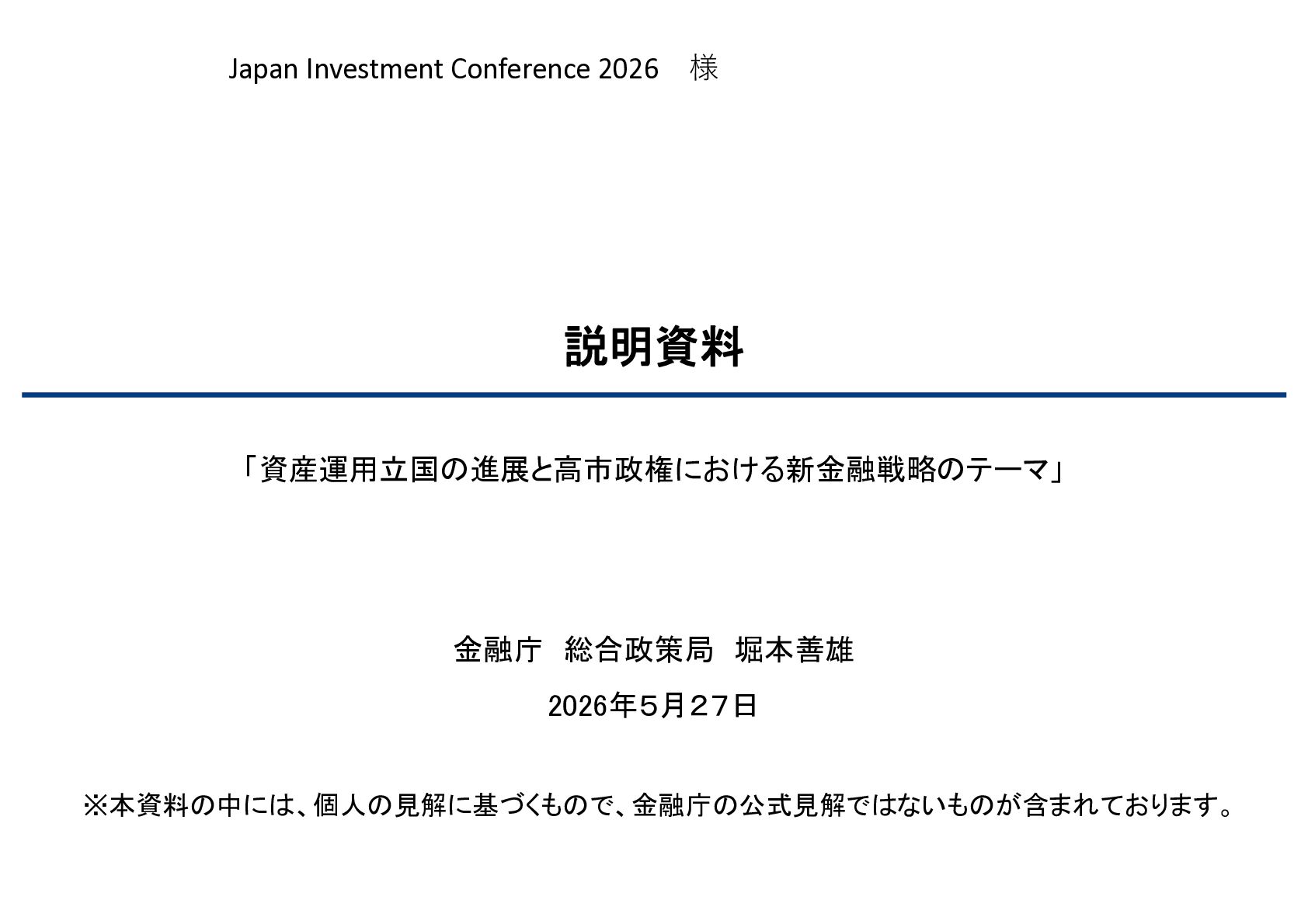
  2. 説明資料 金融庁 総合政策局 堀本善雄 2026年5月27日 「資産運用立国の進展と高市政権における新金融戦略のテーマ」 Japan Investment Conference 2026

    様 ※本資料の中には、個人の見解に基づくもので、金融庁の公式見解ではないものが含まれております。
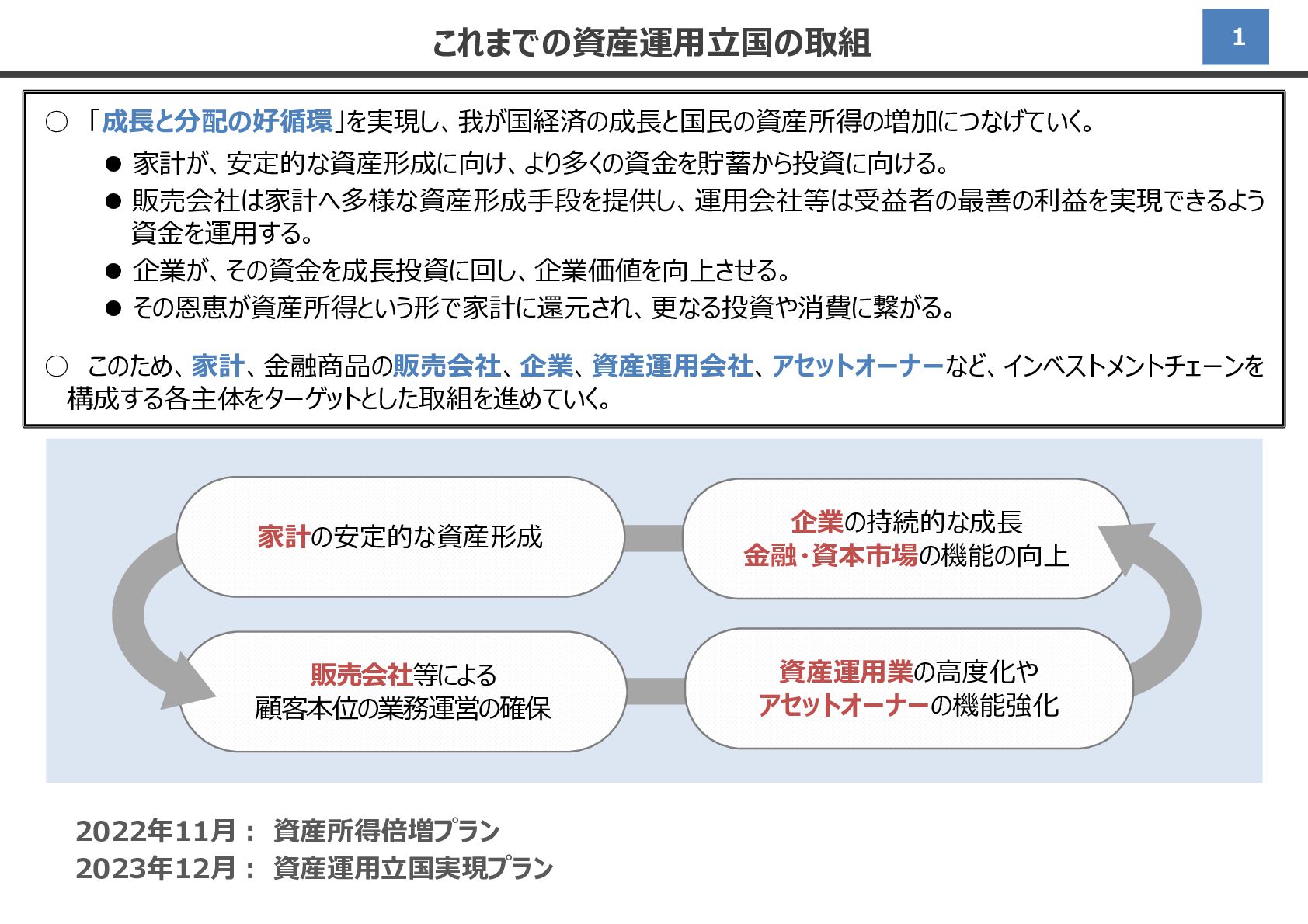
  3. これまでの資産運⽤⽴国の取組 ◦ 「成⻑と分配の好循環」を実現し、我が国経済の成⻑と国⺠の資産所得の増加につなげていく。  家計が、安定的な資産形成に向け、より多くの資⾦を貯蓄から投資に向ける。  販売会社は家計へ多様な資産形成⼿段を提供し、運⽤会社等は受益者の最善の利益を実現できるよう 資⾦を運⽤する。  企業が、その資⾦を成⻑投資に回し、企業価値を向上させる。

     その恩恵が資産所得という形で家計に還元され、更なる投資や消費に繋がる。 ◦ このため、家計、⾦融商品の販売会社、企業、資産運⽤会社、アセットオーナーなど、インベストメントチェーンを 構成する各主体をターゲットとした取組を進めていく。 家計の安定的な資産形成 販売会社等による 顧客本位の業務運営の確保 資産運⽤業の⾼度化や アセットオーナーの機能強化 企業の持続的な成⻑ ⾦融・資本市場の機能の向上 2022年11⽉︓ 資産所得倍増プラン 2023年12⽉︓ 資産運⽤⽴国実現プラン 1
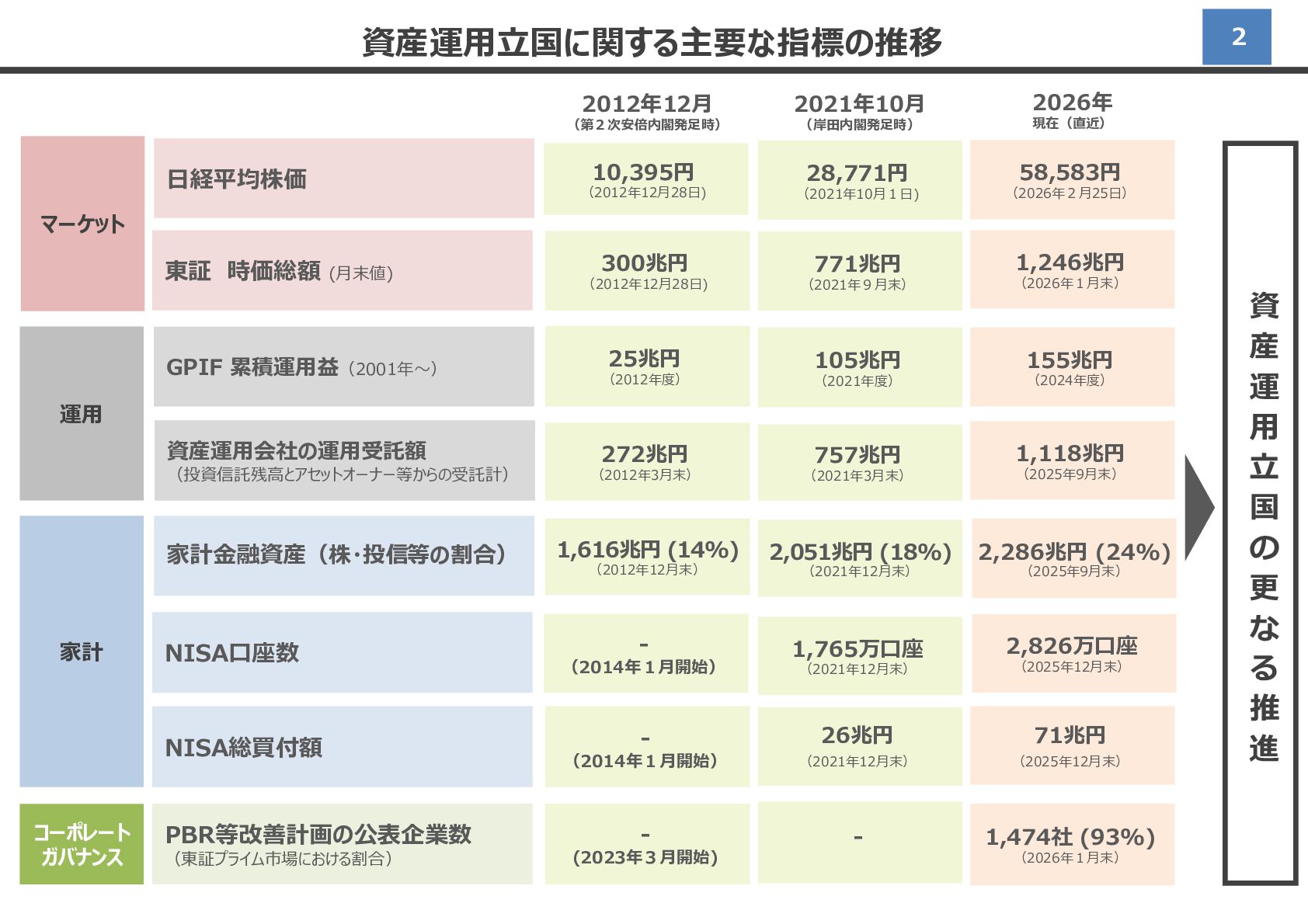
  4. 資産運⽤⽴国に関する主要な指標の推移 マーケット 家計 コーポレート ガバナンス ⽇経平均株価 東証 時価総額 (⽉末値) 家計⾦融資産(株・投信等の割合)

    NISA⼝座数 PBR等改善計画の公表企業数 (東証プライム市場における割合) 2012年12⽉ (第2次安倍内閣発⾜時) 2026年 現在(直近) NISA総買付額 300兆円 (2012年12⽉28⽇) - (2014年1⽉開始) - (2014年1⽉開始) - (2023年3⽉開始) 10,395円 (2012年12⽉28⽇) 1,616兆円 (14%) (2012年12⽉末) 1,246兆円 (2026年1⽉末) 2,826万⼝座 (2025年12⽉末) 71兆円 (2025年12⽉末) 1,474社 (93%) (2026年1⽉末) 2,286兆円 (24%) (2025年9⽉末) 58,583円 (2026年2⽉25⽇) 運⽤ GPIF 累積運⽤益(2001年〜) 25兆円 (2012年度) 155兆円 (2024年度) 資産運⽤会社の運⽤受託額 (投資信託残⾼とアセットオーナー等からの受託計) 272兆円 (2012年3⽉末) 1,118兆円 (2025年9⽉末) 2021年10⽉ (岸⽥内閣発⾜時) 771兆円 (2021年9⽉末) 1,765万⼝座 (2021年12⽉末) 26兆円 (2021年12⽉末) - 28,771円 (2021年10⽉1⽇) 2,051兆円 (18%) (2021年12⽉末) 105兆円 (2021年度) 757兆円 (2021年3⽉末) 資 産 運 ⽤ ⽴ 国 更 推 進 2
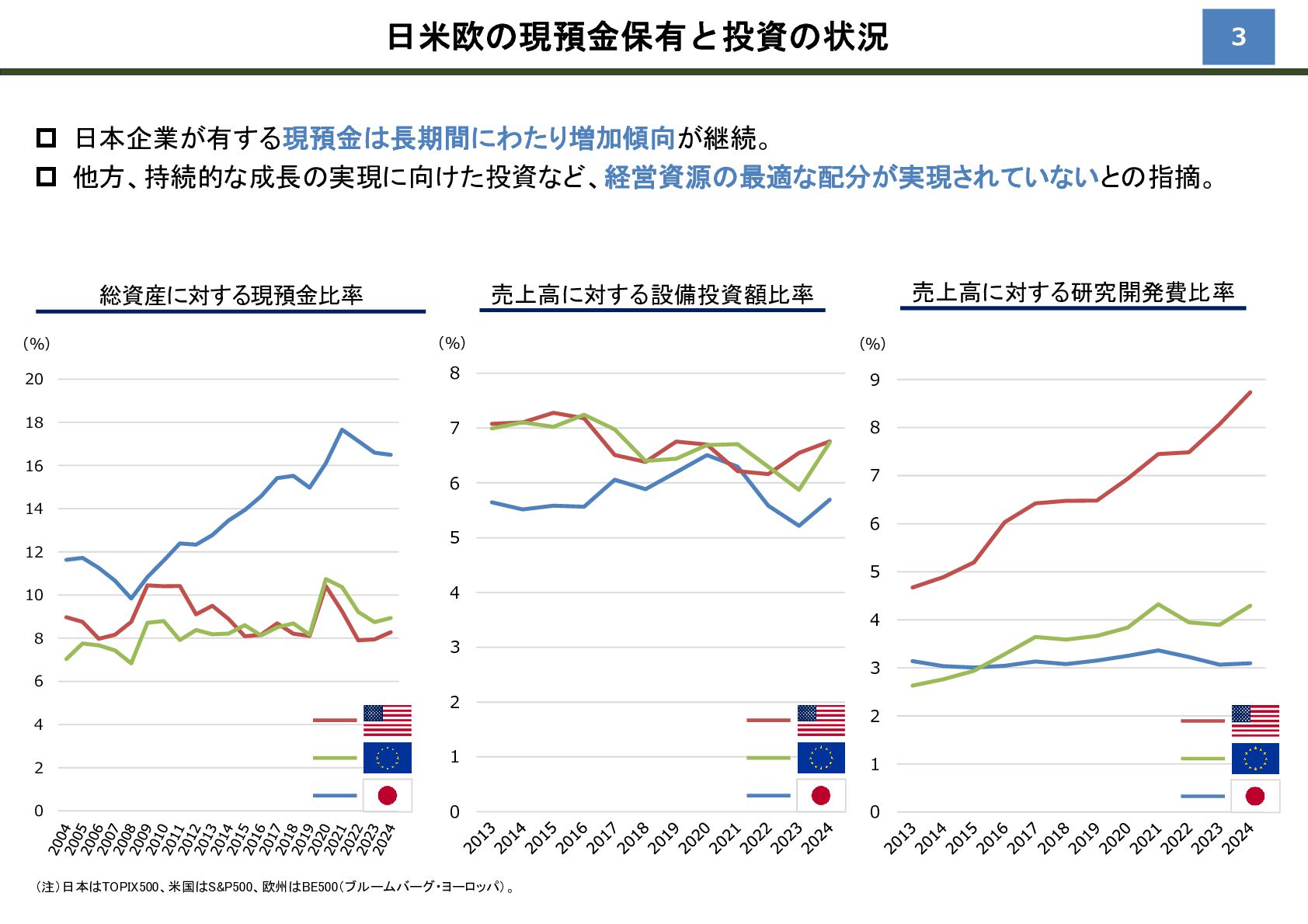
  5. 日米欧の現預金保有と投資の状況  日本企業が有する現預金は長期間にわたり増加傾向が継続。  他方、持続的な成長の実現に向けた投資など、経営資源の最適な配分が実現されていないとの指摘。 0 1 2 3 4

    5 6 7 8 0 1 2 3 4 5 6 7 8 9 売上高に対する設備投資額比率 売上高に対する研究開発費比率 (%) (%) 総資産に対する現預金比率 (注)日本はTOPIX500、米国はS&P500、欧州はBE500(ブルームバーグ・ヨーロッパ)。 0 2 4 6 8 10 12 14 16 18 20 (%) 3 3
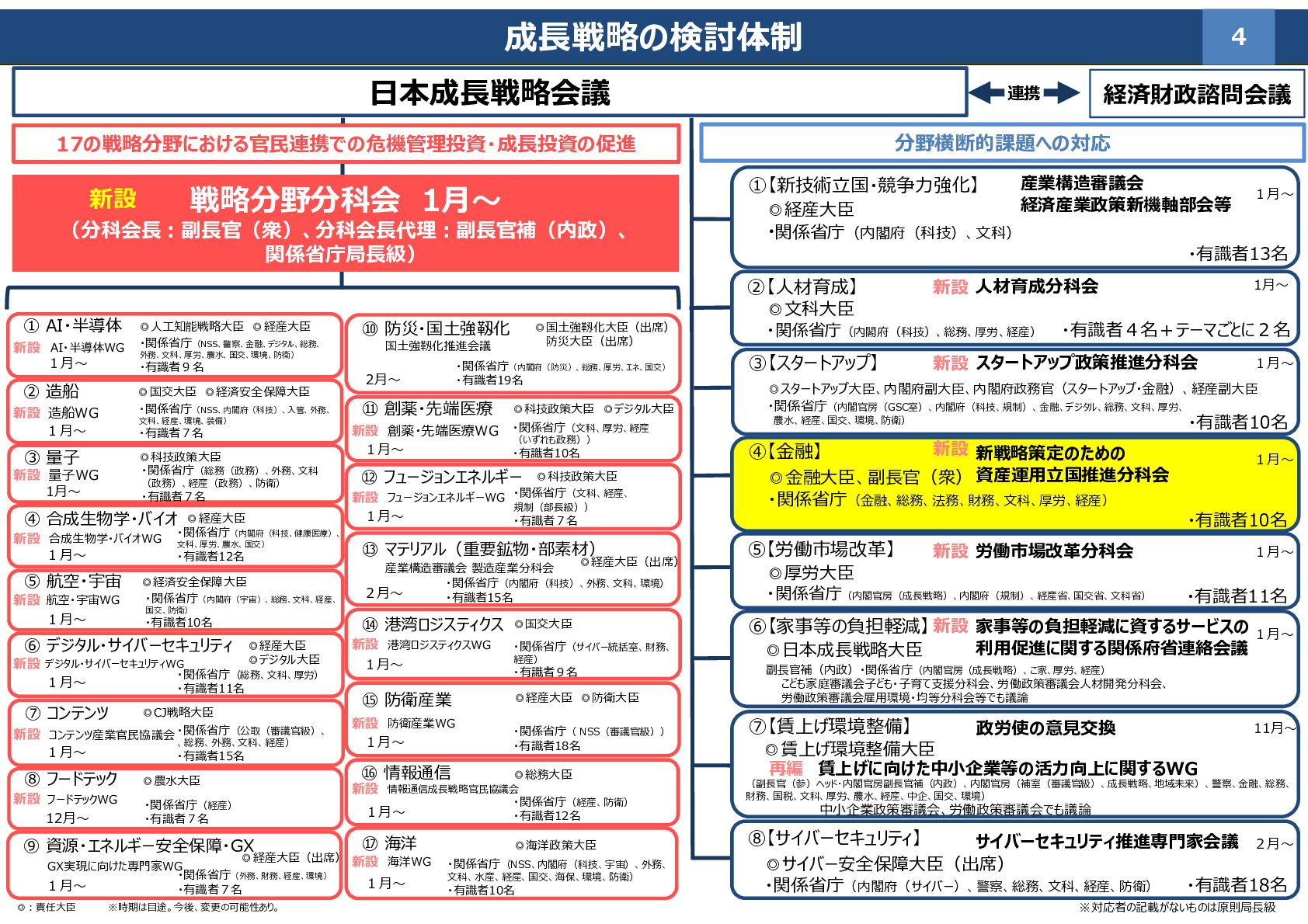
  6. ⑧【サイバーセキュリティ】 ④【⾦融】 ⽇本成⻑戦略会議 成⻑戦略の検討体制 戦略分野分科会 1⽉〜 (分科会⻑︓副⻑官(衆)、分科会⻑代理︓副⻑官補(内政)、 関係省庁局⻑級) 新設 ・関係省庁(経産、防衛)

    ・有識者12名 ◎⾦融⼤⾂、副⻑官(衆) ・関係省庁(⾦融、総務、法務、財務、⽂科、厚労、経産) ・有識者10名 ①【新技術⽴国・競争⼒強化】 ◎サイバー安全保障⼤⾂(出席) ・関係省庁(内閣府(サイバー)、警察、総務、⽂科、経産、防衛) ・有識者18名 ②【⼈材育成】 ③【スタートアップ】 ⑤【労働市場改⾰】 ⑥【家事等の負担軽減】 ⑦【賃上げ環境整備】 ・関係省庁(内閣府(科技)、⽂科) ・有識者13名 ◎⽂科⼤⾂ ・関係省庁(内閣府(科技)、総務、厚労、経産) ・有識者4名+テーマごとに2名 1⽉〜 1⽉〜 ◎スタートアップ⼤⾂、内閣府副⼤⾂、内閣府政務官(スタートアップ・⾦融)、経産副⼤⾂ ・関係省庁(内閣官房(GSC室)、内閣府(科技、規制)、⾦融、デジタル、総務、⽂科、厚労、 農⽔、経産、国交、環境、防衛) 1⽉〜 1⽉〜 ◎厚労⼤⾂ ・関係省庁(内閣官房(成⻑戦略)、内閣府(規制)、経産省、国交省、⽂科省) 副⻑官補(内政)・関係省庁(内閣官房(成⻑戦略)、こ家、厚労、経産) こども家庭審議会⼦ども・⼦育て⽀援分科会、労働政策審議会⼈材開発分科会、 労働政策審議会雇⽤環境・均等分科会等でも議論 新設 新設 新設 新設 新設 1⽉〜 11⽉〜 2⽉〜 スタートアップ政策推進分科会 中⼩企業政策審議会、労働政策審議会でも議論 賃上げに向けた中⼩企業等の活⼒向上に関するWG 再編 ◎経産⼤⾂ 1⽉〜 経済財政諮問会議 連携 17の戦略分野における官⺠連携での危機管理投資・成⻑投資の促進 分野横断的課題への対応 ⼈材育成分科会 新戦略策定のための 資産運⽤⽴国推進分科会 労働市場改⾰分科会 家事等の負担軽減に資するサービスの 利⽤促進に関する関係府省連絡会議 政労使の意⾒交換 サイバーセキュリティ推進専⾨家会議 ※対応者の記載がないものは原則局⻑級 ⑰ 海洋 ・関係省庁(NSS、内閣府(科技、宇宙)、外務、 ⽂科、⽔産、経産、国交、海保、環境、防衛) ・有識者10名 1⽉〜 新設 海洋WG 産業構造審議会 経済産業政策新機軸部会等 ◎⽇本成⻑戦略⼤⾂ ⑩ 防災・国⼟強靱化 ◎国⼟強靱化⼤⾂(出席) 防災⼤⾂(出席) 2⽉〜 国⼟強靱化推進会議 ・関係省庁(内閣府(防災)、総務、厚労、エネ、国交) ・有識者19名 ◎賃上げ環境整備⼤⾂ ◎︓責任⼤⾂ ① AI・半導体 ・関係省庁(NSS、警察、⾦融、デジタル、総務、 外務、⽂科、厚労、農⽔、国交、環境、防衛) ・有識者9名 1⽉〜 新設 AI・半導体WG ◎⼈⼯知能戦略⼤⾂ ◎経産⼤⾂ ② 造船 新設 造船WG ・関係省庁(NSS、内閣府(科技)、⼊管、外務、 ⽂科、経産、環境、装備) ・有識者7名 1⽉〜 ◎国交⼤⾂ ◎経済安全保障⼤⾂ ⑧ フードテック ・関係省庁(経産) ・有識者7名 12⽉〜 新設 フードテックWG ◎農⽔⼤⾂ ③ 量⼦ ・関係省庁(総務(政務)、外務、⽂科 (政務)、経産(政務)、防衛) ・有識者7名 1⽉〜 新設 量⼦WG ◎科技政策⼤⾂ ④ 合成⽣物学・バイオ ・関係省庁(内閣府(科技、健康医療)、 ⽂科、厚労、農⽔、国交) ・有識者12名 1⽉〜 合成⽣物学・バイオWG 新設 ◎経産⼤⾂ ⑤ 航空・宇宙 ・関係省庁(内閣府(宇宙)、総務、⽂科、経産、 国交、防衛) ・有識者10名 新設 1⽉〜 航空・宇宙WG ◎経済安全保障⼤⾂ ⑥ デジタル・サイバーセキュリティ ・関係省庁(総務、⽂科、厚労) ・有識者11名 1⽉〜 新設 デジタル・サイバーセキュリティWG ◎経産⼤⾂ ◎デジタル⼤⾂ ⑦ コンテンツ ・関係省庁(公取(審議官級)、 、総務、外務、⽂科、経産) ・有識者15名 1⽉〜 新設 コンテンツ産業官⺠協議会 ◎CJ戦略⼤⾂ ⑨ 資源・エネルギー安全保障・GX ・関係省庁(外務、財務、経産、環境) ・有識者7名 1⽉〜 GX実現に向けた専⾨家WG ◎経産⼤⾂(出席) ⑪ 創薬・先端医療 ・関係省庁(⽂科、厚労、経産 (いずれも政務)) ・有識者10名 1⽉〜 新設 創薬・先端医療WG ◎科技政策⼤⾂ ◎デジタル⼤⾂ ⑫ フュージョンエネルギー ・関係省庁(⽂科、経産、 規制(部⻑級)) ・有識者7名 1⽉〜 フュージョンエネルギーWG 新設 ◎科技政策⼤⾂ ⑬ マテリアル(重要鉱物・部素材) ・関係省庁(内閣府(科技)、外務、⽂科、環境) ・有識者15名 2⽉〜 産業構造審議会 製造産業分科会 ◎経産⼤⾂(出席) ⑭ 港湾ロジスティクス ・関係省庁(サイバー統括室、財務、 経産) ・有識者9名 1⽉〜 新設 港湾ロジスティクスWG ◎国交⼤⾂ ⑮ 防衛産業 ・関係省庁( NSS(審議官級)) ・有識者18名 1⽉〜 防衛産業WG 新設 ◎経産⼤⾂ ◎防衛⼤⾂ ⑯ 情報通信 1⽉〜 情報通信成⻑戦略官⺠協議会 新設 ◎総務⼤⾂ ◎海洋政策⼤⾂ (副⻑官(参)ヘッド・内閣官房副⻑官補(内政)、内閣官房(補室(審議官級)、成⻑戦略、地域未来)、警察、⾦融、総務、 財務、国税、⽂科、厚労、農⽔、経産、中企、国交、環境) ・有識者10名 ・有識者11名 ※時期は⽬途。今後、変更の可能性あり。 4
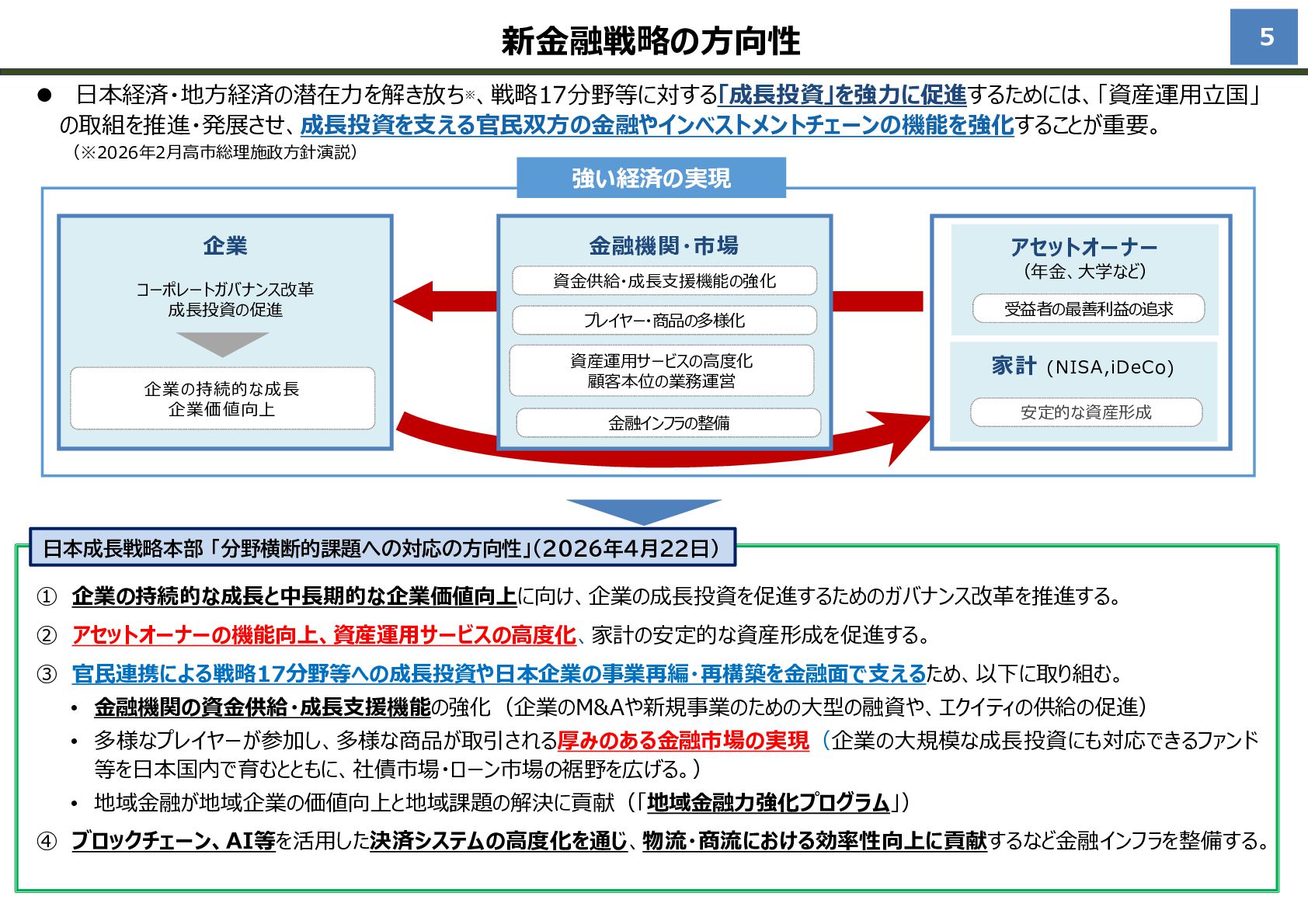
  7. 新⾦融戦略の⽅向性 ① 企業の持続的な成⻑と中⻑期的な企業価値向上に向け、企業の成⻑投資を促進するためのガバナンス改⾰を推進する。 ② アセットオーナーの機能向上、資産運⽤サービスの⾼度化、家計の安定的な資産形成を促進する。 ③ 官⺠連携による戦略17分野等への成⻑投資や⽇本企業の事業再編・再構築を⾦融⾯で⽀えるため、以下に取り組む。 • ⾦融機関の資⾦供給・成⻑⽀援機能の強化(企業のM&Aや新規事業のための⼤型の融資や、エクイティの供給の促進) •

    多様なプレイヤーが参加し、多様な商品が取引される厚みのある⾦融市場の実現(企業の⼤規模な成⻑投資にも対応できるファンド 等を⽇本国内で育むとともに、社債市場・ローン市場の裾野を広げる。) • 地域⾦融が地域企業の価値向上と地域課題の解決に貢献(「地域⾦融⼒強化プログラム」) ④ ブロックチェーン、AI等を活⽤した決済システムの⾼度化を通じ、物流・商流における効率性向上に貢献するなど⾦融インフラを整備する。 企業の持続的な成⻑ 企業価値向上 家計 (NISA,iDeCo) アセットオーナー (年⾦、⼤学など) 安定的な資産形成 受益者の最善利益の追求 コーポレートガバナンス改⾰ 成⻑投資の促進 資産運⽤サービスの⾼度化 顧客本位の業務運営 企業 強い経済の実現 プレイヤー・商品の多様化 資⾦供給・成⻑⽀援機能の強化 ⾦融機関・市場 ⾦融インフラの整備  ⽇本経済・地⽅経済の潜在⼒を解き放ち※、戦略17分野等に対する「成⻑投資」を強⼒に促進するためには、「資産運⽤⽴国」 の取組を推進・発展させ、成⻑投資を⽀える官⺠双⽅の⾦融やインベストメントチェーンの機能を強化することが重要。 (※2026年2⽉⾼市総理施政⽅針演説) 5 日本成長戦略本部 「分野横断的課題への対応の方向性」(2026年4月22日)
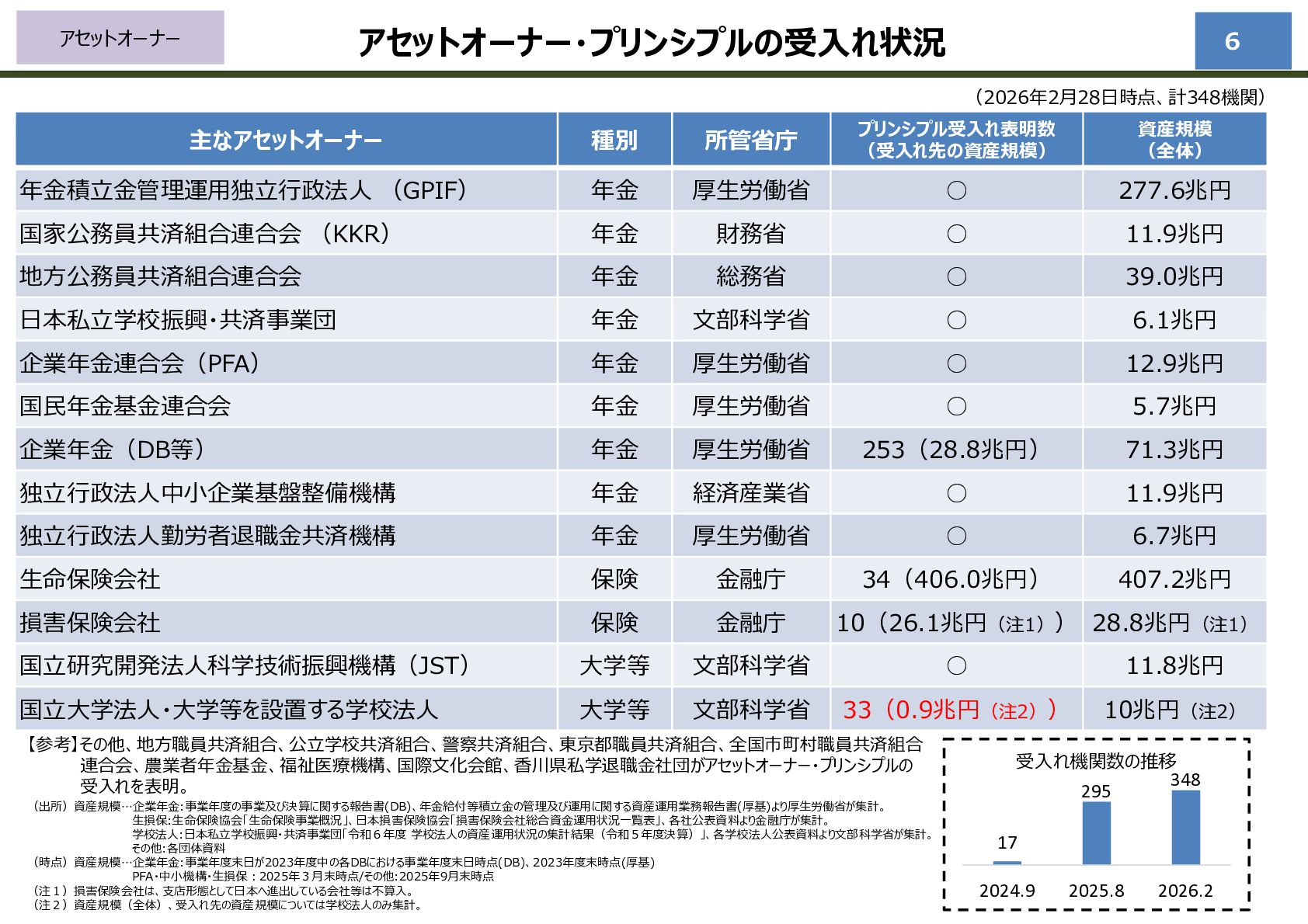
  8. アセットオーナー・プリンシプルの受⼊れ状況 資産規模 (全体) プリンシプル受⼊れ表明数 (受⼊れ先の資産規模) 所管省庁 種別 主なアセットオーナー 277.6兆円 ◦

    厚⽣労働省 年⾦ 年⾦積⽴⾦管理運⽤独⽴⾏政法⼈ (GPIF) 11.9兆円 ◦ 財務省 年⾦ 国家公務員共済組合連合会 (KKR) 39.0兆円 ◦ 総務省 年⾦ 地⽅公務員共済組合連合会 6.1兆円 ◦ ⽂部科学省 年⾦ ⽇本私⽴学校振興・共済事業団 12.9兆円 ◦ 厚⽣労働省 年⾦ 企業年⾦連合会(PFA) 5.7兆円 ◦ 厚⽣労働省 年⾦ 国⺠年⾦基⾦連合会 71.3兆円 253(28.8兆円) 厚⽣労働省 年⾦ 企業年⾦(DB等) 11.9兆円 ◦ 経済産業省 年⾦ 独⽴⾏政法⼈中⼩企業基盤整備機構 6.7兆円 ◦ 厚⽣労働省 年⾦ 独⽴⾏政法⼈勤労者退職⾦共済機構 407.2兆円 34(406.0兆円) ⾦融庁 保険 ⽣命保険会社 28.8兆円(注1) 10(26.1兆円(注1)) ⾦融庁 保険 損害保険会社 11.8兆円 ◦ ⽂部科学省 ⼤学等 国⽴研究開発法⼈科学技術振興機構(JST) 10兆円(注2) 33(0.9兆円(注2)) ⽂部科学省 ⼤学等 国⽴⼤学法⼈・⼤学等を設置する学校法⼈ 【参考】その他、地⽅職員共済組合、公⽴学校共済組合、警察共済組合、東京都職員共済組合、全国市町村職員共済組合 連合会、農業者年⾦基⾦、福祉医療機構、国際⽂化会館、⾹川県私学退職⾦社団がアセットオーナー・プリンシプルの 受⼊れを表明。 (2026年2⽉28⽇時点、計348機関) (出所)資産規模…企業年⾦:事業年度の事業及び決算に関する報告書(DB)、年⾦給付等積⽴⾦の管理及び運⽤に関する資産運⽤業務報告書(厚基)より厚⽣労働省が集計。 ⽣損保:⽣命保険協会「⽣命保険事業概況」、⽇本損害保険協会「損害保険会社総合資⾦運⽤状況⼀覧表」、各社公表資料より⾦融庁が集計。 学校法⼈:⽇本私⽴学校振興・共済事業団「令和6年度 学校法⼈の資産運⽤状況の集計結果(令和5年度決算)」、各学校法⼈公表資料より⽂部科学省が集計。 その他:各団体資料 (時点)資産規模…企業年⾦:事業年度末⽇が2023年度中の各DBにおける事業年度末⽇時点(DB)、2023年度末時点(厚基) PFA・中⼩機構・⽣損保︓2025年3⽉末時点/その他:2025年9⽉末時点 (注1)損害保険会社は、⽀店形態として⽇本へ進出している会社等は不算⼊。 (注2)資産規模(全体)、受⼊れ先の資産規模については学校法⼈のみ集計。 17 295 348 2024.9 2025.8 2026.2 受⼊れ機関数の推移 6 アセットオーナー
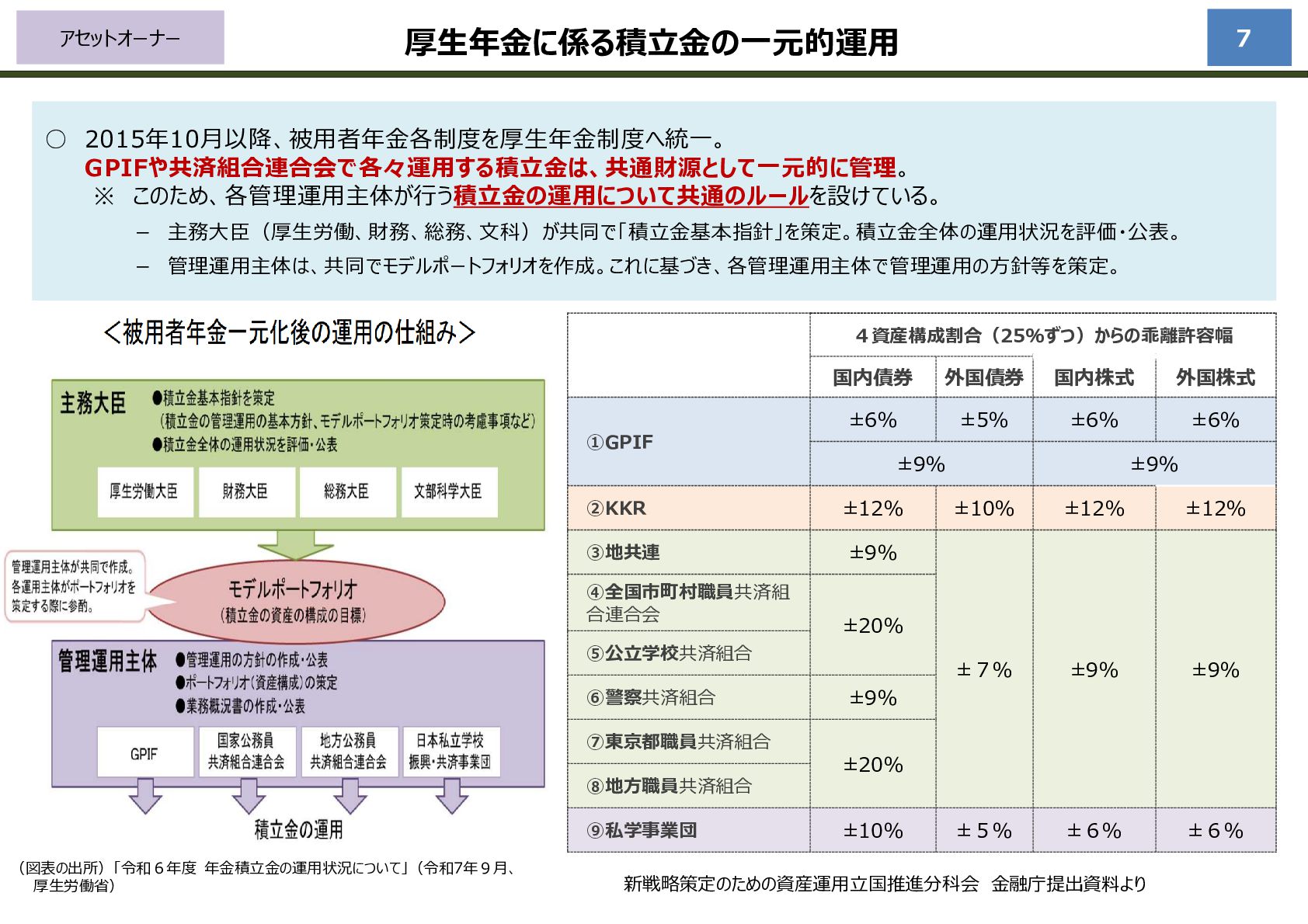
  9. 厚⽣年⾦に係る積⽴⾦の⼀元的運⽤ ◦ 2015年10⽉以降、被⽤者年⾦各制度を厚⽣年⾦制度へ統⼀。 GPIFや共済組合連合会で各々運⽤する積⽴⾦は、共通財源として⼀元的に管理。 ※ このため、各管理運⽤主体が⾏う積⽴⾦の運⽤について共通のルールを設けている。 - 主務⼤⾂(厚⽣労働、財務、総務、⽂科)が共同で「積⽴⾦基本指針」を策定。積⽴⾦全体の運⽤状況を評価・公表。 - 管理運⽤主体は、共同でモデルポートフォリオを作成。これに基づき、各管理運⽤主体で管理運⽤の⽅針等を策定。

    (図表の出所)「令和6年度 年⾦積⽴⾦の運⽤状況について」(令和7年9⽉、 厚⽣労働省) 7 アセットオーナー 4資産構成割合(25%ずつ)からの乖離許容幅 外国株式 国内株式 外国債券 国内債券 ±6% ±6% ±5% ±6% ①GPIF ±9% ±9% ±12% ±12% ±10% ±12% ②KKR ±9% ±9% ±7% ±9% ③地共連 ±20% ④全国市町村職員共済組 合連合会 ⑤公⽴学校共済組合 ±9% ⑥警察共済組合 ±20% ⑦東京都職員共済組合 ⑧地⽅職員共済組合 ±6% ±6% ±5% ±10% ⑨私学事業団 新戦略策定のための資産運⽤⽴国推進分科会 ⾦融庁提出資料より
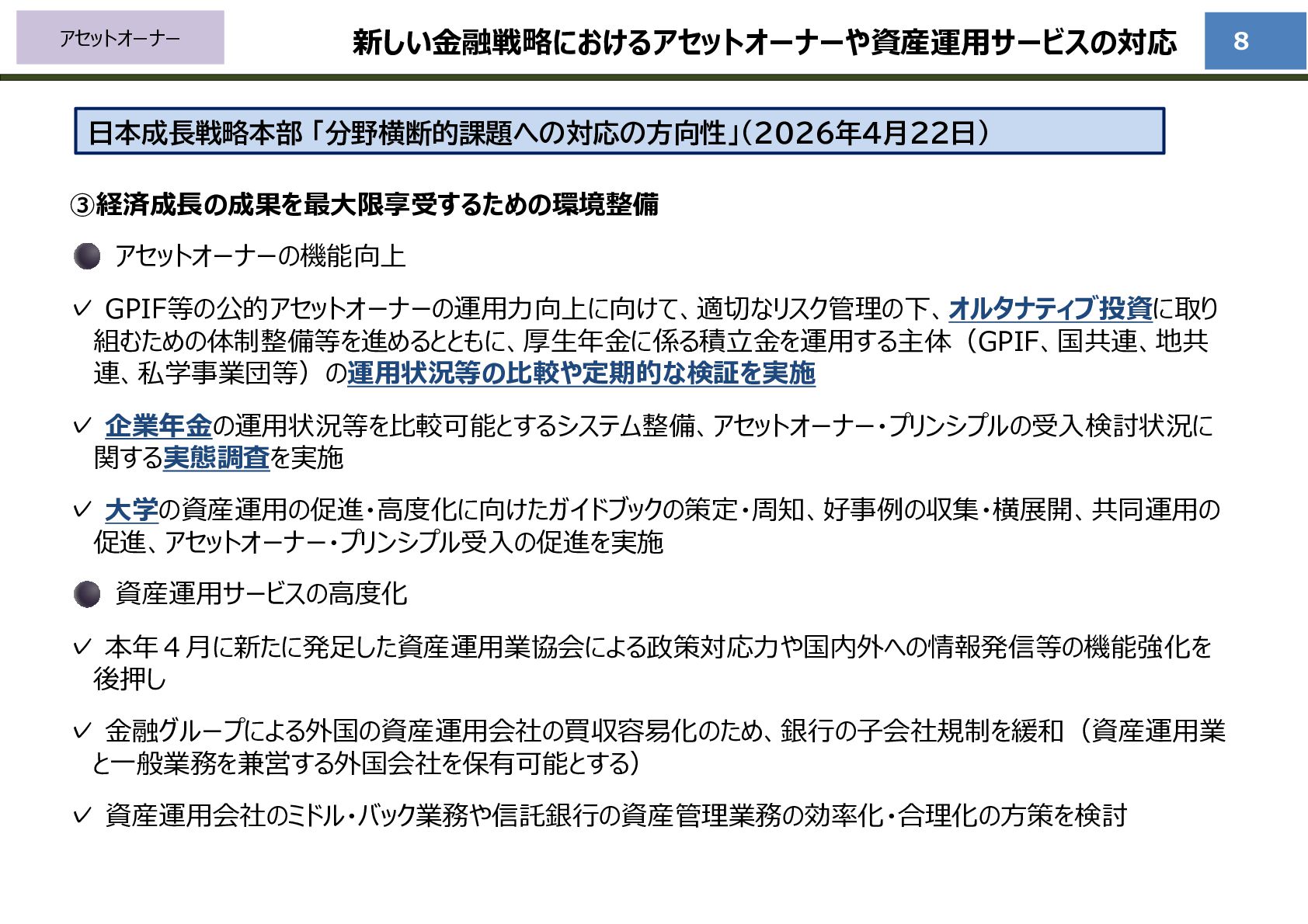
  10. 8 ③経済成⻑の成果を最⼤限享受するための環境整備 アセットオーナーの機能向上 ✓ GPIF等の公的アセットオーナーの運⽤⼒向上に向けて、適切なリスク管理の下、オルタナティブ投資に取り 組むための体制整備等を進めるとともに、厚⽣年⾦に係る積⽴⾦を運⽤する主体(GPIF、国共連、地共 連、私学事業団等)の運⽤状況等の⽐較や定期的な検証を実施 ✓ 企業年⾦の運⽤状況等を⽐較可能とするシステム整備、アセットオーナー・プリンシプルの受⼊検討状況に 関する実態調査を実施

    ✓ ⼤学の資産運⽤の促進・⾼度化に向けたガイドブックの策定・周知、好事例の収集・横展開、共同運⽤の 促進、アセットオーナー・プリンシプル受⼊の促進を実施 資産運⽤サービスの⾼度化 ✓ 本年4⽉に新たに発⾜した資産運⽤業協会による政策対応⼒や国内外への情報発信等の機能強化を 後押し ✓ ⾦融グループによる外国の資産運⽤会社の買収容易化のため、銀⾏の⼦会社規制を緩和(資産運⽤業 と⼀般業務を兼営する外国会社を保有可能とする) ✓ 資産運⽤会社のミドル・バック業務や信託銀⾏の資産管理業務の効率化・合理化の⽅策を検討 新しい⾦融戦略におけるアセットオーナーや資産運⽤サービスの対応 アセットオーナー 日本成長戦略本部 「分野横断的課題への対応の方向性」(2026年4月22日)
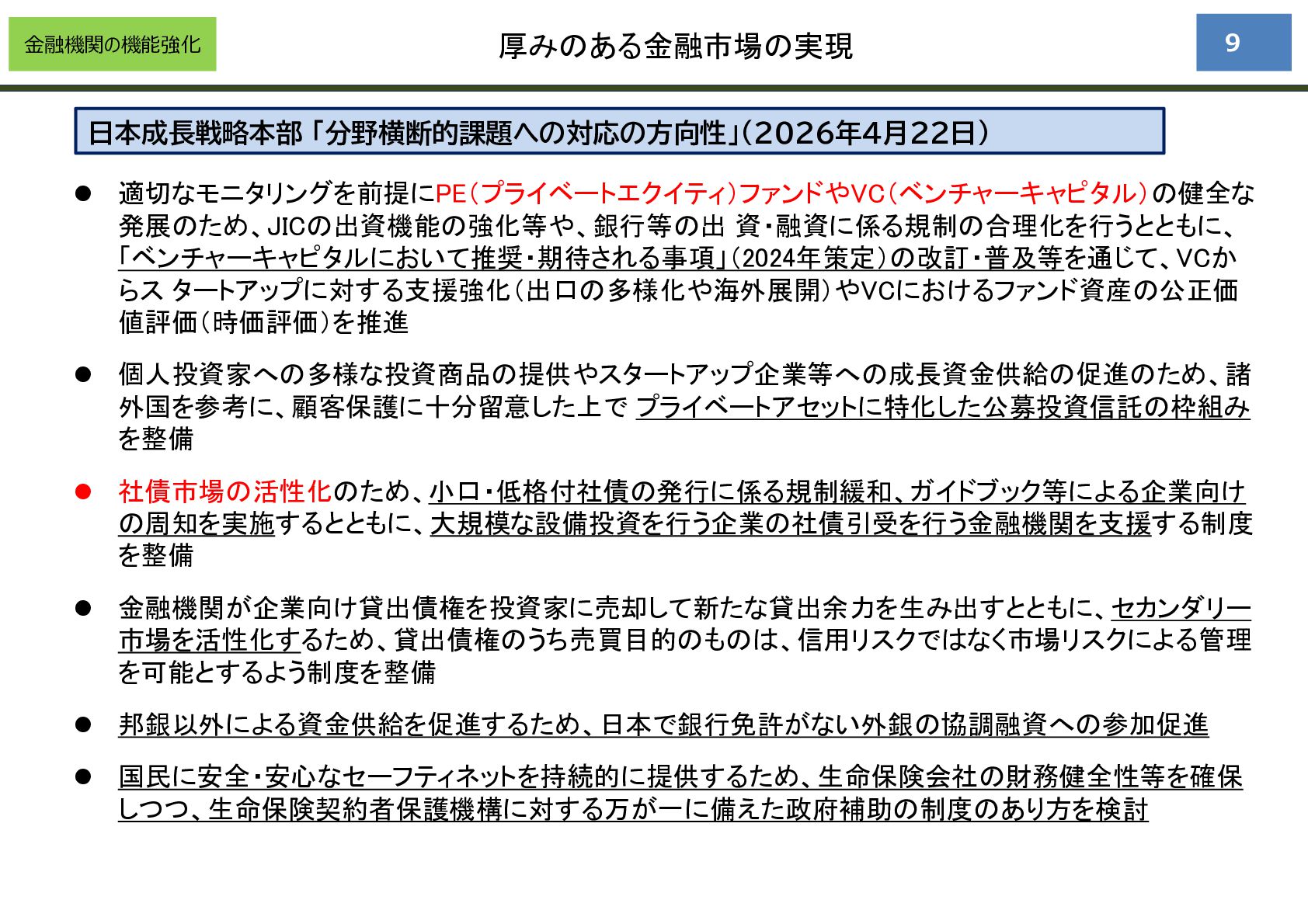
  11.  適切なモニタリングを前提にPE(プライベートエクイティ)ファンドやVC(ベンチャーキャピタル)の健全な 発展のため、JICの出資機能の強化等や、銀行等の出 資・融資に係る規制の合理化を行うとともに、 「ベンチャーキャピタルにおいて推奨・期待される事項」(2024年策定)の改訂・普及等を通じて、VCか らス タートアップに対する支援強化(出口の多様化や海外展開)やVCにおけるファンド資産の公正価 値評価(時価評価)を推進  個人投資家への多様な投資商品の提供やスタートアップ企業等への成長資金供給の促進のため、諸

    外国を参考に、顧客保護に十分留意した上で プライベートアセットに特化した公募投資信託の枠組み を整備  社債市場の活性化のため、小口・低格付社債の発行に係る規制緩和、ガイドブック等による企業向け の周知を実施するとともに、大規模な設備投資を行う企業の社債引受を行う金融機関を支援する制度 を整備  金融機関が企業向け貸出債権を投資家に売却して新たな貸出余力を生み出すとともに、セカンダリー 市場を活性化するため、貸出債権のうち売買目的のものは、信用リスクではなく市場リスクによる管理 を可能とするよう制度を整備  邦銀以外による資金供給を促進するため、日本で銀行免許がない外銀の協調融資への参加促進  国民に安全・安心なセーフティネットを持続的に提供するため、生命保険会社の財務健全性等を確保 しつつ、生命保険契約者保護機構に対する万が一に備えた政府補助の制度のあり方を検討 厚みのある金融市場の実現 ⾦融機関の機能強化 9 日本成長戦略本部 「分野横断的課題への対応の方向性」(2026年4月22日)
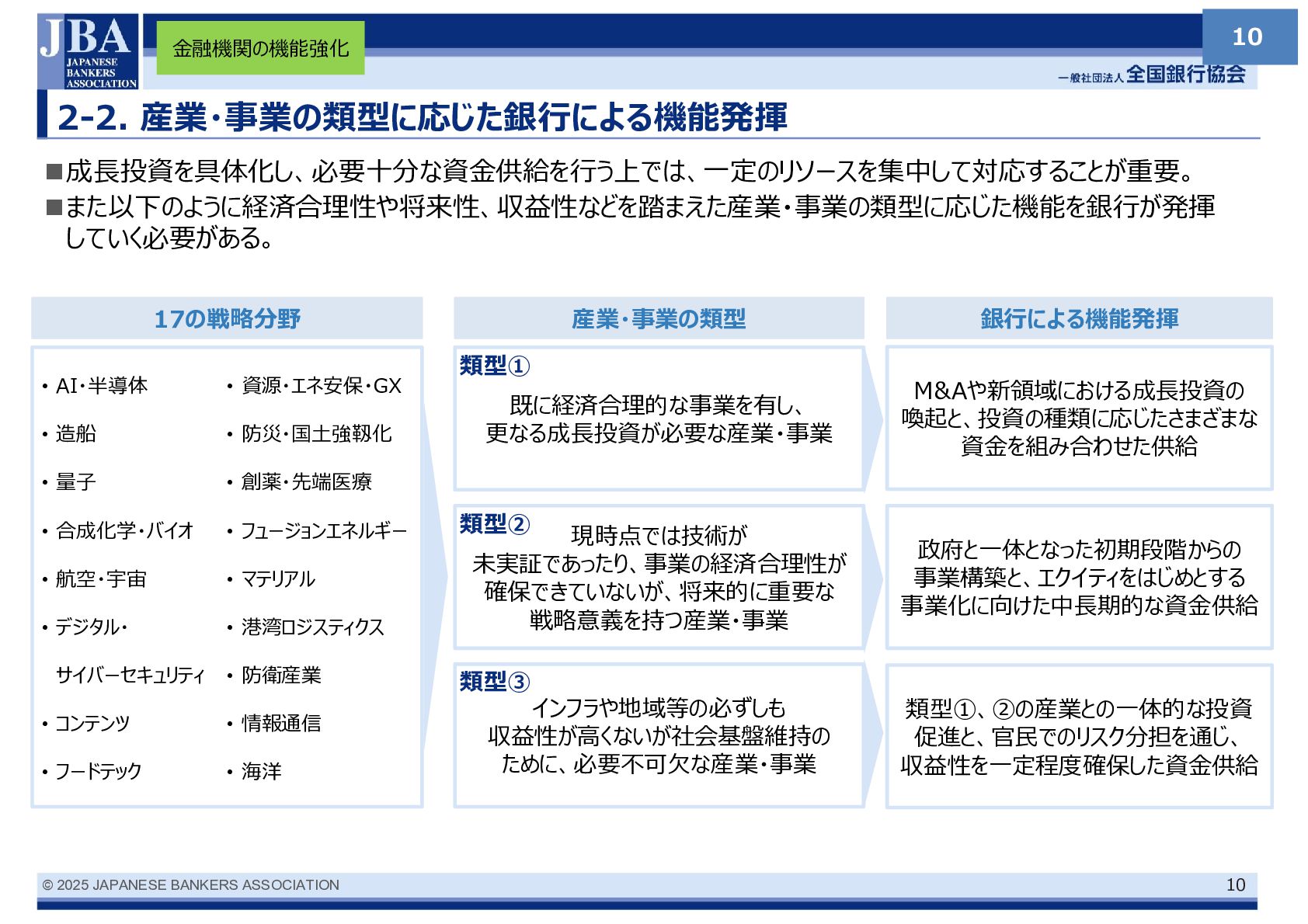
  12. © 2025 JAPANESE BANKERS ASSOCIATION 10 2-2. 産業・事業の類型に応じた銀⾏による機能発揮 • AI・半導体

    • 造船 • 量⼦ • 合成化学・バイオ • 航空・宇宙 • デジタル・ サイバーセキュリティ • コンテンツ • フードテック • 資源・エネ安保・GX • 防災・国⼟強靱化 • 創薬・先端医療 • フュージョンエネルギー • マテリアル • 港湾ロジスティクス • 防衛産業 • 情報通信 • 海洋 銀⾏による機能発揮 産業・事業の類型 既に経済合理的な事業を有し、 更なる成⻑投資が必要な産業・事業 現時点では技術が 未実証であったり、事業の経済合理性が 確保できていないが、将来的に重要な 戦略意義を持つ産業・事業 インフラや地域等の必ずしも 収益性が⾼くないが社会基盤維持の ために、必要不可⽋な産業・事業 M&Aや新領域における成⻑投資の 喚起と、投資の種類に応じたさまざまな 資⾦を組み合わせた供給 政府と⼀体となった初期段階からの 事業構築と、エクイティをはじめとする 事業化に向けた中⻑期的な資⾦供給 類型①、②の産業との⼀体的な投資 促進と、官⺠でのリスク分担を通じ、 収益性を⼀定程度確保した資⾦供給 17の戦略分野 類型① 成⻑投資を具体化し、必要⼗分な資⾦供給を⾏う上では、⼀定のリソースを集中して対応することが重要。 また以下のように経済合理性や将来性、収益性などを踏まえた産業・事業の類型に応じた機能を銀⾏が発揮 していく必要がある。 類型② 類型③ 10 ⾦融機関の機能強化
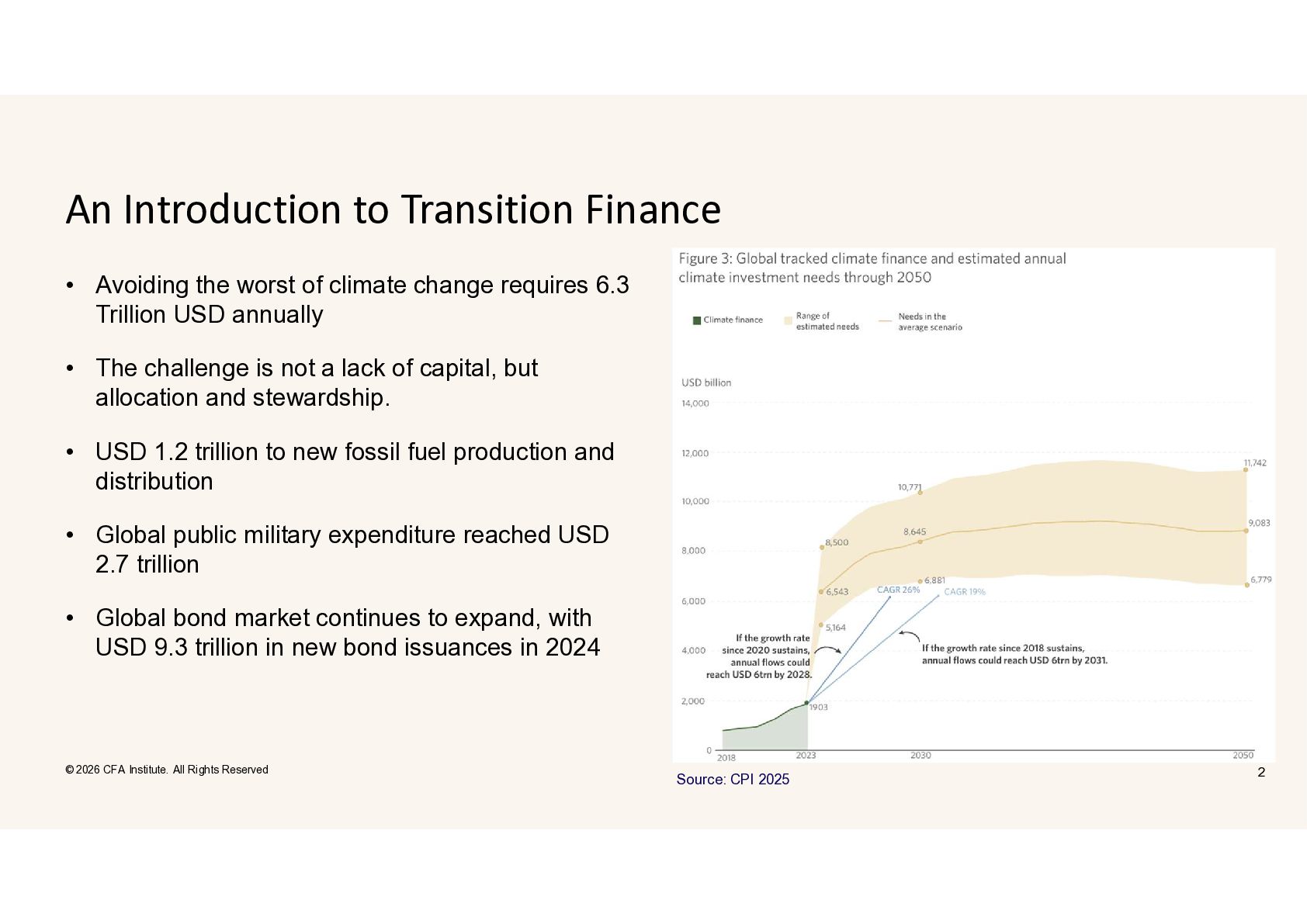
  13. An Introduction to Transition Finance • Avoiding the worst of

    climate change requires 6.3 Trillion USD annually • The challenge is not a lack of capital, but allocation and stewardship. • USD 1.2 trillion to new fossil fuel production and distribution • Global public military expenditure reached USD 2.7 trillion • Global bond market continues to expand, with USD 9.3 trillion in new bond issuances in 2024 © 2026 CFA Institute. All Rights Reserved 2 Source: CPI 2025
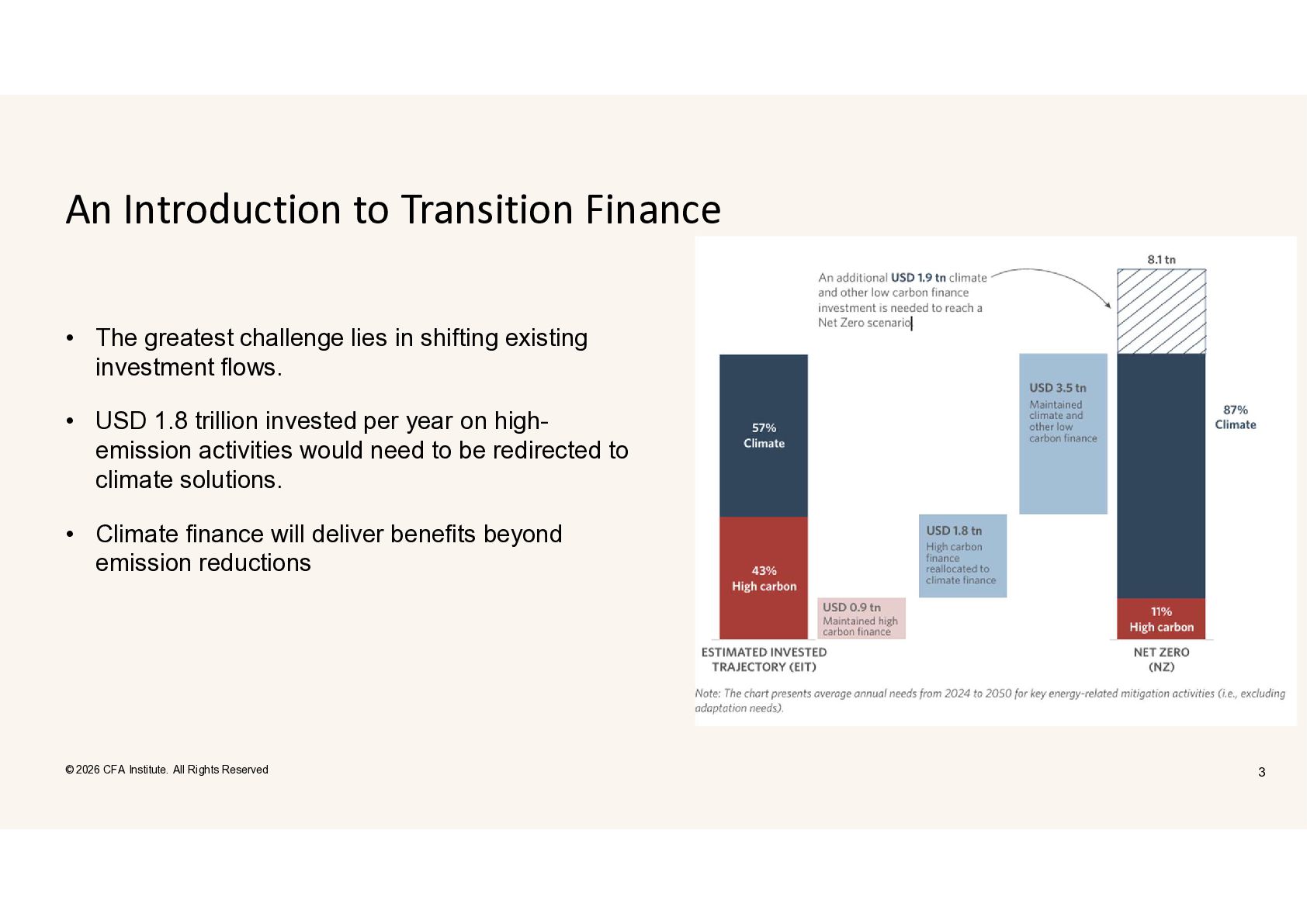
  14. An Introduction to Transition Finance • The greatest challenge lies

    in shifting existing investment flows. • USD 1.8 trillion invested per year on high- emission activities would need to be redirected to climate solutions. • Climate finance will deliver benefits beyond emission reductions © 2026 CFA Institute. All Rights Reserved 3
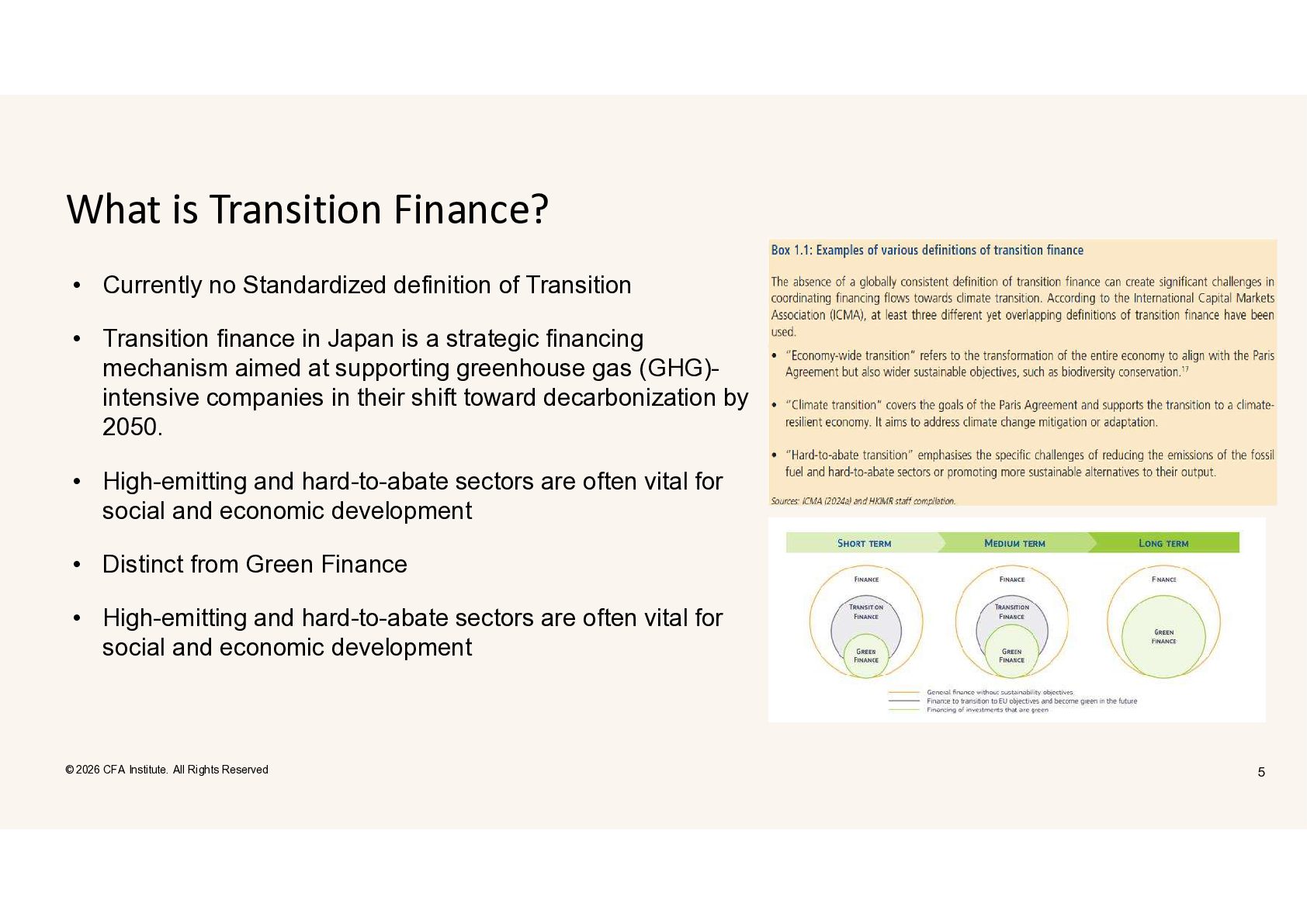
  15. What is Transition Finance? • Currently no Standardized definition of

    Transition • Transition finance in Japan is a strategic financing mechanism aimed at supporting greenhouse gas (GHG)- intensive companies in their shift toward decarbonization by 2050. • High-emitting and hard-to-abate sectors are often vital for social and economic development • Distinct from Green Finance • High-emitting and hard-to-abate sectors are often vital for social and economic development © 2026 CFA Institute. All Rights Reserved 5
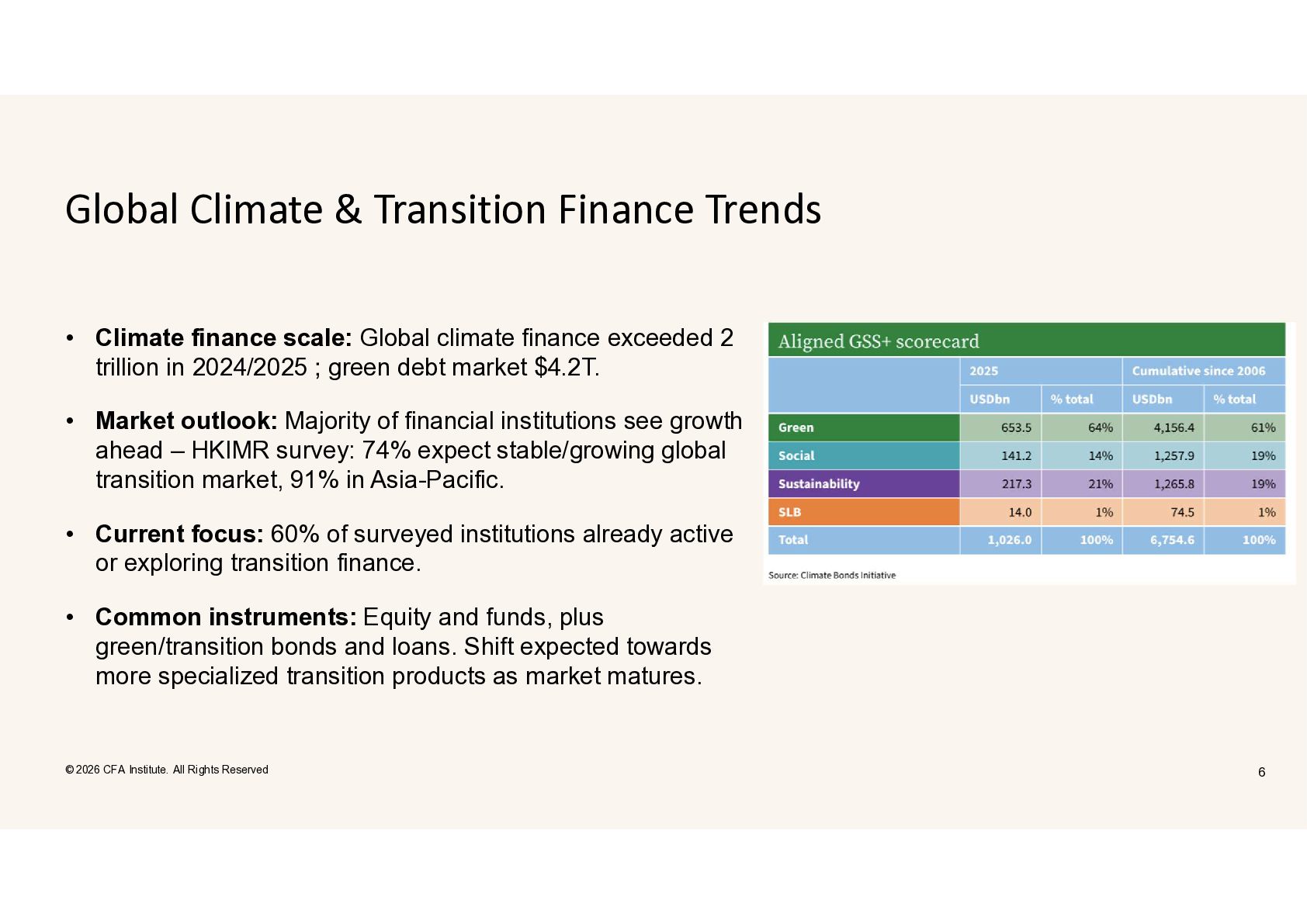
  16. Global Climate & Transition Finance Trends • Climate finance scale:

    Global climate finance exceeded 2 trillion in 2024/2025 ; green debt market $4.2T. • Market outlook: Majority of financial institutions see growth ahead – HKIMR survey: 74% expect stable/growing global transition market, 91% in Asia-Pacific. • Current focus: 60% of surveyed institutions already active or exploring transition finance. • Common instruments: Equity and funds, plus green/transition bonds and loans. Shift expected towards more specialized transition products as market matures. © 2026 CFA Institute. All Rights Reserved 6
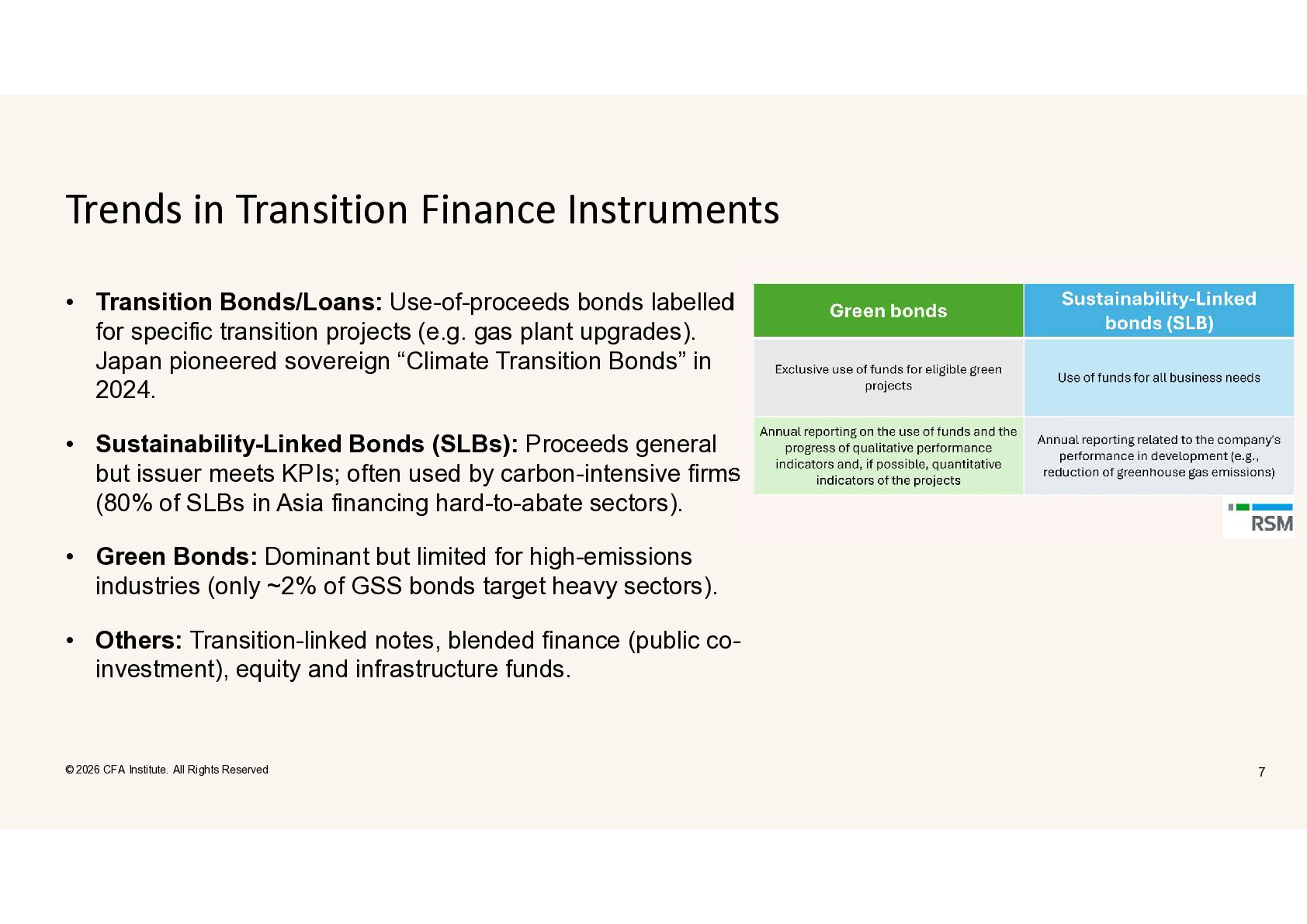
  17. Trends in Transition Finance Instruments • Transition Bonds/Loans: Use-of-proceeds bonds

    labelled for specific transition projects (e.g. gas plant upgrades). Japan pioneered sovereign “Climate Transition Bonds” in 2024. • Sustainability-Linked Bonds (SLBs): Proceeds general but issuer meets KPIs; often used by carbon-intensive firms (80% of SLBs in Asia financing hard-to-abate sectors). • Green Bonds: Dominant but limited for high-emissions industries (only ~2% of GSS bonds target heavy sectors). • Others: Transition-linked notes, blended finance (public co- investment), equity and infrastructure funds. © 2026 CFA Institute. All Rights Reserved 7
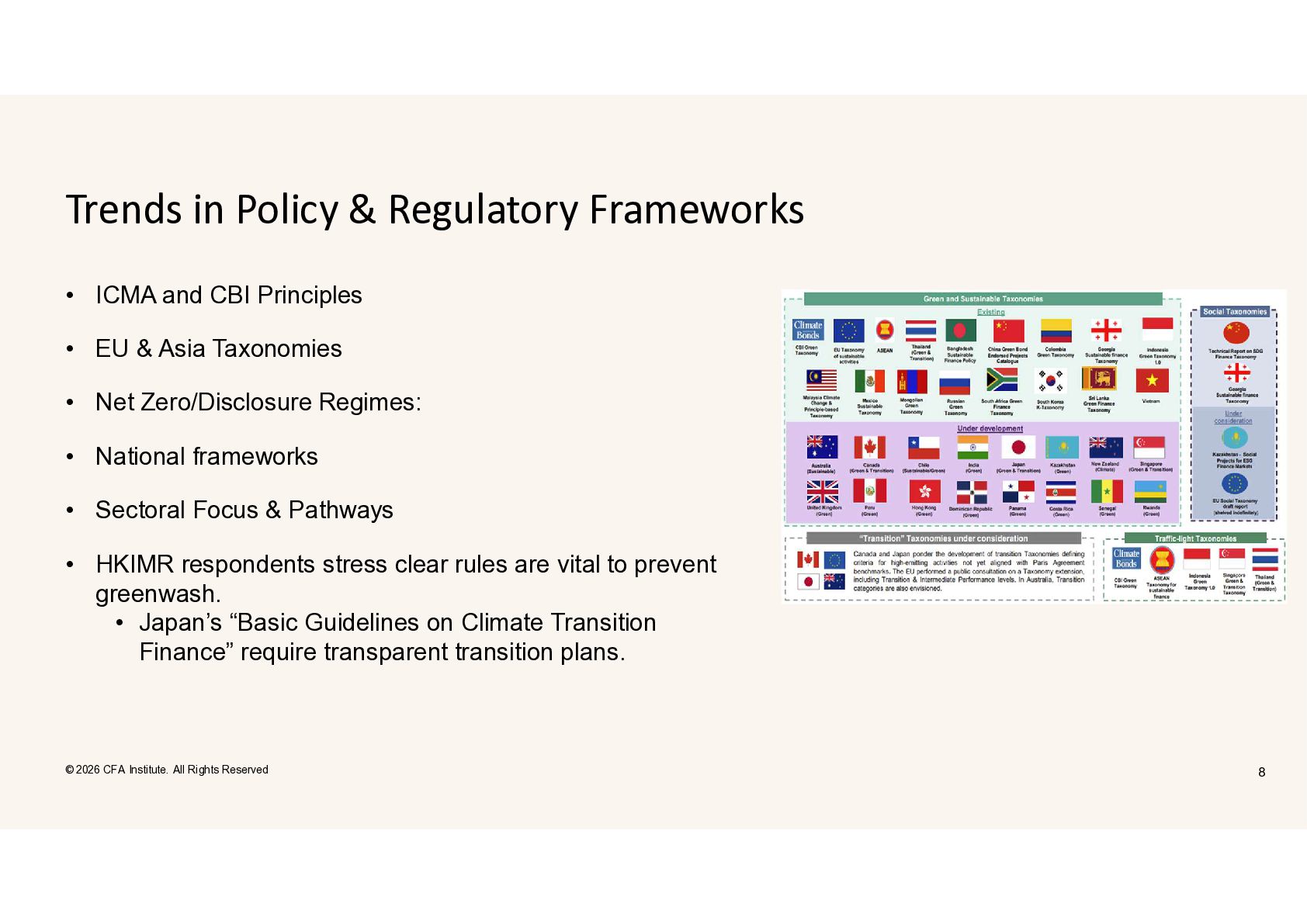
  18. Trends in Policy & Regulatory Frameworks • ICMA and CBI

    Principles • EU & Asia Taxonomies • Net Zero/Disclosure Regimes: • National frameworks • Sectoral Focus & Pathways • HKIMR respondents stress clear rules are vital to prevent greenwash. • Japan’s “Basic Guidelines on Climate Transition Finance” require transparent transition plans. © 2026 CFA Institute. All Rights Reserved 8
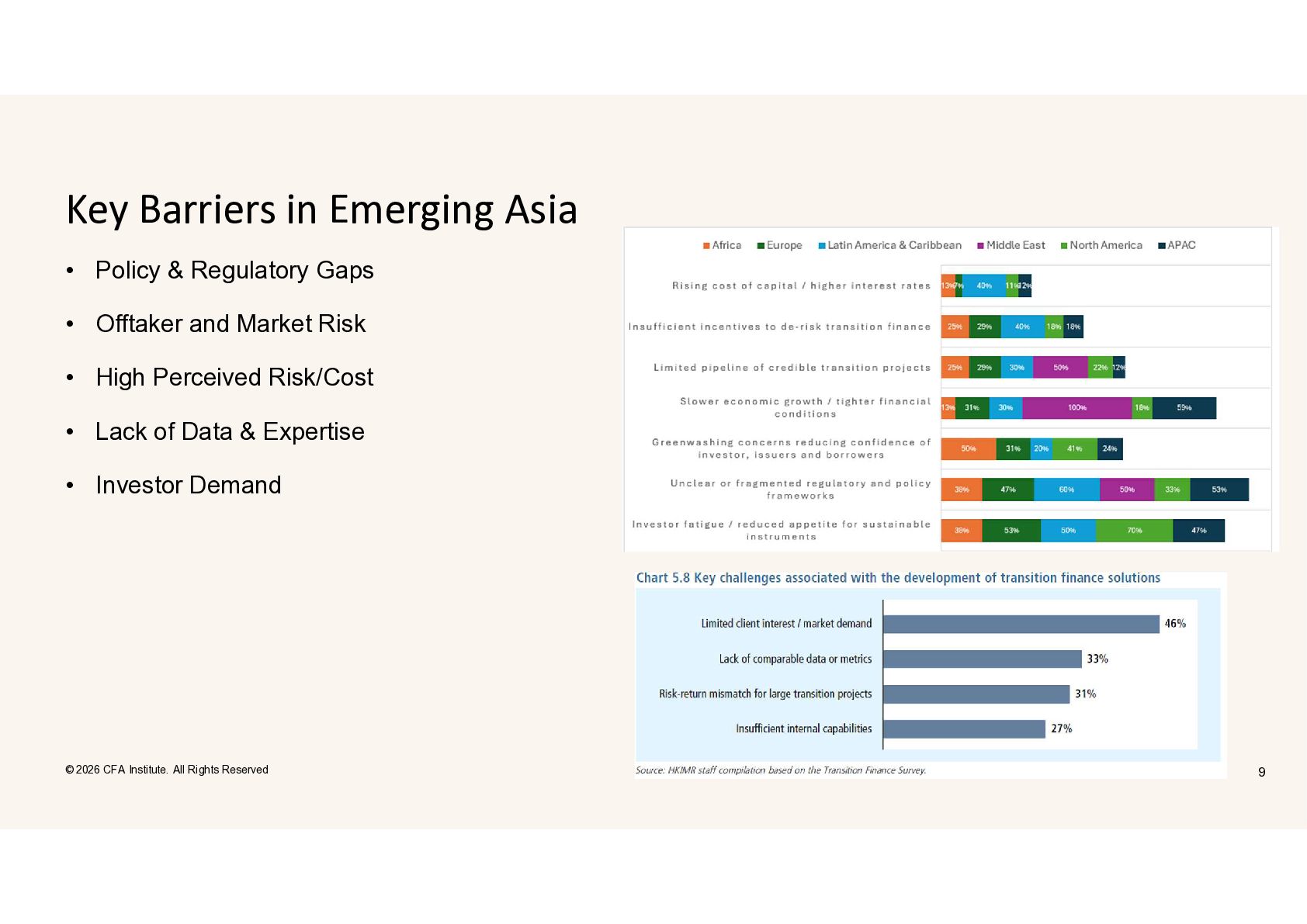
  19. Key Barriers in Emerging Asia • Policy & Regulatory Gaps

    • Offtaker and Market Risk • High Perceived Risk/Cost • Lack of Data & Expertise • Investor Demand © 2026 CFA Institute. All Rights Reserved 9
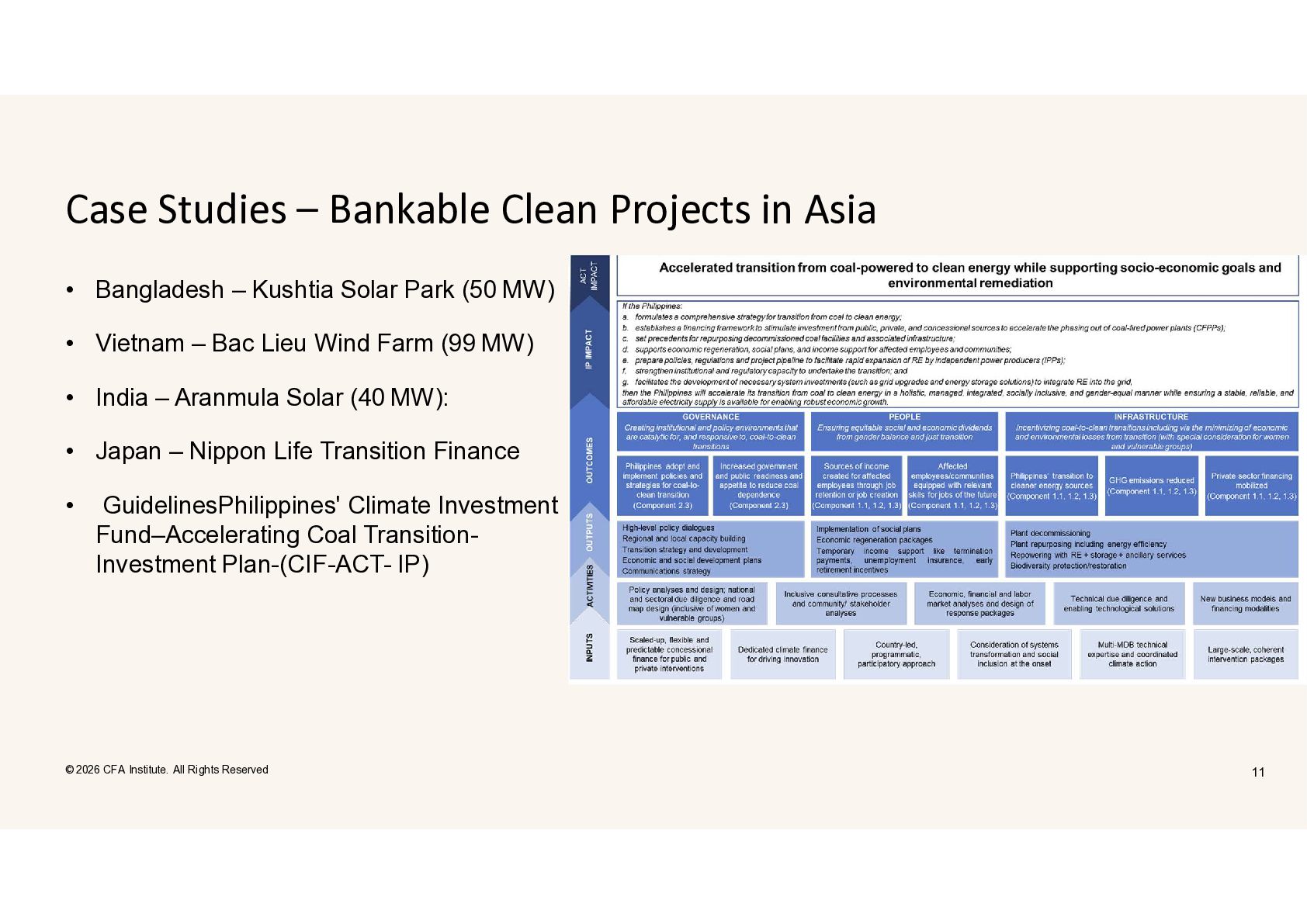
  20. Case Studies – Bankable Clean Projects in Asia • Bangladesh

    – Kushtia Solar Park (50 MW) • Vietnam – Bac Lieu Wind Farm (99 MW) • India – Aranmula Solar (40 MW): • Japan – Nippon Life Transition Finance • GuidelinesPhilippines' Climate Investment Fund–Accelerating Coal Transition- Investment Plan-(CIF-ACT- IP) © 2026 CFA Institute. All Rights Reserved 11
  21. Japan’s Green Transformation (GX) Strategy • GX Goals: Carbon neutrality

    by 2050; interim 46% emissions cut by 2030 (vs 2013). • Investment need: USD 950 billion required over next 10 years for GX (all sectors). Japan targeting USD 125 million in climate transition bonds to catalyse this. • Sector focus: Japan’s policy notes ~40% of 2030 emissions from industry/energy; accordingly, transition projects span hydrogen, ammonia, nuclear R&D, industrial efficiency, agriculture, etc. • Societal context: High hard-to-abate share (steel, chemicals, power), low self-sufficiency – Japan embraces a “graded” transition path • © 2026 CFA Institute. All Rights Reserved 12
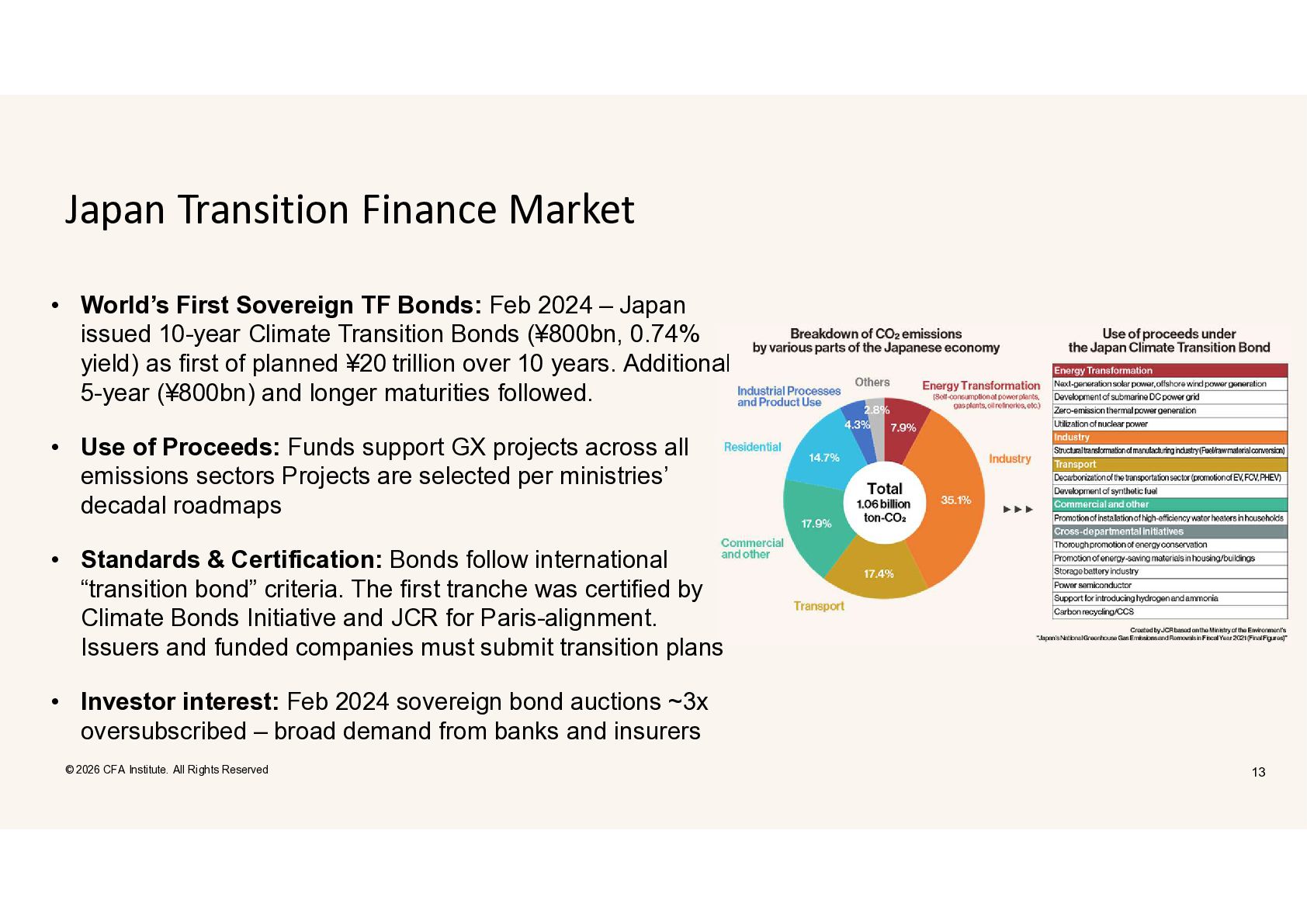
  22. Japan Transition Finance Market • World’s First Sovereign TF Bonds:

    Feb 2024 – Japan issued 10-year Climate Transition Bonds (¥800bn, 0.74% yield) as first of planned ¥20 trillion over 10 years. Additional 5-year (¥800bn) and longer maturities followed. • Use of Proceeds: Funds support GX projects across all emissions sectors Projects are selected per ministries’ decadal roadmaps • Standards & Certification: Bonds follow international “transition bond” criteria. The first tranche was certified by Climate Bonds Initiative and JCR for Paris-alignment. Issuers and funded companies must submit transition plans • Investor interest: Feb 2024 sovereign bond auctions ~3x oversubscribed – broad demand from banks and insurers © 2026 CFA Institute. All Rights Reserved 13
  23. Japan’s Projects; Corporate & Bank Transition Plans • Use of

    proceeds: Follows GX strategy. Funds various vetted projects (22 fields, 7 sectors) • Accountability: All companies financed must publish carbon reduction plans; projects tied to decadal roadmaps (Green Transformation strategy) • Corporate climate strategies: Listed companies increasingly publish transition plans (TCFD-aligned). Many follow METI roadmaps for sectors (steel, power, etc). FSA advises banks to scrutinize these in lending. • Banks & insurers: Major Japanese FIs (MUFG, SMBC, Nippon Life, etc) have net-zero policies; some offer transition loans linked to borrower decarb KPIs. FSA’s 2023 Follow-up Guidance emphasizes post-finance monitoring. • Asset owners: Pension funds and insurers expanding sustainable/transition allocations – e.g. investments in green infrastructure, green hydrogen projects. • © 2026 CFA Institute. All Rights Reserved 14
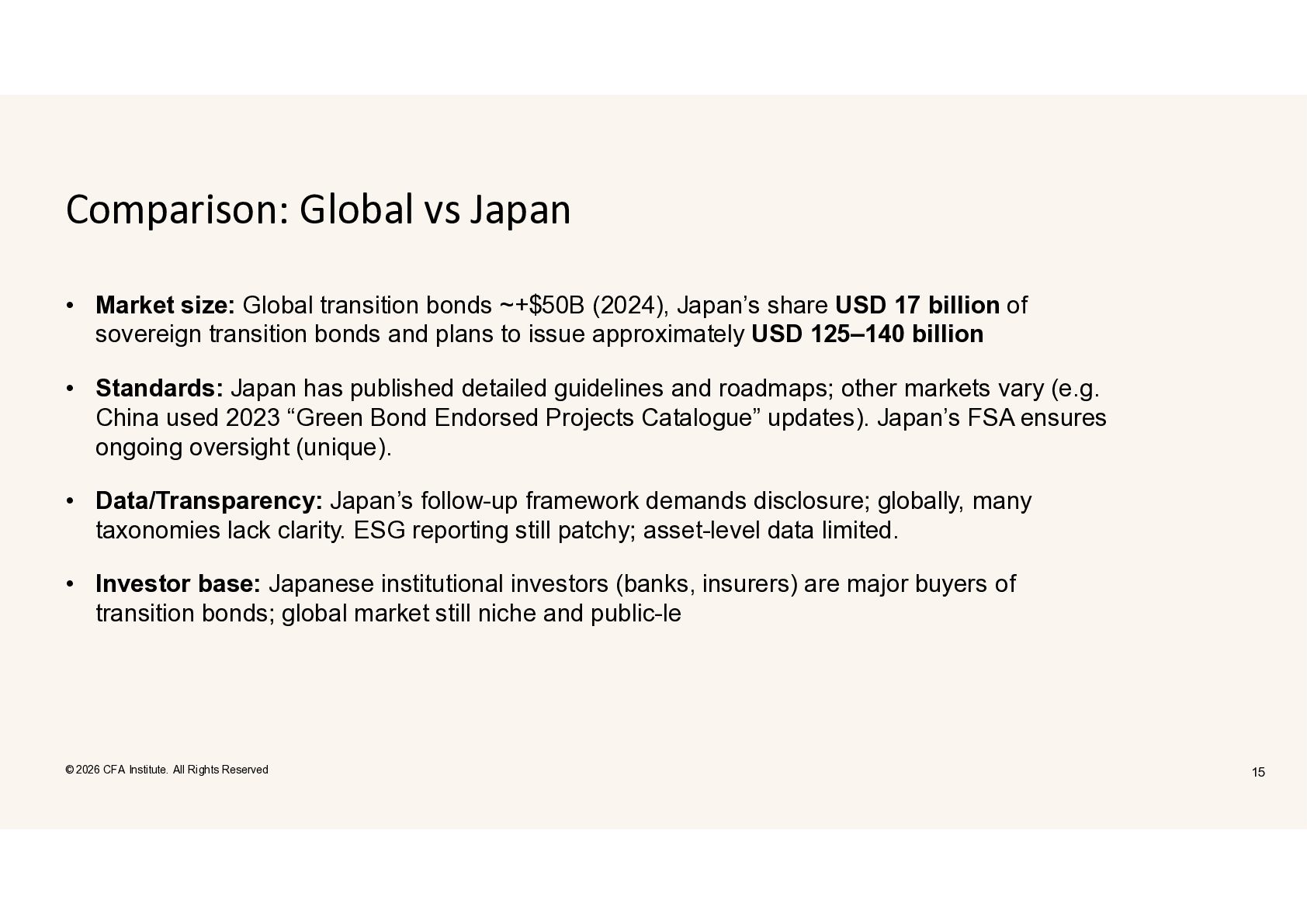
  24. Comparison: Global vs Japan • Market size: Global transition bonds

    ~+$50B (2024), Japan’s share USD 17 billion of sovereign transition bonds and plans to issue approximately USD 125–140 billion • Standards: Japan has published detailed guidelines and roadmaps; other markets vary (e.g. China used 2023 “Green Bond Endorsed Projects Catalogue” updates). Japan’s FSA ensures ongoing oversight (unique). • Data/Transparency: Japan’s follow-up framework demands disclosure; globally, many taxonomies lack clarity. ESG reporting still patchy; asset-level data limited. • Investor base: Japanese institutional investors (banks, insurers) are major buyers of transition bonds; global market still niche and public-le © 2026 CFA Institute. All Rights Reserved 15
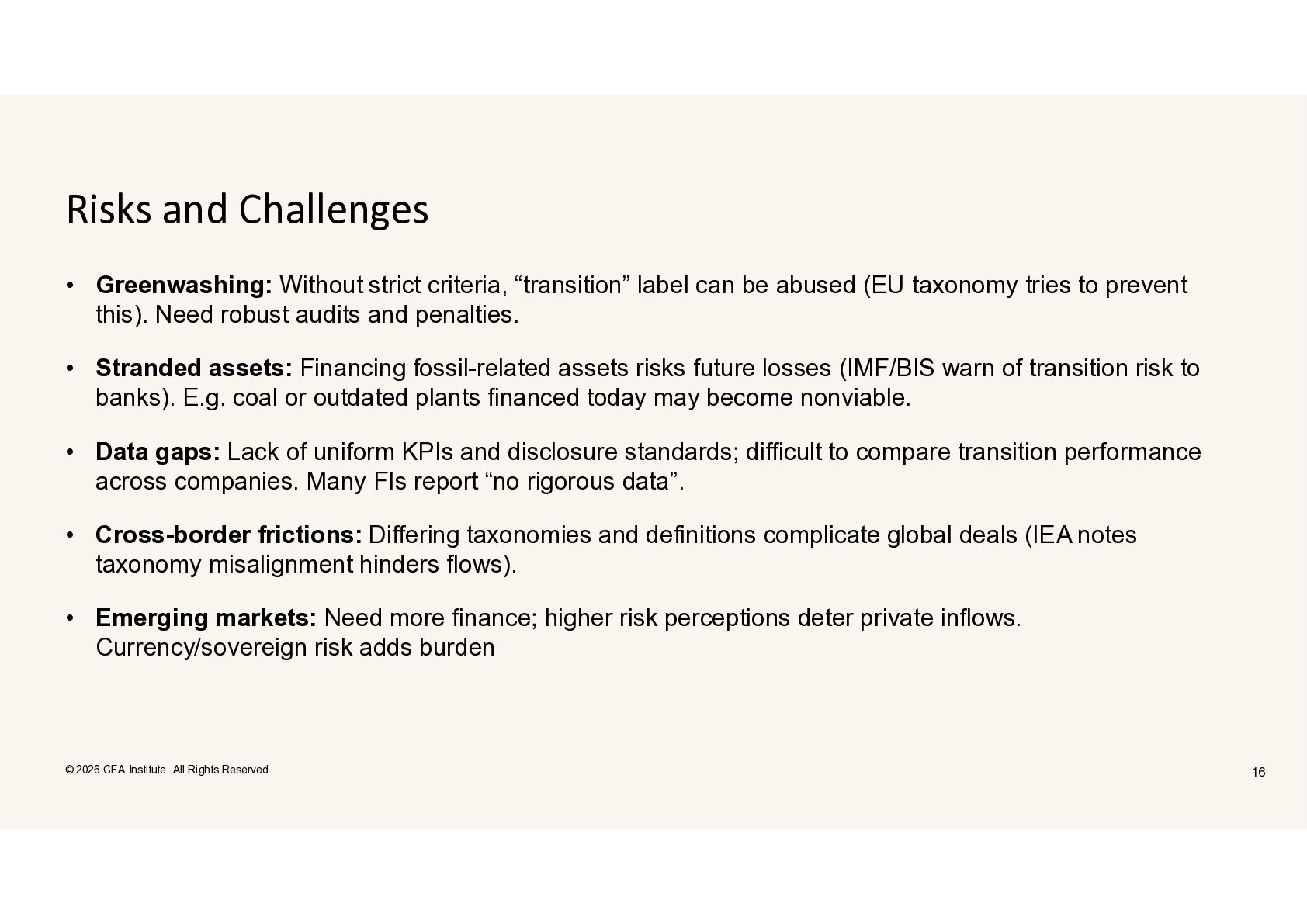
  25. Risks and Challenges • Greenwashing: Without strict criteria, “transition” label

    can be abused (EU taxonomy tries to prevent this). Need robust audits and penalties. • Stranded assets: Financing fossil-related assets risks future losses (IMF/BIS warn of transition risk to banks). E.g. coal or outdated plants financed today may become nonviable. • Data gaps: Lack of uniform KPIs and disclosure standards; difficult to compare transition performance across companies. Many FIs report “no rigorous data”. • Cross-border frictions: Differing taxonomies and definitions complicate global deals (IEA notes taxonomy misalignment hinders flows). • Emerging markets: Need more finance; higher risk perceptions deter private inflows. Currency/sovereign risk adds burden © 2026 CFA Institute. All Rights Reserved 16
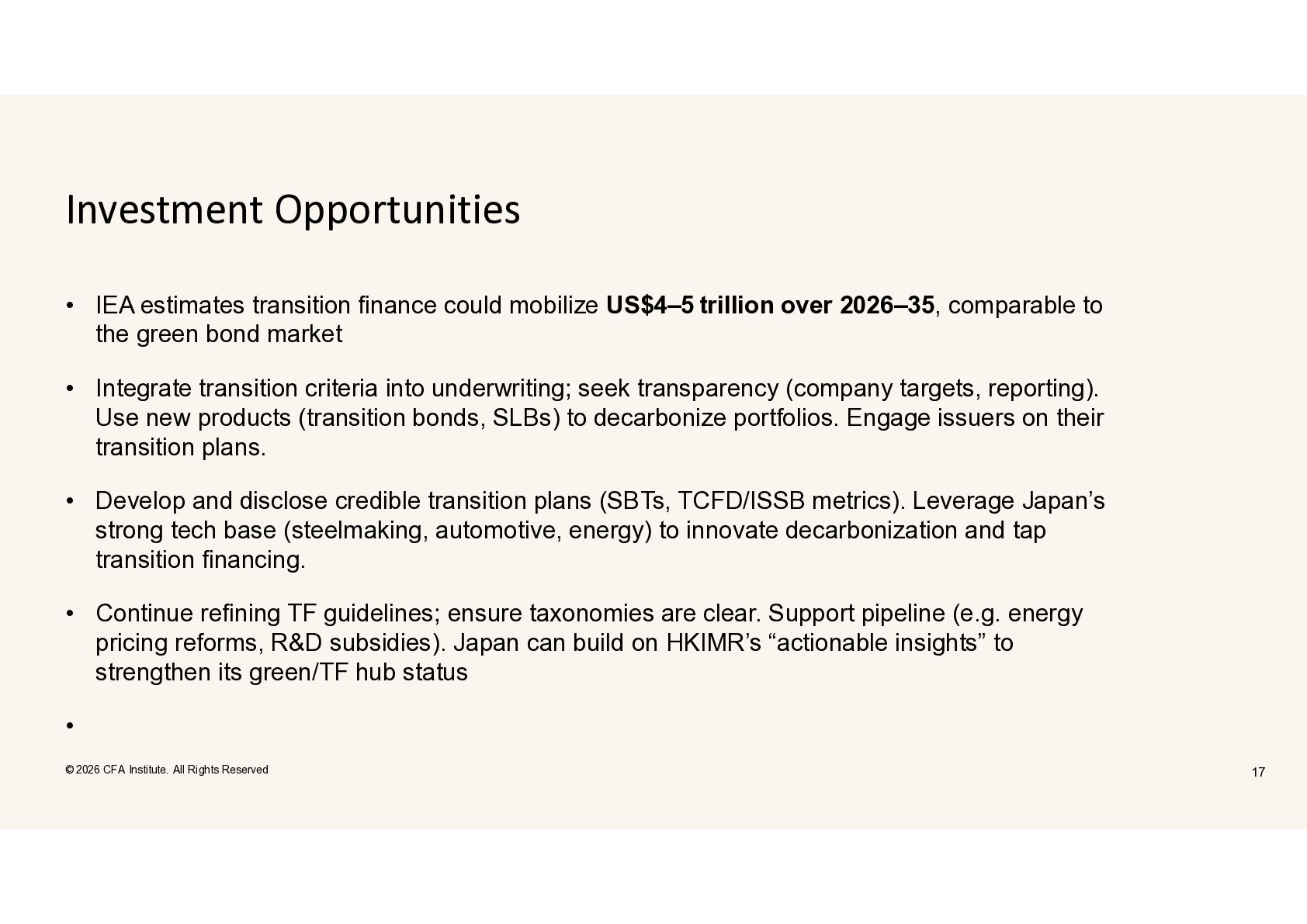
  26. Investment Opportunities • IEA estimates transition finance could mobilize US$4–5

    trillion over 2026–35, comparable to the green bond market • Integrate transition criteria into underwriting; seek transparency (company targets, reporting). Use new products (transition bonds, SLBs) to decarbonize portfolios. Engage issuers on their transition plans. • Develop and disclose credible transition plans (SBTs, TCFD/ISSB metrics). Leverage Japan’s strong tech base (steelmaking, automotive, energy) to innovate decarbonization and tap transition financing. • Continue refining TF guidelines; ensure taxonomies are clear. Support pipeline (e.g. energy pricing reforms, R&D subsidies). Japan can build on HKIMR’s “actionable insights” to strengthen its green/TF hub status • © 2026 CFA Institute. All Rights Reserved 17
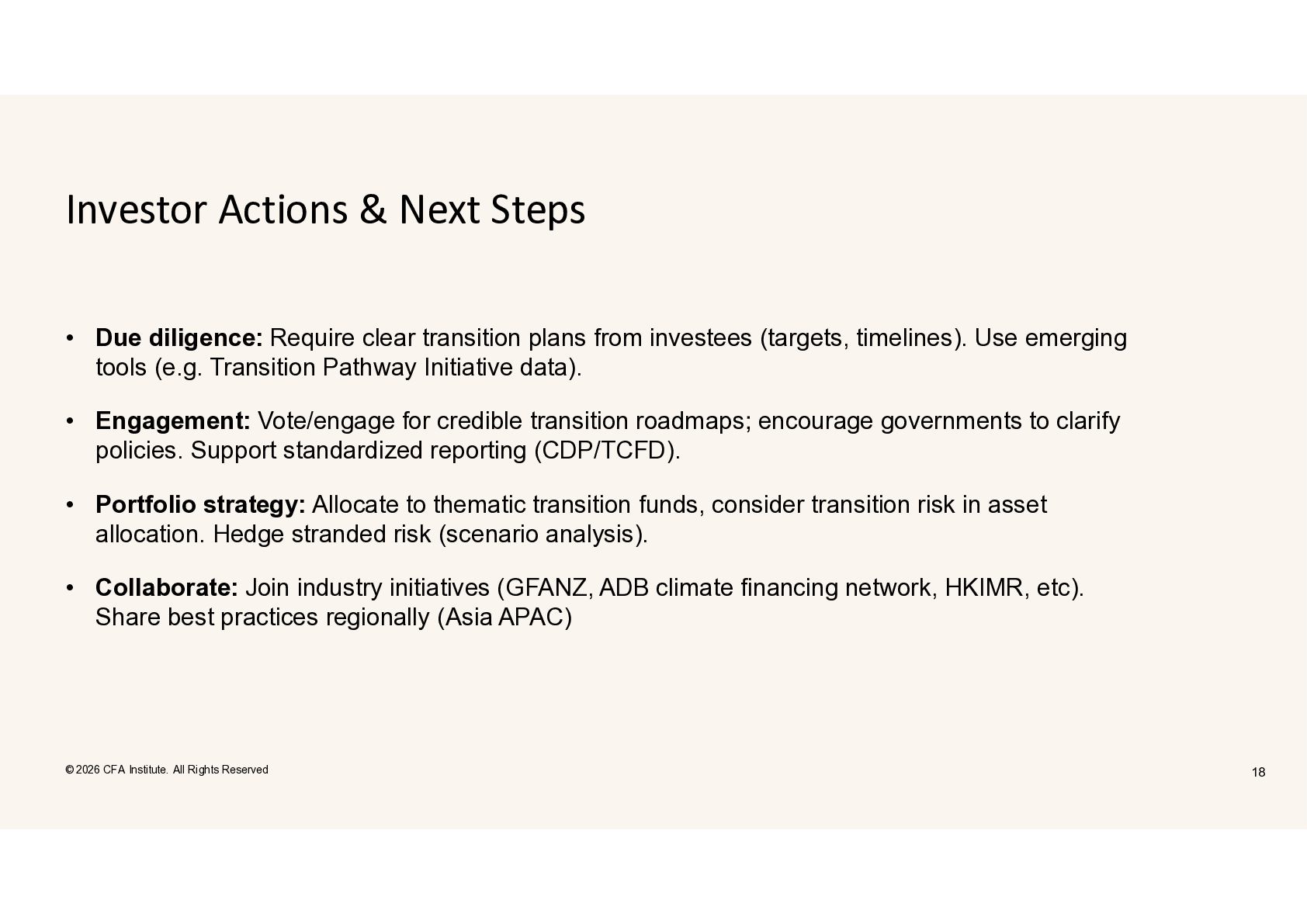
  27. Investor Actions & Next Steps • Due diligence: Require clear

    transition plans from investees (targets, timelines). Use emerging tools (e.g. Transition Pathway Initiative data). • Engagement: Vote/engage for credible transition roadmaps; encourage governments to clarify policies. Support standardized reporting (CDP/TCFD). • Portfolio strategy: Allocate to thematic transition funds, consider transition risk in asset allocation. Hedge stranded risk (scenario analysis). • Collaborate: Join industry initiatives (GFANZ, ADB climate financing network, HKIMR, etc). Share best practices regionally (Asia APAC) © 2026 CFA Institute. All Rights Reserved 18
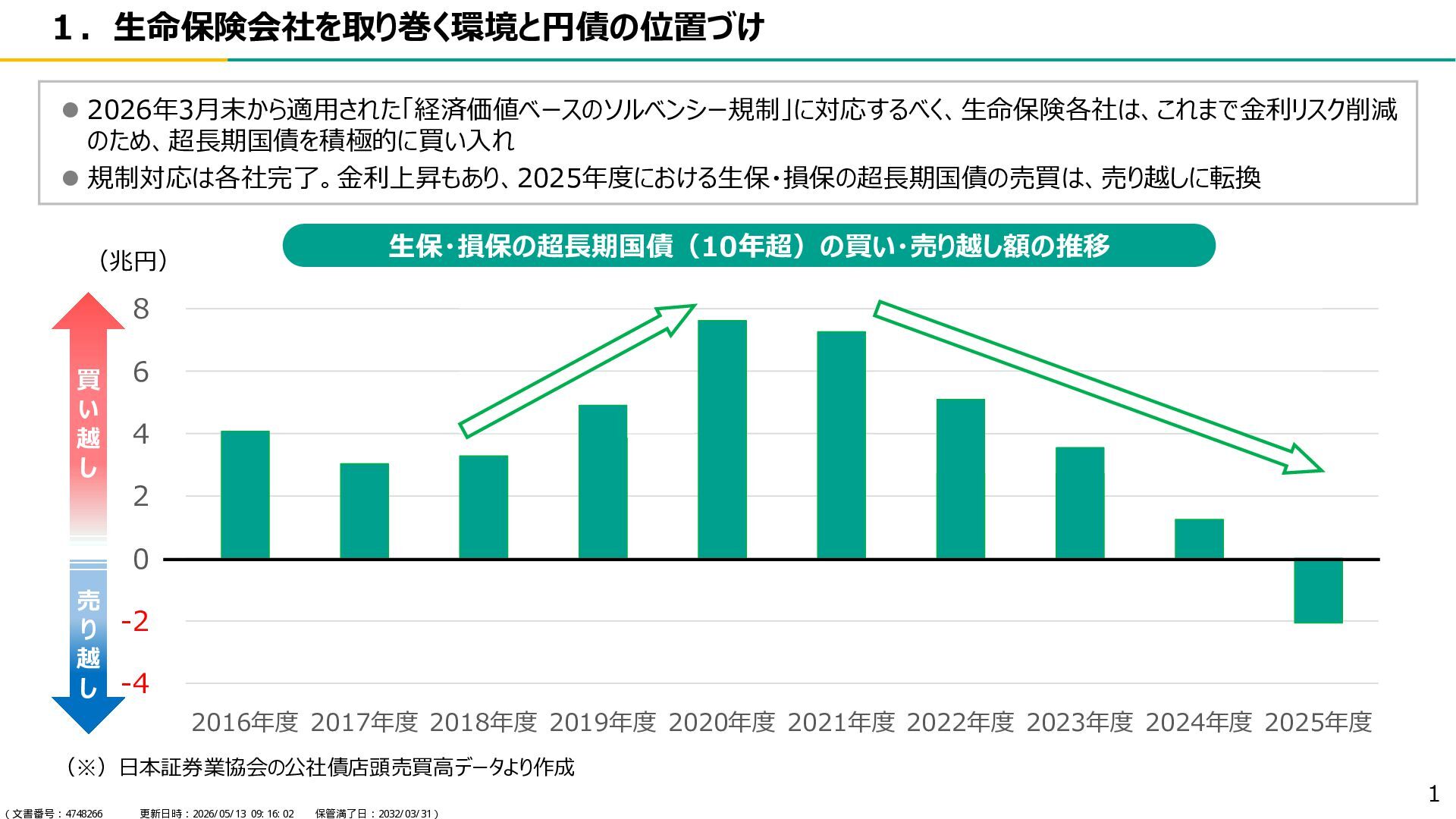
  28. -4 -2 0 2 4 6 8 2016年度 2017年度 2018年度

    2019年度 2020年度 2021年度 2022年度 2023年度 2024年度 2025年度 買 い 越 し 売 り 越 し 1.生命保険会社を取り巻く環境と円債の位置づけ  2026年3月末から適用された「経済価値ベースのソルベンシー規制」に対応するべく、生命保険各社は、これまで金利リスク削減 のため、超長期国債を積極的に買い入れ  規制対応は各社完了。金利上昇もあり、2025年度における生保・損保の超長期国債の売買は、売り越しに転換 1 生保・損保の超長期国債(10年超)の買い・売り越し額の推移 (兆円) (※)日本証券業協会の公社債店頭売買高データより作成
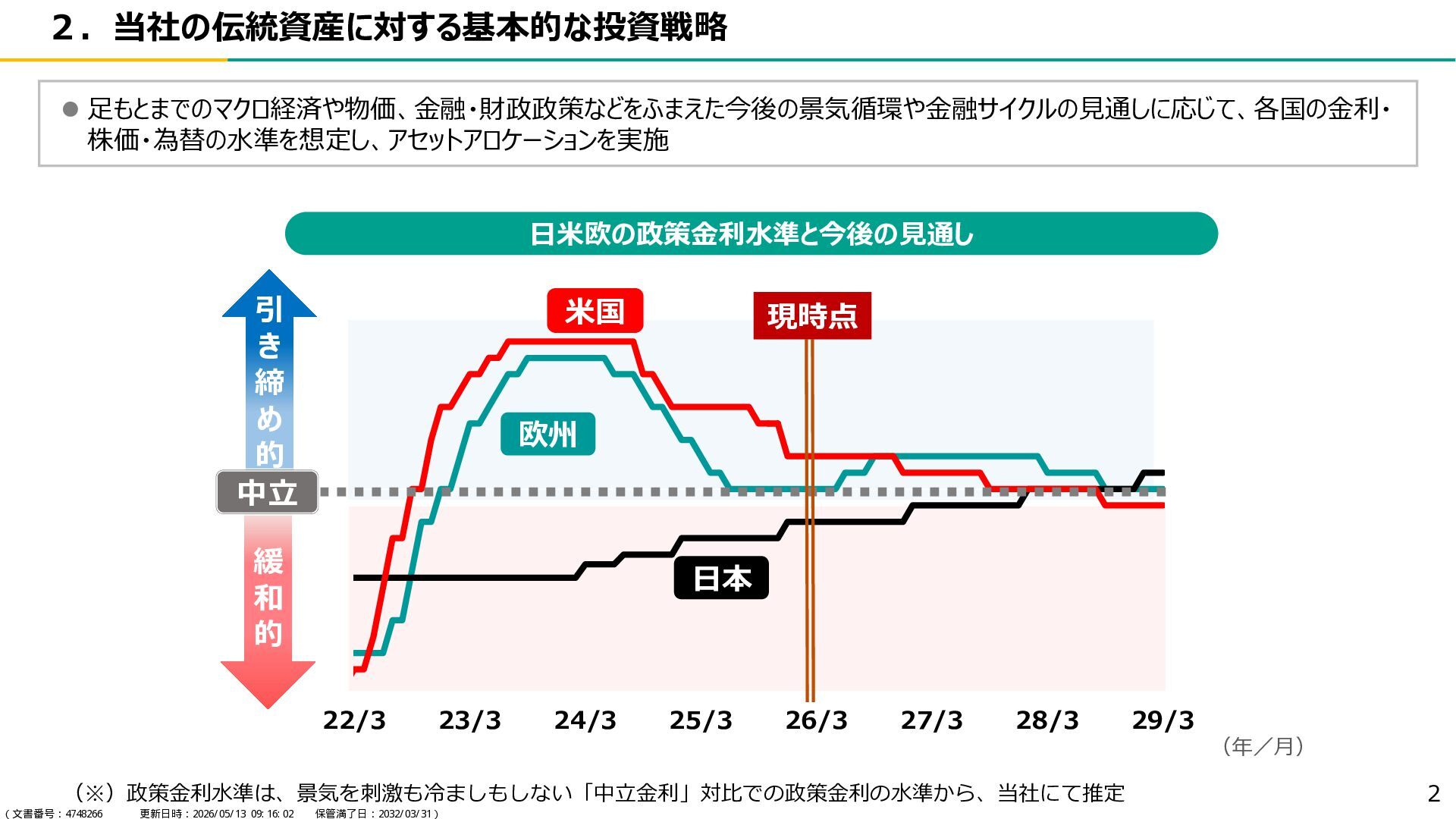
  29. (3) (2) (1) 0 1 2 3 22/3 23/3 24/3

    25/3 26/3 27/3 28/3 29/3 2.当社の伝統資産に対する基本的な投資戦略  足もとまでのマクロ経済や物価、金融・財政政策などをふまえた今後の景気循環や金融サイクルの見通しに応じて、各国の金利・ 株価・為替の水準を想定し、アセットアロケーションを実施 2 日米欧の政策金利水準と今後の見通し (※)政策金利水準は、景気を刺激も冷ましもしない「中立金利」対比での政策金利の水準から、当社にて推定 日本 米国 欧州 緩 和 的 引 き 締 め 的 中立 現時点 (年/月)
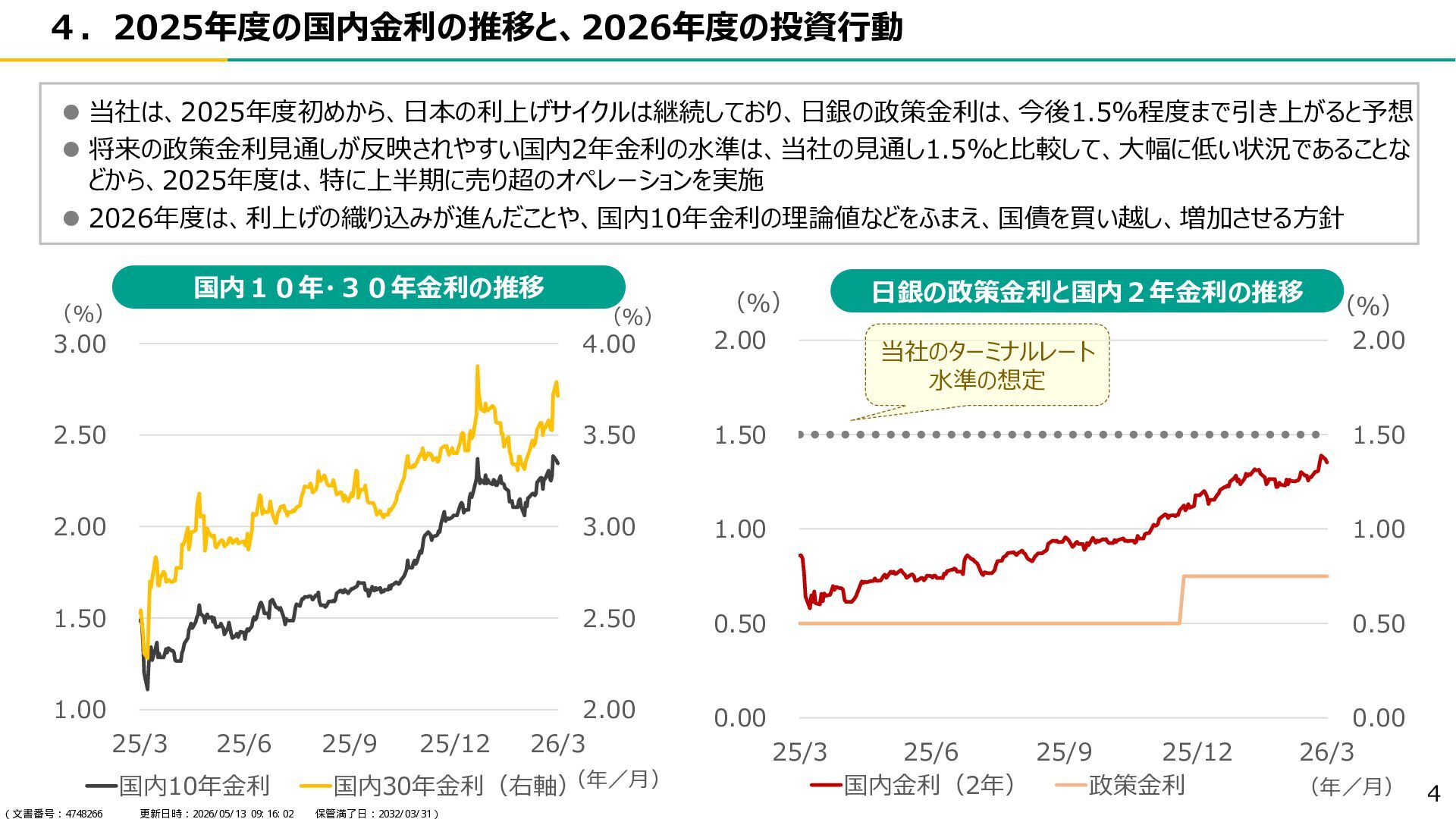
  30. 0.00 0.50 1.00 1.50 2.00 0.00 0.50 1.00 1.50 2.00

    25/3 25/6 25/9 25/12 26/3 国内金利(2年) 政策金利 (%) (年/月) 当社のターミナルレート 水準の想定 (%) 4.2025年度の国内金利の推移と、2026年度の投資行動  当社は、2025年度初めから、日本の利上げサイクルは継続しており、日銀の政策金利は、今後1.5%程度まで引き上がると予想  将来の政策金利見通しが反映されやすい国内2年金利の水準は、当社の見通し1.5%と比較して、大幅に低い状況であることな どから、2025年度は、特に上半期に売り超のオペレーションを実施  2026年度は、利上げの織り込みが進んだことや、国内10年金利の理論値などをふまえ、国債を買い越し、増加させる方針 4 国内10年・30年金利の推移 日銀の政策金利と国内2年金利の推移 2.00 2.50 3.00 3.50 4.00 1.00 1.50 2.00 2.50 3.00 25/3 25/6 25/9 25/12 26/3 国内10年金利 国内30年金利(右軸) (%) (年/月) (%)
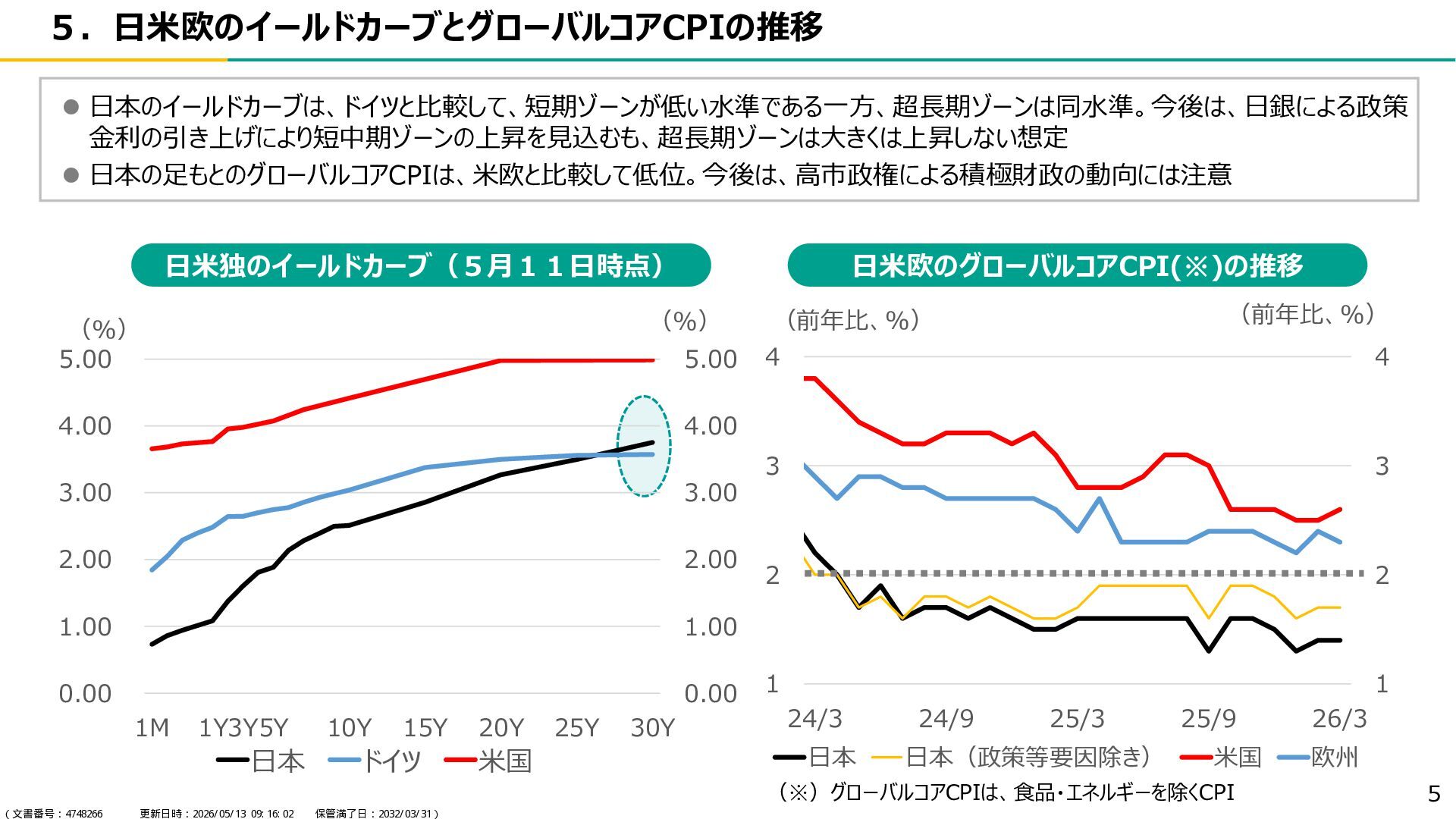
  31. 5.日米欧のイールドカーブとグローバルコアCPIの推移  日本のイールドカーブは、ドイツと比較して、短期ゾーンが低い水準である一方、超長期ゾーンは同水準。今後は、日銀による政策 金利の引き上げにより短中期ゾーンの上昇を見込むも、超長期ゾーンは大きくは上昇しない想定  日本の足もとのグローバルコアCPIは、米欧と比較して低位。今後は、高市政権による積極財政の動向には注意 5 日米欧のグローバルコアCPI(※)の推移 1 2

    3 4 1 2 3 4 24/3 24/9 25/3 25/9 26/3 日本 日本(政策等要因除き) 米国 欧州 (前年比、%) (前年比、%) 日米独のイールドカーブ(5月11日時点) (※)グローバルコアCPIは、食品・エネルギーを除くCPI 0.00 1.00 2.00 3.00 4.00 5.00 0.00 1.00 2.00 3.00 4.00 5.00 1M 1Y3Y5Y 10Y 15Y 20Y 25Y 30Y 日本 ドイツ 米国 (%) (%)
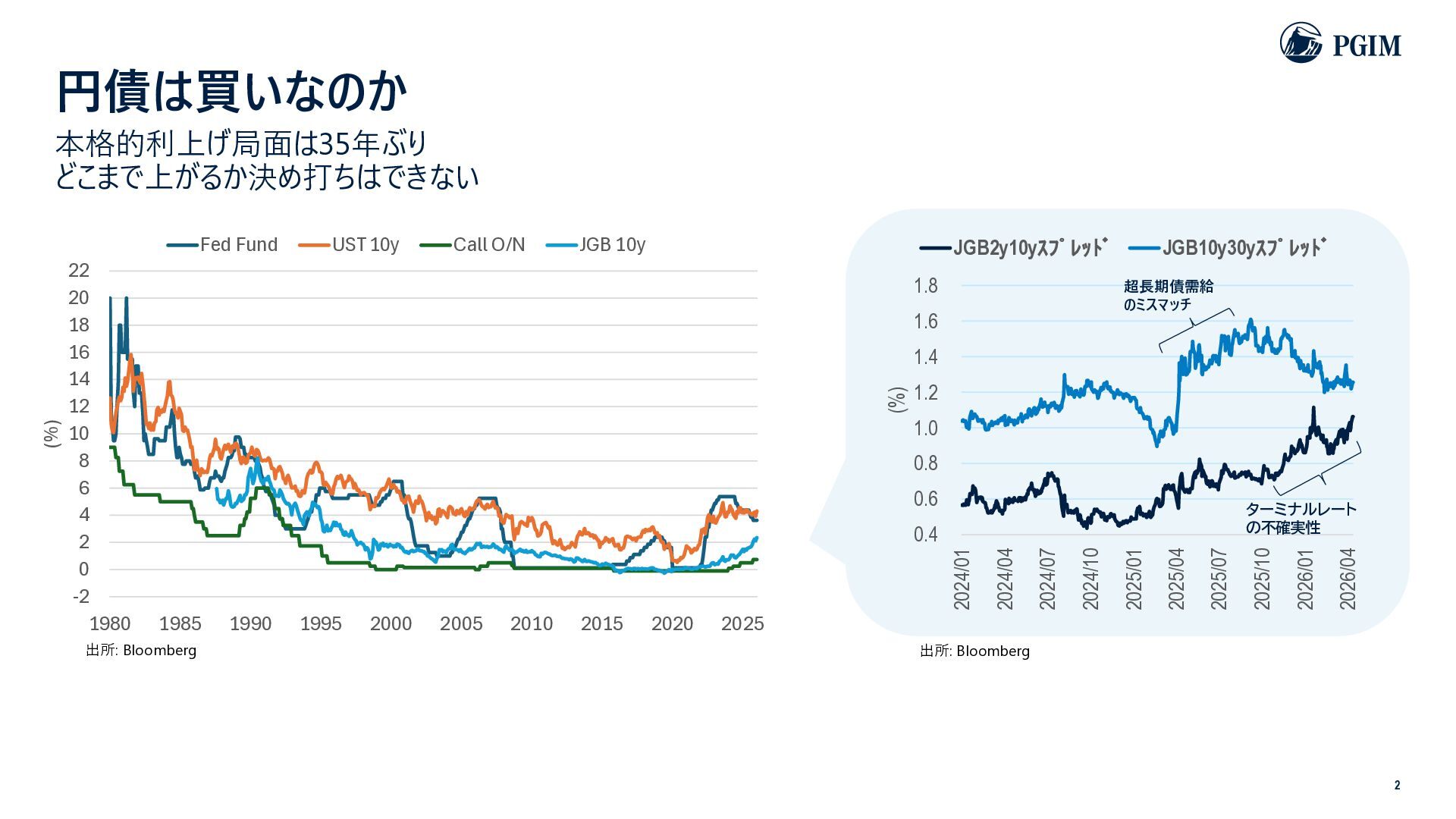
  32. 2 -2 0 2 4 6 8 10 12 14

    16 18 20 22 1980 1985 1990 1995 2000 2005 2010 2015 2020 2025 (%) Fed Fund UST 10y Call O/N JGB 10y 円債は買いなのか 本格的利上げ局面は35年ぶり どこまで上がるか決め打ちはできない 0.4 0.6 0.8 1.0 1.2 1.4 1.6 1.8 2024/01 2024/04 2024/07 2024/10 2025/01 2025/04 2025/07 2025/10 2026/01 2026/04 (%) JGB2y10yスプレッド JGB10y30yスプレッド ターミナルレート の不確実性 超長期債需給 のミスマッチ 出所: Bloomberg 出所: Bloomberg
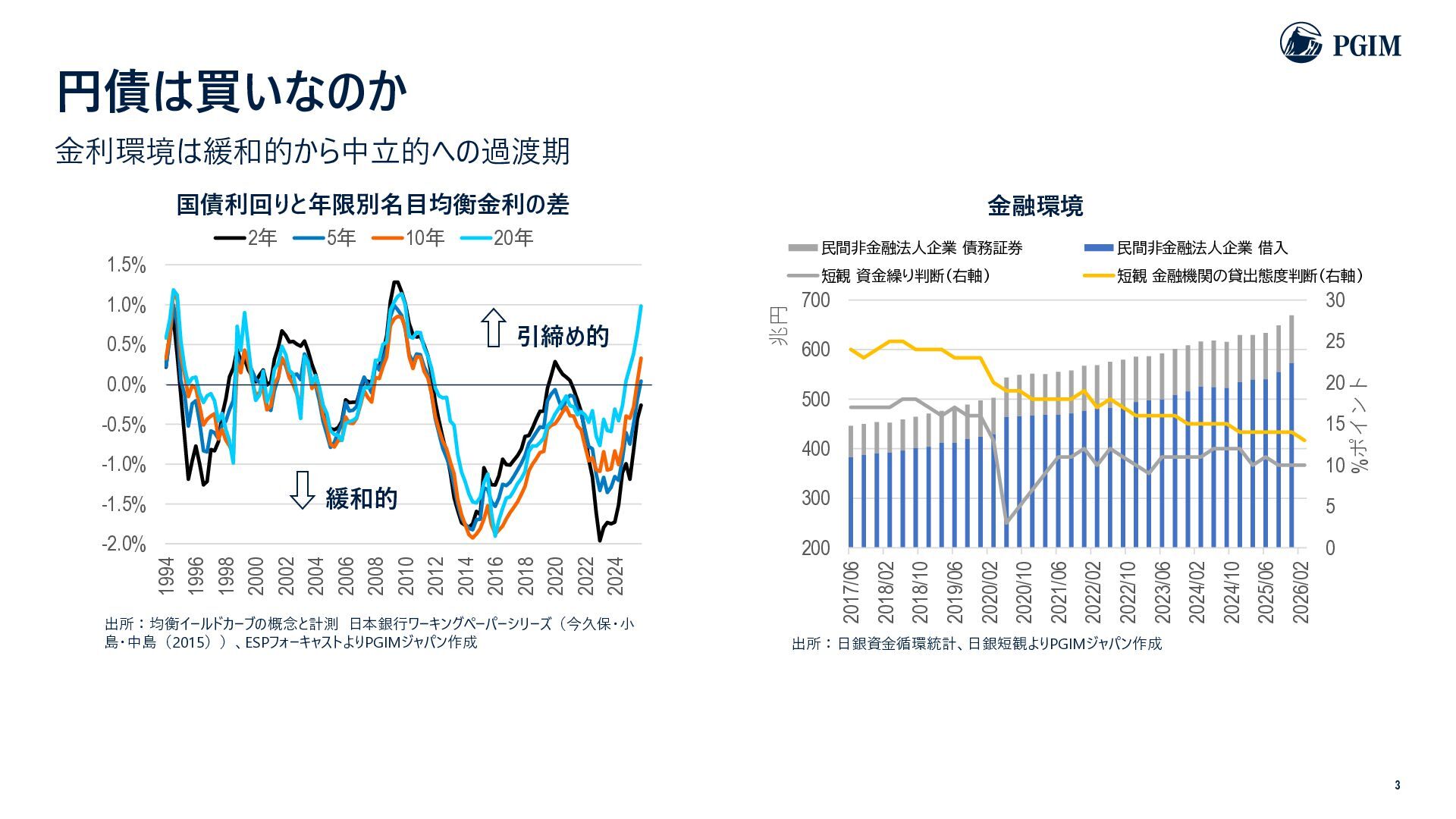
  33. 3 0 5 10 15 20 25 30 200 300

    400 500 600 700 2017/06 2018/02 2018/10 2019/06 2020/02 2020/10 2021/06 2022/02 2022/10 2023/06 2024/02 2024/10 2025/06 2026/02 %ポイント 兆円 民間非金融法人企業 債務証券 民間非金融法人企業 借入 短観 資金繰り判断(右軸) 短観 金融機関の貸出態度判断(右軸) 円債は買いなのか 金利環境は緩和的から中立的への過渡期 出所: Bloomberg -2.0% -1.5% -1.0% -0.5% 0.0% 0.5% 1.0% 1.5% 1994 1996 1998 2000 2002 2004 2006 2008 2010 2012 2014 2016 2018 2020 2022 2024 2年 5年 10年 20年 国債利回りと年限別名目均衡金利の差 ⇩緩和的 ⇧引締め的 出所:均衡イールドカーブの概念と計測 日本銀行ワーキングペーパーシリーズ(今久保・小 島・中島(2015))、ESPフォーキャストよりPGIMジャパン作成 金融環境 出所:日銀資金循環統計、日銀短観よりPGIMジャパン作成
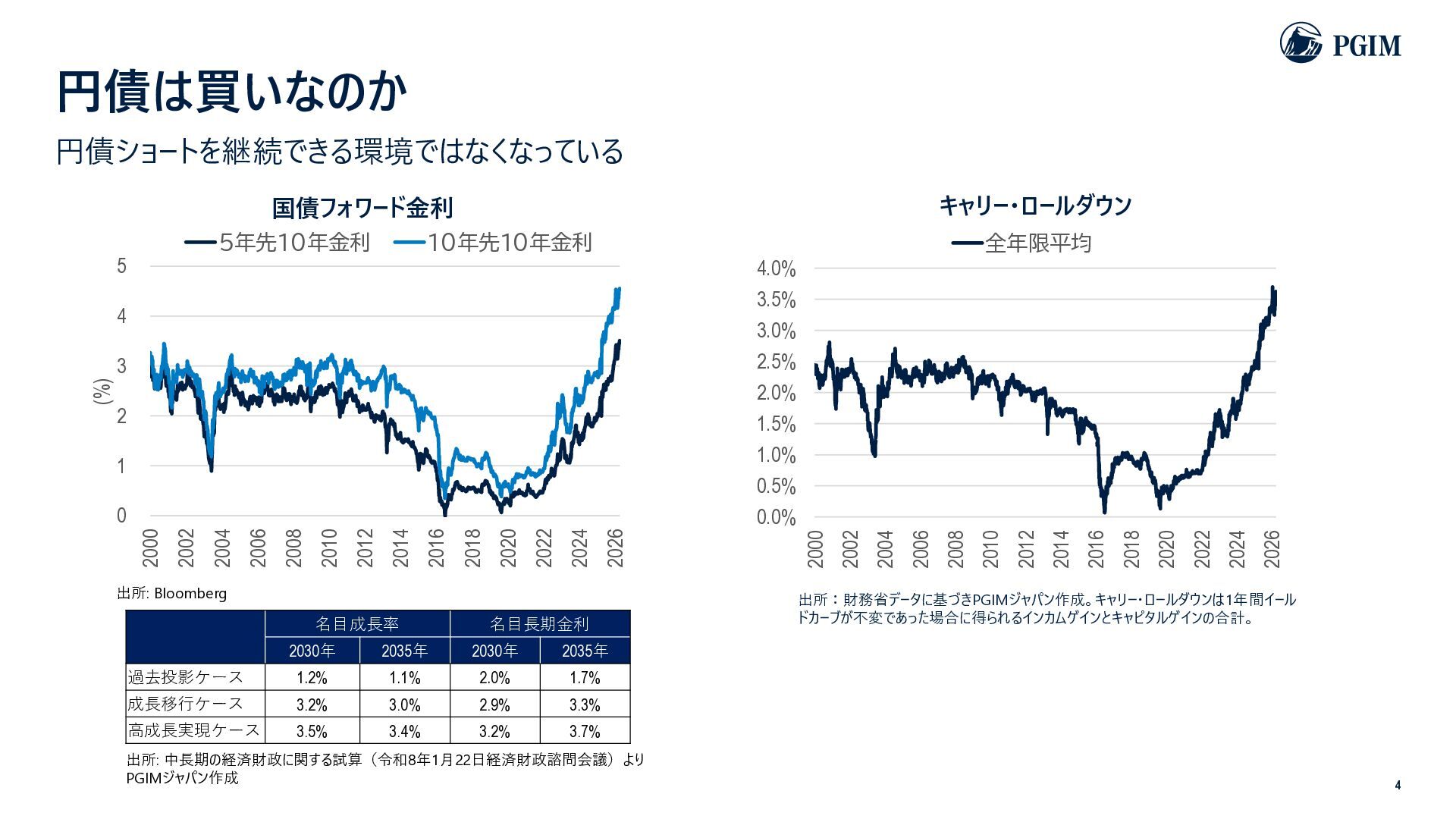
  34. 4 円債は買いなのか 出所: 中長期の経済財政に関する試算(令和8年1月22日経済財政諮問会議)より PGIMジャパン作成 0 1 2 3 4

    5 2000 2002 2004 2006 2008 2010 2012 2014 2016 2018 2020 2022 2024 2026 (%) 5年先10年金利 10年先10年金利 名目成長率 名目長期金利 2030年 2035年 2030年 2035年 過去投影ケース 1.2% 1.1% 2.0% 1.7% 成長移行ケース 3.2% 3.0% 2.9% 3.3% 高成長実現ケース 3.5% 3.4% 3.2% 3.7% 円債ショートを継続できる環境ではなくなっている 出所: Bloomberg キャリー・ロールダウン 国債フォワード金利 出所:財務省データに基づきPGIMジャパン作成。キャリー・ロールダウンは1年間イール ドカーブが不変であった場合に得られるインカムゲインとキャピタルゲインの合計。 0.0% 0.5% 1.0% 1.5% 2.0% 2.5% 3.0% 3.5% 4.0% 2000 2002 2004 2006 2008 2010 2012 2014 2016 2018 2020 2022 2024 2026 全年限平均
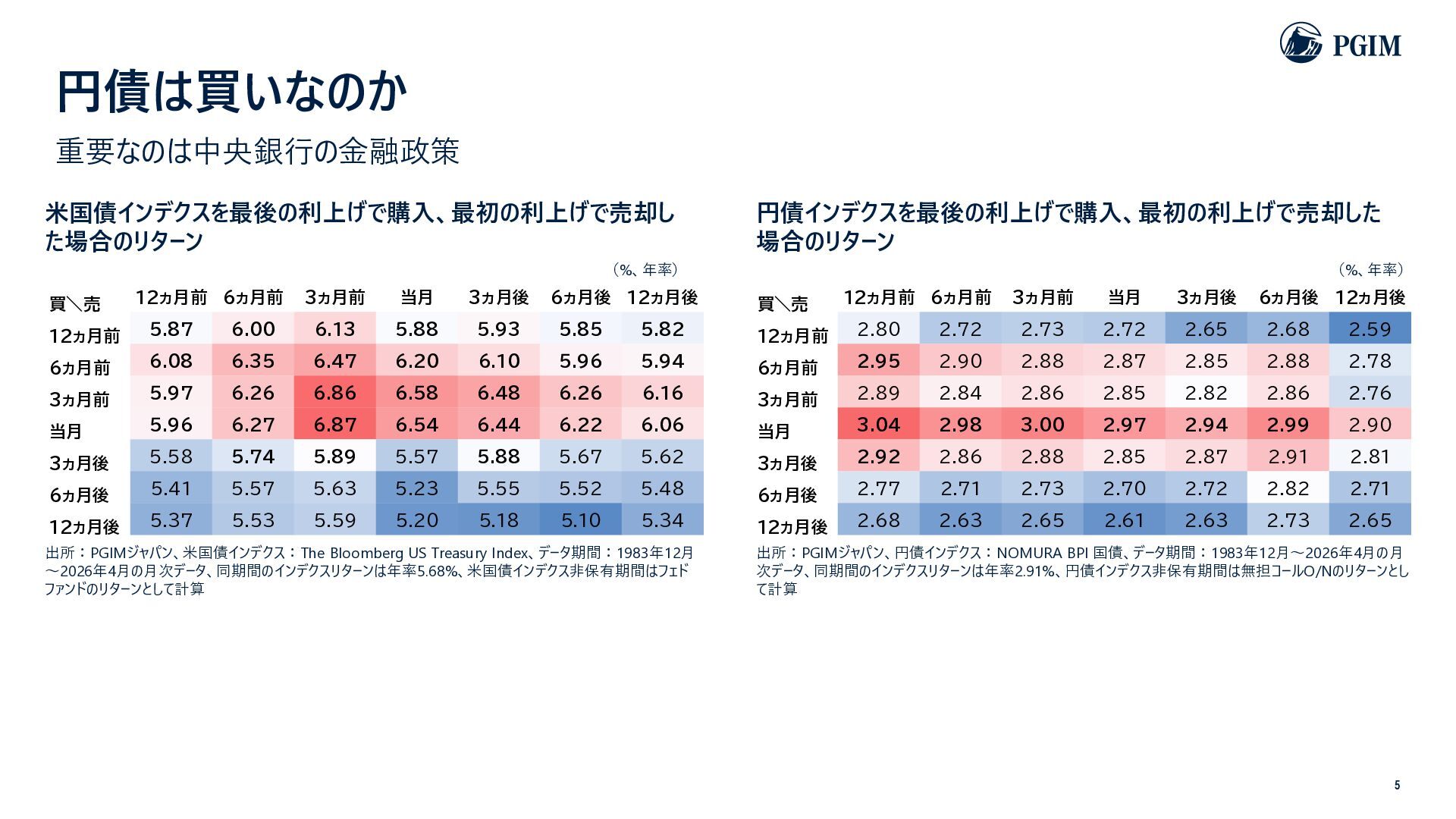
  35. 5 円債は買いなのか 重要なのは中央銀行の金融政策 出所:PGIMジャパン、米国債インデクス:The Bloomberg US Treasury Index、データ期間:1983年12月 ~2026年4月の月次データ、同期間のインデクスリターンは年率5.68%、米国債インデクス非保有期間はフェド ファンドのリターンとして計算

    米国債インデクスを最後の利上げで購入、最初の利上げで売却し た場合のリターン (%、年率) 円債インデクスを最後の利上げで購入、最初の利上げで売却した 場合のリターン (%、年率) 出所:PGIMジャパン、円債インデクス:NOMURA BPI 国債、データ期間:1983年12月~2026年4月の月 次データ、同期間のインデクスリターンは年率2.91%、円債インデクス非保有期間は無担コールO/Nのリターンとし て計算 買\売 12ヵ月前 6ヵ月前 3ヵ月前 当月 3ヵ月後 6ヵ月後 12ヵ月後 12ヵ月前 2.80 2.72 2.73 2.72 2.65 2.68 2.59 6ヵ月前 2.95 2.90 2.88 2.87 2.85 2.88 2.78 3ヵ月前 2.89 2.84 2.86 2.85 2.82 2.86 2.76 当月 3.04 2.98 3.00 2.97 2.94 2.99 2.90 3ヵ月後 2.92 2.86 2.88 2.85 2.87 2.91 2.81 6ヵ月後 2.77 2.71 2.73 2.70 2.72 2.82 2.71 12ヵ月後 2.68 2.63 2.65 2.61 2.63 2.73 2.65 買\売 12ヵ月前 6ヵ月前 3ヵ月前 当月 3ヵ月後 6ヵ月後 12ヵ月後 12ヵ月前 5.87 6.00 6.13 5.88 5.93 5.85 5.82 6ヵ月前 6.08 6.35 6.47 6.20 6.10 5.96 5.94 3ヵ月前 5.97 6.26 6.86 6.58 6.48 6.26 6.16 当月 5.96 6.27 6.87 6.54 6.44 6.22 6.06 3ヵ月後 5.58 5.74 5.89 5.57 5.88 5.67 5.62 6ヵ月後 5.41 5.57 5.63 5.23 5.55 5.52 5.48 12ヵ月後 5.37 5.53 5.59 5.20 5.18 5.10 5.34
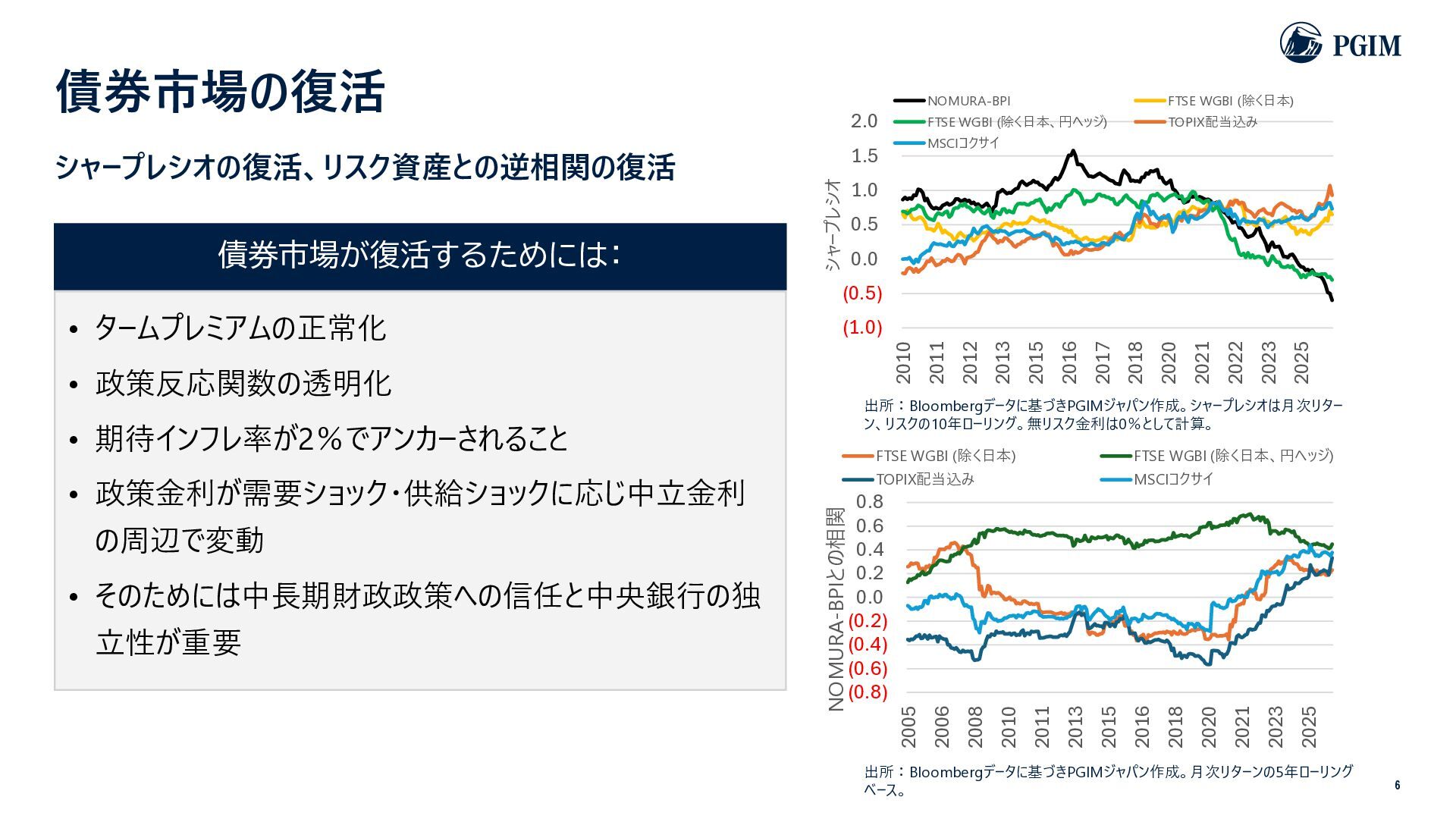
  36. 6 (1.0) (0.5) 0.0 0.5 1.0 1.5 2.0 2010 2011

    2012 2013 2015 2016 2017 2018 2020 2021 2022 2023 2025 シャープレシオ NOMURA-BPI FTSE WGBI (除く日本) FTSE WGBI (除く日本、円ヘッジ) TOPIX配当込み MSCIコクサイ 債券市場の復活 シャープレシオの復活、リスク資産との逆相関の復活 債券市場が復活するためには: • タームプレミアムの正常化 • 政策反応関数の透明化 • 期待インフレ率が2%でアンカーされること • 政策金利が需要ショック・供給ショックに応じ中立金利 の周辺で変動 • そのためには中長期財政政策への信任と中央銀行の独 立性が重要 出所:Bloombergデータに基づきPGIMジャパン作成。シャープレシオは月次リター ン、リスクの10年ローリング。無リスク金利は0%として計算。 出所:Bloombergデータに基づきPGIMジャパン作成。月次リターンの5年ローリング ベース。 (0.8) (0.6) (0.4) (0.2) 0.0 0.2 0.4 0.6 0.8 2005 2006 2008 2010 2011 2013 2015 2016 2018 2020 2021 2023 2025 NOMURA-BPIとの相関 FTSE WGBI (除く日本) FTSE WGBI (除く日本、円ヘッジ) TOPIX配当込み MSCIコクサイ
  37. 7 資料で使用している指数について ※MSCIコクサイ・インデックスは、MSCI Inc.が開発・算出する株価指数であり、その著作権、知的財産権およびその他一切の権利は、MSCI Inc.およびその関連会社に帰 属します。MSCI Inc.は、当インデックスの正確性、完全性についていかなる保証も行うものではなく、当インデックスの使用またはそれに基づいて行われたいかなる投資判断 についても、一切の責任を負いません。また、MSCI Inc.は、当インデックスへの投資成果や特定の投資商品の運用成果を保証するものではありません。 ※NOMURA-BPI(総合)指数の知的財産権およびその他一切の権利は、野村フィデューシャリー・リサーチ&コンサルティング株式会社に帰属しています。野村フィデューシ

    ャリー・リサーチ&コンサルティング株式会社は、当該指数の正確性、完全性、信頼性、有用性、市場性、商品性および適合性を保証するものではなく、ファンドの運用成 果等に関して一切責任を負いません。本ディスクレーマーは、本資料で使用されているすべてのNOMURA-BPI(総合)指数に適用されます。 ※FTSE World Government Bond Index(FTSE WGBI)に関する著作権、知的財産権およびその他一切の権利は、FTSE International Limited(以下「FTSE」)に 帰属します。FTSE、その関連会社およびライセンサーは、当該指数の正確性、完全性、信頼性、結果、または当該指数を使用して得られるいかなる成果についても、明示 的または黙示的を問わず、いかなる保証も行わず、また一切の責任を負いません。FTSE World Government Bond Index(FTSE WGBI)は、FTSEまたはその関連会 社がいかなる投資商品の推奨、支持または保証を行うことを意味するものではありません。 ※Bloomberg U.S. Treasury IndexおよびBloomberg指数に関する著作権、知的財産権およびその他一切の権利は、Bloomberg Finance L.P.またはその関連会社( 以下「Bloomberg」)に帰属します。Bloombergは、当該指数の正確性、完全性、時時性、信頼性、または当該指数を使用して得られるいかなる結果についても、明 示的または黙示的を問わず、いかなる保証も行うものではなく、また、いかなる責任も負いません。Bloombergは、本資料に関連するいかなる金融商品についても、推奨、 支持、保証、販売の勧誘を行うものではありません。
  38. 8 ※本資料は、当社の資産運用ビジネスに関する情報提供を目的としたものであり、特定の金融商品の勧誘又は販売を目的としたものではありません。また、 本資料に記載された内容等については今後変更されることもあります。 ※記載されている市場動向等は現時点での見解であり、これらは今後変更することもあります。また、その結果の確実性を表明するものではなく、将来の市 場環境の変動等を保証するものでもありません。 ※本資料に記載されている市場関連データ及び情報等は、その受領時点で当社が信頼できると判断した各種情報源から入手したものですが、当該情報の 正確性や完全性、当該情報が変更されないことを保証するものではありません。 ※当社は、当該情報の一部または全部を更新する義務を負いません。また、その完全性、正確性、または誤謬に対する責任を、明示または黙示の保証ま たは表明を行うものではありません。 ※本資料にはマネジャーの現時点の見解が含まれており、それらの見解は事前の予告なく変更されることがあります。

    ※過去の運用実績は必ずしも将来の運用成果等を保証するものではありません。 ※本資料は法務、会計、税務上のアドバイスあるいは投資推奨等を行うために作成されたものではありません。 ※当社による事前承諾なしに、本資料の一部または全部を複製することは堅くお断り致します。 ※“Prudential”、“PGIM ” 、それぞれのロゴおよびロック・シンボルは、プルデンシャル・ファイナンシャル・インクおよびその関連会社のサービスマークであり、多数 の国・地域で登録されています。 ※PGIMジャパン株式会社は、世界最大級の金融サービス機関プルデンシャル・ファイナンシャルの一員であり、英国プルーデンシャル社とはなんら関係がありま せん。 留意事項 PGIMジャパン株式会社 金融商品取引業者 関東財務局長(金商)第392号 加入協会 一般社団法人 資産運用業協会 一般社団法人 第二種金融商品取引業協会 PGIMJ129114 5472879-20260511
  39. -3 -2 -1 0 1 2 3 4 5 6

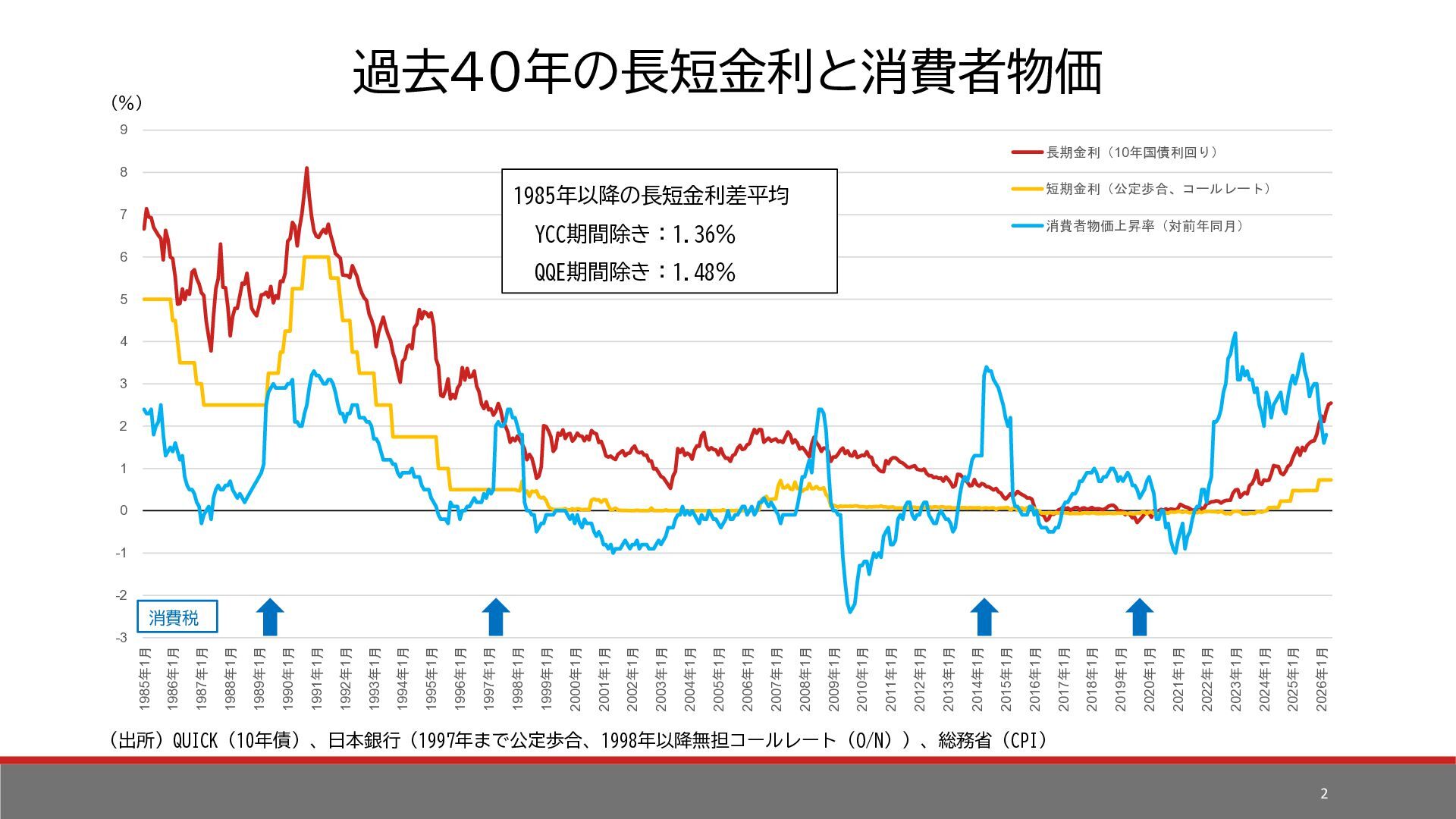
    7 8 9 1985年1月 1986年1月 1987年1月 1988年1月 1989年1月 1990年1月 1991年1月 1992年1月 1993年1月 1994年1月 1995年1月 1996年1月 1997年1月 1998年1月 1999年1月 2000年1月 2001年1月 2002年1月 2003年1月 2004年1月 2005年1月 2006年1月 2007年1月 2008年1月 2009年1月 2010年1月 2011年1月 2012年1月 2013年1月 2014年1月 2015年1月 2016年1月 2017年1月 2018年1月 2019年1月 2020年1月 2021年1月 2022年1月 2023年1月 2024年1月 2025年1月 2026年1月 長期金利(10年国債利回り) 短期金利(公定歩合、コールレート) 消費者物価上昇率(対前年同月) 過去40年の長短金利と消費者物価 (出所)QUICK(10年債)、日本銀行(1997年まで公定歩合、1998年以降無担コールレート(O/N))、総務省(CPI) (%) 消費税 1985年以降の長短金利差平均 YCC期間除き:1.36% QQE期間除き:1.48% 2
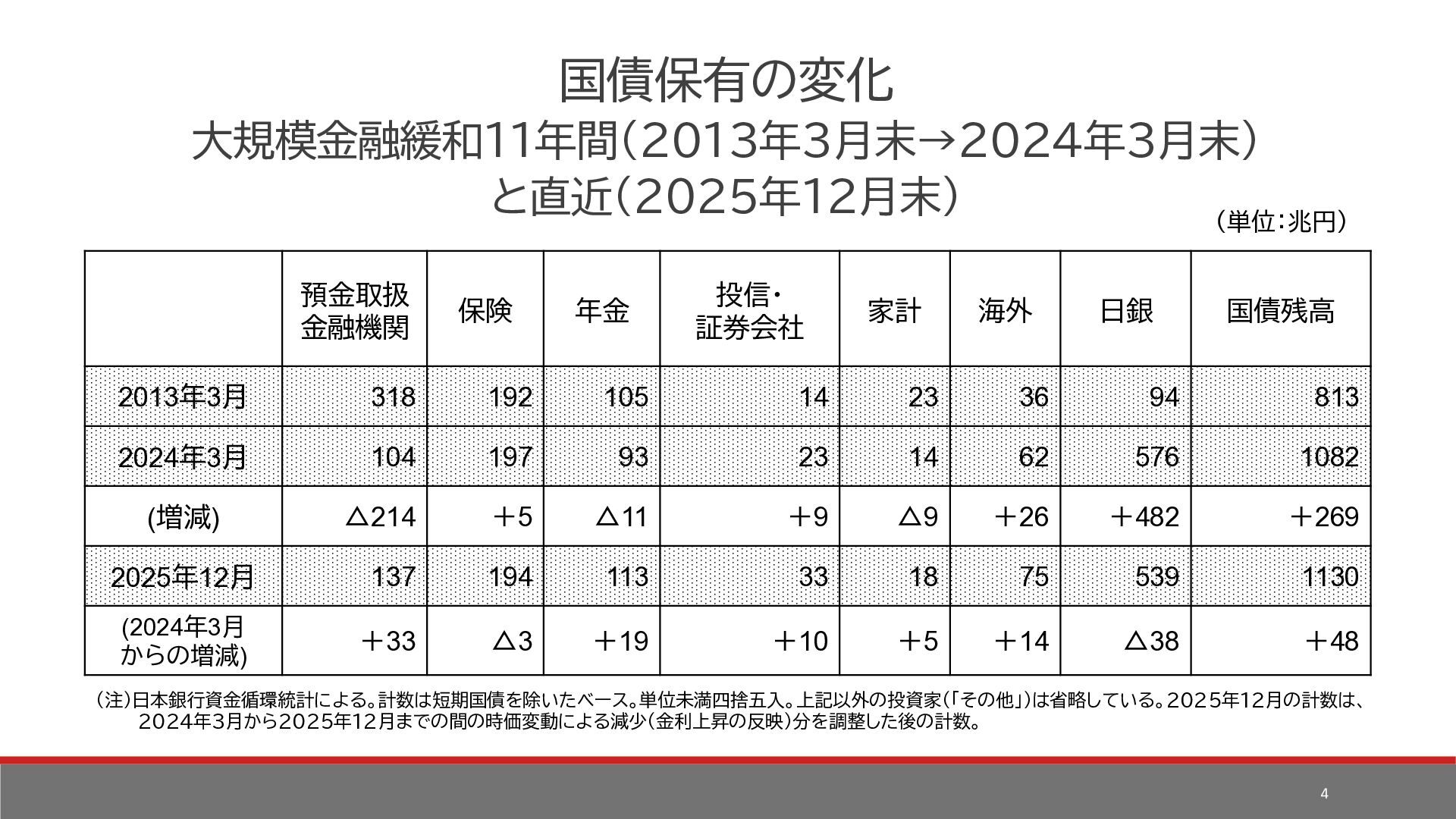
  40. 国債保有の変化 大規模金融緩和11年間(2013年3月末→2024年3月末) と直近(2025年12月末) 預金取扱 金融機関 保険 年金 投信・ 証券会社 家計

    海外 日銀 国債残高 2013年3月 318 192 105 14 23 36 94 813 2024年3月 104 197 93 23 14 62 576 1082 (増減) △214 +5 △11 +9 △9 +26 +482 +269 2025年12月 137 194 113 33 18 75 539 1130 (2024年3月 からの増減) +33 △3 +19 +10 +5 +14 △38 +48 (注)日本銀行資金循環統計による。計数は短期国債を除いたベース。単位未満四捨五入。上記以外の投資家(「その他」)は省略している。2025年12月の計数は、 2024年3月から2025年12月までの間の時価変動による減少(金利上昇の反映)分を調整した後の計数。 (単位:兆円) 4
  41. © 2026 MSCI Inc. All rights reserved. Please refer to

    the disclaimer at the end of this document. Investment Trends in Focus 2026 注目される投資トレンドと市場構造の変化を読み解く 阿部 真也(Masaya ABE)APAC Research May 27, 2026
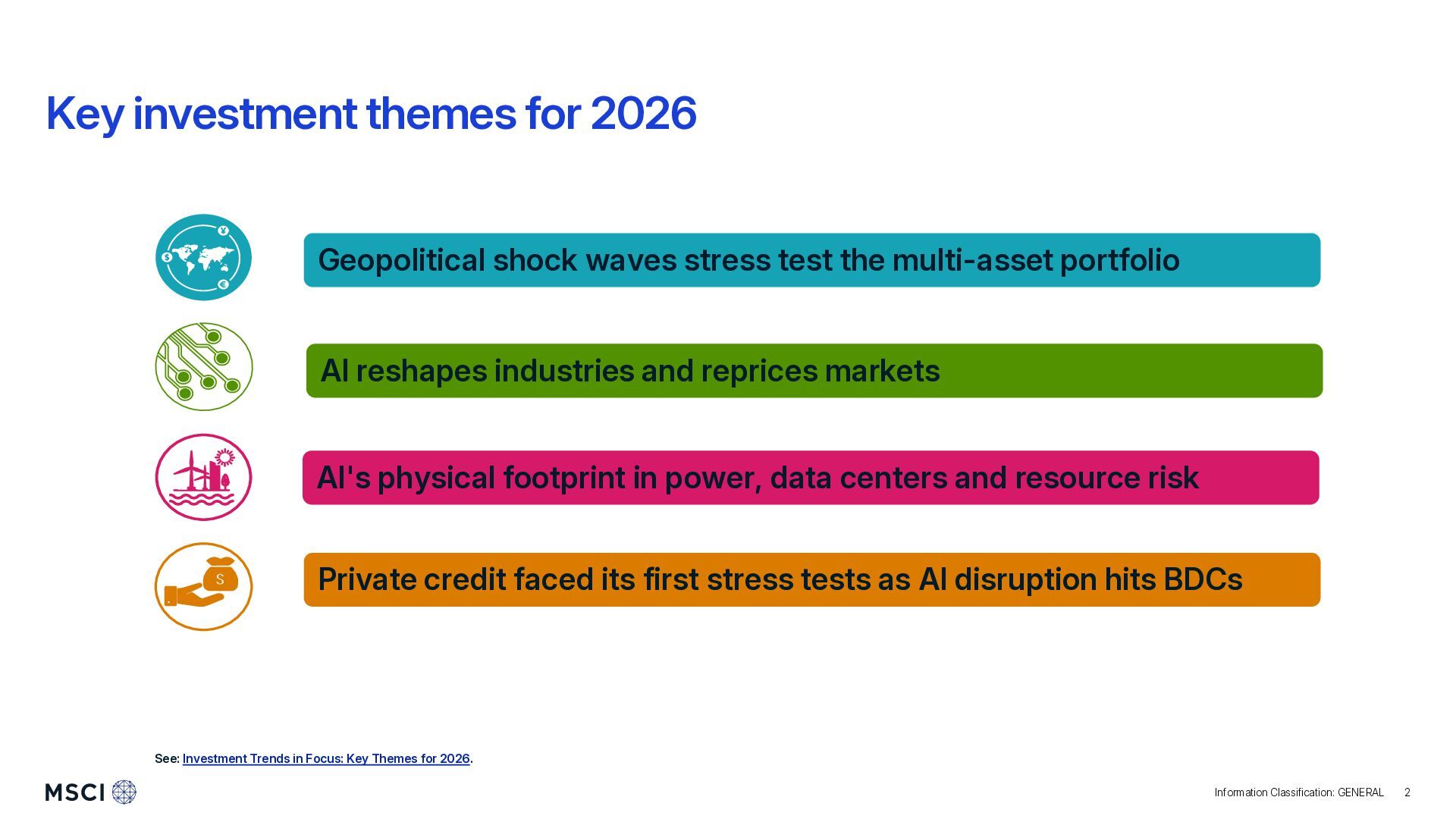
  42. Information Classification: GENERAL 2 Key investment themes for 2026 Geopolitical

    shock waves stress test the multi-asset portfolio AI reshapes industries and reprices markets AI's physical footprint in power, data centers and resource risk Private credit faced its first stress tests as AI disruption hits BDCs See: Investment Trends in Focus: Key Themes for 2026.
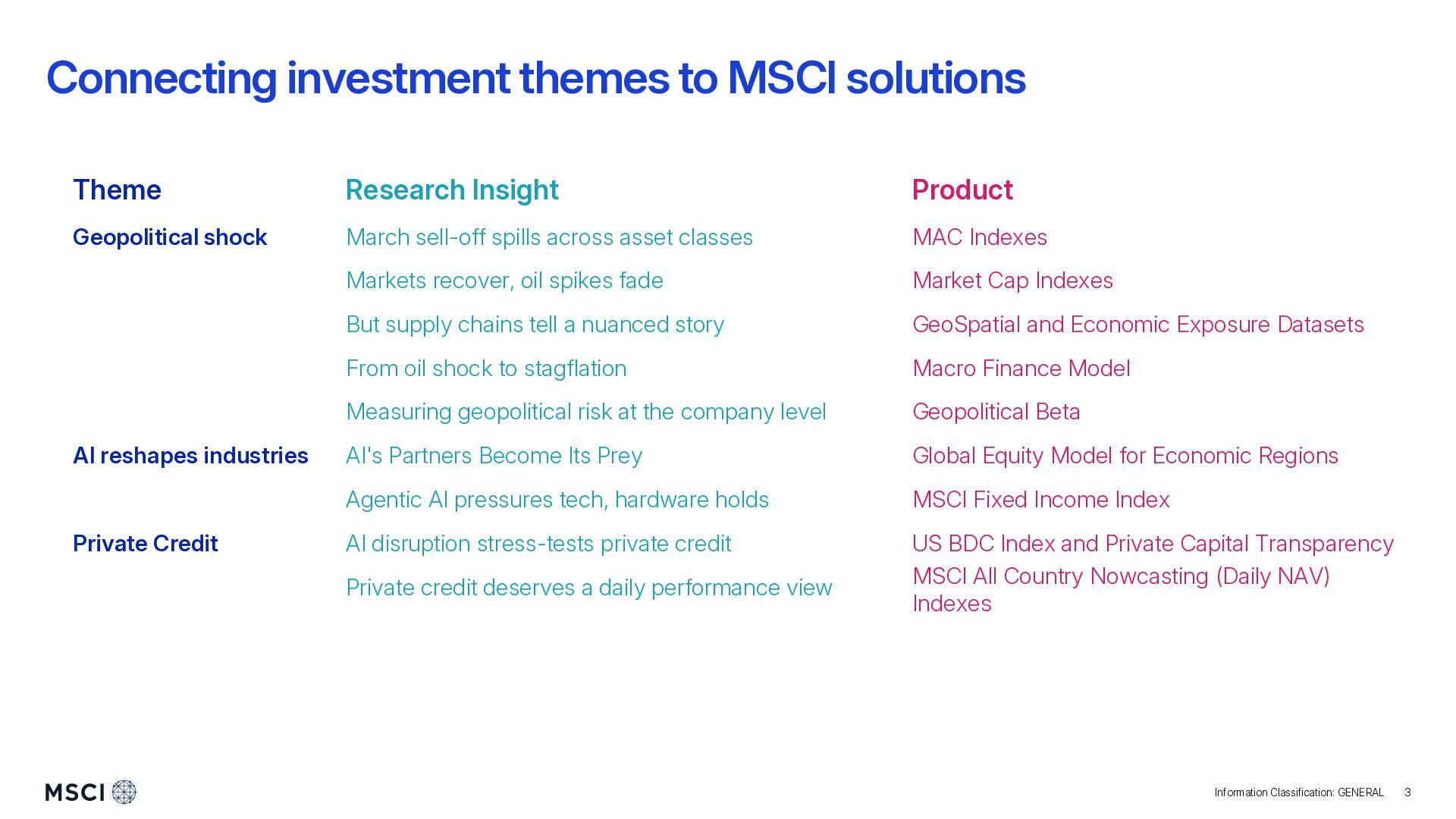
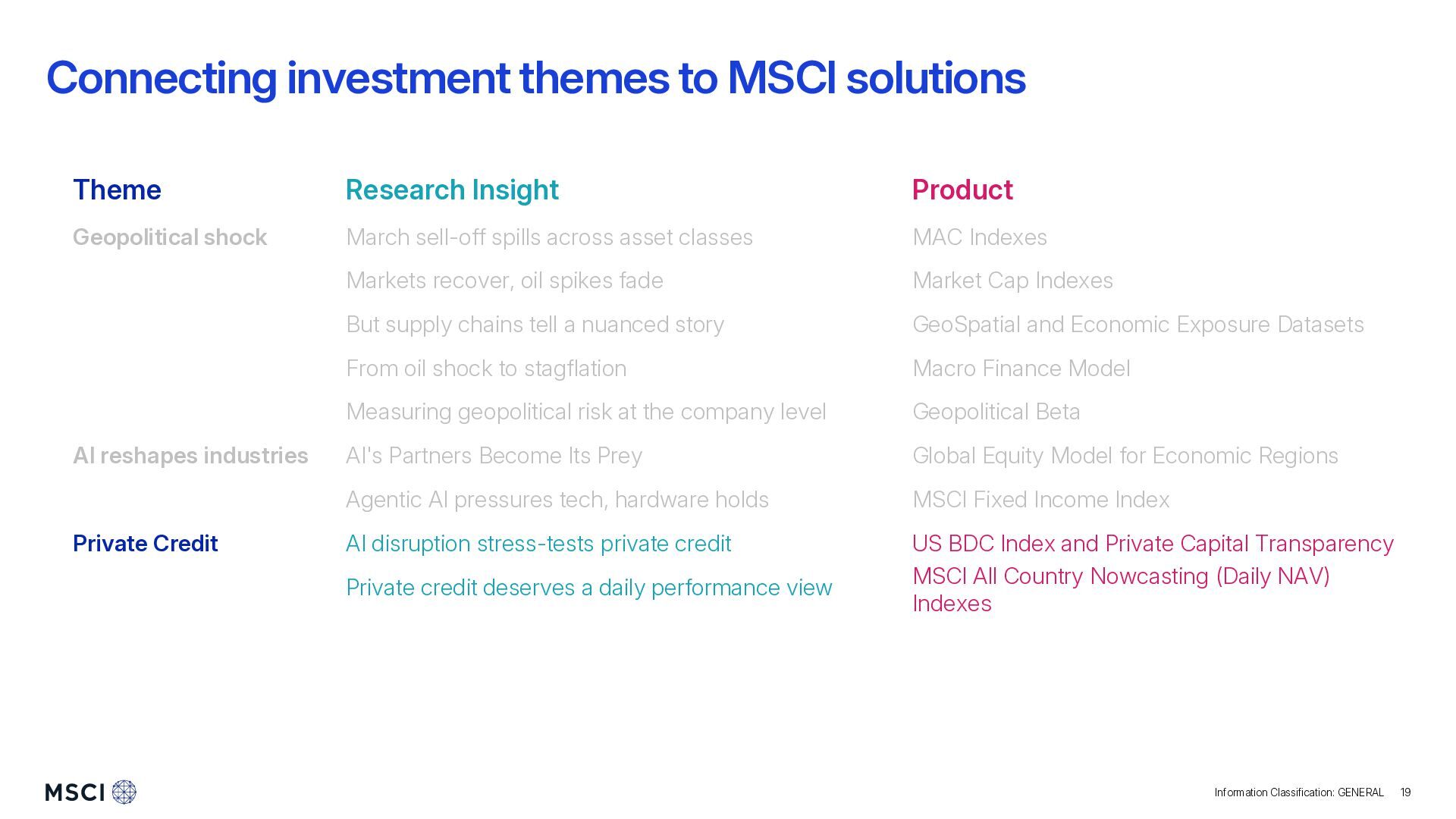
  43. Information Classification: GENERAL 3 Connecting investment themes to MSCI solutions

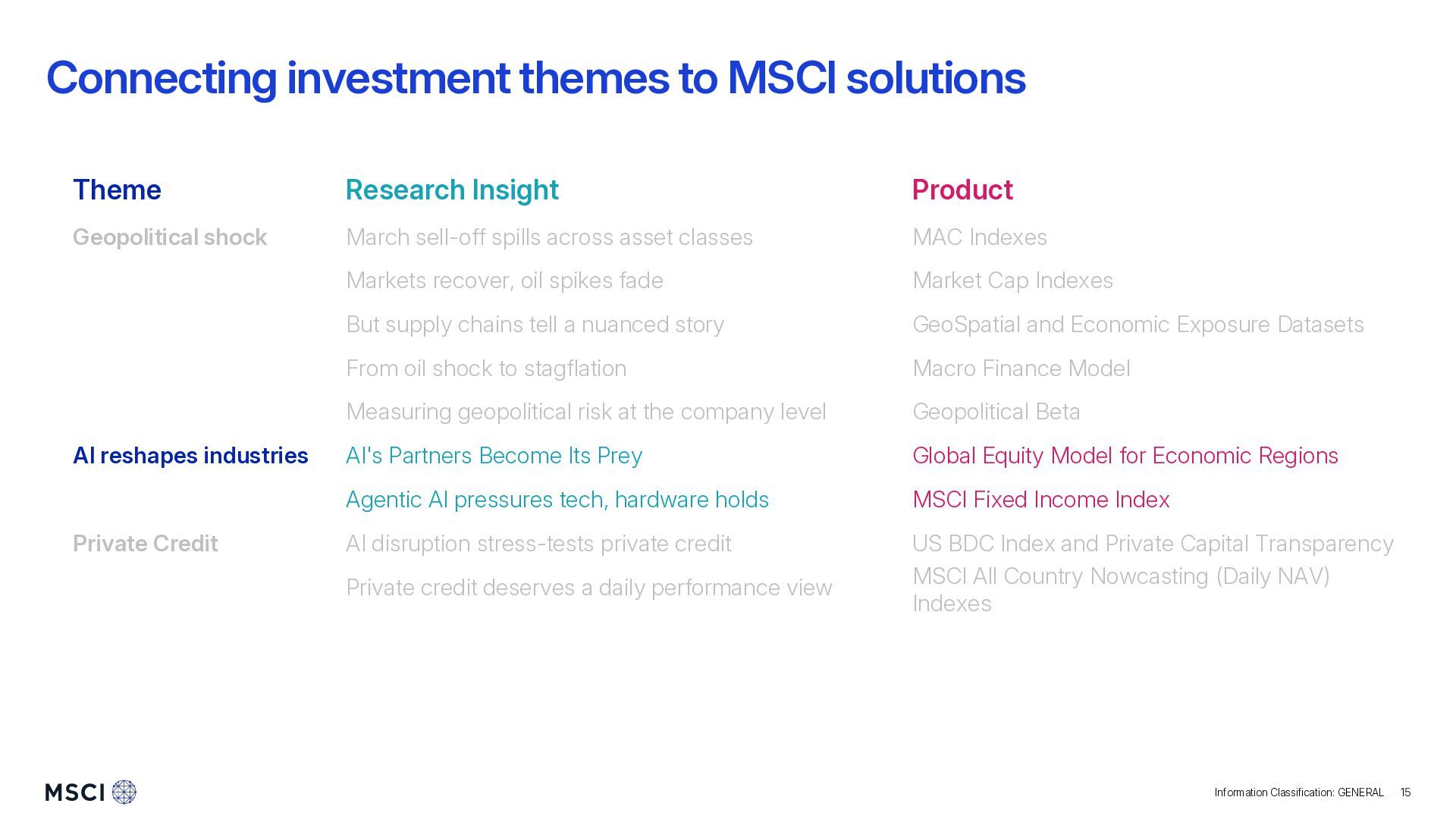
    Theme Research Insight Product Geopolitical shock March sell-off spills across asset classes MAC Indexes Markets recover, oil spikes fade Market Cap Indexes But supply chains tell a nuanced story GeoSpatial and Economic Exposure Datasets From oil shock to stagflation Macro Finance Model Measuring geopolitical risk at the company level Geopolitical Beta AI reshapes industries AI's Partners Become Its Prey Global Equity Model for Economic Regions Agentic AI pressures tech, hardware holds MSCI Fixed Income Index Private Credit AI disruption stress-tests private credit US BDC Index and Private Capital Transparency Private credit deserves a daily performance view MSCI All Country Nowcasting (Daily NAV) Indexes
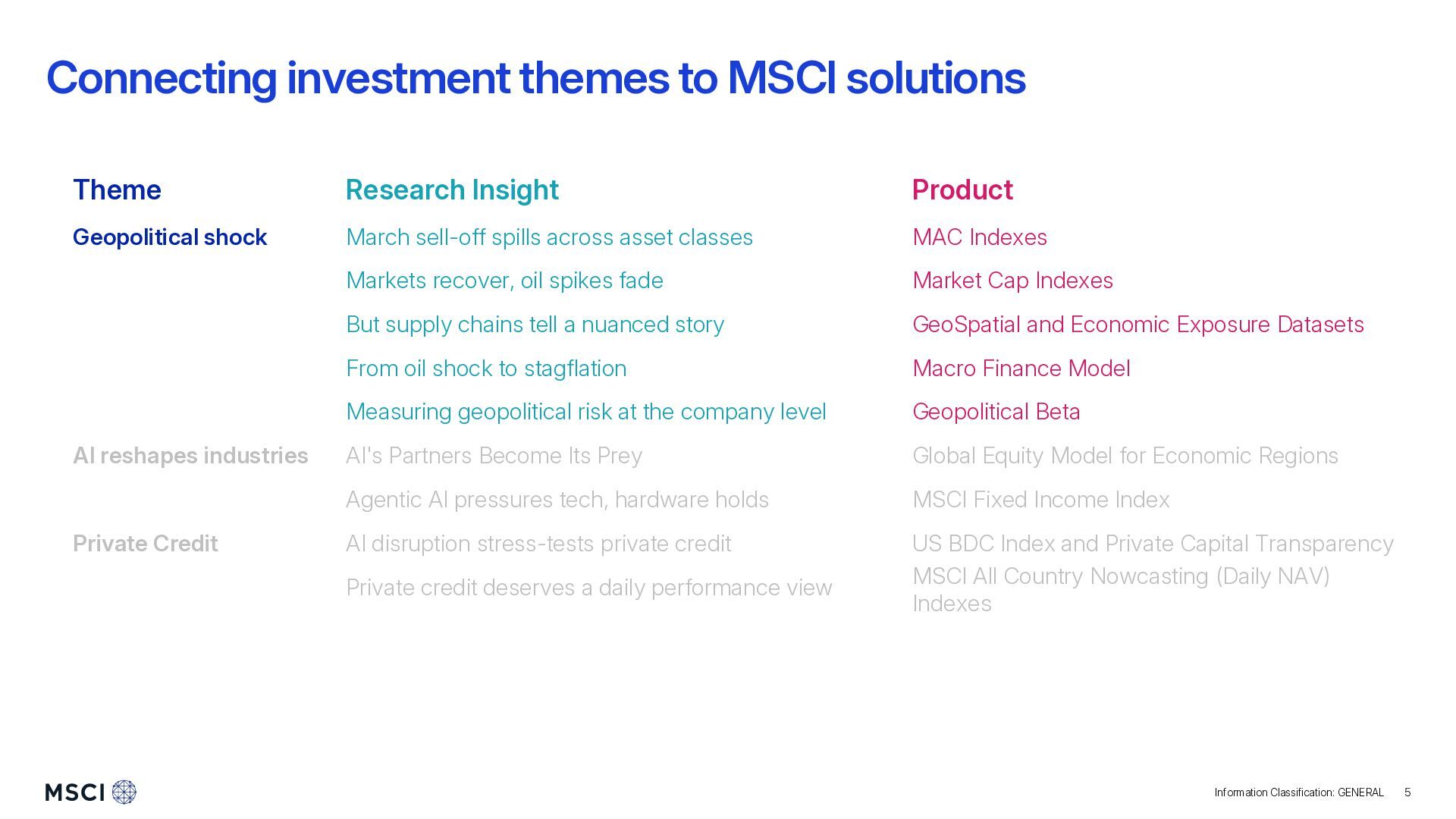
  44. Information Classification: GENERAL 5 Connecting investment themes to MSCI solutions

    Theme Research Insight Product Geopolitical shock March sell-off spills across asset classes MAC Indexes Markets recover, oil spikes fade Market Cap Indexes But supply chains tell a nuanced story GeoSpatial and Economic Exposure Datasets From oil shock to stagflation Macro Finance Model Measuring geopolitical risk at the company level Geopolitical Beta AI reshapes industries AI's Partners Become Its Prey Global Equity Model for Economic Regions Agentic AI pressures tech, hardware holds MSCI Fixed Income Index Private Credit AI disruption stress-tests private credit US BDC Index and Private Capital Transparency Private credit deserves a daily performance view MSCI All Country Nowcasting (Daily NAV) Indexes
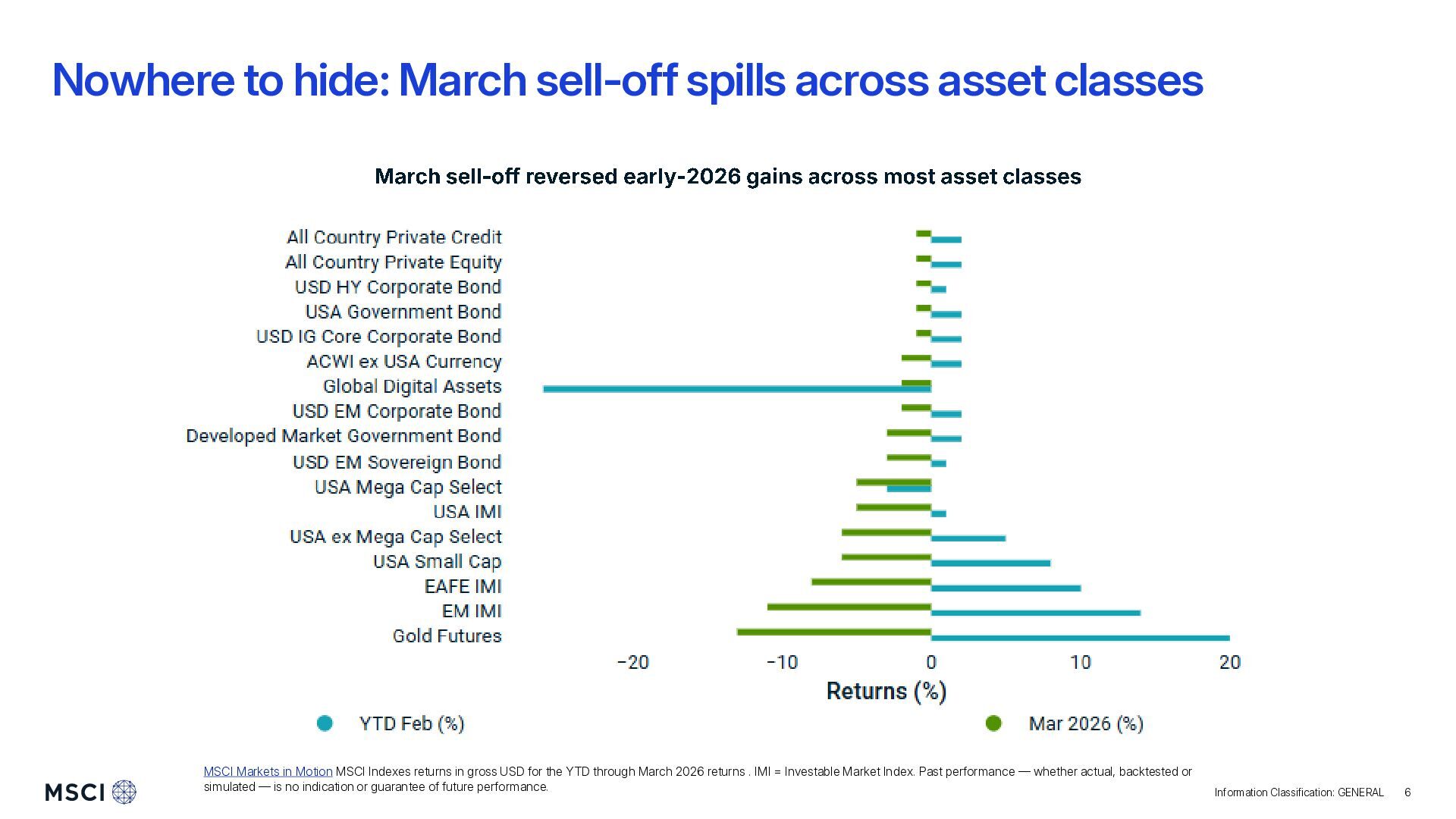
  45. Information Classification: GENERAL 6 MSCI Markets in Motion MSCI Indexes

    returns in gross USD for the YTD through March 2026 returns . IMI = Investable Market Index. Past performance — whether actual, backtested or simulated — is no indication or guarantee of future performance. March sell - off reversed early - 2026 gains across most asset classes Nowhere to hide: March sell-off spills across asset classes
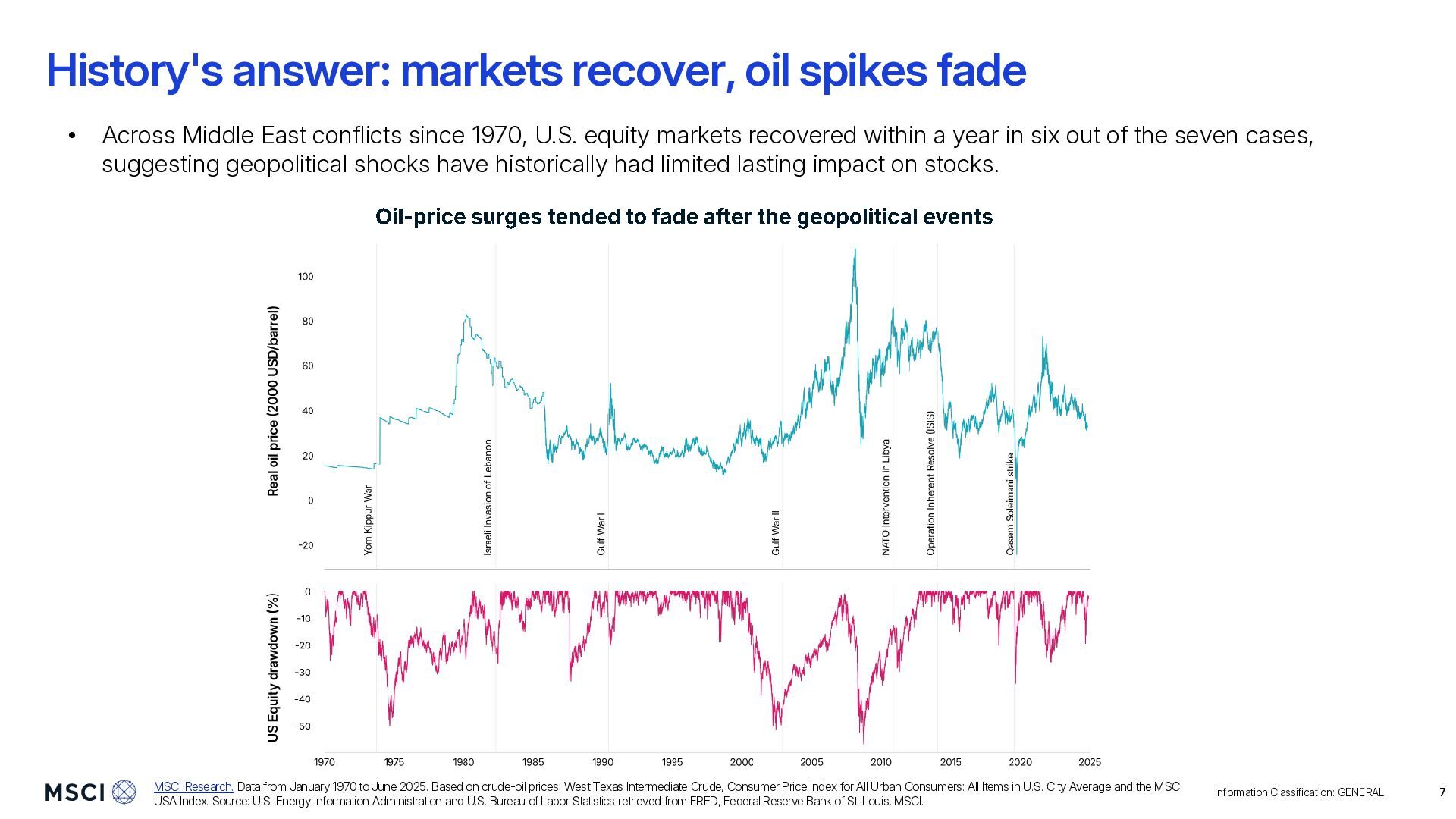
  46. Information Classification: GENERAL History's answer: markets recover, oil spikes fade

    7 • Across Middle East conflicts since 1970, U.S. equity markets recovered within a year in six out of the seven cases, suggesting geopolitical shocks have historically had limited lasting impact on stocks. MSCI Research. Data from January 1970 to June 2025. Based on crude-oil prices: West Texas Intermediate Crude, Consumer Price Index for All Urban Consumers: All Items in U.S. City Average and the MSCI USA Index. Source: U.S. Energy Information Administration and U.S. Bureau of Labor Statistics retrieved from FRED, Federal Reserve Bank of St. Louis, MSCI. Oil- price surges tended to fade after the geopolitical events
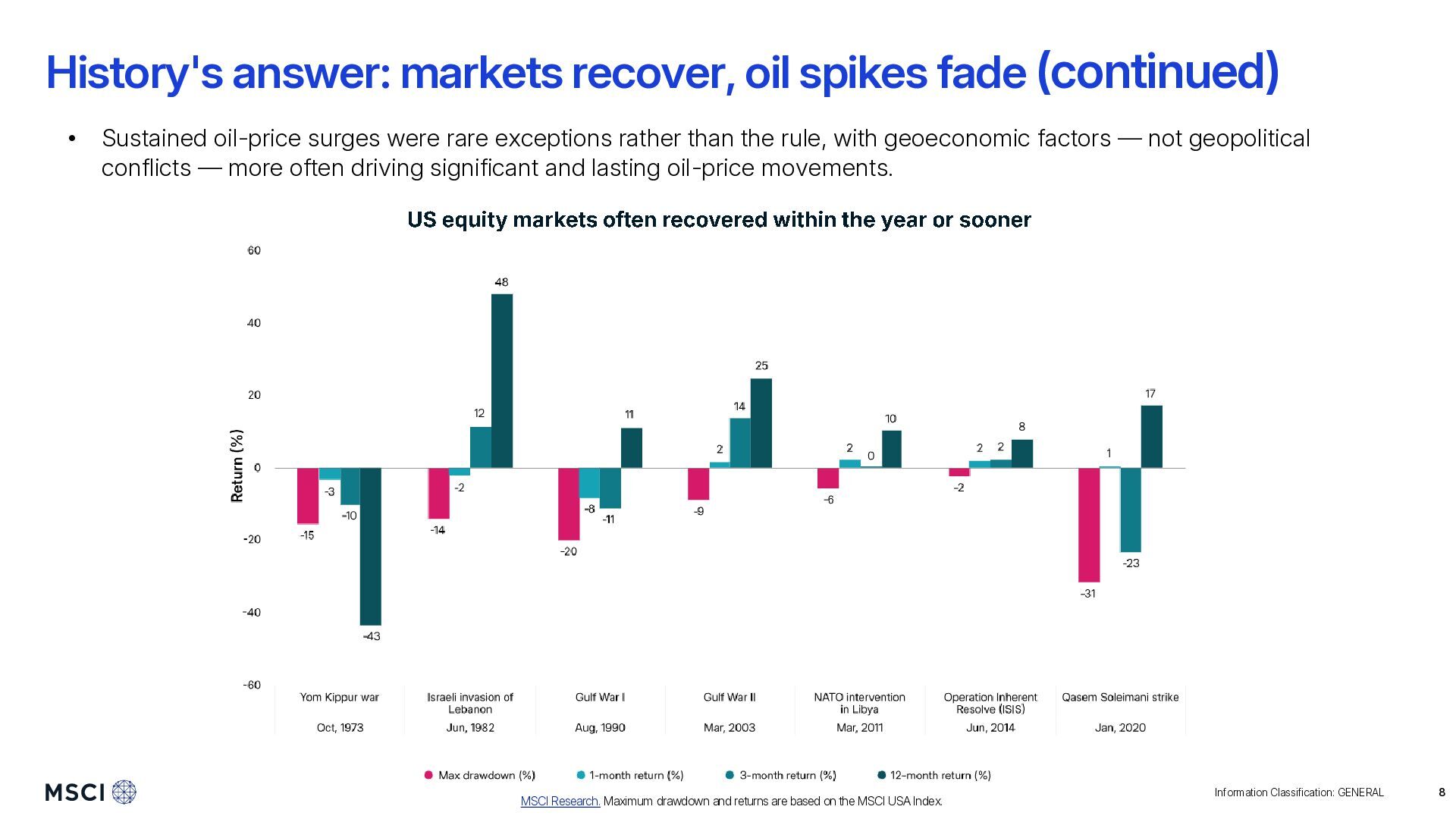
  47. Information Classification: GENERAL History's answer: markets recover, oil spikes fade

    (continued) 8 • Sustained oil-price surges were rare exceptions rather than the rule, with geoeconomic factors — not geopolitical conflicts — more often driving significant and lasting oil-price movements. MSCI Research. Maximum drawdown and returns are based on the MSCI USA Index. US equity markets often recovered within the year or sooner
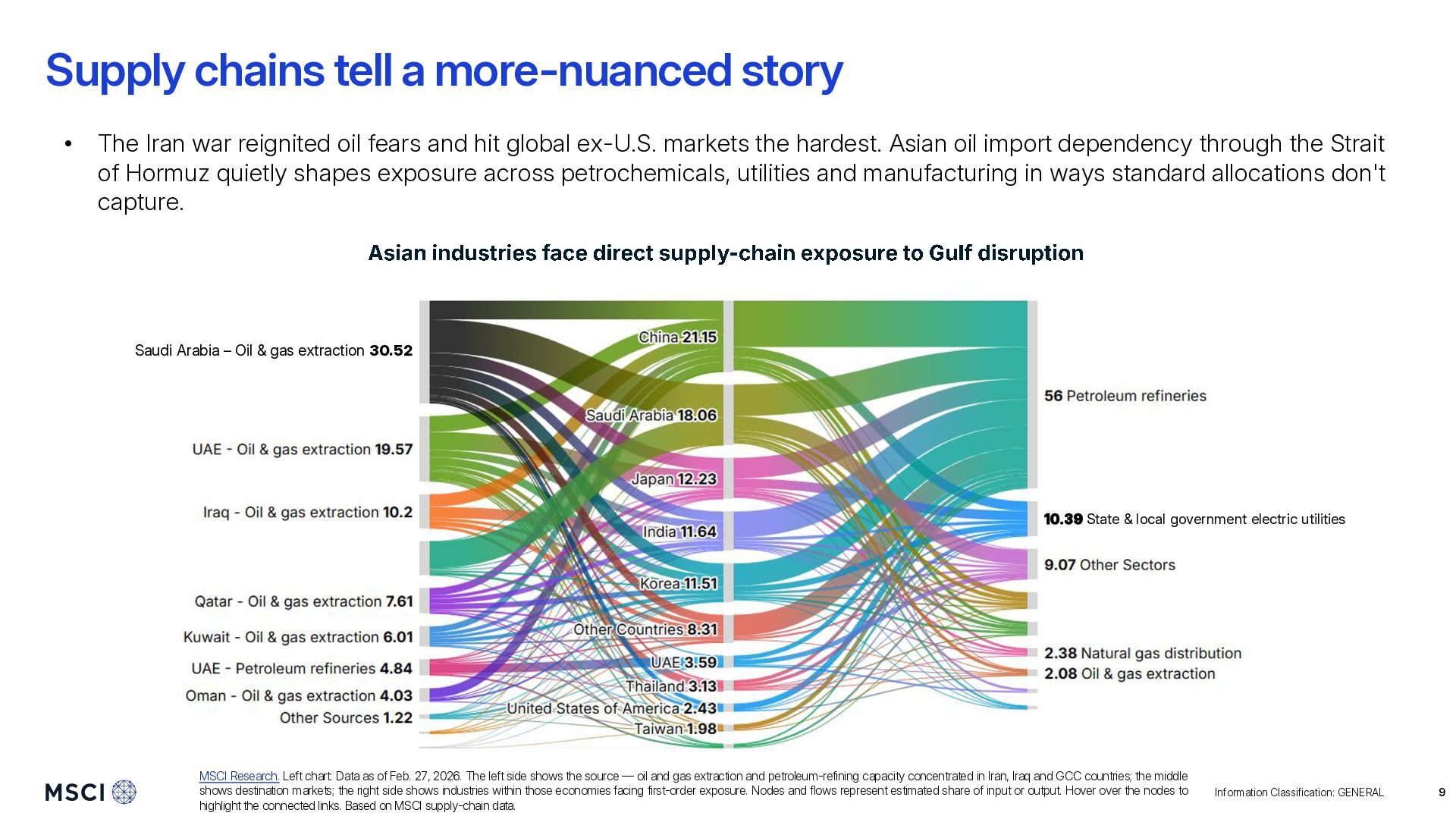
  48. Information Classification: GENERAL Supply chains tell a more-nuanced story 9

    • The Iran war reignited oil fears and hit global ex-U.S. markets the hardest. Asian oil import dependency through the Strait of Hormuz quietly shapes exposure across petrochemicals, utilities and manufacturing in ways standard allocations don't capture. MSCI Research. Left chart: Data as of Feb. 27, 2026. The left side shows the source — oil and gas extraction and petroleum-refining capacity concentrated in Iran, Iraq and GCC countries; the middle shows destination markets; the right side shows industries within those economies facing first-order exposure. Nodes and flows represent estimated share of input or output. Hover over the nodes to highlight the connected links. Based on MSCI supply-chain data. Asian industries face direct supply - chain exposure to Gulf disruption Saudi Arabia – Oil & gas extraction 30.52 10.39 State & local government electric utilities
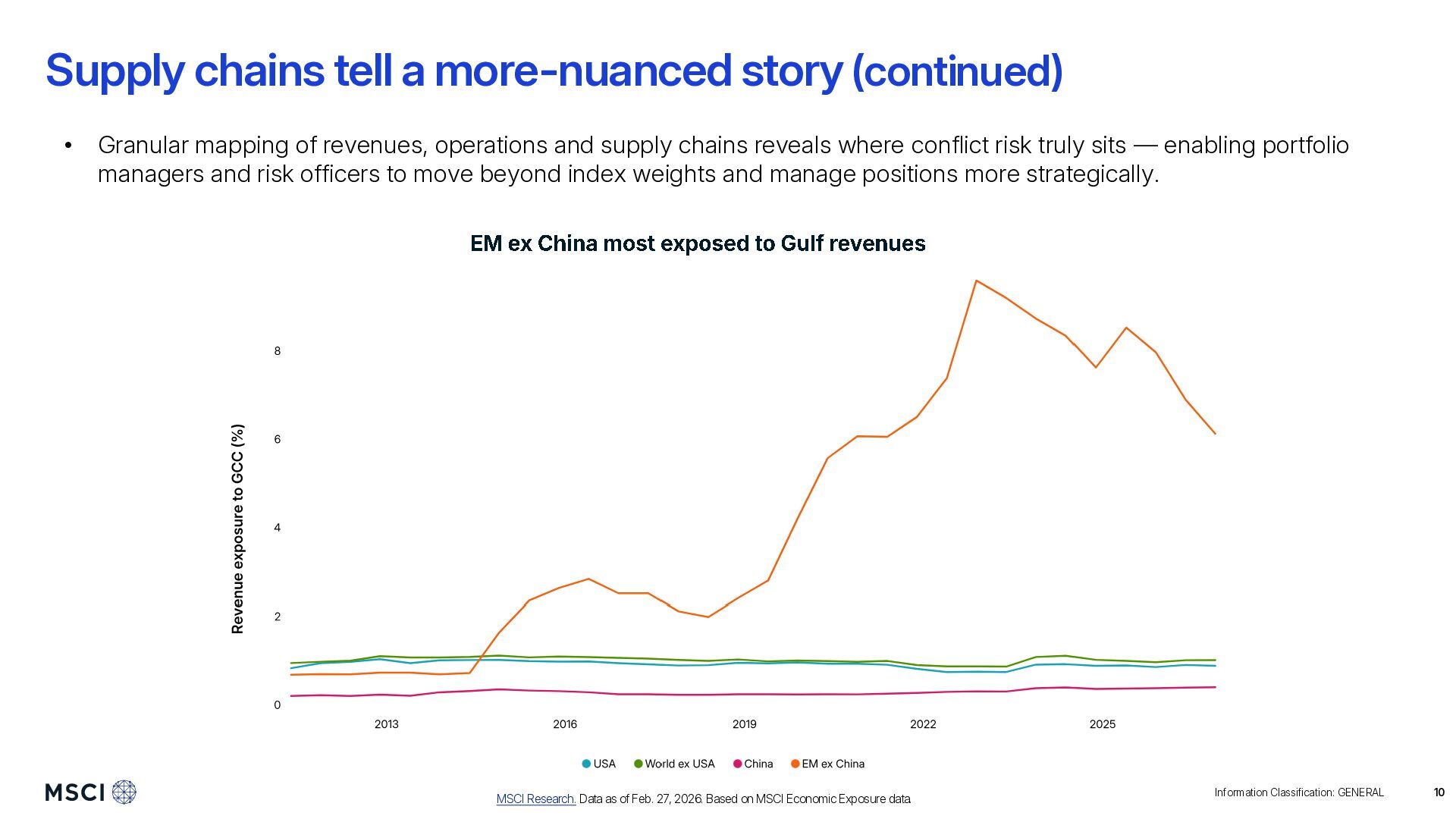
  49. Information Classification: GENERAL Supply chains tell a more-nuanced story (continued)

    10 • Granular mapping of revenues, operations and supply chains reveals where conflict risk truly sits — enabling portfolio managers and risk officers to move beyond index weights and manage positions more strategically. MSCI Research. Data as of Feb. 27, 2026. Based on MSCI Economic Exposure data. EM ex China most exposed to Gulf revenues
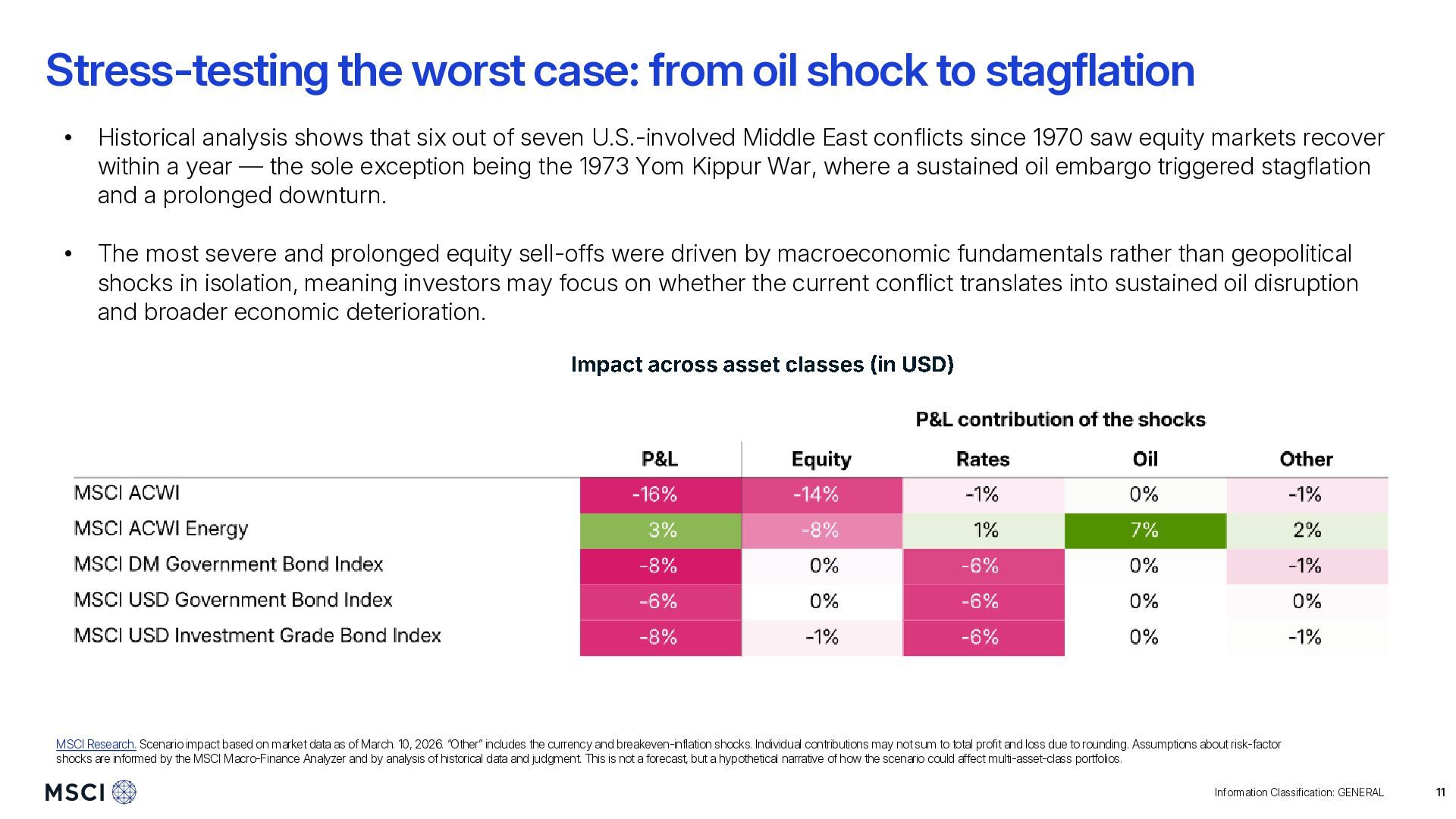
  50. Information Classification: GENERAL Stress-testing the worst case: from oil shock

    to stagflation 11 • Historical analysis shows that six out of seven U.S.-involved Middle East conflicts since 1970 saw equity markets recover within a year — the sole exception being the 1973 Yom Kippur War, where a sustained oil embargo triggered stagflation and a prolonged downturn. • The most severe and prolonged equity sell-offs were driven by macroeconomic fundamentals rather than geopolitical shocks in isolation, meaning investors may focus on whether the current conflict translates into sustained oil disruption and broader economic deterioration. MSCI Research. Scenario impact based on market data as of March. 10, 2026. “Other” includes the currency and breakeven-inflation shocks. Individual contributions may not sum to total profit and loss due to rounding. Assumptions about risk-factor shocks are informed by the MSCI Macro-Finance Analyzer and by analysis of historical data and judgment. This is not a forecast, but a hypothetical narrative of how the scenario could affect multi-asset-class portfolios. Impact across asset classes (in USD)
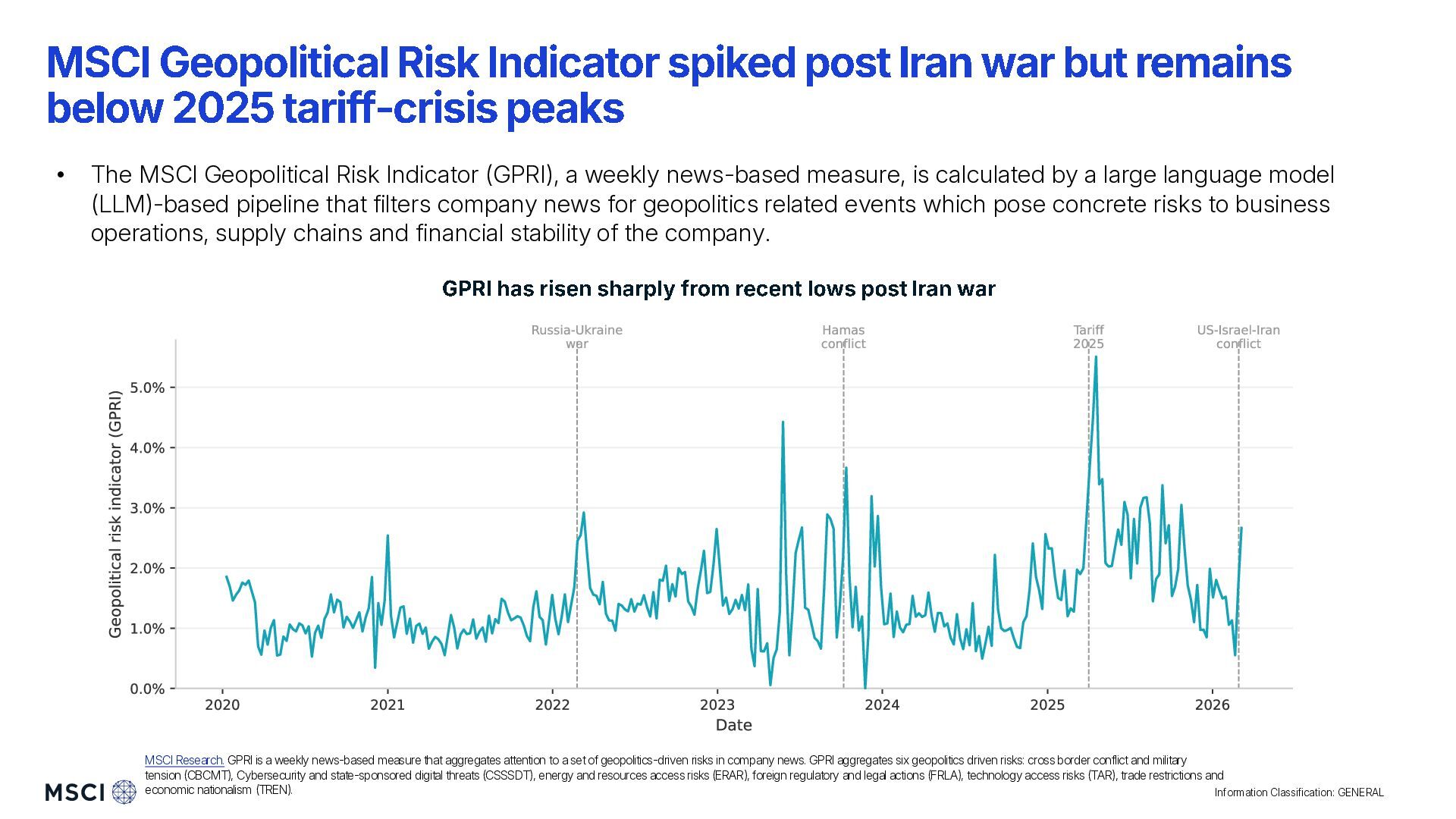
  51. Information Classification: GENERAL MSCI Geopolitical Risk Indicator spiked post Iran

    war but remains below 2025 tariff -crisis peaks MSCI Research. GPRI is a weekly news-based measure that aggregates attention to a set of geopolitics-driven risks in company news. GPRI aggregates six geopolitics driven risks: cross border conflict and military tension (CBCMT), Cybersecurity and state-sponsored digital threats (CSSSDT), energy and resources access risks (ERAR), foreign regulatory and legal actions (FRLA), technology access risks (TAR), trade restrictions and economic nationalism (TREN). • The MSCI Geopolitical Risk Indicator (GPRI), a weekly news-based measure, is calculated by a large language model (LLM)-based pipeline that filters company news for geopolitics related events which pose concrete risks to business operations, supply chains and financial stability of the company. GPRI has risen sharply from recent lows post Iran war
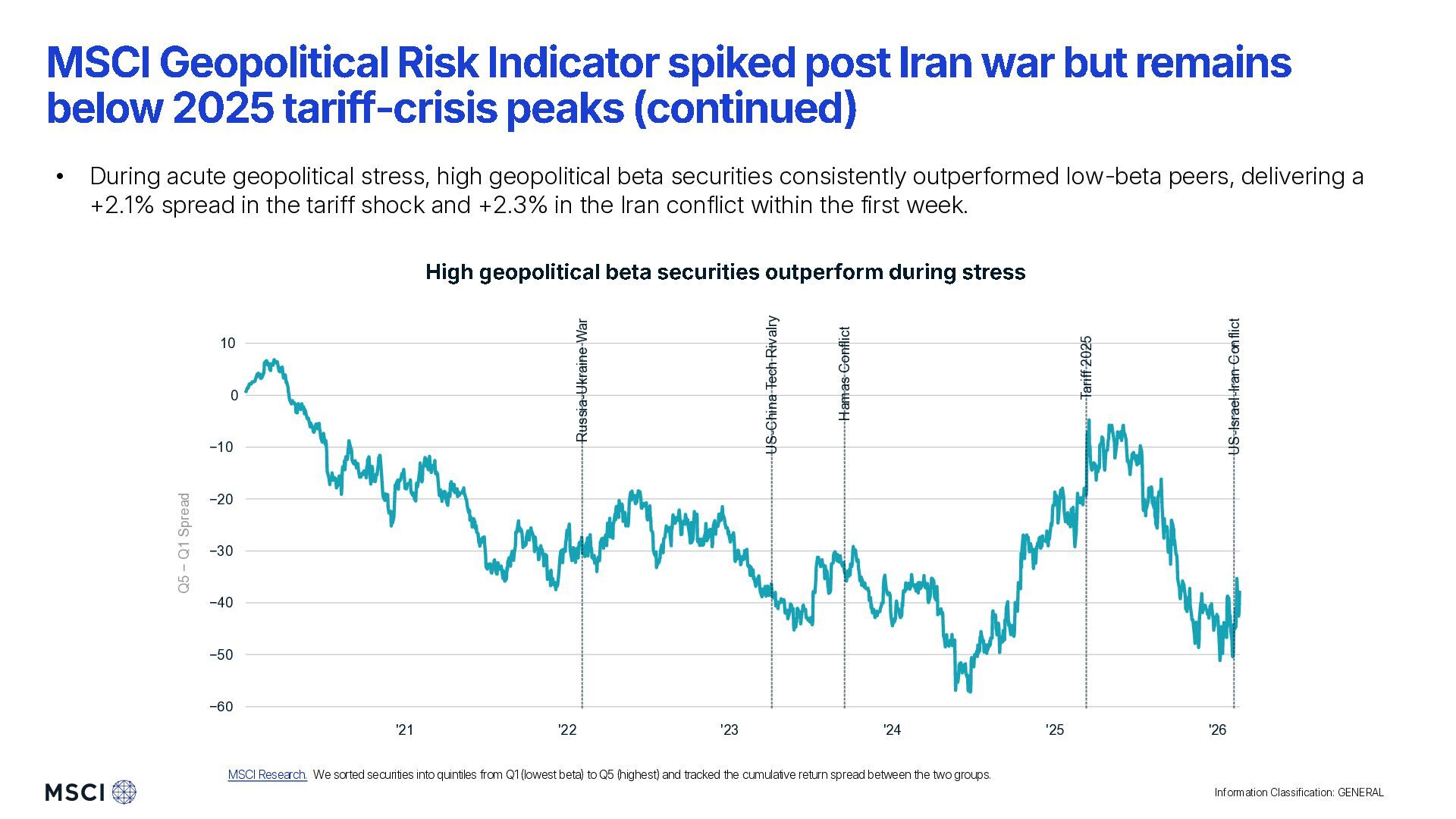
  52. Information Classification: GENERAL MSCI Geopolitical Risk Indicator spiked post Iran

    war but remains below 2025 tariff -crisis peaks (continued) MSCI Research. We sorted securities into quintiles from Q1 (lowest beta) to Q5 (highest) and tracked the cumulative return spread between the two groups. • During acute geopolitical stress, high geopolitical beta securities consistently outperformed low-beta peers, delivering a +2.1% spread in the tariff shock and +2.3% in the Iran conflict within the first week. High geopolitical beta securities outperform during stress
  53. Information Classification: GENERAL 15 Connecting investment themes to MSCI solutions

    Theme Research Insight Product Geopolitical shock March sell-off spills across asset classes MAC Indexes Markets recover, oil spikes fade Market Cap Indexes But supply chains tell a nuanced story GeoSpatial and Economic Exposure Datasets From oil shock to stagflation Macro Finance Model Measuring geopolitical risk at the company level Geopolitical Beta AI reshapes industries AI's Partners Become Its Prey Global Equity Model for Economic Regions Agentic AI pressures tech, hardware holds MSCI Fixed Income Index Private Credit AI disruption stress-tests private credit US BDC Index and Private Capital Transparency Private credit deserves a daily performance view MSCI All Country Nowcasting (Daily NAV) Indexes
  54. Information Classification: GENERAL AI's partners become its prey 16 •

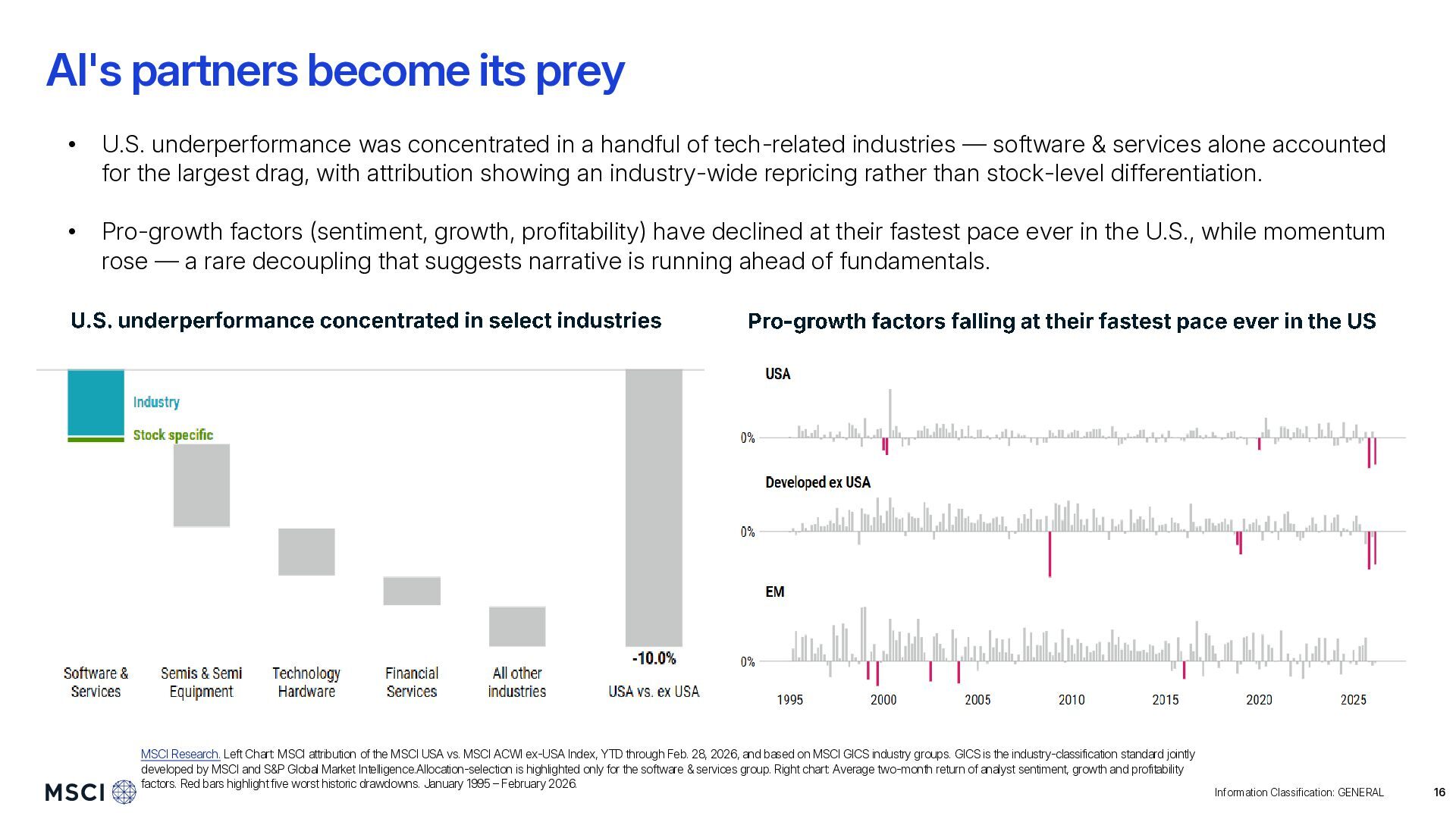
    U.S. underperformance was concentrated in a handful of tech-related industries — software & services alone accounted for the largest drag, with attribution showing an industry-wide repricing rather than stock-level differentiation. • Pro-growth factors (sentiment, growth, profitability) have declined at their fastest pace ever in the U.S., while momentum rose — a rare decoupling that suggests narrative is running ahead of fundamentals. MSCI Research. Left Chart: MSCI attribution of the MSCI USA vs. MSCI ACWI ex-USA Index, YTD through Feb. 28, 2026, and based on MSCI GICS industry groups. GICS is the industry-classification standard jointly developed by MSCI and S&P Global Market Intelligence.Allocation-selection is highlighted only for the software & services group. Right chart: Average two-month return of analyst sentiment, growth and profitability factors. Red bars highlight five worst historic drawdowns. January 1995 – February 2026. U.S. underperformance concentrated in select industries Pro - growth factors falling at their fastest pace ever in the US
  55. Information Classification: GENERAL Agentic AI widens tech spreads, but hardware

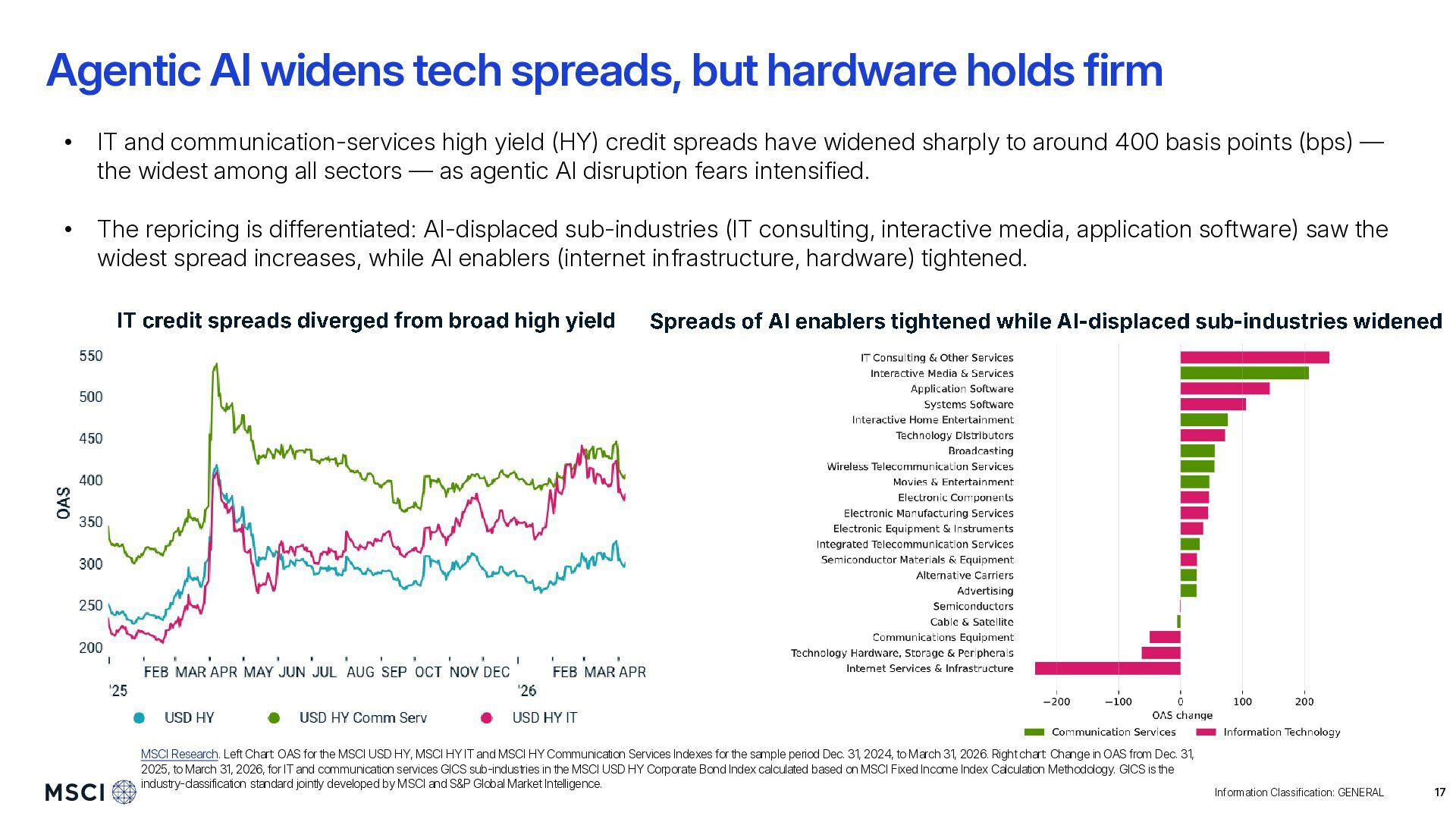
    holds firm 17 • IT and communication-services high yield (HY) credit spreads have widened sharply to around 400 basis points (bps) — the widest among all sectors — as agentic AI disruption fears intensified. • The repricing is differentiated: AI-displaced sub-industries (IT consulting, interactive media, application software) saw the widest spread increases, while AI enablers (internet infrastructure, hardware) tightened. MSCI Research. Left Chart: OAS for the MSCI USD HY, MSCI HY IT and MSCI HY Communication Services Indexes for the sample period Dec. 31, 2024, to March 31, 2026. Right chart: Change in OAS from Dec. 31, 2025, to March 31, 2026, for IT and communication services GICS sub-industries in the MSCI USD HY Corporate Bond Index calculated based on MSCI Fixed Income Index Calculation Methodology. GICS is the industry-classification standard jointly developed by MSCI and S&P Global Market Intelligence. IT credit spreads diverged from broad high yield Spreads of AI enablers tightened while AI - displaced sub - industries widened
  56. Information Classification: GENERAL 19 Connecting investment themes to MSCI solutions

    Theme Research Insight Product Geopolitical shock March sell-off spills across asset classes MAC Indexes Markets recover, oil spikes fade Market Cap Indexes But supply chains tell a nuanced story GeoSpatial and Economic Exposure Datasets From oil shock to stagflation Macro Finance Model Measuring geopolitical risk at the company level Geopolitical Beta AI reshapes industries AI's Partners Become Its Prey Global Equity Model for Economic Regions Agentic AI pressures tech, hardware holds MSCI Fixed Income Index Private Credit AI disruption stress-tests private credit US BDC Index and Private Capital Transparency Private credit deserves a daily performance view MSCI All Country Nowcasting (Daily NAV) Indexes
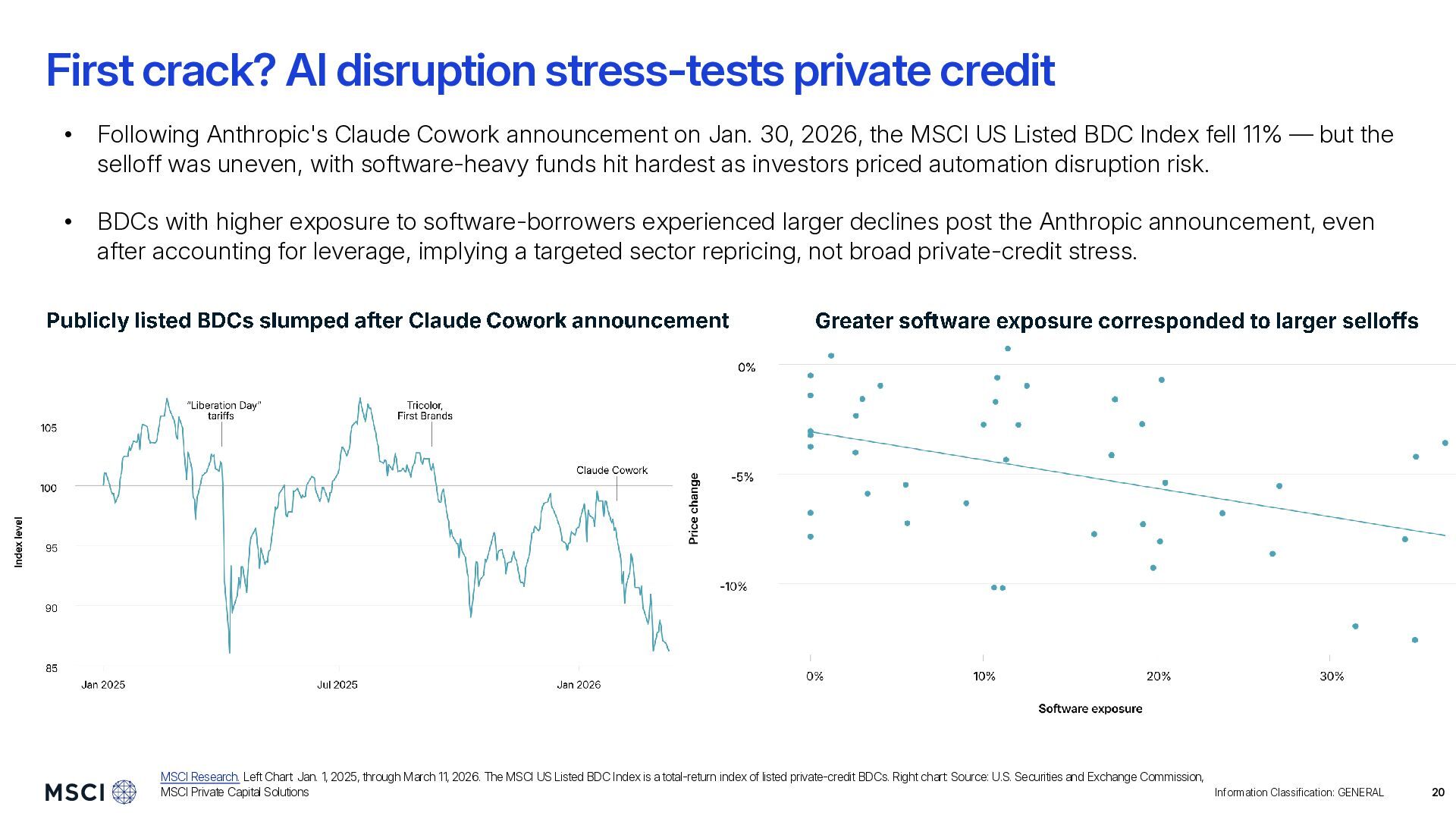
  57. Information Classification: GENERAL First crack? AI disruption stress-tests private credit

    20 • Following Anthropic's Claude Cowork announcement on Jan. 30, 2026, the MSCI US Listed BDC Index fell 11% — but the selloff was uneven, with software-heavy funds hit hardest as investors priced automation disruption risk. • BDCs with higher exposure to software-borrowers experienced larger declines post the Anthropic announcement, even after accounting for leverage, implying a targeted sector repricing, not broad private-credit stress. MSCI Research. Left Chart: Jan. 1, 2025, through March 11, 2026. The MSCI US Listed BDC Index is a total-return index of listed private-credit BDCs. Right chart: Source: U.S. Securities and Exchange Commission, MSCI Private Capital Solutions Publicly listed BDCs slumped after Claude Cowork announcement Greater software exposure corresponded to larger selloffs
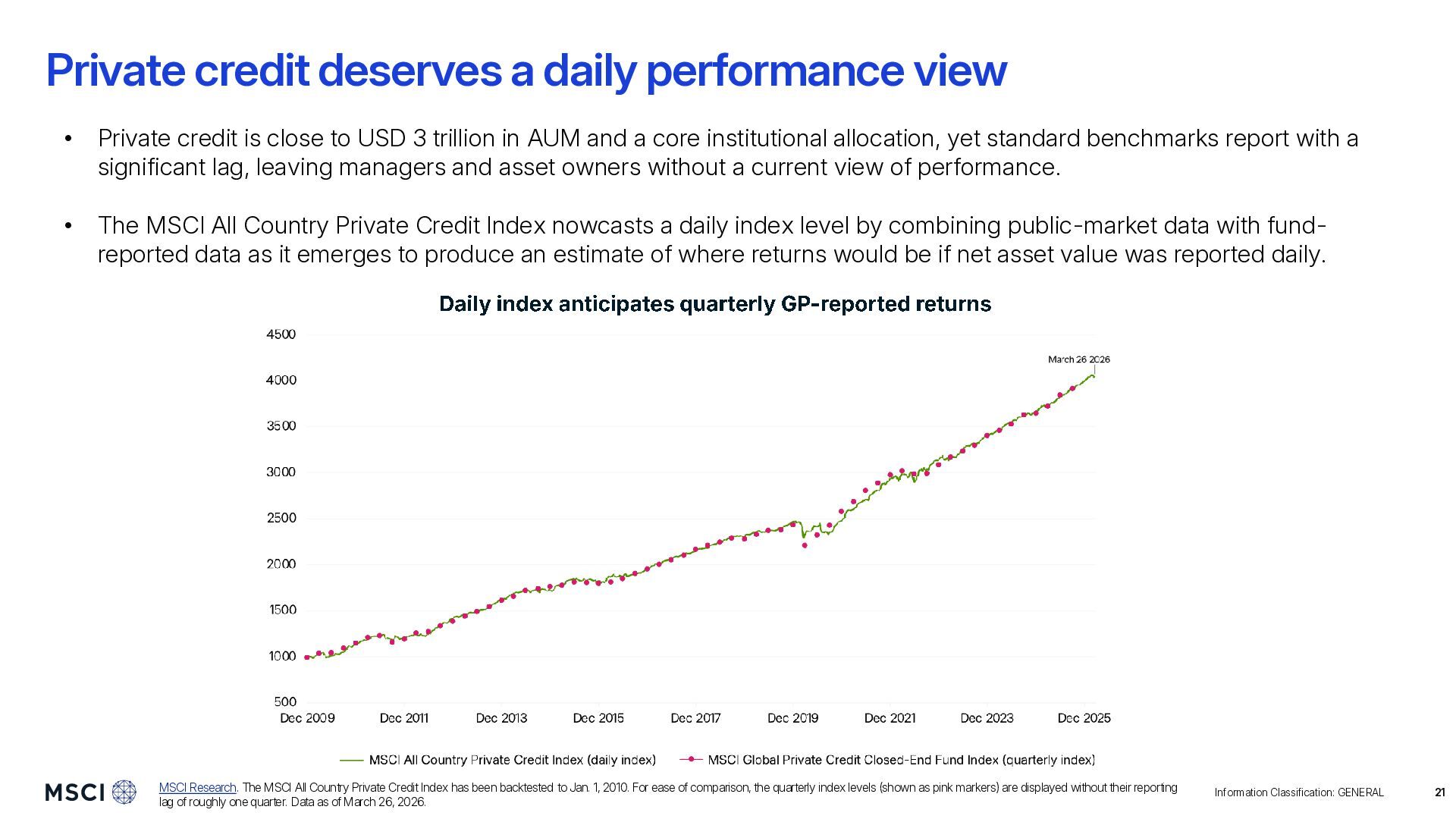
  58. Information Classification: GENERAL Private credit deserves a daily performance view

    21 • Private credit is close to USD 3 trillion in AUM and a core institutional allocation, yet standard benchmarks report with a significant lag, leaving managers and asset owners without a current view of performance. • The MSCI All Country Private Credit Index nowcasts a daily index level by combining public-market data with fund- reported data as it emerges to produce an estimate of where returns would be if net asset value was reported daily. MSCI Research. The MSCI All Country Private Credit Index has been backtested to Jan. 1, 2010. For ease of comparison, the quarterly index levels (shown as pink markers) are displayed without their reporting lag of roughly one quarter. Data as of March 26, 2026. Daily index anticipates quarterly GP - reported returns
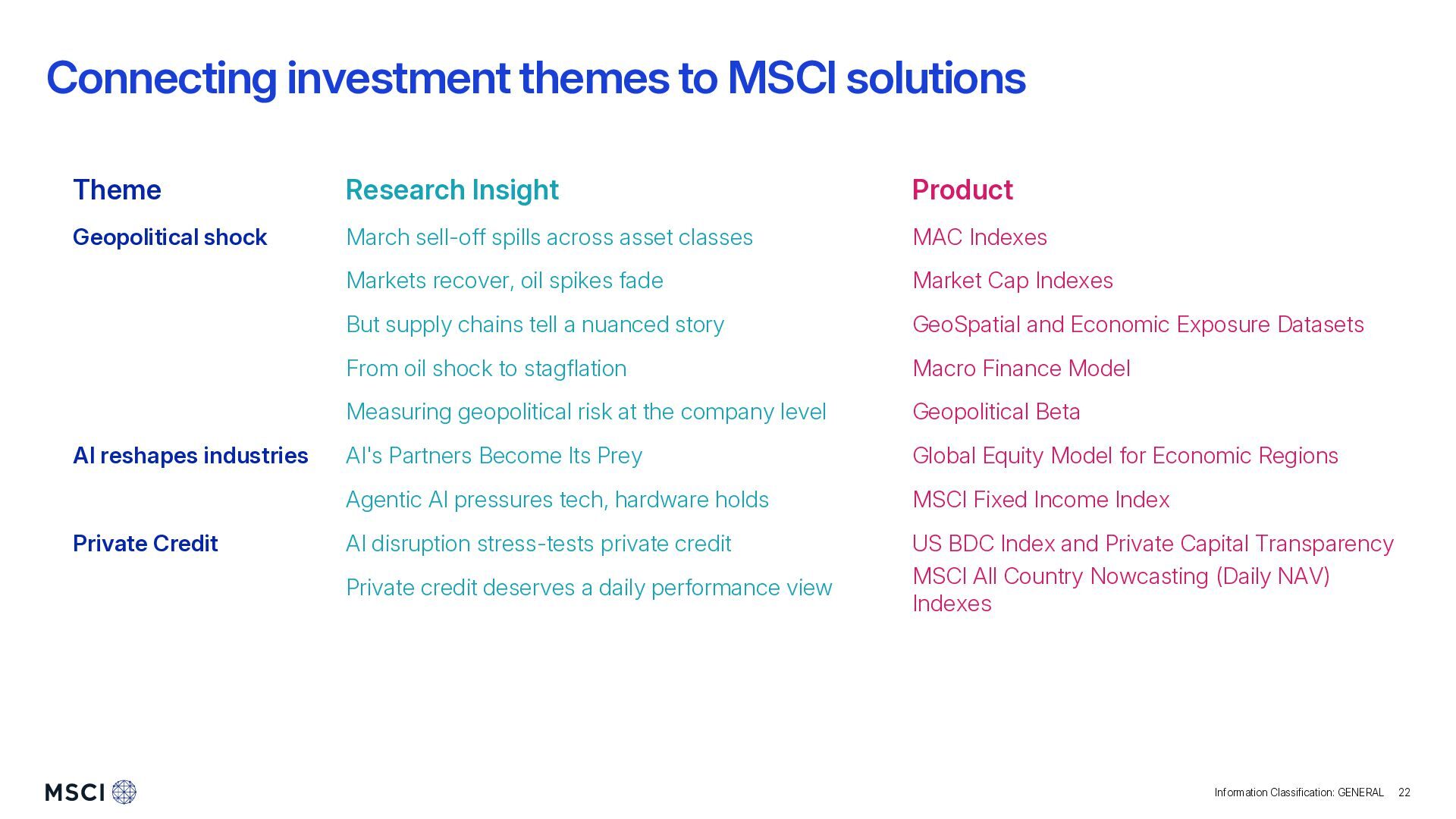
  59. Information Classification: GENERAL 22 Connecting investment themes to MSCI solutions

    Theme Research Insight Product Geopolitical shock March sell-off spills across asset classes MAC Indexes Markets recover, oil spikes fade Market Cap Indexes But supply chains tell a nuanced story GeoSpatial and Economic Exposure Datasets From oil shock to stagflation Macro Finance Model Measuring geopolitical risk at the company level Geopolitical Beta AI reshapes industries AI's Partners Become Its Prey Global Equity Model for Economic Regions Agentic AI pressures tech, hardware holds MSCI Fixed Income Index Private Credit AI disruption stress-tests private credit US BDC Index and Private Capital Transparency Private credit deserves a daily performance view MSCI All Country Nowcasting (Daily NAV) Indexes
  60. Contact https://www.msci.com/index-regulation The process for submitting a formal index complaint

    can be found on the index page of MSCI’s website at: https://www.msci.com/index-regulation. Information Classification: GENERAL Americas Asia Pacific Europe, Middle East & Africa United States +1 888 588 4567 (toll free) Canada +1 416 628 1007 Brazil +55 11 4040 7830 Mexico +52 81 1253 4020 China +86 21 61326611 Hong Kong + 852 2844 9333 India + 91 22 6784 9160 Malaysia 1800818185 (toll free) South Korea +82 70 4769 4231 Singapore +65 67011177 Australia +612 9033 9333 Taiwan 008 0112 7513 (toll free) Thailand 0018 0015 6207 7181 (toll free) Japan +81 3 4579 0333 South Africa + 27 21 673 0103 Germany + 49 69 133 859 00 Switzerland + 41 22 817 9777 United Kingdom + 44 20 7618 2222 Italy + 39 02 5849 0415 France + 33 17 6769 810 23
  61. Information Classification: GENERAL About Us www.msci.com https://www.msci.com/index-regulation About MSCI Sustainability

    and Climate Products and Services MSCI Sustainability and Climate products and services are provided by MSCI Solutions LLC and certain related entities, and are designed to provide in-depth research, ratings and analysis of environmental, social and governance related business practices to companies worldwide. ESG ratings, data and analysis from MSCI Sustainability and Climate are also used in the construction of MSCI Indexes. About MSCI Inc. MSCI (NYSE: MSCI Inc.) strengthens global markets by connecting participants across the financial ecosystem with a common language. Our research-based data, analytics and indexes, supported by advanced technology, set standards for global investors and help our clients understand risks and opportunities so they can make better decisions and unlock innovation. We serve asset managers and owners, private-market sponsors and investors, hedge funds, wealth managers, banks, insurers and corporates. To learn more, please visit www.msci.com The process for submitting a formal index complaint can be found on the index regulation page of MSCI’s website at: https://www.msci.com/index-regulation. 24
  62. Information Classification: GENERAL https://www.msci.com/legal/supplemental-terms-for-client-use-of-artificial-intelligence www.msci.com https://www.msci.com/index-regulation https://www.msci.com/privacy-pledge The data, data

    feeds, databases, reports, text, graphs, charts, images, videos, recordings, models, metrics, analytics, indexes, ratings, scores, cases, estimates, assessments, software, websites, products, services and other information and materials contained herein or delivered in connection with this notice (collectively, the “Information”) are copyrighted, trade secrets (when not publicly available), trademarks and proprietary property of MSCI Inc. or its subsidiaries (collectively, “MSCI”), MSCI’s licensors, direct or indirect suppliers and authorized sources, and/or any third party contributing to the Information (collectively, with MSCI, the “Information Providers”). All rights in the Information are reserved by MSCI and its Information Providers and user(s) shall not, nor assist others to, challenge or assert any rights in the Information. Unless you contact MSCI and receive its prior written permission, you must NOT use the Information, directly or indirectly, in whole or in part (i) for commercial purposes, (ii) in a manner that competes with MSCI or impacts its ability to commercialize the Information or its services, (iii) to provide a service to a third party, (iv) to permit a third party to directly or indirectly access, use or resell the Information, (v) to redistribute or resell the Information in any form, (vi) to include the Information in any materials for public dissemination such as fund factsheets, market presentations, prospectuses, and investor information documents (e.g. KIIDs or KIDs), (vii) to create or as a component of any financial products, whether listed or traded over the counter or on a private placement basis or otherwise, (viii) to create any indexes, ratings or other data products, including in derivative works combined with other indexes or data or as a policy, product or performance benchmarks for active, passive or other financial products, (ix) to populate a database, or (x) to train, use as an input to, or otherwise in connection with any artificial intelligence, machine learning, large language models or similar technologies except as licensed and expressly authorized under MSCI’s AI Contracting Supplement at https://www.msci.com/legal/supplemental-terms-for-client-use-of-artificial-intelligence. The intellectual property rights of MSCI and its Information Providers may not be misappropriated or used in a competitive manner through the use of third-party data or financial products linked to the Information, including by using an MSCI index-linked future or option in a competing third-party index to provide an exposure to the underlying MSCI index or by using an MSCI index-linked ETF to create a financial product that provides an exposure to the underlying MSCI index without obtaining a license from MSCI. The user or recipient of the Information assumes the entire risk of any use it may make, permit or cause to be made of the Information. NONE OF THE INFORMATION PROVIDERS MAKES ANY EXPRESS OR IMPLIED WARRANTIES OR REPRESENTATIONS WITH RESPECT TO THE INFORMATION (OR THE RESULTS TO BE OBTAINED BY THE USE THEREOF), AND TO THE MAXIMUM EXTENT PERMITTED BY APPLICABLE LAW, EACH INFORMATION PROVIDER EXPRESSLY DISCLAIMS ALL IMPLIED WARRANTIES (INCLUDING ANY IMPLIED WARRANTIES OF ORIGINALITY, ACCURACY, TIMELINESS, SUITABILITY, NON-INFRINGEMENT, COMPLETENESS, MERCHANTABILITY AND FITNESS FOR A PARTICULAR PURPOSE) WITH RESPECT TO ANY OF THE INFORMATION. Without limiting any of the foregoing and to the maximum extent permitted by applicable law, in no event shall MSCI or any other Information Provider have any liability arising out of or relating to any of the Information, including for any direct, indirect, special, punitive, consequential (including lost profits) or any other damages, even if notified of the possibility of such damages. The foregoing shall not exclude or limit any liability that may not by applicable law be excluded or limited. The Information, including index construction, ratings, historical data, or analysis, is not a prediction or guarantee of future performance, and must not be relied upon as such. Past performance is not indicative of future results. The Information may contain back tested data. Back- tested performance based on back-tested data is not actual performance but is hypothetical. There are frequently material differences between back tested performance results and actual results subsequently achieved by any investment strategy. The Information may include “Signals,” defined as quantitative attributes or the product of methods or formulas that describe or are derived from calculations using historical data. Signals are inherently backward-looking because of their use of historical data, and they are inherently inaccurate, not intended to predict the future and must not be relied upon as such. The relevance, correlations and accuracy of Signals frequently change materially over time. The Information may include data relating to indicative prices, evaluated pricing or other information based on estimates or evaluations (collectively, “Evaluations”) that are not current and do not reflect real-time traded prices. No evaluation method, including those used by the Information Providers, may consistently generate evaluations or estimates that correspond to actual “traded” prices of any relevant securities or other assets. Evaluations are subject to change at any time without notice and without any duty to update or inform you, may not reflect prices at which actual transactions or collateral calls may occur or have occurred. The market price of securities, financial instruments, and other assets can be determined only if and when executed in the market. There may be no, or may not have been any, secondary trading market for the relevant securities, financial instruments or other assets. Private capital, equity, credit and other assets and their prices may be assessed infrequently, may not be priced on a secondary market, and shall not be relied upon as an explicit or implicit valuation of a particular instrument. Any reliance on fair value estimates and non-market inputs introduces potential biases and subjectivity. Internal Rate of Return metrics are not fully representative without full disclosure of fund cash flows, assumptions, and time horizons. The Information does not constitute, and must not be relied upon as, investment advice, credit ratings, or proxy advisory or voting services. None of the Information Providers, their products or services, are fiduciaries or make any recommendation, endorsement, or approval of any investment decision or asset allocation. Likewise, the Information does not represent an offer to sell, a solicitation to buy, or an endorsement of any security, financial product, instrument, investment vehicle, or trading strategy, whether or not linked to or in any way based on any MSCI index, rating, subcomponent, or other Information (collectively, “Linked Investments”).The Information should not be relied on and is not a substitute for the skill, judgment and experience of any user when making investment and other business decisions. MSCI is not responsible for any user’s compliance with applicable laws and regulations. All Information is impersonal, not tailored to the needs of any person, entity or group of persons, not objectively verifiable in every respect, and may not be based on information that is important to any user. It is not possible to invest in an index. Exposure to an asset class or trading strategy or other category represented by an index is only available through third party investable instruments (if any) based on that index. MSCI makes no assurance that any Linked Investments will accurately track index performance or provide positive investment returns. Index returns do not represent results of actual trading of investible assets/securities. MSCI maintains and calculates indexes but does not manage assets. The calculation of indexes and index returns may deviate from the stated methodology. Index returns do not reflect payment of any sales charges or fees an investor may pay to purchase securities underlying the index or Linked Investments. The imposition of these fees and charges would cause the performance of a Linked Investment to be different than the MSCI index performance. Information provided by MSCI Solutions LLC and certain related entities (“MSCI Solutions”), including materials utilized in MSCI sustainability and climate products, have not been submitted to, nor received approval from any regulatory body. MSCI sustainability and climate offerings, research and data are produced by, and ratings are solely the opinion of MSCI Solutions. Other MSCI products and services may utilize information from MSCI Solutions, Barra LLC or other affiliates. More information can be found in the relevant methodologies on www.msci.com. MSCI Indexes are administered by MSCI Limited (UK) and MSCI Deutschland GmbH. No regulated use of any MSCI private real assets indexes in any jurisdiction is permitted without MSCI’s express written authorization. The process for applying for MSCI’s express written authorization can be found at: https://www.msci.com/index-regulation. MSCI receives compensation in connection with licensing its indexes and other Information to third parties. MSCI Inc.’s revenue includes fees based on assets in Linked Investments. Information can be found in MSCI Inc.’s company filings on the Investor Relations section of msci.com. Issuers mentioned in MSCI Solutions materials or their affiliates may purchase research or other products or services from one or more MSCI affiliates, manage financial products such as mutual funds or ETFs rated by MSCI Solutions or its affiliates or are based on MSCI Indexes. Constituents of MSCI equity indexes are listed companies, which are included in or excluded from the indexes according to the application of the relevant index methodologies. Constituents in MSCI Inc. equity indexes may include MSCI Inc., clients of MSCI or suppliers to MSCI. MSCI Solutions has taken steps to mitigate potential conflicts of interest and safeguard the integrity and independence of its research and ratings. MIFID2/MIFIR notice: MSCI Solutions does not distribute or act as an intermediary for financial instruments or structured deposits, nor does it deal on its own account, provide execution services for others or manage client accounts. No MSCI product or service supports, promotes or is intended to support or promote any such activity. MSCI Solutions is an independent provider of sustainability and climate data. All use of indicative prices for carbon credits must comply with any rules specified by MSCI. All transactions in carbon credits must be traded “over-the- counter” (i.e. not on a regulated market, trading venue or platform that performs a similar function to a trading venue) and result in physical delivery of the carbon credits. You may not remove, alter, or obscure any attribution to MSCI or notices or disclaimers that apply to the Information. MSCI, Barra, RiskMetrics, and other MSCI brands and product names are the trademarks, service marks, or registered trademarks of MSCI or its subsidiaries in the United States and other jurisdictions. The Global Industry Classification Standard (GICS) was developed by and is the exclusive property of MSCI and S&P Dow Jones Indices. “Global Industry Classification Standard (GICS)” is a service mark of MSCI and S&P Dow Jones Indices. Terms such as including, includes, for example, such as and similar terms used herein are without limitation. MSCI and its Information Providers may use automated technologies and artificial intelligence to help generate content and output incorporated in the Information. Privacy notice: For information about how MSCI collects and uses personal data, please refer to our Privacy Notice at: https://www.msci.com/privacy-pledge. For copyright infringement claims contact us at [email protected]. This notice is governed by the laws of the State of New York without regard to conflict of laws principles Notice and Disclaimer 25
  63. From Yield to Cash Flow: Integrating Dividend and Quality Factors

    in Index Strategies Izzy Wang Associate Director, Factors and Dividends Indices May 27, 2026 S&P Dow Jones Indices – For Financial Professionals Only
  64. S&P Dow Jones Indices – For Financial Professionals Only 2

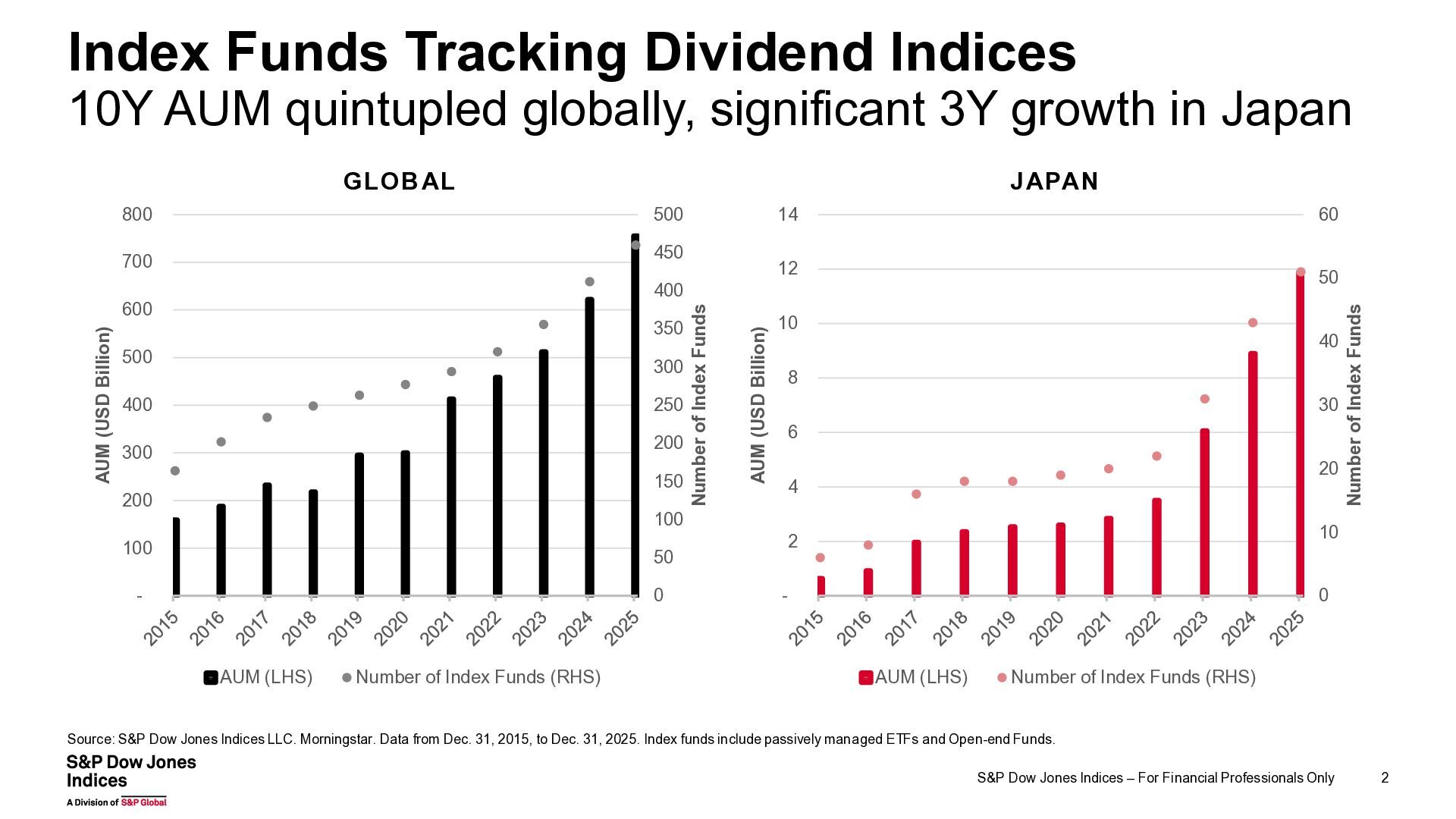
    10Y AUM quintupled globally, significant 3Y growth in Japan Index Funds Tracking Dividend Indices Source: S&P Dow Jones Indices LLC. Morningstar. Data from Dec. 31, 2015, to Dec. 31, 2025. Index funds include passively managed ETFs and Open-end Funds. 0 50 100 150 200 250 300 350 400 450 500 - 100 200 300 400 500 600 700 800 Number of Index Funds AUM (USD Billion) GLOBAL AUM (LHS) Number of Index Funds (RHS) 0 10 20 30 40 50 60 - 2 4 6 8 10 12 14 Number of Index Funds AUM (USD Billion) JAPAN AUM (LHS) Number of Index Funds (RHS)
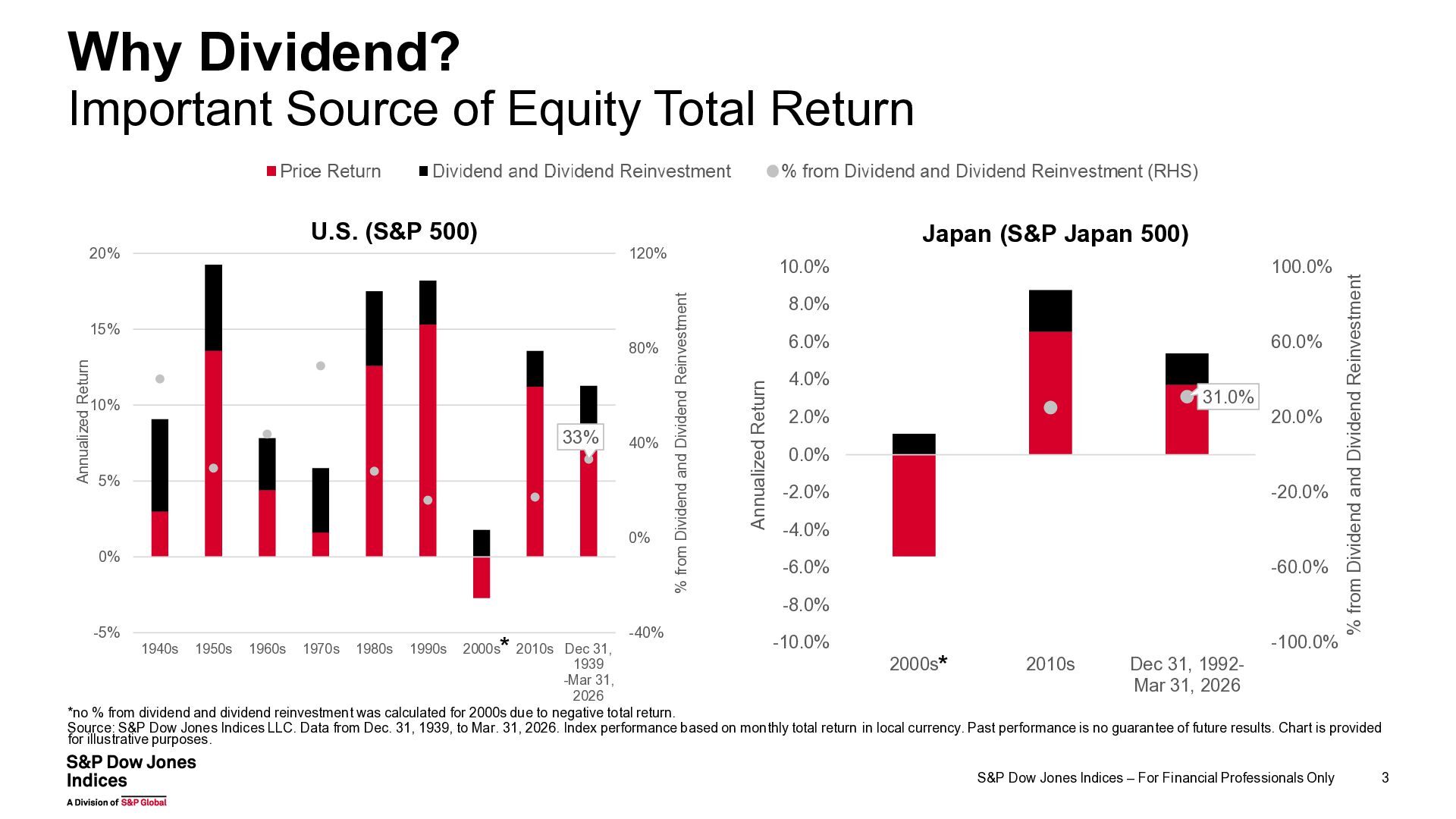
  65. 33% -40% 0% 40% 80% 120% -5% 0% 5% 10%

    15% 20% 1940s 1950s 1960s 1970s 1980s 1990s 2000s 2010s Dec 31, 1939 -Mar 31, 2026 % from Dividend and Dividend Reinvestment Annualized Return U.S. (S&P 500) S&P Dow Jones Indices – For Financial Professionals Only 3 Important Source of Equity Total Return Why Dividend? *no % from dividend and dividend reinvestment was calculated for 2000s due to negative total return. Source: S&P Dow Jones Indices LLC. Data from Dec. 31, 1939, to Mar. 31, 2026. Index performance based on monthly total return in local currency. Past performance is no guarantee of future results. Chart is provided for illustrative purposes. 31.0% -100.0% -60.0% -20.0% 20.0% 60.0% 100.0% -10.0% -8.0% -6.0% -4.0% -2.0% 0.0% 2.0% 4.0% 6.0% 8.0% 10.0% 2000s 2010s Dec 31, 1992- Mar 31, 2026 % from Dividend and Dividend Reinvestment Annualized Return Japan (S&P Japan 500) * *
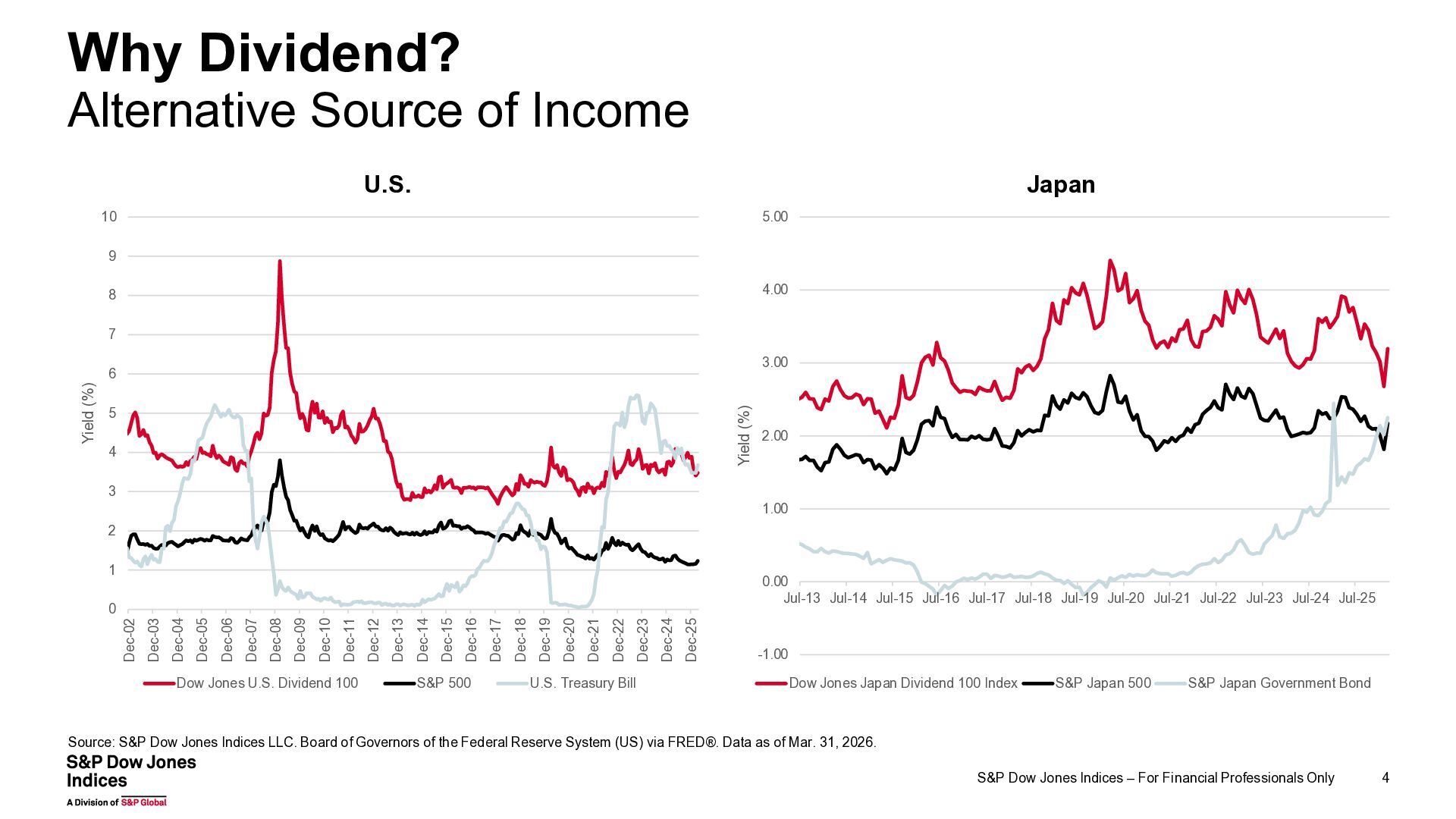
  66. S&P Dow Jones Indices – For Financial Professionals Only 4

    Alternative Source of Income Why Dividend? Source: S&P Dow Jones Indices LLC. Board of Governors of the Federal Reserve System (US) via FRED®. Data as of Mar. 31, 2026. -1.00 0.00 1.00 2.00 3.00 4.00 5.00 Jul-13 Jul-14 Jul-15 Jul-16 Jul-17 Jul-18 Jul-19 Jul-20 Jul-21 Jul-22 Jul-23 Jul-24 Jul-25 Yield (%) Japan Dow Jones Japan Dividend 100 Index S&P Japan 500 S&P Japan Government Bond 0 1 2 3 4 5 6 7 8 9 10 Dec-02 Dec-03 Dec-04 Dec-05 Dec-06 Dec-07 Dec-08 Dec-09 Dec-10 Dec-11 Dec-12 Dec-13 Dec-14 Dec-15 Dec-16 Dec-17 Dec-18 Dec-19 Dec-20 Dec-21 Dec-22 Dec-23 Dec-24 Dec-25 Yield (%) U.S. Dow Jones U.S. Dividend 100 S&P 500 U.S. Treasury Bill

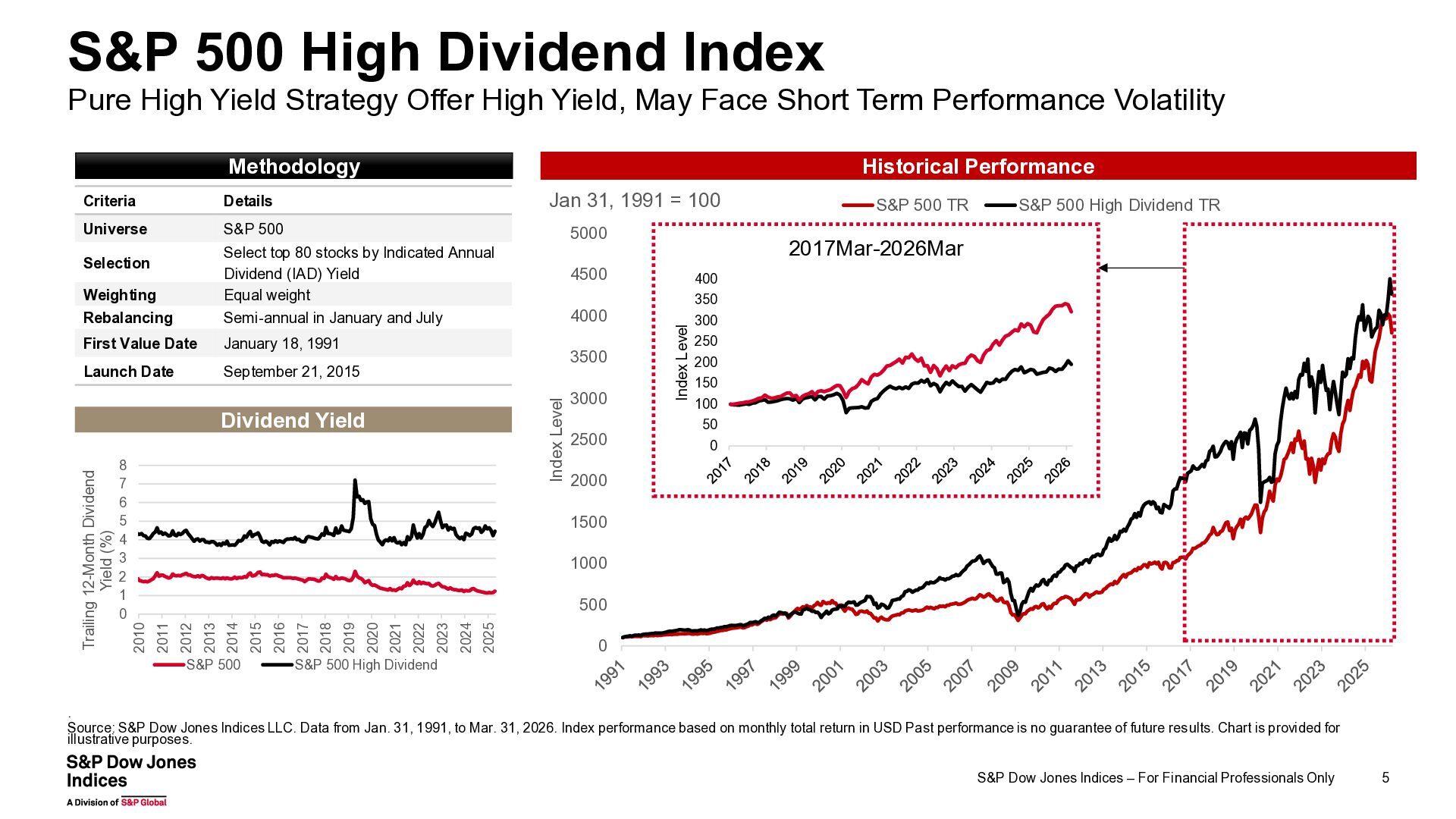
  67. 0 500 1000 1500 2000 2500 3000 3500 4000 4500

    5000 Index Level Jan 31, 1991 = 100 S&P 500 TR S&P 500 High Dividend TR S&P Dow Jones Indices – For Financial Professionals Only 5 Pure High Yield Strategy Offer High Yield, May Face Short Term Performance Volatility S&P 500 High Dividend Index . Source: S&P Dow Jones Indices LLC. Data from Jan. 31, 1991, to Mar. 31, 2026. Index performance based on monthly total return in USD Past performance is no guarantee of future results. Chart is provided for illustrative purposes. Criteria Details Universe S&P 500 Selection Select top 80 stocks by Indicated Annual Dividend (IAD) Yield Weighting Equal weight Rebalancing Semi-annual in January and July First Value Date January 18, 1991 Launch Date September 21, 2015 Methodology Dividend Yield 0 1 2 3 4 5 6 7 8 2010 2011 2012 2013 2014 2015 2016 2017 2018 2019 2020 2021 2022 2023 2024 2025 Trailing 12-Month Dividend Yield (%) S&P 500 S&P 500 High Dividend Historical Performance 0 50 100 150 200 250 300 350 400 Index Level 2017Mar-2026Mar
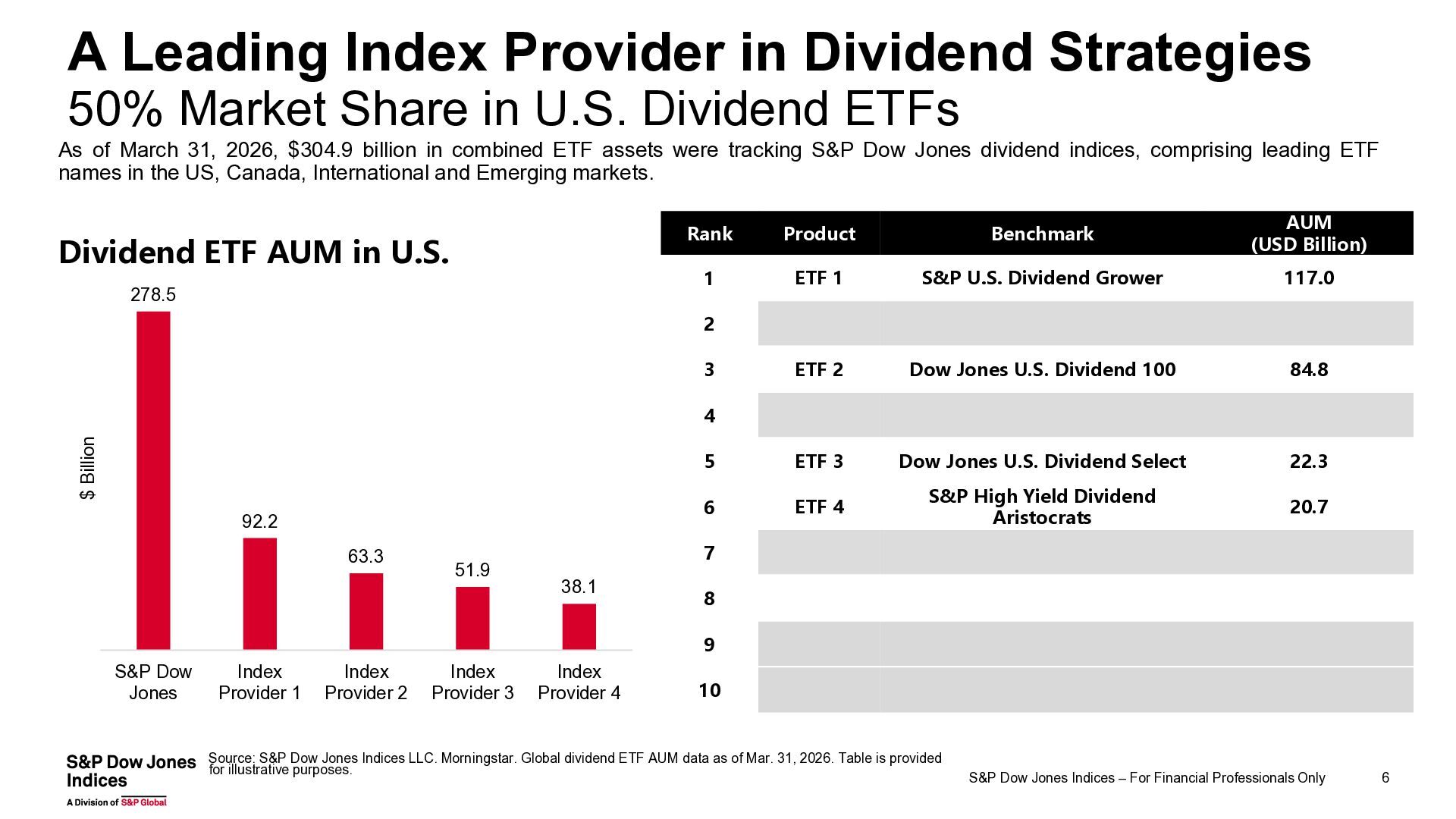
  68. S&P Dow Jones Indices – For Financial Professionals Only 6

    Source: S&P Dow Jones Indices LLC. Morningstar. Global dividend ETF AUM data as of Mar. 31, 2026. Table is provided for illustrative purposes. Rank Product Benchmark AUM (USD Billion) 1 ETF 1 S&P U.S. Dividend Grower 117.0 2 3 ETF 2 Dow Jones U.S. Dividend 100 84.8 4 5 ETF 3 Dow Jones U.S. Dividend Select 22.3 6 ETF 4 S&P High Yield Dividend Aristocrats 20.7 7 8 9 10 As of March 31, 2026, $304.9 billion in combined ETF assets were tracking S&P Dow Jones dividend indices, comprising leading ETF names in the US, Canada, International and Emerging markets. Dividend ETF AUM in U.S. 50% Market Share in U.S. Dividend ETFs A Leading Index Provider in Dividend Strategies 278.5 92.2 63.3 51.9 38.1 S&P Dow Jones Index Provider 1 Index Provider 2 Index Provider 3 Index Provider 4 $ Billion
  69. S&P Dow Jones Indices – For Financial Professionals Only 7

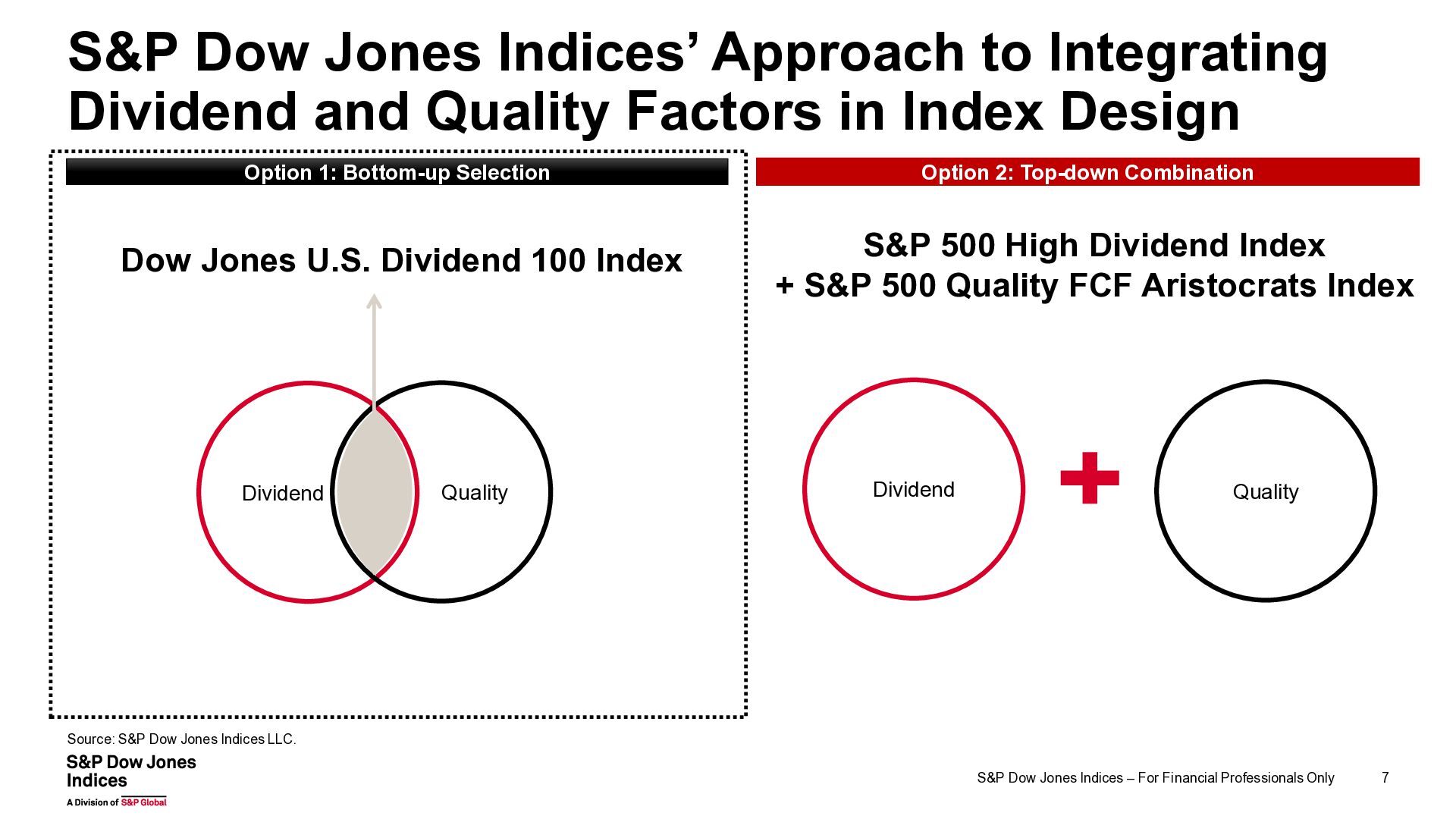
    S&P Dow Jones Indices’ Approach to Integrating Dividend and Quality Factors in Index Design Source: S&P Dow Jones Indices LLC. Option 1: Bottom-up Selection Option 2: Top-down Combination Dow Jones U.S. Dividend 100 Index Dividend Quality S&P 500 High Dividend Index + S&P 500 Quality FCF Aristocrats Index Dividend Quality
  70. S&P Dow Jones Indices – For Financial Professionals Only 8

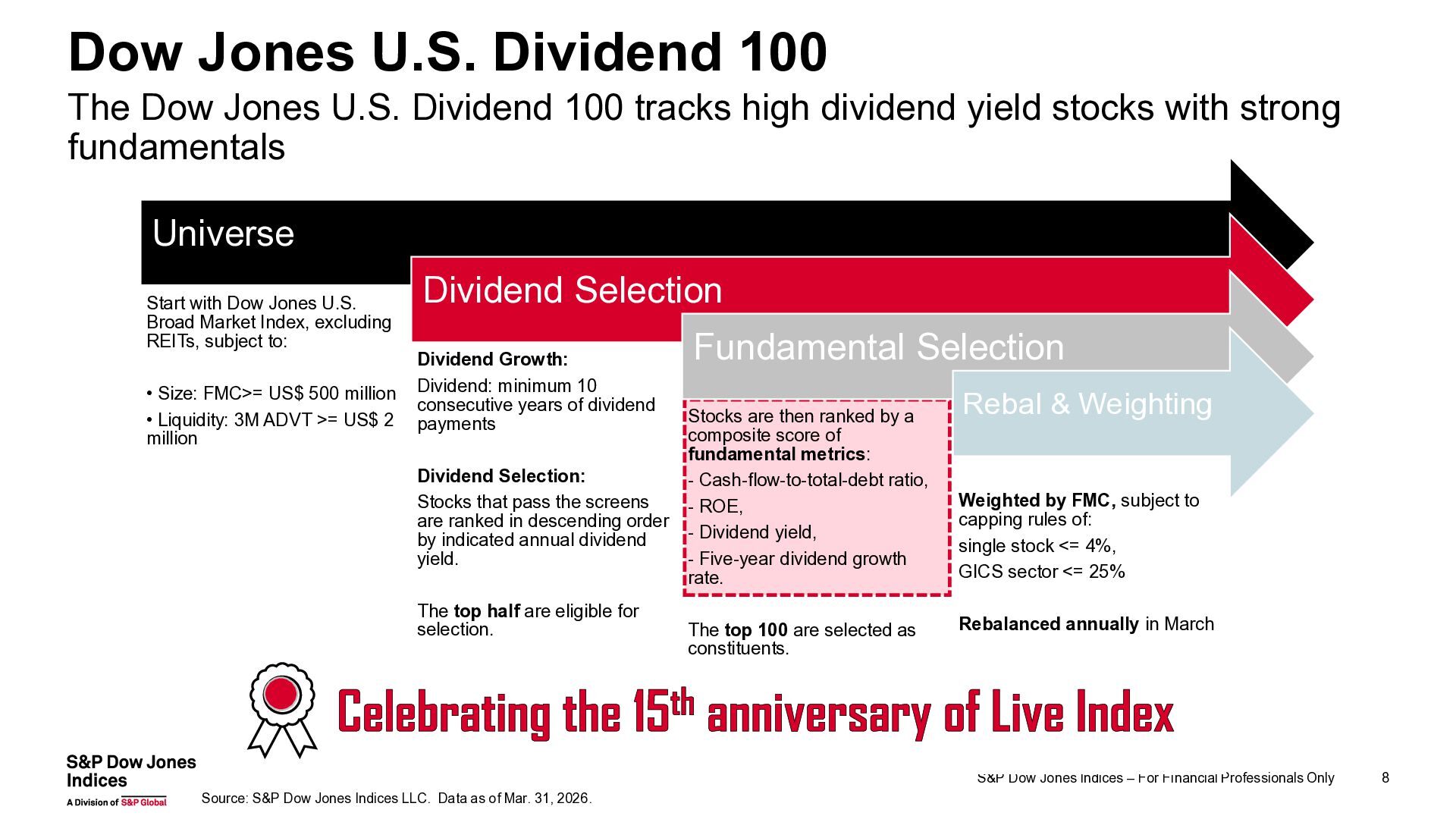
    The Dow Jones U.S. Dividend 100 tracks high dividend yield stocks with strong fundamentals Source: S&P Dow Jones Indices LLC. Data as of Mar. 31, 2026. Dow Jones U.S. Dividend 100 Universe Start with Dow Jones U.S. Broad Market Index, excluding REITs, subject to: • Size: FMC>= US$ 500 million • Liquidity: 3M ADVT >= US$ 2 million Dividend Selection Dividend Growth: Dividend: minimum 10 consecutive years of dividend payments Dividend Selection: Stocks that pass the screens are ranked in descending order by indicated annual dividend yield. The top half are eligible for selection. Fundamental Selection Stocks are then ranked by a composite score of fundamental metrics: - Cash-flow-to-total-debt ratio, - ROE, - Dividend yield, - Five-year dividend growth rate. The top 100 are selected as constituents. Rebal & Weighting Weighted by FMC, subject to capping rules of: single stock <= 4%, GICS sector <= 25% Rebalanced annually in March Celebrating the 15th anniversary of Live Index
  71. S&P Dow Jones Indices – For Financial Professionals Only 9

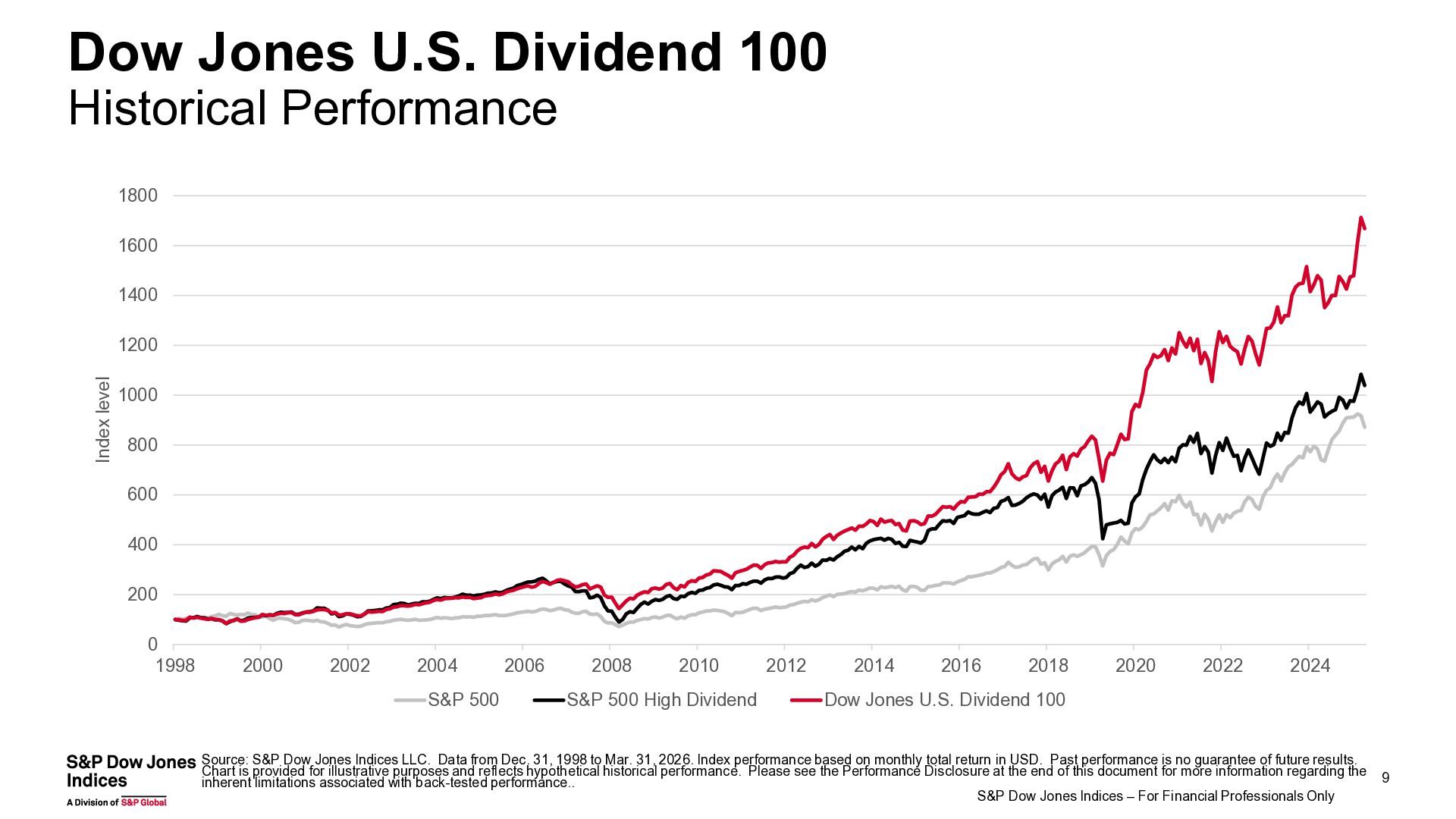
    Source: S&P Dow Jones Indices LLC. Data from Dec. 31, 1998 to Mar. 31, 2026. Index performance based on monthly total return in USD. Past performance is no guarantee of future results. Chart is provided for illustrative purposes and reflects hypothetical historical performance. Please see the Performance Disclosure at the end of this document for more information regarding the inherent limitations associated with back-tested performance.. Dow Jones U.S. Dividend 100 Historical Performance 0 200 400 600 800 1000 1200 1400 1600 1800 1998 2000 2002 2004 2006 2008 2010 2012 2014 2016 2018 2020 2022 2024 Index level S&P 500 S&P 500 High Dividend Dow Jones U.S. Dividend 100
  72. S&P Dow Jones Indices – For Financial Professionals Only 10

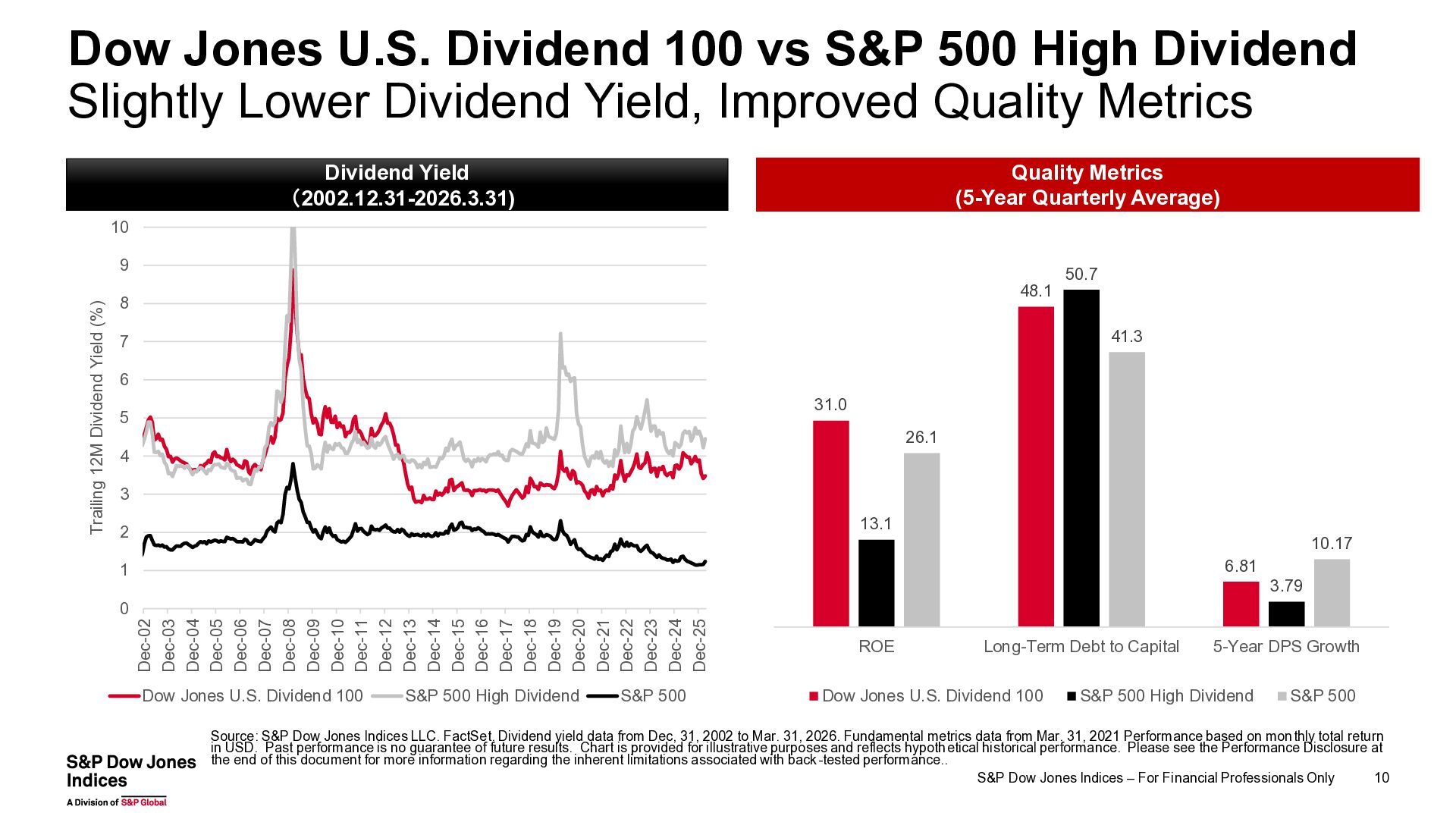
    Source: S&P Dow Jones Indices LLC. FactSet. Dividend yield data from Dec, 31, 2002 to Mar. 31, 2026. Fundamental metrics data from Mar. 31, 2021 Performance based on monthly total return in USD. Past performance is no guarantee of future results. Chart is provided for illustrative purposes and reflects hypothetical historical performance. Please see the Performance Disclosure at the end of this document for more information regarding the inherent limitations associated with back-tested performance.. Dow Jones U.S. Dividend 100 vs S&P 500 High Dividend Slightly Lower Dividend Yield, Improved Quality Metrics Dividend Yield (2002.12.31-2026.3.31) Quality Metrics (5-Year Quarterly Average) 0 1 2 3 4 5 6 7 8 9 10 Dec-02 Dec-03 Dec-04 Dec-05 Dec-06 Dec-07 Dec-08 Dec-09 Dec-10 Dec-11 Dec-12 Dec-13 Dec-14 Dec-15 Dec-16 Dec-17 Dec-18 Dec-19 Dec-20 Dec-21 Dec-22 Dec-23 Dec-24 Dec-25 Trailing 12M Dividend Yield (%) Dow Jones U.S. Dividend 100 S&P 500 High Dividend S&P 500 31.0 48.1 6.81 13.1 50.7 3.79 26.1 41.3 10.17 ROE Long-Term Debt to Capital 5-Year DPS Growth Dow Jones U.S. Dividend 100 S&P 500 High Dividend S&P 500
  73. S&P Dow Jones Indices – For Financial Professionals Only 11

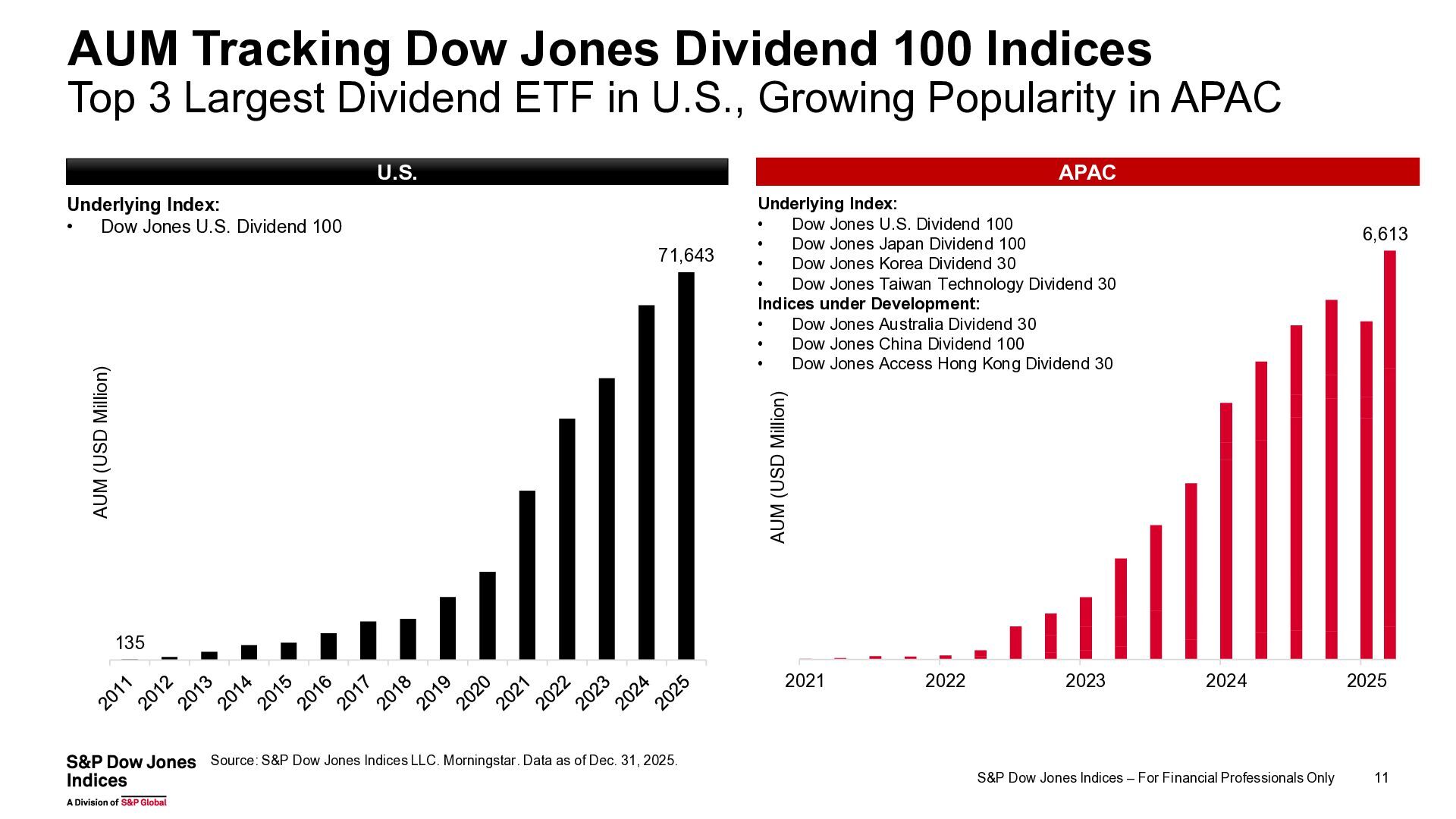
    Source: S&P Dow Jones Indices LLC. Morningstar. Data as of Dec. 31, 2025. AUM Tracking Dow Jones Dividend 100 Indices Top 3 Largest Dividend ETF in U.S., Growing Popularity in APAC U.S. APAC 135 71,643 AUM (USD Million) 6,613 2021 2022 2023 2024 2025 AUM (USD Million) Underlying Index: • Dow Jones U.S. Dividend 100 Underlying Index: • Dow Jones U.S. Dividend 100 • Dow Jones Japan Dividend 100 • Dow Jones Korea Dividend 30 • Dow Jones Taiwan Technology Dividend 30 Indices under Development: • Dow Jones Australia Dividend 30 • Dow Jones China Dividend 100 • Dow Jones Access Hong Kong Dividend 30
  74. S&P Dow Jones Indices – For Financial Professionals Only 12

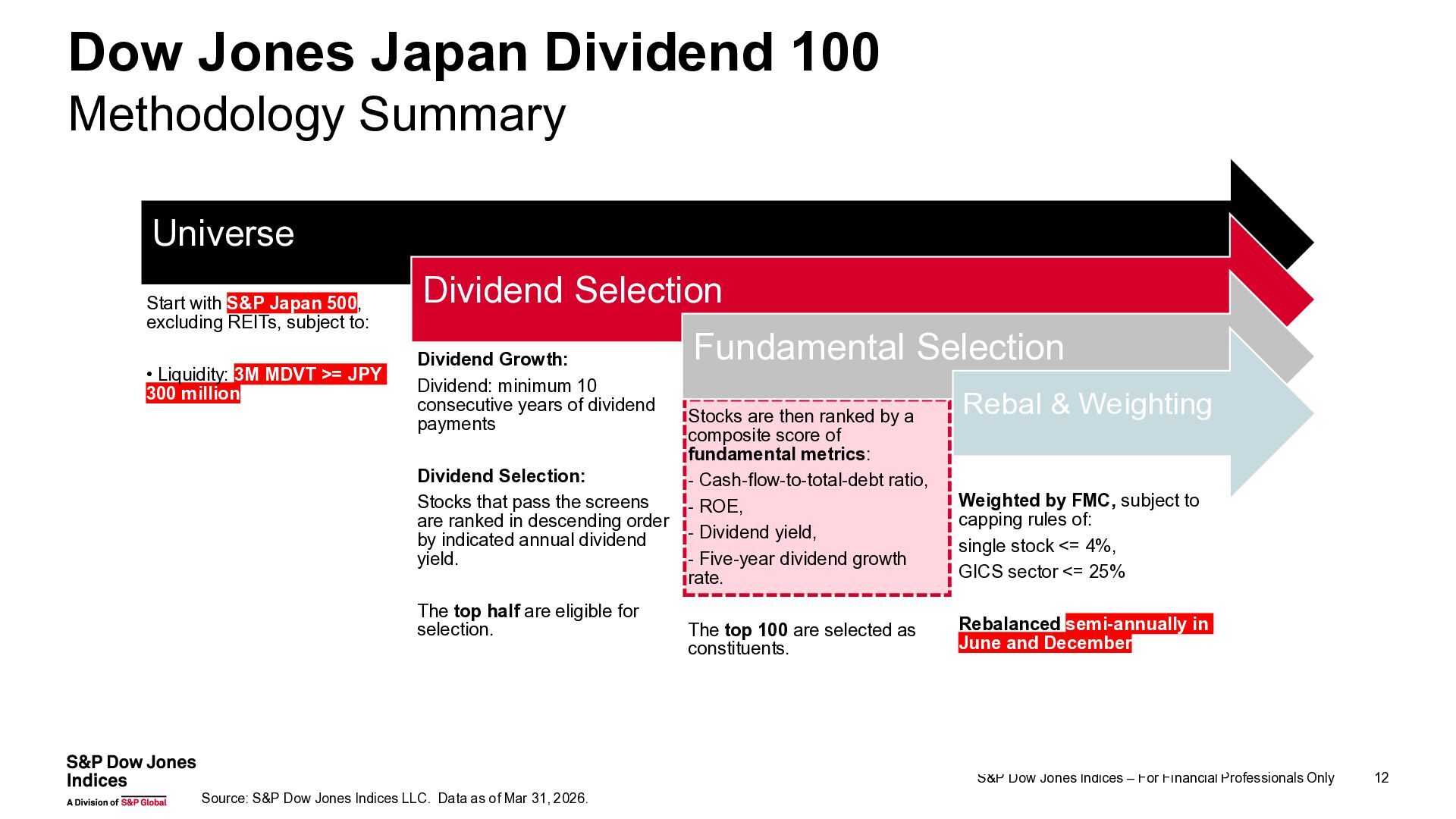
    Methodology Summary Source: S&P Dow Jones Indices LLC. Data as of Mar 31, 2026. Dow Jones Japan Dividend 100 Universe Start with S&P Japan 500, excluding REITs, subject to: • Liquidity: 3M MDVT >= JPY 300 million Dividend Selection Dividend Growth: Dividend: minimum 10 consecutive years of dividend payments Dividend Selection: Stocks that pass the screens are ranked in descending order by indicated annual dividend yield. The top half are eligible for selection. Fundamental Selection Stocks are then ranked by a composite score of fundamental metrics: - Cash-flow-to-total-debt ratio, - ROE, - Dividend yield, - Five-year dividend growth rate. The top 100 are selected as constituents. Rebal & Weighting Weighted by FMC, subject to capping rules of: single stock <= 4%, GICS sector <= 25% Rebalanced semi-annually in June and December
  75. S&P Dow Jones Indices – For Financial Professionals Only 13

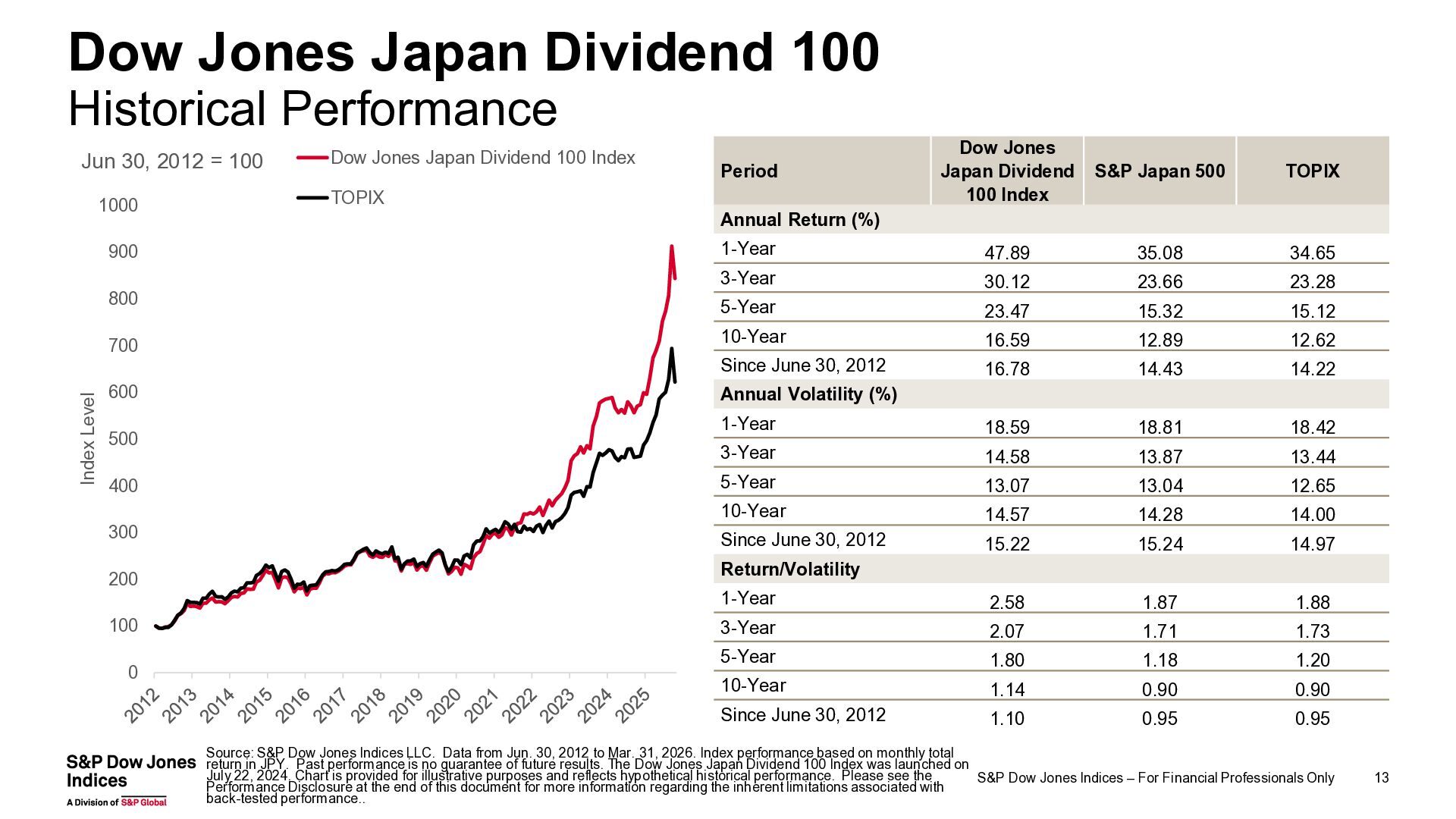
    Source: S&P Dow Jones Indices LLC. Data from Jun. 30, 2012 to Mar. 31, 2026. Index performance based on monthly total return in JPY. Past performance is no guarantee of future results. The Dow Jones Japan Dividend 100 Index was launched on July 22, 2024. Chart is provided for illustrative purposes and reflects hypothetical historical performance. Please see the Performance Disclosure at the end of this document for more information regarding the inherent limitations associated with back-tested performance.. Dow Jones Japan Dividend 100 Historical Performance Period Dow Jones Japan Dividend 100 Index S&P Japan 500 TOPIX Annual Return (%) 1-Year 47.89 35.08 34.65 3-Year 30.12 23.66 23.28 5-Year 23.47 15.32 15.12 10-Year 16.59 12.89 12.62 Since June 30, 2012 16.78 14.43 14.22 Annual Volatility (%) 1-Year 18.59 18.81 18.42 3-Year 14.58 13.87 13.44 5-Year 13.07 13.04 12.65 10-Year 14.57 14.28 14.00 Since June 30, 2012 15.22 15.24 14.97 Return/Volatility 1-Year 2.58 1.87 1.88 3-Year 2.07 1.71 1.73 5-Year 1.80 1.18 1.20 10-Year 1.14 0.90 0.90 Since June 30, 2012 1.10 0.95 0.95 0 100 200 300 400 500 600 700 800 900 1000 Index Level Jun 30, 2012 = 100 Dow Jones Japan Dividend 100 Index TOPIX
  76. S&P Dow Jones Indices – For Financial Professionals Only 14

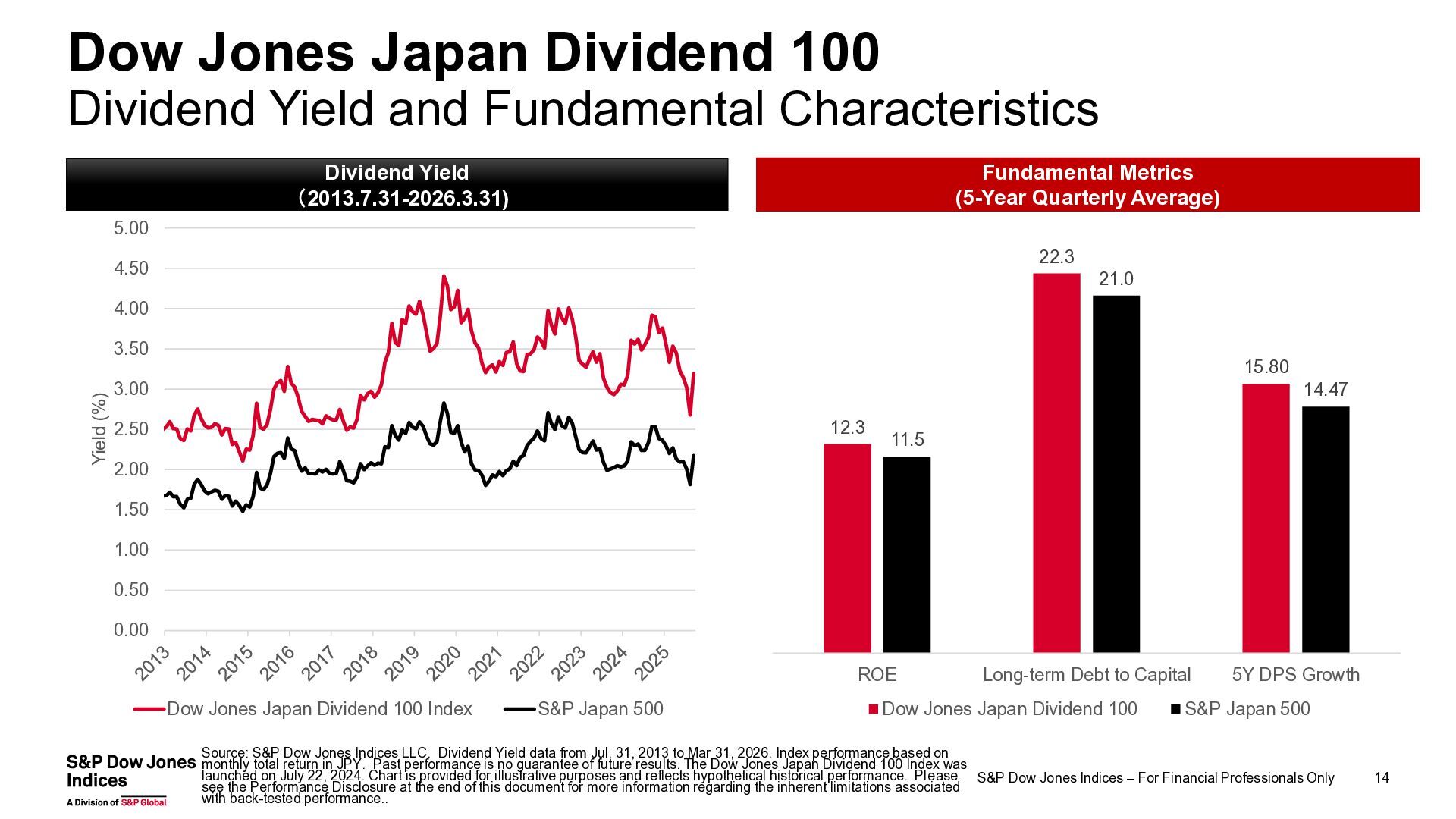
    Source: S&P Dow Jones Indices LLC. Dividend Yield data from Jul. 31, 2013 to Mar 31, 2026. Index performance based on monthly total return in JPY. Past performance is no guarantee of future results. The Dow Jones Japan Dividend 100 Index was launched on July 22, 2024. Chart is provided for illustrative purposes and reflects hypothetical historical performance. Please see the Performance Disclosure at the end of this document for more information regarding the inherent limitations associated with back-tested performance.. Dow Jones Japan Dividend 100 Dividend Yield and Fundamental Characteristics 0.00 0.50 1.00 1.50 2.00 2.50 3.00 3.50 4.00 4.50 5.00 Yield (%) Dow Jones Japan Dividend 100 Index S&P Japan 500 Dividend Yield (2013.7.31-2026.3.31) Fundamental Metrics (5-Year Quarterly Average) 12.3 22.3 15.80 11.5 21.0 14.47 ROE Long-term Debt to Capital 5Y DPS Growth Dow Jones Japan Dividend 100 S&P Japan 500
  77. S&P Dow Jones Indices – For Financial Professionals Only 15

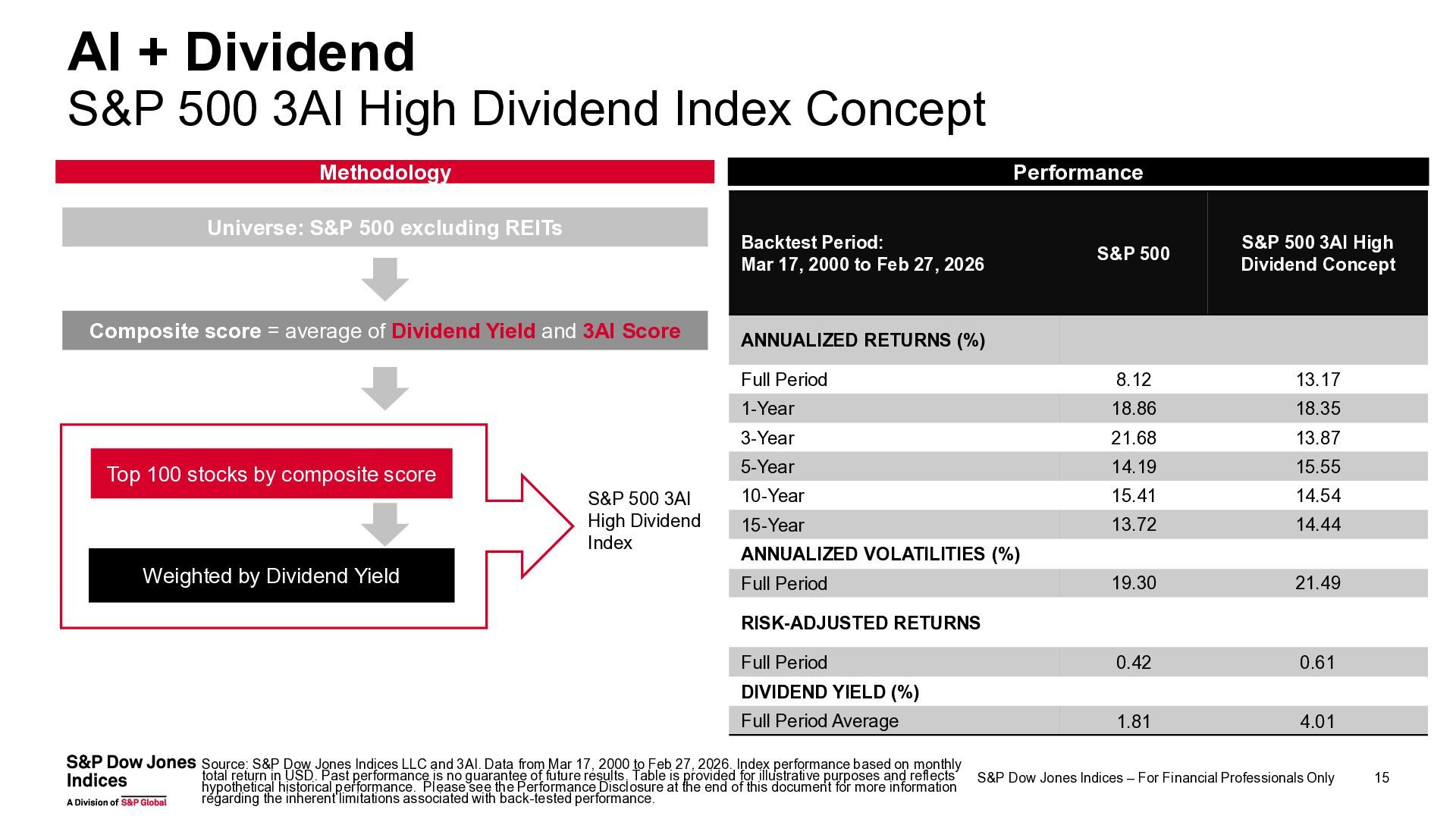
    Source: S&P Dow Jones Indices LLC and 3AI. Data from Mar 17, 2000 to Feb 27, 2026. Index performance based on monthly total return in USD. Past performance is no guarantee of future results. Table is provided for illustrative purposes and reflects hypothetical historical performance. Please see the Performance Disclosure at the end of this document for more information regarding the inherent limitations associated with back-tested performance. AI + Dividend S&P 500 3AI High Dividend Index Concept Methodology Performance Backtest Period: Mar 17, 2000 to Feb 27, 2026 S&P 500 S&P 500 3AI High Dividend Concept ANNUALIZED RETURNS (%) Full Period 8.12 13.17 1-Year 18.86 18.35 3-Year 21.68 13.87 5-Year 14.19 15.55 10-Year 15.41 14.54 15-Year 13.72 14.44 ANNUALIZED VOLATILITIES (%) Full Period 19.30 21.49 RISK-ADJUSTED RETURNS Full Period 0.42 0.61 DIVIDEND YIELD (%) Full Period Average 1.81 4.01 Universe: S&P 500 excluding REITs Composite score = average of Dividend Yield and 3AI Score Top 100 stocks by composite score Weighted by Dividend Yield S&P 500 3AI High Dividend Index
  78. S&P Dow Jones Indices – For Financial Professionals Only 16

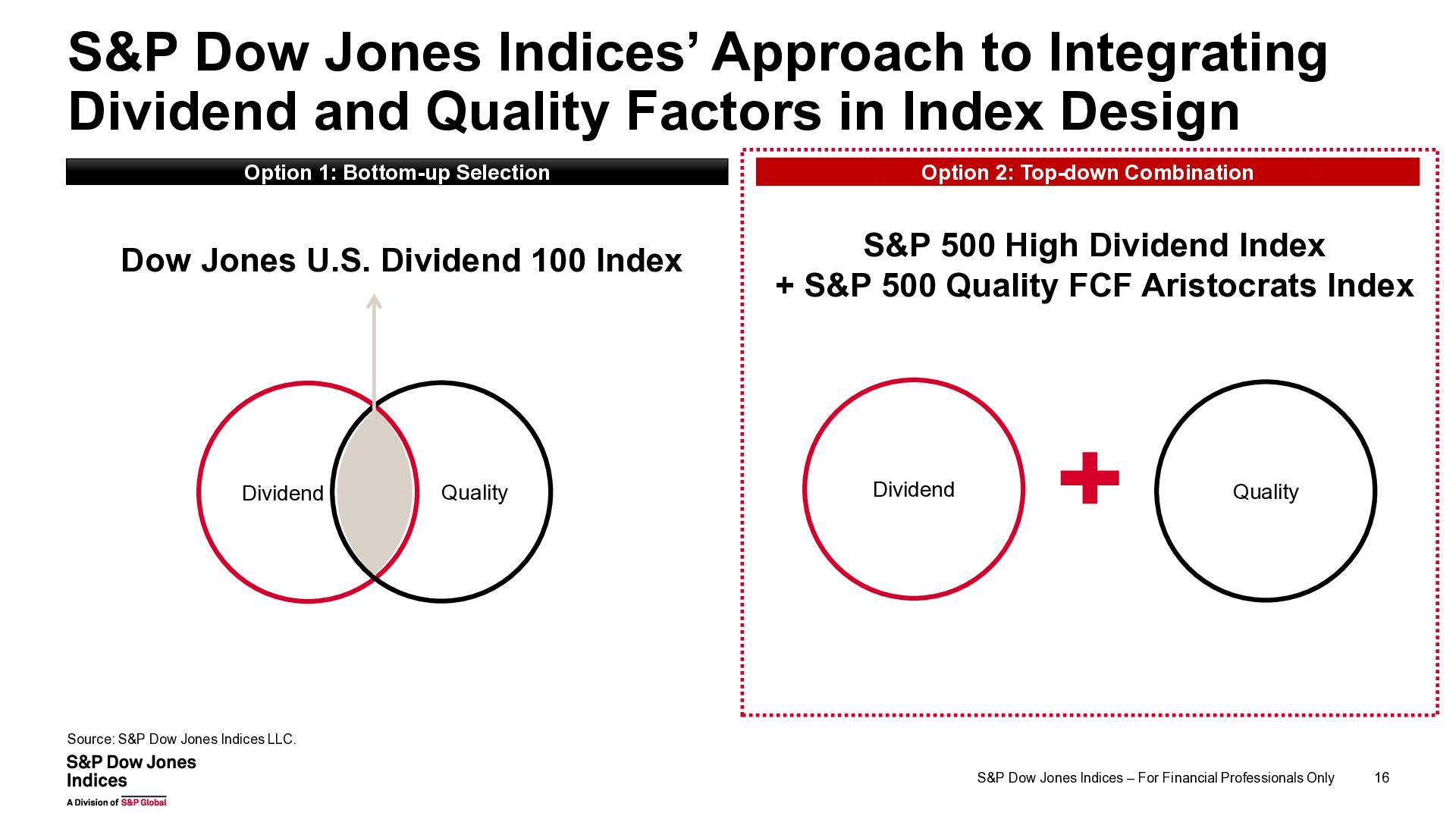
    S&P Dow Jones Indices’ Approach to Integrating Dividend and Quality Factors in Index Design Source: S&P Dow Jones Indices LLC. Option 1: Bottom-up Selection Option 2: Top-down Combination Dow Jones U.S. Dividend 100 Index Dividend Quality S&P 500 High Dividend Index + S&P 500 Quality FCF Aristocrats Index Dividend Quality
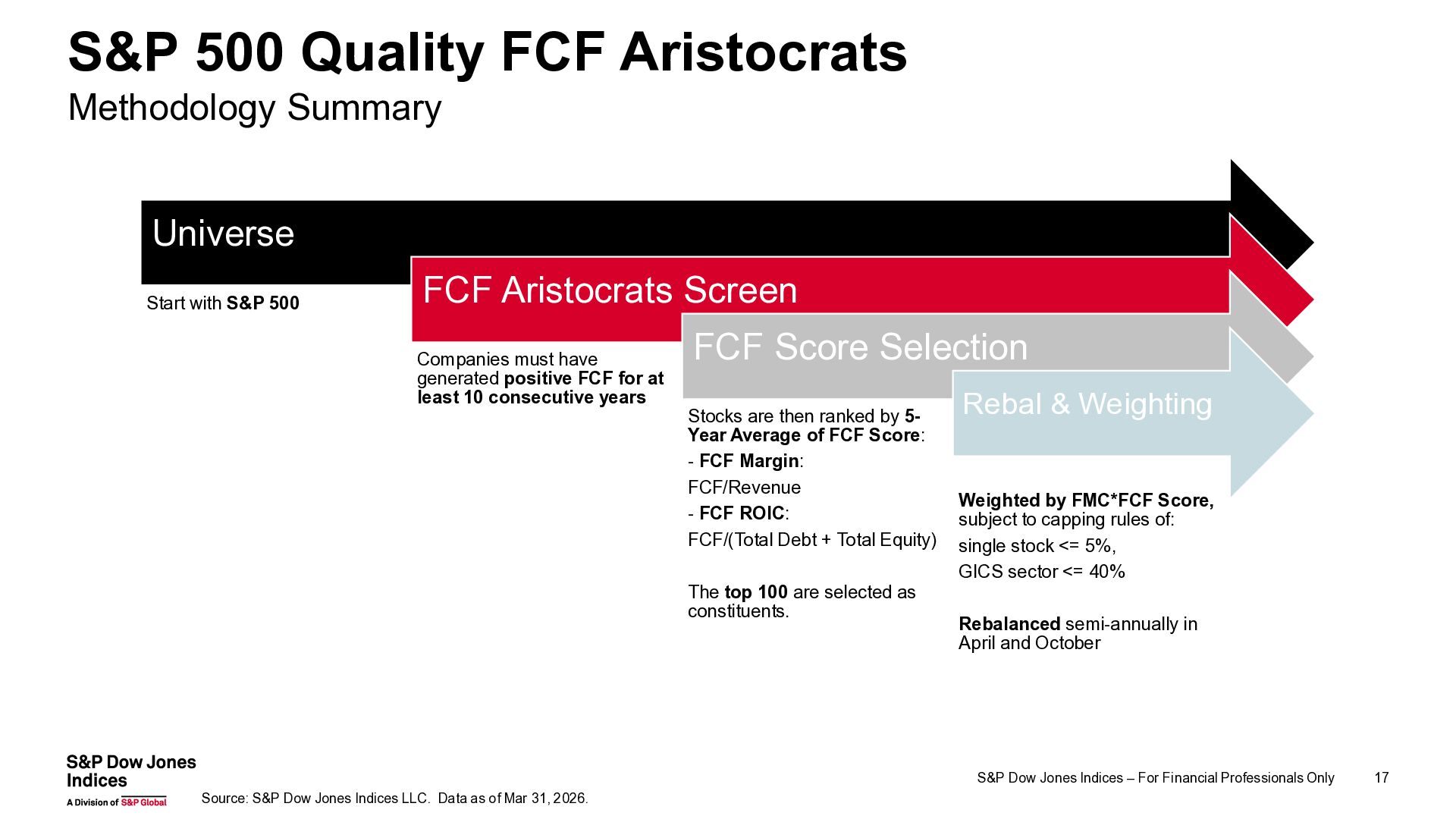
  79. Universe Start with S&P 500 FCF Aristocrats Screen Companies must

    have generated positive FCF for at least 10 consecutive years FCF Score Selection Stocks are then ranked by 5- Year Average of FCF Score: - FCF Margin: FCF/Revenue - FCF ROIC: FCF/(Total Debt + Total Equity) The top 100 are selected as constituents. Rebal & Weighting Weighted by FMC*FCF Score, subject to capping rules of: single stock <= 5%, GICS sector <= 40% Rebalanced semi-annually in April and October S&P Dow Jones Indices – For Financial Professionals Only 17 Methodology Summary Source: S&P Dow Jones Indices LLC. Data as of Mar 31, 2026. S&P 500 Quality FCF Aristocrats
  80. S&P Dow Jones Indices – For Financial Professionals Only 18

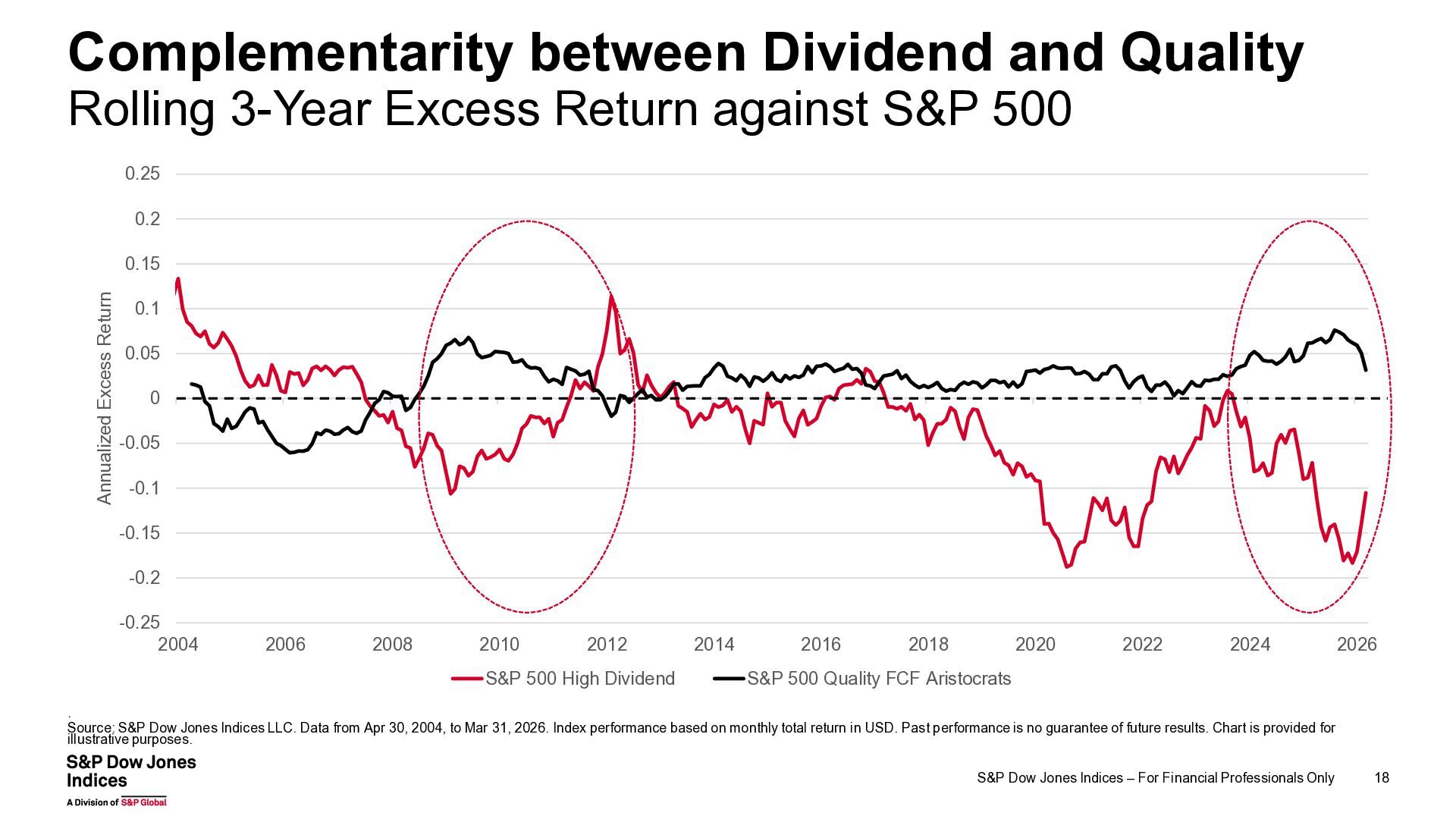
    Rolling 3-Year Excess Return against S&P 500 Complementarity between Dividend and Quality . Source: S&P Dow Jones Indices LLC. Data from Apr 30, 2004, to Mar 31, 2026. Index performance based on monthly total return in USD. Past performance is no guarantee of future results. Chart is provided for illustrative purposes. -0.25 -0.2 -0.15 -0.1 -0.05 0 0.05 0.1 0.15 0.2 0.25 2004 2006 2008 2010 2012 2014 2016 2018 2020 2022 2024 2026 Annualized Excess Return S&P 500 High Dividend S&P 500 Quality FCF Aristocrats
  81. S&P Dow Jones Indices – For Financial Professionals Only Source:

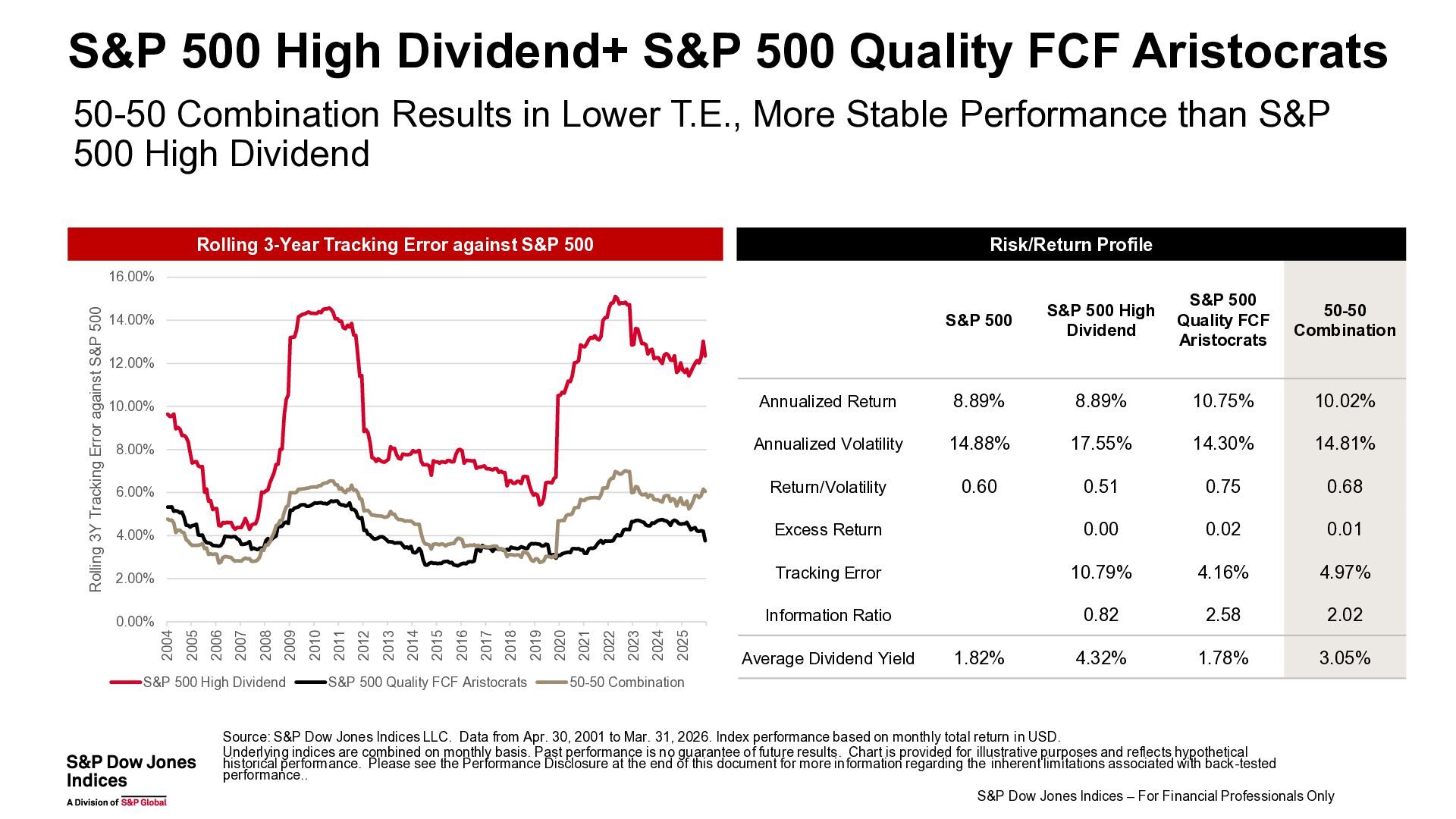
    S&P Dow Jones Indices LLC. Data from Apr. 30, 2001 to Mar. 31, 2026. Index performance based on monthly total return in USD. Underlying indices are combined on monthly basis. Past performance is no guarantee of future results. Chart is provided for illustrative purposes and reflects hypothetical historical performance. Please see the Performance Disclosure at the end of this document for more information regarding the inherent limitations associated with back-tested performance.. S&P 500 S&P 500 High Dividend S&P 500 Quality FCF Aristocrats 50-50 Combination Annualized Return 8.89% 8.89% 10.75% 10.02% Annualized Volatility 14.88% 17.55% 14.30% 14.81% Return/Volatility 0.60 0.51 0.75 0.68 Excess Return 0.00 0.02 0.01 Tracking Error 10.79% 4.16% 4.97% Information Ratio 0.82 2.58 2.02 Average Dividend Yield 1.82% 4.32% 1.78% 3.05% Rolling 3-Year Tracking Error against S&P 500 Risk/Return Profile S&P 500 High Dividend+ S&P 500 Quality FCF Aristocrats 50-50 Combination Results in Lower T.E., More Stable Performance than S&P 500 High Dividend 0.00% 2.00% 4.00% 6.00% 8.00% 10.00% 12.00% 14.00% 16.00% 2004 2005 2006 2007 2008 2009 2010 2011 2012 2013 2014 2015 2016 2017 2018 2019 2020 2021 2022 2023 2024 2025 Rolling 3Y Tracking Error against S&P 500 S&P 500 High Dividend S&P 500 Quality FCF Aristocrats 50-50 Combination
  82. S&P Dow Jones Indices – For Financial Professionals Only 20

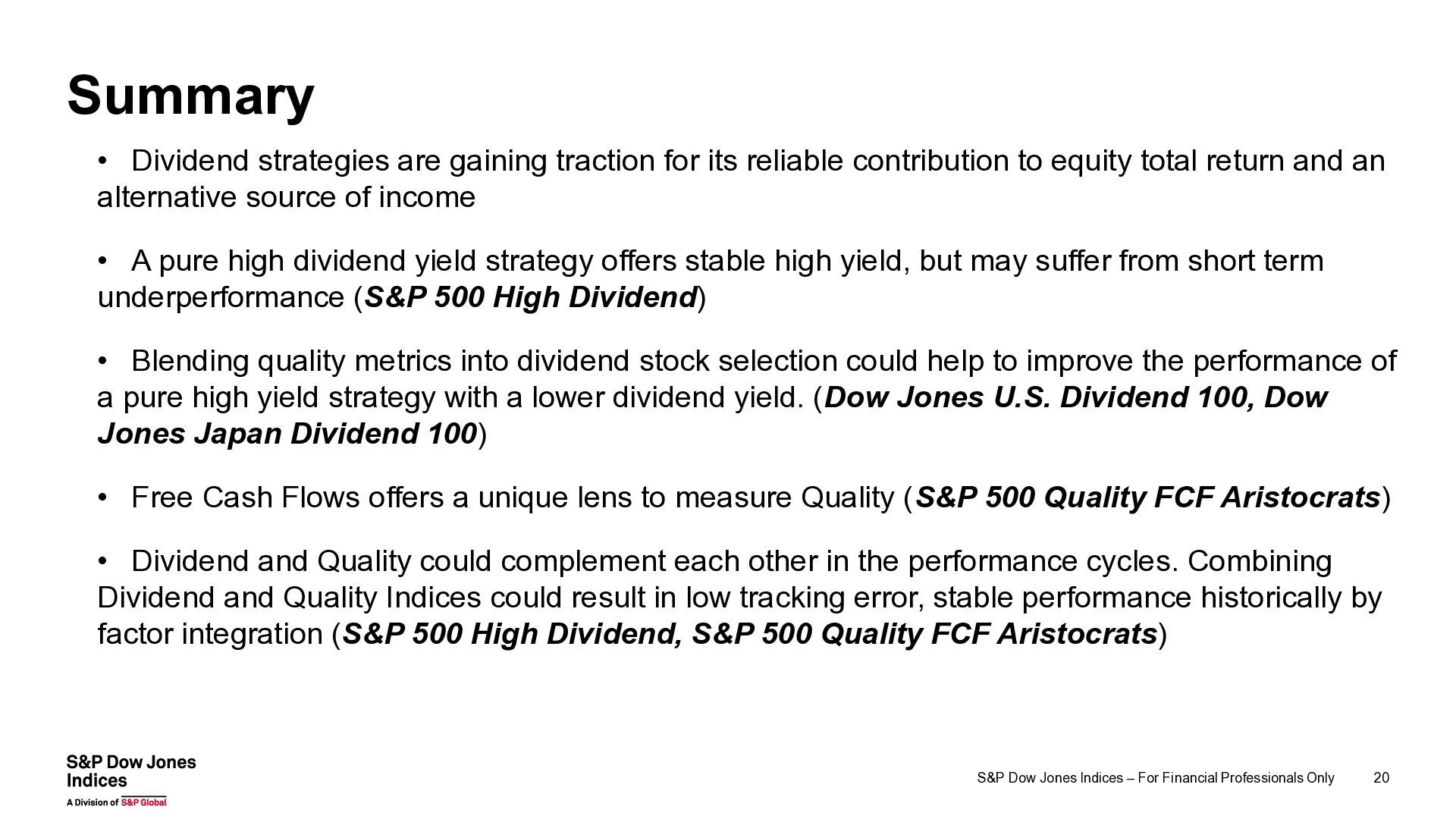
    Summary • Dividend strategies are gaining traction for its reliable contribution to equity total return and an alternative source of income • A pure high dividend yield strategy offers stable high yield, but may suffer from short term underperformance (S&P 500 High Dividend) • Blending quality metrics into dividend stock selection could help to improve the performance of a pure high yield strategy with a lower dividend yield. (Dow Jones U.S. Dividend 100, Dow Jones Japan Dividend 100) • Free Cash Flows offers a unique lens to measure Quality (S&P 500 Quality FCF Aristocrats) • Dividend and Quality could complement each other in the performance cycles. Combining Dividend and Quality Indices could result in low tracking error, stable performance historically by factor integration (S&P 500 High Dividend, S&P 500 Quality FCF Aristocrats)
  83. S&P Dow Jones Indices – For Financial Professionals Only For

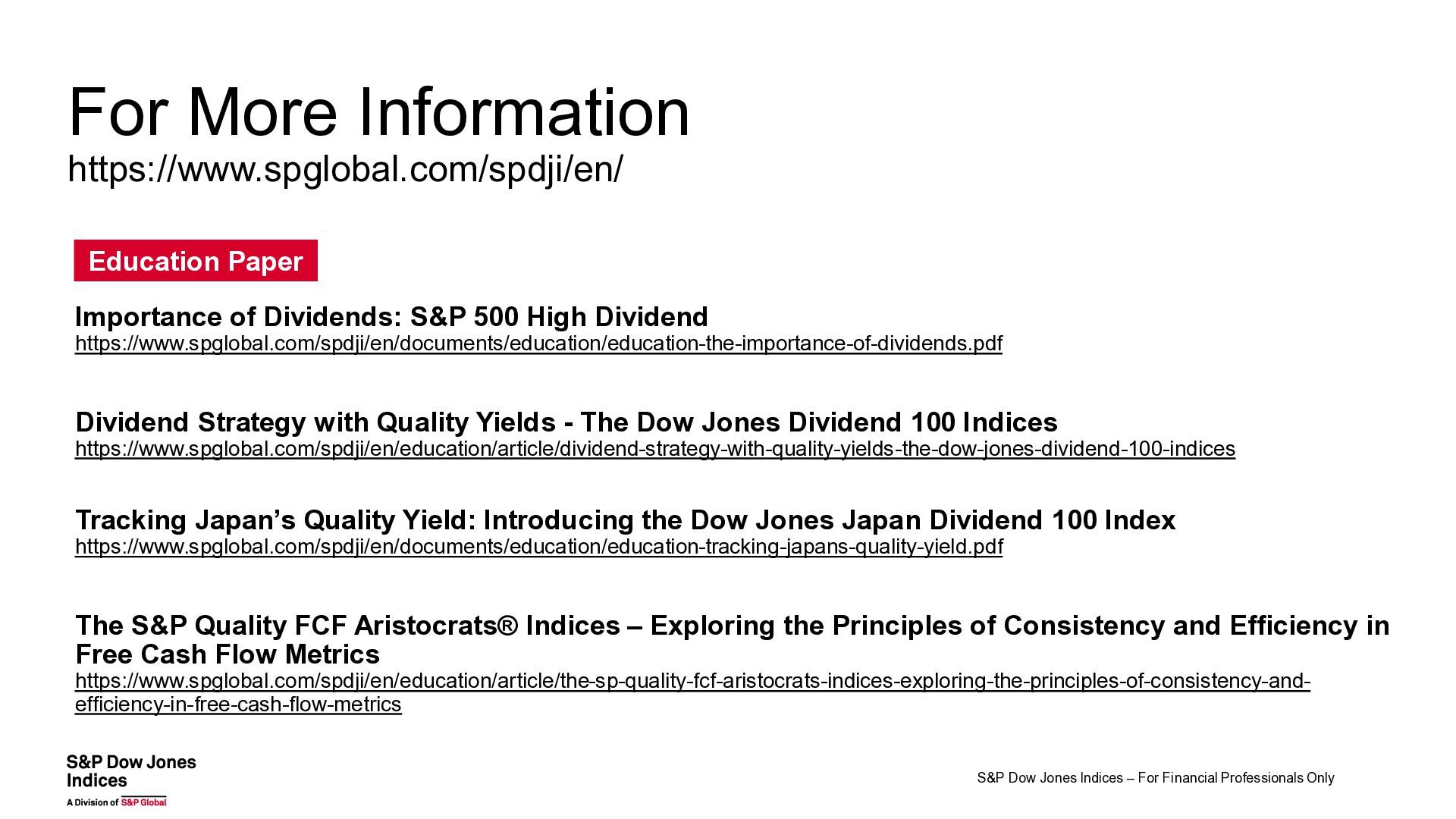
    More Information https://www.spglobal.com/spdji/en/ Importance of Dividends: S&P 500 High Dividend https://www.spglobal.com/spdji/en/documents/education/education-the-importance-of-dividends.pdf Dividend Strategy with Quality Yields - The Dow Jones Dividend 100 Indices https://www.spglobal.com/spdji/en/education/article/dividend-strategy-with-quality-yields-the-dow-jones-dividend-100-indices Tracking Japan’s Quality Yield: Introducing the Dow Jones Japan Dividend 100 Index https://www.spglobal.com/spdji/en/documents/education/education-tracking-japans-quality-yield.pdf The S&P Quality FCF Aristocrats® Indices – Exploring the Principles of Consistency and Efficiency in Free Cash Flow Metrics https://www.spglobal.com/spdji/en/education/article/the-sp-quality-fcf-aristocrats-indices-exploring-the-principles-of-consistency-and- efficiency-in-free-cash-flow-metrics Education Paper
  84. © 2026 S&P Dow Jones Indices. All rights reserved. S&P,

    S&P 500, S&P 500 LOW VOLATILITY INDEX, S&P 100, S&P COMPOSITE 1500, S&P 400, S&P MIDCAP 400, S&P 600, S&P SMALLCAP 600, S&P GIVI, GLOBAL TITANS, DIVIDEND ARISTOCRATS, S&P TARGET DATE INDICES, S&P PRISM, S&P STRIDE, GICS, SPIVA, SPDR and INDEXOLOGY are registered trademarks of S&P Global, Inc. (“S&P Global”) or its affiliates. DOW JONES, DJ, DJIA, THE DOW and DOW JONES INDUSTRIAL AVERAGE are registered trademarks of Dow Jones Trademark Holdings LLC (“Dow Jones”). These trademarks together with others have been licensed to S&P Dow Jones Indices LLC. Redistribution or reproduction in whole or in part are prohibited without written permission of S&P Dow Jones Indices LLC. This document does not constitute an offer of services in jurisdictions where S&P Dow Jones Indices LLC, S&P Global, Dow Jones or their respective affiliates (collectively “S&P Dow Jones Indices”) do not have the necessary licenses. Except for certain custom index calculation services, all information provided by S&P Dow Jones Indices is impersonal and not tailored to the needs of any person, entity or group of persons. S&P Dow Jones Indices receives compensation in connection with licensing its indices to third parties and providing custom calculation services. Past performance of an index is not an indication or guarantee of future results. It is not possible to invest directly in an index. Exposure to an asset class represented by an index may be available through investable instruments based on that index. S&P Dow Jones Indices does not sponsor, endorse, sell, promote or manage any investment fund or other investment vehicle that is offered by third parties and that seeks to provide an investment return based on the performance of any index. S&P Dow Jones Indices makes no assurance that investment products based on the index will accurately track index performance or provide positive investment returns. S&P Dow Jones Indices LLC is not an investment advisor, and S&P Dow Jones Indices makes no representation regarding the advisability of investing in any such investment fund or other investment vehicle. A decision to invest in any such investment fund or other investment vehicle should not be made in reliance on any of the statements set forth in this document. Prospective investors are advised to make an investment in any such fund or other vehicle only after carefully considering the risks associated with investing in such funds, as detailed in an offering memorandum or similar document that is prepared by or on behalf of the issuer of the investment fund or other investment product or vehicle. S&P Dow Jones Indices LLC is not a tax advisor. A tax advisor should be consulted to evaluate the impact of any tax-exempt securities on portfolios and the tax consequences of making any particular investment decision. Inclusion of a security within an index is not a recommendation by S&P Dow Jones Indices to buy, sell, or hold such security, nor is it considered to be investment advice. These materials have been prepared solely for informational purposes based upon information generally available to the public and from sources believed to be reliable. No content contained in these materials (including index data, ratings, credit-related analyses and data, research, valuations, model, software or other application or output therefrom) or any part thereof (“Content”) may be modified, reverse-engineered, reproduced or distributed in any form or by any means, or stored in a database or retrieval system, without the prior written permission of S&P Dow Jones Indices. The Content shall not be used for any unlawful or unauthorized purposes. S&P Dow Jones Indices and its third-party data providers and licensors (collectively “S&P Dow Jones Indices Parties”) do not guarantee the accuracy, completeness, timeliness or availability of the Content. S&P Dow Jones Indices Parties are not responsible for any errors or omissions, regardless of the cause, for the results obtained from the use of the Content. THE CONTENT IS PROVIDED ON AN “AS IS” BASIS. S&P DOW JONES INDICES PARTIES DISCLAIM ANY AND ALL EXPRESS OR IMPLIED WARRANTIES, INCLUDING, BUT NOT LIMITED TO, ANY WARRANTIES OF MERCHANTABILITY OR FITNESS FOR A PARTICULAR PURPOSE OR USE, FREEDOM FROM BUGS, SOFTWARE ERRORS OR DEFECTS, THAT THE CONTENT’S FUNCTIONING WILL BE UNINTERRUPTED OR THAT THE CONTENT WILL OPERATE WITH ANY SOFTWARE OR HARDWARE CONFIGURATION. In no event shall S&P Dow Jones Indices Parties be liable to any party for any direct, indirect, incidental, exemplary, compensatory, punitive, special or consequential damages, costs, expenses, legal fees, or losses (including, without limitation, lost income or lost profits and opportunity costs) in connection with any use of the Content even if advised of the possibility of such damages. S&P Global keeps certain activities of its various divisions and business units separate from each other in order to preserve the independence and objectivity of their respective activities. As a result, certain divisions and business units of S&P Global may have information that is not available to other business units. S&P Global has established policies and procedures to maintain the confidentiality of certain non-public information received in connection with each analytical process. In addition, S&P Dow Jones Indices provides a wide range of services to, or relating to, many organizations, including issuers of securities, investment advisers, broker-dealers, investment banks, other financial institutions and financial intermediaries, and accordingly may receive fees or other economic benefits from those organizations, including organizations whose securities or services they may recommend, rate, include in model portfolios, evaluate or otherwise address. 22 GENERAL DISCLAIMER
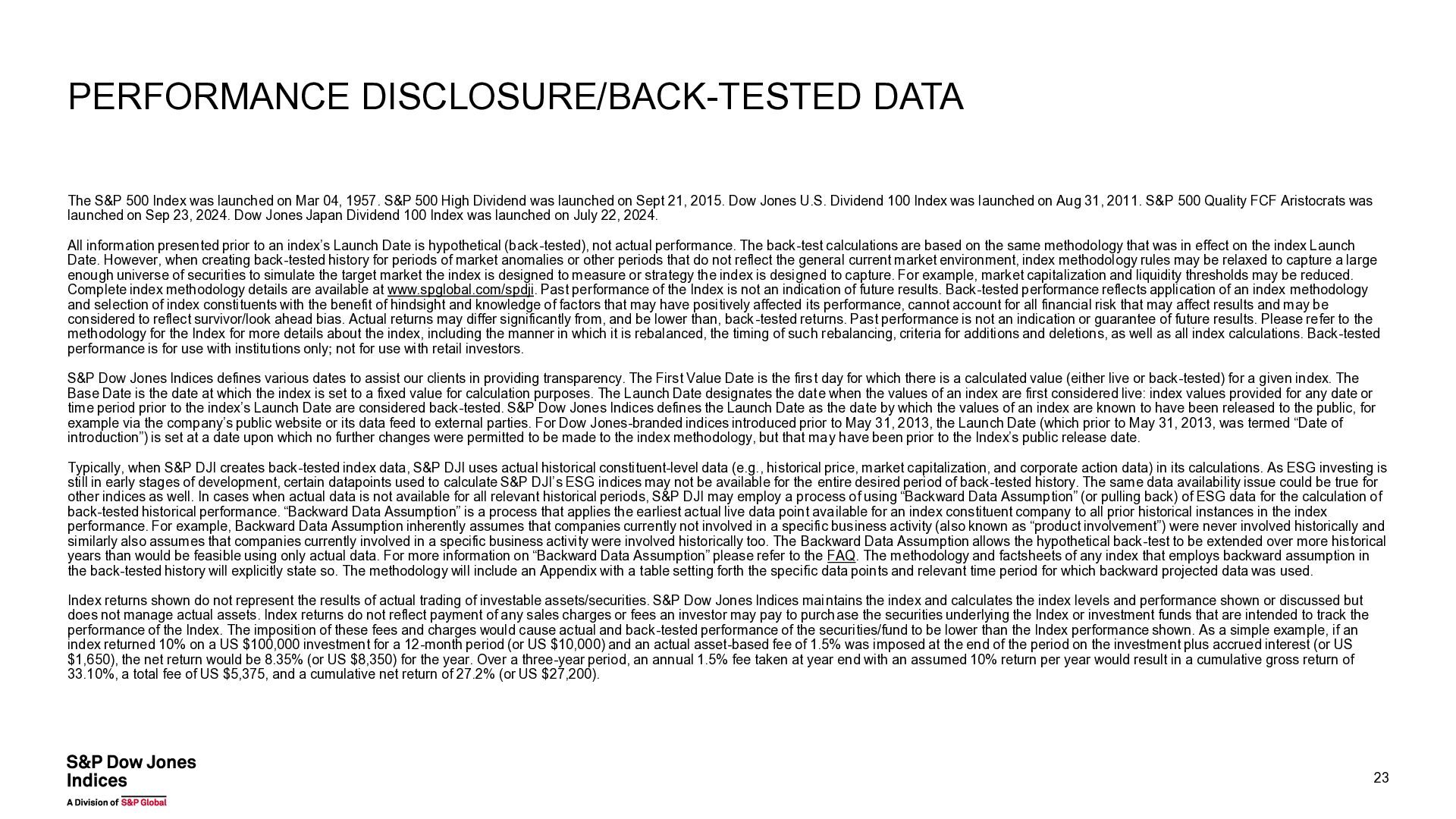
  85. The S&P 500 Index was launched on Mar 04, 1957.

    S&P 500 High Dividend was launched on Sept 21, 2015. Dow Jones U.S. Dividend 100 Index was launched on Aug 31, 2011. S&P 500 Quality FCF Aristocrats was launched on Sep 23, 2024. Dow Jones Japan Dividend 100 Index was launched on July 22, 2024. All information presented prior to an index’s Launch Date is hypothetical (back-tested), not actual performance. The back-test calculations are based on the same methodology that was in effect on the index Launch Date. However, when creating back-tested history for periods of market anomalies or other periods that do not reflect the general current market environment, index methodology rules may be relaxed to capture a large enough universe of securities to simulate the target market the index is designed to measure or strategy the index is designed to capture. For example, market capitalization and liquidity thresholds may be reduced. Complete index methodology details are available at www.spglobal.com/spdji. Past performance of the Index is not an indication of future results. Back-tested performance reflects application of an index methodology and selection of index constituents with the benefit of hindsight and knowledge of factors that may have positively affected its performance, cannot account for all financial risk that may affect results and may be considered to reflect survivor/look ahead bias. Actual returns may differ significantly from, and be lower than, back-tested returns. Past performance is not an indication or guarantee of future results. Please refer to the methodology for the Index for more details about the index, including the manner in which it is rebalanced, the timing of such rebalancing, criteria for additions and deletions, as well as all index calculations. Back-tested performance is for use with institutions only; not for use with retail investors. S&P Dow Jones Indices defines various dates to assist our clients in providing transparency. The First Value Date is the first day for which there is a calculated value (either live or back-tested) for a given index. The Base Date is the date at which the index is set to a fixed value for calculation purposes. The Launch Date designates the date when the values of an index are first considered live: index values provided for any date or time period prior to the index’s Launch Date are considered back-tested. S&P Dow Jones Indices defines the Launch Date as the date by which the values of an index are known to have been released to the public, for example via the company’s public website or its data feed to external parties. For Dow Jones-branded indices introduced prior to May 31, 2013, the Launch Date (which prior to May 31, 2013, was termed “Date of introduction”) is set at a date upon which no further changes were permitted to be made to the index methodology, but that may have been prior to the Index’s public release date. Typically, when S&P DJI creates back-tested index data, S&P DJI uses actual historical constituent-level data (e.g., historical price, market capitalization, and corporate action data) in its calculations. As ESG investing is still in early stages of development, certain datapoints used to calculate S&P DJI’s ESG indices may not be available for the entire desired period of back-tested history. The same data availability issue could be true for other indices as well. In cases when actual data is not available for all relevant historical periods, S&P DJI may employ a process of using “Backward Data Assumption” (or pulling back) of ESG data for the calculation of back-tested historical performance. “Backward Data Assumption” is a process that applies the earliest actual live data point available for an index constituent company to all prior historical instances in the index performance. For example, Backward Data Assumption inherently assumes that companies currently not involved in a specific business activity (also known as “product involvement”) were never involved historically and similarly also assumes that companies currently involved in a specific business activity were involved historically too. The Backward Data Assumption allows the hypothetical back-test to be extended over more historical years than would be feasible using only actual data. For more information on “Backward Data Assumption” please refer to the FAQ. The methodology and factsheets of any index that employs backward assumption in the back-tested history will explicitly state so. The methodology will include an Appendix with a table setting forth the specific data points and relevant time period for which backward projected data was used. Index returns shown do not represent the results of actual trading of investable assets/securities. S&P Dow Jones Indices maintains the index and calculates the index levels and performance shown or discussed but does not manage actual assets. Index returns do not reflect payment of any sales charges or fees an investor may pay to purchase the securities underlying the Index or investment funds that are intended to track the performance of the Index. The imposition of these fees and charges would cause actual and back-tested performance of the securities/fund to be lower than the Index performance shown. As a simple example, if an index returned 10% on a US $100,000 investment for a 12-month period (or US $10,000) and an actual asset-based fee of 1.5% was imposed at the end of the period on the investment plus accrued interest (or US $1,650), the net return would be 8.35% (or US $8,350) for the year. Over a three-year period, an annual 1.5% fee taken at year end with an assumed 10% return per year would result in a cumulative gross return of 33.10%, a total fee of US $5,375, and a cumulative net return of 27.2% (or US $27,200). 23 PERFORMANCE DISCLOSURE/BACK-TESTED DATA
  86. 2 $21.5T $5.2T $20.3T $26.7T $0T $5T $10T $15T $20T

    $25T $30T $35T 2015 2016 2017 2018 2019 2020 2021 2022 2023 2024 2025 2026 2027 2028 2029 2030 Drawdown funds Evergreen Base case forecast Forecast range 本資料は情報提供のみを目的としており、特定の投資判断を推奨するものではありません。モーニングスターの事前承諾なく複製・転送・再配布を禁じます。 Source: PitchBook “2030 Private Market Horizons”, Geography: Global Note: Historical data does not include evergreen structures. "Evergreen” includes insurance AUM from Blackstone, KKR, Blue Owl Capital, e Carlyle Group, Ares Management, Apollo Global, and Brook eld. Forecasts were generated on April 17, 2026. プライベート資産AUM推移と予測 伝統的なドローダウン・ファンドの 拡大ペースは鈍化 受領者限り For Intended Recipient Only
  87. 3 本資料は情報提供のみを目的としており、特定の投資判断を推奨するものではありません。モーニングスターの事前承諾なく複製・転送・再配布を禁じます。 $66.6 $79.3 $103.9 $132.0 $42.1 $59.9 $81.8 $117.0

    $100.5 $89.0 $90.1 $92.8 $58.0 $87.3 $147.0 $192.8 $267.2 $315.6 $422.7 $534.6 2022 2023 2024 2025 Interval Tender offer REIT BDC 米国セミリキッド・ファンドのAUM推移(十億ドル) 0% 10% 20% 30% 40% 50% 60% 70% 80% 90% 100% Interval Tender offer REIT BDC Direct lending Alternative credit Real estate Private equity Private multi-asset Infrastructure Venture capital Nonprivate markets 米国セミリキッド・ファンドの戦略別AUM構成比 Source: “Q1 2026 US Evergreen Fund Landscape repo ”, Morningstar and PitchBook , Geography: US Note: Data was aggregated on March 13, 2026. e most recent dates of the disclosure documents range from June 30 to December 31, 2025. 受領者限り For Intended Recipient Only
  88. 4 純資産総額 (億円) ファンド名 4,159 ブラックストーン・プライベート・エクイティ・ストラテジーズ投信米ドル建て 3,288 ダイワ・ブラックストーン・プライベート・クレジット・ファンド(米ドル建て) 1,956 GSプライベート・クレジット戦略投信

    米ドル建 1,223 野村マッコーリー・プライベート・インフラ・ファンド 862 日興ワールド・トラスト-アレス・ストラテジック・インカム・ファンド 円建(ヘッジなし)クラス受益証券 本資料は情報提供のみを目的としており、特定の投資判断を推奨するものではありません。モーニングスターの事前承諾なく複製・転送・再配布を禁じます。 33% 0% 49% 12% 3% 3% プライベート・エクイティ ベンチャー・キャピタル プライベート・クレジット プライベート・インフラ 不動産 プライベート・アロケーション 2026年3月末 約1.5兆円 タイプ別資産残高 プライベート資産ファンドの残高上位5ファンド 出所: Morningstar Direct。外国籍を含む日本で販売されているプライベート資産に投資を行う投資信託の純資産総額。2026年3月末時点。モーニングスターのデータベース上でデータが取得できないものは除外している。 受領者限り For Intended Recipient Only
  89. 5 : 本資料は情報提供のみを目的としており、特定の投資判断を推奨するものではありません。モーニングスターの事前承諾なく複製・転送・再配布を禁じます。 投資家が直感的に理解しづらい費用体系 純資産総額の年率2.65%程度 +投資対象ファンド投資顧問会社の成功報酬 成功報酬:各四半期に発生した投資対象ファンドの インカムゲインから費用を控除した額の12.5% (ハードルレート年率5%を超過した場合。 キャッチアップ条件あり。)

    誤解を招かないために、 「成功報酬は予め具体的に示すことは困難」 という説明が一般的。 9 7.525 3.85 1.25 1.275 1.4 6.3 0% 2% 4% 6% 8% 10% 12% 14% 16% 18% グロスインカム 借入コスト 管理報酬 成功報酬 国内報酬 ネットインカム 費用シミュレーション レバレッジ70%、インカム・ゲイン9%の場合 シミュレーションの前提条件 元本:100、レバレッジ:70%、インカム・ゲイン:9%、短期金利:3.5%、 借入コスト:短期金利+2%、投資先ファンド管理報酬等:1.25%、 成功報酬(インカム・ゲインに対して):12.5%、ハードルレート5%、国内向けファンド報酬:1.4% 単純化のためにキャピタル・ゲインは考慮していません。 例示を目的としたもので、実際のファンドの費用を具体的に示すものではありません。 受領者限り For Intended Recipient Only
  90. 6 : 本資料は情報提供のみを目的としており、特定の投資判断を推奨するものではありません。モーニングスターの事前承諾なく複製・転送・再配布を禁じます。 • 典型的なファンドは四半期ごとに純資産総額の5% までの換金が可能。 • 一見すると、流動性は確保されているように見え るが、保有資産(プライベート資産)自体の流動 性は極めて低い。

    • 通常時は手元資金で解約に応じることはできる が、一斉に換金申し込みには応じることは困難。 • 一般に、リテール向けファンドでは5%の解約は、 めずらしいことではない。 (リテール資金=粘着性が高い、とは必ずしも言 えない。) 85% 77% 0% 10% 20% 30% 40% 50% 60% 70% 80% 90% 100% 四半期で5% 4四半期で20% 資金純流出が四半期で5%、 連続する4四半期で20%を超えたファンドの割合 出所: Morningstar Direct。日本籍公募追加型株式投資信託のうち、2010年から2026年3月までの四半期ごと に、純資産総額に対する資金純流出額が四半期で5%、連続する4四半期で20%を超えたファンドの割合。 受領者限り For Intended Recipient Only
  91. 7 : 本資料は情報提供のみを目的としており、特定の投資判断を推奨するものではありません。モーニングスターの事前承諾なく複製・転送・再配布を禁じます。 0 100 200 300 400 500 600

    700 0 2 4 6 8 10 12 2010 2011 2012 2013 2014 2015 2016 2017 2018 2019 2020 2021 2022 2023 2024 2025 2026 0 10 20 30 40 50 60 70 80 2010 2011 2012 2013 2014 2015 2016 2017 2018 2019 2020 2021 2022 2023 2024 2025 2026 インデックス・ファンド インデックス・ファンド以外 通貨選択型ファンド 残高(左軸、兆円)と本数(右軸) 株式型タイプ別資産残高の推移(兆円) 出所: Morningstar Direct。通貨選択型ファンドは日本籍公募追加型株式投資信託のうち、日本円以外に為替ヘッジを行うファンド。タイプ別残高推移は、モーニングスターにより株式型に分類されるファンド。 シンプル・低コストの 運用商品に資金が流入 受領者限り For Intended Recipient Only
  92. 10 Morningstar Directの幅広いパブリック市場データと高度な分析機能に より、ポートフォリオ全体の特性を包括的に把握 • パブリック+プライベート: PitchBookデータも活用し、両市場を 組み合わせたポートフォリオ構築を支援 • ポートフォリオ分析:

    資産横断的にリスク・リターンを 統合的に把握 • リスク分析: トレードオフや分散効果を定量的に可視化 • 意思決定支援: 分析結果に基づき、ポートフォリオの最適化を支援 PitchBookのVC・PE・M&Aを網羅したデータと分析により、 プライベート市場の全体像を把握 • 企業・投資家調査: 世界中の未公開企業、投資家、M&Aデータを 横断的に検索 • 資金調達・投資先追跡: ベンチャーキャピタルや成⾧資金の 調達動向をリアルタイムで把握 • 取引履歴・バリュエーション: M&Aの取引詳細やバリュエーション を詳細に確認 • ベンチマーキング: 業界トレンドやパフォーマンスを多角的に分析 本資料は情報提供のみを目的としており、特定の投資判断を推奨するものではありません。モーニングスターの事前承諾なく複製・転送・再配布を禁じます。 受領者限り For Intended Recipient Only
  93. <重要事項> © 2026 Morningstar, Inc. All Rights Reserved. 本レポートの全ての著作権はモーニングスターに帰 属します。モーニングスターから事前の書面による承諾がない限り、当資料の一部あるいは

    全ての複製ならびに再配布等の使用はできません。また、損害賠償、著作権法の罰則の対象 となります。 本レポートに記載されている情報、データ、分析、意見は、(1)モーニングスターの機密 情報ならびに専有情報が含まれます、(2)コピーならびに再配布はできません、(3)作成 日時点の情報です、(4)予告なしに変更することがあります、(5)モーニングスターによ る投資助言ではありません、(6)情報提供のみを目的としたものです、(7)銘柄の売買を 推奨するものではありません、(8)情報の正確性、完全性や適時性を保証するものではあ りません。モーニングスターは、法律により定められている場合を除き、本レポートの情 報、データ、分析、意見を利用して行ったいかなる投資の判断、損失、損害に責任は負いま せん。当資料にある指数はそれ自体運用商品ではなく、直接投資することはできません。過 去のパフォーマンスは将来のリターンを保証するものではありません。本レポートは営業用 資料ではありません。投資を行う際は、目論見書や他の開示情報をご確認ください。 Morningstarの商号、ロゴはMorningstar, Inc.の登録商標です。 <Disclosures> ©2026 Morningstar, Inc. All rights reserved. is presentation includes proprietary materials of Morningstar; reproduction, transcription or other use, by any means, in whole or in pa , without prior wri en consent of Morningstar is prohibited. e information, data, analyses, repo s and opinions presented herein include proprietary materials of Morningstar; are not allowed to be duplicated or redistributed; do not constitute investment advice; are provided as of the date wri en; solely for informational purposes; and subject to change at any time without notice. is content is not an o er to buy or sell any pa icular securi and is not warranted to be correct, complete, accurate or timely. Except as otherwise required by law, Morningstar shall not be responsible for any trading decisions, damages or other losses resulting from, or related to, this information, data, analyses or opinions or their use. e indexes shown are unmanaged and not available for direct investment. Past performance is not a guarantee of future results. is repo is not a sales material. Please refer to the Prospectus or other disclosure information in making investment decisions. e Morningstar name and logo are registered marks of Morningstar, Inc.
  94. LLMのみによるテーマ別バスケットへの分類の問題点 • 時系列データの欠如 • 定性的判断のみで定量的根拠の欠如 • LLMに含まれる情報量の偏り(大企業優位、英語圏バイアスなど) • ユニバースが大きい場合、トークンコストが急増する •

    Point-in-Timeで企業の事業内容を分類 • テーマに関連するエクスポージャーの把握 • 投資ユニバース全体の一貫した方法でのカバレッジ • 推論対象を最小化して、トークンコストを抑える 解決策 Copyright © 2026 FactSet Research Systems Inc. All rights reserved. FactSet Business Use Only​
  95. RBICSセクター Printed Circuit Boards Clay and Ceramic Products Manufacturing Cabinets

    and Countertops Manufacturing (例)イビデン (4062) 54.39% 22.76% 23.86% RBICS L6セクター セグメント報告書 RBICSは世界中のテーマ型投信で利用されている業種分類 • 12の大分類、最も詳細な分類では約2,000の業種に分類 • 主業種のみでなく、事業セグメント別に業種分類を付与 セグメントエクスポージャー Copyright © 2026 FactSet Research Systems Inc. All rights reserved. FactSet Business Use Only​
  96. AIテーマ別セクターバスケット AI基盤 AI代替リスク • Wafer Processing Subsystem Equipment Manufacturing •

    Printed Circuit Boards • Semiconductors Distributors • General Printing Services • Staffing Services • General Professional Content Providers and Sites • Asia/Pacific Investment Banking/Corporate Finance • Biopharmaceuticals • Logistics and Supply Chain Service Providers AIユーザー 約2,000の業種分類 テーマ別セクターバスケットを マニュアル選定 LLM 通常 LLMによりテーマ別に業種を分類 Copyright © 2026 FactSet Research Systems Inc. All rights reserved. FactSet Business Use Only​
  97. 最後に • 業種分類などのデータとLLMを利用する事で、今まで時間がかかってい たユニバース全体のテーマ別バスケット作成にかかる時間が大幅に縮小 できる • リスクテーマ(石油依存の高い業種群など)などの抽出にも応用可能 • MCPサーバーを利用する事で、使用するデータベースの選択からデー タの抽出

    -> 分析まですべてLLMが行う事も可能になり、ますます利便 性が高まっている (例)MCPサーバーを利用して、中東への依存度が高いことが考えら れる企業群のダッシュボード作成 Copyright © 2026 FactSet Research Systems Inc. All rights reserved. FactSet Business Use Only​
  98. The Evolving Relationship Between Investors and the Board of Directors

    Japan Investment Conference 2026 Annalisa Barrett, KPMG US Board Leadership Center — May 2026
  99. 2 © 2024 KPMG LLP, a Delaware limited liability partnership

    and a member firm of the KPMG global organization of independent member firms affiliated with KPMG International Limited, a private English company limited by guarantee. All rights reserved. USCS011029-3A Annalisa Barrett, KPMG US Board Leadership Center Annalisa Barrett is a Senior Advisor with the KPMG Board Leadership Center, where she informs corporate directors about emerging governance issues and conducts research on board composition and practices. As an expert in corporate governance, she is a frequent speaker on issues important to corporate directors, governance professionals, investors, and other stakeholders. Barrett was a recipient of the prestigious Directorship 100 Award in 2024, which honors the most influential leaders in corporate governance. Barrett has been quoted on corporate governance in the New York Times, Bloomberg, and the Financial Times, and her research has been featured on the front page of the Wall Street Journal. Barrett is a graduate of San Diego State University (including semester abroad at Waseda University in Tokyo), and the Ross School of Business at the University of Michigan. She is a Professor of Corporate Governance at University of San Diego. US Japan Leadership Fellow and member of US Japan Council and Japan Board Diversity Network.
  100. 3 © 2024 KPMG LLP, a Delaware limited liability partnership

    and a member firm of the KPMG global organization of independent member firms affiliated with KPMG International Limited, a private English company limited by guarantee. All rights reserved. USCS011029-3A Board of Directors Investors Managers Stakeholders Corporation Corporate Governance Stakeholders Stakeholders Stakeholders
  101. 4 © 2024 KPMG LLP, a Delaware limited liability partnership

    and a member firm of the KPMG global organization of independent member firms affiliated with KPMG International Limited, a private English company limited by guarantee. All rights reserved. USCS011029-3A Investor Engagement with Company & Board Disclosure: Required and Voluntary AGM and Proxy Voting Engagement Meetings Share- holder Proposals Activism Campaigns Securities Litigation
  102. 5 © 2024 KPMG LLP, a Delaware limited liability partnership

    and a member firm of the KPMG global organization of independent member firms affiliated with KPMG International Limited, a private English company limited by guarantee. All rights reserved. USCS011029-3A Shareholder Proposals, US 7.70% 12.10% 8.60% 7.30% 16.00% 23.80% 16.10% 17.70% 15.20% 0% 5% 10% 15% 20% 25% 0 100 200 300 400 500 600 700 2026 2025 2024 2023 2022 2021 2020 2019 2018 Shareholder proposal pass rate Russell 3000 Proposals voted Proposals w/ majority support Percent passed Source: The Conference Board, Shareholder Voting Trends Dashboard, Retrieved May 21, 2026
  103. 6 © 2024 KPMG LLP, a Delaware limited liability partnership

    and a member firm of the KPMG global organization of independent member firms affiliated with KPMG International Limited, a private English company limited by guarantee. All rights reserved. USCS011029-3A Shareholder Proposals, US Source: The Conference Board, Shareholder Voting Trends Dashboard, Retrieved May 21, 2026
  104. 7 © 2024 KPMG LLP, a Delaware limited liability partnership

    and a member firm of the KPMG global organization of independent member firms affiliated with KPMG International Limited, a private English company limited by guarantee. All rights reserved. USCS011029-3A Shareholder Proposals, Japan Source: “Japan Corporate & Finance Insights,” TMI Associates, September 2025.
  105. 8 © 2024 KPMG LLP, a Delaware limited liability partnership

    and a member firm of the KPMG global organization of independent member firms affiliated with KPMG International Limited, a private English company limited by guarantee. All rights reserved. USCS011029-3A Shareholder Proposals, Japan Source: “Japan Corporate & Finance Insights,” TMI Associates, September 2025.)
  106. 9 © 2024 KPMG LLP, a Delaware limited liability partnership

    and a member firm of the KPMG global organization of independent member firms affiliated with KPMG International Limited, a private English company limited by guarantee. All rights reserved. USCS011029-3A Shareholder Activism, US
  107. 10 © 2024 KPMG LLP, a Delaware limited liability partnership

    and a member firm of the KPMG global organization of independent member firms affiliated with KPMG International Limited, a private English company limited by guarantee. All rights reserved. USCS011029-3A Shareholder Activism, Japan
  108. 11 © 2024 KPMG LLP, a Delaware limited liability partnership

    and a member firm of the KPMG global organization of independent member firms affiliated with KPMG International Limited, a private English company limited by guarantee. All rights reserved. USCS011029-3A Shareholder Activism, Japan Source: “The Rise of Shareholder Activism in Japan and Implications for Japanese Listed Companies,” JRI Research Journal, May 19, 2026
  109. 12 © 2024 KPMG LLP, a Delaware limited liability partnership

    and a member firm of the KPMG global organization of independent member firms affiliated with KPMG International Limited, a private English company limited by guarantee. All rights reserved. USCS011029-3A Regulatory Changes in the US Change in beneficial ownership reporting requirements Modification of "no-action" letter process for shareholder proposals Reduction/elimination of certain disclosure requirements Proposal to allow semiannual financial reporting
  110. 13 © 2024 KPMG LLP, a Delaware limited liability partnership

    and a member firm of the KPMG global organization of independent member firms affiliated with KPMG International Limited, a private English company limited by guarantee. All rights reserved. USCS011029-3A The Evolving Relationship Despite these headwinds, the relationship between investors and the board of directors is more important than ever.
  111. Learn about us: kpmg.com The information contained herein is of

    a general nature and is not intended to address the circumstances of any particular Individual or entity. Although we endeavor to provide accurate and timely information, there can be no guarantee that such information is accurate as of the date it is received or that it will continue to be accurate in the future. No one should act upon such information without appropriate professional advice after a thorough examination of the particular situation. © 2025 KPMG LLP, a Delaware limited liability partnership and a member firm of the KPMG global organization of independent member firms affiliated with KPMG International Limited, a private English company limited by guarantee. All rights reserved. The KPMG name and logo are trademarks used under license by the independent member firms of the KPMG global organization. About the KPMG Board Leadership Center The KPMG Board Leadership Center (BLC) champions outstanding corporate governance to drive long-term value and enhance stakeholder confidence. Through an array of insights, perspectives, and programs, the BLC promotes continuous education and improvement of public and private company governance. BLC engages with directors and business leaders on the critical issues driving board agendas—from strategy, risk, talent, and sustainability to data governance, artificial intelligence, audit quality, proxy trends, and more. Learn more at kpmg.com/us/blc Some or all of the services described herein may not be permissible for KPMG audit clients and their affiliates or related entities. .
  112. 3 パッシブ運用の領域拡大 出所: ステート・ストリート・インベストメント・マネジメント。例示のみを目的としています。 市場の成熟化と運用技術の向上により・・・ 国債 IG社債 HY社債 バンクローン プライベート・クレジット

    1990年代~ 足元では State Street がご提供できるソリューション 国債 IG社債 HY社債 バンクローン プライベート・クレジット アクティブ運用の領域 8920918.2.1.APAC.INST
  113. 4 公募市場リターンの差別化が低下、アルファ獲得はプライベート市場へ 出所:Morningstar、ステート・ストリート・インベストメント・マネジメント等。過去10年間(2015年4月17日~2025年4月16日)のデータに基づき、各資産のリターン分布(中央値・パーセンタイル)を比較。上場株式および債券はMorningstarカテゴリー ベース、プライベート資産は各指数(MSCI、Preqin等)に基づく。プライベート資産のリターンは主にIRR、上場資産はトータルリターンで算出されており、直接比較には一定の前提が含まれる。グローバル・コア不動産は2025年第1四半期終了時点までの10年 間の年次リターンに基づく。グローバル・プライベート・クレジット、グローバル・ノンコア不動産、グローバル・プライベート・エクイティ、グローバル・ベンチャーキャピタルは2025年第1四半期終了時点までの10年間の内部収益率(IRR)に基づく。 運用者の画一化 上場市場、プライベート市場の各資産におけるマネージャー・リターンの分布の比較 0 5 10

    15 20 25 30 35 Global Large Cap Equities (Active) Global Bonds (Active) U.S. Core Real Estate (Private) U.S. Non-Core Real Estate (Private) Global Private Credit Global Private Equity Global Venture Capital Hedge Funds (HFRI FWC) 過去10年間のマネージャーリターン(%) Median 第25から第75パーセンタイル 第10から第90パーセンタイル I 大型株式 (アクティブ運用) グローバル債券 (アクティブ運用) グローバル・コア不動産 (プライベート) グローバル・ノンコア不動産 (プライベート) グローバル・ プライベート・ クレジット グローバル・ プライベート・ エクイティ グローバル・ ベンチャーキャピタル ヘッジファンド (HFRI FWC指数) 中央値 8920918.2.1.APAC.INST
  114. 5 バンクローンの多くのアクティブ運用は、報酬控除後でベンチマークを下回る 出所: Morningstar、ステート・ストリート・インベストメント・マネジメント、2025年12月31日時点。Morningstar米国バンクローン・カテゴリーのうち、2015年1月から2025年12月31日までの運用実績がある46社を対象に分析。 報酬控除後で、ベンチマークを上回ったアクティブ運用者は46社中1社にとどまりました。 State Street がご提供できるソリューション 各アクティブ運用者 ベンチマーク*対比累積超過リターン

    (報酬控除前) (2015年1月~2025年12月末) 各アクティブ運用者 ベンチマーク*対比累積超過リターン (報酬控除後) (2015年1月~2025年12月末) *ベンチマークは、Morningstar LSTA US Leveraged Loan Indexのリターンを用いて集計。 -40% -30% -20% -10% 0% 10% 20% 30% 40% 1 3 5 7 9 11 13 15 17 19 21 23 25 27 29 31 33 35 37 39 41 43 45 -40% -30% -20% -10% 0% 10% 20% 30% 40% 1 3 5 7 9 11 13 15 17 19 21 23 25 27 29 31 33 35 37 39 41 43 45 8920918.2.1.APAC.INST
  115. 6 バンクローンのインデックス運用に適した環境が整備 出所: LSTA、Barclaysリサーチ。月間取引頻度は、月に10回未満取引されるローンの割合と、月に20回超取引されるローンの割合を示しています。2025年6月30日時点。 バンクローン市場の流動性・透明性が向上 State Street がご提供できるソリューション バンクローンの取引コストは低下傾向 バンクローンの取引量は増加傾向

    月間取引頻度の増加 取引頻度が20回超のローンの比率の増加、10回未満の比率の低下 1100 1200 1300 1400 1500 1600 1700 1800 Jan-13 Jan-15 Jan-17 Jan-19 Jan-21 Jan-23 Jan-25 # 月間に取引されたローン本数 0 100 200 300 Jan-07 Jan-08 Jan-09 Jan-10 Jan-11 Jan-12 Jan-13 Jan-14 Jan-15 Jan-16 Jan-17 Jan-18 Jan-19 Jan-20 Jan-21 Jan-22 Jan-23 Jan-24 Jan-25 Bid-Ask Spread (bp) Average Median 0% 10% 20% 30% 40% 50% 60% 70% 80% Jan-17 Jan-18 Jan-19 Jan-20 Jan-21 Jan-22 Jan-23 Jan-24 Jan-25 <10 Trades >=20 Trades 8920918.2.1.APAC.INST
  116. 8 債券投資の進化 出所: ステート・ストリート・インベストメント・マネジメント。例示のみを目的としています。 State Street がご提供できるソリューション アクティブ・リターン アルファ創出余地 インデックス運用

    アクティブ インデックス・プラス(エンハンスド) 層化抽出法 完全複製 ベンチマーク対比 • ファンダメンタル • クオンツ・ システマティック ベンチマーク非依存型 ヘッジファンド、絶対収益型戦略 ポートフォリオ ベンチマーク・ユニーバース アクティブ・リスク ベンチマークに対するTE インデックスとアクティブ両者の境界は曖昧化 • インデックス運用の枠組みにアクティブ要素を組み込むことが可能 • アクティブ戦略は既知の非効率性を活用し、相対的に低リスクな代替手段を提供 • システマティック戦略は補完的な超過収益源を提供 インデックス運用からアクティブへの段階的な広がり 8920918.2.1.APAC.INST
  117. 9 0.0 0.2 0.4 0.6 0.8 1.0 1.2 2013 2015

    2017 2019 2021 2023 2025 % 非国債市場の流動性と透明性の拡大 左図出所:Greenwich MarketView、Barclays QPS(2024年12月31日時点)。許可を得て使用。例示のみを目的としています。 右図出所:MarketAxess、Bloomberg Finance L.P.(2025年3月31日時点)。例示のみを目的としています。 伝統的なアクティブ運用に逆風、インデックス・計量運用に追い風 State Street がご提供できるソリューション 電子取引の比率(米国投資適格社債) 取引コスト(ビッド・アスク・スプレッド) 34% 41% 45% 48% 0% 10% 20% 30% 40% 50% 2021 2022 2023 2024 8920918.2.1.APAC.INST
  118. 10 銘柄選択を主導するアルファ・シグナル 各図表は、ブルームバーグ米国社債トータルリターン指数の、デュレーションを一致させた米国債に対する累積超過リターンを、集中を制限するとともに指数にリスク特性(デュレーション、DTS、産業セクター、格付による配分など)を近づけた2つのティルト・ポー トフォリオとともに示したものです。ティルト・ポートフォリオは、相対的なバリュー(ESP)、モメンタム(EMC)、センチメント(ESI)のいずれかのファクターのウェイトを増加、または減少させています。ターンオーバーに制限は設けず、取引コストは無視しています。 上記情報は例示のみを目的としています。 出所:バークレイズQPSリサーチ 高スコア選好、低スコア回避によるアウトパフォームを示唆 -80 -60 -40

    -20 0 20 40 60 80 100 1998 2002 2006 2010 2014 2018 2022 US IG Index High ESP Low ESP 選好 回避 -80 -60 -40 -20 0 20 40 60 80 100 1998 2002 2006 2010 2014 2018 2022 US IG Index High EMC Low EMC 選好 回避 -80 -60 -40 -20 0 20 40 60 80 100 1998 2002 2006 2010 2014 2018 2022 US IG Index High ESI Low ESI 選好 回避 エクセス・スプレッド・オーバー・ピアーズ(ESP) ファンダメンタルズ考慮後の債券価格の歪みを特定するよう に設計された相対的なバリューシグナル 1. バリュー エクイティ・モメンタム・イン・クレジット(EMC) 株式・債券間のリターンのリード・ラグ関係を利用した 株式・社債モメンタムシグナル 2. モメンタム エクイティ・ショート・インタレスト(ESI) 株式投資家の積極的な空売りが優勢な発行体を 回避するセンチメントシグナル 3. センチメント 8920918.2.1.APAC.INST
  119. 11 圧倒的に高いリスク効率 出所:ステート・ストリート・インベストメント・マネジメント、バークレイズQPSリサーチ、eVestment。バックテストと米国投資適格社債アクティブ運用マネジャーの一連のパフォーマンス(グロス・リターン)から取引コストを控除したベースで比較分析しています。 バックテストの取引コストはバークレイズ流動性コスト・スコア(LCS)を前提としています。2011年1月から2024年12月の月次トータルリターンとベンチマークの比較を使用しています。 システマティック・アクティブ米国社債ポートフォリオとして示したデータは、バックテストを実施した仮想ポートフォリオのパフォーマンスに基づき、算出しています。取引コストはパフォーマンスに反映されていますが、運用報酬やその他の報酬と経費は反映されていませ ん。過去のパフォーマンスは将来のパフォーマンスを保証するものではありません。 ジャッジメンタル運用との高い補完性 eVestmentの米国投資適格社債ユニバースに含まれる資産運用マネジャーの超過収益 (年率換算)の比較(2011年1月1日〜2024年12月31日) ベンチマークはブルームバーグ米国IG社債指数

    超過収益の平均値(% / 年率) ▪ 平均アルファ(年率):125 bps ▪ トラッキングエラー・ボラティリティ:59 bps ▪ 超過収益の源泉:銘柄選択 戦略の主な特徴 -0.5% 0.0% 0.5% 1.0% 1.5% 2.0% 2.5% 0.0% 0.5% 1.0% 1.5% 2.0% 2.5% トラッキング・エラー バックテストを行った システマティック・ポートフォリオの インフォメーション・レシオ 8920918.2.1.APAC.INST
  120. 12 設定来で、低いトラッキングエラーで高い超過収益を安定的に実現 出所:ステート・ストリート・インベストメント・マネジメント、eVestment。 上段の表は2024年1月~2026年3月、下段のグラフは2024年1月~2025年9月の月次グロスリターンに基づき分析しております。グロスパフォーマンスには取引コストは反映されておりますが、運用報酬およびその他の費用は含まれておりません。表示して いるパフォーマンスは過去の実績であり、将来の成果を保証するものではありません。 パフォーマンス要因分析 • 分散されたファクターと低い取引コストにより、一貫したアルファを創出 • 低トラッキング・エラー下でも安定的にアルファを創出し、

    インフォメーション・レシオはユニバース内でトップクラス システマティック高クオリティ戦略 ポートフォリオ ベンチマーク 超過リターン トラッキングエラー インフォメーション・レシオ 中期1~10年 5.24% 4.49% 0.75% 0.27% 2.78 長期10年超 1.95% 0.97% 0.98% 0.50% 1.95 2024年設定来〜2026年3月末までのパフォーマンス(報酬控除前、年率) -1.0% -0.5% 0.0% 0.5% 1.0% 1.5% 2.0% 2.5% 3.0% 0.0% 0.5% 1.0% 1.5% 2.0% 2.5% トラッキング・エラー アルファ(年率) SAFI中期 年限1-10年 インフォメーション・レシオ アクティブ・マネージャー アクティブ・マネージャーとのパフォーマンス比較(報酬控除前) 8920918.2.1.APAC.INST
  121. 13 下方リスクを抑えつつ、上昇局面にも追従 左図出所:Morningstar、Bloomberg、ステート・ストリート・インベストメント・マネジメント。2023年12月31日から2026年3月31日までの月次データ(運用報酬控除後)に基づき分析しております。2026年3月31日時点でMorningstarにおいてデータが 取得可能なオープンエンド型投資信託を対象としており、サンプル数は26ファンドとなっております。 右図出所:eVestment、ステート・ストリート・インベストメント・マネジメント。2023年12月31日から2025年12月31日までの月次データ(運用報酬控除前)に基づきアルファ・ドローダウン分析を実施しております。対象ユニバースはeVestment米国社債ユニ バースです。グロスパフォーマンスには取引コストは反映されておりますが、運用報酬およびその他の費用は含まれておりません。表示しているパフォーマンスは過去の実績であり、将来の成果を保証するものではありません。 4月解放日(赤点線)におけるスプレッド拡大局面では: • SAFI(黒線)は横ばい推移、アクティブマネジャー(青)はアンダーパフォーム SAFIは、超過収益のドローダウンが

    -0.05%と小さく、86戦略中で上位(4位) ユニバース上位25%でも-0.2% 下位25%は-0.6% 最下位は-1.2% 平均は-0.50% 70 80 90 100 110 100 100.5 101 101.5 102 2023/12 2024/06 2024/12 2025/06 2025/12 OAS (bps) 累積超過リターン(2023年末=100) Mean Morningstar US IG Corp Open-End Fund Systematic US HQ Intermediate US IG Corp OAS (RHS) 0.0% -0.2% -0.4% -0.6% -0.8% -1.0% -1.2% -1.4% 超過収益の最大ドローダウン ランク SAFI 中期戦略 -0.05% 4th of 86 運用者平均値 -0.50% SAFIは-0.05% eVestment 米国社債ユニバース、最大アルファ・ドローダウン分布 (2024年1月~2025年12月末) 8920918.2.1.APAC.INST
  122. 14 ステート・ストリート・グローバル・アドバイザーズ株式会社 金融商品取引業者 登録番号 関東財務局長(金商)第345号 加入協会: 一般社団法人 日本投資顧問業協会、 一般社団法人 投資信託協会、

    日本証券業協会 本資料は、弊社の運用手法や運用に関する見解等をご説明するために作成・提供されるものであり、特定の金融商品への投資を勧誘する目的のものではございません。 また、このプレゼンテーション資料には、ステート・ストリート・グループにより作成された資料が含まれています。 弊社に無断で複製、引用、転載または転送等を行うことはできません。 本資料は、信頼しうると考えられる情報源から得たものですが、正確性・完全性は保証するものではありません。 また、将来の投資成果を保証するものではありません。なお、実際の運用戦略においては、株式・債券等の有価証 券に投資します。有価証券の価格は市場環境、有価証券の発行会社の業績、財務状況、政治体制・経済情勢の変化等により価格が変動するため、損失を被る事があります。また、外貨建の資産に投資する場合には、為替 変動により損失を被ることがあります。 本資料に表示している各種シミュレーション・データは、過去のデータに基づき弊社モデルを利用したバックテスト結果であり、将来の運用収益を保証するものではありません。実際の運用収益はバックテスト結果から大きく異なる可 能性があります。 本資料に記載の各インデックスの著作権・知的所有権その他一切の権利は各インデックスを算出・公表している機関・会社に帰属します。 弊社ならびに弊社グループ会社における運用に係る研究開発実例、運用スタイル、運用戦略、投資環境等をご紹介するものであり、特定の金融商品の勧誘を目的とするものではないため、運用に係る手数料・報酬等の金額お よび計算方法等を予め示すことができません。なお、投資信託の場合は投資信託毎に設定された販売手数料、信託報酬やその他費用が、投資一任契約や投資顧問契約の場合は個別契約毎に運用報酬、信託報酬やその 他費用がかかります。各金融商品に関する運用リスクや手数料等諸費用の詳細につきましては、契約締結前交付書面やお客様向け資料等をご覧下さい。 グループの運用戦略をもとに、弊社が運用を再委任することにより提供可能となる運用戦略も含まれます。 本資料の記載内容は、特段の記載がない限り、2026年5月時点のものであり、今後予告なく変更されることがあります。 ステート・ストリート・グローバル・アドバイザーズはブランド名をステート・ストリート・インベストメント・マネジメントに変更いたしました。ステート・ストリート・インベストメント・マネジメントは、ステート・ストリート・グローバル・アドバイザーズ株 式会社が行う資産運用関連業務のブランド名です。 ©2026 State Street Corporation - All Rights Reserved Tracking Number : 8920918.2.1.APAC.INST Expiration Date : 9/30/2026 8920918.2.1.APAC.INST 留意事項 ステート・ストリート・グローバル・アドバイザーズ株式会社 金融商品取引業者 登録番号 関東財務局長(金商)第345号 加入協会:一般社団法人 資産運用業協会、日本証券業協会
  123. © Mercuria Investment Co., Ltd. All rights reserved. 株式会社マーキュリアホールディングス 東証プライム:7347

    2025年12月期決算説明会 2026/3/3 広がるオルタナティブ投資の世界とCFAへの期待 2026年5月 株式会社マーキュリアインベストメント Mercuria Investment Co., Ltd.
  124. © Mercuria Investment Co., Ltd. All rights reserved. ◼ マーキュリアインベストメントは2005年に設立されて以降、マーキュリアホールディングスの中核を担う企業。

    ◼ 事業内容はオルタナティブ投資ファンドの運用が中心。 会社名 株式会社マーキュリアホールディングス(持株会社) 設 立 2021年7月1日 ホールディングス化 資本金 4,073,649,980円 事業内容 持株会社 ファンド運用事業及び自己投資事業 経営陣 代表取締役CEO 豊島 俊弘 取締役COO資産投資統括 石野 英也 取締役CIO事業投資統括 小山 潔人 従業員数 連結 119名 上場区分 東京証券取引所プライム市場(証券コード7347) 戦略株主 株式会社日本政策投資銀行 伊藤忠商事株式会社 三井住友信託銀行株式会社 マーキュリアグループの概要 会社概要(2025年12月末時点) Mission 「ファンドの力で、日本の今を変える」 Vision 「世界に冠たる投資グループへ」 経営理念(=投資哲学) 幸せの総量を 最大化する 全ては事業のために クロスボーダー 国の壁、心の壁、 世代の壁を超えて 5年後の常識 ビジョン/ミッション/経営理念 2 会社名 株式会社マーキュリアインベストメント 本社所在地 東京都千代田区内幸町1-3-3 内幸町ダイビル 設 立 2005年10月 設立 事業内容 投資助言業、投資運用業 第二種金融商品取引業 経営陣 代表取締役 豊島 俊弘 取締役 石野 英也 取締役 小山 潔人
  125. © Mercuria Investment Co., Ltd. All rights reserved. 36.4 43.9

    40.3 45.3 67.4 0 500 1,000 1,500 2,000 2,500 3,000 3,500 4,000 0 10 20 30 40 50 60 70 80 マーキュリアグループの主要経営指標推移 16年10月 東証二部に上場 05/12 07/12 08/12 09/12 20/12 10/12 11/12 12/12 14/12 13/12 15/12 16/12 17/12 18/12 19/12 21/12 22/12 22.1 06/12 18.2 15.2 上場後 上場前 運用資産 (億円) 13年12月 Spring REITが香港 証券取引所に上場 15年 伊藤忠及び三井住友信託 による増資 17年12月 東証一部指定 08年9月 リーマンショック 22年4月 東証プライム市場選択 21年7月 持株会社体制移行 営業総利益(左軸) 運用資産残高(右軸) 経常利益(左軸) 23/12 24/12 運用資産残高 3,445億円 (2024年末時点) ◼ 設立以来、マクロ環境のトレンドを予測し戦略的に投資領域をシフトすることで大きく成長。 ◼ 25年12月期は営業総利益67.4億円/経常利益25.5億円で過去最高益を更新。 ◼ 運用資産残高は3,445億円まで増加、今後も新規ファンドの企画/組成により運用資産の更なる拡大を目指す。 11.6 AUM 1,000億円突破 AUM 2,000億円突破 AUM 3,000億円突破 25/12 25.5 過去最高益 を更新 営業総利益/経常利益 (億円) 3
  126. © Mercuria Investment Co., Ltd. All rights reserved. マーキュリアグループの事業概要 資産投資

    事業投資 バイアウト投資  1号ファンド(2016~)  2号ファンド(2022~) 成長投資  BizTechファンド (2019~)  サプライチェーンファンド (2024~)  縁ファンド (2025~) 不動産投資  Spring REIT(2013~)  追加資産組入/売却 (2017/2022)(2025) 航空機投資  1号ファンド(2018~)  2号ファンド(2022~) 再エネ投資  エネクス・インフラ投資法人 (2018~)  インフラウェアハウジング ファンド(2020~) 金融危機時の割安不動産投資/債権投資等 ◼ 事業部門はバイアウト投資/成長投資を行う事業投資と、不動産投資/航空機投資/再エネ投資を行う資産投資 の2部門から構成 ◼ 金融危機時等には割安不動産投資/債権投資等を行うバリュー投資も実行 バリュー投資 4
  127. © Mercuria Investment Co., Ltd. All rights reserved. オルタナティブと伝統的資産 ◼

    当社が運営するファンドは、「オルタナティブ(代替)投資」と呼ばれ、低流動性分野におけるアルファ投資を追求。 ◼ 流動性の高い資本市場を扱うヘッジファンドと異なり、低流動性資産を扱っている点に特徴。 Low Return オルタナの代表資産 インデックス集中に 伴い1bpの争い Hedge Fund オルタナティブ(代替)資産 Private Equity Structured Finance Real‐ Estate 伝統的4資産 国内 株式 海外 株式 国内 債券 海外 債券 新興不動産の 再編を経て 伝統的資産化 人の手を掛けた ハンズオン投資 から生ずる 高リターン サブプライムショックの 余波から再起せず 流動性 高 流動性 低 伝統的資産化 現場力を 要する分野 新興REIT ブーム 再編・ 私募REIT 信頼される マネジャーの必要性 「投資品質宣言」 公正価値評価 6
  128. © Mercuria Investment Co., Ltd. All rights reserved. オルタナティブへのアロケーションの増加 機関投資家のポートフォリオ比較(2024/2025)

    3% 4% 79% 31% 56% 2% 14% 37% 29% 49% 4% 29% 15% 49% 0% 10% 20% 30% 40% 50% 60% 70% 80% 90% 100% Harvard CalPERS CPPIB GPIF 現金 オルタナティブ 株式 債券 ※ ※※ カテゴリ 2008年 2025年 Public Equity 34% 14% Private Equity 12% 41% Hedge Funds 21% 31% Real Estate 8% 5% Other Real Assets 16% 3% Bonds/TIPS 15% 4% Cash -5% 3% ハーバード大学の配分ターゲットの変化 (出所)各社HP・公表資料より当社作成 ◼ 日本は「資産運用立国」を目指す→事業収益(PL)と異なり、資産収益を得るには一定の資産残高(BS) が前提となる。 ◼ 海外のEndowment(大学財団)や年金運用機関はポートフォリオの資産構成におけるオルタナティブ資産の 割合を増やすことで長期的に高い運用パフォーマンスを示してきた。 ◼ 投資には流動性vs長期リターンのトレードオフが存在(=複利効果:Power of Compounding)。 ※CalPERS:カリフォルニア州職員退職年金基金 ※※CPPIB:カナダ年金制度投資委員会 7
  129. © Mercuria Investment Co., Ltd. All rights reserved. 公正価値評価 の拡がり

    「市場の壁」を超えたリスクマネーの資金循環の創出 ◼ マーキュリアグループは、低流動性オルタナティブ・マネージャーとして、実物市場の価値を発見・管理した上で、投資 家の資金運用(資本市場)に繋げる役割を担う。 ◼ 「実物市場」と「資本市場」、「低流動性市場」と「流動性市場」の壁を超えたリスクマネー循環を創出。 貨幣市場 低流動性オルタナティブ ・マネージャーの使命・役割 変換 実物市場 航空機 不動産 インフラ 動産 非公開企業 低流動性市場 流動性市場 資本市場 価値発見・管理 宅建業 登録制度 事業免許 仲介規制なし コモディティ 取引所 ー 8
  130. © Mercuria Investment Co., Ltd. All rights reserved. 金融資産循環におけるオルタナ市場の拡大 41

    43 45 47 49 51 53 0 100 200 300 400 500 04 05 06 07 08 09 10 11 12 13 14 15 16 17 18 19 20 21 22 23 24 NBFI sector Banks Central banks Public financial institutions NBFI sector share (出所) Financial Stability Board 「Global Monitoring Report on Non-Bank Financial Intermediation 2025」 ◼ 世界の金融資産は、継続的に拡大(2004年約140兆ドル⇒2024年約504兆ドル)。 ◼ ノンバンク金融仲介(NBFI)の金融資産残高が大きく増加し、直近におけるNBFI比率は約50%に達している。 (USD trillion) (%) 世界の金融資産に 占めるNBFI割合は 約50%まで上昇 世界の金融資産におけるNBFI比率の推移 9
  131. © Mercuria Investment Co., Ltd. All rights reserved. 海外におけるオルタナティブ投資家の役割 •

    世界的な金融規制の強化により、従来の銀 行がリスク資産を保有することが困難に。 • そのギャップをオルタナティブ投資家が埋 めている。 BIS 規制(バーゼル III ) 自己資本比率の厳格化 レバレッジ規制 総資産に対する資本要件 時価会計・減損規制 ボラティリティへの忌避感 流動性規制 長期固定資産の保有制限 ◼ 海外のオルタナティブマネージャーは、銀行や公開市場では供給が難しい長期・低流動性資産に対して資金供給 を行うことで、現代の資金循環において不可欠な役割を担っている。 家計 年金基金 保険 SWF 大学基金 資金の出し手 銀行 規制によるBS圧縮 証券会社 株式・債券 オルタナティブマネージャー PE/PD/インフラ/不動産 資金仲介機能 役割拡大 企業 インフラ 不動産 未公開企業 実物経済 銀行中心からオルタナティブ投資家中心への構造変化 銀行からオルタナへのシフト 縮小 10
  132. © Mercuria Investment Co., Ltd. All rights reserved. 日本では貯蓄が投資へと充分に繋がっていない ◼

    日本は、米国等と比し資本投入による経済成長寄与度が小さく、貯蓄を投資へと繋げる資金循環を促進する必 要がある。 Y = A Lα Kβ Y:産出(GDP) A:技術力(全要素生産性) L:労働力人口 K:資本ストック コブ=ダグラス型生産関数 貯蓄が投資の源泉となる 所得(Y)=消費(C)+貯蓄(S) 生産(Y)=消費(C)+投資(I) 経済成長や産業構造変革には貯蓄から投資への仲介機能の 強化が不可欠 経済成長には生産要素(資本ストック)の 充実が不可欠 資本ストック(T1)+投資(I)-償却(d)=資本ストック(T2) 銀行預金への過度の依存 12
  133. © Mercuria Investment Co., Ltd. All rights reserved. 家計金融資産は業法毎に異なるエージェントが仲介・運用 ◼

    日本の家計金融資産2,200兆円は、現預金・株式・年金等、その属性に応じた異なるエージェントが仲介・運用 する構造。 (出所)日本銀行「資金循環統計」より当社作成 日本の家計金融資産の構成(2025/3末時点、兆円) 家計金融資産2,200兆円 銀行 証券 会社 企 業 年 金 GPIF等 銀行業 証券業 年金法 保険業 保険会社 官製 ファンド 特別法 現預金 1,119 債務証券 32 投資信託 130 株式等 279 保険 412 年金受給額 153 その他 73 公的年金 345 政府 財政 0 500 1,000 1,500 2,000 2,500 13
  134. © Mercuria Investment Co., Ltd. All rights reserved. 日本の問題点:家計金融資産の過半を現預金が構成 ◼

    日本の家計金融資産の51%を現預金が占める一方、米国は12%に留まる。 ◼ 預金中心では個人の資産増加が見込めず、またリスクマネー供給が限定的で企業の積極的な投資に繋がらな いと考えられる。 日米の家計金融資産の構成比較(2025/3末時点) 一人当たり金融資産 約18百万円 一人当たり金融資産 約37万ドル 51% 12% 13% 42% 0% 10% 20% 30% 40% 50% 60% 70% 80% 90% 100% 日本 米国 その他 保険・年金・定型保証 株式等 投資信託 債務証券 現預金 2,200兆円 128.8兆ドル (出所)日本銀行「資金循環統計」、UNFPA「世界人口白書」等より当社作成 59 % 14
  135. © Mercuria Investment Co., Ltd. All rights reserved. 「貯蓄から投資」への流れは海外への資金流出へ ◼

    貯蓄から投資への流れが進む中、海外への投資が増加。 ◼ 個人を中心に投資信託へ資金が流入しているものの、その組入資産は外国株式等が増加(次項参照)。 投資信託 37 投資信託 15 対外証券投資 8 対外証券投資 17 (40) (30) (20) (10) 0 10 20 30 40 50 家計 年金基金 対外証券投資 投資信託 株式等 債務証券 日本の家計/年金基金の累積投資金額(2013~24年、兆円) 15 (出所)日本銀行「資金循環統計」等より当社作成
  136. © Mercuria Investment Co., Ltd. All rights reserved. 投信は外国株とインデックスに集中(パッシブ運用増加と証券アナリストの役割減退) ◼

    国内株式と比較して外国株式を組入資産とする公募投信に対する資金流入が続く。 ◼ 特にアクティブ運用が減少しており、パッシブ運用比率が上昇、証券アナリストの減少等を通じ、価値を有する企 業の発見能力の低下が懸念される。 公募投信における資金増減額(2015年以降) 株式投信におけるパッシブ運用の残高およびシェア -5 0 5 10 海外株式 資金増減額 内外株式 資金増減額 0 10 20 30 40 50 60 海外株式 純資産総額 内外株式 純資産総額 国内株式(除ETF) 純資産総額 公募投信における純資産総額推移(2015年以降累積) 0% 5% 10% 15% 20% 25% 30% 35% 40% 45% 0 10 20 30 40 50 60 70 16/3 17/3 18/3 19/3 20/3 21/3 22/3 23/3 24/3 25/3 25/9 パッシブ投信(左軸) 追加型株式投信(除ETF)に占める割合(右軸) (兆円) (兆円) (兆円) 16 (出所)野村総合研究所「日本の資産運用ビジネス2025/2026」より当社作成 https://www.nri.com/jp/knowledge/publication/jamb_2025/01.html
  137. © Mercuria Investment Co., Ltd. All rights reserved. 長期資金循環の促進にはCross-Sectorの仲介が必要 ◼

    国内の長期資金循環促進のためには、異なるセクターを超えた金融仲介が必要。 17 預金・銀行 金商法 実物・実業
  138. © Mercuria Investment Co., Ltd. All rights reserved. オルタナティブ資産の評価が取得原価から公正価値へ ~投資家層の裾野拡大が期待される~

    19 会計 基準 これまで これからの展開 中小企業等投資事業有限責任組合会計規則 投資事業有限責任組合会計規則の新設※1 • 投資は、時価を付さなければならない。ただし、時価が取得 価額を上回る場合には、取得価額によることも妨げない。 (結果、取得価額となる) • 投資は、原則として、時価を付さなければならない。 (公正価値を推奨) ※1 2023年12月5日に施行、その後2025年4月1日をもって廃止され、2025年4月1日以後開始する事業年度からは、「投資事業有限責任組合契約に関する法律施行規則」が適用 • オルタナティブ資産(未上場株式・不動産・インフラ等)につ いては、取引所(時価)は存在せず、Exitまで原則取得原 価で評価(減損判定は適用) • 投資資産の時価を示すことができず、投資先の本源的価値と 会計上の計上額との間に乖離が発生(含み損益から将来見 込まれる成功報酬や自己投資収益の予測が困難) • ファンドの各投資対象について、公正価値評価が付され、株 主や投資家との目線合わせの尺度となる • のれん評価と合わせ、海外ファンドと評価基準の差異が解消さ れることで、機関投資家によるオルタナティブファンドへの投資 ハードルが低下することを期待 • 投資信託の中のオルタナティブ資産の拡大が期待される オルタナ 運用へ の影響 投資信託等の運用に関する規制 「投資信託等の運用に関する規制」等の一部改正 • 非上場株式の組み入れは原則禁止(記載なし) • 投資信託財産への非上場株式の組入れに当たっては、原 則として純資産総額の15%を超えてはならないこととする。 • 非上場株式の評価については、公正価値測定を用いて時 価で評価するものとする 投資 信託
  139. © Mercuria Investment Co., Ltd. All rights reserved. (参考)IPEVガイドラインに基づく非上場株式の評価手法 ◼

    IFRSに基づく非上場株式の評価手法として、IPEVガイドライン(International Private Equity and Venture Capital Valuation Guidelines)が存在するが、国内PEファンド/VCでの採用は限定的。 (出所)IPEVガイドラインに基づき当社作成 IPEVガイドラインの概要 株式評価方法に基づく国内ファンドの構成 20 記事:米アポロ、プライベートクレジットの価格情報を毎日提示 • 米オルタナティブ資産運用大手のアポロ・グローバル・マネジメントが、これまで四半期 ごとだったクレジットファンドの評価額提示を、2026年9月末までに「毎日提示」へと 変更することを表明。 • 個人投資家の間で流動性の低さや融資リスクへの不安が広がっていることから、従来 の情報開示手法に厳しい目が注がれており、価格透明性を向上させる狙い。 (出所) Reuters 2026年5月6日配信記事 https://jp.reuters.com/markets/japan/U73SY4IPJFLGRL3HPNJQZBWPRU-2026-05-06/ 評価技法 投資先の状況など マーケットアプローチ マルチプル法 継続的な利益または売上の傾向が見込 まれ、それが持続可能と考えられる、 事業基盤が確立している企業 業界固有のベンチマーク 投資家が売上高(収益)やマーケット シェアを重視しており、業界内での一 般的な収益性に大差がないという前提 に基づいている場合 入手可能な市場価格 相場価格のある投資 インカムアプローチ (投資先企業の)ディスカウン ト・キャッシュ・フロー 企業の活動が大きく変動する時期、例 えばレスキューリファイナンス、企業 再生(ターンアラウンド)、戦略的リ ポジショニング、赤字企業や立ち上げ 直後の企業など (投資の)ディスカウント・ キャッシュ・フロー 負債やメザニンなど、エクイティ以外 の投資 再調達原価アプローチ 純資産 資産保有企業や投資会社など利益より は資産の公正価値を企業価値の源泉と している企業、十分な資産からのリ ターンを生み出していない企業や、会 社清算や資産売却によって、より大き な価値が実現される可能性がある企業 40% 31% 9% 5% 1% 6% 4% 4% 16% 24% 5% 15% 4% 29% 5% 2% LPS Accounting/METI Rules LPS Accounting/180-Day Financing LPS Accounting/GP Discretion LPS Accounting/Other Other/GP Discretion LPS Accounting/IPEV Guidelines US GAAP/GP Discretion US GAAP/IPEV Guidelines 14% By Commitment By No. of Funds Fair Market Value Fair Market Value 36% (出所)Preqin Alternative Assets in Asia-Pacific: Japan (September 2021)より当社作成
  140. © Mercuria Investment Co., Ltd. All rights reserved. CFA協会のお取組み 21

    CFA資格制度の変更 資本市場の変化 日本における資本市場のインフラ整備の課題 従来の資本市場は流動性の高い「上場市場」中心と 考えられて来たが、近年「オルタナ市場」が浸透し、資本 市場が実物市場を巻き込み、更に拡大傾向にある。 米国等を中心に低流動性商品(オルタナ)の流動性 が上昇。 ① オルタナティブアセットにかかる共通言語 ② 公正価値評価のプロの増加・充実 ③ 監査制度の整備 CFAレベルⅢの選択科目に「Private Markets」を追加 (2025年~) 新たに「Private Market and Alternative Investments」の資格を創設 1 2 オルタナティブ投資および資本市場の拡大に伴い、 業界の共通言語習得や本来のオルタナティブアセット の価値分析を促進 (出所)CFA Institute HPより当社作成
  141. © Mercuria Investment Co., Ltd. All rights reserved. 公正価値評価 の拡がり

    (再掲) 「市場の壁」を超えたリスクマネーの資金循環の創出 ◼ マーキュリアグループは、低流動性オルタナティブ・マネージャーとして、実物市場の価値を発見・管理した上で、投資 家の資金運用(資本市場)に繋げる役割を担う。 ◼ 「実物市場」と「資本市場」、「低流動性市場」と「流動性市場」の壁を超えたリスクマネー循環を創出。 貨幣市場 低流動性オルタナティブ ・マネージャーの使命・役割 変換 実物市場 航空機 不動産 インフラ 動産 非公開企業 低流動性市場 流動性市場 資本市場 価値発見・管理 宅建業 登録制度 事業免許 仲介規制なし コモディティ 取引所 ー 22
  142. © Mercuria Investment Co., Ltd. All rights reserved. CFA協会の皆様へ(まとめ) 23

    オルタナティブアセットの役割拡大 • 低流動性を背景とした複利リターン機会を提供し、グローバルでは長期運用の中核へ。 • 規制環境の変化を背景に、銀行→ノンバンクが市場への資金循環の担い手に。 日本における構造的課題 • 「貯蓄から投資へ」は進展するも、国内オルタナ資産への国内投資家資金の流入は限定的。 • 国内投資家と非上場株式・インフラ等のオルタナティブアセットを接続することで国内成長への資金 循環の促進が望まれる。 求められる基盤整備 • オルタナティブアセットの拡大には、公正価値評価(Fair Value)の普及が不可欠。 • 一方で日本では、評価・監査・DDを担うインフラ・専門人材が不足。 皆様への期待 • CFA協会においてもオルタナティブアセットにかかる資格が充実。 • CFA会員の皆様には、公正価値評価のプロとして、オルタナアセットへの資本市場の広がりに向け てご活躍いただきたい。 オルタナ投資機会の 拡大 オルタナアセットの 公正価値評価 人材の拡充 日本における オルタナティブ市場の 発展および民主化
  143. © Mercuria Investment Co., Ltd. All rights reserved. ご清聴ありがとうございました。 Mercuria

    ホームページ https://www.mercuria.jp/ noteもはじめました! https://note.com/mercuria_group DISCLAIMER : 本資料は情報の提供のみを目的とするものであり、投資商品を販売することを目的に作成されたものではなく、その内容について株式会社マーキュリアインベストメント(以下「当社」という。)が法的な義務・責任を負うものではありません。 ご利用に際しては、すべてお客様ご自身でご判断下さいますよう、宜しくお願い申し上げます。本資料は当社の著作物であり、著作権法により保護されており、また、本資料及び本資料の内容を、当社の許可なく、第三者に開示又は漏 洩することはできません。本資料の内容は、作成時点における当社が信頼するに足ると判断した情報に基づいて作成しておりますが、その正確性、適切性、網羅性及び完全性について当社が保証するものではなく、また予告なしに変更す ることがありますので、予めご了承下さい。本資料に記載された過去の投資実績は将来における同様なパフォーマンスを保証するものではなく、また、将来予測の記述には一定のリスクや不確実性を前提とした部分も含まれており、今後の 環境の変化などにより、将来における実際の結果と異なる可能性があることにご留意ください。 商号等: 株式会社マーキュリアインベストメント 金融商品取引業者 関東財務局長(金商)第2511号 加入協会: 一般社団法人 資産運用業協会 一般社団法人 第二種金融商品取引業協会