Share
Embed
The Magic of Generative Testing: Fast-Check in JavaScript
(Video at https://youtu.be/a2J_FSkxWKo)
Generative testing (aka property testing), popularized by the Haskell library QuickCheck, is a technique of:
- specifying invariant laws your code expects to exhibit
- generating random inputs to verify the laws
- simplifying failures to find error boundaries
- providing replay mechanisms for easy debugging
In this BrooklynJS talk, I show the motivations for and basics of property testing in JavaScript, via the library fast-check.
Gabriel Lebec
June 20, 2019
Transcript
59 slides
-
describe('`sort`', () => { it('transforms `[2, 1, 3]` to `[1,
2, 3]`', () => { expect(sort([2, 1, 3])).toEqual([1, 2, 3]) }) }) -
describe('`sort`', () => { it('transforms `[2, 1, 3]` to `[1,
2, 3]`', () => { expect(sort([2, 1, 3])).toEqual([1, 2, 3]) }) }) ✅ Passes! -
describe('`sort`', () => { it('transforms `[2, 1, 3]` to `[1,
2, 3]`', () => { expect(sort([2, 1, 3])).toEqual([1, 2, 3]) }) }) -
describe('`sort`', () => { it('transforms `[2, 1, 3]` to `[1,
2, 3]`', () => { expect(sort([2, 1, 3])).toEqual([1, 2, 3]) }) }) • nums => [1, 2, 3] • nums => [nums[1], nums[0], nums[2]] • nums => realSort([ ...new Set(nums)]) • nums => realSort([nums[0], ...nums.slice(1)]) • nums => realSort(nums.map(n => Math.round(n)) • nums => nums.sort() All these pass… -
describe('`sort`', () => { it('transforms `[2, 1, 3]` to `[1,
2, 3]`', () => { expect(sort([2, 1, 3])).toEqual([1, 2, 3]) }) }) So what do we do? -
describe('`sort`', () => { it('transforms `[2, 1, 3]` to `[1,
2, 3]`', () => { expect(sort([2, 1, 3])).toEqual([1, 2, 3]) }) it('transforms `[2, 3, 1]` to `[1, 2, 3]`', () => { expect(sort([2, 3, 1])).toEqual([1, 2, 3]) }) }) -
describe('`sort`', () => { it('transforms `[2, 1, 3]` to `[1,
2, 3]`', () => { expect(sort([2, 1, 3])).toEqual([1, 2, 3]) }) it('transforms `[2, 3, 1]` to `[1, 2, 3]`', () => { expect(sort([2, 3, 1])).toEqual([1, 2, 3]) }) it('transforms `[1.5, -4]` to `[-4, 1.5]`', () => { expect(sort([1.5, -4])).toEqual([-4, 1.5]) }) }) -
describe('`sort`', () => { it('transforms `[2, 1, 3]` to `[1,
2, 3]`', () => { expect(sort([2, 1, 3])).toEqual([1, 2, 3]) }) it('transforms `[2, 3, 1]` to `[1, 2, 3]`', () => { expect(sort([2, 3, 1])).toEqual([1, 2, 3]) }) it('transforms `[1.5, -4]` to `[-4, 1.5]`', () => { expect(sort([1.5, -4])).toEqual([-4, 1.5]) }) it('transforms `[]` to `[]`', () => { expect(sort([])).toEqual([]) }) }) -
describe('`sort`', () => { it('transforms `[2, 1, 3]` to `[1,
2, 3]`', () => { expect(sort([2, 1, 3])).toEqual([1, 2, 3]) }) it('transforms `[2, 3, 1]` to `[1, 2, 3]`', () => { expect(sort([2, 3, 1])).toEqual([1, 2, 3]) }) it('transforms `[1.5, -4]` to `[-4, 1.5]`', () => { expect(sort([1.5, -4])).toEqual([-4, 1.5]) }) it('transforms `[]` to `[]`', () => { expect(sort([])).toEqual([]) }) it('transforms `[1, 1, 1, 1, 1]` to `[1, 1, 1, 1, 1]`', () => { expect(sort([1, 1, 1, 1, 1])).toEqual([1, 1, 1, 1, 1]) }) it('transforms `[999, 500, 2]` to `[999. 500, 2]`', () => { expect(sort([999, 500, 2])).toEqual([2, 500, 999]) }) it('transforms `[0x821, 1.3e5]` to `[0x821, 1.3e5]`', () => { expect(sort([0x821, 1.3e5])).toEqual([0x821, 1.3e5]) }) it('transforms `[0]` to `[0]`', () => { expect(sort([0])).toEqual([0]) }) it('transforms `[-0]` to `[-0]`', () => { expect(sort([-0])).toEqual([-0]) }) it('transforms `[1, 2, 1, 2]` to `[1, 1, 2, 2]`', () => { expect(sort([1, 2, 1, 2])).toEqual([1, 1, 2, 2]) }) it('transforms `[10, 11, 12, 9001, -1]` to `[-1, 10, 11, 12, 9001]`', () => { expect(sort([10, 11, 12, 9001, -1])).toEqual([-1, 10, 11, 12, 9001]) }) it('transforms `[0.9999999, 1, 0.9999999]` to `[0.9999999, 0.9999999, 1]`', () => { expect(sort([0.9999999, 1, 0.9999999])).toEqual([0.9999999, 0.9999999, 1]) -
ERROR: cannot read 'name' of undefined 100% coverage Build succeeded
Tests passed As humans, we focus on the "happy path" -
What are we saying in this test? What is the
*point*? describe('`sort`', () => { it('transforms `[2, 1, 3]` to `[1, 2, 3]`', () => { expect(sort([2, 1, 3])).toEqual([1, 2, 3]) }) }) -
describe('`sort`', () => { it('transforms `[2, 1, 3]` to `[1,
2, 3]`', () => { expect(sort([2, 1, 3])).toEqual([1, 2, 3]) }) }) Is it this particular array we care about? -
describe('`sort`', () => { it('results in an ordered array', ()
=> { expect(sort([2, 1, 3])).toEqual([1, 2, 3]) }) }) …or is it this particular *law*? aka "property" (of sorting)? aka "invariant" (behavior, regardless of input) -
• Sorting a list of nums results in an ordered
list • Sorting a sorted list is a no-op (idempotence) • Sorting neither adds, removes, nor changes elements ⚖ -
⚖ // :: [Number] -> Bool function sortOrders (arr) {
const sorted = sort(arr) for (let i = 0; i < arr.length - 1; i ++) { if (arr[i] > arr[i + 1]) return false } return true } a predicate function (returns Bool) aka property check we've explicitly named our law -
// :: (Number) -> Number function randomInt (limit = 1)
{ return Math.floor(Math.random() * limit) } // :: () -> [Number] function randomArr () { return Array.from( { length: randomInt(LIMIT_LEN) }, () => randomInt(LIMIT_NUM) ) } ad-hoc data generators -
describe('`sort`', () => { it('outputs ordered arrays', () => {
for (let t = 0; t < LIMIT_TESTS; t ++) { expect(isOrdered(sort(randomArr()))).toBe(true) } }) }) generate and verify many random cases ✅ Passes! -
describe('`sort`', () => { it('outputs ordered arrays', () => {
for (let t = 0; t < LIMIT_TESTS; t ++) { expect(isOrdered(sort(randomArr()))).toBe(true) } }) }) …but what happens if it fails? -
FAIL src/01-sort.spec.ts • `sort` › outputs ordered arrays expect(received).toBe(expected) //
Object.is equality Expected: true Received: false -
FAIL src/01-sort.spec.ts • `sort` › outputs ordered arrays expect(received).toBe(expected) //
Object.is equality Expected: true Received: false which input array failed? what was the output from sort? …let's just add a console.log… -
…re-ran, failed again… but why does THIS array fail? FAIL
`sort` › outputs ordered arrays Input: [93, 2, 0, 1, 90101, 29, 350, 301, 620] Output: [0, 1, 2, 29, 301, 250, 620, 90101, 93] Expected: true Received: false -
laborious ad-hoc error-prone generators (did you notice we never generated
negative ints?) random array generator maybe repeated empty arr non-instructive failure (input? output?) irreproducible failing cases may be unnecessarily large -
⚖ specify law (predicate function) ⏳ support for async predicates
generates progressively bigger random inputs . common edge cases baked-in failing cases progressively "shrunk" (simplified) ⚠ finds error boundary deterministically pseudorandom can specify seed -
import * as fc from 'fast-check' describe('`sort`', () => {
it('outputs ordered arrays', () => { fc.assert( fc.property( fc.array(fc.integer()), (nums) => isOrdered(sort(nums)) ) ) }) }) -
import * as fc from 'fast-check' describe('`sort`', () => {
it('outputs ordered arrays', () => { fc.assert( fc.property( fc.array(fc.integer()), (nums) => isOrdered(sort(nums)) ) ) }) }) a fast-check "property" instance, which… -
import * as fc from 'fast-check' describe('`sort`', () => {
it('outputs ordered arrays', () => { fc.assert( fc.property( fc.array(fc.integer()), (nums) => isOrdered(sort(nums)) ) ) }) }) generates arrays of ints, and… -
import * as fc from 'fast-check' describe('`sort`', () => {
it('outputs ordered arrays', () => { fc.assert( fc.property( fc.array(fc.integer()), (nums) => isOrdered(sort(nums)) ) ) }) }) feeds them to this predicate -
import * as fc from 'fast-check' describe('`sort`', () => {
it('outputs ordered arrays', () => { fc.assert( fc.property( fc.array(fc.integer()), (nums) => isOrdered(sort(nums)) ) ) }) }) run many times, and throw upon failure… -
FAIL src/01-sort.spec.ts `sort` ✕ outputs ordered arrays (9ms) • `sort`
› outputs ordered arrays Property failed after 4 tests { seed: 1213330267, path: "3:1:3:2:3:2:3:2", endOnFailure: true } Counterexample: [[-1,-2]] Shrunk 7 time(s) but if it fails, it fails elegantly -
FAIL src/01-sort.spec.ts `sort` ✕ outputs ordered arrays (9ms) • `sort`
› outputs ordered arrays Property failed after 4 tests { seed: 1213330267, path: "3:1:3:2:3:2:3:2", endOnFailure: true } Counterexample: [[-1,-2]] Shrunk 7 time(s) ran until failure (or configured limit) -
FAIL src/01-sort.spec.ts `sort` ✕ outputs ordered arrays (9ms) • `sort`
› outputs ordered arrays Property failed after 4 tests { seed: 1213330267, path: "3:1:3:2:3:2:3:2", endOnFailure: true } Counterexample: [[-1,-2]] Shrunk 7 time(s) failure was simplified 7 times -
FAIL src/01-sort.spec.ts `sort` ✕ outputs ordered arrays (9ms) • `sort`
› outputs ordered arrays Property failed after 4 tests { seed: 1213330267, path: "3:1:3:2:3:2:3:2", endOnFailure: true } Counterexample: [[-1,-2]] Shrunk 7 time(s) minimal edge case found -
FAIL src/01-sort.spec.ts `sort` ✕ outputs ordered arrays (9ms) • `sort`
› outputs ordered arrays Property failed after 4 tests { seed: 1213330267, path: "3:1:3:2:3:2:3:2", endOnFailure: true } Counterexample: [[-1,-2]] Shrunk 7 time(s) can reproduce at will -
test assertion takes an optional config import * as fc
from 'fast-check' describe('`sort`', () => { it('outputs ordered arrays', () => { fc.assert( fc.property( fc.array(fc.integer()), (nums) => isOrdered(sort(nums)) ), ) }) }) -
import * as fc from 'fast-check' describe('`sort`', () => {
it('outputs ordered arrays', () => { fc.assert( fc.property( fc.array(fc.integer()), (nums) => isOrdered(sort(nums)) ), { seed: 1213330267, verbose: true } ) }) }) can specify PRNG seed -
• `sort` › outputs ordered arrays Property failed after 4
tests { seed: 1213330267, path: "3:1:3:2:3:2:3:2", endOnFailure: true } Counterexample: [[-1,-2]] Shrunk 7 time(s) Encountered failures were: - [[-10,-1823440029,-3,-8,109548166,22,236538465]] - [[-1823440029,-3,-8,22]] - [[-1823440029,-2,-8,22]] - [[-1,-1823440029,-8,22]] - [[-1,-8,22]] - [[-1,-8]] - [[-1,-4]] - [[-1,-2]] debug same code path, and/or see how minimal case was found -
describe("(one of) De Morgans Laws", () => { test('not (P
and Q) <=> (not P) or (not Q)', () => { fc.assert(fc.property( fc.boolean(), fc.boolean(), (p, q) => { return !(p && q) === !p || !q } )) }) }) can easily request multiple arbitraries (generator + shrinker = "arbitrary") -
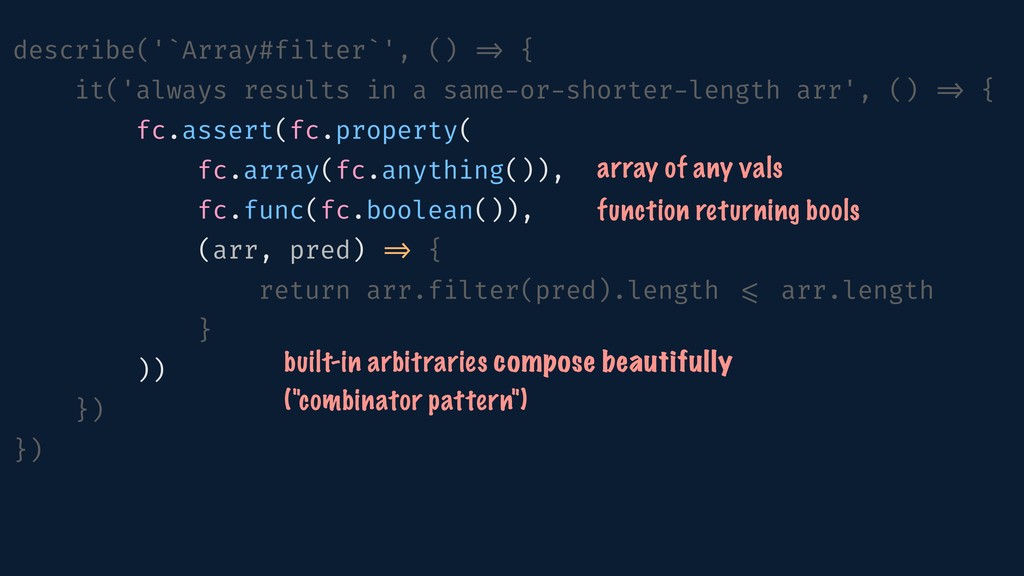
describe('`Array#filter`', () => { it('always results in a same-or-shorter-length arr',
() => { fc.assert(fc.property( fc.array(fc.anything()), fc.func(fc.boolean()), (arr, pred) => { return arr.filter(pred).length <= arr.length } )) }) }) built-in arbitraries compose beautifully ("combinator pattern") array of any vals function returning bools -
describe('`isOdd`', () => { it('correctly identifies odd integers', () =>
{ fc.assert(fc.property( fc.integer().map(n => n * 2 + 1), isOdd )) }) }) function isOdd (num) { return num % 2 === 1 } a new arbitrary which generates odd integers can transform arbitraries via functional techniques like `map` and `filter` (fails on -1!) -
tons more! size minima / maxima ✍ special strings (ascii,
unicode, ipv4, json) custom generators from scratch -
Complementary to other strats Unit tests for specific important cases
Fuzzers for robustness against garbage input Prop tests for confidence that API contract holds <- property-based testing image credit: Nicolas Dubien -
Plain JS -> zero-effort integration No special plugins, matchers, or
bindings needed Drop into Mocha, AVA, Jest, Tape, etc. Insert assertions from Chai, Sinon, Supertest, etc. -
THANKS! - https: //speakerdeck.com/glebec/the-magic-of-generative-testing - https: //dev.to/glebec/property-testing-with-jsverify-part-i-3one - https: //
www.cs.tufts.edu/~nr/cs257/archive/john-hughes/quick.pdf - YouTube: "Don't Write Tests"! (John Hughes) - https: //github.com/dubzzz/fast-check