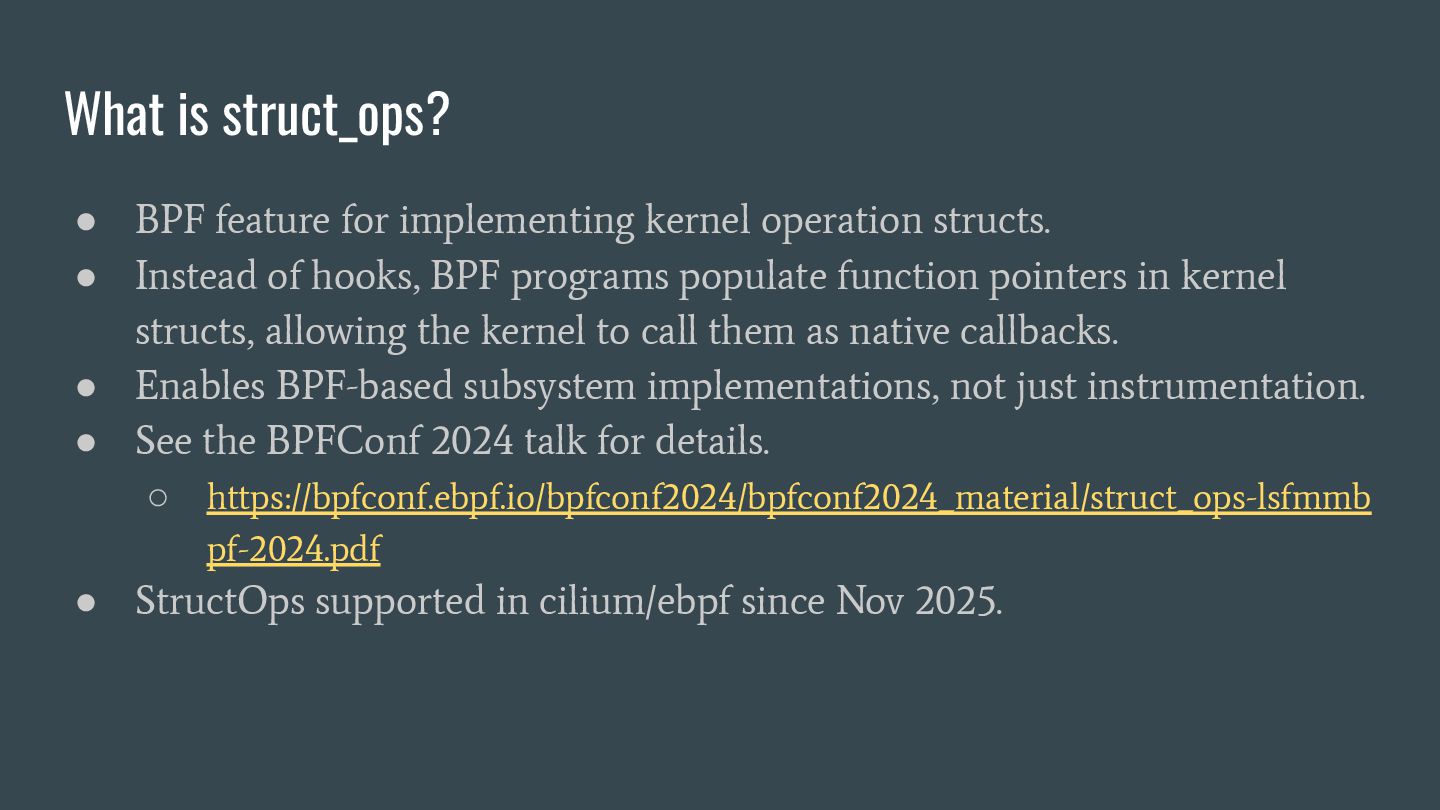
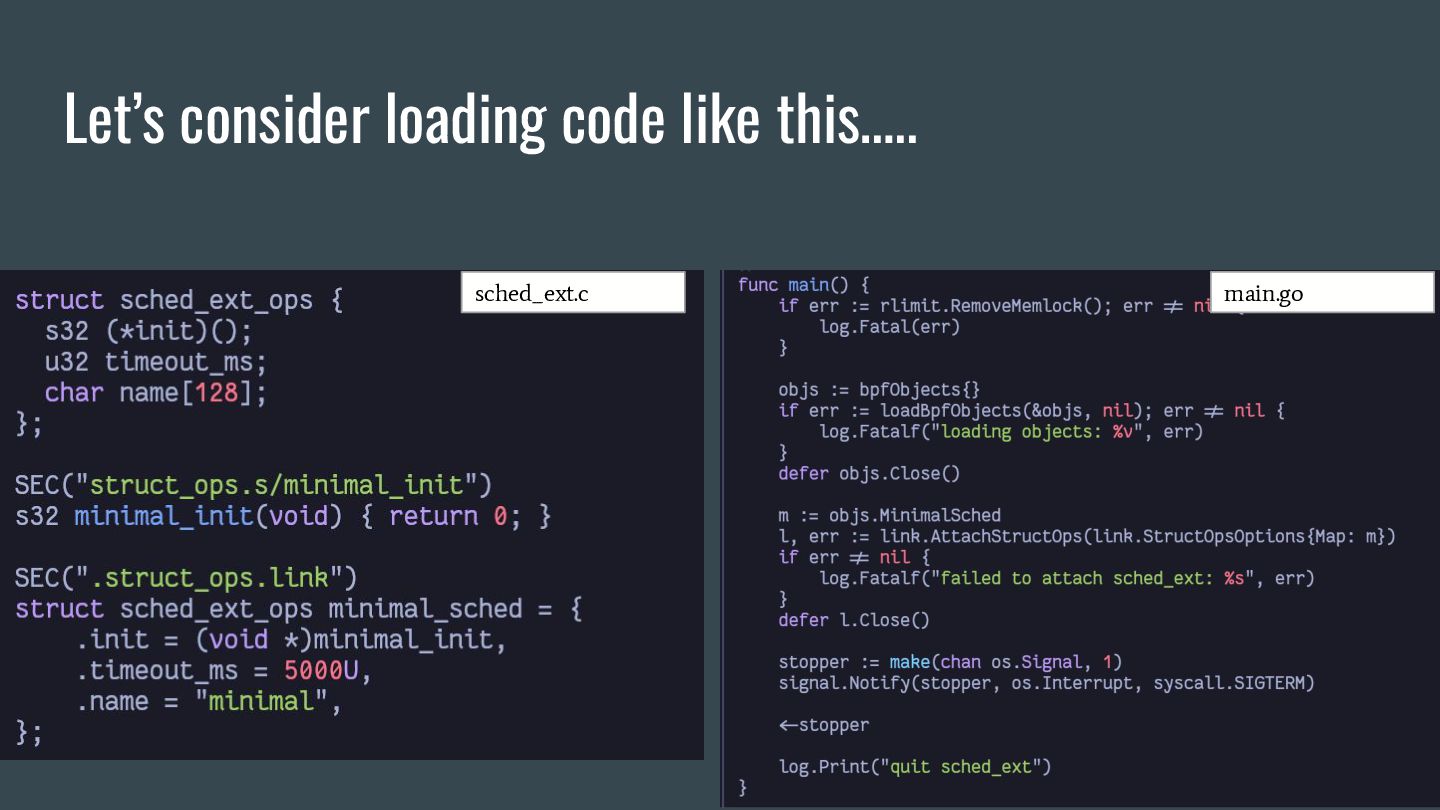
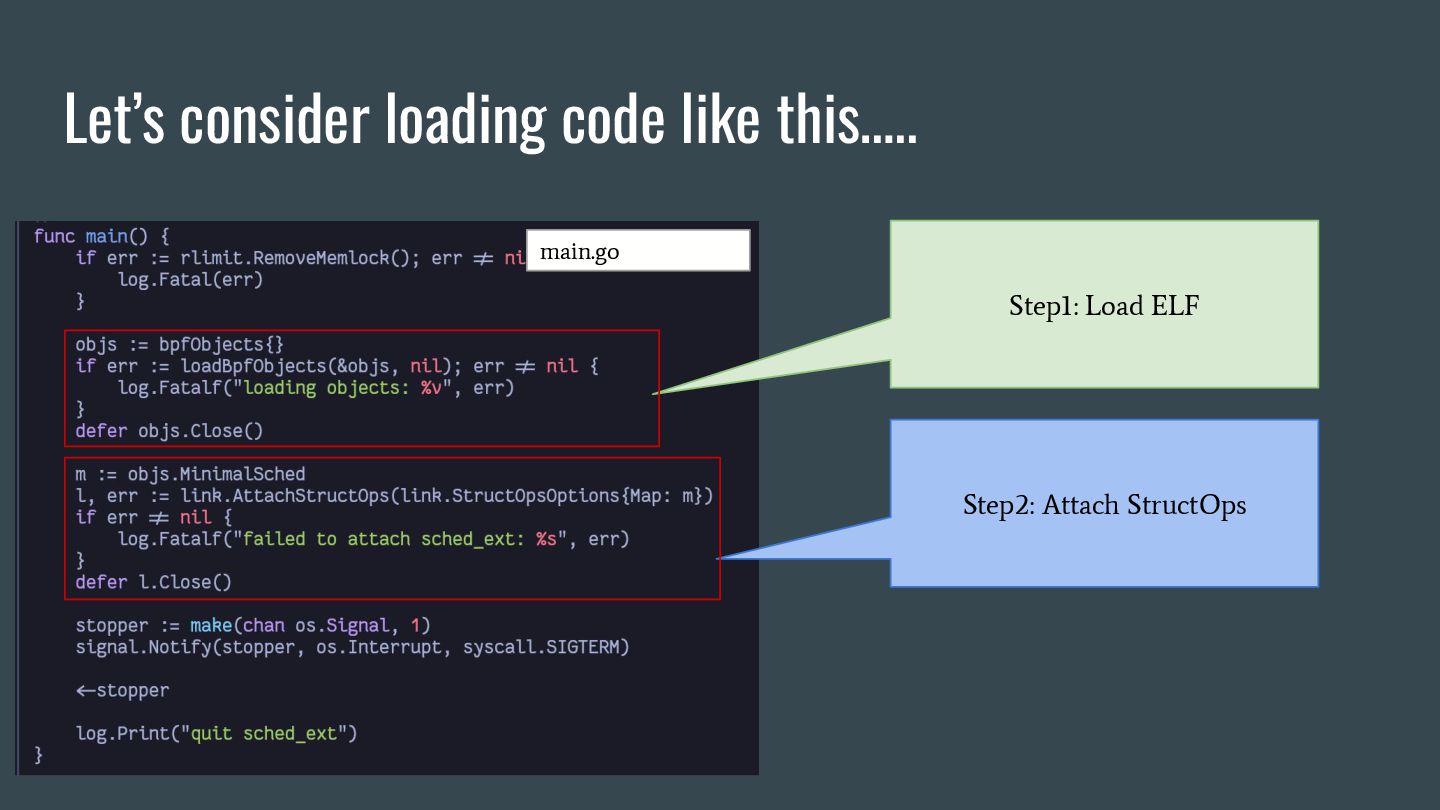
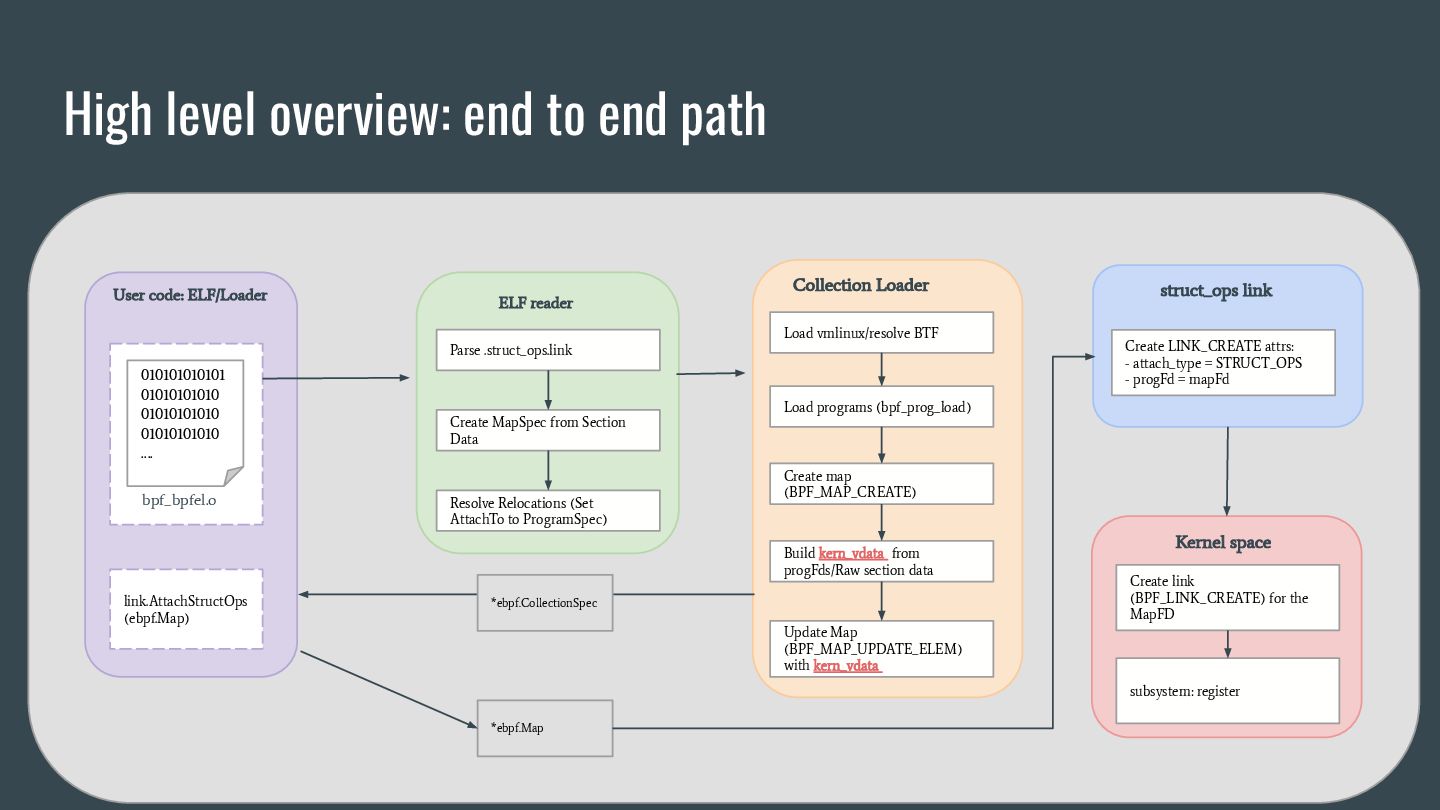
structs. • Instead of hooks, BPF programs populate function pointers in kernel structs, allowing the kernel to call them as native callbacks. • Enables BPF-based subsystem implementations, not just instrumentation. • See the BPFConf 2024 talk for details. ◦ https://bpfconf.ebpf.io/bpfconf2024/bpfconf2024_material/struct_ops-lsfmmb pf-2024.pdf • StructOps supported in cilium/ebpf since Nov 2025.
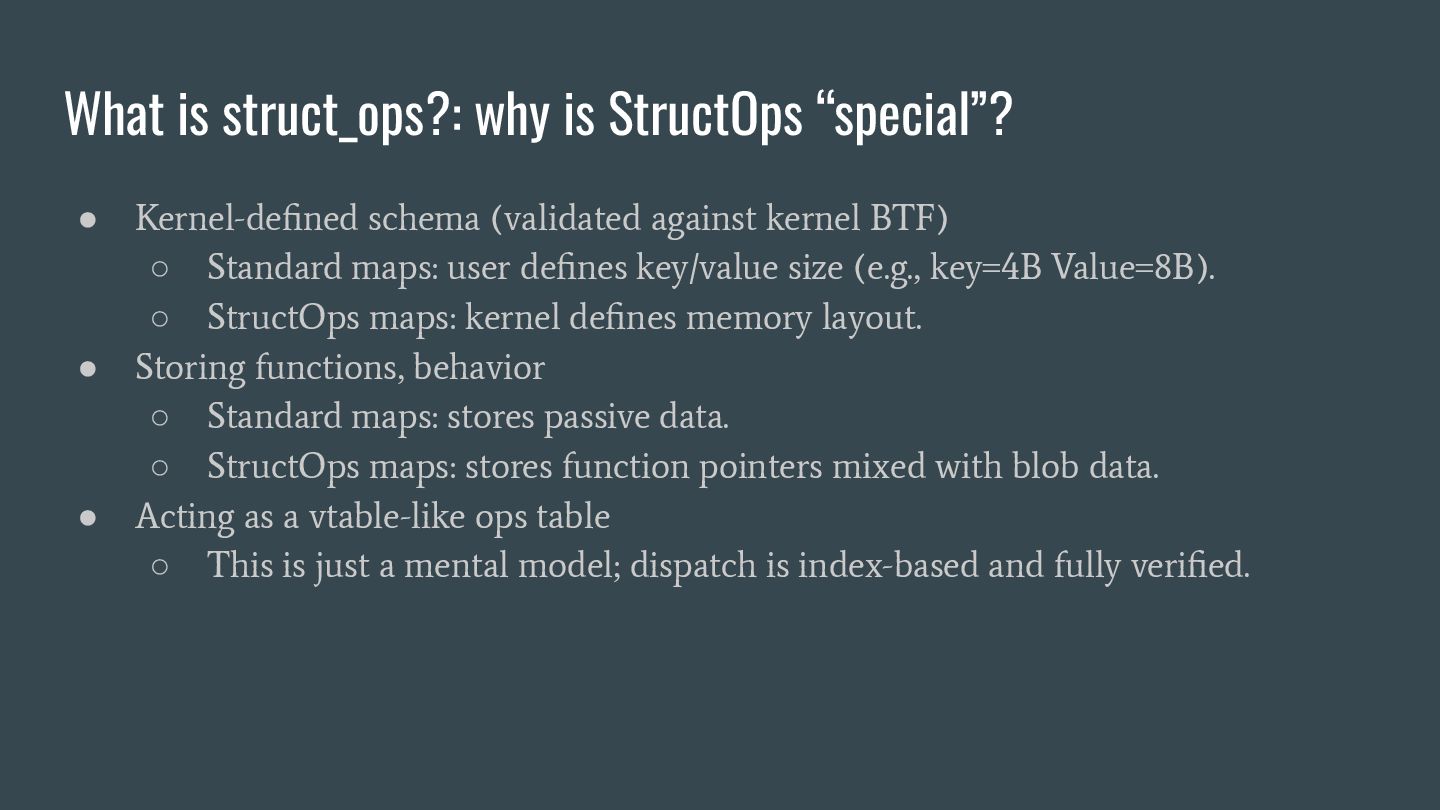
BTF) ◦ Standard maps: user defines key/value size (e.g., key=4B Value=8B). ◦ StructOps maps: kernel defines memory layout. • Storing functions, behavior ◦ Standard maps: stores passive data. ◦ StructOps maps: stores function pointers mixed with blob data. • Acting as an ops table in kernel ◦ This is just a mental model; dispatch is index-based and fully verified.
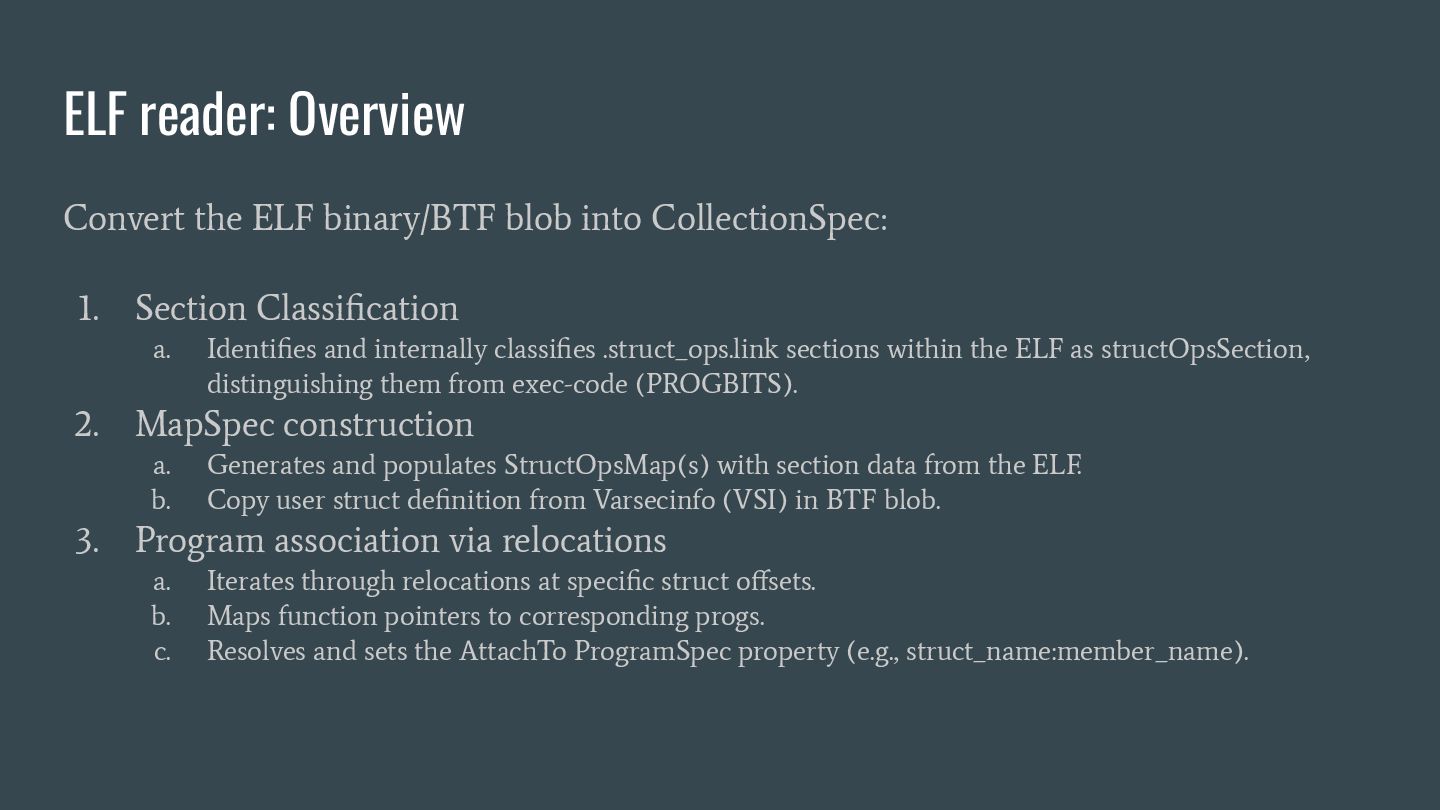
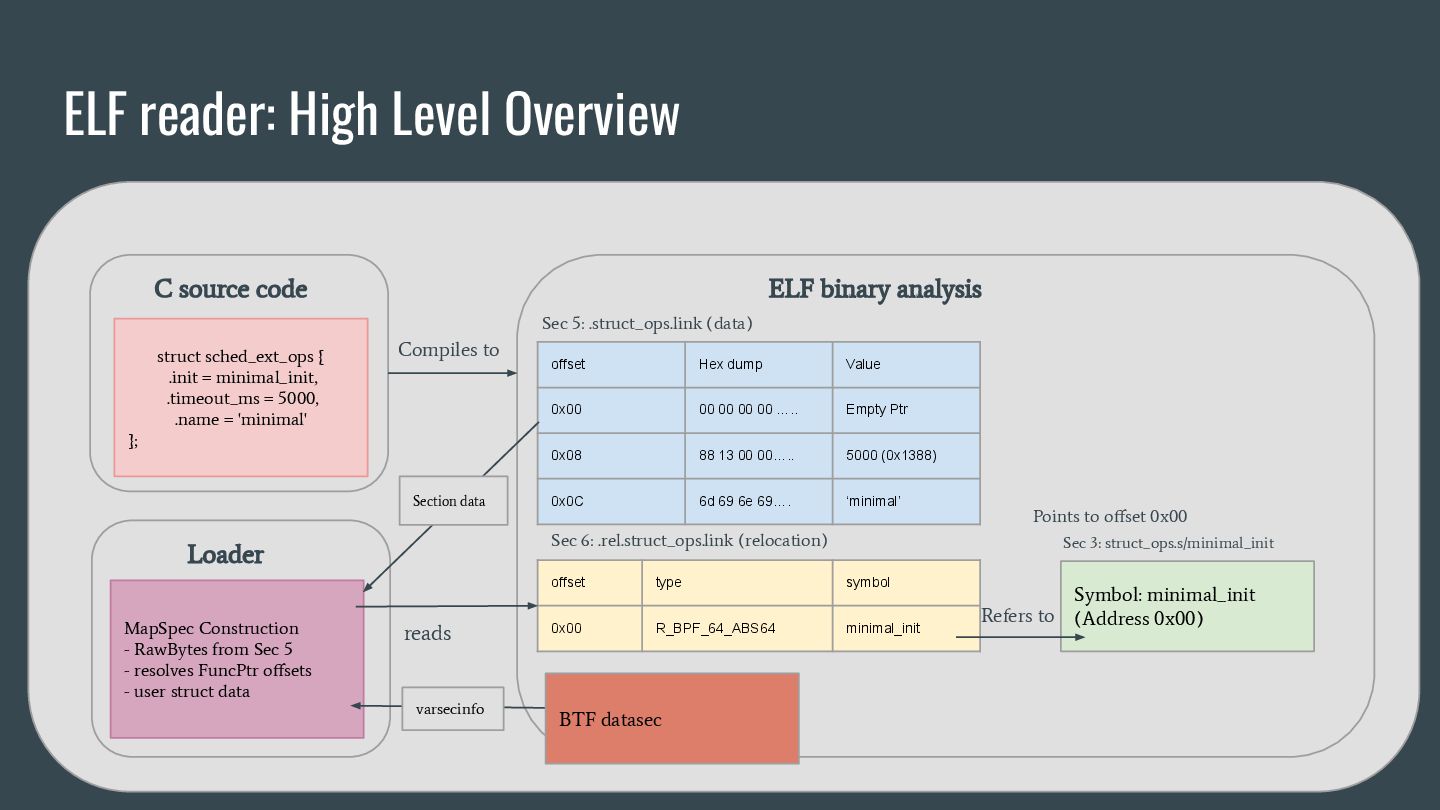
1. Section Classification a. Identifies and internally classifies .struct_ops.link sections within the ELF as structOpsSection, distinguishing them from exec-code (PROGBITS). 2. MapSpec construction a. Generates and populates StructOpsMap(s) with section data from the ELF. b. Copy user struct definition from Varsecinfo (VSI) in BTF blob. 3. Program association via relocations a. Iterates through relocations at specific struct offsets. b. Maps function pointers to corresponding progs. c. Resolves and sets the AttachTo ProgramSpec property (e.g., struct_name:member_name).
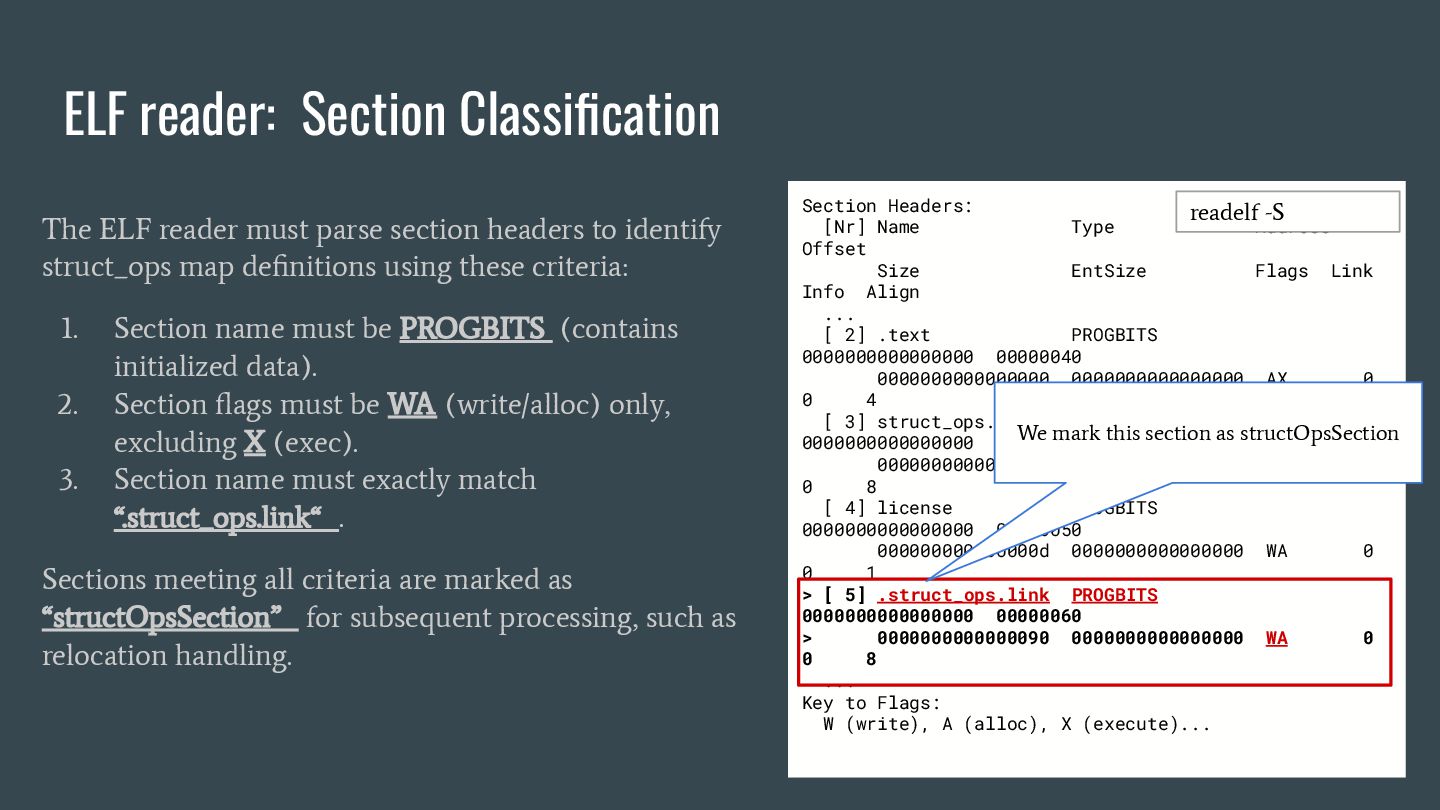
headers to identify struct_ops map definitions using these criteria: 1. Section name must be PROGBITS (contains initialized data). 2. Section flags must be WA (write/alloc) only, excluding X (exec). 3. Section name must exactly match “.struct_ops.link“ . Sections meeting all criteria are marked as “structOpsSection” for subsequent processing, such as relocation handling. Section Headers: [Nr] Name Type Address Offset Size EntSize Flags Link Info Align ... [ 2] .text PROGBITS 0000000000000000 00000040 0000000000000000 0000000000000000 AX 0 0 4 [ 3] struct_ops.s[...] PROGBITS 0000000000000000 00000040 0000000000000010 0000000000000000 AX 0 0 8 [ 4] license PROGBITS 0000000000000000 00000050 000000000000000d 0000000000000000 WA 0 0 1 > [ 5] .struct_ops.link PROGBITS 0000000000000000 00000060 > 0000000000000090 0000000000000000 WA 0 0 8 ... Key to Flags: W (write), A (alloc), X (execute)... readelf -S We mark this section as structOpsSection
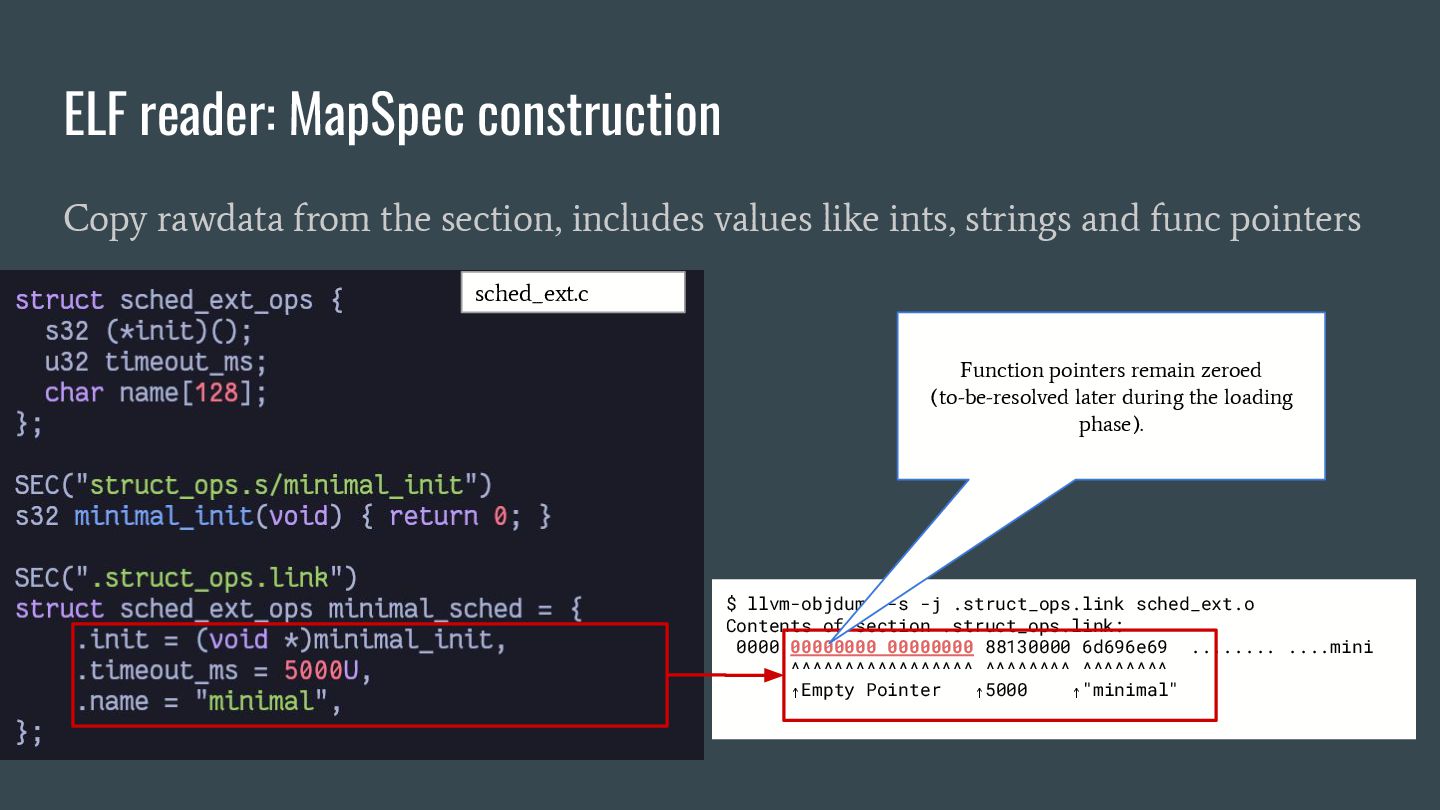
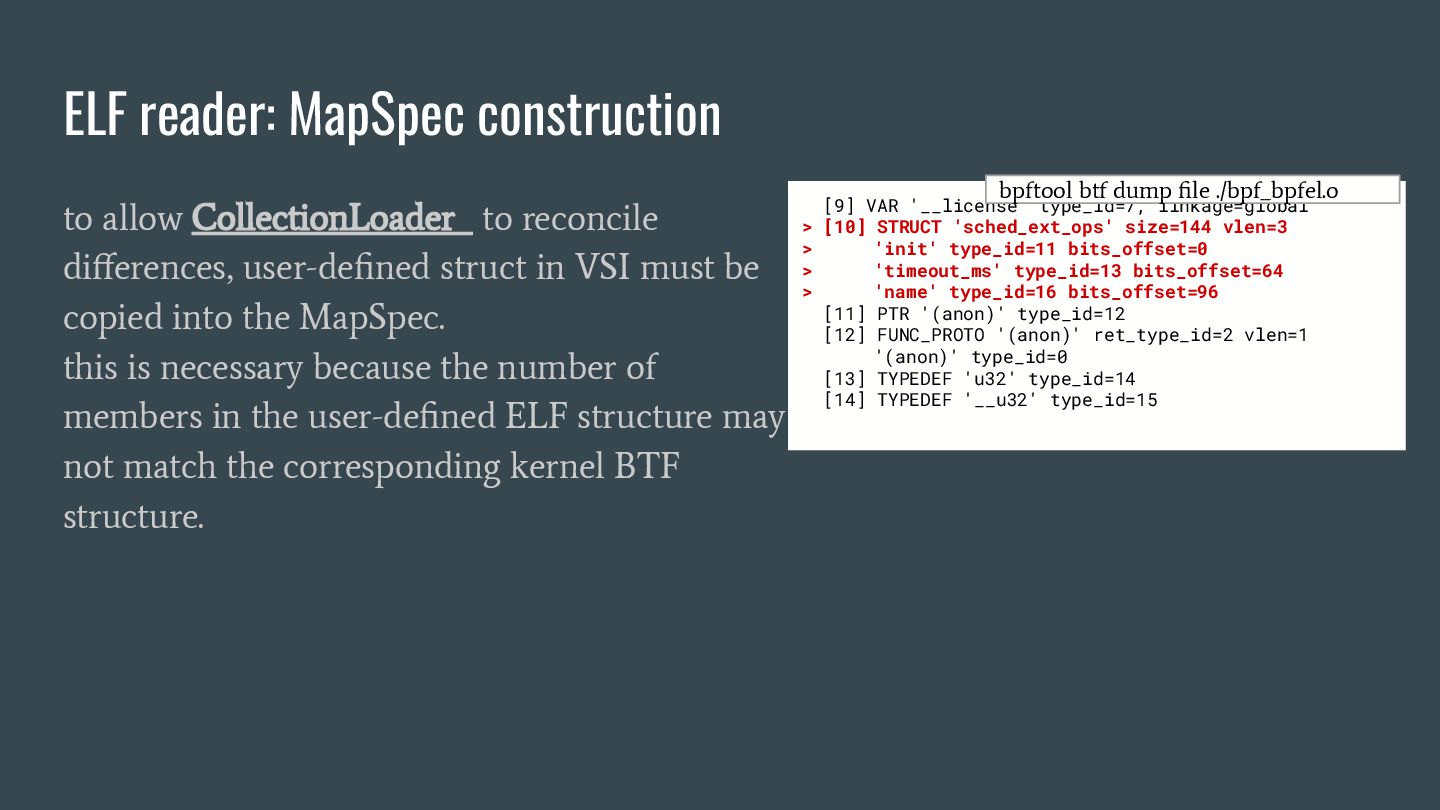
user-defined struct in VSI must be copied into the MapSpec. this is necessary because the number of members in the user-defined ELF structure may not match the corresponding kernel BTF structure. [9] VAR '__license' type_id=7, linkage=global > [10] STRUCT 'sched_ext_ops' size=144 vlen=3 > 'init' type_id=11 bits_offset=0 > 'timeout_ms' type_id=13 bits_offset=64 > 'name' type_id=16 bits_offset=96 [11] PTR '(anon)' type_id=12 [12] FUNC_PROTO '(anon)' ret_type_id=2 vlen=1 '(anon)' type_id=0 [13] TYPEDEF 'u32' type_id=14 [14] TYPEDEF '__u32' type_id=15 bpftool btf dump file ./bpf_bpfel.o
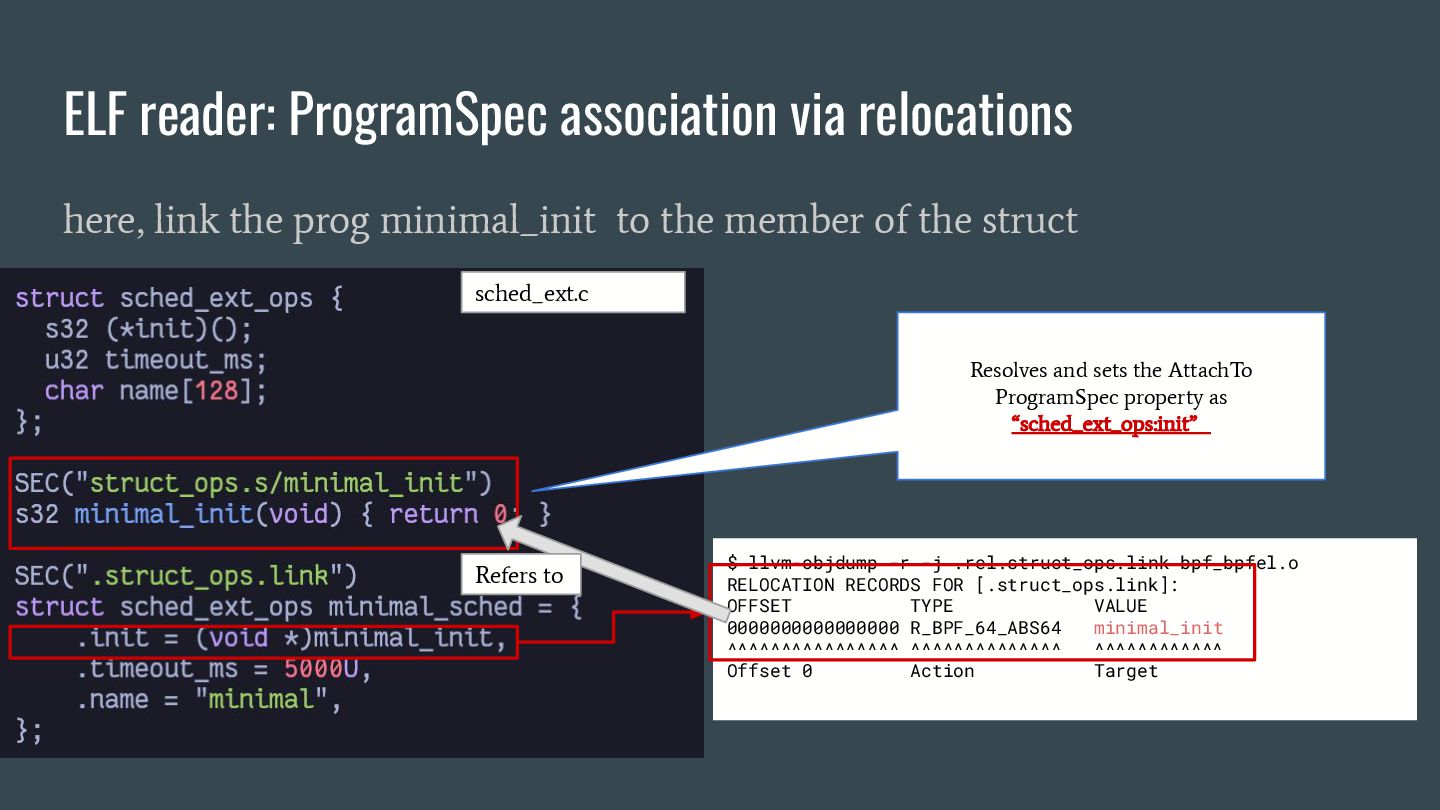
struct ELF reader: ProgramSpec association via relocations sched_ext.c $ llvm-objdump -r -j .rel.struct_ops.link bpf_bpfel.o RELOCATION RECORDS FOR [.struct_ops.link]: OFFSET TYPE VALUE 0000000000000000 R_BPF_64_ABS64 minimal_init ^^^^^^^^^^^^^^^^ ^^^^^^^^^^^^^^ ^^^^^^^^^^^^ Offset 0 Action Target Resolves and sets the AttachTo ProgramSpec property as “sched_ext_ops:init” Refers to
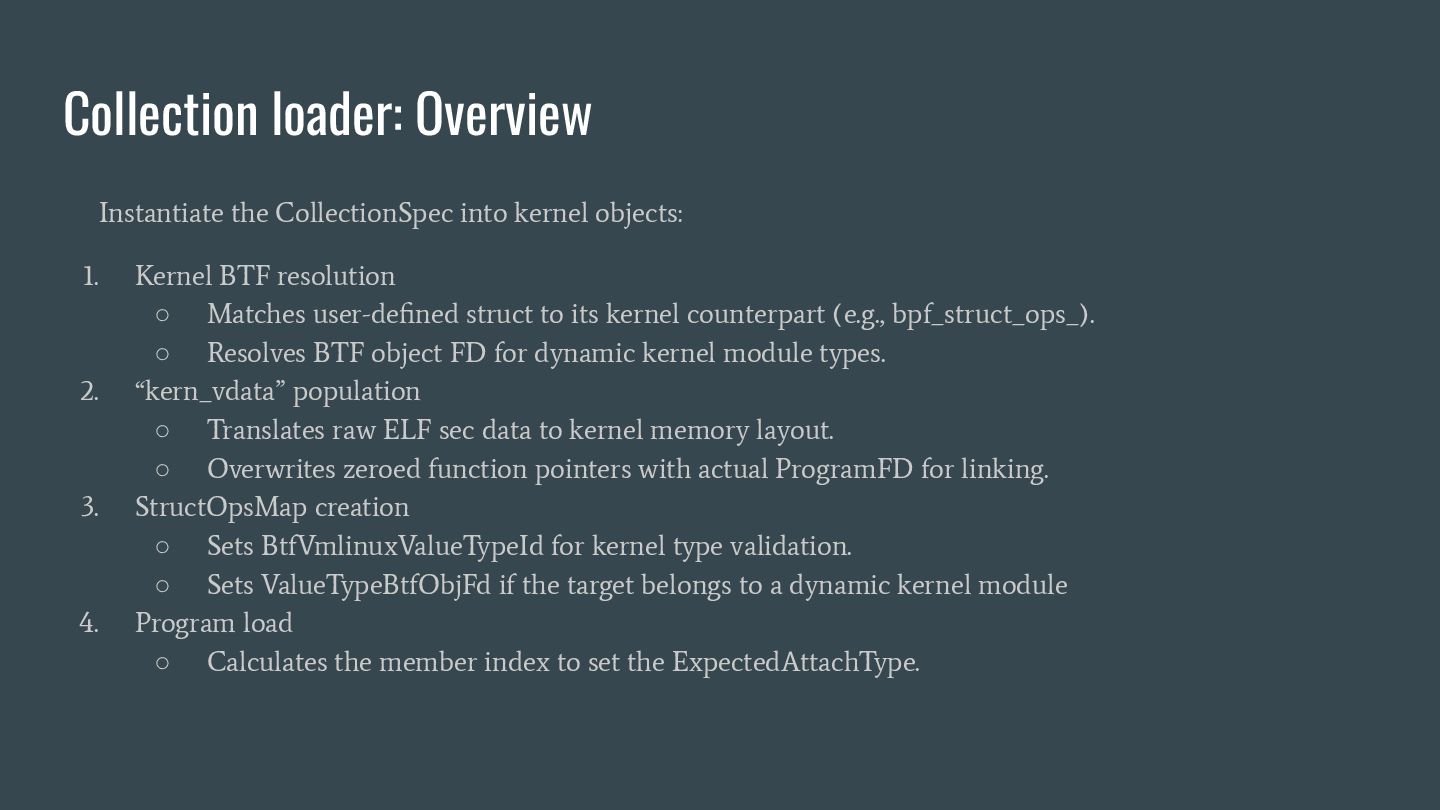
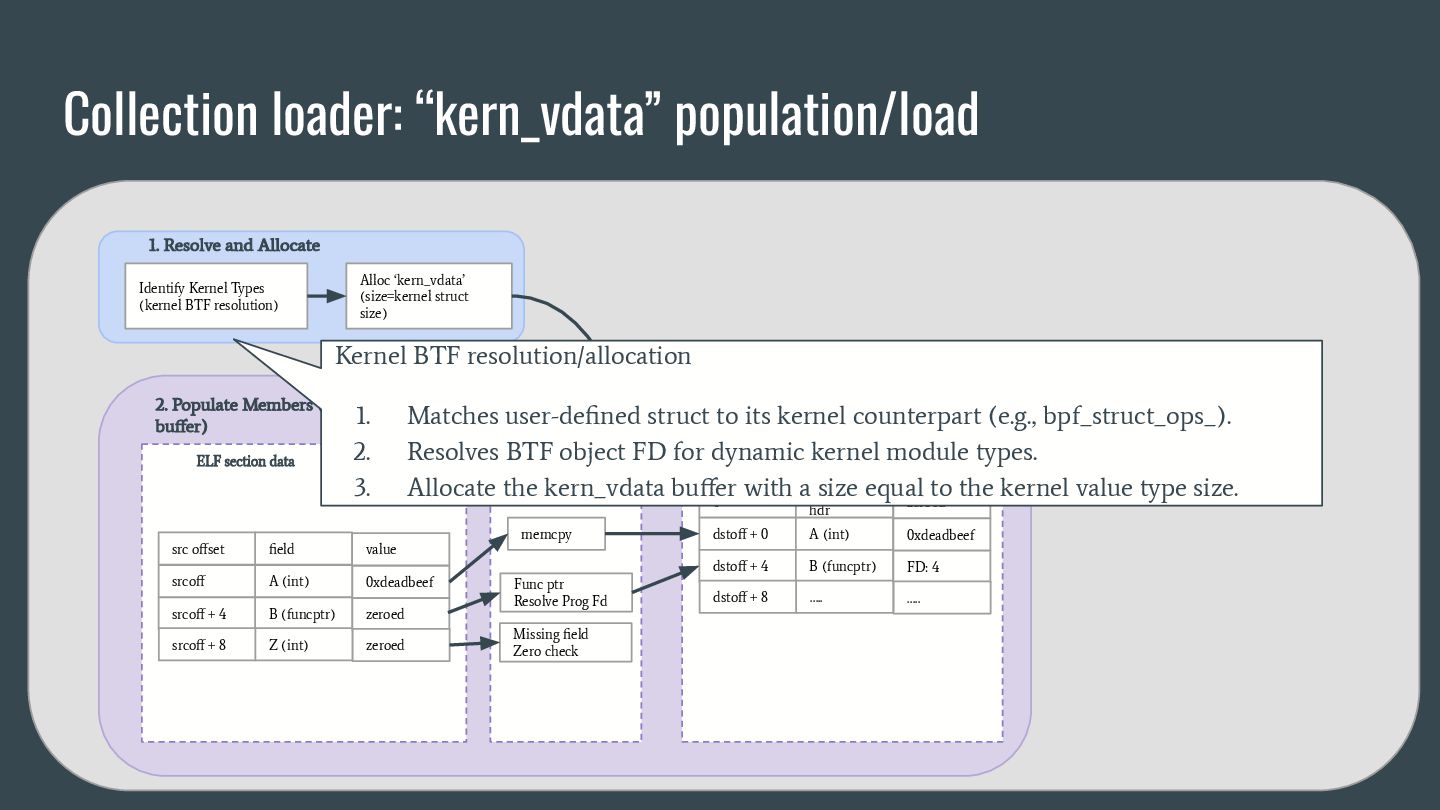
Kernel BTF resolution ◦ Matches user-defined struct to its kernel counterpart (e.g., bpf_struct_ops_). ◦ Resolves BTF object FD for dynamic kernel module types. 2. “kern_vdata” population ◦ Translates raw ELF sec data to kernel memory layout. ◦ Overwrites zeroed function pointers with actual ProgramFD for linking. 3. StructOpsMap creation ◦ Sets BtfVmlinuxValueTypeId for kernel type validation. ◦ Sets ValueTypeBtfObjFd if the target belongs to a dynamic kernel module 4. Program load ◦ Calculates the member index to set the ExpectedAttachType.
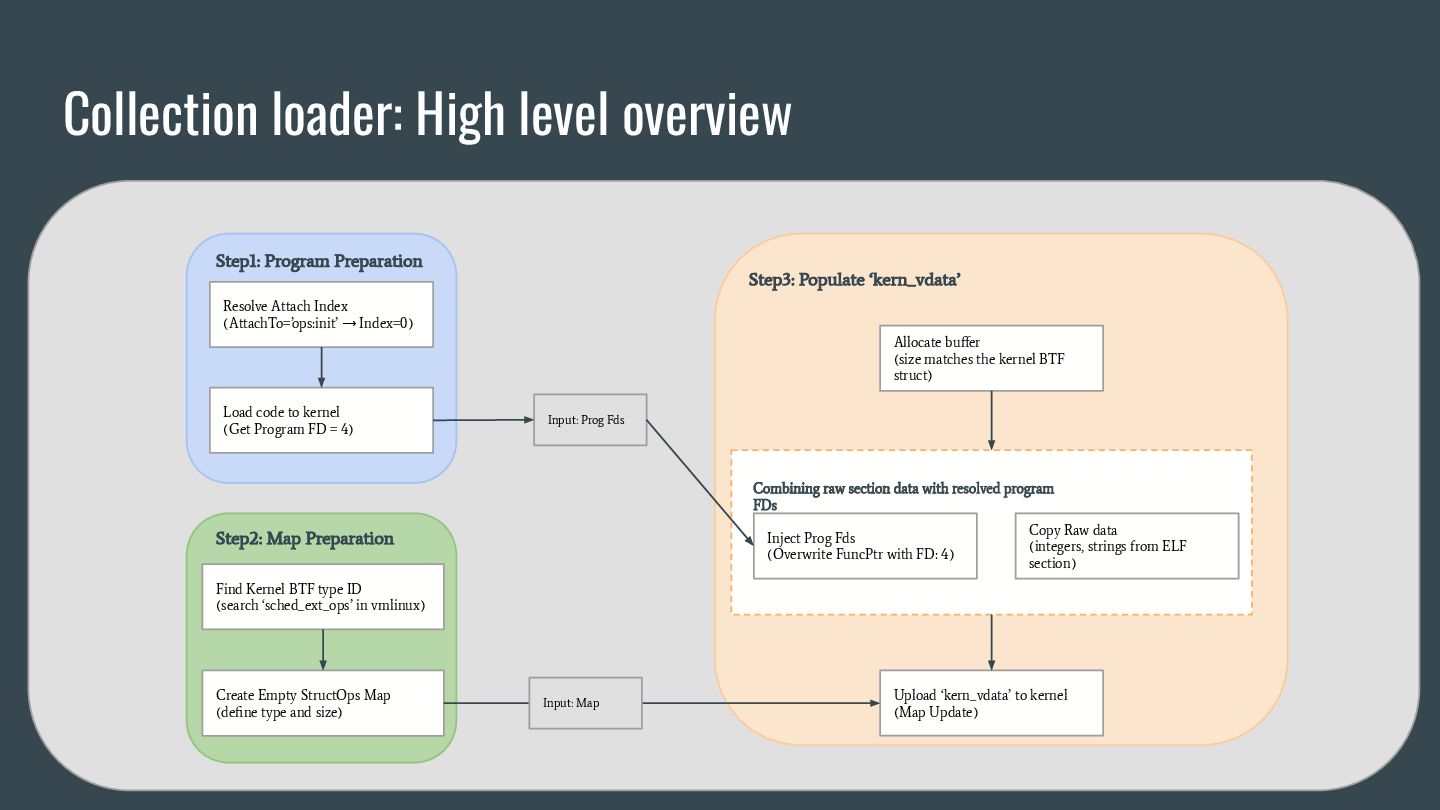
Index=0) Step1: Program Preparation Load code to kernel (Get Program FD = 4) Step2: Map Preparation Find Kernel BTF type ID (search ‘sched_ext_ops’ in vmlinux) Create Empty StructOps Map (define type and size) Step3: Populate ‘kern_vdata’ Allocate buffer (size matches the kernel BTF struct) Combining raw section data with resolved program FDs Copy Raw data (integers, strings from ELF section) Inject Prog Fds (Overwrite FuncPtr with FD: 4) Upload ‘kern_vdata’ to kernel (Map Update) Input: Prog Fds Input: Map
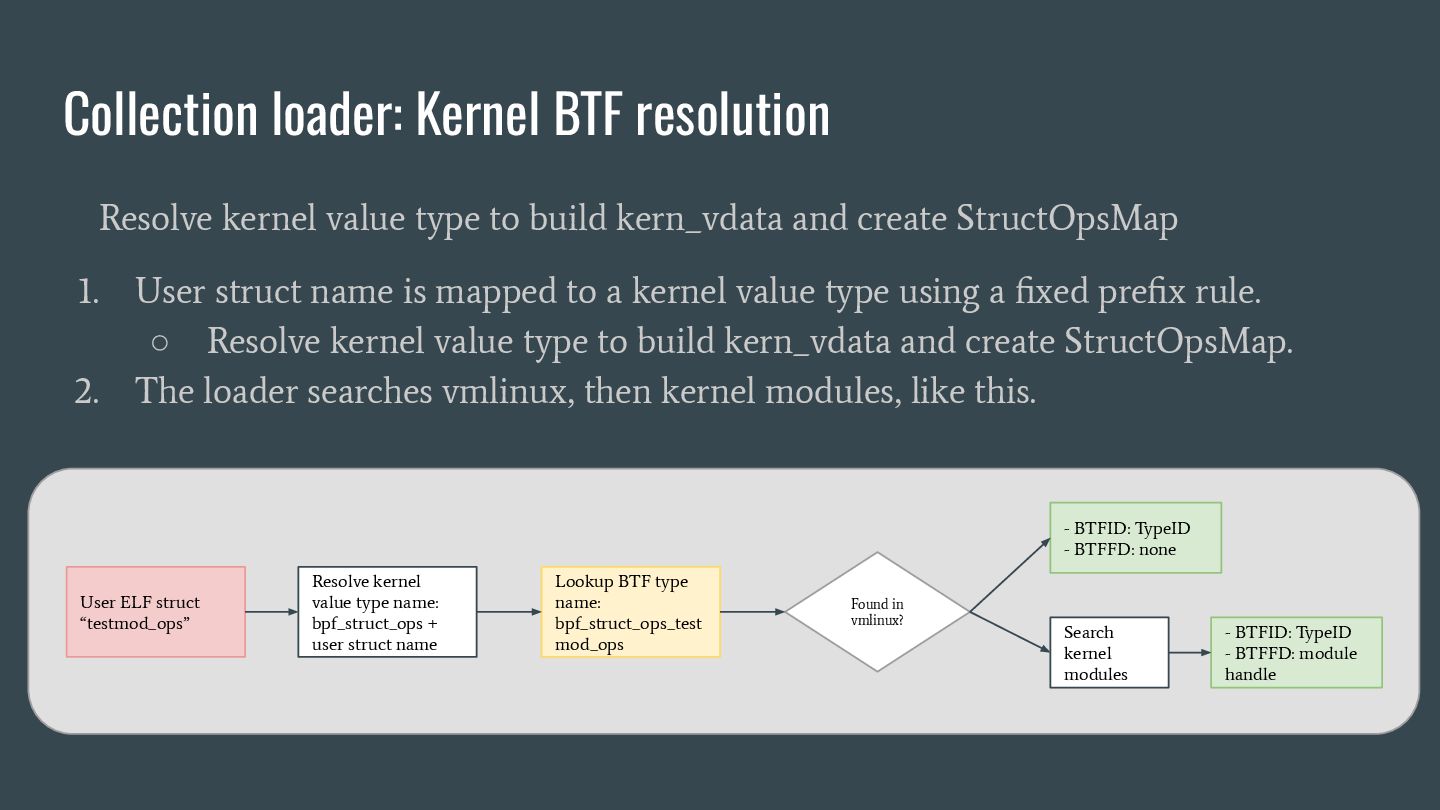
build kern_vdata and create StructOpsMap 1. User struct name is mapped to a kernel value type using a fixed prefix rule. ◦ Resolve kernel value type to build kern_vdata and create StructOpsMap. 2. The loader searches vmlinux, then kernel modules, like this. User ELF struct “testmod_ops” Resolve kernel value type name: bpf_struct_ops + user struct name Lookup BTF type name: bpf_struct_ops_test mod_ops Found in vmlinux? - BTFID: TypeID - BTFFD: none Search kernel modules - BTFID: TypeID - BTFFD: module handle
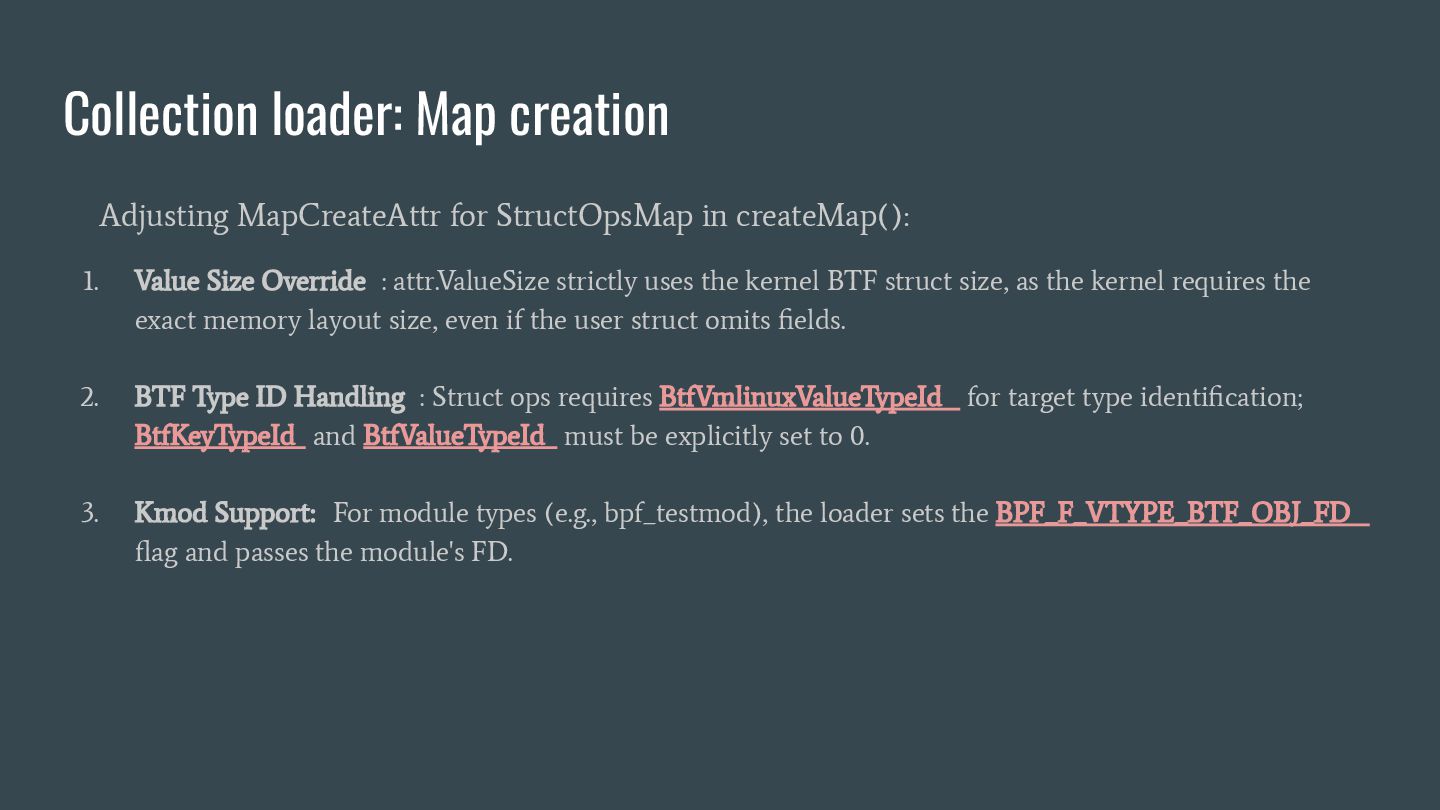
1. Value Size Override : attr.ValueSize strictly uses the kernel BTF struct size, as the kernel requires the exact memory layout size, even if the user struct omits fields. 2. BTF Type ID Handling : Struct ops requires BtfVmlinuxValueTypeId for target type identification; BtfKeyTypeId and BtfValueTypeId must be explicitly set to 0. 3. Kmod Support: For module types (e.g., bpf_testmod), the loader sets the BPF_F_VTYPE_BTF_OBJ_FD flag and passes the module's FD.
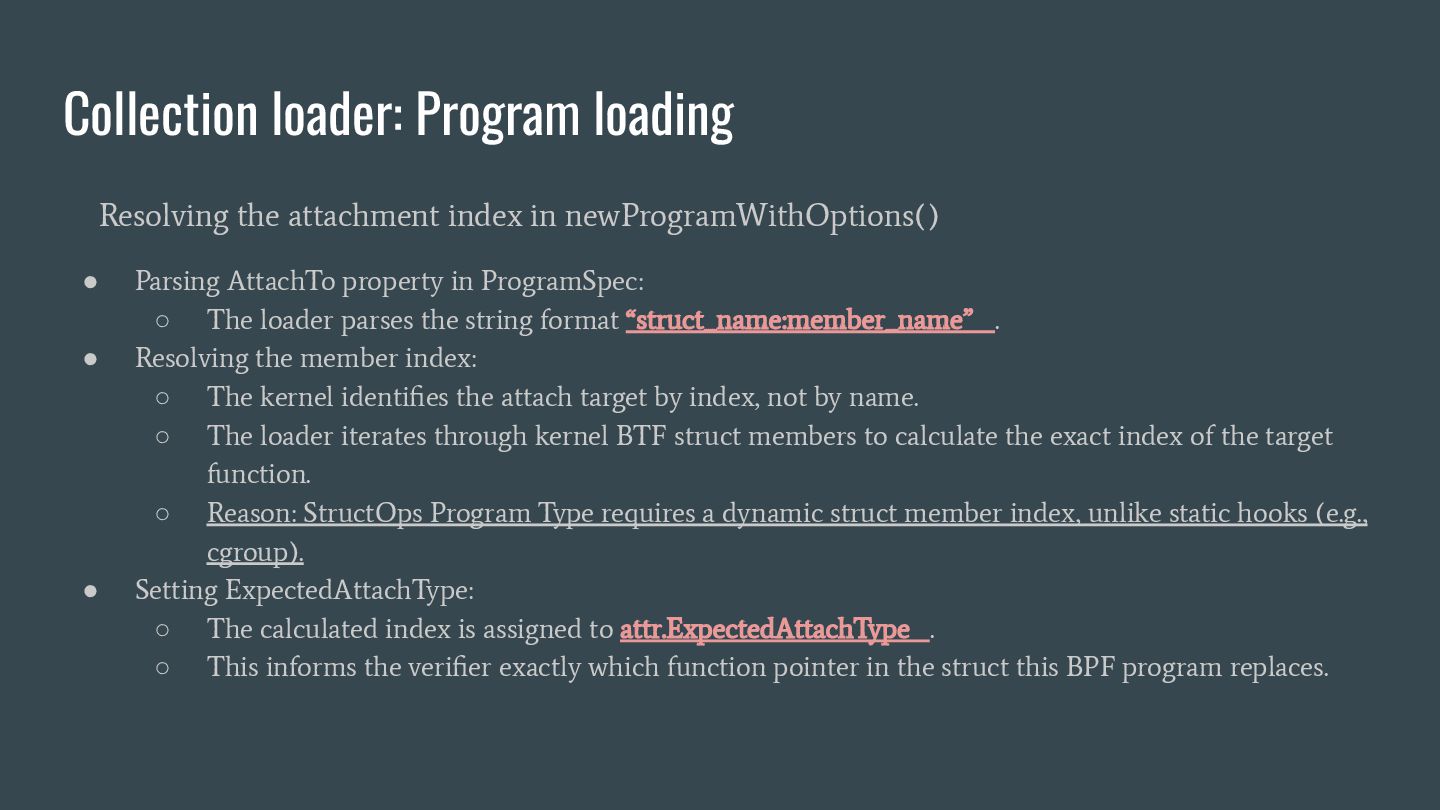
• Parsing AttachTo property in ProgramSpec: ◦ The loader parses the string format “struct_name:member_name” . • Resolving the member index: ◦ The kernel identifies the attach target by index, not by name. ◦ The loader iterates through kernel BTF struct members to calculate the exact index of the target function. ◦ Reason: StructOps Program Type requires a dynamic struct member index, unlike static hooks (e.g., cgroup). • Setting ExpectedAttachType: ◦ The calculated index is assigned to attr.ExpectedAttachType . ◦ This informs the verifier exactly which function pointer in the struct this BPF program replaces.
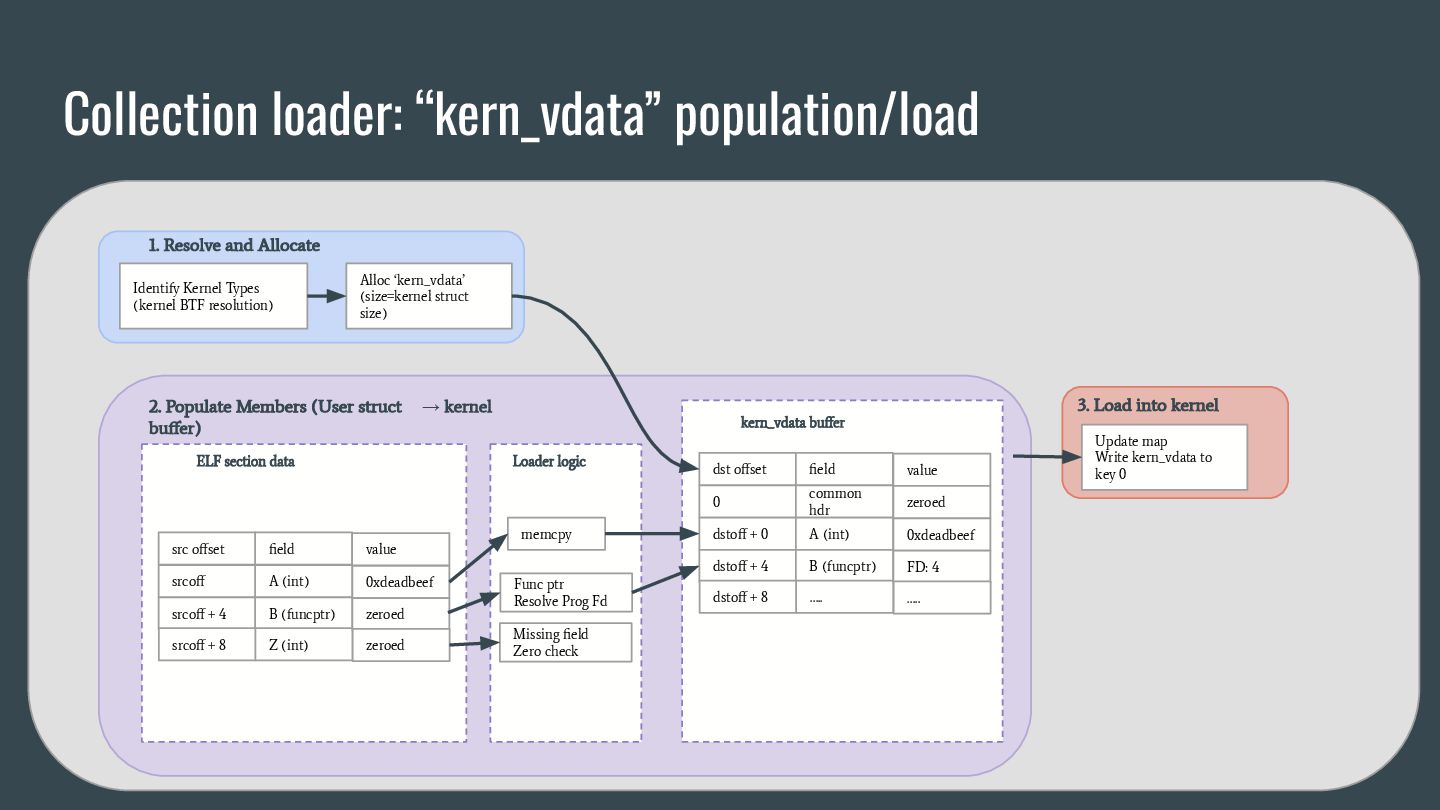
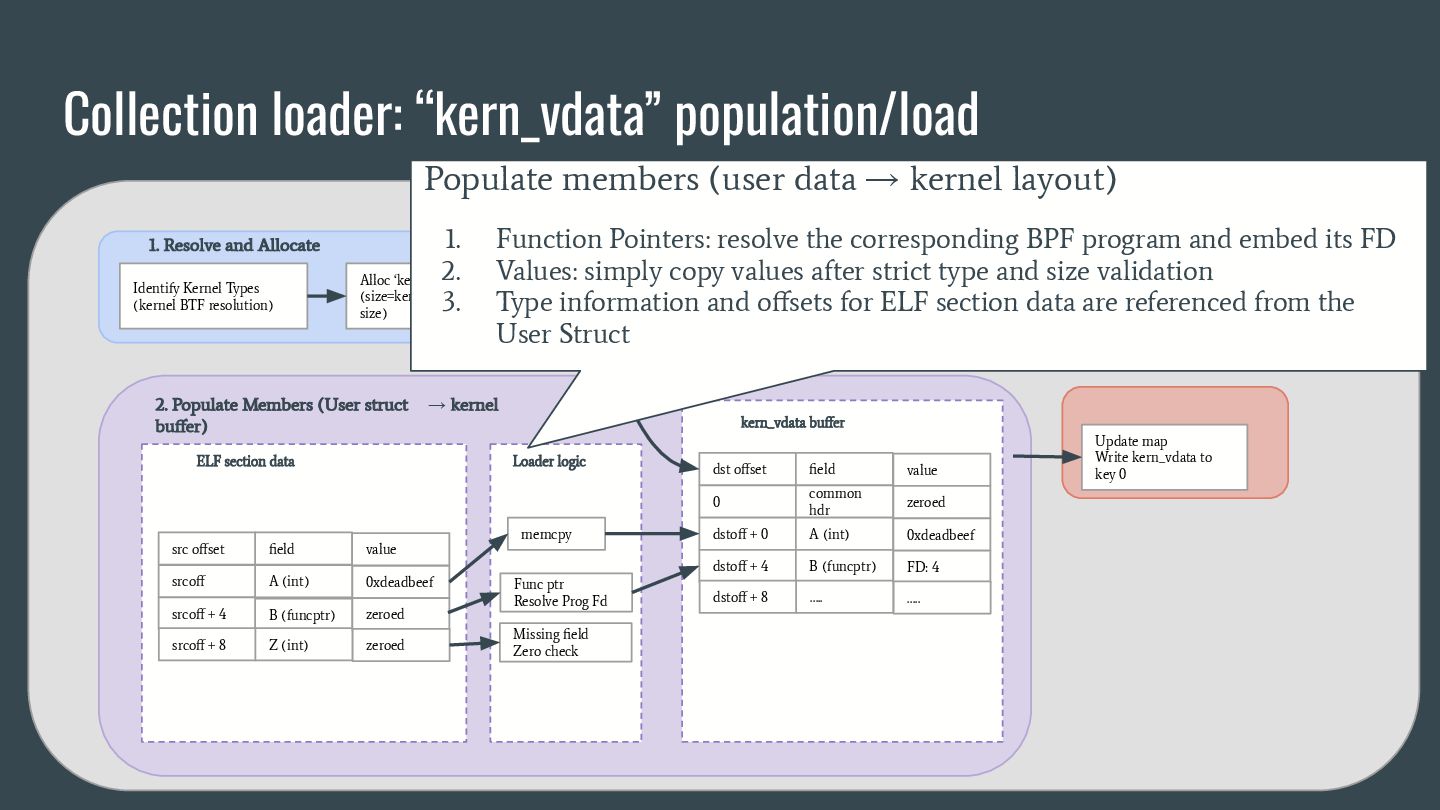
Alloc ‘kern_vdata’ (size=kernel struct size) 1. Resolve and Allocate 2. Populate Members (User struct → kernel buffer) Update map Write kern_vdata to key 0 kern_vdata buffer ELF section data Loader logic dst offset field 0 common hdr dstoff + 0 A (int) dstoff + 4 B (funcptr) dstoff + 8 ….. src offset field srcoff A (int) srcoff + 4 B (funcptr) srcoff + 8 Z (int) value 0xdeadbeef zeroed zeroed memcpy Func ptr Resolve Prog Fd value zeroed 0xdeadbeef FD: 4 ….. Missing field Zero check Populate members (user data → kernel layout) 1. Function Pointers: resolve the corresponding BPF program and embed its FD 2. Values: simply copy values after strict type and size validation 3. Type information and offsets for ELF section data are referenced from the User Struct
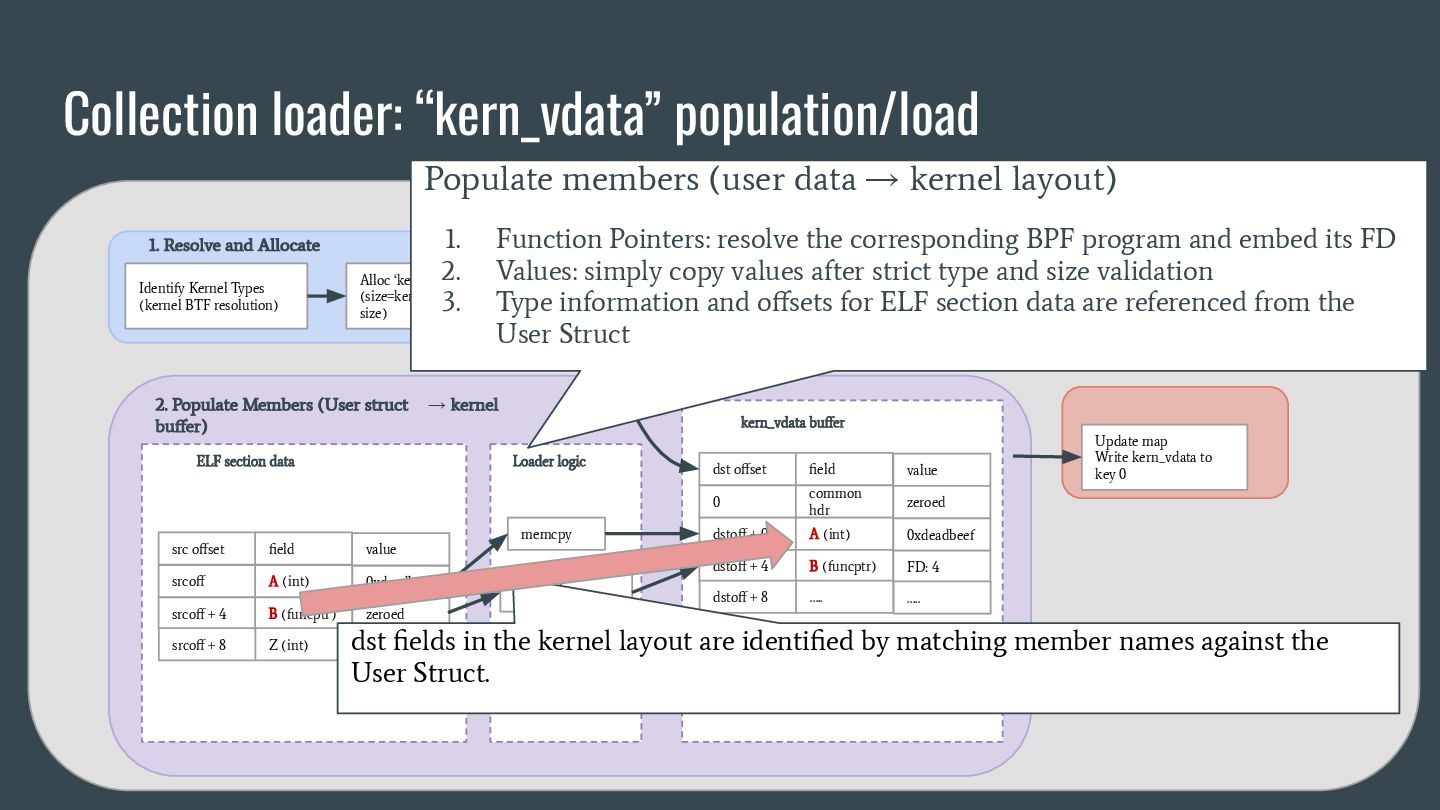
Alloc ‘kern_vdata’ (size=kernel struct size) 1. Resolve and Allocate 2. Populate Members (User struct → kernel buffer) Update map Write kern_vdata to key 0 kern_vdata buffer ELF section data Loader logic dst offset field 0 common hdr dstoff + 0 A (int) dstoff + 4 B (funcptr) dstoff + 8 ….. src offset field srcoff A (int) srcoff + 4 B (funcptr) srcoff + 8 Z (int) value 0xdeadbeef zeroed zeroed memcpy Func ptr Resolve Prog Fd value zeroed 0xdeadbeef FD: 4 ….. Missing field Zero check Populate members (user data → kernel layout) 1. Function Pointers: resolve the corresponding BPF program and embed its FD 2. Values: simply copy values after strict type and size validation 3. Type information and offsets for ELF section data are referenced from the User Struct dst fields in the kernel layout are identified by matching member names against the User Struct.
Linking the map ◦ Unlike standard BPF hooks, StructOps requires linking the map. • LinkCreate ◦ The library calls sys.LinkCreate() with specific attributes: ▪ Link Type: ebpf.AttachStructOps ▪ MapFd: The FD of the populated struct_ops map • Lifecycle management ◦ The returned link.Link FD manages registration lifetime. ◦ Closing the Link FD automatically unregisters the ops from the kernel.

 Your Podcast. Everywhere. Effortlessly.


 shun159
 marcduiker
 jnunemaker
 ivargrimstad
 inesmontani
 lfama
lfama
 brad_frost
 marktimemedia
 reverentgeek
 sugarenia
 livdayseo
 baasie
 apolaine