Upgrade to Pro
— share decks privately, control downloads, hide ads and more …
Speaker Deck
Sign up for free
Menu
Search
Features
All features
Private URLs
Password Protection
Custom URLS
Scheduled publishing
Remove Branding
Restrict embedding
Deck Collections
Notes
Features
All features
Private URLs
Password Protection
Custom URLS
Scheduled publishing
Remove Branding
Restrict embedding
Deck Collections
Notes
Explore
Featured decks
Featured speakers
Programming
Technology
Storyboards
Explore
Featured decks
Featured speakers
Programming
Technology
Storyboards
Pricing
Search
Sign in
Sign up for free
Exploring the OpenTelemetry Client Library for Go
Search
Akari
June 06, 2024
Programming
480
0
Share
Embed
Copy iframe code
Copy JS code
Copy link
Start on current slide
Exploring the OpenTelemetry Client Library for Go
Akari
June 06, 2024
More Decks by Akari
See All by Akari
Exploring the Implementation of “t.Run”, “t.Parallel”, and “t.Cleanup”
akarin
2
420
EC2 からの脱出劇:多用途なサーバの全役割をサーバレス・コンテナ環境へ
akarin
2
1.7k
RAILS_ENVを統合する取り組み: 開発用デプロイ環境をよりシンプルに
akarin
3
1.9k
モノレポを採用しているマイクロサービスのCI/CDの現状と課題
akarin
2
410
Other Decks in Programming
See All in Programming
UPDATE をやめる — EF Core でマスタをバージョン管理する
panda728
PRO
0
1.1k
選挙速報を多くのユーザーへ 届ける Live Activities 設計
hamayokokuririn
0
210
JAWS-UG 東京支部が始める、JAWS-UG支部コラボ / JAWS-UG lunchtime LT Collaboration
y0hgi
0
170
Androidだけじゃない、DroidKaigiで広がった私の技術スタック
akkeylab
0
110
Augmenting AI with the Power of Jakarta EE
ivargrimstad
0
470
動作中のプログラムの中身をリアルタイムに覗く / Realtime Debugger for CSharp with Roslyn
prota
1
1.7k
AHC070解法紹介
eijirou
0
150
[Rails World 2026] Durable orchestration on Rails: from continuation to workflow
palkan
1
420
更なる可用性を求めて、5年間運用したKotlinのアプリケーションをGoでリプレイスする話
ken_tunc
0
430
[2026-09-26]空論ジェネリックプロセス~テスト資産とAIで紡ぐ、再現可能なパフォーマンスチューニングの話~
tosite
0
250
Herb in Rails 8.2: Your ERB views, now HTML-aware @ Rails World 2026, Austin, Texas
marcoroth
0
150
AI時代のコードレビューは人に向けるな、仕組みに向けろ
texmeijin
5
3.3k
Featured
See All Featured
Leveraging LLMs for student feedback in introductory data science courses - posit::conf(2025)
minecr
1
410
Raft: Consensus for Rubyists
vanstee
142
7.7k
VelocityConf: Rendering Performance Case Studies
addyosmani
331
25k
Rails Girls Zürich Keynote
gr2m
96
14k
Organizational Design Perspectives: An Ontology of Organizational Design Elements
kimpetersen
PRO
1
840
No one is an island. Learnings from fostering a developers community.
thoeni
21
3.8k
Redefining SEO in the New Era of Traffic Generation
szymonslowik
1
450
The Success of Rails: Ensuring Growth for the Next 100 Years
eileencodes
47
8.4k
The Spectacular Lies of Maps
axbom
PRO
1
1.1k
Deep Space Network (abreviated)
tonyrice
0
350
Beyond borders and beyond the search box: How to win the global "messy middle" with AI-driven SEO
davidcarrasco
3
270
The Mindset for Success: Future Career Progression
greggifford
PRO
0
520
Transcript
Exploring the OpenTelemetry Client Library for Go (Unofficial)Go Conference 2024
Pre Party 7 June, 2024 Keisuke Akari @k-akari @akarin0519
1. Reference Please refer the following blog post if you’d
like to know this topic in more detail. - Exploring the OpenTelemetry Client Library for Go
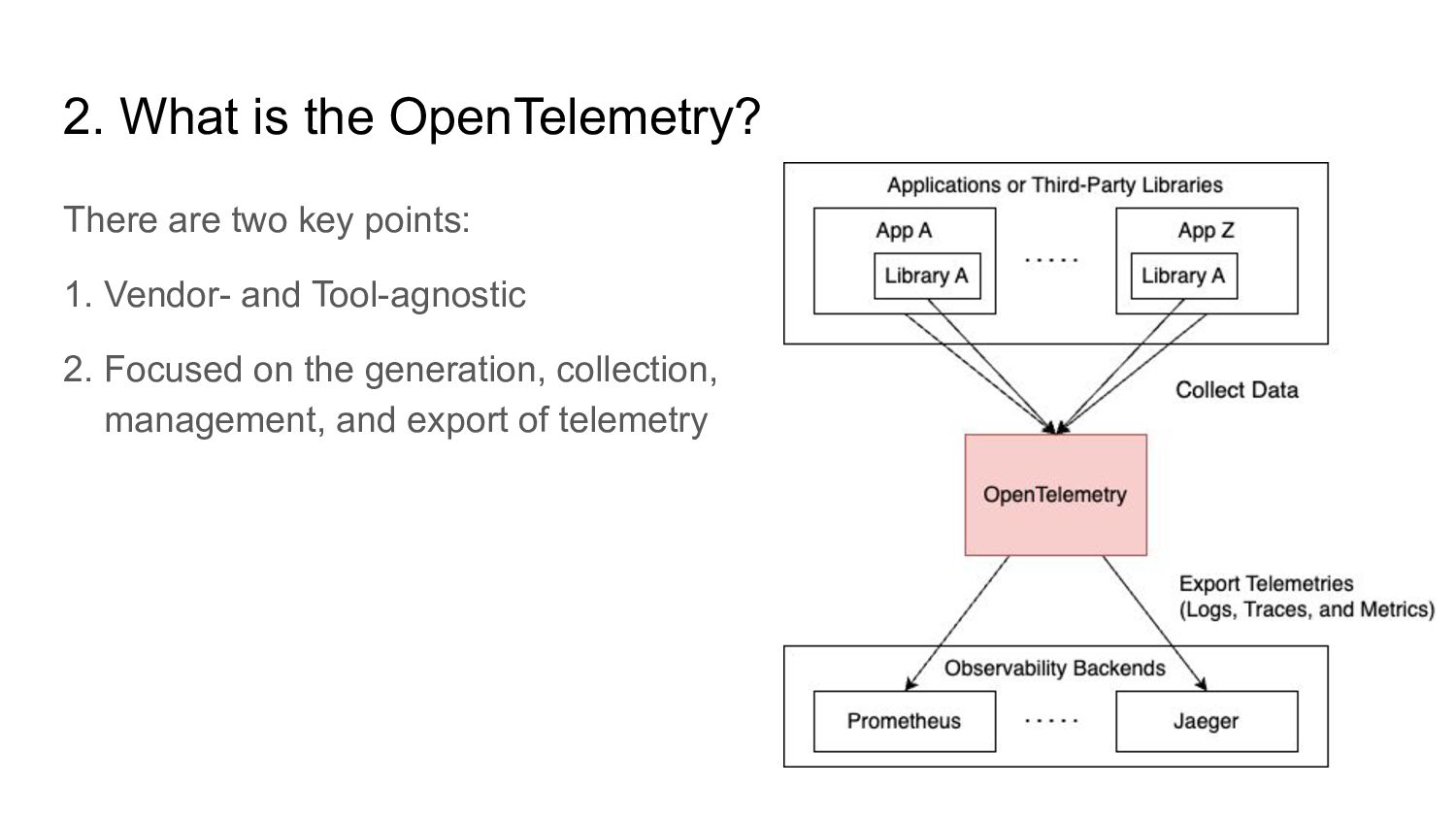
2. What is the OpenTelemetry? There are two key points:
1. Vendor- and Tool-agnostic 2. Focused on the generation, collection, management, and export of telemetry
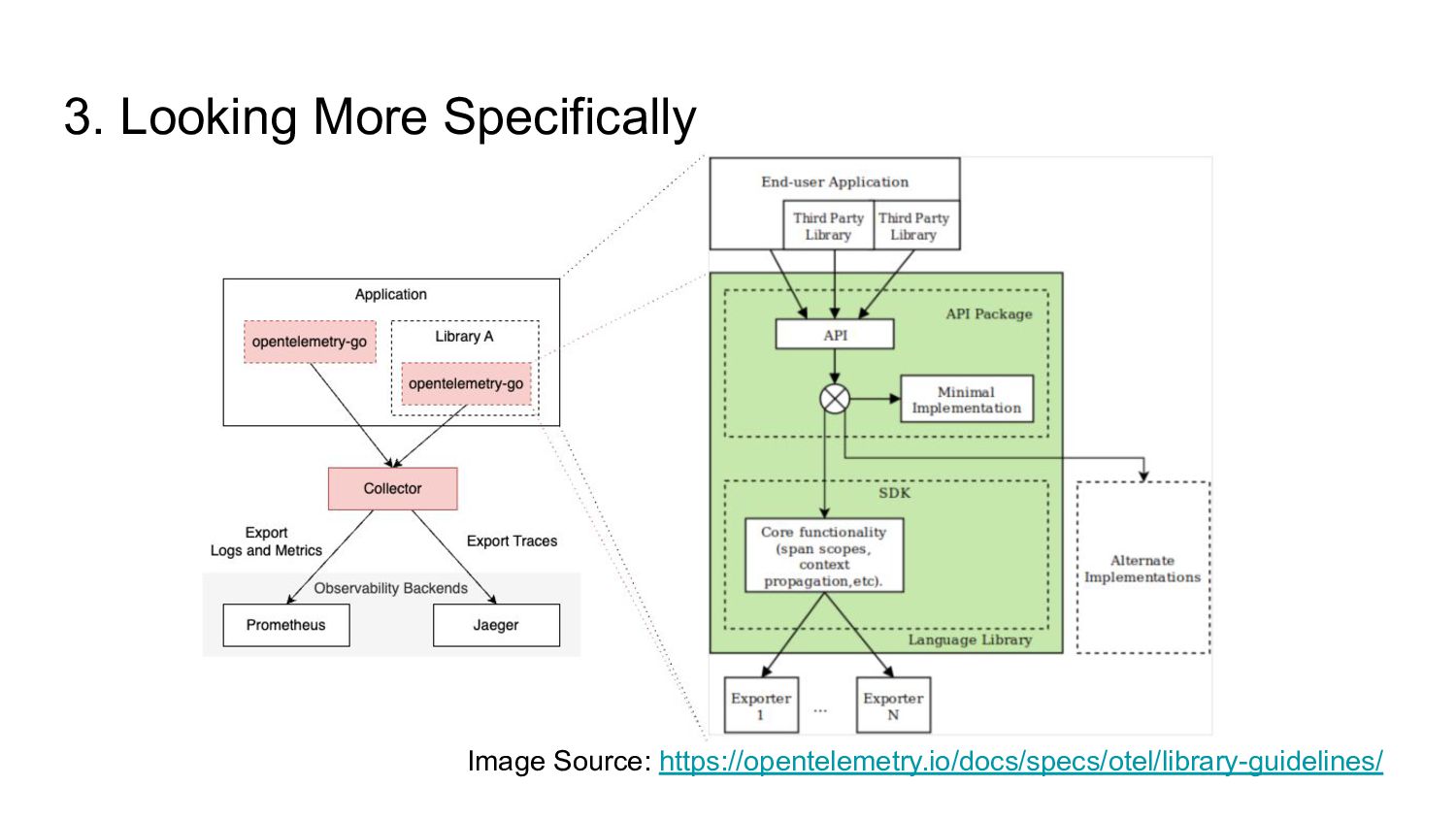
3. Looking More Specifically Image Source: https://opentelemetry.io/docs/specs/otel/library-guidelines/
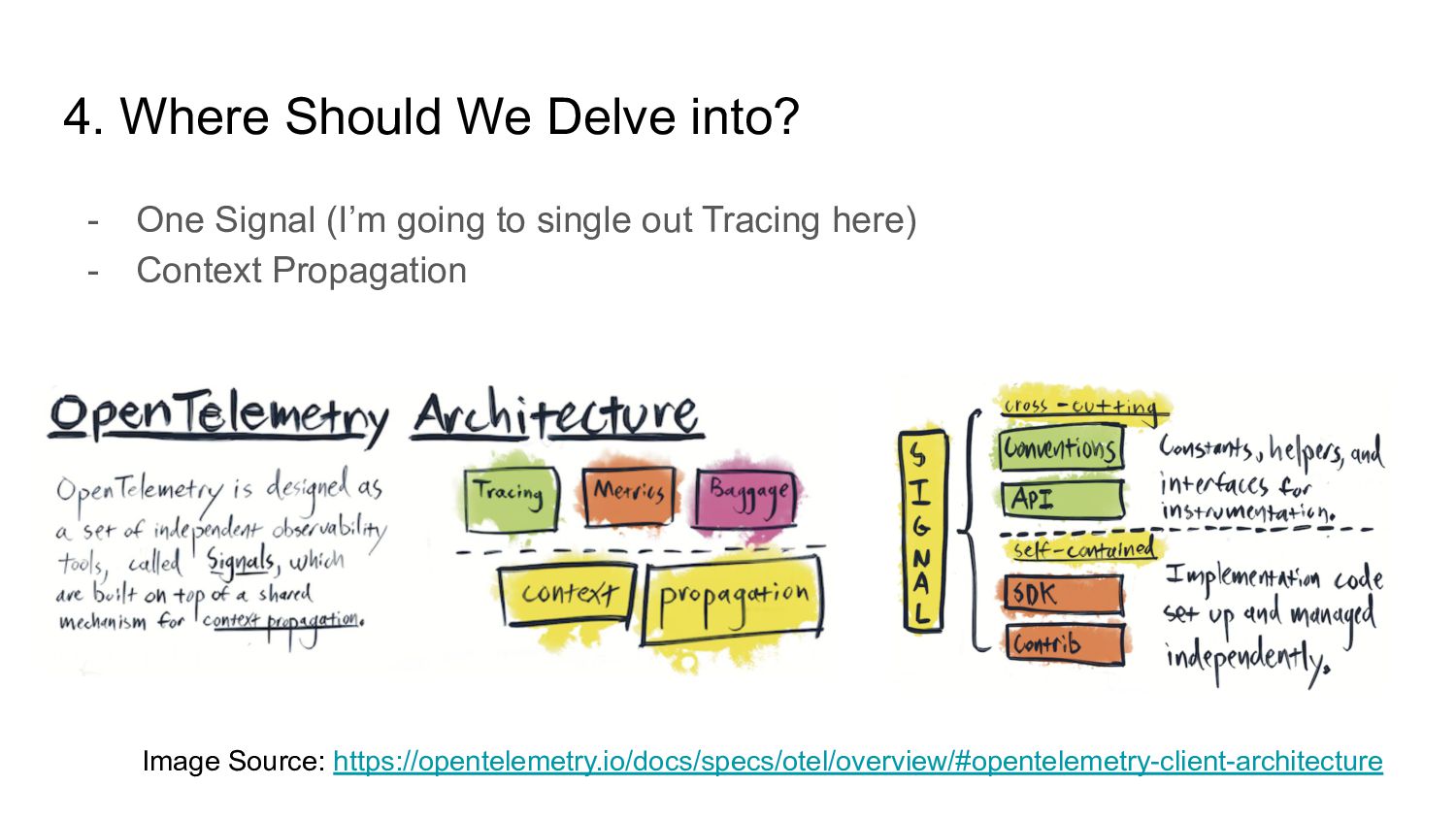
4. Where Should We Delve into? - One Signal (I’m
going to single out Tracing here) - Context Propagation Image Source: https://opentelemetry.io/docs/specs/otel/overview/#opentelemetry-client-architecture
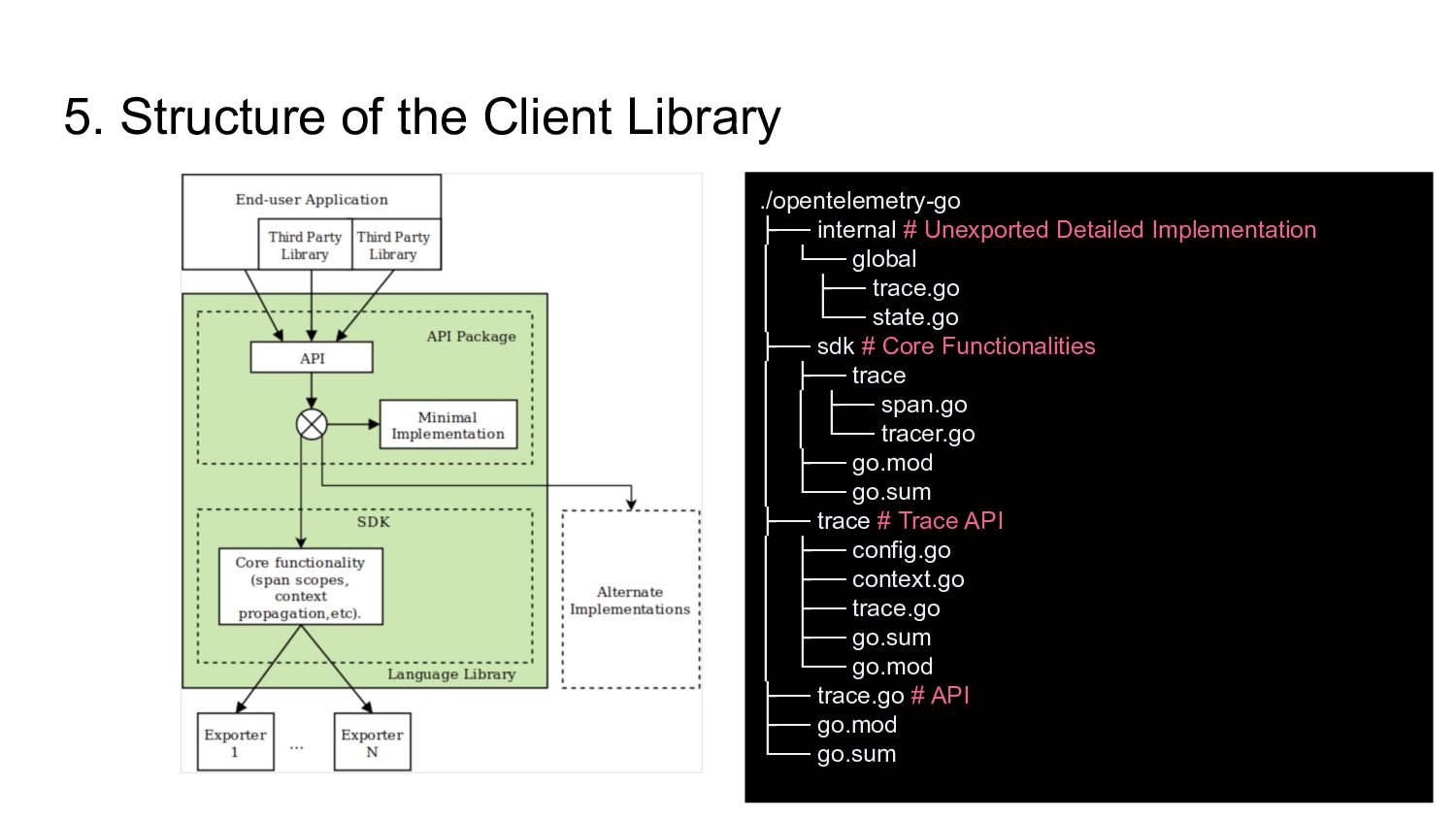
5. Structure of the Client Library ./opentelemetry-go ├── internal #
Unexported Detailed Implementation │ └── global │ ├── trace.go │ └── state.go ├── sdk # Core Functionalities │ ├── trace │ │ ├── span.go │ │ └── tracer.go │ ├── go.mod │ └── go.sum ├── trace # Trace API │ ├── config.go │ ├── context.go │ ├── trace.go │ ├── go.sum │ └── go.mod ├── trace.go # API ├── go.mod └── go.sum
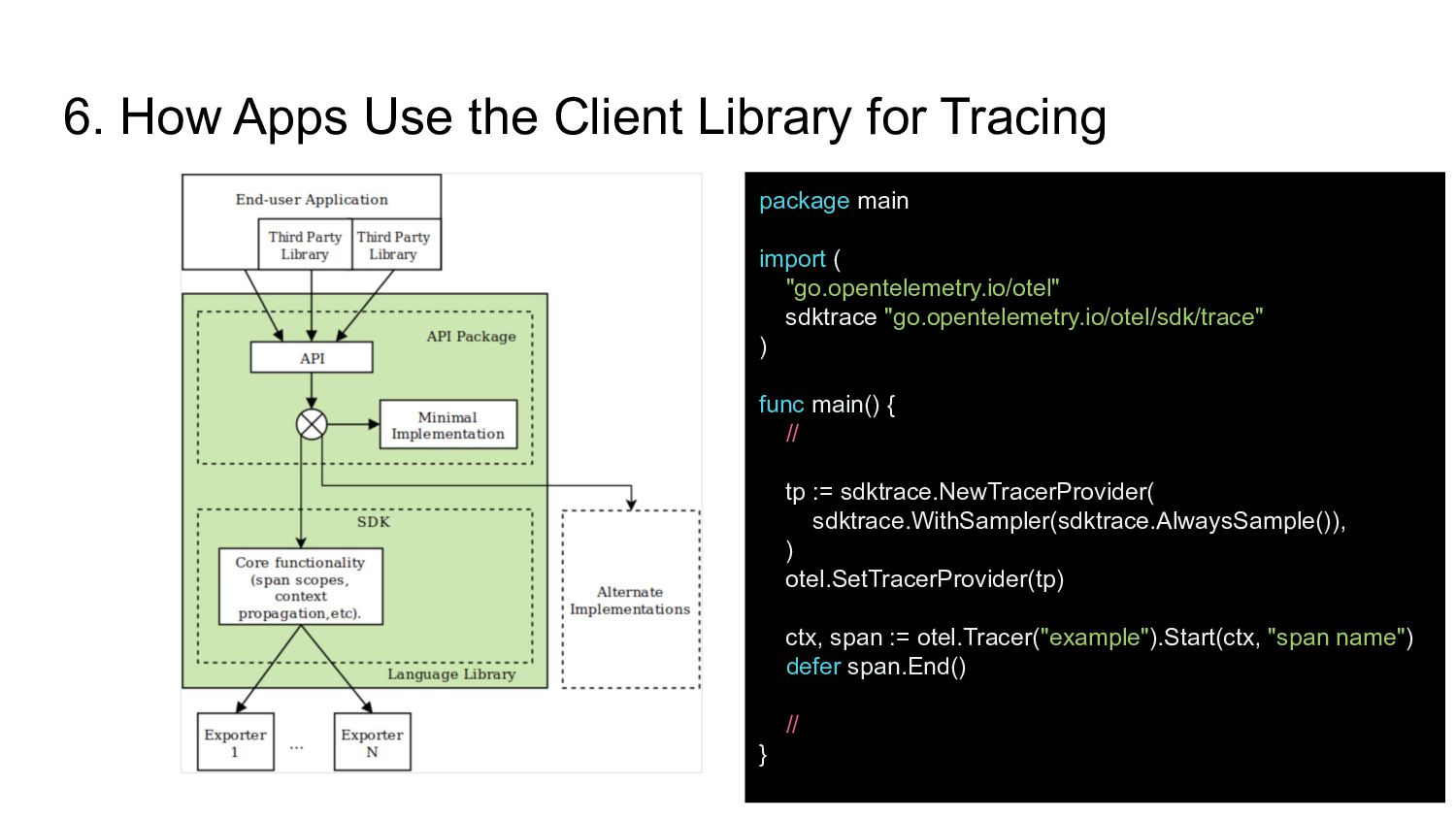
6. How Apps Use the Client Library for Tracing package
main import ( "go.opentelemetry.io/otel" sdktrace "go.opentelemetry.io/otel/sdk/trace" ) func main() { // tp := sdktrace.NewTracerProvider( sdktrace.WithSampler(sdktrace.AlwaysSample()), ) otel.SetTracerProvider(tp) ctx, span := otel.Tracer("example").Start(ctx, "span name") defer span.End() // }
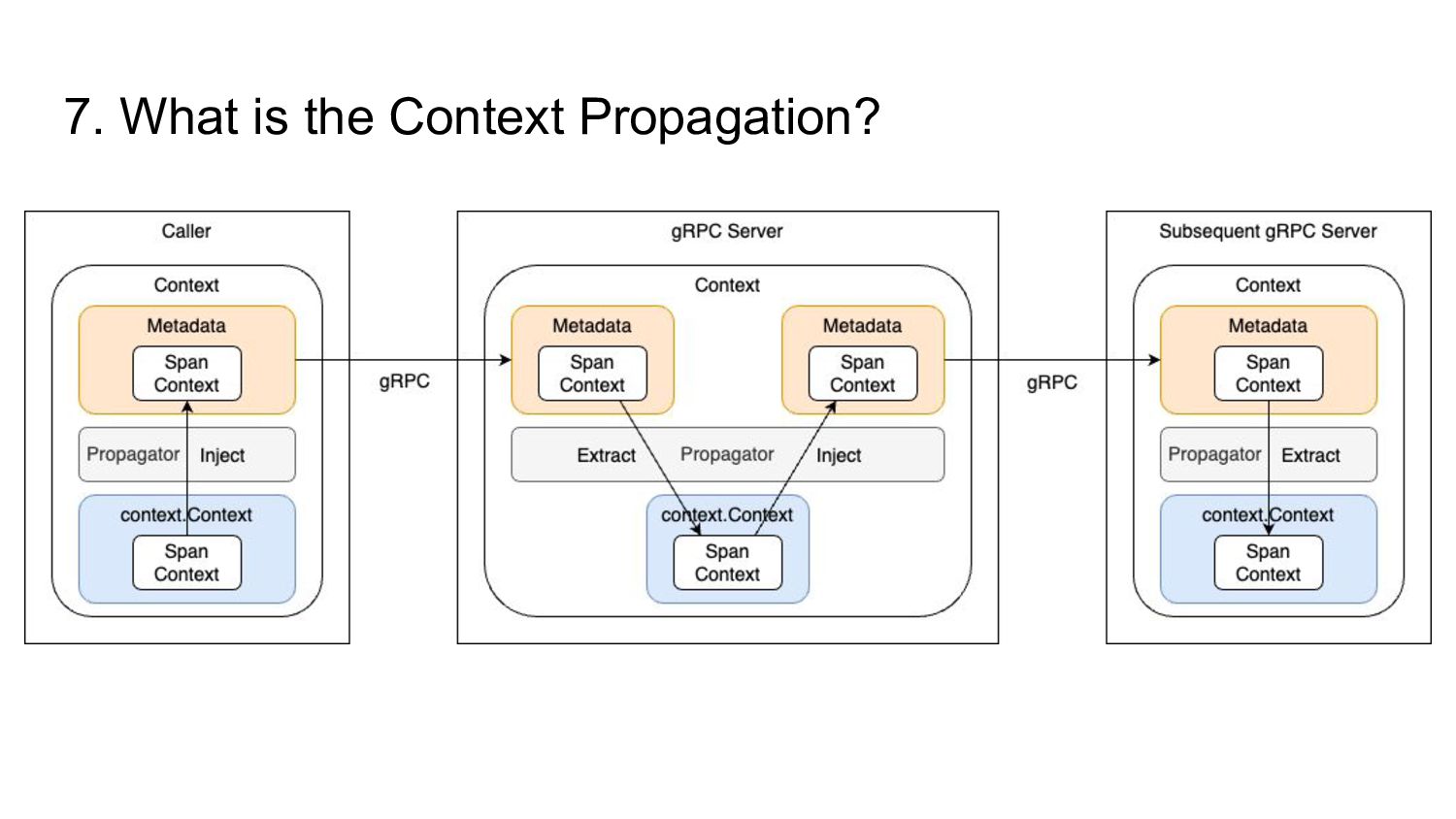
7. What is the Context Propagation?
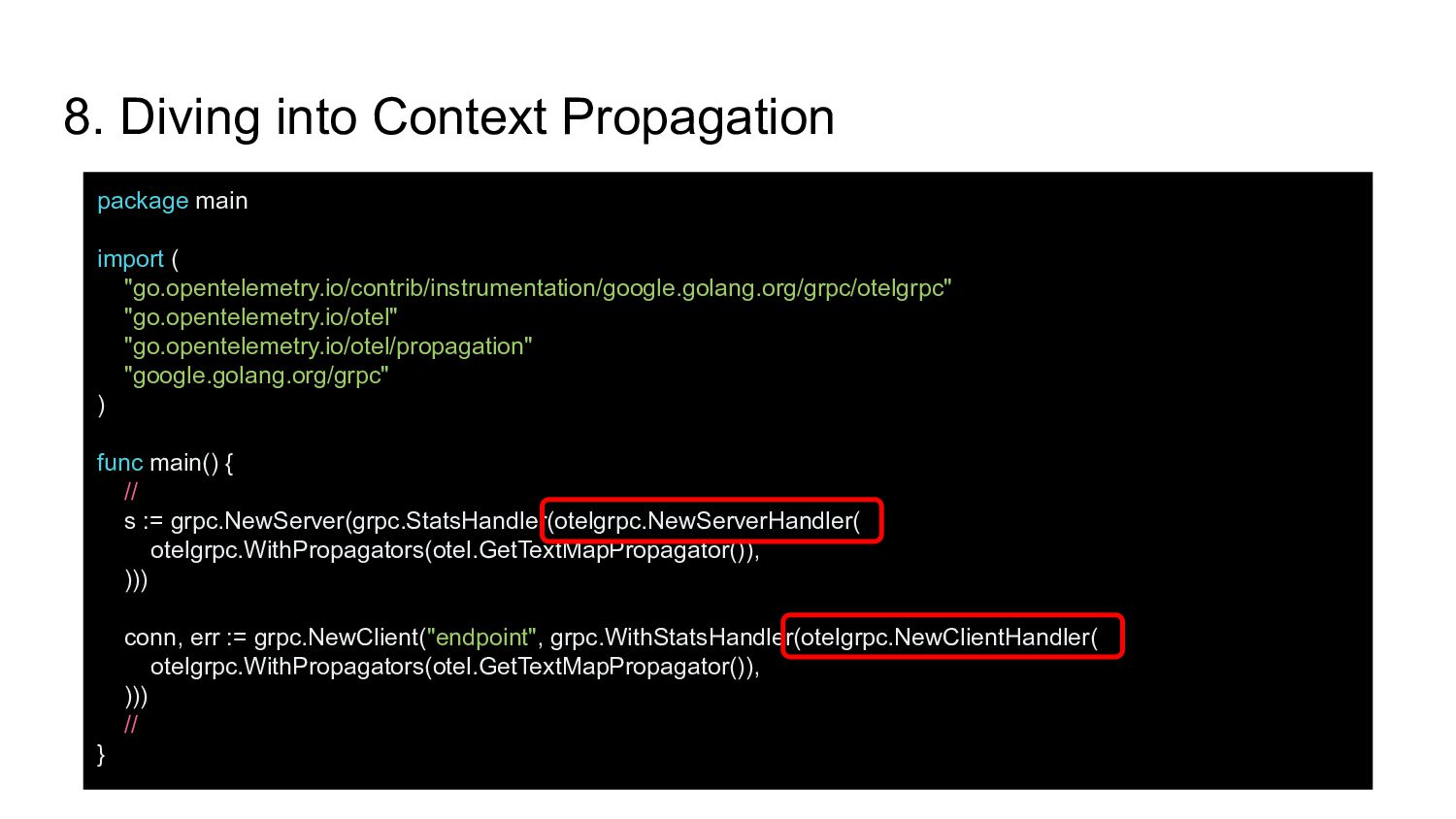
8. Diving into Context Propagation package main import ( "go.opentelemetry.io/contrib/instrumentation/google.golang.org/grpc/otelgrpc"
"go.opentelemetry.io/otel" "go.opentelemetry.io/otel/propagation" "google.golang.org/grpc" ) func main() { // s := grpc.NewServer(grpc.StatsHandler(otelgrpc.NewServerHandler( otelgrpc.WithPropagators(otel.GetTextMapPropagator()), ))) conn, err := grpc.NewClient("endpoint", grpc.WithStatsHandler(otelgrpc.NewClientHandler( otelgrpc.WithPropagators(otel.GetTextMapPropagator()), ))) // }
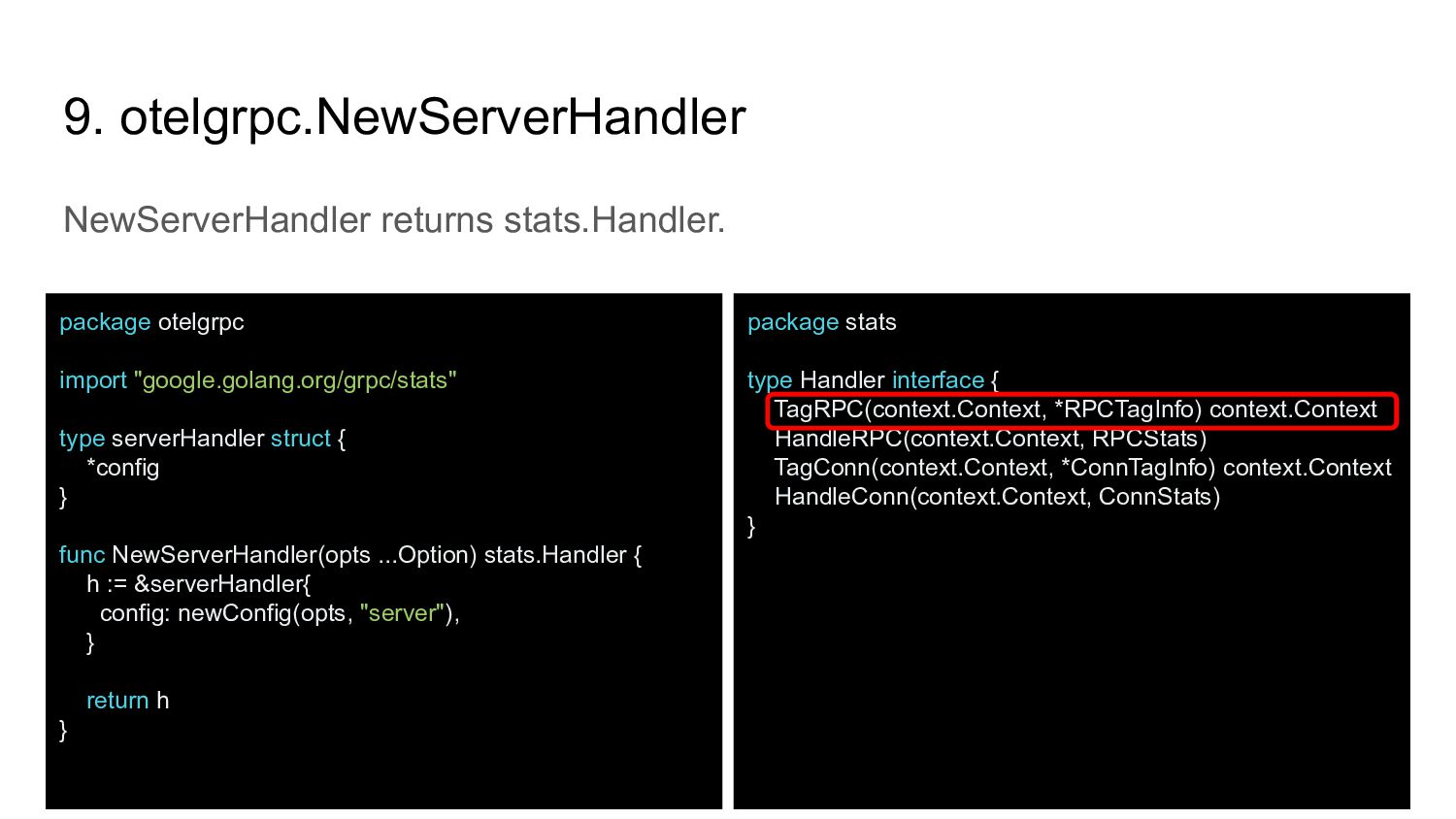
NewServerHandler returns stats.Handler. 9. otelgrpc.NewServerHandler package otelgrpc import "google.golang.org/grpc/stats" type
serverHandler struct { *config } func NewServerHandler(opts ...Option) stats.Handler { h := &serverHandler{ config: newConfig(opts, "server"), } return h } package stats type Handler interface { TagRPC(context.Context, *RPCTagInfo) context.Context HandleRPC(context.Context, RPCStats) TagConn(context.Context, *ConnTagInfo) context.Context HandleConn(context.Context, ConnStats) }
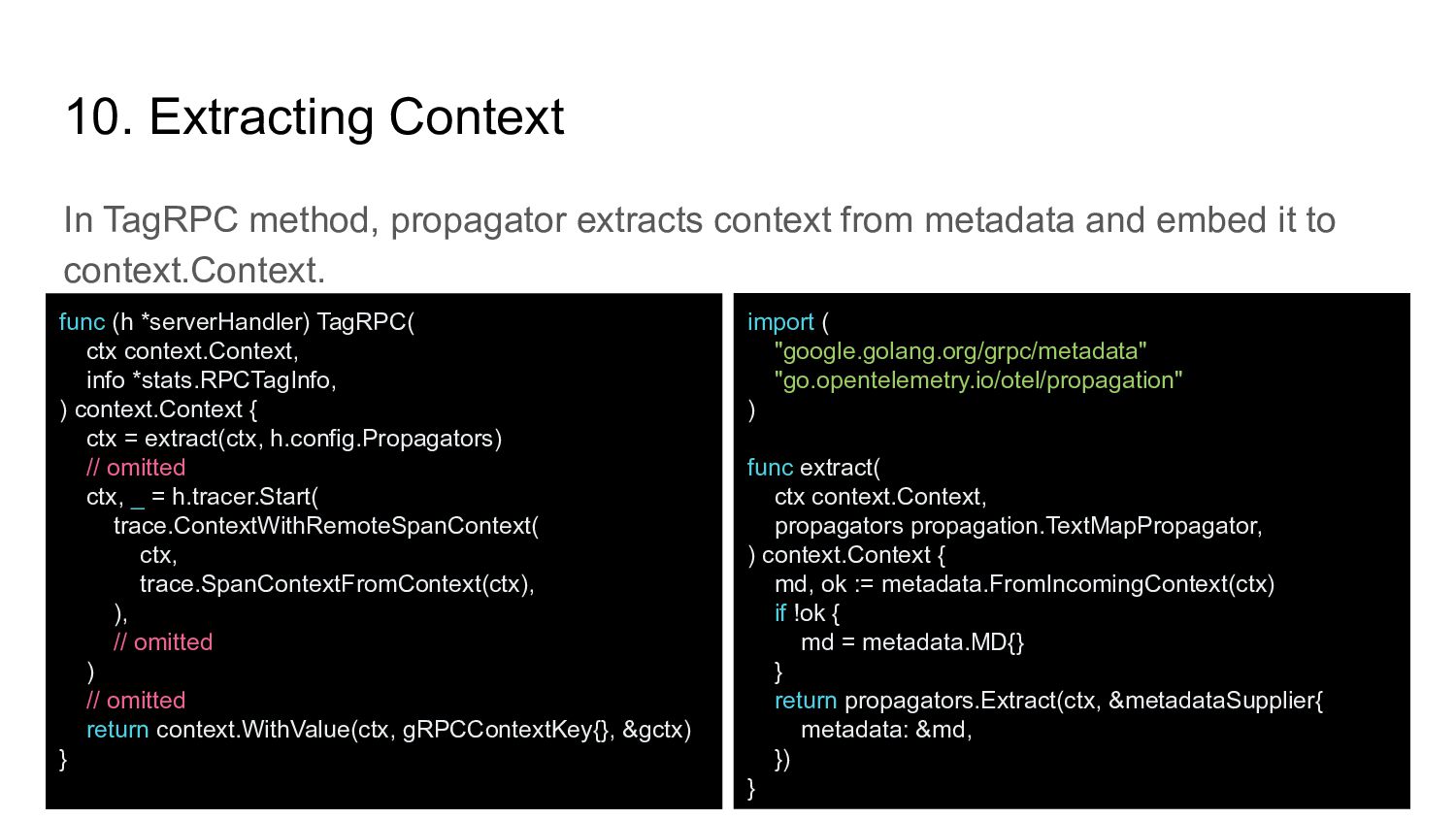
In TagRPC method, propagator extracts context from metadata and embed
it to context.Context. 10. Extracting Context func (h *serverHandler) TagRPC( ctx context.Context, info *stats.RPCTagInfo, ) context.Context { ctx = extract(ctx, h.config.Propagators) // omitted ctx, _ = h.tracer.Start( trace.ContextWithRemoteSpanContext( ctx, trace.SpanContextFromContext(ctx), ), // omitted ) // omitted return context.WithValue(ctx, gRPCContextKey{}, &gctx) } import ( "google.golang.org/grpc/metadata" "go.opentelemetry.io/otel/propagation" ) func extract( ctx context.Context, propagators propagation.TextMapPropagator, ) context.Context { md, ok := metadata.FromIncomingContext(ctx) if !ok { md = metadata.MD{} } return propagators.Extract(ctx, &metadataSupplier{ metadata: &md, }) }
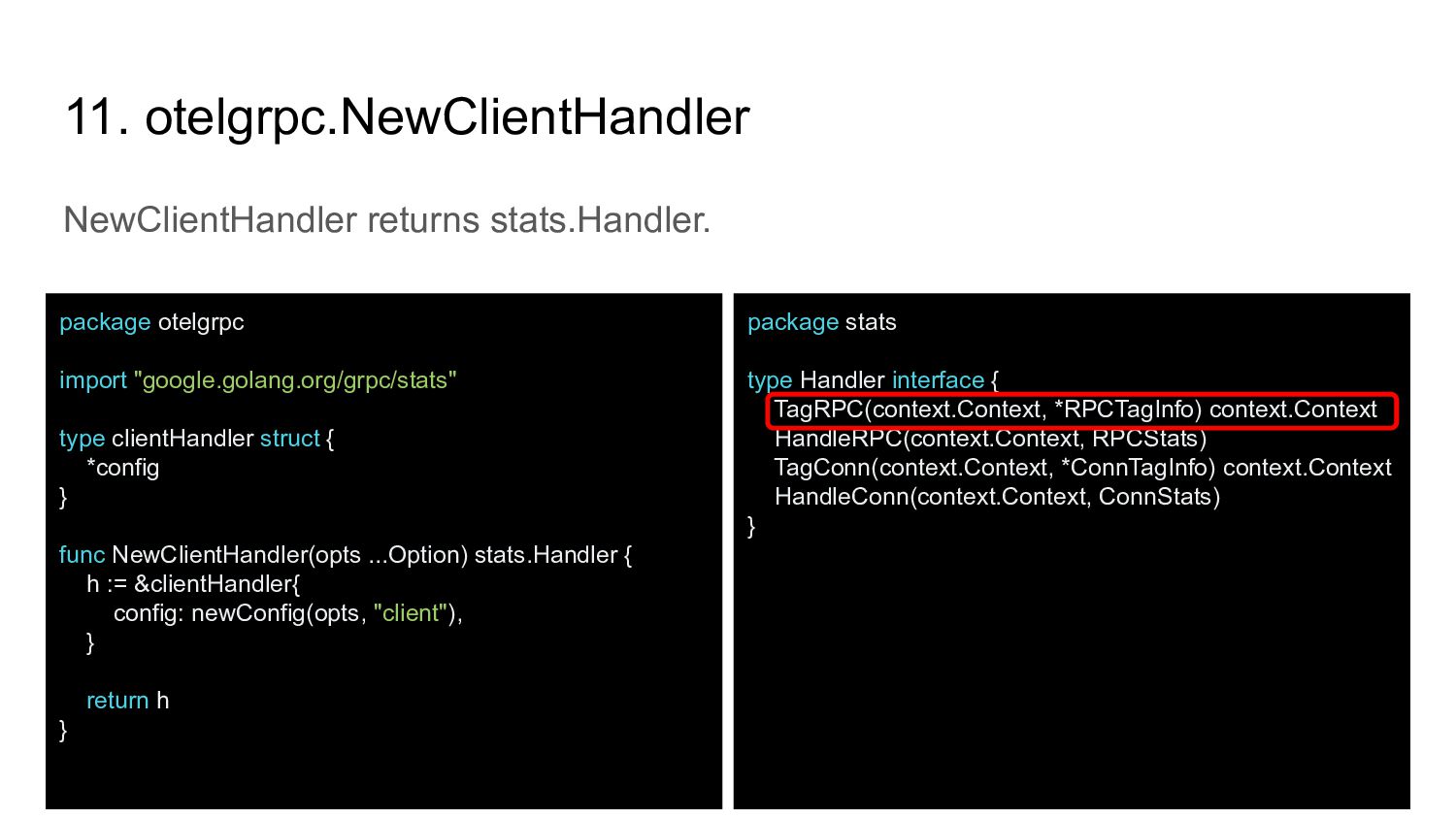
NewClientHandler returns stats.Handler. 11. otelgrpc.NewClientHandler package otelgrpc import "google.golang.org/grpc/stats" type
clientHandler struct { *config } func NewClientHandler(opts ...Option) stats.Handler { h := &clientHandler{ config: newConfig(opts, "client"), } return h } package stats type Handler interface { TagRPC(context.Context, *RPCTagInfo) context.Context HandleRPC(context.Context, RPCStats) TagConn(context.Context, *ConnTagInfo) context.Context HandleConn(context.Context, ConnStats) }
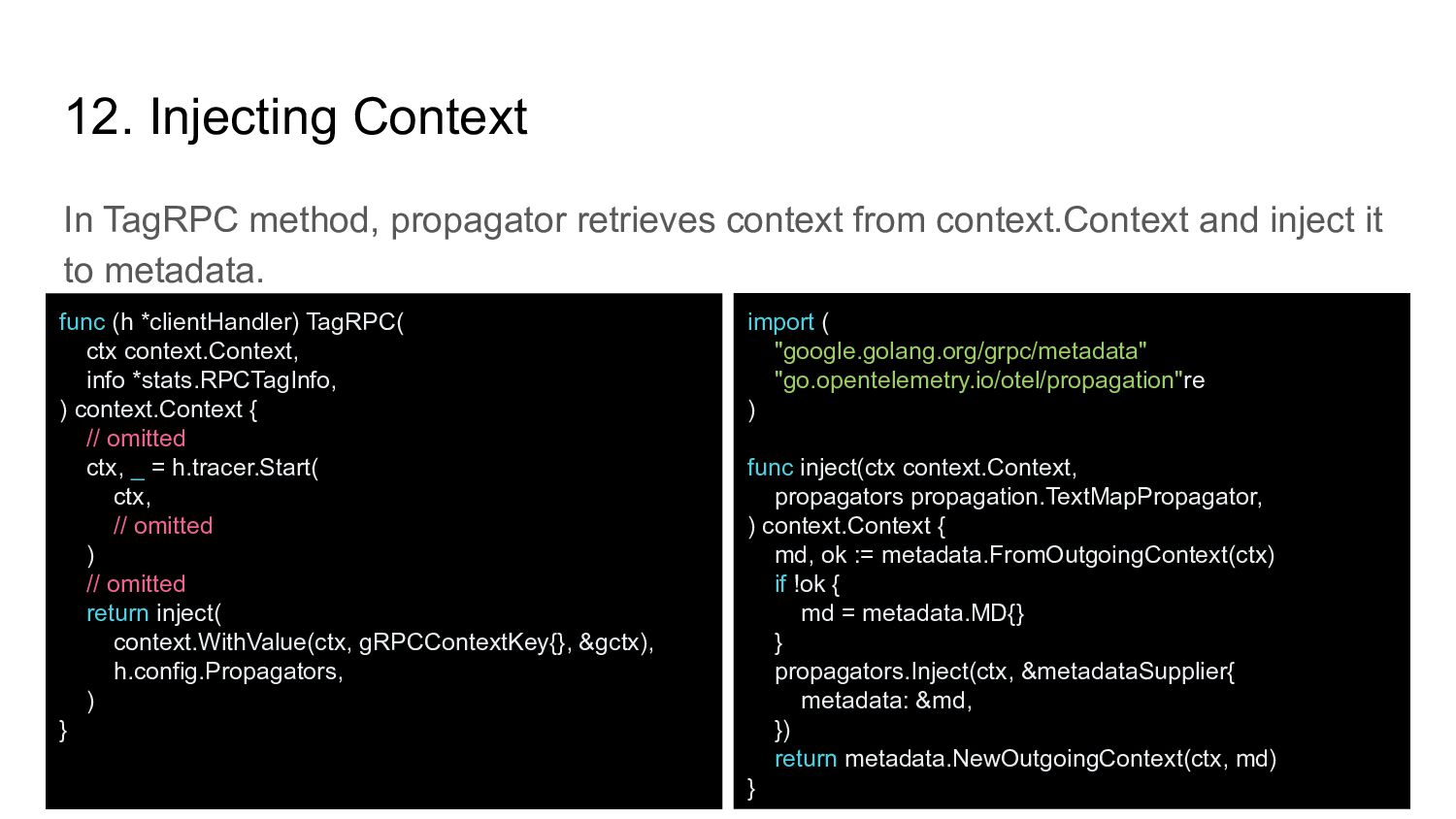
In TagRPC method, propagator retrieves context from context.Context and inject
it to metadata. 12. Injecting Context func (h *clientHandler) TagRPC( ctx context.Context, info *stats.RPCTagInfo, ) context.Context { // omitted ctx, _ = h.tracer.Start( ctx, // omitted ) // omitted return inject( context.WithValue(ctx, gRPCContextKey{}, &gctx), h.config.Propagators, ) } import ( "google.golang.org/grpc/metadata" "go.opentelemetry.io/otel/propagation"re ) func inject(ctx context.Context, propagators propagation.TextMapPropagator, ) context.Context { md, ok := metadata.FromOutgoingContext(ctx) if !ok { md = metadata.MD{} } propagators.Inject(ctx, &metadataSupplier{ metadata: &md, }) return metadata.NewOutgoingContext(ctx, md) }
Thank you for your attention🙏


 akarin
 panda728
 hamayokokuririn
 y0hgi
y0hgi
 akkeylab
 ivargrimstad
 prota
prota
 eijirou
 palkan
 ken_tunc
 tosite
 marcoroth
 texmeijin
 minecr
 vanstee
 addyosmani
 gr2m
gr2m
 kimpetersen
 thoeni
 szymonslowik
 eileencodes
 axbom
axbom
 tonyrice
 davidcarrasco
 greggifford