Upgrade to Pro — share decks privately, control downloads, hide ads and more …

Reactive ❤️ Loom: A Forbidden Love Story

Sponsored · Your Podcast. Everywhere. Effortlessly. Share. Educate. Inspire. Entertain. You do you. We'll handle the rest.

Reactive ❤️ Loom: A Forbidden Love Story

For years, the Java community has been told that Project Loom would kill reactive programming — that blocking and async were destined to be enemies. But what if that story was wrong?

In this talk, we’ll explore what happens when these two worlds actually fall in love.

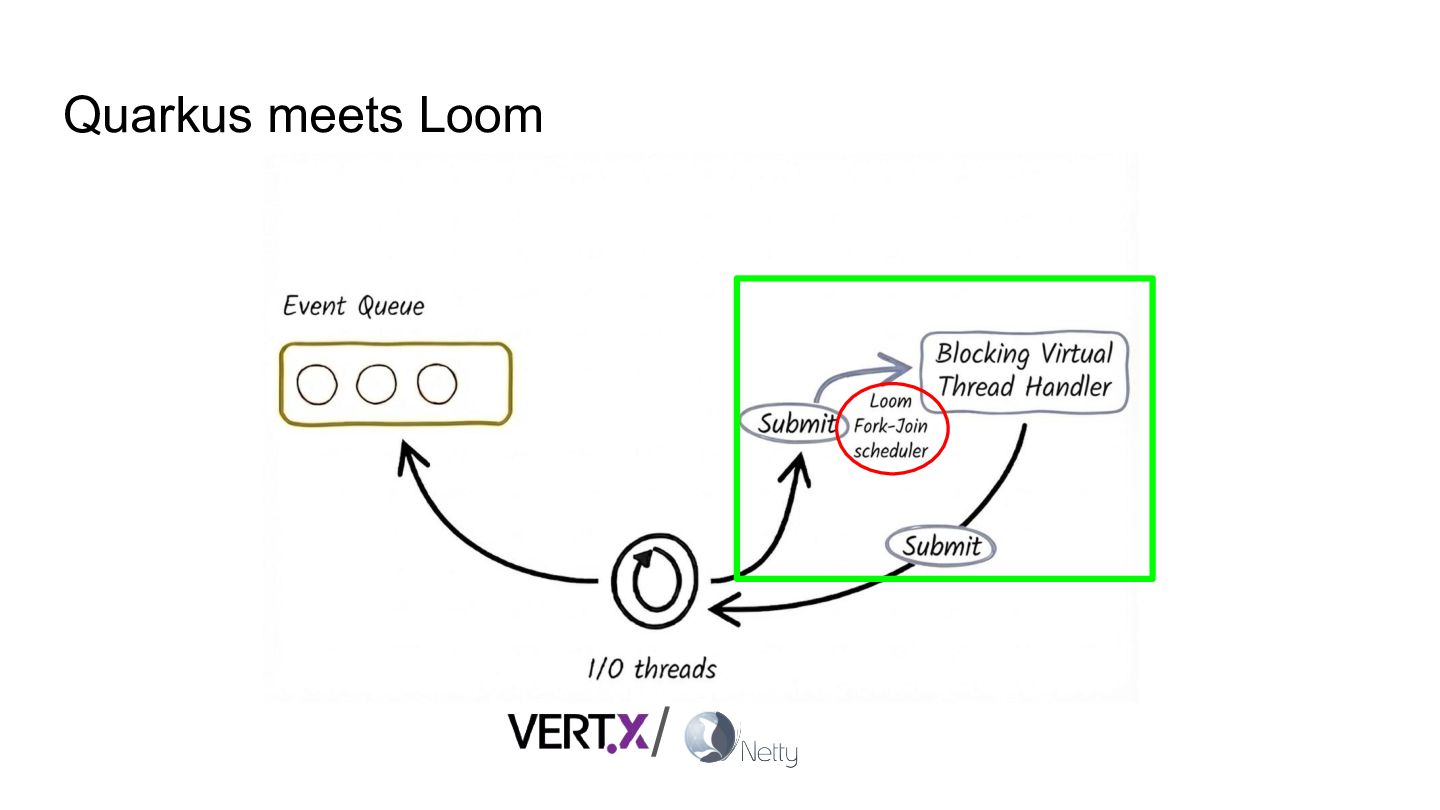
Drawing from real-world work inside the Quarkus, Vert.x, Netty, and HotSpot teams, we’ll see how a custom Loom scheduler built on top of Netty brings together the performance of event-driven I/O and the simplicity of virtual-thread-friendly blocking APIs.

This isn’t a theoretical “what if”: it’s a data-driven exploration born from experiments and collaborations between IBM, Oracle Labs, Oracle and Apple engineering teams.

You’ll see how this approach reshapes how we think about async, concurrency, and scheduling — and why some of the long-held assumptions about “reactive vs blocking” simply don’t hold up when measured scientifically.

Along the way, we’ll dissect:
- How the Loom scheduler and virtual threads work under the hood.
- What happens when you run them over a Netty core
- Performance implications and trade-offs measured empirically

This talk is a technical love story, but also a call to reason: Measure, Don’t Guess.
Because sometimes, the forbidden relationships are the ones that can move the platform forward.

Avatar for Francesco Nigro

Francesco Nigro

March 25, 2026
Tweet
Other Decks in Programming

Transcript

  1. Who I am - Java Champion - Performance Obsessed Engineer

    - Working hard on Quarkus performance In the Performance App Services Team in IBM - @forked_franz on Twitter/X/Whatever
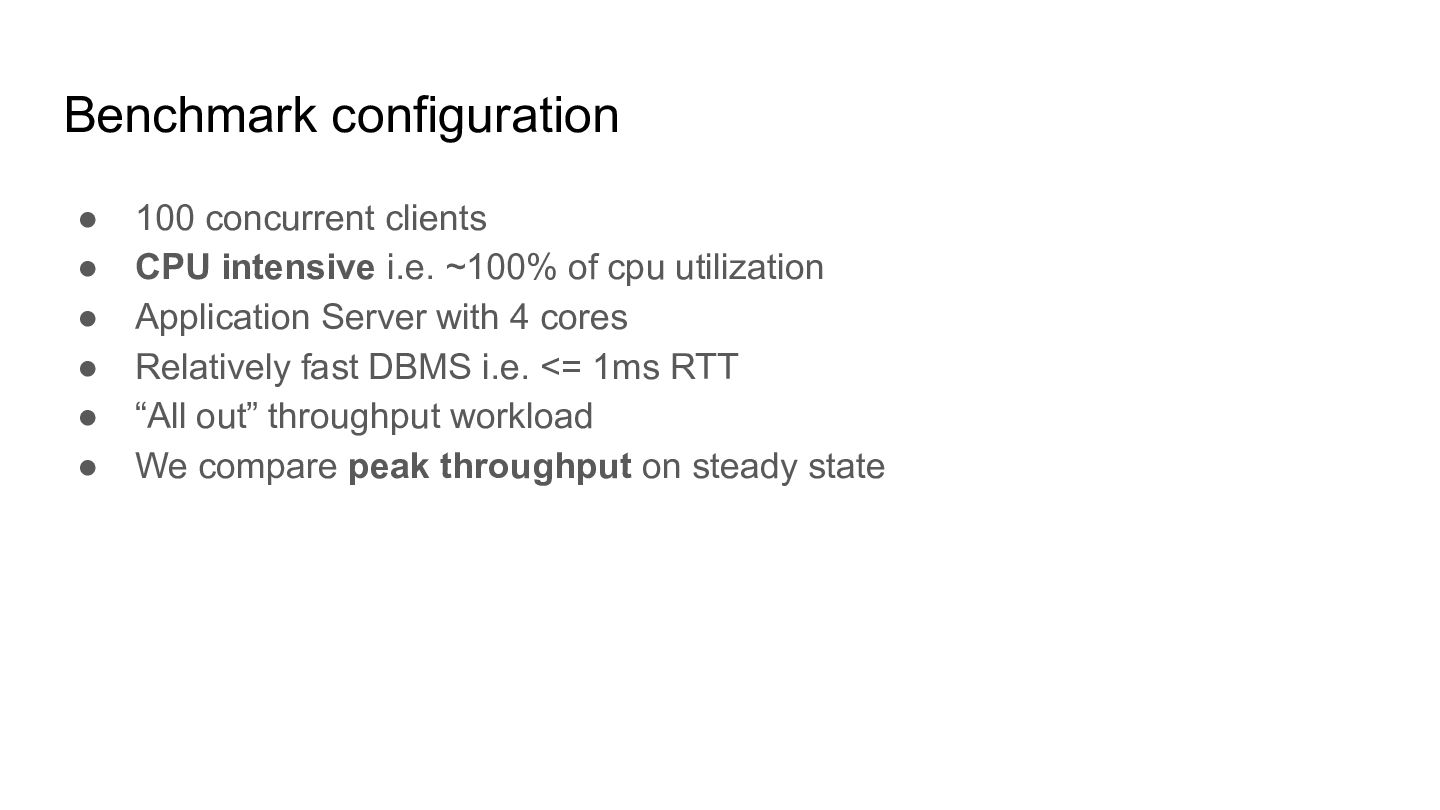
  2. Benchmark configuration • 100 concurrent clients • CPU intensive i.e.

    ~100% of cpu utilization • Application Server with 4 cores • Relatively fast DBMS i.e. <= 1ms RTT • “All out” throughput workload • We compare peak throughput on steady state
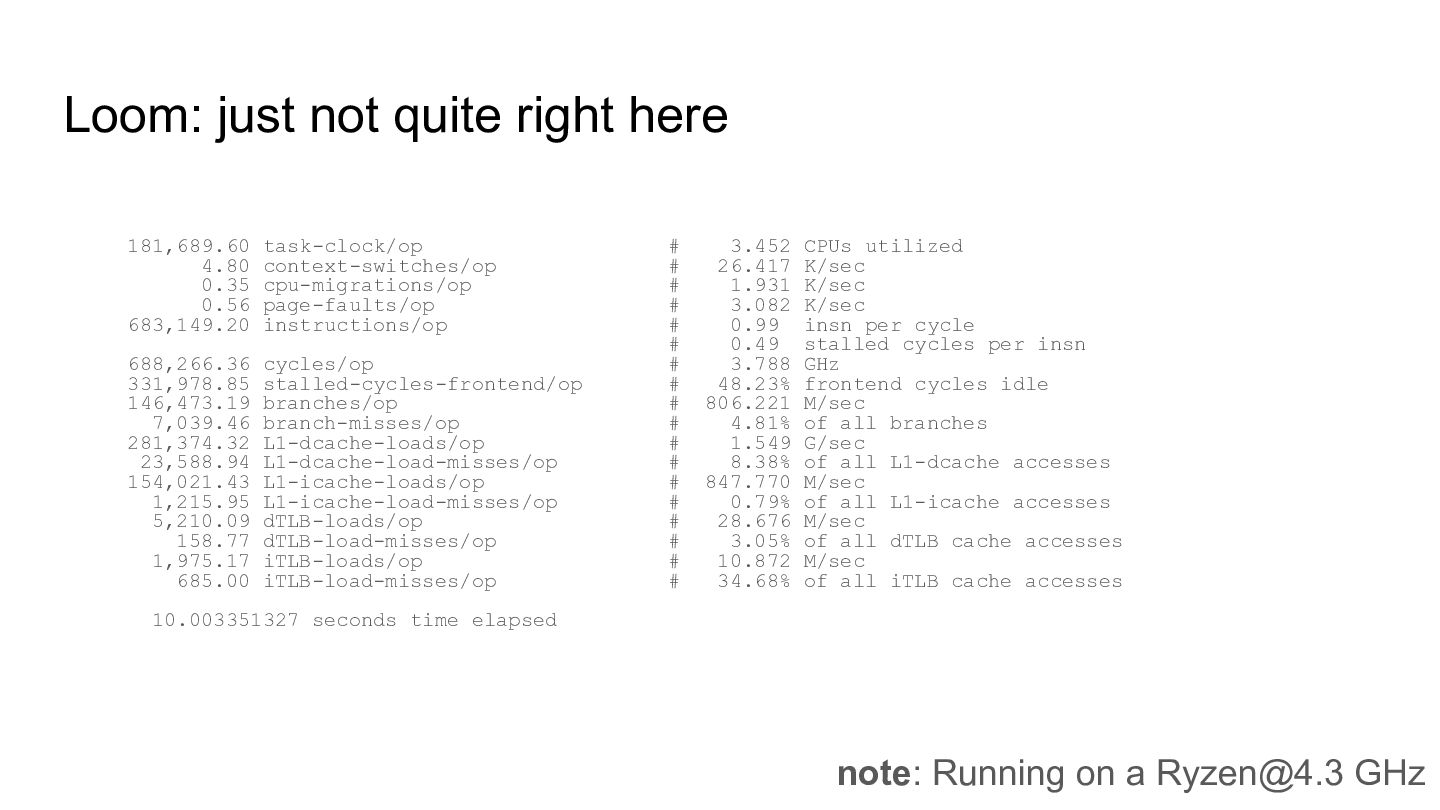
  3. Loom: just not quite right here 181,689.60 task-clock/op # 3.452

    CPUs utilized 4.80 context-switches/op # 26.417 K/sec 0.35 cpu-migrations/op # 1.931 K/sec 0.56 page-faults/op # 3.082 K/sec 683,149.20 instructions/op # 0.99 insn per cycle # 0.49 stalled cycles per insn 688,266.36 cycles/op # 3.788 GHz 331,978.85 stalled-cycles-frontend/op # 48.23% frontend cycles idle 146,473.19 branches/op # 806.221 M/sec 7,039.46 branch-misses/op # 4.81% of all branches 281,374.32 L1-dcache-loads/op # 1.549 G/sec 23,588.94 L1-dcache-load-misses/op # 8.38% of all L1-dcache accesses 154,021.43 L1-icache-loads/op # 847.770 M/sec 1,215.95 L1-icache-load-misses/op # 0.79% of all L1-icache accesses 5,210.09 dTLB-loads/op # 28.676 M/sec 158.77 dTLB-load-misses/op # 3.05% of all dTLB cache accesses 1,975.17 iTLB-loads/op # 10.872 M/sec 685.00 iTLB-load-misses/op # 34.68% of all iTLB cache accesses 10.003351327 seconds time elapsed note: Running on a [email protected] GHz
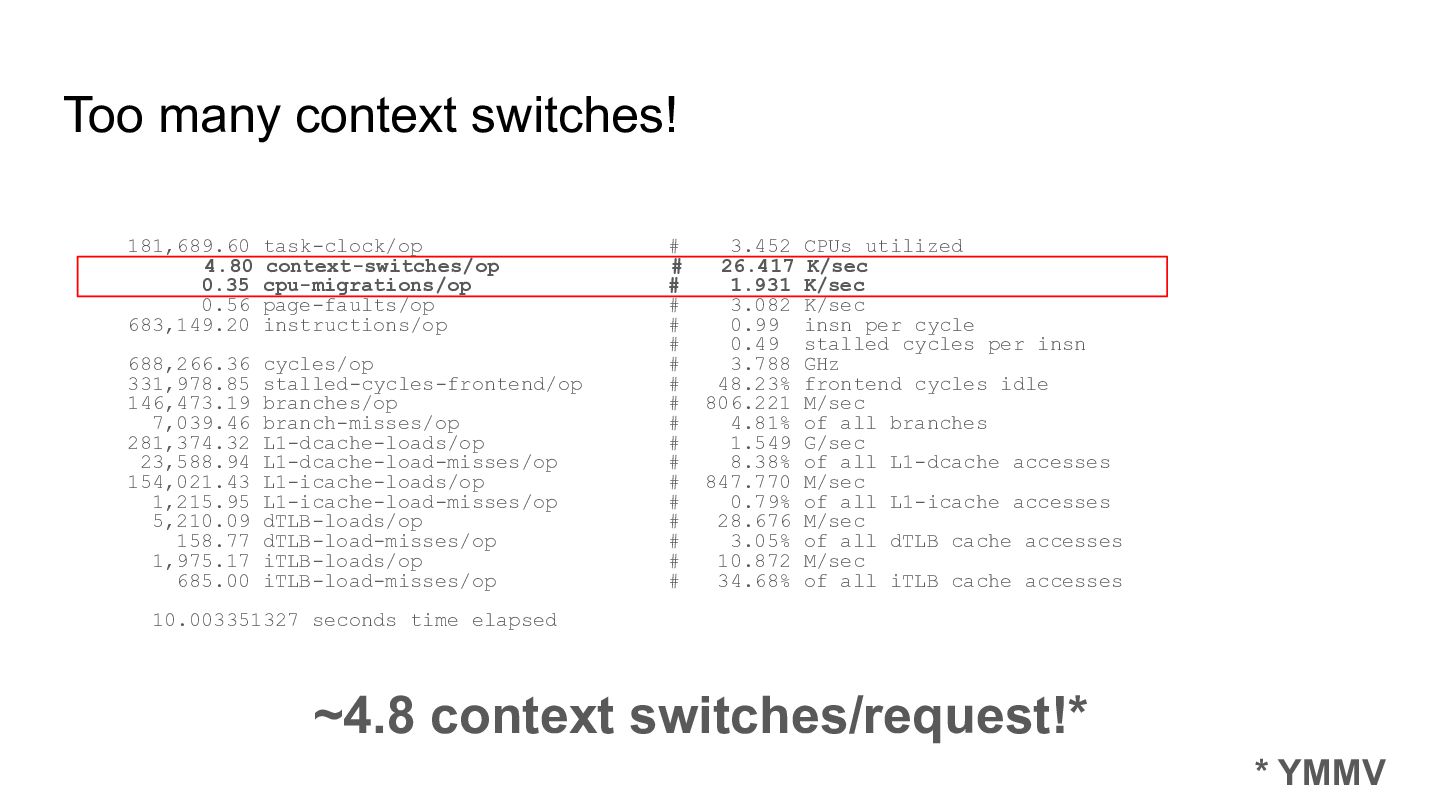
  4. Too many context switches! ~4.8 context switches/request!* * YMMV 181,689.60

    task-clock/op # 3.452 CPUs utilized 4.80 context-switches/op # 26.417 K/sec 0.35 cpu-migrations/op # 1.931 K/sec 0.56 page-faults/op # 3.082 K/sec 683,149.20 instructions/op # 0.99 insn per cycle # 0.49 stalled cycles per insn 688,266.36 cycles/op # 3.788 GHz 331,978.85 stalled-cycles-frontend/op # 48.23% frontend cycles idle 146,473.19 branches/op # 806.221 M/sec 7,039.46 branch-misses/op # 4.81% of all branches 281,374.32 L1-dcache-loads/op # 1.549 G/sec 23,588.94 L1-dcache-load-misses/op # 8.38% of all L1-dcache accesses 154,021.43 L1-icache-loads/op # 847.770 M/sec 1,215.95 L1-icache-load-misses/op # 0.79% of all L1-icache accesses 5,210.09 dTLB-loads/op # 28.676 M/sec 158.77 dTLB-load-misses/op # 3.05% of all dTLB cache accesses 1,975.17 iTLB-loads/op # 10.872 M/sec 685.00 iTLB-load-misses/op # 34.68% of all iTLB cache accesses 10.003351327 seconds time elapsed
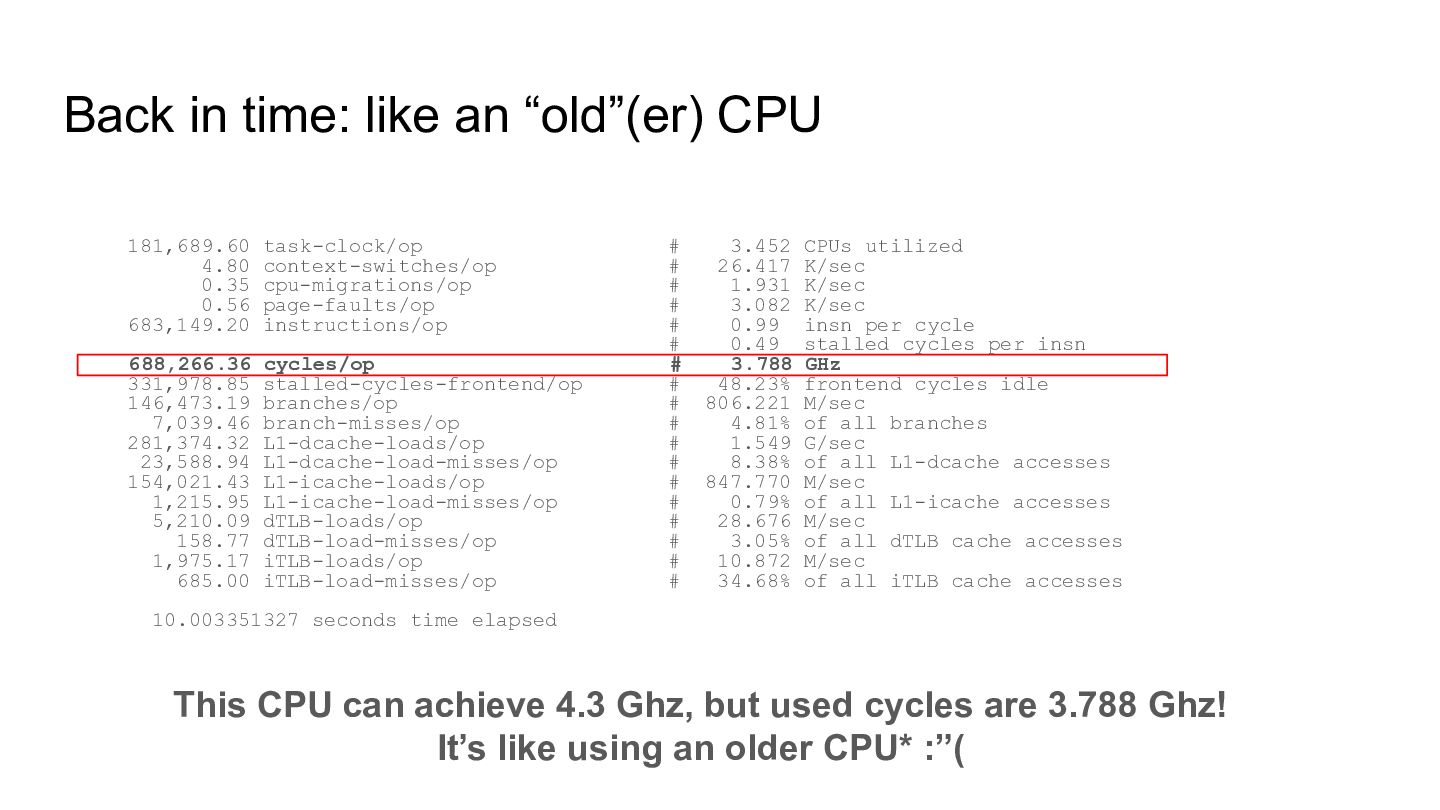
  5. Back in time: like an “old”(er) CPU This CPU can

    achieve 4.3 Ghz, but used cycles are 3.788 Ghz! It’s like using an older CPU* :”( 181,689.60 task-clock/op # 3.452 CPUs utilized 4.80 context-switches/op # 26.417 K/sec 0.35 cpu-migrations/op # 1.931 K/sec 0.56 page-faults/op # 3.082 K/sec 683,149.20 instructions/op # 0.99 insn per cycle # 0.49 stalled cycles per insn 688,266.36 cycles/op # 3.788 GHz 331,978.85 stalled-cycles-frontend/op # 48.23% frontend cycles idle 146,473.19 branches/op # 806.221 M/sec 7,039.46 branch-misses/op # 4.81% of all branches 281,374.32 L1-dcache-loads/op # 1.549 G/sec 23,588.94 L1-dcache-load-misses/op # 8.38% of all L1-dcache accesses 154,021.43 L1-icache-loads/op # 847.770 M/sec 1,215.95 L1-icache-load-misses/op # 0.79% of all L1-icache accesses 5,210.09 dTLB-loads/op # 28.676 M/sec 158.77 dTLB-load-misses/op # 3.05% of all dTLB cache accesses 1,975.17 iTLB-loads/op # 10.872 M/sec 685.00 iTLB-load-misses/op # 34.68% of all iTLB cache accesses 10.003351327 seconds time elapsed
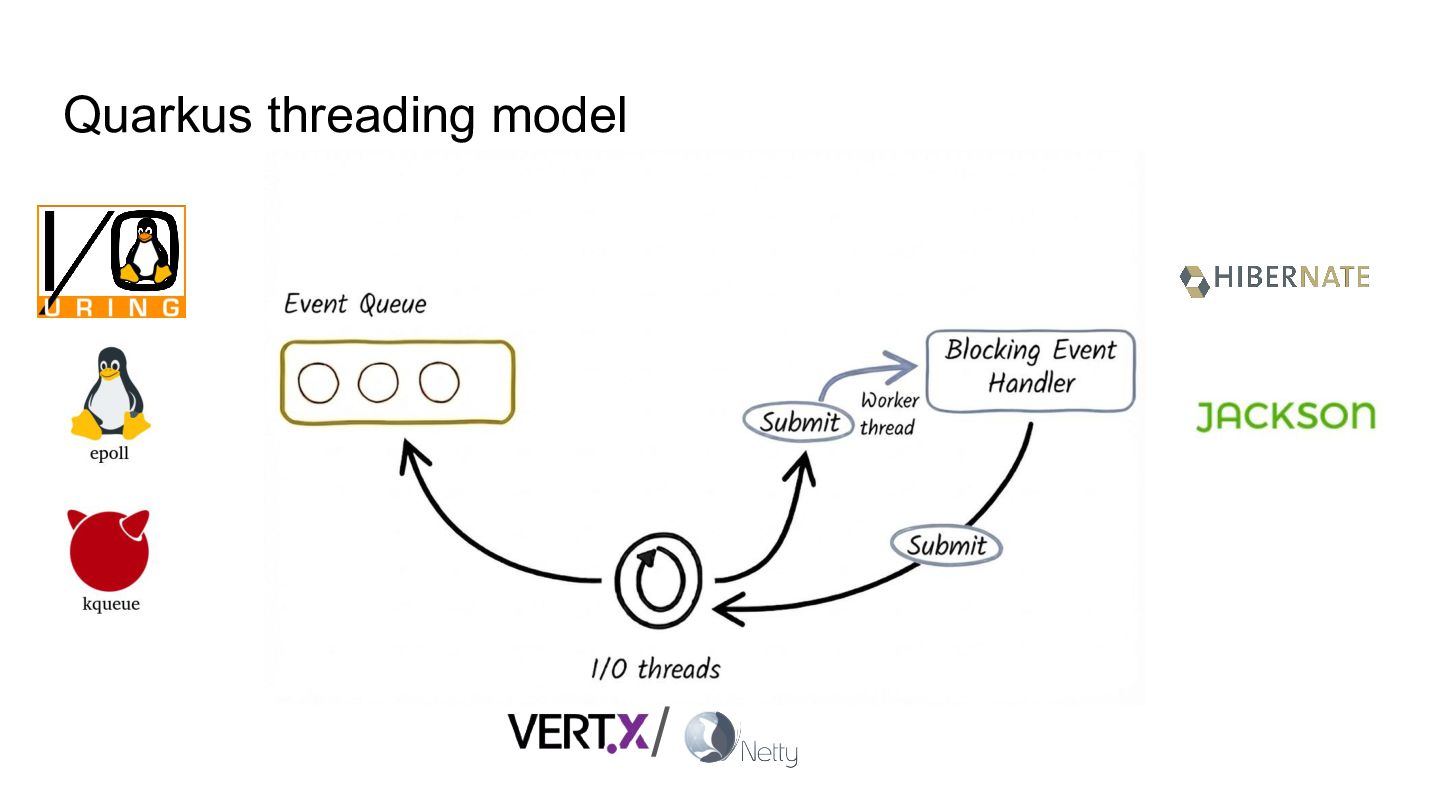
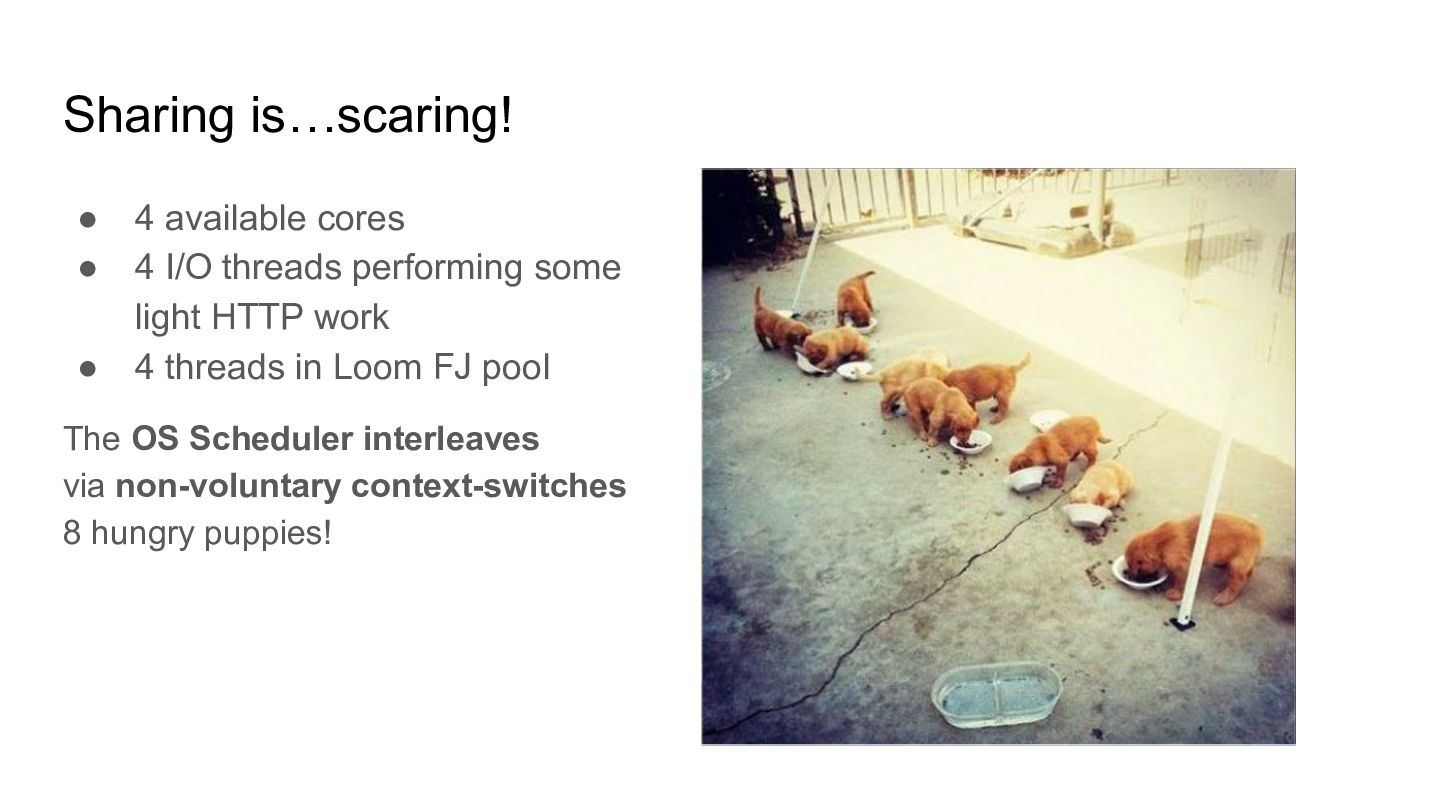
  6. Sharing is…scaring! • 4 available cores • 4 I/O threads

    performing some light HTTP work • 4 threads in Loom FJ pool The OS Scheduler interleaves via non-voluntary context-switches 8 hungry puppies!
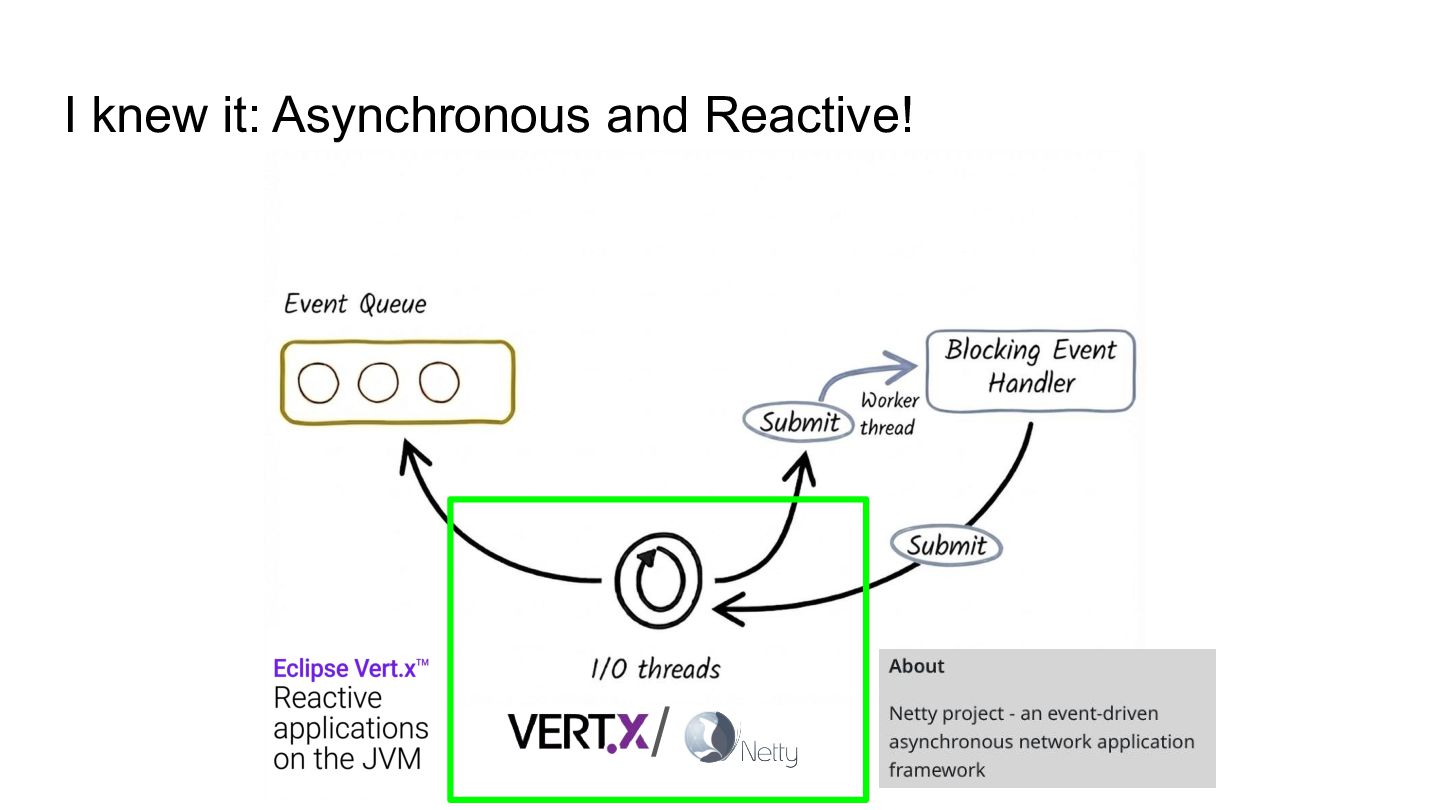
  7. How Loom handle VirtualThread(s) • VirtualThread(s) runs via Continuations Runnables

    • The Loom “built-in” scheduler is backed by a ForkJoin ThreadPool • The Hotspot runtime manage to do its magic to: ◦ Materialize the VirtualThread stack as a continuous ◦ Yield and resume them efficiently • VirtualThread(s) are non-blocking Runnable(s): ◦ The Scheduler decides on which Platform Thread they run ◦ Synchronous Socket operations are handled non-blocking under the hood
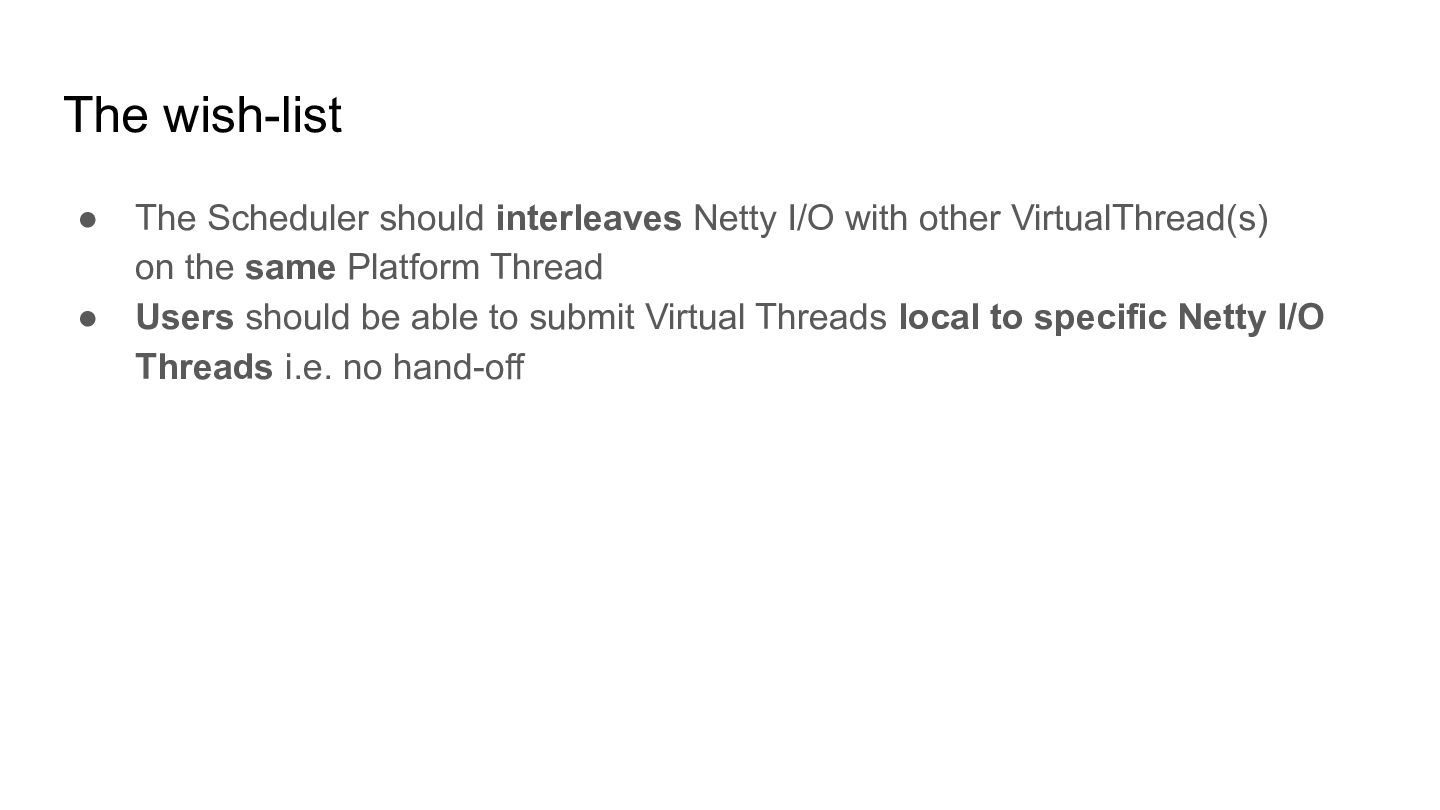
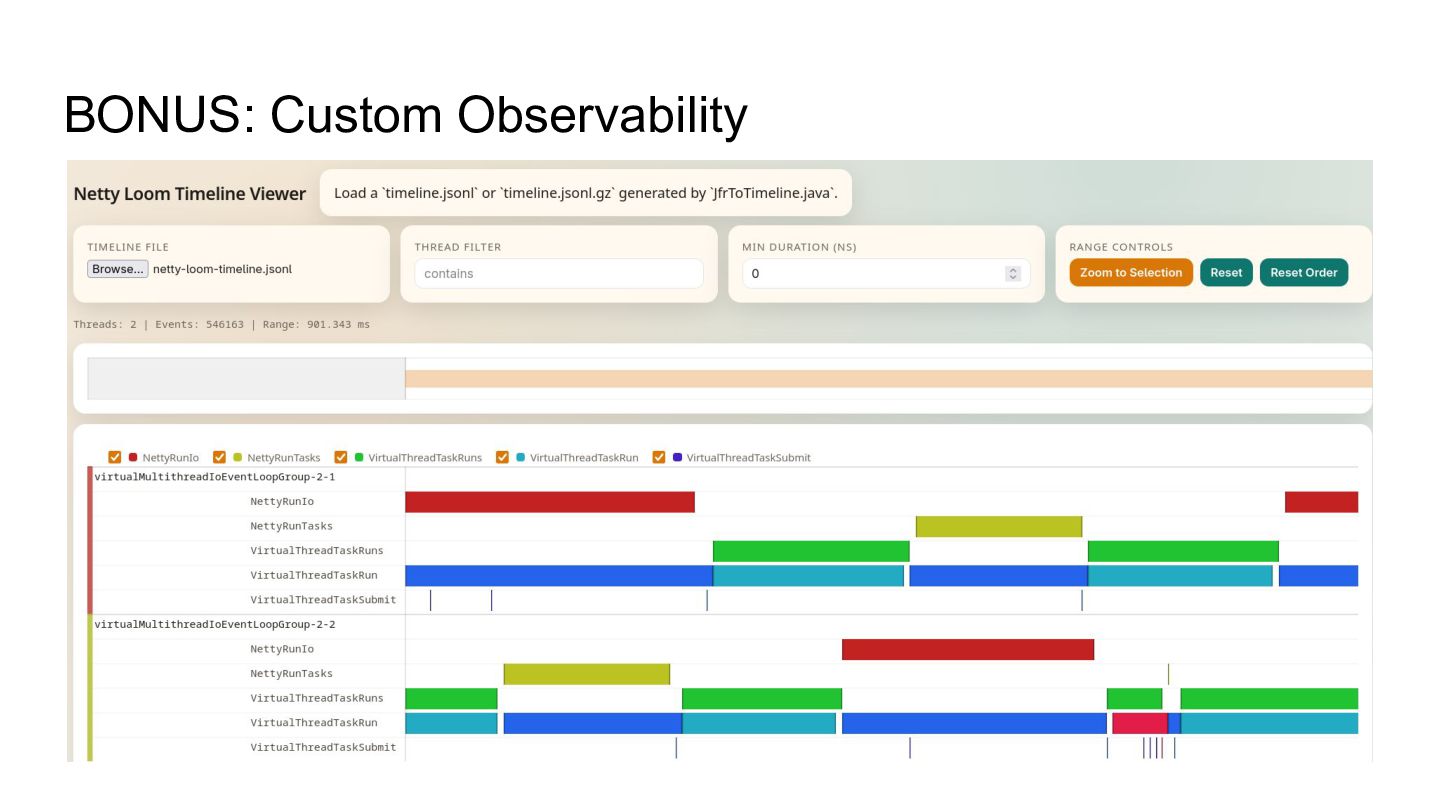
  8. The wish-list • The Scheduler should interleaves Netty I/O with

    other VirtualThread(s) on the same Platform Thread • Users should be able to submit Virtual Threads local to specific Netty I/O Threads i.e. no hand-off
  9. Get back to the lab! • Using a DBMS is

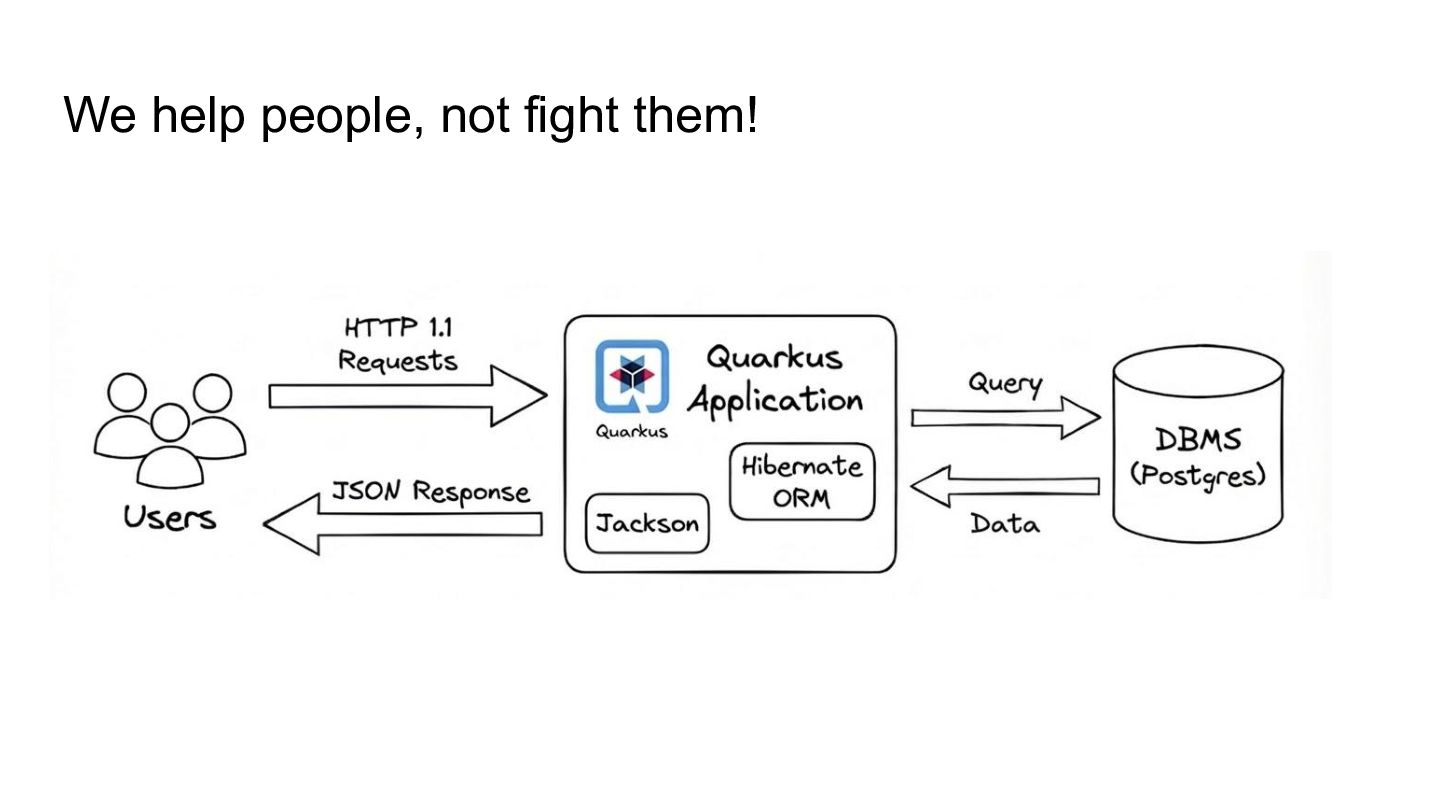
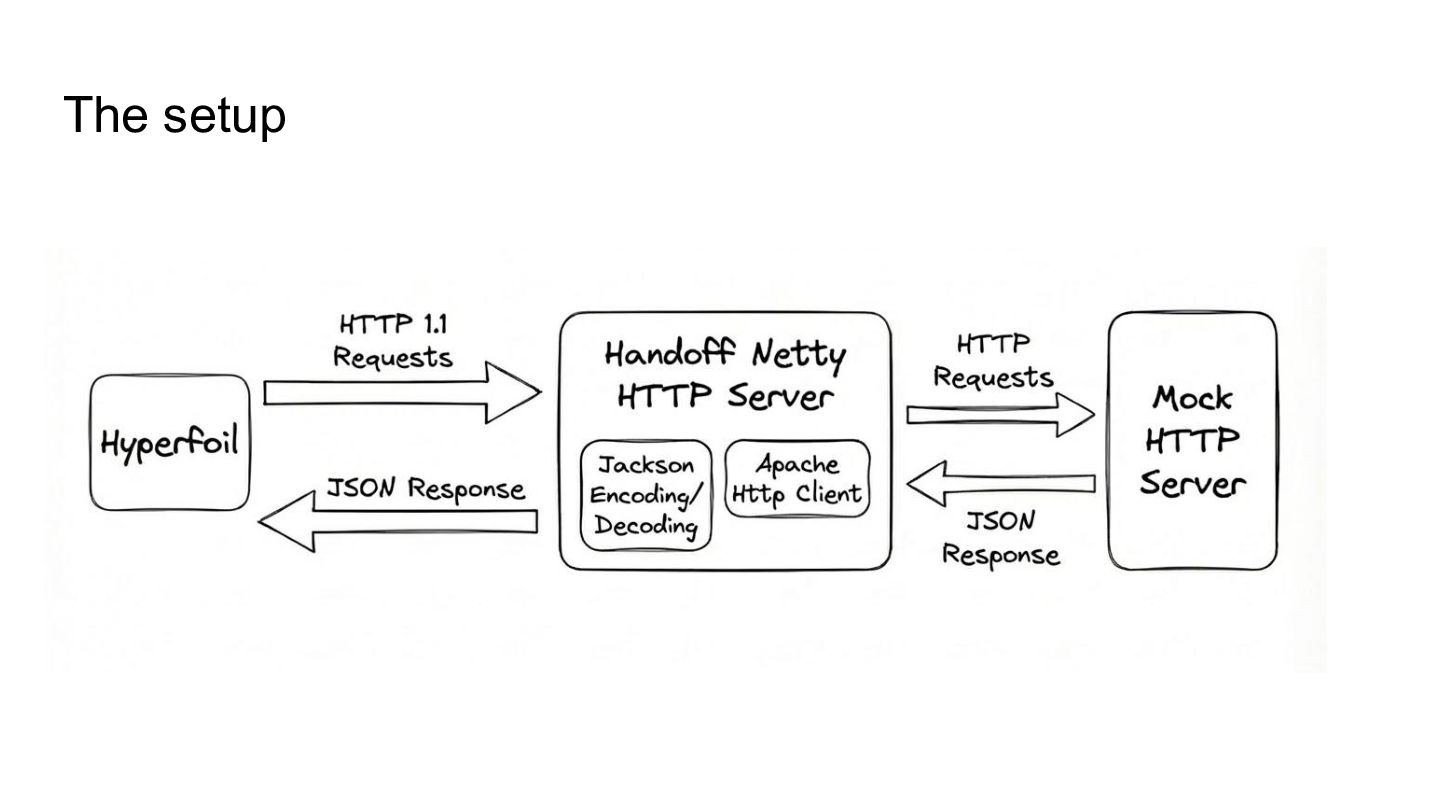
    not ideal: we need MORE control! • Let’s create a setup which resemble the original benchmark • Just Netty + Jackson + blocking Http client
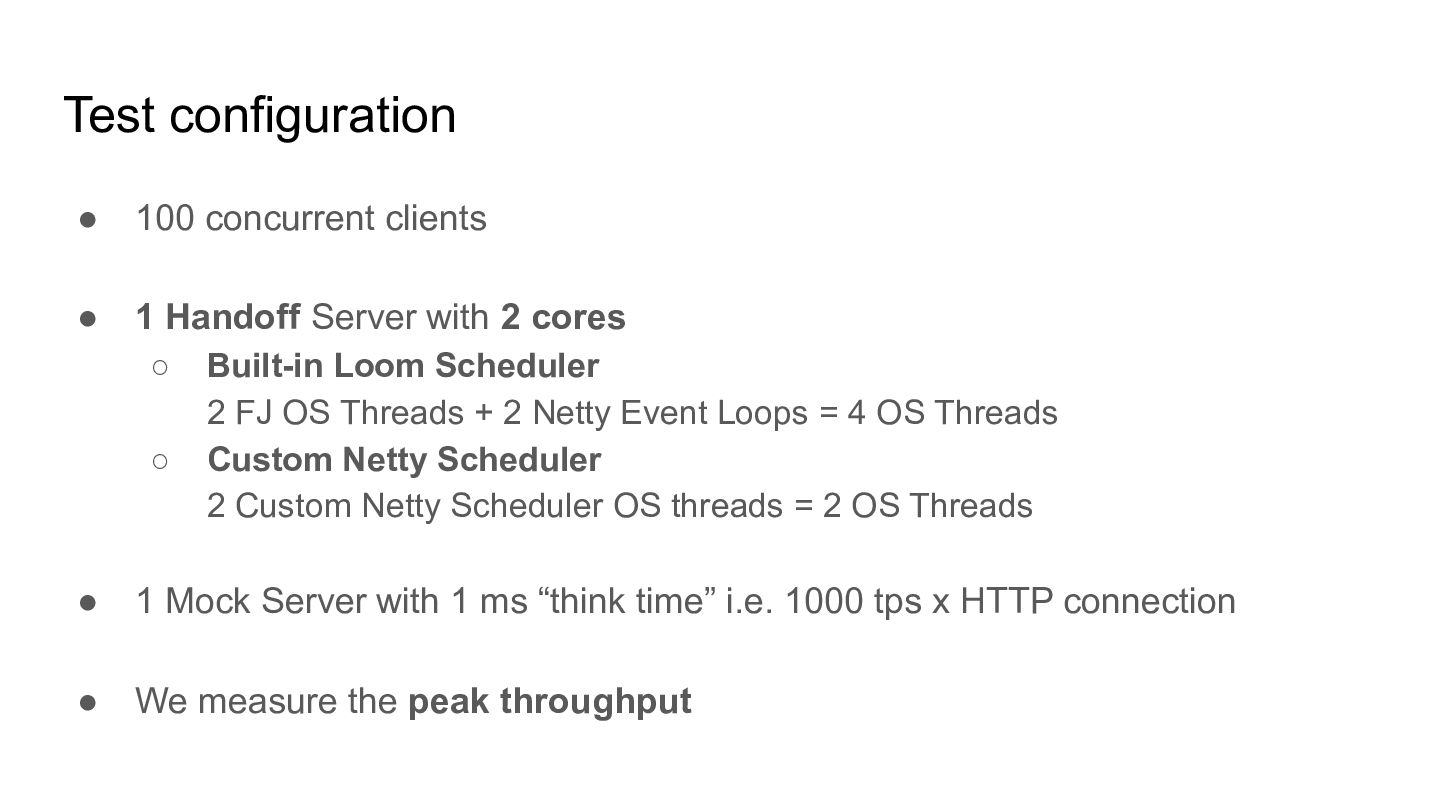
  10. Test configuration • 100 concurrent clients • 1 Handoff Server

    with 2 cores ◦ Built-in Loom Scheduler 2 FJ OS Threads + 2 Netty Event Loops = 4 OS Threads ◦ Custom Netty Scheduler 2 Custom Netty Scheduler OS threads = 2 OS Threads • 1 Mock Server with 1 ms “think time” i.e. 1000 tps x HTTP connection • We measure the peak throughput
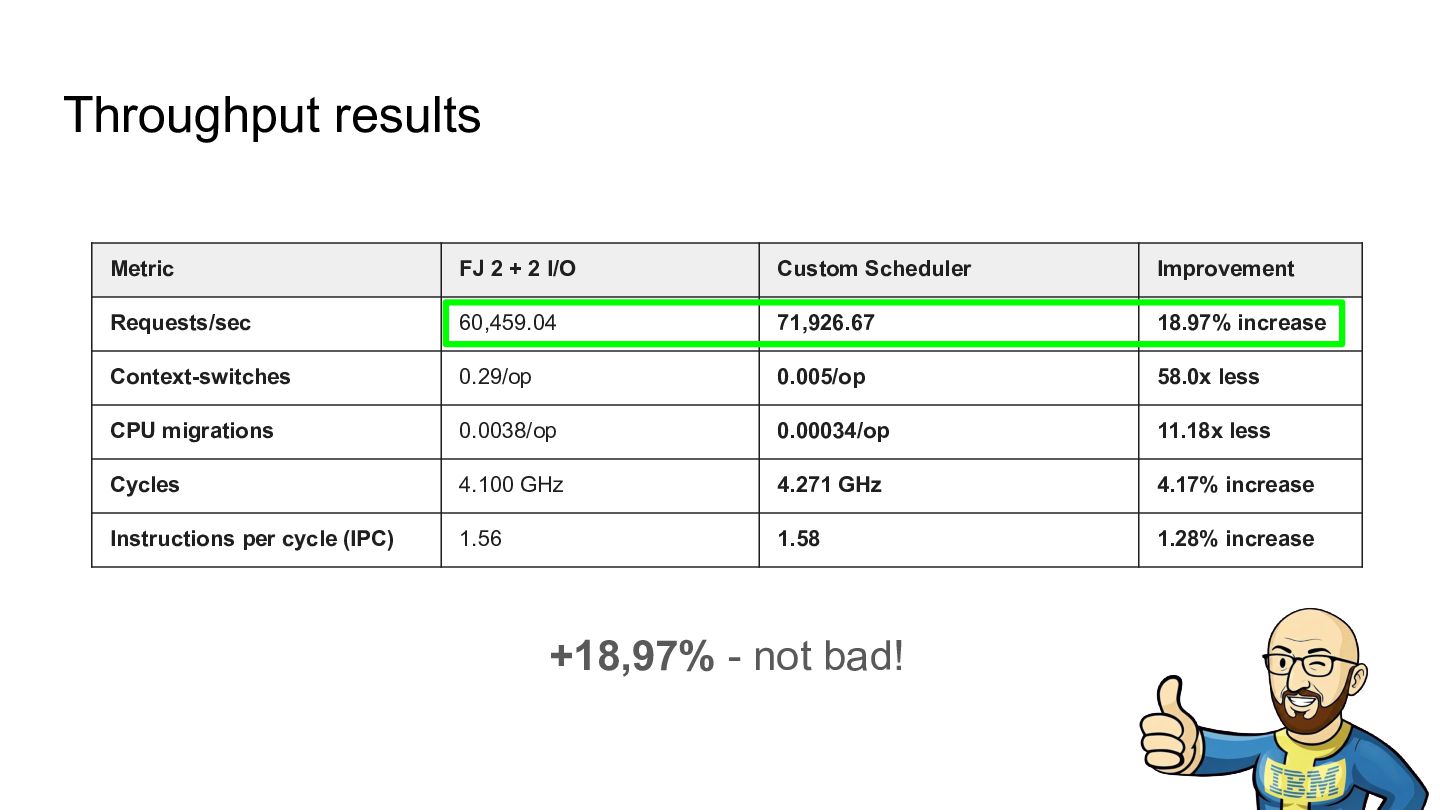
  11. Throughput results +18,97% - not bad! Metric FJ 2 +

    2 I/O Custom Scheduler Improvement Requests/sec 60,459.04 71,926.67 18.97% increase Context-switches 0.29/op 0.005/op 58.0x less CPU migrations 0.0038/op 0.00034/op 11.18x less Cycles 4.100 GHz 4.271 GHz 4.17% increase Instructions per cycle (IPC) 1.56 1.58 1.28% increase
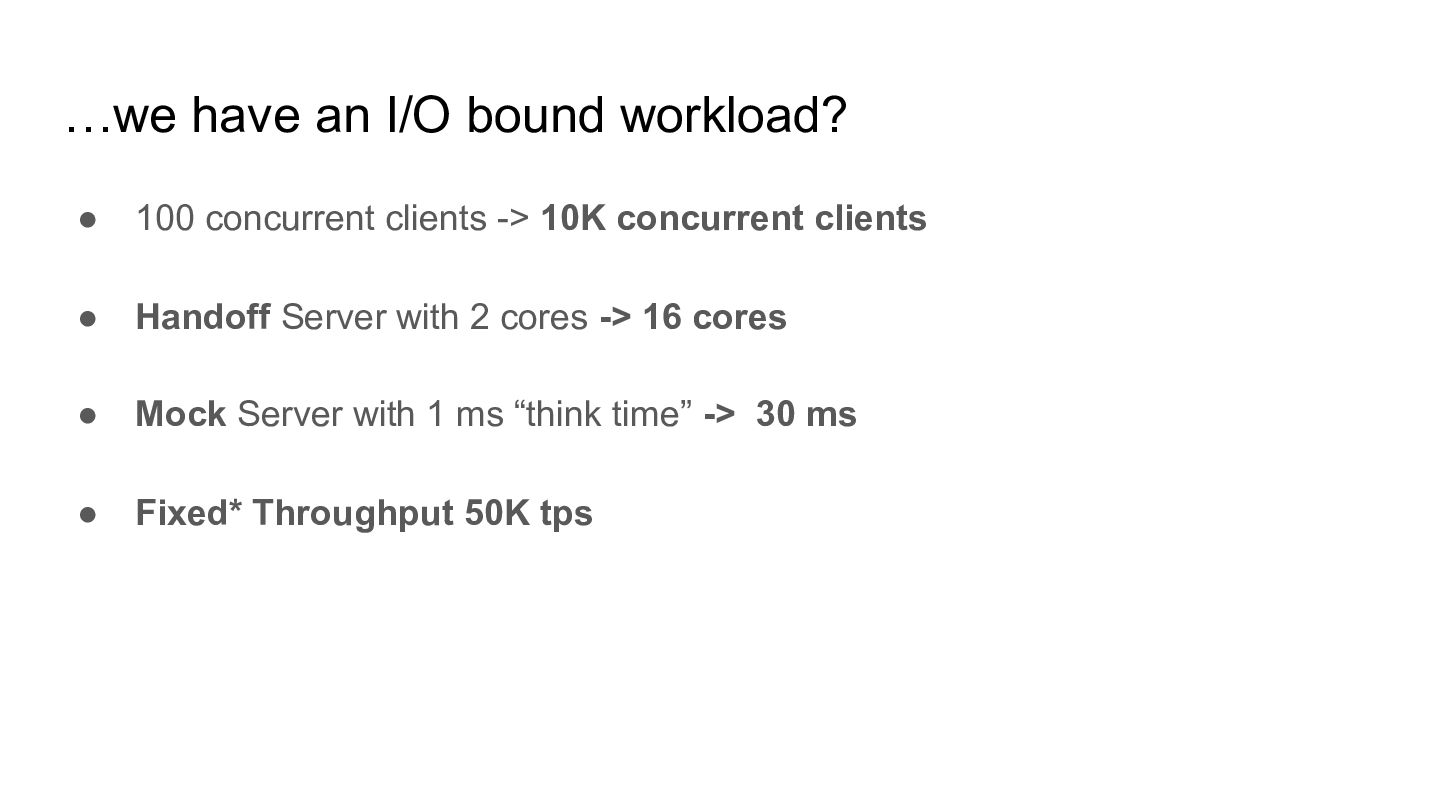
  12. …we have an I/O bound workload? • 100 concurrent clients

    -> 10K concurrent clients • Handoff Server with 2 cores -> 16 cores • Mock Server with 1 ms “think time” -> 30 ms • Fixed* Throughput 50K tps
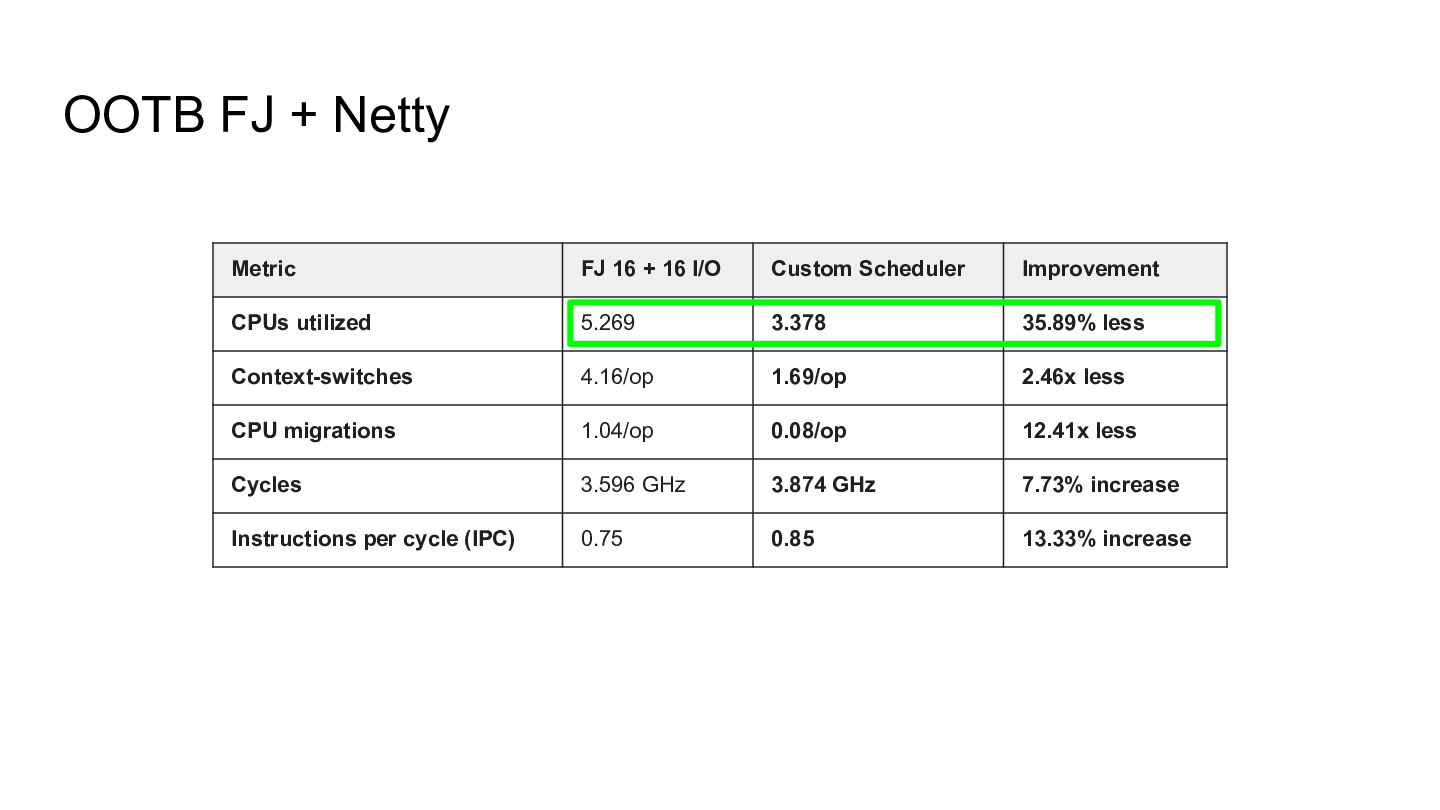
  13. Metric FJ 16 + 16 I/O Custom Scheduler Improvement CPUs

    utilized 5.269 3.378 35.89% less Context-switches 4.16/op 1.69/op 2.46x less CPU migrations 1.04/op 0.08/op 12.41x less Cycles 3.596 GHz 3.874 GHz 7.73% increase Instructions per cycle (IPC) 0.75 0.85 13.33% increase OOTB FJ + Netty
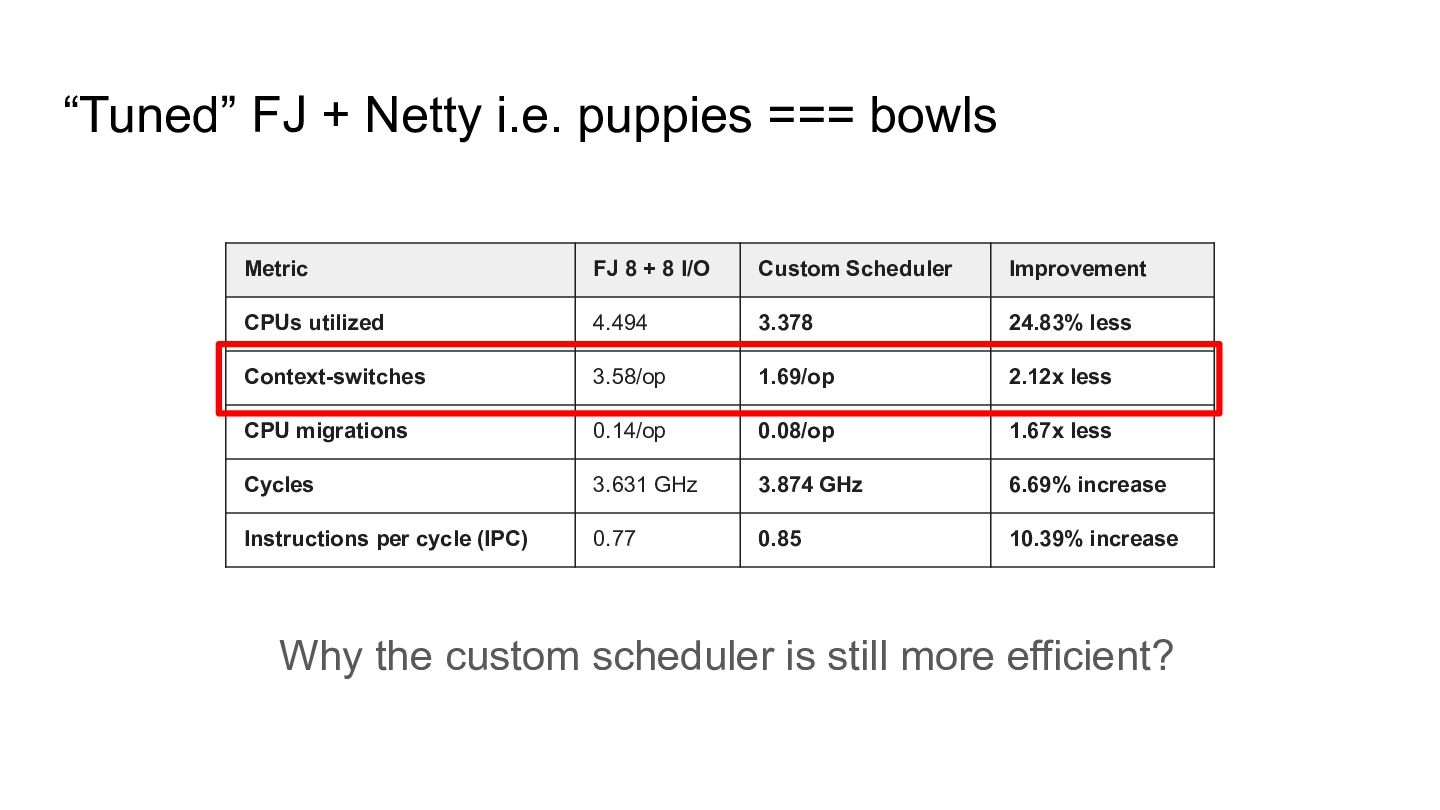
  14. Metric FJ 8 + 8 I/O Custom Scheduler Improvement CPUs

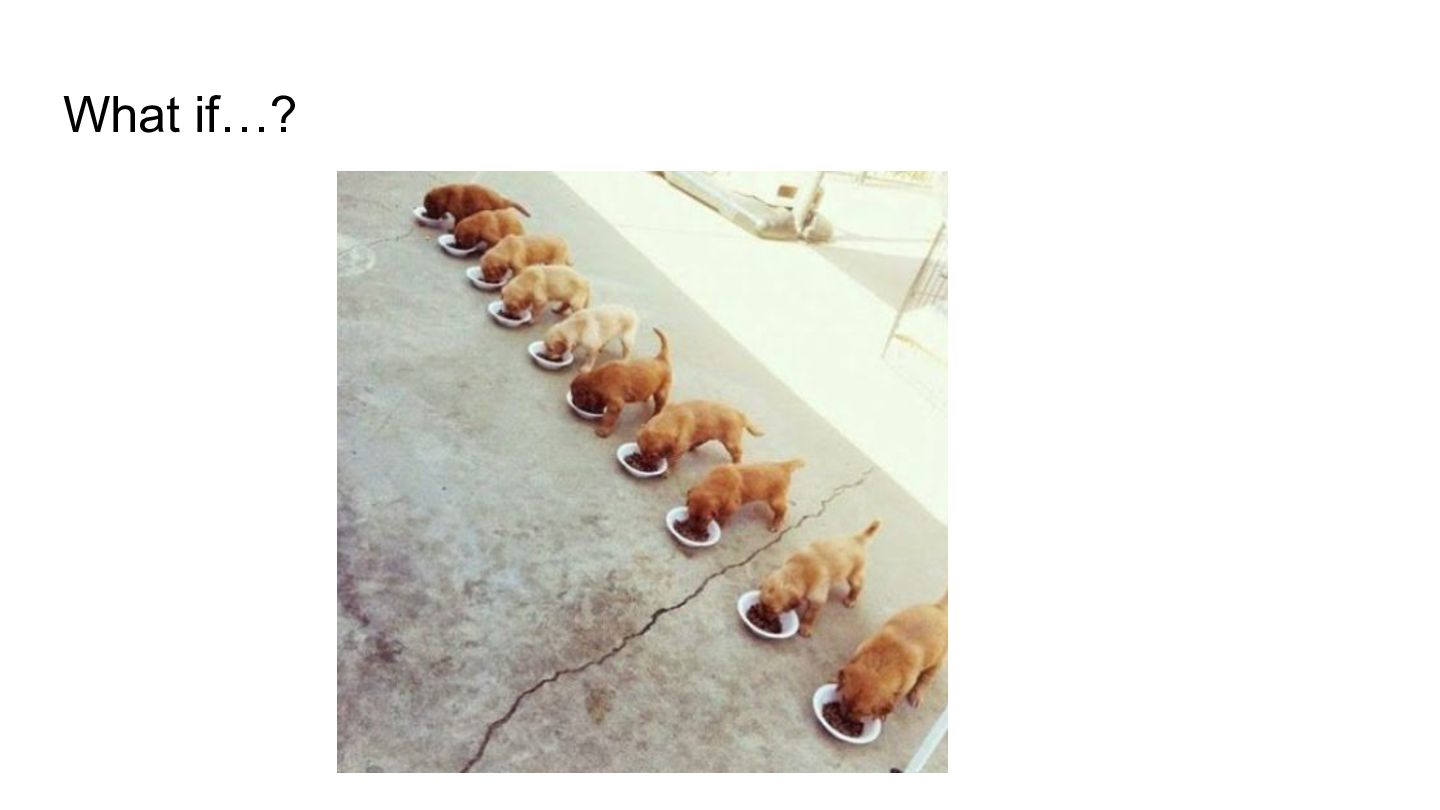
    utilized 4.494 3.378 24.83% less Context-switches 3.58/op 1.69/op 2.12x less CPU migrations 0.14/op 0.08/op 1.67x less Cycles 3.631 GHz 3.874 GHz 6.69% increase Instructions per cycle (IPC) 0.77 0.85 10.39% increase “Tuned” FJ + Netty i.e. puppies === bowls Why the custom scheduler is still more efficient?
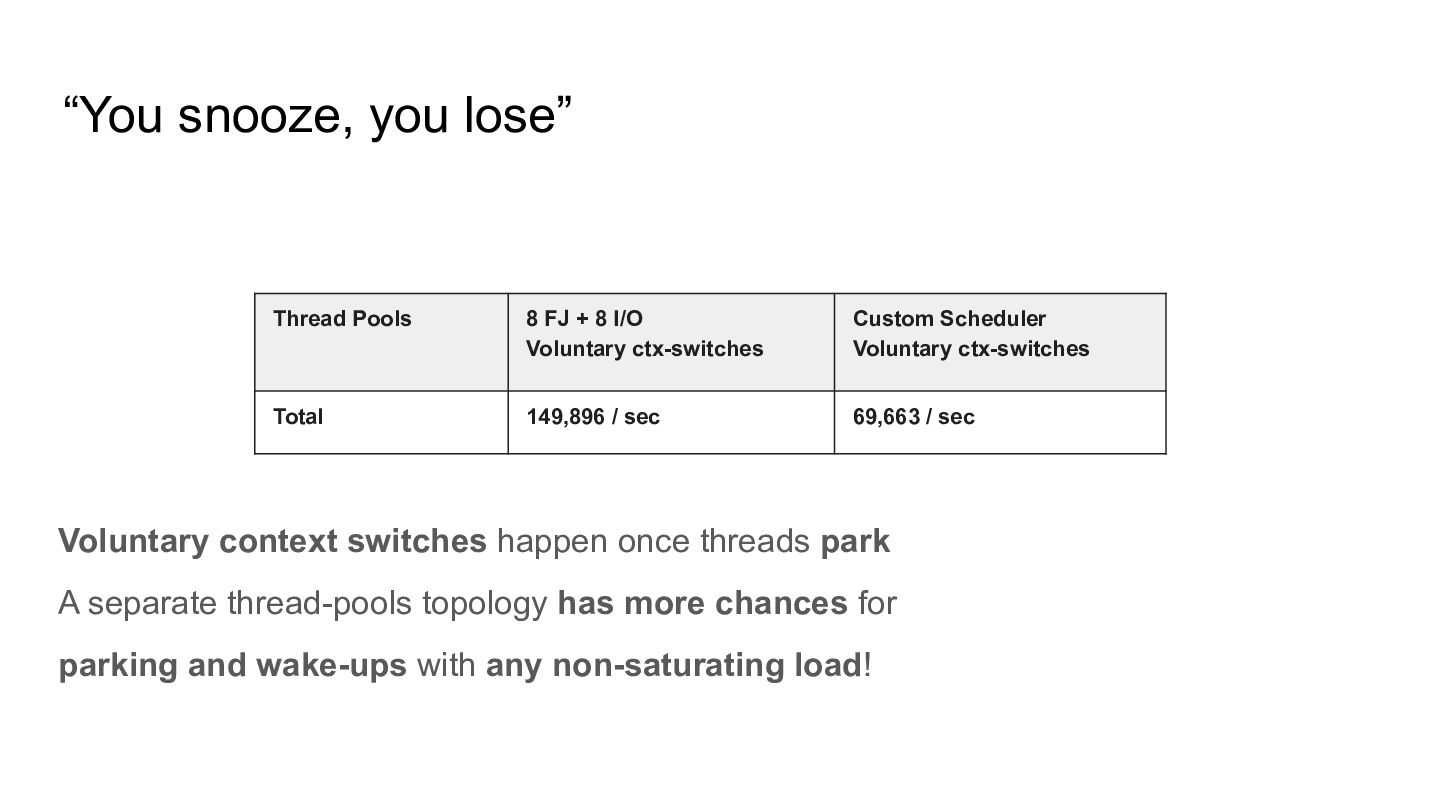
  15. Thread Pools 8 FJ + 8 I/O Voluntary ctx-switches Custom

    Scheduler Voluntary ctx-switches Total 149,896 / sec 69,663 / sec “You snooze, you lose” Voluntary context switches happen once threads park A separate thread-pools topology has more chances for parking and wake-ups with any non-saturating load!
  16. Economical implications • C6a.2xlarge (8 vcpus) • 1.33 capacity ratio

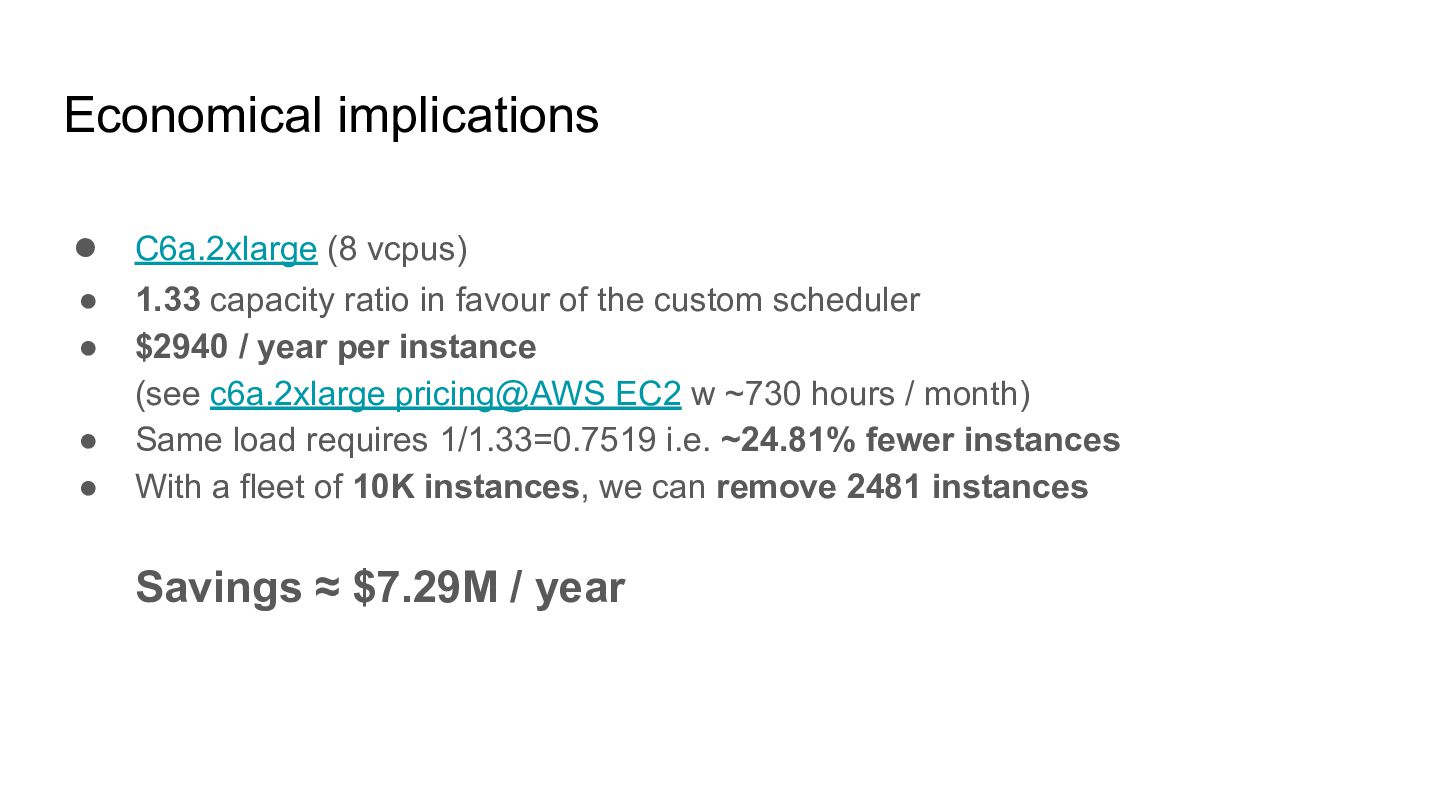
    in favour of the custom scheduler • $2940 / year per instance (see c6a.2xlarge pricing@AWS EC2 w ~730 hours / month) • Same load requires 1/1.33=0.7519 i.e. ~24.81% fewer instances • With a fleet of 10K instances, we can remove 2481 instances Savings ≈ $7.29M / year
  17. Summary: Is It worthy? • Squeezing more capacity out of

    HW reduces the number of instances • Less instances means $$$ saving • Amortizing wake-ups improves CPU utilization… • …with less carbon emitted • It tooks 447 LOC(!)
  18. Engineering delivers within constraints • Replacing a Networking Framework is

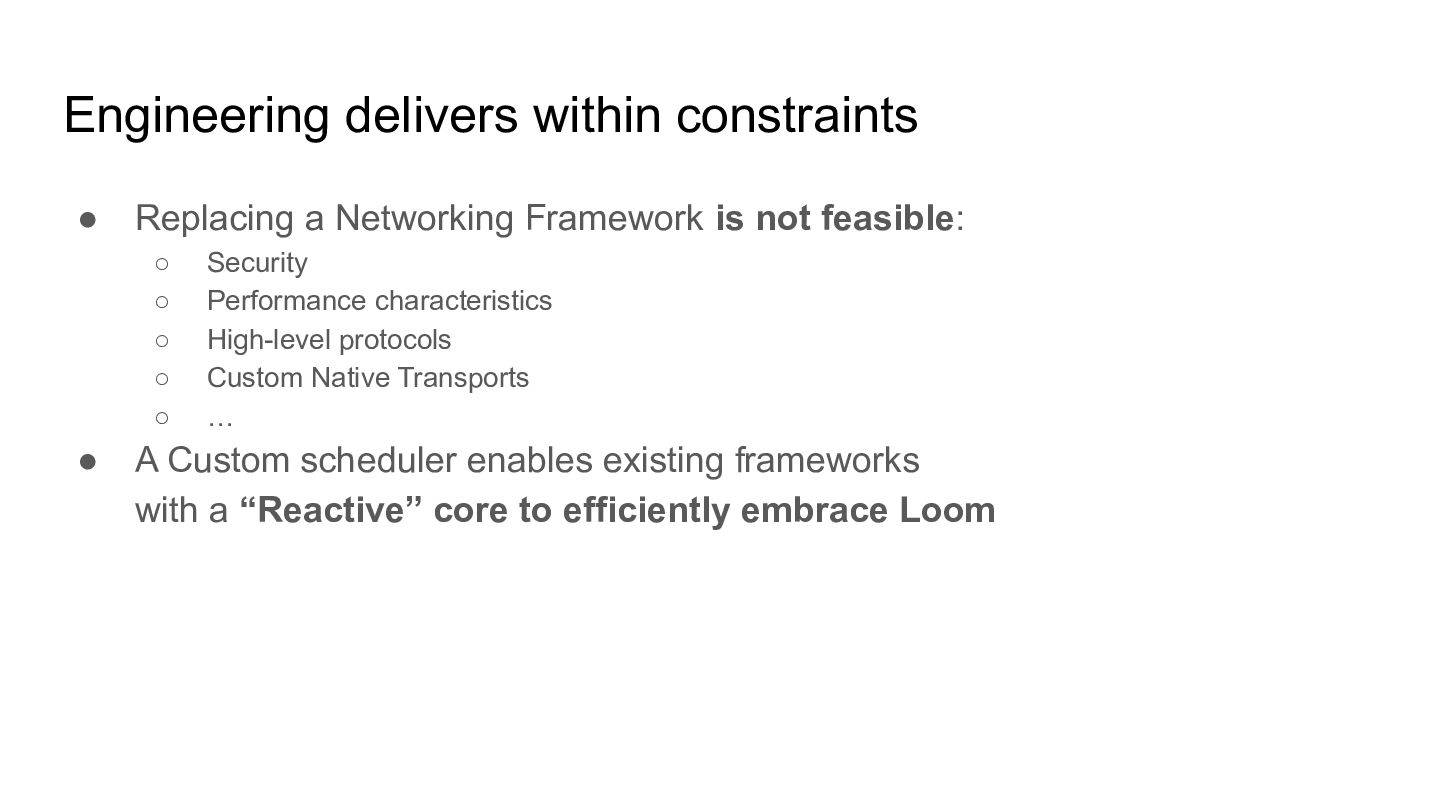
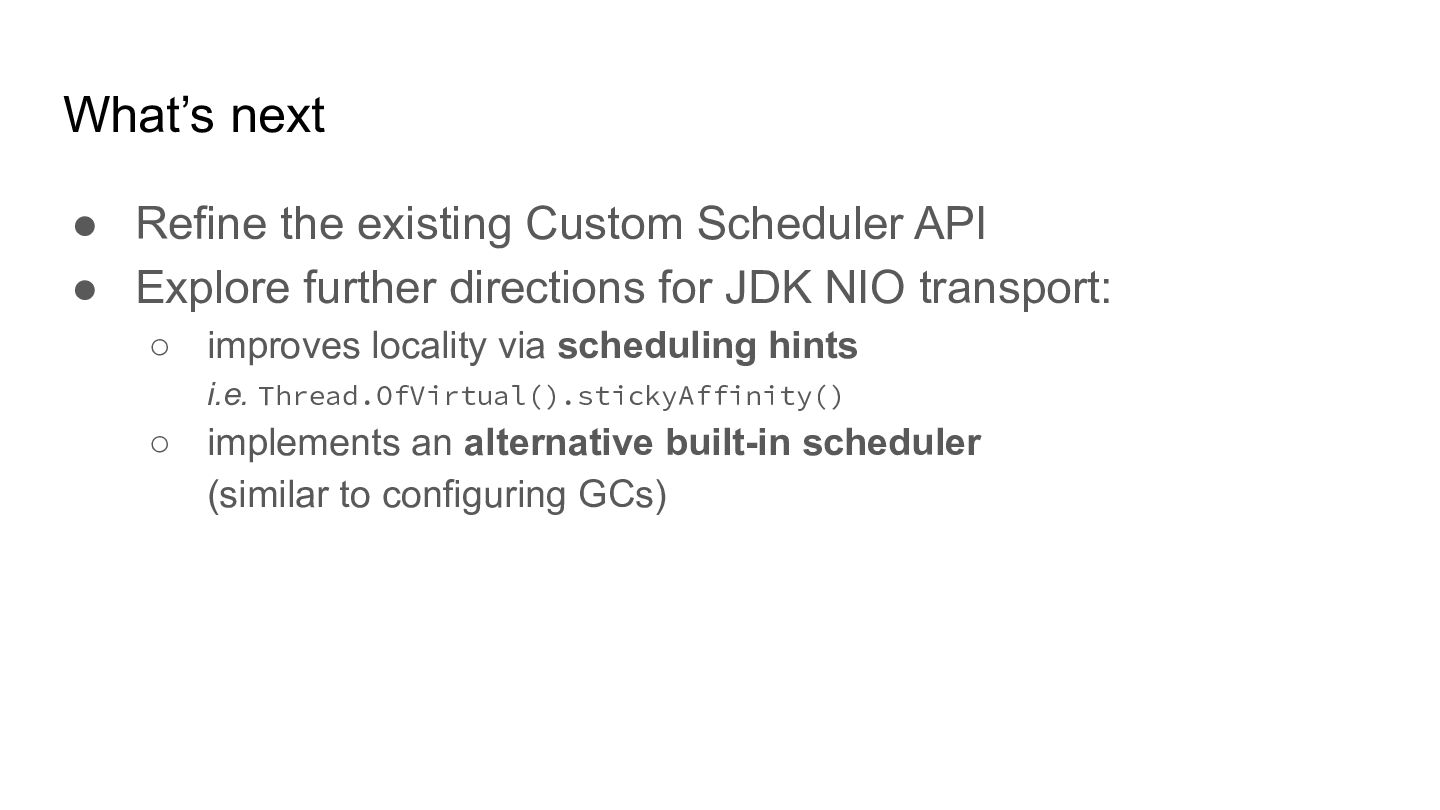
    not feasible: ◦ Security ◦ Performance characteristics ◦ High-level protocols ◦ Custom Native Transports ◦ … • A Custom scheduler enables existing frameworks with a “Reactive” core to efficiently embrace Loom
  19. The unsung heroes • IBM OpenJDK Team • IBM Quarkus

    Team • IBM App Services Performance Team • Oracle Loom Team • Micronaut OracleLabs Team • Netflix • Apple