Upgrade to Pro — share decks privately, control downloads, hide ads and more …

Asset Partitions: Matching Workflow to the Righ...

Sponsored · Ship Features Fearlessly Turn features on and off without deploys. Used by thousands of Ruby developers.
Avatar for Lee Wei Lee Wei
August 20, 2026

Asset Partitions: Matching Workflow to the Right Data

Avatar for Lee Wei

Lee Wei

August 20, 2026

More Decks by Lee Wei

Other Decks in Programming

Transcript

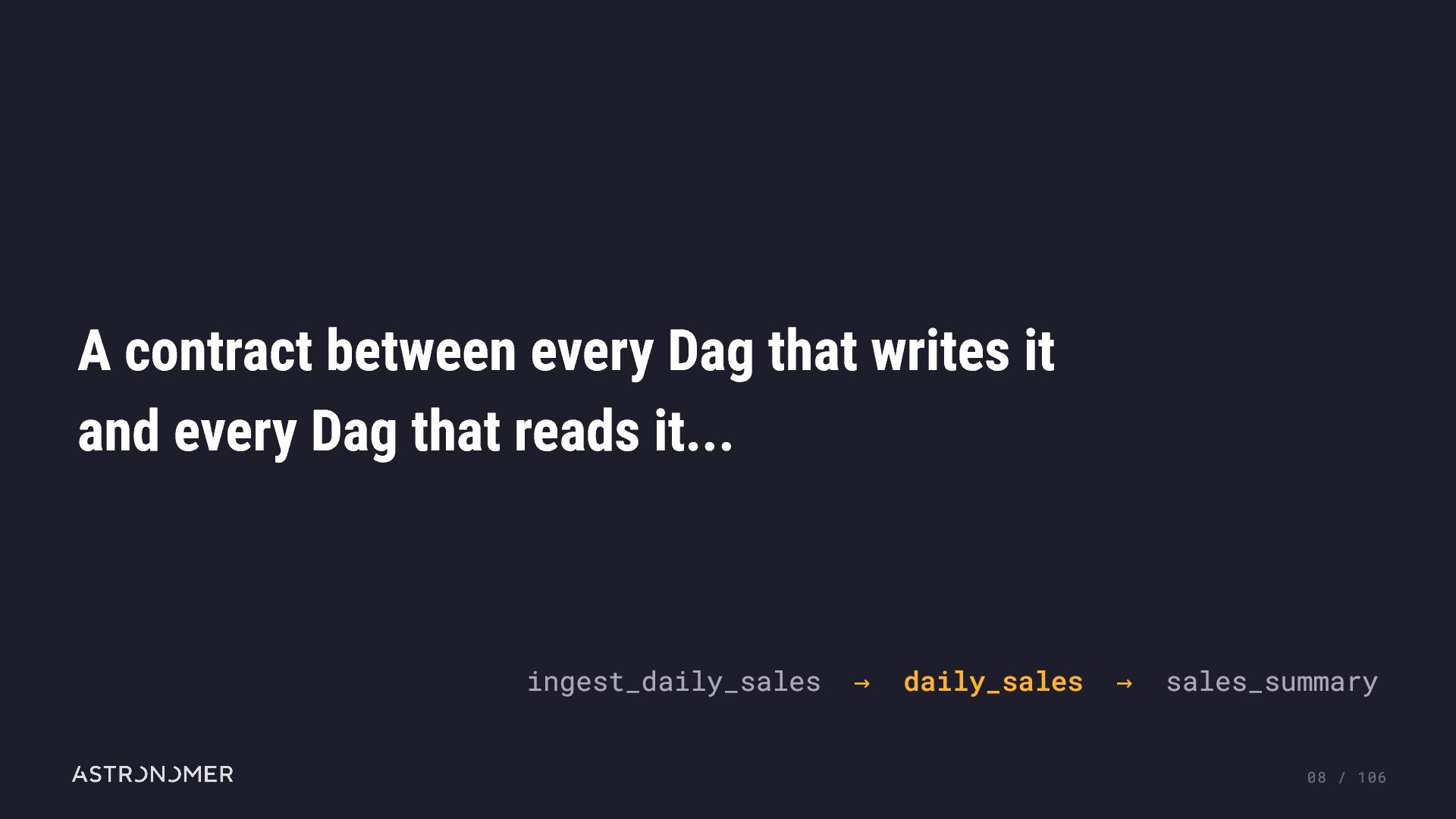
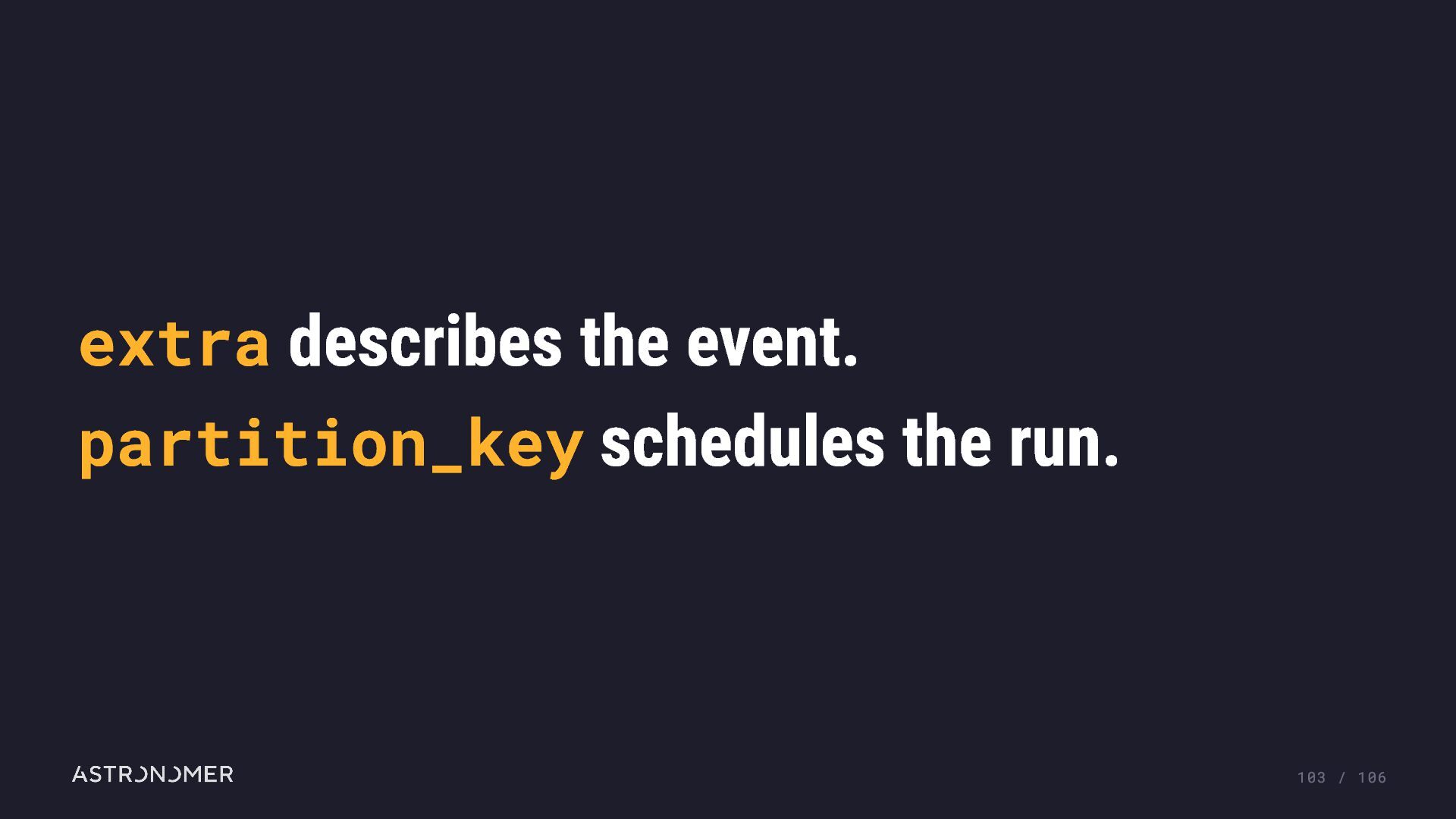
  1. A contract between every Dag that writes it and every

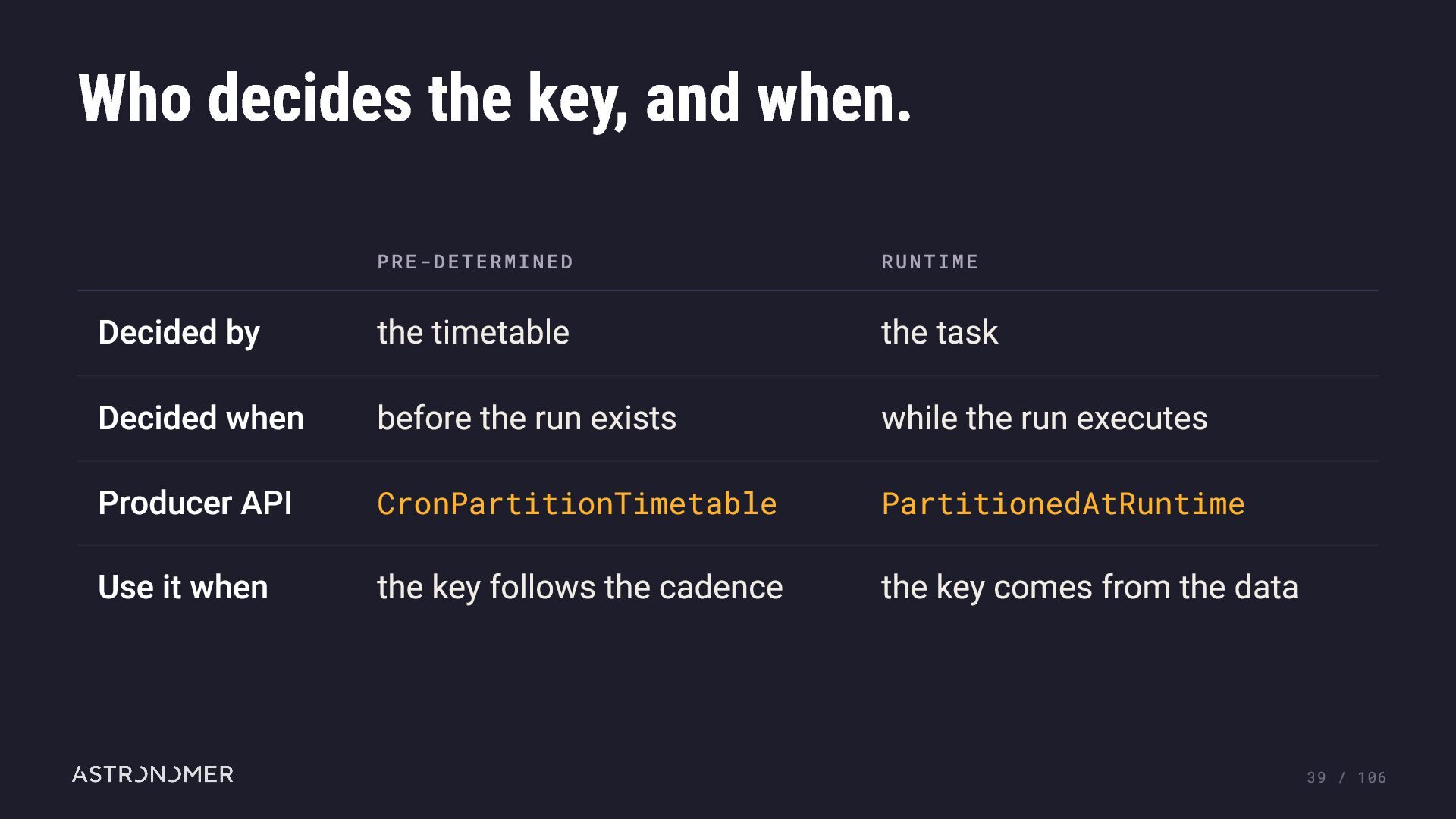
    Dag that reads it... ingest_daily_sales → daily_sales → sales_summary 11 / 104
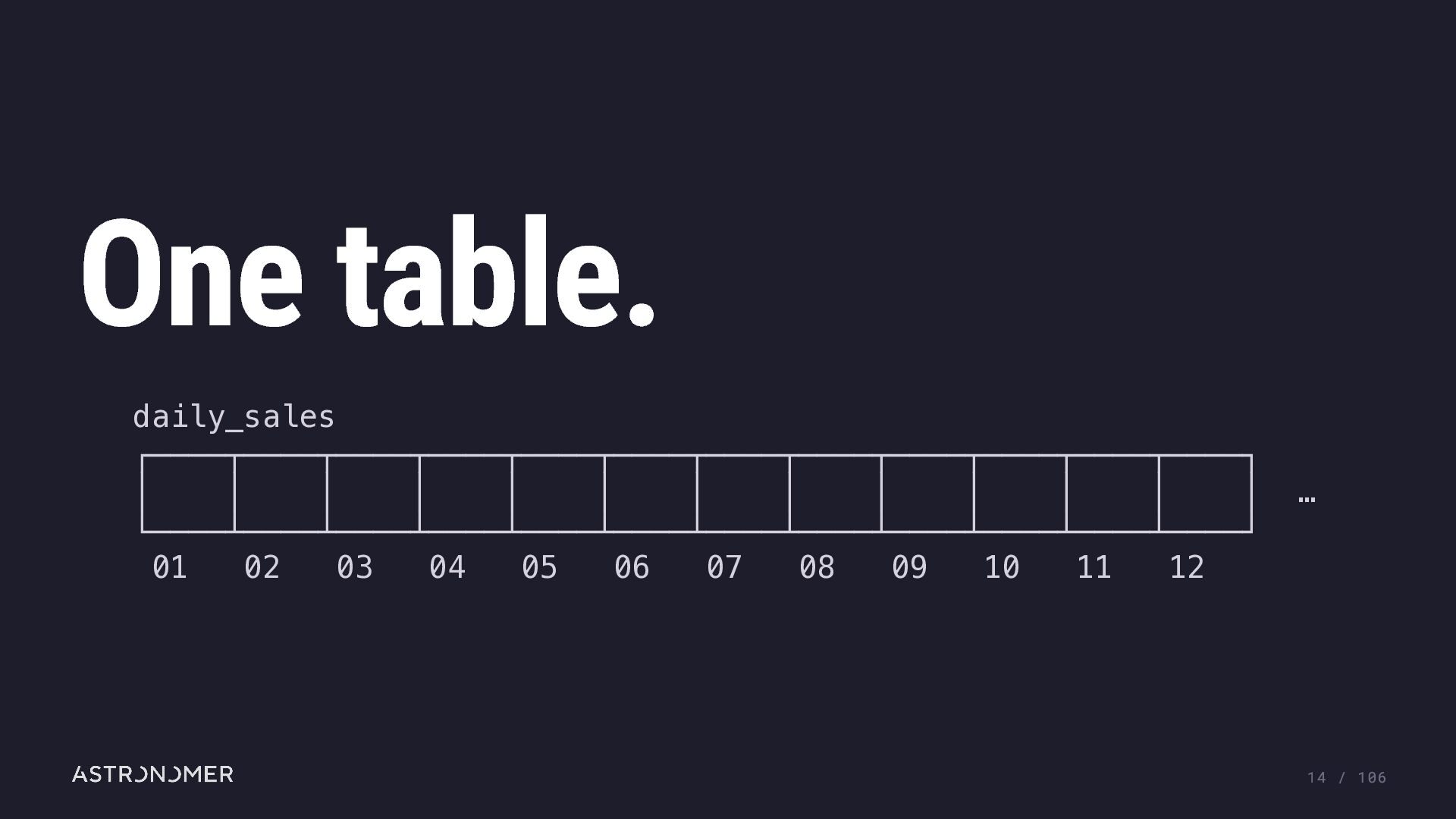
  2. 365 days of data. daily_sales ┌────┬────┬────┬────┬────┬────┬────┬────┬────┬────┬────┬────┐ │ │ │ │

    │ │ │ │ │ │ │ │ │ └────┴────┴────┴────┴────┴────┴────┴────┴────┴────┴────┴────┘ 01 02 03 04 05 06 07 08 09 10 11 12 … 20 / 104
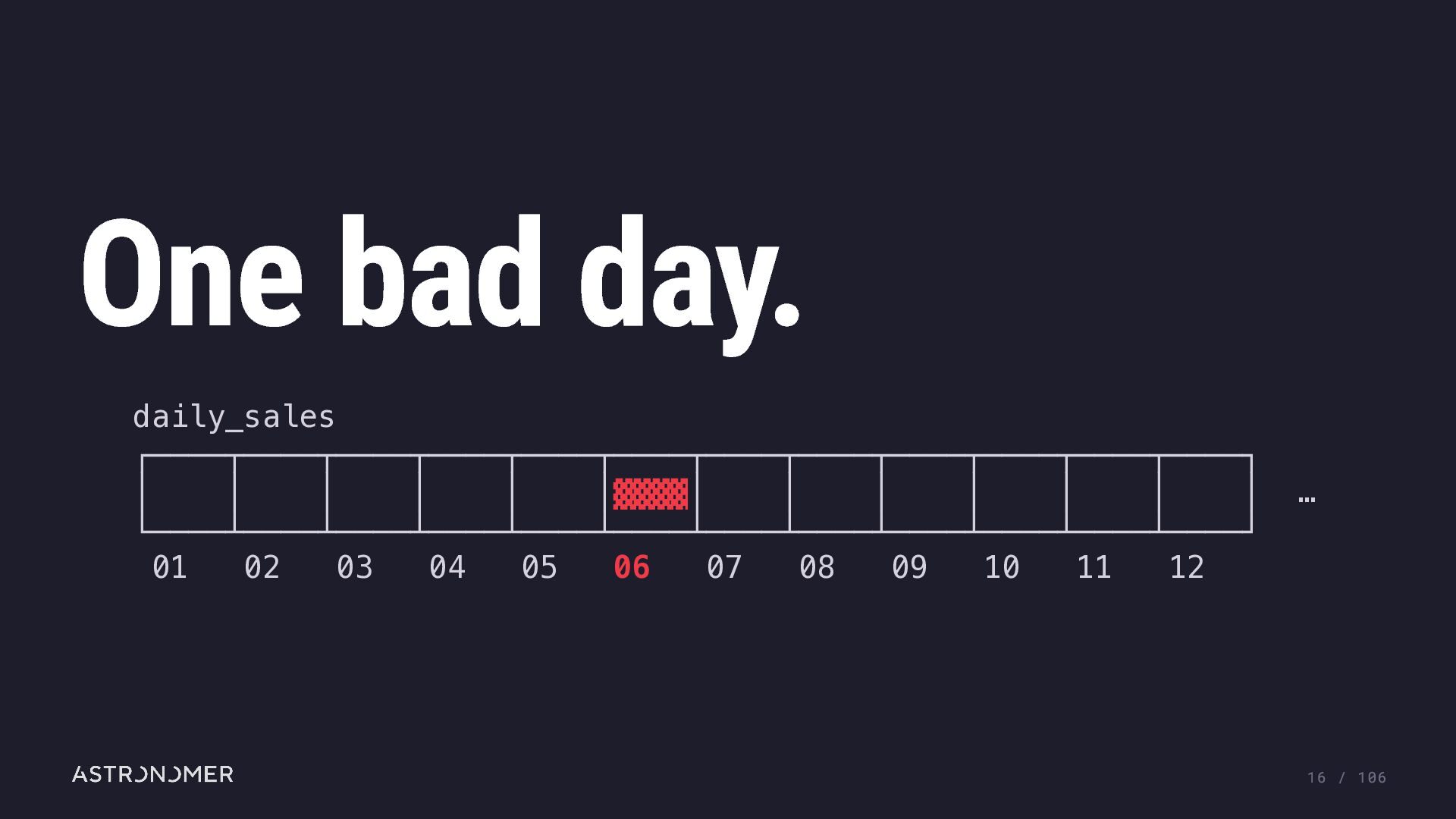
  3. One bad day. daily_sales ┌────┬────┬────┬────┬────┬────┬────┬────┬────┬────┬────┬────┐ │ │ │ │ │

    │▓▓▓▓│ │ │ │ │ │ │ └────┴────┴────┴────┴────┴────┴────┴────┴────┴────┴────┴────┘ 01 02 03 04 05 06 07 08 09 10 11 12 … 21 / 104
  4. Upstream fixed it. daily_sales ┌────┬────┬────┬────┬────┬────┬────┬────┬────┬────┬────┬────┐ │ │ │ │ │

    │▓▓▓▓│ │ │ │ │ │ │ └────┴────┴────┴────┴────┴────┴────┴────┴────┴────┴────┴────┘ 01 02 03 04 05 06 07 08 09 10 11 12 … 22 / 104
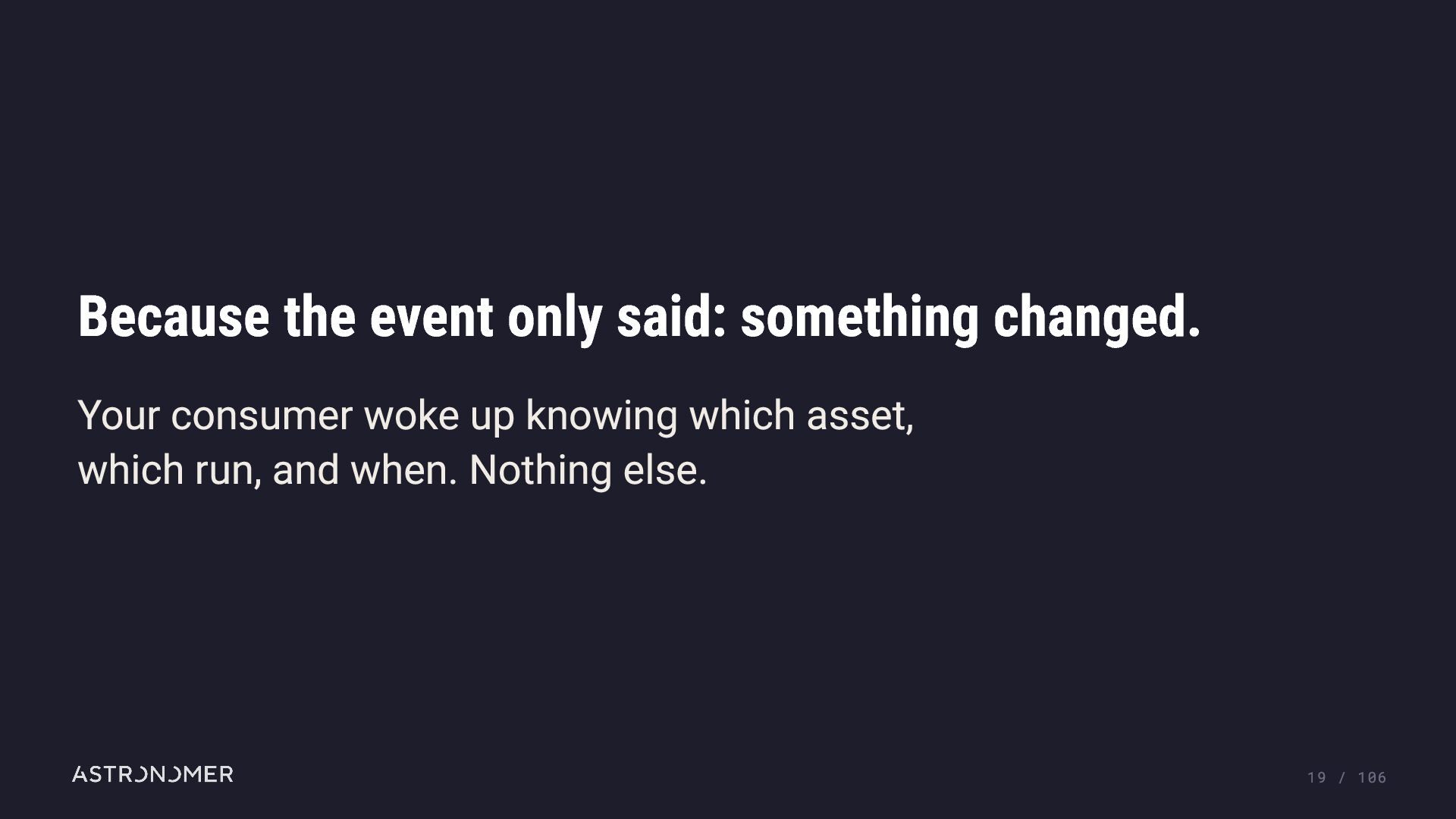
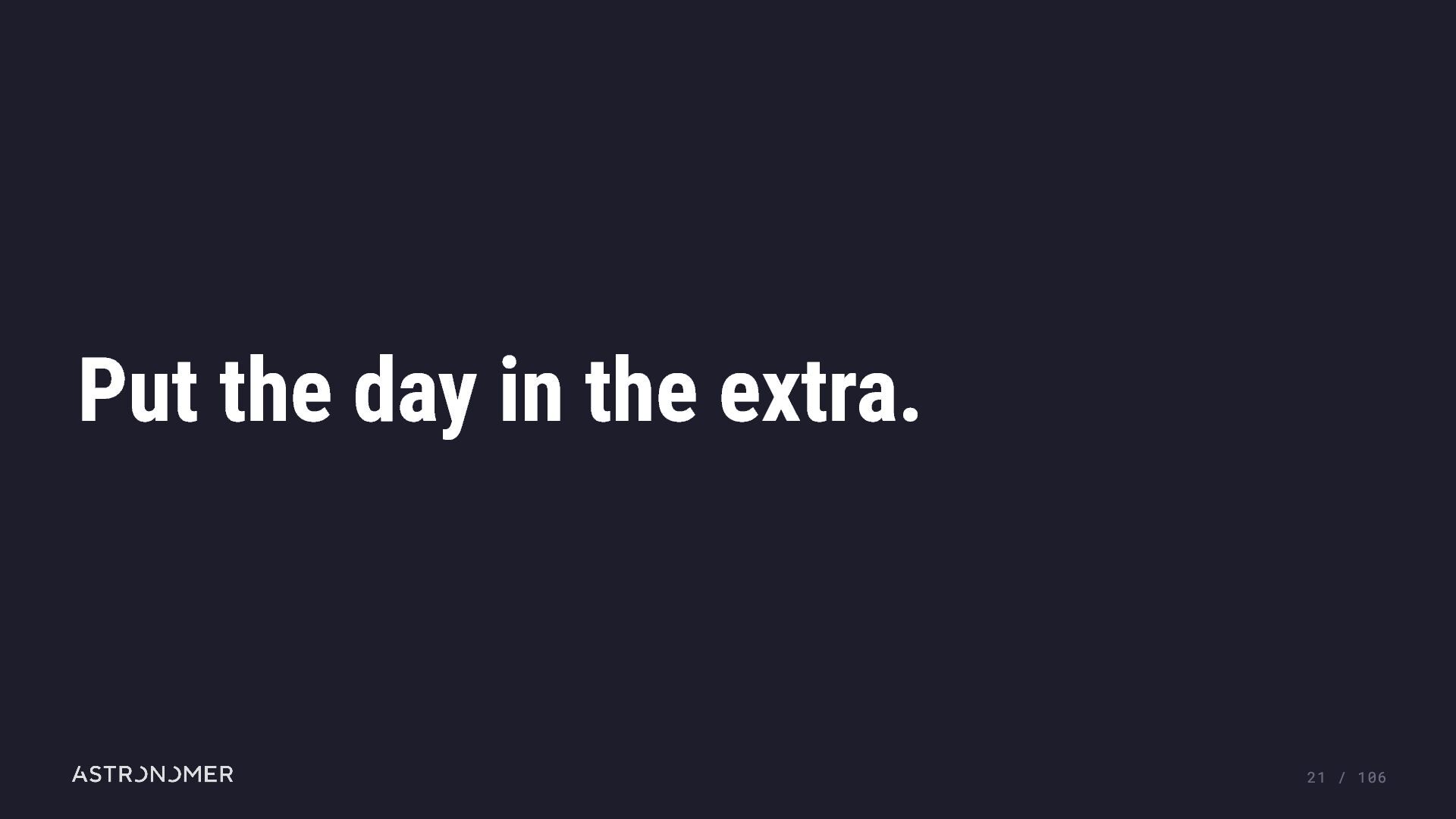
  5. The scheduler could not see any of it. That dict

    is a payload. Nothing schedules on it. 33 / 104
  6. The workaround becomes a schedule. YOU WROTE THIS NOW YOU

    DECLARE IT Which slice? one run per slice Has it landed? held until ready How many arrived? the scheduler counts Go, or stop? you set the wait policy in a task · after the run started in the schedule · before the run exists 36 / 104
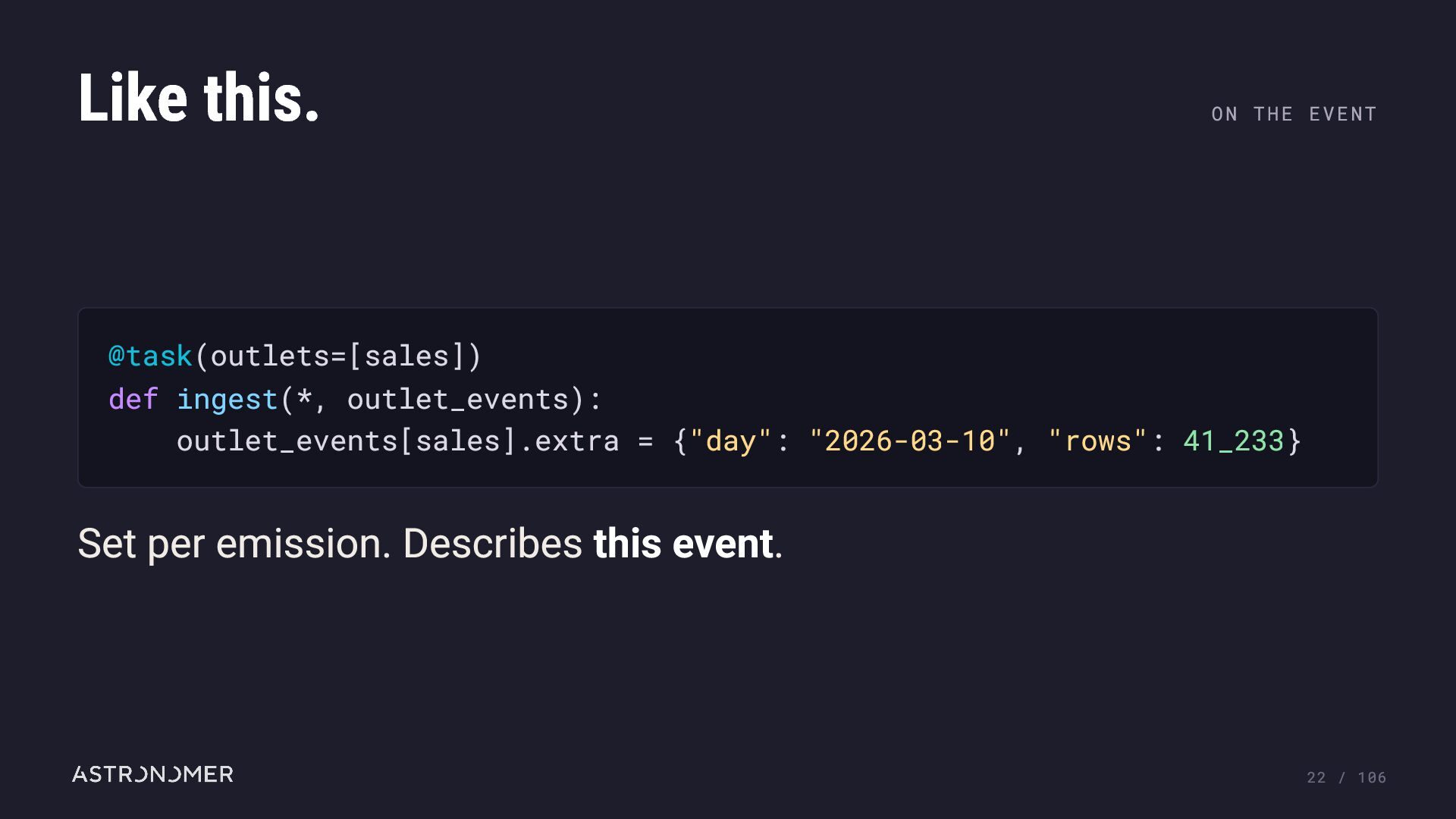
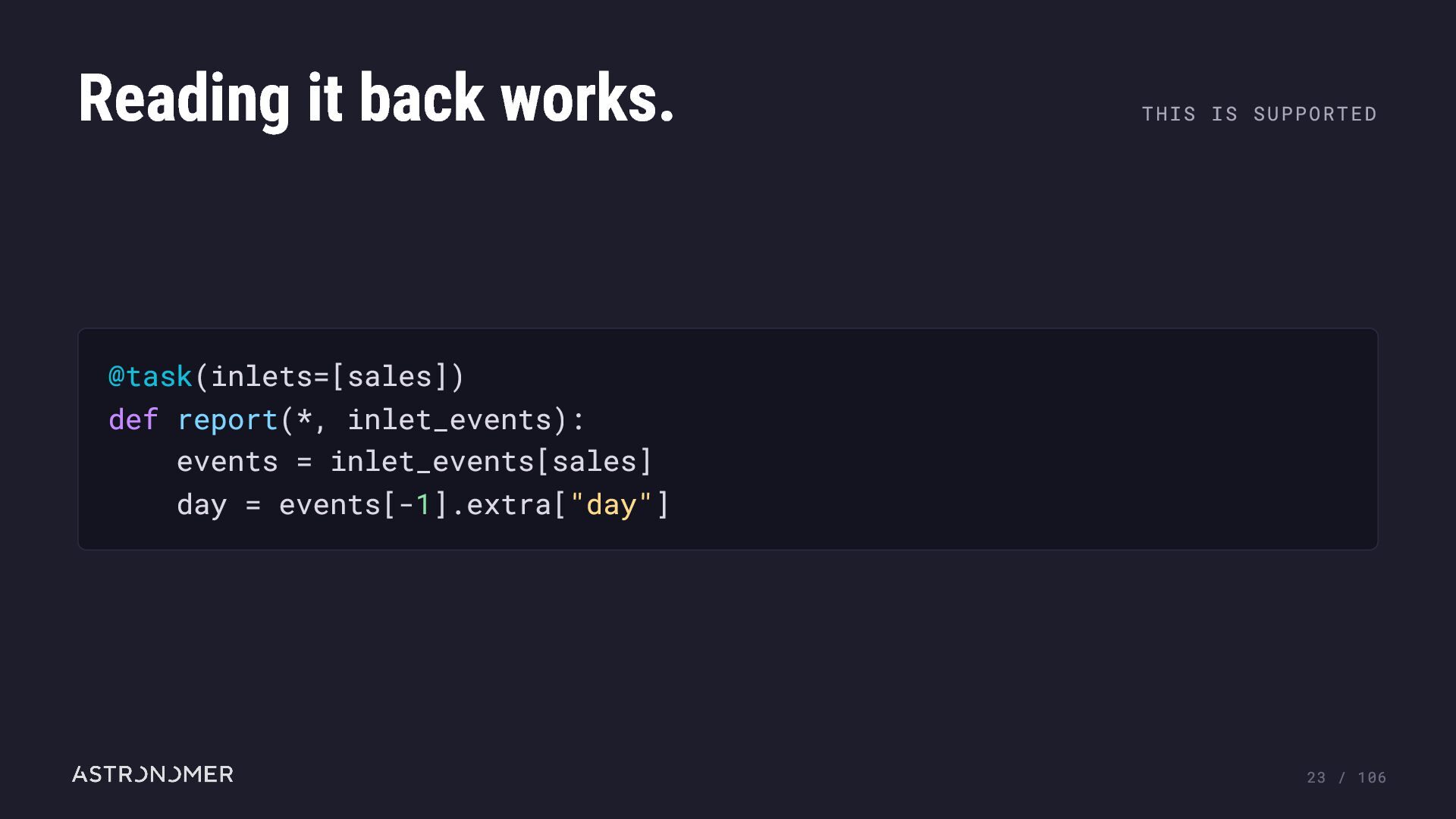
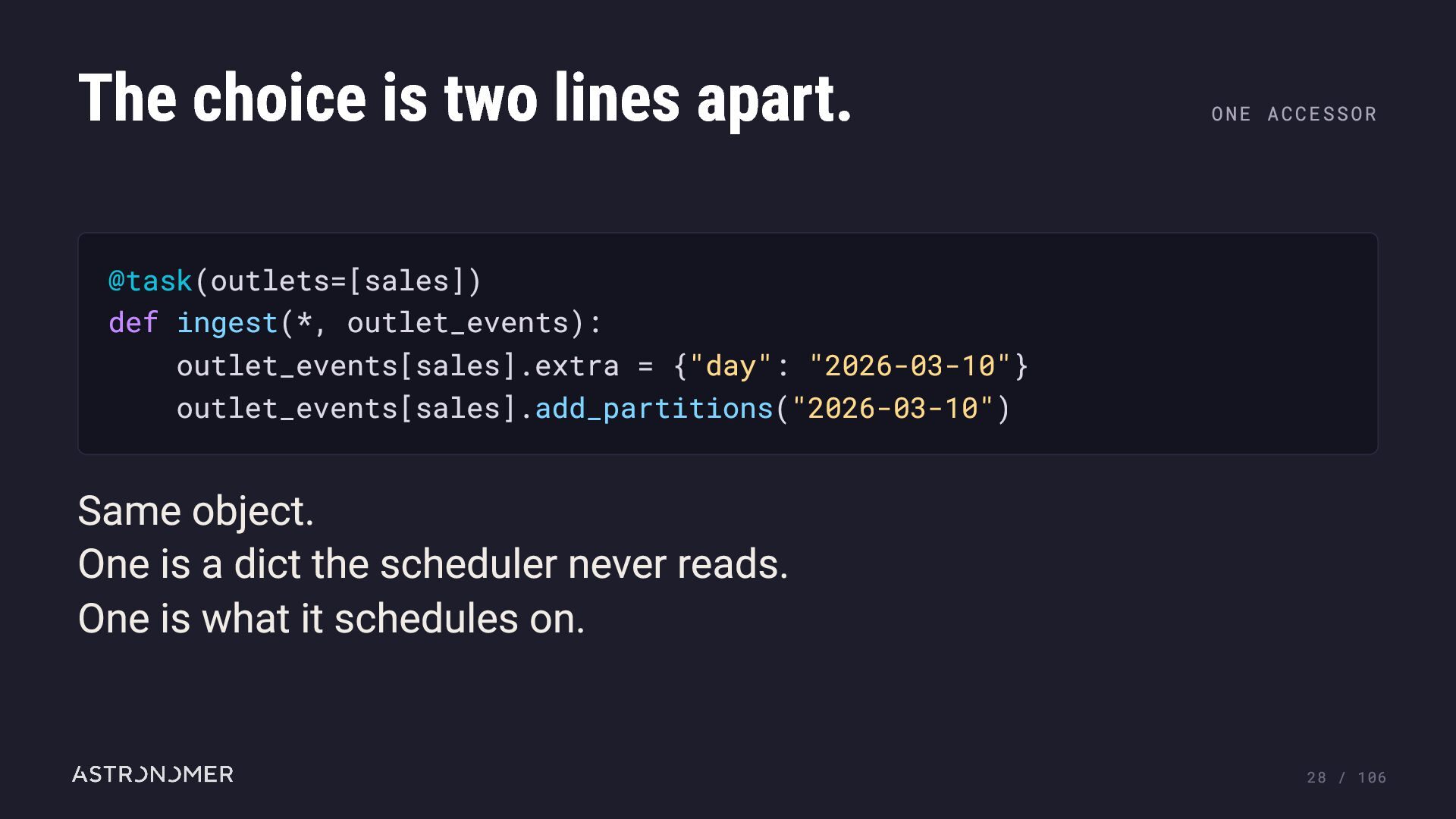
  7. @task(outlets=[sales]) def ingest(*, outlet_events): # the scheduler never reads this

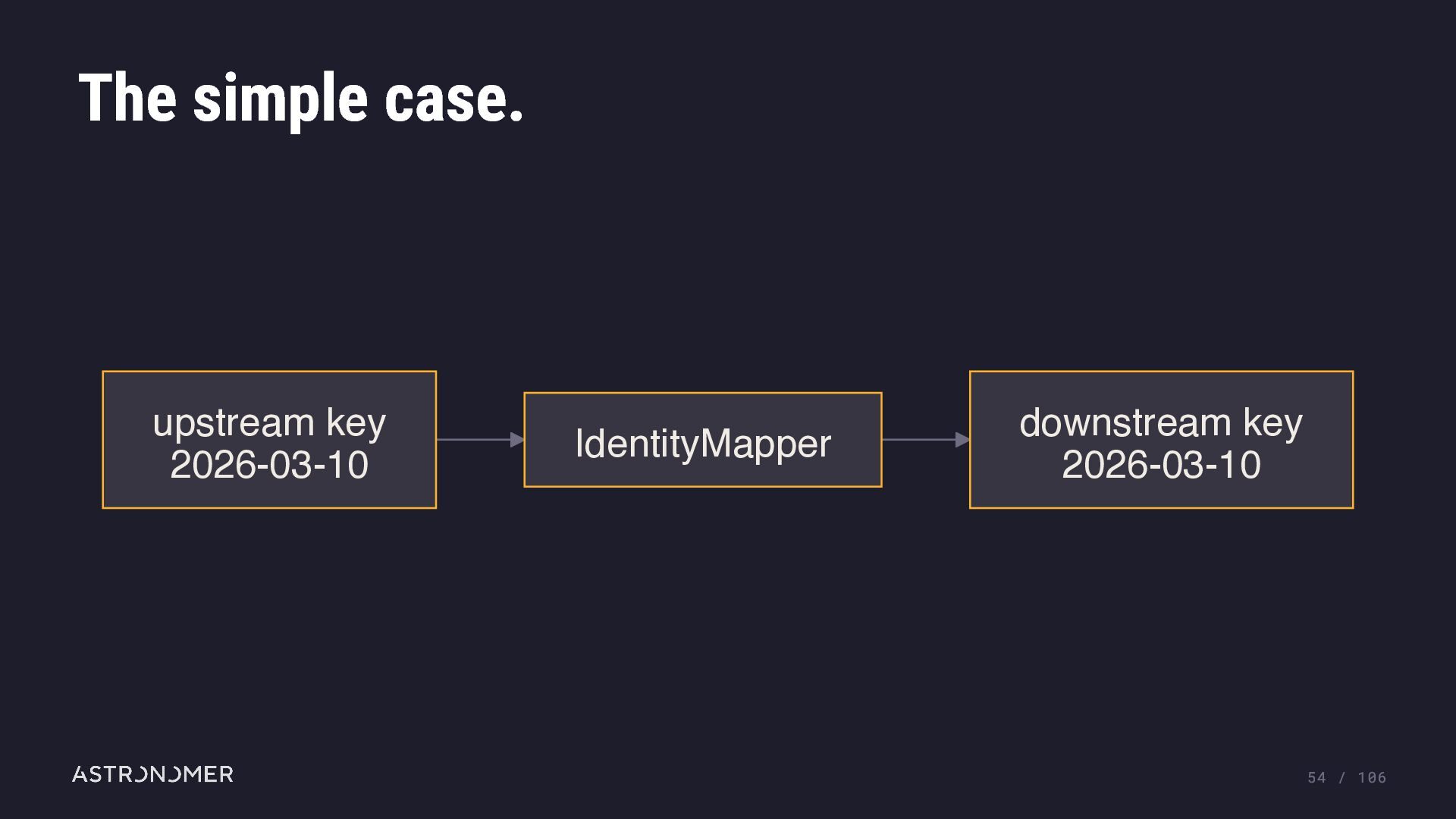
    outlet_events[sales].extra = {"day": "2026-03-10"} # the scheduler schedules on this outlet_events[sales].add_partitions("2026-03-10") Same object. One is a dict the scheduler never reads. One is what it schedules on. 37 / 104
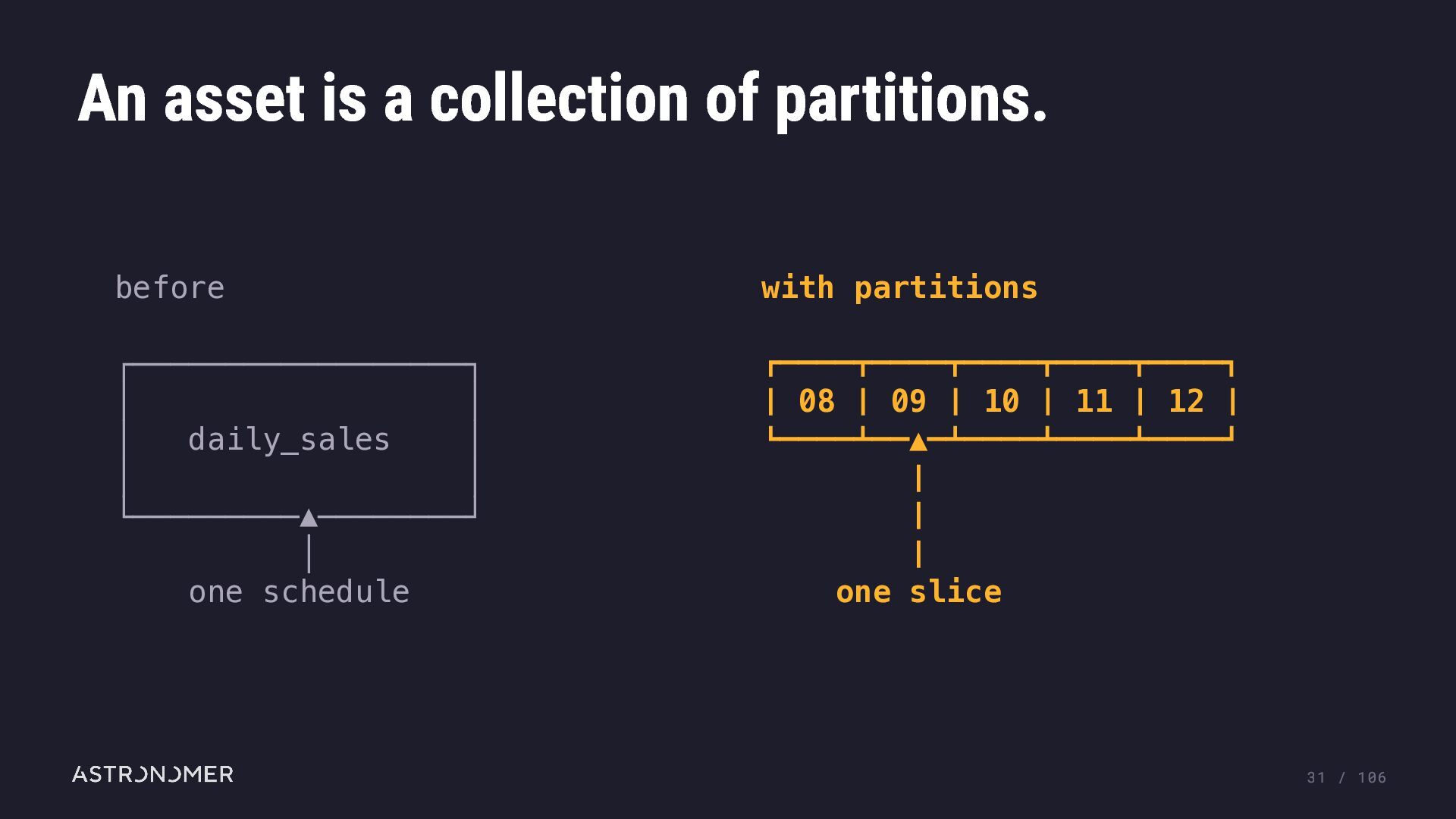
  8. An asset is a collection of partitions. before with partitions

    ┌──────────────────┐ │ │ │ daily_sales │ │ │ └─────────▲────────┘ │ one schedule ┌────┬────┬────┬────┬────┐ │ 08 │ 09 │ 10 │ 11 │ 12 │ └────┴──▲─┴────┴────┴────┘ │ │ │ one slice 38 / 104
  9. 73 is the vision. AIP-73 · Expanded Data Awareness AIP-74

    Introducing Data Assets AIP-75 New Asset-Centric Syntax Airflow 3.0 AIP-76 Asset Partitions Airflow 3.2 / 3.3 39 / 104
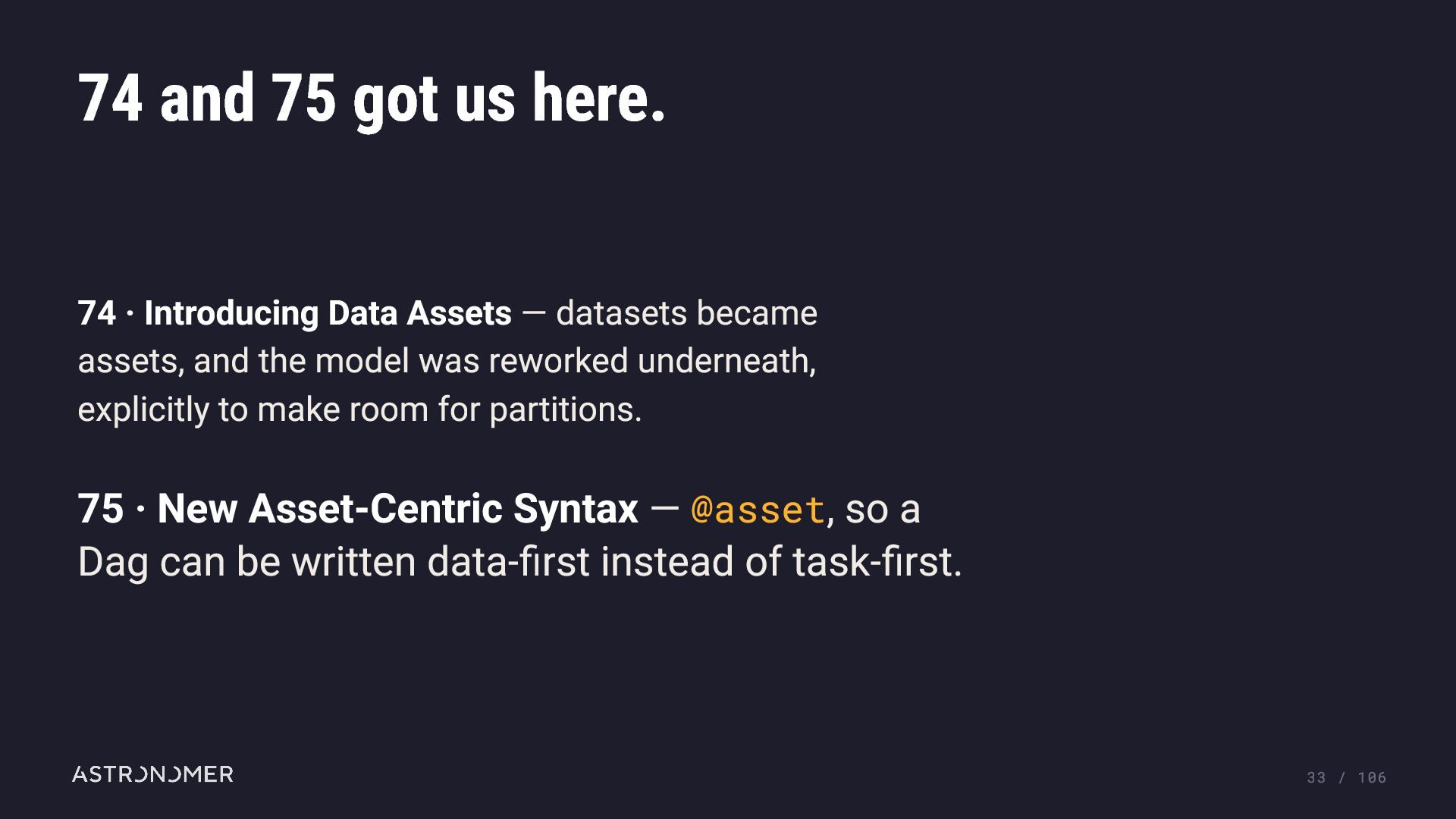
  10. 74 and 75 got us here. 74 · Introducing Data

    Assets — datasets became assets, and the model was reworked underneath, explicitly to make room for partitions. 75 · New Asset-Centric Syntax — @asset, so a Dag can be written data-first instead of task-first. 40 / 104
  11. 01 / 04 Definitions Where the partition key comes from.

    DEFINITIONS MAPPINGS COMPLETENESS BACKFILLS ADOPTING IT 42 / 104
  12. 2026-03-10T09:00:00 hourly, from a schedule tw a segment, decided at

    runtime tw|2026-03-10 composite, both at once One Dag writes this string. Another Dag has to match it exactly. 44 / 104
  13. Who decides the key, and when. PRE-DETERMINED RUNTIME Decided by

    the timetable the task Decided when before the run exists while the run executes Producer API CronPartitionTimetable PartitionedAtRuntime Use it when the key follows the cadence the key comes from the data 45 / 104
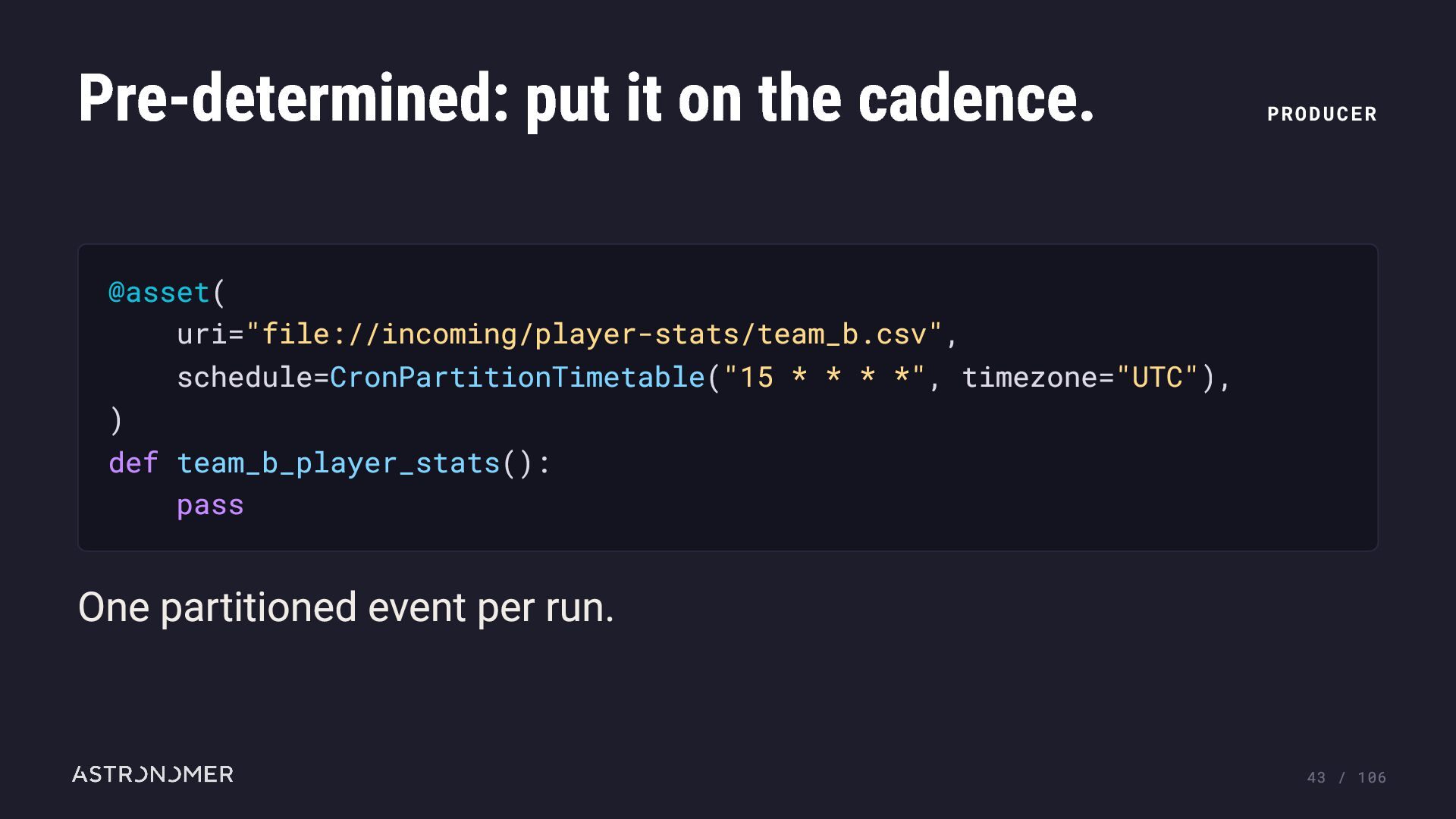
  14. Pre-determined: put it on the cadence. @asset( uri="file://incoming/player-stats/team_b.csv", schedule=CronPartitionTimetable("15 *

    * * *", timezone="UTC"), ) def team_b_player_stats(): pass One partitioned event per run. 46 / 104
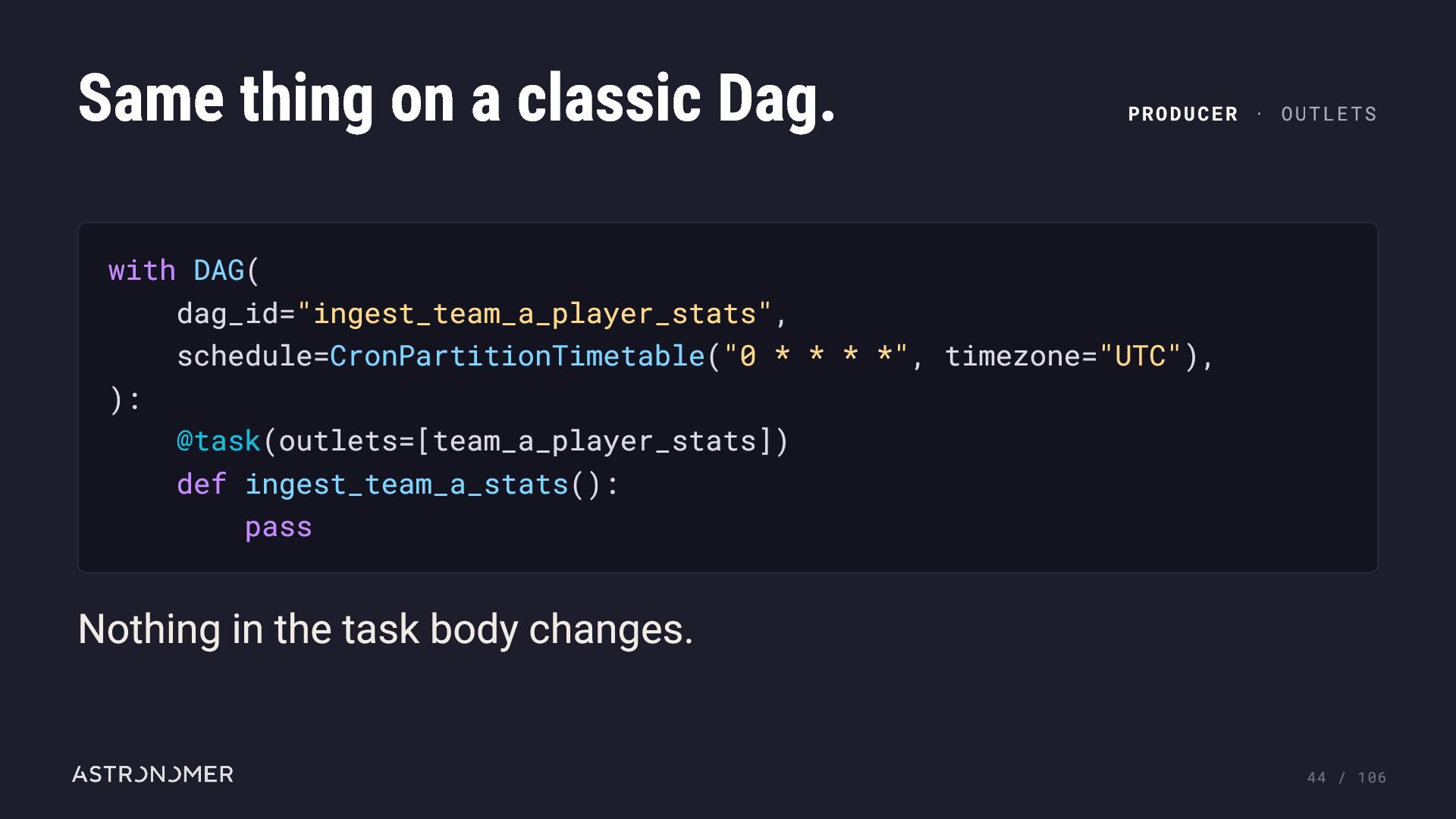
  15. Same thing on a classic Dag. with DAG( dag_id="ingest_team_a_player_stats", schedule=CronPartitionTimetable("0

    * * * *", timezone="UTC"), ): @task(outlets=[team_a_player_stats]) def ingest_team_a_stats(): pass Nothing in the task body changes. 47 / 104
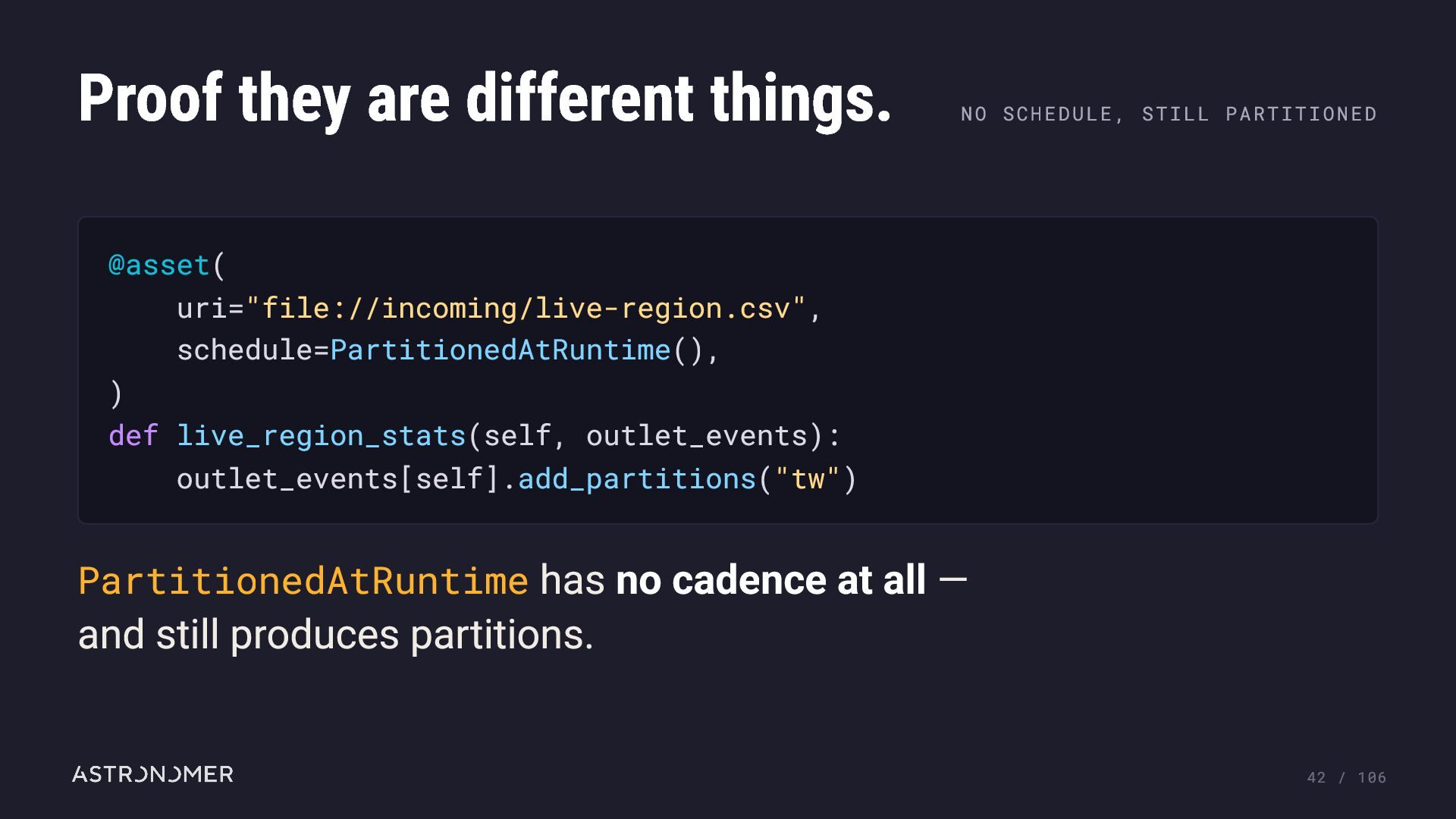
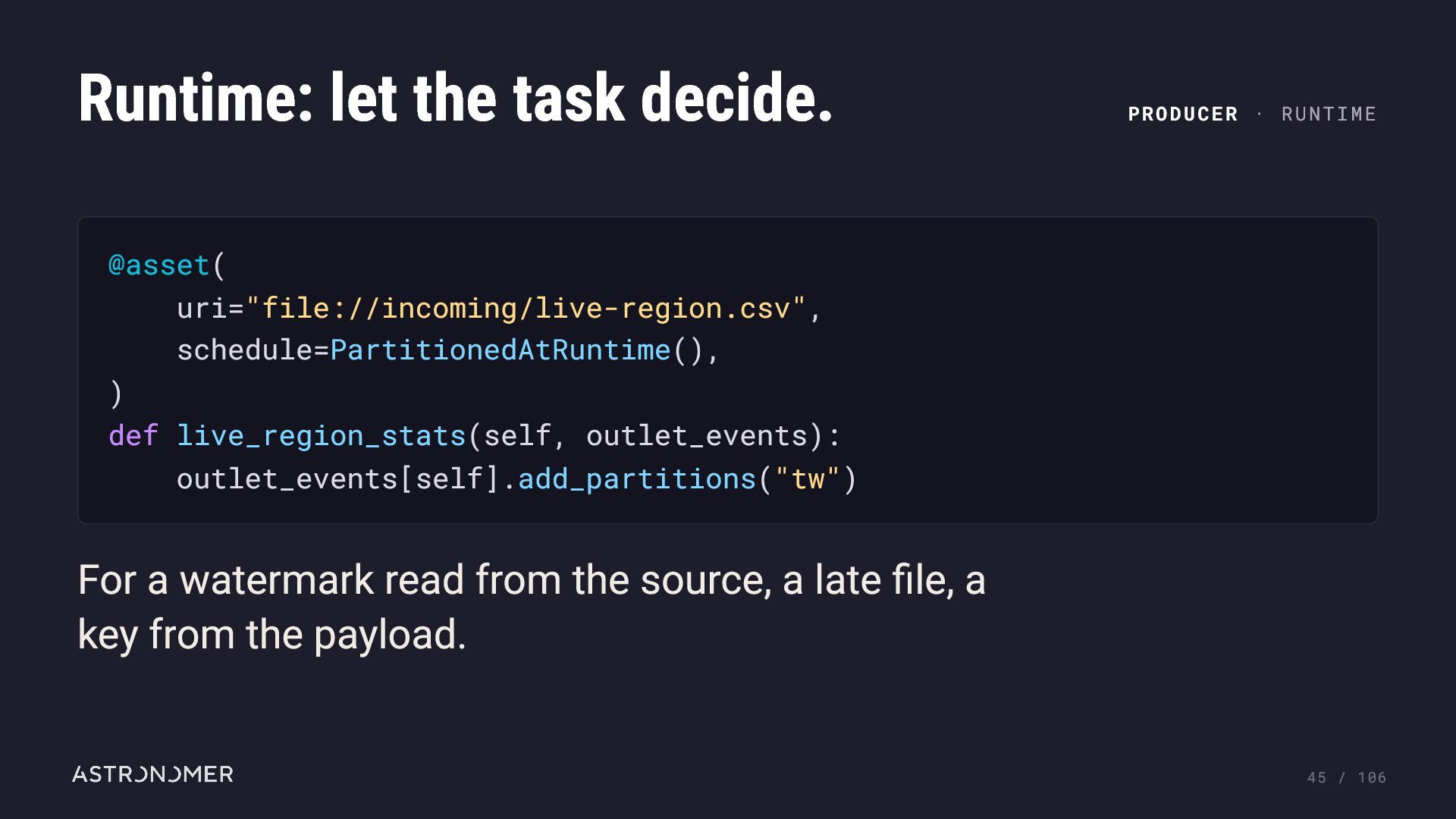
  16. Runtime: let the task decide. @asset( uri="file://incoming/live-region.csv", schedule=PartitionedAtRuntime(), ) def

    live_region_stats(self, outlet_events): outlet_events[self].add_partitions("tw") For a watermark read from the source, a late file, a key from the payload. 48 / 104
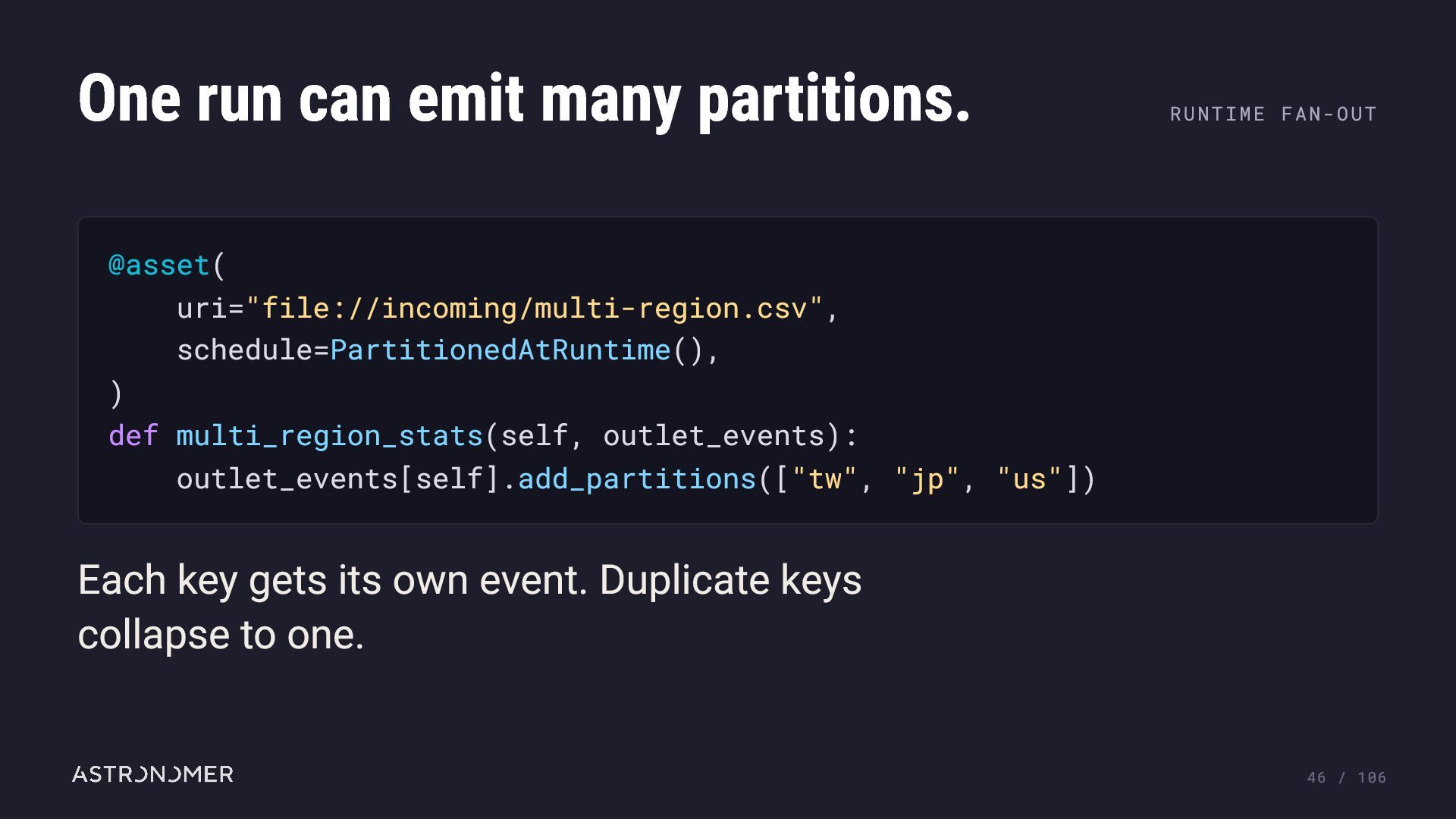
  17. One run can emit many partitions. @asset( uri="file://incoming/multi-region.csv", schedule=PartitionedAtRuntime(), )

    def multi_region_stats(self, outlet_events): outlet_events[self].add_partitions(["tw", "jp", "us"]) Each key gets its own event. Duplicate keys collapse to one. 49 / 104
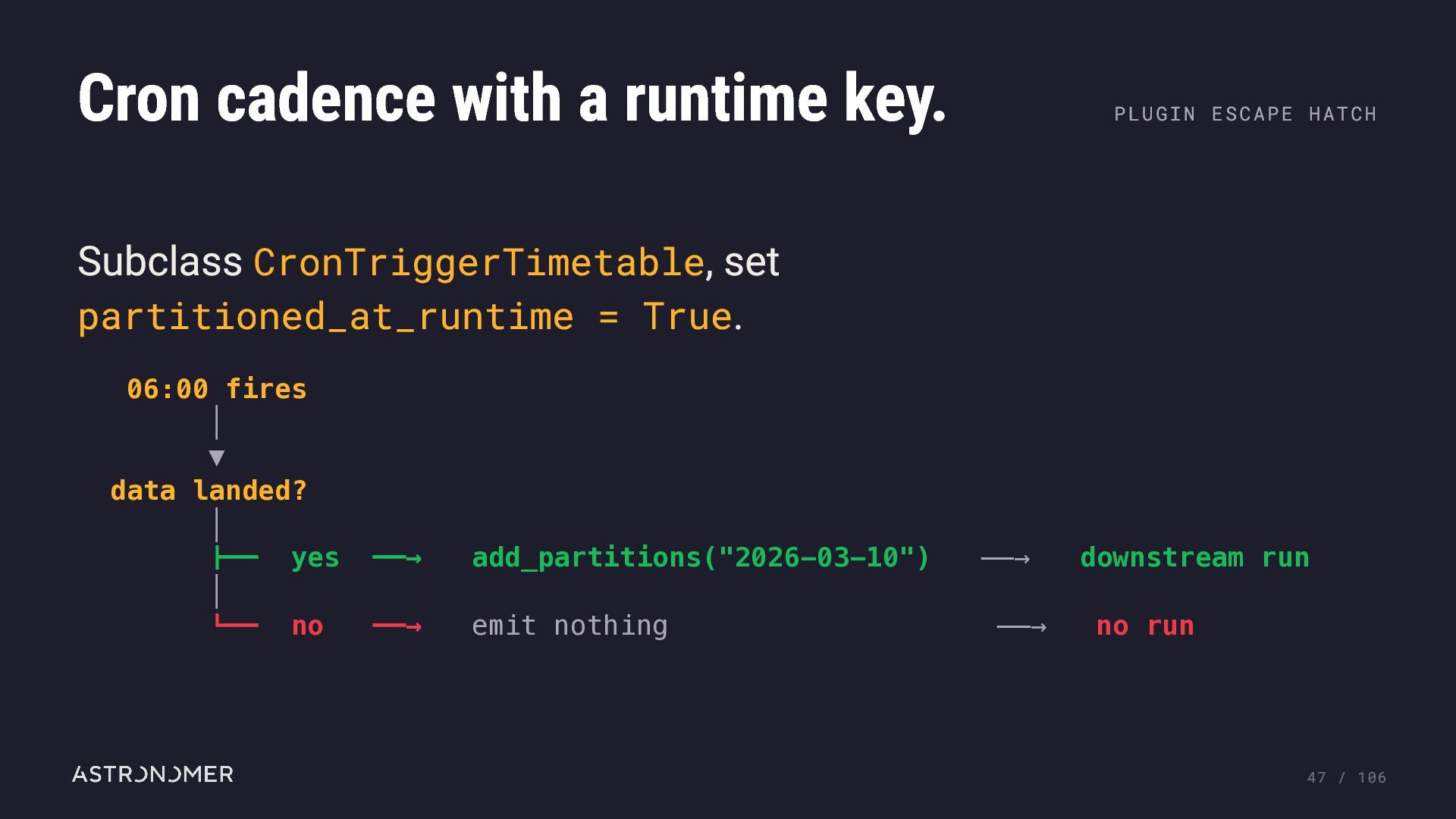
  18. Cron cadence with a runtime key. Subclass CronTriggerTimetable, set partitioned_at_runtime

    = True. 06:00 fires ▼ data landed? yes ──→ add_partitions("2026-03-10") ──→ downstream run no ──→ emit nothing ──→ no run 50 / 104
  19. 02 / 04 Mappings How upstream slices match downstream runs.

    DEFINITIONS MAPPINGS COMPLETENESS BACKFILLS ADOPTING IT 53 / 104
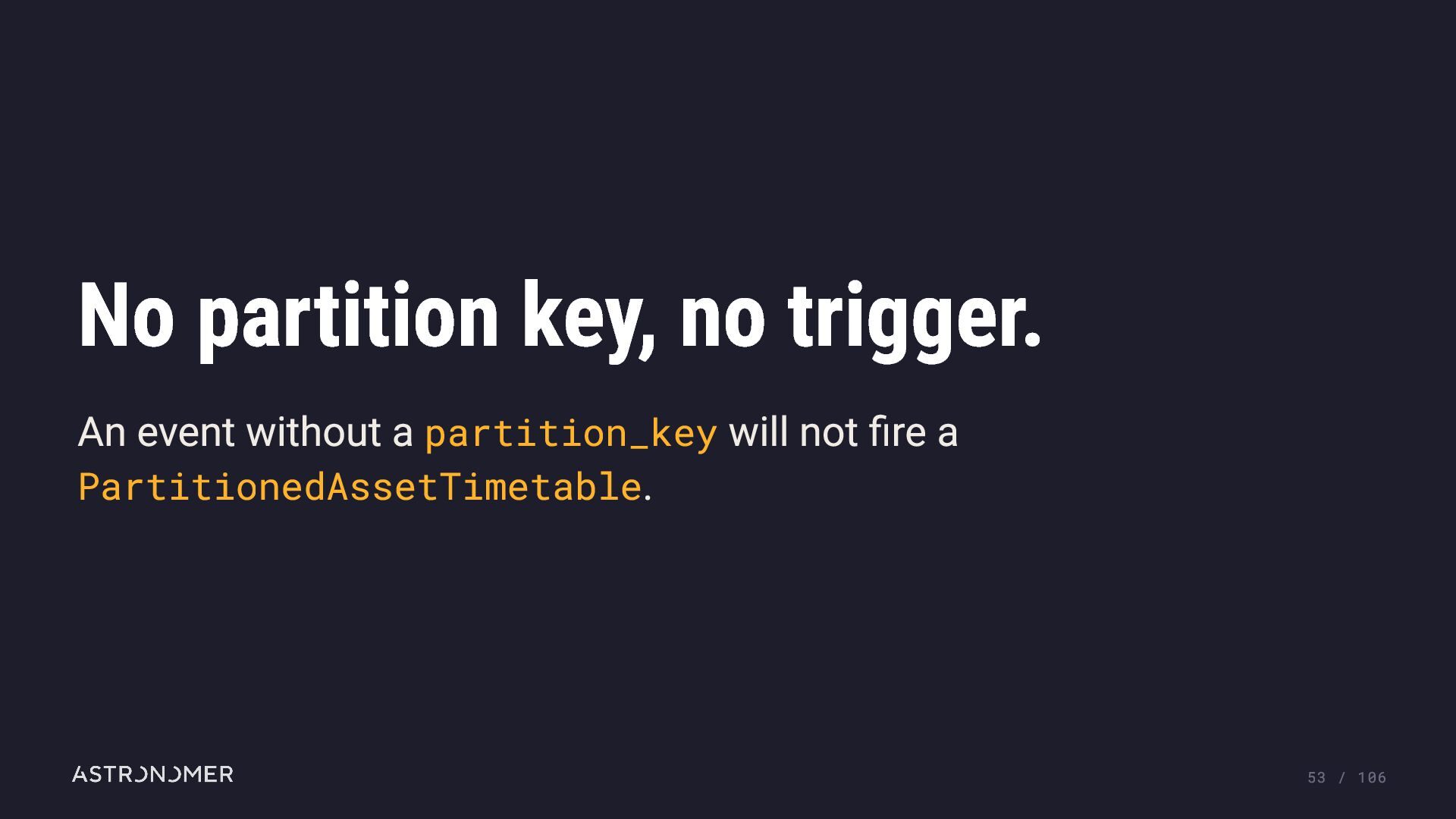
  20. No partition key, no trigger. An event without a partition_key

    will not fire a PartitionedAssetTimetable. 55 / 104
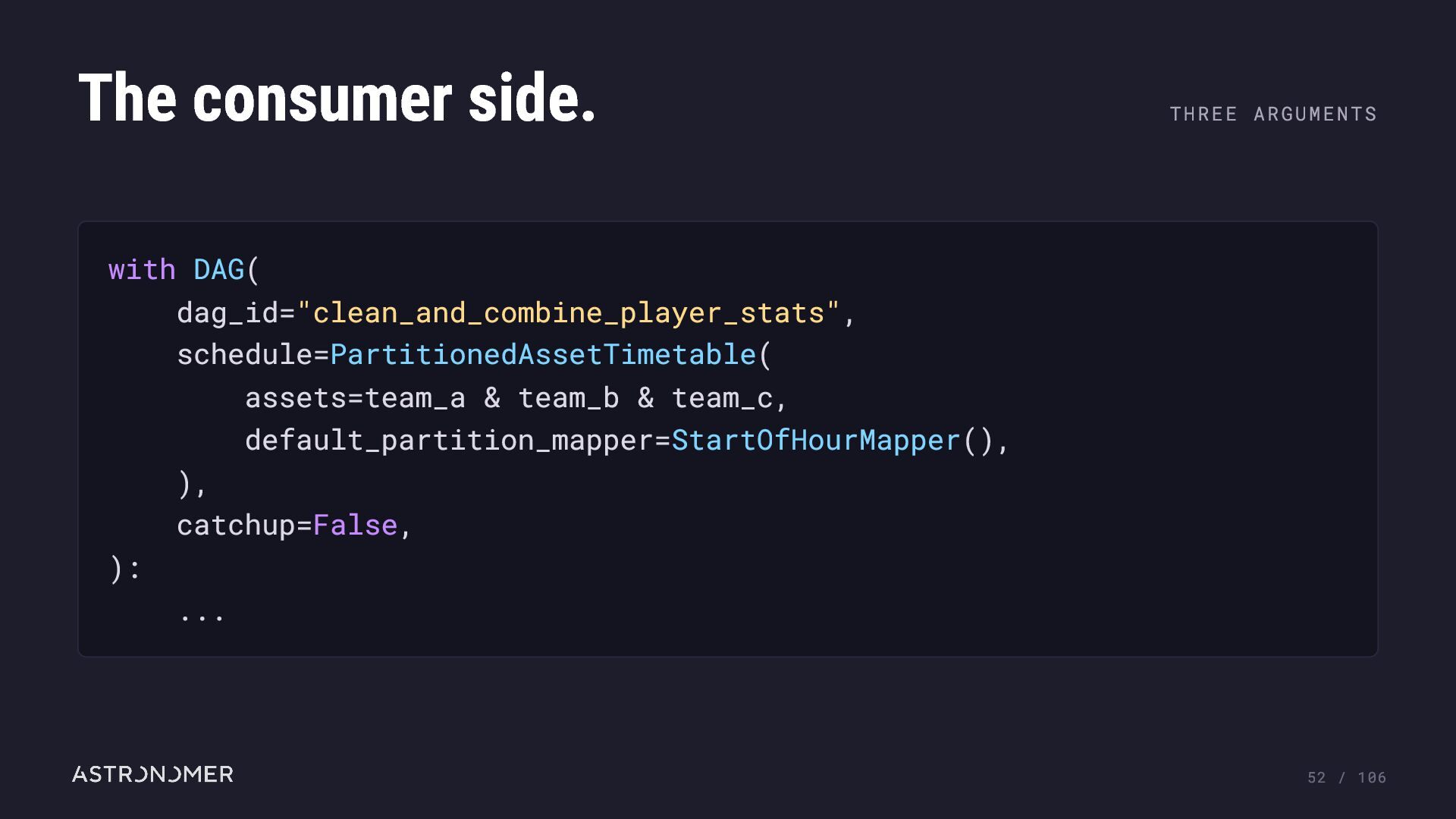
  21. The consumer side. with DAG( dag_id="clean_and_combine_player_stats", schedule=PartitionedAssetTimetable( assets=team_a & team_b

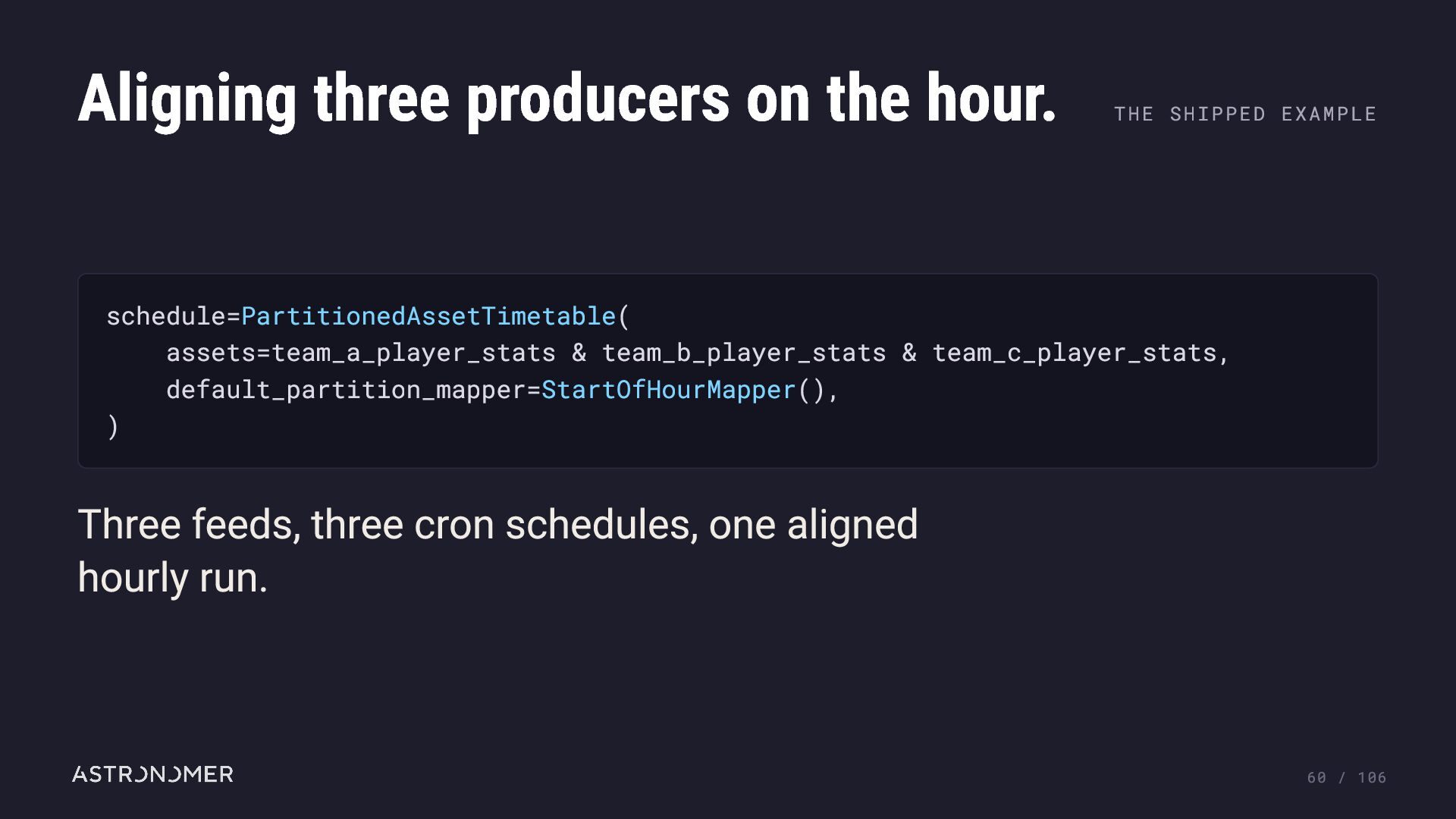
    & team_c, default_partition_mapper=StartOfHourMapper(), ), catchup=False, ): ... 56 / 104
  22. Why a mapper at all? hourly_sales emits daily_summary wants 2026-03-10T09:00:00

    │ │ a mapper translates ▼ 2026-03-10 The producer names its own slice. The consumer needs a different name for it. 57 / 104
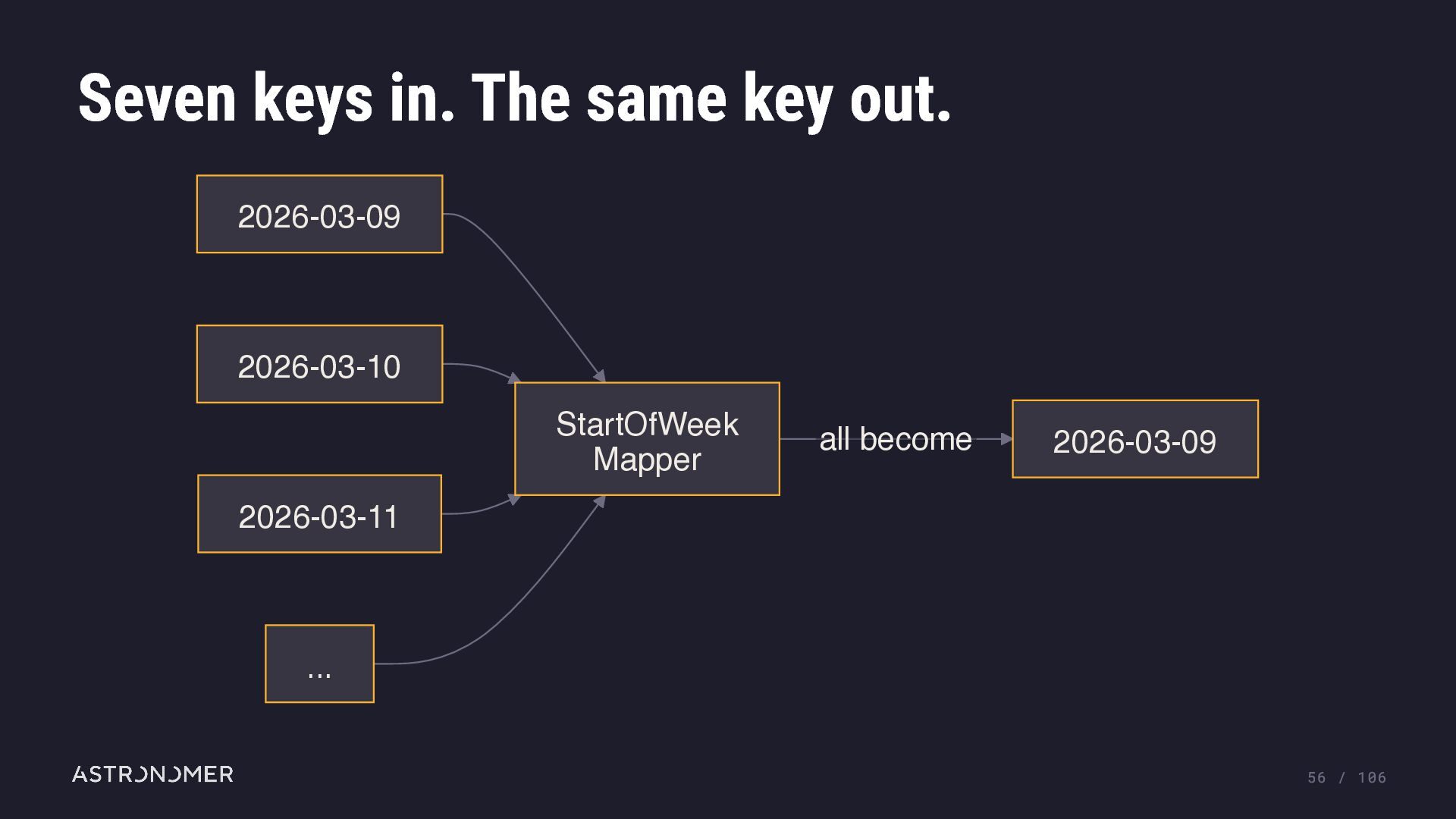
  23. Seven keys in. The same key out. 2026-03-09 2026-03-10 StartOfWeek

    Mapper all become 2026-03-09 2026-03-11 ... 61 / 104
  24. It does not wait for all seven. The first key

    to arrive already produces the weekly key — and fires the run. 62 / 104
  25. The rule. A mapper maps an upstream key to a

    downstream key. The run fires when every required upstream asset yields the same downstream key. 63 / 104
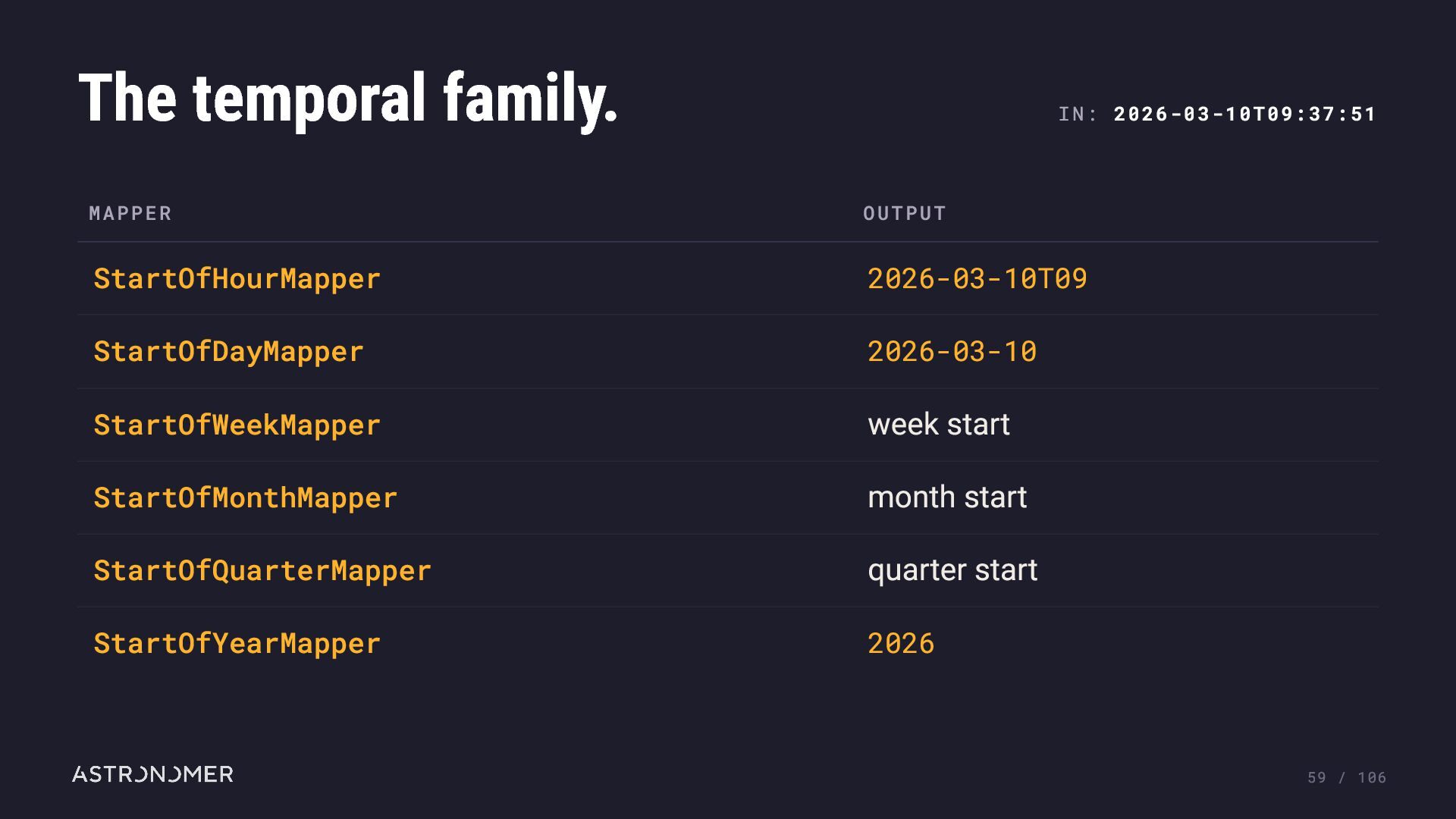
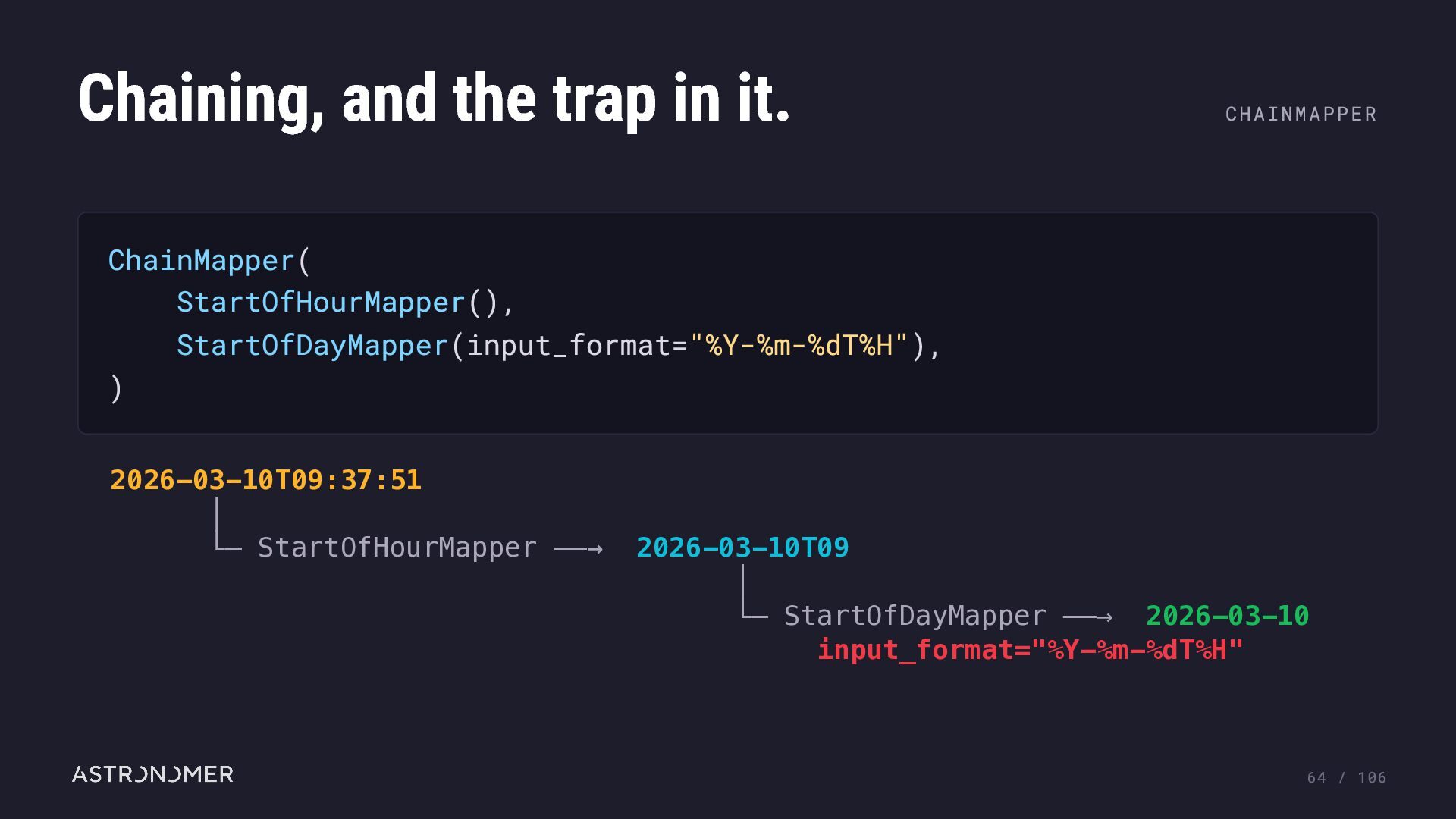
  26. Time-based mappers. MAPPER 2026-03-10T09:37:51 BECOMES StartOfHourMapper 2026-03-10T09 StartOfDayMapper 2026-03-10 StartOfWeekMapper

    2026-03-09 (W11) StartOfMonthMapper 2026-03 StartOfQuarterMapper 2026-Q1 StartOfYearMapper 2026 64 / 104
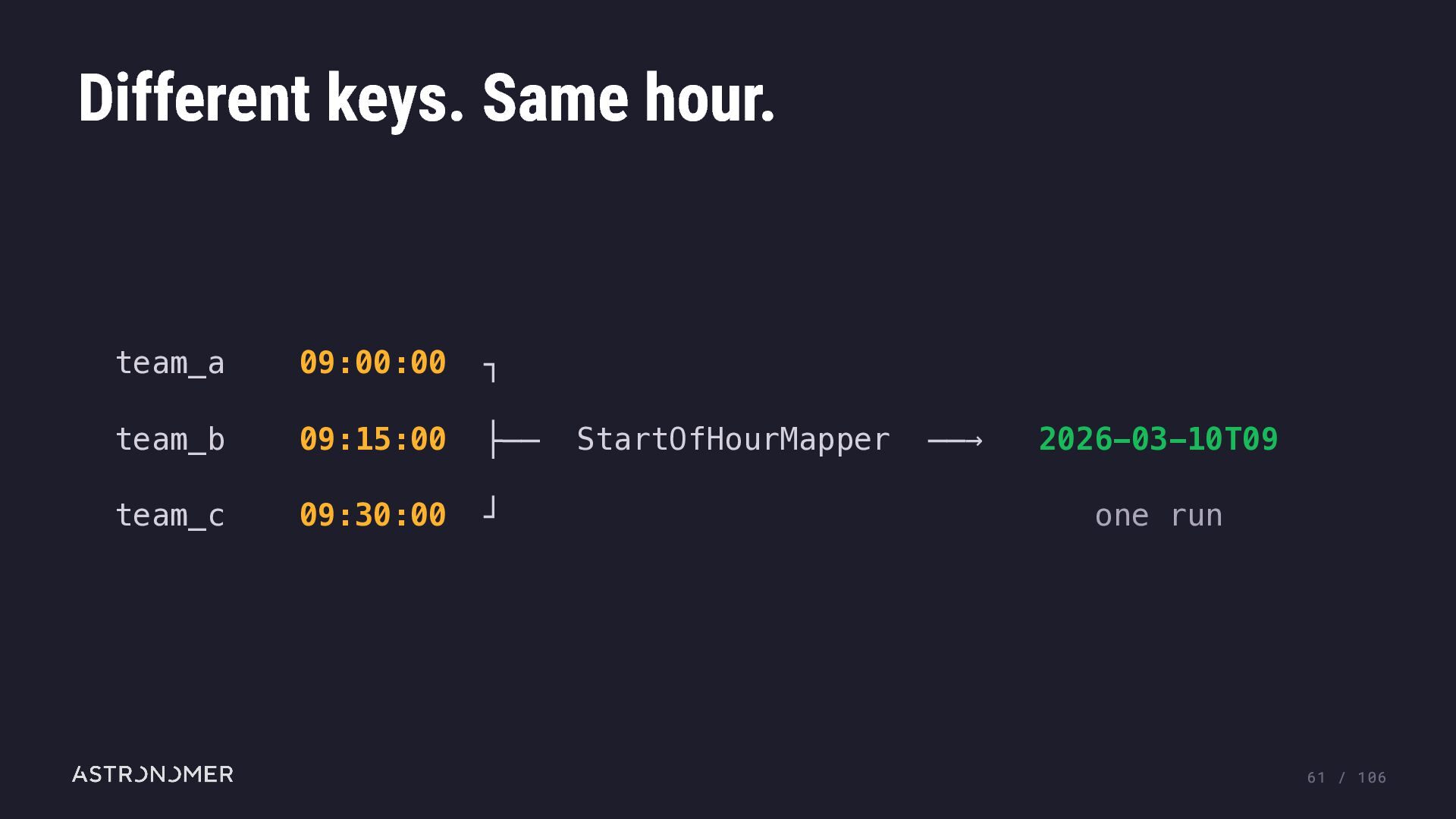
  27. Different keys. Same hour. team_a 09:00:00 ┐ team_b 09:15:00 ├──

    team_c 09:30:00 ┘ StartOfHourMapper ──→ 2026-03-10T09 3 feeds, 3 cron schedules, 1 aligned hourly run. 65 / 104
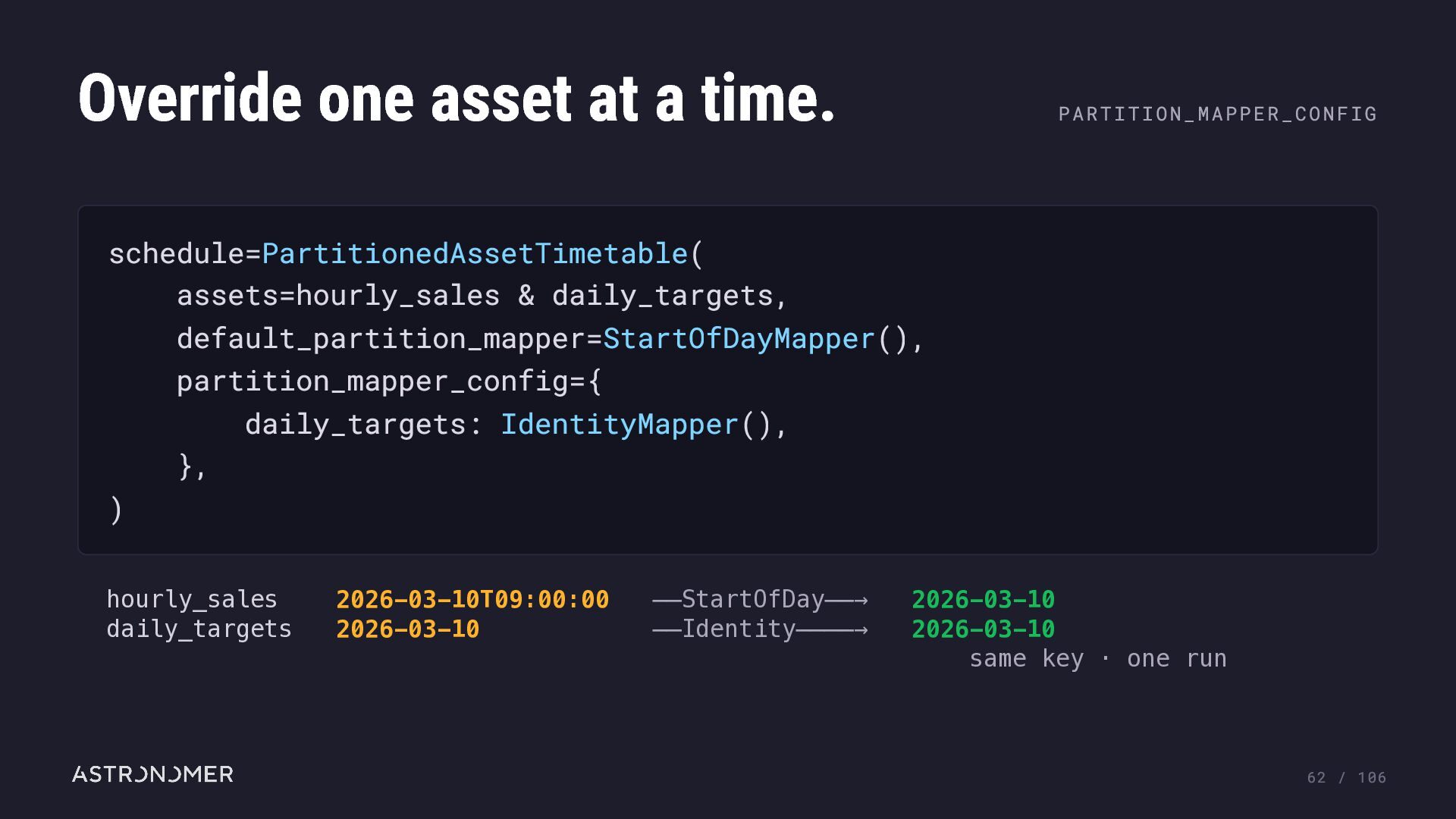
  28. Override one asset at a time. schedule=PartitionedAssetTimetable( assets=hourly_sales & daily_targets,

    default_partition_mapper=StartOfDayMapper(), partition_mapper_config={ daily_targets: IdentityMapper(), }, ) hourly_sales daily_targets 2026-03-10T09:00:00 2026-03-10 ──StartOfDay──→ ──Identity────→ 2026-03-10 2026-03-10 66 / 104
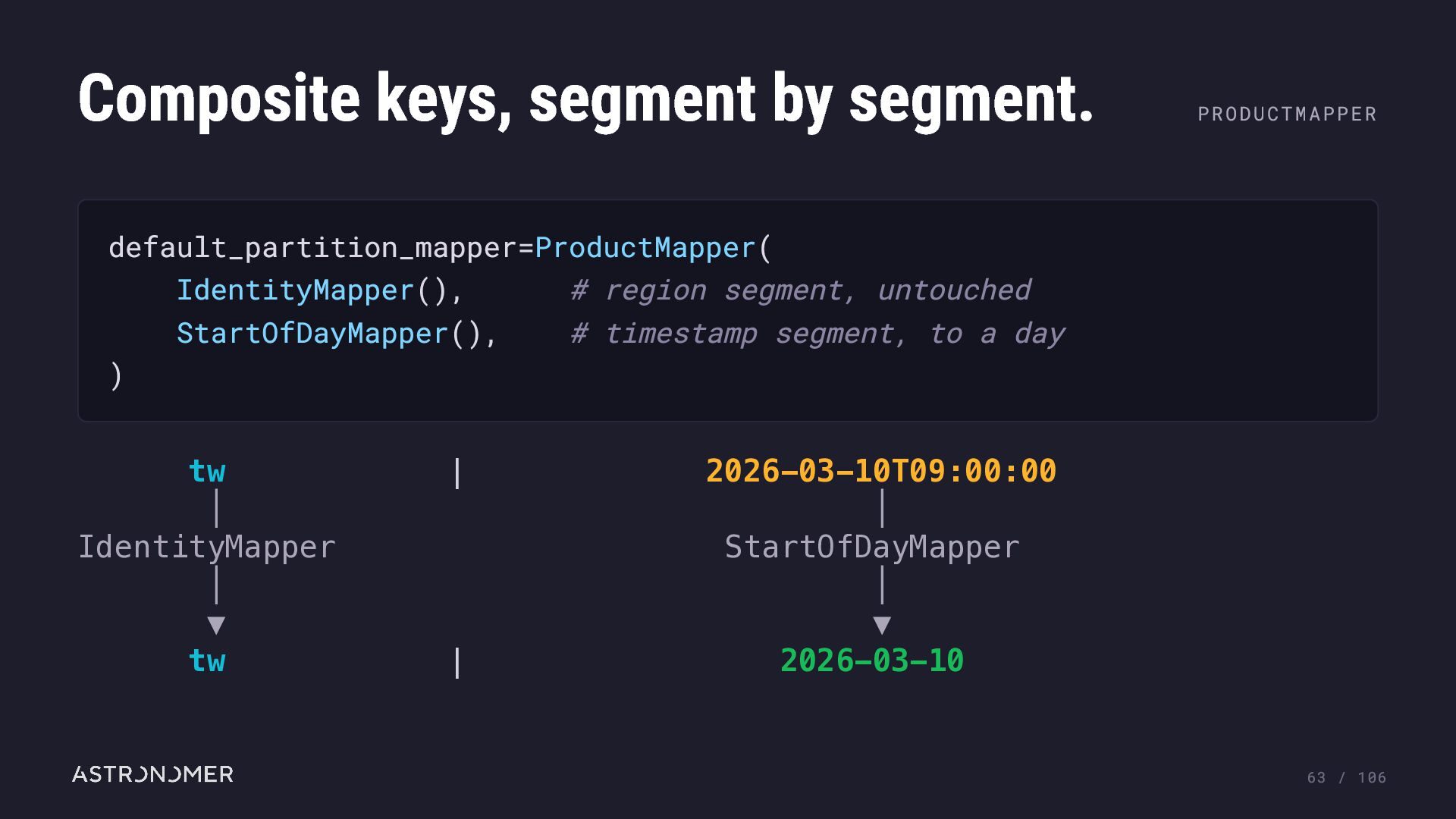
  29. Composite keys, segment by segment. default_partition_mapper=ProductMapper( IdentityMapper(), # region segment,

    untouched StartOfDayMapper(), # timestamp segment, to a day ) ┌─────────────────────────────────────────────────────┐ tw | 2026-03-10T09:00:00 └─────────────────────────────────────────────────────┘ IdentityMapper StartOfDayMapper ▼ ▼ ┌─────────────────────────────────────────────────────┐ tw | 2026-03-10 └─────────────────────────────────────────────────────┘ 67 / 104
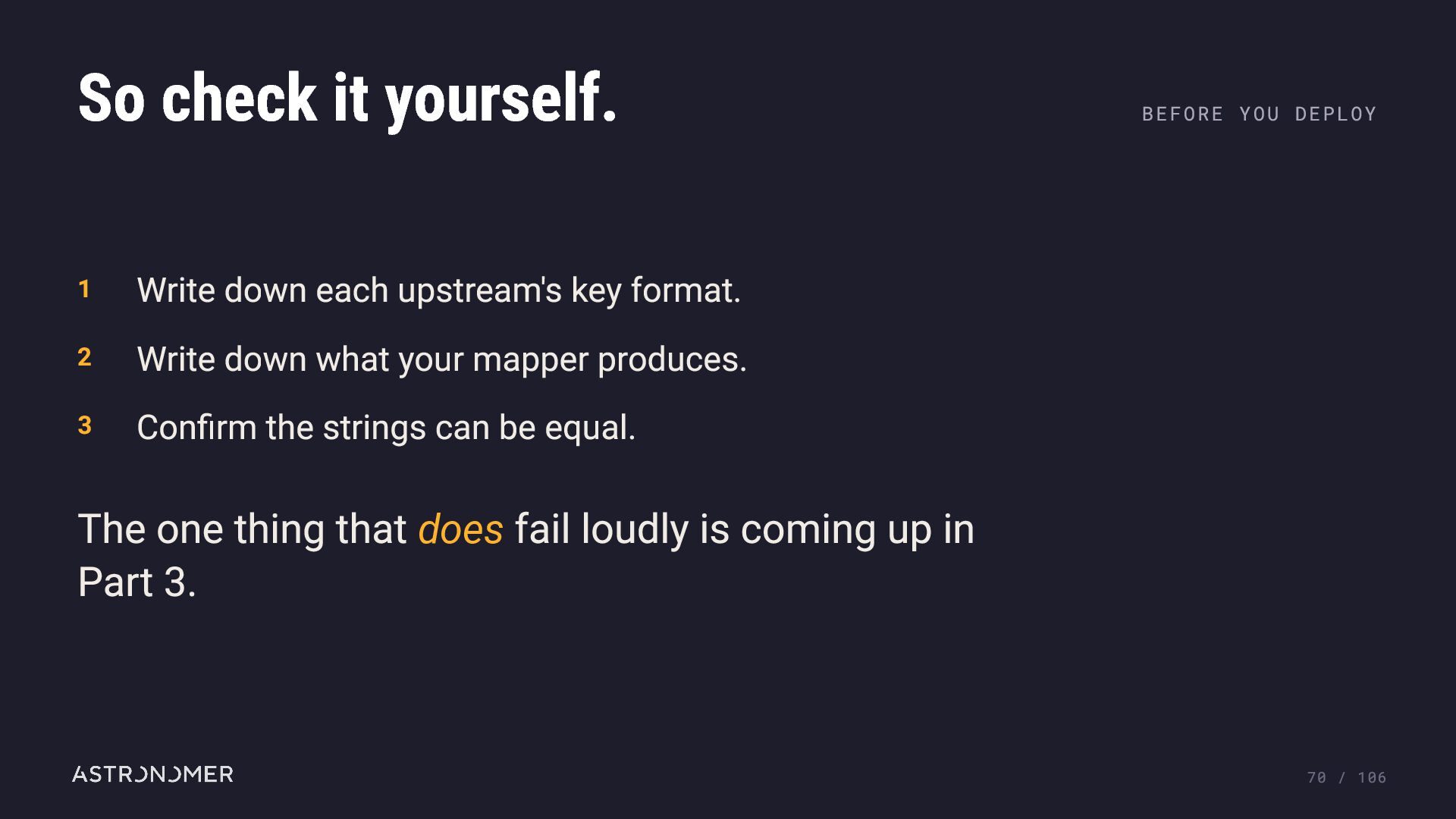
  30. So check it yourself. 1 Write down each upstream's key

    format. 2 Write down what your mapper produces. 3 Confirm the strings can be equal. 69 / 104
  31. A trigger no longer just means "the Dag ran". It

    also means "my slice is ready". 70 / 104
  32. 03 / 04 Completeness When is a slice actually done?

    DEFINITIONS MAPPINGS COMPLETENESS BACKFILLS ADOPTING IT 71 / 104
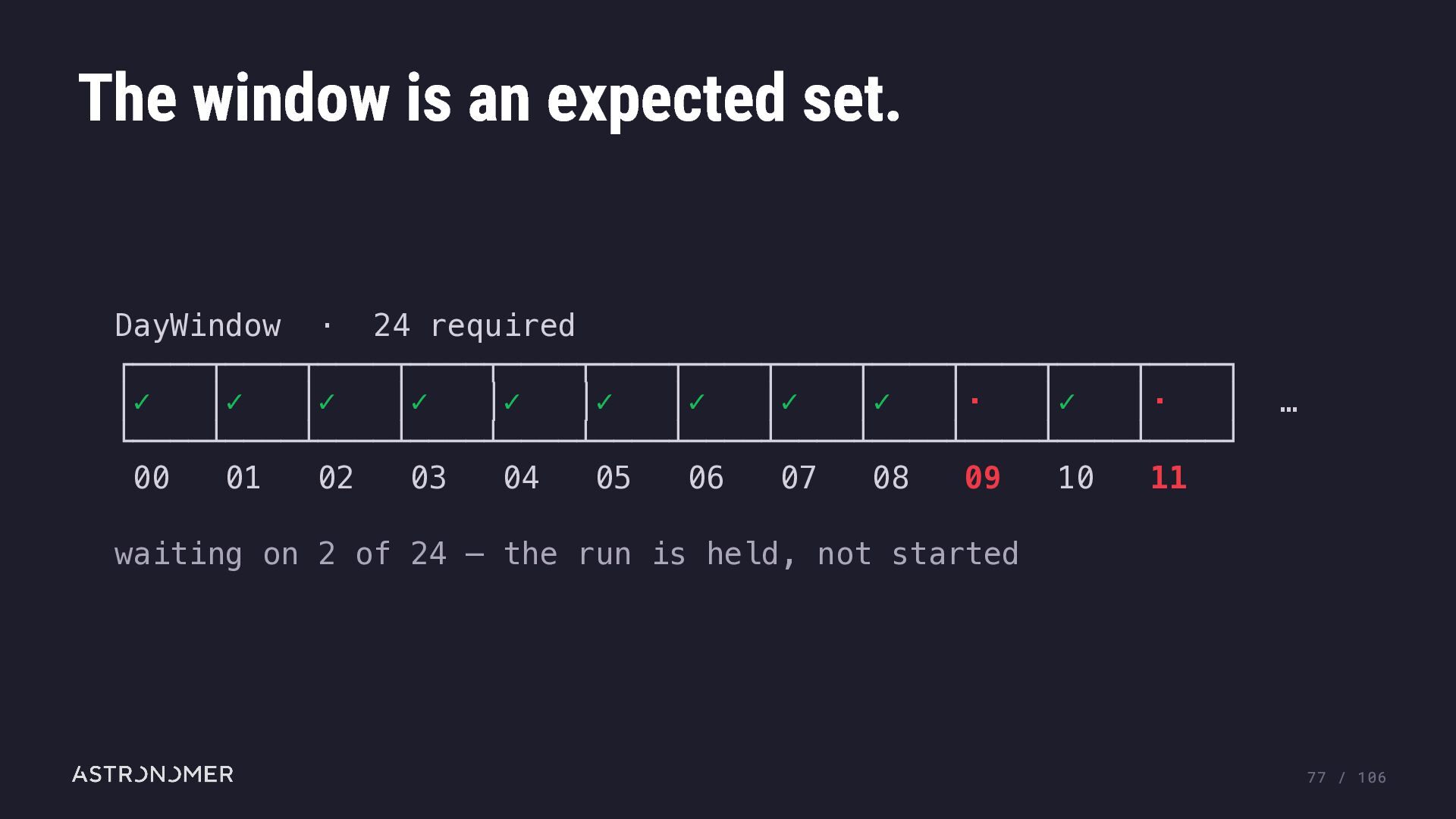
  33. The window is an expected set. DayWindow · 24 required

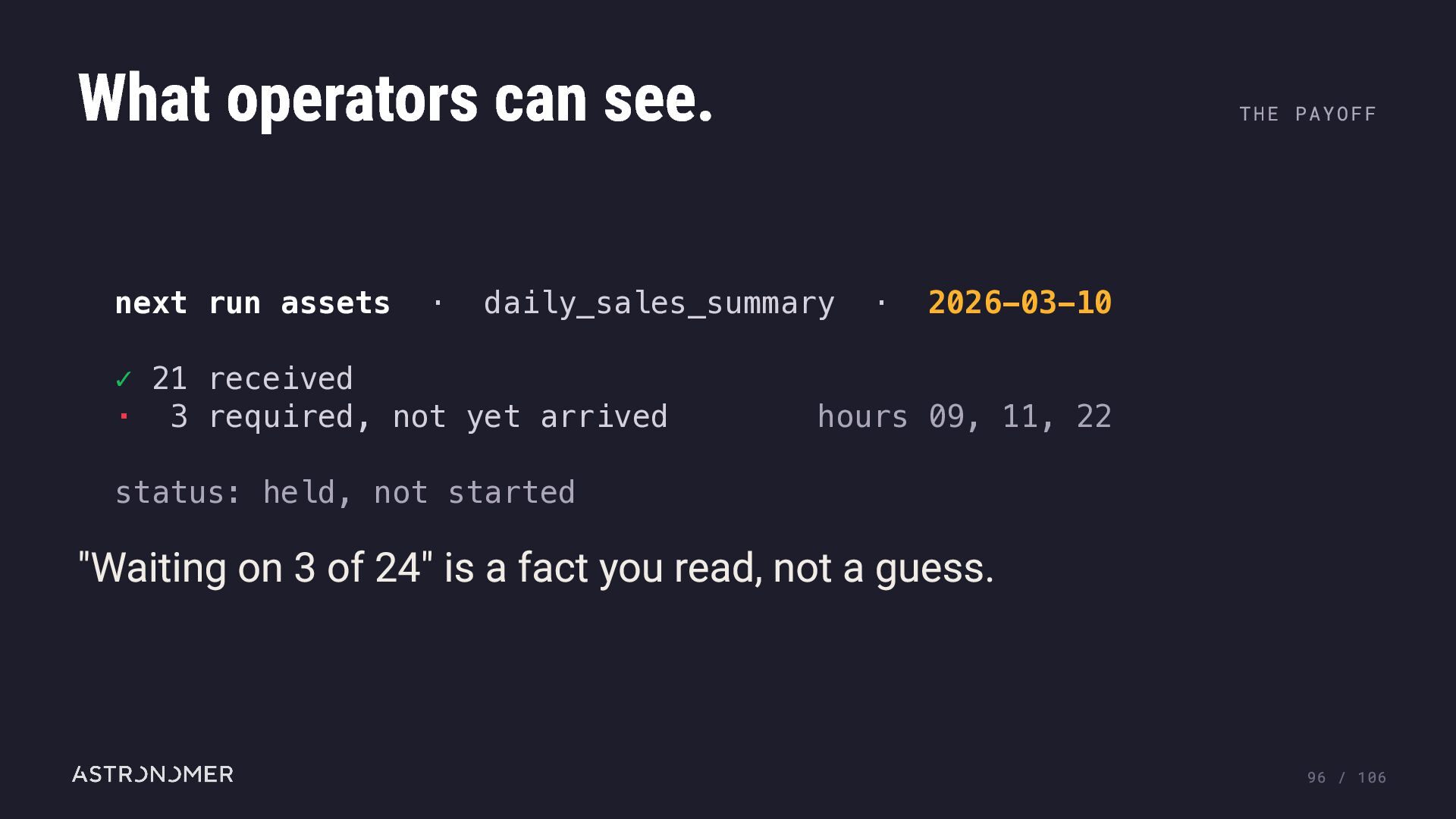
    ┌────┬────┬────┬────┬────┬────┬────┬────┬────┬────┬────┬────┐ │✓ │✓ │✓ │✓ │✓ │✓ │✓ │✓ │✓ │· │✓ │· │ └────┴────┴────┴────┴────┴────┴────┴────┴────┴────┴────┴────┘ 00 01 02 03 04 05 06 07 08 09 10 11 … waiting on 2 of 24 — the run is held, not started 74 / 104
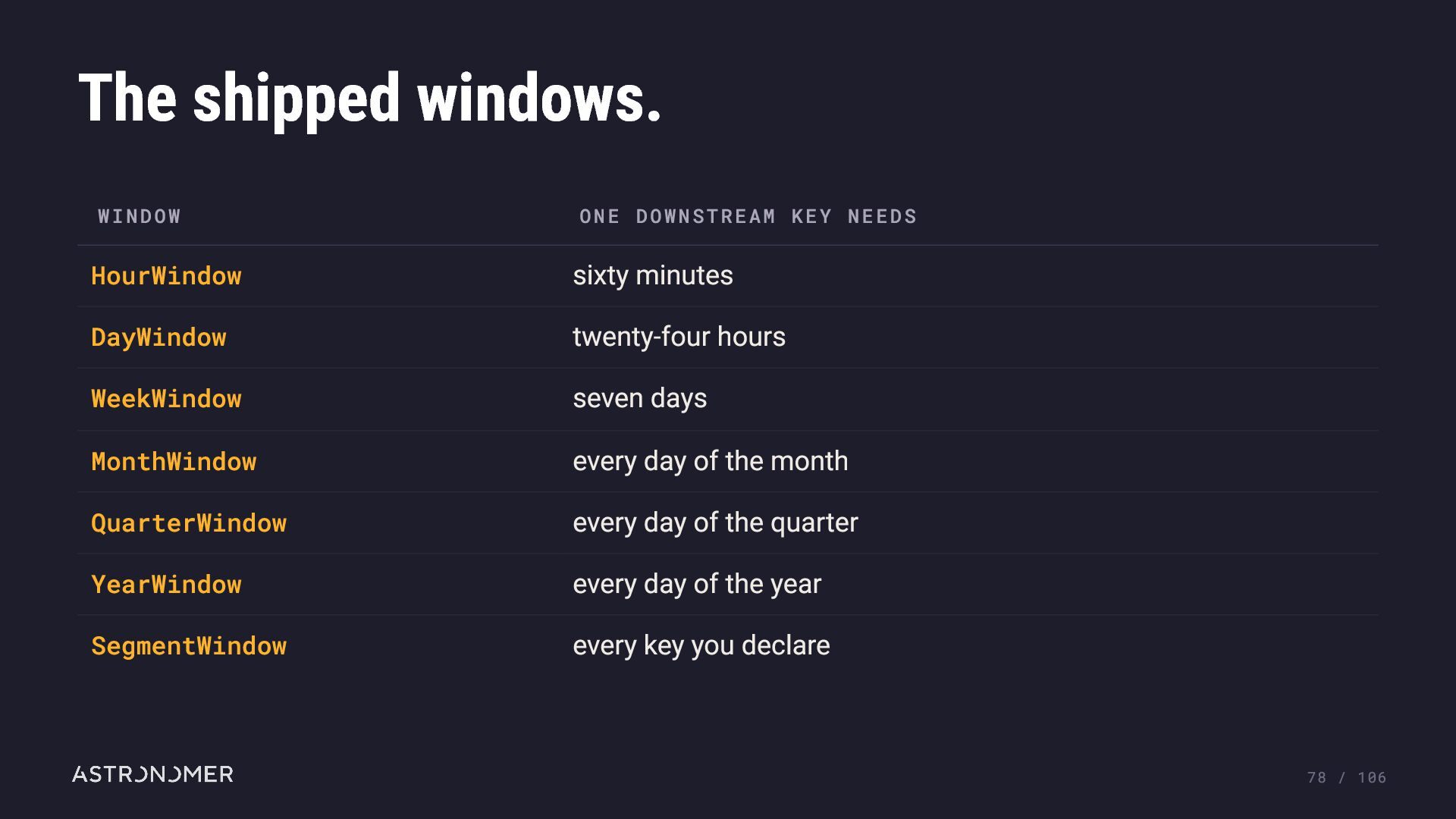
  34. The shipped windows. WINDOW ONE DOWNSTREAM KEY NEEDS HourWindow sixty

    minutes DayWindow twenty-four hours WeekWindow seven days MonthWindow every day of the month QuarterWindow every day of the quarter YearWindow every day of the year SegmentWindow every key you declare 75 / 104
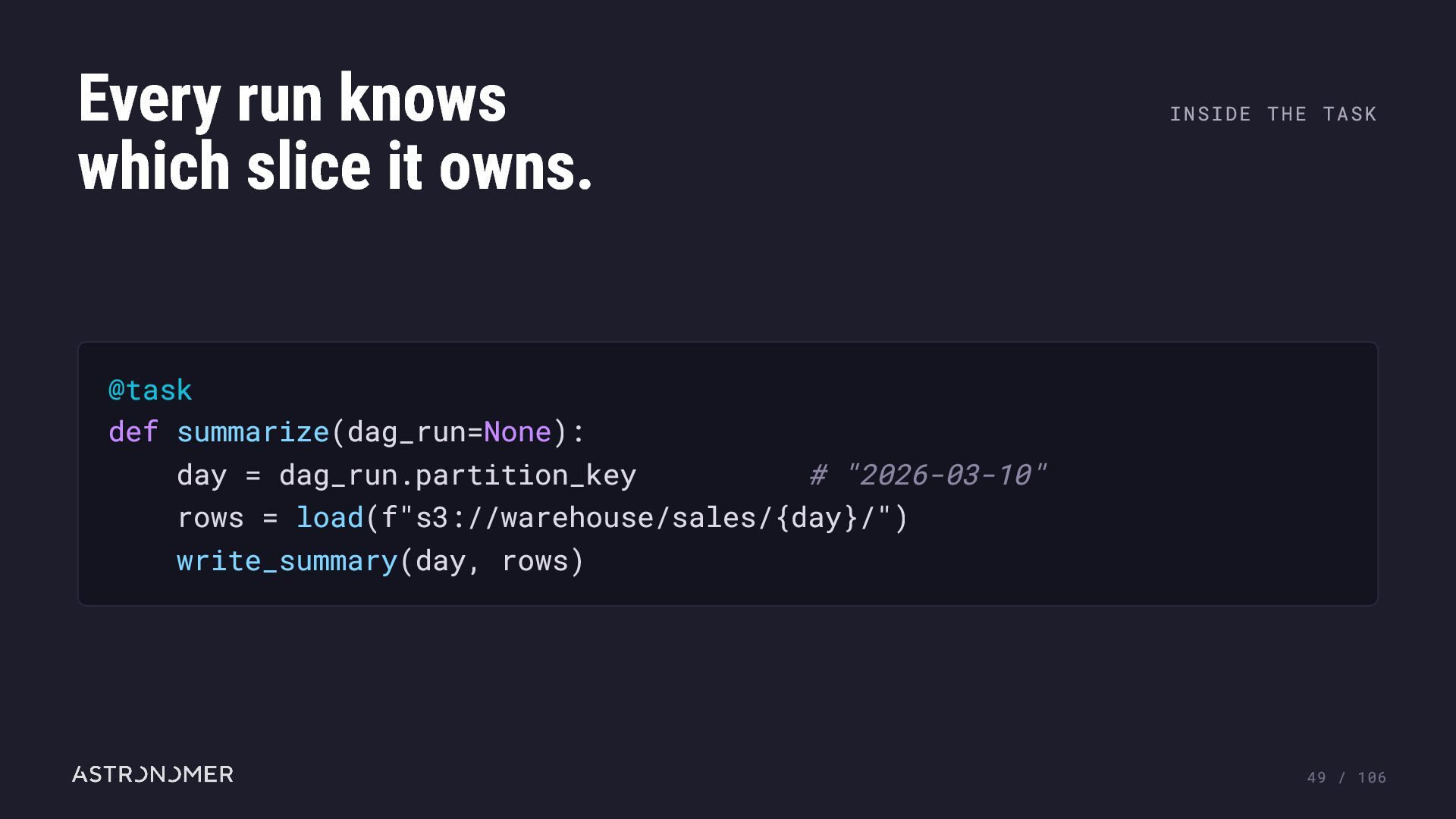
  35. And the run can see what fed it. @task def

    summarize(*, triggering_asset_events, dag_run=None): day = dag_run.partition_key # "2026-03-10" hours = [e.partition_key for e in triggering_asset_events[hourly_sales]] 77 / 104
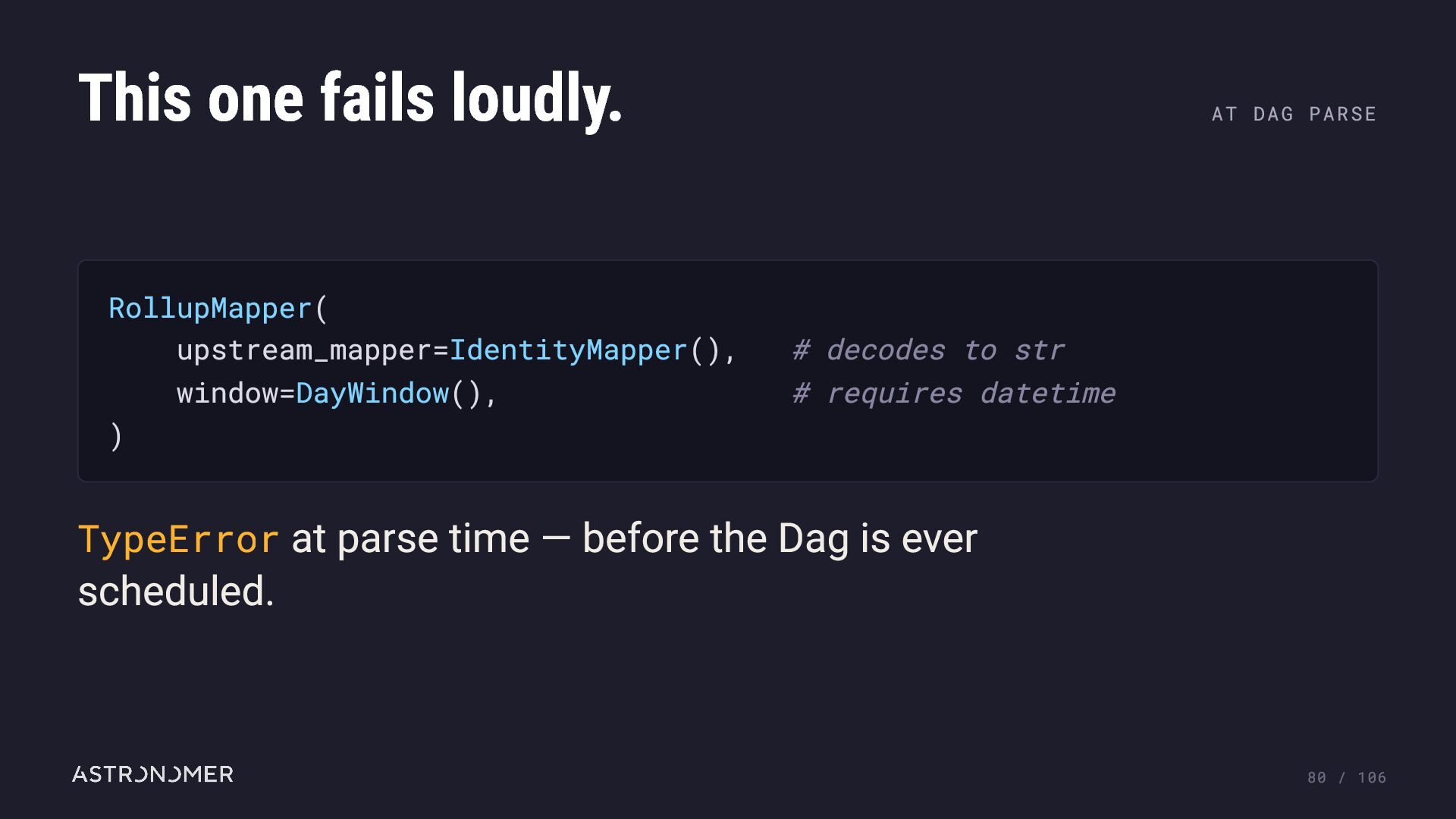
  36. This one fails loudly. RollupMapper( upstream_mapper=IdentityMapper(), window=DayWindow(), ) # decodes

    to str # requires datetime TypeError at parse time — before the Dag is ever scheduled. 78 / 104
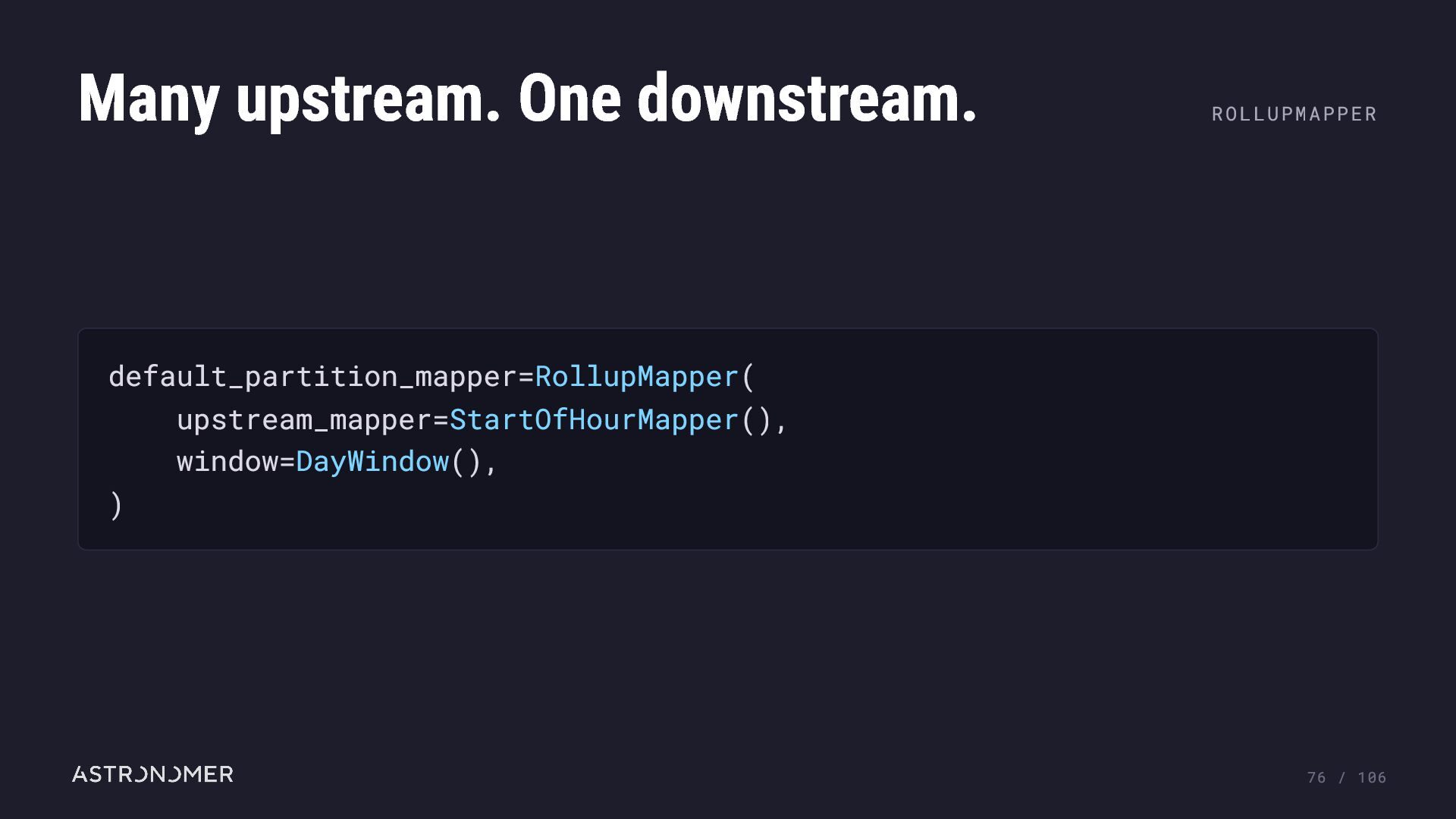
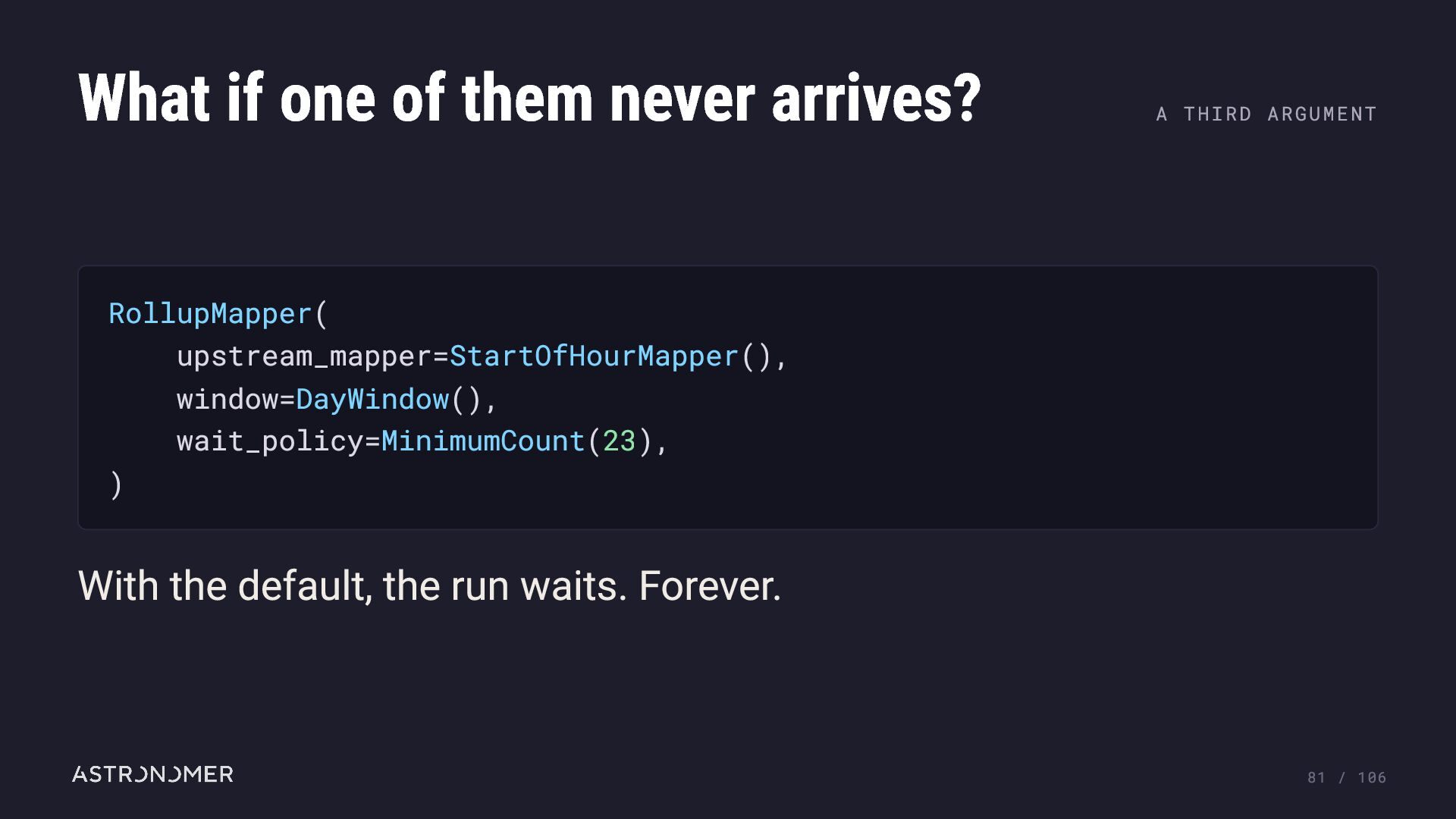
  37. What if one of them never arrives? RollupMapper( upstream_mapper=StartOfHourMapper(), window=DayWindow(),

    wait_policy=MinimumCount(23), ) With the default, the run waits. Forever. 79 / 104
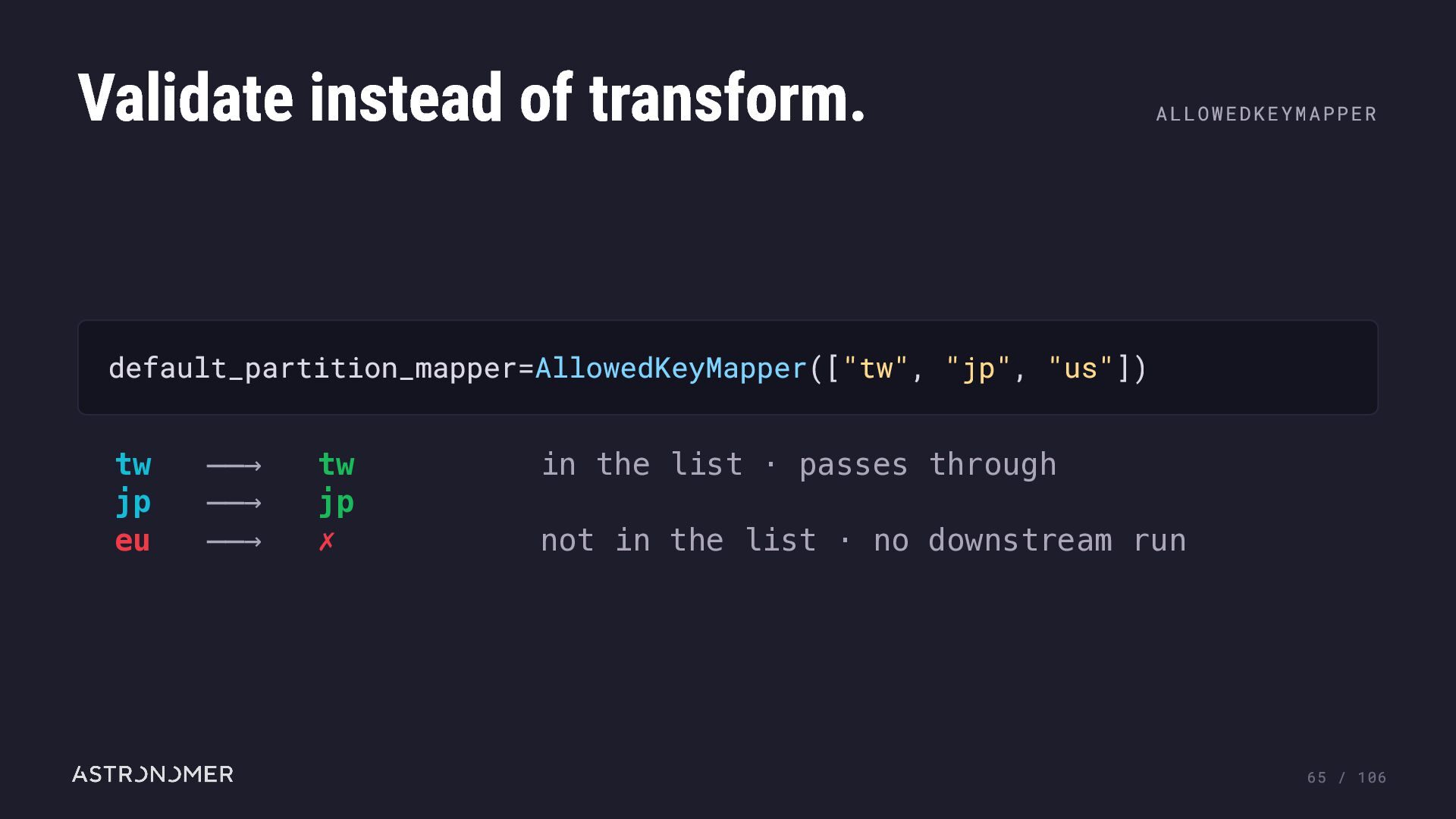
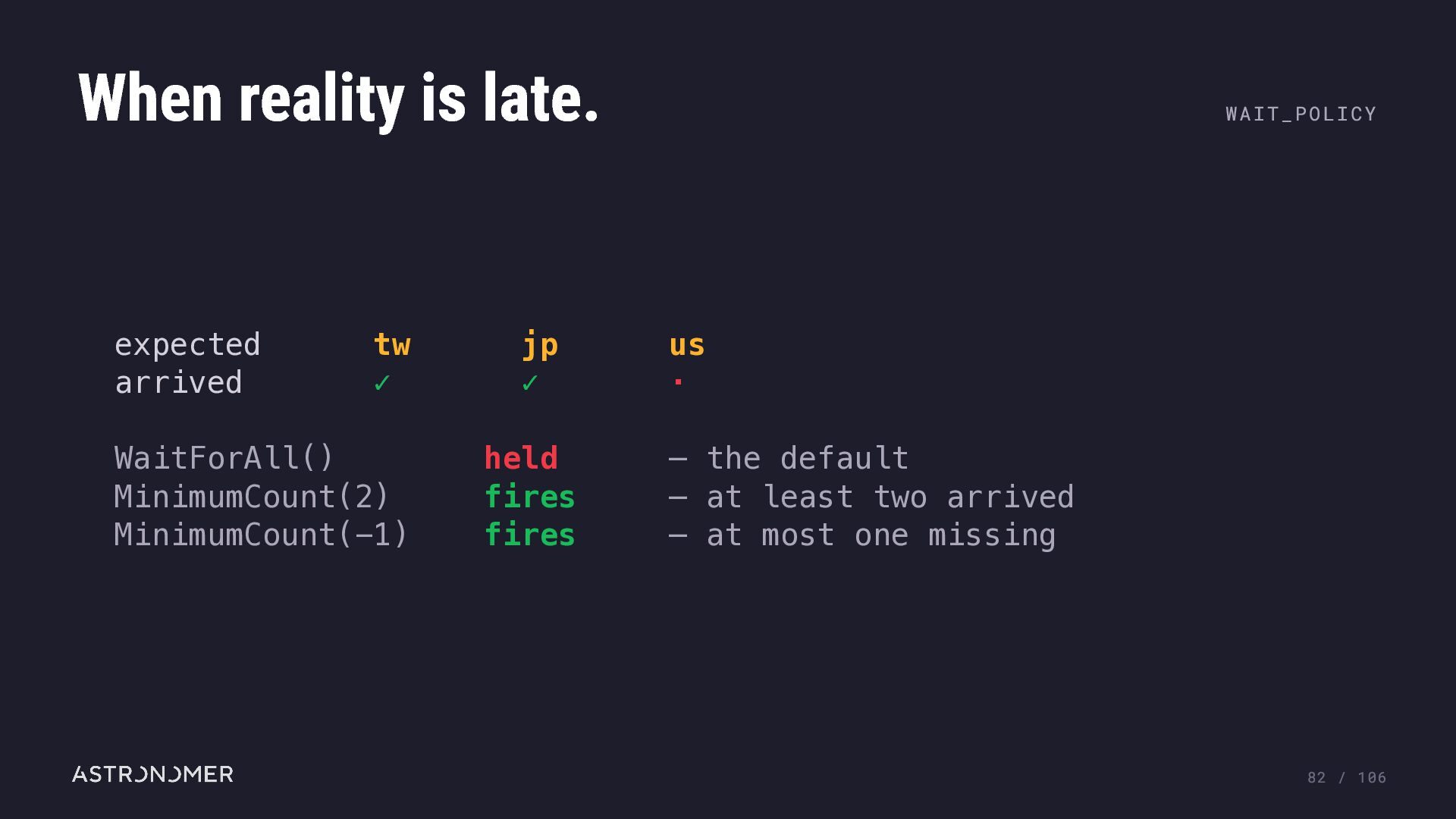
  38. When reality is late. expected arrived tw ✓ jp ✓

    WaitForAll() MinimumCount(2) MinimumCount(-1) held fires fires us · — the default — at least two arrived — at most one missing 80 / 104
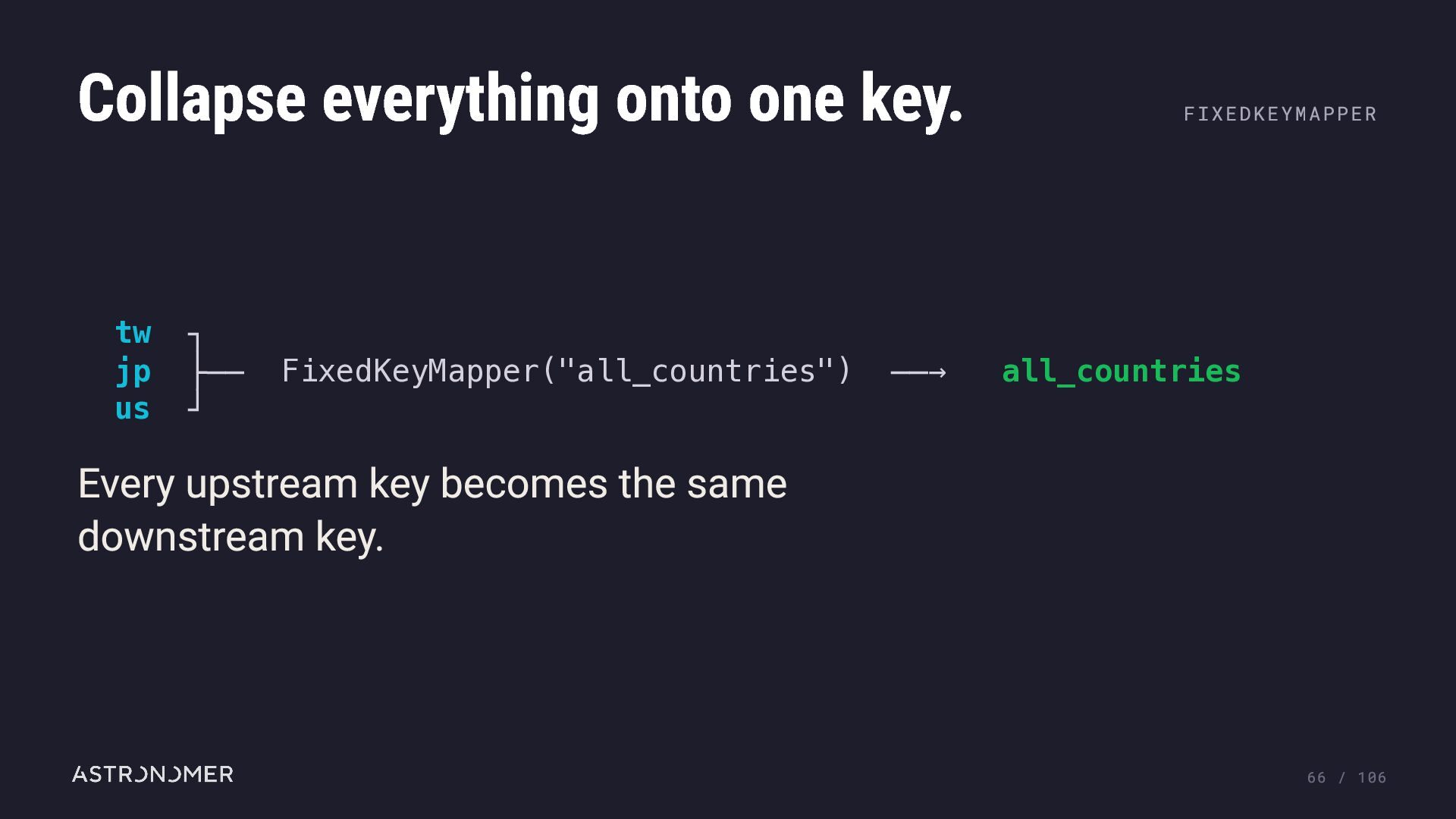
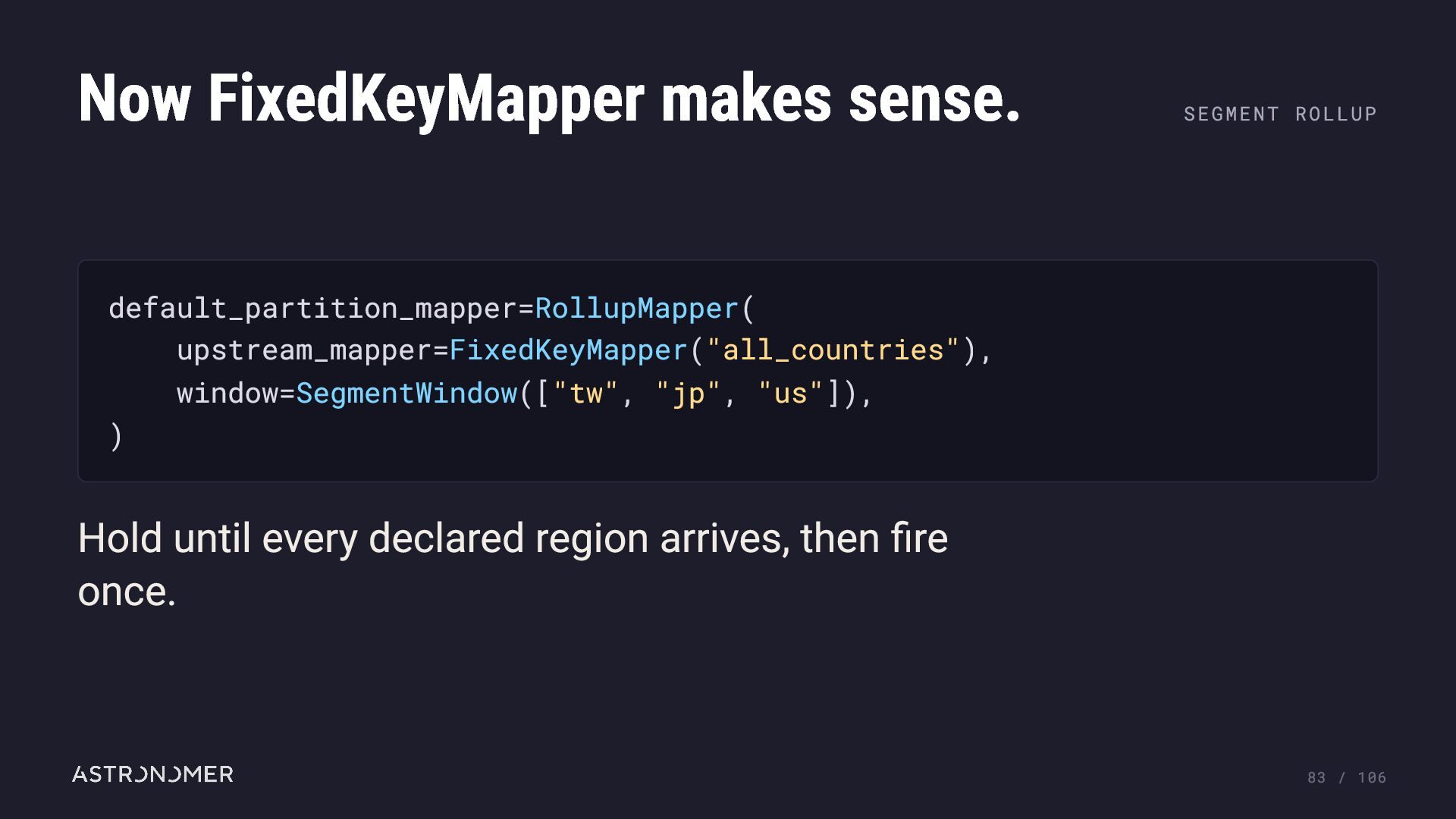
  39. Roll up a fixed set of names. tw jp us

    ┐ ├── ┘ FixedKeyMapper("all_countries") ──→ all_countries default_partition_mapper=RollupMapper( upstream_mapper=FixedKeyMapper("all_countries"), window=SegmentWindow(["tw", "jp", "us"]), ) Hold until every declared region arrives, then fire once. 81 / 104
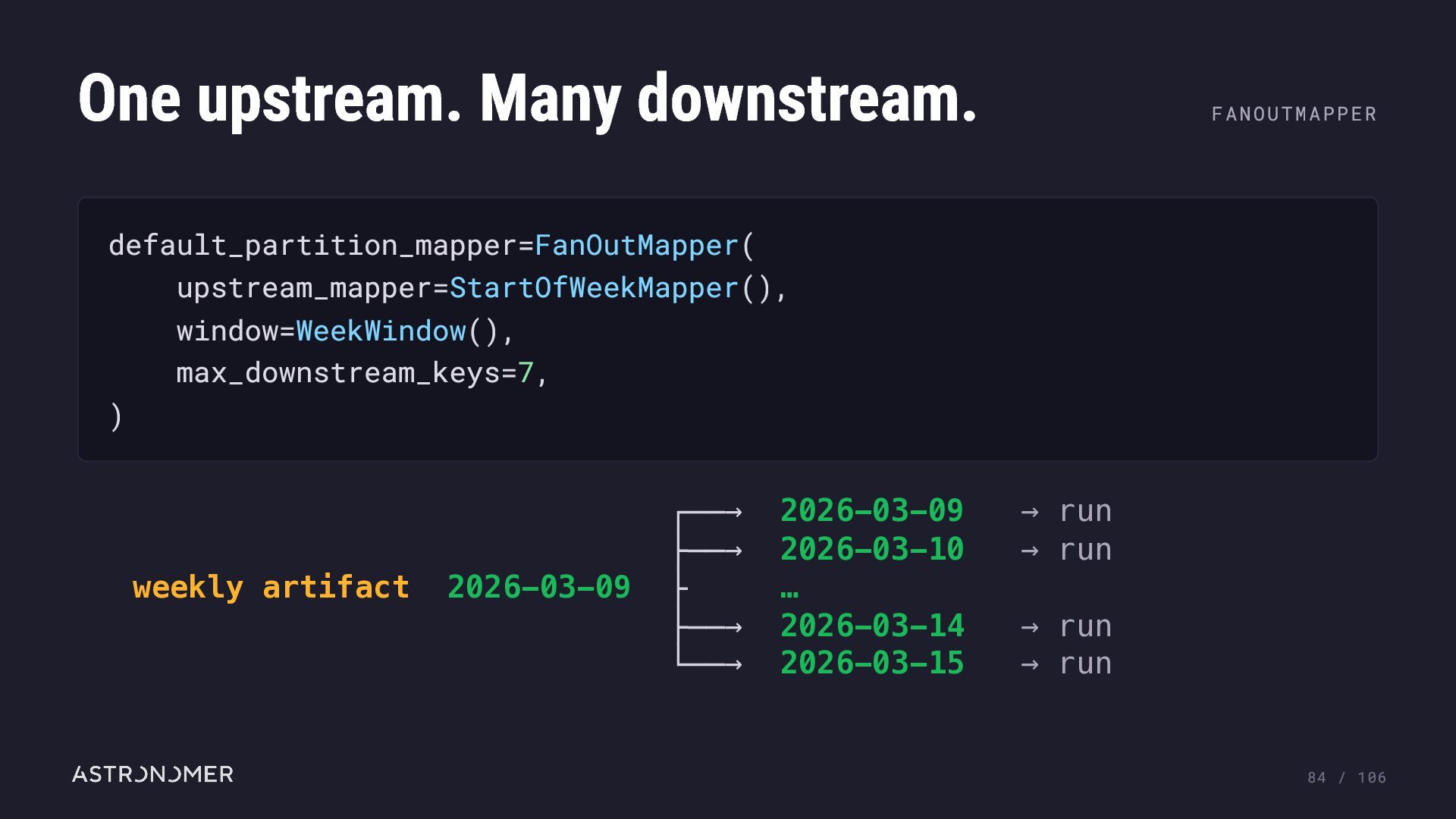
  40. One upstream. Many downstream. default_partition_mapper=FanOutMapper( upstream_mapper=StartOfWeekMapper(), window=WeekWindow(), max_downstream_keys=7, ) weekly

    artifact 2026-03-09 ┌──→ ├──→ ├ ├──→ └──→ 2026-03-09 2026-03-10 … 2026-03-14 2026-03-15 → run → run → run → run 82 / 104
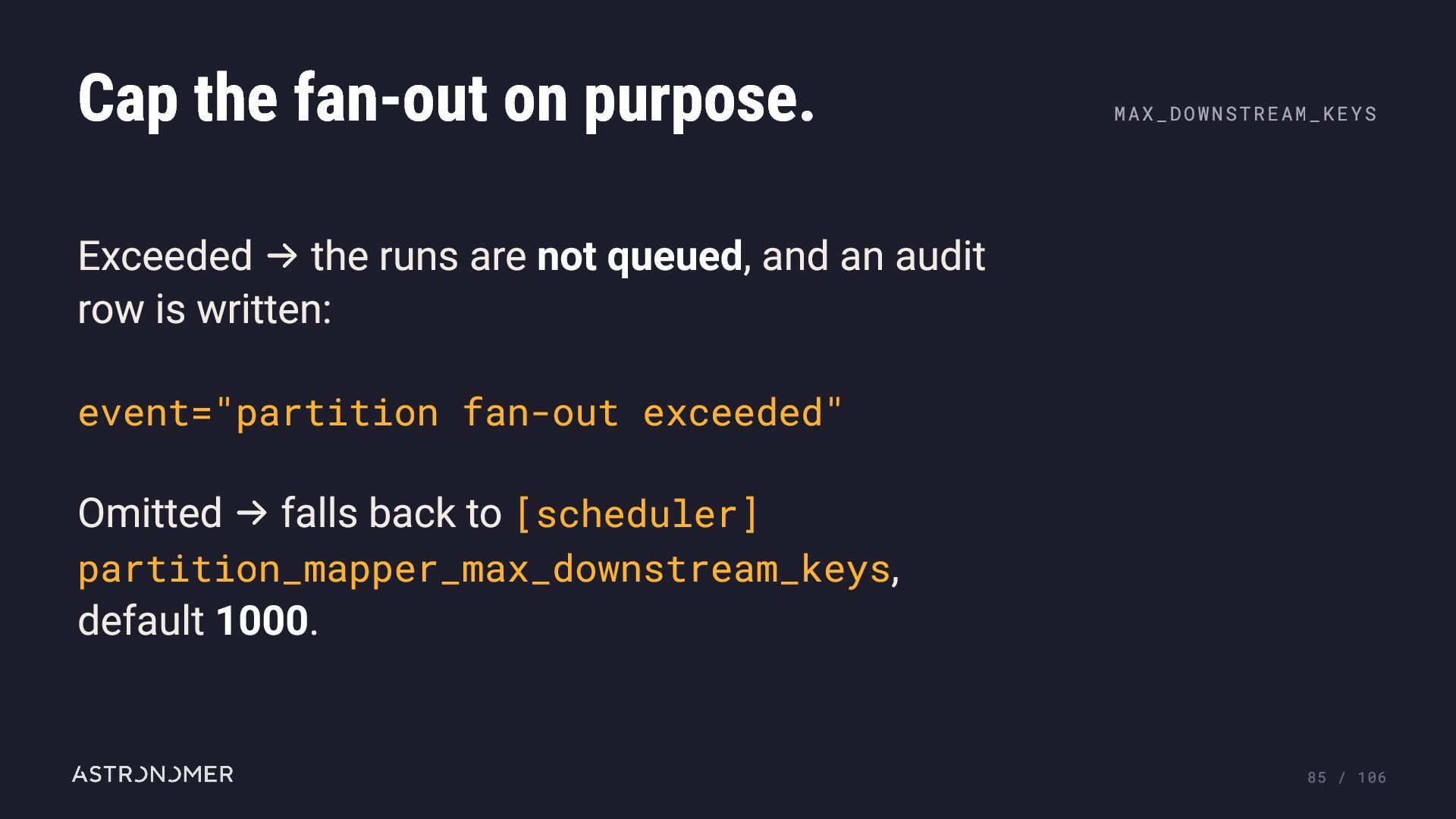
  41. Cap the fan-out on purpose. → the runs are not

    queued. Omitted → falls back to [scheduler] Exceeded partition_mapper_max_downstream_keys, default 1000. 83 / 104
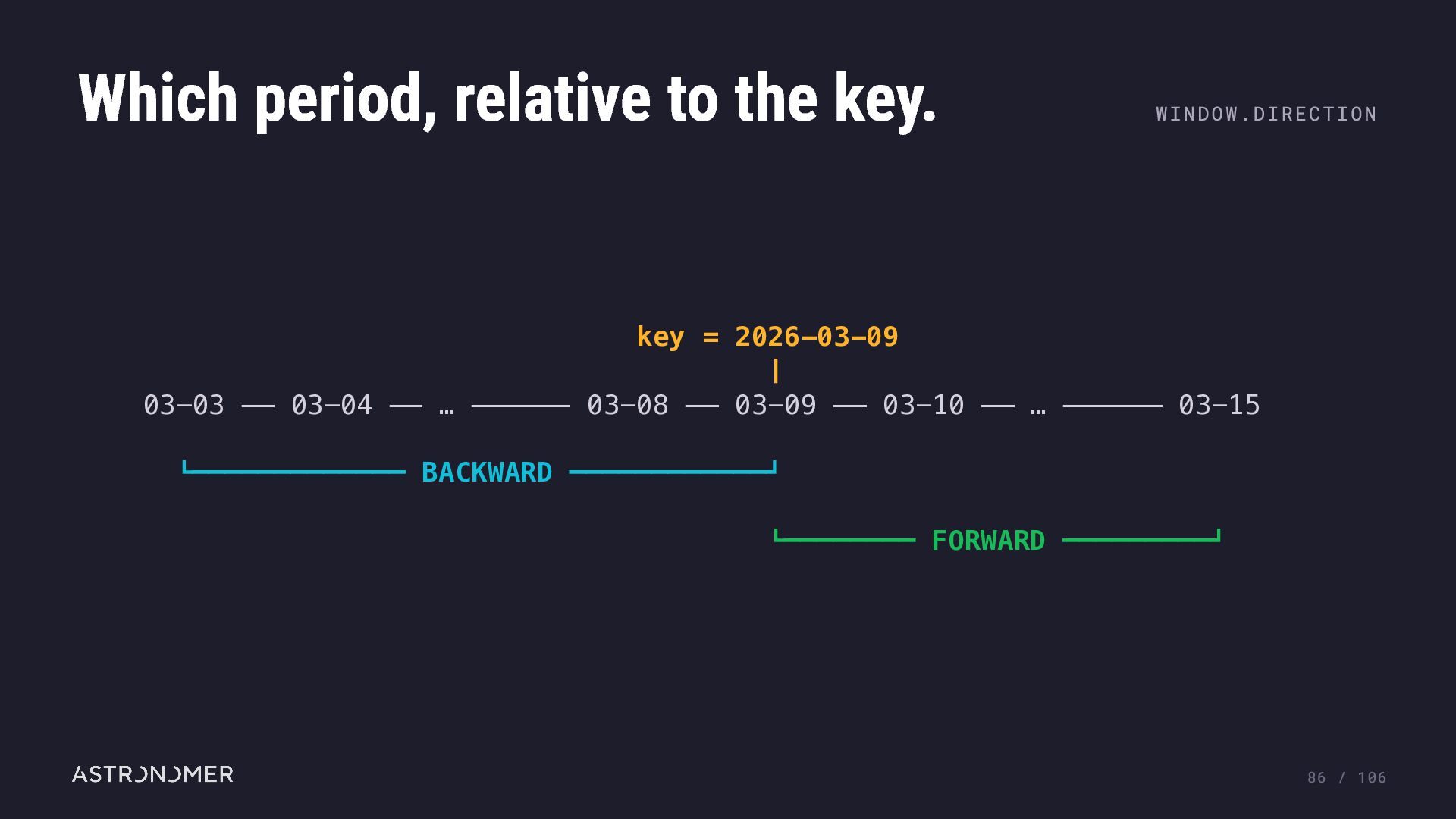
  42. Which period, relative to the key. key = 2026-03-09 │

    03-03 ── 03-04 ── … ────── 03-08 ── 03-09 ── 03-10 ── … ────── 03-15 └───────────── BACKWARD ────────────┘ └──────── FORWARD ─────────┘ 84 / 104
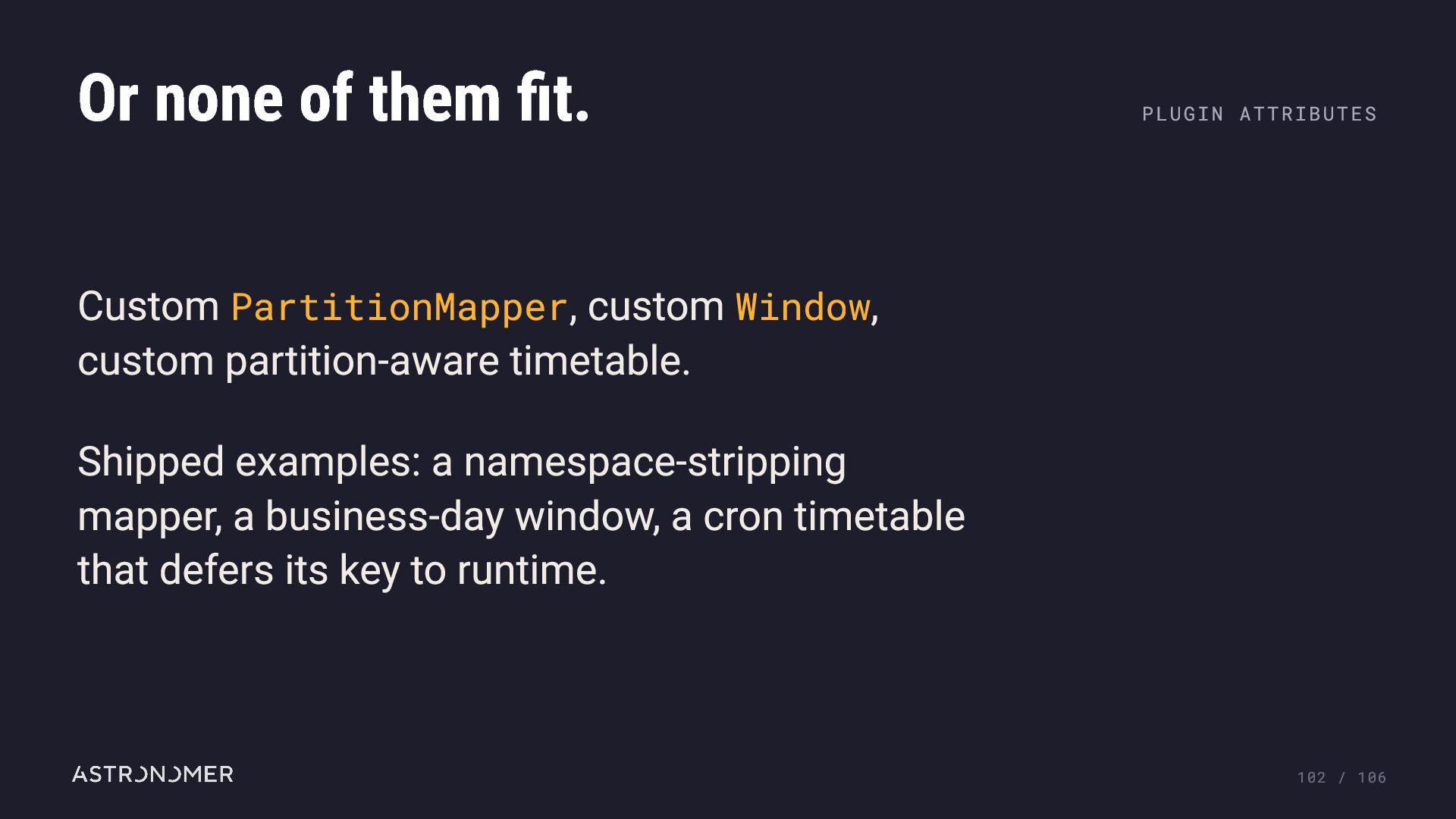
  43. You can write all three yourself. REGISTERED AS a timetable

    — where keys come from AirflowPlugin.timetables a partition mapper — how keys map AirflowPlugin.partition_mappers a window — what one period contains AirflowPlugin.windows 85 / 104
  44. 04 / 04 Backfills Materializing the past, and everything after

    the first green run. DEFINITIONS MAPPINGS COMPLETENESS BACKFILLS ADOPTING IT 86 / 104
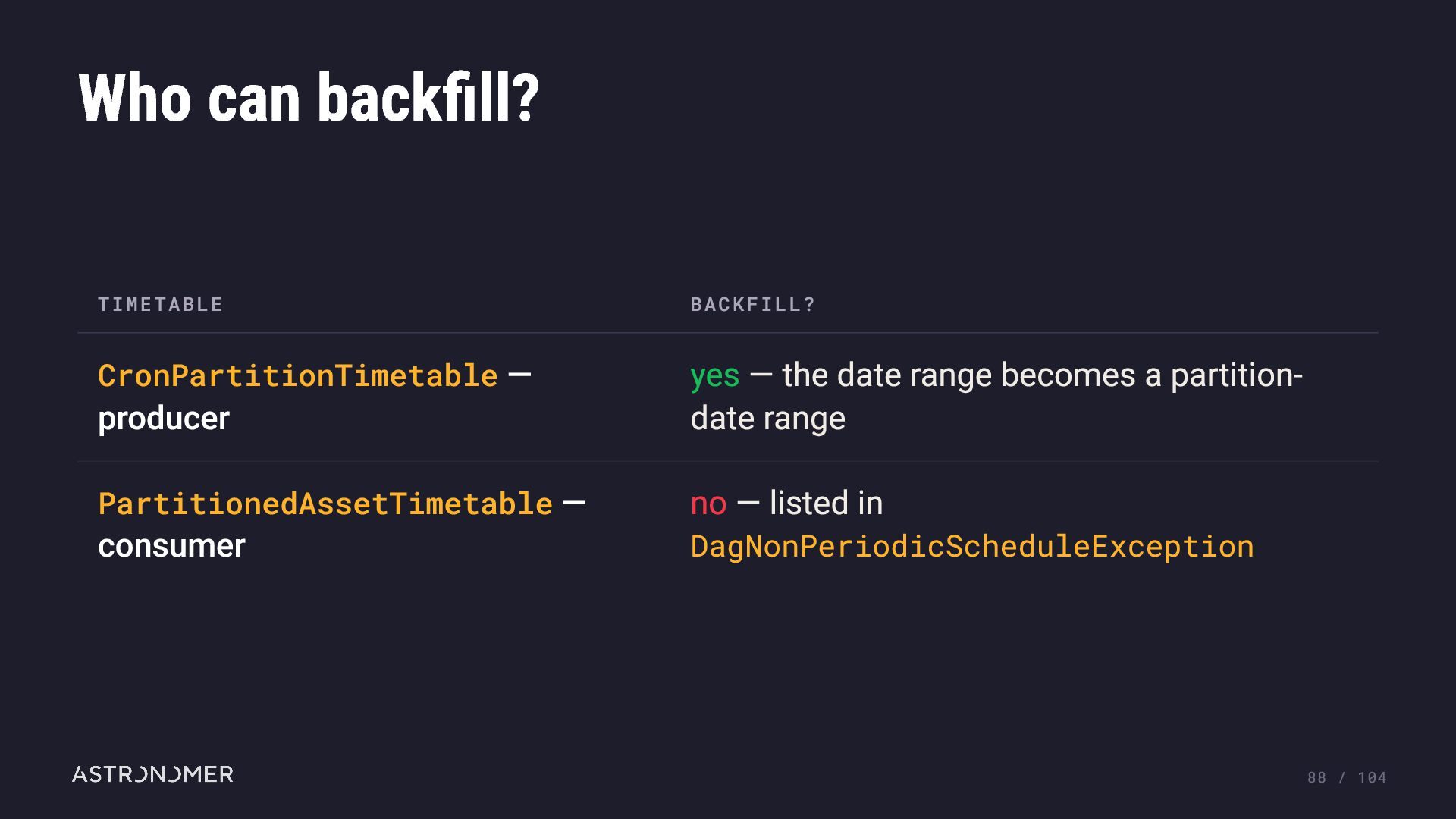
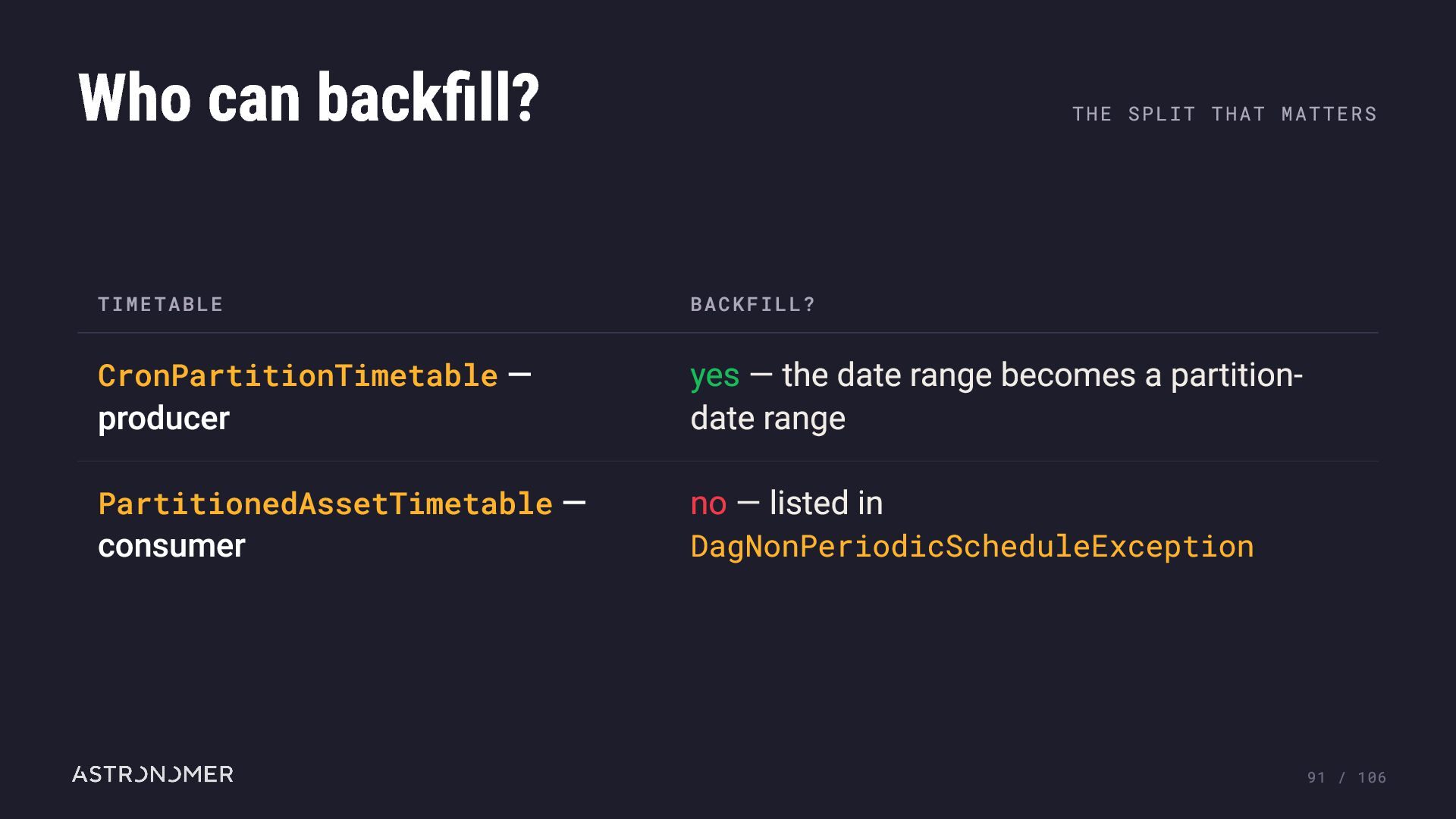
  45. Who can backfill? TIMETABLE BACKFILL? CronPartitionTimetable — producer yes —

    the date range becomes a partitiondate range PartitionedAssetTimetable — no — listed in consumer DagNonPeriodicScheduleException 88 / 104
  46. To backfill you need a time-based schedule. with DAG("ingest_hourly_sales", schedule=CronPartitionTimetable("0

    * * * *")): ... # 02-18 00:00, 01:00, 02:00 ... a list of ticks with DAG("daily_sales_summary", schedule=PartitionedAssetTimetable(assets=hourly_sales)): ... # no ticks at all Backfill asks for a list of runs. Only one of these can answer. 89 / 104
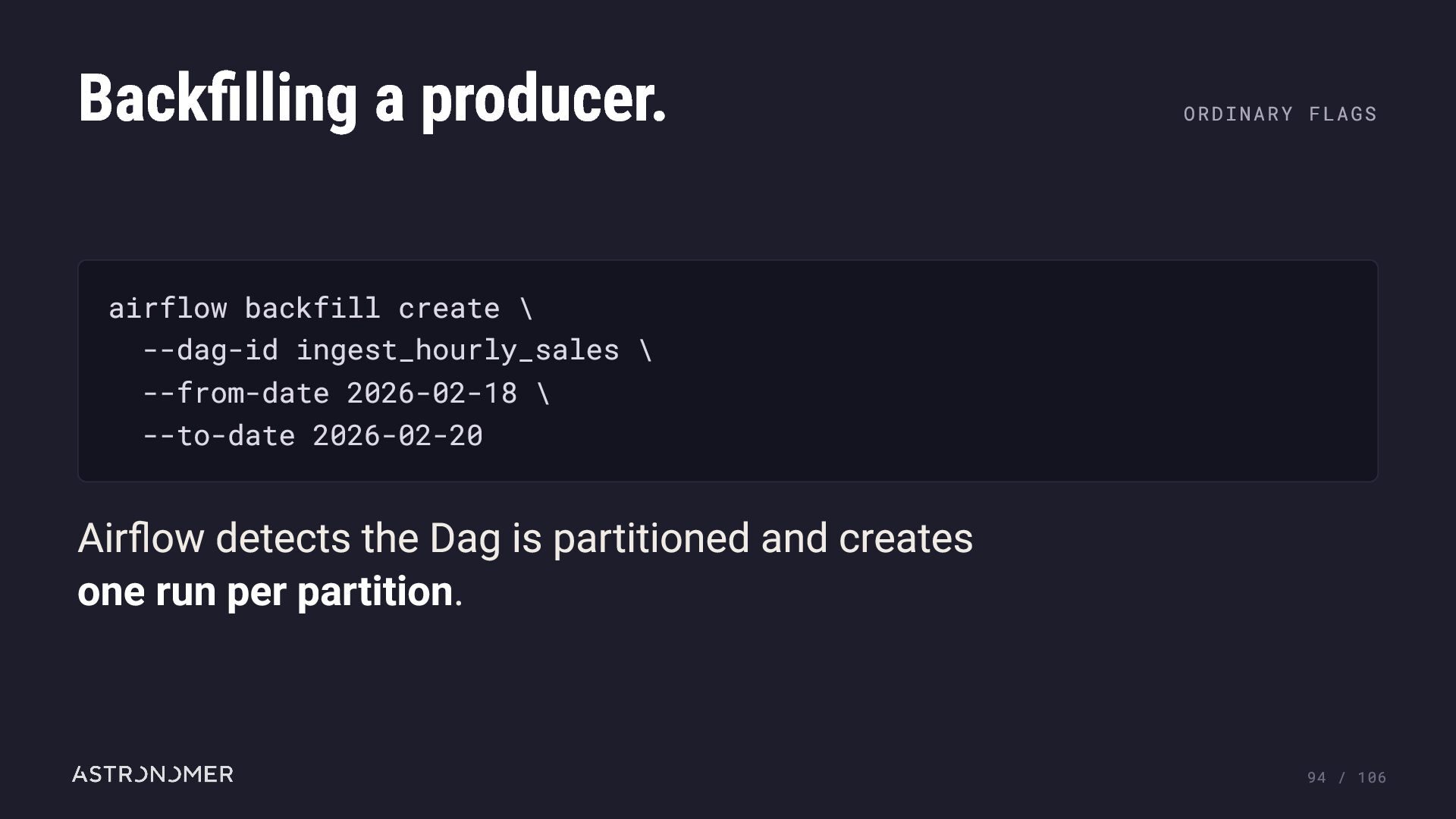
  47. So you backfill the producer instead. airflow backfill create \

    --dag-id ingest_hourly_sales \ --from-date 2026-02-18 \ --to-date 2026-02-20 Airflow detects the Dag is partitioned and creates one run per partition. 90 / 104
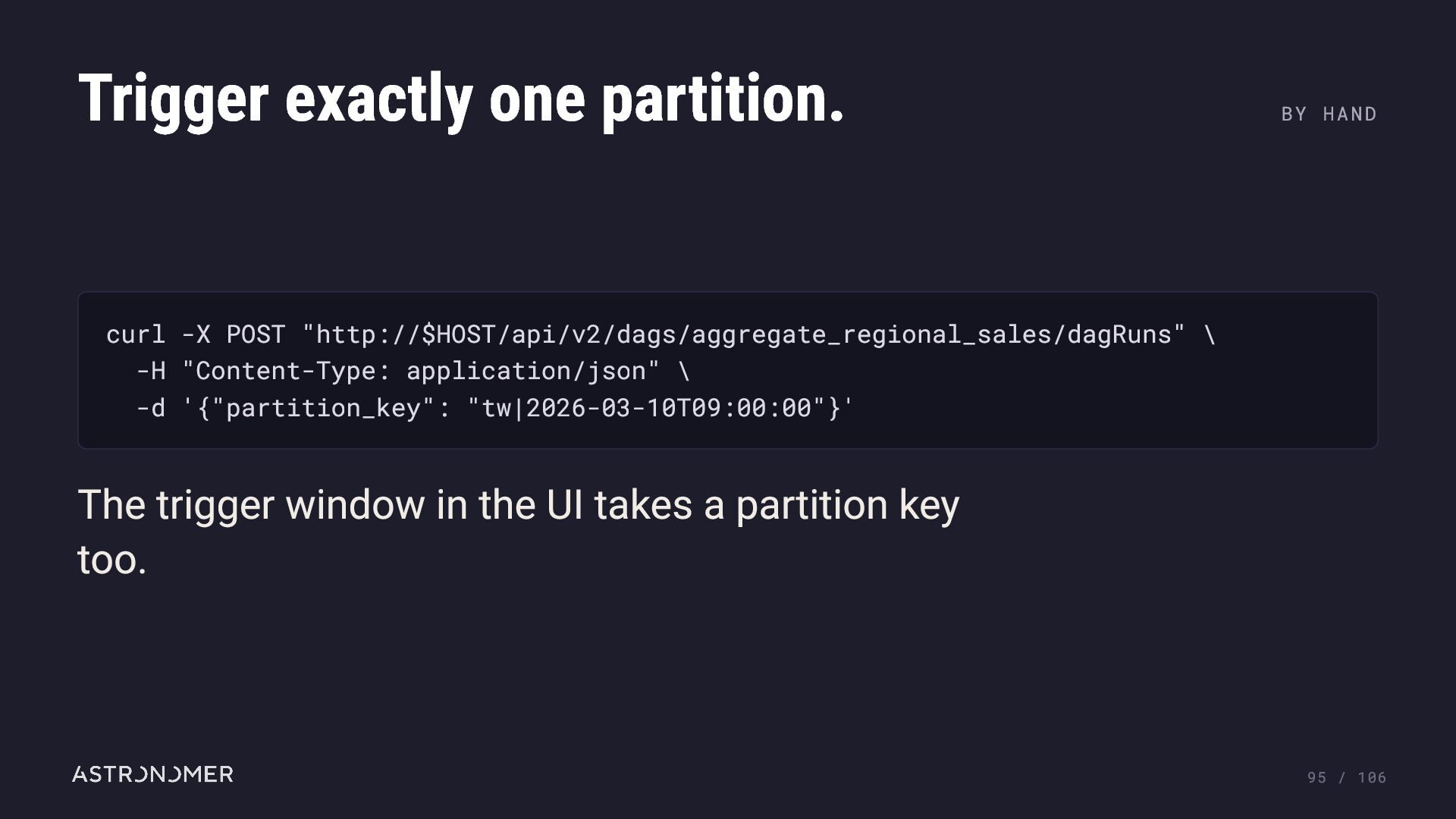
  48. Trigger exactly one partition. curl -X POST "http://$HOST/api/v2/dags/aggregate_regional_sales/dagRuns" \ -H

    "Content-Type: application/json" \ -d '{"partition_key": "tw|2026-03-10T09:00:00"}' The trigger window in the UI takes a partition key too. 91 / 104
  49. and then Adopting it You do not have to take

    all of this at once. DEFINITIONS MAPPINGS COMPLETENESS BACKFILLS ADOPTING IT 92 / 104
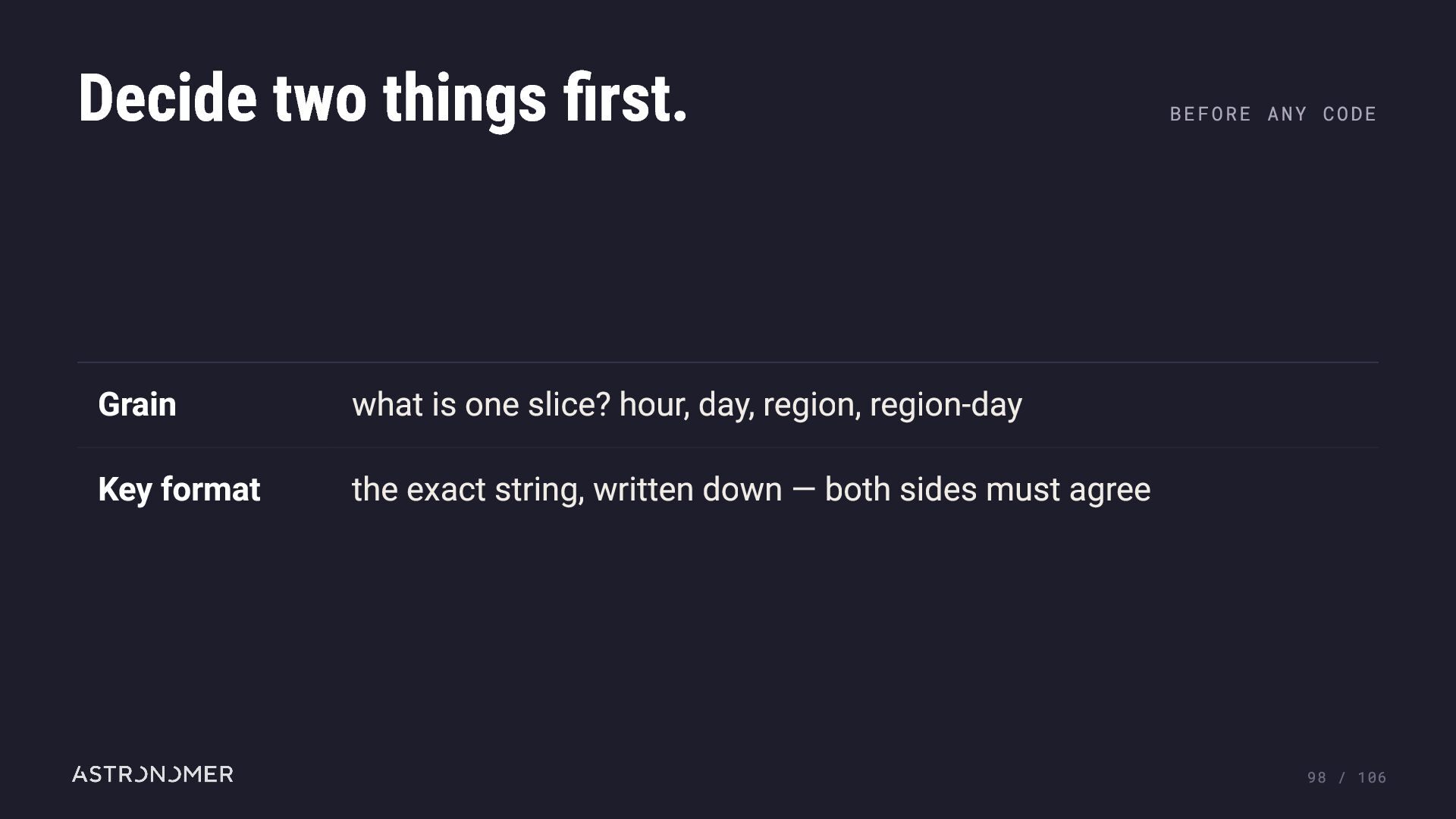
  50. Decide two things first. Grain what is one slice? hour,

    day, region, region-day Key format a string — mapper classes can transform it 93 / 104
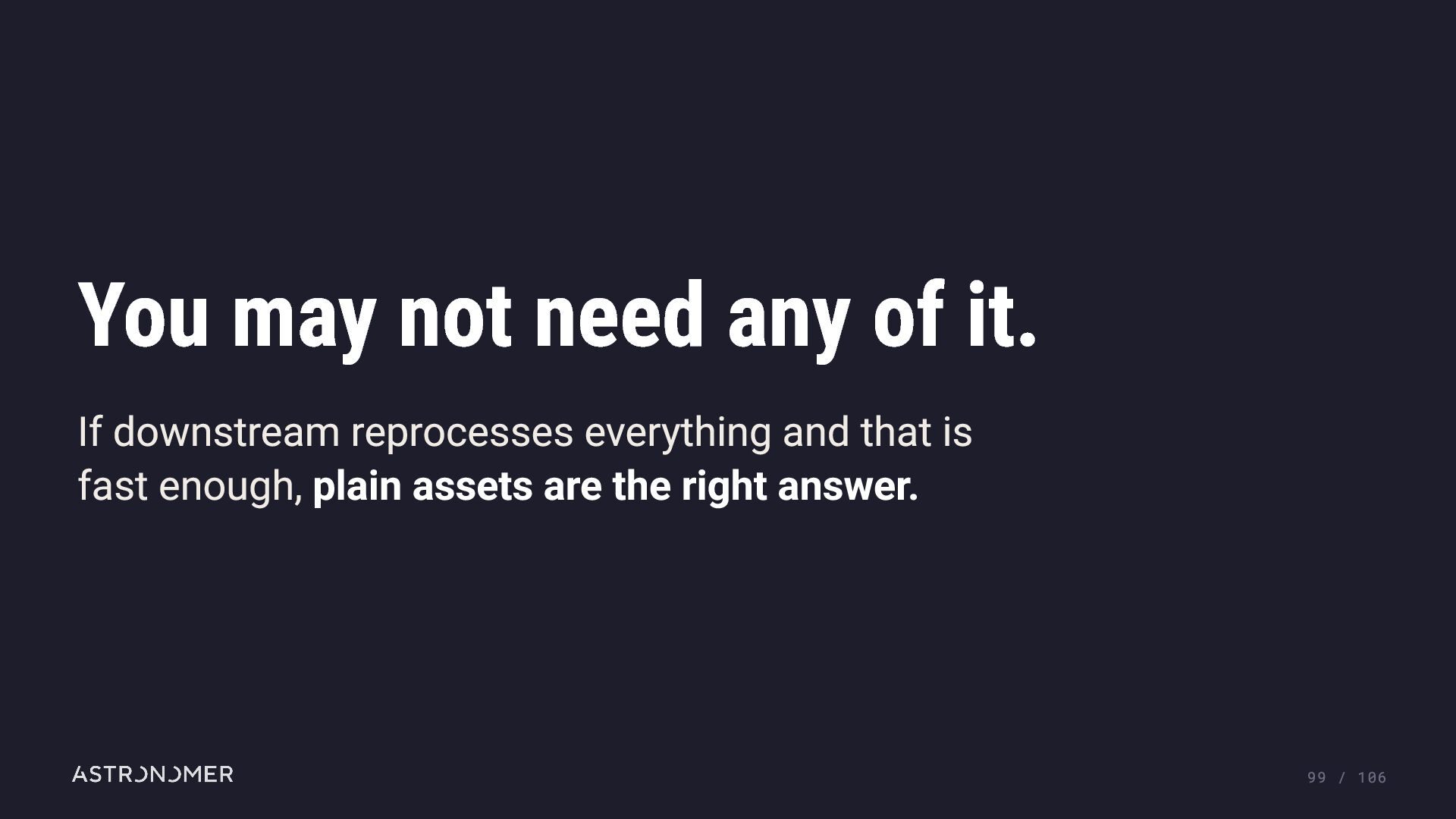
  51. You may not need any of it. If downstream reprocesses

    everything and that is fast enough, plain assets are the right answer. 94 / 104
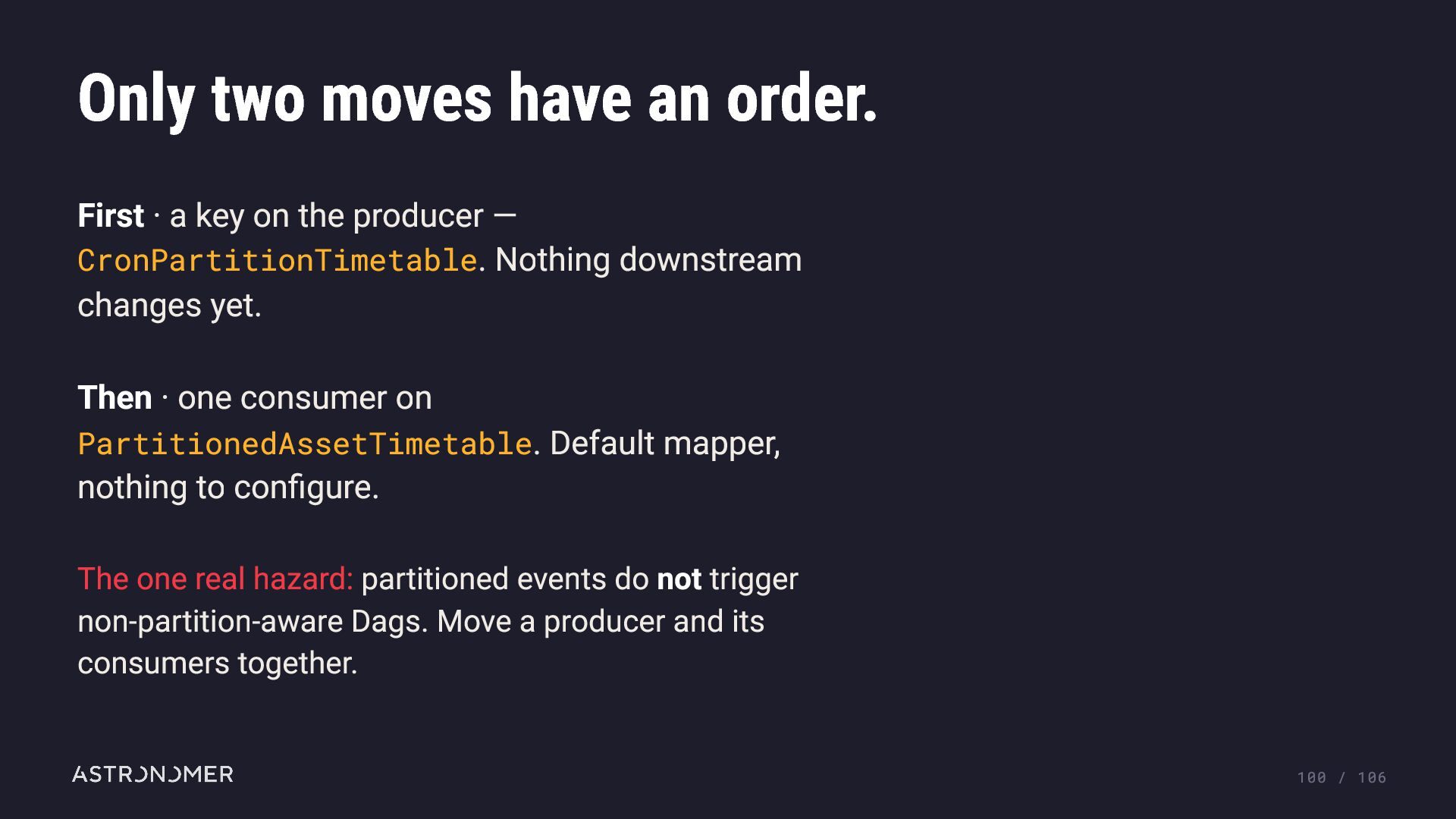
  52. Producer first, then consumer. First · a key on the

    producer — CronPartitionTimetable. Nothing downstream changes yet. Then · one consumer on PartitionedAssetTimetable. Default mapper, nothing to configure. The one real hazard: partitioned events do not trigger non-partition-aware Dags. Move a producer and its consumers together. 95 / 104
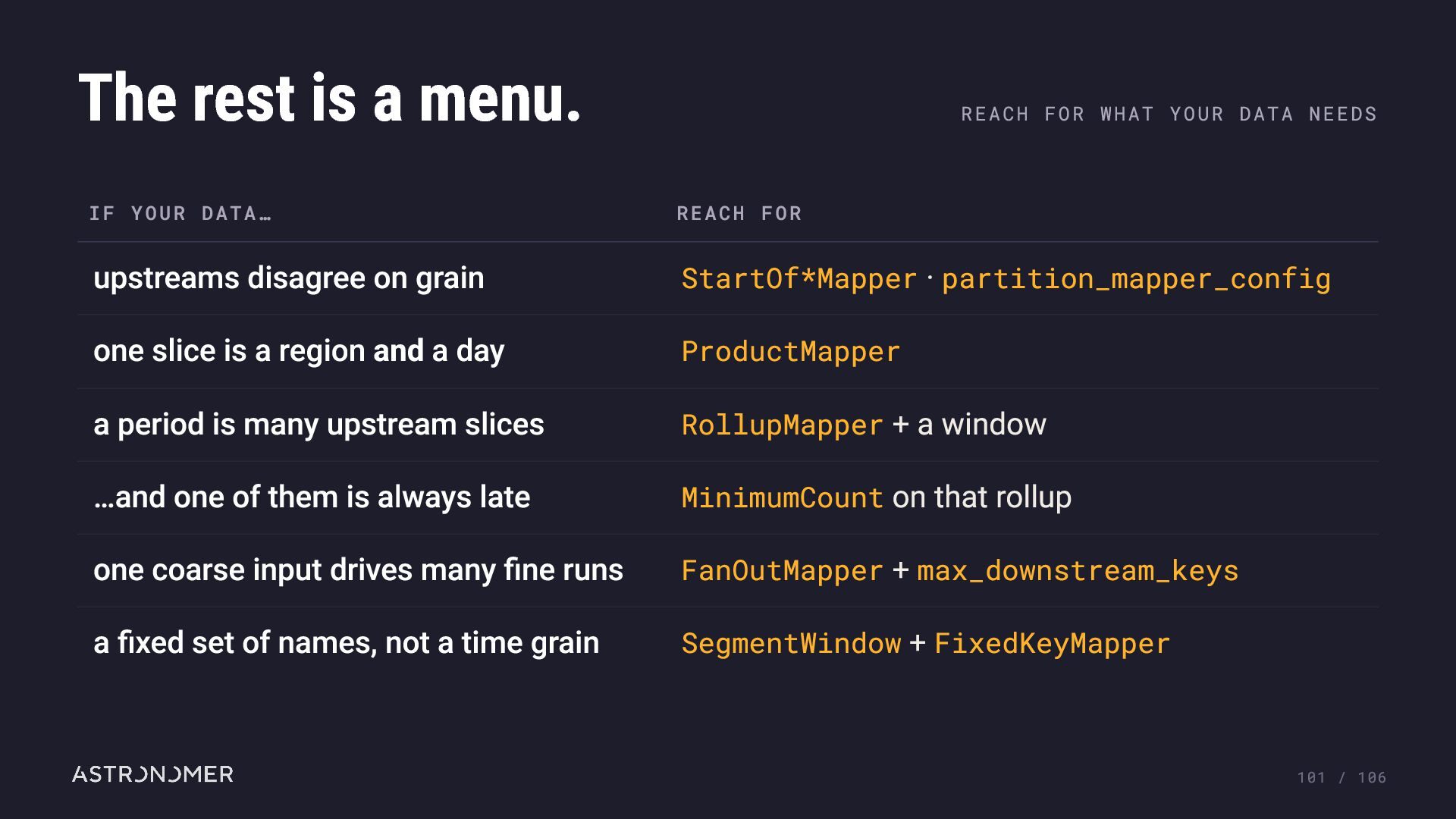
  53. The rest is a menu. IF YOUR DATA… USE upstreams

    disagree on grain StartOf*Mapper · partition_mapper_config one slice is a region and a day ProductMapper a period is many upstream slices RollupMapper + a window …and one of them is sometimes late MinimumCount on that rollup one coarse input drives many fine runs FanOutMapper + max_downstream_keys a fixed set of names, not a time grain SegmentWindow + FixedKeyMapper 96 / 104
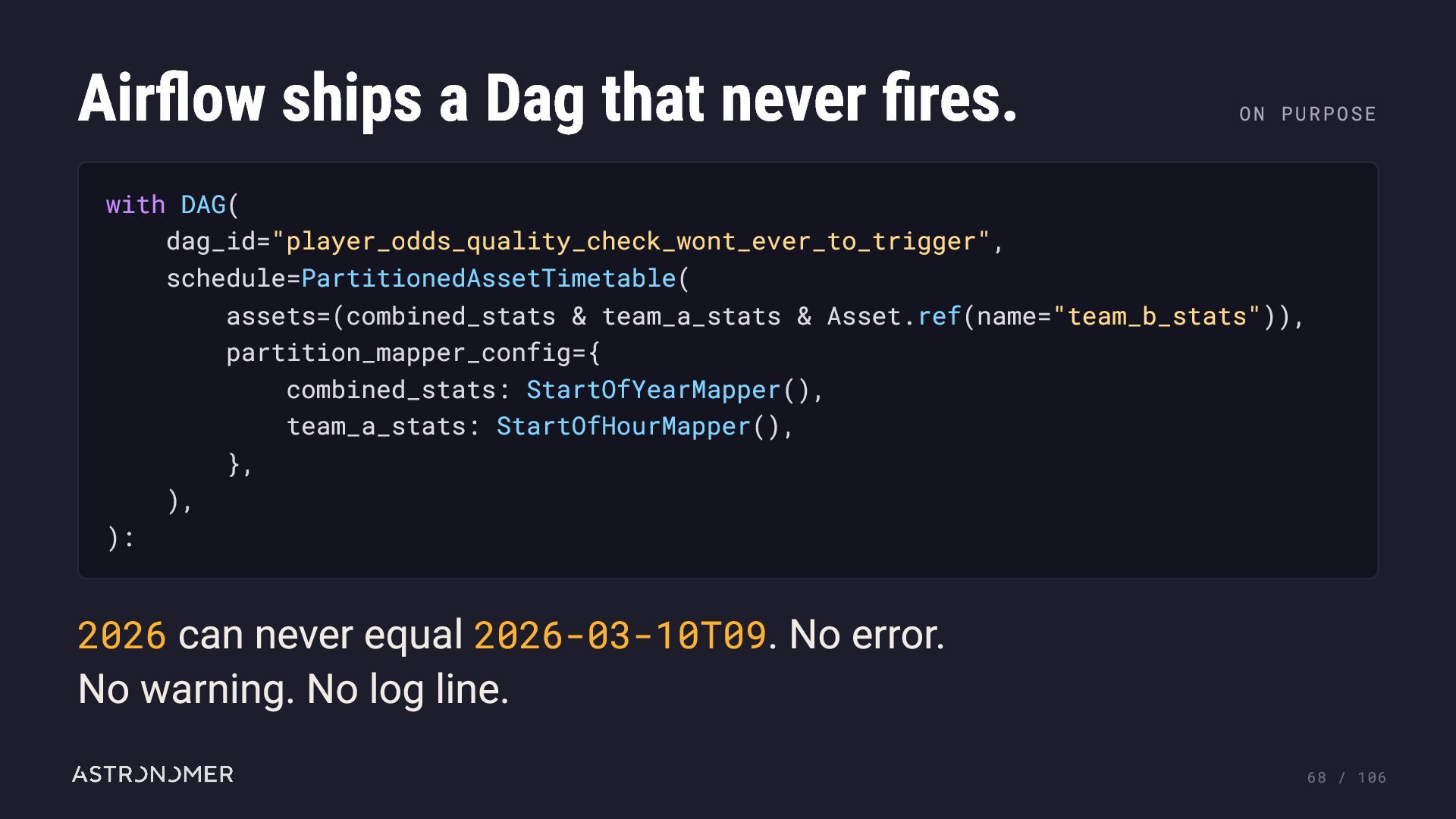
  54. Gotcha: mappers that never agree schedule=PartitionedAssetTimetable( assets=combined_stats & team_a_stats &

    team_b_stats, partition_mapper_config={ combined_stats: StartOfYearMapper(), team_a_stats: StartOfHourMapper(), }, ) 2026 can never equal 2026-03-10T09. No error. No warning. No log line. 98 / 104
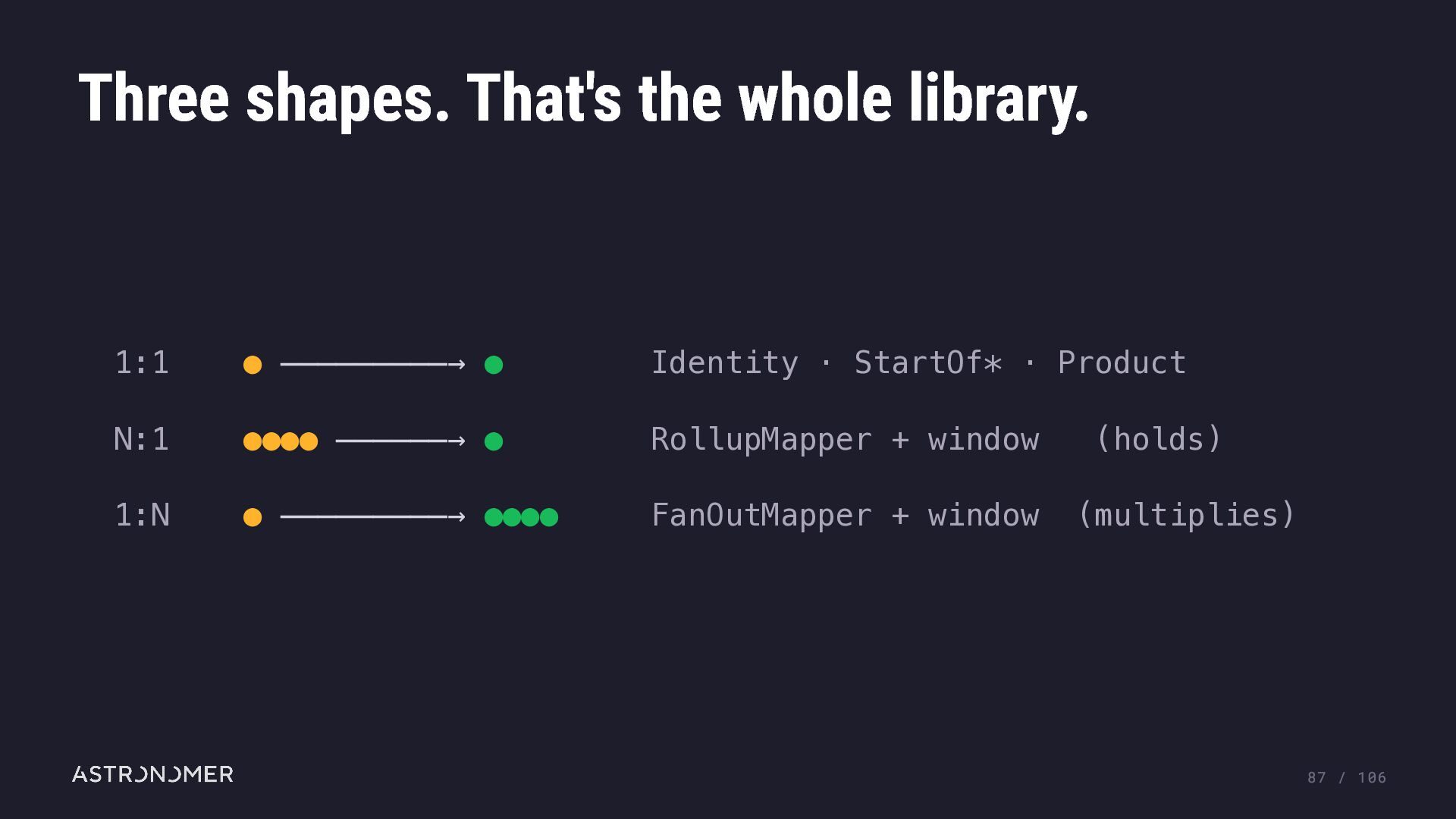
  55. 1 · three shapes 1:1 • ─────────→ • Identity ·

    StartOf* · Product N:1 •••• ──────→ • RollupMapper + window (holds) 1:N • ─────────→ •••• FanOutMapper + window (multiplies) 100 / 104
  56. 2 · the scheduler decides, not your task Whether a

    run exists. Which slice. When it may start. 101 / 104
  57. 3 · the partition key travels on its own hourly_sales

    │ ▼ daily_summary │ ▼ weekly_rollup 2026-03-10T09 2026-03-10 2026-03-09 102 / 104
  58. Wei Lee / 李唯 Apache Airflow PMC Member Senior Software

    Engineer @ Astronomer wei-lee.me 103 / 104