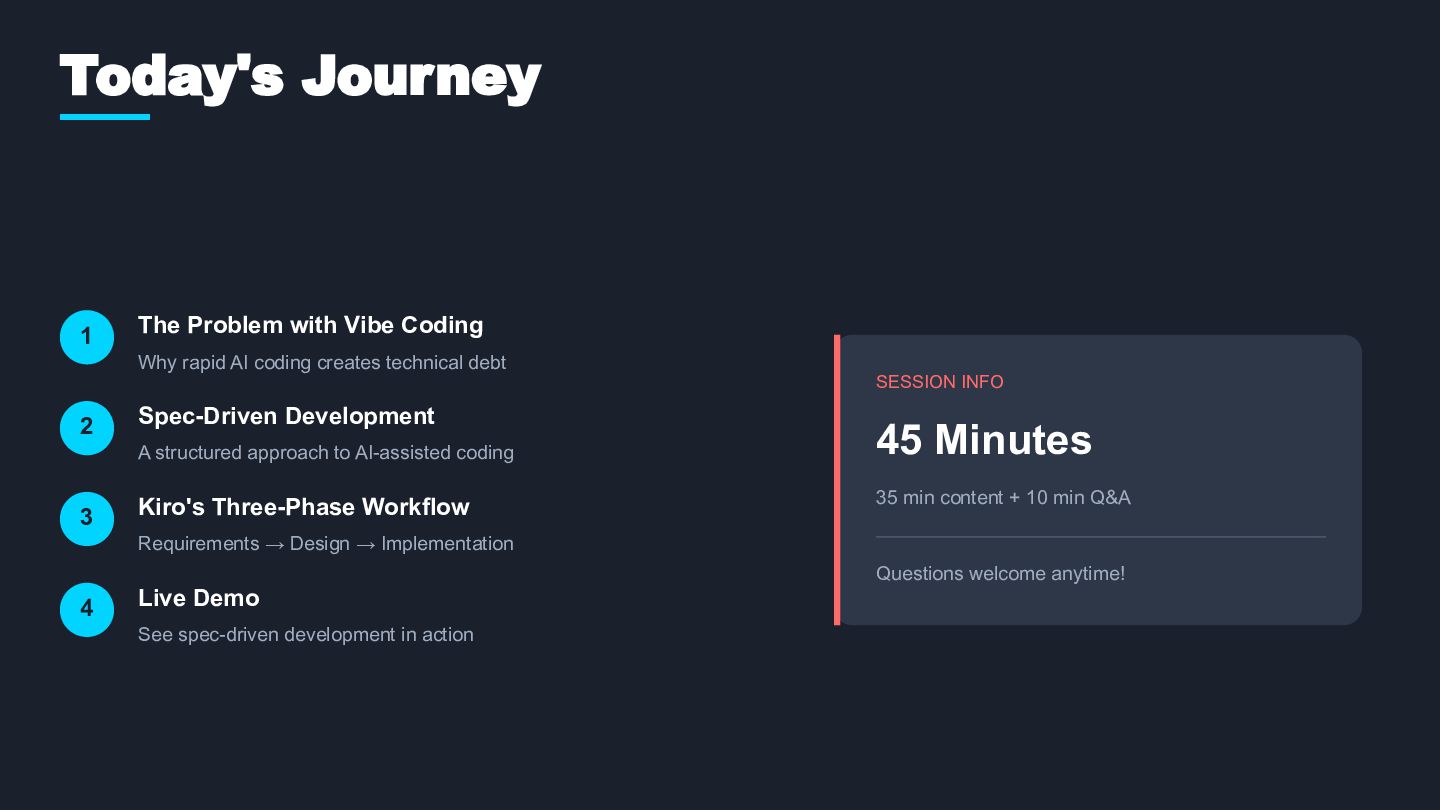
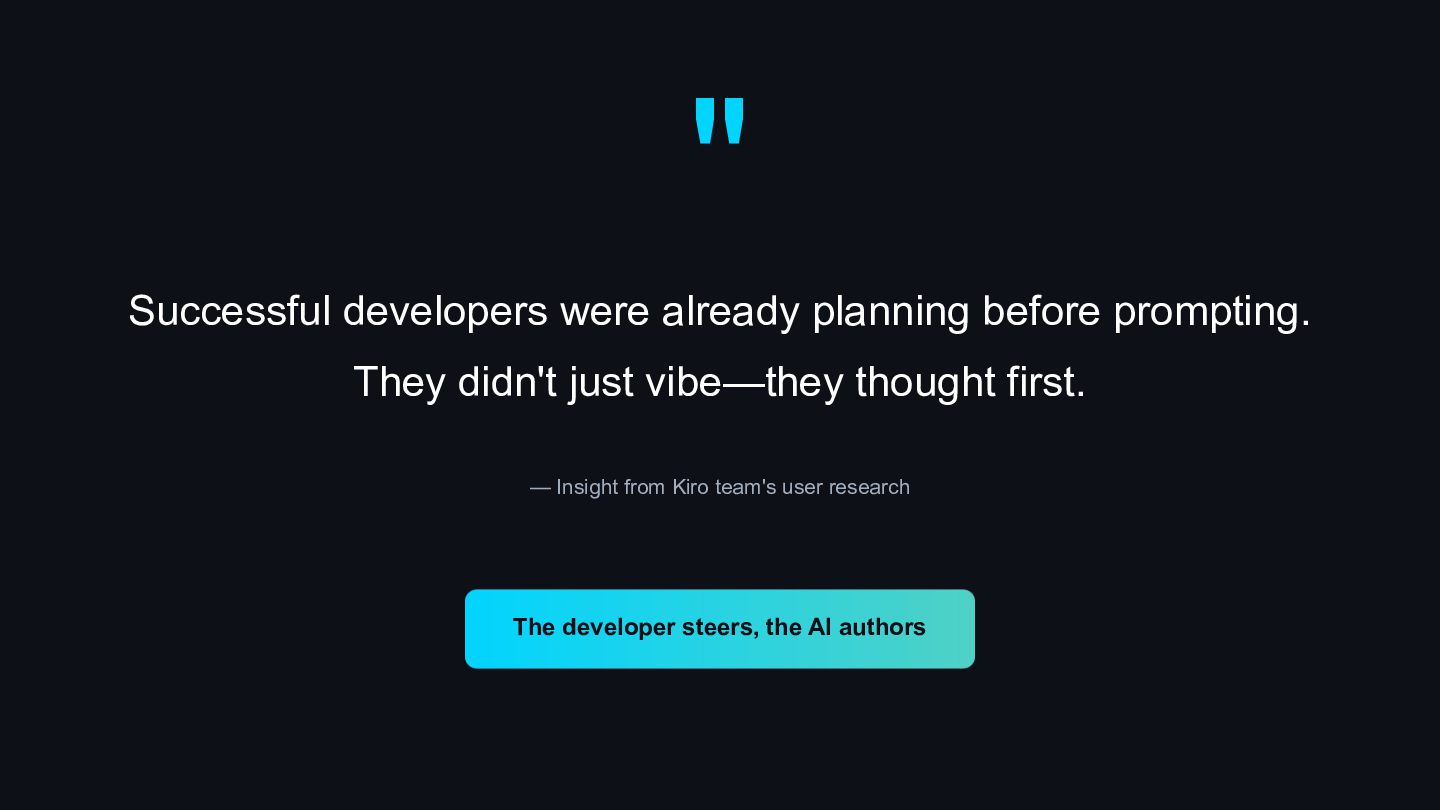
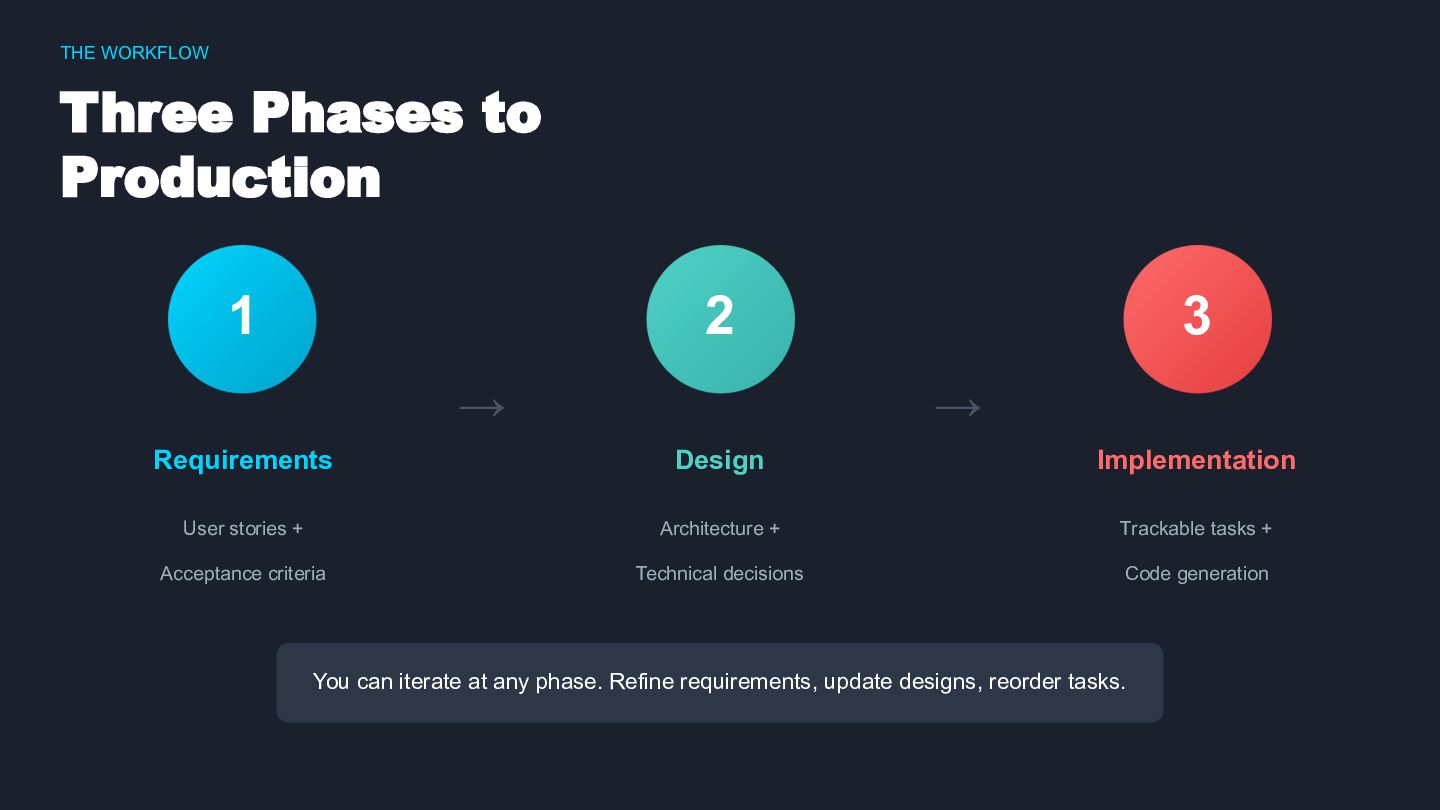
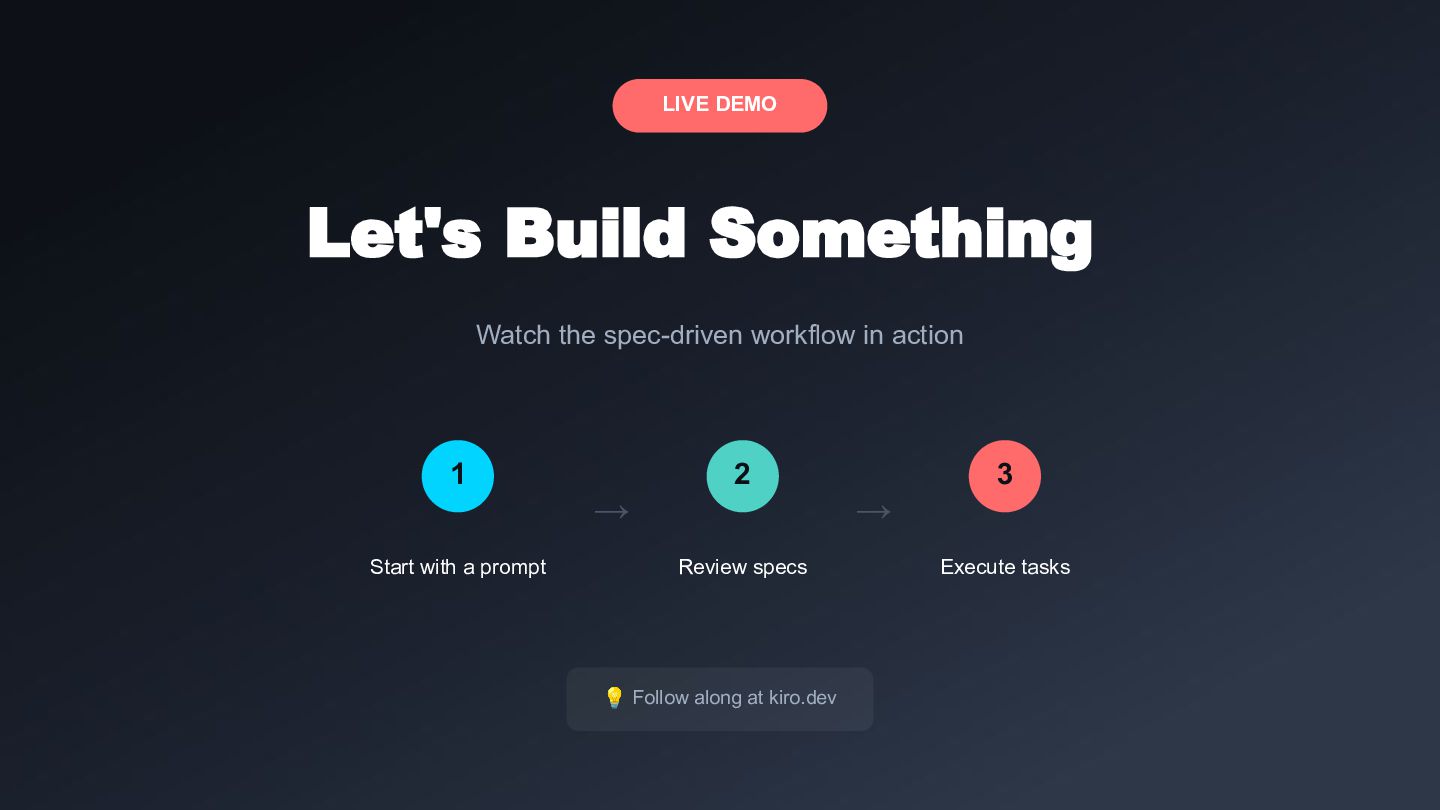
AI coding creates technical debt 2 Spec-Driven Development A structured approach to AI-assisted coding 3 Kiro's Three-Phase Workflow Requirements → Design → Implementation 4 Live Demo See spec-driven development in action SESSION INFO 45 Minutes 35 min content + 10 min Q&A Questions welcome anytime!
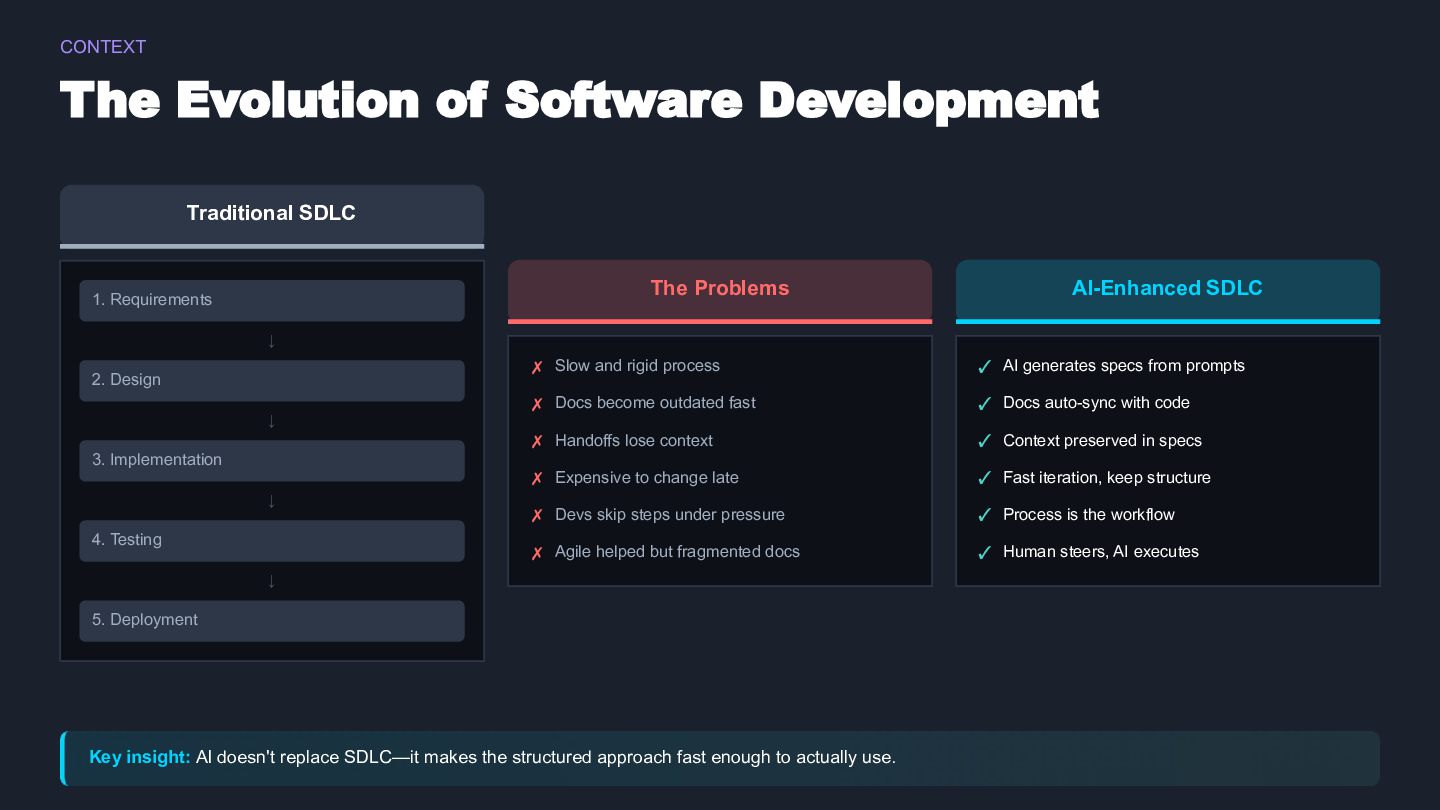
↓ 2. Design ↓ 3. Implementation ↓ 4. Testing ↓ 5. Deployment The Problems ✗ Slow and rigid process ✗ Docs become outdated fast ✗ Handoffs lose context ✗ Expensive to change late ✗ Devs skip steps under pressure ✗ Agile helped but fragmented docs AI-Enhanced SDLC ✓ AI generates specs from prompts ✓ Docs auto-sync with code ✓ Context preserved in specs ✓ Fast iteration, keep structure ✓ Process is the workflow ✓ Human steers, AI executes Key insight: AI doesn't replace SDLC—it makes the structured approach fast enough to actually use.
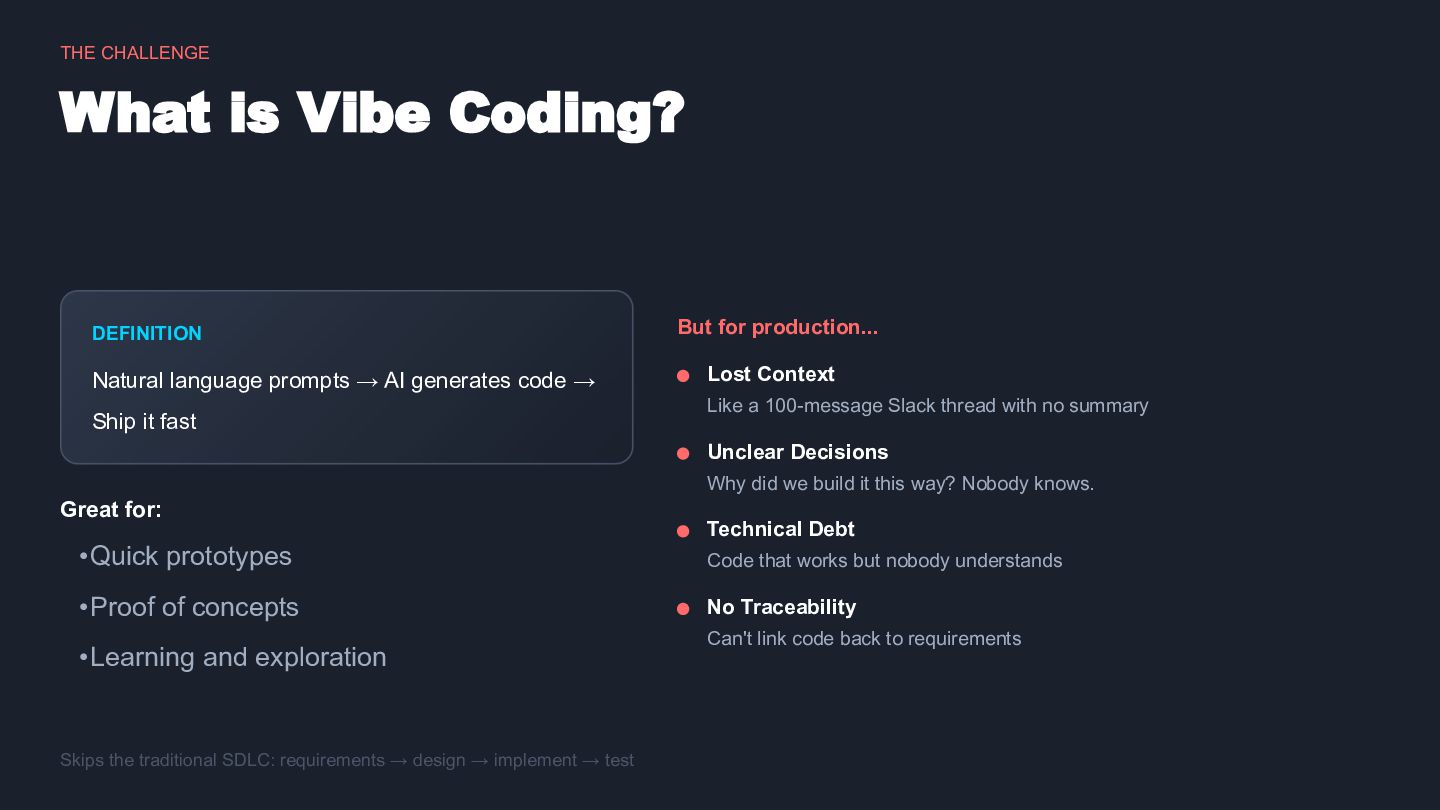
→ AI generates code → Ship it fast Great for: •Quick prototypes •Proof of concepts •Learning and exploration But for production... Lost Context Like a 100-message Slack thread with no summary Unclear Decisions Why did we build it this way? Nobody knows. Technical Debt Code that works but nobody understands No Traceability Can't link code back to requirements Skips the traditional SDLC: requirements → design → implement → test
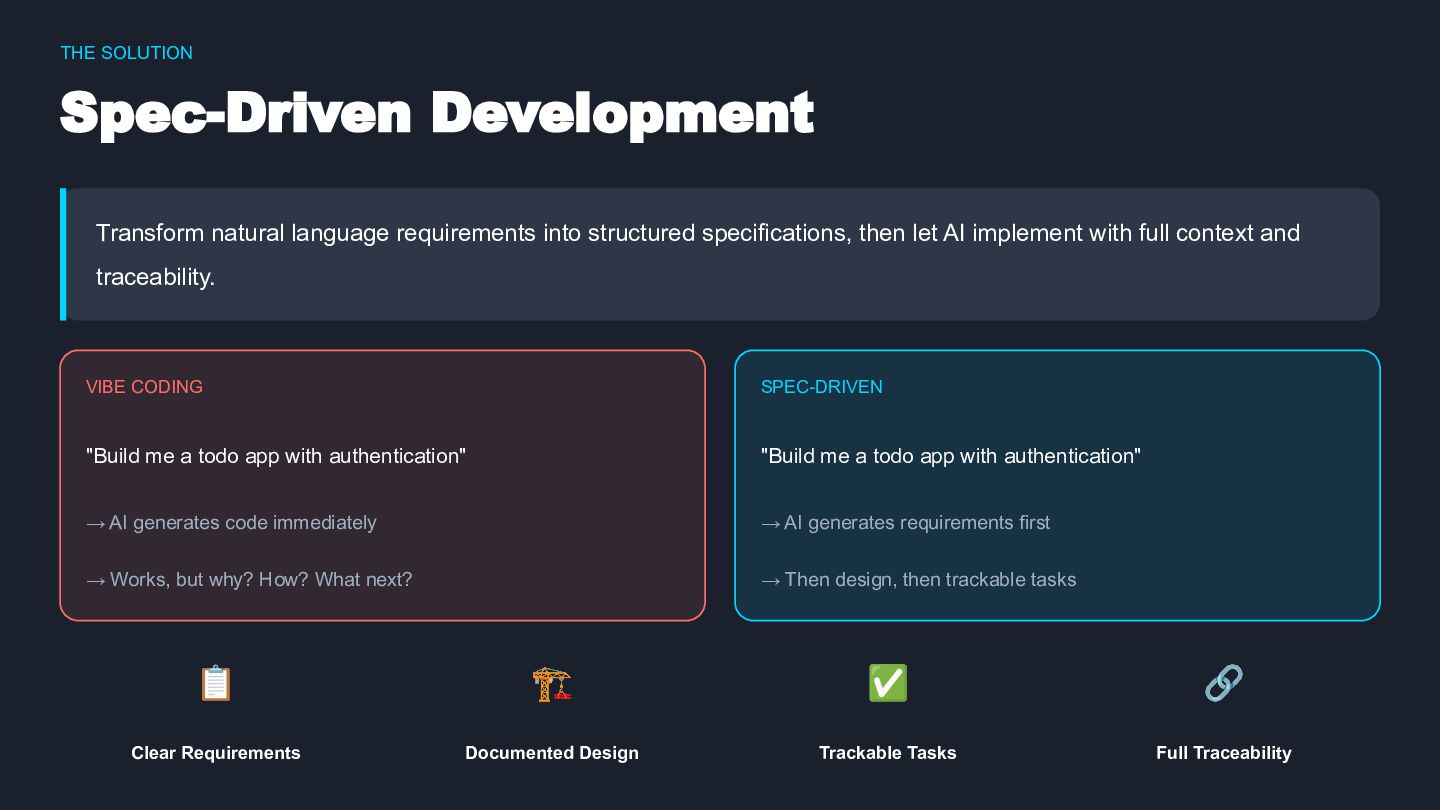
specifications, then let AI implement with full context and traceability. VIBE CODING "Build me a todo app with authentication" → AI generates code immediately → Works, but why? How? What next? SPEC-DRIVEN "Build me a todo app with authentication" → AI generates requirements first → Then design, then trackable tasks 📋 Clear Requirements 🏗 Documented Design ✅ Trackable Tasks 🔗 Full Traceability
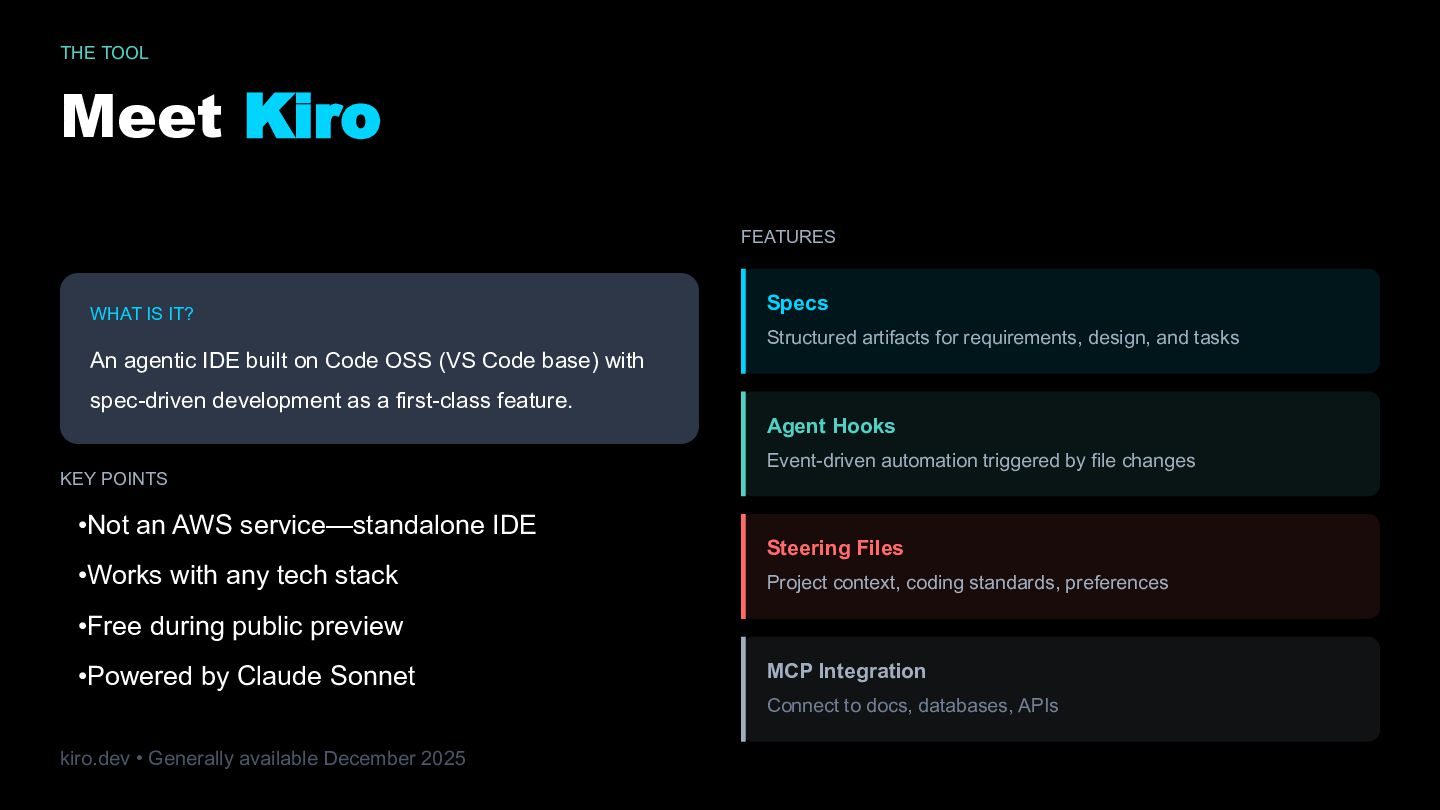
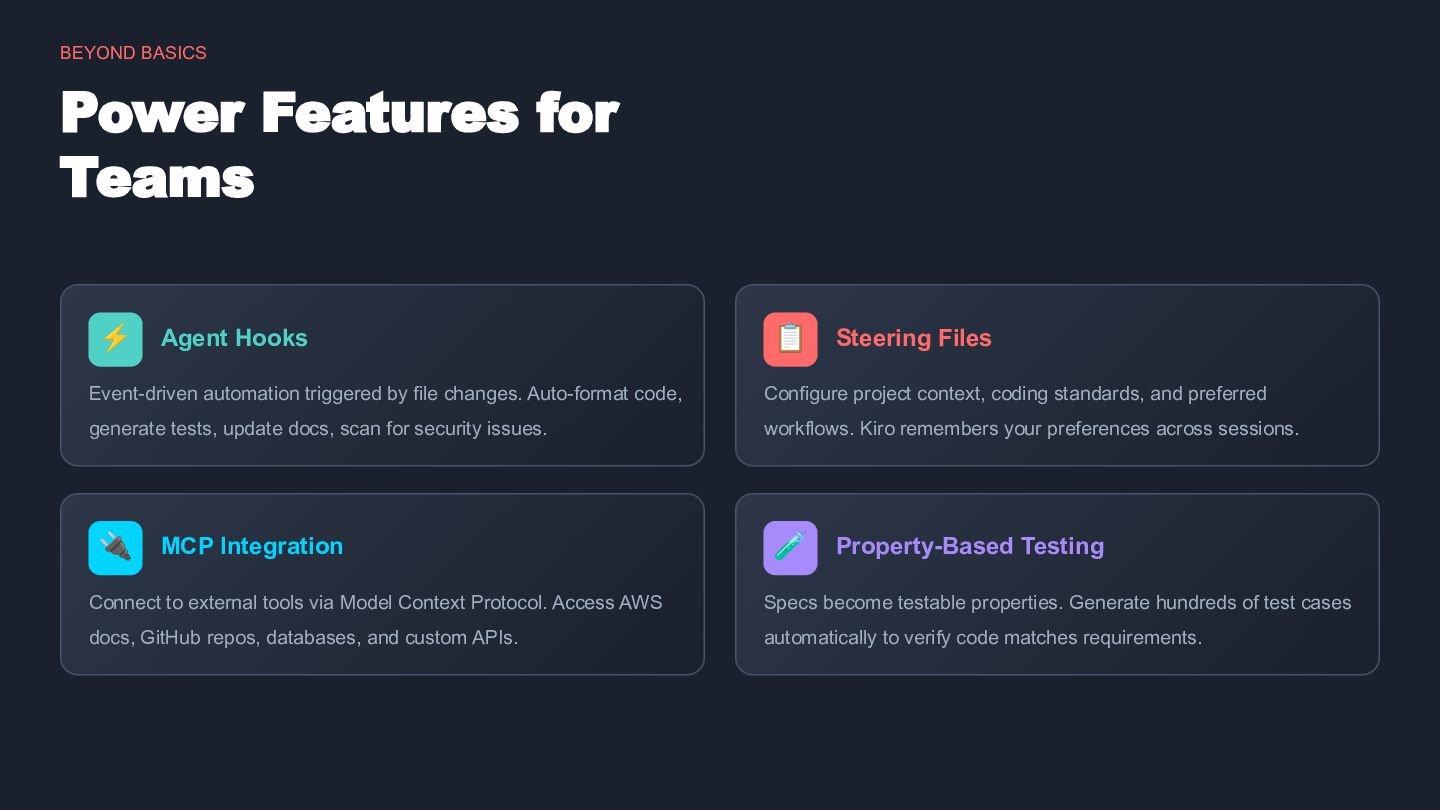
built on Code OSS (VS Code base) with spec-driven development as a first-class feature. KEY POINTS •Not an AWS service—standalone IDE •Works with any tech stack •Free during public preview •Powered by Claude Sonnet FEATURES Specs Structured artifacts for requirements, design, and tasks Agent Hooks Event-driven automation triggered by file changes Steering Files Project context, coding standards, preferences MCP Integration Connect to docs, databases, APIs kiro.dev • Generally available December 2025
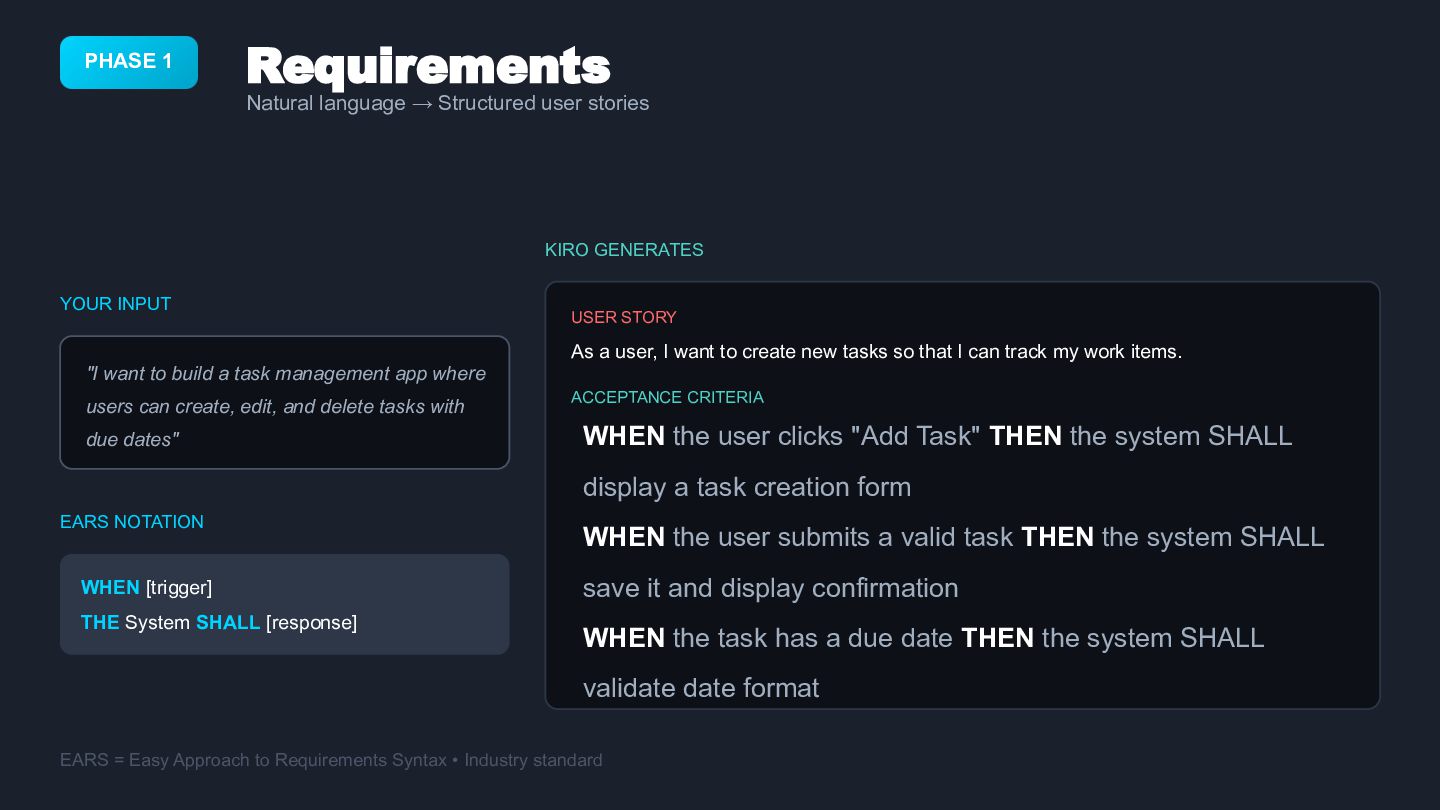
INPUT "I want to build a task management app where users can create, edit, and delete tasks with due dates" EARS NOTATION WHEN [trigger] THE System SHALL [response] KIRO GENERATES USER STORY As a user, I want to create new tasks so that I can track my work items. ACCEPTANCE CRITERIA WHEN the user clicks "Add Task" THEN the system SHALL display a task creation form WHEN the user submits a valid task THEN the system SHALL save it and display confirmation WHEN the task has a due date THEN the system SHALL validate date format EARS = Easy Approach to Requirements Syntax • Industry standard
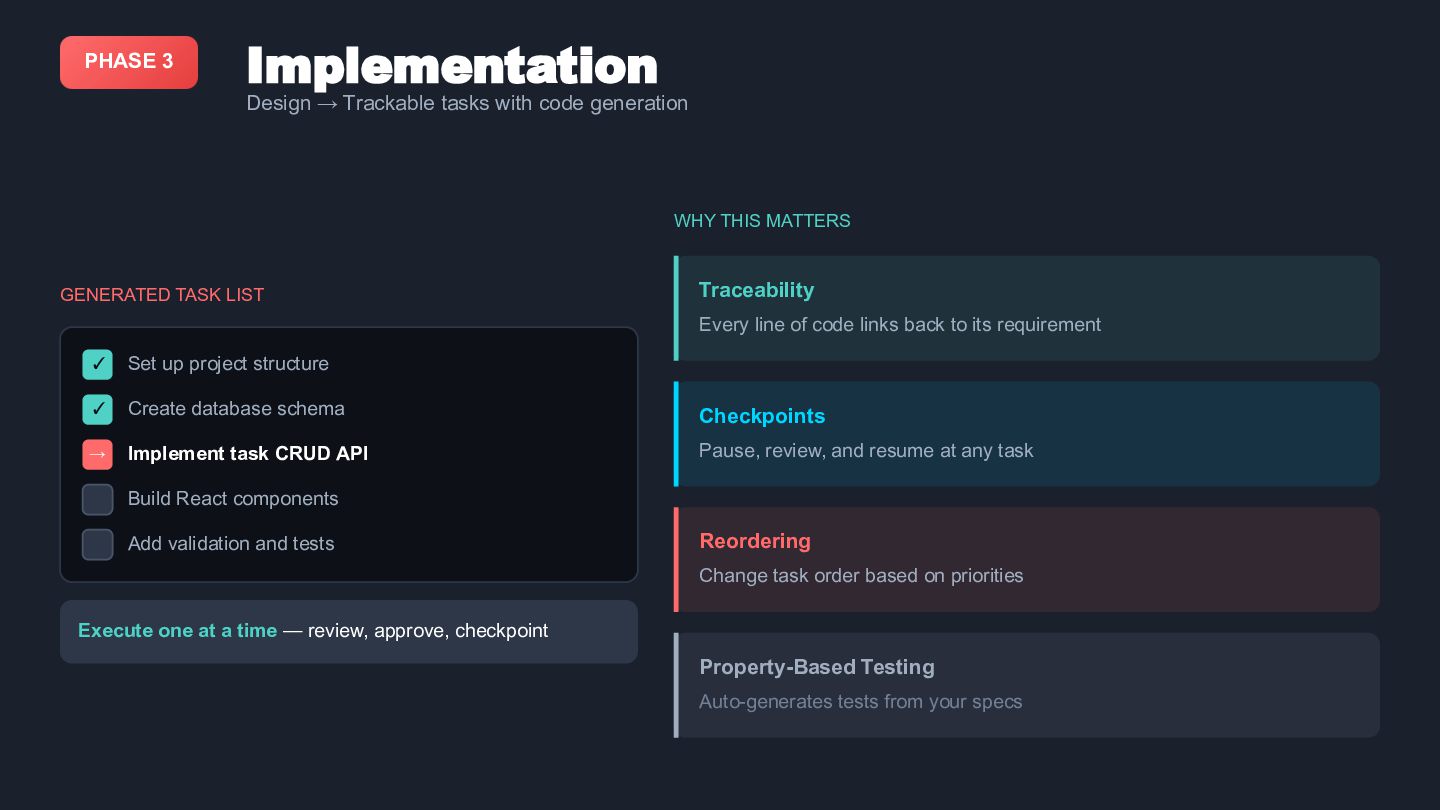
GENERATED TASK LIST ✓ Set up project structure ✓ Create database schema → Implement task CRUD API Build React components Add validation and tests Execute one at a time — review, approve, checkpoint WHY THIS MATTERS Traceability Every line of code links back to its requirement Checkpoints Pause, review, and resume at any task Reordering Change task order based on priorities Property-Based Testing Auto-generates tests from your specs
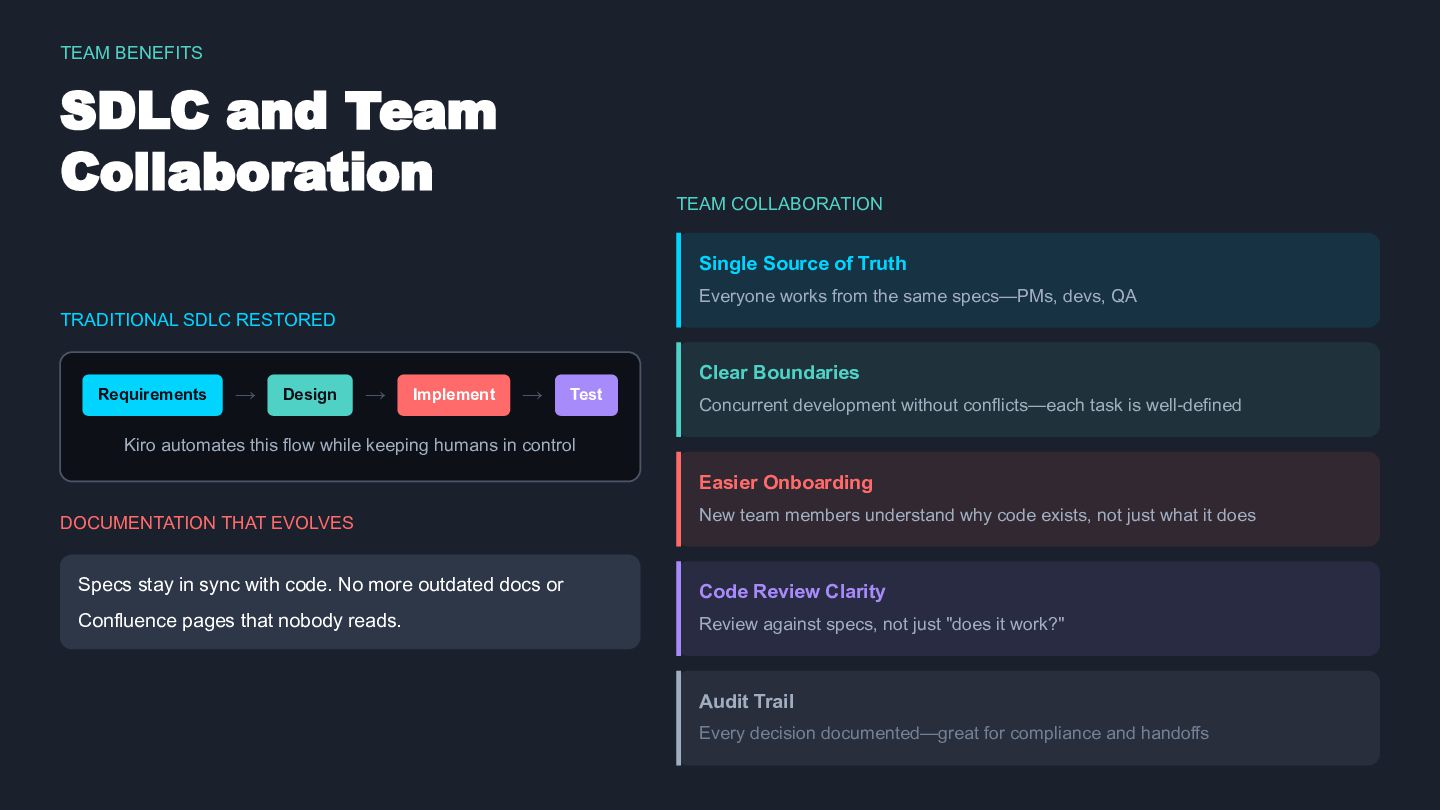
→ Design → Implement → Test Kiro automates this flow while keeping humans in control DOCUMENTATION THAT EVOLVES Specs stay in sync with code. No more outdated docs or Confluence pages that nobody reads. TEAM COLLABORATION Single Source of Truth Everyone works from the same specs—PMs, devs, QA Clear Boundaries Concurrent development without conflicts—each task is well-defined Easier Onboarding New team members understand why code exists, not just what it does Code Review Clarity Review against specs, not just "does it work?" Audit Trail Every decision documented—great for compliance and handoffs
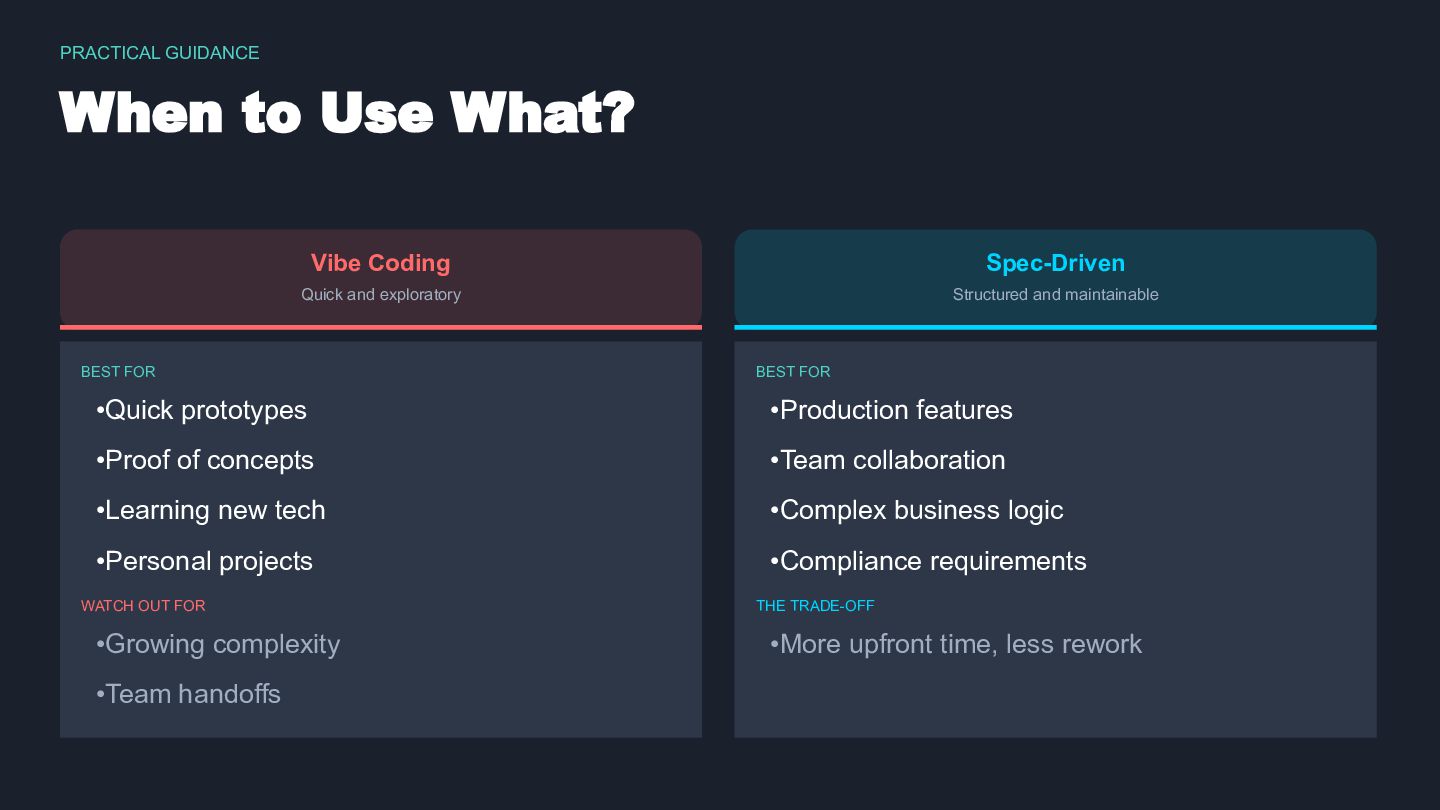
exploratory BEST FOR •Quick prototypes •Proof of concepts •Learning new tech •Personal projects WATCH OUT FOR •Growing complexity •Team handoffs Spec-Driven Structured and maintainable BEST FOR •Production features •Team collaboration •Complex business logic •Compliance requirements THE TRADE-OFF •More upfront time, less rework
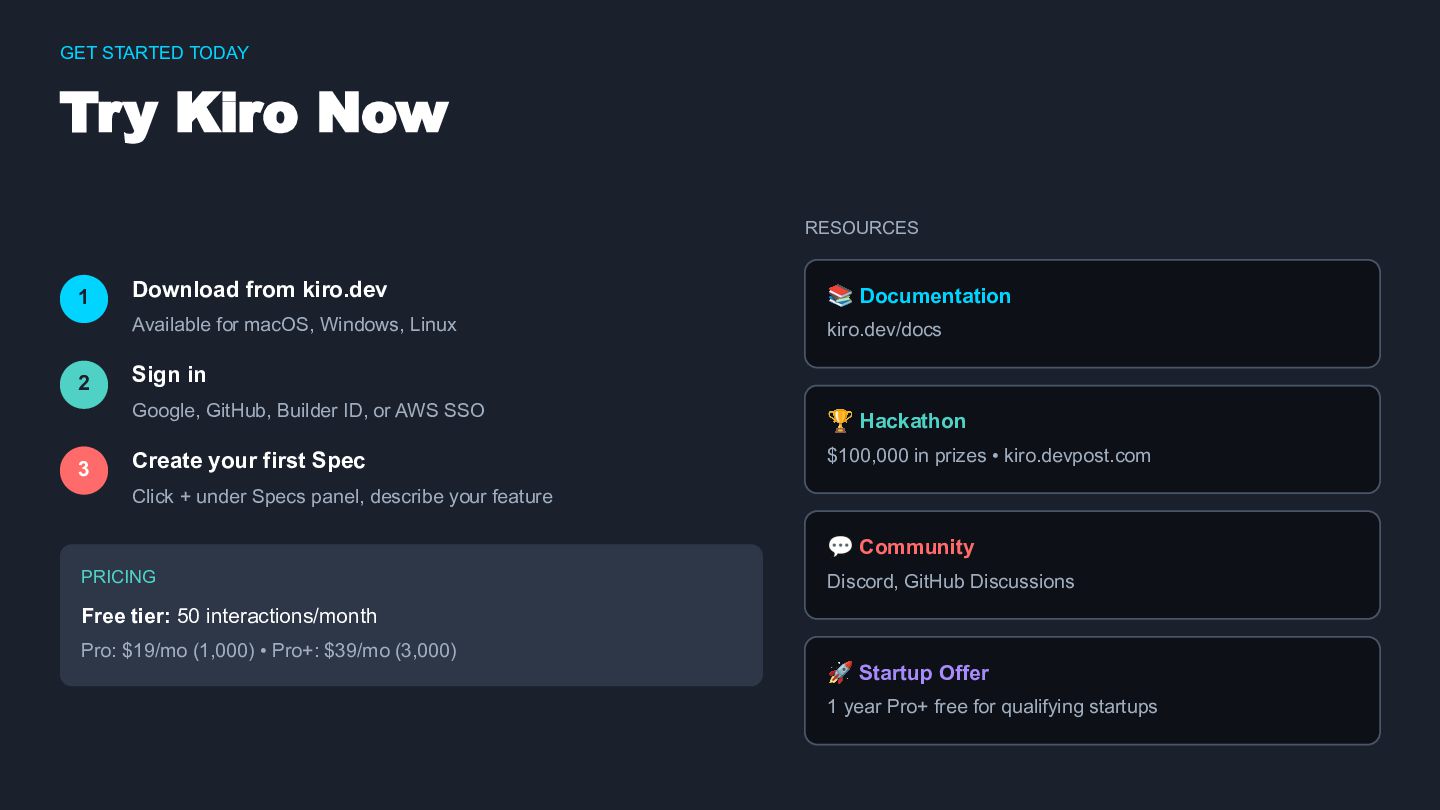
Available for macOS, Windows, Linux 2 Sign in Google, GitHub, Builder ID, or AWS SSO 3 Create your first Spec Click + under Specs panel, describe your feature PRICING Free tier: 50 interactions/month Pro: $19/mo (1,000) • Pro+: $39/mo (3,000) RESOURCES 📚 Documentation kiro.dev/docs 🏆 Hackathon $100,000 in prizes • kiro.devpost.com 💬 Community Discord, GitHub Discussions 🚀 Startup Offer 1 year Pro+ free for qualifying startups


 petrabarus
 aemeredith
 csswizardry
 lcolladotor
 livdayseo
 productmarketing
 soudai
.png) helenjbeal
helenjbeal
 kimpetersen
 gurzu
gurzu
 addyosmani
 aleyda
 smashingmag