Upgrade to Pro — share decks privately, control downloads, hide ads and more …

Python Turns 35: The Language That Refused to Die

Sponsored · Your Podcast. Everywhere. Effortlessly. Share. Educate. Inspire. Entertain. You do you. We'll handle the rest.
Avatar for Wallace Espindola Wallace Espindola
February 20, 2026
1

Python Turns 35: The Language That Refused to Die

Python was created by Guido van Rossum in February 1991. Thirty-five years later, it's more relevant than ever -- powering AI systems, backend APIs, cloud automation and scientific computing worldwide.

This slide deck walks through Python's remarkable journey across four distinct phases, from a niche scripting language to a universal platform. It also compares Python at 35 with Java at 30, showing how both languages survived by optimizing for different things.

What's Covered:
- Python's four evolutionary phases (1991-2026)
- The five factors behind Python's longevity
- Current strong points and where it still has room to grow
- A side-by-side comparison with Java at 30
- Why these two languages complement rather than compete
- What's next for both in the coming decade

Key Takeaway:
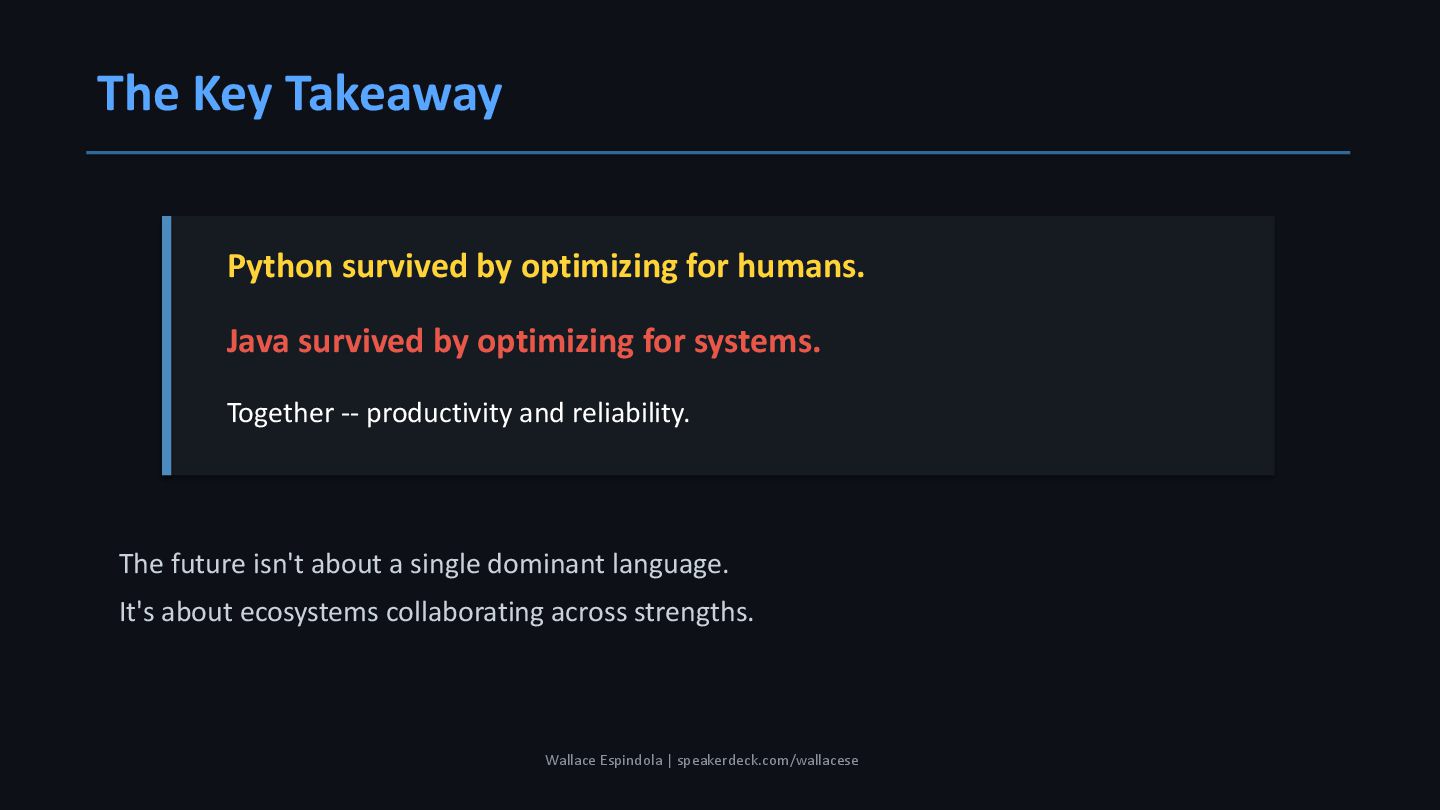
Python survived by optimizing for humans. Java survived by optimizing for systems. Together they represent two complementary visions of software engineering -- productivity and reliability.

Author:
Wallace Espindola
Senior Software Engineer, Brussels, Belgium

GitHub: github.com/wallaceespindola
LinkedIn: linkedin.com/in/wallaceespindola
Medium: medium.com/@wallaceespindola
Dev.to: dev.to/wallaceespindola

Tags:
Python, Java, Programming Languages, Software Engineering, AI, Machine Learning

Avatar for Wallace Espindola

Wallace Espindola

February 20, 2026
Tweet

Transcript

  1. Python Turns 35 The Language That Refused to Die 1991

    - 2026 Wallace Espindola Senior Software Engineer | Brussels, Belgium speakerdeck.com/wallacese
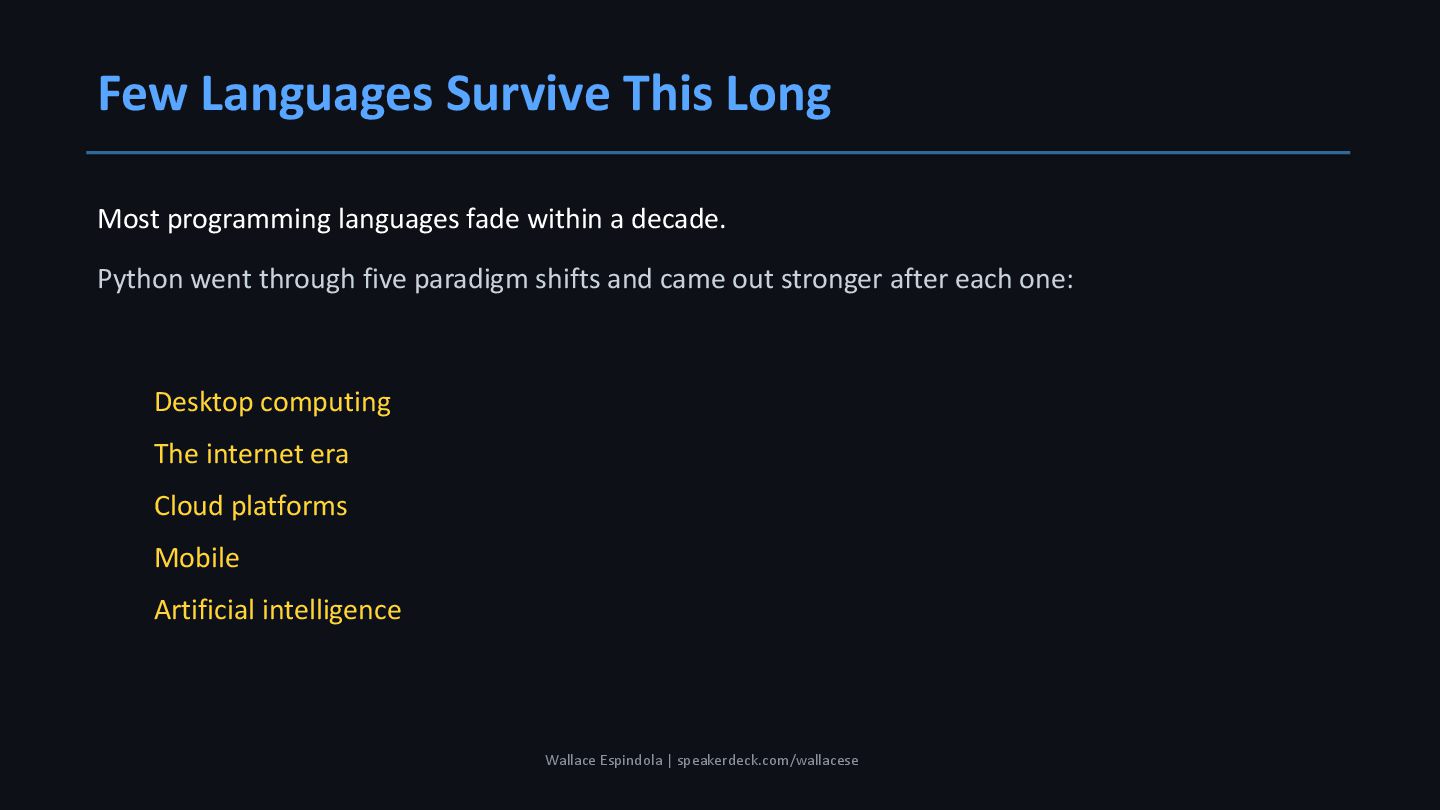
  2. Few Languages Survive This Long Most programming languages fade within

    a decade. Python went through five paradigm shifts and came out stronger after each one: Desktop computing The internet era Cloud platforms Mobile Artificial intelligence Wallace Espindola | speakerdeck.com/wallacese
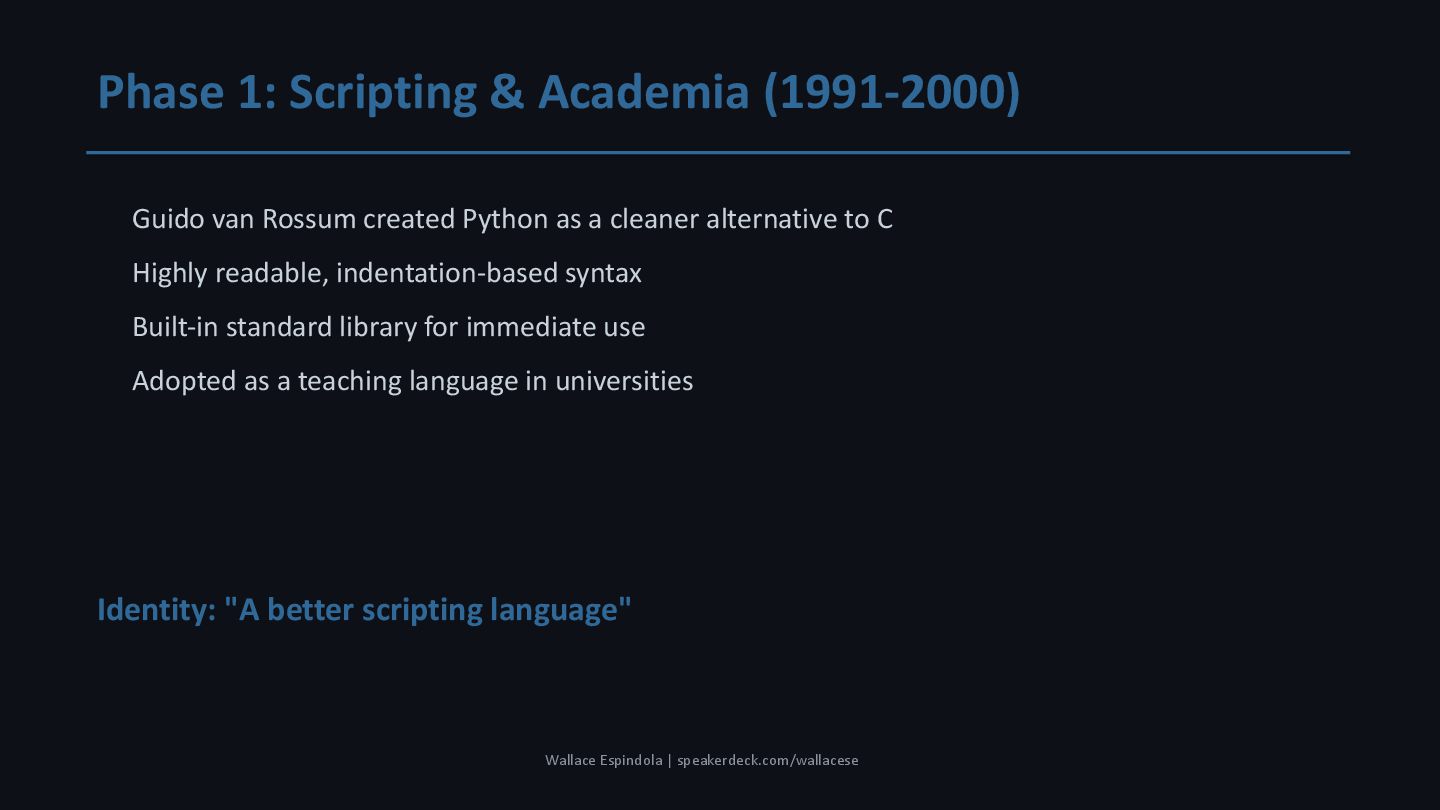
  3. Phase 1: Scripting & Academia (1991-2000) Guido van Rossum created

    Python as a cleaner alternative to C Highly readable, indentation-based syntax Built-in standard library for immediate use Adopted as a teaching language in universities Identity: "A better scripting language" Wallace Espindola | speakerdeck.com/wallacese
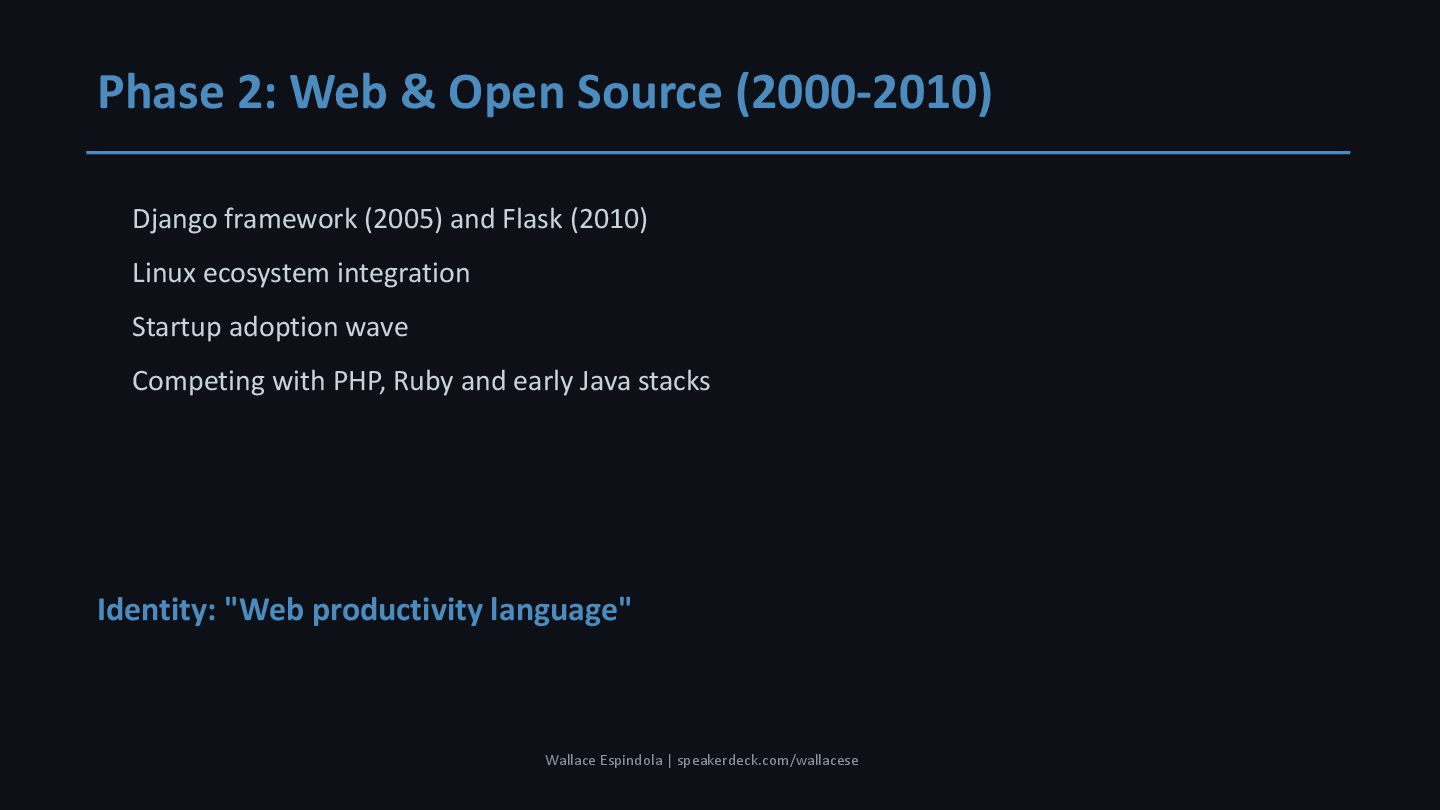
  4. Phase 2: Web & Open Source (2000-2010) Django framework (2005)

    and Flask (2010) Linux ecosystem integration Startup adoption wave Competing with PHP, Ruby and early Java stacks Identity: "Web productivity language" Wallace Espindola | speakerdeck.com/wallacese
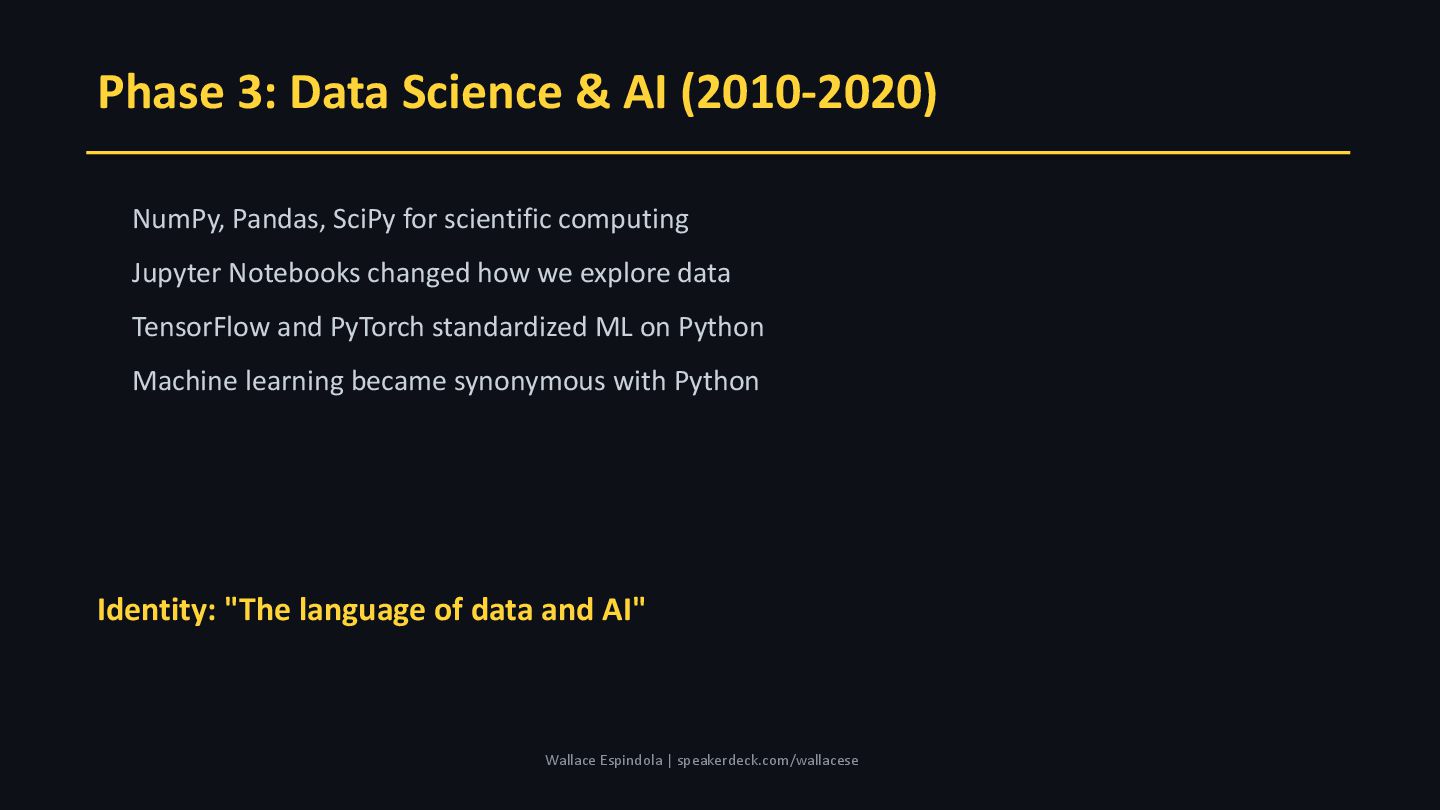
  5. Phase 3: Data Science & AI (2010-2020) NumPy, Pandas, SciPy

    for scientific computing Jupyter Notebooks changed how we explore data TensorFlow and PyTorch standardized ML on Python Machine learning became synonymous with Python Identity: "The language of data and AI" Wallace Espindola | speakerdeck.com/wallacese
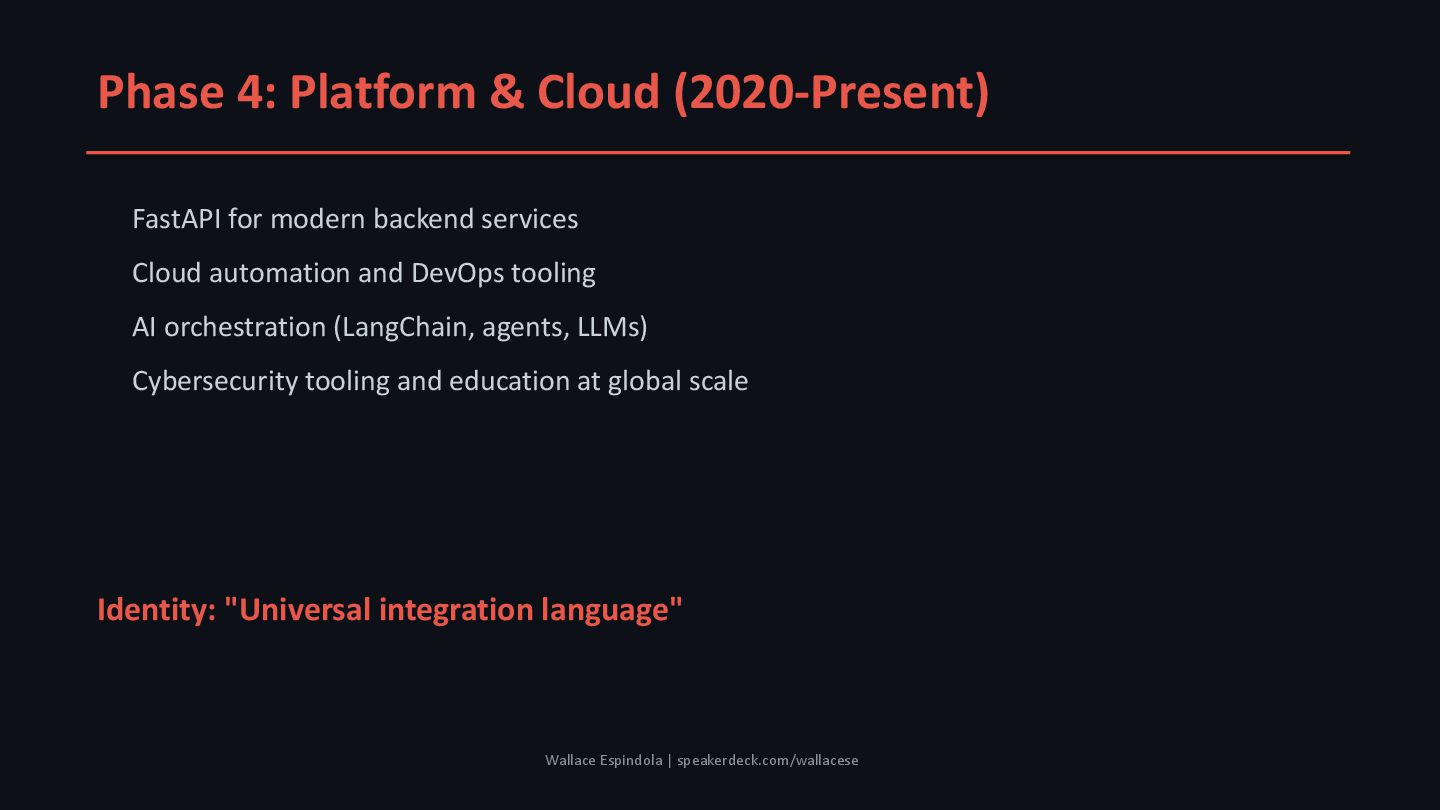
  6. Phase 4: Platform & Cloud (2020-Present) FastAPI for modern backend

    services Cloud automation and DevOps tooling AI orchestration (LangChain, agents, LLMs) Cybersecurity tooling and education at global scale Identity: "Universal integration language" Wallace Espindola | speakerdeck.com/wallacese
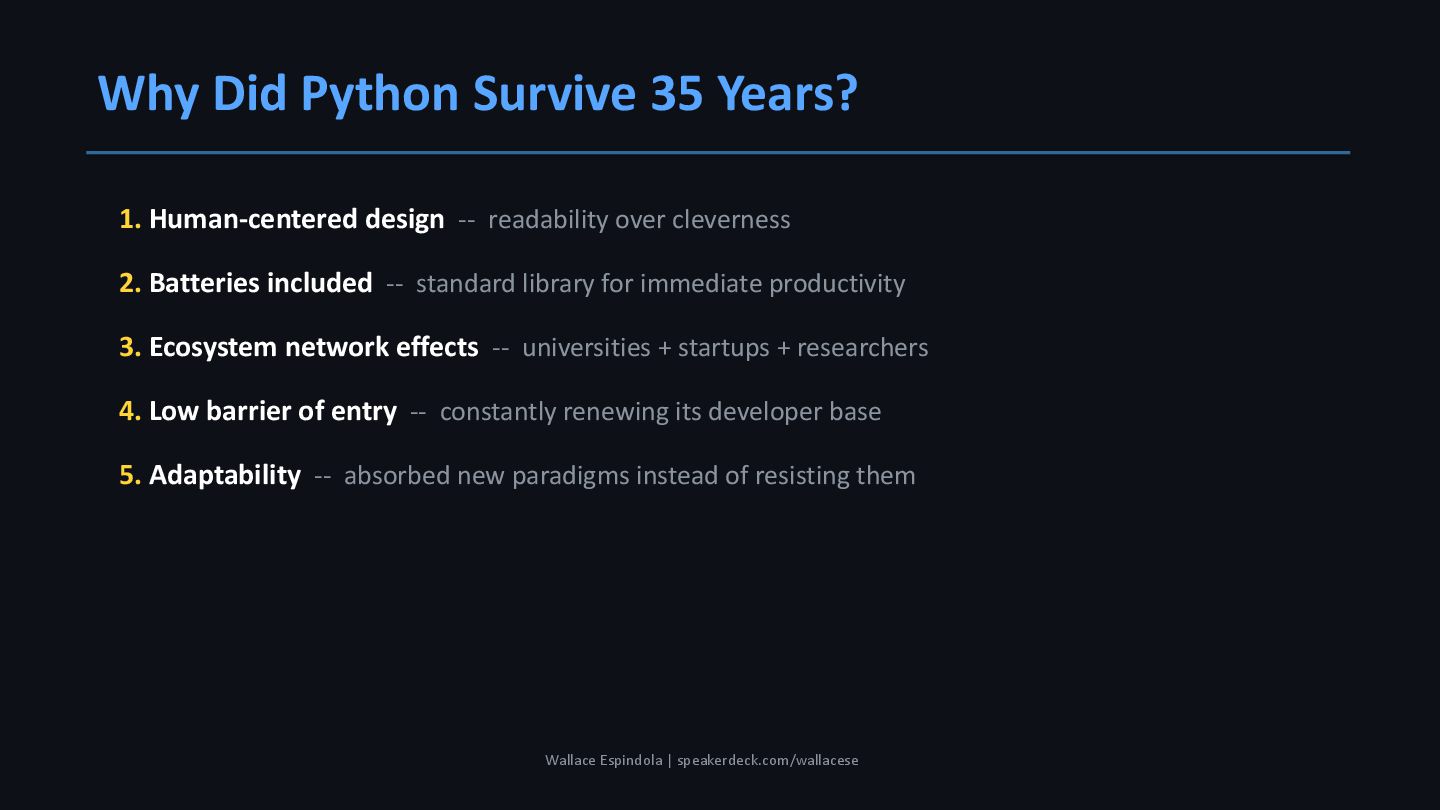
  7. Why Did Python Survive 35 Years? 1. Human-centered design --

    readability over cleverness 2. Batteries included -- standard library for immediate productivity 3. Ecosystem network effects -- universities + startups + researchers 4. Low barrier of entry -- constantly renewing its developer base 5. Adaptability -- absorbed new paradigms instead of resisting them Wallace Espindola | speakerdeck.com/wallacese
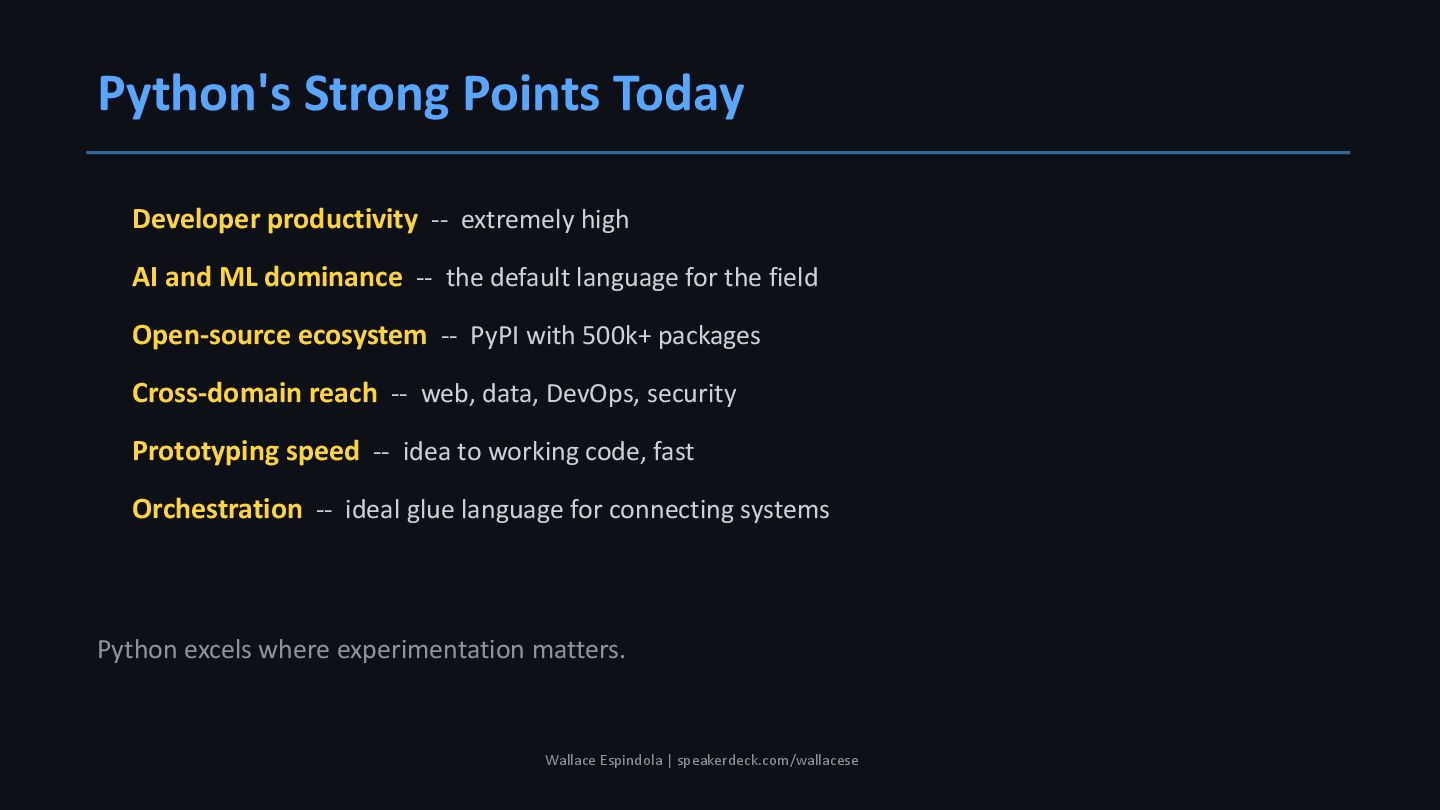
  8. Python's Strong Points Today Developer productivity -- extremely high AI

    and ML dominance -- the default language for the field Open-source ecosystem -- PyPI with 500k+ packages Cross-domain reach -- web, data, DevOps, security Prototyping speed -- idea to working code, fast Orchestration -- ideal glue language for connecting systems Python excels where experimentation matters. Wallace Espindola | speakerdeck.com/wallacese
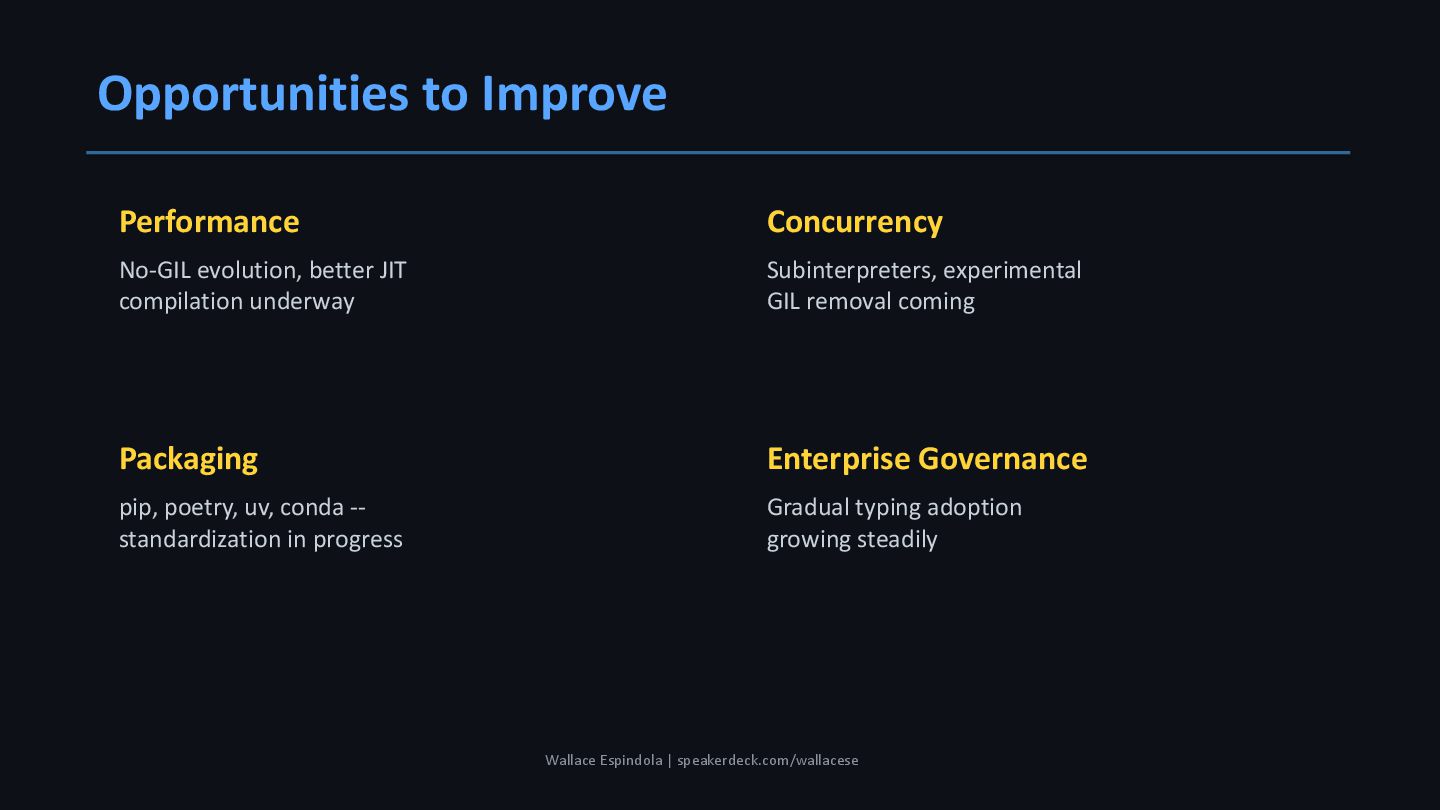
  9. Opportunities to Improve Performance No-GIL evolution, better JIT compilation underway

    Packaging pip, poetry, uv, conda -- standardization in progress Concurrency Subinterpreters, experimental GIL removal coming Enterprise Governance Gradual typing adoption growing steadily Wallace Espindola | speakerdeck.com/wallacese
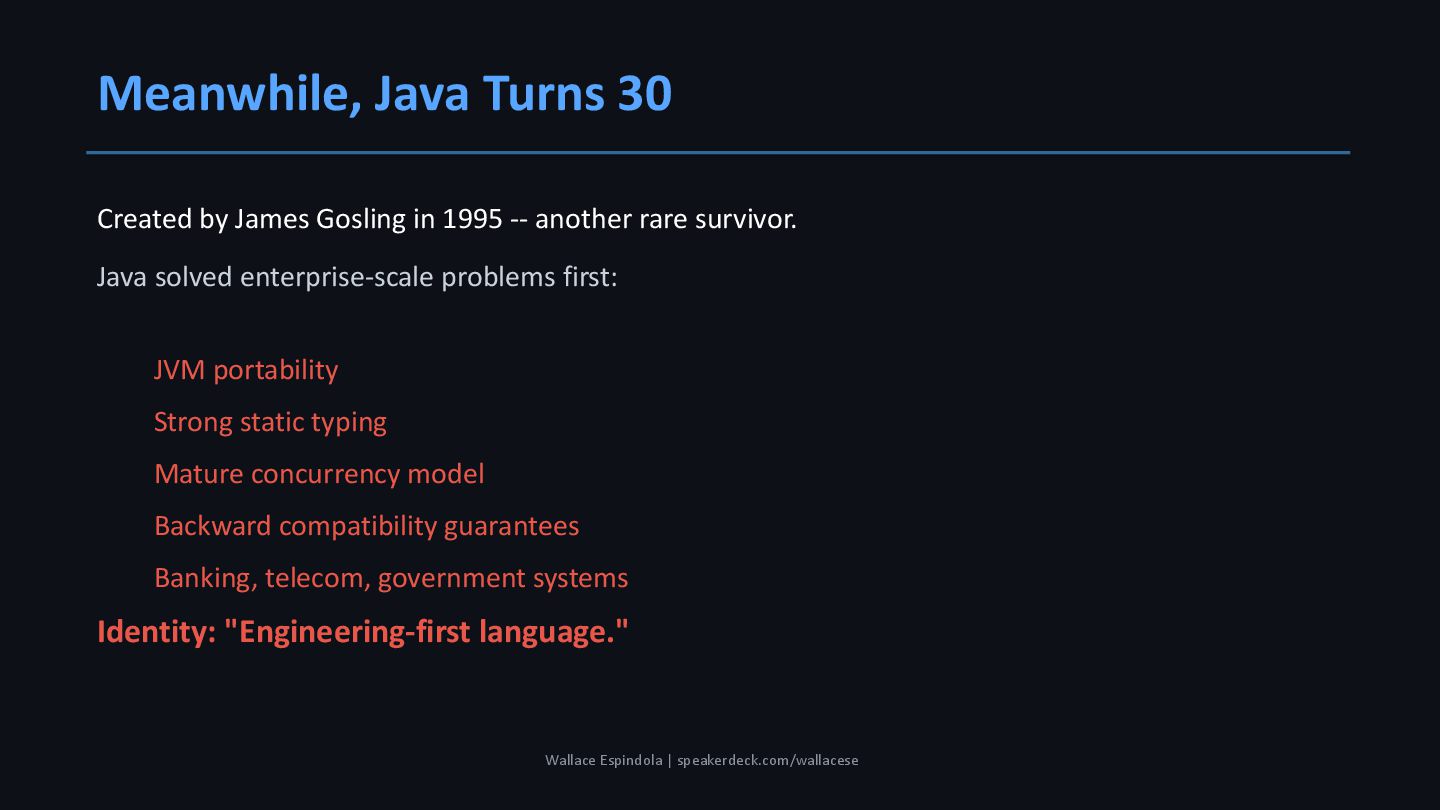
  10. Meanwhile, Java Turns 30 Created by James Gosling in 1995

    -- another rare survivor. Java solved enterprise-scale problems first: JVM portability Strong static typing Mature concurrency model Backward compatibility guarantees Banking, telecom, government systems Identity: "Engineering-first language." Wallace Espindola | speakerdeck.com/wallacese
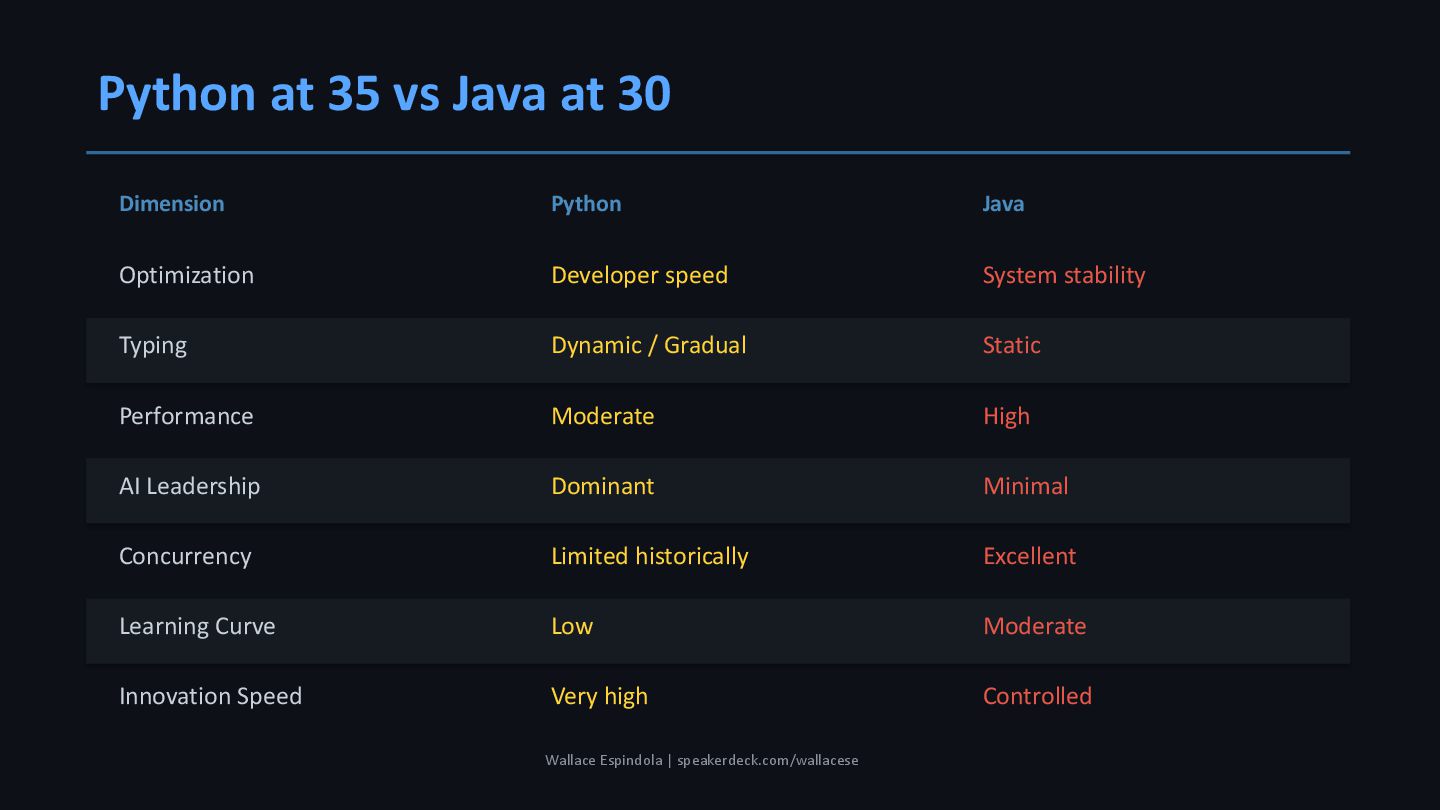
  11. Python at 35 vs Java at 30 Dimension Python Java

    Optimization Developer speed System stability Typing Dynamic / Gradual Static Performance Moderate High AI Leadership Dominant Minimal Concurrency Limited historically Excellent Learning Curve Low Moderate Innovation Speed Very high Controlled Wallace Espindola | speakerdeck.com/wallacese
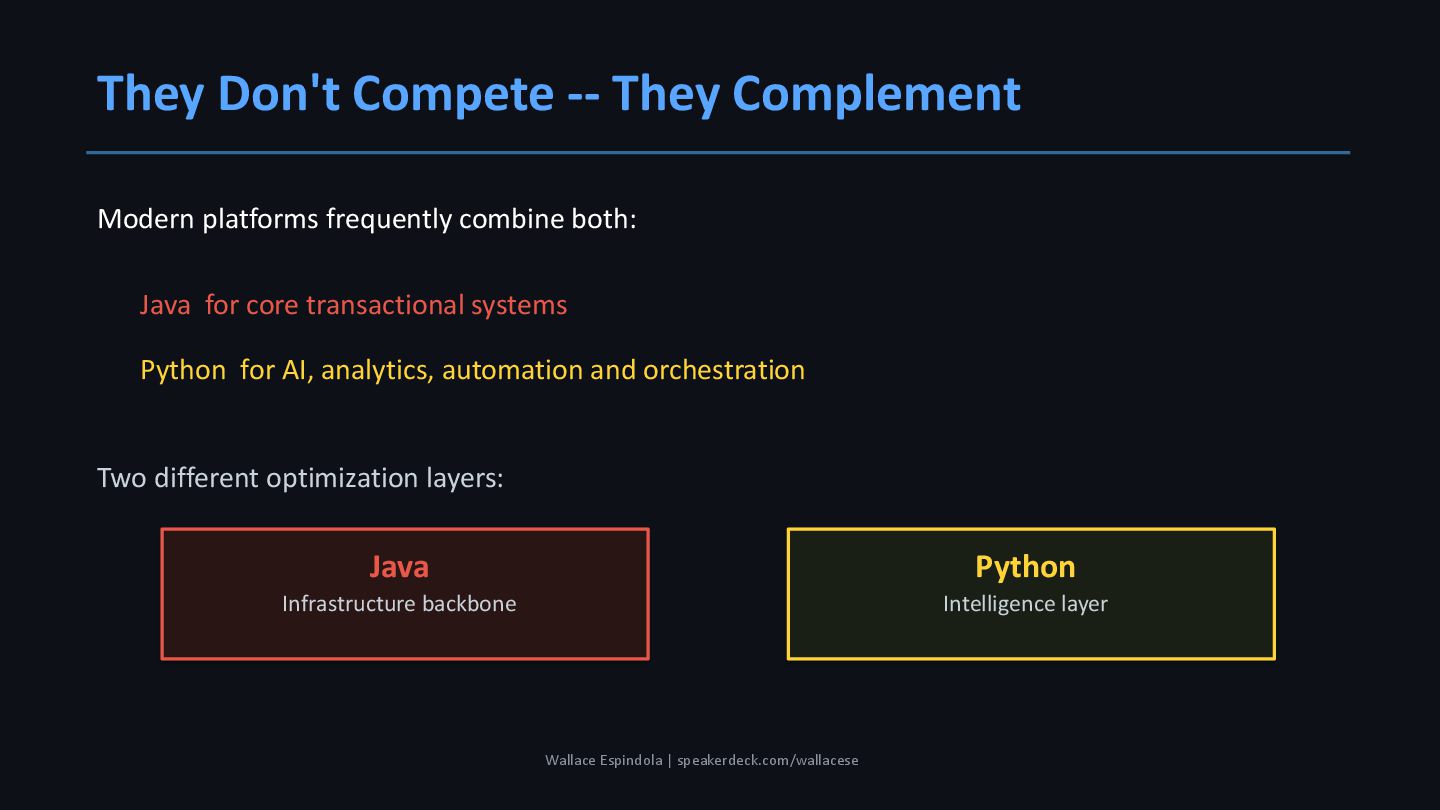
  12. They Don't Compete -- They Complement Modern platforms frequently combine

    both: Java for core transactional systems Python for AI, analytics, automation and orchestration Two different optimization layers: Java Infrastructure backbone Python Intelligence layer Wallace Espindola | speakerdeck.com/wallacese
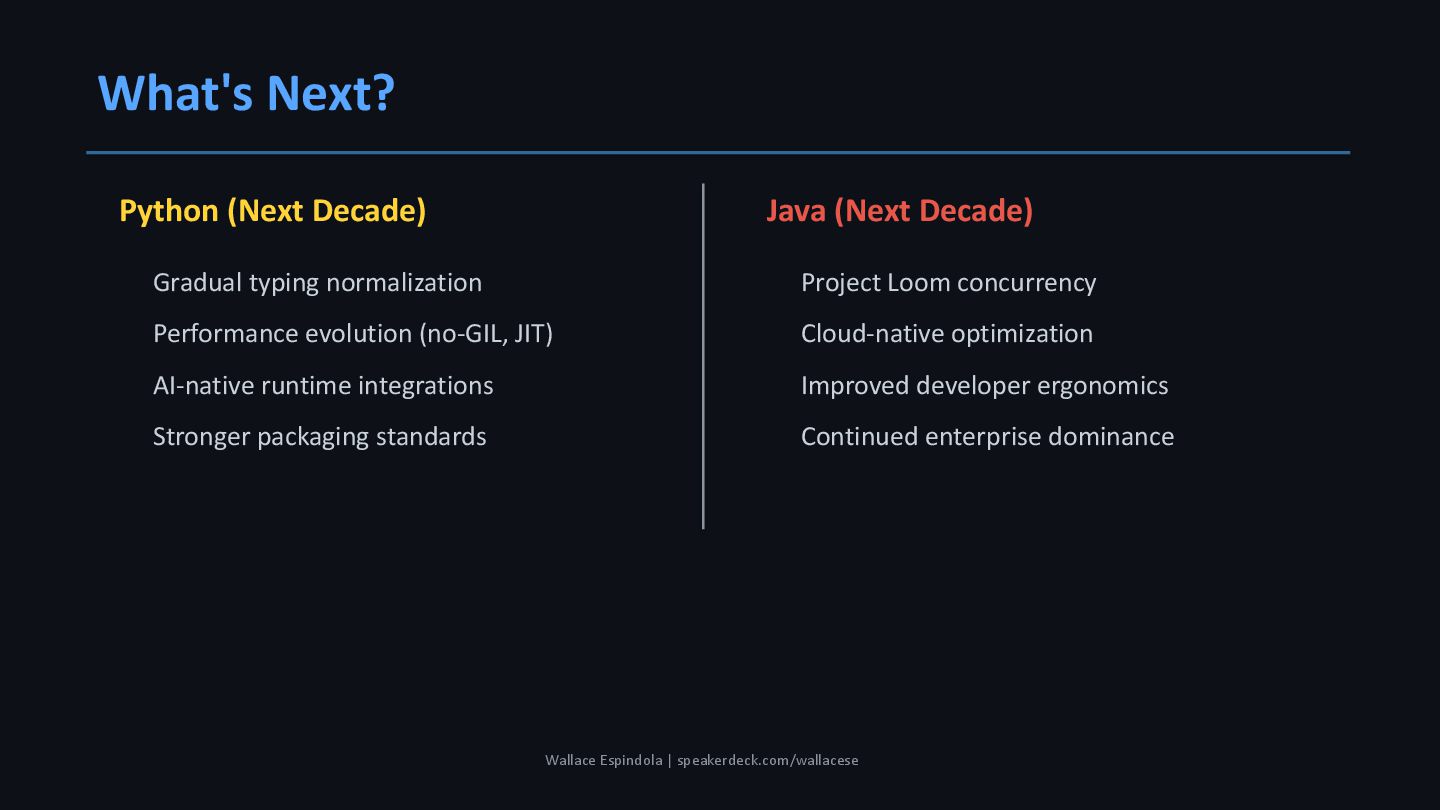
  13. What's Next? Python (Next Decade) Gradual typing normalization Performance evolution

    (no-GIL, JIT) AI-native runtime integrations Stronger packaging standards Java (Next Decade) Project Loom concurrency Cloud-native optimization Improved developer ergonomics Continued enterprise dominance Wallace Espindola | speakerdeck.com/wallacese
  14. The Key Takeaway Python survived by optimizing for humans. Java

    survived by optimizing for systems. Together -- productivity and reliability. The future isn't about a single dominant language. It's about ecosystems collaborating across strengths. Wallace Espindola | speakerdeck.com/wallacese
  15. Thank You Happy 35th birthday, Python! Wallace Espindola Senior Software

    Engineer | Brussels, Belgium GitHub: github.com/wallaceespindola LinkedIn: linkedin.com/in/wallaceespindola Medium: medium.com/@wallaceespindola Dev.to: dev.to/wallaceespindola Speaker Deck: speakerdeck.com/wallacese