Share
Embed
MVWTF: Demystifying Architecture Patterns
Breaking down the differences between a number of the MV* patterns on Android.

Adam McNeilly
August 14, 2019
Transcript
92 slides
-
You May Have Heard These Buzzwords: • MVC • MVP
• MVVM • MVI • MVU?? @AdamMc331 #AndroidSummit 2 -
More Buzzwords! • Maintainability • Extensibility • Robust • Testable
@AdamMc331 #AndroidSummit 8 -
Why Not? • Not readable • Difficult to add new
code • Difficult to change existing code • Can't write Junit tests for this @AdamMc331 #AndroidSummit 12 -
Model-View-Controller • One of the earliest architecture patterns • Introduced
in the 1970s as a way to organize code • Divides application to three parts @AdamMc331 #AndroidSummit 15 -
Model • This is your data source • Database, remote
server, etc • It does not care about the view @AdamMc331 #AndroidSummit 16 -
View • This is the visual representation of information •
Does not care where this data came from • Only responsible for displaying data • If your view has a conditional, consider refactoring @AdamMc331 #AndroidSummit 17 -
Controller • Handles user inputs • Validates if necessary •
Passes input to model • Passes model response to view @AdamMc331 #AndroidSummit 18 -
The Model & View Components Are The Same For All
Patterns @AdamMc331 #AndroidSummit 19 -
Why Do We Have So Many Options For This Third
Component? @AdamMc331 #AndroidSummit 22 -
Why Don't We Use This For Android? • We can't
write Junit tests for an Activity • We can't unit test our UI logic • We don't really have a separation of concerns here @AdamMc331 #AndroidSummit 28 -
Model-View-Presenter • Similar to the last pattern • Moves our
presentation logic out of the Activity class @AdamMc331 #AndroidSummit 30 -
Why Is This Better? • UI logic is outside of
the Activity, and now supports Junit tests • Our concerns are separated again @AdamMc331 #AndroidSummit 32 -
Contract Class class TaskListContract { interface View { fun showTasks(tasks:
List<Task>) } interface Presenter { fun viewCreated() fun viewDestroyed() } interface Model { fun getTasks(): List<Task> } } @AdamMc331 #AndroidSummit 34 -
Contract Class class TaskListContract { interface View { fun showTasks(tasks:
List<Task>) } interface Presenter { fun viewCreated() fun viewDestroyed() } interface Model { fun getTasks(): List<Task> } } @AdamMc331 #AndroidSummit 35 -
Model class InMemoryTaskService : TaskListContract.Model { override fun getTasks(): List<Task>
{ return listOf( Task("Sample task 1"), Task("Sample task 2") ) } } @AdamMc331 #AndroidSummit 36 -
View class TaskListActivity : AppCompatActivity(), TaskListContract.View { private val taskAdapter
= TaskAdapter() private val presenter = TaskListPresenter(this, TaskRepository()) override fun onCreate(savedInstanceState: Bundle?) { super.onCreate(savedInstanceState) // ... presenter.viewCreated() } override fun onDestroy() { presenter.viewDestroyed() super.onDestroy() } override fun showTasks(tasks: List<Task>) { taskAdapter.tasks = tasks } } @AdamMc331 #AndroidSummit 37 -
View class TaskListActivity : AppCompatActivity(), TaskListContract.View { private val taskAdapter
= TaskAdapter() private val presenter = TaskListPresenter(this, TaskRepository()) override fun onCreate(savedInstanceState: Bundle?) { super.onCreate(savedInstanceState) // ... presenter.viewCreated() } override fun onDestroy() { presenter.viewDestroyed() super.onDestroy() } override fun showTasks(tasks: List<Task>) { taskAdapter.tasks = tasks } } @AdamMc331 #AndroidSummit 38 -
Presenter class TaskListPresenter( private var view: TaskListContract.View?, private val model:
TaskListContract.Model ) : TaskListContract.Presenter { override fun viewCreated() { val tasks = model.getTasks() view?.showTasks(tasks) } override fun viewDestroyed() { view = null } } @AdamMc331 #AndroidSummit 39 -
Presenter class TaskListPresenter( private var view: TaskListContract.View?, private val model:
TaskListContract.Model ) : TaskListContract.Presenter { override fun viewCreated() { val tasks = model.getTasks() view?.showTasks(tasks) } override fun viewDestroyed() { view = null } } @AdamMc331 #AndroidSummit 40 -
Is That Enough? • View does nothing but display data
• Data fetching is all handled by model • Presentation of data is handled by presenter • Everything is separated, everything is testable • If you think this is good enough, use it! @AdamMc331 #AndroidSummit 41 -
The Presenter Doesn't Need To Care About The View @AdamMc331
#AndroidSummit 43 -
Model Doesn't Change (much) interface TaskRepository { fun getTasks(): List<Task>
} class InMemoryTaskService : TaskRepository { override fun getTasks(): List<Task> { return listOf(...) } } @AdamMc331 #AndroidSummit 46 -
ViewModel class TaskListViewModel( private val repository: TaskRepository ) { private
val tasks = MutableLiveData<List<Task>>() fun getTasks(): LiveData<List<Task>> = tasks init { fetchTasks() } private fun fetchTasks() { tasks.value = repository.getTasks() } } @AdamMc331 #AndroidSummit 47 -
ViewModel class TaskListViewModel( private val repository: TaskRepository ) { private
val tasks = MutableLiveData<List<Task>>() fun getTasks(): LiveData<List<Task>> = tasks init { fetchTasks() } private fun fetchTasks() { tasks.value = repository.getTasks() } } @AdamMc331 #AndroidSummit 48 -
ViewModel class TaskListViewModel( private val repository: TaskRepository ) { private
val tasks = MutableLiveData<List<Task>>() fun getTasks(): LiveData<List<Task>> = tasks init { fetchTasks() } private fun fetchTasks() { tasks.value = repository.getTasks() } } @AdamMc331 #AndroidSummit 49 -
View class TaskListActivity : AppCompatActivity() { private val adapter =
TaskAdapter() private val viewModel = TaskListviewModel(repository = InMemoryTaskService()) override fun onCreate(savedInstanceState: Bundle?) { super.onCreate(savedInstanceState) // ... subscribeToViewModel() } private fun subscribeToViewModel() { viewModel.getTasks().observe(this, Observer { tasks -> adapter.tasks = tasks }) } } @AdamMc331 #AndroidSummit 50 -
View class TaskListActivity : AppCompatActivity() { private val adapter =
TaskAdapter() private val viewModel = TaskListviewModel(repository = InMemoryTaskService()) override fun onCreate(savedInstanceState: Bundle?) { super.onCreate(savedInstanceState) // ... subscribeToViewModel() } private fun subscribeToViewModel() { viewModel.getTasks().observe(this, Observer { tasks -> adapter.tasks = tasks }) } } @AdamMc331 #AndroidSummit 51 -
This Is Pretty Close To MVP, With One New Benefit
@AdamMc331 #AndroidSummit 52 -
Since ViewModel Doesn't Reference View, We Can Leverage Android ViewModel
To Outlast Config Changes @AdamMc331 #AndroidSummit 53 -
Handle Rotation In MVP 1. Update your presenter to save/restore
state 2. Modify the view to call appropriate save/restore methods @AdamMc331 #AndroidSummit 54 -
Handle Rotation In MVP class TaskListContract { interface Presenter {
// New: fun getState(): Bundle fun restoreState(bundle: Bundle?) } } @AdamMc331 #AndroidSummit 55 -
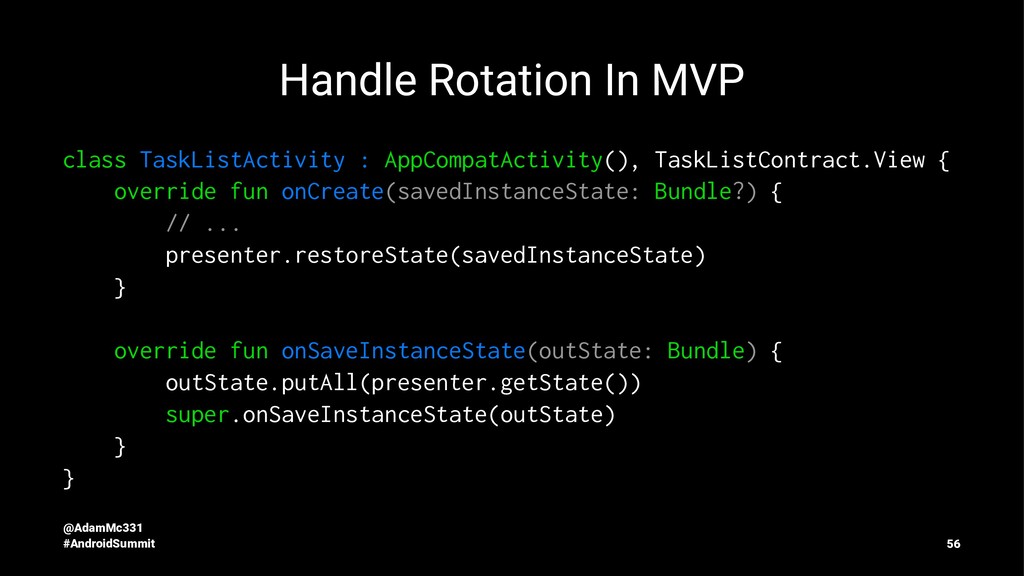
Handle Rotation In MVP class TaskListActivity : AppCompatActivity(), TaskListContract.View {
override fun onCreate(savedInstanceState: Bundle?) { // ... presenter.restoreState(savedInstanceState) } override fun onSaveInstanceState(outState: Bundle) { outState.putAll(presenter.getState()) super.onSaveInstanceState(outState) } } @AdamMc331 #AndroidSummit 56 -
Handle Rotation In MVVM 1. Have ViewModel class extend the
Android ViewModel class 2. Update Activity to use ViewModelProviders 3. Since Android's ViewModel outlasts config changes, no need to save/restore state, just re-subscribe @AdamMc331 #AndroidSummit 57 -
Handle Rotation In MVVM class TaskListViewModel( private val repository: TaskRepository
) : ViewModel() { // ... } @AdamMc331 #AndroidSummit 58 -
Handle Rotation In MVVM class TaskListActivity : AppCompatActivity() { private
lateinit var viewModel: TaskListViewModel override fun onCreate(savedInstanceState: Bundle?) { super.onCreate(savedInstanceState) // ... setupViewModel() } private fun setupViewModel() { viewModel = ViewModelProviders.of(this, viewModelFactory).get(TaskListViewModel::class.java) viewModel.getTasks().observe(this, Observer { tasks -> taskAdapter.tasks = tasks }) } } @AdamMc331 #AndroidSummit 59 -
Is That Enough? • View does nothing but display data
• Data fetching is all handled by model • ViewModel handles all UI logic • We can easily save state across config changes • Everything is separated, everything is testable • If you think this is good enough, use it! @AdamMc331 #AndroidSummit 60 -
Let's Consider A More Complicated State sealed class TaskListState {
object Loading : TaskListState() data class Loaded(val tasks: List<Task>) : TaskListState() data class Error(val error: Throwable?) : TaskListState() } @AdamMc331 #AndroidSummit 63 -
Let's Consider A More Complicated State class TaskListViewModel(private val repository:
TaskRepository) : ViewModel() { init { showLoading() try { fetchTasks() } catch (e: Exception) { showError() } } // ... } @AdamMc331 #AndroidSummit 64 -
Let's Consider A More Complicated State class TaskListViewModel(private val repository:
TaskRepository) : ViewModel() { // ... private fun showLoading() { state.value = TaskListState.Loading } private fun fetchTasks() { val tasks = repository.getItems() state.value = TaskListState.Loaded(tasks) } private fun showError() { state.value = TaskListState.Error(Throwable("Unable to fetch tasks.")) } } @AdamMc331 #AndroidSummit 65 -
What Are The Risks Of These Methods? private fun showLoading()
{ state.value = TaskListState.Loading } private fun fetchTasks() { val tasks = repository.getItems() state.value = TaskListState.Loaded(tasks) } private fun showError() { state.value = TaskListState.Error(Throwable("Unable to fetch tasks.")) } @AdamMc331 #AndroidSummit 66 -
What Are The Risks Of These Methods? • Any methods
in the class can call them • We can't guarantee they're associated with a specific action or intent • We have multiple methods manipulating our state that we have to ensure don't conflict with each other @AdamMc331 #AndroidSummit 67 -
How Can We Mitigate This Risk? • Have one single
source of truth for our state • Do this through a single pipeline where every action causes a specific change in the state • This makes state changes predictable, and therefore highly testable as well @AdamMc331 #AndroidSummit 68 -
Model-View-Intent • Unlike the previous patterns, "Intent" isn't used to
reference a specific kind of component, but rather the intention of doing something that we want to capture in our state. @AdamMc331 #AndroidSummit 70 -
The First Goal Is To Make Our State Changes Predictable
@AdamMc331 #AndroidSummit 71 -
We Achieve This With A Reducer abstract class Reducer {
abstract fun reduce(action: Action, state: State): State } @AdamMc331 #AndroidSummit 72 -
Clearly Defined Inputs And Outputs class TaskListReducer : Reducer<TaskListState>() {
override fun reduce(action: Action, state: TaskListState): TaskListState { return when (action) { is TaskListAction.TasksLoading -> TaskListState.Loading() is TaskListAction.TasksLoaded -> TaskListState.Loaded(action.tasks) is TaskListAction.TasksErrored -> TaskListState.Error() else -> state } } } @AdamMc331 #AndroidSummit 73 -
We Create A State Container Called A Store • Contains
our state and exposes it for anyone to observe • Contains our reducer instance • Dispatches actions into that reducer to modify the state @AdamMc331 #AndroidSummit 75 -
Store Implementation class BaseStore<S : State>( initialState: S, private val
reducer: Reducer<S> ) { private var stateListener: ((S) -> Unit)? = null private var currentState: S = initialState set(value) { field = value stateListener?.invoke(value) } fun dispatch(action: Action) { currentState = reducer.reduce(action, currentState) } fun subscribe(stateListener: ((S) -> Unit)?) { this.stateListener = stateListener } } @AdamMc331 #AndroidSummit 76 -
Store Implementation class BaseStore<S : State>( initialState: S, private val
reducer: Reducer<S> ) { private var stateListener: ((S) -> Unit)? = null private var currentState: S = initialState set(value) { field = value stateListener?.invoke(value) } fun dispatch(action: Action) { currentState = reducer.reduce(action, currentState) } fun subscribe(stateListener: ((S) -> Unit)?) { this.stateListener = stateListener } } @AdamMc331 #AndroidSummit 77 -
Store Implementation class BaseStore<S : State>( initialState: S, private val
reducer: Reducer<S> ) { private var stateListener: ((S) -> Unit)? = null private var currentState: S = initialState set(value) { field = value stateListener?.invoke(value) } fun dispatch(action: Action) { currentState = reducer.reduce(action, currentState) } fun subscribe(stateListener: ((S) -> Unit)?) { this.stateListener = stateListener } } @AdamMc331 #AndroidSummit 78 -
Store Implementation class BaseStore<S : State>( initialState: S, private val
reducer: Reducer<S> ) { private var stateListener: ((S) -> Unit)? = null private var currentState: S = initialState set(value) { field = value stateListener?.invoke(value) } fun dispatch(action: Action) { currentState = reducer.reduce(action, currentState) } fun subscribe(stateListener: ((S) -> Unit)?) { this.stateListener = stateListener } } @AdamMc331 #AndroidSummit 79 -
Hook This Up To Our ViewModel/Presenter class TaskListViewModel(private val repository:
TaskRepository) : ViewModel() { private val store: BaseStore<TaskListState> = BaseStore( TaskListState.Loading(), TaskListReducer() ) // ... private fun fetchTasks() { store.dispatch(TaskListAction.TasksLoading) try { val tasks = repository.getTasks() store.dispatch(TaskListAction.TasksLoaded(tasks)) } catch (e: Throwable) { store.dispatch(TaskListAction.TasksErrored(e)) } } } @AdamMc331 #AndroidSummit 81 -
Hook This Up To Our ViewModel/Presenter class TaskListViewModel(private val repository:
TaskRepository) : ViewModel() { private val store: BaseStore<TaskListState> = BaseStore( TaskListState.Loading(), TaskListReducer() ) // ... private fun fetchTasks() { store.dispatch(TaskListAction.TasksLoading) try { val tasks = repository.getTasks() store.dispatch(TaskListAction.TasksLoaded(tasks)) } catch (e: Throwable) { store.dispatch(TaskListAction.TasksErrored(e)) } } } @AdamMc331 #AndroidSummit 82 -
Hook This Up To Our ViewModel/Presenter class TaskListViewModel(private val repository:
TaskRepository) : ViewModel() { private val store: BaseStore<TaskListState> = BaseStore( TaskListState.Loading(), TaskListReducer() ) // ... private fun fetchTasks() { store.dispatch(TaskListAction.TasksLoading) try { val tasks = repository.getTasks() store.dispatch(TaskListAction.TasksLoaded(tasks)) } catch (e: Throwable) { store.dispatch(TaskListAction.TasksErrored(e)) } } } @AdamMc331 #AndroidSummit 83 -
Is That Enough? • View does nothing but display data
• Data fetching is all handled by model • ViewModel handles UI logic • We can easily save state across config changes • Everything is separated, everything is testable • State management is clear and predictable • If you think this is good enough, use it! @AdamMc331 #AndroidSummit 84 -
Is MVI The Best We Can Do? • State management
is pretty solid • But, we have 22 letters that weren't covered yet @AdamMc331 #AndroidSummit 85 -
Model-View-Presenter • Separated concerns and allows us to unit test
all of our code • Good for quick prototyping • Good for blog post samples because of its readability • Can handle config changes but requires a little more work • State management is unpredictable @AdamMc331 #AndroidSummit 87 -
Model-View-ViewModel • Separated concerns and allows us to unit test
all of our code • Even better for quick prototyping • No contract class boilerplate • Good for blog post samples because of its readability3 • Can handle config changes easily if we use Android's architecture components • State management is unpredictable 3 Depending on how you expose information @AdamMc331 #AndroidSummit 88 -
Model-View-Intent • Can work with presenter or viewmodel • Separated
concerns, testability come with this • Not good for quick prototyping • Can be confusing if used for sample apps due to unfamiliarity • Can handle config changes based on whether we used a presenter or a viewmodel • State management is clear and predictable @AdamMc331 #AndroidSummit 89 -
General Suggestions • MVP can get you up and running
quickly, but due to the boilerplate and config changes work I wouldn't recommend it. • MVVM is what I'd recommend the most. It allows for separation of concerns and unit test support without a major learning curve. • If your app handles complex user flows or states, MVI can give you more support for state management. @AdamMc331 #AndroidSummit 90
 adammc331
 phigasui
 raeminkang
 kamina_zzz
 kinakomoti321
 ryunakayama
 fornewid
 sms_tech
 l2hyunwoo
 nextbeatdev
 tarao
 seike460
 youto
 colly
 leimatthew05
 eileencodes
 tammyeverts
 hatefulcrawdad
 3n
 ivargrimstad
 michielstock
 soysaucechin
 helenjbeal
 mfonobong
 jnunemaker