Center • Filipa Calado, GC Digital Fellow, CUNY Graduate Center • Yuxiao Luo, GC Digital Fellow, CUNY Graduate Center • Connor French, GC Digital Fellow, CUNY Graduate Center • Param Ajmera, GC Digital Fellow, CUNY Graduate Center • Dimitris C. Papadopoulos, NEH CARES Digital Humanities Instructional Technologist, Division of Humanities and the Arts, The City College of New York • Yolande Brener, Adjunct Assistant Professor, English, The City College of New York • Debra Williams, Adjunct Lecturer, English, The City College of New York • Janelle Poe, Adjunct Assistant Professor, Black Studies, The City College of New York
Fellows || cuny.is/digitalfellows || #CUNYGCDI What is GC Digital Initiatives? The Graduate Center Digital Initiatives (GCDI) builds and sustains an active community around the shared idea of a “Digital GC,” where scholars and technologists explore new modes of inquiry that integrate digital tools and methods into the research, teaching, and service missions of the institution. Emerging digital technologies offer opportunities for expanding scholarly practice and public engagement, and GCDI represents a diverse constellation of people, projects, labs, and collaborations pushing the boundaries of existing scholarly practice through the skeptical, reflective, and innovative incorporation of digital technologies.
Fellows || cuny.is/digitalfellows || #CUNYGCDI Teaching participants the basic skills in the Command Line, Git/Github, Databases, Ethics, Python, and more, to empower them to develop their own digital projects
Fellows || cuny.is/digitalfellows || #CUNYGCDI Next Steps: • Creating a Virtual Institute, with 30 participants from 15 institutions. • Open-access, online courses to be tested in DRI Workshop Series, 2021. So far… • Entirely redesigned curriculum to harness affordances of online learning. • Piloting the revised curriculum at our institution’s Digital Research Institute, Winter 2021
Fellows || cuny.is/digitalfellows || #CUNYGCDI How do we teach digital skills to a beginner audience online, while staying true to our practice of face-to-face, communal learning?
Fellows || cuny.is/digitalfellows || #CUNYGCDI About Us and What We Do • Spring 2020 Cohort: an interdisciplinary group of MA and PhD students at the CUNY graduate center. • What we do in D4PG: use data for public benefits by applying tools and techniques that are generally used in business applications. • Why we do D4PG ◦ Public interest ◦ Data potential ◦ Experience cumulation ◦ Team collaboration ◦ Capability improvement
Fellows || cuny.is/digitalfellows || #CUNYGCDI D4PG 2021: Covid Tracking Project • Partnership: partner with a volunteer organization launched by The Atlantic : Racial Digital Tracker. • What to expect ◦ Continue working on Covid-19 data (with a focus on race and ethnicity) ◦ Skills: ▪ Data entry ▪ Data infrastructure knowledge ▪ Web development • Application Form for D4PG 2021.
Fellows || cuny.is/digitalfellows || #CUNYGCDI Working groups 2020 Digital Fellow: Connor French PUG GIS DVG Sound R User Group Python User Group GIS Working Group Data Visualization Group Digital Archives Research Collective Sound Studies and Methods Working Group
Fellows || cuny.is/digitalfellows || #CUNYGCDI • Discussion group • Pre-meeting readings • Guided tutorials • Themed series • Cloud-based coding Solution- listen to your community PUG • Communal approach • Members bring their problems and ideas Sound
Fellows || cuny.is/digitalfellows || #CUNYGCDI What is DARC? • Interdisciplinary collective of researchers working with digital archives. • Community invested with discussing new ways of using and building digital archives. • Activities include: ◦ DARC Wiki - cuny.is/darc-wiki ◦ Workshops - Omeka, Oral History Recording ◦ Speaker Series ◦ Open Forum Meetings
Fellows || cuny.is/digitalfellows || #CUNYGCDI Pandemic-Induced Changes • Access to archives became severely affected. • Pivot to helping researchers work with digital archives: ◦ More Open Forums ◦ Contacting archivists ◦ Building relationships with scholars at other universities ◦ Data Mining, Data Visualization, Metadata Analysis ◦ Workshops emphasize remote work: ▪ Working with HathiTrust Data ▪ Getting Good (Enough) Audio Recordings
New York Dimitris C. Papadopoulos Ph.D NEH CARES DH Instructional Technologist https://dhccny.commons.gc.cuny.edu/ [email protected] @dimaterialist This presentation has been made possible in part by the National Endowment for the Humanities: NEH CARES Any views, findings, conclusions, or recommendations expressed in this presentation do not necessarily represent those of the National Endowment for the Humanities.
a Covid-19 Instructional Environment at the City College of New York” (July - December 2020). • 25 Adjunct Professors • Support in integration of digital humanities/digital pedagogy tools, re-design of syllabi, course development The NEH CARES digital pedagogy project at CCNY Project Coordinator: Renata Miller, Deputy Dean, Division of Humanities and the Arts, CCNY
CARES DH Workshop Series (text analysis, editing, publishing, digital collections / media in class spatio-temporal data, digital project sustainability) • Digital project review sessions • One-on-one consultations • A-Z Resources / Guides / Lists of Tools • Tutorials
• special projects (e.g. Omeka websites) • networking / exchange across fields and departments • feedback from faculty and instructors Support and community building through digital pedagogy: the experience so far
to (re)introduce, (re)use, (re)discover existing resources and infrastructures available “at home” (e.g. CCNY Teaching and Learning Center, CCNY Digital Scholarship Services, CUNY Academic Commons, Open Educational Resources) • building communities of practice and support among peers, across departments and campuses • technology is not the end goal. Need to align to pedagogy approaches / learning objectives. More examples of digital tools and materials as used in class.
to be aware of the fact that getting familiar with new digital tools or online environments is additional labor • emphasis on data literacy and digital skills (e.g. data management) as foundation for digital pedagogy / digital humanities projects • awareness of ethical issues (e.g. privacy, surveillance, anonymity, accessibility) in instructional technologies • need for (institutional) continuity and support
New York Dimitris C. Papadopoulos Ph.D NEH CARES DH Instructional Technologist https://dhccny.commons.gc.cuny.edu/ [email protected] @dimaterialist This presentation has been made possible in part by the National Endowment for the Humanities: NEH CARES Any views, findings, conclusions, or recommendations expressed in this presentation do not necessarily represent those of the National Endowment for the Humanities.
connection with each other • Not hearing/seeing each other in real time • Cameras and mics turned off in class • Accessibility of information • Communication both in and out of class
websites, with most recent announcements on home page • Video announcements (Zoom, Screencast-O-Matic) • Digital Stories Assignment (3 minute video stories) • Sharing select student work on larger forum (Academic Commons, Openlab, Wordpress)
Accountability Groups • Whatsapp Groups (work better when student led) • Students interviewing each other • Student's Choice Assignment (including art, performance, video, with written description of process and intention)
When working online, less assignments more practical • Instead of crowded modules, one or two self-directed tasks per week • Provide information in multiple modes: written, video, audio, spoken in class • Keep track of who speaks when • Reach out to silent members of class • Extended office hours, but within boundaries Examples of student videos and artwork submitted with written descriptions of their process
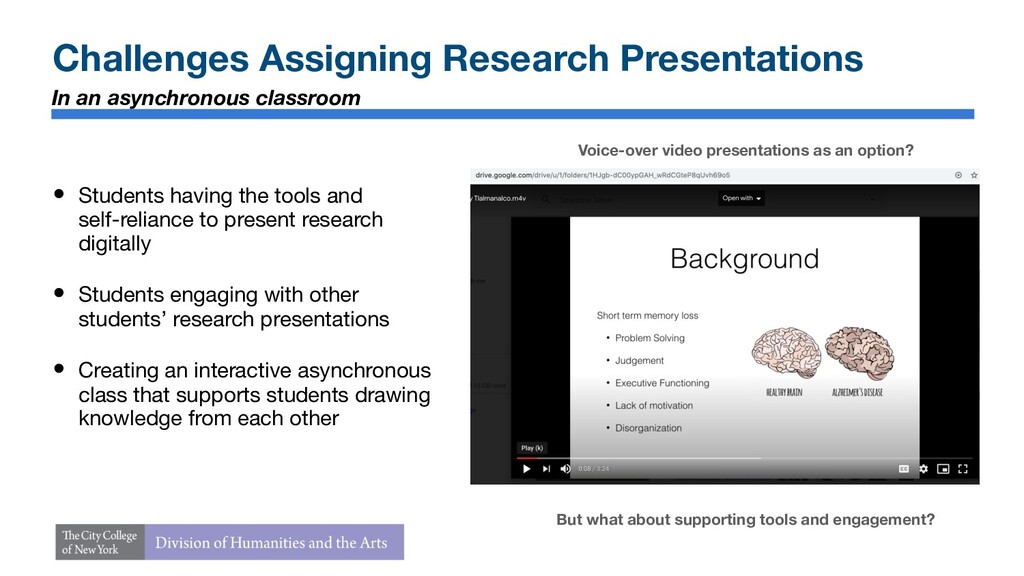
having the tools and self-reliance to present research digitally • Students engaging with other students’ research presentations • Creating an interactive asynchronous class that supports students drawing knowledge from each other Voice-over video presentations as an option? But what about supporting tools and engagement?
as a Solution Incorporating hypothesis.is with a web-base application like Google Drive for student engagement and interaction: • Convert/Export voice-over presentation as mp4 or m4v file format • Upload file to Google Drive • Use hypothes.is to comment/peer-review presentations played on Google Drive
Zoom / Academic Commons / Google Drive / hypothes.is • Students are more adaptable to new technology Accessing technical tools and information to support students • Youtube videos as a resource for learning new applications/technology Take Away from Initial Concerns
descriptions, tutorials and walk-through • Assign multiple interactions (ungraded attempts at first, extra time to complete) • Reassess again and adjust
learning experience) • Allow time for familiarity (pre- & during semester) • Overwhelmed by new tech? If so, your students are as well. • What alternatives do you have to simplify the process and achieve your desired results?


 digitalfellow
 pawan_pharm
 ainischool
 2720japanoke
 auctria
 mariooc
 juanmartin2026
 robintux
 yatabe
 mutomasa
 coderdojojapan
 hiola
hiola
 dougneiner
 chrislema
 garrettdimon
 kimpetersen
 inesmontani
 auna
auna
.jpg) cargoodrich
cargoodrich
 jcasabona
 uxyall
 marktimemedia
 signer
 mojombo