Upgrade to Pro
— share decks privately, control downloads, hide ads and more …
Speaker Deck
Sign up for free
Menu
Search
Features
All features
Private URLs
Password Protection
Custom URLS
Scheduled publishing
Remove Branding
Restrict embedding
Deck Collections
Notes
Features
All features
Private URLs
Password Protection
Custom URLS
Scheduled publishing
Remove Branding
Restrict embedding
Deck Collections
Notes
Explore
Featured decks
Featured speakers
Programming
Technology
Storyboards
Explore
Featured decks
Featured speakers
Programming
Technology
Storyboards
Pricing
Search
Sign in
Sign up for free
SeaQL Projectsについて
Search
Yuki Toyoda
June 05, 2024
660
1
Share
Embed
Copy iframe code
Copy JS code
Copy link
Start on current slide
SeaQL Projectsについて
Yuki Toyoda
June 05, 2024
More Decks by Yuki Toyoda
See All by Yuki Toyoda
パフォーマンスクリティカルな領域へのRust活用戦略
helloyuk13
4
940
Context Oriented Programming of Kotlin
helloyuk13
3
5.5k
カジュアルコントリビュータと学ぶRustコンパイラ
helloyuk13
3
2.1k
2025 年の Rust はどこに向かっているのか?
helloyuk13
6
1.6k
RustでWeb開発コソコソ噂話
helloyuk13
15
20k
年末ですし、今年のRustの進捗の話をしましょう
helloyuk13
2
3.2k
SwiftでAWS Lambda
helloyuk13
0
280
Rustハンズオン@エウレカ社
helloyuk13
22
12k
Rust ハンズオン第6回 ベアメタル Rust 編
helloyuk13
0
470
Featured
See All Featured
Agile Actions for Facilitating Distributed Teams - ADO2019
mkilby
0
310
Put a Button on it: Removing Barriers to Going Fast.
kastner
60
4.6k
RailsConf & Balkan Ruby 2019: The Past, Present, and Future of Rails at GitHub
eileencodes
141
35k
The #1 spot is gone: here's how to win anyway
tamaranovitovic
4
1.2k
Unlocking the hidden potential of vector embeddings in international SEO
frankvandijk
0
1k
Un-Boring Meetings
codingconduct
0
460
Believing is Seeing
oripsolob
1
250
Design and Strategy: How to Deal with People Who Don’t "Get" Design
morganepeng
133
20k
Context Engineering - Making Every Token Count
addyosmani
9
1.2k
ラッコキーワード サービス紹介資料
rakko
3
5.4M
Embracing the Ebb and Flow
colly
88
5.2k
End of SEO as We Know It (SMX Advanced Version)
ipullrank
3
4.4k
Transcript
Rust をこれから大きく支えるかもしれない SeaQL Projects について
このプレゼンテーションの目標 SeaQL Projects という取り組みを知ってもらう。 Sea 系のプロダクトが技術選定の候補にあがってくる状態にする。
免責 私は本番環境でこのプロダクトを利用したことがありません。
SeaQL Projects とは 「 SeaXXX」とつくクレート群の総称を yuki が勝手に呼んでいる。 ORM やそれに関連する GraphQL、ストリーミング処理ライブラリ、デバッガーなどを
作っている。 有名どころでは「 SeaORM」がある。 https://www.sea-ql.org/
SeaQL Projects の製品群 SeaORM / SeaORM X SeaQuery Seaography SeaStreamer
FireDBG
SeaORM / SeaORM X 一番知名度があるかもしれない、 ORM のクレート。近年話題。 MySQL、 Postgres、 SQLite
に対応している。 「 X」の方は SQLServer 対応のもの。 Rails の Active Record に使用感は近そうに感じる。
SeaQuery SeaORM 内で使われているクエリビルダー。
Seaography SeaORM で作ったモデルの機能を拡張して GraphQL 対応させることができる。 async-graphql と SeaORM を元に作られている。
SeaStreamer いわゆるストリーム処理を行えるようにするクレート。 Kafka や Redis などをバックエンドとすることができる。
SeaXXX 系に言えること 非同期処理対応がデフォルトでなされていて ◎。 ドキュメントが充実している。 団体でメンテナンスしているので、これからもおそらくメンテナンスが続くだろうとい う期待を持てる。
今日は SeaORM を簡単にみていきます
サンプルコード https://github.com/yuk1ty/seaql-examples
SeaORM Pros 普通に実用的なデザインをしている。 Rust にはまだ数少ない O/R マッパーを利用できる。 sea-orm-cli と組み合わせるとマイグレーションもスムーズ。 Cons
手続き的マクロで生成される箇所のコンパイルエラーの読み解きが難しい。 Rust 1.78 から入った #[diagnostic::on_unimplemented] とかをもうちょ っと活用してよくできるかも。期待。 ボイラープレート多い。 O/R マッパーはいろいろ設定が必要な手前、仕方ない気もする。
SeaORM を使う
今回扱うモデル
モデルの定義 Model の定義、ならびに DeriveEntityModel から Entity を生成させる。 ActiveModel 関連の操作定義をする。 Related
を使って関係性(リレーション)を定義する。
モデルの定義 : customer モデルの定義 // src/customer.rs use sea_orm::entity::prelude::*; #[derive(Clone, Debug,
PartialEq, DeriveEntityModel)] #[sea_orm(table_name = "customers")] pub struct Model { #[sea_orm(primary_key, auto_increment = true)] pub customer_id: i32, pub name: String, pub address: String, pub phone_number: String, } #[derive(Clone, Debug, EnumIter, DeriveRelation)] pub enum Relation { #[sea_orm(has_many = "super::order::Entity")] Order, } impl Related<super::order::Entity> for Entity { fn to() -> RelationDef { Relation::Order.def() } } impl ActiveModelBehavior for ActiveModel {}
エンティティとモデル // DeriveEntityModelでカラムやプライマリキーに関する情報が埋め合わせされる。 #[derive(Clone, Debug, DeriveEntityModel)] #[sea_orm(table_name = "customers")] //
構造体の名前は`Model`じゃないとダメ。 pub struct Model { #[sea_orm(primary_key, auto_increment = true)] pub customer_id: i32, pub name: String, pub address: String, pub phone_number: String, } // insertやupdateなどのメソッドを生やしてくれる`ActiveModel`。 impl ActiveModelBehavior for ActiveModel { // ActiveModelBehaviorを使うと、保存や削除処理をする直前に、 // たとえばバリデーションチェックなどの機構を挟み込むことができる。 // 何もしない場合は空にしておく(飛ばすことはできない) 。 }
モデル定義 : order モデルの定義 // src/order.rs use sea_orm::entity::prelude::*; #[derive(Clone, Debug,
DeriveEntityModel)] #[sea_orm(table_name = "orders")] pub struct Model { #[sea_orm(primary_key, auto_increment = true)] pub order_id: i32, pub ordered_at: DateTime, pub customer_id: i32, pub item_id: i32, pub amount: u32, } #[derive(Clone, Debug, EnumIter, DeriveRelation)] pub enum Relation { #[sea_orm( belongs_to = "super::customer::Entity", from = "Column::CustomerId", to = "super::customer::Column::CustomerId" )] Customer, #[sea_orm( belongs_to = "super::item::Entity", from = "Column::ItemId", to = "super::item::Column::ItemId" )] Item, } impl Related<super::customer::Entity> for Entity { fn to() -> RelationDef { Relation::Customer.def() } } impl Related<super::item::Entity> for Entity { fn to() -> RelationDef { Relation::Item.def() } } impl ActiveModelBehavior for ActiveModel {}
モデルの定義 : item モデルの定義 // src/item.rs use sea_orm::entity::prelude::*; #[derive(Clone, Debug,
DeriveEntityModel)] #[sea_orm(table_name = "items")] pub struct Model { #[sea_orm(primary_key, auto_increment = true)] pub item_id: i32, pub name: String, pub price: u32, } #[derive(Clone, Debug, EnumIter, DeriveRelation)] pub enum Relation { #[sea_orm(has_many = "super::order::Entity")] Order, } impl Related<super::order::Entity> for Entity { fn to() -> RelationDef { Relation::Order.def() } } impl ActiveModelBehavior for ActiveModel {}
リレーションの定義 customer と order は one-to-many の関係性にする。 item と order
は one-to-many の関係性にする。 これを SeaORM 上で定義する。
SeaORM でのリレーションの定義 Relation という enum を定義する。 Related トレイトを実装する。
customer に実装する #[derive(Clone, Debug, EnumIter, DeriveRelation)] pub enum Relation {
// customer -> orderに対する関係性を定義する。 #[sea_orm(has_many = "super::order::Entity")] Order, } // customer::Entityに対して関係性情報を追加する。 impl Related<super::order::Entity> for Entity { fn to() -> RelationDef { Relation::Order.def() } }
item に実装する customer と同様。 #[derive(Clone, Debug, EnumIter, DeriveRelation)] pub enum
Relation { #[sea_orm(has_many = "super::order::Entity")] Order, } impl Related<super::order::Entity> for Entity { fn to() -> RelationDef { Relation::Order.def() } }
order に実装する #[derive(Clone, Debug, EnumIter, DeriveRelation)] pub enum Relation {
// どのカラムをキーとしてマッピングさせるかを定義する。 // itemとcustomerに対して定義する。 #[sea_orm( belongs_to = "super::customer::Entity", from = "Column::CustomerId", to = "super::customer::Column::CustomerId" )] Customer, #[sea_orm( belongs_to = "super::item::Entity", from = "Column::ItemId", to = "super::item::Column::ItemId" )] Item, } // order::Entityとcustomer/item::Entityの関係性を定義する。 impl Related<super::customer::Entity> for Entity { fn to() -> RelationDef { Relation::Customer.def() } } impl Related<super::item::Entity> for Entity { fn to() -> RelationDef { Relation::Item.def() } }
テストを通じて使い方を確認する 本来は実データベースに接続すべきですが、時間と説明の都合モックの話を優先します 生成された Entity から find_by_id などのデータベース操作関連の関数が生えている のを確認する。 モックを使ったテストの仕方を確認する。
テストコード #[cfg(test)] mod tests { use sea_orm::{entity::prelude::*, DatabaseBackend, MockDatabase}; use
crate::customer::Entity as CustomerEntity; use crate::{ customer::Model as CustomerModel, item::Model as ItemModel, order::Model as OrderModel, }; #[tokio::test] async fn test_find_item() -> Result<(), DbErr> { let db = MockDatabase::new(DatabaseBackend::Postgres) .append_query_results([vec![CustomerModel { /* 省略 */ }]]) .append_query_results([vec![ItemModel { /* 省略 */ }]]) .append_query_results([vec![OrderModel { /* 省略 */ }]]) .into_connection(); assert_eq!( CustomerEntity::find_by_id(1).one(&db).await?, Some(CustomerModel { /* 省略 */ }) ); Ok(()) } }
テストコード ポイントは次の通り。 Entity から生えた find_by_id などの関数が見られる。 MockDatabase 、ならびに append_query_results を使ってテストデータをセットで
きる。
CRUD 関数 生成した Entity に対して、 find 、 insert 、 update
、 delete などの関数が生え てくる。 これを使ってデータベース操作を行う。 CustomerEntity::find_by_id(1).one(&db).await?, Some(CustomerModel { /* 省略 */ })
モックデータベースの定義 MockDatabase ならびに付随する関数を利用して、モック用のデータを結構手軽にセッ トできる。便利。 let db = MockDatabase::new(DatabaseBackend::Postgres) .append_query_results([vec![CustomerModel {
/* 省略 */ }]]) .append_query_results([vec![ItemModel { /* 省略 */ }]]) .append_query_results([vec![OrderModel { /* 省略 */ }]]) .into_connection();
モックデータベースの定義 読み出しの場合は append_query_results を用いたが、書き込みの結果をモックさせ る場合は append_exec_results という関数が使える。 書き込み時には、その他トランザクションログをテストする機構も用意されている。 詳しくはドキュメント https://www.sea-ql.org/SeaORM/docs/write-test/mock/
を参照 できる。
sea-orm-cliの機能 実務上便利かもしれない機能として下記がある。 データベースマイグレーションをできる。 実テーブルの情報を読んでエンティティのコードを自動生成させられる( sea-orm- cli generate entity ) 。
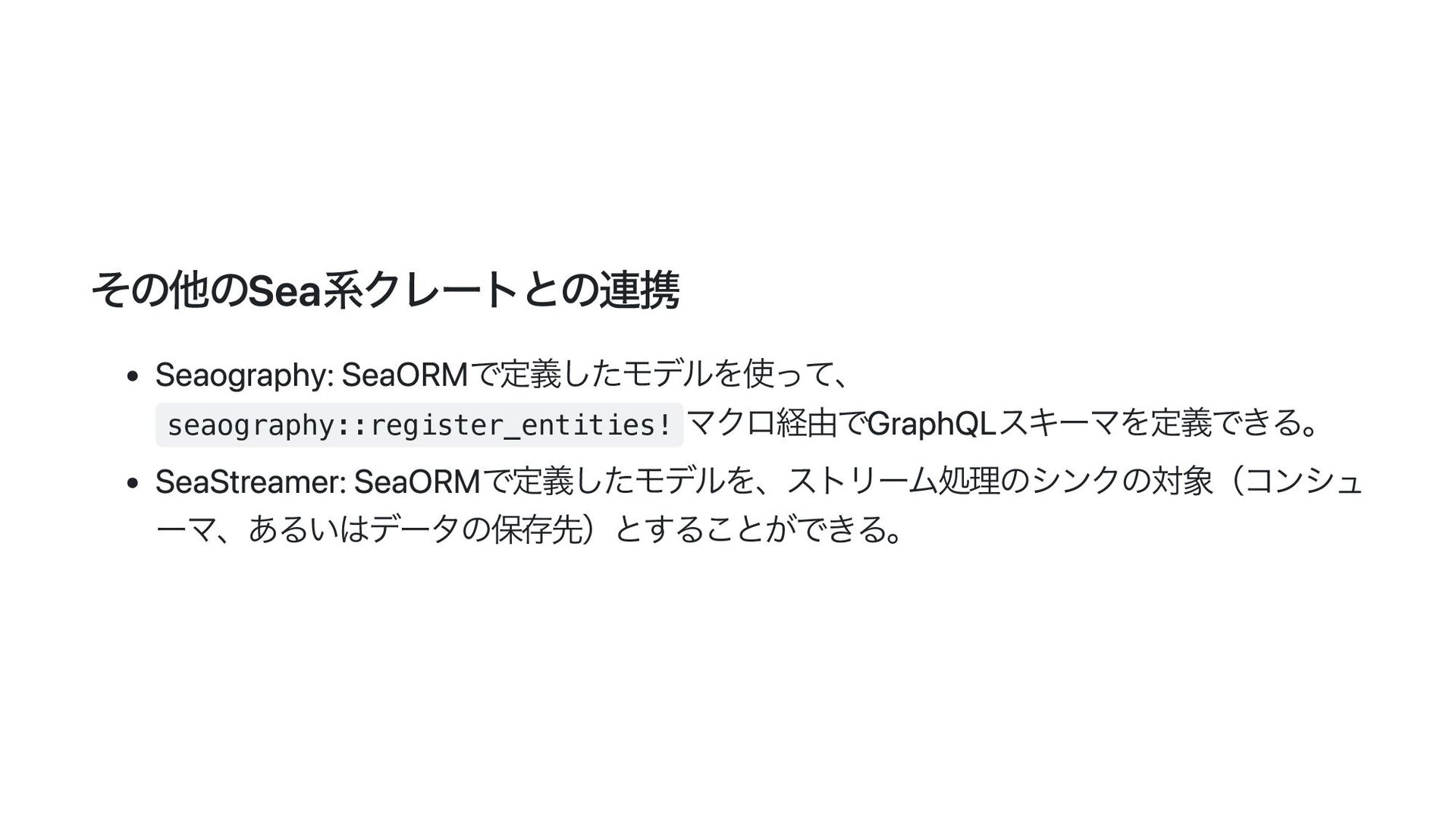
その他の Sea系クレートとの連携 Seaography: SeaORMで定義したモデルを使って、 seaography::register_entities! マクロ経由で GraphQLスキーマを定義できる。 SeaStreamer: SeaORMで定義したモデルを、ストリーム処理のシンクの対象(コンシュ ーマ、あるいはデータの保存先)とすることができる。
まとめ SeaXXX というクレートがある。 SeaORM について今回はメインで解説した。


 helloyuk13
 mkilby
 kastner
 eileencodes
 tamaranovitovic
 frankvandijk
 codingconduct
 oripsolob
 morganepeng
 addyosmani
 rakko
rakko
 colly
colly
 ipullrank


![エンティティとモデル // DeriveEntityModelでカラムやプライマリキーに関する情報が埋め合わせされる。 #[derive(Clone, Debug, DeriveEntityModel)] #[sea_orm(table_name = "customers")] //](https://files.speakerdeck.com/presentations/851a96ef06314906a19853963d1614fa/slide_17.jpg)


![customer に実装する #[derive(Clone, Debug, EnumIter, DeriveRelation)] pub enum Relation {](https://files.speakerdeck.com/presentations/851a96ef06314906a19853963d1614fa/slide_22.jpg)
![item に実装する customer と同様。 #[derive(Clone, Debug, EnumIter, DeriveRelation)] pub enum](https://files.speakerdeck.com/presentations/851a96ef06314906a19853963d1614fa/slide_23.jpg)
![order に実装する #[derive(Clone, Debug, EnumIter, DeriveRelation)] pub enum Relation {](https://files.speakerdeck.com/presentations/851a96ef06314906a19853963d1614fa/slide_24.jpg)

![テストコード #[cfg(test)] mod tests { use sea_orm::{entity::prelude::*, DatabaseBackend, MockDatabase}; use](https://files.speakerdeck.com/presentations/851a96ef06314906a19853963d1614fa/slide_26.jpg)