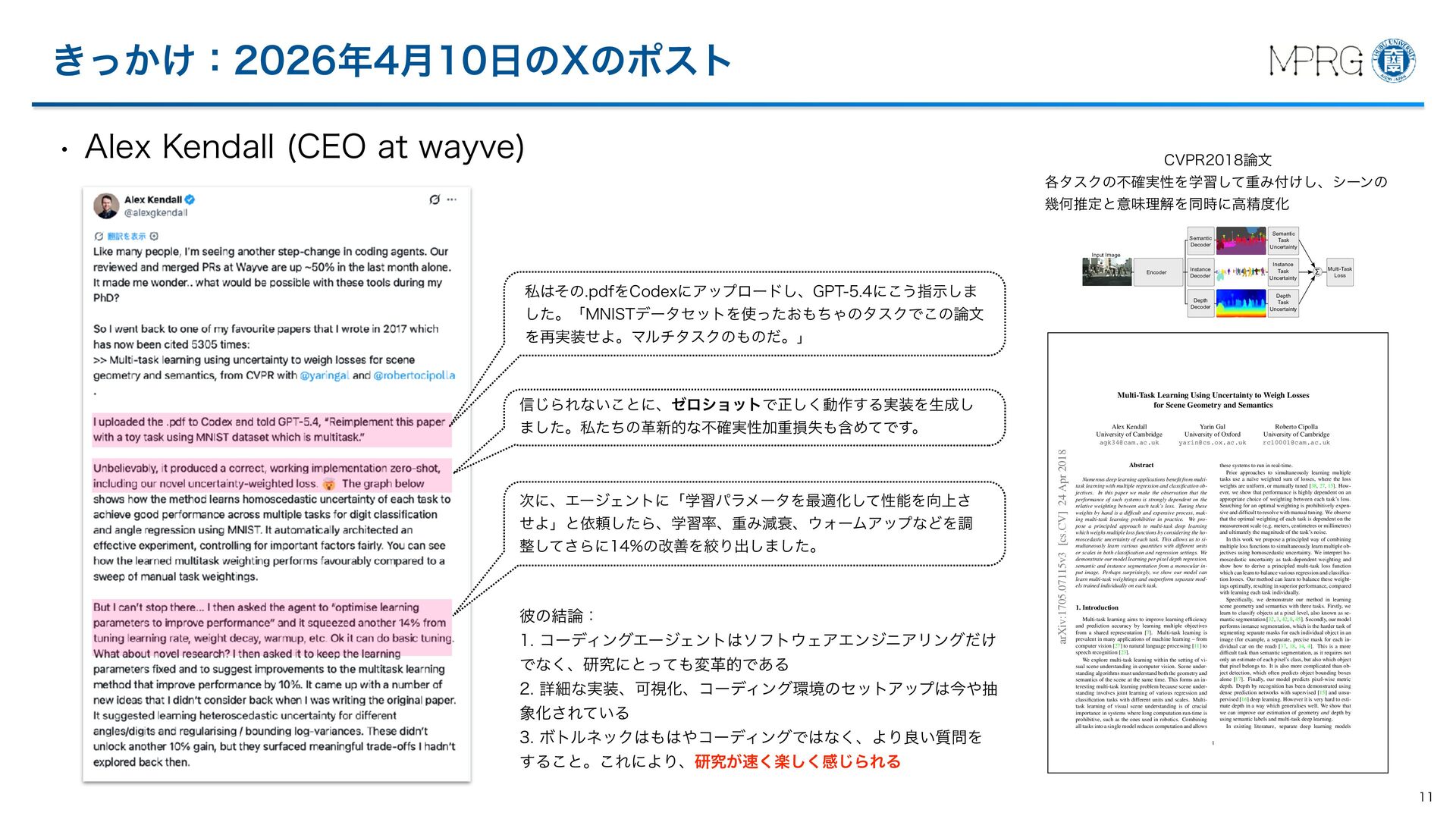
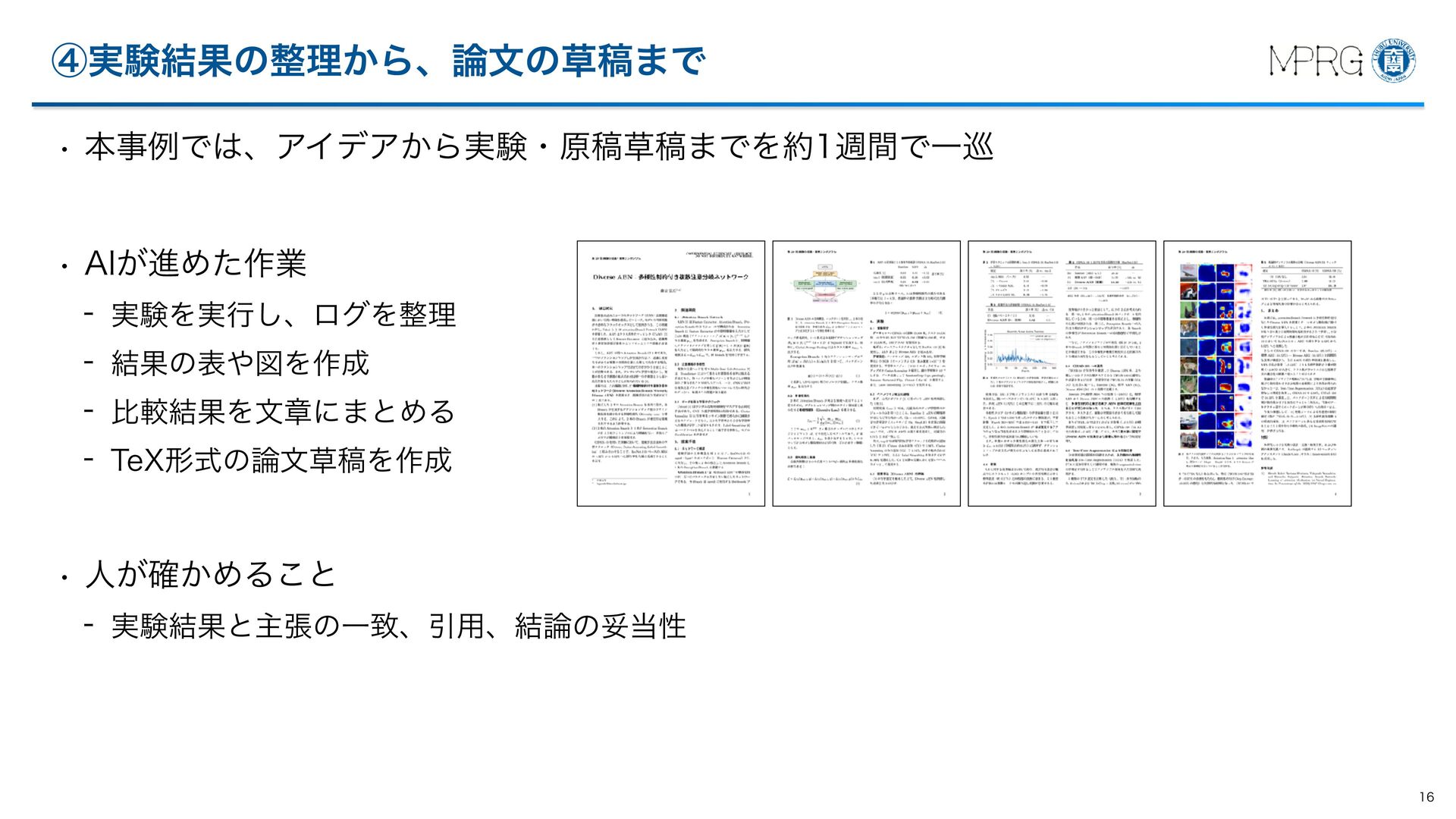
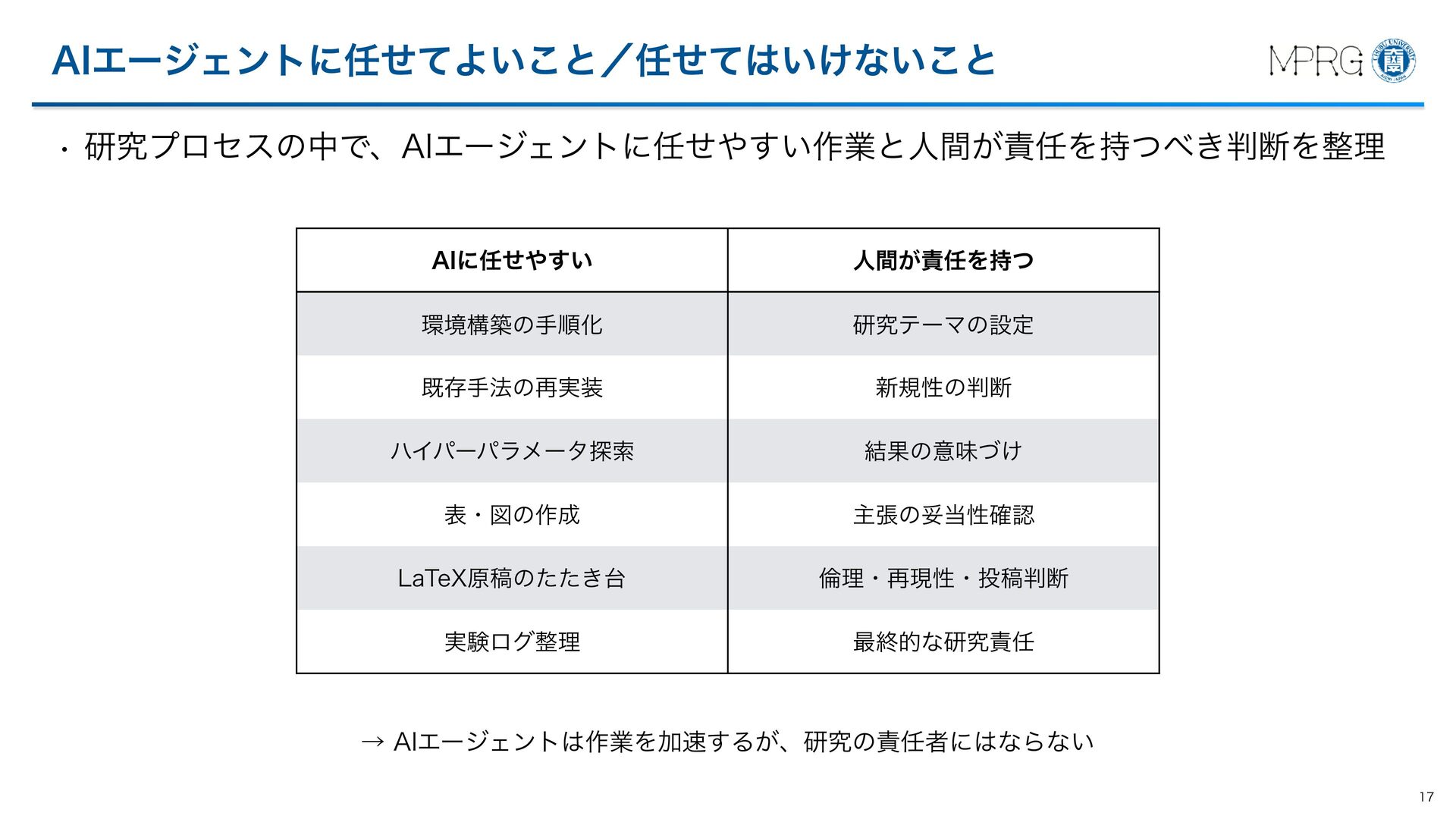
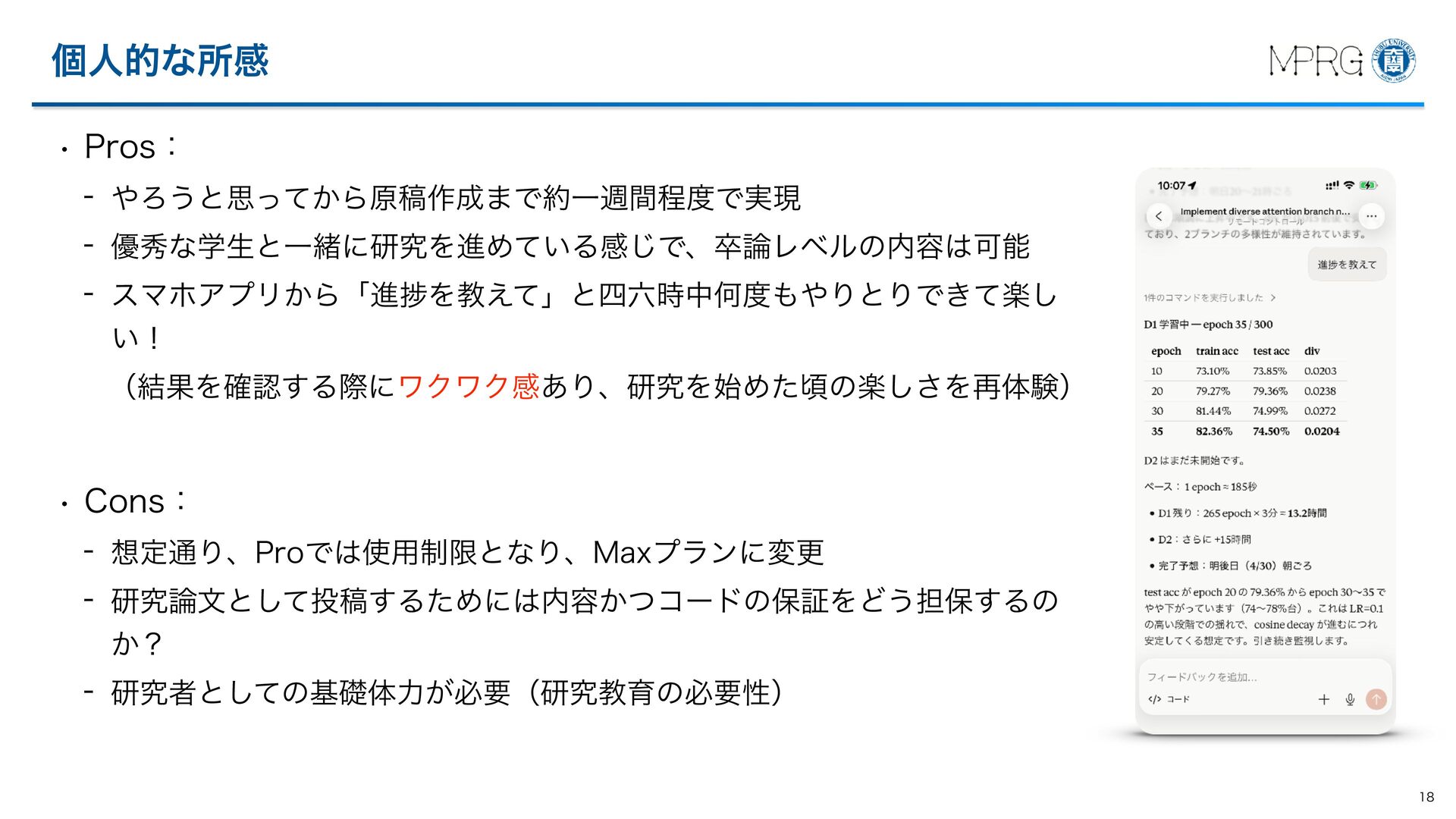
Semantic Decoder Semantic Task Uncertainty Instance Decoder Instance Task Uncertainty Depth Decoder Depth Task Uncertainty Input Image Encoder 私はその.pdfをCodexにアップロードし、GPT-5.4にこう指示しま した。「MNISTデータセットを使ったおもちゃのタスクでこの論文 を再実装せよ。マルチタスクのものだ。」 1. コーディングエージェントはソフトウェアエンジニアリングだけ でなく、研究にとっても変革的である 2. 詳細な実装、可視化、コーディング環境のセットアップは今や抽 象化されている 3. ボトルネックはもはやコーディングではなく、より良い質問を arXiv:1705.07115v3 [cs.CV] 24 Apr 2018 彼の結論: Multi-Task Loss Figure 1: Multi-task deep learning. We derive a principled way of combining multiple regression and classification loss functions for multi-task learning. Our architecture takes a single monocular RGB image as input and produces a pixel-wise classification, an instance semantic segmentation and an estimate of per pixel depth. Multi-task learning can improve accuracy over separately trained models because cues from one task, such as depth, are used to regularize and improve the generalization of another domain, such as segmentation. 信じられないことに、ゼロショットで正しく動作する実装を生成し ました。私たちの革新的な不確実性加重損失も含めてです。 次に、エージェントに「学習パラメータを最適化して性能を向上さ せよ」と依頼したら、学習率、重み減衰、ウォームアップなどを調 整してさらに14%の改善を絞り出しました。 Σ would be used to learn depth regression, semantic segmenone task can help learn other tasks [7]. tation and instance segmentation to create a complete scene Fine-tuning [1, 36] is a basic example of multi-task understanding system. Given a single monocular input imlearning, where we can leverage different learning tasks by age, our system is the first to produce a semantic segmentaconsidering them as a pre-training step. Other models altion, a dense estimate of metric depth and an instance level ternate learning between each training task, for example in segmentation jointly (Figure 1). While other vision modnatural language processing [11]. Multi-task learning can Multi-Task Learning Using els have demonstrated multi-task learning, we show how toUncertainty to Weigh Losses also be used in a data streaming setting [40], or to prevent learn to combine semantics and geometry. Combining these for Scene Geometry and Semantics forgetting previously learned tasks in reinforcement learntasks into a single model ensures that the model agrees being [26]. It can also be used to learn unsupervised features tween the separate task outputs while reducing computafrom various data sources with an auto-encoder [35]. tion. Finally,Alex we show that using a shared representation Kendall Yarin Gal Roberto Cipolla In computer vision there are many examples of methods with multi-task learning improves performance on various University of Cambridge University of Oxford University of Cambridge for multi-task learning. Many focus on semantic tasks, such metrics, making the models more effective.
[email protected] [email protected] [email protected] as classification and semantic segmentation [30] or classifiIn summary, the key contributions of this paper are: cation and detection [38]. MultiNet [39] proposes an archi1. a novel and principled multi-task loss to simultanetecture for detection, classification and semantic segmentaously learn various classification and regression losses tion.systems CrossStitch [34] explore methods to comof varying quantities and units using homoscedastic these Abstract to run networks in real-time. bine neural Uhrig et al. [41] learn task uncertainty, Priormulti-task approaches to activations. simultaneously learning multiple semantic instance segmentations underwhere a classification 2. a unified for semantic segmentation, use a and naı̈ve weighted sum of losses, the loss Numerous deeparchitecture learning applications benefit from multi-in- tasks setting.are Multi-task learningtuned has also for gestancewith segmentation and depthand regression, weights uniform, deep or manually [38,been 27, used 15]. Howtask learning multiple regression classification obometry and regression tasks. [15] show how to learn se3. demonstrating of loss weighting jectives. In this paperthe we importance make the observation that the in ever, we show that performance is highly dependent on an mantic segmentation, depth andbetween surface normals. PoseNet appropriate choice of weighting each task’s loss. multi-task deep learning and howdependent to obtain on superior performance of such systems is strongly the [25] is a for model which learns camera position and expenorientacompared to equivalent trained Searching an optimal weighting is prohibitively relative performance weighting between each task’s loss.separately Tuning these tion. UberNet [27] learns a number of different regression sive and difficult to resolve with manual tuning. We observe weights models. by hand is a difficult and expensive process, makand classification tasks under a single architecture. In this that the optimal weighting of each task is dependent on the ing multi-task learning prohibitive in practice. We prowork we are the first to propose a method for jointly learn2. aRelated Work measurement scale (e.g. meters, centimetres or millimetres) pose principled approach to multi-task deep learning ing depth regression, semantic and instance segmentation. and ultimately the magnitude of the task’s noise. which weighs multiple loss functions by considering the hoMulti-task learning aims to improve learning efficiency Like the model of [15], our model learns both semantic and moscedastic uncertainty of each task. This allows us to siIn this work we propose a principled way of combining and prediction accuracy for each task, when compared to geometry representations, which is important for scene unmultaneously learn various quantities with different units multiple loss functions to simultaneously learn multiple obtraining a separate model for each task [40, 5]. It can be conderstanding. However, our model learns the much harder or scales in both classification and regression settings. We homoscedastic uncertainty. We interpret ho-of sidered an approach to inductive knowledge transfer which jectives task ofusing instance segmentation which requires knowledge demonstrate our model learning per-pixel depth regression, uncertainty as task-dependent weighting and improves generalisation by sharing the domain information moscedastic both semantics and geometry. This is because our model semantic and instance segmentation from a by monocular inshow to derive principled multi-task loss function between complimentary tasks. It does this using a shared musthow determine the aclass and spatial relationship for each putrepresentation image. Perhaps surprisingly, we show ouris model learnobject to balance various segmentation. regression and classificato learn multiple tasks – what learnedcan from which pixelcan in each for instance learn multi-task weightings and outperform separate modtion losses. Our method can learn to balance these weightels trained individually on each task. ings optimally, resulting in superior performance, compared 2with learning each task individually. Specifically, we demonstrate our method in learning scene geometry and semantics with three tasks. Firstly, we 1. Introduction learn to classify objects at a pixel level, also known as seMulti-task learning aims to improve learning efficiency mantic segmentation [32, 3, 42, 8, 45]. Secondly, our model and prediction accuracy by learning multiple objectives performs instance segmentation, which is the harder task of from a shared representation [7]. Multi-task learning is segmenting separate masks for each individual object in an prevalent in many applications of machine learning – from image (for example, a separate, precise mask for each incomputer vision [27] to natural language processing [11] to dividual car on the road) [37, 18, 14, 4]. This is a more speech recognition [23]. difficult task than semantic segmentation, as it requires not only an estimate of each pixel’s class, but also which object We explore multi-task learning within the setting of vithat pixel belongs to. It is also more complicated than obsual scene understanding in computer vision. Scene underject detection, which often predicts object bounding boxes standing algorithms must understand both the geometry and alone [17]. Finally, our model predicts pixel-wise metric semantics of the scene at the same time. This forms an indepth. Depth by recognition has been demonstrated using teresting multi-task learning problem because scene underdense prediction networks with supervised [15] and unsustanding involves joint learning of various regression and pervised [16] deep learning. However it is very hard to esticlassification tasks with different units and scales. Multimate depth in a way which generalises well. We show that task learning of visual scene understanding is of crucial we can improve our estimation of geometry and depth by importance in systems where long computation run-time is using semantic labels and multi-task deep learning. prohibitive, such as the ones used in robotics. Combining all tasks into a single model reduces computation and allows In existing literature, separate deep learning models 1 すること。これにより、研究が速く楽しく感じられる 11


 hf149
hf149
 koide3
 mickey_0226
 shibuiwilliam
 fkske
fkske
 stktu
stktu
 signer
 enochan
 yumaichikawa
 de9uch1
 hellosct1
 ftakahashi
 datascientistsociety
 marcoroth
 tmiket
 aleyda
 retrage
 csswizardry
 mkilby
 sferik
 rasagy
 keavy
keavy
 kimpetersen
 philnash
 inesmontani

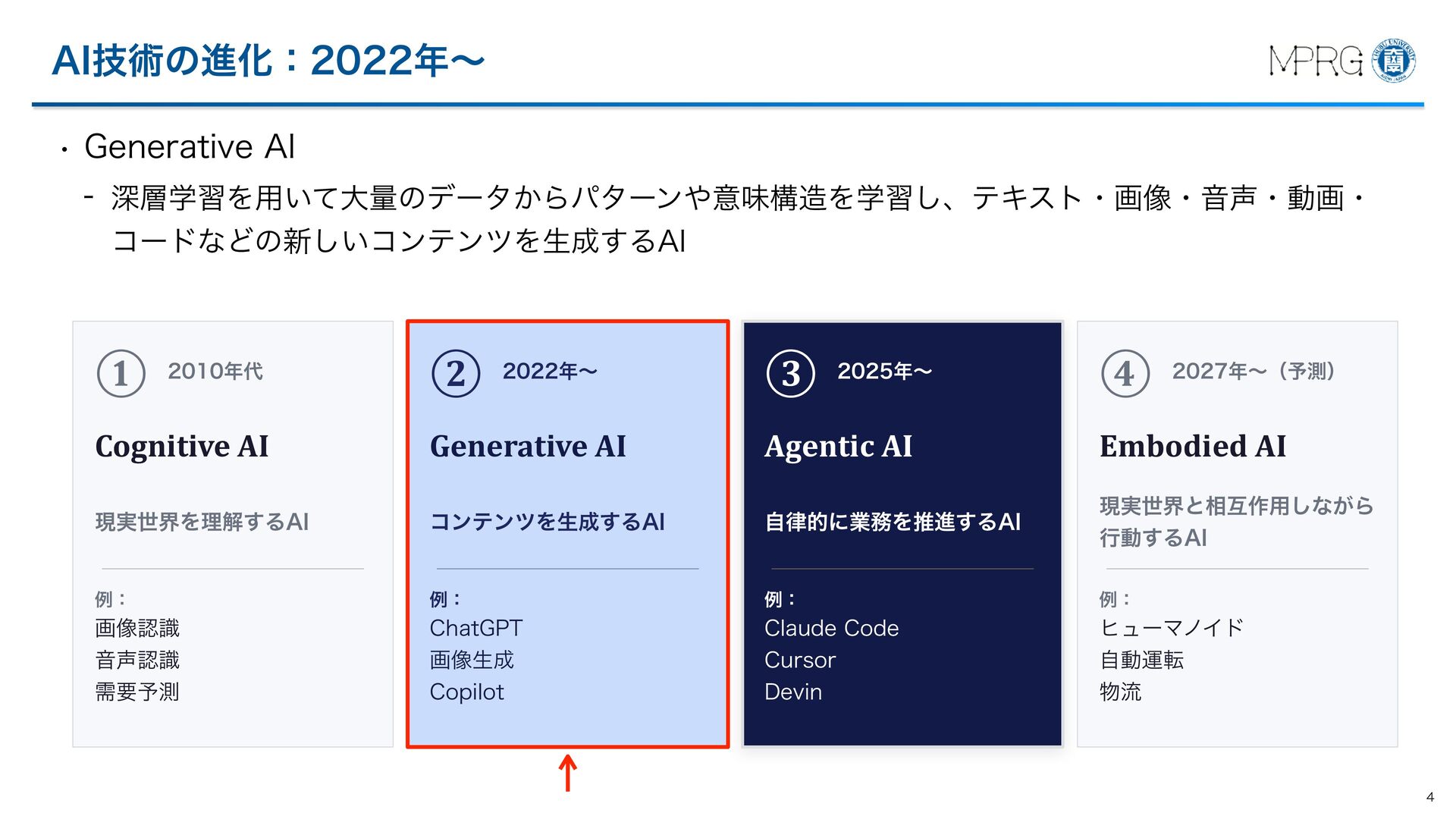
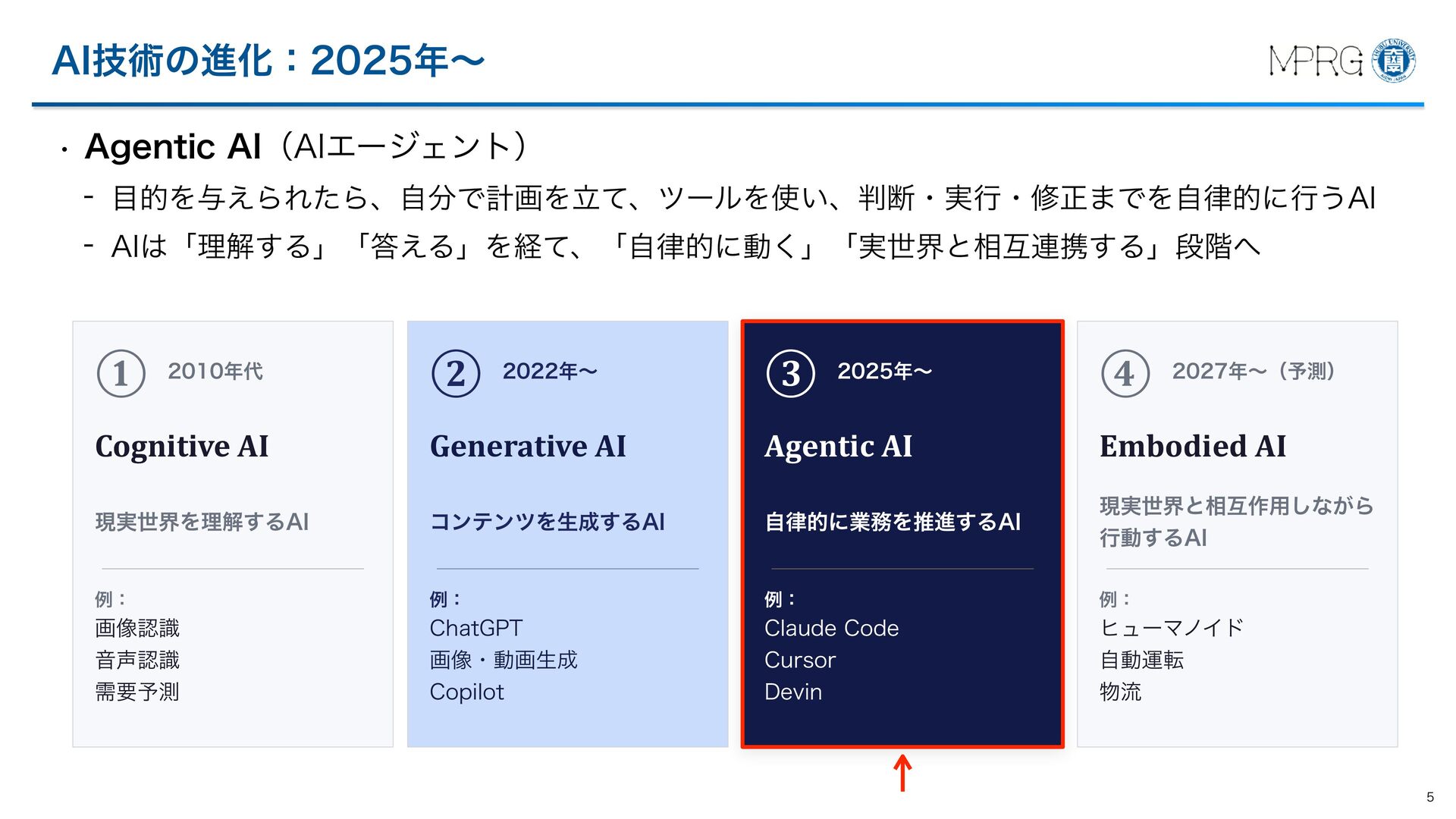
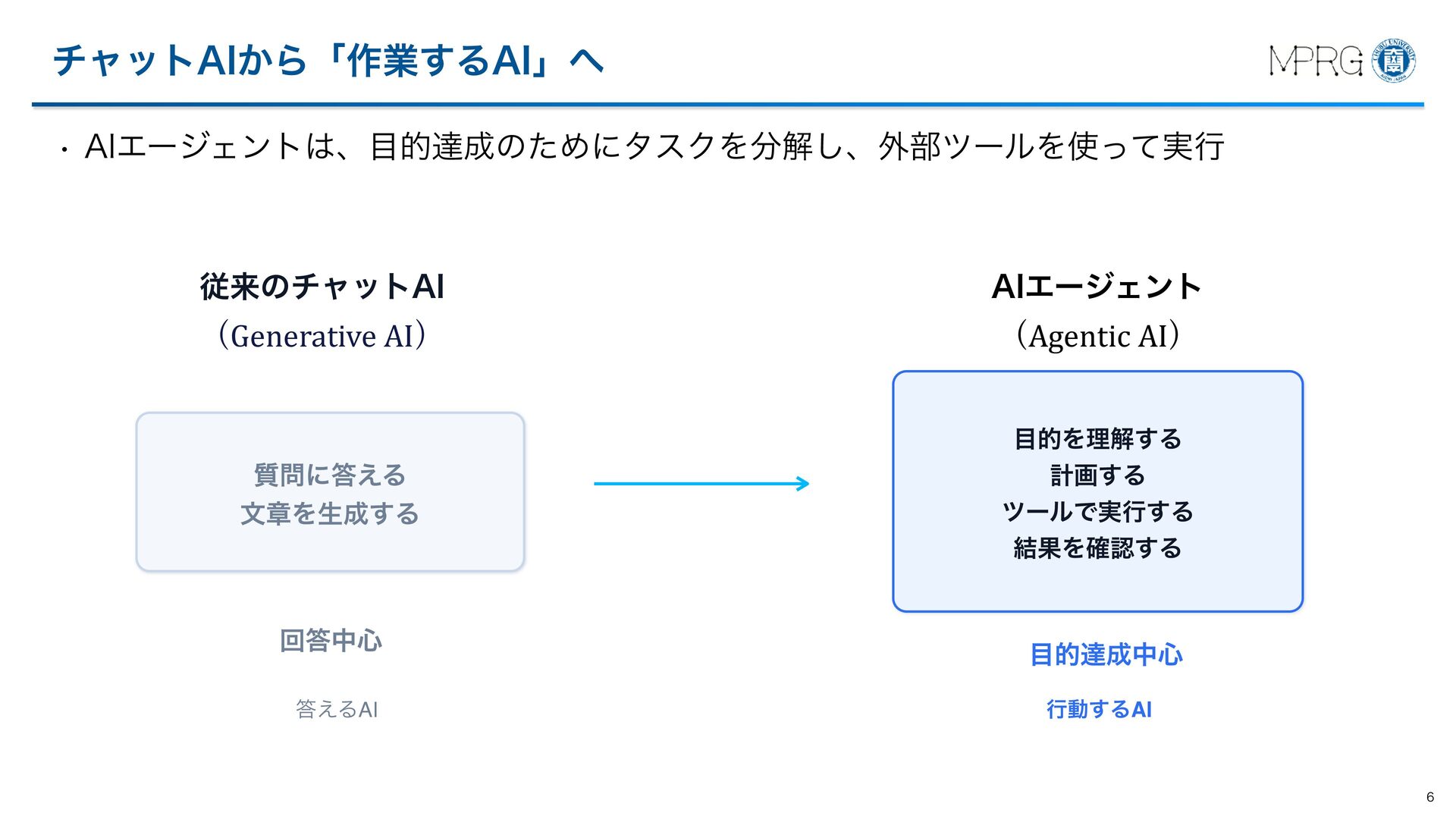
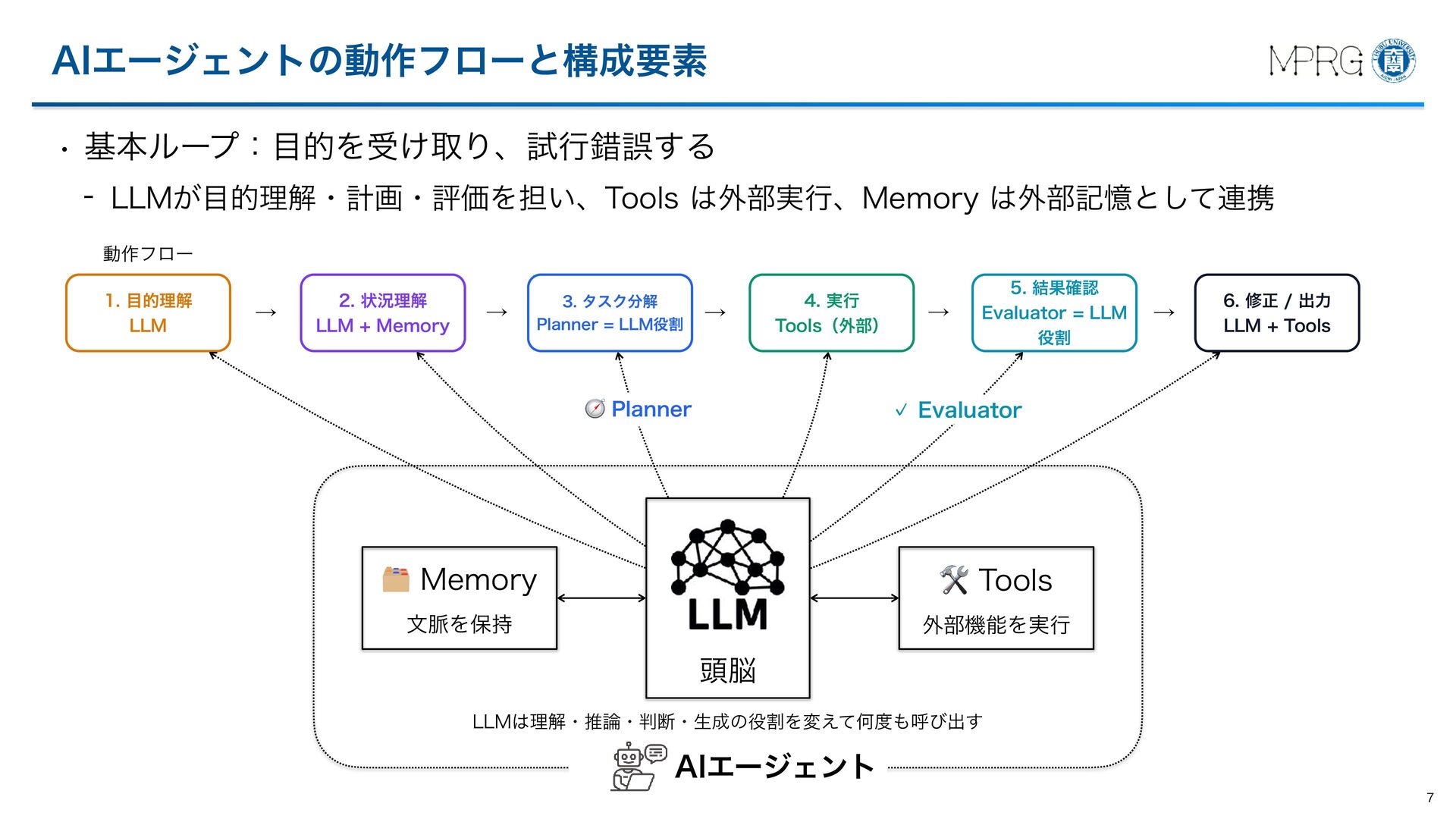
![自動運転に関する最新動向 [1/3] • Cybercab - Teslaが開発した、自動運転タクシーサービス「Robotaxi」向けの2人乗り電気自動車 中部大学ロゴ 中部大学ロゴ https://www.youtube.com/watch?v=DbeKe2bEp6Y 28](https://files.speakerdeck.com/presentations/a997d36455904c898eebdab3a07397d2/slide_27.jpg)
![自動運転に関する最新動向 [2/3] • Cybercab (Tesla) vs Waymo 比較項目 Cybercab(Tesla) Waymo](https://files.speakerdeck.com/presentations/a997d36455904c898eebdab3a07397d2/slide_28.jpg)
![自動運転に関する最新動向 [3/3] • 国内における自動運転が大きく前進 2027年中の開始を目指す 2028 年から順次搭載へ Waymo トヨタ GO](https://files.speakerdeck.com/presentations/a997d36455904c898eebdab3a07397d2/slide_29.jpg)
![フィジカルAIの社会実装 [1/2] • IROS 2025 Plenary Debate: Humanoids Will Soon](https://files.speakerdeck.com/presentations/a997d36455904c898eebdab3a07397d2/slide_30.jpg)
![フィジカルAIの社会実装 [2/2] • Physical Intelligence社(ロボット基盤モデルπ0などを開発する米国企業) - 限定した工程で実証・商用導入 中部大学ロゴ 導入先・協業企業 実際に行う作業](https://files.speakerdeck.com/presentations/a997d36455904c898eebdab3a07397d2/slide_31.jpg)
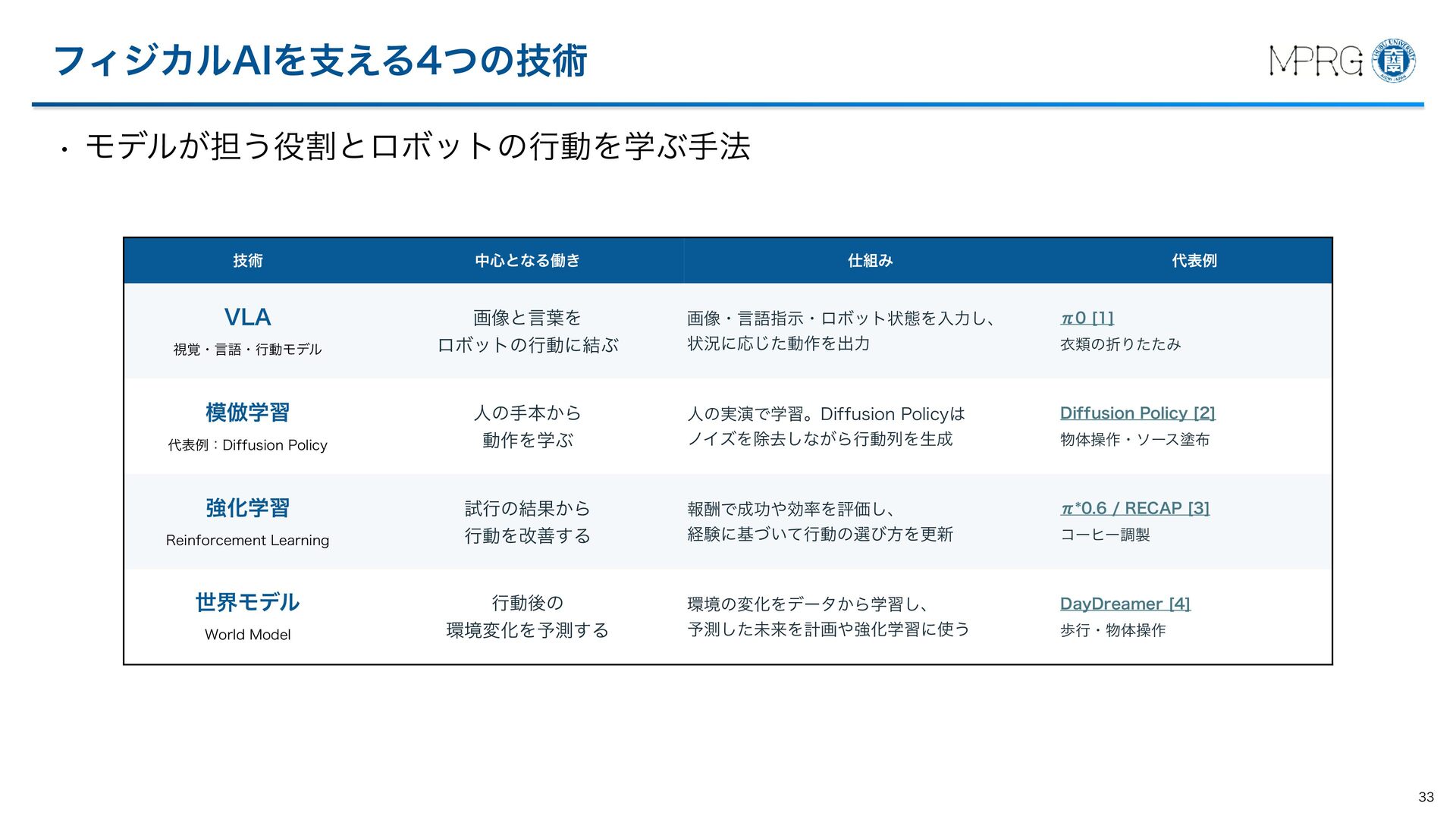
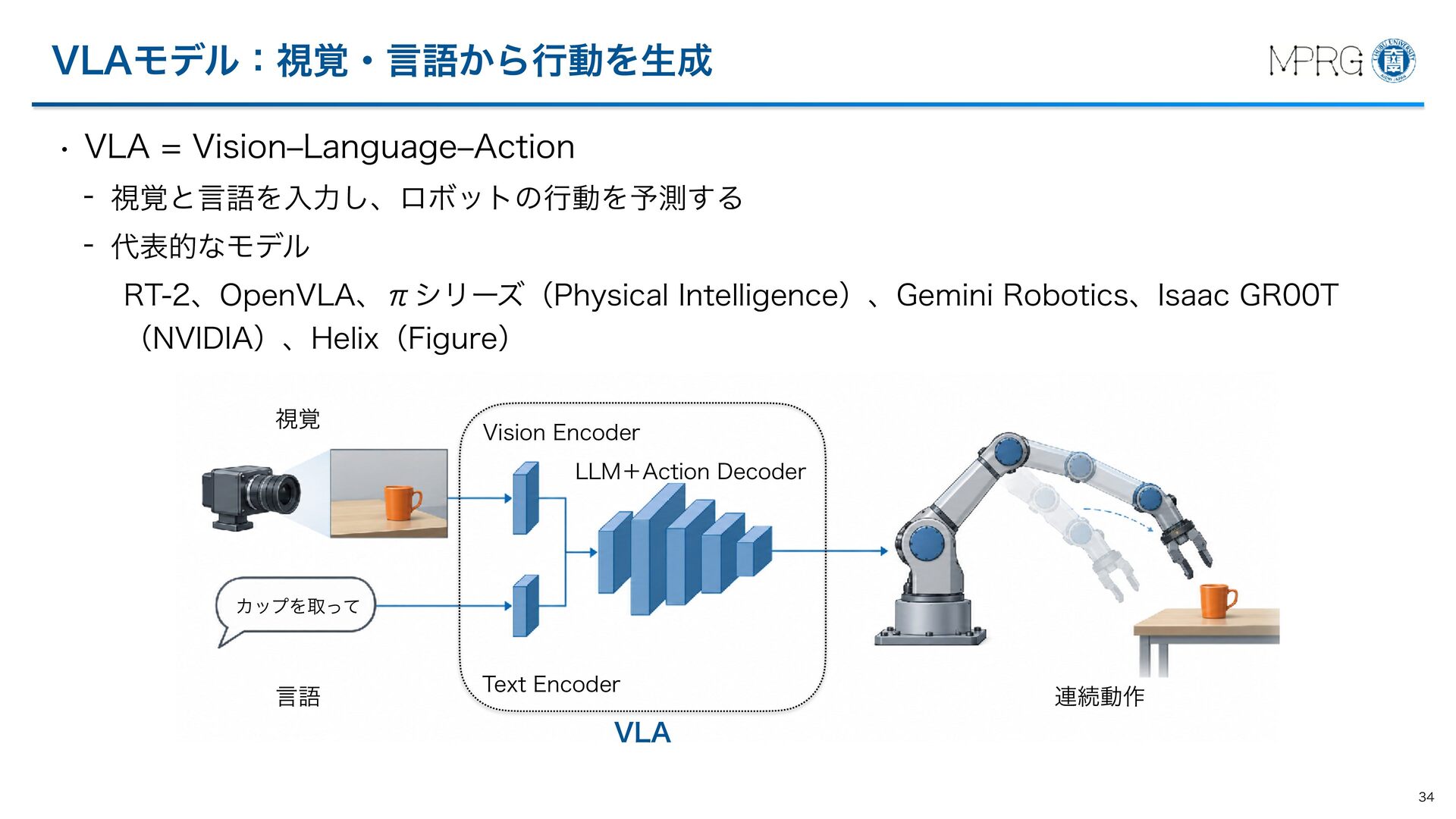
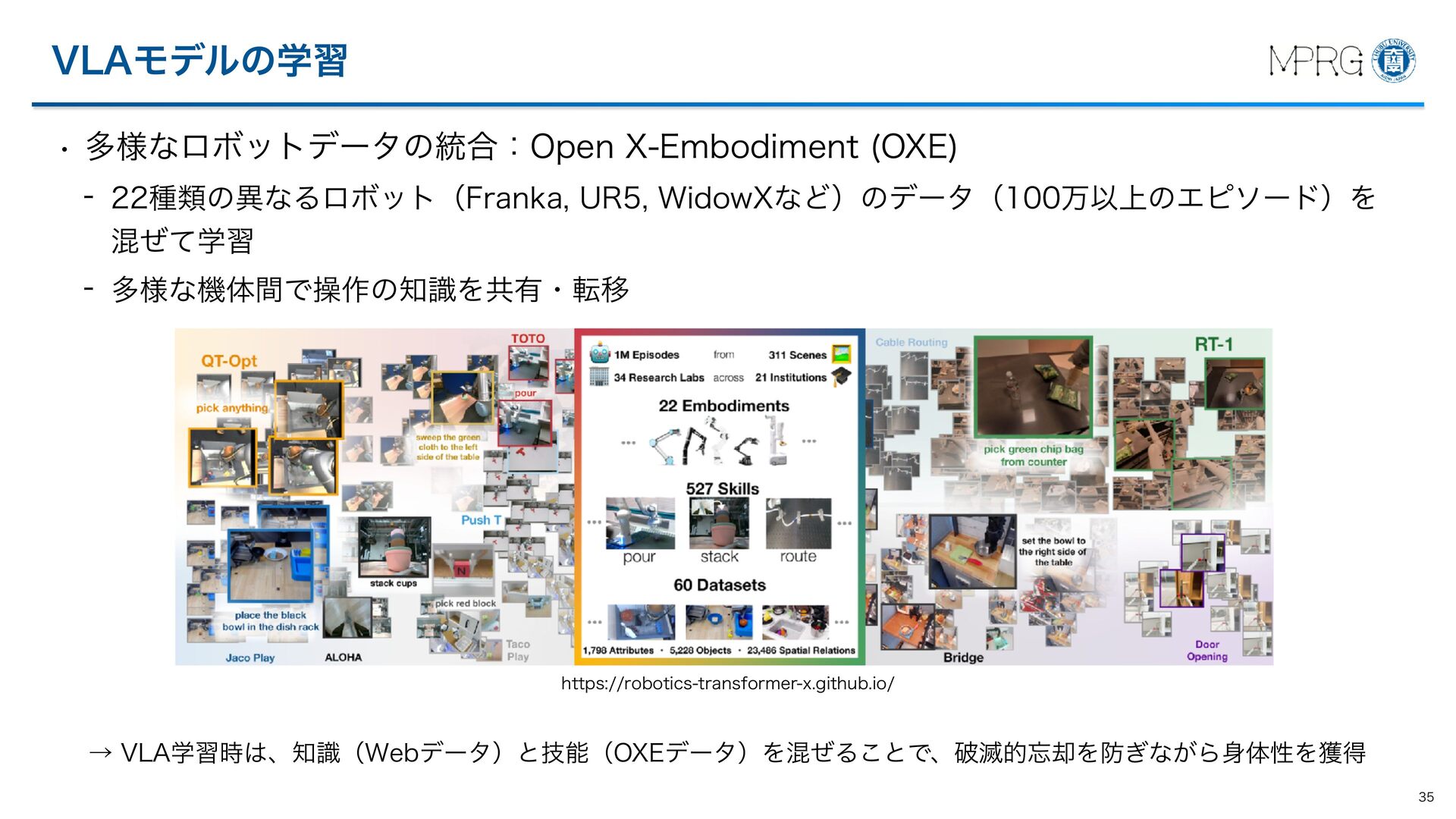
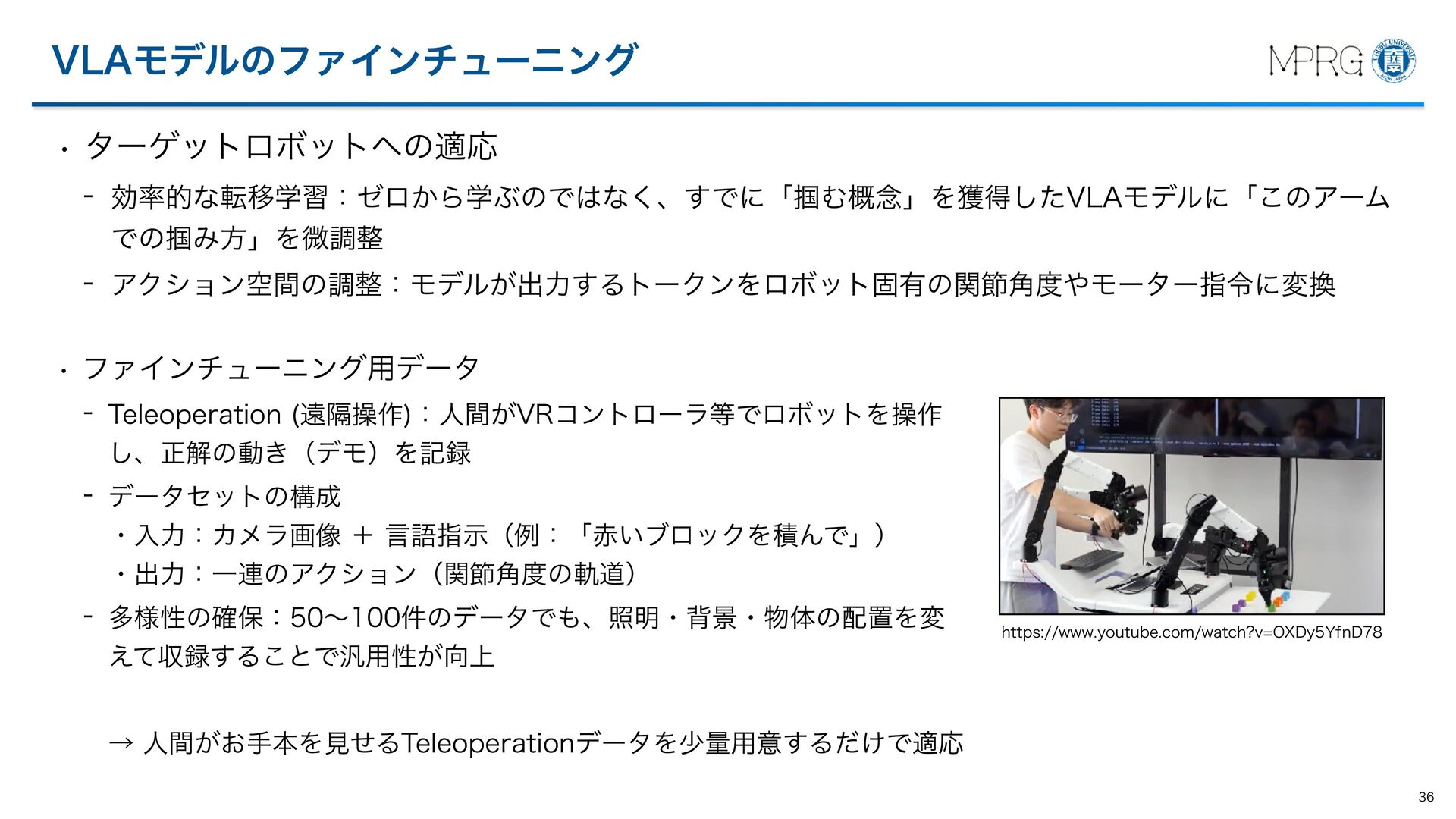
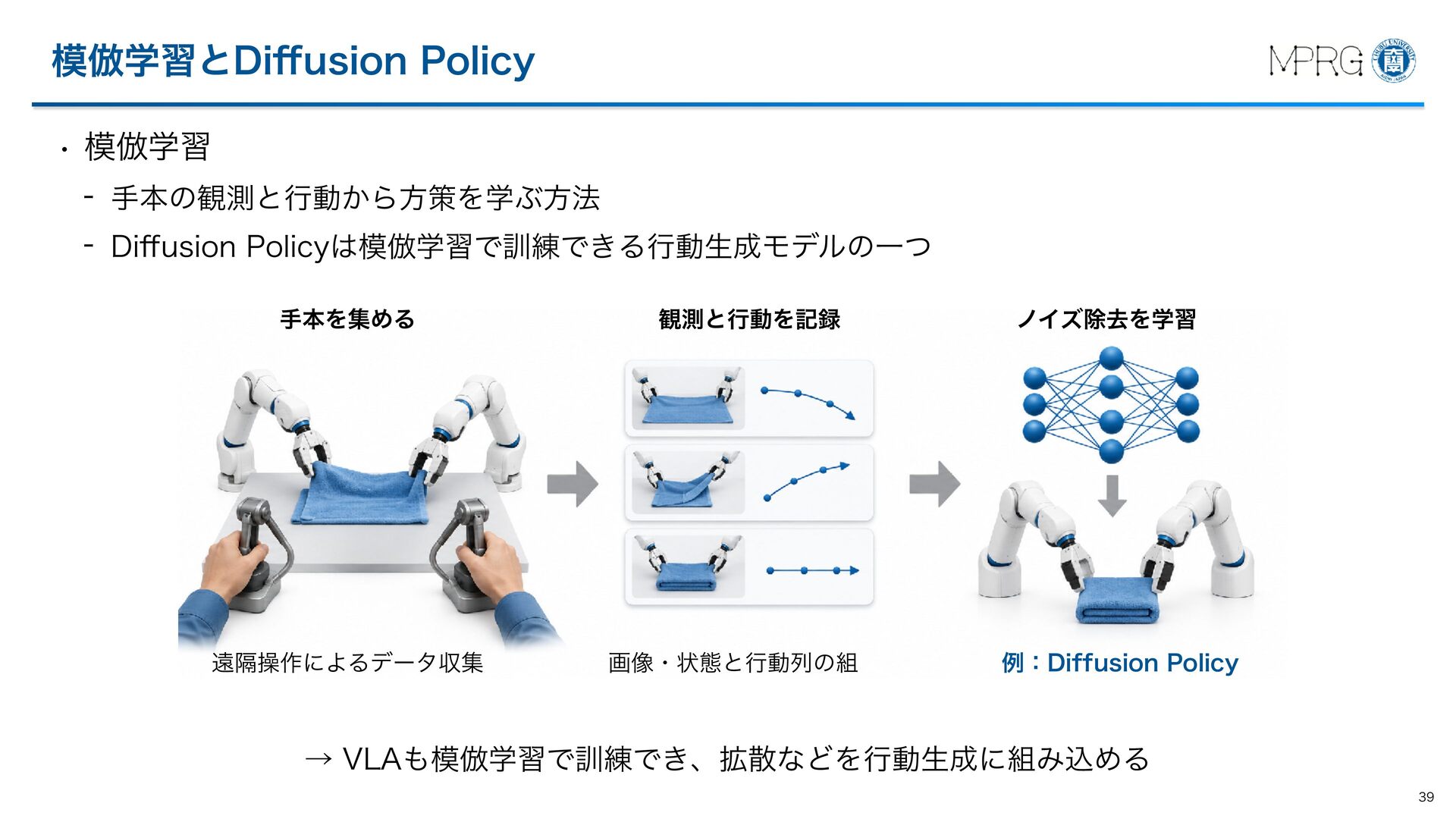
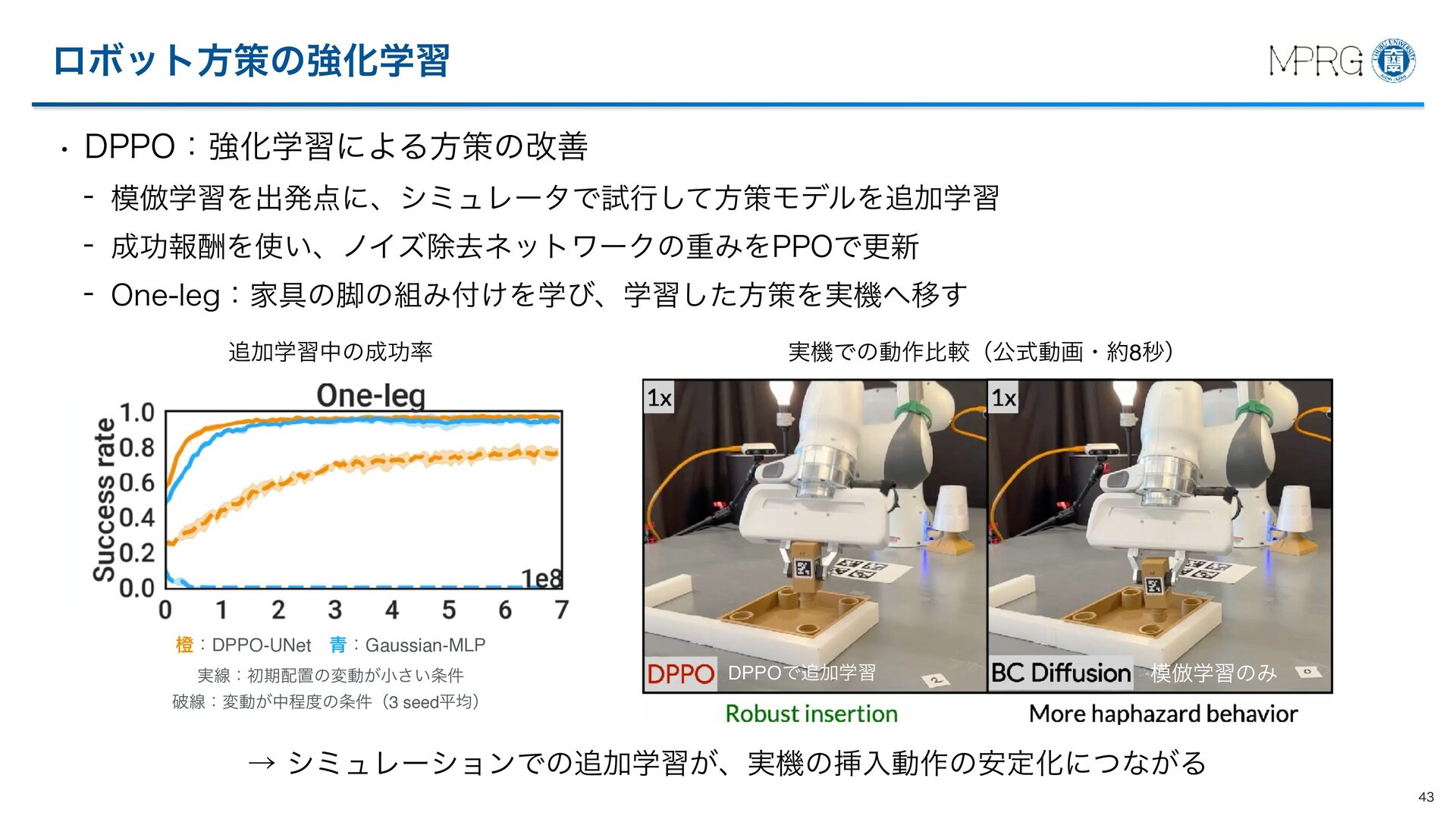
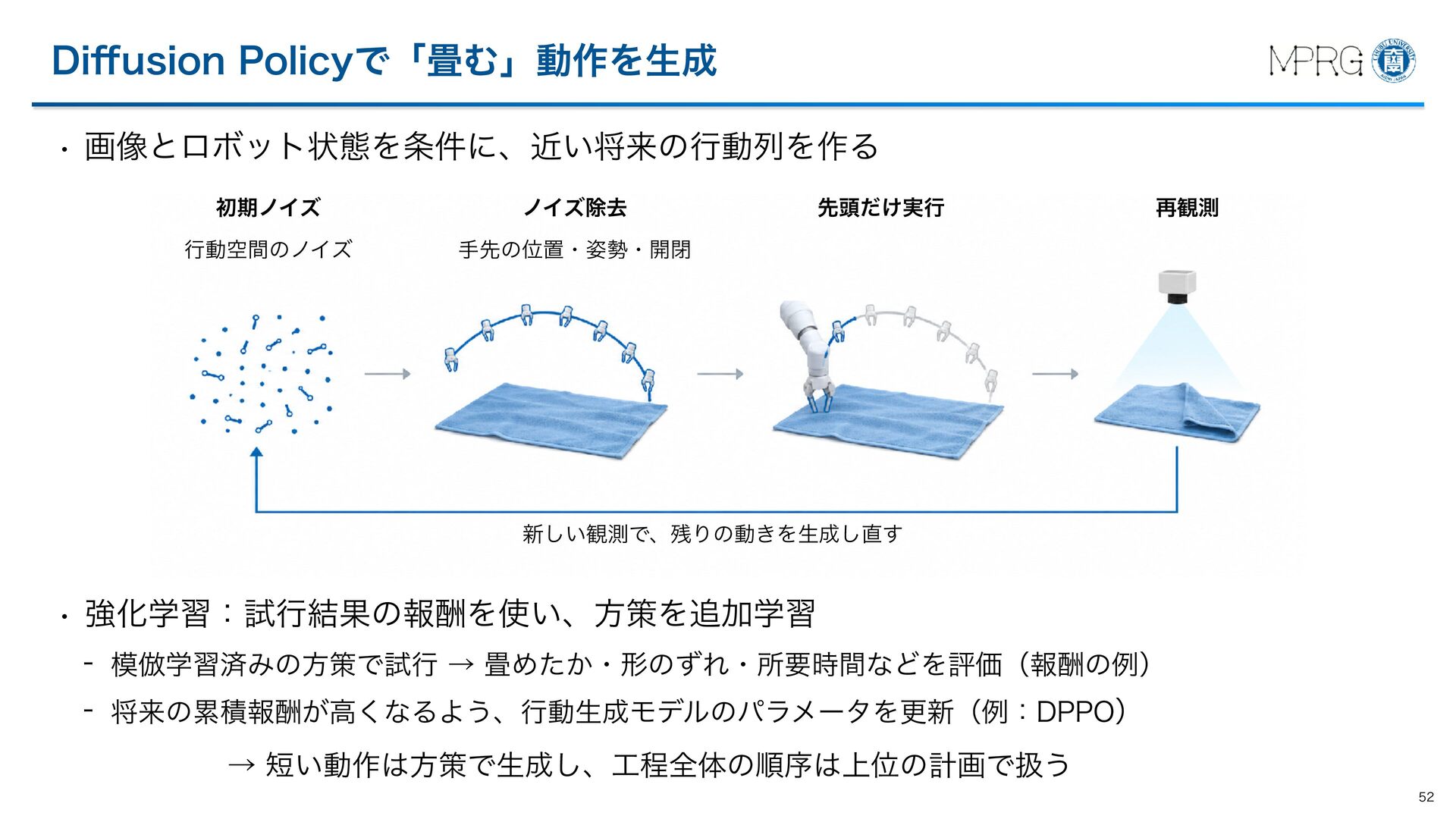
![Di usion Policy [Chi+, RSS2023] • 画像・ロボット状態を条件に、ノイズから複数ステップの行動列を生成 - 学習:手本の行動列にノイズを加え、取り除く方法を学ぶ -](https://files.speakerdeck.com/presentations/a997d36455904c898eebdab3a07397d2/slide_39.jpg)
![Di usion Policy [Chi+, RSS2023] • 動作例と軌道の比較 - Push-T:T字ブロックを目標位置へ押す -](https://files.speakerdeck.com/presentations/a997d36455904c898eebdab3a07397d2/slide_40.jpg)
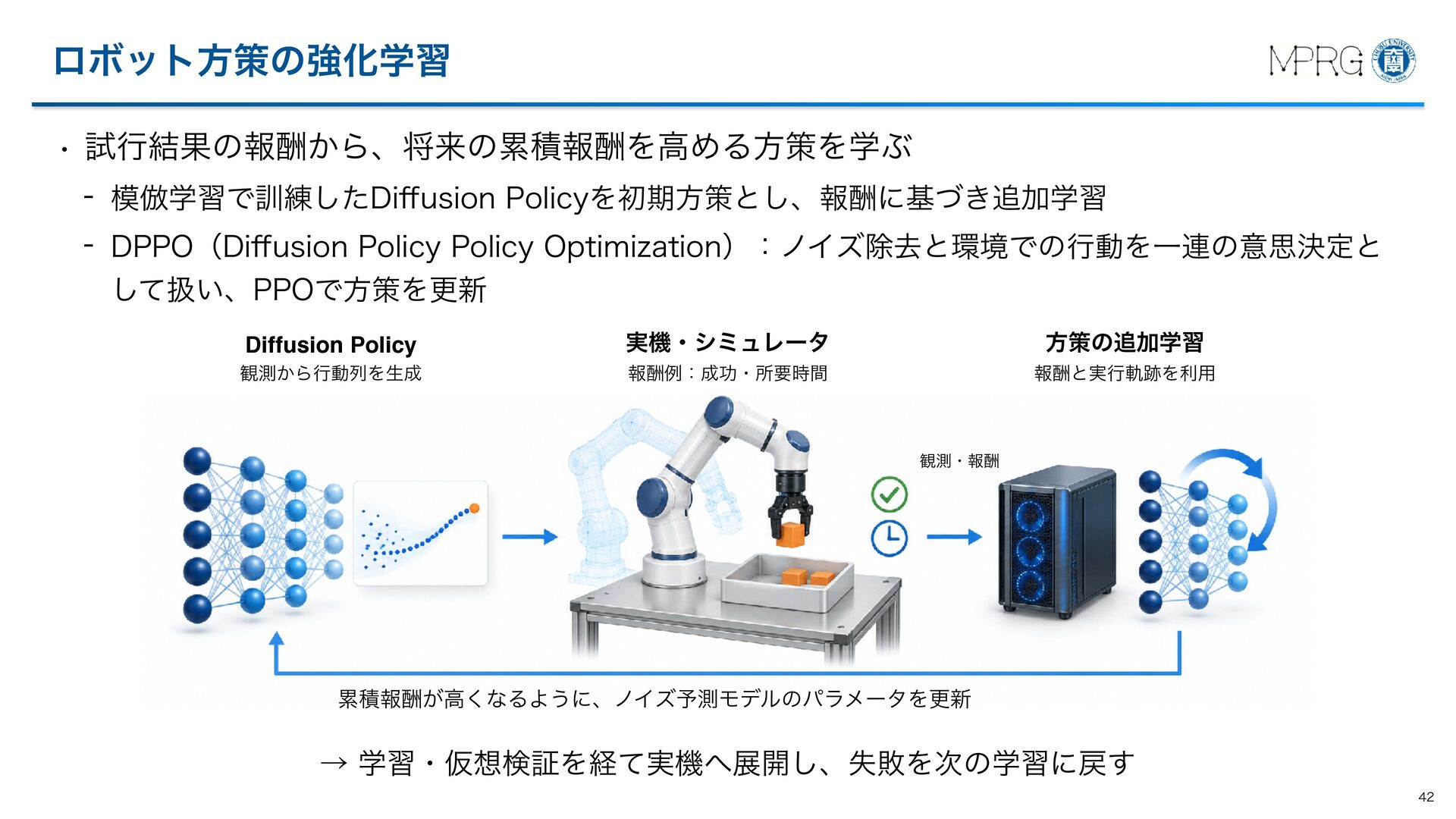
![世界モデル:行動の結果を予測 • 現在の状態とアクション候補を入力し、それぞれの未来を予測 - 想像内で方策を学習:DayDreamer[CoRL 2022] - 映像生成・学習データ拡張:Cosmos アクションA:低い位置のまま直進 予測した未来](https://files.speakerdeck.com/presentations/a997d36455904c898eebdab3a07397d2/slide_43.jpg)
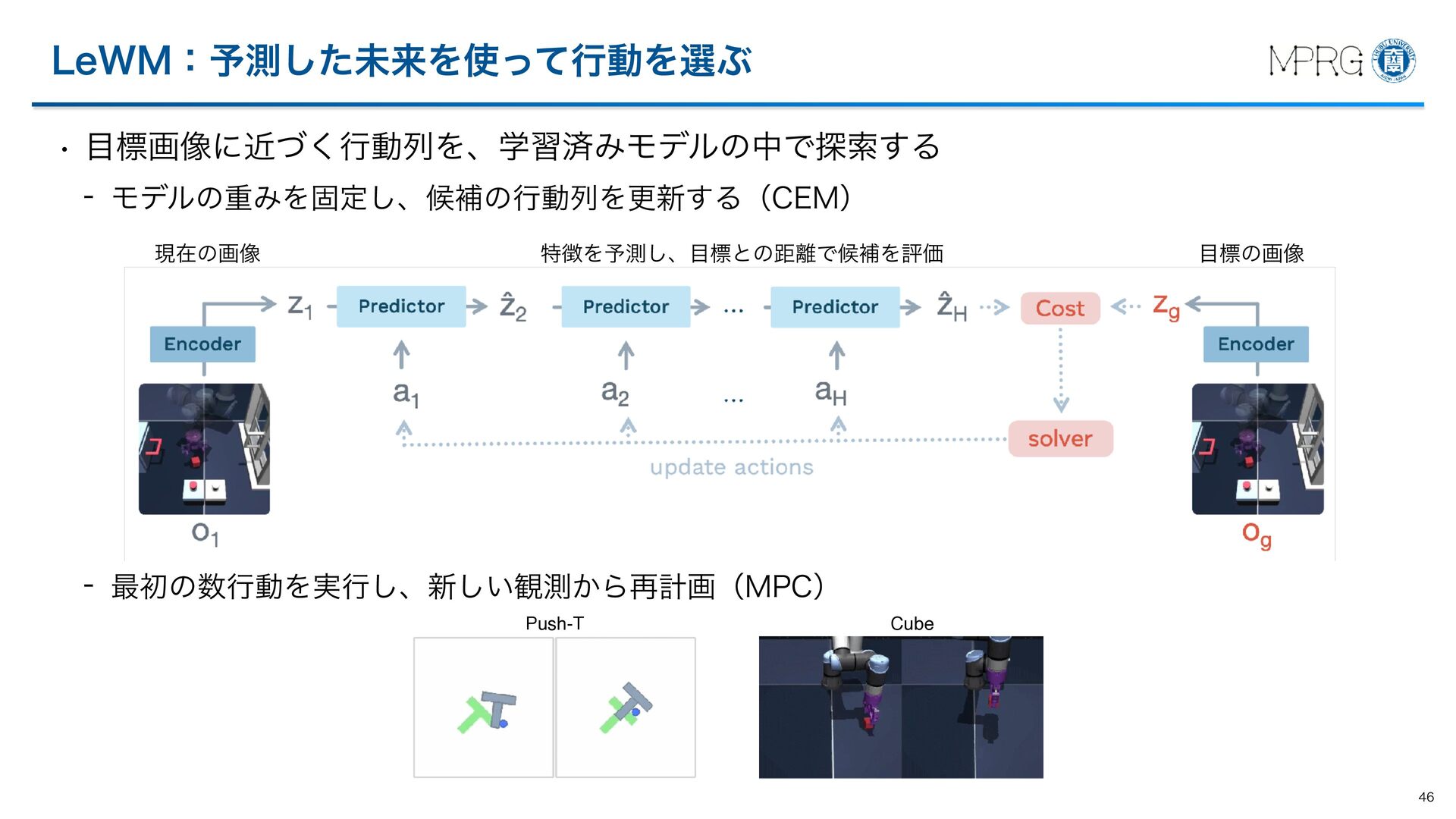
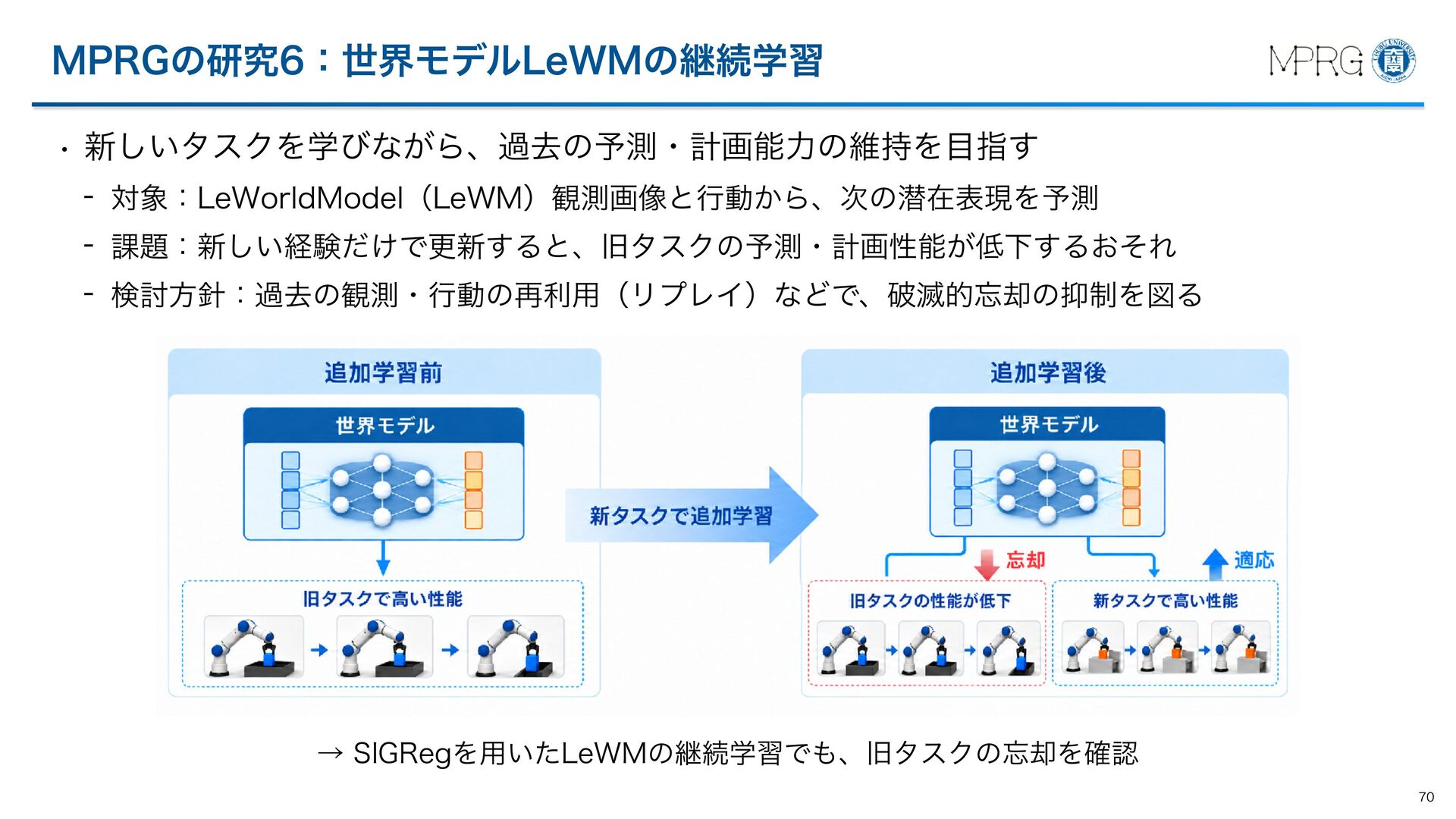
![LeWorldModel (LeWM) [Maes+, arXivʼ26] • 画像と行動から「次の特徴」を予測するJEPA型の世界モデル - 画像からEncoderとPredictorを同時に学習 予測と観測の特徴を近づける SIGRegで表現の崩壊を防ぐ](https://files.speakerdeck.com/presentations/a997d36455904c898eebdab3a07397d2/slide_44.jpg)
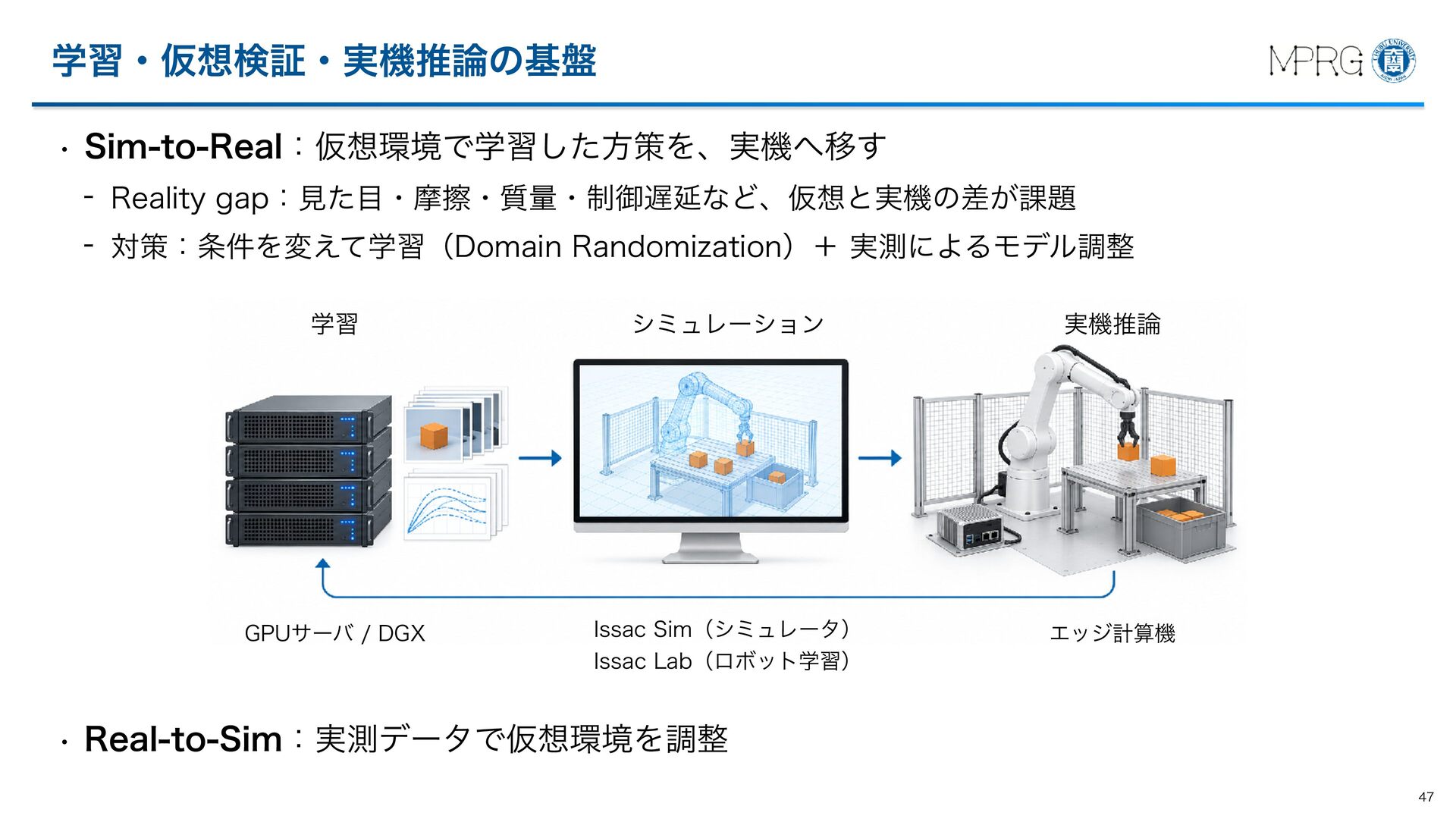
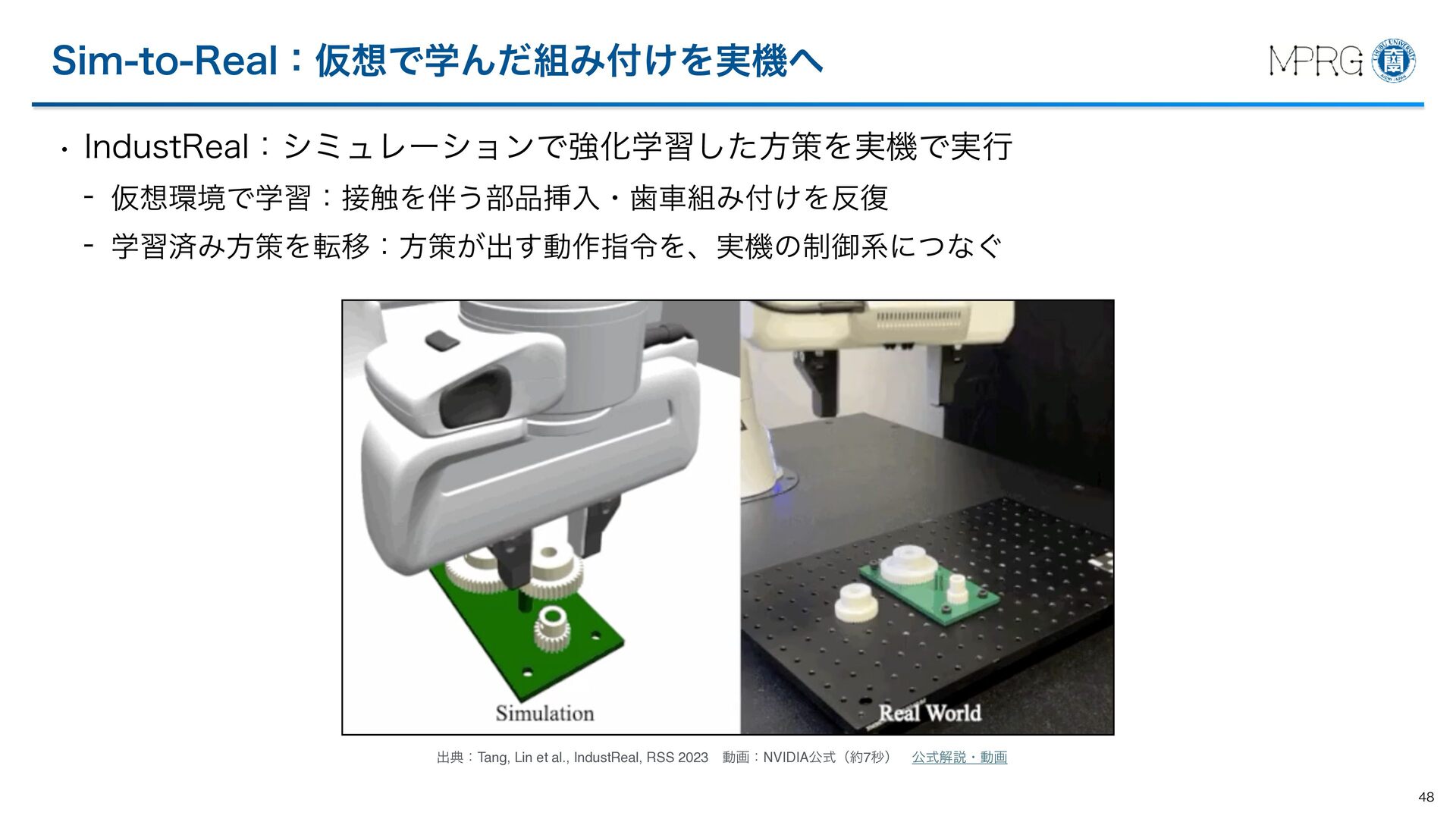
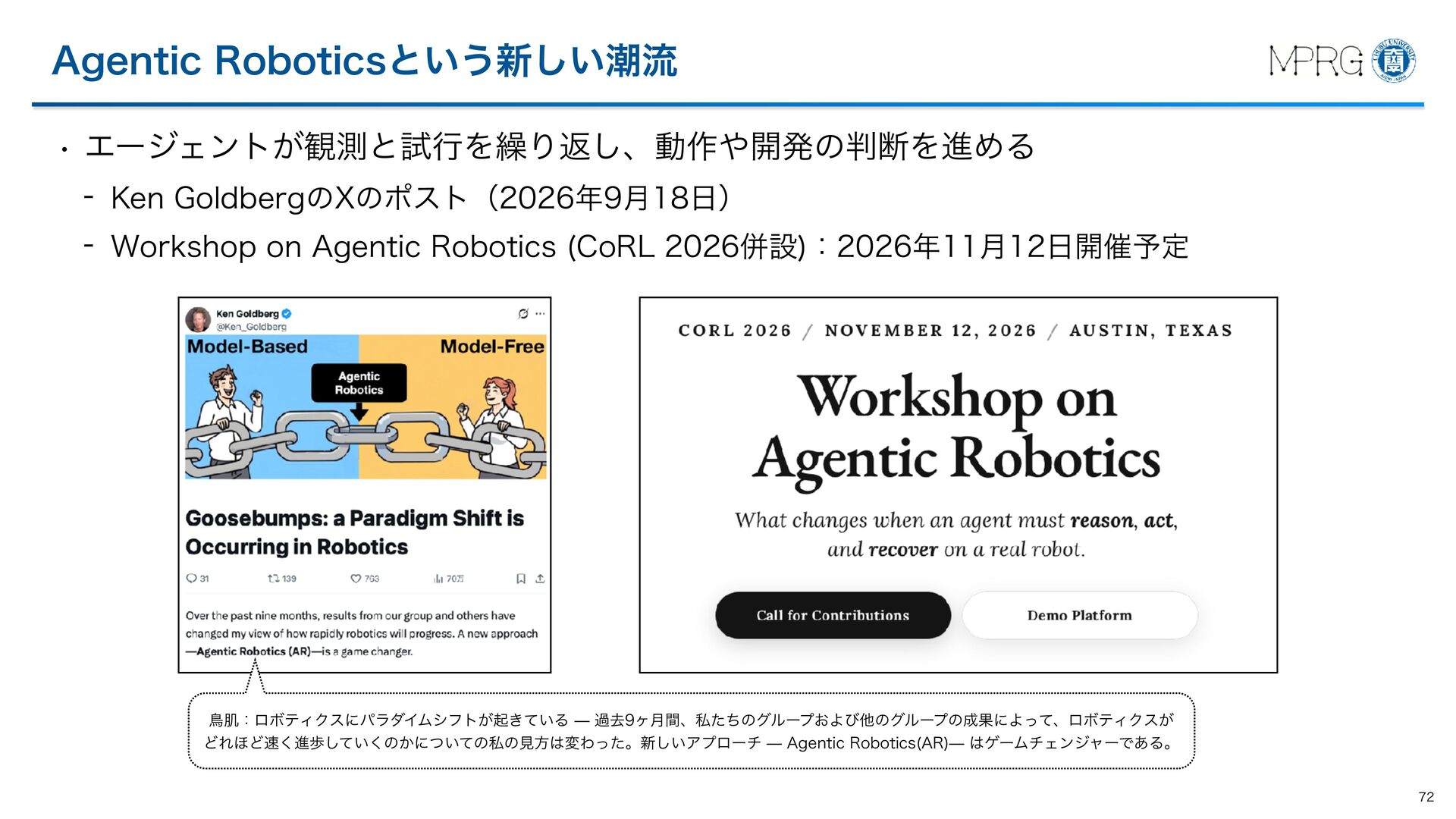
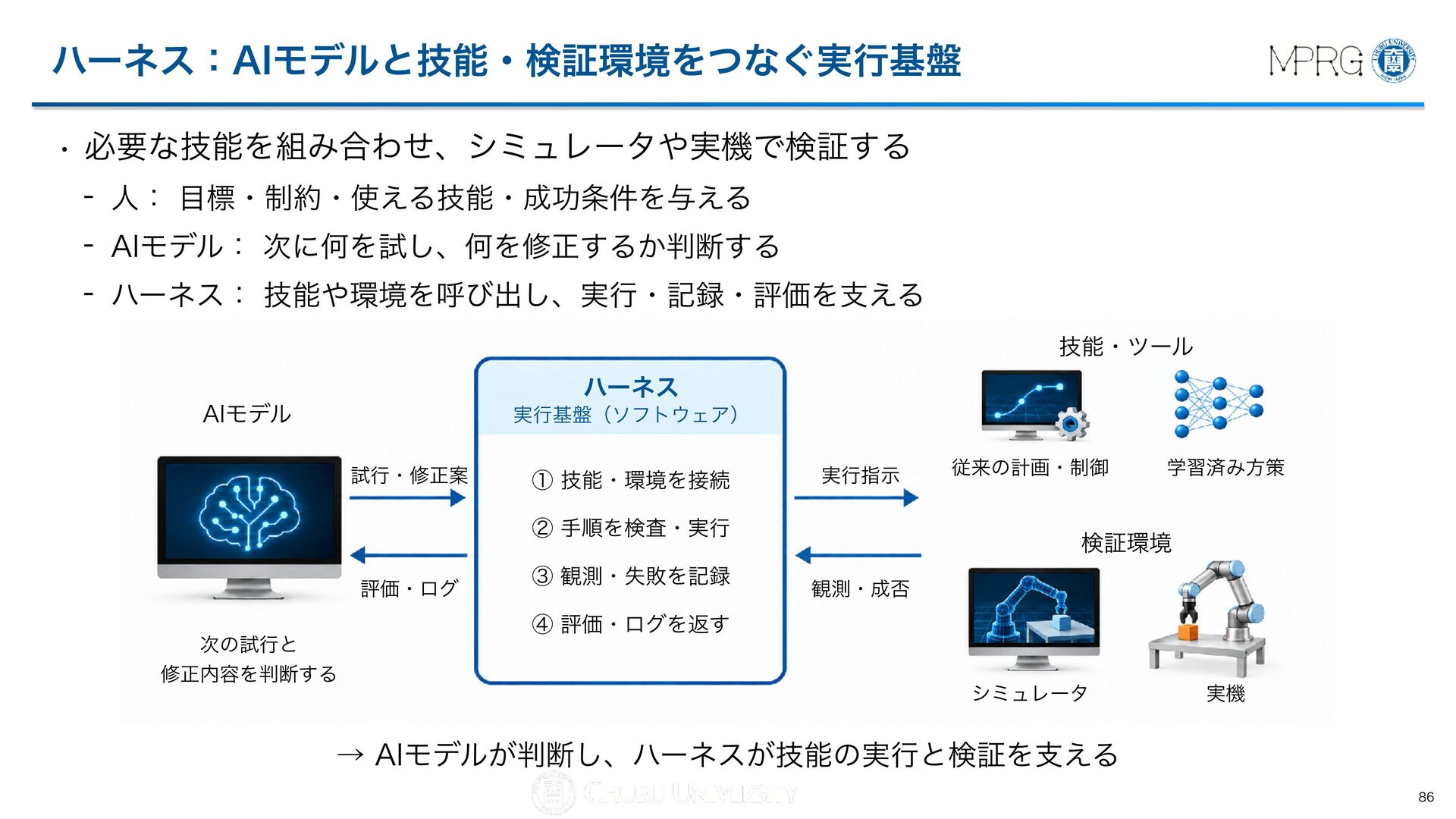
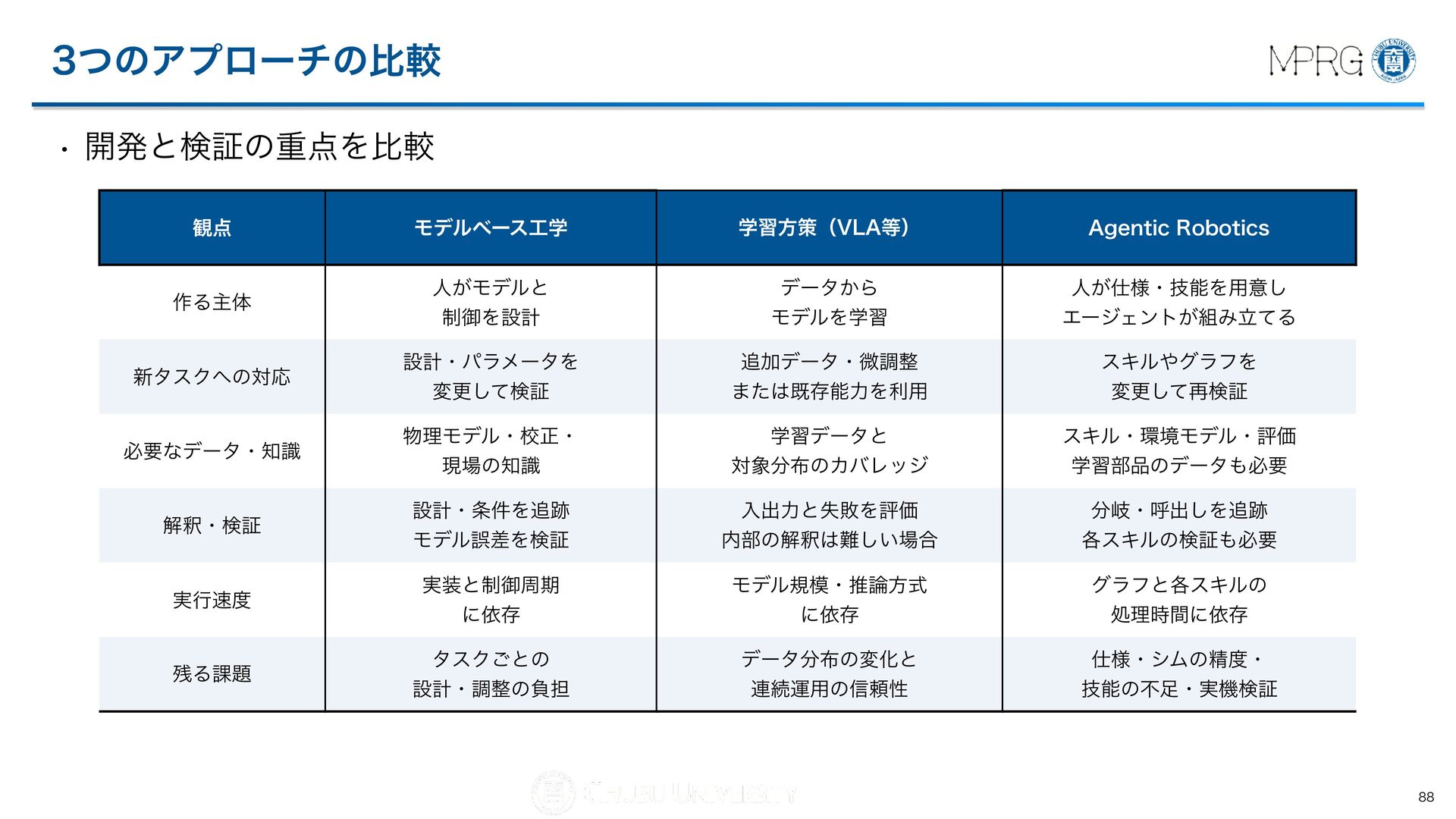
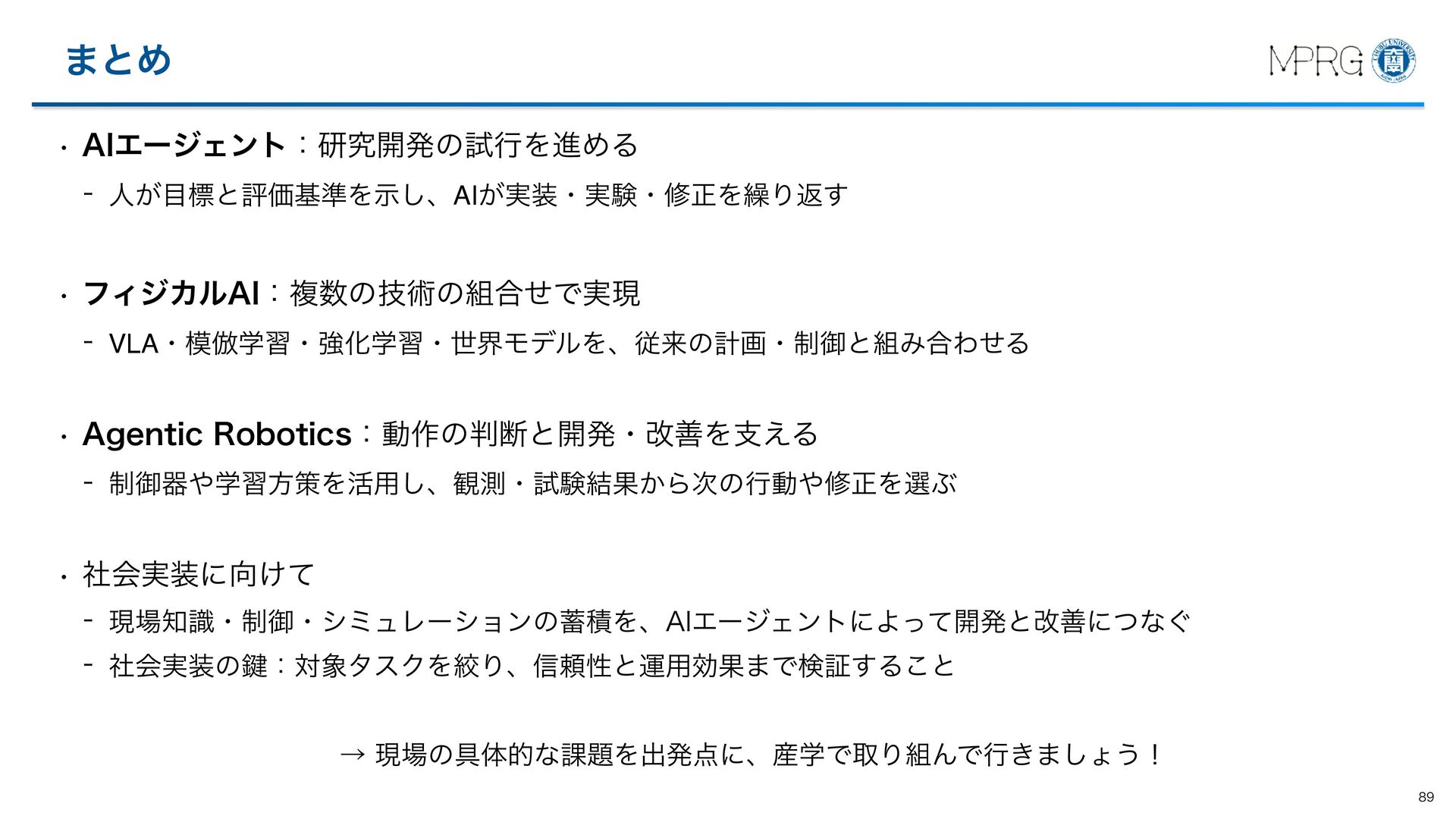
![Agentic Roboticsの考え方 [1/2] • 「ロボットの知能がどこで開発されるか」のシフト - VLA対世界モデルではなく、両方+モデルベース手法をコーディングエージェントが統合 学習ベースの開発 古典ロボティクス 人間が開発](https://files.speakerdeck.com/presentations/a997d36455904c898eebdab3a07397d2/slide_72.jpg)
![Agentic Roboticsの考え方 [2/2] • エージェント・制御/方策・ロボットの関係 - 人が与える:目標・制約・使える技能・成功条件 - エージェント:手法を組み合わせ、ロボットの試験結果から改良する 開発・統合](https://files.speakerdeck.com/presentations/a997d36455904c898eebdab3a07397d2/slide_73.jpg)
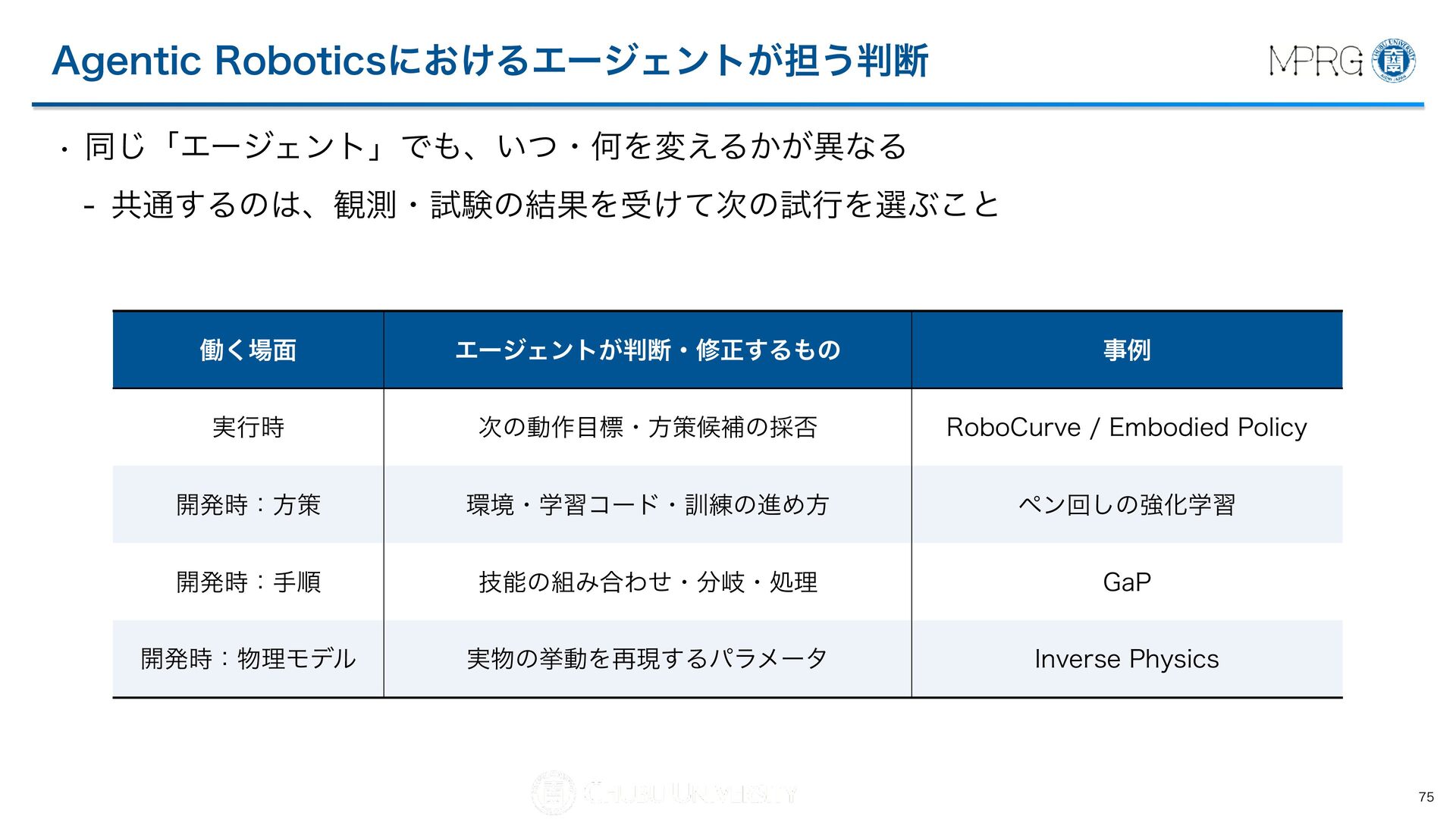
![実行時の判断:RoboCurve [1/2] • 実機ベンチマーク:同一エージェントハーネス上でのモデル比較 - LLMを直接ロボットコントローラとして使う構成 - 共通ハーネス・課題で比較 状況を読み取り 次の動作目標を選ぶ](https://files.speakerdeck.com/presentations/a997d36455904c898eebdab3a07397d2/slide_75.jpg)
![実行時の判断:RoboCurve [2/2] • Astraの改善度合いは、タスクによって異なる - ボウル:成功率40%→95%、出力トークン約74%減、費用約56%減 - パズル: 同率(10%)で1.6倍安い /](https://files.speakerdeck.com/presentations/a997d36455904c898eebdab3a07397d2/slide_76.jpg)
![実行時の判断:Embodied Policy [1/2] • 学習済み方策の候補をAstraが観測と照らし合わせて点検 - Hybrid:学習済み方策の操作経験に、Astraの状況判断を組み合わせる Astraが点検 π0.5が候補を作る 採用](https://files.speakerdeck.com/presentations/a997d36455904c898eebdab3a07397d2/slide_77.jpg)
![実行時の判断:Embodied Policy [2/2] • Astraが全動作を作る方式と、π0.5の動きを点検する方式を比較 - Direct:Astraのみで動作を生成 - Hybrid:π0.5の候補をAstraが点検 成功率(各50試行)](https://files.speakerdeck.com/presentations/a997d36455904c898eebdab3a07397d2/slide_78.jpg)
![方策の開発 [1/2] • Astraをコーディングエージェントとして使いペン回しの方策を獲得 - プロンプト: 器用な操作ができるロボットハンドで、ペン回しを実装してください。強化学習(RL)の訓練には Isaac Lab、ハンドには Sharpa](https://files.speakerdeck.com/presentations/a997d36455904c898eebdab3a07397d2/slide_79.jpg)
![方策の開発 [2/2] • Astraをコーディングエージェントとして使いペン回しの方策を獲得 - GPT-6 Astraの役割:シミュレーション環境と強化学習の手順を構築 - 学習済み方策が担う部分:PPO方策が指の動きを生成しペン回しを実行 →](https://files.speakerdeck.com/presentations/a997d36455904c898eebdab3a07397d2/slide_80.jpg)
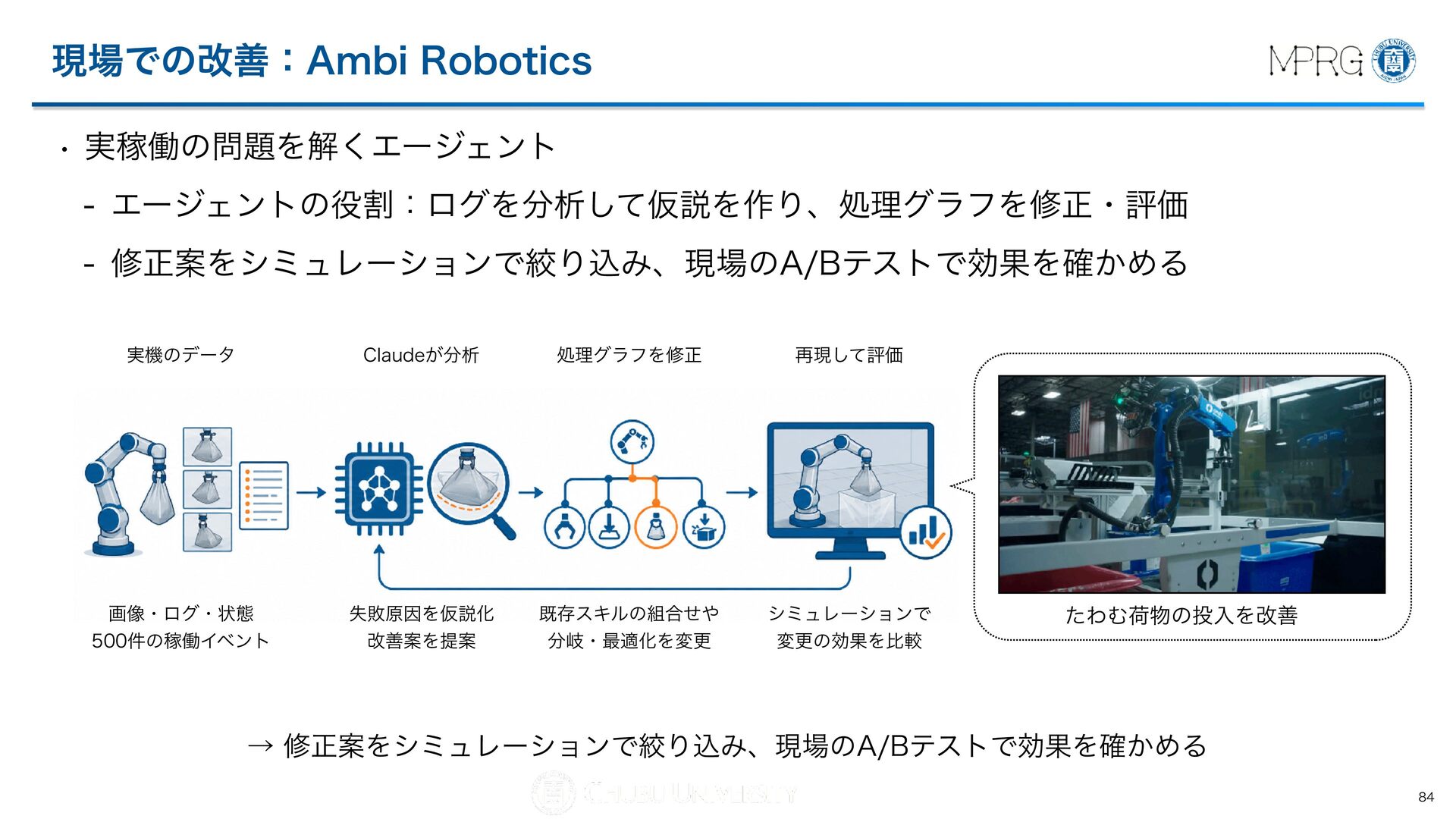
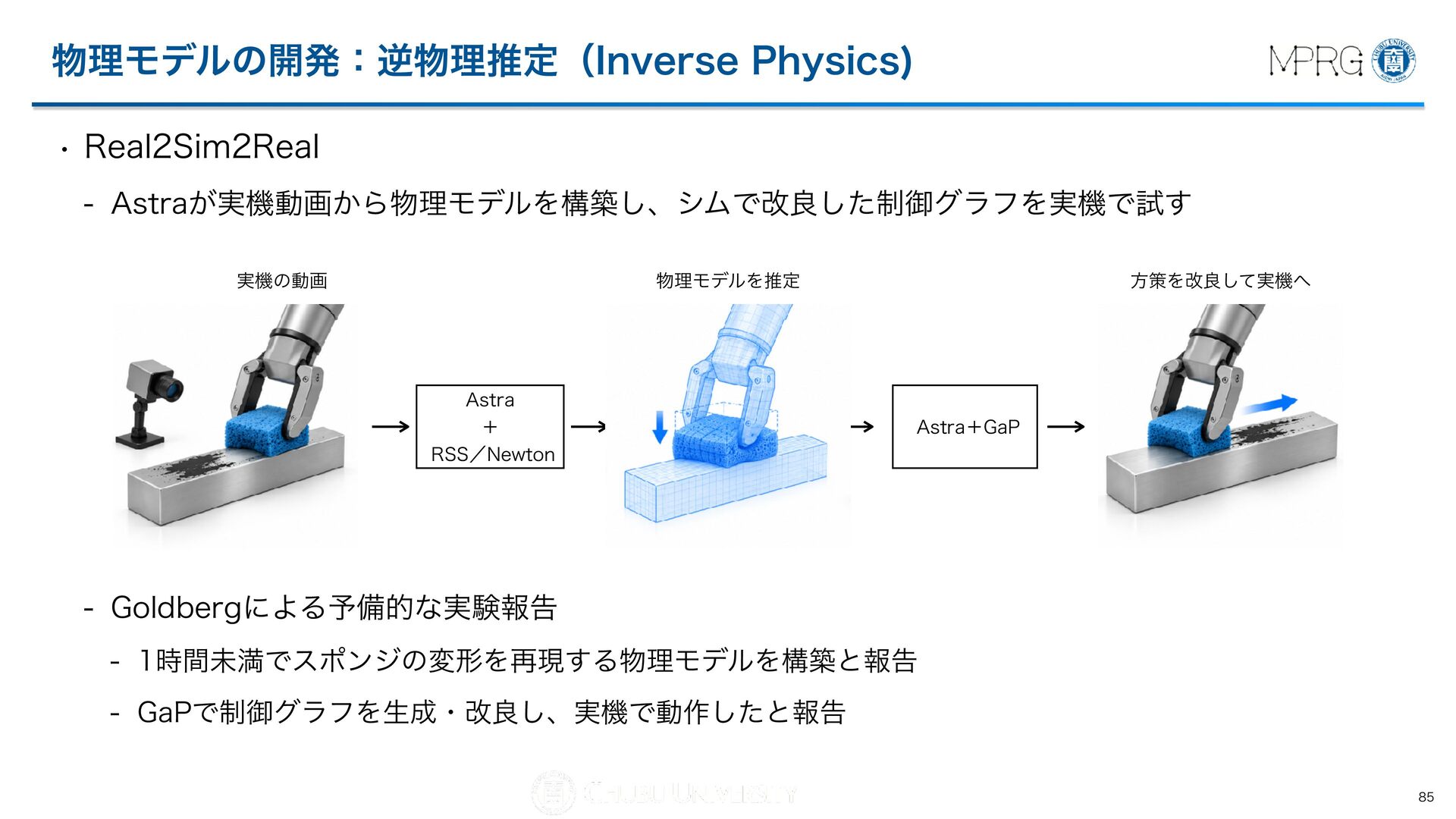
![手順の開発:GaP (Graph-as-Policy) [1/2] • 目的と使える技能を与え、生成・試験・修正をエージェントが進める - 統括エージェントがタスクを分け、技能エージェントが部分グラフを作る エージェントがスキルの組み合わせと実行グラフを設計・改善 82](https://files.speakerdeck.com/presentations/a997d36455904c898eebdab3a07397d2/slide_81.jpg)
![手順の開発:GaP (Graph-as-Policy) [2/2] • 目的と使える技能を与え、生成・試験・修正をエージェントが進める - 目標から手順を作る:エージェントが技能と分岐(グラフ)を組む - 失敗から修正する:結果を評価しグラフを書き換える 83](https://files.speakerdeck.com/presentations/a997d36455904c898eebdab3a07397d2/slide_82.jpg)