Intro to harness engineering (Agent = model + h...
 SiteGround - Reliable hosting with speed, security, and support you can count on.
→

Share
Intro to harness engineering (Agent = model + harness) | Learn Harness Engineering with Kiro 01
An introduction to harness engineering with Kiro. An agent is the model plus the harness: instructions, tools, memory and context, checks, permissions, and records. The deck shows the four mechanisms you add around Kiro (guide, check, contain, and run the loop) and how to size the harness to the task. It then tests one way of working on a small booking app built for this series: log each miss, and add a hook or a line of steering when the same miss happens a second time. Most trial slides show English reruns with Kiro CLI 3.1; two come from the Japanese edition's runs, and each trial slide says which run it shows. It ends with where to put checks and the human's role. As of November 2026 (Kiro IDE 1.4, Kiro CLI 3.1). Level 200. This is deck 01 (The idea) of the Learn Harness Engineering with Kiro series.

Riku INADA PRO
Annual Pro sale · Save $30
Have presentations of your own?
Share with private links, password protection, and more control over your work.
Transcript
32 slides
-
Learn Harness Engineering with Kiro The idea Level 200 Intro
to harness engineering Agent = model + harness As of November 2026 (Kiro IDE 1.4) November 2026 Riku Inada Amazon Web Services Japan 01 + Kiro + Harness Engineering © 2026, Amazon Web Services, Inc. or its affiliates. All rights reserved. 1 -
Introduction About me Riku Inada Amazon Web Services Japan G.K.
Solutions Architect Works mainly with manufacturing customers Recent work Promoting the AI-Driven Development Life Cycle (AI-DLC) Writing and speaking about Kiro and AWS Amplify © 2026, Amazon Web Services, Inc. or its affiliates. All rights reserved. X @inada_riku Speaker Deck speakerdeck.com/inariku Zenn zenn.dev/inariku GitHub github.com/inariku 2 -
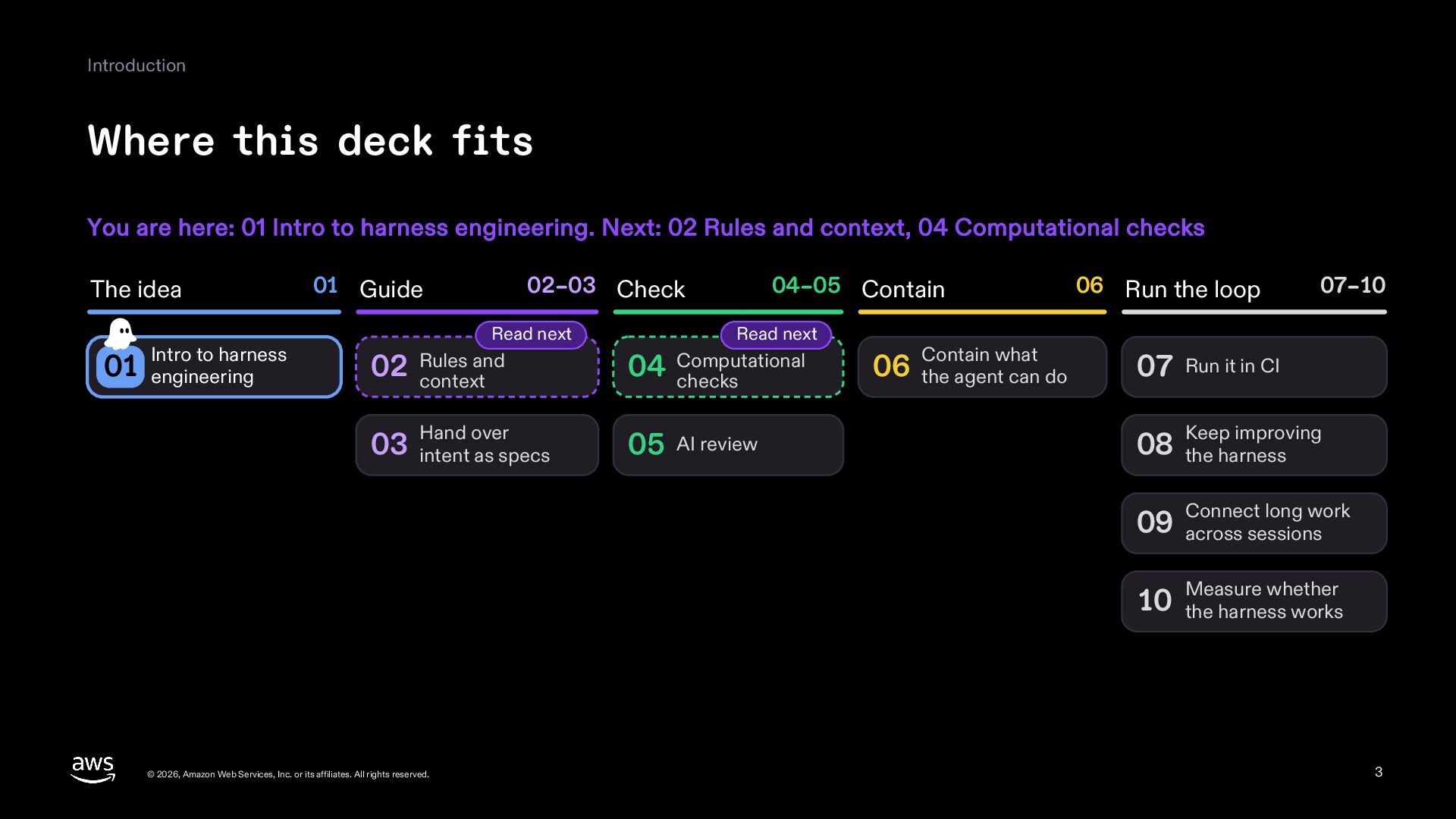
Introduction Where this deck fits You are here: 01 Intro
to harness engineering. Next: 02 Rules and context, 04 Computational checks The idea Intro to harness 01 engineering 01 Guide 02–03 Check Read next and 02 Rules context Hand over 03 intent as specs 04–05 Contain Read next 04 Computational checks 05 AI review Contain what 06 the agent can do 06 Run the loop 07–10 07 Run it in CI Keep improving 08 the harness long work 09 Connect across sessions whether 10 Measure the harness works © 2026, Amazon Web Services, Inc. or its affiliates. All rights reserved. 3 -
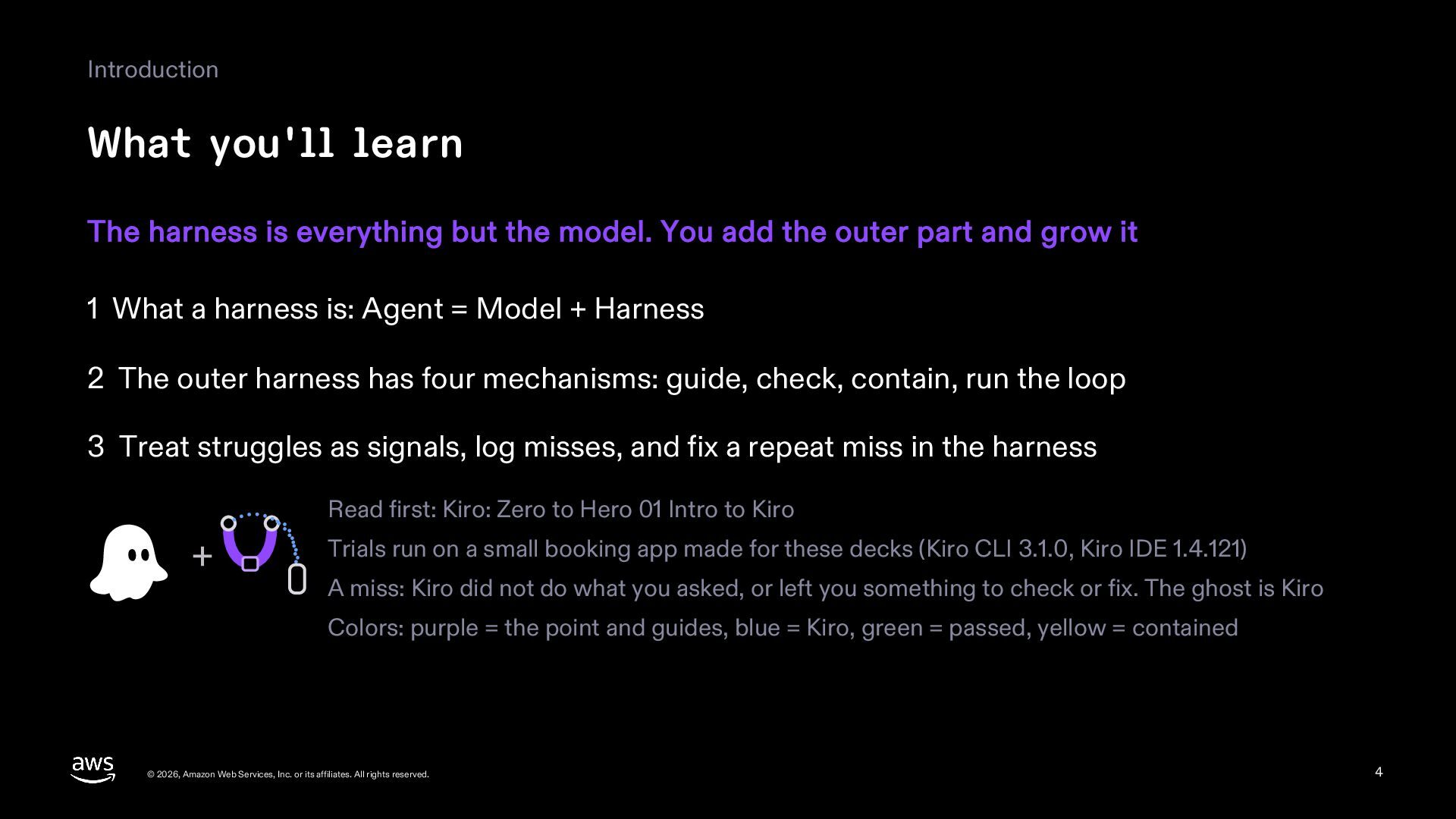
Introduction What you'll learn The harness is everything but the
model. You add the outer part and grow it 1 What a harness is: Agent = Model + Harness 2 The outer harness has four mechanisms: guide, check, contain, run the loop 3 Treat struggles as signals, log misses, and fix a repeat miss in the harness Read first: Kiro: Zero to Hero 01 Intro to Kiro + Trials run on a small booking app made for these decks (Kiro CLI 3.1.0, Kiro IDE 1.4.121) A miss: Kiro did not do what you asked, or left you something to check or fix. The ghost is Kiro Colors: purple = the point and guides, blue = Kiro, green = passed, yellow = contained © 2026, Amazon Web Services, Inc. or its affiliates. All rights reserved. 4 -
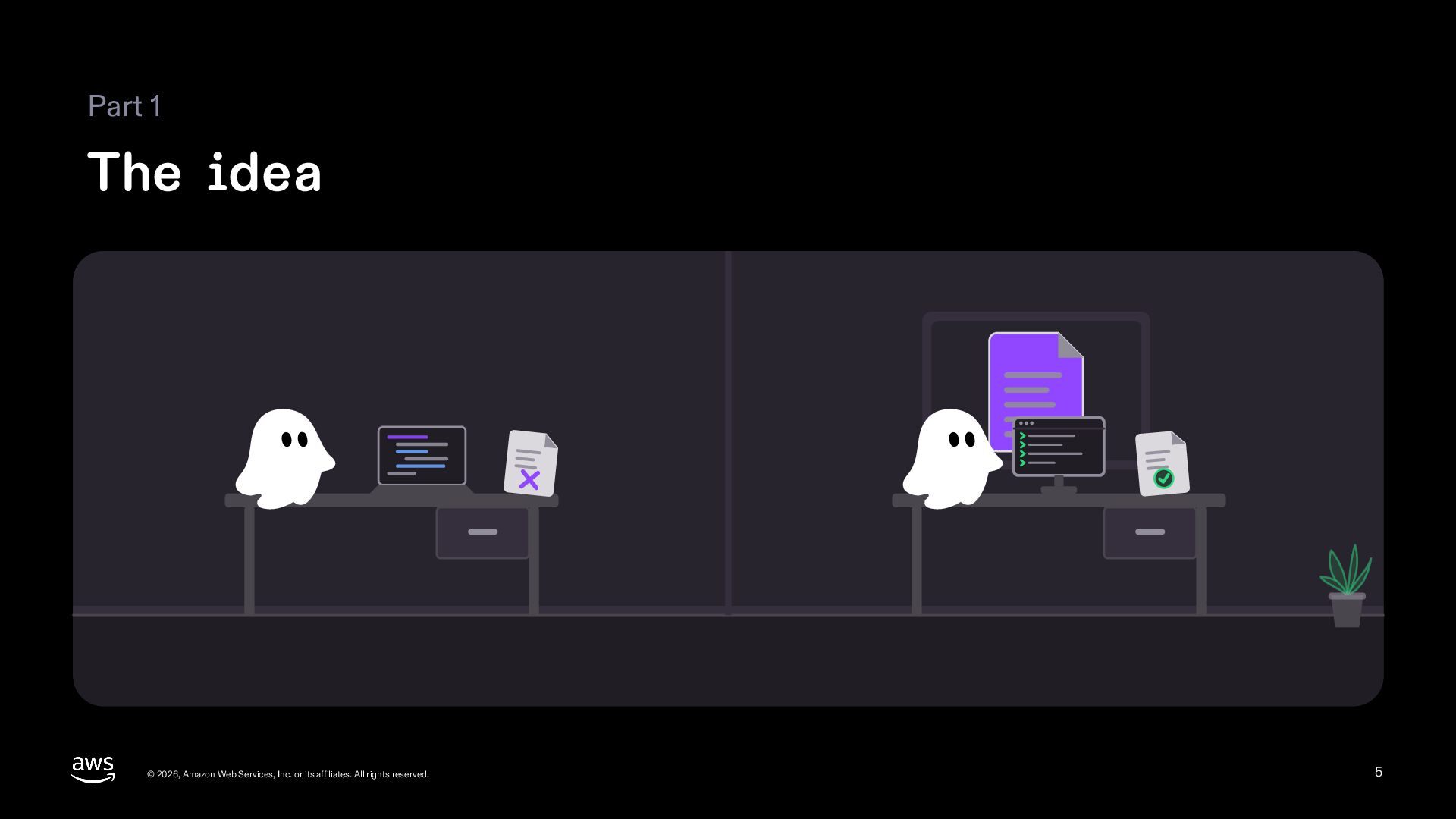
Part 1 The idea © 2026, Amazon Web Services, Inc.
or its affiliates. All rights reserved. 5 -
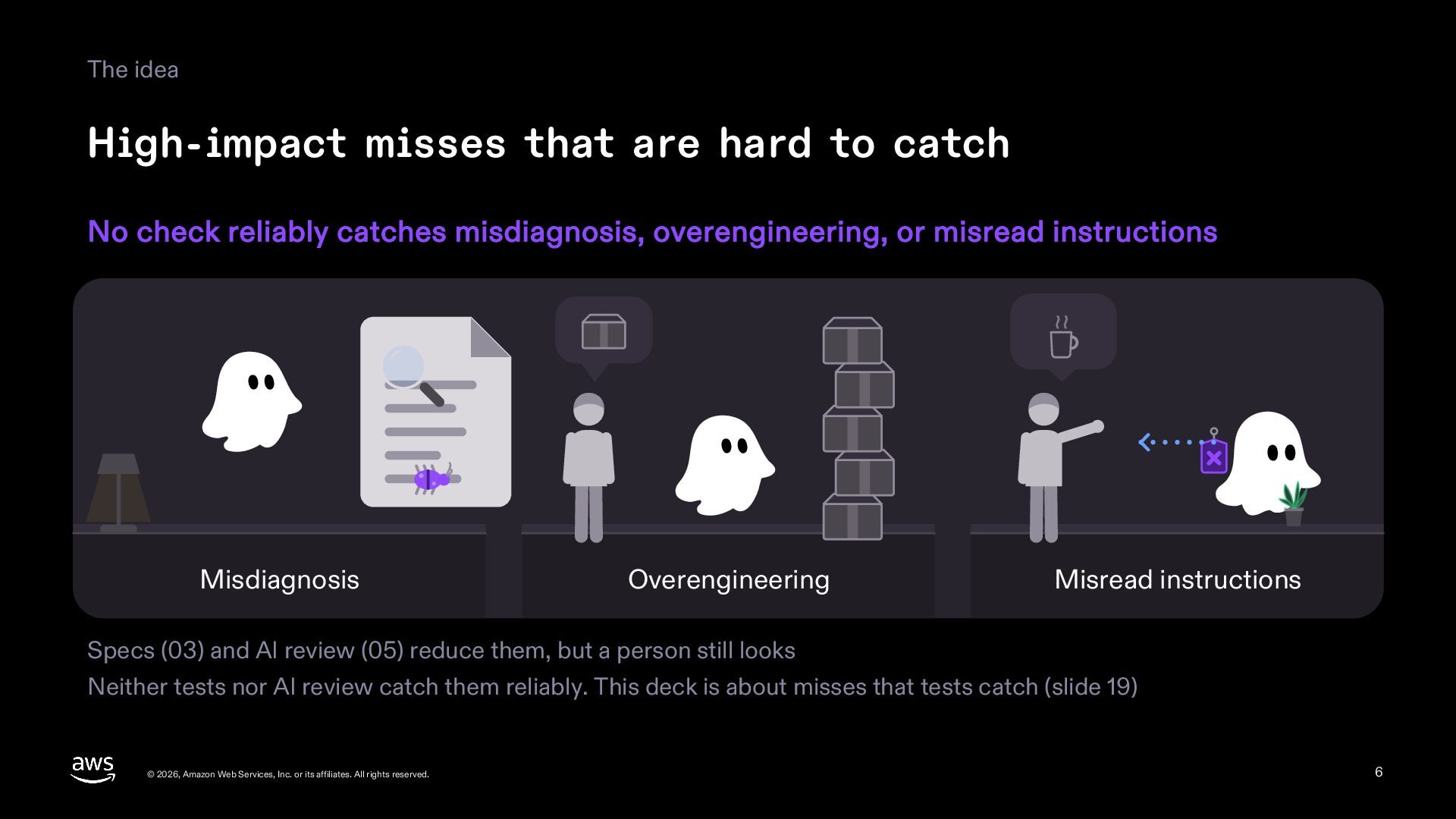
The idea High-impact misses that are hard to catch No
check reliably catches misdiagnosis, overengineering, or misread instructions Misdiagnosis Overengineering Misread instructions Specs (03) and AI review (05) reduce them, but a person still looks Neither tests nor AI review catch them reliably. This deck is about misses that tests catch (slide 19) © 2026, Amazon Web Services, Inc. or its affiliates. All rights reserved. 6 -
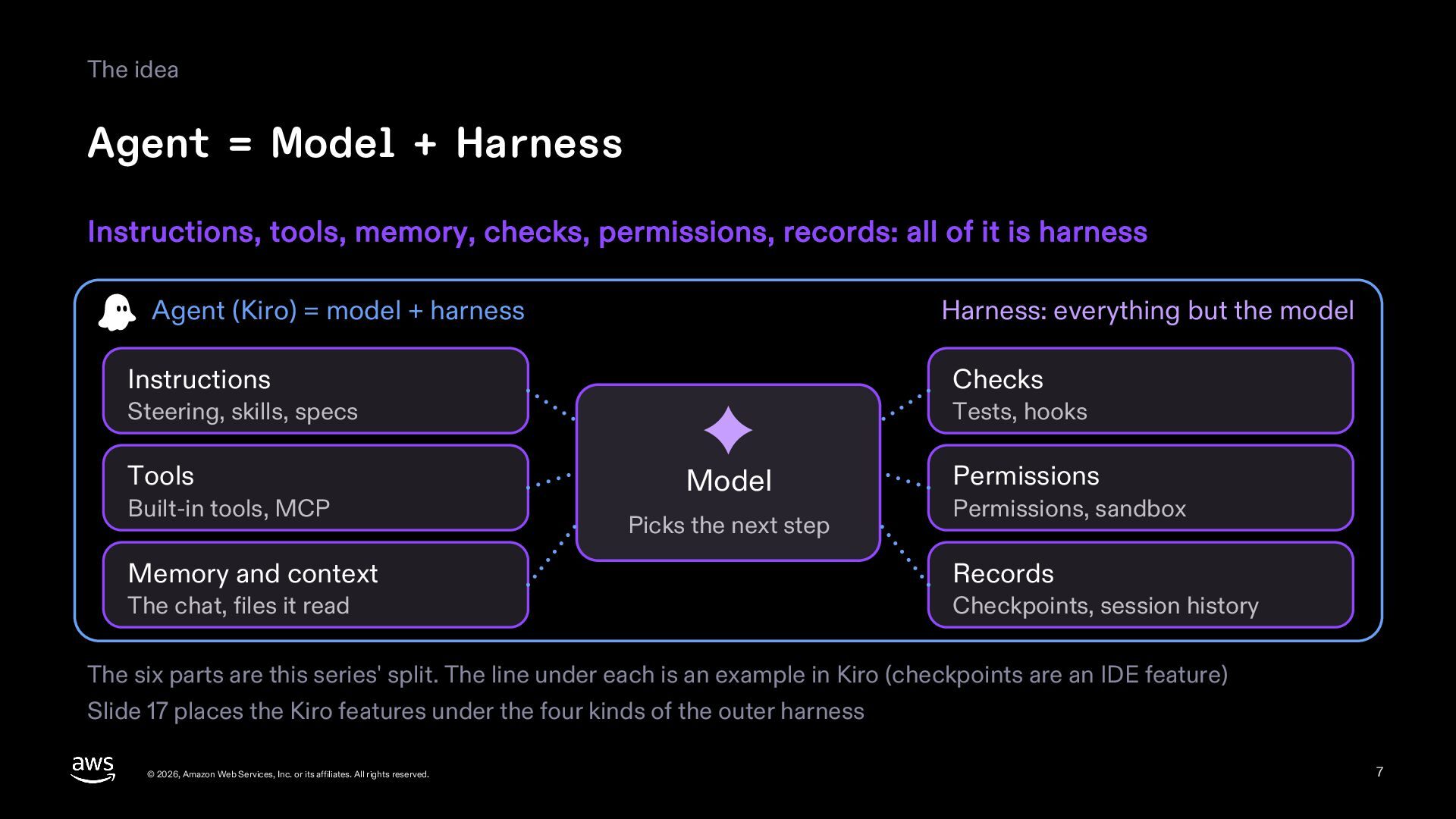
The idea Agent = Model + Harness Instructions, tools, memory,
checks, permissions, records: all of it is harness Agent (Kiro) = model + harness Harness: everything but the model Instructions Checks Steering, skills, specs Tests, hooks Tools Built-in tools, MCP Model Picks the next step Permissions Permissions, sandbox Memory and context Records The chat, files it read Checkpoints, session history The six parts are this series' split. The line under each is an example in Kiro (checkpoints are an IDE feature) Slide 17 places the Kiro features under the four kinds of the outer harness © 2026, Amazon Web Services, Inc. or its affiliates. All rights reserved. 7 -
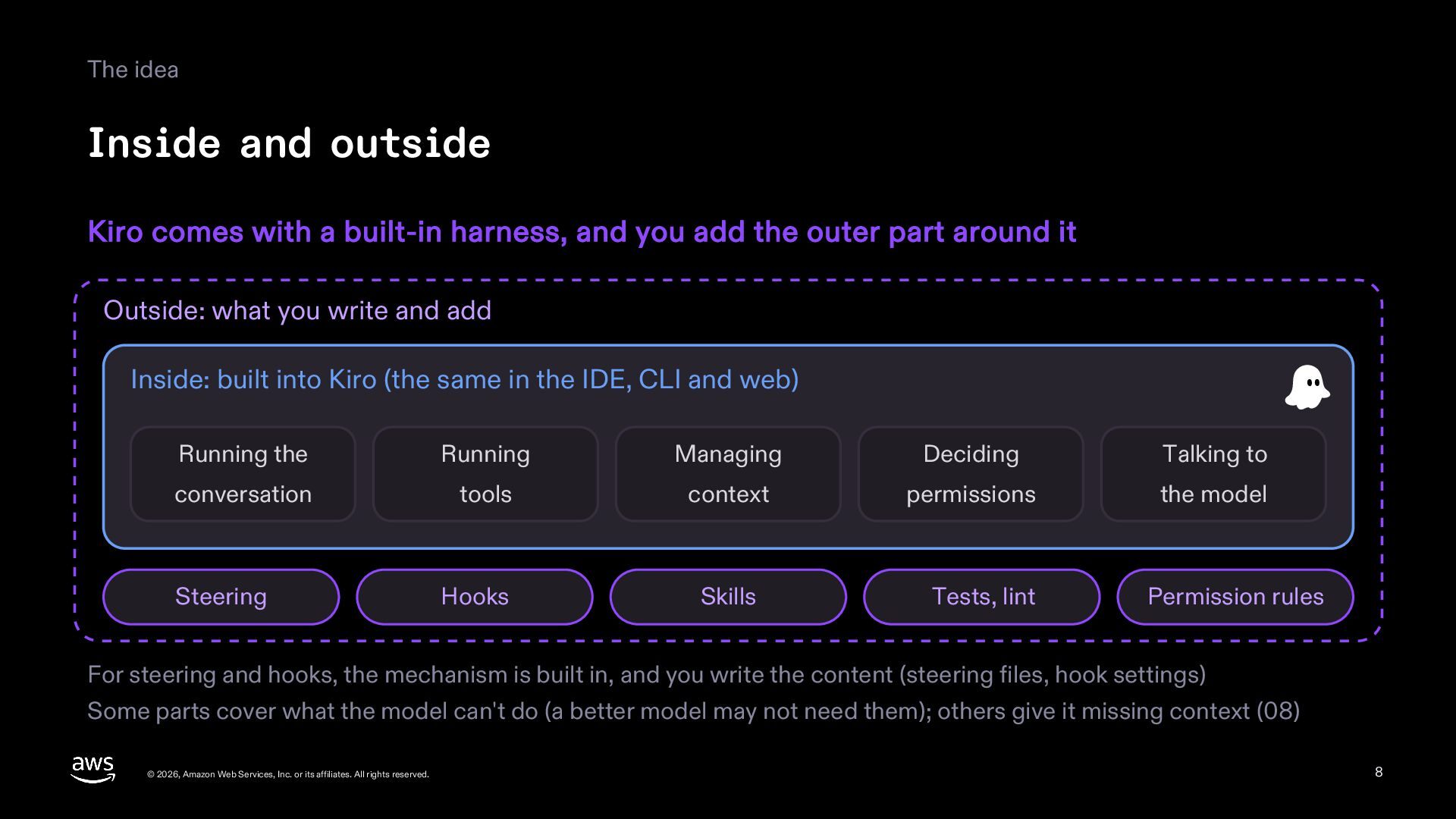
The idea Inside and outside Kiro comes with a built-in
harness, and you add the outer part around it Outside: what you write and add Inside: built into Kiro (the same in the IDE, CLI and web) Running the Running Managing Deciding Talking to conversation tools context permissions the model Hooks Skills Tests, lint Steering Permission rules For steering and hooks, the mechanism is built in, and you write the content (steering files, hook settings) Some parts cover what the model can't do (a better model may not need them); others give it missing context (08) © 2026, Amazon Web Services, Inc. or its affiliates. All rights reserved. 8 -
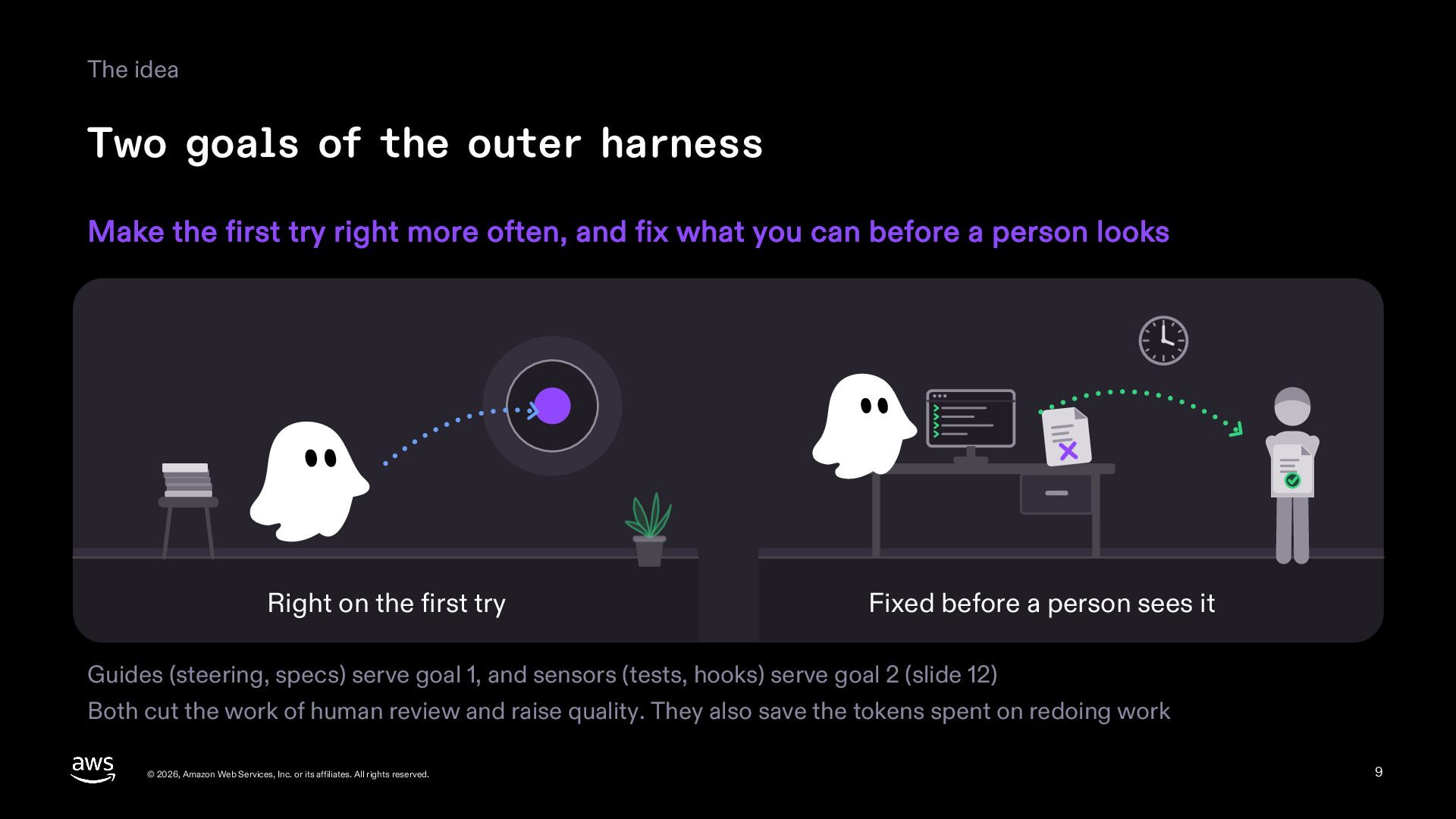
The idea Two goals of the outer harness Make the
first try right more often, and fix what you can before a person looks Right on the first try Fixed before a person sees it Guides (steering, specs) serve goal 1, and sensors (tests, hooks) serve goal 2 (slide 12) Both cut the work of human review and raise quality. They also save the tokens spent on redoing work © 2026, Amazon Web Services, Inc. or its affiliates. All rights reserved. 9 -
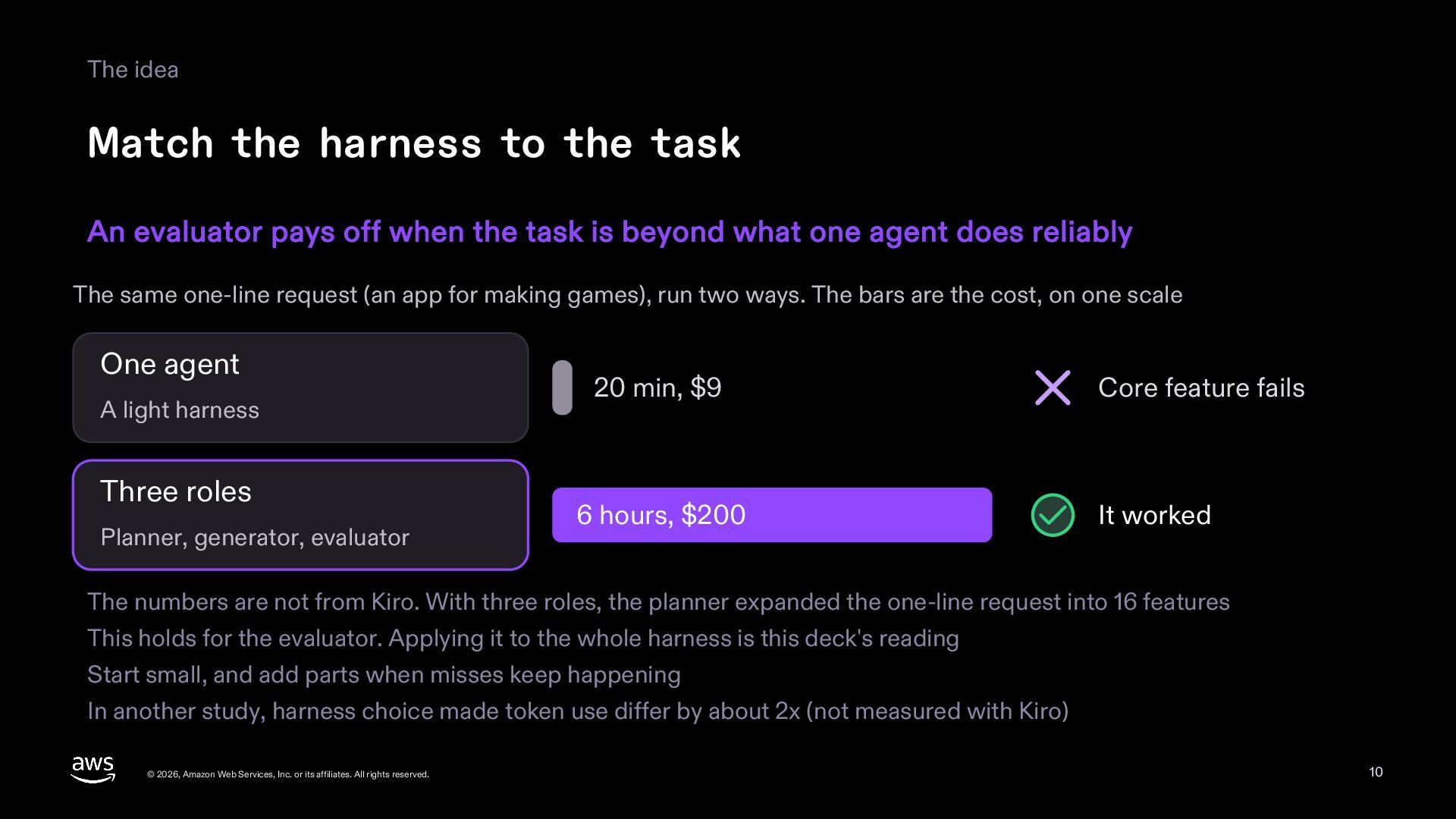
The idea Match the harness to the task An evaluator
pays off when the task is beyond what one agent does reliably The same one-line request (an app for making games), run two ways. The bars are the cost, on one scale One agent A light harness Three roles Planner, generator, evaluator 20 min, $9 Core feature fails 6 hours, $200 It worked The numbers are not from Kiro. With three roles, the planner expanded the one-line request into 16 features This holds for the evaluator. Applying it to the whole harness is this deck's reading Start small, and add parts when misses keep happening In another study, harness choice made token use differ by about 2x (not measured with Kiro) © 2026, Amazon Web Services, Inc. or its affiliates. All rights reserved. 10 -
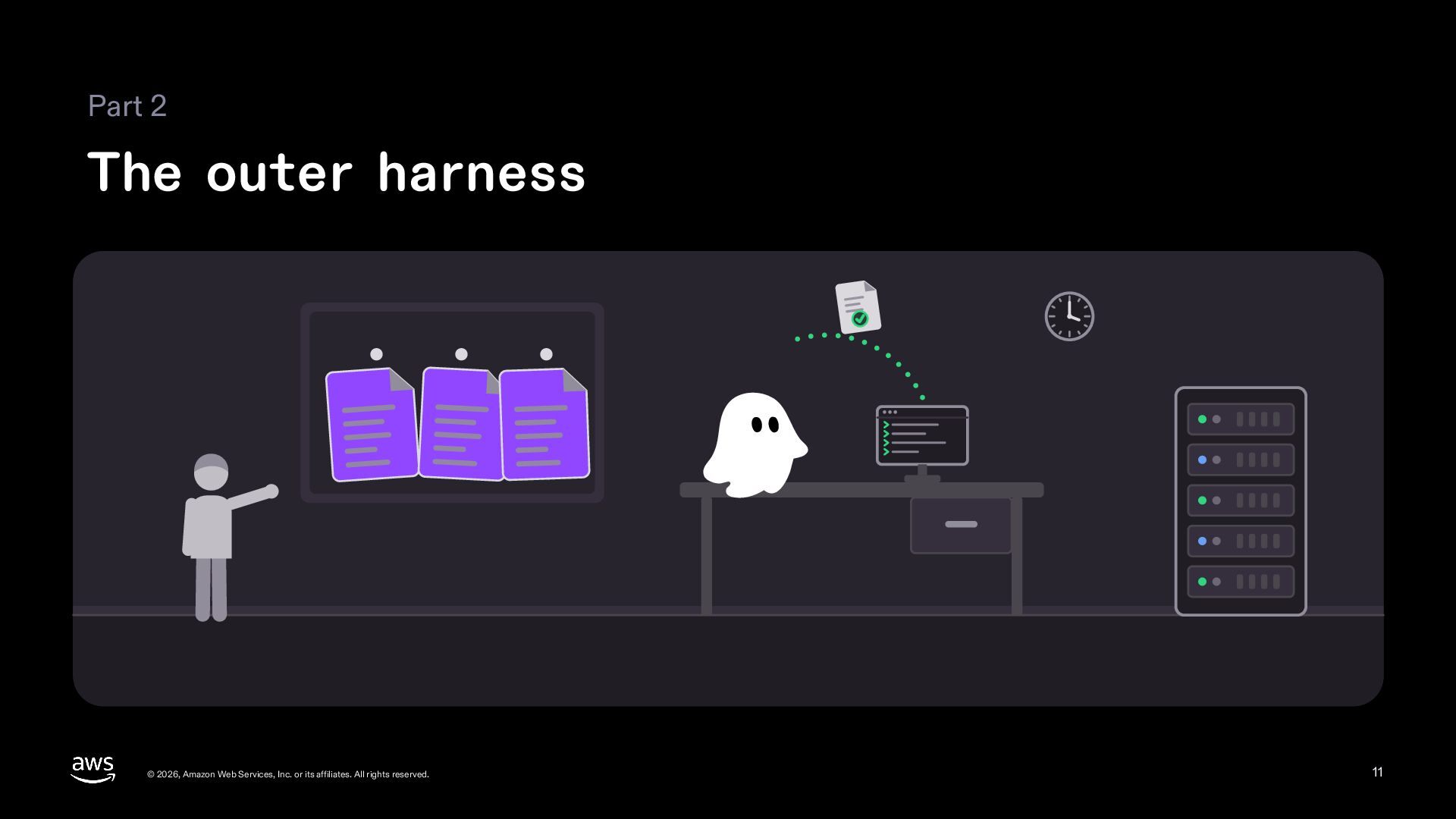
Part 2 The outer harness © 2026, Amazon Web Services,
Inc. or its affiliates. All rights reserved. 11 -
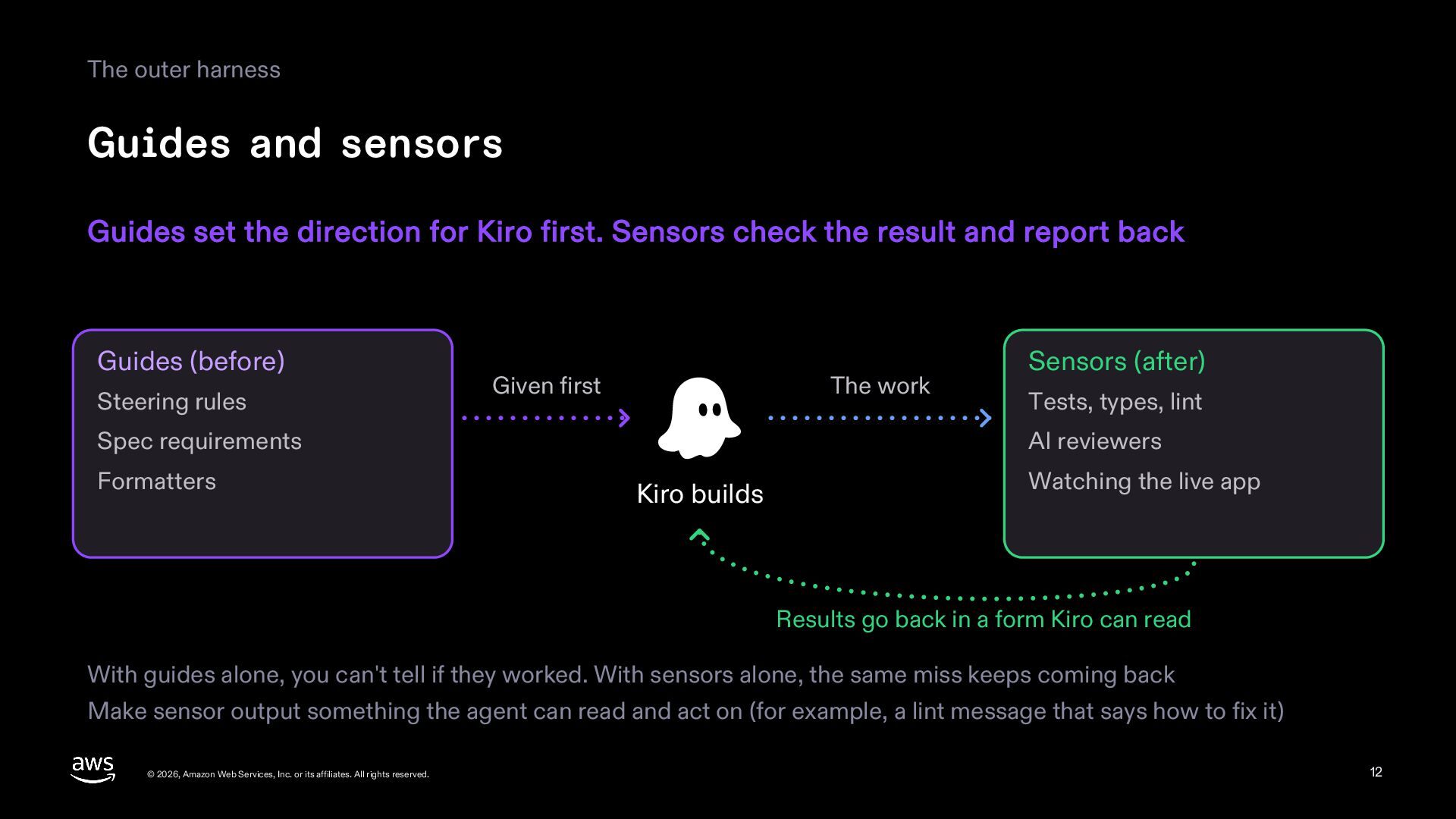
The outer harness Guides and sensors Guides set the direction
for Kiro first. Sensors check the result and report back Guides (before) Steering rules Given first The work Spec requirements Formatters Sensors (after) Tests, types, lint AI reviewers Kiro builds Watching the live app Results go back in a form Kiro can read With guides alone, you can't tell if they worked. With sensors alone, the same miss keeps coming back Make sensor output something the agent can read and act on (for example, a lint message that says how to fix it) © 2026, Amazon Web Services, Inc. or its affiliates. All rights reserved. 12 -
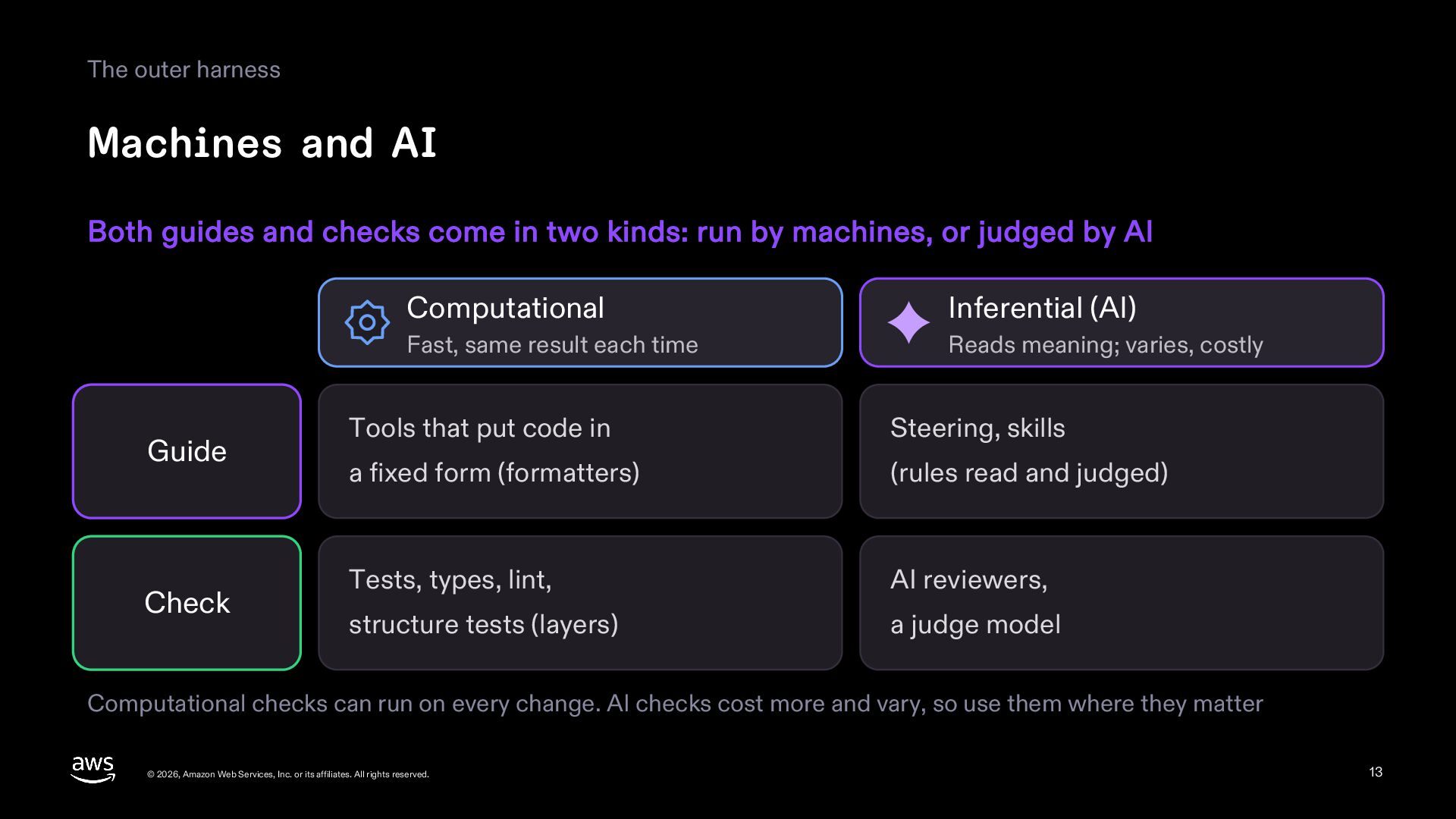
The outer harness Machines and AI Both guides and checks
come in two kinds: run by machines, or judged by AI Guide Check Computational Inferential (AI) Fast, same result each time Reads meaning; varies, costly Tools that put code in Steering, skills a fixed form (formatters) (rules read and judged) Tests, types, lint, AI reviewers, structure tests (layers) a judge model Computational checks can run on every change. AI checks cost more and vary, so use them where they matter © 2026, Amazon Web Services, Inc. or its affiliates. All rights reserved. 13 -
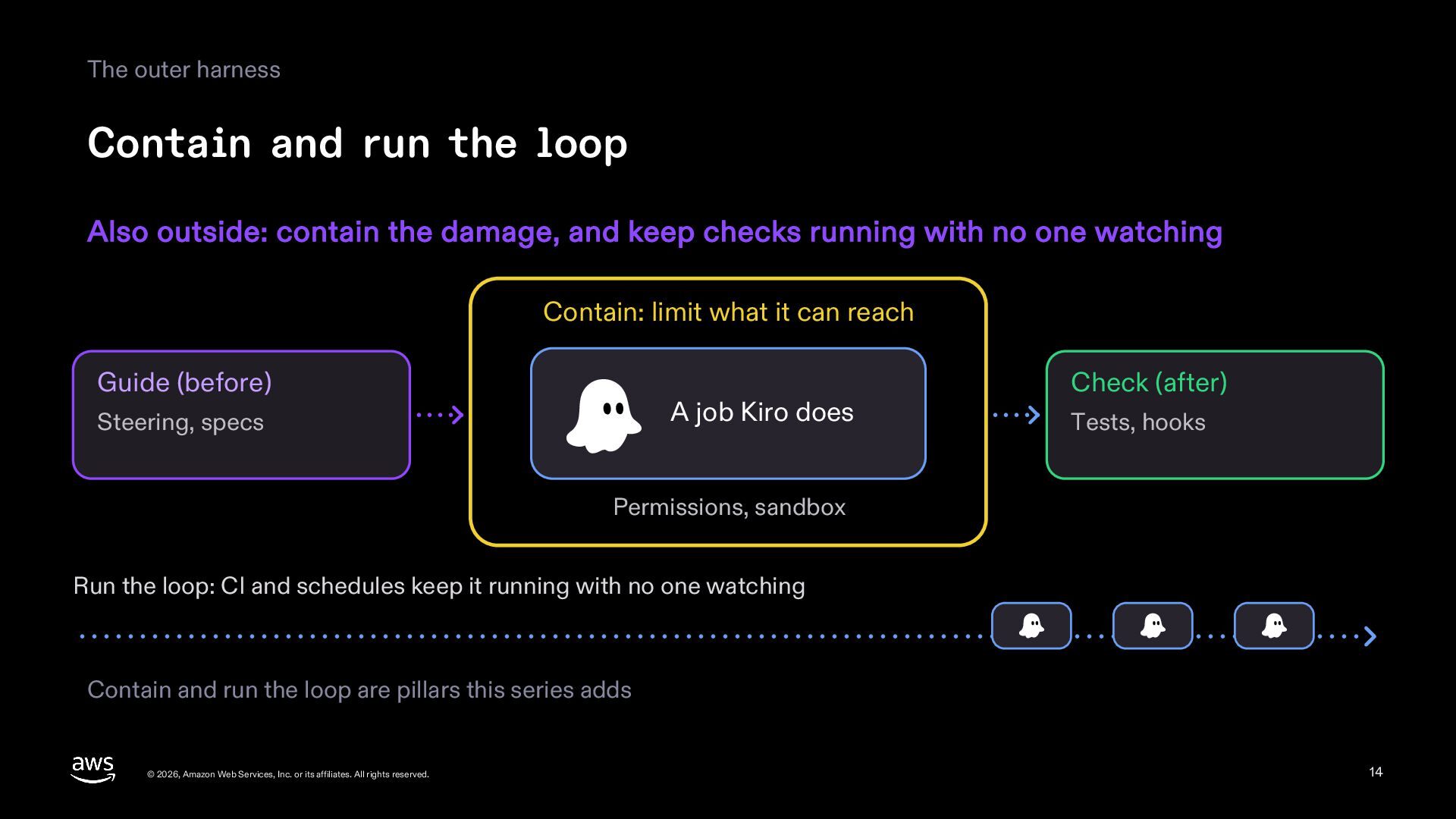
The outer harness Contain and run the loop Also outside:
contain the damage, and keep checks running with no one watching Contain: limit what it can reach Guide (before) A job Kiro does Steering, specs Check (after) Tests, hooks Permissions, sandbox Run the loop: CI and schedules keep it running with no one watching Contain and run the loop are pillars this series adds © 2026, Amazon Web Services, Inc. or its affiliates. All rights reserved. 14 -
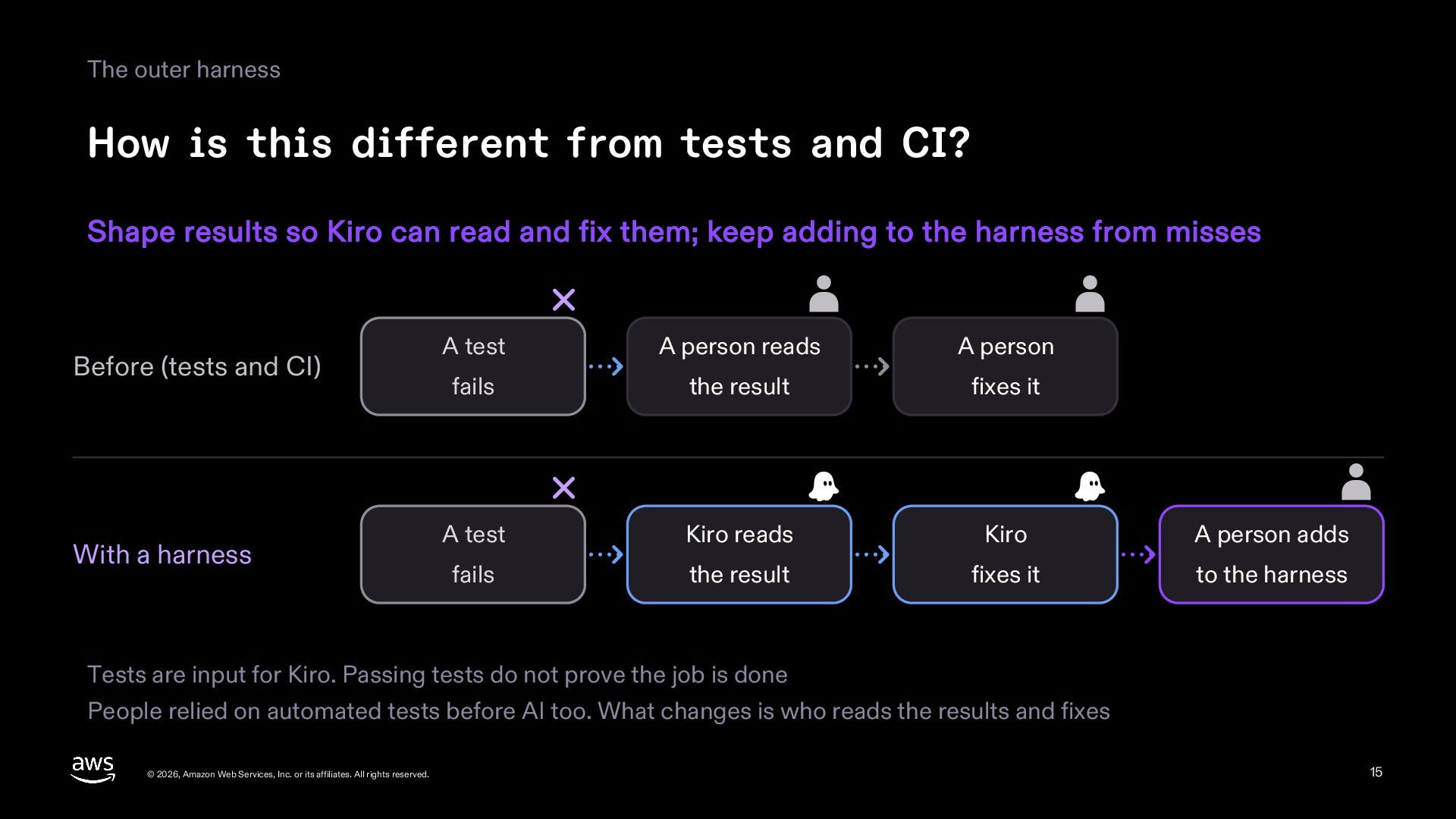
The outer harness How is this different from tests and
CI? Shape results so Kiro can read and fix them; keep adding to the harness from misses Before (tests and CI) With a harness A test A person reads A person fails the result fixes it A test Kiro reads Kiro A person adds fails the result fixes it to the harness Tests are input for Kiro. Passing tests do not prove the job is done People relied on automated tests before AI too. What changes is who reads the results and fixes © 2026, Amazon Web Services, Inc. or its affiliates. All rights reserved. 15 -
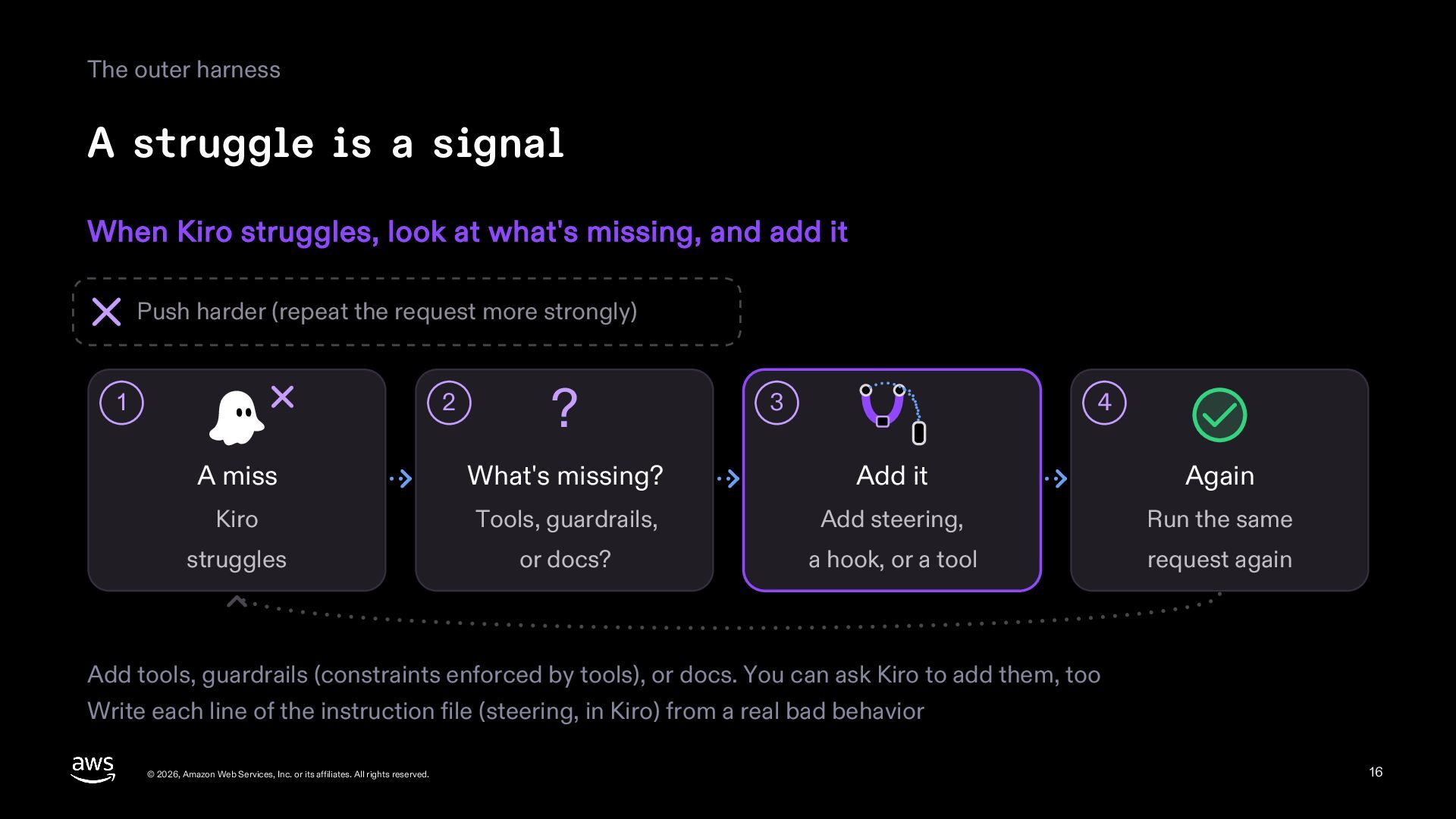
The outer harness A struggle is a signal When Kiro
struggles, look at what's missing, and add it Push harder (repeat the request more strongly) 1 2 ? 3 4 A miss What's missing? Add it Again Kiro Tools, guardrails, Add steering, Run the same struggles or docs? a hook, or a tool request again Add tools, guardrails (constraints enforced by tools), or docs. You can ask Kiro to add them, too Write each line of the instruction file (steering, in Kiro) from a real bad behavior © 2026, Amazon Web Services, Inc. or its affiliates. All rights reserved. 16 -
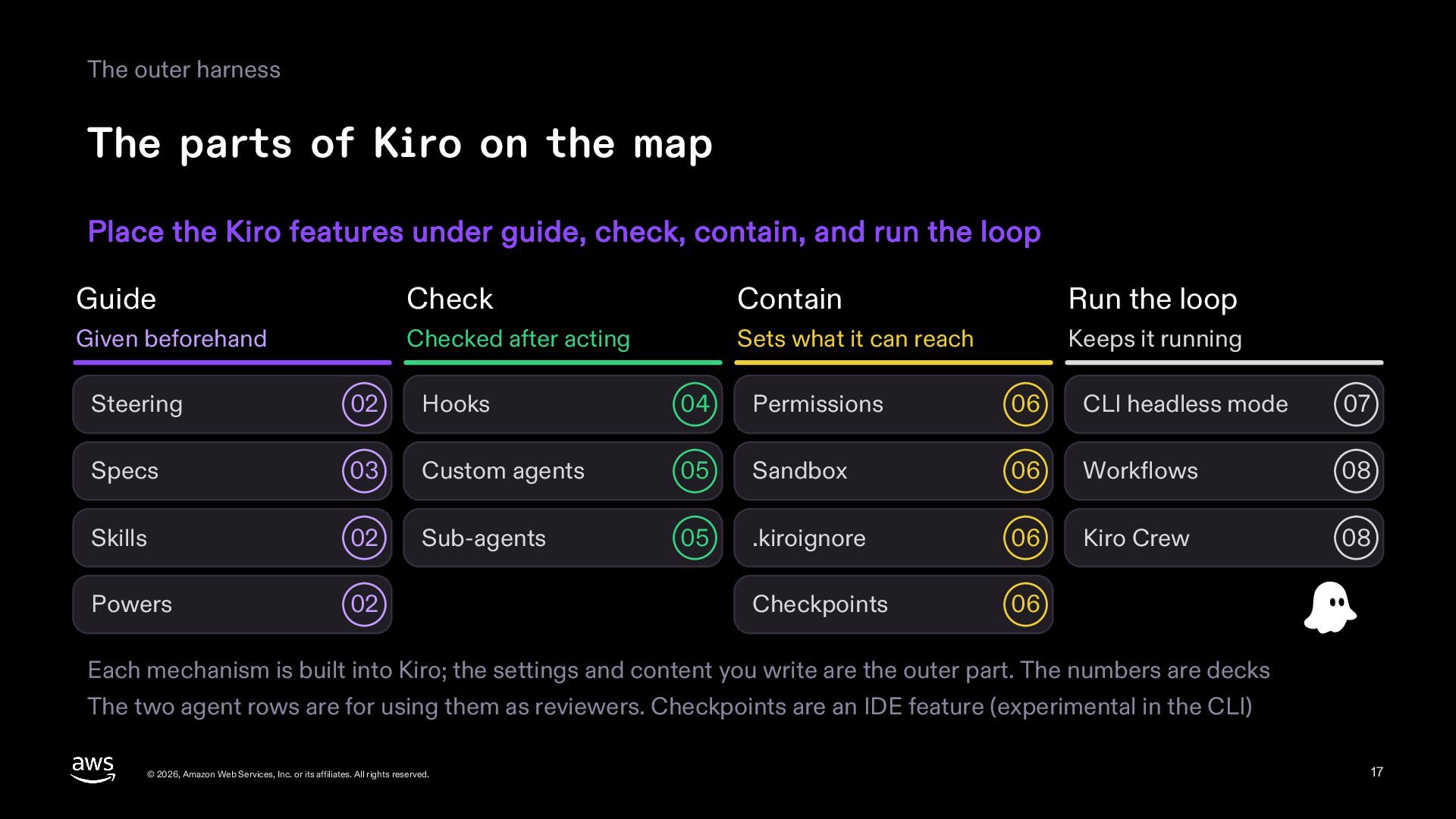
The outer harness The parts of Kiro on the map
Place the Kiro features under guide, check, contain, and run the loop Guide Check Contain Run the loop Given beforehand Checked after acting Sets what it can reach Keeps it running Steering 02 Hooks 04 Permissions 06 CLI headless mode 07 Specs 03 Custom agents 05 Sandbox 06 Workflows 08 Skills 02 Sub-agents 05 .kiroignore 06 Kiro Crew 08 Powers 02 Checkpoints 06 Each mechanism is built into Kiro; the settings and content you write are the outer part. The numbers are decks The two agent rows are for using them as reviewers. Checkpoints are an IDE feature (experimental in the CLI) © 2026, Amazon Web Services, Inc. or its affiliates. All rights reserved. 17 -
Part 3 Trying it on the booking app © 2026,
Amazon Web Services, Inc. or its affiliates. All rights reserved. 18 -
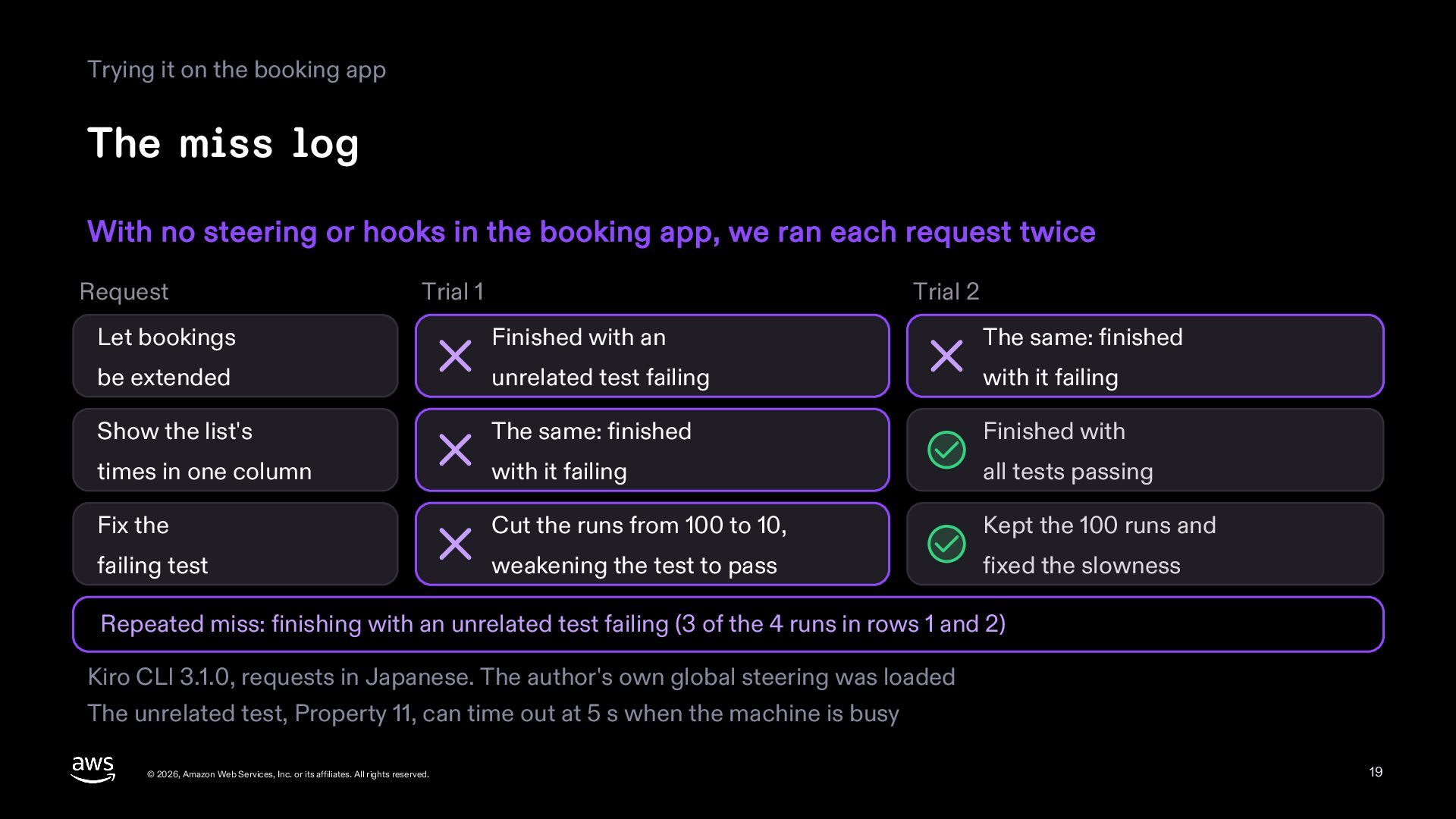
Trying it on the booking app The miss log With
no steering or hooks in the booking app, we ran each request twice Request Trial 1 Trial 2 Let bookings Finished with an The same: finished be extended unrelated test failing with it failing Show the list's The same: finished Finished with times in one column with it failing all tests passing Fix the Cut the runs from 100 to 10, Kept the 100 runs and failing test weakening the test to pass fixed the slowness Repeated miss: finishing with an unrelated test failing (3 of the 4 runs in rows 1 and 2) Kiro CLI 3.1.0, requests in Japanese. The author's own global steering was loaded The unrelated test, Property 11, can time out at 5 s when the machine is busy © 2026, Amazon Web Services, Inc. or its affiliates. All rights reserved. 19 -
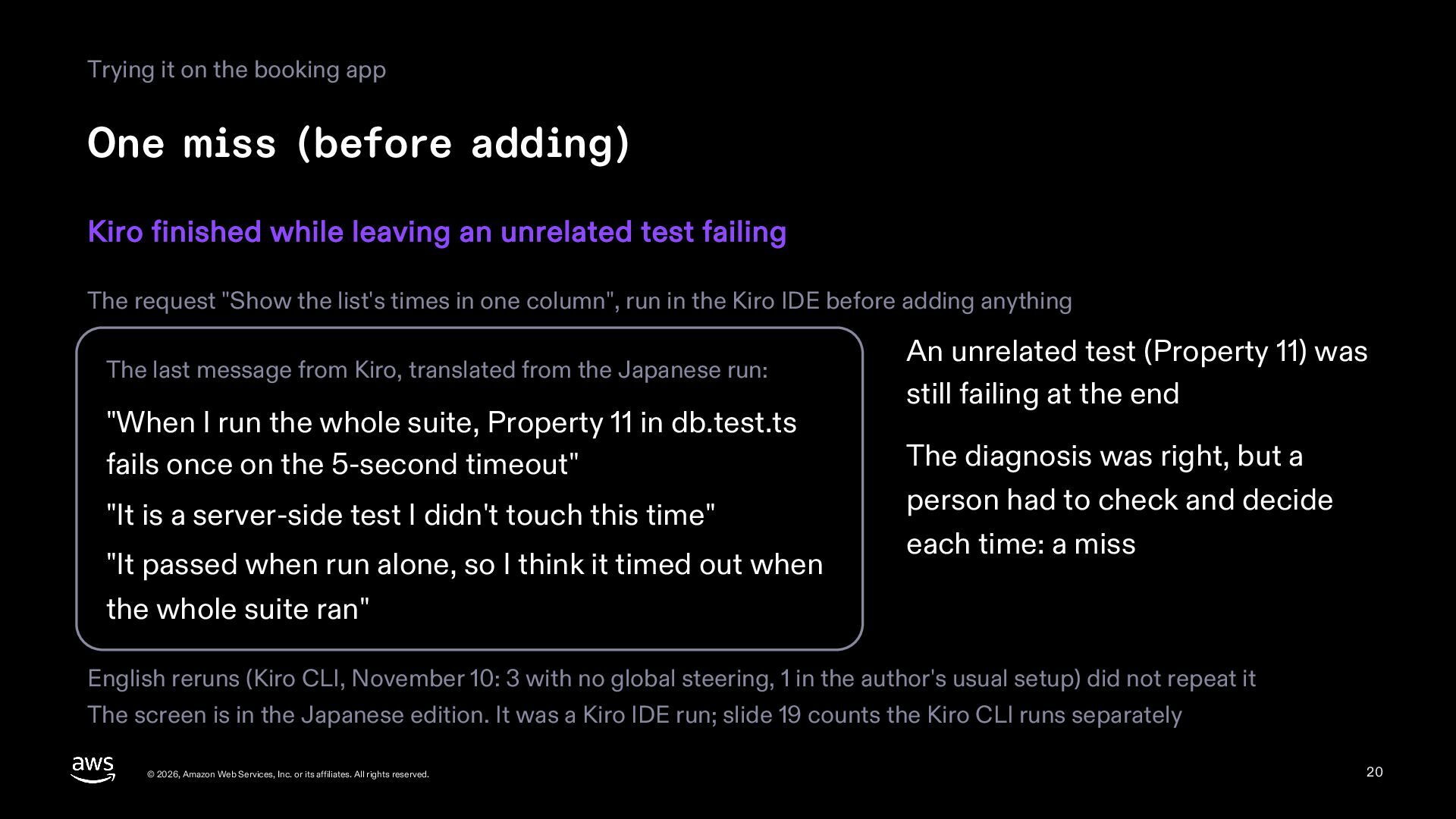
Trying it on the booking app One miss (before adding)
Kiro finished while leaving an unrelated test failing The request "Show the list's times in one column", run in the Kiro IDE before adding anything The last message from Kiro, translated from the Japanese run: "When I run the whole suite, Property 11 in db.test.ts fails once on the 5-second timeout" "It is a server-side test I didn't touch this time" "It passed when run alone, so I think it timed out when the whole suite ran" An unrelated test (Property 11) was still failing at the end The diagnosis was right, but a person had to check and decide each time: a miss English reruns (Kiro CLI, November 10: 3 with no global steering, 1 in the author's usual setup) did not repeat it The screen is in the Japanese edition. It was a Kiro IDE run; slide 19 counts the Kiro CLI runs separately © 2026, Amazon Web Services, Inc. or its affiliates. All rights reserved. 20 -
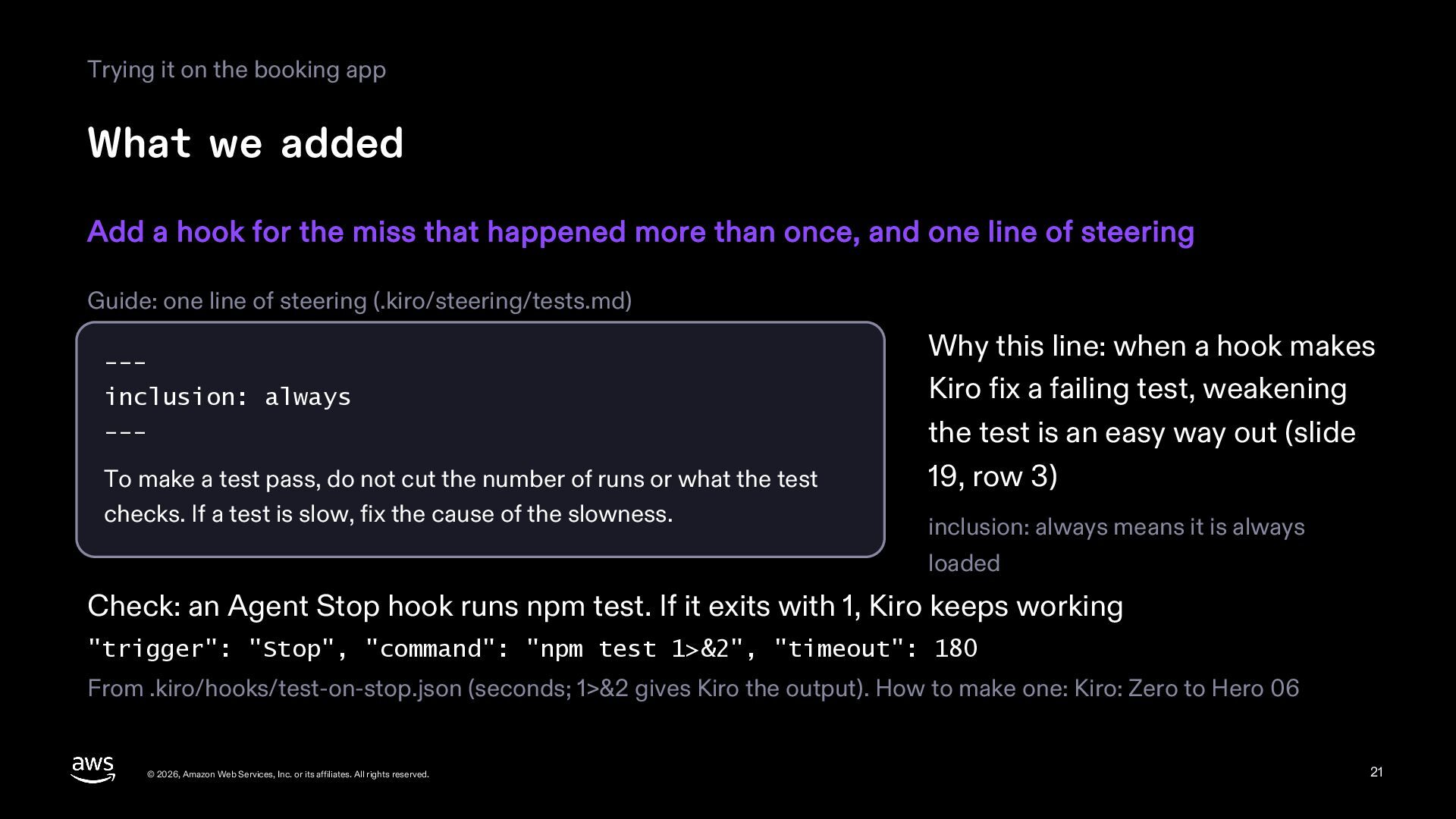
Trying it on the booking app What we added Add
a hook for the miss that happened more than once, and one line of steering Guide: one line of steering (.kiro/steering/tests.md) --inclusion: always --To make a test pass, do not cut the number of runs or what the test checks. If a test is slow, fix the cause of the slowness. Why this line: when a hook makes Kiro fix a failing test, weakening the test is an easy way out (slide 19, row 3) inclusion: always means it is always loaded Check: an Agent Stop hook runs npm test. If it exits with 1, Kiro keeps working "trigger": "Stop", "command": "npm test 1>&2", "timeout": 180 From .kiro/hooks/test-on-stop.json (seconds; 1>&2 gives Kiro the output). How to make one: Kiro: Zero to Hero 06 © 2026, Amazon Web Services, Inc. or its affiliates. All rights reserved. 21 -
Trying it on the booking app The same request again
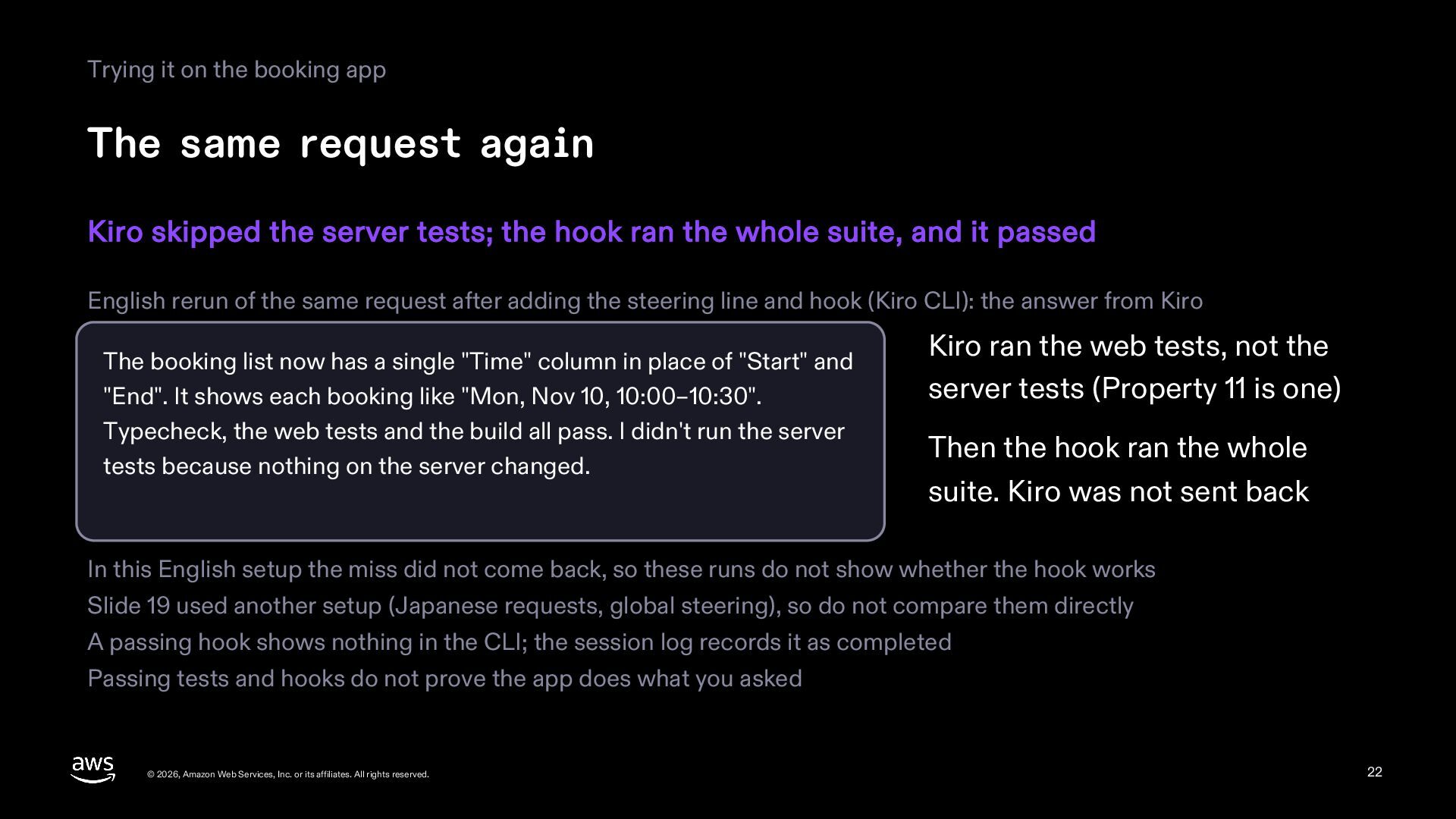
Kiro skipped the server tests; the hook ran the whole suite, and it passed English rerun of the same request after adding the steering line and hook (Kiro CLI): the answer from Kiro The booking list now has a single "Time" column in place of "Start" and "End". It shows each booking like "Mon, Nov 10, 10:00–10:30". Typecheck, the web tests and the build all pass. I didn't run the server tests because nothing on the server changed. Kiro ran the web tests, not the server tests (Property 11 is one) Then the hook ran the whole suite. Kiro was not sent back In this English setup the miss did not come back, so these runs do not show whether the hook works Slide 19 used another setup (Japanese requests, global steering), so do not compare them directly A passing hook shows nothing in the CLI; the session log records it as completed Passing tests and hooks do not prove the app does what you asked © 2026, Amazon Web Services, Inc. or its affiliates. All rights reserved. 22 -
Trying it on the booking app A request to fix
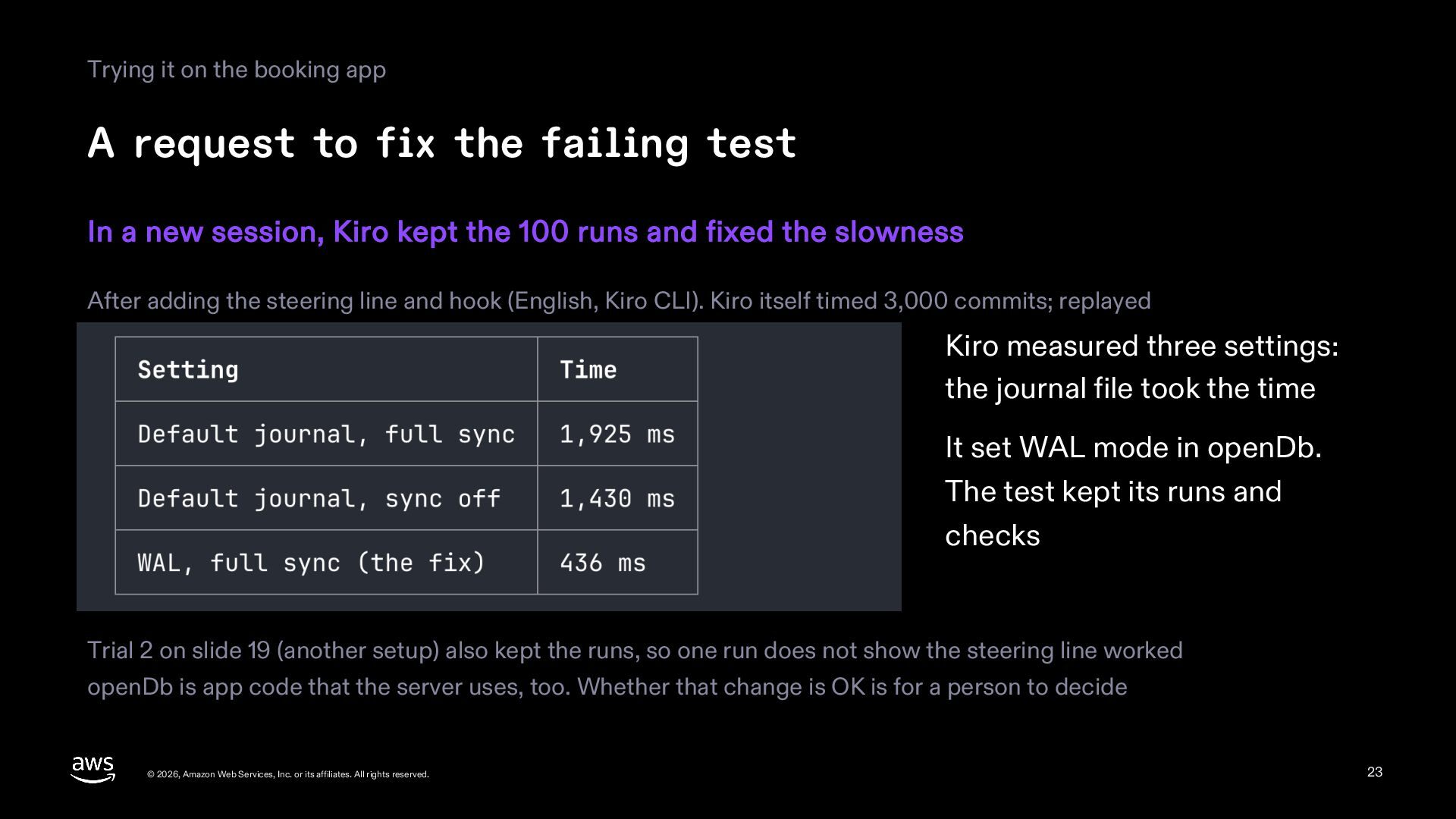
the failing test In a new session, Kiro kept the 100 runs and fixed the slowness After adding the steering line and hook (English, Kiro CLI). Kiro itself timed 3,000 commits; replayed Kiro measured three settings: the journal file took the time It set WAL mode in openDb. The test kept its runs and checks Trial 2 on slide 19 (another setup) also kept the runs, so one run does not show the steering line worked openDb is app code that the server uses, too. Whether that change is OK is for a person to decide © 2026, Amazon Web Services, Inc. or its affiliates. All rights reserved. 23 -
Part 4 How to proceed © 2026, Amazon Web Services,
Inc. or its affiliates. All rights reserved. 24 -
How to proceed Don't let the same miss repeat Log
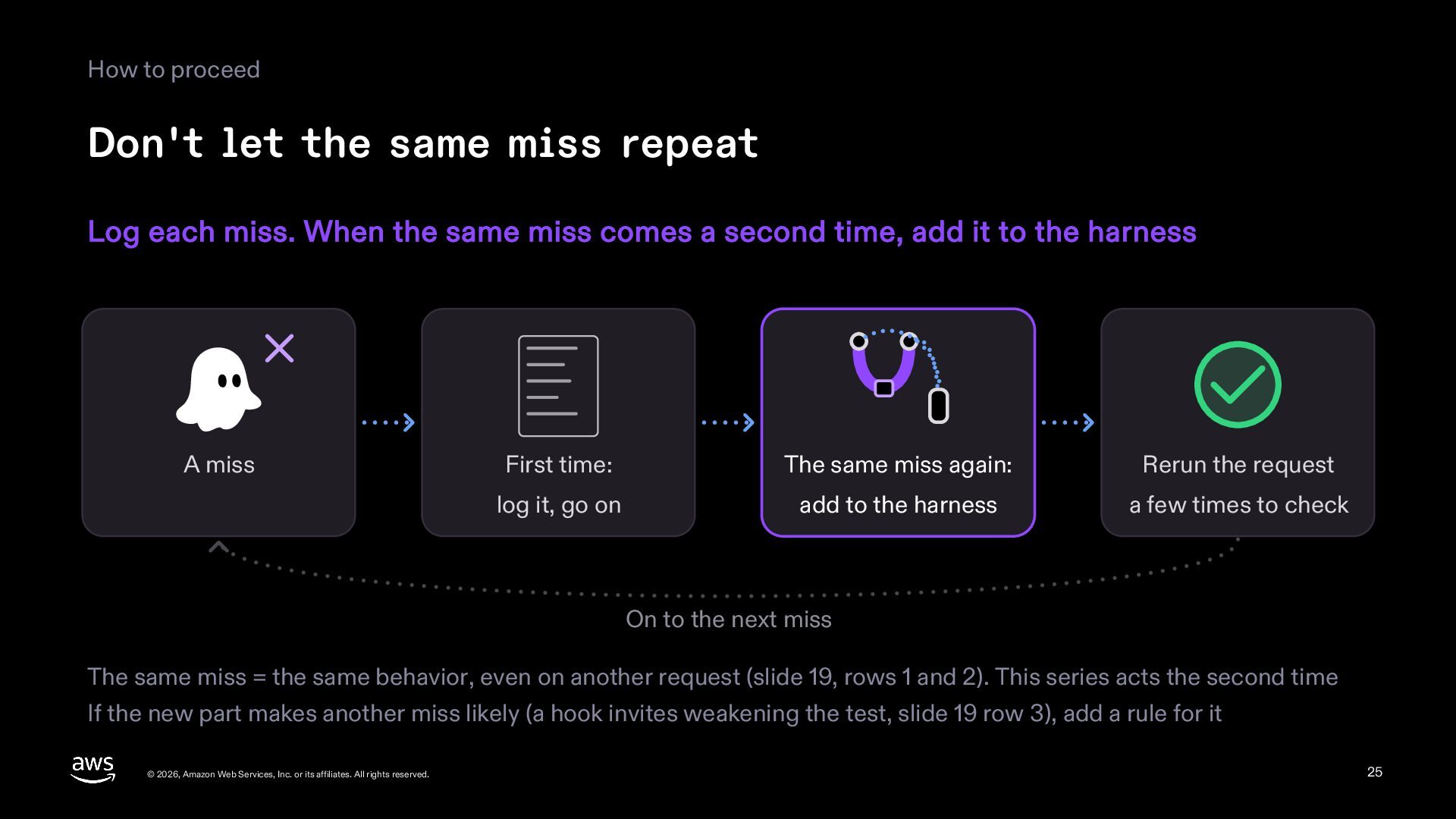
each miss. When the same miss comes a second time, add it to the harness A miss First time: The same miss again: Rerun the request log it, go on add to the harness a few times to check On to the next miss The same miss = the same behavior, even on another request (slide 19, rows 1 and 2). This series acts the second time If the new part makes another miss likely (a hook invites weakening the test, slide 19 row 3), add a rule for it © 2026, Amazon Web Services, Inc. or its affiliates. All rights reserved. 25 -
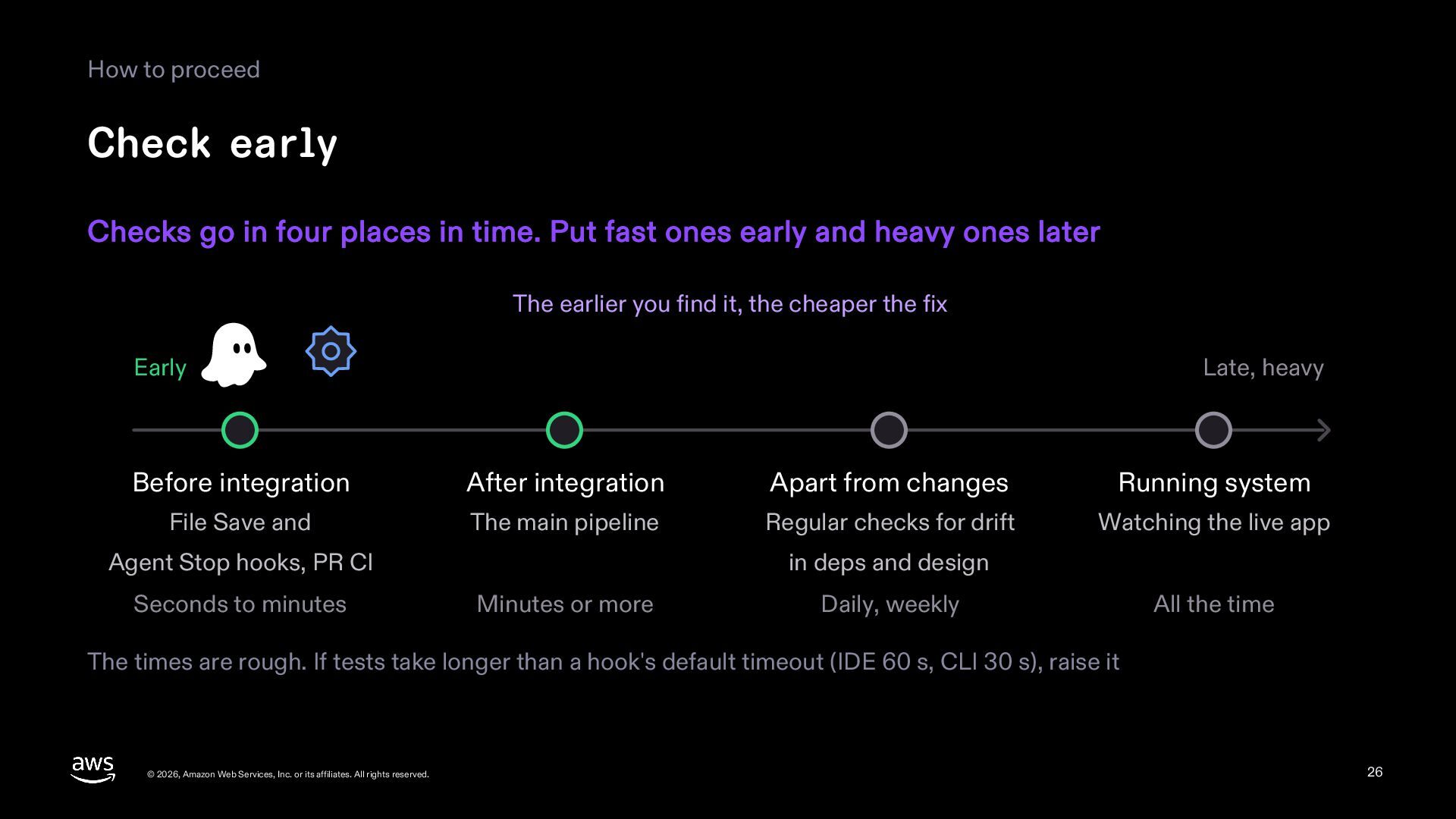
How to proceed Check early Checks go in four places
in time. Put fast ones early and heavy ones later The earlier you find it, the cheaper the fix Early Late, heavy Before integration After integration Apart from changes Running system File Save and The main pipeline Regular checks for drift Watching the live app Agent Stop hooks, PR CI Seconds to minutes in deps and design Minutes or more Daily, weekly All the time The times are rough. If tests take longer than a hook's default timeout (IDE 60 s, CLI 30 s), raise it © 2026, Amazon Web Services, Inc. or its affiliates. All rights reserved. 26 -
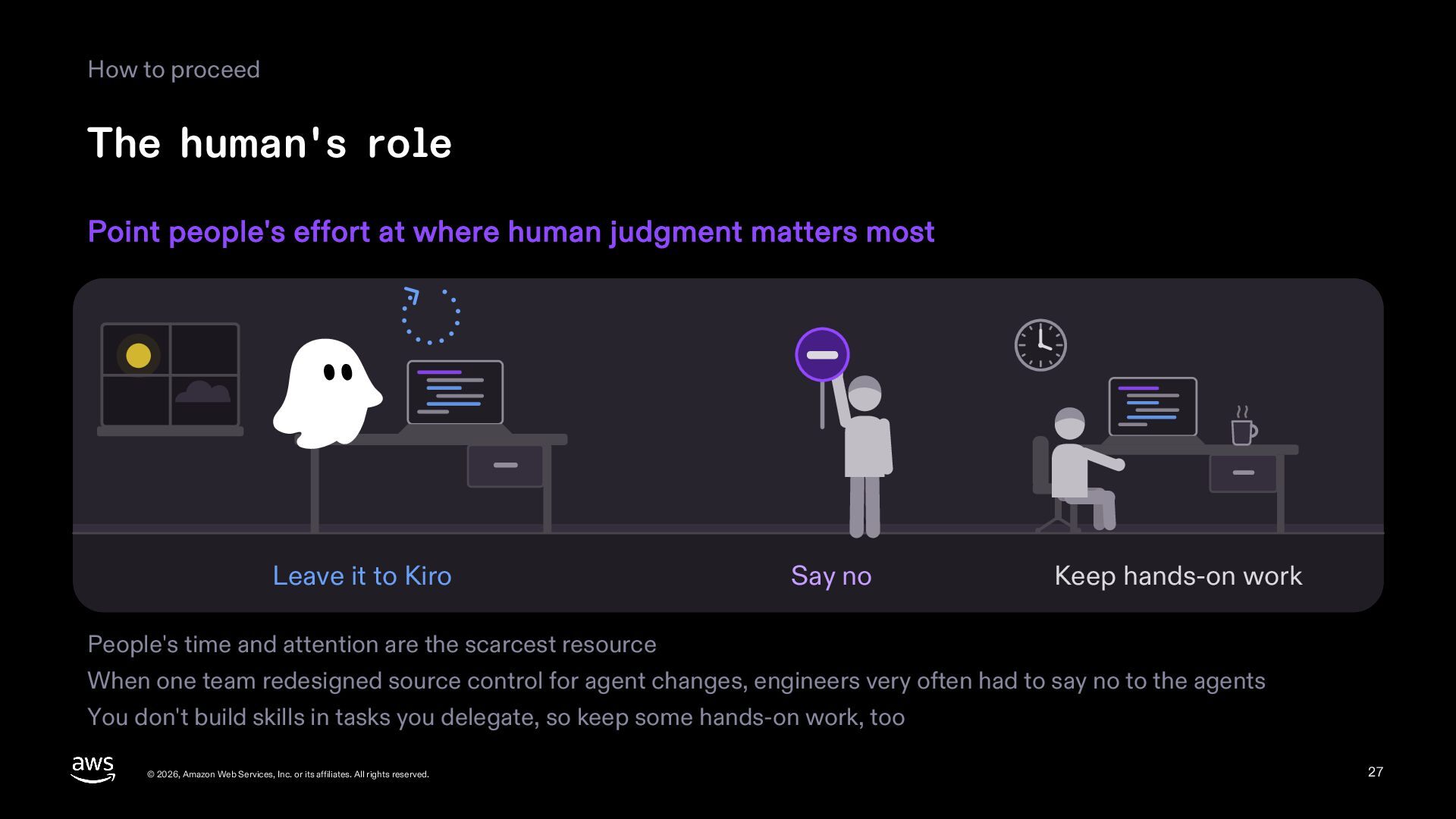
How to proceed The human's role Point people's effort at
where human judgment matters most Leave it to Kiro Say no Keep hands-on work People's time and attention are the scarcest resource When one team redesigned source control for agent changes, engineers very often had to say no to the agents You don't build skills in tasks you delegate, so keep some hands-on work, too © 2026, Amazon Web Services, Inc. or its affiliates. All rights reserved. 27 -
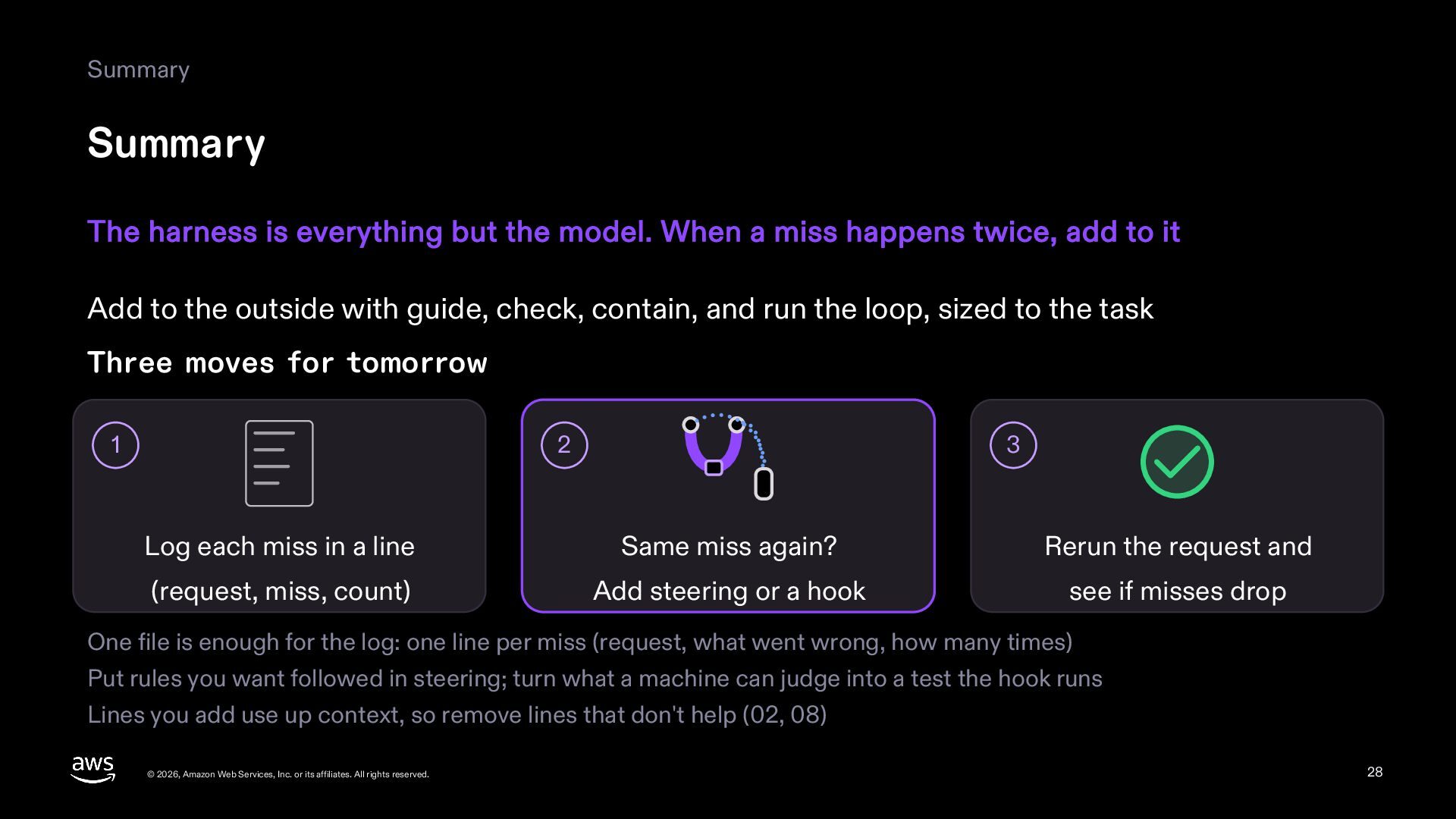
Summary Summary The harness is everything but the model. When
a miss happens twice, add to it Add to the outside with guide, check, contain, and run the loop, sized to the task Three moves for tomorrow 1 2 3 Log each miss in a line Same miss again? Rerun the request and (request, miss, count) Add steering or a hook see if misses drop One file is enough for the log: one line per miss (request, what went wrong, how many times) Put rules you want followed in steering; turn what a machine can judge into a test the hook runs Lines you add use up context, so remove lines that don't help (02, 08) © 2026, Amazon Web Services, Inc. or its affiliates. All rights reserved. 28 -
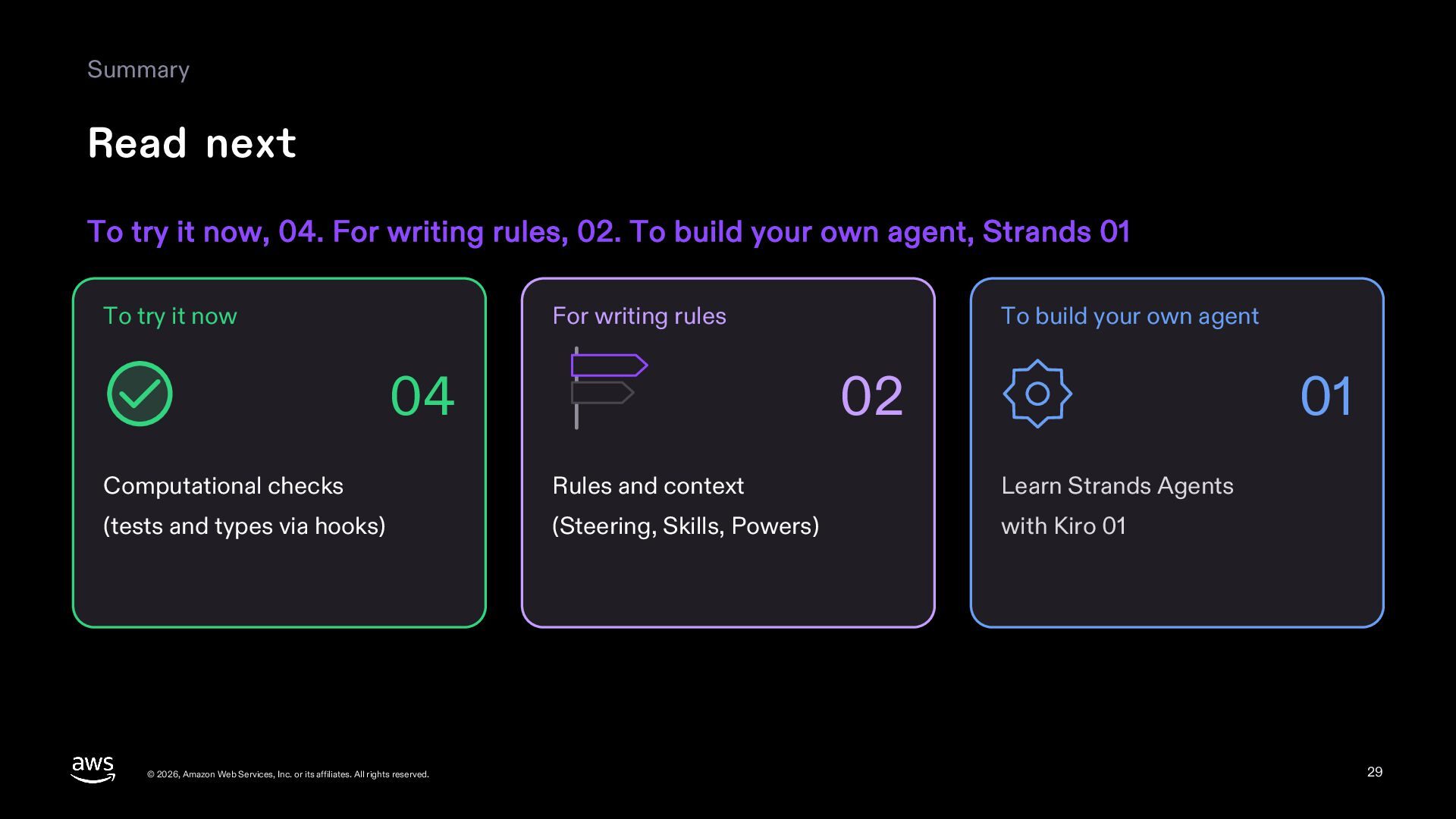
Summary Read next To try it now, 04. For writing
rules, 02. To build your own agent, Strands 01 To try it now For writing rules 04 To build your own agent 02 01 Computational checks Rules and context Learn Strands Agents (tests and types via hooks) (Steering, Skills, Powers) with Kiro 01 © 2026, Amazon Web Services, Inc. or its affiliates. All rights reserved. 29 -
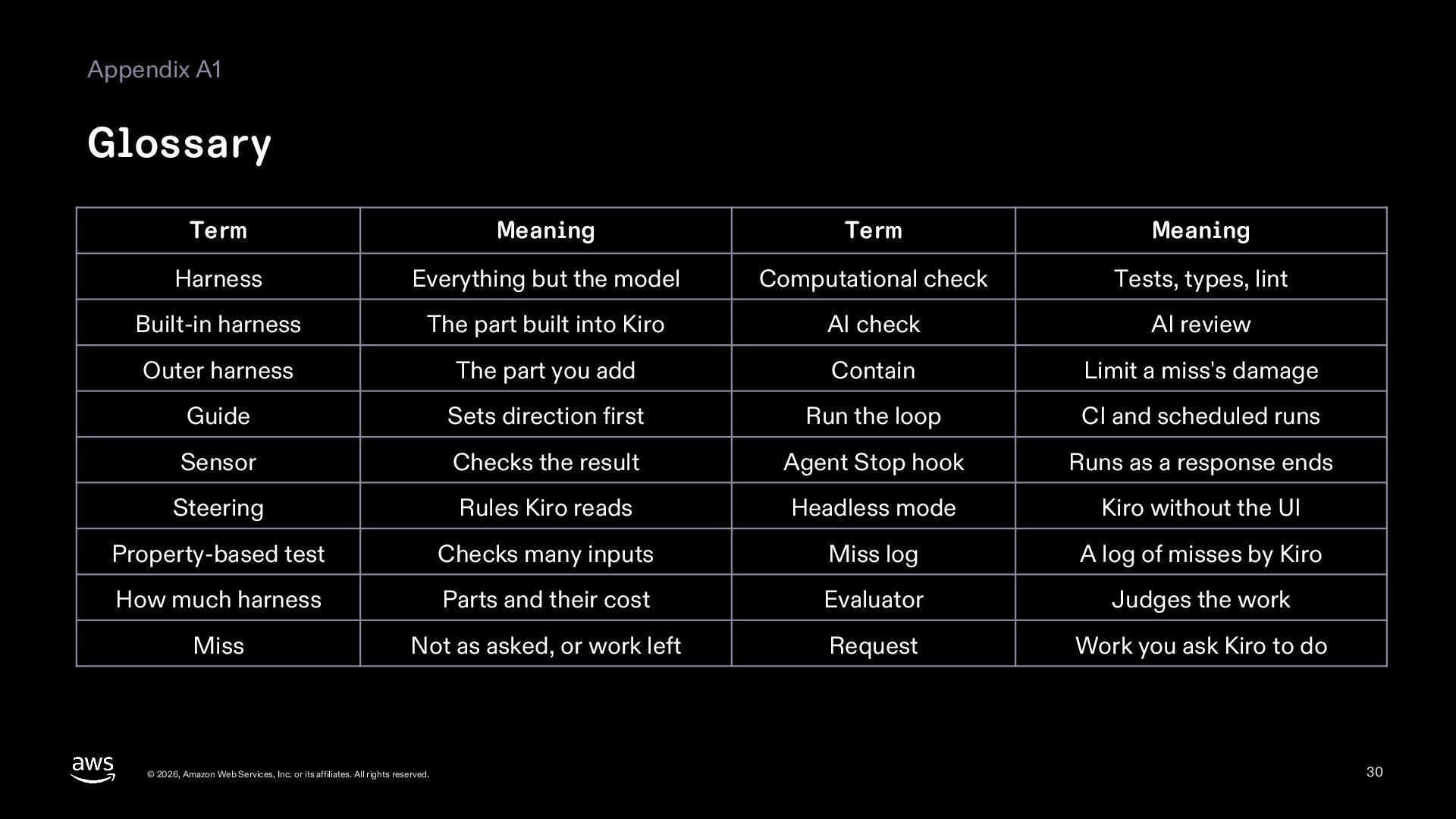
Appendix A1 Glossary Term Meaning Term Meaning Harness Everything but
the model Computational check Tests, types, lint Built-in harness The part built into Kiro AI check AI review Outer harness The part you add Contain Limit a miss's damage Guide Sets direction first Run the loop CI and scheduled runs Sensor Checks the result Agent Stop hook Runs as a response ends Steering Rules Kiro reads Headless mode Kiro without the UI Property-based test Checks many inputs Miss log A log of misses by Kiro How much harness Parts and their cost Evaluator Judges the work Miss Not as asked, or work left Request Work you ask Kiro to do © 2026, Amazon Web Services, Inc. or its affiliates. All rights reserved. 30 -
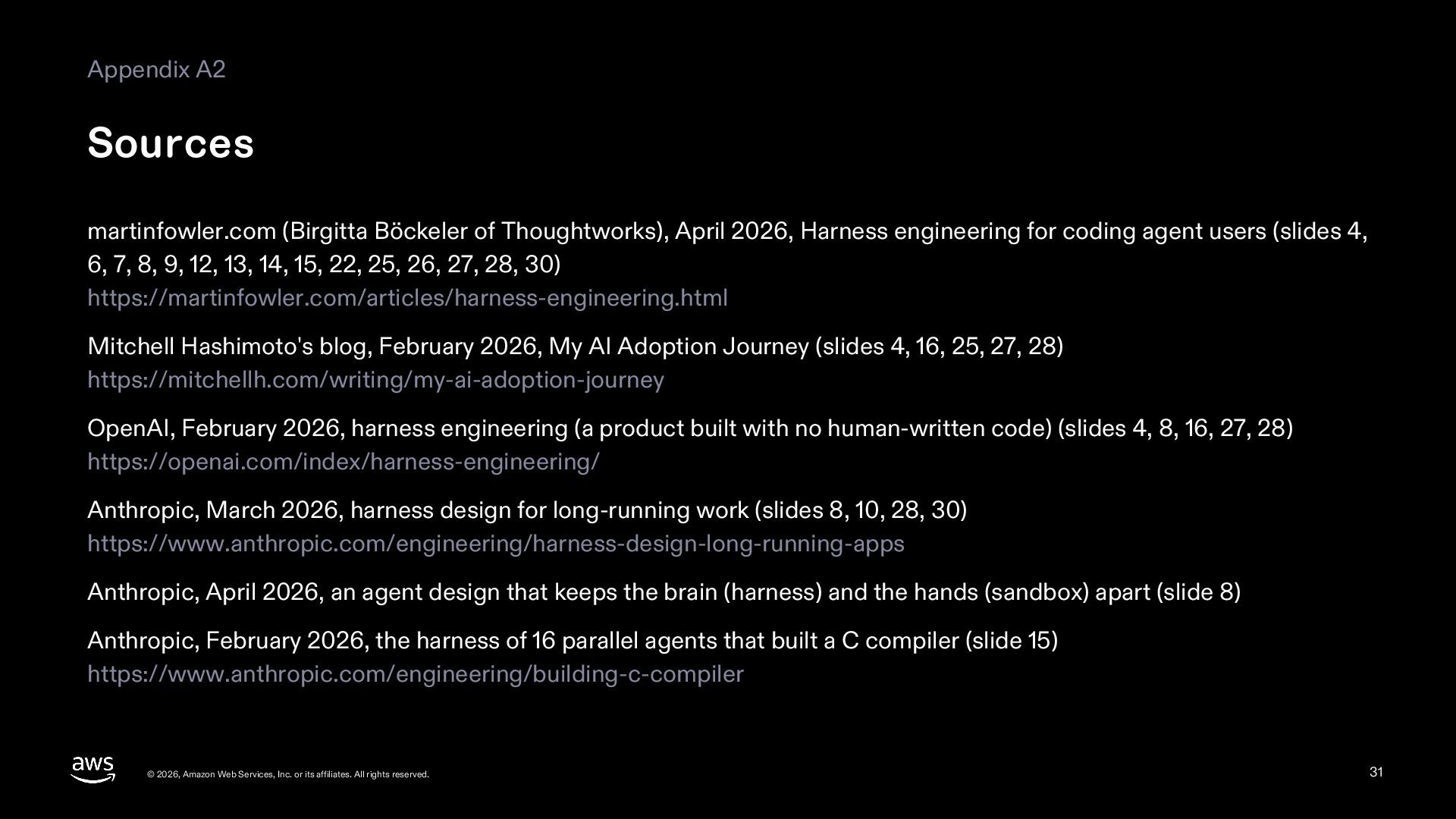
Appendix A2 Sources martinfowler.com (Birgitta Böckeler of Thoughtworks), April 2026,
Harness engineering for coding agent users (slides 4, 6, 7, 8, 9, 12, 13, 14, 15, 22, 25, 26, 27, 28, 30) https://martinfowler.com/articles/harness-engineering.html Mitchell Hashimoto's blog, February 2026, My AI Adoption Journey (slides 4, 16, 25, 27, 28) https://mitchellh.com/writing/my-ai-adoption-journey OpenAI, February 2026, harness engineering (a product built with no human-written code) (slides 4, 8, 16, 27, 28) https://openai.com/index/harness-engineering/ Anthropic, March 2026, harness design for long-running work (slides 8, 10, 28, 30) https://www.anthropic.com/engineering/harness-design-long-running-apps Anthropic, April 2026, an agent design that keeps the brain (harness) and the hands (sandbox) apart (slide 8) Anthropic, February 2026, the harness of 16 parallel agents that built a C compiler (slide 15) https://www.anthropic.com/engineering/building-c-compiler © 2026, Amazon Web Services, Inc. or its affiliates. All rights reserved. 31 -
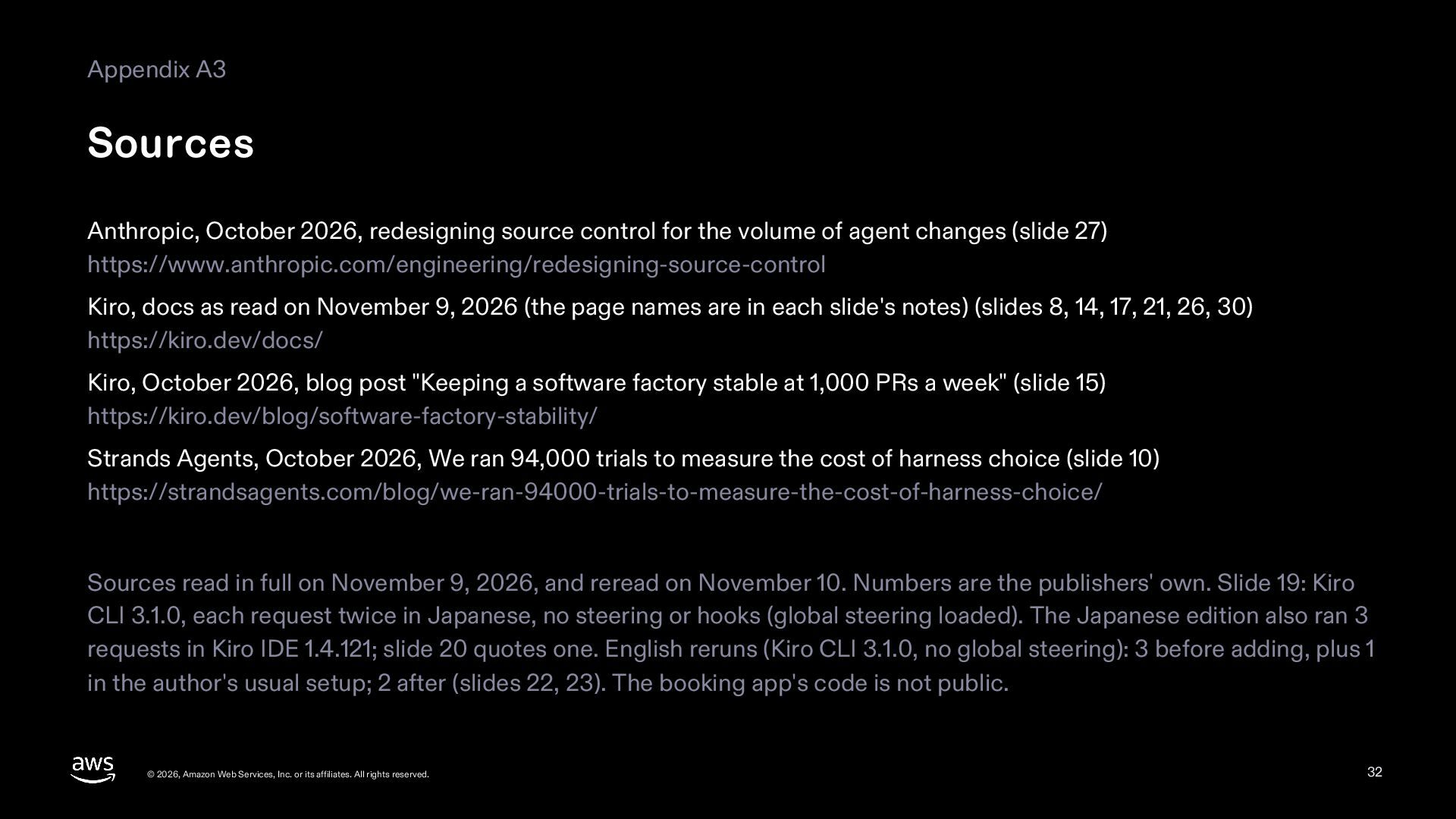
Appendix A3 Sources Anthropic, October 2026, redesigning source control for
the volume of agent changes (slide 27) https://www.anthropic.com/engineering/redesigning-source-control Kiro, docs as read on November 9, 2026 (the page names are in each slide's notes) (slides 8, 14, 17, 21, 26, 30) https://kiro.dev/docs/ Kiro, October 2026, blog post "Keeping a software factory stable at 1,000 PRs a week" (slide 15) https://kiro.dev/blog/software-factory-stability/ Strands Agents, October 2026, We ran 94,000 trials to measure the cost of harness choice (slide 10) https://strandsagents.com/blog/we-ran-94000-trials-to-measure-the-cost-of-harness-choice/ Sources read in full on November 9, 2026, and reread on November 10. Numbers are the publishers' own. Slide 19: Kiro CLI 3.1.0, each request twice in Japanese, no steering or hooks (global steering loaded). The Japanese edition also ran 3 requests in Kiro IDE 1.4.121; slide 20 quotes one. English reruns (Kiro CLI 3.1.0, no global steering): 3 before adding, plus 1 in the author's usual setup; 2 after (slides 22, 23). The booking app's code is not public. © 2026, Amazon Web Services, Inc. or its affiliates. All rights reserved. 32
 inariku
 sansan33
 yoshimura_datam
 bitkey
 nakker1218
 tetsuyaoi
 azukiazusa1
 mineo_matsuya
 sergicalsix
 tascript
 yamakenji24
 qatonchan
 michielstock
 varn
 tapps
 aleyda
 addyosmani
 tammyeverts
 inesmontani
 baasie
 helmedeiros
 keathley
 cassininazir
 smashingmag