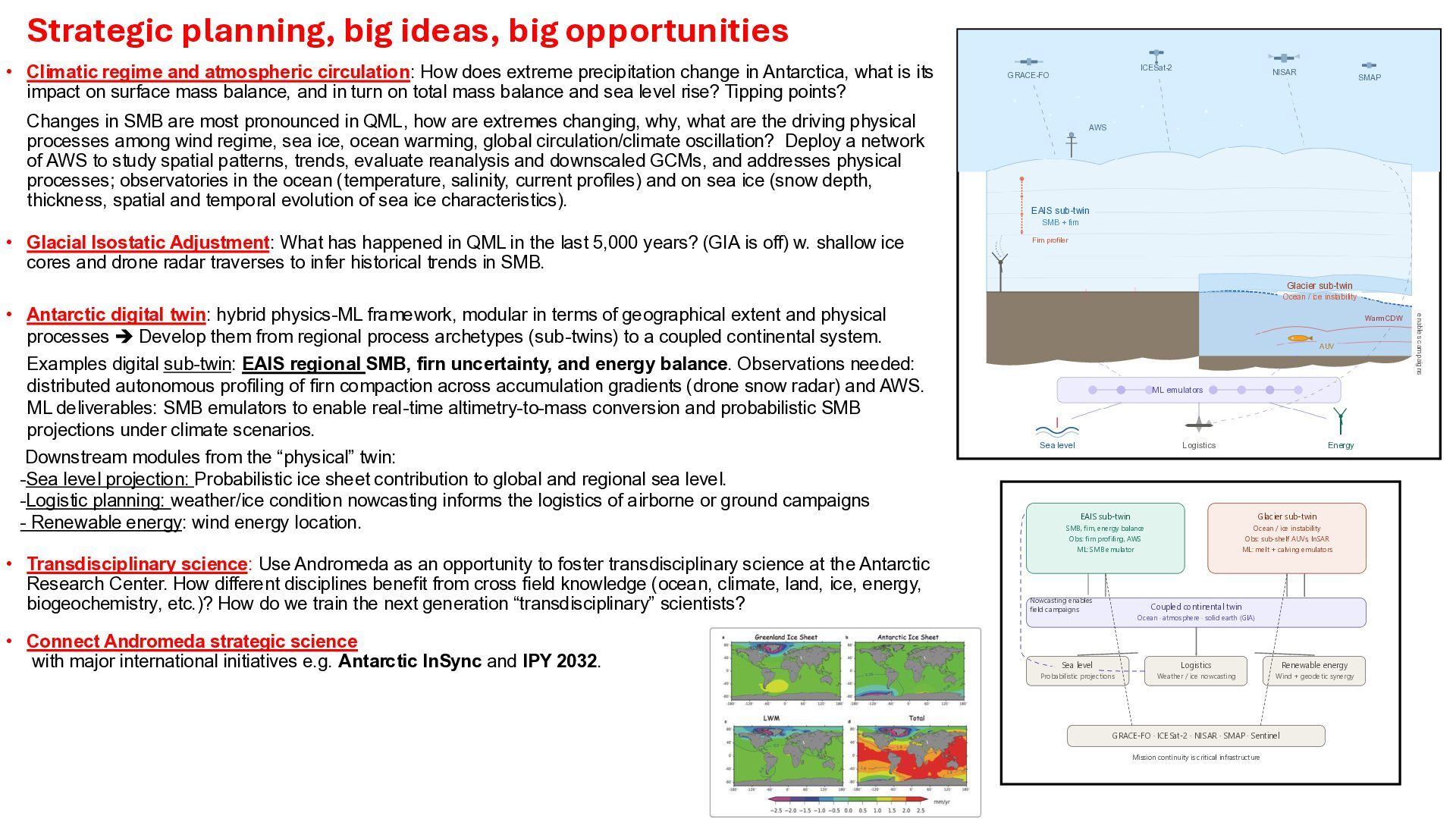
change in Antarctica, what is its impact on surface mass balance, and in turn on total mass balance and sea level rise? Tipping points? Changes in SMB are most pronounced in QML, how are extremes changing, why, what are the driving physical processes among wind regime, sea ice, ocean warming, global circulation/climate oscillation? Deploy a network of AWS to study spatial patterns, trends, evaluate reanalysis and downscaled GCMs, and addresses physical processes; observatories in the ocean (temperature, salinity, current profiles) and on sea ice (snow depth, thickness, spatial and temporal evolution of sea ice characteristics). • Glacial Isostatic Adjustment: What has happened in QML in the last 5,000 years? (GIA is off) w. shallow ice cores and drone radar traverses to infer historical trends in SMB. • Antarctic digital twin: hybrid physics-ML framework, modular in terms of geographical extent and physical processes ➔ Develop them from regional process archetypes (sub-twins) to a coupled continental system. Examples digital sub-twin: EAIS regional SMB, firn uncertainty, and energy balance. Observations needed: distributed autonomous profiling of firn compaction across accumulation gradients (drone snow radar) and AWS. ML deliverables: SMB emulators to enable real-time altimetry-to-mass conversion and probabilistic SMB projections under climate scenarios. Downstream modules from the “physical” twin: -Sea level projection: Probabilistic ice sheet contribution to global and regional sea level. -Logistic planning: weather/ice condition nowcasting informs the logistics of airborne or ground campaigns - Renewable energy: wind energy location. • Transdisciplinary science: Use Andromeda as an opportunity to foster transdisciplinary science at the Antarctic Research Center. How different disciplines benefit from cross field knowledge (ocean, climate, land, ice, energy, biogeochemistry, etc.)? How do we train the next generation “transdisciplinary” scientists? • Connect Andromeda strategic science with major international initiatives e.g. Antarctic InSync and IPY 2032. at sub twin firn irn profiler arm D lacier sub twin cean ice instability emulators ea le el ogistics nergy enables campaigns Strategic planning, big ideas, big opportunities

 Your Podcast. Everywhere. Effortlessly.


 ipfevents
 i2tsuki
 mutsumix
 trycycle
 shucho0103
 saltcooky12
.jpg) ktatsuya
ktatsuya
 tagtag
 analokmaus
 tanoku
 inesmontani
 ipullrank
 mkilby
 hatefulcrawdad
 ryanjones
 hannesfritz
 michaelherold
 varn
varn
 techseoconnect
 lauravandoore
 afnizarnur