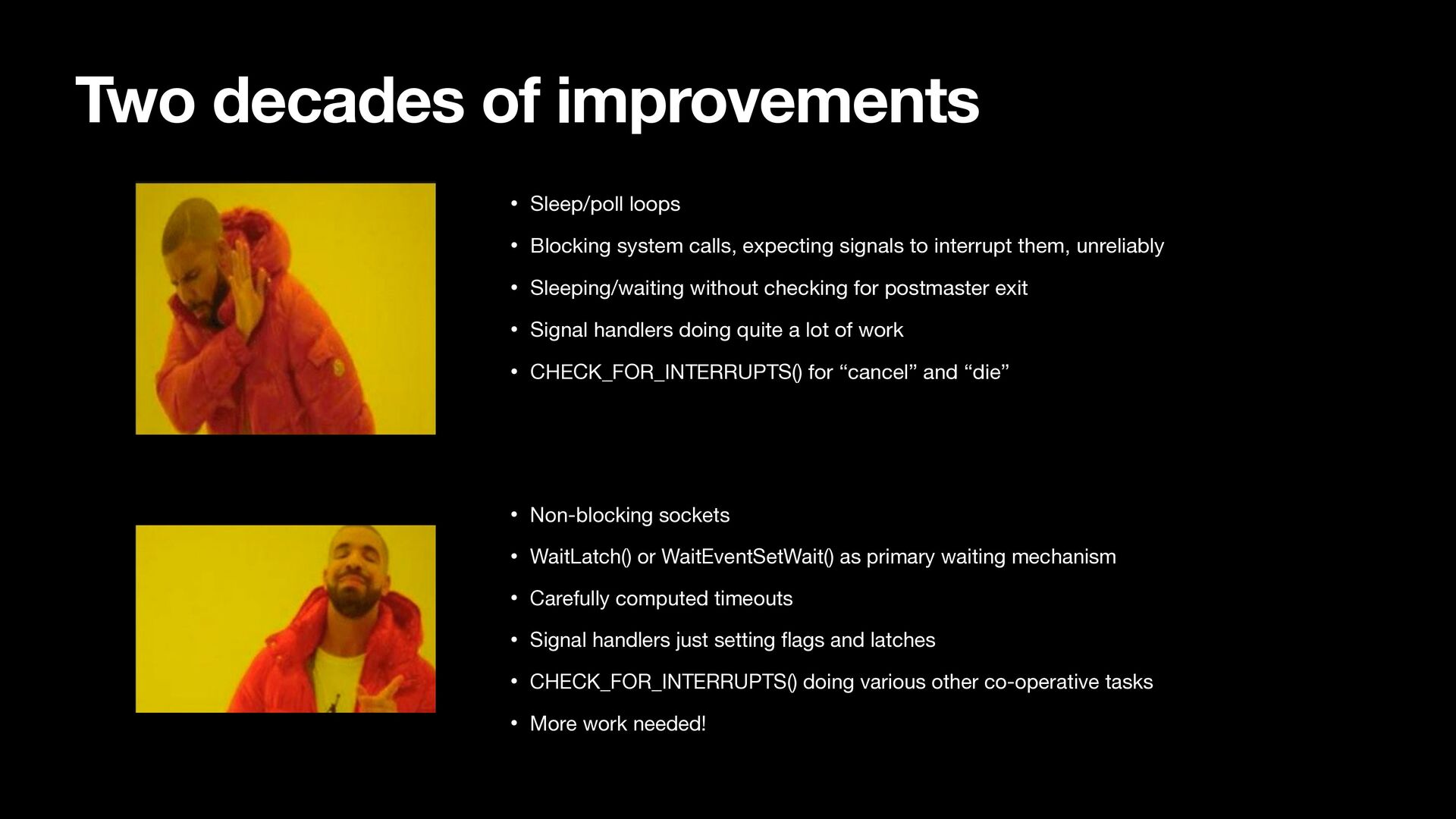
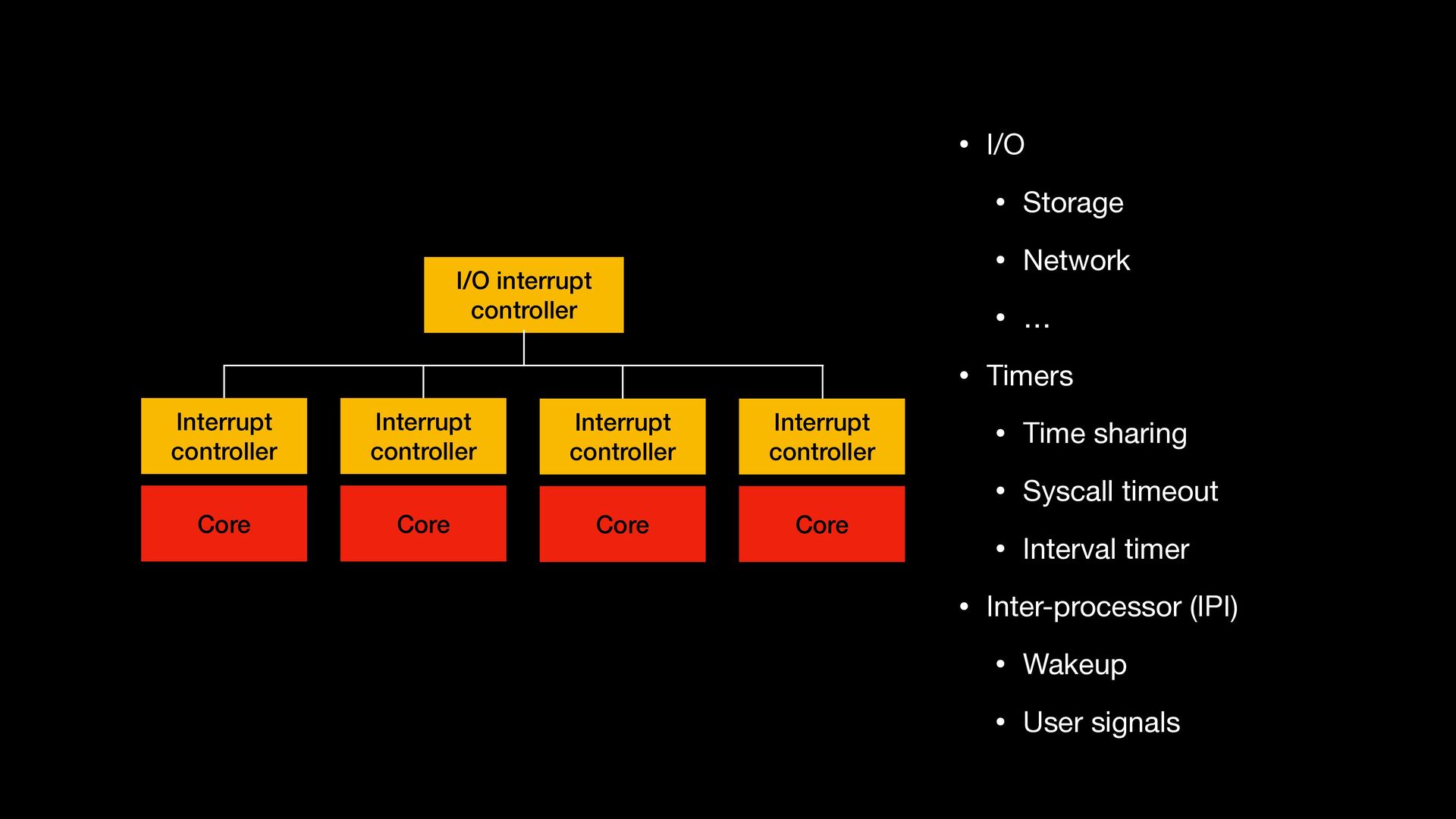
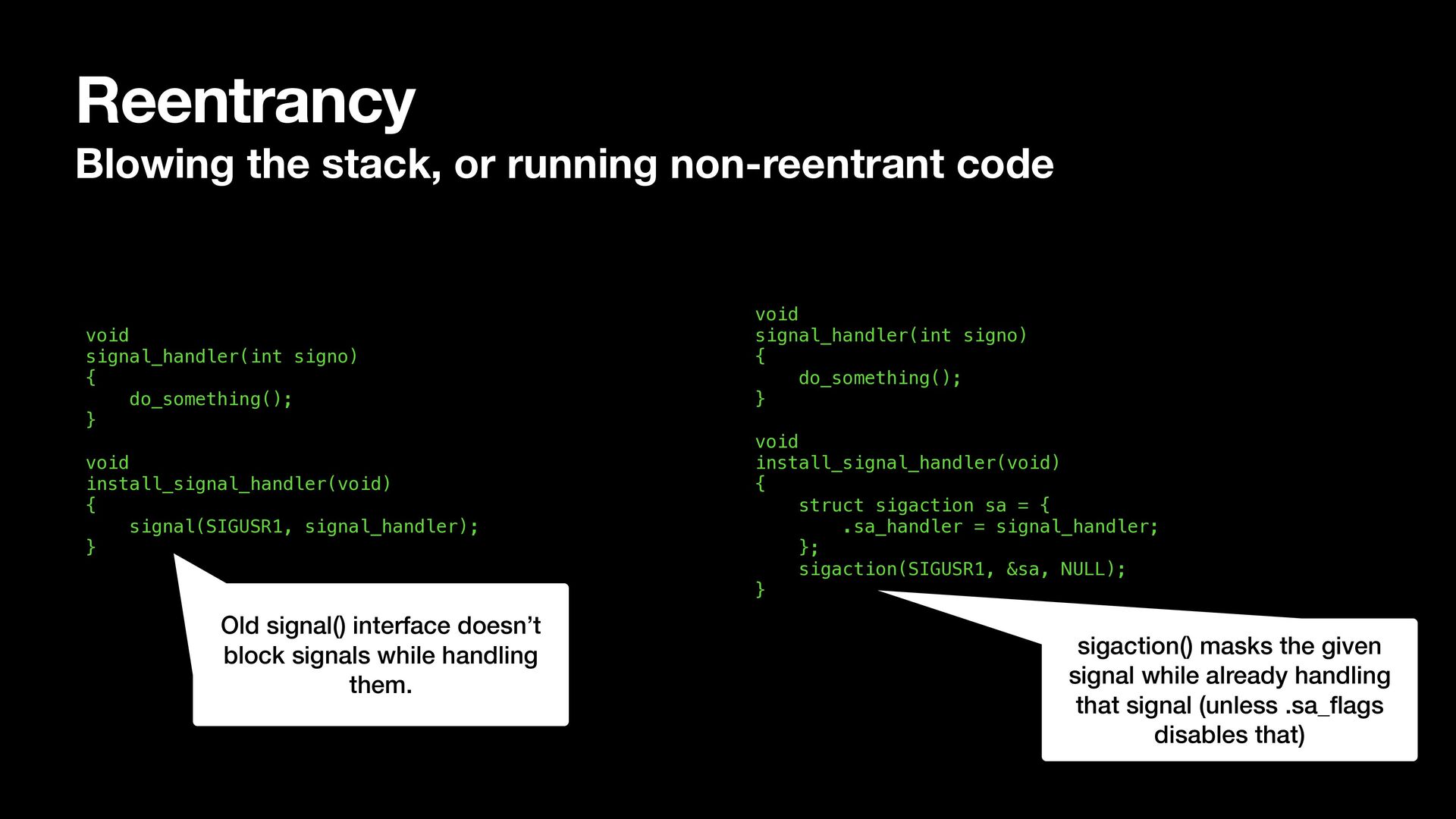
interrupt them, unreliably • Sleeping/waiting without checking for postmaster exit • Signal handlers doing quite a lot of work • CHECK_FOR_INTERRUPTS() for “cancel” and “die” • Non-blocking sockets • WaitLatch() or WaitEventSetWait() as primary waiting mechanism • Carefully computed timeouts • Signal handlers just setting fl ags and latches • CHECK_FOR_INTERRUPTS() doing various other co-operative tasks • More work needed! Two decades of improvements
forks children inside a signal handler; this was questionable (and incidentally broke on two obscure OSes) • [Pending] Recovery con fl icts should not be handled in the SIGUSR1 handler! • Walreceiver no longer wakes up 10 times per second to check for work to do • Startup process no longer wakes up every 5 seconds to check for promote_trigger_ fi le • CHECK_FOR_INTERRUPTS() added to various slow code paths
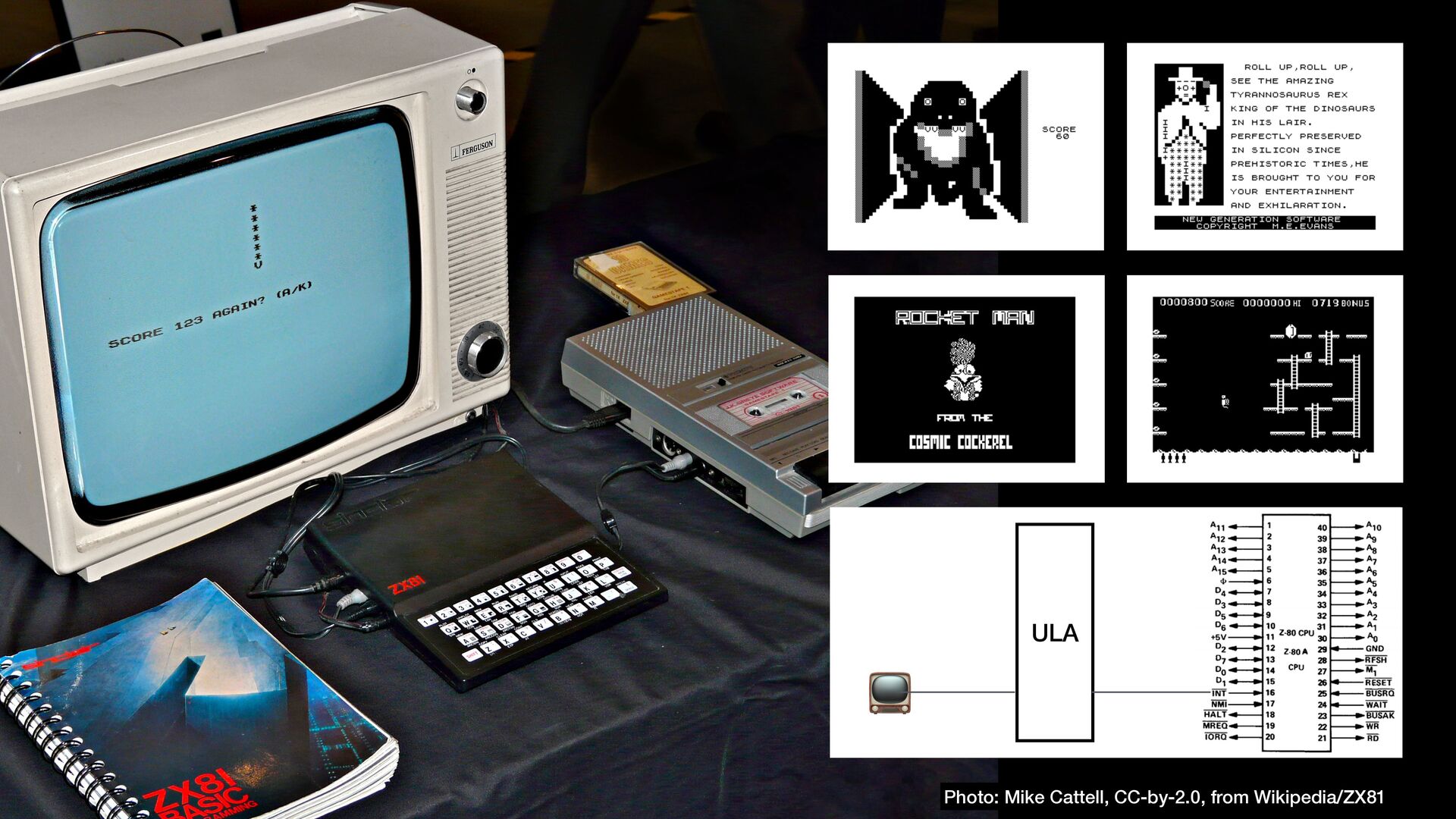
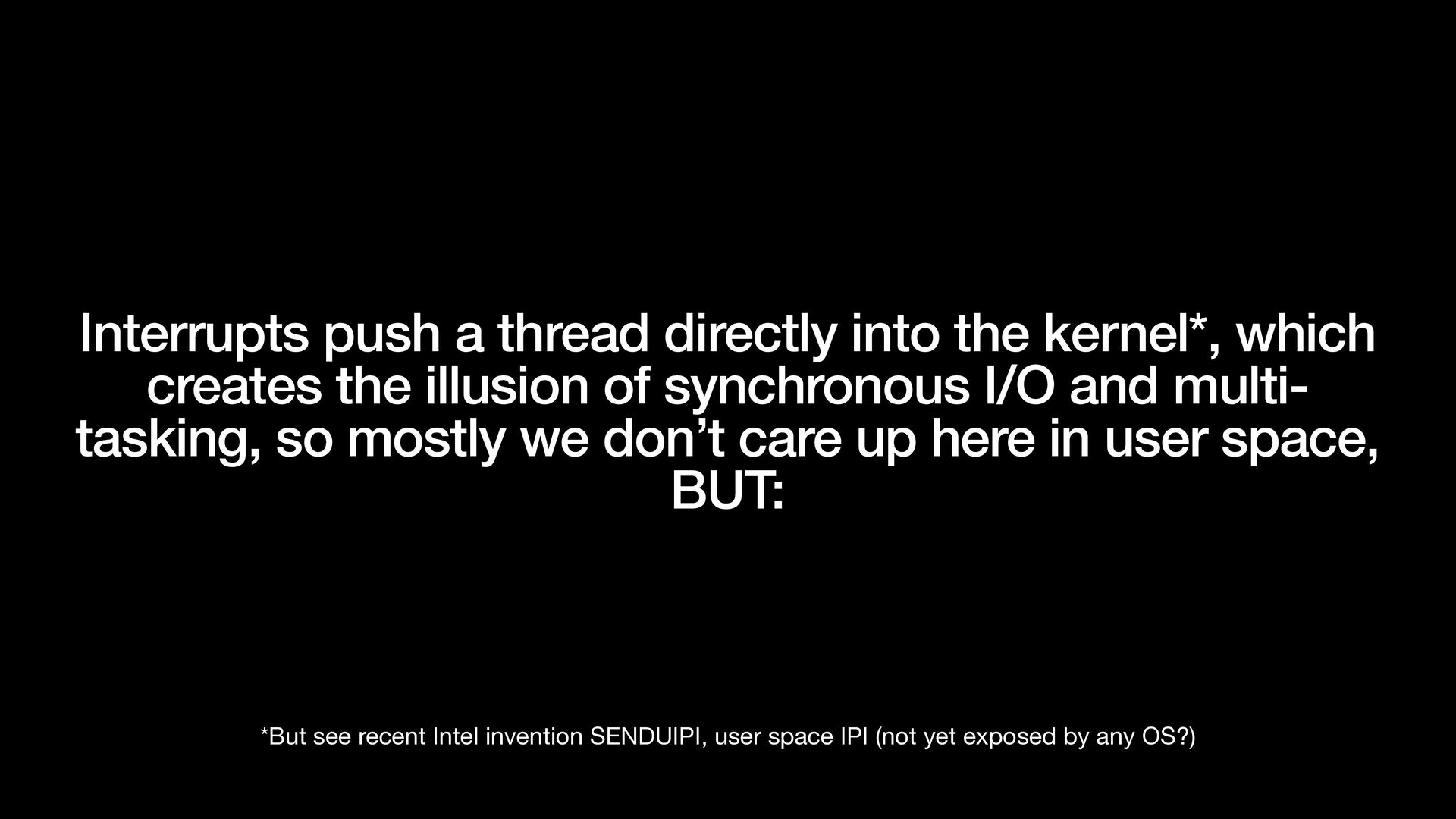
the illusion of synchronous I/O and multi- tasking, so mostly we don’t care up here in user space, BUT: *But see recent Intel invention SENDUIPI, user space IPI (not yet exposed by any OS?)
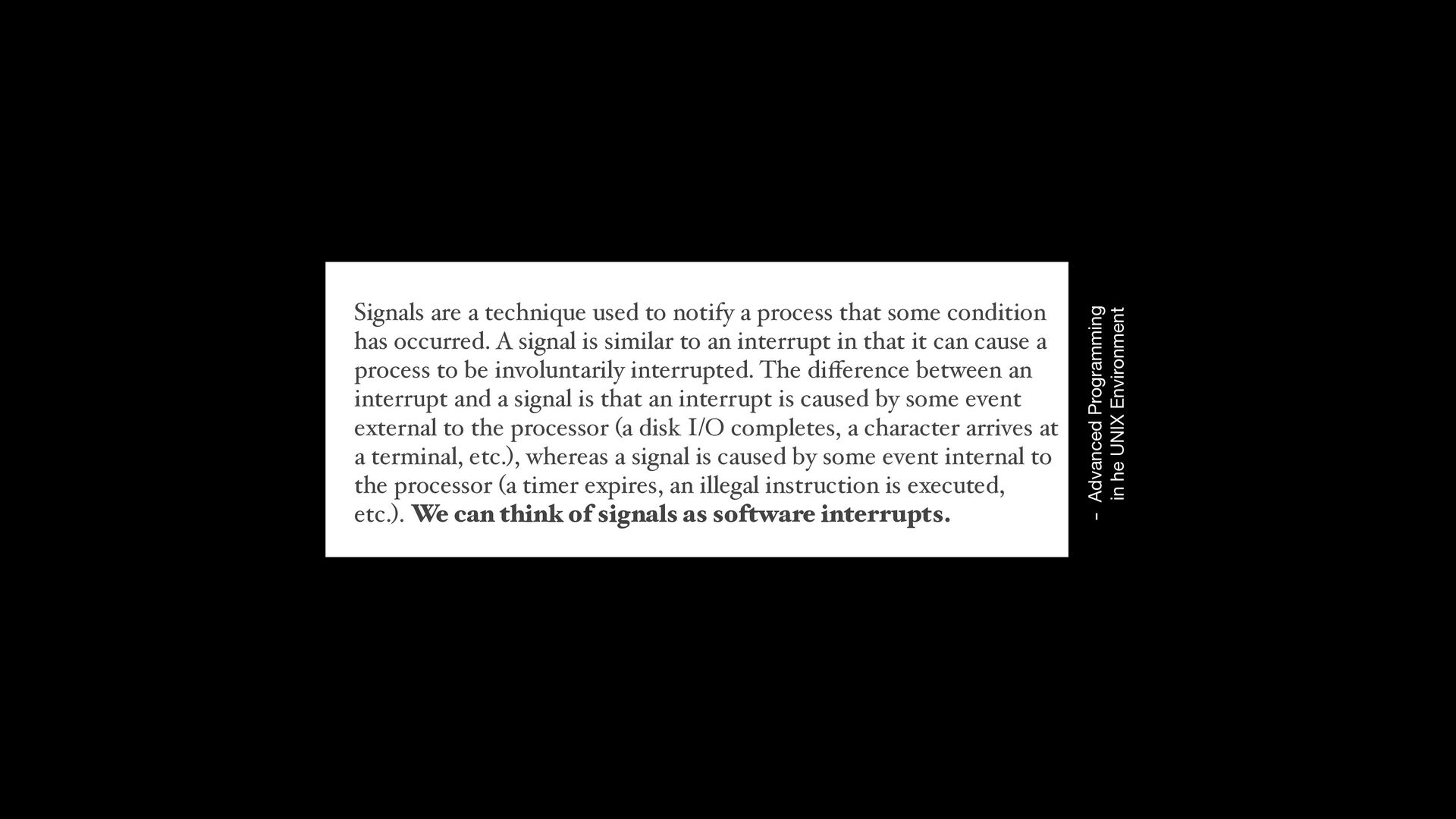
some condition has occurred. A signal is similar to an interrupt in that it can cause a process to be involuntarily interrupted. The di ff erence between an interrupt and a signal is that an interrupt is caused by some event external to the processor (a disk I/O completes, a character arrives at a terminal, etc.), whereas a signal is caused by some event internal to the processor (a timer expires, an illegal instruction is executed, etc.). We can think of signals as software interrupts. - Advanced Programming in he UNIX Environment
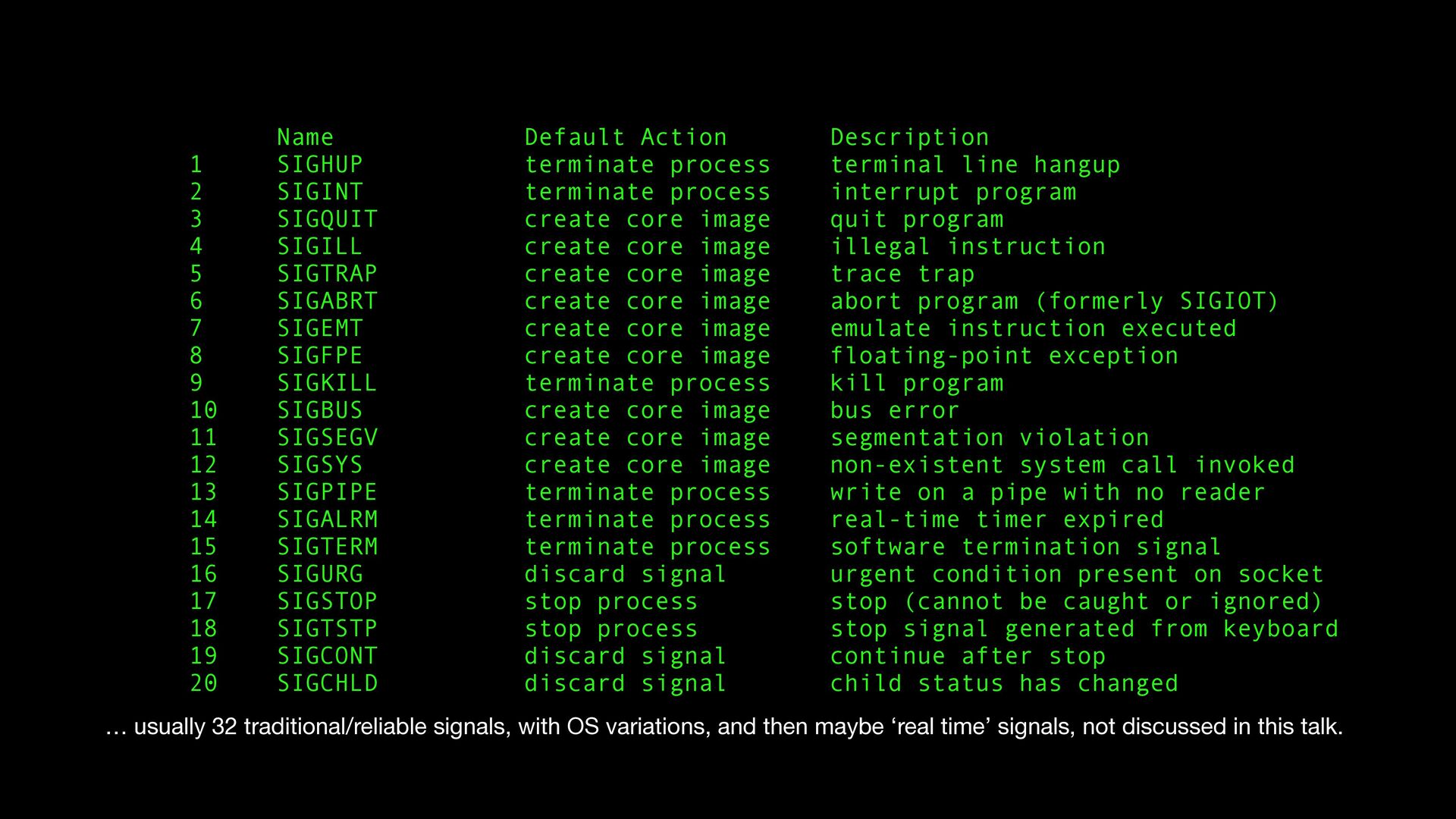
hangup 2 SIGINT terminate process interrupt program 3 SIGQUIT create core image quit program 4 SIGILL create core image illegal instruction 5 SIGTRAP create core image trace trap 6 SIGABRT create core image abort program (formerly SIGIOT) 7 SIGEMT create core image emulate instruction executed 8 SIGFPE create core image floating-point exception 9 SIGKILL terminate process kill program 10 SIGBUS create core image bus error 11 SIGSEGV create core image segmentation violation 12 SIGSYS create core image non-existent system call invoked 13 SIGPIPE terminate process write on a pipe with no reader 14 SIGALRM terminate process real-time timer expired 15 SIGTERM terminate process software termination signal 16 SIGURG discard signal urgent condition present on socket 17 SIGSTOP stop process stop (cannot be caught or ignored) 18 SIGTSTP stop process stop signal generated from keyboard 19 SIGCONT discard signal continue after stop 20 SIGCHLD discard signal child status has changed … usually 32 traditional/reliable signals, with OS variations, and then maybe ‘real time’ signals, not discussed in this talk.
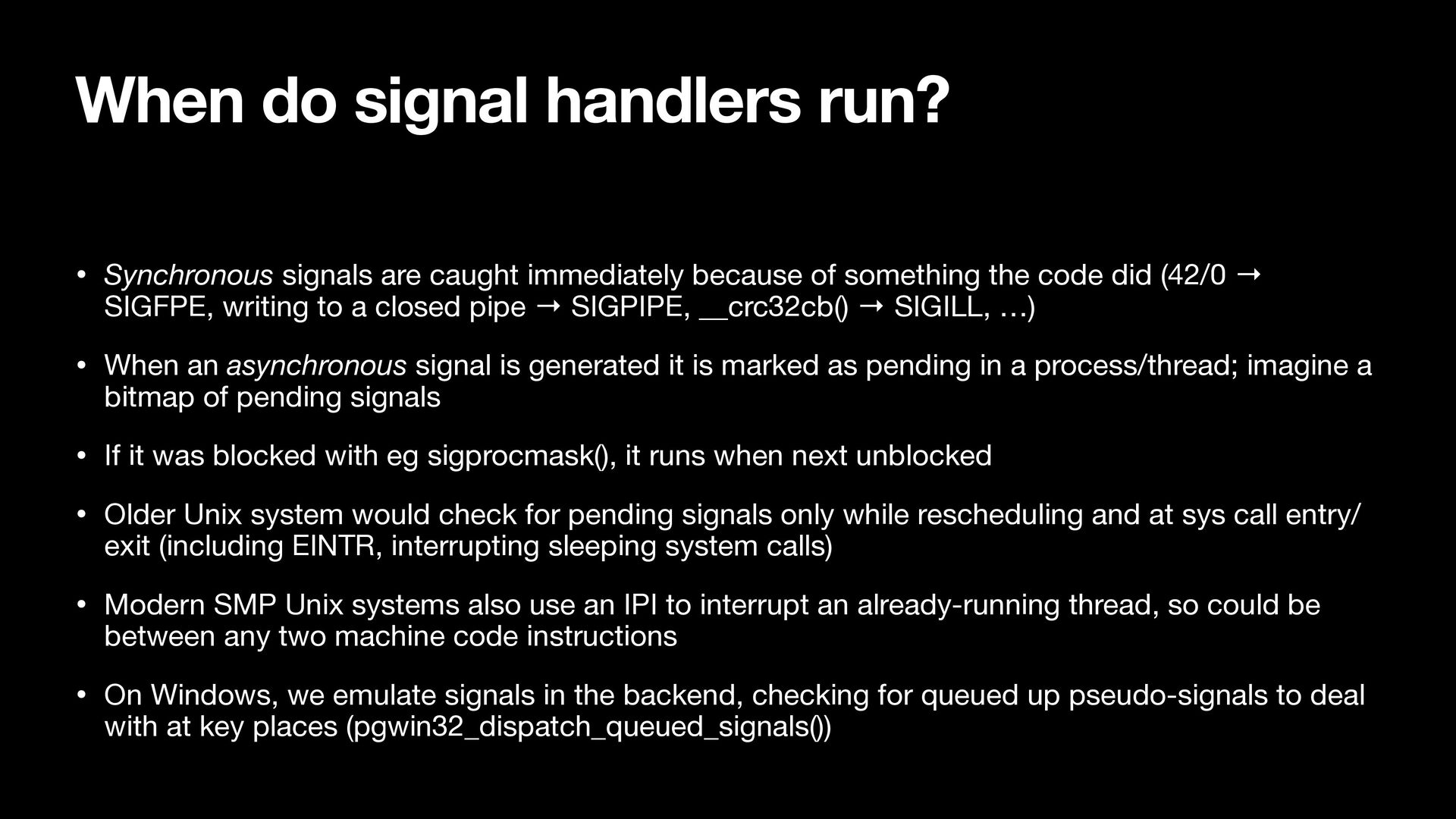
immediately because of something the code did (42/0 → SIGFPE, writing to a closed pipe → SIGPIPE, __crc32cb() → SIGILL, …) • When an asynchronous signal is generated it is marked as pending in a process/thread; imagine a bitmap of pending signals • If it was blocked with eg sigprocmask(), it runs when next unblocked • Older Unix system would check for pending signals only while rescheduling and at sys call entry/ exit (including EINTR, interrupting sleeping system calls) • Modern SMP Unix systems also use an IPI to interrupt an already-running thread, so could be between any two machine code instructions • On Windows, we emulate signals in the backend, checking for queued up pseudo-signals to deal with at key places (pgwin32_dispatch_queued_signals())
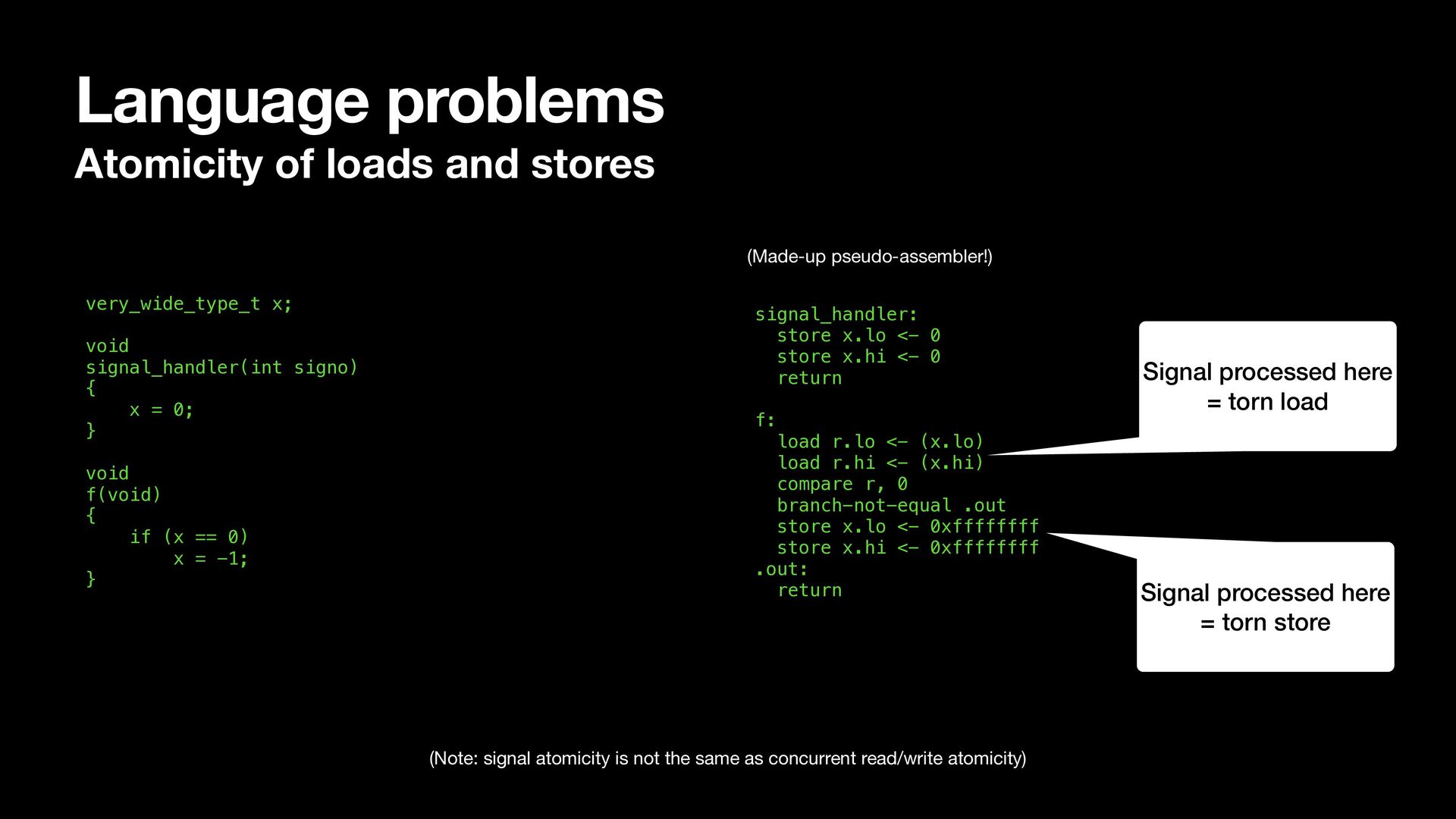
void signal_handler(int signo) { x = 0; } void f(void) { if (x == 0) x = -1; } signal_handler: store x.lo <- 0 store x.hi <- 0 return f: load r.lo <- (x.lo) load r.hi <- (x.hi) compare r, 0 branch-not-equal .out store x.lo <- 0xffffffff store x.hi <- 0xffffffff .out: return Signal processed here = torn load Signal processed here = torn store (Note: signal atomicity is not the same as concurrent read/write atomicity) (Made-up pseudo-assembler!)
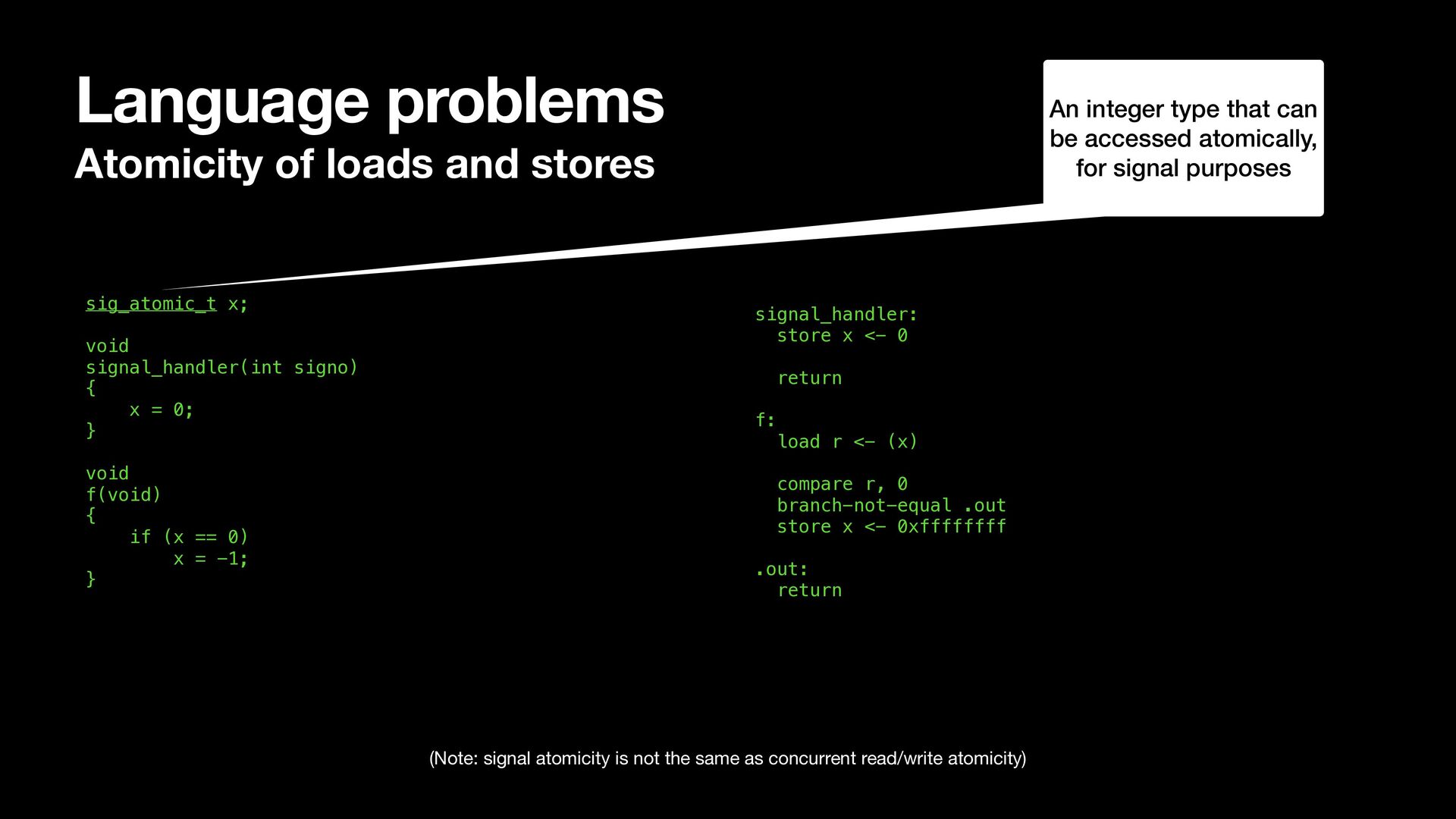
void signal_handler(int signo) { x = 0; } void f(void) { if (x == 0) x = -1; } signal_handler: store x <- 0 return f: load r <- (x) compare r, 0 branch-not-equal .out store x <- 0xffffffff .out: return (Note: signal atomicity is not the same as concurrent read/write atomicity) An integer type that can be accessed atomically, for signal purposes
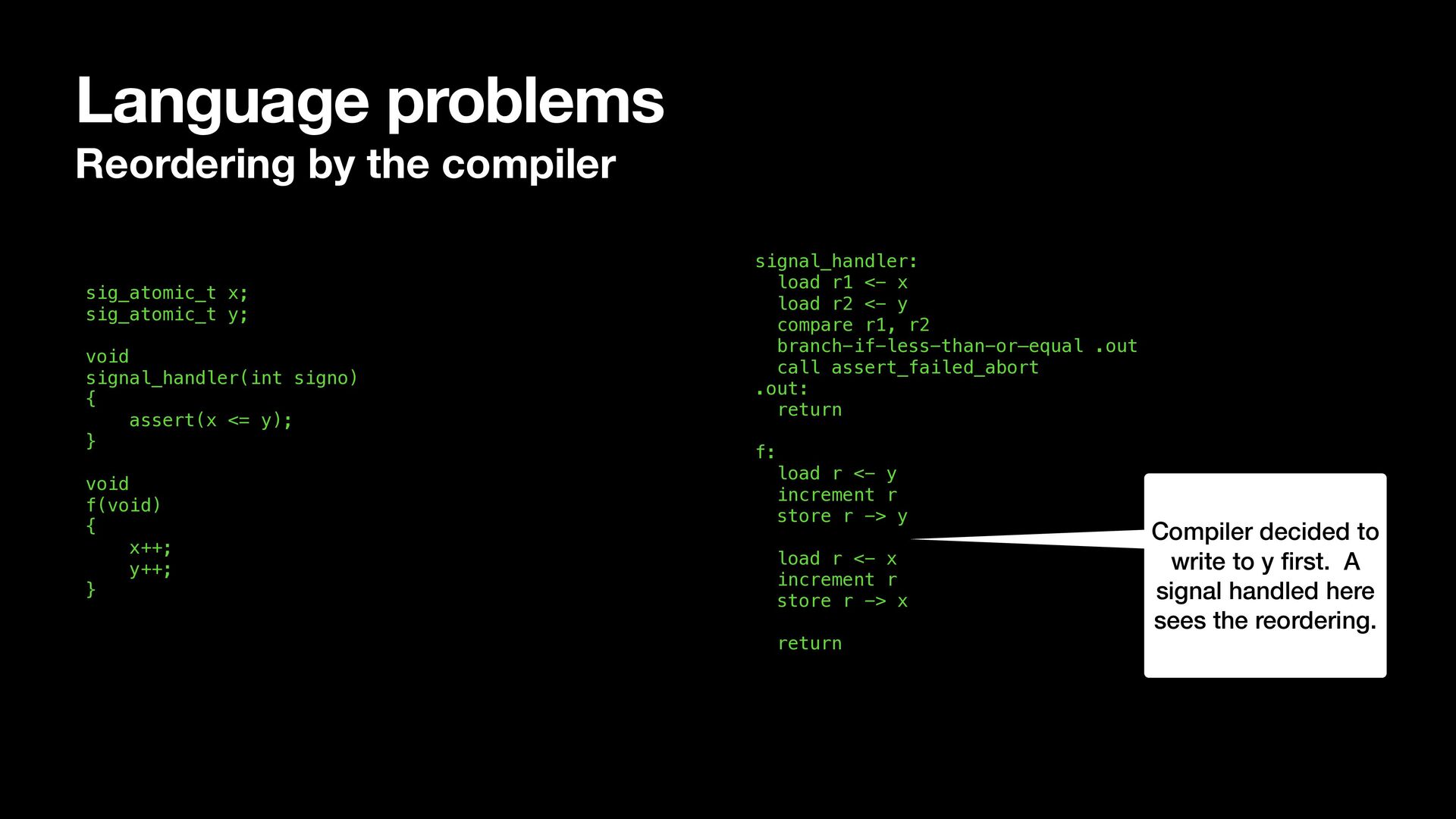
y; void signal_handler(int signo) { assert(x <= y); } void f(void) { x++; y++; } signal_handler: load r1 <- x load r2 <- y compare r1, r2 branch-if-less-than-or—equal .out call assert_failed_abort .out: return f: load r <- y increment r store r -> y load r <- x increment r store r -> x return Compiler decided to write to y fi rst. A signal handled here sees the reordering.
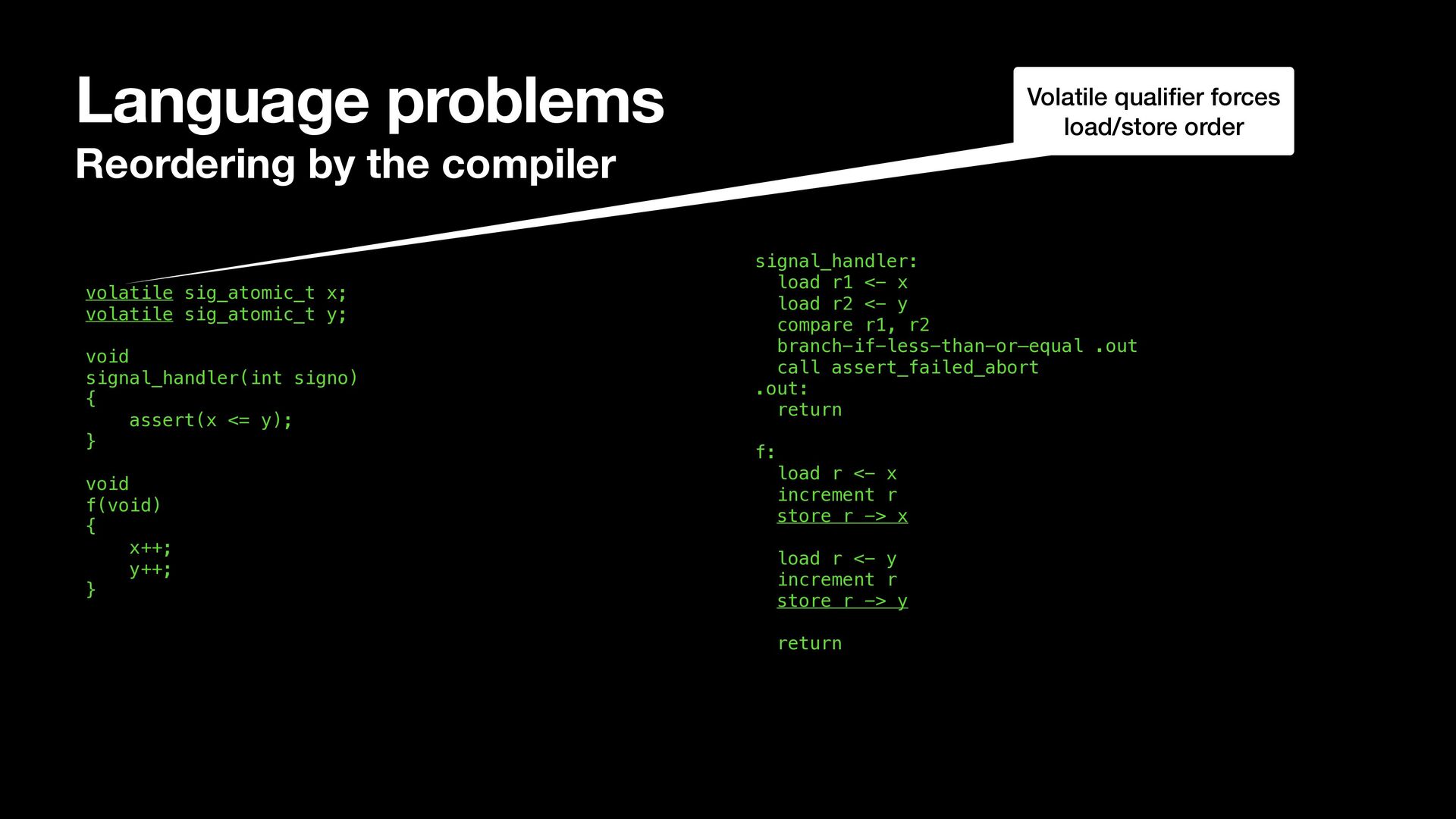
volatile sig_atomic_t y; void signal_handler(int signo) { assert(x <= y); } void f(void) { x++; y++; } signal_handler: load r1 <- x load r2 <- y compare r1, r2 branch-if-less-than-or—equal .out call assert_failed_abort .out: return f: load r <- x increment r store r -> x load r <- y increment r store r -> y return Volatile quali fi er forces load/store order
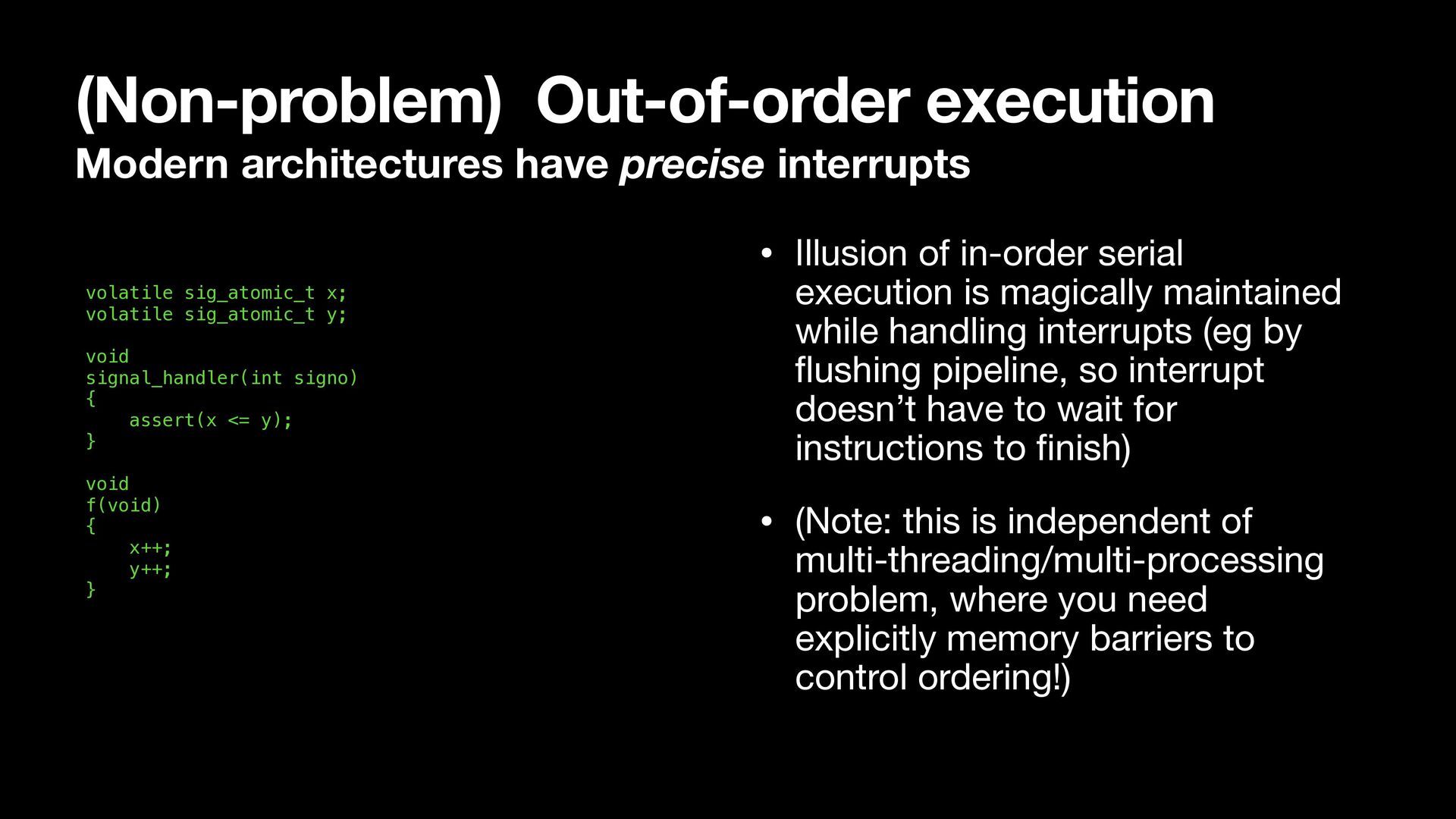
x; volatile sig_atomic_t y; void signal_handler(int signo) { assert(x <= y); } void f(void) { x++; y++; } • Illusion of in-order serial execution is magically maintained while handling interrupts (eg by fl ushing pipeline, so interrupt doesn’t have to wait for instructions to fi nish) • (Note: this is independent of multi-threading/multi-processing problem, where you need explicitly memory barriers to control ordering!)
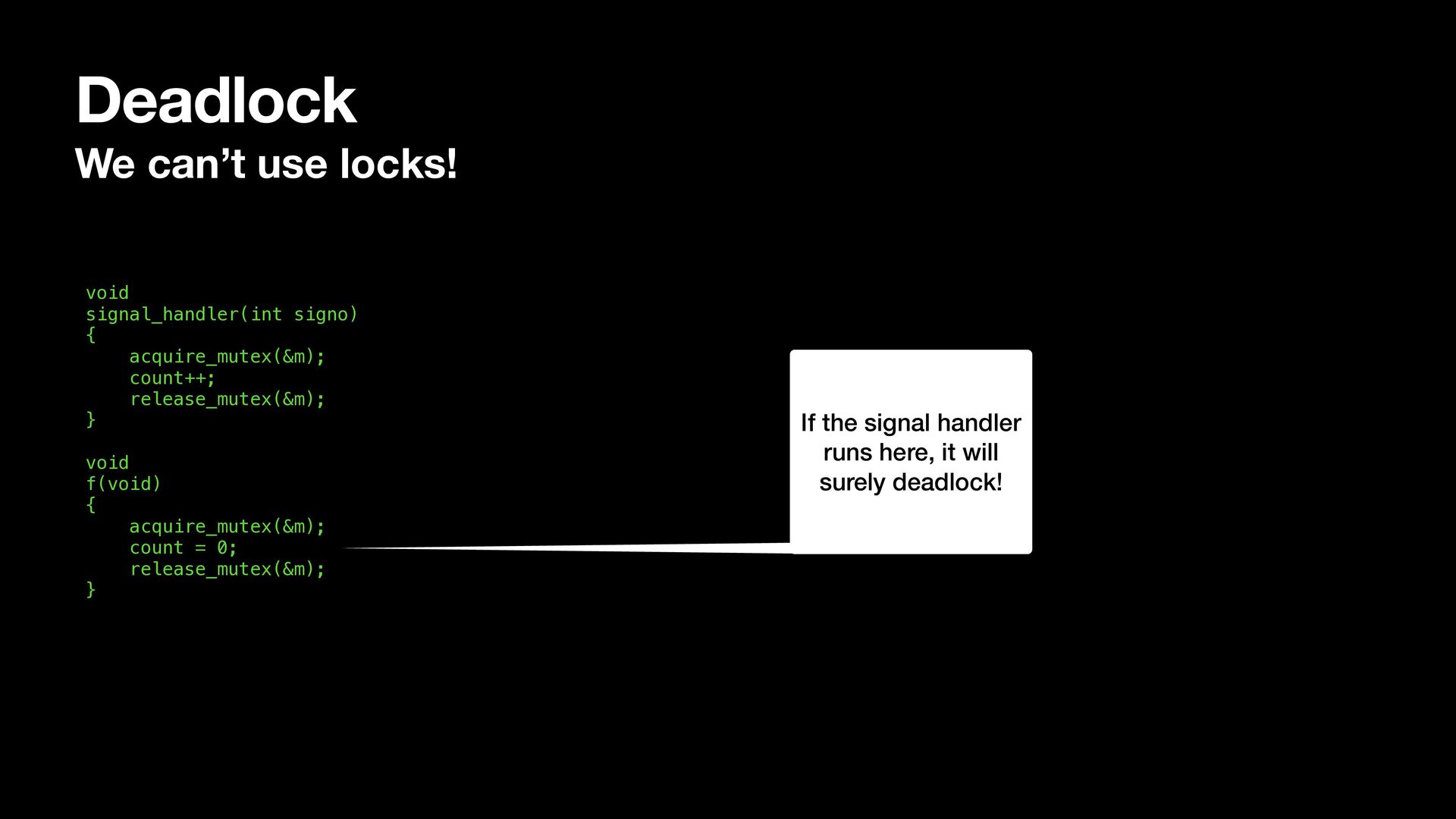
acquire_mutex(&m); count++; release_mutex(&m); } void f(void) { acquire_mutex(&m); count = 0; release_mutex(&m); } If the signal handler runs here, it will surely deadlock!
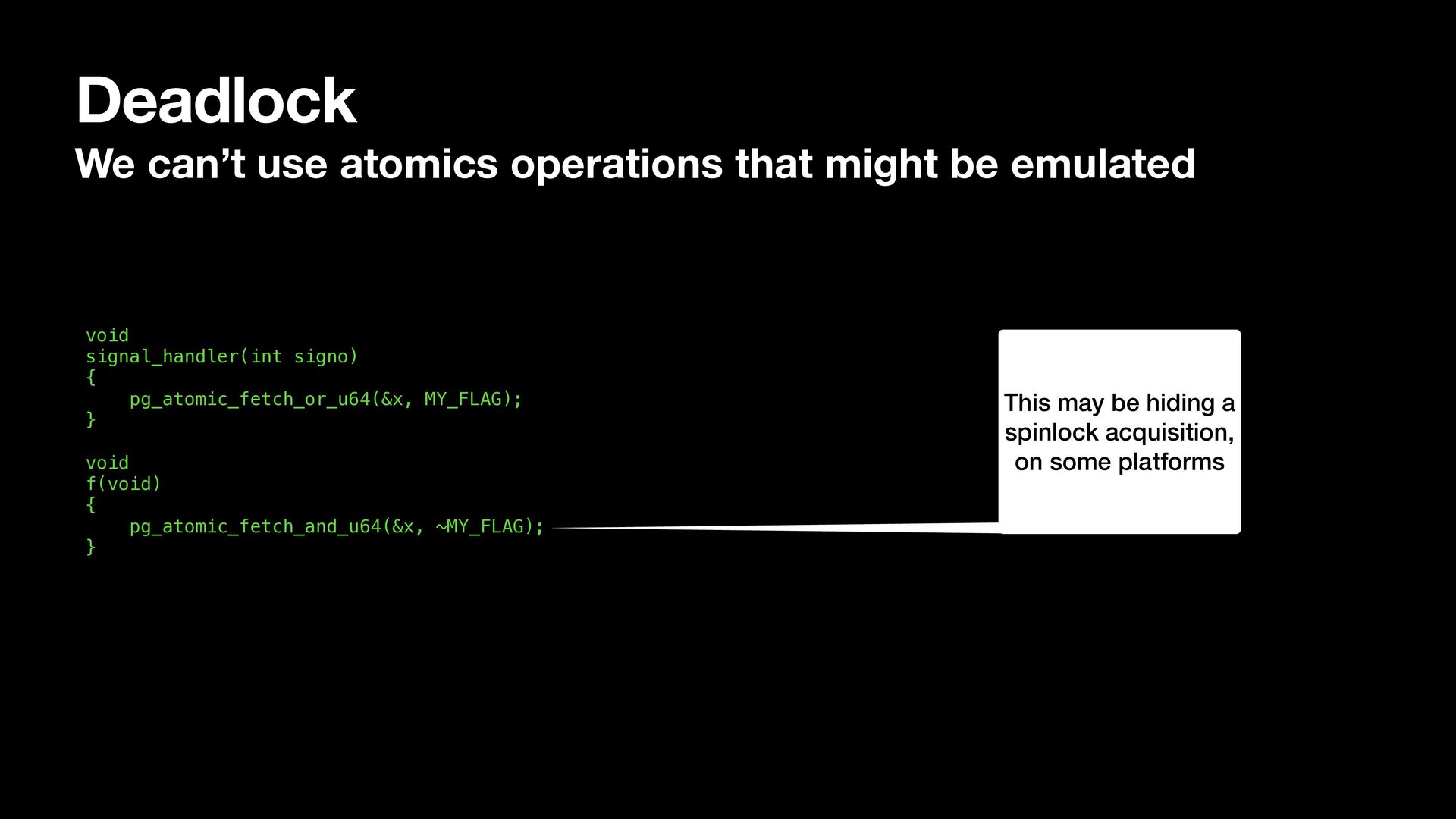
void signal_handler(int signo) { pg_atomic_fetch_or_u64(&x, MY_FLAG); } void f(void) { pg_atomic_fetch_and_u64(&x, ~MY_FLAG); } This may be hiding a spinlock acquisition, on some platforms
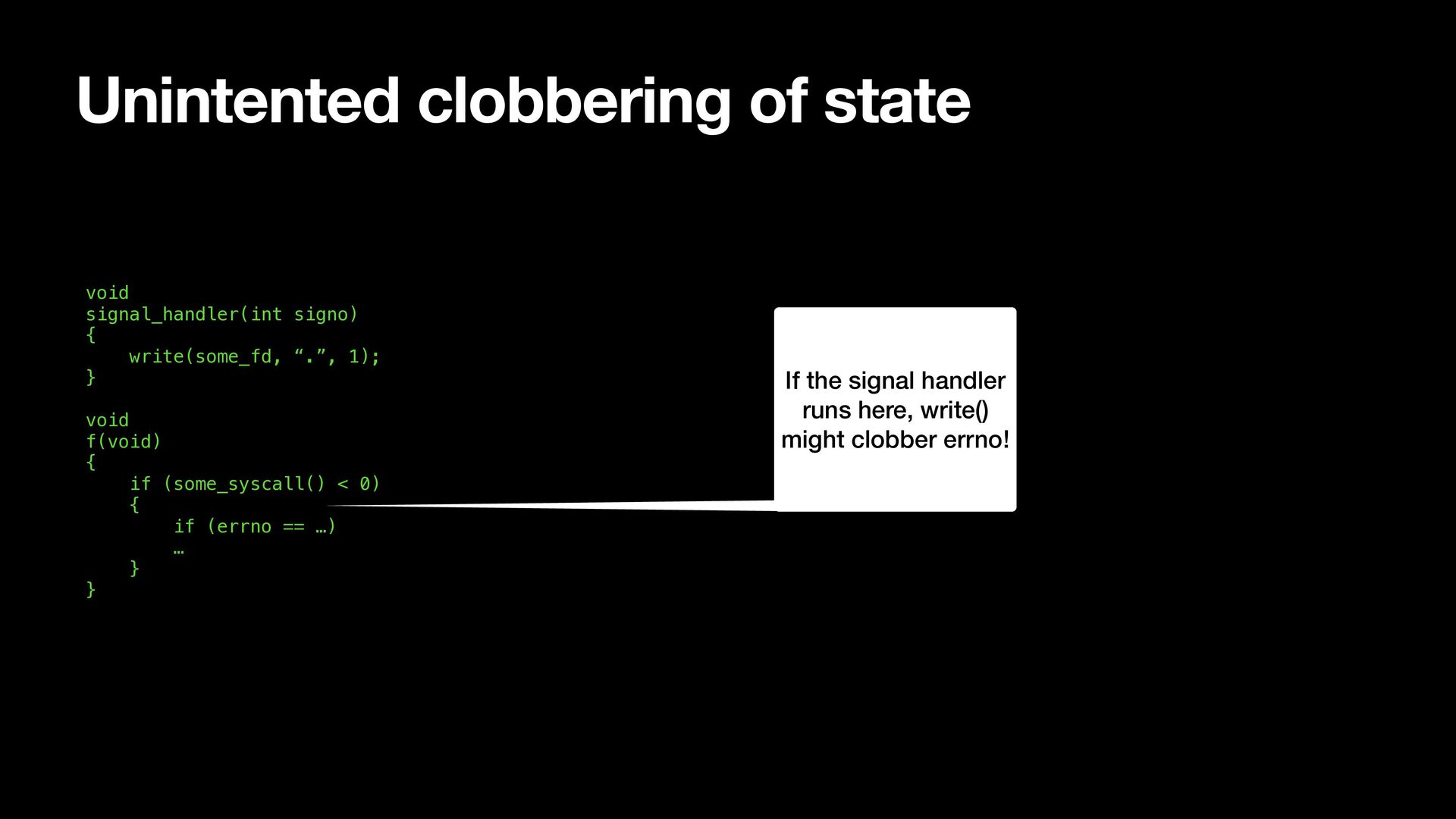
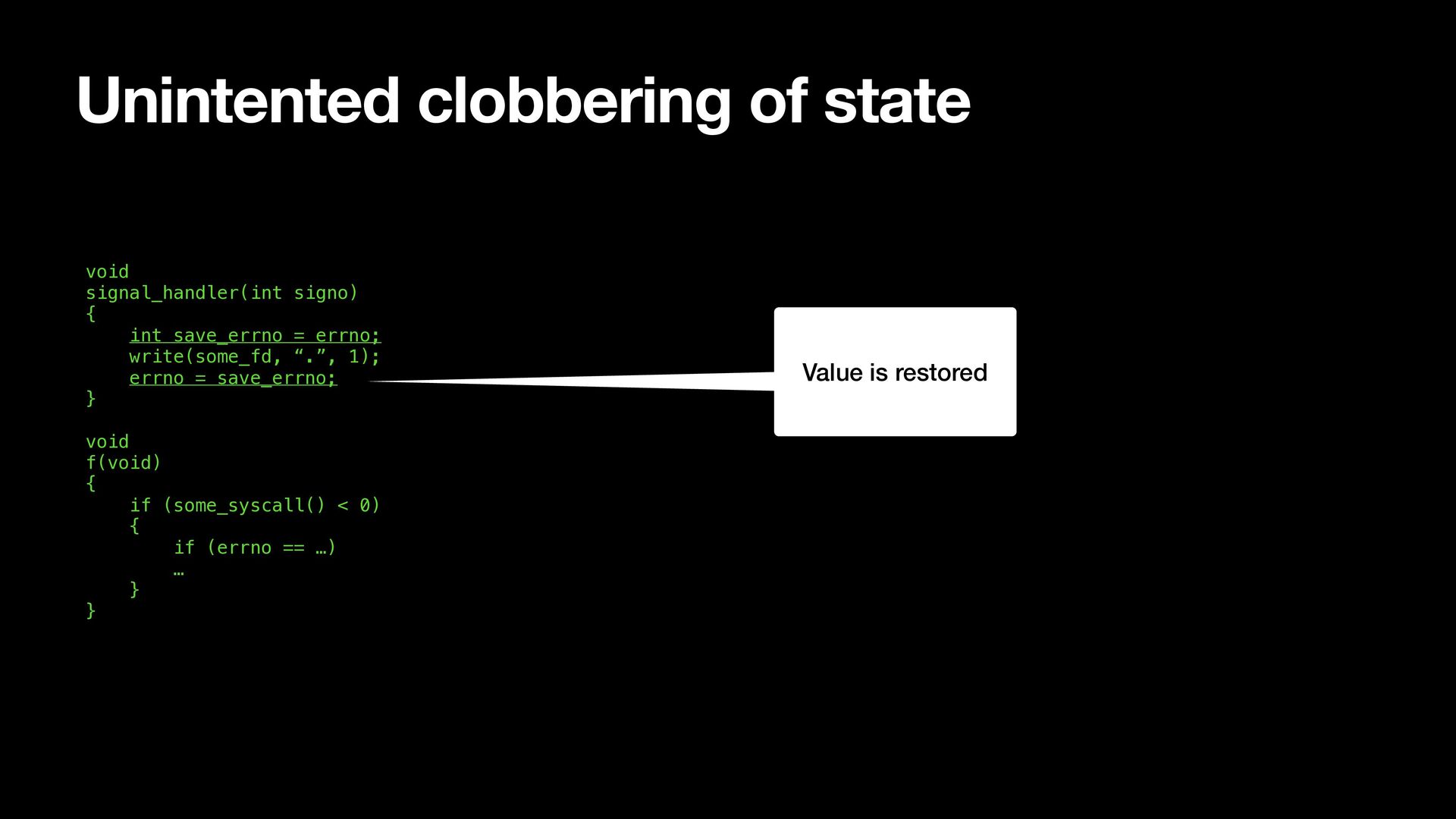
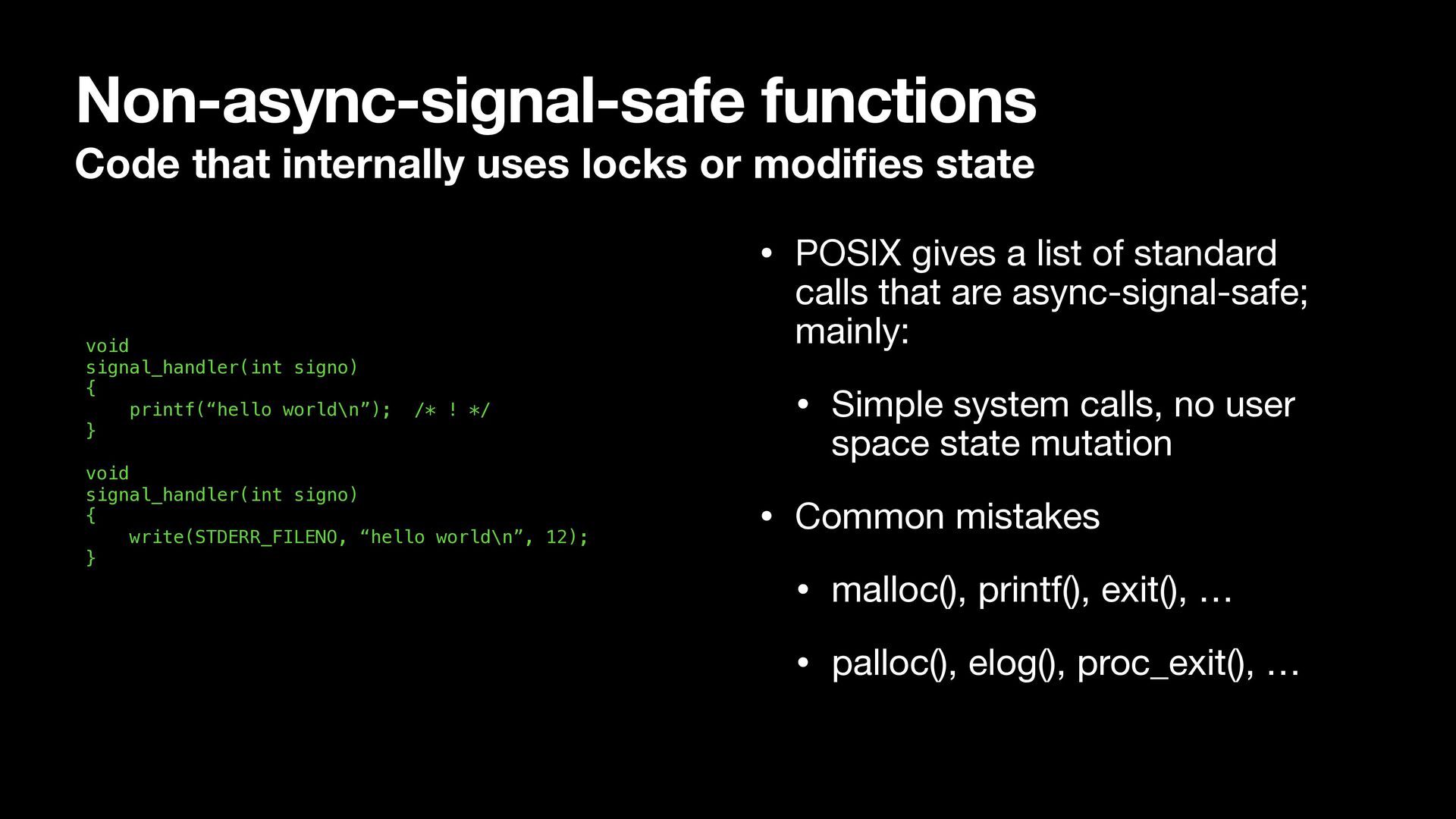
es state void signal_handler(int signo) { printf(“hello world\n”); /* ! */ } void signal_handler(int signo) { write(STDERR_FILENO, “hello world\n”, 12); } • POSIX gives a list of standard calls that are async-signal-safe; mainly: • Simple system calls, no user space state mutation • Common mistakes • malloc(), printf(), exit(), … • palloc(), elog(), proc_exit(), …
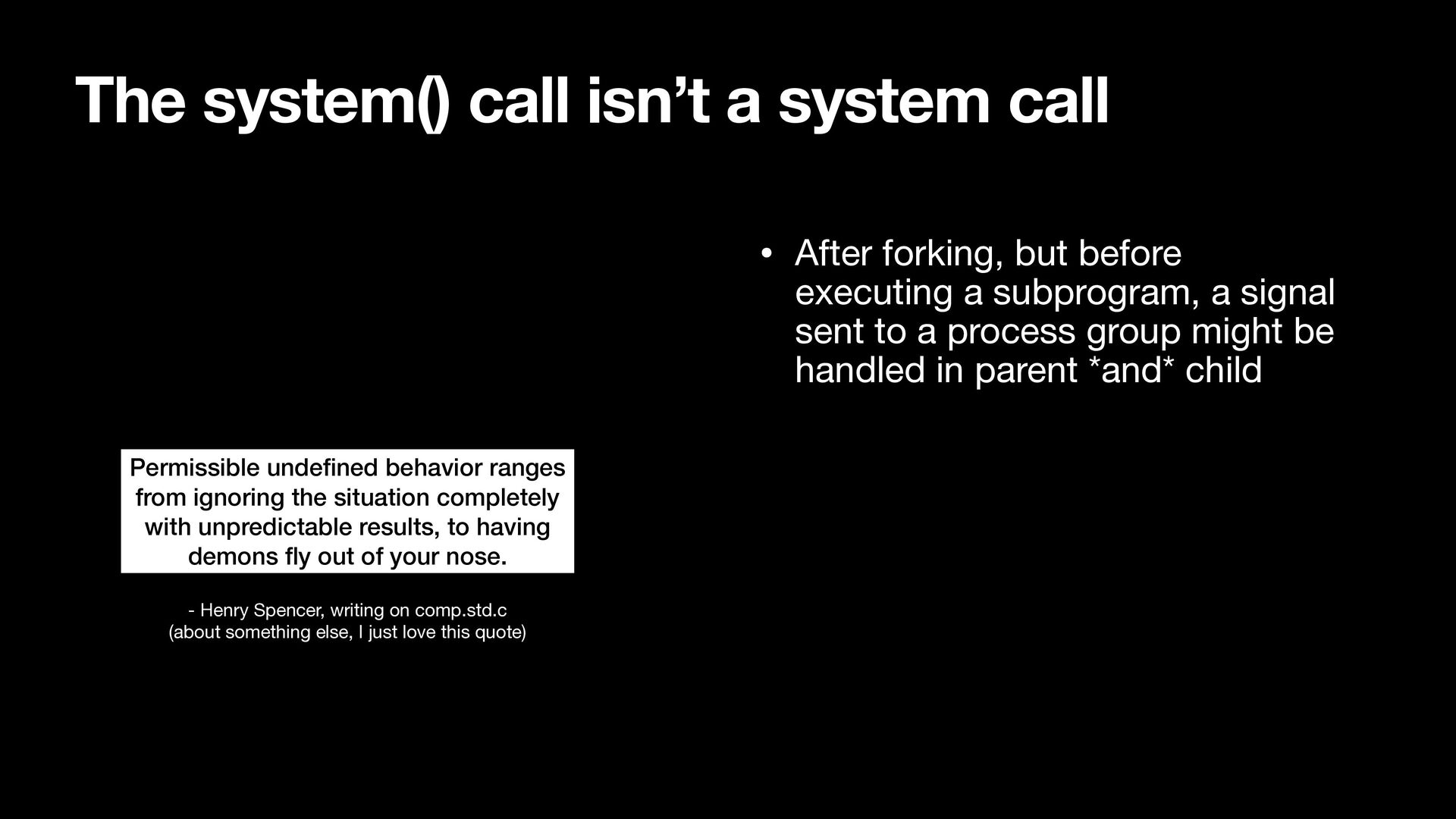
but before executing a subprogram, a signal sent to a process group might be handled in parent *and* child Permissible unde fi ned behavior ranges from ignoring the situation completely with unpredictable results, to having demons fl y out of your nose. - Henry Spencer, writing on comp.std.c (about something else, I just love this quote)
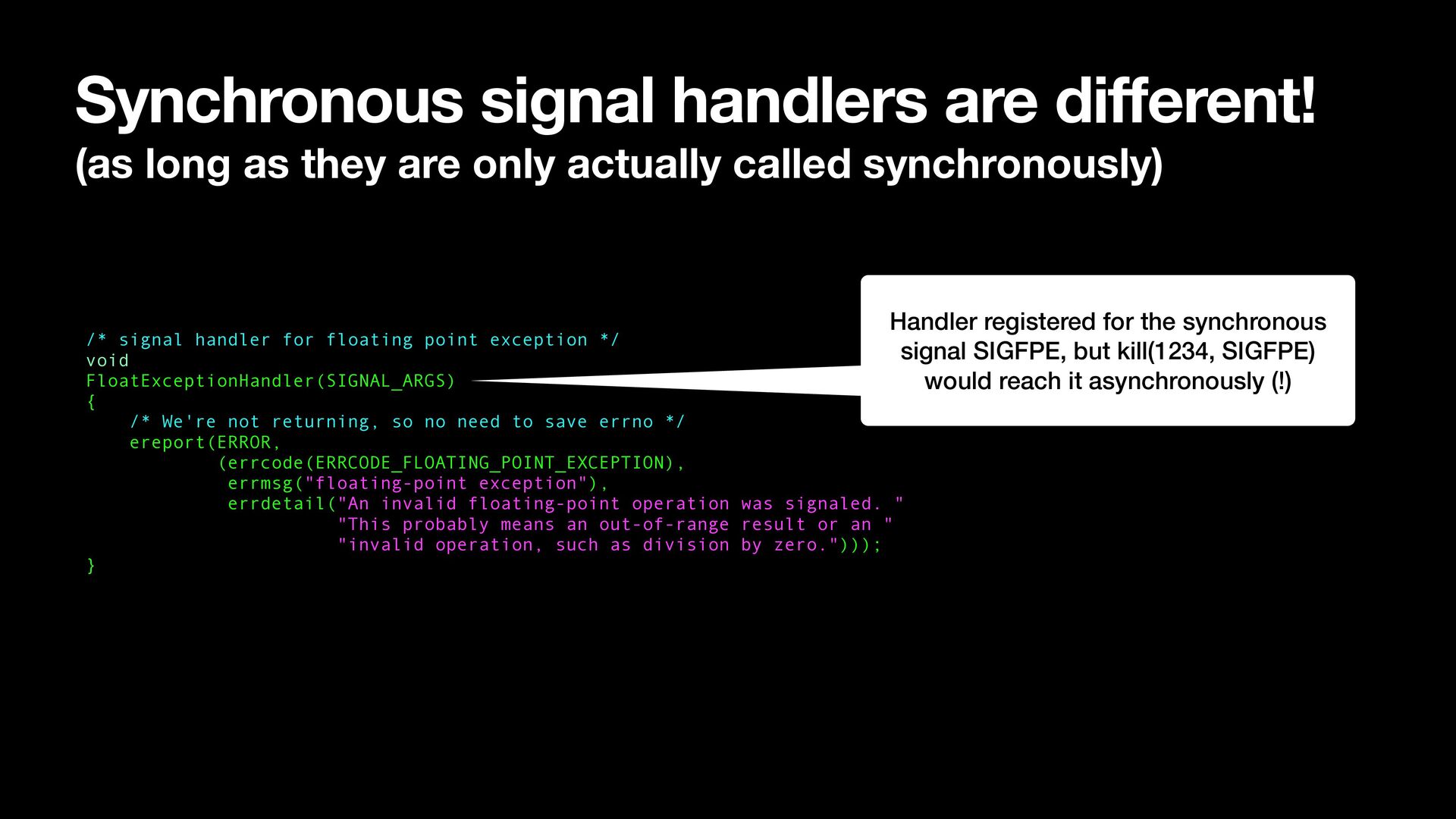
only actually called synchronously) /* signal handler for floating point exception */ void FloatExceptionHandler(SIGNAL_ARGS) { /* We're not returning, so no need to save errno */ ereport(ERROR, (errcode(ERRCODE_FLOATING_POINT_EXCEPTION), errmsg("floating-point exception"), errdetail("An invalid floating-point operation was signaled. " "This probably means an out-of-range result or an " "invalid operation, such as division by zero."))); } Handler registered for the synchronous signal SIGFPE, but kill(1234, SIGFPE) would reach it asynchronously (!)
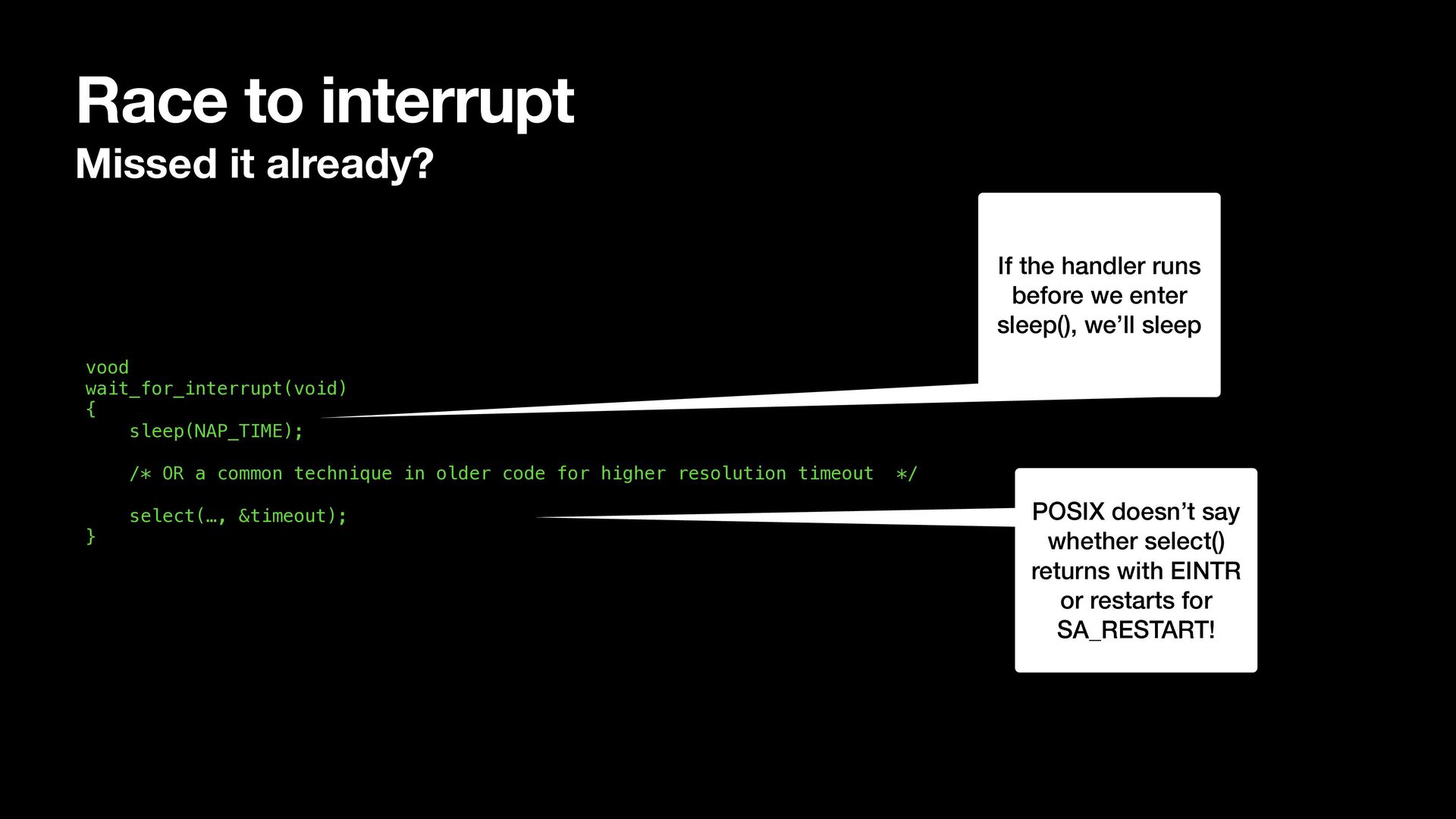
{ sleep(NAP_TIME); /* OR a common technique in older code for higher resolution timeout */ select(…, &timeout); } If the handler runs before we enter sleep(), we’ll sleep POSIX doesn’t say whether select() returns with EINTR or restarts for SA_RESTART!
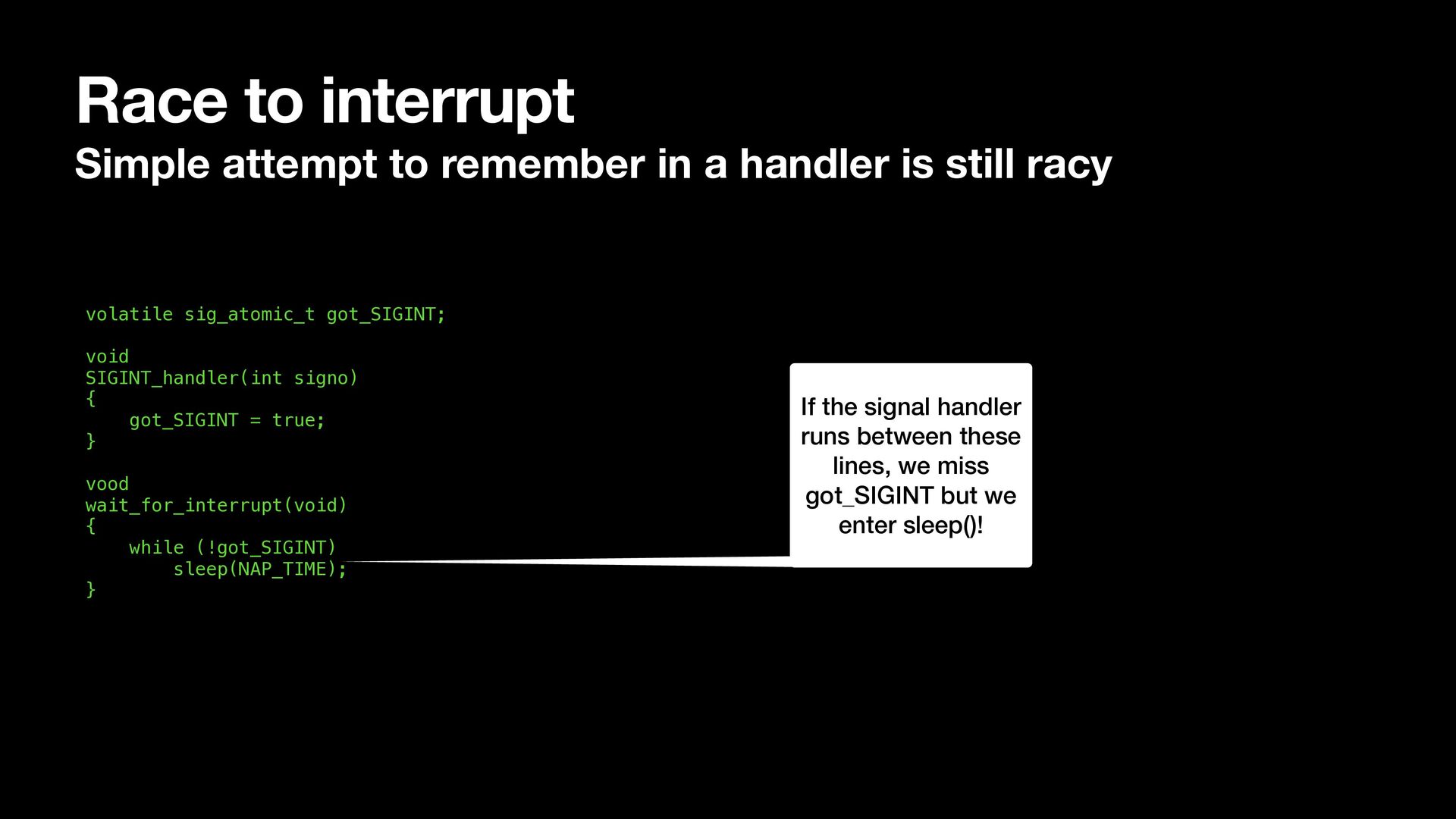
is still racy volatile sig_atomic_t got_SIGINT; void SIGINT_handler(int signo) { got_SIGINT = true; } vood wait_for_interrupt(void) { while (!got_SIGINT) sleep(NAP_TIME); } If the signal handler runs between these lines, we miss got_SIGINT but we enter sleep()!
15:48:04 2010 +0000 Introduce latches. A latch is a boolean variable, with the capability to wait until it is set. Latches can be used to reliably wait until a signal arrives, which is hard otherwise because signals don't interrupt select() on some platforms, and even when they do, there's race conditions. On Unix, latches use the so called self-pipe trick under the covers to implement the sleep until the latch is set, without race conditions. On Windows, Windows events are used. Use the new latch abstraction to sleep in walsender, so that as soon as a transaction finishes, walsender is woken up to immediately send the WAL to the standby. This reduces the latency between master and standby, which is good. Preliminary work by Fujii Masao. The latch implementation is by me, with helpful comments from many people.
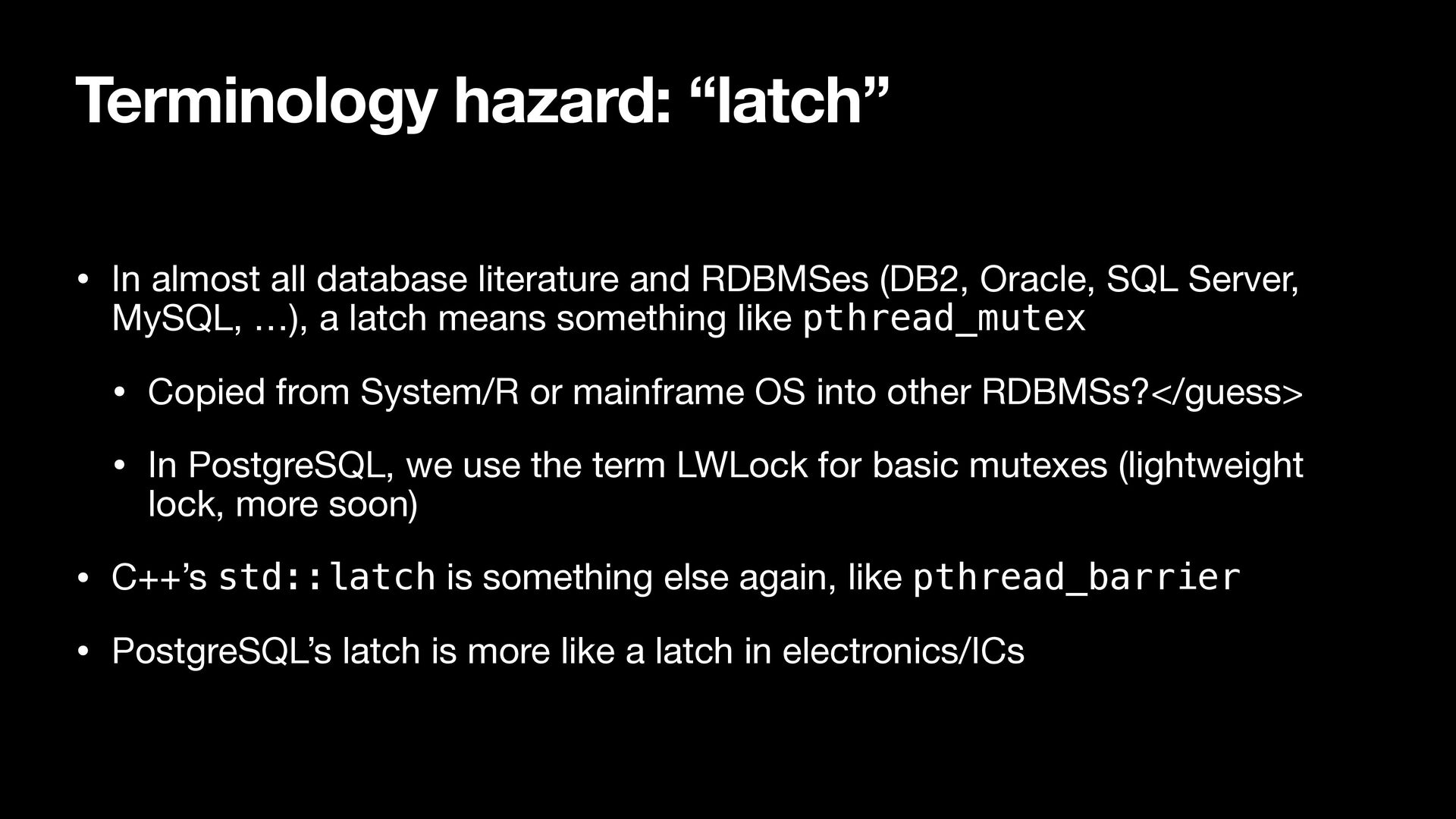
RDBMSes (DB2, Oracle, SQL Server, MySQL, …), a latch means something like pthread_mutex • Copied from System/R or mainframe OS into other RDBMSs?</guess> • In PostgreSQL, we use the term LWLock for basic mutexes (lightweight lock, more soon) • C++’s std::latch is something else again, like pthread_barrier • PostgreSQL’s latch is more like a latch in electronics/ICs
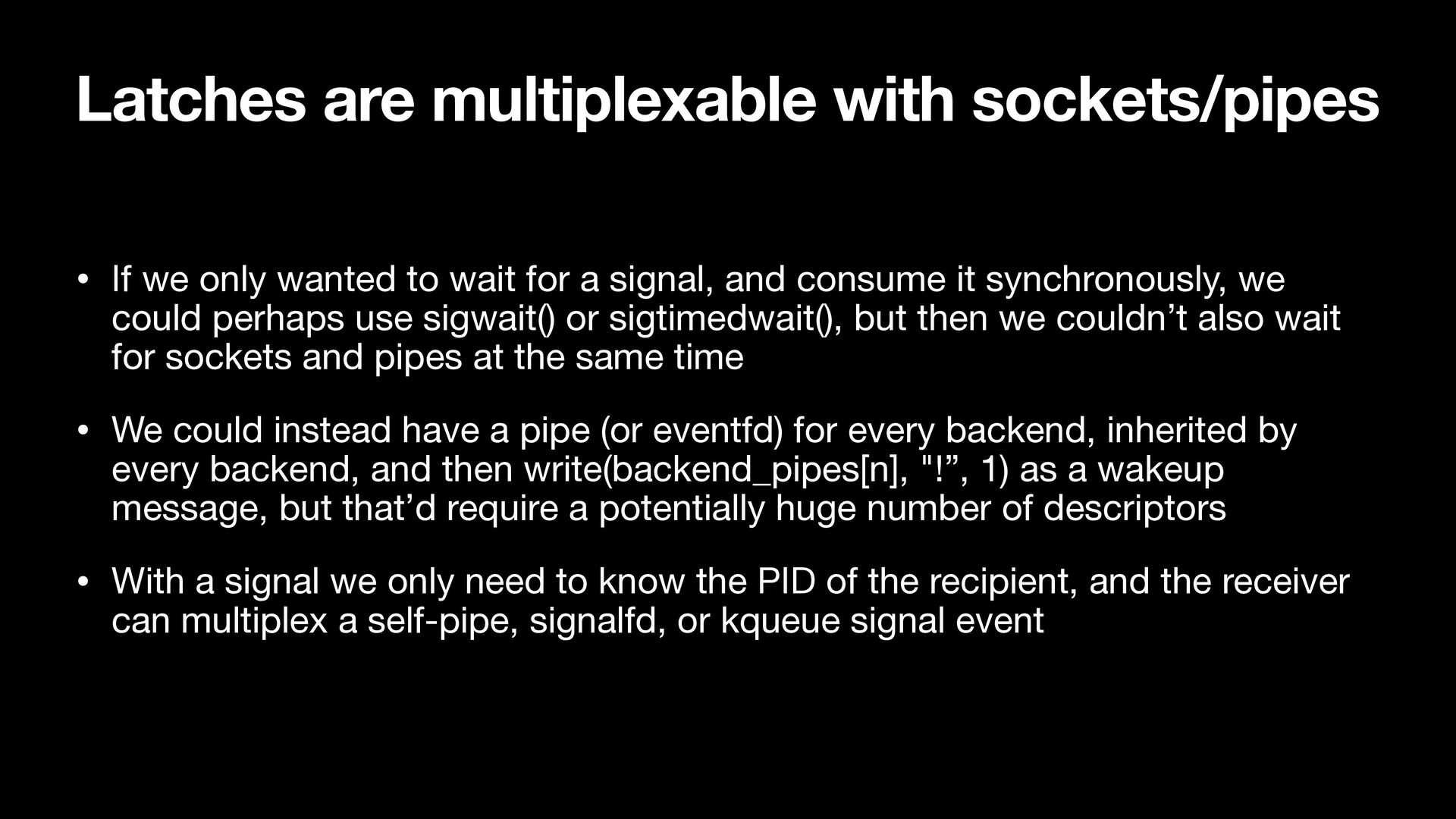
to wait for a signal, and consume it synchronously, we could perhaps use sigwait() or sigtimedwait(), but then we couldn’t also wait for sockets and pipes at the same time • We could instead have a pipe (or eventfd) for every backend, inherited by every backend, and then write(backend_pipes[n], "!”, 1) as a wakeup message, but that’d require a potentially huge number of descriptors • With a signal we only need to know the PID of the recipient, and the receiver can multiplex a self-pipe, signalfd, or kqueue signal event
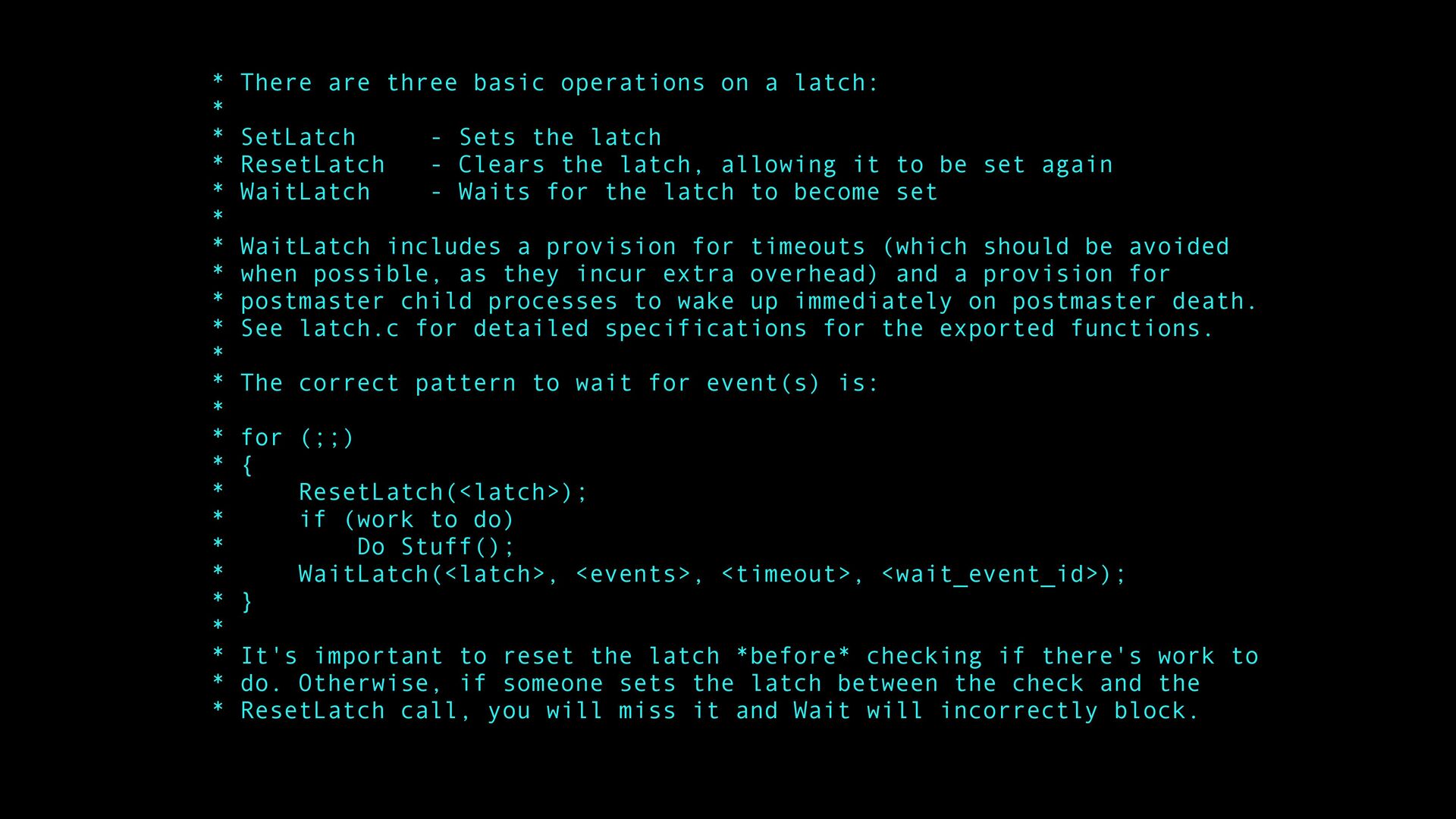
* SetLatch - Sets the latch * ResetLatch - Clears the latch, allowing it to be set again * WaitLatch - Waits for the latch to become set * * WaitLatch includes a provision for timeouts (which should be avoided * when possible, as they incur extra overhead) and a provision for * postmaster child processes to wake up immediately on postmaster death. * See latch.c for detailed specifications for the exported functions. * * The correct pattern to wait for event(s) is: * * for (;;) * { * ResetLatch(<latch>); * if (work to do) * Do Stuff(); * WaitLatch(<latch>, <events>, <timeout>, <wait_event_id>); * } * * It's important to reset the latch *before* checking if there's work to * do. Otherwise, if someone sets the latch between the check and the * ResetLatch call, you will miss it and Wait will incorrectly block.
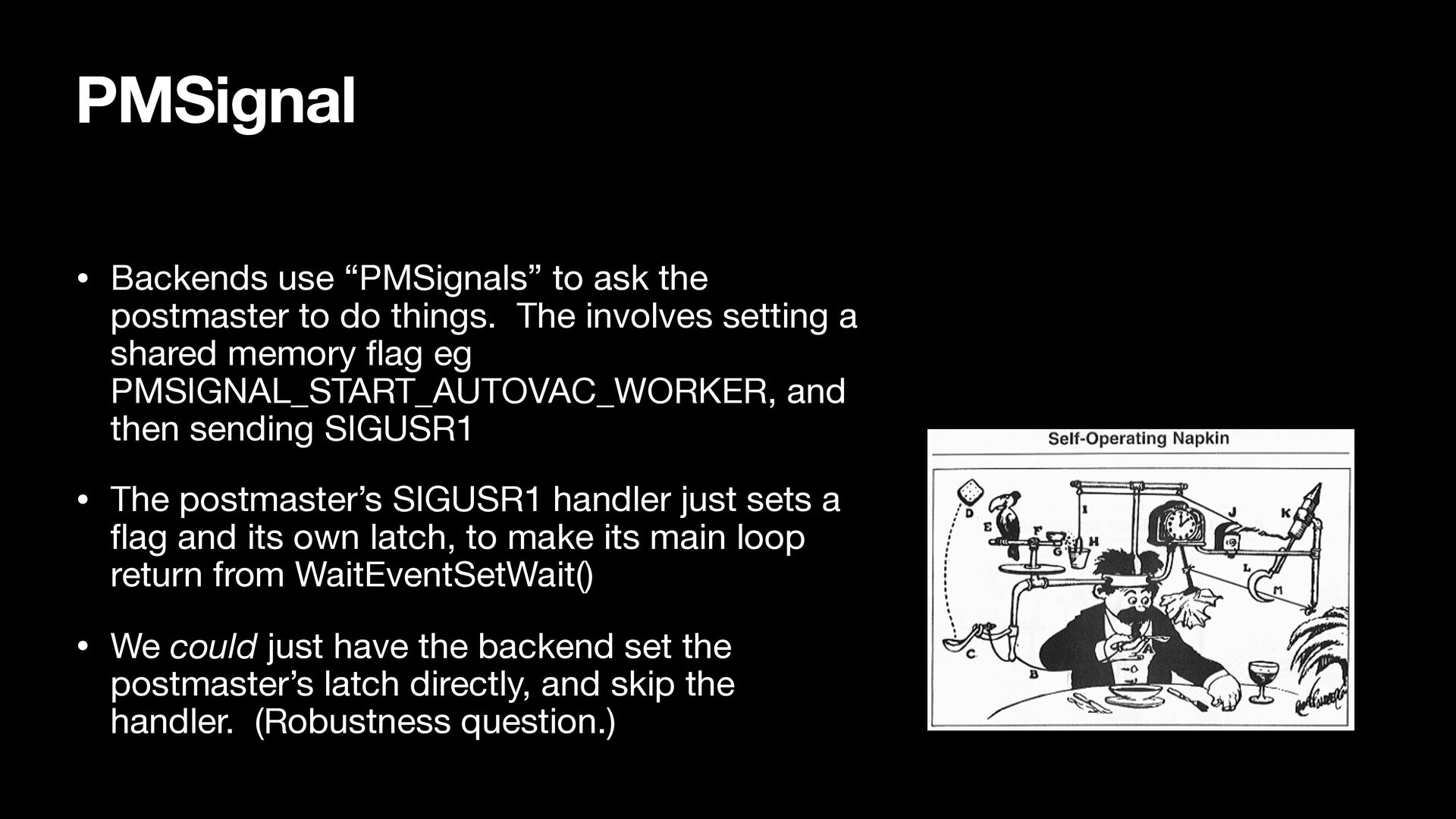
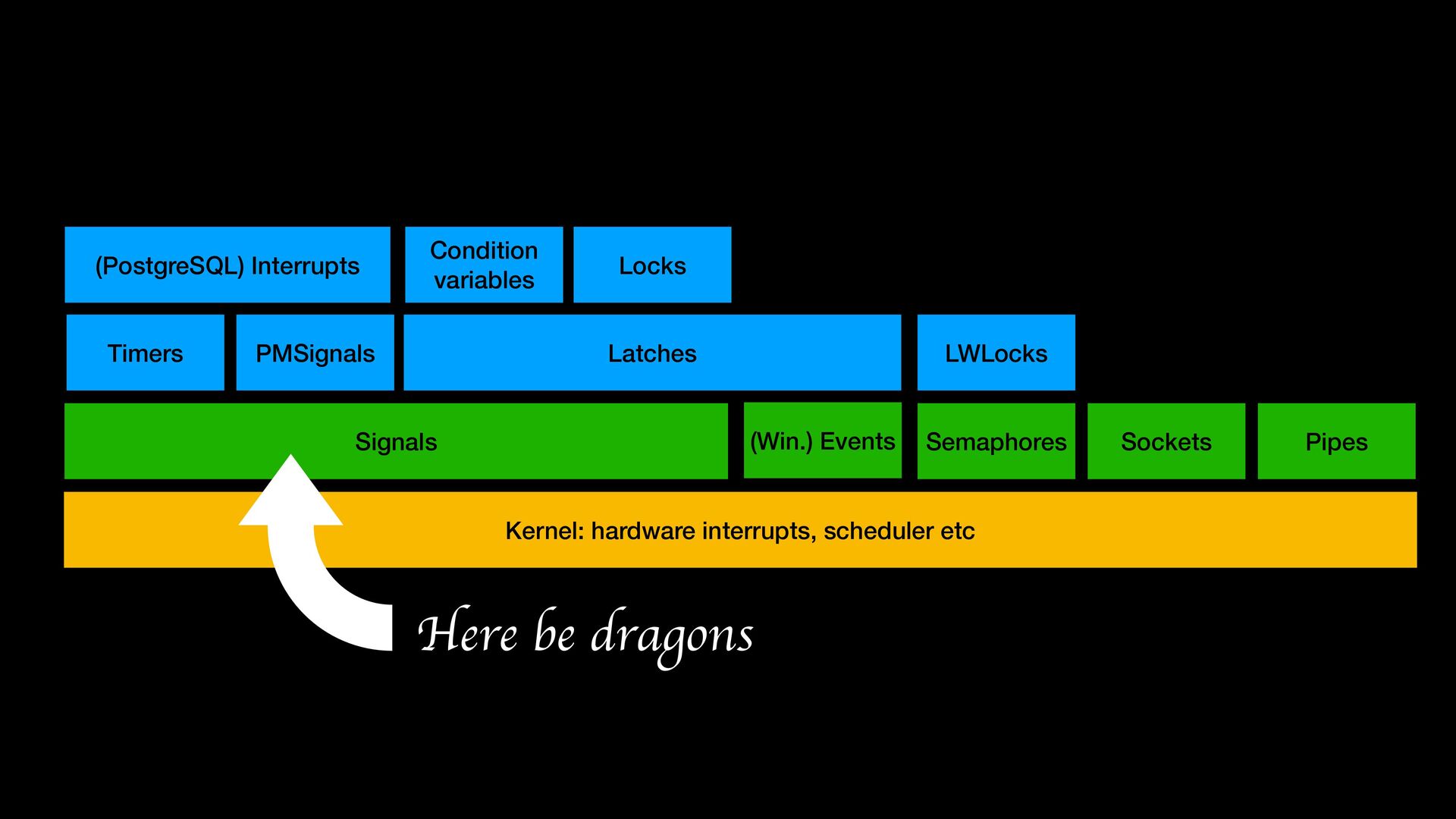
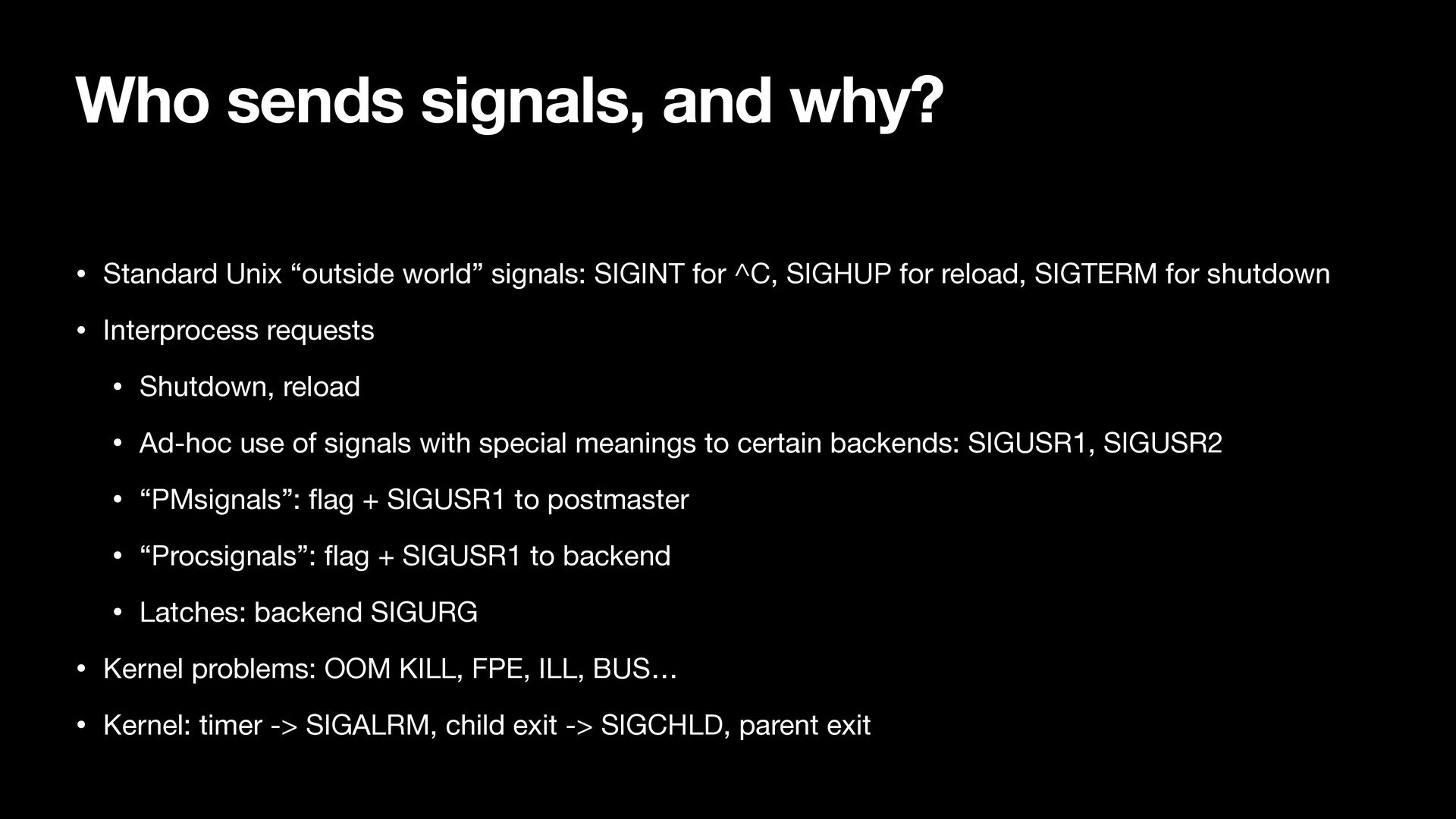
do things. The involves setting a shared memory fl ag eg PMSIGNAL_START_AUTOVAC_WORKER, and then sending SIGUSR1 • The postmaster’s SIGUSR1 handler just sets a fl ag and its own latch, to make its main loop return from WaitEventSetWait() • We could just have the backend set the postmaster’s latch directly, and skip the handler. (Robustness question.)
do certain things, they send ProcSignals, which work the same way: set a fl ag eg PROCSIG_LOG_MEMORY_CONTEXT and send SIGUSR1 • The SIGUSR1 handler in most cases sets an “interrupt” fl ag, for the next call to CHECK_FOR_INTERRUPTS() to see and do something about* • It also sets the backend’s latch, to break out of WaitEventSetWait() if we happen to be in it • We could fi gure out how to skip SIGUSR1, and just set the latch directly from the sender, and teach CHECK_FOR_INTERRUPTS() to deal with the PROCSIG_XXX fl ags directly *In some places we do more work than that directly in the SIGUSR1 handler, but that’s a bug to be fi xed.
The only current use of it is to force every backend to close all smgr fi le descriptors • Fixes random failures on Windows where you can’t unlink directories while someone has fi les open • Fixes historical bugs in hard cases where we lack invalidation, and could mix up fi les • We are waiting for every backend in the system to reach CHECK_FOR_INTERRUPTS()!
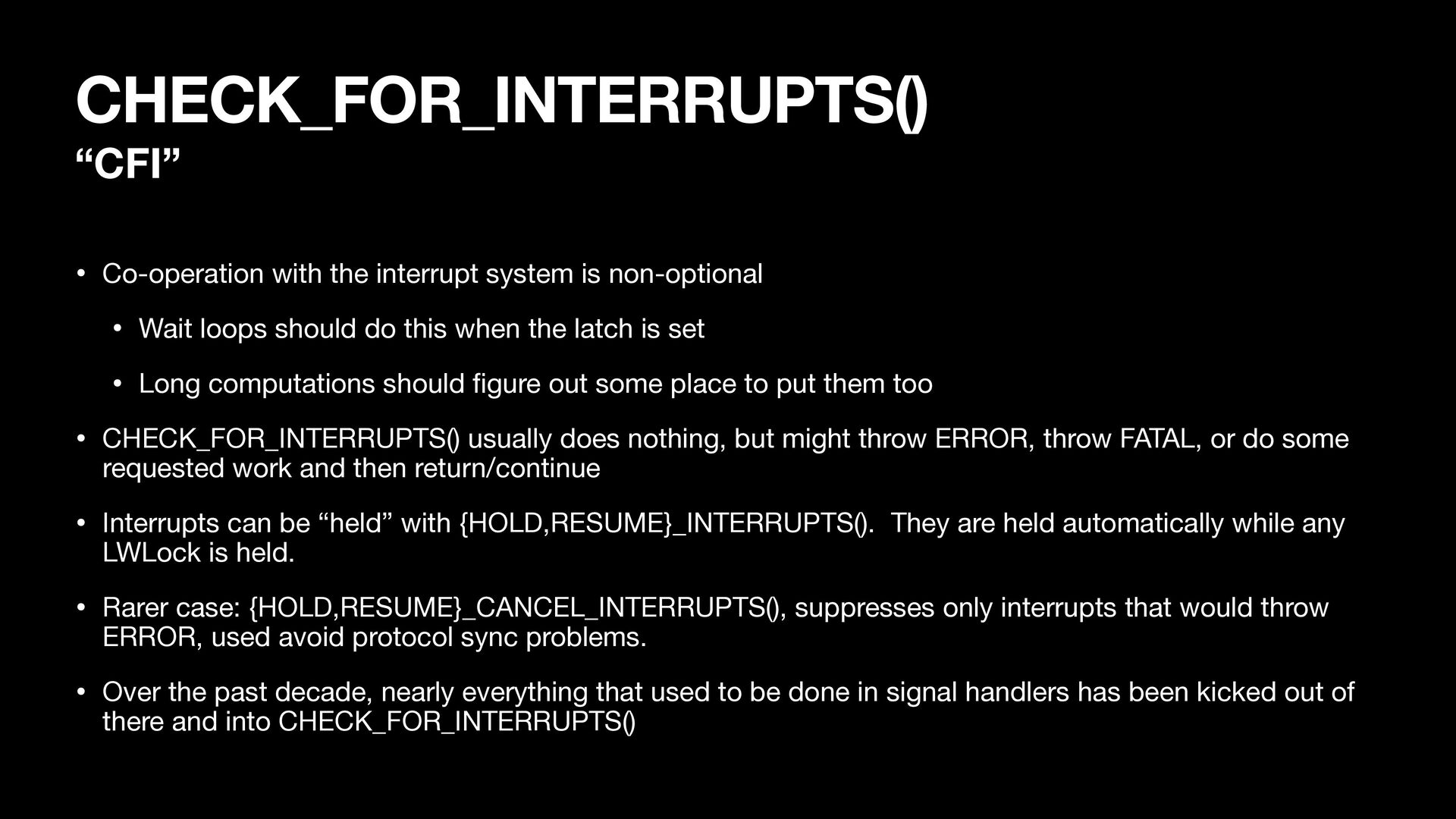
• Wait loops should do this when the latch is set • Long computations should fi gure out some place to put them too • CHECK_FOR_INTERRUPTS() usually does nothing, but might throw ERROR, throw FATAL, or do some requested work and then return/continue • Interrupts can be “held” with {HOLD,RESUME}_INTERRUPTS(). They are held automatically while any LWLock is held. • Rarer case: {HOLD,RESUME}_CANCEL_INTERRUPTS(), suppresses only interrupts that would throw ERROR, used avoid protocol sync problems. • Over the past decade, nearly everything that used to be done in signal handlers has been kicked out of there and into CHECK_FOR_INTERRUPTS()
we block interrupts, because we don’t want to ereport(ERROR); for example during a loop that cleans up temporary fi les on error • That means we don’t handle ProcSignalBarrier code, for example
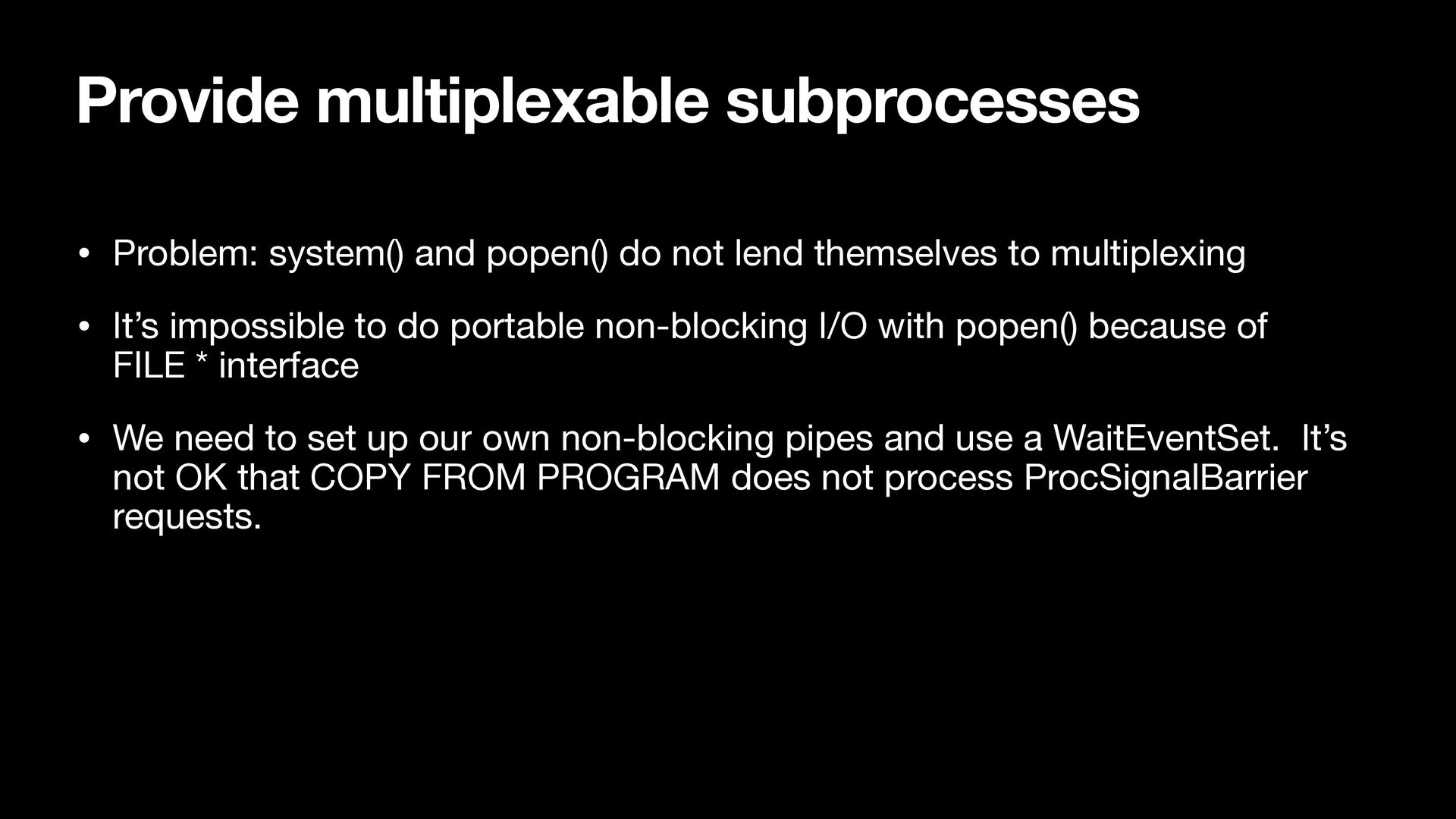
lend themselves to multiplexing • It’s impossible to do portable non-blocking I/O with popen() because of FILE * interface • We need to set up our own non-blocking pipes and use a WaitEventSet. It’s not OK that COPY FROM PROGRAM does not process ProcSignalBarrier requests.
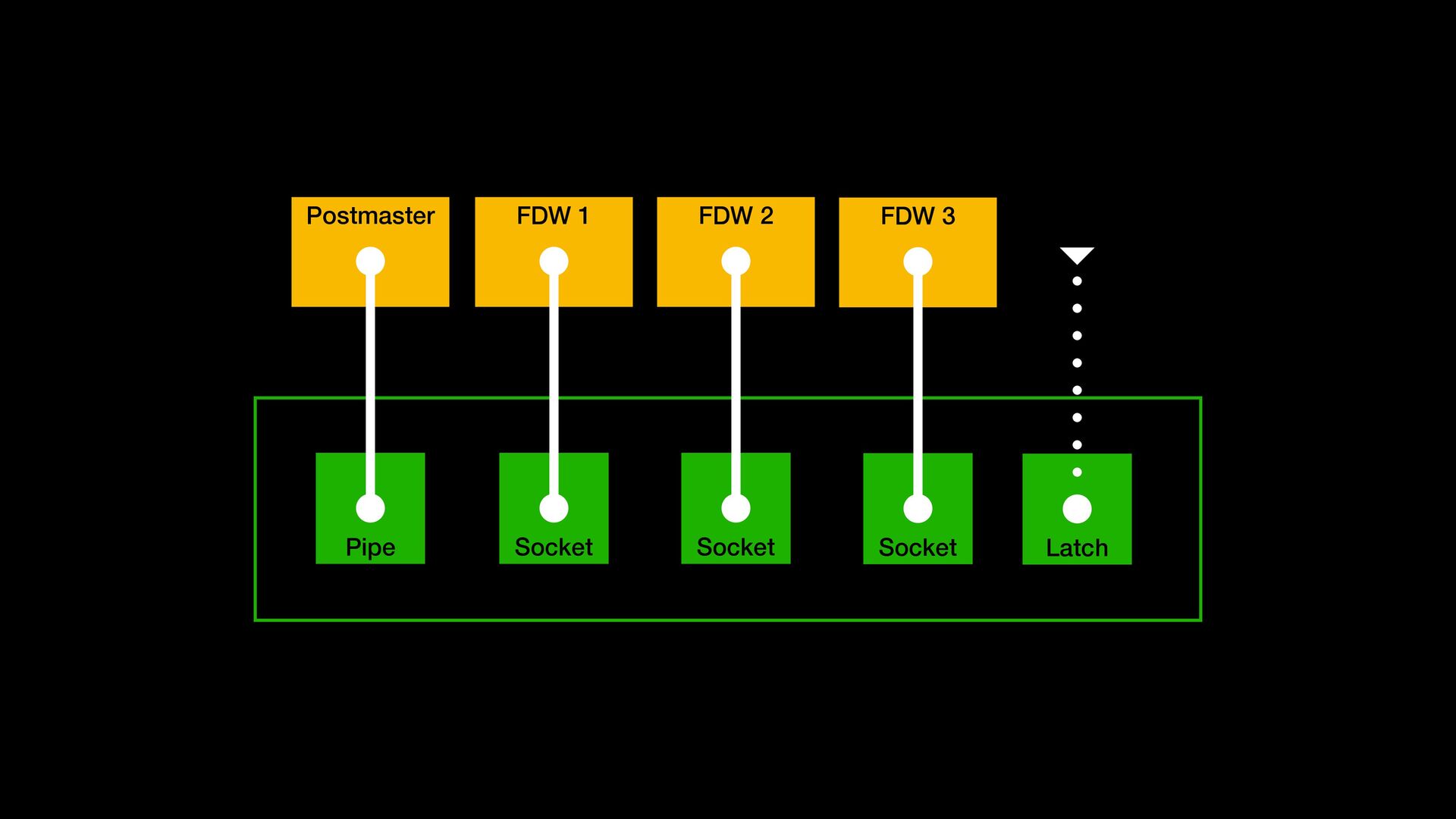
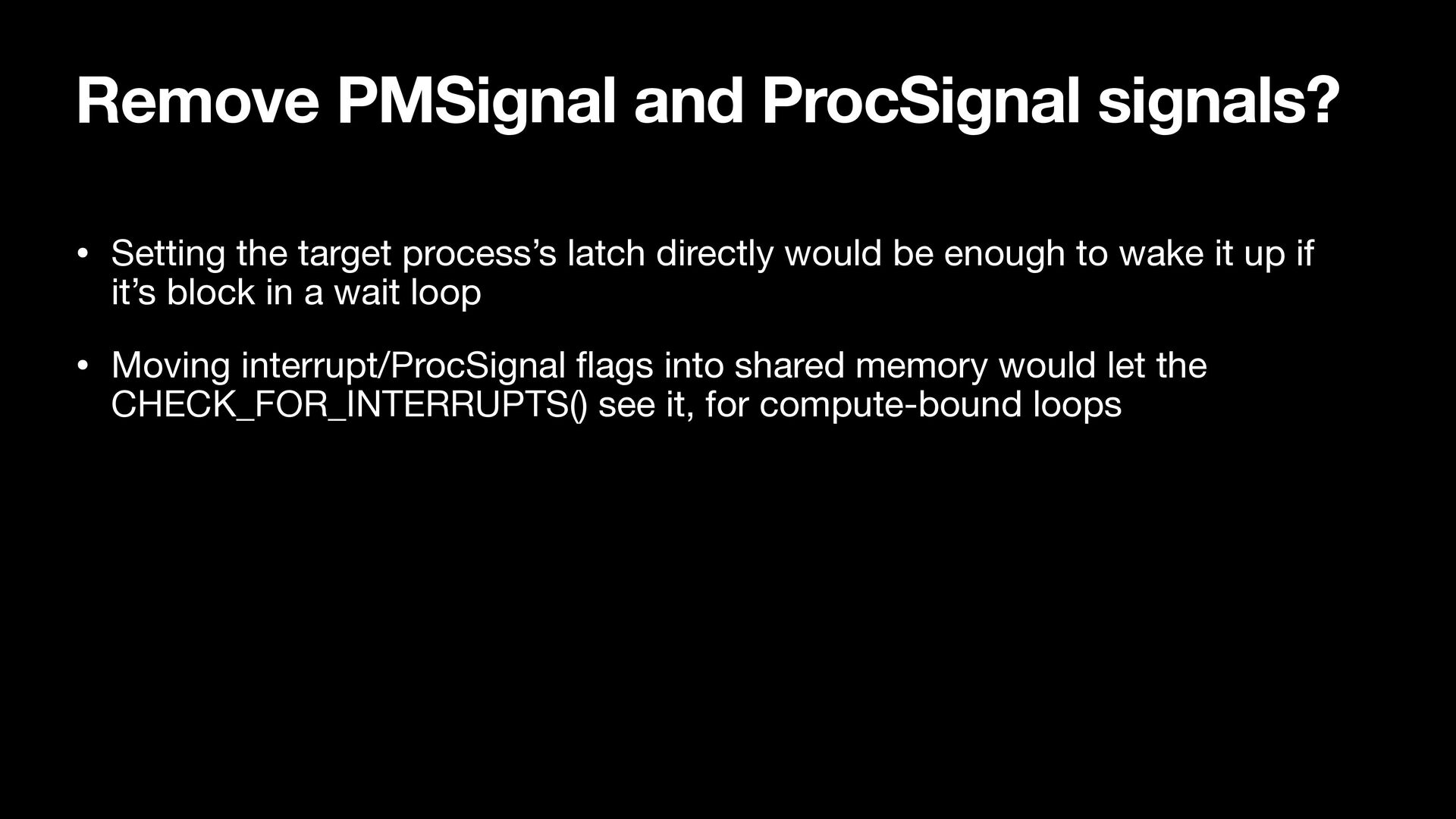
latch directly would be enough to wake it up if it’s block in a wait loop • Moving interrupt/ProcSignal fl ags into shared memory would let the CHECK_FOR_INTERRUPTS() see it, for compute-bound loops
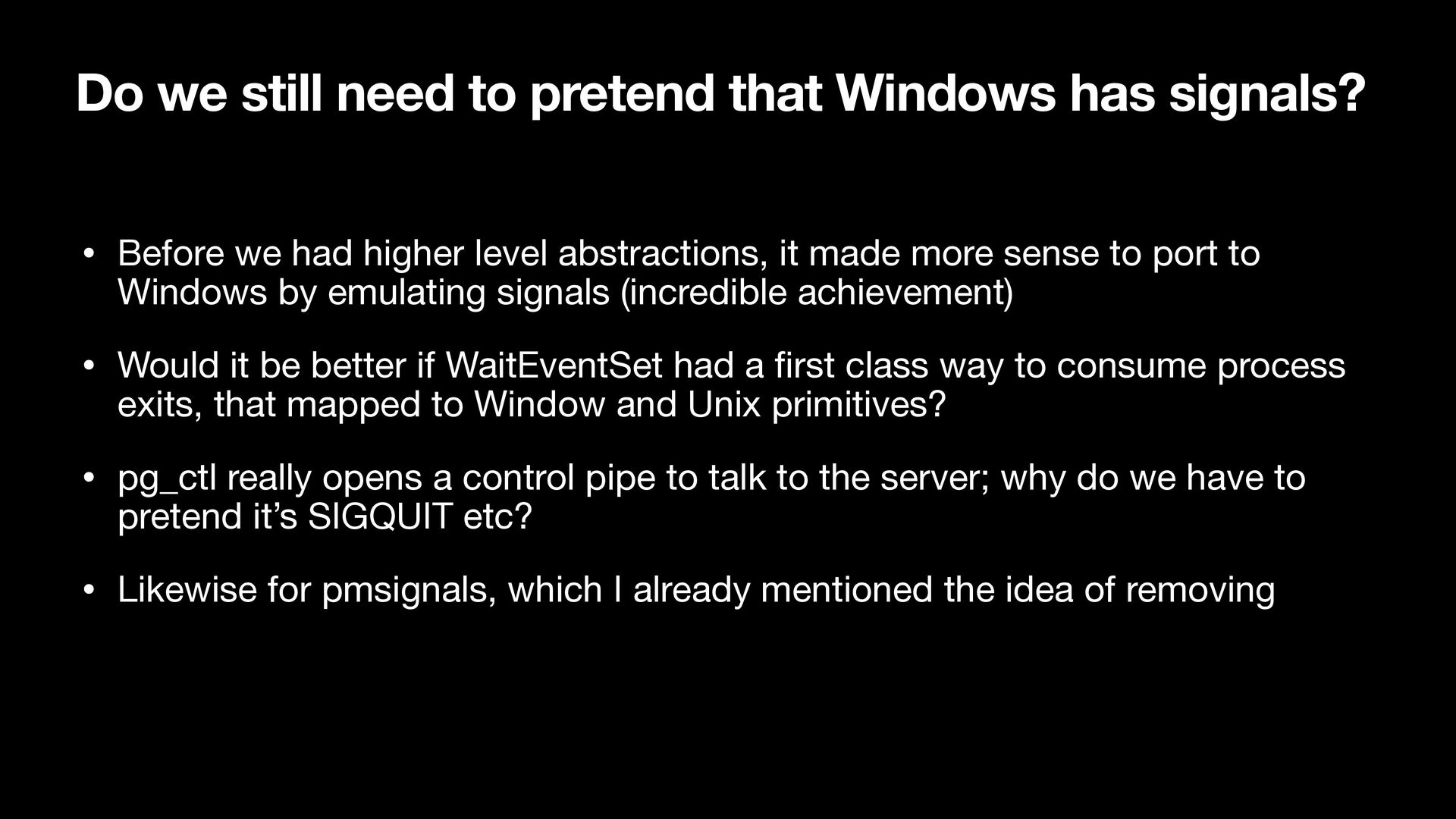
• Before we had higher level abstractions, it made more sense to port to Windows by emulating signals (incredible achievement) • Would it be better if WaitEventSet had a fi rst class way to consume process exits, that mapped to Window and Unix primitives? • pg_ctl really opens a control pipe to talk to the server; why do we have to pretend it’s SIGQUIT etc? • Likewise for pmsignals, which I already mentioned the idea of removing


 macdice
 eijirou
 hokaccha
 satotakeshi
 h1d3mun3
 ktcryomm
 yukiny
 glassfiber
 satoshi256kbyte
 kanfab1
 minodriven
 yuukiw00w
 iwatsukayura
 wjessup
 mayatellez
 tmiket
 mkilby
 stephenakadiri
 rmw
rmw
 eileencodes
.jpg) cargoodrich
cargoodrich
 reverentgeek
 stuffmc
 lauravandoore
 aleyda

![commit 2746e5f21d4dce07ee55c58b2035ff631470577f Author: Heikki Linnakangas <[email protected]> Date: Sat Sep 11](https://files.speakerdeck.com/presentations/f5f50afe45164b3b9822aebdf42076f7/slide_32.jpg)