Share
Embed
Securing Your AWS Cloud Infrastructure
Presented during https://www.meetup.com/div0_sg/events/260846046/ and https://www.meetup.com/DrinkingCodeSG/events/261131219/
Steve Teo
May 23, 2019
Transcript
59 slides
-
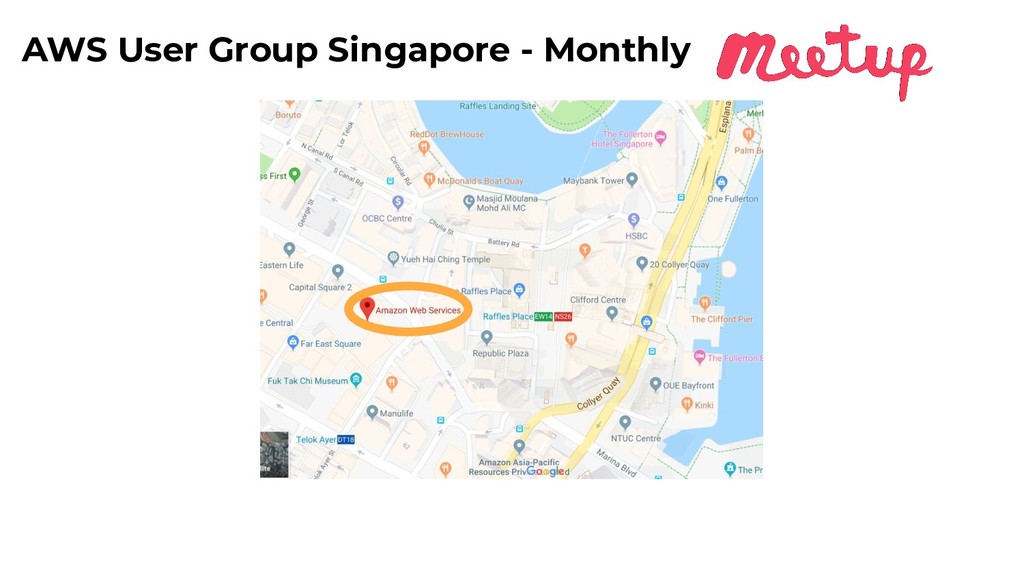
13 August 2018 • Horangi team • 118A Telok Ayer,
Singapore 068587 Securing Your AWS Cloud Infrastructure. -
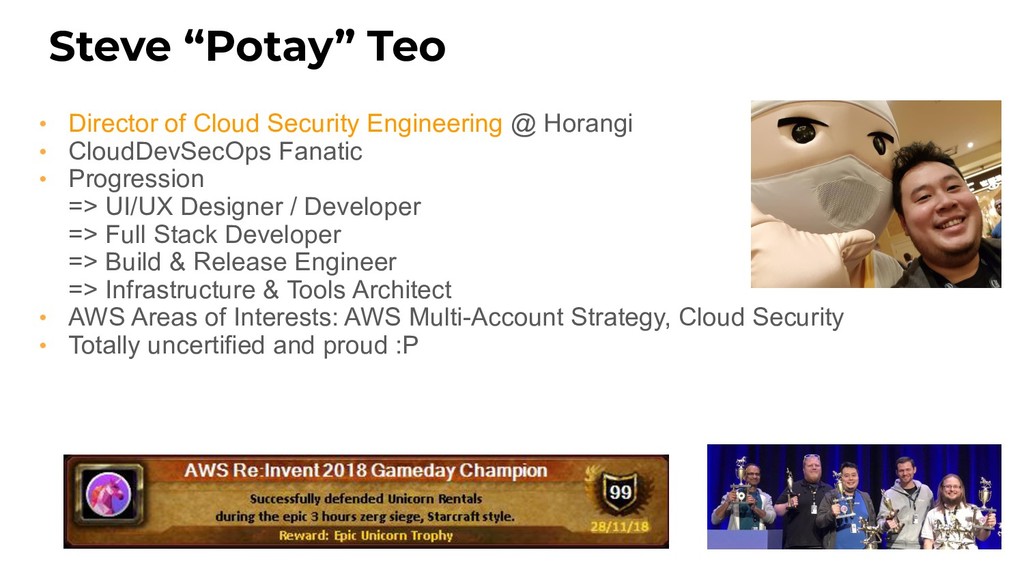
• Director of Cloud Security Engineering @ Horangi • CloudDevSecOps
Fanatic • Progression => UI/UX Designer / Developer => Full Stack Developer => Build & Release Engineer => Infrastructure & Tools Architect • AWS Areas of Interests: AWS Multi-Account Strategy, Cloud Security • Totally uncertified and proud :P Steve “Potay” Teo -
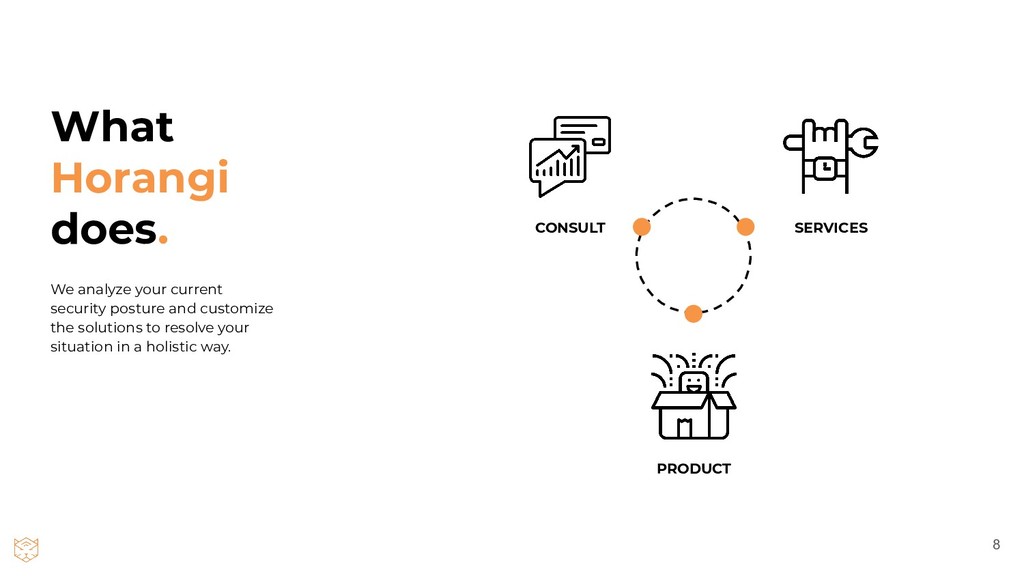
What Horangi does. We analyze your current security posture and
customize the solutions to resolve your situation in a holistic way. PRODUCT SERVICES CONSULT 8 -
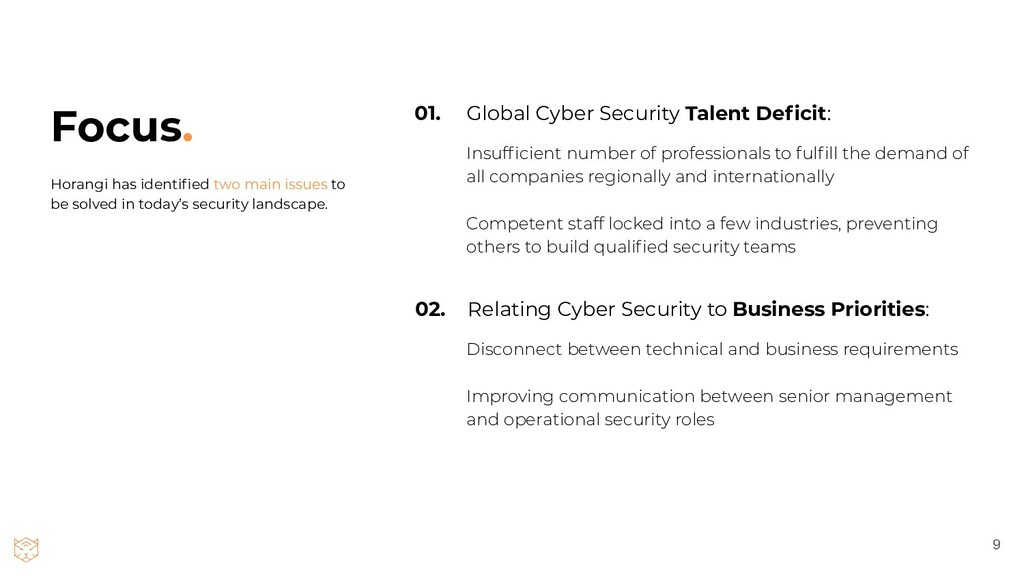
Focus. 01. Global Cyber Security Talent Deficit: Insufficient number of
professionals to fulfill the demand of all companies regionally and internationally Competent staff locked into a few industries, preventing others to build qualified security teams 02. Relating Cyber Security to Business Priorities: Disconnect between technical and business requirements Improving communication between senior management and operational security roles Horangi has identified two main issues to be solved in today’s security landscape. 9 -
Warden is a cloud security assessment and monitoring tool that
detects misconfigurations and vulnerabilities in your cloud infrastructure. 11 -
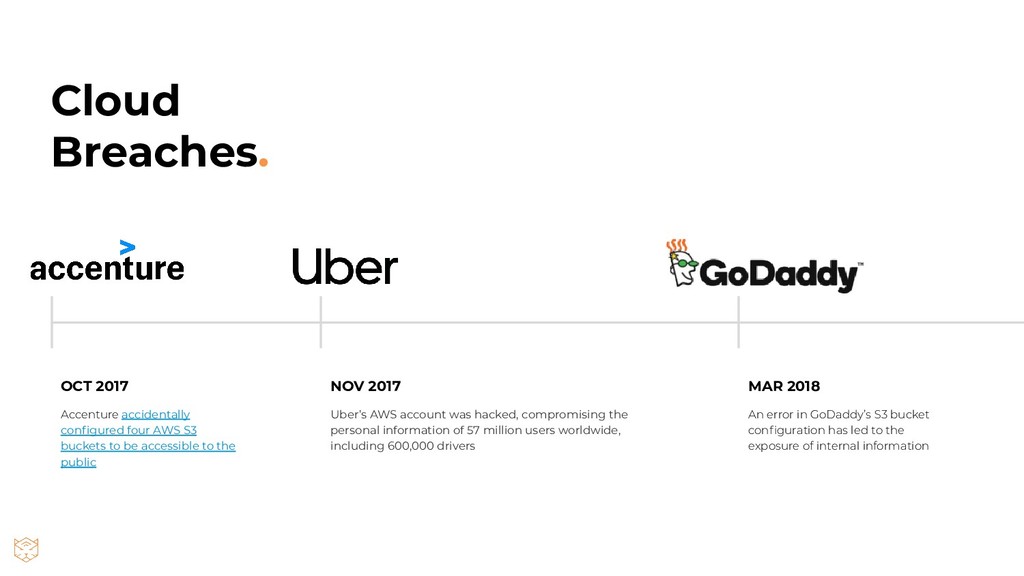
Cloud Breaches. Accenture accidentally configured four AWS S3 buckets to
be accessible to the public Uber’s AWS account was hacked, compromising the personal information of 57 million users worldwide, including 600,000 drivers OCT 2017 NOV 2017 An error in GoDaddy’s S3 bucket configuration has led to the exposure of internal information MAR 2018 -
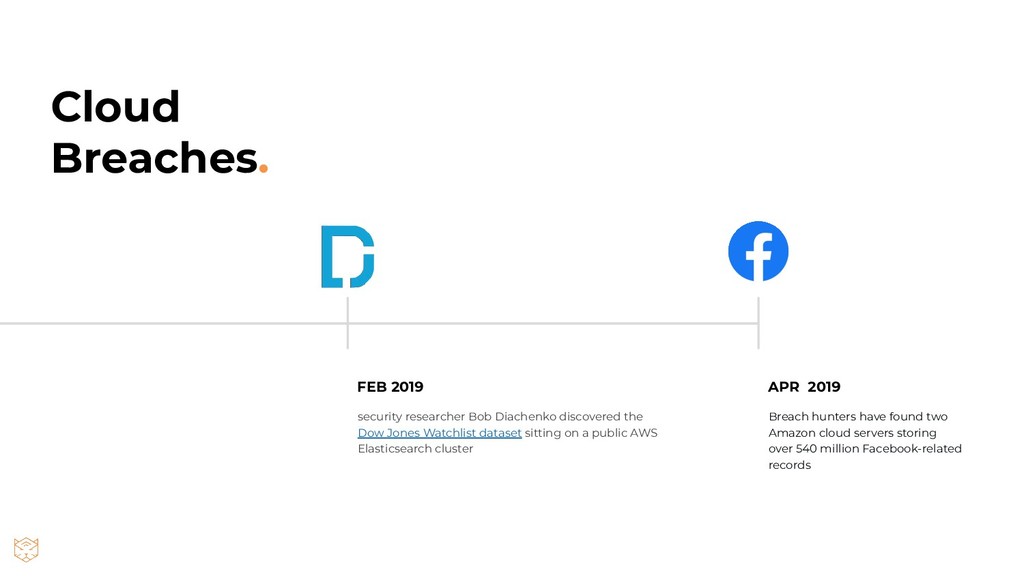
Cloud Breaches. security researcher Bob Diachenko discovered the Dow Jones
Watchlist dataset sitting on a public AWS Elasticsearch cluster FEB 2019 Breach hunters have found two Amazon cloud servers storing over 540 million Facebook-related records APR 2019 -
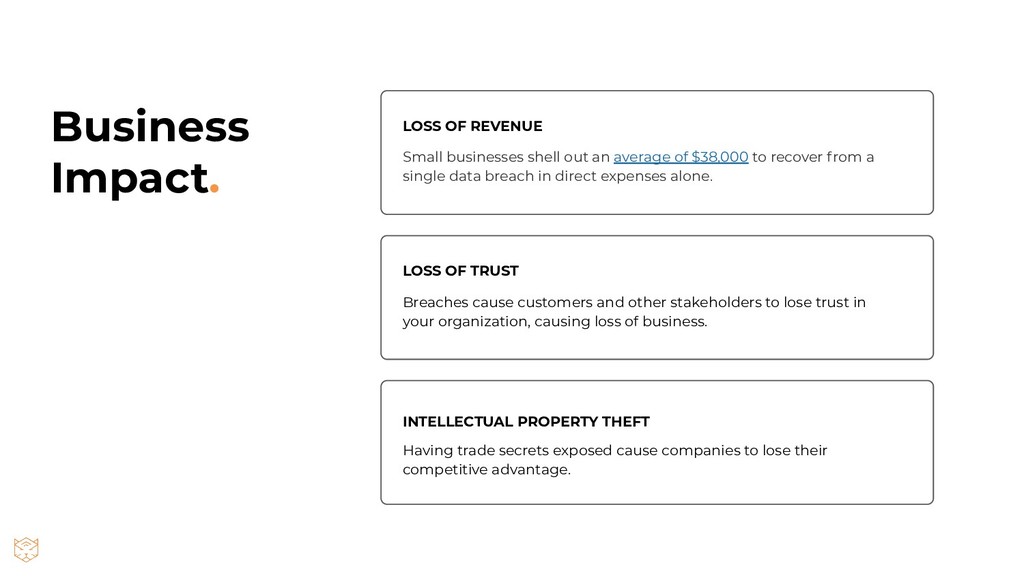
Business Impact. LOSS OF REVENUE Small businesses shell out an
average of $38,000 to recover from a single data breach in direct expenses alone. LOSS OF TRUST Breaches cause customers and other stakeholders to lose trust in your organization, causing loss of business. INTELLECTUAL PROPERTY THEFT Having trade secrets exposed cause companies to lose their competitive advantage. -
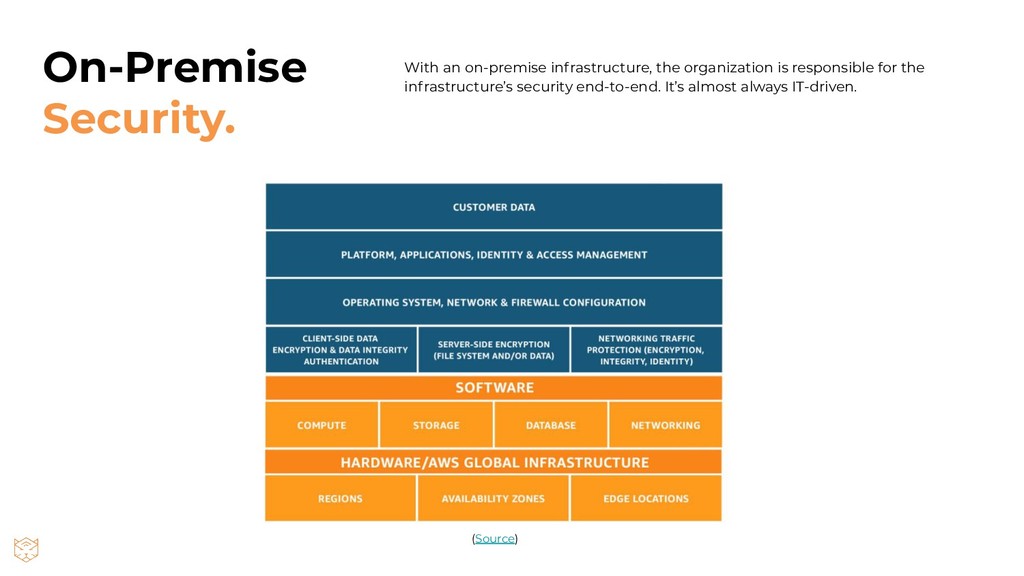
On-Premise Security. With an on-premise infrastructure, the organization is responsible
for the infrastructure’s security end-to-end. It’s almost always IT-driven. (Source) -
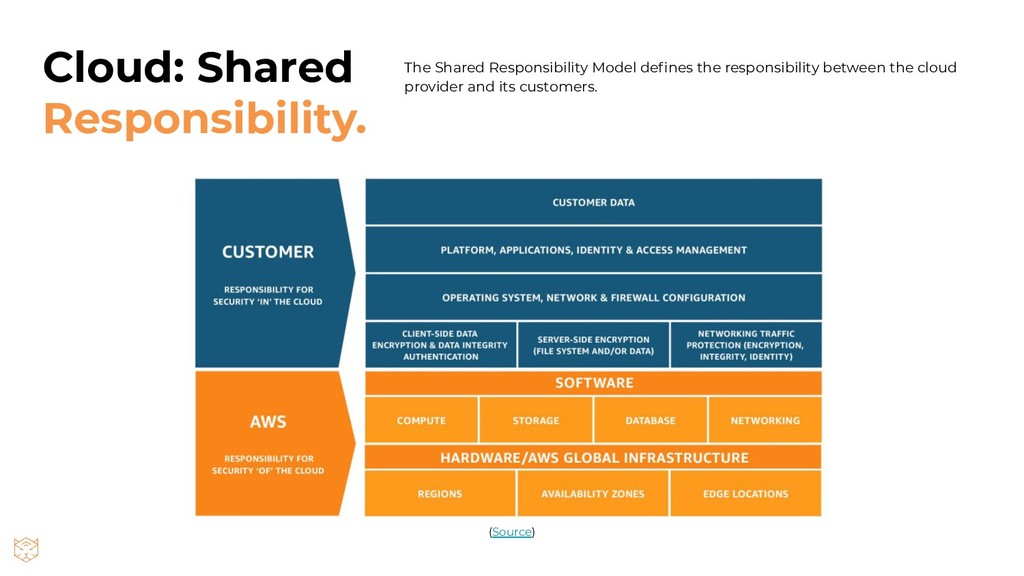
Cloud: Shared Responsibility. The Shared Responsibility Model defines the responsibility
between the cloud provider and its customers. (Source) -
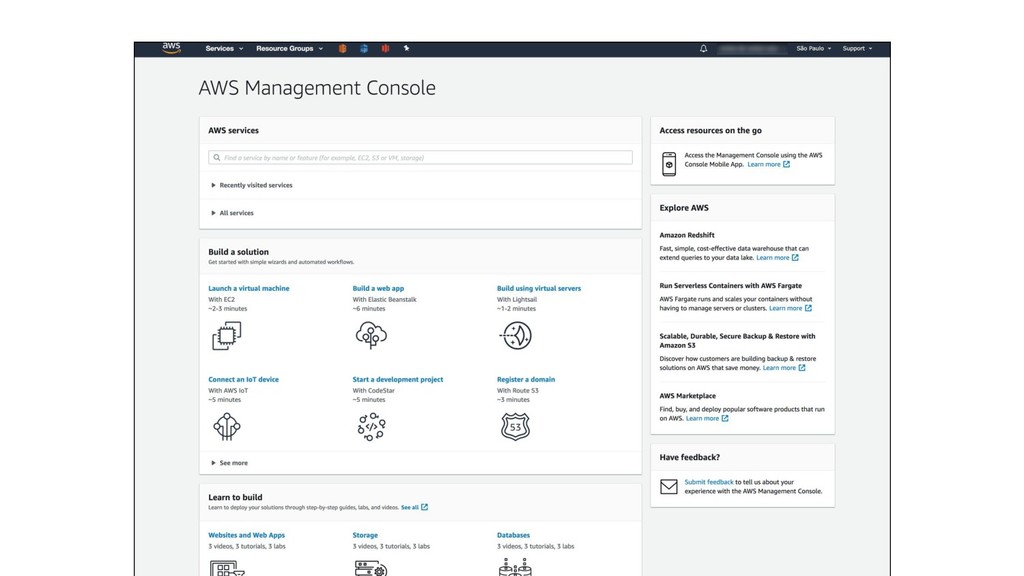
- Management Layer now exposed to Internet - Traditional Siloed
Roles vs new Cloud Roles - Our Talent pool is not all mature enough for the Cloud Shift Other Key Points -
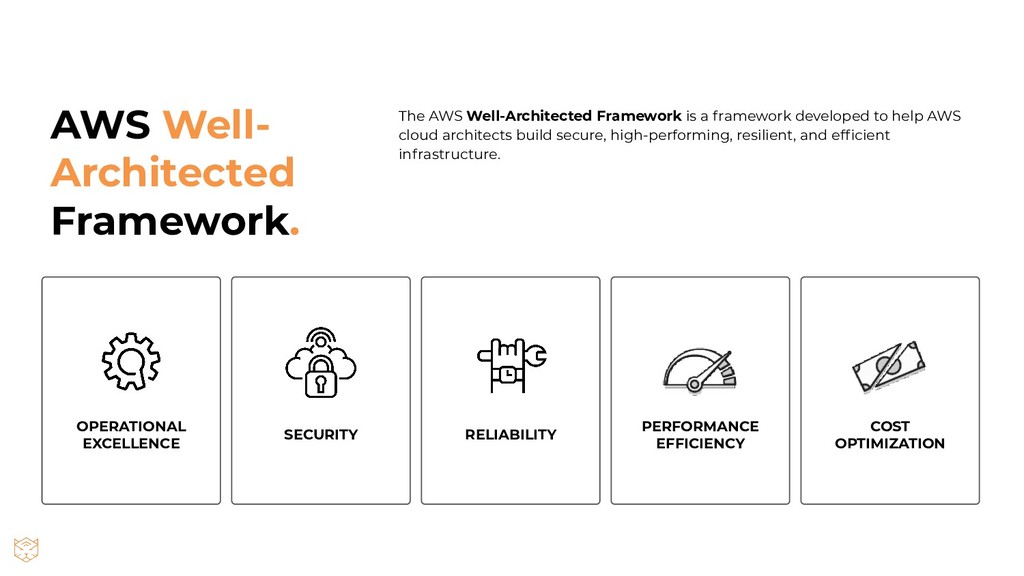
RELIABILITY PERFORMANCE EFFICIENCY OPERATIONAL EXCELLENCE SECURITY AWS Well- Architected Framework.
The AWS Well-Architected Framework is a framework developed to help AWS cloud architects build secure, high-performing, resilient, and efficient infrastructure. COST OPTIMIZATION -
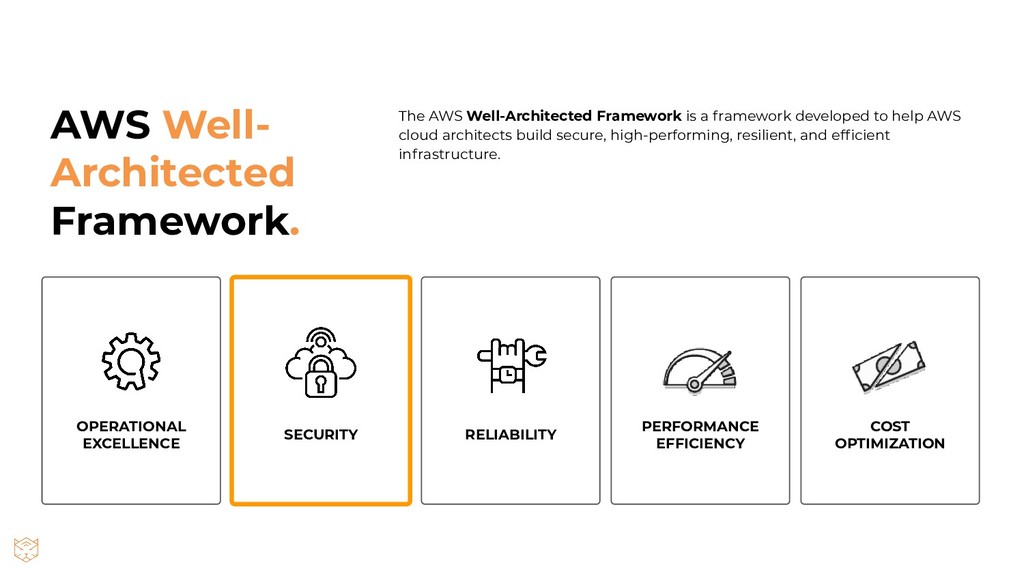
RELIABILITY PERFORMANCE EFFICIENCY OPERATIONAL EXCELLENCE SECURITY AWS Well- Architected Framework.
The AWS Well-Architected Framework is a framework developed to help AWS cloud architects build secure, high-performing, resilient, and efficient infrastructure. COST OPTIMIZATION -
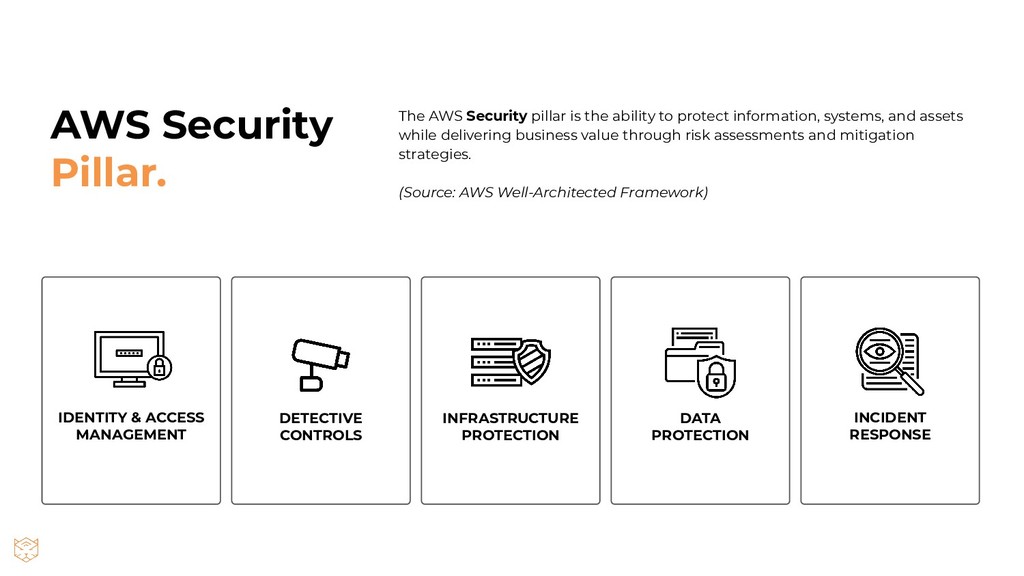
INFRASTRUCTURE PROTECTION DATA PROTECTION IDENTITY & ACCESS MANAGEMENT DETECTIVE CONTROLS
AWS Security Pillar. The AWS Security pillar is the ability to protect information, systems, and assets while delivering business value through risk assessments and mitigation strategies. (Source: AWS Well-Architected Framework) INCIDENT RESPONSE -
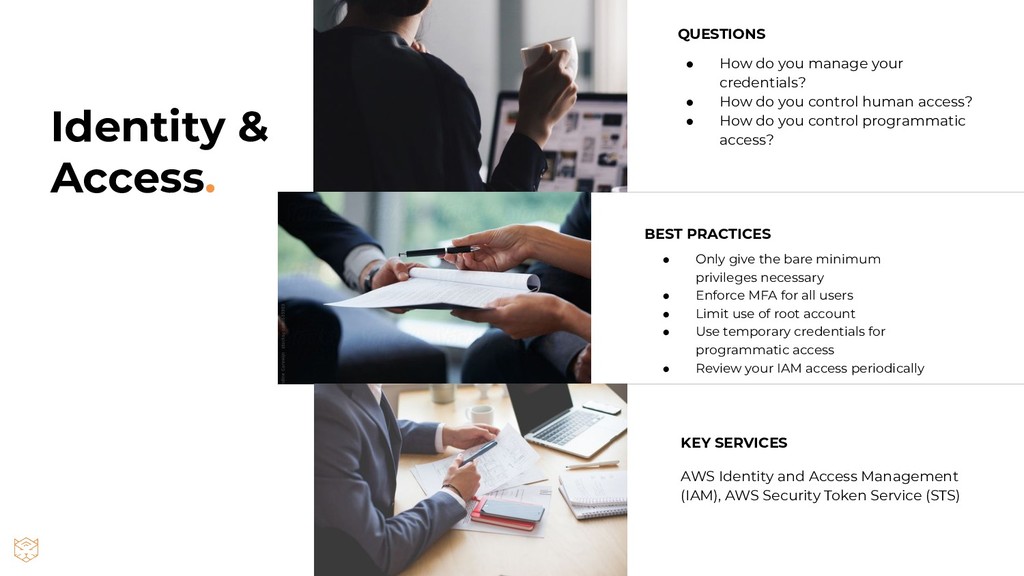
Identity & Access. • Only give the bare minimum privileges
necessary • Enforce MFA for all users • Limit use of root account • Use temporary credentials for programmatic access • Review your IAM access periodically AWS Identity and Access Management (IAM), AWS Security Token Service (STS) QUESTIONS BEST PRACTICES KEY SERVICES • How do you manage your credentials? • How do you control human access? • How do you control programmatic access? -
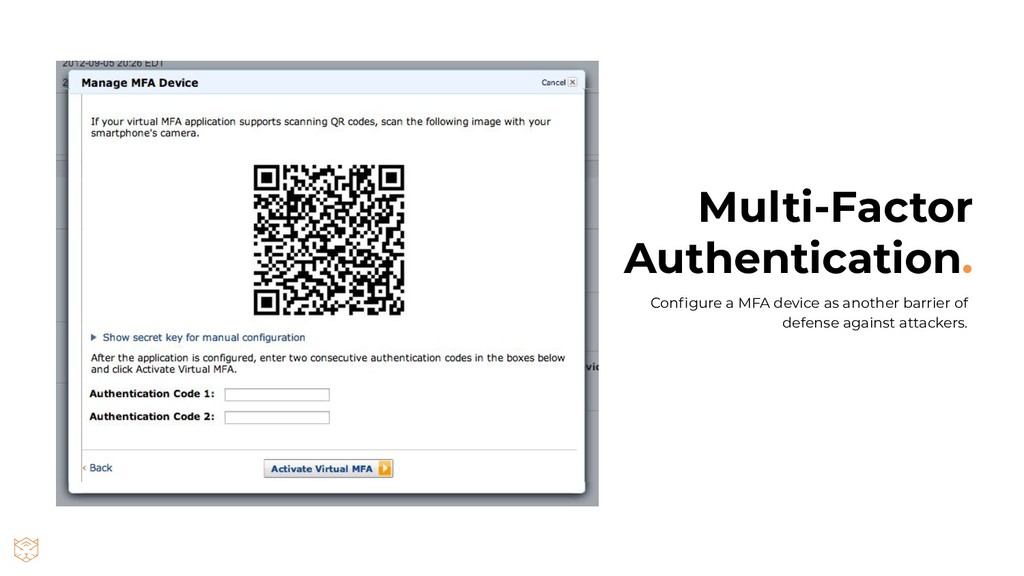
Multi-Factor Authentication. Configure a MFA device as another barrier of
defense against attackers. -
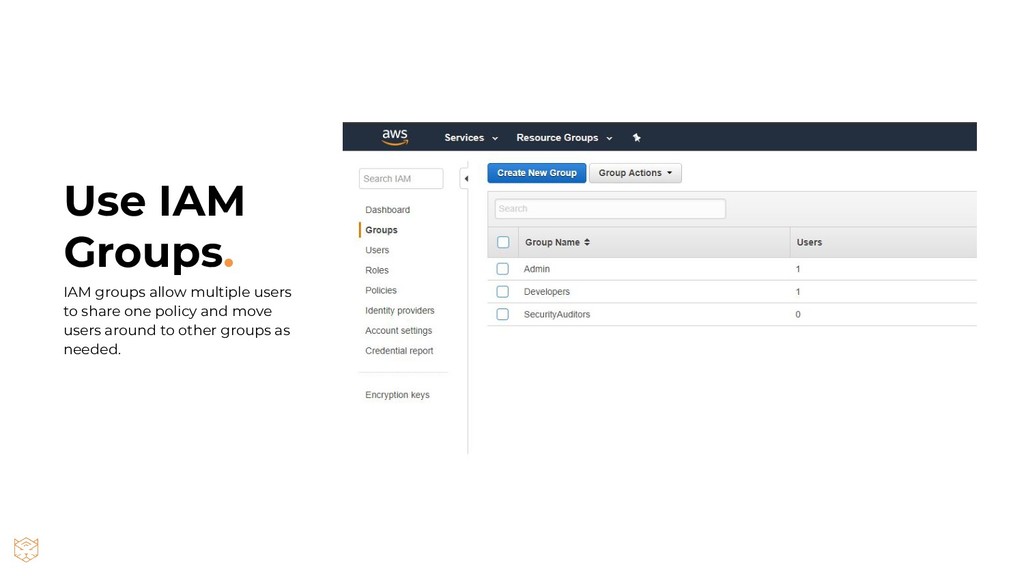
Use IAM Groups. IAM groups allow multiple users to share
one policy and move users around to other groups as needed. -
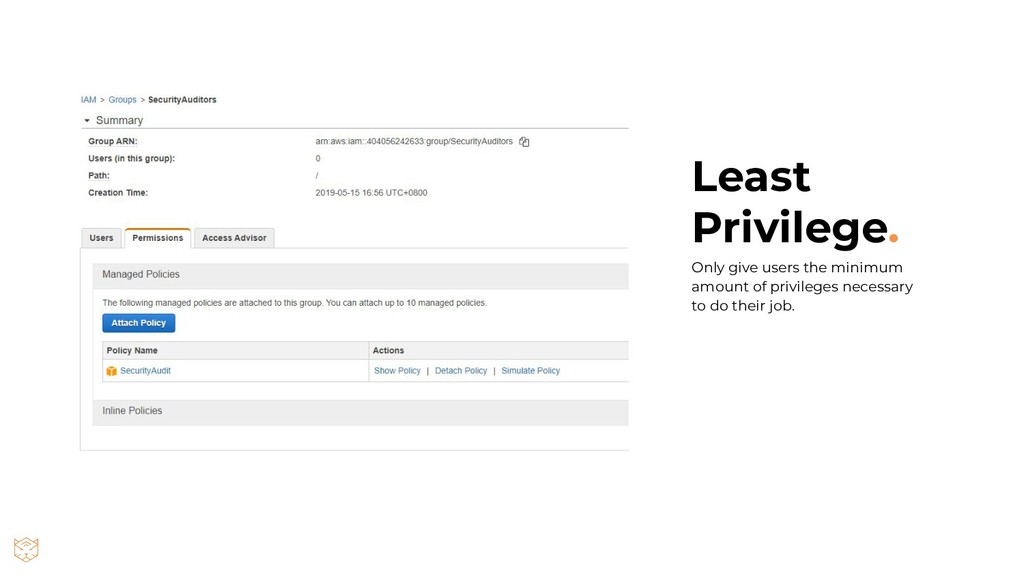
Least Privilege. Only give users the minimum amount of privileges
necessary to do their job. -
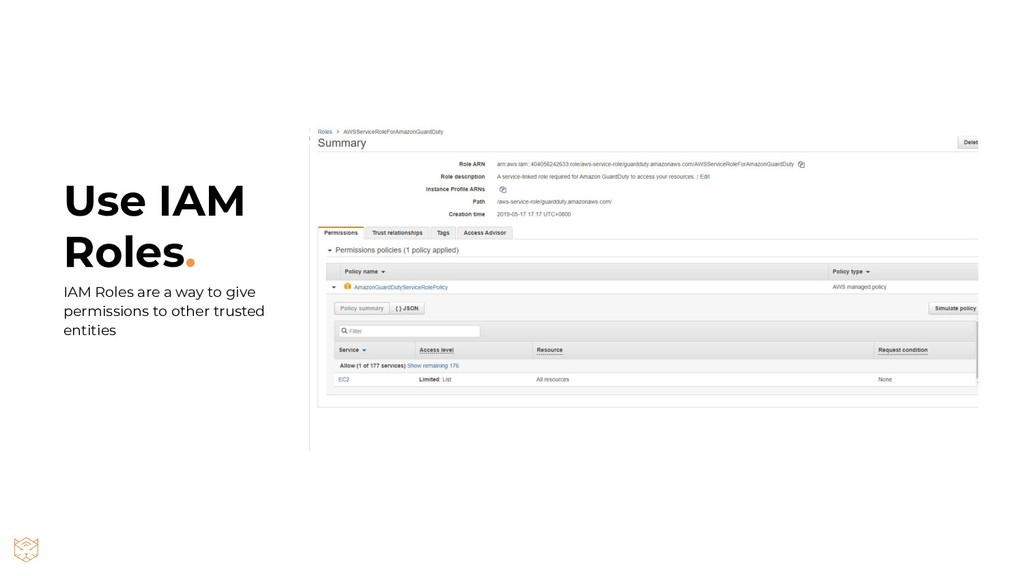
Use IAM Roles. IAM Roles are a way to give
permissions to other trusted entities -
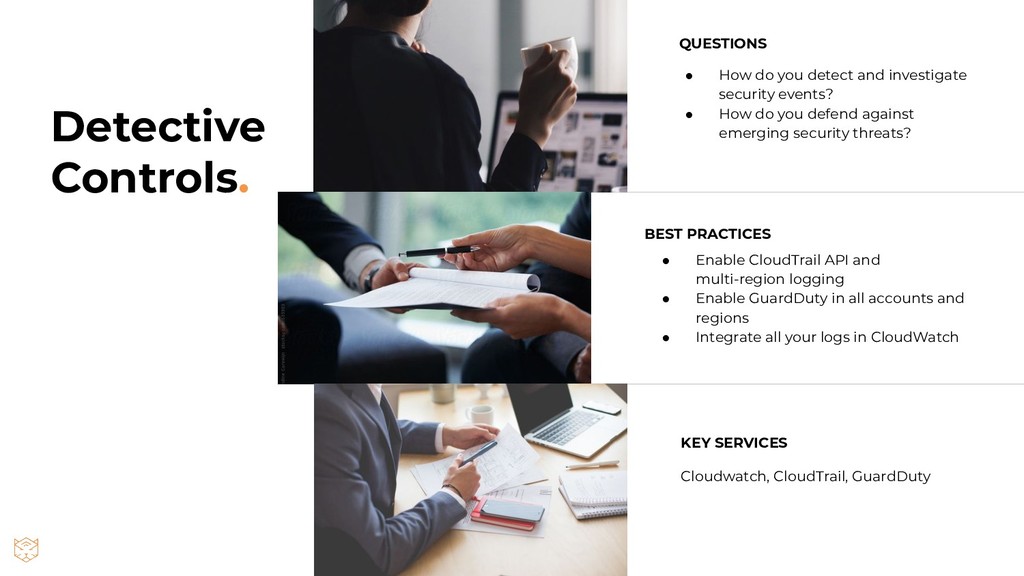
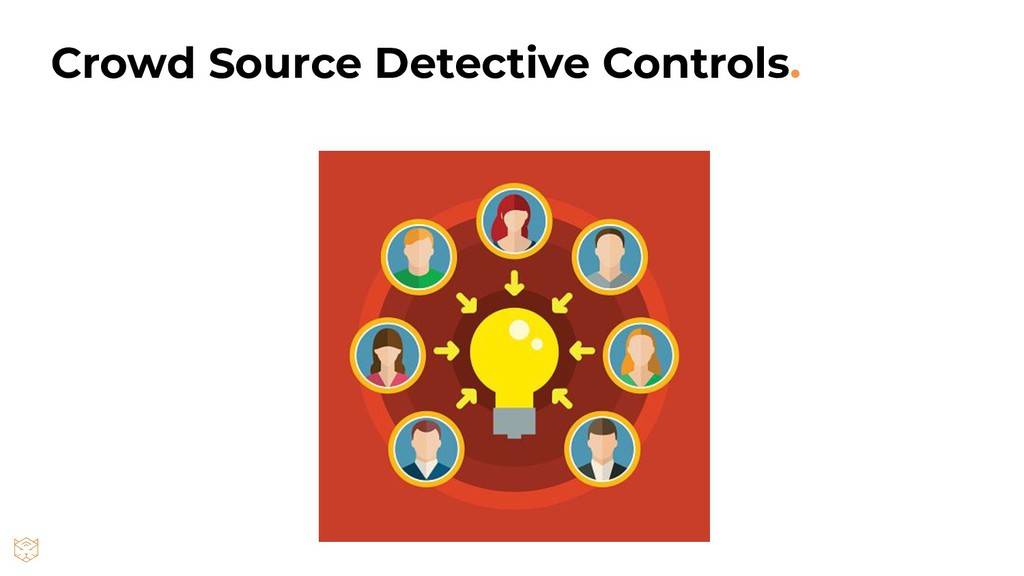
Detective Controls. • How do you detect and investigate security
events? • How do you defend against emerging security threats? • Enable CloudTrail API and multi-region logging • Enable GuardDuty in all accounts and regions • Integrate all your logs in CloudWatch Cloudwatch, CloudTrail, GuardDuty QUESTIONS BEST PRACTICES KEY SERVICES -
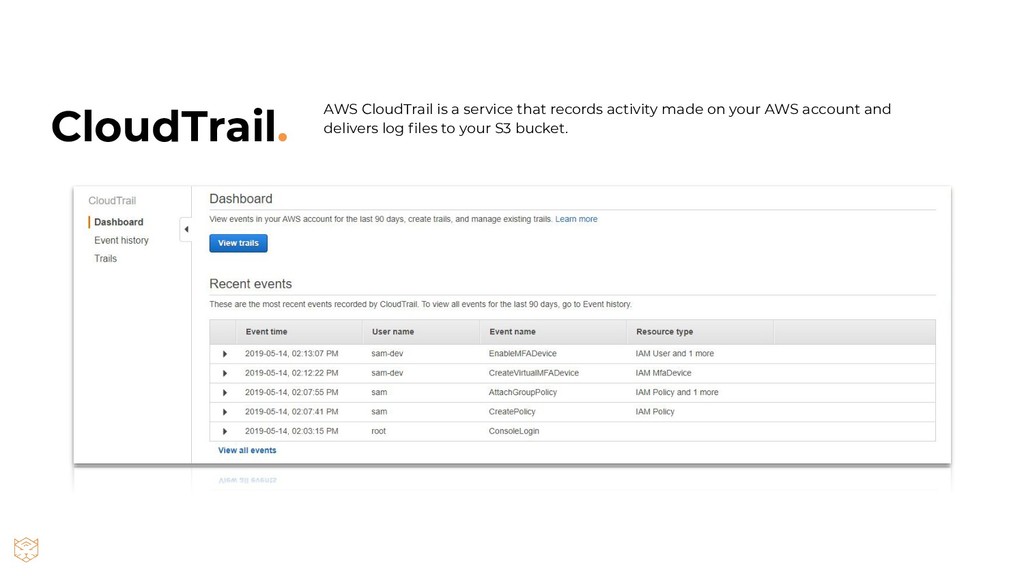
AWS CloudTrail is a service that records activity made on
your AWS account and delivers log files to your S3 bucket. CloudTrail. -
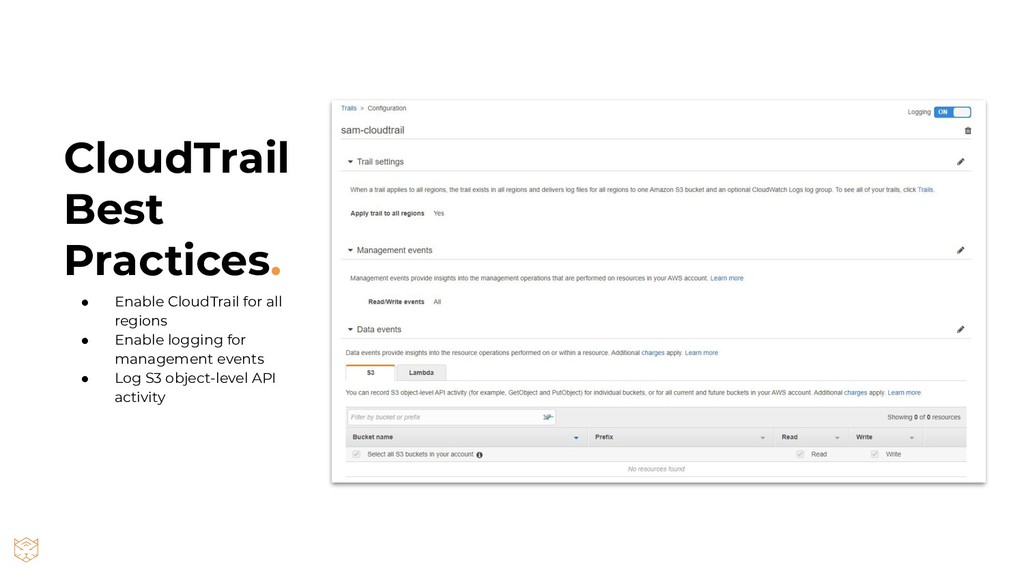
CloudTrail Best Practices. • Enable CloudTrail for all regions •
Enable logging for management events • Log S3 object-level API activity -
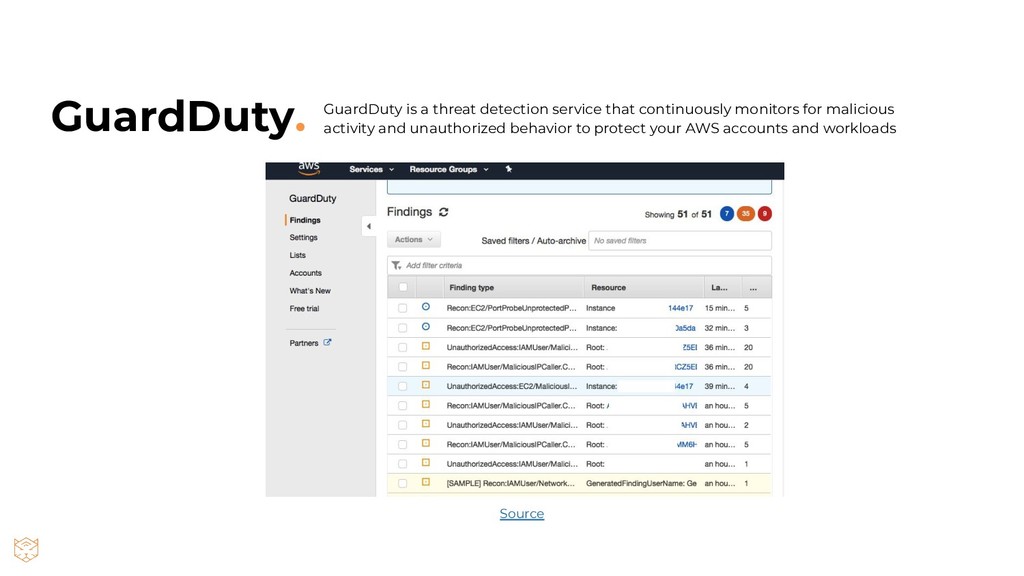
GuardDuty is a threat detection service that continuously monitors for
malicious activity and unauthorized behavior to protect your AWS accounts and workloads GuardDuty. Source -
Infrastructure Protection. • How do you protect your networks? •
How do you protect your compute resources? • Open only the necessary ports for operation • Automate deployment and maintenance whenever possible • Use IAM to configure user-level access Virtual Private Cloud (VPC) QUESTIONS BEST PRACTICES KEY SERVICES -
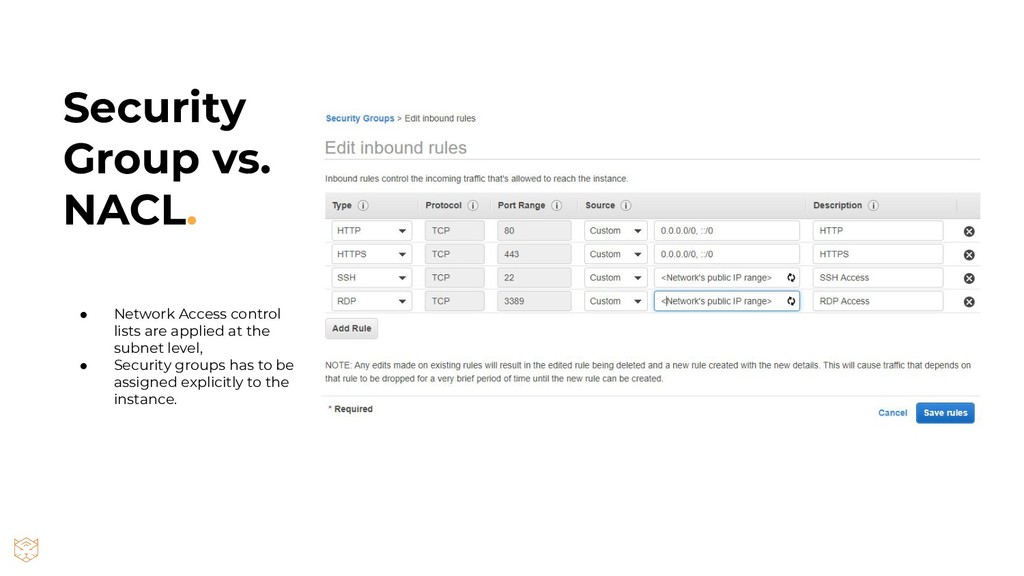
Security Group vs. NACL. • Network Access control lists are
applied at the subnet level, • Security groups has to be assigned explicitly to the instance. -
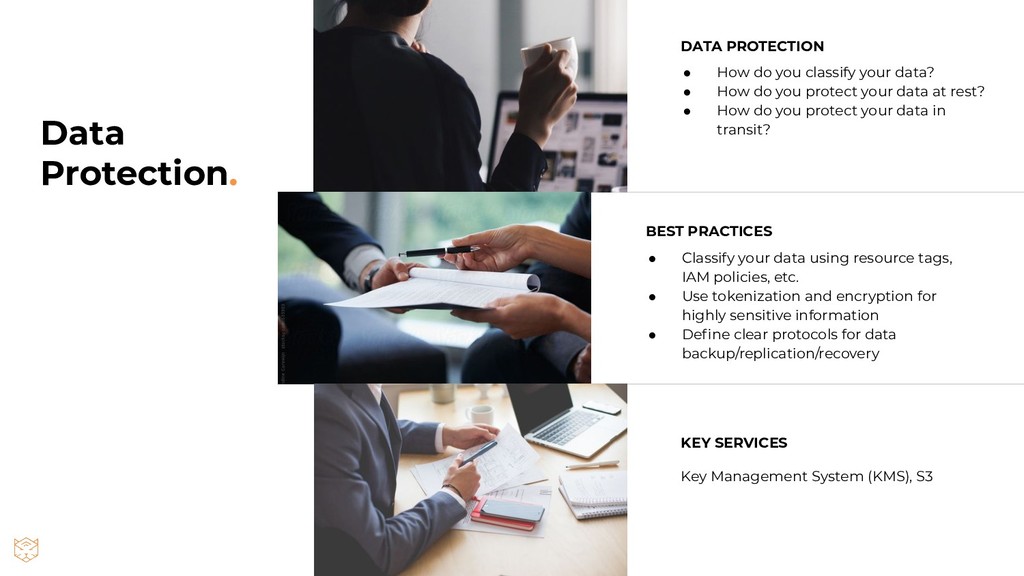
Data Protection. • How do you classify your data? •
How do you protect your data at rest? • How do you protect your data in transit? • Classify your data using resource tags, IAM policies, etc. • Use tokenization and encryption for highly sensitive information • Define clear protocols for data backup/replication/recovery Key Management System (KMS), S3 DATA PROTECTION BEST PRACTICES KEY SERVICES -
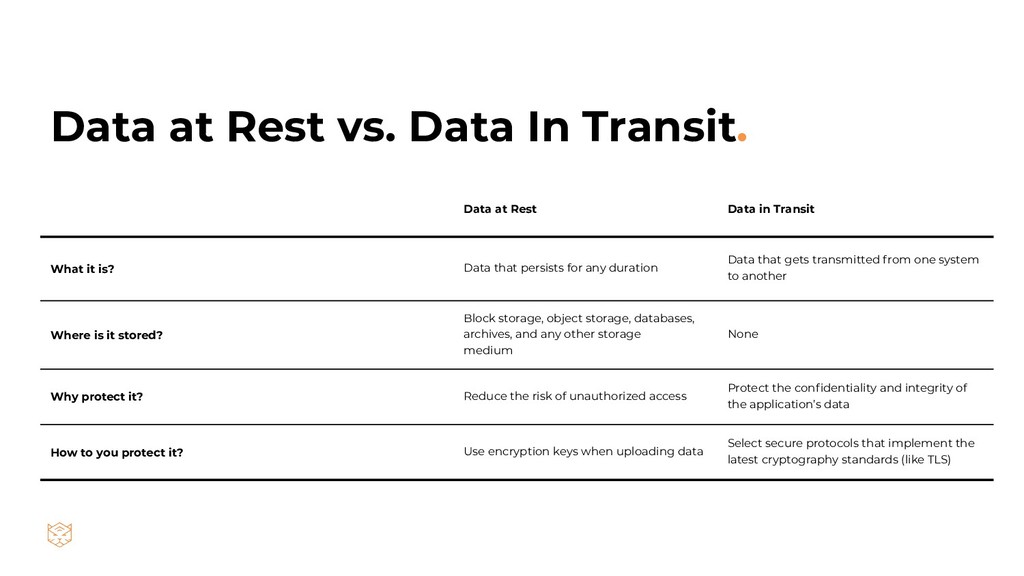
Data at Rest vs. Data In Transit. Data at Rest
Data in Transit What it is? Data that persists for any duration Data that gets transmitted from one system to another Where is it stored? Block storage, object storage, databases, archives, and any other storage medium None Why protect it? Reduce the risk of unauthorized access Protect the confidentiality and integrity of the application’s data How to you protect it? Use encryption keys when uploading data Select secure protocols that implement the latest cryptography standards (like TLS) -
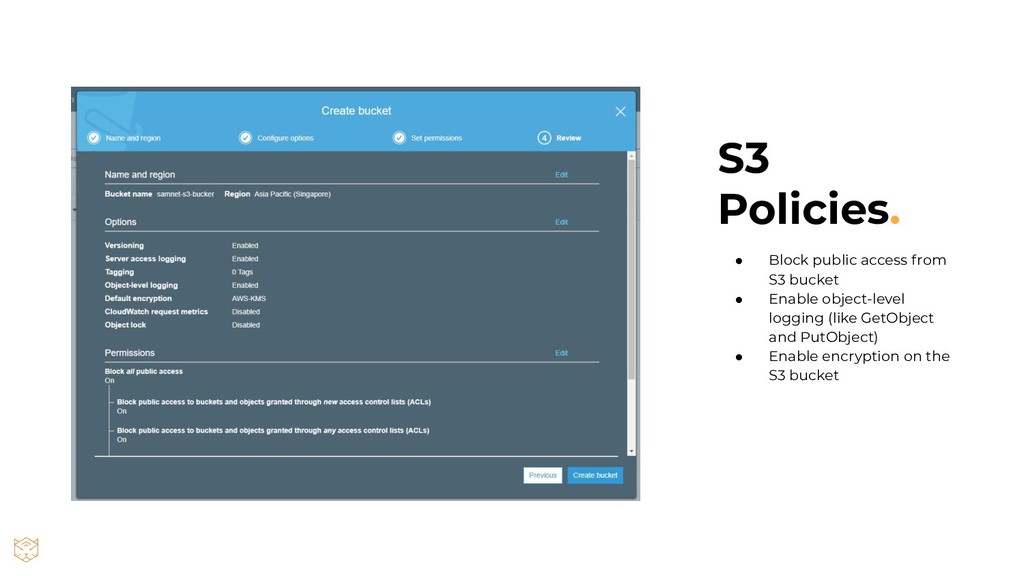
S3 Policies. • Block public access from S3 bucket •
Enable object-level logging (like GetObject and PutObject) • Enable encryption on the S3 bucket -
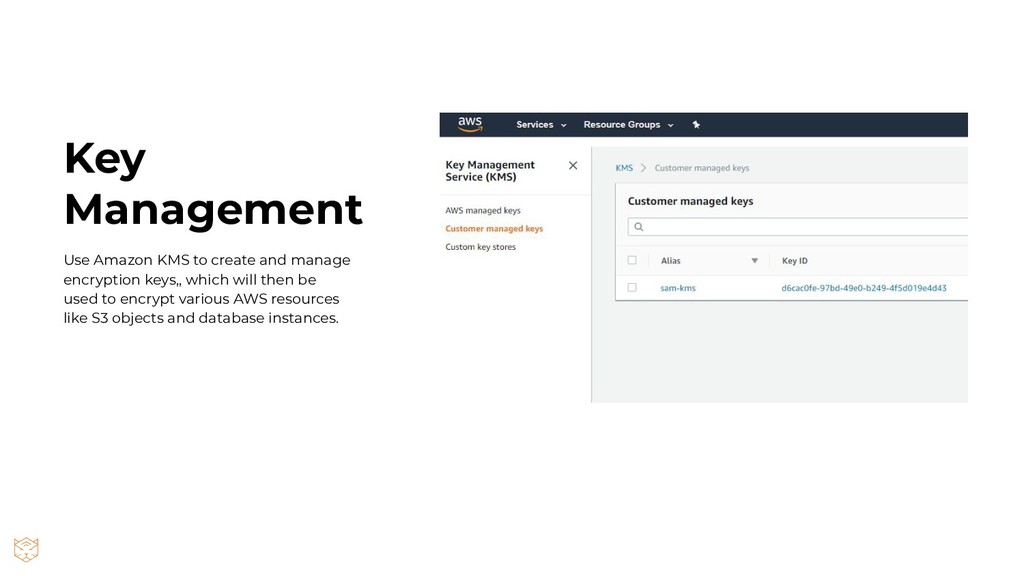
Key Management Use Amazon KMS to create and manage encryption
keys,, which will then be used to encrypt various AWS resources like S3 objects and database instances. -
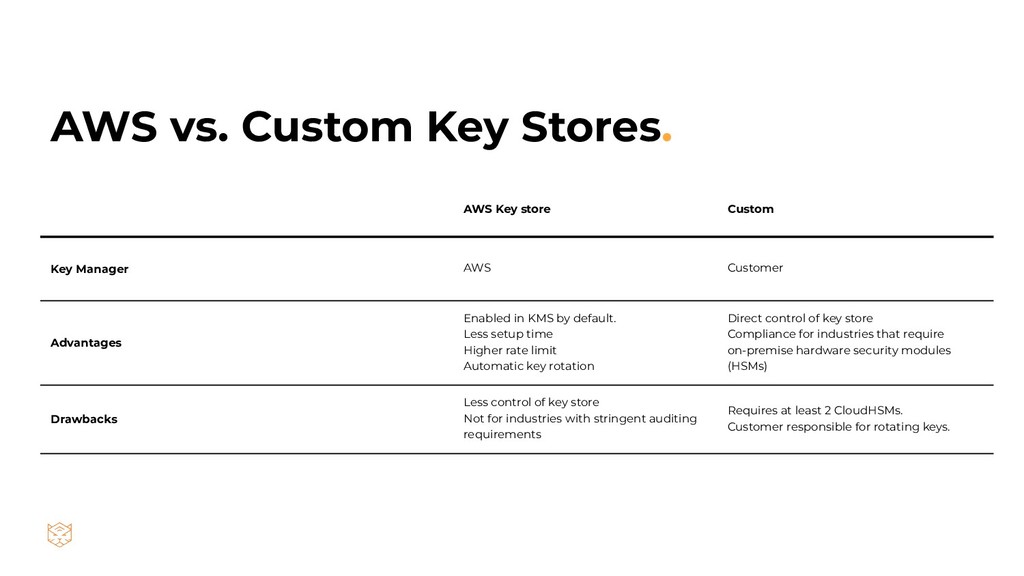
AWS vs. Custom Key Stores. AWS Key store Custom Key
Manager AWS Customer Advantages Enabled in KMS by default. Less setup time Higher rate limit Automatic key rotation Direct control of key store Compliance for industries that require on-premise hardware security modules (HSMs) Drawbacks Less control of key store Not for industries with stringent auditing requirements Requires at least 2 CloudHSMs. Customer responsible for rotating keys. -
Incident Response. • How do you respond to an incident?
• Have a defined incident response policy in place • Use resource tags to organize process • Use the “Clean Room” approach when investigating the root cause • Configure logs to audit as much as possible VPC, IAM, CloudFormation QUESTIONS BEST PRACTICES KEY SERVICES -
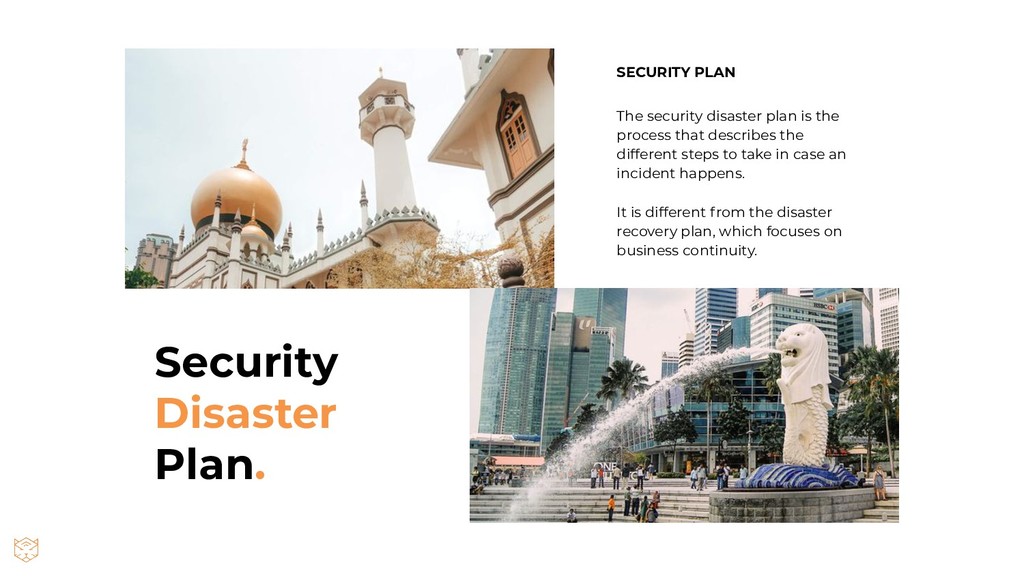
Security Disaster Plan. The security disaster plan is the process
that describes the different steps to take in case an incident happens. It is different from the disaster recovery plan, which focuses on business continuity. SECURITY PLAN