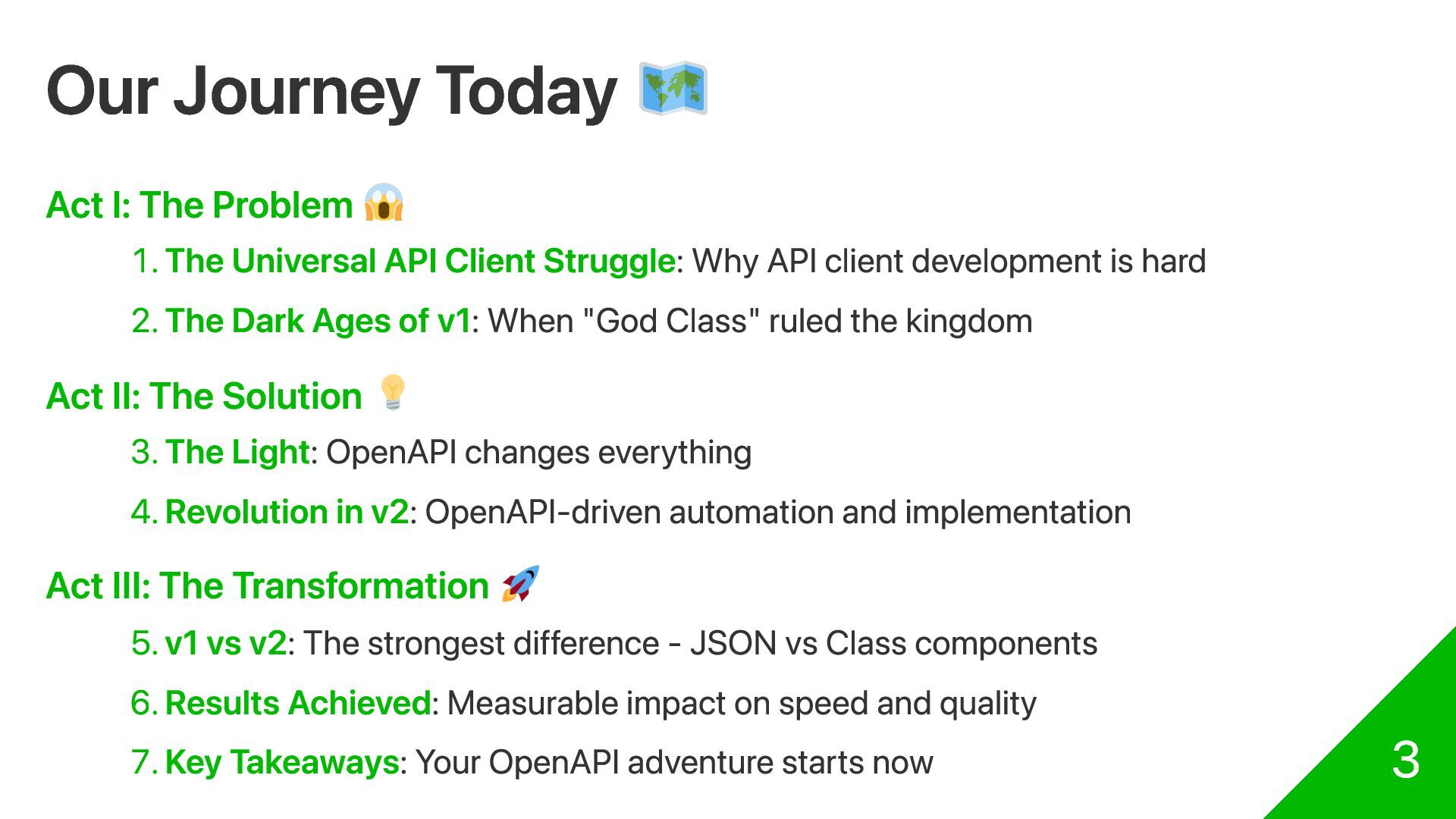
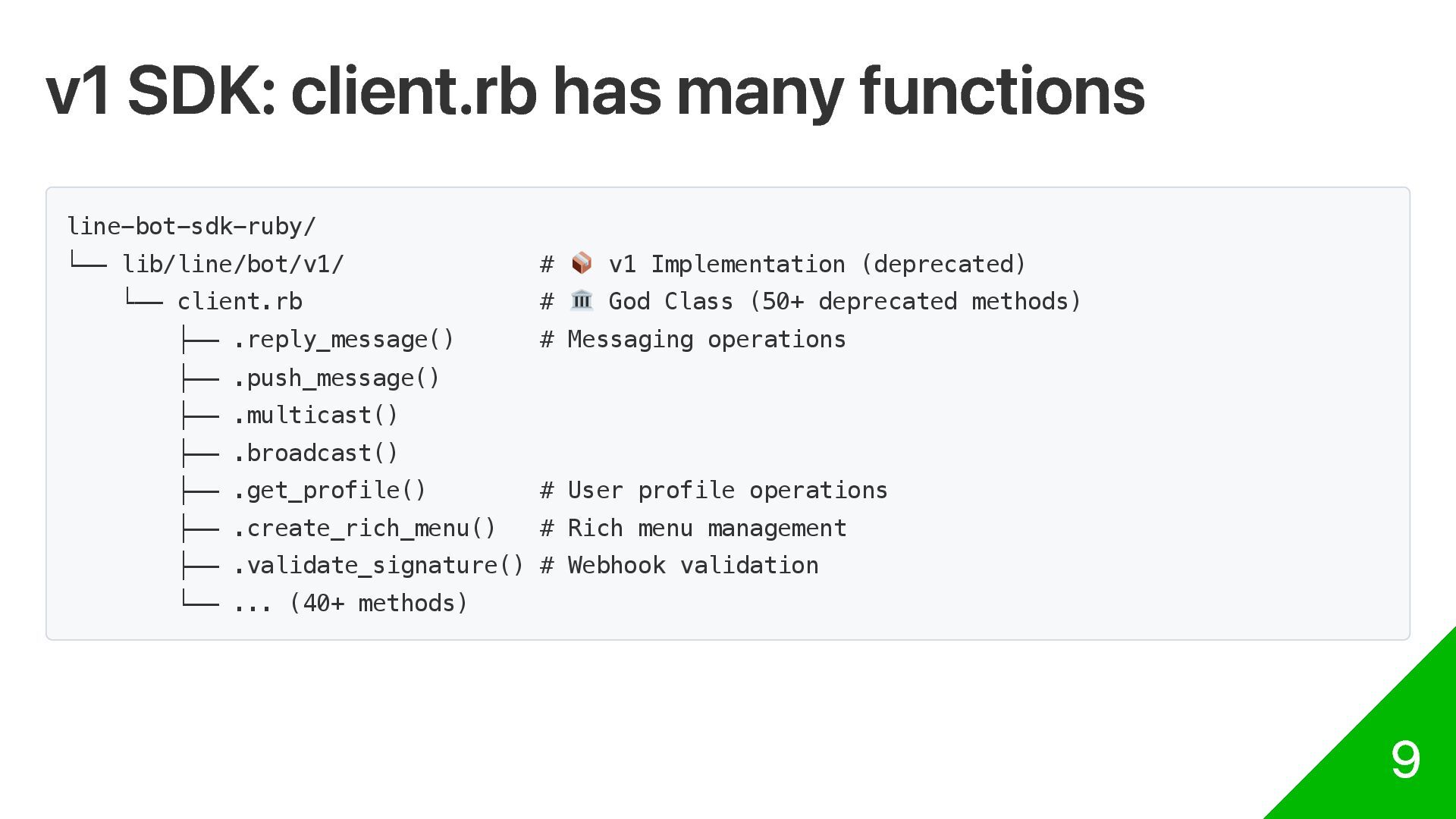
API Client Struggle: Why API client development is hard 2. The Dark Ages of v1: When "God Class" ruled the kingdom Act II: The Solution 3. The Light: OpenAPI changes everything 4. Revolution in v2: OpenAPI-driven automation and implementation Act III: The Transformation 5. v1 vs v2: The strongest difference - JSON vs Class components 6. Results Achieved: Measurable impact on speed and quality 7. Key Takeaways: Your OpenAPI adventure starts now 3
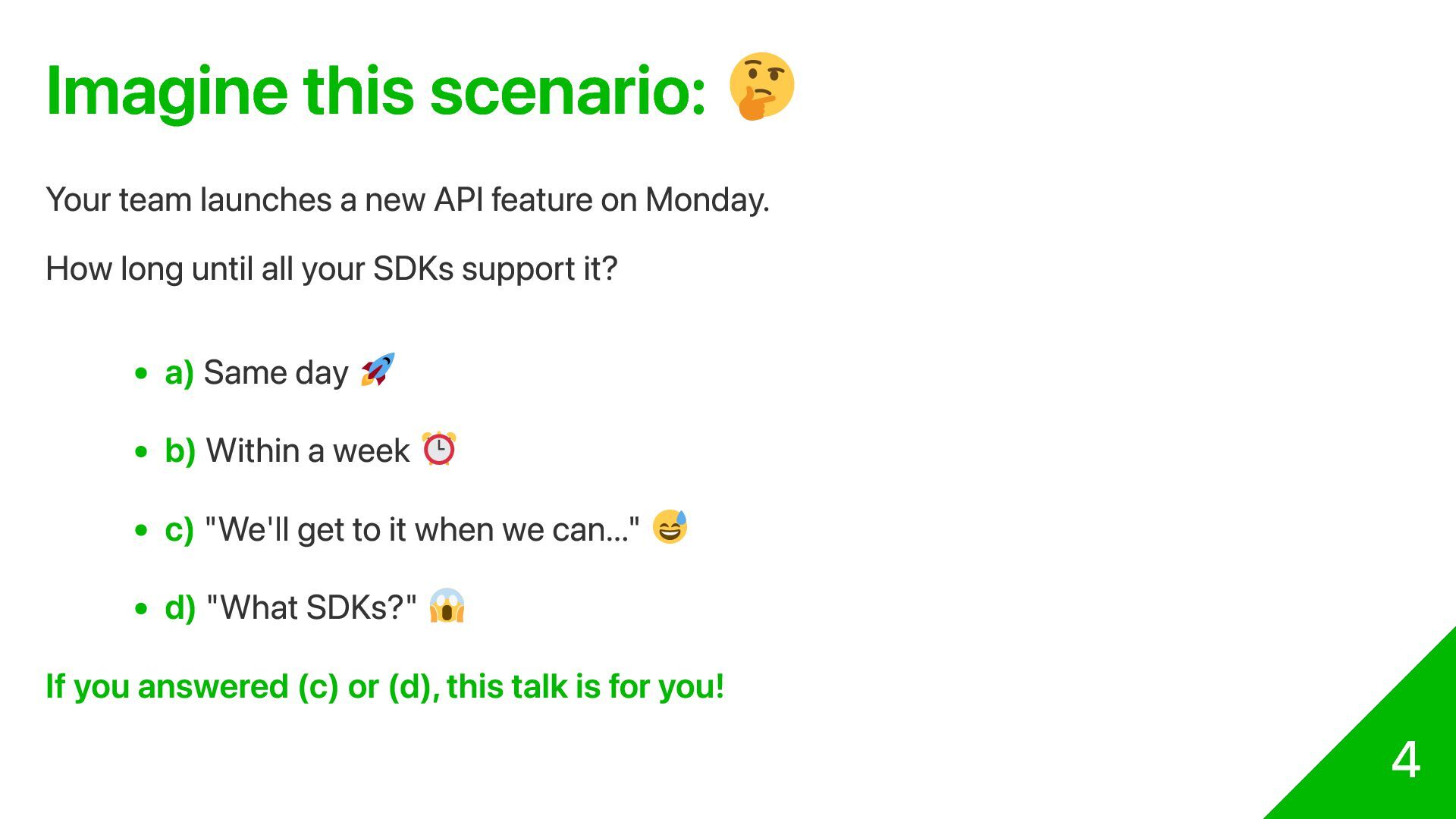
on Monday. How long until all your SDKs support it? a) Same day b) Within a week c) "We'll get to it when we can..." d) "What SDKs?" If you answered (c) or (d), this talk is for you! 4
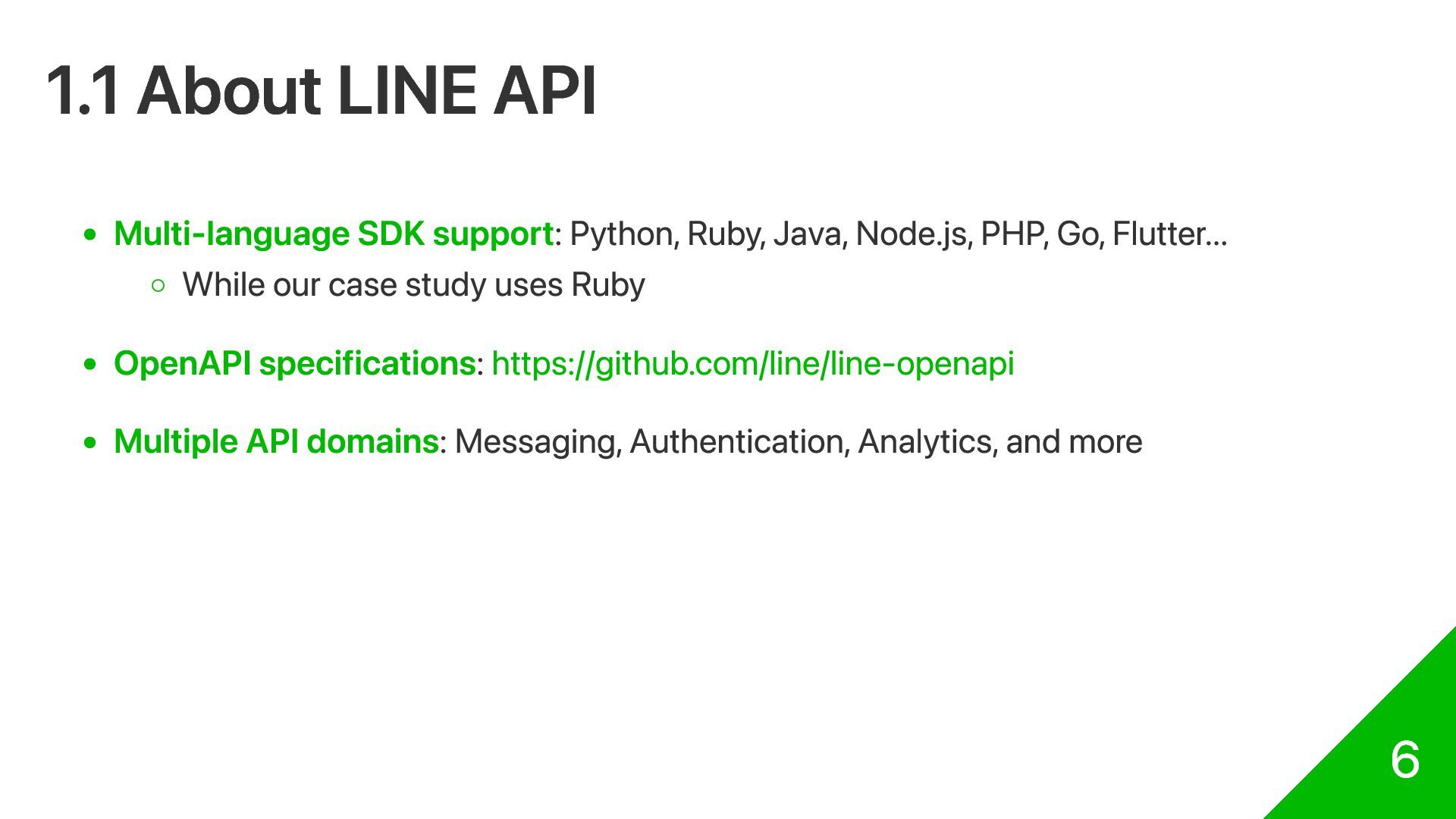
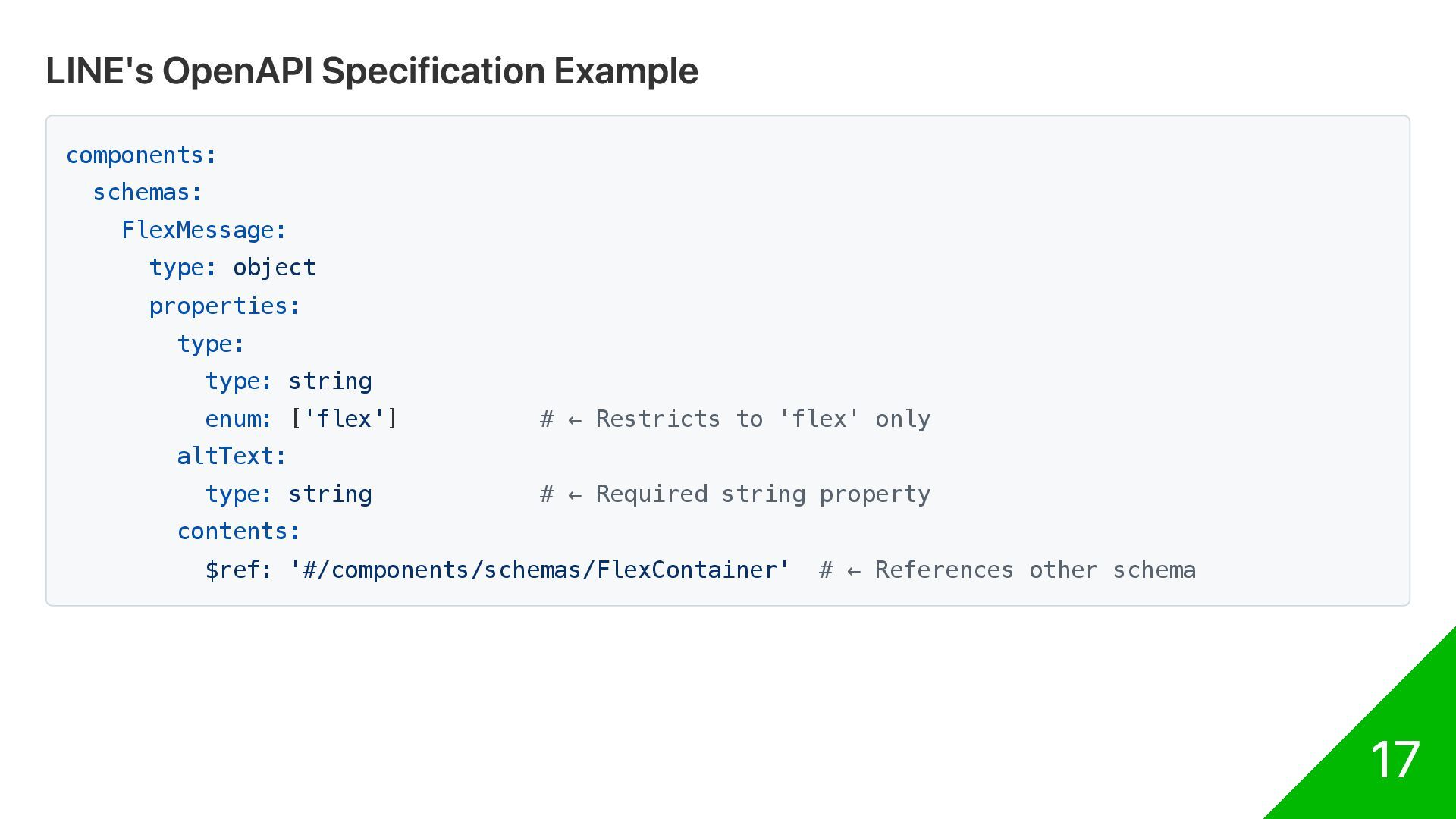
Node.js, PHP, Go, Flutter... While our case study uses Ruby OpenAPI specifications: https://github.com/line/line-openapi Multiple API domains: Messaging, Authentication, Analytics, and more 6
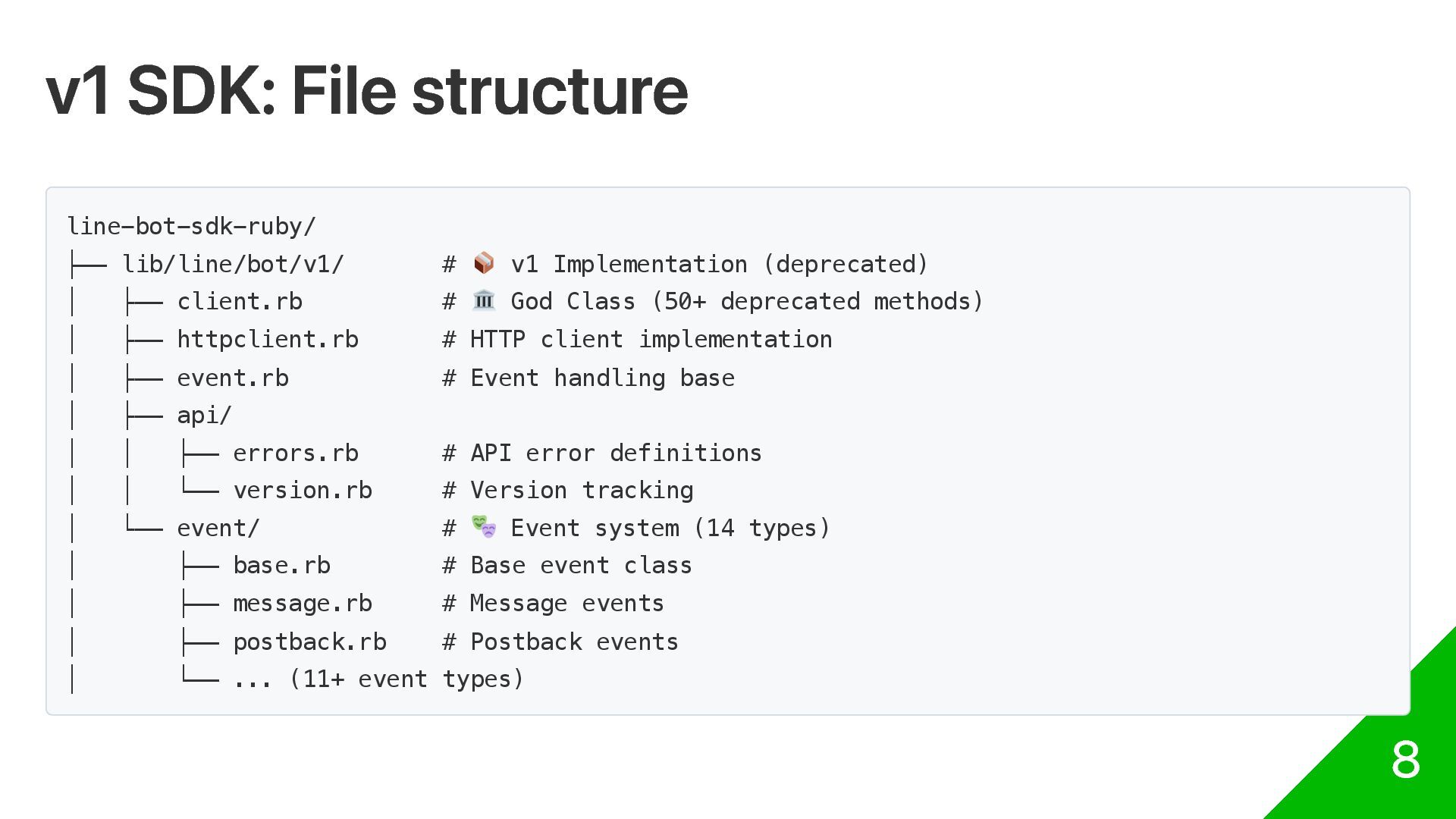
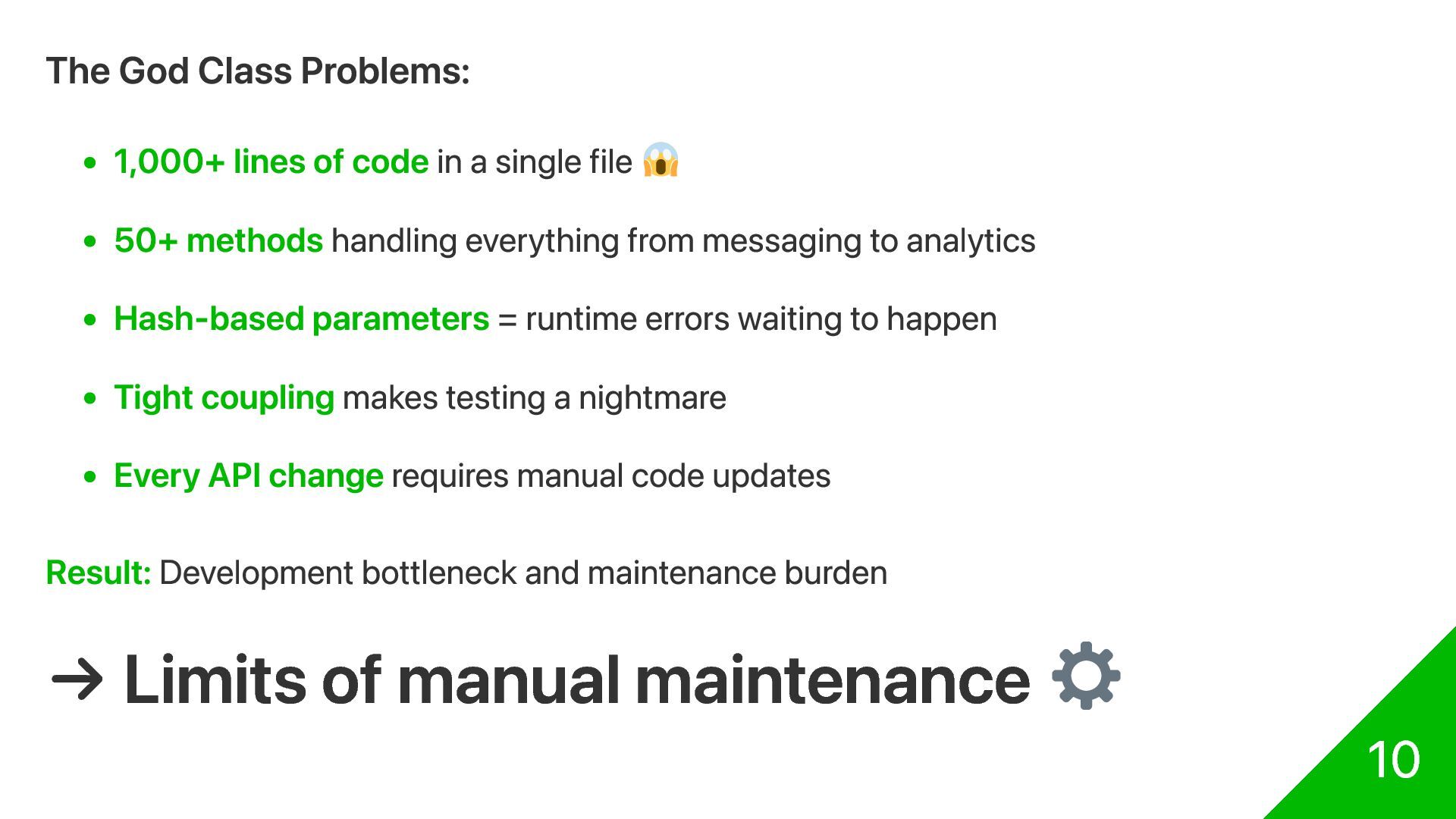
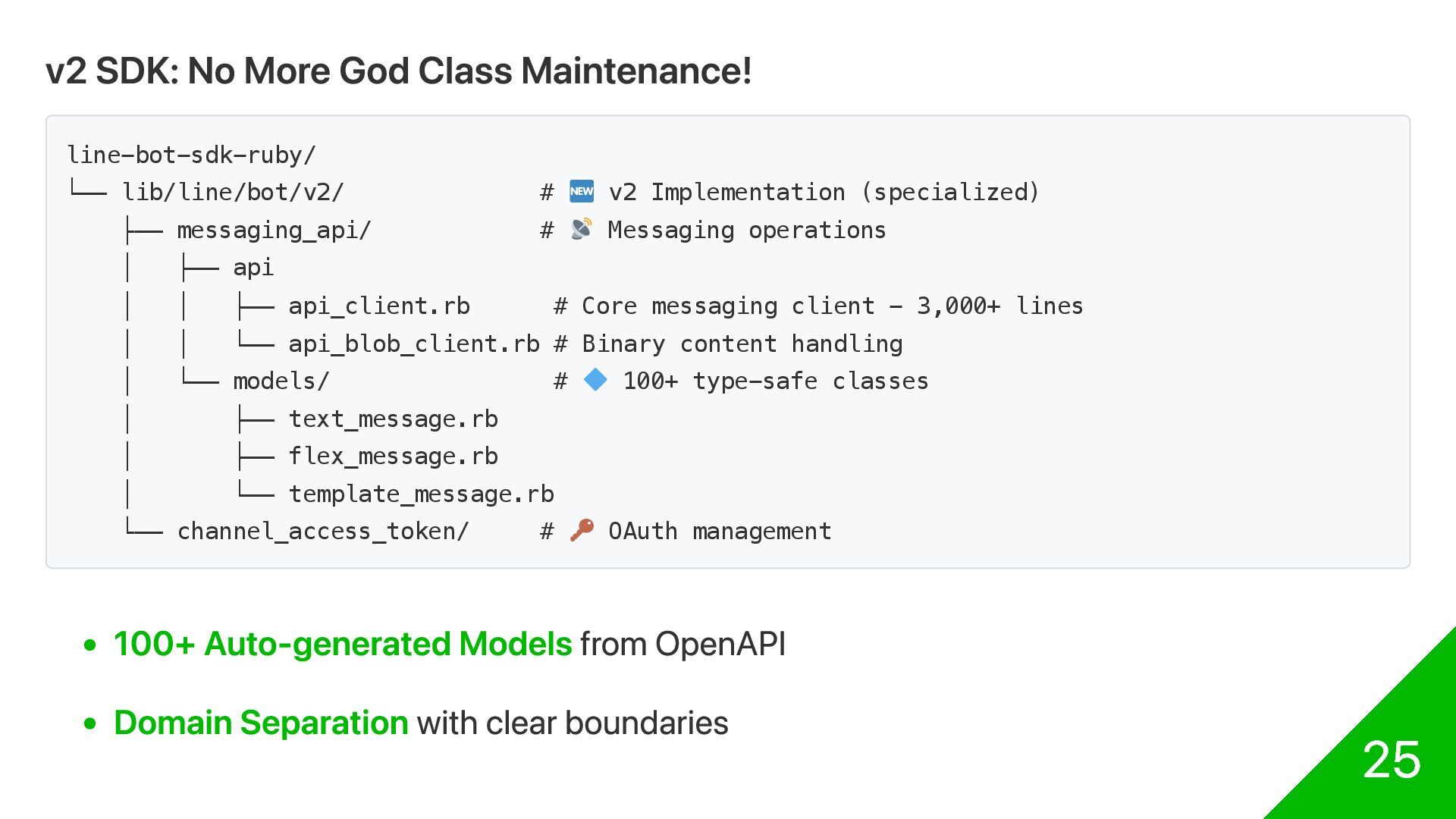
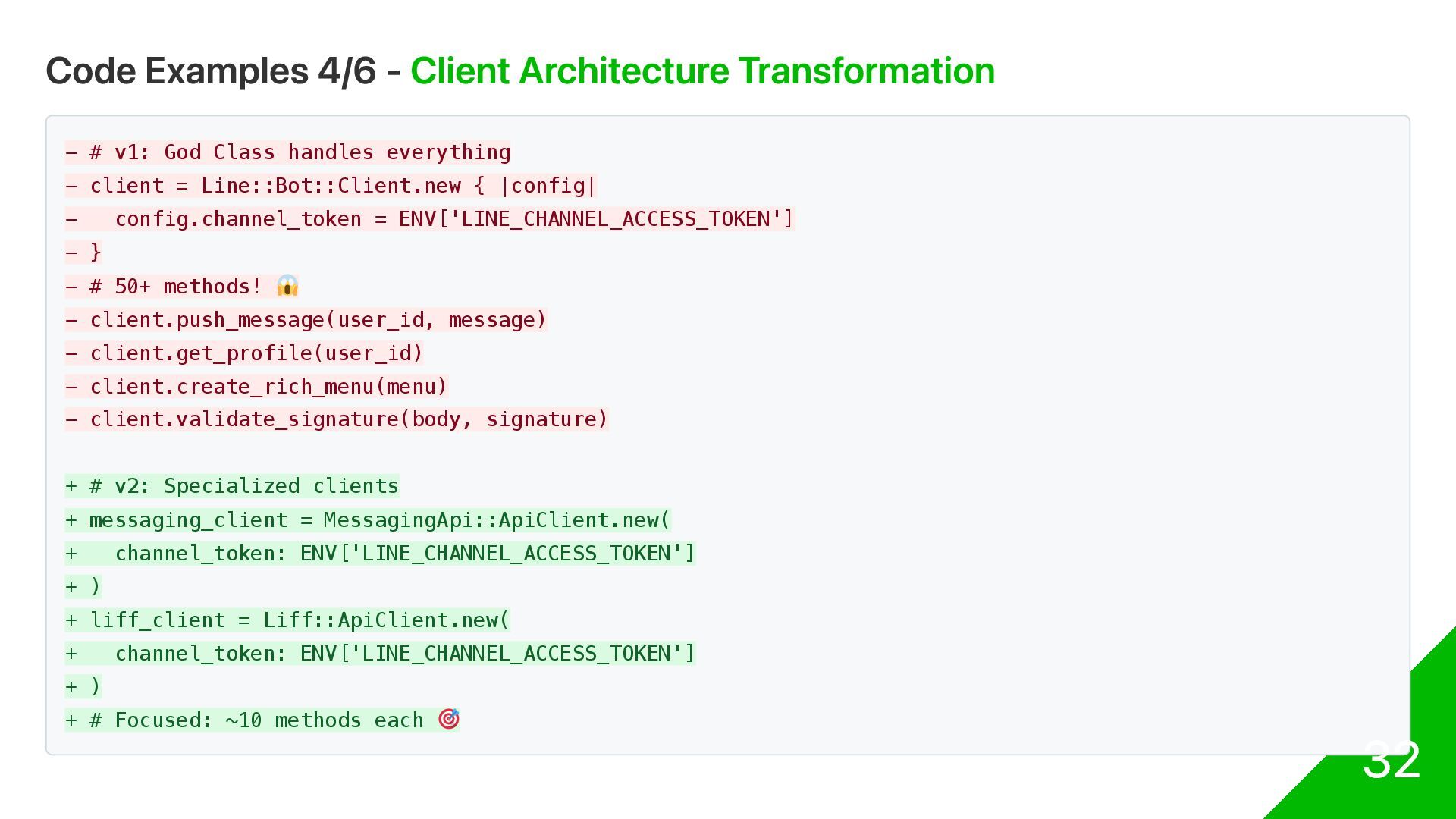
single file 50+ methods handling everything from messaging to analytics Hash-based parameters = runtime errors waiting to happen Tight coupling makes testing a nightmare Every API change requires manual code updates Result: Development bottleneck and maintenance burden → Limits of manual maintenance 10
in 10+ languages from one file? Your documentation never goes out of sync? Type safety comes for free? API changes propagate instantly to all clients? "Impossible!" you say? Welcome to the OpenAPI revolution! 12
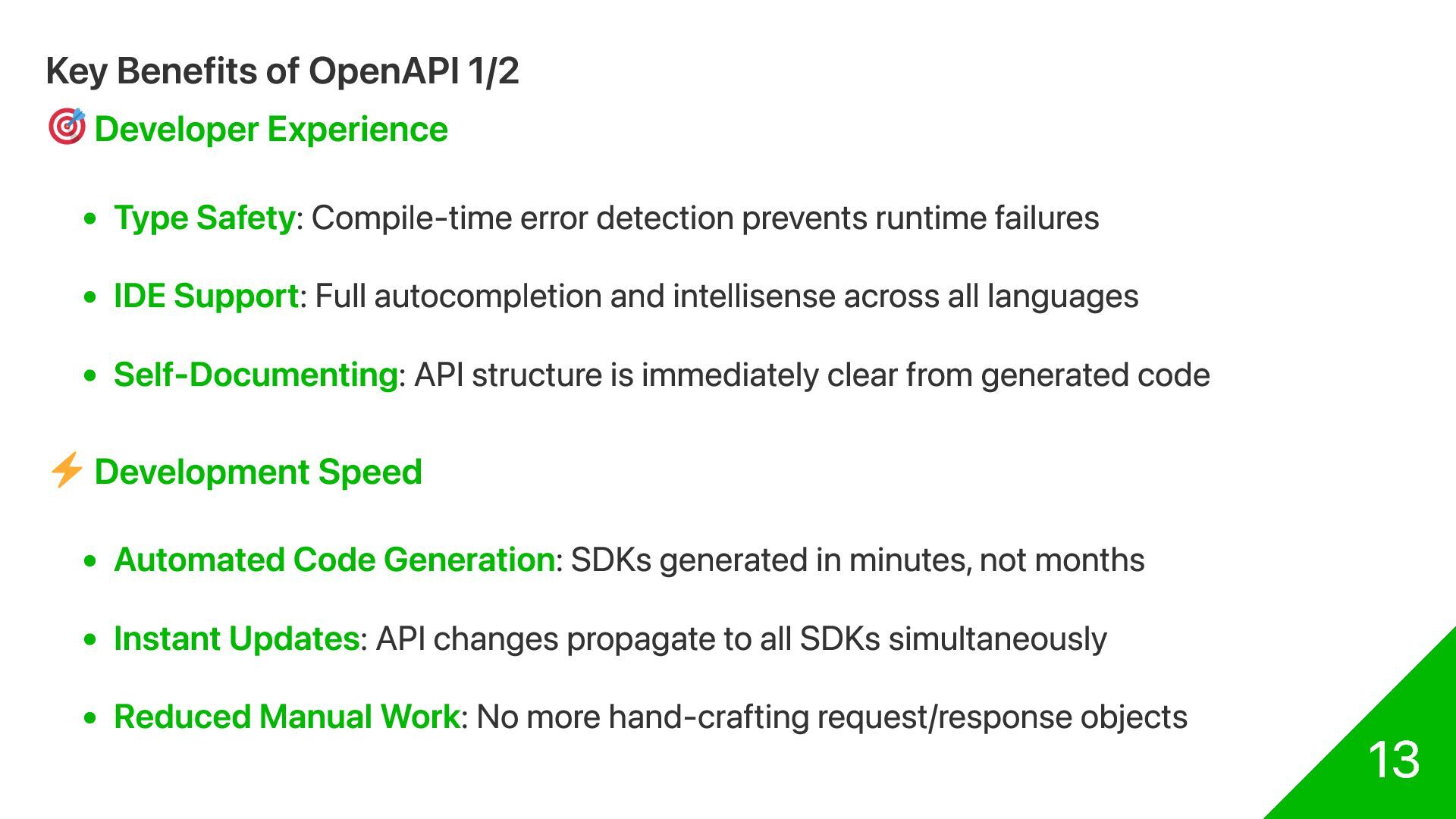
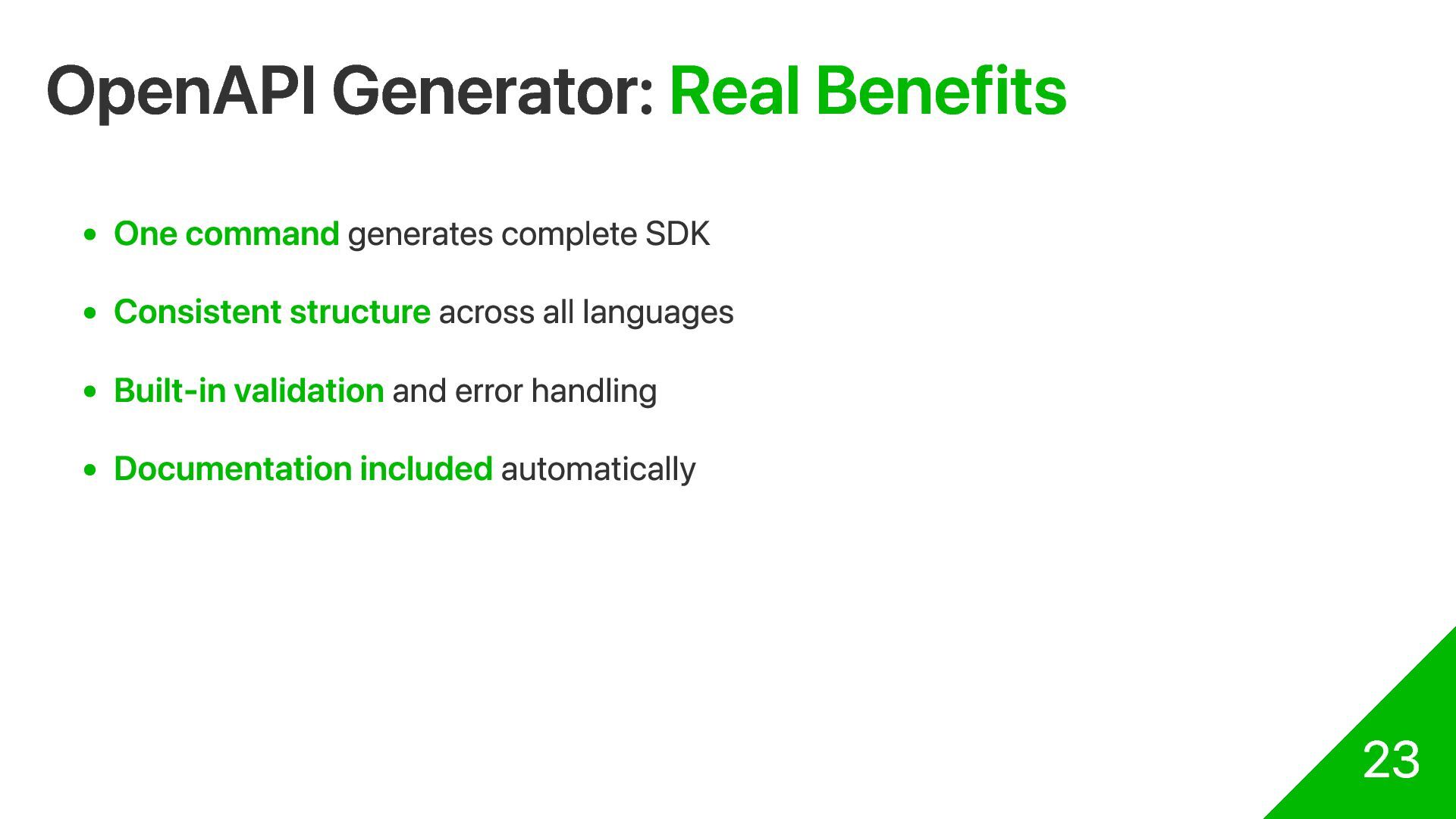
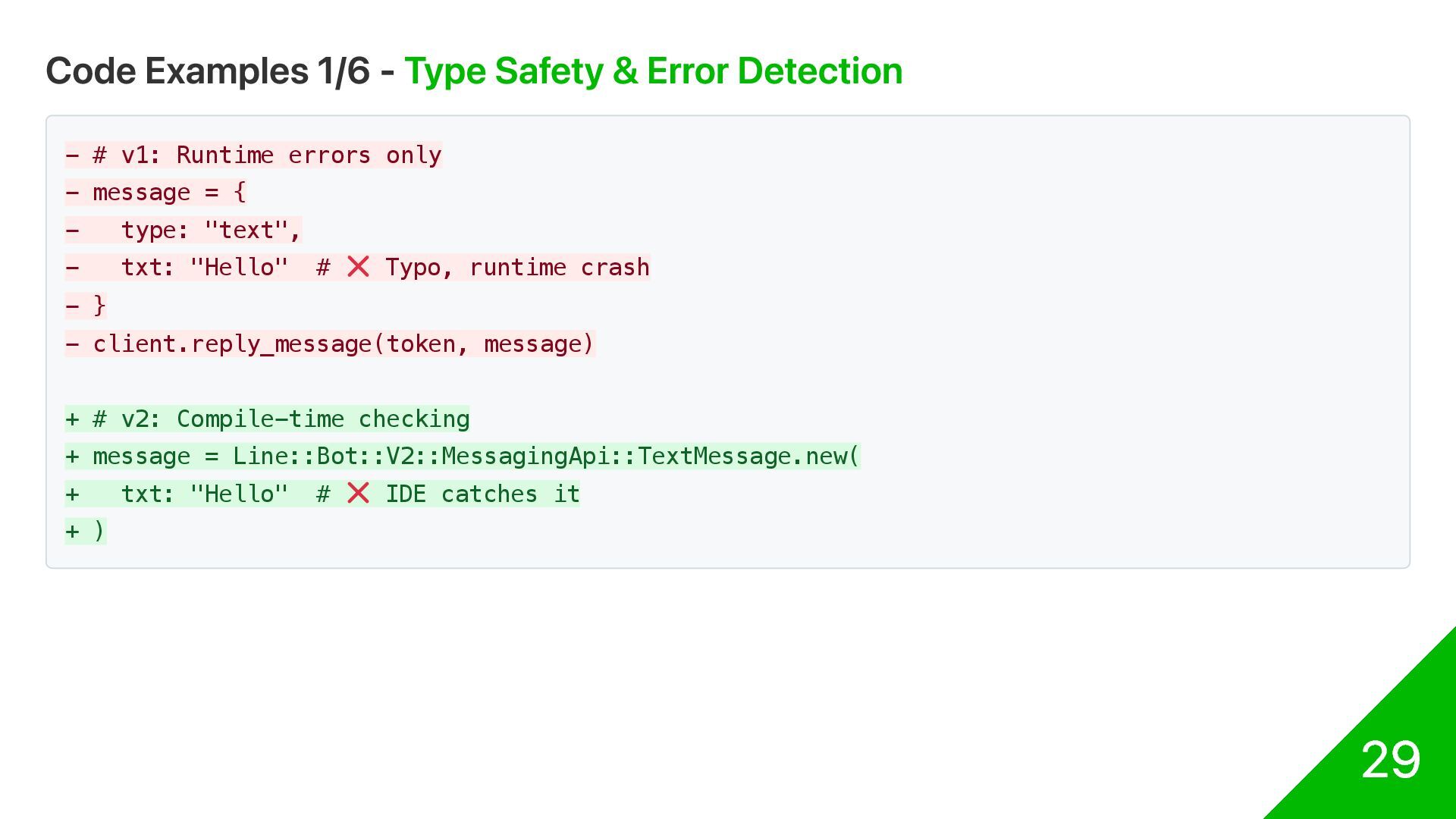
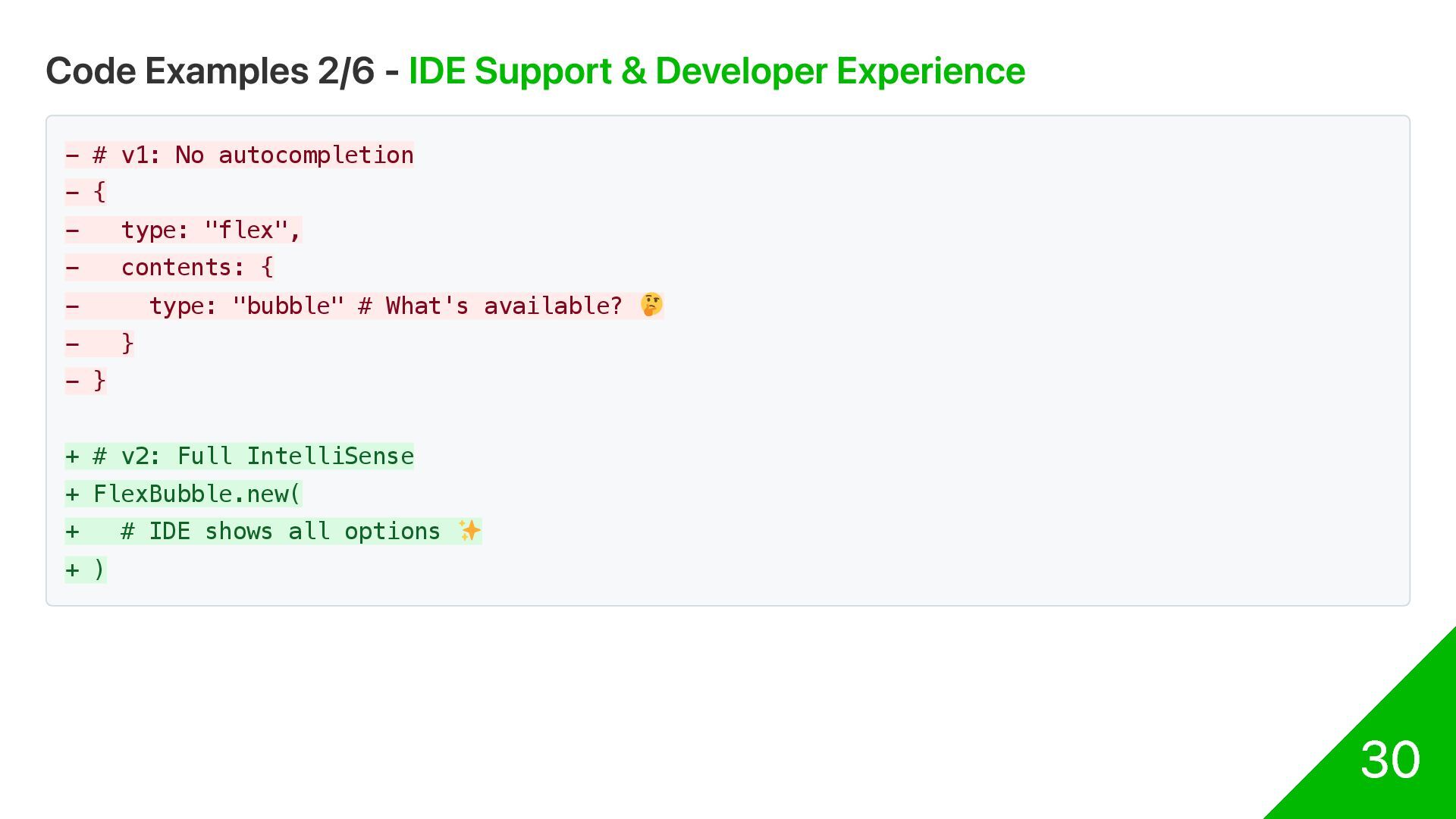
error detection prevents runtime failures IDE Support: Full autocompletion and intellisense across all languages Self-Documenting: API structure is immediately clear from generated code Development Speed Automated Code Generation: SDKs generated in minutes, not months Instant Updates: API changes propagate to all SDKs simultaneously Reduced Manual Work: No more hand-crafting request/response objects 13
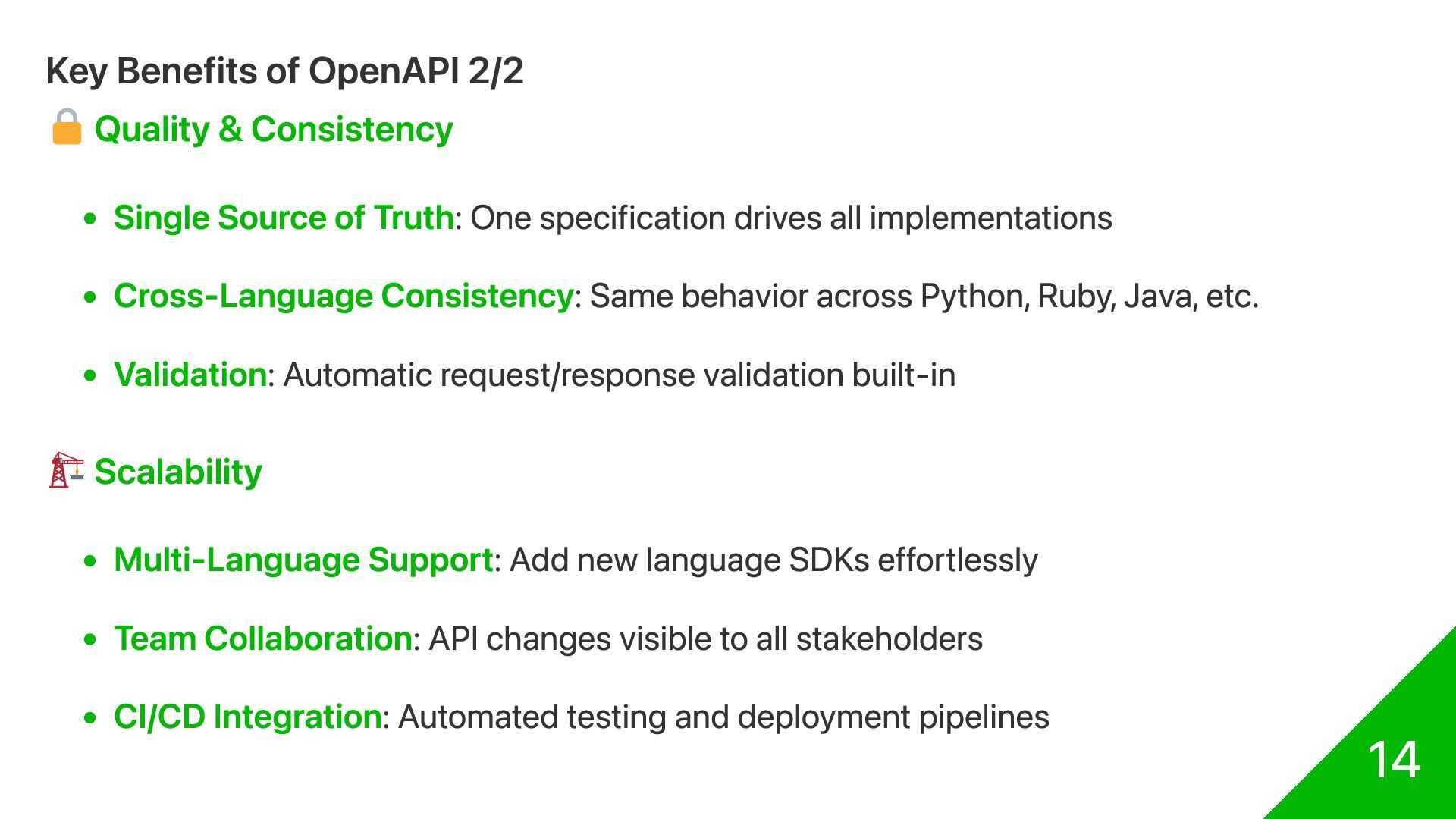
of Truth: One specification drives all implementations Cross-Language Consistency: Same behavior across Python, Ruby, Java, etc. Validation: Automatic request/response validation built-in Scalability Multi-Language Support: Add new language SDKs effortlessly Team Collaboration: API changes visible to all stakeholders CI/CD Integration: Automated testing and deployment pipelines 14
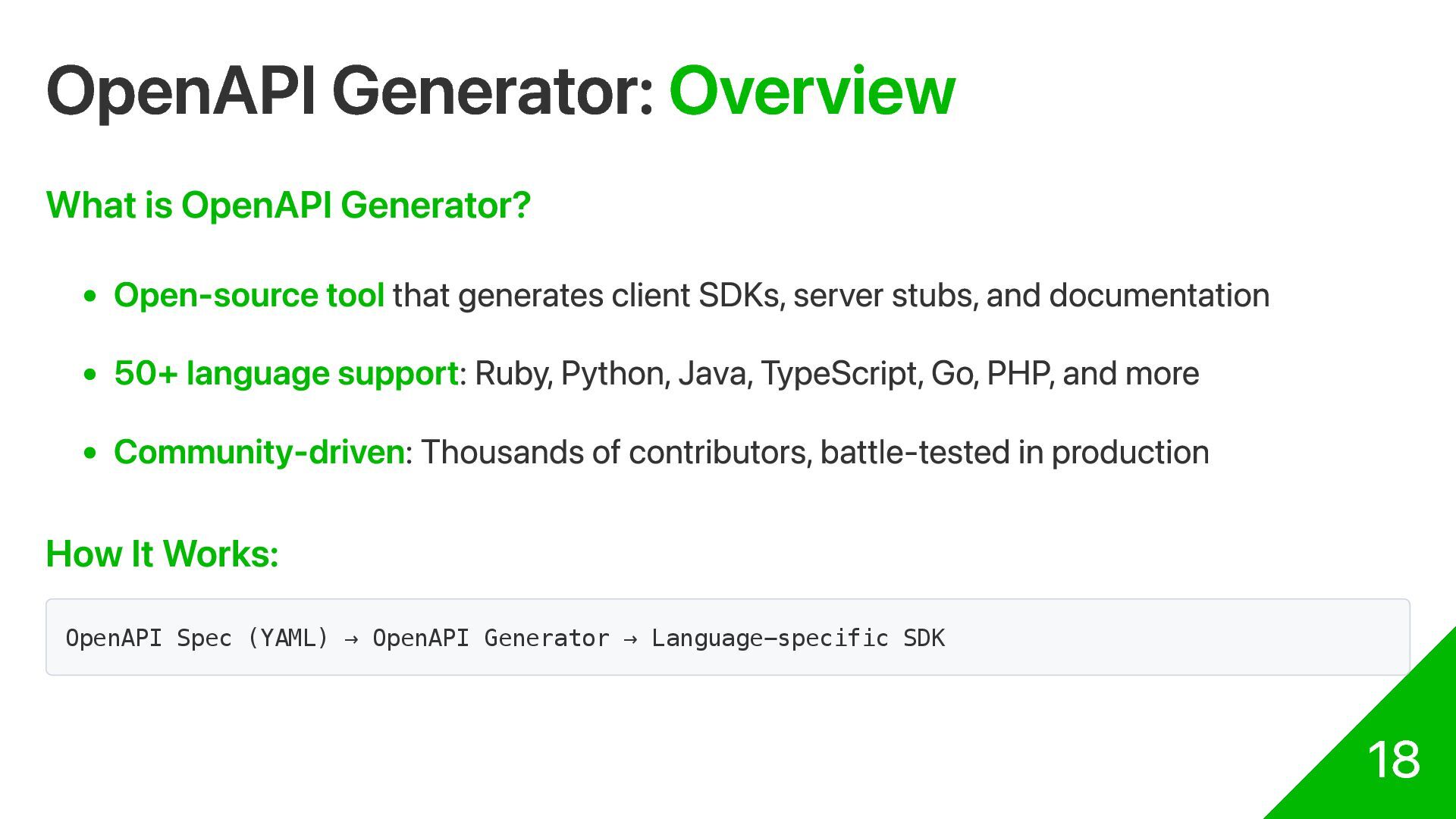
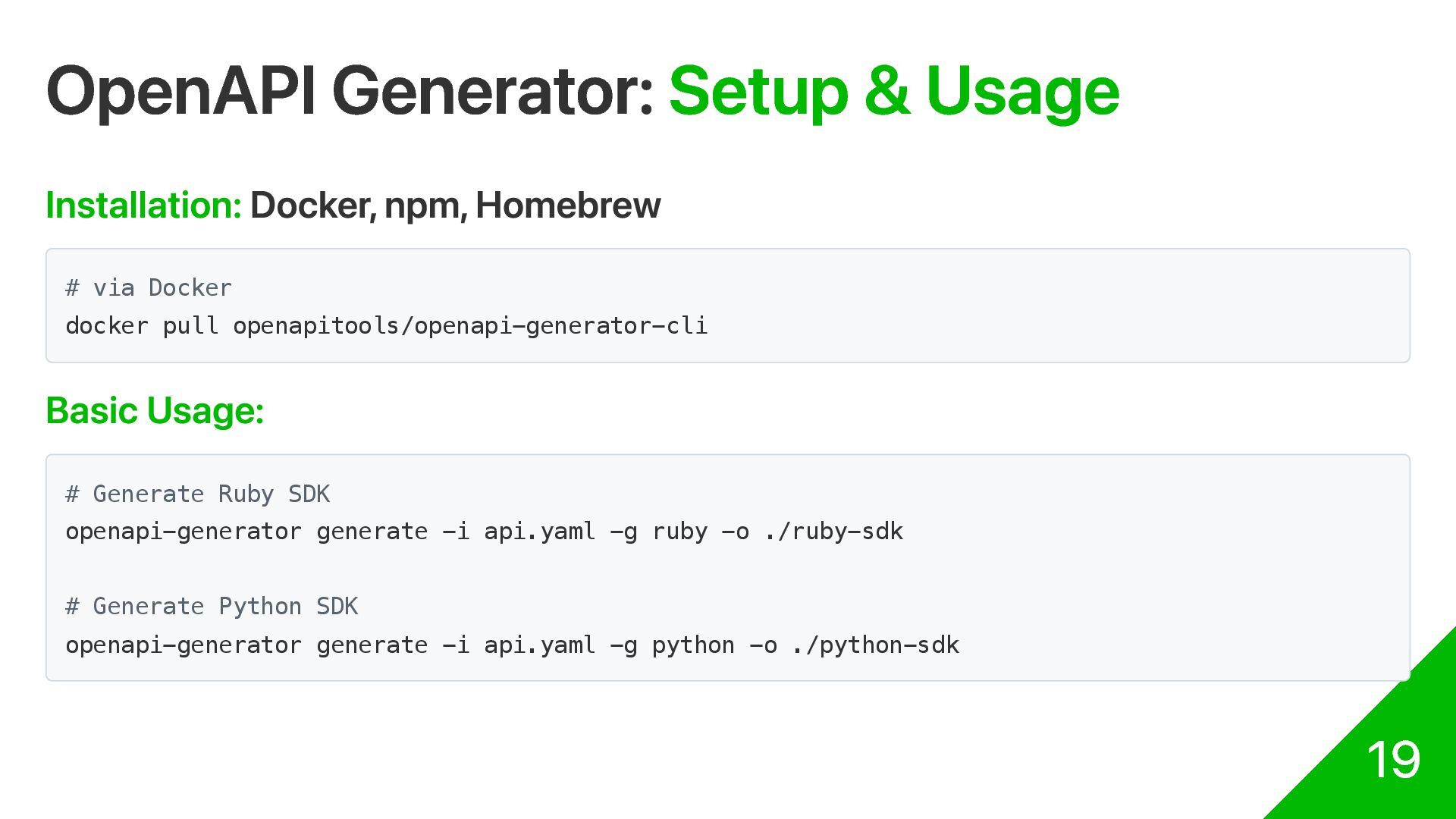
generates client SDKs, server stubs, and documentation 50+ language support: Ruby, Python, Java, TypeScript, Go, PHP, and more Community-driven: Thousands of contributors, battle-tested in production How It Works: OpenAPI Spec (YAML) → OpenAPI Generator → Language-specific SDK 18
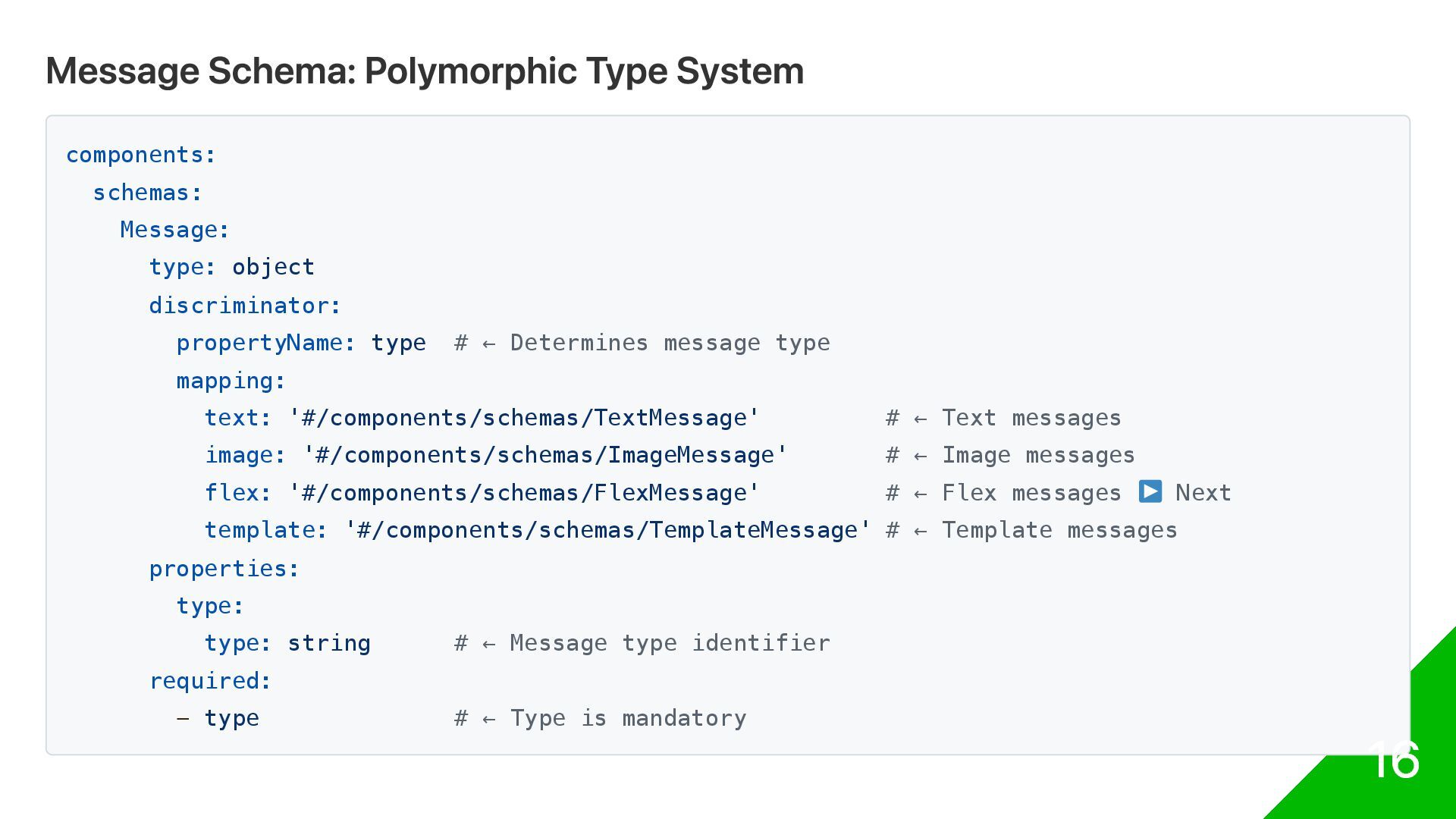
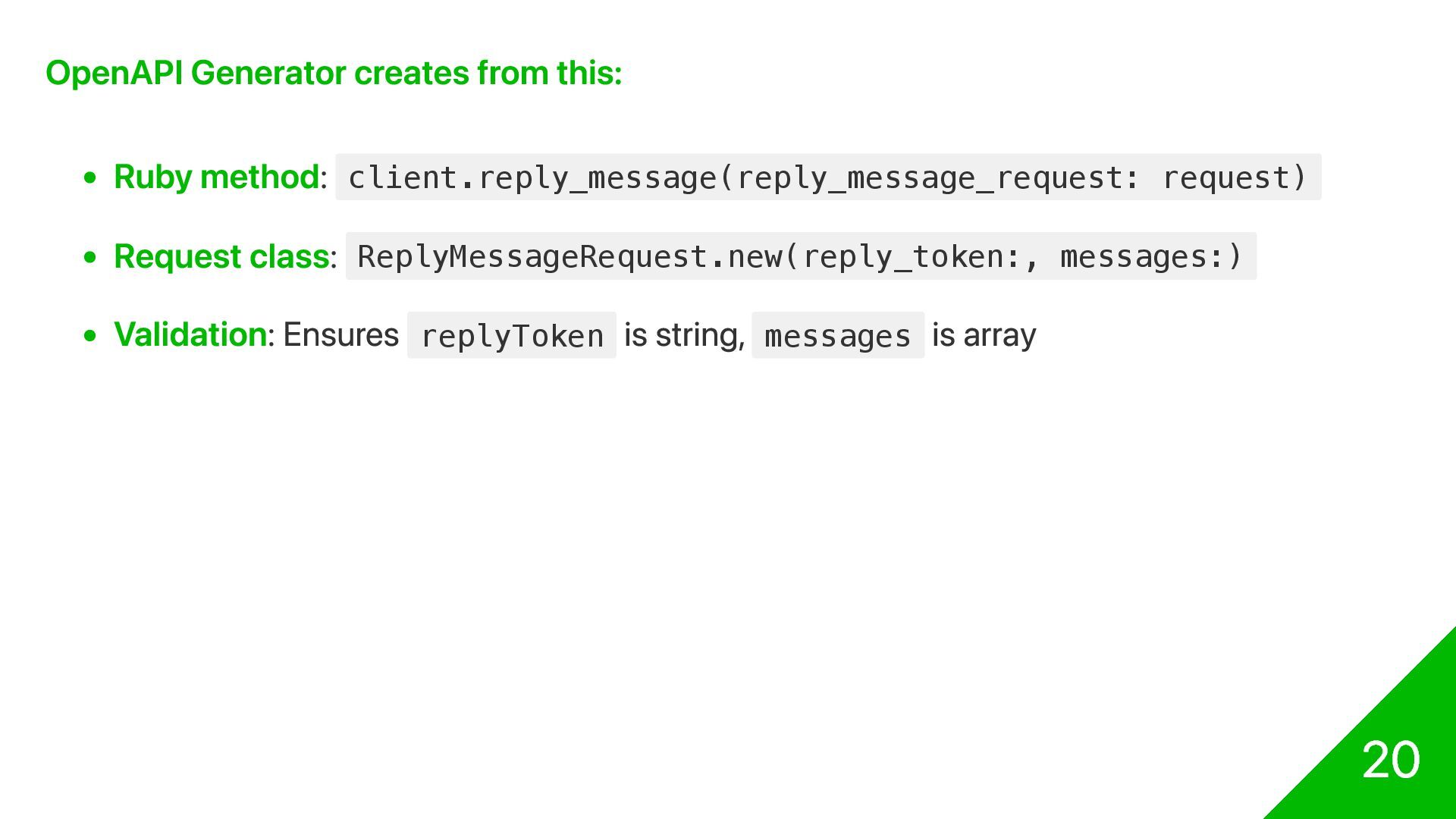
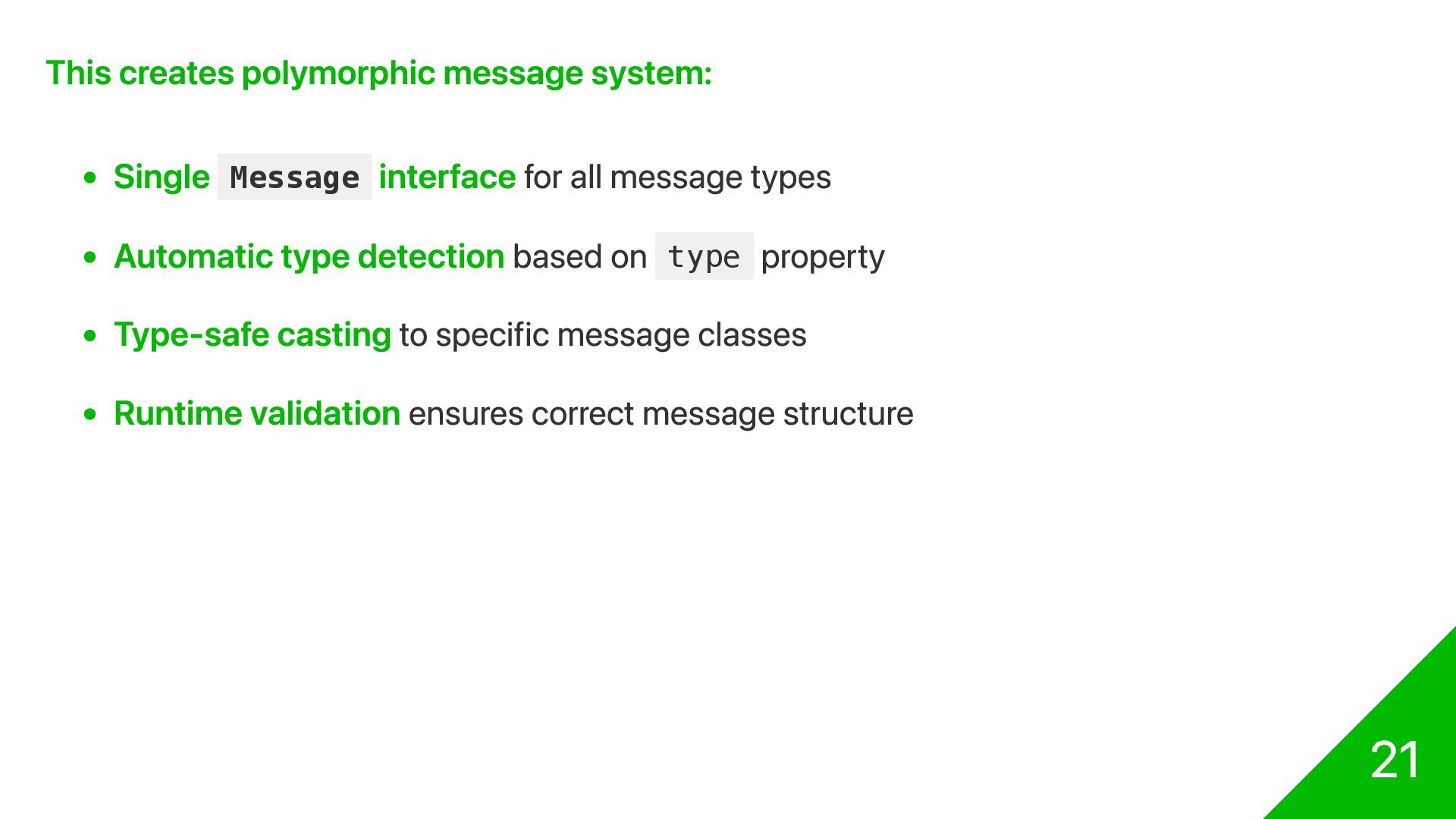
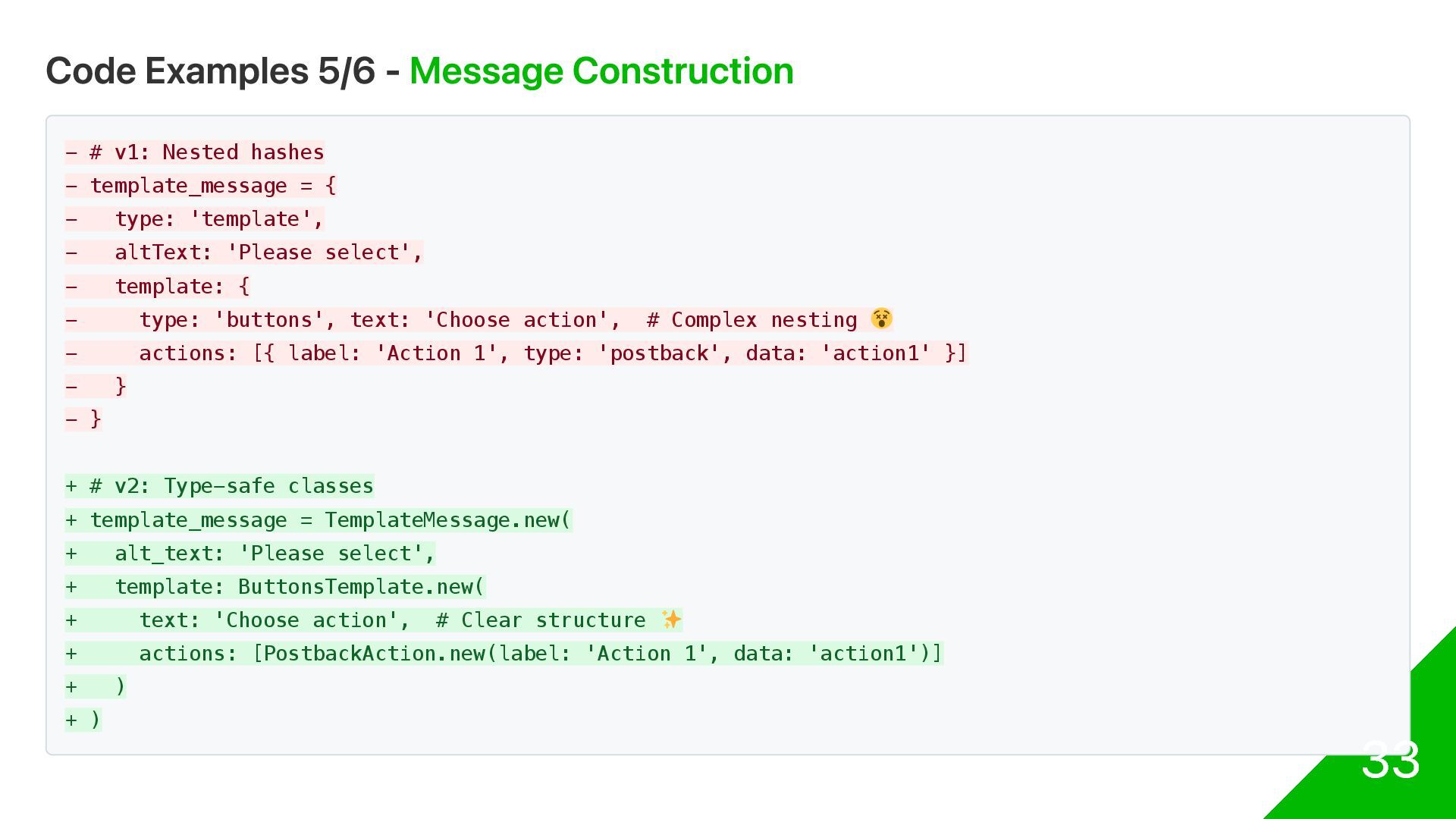
message types Automatic type detection based on type property Type-safe casting to specific message classes Runtime validation ensures correct message structure 21
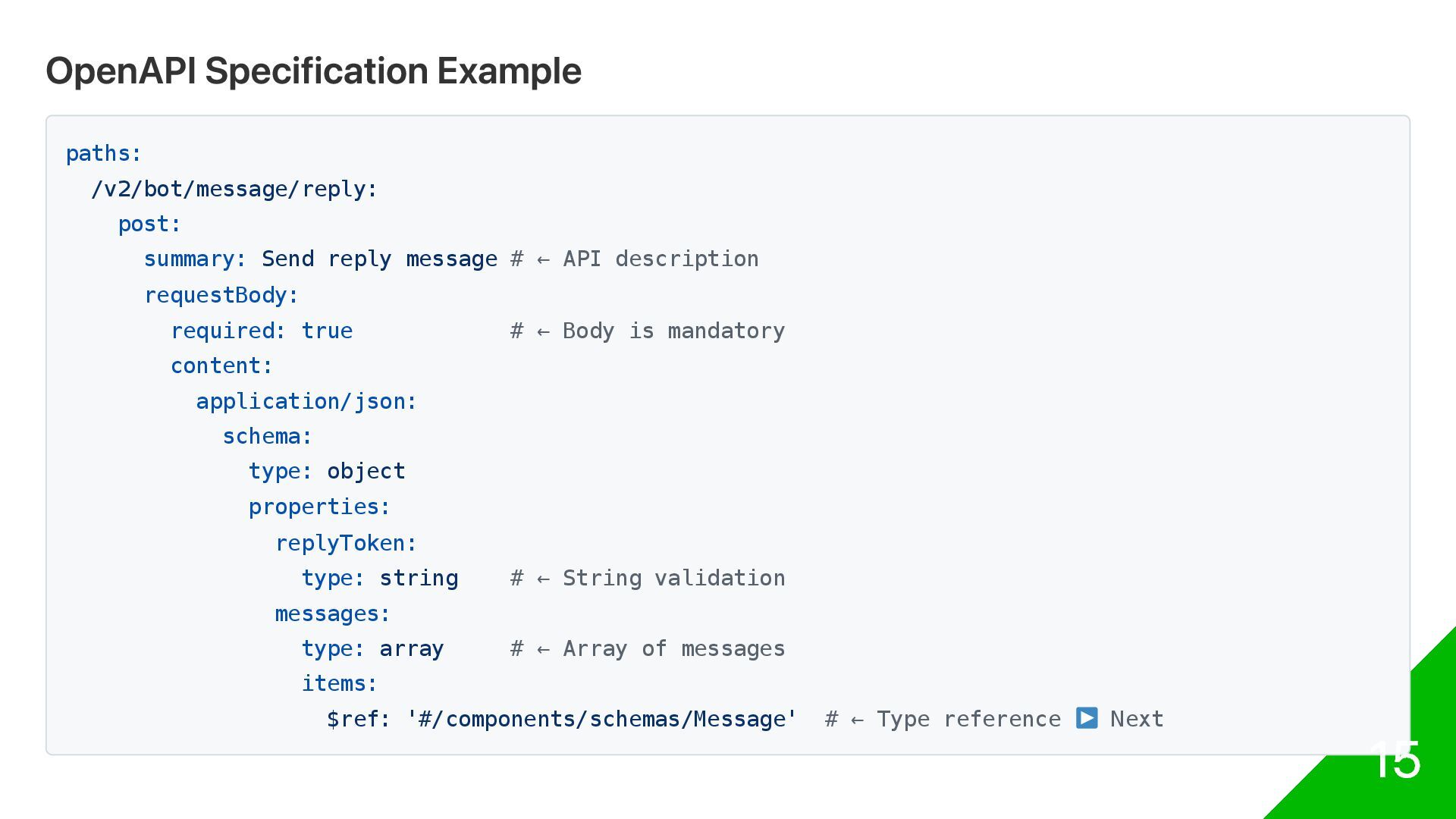
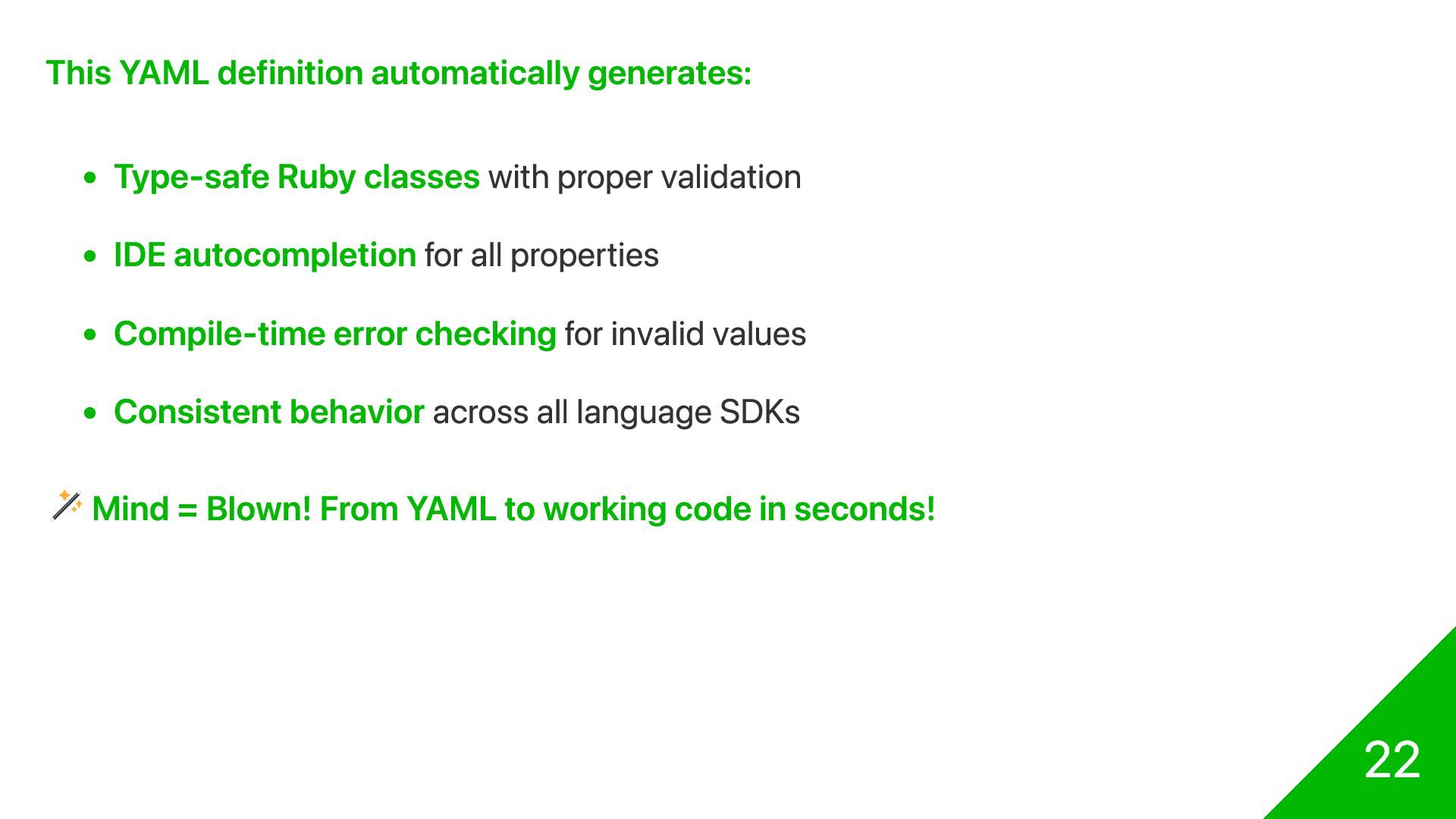
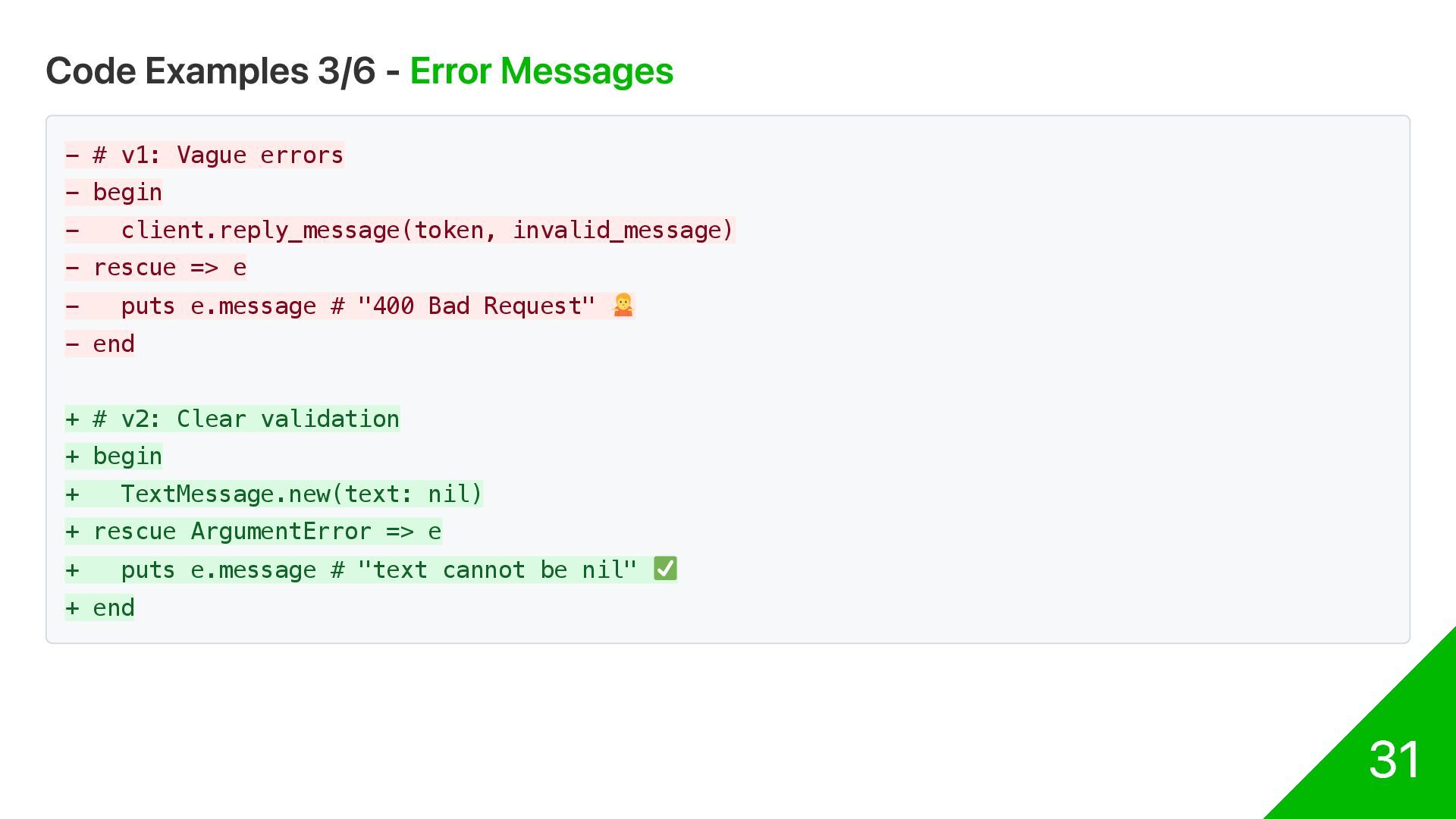
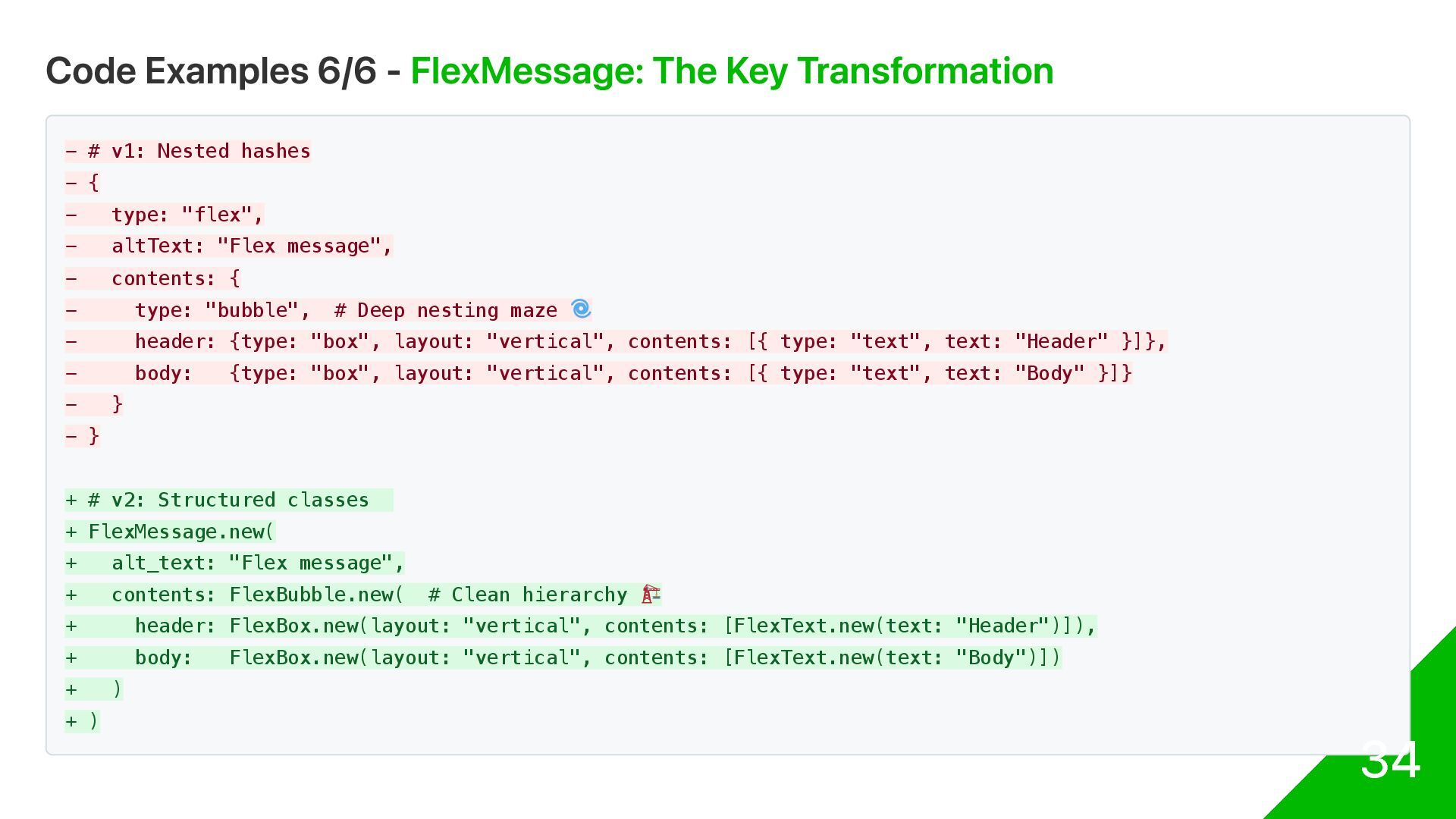
validation IDE autocompletion for all properties Compile-time error checking for invalid values Consistent behavior across all language SDKs Mind = Blown! From YAML to working code in seconds! 22
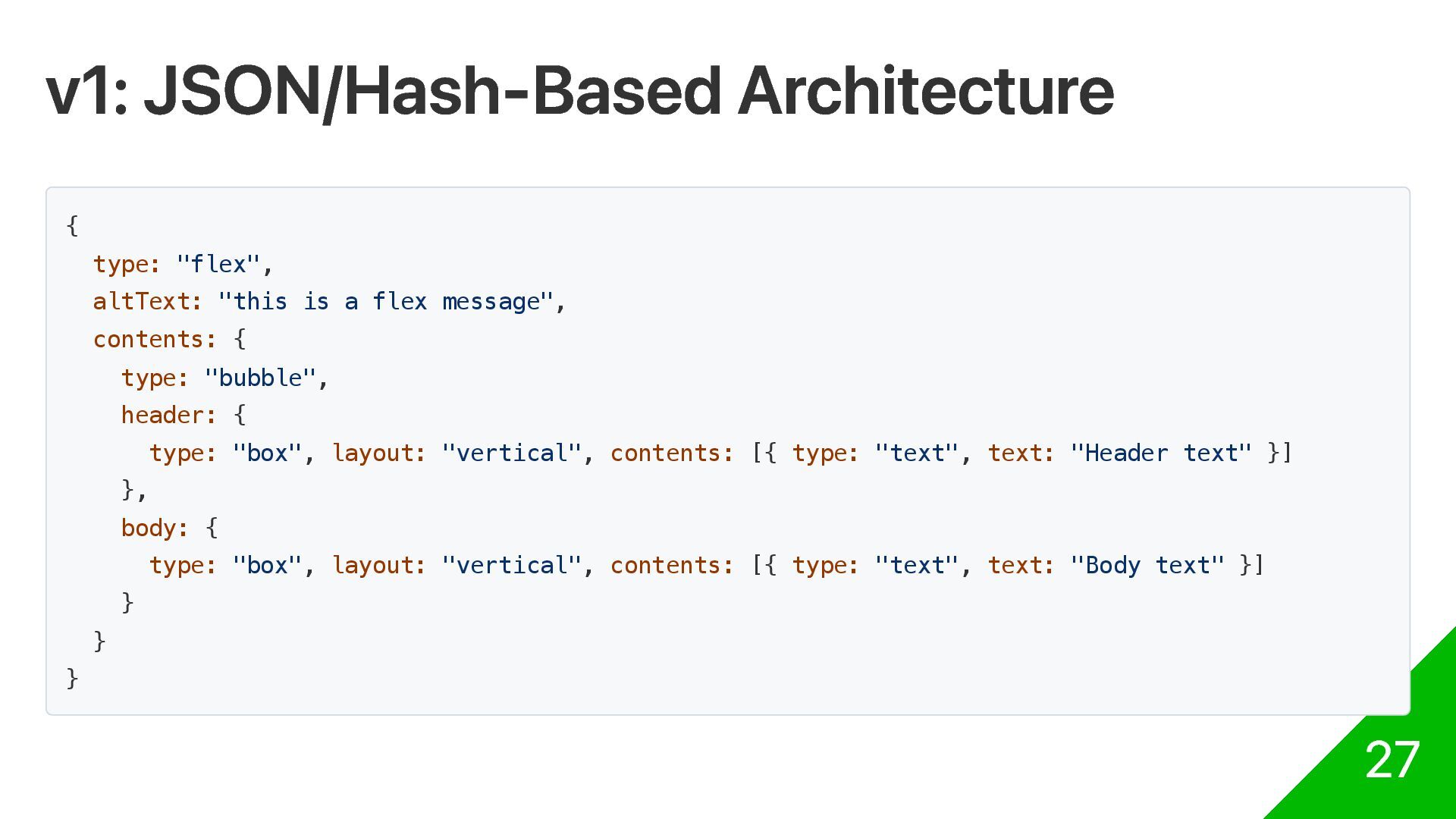
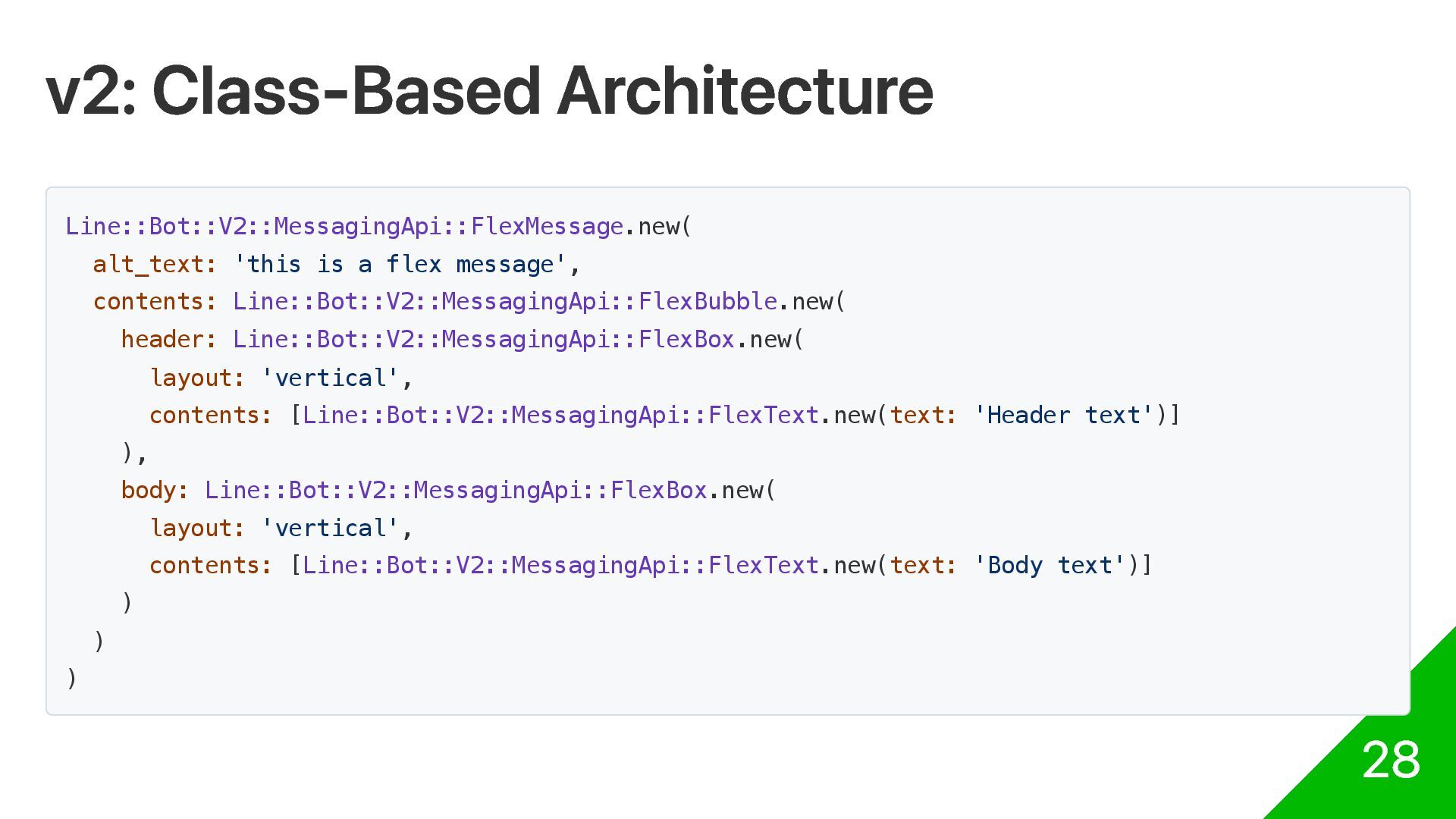
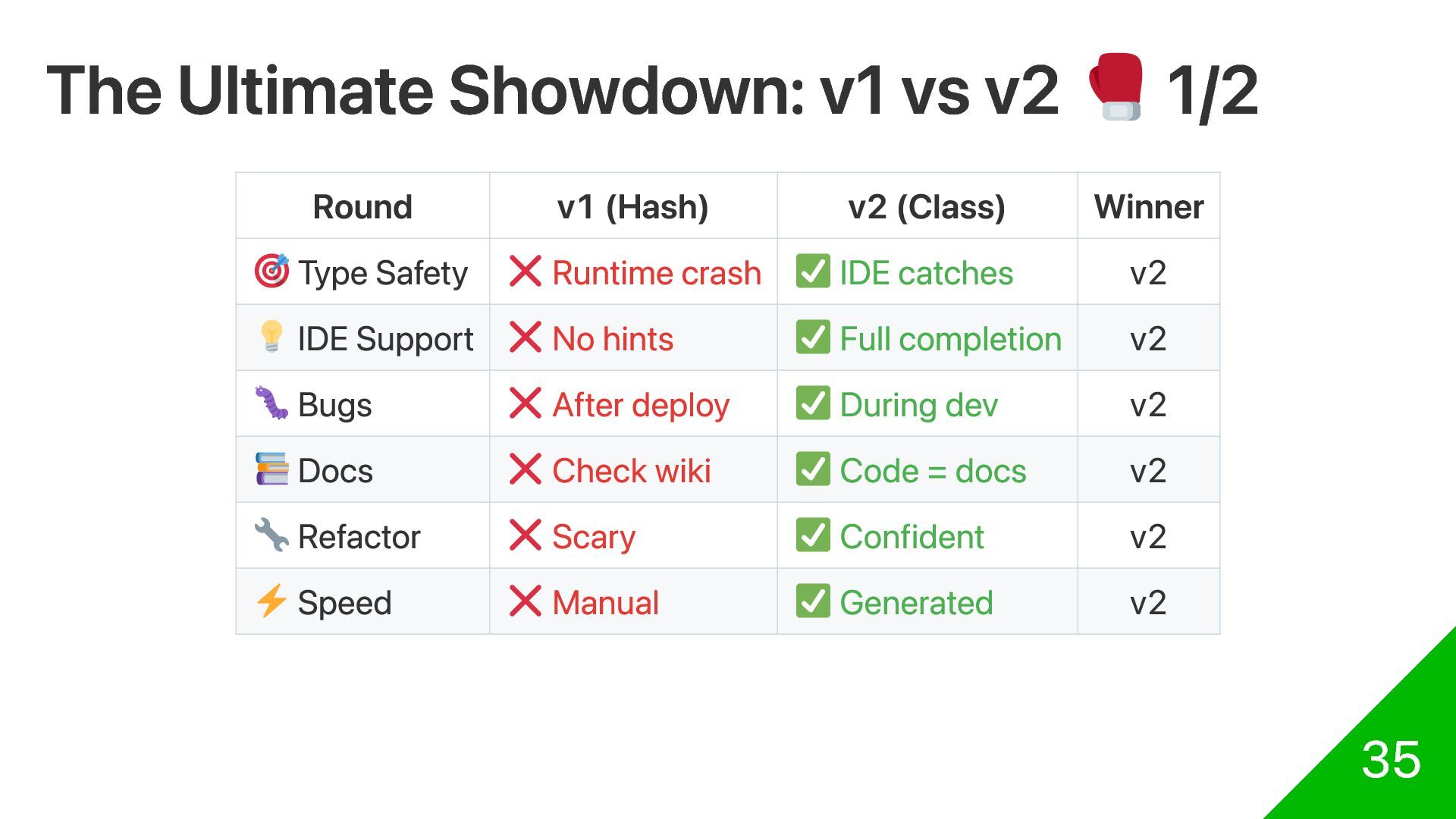
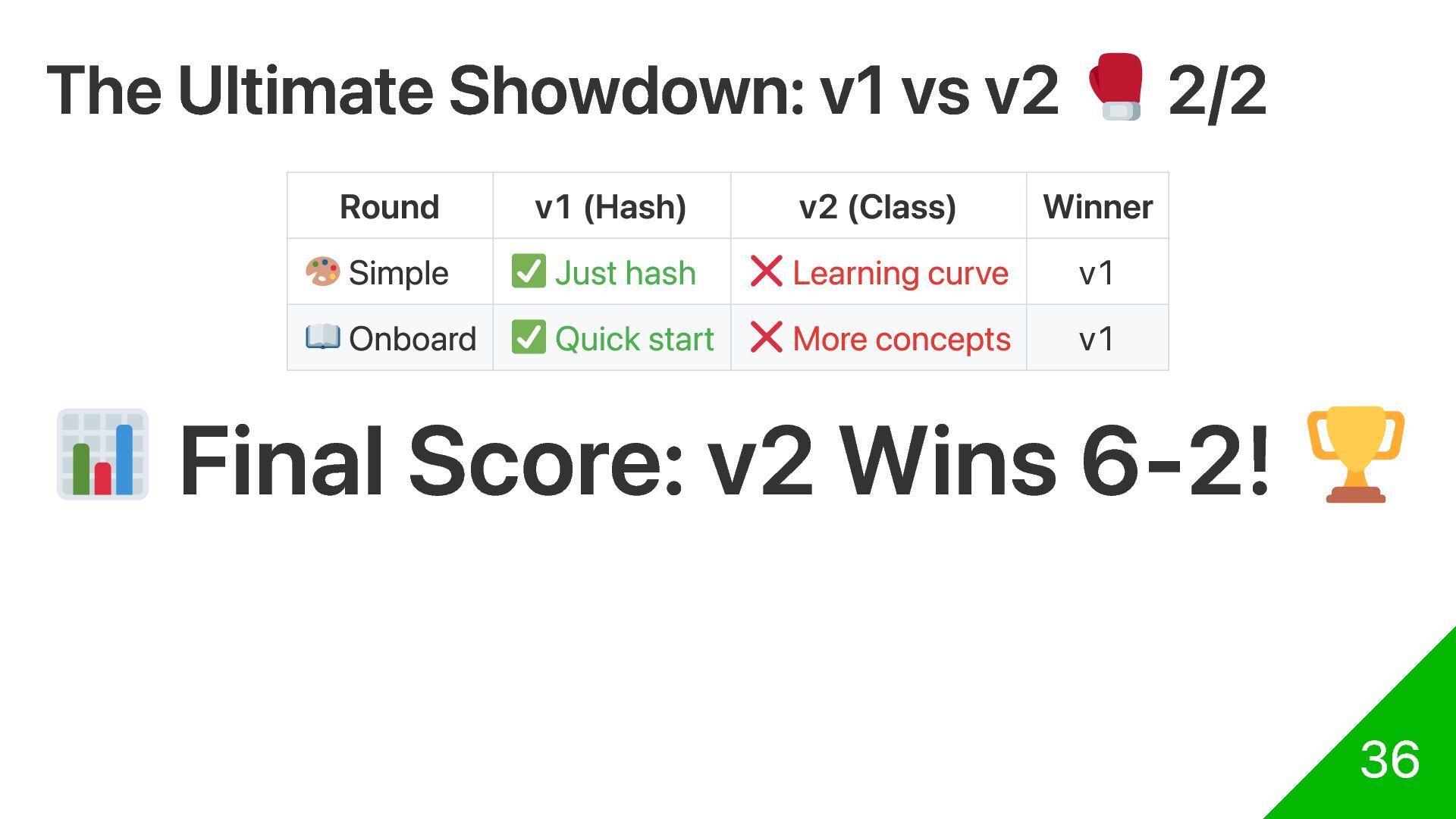
v2 (Class) Winner Type Safety Runtime crash IDE catches v2 IDE Support No hints Full completion v2 Bugs After deploy During dev v2 Docs Check wiki Code = docs v2 Refactor Scary Confident v2 Speed Manual Generated v2 35
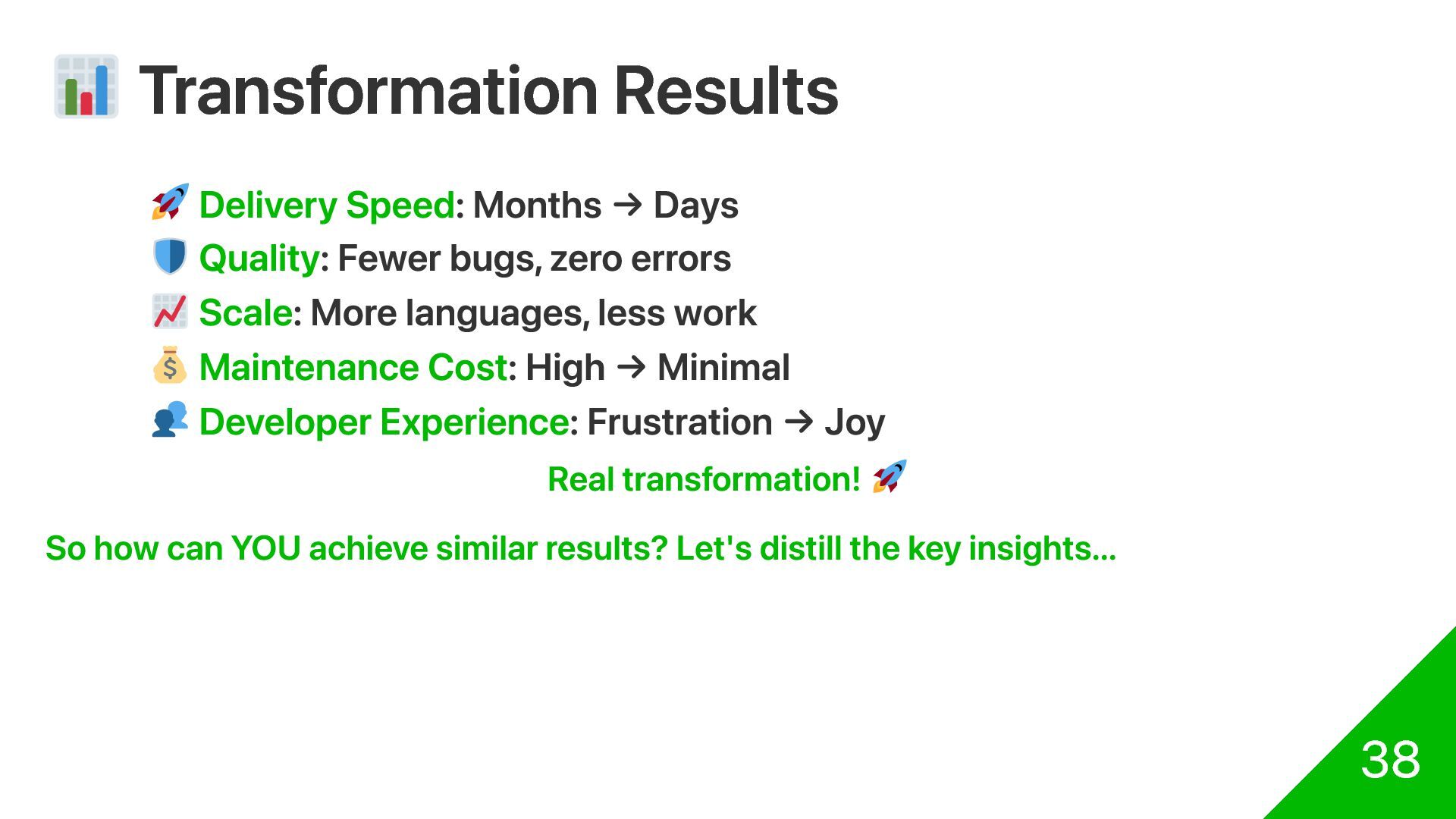
zero errors Scale: More languages, less work Maintenance Cost: High → Minimal Developer Experience: Frustration → Joy Real transformation! So how can YOU achieve similar results? Let's distill the key insights... 38
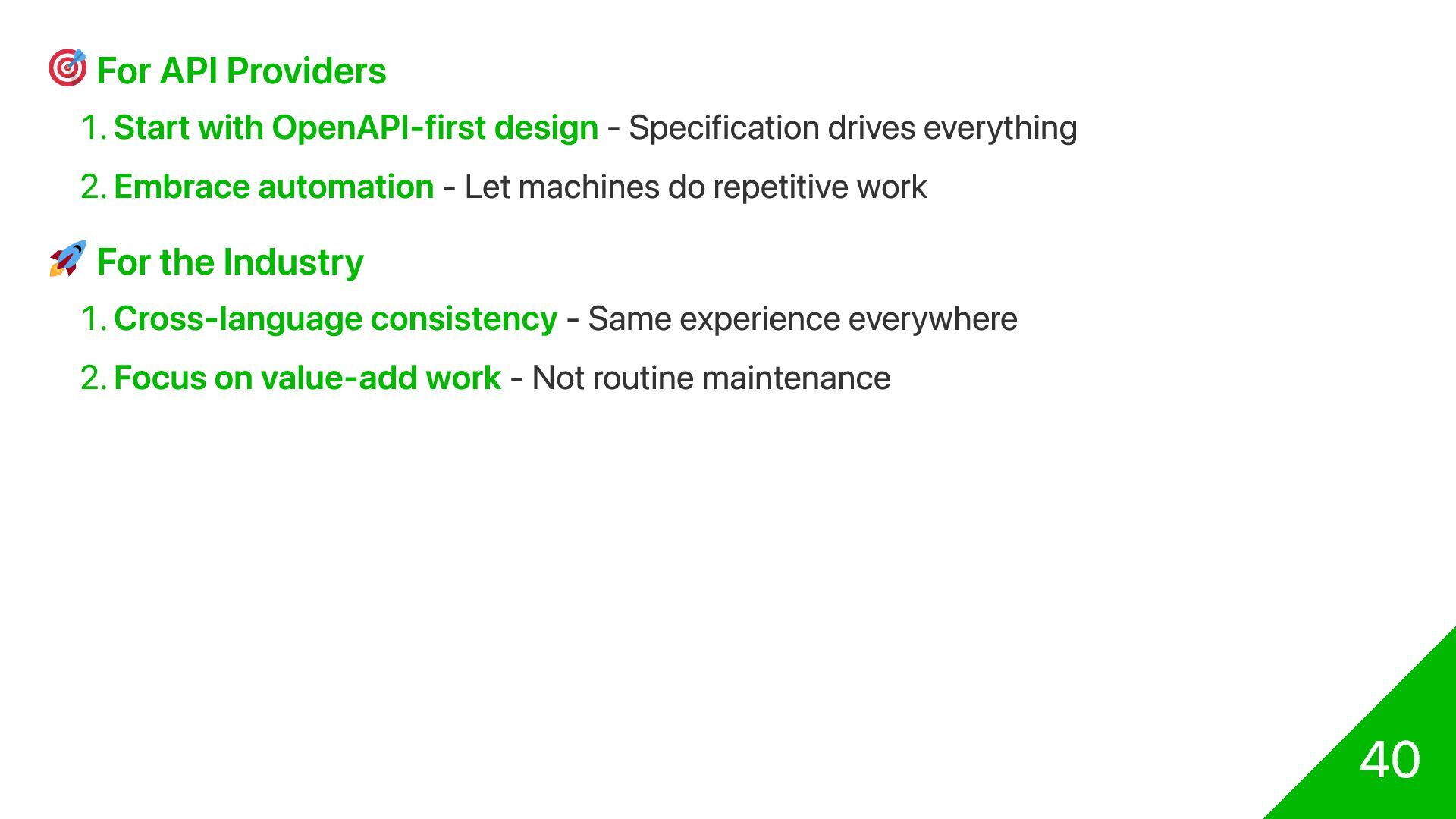
drives everything 2. Embrace automation - Let machines do repetitive work For the Industry 1. Cross-language consistency - Same experience everywhere 2. Focus on value-add work - Not routine maintenance 40
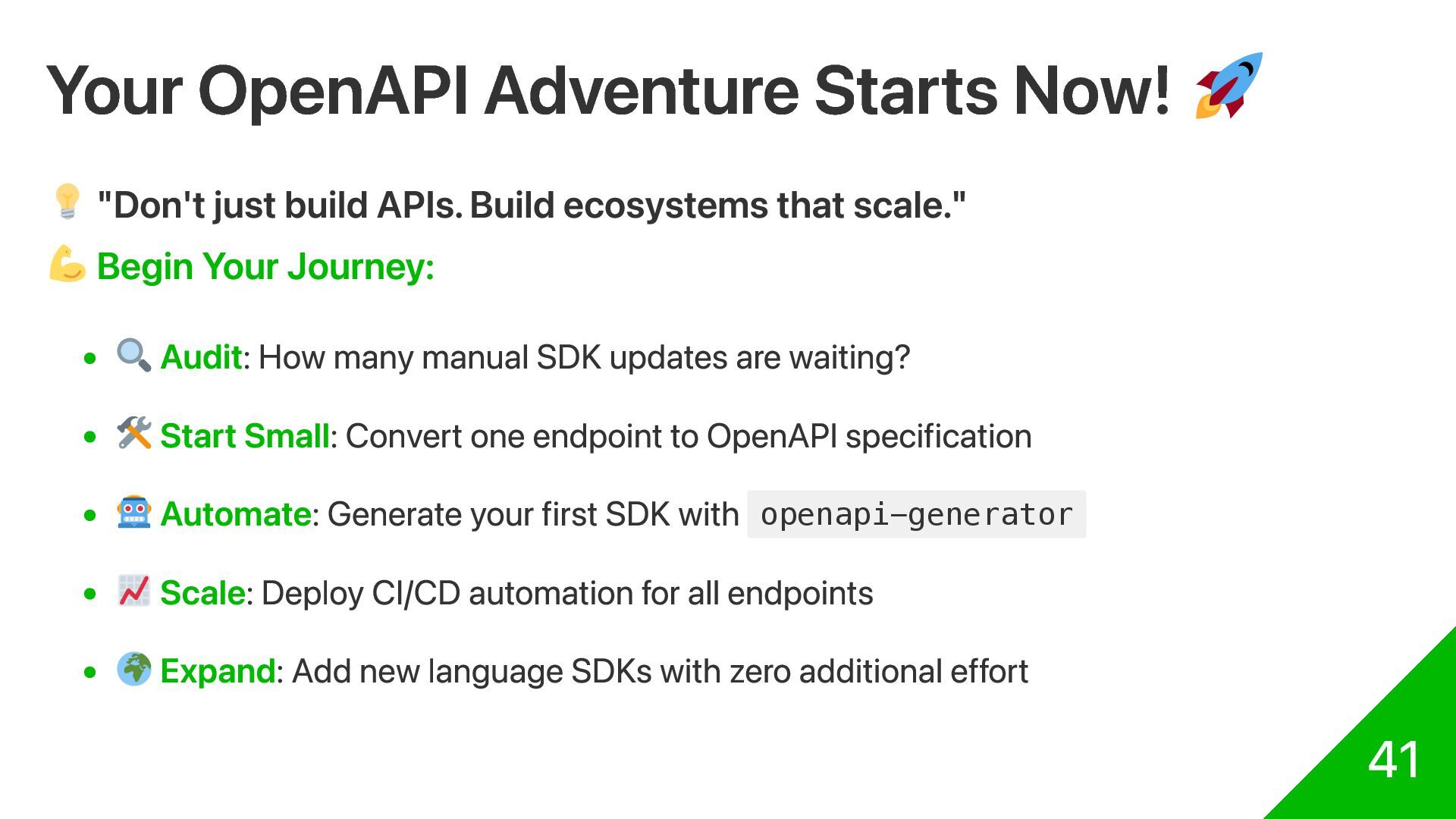
ecosystems that scale." Begin Your Journey: Audit: How many manual SDK updates are waiting? Start Small: Convert one endpoint to OpenAPI specification Automate: Generate your first SDK with openapi-generator Scale: Deploy CI/CD automation for all endpoints Expand: Add new language SDKs with zero additional effort 41

 Your Podcast. Everywhere. Effortlessly.


 4geru
4geru
 leimatthew05
 wjessup
 letsgokoyo
 thirion
 lfama
lfama
 eileencodes
 inesmontani
 sergeychernyshev
 mclloyd
 zakiyama
 techseoconnect
 lauravandoore