Share
Embed
Microservices - are your frameworks ready?
Slides for our talk at #microXchg, Berlin. More info available at https://www.innoq.com/en/talks/2015/02/microservices-jvm-applications-talk/
Alexander Heusingfeld
February 13, 2015
Transcript
97 slides
-
Challenges > distributed configuration > service registration & discovery >
resilience > fast, automated deployment > metrics -
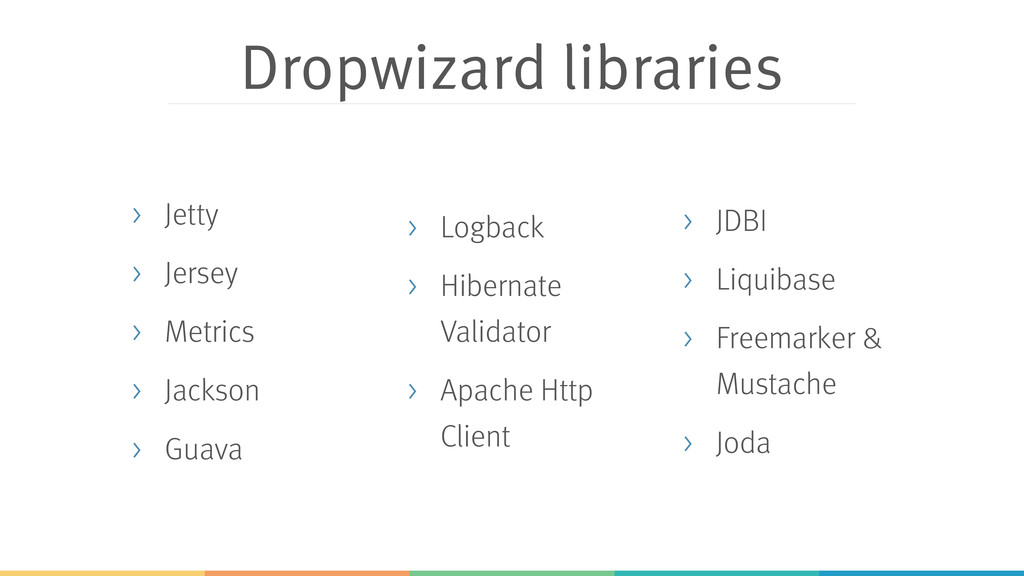
Dropwizard libraries > Jetty > Jersey > Metrics > Jackson
> Guava > Logback > Hibernate Validator > Apache Http Client > JDBI > Liquibase > Freemarker & Mustache > Joda -
Spring Boot > convention over configuration approach > Java, Groovy
or Scala > self-contained jar or war -
Spring Boot > convention over configuration approach > Java, Groovy
or Scala > self-contained jar or war > tackles dependency-hell via pre-packaging -
Spring Cloud > umbrella project for cloud connectors > On
top of Spring Boot -
Spring Cloud > umbrella project for cloud connectors > On
top of Spring Boot > config server for distributed configuration -
Spring Cloud > umbrella project for cloud connectors > On
top of Spring Boot > config server for distributed configuration > annotations for service-discovery & resilience -
Play 2 > Java or Scala > based on Akka
> strong async support -
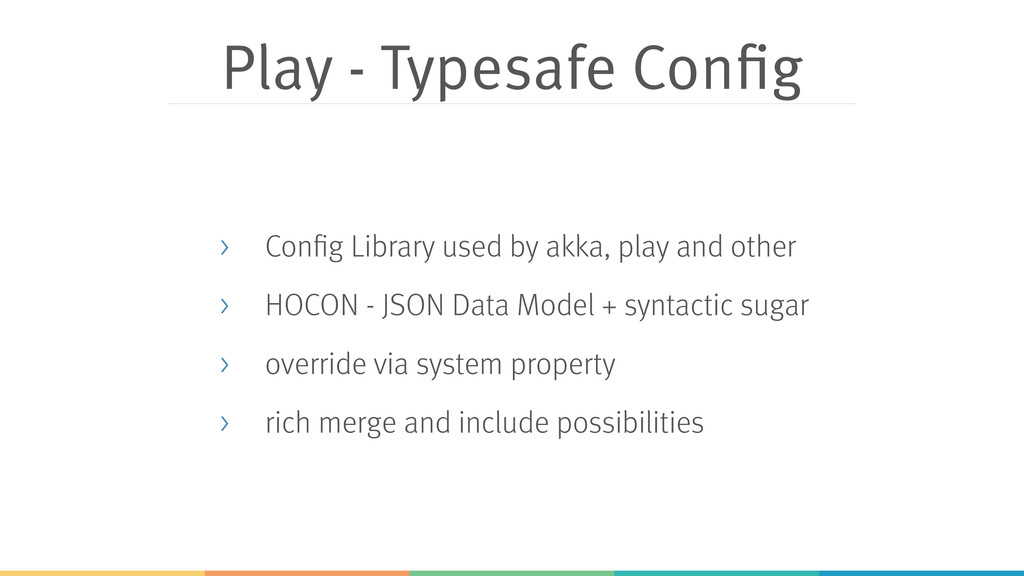
Play - Typesafe Config > Config Library used by akka,
play and other -
Play - Typesafe Config > Config Library used by akka,
play and other > HOCON - JSON Data Model + syntactic sugar -
Play - Typesafe Config > Config Library used by akka,
play and other > HOCON - JSON Data Model + syntactic sugar > override via system property -
Play - Typesafe Config > Config Library used by akka,
play and other > HOCON - JSON Data Model + syntactic sugar > override via system property > rich merge and include possibilities -
Spring Boot @ComponentScan @EnableAutoConfiguration public class OrderApp { public
static void main(String[] args) { SpringApplication.run(OrderApp.class, args); } } -
Spring Boot @ComponentScan @EnableAutoConfiguration public class OrderApp { public
static void main(String[] args) { SpringApplication.run(OrderApp.class, args); } } -
Spring Boot > HTTP resource “/autoconfig” shows all properties @ComponentScan
@EnableAutoConfiguration public class OrderApp { public static void main(String[] args) { SpringApplication.run(OrderApp.class, args); } } -
Spring Boot > HTTP resource “/autoconfig” shows all properties >
overwrite via application.properties or CLI parameter @ComponentScan @EnableAutoConfiguration public class OrderApp { public static void main(String[] args) { SpringApplication.run(OrderApp.class, args); } } -
Spring Boot > HTTP resource “/autoconfig” shows all properties >
overwrite via application.properties or CLI parameter > configuration in git? -> Check spring-cloud configserver @ComponentScan @EnableAutoConfiguration public class OrderApp { public static void main(String[] args) { SpringApplication.run(OrderApp.class, args); } } -
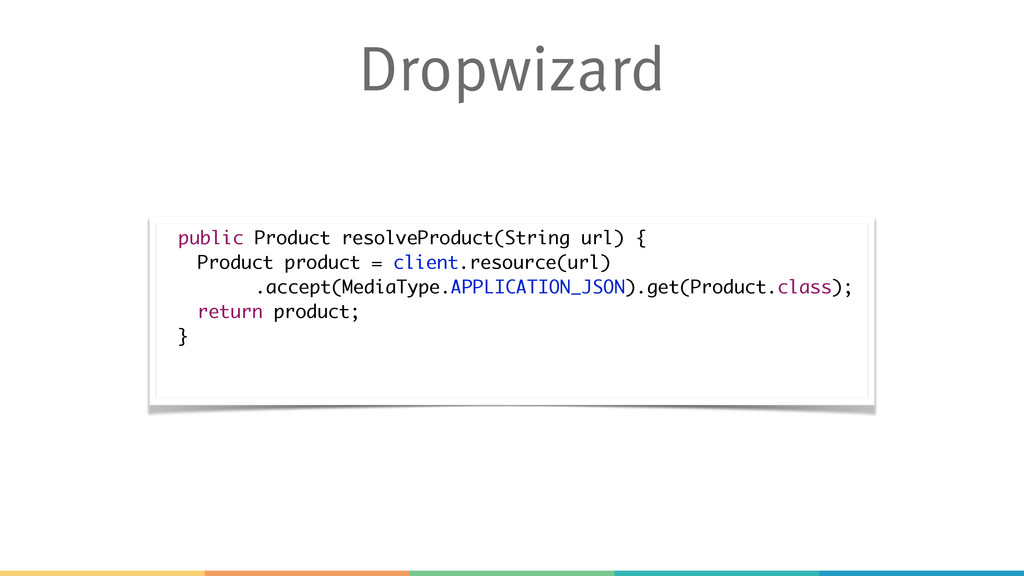
Dropwizard public Product resolveProduct(String url) { Product product = client.resource(url)
.accept(MediaType.APPLICATION_JSON).get(Product.class); return product; } -
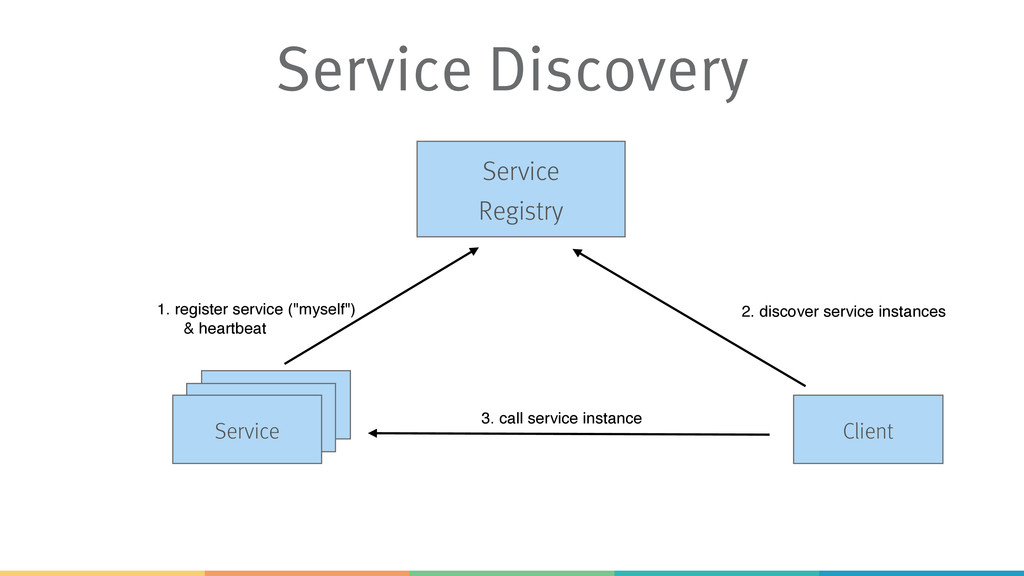
Service Service Discovery Client Service Registry 2. discover service instances
3. call service instance Service Service 1. register service ("myself") & heartbeat -
Spring Cloud @ComponentScan @EnableAutoConfiguration @EnableDiscoveryClient public class OrdersApp {
public static void main(String[] args) { SpringApplication.run(OrdersApp.class, args); } } -
Spring Cloud @ComponentScan @EnableAutoConfiguration @EnableDiscoveryClient public class OrdersApp {
public static void main(String[] args) { SpringApplication.run(OrdersApp.class, args); } } -
Spring Cloud @ComponentScan @EnableAutoConfiguration @EnableDiscoveryClient public class OrdersApp {
public static void main(String[] args) { SpringApplication.run(OrdersApp.class, args); } } -
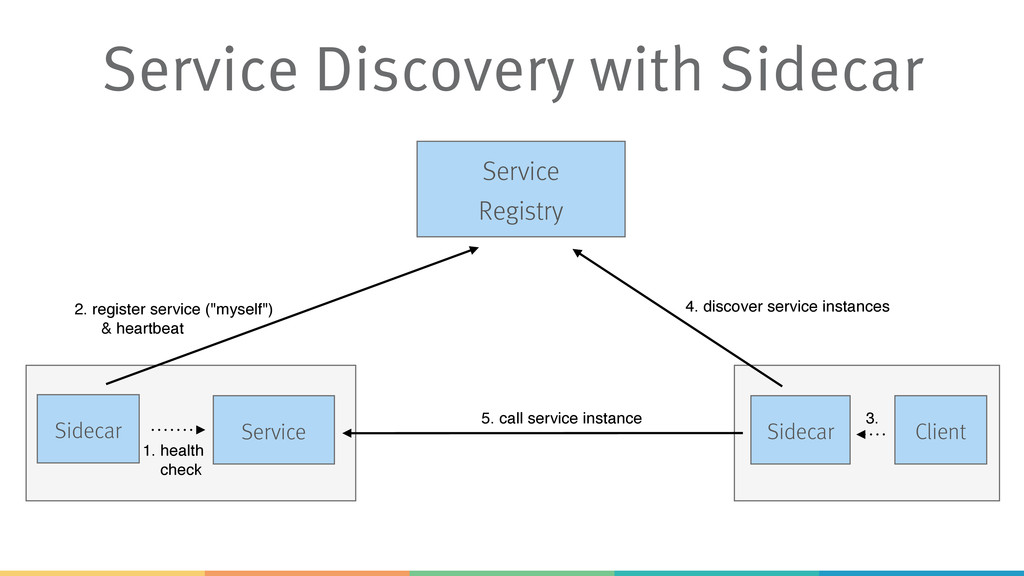
Service Discovery with Sidecar Sidecar Client Service Registry Sidecar Service
2. register service ("myself") & heartbeat 4. discover service instances 5. call service instance 1. health check 3. -
Resilience > isolate Failure > apply graceful degradation > be
responsive in case of failure -
> Provides Command-oriented Integration of Services > Introduces Circuit Breaker,
Bulkheads and Isolation > Decouples from Service-dependencies > Provides metrics-facility to protect from failures -
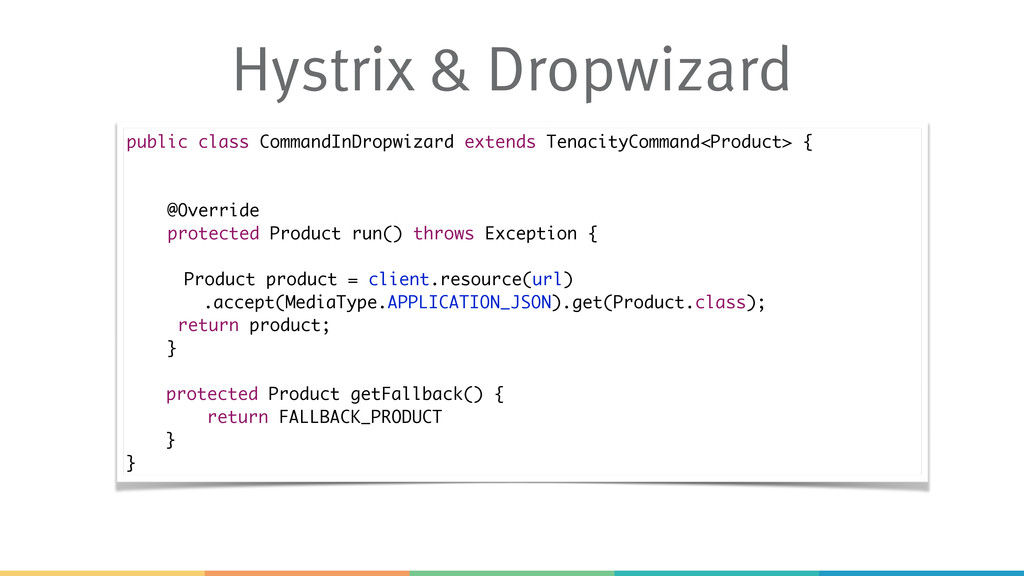
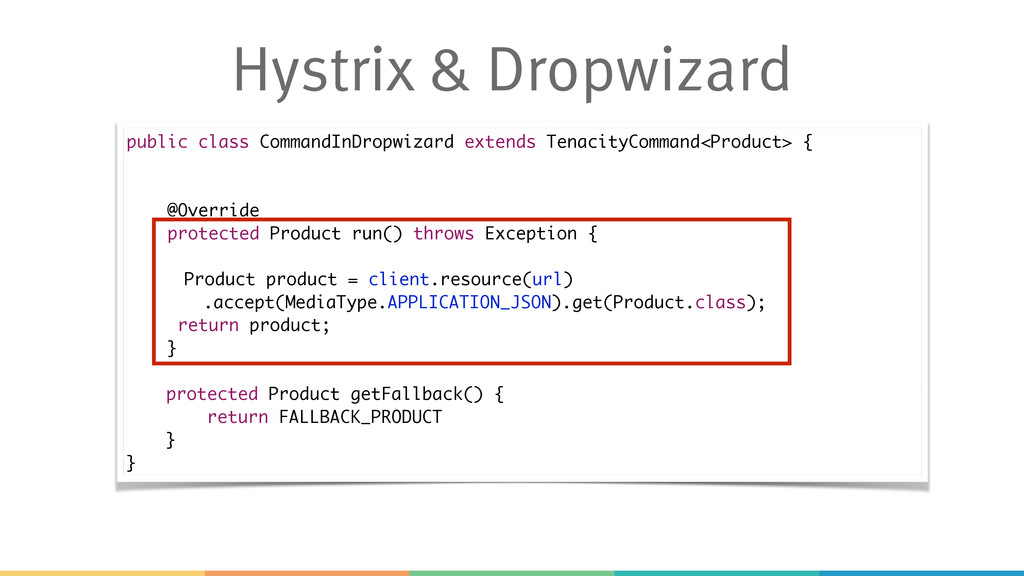
Hystrix & Dropwizard public class CommandInDropwizard extends TenacityCommand<Product> { @Override
protected Product run() throws Exception { Product product = client.resource(url) .accept(MediaType.APPLICATION_JSON).get(Product.class); return product; } protected Product getFallback() { return FALLBACK_PRODUCT } } -
Spring Cloud Hystrix @HystrixCommand(fallbackMethod = “fallbackProduct") private Pair<String, ResponseEntity<Product>> resolveProduct(String
productUri) { final RestTemplate restTemplate = new RestTemplate(); return new Pair(productUri, restTemplate.getForEntity(productUri, Product.class)); } private Pair<String, ResponseEntity<Product>> fallbackProduct(String productUri) { final Product product = new Product(productUri, null, BigDecimal.ZERO); final ResponseEntity<Product> response = new ResponseEntity<Product>(product, PARTIAL_CONTENT); return new Pair(productUri, response); } -
Spring Cloud Hystrix @HystrixCommand(fallbackMethod = “fallbackProduct") private Pair<String, ResponseEntity<Product>> resolveProduct(String
productUri) { final RestTemplate restTemplate = new RestTemplate(); return new Pair(productUri, restTemplate.getForEntity(productUri, Product.class)); } private Pair<String, ResponseEntity<Product>> fallbackProduct(String productUri) { final Product product = new Product(productUri, null, BigDecimal.ZERO); final ResponseEntity<Product> response = new ResponseEntity<Product>(product, PARTIAL_CONTENT); return new Pair(productUri, response); } auto-wrapped with command! -
Spring Cloud Hystrix @HystrixCommand(fallbackMethod = “fallbackProduct") private Pair<String, ResponseEntity<Product>> resolveProduct(String
productUri) { final RestTemplate restTemplate = new RestTemplate(); return new Pair(productUri, restTemplate.getForEntity(productUri, Product.class)); } private Pair<String, ResponseEntity<Product>> fallbackProduct(String productUri) { final Product product = new Product(productUri, null, BigDecimal.ZERO); final ResponseEntity<Product> response = new ResponseEntity<Product>(product, PARTIAL_CONTENT); return new Pair(productUri, response); } -
Spring Cloud Hystrix @HystrixCommand(fallbackMethod = “fallbackProduct") private Pair<String, ResponseEntity<Product>> resolveProduct(String
productUri) { final RestTemplate restTemplate = new RestTemplate(); return new Pair(productUri, restTemplate.getForEntity(productUri, Product.class)); } private Pair<String, ResponseEntity<Product>> fallbackProduct(String productUri) { final Product product = new Product(productUri, null, BigDecimal.ZERO); final ResponseEntity<Product> response = new ResponseEntity<Product>(product, PARTIAL_CONTENT); return new Pair(productUri, response); } method reference! -
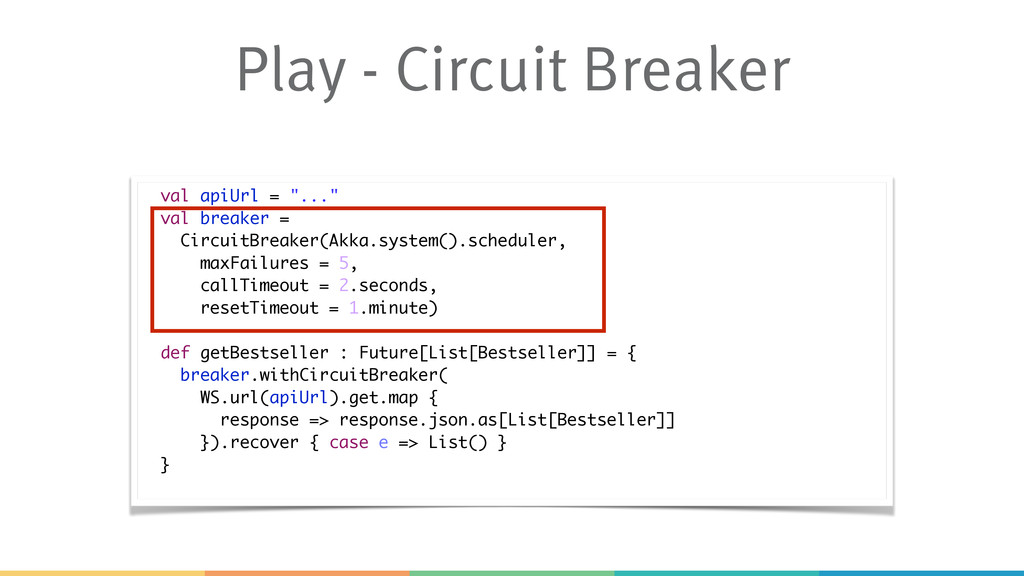
Play - Circuit Breaker val apiUrl = "..." val breaker
= CircuitBreaker(Akka.system().scheduler, maxFailures = 5, callTimeout = 2.seconds, resetTimeout = 1.minute) def getBestseller : Future[List[Bestseller]] = { breaker.withCircuitBreaker( WS.url(apiUrl).get.map { response => response.json.as[List[Bestseller]] }).recover { case e => List() } } -
Spring Boot - Packaging ./gradlew build ./gradlew distZip ZIP +
shell-script executable JAR -
Dropwizard > “Metrics” Integrated with Dropwizard > @Timed on Resources
> HTTP Client is already instrumented > JVM Data -
"org.apache.http.client.HttpClient.cart.get-requests": { "count": 11, "max": 0.062107, "mean": 0.013355909090909092, "min": 0.005750000000000001,
"p50": 0.009454, "p75": 0.010427, "p95": 0.062107, "p98": 0.062107, "p99": 0.062107, "p999": 0.062107, "stddev": 0.016285873488729705, "m15_rate": 0, "m1_rate": 0, "m5_rate": 0, "mean_rate": 2.9714422786532126, "duration_units": "seconds", "rate_units": "calls/second" } "cart.resources.ShoppingCartResource.shoppingCart": { "count": 22, "max": 0.136162, "mean": 0.01208109090909091, "min": 0.00093, "p50": 0.008174500000000001, "p75": 0.011782250000000001, "p95": 0.11783499999999976, "p98": 0.136162, "p99": 0.136162, "p999": 0.136162, "stddev": 0.02813530239821426, "m15_rate": 1.8524577712890011, "m1_rate": 0.18057796798879996, "m5_rate": 1.315746847992022, "mean_rate": 0.133050618509084, "duration_units": "seconds", "rate_units": "calls/second" } -
Dropwizard Metrics > Exposed over HTTP (as Json) > Exposed
as jmx > Others available: stdout, csv, slf4j, ganglia, graphite -
Spring Boot Metrics > Prepackaged Spring Boot starter module >
enables HTTP resources for metrics > configurable via application.properties http://docs.spring.io/spring-boot/docs/current-SNAPSHOT/reference/htmlsingle/#production-ready -
{ "counter.checkouts.withproducts.3": 4, ... } counterService.increment("checkouts.withproducts." + productUris.size()); GET /metrics
HTTP/1.1 Using a counter metric in your Java code… …will display it in the /metrics JSON Spring Boot Metrics -
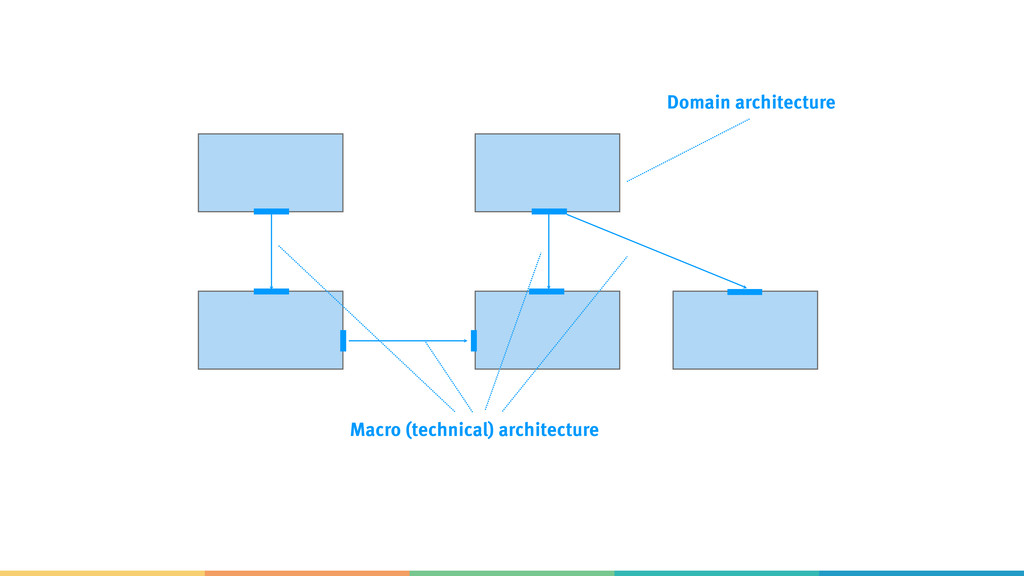
Modularize into independent, self-contained systems Separate micro and macro architectures
Strike a balance between control and decentralization Summary -
Modularize into independent, self-contained systems Separate micro and macro architectures
Strike a balance between control and decentralization MicroServices aren’t micro! Summary -
Modularize into independent, self-contained systems Separate micro and macro architectures
Strike a balance between control and decentralization MicroServices aren’t micro! frameworks can’t solve all your problems Summary -
Martin Eigenbrodt | @eigenbrodtm [email protected] Alexander Heusingfeld | @goldstift [email protected]
innoQ Deutschland GmbH Krischerstr. 100 40789 Monheim am Rhein Germany Phone: +49 2173 3366-0 innoQ Schweiz GmbH Gewerbestr. 11 CH-6330 Cham Switzerland Phone: +41 41 743 0116 www.innoq.com Ohlauer Straße 43 10999 Berlin Germany Phone: +49 2173 3366-0 Robert-Bosch-Straße 7 64293 Darmstadt Germany Phone: +49 2173 3366-0 Radlkoferstraße 2 D-81373 München Germany Telefon +49 (0) 89 741185-270 Thank you! Questions? Comments? https://www.innoq.com/en/talks/2015/02/microservices-jvm-applications-talk