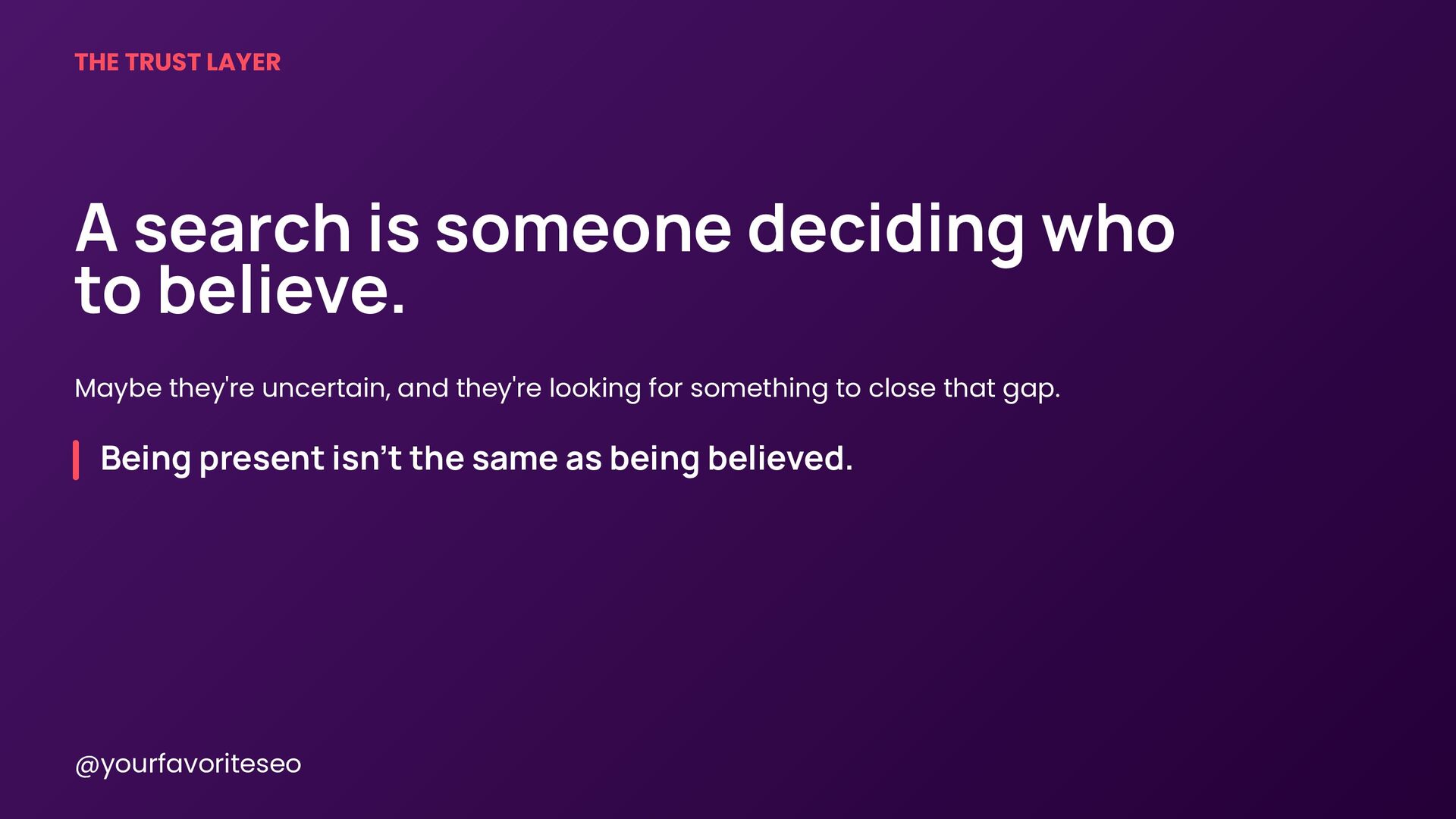
believe. Maybe they're uncertain, and they're looking for something to close that gap. Being present isn’t the same as being believed. @yourfavoriteseo
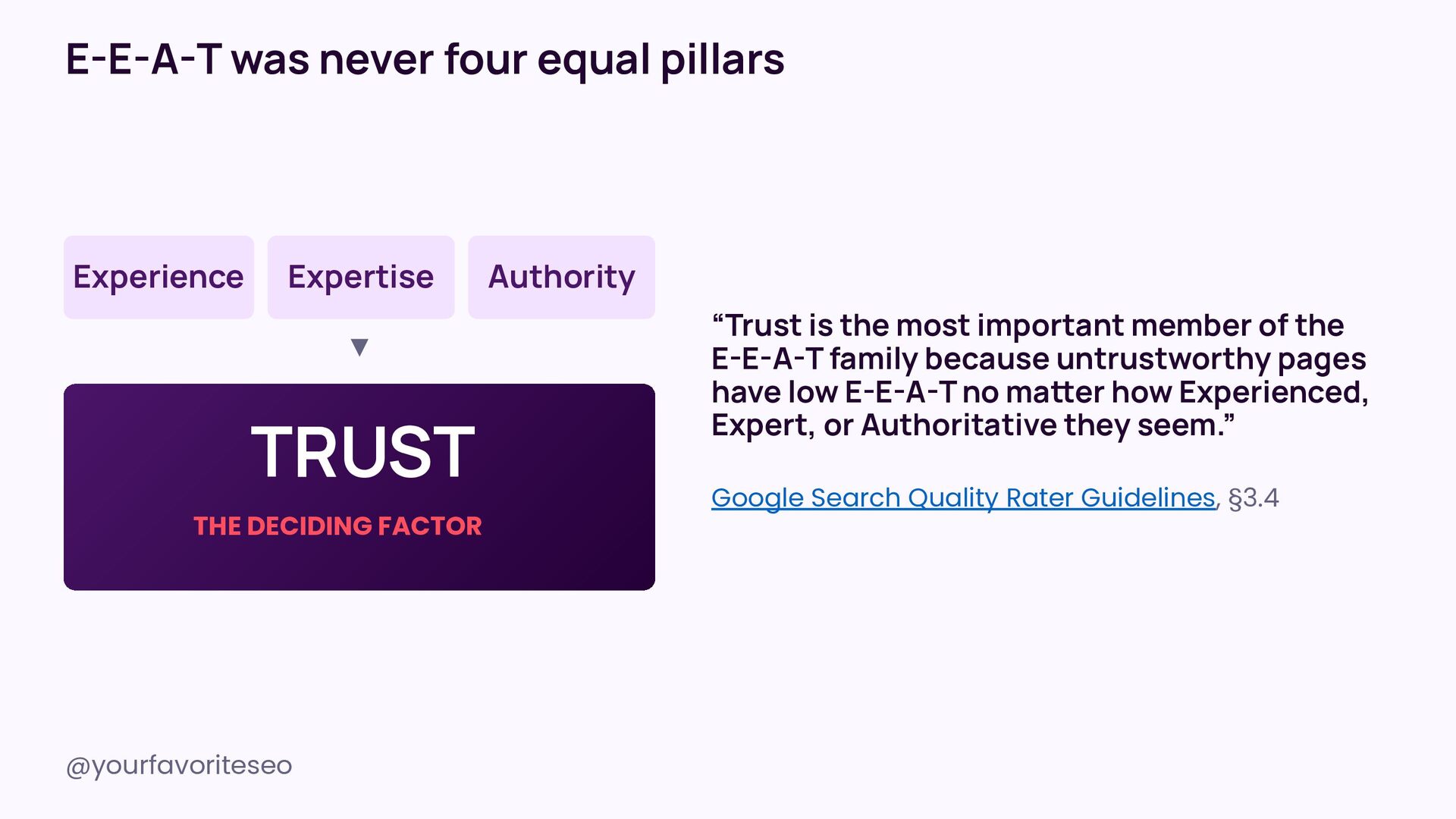
THE DECIDING FACTOR @yourfavoriteseo Authority “Trust is the most important member of the E-E-A-T family because untrustworthy pages have low E-E-A-T no maer how Experienced, Expert, or Authoritative they seem.” Google Search Quality Rater Guidelines, §3.4
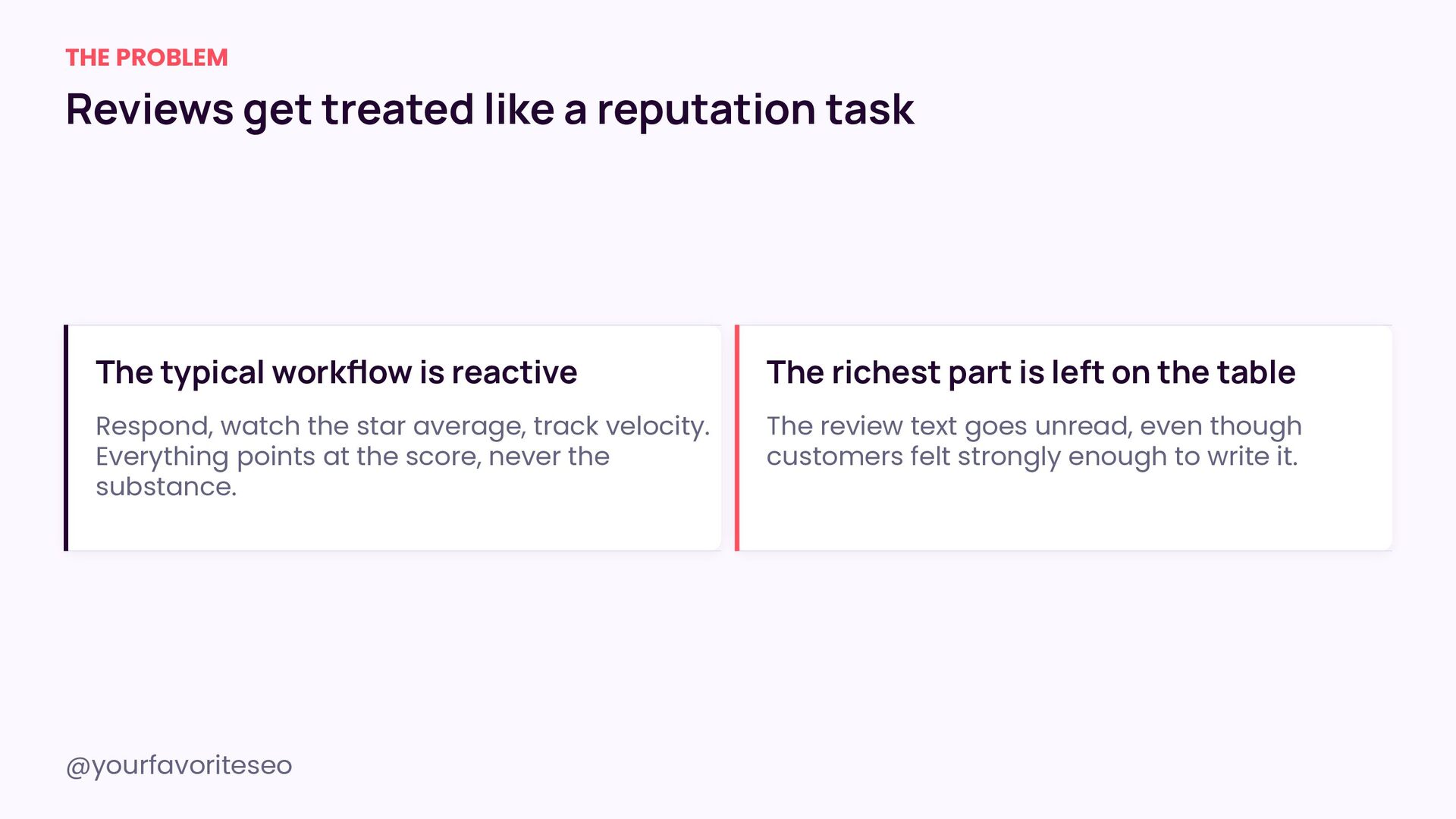
typical workflow is reactive The richest part is left on the table Respond, watch the star average, track velocity. Everything points at the score, never the substance. The review text goes unread, even though customers felt strongly enough to write it. @yourfavoriteseo
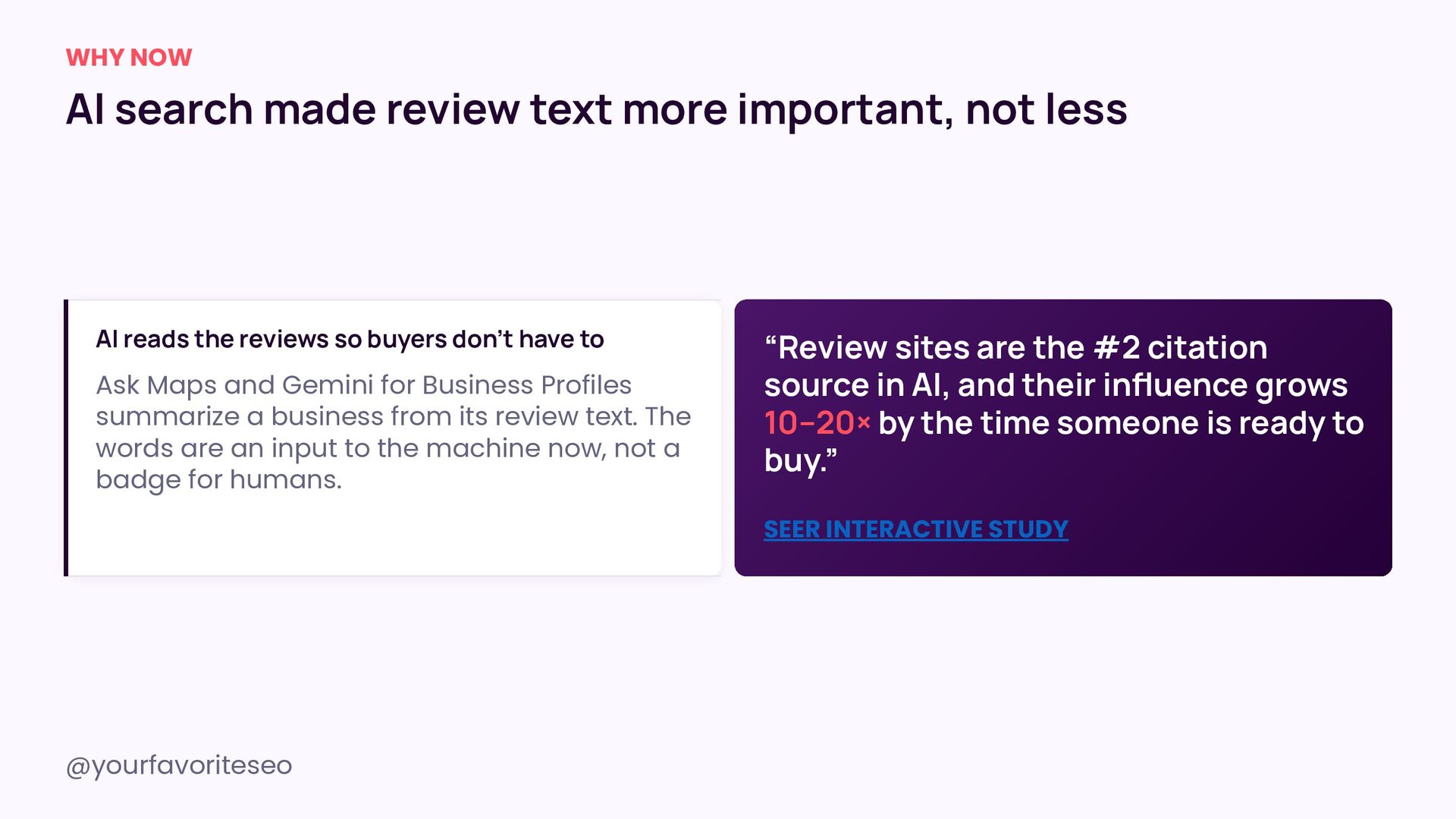
less AI reads the reviews so buyers don’t have to Ask Maps and Gemini for Business Profiles summarize a business from its review text. The words are an input to the machine now, not a badge for humans. “Review sites are the #2 citation source in AI, and their influence grows 10–20× by the time someone is ready to buy.” SEER INTERACTIVE STUDY @yourfavoriteseo
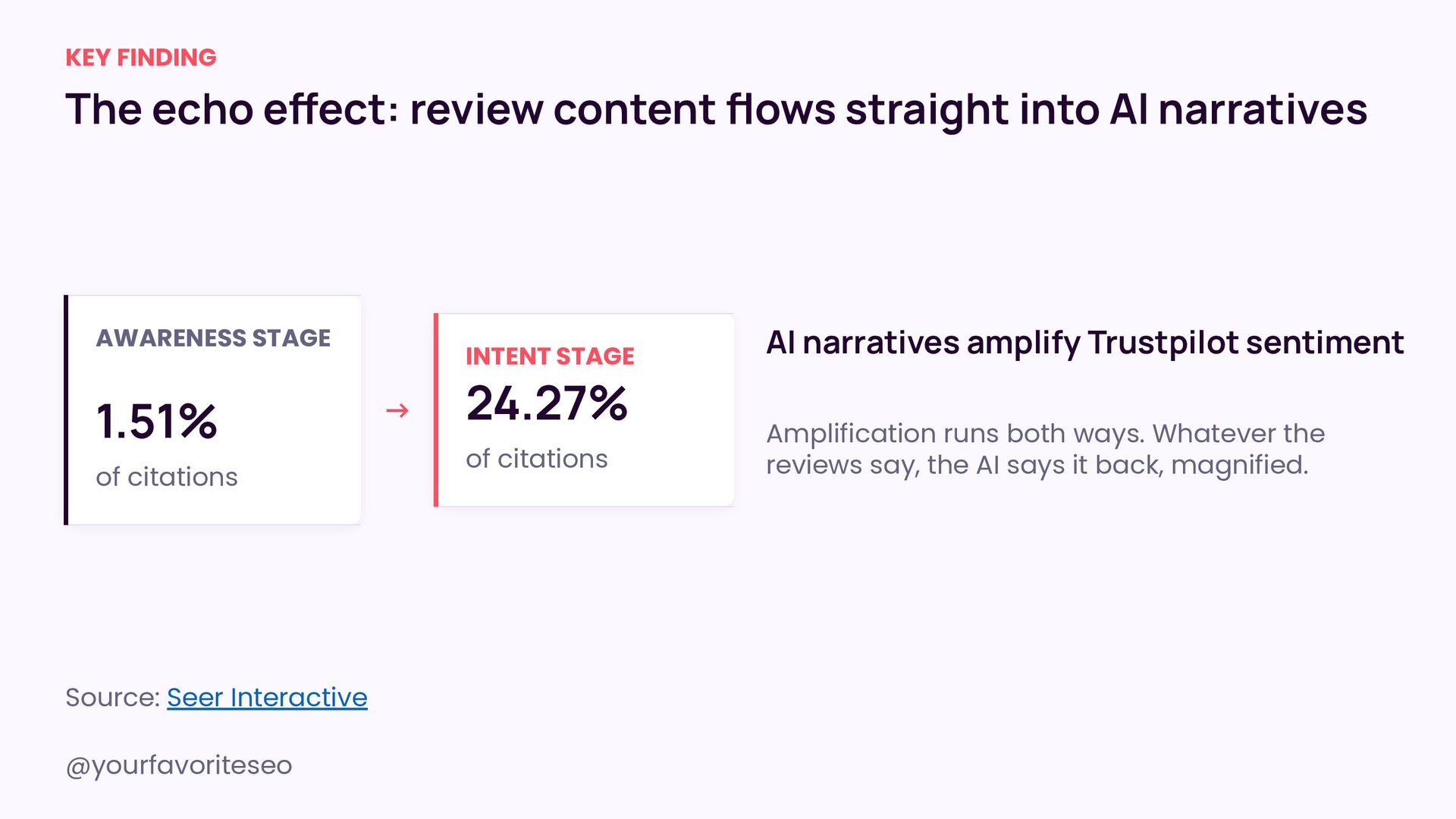
AI narratives AWARENESS STAGE 1.51% of citations Source: Seer Interactive @yourfavoriteseo → INTENT STAGE AI narratives amplify Trustpilot sentiment of citations Amplification runs both ways. Whatever the reviews say, the AI says it back, magnified. 24.27%
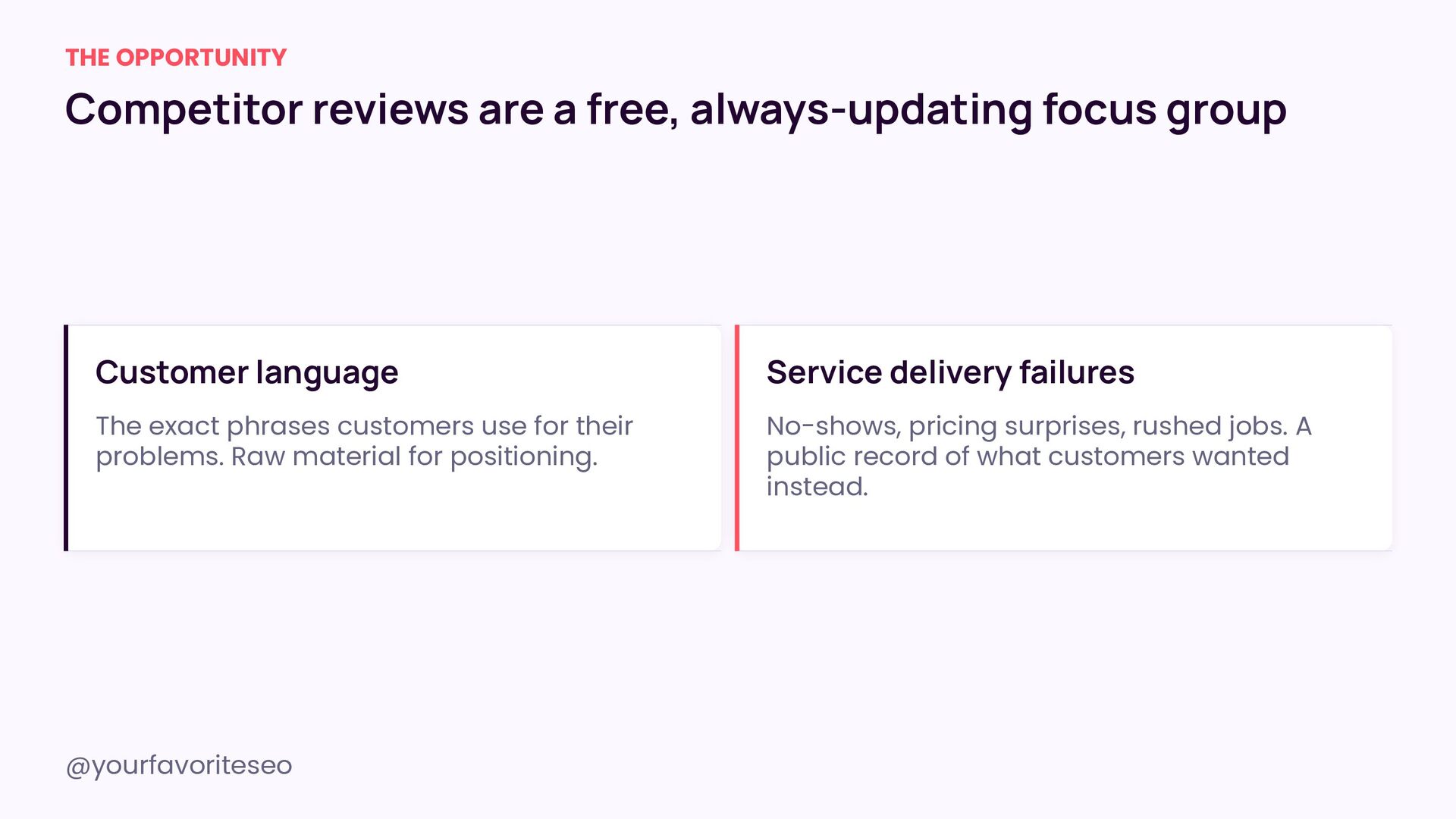
Customer language Service delivery failures The exact phrases customers use for their problems. Raw material for positioning. No-shows, pricing surprises, rushed jobs. A public record of what customers wanted instead. @yourfavoriteseo
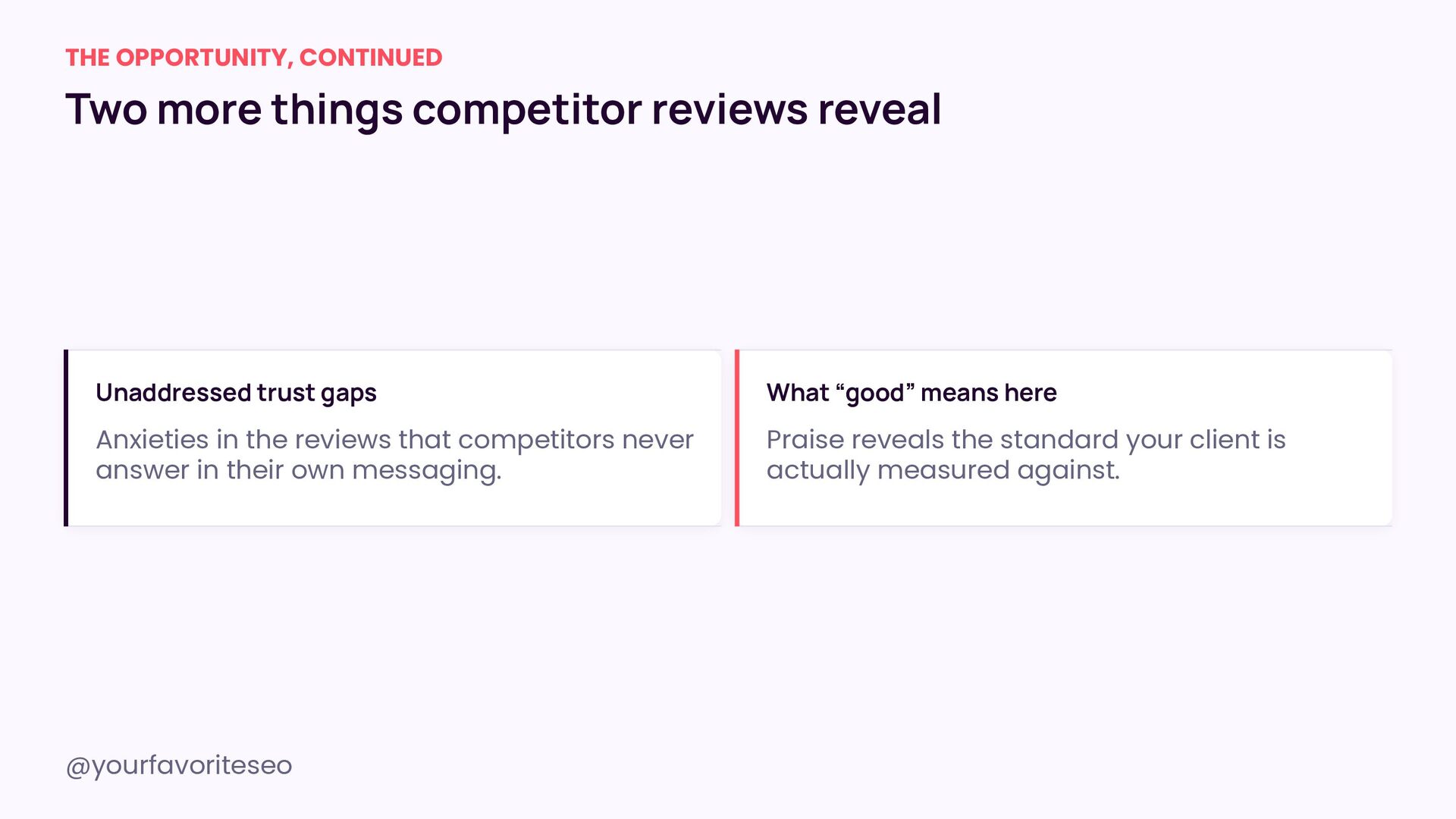
trust gaps What “good” means here Anxieties in the reviews that competitors never answer in their own messaging. Praise reveals the standard your client is actually measured against. @yourfavoriteseo
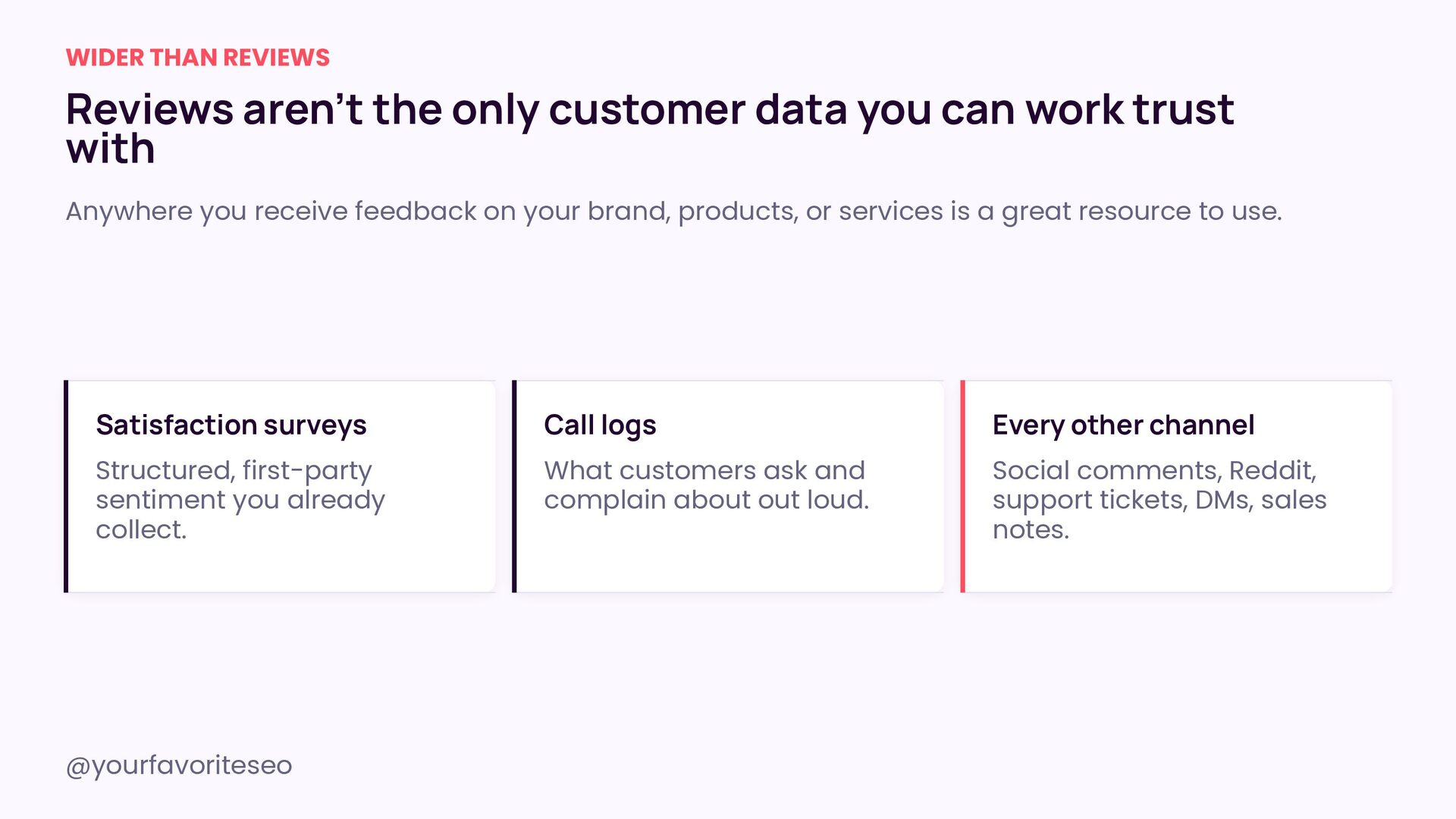
can work trust with Anywhere you receive feedback on your brand, products, or services is a great resource to use. Satisfaction surveys Call logs Every other channel Structured, first-party sentiment you already collect. What customers ask and complain about out loud. Social comments, Reddit, support tickets, DMs, sales notes. @yourfavoriteseo
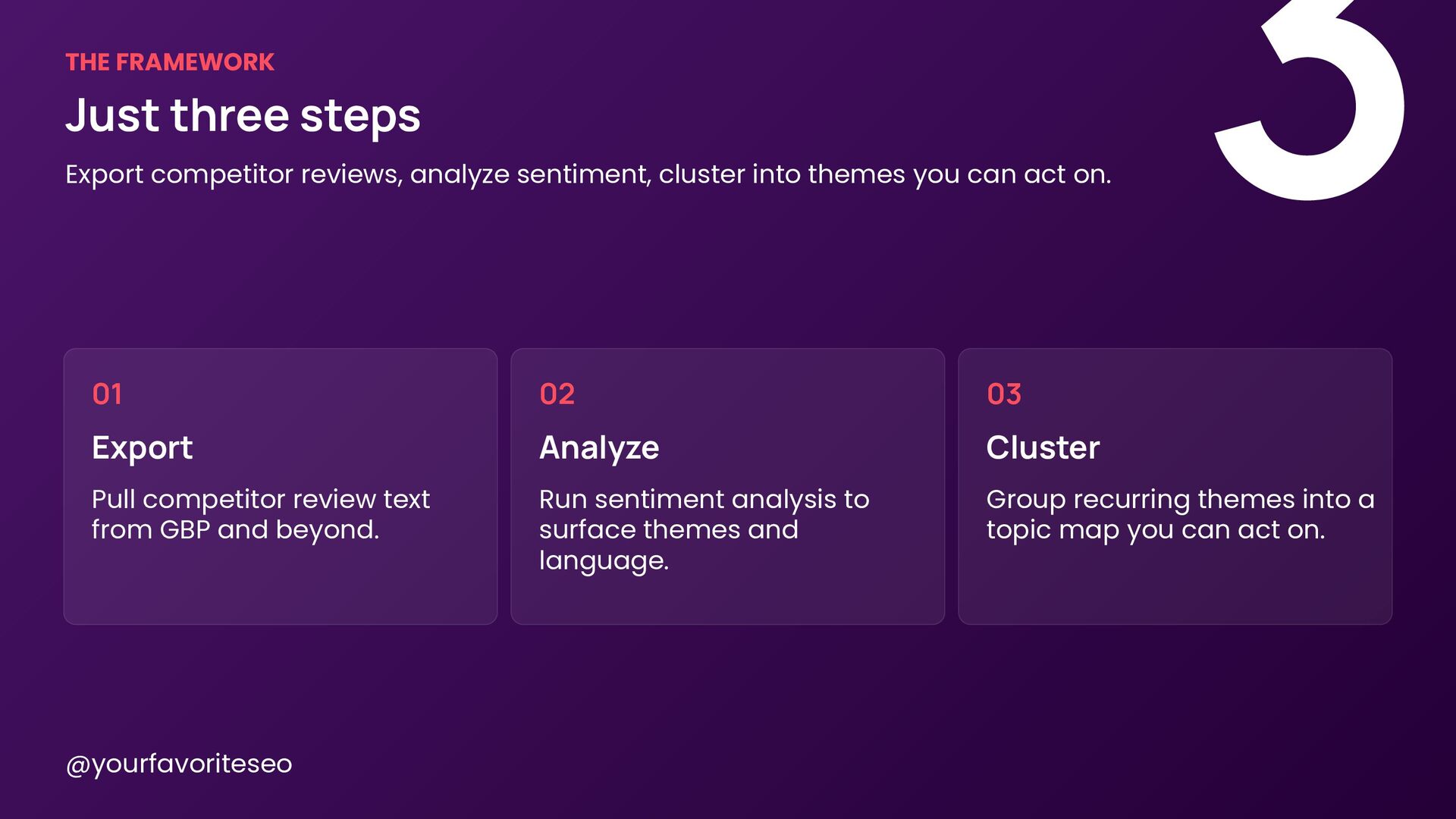
cluster into themes you can act on. 3 01 02 03 Export Analyze Cluster Pull competitor review text from GBP and beyond. Run sentiment analysis to surface themes and language. Group recurring themes into a topic map you can act on. @yourfavoriteseo
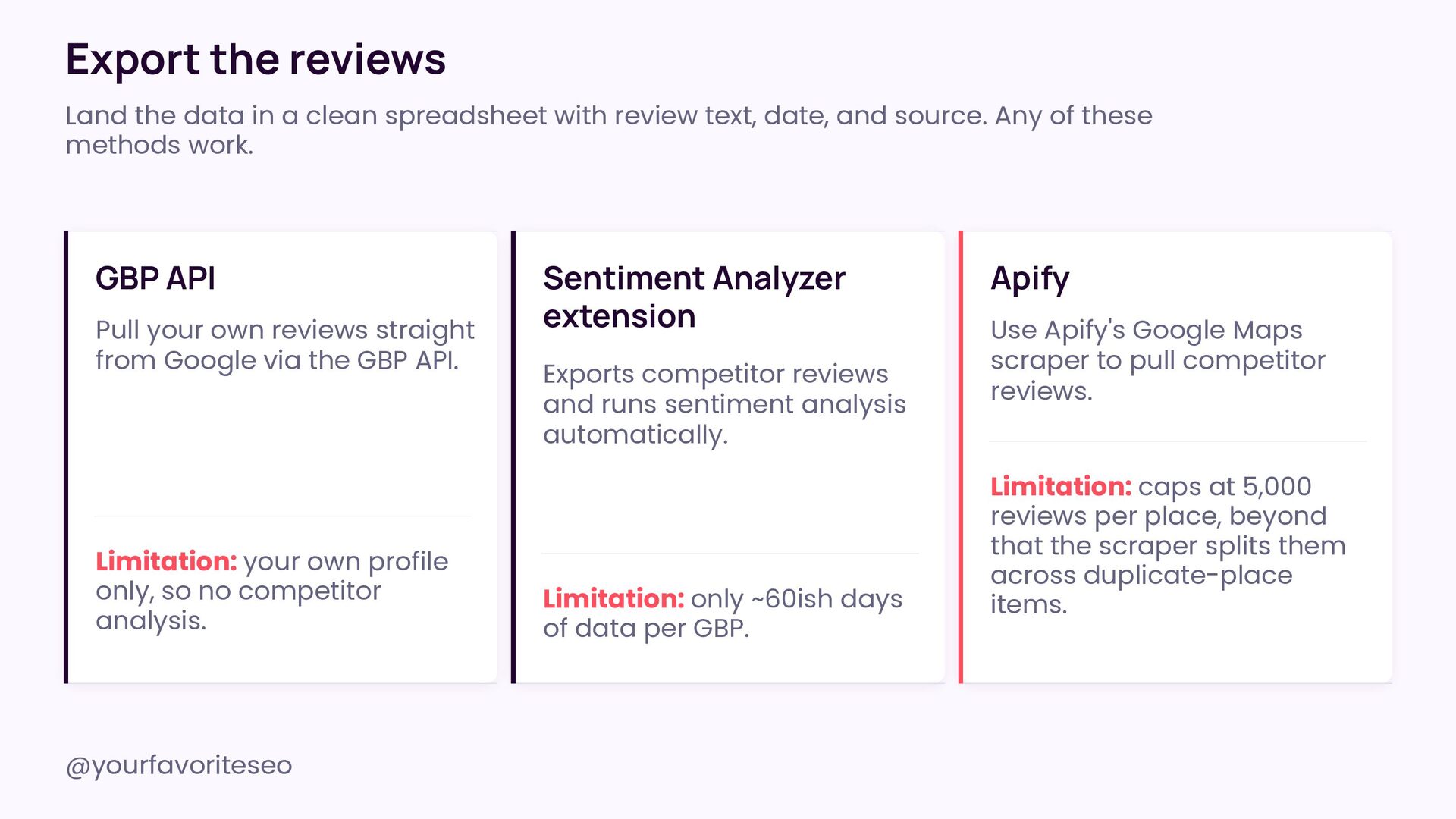
with review text, date, and source. Any of these methods work. GBP API Pull your own reviews straight from Google via the GBP API. Limitation: your own profile only, so no competitor analysis. @yourfavoriteseo Sentiment Analyzer extension Exports competitor reviews and runs sentiment analysis automatically. Limitation: only ~60ish days of data per GBP. Apify Use Apify's Google Maps scraper to pull competitor reviews. Limitation: caps at 5,000 reviews per place, beyond that the scraper splits them across duplicate-place items.
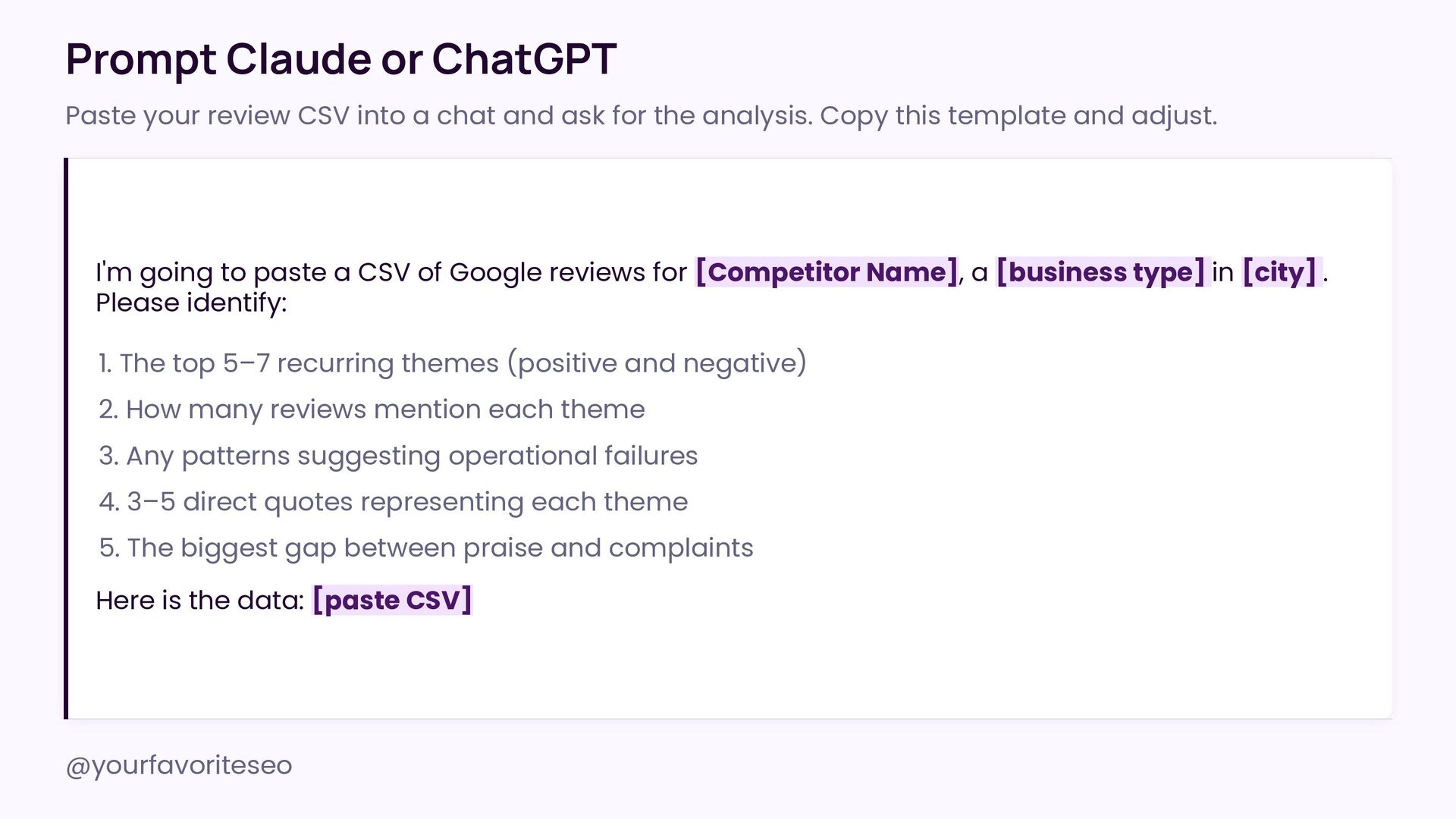
chat and ask for the analysis. Copy this template and adjust. I'm going to paste a CSV of Google reviews for [Competitor Name], a [business type] in [city] . Please identify: 1. The top 5–7 recurring themes (positive and negative) 2. How many reviews mention each theme 3. Any patterns suggesting operational failures 4. 3–5 direct quotes representing each theme 5. The biggest gap between praise and complaints Here is the data: [paste CSV] @yourfavoriteseo
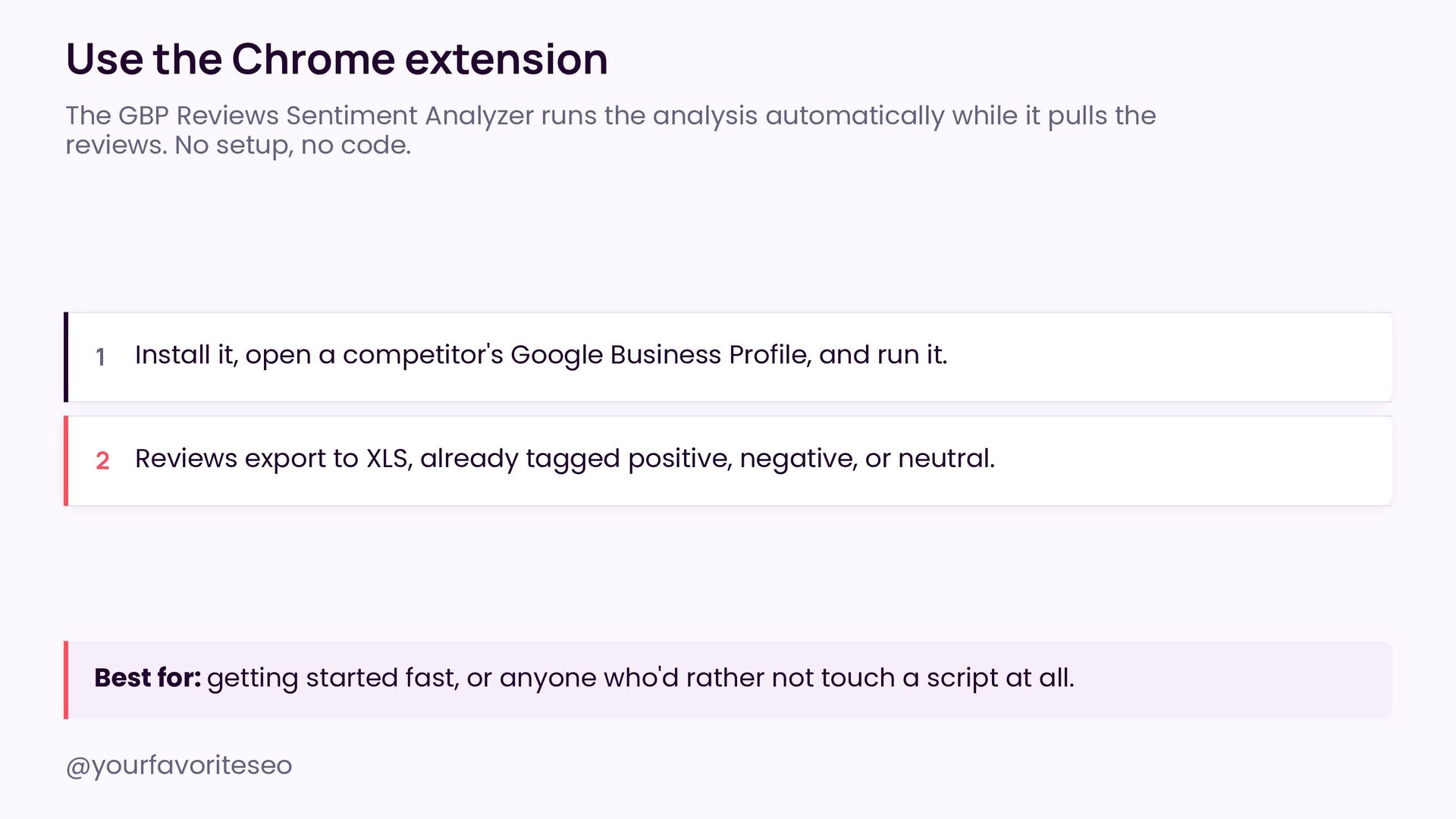
the analysis automatically while it pulls the reviews. No setup, no code. 1 Install it, open a competitor's Google Business Profile, and run it. 2 Reviews export to XLS, already tagged positive, negative, or neutral. Best for: getting started fast, or anyone who'd rather not touch a script at all. @yourfavoriteseo
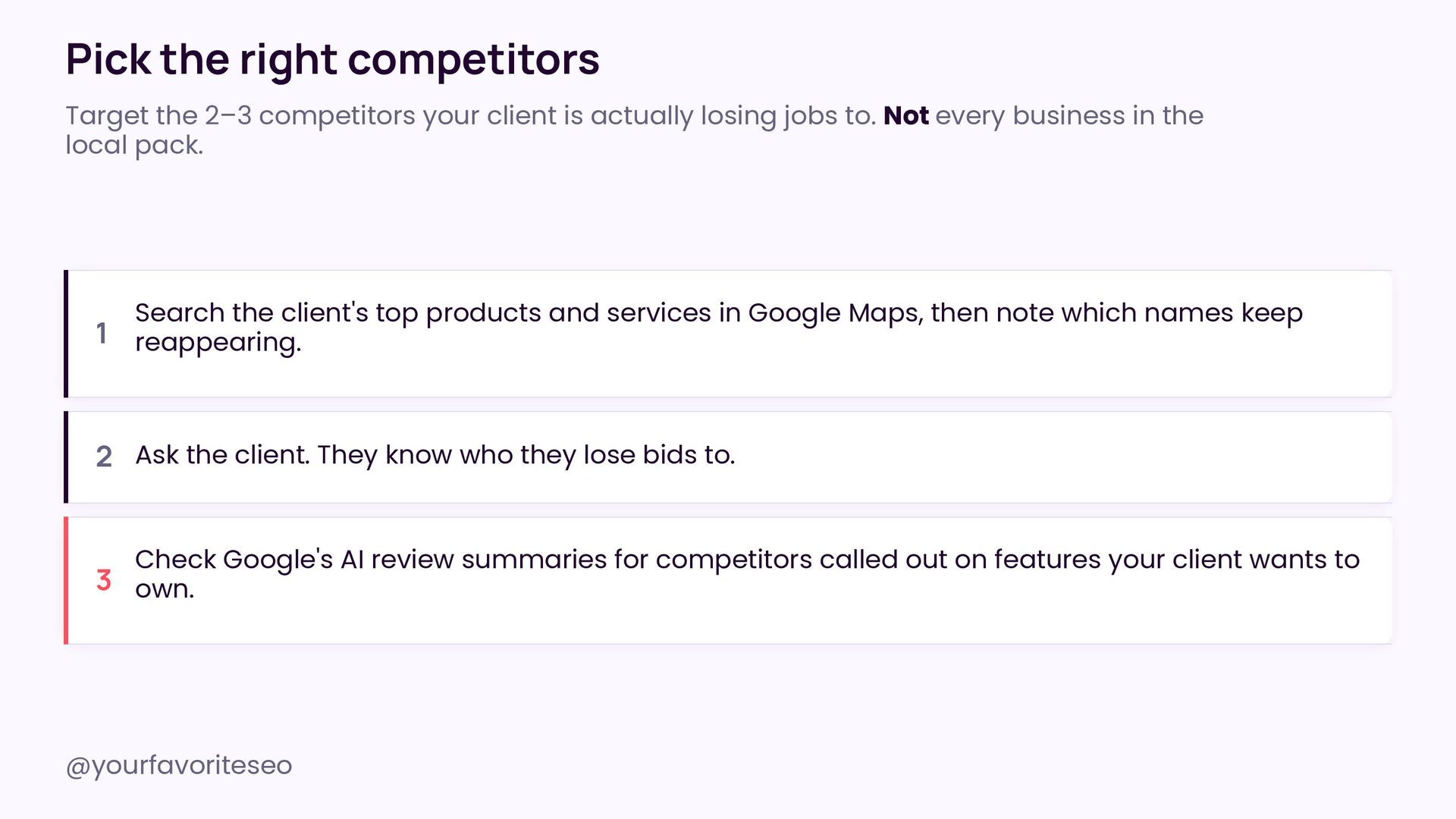
is actually losing jobs to. Not every business in the local pack. 1 Search the client's top products and services in Google Maps, then note which names keep reappearing. 2 Ask the client. They know who they lose bids to. Check Google's AI review summaries for competitors called out on features your client wants to 3 own. @yourfavoriteseo
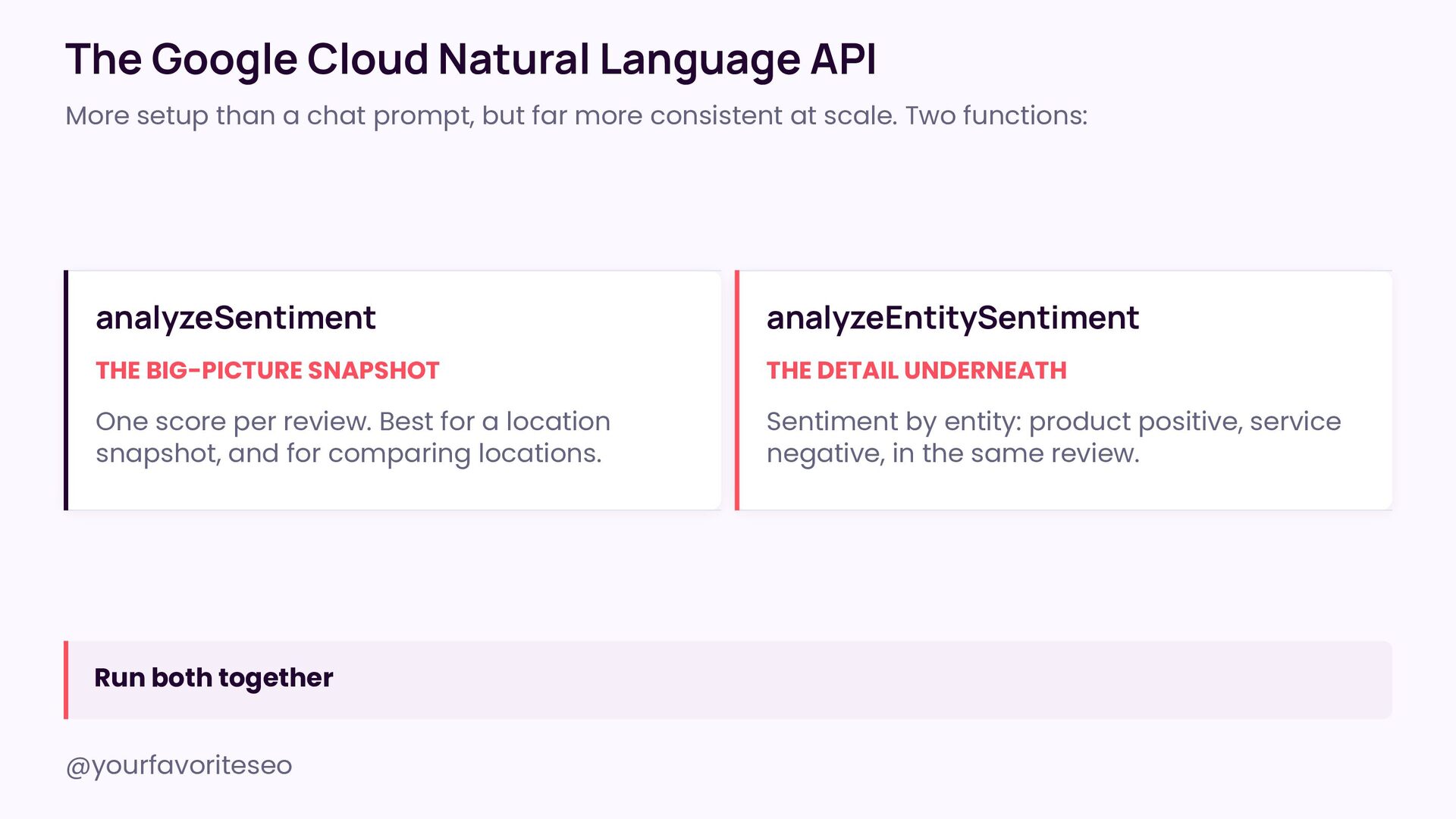
chat prompt, but far more consistent at scale. Two functions: analyzeSentiment analyzeEntitySentiment THE BIG-PICTURE SNAPSHOT THE DETAIL UNDERNEATH One score per review. Best for a location snapshot, and for comparing locations. Sentiment by entity: product positive, service negative, in the same review. Run both together @yourfavoriteseo
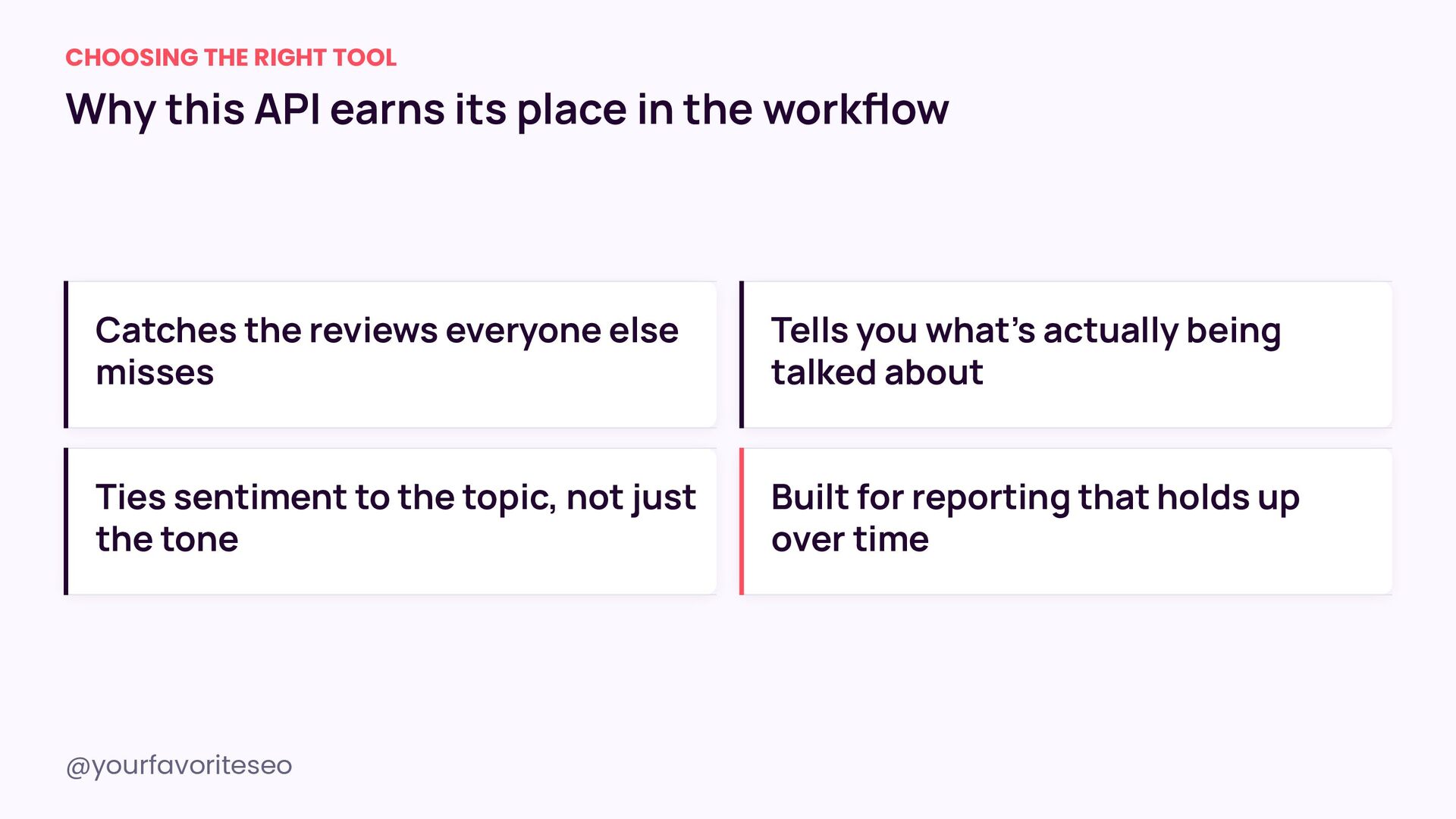
in the workflow Catches the reviews everyone else misses Tells you what’s actually being talked about Ties sentiment to the topic, not just the tone Built for reporting that holds up over time @yourfavoriteseo
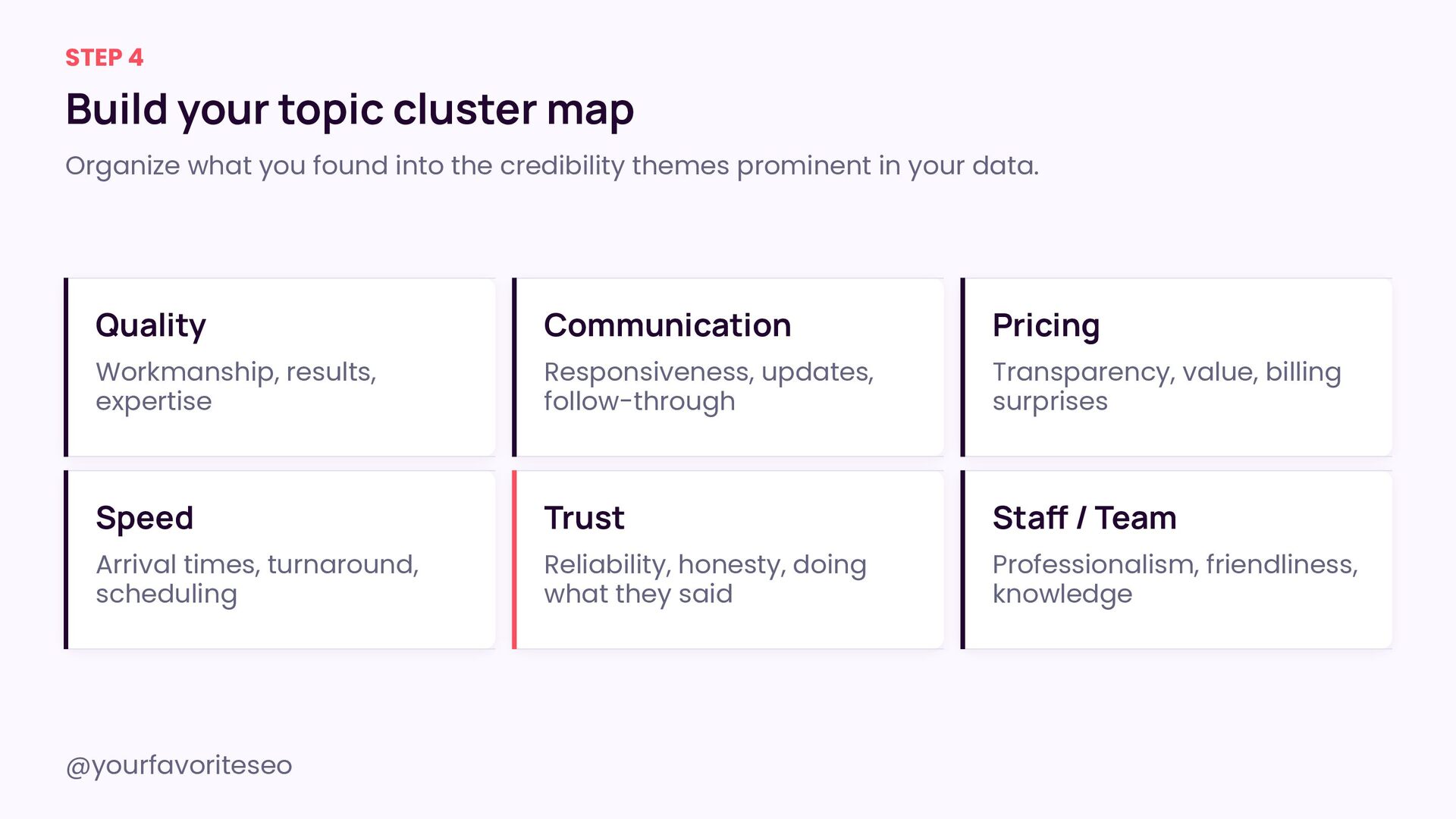
found into the credibility themes prominent in your data. Quality Communication Pricing Workmanship, results, expertise Responsiveness, updates, follow-through Transparency, value, billing surprises Speed Trust Sta / Team Arrival times, turnaround, scheduling Reliability, honesty, doing what they said Professionalism, friendliness, knowledge @yourfavoriteseo
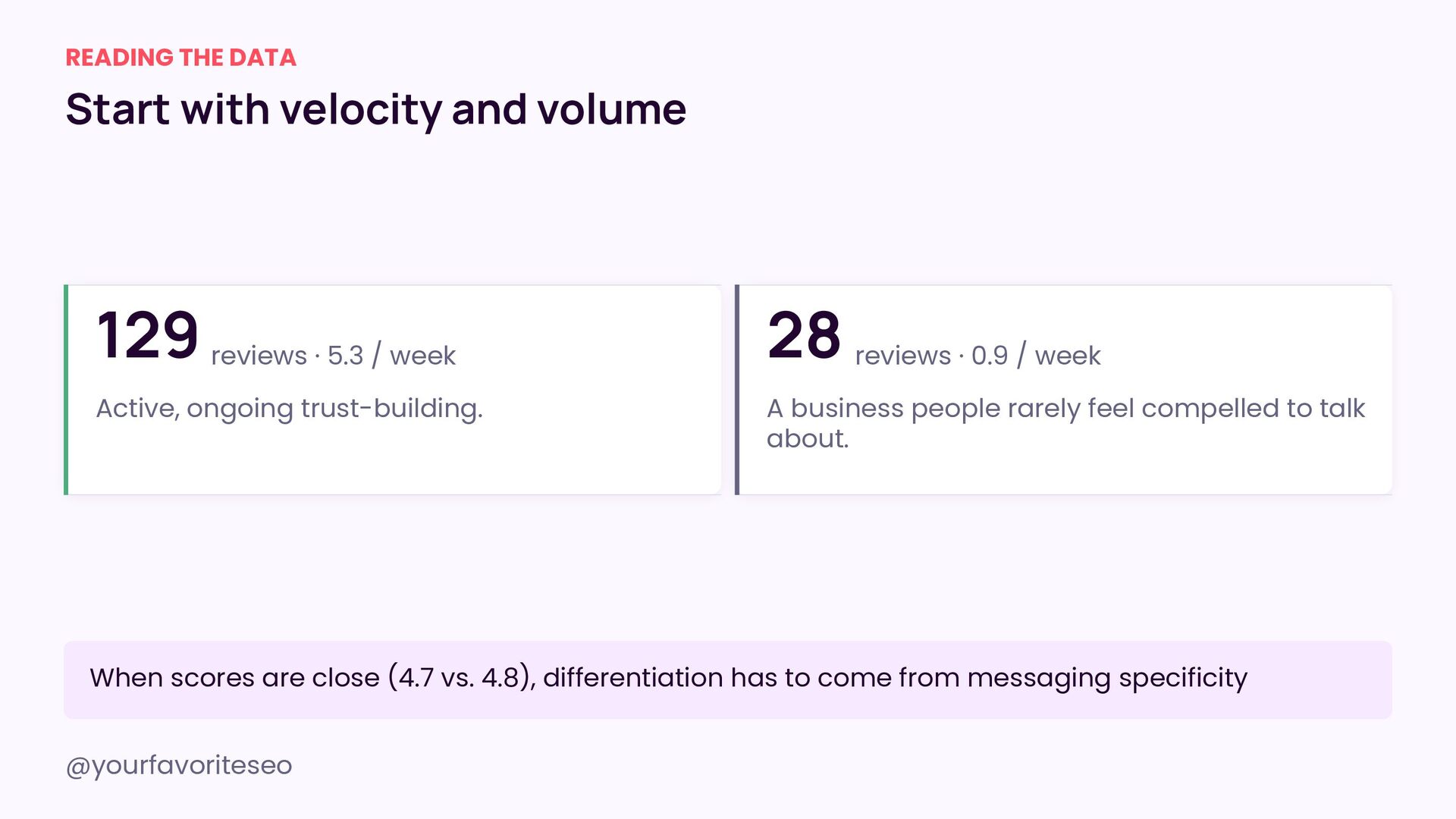
· 5.3 / week 28 reviews · 0.9 / week Active, ongoing trust-building. A business people rarely feel compelled to talk about. When scores are close (4.7 vs. 4.8), differentiation has to come from messaging specificity @yourfavoriteseo
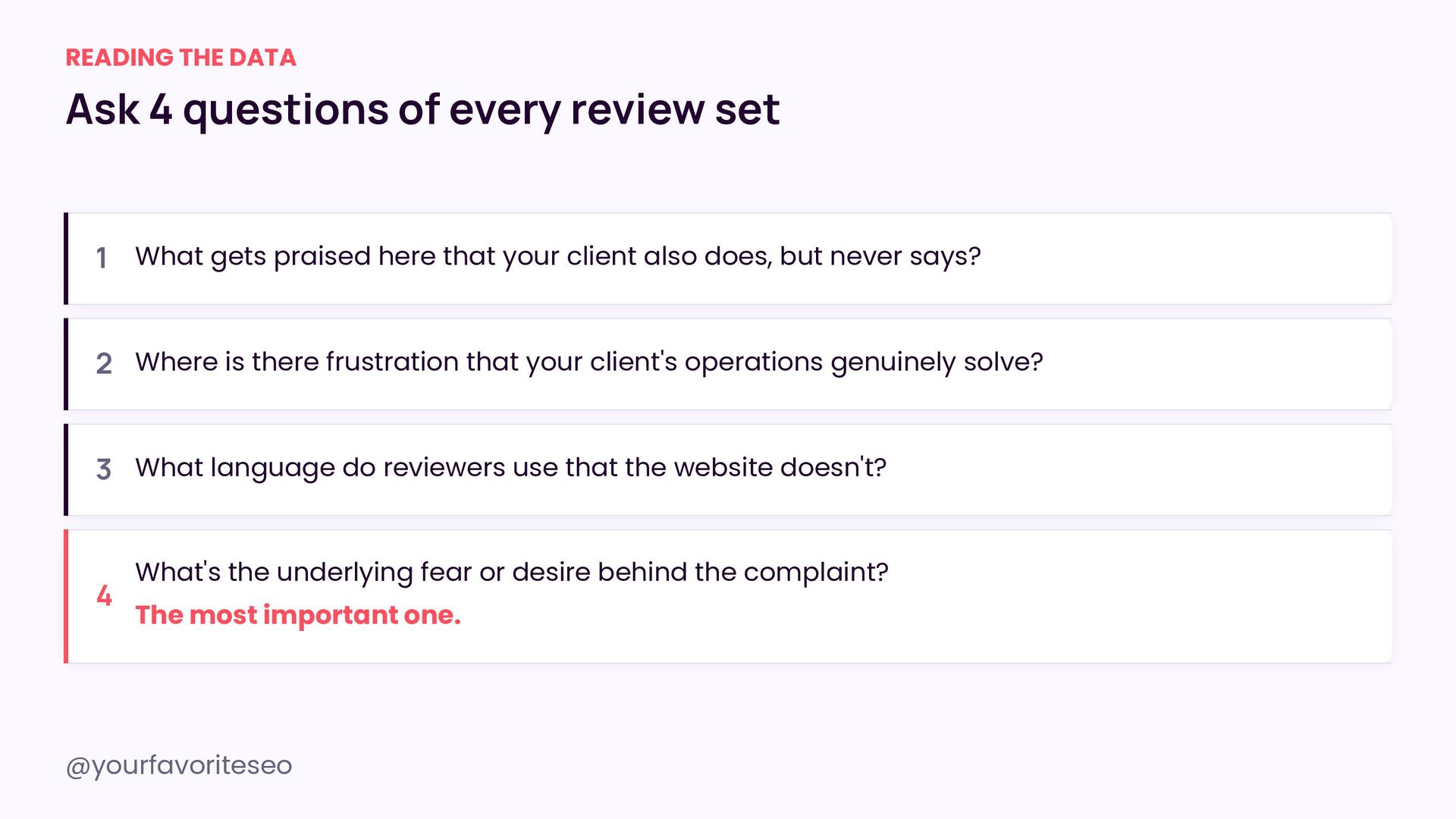
1 What gets praised here that your client also does, but never says? 2 Where is there frustration that your client's operations genuinely solve? 3 What language do reviewers use that the website doesn't? 4 What's the underlying fear or desire behind the complaint? The most important one. @yourfavoriteseo
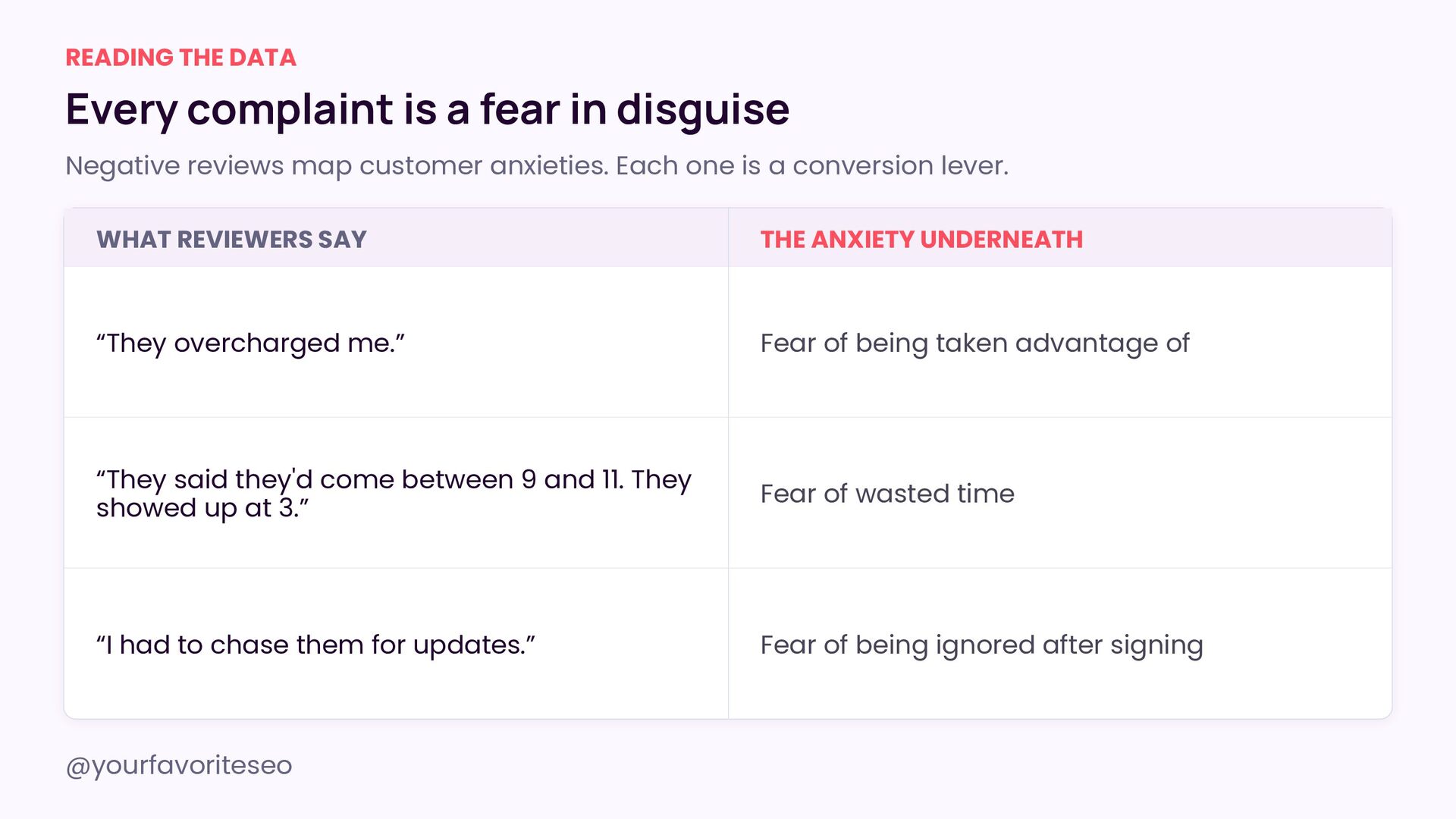
Negative reviews map customer anxieties. Each one is a conversion lever. WHAT REVIEWERS SAY THE ANXIETY UNDERNEATH “They overcharged me.” Fear of being taken advantage of “They said they'd come between 9 and 11. They showed up at 3.” Fear of wasted time “I had to chase them for updates.” Fear of being ignored after signing @yourfavoriteseo
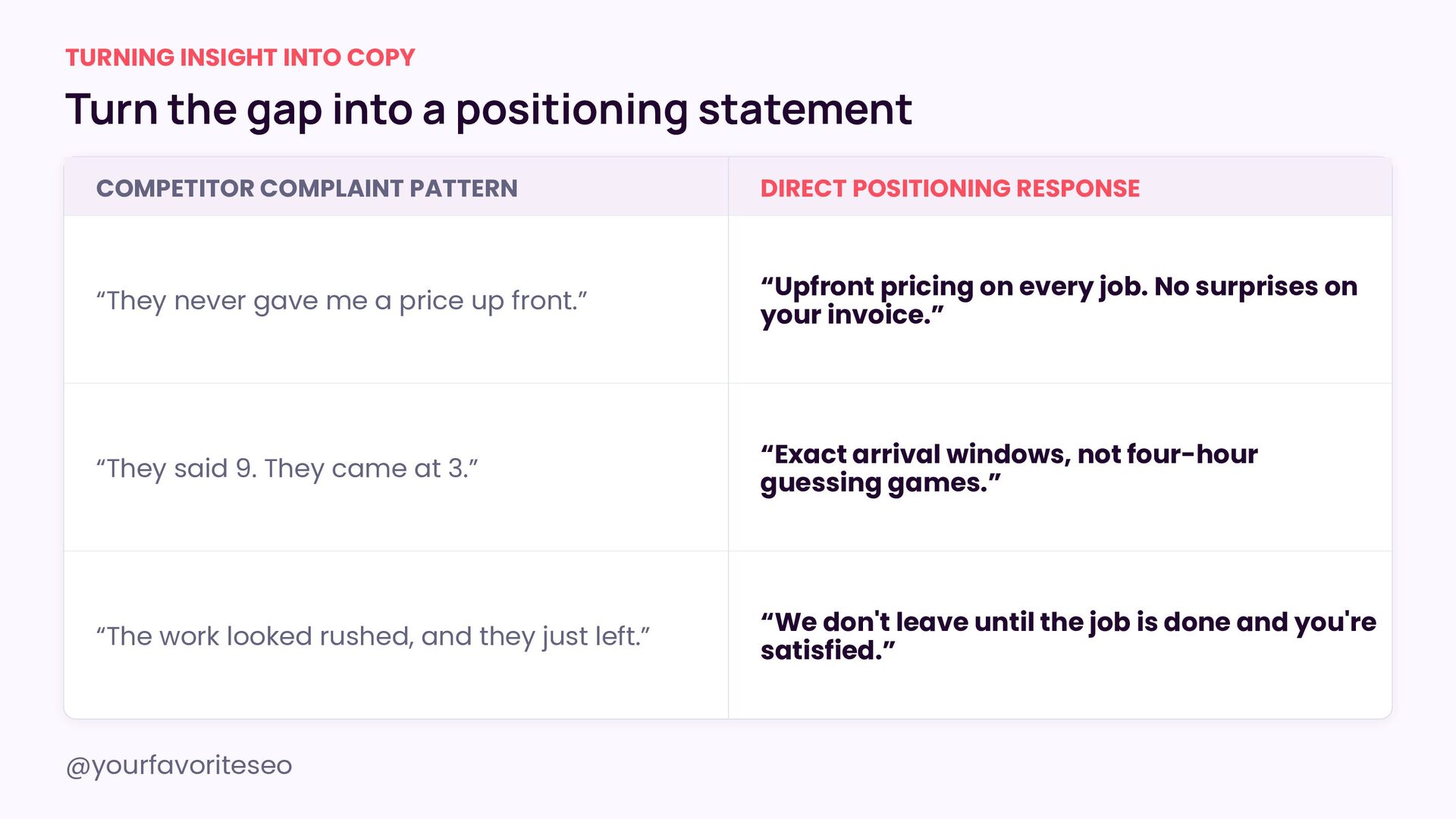
statement COMPETITOR COMPLAINT PATTERN DIRECT POSITIONING RESPONSE “They never gave me a price up front.” “Upfront pricing on every job. No surprises on your invoice.” “They said 9. They came at 3.” “Exact arrival windows, not four-hour guessing games.” “The work looked rushed, and they just left.” “We don't leave until the job is done and you're satisfied.” @yourfavoriteseo
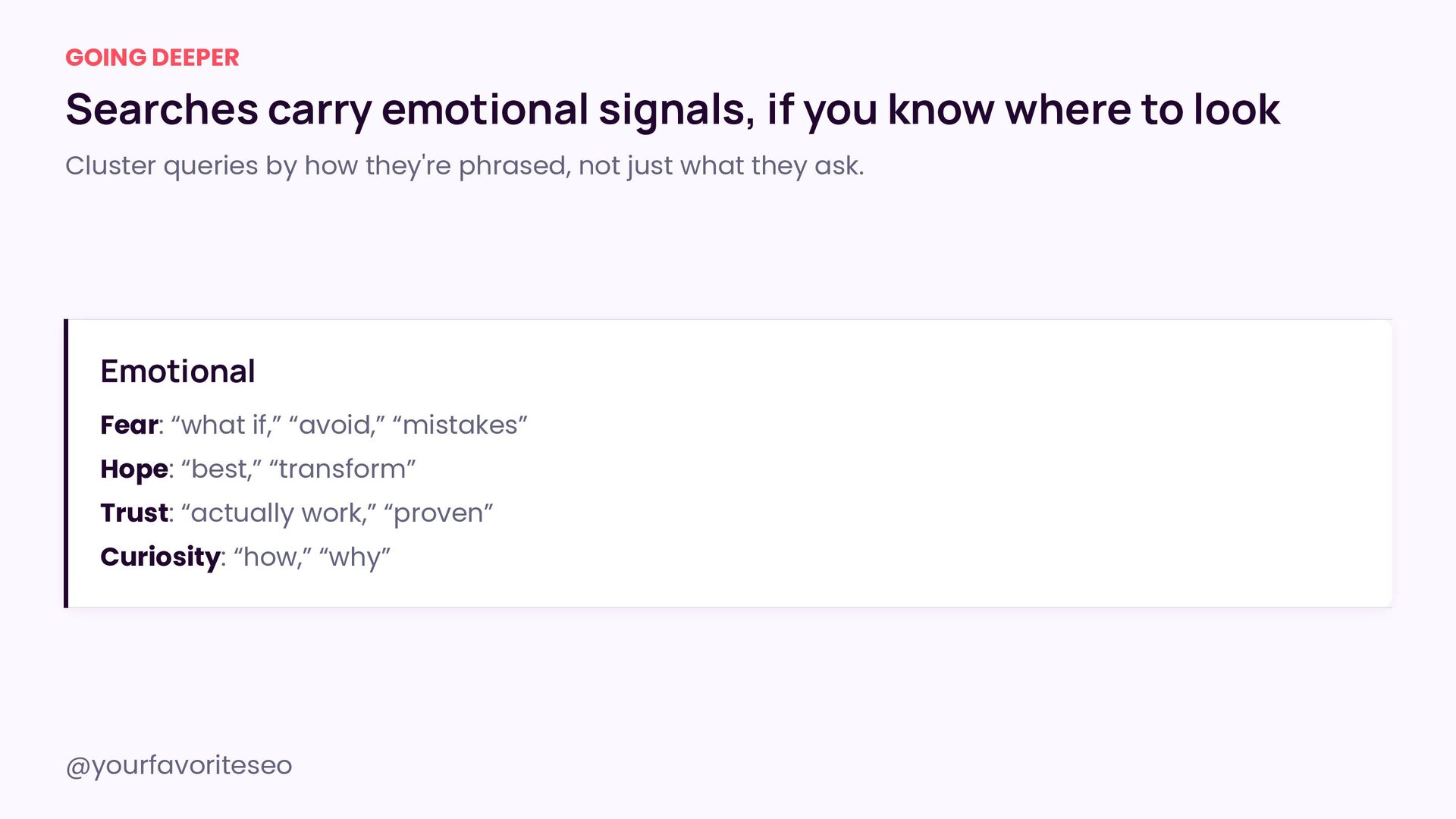
to look Cluster queries by how they're phrased, not just what they ask. Emotional Fear: “what if,” “avoid,” “mistakes” Hope: “best,” “transform” Trust: “actually work,” “proven” Curiosity: “how,” “why” @yourfavoriteseo
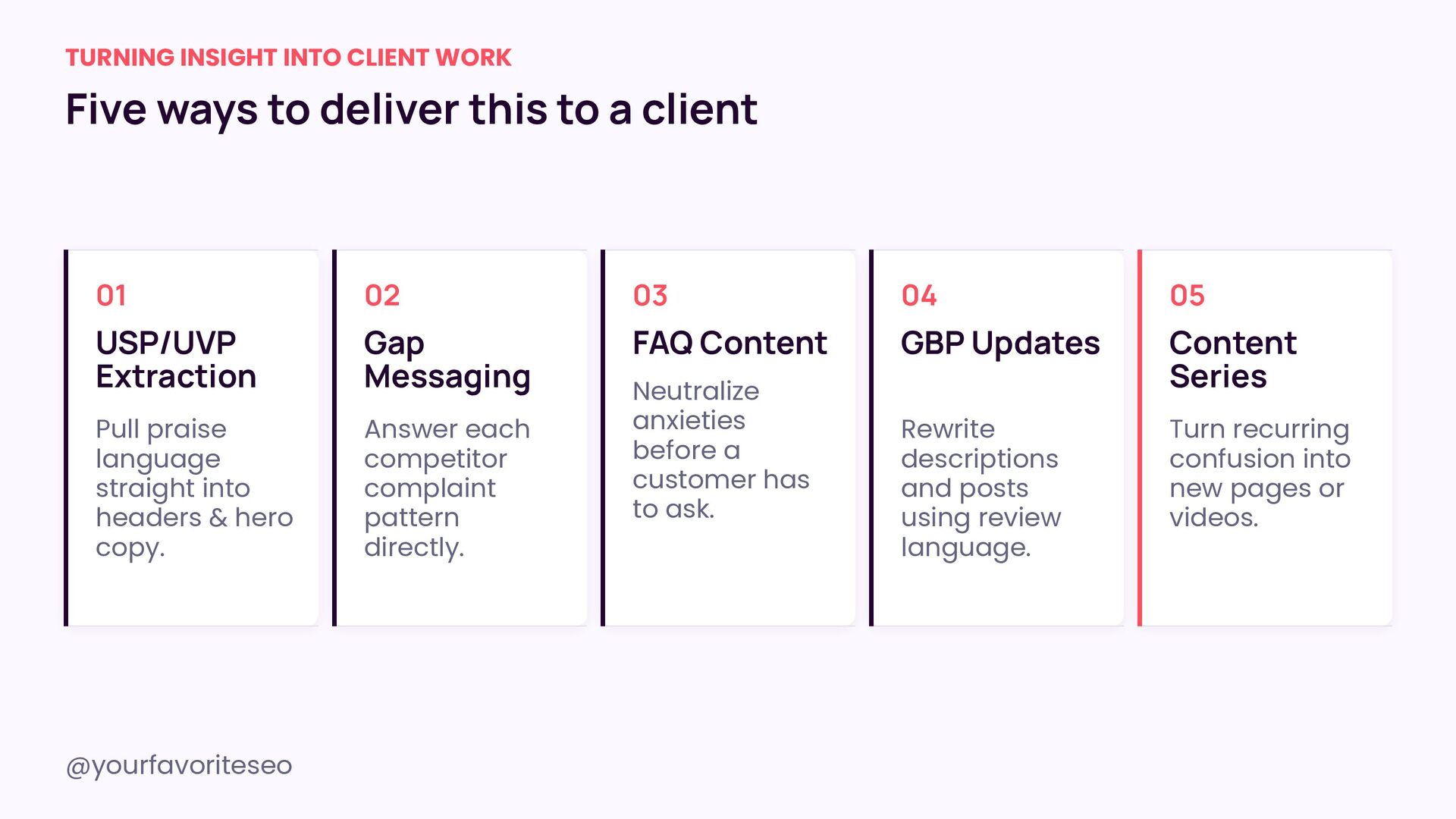
to a client 01 02 03 04 05 USP/UVP Extraction Gap Messaging FAQ Content GBP Updates Content Series Pull praise language straight into headers & hero copy. Answer each competitor complaint pattern directly. Rewrite descriptions and posts using review language. Turn recurring confusion into new pages or videos. @yourfavoriteseo Neutralize anxieties before a customer has to ask.
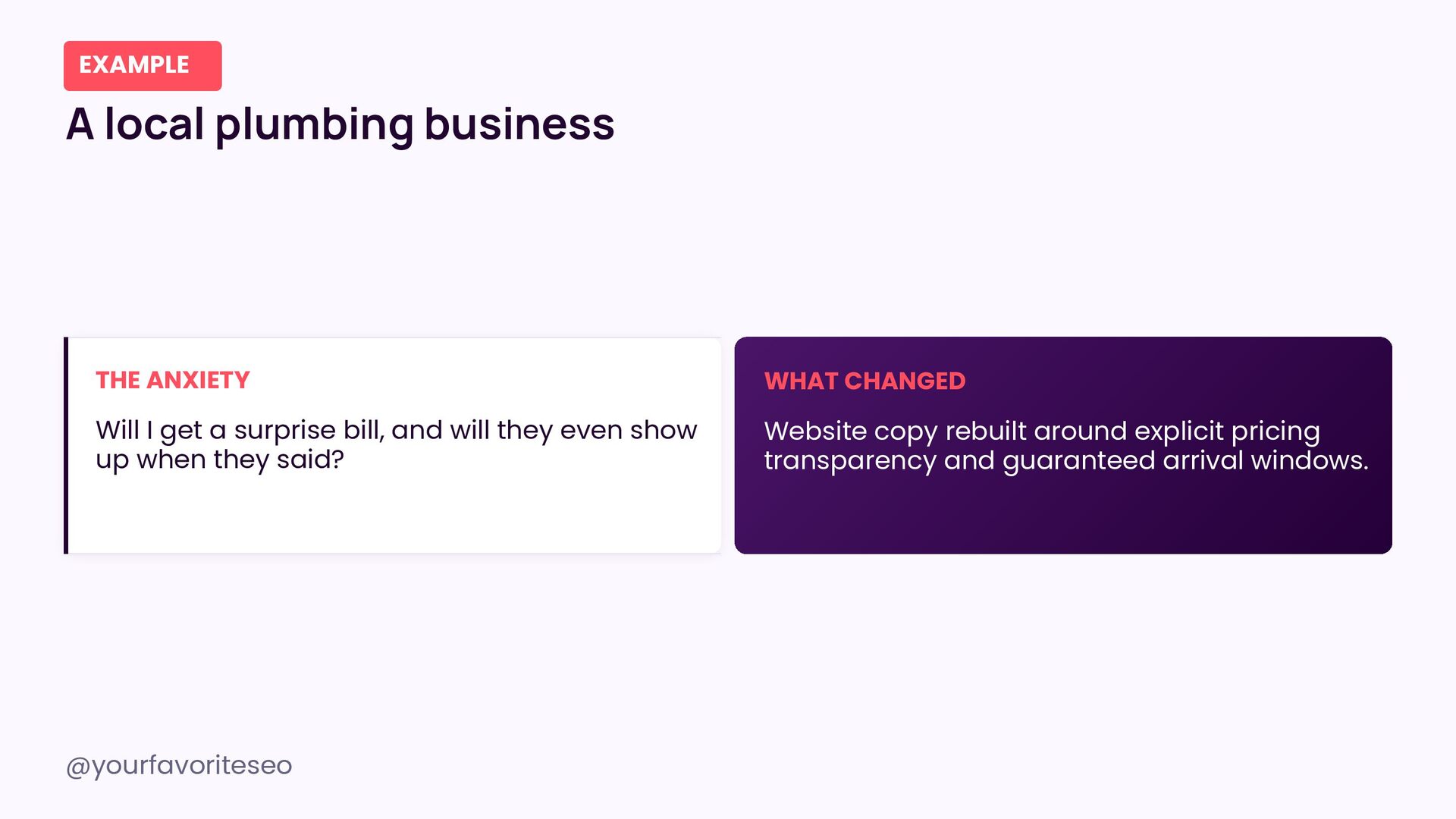
I get a surprise bill, and will they even show up when they said? Website copy rebuilt around explicit pricing transparency and guaranteed arrival windows. @yourfavoriteseo
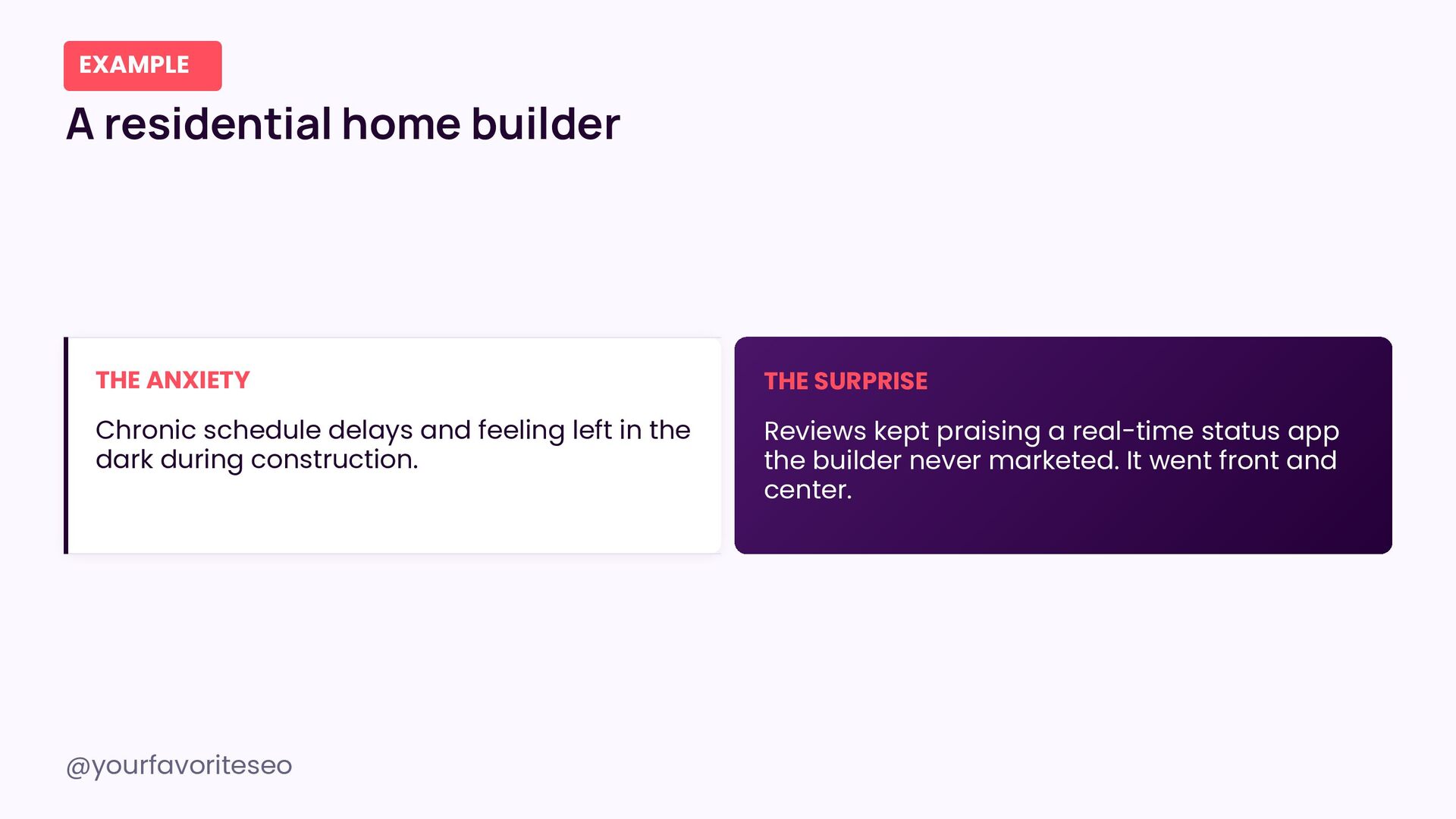
schedule delays and feeling left in the dark during construction. Reviews kept praising a real-time status app the builder never marketed. It went front and center. @yourfavoriteseo


 celestelili
 nikkihalliwell
 lara
lara
 bluesmoon
 eileencodes
 honzajavorek
 carmenintech
 skipperchong
.png) helenjbeal
helenjbeal
 joshbly
 inesmontani
 jonoalderson
 codingconduct