Upgrade to Pro — share decks privately, control downloads, hide ads and more …

Deep Learning in Go, or Shennanigans With Matrices

Sponsored · Ship Features Fearlessly Turn features on and off without deploys. Used by thousands of Ruby developers.
Avatar for Xuanyi Xuanyi
October 29, 2015

Deep Learning in Go, or Shennanigans With Matrices

Presented at Golang Sydney October 2015. I rushed through a lot of the slides. Write up to come

Avatar for Xuanyi

Xuanyi

October 29, 2015
Tweet

More Decks by Xuanyi

Other Decks in Programming

Transcript

  1. @chewxy  on  Twi-er   Deep  Learning  in  Go   Or,

     shennanigans     By  Xuanyi  Chew,  GolangSyd  Oct2015  
  2. @chewxy  on  Twi-er   Why  Go?   •  Knee  jerk

     reacDon.   •  No  good  reason.     •  You  probably  should  use  Theano.  
  3. @chewxy  on  Twi-er   A  Neurone   Picture thanks to

    Michael Nielsen f(x, w) w1 w2 w3 output = f(Σwi xi )
  4. @chewxy  on  Twi-er   Representing  Neural  Networks   w1  

    w2   w3   Input Output (number of neurones)
  5. @chewxy  on  Twi-er   Deep  Neural  Network   Picture thanks

    to Michael Nielsen 1 x n n x m m x o o x 4
  6. @chewxy  on  Twi-er   Implementing  a  NN  in  Go  

      type  NeuralNetwork  struct  {    DeepConfig      hiddenLayers  []*NeuroneLayer    logitLayer  *LogitLayer  //  or  SoftmaxLayer   }    
  7. @chewxy  on  Twi-er   Implementing  a  NN  in  Go  

    type  NeuroneLayer  struct  {    *Neurone    LayerConfig      activationFunction  ActivationFunction   }         type  ActivationFunction  func(float64)  float64  
  8. @chewxy  on  Twi-er   Implementing  a  NN  in  Go  

    type  Neurone  struct  {    //  weights[i][j]  -­‐-­‐  i  is  the  output  index,  j  is  the  input  index    Weights  [][]float64      Biases    []float64   }  
  9. @chewxy  on  Twi-er   Implementing  a  NN  in  Go  

    func  (nl  *NeuroneLayer)  Activate(x  []float64)  []float64  {    retVal  :=  make([]float64,  nl.Outputs)    for  i,  row  :=  range  nl.Weights  {      var  output  float64      for  j,  weight  :=  range  row  {        output  +=  weight  *  x[j]      }      output  +=  nl.Biases[i]      retVal[i]  =  nl.activationFunction(output)    }    return  retVal   }  
  10. @chewxy  on  Twi-er   Implementing  a  NN  in  Go  

    •  Other  bits  and  bobs:   •  Back  propagate  errors   •  Learning  method  (SGD,  AdaGrad,  RMSprop,  L-­‐BFGS…)   •  Errors  (Cross  Entropy,  meansquare  errors…)   •  Unique  layers  (ConvoluDon,  RBM,  etc  …)   •  Mix  and  Match  bits   •  All  the  above  is  just  simple  manipulaDon  of  matrix  code  
  11. @chewxy  on  Twi-er   The  Problem   •  Not  fast

     enough   •  Use  too  much  memory  
  12. @chewxy  on  Twi-er   Too  Much  Memory   •  Some

     matrices  are  sparse   •  Too  much  space  wasted  storing  0.0f  
  13. @chewxy  on  Twi-er   Real  Life  Logs   2015/10/21  09:59:14

     Epoch  58.  Correct/Total:  214577/229672  =  0.93   2015/10/21  09:59:14  MatSize:  6370341/151970075   2015/10/21  09:59:14  Mat  load  factor:  0.04   2015/10/21  09:59:14  Allocated                    :  1905.51  MB   2015/10/21  09:59:14  Total  Allocated        :  244659.96  MB   2015/10/21  09:59:14  Heap  Allocted            :  1905.51  MB   2015/10/21  09:59:14  Sys  Total  Allocated:  2335.47  MB   2015/10/21  09:59:14  -­‐-­‐-­‐-­‐-­‐-­‐-­‐-­‐-­‐-­‐        
  14. @chewxy  on  Twi-er   Solution(s)   •  Implement  Sparse  Matrix

      •  map[coordinate]float64   •  type  sparseMat64  struct  {    d  []float64    r  []uint32    c  []uint32   }   •  type  sparseMat64  []*cell   •  type  sparseMat64  [][MAXCOL]float64   type  coordinate  struct  {  r,  c  int  }   type  cell  struct  {  col  int,  val  float64  }  
  15. @chewxy  on  Twi-er   Solution(s)   •  Implement  Sparse  Matrix

      •  map[coordinate]float64   •  type  sparseMat64  struct  {    d  []float64    r  []uint32    c  []uint32   }   •  type  sparseMat64  []*cell   •  type  sparseMat64  [][MAXCOL]float64     type  coordinate  struct  {  r,  c  int  }   type  cell  struct  {  col  int,  val  float64  }     Most flexible Most useful for Hadamard Fastest, good for small MAXCOL Fastest to build
  16. @chewxy  on  Twi-er   Dense  Matrix   •  "import  github.com/gonum/matrix"

      •  [][]float64   •  [][MAXCOL]float64   •  [MAXCOL][]float64   •  type  mat64  struct  {    d      []float64    stride  int   }  
  17. @chewxy  on  Twi-er   Other  Memory  Stuff   •  Transpose

     at  will  or  store  both  Column-­‐Major  and  Row-­‐Major   matrix?   •  Layer  by  layer  training  (save  each  layer  to  disk)  
  18. @chewxy  on  Twi-er   Not  Fast  Enough   •  Let's

     look  at  a  real  life  example  
  19. @chewxy  on  Twi-er   Embarrassingly  Parallel   threads  :=  runtime.GOMAXPROCS(-­‐1)

      chunkSize  :=  len(mat)  /  threads     costChan  :=  make(chan  *cost)   for  chunk  :=  0;  chunk  <  threads;  chunk++  {    var  start  int  =  chunk  *  chunkSize    var  end  int      if  start+chunkSize  >  len(mat)  {      end  =  len(mat)    }  else  {      end  =  start  +  chunkSize    }      go  nn.costFn(mat[start:end],  chunkSize,  costChan)   }  
  20. @chewxy  on  Twi-er   ProJiling…   Showing  top  10  nodes

     out  of  61  (cum  >=  44.95s)              flat    flat%      sum%                cum      cum%        254.90s  67.81%  67.81%        337.61s  89.81%    github.com/chewxy/goddamnproject/dp. (*neuralnetwork).costFn          11.39s    3.03%  70.84%          11.39s    3.03%    sync/atomic.CompareAndSwapUint32                  8s    2.13%  72.97%          29.19s    7.77%    sync.(*Mutex).Lock            7.51s    2.00%  74.96%            7.51s    2.00%    runtime.procyield            7.48s    1.99%  76.95%            7.69s    2.05%    github.com/chewxy/goddamnproject/dp. (*neuralnetwork).computeScores            6.92s    1.84%  78.80%            8.04s    2.14%    runtime.mapaccess2_fast64            6.25s    1.66%  80.46%          13.54s    3.60%    math.Pow            5.17s    1.38%  81.83%            5.17s    1.38%    sync/atomic.AddUint32            4.08s    1.09%  82.92%            4.08s    1.09%    runtime.heapBitsForObject            3.40s      0.9%  83.82%          44.95s  11.96%    math/rand.(*lockedSource).Int63   (pprof)  weblist  costFn  
  21. @chewxy  on  Twi-er   weblist  cosFn   225  .  

                 .            //  This  loop  took  a  helluva  long  time     226  4.93s            4.93s        for  _,  a  :=  range  actives  {     227  29.47s          29.47s  layer2Grad[i][a]  +=  delta  *  hiddenAct[a]     228  1.02mins      1.02mins        hiddenActGrad[a]  +=  delta  *  nn.weights2[i][a]   229            .      .            }    
  22. @chewxy  on  Twi-er   AVX  to  the  Rescue!   • 

    Intel®  brings  extra  extra  parallelism  to  SIMD  instrucDons  with   AVX©®™  
  23. @chewxy  on  Twi-er   AVX/SIMD  in  a  nutshell   256

     bit  register   float64   float64   256  bit  register   float64   float64   +
  24. @chewxy  on  Twi-er   AVX/SIMD  in  a  nutshell   256

     bit  register   float64   float64   256  bit  register   float64   float64   + Single Instruction Multiple Data VADDPD
  25. @chewxy  on  Twi-er   AVX  in  Go   /*  

    #cgo  CFLAGS:  -­‐mavx  -­‐std=c99   #include  <stdio.h>   #include  <stdlib.h>   #include  <immintrin.h>//AVX:  -­‐mavx     void  avx_add64(const  size_t  n,  double  *x,  double  *y,  double  *z)  {    static  const  size_t  elements  =  4;  //  with  double  precision,   the  processor  can  only  handle  4  at  a  time.  Maybe  switch  to  float32?    const  size_t  end  =  n  /  elements;      //  convert  to  AVX  specific  types    __m256d  *vz  =  (__m256d  *)z;    __m256d  *vx  =  (__m256d  *)x;    __m256d  *vy  =  (__m256d  *)y;      for  (size_t  i=0;  i  <  end;  ++i  ){      vz[i]  =  _mm256_add_pd(vx[i],  vy[i]);    }   }    
  26. @chewxy  on  Twi-er   AVX  in  Go   //  multiplies

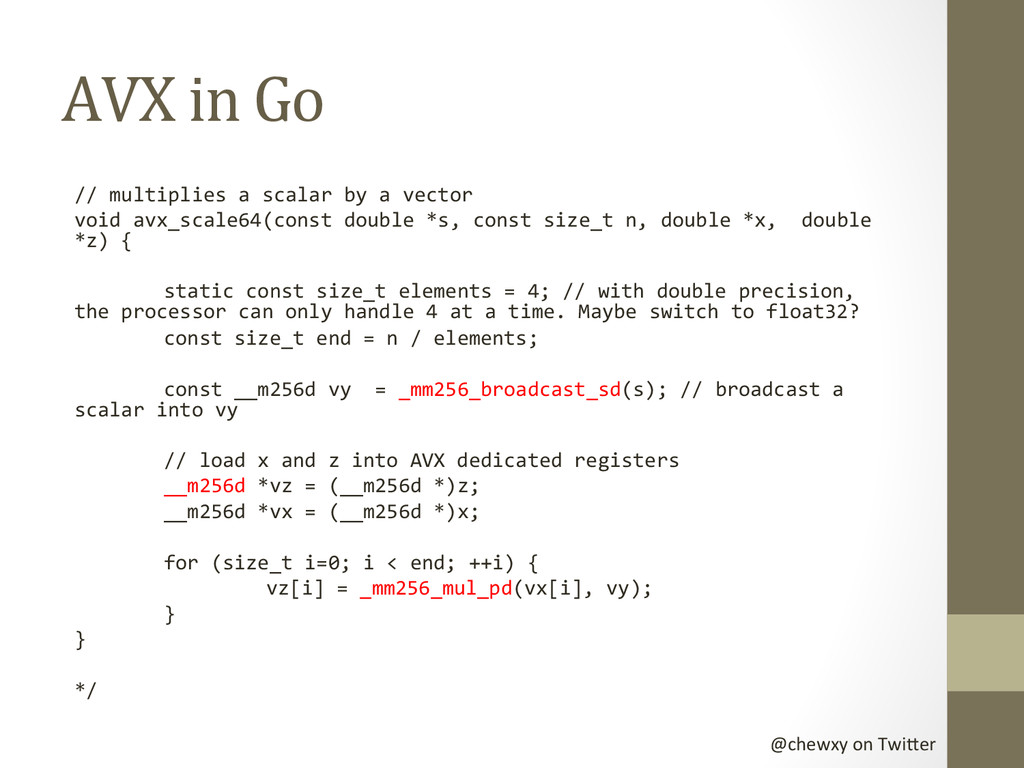
     a  scalar  by  a  vector   void  avx_scale64(const  double  *s,  const  size_t  n,  double  *x,    double   *z)  {      static  const  size_t  elements  =  4;  //  with  double  precision,   the  processor  can  only  handle  4  at  a  time.  Maybe  switch  to  float32?    const  size_t  end  =  n  /  elements;      const  __m256d  vy    =  _mm256_broadcast_sd(s);  //  broadcast  a   scalar  into  vy      //  load  x  and  z  into  AVX  dedicated  registers    __m256d  *vz  =  (__m256d  *)z;    __m256d  *vx  =  (__m256d  *)x;      for  (size_t  i=0;  i  <  end;  ++i)  {      vz[i]  =  _mm256_mul_pd(vx[i],  vy);    }   }     */  
  27. @chewxy  on  Twi-er   AVX  in  Go   func  malloc64(length

     int)  []float64  {    //  pad  it  so  that  at  most  there  will  be  64  items   extra  -­‐  worse  comes  to  worst,  there  are    a  bunch  of  0s  to   add  or  mul    size  :=  length  *  64      ptr  :=  C._mm_malloc((C.size_t)(size),  64)    header  :=  reflect.SliceHeader{      Data:  uintptr(unsafe.Pointer(ptr)),      Len:    length,      Cap:    length,    }    goSlice  :=  *(*[]float64)(unsafe.Pointer(&header))    return  goSlice   }     //  somewhere  later   defer  C._mm_free(unsafe.Pointer(&vec[0]))  
  28. @chewxy  on  Twi-er   The  Bits  To  Be  AVX'd  

    for  i  :=  range  rows  {    //  calculate  delta  omitted    //  This  loop  took  a  helluva  long  time    for  _,  a  :=  range  actives  {      layer2Grad[i][a]  +=  delta  *  hiddenAct[a]      hiddenActGrad[a]  +=  delta  *  nn.weights2[i][a]    }   }  
  29. @chewxy  on  Twi-er   After  AVX   for  i  :=

     range  rows  {    //  calculate  delta  omitted    scale64(delta,  hiddenAct)        ith2LWeights  :=  make([]float64,  len(nn.weights2[i]))    copy(nn.weights2[i][0:],  ith2LWeights[0:])    scale64(delta,  ith2LWeights)    dropout(ith2LWeights,  inactives)      add64(layer2Grad[i],  hiddenAct)    add64(hiddenActGrad,  ith2LWeights)   }  
  30. @chewxy  on  Twi-er   Uh  Oh   Showing  top  10

     nodes  out  of  92  (cum  >=  13.03mins)              flat    flat%      sum%                cum      cum%      4.93mins  11.45%  11.45%      4.93mins  11.45%    runtime._ExternalCode      4.58mins  10.62%  22.07%    10.03mins  23.28%    runtime.cgocall      3.26mins    7.56%  29.62%      3.26mins    7.56%    runtime.heapBitsForObject      3.24mins    7.53%  37.15%    26.96mins  62.59%    github.com/chewxy/ goddamnproject/dp.(*neuralnetwork).costFn      2.75mins    6.38%  43.53%      3.45mins    8.01%    runtime.greyobject      2.20mins    5.11%  48.64%      2.20mins    5.11%    runtime.memmove      1.74mins    4.03%  52.67%      8.25mins  19.15%    runtime.scanobject      1.71mins    3.96%  56.63%      1.71mins    3.96%    runtime.memclr      1.45mins    3.38%  60.00%      3.13mins    7.26%    runtime.deferreturn      1.34mins    3.12%  63.12%    13.03mins  30.24%    runtime.systemstack   (pprof)  weblist  costFn    
  31. @chewxy  on  Twi-er   Overhead  for  CGo   •  Is

     way  too  high     217  1.99s      4.92mins      scale64(delta,  hiddenAct)      ...   221  3.74s      5.05mins      scale64(delta,  ith2LWeights)      ...   228  3.84s      6.48mins      add64(layer2Grad[i],  hiddenAct)     229  1.52s      6.07mins      add64(hiddenActGrad,  ith2LWeights)    
  32. @chewxy  on  Twi-er   Solution(s)   •  Batch  Cgo  calls

      •  Handwrite  ASM,  match  APIs  
  33. @chewxy  on  Twi-er   Solution:    Don't  Use  Cgo  

    •  Batch  Cgo  calls   •  Handwrite  ASM!   Too much rearchitecting
  34. @chewxy  on  Twi-er   Problem   •  Go's  Assembler  doesn't

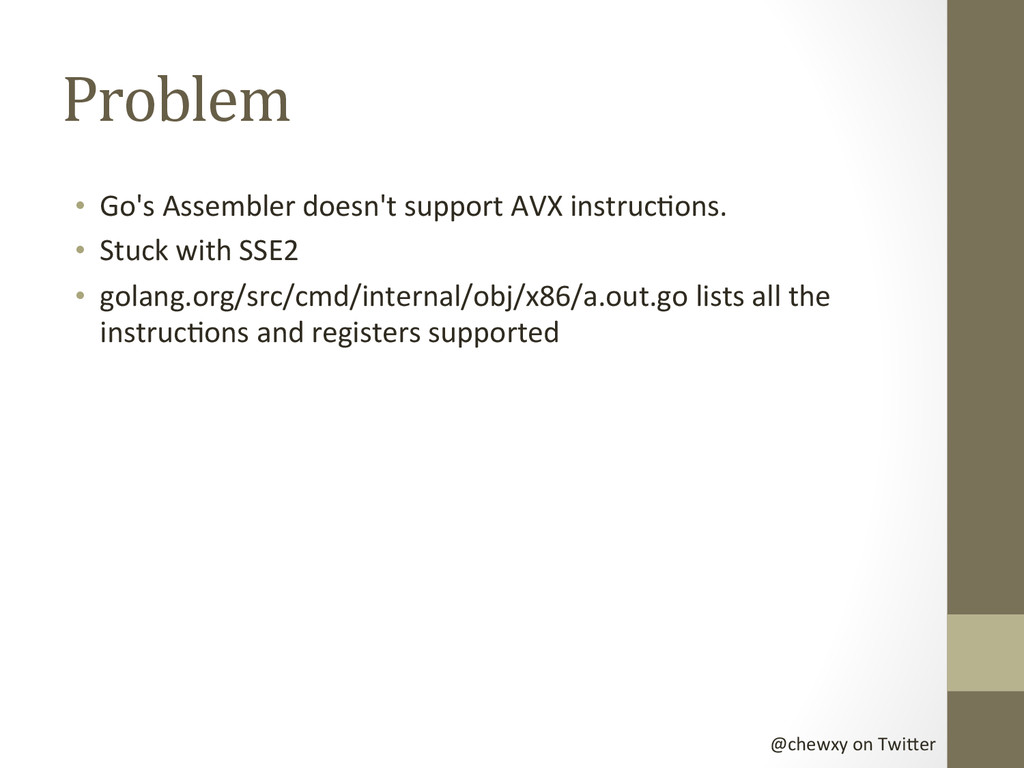
     support  AVX  instrucDons.   •  Stuck  with  SSE2   •  golang.org/src/cmd/internal/obj/x86/a.out.go  lists  all  the   instrucDons  and  registers  supported  
  35. @chewxy  on  Twi-er   //  func  scale64(s  float64,  a  []float64)

      TEXT  ·∙scale64(SB),  7,  $0      MOVSD  s+0(FP),  X0    MOVQ  x_data+8(FP),  SI    //  move  the  first  element  to  the  indexing  register    MOVQ  x_len+24(FP),  BP    //  move  the  length  into  BP      //  check  that  there  is  more  than  4  values  in  the  slice    SUBQ    $4,  BP    JL  remainders      //  jump  to  remainder    //  manually  broadcast  s  into  X0's  lower  bits,  which  is  used  for  SIMD    MOVLHPS  X0,  X0     loop:    //  load  the  first  two  elements,  and  then  multiply  by  s  (which  is  in  X0)    MOVUPD  (SI),  X2          MULPD  X0,  X2    //  load  second  two  elements,  then  multiply  by  s    MOVUPD  16(SI),  X4        MULPD  X0,  X4    //  move  the  values  back  to  the  original  positions    MOVUPD  X2,  (SI)    MOVUPD  X4,  16(SI)      //  now  that  we  are  done  with  the  first  4  elements,  update  the  pointers  to  the  top  of  the   next  4  elements    ADDQ  $32,  SI      SUBQ  $4,  BP      //  the  len  is  now  less  4    JGE    loop     remainders:    ADDQ  $4,  BP      //  we  subtracted  earlier,  remember??!!!    JEQ    done    //  if  there  are  nothing  left  to  process,  we'll  go  to  done     remainingloop:    //  load  element  from  x,  and  then  multiply  by  s  (which  in  X0)      //  TODO:  check  if  there  is  a  performance  penalty  on  using  SSE  registers    MOVSD  (SI),  X2    MULSD  X0,  X2      //  save  it  back  to  the  array    MOVSD  X2,  (SI)      //  update  the  pointer    ADDQ    $8,  SI      DECQ  BP    JNE  remainingloop   done:    RET  
  36. @chewxy  on  Twi-er   Pprof  Says…   217    1.64s

             12.82s    scale64(delta,  hiddenAct)      ...   221    7.88s            7.88s    scale64(delta,  ith2LWeights)      ...   228        .                    .      add64(layer2Grad[i],  hiddenAct)     229        .                    .    add64(hiddenActGrad,  ith2LWeights)    
  37. @chewxy  on  Twi-er   Interesting  Note   go  test  -­‐bench

     .   testing:  warning:  no  tests  to  run   PASS   BenchmarkGoScale64-­‐8    1000000              1339  ns/op   BenchmarkScale64-­‐8        5000000                329  ns/op   BenchmarkGoAdd64-­‐8        1000000              1711  ns/op   BenchmarkAdd64-­‐8            1000000              1473  ns/op   ok      github.com/chewxy/testideas3  6.567s     func  GoAdd64(a,  b  []float64)  {    for  i,  v  :=  range  a{      a[i]  =  v  +  b[i]    }   }   Not much difference
  38. @chewxy  on  Twi-er   Other  More  Realistic  Solutions   • 

    Be-er  algorithms   •  PrecalculaDng  acDvaDons  and  caching§   •  Binary  weights  (no  mulDplicaDon,  only  addiDon)*     *very  very  very  very  very  new.  I'm  sDll  playing  with  it    
  39. @chewxy  on  Twi-er   GoNum   •  Failed  build  (a

     few  months  ago  when  I  started)…  haven't   checked  since.  
  40. @chewxy  on  Twi-er   Conclusion   •  Building  a  neural

     network  in  Go  is  fairly  simple.   •  Building  a  performant  neural  network  in  Go?  Only  embark   with  quesDonable  sanity   •  Irony:  deploying  Theano  is  hard.  But  all  my  opDmizaDons   make  deploying  this  equally  hard.   •  A  default  built  in,  well  opDmized  matrix  type  would  be  really   really  really  sweet