Share
Embed
Cox-Zucker Helps With Screwing on a Kummer Surface
Talk given at GopherCon Singapore 2025

Xuanyi
January 24, 2025
Transcript
105 slides
-
bsky.chewxy.com F()-ing Cox-Zucker Tunes a MA Screw unto a Kummer
Surface Chewxy bsky.chewxy.com -
bsky.chewxy.com 想像象相 “Yeah, I think it did. The boys still
at their Matrix marathon?” Viv nodded. “Why didn’t you join them Audrey? You love The Matrix.” “Fourth one soured me to it. Neo ended up back in the Matrix” “Ah, that’s where you got it wrong. See, the matrix is defective. It’s never about escaping the matrix. It’s really about reducing the matrix to its eigenbasis. Once you have found your eigenvectors and eigenvalues, then you can orthogonalize the subspace,” said Edith, before finishing with a flourish, “Then you’re the Superman. The Thought Robot.” -
bsky.chewxy.com "Yeah, I think it did. The boys still at
their Matrix marathon?" Viv nodded. "Why didn't you join them Audrey? You love The Matrix." "Fourth one soured me to it. Neo ended up back in the Matrix" "Ah, that's where you got it wrong. See, the matrix is defective. It was never about leaving. It’s all about reducing the matrix to its eigenbasis. Once you have found your eigenvectors and dominant eigenvalues, you can then orthogonalize the subspace," said Edith before finishing with a flourish, “then, you’ll be free” Mort chuckled as Audrey playfully punched her elder sister. -
bsky.chewxy.com Stability Precision Aphantasia Me Me + LSD Me +
Vyvanse Me + Cannabis Me + Alcohol -
bsky.chewxy.com Constructing the Universe 1. Find an elliptic curve E.
2. Parameterize by t to make it a screw. 3. Find the cross product E × E. 4. Apply an involution function (a1, a2) ↦ (-a1, -a2) . 5. Fibrate over P1 into an elliptic surface. 6. Apply Cox-Zucker machine to find basis. 7. ??? 8. Profit! -
bsky.chewxy.com Side Note: Screwing and Kummer Surfaces Credit: wikimedia commons
Credit: wikipedia on Kummer surfaces -
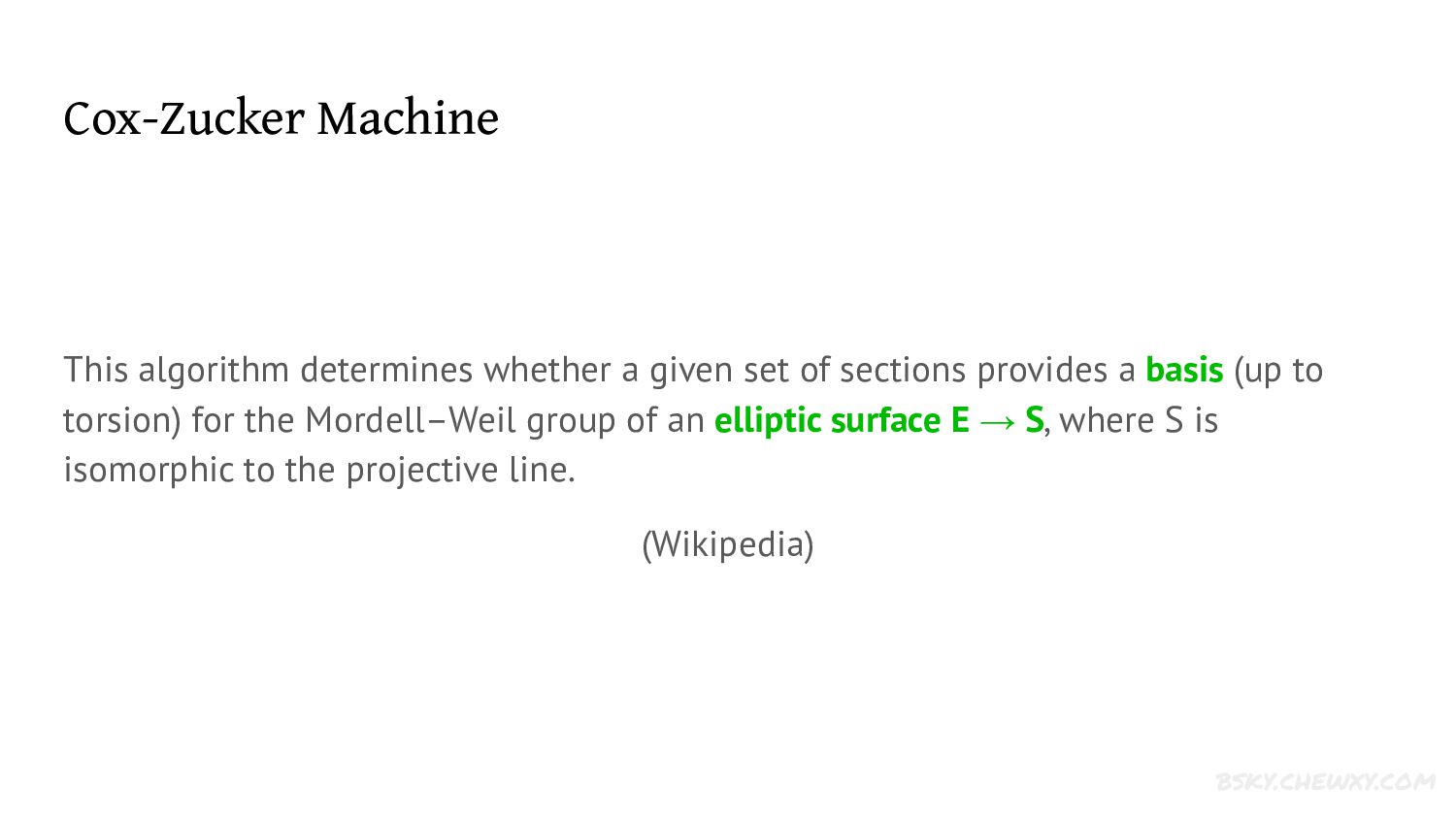
bsky.chewxy.com Cox-Zucker Machine This algorithm determines whether a given set
of sections provides a basis (up to torsion) for the Mordell–Weil group of an elliptic surface E → S, where S is isomorphic to the projective line. (Wikipedia) -
bsky.chewxy.com Cox-Zucker Machine This algorithm determines whether a given set
of sections provides a basis (up to torsion) for the Mordell–Weil group of an elliptic surface E → S, where S is isomorphic to the projective line. (Wikipedia) -
bsky.chewxy.com Cox-Zucker Machine This algorithm determines whether a given set
of sections provides a basis (up to torsion) for the Mordell–Weil group of an elliptic surface E → S, where S is isomorphic to the projective line. (Wikipedia) -
bsky.chewxy.com Elliptic Curves y2 = x3 + ax + b
Picture of Elliptic Curve -
bsky.chewxy.com Elliptic Curves y2 = x3 + ax + b
Picture of Elliptic Curve type EC struct { a, b int } func (c *EC) Eval1(x int) int { y2 := x*x*x + c.a*x + c.b return sqrt(y2) } func (c *EC) Eval2(x, y int) int { return y*y + c.Eval1(x) } -
bsky.chewxy.com Elliptic Curves Are Surfaces y2 = x3 + ax
+ b z = -y2 + x3 + ax + b -
bsky.chewxy.com Elliptic Curves Are Surfaces z = -y2 + x3
+ ax + b type EC struct { a, b int } func (c *EC) Eval1(x int) int { y2 := x*x*x + c.a*x + c.b return sqrt(y2) } func (c *EC) Eval2(x, y int) int { return y*y + c.Eval1(x) } -
bsky.chewxy.com Elliptic Surfaces An elliptic surface is a surface with
an elliptic fibration. -
bsky.chewxy.com Elliptic Surfaces An elliptic surface is a surface with
an elliptic fibration. -
bsky.chewxy.com A Fibration is a Generic Fibre Bundle The surface
of a cylinder can be thought of as a bundle of fibres going from the base space of a circle. The surface of a Möbius strip can be thought of as a bundle of fibres going from a base space of a circle. -
bsky.chewxy.com Elliptic Surfaces An elliptic surface is a surface with
an elliptic fibration. -
bsky.chewxy.com Elliptic Surface y2 = x3 + A(t)x + B(t)x
Polynomials A(t) = ɑtn + βtn-1 + … + ψt1 + ⍵t0 -
bsky.chewxy.com // Q is a representation of a rat number.
type Q big.Rat // Section is a section on an elliptic surface type Section struct { x, y QFn } // Polynomial is a representation of a polynomial. // The slice stores coefficients in ascending order of power. type Poly []*Q // QFn represents a rational function. type QFn struct { n, d Poly } // Point is a point on an elliptic curve. type Point struct { x, y *Q } // EC represents an elliptic curve. type EC struct { a, b *Q points []Point } Elliptic Curve & Surface // ES represents an elliptic surface. type ES struct { a, b QFn sections []*Section } -
bsky.chewxy.com Cox-Zucker Machine This algorithm determines whether a given set
of sections provides a basis (up to torsion) for the Mordell–Weil group of an elliptic surface E → S, where S is isomorphic to the projective line. (Wikipedia) -
bsky.chewxy.com Cox-Zucker Machine This algorithm determines whether a given set
of sections provides a basis (up to torsion) for the Mordell–Weil group of an elliptic surface E → S, where S is isomorphic to the projective line. (Wikipedia) -
bsky.chewxy.com Basis Directions to Marina Bay Sands from JW Marriott:
1. 1.85 km towards Tekong 2. 2.54 km towards Sentosa Marina Bay Sands = 1.85T + 2.54S 1km 1km -
bsky.chewxy.com What is a “basis” for this? y2 = x3
+ ax2 + b Picture of Elliptic Curve -
bsky.chewxy.com Collinear Points P + Q + R = 0
Picture of Elliptic Curve P Q R -
bsky.chewxy.com Collinear Points P + Q = -R Picture of
Elliptic Curve P Q R -
bsky.chewxy.com Cox-Zucker Machine This algorithm determines whether a given set
of sections provides a basis (up to torsion) for the Mordell–Weil group of an elliptic surface E → S, where S is isomorphic to the projective line. (Wikipedia) -
bsky.chewxy.com Cox-Zucker Machine This algorithm determines whether a given set
of sections provides a basis (up to torsion) for the Mordell–Weil group of an elliptic surface E → S, where S is isomorphic to the projective line. (Wikipedia) -
bsky.chewxy.com A Group is: A set of things, A A
binary operation, · such that a · b = c, where a, b, c ∈ A A = ℤ = {..., -3, -2, -1, 0, 1, 2, 3,…} + type Int int func Add(a, b Int) Int { return a + b } Rules • A has identity/“zero” element • (a · b) · c = a · (b· c) type String string func Add(a, b String) String { return a + b } -
bsky.chewxy.com A Group is: A set of things, A A
binary operation, · such that a · b = c, where a, b, c ∈ A A = ℤ = {..., -3, -2, -1, 0, 1, 2, 3,…} + type Int int func Add(a, b Int) Int { return a + b } Rules • A has identity/“zero” element • (a · b) · c = a · (b· c) • a · b = b · a • A has inverse element type String string func Add(a, b String) String { return a + b } -
bsky.chewxy.com A Group is: A set of things, A A
binary operation, · such that a · b = c, where a, b, c ∈ A A = ℤ = {..., -3, -2, -1, 0, 1, 2, 3,…} + type Int int func (a Int) Add(b Int) Int { return a + b } Rules • A has identity/“zero” element • (a · b) · c = a · (b· c) • a · b = b · a • A has inverse element type String string func Add(a, b String) String { return a + b } // Not handled: commutativity and associativity. type Group interface { Add(elem Group) Group Neg() Group } -
bsky.chewxy.com A Magma is: A set of things, A A
binary operation, · such that a · b = c, where a, b, c ∈ A A = ℤ = {..., -3, -2, -1, 0, 1, 2, 3,…} + type Int int type String string func (a String) Add(b String) String { return a + b } func (a Int) Add(b Int) Int { return a + b } type Magma interface { Add(elem Magma) Magma IsZero() bool } -
bsky.chewxy.com Cox-Zucker Machine This algorithm determines whether a given set
of sections provides a basis (up to torsion) for the Mordell–Weil group of an elliptic surface E → S, where S is isomorphic to the projective line. (Wikipedia) Set of points on the surface whose coordinates are rational numbers -
bsky.chewxy.com // QFn represents a rational function. type QFn struct
{ n, d Poly } // ES represents an elliptic surface. type ES struct { a, b QFn sections []*Section } // EC represents an elliptic curve. type EC struct { a, b *Q points []Point } // Q is a representation of a rat number. type Q struct { n, d *big.Int } // Section is a section on an elliptic surface type Section struct { x, y QFn } // Polynomial is a representation of a polynomial. // The slice stores coefficients in ascending order of power. type Poly []*Q // Point is a point on an elliptic curve. type Point struct { x, y *Q } Elliptic Curve & Surface -
bsky.chewxy.com Cox-Zucker Machine This algorithm determines whether a given set
of sections provides a basis (up to torsion) for the Mordell–Weil group of an elliptic surface E → S, where S is isomorphic to the projective line. (Wikipedia) set of points Set of points on the surface whose coordinates are rational numbers -
bsky.chewxy.com The Algorithm in Words {σ i …σ r }
is a basis of the Mordell-Weil group if and only if: det(<σ i , σ j >) = N2 / Πm s m s is the number of components of multiplicity 1 N is the number of elements in the torsion subgroup of the Mordell-Weil Group r is the rank of the Mordell-Weil Group -
bsky.chewxy.com The Algorithm n := len(sections) mat := make([][]*Q, n)
for i := range mat { mat[i] = make([]*Q, n) } for i := 0; i < n; i++ { for j := 0; j < n; j++ { mat[i][j] = es.HeightPair(sections[i], sections[j]) } } det := qMatDet(mat) thresh := ExpectedDeterminant(es) return det.Eq(thresh) -
bsky.chewxy.com The Algorithm to Find Bases for _, s :=
range e.MordellWeilLat { if e.F().CoxZucker(s){ bases = append(bases, s) } } -
bsky.chewxy.com 111 Words, 4977 Lines of Code. Four lines, stark
as dead pixels on a blazing white OLED screen, dissolves into view. Orthogonal to each other, they intersect at sixteen nodal points, their vector dance playing out in every direction – ahead of, behind, and through Mort. A grey volume precipitates from these lines, sweeping across space to connect the dark axes. This precision-crafted mirage skews, rotates then disintegrates A different set of four lines appear. Again, a grey volume materializes, only to vanish after a scale and tilt. This sequence repeats, hypnotic – lines shifting, grey form cohering, size changing, dissolving – an infinite recursion of ephemeral functions. Then, sudden stillness: the grey volume suffusing space, stark lines permeating every dimension. -
bsky.chewxy.com // QFn represents a rational function. type QFn struct
{ n, d Poly } // ES represents an elliptic surface. type ES struct { a, b QFn sections []*Section } // EC represents an elliptic curve. type EC struct { a, b *Q points []Point } // Q is a representation of a rat number. type Q big.Rat // Section is a section on an elliptic surface type Section struct { x, y QFn } // Polynomial is a representation of a polynomial. // The slice stores coefficients in ascending order of power. type Poly []*Q // Point is a point on an elliptic curve. type Point struct { x, y *Q } Elliptic Curve & Surface -
bsky.chewxy.com Elliptic Curve Day 1 // EC represents an elliptic
curve. type EC struct { a, b int points []Point } -
bsky.chewxy.com Sidequest: Polynomials // Poly represents the coefficients of a
polynomial function. type Poly []int func (p Poly) Add(q Poly) Poly { ... } func (p Poly) Mul(q Poly) Poly { ... } func (p Poly) GCD(q Poly) Poly { ... } -
bsky.chewxy.com Sidequest: Polynomials // Poly represents the coefficients of a
polynomial function. type Poly []int func (p Poly) Add(q Poly) Poly { ... } func (p Poly) Mul(q Poly) Poly { ... } func (p Poly) GCD(q Poly) Poly { ... } func TestPolyGCD(t *testing.T) { p := Poly{1, 2, 3} q := Poly{2, 4, 6} t.Logf("%v\n%v", p, q) gcd := p.GCD(q) if len(gcd) != 3 { t.Errorf("len(gcd) = %d, want 3", len(gcd)) } -
bsky.chewxy.com Elliptic Curve Day 2 // EC represents an elliptic
curve over a rational field type EC struct { a, b Q points []Point } type Poly []Q type Q struct { N, D int } -
bsky.chewxy.com Elliptic Curve Day 3 // EC represents an elliptic
curve over a rational field type EC struct { a, b *Q points []Point } type Poly []*Q type Q = big.Rat -
bsky.chewxy.com Elliptic Curve Definition An elliptic curve is defined over
a field K and describes points in K2. (Wikipedia) -
bsky.chewxy.com What If We Could Genericize? An elliptic curve is
defined over a field K and describes points in K2. // EC represents an elliptic curve over a rational field type EC struct { a, b *Q points []Point } -
bsky.chewxy.com What If We Could Genericize? An elliptic curve is
defined over a field K and describes points in K2. // EC represents an elliptic curve over a rational field K type EC struct { a, b ??? points []Point } -
bsky.chewxy.com Generics // EC represents an elliptic curve over a
field f type EC[K Field] struct { a, b K points []Point[K] } // Field is a representation of an abstract, finite field. type Field interface { Add(x Num) Num Sub(x Num) Num Mul(x Num) Num Div(x Num) Num Neg() Num IsZero(x Num) bool CharNum() int } -
bsky.chewxy.com Alternative // Field is a representation of an abstract,
finite field. type Field[T any] interface { Add(x, y T) T Sub(x, y T) T Mul(x, y T) T Div(x, y T) T Neg(x T) T IsZero(x T) bool CharNum() int } // EC represents an elliptic curve over a field f type EC[T any] struct { a, b T f Field[T] points []Point } -
bsky.chewxy.com Implication // U 1 = X 1 Z 2
, U 2 = X 2 Z 1 u1 := x1.Mul(z2) u2 := x2.Mul(z1) // U 1 = X 1 Z 2 , U 2 = X 2 Z 1 u1 := e.f.Mul(x1, z2) u2 := e.f.Mul(x2, z1) Generics Alternative -
bsky.chewxy.com How Do You Conceptualize Field? // Field is a
representation of an abstract, finite field. type Field[T any] interface { Add(x, y T) T Sub(x, y T) T Mul(x, y T) T Div(x, y T) T Neg(x T) T IsZero(x T) bool CharNum() int } // Field is a representation of an abstract, finite field. type Field interface { Add(x Num) Num Sub(x Num) Num Mul(x Num) Num Div(x Num) Num Neg() Num IsZero(x Num) bool CharNum() int } As a collection of things with rules applied? As an Engine that does things to data? -
bsky.chewxy.com type Field interface { Add(x Num) Num Sub(x Num)
Num Mul(x Num) Num Div(x Num) Num Neg() Num IsZero(x Num) bool CharNum() int } type Field interface { Add(x, y T) T Sub(x, y T) T Mul(x, y T) T Div(x, y T) T Neg(x T) T IsZero(x T) bool CharNum() int } Closer to theory Closer to practice -
bsky.chewxy.com On Types and Data Types type EC[K Field] struct
{ a, b K points []Point[K] } // Field is a representation of an abstract, finite field. type Field interface { Add(x Num) Num Sub(x Num) Num Mul(x Num) Num Div(x Num) Num Neg() Num IsZero(x Num) bool CharNum() int } -
bsky.chewxy.com On Types and Data Types type EC[K Field] struct
{ a, b K points []Point[K] } // Field is a representation of an abstract, finite field. type Field interface { Add(x Num) Num Sub(x Num) Num Mul(x Num) Num Div(x Num) Num Neg() Num IsZero(x Num) bool CharNum() int } -
bsky.chewxy.com On Types and Data Types type EC[K Field] struct
{ a, b K points []Point[K] } // Field is a representation of an abstract, finite field. type Field interface { Add(x Field) Field Sub(x Field) Field Mul(x Field) Field Div(x Field) Field Neg() Field IsZero(x Field) bool CharNum() int } -
bsky.chewxy.com On Types and Data Types type EC[N any, K
Field[N]] struct { a, b K points []Point[N, K] } // Field is a representation of an abstract, finite field. type Field[T any] interface { Add(x T) T Sub(x T) T Mul(x T) T Div(x T) T Neg() T IsZero(x T) bool CharNum() int } -
bsky.chewxy.com Side Note: Reimplementing Rat! // Q is a representation
of a rational number. type Q big.Rat func (n *Q) Add(m *Q) *Q { ... } func (n *Q) Sub(m *Q) *Q { ... } func (n *Q) Mul(m *Q) *Q { ... } func (n *Q) Div(m *Q) *Q { nr := (*big.Rat)(n) mr := (*big.Rat)(m) retVal := new(big.Rat) retVal = retVal.Quo(nr, mr) // clobbers retVal return (*Q)(retVal) } -
bsky.chewxy.com type Q struct { N, D int } type
Q = big.Rat type Q struct { big.Rat } type Q *big.Rat type Q big.Rat Variations of Implementing Q Original implementation Too much to refactor! Not allowed to define methods Sigh, OK -
bsky.chewxy.com On Types and Data Types type EC[N any, K
Field[N]] struct { a, b K points []Point[N, K] } // Field is a representation of an abstract, finite field. type Field[T any] interface { Add(x T) T Sub(x T) T Mul(x T) T Div(x T) T Neg() T IsZero(x T) bool CharNum() int } func NewEC[N Num, K Field[DT]](...) {...} ec := NewEC[*Q, *Q](...) -
bsky.chewxy.com // QFn represents a rational function. type QFn struct
{ n, d Poly } // ES represents an elliptic surface. type ES struct { a, b QFn sections []*Section } // EC represents an elliptic curve. type EC struct { a, b *Q points []Point } // Q is a representation of a rat number. type Q struct { n, d *big.Int } // Section is a section on an elliptic surface type Section struct { x, y QFn } // Polynomial is a representation of a polynomial. // The slice stores coefficients in ascending order of power. type Poly []*Q // Point is a point on an elliptic curve. type Point struct { x, y *Q } Elliptic Curve & Surface -
bsky.chewxy.com // QFn represents a rational function. type QFn struct
{ n, d Poly } // ES represents an elliptic surface. type ES struct { a, b QFn sections []*Section } // EC represents an elliptic curve. type EC struct { a, b *Q points []Point } // Q is a representation of a rat number. type Q struct { n, d *big.Int } // Section is a section on an elliptic surface type Section struct { x, y QFn } // Polynomial is a representation of a polynomial. // The slice stores coefficients in ascending order of power. type Poly []*Q // Point is a point on an elliptic curve. type Point struct { x, y *Q } Elliptic Curve & Surface Field: A set of things with + - × ÷ defined // Field is a representation of an abstract, finite field. type Field[T Num] interface { Add(x T) T Sub(x T) T Mul(x T) T Div(x T) T Neg() T IsZero(x T) bool CharNum() int } -
bsky.chewxy.com Implementing Q type Q[T ???] struct { N, D
T } func (n *Q[R]) Add(m *Q[R]) *Q[R] { n2n := n.N.Mul(m.D) n2m := m.N.Mul(n.D) d := n.D.Mul(m.D) return &Q[R]{N: n2n.Add(n2m), D: d} } func (n *Q[R]) Sub(m *Q[R]) *Q[R] { ... } func (n *Q[R]) Mul(m *Q[R]) *Q[R] { ... } func (n *Q[R]) Div(m *Q[R]) *Q[R] { ... } The usual rational numbers: var q *Q[*Z] type Z big.Int The rational function: var qfn *Q[Poly] -
bsky.chewxy.com Implementing Q type Q[R Ring] struct { N, D
R } func (n *Q[R]) Add(m *Q[R]) *Q[R] { n2n := n.N.Mul(m.D) n2m := m.N.Mul(n.D) d := n.D.Mul(m.D) return &Q[R]{N: n2n.Add(n2m), D: d} } func (n *Q[R]) Sub(m *Q[R]) *Q[R] { ... } func (n *Q[R]) Mul(m *Q[R]) *Q[R] { ... } func (n *Q[R]) Div(m *Q[R]) *Q[R] { ... } type Ring interface { Add(m ???) ??? Mul(m ???) ??? } -
bsky.chewxy.com Implementing Q type Q[R Ring] struct { N, D
R } func (n *Q[R]) Add(m *Q[R]) *Q[R] { n2n := n.N.Mul(m.D) n2m := m.N.Mul(n.D) d := n.D.Mul(m.D) return &Q[R]{N: n2n.Add(n2m), D: d} } func (n *Q[R]) Sub(m *Q[R]) *Q[R] { ... } func (n *Q[R]) Mul(m *Q[R]) *Q[R] { ... } func (n *Q[R]) Div(m *Q[R]) *Q[R] { ... } type Ring[T any] interface { Add(m T) T Mul(m T) T } -
bsky.chewxy.com Implementing Q type Q[T Num, R Ring[T]] struct {
N, D R[T] } func (n *Q[T, R]) Add(m *Q[T, R]) *Q[T, R] { n2n := n.N.Mul(m.D) n2m := m.N.Mul(n.D) d := n.D.Mul(m.D) return &Q[R]{N: n2n.Add(n2m), D: d} } func (n *Q[T,R]) Sub(m *Q[T,R]) *Q[T,R] { ... } func (n *Q[T,R]) Mul(m *Q[T,R]) *Q[T,R] { ... } func (n *Q[T,R]) Div(m *Q[T,R]) *Q[T,R] { ... } type Ring[T Num] interface { Add(m T) T Mul(m T) T } -
bsky.chewxy.com // QFn represents a rational function. type QFn struct
{ n, d Poly } // ES represents an elliptic surface. type ES struct { a, b QFn sections []*Section } // EC represents an elliptic curve. type EC struct { a, b *Q points []Point } // Q is a representation of a rat number. type Q struct { n, d *big.Int } // Section is a section on an elliptic surface type Section struct { x, y QFn } // Polynomial is a representation of a polynomial. // The slice stores coefficients in ascending order of power. type Poly []*Q // Point is a point on an elliptic curve. type Point struct { x, y *Q } Elliptic Curve & Surface Ring: A set of things with + and × defined // Ring is a representation of a ring type Ring[T Num] interface { Add(x T) T Mul(x T) T IsZero(x T) bool CharNum() int } -
bsky.chewxy.com Implementing Rings type Poly []*Q[*Z] type Z big.Int func
(p Poly) Div(q Poly) *Q[Poly] { return &Q[Poly]{N: q, D: q} } type Field[T Num] interface { Add(x T) T Sub(x T) T Mul(x T) T Div(x T) T Neg() T IsZero(x T) bool CharNum() int } -
bsky.chewxy.com // QFn represents a rational function. type QFn struct
{ n, d Poly } // ES represents an elliptic surface. type ES struct { a, b QFn sections []*Section } // EC represents an elliptic curve. type EC struct { a, b *Q points []Point } // Q is a representation of a rat number. type Q struct { n, d *big.Int } // Section is a section on an elliptic surface type Section struct { x, y QFn } // Polynomial is a representation of a polynomial. // The slice stores coefficients in ascending order of power. type Poly []*Q // Point is a point on an elliptic curve. type Point struct { x, y *Q } Elliptic Curve & Surface Magma: A set of things with + defined // Magma is a representation of a magma. type Magma[T Num] interface { Add(x T) T IsZero(x T) bool } -
bsky.chewxy.com // QFn represents a rational function. type QFn struct
{ n, d Poly } // ES represents an elliptic surface. type ES struct { a, b QFn sections []*Section } // EC represents an elliptic curve. type EC struct { a, b *Q points []Point } // Q is a representation of a rat number. type Q struct { n, d *big.Int } // Section is a section on an elliptic surface type Section struct { x, y QFn } // Polynomial is a representation of a polynomial. // The slice stores coefficients in ascending order of power. type Poly []*Q // Point is a point on an elliptic curve. type Point struct { x, y *Q } Elliptic Curve & Surface Magma: A set of things with + defined // Magma is a representation of a magma. type Magma[T any] interface { Add(x T) T IsZero(x T) bool } -
bsky.chewxy.com 天元 /Tengen := Center of the Go board She
shook her head. “We store things to tianyuan.” Alice paused momentarily as she gathered her thoughts, “I suppose tianyuan is just a bunch of computers and they need to store things. You know, Bob loves retro computers. He’s showed me a few in his collection. They store data on the machine itself, but there’s no such glass things. How does it work?” “These glass things have been the standard in cloud storage — er, tianyuan storage — for the past 300 years. How do you not know this?” -
bsky.chewxy.com Resources Elliptic Curves: Ben Lynn’s Notes - https://crypto.stanford.edu/pbc/notes/elliptic/ Elliptic
Surfaces: • Review by Matthias Schütt and Tetsuji Shioda (2010) • Chao Li’s homepage https://www.math.columbia.edu/~chaoli/docs/EllipticSurfaces.html p/s: Ask ChatGPT/Claude/Gemini if you want to get confused. Textbooks are way better.
 chewxy
 miu_crescent
 oracle4engineer
 okiyuki99
 ham0215
 pospome
 inariku
 nobitabashi
 oidfj
 visional_engineering_and_design
 kazzpapa3
 thekraken
 morganepeng
 keithpitt
 reverentgeek
 afnizarnur
 lara
 baasie
 akosma
 aleyda
 bethany
 pwiseman
 kastner