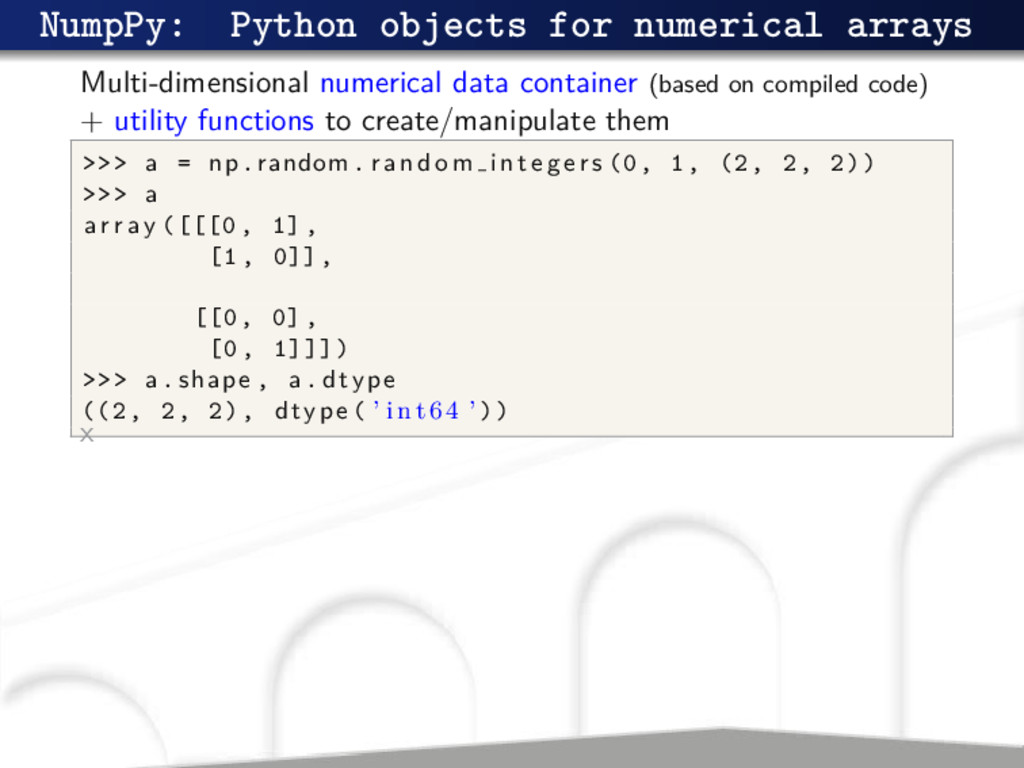
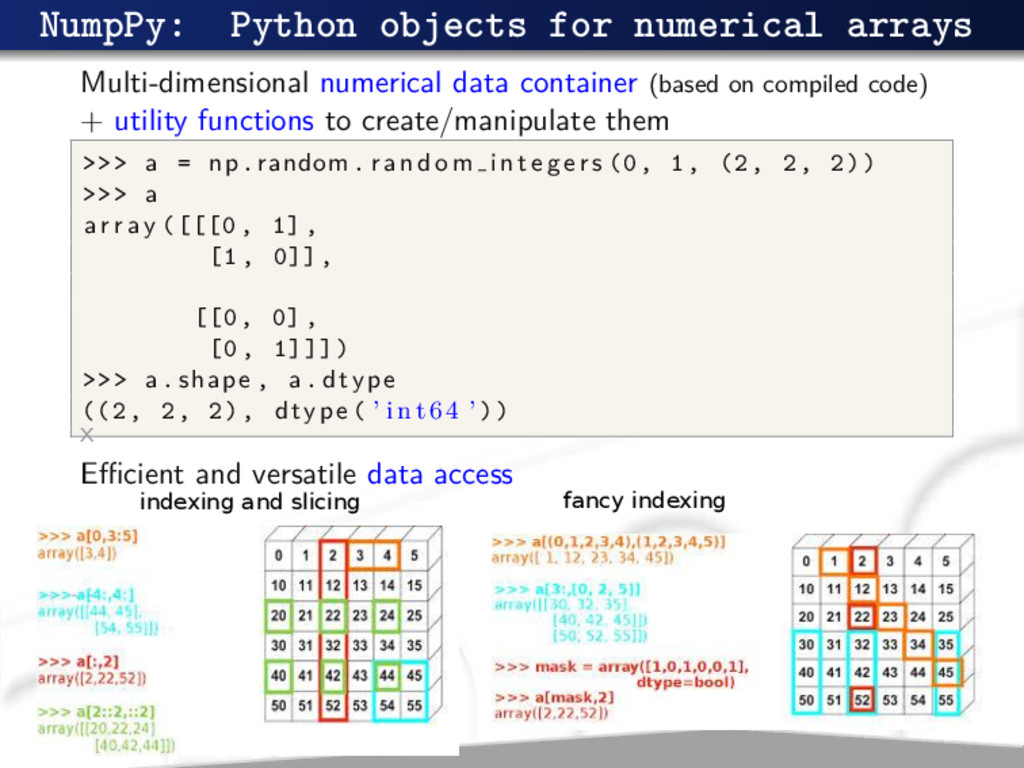
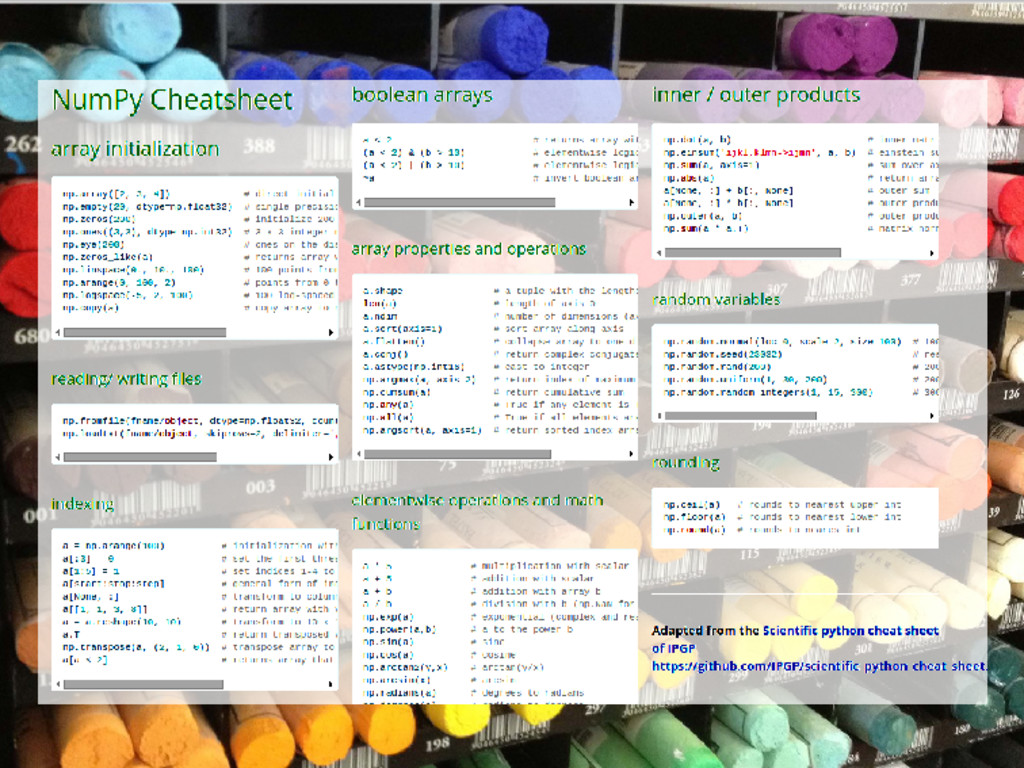
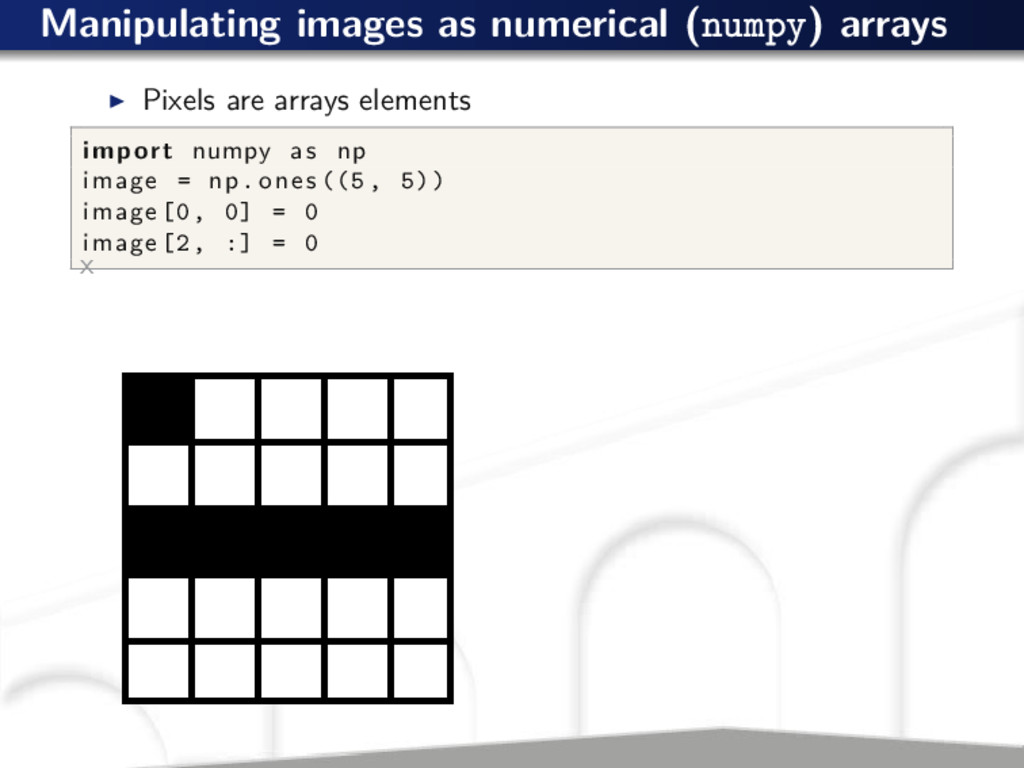
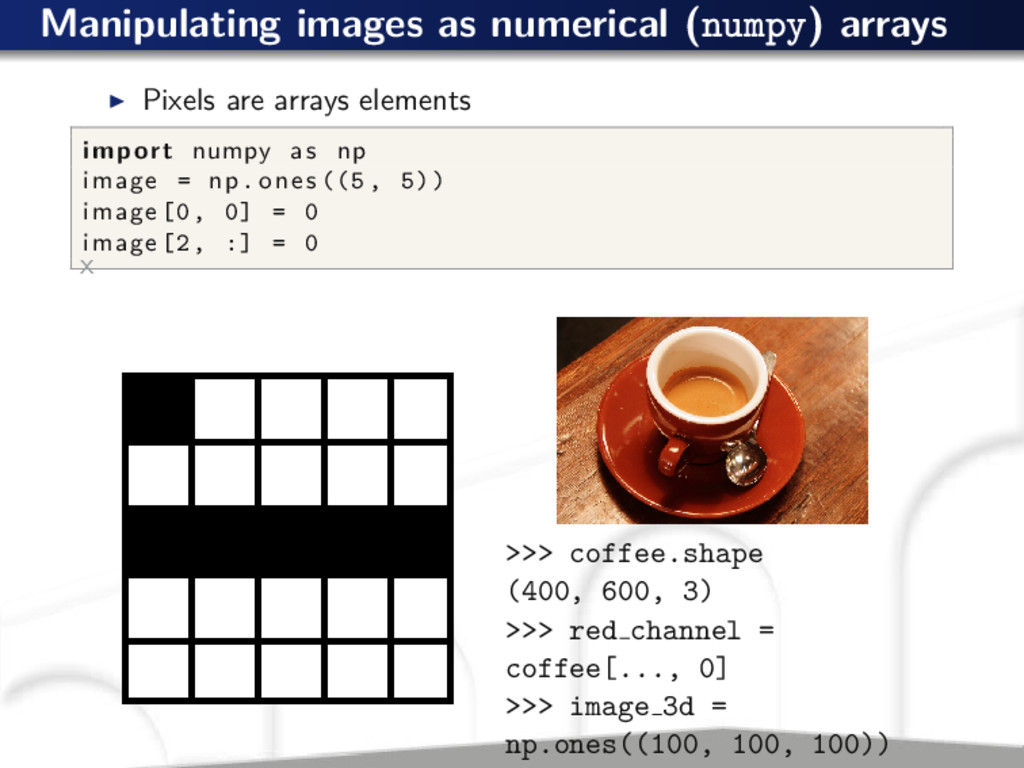
(based on compiled code) + utility functions to create/manipulate them >>> a = np.random. r a n d o m i n t e g e r s (0, 1, (2, 2, 2)) >>> a a r r a y ([[[0 , 1], [1, 0]], [[0, 0], [0, 1]]]) >>> a. shape , a. dtype ((2, 2, 2), dtype ( ’ int64 ’ )) x
(based on compiled code) + utility functions to create/manipulate them >>> a = np.random. r a n d o m i n t e g e r s (0, 1, (2, 2, 2)) >>> a a r r a y ([[[0 , 1], [1, 0]], [[0, 0], [0, 1]]]) >>> a. shape , a. dtype ((2, 2, 2), dtype ( ’ int64 ’ )) x Efficient and versatile data access indexing and slicing fancy indexing
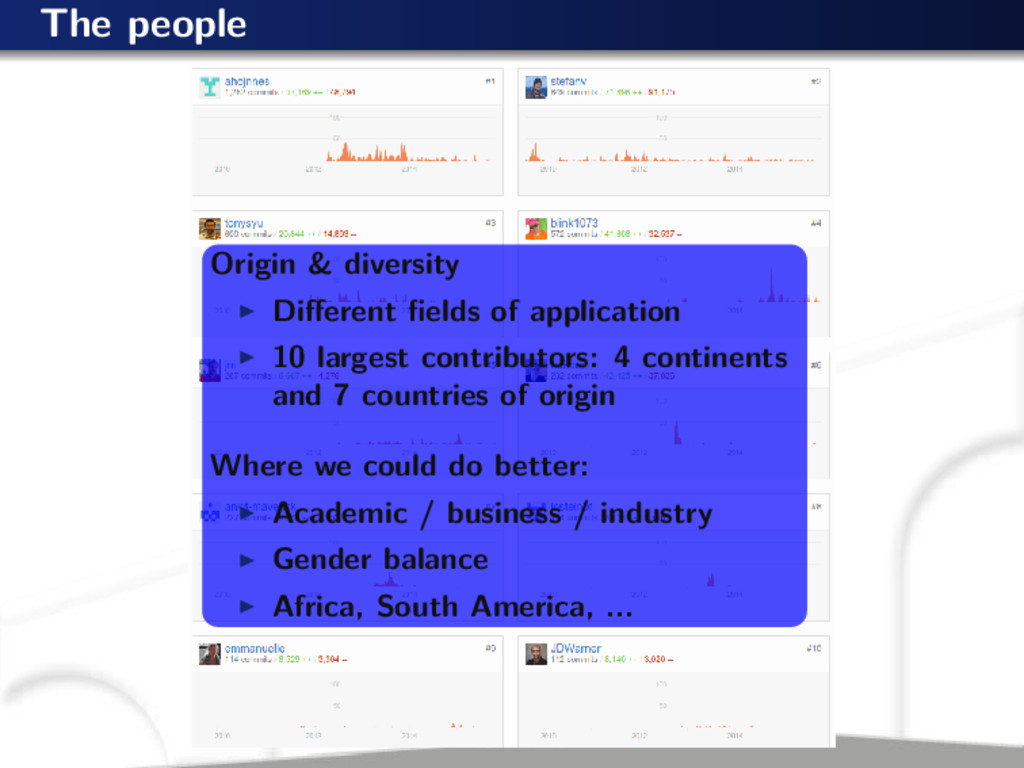
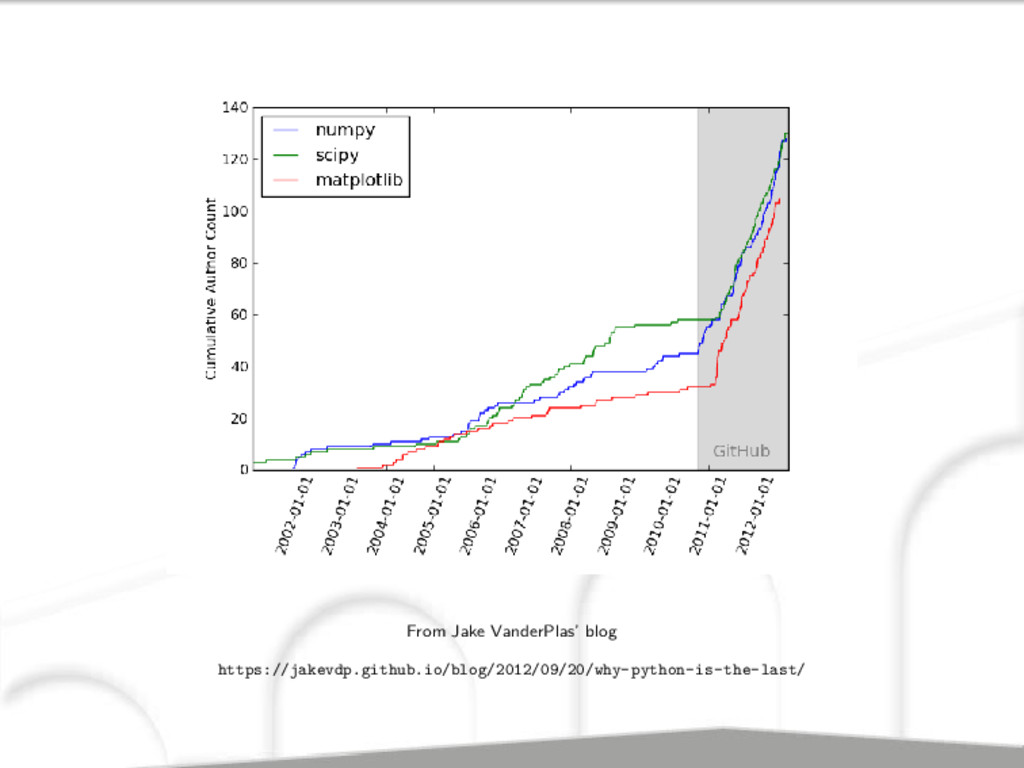
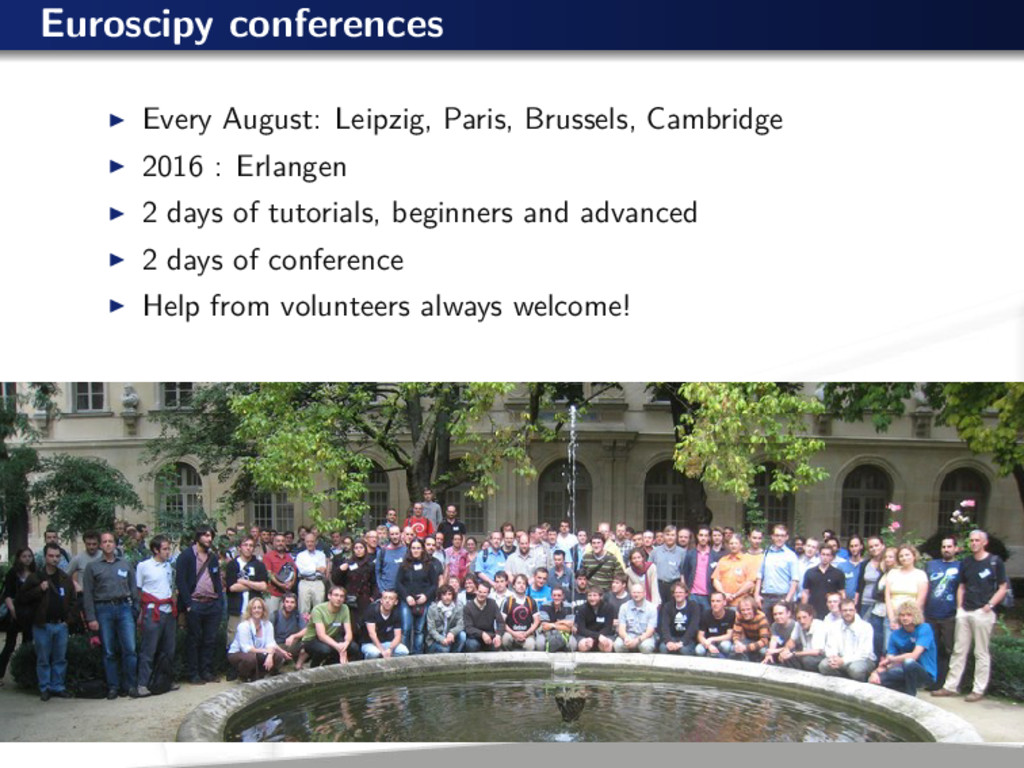
largest contributors: 4 continents and 7 countries of origin Where we could do better: Academic / business / industry Gender balance Africa, South America, ...
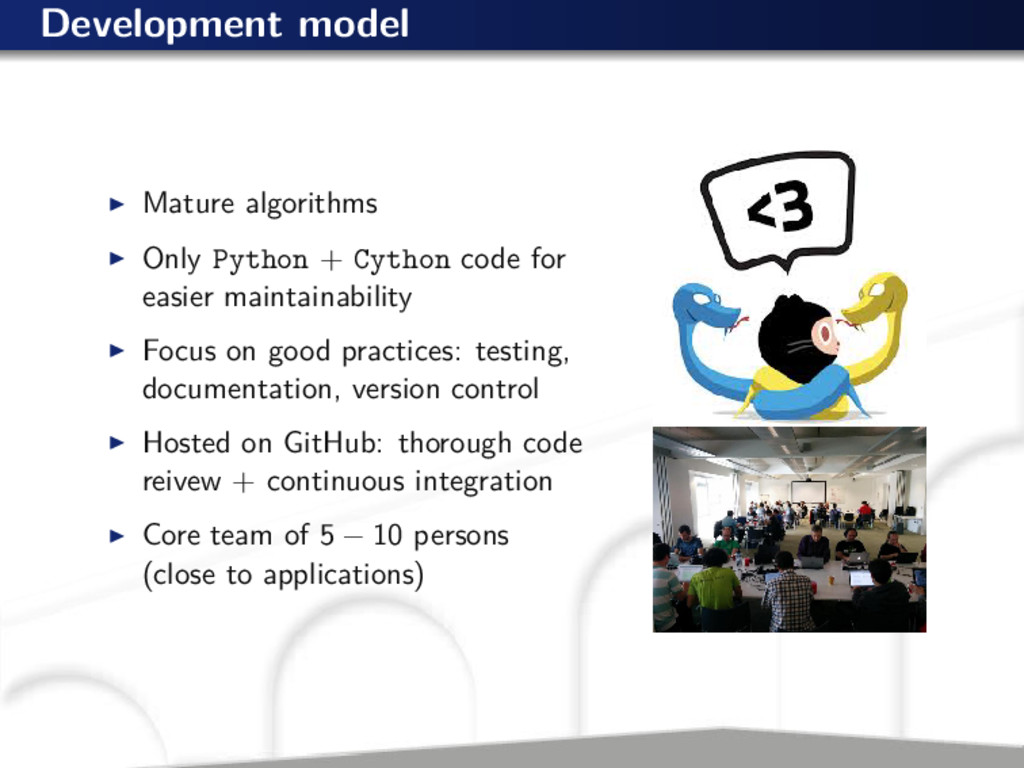
easier maintainability Focus on good practices: testing, documentation, version control Hosted on GitHub: thorough code reivew + continuous integration Core team of 5 − 10 persons (close to applications)
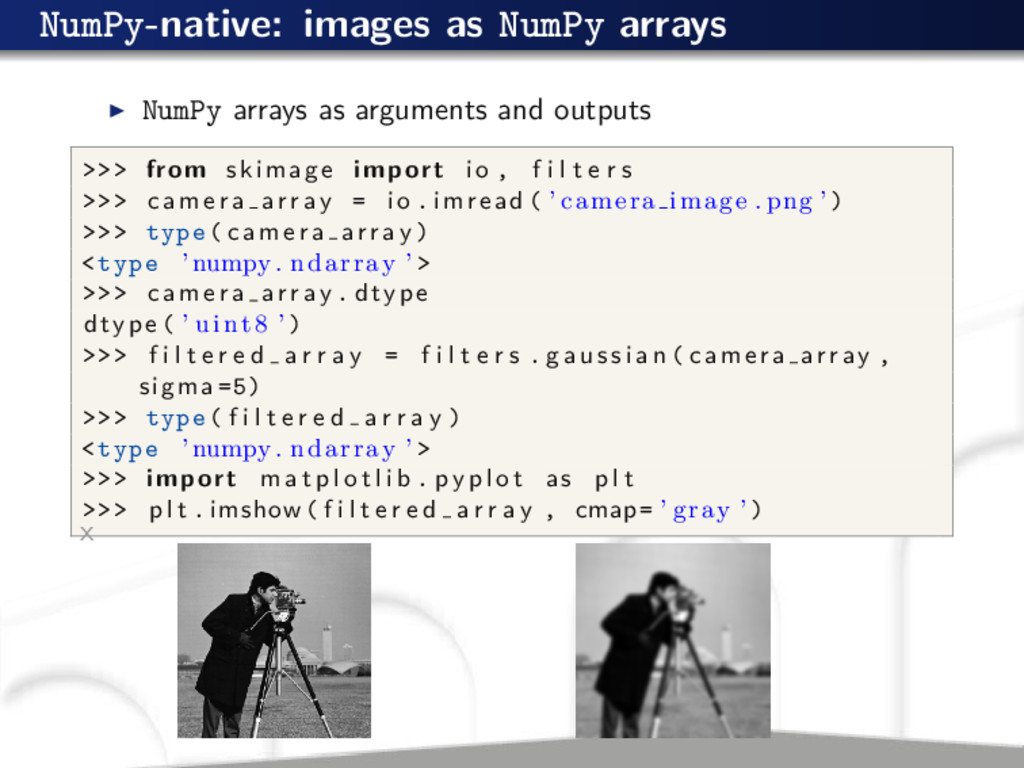
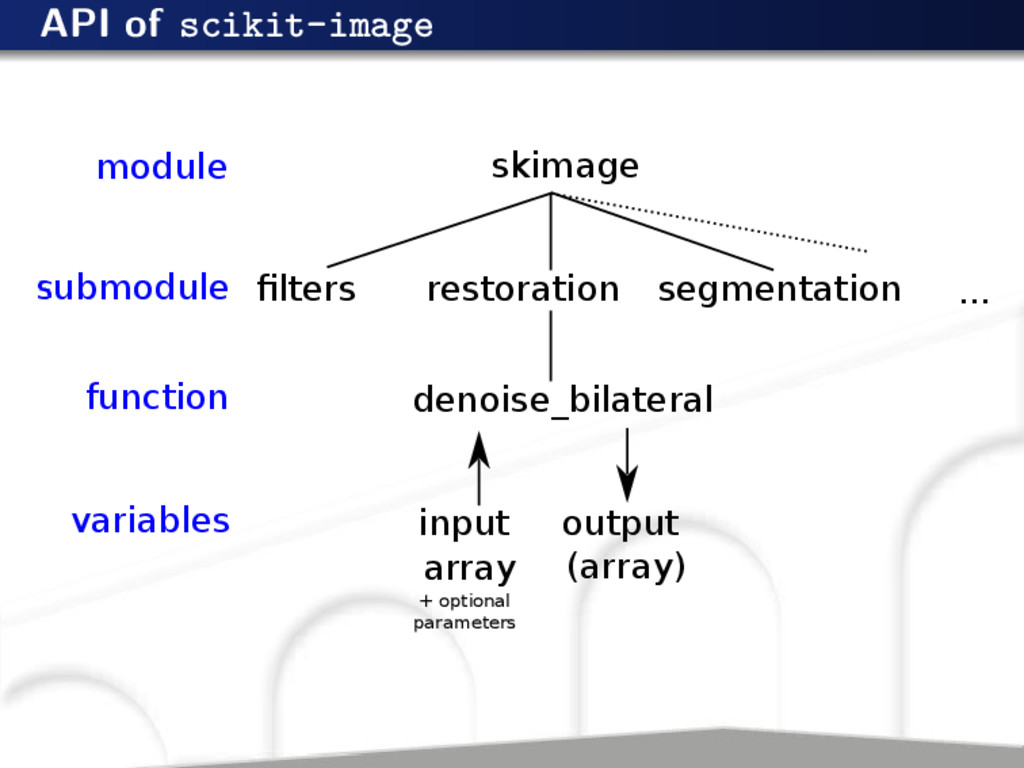
outputs >>> from skimage import io , f i l t e r s >>> c a m e r a a r r a y = i o . imread ( ’ camera image . png ’ ) >>> type( c a m e r a a r r a y ) <type ’numpy . ndarray ’ > >>> c a m e r a a r r a y . dtype dtype ( ’ uint8 ’ ) >>> f i l t e r e d a r r a y = f i l t e r s . g a u s s i a n ( camera array , sigma =5) >>> type( f i l t e r e d a r r a y ) <type ’numpy . ndarray ’ > >>> import m a t p l o t l i b . p y p l o t as p l t >>> p l t .imshow( f i l t e r e d a r r a y , cmap= ’ gray ’ ) x
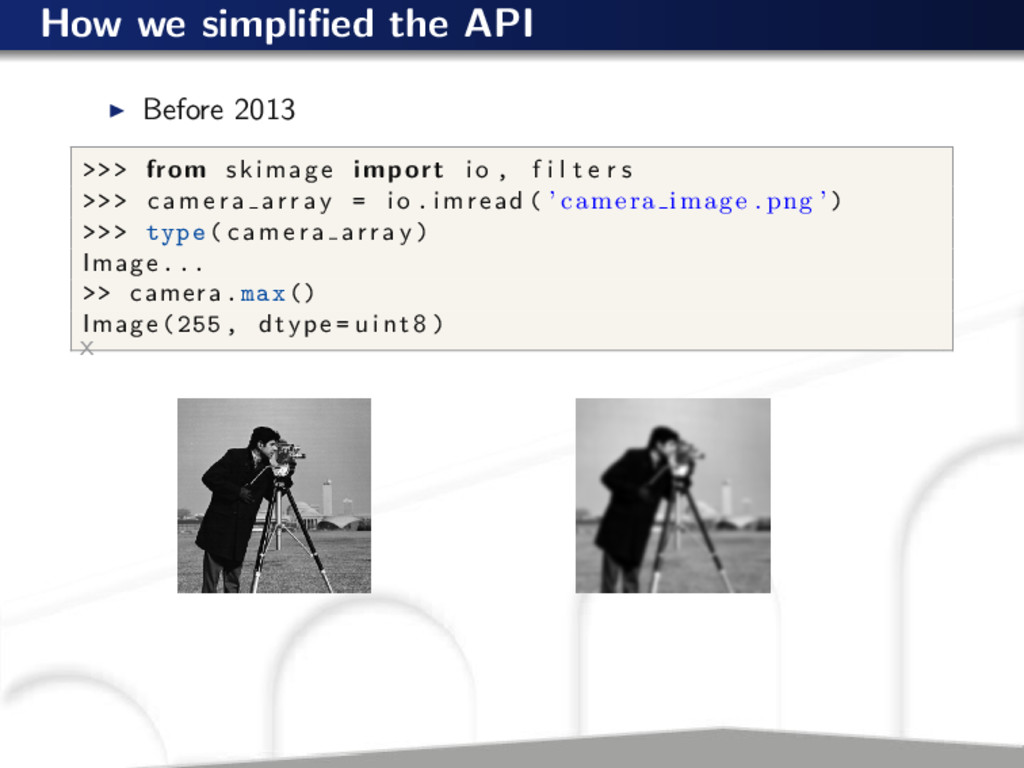
import io , f i l t e r s >>> c a m e r a a r r a y = i o . imread ( ’ camera image . png ’ ) >>> type( c a m e r a a r r a y ) Image ... >> camera .max() Image (255 , dtype = u i n t 8 ) x
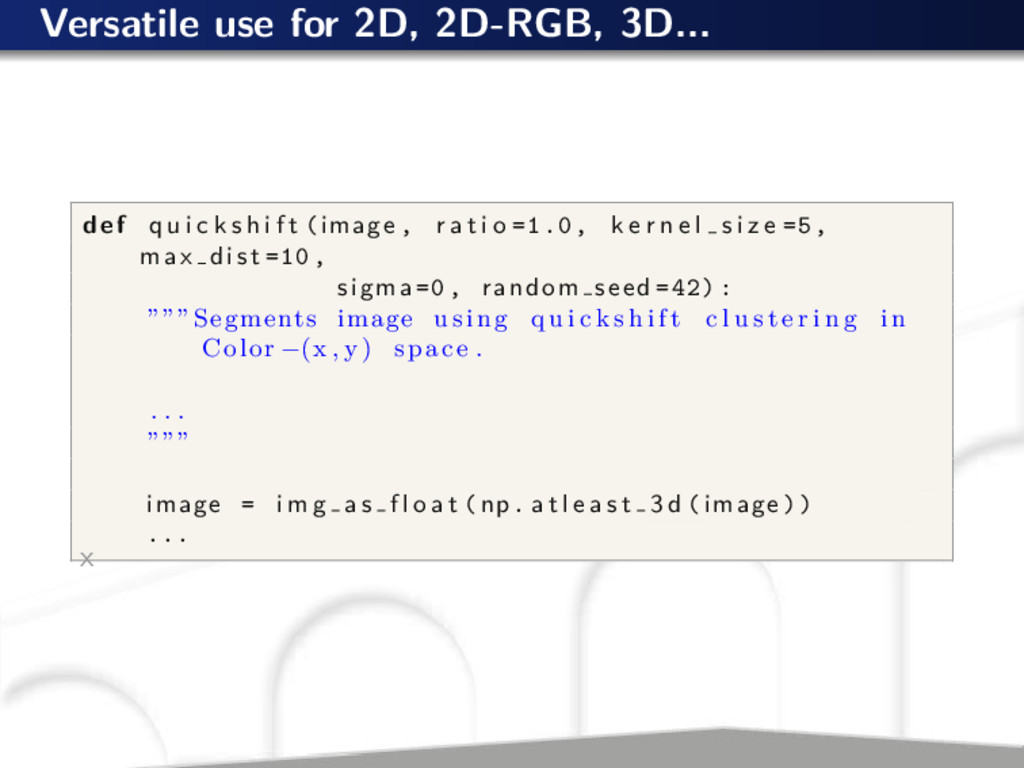
c k s h i f t (image , r a t i o =1.0 , k e r n e l s i z e =5, ma x di st =10, sigma =0, random seed =42): ””” Segments image using q u i c k s h i f t c l u s t e r i n g in Color −(x , y ) space . . . . ””” image = i m g a s f l o a t (np. a t l e a s t 3 d ( image )) ... x
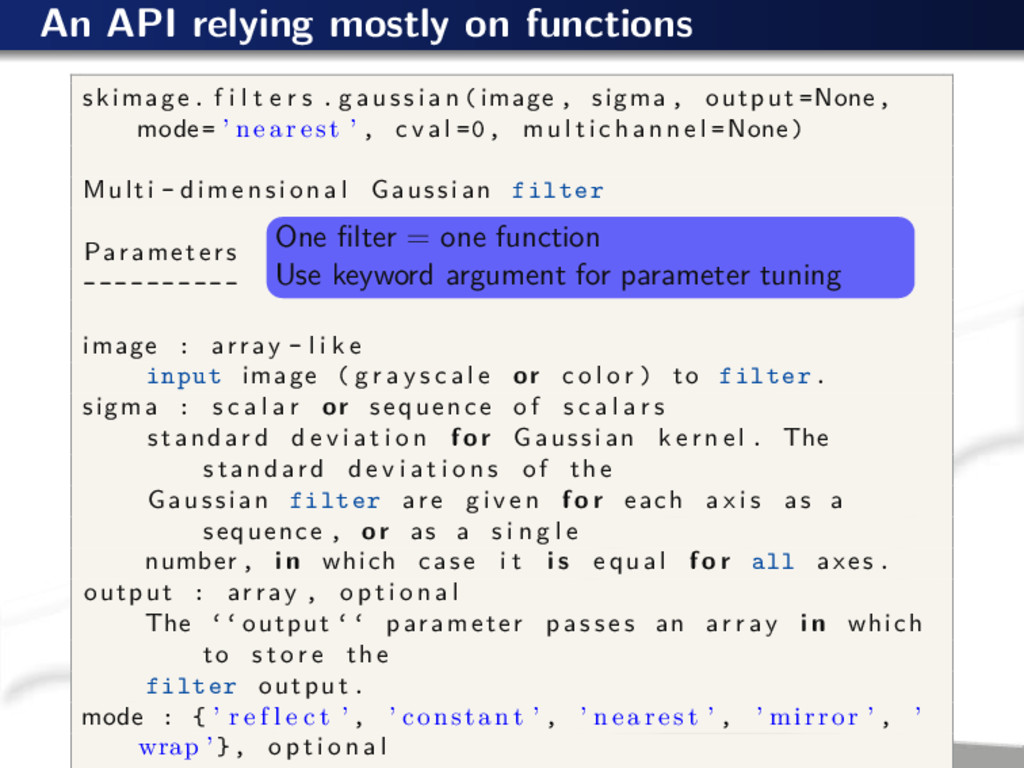
l t e r s . g a u s s i a n (image , sigma , output =None, mode= ’ n e a r e s t ’ , c v a l =0, m u l t i c h a n n e l =None) Multi - d i m e n s i o n a l Gaussian filter Parameters ---------- image : array - l i k e input image ( g r a y s c a l e or c o l o r ) to filter. sigma : s c a l a r or sequence of s c a l a r s st and ard d e v i a t i o n f o r Gaussian k e r n e l . The st and ard d e v i a t i o n s of the Gaussian filter are g i v e n f o r each a x i s as a sequence , or as a s i n g l e number , in which case i t i s equal f o r all axes . output : array , o p t i o n a l The ‘‘ output ‘‘ parameter p a s s e s an a r r a y in which to s t o r e the filter output . mode : { ’ r e f l e c t ’ , ’ constant ’ , ’ n ea re st ’ , ’ mirror ’ , ’ wrap ’ }, o p t i o n a l One filter = one function Use keyword argument for parameter tuning
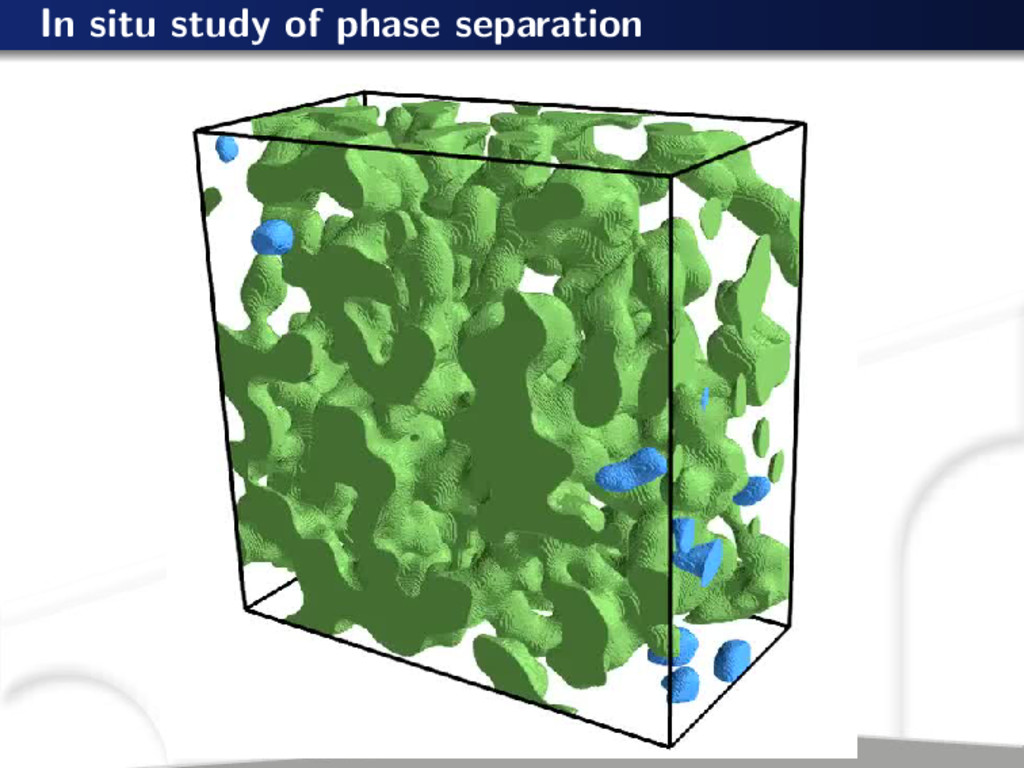
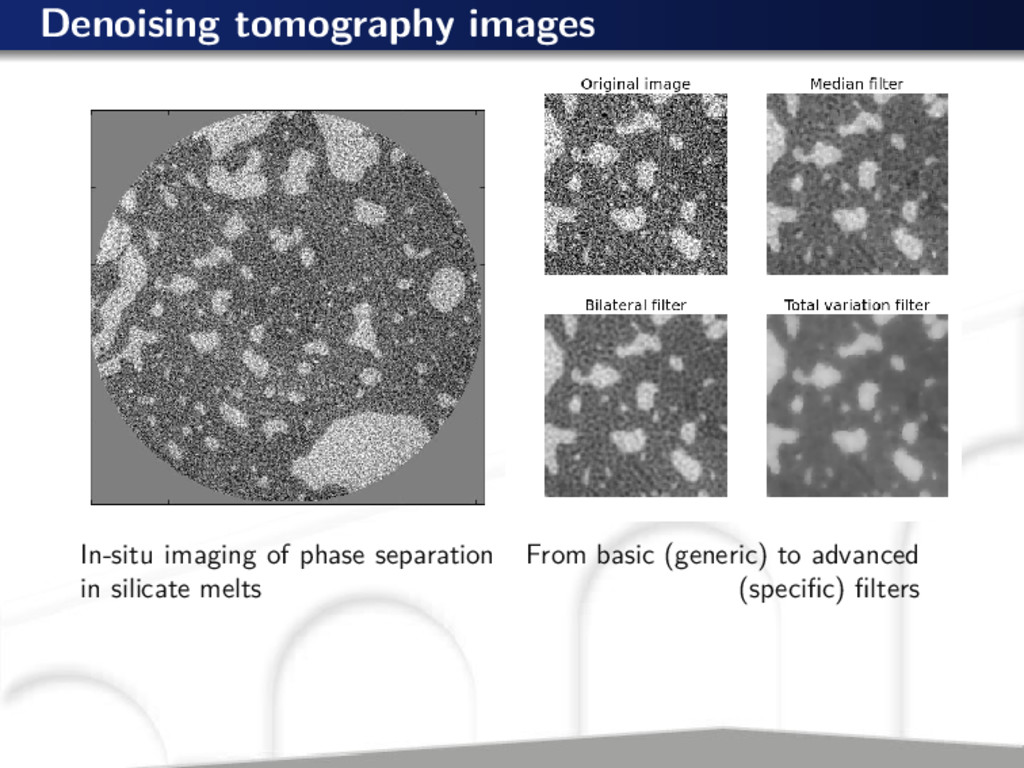
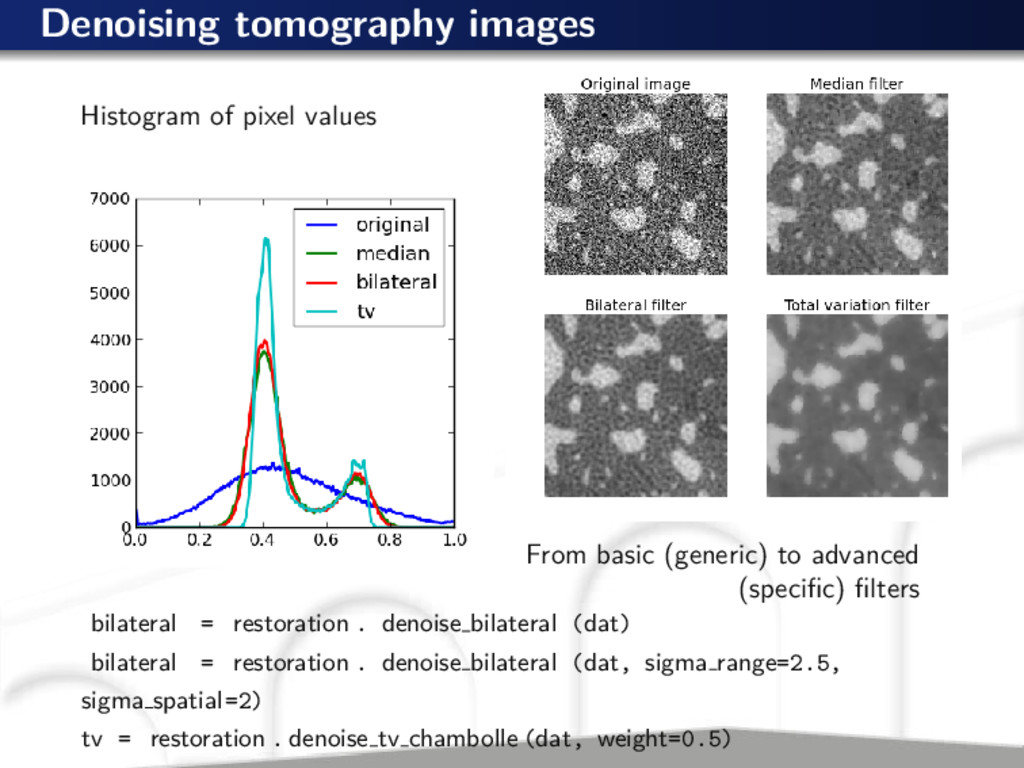
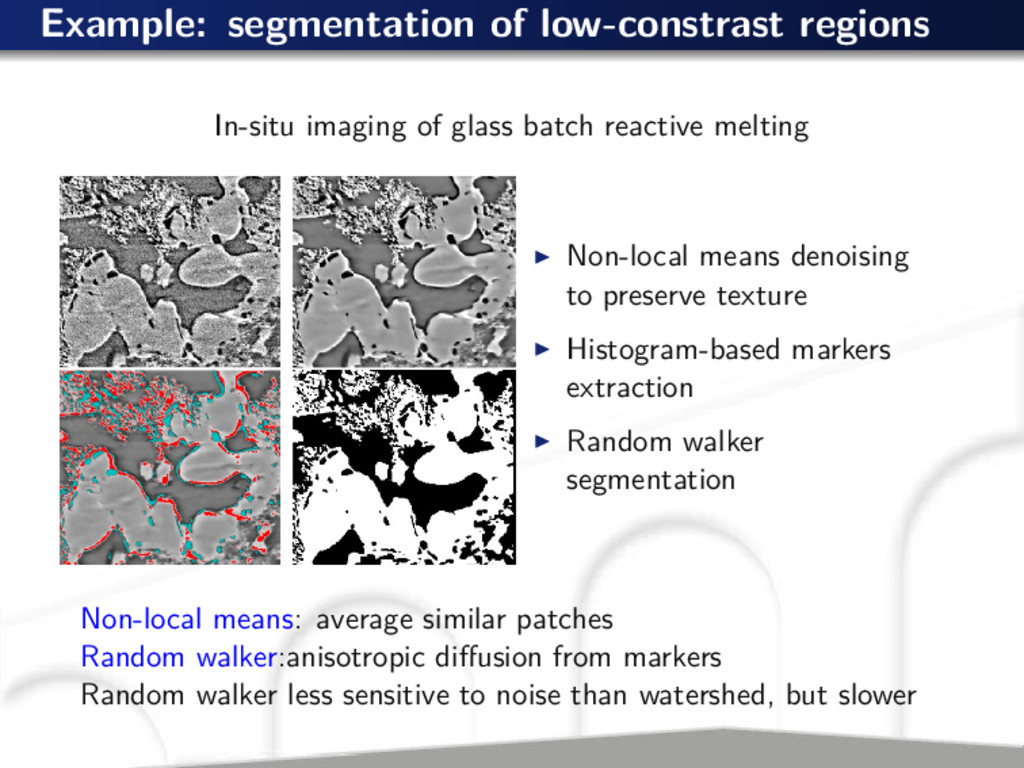
reactive melting Non-local means denoising to preserve texture Histogram-based markers extraction Random walker segmentation Non-local means: average similar patches Random walker:anisotropic diffusion from markers Random walker less sensitive to noise than watershed, but slower
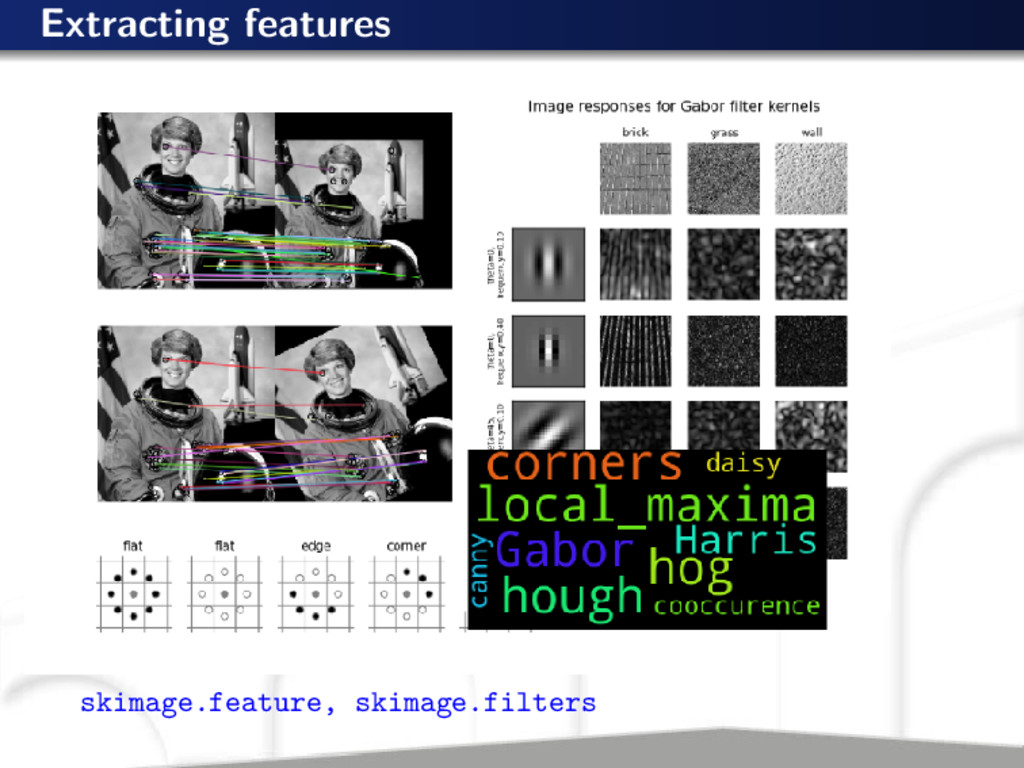
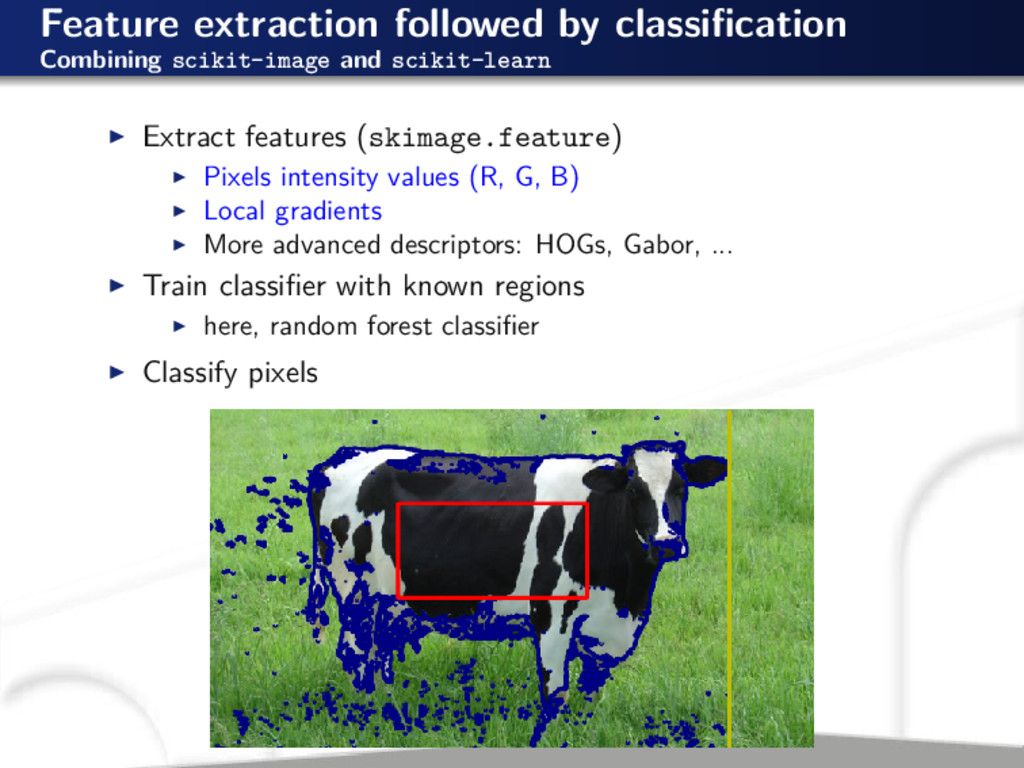
features (skimage.feature) Pixels intensity values (R, G, B) Local gradients More advanced descriptors: HOGs, Gabor, ... Train classifier with known regions here, random forest classifier Classify pixels
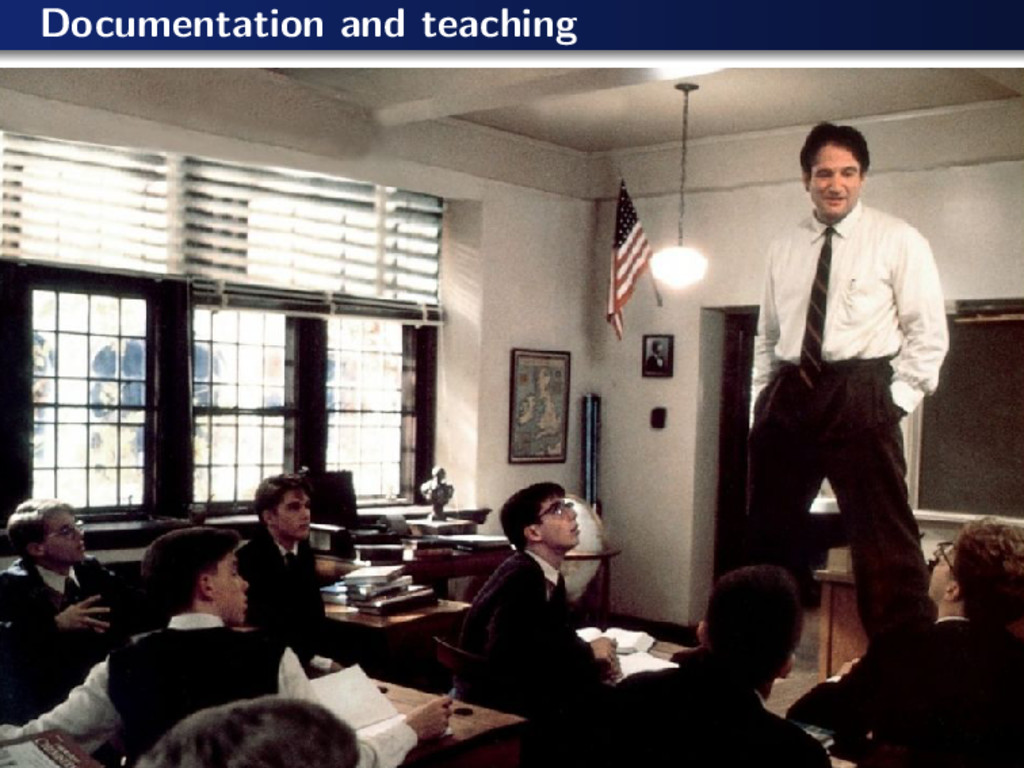
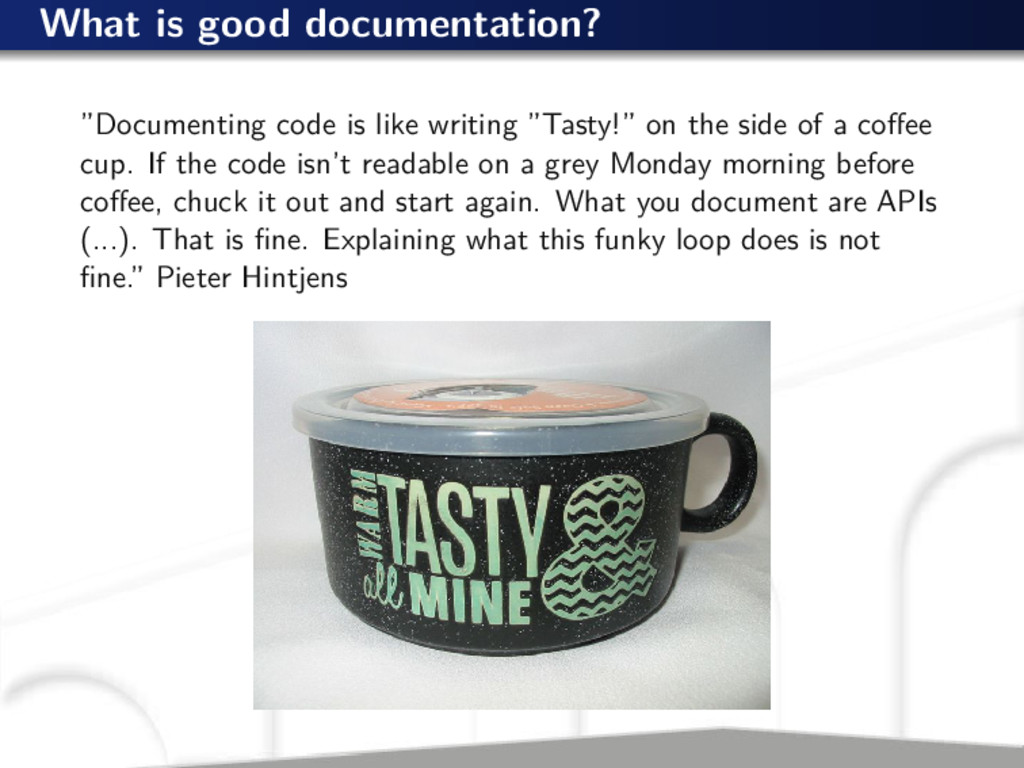
on the side of a coffee cup. If the code isn’t readable on a grey Monday morning before coffee, chuck it out and start again. What you document are APIs (...). That is fine. Explaining what this funky loop does is not fine.” Pieter Hintjens
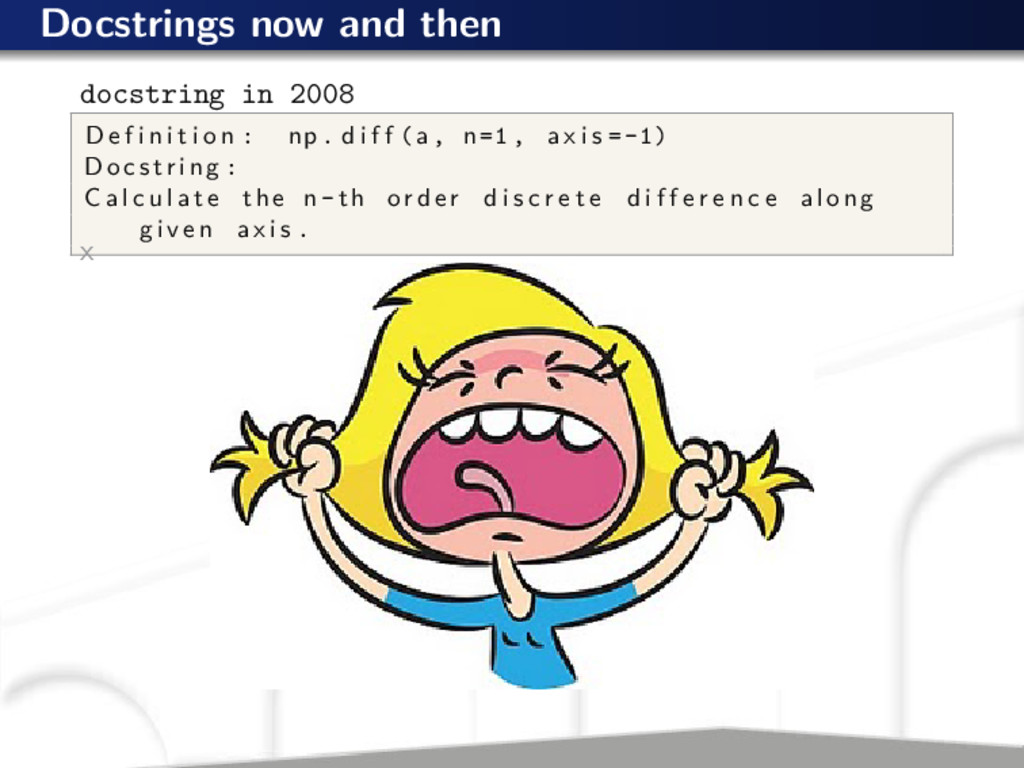
i n i t i o n : np. d i f f (a, n=1, a x i s =-1) D o c s t r i n g : C a l c u l a t e the n- th o r d e r d i s c r e t e d i f f e r e n c e along g i v e n a x i s . x
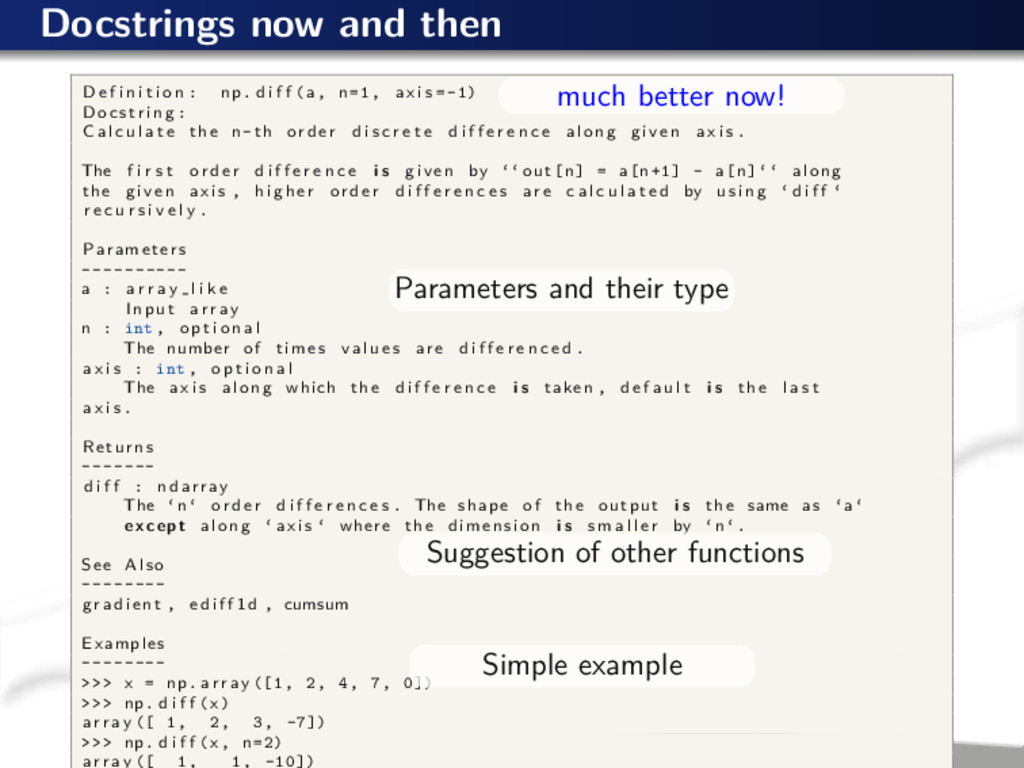
t i o n : np. d i f f (a, n=1, a x i s =-1) Docstring : C a l c u l a t e the n- th o r d e r d i s c r e t e d i f f e r e n c e along given a x i s . The f i r s t o r d e r d i f f e r e n c e i s given by ‘‘ out [n] = a[n+1] - a[n]‘‘ along the given axis , h i g h e r o r d e r d i f f e r e n c e s are c a l c u l a t e d by using ‘ d i f f ‘ r e c u r s i v e l y . Parameters ---------- a : a r r a y l i k e Input a r r a y n : int , o p t i o n a l The number of times v a l u e s are d i f f e r e n c e d . a x i s : int , o p t i o n a l The a x i s along which the d i f f e r e n c e i s taken , d e f a u l t i s the l a s t a x i s . Returns ------- d i f f : ndarray The ‘n‘ o r d e r d i f f e r e n c e s . The shape of the output i s the same as ‘a‘ except along ‘ axis ‘ where the dimension i s s m a l l e r by ‘n‘. See Also -------- gradient , e d i f f 1 d , cumsum Examples -------- >>> x = np. a r r a y ([1, 2, 4, 7, 0]) >>> np. d i f f (x) a r r a y ([ 1, 2, 3, -7]) >>> np. d i f f (x , n=2) a r r a y ([ 1, 1, -10]) much better now! Parameters and their type Suggestion of other functions Simple example
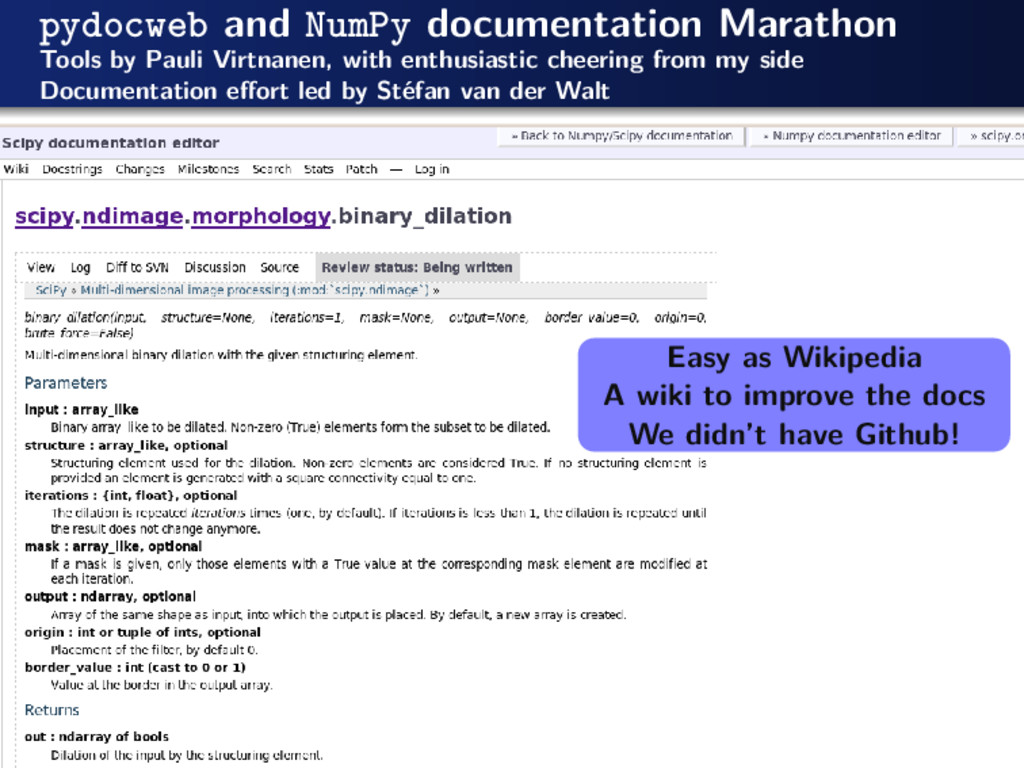
enthusiastic cheering from my side Documentation effort led by St´ efan van der Walt Easy as Wikipedia A wiki to improve the docs We didn’t have Github!
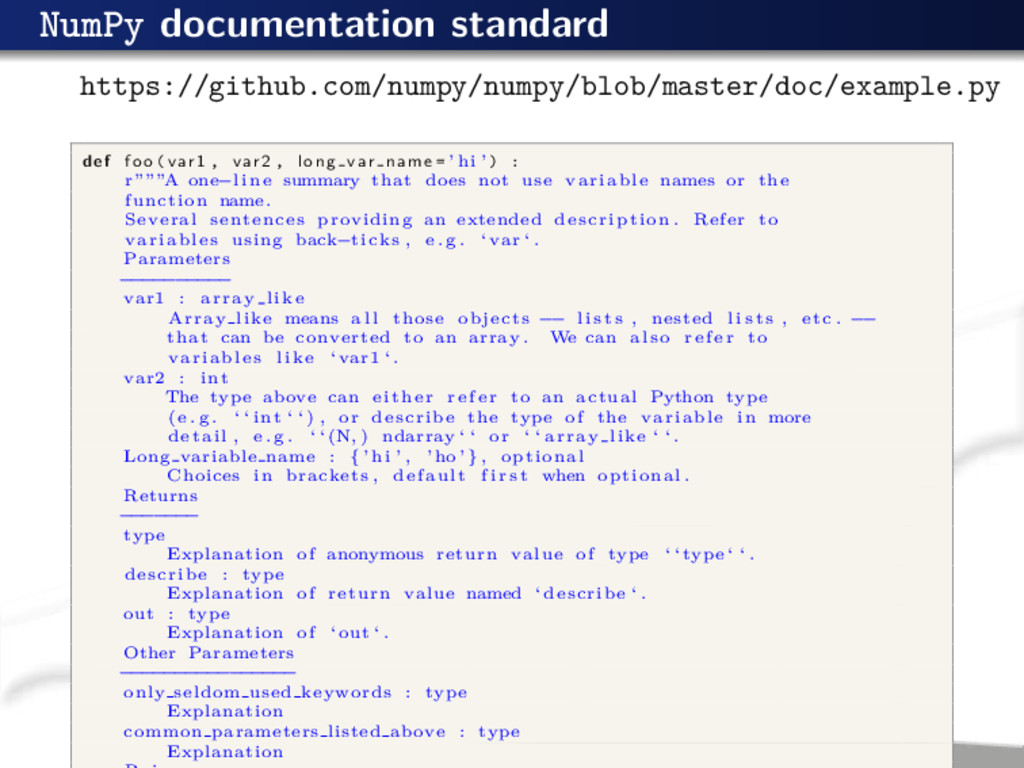
, long var name = ’ hi ’) : r”””A one−line summary that does not use variable names or the function name. Several sentences providing an extended description . Refer to variables using back−ticks , e . g . ‘var ‘ . Parameters − − − − − − − − − − var1 : array like Array like means all those objects − − lists , nested lists , etc . − − that can be converted to an array . We can also refer to variables like ‘var1 ‘ . var2 : int The type above can either refer to an actual Python type (e . g . ‘ ‘ int ‘ ‘) , or describe the type of the variable in more detail , e . g . ‘ ‘(N,) ndarray ‘ ‘ or ‘ ‘ array like ‘ ‘ . Long variable name : {’ hi ’ , ’ho ’} , optional Choices in brackets , default f i r s t when optional . Returns − − − − − − − type Explanation of anonymous return value of type ‘ ‘type ‘ ‘ . describe : type Explanation of return value named ‘ describe ‘ . out : type Explanation of ‘out ‘ . Other Parameters − − − − − − − − − − − − − − − − only seldom used keywords : type Explanation common parameters listed above : type Explanation
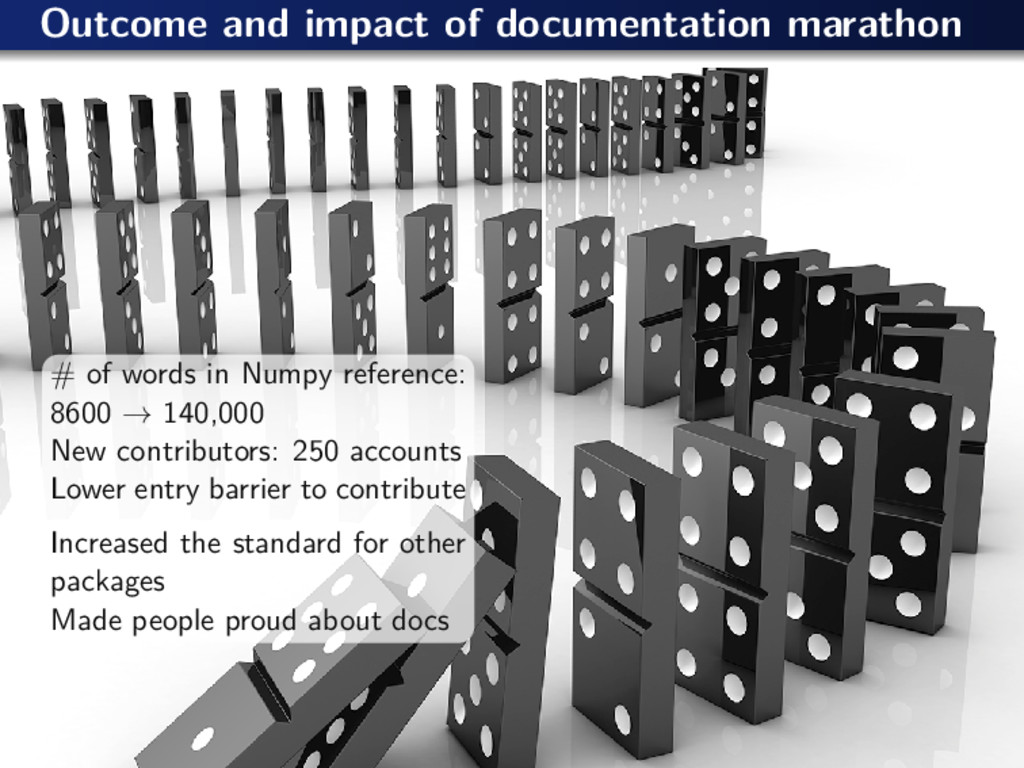
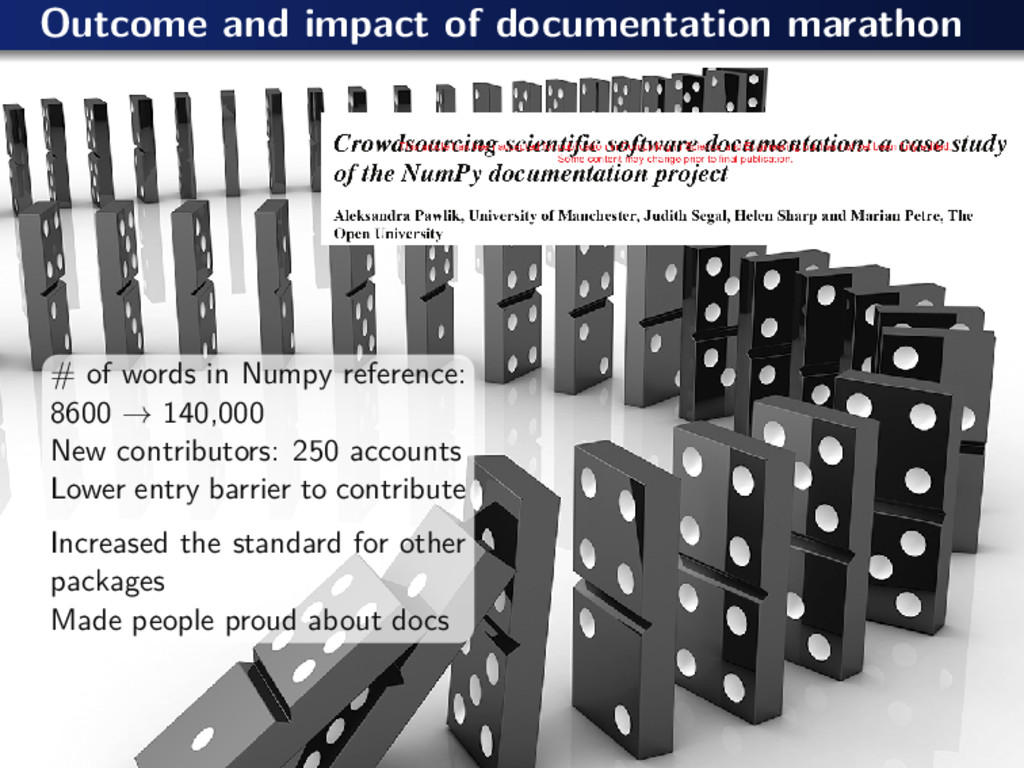
Numpy reference: 8600 → 140,000 New contributors: 250 accounts Lower entry barrier to contribute Increased the standard for other packages Made people proud about docs
Numpy reference: 8600 → 140,000 New contributors: 250 accounts Lower entry barrier to contribute Increased the standard for other packages Made people proud about docs
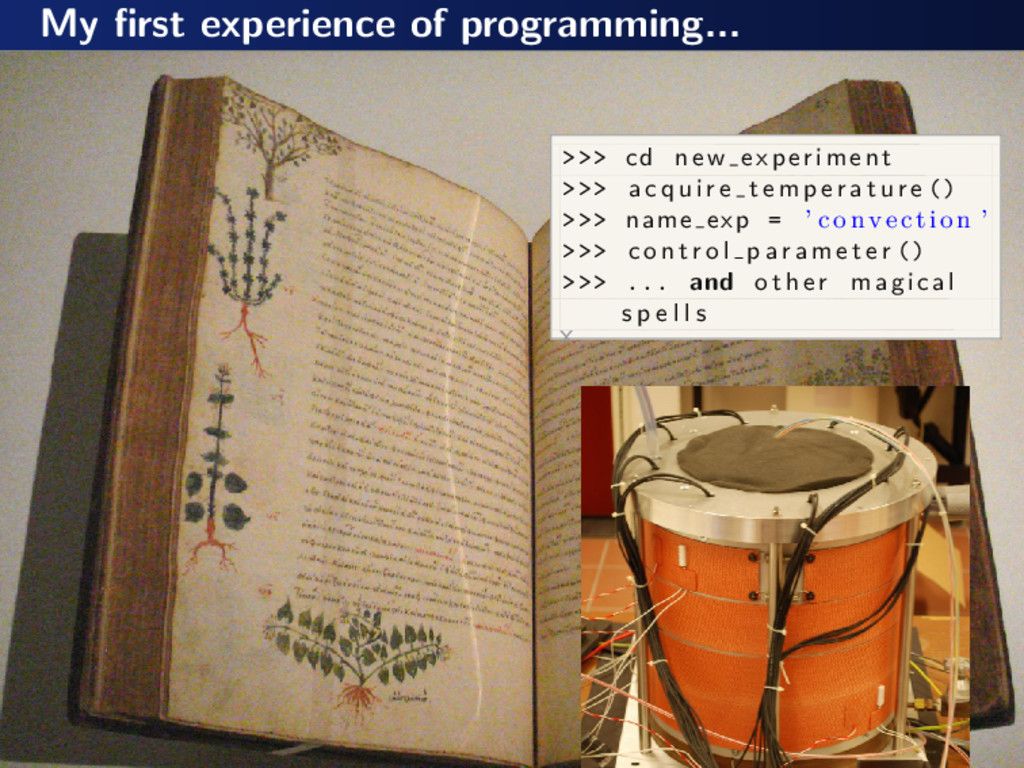
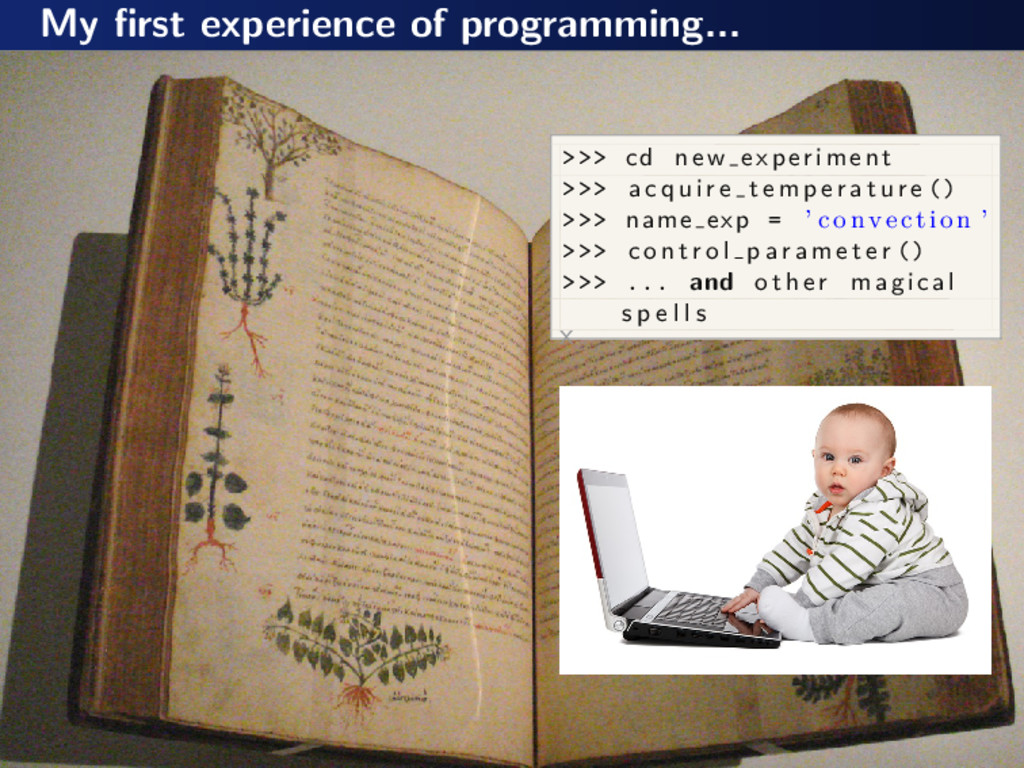
a c q u i r e t e m p e r a t u r e () >>> name exp = ’ convection ’ >>> c o n t r o l p a r a m e t e r () >>> ... and o t h e r magical s p e l l s x
a c q u i r e t e m p e r a t u r e () >>> name exp = ’ convection ’ >>> c o n t r o l p a r a m e t e r () >>> ... and o t h e r magical s p e l l s x
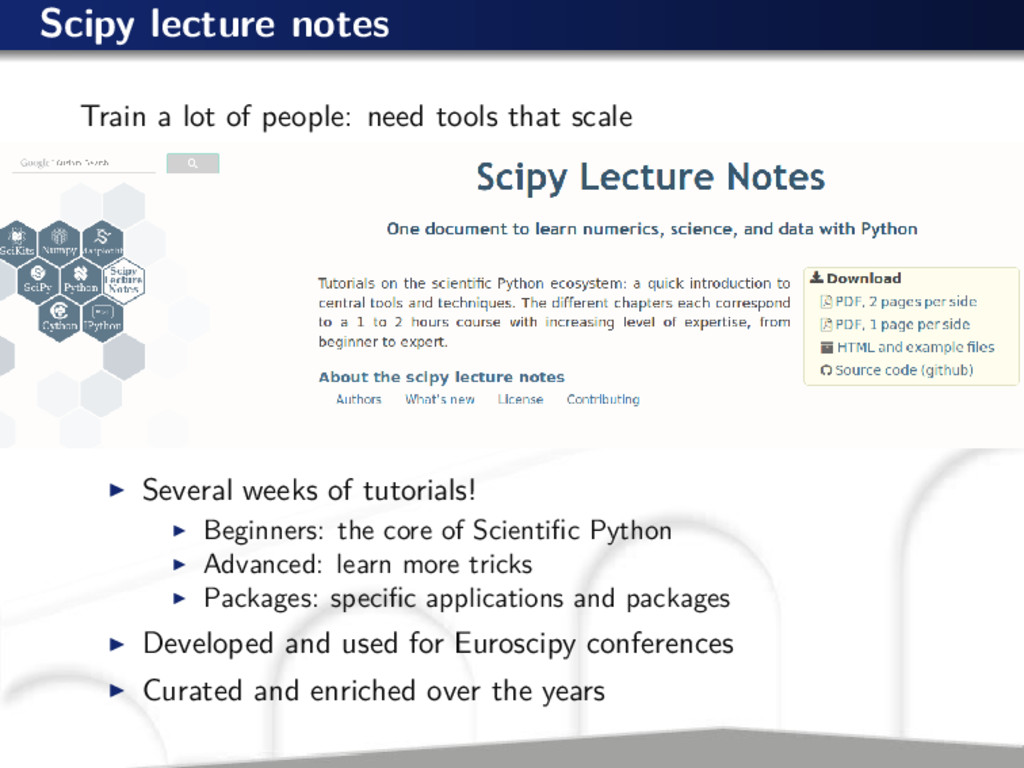
that scale Several weeks of tutorials! Beginners: the core of Scientific Python Advanced: learn more tricks Packages: specific applications and packages Developed and used for Euroscipy conferences Curated and enriched over the years
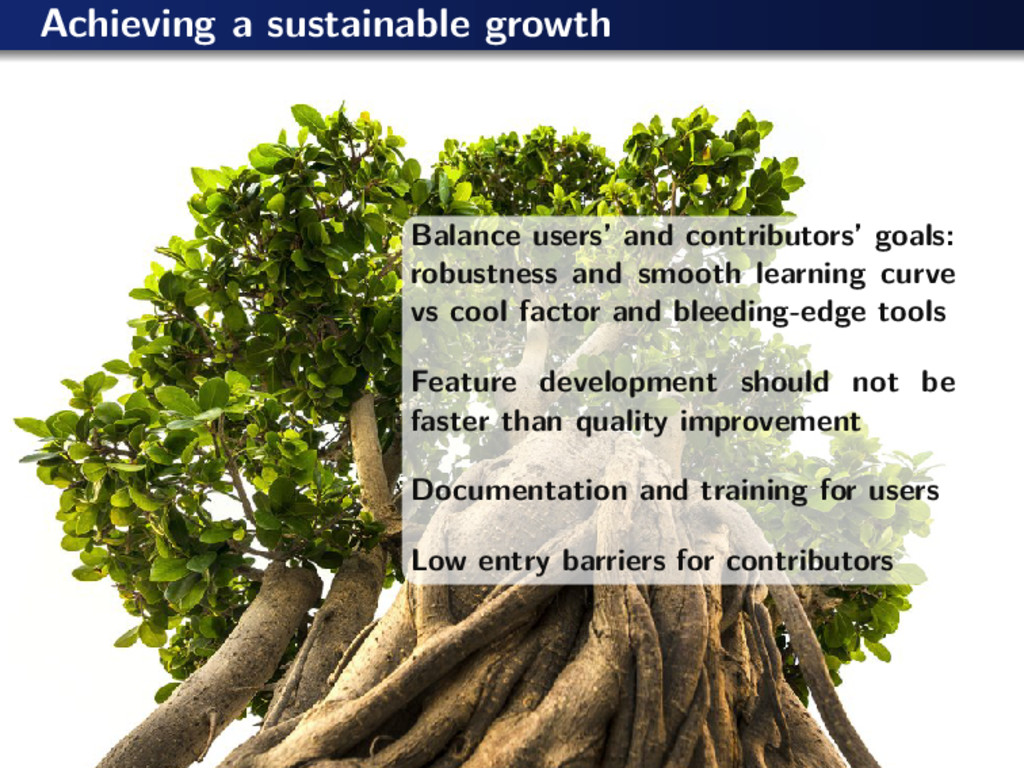
and smooth learning curve vs cool factor and bleeding-edge tools Feature development should not be faster than quality improvement Documentation and training for users Low entry barriers for contributors
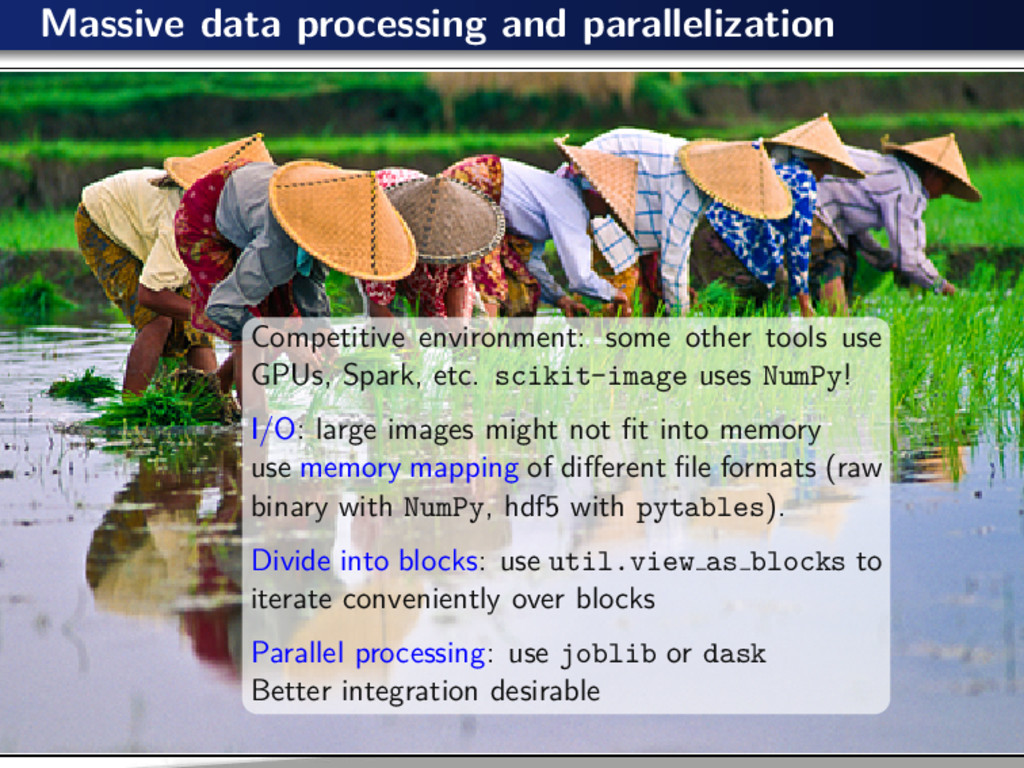
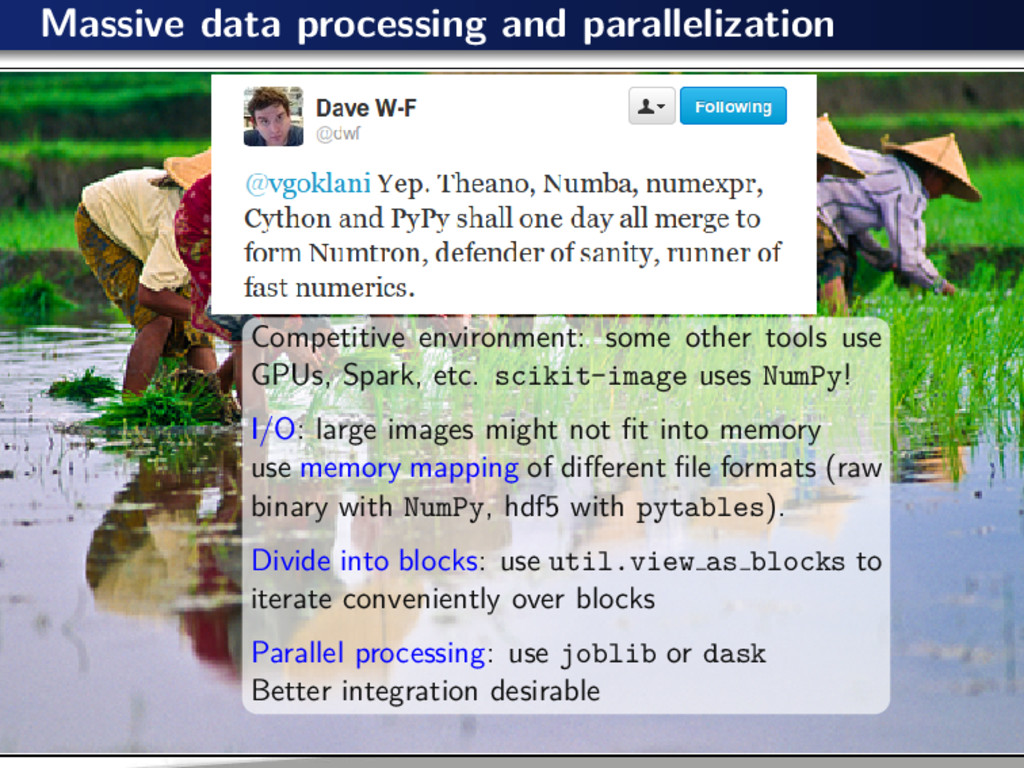
use GPUs, Spark, etc. scikit-image uses NumPy! I/O: large images might not fit into memory use memory mapping of different file formats (raw binary with NumPy, hdf5 with pytables). Divide into blocks: use util.view as blocks to iterate conveniently over blocks Parallel processing: use joblib or dask Better integration desirable
use GPUs, Spark, etc. scikit-image uses NumPy! I/O: large images might not fit into memory use memory mapping of different file formats (raw binary with NumPy, hdf5 with pytables). Divide into blocks: use util.view as blocks to iterate conveniently over blocks Parallel processing: use joblib or dask Better integration desirable
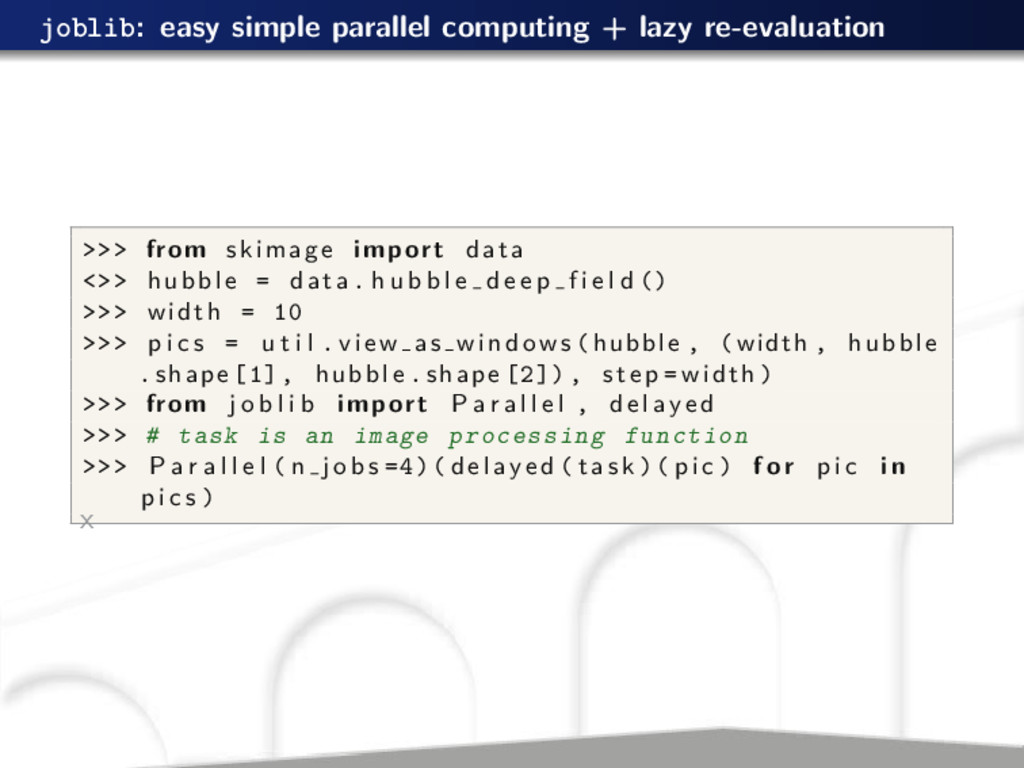
skimage import data <>> hubble = data . h u b b l e d e e p f i e l d () >>> width = 10 >>> p i c s = u t i l . view as windows ( hubble , ( width , hubble . shape [1], hubble . shape [2]) , s t e p = width ) >>> from j o b l i b import P a r a l l e l , d e l a y e d >>> # task is an image processing function >>> P a r a l l e l ( n j o b s =4)( d e l a y e d ( t a s k )( p i c ) f o r p i c in p i c s ) x
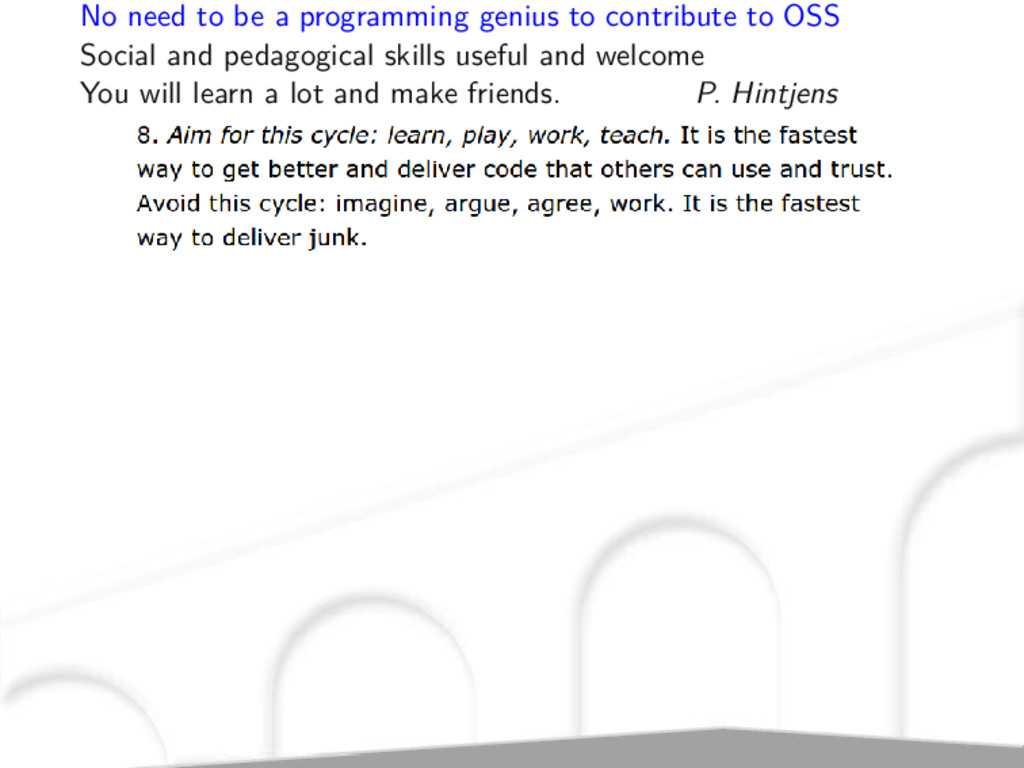
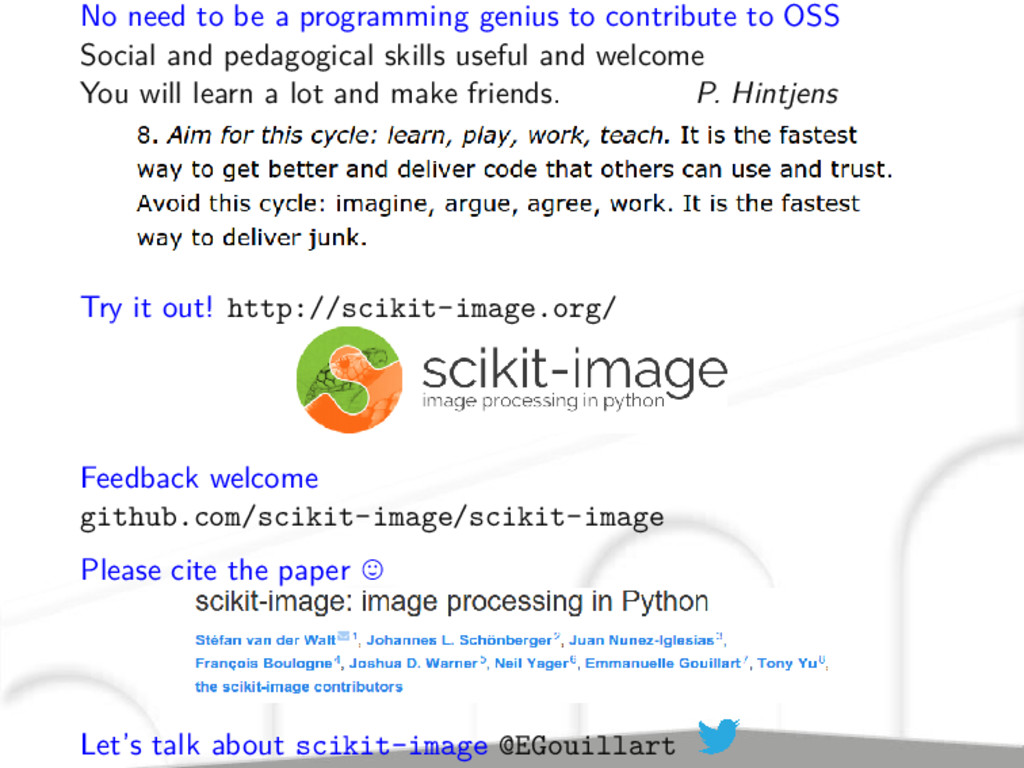
OSS Social and pedagogical skills useful and welcome You will learn a lot and make friends. P. Hintjens Try it out! http://scikit-image.org/ Feedback welcome github.com/scikit-image/scikit-image Please cite the paper Let’s talk about scikit-image @EGouillart


 emmanuelle
 kameitomohiro
 ueponx
 camiha
 kizawa2020
 ludicmind
 furuton
 takanorip
 mkdev10
 tetsuya28
 oracle4engineer
 munakata
 colopl
 mfonobong
 addyosmani
 sergeychernyshev
 marketingsoph
 jonoalderson
 codingconduct
 samanthasiow
 3n
3n
 deanohume
 rabernat
 sabderemane