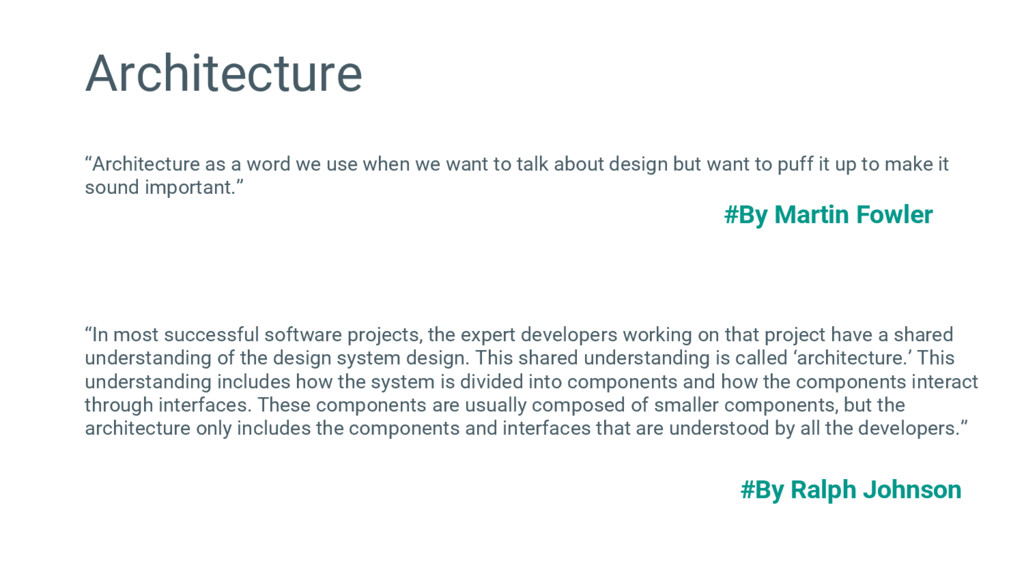
when we want to talk about design but want to puff it up to make it sound important.” “In most successful software projects, the expert developers working on that project have a shared understanding of the design system design. This shared understanding is called ‘architecture.’ This understanding includes how the system is divided into components and how the components interact through interfaces. These components are usually composed of smaller components, but the architecture only includes the components and interfaces that are understood by all the developers.” #By Ralph Johnson
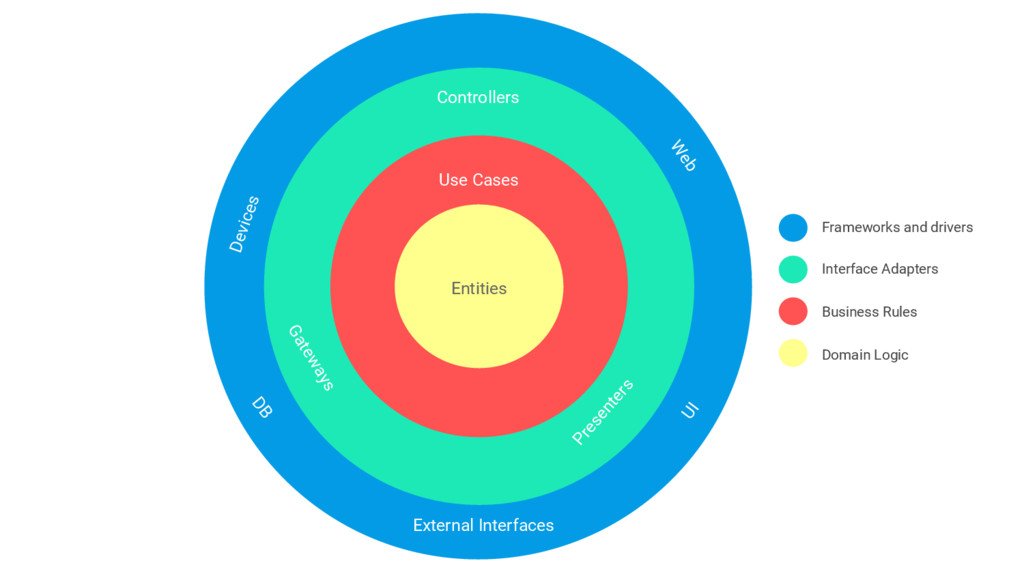
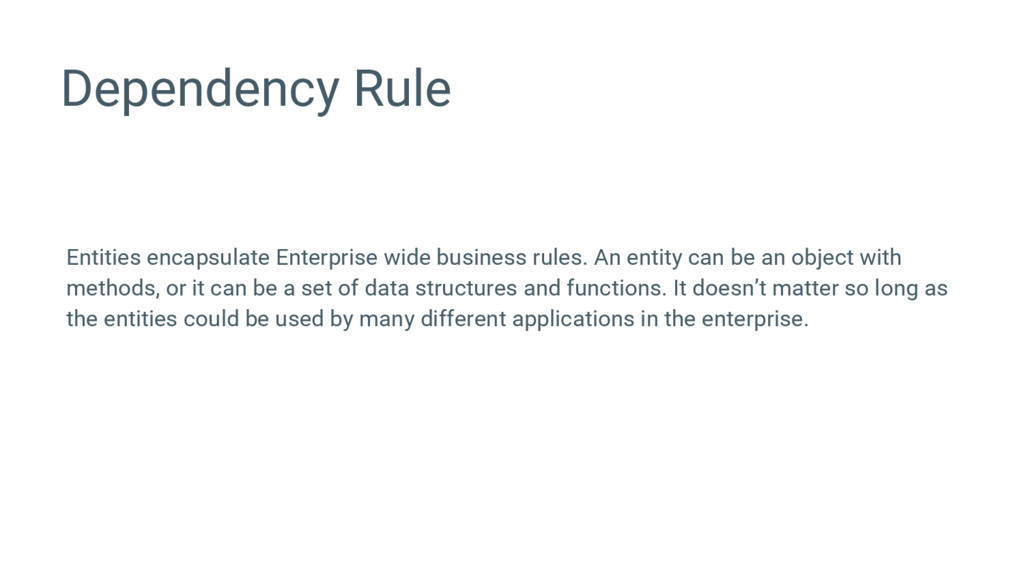
can be an object with methods, or it can be a set of data structures and functions. It doesn’t matter so long as the entities could be used by many different applications in the enterprise.
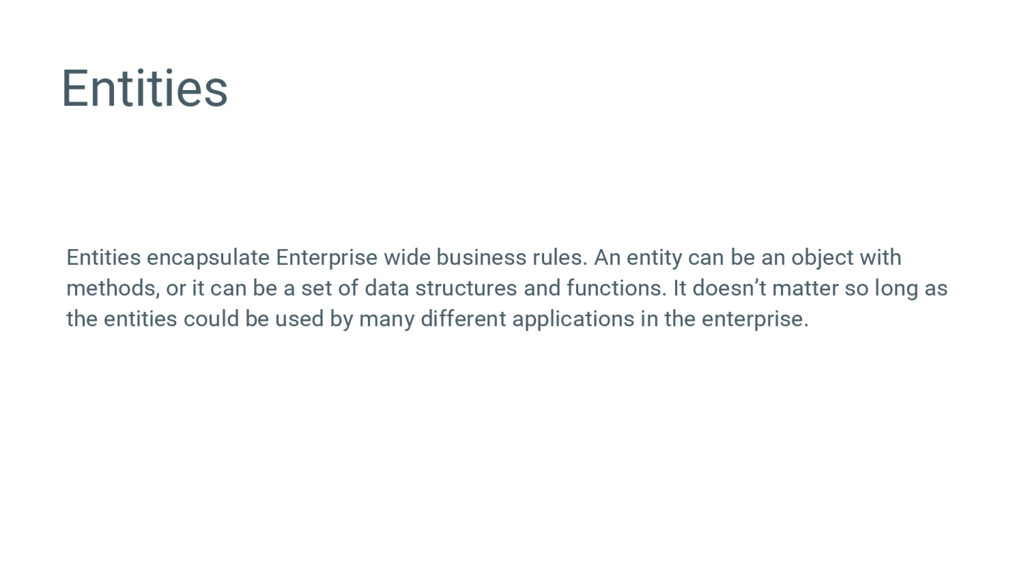
be an object with methods, or it can be a set of data structures and functions. It doesn’t matter so long as the entities could be used by many different applications in the enterprise.
business rules. It encapsulates and implements all of the use cases of the system. These use cases orchestrate the flow of data to and from the entities, and direct those entities to use their enterprise wide business rules to achieve the goals of the use case.
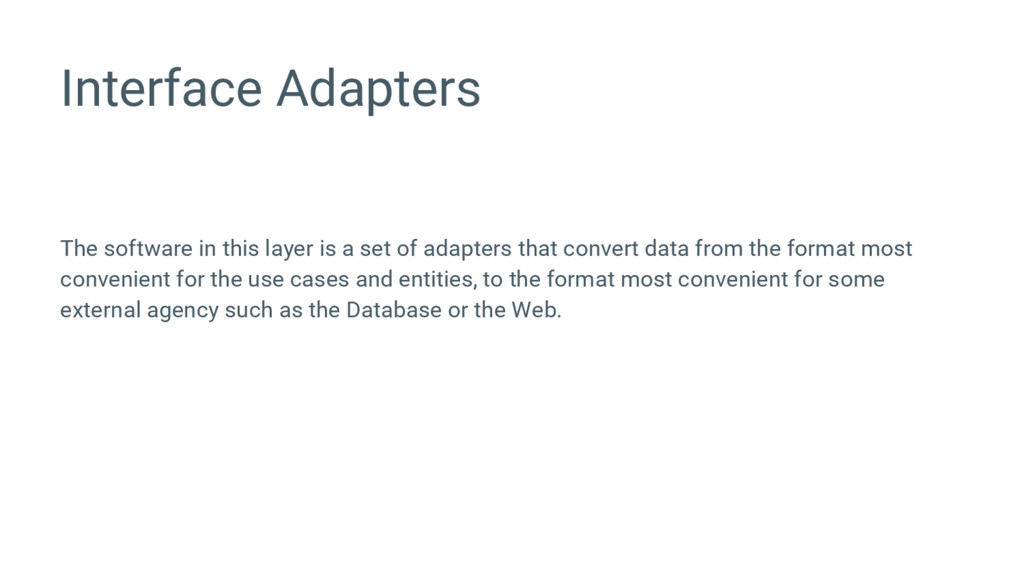
of adapters that convert data from the format most convenient for the use cases and entities, to the format most convenient for some external agency such as the Database or the Web.
frameworks and tools such as the Database, the Web Framework, etc. Generally you don’t write much code in this layer other than glue code that communicates to the next circle inwards. This layer is where all the details go. The Web is a detail. The database is a detail. We keep these things on the outside where they can do little harm.
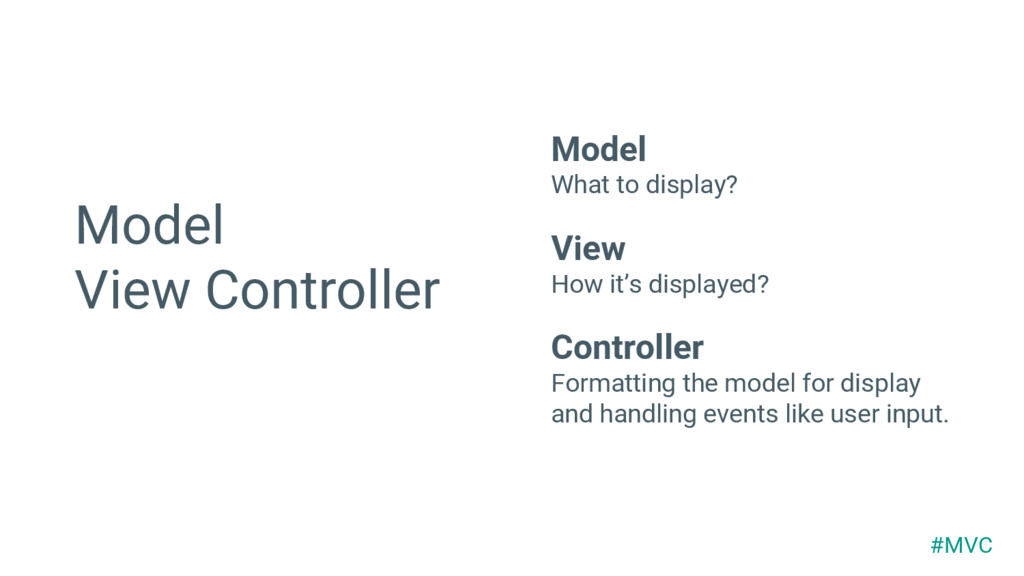
presentation layer from the logic, so that everything about how the interface works is separated from how we represent it on screen. Ideally the MVP pattern would achieve that same logic might have completely different and interchangeable views.
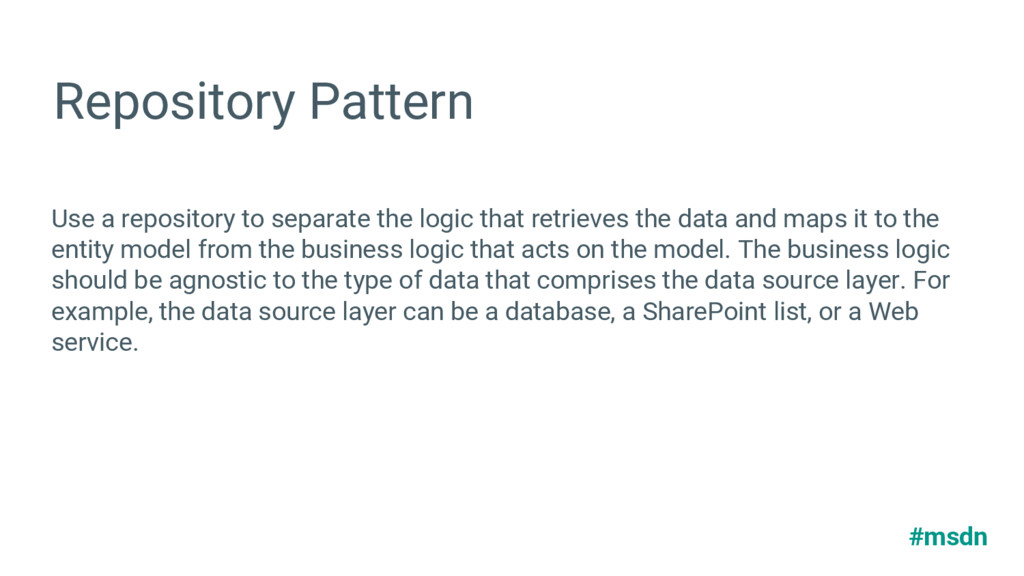
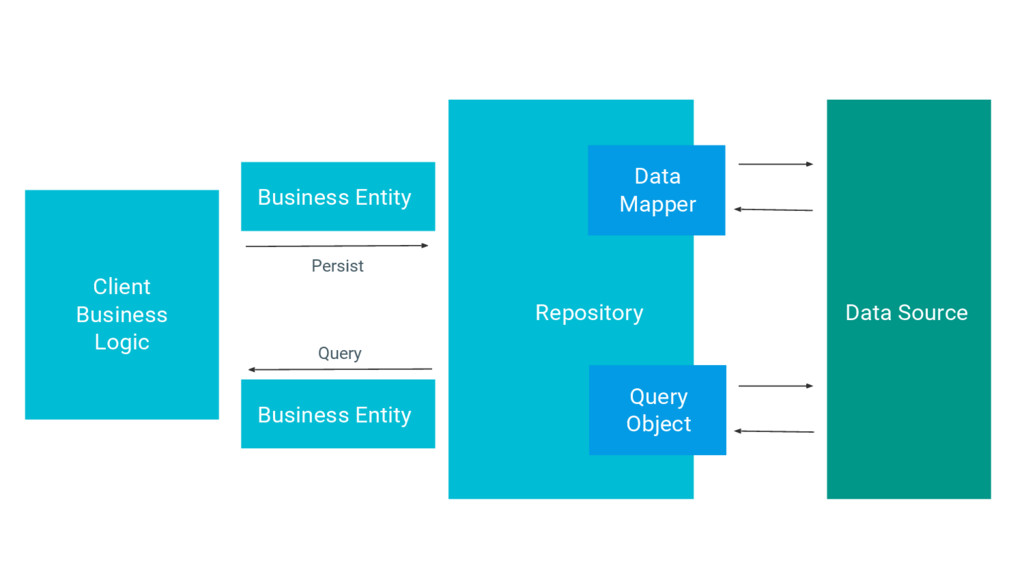
retrieves the data and maps it to the entity model from the business logic that acts on the model. The business logic should be agnostic to the type of data that comprises the data source layer. For example, the data source layer can be a database, a SharePoint list, or a Web service. #msdn
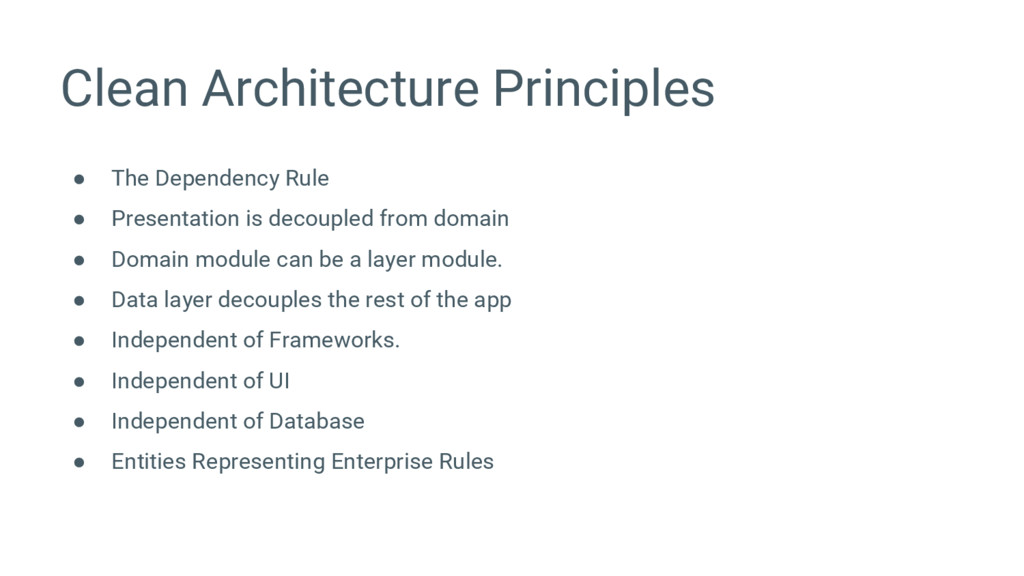
decoupled from domain • Domain module can be a layer module. • Data layer decouples the rest of the app • Independent of Frameworks. • Independent of UI • Independent of Database • Entities Representing Enterprise Rules
Domain Model Data Source Implementation Repository Repository Data Source Data Source Data Source Implementation Presentation Layer Domain Layer Data Layer
hard, and will save you a lot of headaches going forward. By separating the software into layers, and conforming to The Dependency Rule, you will create a system that is intrinsically testable, with all the benefits that implies. When any of the external parts of the system become obsolete, like the database, or the web framework, you can replace those obsolete elements with a minimum of fuss. #Uncle Bob
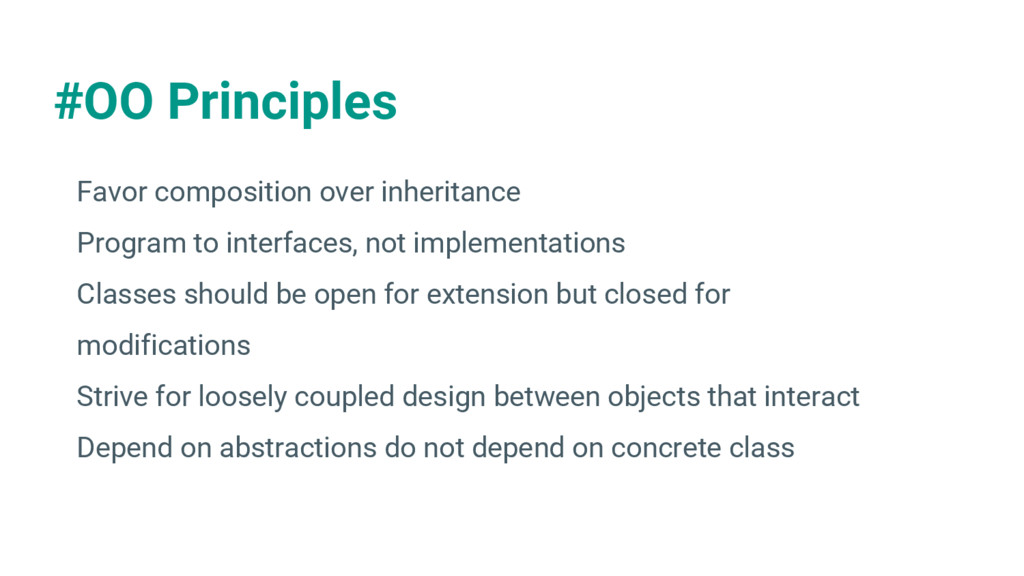
implementations Classes should be open for extension but closed for modifications Strive for loosely coupled design between objects that interact Depend on abstractions do not depend on concrete class
Architecture by Fernando Cejas https://github.com/android10/Android-CleanArchitecture • Clean Architecture by Uncle Bob https://blog.8thlight.com/uncle-bob/2012/08/13/the-clean-architecture.html • Rosie Android Framework for Clean Architecture by Karumi https://github.com/Karumi/Rosie


 erikjhordan_rey
 shpigford
 bethany
 greggifford
 inesmontani
 tammielis
 lynnandtonic
 eileencodes
 jnunemaker
 ipullrank
 tammyeverts
 marcoroth
 gr2m
gr2m