Groovy in 2014 and beyond -- JavaOne 2014
Sponsored
·
 Your Podcast. Everywhere. Effortlessly.
Share. Educate. Inspire. Entertain. You do you. We'll handle the rest.
→
Your Podcast. Everywhere. Effortlessly.
Share. Educate. Inspire. Entertain. You do you. We'll handle the rest.
→

Share
Embed
Groovy in 2014 and beyond -- JavaOne 2014
The latest developments in the Groovy programming language proejct

Guillaume Laforge
October 02, 2014
Transcript
138 slides
-
Groovy in 2014 and beyond Guillaume Laforge Groovy project lead
Pivotal @glaforge -
The Groovy roadmap 3 2015 2014 2013 Groovy 2.3 Groovy
2.4 Groovy 2.2 Groovy 2.5 ? Groovy 3.0 ? -
JDK 8 support — closures vs lambdas 6 IntStream.range(1, 100).forEach(s
-‐> System.out.println(s)); ! Files.lines(Paths.get('README.adoc')) .map(it -‐> it.toUpperCase()) .forEach(it -‐> System.out.println(it)); -
JDK 8 support — closures vs lambdas 6 IntStream.range(1, 100).forEach(s
-‐> System.out.println(s)); ! Files.lines(Paths.get('README.adoc')) .map(it -‐> it.toUpperCase()) .forEach(it -‐> System.out.println(it)); IntStream.range(1, 100).forEach { println it } ! Files.lines(Paths.get('README.adoc')) .map { it.toUpperCase() } .forEach { println it } -
JDK 8 support — closures vs lambdas 6 IntStream.range(1, 100).forEach(s
-‐> System.out.println(s)); ! Files.lines(Paths.get('README.adoc')) .map(it -‐> it.toUpperCase()) .forEach(it -‐> System.out.println(it)); IntStream.range(1, 100).forEach { println it } ! Files.lines(Paths.get('README.adoc')) .map { it.toUpperCase() } .forEach { println it } Use Groovy closures wherever you pass lambdas in Java 8 -
Traits • Like interfaces, but with method bodies • similar
to Java 8 interface default methods • Elegant way to compose behavior • multiple inheritance without the « diamond » problem • Traits can also be stateful • traits can have properties like normal classes • Compatible with static typing and static compilation • class methods from traits also visible from Java classes • Also possible to implement traits at runtime 8 -
Traits: a simple example 9 trait FlyingAbility {
String fly() { "I'm flying!" } } ! class Bird implements FlyingAbility {} def b = new Bird() ! assert b.fly() == "I'm flying!" -
Traits: a simple example 9 trait FlyingAbility {
String fly() { "I'm flying!" } } ! class Bird implements FlyingAbility {} def b = new Bird() ! assert b.fly() == "I'm flying!" « trait », a new keyword for a new concept -
Traits: a simple example 9 trait FlyingAbility {
String fly() { "I'm flying!" } } ! class Bird implements FlyingAbility {} def b = new Bird() ! assert b.fly() == "I'm flying!" a class « implements » a trait -
Traits: a simple example 9 trait FlyingAbility {
String fly() { "I'm flying!" } } ! class Bird implements FlyingAbility {} def b = new Bird() ! assert b.fly() == "I'm flying!" the fly() method from the trait is available -
Traits: a simple example 9 trait FlyingAbility {
String fly() { "I'm flying!" } } ! class Bird implements FlyingAbility {} def b = new Bird() ! assert b.fly() == "I'm flying!" -
Traits: stateful 10 trait Named {
String name } ! class Bird implements Named {} def b = new Bird(name: 'Colibri') ! assert b.name == 'Colibri' -
Traits: stateful 10 trait Named {
String name } ! class Bird implements Named {} def b = new Bird(name: 'Colibri') ! assert b.name == 'Colibri' a Groovy property -
Traits: stateful 10 trait Named {
String name } ! class Bird implements Named {} def b = new Bird(name: 'Colibri') ! assert b.name == 'Colibri' implement the trait -
Traits: stateful 10 trait Named {
String name } ! class Bird implements Named {} def b = new Bird(name: 'Colibri') ! assert b.name == 'Colibri' Groovy named argument constructor -
Traits: stateful 10 trait Named {
String name } ! class Bird implements Named {} def b = new Bird(name: 'Colibri') ! assert b.name == 'Colibri' access the property -
Traits: stateful 10 trait Named {
String name } ! class Bird implements Named {} def b = new Bird(name: 'Colibri') ! assert b.name == 'Colibri' -
Traits: inheritance 11 trait Named { String name }
! trait FlyingAbility extends Named { String fly() { "I'm a flying ${name}!" } } ! class Bird implements FlyingAbility {} def b = new Bird(name: 'Colibri') ! assert b.name == 'Colibri' assert b.fly() == "I'm a flying Colibri!" -
Traits: inheritance 11 trait Named { String name }
! trait FlyingAbility extends Named { String fly() { "I'm a flying ${name}!" } } ! class Bird implements FlyingAbility {} def b = new Bird(name: 'Colibri') ! assert b.name == 'Colibri' assert b.fly() == "I'm a flying Colibri!" extend the Named trait -
Traits: inheritance 11 trait Named { String name }
! trait FlyingAbility extends Named { String fly() { "I'm a flying ${name}!" } } ! class Bird implements FlyingAbility {} def b = new Bird(name: 'Colibri') ! assert b.name == 'Colibri' assert b.fly() == "I'm a flying Colibri!" access the name property -
Traits: inheritance 11 trait Named { String name }
! trait FlyingAbility extends Named { String fly() { "I'm a flying ${name}!" } } ! class Bird implements FlyingAbility {} def b = new Bird(name: 'Colibri') ! assert b.name == 'Colibri' assert b.fly() == "I'm a flying Colibri!" implement the composite trait -
Traits: inheritance 11 trait Named { String name }
! trait FlyingAbility extends Named { String fly() { "I'm a flying ${name}!" } } ! class Bird implements FlyingAbility {} def b = new Bird(name: 'Colibri') ! assert b.name == 'Colibri' assert b.fly() == "I'm a flying Colibri!" -
Traits: what about conflicts? 12 trait KiteSurfer { String surf()
{ 'kite' } } ! trait WebSurfer { String surf() { 'web' } } ! class Person { String name } ! class Hipster extends Person implements KiteSurfer, WebSurfer {} ! def h = new Hipster() assert h.surf() == 'web' -
Traits: what about conflicts? 12 trait KiteSurfer { String surf()
{ 'kite' } } ! trait WebSurfer { String surf() { 'web' } } ! class Person { String name } ! class Hipster extends Person implements KiteSurfer, WebSurfer {} ! def h = new Hipster() assert h.surf() == 'web' two surf() methods -
Traits: what about conflicts? 12 trait KiteSurfer { String surf()
{ 'kite' } } ! trait WebSurfer { String surf() { 'web' } } ! class Person { String name } ! class Hipster extends Person implements KiteSurfer, WebSurfer {} ! def h = new Hipster() assert h.surf() == 'web' -
Traits: what about conflicts? 12 trait KiteSurfer { String surf()
{ 'kite' } } ! trait WebSurfer { String surf() { 'web' } } ! class Person { String name } ! class Hipster extends Person implements KiteSurfer, WebSurfer {} ! def h = new Hipster() assert h.surf() == 'web' extending a class and implementing the two traits -
Traits: what about conflicts? 12 trait KiteSurfer { String surf()
{ 'kite' } } ! trait WebSurfer { String surf() { 'web' } } ! class Person { String name } ! class Hipster extends Person implements KiteSurfer, WebSurfer {} ! def h = new Hipster() assert h.surf() == 'web' -
Traits: what about conflicts? 12 trait KiteSurfer { String surf()
{ 'kite' } } ! trait WebSurfer { String surf() { 'web' } } ! class Person { String name } ! class Hipster extends Person implements KiteSurfer, WebSurfer {} ! def h = new Hipster() assert h.surf() == 'web' last declared trait wins! -
Traits: what about conflicts? 12 trait KiteSurfer { String surf()
{ 'kite' } } ! trait WebSurfer { String surf() { 'web' } } ! class Person { String name } ! class Hipster extends Person implements KiteSurfer, WebSurfer {} ! def h = new Hipster() assert h.surf() == 'web' -
Traits: what about conflicts? 13 trait KiteSurfer { String surf()
{ 'kite' } } ! trait WebSurfer { String surf() { 'web' } } ! class Person { String name } ! class Hipster extends Person implements WebSurfer, KiteSurfer {} ! def h = new Hipster() assert h.surf() == 'kite' -
Traits: what about conflicts? 13 trait KiteSurfer { String surf()
{ 'kite' } } ! trait WebSurfer { String surf() { 'web' } } ! class Person { String name } ! class Hipster extends Person implements WebSurfer, KiteSurfer {} ! def h = new Hipster() assert h.surf() == 'kite' reverse the order! -
Traits: what about conflicts? 13 trait KiteSurfer { String surf()
{ 'kite' } } ! trait WebSurfer { String surf() { 'web' } } ! class Person { String name } ! class Hipster extends Person implements WebSurfer, KiteSurfer {} ! def h = new Hipster() assert h.surf() == 'kite' -
Traits: what about conflicts? 14 trait KiteSurfer { String surf()
{ 'kite' } } ! trait WebSurfer { String surf() { 'web' } } ! class Person { String name } ! class Hipster extends Person implements WebSurfer, KiteSurfer { String surf() { KiteSurfer.super.surf() } } ! def h = new Hipster() assert h.surf() == 'kite' -
Traits: what about conflicts? 14 trait KiteSurfer { String surf()
{ 'kite' } } ! trait WebSurfer { String surf() { 'web' } } ! class Person { String name } ! class Hipster extends Person implements WebSurfer, KiteSurfer { String surf() { KiteSurfer.super.surf() } } ! def h = new Hipster() assert h.surf() == 'kite' Be explicit! Override surf() & use ‘super’ -
Traits: what about conflicts? 14 trait KiteSurfer { String surf()
{ 'kite' } } ! trait WebSurfer { String surf() { 'web' } } ! class Person { String name } ! class Hipster extends Person implements WebSurfer, KiteSurfer { String surf() { KiteSurfer.super.surf() } } ! def h = new Hipster() assert h.surf() == 'kite' Your class method takes precedence over the traits -
Traits: what about conflicts? 14 trait KiteSurfer { String surf()
{ 'kite' } } ! trait WebSurfer { String surf() { 'web' } } ! class Person { String name } ! class Hipster extends Person implements WebSurfer, KiteSurfer { String surf() { KiteSurfer.super.surf() } } ! def h = new Hipster() assert h.surf() == 'kite' -
trait Named { String name
} ! class Animal {} class NamedAnimal implements Named {} ! def na = new NamedAnimal(name: 'Felix') ! assert na.name == 'Felix' Traits: runtime implementation 15 -
trait Named { String name
} ! class Animal {} class NamedAnimal implements Named {} ! def na = new NamedAnimal(name: 'Felix') ! assert na.name == 'Felix' Traits: runtime implementation 15 Somewhat artificial to have to create an intermediary class to get named animals -
trait Named { String name
} ! class Animal {} class NamedAnimal implements Named {} ! def na = new NamedAnimal(name: 'Felix') ! assert na.name == 'Felix' Traits: runtime implementation 15 -
trait Named { String name
} ! class Animal {} ! ! def na = new Animal() as Named na.name = 'Felix' assert na.name == 'Felix' Traits: runtime implementation 16 -
trait Named { String name
} ! class Animal {} ! ! def na = new Animal() as Named na.name = 'Felix' assert na.name == 'Felix' Traits: runtime implementation 16 Runtime trait, with Groovy’s usual coercion mechanism -
trait Named { String name
} ! class Animal {} ! ! def na = new Animal() as Named na.name = 'Felix' assert na.name == 'Felix' Traits: runtime implementation 16 -
Traits: runtime implementation 17 trait Named { String name }
! trait Quacks { String quack() { 'Quack!' } } ! class Animal {} ! def na = new Animal().withTraits Named, Quacks na.name = 'Daffy' assert na.name == 'Daffy' assert na.quack() == 'Quack!' -
Traits: runtime implementation 17 trait Named { String name }
! trait Quacks { String quack() { 'Quack!' } } ! class Animal {} ! def na = new Animal().withTraits Named, Quacks na.name = 'Daffy' assert na.name == 'Daffy' assert na.quack() == 'Quack!' Implement several traits at once, at runtime -
Traits: runtime implementation 17 trait Named { String name }
! trait Quacks { String quack() { 'Quack!' } } ! class Animal {} ! def na = new Animal().withTraits Named, Quacks na.name = 'Daffy' assert na.name == 'Daffy' assert na.quack() == 'Quack!' -
New: @TailRecursive 19 import groovy.transform.TailRecursive ! @TailRecursive def
fact(BigInteger n, accu = 1G) { if (n < 2) accu else fact(n -‐ 1, n * accu) } ! assert fact(1000) > 10e2566 -
New: @TailRecursive 19 import groovy.transform.TailRecursive ! @TailRecursive def
fact(BigInteger n, accu = 1G) { if (n < 2) accu else fact(n -‐ 1, n * accu) } ! assert fact(1000) > 10e2566 Rewrites tail recursive friendly function serially -
New: @TailRecursive 19 import groovy.transform.TailRecursive ! @TailRecursive def
fact(BigInteger n, accu = 1G) { if (n < 2) accu else fact(n -‐ 1, n * accu) } ! assert fact(1000) > 10e2566 Doesn’t blow up with a stack overflow error -
New: @TailRecursive 19 import groovy.transform.TailRecursive ! @TailRecursive def
fact(BigInteger n, accu = 1G) { if (n < 2) accu else fact(n -‐ 1, n * accu) } ! assert fact(1000) > 10e2566 Downside of tail recursion is you might have to rewrite your algo to be tailrec friendly -
New: @TailRecursive 19 import groovy.transform.TailRecursive ! @TailRecursive def
fact(BigInteger n, accu = 1G) { if (n < 2) accu else fact(n -‐ 1, n * accu) } ! assert fact(1000) > 10e2566 -
New: @Sortable 20 import groovy.transform.* ! @Sortable class
Person { String lastName String firstName int age } -
New: @Sortable 20 import groovy.transform.* ! @Sortable class
Person { String lastName String firstName int age } Makes the class Comparable by multiple Comparators -
New: @Sortable 20 import groovy.transform.* ! @Sortable class
Person { String lastName String firstName int age } First compare by lastName, then by firstName, etc. -
New: @Sortable 20 import groovy.transform.* ! @Sortable class
Person { String lastName String firstName int age } You can also specify ‘includes’ / ‘excludes’ properties -
New: @Sortable 20 import groovy.transform.* ! @Sortable class
Person { String lastName String firstName int age } -
@BaseScript improvements 21 abstract class CustomBase extends Script {
int meaningOfLife = 42 } @BaseScript(CustomBase) import groovy.transform.BaseScript ! assert meaningOfLife == 42 -
@BaseScript improvements 21 abstract class CustomBase extends Script {
int meaningOfLife = 42 } @BaseScript(CustomBase) import groovy.transform.BaseScript ! assert meaningOfLife == 42 You can add your own base methods and properties to all compiled scripts -
@BaseScript improvements 21 abstract class CustomBase extends Script {
int meaningOfLife = 42 } @BaseScript(CustomBase) import groovy.transform.BaseScript ! assert meaningOfLife == 42 Define the base script class for this script -
@BaseScript improvements 21 abstract class CustomBase extends Script {
int meaningOfLife = 42 } @BaseScript(CustomBase) import groovy.transform.BaseScript ! assert meaningOfLife == 42 Ability to put the annotation on imports & package -
@BaseScript improvements 21 abstract class CustomBase extends Script {
int meaningOfLife = 42 } @BaseScript(CustomBase) import groovy.transform.BaseScript ! assert meaningOfLife == 42 -
@BaseScript custom abstract method 22 abstract class CustomBase extends Script
{ def run() { before() internalRun() after() } ! abstract internalRun() ! def before() { println 'before' } def after() { println 'after' } } -
@BaseScript custom abstract method 22 abstract class CustomBase extends Script
{ def run() { before() internalRun() after() } ! abstract internalRun() ! def before() { println 'before' } def after() { println 'after' } } import groovy.transform.BaseScript @BaseScript CustomBase script ! println 'Hello' -
@BaseScript custom abstract method 22 abstract class CustomBase extends Script
{ def run() { before() internalRun() after() } ! abstract internalRun() ! def before() { println 'before' } def after() { println 'after' } } import groovy.transform.BaseScript @BaseScript CustomBase script ! println 'Hello' You can define your own abstract method for script bodies -
@BaseScript custom abstract method 22 abstract class CustomBase extends Script
{ def run() { before() internalRun() after() } ! abstract internalRun() ! def before() { println 'before' } def after() { println 'after' } } import groovy.transform.BaseScript @BaseScript CustomBase script ! println 'Hello' -
JDK 7+ NIO2 module • All the familiar methods on
File retrofitted on Path as well 24 path.withReader { Reader r -‐> ... } path.eachLine { String line -‐> ... } path.eachFileRecurse { Path p -‐> ... } path << 'some content' path << bytes path.readLines() … -
JDK 7+ NIO2 module • All the familiar methods on
File retrofitted on Path as well 24 path.withReader { Reader r -‐> ... } path.eachLine { String line -‐> ... } path.eachFileRecurse { Path p -‐> ... } path << 'some content' path << bytes path.readLines() … Feature request to add all the java.nio.file.Files static utility methods as GDK -
JDK 7+ NIO2 module • All the familiar methods on
File retrofitted on Path as well 24 path.withReader { Reader r -‐> ... } path.eachLine { String line -‐> ... } path.eachFileRecurse { Path p -‐> ... } path << 'some content' path << bytes path.readLines() … -
JSON parser / builder perf. increase • Re-implementation of JSON
support for speed & efficiency • parser forked off the Boon JSON project • serializer carefully fine-tuned ! • Article on the parsing speed improvements • http://rick-hightower.blogspot.fr/2014/04/groovy-and-boon-provide-fastest-json.html 26 -
JSON parser / builder perf. increase • Re-implementation of JSON
support for speed & efficiency • parser forked off the Boon JSON project • serializer carefully fine-tuned ! • Article on the parsing speed improvements • http://rick-hightower.blogspot.fr/2014/04/groovy-and-boon-provide-fastest-json.html 26 Benchmark gives 3x to 4x performance factor over Jackson and GSON -
JSON parser / builder perf. increase • Re-implementation of JSON
support for speed & efficiency • parser forked off the Boon JSON project • serializer carefully fine-tuned ! • Article on the parsing speed improvements • http://rick-hightower.blogspot.fr/2014/04/groovy-and-boon-provide-fastest-json.html 26 -
New modes for parsing • Original JsonSlurper renamed to JsonSlurperClassic
! • Additional parsing modes: • INDEX_OVERLAY: super fast for <2MB payloads o using a « parsing overlay » technique • CHARACTER_SOURCE: for >2MB payloads o implemented with sliding windows over readers • LAX: beyond the JSON spec, nice for configuration files o support single quotes, / and # comments • CHAR_BUFFER: general purpose 27 -
JsonSlurper for configuration files 28 import groovy.json.* import static
groovy.json.JsonParserType.* ! def parser = new JsonSlurper().setType(LAX) ! def conf = parser.parseText ''' // configuration file { // no quote for key, single quoted value environment: 'production' # pound-‐style comment 'server': 5 } ''' ! assert conf.environment == 'production' assert conf.server == 5 -
JsonSlurper for configuration files 28 import groovy.json.* import static
groovy.json.JsonParserType.* ! def parser = new JsonSlurper().setType(LAX) ! def conf = parser.parseText ''' // configuration file { // no quote for key, single quoted value environment: 'production' # pound-‐style comment 'server': 5 } ''' ! assert conf.environment == 'production' assert conf.server == 5 More tolerant parser: single quotes, non-quoted keys, // and # comments, missing comas -
JsonSlurper for configuration files 28 import groovy.json.* import static
groovy.json.JsonParserType.* ! def parser = new JsonSlurper().setType(LAX) ! def conf = parser.parseText ''' // configuration file { // no quote for key, single quoted value environment: 'production' # pound-‐style comment 'server': 5 } ''' ! assert conf.environment == 'production' assert conf.server == 5 -
Markup template engine • Based on the principles of Groovy’s
« builders » • and particularly the MarkupBuilder class for generating arbitrary XML / HTML payloads ! • Compiled statically for fast template rendering ! • Internationalization aware • provide the desired Locale in the configuration object • usual suffix notation template_fr_FR.tpl ! • Custom base template class • ability to provide reusable methods across your templates 30 -
Markup template engine • Based on the principles of Groovy’s
« builders » • and particularly the MarkupBuilder class for generating arbitrary XML / HTML payloads ! • Compiled statically for fast template rendering ! • Internationalization aware • provide the desired Locale in the configuration object • usual suffix notation template_fr_FR.tpl ! • Custom base template class • ability to provide reusable methods across your templates 30 Spring Boot approved -
Markup template engine — the idea 31 cars {
cars.each { car(make: it.make, name: it.name) } } -
Markup template engine — the idea 31 cars {
cars.each { car(make: it.make, name: it.name) } } Your template -
Markup template engine — the idea 31 cars {
cars.each { car(make: it.make, name: it.name) } } model = [cars: [! new Car(make: 'Peugeot', name: '508'), ! new Car(make: 'Toyota', name: 'Prius’)! ]] -
Markup template engine — the idea 31 cars {
cars.each { car(make: it.make, name: it.name) } } model = [cars: [! new Car(make: 'Peugeot', name: '508'), ! new Car(make: 'Toyota', name: 'Prius’)! ]] Feed a model into your template -
Markup template engine — the idea 31 cars {
cars.each { car(make: it.make, name: it.name) } } model = [cars: [! new Car(make: 'Peugeot', name: '508'), ! new Car(make: 'Toyota', name: 'Prius’)! ]] <cars>! <car make='Peugeot' name='508'/>! <car make='Toyota' name='Prius'/>! </cars> -
Markup template engine — the idea 31 cars {
cars.each { car(make: it.make, name: it.name) } } model = [cars: [! new Car(make: 'Peugeot', name: '508'), ! new Car(make: 'Toyota', name: 'Prius’)! ]] <cars>! <car make='Peugeot' name='508'/>! <car make='Toyota' name='Prius'/>! </cars> Generate the XML output -
Markup template engine — the idea 31 cars {
cars.each { car(make: it.make, name: it.name) } } model = [cars: [! new Car(make: 'Peugeot', name: '508'), ! new Car(make: 'Toyota', name: 'Prius’)! ]] <cars>! <car make='Peugeot' name='508'/>! <car make='Toyota' name='Prius'/>! </cars> -
Markup template engine — in action 32 import groovy.text.markup.*
! def config = new TemplateConfiguration() def engine = new MarkupTemplateEngine(config) def tmpl = engine.createTemplate(''' p("Hello ${model.name}") ''') def model = [name: 'World'] System.out << tmpl.make(model) -
Markup template engine — includes 33 // include another template
include template: 'foo.tpl' // include raw content include unescaped: 'raw.txt' ! // escape & include include escaped: 'to_escape.txt' -
Markup template engine — static! • Type-checked templates available •
use createTypeCheckedModelTemplate() instead of createTemplate() ! • Advantages • get compilation errors o if a variable is not available o if you make mistakes in the code snippets • even faster templates 34 -
Markup template engine — static! • With typed check model
creation method ! ! ! ! ! ! ! ! ! • Or declare your model types in the template 35 -
Markup template engine — static! • With typed check model
creation method ! ! ! ! ! ! ! ! ! • Or declare your model types in the template 35 def modelTypes = [cars: "List<Car>"] ! def tmpl = engine. createTypeCheckedModelTemplate( "page.tpl", modelTypes) -
Markup template engine — static! • With typed check model
creation method ! ! ! ! ! ! ! ! ! • Or declare your model types in the template 35 def modelTypes = [cars: "List<Car>"] ! def tmpl = engine. createTypeCheckedModelTemplate( "page.tpl", modelTypes) modelTypes = { List<Car> cars } ! cars.each { car -‐> p("Car name: $car.name") } -
Markup template engine — static! • With typed check model
creation method ! ! ! ! ! ! ! ! ! • Or declare your model types in the template 35 def modelTypes = [cars: "List<Car>"] ! def tmpl = engine. createTypeCheckedModelTemplate( "page.tpl", modelTypes) modelTypes = { List<Car> cars } ! cars.each { car -‐> p("Car name: $car.name") } Works with createTemplate() too -
Markup template engine — static! • With typed check model
creation method ! ! ! ! ! ! ! ! ! • Or declare your model types in the template 35 def modelTypes = [cars: "List<Car>"] ! def tmpl = engine. createTypeCheckedModelTemplate( "page.tpl", modelTypes) modelTypes = { List<Car> cars } ! cars.each { car -‐> p("Car name: $car.name") } -
Android support • You can use Groovy to code Android
apps! • use Groovy 2.4.0-beta-1+ • prefer @CompileStatic ! • Two great posts to get started: • http://melix.github.io/blog/2014/06/grooid.html • http://melix.github.io/blog/2014/06/grooid2.html 42 -
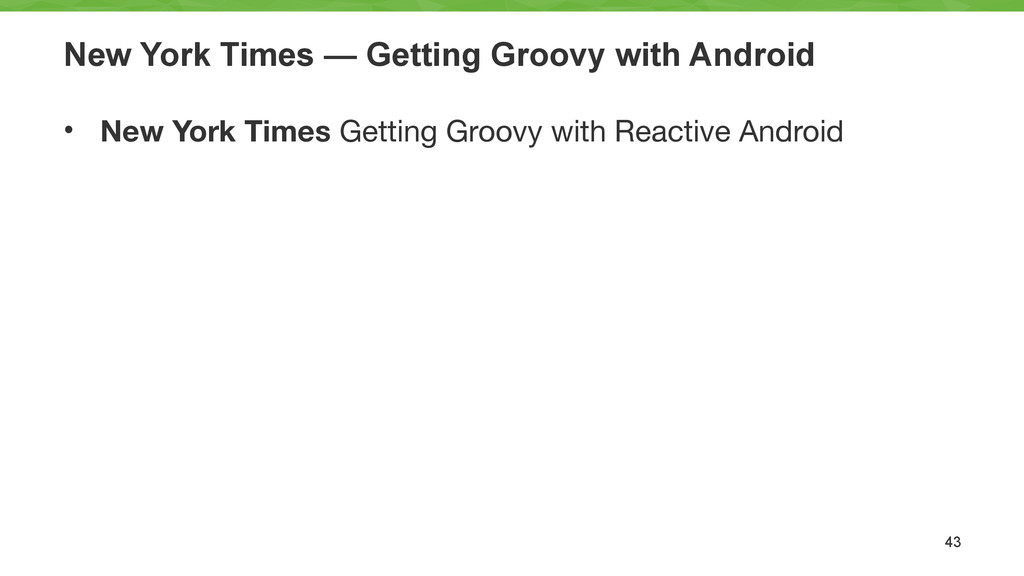
New York Times — Getting Groovy with Android • New
York Times Getting Groovy with Reactive Android 43 -
New York Times — Getting Groovy with Android • New
York Times Getting Groovy with Reactive Android 43 http://bit.ly/nyt-groovy -
Groovy Macros ! • Sergei Egorov wants to contribute a
macro module • https://github.com/groovy/groovy-core/pull/470 ! • Simplify creation of AST transformations • less boilerplate manipulating the Groovy AST API • more powerful and less limited than AstBuilder 45 -
Groovy Macros ! • Authoring AST transformations can be verbose:
46 def someVariable = new ConstantExpression("xyz") def returnStatement = new ReturnStatement( new ConstructorCallExpression( ClassHelper.make(SomeCoolClass), new ArgumentListExpression(someVariable) ) ) -
Groovy Macros • With Groovy Macros, it could be simpler:
47 def someVariable = macro { "xyz" } def returnStatement = macro { new SomeCoolClass($v{ someVariable }) } -
Groovy Macros • With Groovy Macros, it could be simpler:
47 def someVariable = macro { "xyz" } def returnStatement = macro { new SomeCoolClass($v{ someVariable }) } Special « macro » command -
Groovy Macros • With Groovy Macros, it could be simpler:
47 def someVariable = macro { "xyz" } def returnStatement = macro { new SomeCoolClass($v{ someVariable }) } Special « macro » command Quasi-quotation -
@glaforge — Groovy in 2014 and beyond New Age Meta-Object
Protocol MOP 2 -
Goals for the new MOP • Leverage & build upon
JDK 7+ invoke dynamic • get Java-like performance even for dynamic code • Rationalize the sedimentation of meta-programming • more coherence, less corner cases & inconsistencies • Provide a notion of « realm » • shield users of « monkey patching » • finer-grained control of meta-programming reach • Private visibility anyone? 51 -
@glaforge — Groovy in 2014 and beyond Rewriting the Groovy
grammar with Antlr v4 Antlr v4 Grammar -
Antlr v4 grammar • Problems • Groovy still uses Antlr
v2! o but version 3 and 4 are out • Groovy’s grammar evolved from a Java grammar o harder to fix and evolve, especially with Antlr v2 • Advantages • Start from a clean slate • Antlr 4 more tolerant and powerful regarding ambiguities • Time to clean some grammar & syntax warts! • Need to implement the Java 8 constructs! 53 -
Antlr v4 grammar • Problems • Groovy still uses Antlr
v2! o but version 3 and 4 are out • Groovy’s grammar evolved from a Java grammar o harder to fix and evolve, especially with Antlr v2 • Advantages • Start from a clean slate • Antlr 4 more tolerant and powerful regarding ambiguities • Time to clean some grammar & syntax warts! • Need to implement the Java 8 constructs! 53 A « Google Summer of Code » student helped kick start it -
@glaforge — Groovy in 2014 and beyond Support the new
Java 8 language features Java 8 language support -
Java 8 support • Additional grammar & semantic features to
support • to keep saying Groovy / Java interoperability is awesome! • New in Java 8 • lambdas • method references • default methods in interfaces • stream API, date / time API • annotations on types & repeated annotations 55 -
Java 8 support • Additional grammar & semantic features to
support • to keep saying Groovy / Java interoperability is awesome! • New in Java 8 • lambdas • method references • default methods in interfaces • stream API, date / time API • annotations on types & repeated annotations 55 Groovy had already: closures, method pointers, mixins, enriched collection & time APIs -
Image credits • Big rock • http://wallpaper.preview-reviews.com/12852-red-rocks-in-a-snowstorm • Android robot
• http://crackberry.com/sites/crackberry.com/files/styles/large/public/topic_images/2013/ANDROID.png?itok=xhm7jaxS • Modern MOP • http://i933.photobucket.com/albums/ad179/autobin/Wonder%20Mop/wondermop4.jpg • Jason • http://static.comicvine.com/uploads/original/3/32405/1031312-jason_19_inch_figure_l.jpg • Jigsaw • http://www.psdgraphics.com/file/psd-jigsaw-icon.jpg • Many thanks • http://www.trys.ie/wp-content/uploads/2013/06/many-thanks.jpg 60
 glaforge
 pvcresin
 dayeon
 yosuke_furukawa
 minodriven
 kishida
 drumath2237
 manfredsteyer
 quramy
 raeminkang
 3saito
 yyh_gl
 leegeunhyeok
 lara
 iamctodd
 destraynor
 jct
 tammyeverts
 schlessera
 asonas
 bcantrill
 ipullrank
 gurzu
 rasmusluckow