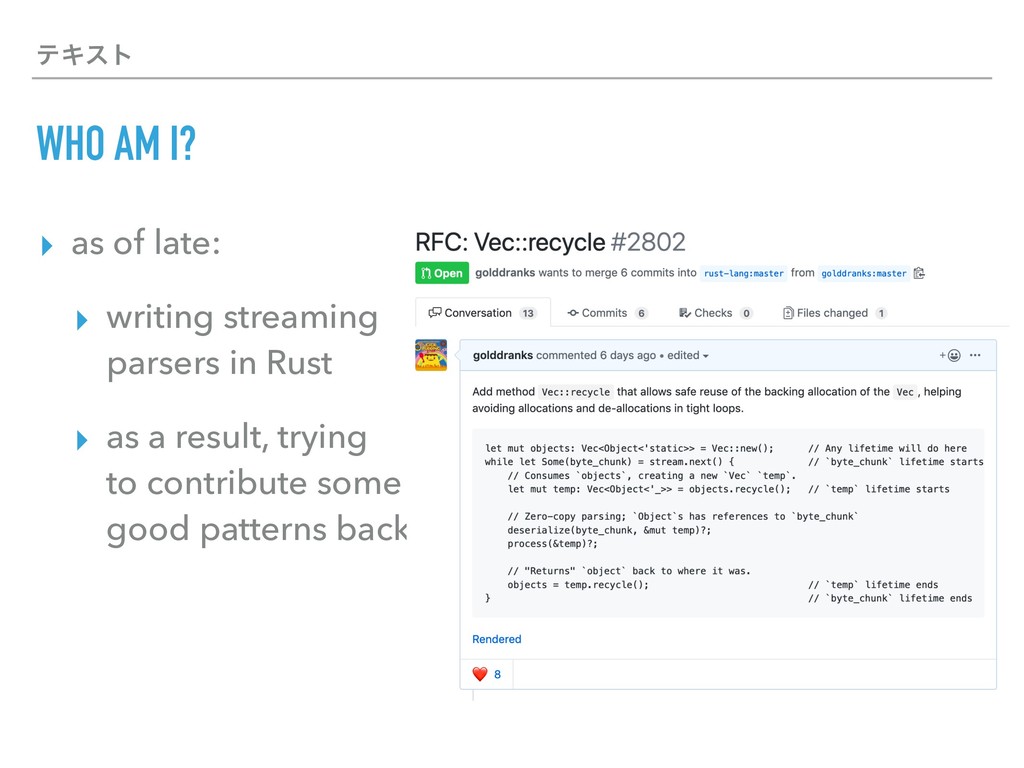
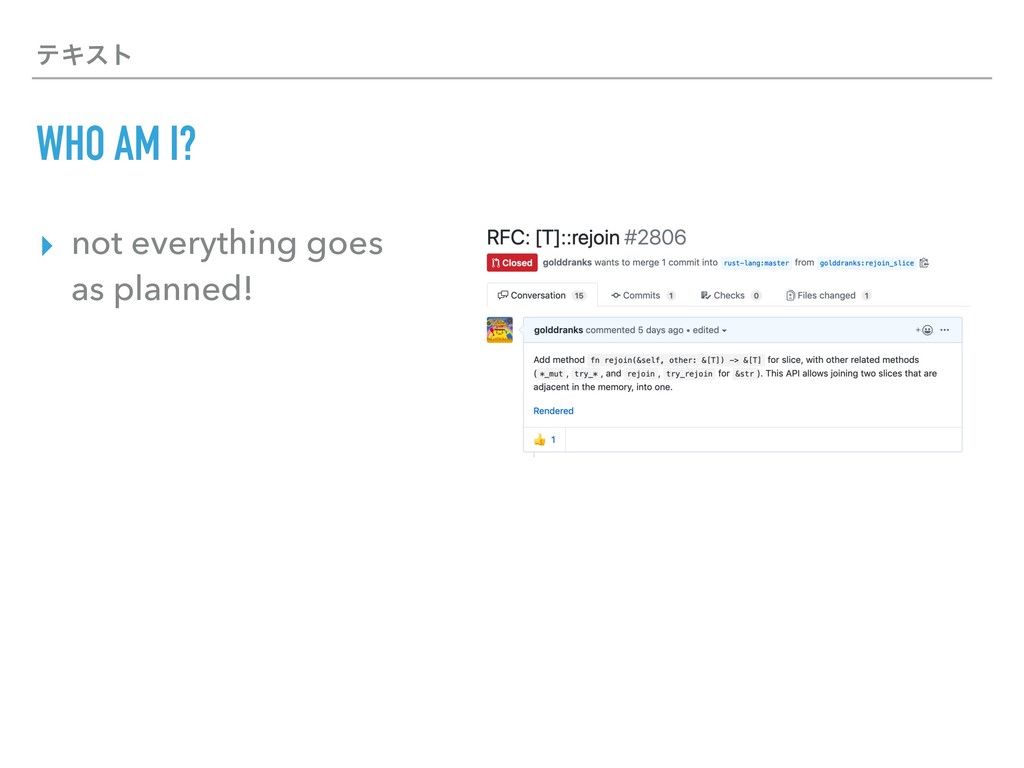
Twitter: @GolDDranks ▸ From: Finland ▸ Does: A software engineer in a Japanese company ▸ Also does: Rust related stuff and programming for fun! ▸ A Rustacean for a little over 5 years – before 1.0!
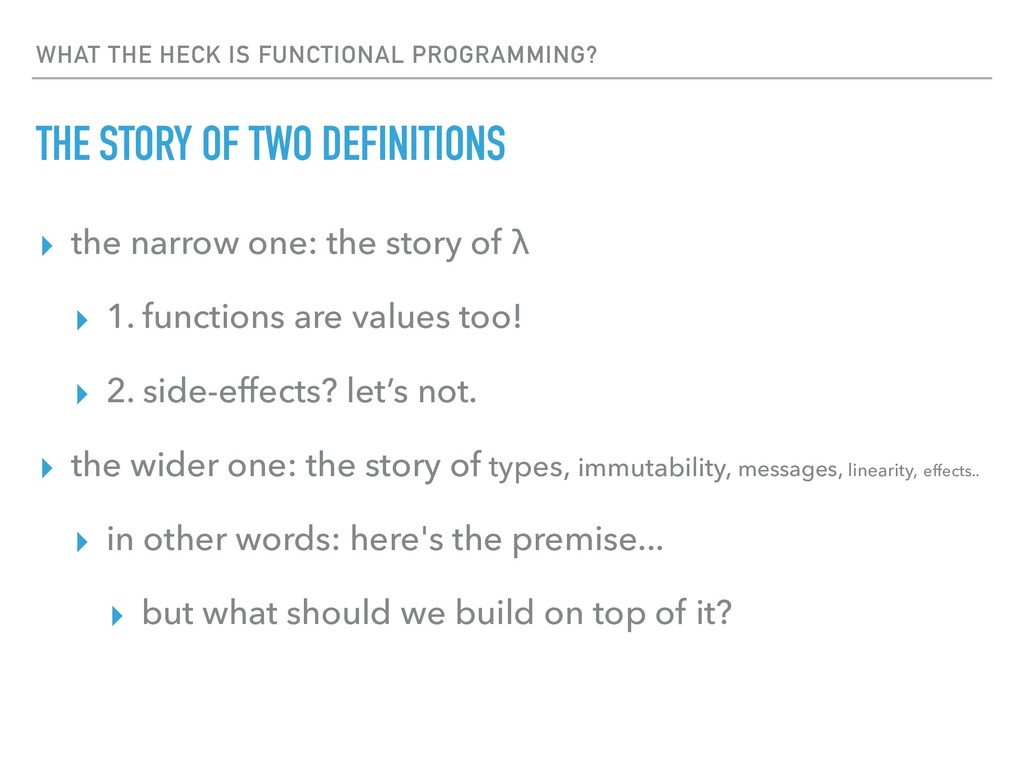
DEFINITIONS ▸ the narrow one: the story of λ ▸ 1. functions are values too! ▸ 2. side-effects? let’s not. ▸ the wider one: the story of types, immutability, messages, linearity, effects.. ▸ in other words: here's the premise... ▸ but what should we build on top of it?
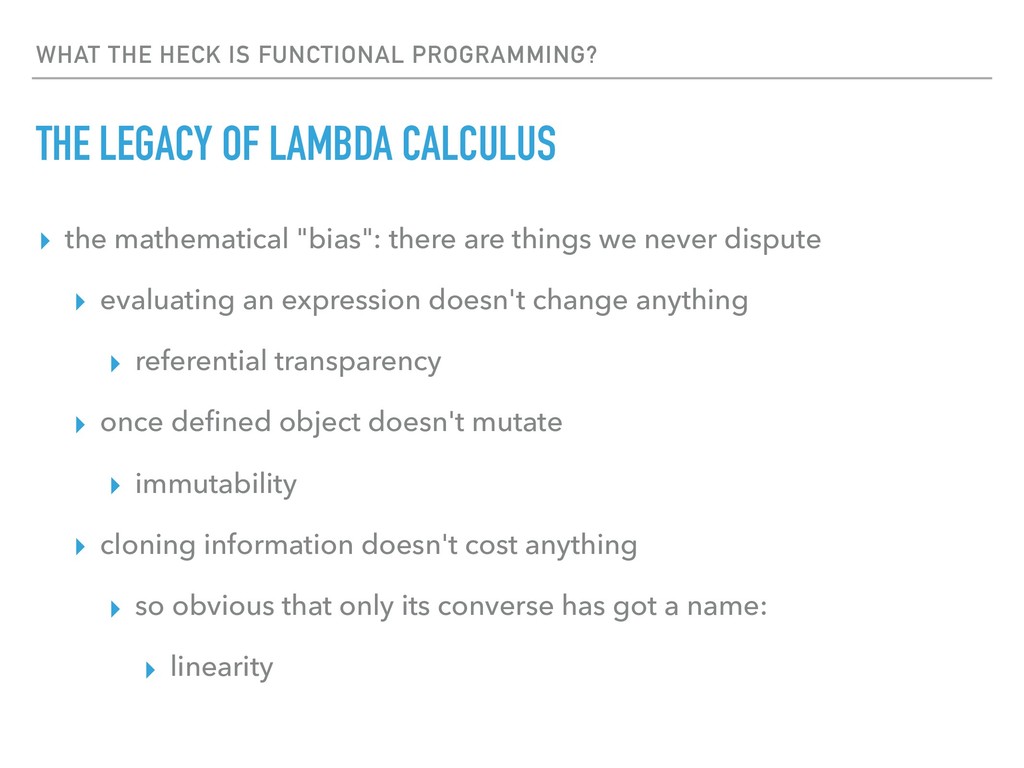
CALCULUS ▸ the mathematical "bias": there are things we never dispute ▸ evaluating an expression doesn't change anything ▸ referential transparency ▸ once defined object doesn't mutate ▸ immutability ▸ cloning information doesn't cost anything ▸ so obvious that only its converse has got a name: ▸ linearity
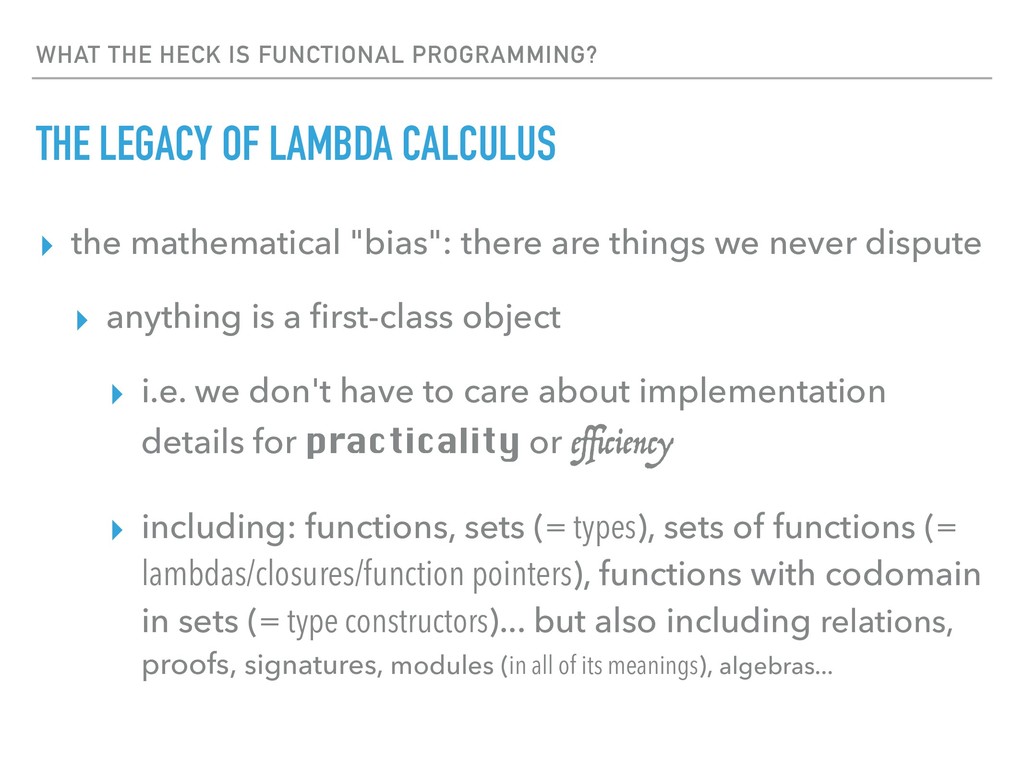
CALCULUS ▸ the mathematical "bias": there are things we never dispute ▸ anything is a first-class object ▸ i.e. we don't have to care about implementation details for practicality or efficiency ▸ including: functions, sets (= types), sets of functions (= lambdas/closures/function pointers), functions with codomain in sets (= type constructors)... but also including relations, proofs, signatures, modules (in all of its meanings), algebras...
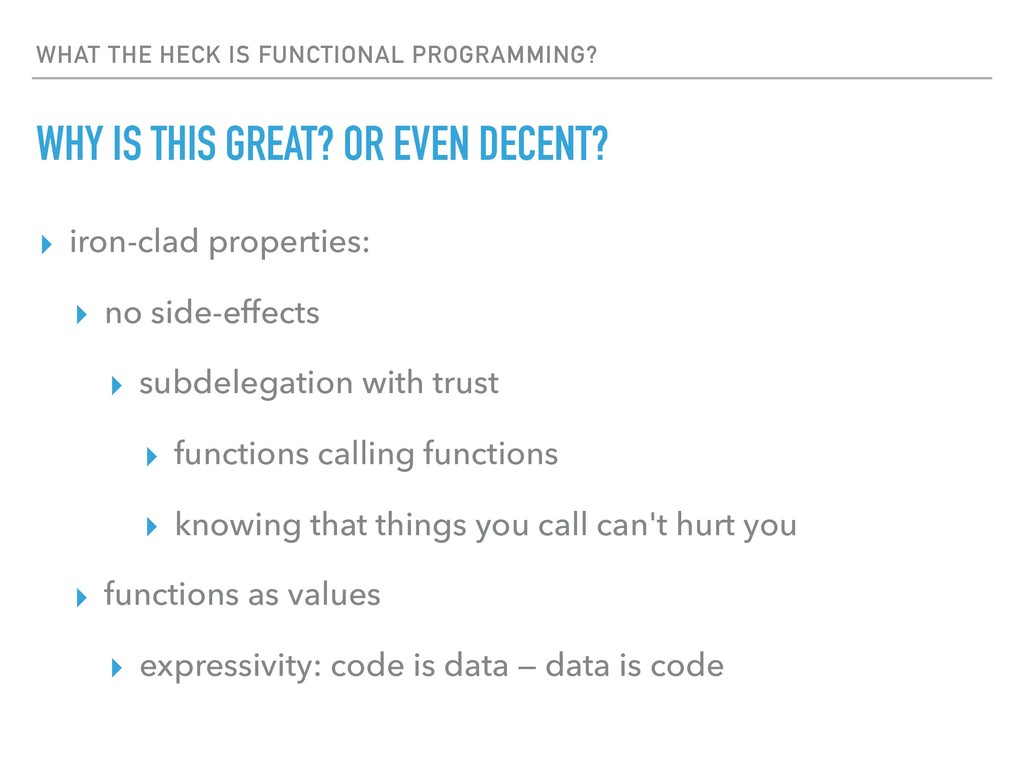
OR EVEN DECENT? ▸ iron-clad properties: ▸ no side-effects ▸ subdelegation with trust ▸ functions calling functions ▸ knowing that things you call can't hurt you ▸ functions as values ▸ expressivity: code is data — data is code
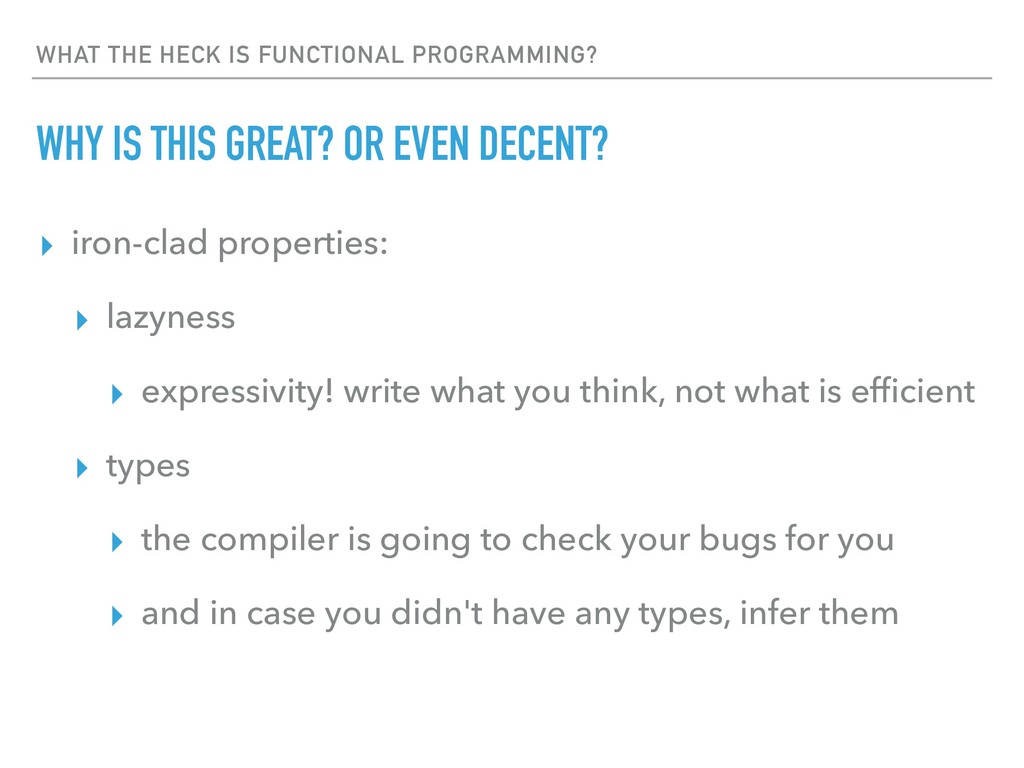
OR EVEN DECENT? ▸ iron-clad properties: ▸ lazyness ▸ expressivity! write what you think, not what is efficient ▸ types ▸ the compiler is going to check your bugs for you ▸ and in case you didn't have any types, infer them
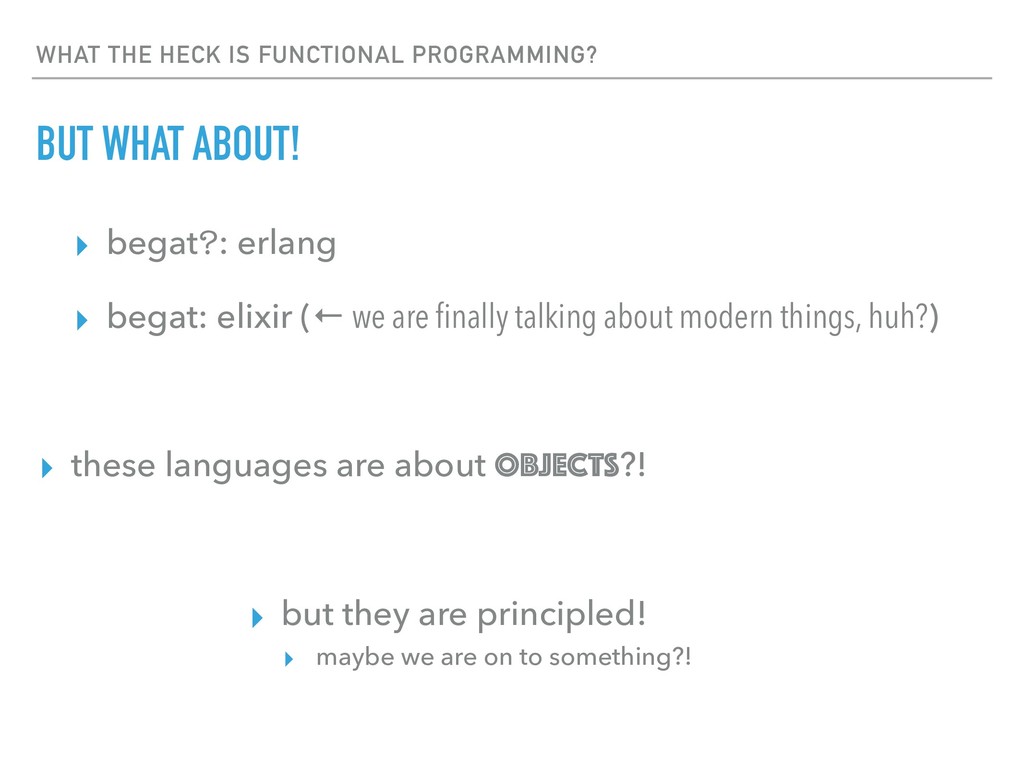
begat?: erlang ▸ begat: elixir (← we are finally talking about modern things, huh?) ▸ these languages are about objects?! ▸ but they are principled! ▸ maybe we are on to something?!
CHAT ▸ a minimal language of a bunch of objects talking to each other ▸ no object can violate the state of another object ▸ encapsulation ▸ message passing
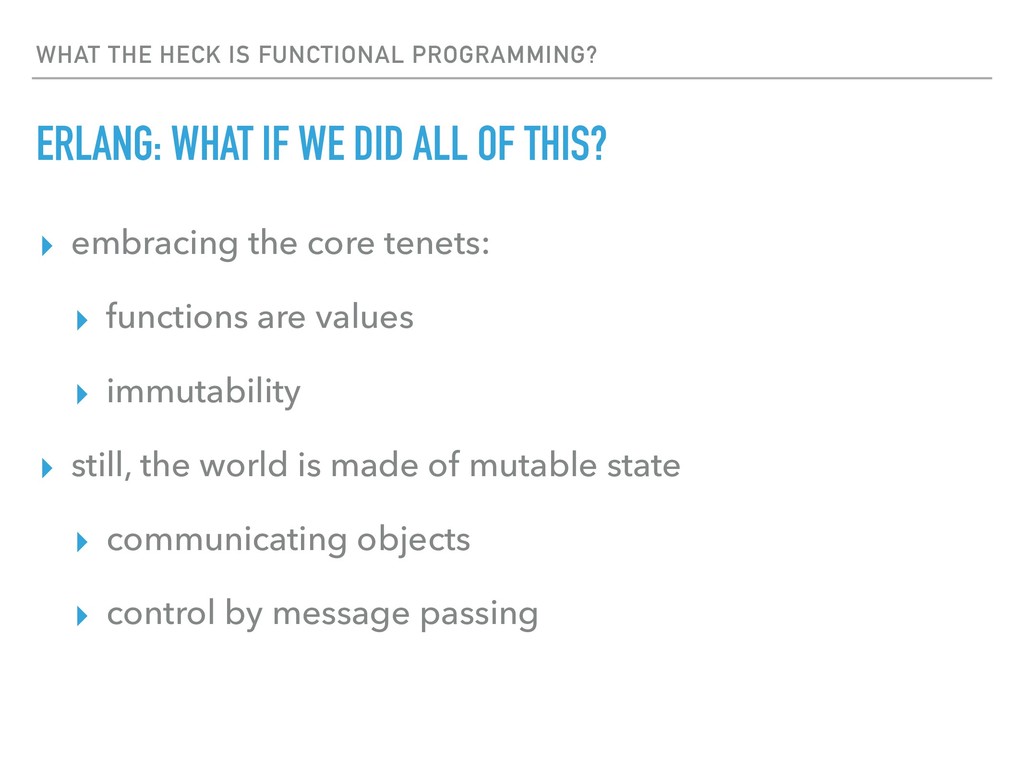
DID ALL OF THIS? ▸ embracing the core tenets: ▸ functions are values ▸ immutability ▸ still, the world is made of mutable state ▸ communicating objects ▸ control by message passing
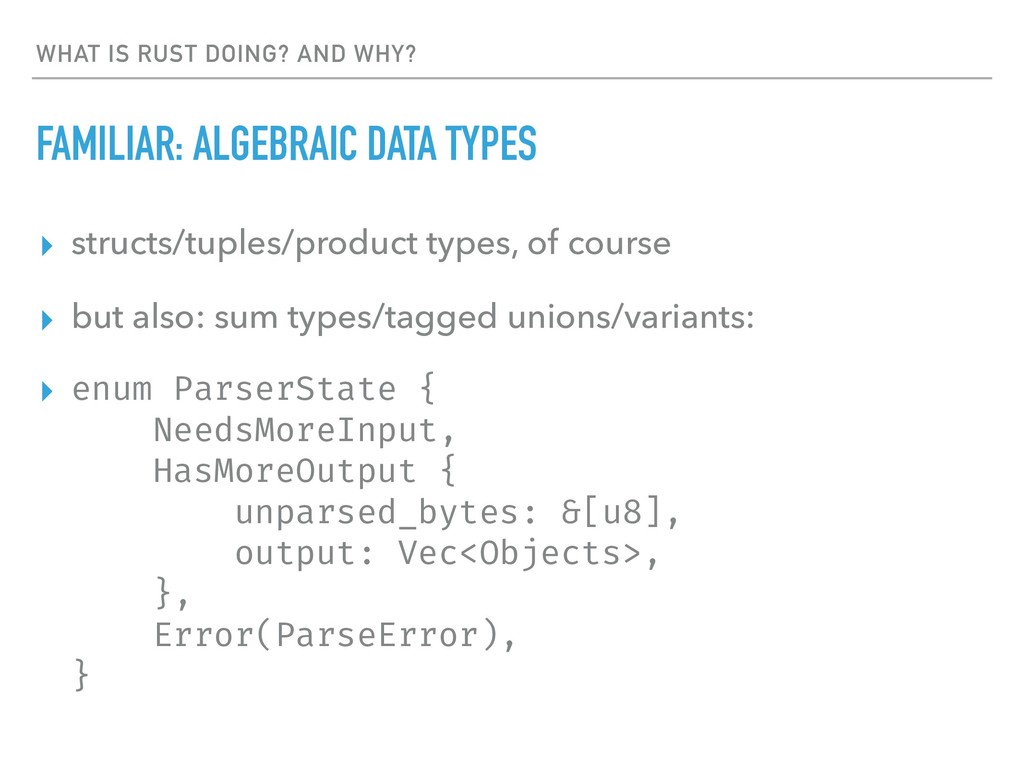
IS FUNCTIONAL PROGRAMMING? ▸ the simpl(istic) answer: a haskell (← not to be taken lightly!) ▸ the wider view: ▸ anything that is inspired/motivated by the the core ideas ▸ including things that aren't strictly limited to programming with functions ▸ "functional" is programming with smart, good ideas
IS FUNCTIONAL PROGRAMMING? ▸ furthermore, functional programming is not a property of a a language ▸ even though some languages have affinity to FP ▸ it's a style of writing programs
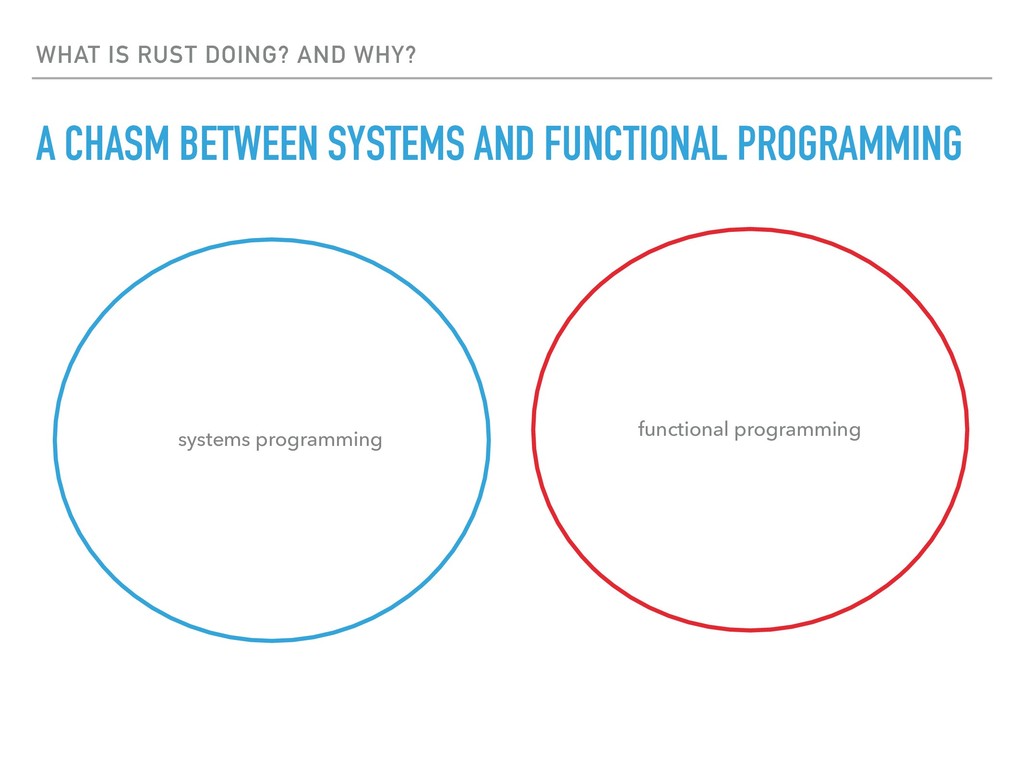
IS IT FOR? ▸ providing a platform for application programming ▸ required: low level control ▸ providing shared functionality ▸ libraries ▸ sometimes required: being agnostic of a platform
▸ many of our assumptions don't survive a contact with the real world ▸ not all information is easily clonable ▸ resources: files, network connections, hardware ▸ the real world is mutable ▸ we can't afford sacrificing performance and control for nicer abstractions
▸ → functional programming is awesome but it doesn't match how the world works too well ▸ in systems programming, you must care about how to world works!
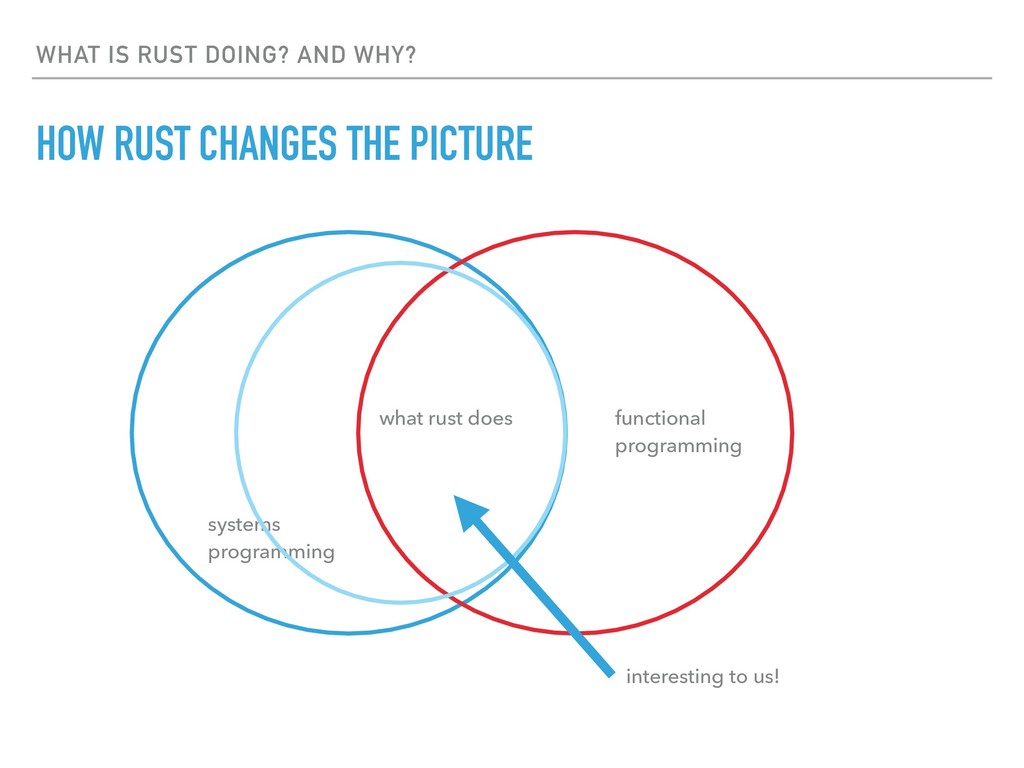
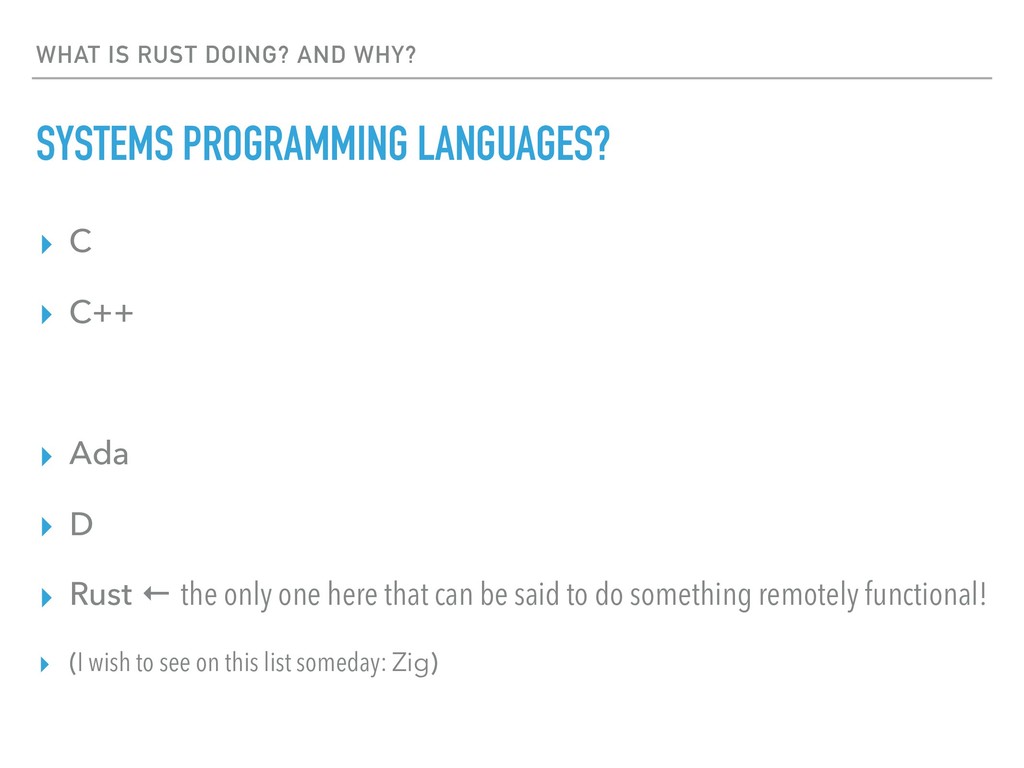
▸ unashamedly systems-y programming language ▸ more C++ than C++, in where C++ means the good parts of C++ ▸ uncompromisingly memory safe ▸ the division between "safe" and "unsafe"parts actually means something ▸ uncannily functional → we want to delve into this!
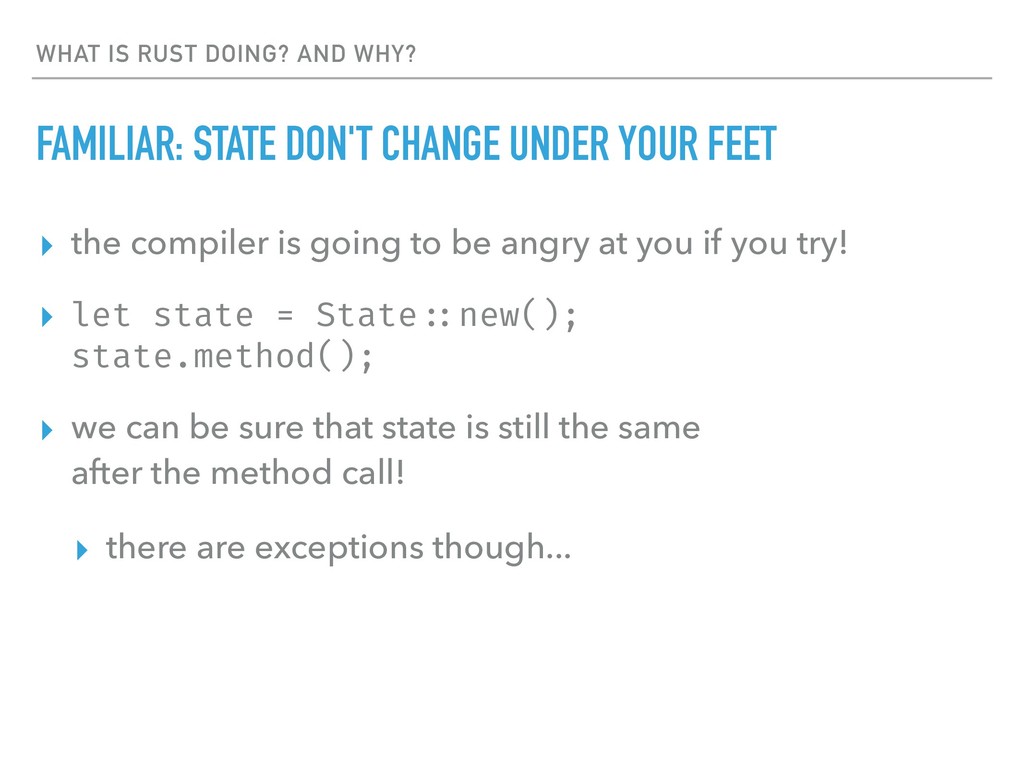
UNDER YOUR FEET ▸ the compiler is going to be angry at you if you try! ▸ let state = State!::new(); state.method(); ▸ we can be sure that state is still the same after the method call! ▸ there are exceptions though...
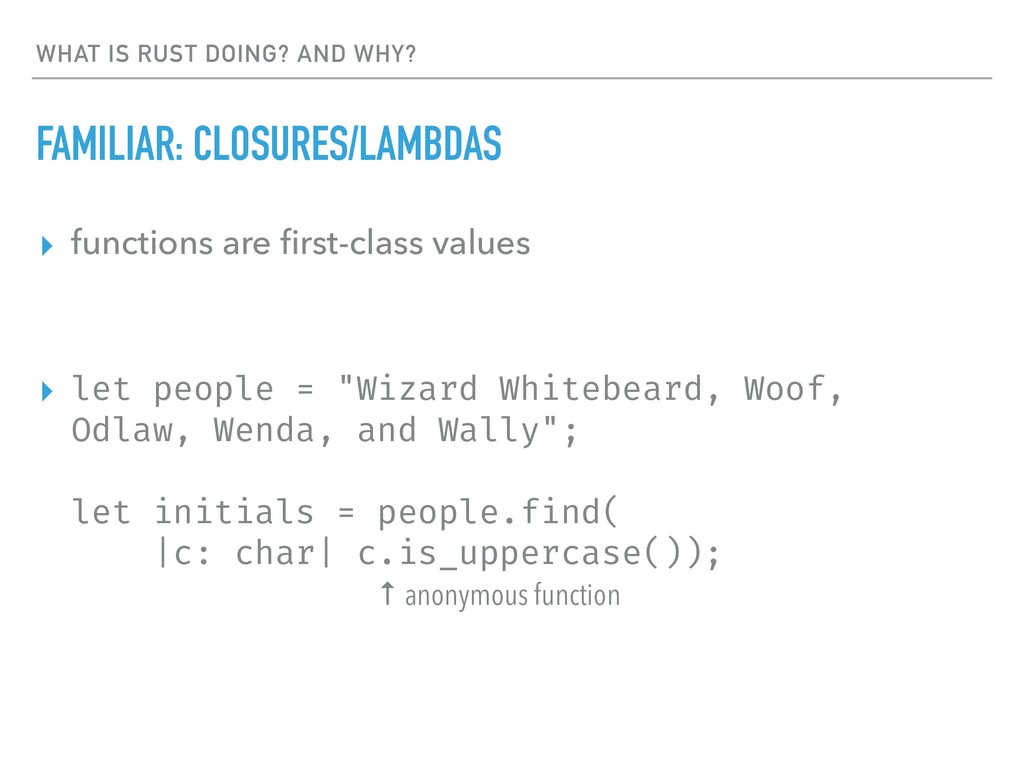
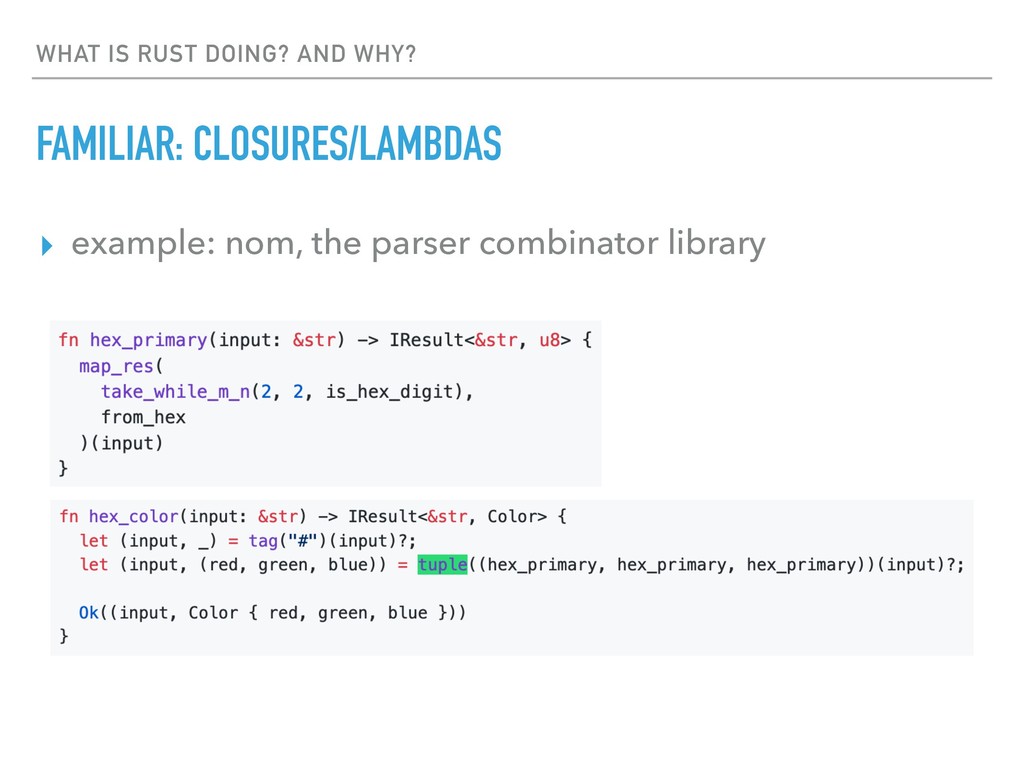
are first-class values ▸ let people = "Wizard Whitebeard, Woof, Odlaw, Wenda, and Wally"; let initials = people.find( |c: char| c.is_uppercase()); ↑ anonymous function
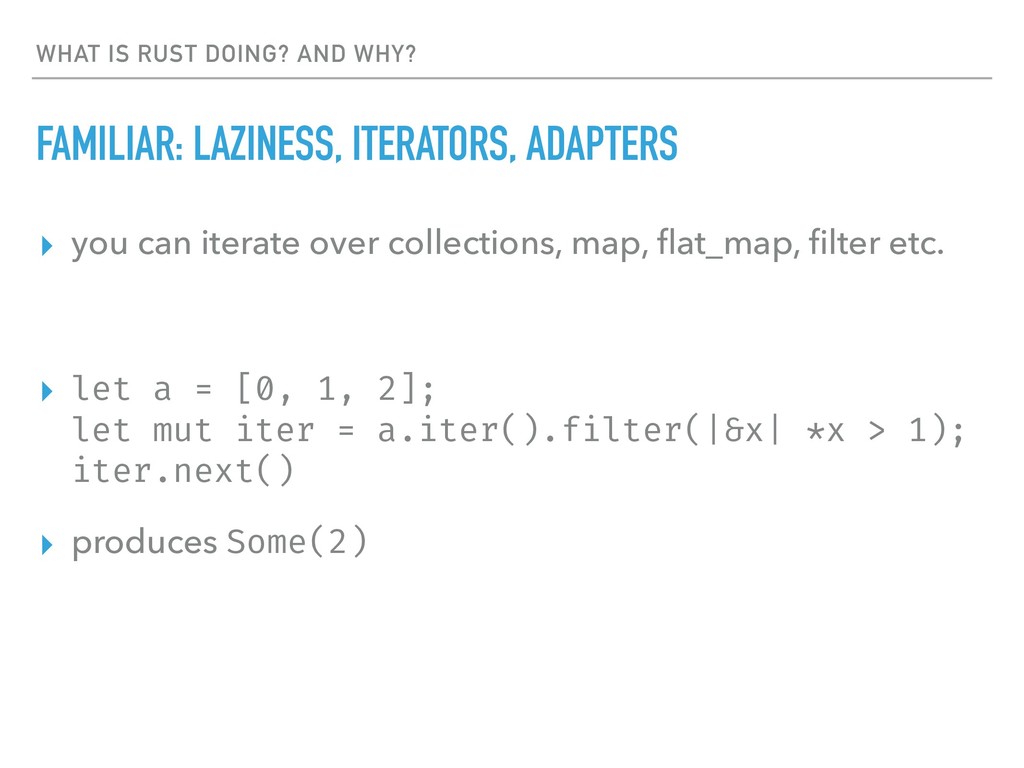
▸ you can iterate over collections, map, flat_map, filter etc. ▸ let a = [0, 1, 2]; let mut iter = a.iter().filter(|&x| *x > 1); iter.next() ▸ produces Some(2)
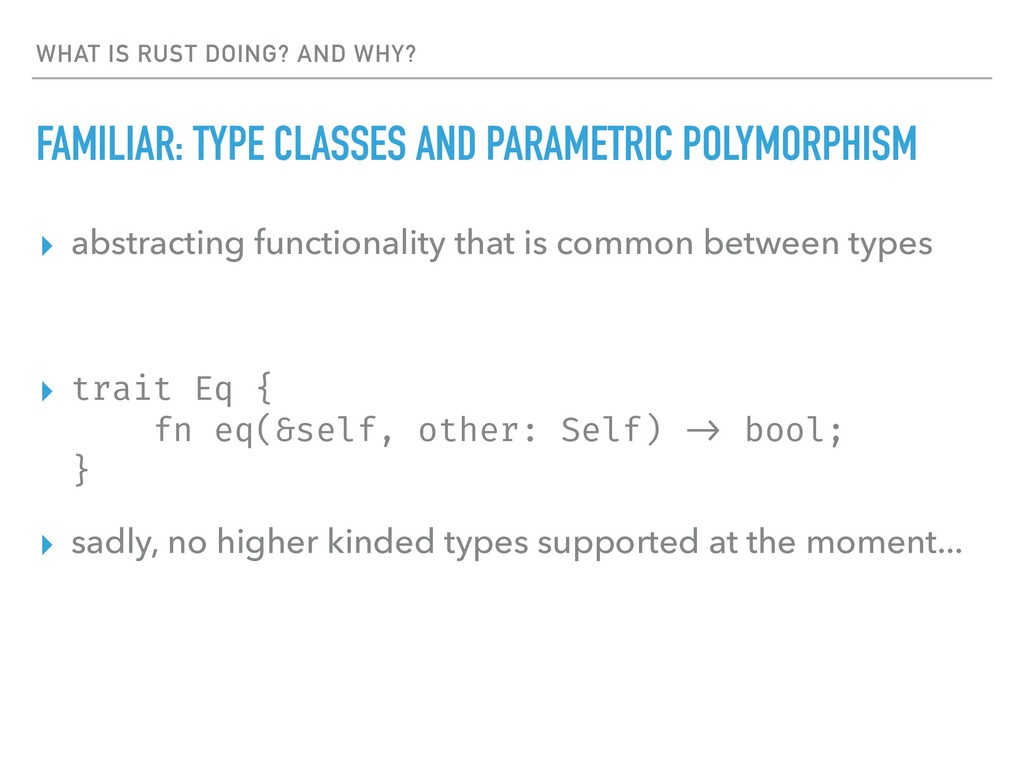
PARAMETRIC POLYMORPHISM ▸ abstracting functionality that is common between types ▸ trait Eq { fn eq(&self, other: Self) !-> bool; } ▸ sadly, no higher kinded types supported at the moment...
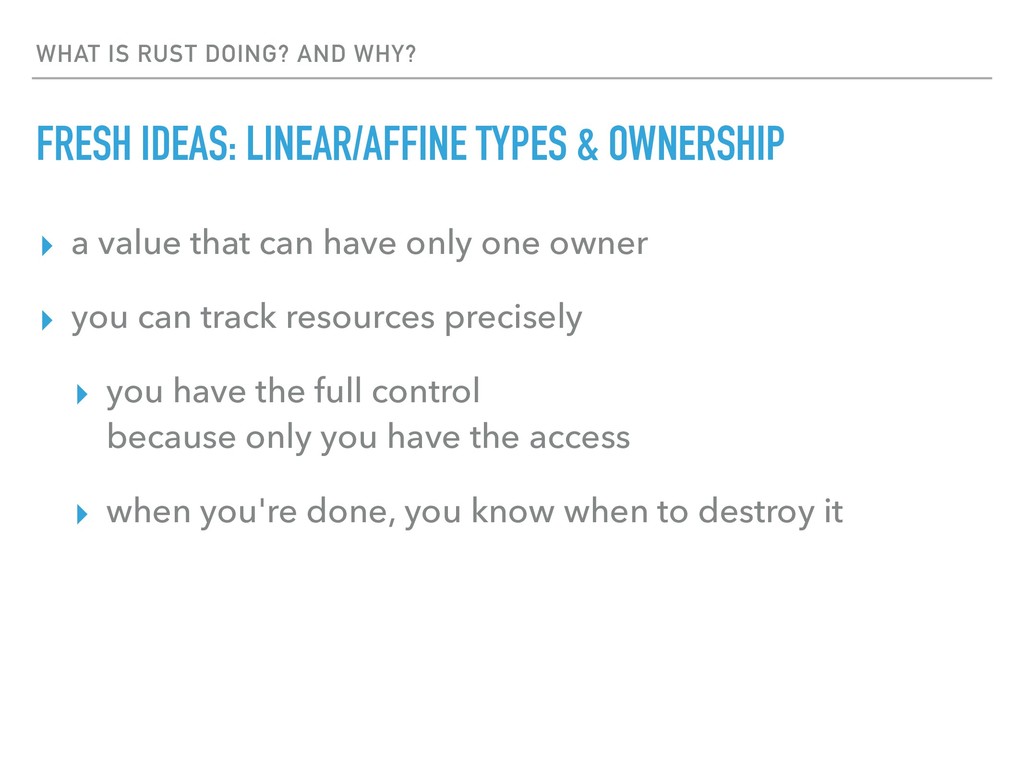
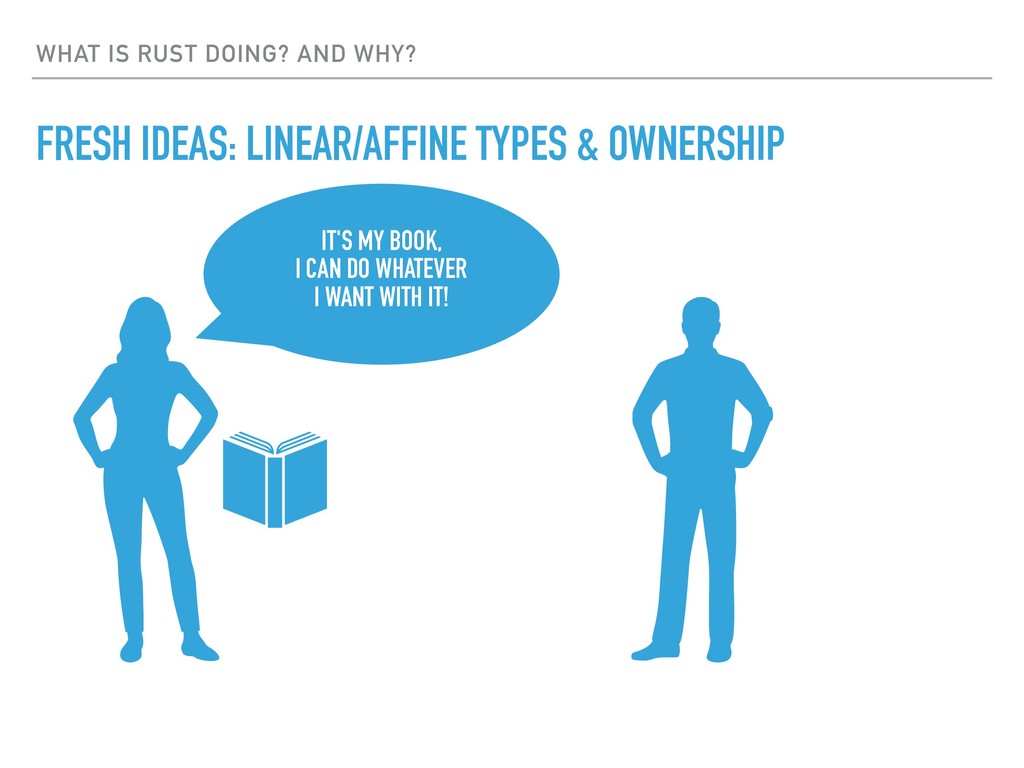
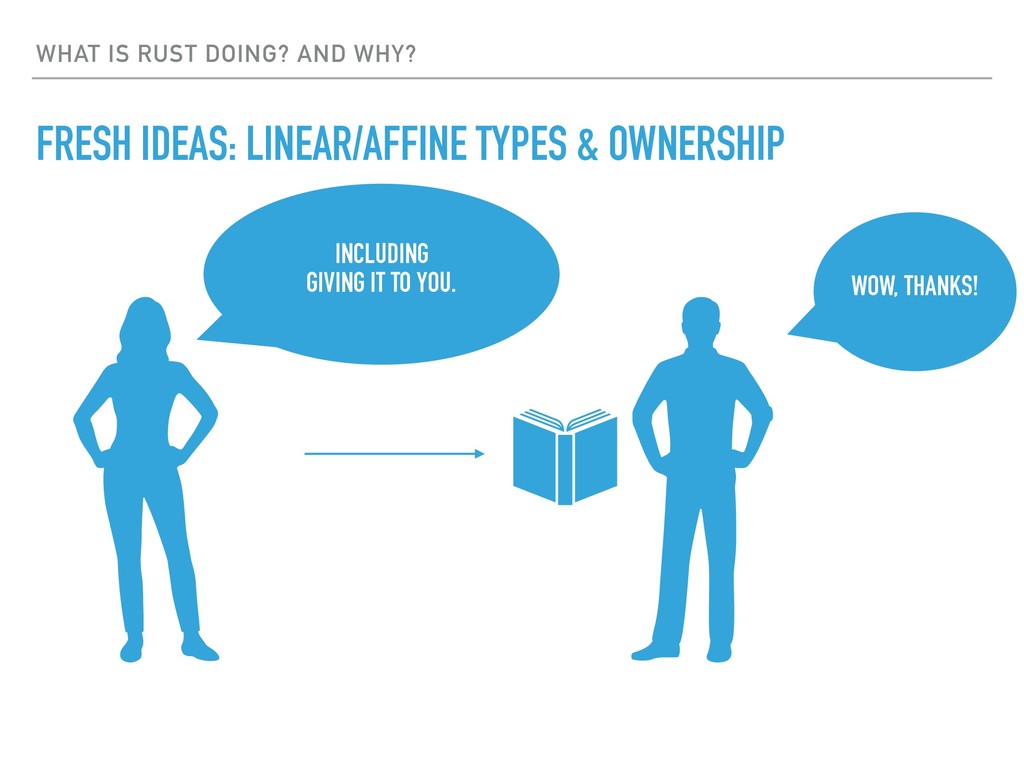
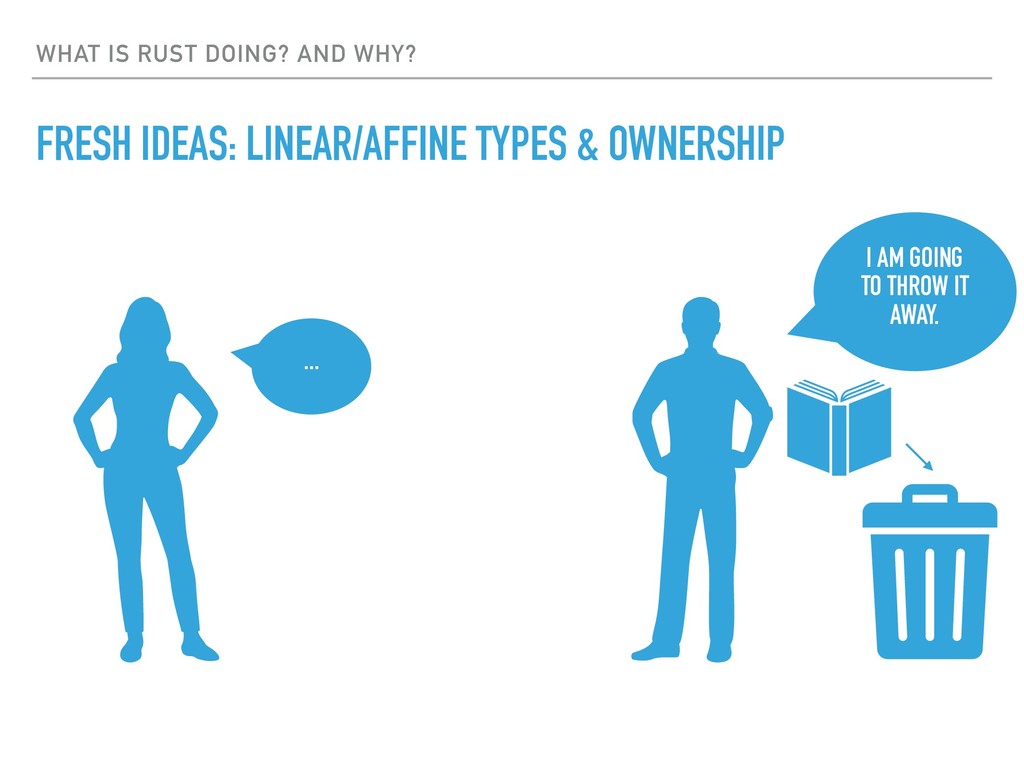
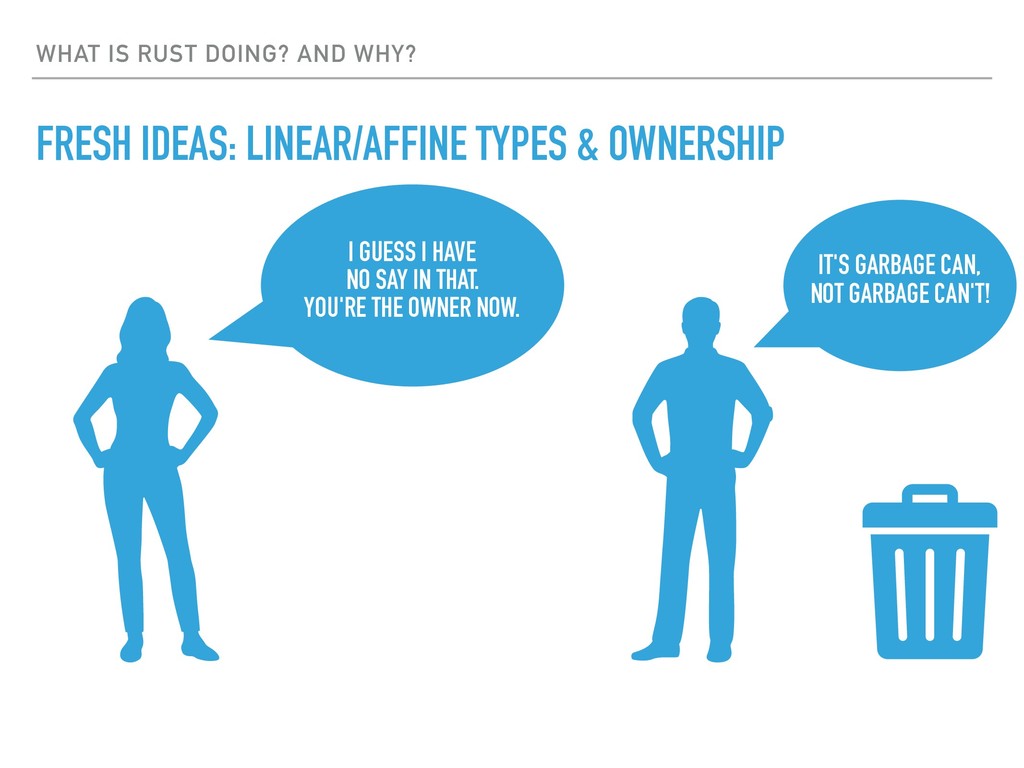
& OWNERSHIP ▸ a value that can have only one owner ▸ you can track resources precisely ▸ you have the full control because only you have the access ▸ when you're done, you know when to destroy it
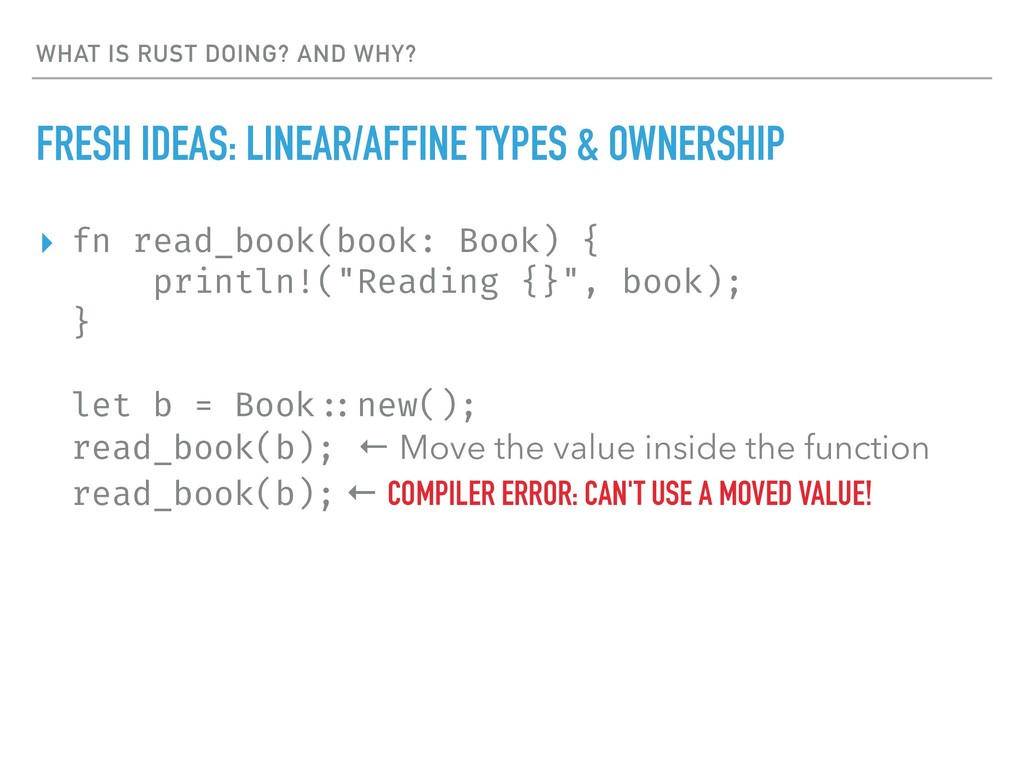
& OWNERSHIP ▸ fn read_book(book: Book) { println!("Reading {}", book); } let b = Book!::new(); read_book(b); ← Move the value inside the function read_book(b); ← COMPILER ERROR: CAN'T USE A MOVED VALUE!
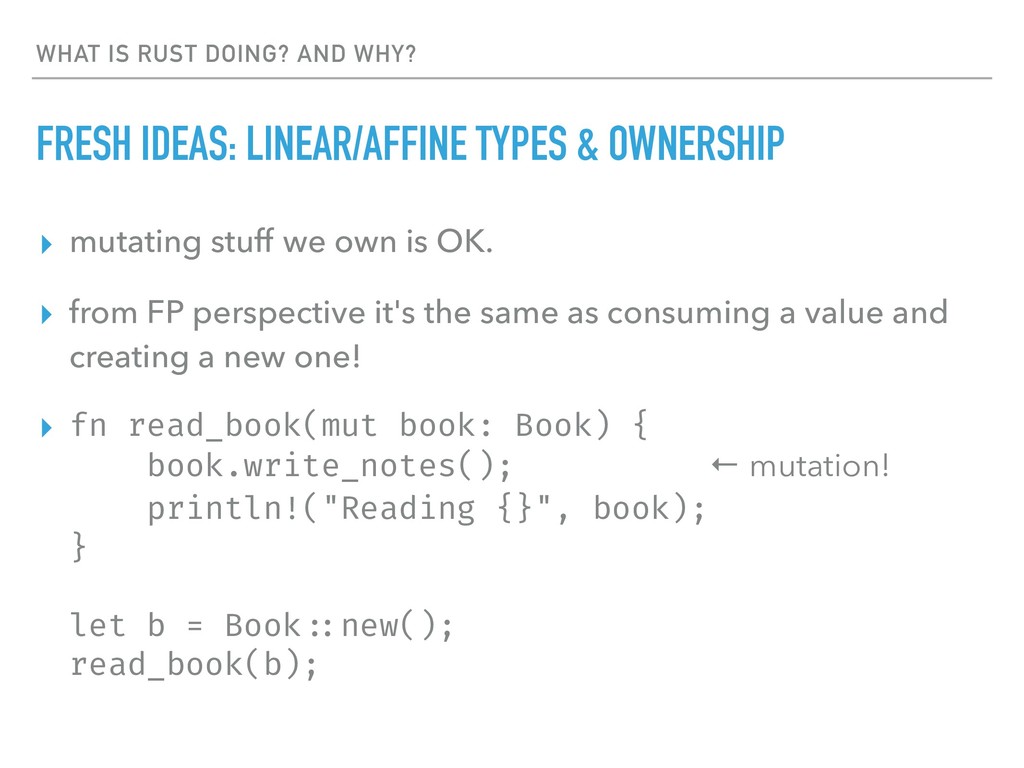
& OWNERSHIP ▸ mutating stuff we own is OK. ▸ from FP perspective it's the same as consuming a value and creating a new one! ▸ fn read_book(mut book: Book) { book.write_notes(); ← mutation! println!("Reading {}", book); } let b = Book!::new(); read_book(b);
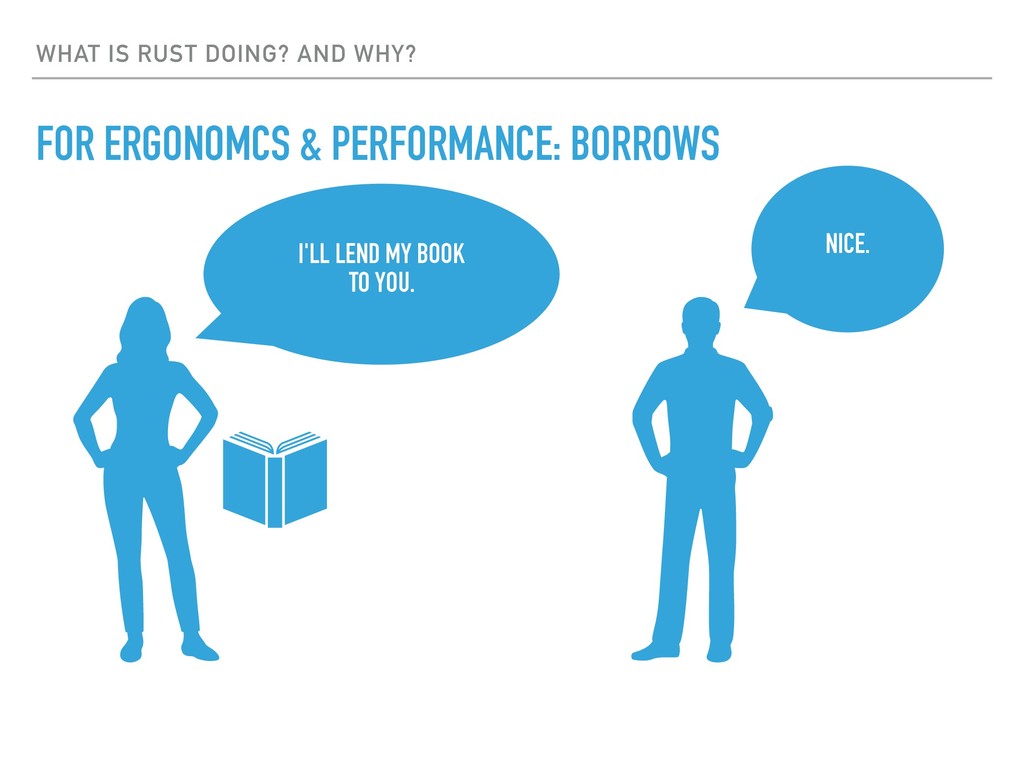
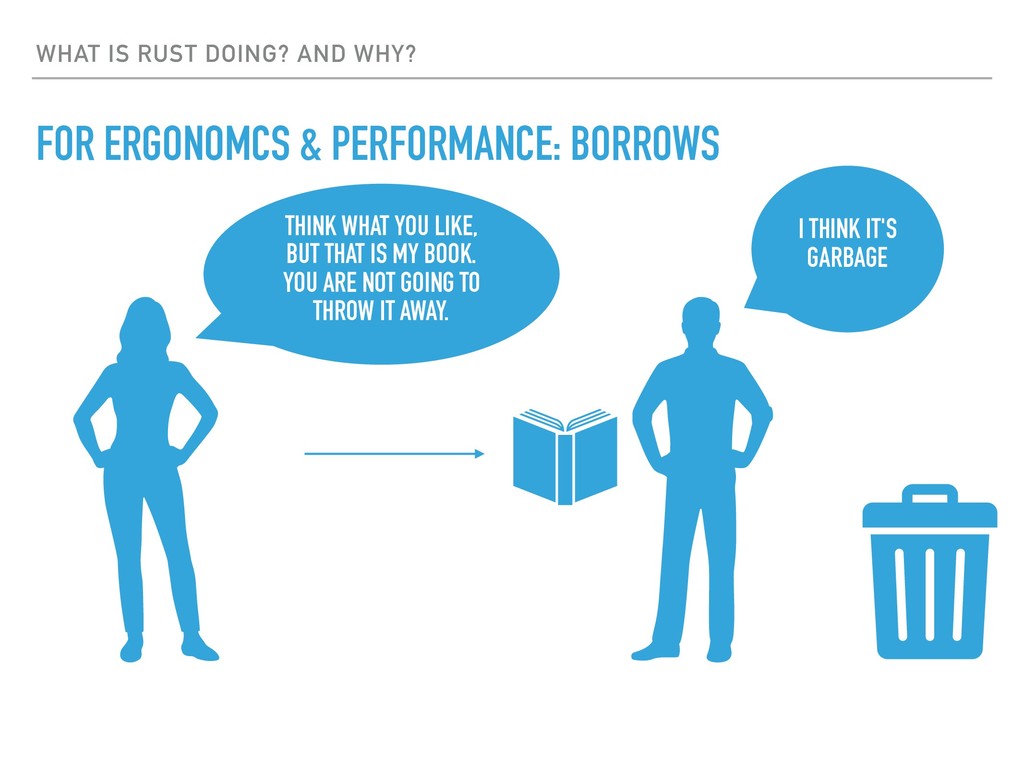
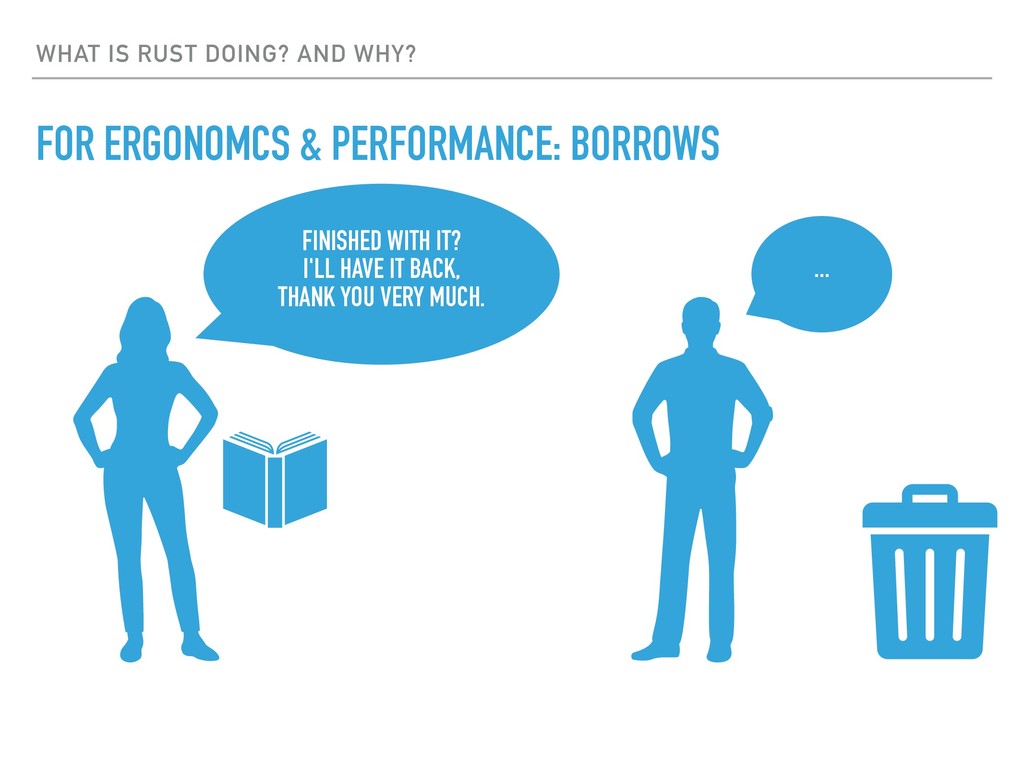
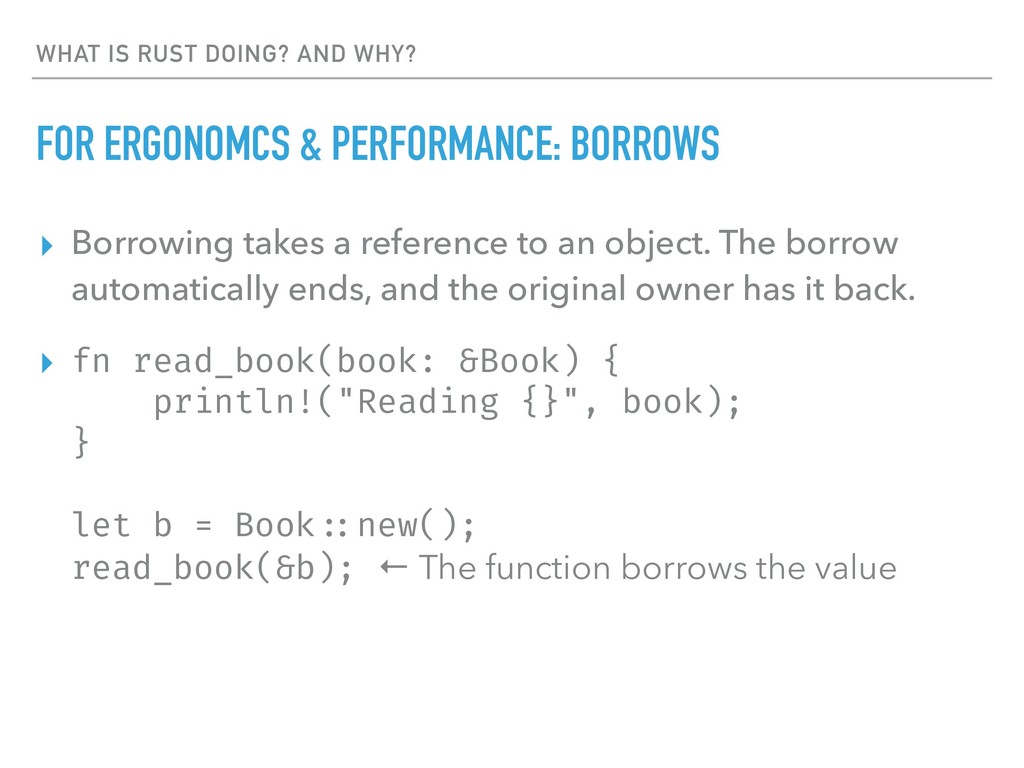
BORROWS ▸ Borrowing takes a reference to an object. The borrow automatically ends, and the original owner has it back. ▸ fn read_book(book: &Book) { println!("Reading {}", book); } let b = Book!::new(); read_book(&b); ← The function borrows the value
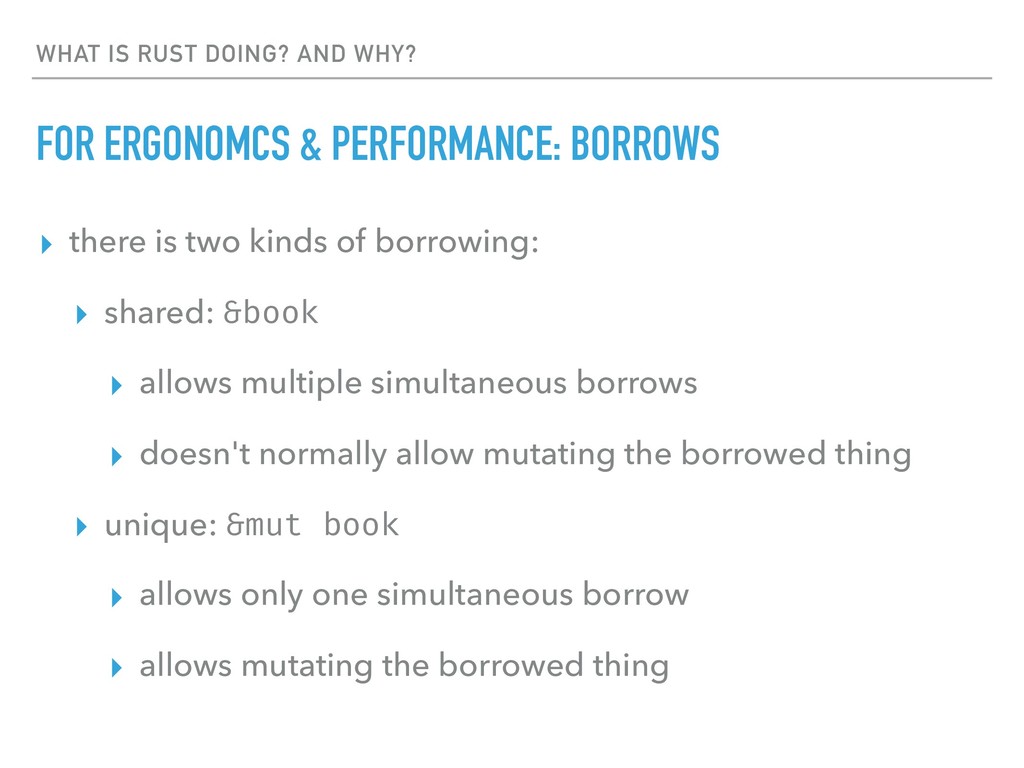
BORROWS ▸ there is two kinds of borrowing: ▸ shared: &book ▸ allows multiple simultaneous borrows ▸ doesn't normally allow mutating the borrowed thing ▸ unique: &mut book ▸ allows only one simultaneous borrow ▸ allows mutating the borrowed thing
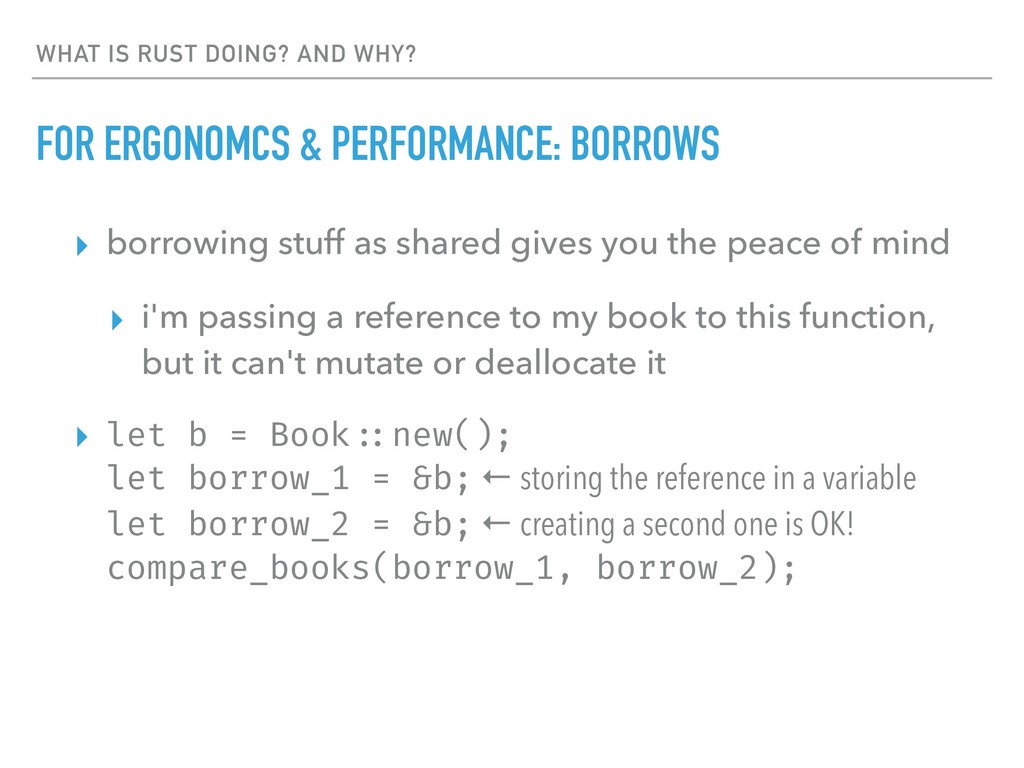
BORROWS ▸ borrowing stuff as shared gives you the peace of mind ▸ i'm passing a reference to my book to this function, but it can't mutate or deallocate it ▸ let b = Book!::new(); let borrow_1 = &b; ← storing the reference in a variable let borrow_2 = &b; ← creating a second one is OK! compare_books(borrow_1, borrow_2);
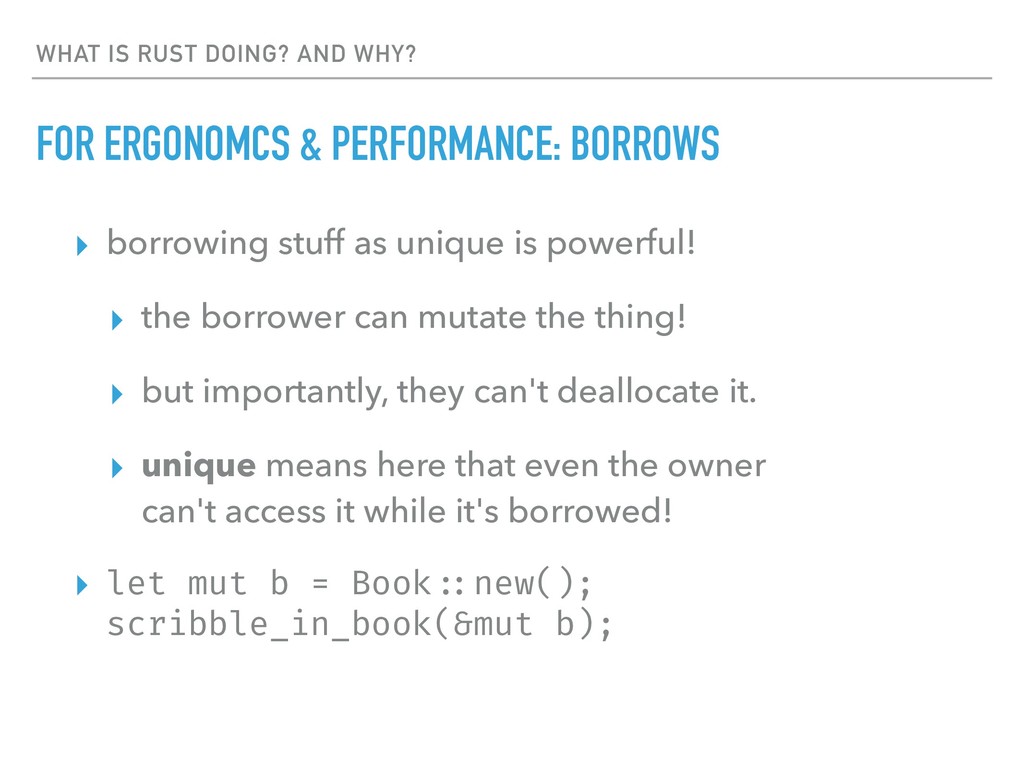
BORROWS ▸ borrowing stuff as unique is powerful! ▸ the borrower can mutate the thing! ▸ but importantly, they can't deallocate it. ▸ unique means here that even the owner can't access it while it's borrowed! ▸ let mut b = Book!::new(); scribble_in_book(&mut b);
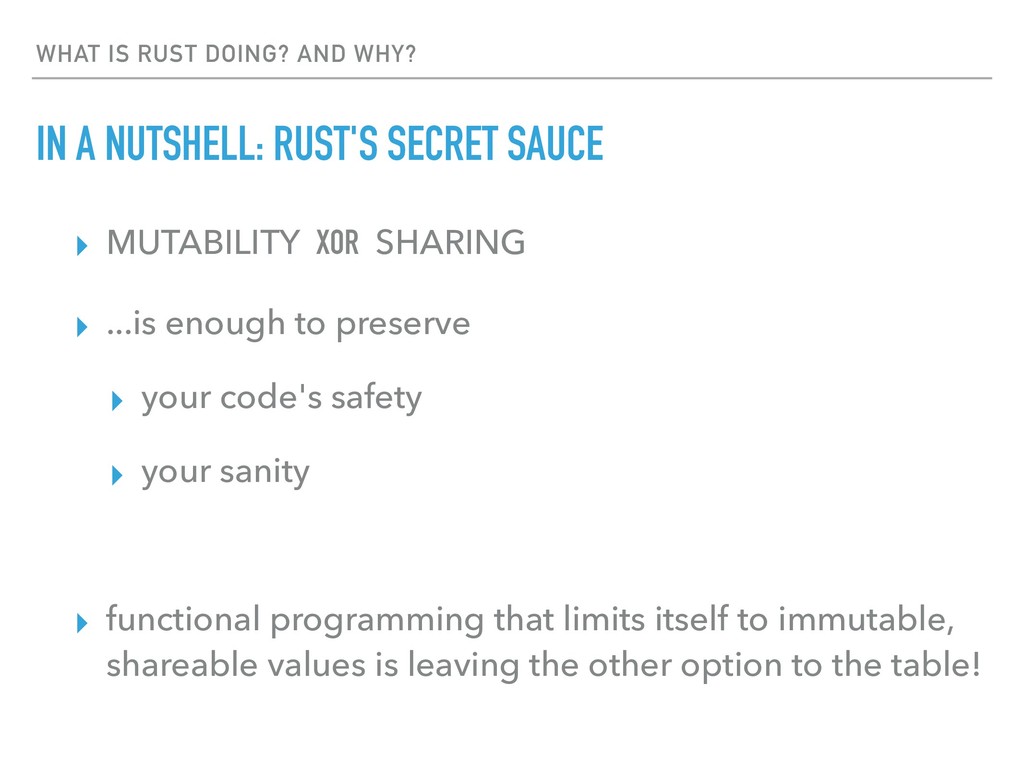
SECRET SAUCE ▸ MUTABILITY XOR SHARING ▸ ...is enough to preserve ▸ your code's safety ▸ your sanity ▸ functional programming that limits itself to immutable, shareable values is leaving the other option to the table!
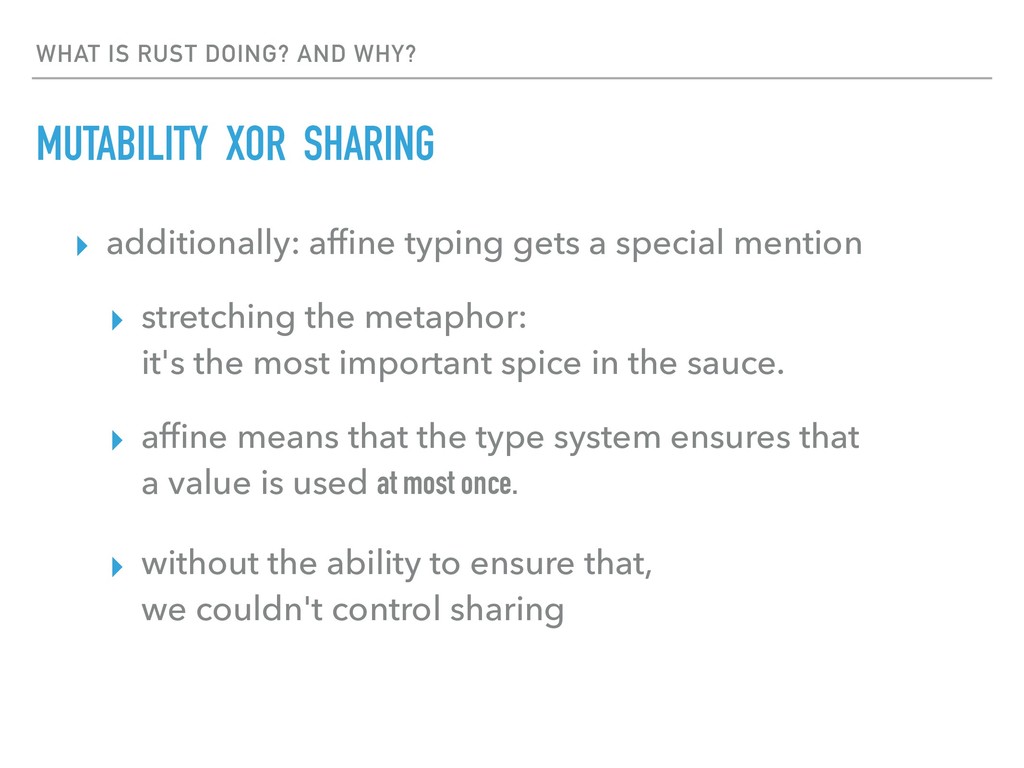
additionally: affine typing gets a special mention ▸ stretching the metaphor: it's the most important spice in the sauce. ▸ affine means that the type system ensures that a value is used at most once. ▸ without the ability to ensure that, we couldn't control sharing
mutability makes rust suitable for system programming ▸ but the ability to restrict it makes Rust sane – in a way that resembles functional programming!
PROGRAMMING LANGUAGE? ▸ in a narrow sense, it isn't ▸ but i like to think it as a part of the bigger story of history of functional programming ▸ Rust takes inspiration from a huge number of great ideas from functional language ▸ i sincerelly hope it also is able to give something back
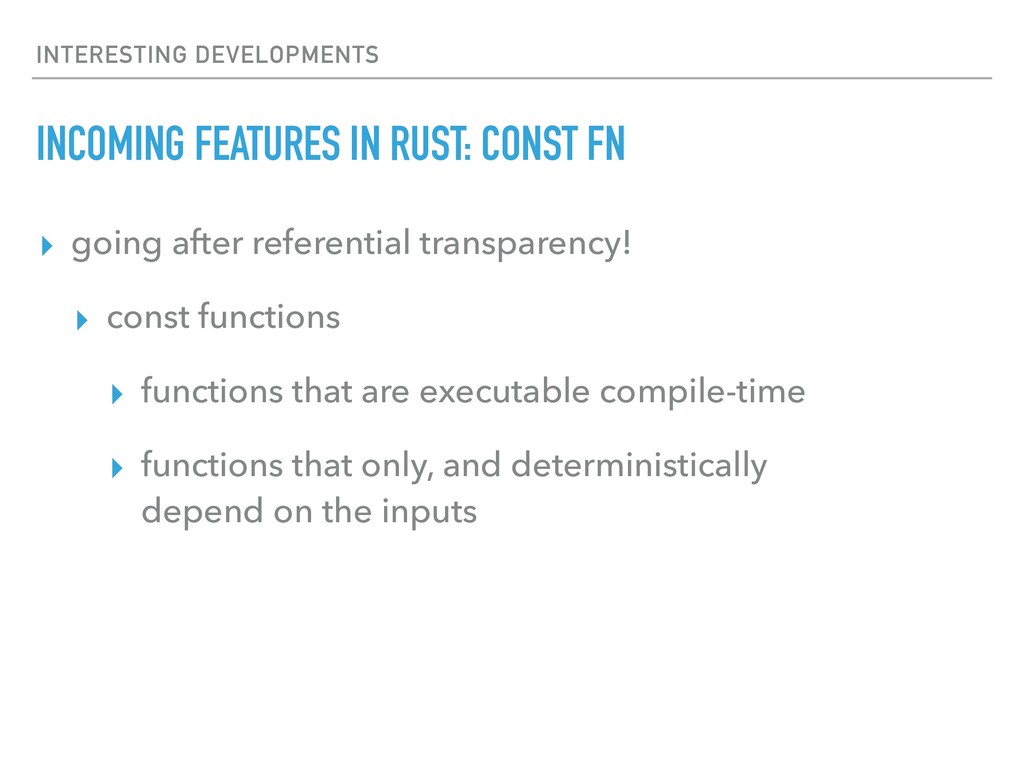
after referential transparency! ▸ const functions ▸ functions that are executable compile-time ▸ functions that only, and deterministically depend on the inputs
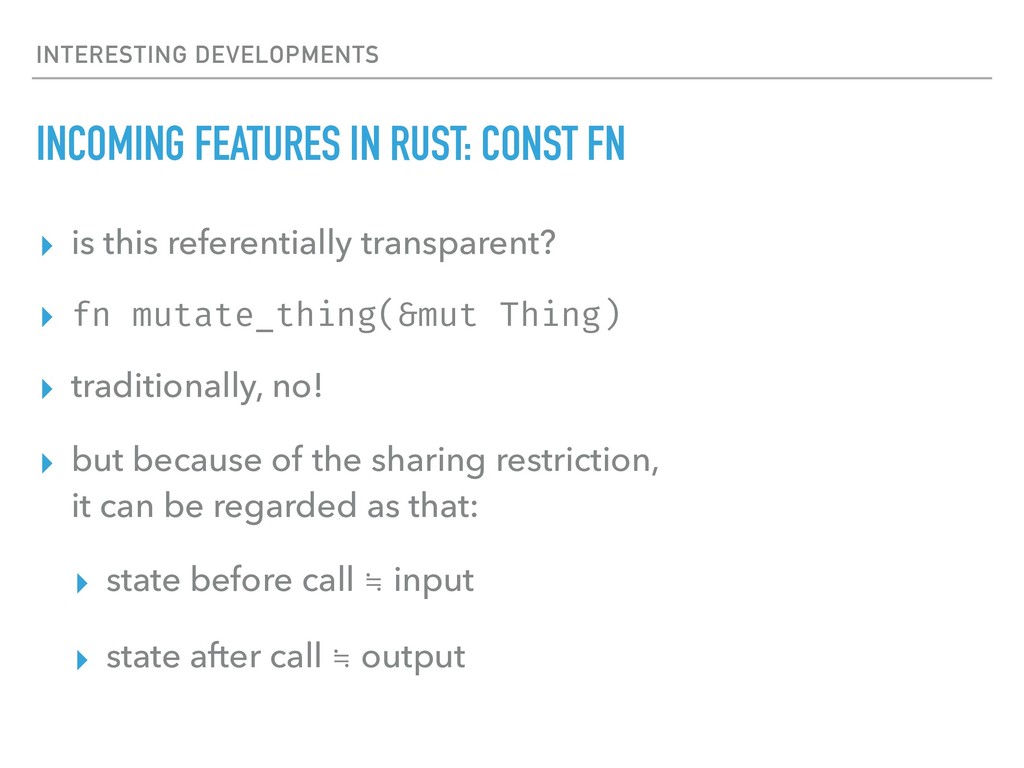
this referentially transparent? ▸ fn mutate_thing(&mut Thing) ▸ traditionally, no! ▸ but because of the sharing restriction, it can be regarded as that: ▸ state before call ≒ input ▸ state after call ≒ output
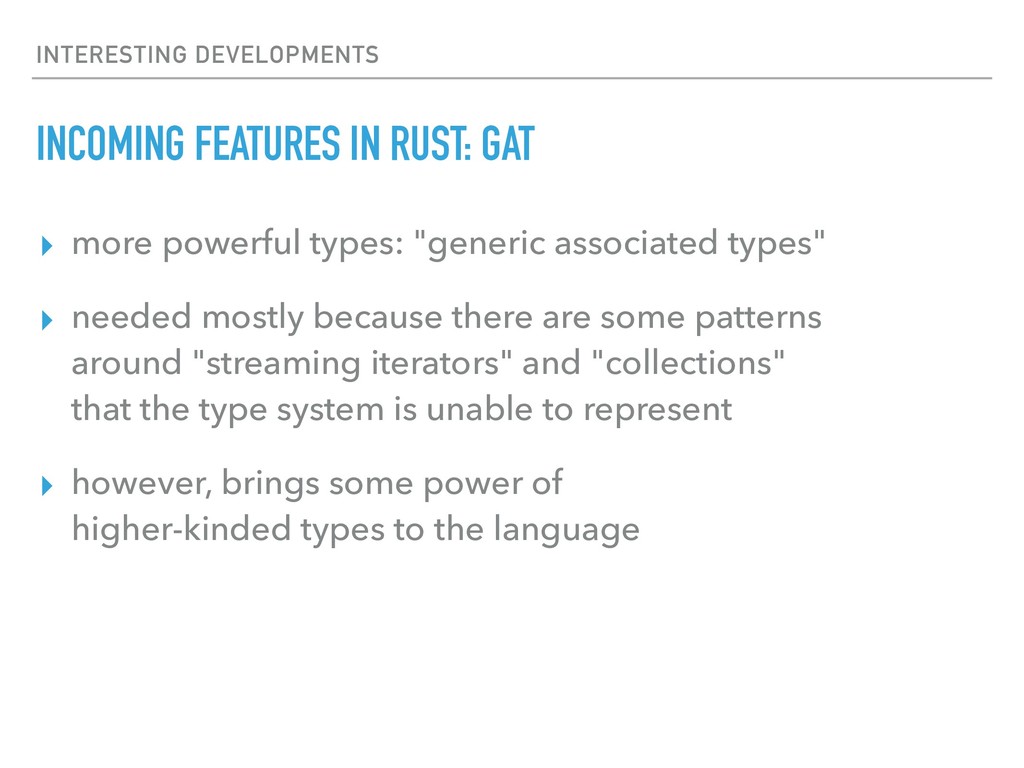
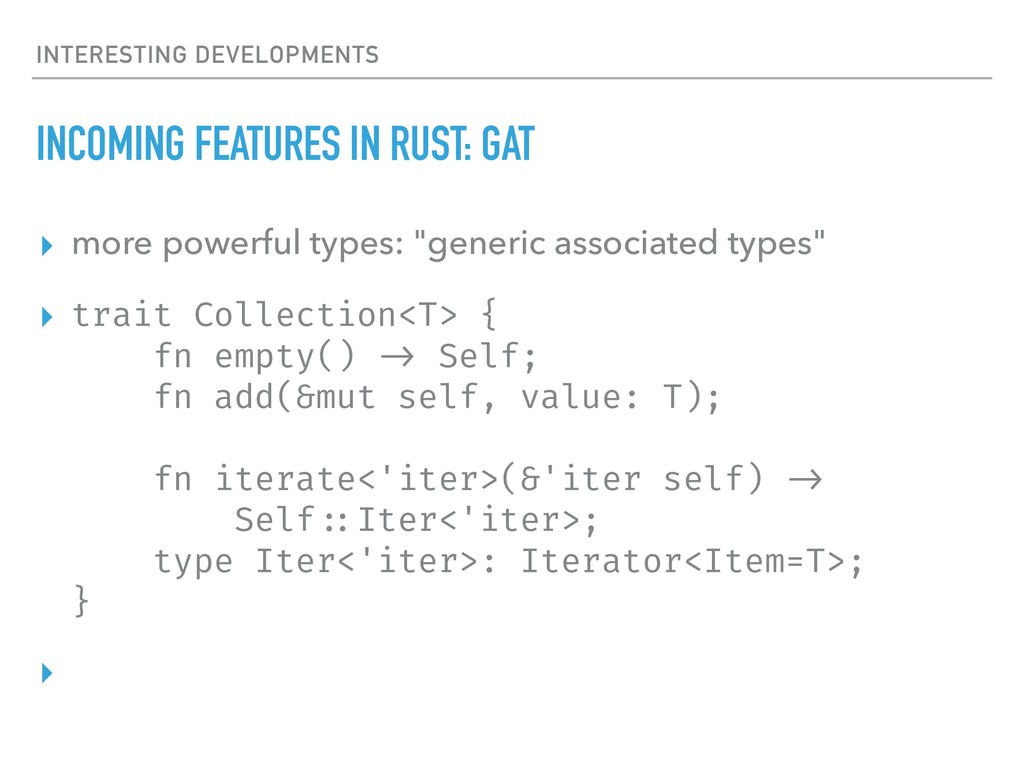
types: "generic associated types" ▸ needed mostly because there are some patterns around "streaming iterators" and "collections" that the type system is unable to represent ▸ however, brings some power of higher-kinded types to the language
polymorphic bounds based on the exact type (like C++ template specialization) ▸ this might be sad for some haskellers: ▸ partial loss of "parametricity": less "theorems for free" ▸ however, it's an excellent example of an balancing act between systems and functional programming


 golddranks
 yukikurage
 colorful12
 kasacchiful
 lef237
 gonta
gonta
 marcoroth
 xleitix
 timakin
 naokihaba
 dske104
 clockmaker
 har1101
 cromwellryan
 reverentgeek
 rabernat
 bryan
bryan
 mkilby
 lara
lara
 aleyda
 mojombo
 techseoconnect
 notwaldorf
 mlcsv
mlcsv
 mfonobong