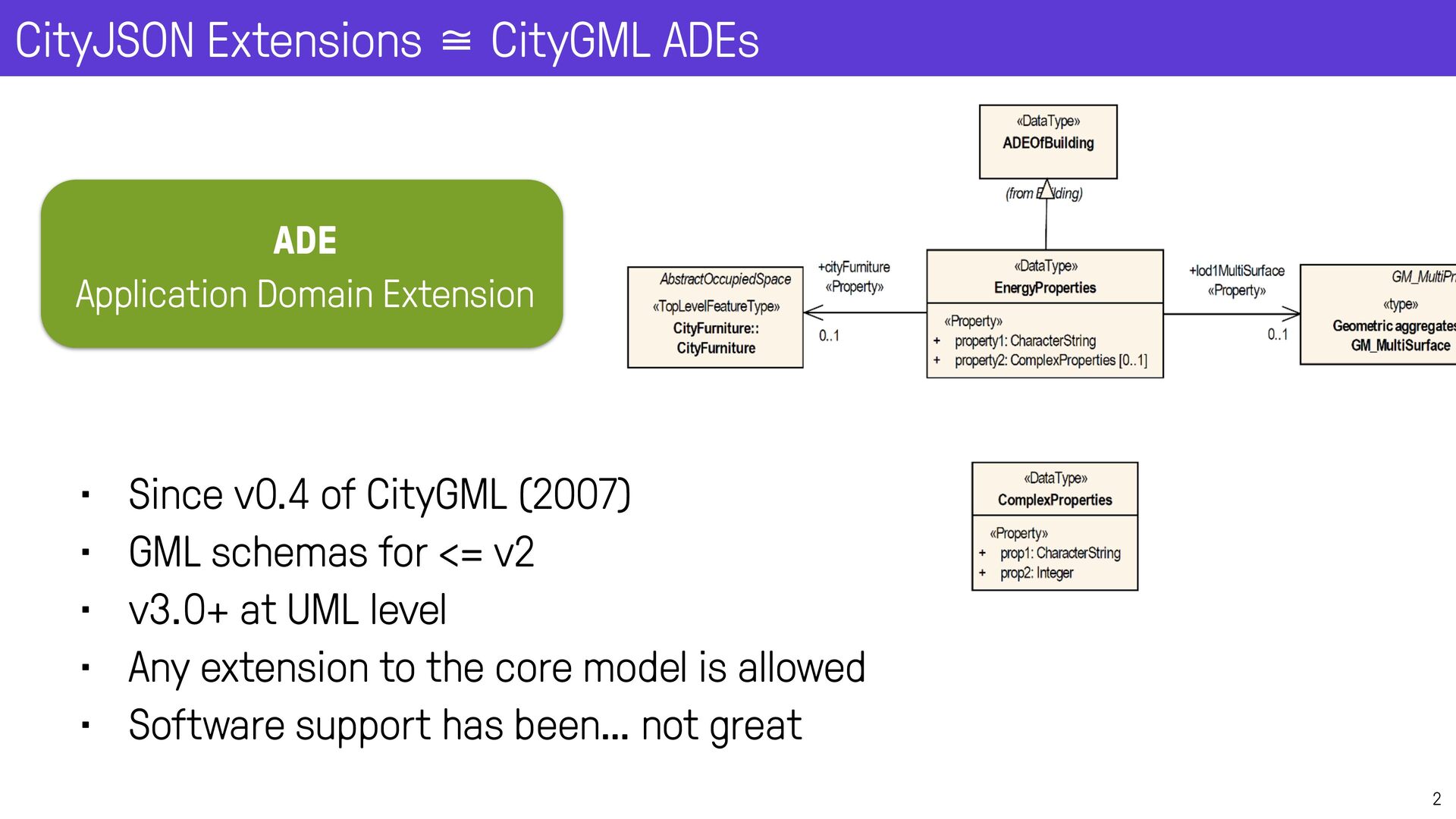
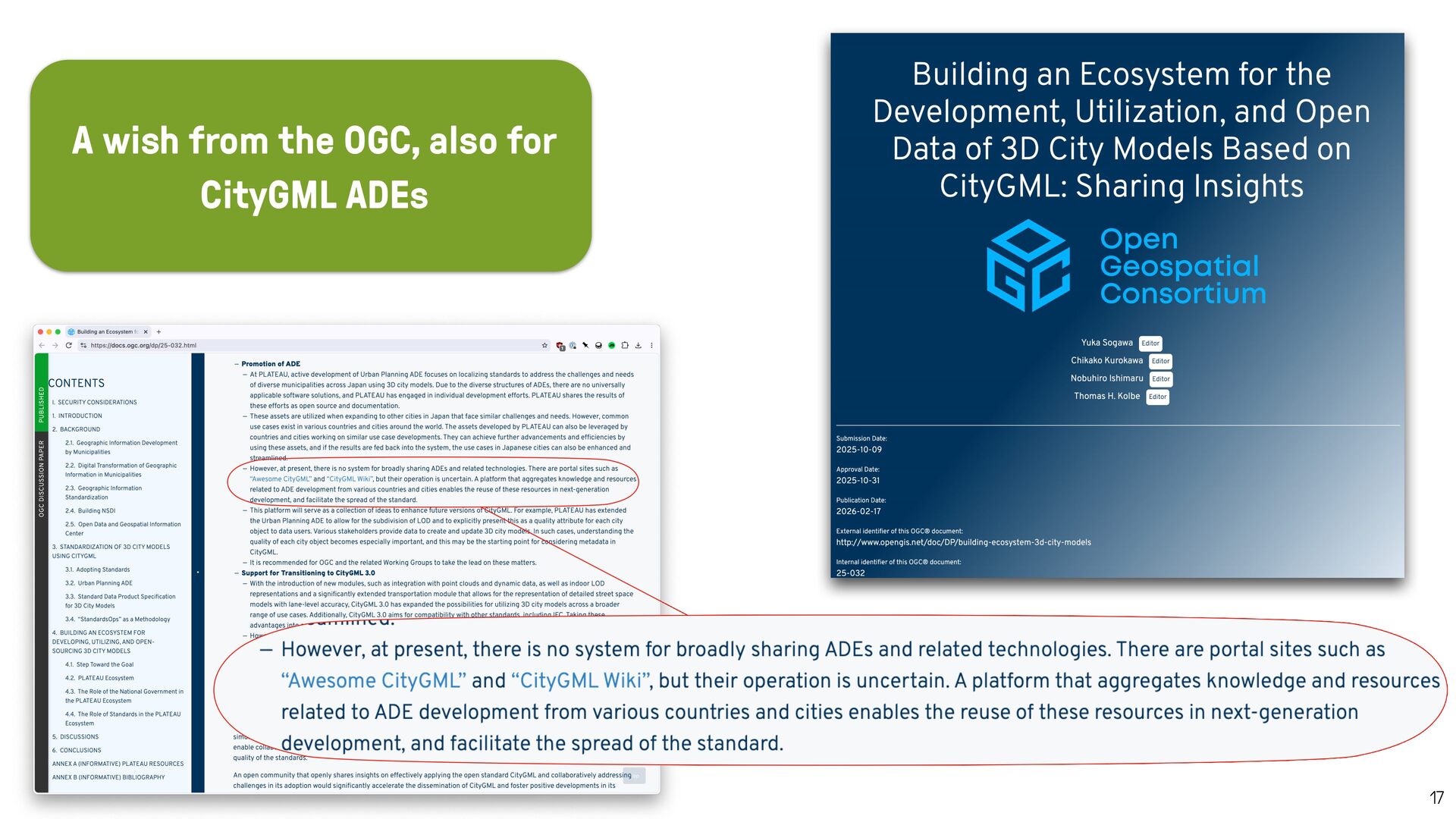
al. Open Geospatial Data, Software and Standards (2018) 3:13 https://doi.org/10.1186/s40965-018-0055-6 Open Geospatial Data, Software and Standards R EV I EW Open Access CityGML Application Domain Extension (ADE): overview of developments Filip Biljecki1* , Kavisha Kumar2 and Claus Nagel3 Abstract The Application Domain Extension (ADE) is a built-in mechanism of CityGML to augment its data model with additional concepts required by particular use cases. The goal of this paper is to provide an overview of the ADE mechanism and a literature review of developments since its introduction a decade ago. The discovery of publications found that currently there are 44 ADEs supporting a wide range of applications, but also application-agnostic purposes such as harmonisation with national geographic information standards. We hope this paper to double as a reference material for the developers of new ADEs. Keywords: CityGML, ADE, 3D GIS, 3D city modelling Introduction The CityGML standard [1] of the Open Geospatial Consortium (OGC) is the staple open data model and format for the storage and exchange of semantic 3D city models. It is used in several countries around the world for a wide spectrum of application domains [2]. While CityGML is intended to be a universal and application-independent geographic information model, the advent of dozens of applications and burgeoning use in different geographic contexts and software [3, 4] requires some additional information that is not readily available in the CityGML data model [5]. An example of such a case is the application of 3D city models in the energy domain: a method employed to estimate the energy demand of a building may necessitate specific and less common information such as building occupancy [6], an attribute that CityGML does not envisage by default. The developers of CityGML have foreseen situations such as this one, and thus for this purpose two ways to support augmenting the CityGML data model beyond its initial scope are offered: through (i) generic objects and attributes, and (ii) using the Application Domain Extension (ADE) mechanism. The former method has been used in practice but it has certain disadvantages (discussed later), thus the latter *Correspondence:
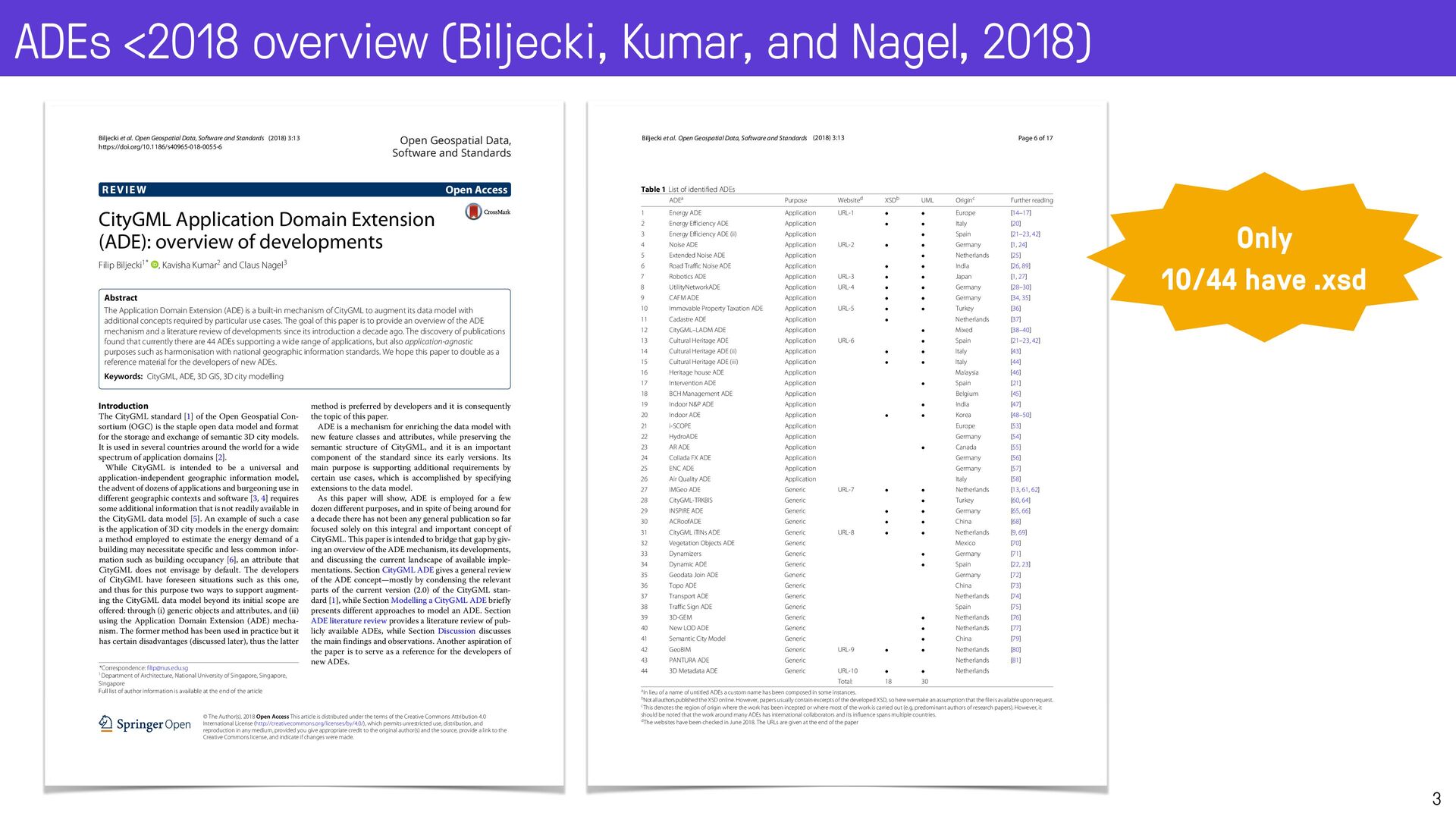
[email protected] 1 Department of Architecture, National University of Singapore, Singapore, Singapore Full list of author information is available at the end of the article method is preferred by developers and it is consequently the topic of this paper. ADE is a mechanism for enriching the data model with new feature classes and attributes, while preserving the semantic structure of CityGML, and it is an important component of the standard since its early versions. Its main purpose is supporting additional requirements by certain use cases, which is accomplished by specifying extensions to the data model. As this paper will show, ADE is employed for a few dozen different purposes, and in spite of being around for a decade there has not been any general publication so far focused solely on this integral and important concept of CityGML. This paper is intended to bridge that gap by giving an overview of the ADE mechanism, its developments, and discussing the current landscape of available implementations. Section CityGML ADE gives a general review of the ADE concept—mostly by condensing the relevant parts of the current version (2.0) of the CityGML standard [1], while Section Modelling a CityGML ADE briefly presents different approaches to model an ADE. Section ADE literature review provides a literature review of publicly available ADEs, while Section Discussion discusses the main findings and observations. Another aspiration of the paper is to serve as a reference for the developers of new ADEs. © The Author(s). 2018 Open Access This article is distributed under the terms of the Creative Commons Attribution 4.0 International License (http://creativecommons.org/licenses/by/4.0/), which permits unrestricted use, distribution, and reproduction in any medium, provided you give appropriate credit to the original author(s) and the source, provide a link to the Creative Commons license, and indicate if changes were made. Biljecki et al. Open Geospatial Data, Software and Standards (2018) 3:13 Page 6 of 17 Table 1 List of identified ADEs 1 ADEa Purpose Websited XSDb UML Originc Further reading Energy ADE Application URL-1 • • Europe [14–17] Italy [20] • Spain [21–23, 42] 2 Energy Efficiency ADE Application 3 Energy Efficiency ADE (ii) Application 4 Noise ADE Application 5 Extended Noise ADE Application • URL-2 6 Road Traffic Noise ADE Application 7 Robotics ADE Application URL-3 URL-4 8 UtilityNetworkADE Application 9 CAFM ADE Application 10 Immovable Property Taxation ADE Application 11 Cadastre ADE Application 12 CityGML–LADM ADE Application 13 Cultural Heritage ADE Application 14 Cultural Heritage ADE (ii) Application 15 Cultural Heritage ADE (iii) Application 16 Heritage house ADE Application 17 Intervention ADE Application 18 BCH Management ADE Application 19 Indoor N&P ADE Application 20 Indoor ADE Application 21 i-SCOPE Application 22 HydroADE Application 23 AR ADE Application 24 Collada FX ADE Application 25 ENC ADE 26 Air Quality ADE URL-5 • • • • Germany [1, 24] Netherlands [25] • • India [26, 89] Japan [1, 27] • • Germany [28–30] Germany [34, 35] • • Turkey [36] Netherlands [37] • • • URL-6 • • • • • • • • • • • • • Mixed [38–40] Spain [21–23, 42] Italy [43] Italy [44] Malaysia [46] Spain [21] Belgium [45] India [47] Korea [48–50] Europe [53] Germany [54] Canada [55] Germany [56] Application Germany [57] Application Italy [58] 27 IMGeo ADE Generic 28 CityGML-TRKBIS Generic 29 INSPIRE ADE Generic 30 ACRoofADE Generic 31 CityGML iTINs ADE Generic 32 Vegetation Objects ADE Generic 33 Dynamizers Generic 34 Dynamic ADE Generic URL-7 • • URL-8 • • • • • • • • • Netherlands [13, 61, 62] Turkey [60, 64] Germany [65, 66] China [68] Netherlands [9, 69] Mexico [70] Germany [71] Spain [22, 23] 35 Geodata Join ADE Generic Germany [72] 36 Topo ADE Generic China [73] 37 Transport ADE Generic Netherlands [74] 38 Traffic Sign ADE Generic Spain [75] 39 3D-GEM Generic Netherlands [76] 40 New LOD ADE Generic Netherlands [77] 41 Semantic City Model Generic 42 GeoBIM Generic 43 PANTURA ADE Generic 44 3D Metadata ADE Generic • • • China [79] URL-9 • • Netherlands [80] Netherlands [81] URL-10 • • Netherlands Total: 18 Only 10/44 have .xsd 30 a In lieu of a name of untitled ADEs a custom name has been composed in some instances. b Not all authors published the XSD online. However, papers usually contain excerpts of the developed XSD, so here we make an assumption that the file is available upon request. c This denotes the region of origin where the work has been incepted or where most of the work is carried out (e.g. predominant authors of research papers). However, it should be noted that the work around many ADEs has international collaborators and its influence spans multiple countries. d The websites have been checked in June 2018. The URLs are given at the end of the paper 3


 hugoledoux
 rmw
rmw
 schlessera
 eileencodes
 baasie
 3n
3n
 mayunak
 thoeni
 katarinadahlin
 reverentgeek
 nonsquared
 rocio
rocio
 inesmontani
![thank you. Hugo Ledoux [email protected] 3d.bk.tudelft.nl/hledoux https://github.com/cityjson/extensions](https://files.speakerdeck.com/presentations/06f4ea85d07f4750b70600db88a477c1/slide_18.jpg)