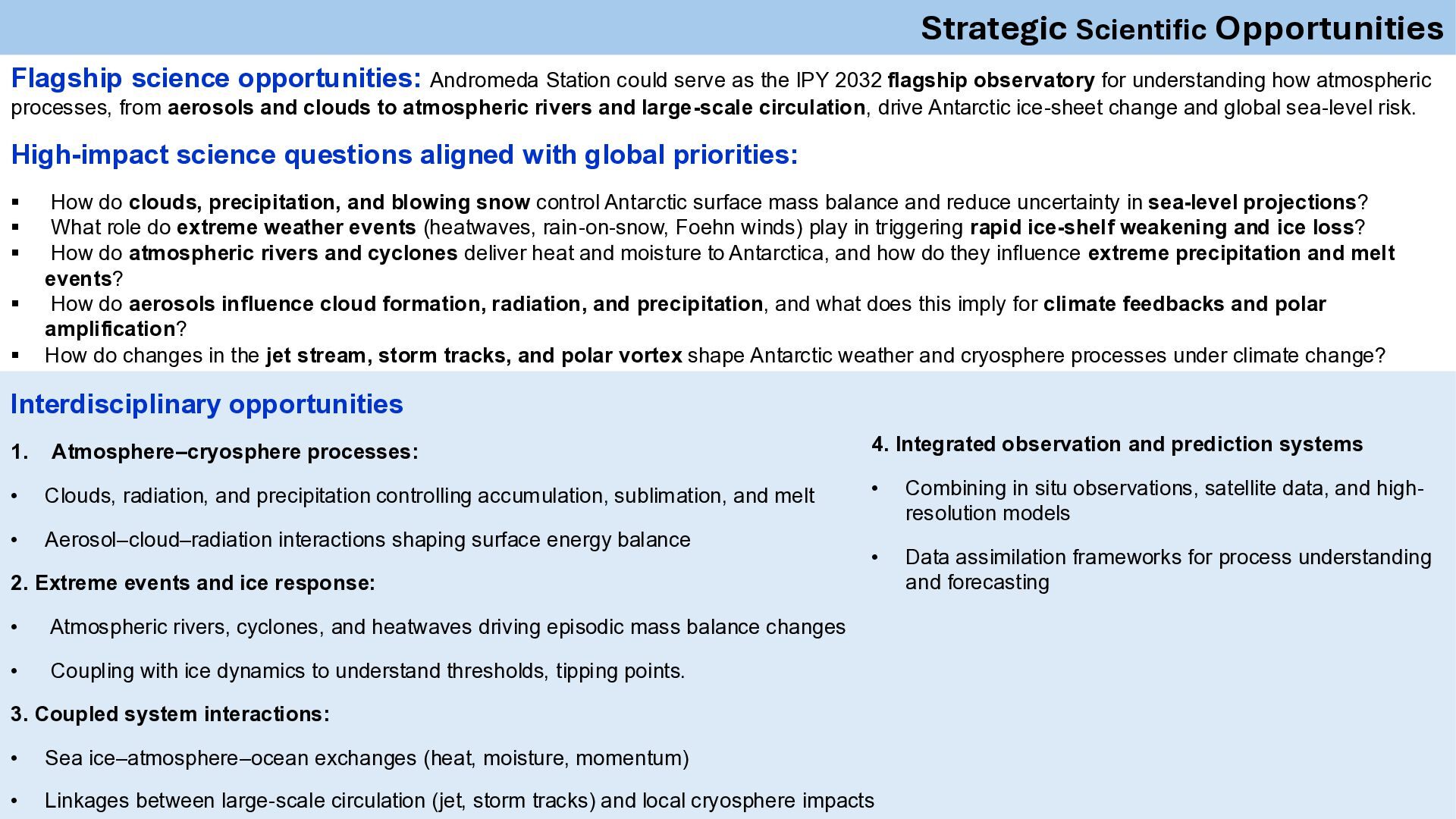
Emirates. Role: Faculty in the Earth Science Department and Head of the Environmental and Geophysical Sciences (ENGEOS) lab. Polar experience: Impacts of storms and atmospheric rivers on polynyas, role of Foehn winds in snow and ice sublimation, role of storms in the calving of ice-shelf fronts, etc.. Core research areas: Polar meteorology, Polar climate, weather extremes in polar regions, sea ice variability, land ice melt and dynamics, atmosphere-cryosphere interactions. Technical expertise: Satellite remote sensing, atmospheric numerical modelling and in-situ observations for sea ice variability (SIMBA). Polynya Expertise & Perspective
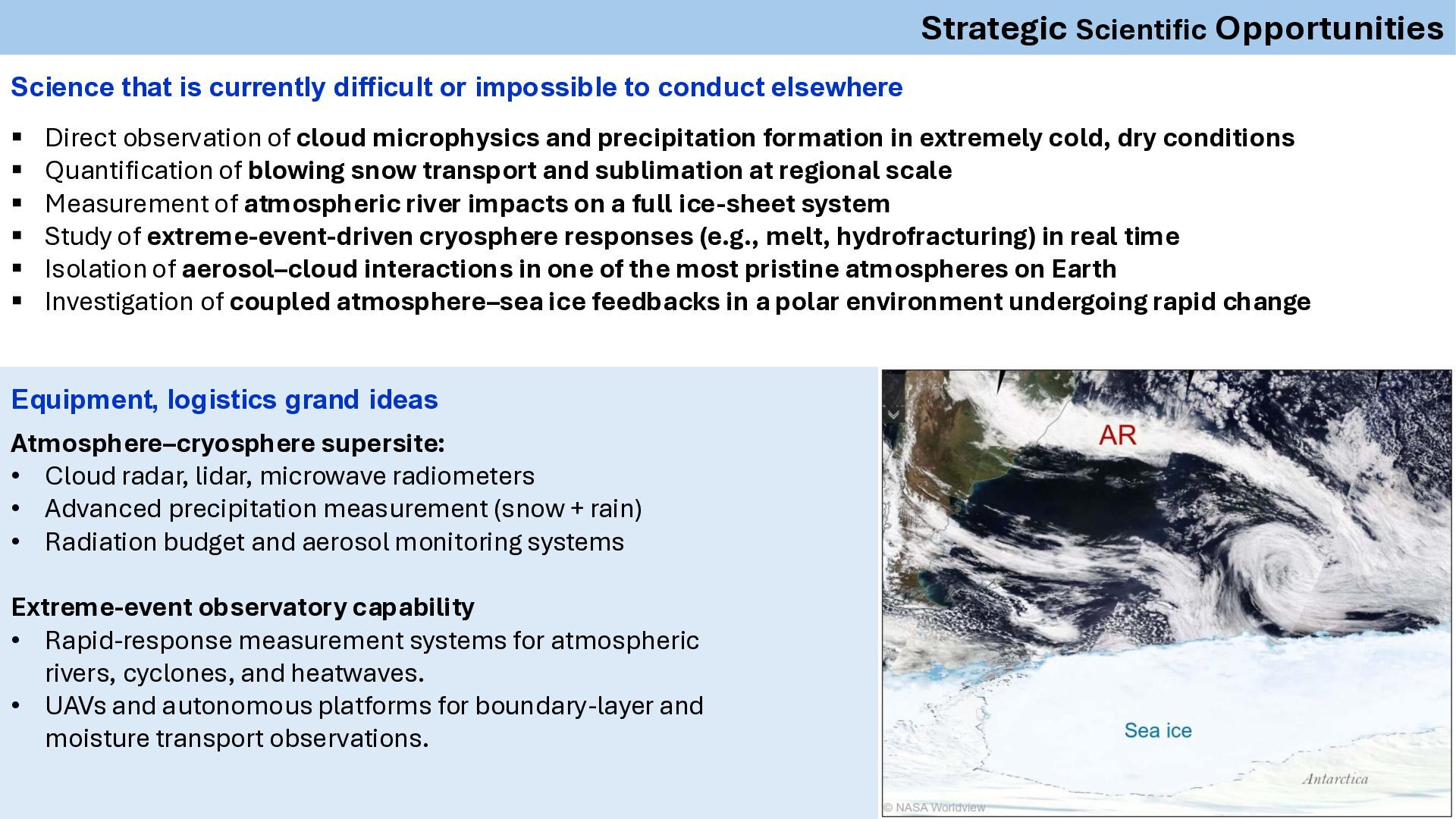
2032 flagship observatory for understanding how atmospheric processes, from aerosols and clouds to atmospheric rivers and large-scale circulation, drive Antarctic ice-sheet change and global sea-level risk. High-impact science questions aligned with global priorities: ▪ How do clouds, precipitation, and blowing snow control Antarctic surface mass balance and reduce uncertainty in sea-level projections? ▪ What role do extreme weather events (heatwaves, rain-on-snow, Foehn winds) play in triggering rapid ice-shelf weakening and ice loss? ▪ How do atmospheric rivers and cyclones deliver heat and moisture to Antarctica, and how do they influence extreme precipitation and melt events? ▪ How do aerosols influence cloud formation, radiation, and precipitation, and what does this imply for climate feedbacks and polar amplification? ▪ How do changes in the jet stream, storm tracks, and polar vortex shape Antarctic weather and cryosphere processes under climate change? Strategic Scientific Opportunities Interdisciplinary opportunities 1. Atmosphere–cryosphere processes: • Clouds, radiation, and precipitation controlling accumulation, sublimation, and melt • Aerosol–cloud–radiation interactions shaping surface energy balance 2. Extreme events and ice response: • Atmospheric rivers, cyclones, and heatwaves driving episodic mass balance changes • Coupling with ice dynamics to understand thresholds, tipping points. 3. Coupled system interactions: • Sea ice–atmosphere–ocean exchanges (heat, moisture, momentum) • Linkages between large-scale circulation (jet, storm tracks) and local cryosphere impacts 4. Integrated observation and prediction systems • Combining in situ observations, satellite data, and high- resolution models • Data assimilation frameworks for process understanding and forecasting
▪ Direct observation of cloud microphysics and precipitation formation in extremely cold, dry conditions ▪ Quantification of blowing snow transport and sublimation at regional scale ▪ Measurement of atmospheric river impacts on a full ice-sheet system ▪ Study of extreme-event-driven cryosphere responses (e.g., melt, hydrofracturing) in real time ▪ Isolation of aerosol–cloud interactions in one of the most pristine atmospheres on Earth ▪ Investigation of coupled atmosphere–sea ice feedbacks in a polar environment undergoing rapid change Strategic Scientific Opportunities Equipment, logistics grand ideas Atmosphere–cryosphere supersite: • Cloud radar, lidar, microwave radiometers • Advanced precipitation measurement (snow + rain) • Radiation budget and aerosol monitoring systems Extreme-event observatory capability • Rapid-response measurement systems for atmospheric rivers, cyclones, and heatwaves. • UAVs and autonomous platforms for boundary-layer and moisture transport observations.


 ipfevents
 trycycle
 bonotake
 hanbao
 konakalab
 chinson03
%20square.jpg) baggiponte
baggiponte
 naokimuroki
 corgies
 expajp
 danielanewman
 rocio
rocio
 axbom
axbom
 sabderemane
 michielstock
 bethany
 sergeychernyshev
 katiecoart
 shlominoach
 aemeredith
 stephaniewalter