Share
Embed
Concurrent and Parallel Programming with OCaml 5
OCaml 5 has brought native support for concurrency and parallelism to OCaml. In this talk, I will present the concurrent and parallel programming primitives exposed by the compiler, and the design decisions that went into making these features backwards compatible for existing users. I will also describe the libraries and tools that we have built to help users take advantage of new features. Finally, I will share our experience with porting a large multi-process-parallel application to a shared-memory-multicore one.

KC Sivaramakrishnan
September 14, 2024
Transcript
115 slides
-
• Building functional systems using OCaml • We work on
‣ OCaml platform: Compiler, Build system (dune), package manager (opam), documentation tools (odoc), editor support (LSP, merlin), etc. ‣ OCaml community: ocaml.org, CI for package repository, managing community infrastructure, run conferences and events ‣ OCaml consulting & training: helping commercial users with OCaml needs ‣ Research: SpaceOS — Satellite IaaS as a service, formal veri fi cation, blockchain forensics -
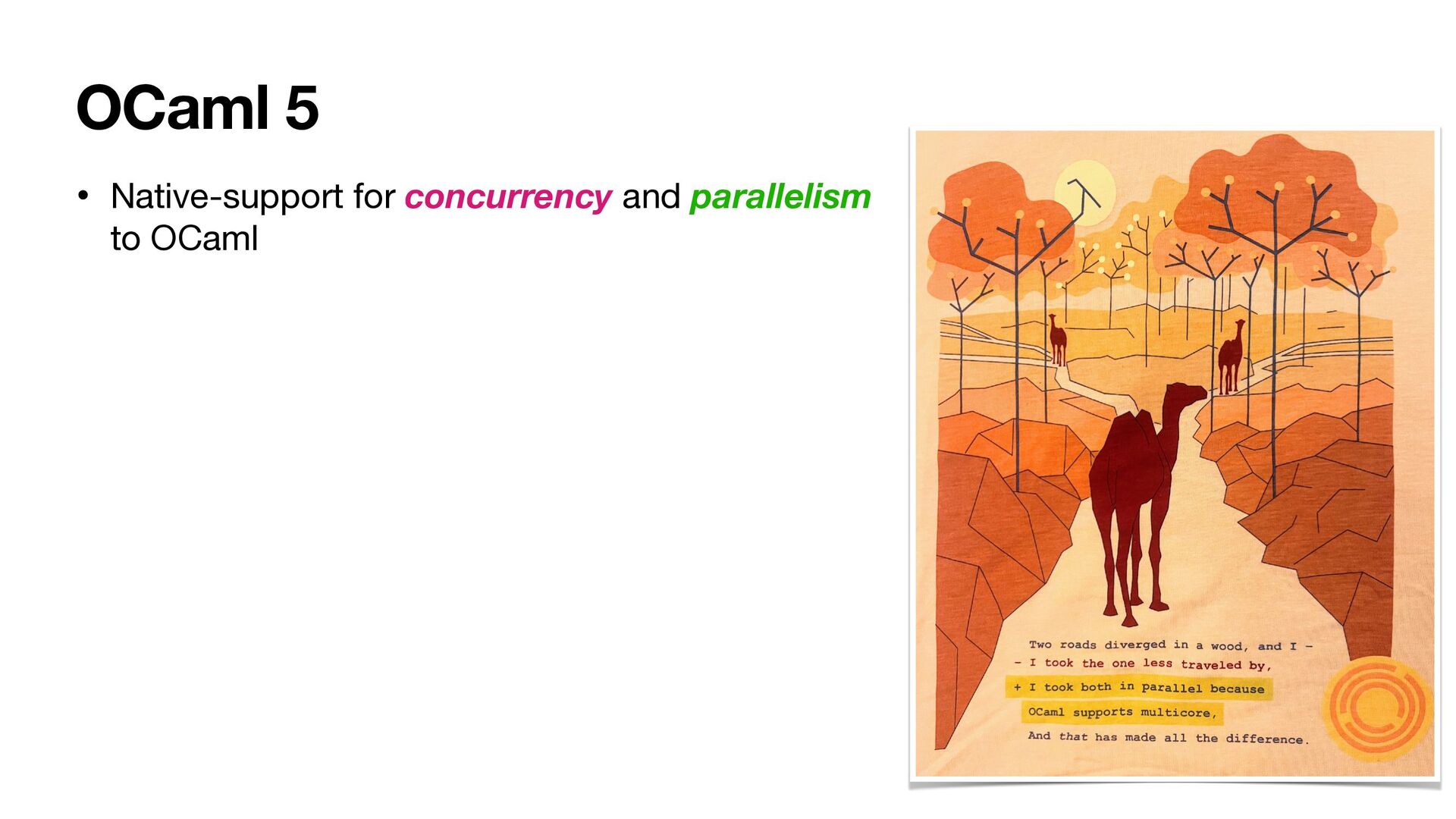
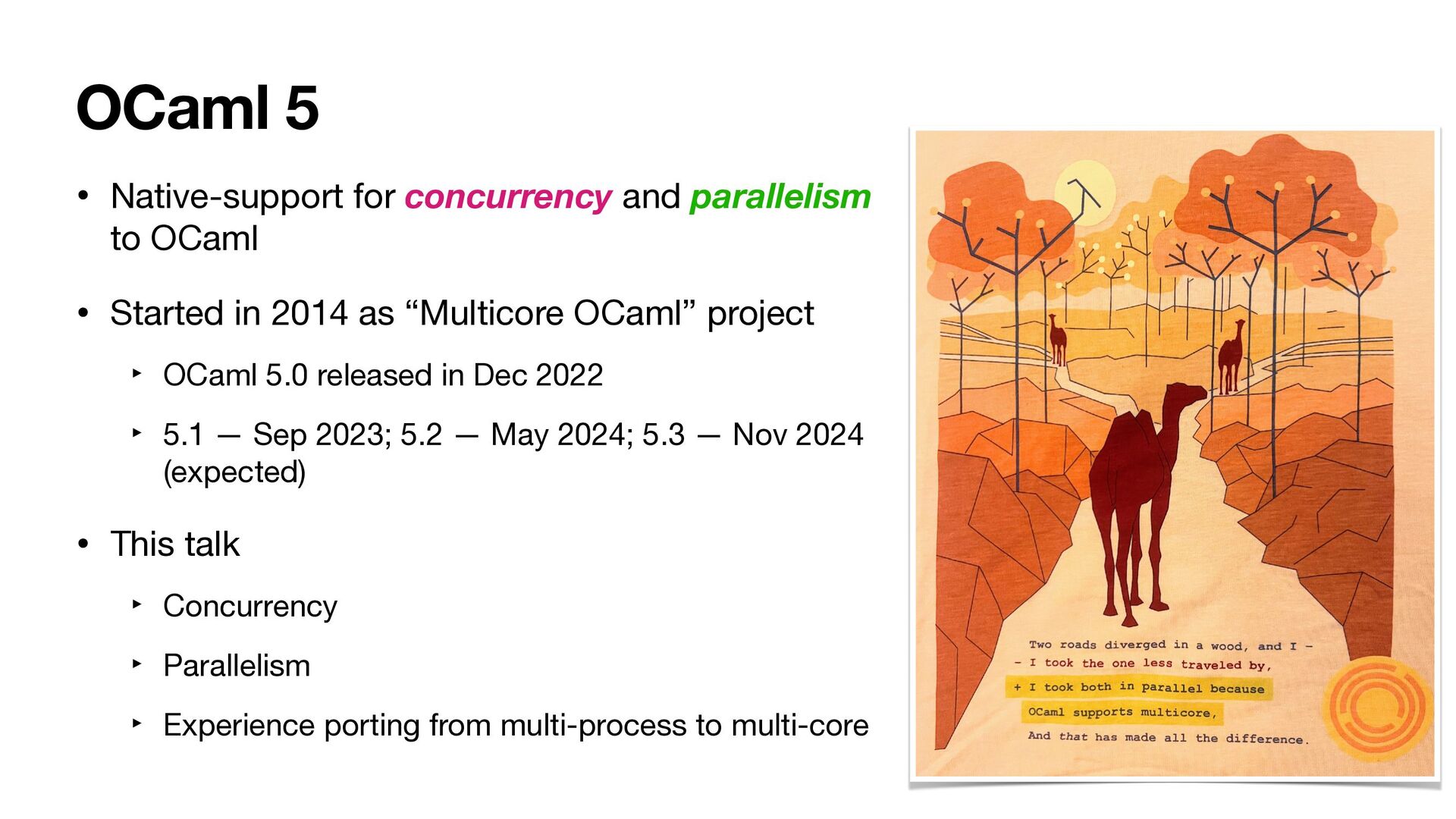
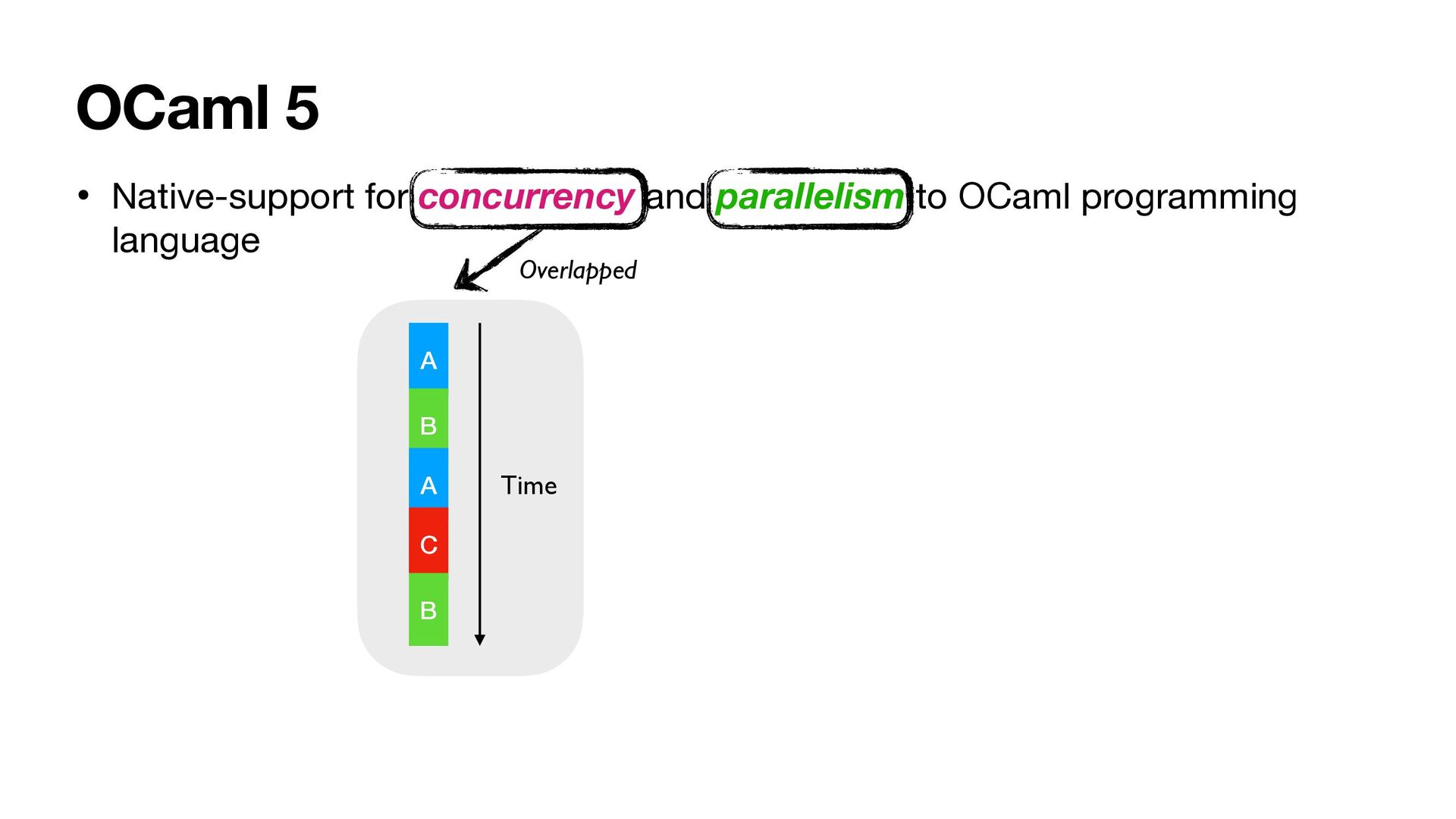
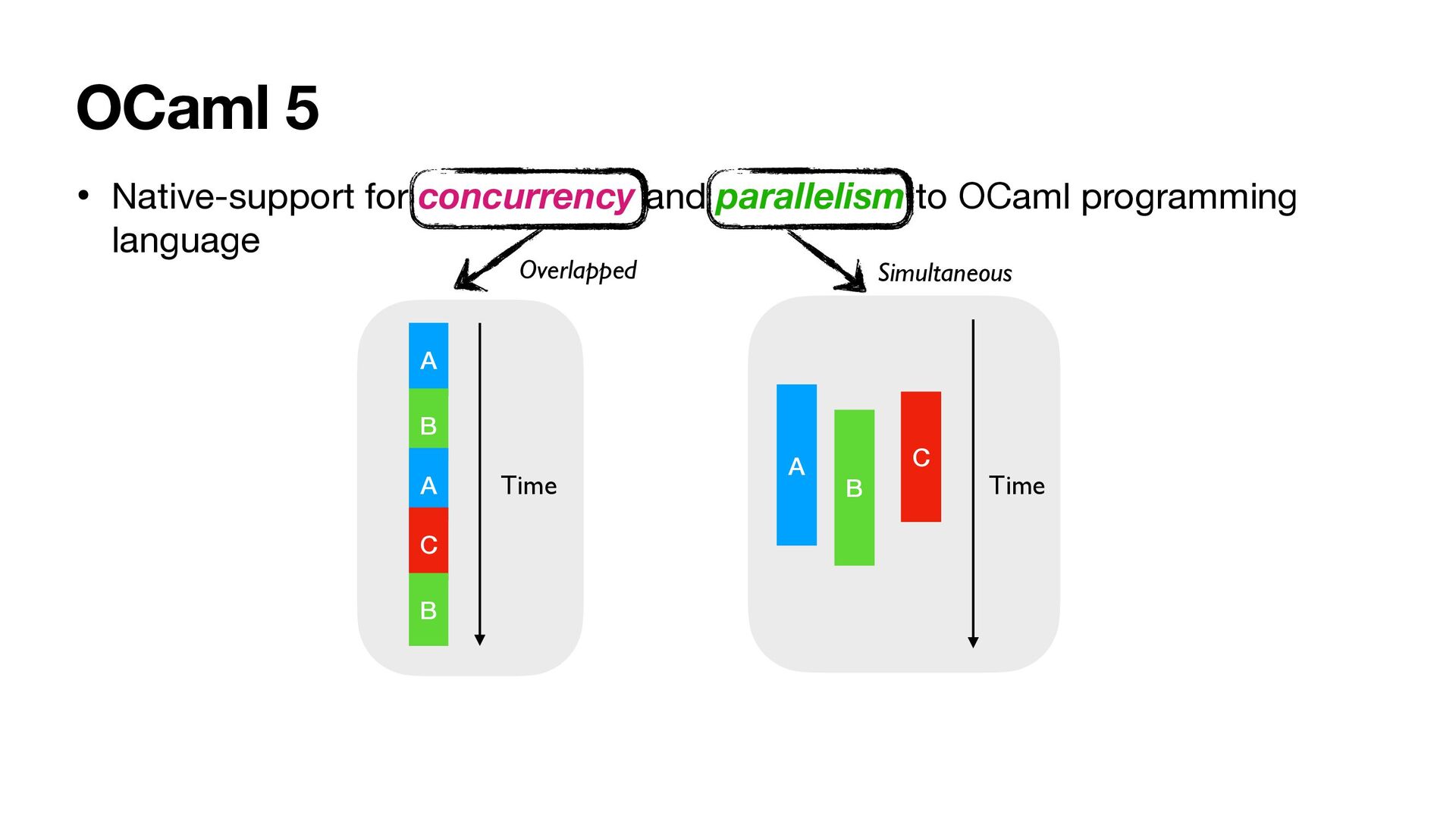
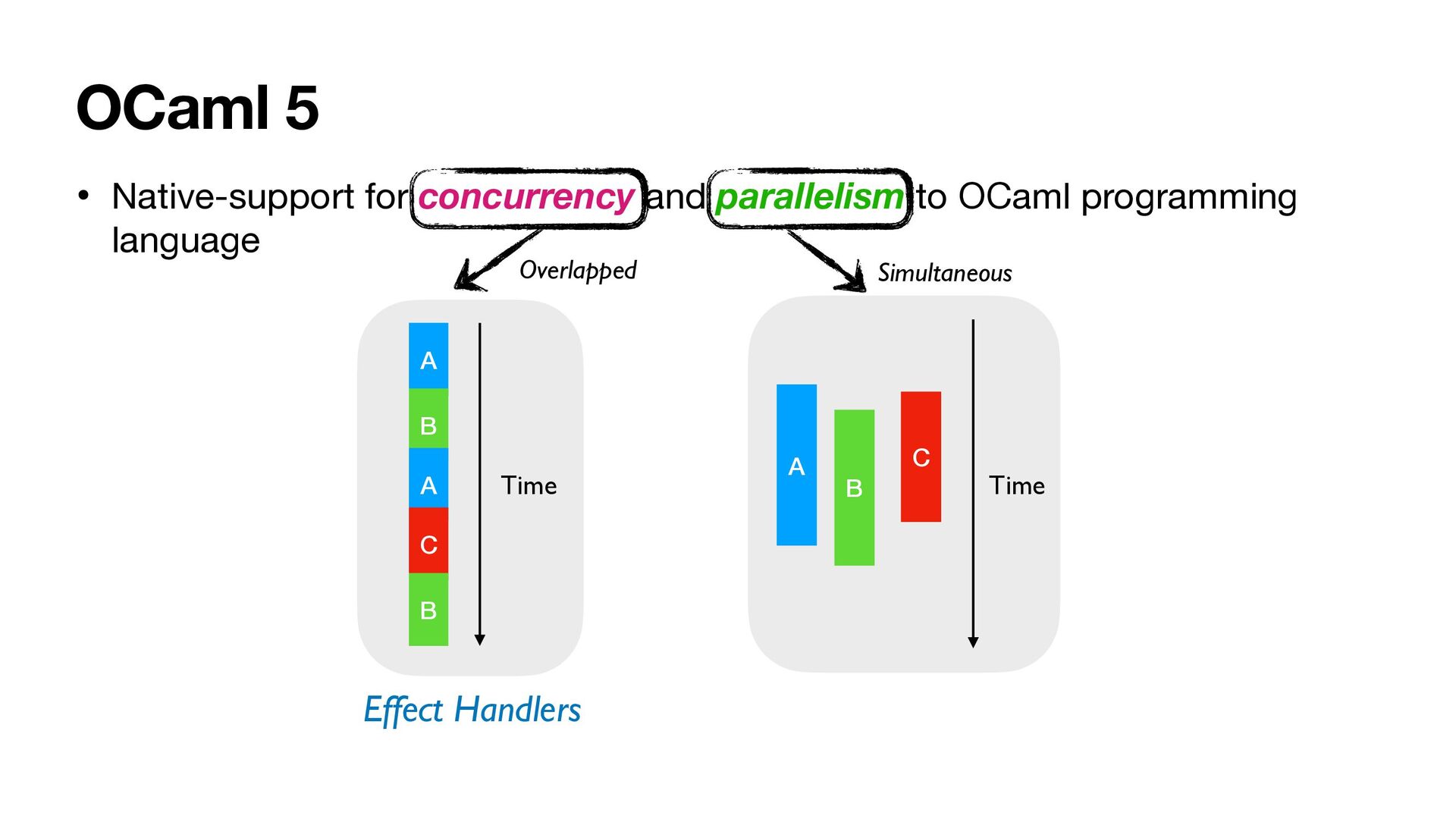
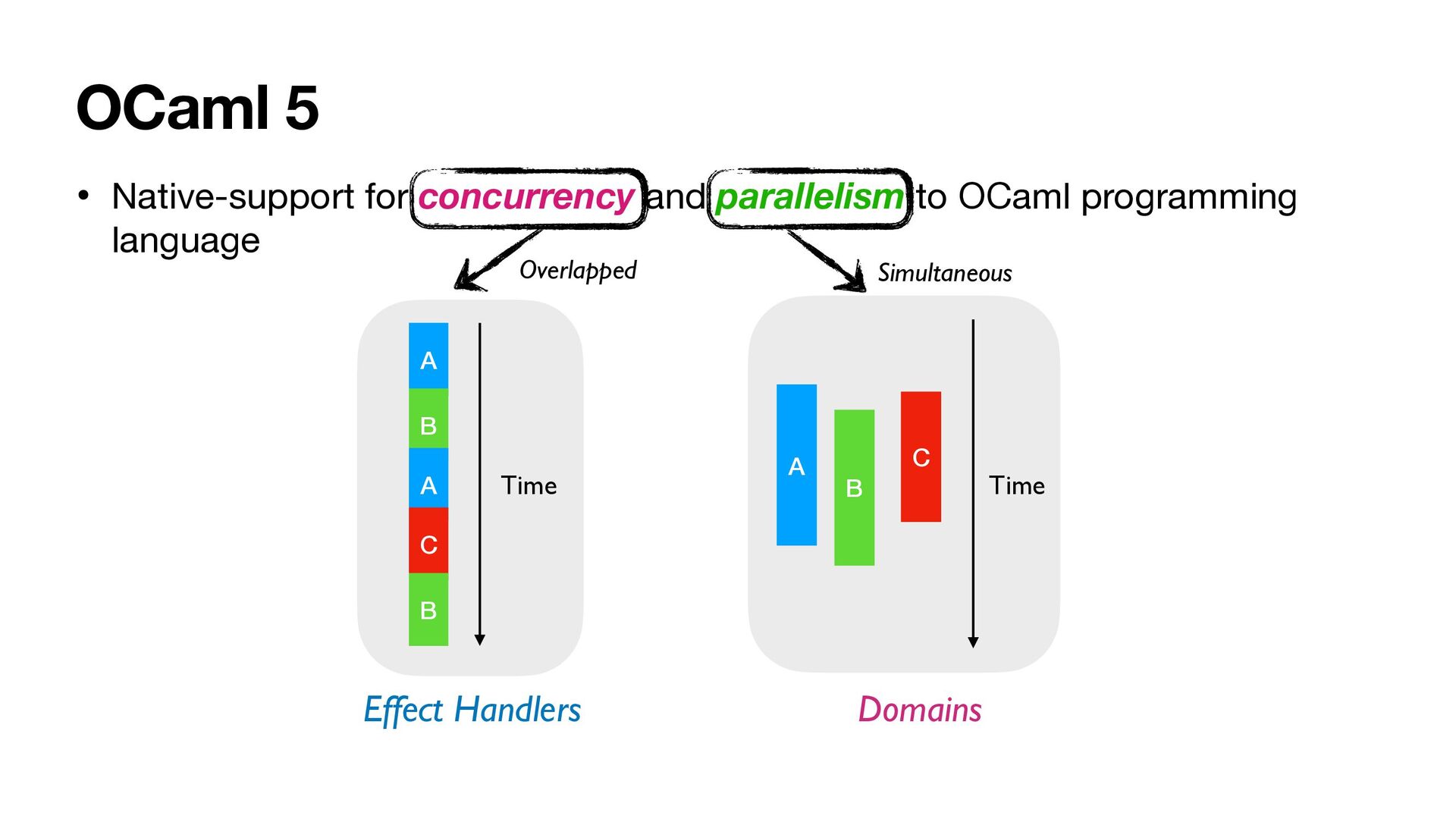
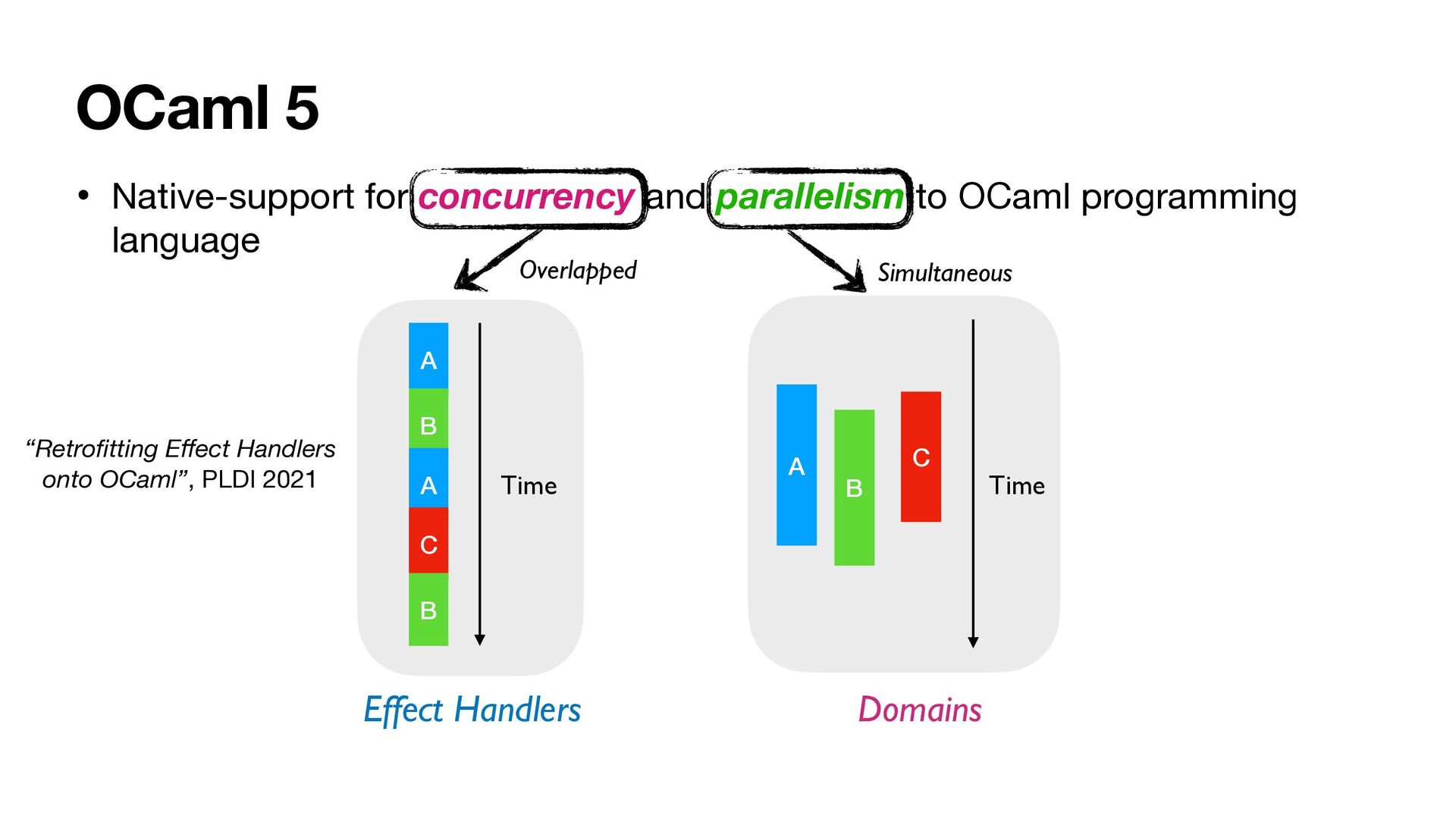
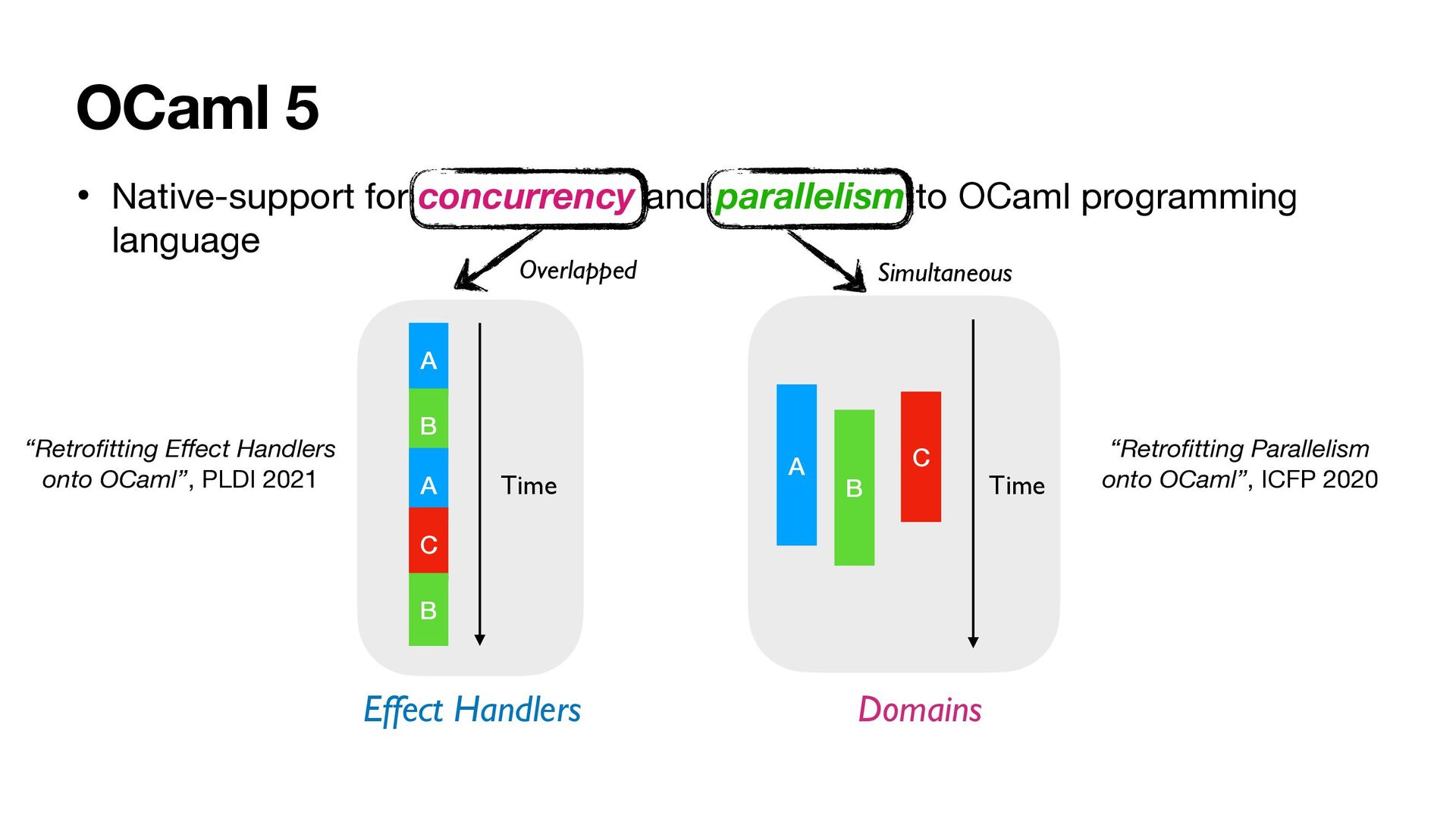
OCaml 5 • Native-support for concurrency and parallelism to OCaml
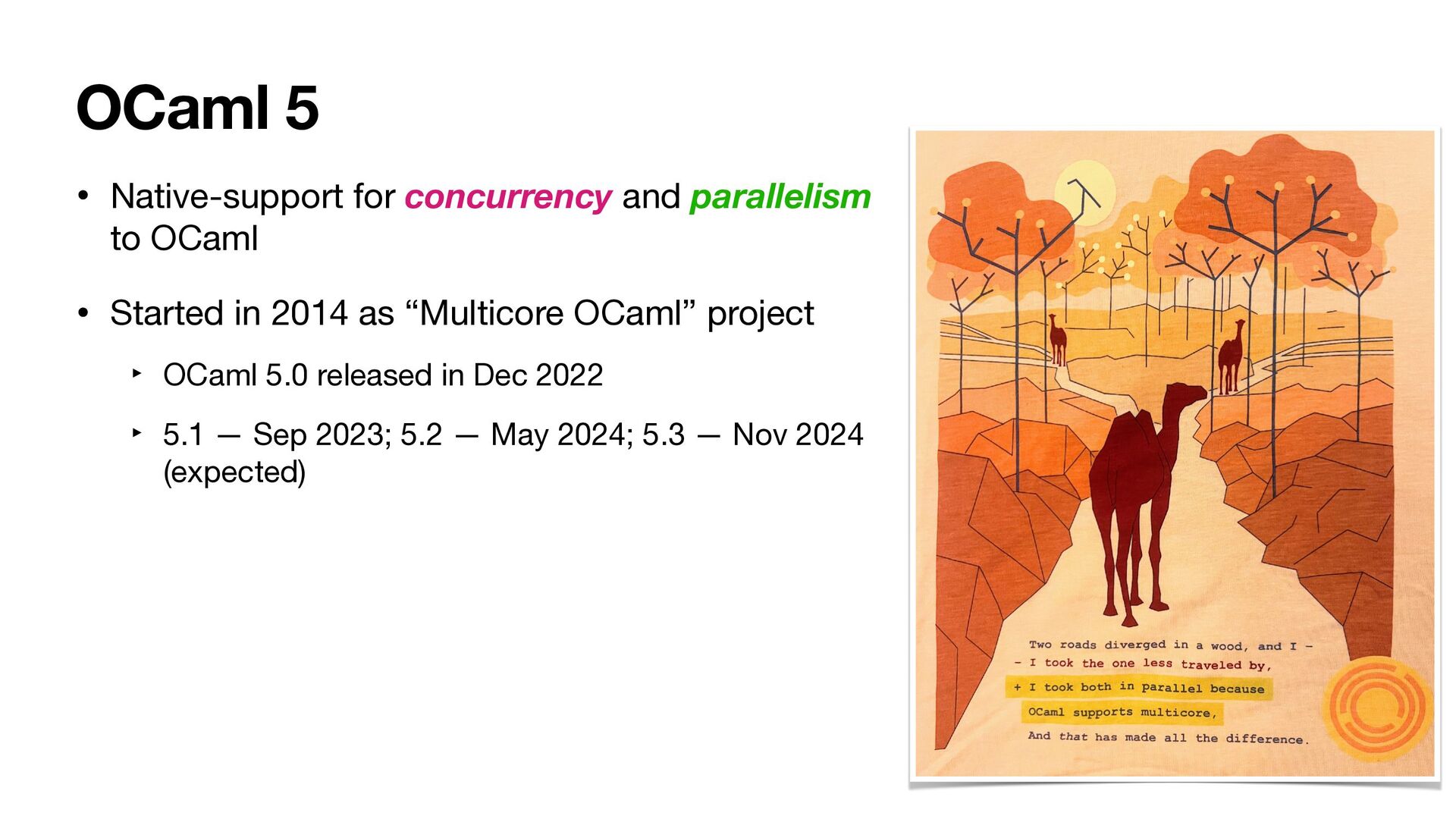
• Started in 2014 as “Multicore OCaml” project ‣ OCaml 5.0 released in Dec 2022 ‣ 5.1 — Sep 2023; 5.2 — May 2024; 5.3 — Nov 2024 (expected) -
OCaml 5 • Native-support for concurrency and parallelism to OCaml
• Started in 2014 as “Multicore OCaml” project ‣ OCaml 5.0 released in Dec 2022 ‣ 5.1 — Sep 2023; 5.2 — May 2024; 5.3 — Nov 2024 (expected) • This talk ‣ Concurrency ‣ Parallelism ‣ Experience porting from multi-process to multi-core -
OCaml 5 • Native-support for concurrency and parallelism to OCaml
programming language -
OCaml 5 • Native-support for concurrency and parallelism to OCaml
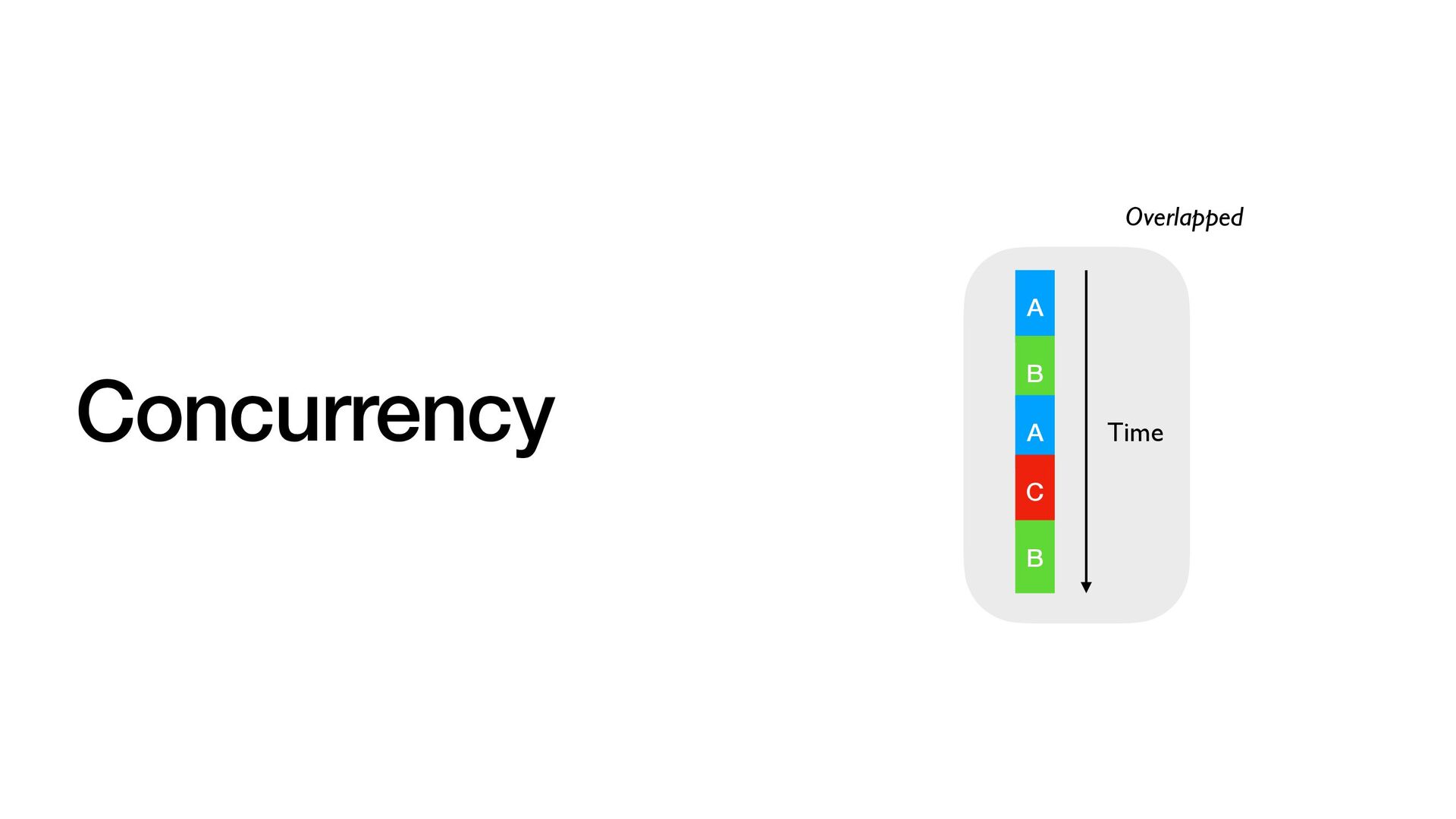
programming language Overlapped A B A C B Time -
OCaml 5 • Native-support for concurrency and parallelism to OCaml
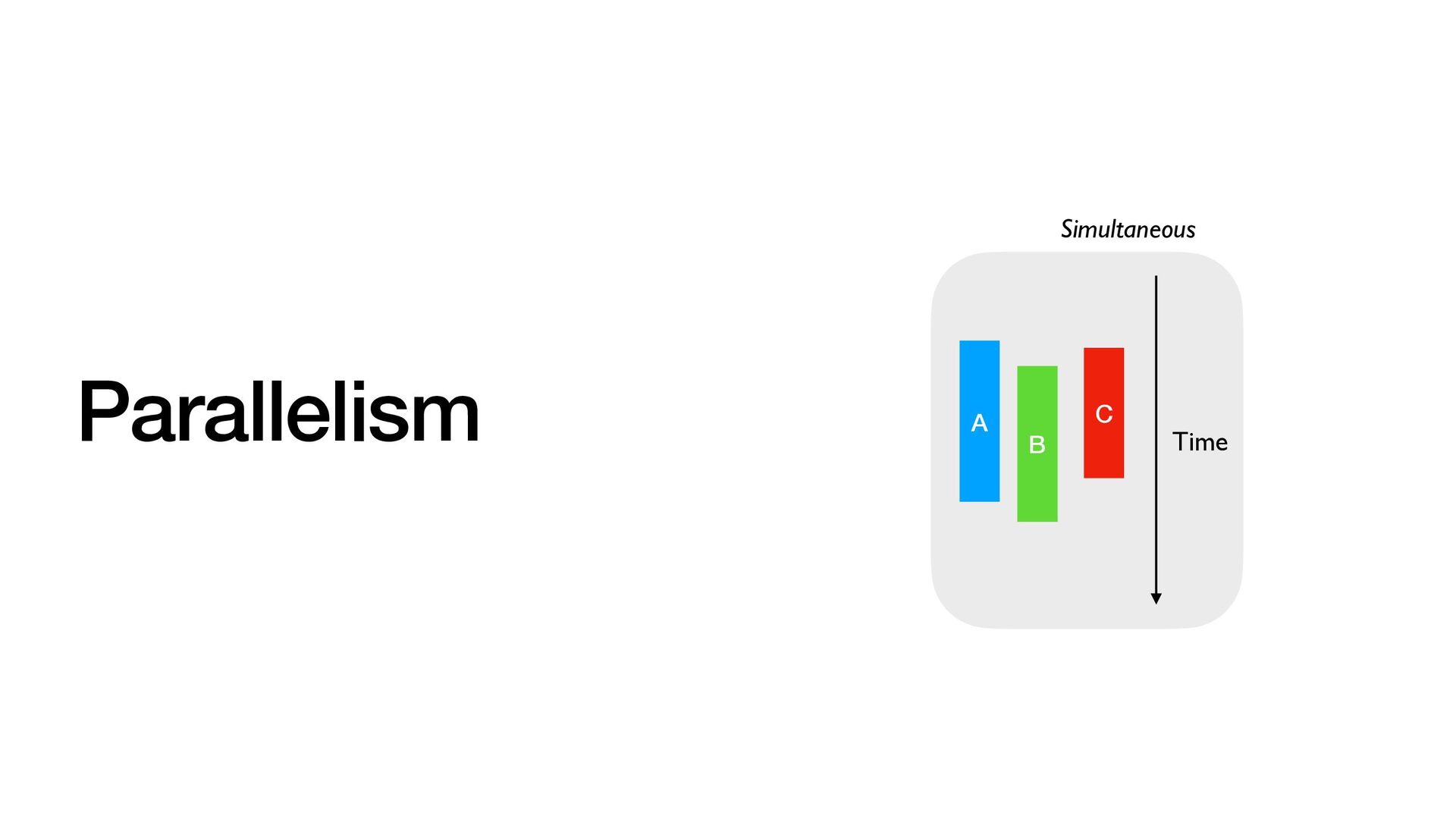
programming language Overlapped A B A C B Time Simultaneous A B C Time -
OCaml 5 • Native-support for concurrency and parallelism to OCaml
programming language Overlapped A B A C B Time Simultaneous A B C Time Effect Handlers -
OCaml 5 • Native-support for concurrency and parallelism to OCaml
programming language Overlapped A B A C B Time Simultaneous A B C Time Effect Handlers Domains -
OCaml 5 • Native-support for concurrency and parallelism to OCaml
programming language Overlapped A B A C B Time Simultaneous A B C Time “Retro fi tting E ff ect Handlers onto OCaml”, PLDI 2021 Effect Handlers Domains -
OCaml 5 • Native-support for concurrency and parallelism to OCaml
programming language Overlapped A B A C B Time Simultaneous A B C Time “Retro fi tting E ff ect Handlers onto OCaml”, PLDI 2021 Effect Handlers Domains “Retro fi tting Parallelism onto OCaml”, ICFP 2020 -
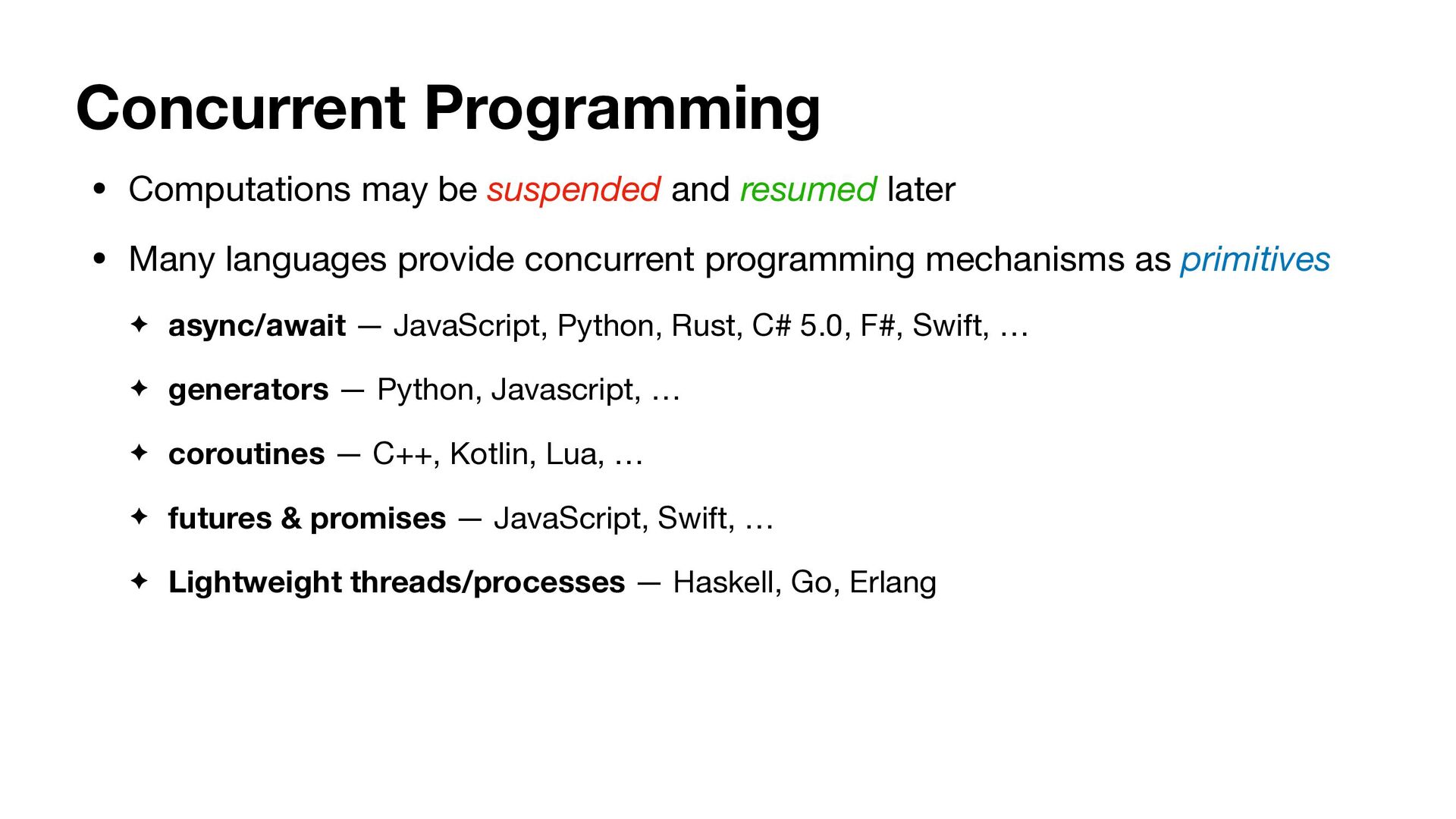
• Computations may be suspended and resumed later • Many
languages provide concurrent programming mechanisms as primitives ✦ async/await — JavaScript, Python, Rust, C# 5.0, F#, Swift, … ✦ generators — Python, Javascript, … ✦ coroutines — C++, Kotlin, Lua, … ✦ futures & promises — JavaScript, Swift, … ✦ Lightweight threads/processes — Haskell, Go, Erlang Concurrent Programming -
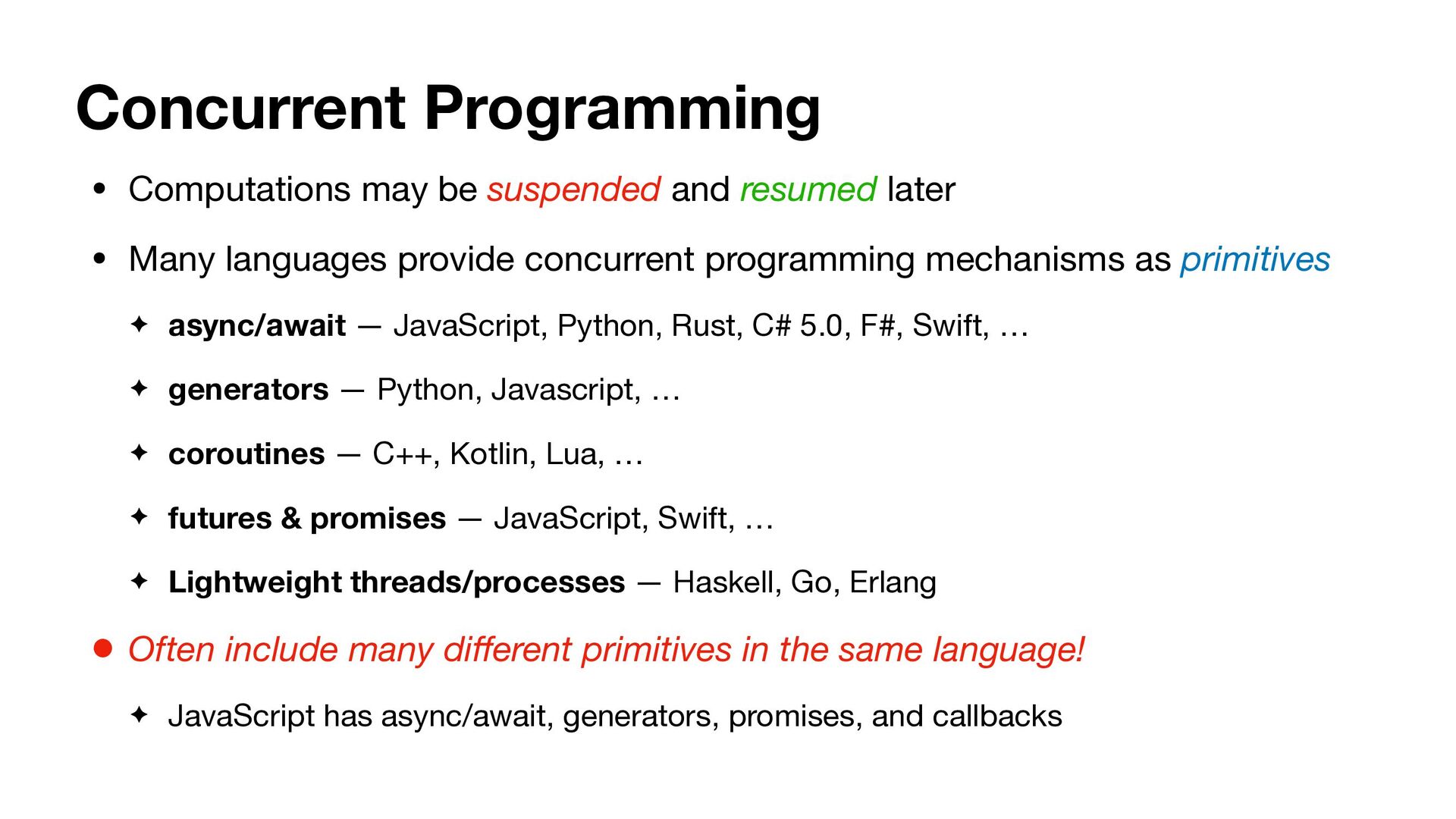
• Computations may be suspended and resumed later • Many
languages provide concurrent programming mechanisms as primitives ✦ async/await — JavaScript, Python, Rust, C# 5.0, F#, Swift, … ✦ generators — Python, Javascript, … ✦ coroutines — C++, Kotlin, Lua, … ✦ futures & promises — JavaScript, Swift, … ✦ Lightweight threads/processes — Haskell, Go, Erlang • Often include many di ff erent primitives in the same language! ✦ JavaScript has async/await, generators, promises, and callbacks Concurrent Programming -
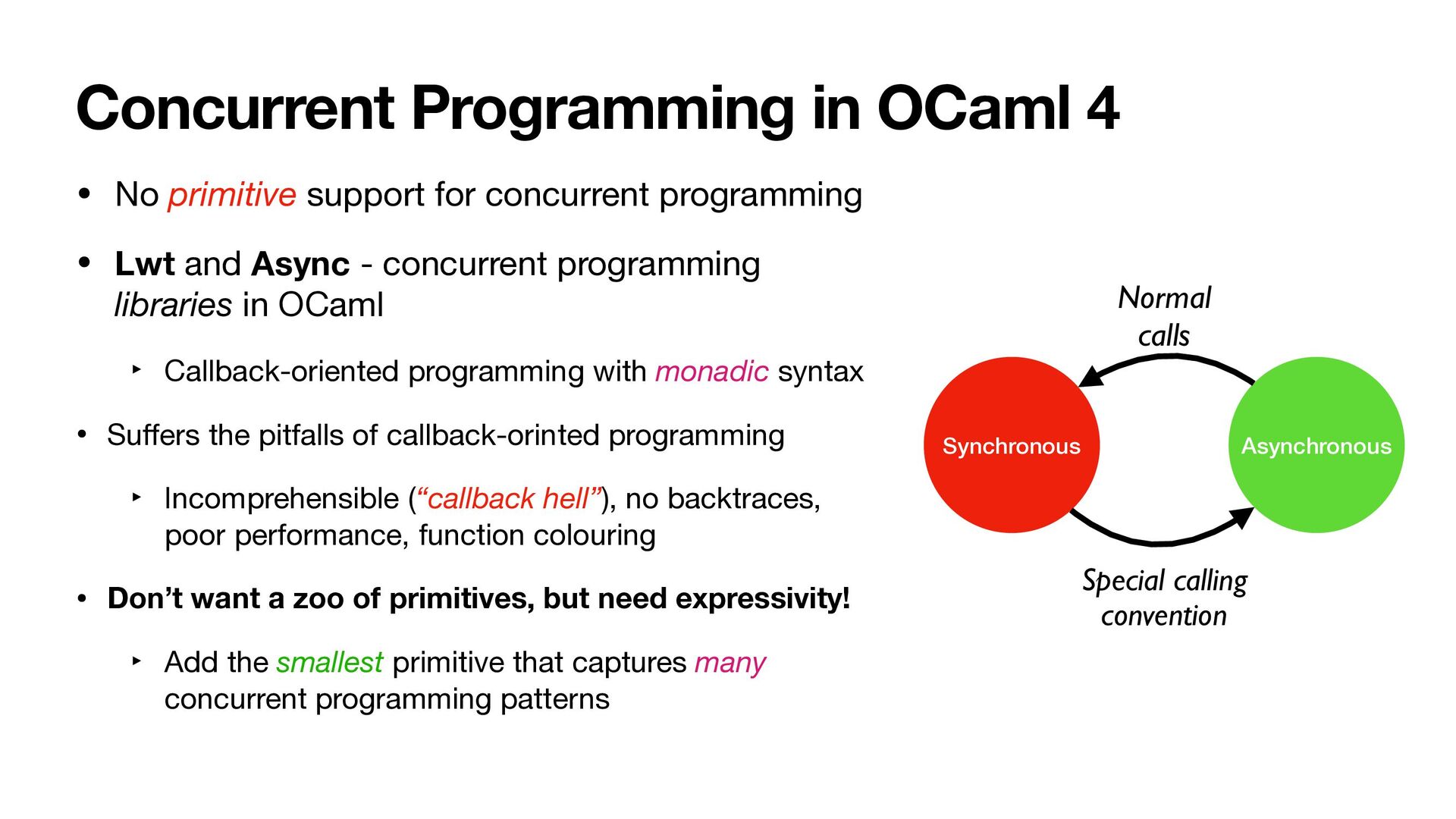
Concurrent Programming in OCaml 4 • No primitive support for
concurrent programming -
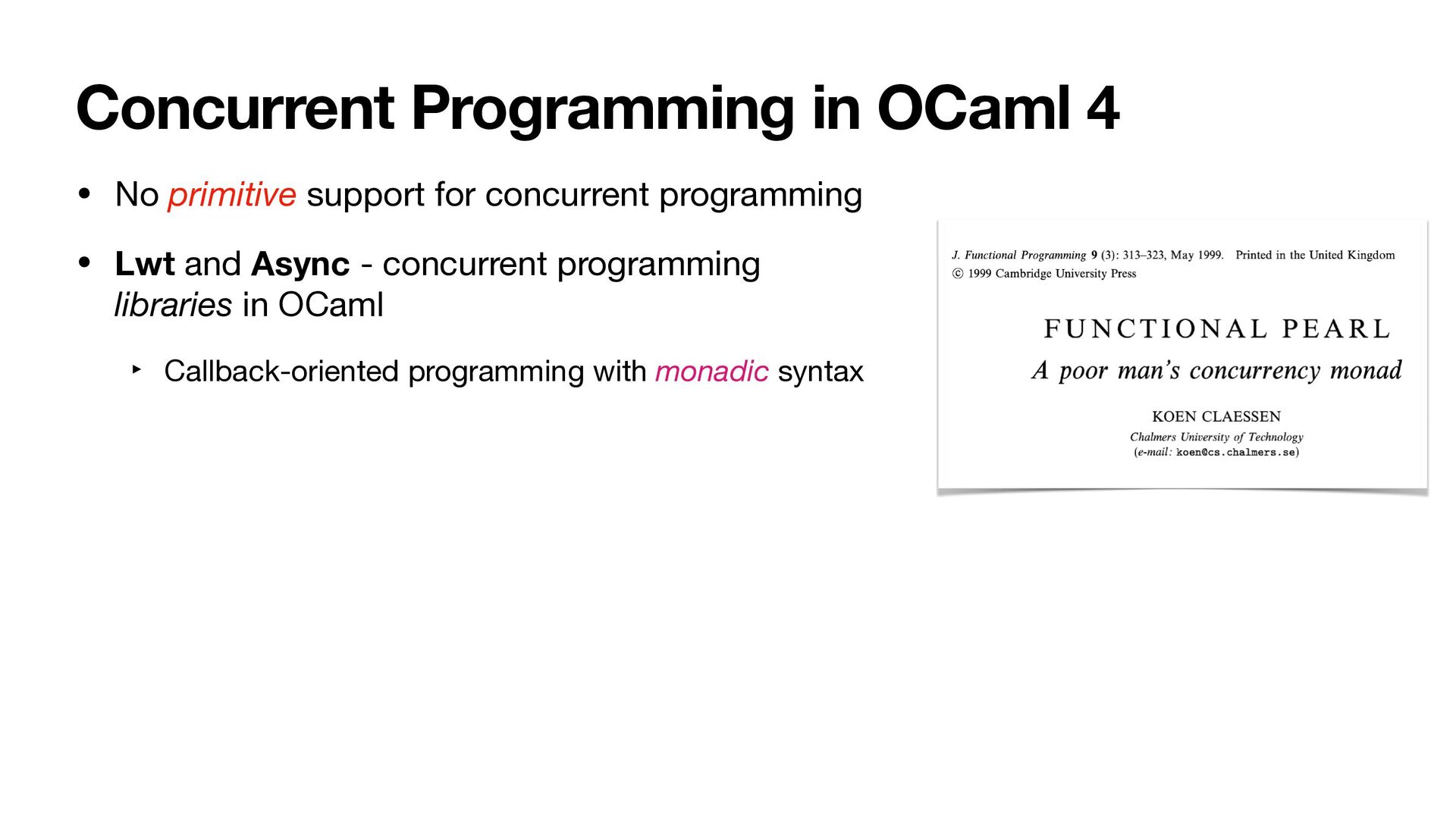
Concurrent Programming in OCaml 4 • No primitive support for
concurrent programming • Lwt and Async - concurrent programming libraries in OCaml ‣ Callback-oriented programming with monadic syntax -
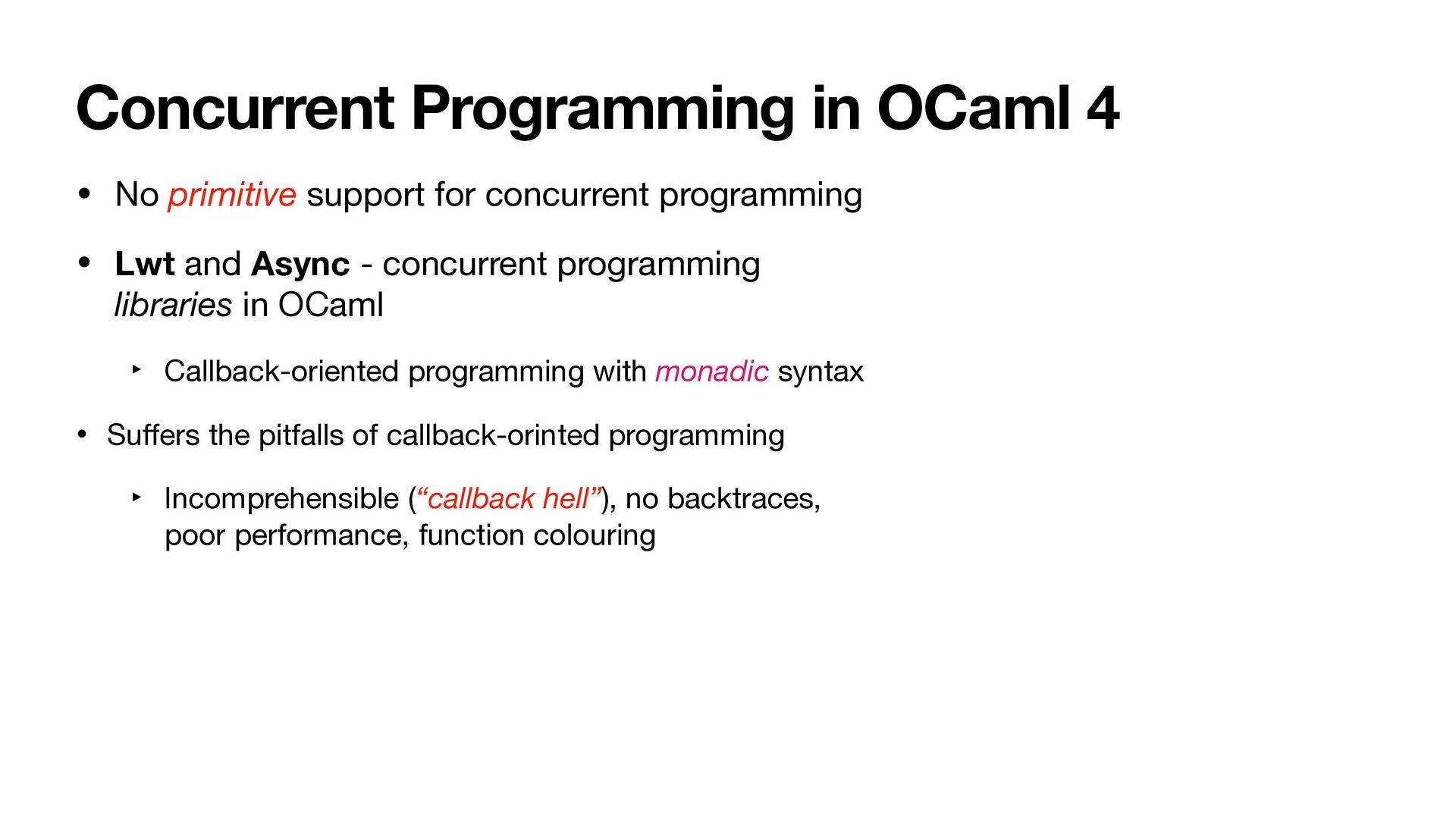
Concurrent Programming in OCaml 4 • No primitive support for
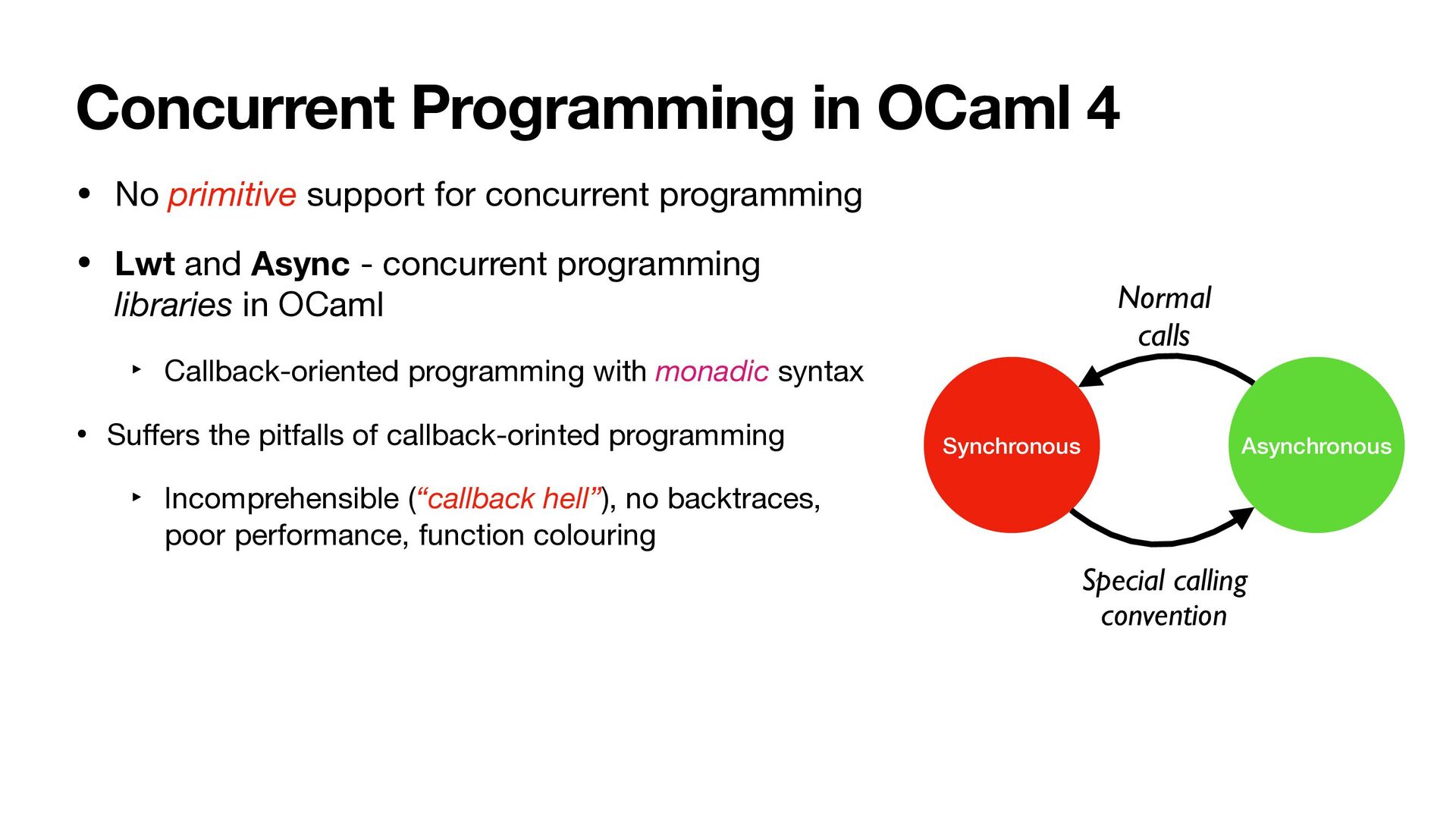
concurrent programming • Lwt and Async - concurrent programming libraries in OCaml ‣ Callback-oriented programming with monadic syntax • Su ff ers the pitfalls of callback-orinted programming ‣ Incomprehensible (“callback hell”), no backtraces, poor performance, function colouring -
Concurrent Programming in OCaml 4 • No primitive support for
concurrent programming • Lwt and Async - concurrent programming libraries in OCaml ‣ Callback-oriented programming with monadic syntax • Su ff ers the pitfalls of callback-orinted programming ‣ Incomprehensible (“callback hell”), no backtraces, poor performance, function colouring Synchronous Asynchronous Normal calls Special calling convention -
Concurrent Programming in OCaml 4 • No primitive support for
concurrent programming • Lwt and Async - concurrent programming libraries in OCaml ‣ Callback-oriented programming with monadic syntax • Su ff ers the pitfalls of callback-orinted programming ‣ Incomprehensible (“callback hell”), no backtraces, poor performance, function colouring • Don’t want a zoo of primitives, but need expressivity! ‣ Add the smallest primitive that captures many concurrent programming patterns Synchronous Asynchronous Normal calls Special calling convention -
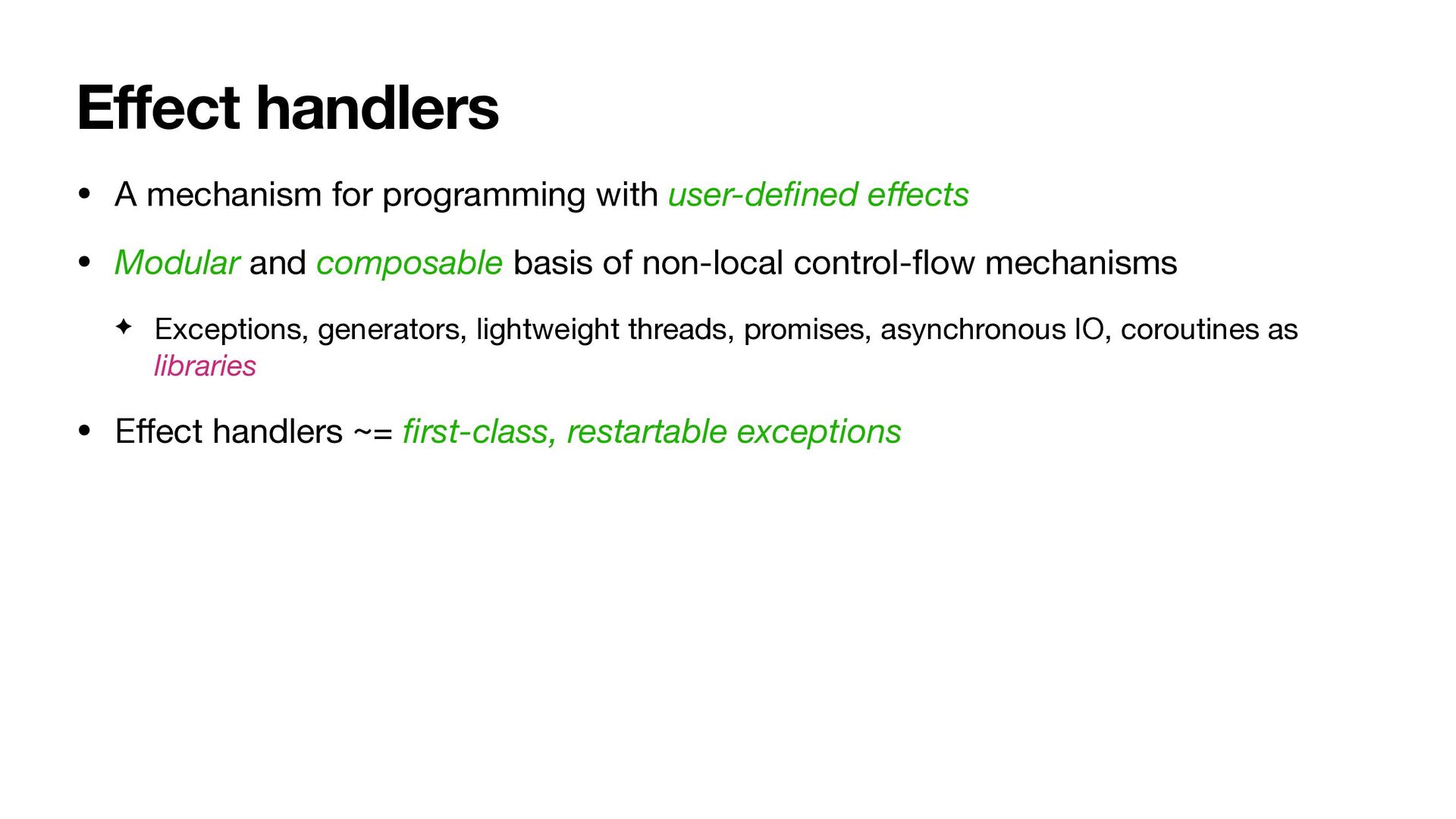
Effect handlers • A mechanism for programming with user-de fi
ned e ff ects • Modular and composable basis of non-local control- fl ow mechanisms -
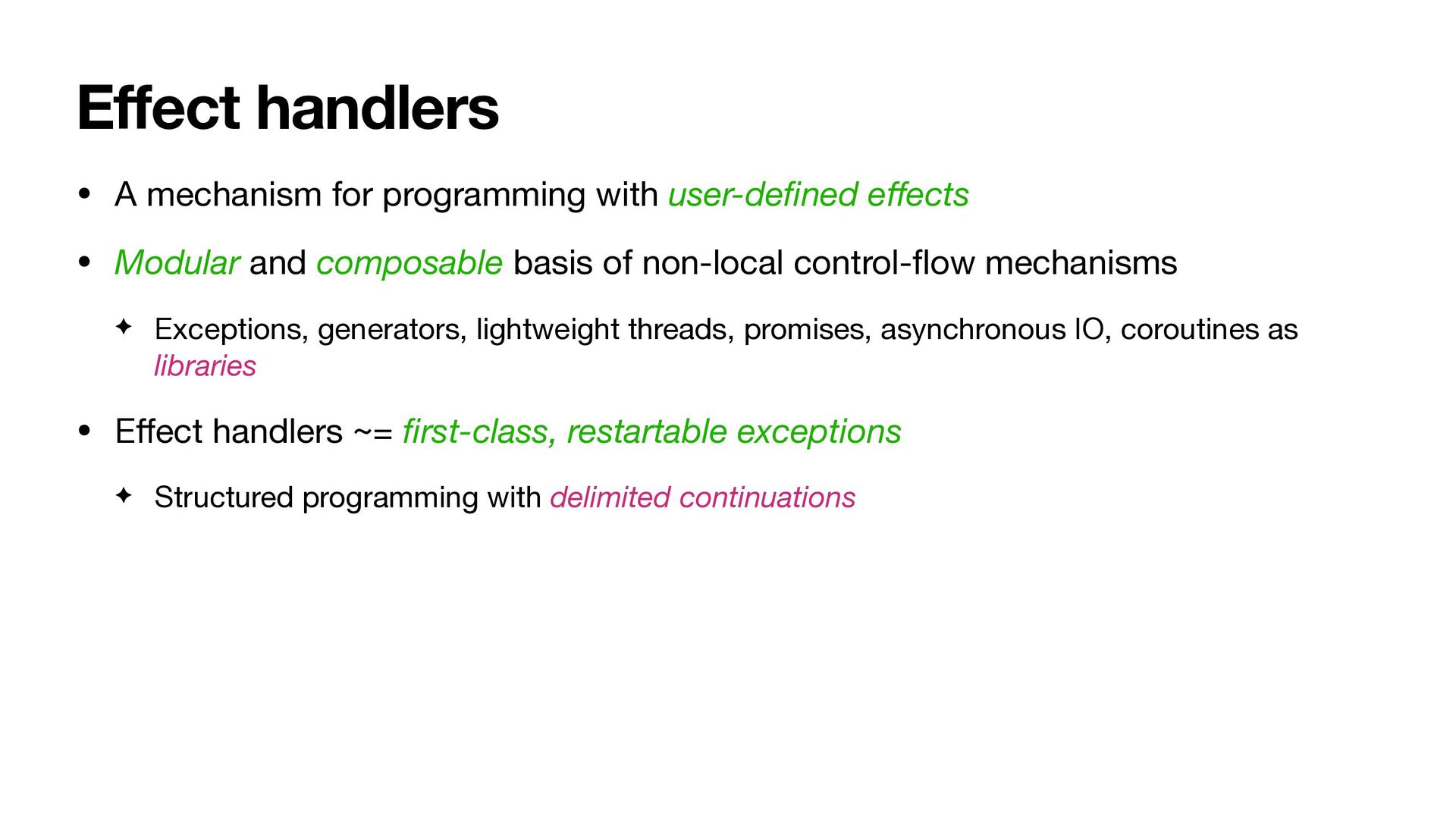
Effect handlers • A mechanism for programming with user-de fi
ned e ff ects • Modular and composable basis of non-local control- fl ow mechanisms ✦ Exceptions, generators, lightweight threads, promises, asynchronous IO, coroutines as libraries -
Effect handlers • A mechanism for programming with user-de fi
ned e ff ects • Modular and composable basis of non-local control- fl ow mechanisms ✦ Exceptions, generators, lightweight threads, promises, asynchronous IO, coroutines as libraries • E ff ect handlers ~= fi rst-class, restartable exceptions -
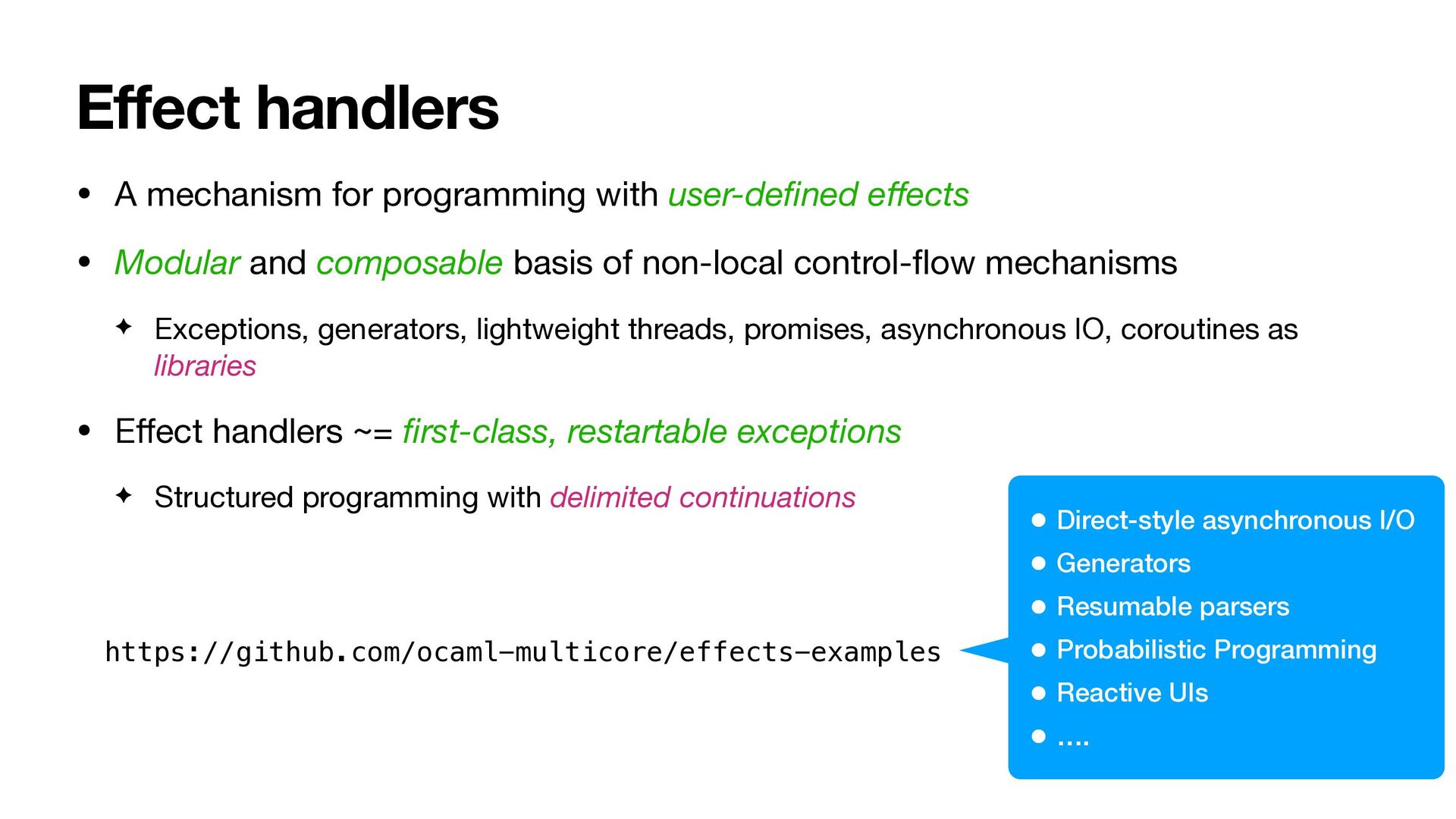
Effect handlers • A mechanism for programming with user-de fi
ned e ff ects • Modular and composable basis of non-local control- fl ow mechanisms ✦ Exceptions, generators, lightweight threads, promises, asynchronous IO, coroutines as libraries • E ff ect handlers ~= fi rst-class, restartable exceptions ✦ Structured programming with delimited continuations -
Effect handlers • A mechanism for programming with user-de fi
ned e ff ects • Modular and composable basis of non-local control- fl ow mechanisms ✦ Exceptions, generators, lightweight threads, promises, asynchronous IO, coroutines as libraries • E ff ect handlers ~= fi rst-class, restartable exceptions ✦ Structured programming with delimited continuations https://github.com/ocaml-multicore/effects-examples • Direct-style asynchronous I/O • Generators • Resumable parsers • Probabilistic Programming • Reactive UIs • …. -
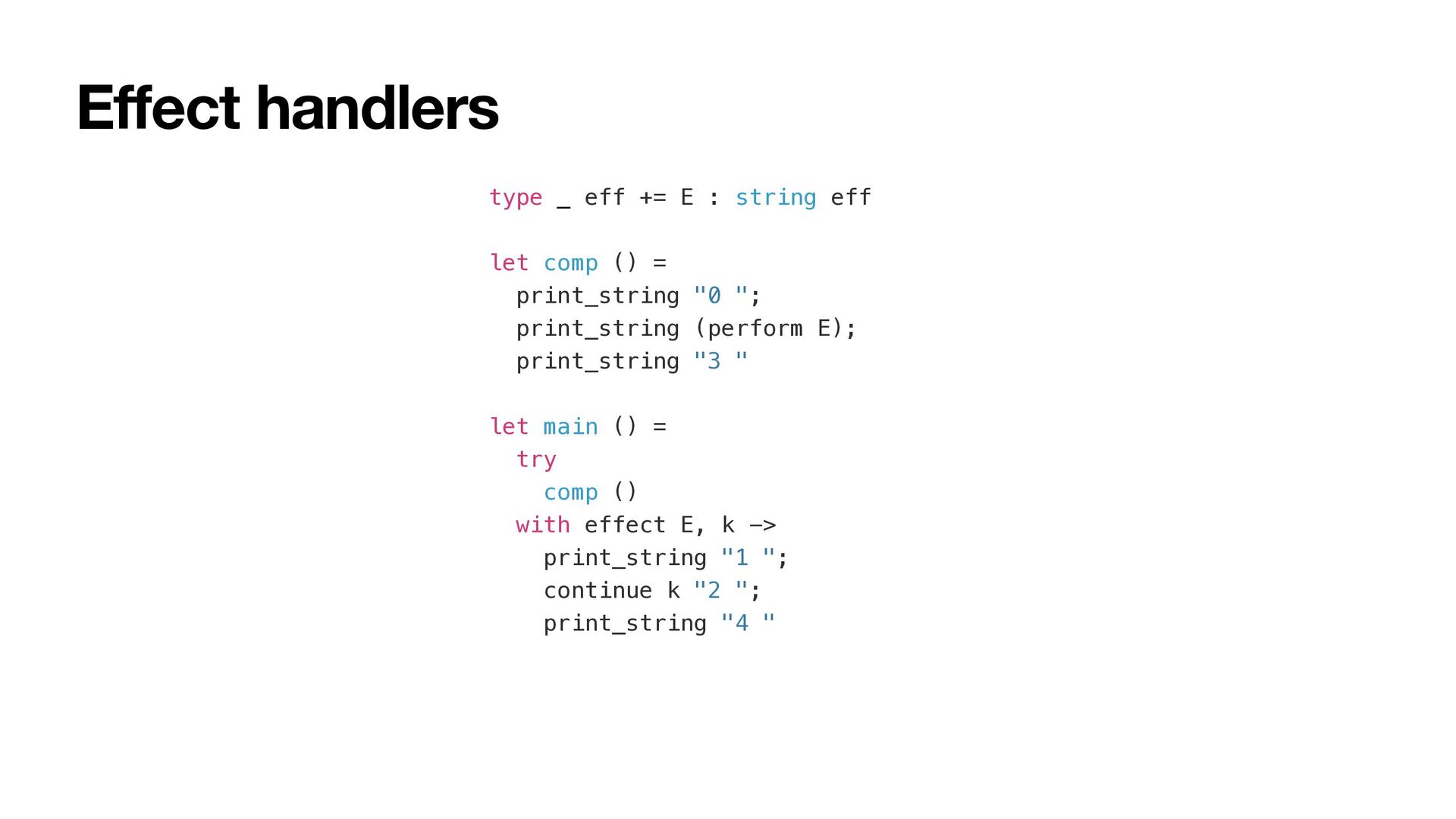
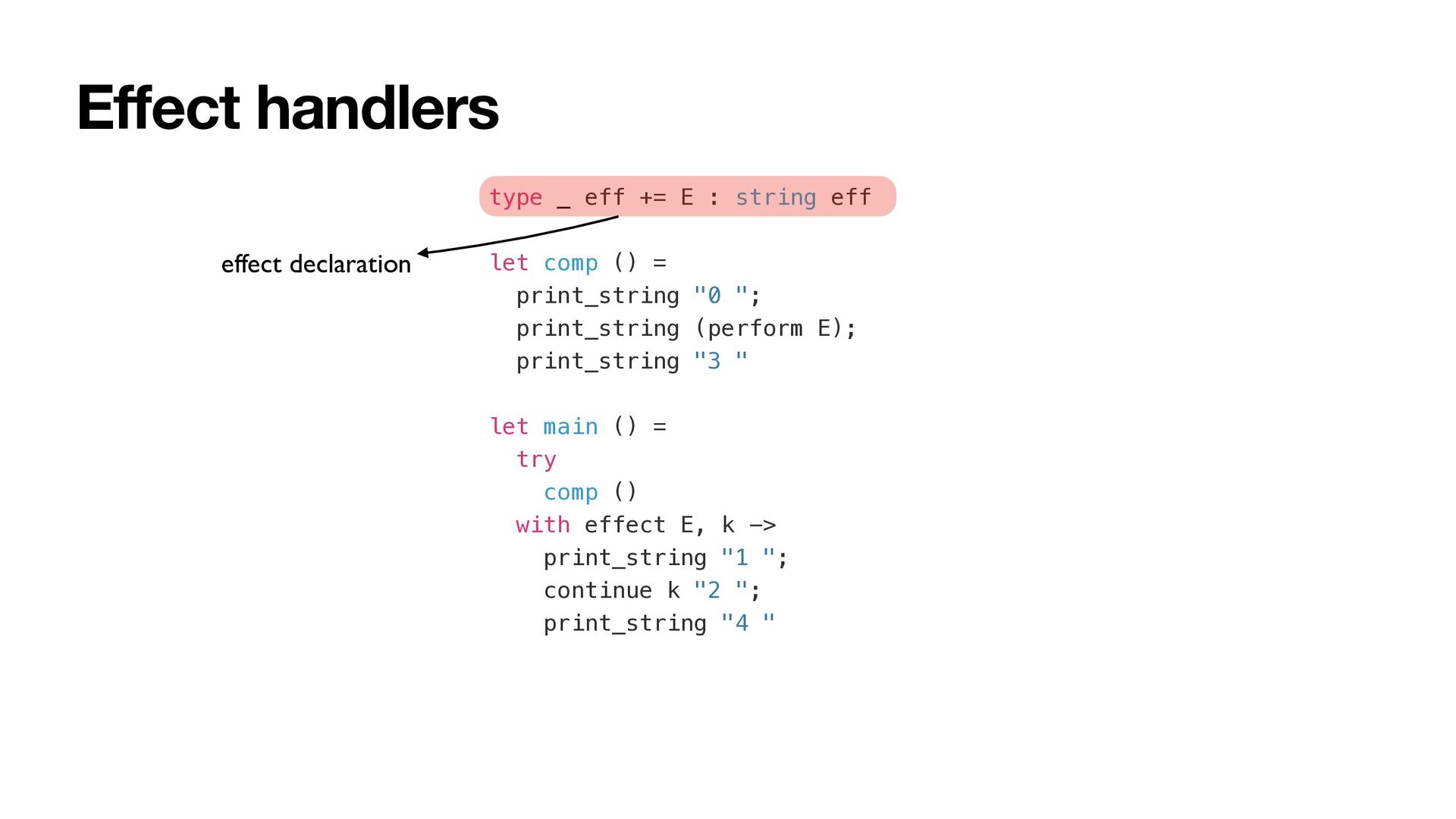
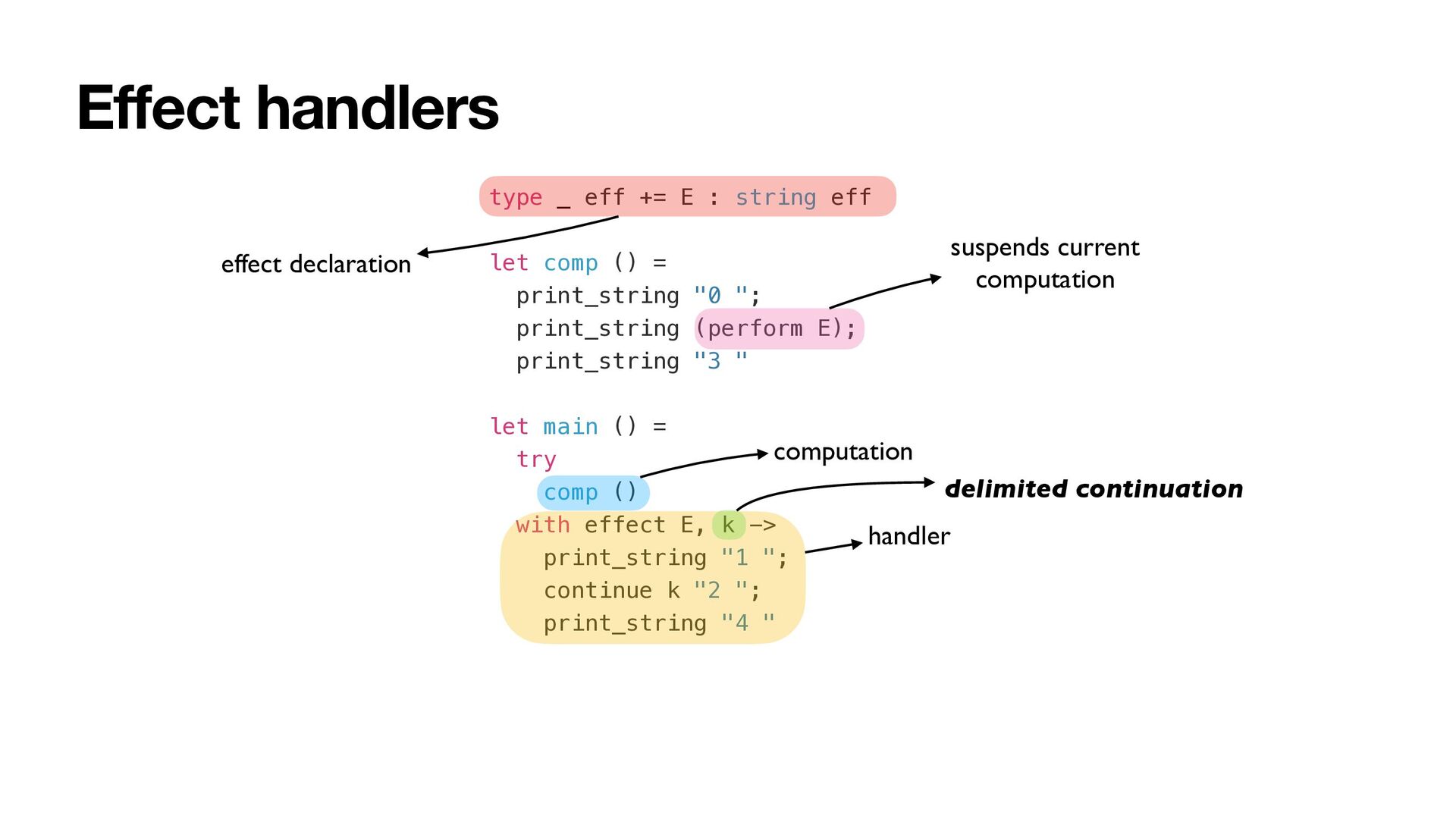
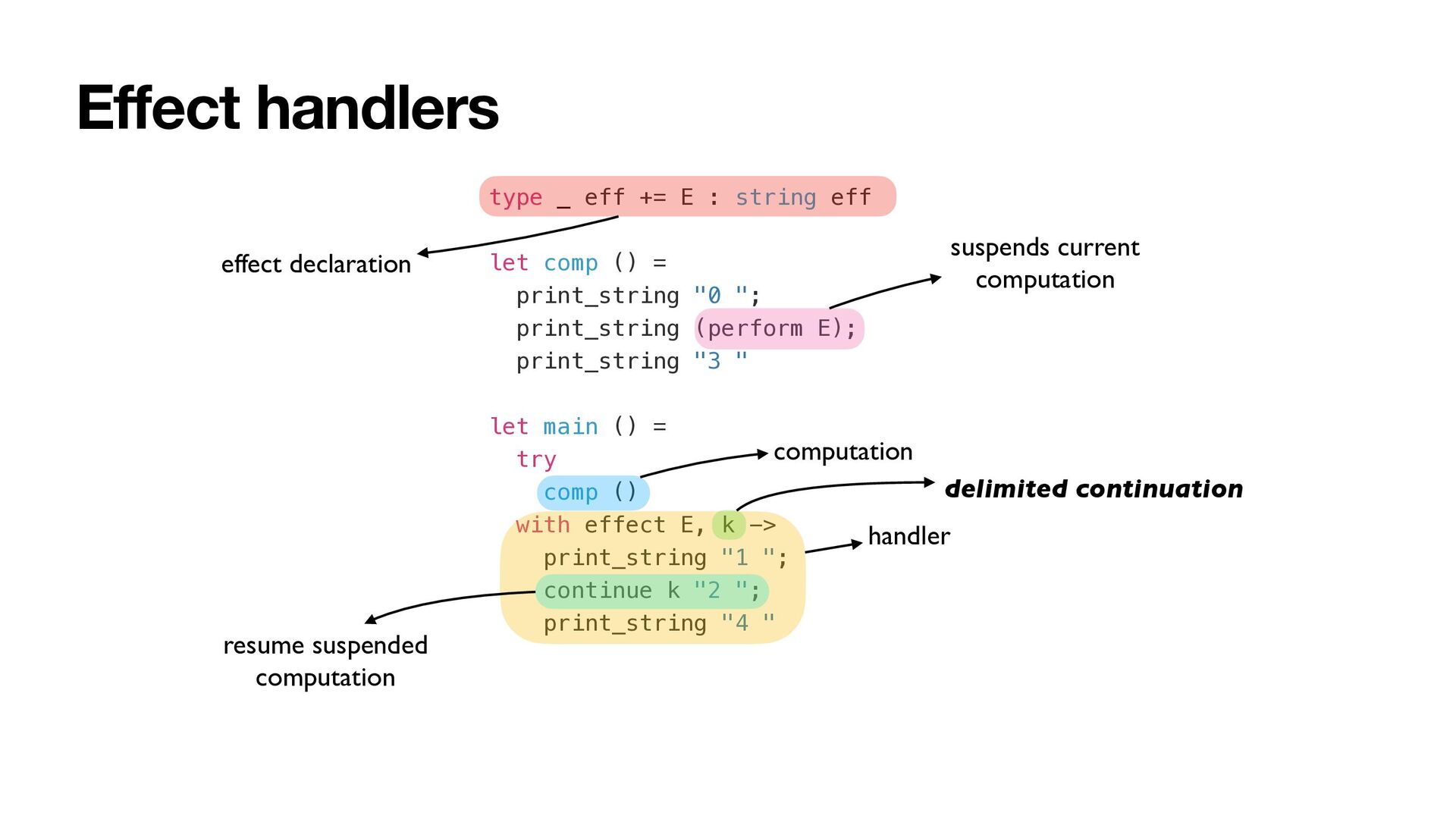
Effect handlers type _ eff += E : string eff
let comp () = print_string "0 "; print_string (perform E); print_string "3 " let main () = try comp () with effect E, k -> print_string "1 "; continue k "2 "; print_string "4 " -
Effect handlers type _ eff += E : string eff
let comp () = print_string "0 "; print_string (perform E); print_string "3 " let main () = try comp () with effect E, k -> print_string "1 "; continue k "2 "; print_string "4 " effect declaration -
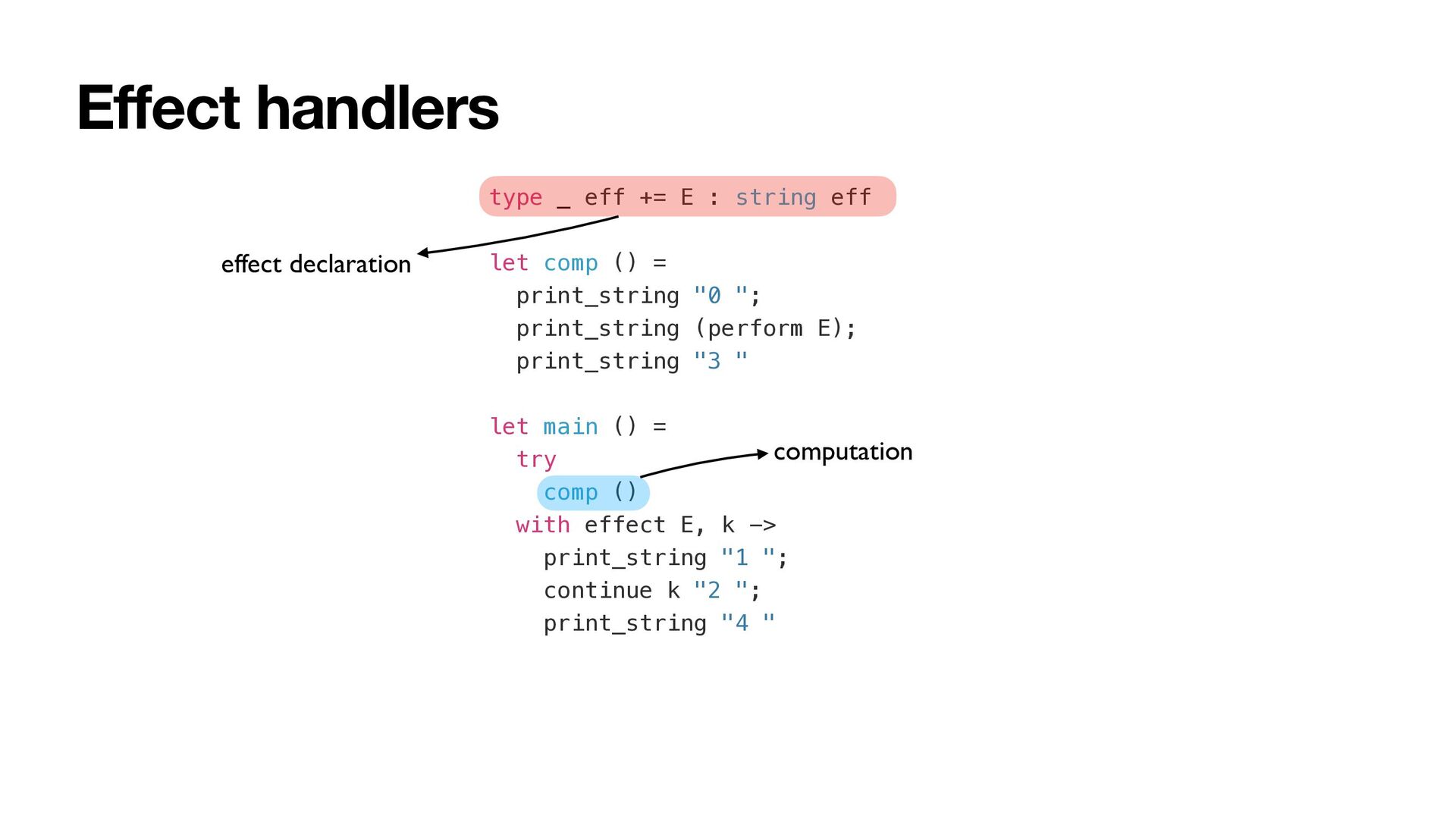
Effect handlers type _ eff += E : string eff
let comp () = print_string "0 "; print_string (perform E); print_string "3 " let main () = try comp () with effect E, k -> print_string "1 "; continue k "2 "; print_string "4 " computation effect declaration -
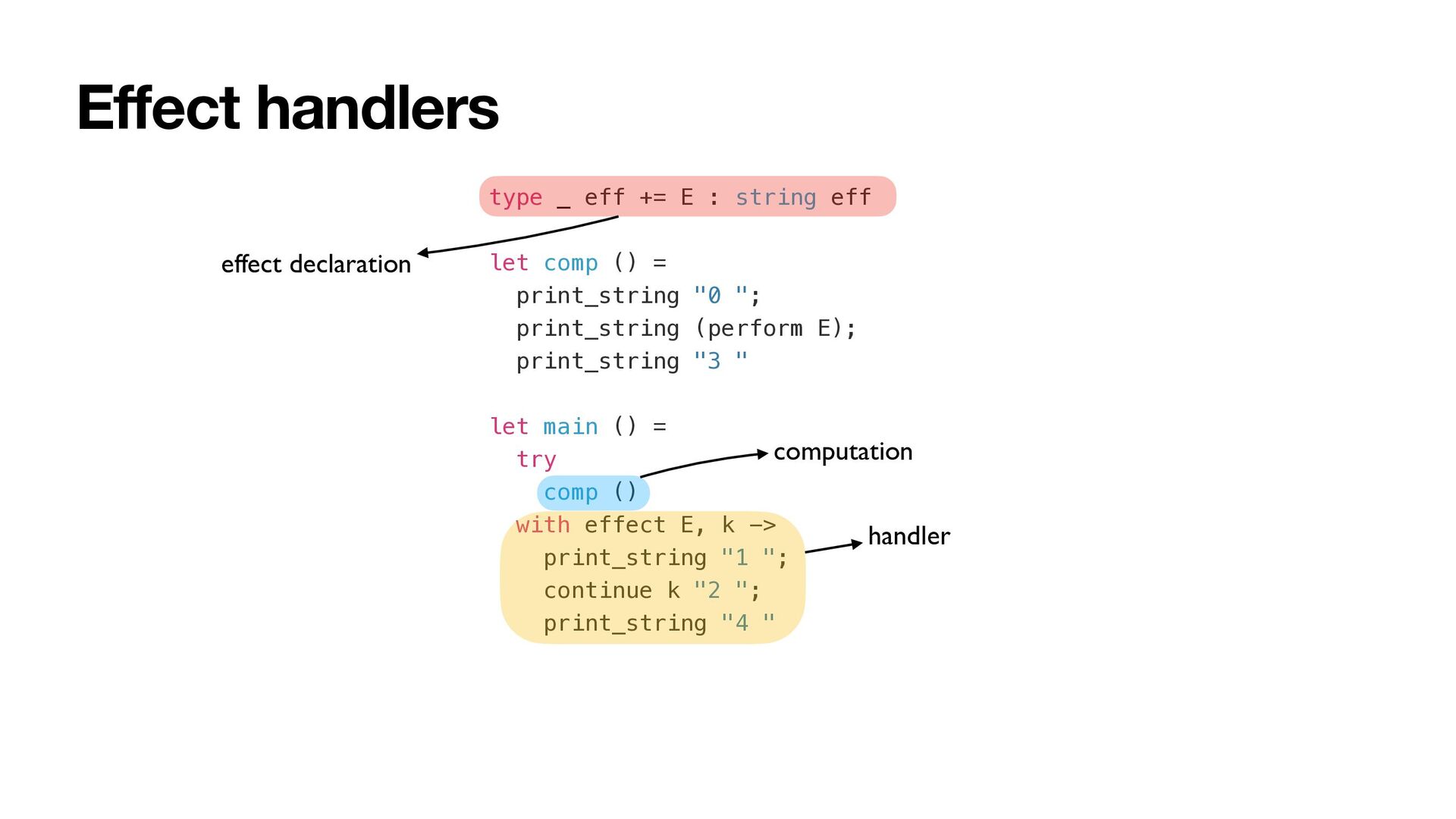
Effect handlers type _ eff += E : string eff
let comp () = print_string "0 "; print_string (perform E); print_string "3 " let main () = try comp () with effect E, k -> print_string "1 "; continue k "2 "; print_string "4 " computation handler effect declaration -
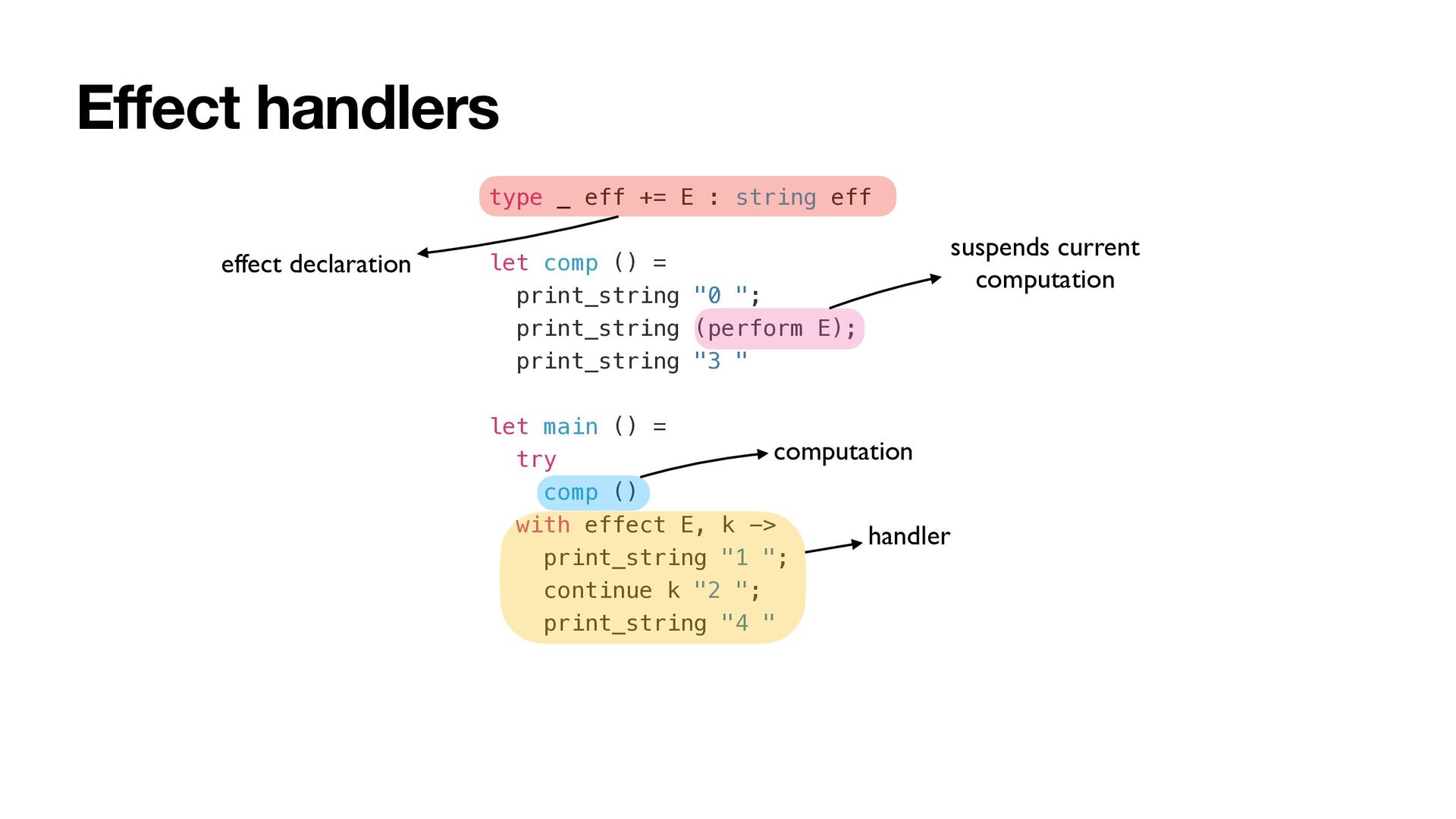
Effect handlers type _ eff += E : string eff
let comp () = print_string "0 "; print_string (perform E); print_string "3 " let main () = try comp () with effect E, k -> print_string "1 "; continue k "2 "; print_string "4 " computation handler suspends current computation effect declaration -
Effect handlers type _ eff += E : string eff
let comp () = print_string "0 "; print_string (perform E); print_string "3 " let main () = try comp () with effect E, k -> print_string "1 "; continue k "2 "; print_string "4 " computation handler delimited continuation suspends current computation effect declaration -
Effect handlers type _ eff += E : string eff
let comp () = print_string "0 "; print_string (perform E); print_string "3 " let main () = try comp () with effect E, k -> print_string "1 "; continue k "2 "; print_string "4 " computation handler delimited continuation suspends current computation resume suspended computation effect declaration -
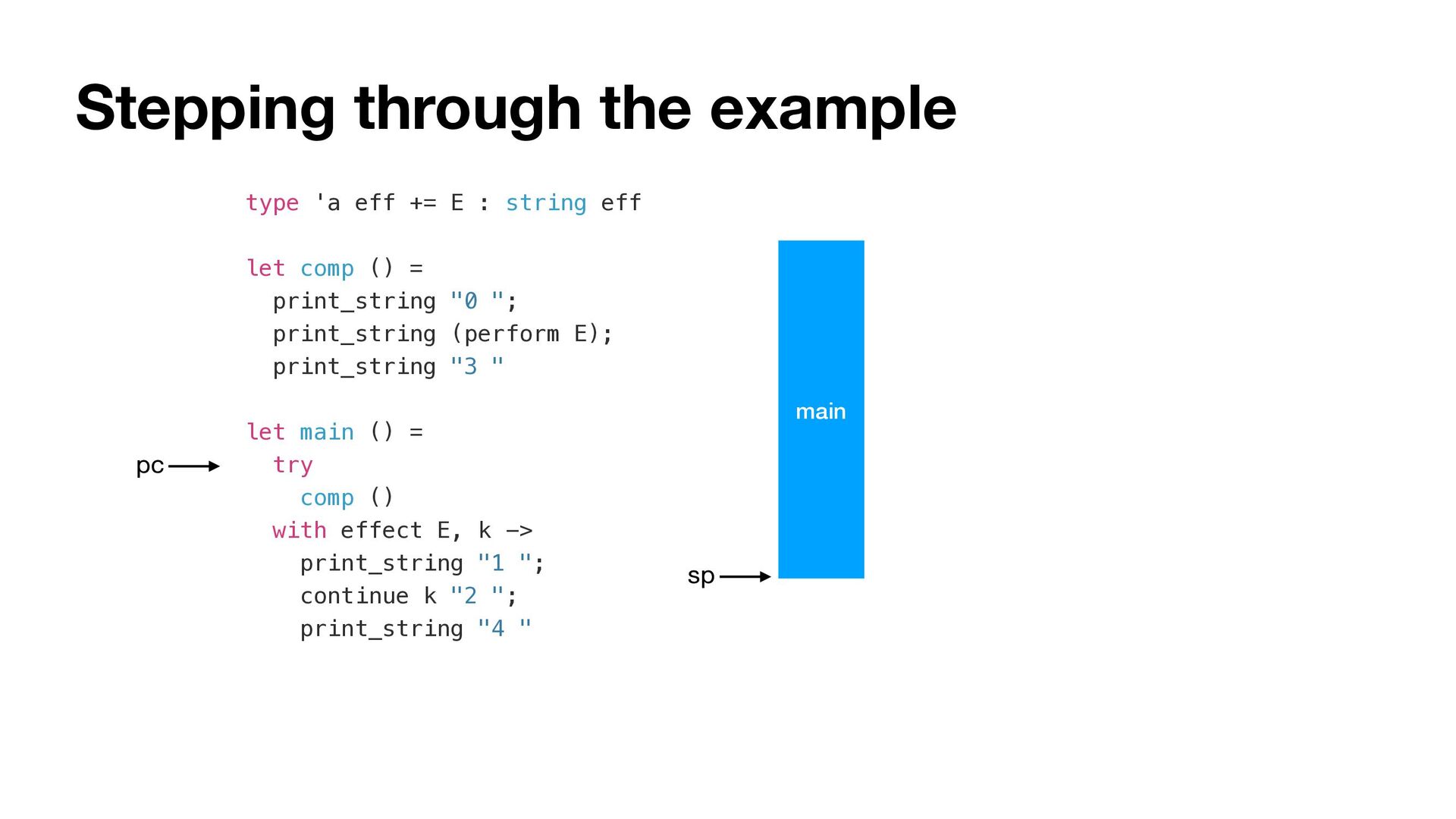
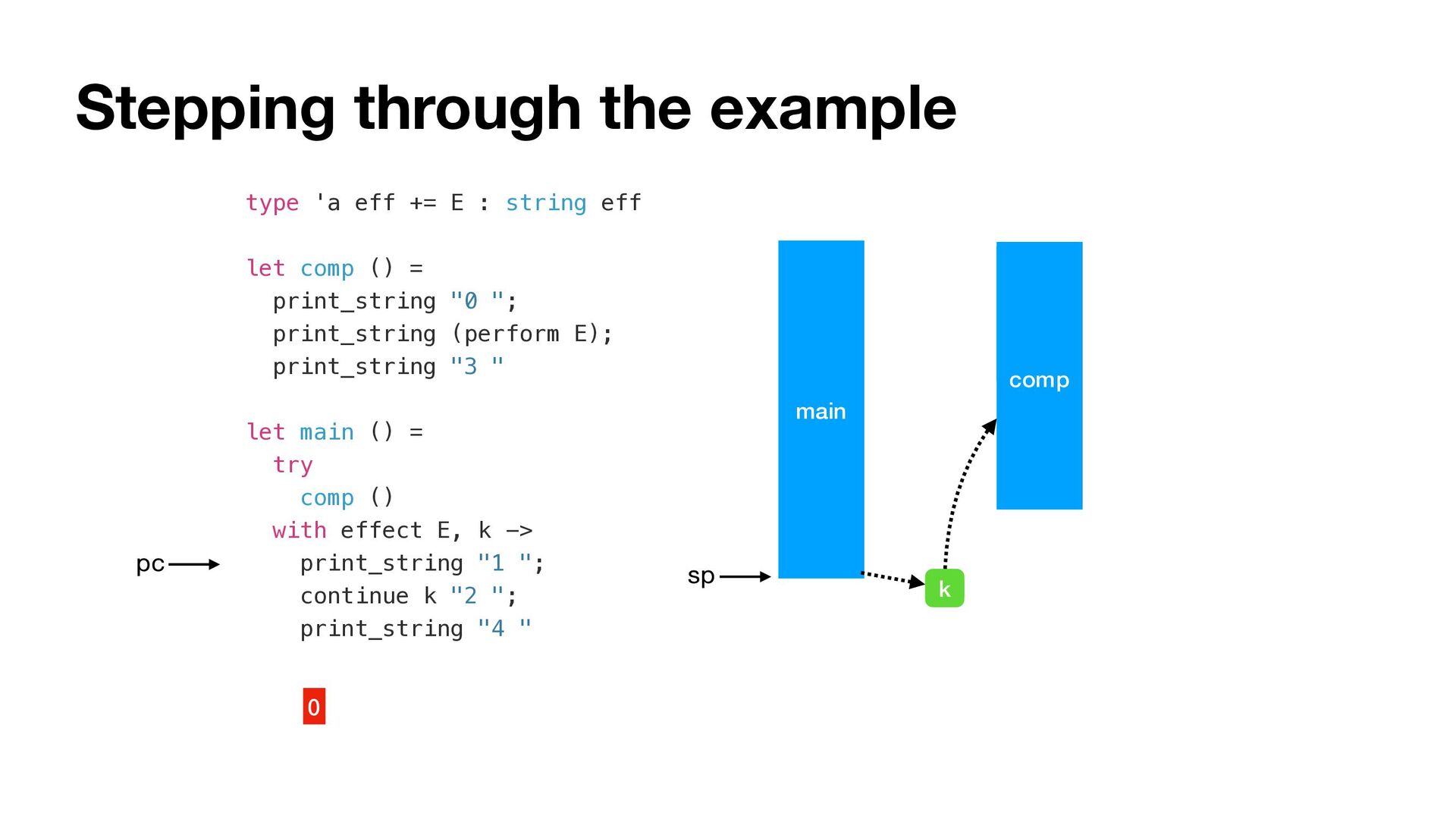
type 'a eff += E : string eff let comp
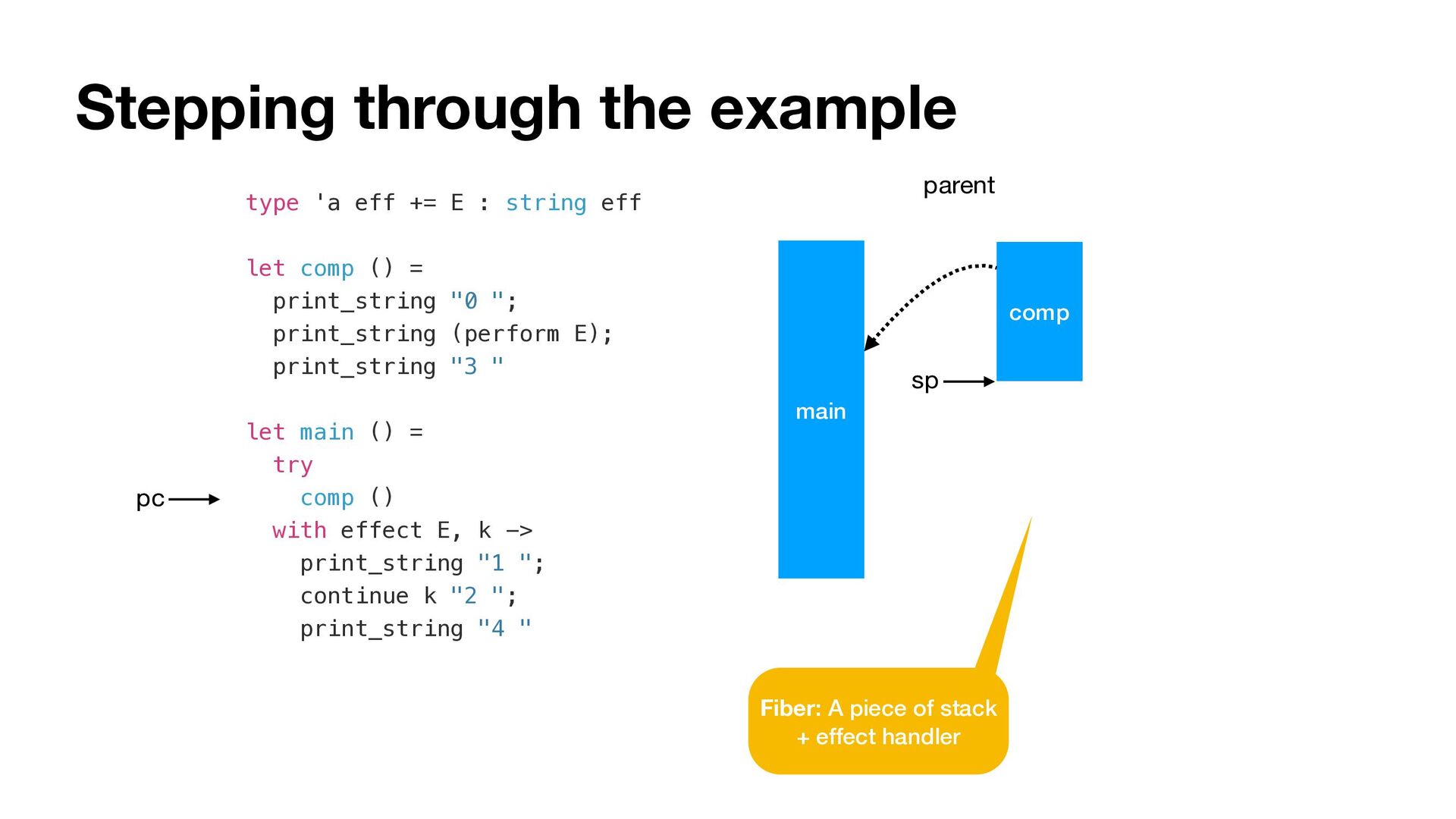
() = print_string "0 "; print_string (perform E); print_string "3 " let main () = try comp () with effect E, k -> print_string "1 "; continue k "2 "; print_string "4 " pc main sp Stepping through the example -
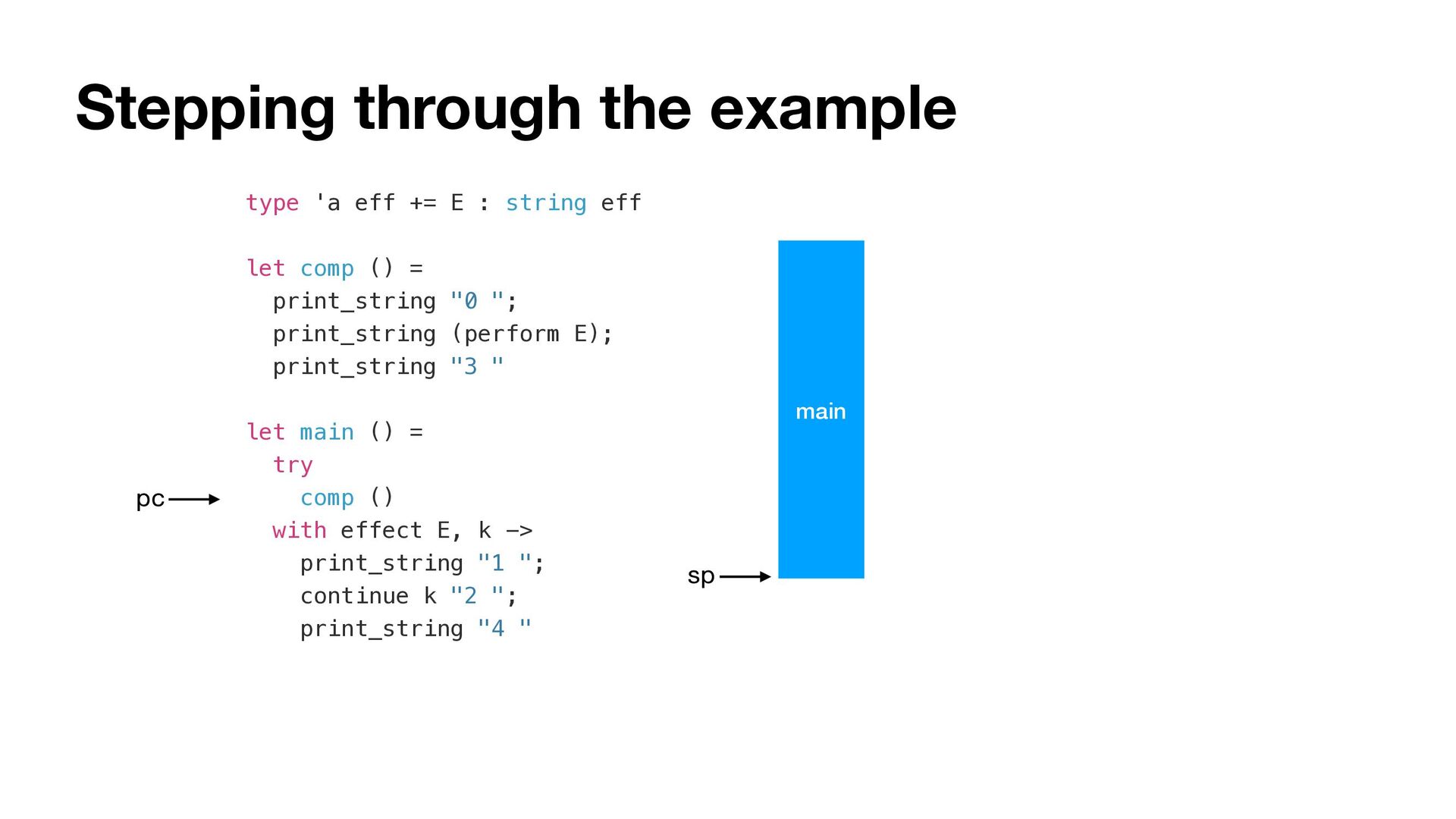
type 'a eff += E : string eff let comp
() = print_string "0 "; print_string (perform E); print_string "3 " let main () = try comp () with effect E, k -> print_string "1 "; continue k "2 "; print_string "4 " pc main sp Stepping through the example -
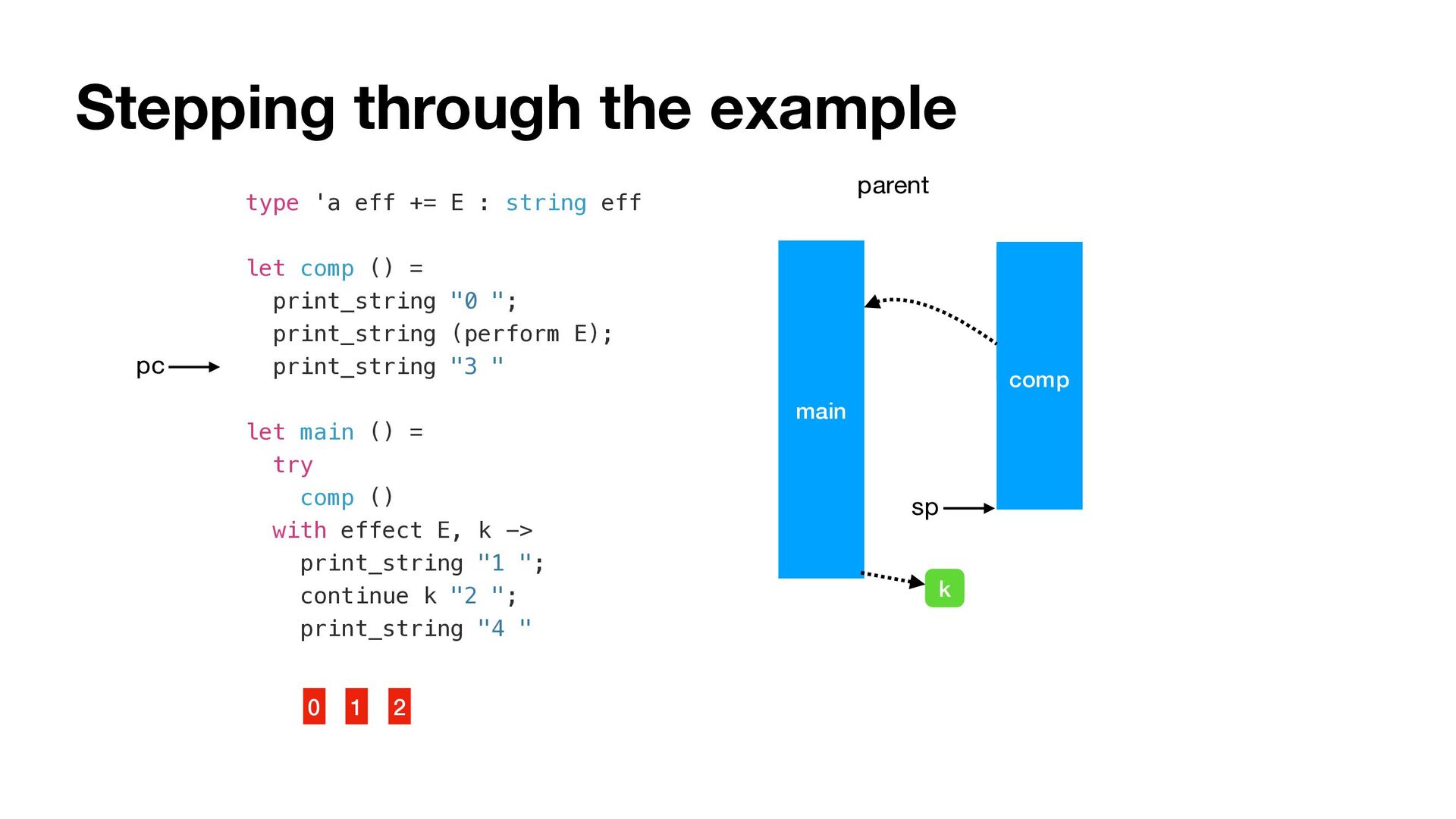
Fiber: A piece of stack + effect handler type 'a
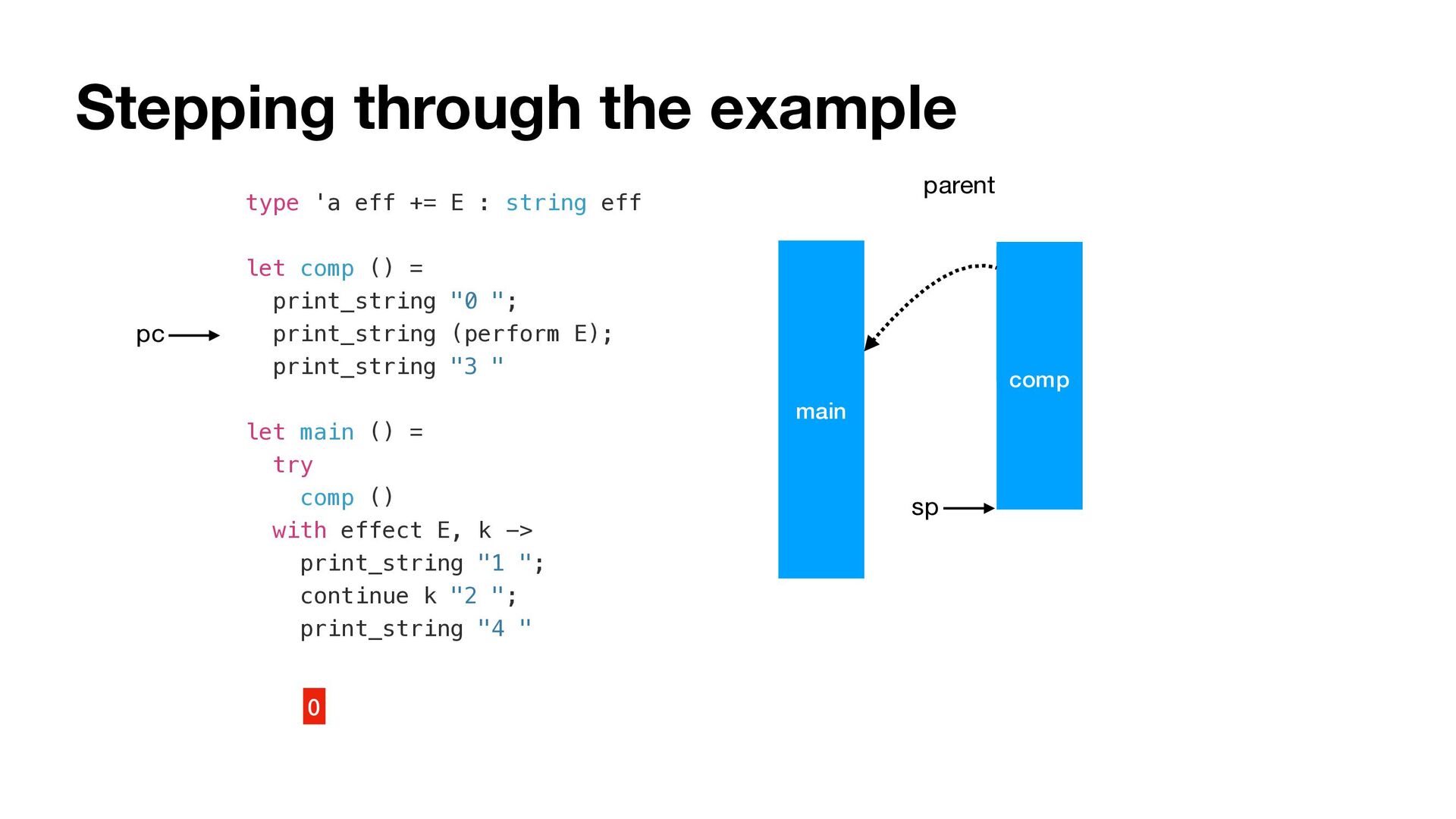
eff += E : string eff let comp () = print_string "0 "; print_string (perform E); print_string "3 " let main () = try comp () with effect E, k -> print_string "1 "; continue k "2 "; print_string "4 " comp pc main sp parent Stepping through the example -
type 'a eff += E : string eff let comp
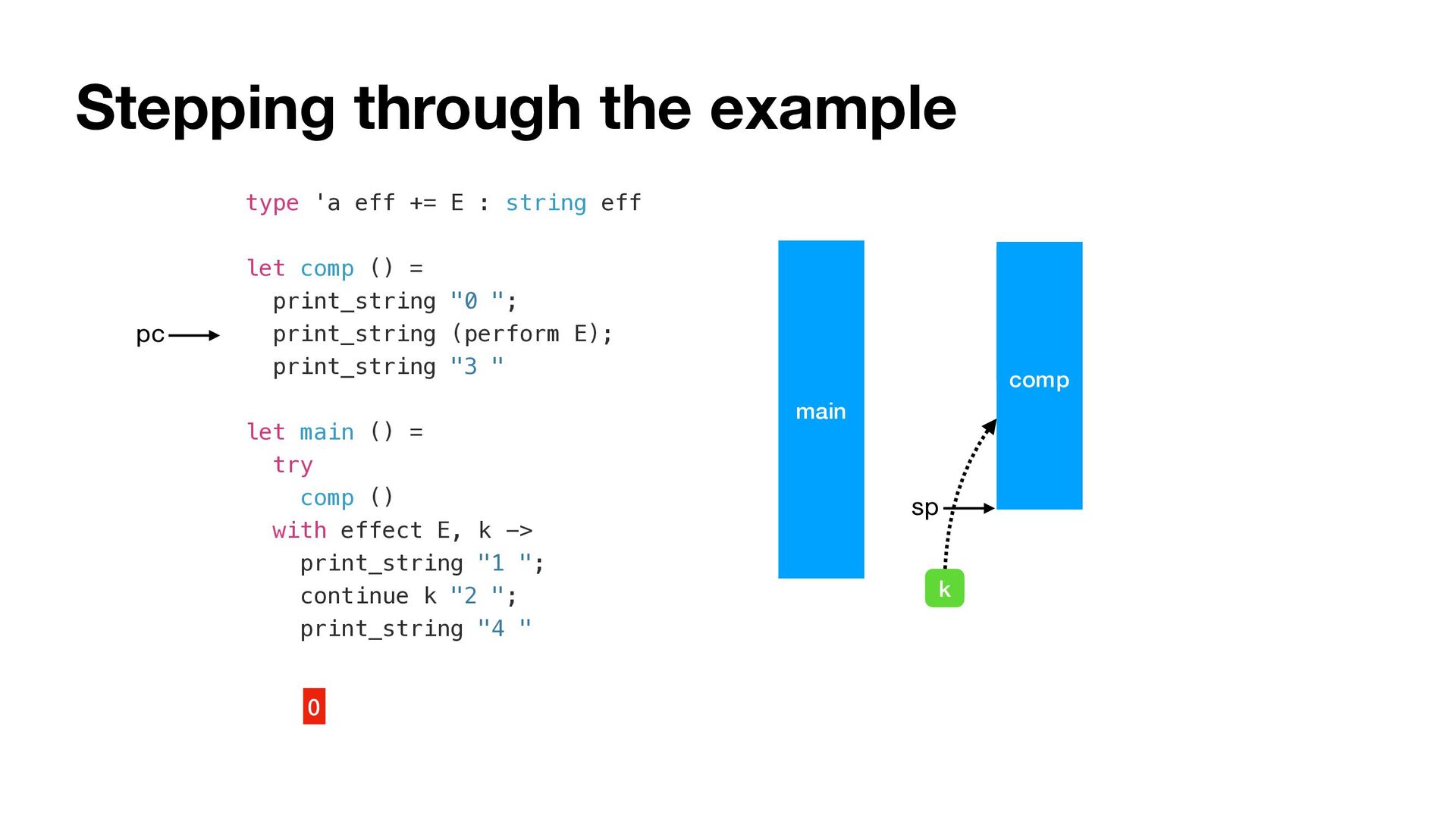
() = print_string "0 "; print_string (perform E); print_string "3 " let main () = try comp () with effect E, k -> print_string "1 "; continue k "2 "; print_string "4 " comp comp pc main sp parent 0 Stepping through the example -
type 'a eff += E : string eff let comp
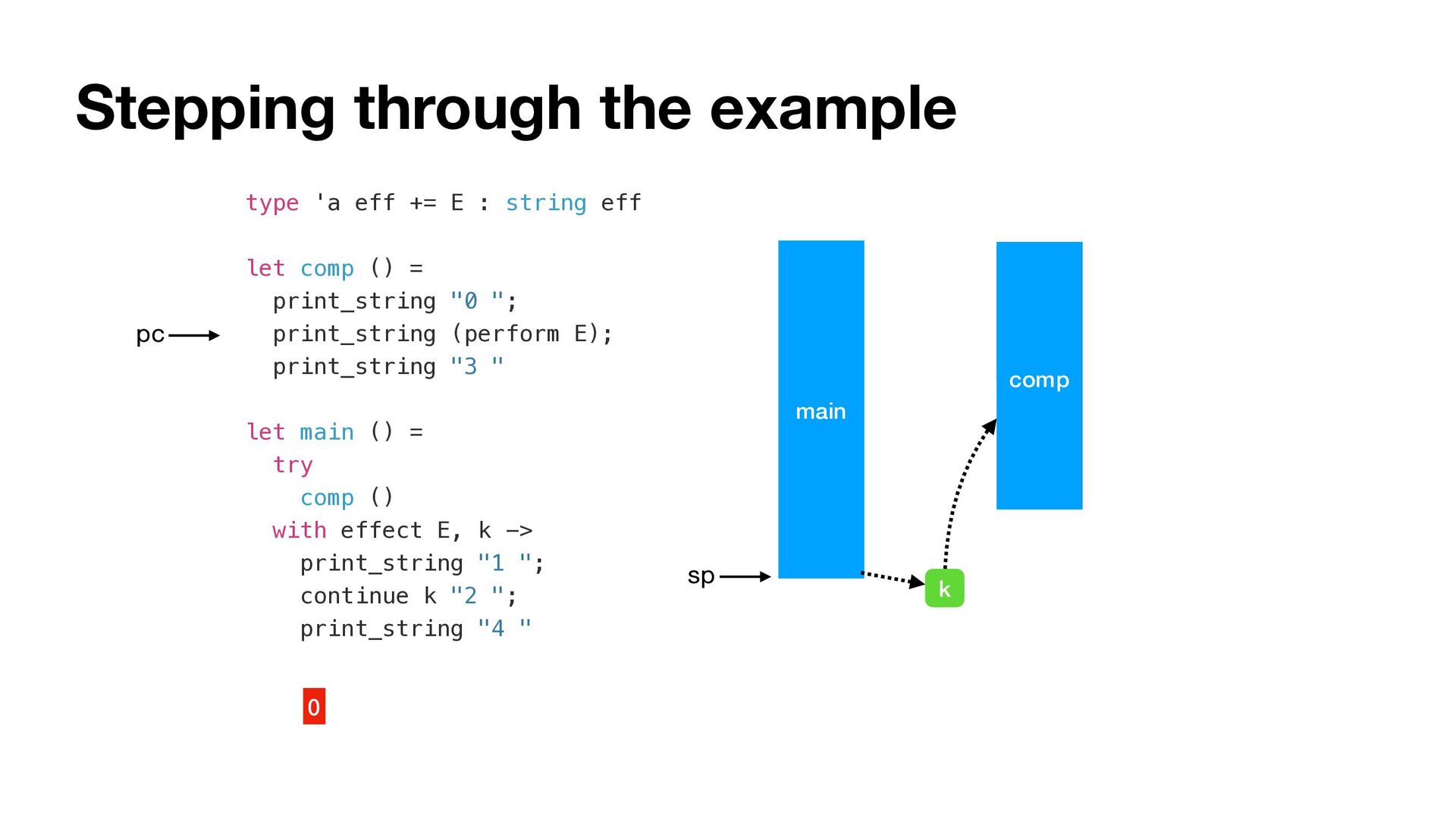
() = print_string "0 "; print_string (perform E); print_string "3 " let main () = try comp () with effect E, k -> print_string "1 "; continue k "2 "; print_string "4 " comp comp pc main sp k 0 Stepping through the example -
type 'a eff += E : string eff let comp
() = print_string "0 "; print_string (perform E); print_string "3 " let main () = try comp () with effect E, k -> print_string "1 "; continue k "2 "; print_string "4 " comp comp pc main sp k 0 Stepping through the example -
type 'a eff += E : string eff let comp
() = print_string "0 "; print_string (perform E); print_string "3 " let main () = try comp () with effect E, k -> print_string "1 "; continue k "2 "; print_string "4 " comp comp pc main sp k 0 Stepping through the example -
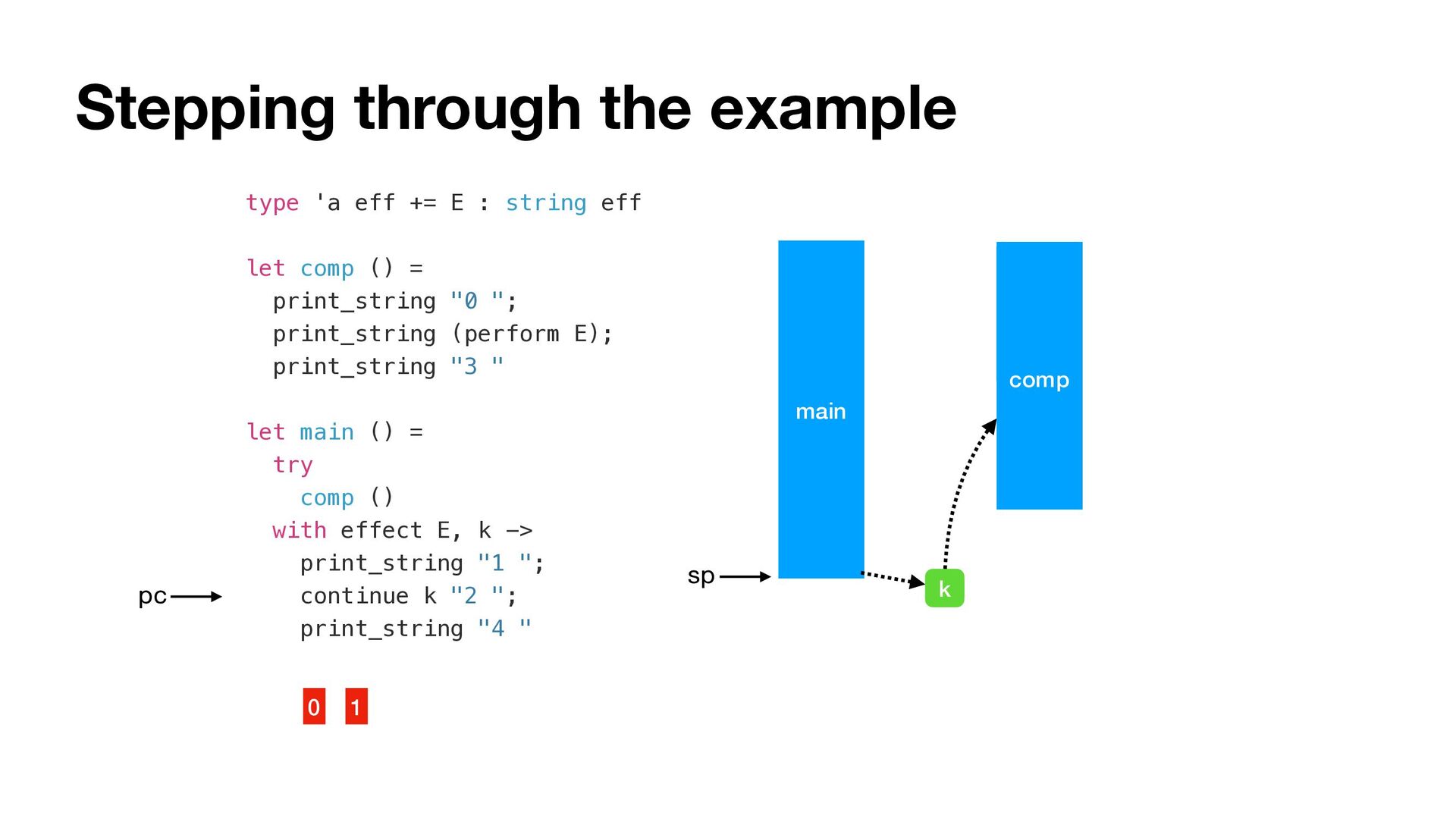
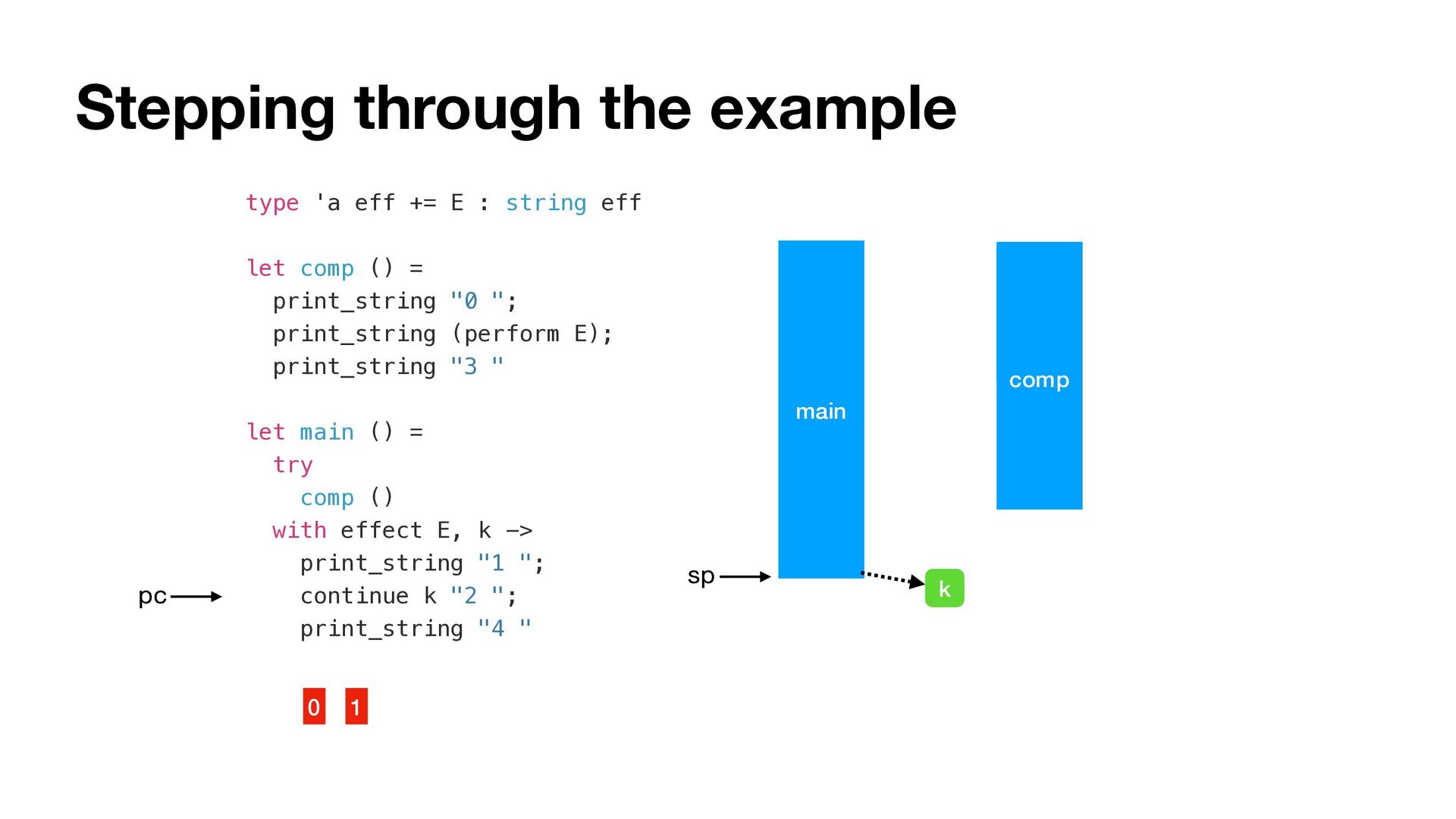
type 'a eff += E : string eff let comp
() = print_string "0 "; print_string (perform E); print_string "3 " let main () = try comp () with effect E, k -> print_string "1 "; continue k "2 "; print_string "4 " comp comp pc main sp k 0 1 Stepping through the example -
type 'a eff += E : string eff let comp
() = print_string "0 "; print_string (perform E); print_string "3 " let main () = try comp () with effect E, k -> print_string "1 "; continue k "2 "; print_string "4 " comp comp pc main sp k 0 1 Stepping through the example -
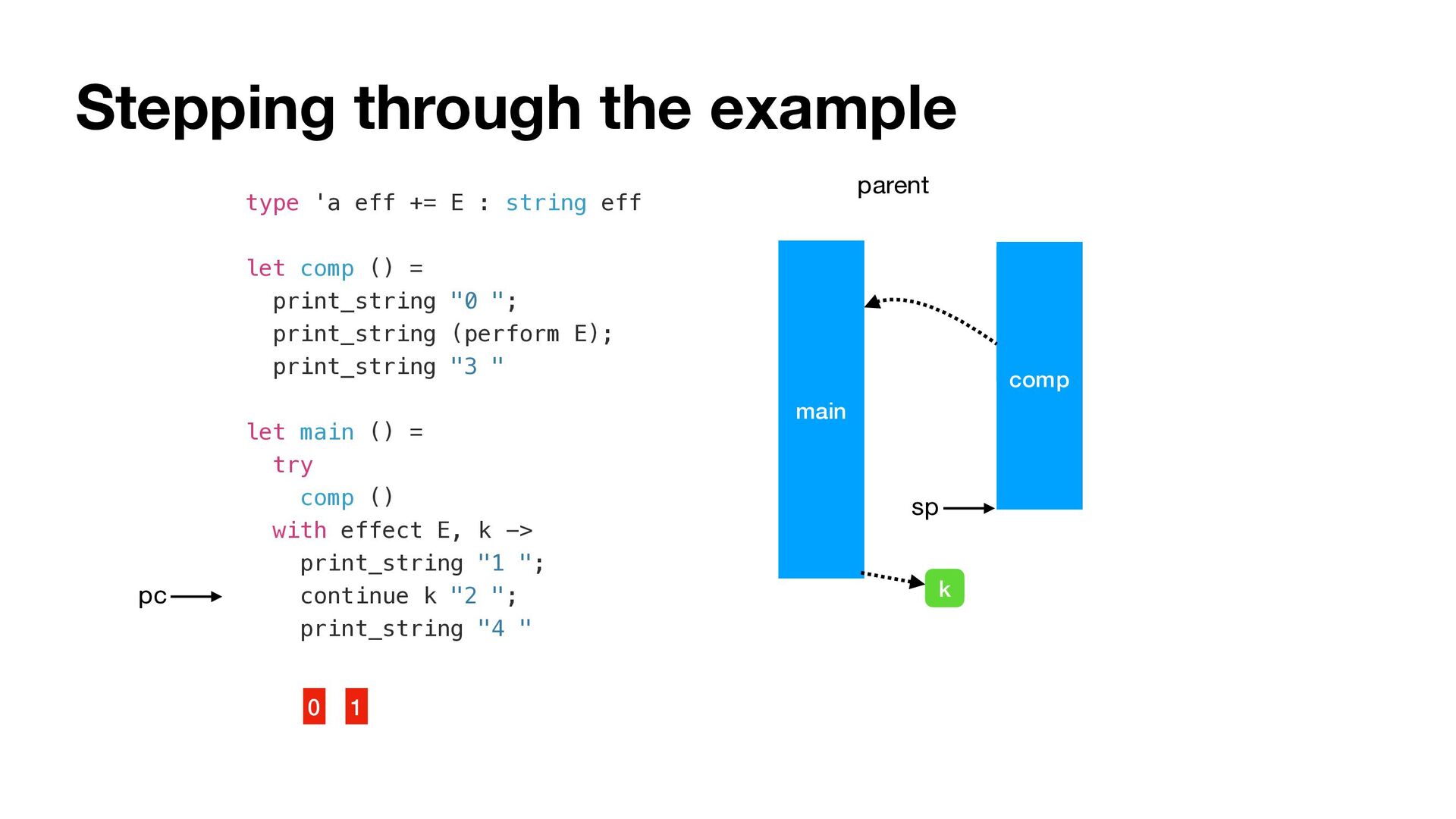
type 'a eff += E : string eff let comp
() = print_string "0 "; print_string (perform E); print_string "3 " let main () = try comp () with effect E, k -> print_string "1 "; continue k "2 "; print_string "4 " comp comp pc main sp k parent 0 1 Stepping through the example -
type 'a eff += E : string eff let comp
() = print_string "0 "; print_string (perform E); print_string "3 " let main () = try comp () with effect E, k -> print_string "1 "; continue k "2 "; print_string "4 " comp comp pc main sp k parent 0 1 2 Stepping through the example -
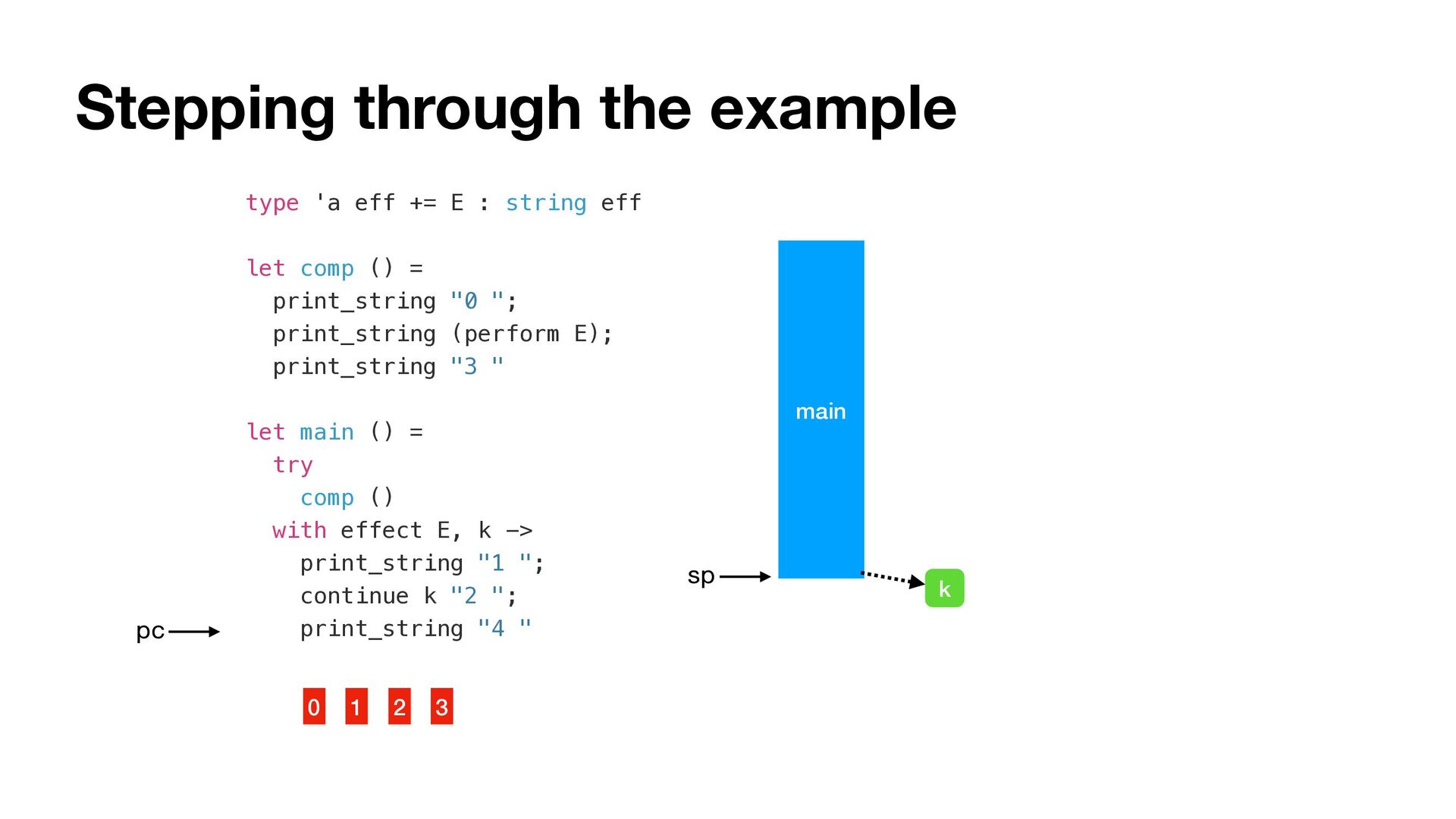
type 'a eff += E : string eff let comp
() = print_string "0 "; print_string (perform E); print_string "3 " let main () = try comp () with effect E, k -> print_string "1 "; continue k "2 "; print_string "4 " pc main sp k 0 1 2 3 Stepping through the example -
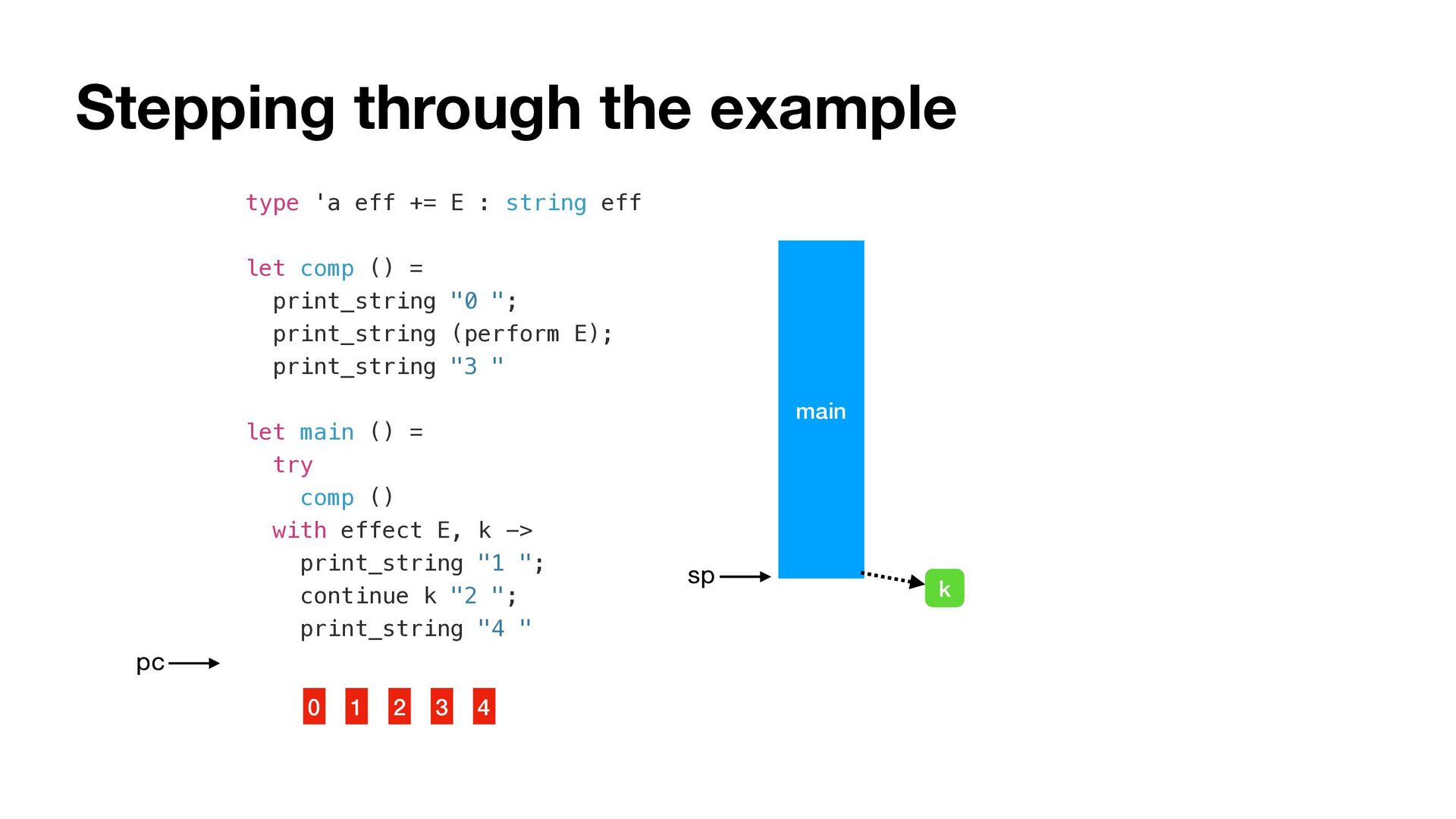
type 'a eff += E : string eff let comp
() = print_string "0 "; print_string (perform E); print_string "3 " let main () = try comp () with effect E, k -> print_string "1 "; continue k "2 "; print_string "4 " pc main sp k 0 1 2 3 4 Stepping through the example -
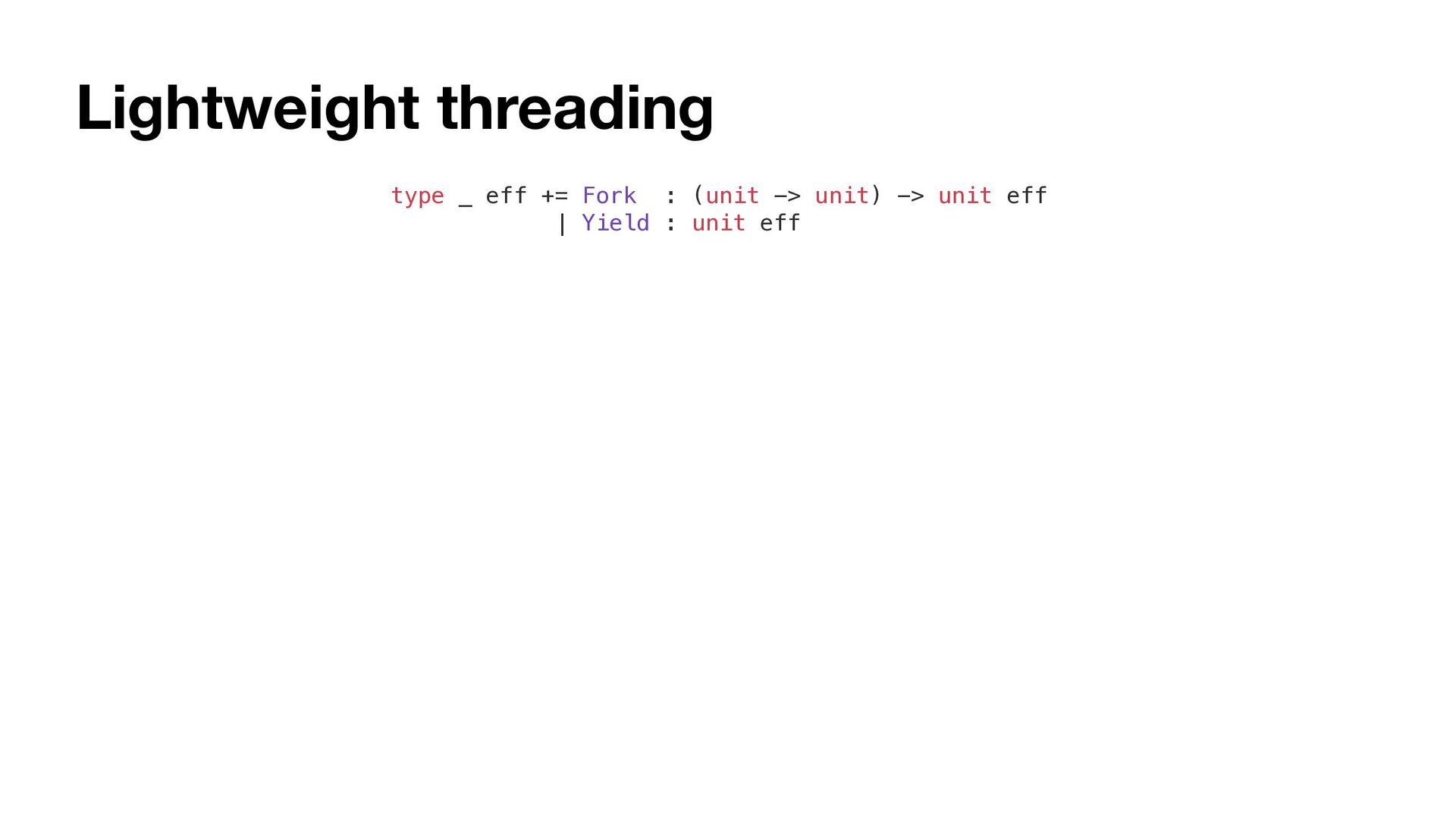
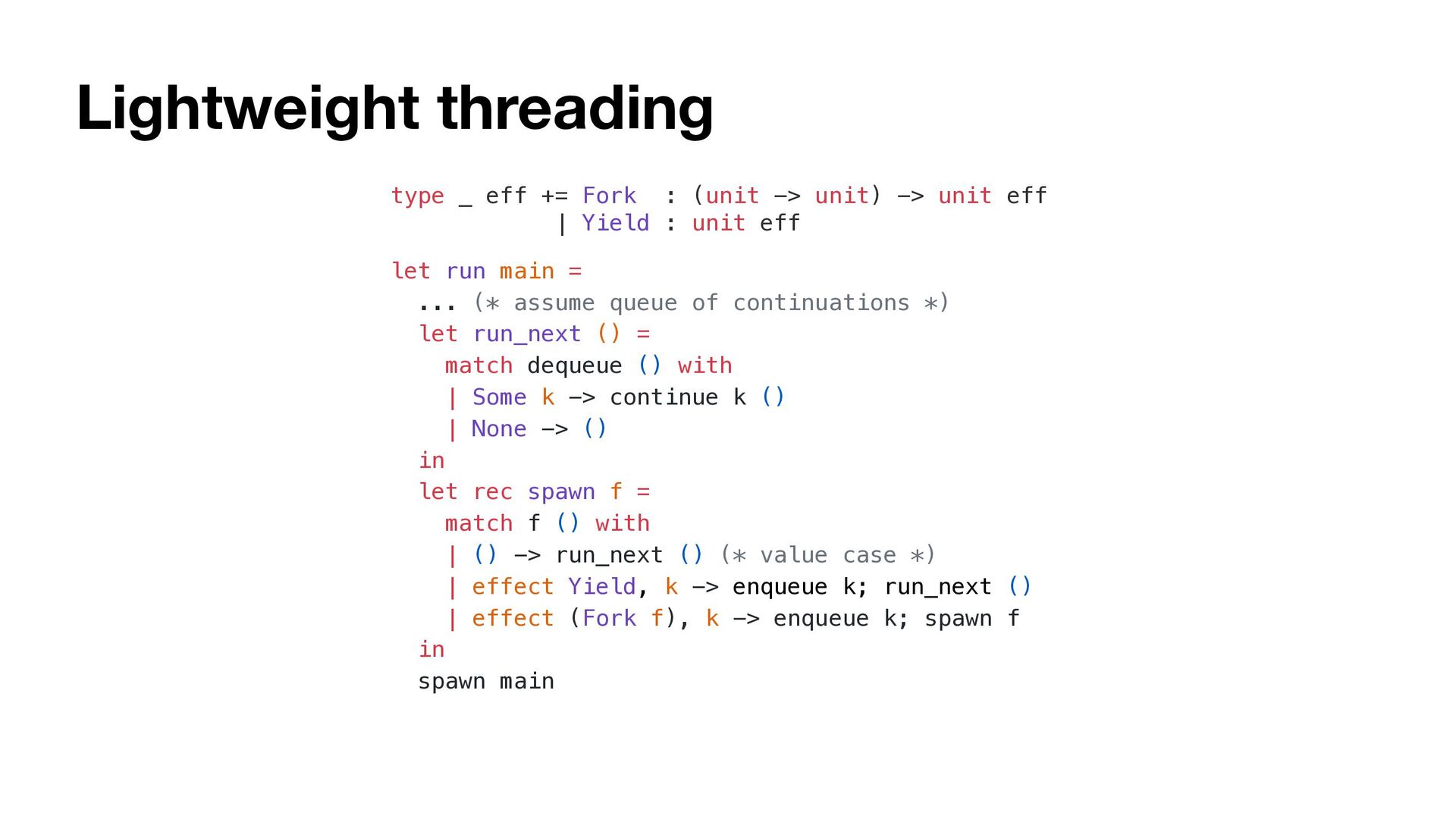
type _ eff += Fork : (unit -> unit) ->
unit eff | Yield : unit eff Lightweight threading -
type _ eff += Fork : (unit -> unit) ->
unit eff | Yield : unit eff let run main = ... (* assume queue of continuations *) let run_next () = match dequeue () with | Some k -> continue k () | None -> () in let rec spawn f = match f () with | () -> run_next () (* value case *) | effect Yield, k -> enqueue k; run_next () | effect (Fork f), k -> enqueue k; spawn f in spawn main Lightweight threading -
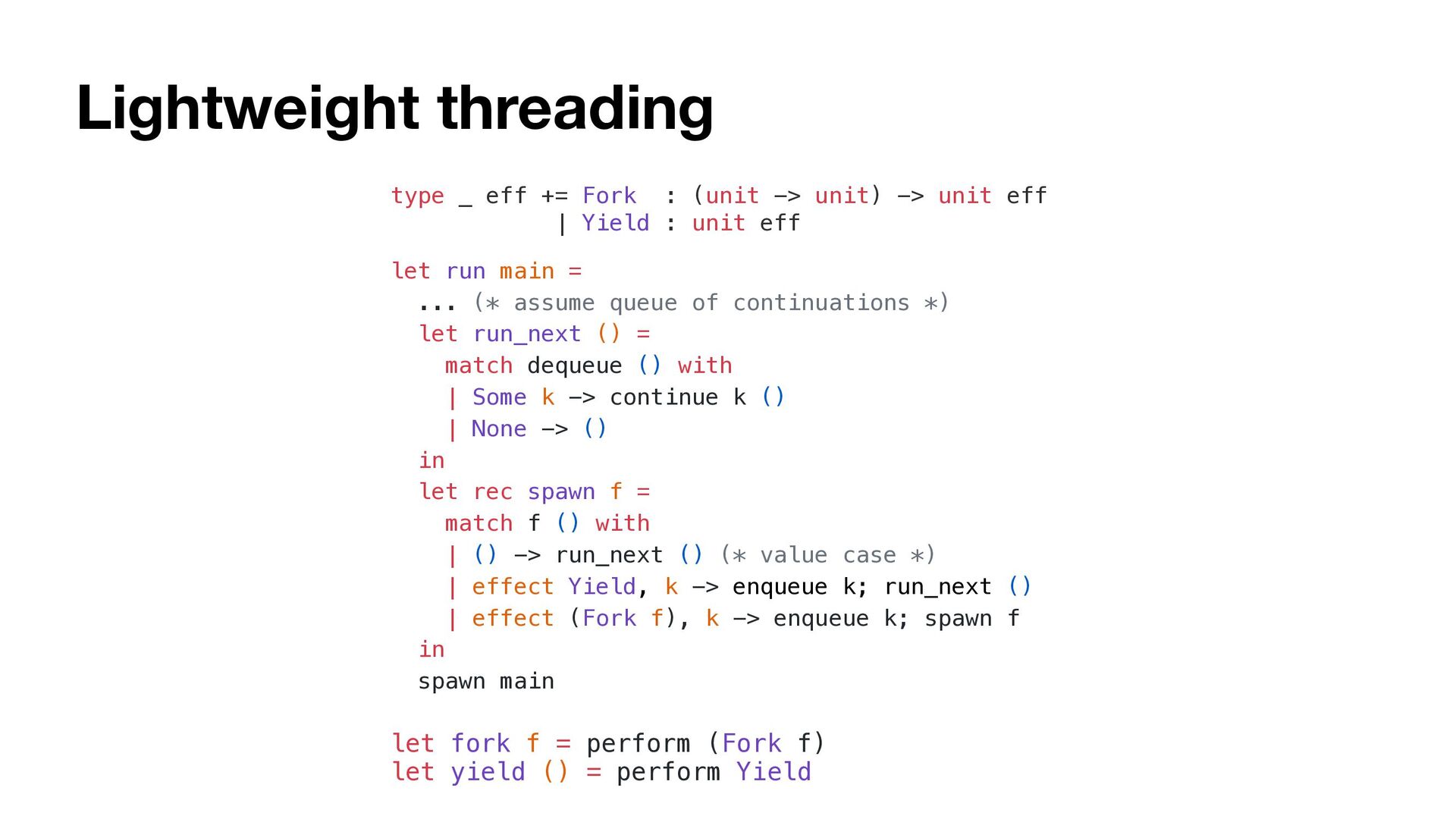
type _ eff += Fork : (unit -> unit) ->
unit eff | Yield : unit eff let run main = ... (* assume queue of continuations *) let run_next () = match dequeue () with | Some k -> continue k () | None -> () in let rec spawn f = match f () with | () -> run_next () (* value case *) | effect Yield, k -> enqueue k; run_next () | effect (Fork f), k -> enqueue k; spawn f in spawn main let fork f = perform (Fork f) let yield () = perform Yield Lightweight threading -
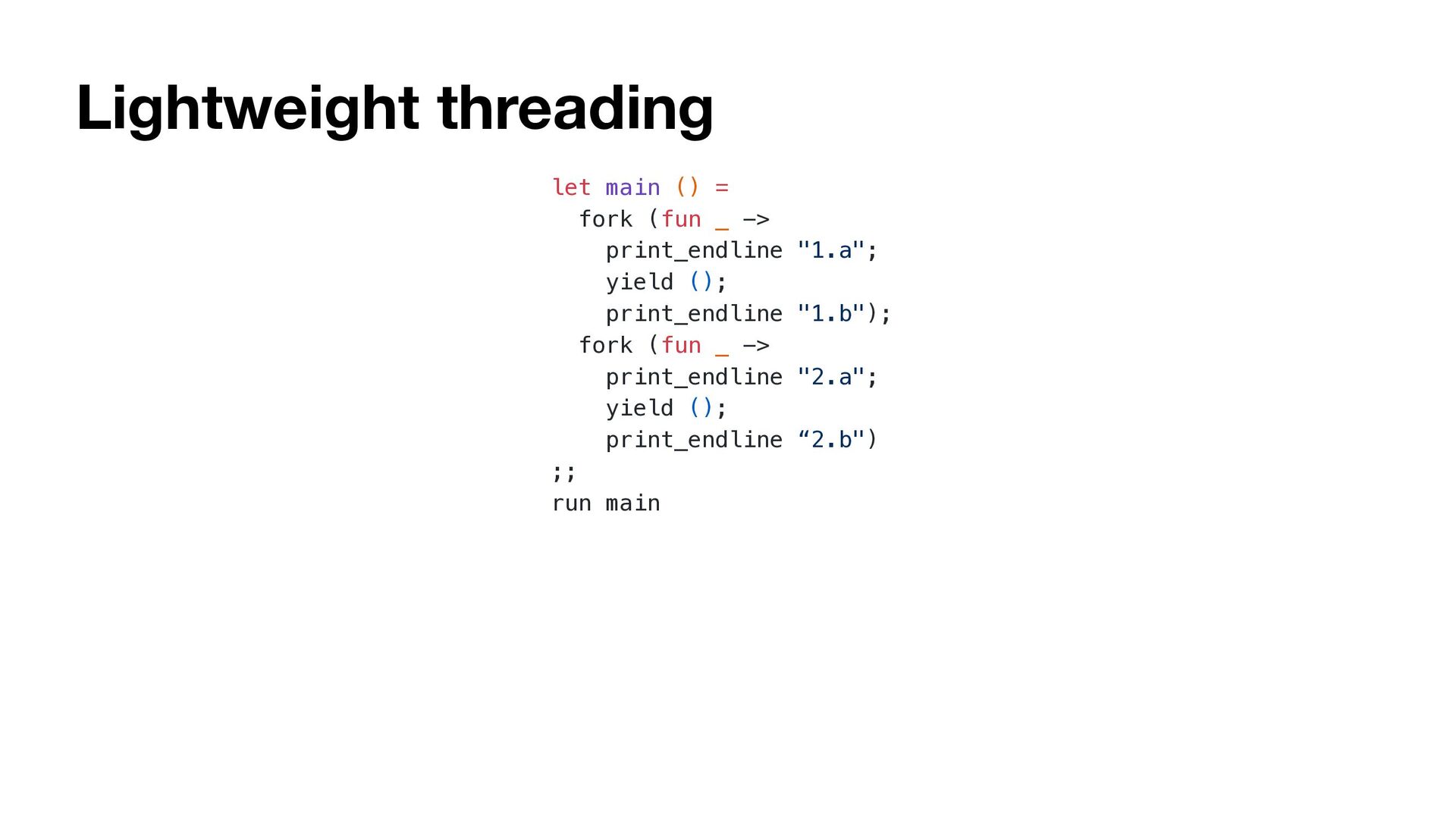
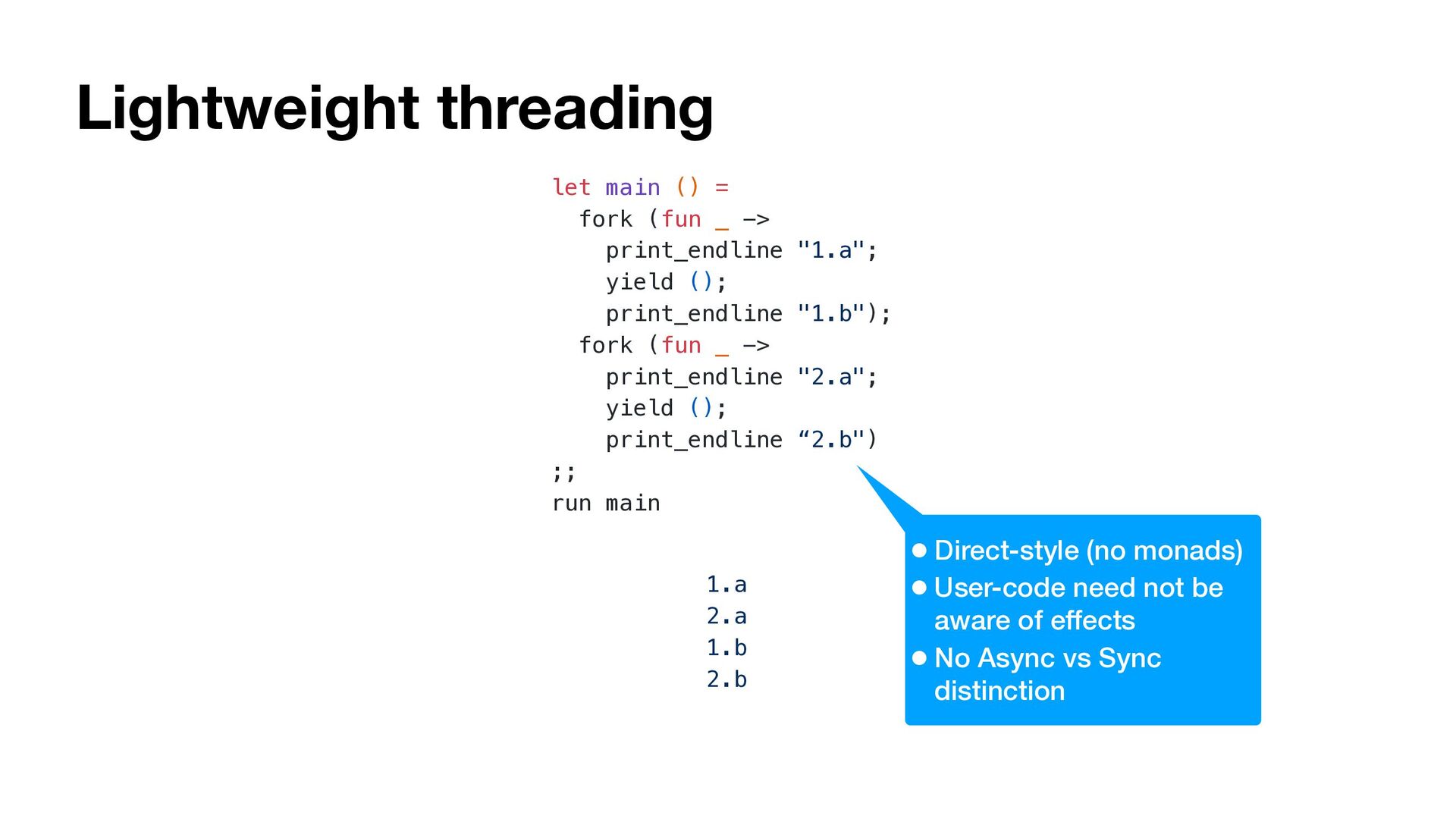
let main () = fork (fun _ -> print_endline "1.a";
yield (); print_endline "1.b"); fork (fun _ -> print_endline "2.a"; yield (); print_endline “2.b") ;; run main Lightweight threading -
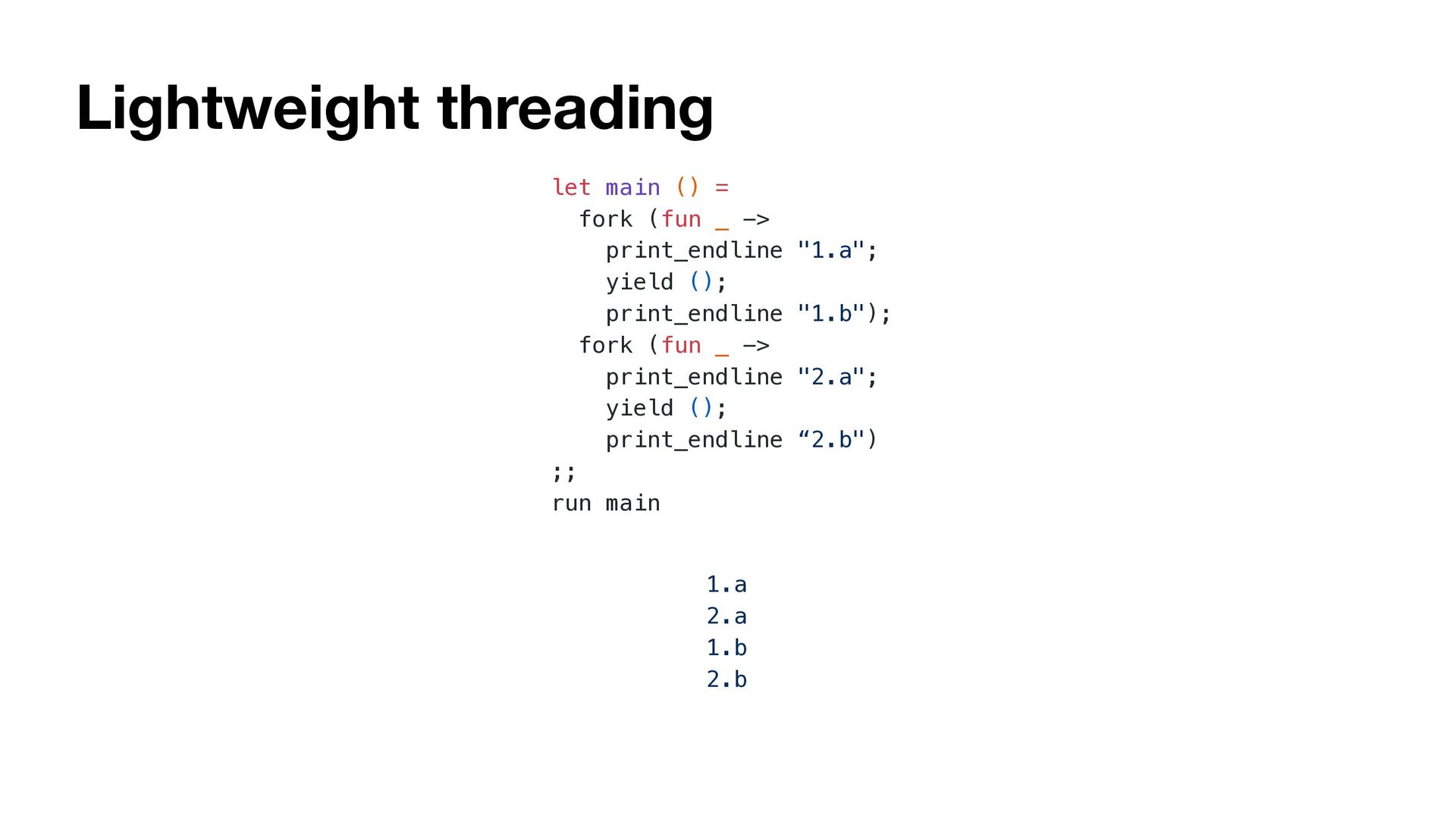
let main () = fork (fun _ -> print_endline "1.a";
yield (); print_endline "1.b"); fork (fun _ -> print_endline "2.a"; yield (); print_endline “2.b") ;; run main 1.a 2.a 1.b 2.b Lightweight threading -
let main () = fork (fun _ -> print_endline "1.a";
yield (); print_endline "1.b"); fork (fun _ -> print_endline "2.a"; yield (); print_endline “2.b") ;; run main 1.a 2.a 1.b 2.b •Direct-style (no monads) •User-code need not be aware of effects •No Async vs Sync distinction Lightweight threading -
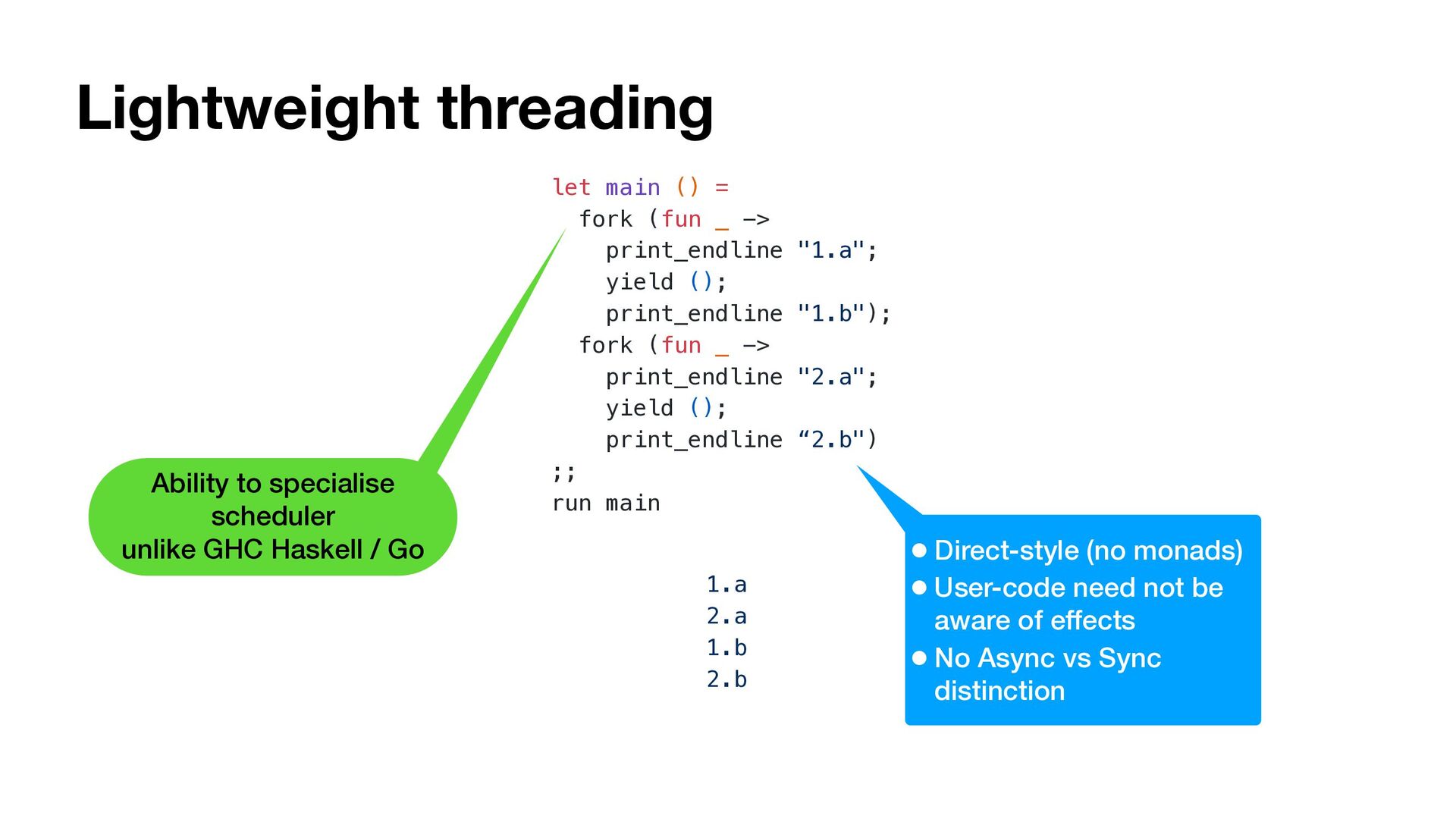
let main () = fork (fun _ -> print_endline "1.a";
yield (); print_endline "1.b"); fork (fun _ -> print_endline "2.a"; yield (); print_endline “2.b") ;; run main 1.a 2.a 1.b 2.b •Direct-style (no monads) •User-code need not be aware of effects •No Async vs Sync distinction Ability to specialise scheduler unlike GHC Haskell / Go Lightweight threading -
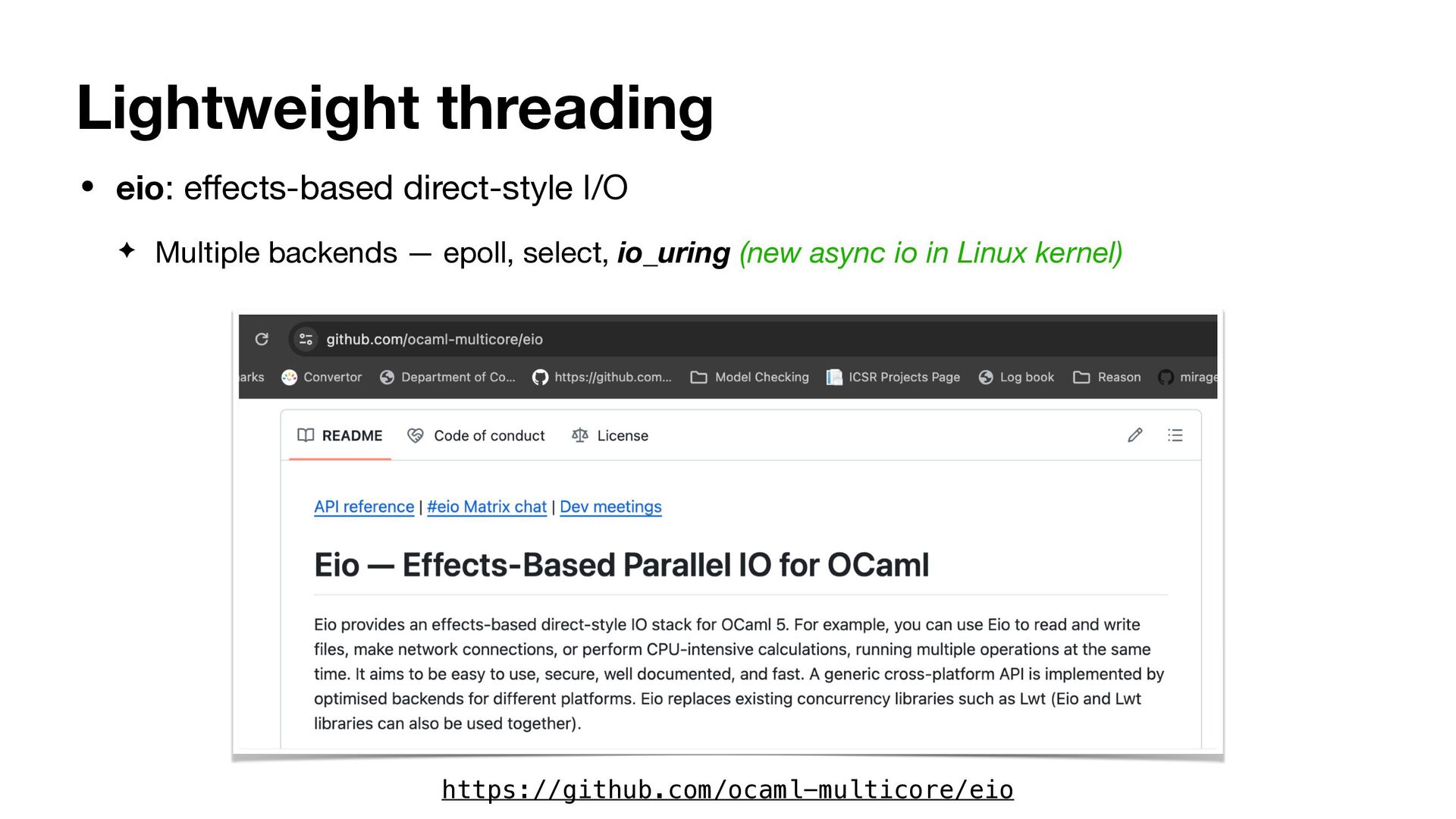
https://github.com/ocaml-multicore/eio • eio: e ff ects-based direct-style I/O ✦ Multiple
backends — epoll, select, io_uring (new async io in Linux kernel) Lightweight threading -
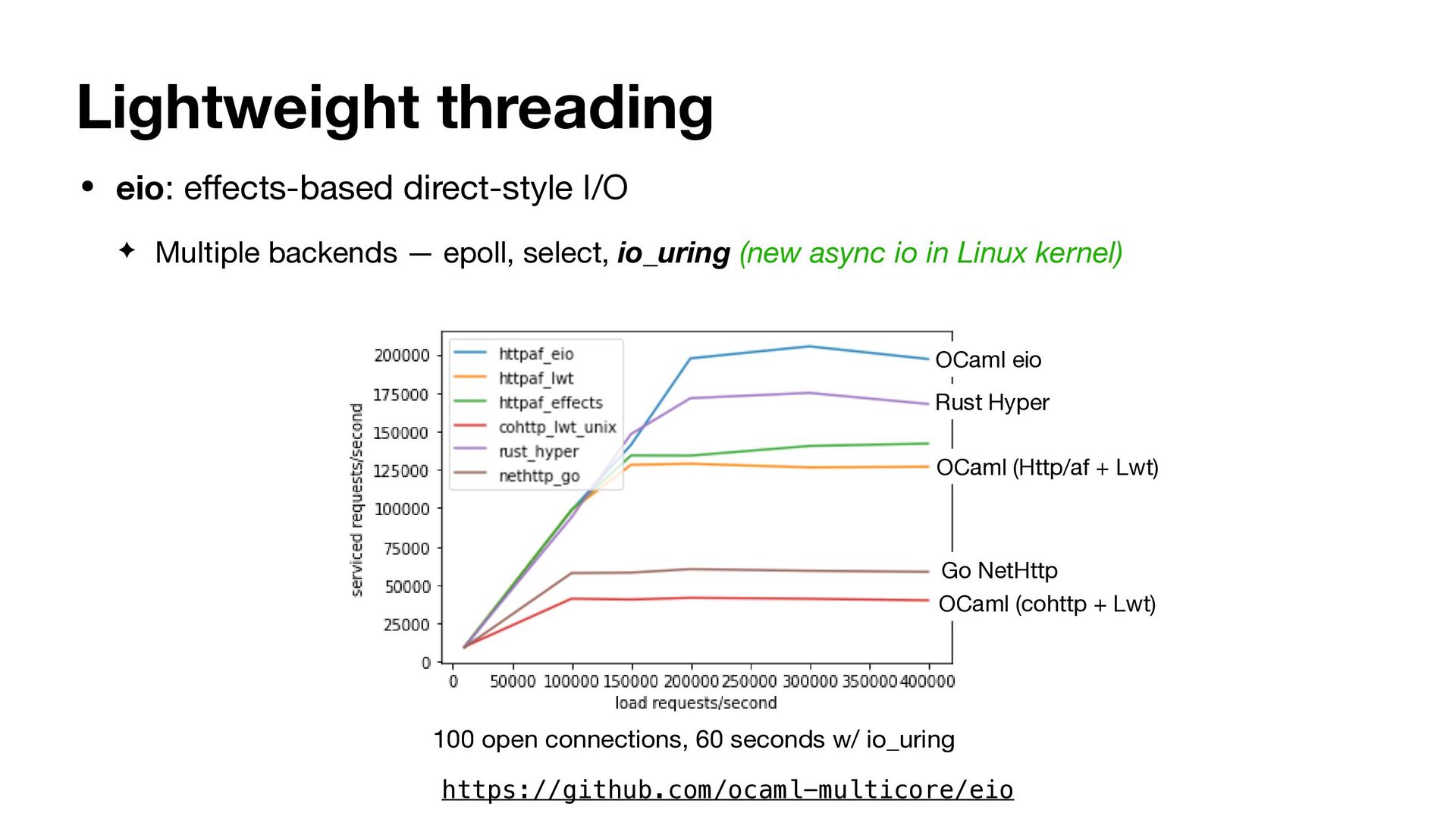
• eio: e ff ects-based direct-style I/O ✦ Multiple backends
— epoll, select, io_uring (new async io in Linux kernel) 100 open connections, 60 seconds w/ io_uring OCaml eio Rust Hyper OCaml (Http/af + Lwt) Go NetHttp OCaml (cohttp + Lwt) https://github.com/ocaml-multicore/eio Lightweight threading -
Representing Stack & Continuations • Program stack is a stack
of runtime-managed dynamically growing fi bers ‣ No pointers into the OCaml stack ➔ reallocate fi bers on stack over fl ow -
Representing Stack & Continuations • Program stack is a stack
of runtime-managed dynamically growing fi bers ‣ No pointers into the OCaml stack ➔ reallocate fi bers on stack over fl ow • Stack switching is fast!! ‣ One shot continuations ➔ No copying of frames ‣ No callee-saved registers in OCaml ➔ No registers to save and restore at switches ‣ Few 10s of intructions; 5 to 10ns for stack switch -
Representing Stack & Continuations • Program stack is a stack
of runtime-managed dynamically growing fi bers ‣ No pointers into the OCaml stack ➔ reallocate fi bers on stack over fl ow • Stack switching is fast!! ‣ One shot continuations ➔ No copying of frames ‣ No callee-saved registers in OCaml ➔ No registers to save and restore at switches ‣ Few 10s of intructions; 5 to 10ns for stack switch • Need stack over fl ow checks in OCaml function prologue ‣ Branch predictor correctly predicts almost always -
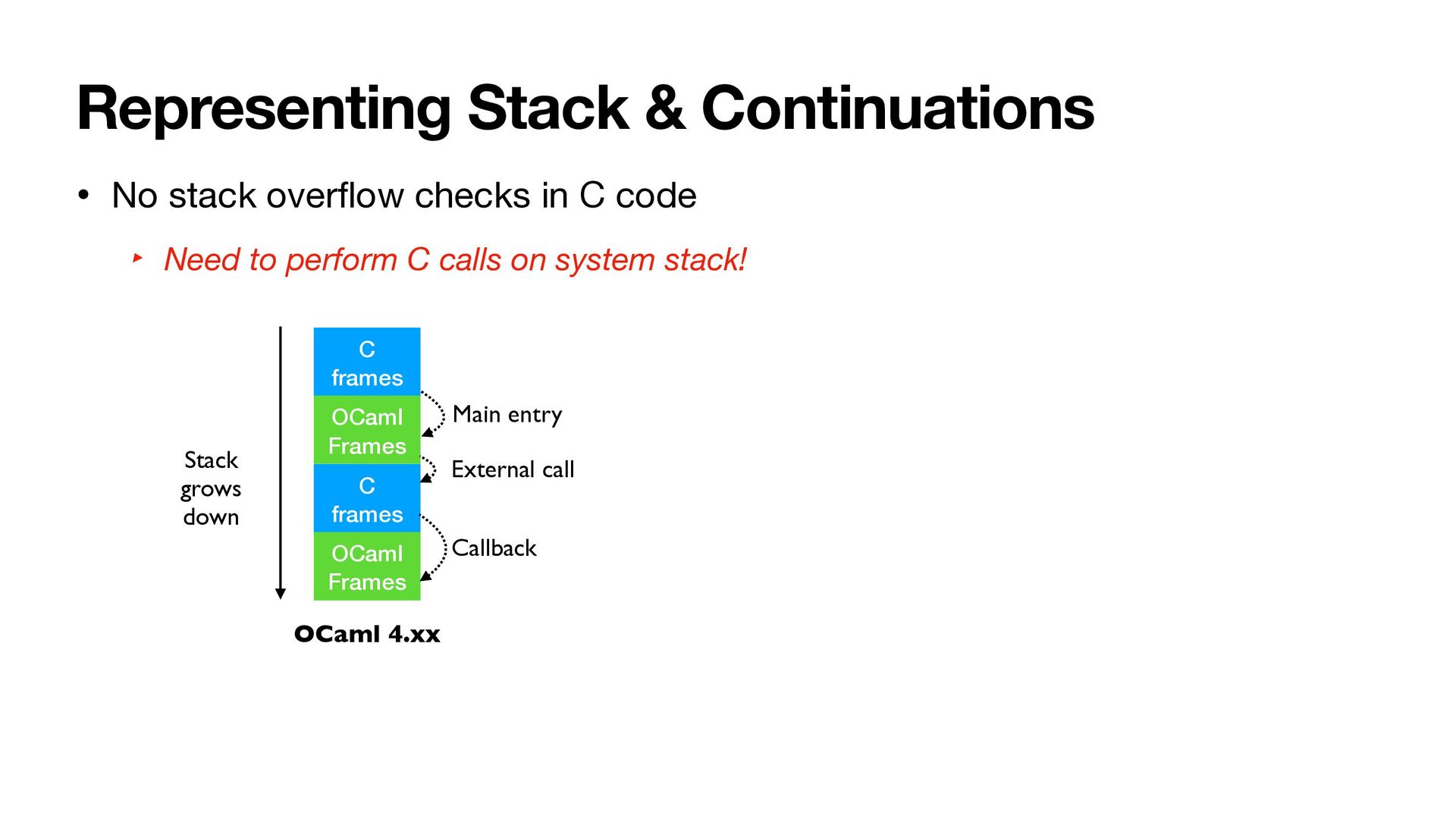
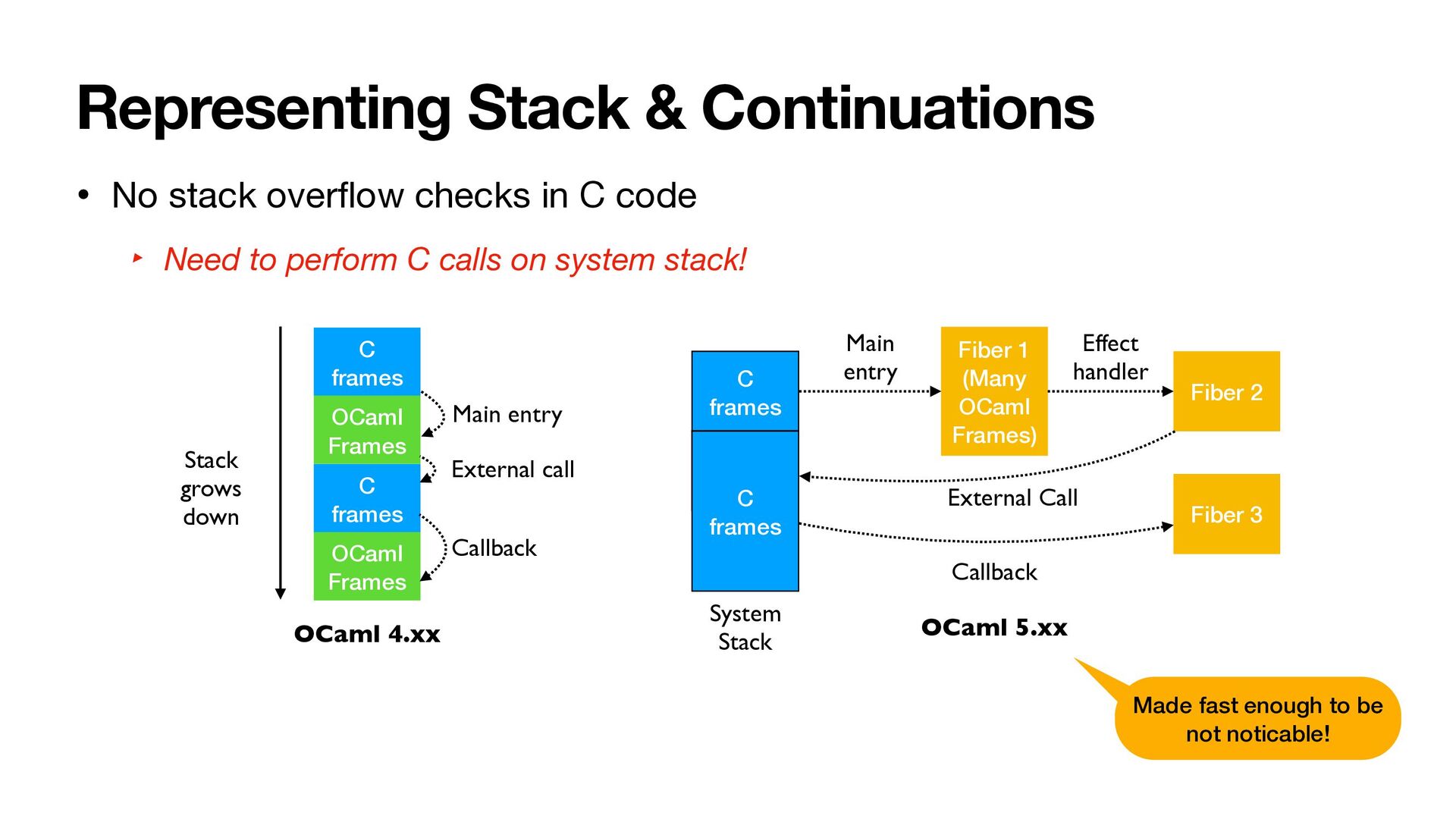
Representing Stack & Continuations • No stack over fl ow
checks in C code ‣ Need to perform C calls on system stack! -
Representing Stack & Continuations • No stack over fl ow
checks in C code ‣ Need to perform C calls on system stack! C frames OCaml Frames C frames OCaml Frames OCaml 4.xx Stack grows down Main entry External call Callback -
Representing Stack & Continuations • No stack over fl ow
checks in C code ‣ Need to perform C calls on system stack! C frames C frames Fiber 1 (Many OCaml Frames) Fiber 2 C frames Fiber 3 Main entry Effect handler External Call Callback System Stack OCaml 5.xx C frames OCaml Frames C frames OCaml Frames OCaml 4.xx Stack grows down Main entry External call Callback Made fast enough to be not noticable! -
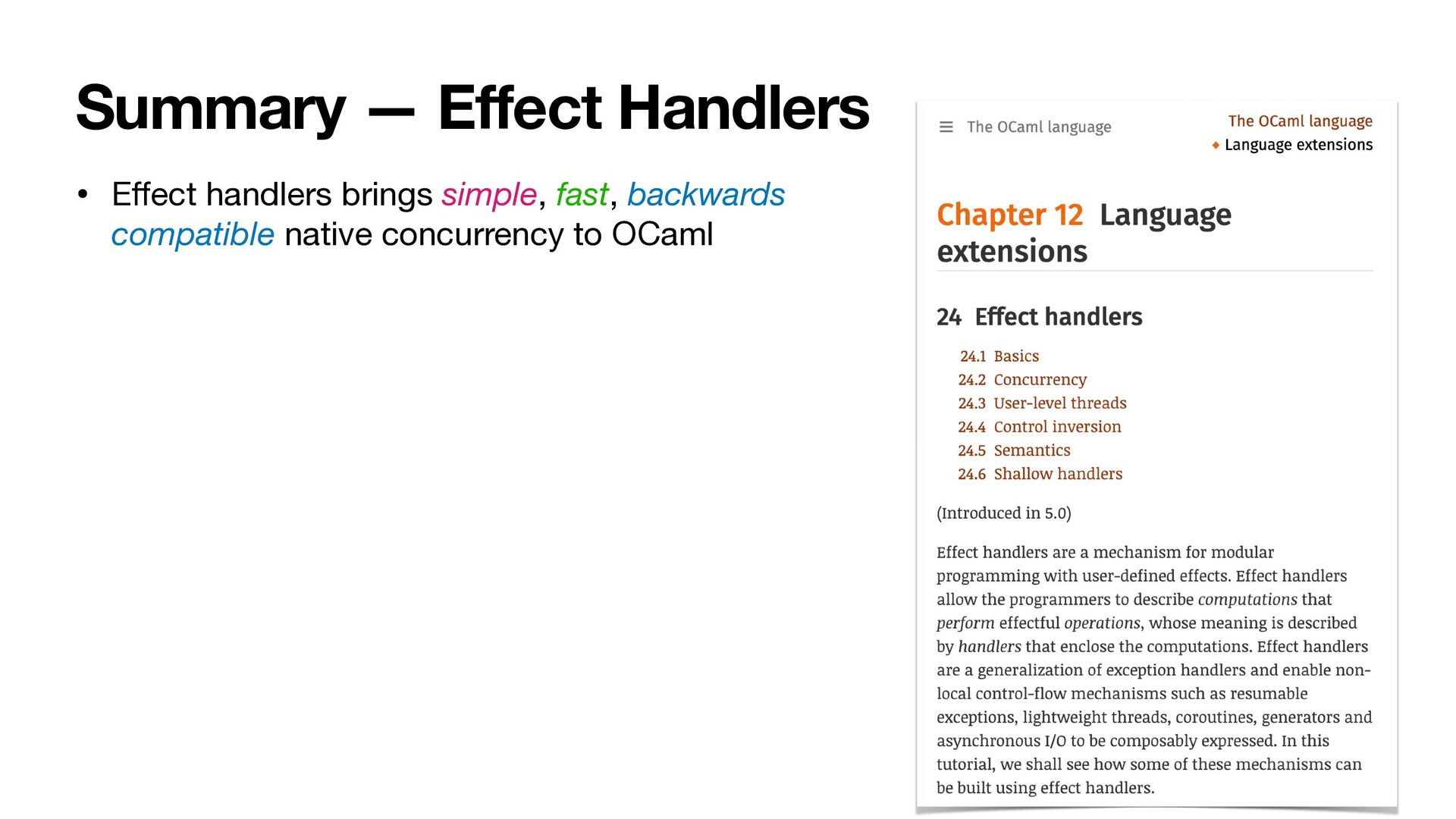
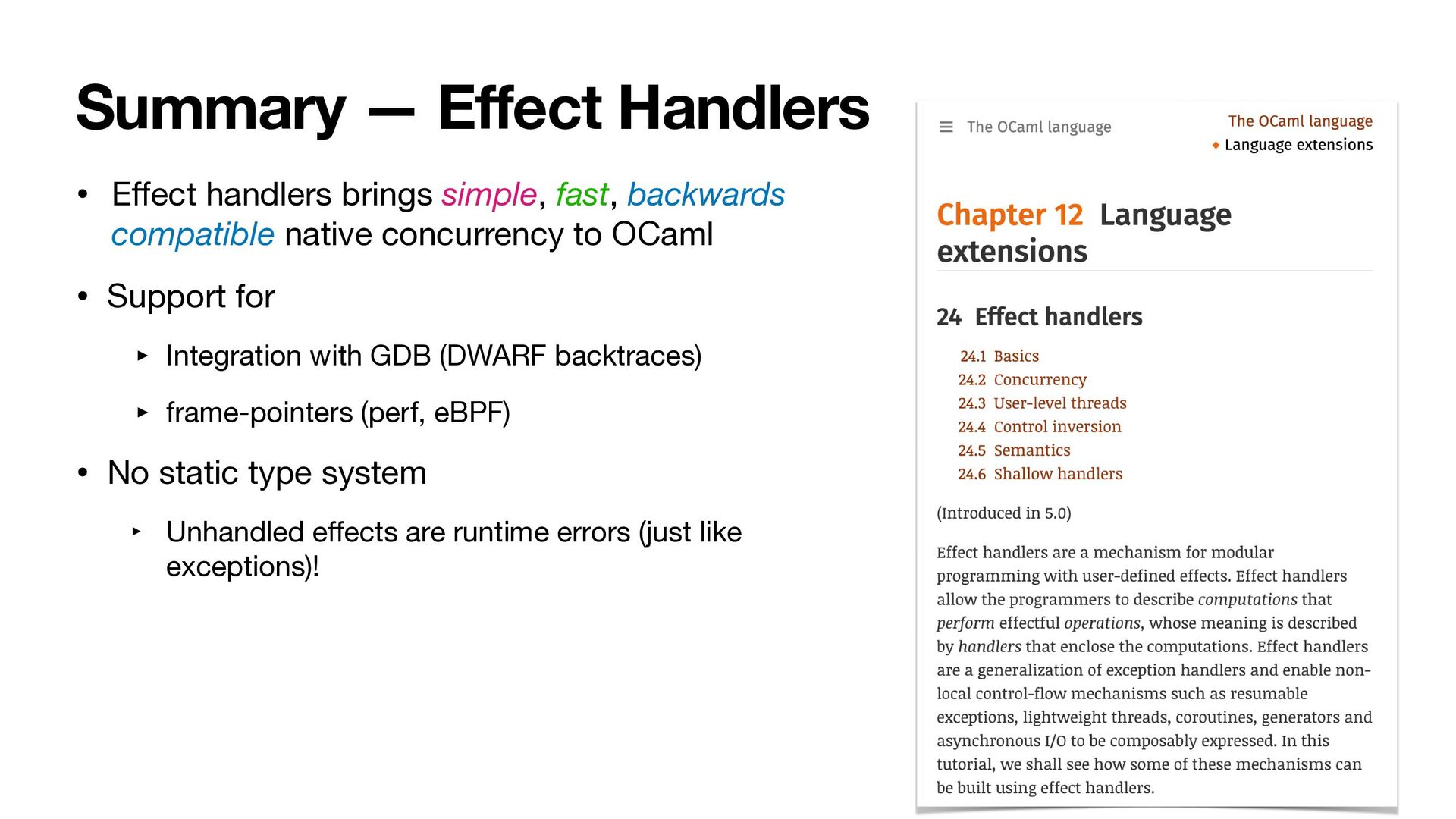
Summary — Effect Handlers • E ff ect handlers brings
simple, fast, backwards compatible native concurrency to OCaml -
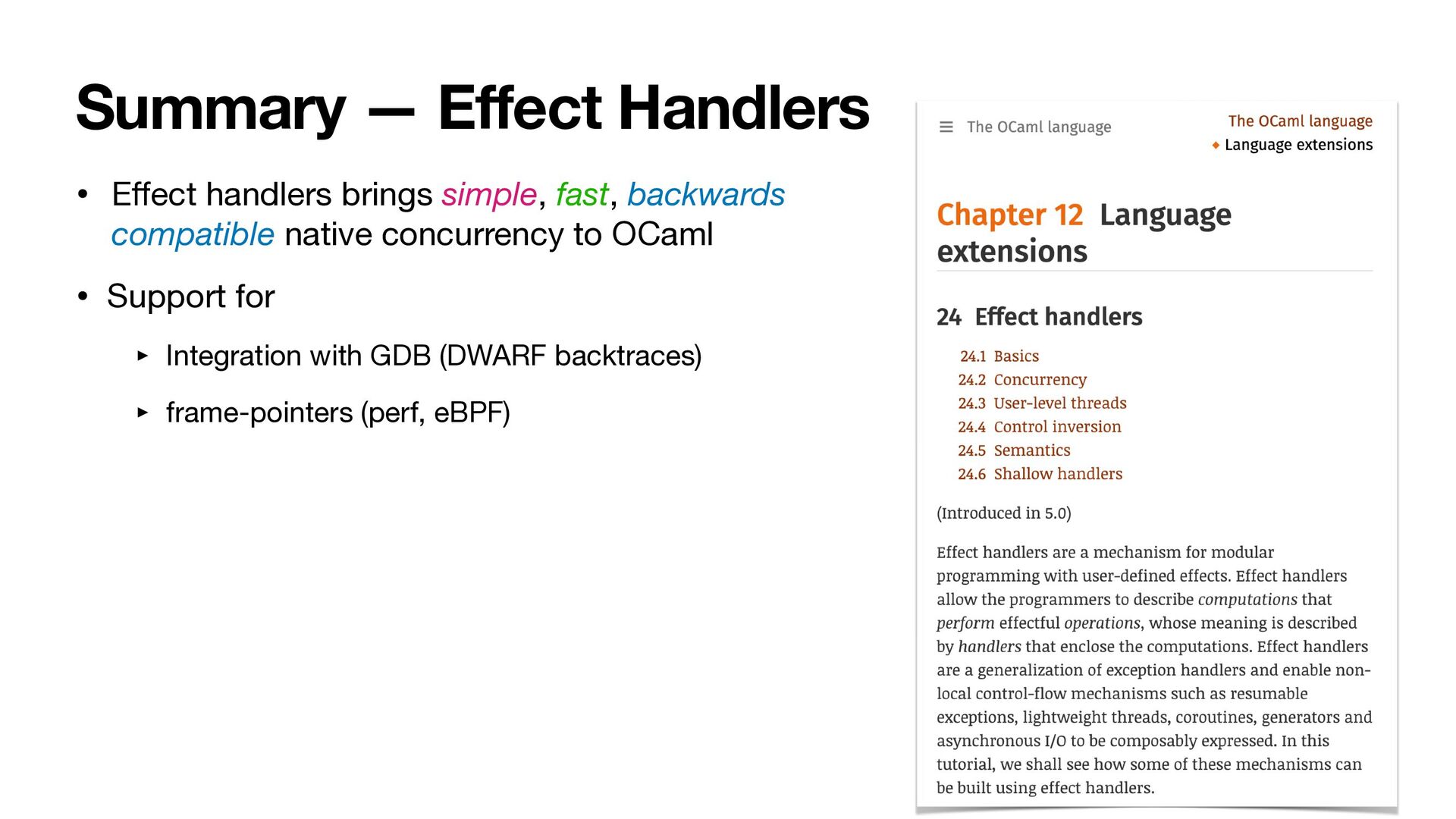
Summary — Effect Handlers • E ff ect handlers brings
simple, fast, backwards compatible native concurrency to OCaml • Support for ‣ Integration with GDB (DWARF backtraces) ‣ frame-pointers (perf, eBPF) -
Summary — Effect Handlers • E ff ect handlers brings
simple, fast, backwards compatible native concurrency to OCaml • Support for ‣ Integration with GDB (DWARF backtraces) ‣ frame-pointers (perf, eBPF) • No static type system ‣ Unhandled e ff ects are runtime errors (just like exceptions)! -
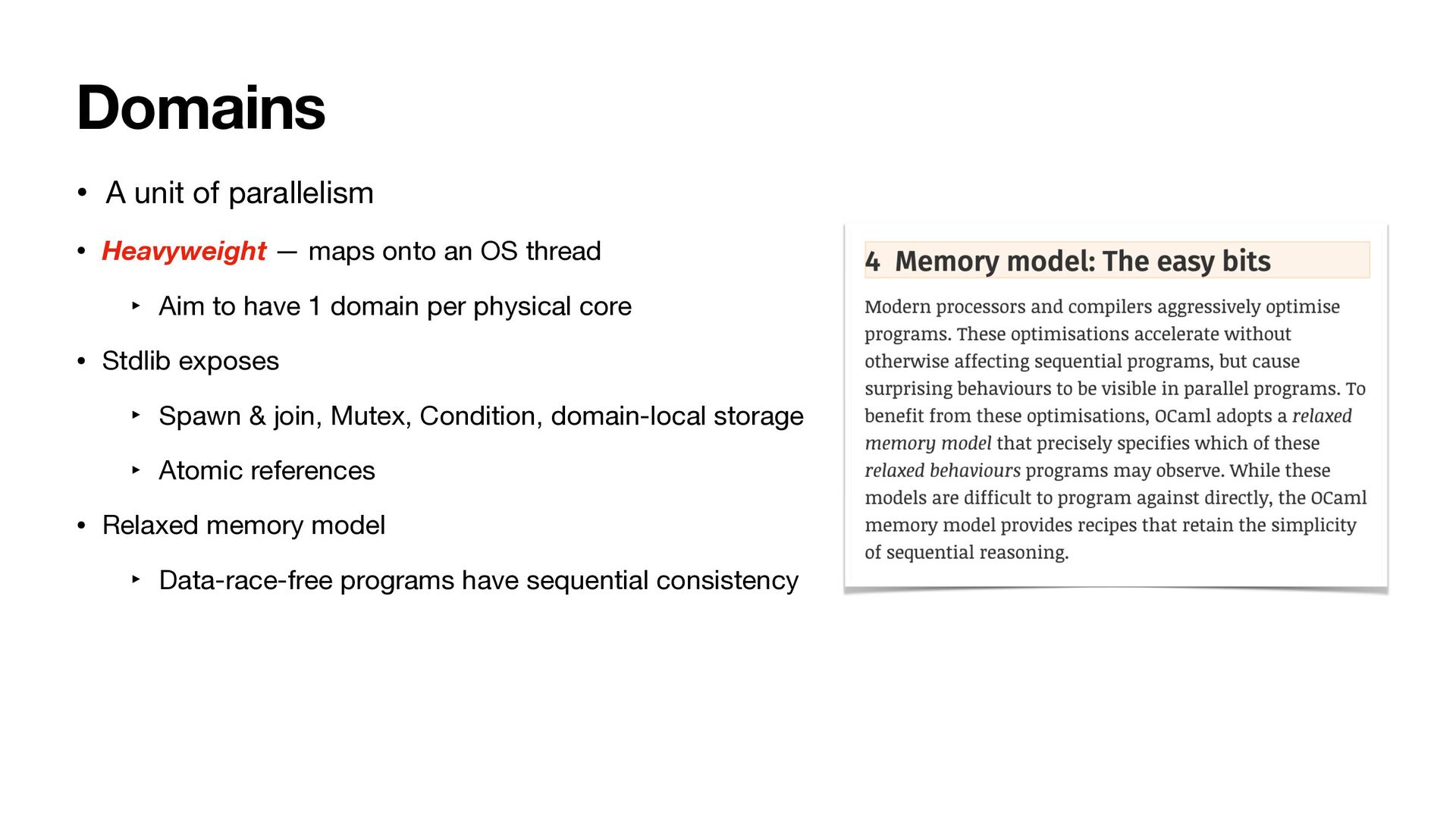
Domains • A unit of parallelism • Heavyweight — maps
onto an OS thread ‣ Aim to have 1 domain per physical core -
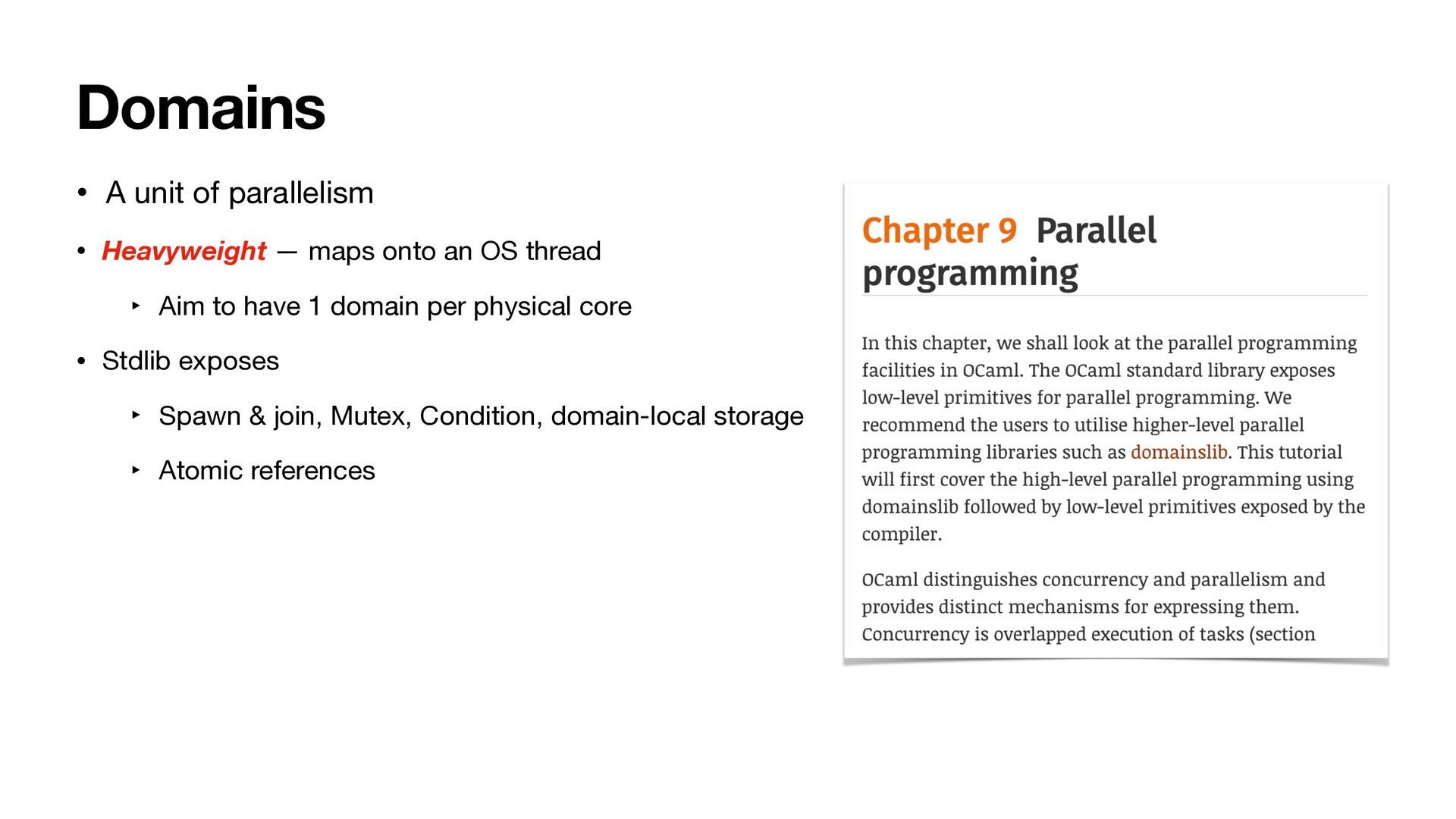
Domains • A unit of parallelism • Heavyweight — maps
onto an OS thread ‣ Aim to have 1 domain per physical core • Stdlib exposes ‣ Spawn & join, Mutex, Condition, domain-local storage ‣ Atomic references -
Domains • A unit of parallelism • Heavyweight — maps
onto an OS thread ‣ Aim to have 1 domain per physical core • Stdlib exposes ‣ Spawn & join, Mutex, Condition, domain-local storage ‣ Atomic references • Relaxed memory model ‣ Data-race-free programs have sequential consistency -
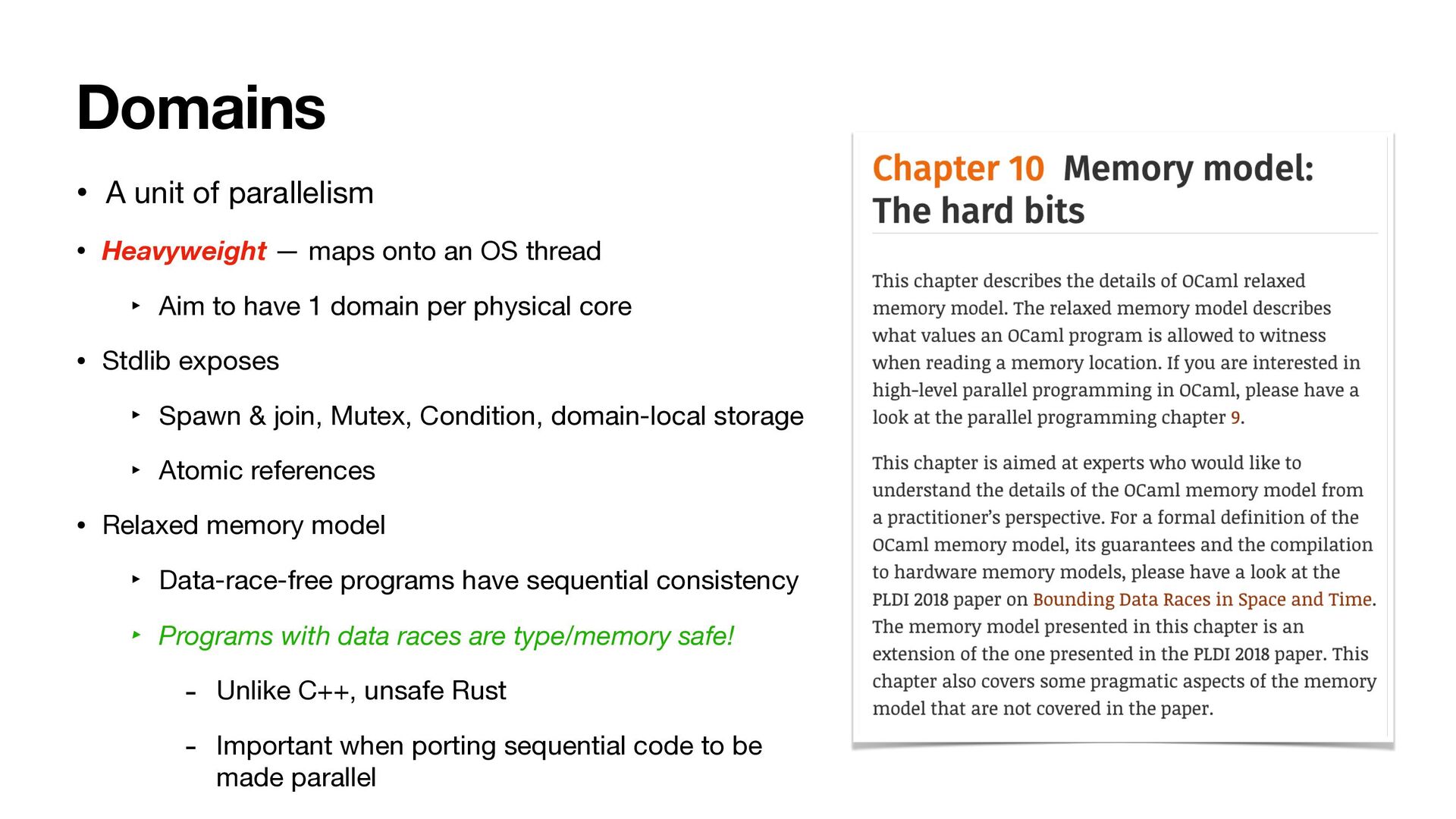
Domains • A unit of parallelism • Heavyweight — maps
onto an OS thread ‣ Aim to have 1 domain per physical core • Stdlib exposes ‣ Spawn & join, Mutex, Condition, domain-local storage ‣ Atomic references • Relaxed memory model ‣ Data-race-free programs have sequential consistency ‣ Programs with data races are type/memory safe! - Unlike C++, unsafe Rust - Important when porting sequential code to be made parallel -
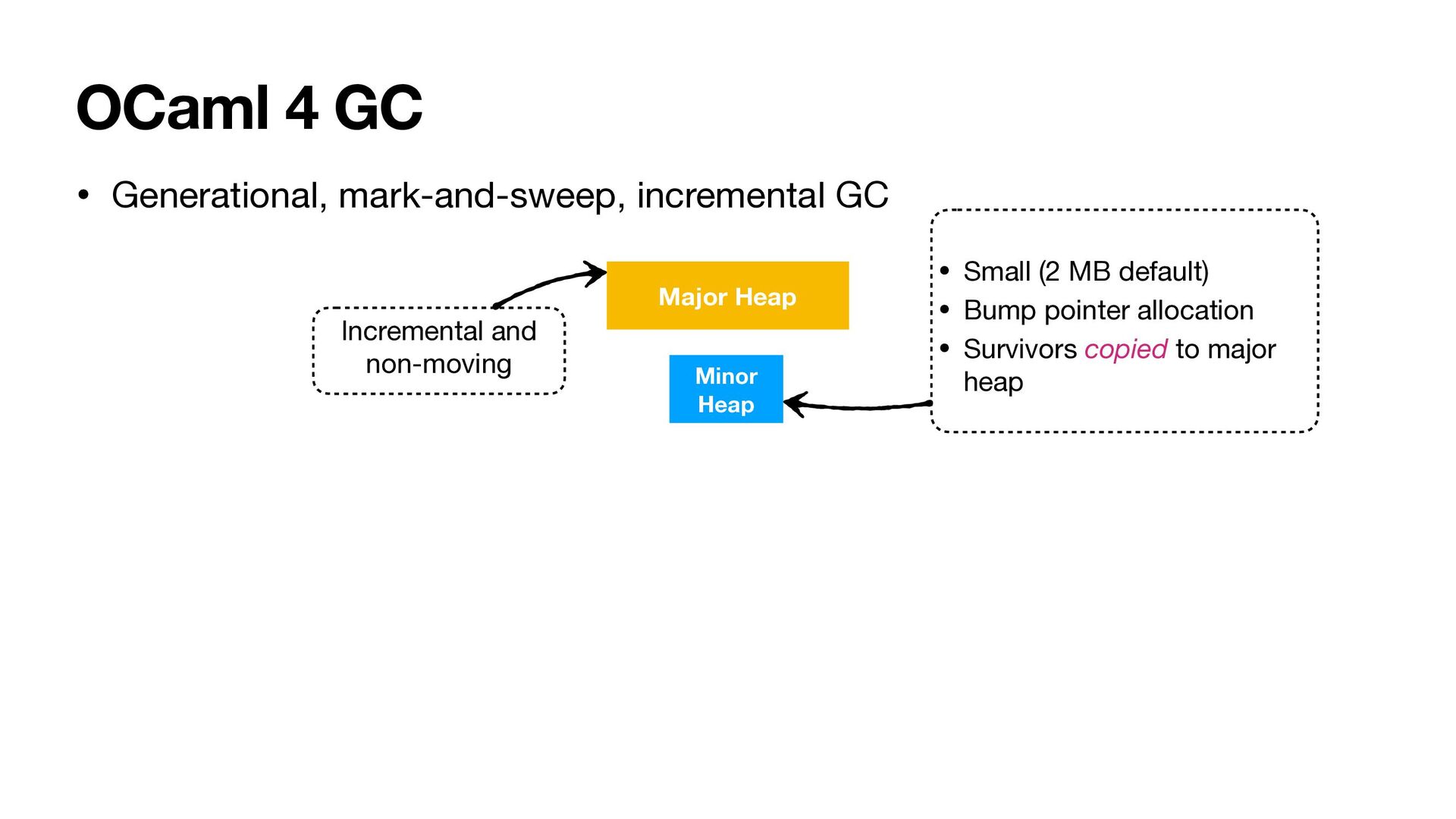
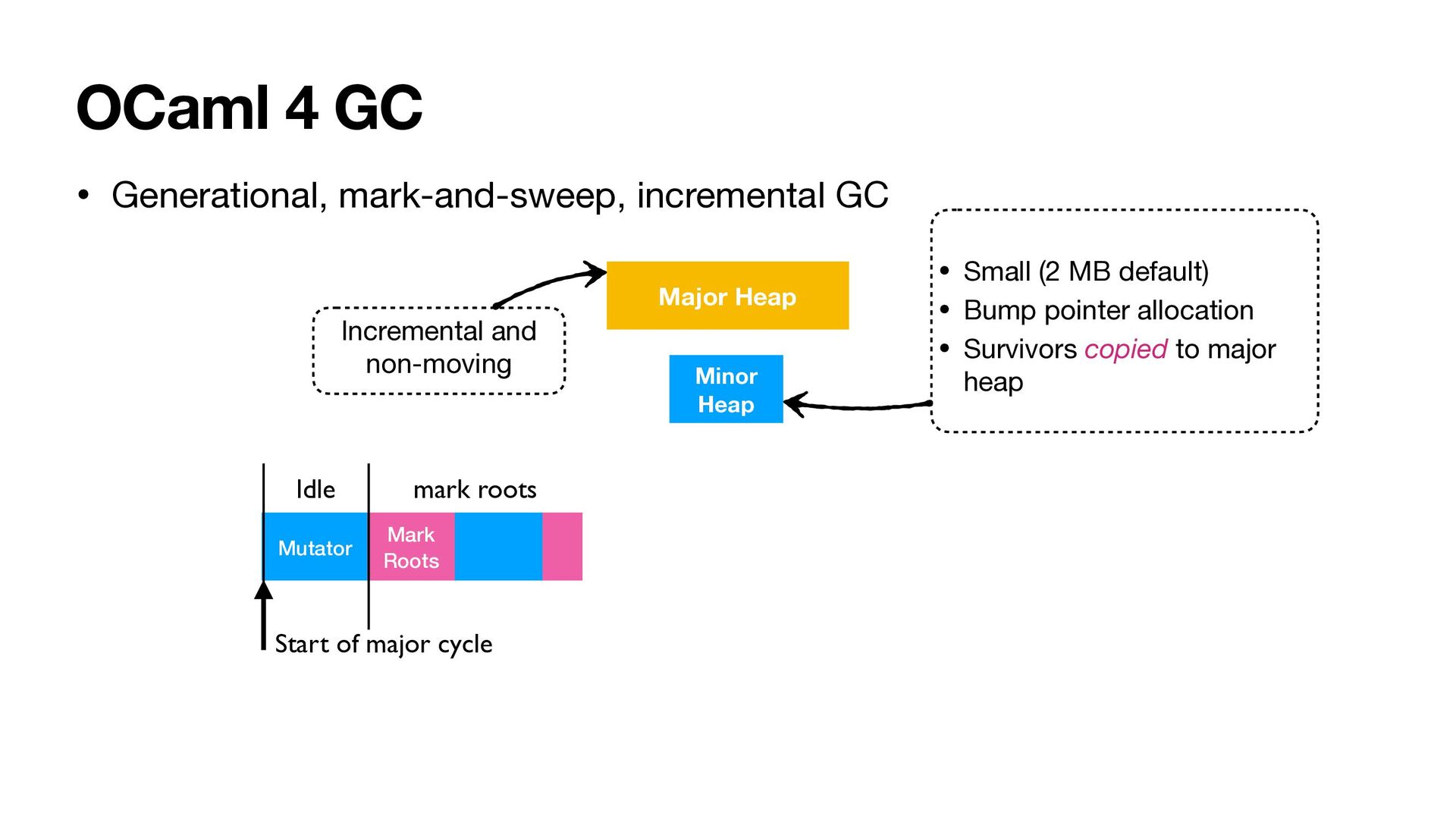
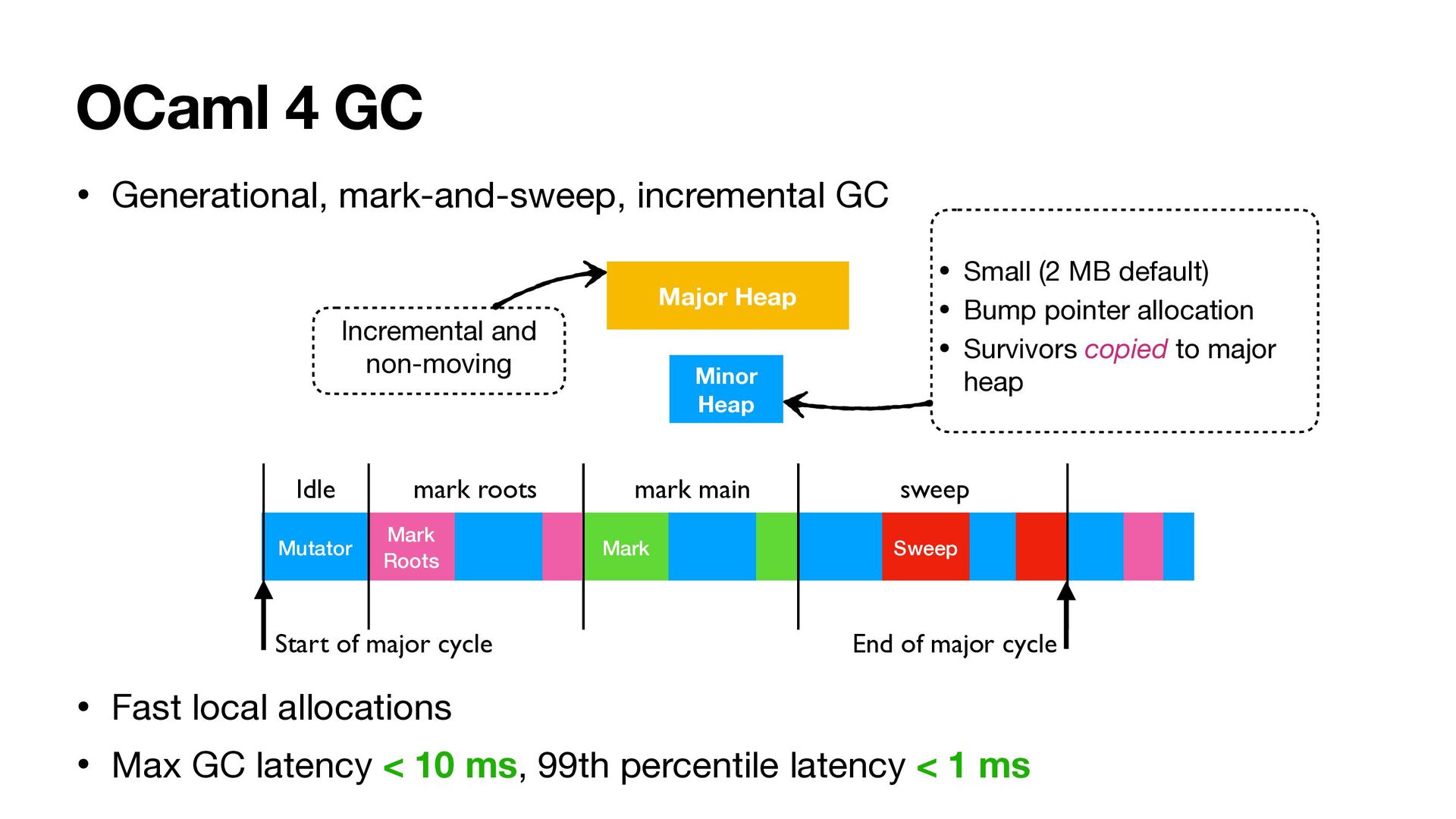
OCaml 4 GC • Generational, mark-and-sweep, incremental GC Incremental and
non-moving Minor Heap Major Heap • Small (2 MB default) • Bump pointer allocation • Survivors copied to major heap -
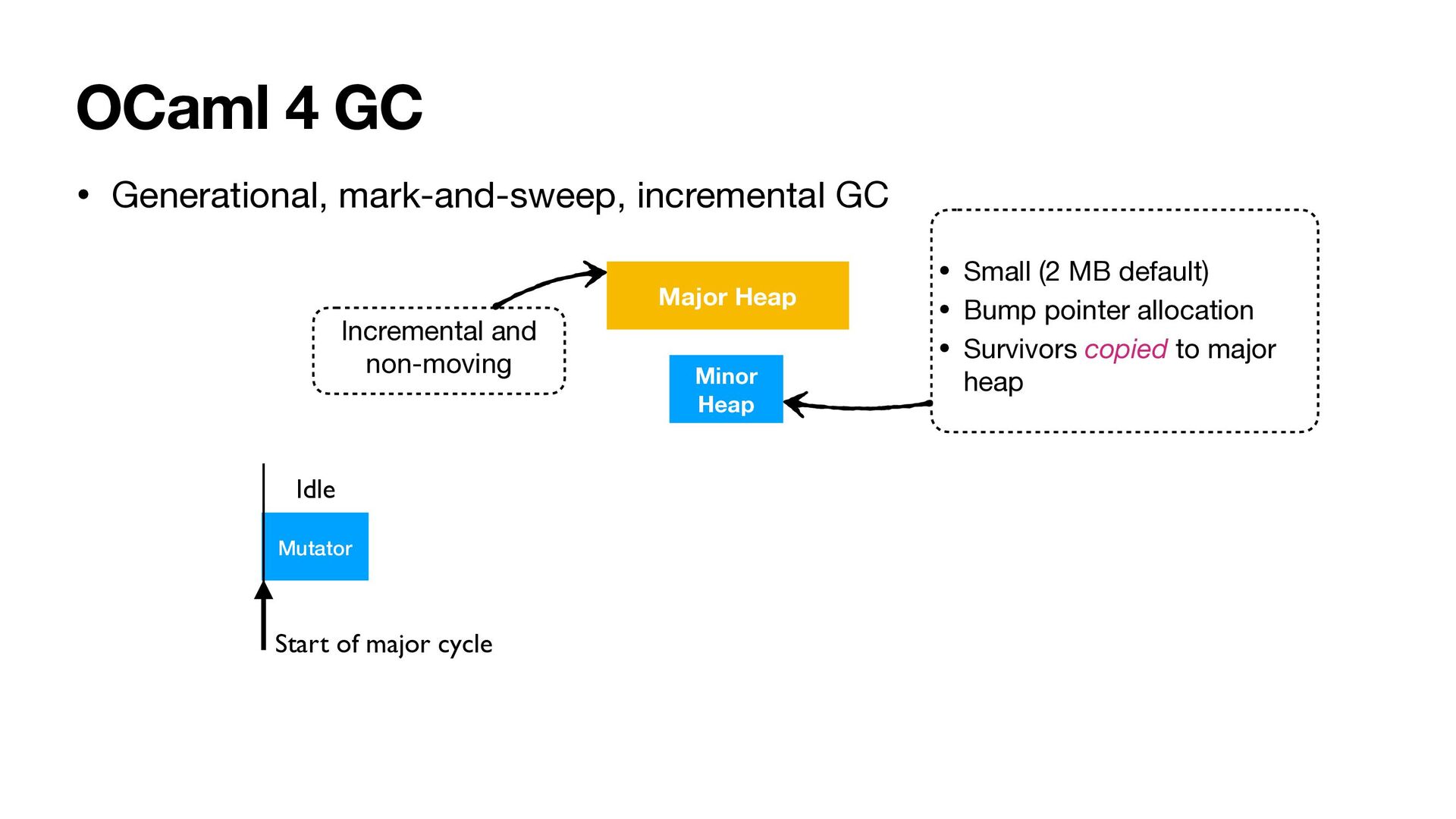
OCaml 4 GC • Generational, mark-and-sweep, incremental GC Incremental and
non-moving Minor Heap Major Heap • Small (2 MB default) • Bump pointer allocation • Survivors copied to major heap Mutator Start of major cycle Idle -
OCaml 4 GC • Generational, mark-and-sweep, incremental GC Incremental and
non-moving Minor Heap Major Heap • Small (2 MB default) • Bump pointer allocation • Survivors copied to major heap Mutator Start of major cycle Idle Mark Roots mark roots -
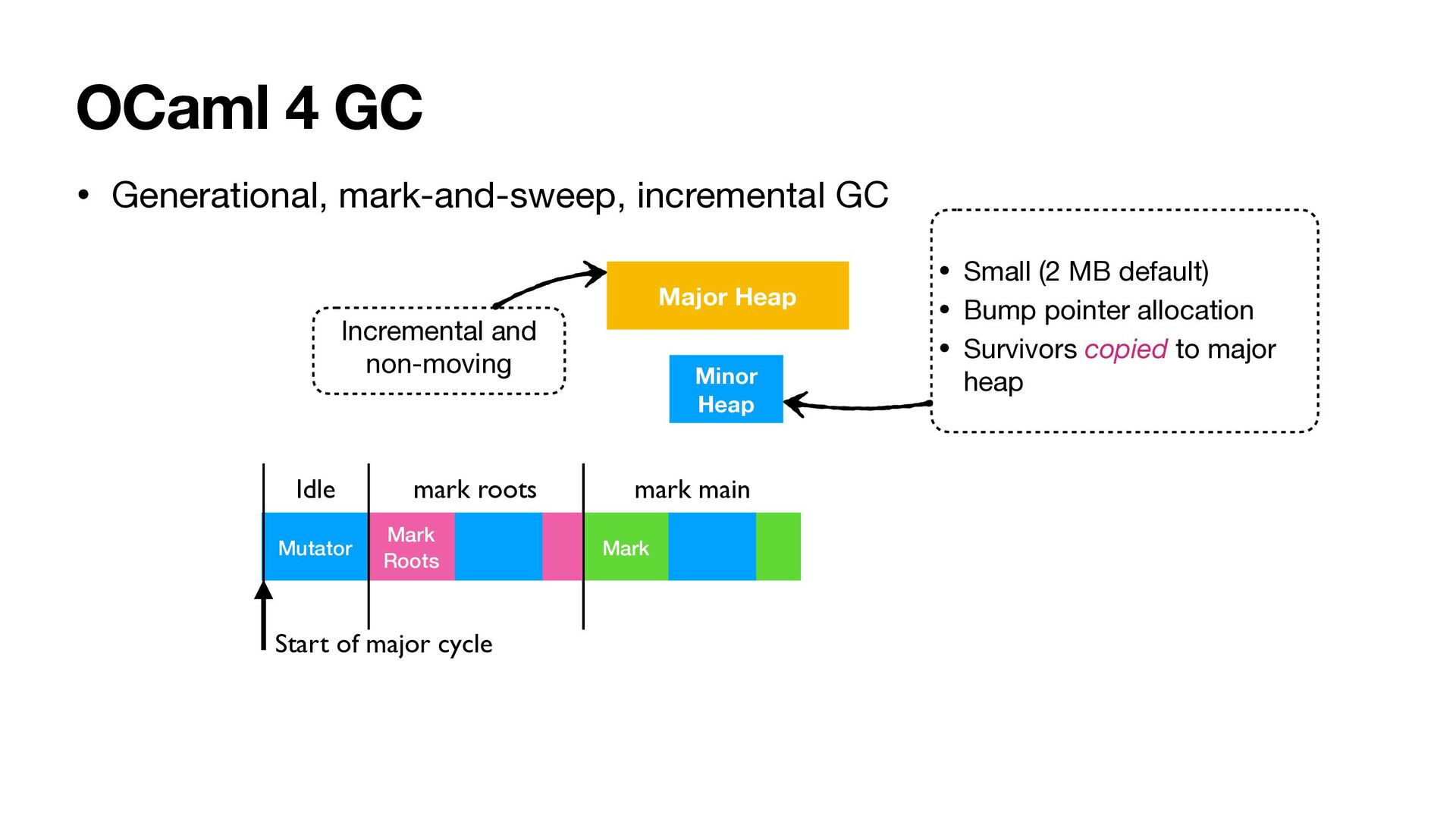
OCaml 4 GC • Generational, mark-and-sweep, incremental GC Incremental and
non-moving Minor Heap Major Heap • Small (2 MB default) • Bump pointer allocation • Survivors copied to major heap Mark mark main Mutator Start of major cycle Idle Mark Roots mark roots -
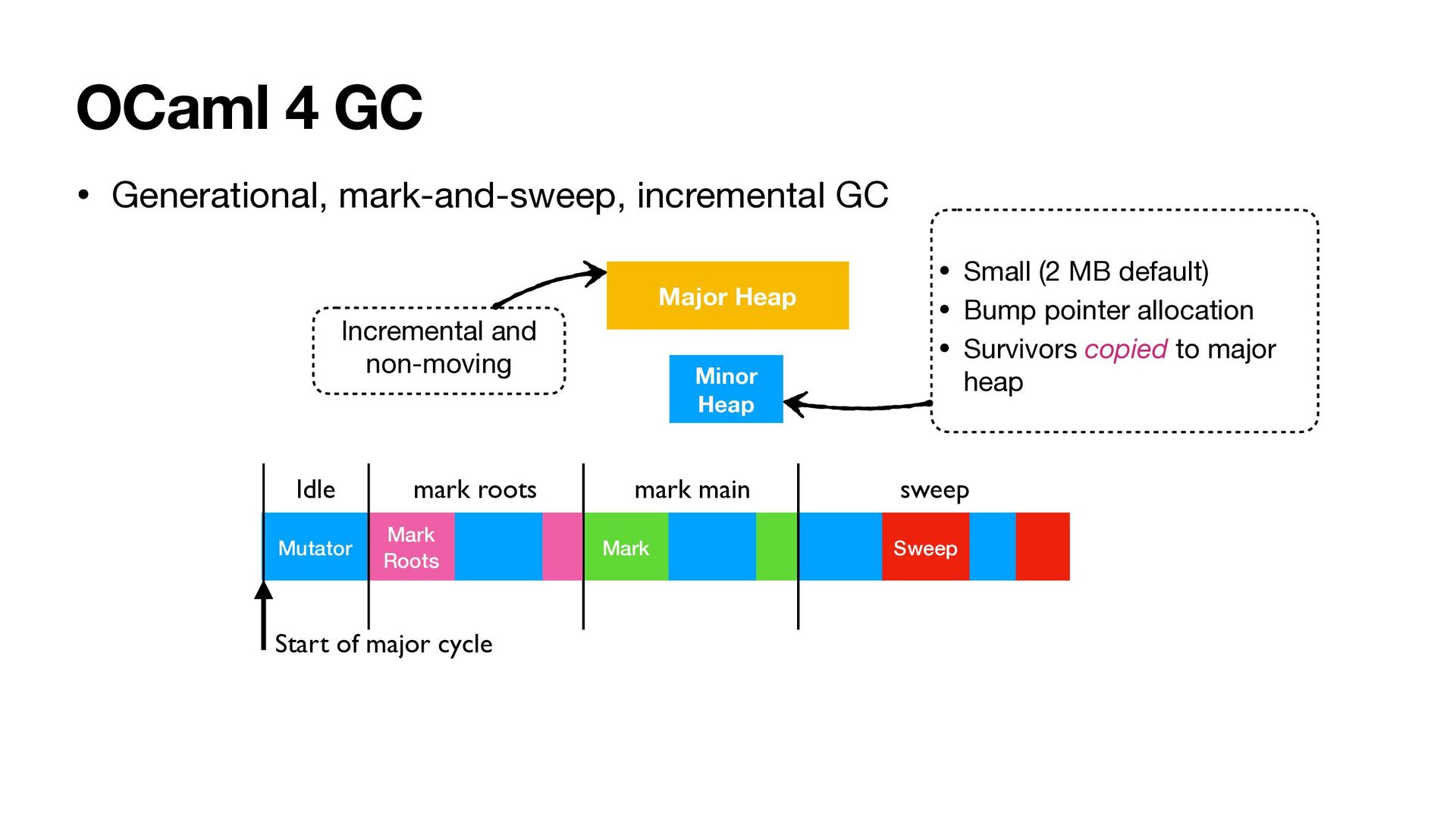
OCaml 4 GC • Generational, mark-and-sweep, incremental GC Incremental and
non-moving Minor Heap Major Heap • Small (2 MB default) • Bump pointer allocation • Survivors copied to major heap Mark mark main Sweep sweep Mutator Start of major cycle Idle Mark Roots mark roots -
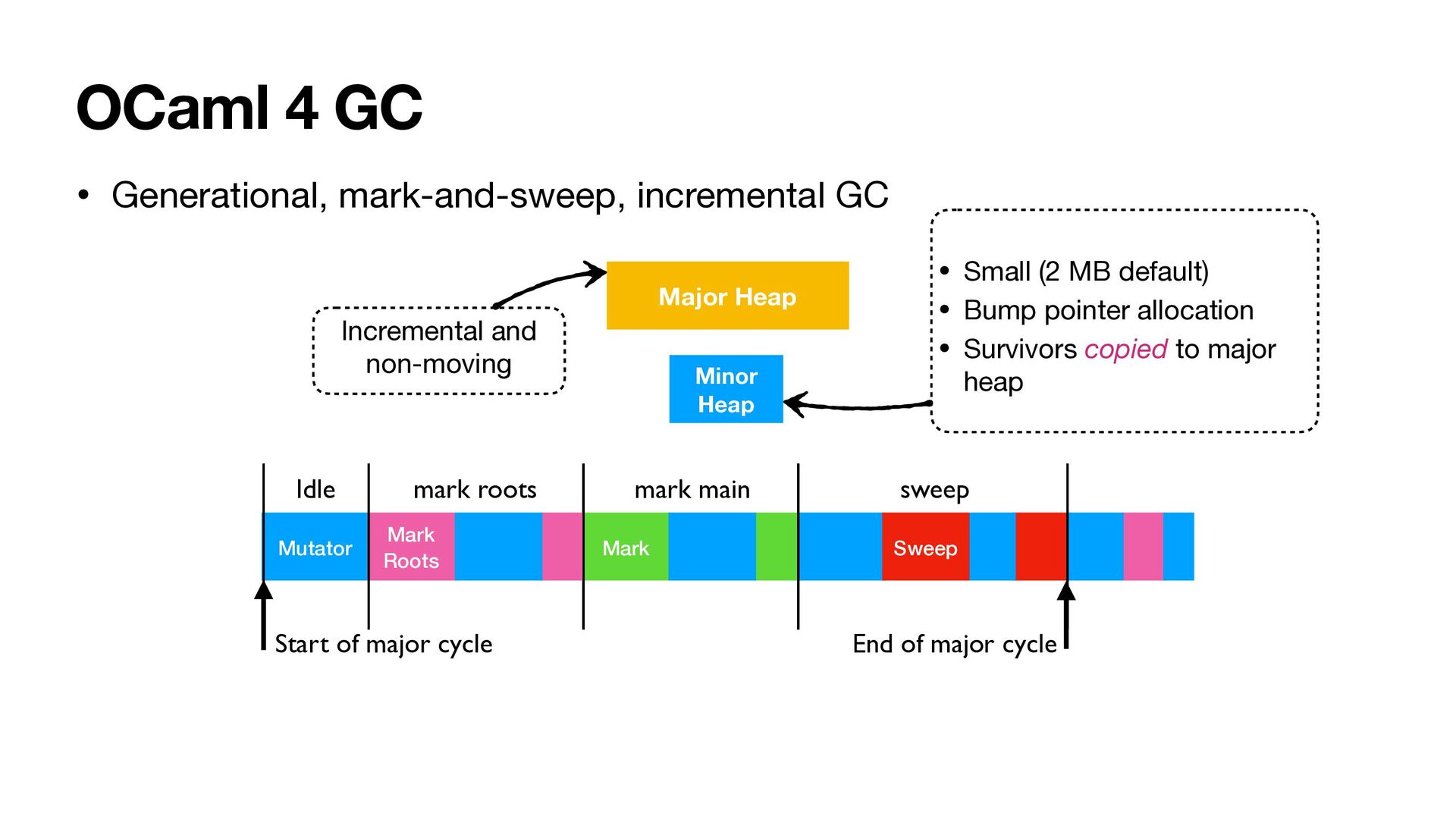
OCaml 4 GC • Generational, mark-and-sweep, incremental GC Incremental and
non-moving Minor Heap Major Heap • Small (2 MB default) • Bump pointer allocation • Survivors copied to major heap Mark mark main Sweep sweep End of major cycle Mutator Start of major cycle Idle Mark Roots mark roots -
OCaml 4 GC • Generational, mark-and-sweep, incremental GC Incremental and
non-moving Minor Heap Major Heap • Small (2 MB default) • Bump pointer allocation • Survivors copied to major heap Mark mark main Sweep sweep End of major cycle Mutator Start of major cycle Idle Mark Roots mark roots • Fast local allocations • Max GC latency < 10 ms, 99th percentile latency < 1 ms -
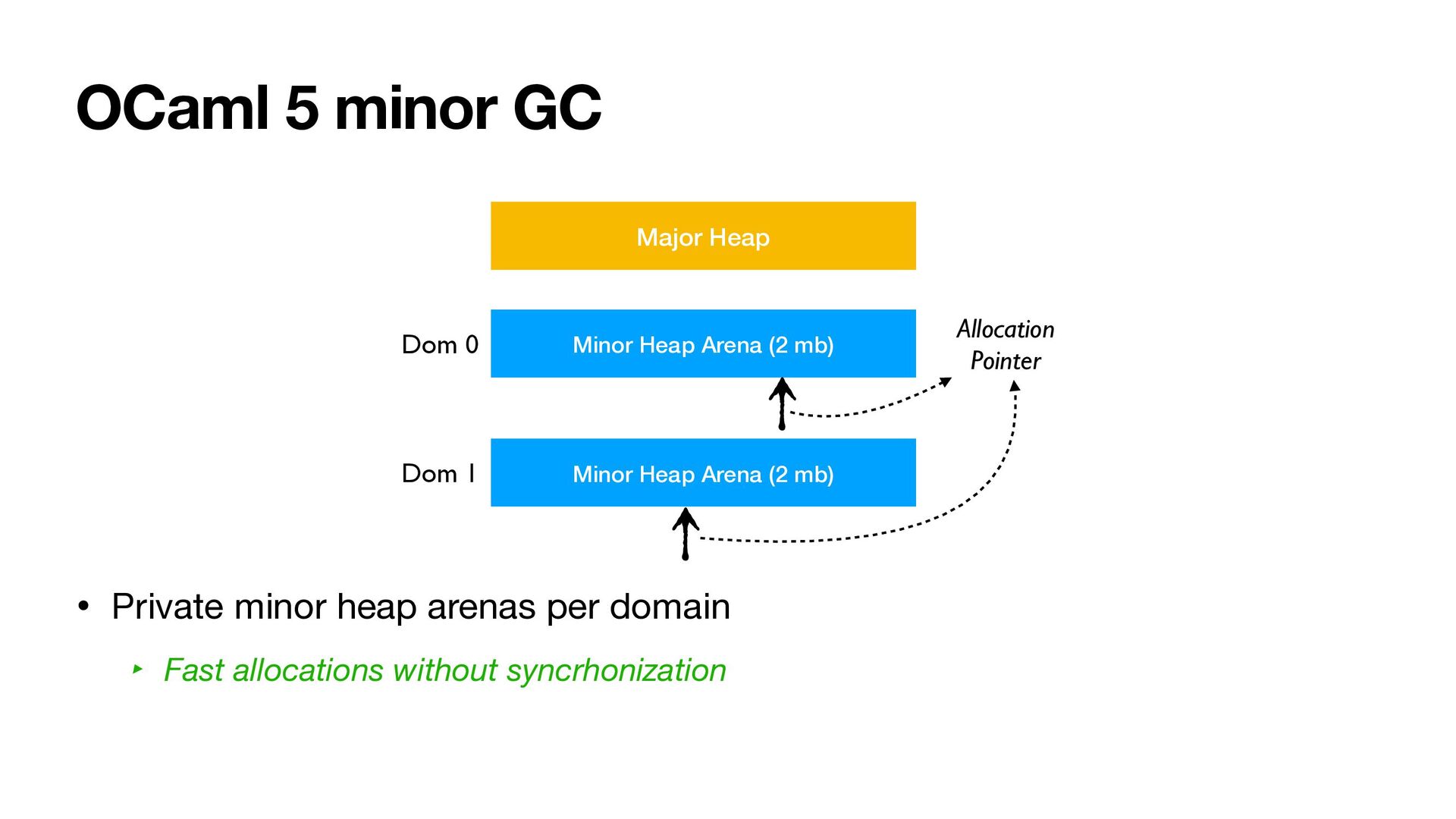
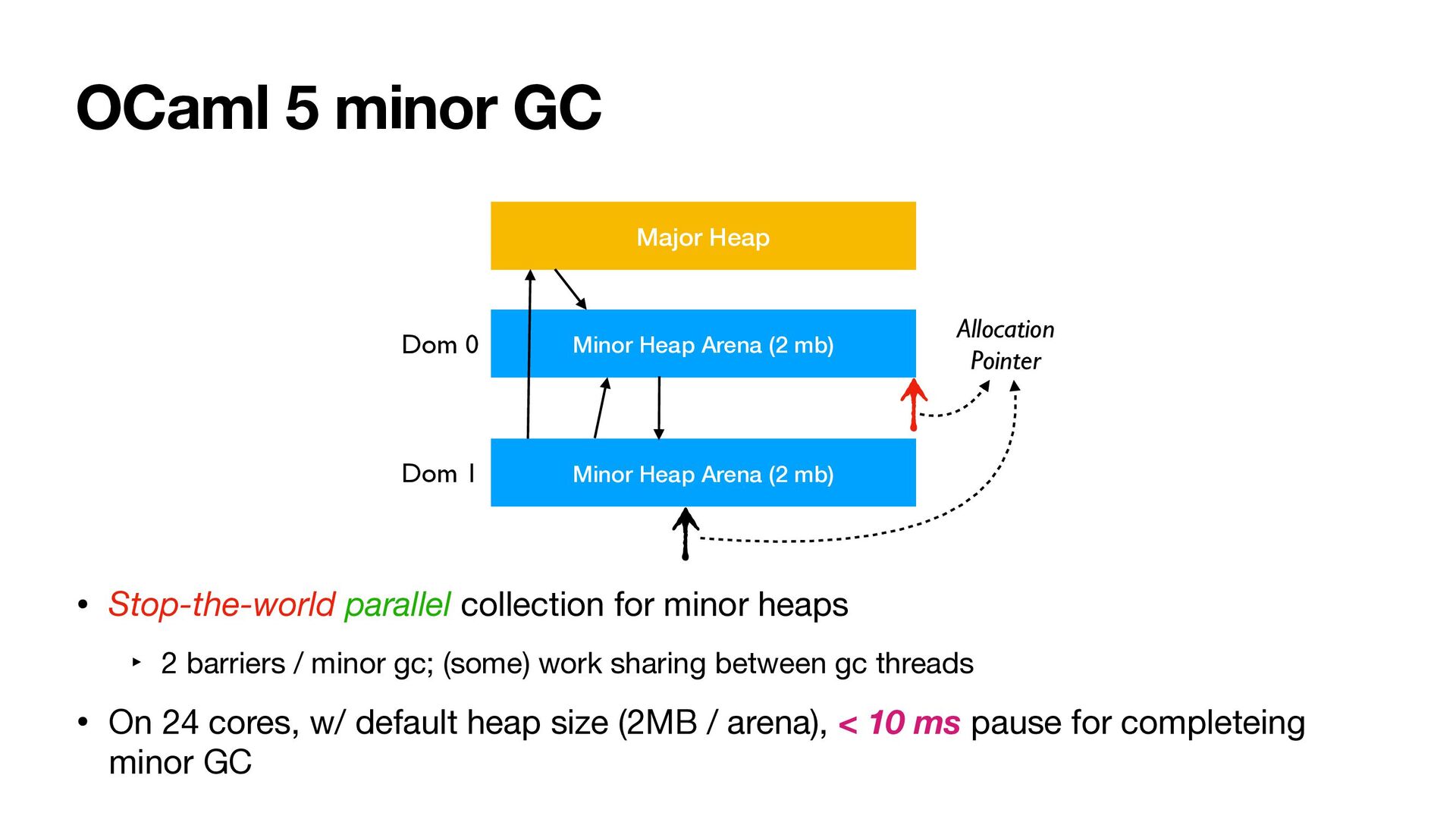
OCaml 5 minor GC • Private minor heap arenas per
domain ‣ Fast allocations without syncrhonization Major Heap Dom 0 Dom 1 Minor Heap Arena (2 mb) Minor Heap Arena (2 mb) Allocation Pointer -
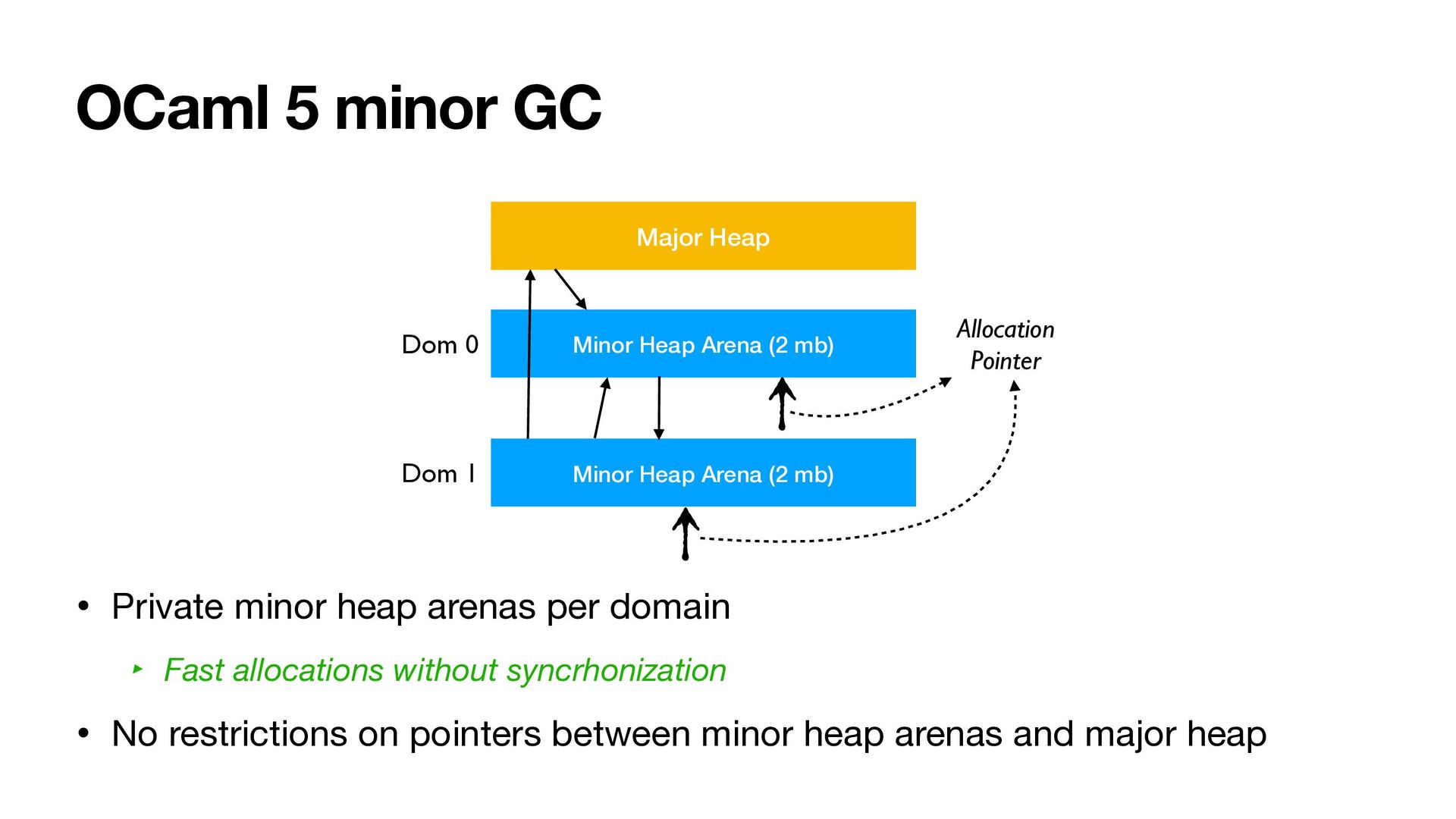
OCaml 5 minor GC • Private minor heap arenas per
domain ‣ Fast allocations without syncrhonization • No restrictions on pointers between minor heap arenas and major heap Major Heap Dom 0 Dom 1 Minor Heap Arena (2 mb) Minor Heap Arena (2 mb) Allocation Pointer -
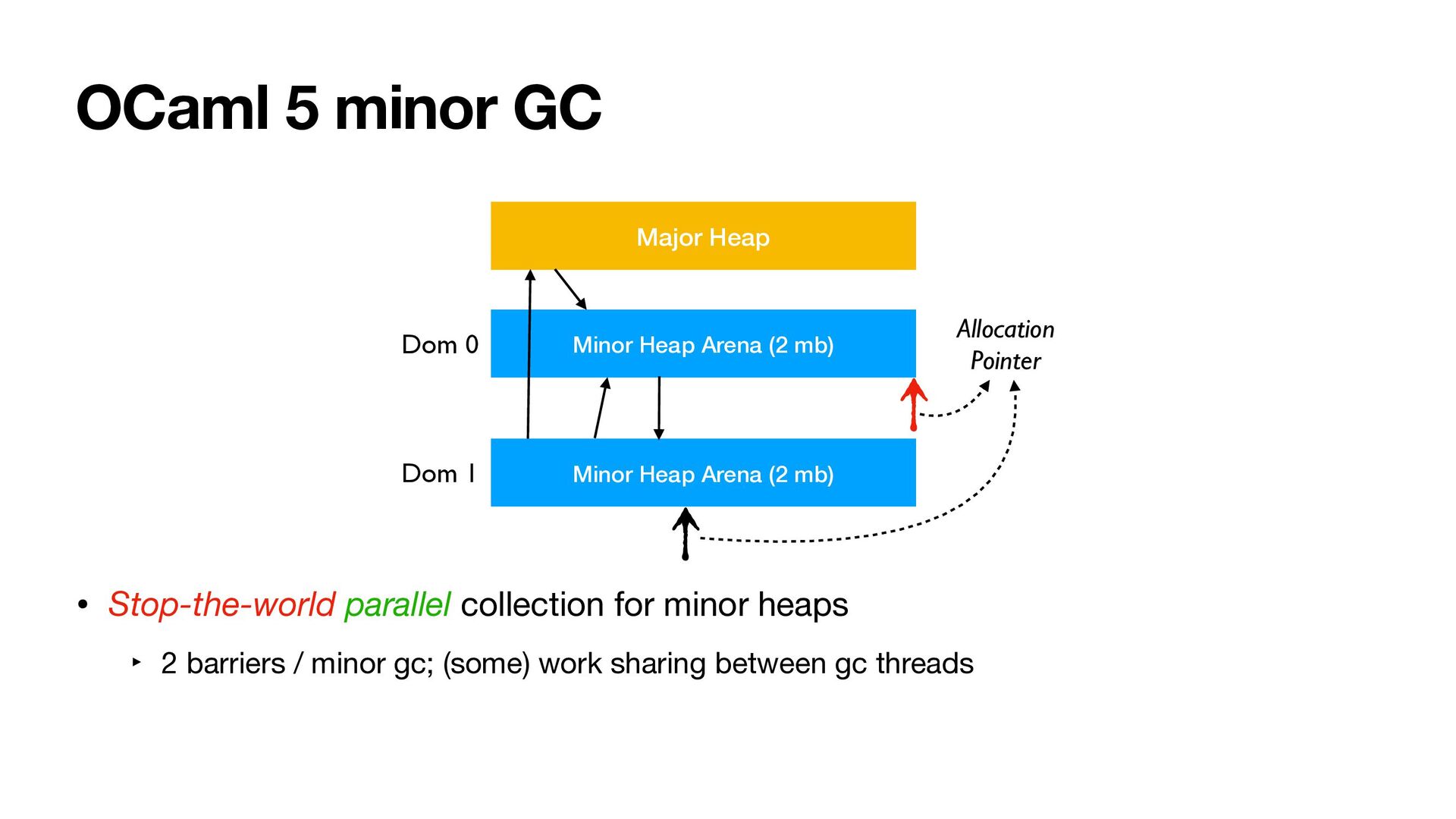
OCaml 5 minor GC Major Heap Dom 0 Dom 1
Minor Heap Arena (2 mb) Minor Heap Arena (2 mb) Allocation Pointer • Stop-the-world parallel collection for minor heaps ‣ 2 barriers / minor gc; (some) work sharing between gc threads -
OCaml 5 minor GC Major Heap Dom 0 Dom 1
Minor Heap Arena (2 mb) Minor Heap Arena (2 mb) Allocation Pointer • Stop-the-world parallel collection for minor heaps ‣ 2 barriers / minor gc; (some) work sharing between gc threads • On 24 cores, w/ default heap size (2MB / arena), < 10 ms pause for completeing minor GC -
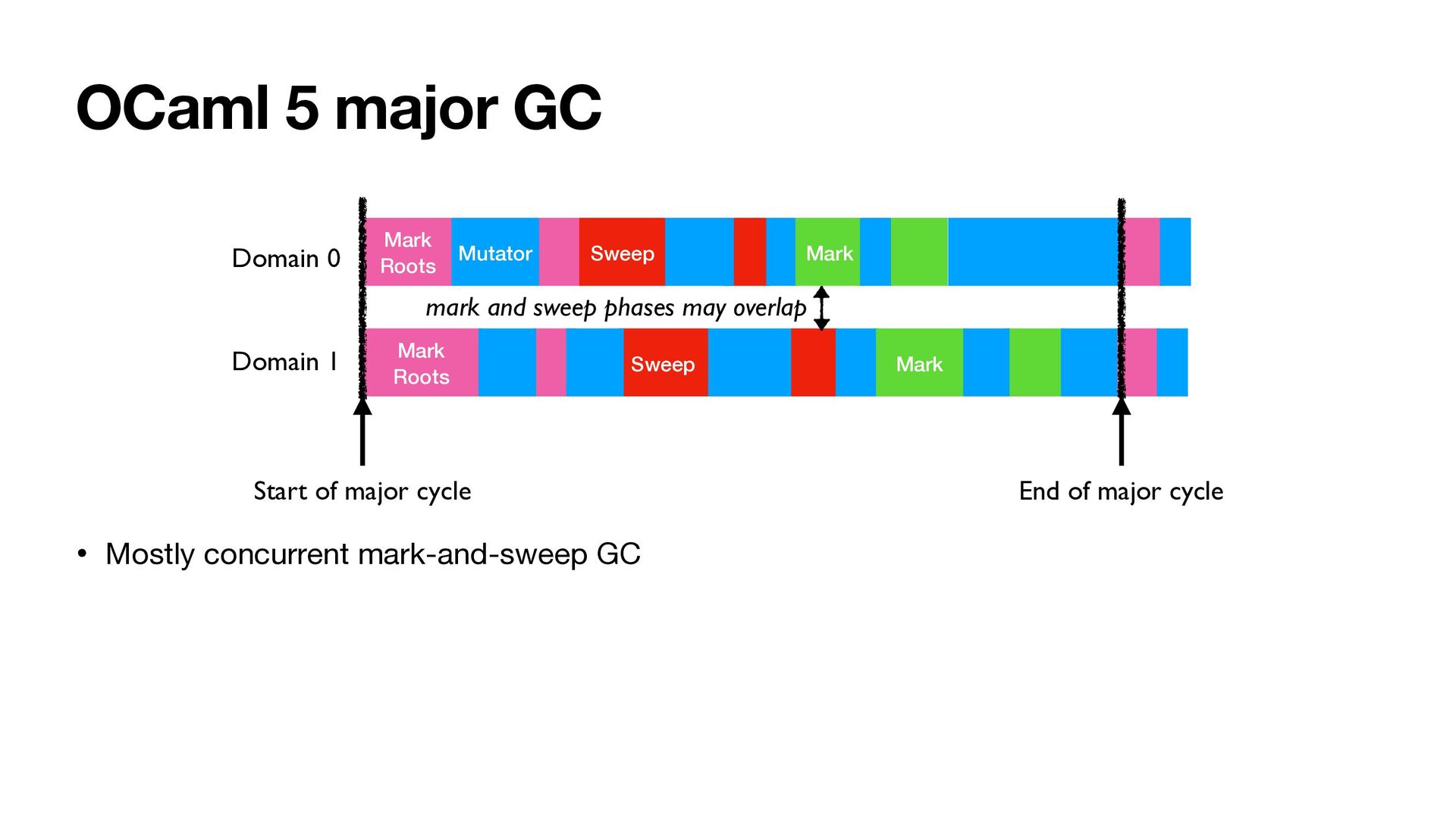
OCaml 5 major GC • Mostly concurrent mark-and-sweep GC Sweep
Mark Mark Roots Mutator Sweep Mark Mark Roots Start of major cycle End of major cycle mark and sweep phases may overlap Domain 0 Domain 1 -
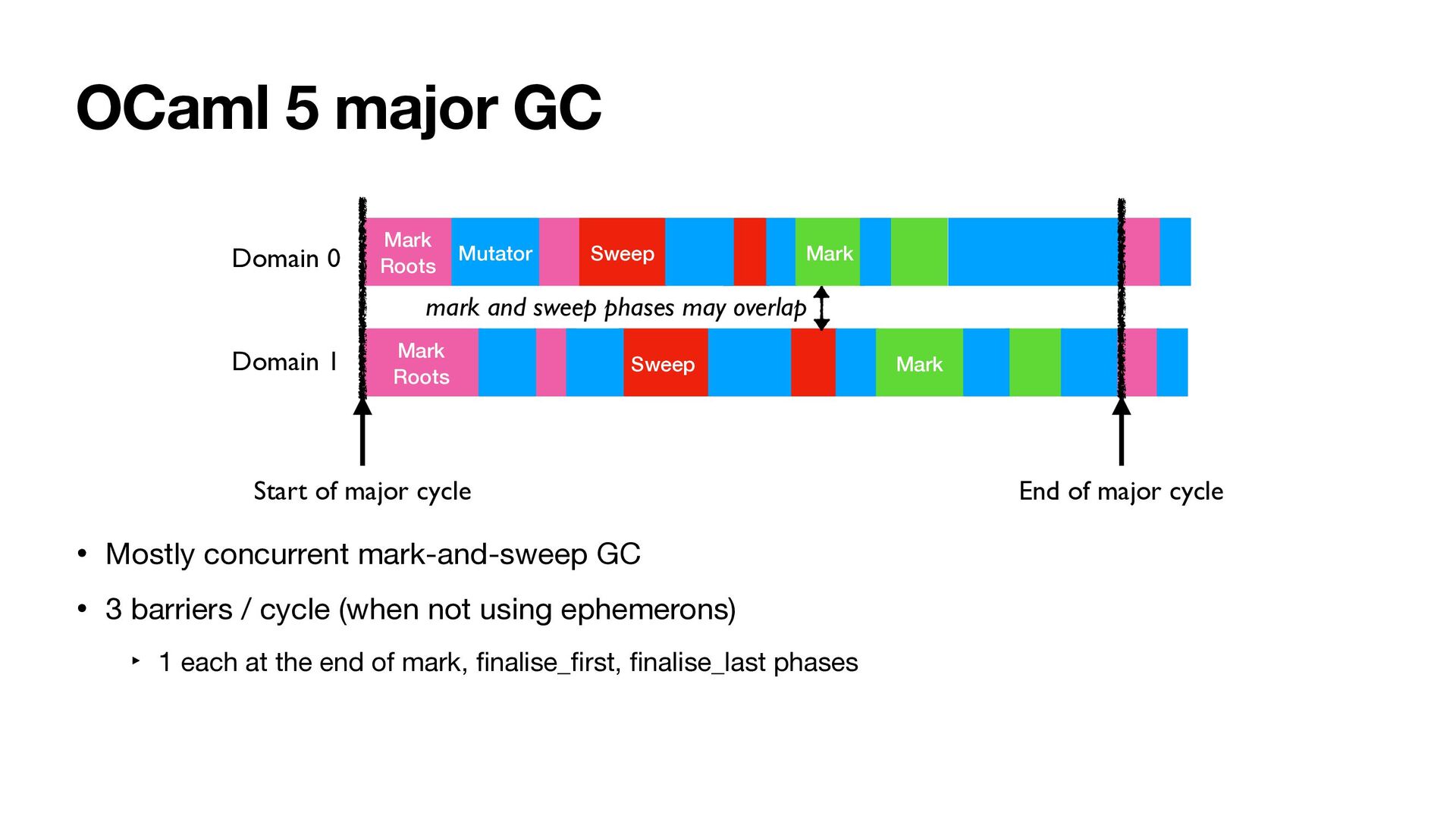
OCaml 5 major GC • Mostly concurrent mark-and-sweep GC •
3 barriers / cycle (when not using ephemerons) ‣ 1 each at the end of mark, fi nalise_ fi rst, fi nalise_last phases Sweep Mark Mark Roots Mutator Sweep Mark Mark Roots Start of major cycle End of major cycle mark and sweep phases may overlap Domain 0 Domain 1 -
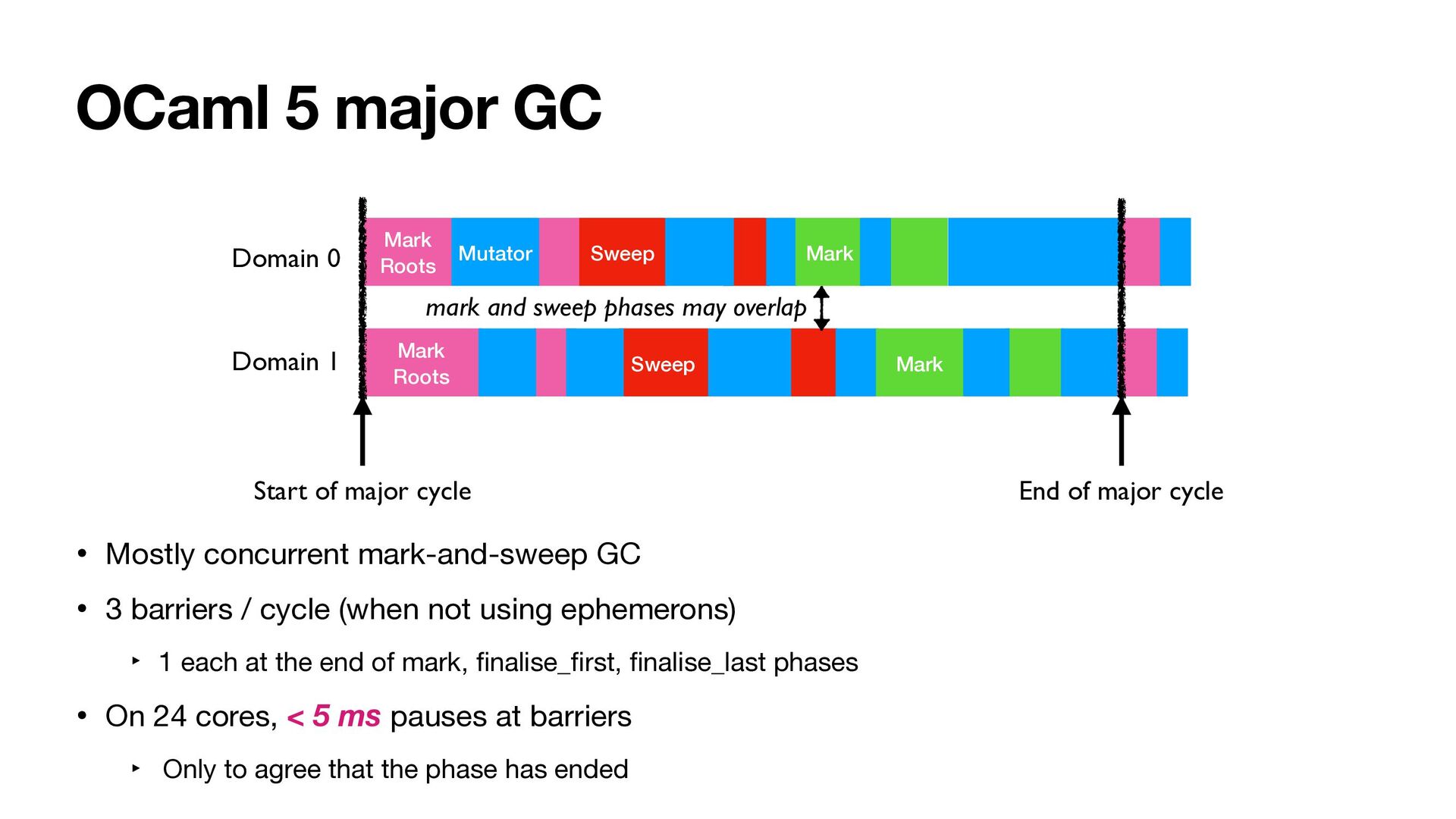
OCaml 5 major GC • Mostly concurrent mark-and-sweep GC •
3 barriers / cycle (when not using ephemerons) ‣ 1 each at the end of mark, fi nalise_ fi rst, fi nalise_last phases • On 24 cores, < 5 ms pauses at barriers ‣ Only to agree that the phase has ended Sweep Mark Mark Roots Mutator Sweep Mark Mark Roots Start of major cycle End of major cycle mark and sweep phases may overlap Domain 0 Domain 1 -
Backwards compatibility • Both e ff ect handlers and GC
designed for backwards compatibility ‣ Performance, tooling support, features (almost all of them) -
Backwards compatibility • Both e ff ect handlers and GC
designed for backwards compatibility ‣ Performance, tooling support, features (almost all of them) • Performance ‣ OCaml 5 is designed to run sequential programs as well as OCaml 4 ‣ Any signi fi cant performance regressions (5%+) is a bug; please report it! -
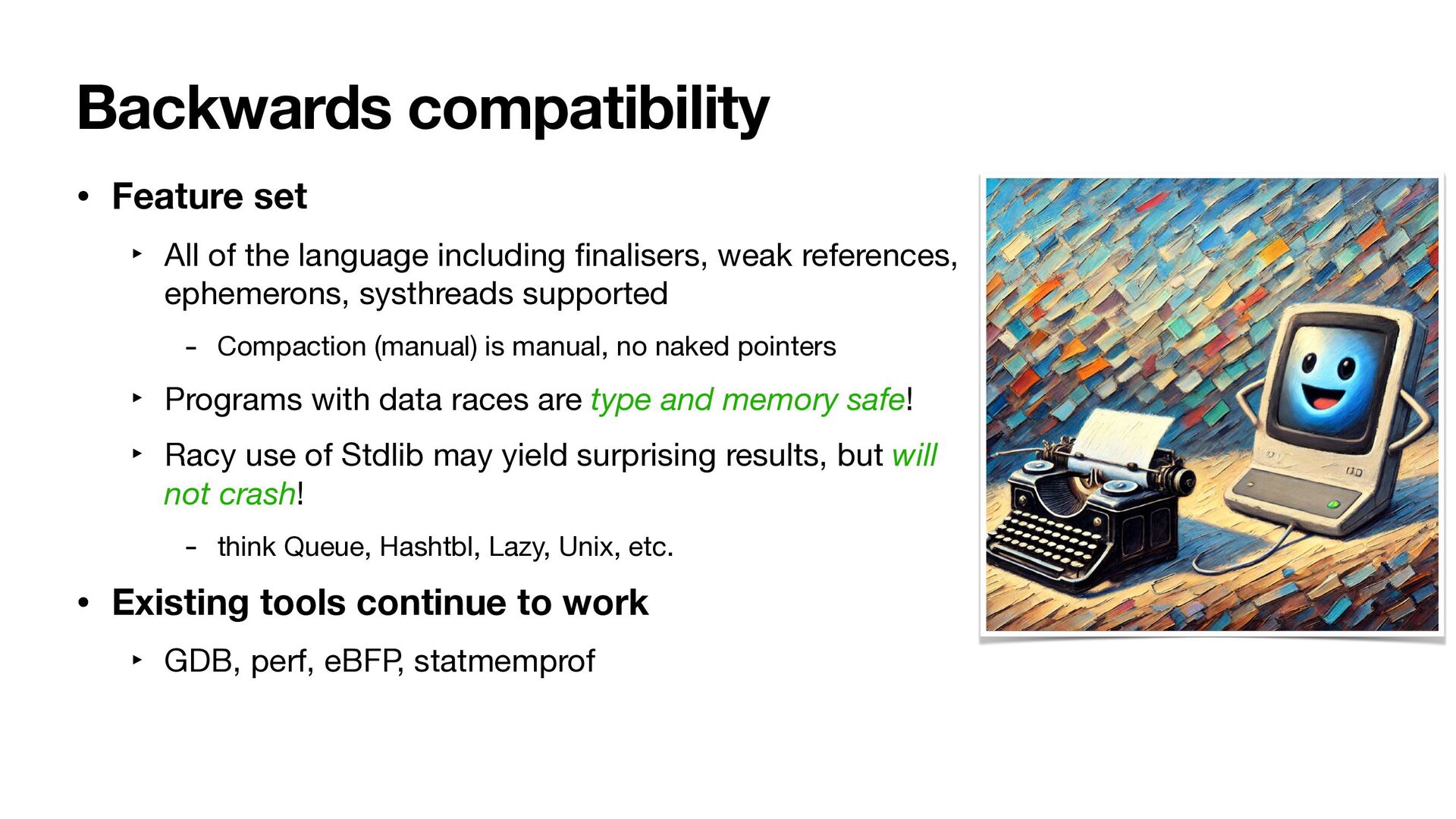
Backwards compatibility • Feature set ‣ All of the language
including fi nalisers, weak references, ephemerons, systhreads supported - Compaction (manual) is manual, no naked pointers ‣ Programs with data races are type and memory safe! ‣ Racy use of Stdlib may yield surprising results, but will not crash! - think Queue, Hashtbl, Lazy, Unix, etc. -
Backwards compatibility • Feature set ‣ All of the language
including fi nalisers, weak references, ephemerons, systhreads supported - Compaction (manual) is manual, no naked pointers ‣ Programs with data races are type and memory safe! ‣ Racy use of Stdlib may yield surprising results, but will not crash! - think Queue, Hashtbl, Lazy, Unix, etc. • Existing tools continue to work ‣ GDB, perf, eBFP, statmemprof -
Porting Applications to OCaml 5 Based on work done by
Thomas Leonard @ Tarides https://roscidus.com/blog/blog/2024/07/22/performance-2/ -
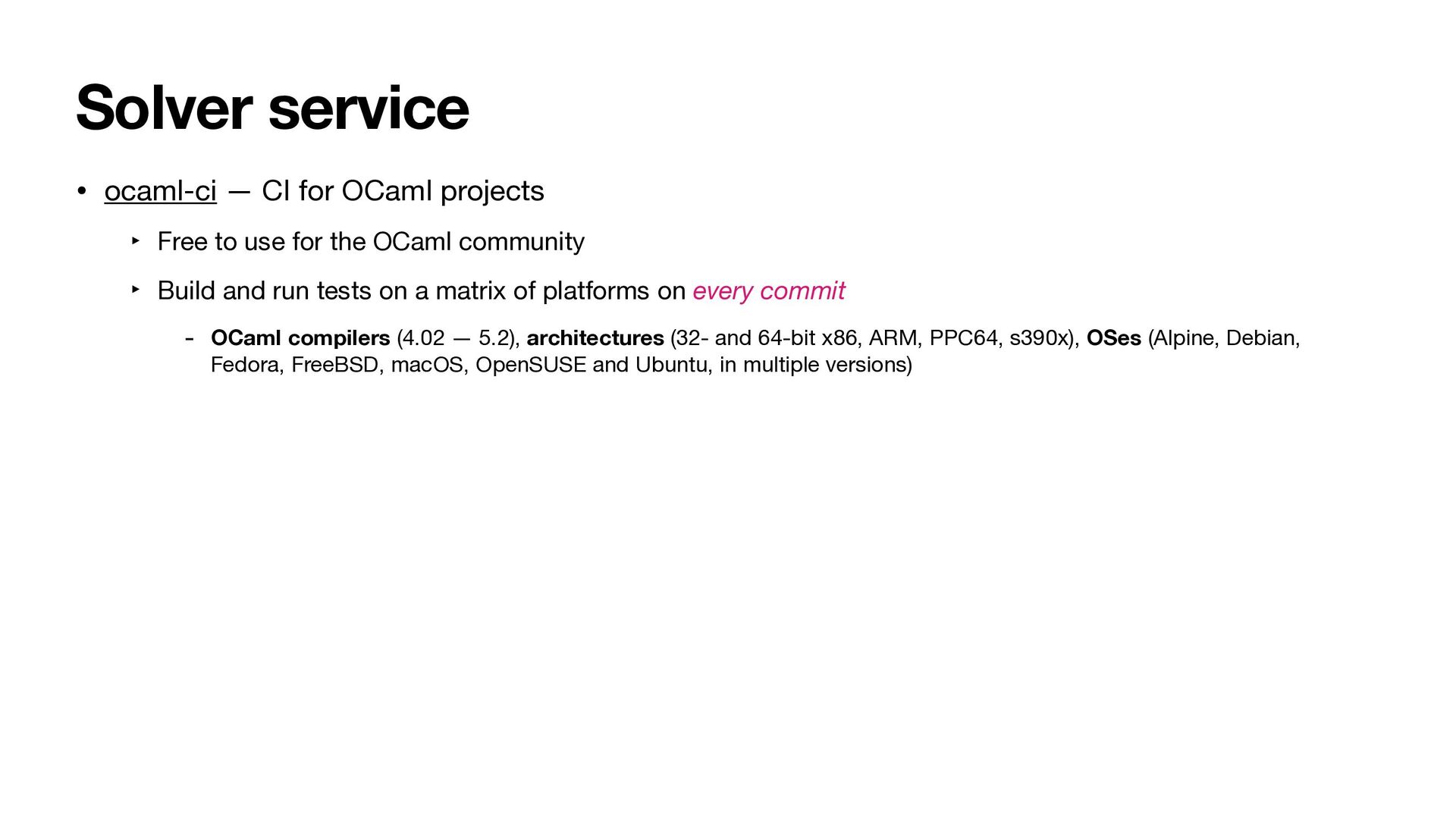
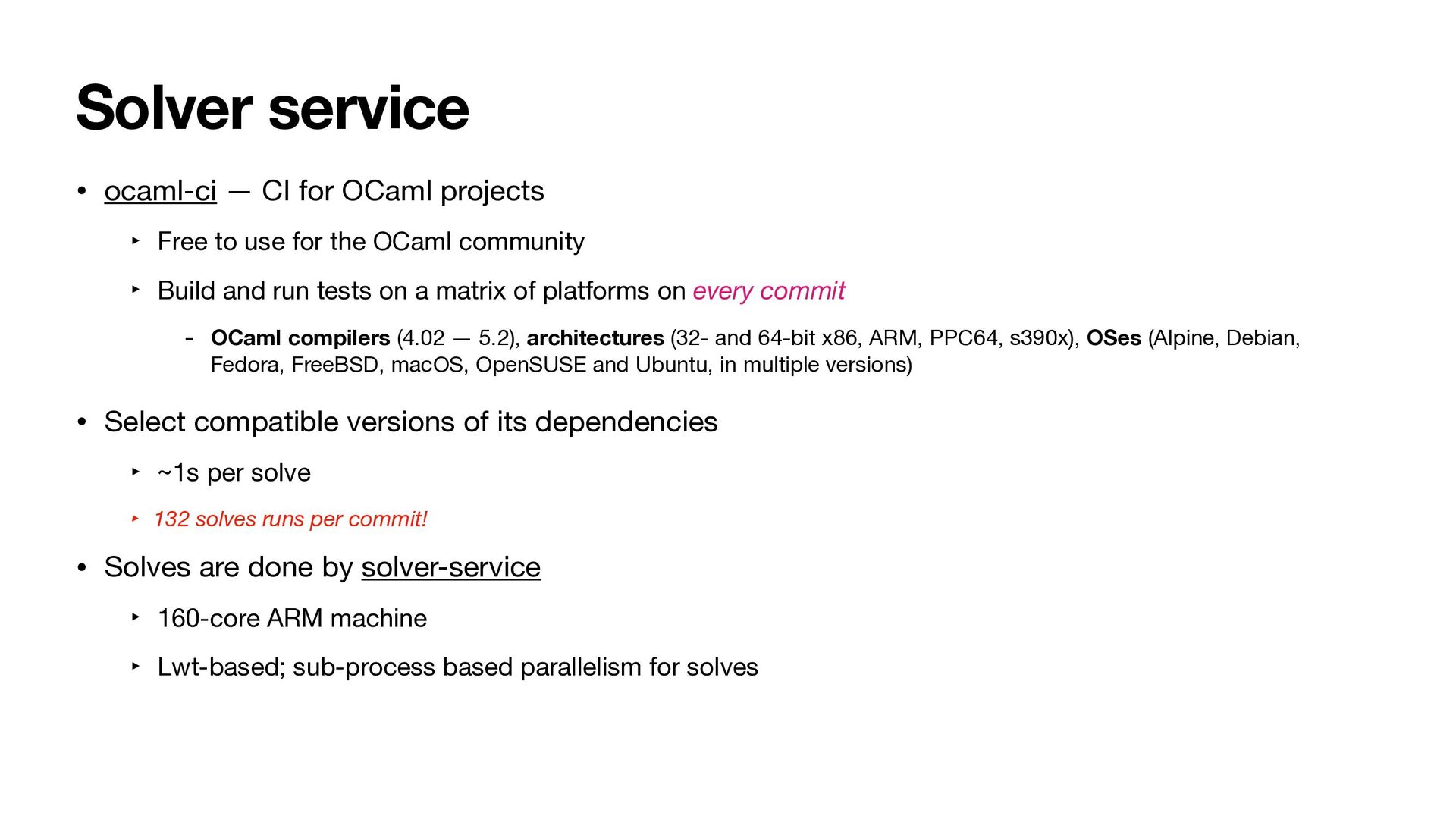
Solver service • ocaml-ci — CI for OCaml projects ‣
Free to use for the OCaml community ‣ Build and run tests on a matrix of platforms on every commit - OCaml compilers (4.02 — 5.2), architectures (32- and 64-bit x86, ARM, PPC64, s390x), OSes (Alpine, Debian, Fedora, FreeBSD, macOS, OpenSUSE and Ubuntu, in multiple versions) -
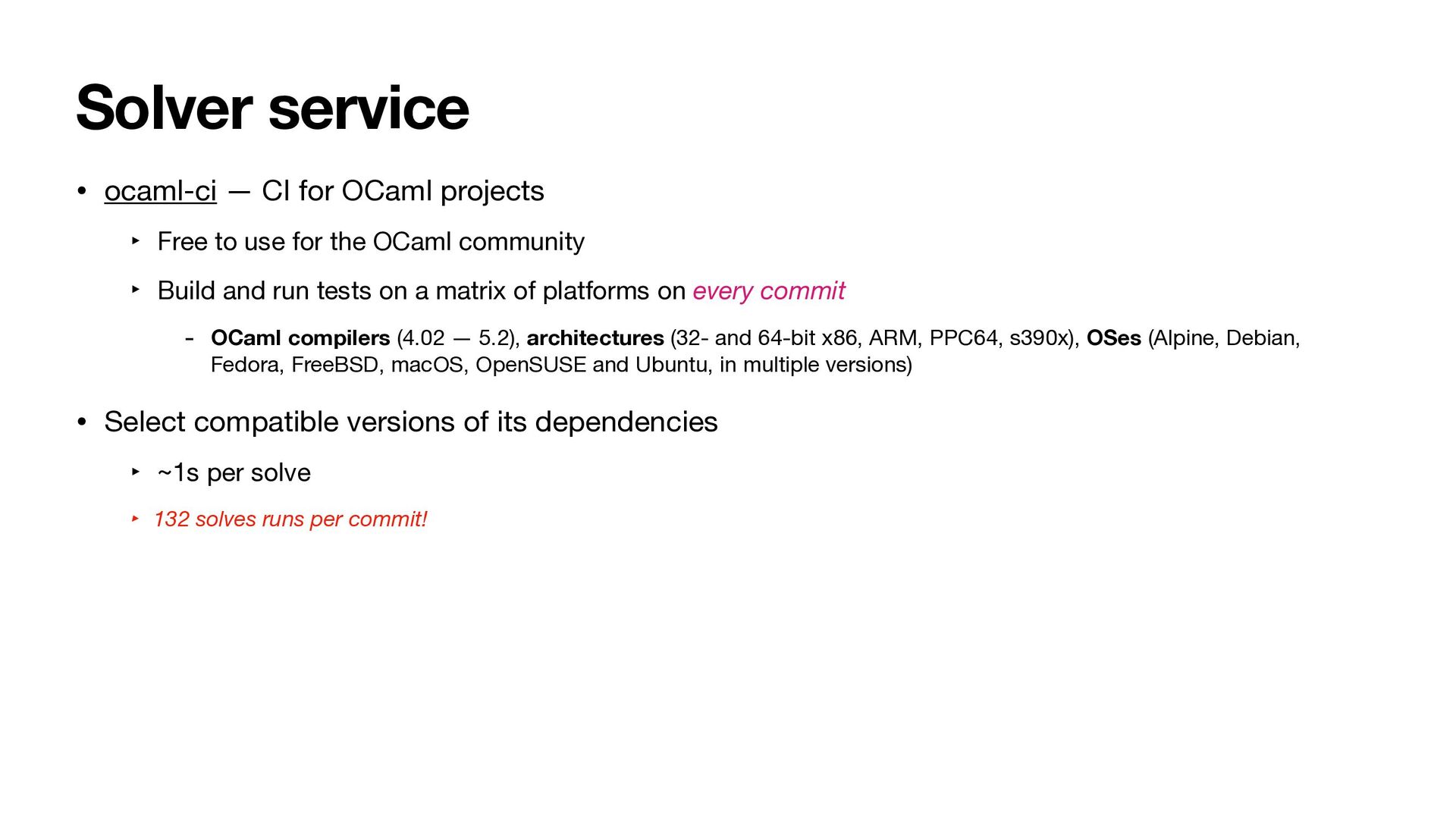
Solver service • ocaml-ci — CI for OCaml projects ‣
Free to use for the OCaml community ‣ Build and run tests on a matrix of platforms on every commit - OCaml compilers (4.02 — 5.2), architectures (32- and 64-bit x86, ARM, PPC64, s390x), OSes (Alpine, Debian, Fedora, FreeBSD, macOS, OpenSUSE and Ubuntu, in multiple versions) • Select compatible versions of its dependencies ‣ ~1s per solve ‣ 132 solves runs per commit! -
Solver service • ocaml-ci — CI for OCaml projects ‣
Free to use for the OCaml community ‣ Build and run tests on a matrix of platforms on every commit - OCaml compilers (4.02 — 5.2), architectures (32- and 64-bit x86, ARM, PPC64, s390x), OSes (Alpine, Debian, Fedora, FreeBSD, macOS, OpenSUSE and Ubuntu, in multiple versions) • Select compatible versions of its dependencies ‣ ~1s per solve ‣ 132 solves runs per commit! • Solves are done by solver-service ‣ 160-core ARM machine ‣ Lwt-based; sub-process based parallelism for solves -
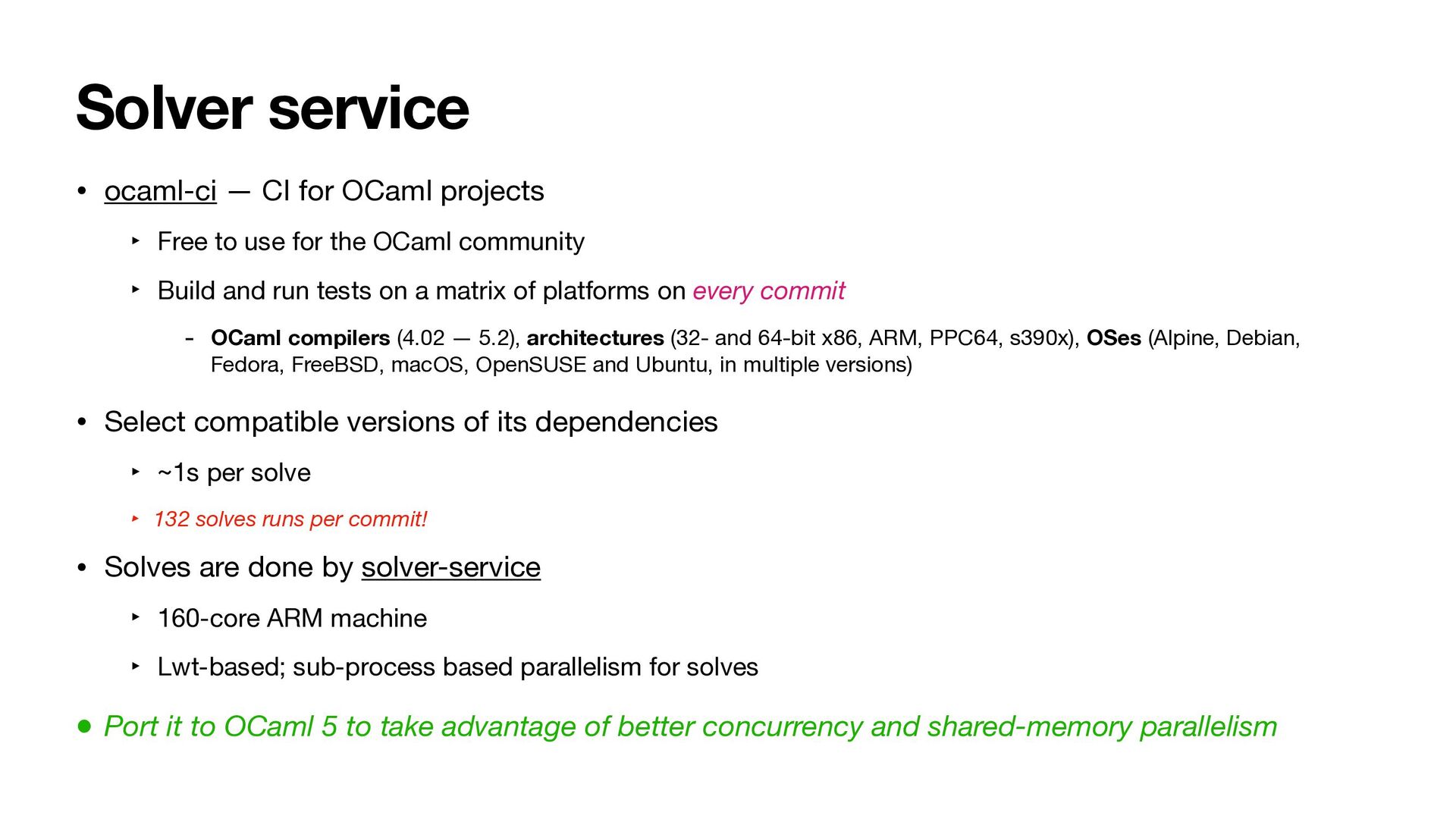
Solver service • ocaml-ci — CI for OCaml projects ‣
Free to use for the OCaml community ‣ Build and run tests on a matrix of platforms on every commit - OCaml compilers (4.02 — 5.2), architectures (32- and 64-bit x86, ARM, PPC64, s390x), OSes (Alpine, Debian, Fedora, FreeBSD, macOS, OpenSUSE and Ubuntu, in multiple versions) • Select compatible versions of its dependencies ‣ ~1s per solve ‣ 132 solves runs per commit! • Solves are done by solver-service ‣ 160-core ARM machine ‣ Lwt-based; sub-process based parallelism for solves • Port it to OCaml 5 to take advantage of better concurrency and shared-memory parallelism -
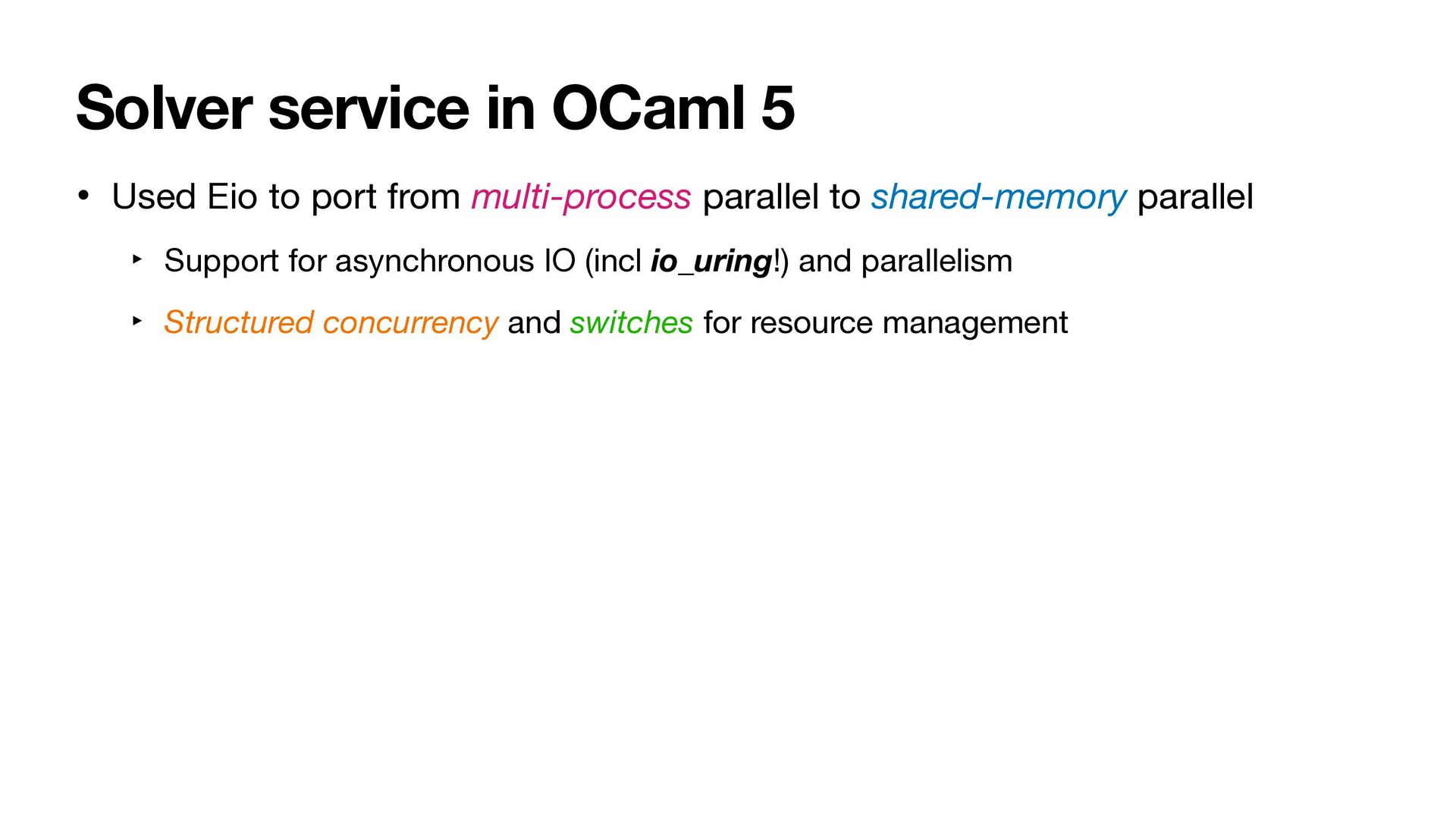
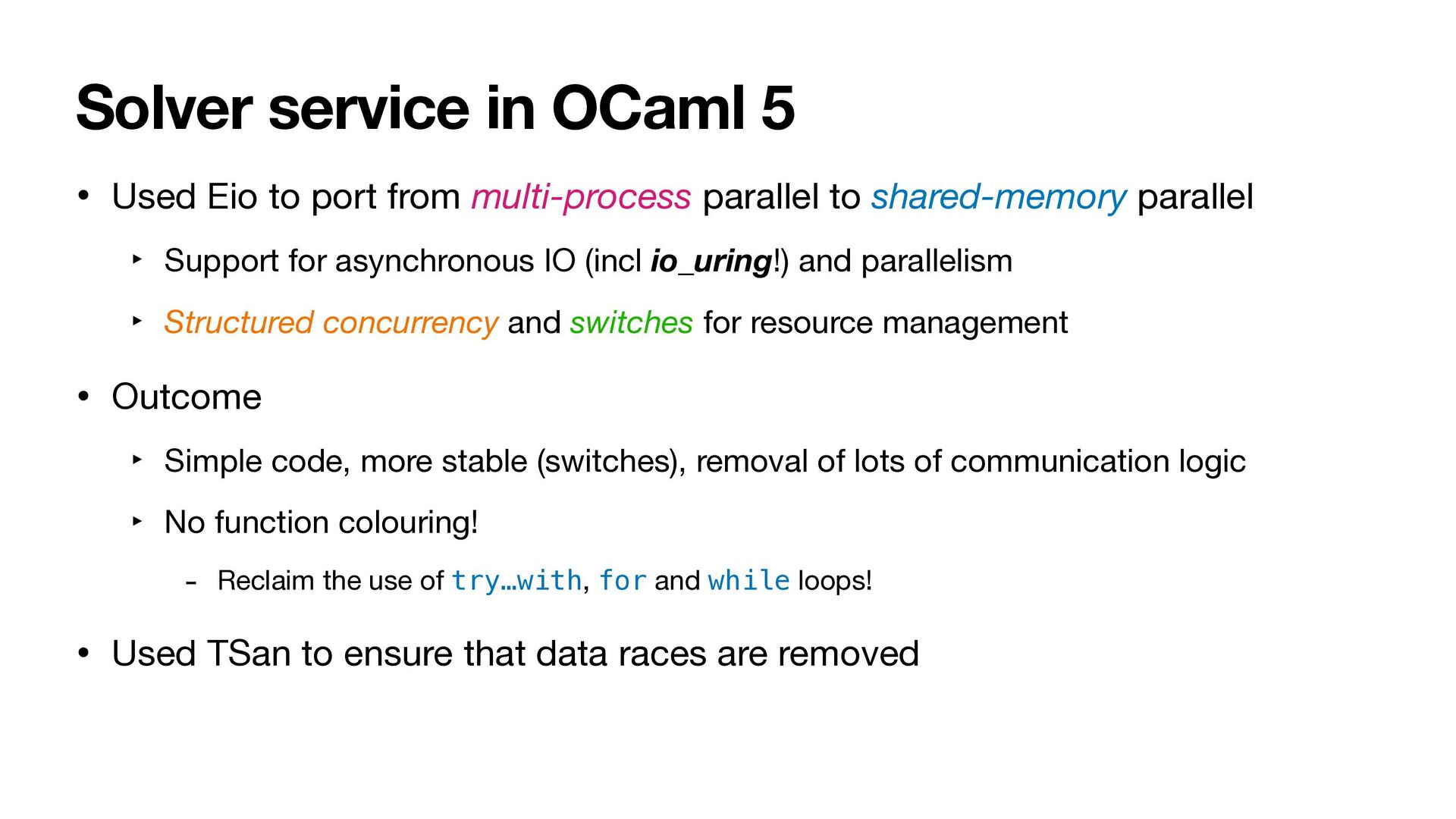
Solver service in OCaml 5 • Used Eio to port
from multi-process parallel to shared-memory parallel ‣ Support for asynchronous IO (incl io_uring!) and parallelism ‣ Structured concurrency and switches for resource management -
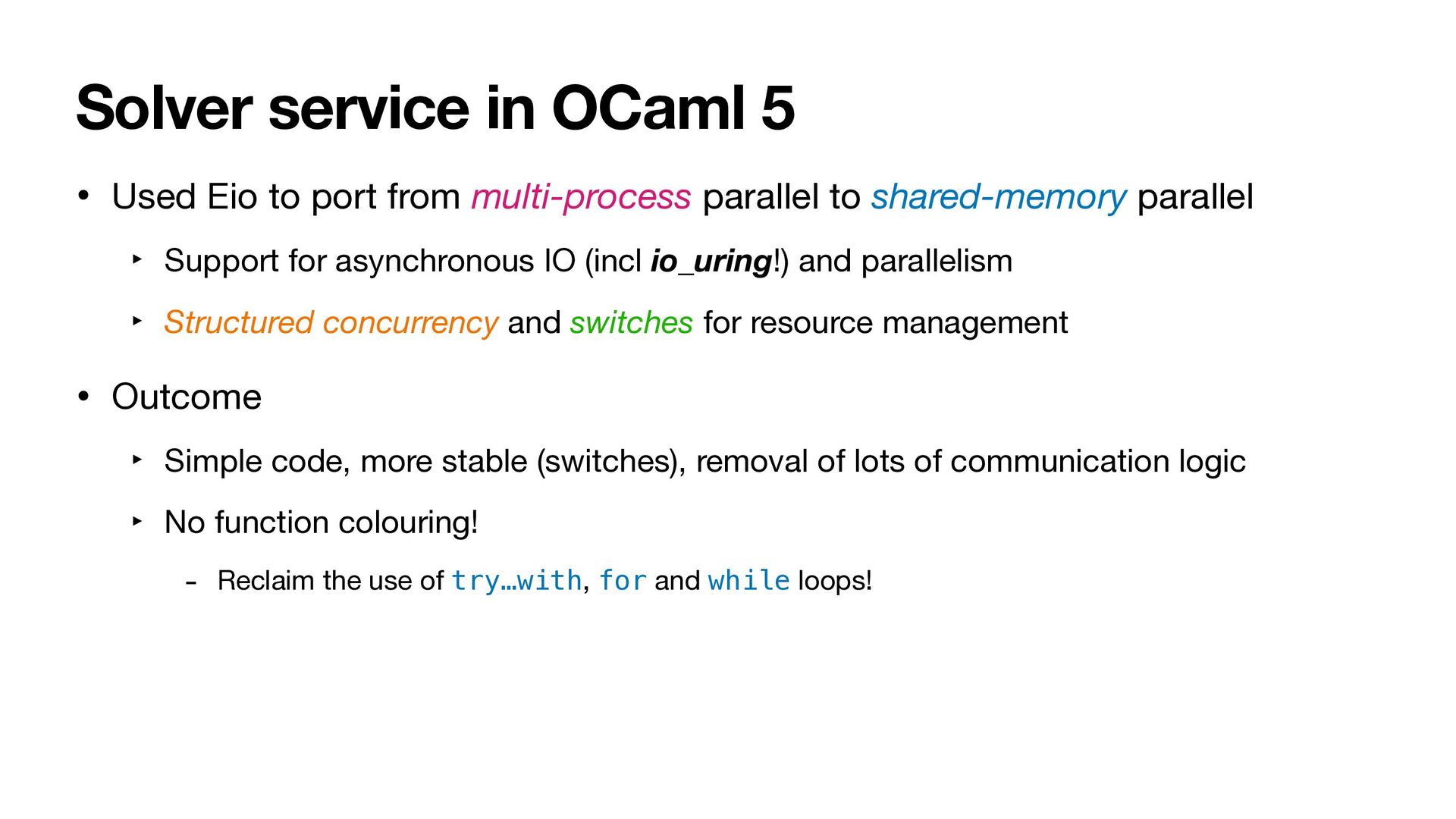
Solver service in OCaml 5 • Used Eio to port
from multi-process parallel to shared-memory parallel ‣ Support for asynchronous IO (incl io_uring!) and parallelism ‣ Structured concurrency and switches for resource management • Outcome ‣ Simple code, more stable (switches), removal of lots of communication logic ‣ No function colouring! - Reclaim the use of try…with, for and while loops! -
Solver service in OCaml 5 • Used Eio to port
from multi-process parallel to shared-memory parallel ‣ Support for asynchronous IO (incl io_uring!) and parallelism ‣ Structured concurrency and switches for resource management • Outcome ‣ Simple code, more stable (switches), removal of lots of communication logic ‣ No function colouring! - Reclaim the use of try…with, for and while loops! • Used TSan to ensure that data races are removed -
ThreadSanitizer (since 5.2) • Detect data races dynamically • Part
of the LLVM project — C++, Go, Swift -
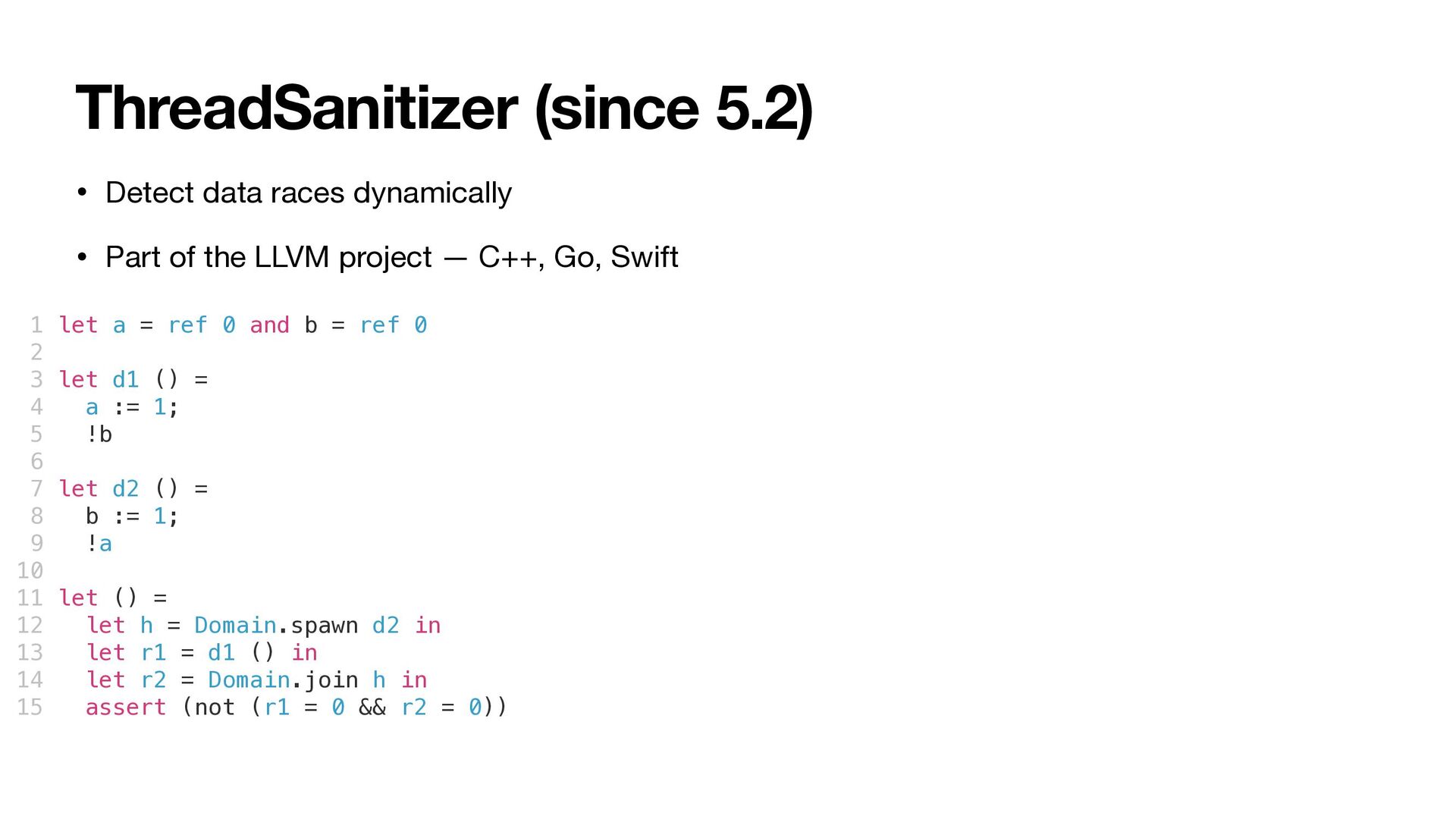
ThreadSanitizer (since 5.2) • Detect data races dynamically • Part
of the LLVM project — C++, Go, Swift 1 let a = ref 0 and b = ref 0 2 3 let d1 () = 4 a := 1; 5 !b 6 7 let d2 () = 8 b := 1; 9 !a 10 11 let () = 12 let h = Domain.spawn d2 in 13 let r1 = d1 () in 14 let r2 = Domain.join h in 15 assert (not (r1 = 0 && r2 = 0)) -
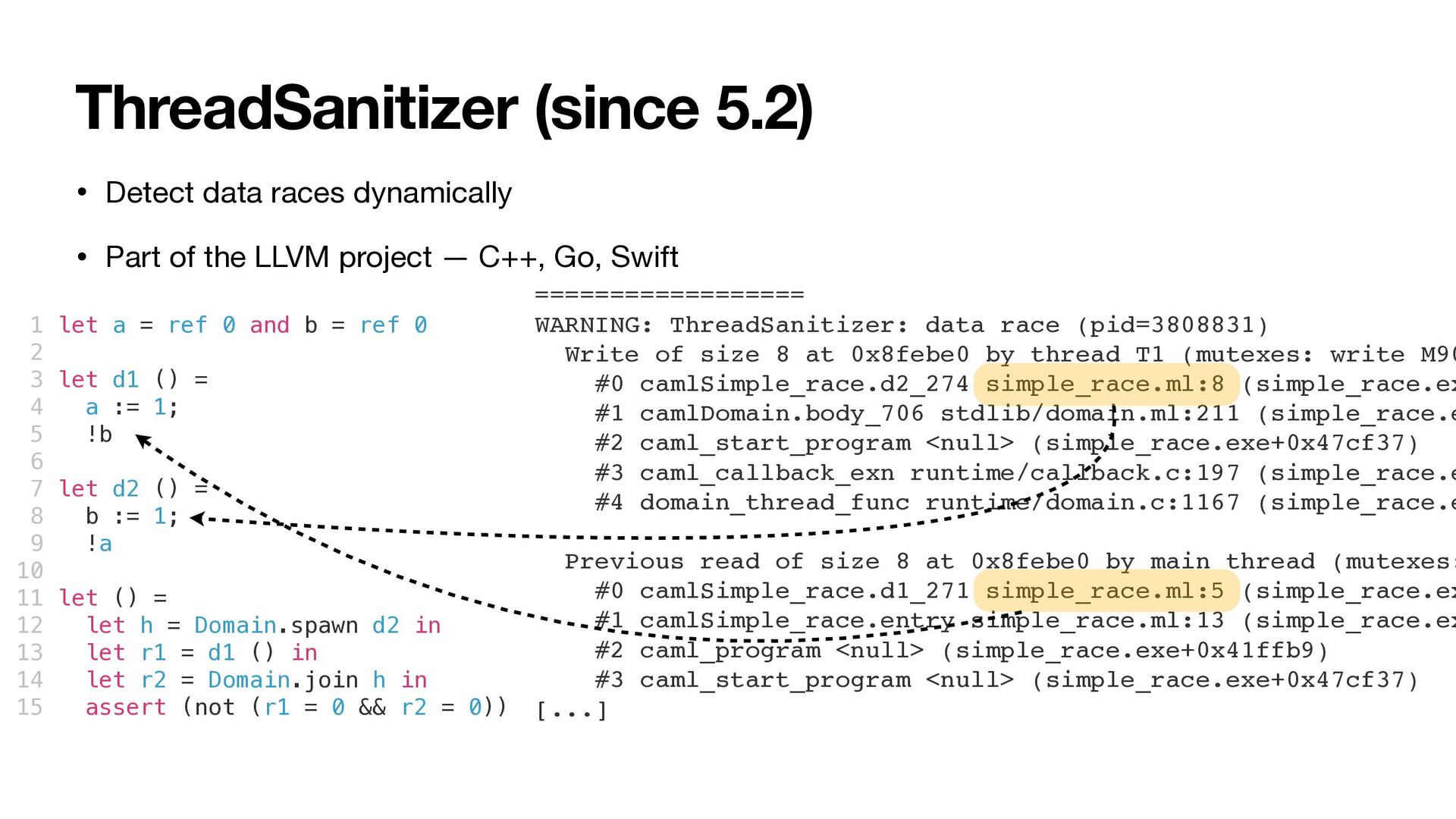
ThreadSanitizer (since 5.2) • Detect data races dynamically • Part
of the LLVM project — C++, Go, Swift 1 let a = ref 0 and b = ref 0 2 3 let d1 () = 4 a := 1; 5 !b 6 7 let d2 () = 8 b := 1; 9 !a 10 11 let () = 12 let h = Domain.spawn d2 in 13 let r1 = d1 () in 14 let r2 = Domain.join h in 15 assert (not (r1 = 0 && r2 = 0)) ================== WARNING: ThreadSanitizer: data race (pid=3808831) Write of size 8 at 0x8febe0 by thread T1 (mutexes: write M90 #0 camlSimple_race.d2_274 simple_race.ml:8 (simple_race.ex #1 camlDomain.body_706 stdlib/domain.ml:211 (simple_race.e #2 caml_start_program <null> (simple_race.exe+0x47cf37) #3 caml_callback_exn runtime/callback.c:197 (simple_race.e #4 domain_thread_func runtime/domain.c:1167 (simple_race.e Previous read of size 8 at 0x8febe0 by main thread (mutexes: #0 camlSimple_race.d1_271 simple_race.ml:5 (simple_race.ex #1 camlSimple_race.entry simple_race.ml:13 (simple_race.ex #2 caml_program <null> (simple_race.exe+0x41ffb9) #3 caml_start_program <null> (simple_race.exe+0x47cf37) [...] -
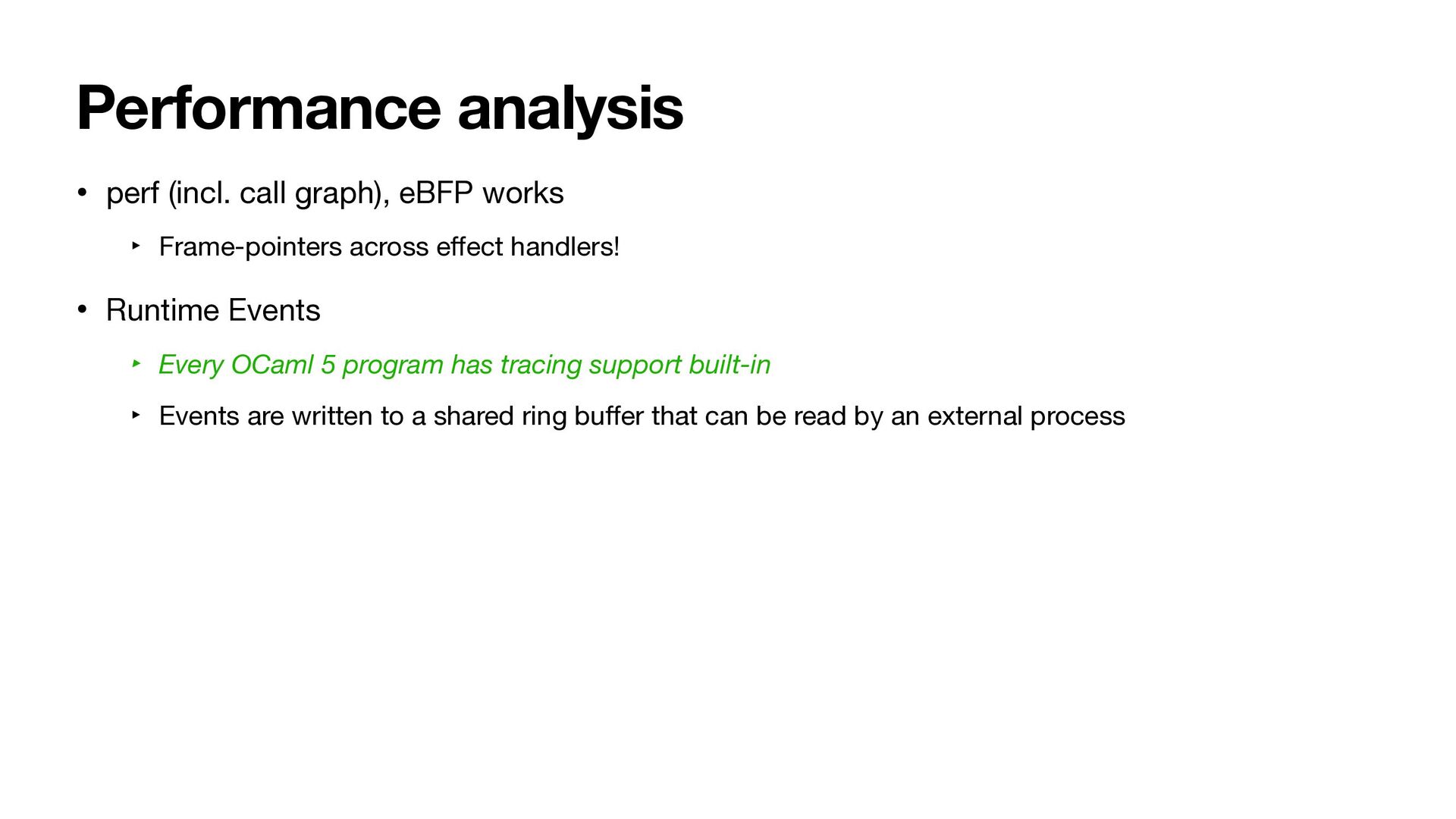
Performance analysis • perf (incl. call graph), eBFP works ‣
Frame-pointers across e ff ect handlers! -
Performance analysis • perf (incl. call graph), eBFP works ‣
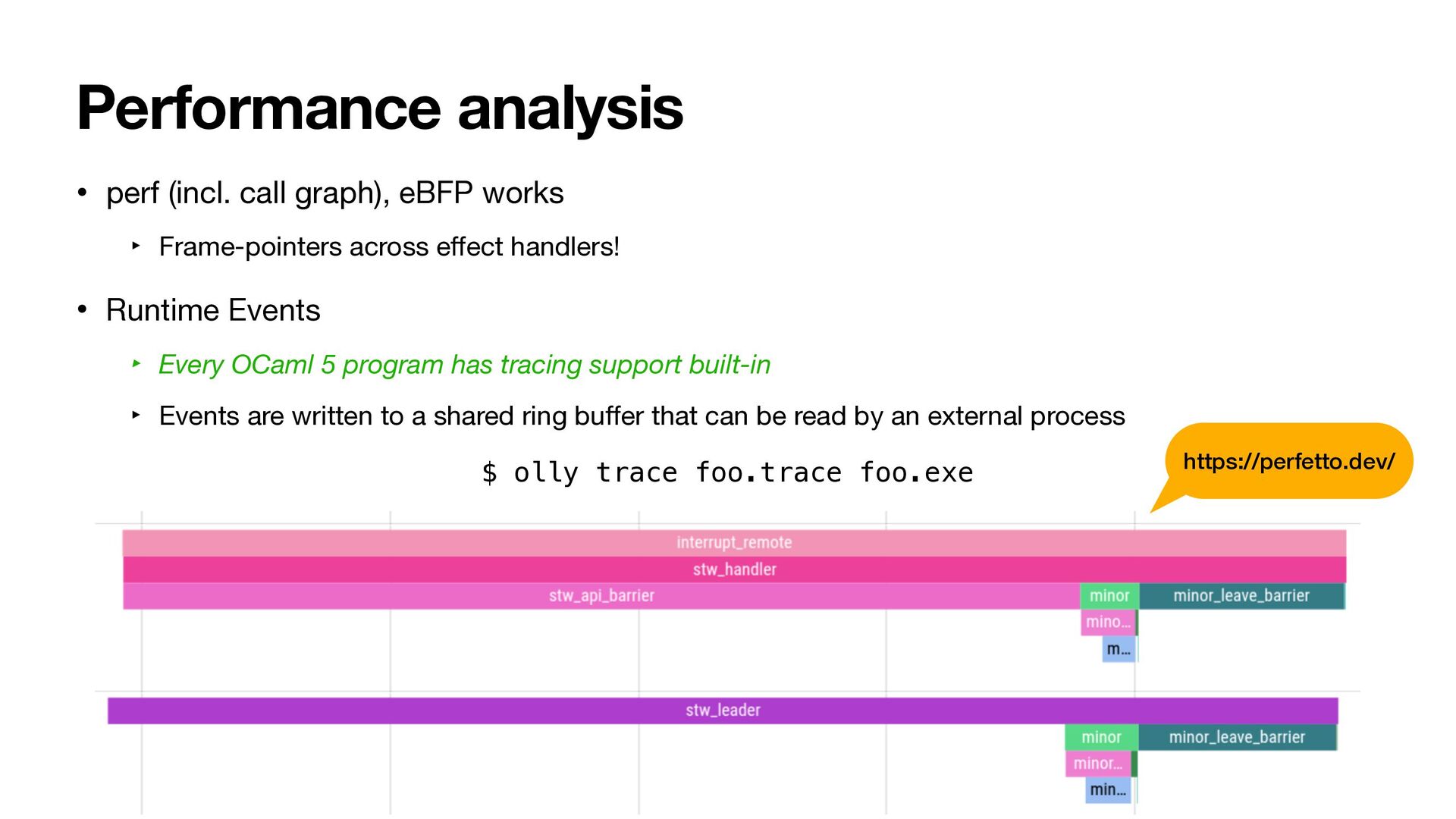
Frame-pointers across e ff ect handlers! • Runtime Events ‣ Every OCaml 5 program has tracing support built-in ‣ Events are written to a shared ring bu ff er that can be read by an external process -
Performance analysis • perf (incl. call graph), eBFP works ‣
Frame-pointers across e ff ect handlers! • Runtime Events ‣ Every OCaml 5 program has tracing support built-in ‣ Events are written to a shared ring bu ff er that can be read by an external process $ olly trace foo.trace foo.exe -
Performance analysis • perf (incl. call graph), eBFP works ‣
Frame-pointers across e ff ect handlers! • Runtime Events ‣ Every OCaml 5 program has tracing support built-in ‣ Events are written to a shared ring bu ff er that can be read by an external process $ olly trace foo.trace foo.exe https://perfetto.dev/ -
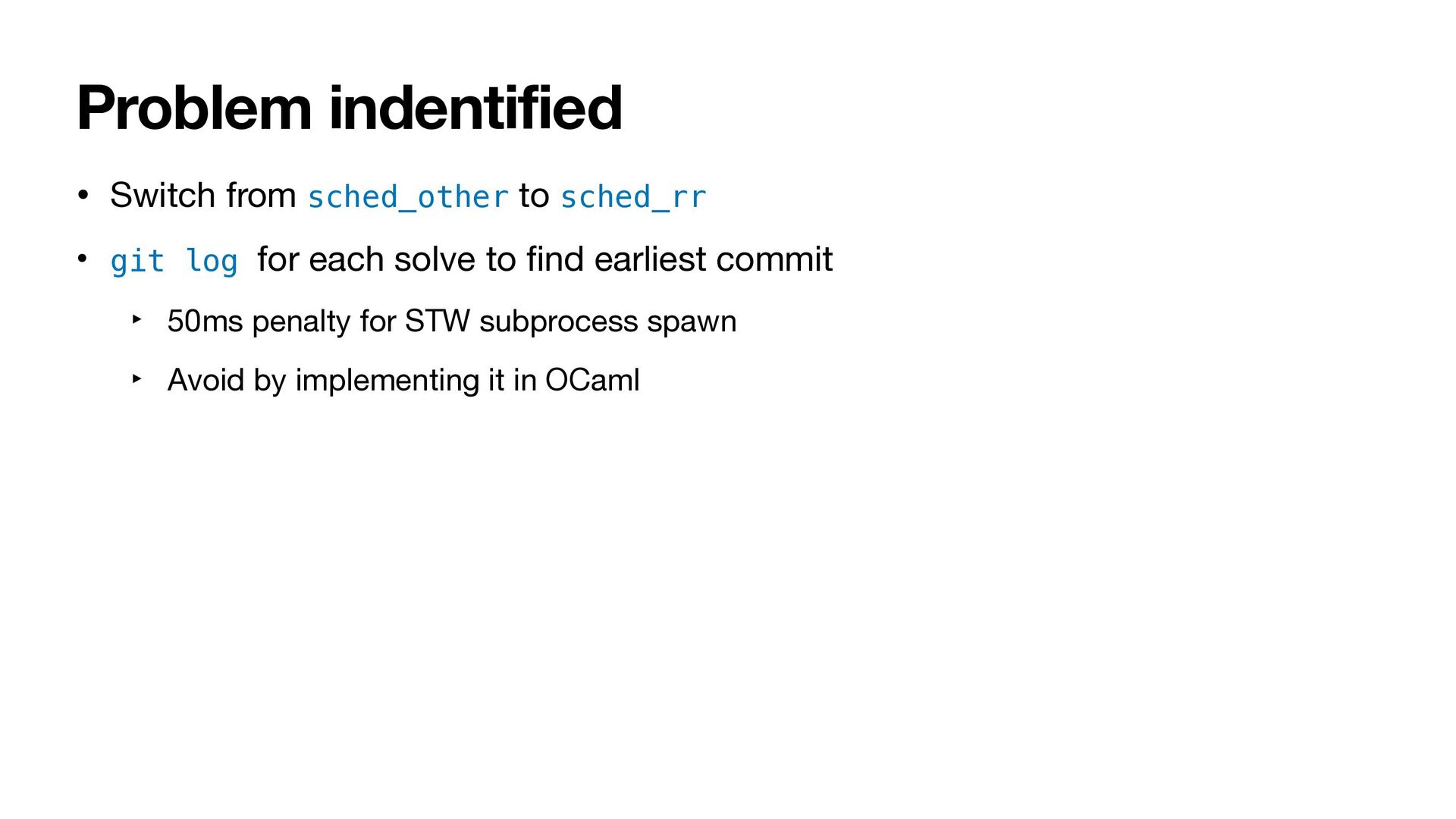
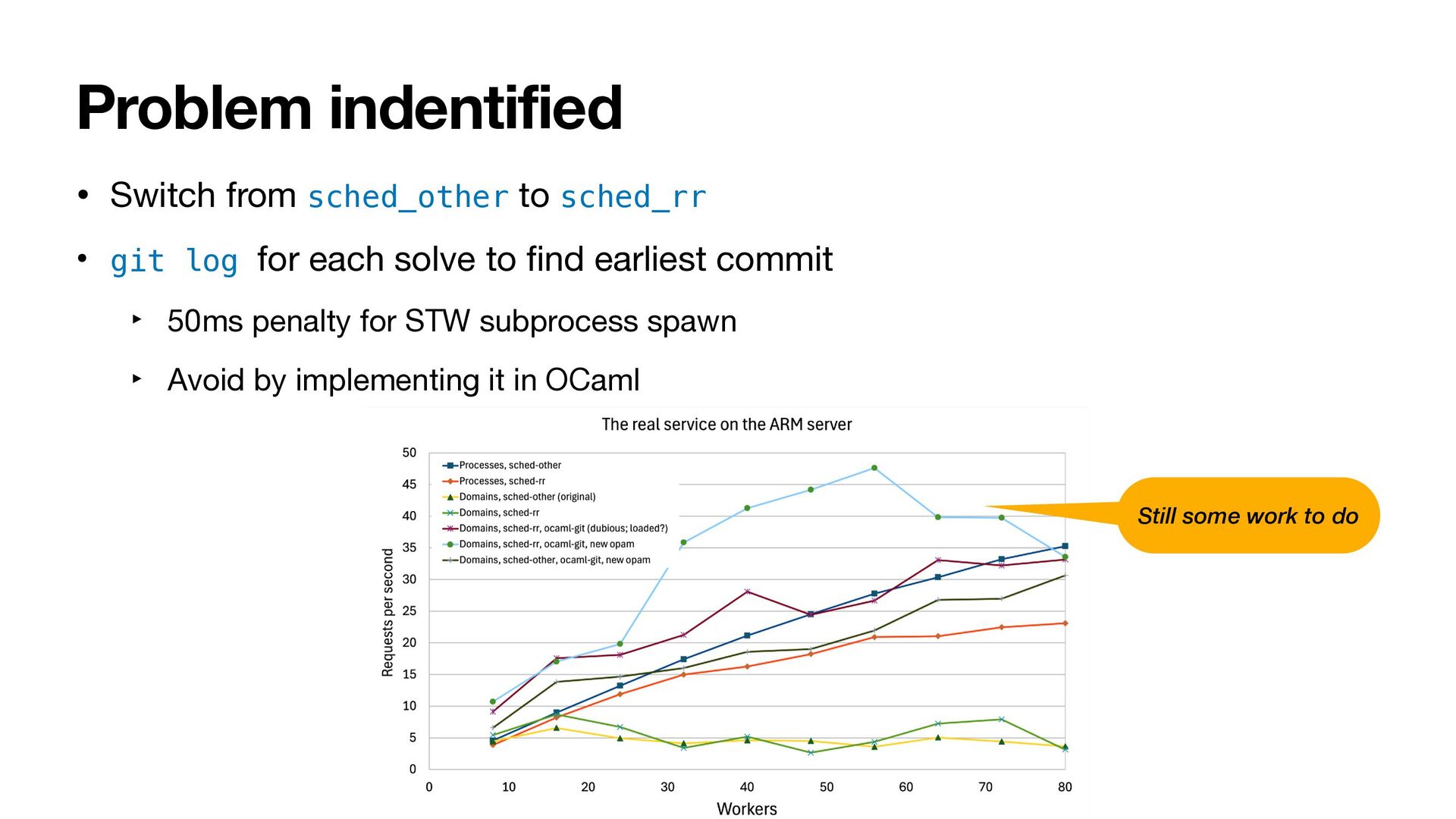
Problem indentified • Switch from sched_other to sched_rr • git
log for each solve to fi nd earliest commit ‣ 50ms penalty for STW subprocess spawn ‣ Avoid by implementing it in OCaml -
Problem indentified • Switch from sched_other to sched_rr • git
log for each solve to fi nd earliest commit ‣ 50ms penalty for STW subprocess spawn ‣ Avoid by implementing it in OCaml Still some work to do -
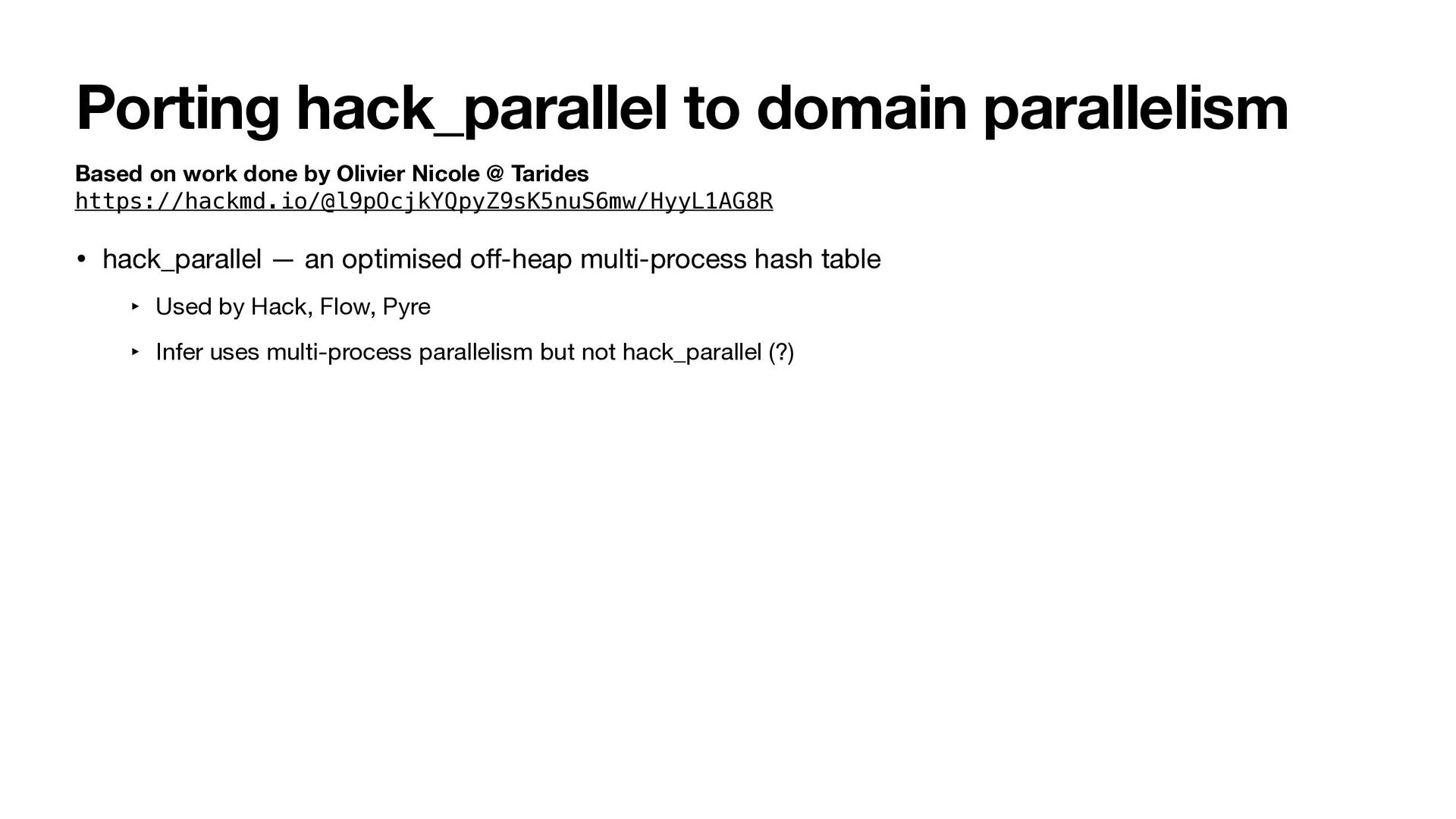
Porting hack_parallel to domain parallelism • hack_parallel — an optimised
o ff -heap multi-process hash table ‣ Used by Hack, Flow, Pyre ‣ Infer uses multi-process parallelism but not hack_parallel (?) Based on work done by Olivier Nicole @ Tarides https://hackmd.io/@l9pOcjkYQpyZ9sK5nuS6mw/HyyL1AG8R -
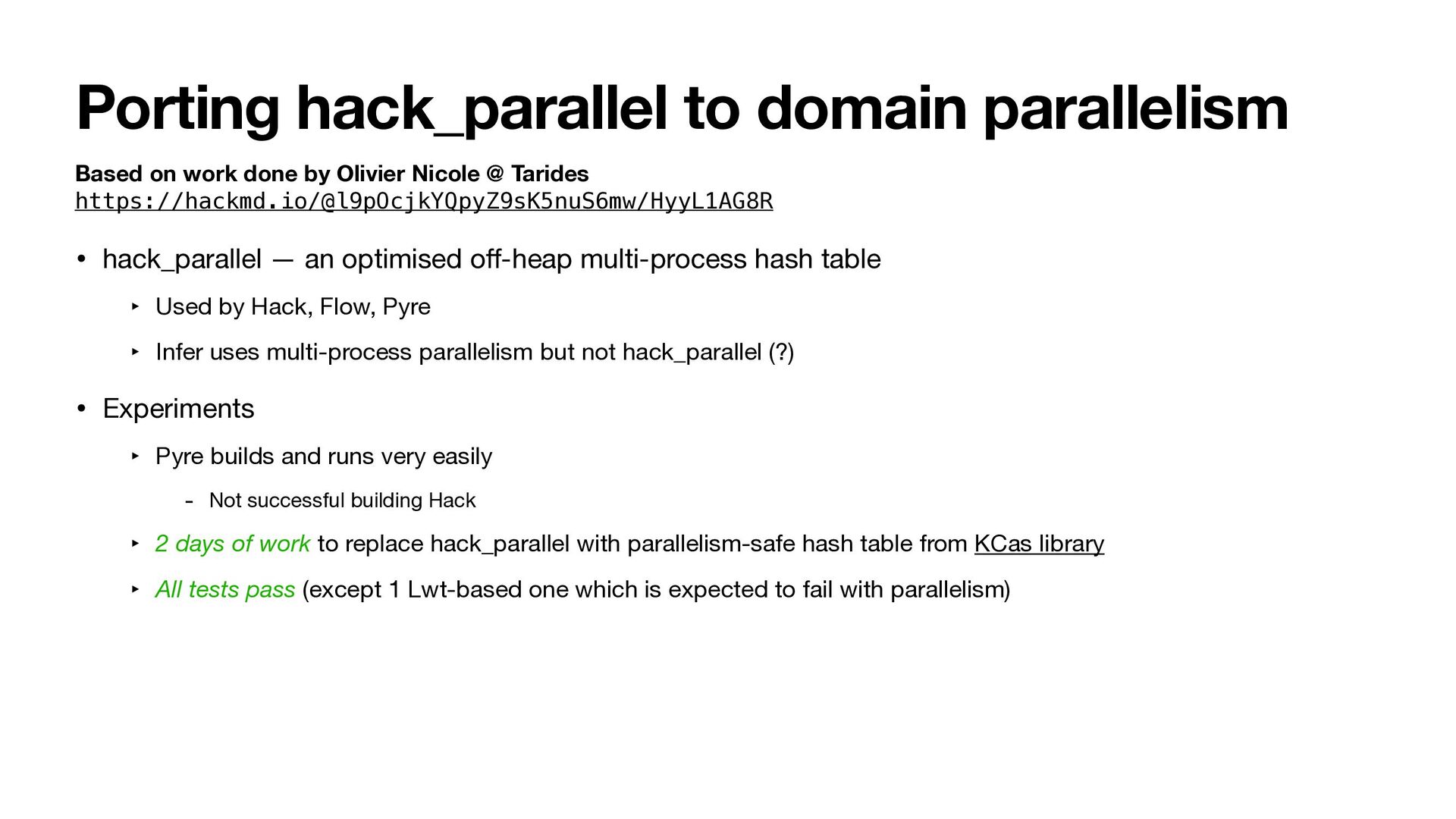
Porting hack_parallel to domain parallelism • hack_parallel — an optimised
o ff -heap multi-process hash table ‣ Used by Hack, Flow, Pyre ‣ Infer uses multi-process parallelism but not hack_parallel (?) • Experiments ‣ Pyre builds and runs very easily - Not successful building Hack ‣ 2 days of work to replace hack_parallel with parallelism-safe hash table from KCas library ‣ All tests pass (except 1 Lwt-based one which is expected to fail with parallelism) Based on work done by Olivier Nicole @ Tarides https://hackmd.io/@l9pOcjkYQpyZ9sK5nuS6mw/HyyL1AG8R -
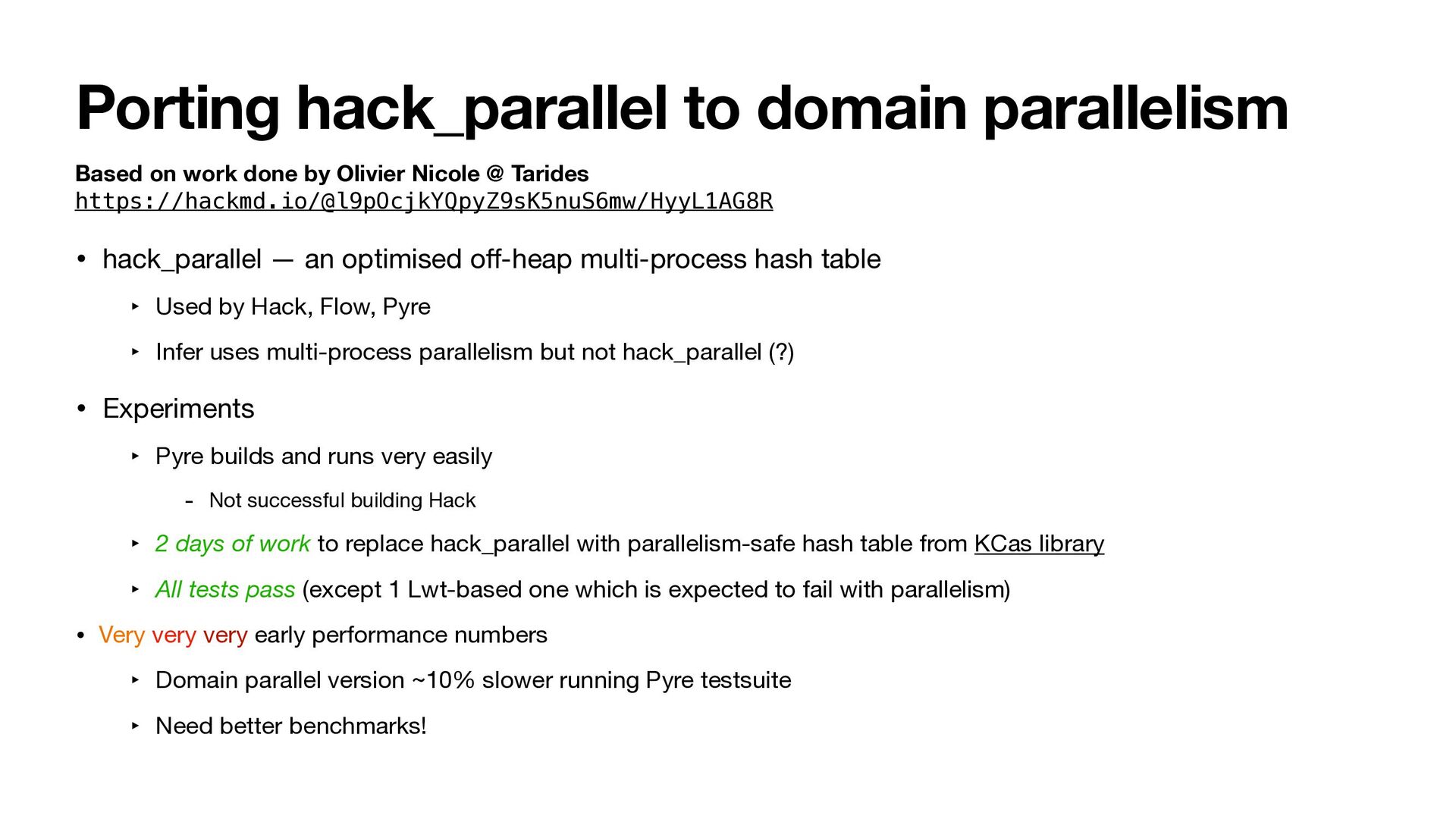
Porting hack_parallel to domain parallelism • hack_parallel — an optimised
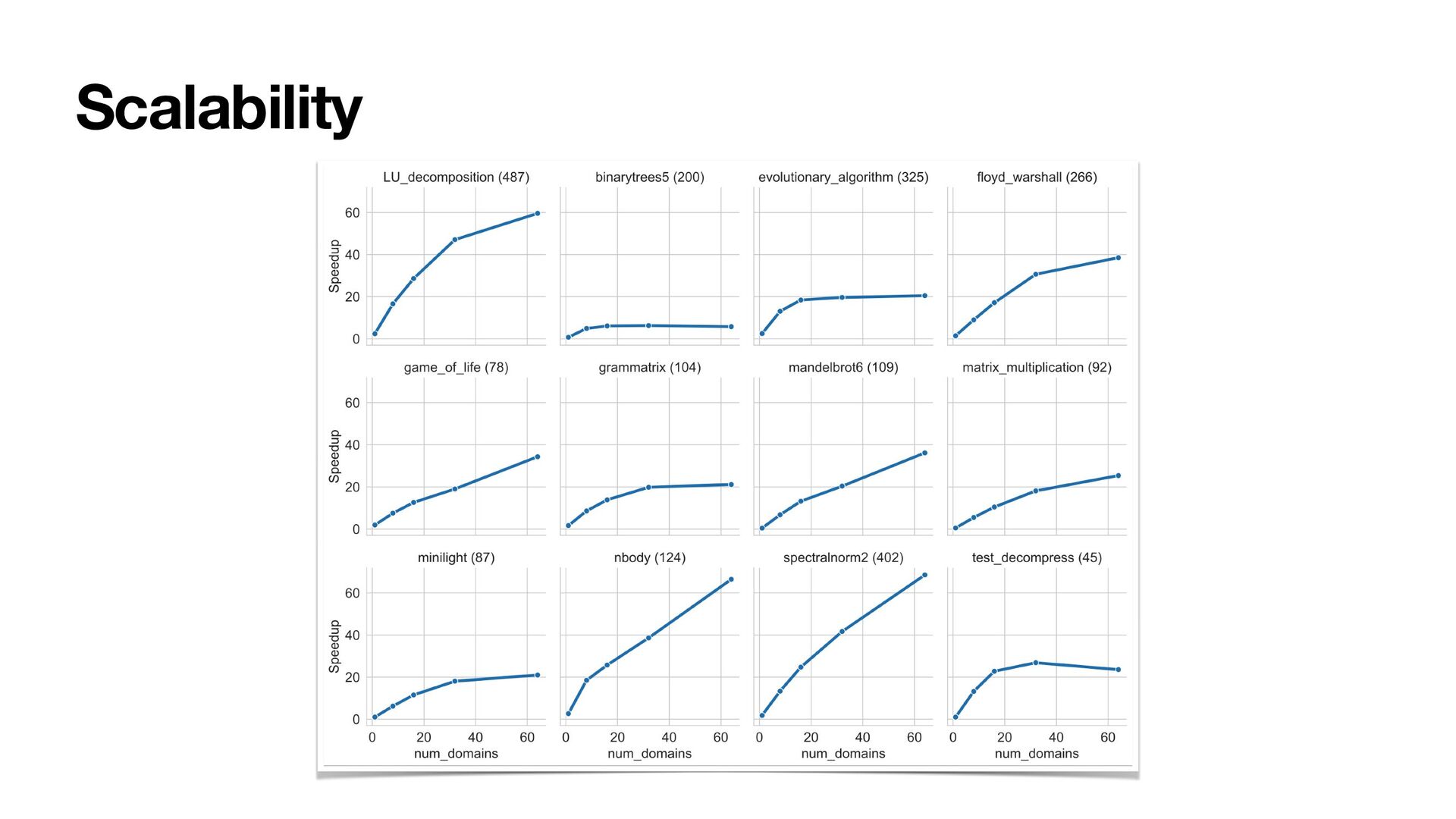
o ff -heap multi-process hash table ‣ Used by Hack, Flow, Pyre ‣ Infer uses multi-process parallelism but not hack_parallel (?) • Experiments ‣ Pyre builds and runs very easily - Not successful building Hack ‣ 2 days of work to replace hack_parallel with parallelism-safe hash table from KCas library ‣ All tests pass (except 1 Lwt-based one which is expected to fail with parallelism) • Very very very early performance numbers ‣ Domain parallel version ~10% slower running Pyre testsuite ‣ Need better benchmarks! Based on work done by Olivier Nicole @ Tarides https://hackmd.io/@l9pOcjkYQpyZ9sK5nuS6mw/HyyL1AG8R -
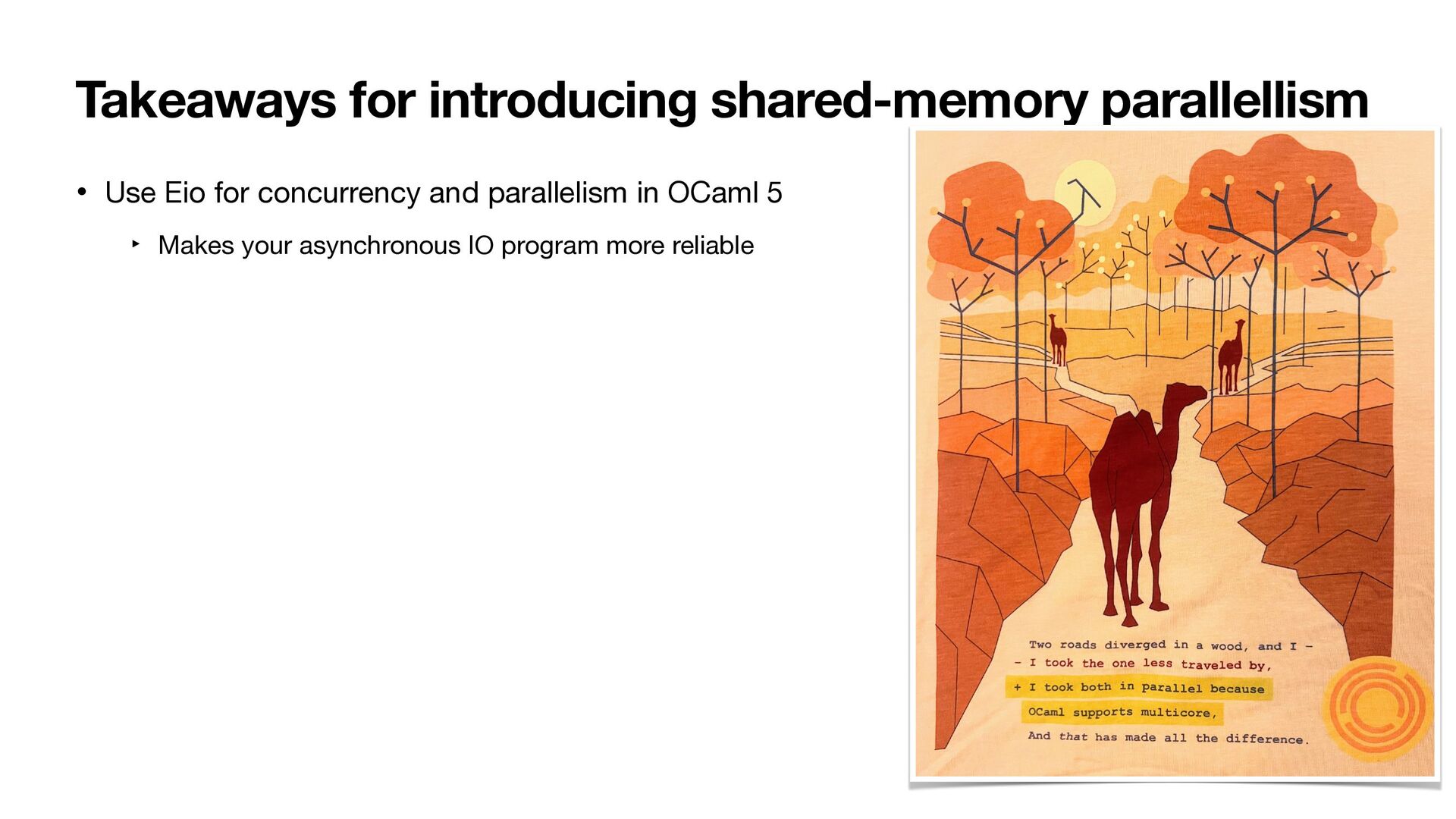
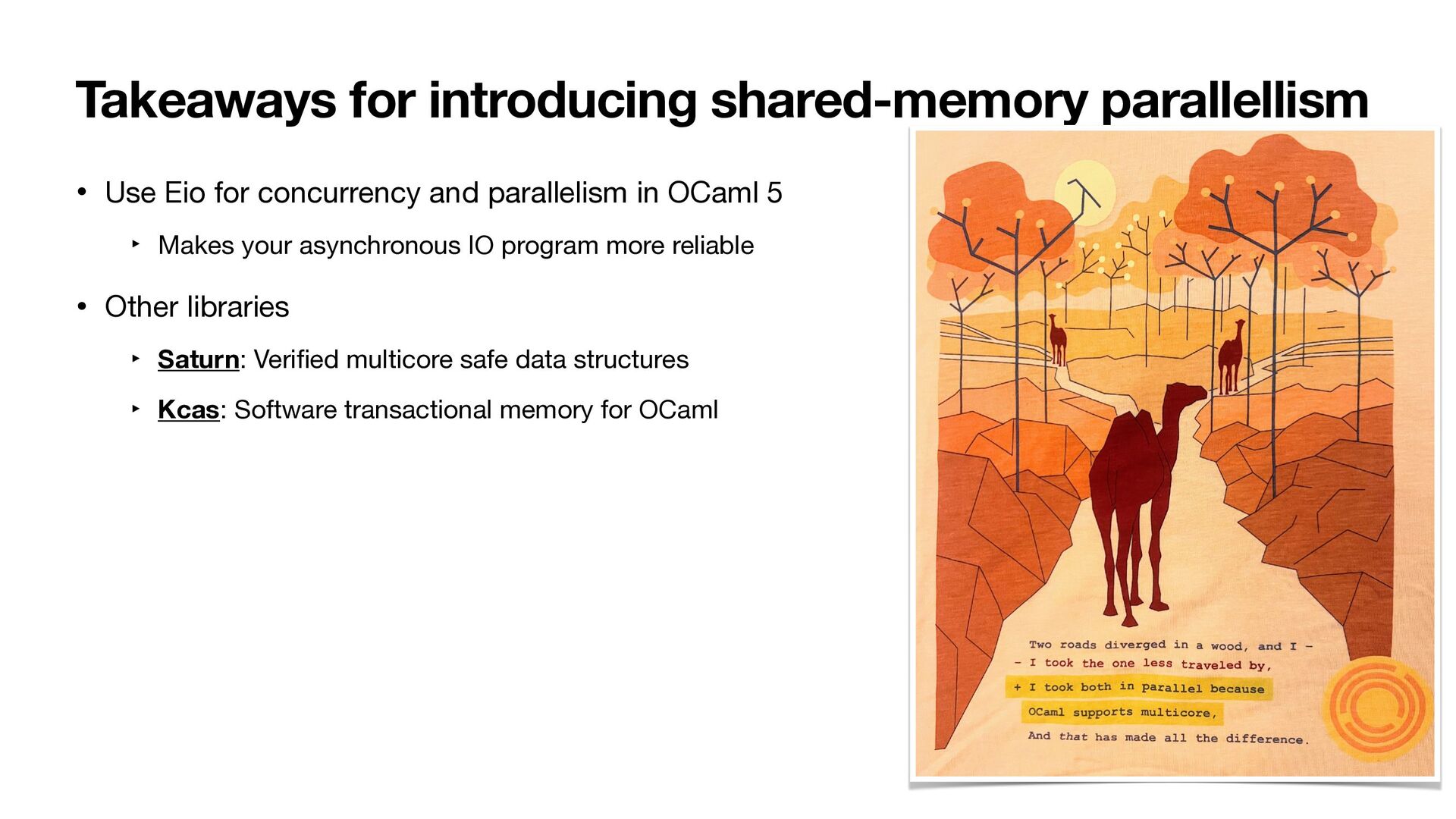
Takeaways for introducing shared-memory parallellism • Use Eio for concurrency
and parallelism in OCaml 5 ‣ Makes your asynchronous IO program more reliable -
Takeaways for introducing shared-memory parallellism • Use Eio for concurrency
and parallelism in OCaml 5 ‣ Makes your asynchronous IO program more reliable • Other libraries ‣ Saturn: Veri fi ed multicore safe data structures ‣ Kcas: Software transactional memory for OCaml -
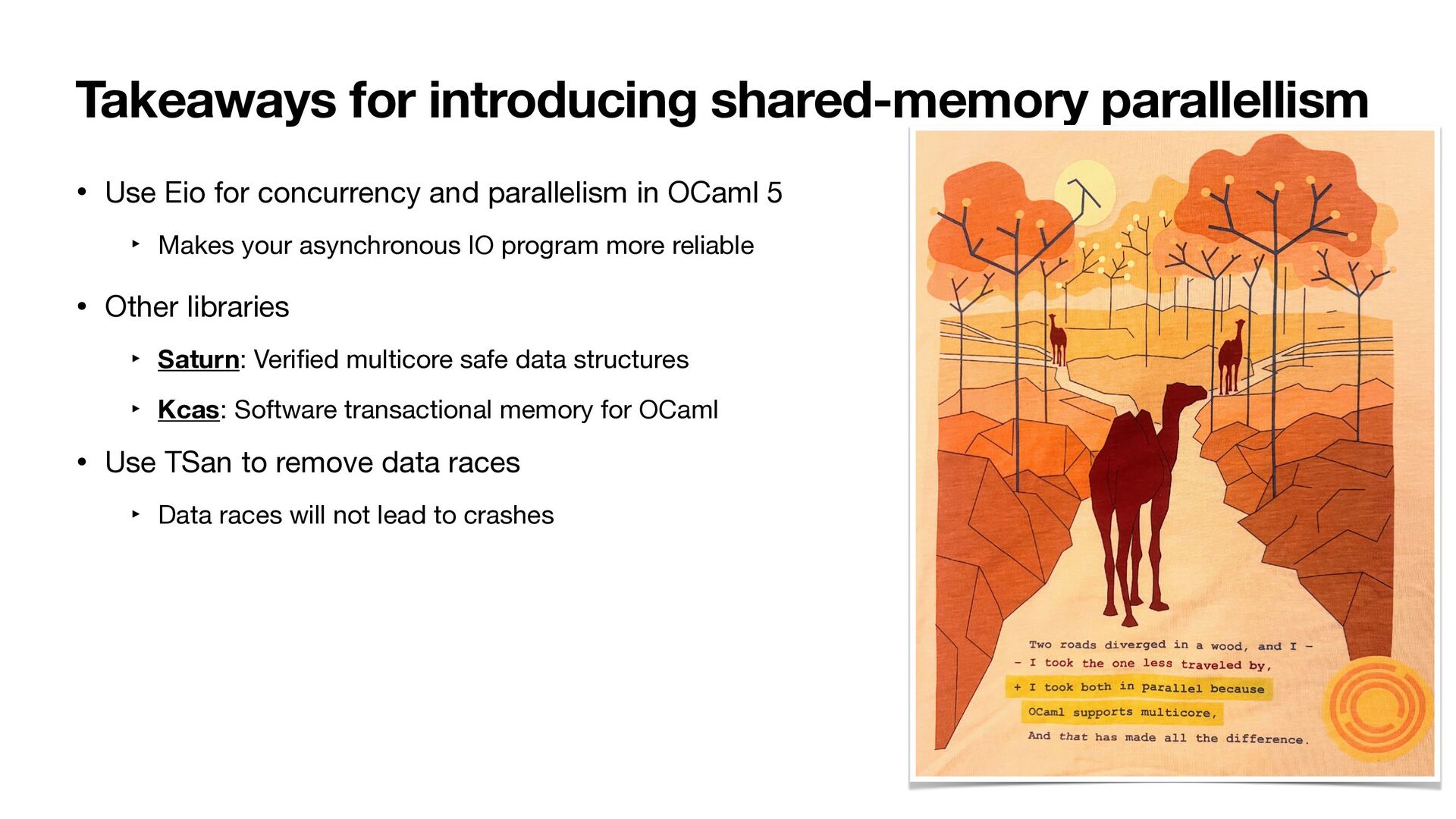
Takeaways for introducing shared-memory parallellism • Use Eio for concurrency
and parallelism in OCaml 5 ‣ Makes your asynchronous IO program more reliable • Other libraries ‣ Saturn: Veri fi ed multicore safe data structures ‣ Kcas: Software transactional memory for OCaml • Use TSan to remove data races ‣ Data races will not lead to crashes -
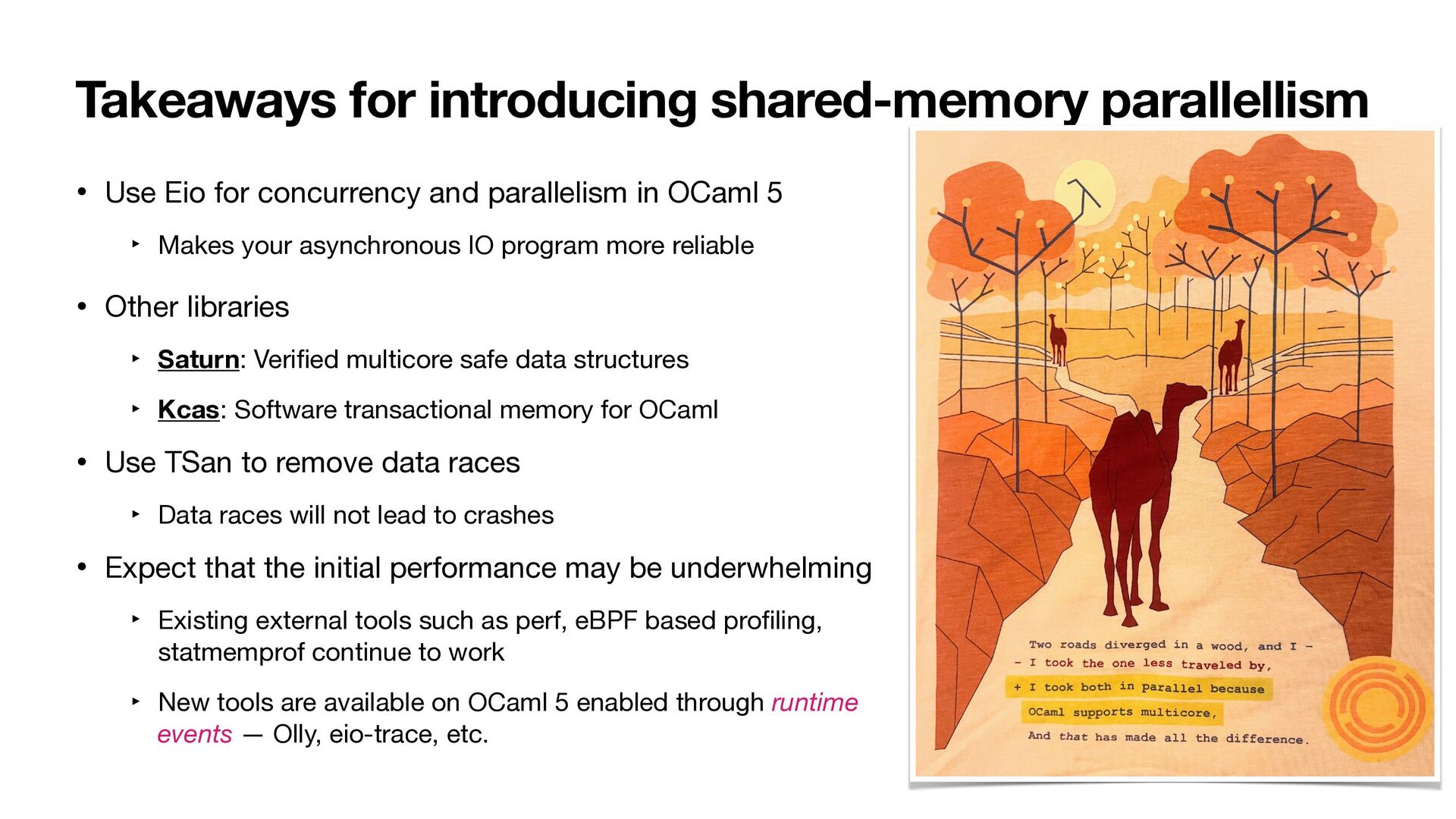
Takeaways for introducing shared-memory parallellism • Use Eio for concurrency
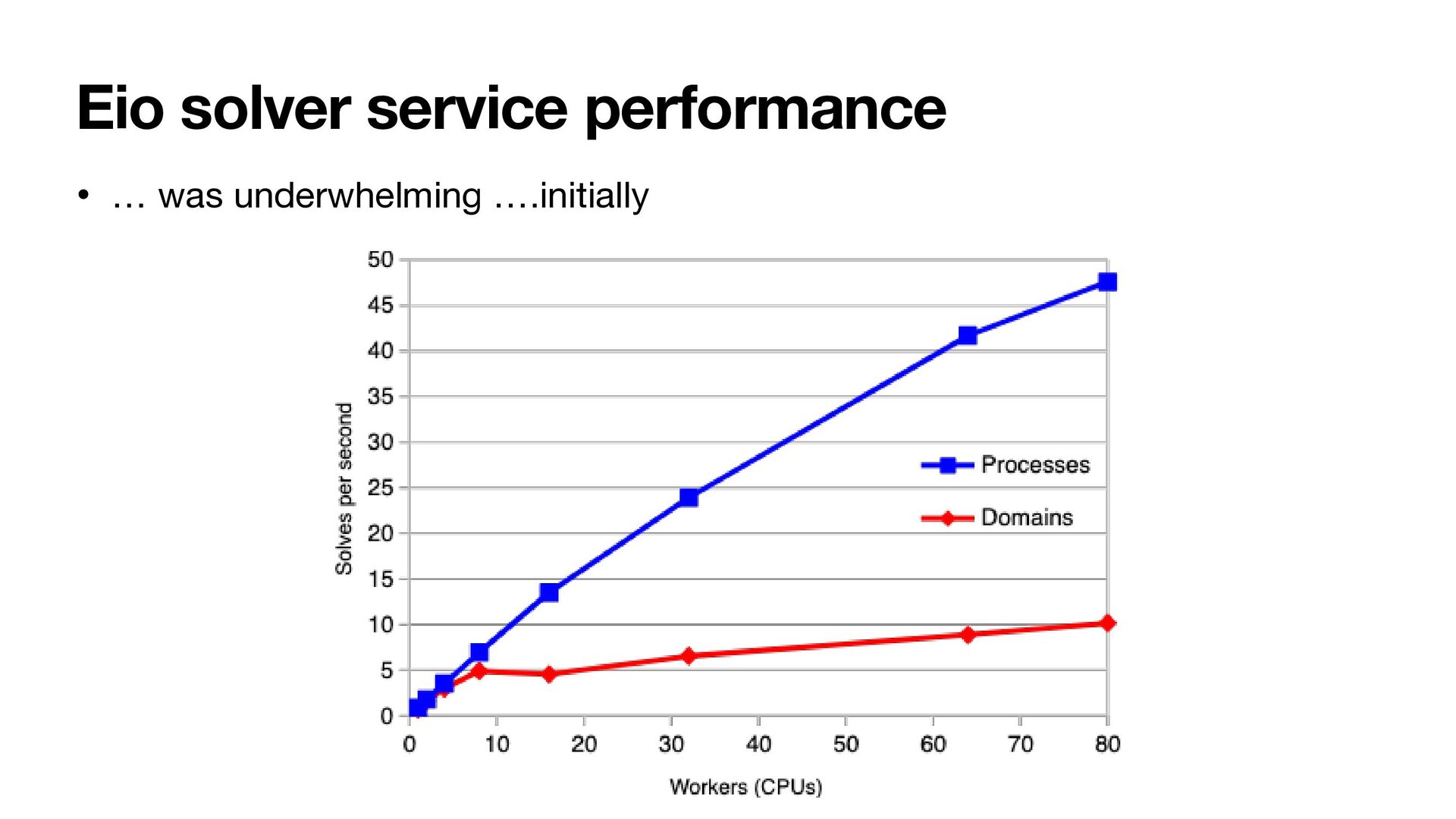
and parallelism in OCaml 5 ‣ Makes your asynchronous IO program more reliable • Other libraries ‣ Saturn: Veri fi ed multicore safe data structures ‣ Kcas: Software transactional memory for OCaml • Use TSan to remove data races ‣ Data races will not lead to crashes • Expect that the initial performance may be underwhelming ‣ Existing external tools such as perf, eBPF based pro fi ling, statmemprof continue to work ‣ New tools are available on OCaml 5 enabled through runtime events — Olly, eio-trace, etc.
 kayceesrk
 marktimemedia
 thirion
 csswizardry
 badams
 mfonobong
 coloredviolet
 marketingsoph
 davetheseo
 akosma
 caitiem20
 smashingmag
 eileencodes