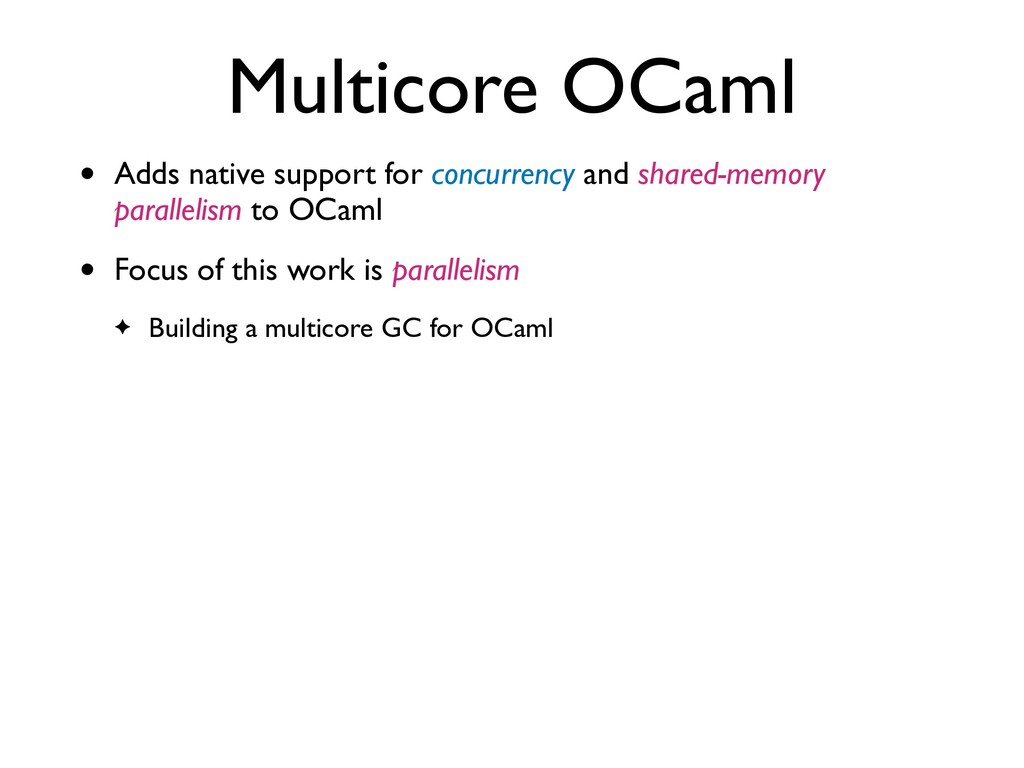
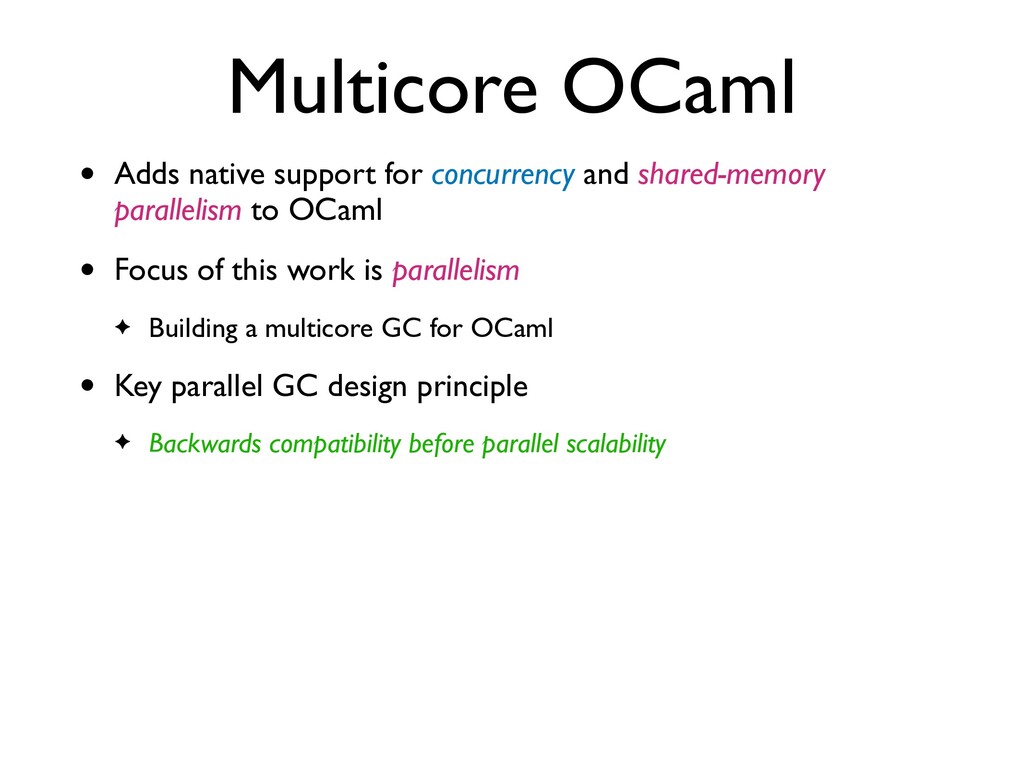
parallelism to OCaml • Focus of this work is parallelism ✦ Building a multicore GC for OCaml • Key parallel GC design principle ✦ Backwards compatibility before parallel scalability
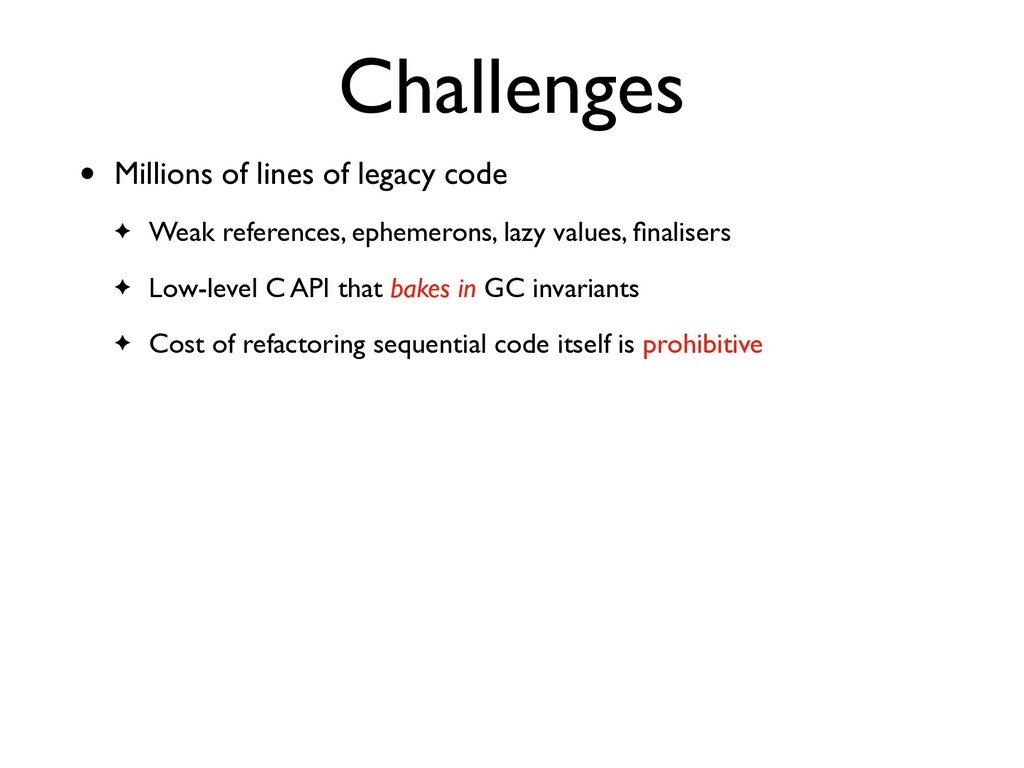
references, ephemerons, lazy values, finalisers ✦ Low-level C API that bakes in GC invariants ✦ Cost of refactoring sequential code itself is prohibitive
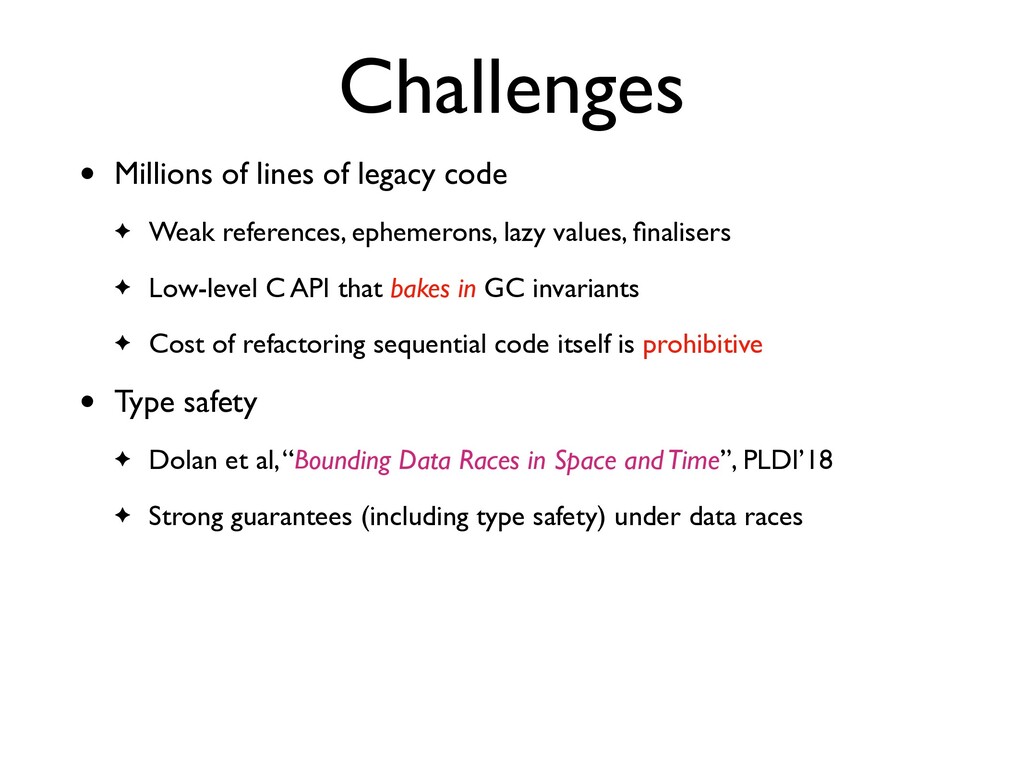
references, ephemerons, lazy values, finalisers ✦ Low-level C API that bakes in GC invariants ✦ Cost of refactoring sequential code itself is prohibitive • Type safety ✦ Dolan et al, “Bounding Data Races in Space and Time”, PLDI’18 ✦ Strong guarantees (including type safety) under data races
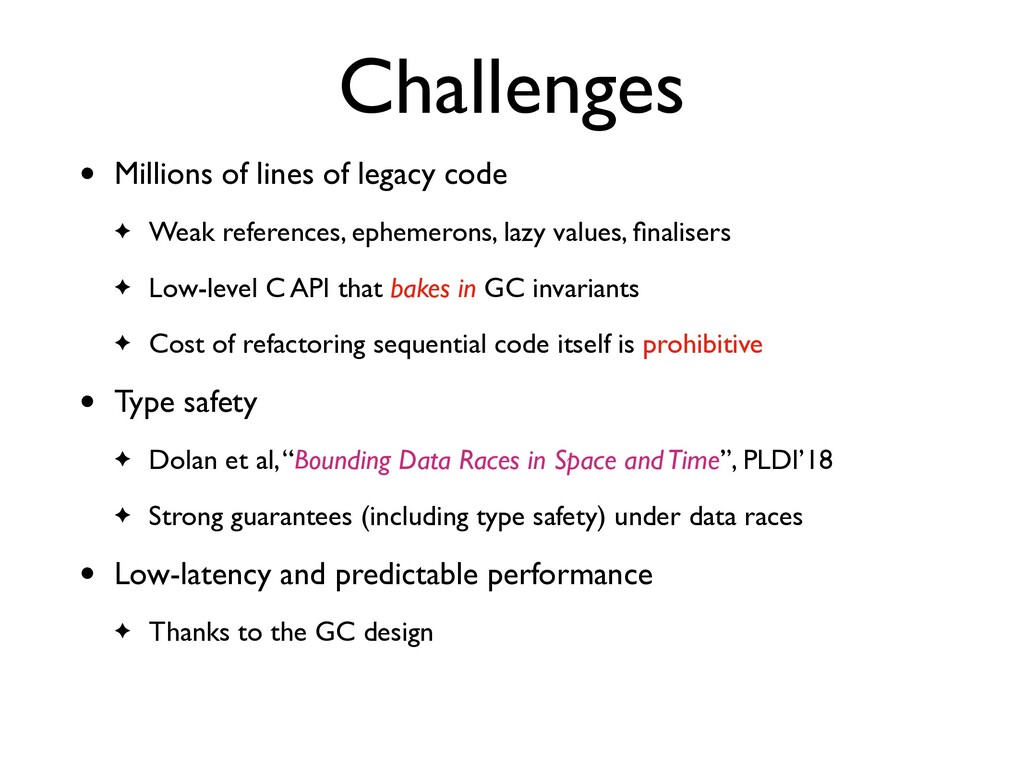
references, ephemerons, lazy values, finalisers ✦ Low-level C API that bakes in GC invariants ✦ Cost of refactoring sequential code itself is prohibitive • Type safety ✦ Dolan et al, “Bounding Data Races in Space and Time”, PLDI’18 ✦ Strong guarantees (including type safety) under data races • Low-latency and predictable performance ✦ Thanks to the GC design
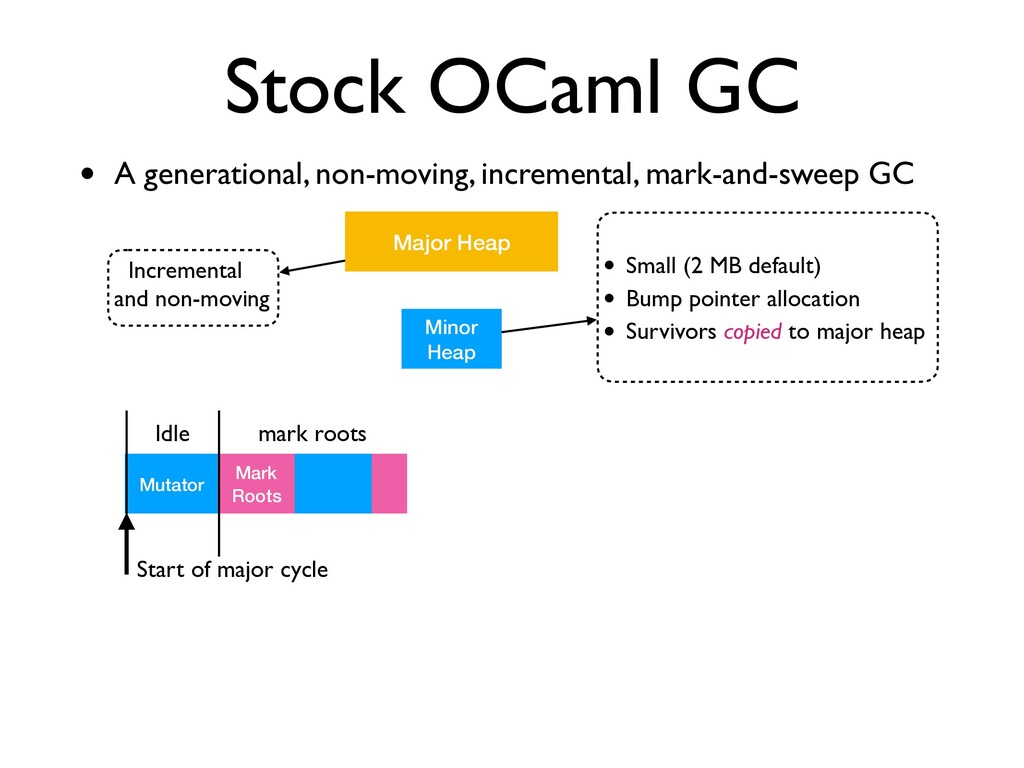
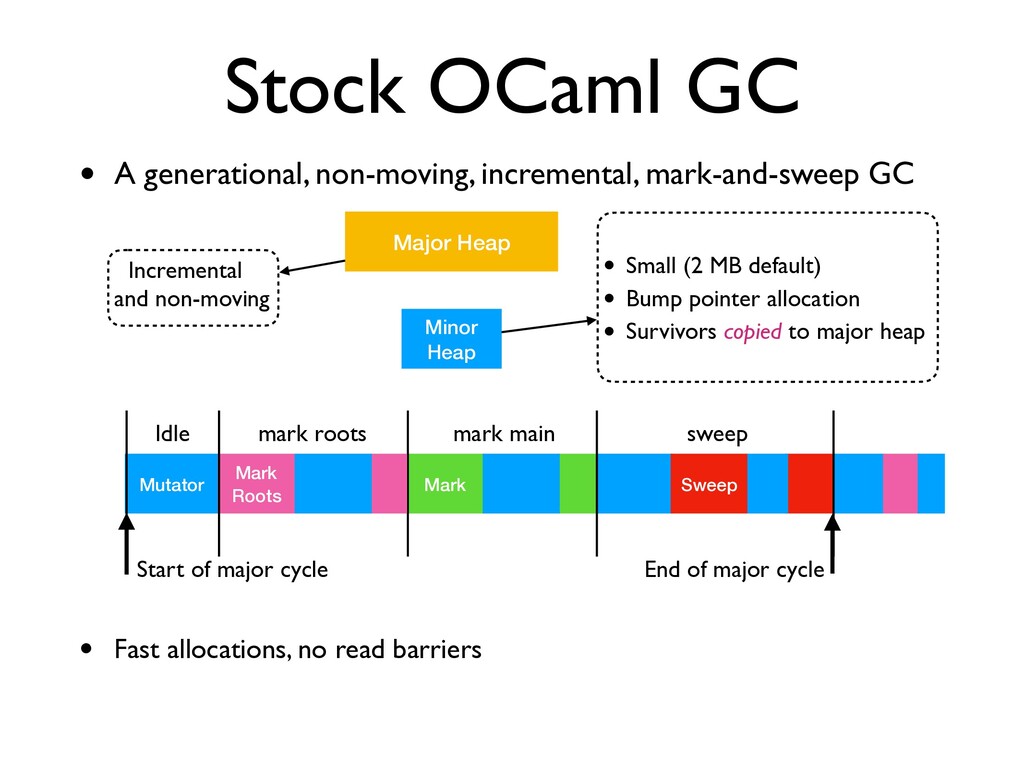
incremental, mark-and-sweep GC Minor Heap Major Heap • Small (2 MB default) • Bump pointer allocation • Survivors copied to major heap Mutator Start of major cycle Idle
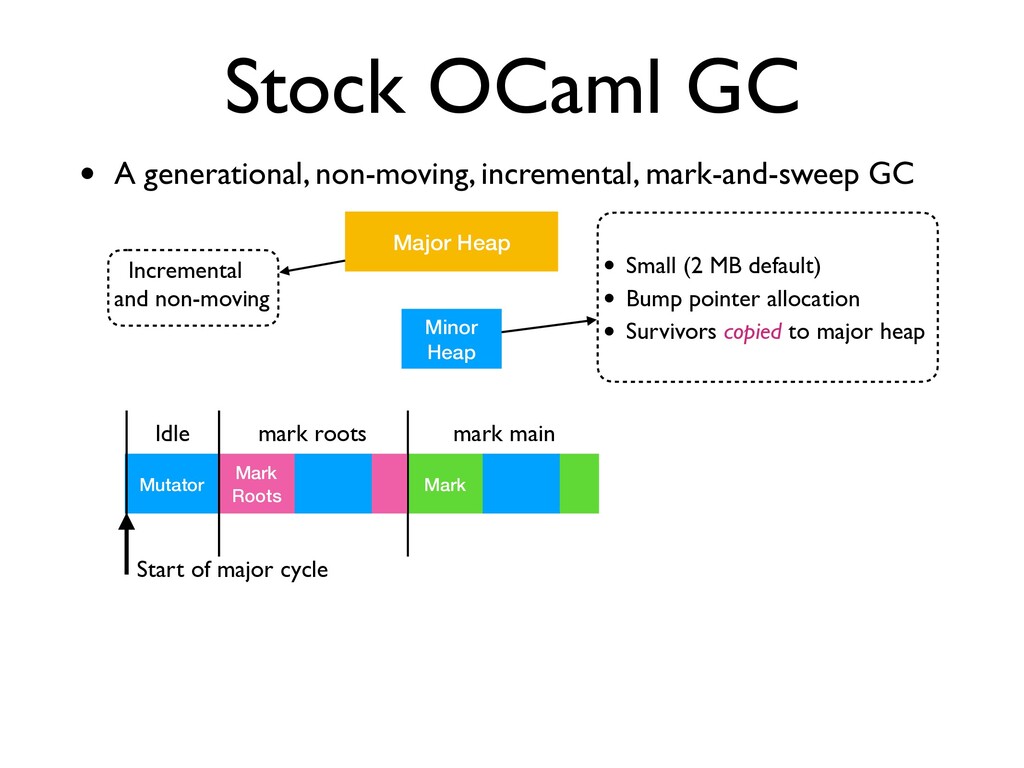
incremental, mark-and-sweep GC Minor Heap Major Heap • Small (2 MB default) • Bump pointer allocation • Survivors copied to major heap Mutator Start of major cycle Idle Mark Roots mark roots
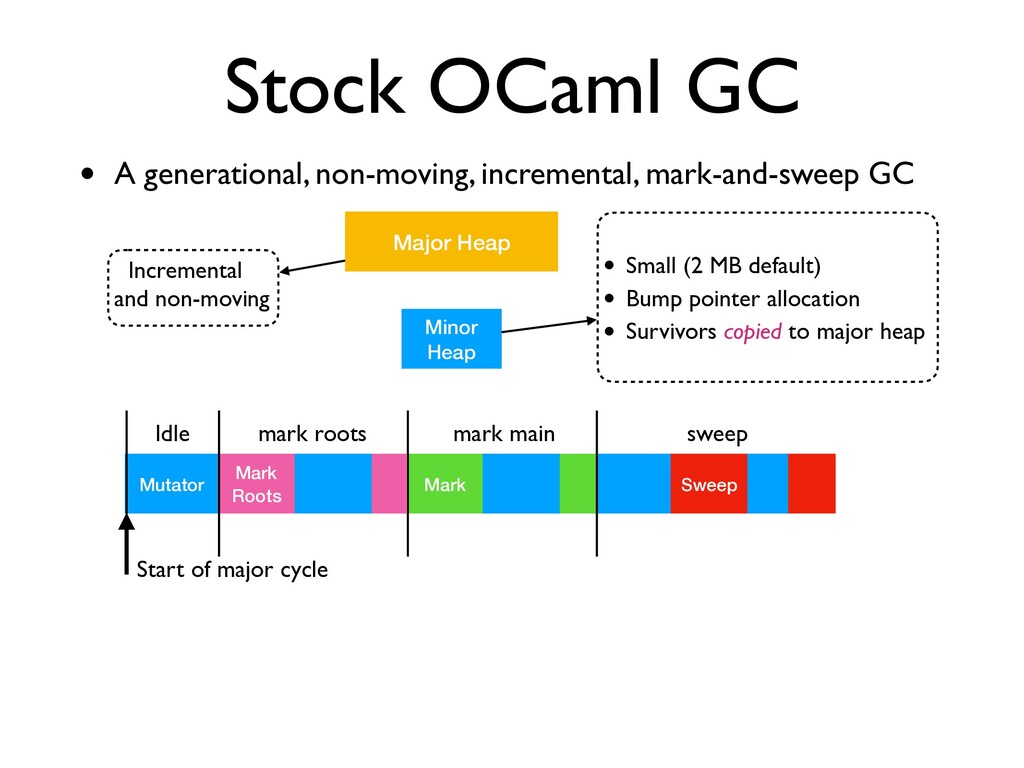
A generational, non-moving, incremental, mark-and-sweep GC Minor Heap Major Heap • Small (2 MB default) • Bump pointer allocation • Survivors copied to major heap Mutator Start of major cycle Idle Mark Roots mark roots
GC • A generational, non-moving, incremental, mark-and-sweep GC Minor Heap Major Heap • Small (2 MB default) • Bump pointer allocation • Survivors copied to major heap Mutator Start of major cycle Idle Mark Roots mark roots
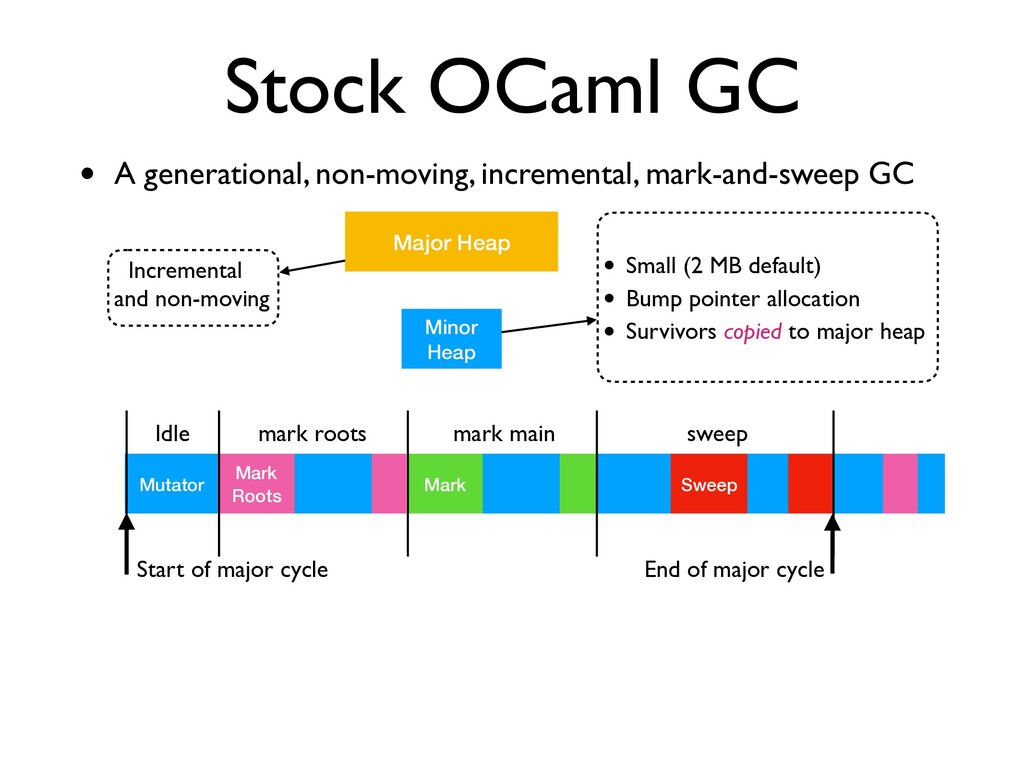
GC • A generational, non-moving, incremental, mark-and-sweep GC Minor Heap Major Heap • Small (2 MB default) • Bump pointer allocation • Survivors copied to major heap End of major cycle Mutator Start of major cycle Idle Mark Roots mark roots
GC • A generational, non-moving, incremental, mark-and-sweep GC Minor Heap Major Heap • Small (2 MB default) • Bump pointer allocation • Survivors copied to major heap End of major cycle Mutator Start of major cycle Idle Mark Roots mark roots • Fast allocations, no read barriers
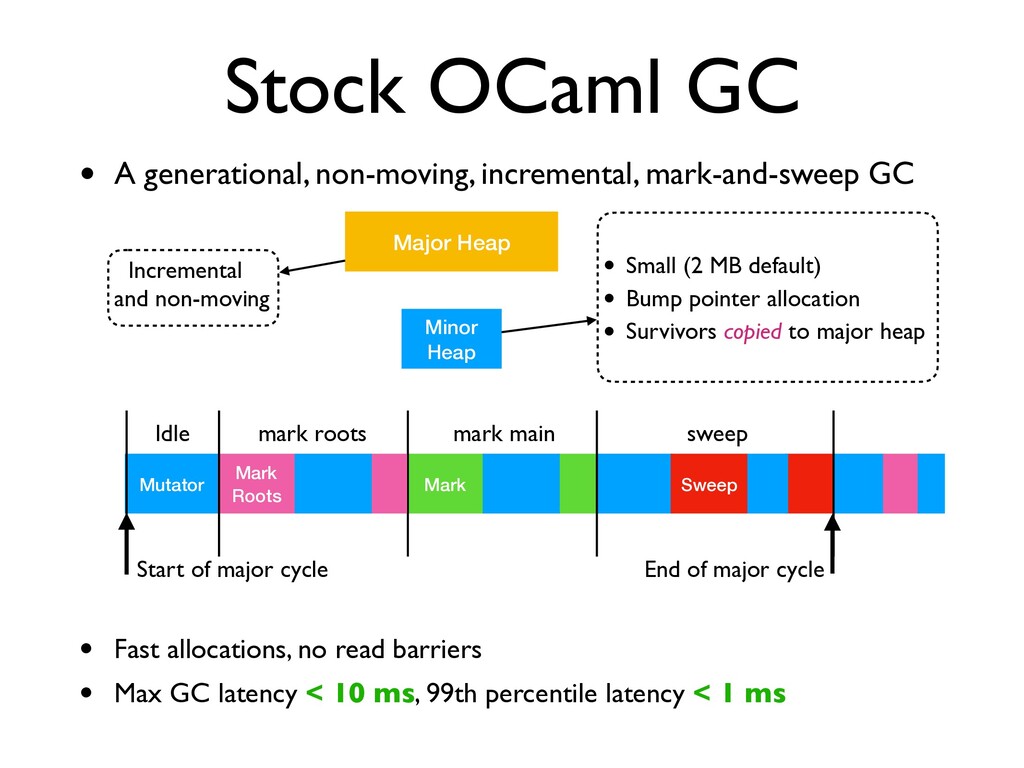
GC • A generational, non-moving, incremental, mark-and-sweep GC Minor Heap Major Heap • Small (2 MB default) • Bump pointer allocation • Survivors copied to major heap End of major cycle Mutator Start of major cycle Idle Mark Roots mark roots • Fast allocations, no read barriers • Max GC latency < 10 ms, 99th percentile latency < 1 ms
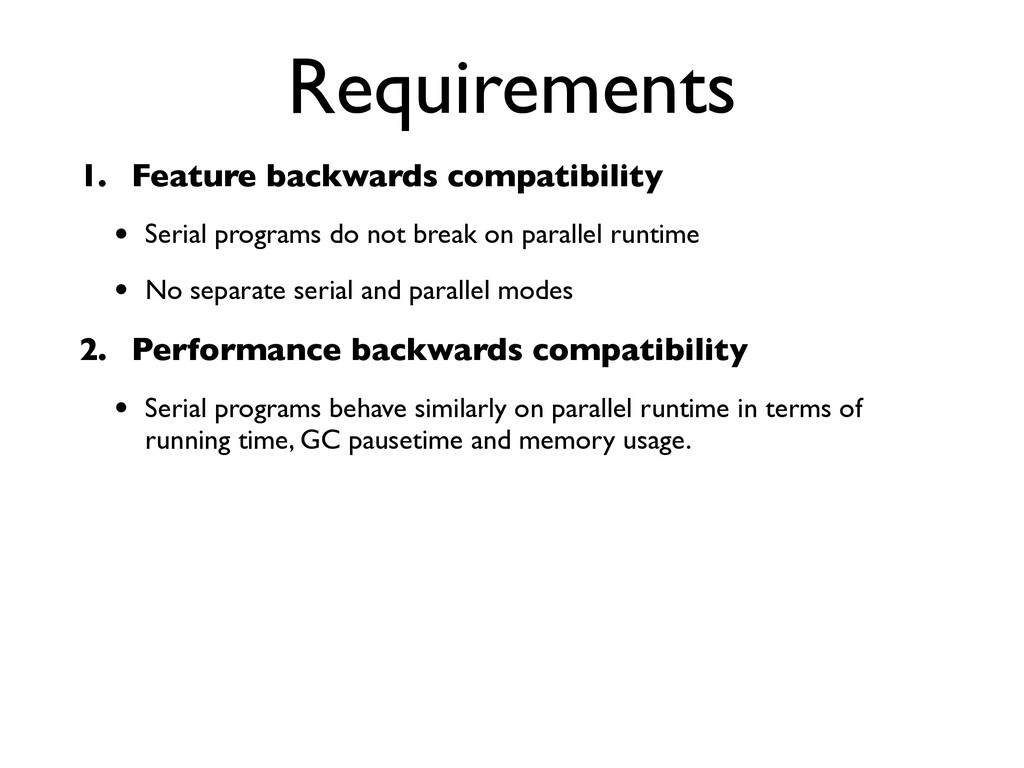
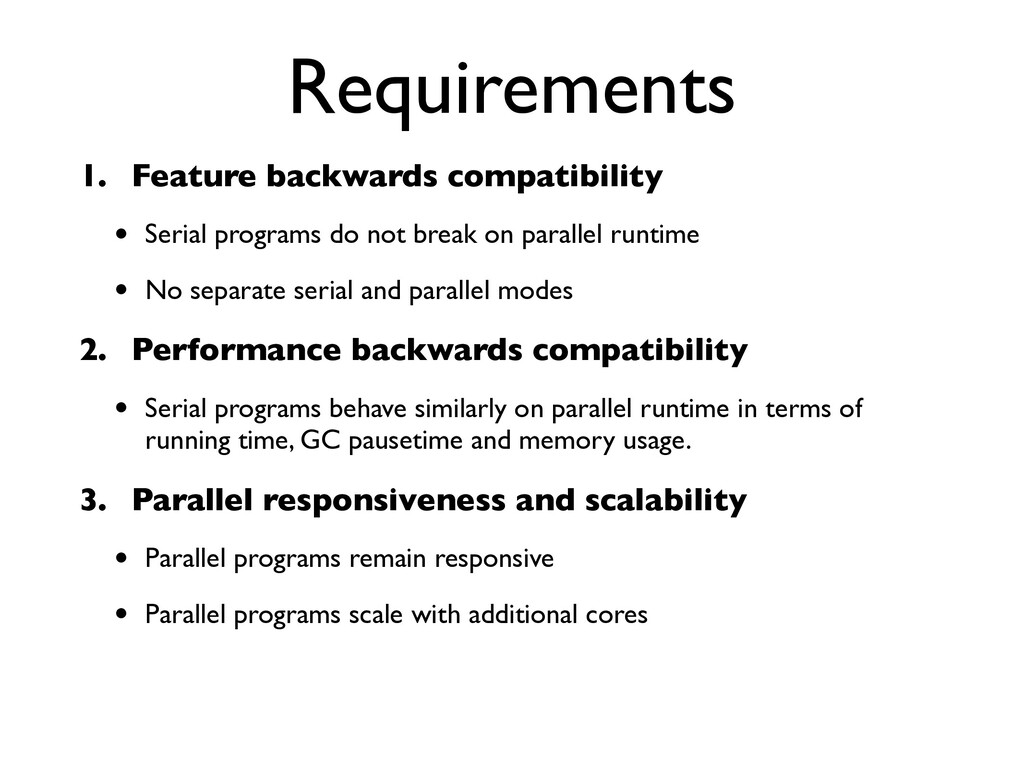
break on parallel runtime • No separate serial and parallel modes 2. Performance backwards compatibility • Serial programs behave similarly on parallel runtime in terms of running time, GC pausetime and memory usage.
break on parallel runtime • No separate serial and parallel modes 2. Performance backwards compatibility • Serial programs behave similarly on parallel runtime in terms of running time, GC pausetime and memory usage. 3. Parallel responsiveness and scalability • Parallel programs remain responsive • Parallel programs scale with additional cores
Streamflow [Schneider et al. 2006] ✦ Thread-local, size-segmented free lists for small objects + malloc for large allocations ✦ Sequential performance on par with OCaml’s allocators
Streamflow [Schneider et al. 2006] ✦ Thread-local, size-segmented free lists for small objects + malloc for large allocations ✦ Sequential performance on par with OCaml’s allocators • A mostly-concurrent, non-moving, mark-and-sweep collector ✦ Based on VCGC [Huelsbergen and Winterbottom 1998]
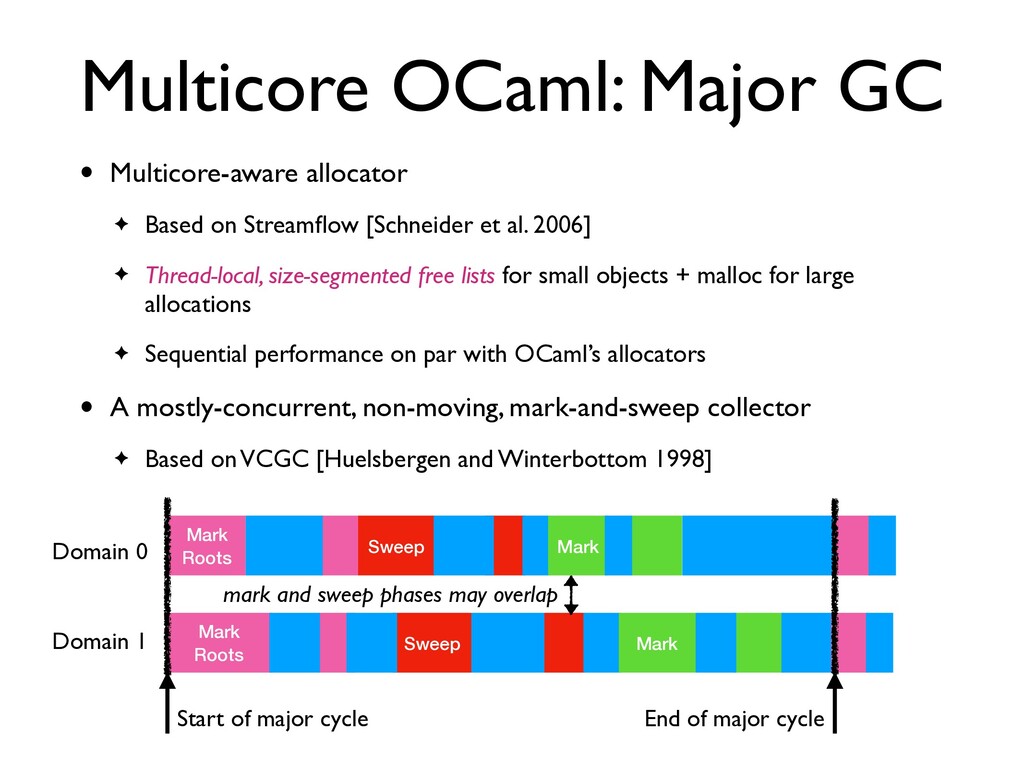
Streamflow [Schneider et al. 2006] ✦ Thread-local, size-segmented free lists for small objects + malloc for large allocations ✦ Sequential performance on par with OCaml’s allocators • A mostly-concurrent, non-moving, mark-and-sweep collector ✦ Based on VCGC [Huelsbergen and Winterbottom 1998] Sweep Mark Mark Roots Sweep Mark Mark Roots Start of major cycle End of major cycle Domain 0 Domain 1
Streamflow [Schneider et al. 2006] ✦ Thread-local, size-segmented free lists for small objects + malloc for large allocations ✦ Sequential performance on par with OCaml’s allocators • A mostly-concurrent, non-moving, mark-and-sweep collector ✦ Based on VCGC [Huelsbergen and Winterbottom 1998] Sweep Mark Mark Roots Sweep Mark Mark Roots Start of major cycle End of major cycle mark and sweep phases may overlap Domain 0 Domain 1
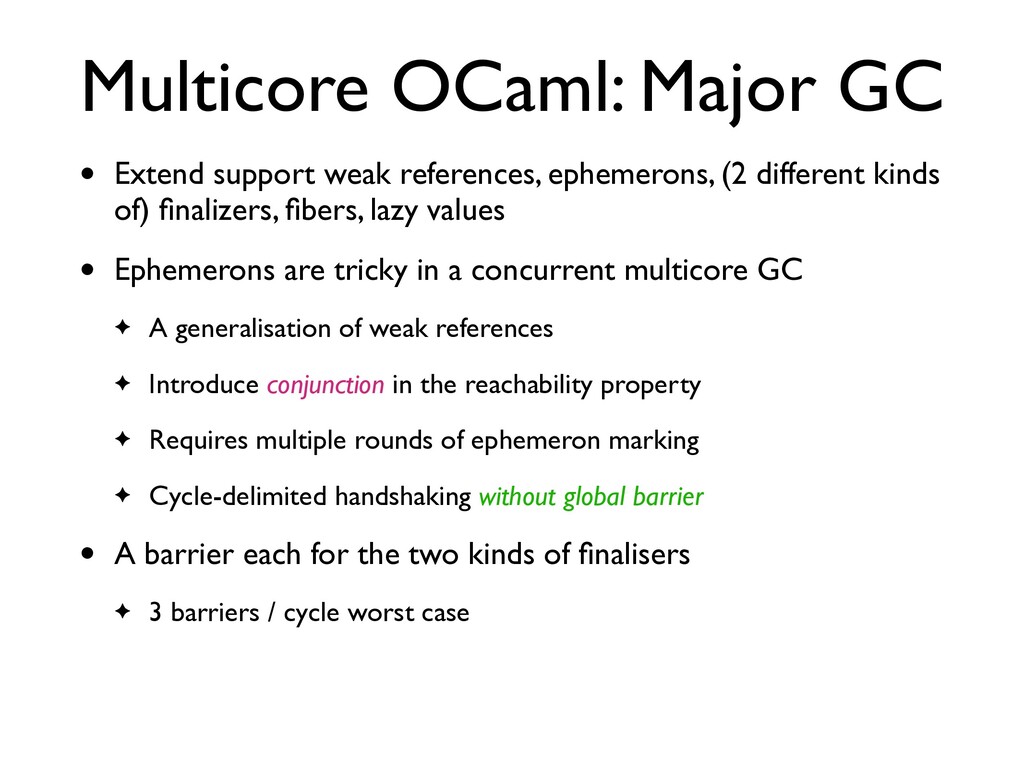
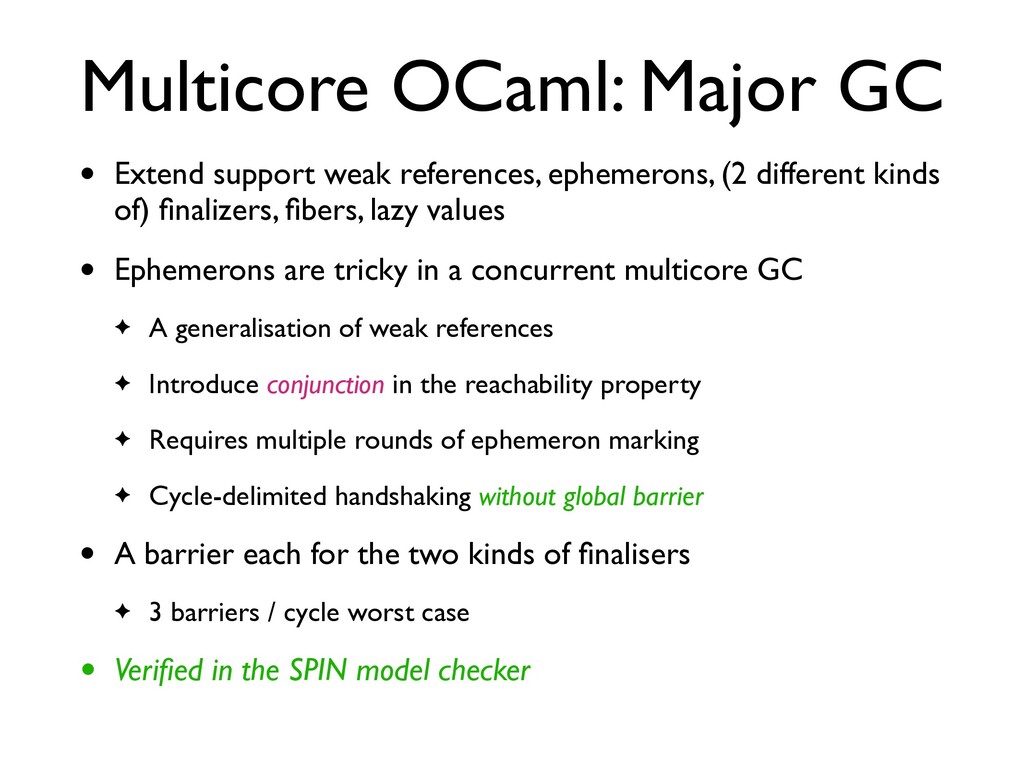
(2 different kinds of) finalizers, fibers, lazy values • Ephemerons are tricky in a concurrent multicore GC ✦ A generalisation of weak references ✦ Introduce conjunction in the reachability property ✦ Requires multiple rounds of ephemeron marking ✦ Cycle-delimited handshaking without global barrier
(2 different kinds of) finalizers, fibers, lazy values • Ephemerons are tricky in a concurrent multicore GC ✦ A generalisation of weak references ✦ Introduce conjunction in the reachability property ✦ Requires multiple rounds of ephemeron marking ✦ Cycle-delimited handshaking without global barrier • A barrier each for the two kinds of finalisers ✦ 3 barriers / cycle worst case
(2 different kinds of) finalizers, fibers, lazy values • Ephemerons are tricky in a concurrent multicore GC ✦ A generalisation of weak references ✦ Introduce conjunction in the reachability property ✦ Requires multiple rounds of ephemeron marking ✦ Cycle-delimited handshaking without global barrier • A barrier each for the two kinds of finalisers ✦ 3 barriers / cycle worst case • Verified in the SPIN model checker
but lazier as in [Marlow and Peyton Jones 2011] collector for GHC Minor Heap Minor Heap Minor Heap Minor Heap Major Heap Domain 0 Domain 1 Domain 2 Domain 3
but lazier as in [Marlow and Peyton Jones 2011] collector for GHC Minor Heap Minor Heap Minor Heap Minor Heap Major Heap Domain 0 Domain 1 Domain 2 Domain 3 • Each domain can independently collect its minor heap
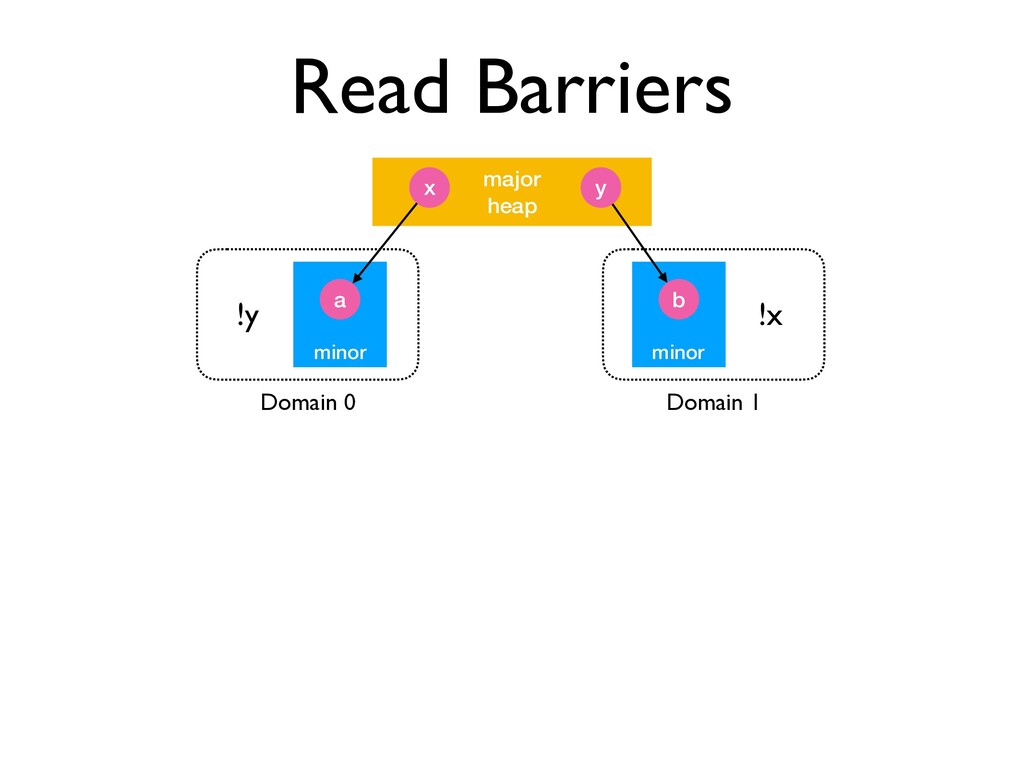
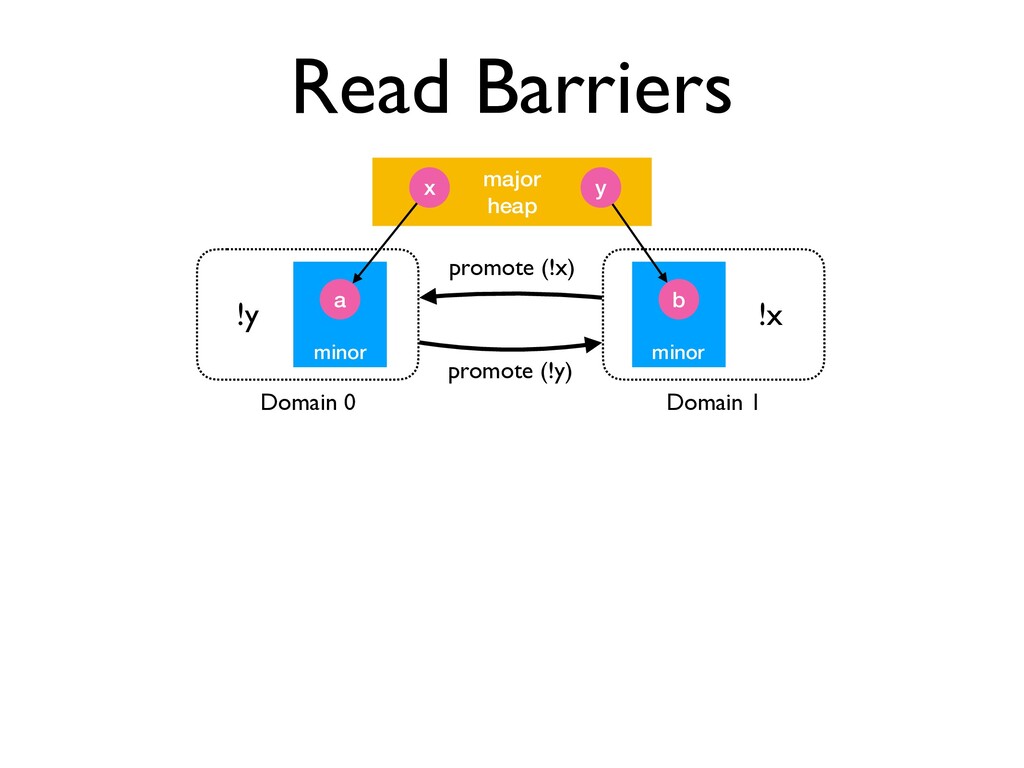
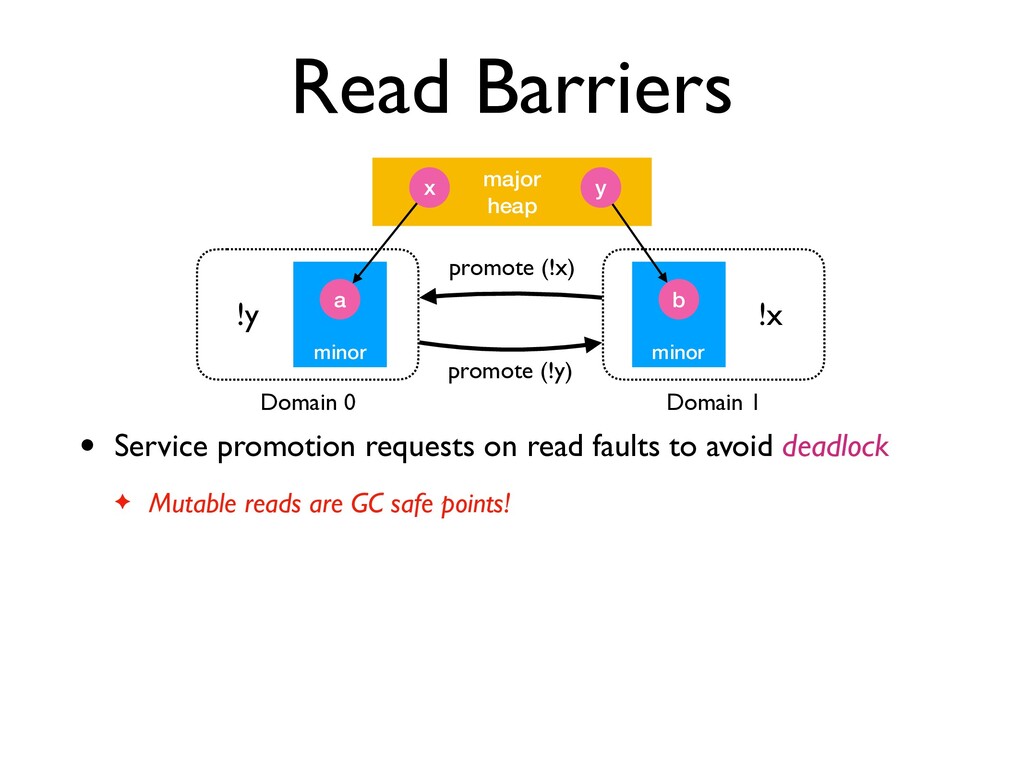
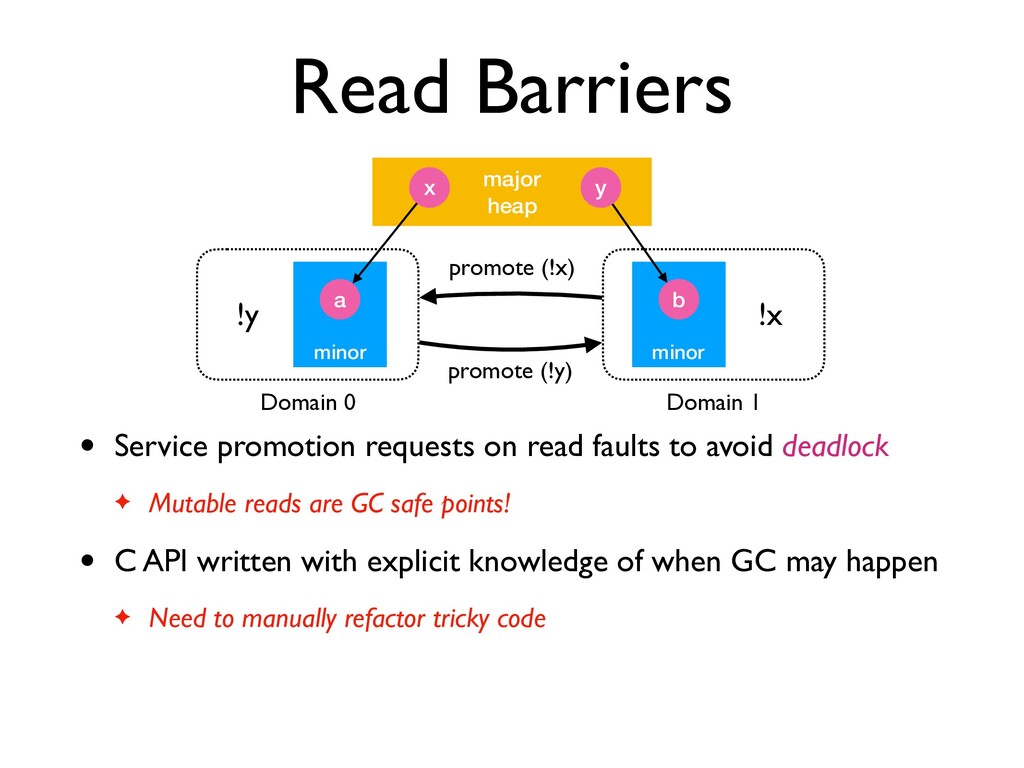
but lazier as in [Marlow and Peyton Jones 2011] collector for GHC Minor Heap Minor Heap Minor Heap Minor Heap Major Heap Domain 0 Domain 1 Domain 2 Domain 3 • Each domain can independently collect its minor heap • Major to minor pointers allowed ✦ Prevents early promotion & mirrors sequential behaviour ✦ Read barrier required for mutable field + promotion
✦ Read barriers need to be efficient for performance backwards compatibility • 3 instructions in x86 - VMM + bit-twiddling tricks ✦ Proof of correctness available in the paper ✦ Minimal performance impact on sequential code
✦ Read barriers need to be efficient for performance backwards compatibility • 3 instructions in x86 - VMM + bit-twiddling tricks ✦ Proof of correctness available in the paper ✦ Minimal performance impact on sequential code • Unfortunately, read barriers break the C API (feature backwards compatibility)
avoid deadlock ✦ Mutable reads are GC safe points! • C API written with explicit knowledge of when GC may happen ✦ Need to manually refactor tricky code minor major heap x y a minor b Domain 0 Domain 1 !y !x promote (!y) promote (!x)
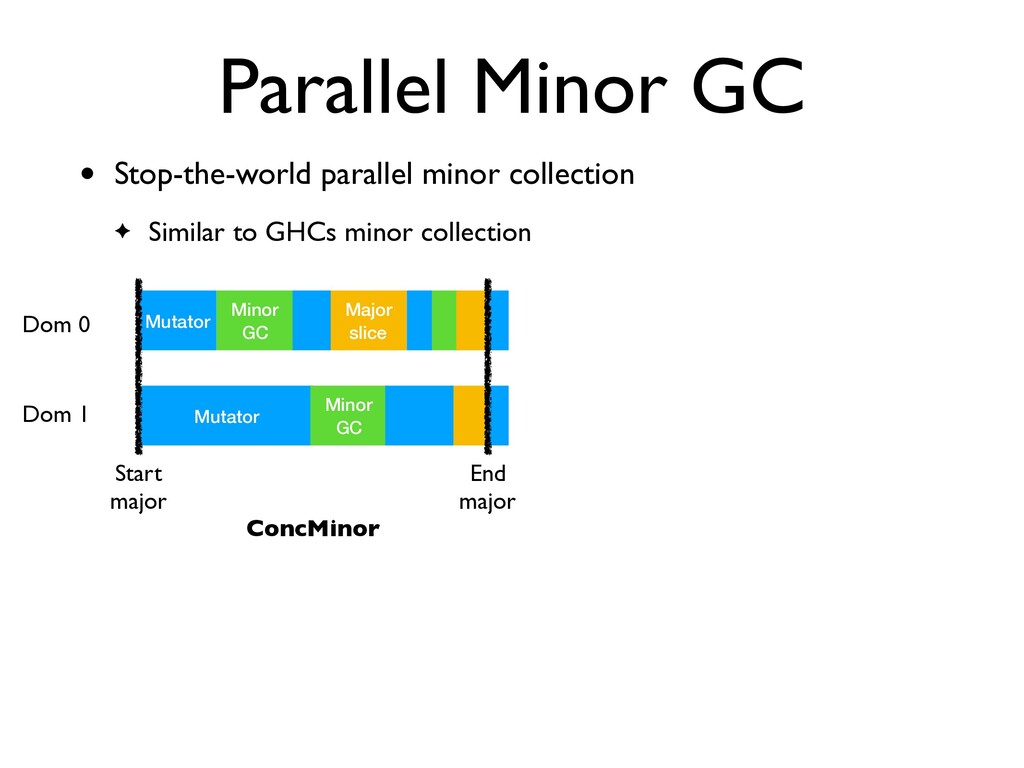
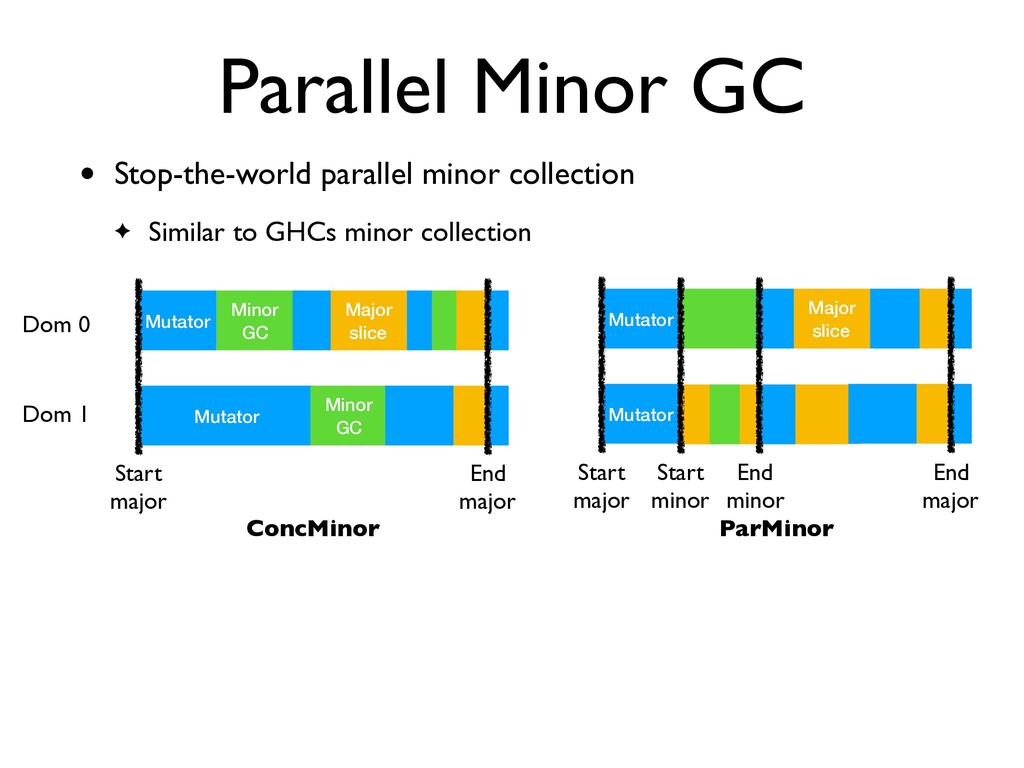
to GHCs minor collection Dom 0 Dom 1 Mutator Minor GC Major slice Mutator Minor GC Start major End major ConcMinor Mutator Major slice Mutator Start major End major Start minor End minor ParMinor
to GHCs minor collection Dom 0 Dom 1 Mutator Minor GC Major slice Mutator Minor GC Start major End major ConcMinor Mutator Major slice Mutator Start major End major Start minor End minor ParMinor Slop space filled with major slices
to GHCs minor collection • No need for read barriers! Dom 0 Dom 1 Mutator Minor GC Major slice Mutator Minor GC Start major End major ConcMinor Mutator Major slice Mutator Start major End major Start minor End minor ParMinor Slop space filled with major slices
to GHCs minor collection • No need for read barriers! • Quickly bring all the domains to a barrier ✦ Insert poll points in code for timely inter-domain interrupt handling [Feeley 1993] Dom 0 Dom 1 Mutator Minor GC Major slice Mutator Minor GC Start major End major ConcMinor Mutator Major slice Mutator Start major End major Start minor End minor ParMinor Slop space filled with major slices
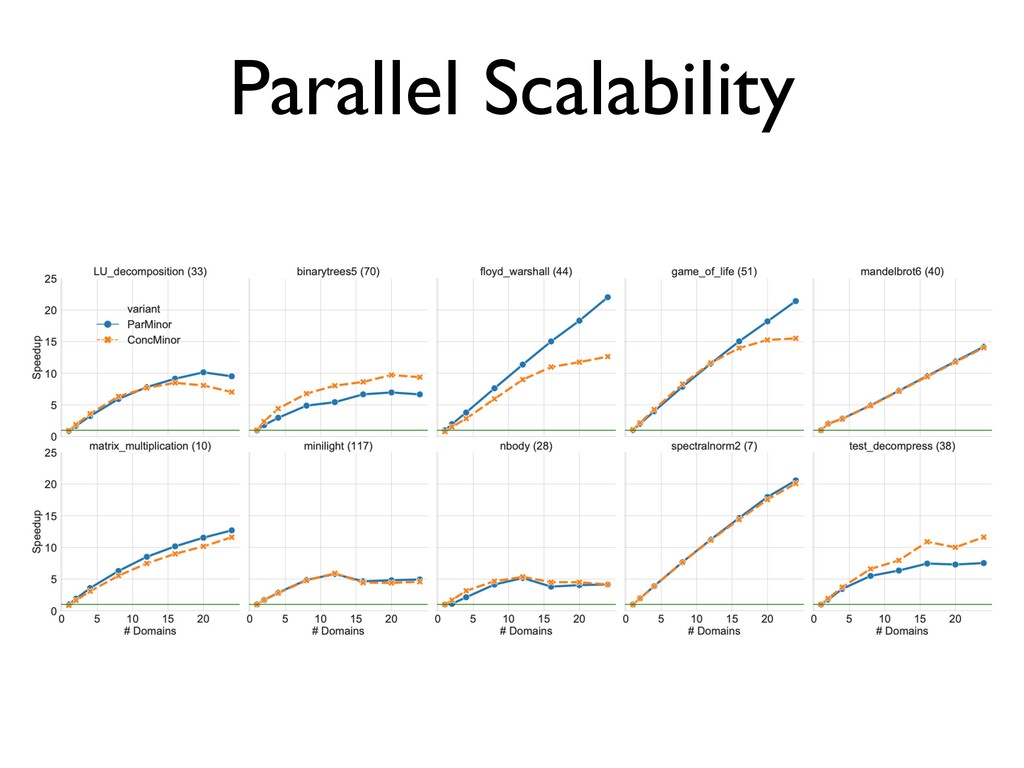
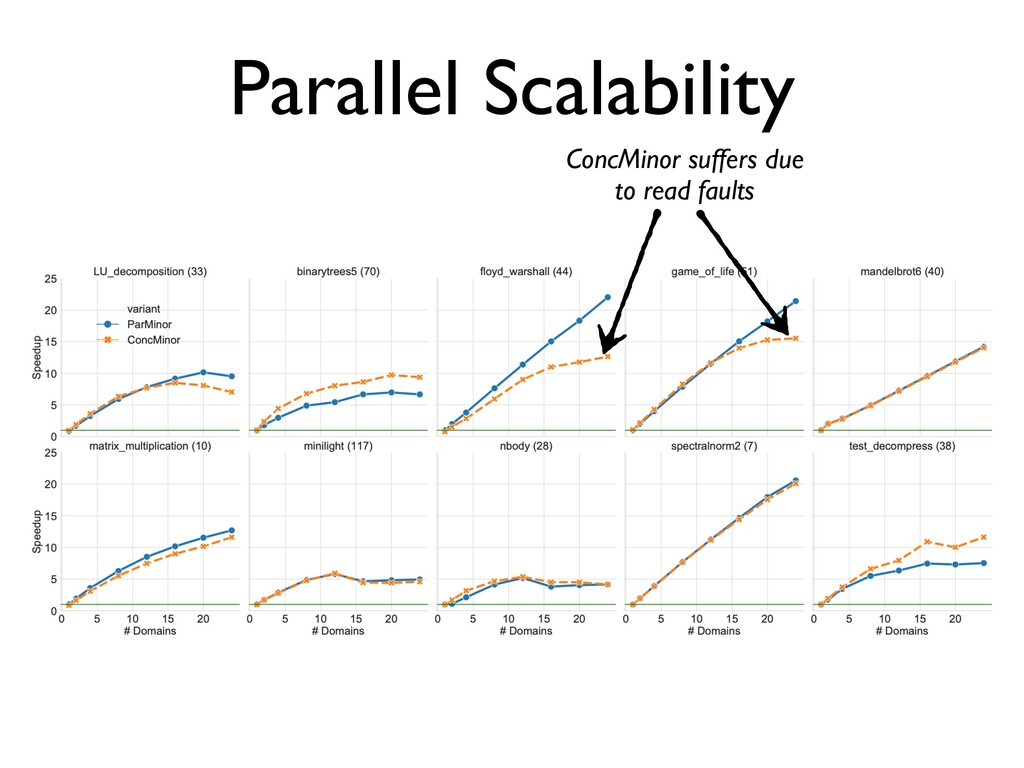
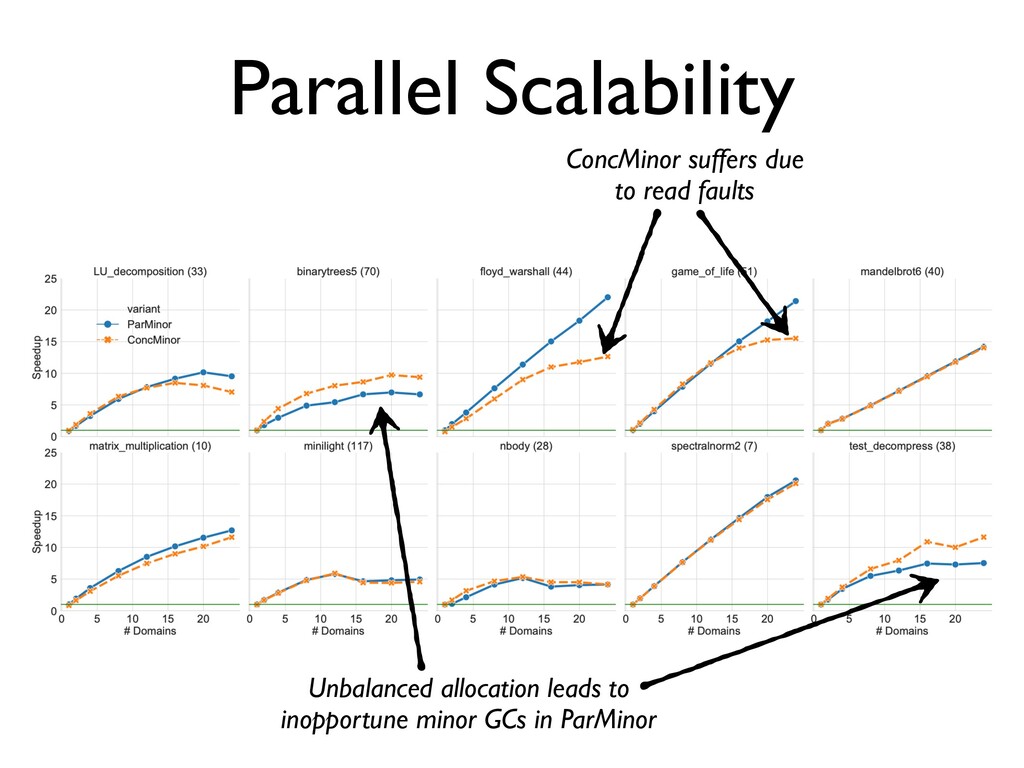
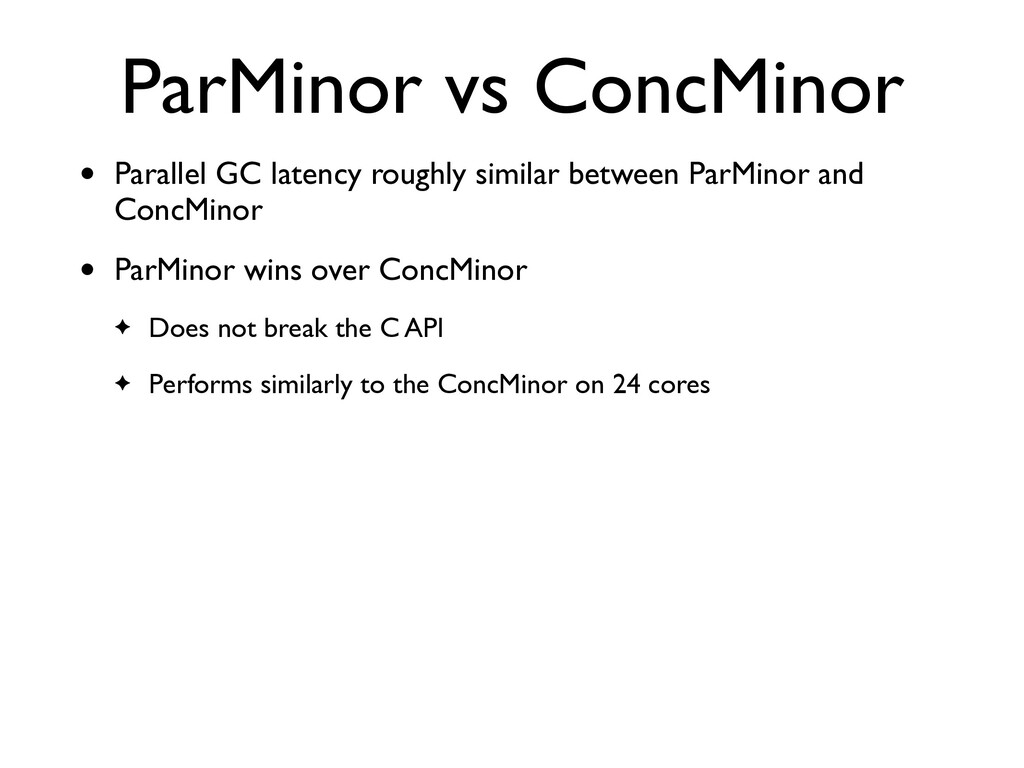
ParMinor and ConcMinor • ParMinor wins over ConcMinor ✦ Does not break the C API ✦ Performs similarly to the ConcMinor on 24 cores • OCaml 5.00 will have multicore support and use ParMinor ✦ May revisit ConcMinor later for manycore future


 kayceesrk
 institutdelelevage
 sirmatrixpage
 satai
 yumulab
 kanojikajino
 godel
 pomcho555
 ktanishima
 kogoro
 auranightsky
 kzmssk
 paigeccino
 jmmastey
 thekraken
 katarinadahlin
 coloredviolet
 jcasabona
 stuffmc
 jdejongh
 lara
 honnibal
 mayunak
 axbom