Share
Certified Mergeable Replicated Data Types
Replicated data types (RDTs) are data structures that permit concurrent modification of multiple potentially geo-distributed replicas without coordination between them. RDTs are designed in such a way that conflicting operations are eventually deterministically reconciled ensuring convergence. Constructing correct RDTs remains a difficult endeavour due to the complexity of reasoning about independently evolving states of the replicas. With the focus on the correctness of RDTs (and rightly so), existing approaches to RDTs are less efficient compared to their sequential counterparts in terms of time and space complexity. This is unfortunate since RDTs are often used in an local-first setting where the local operations far outweigh remote communication.
In this paper, we present Peepul, a pragmatic approach to building and verifying efficient RDTs. To make reasoning about correctness easier, we cast RDTs in the mould of distributed version control system, and equip it with a threeway merge function for reconciling conflicting versions. Further, we go beyond just verifying convergence, and provide a methodology to verify arbitrarily complex specifications. We develop a replication-aware simulation relation based technique to relate RDT specifications to their efficient purely functional implementations. We have developed Peepul as an F* library that discharges proof obligations to an SMT solver. The verified efficient RDTs are extracted as OCaml code and used in Irmin, a Git-like distributed database.
KC Sivaramakrishnan
Transcript
129 slides
-
Certi fi ed Mergeable Replicated Data Types “KC” Sivaramakrishnan joint
work with Vimala Soundarapandian, Adharsh Kamath and Kartik Nagar -
4 module Counter : sig type t val read :
t -> int val add : t -> int -> t val sub : t -> int -> t end = struct type t = int let read x = x let add x d = x + d let sub x d = x - d end Sequential Counter -
• Written in idiomatic style • Composable 4 module Counter
: sig type t val read : t -> int val add : t -> int -> t val sub : t -> int -> t end = struct type t = int let read x = x let add x d = x + d let sub x d = x - d end type counter_list = Counter.t list Sequential Counter -
INTERNET 0 0 Replicated Counter +2 2 +3 3 •
Idea: Apply the local operations at all replicas -
INTERNET Replicated Counter +2 +3 5 5 5 5 •
Idea: Apply the local operations at all replicas -
7 module Counter : sig type t val read :
t -> int val add : t -> int -> t val sub : t -> int -> t val mult : t -> int -> t end = struct type t = int let read x = x let add x d = x + d let sub x d = x - d let mult x n = x * n end -
7 module Counter : sig type t val read :
t -> int val add : t -> int -> t val sub : t -> int -> t val mult : t -> int -> t end = struct type t = int let read x = x let add x d = x + d let sub x d = x - d let mult x n = x * n end 7 -
7 module Counter : sig type t val read :
t -> int val add : t -> int -> t val sub : t -> int -> t val mult : t -> int -> t end = struct type t = int let read x = x let add x d = x + d let sub x d = x - d let mult x n = x * n end 7 8 +1 -
7 module Counter : sig type t val read :
t -> int val add : t -> int -> t val sub : t -> int -> t val mult : t -> int -> t end = struct type t = int let read x = x let add x d = x + d let sub x d = x - d let mult x n = x * n end 7 8 21 +1 *3 -
7 module Counter : sig type t val read :
t -> int val add : t -> int -> t val sub : t -> int -> t val mult : t -> int -> t end = struct type t = int let read x = x let add x d = x + d let sub x d = x - d let mult x n = x * n end 7 8 21 +1 *3 24 *3 -
7 module Counter : sig type t val read :
t -> int val add : t -> int -> t val sub : t -> int -> t val mult : t -> int -> t end = struct type t = int let read x = x let add x d = x + d let sub x d = x - d let mult x n = x * n end 7 8 21 +1 *3 24 22 *3 +1 -
7 module Counter : sig type t val read :
t -> int val add : t -> int -> t val sub : t -> int -> t val mult : t -> int -> t end = struct type t = int let read x = x let add x d = x + d let sub x d = x - d let mult x n = x * n end 7 8 21 +1 *3 24 22 *3 +1 Diverges -
7 module Counter : sig type t val read :
t -> int val add : t -> int -> t val sub : t -> int -> t val mult : t -> int -> t end = struct type t = int let read x = x let add x d = x + d let sub x d = x - d let mult x n = x * n end 7 8 21 +1 *3 24 22 *3 +1 Diverges Addition and multiplication do not commute -
8 module Counter : sig type t val read :
t -> int val add : t -> int -> t val sub : t -> int -> t val mult : t -> int -> t end = struct type t = int let read x = x let add x d = x + d let sub x d = x - d let mult x n = x * n end -
8 module Counter : sig type t val read :
t -> int val add : t -> int -> t val sub : t -> int -> t val mult : t -> int -> t end = struct type t = int let read x = x let add x d = x + d let sub x d = x - d let mult x n = x * n end • Idea: Capture the effect of multiplication through the commutative addition operation -
8 module Counter : sig type t val read :
t -> int val add : t -> int -> t val sub : t -> int -> t val mult : t -> int -> t end = struct type t = int let read x = x let add x d = x + d let sub x d = x - d let mult x n = x * n end 7 • Idea: Capture the effect of multiplication through the commutative addition operation -
8 module Counter : sig type t val read :
t -> int val add : t -> int -> t val sub : t -> int -> t val mult : t -> int -> t end = struct type t = int let read x = x let add x d = x + d let sub x d = x - d let mult x n = x * n end 7 8 +1 • Idea: Capture the effect of multiplication through the commutative addition operation -
8 module Counter : sig type t val read :
t -> int val add : t -> int -> t val sub : t -> int -> t val mult : t -> int -> t end = struct type t = int let read x = x let add x d = x + d let sub x d = x - d let mult x n = x * n end 7 8 21 +1 *3 • Idea: Capture the effect of multiplication through the commutative addition operation -
8 module Counter : sig type t val read :
t -> int val add : t -> int -> t val sub : t -> int -> t val mult : t -> int -> t end = struct type t = int let read x = x let add x d = x + d let sub x d = x - d let mult x n = x * n end 7 8 21 +1 *3 22 +14 • Idea: Capture the effect of multiplication through the commutative addition operation -
8 module Counter : sig type t val read :
t -> int val add : t -> int -> t val sub : t -> int -> t val mult : t -> int -> t end = struct type t = int let read x = x let add x d = x + d let sub x d = x - d let mult x n = x * n end 7 8 21 +1 *3 22 22 +14 +1 • Idea: Capture the effect of multiplication through the commutative addition operation -
8 module Counter : sig type t val read :
t -> int val add : t -> int -> t val sub : t -> int -> t val mult : t -> int -> t end = struct type t = int let read x = x let add x d = x + d let sub x d = x - d let mult x n = x * n end 7 8 21 +1 *3 22 22 +14 +1 Converges • Idea: Capture the effect of multiplication through the commutative addition operation -
8 module Counter : sig type t val read :
t -> int val add : t -> int -> t val sub : t -> int -> t val mult : t -> int -> t end = struct type t = int let read x = x let add x d = x + d let sub x d = x - d let mult x n = x * n end 7 8 21 +1 *3 22 22 +14 +1 Converges • Idea: Capture the effect of multiplication through the commutative addition operation • CRDTs -
Convergent Replicated Data Types (CRDT) • CRDT is guaranteed to
ensure strong eventual consistency (SEC) ★ G-counters, PN-counters, OR-Sets, Graphs, Ropes, docs, sheets ★ Simple interface for the clients of CRDTs 9 -
Convergent Replicated Data Types (CRDT) • CRDT is guaranteed to
ensure strong eventual consistency (SEC) ★ G-counters, PN-counters, OR-Sets, Graphs, Ropes, docs, sheets ★ Simple interface for the clients of CRDTs • Need to reengineer every datatype to ensure SEC (commutativity) ★ Do not mirror sequential counter parts => implementation & proof burden ★ Do not compose! ✦ counter set is not a composition of counter and set CRDTs 9 -
Can we program & reason about replicated data types as
an extension of their sequential counterparts? -
Can we program & reason about replicated data types as
an extension of their sequential counterparts? MRDT -
11 module Counter : sig type t val read :
t -> int val add : t -> int -> t val sub : t -> int -> t val mult : t -> int -> t val merge : lca:t -> v1:t -> v2:t -> t end = struct type t = int let read x = x let add x d = x + d let sub x d = x - d let mult x n = x * n let merge ~lca ~v1 ~v2 = lca + (v1 - lca) + (v2 - lca) end -
11 module Counter : sig type t val read :
t -> int val add : t -> int -> t val sub : t -> int -> t val mult : t -> int -> t val merge : lca:t -> v1:t -> v2:t -> t end = struct type t = int let read x = x let add x d = x + d let sub x d = x - d let mult x n = x * n let merge ~lca ~v1 ~v2 = lca + (v1 - lca) + (v2 - lca) end 7 -
11 module Counter : sig type t val read :
t -> int val add : t -> int -> t val sub : t -> int -> t val mult : t -> int -> t val merge : lca:t -> v1:t -> v2:t -> t end = struct type t = int let read x = x let add x d = x + d let sub x d = x - d let mult x n = x * n let merge ~lca ~v1 ~v2 = lca + (v1 - lca) + (v2 - lca) end 7 8 +1 -
11 module Counter : sig type t val read :
t -> int val add : t -> int -> t val sub : t -> int -> t val mult : t -> int -> t val merge : lca:t -> v1:t -> v2:t -> t end = struct type t = int let read x = x let add x d = x + d let sub x d = x - d let mult x n = x * n let merge ~lca ~v1 ~v2 = lca + (v1 - lca) + (v2 - lca) end 7 8 21 +1 *3 -
11 module Counter : sig type t val read :
t -> int val add : t -> int -> t val sub : t -> int -> t val mult : t -> int -> t val merge : lca:t -> v1:t -> v2:t -> t end = struct type t = int let read x = x let add x d = x + d let sub x d = x - d let mult x n = x * n let merge ~lca ~v1 ~v2 = lca + (v1 - lca) + (v2 - lca) end 7 8 21 +1 *3 22 -
11 module Counter : sig type t val read :
t -> int val add : t -> int -> t val sub : t -> int -> t val mult : t -> int -> t val merge : lca:t -> v1:t -> v2:t -> t end = struct type t = int let read x = x let add x d = x + d let sub x d = x - d let mult x n = x * n let merge ~lca ~v1 ~v2 = lca + (v1 - lca) + (v2 - lca) end 7 8 21 +1 *3 22 22 -
11 module Counter : sig type t val read :
t -> int val add : t -> int -> t val sub : t -> int -> t val mult : t -> int -> t val merge : lca:t -> v1:t -> v2:t -> t end = struct type t = int let read x = x let add x d = x + d let sub x d = x - d let mult x n = x * n let merge ~lca ~v1 ~v2 = lca + (v1 - lca) + (v2 - lca) end 7 8 21 +1 *3 22 22 22 = 7 + (8-1) + (21 -7) -
11 module Counter : sig type t val read :
t -> int val add : t -> int -> t val sub : t -> int -> t val mult : t -> int -> t val merge : lca:t -> v1:t -> v2:t -> t end = struct type t = int let read x = x let add x d = x + d let sub x d = x - d let mult x n = x * n let merge ~lca ~v1 ~v2 = lca + (v1 - lca) + (v2 - lca) end 7 8 21 +1 *3 22 22 22 = 7 + (8-1) + (21 -7) • 3-way merge function makes the counter suitable for distribution -
11 module Counter : sig type t val read :
t -> int val add : t -> int -> t val sub : t -> int -> t val mult : t -> int -> t val merge : lca:t -> v1:t -> v2:t -> t end = struct type t = int let read x = x let add x d = x + d let sub x d = x - d let mult x n = x * n let merge ~lca ~v1 ~v2 = lca + (v1 - lca) + (v2 - lca) end 7 8 21 +1 *3 22 22 22 = 7 + (8-1) + (21 -7) • 3-way merge function makes the counter suitable for distribution • Does not appeal to individual operations => independently extend data-type -
12 Systems ➞ PL • CRDTs need to take care
of systems level concerns such as message loss, duplication and reordering -
12 Systems ➞ PL • CRDTs need to take care
of systems level concerns such as message loss, duplication and reordering • 3-way merge is oblivious to these ✦ By leaving those concerns to MRDT middleware -
12 7 8 21 +1 *3 22 22 Systems ➞
PL • CRDTs need to take care of systems level concerns such as message loss, duplication and reordering • 3-way merge is oblivious to these ✦ By leaving those concerns to MRDT middleware -
?? 12 7 8 21 +1 *3 22 22 Systems
➞ PL • CRDTs need to take care of systems level concerns such as message loss, duplication and reordering • 3-way merge is oblivious to these ✦ By leaving those concerns to MRDT middleware -
?? 12 7 8 21 +1 *3 22 22 22
22 = 21 + (21-21) + (22 -21) Systems ➞ PL • CRDTs need to take care of systems level concerns such as message loss, duplication and reordering • 3-way merge is oblivious to these ✦ By leaving those concerns to MRDT middleware -
14 • OR-set — add-wins when there is a concurrent
add and remove of the same element Observed-Removed Set -
14 • OR-set — add-wins when there is a concurrent
add and remove of the same element Observed-Removed Set let merge ~lca ~v1 ~v2 = (lca ∩ v1 ∩ v2) (* unmodified elements *) ∪ (v1 - lca) (* added in v1 *) ∪ (v2 - lca) (* added in v2 *) Kaki et al. “Mergeable Replicated Data Types”, OOPSLA 2019 -
14 {1} • OR-set — add-wins when there is a
concurrent add and remove of the same element Observed-Removed Set let merge ~lca ~v1 ~v2 = (lca ∩ v1 ∩ v2) (* unmodified elements *) ∪ (v1 - lca) (* added in v1 *) ∪ (v2 - lca) (* added in v2 *) Kaki et al. “Mergeable Replicated Data Types”, OOPSLA 2019 -
14 {1} {1} add(1) • OR-set — add-wins when there
is a concurrent add and remove of the same element Observed-Removed Set let merge ~lca ~v1 ~v2 = (lca ∩ v1 ∩ v2) (* unmodified elements *) ∪ (v1 - lca) (* added in v1 *) ∪ (v2 - lca) (* added in v2 *) Kaki et al. “Mergeable Replicated Data Types”, OOPSLA 2019 -
14 {1} {1} { } add(1) rem(1) • OR-set —
add-wins when there is a concurrent add and remove of the same element Observed-Removed Set let merge ~lca ~v1 ~v2 = (lca ∩ v1 ∩ v2) (* unmodified elements *) ∪ (v1 - lca) (* added in v1 *) ∪ (v2 - lca) (* added in v2 *) Kaki et al. “Mergeable Replicated Data Types”, OOPSLA 2019 -
14 {1} {1} { } { } { } add(1)
rem(1) • OR-set — add-wins when there is a concurrent add and remove of the same element Observed-Removed Set let merge ~lca ~v1 ~v2 = (lca ∩ v1 ∩ v2) (* unmodified elements *) ∪ (v1 - lca) (* added in v1 *) ∪ (v2 - lca) (* added in v2 *) { } ∪ ({1} - {1}) ∪ ({ } - {1}) = { } ∪ { } ∪ { } = { } (expected {1}) Kaki et al. “Mergeable Replicated Data Types”, OOPSLA 2019 -
14 {1} {1} { } { } { } add(1)
rem(1) • Convergence is not suf fi cient; Intent is not preserved • OR-set — add-wins when there is a concurrent add and remove of the same element Observed-Removed Set let merge ~lca ~v1 ~v2 = (lca ∩ v1 ∩ v2) (* unmodified elements *) ∪ (v1 - lca) (* added in v1 *) ∪ (v2 - lca) (* added in v2 *) { } ∪ ({1} - {1}) ∪ ({ } - {1}) = { } ∪ { } ∪ { } = { } (expected {1}) Kaki et al. “Mergeable Replicated Data Types”, OOPSLA 2019 -
Concretising Intent • Intent is a woolly term ★ How
can we formalise the intent of operations on a data structure? 15 l v1 v2 v -
Concretising Intent • Intent is a woolly term ★ How
can we formalise the intent of operations on a data structure? • We need ★ A formal language to specify the intent of an RDT ★ Mechanization to bridge the air gap between speci fi cation and implementation due to distributed system complexity 15 l v1 v2 v -
Peepul — Certi fi ed MRDTs • An F* library
implementing and proving MRDTs ★ https://github.com/prismlab/peepul 16 -
Peepul — Certi fi ed MRDTs • An F* library
implementing and proving MRDTs ★ https://github.com/prismlab/peepul • Speci fi cation language is event-based ★ Burckhardt et al. “Replicated Data Types: Speci fi cation, Veri fi cation and Optimality”, POPL 2014 16 -
Peepul — Certi fi ed MRDTs • An F* library
implementing and proving MRDTs ★ https://github.com/prismlab/peepul • Speci fi cation language is event-based ★ Burckhardt et al. “Replicated Data Types: Speci fi cation, Veri fi cation and Optimality”, POPL 2014 • Replication-aware simulation to connect speci fi cation with implementation 16 -
Peepul — Certi fi ed MRDTs • An F* library
implementing and proving MRDTs ★ https://github.com/prismlab/peepul • Speci fi cation language is event-based ★ Burckhardt et al. “Replicated Data Types: Speci fi cation, Veri fi cation and Optimality”, POPL 2014 • Replication-aware simulation to connect speci fi cation with implementation • Composition of MRDTs and their proofs! 16 -
Peepul — Certi fi ed MRDTs • An F* library
implementing and proving MRDTs ★ https://github.com/prismlab/peepul • Speci fi cation language is event-based ★ Burckhardt et al. “Replicated Data Types: Speci fi cation, Veri fi cation and Optimality”, POPL 2014 • Replication-aware simulation to connect speci fi cation with implementation • Composition of MRDTs and their proofs! • Extracted RDTs are compatible with Irmin — a Git-like distributed database 16 -
Fixing OR-Set • Discriminate duplicate additions by associating a unique
id 17 { (a,1) } { (a,1); (a,2) } add(a) -
Fixing OR-Set • Discriminate duplicate additions by associating a unique
id 17 { (a,1) } { (a,1); (a,2) } { } add(a) rem(a) -
Fixing OR-Set • Discriminate duplicate additions by associating a unique
id 17 { (a,1) } { (a,1); (a,2) } { } { (a,2) } { (a,2) } add(a) rem(a) { } ∪ ( { (a,1); (a,2) } - { (a,1) }) ∪ ( { } - { (a,1) } ) = { } ∪ { (a,2) } ∪ { } = { (a,2) } -
Fixing OR-Set • Discriminate duplicate additions by associating a unique
id • MRDT implementation 17 { (a,1) } { (a,1); (a,2) } { } { (a,2) } { (a,2) } add(a) rem(a) { } ∪ ( { (a,1); (a,2) } - { (a,1) }) ∪ ( { } - { (a,1) } ) = { } ∪ { (a,2) } ∪ { } = { (a,2) } -
Fixing OR-Set • Discriminate duplicate additions by associating a unique
id • MRDT implementation 17 { (a,1) } { (a,1); (a,2) } { } { (a,2) } { (a,2) } add(a) rem(a) { } ∪ ( { (a,1); (a,2) } - { (a,1) }) ∪ ( { } - { (a,1) } ) = { } ∪ { (a,2) } ∪ { } = { (a,2) } -
Fixing OR-Set • Discriminate duplicate additions by associating a unique
id • MRDT implementation 17 { (a,1) } { (a,1); (a,2) } { } { (a,2) } { (a,2) } add(a) rem(a) { } ∪ ( { (a,1); (a,2) } - { (a,1) }) ∪ ( { } - { (a,1) } ) = { } ∪ { (a,2) } ∪ { } = { (a,2) } Unique Lamport Timestamps -
18 Specifying OR-Set Abstract state add(a) add(a) rem(a) rd vis
vis vis vis { (a,1) } { (a,1); (a,2) } { } { (a,2) } { (a,2) } add(a) rem(a) -
18 Specifying OR-Set Abstract state add(a) add(a) rem(a) rd vis
vis vis vis { (a,1) } { (a,1); (a,2) } { } { (a,2) } { (a,2) } add(a) rem(a) -
18 Specifying OR-Set Abstract state = { a } add(a)
add(a) rem(a) rd vis vis vis vis { (a,1) } { (a,1); (a,2) } { } { (a,2) } { (a,2) } add(a) rem(a) -
Simulation Relation • Connects the abstract execution with the concrete
state • For the OR-set, 19 -
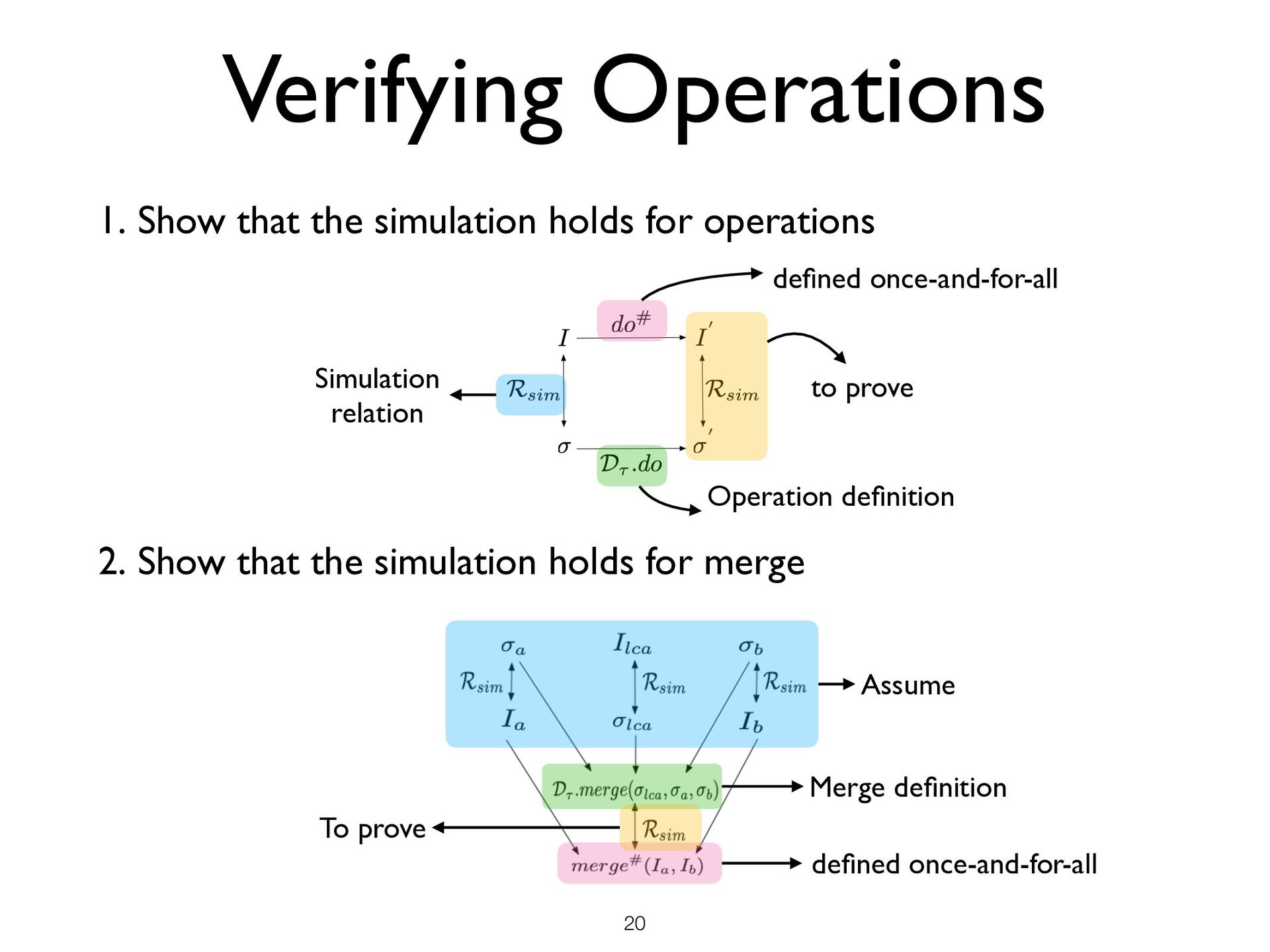
Verifying Operations 1. Show that the simulation holds for operations
20 to prove Operation de fi nition de fi ned once-and-for-all Simulation relation -
Verifying Operations 1. Show that the simulation holds for operations
20 to prove Operation de fi nition de fi ned once-and-for-all Simulation relation 2. Show that the simulation holds for merge -
Verifying Operations 1. Show that the simulation holds for operations
20 to prove Operation de fi nition de fi ned once-and-for-all Simulation relation 2. Show that the simulation holds for merge -
Verifying Operations 1. Show that the simulation holds for operations
20 to prove Operation de fi nition de fi ned once-and-for-all Simulation relation 2. Show that the simulation holds for merge Merge de fi nition Assume de fi ned once-and-for-all To prove -
Verifying Operations 3. Show that the speci fi cation and
the implementation agree on the return values of operations 21 -
Verifying Operations 3. Show that the speci fi cation and
the implementation agree on the return values of operations 21 4. Convergence -
Verifying Operations 3. Show that the speci fi cation and
the implementation agree on the return values of operations 21 4. Convergence ✦ Permits the different replicas to converge to states that are observationally equal but not structurally equal ✤ Example: differently balanced BSTs -
Verifying Operations 3. Show that the speci fi cation and
the implementation agree on the return values of operations 21 4. Convergence ✦ Permits the different replicas to converge to states that are observationally equal but not structurally equal ✤ Example: differently balanced BSTs -
Space-ef fi cient OR-Set • Recall that the OR-set has
duplicates • How can we remove them? 22 { (a,1) } { (a,1); (a,2) } { } { (a,2) } { (a,2) } add(a) rem(a) -
Space-ef fi cient OR-Set • Recall that the OR-set has
duplicates • How can we remove them? • Idea ★ On addition, replace existing element’s timestamp with the new timestamp ★ On merge, pick the larger timestamp 22 { (a,1) } { (a,1); (a,2) } { } { (a,2) } { (a,2) } add(a) rem(a) -
Space-ef fi cient OR-Set • Recall that the OR-set has
duplicates • How can we remove them? • Idea ★ On addition, replace existing element’s timestamp with the new timestamp ★ On merge, pick the larger timestamp 22 { (a,1) } { (a,1); (a,2) } { } { (a,2) } { (a,2) } add(a) rem(a) Correctness argument is tricky -
Space-ef fi cient OR-Set 23 { (a,1) } { (a,1);
(a,2) } { } { (a,2) } { (a,2) } add(a) rem(a) { (a,1) } { (a,2) } { } { (a,2) } { (a,2) } add(a) rem(a) -
Space-ef fi cient OR-Set 23 { (a,1) } { (a,1);
(a,2) } { } { (a,2) } { (a,2) } add(a) rem(a) { (a,1) } { (a,2) } { } { (a,2) } { (a,2) } add(a) rem(a) -
Space-ef fi cient OR-Set 23 { (a,1) } { (a,1);
(a,2) } { } { (a,2) } { (a,2) } add(a) rem(a) { (a,1) } { (a,2) } { } { (a,2) } { (a,2) } add(a) rem(a) Simulation relation is more intricate as one would expect -
Composing IRC-style chat • Build IRC-style group chat ★ Send
and read messages in channels ★ For simplicity, channels and messages cannot be deleted • Represent application state as a grow-only map with string (channel name) keys and mergeable-log as values • Goal: ★ map and log proved correct separately ★ Use the proof of underlying RDTs to prove chat application correctness 26 -
Generic Map MRDT • Speci fi cation • Project fi
lters the abstract state of the map on the key k and returns an abstract state of the underlying data type ★ Provided by the user once for a generic MRDT 27 where -
Generic Map MRDT • Speci fi cation • Project fi
lters the abstract state of the map on the key k and returns an abstract state of the underlying data type ★ Provided by the user once for a generic MRDT 27 where set (“general”, append (“hello”)) set (“compiler”, append (“error”)) set (“general”, append (“world”)) vis vis get (“general”, rd) [“world”; “hello”] -
28 Generic Map MRDT Implementation Simulation Relation Get applies given
operation on the value at key k and returns the value -
28 Generic Map MRDT Implementation Simulation Relation Get applies given
operation on the value at key k and returns the value Set is Get + update the map with the new state -
28 Generic Map MRDT Implementation Simulation Relation Get applies given
operation on the value at key k and returns the value Set is Get + update the map with the new state Merge uses the merge of the underlying value type! -
28 Generic Map MRDT Implementation Simulation Relation Get applies given
operation on the value at key k and returns the value Set is Get + update the map with the new state Merge uses the merge of the underlying value type! Simulation relation appeals to the value type’s simulation relation! -
• Program state is constructed by instantiating generic map with
mergeable log ★ The proof of correctness of the chat application directly follows from the composition! 29 Composing IRC-style chat -
Mergeable Queues • Replicated queue with at-least-once dequeue semantics ★
First veri fi ed queue RDT! 30 -
Mergeable Queues • Replicated queue with at-least-once dequeue semantics ★
First veri fi ed queue RDT! 30 -
Mergeable Queues • Replicated queue with at-least-once dequeue semantics ★
First veri fi ed queue RDT! • Our aim is to have O(1) enqueue and dequeue and O(n) merge 30 -
Mergeable Queues • Implementation ★ Uses two-list functional queue implementation
✦ amortised O(1) enqueue and dequeue operations ★ Merge uses longest common contiguous subsequence algorithm — O(n) 31 M -
Mergeable Queues • Implementation ★ Uses two-list functional queue implementation
✦ amortised O(1) enqueue and dequeue operations ★ Merge uses longest common contiguous subsequence algorithm — O(n) • Speci fi cation 1.Any element popped in either A or B does not remain in M 2. Any element pushed into either A or B appears in M 3. An element that remains untouched in LCA, A, B remains in M 4. Order of pairs of elements in LCA, A, B must be preserved in M, if those elements are present in M. 31 M -
Mergeable Queues • Implementation ★ Uses two-list functional queue implementation
✦ amortised O(1) enqueue and dequeue operations ★ Merge uses longest common contiguous subsequence algorithm — O(n) • Speci fi cation 1.Any element popped in either A or B does not remain in M 2. Any element pushed into either A or B appears in M 3. An element that remains untouched in LCA, A, B remains in M 4. Order of pairs of elements in LCA, A, B must be preserved in M, if those elements are present in M. 31 M Implementation far removed from the specification! -
• Programming and proving with RDTs is complicated due to
concurrency and the lack of suitable programming abstractions 33 Summary -
• Programming and proving with RDTs is complicated due to
concurrency and the lack of suitable programming abstractions • MRDTs simplify RDTs by implementing them as extensions of sequential data types ★ Reasoning about correctness is still hard 33 Summary -
• Programming and proving with RDTs is complicated due to
concurrency and the lack of suitable programming abstractions • MRDTs simplify RDTs by implementing them as extensions of sequential data types ★ Reasoning about correctness is still hard • Peepul is an F* library for certi fi ed MRDTs ★ Replication-aware simulation for proving complex MRDTs ★ Complex MRDTs can be constructed and proved using simpler MRDTs 33 Summary -
• Programming and proving with RDTs is complicated due to
concurrency and the lack of suitable programming abstractions • MRDTs simplify RDTs by implementing them as extensions of sequential data types ★ Reasoning about correctness is still hard • Peepul is an F* library for certi fi ed MRDTs ★ Replication-aware simulation for proving complex MRDTs ★ Complex MRDTs can be constructed and proved using simpler MRDTs • F* allows us to strike a balance between automated and interactive proofs ★ Extract to OCaml and run on Irmin! 33 Summary