Share
Embed
The Road to a Distributed Search Engine
A talk given at Berlin Buzzwords 2011
Shay Banon
June 06, 2012
Transcript
45 slides
-
elasticsearch The Road to a Distributed, (Near) Real Time, Search
Engine Shay Banon - @kimchy -
Lucene Basics - Directory A File System Abstraction Mainly used
to read and write “files” Used to read and write different index files -
Lucene Basics - IndexWriter Used to add documents / delete
documents from the index Changes are stored in memory (possibly flushing to maintain memory limits) Requires a commit to make changes “persistent”, which is expensive A single IndexWriter can write to an index, expensive to create (reuse at all cost!) -
Lucene Basics - Index Segments An index is composed of
internal segments Each segment is almost a self sufficient index by itself, immutable up to deletes Commits “officially” adds segments to the index, though internal flushing might create new segments as well Segments are merged continuously A lot of caching per segment (terms, field) -
Lucene Basics - (Near) Real Time IndexReader is the basis
for searching IndexWriter#getReader allows to get a refreshed reader that sees changes done to IW Requires flushing (but not committing) Can’t call it on each operation, too expensive Segment based readers and search -
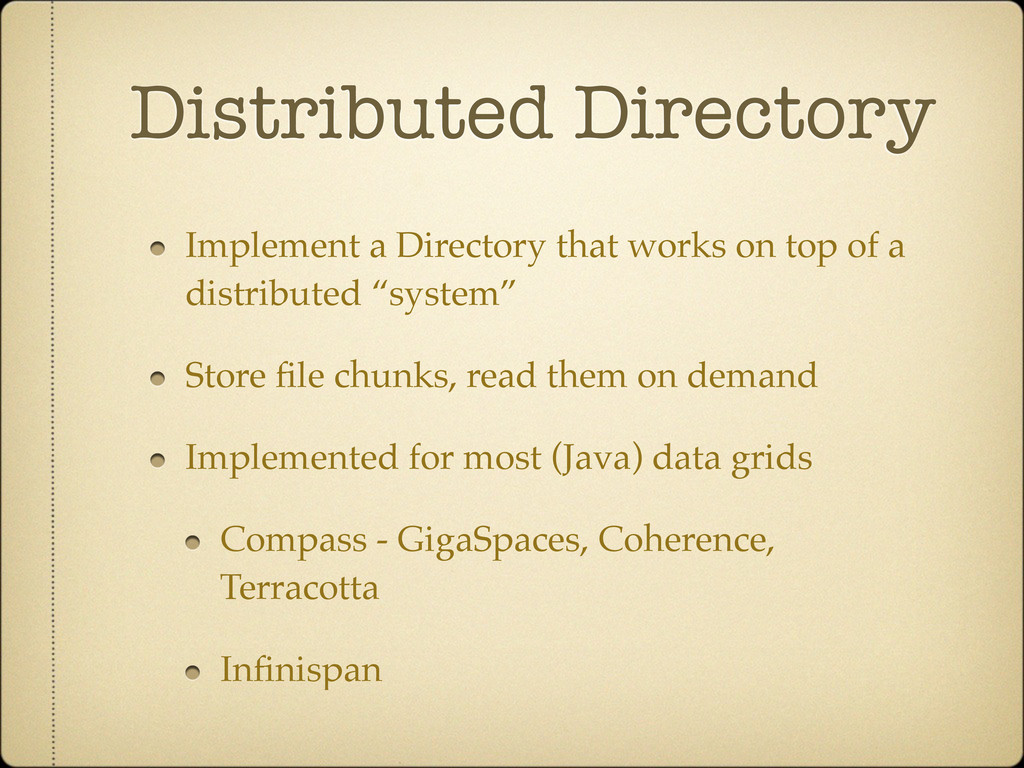
Distributed Directory Implement a Directory that works on top of
a distributed “system” Store file chunks, read them on demand Implemented for most (Java) data grids Compass - GigaSpaces, Coherence, Terracotta Infinispan -
Distributed Directory DIR Node IndexWriter IndexReader Chunk Chunk Node Chunk
Chunk Node Chunk Chunk -
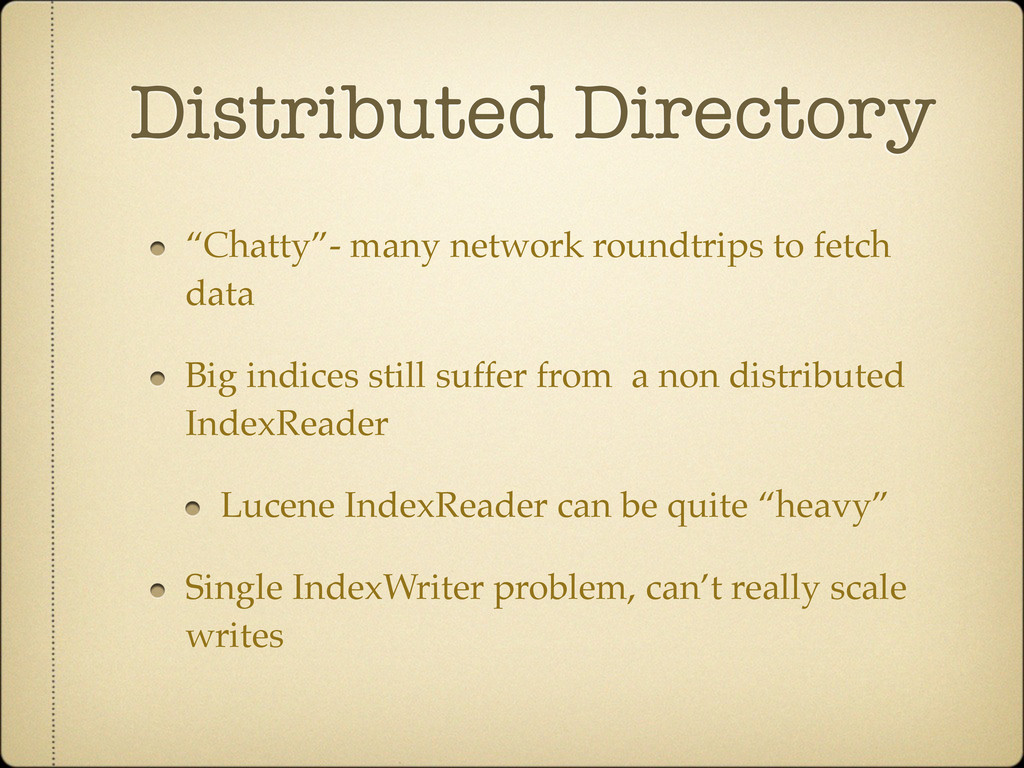
Distributed Directory “Chatty”- many network roundtrips to fetch data Big
indices still suffer from a non distributed IndexReader Lucene IndexReader can be quite “heavy” Single IndexWriter problem, can’t really scale writes -
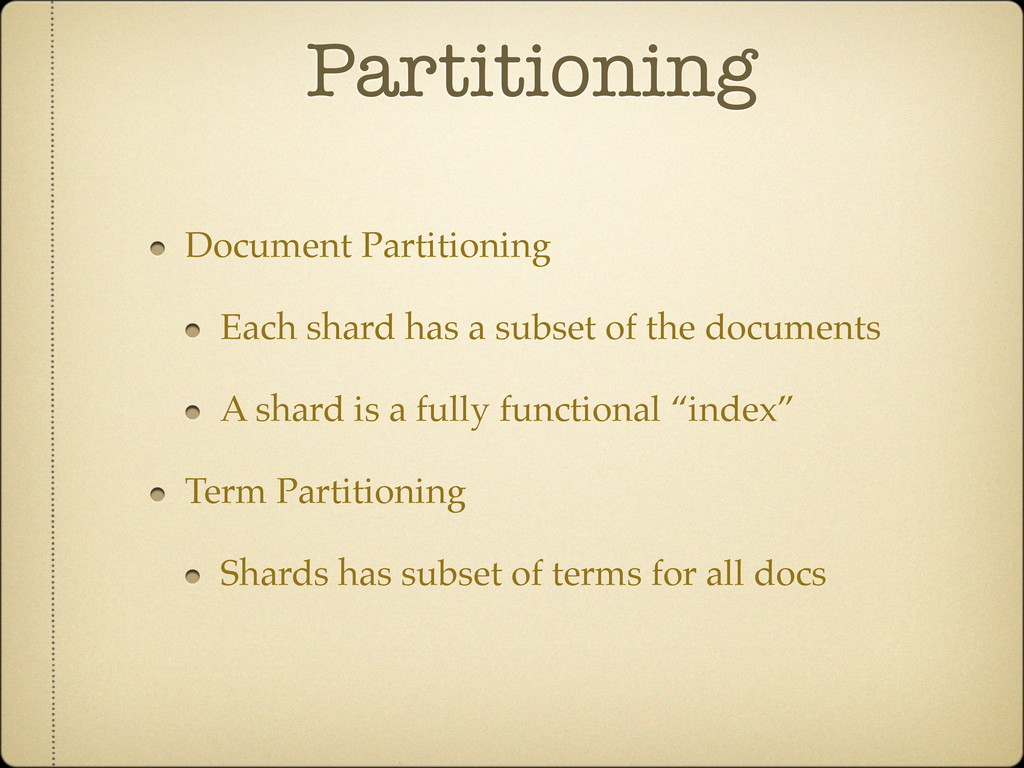
Partitioning Document Partitioning Each shard has a subset of the
documents A shard is a fully functional “index” Term Partitioning Shards has subset of terms for all docs -
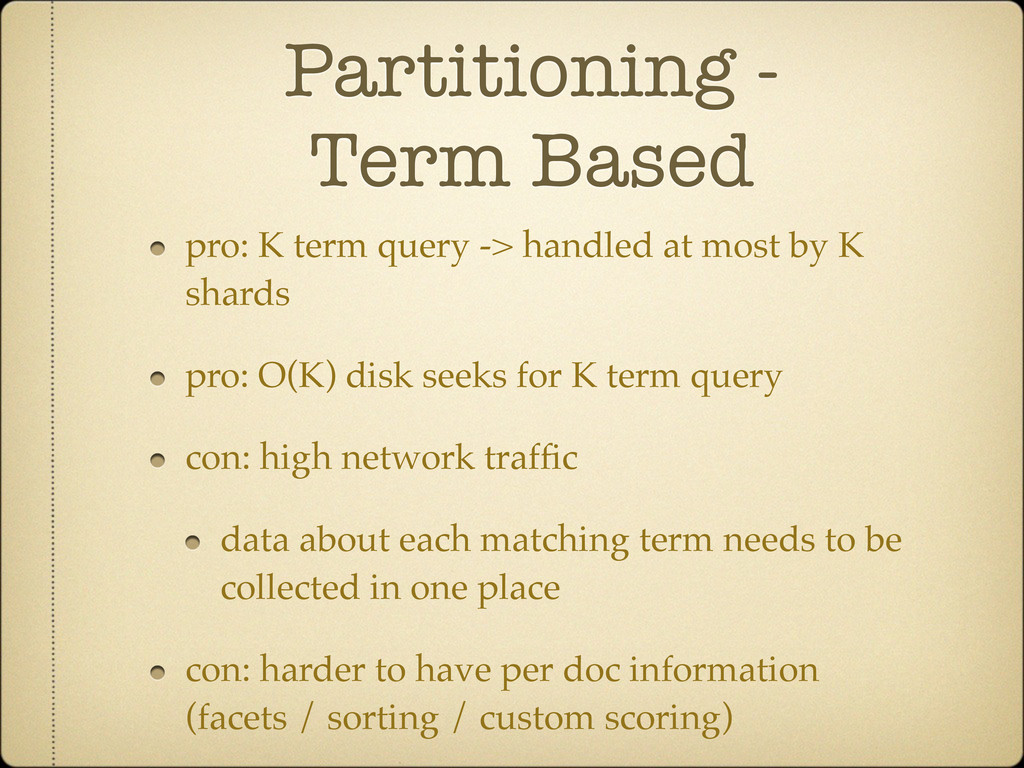
Partitioning - Term Based pro: K term query -> handled
at most by K shards pro: O(K) disk seeks for K term query con: high network traffic data about each matching term needs to be collected in one place con: harder to have per doc information (facets / sorting / custom scoring) -
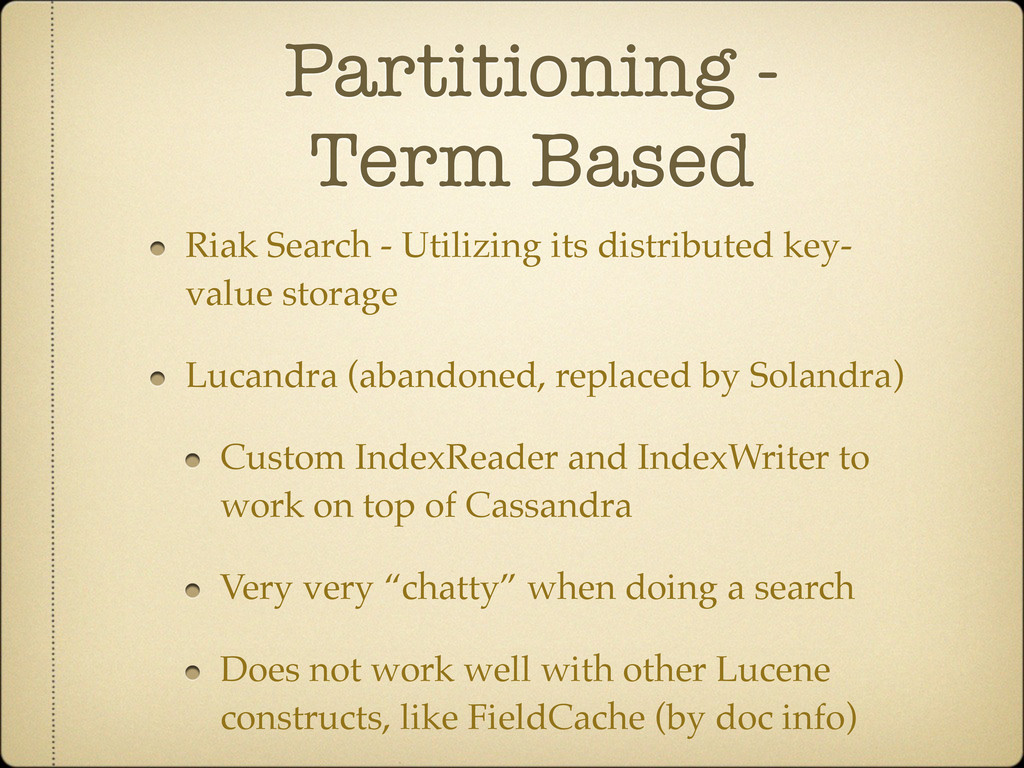
Partitioning - Term Based Riak Search - Utilizing its distributed
key- value storage Lucandra (abandoned, replaced by Solandra) Custom IndexReader and IndexWriter to work on top of Cassandra Very very “chatty” when doing a search Does not work well with other Lucene constructs, like FieldCache (by doc info) -
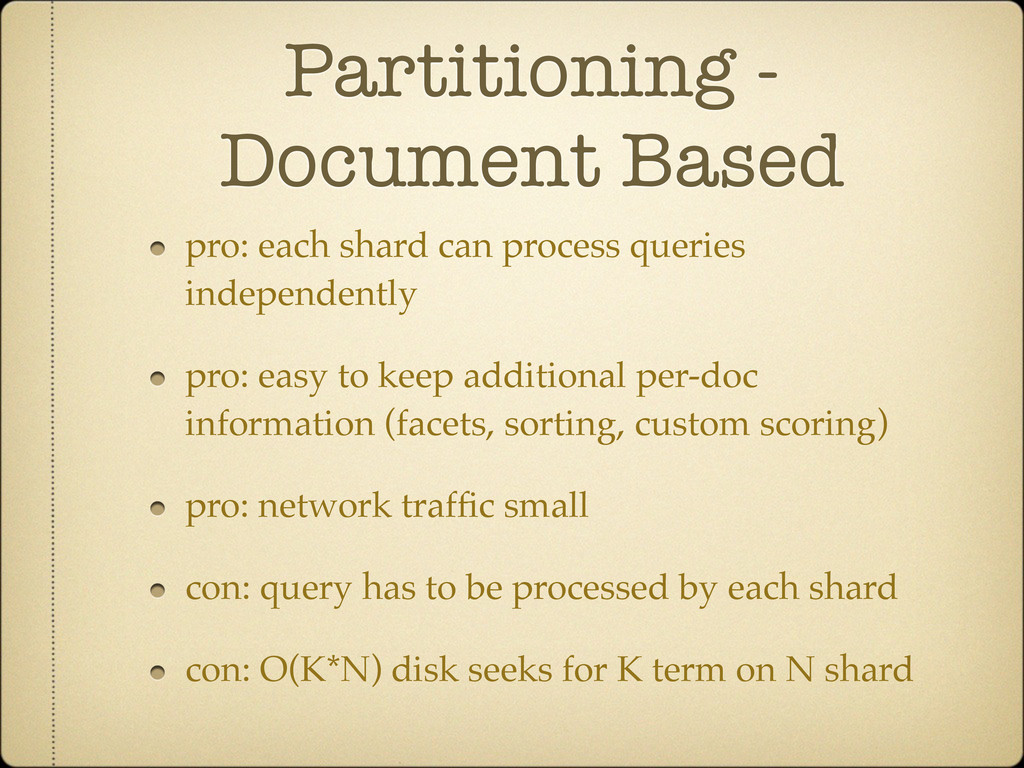
Partitioning - Document Based pro: each shard can process queries
independently pro: easy to keep additional per-doc information (facets, sorting, custom scoring) pro: network traffic small con: query has to be processed by each shard con: O(K*N) disk seeks for K term on N shard -
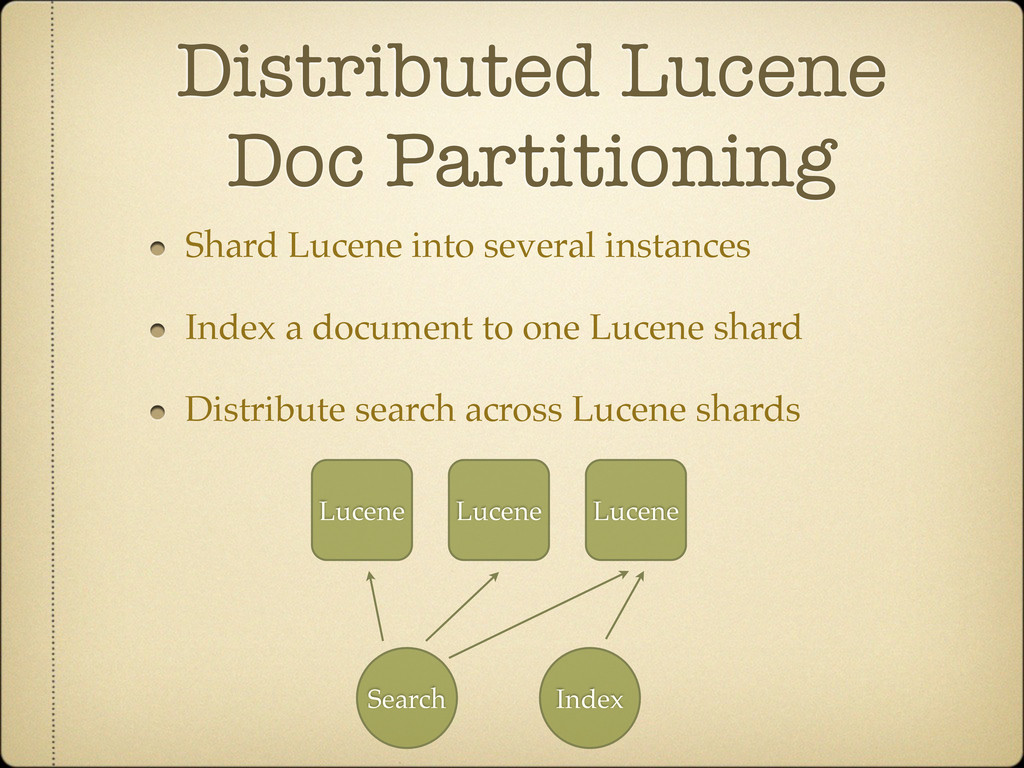
Distributed Lucene Doc Partitioning Shard Lucene into several instances Index
a document to one Lucene shard Distribute search across Lucene shards Lucene Lucene Lucene Search Index -
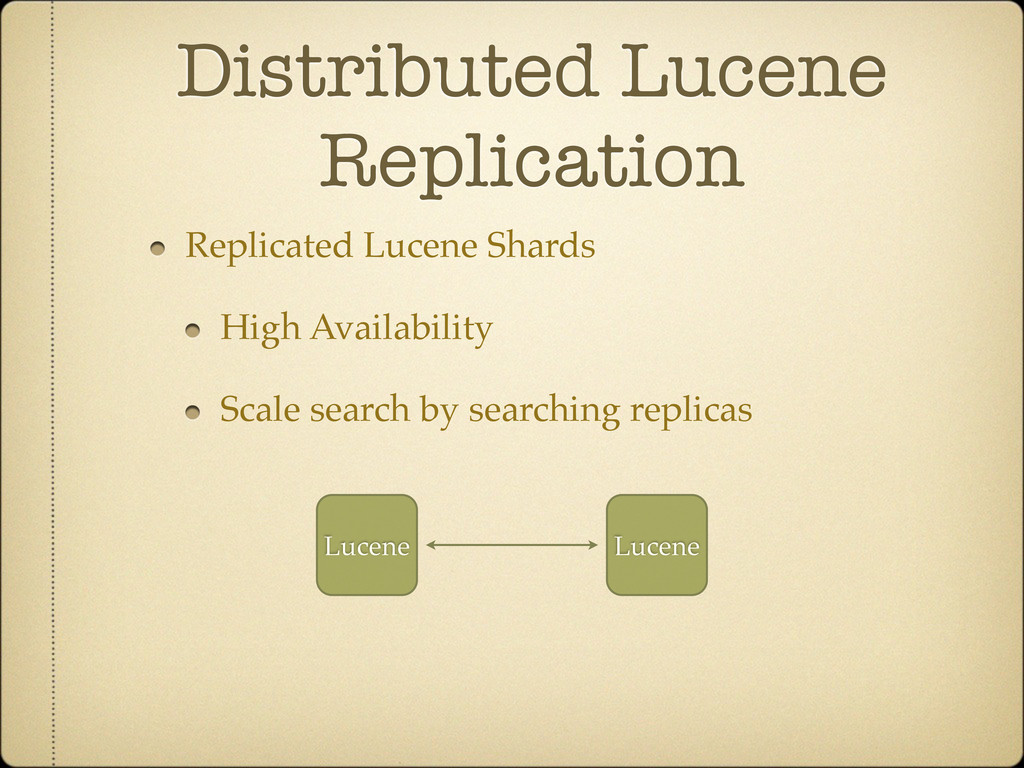
Distributed Lucene Replication Replicated Lucene Shards High Availability Scale search
by searching replicas Lucene Lucene -
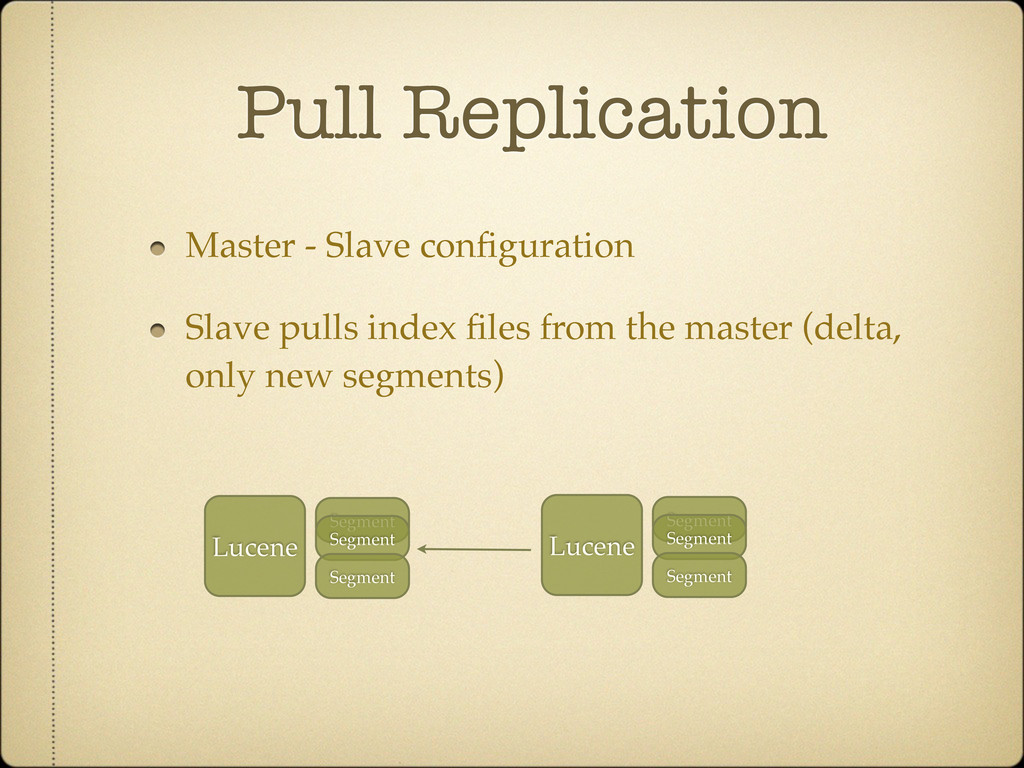
Pull Replication Master - Slave configuration Slave pulls index files
from the master (delta, only new segments) Lucene Segment Segment Segment Lucene Segment Segment Segment -
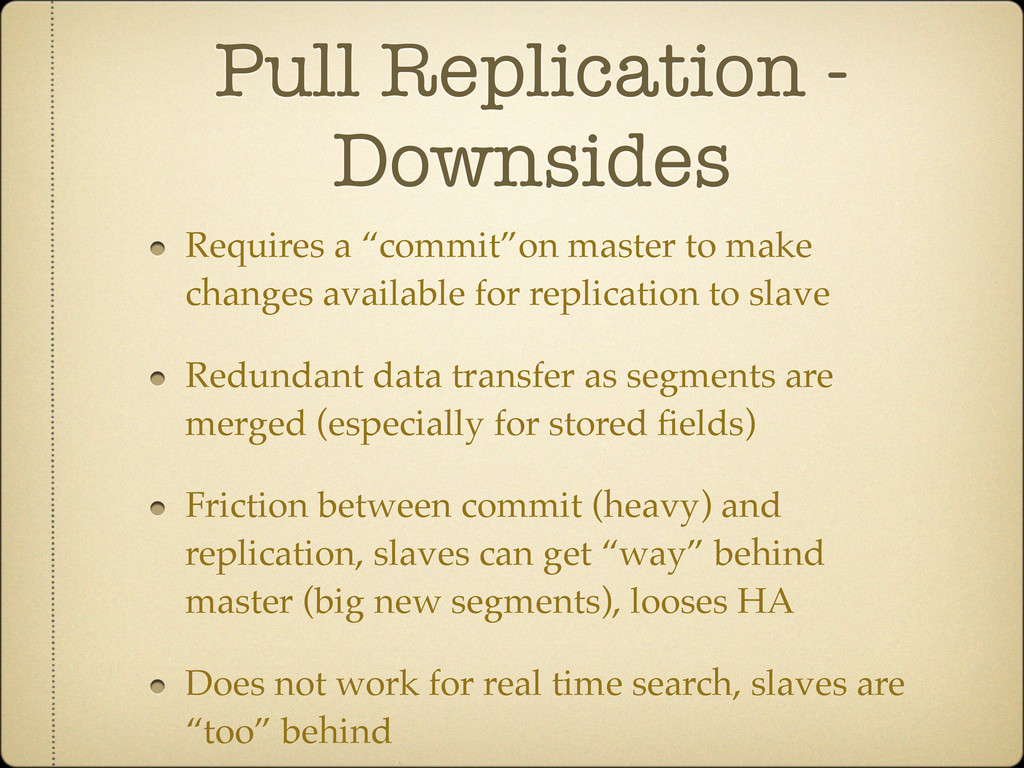
Pull Replication - Downsides Requires a “commit”on master to make
changes available for replication to slave Redundant data transfer as segments are merged (especially for stored fields) Friction between commit (heavy) and replication, slaves can get “way” behind master (big new segments), looses HA Does not work for real time search, slaves are “too” behind -
Push Replication “Master/Primary” push to all the replicas Indexing is
done on all replicas Lucene Lucene Client Doc Doc -
Push Replication - Downsides Indexing the document on all nodes
(though less data transfer over the wire) Delicate control over concurrent indexing operations Usually solved using versioning -
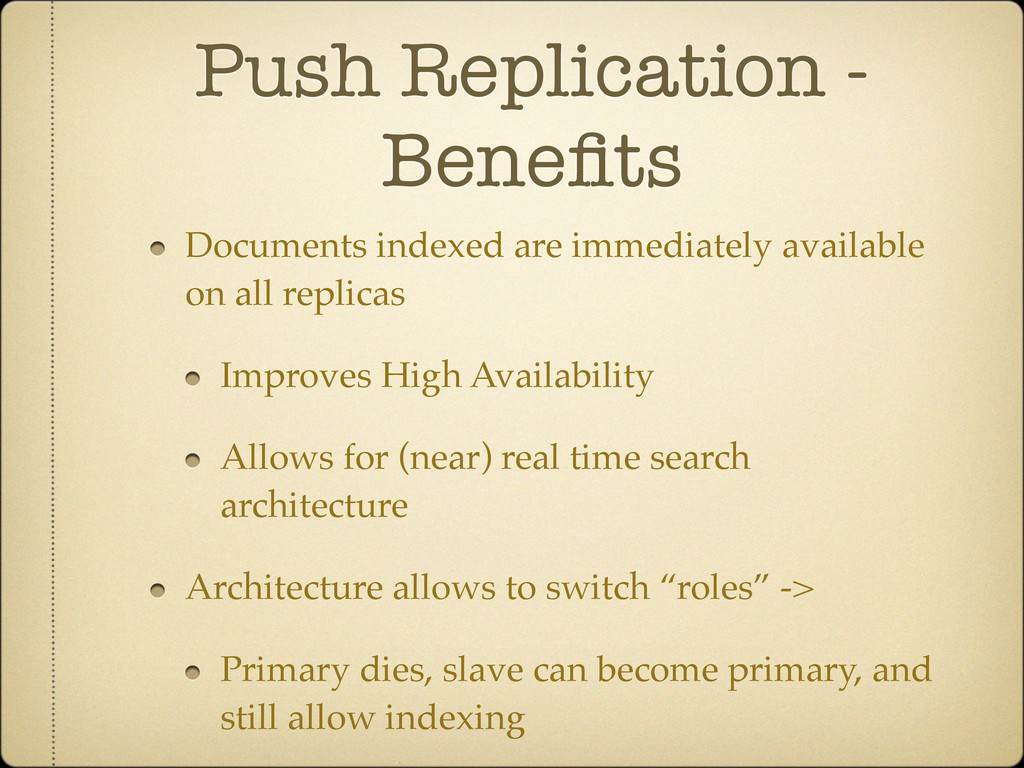
Push Replication - Benefits Documents indexed are immediately available on
all replicas Improves High Availability Allows for (near) real time search architecture Architecture allows to switch “roles” -> Primary dies, slave can become primary, and still allow indexing -
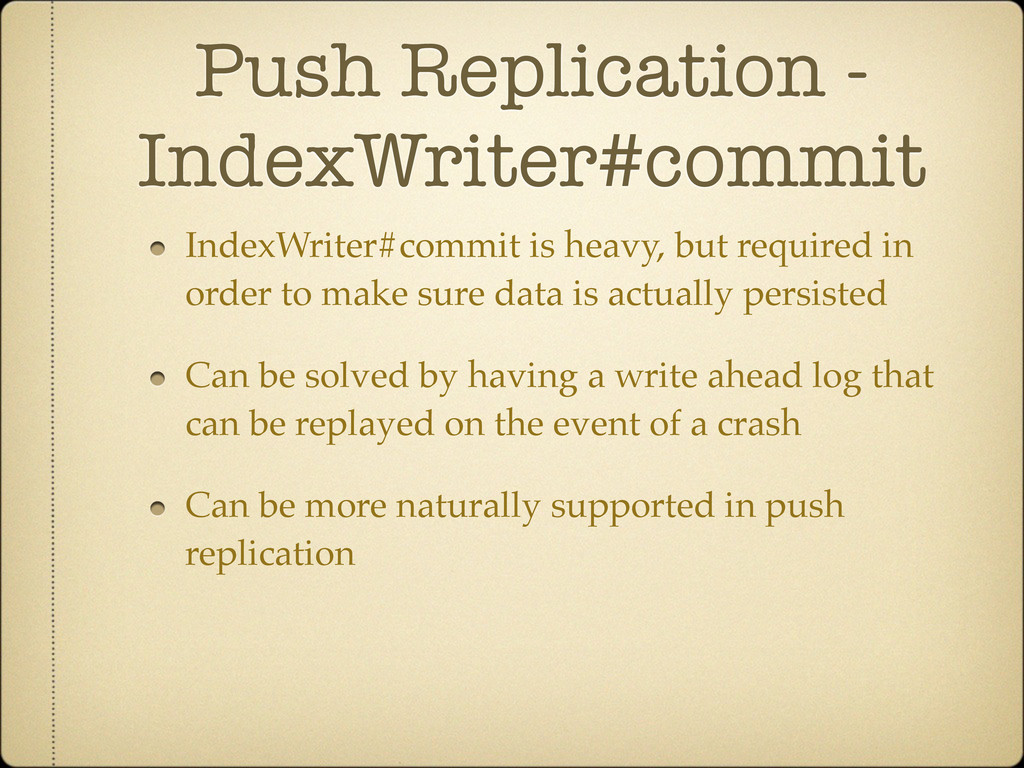
Push Replication - IndexWriter#commit IndexWriter#commit is heavy, but required in
order to make sure data is actually persisted Can be solved by having a write ahead log that can be replayed on the event of a crash Can be more naturally supported in push replication -
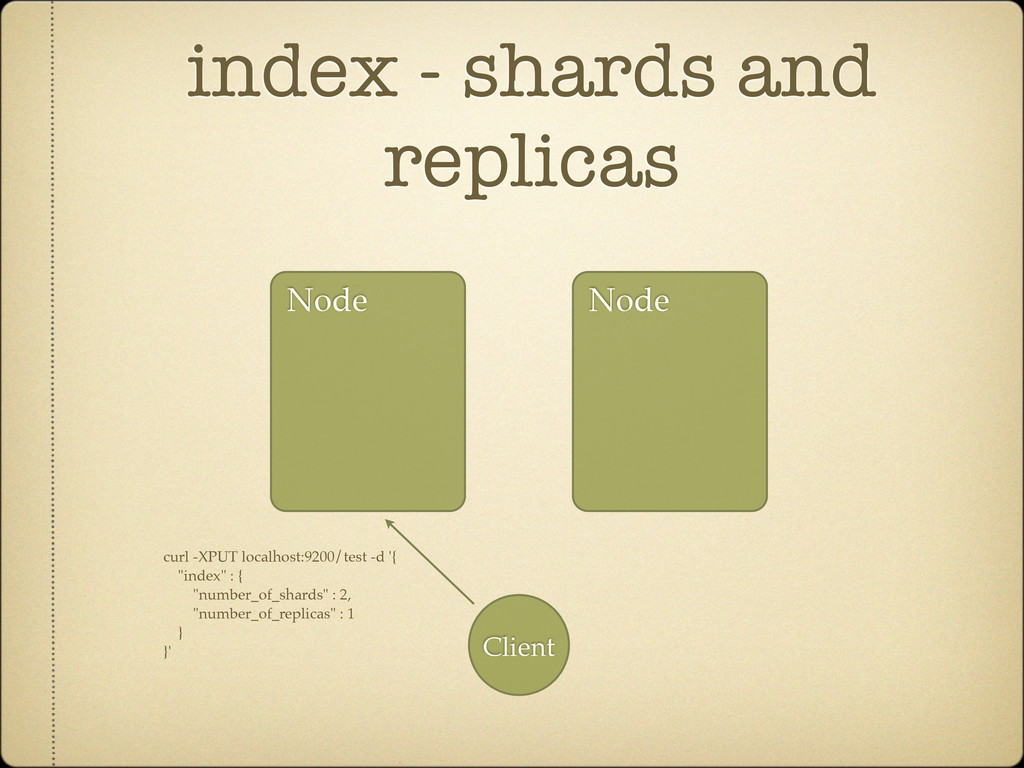
index - shards and replicas Node Node Client curl -XPUT
localhost:9200/test -d '{ "index" : { "number_of_shards" : 2, "number_of_replicas" : 1 } }' -
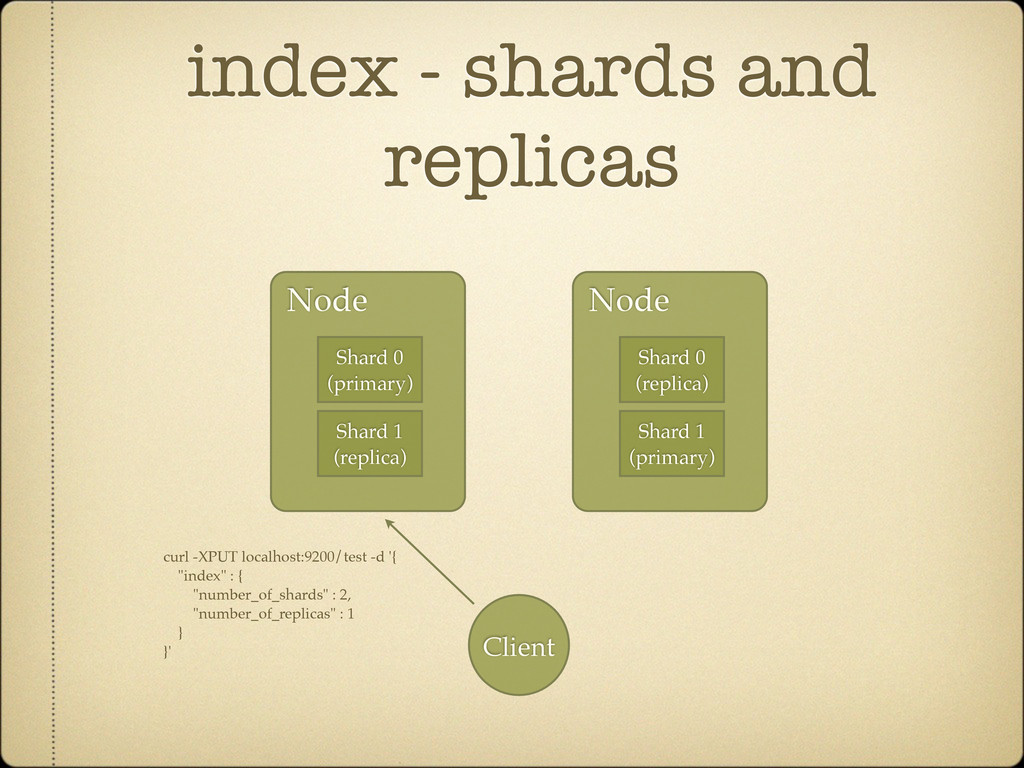
index - shards and replicas Node Shard 0 (primary) Shard
1 (replica) Node Shard 0 (replica) Shard 1 (primary) Client curl -XPUT localhost:9200/test -d '{ "index" : { "number_of_shards" : 2, "number_of_replicas" : 1 } }' -
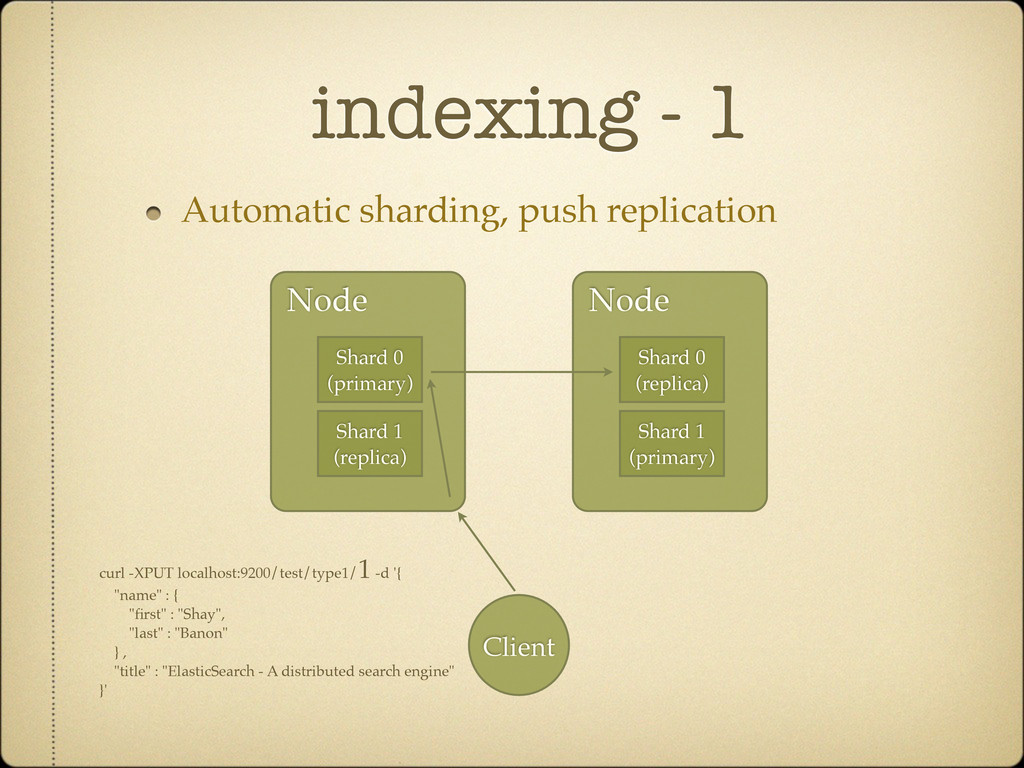
indexing - 1 Node Shard 0 (primary) Shard 1 (replica)
Node Shard 0 (replica) Shard 1 (primary) Client curl -XPUT localhost:9200/test/type1/ 1 -d '{ "name" : { "first" : "Shay", "last" : "Banon" } , "title" : "ElasticSearch - A distributed search engine" }' Automatic sharding, push replication -
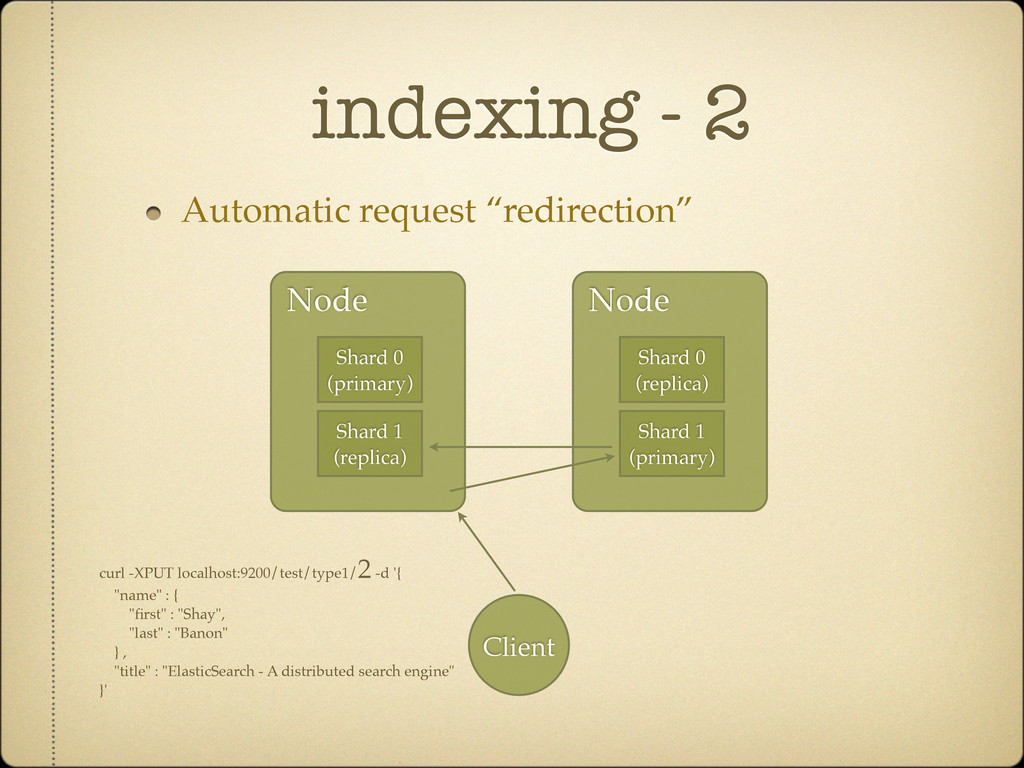
indexing - 2 Node Shard 0 (primary) Shard 1 (replica)
Node Shard 0 (replica) Shard 1 (primary) Client curl -XPUT localhost:9200/test/type1/ 2 -d '{ "name" : { "first" : "Shay", "last" : "Banon" } , "title" : "ElasticSearch - A distributed search engine" }' Automatic request “redirection” -
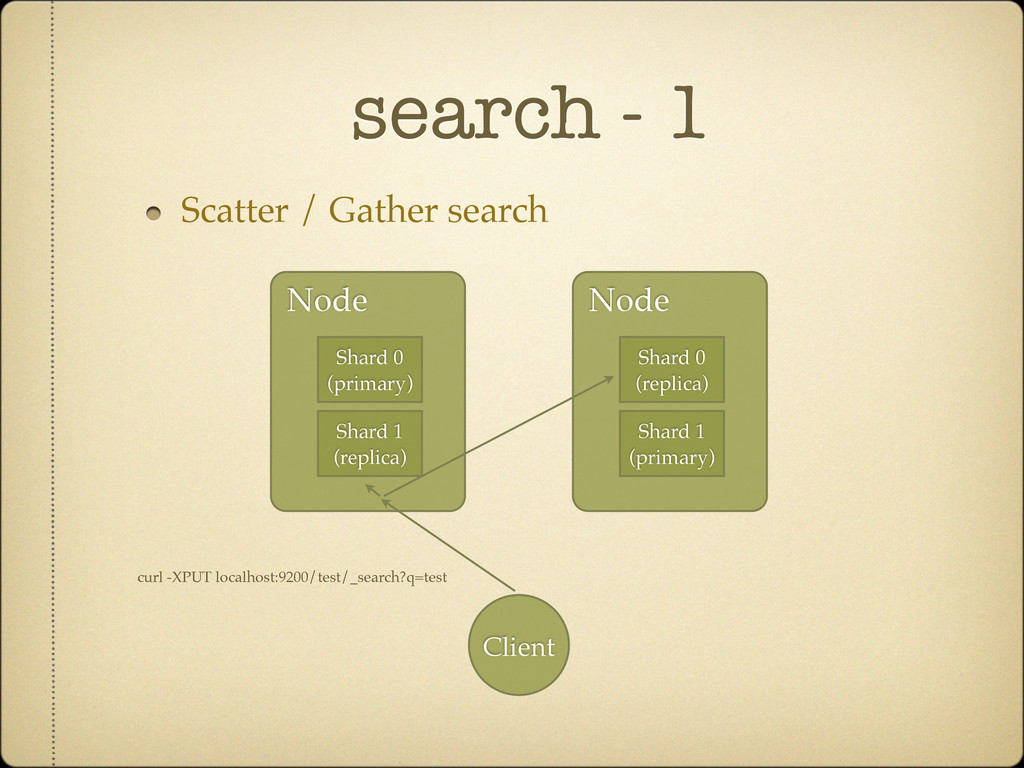
search - 1 Node Shard 0 (primary) Shard 1 (replica)
Node Shard 0 (replica) Shard 1 (primary) Client curl -XPUT localhost:9200/test/_search?q=test Scatter / Gather search -
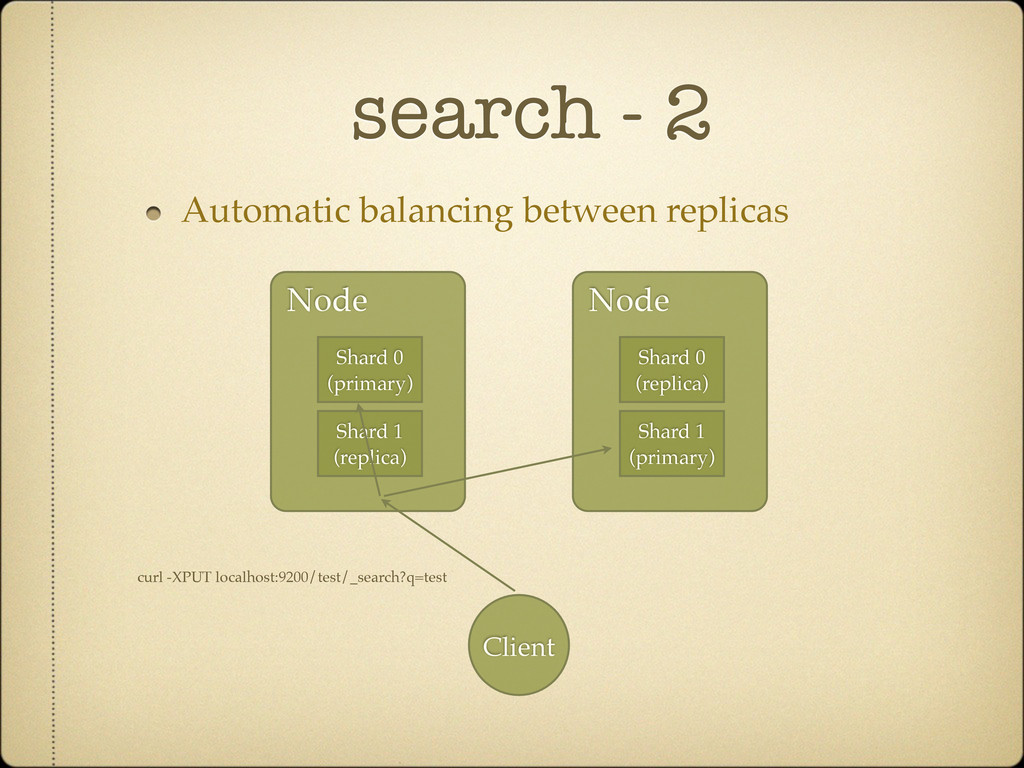
search - 2 Node Shard 0 (primary) Shard 1 (replica)
Node Shard 0 (replica) Shard 1 (primary) Client curl -XPUT localhost:9200/test/_search?q=test Automatic balancing between replicas -
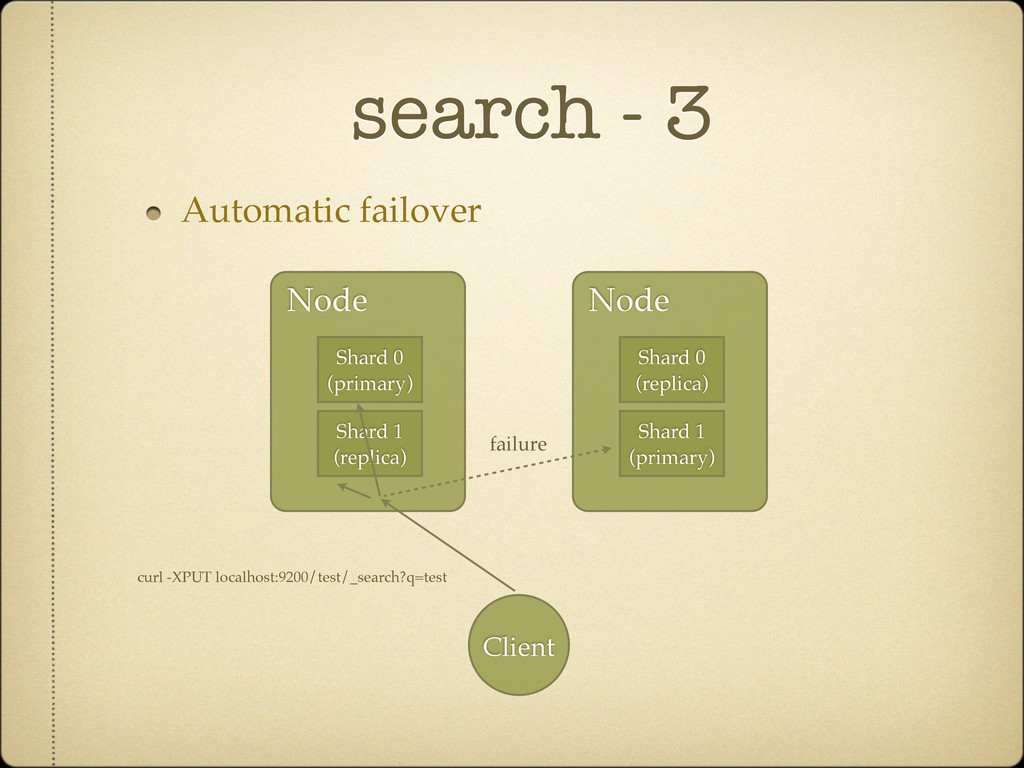
search - 3 Node Shard 0 (primary) Shard 1 (replica)
Node Shard 0 (replica) Shard 1 (primary) Client curl -XPUT localhost:9200/test/_search?q=test failure Automatic failover -
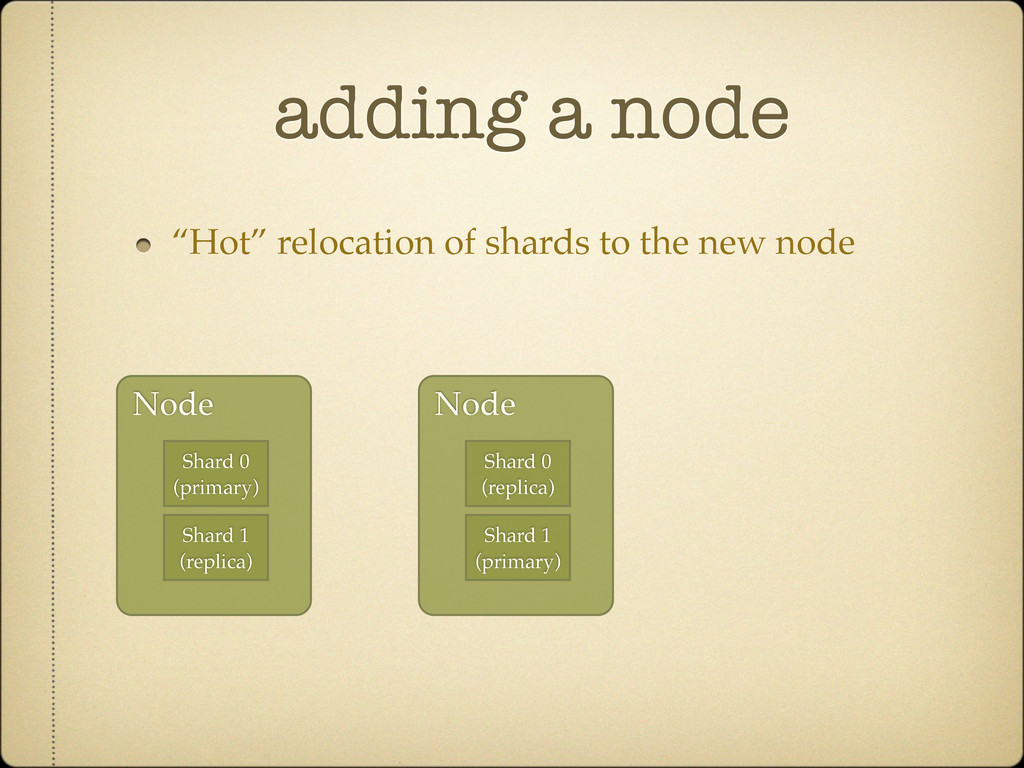
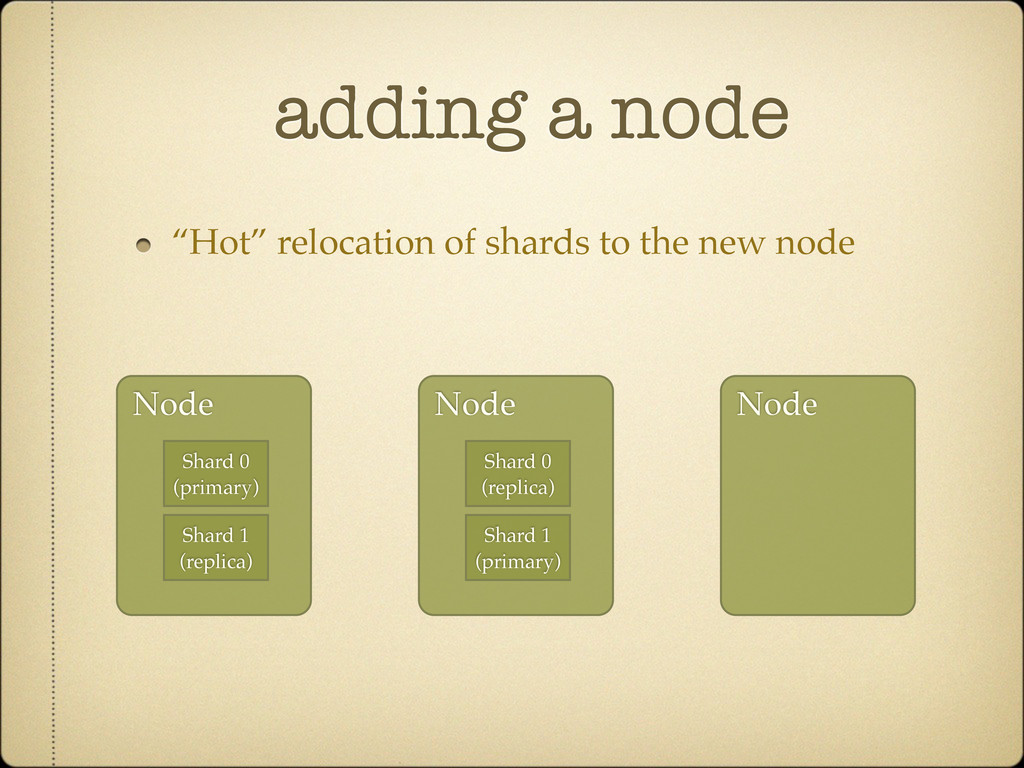
adding a node Node Shard 0 (primary) Shard 1 (replica)
Node Shard 1 (primary) Shard 0 (replica) “Hot” relocation of shards to the new node -
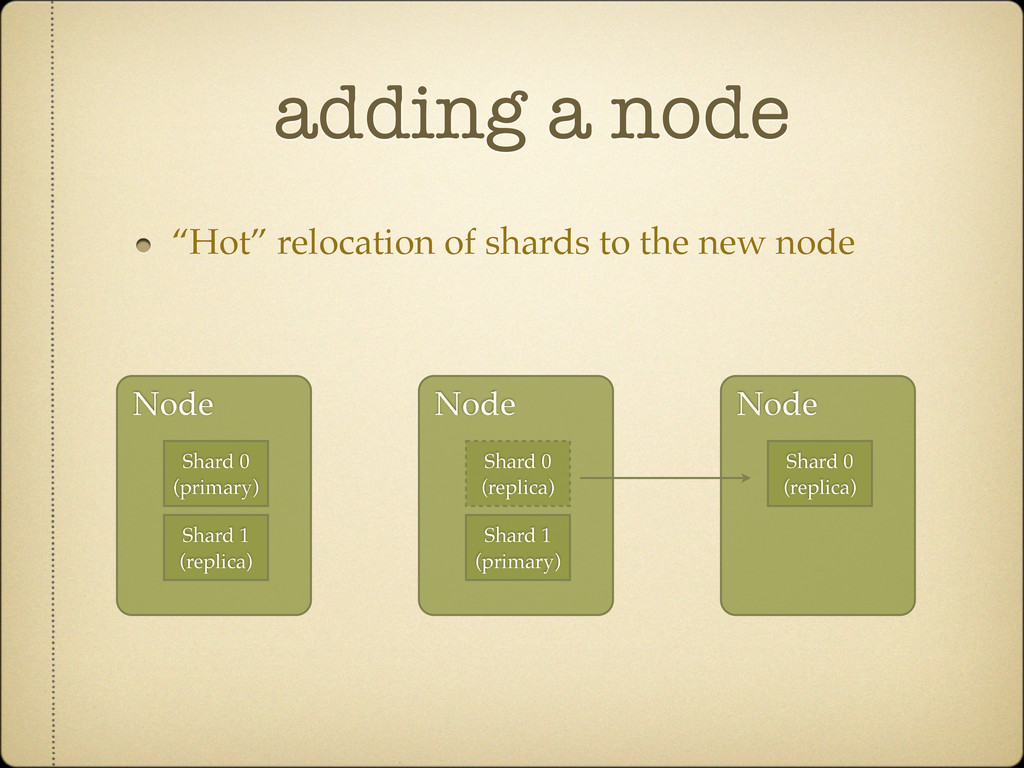
adding a node Node Shard 0 (primary) Shard 1 (replica)
Node Shard 1 (primary) Node Shard 0 (replica) “Hot” relocation of shards to the new node -
adding a node Node Shard 0 (primary) Shard 1 (replica)
Node Shard 1 (primary) Node Shard 0 (replica) “Hot” relocation of shards to the new node Shard 0 (replica) -
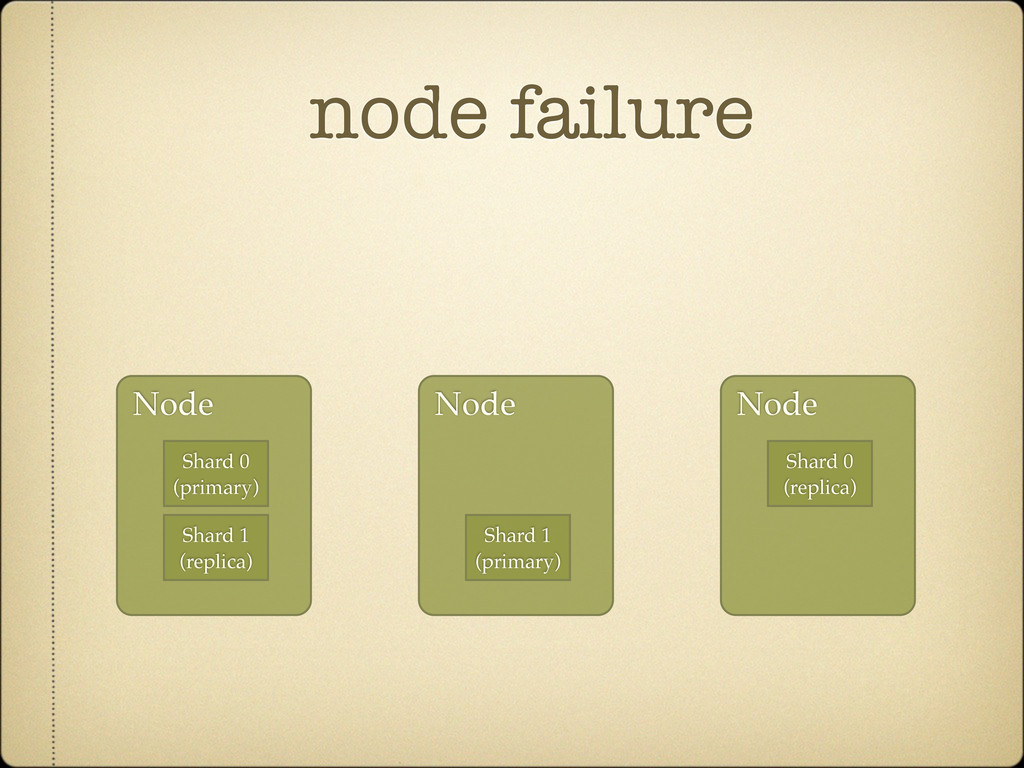
node failure Node Shard 1 (primary) Node Shard 0 (replica)
Node Shard 0 (primary) Shard 1 (replica) -
node failure - 1 Node Shard 1 (primary) Node Shard
0 (primary) Replicas can automatically become primaries -
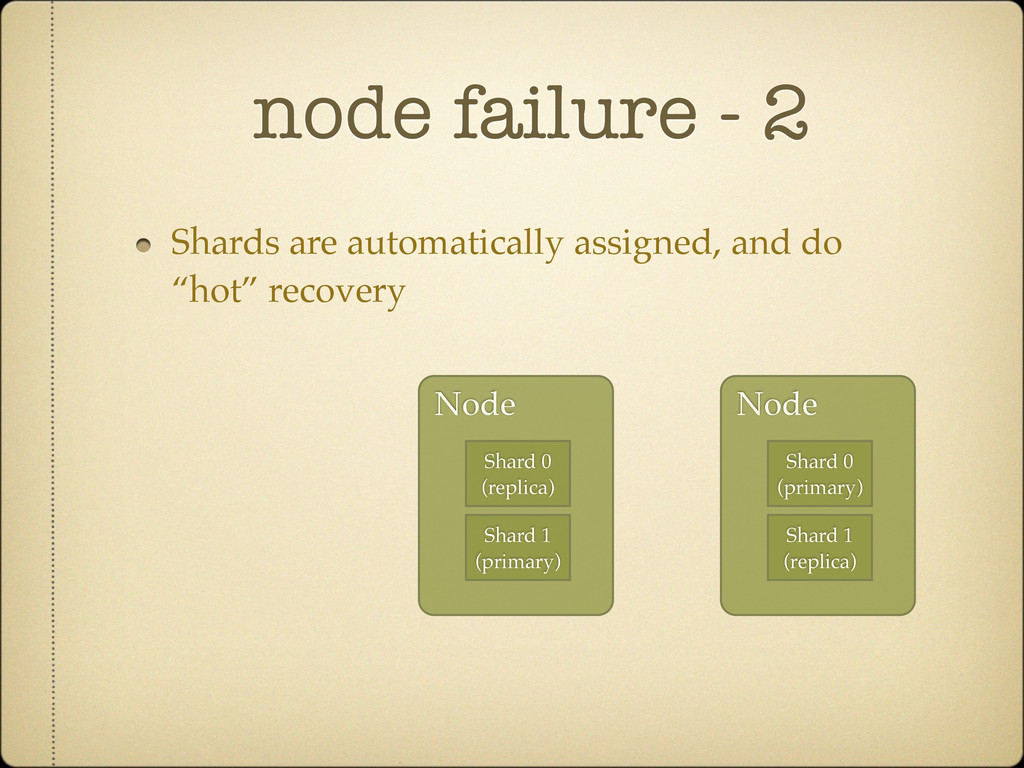
node failure - 2 Node Shard 1 (primary) Node Shard
0 (primary) Shards are automatically assigned, and do “hot” recovery Shard 0 (replica) Shard 1 (replica) -
dynamic replicas Node Shard 0 (primary) Node Shard 0 (replica)
Client curl -XPUT localhost:9200/test -d '{ "index" : { "number_of_shards" : 1, "number_of_replicas" : 1 } }' -
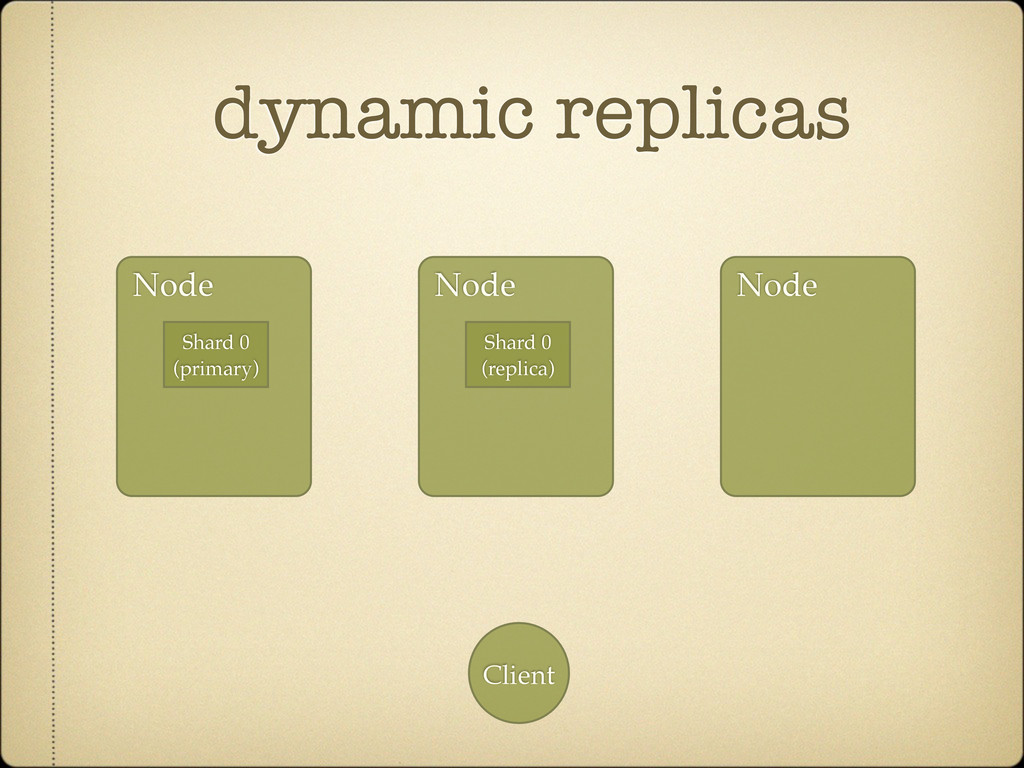
dynamic replicas Node Shard 0 (primary) Node Node Shard 0
(replica) Client -
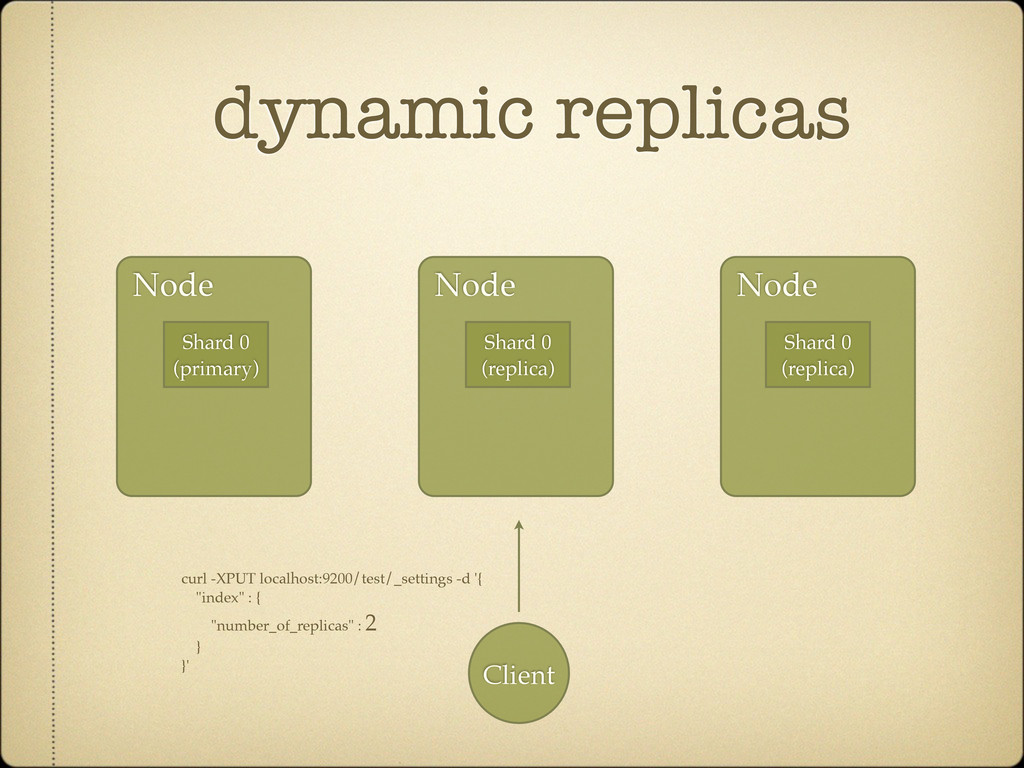
dynamic replicas Node Shard 0 (primary) Node Node Shard 0
(replica) Client Shard 0 (replica) curl -XPUT localhost:9200/test/_settings -d '{ "index" : { "number_of_replicas" : 2 } }' -
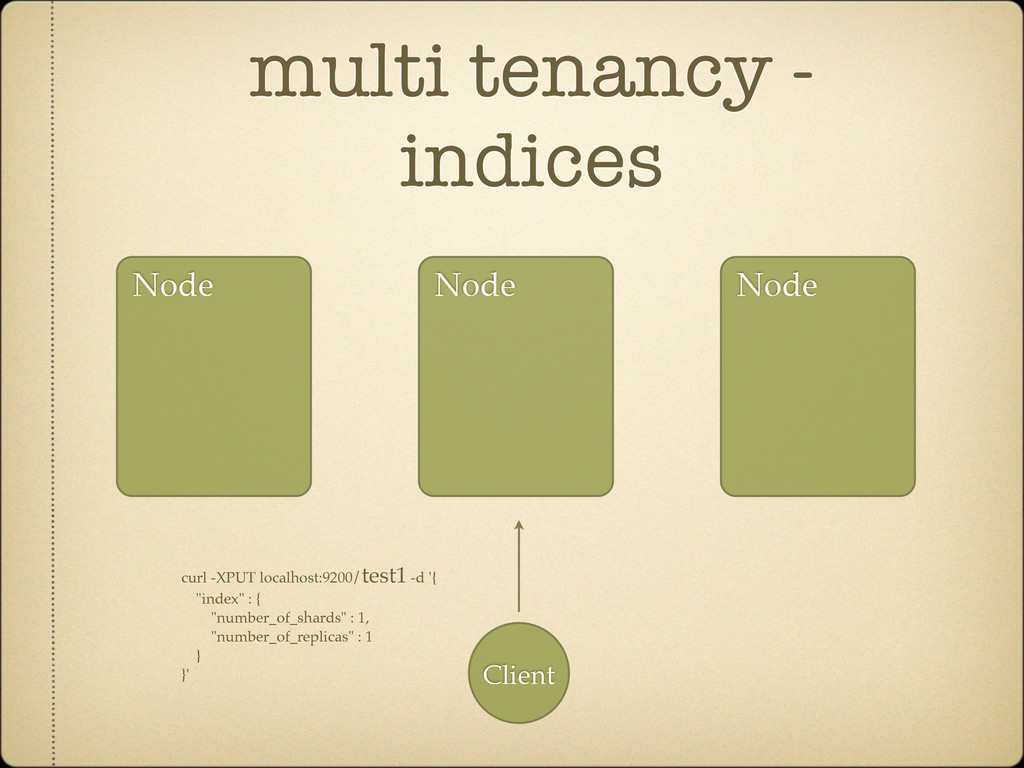
multi tenancy - indices Node Node Node Client curl -XPUT
localhost:9200/test1 -d '{ "index" : { "number_of_shards" : 1, "number_of_replicas" : 1 } }' -
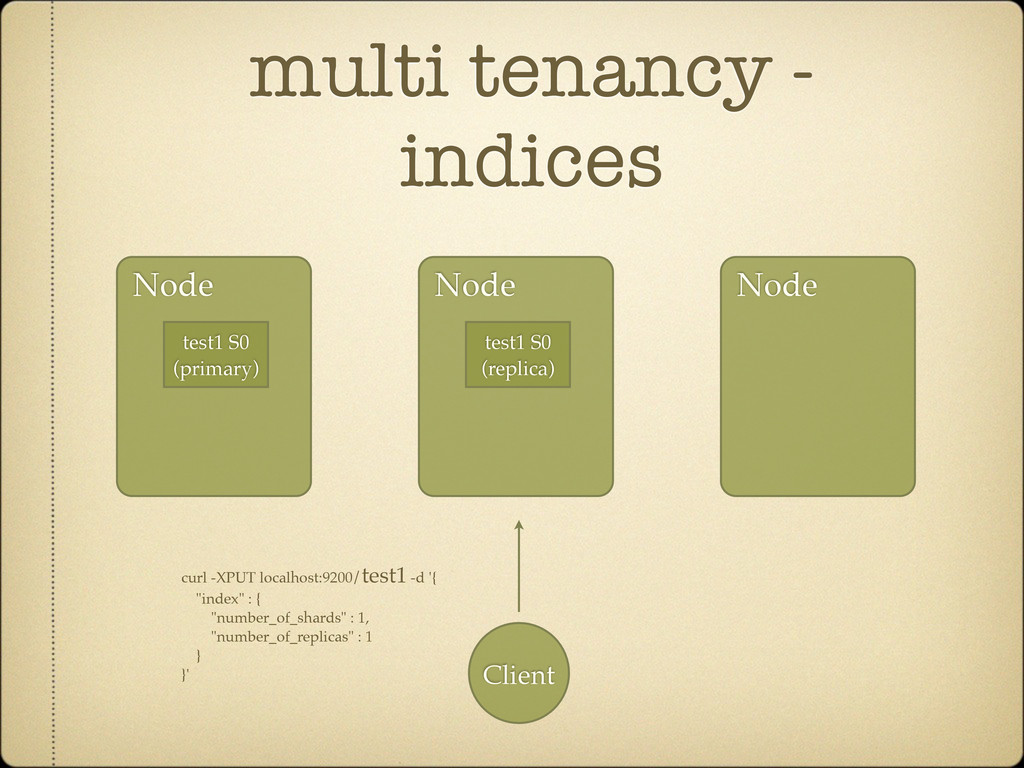
multi tenancy - indices Node test1 S0 (primary) Node Node
test1 S0 (replica) Client curl -XPUT localhost:9200/test1 -d '{ "index" : { "number_of_shards" : 1, "number_of_replicas" : 1 } }' -
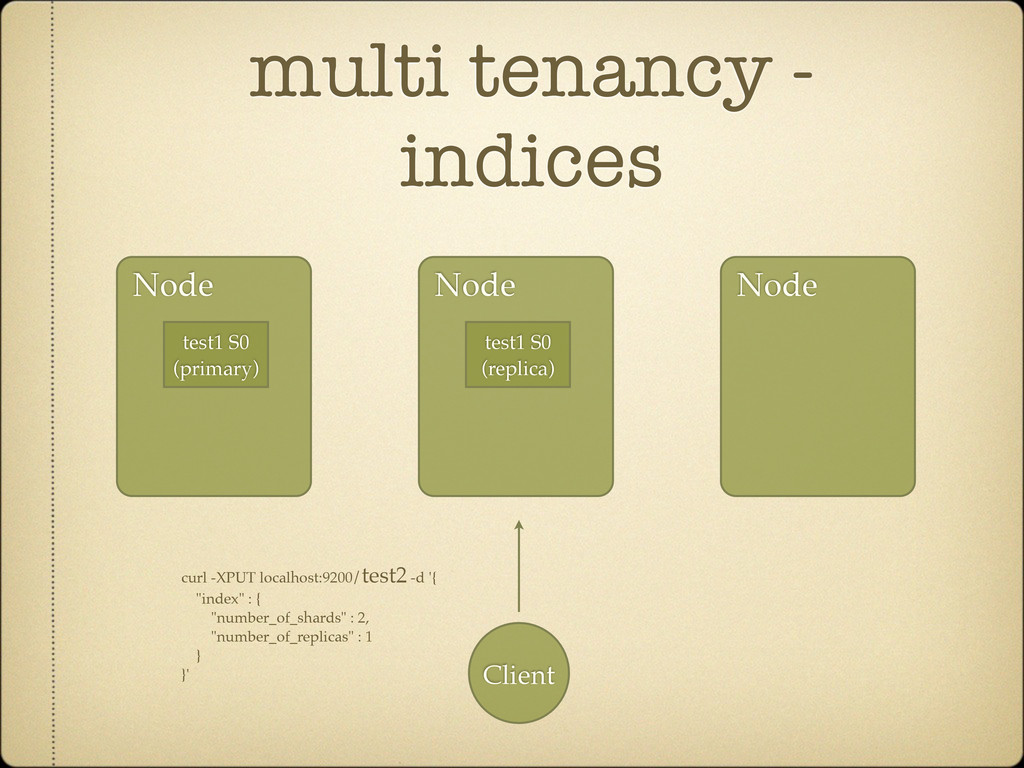
multi tenancy - indices Node test1 S0 (primary) Node Node
test1 S0 (replica) Client curl -XPUT localhost:9200/test2 -d '{ "index" : { "number_of_shards" : 2, "number_of_replicas" : 1 } }' -
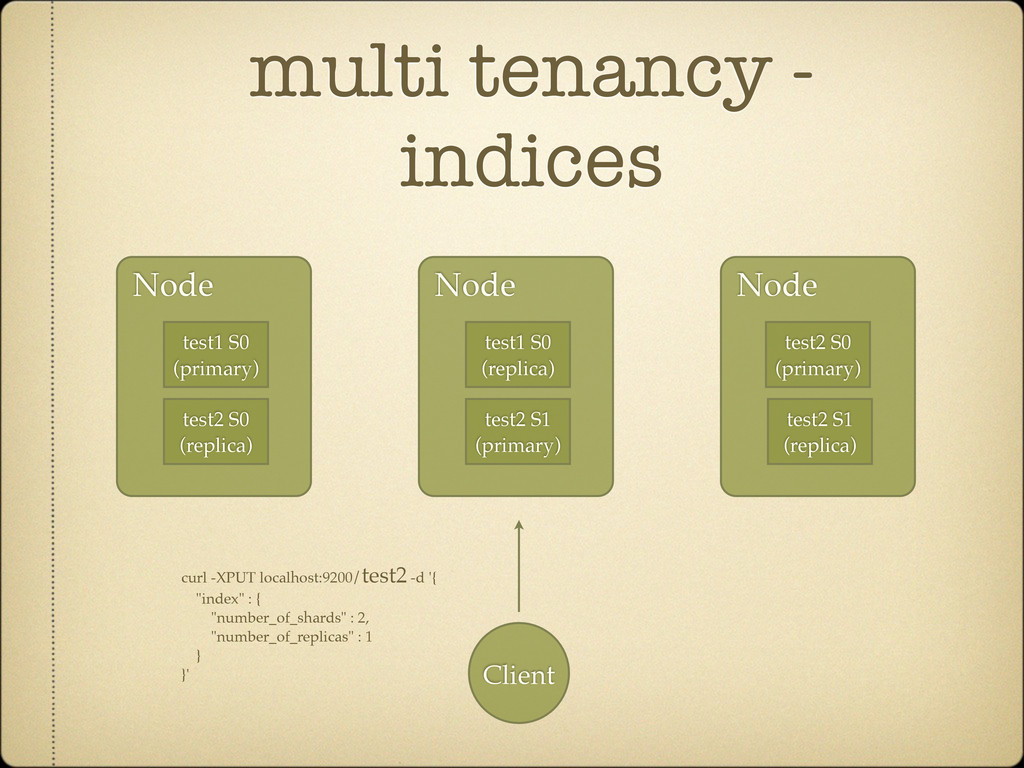
multi tenancy - indices Node test1 S0 (primary) Node Node
test1 S0 (replica) Client curl -XPUT localhost:9200/test2 -d '{ "index" : { "number_of_shards" : 2, "number_of_replicas" : 1 } }' test2 S0 (replica) test2 S1 (primary) test2 S1 (replica) test2 S0 (primary) -
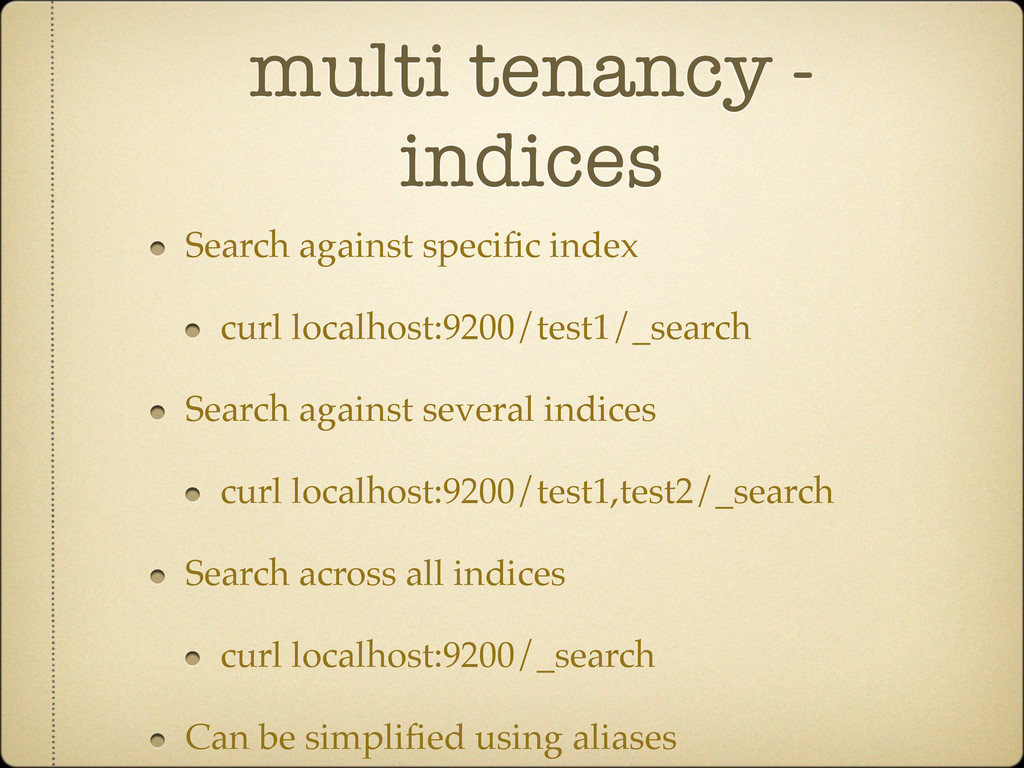
multi tenancy - indices Search against specific index curl localhost:9200/test1/_search
Search against several indices curl localhost:9200/test1,test2/_search Search across all indices curl localhost:9200/_search Can be simplified using aliases -
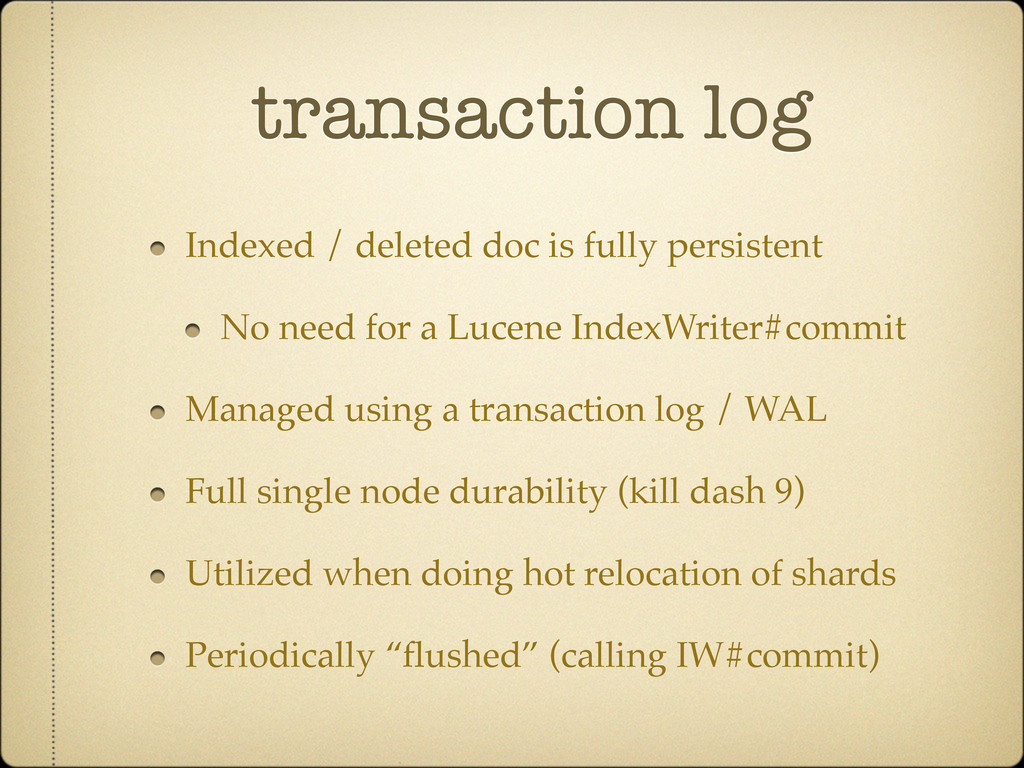
transaction log Indexed / deleted doc is fully persistent No
need for a Lucene IndexWriter#commit Managed using a transaction log / WAL Full single node durability (kill dash 9) Utilized when doing hot relocation of shards Periodically “flushed” (calling IW#commit) -
many more... (dist. related) Custom routing when indexing and searching
Different “search execution types” dfs, query_then_fetch, query_and_fetch Complete non blocking, event IO based communication (no blocking threads on sockets, no deadlocks, scalable with large number of shards/replicas) -
Thanks Shay Banon, twitter: @kimchy elasticsearch http://www.elasticsearch.org/ twitter: @elasticsearch github:
https://github.com/elasticsearch/ elasticsearch