Upgrade to Pro — share decks privately, control downloads, hide ads and more …

Don't Prompt Harder, Structure Better

Sponsored · SiteGround - Reliable hosting with speed, security, and support you can count on.

Don't Prompt Harder, Structure Better

Avatar for Yusuke Kita

Yusuke Kita

April 14, 2026

More Decks by Yusuke Kita

Other Decks in Programming

Transcript

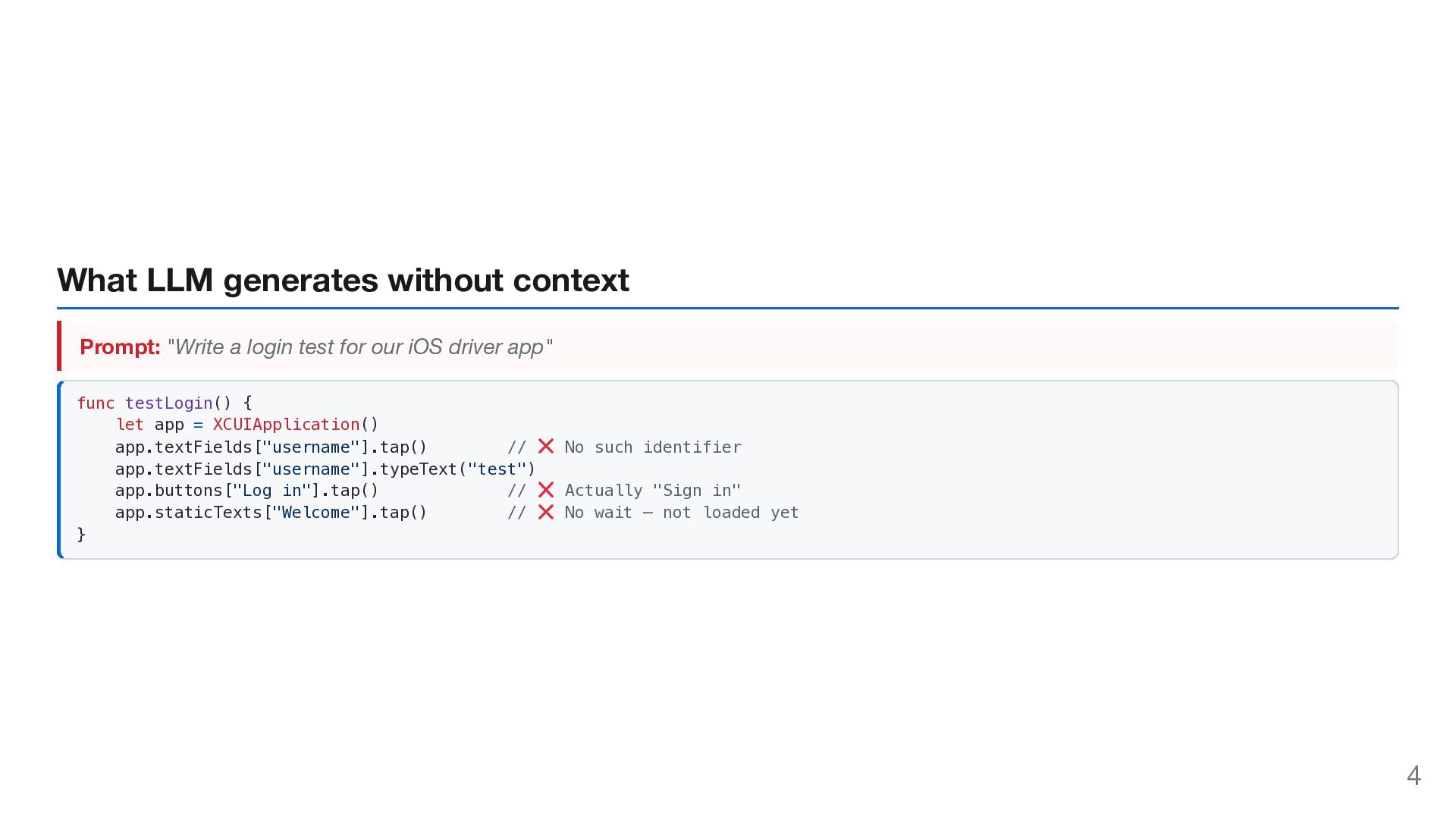
  1. What LLM generates without context Prompt: "Write a login test

    for our iOS driver app" func testLogin() { let app = XCUIApplication() app.textFields["username"].tap() // No such identifier app.textFields["username"].typeText("test") app.buttons["Log in"].tap() // Actually "Sign in" app.staticTexts["Welcome"].tap() // No wait — not loaded yet } 4
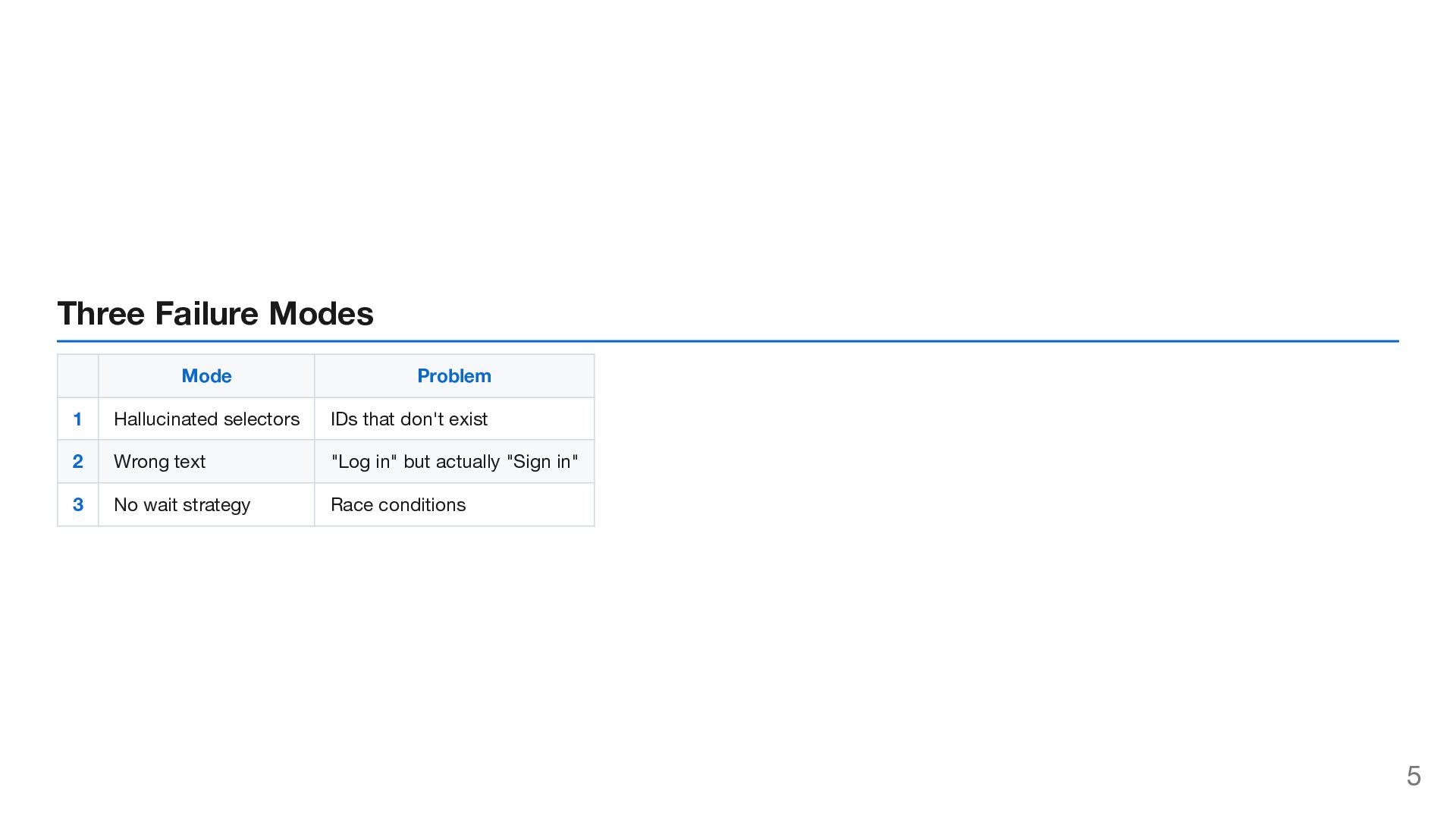
  2. Three Failure Modes Mode Problem 1 Hallucinated selectors IDs that

    don't exist 2 Wrong text "Log in" but actually "Sign in" 3 No wait strategy Race conditions 5
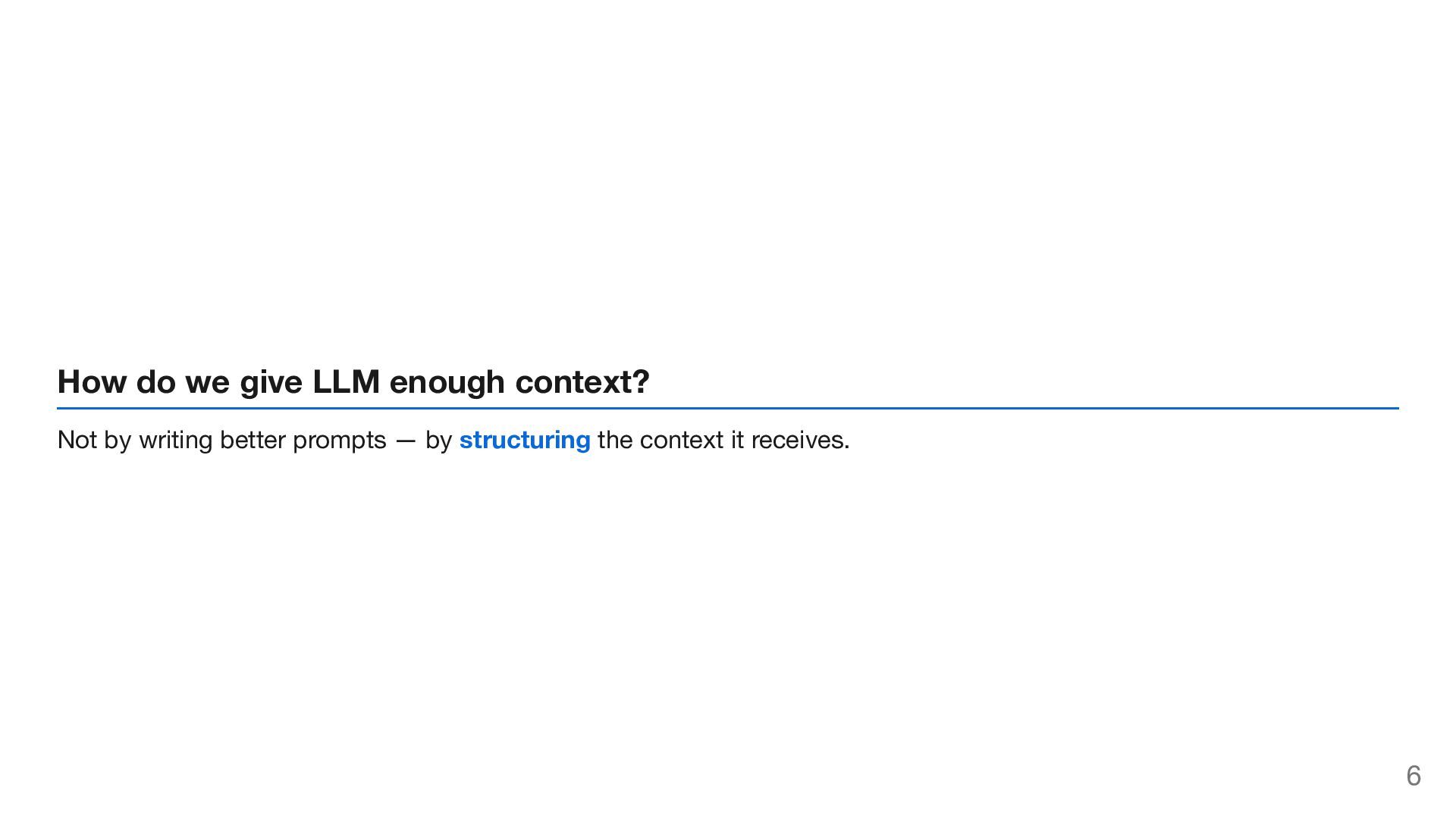
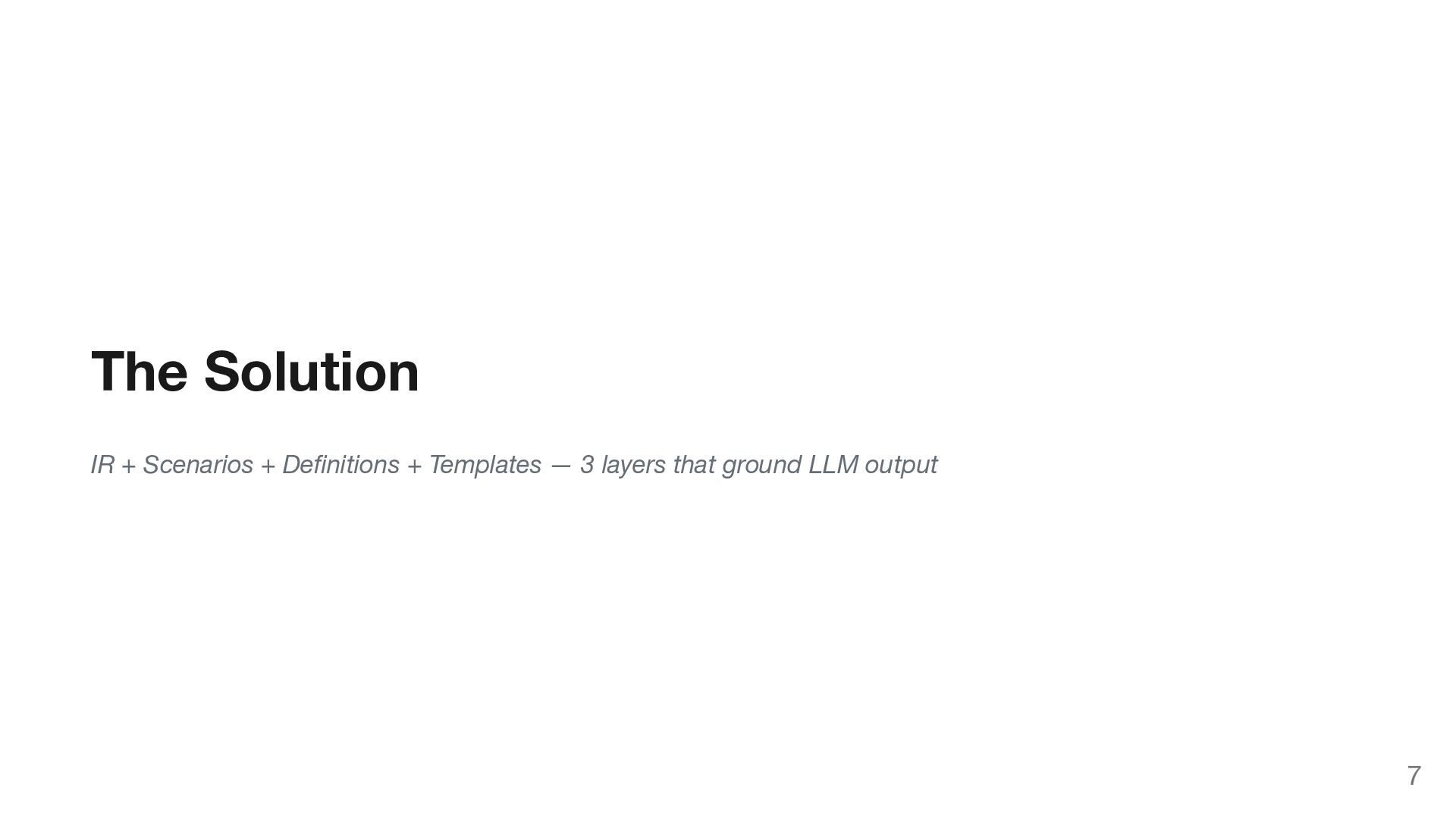
  3. How do we give LLM enough context? Not by writing

    better prompts — by structuring the context it receives. 6
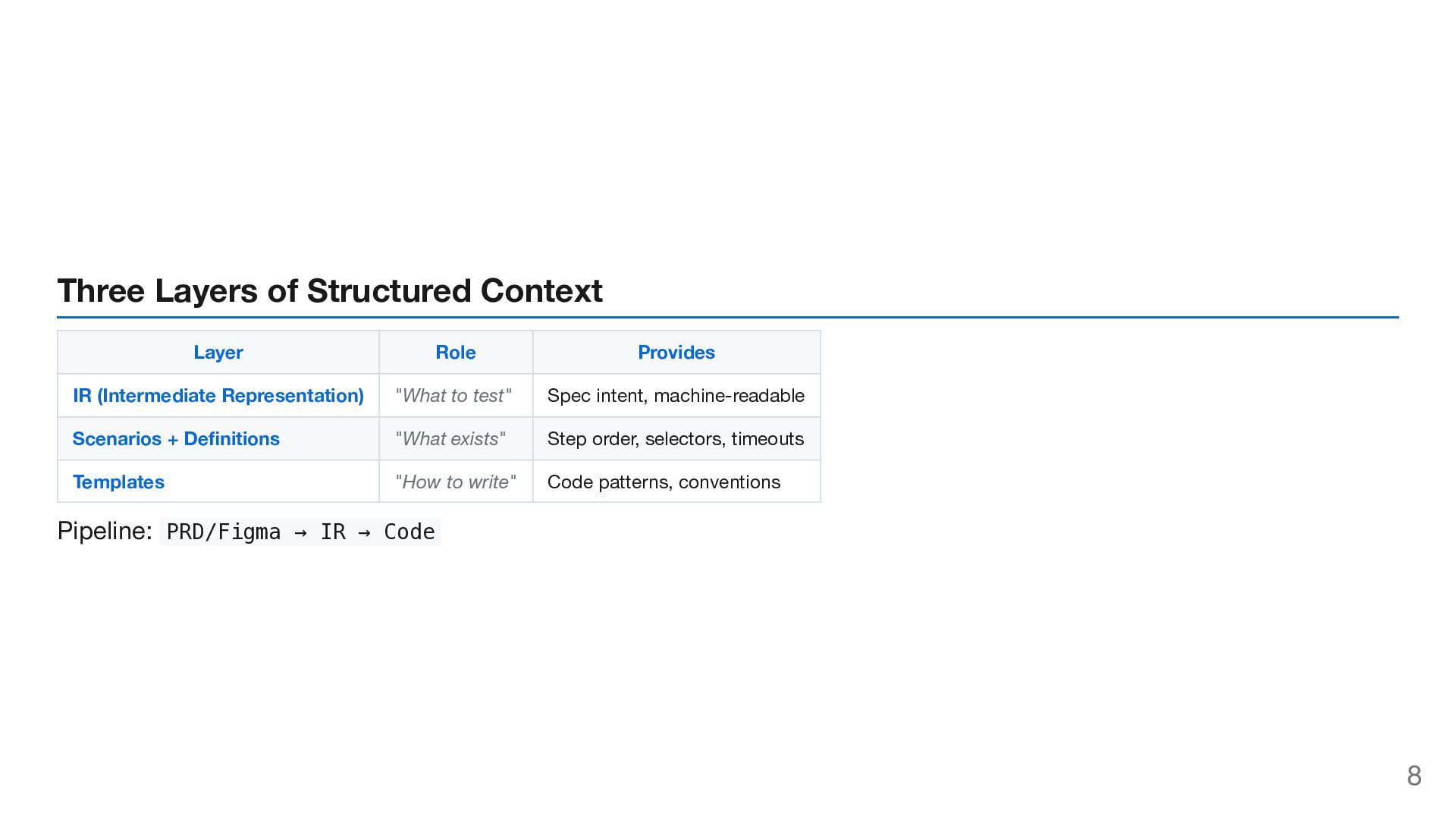
  4. Three Layers of Structured Context Layer Role Provides IR (Intermediate

    Representation) "What to test" Spec intent, machine-readable Scenarios + Definitions "What exists" Step order, selectors, timeouts Templates "How to write" Code patterns, conventions Pipeline: PRD/Figma → IR → Code 8
  5. IR — "What to test" ir: name: Driver Login preconditions:

    - Operator account exists input_fields: - { name: operator_name, type: select } - { name: password, type: password } - { name: branch_office, type: select } - { name: radio_number, type: text } - { name: driver_number, type: text } IR captures intent separately from implementation → prevents hallucination. 9
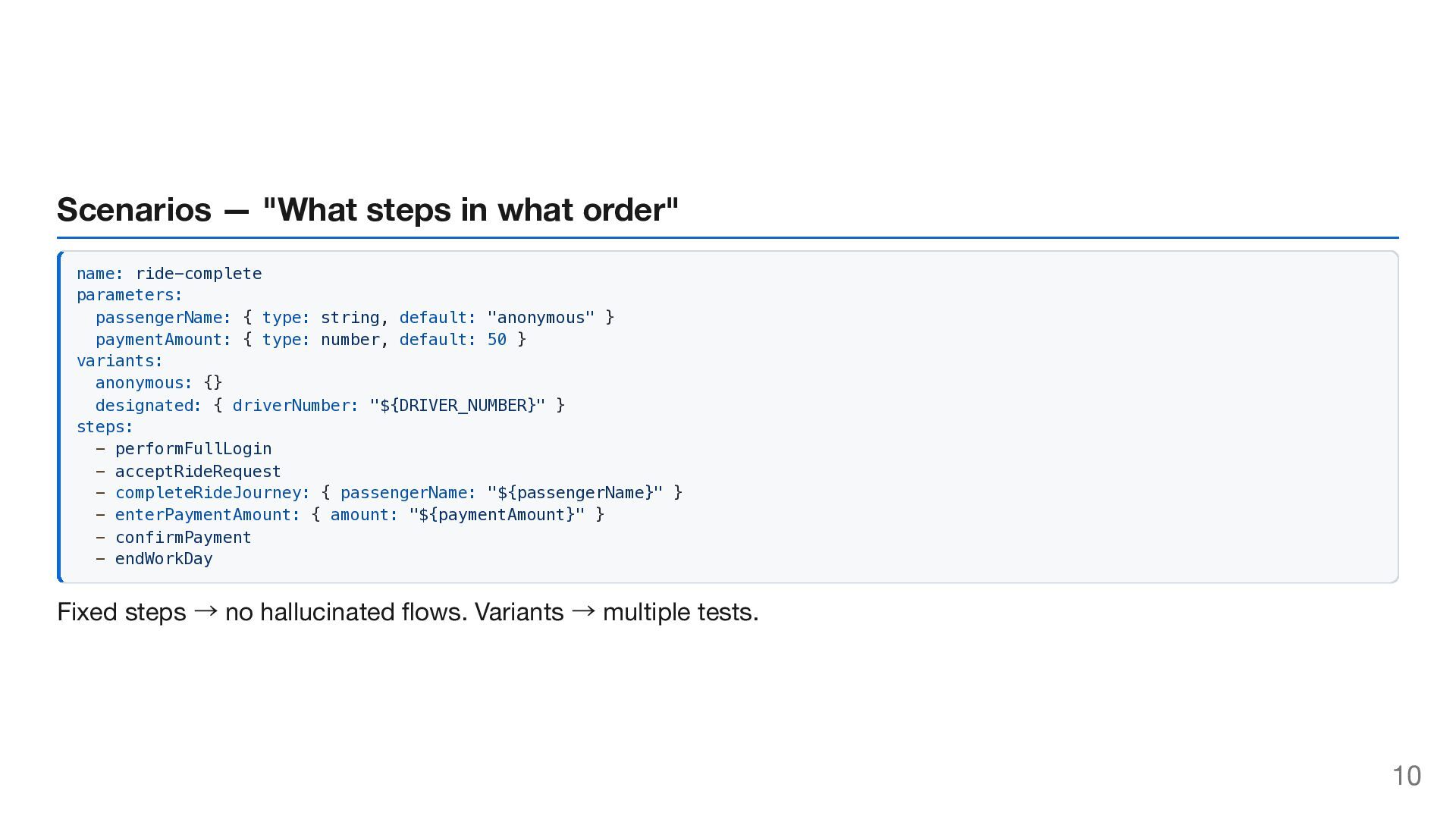
  6. Scenarios — "What steps in what order" name: ride-complete parameters:

    passengerName: { type: string, default: "anonymous" } paymentAmount: { type: number, default: 50 } variants: anonymous: {} designated: { driverNumber: "${DRIVER_NUMBER}" } steps: - performFullLogin - acceptRideRequest - completeRideJourney: { passengerName: "${passengerName}" } - enterPaymentAmount: { amount: "${paymentAmount}" } - confirmPayment - endWorkDay Fixed steps → no hallucinated flows. Variants → multiple tests. 10
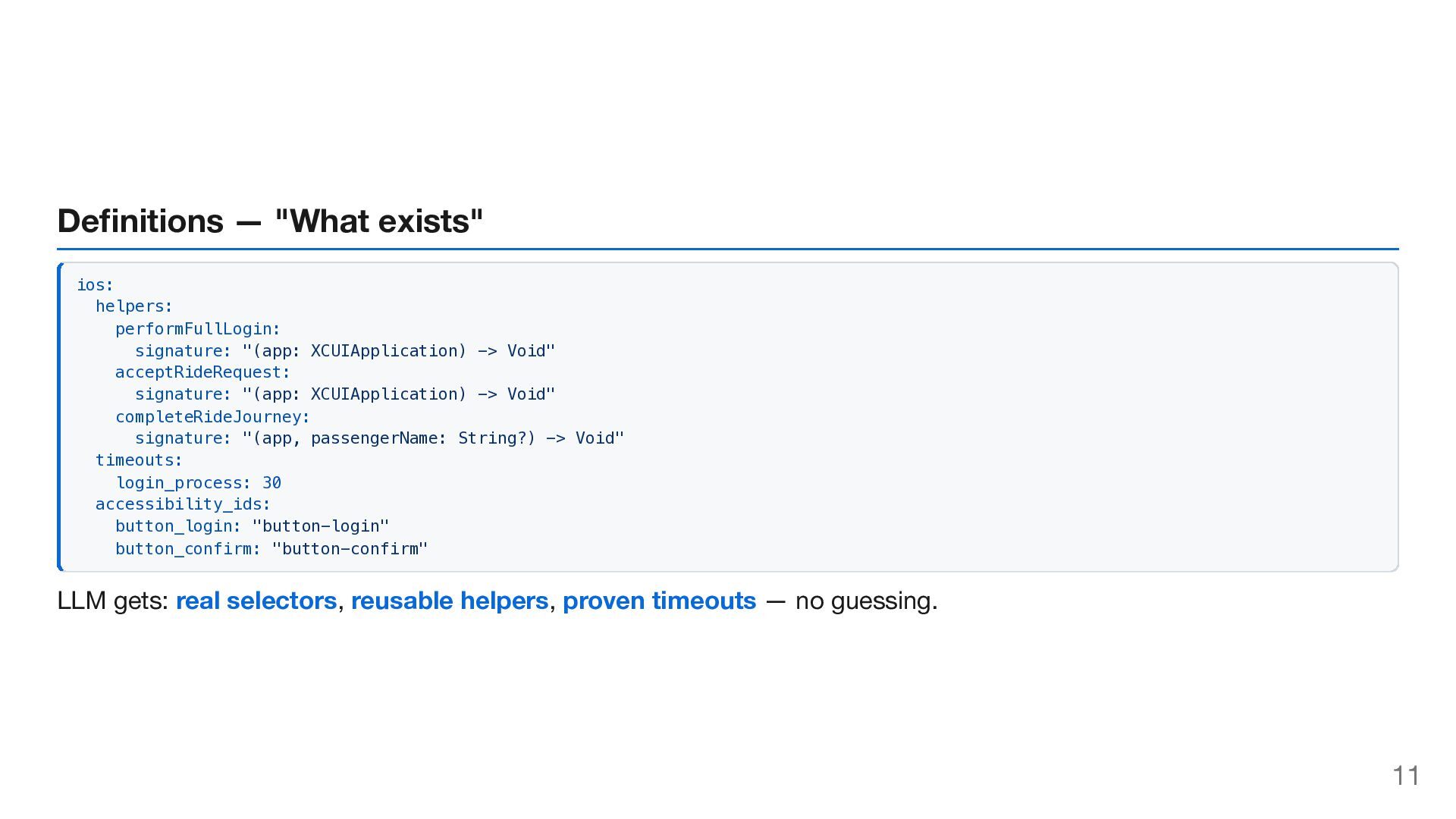
  7. Definitions — "What exists" ios: helpers: performFullLogin: signature: "(app: XCUIApplication)

    -> Void" acceptRideRequest: signature: "(app: XCUIApplication) -> Void" completeRideJourney: signature: "(app, passengerName: String?) -> Void" timeouts: login_process: 30 accessibility_ids: button_login: "button-login" button_confirm: "button-confirm" LLM gets: real selectors, reusable helpers, proven timeouts — no guessing. 11
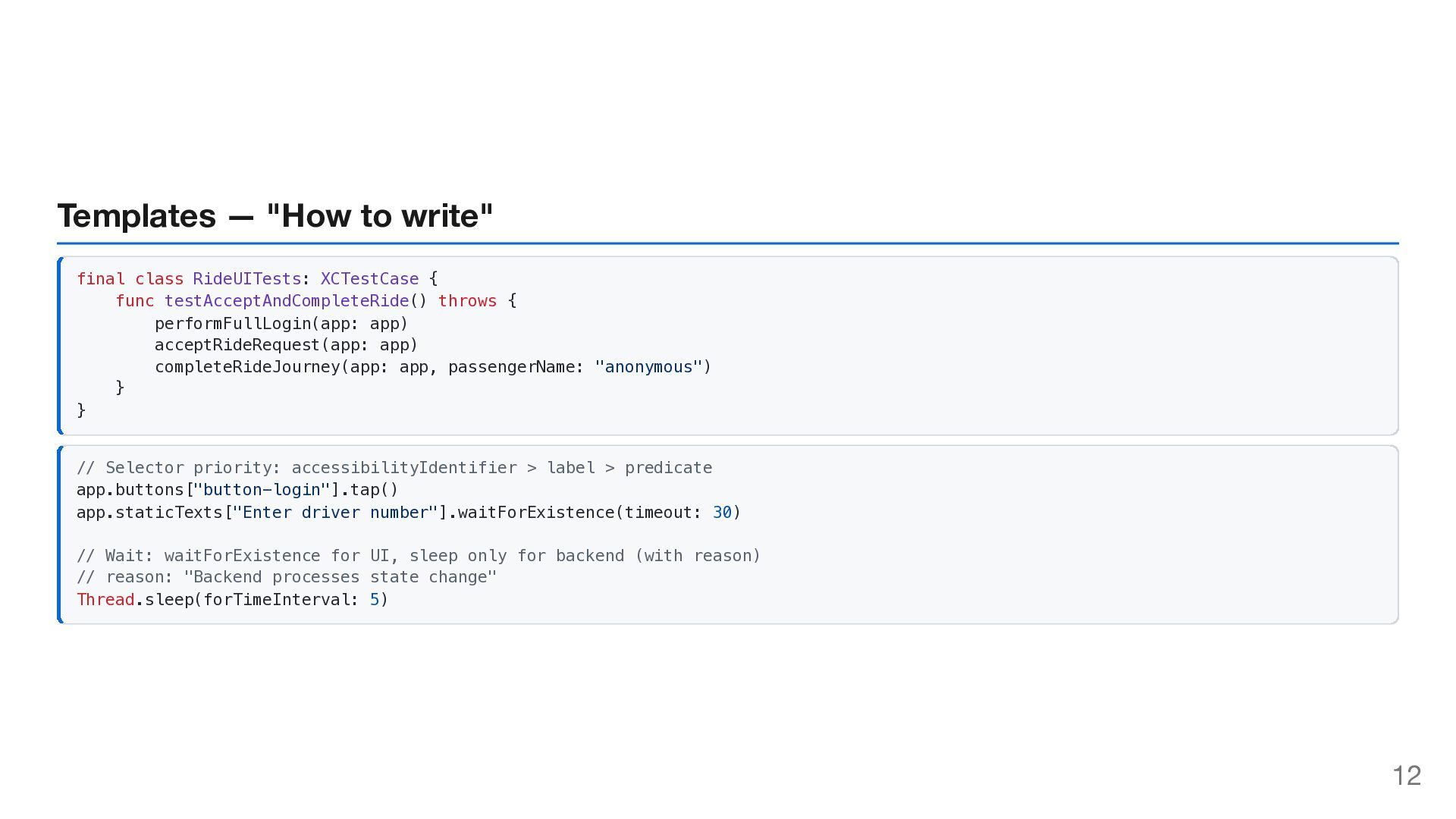
  8. Templates — "How to write" final class RideUITests: XCTestCase {

    func testAcceptAndCompleteRide() throws { performFullLogin(app: app) acceptRideRequest(app: app) completeRideJourney(app: app, passengerName: "anonymous") } } // Selector priority: accessibilityIdentifier > label > predicate app.buttons["button-login"].tap() app.staticTexts["Enter driver number"].waitForExistence(timeout: 30) // Wait: waitForExistence for UI, sleep only for backend (with reason) // reason: "Backend processes state change" Thread.sleep(forTimeInterval: 5) 12
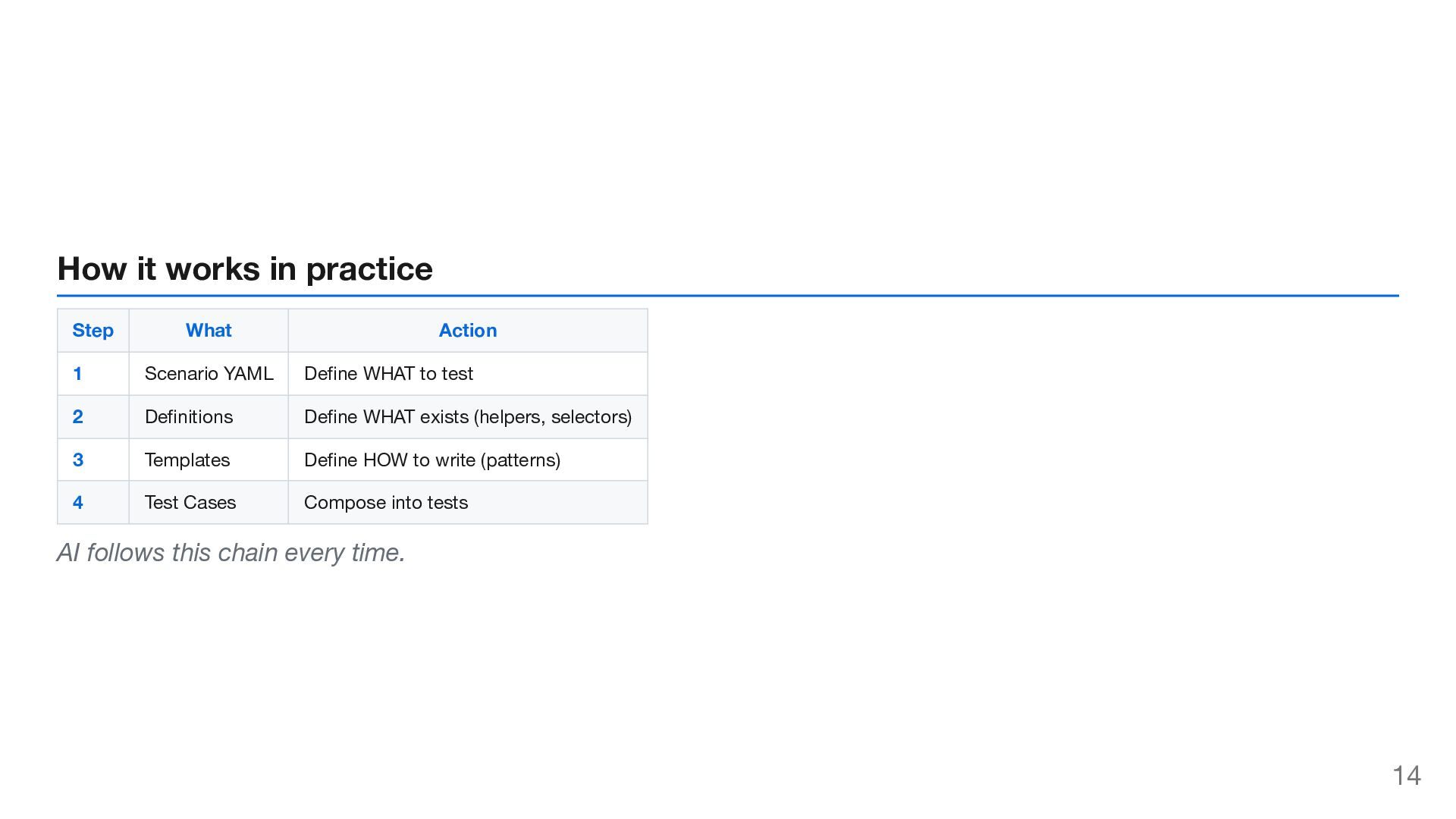
  9. How it works in practice Step What Action 1 Scenario

    YAML Define WHAT to test 2 Definitions Define WHAT exists (helpers, selectors) 3 Templates Define HOW to write (patterns) 4 Test Cases Compose into tests AI follows this chain every time. 14
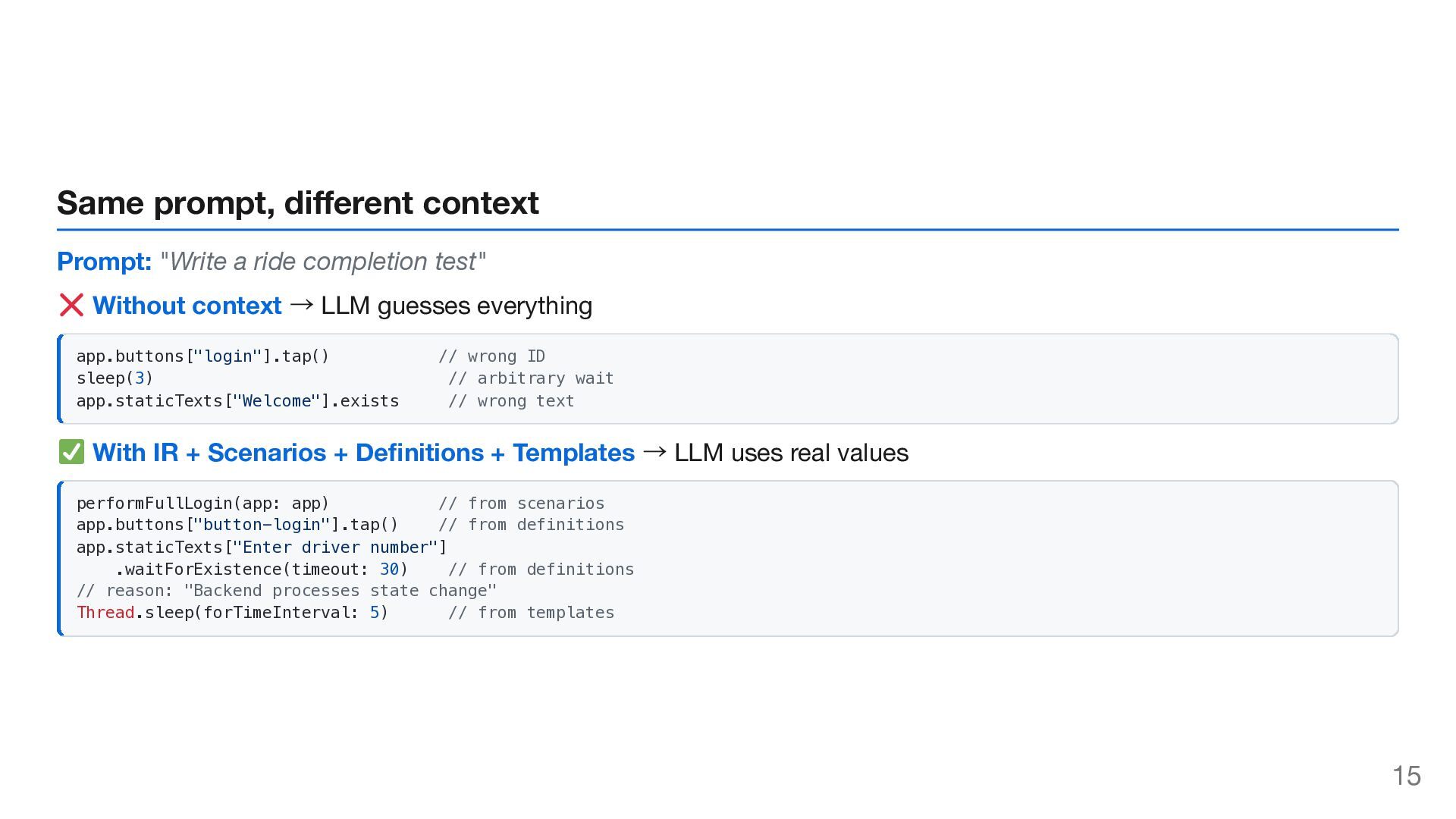
  10. Same prompt, different context Prompt: "Write a ride completion test"

    Without context → LLM guesses everything app.buttons["login"].tap() // wrong ID sleep(3) // arbitrary wait app.staticTexts["Welcome"].exists // wrong text With IR + Scenarios + Definitions + Templates → LLM uses real values performFullLogin(app: app) // from scenarios app.buttons["button-login"].tap() // from definitions app.staticTexts["Enter driver number"] .waitForExistence(timeout: 30) // from definitions // reason: "Backend processes state change" Thread.sleep(forTimeInterval: 5) // from templates 15
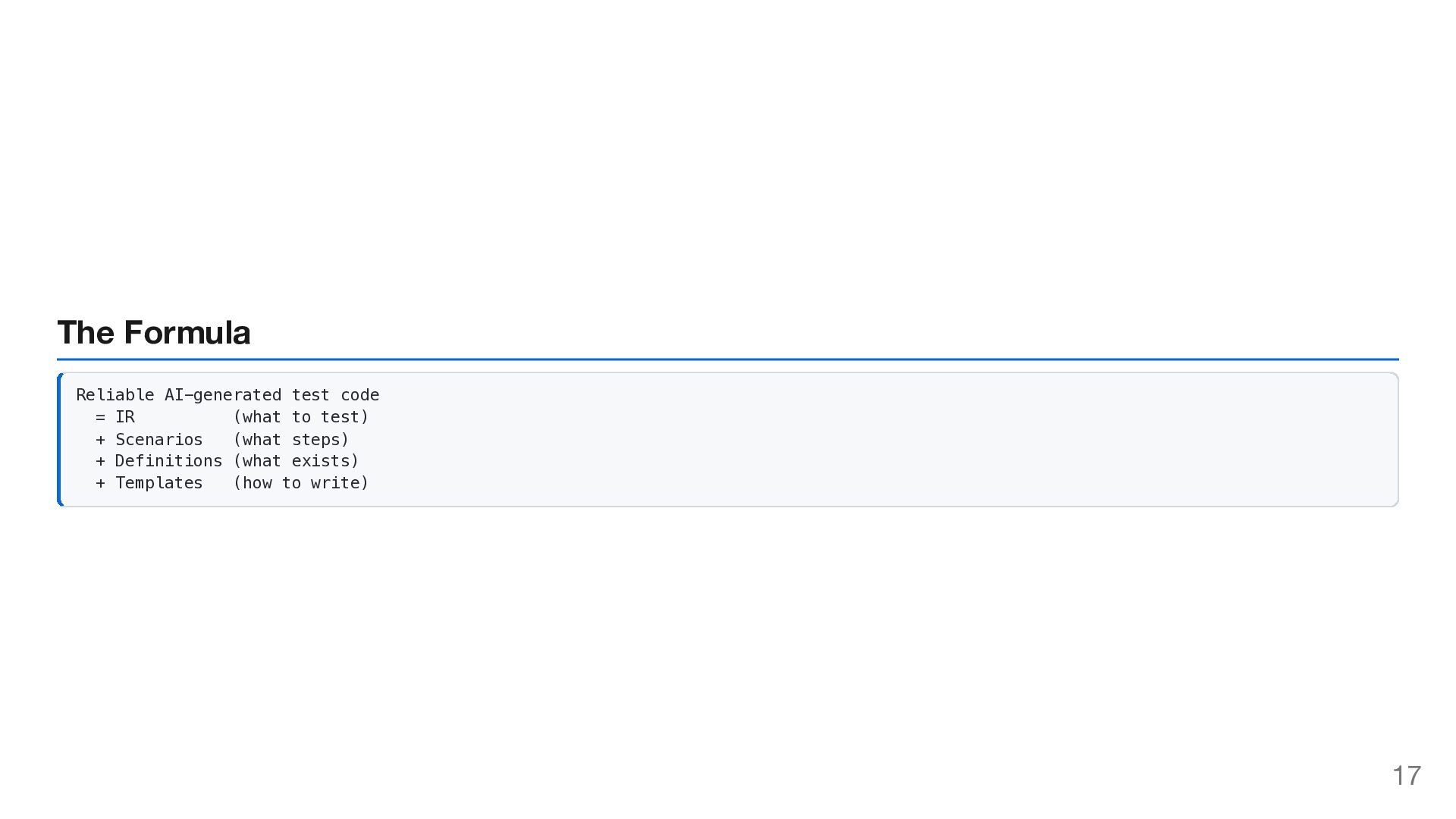
  11. The Formula Reliable AI-generated test code = IR (what to

    test) + Scenarios (what steps) + Definitions (what exists) + Templates (how to write) 17
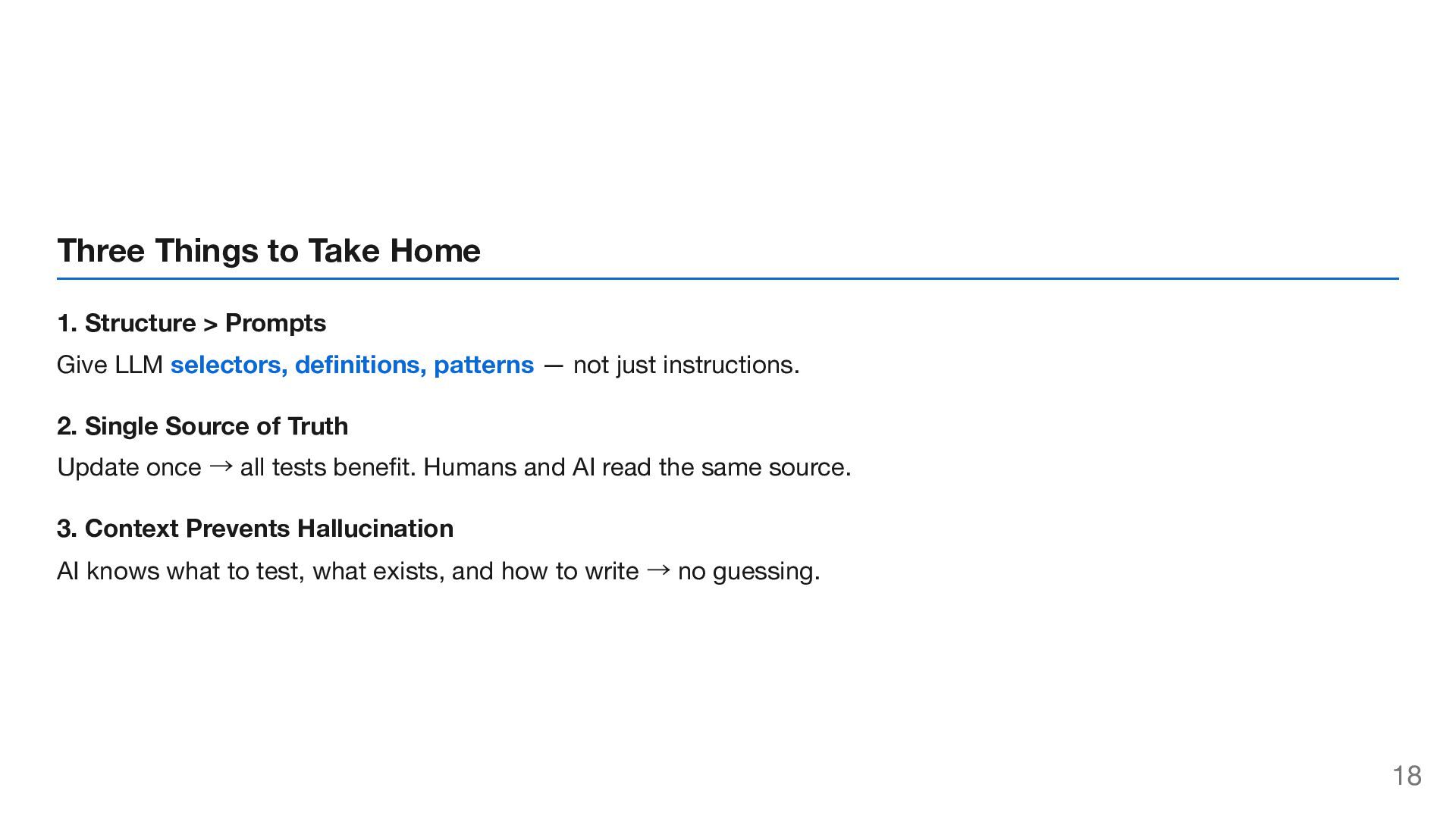
  12. Three Things to Take Home 1. Structure > Prompts Give

    LLM selectors, definitions, patterns — not just instructions. 2. Single Source of Truth Update once → all tests benefit. Humans and AI read the same source. 3. Context Prevents Hallucination AI knows what to test, what exists, and how to write → no guessing. 18
  13. One More Thing Don't build for AI. Build for your

    team. The context that helps your team write consistent code — is the same context AI needs. 19
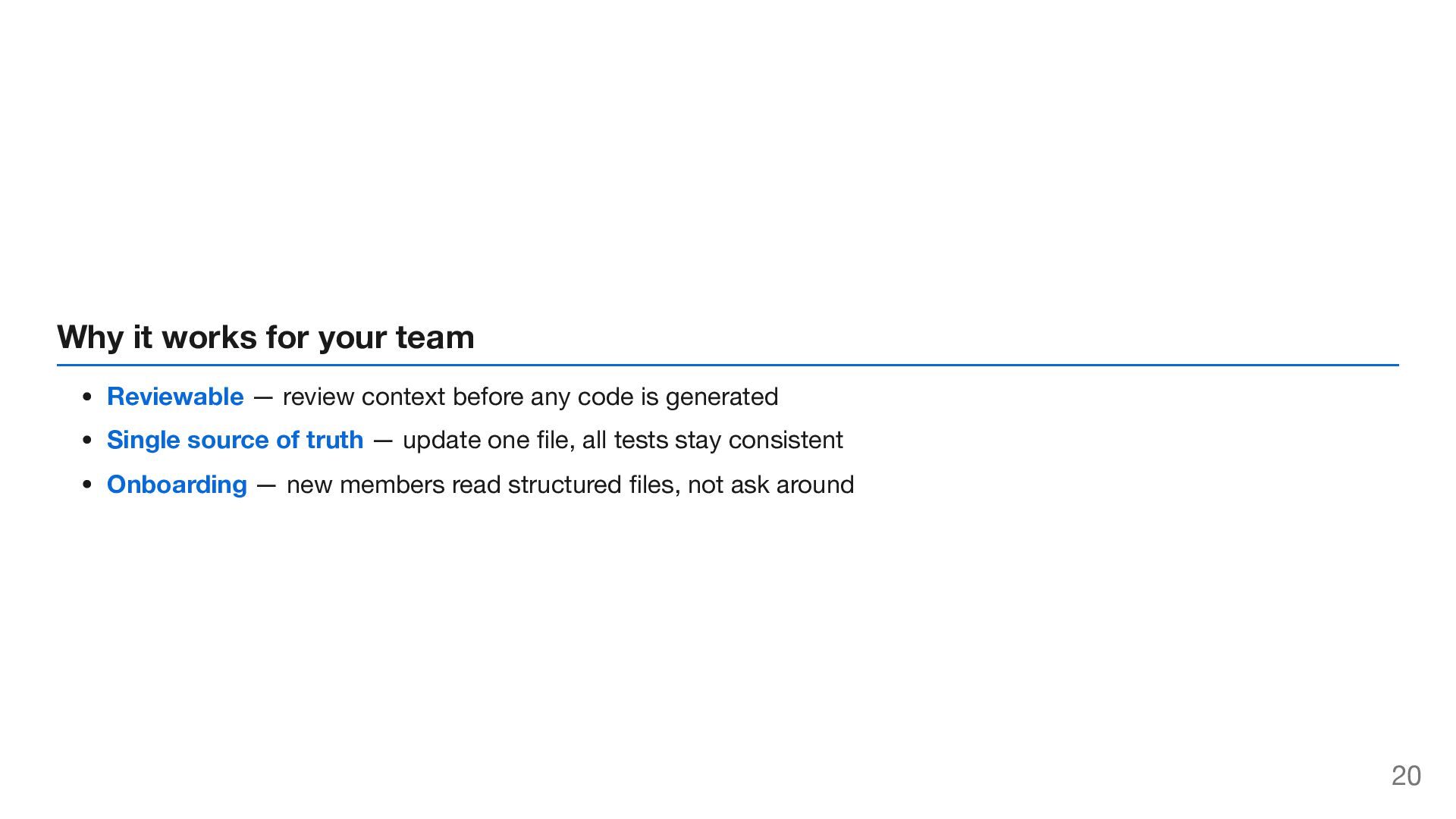
  14. Why it works for your team Reviewable — review context

    before any code is generated Single source of truth — update one file, all tests stay consistent Onboarding — new members read structured files, not ask around 20