Share
Embed
Its all about the journey - ElixirDaze 2017
This talk shares some of the interesting ideas we have discovered whilst building the card generator too we used to create ElixirCards - the cards will be available on amazon soon. Info will be posted to www.elixircards.co.uk when we return to the UK.
Keith
March 03, 2017
Transcript
132 slides
-
Its all about the Journey by Tanya and Keith ElixirDaze
2017 #elixirdaze2017 -
The journey of a thousand miles begins with one step
Lao Tzu ElixirDaze 2017 #elixirdaze2017 -
The idea of a Card Generator was born ElixirDaze 2017
#elixirdaze2017 -
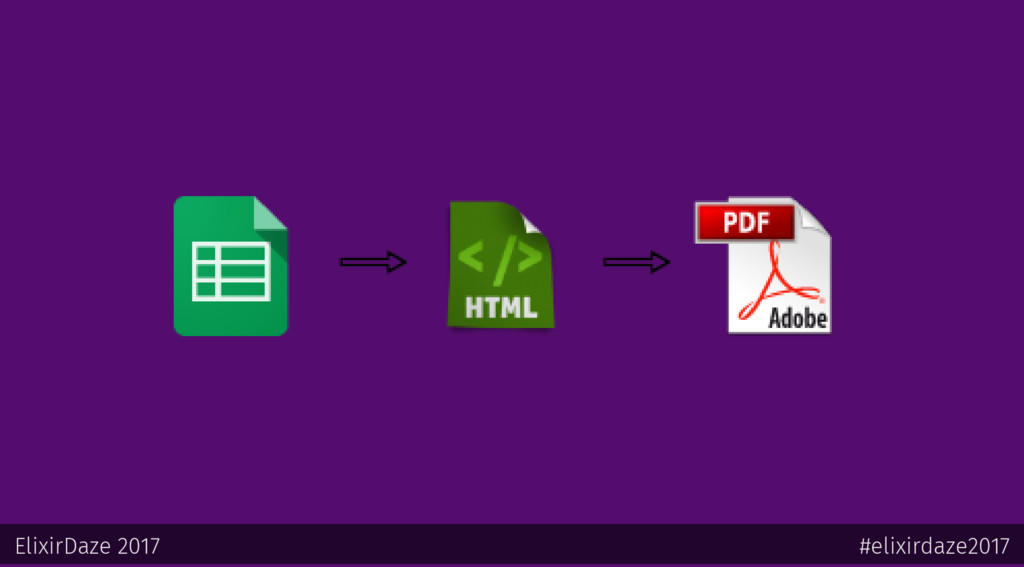
Summary and limitations Generate from CSV is working Google spreadsheet
works for now Generate HTML, not PDF, much faster! Building with EVERYTHING BUT(!) elixir Need to verify correctness ElixirDaze 2017 #elixirdaze2017 -
Things we want: Correct cards Fast Stable and reliable Scalable
ElixirDaze 2017 #elixirdaze2017 -
With Elixir we get: Tests with a bit of meta
programming Fast with concurrency Reliable with processes and supervision Scalable with OTP applications ElixirDaze 2017 #elixirdaze2017 -
defmodule Downloader do def download(url, _file_path) do HTTPotion.get(url) |> Map.get(:body)
|> save(file_path) end end What could go wrong with that? ElixirDaze 2017 #elixirdaze2017 -
defmodule Downloader do def download(url, file_path) do case HTTPotion.get(url) do
%Response{body: content} -> save(content, file_path) %ErrorResponse{message: error} -> error end end end ElixirDaze 2017 #elixirdaze2017 -
def save(content, file_path) do {:ok, file} = File.open(file_path, [:write]) IO.binwrite(file,
content) File.close(file) end So what could go wrong? ElixirDaze 2017 #elixirdaze2017 -
iex> h File.open^200 ... {:error, reason} - the file could
not be opened. ElixirDaze 2017 #elixirdaze2017 -
def save(content, file_path) do {:ok, file} = File.open(file_path, [:write]) #
<---- here IO.binwrite(file, content) File.close(file) end ElixirDaze 2017 #elixirdaze2017 -
** (MatchError) no match of right hand side value: {:error,
:eacces} ElixirDaze 2017 #elixirdaze2017 -
Erlang philosophy "Let it crash" doesn't mean don't handle errors
ElixirDaze 2017 #elixirdaze2017 -
def save(content, file_path) do case File.open(file_path, [:write]) do {:ok, file}
-> IO.binwrite(file, content) File.close(file) {:error, reason} -> reason end end ElixirDaze 2017 #elixirdaze2017 -
@spec binwrite(device, iodata) :: :ok | {:error, term} def binwrite(device
\\ :stdio, item) when is_iodata(item) do :file.write map_dev(device), item end ElixirDaze 2017 #elixirdaze2017 -
def save(content, file_path) do case File.open(file_path, [:write]) do {:ok, file}
-> case IO.binwrite(file, content) do :ok -> File.close(file) {:error, reason} -> reason end {:error, reason} -> reason end end ElixirDaze 2017 #elixirdaze2017 -
def save(content, file_path) do case File.open(file_path, [:write]) do {:ok, file}
-> case IO.binwrite(file, content) do :ok -> File.close(file) {:error, reason} -> File.close(file) reason end {:error, reason} -> reason end end ElixirDaze 2017 #elixirdaze2017 -
iex> h File.close ... It mostly returns :ok, except for
some severe errors such as *out of memory*. ElixirDaze 2017 #elixirdaze2017 -
@spec close(io_device) :: :ok | {:error, posix | :badarg |
:terminated} ElixirDaze 2017 #elixirdaze2017 -
def save(content, file_path) do case File.open(file_path, [:write]) do {:ok, file}
-> case IO.binwrite(file, content) do :ok -> File.close(file) {:error, reason} -> File.close(file) reason end {:error, reason} -> reason end end ElixirDaze 2017 #elixirdaze2017 -
def save(content, file_path) do case File.open(file_path, [:write]) do {:ok, file}
-> case IO.binwrite(file, content) do :ok -> File.close(file) # <------------- Here :ok {:error, reason} -> File.close(file) reason # <----------------------- Here term end {:error, reason} -> reason # <--------- Here term end end ElixirDaze 2017 #elixirdaze2017 -
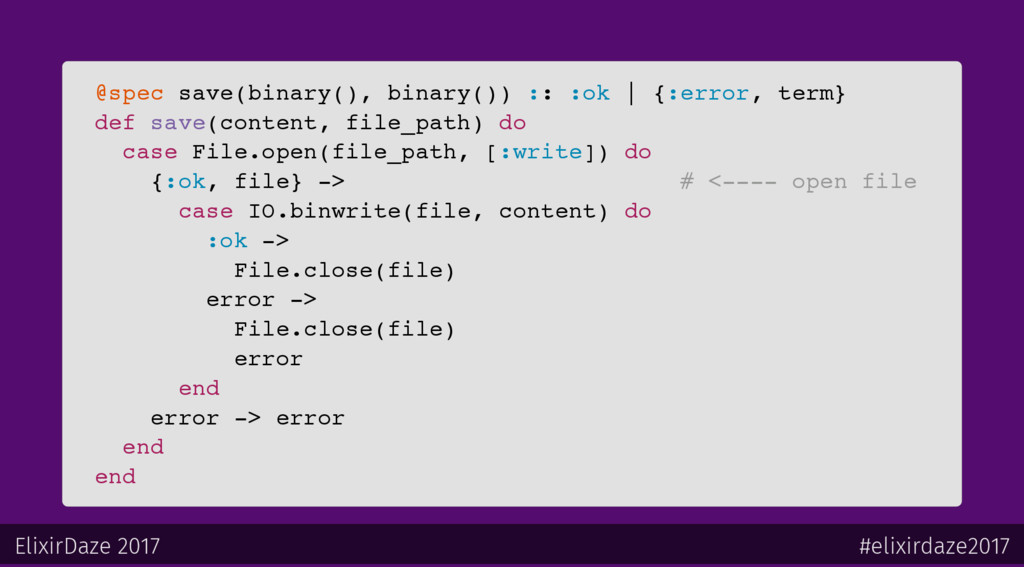
@spec save(binary(), binary()) :: :ok | {:error, term} def save(content,
file_path) do case File.open(file_path, [:write]) do {:ok, file} -> case IO.binwrite(file, content) do :ok -> File.close(file) # <------------------ Here :ok error -> File.close(file) error # <----------------------------- Here tuple end error -> error # <-------------------------- Here tuple end end ElixirDaze 2017 #elixirdaze2017 -
@spec download(binary(), binary()) :: :ok | {:error, term} def download(url,
file_path) do case HTTPotion.get(url) do %HTTPotion.Response{body: body} -> case save(body, file_path) do :ok -> "Succes Yay! We saved the file here: #{file_path}" {:error, reason} -> # <------ here pattern match "I got 99 problems but... #{inspect reason}" end %HTTPotion.ErrorResponse{message: error} -> error end end ElixirDaze 2017 #elixirdaze2017 -
@spec download(binary(), binary()) :: :ok | {:error, term} def download(url,
file_path) do case HTTPotion.get(url) do %Response{body: body} -> save(body, file_path) %ErrorResponse{message: error} -> {:error, error} end end ElixirDaze 2017 #elixirdaze2017 -
@spec save(binary(), binary()) :: :ok | {:error, term} def save(content,
file_path) do case File.open(file_path, [:write]) do {:ok, file} -> case IO.binwrite(file, content) do :ok -> File.close(file) error -> File.close(file) error end error -> error end end ElixirDaze 2017 #elixirdaze2017 -
@spec save(binary(), binary()) :: :ok | {:error, term} def save(content,
file_path) do case File.open(file_path, [:write]) do {:ok, file} -> # <---- open file case IO.binwrite(file, content) do :ok -> File.close(file) error -> File.close(file) error end error -> error end end ElixirDaze 2017 #elixirdaze2017 -
@spec save(binary(), binary()) :: :ok | {:error, term} def save(content,
file_path) do case File.open(file_path, [:write]) do {:ok, file} -> # <---- open file case IO.binwrite(file, content) do :ok -> # <---- write file File.close(file) error -> File.close(file) error end error -> error end end ElixirDaze 2017 #elixirdaze2017 -
@spec save(binary(), binary()) :: :ok | {:error, term} def save(content,
file_path) do case File.open(file_path, [:write]) do {:ok, file} -> # <---- open file case IO.binwrite(file, content) do :ok -> # <---- write file File.close(file) # <---- close file error -> File.close(file) error end error -> error end end ElixirDaze 2017 #elixirdaze2017 -
Use the force Luke Kernel.with Special Form!! Used to combine
matching clauses ElixirDaze 2017 #elixirdaze2017 -
def save(content, file_path) do with {:ok, file} -> File.open(file_path, [:write]),
# <--- note the commas :ok -> IO.binwrite(file, content), # <--- note the commas :ok -> File.close(file) do :ok -> {:ok, file_path} # <---- the happy case result else error -> error # <----- all errors pop out here end end ElixirDaze 2017 #elixirdaze2017 -
def save(content, file_path) do case File.open(file_path, [:write]) do {:ok, file}
-> try do IO.binwrite(file, content) # <--- this returns result after File.close(file) end other -> other end end ElixirDaze 2017 #elixirdaze2017 -
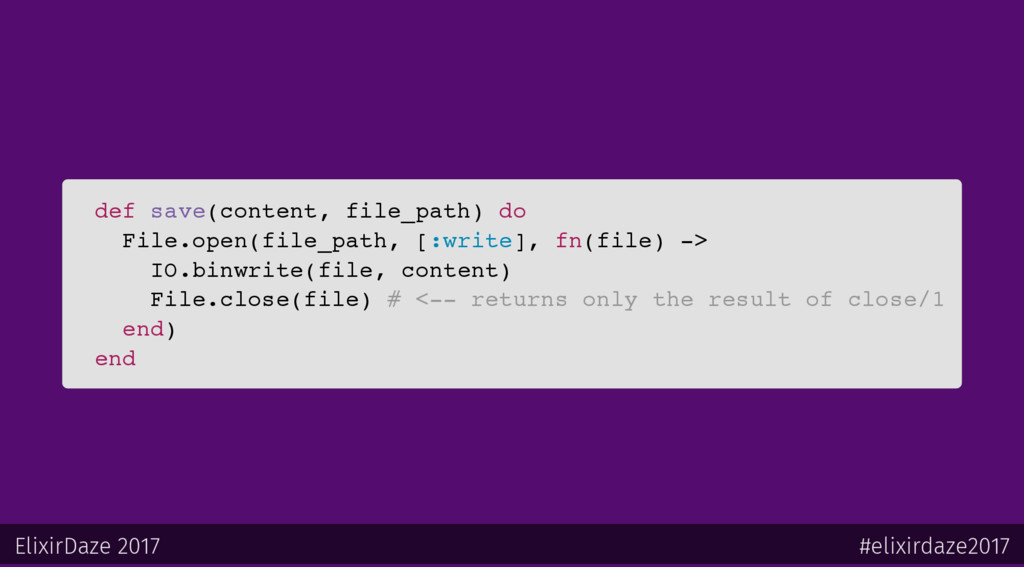
def save(content, file_path) do File.open(file_path, [:write], fn(file) -> IO.binwrite(file, content)
File.close(file) # <-- returns only the result of close/1 end) end ElixirDaze 2017 #elixirdaze2017 -
def save(content, file_path) do File.open(file_path, [:write], fn(file) -> try do
IO.binwrite(file, content) # <-- returns result write/1 after File.close(file) end end) end ElixirDaze 2017 #elixirdaze2017 -
# equivalent of bind (>>=) in Haskell defmacro left ~>>
right do quote do (fn -> case unquote(left) do {:ok, x} -> x |> unquote(right) # <--- notice x! {:error, _} = expr -> expr end end).() end end ElixirDaze 2017 #elixirdaze2017 -
def save(content, file_path) do open_file(file_path) ~>> write_file(content) ~>> close_file(file_path) end
ElixirDaze 2017 #elixirdaze2017 -
def save(content, file_path) do open_file(file_path) # <-- we need to
lift into Either type ~>> write_file(content) ~>> close_file(file_path) end ElixirDaze 2017 #elixirdaze2017 -
def open_file(file_path) do # <—— here we need to lift
our functions into "Either" :ok = File.mkdir_p(Path.dirname(file_path)) File.open(file_path, [:write]) # <- this returns {:ok, file} end def write_file(file, content) do # <— here case IO.binwrite(file, content) do :ok -> {:ok, file} # <- here we return {:ok, file} other -> other end end def close_file(file, file_path) do # <— here case File.close(file) do :ok -> {:ok, file_path} other -> other end end ElixirDaze 2017 #elixirdaze2017 -
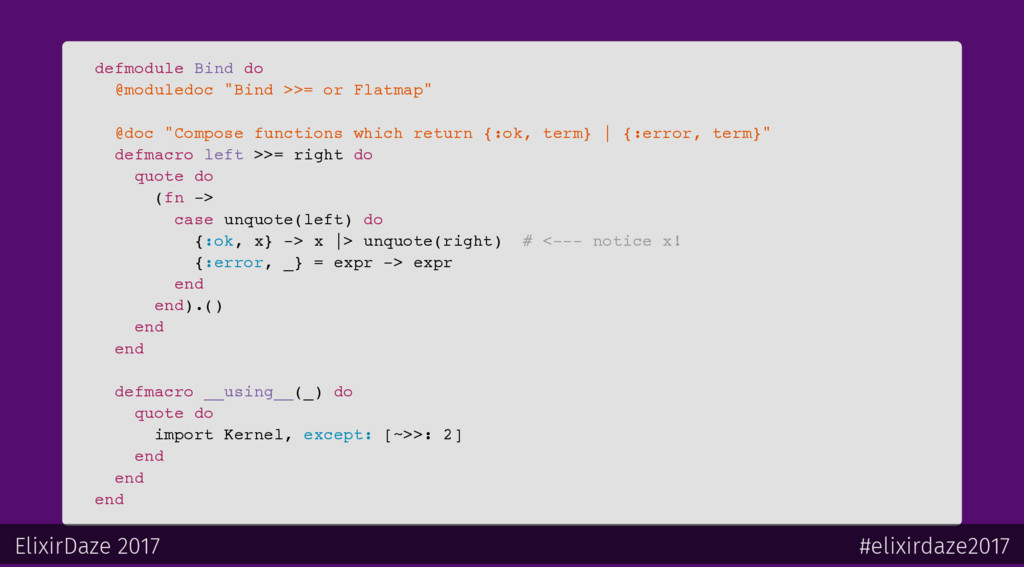
defmodule Bind do @moduledoc "Bind >>= or Flatmap" @doc "Compose
functions which return {:ok, term} | {:error, term}" defmacro left >>= right do quote do (fn -> case unquote(left) do {:ok, x} -> x |> unquote(right) # <--- notice x! {:error, _} = expr -> expr end end).() end end defmacro __using__(_) do quote do import Kernel, except: [~>>: 2] end end end ElixirDaze 2017 #elixirdaze2017 -
Want to learn more? Go watch Scott Wlaschin wonderful talk
"Railway Oriented Programming" Watch all of Scott's ^ talks - he knows a thing or two about functional Programming Watch Brian Lonsdorf's talks and screencasts - he knows his sh*t Learn about Monoids, Functors, Applicatives and Monads - it's fun! Listen to Lamdacast & Magic Read Along, Functional Geekery podcasts Listen to Elixir Fountain! - (ofc) I assume you already do! ElixirDaze 2017 #elixirdaze2017 -
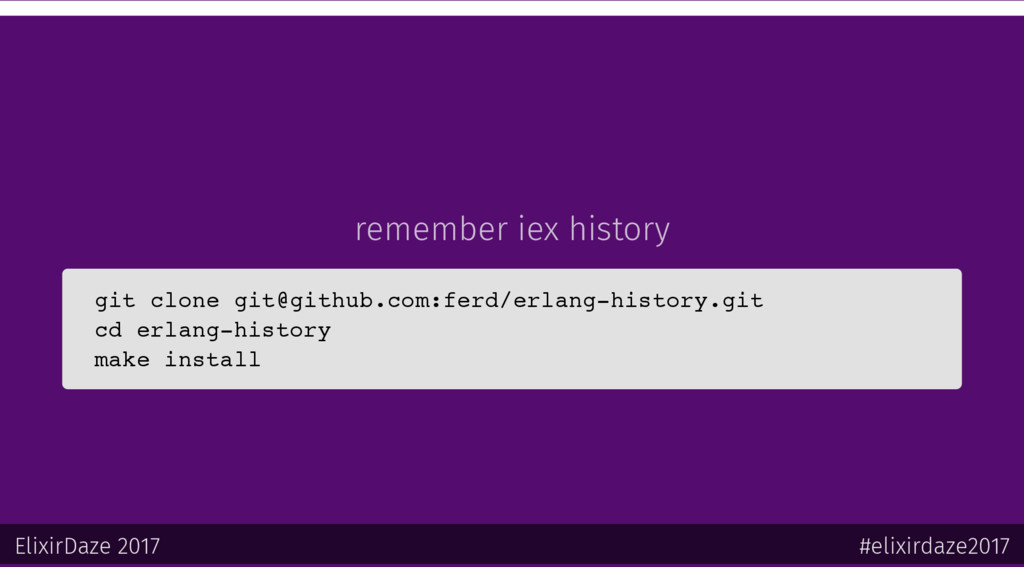
remember iex history git clone [email protected]:ferd/erlang-history.git cd erlang-history make install
ElixirDaze 2017 #elixirdaze2017 -
defmodule Mix.Tasks.Cards.Download do use Mix.Task def run(_) do IO.puts "Called
with invalid parameters" IO.puts "Example: mix.cards.download elixir pack1" end end ElixirDaze 2017 #elixirdaze2017 -
$ mix cards.download Called with invalid parameters Example: mix.cards.download elixir
pack1 ElixirDaze 2017 #elixirdaze2017 -
defmodule Mix.Tasks.Cards.Download do use Mix.Task @shortdoc "downloads cards from google
spreadsheets" ... end ElixirDaze 2017 #elixirdaze2017 -
defmodule Mix.Tasks.Cards.Download do ... @spec run([String.t, String.t]) :: {:ok, String.t}
| {:error, term} def run([lang, pack]) do Downloader.download(lang, pack) end def run(_) do ... end ElixirDaze 2017 #elixirdaze2017 -
defmodule Mix.Tasks.Cards.Download do ... @lang_packs [{"elixir", "pack1"}, ...] def run([lang,
pack]) when {lang, pack} in @lang_packs do ... end put it in a list for multiple arguments. ElixirDaze 2017 #elixirdaze2017 -
$ mix compile $ mix cards.download elixir pack1 "Downloaded /files/elixir_cards/pack1/pack1.csv"
ElixirDaze 2017 #elixirdaze2017 -
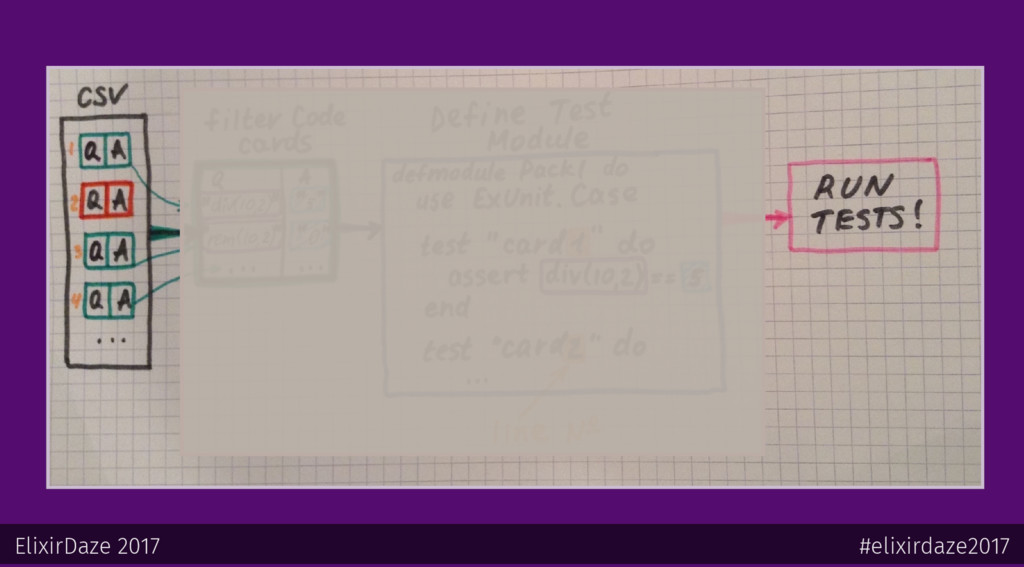
csv file "`round 3.58`","`=> 4`" "What args elem/2 function accept?","tuple,
index" ElixirDaze 2017 #elixirdaze2017 -
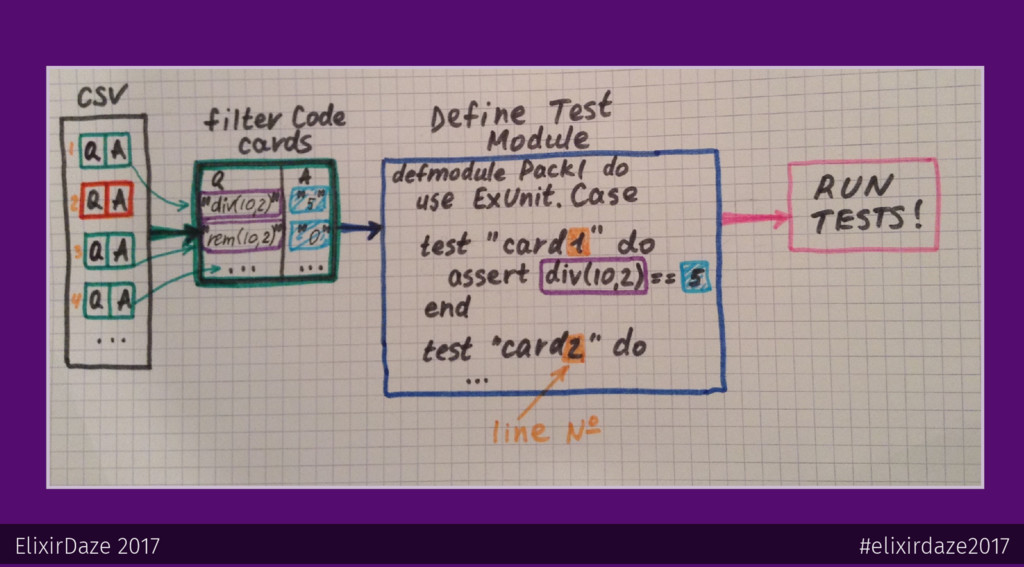
defmodule Tester do def test({lang, pack}) do file = "files/#{lang}_cards/#{pack}/#{pack}.csv"
... end end ElixirDaze 2017 #elixirdaze2017 -
defmodule Tester do @packs [{"elixir", "pack1"}] def test({lang, pack} =
input) when input in @packs do file = "files/#{lang}_cards/#{pack}/#{pack}.csv" ... end end ElixirDaze 2017 #elixirdaze2017 -
defmodule Tester do @packs [{"elixir", "pack1"}] def test({lang, pack} =
input) when input in @packs do file = "files/#{lang}_cards/#{pack}/#{pack}.csv" code_cards = PrepareTests.get_code_cards(file) ... end end ElixirDaze 2017 #elixirdaze2017 -
defmodule PrepareTests do def get_code_cards(file) do file |> File.stream!() ...
end ElixirDaze 2017 #elixirdaze2017 -
defmodule PrepareTests do def get_code_cards(file) do file |> File.stream!() |>
NimbleCSV.RFC4180.parse_stream() ... end ElixirDaze 2017 #elixirdaze2017 -
defmodule Tester.Mixfile do ... defp deps do [{:nimble_csv, ">= 0.1.0"}]
end ... end ElixirDaze 2017 #elixirdaze2017 -
File.stream!(file) |> NimbleCSV.RFC4180.parse_stream() # Lazily parses CSV from a stream
and returns a stream of rows. ElixirDaze 2017 #elixirdaze2017 -
defmodule PrepareTests do def get_code_cards(file) do file |> File.stream!() |>
NimbleCSV.RFC4180.parse_stream() |> Stream.with_index(1) # <---- card id ... end ElixirDaze 2017 #elixirdaze2017 -
defmodule PrepareTests do def get_code_cards(file) do file |> File.stream!() |>
NimbleCSV.RFC4180.parse_stream() |> Stream.with_index(2) |> Stream.flat_map(fn({[q, a], line}) -> parse(q, a, line) end) end ElixirDaze 2017 #elixirdaze2017 -
defmodule PrepareTests do ... defp parse(question, "`=> " <> <<
_code :: binary >> = answer, line) do q = extract_code(question) a = extract_code(answer) [{line, q, a}] end defp parse(_, _, _), do: [] ... ElixirDaze 2017 #elixirdaze2017 -
defmodule PrepareTests do ... q = extract_code(question) ... defp extract_code(data)
do ~r/(\`(\`{2})?)((\n)*)?(=> )?(?>code>[^\`]*)(\`(\`{2})?)/ |> Regex.named_captures(data) |> Map.get("code") |> String.trim("\n") end ElixirDaze 2017 #elixirdaze2017 -
defmodule Tester do @packs [{"elixir", "pack1"}] def test({lang, pack} =
input) when input in @packs do file = "files/#{lang}_cards/#{pack}/#{pack}.csv" code_cards = PrepareTests.get_code_cards(file) ... end end ElixirDaze 2017 #elixirdaze2017 -
defmodule Tester do @packs [{"elixir", "pack1"}] def test({lang, pack} =
input) when input in @packs do file = "files/#{lang}_cards/#{pack}/#{pack}.csv" code_cards = PrepareTests.get_code_cards(file) TestIt.define(String.to_atom(pack), code_cards) ... end end ElixirDaze 2017 #elixirdaze2017 -
defmodule TestIt do ExUnit.start def define(mod, content) do ... Module.create(mod,
body, __ENV__) end end ElixirDaze 2017 #elixirdaze2017 -
defmodule TestIt do ExUnit.start def define(mod, content) do body =
quote do use ExUnit.Case unquote(generate_cases(content)) end Module.create(mod, body, __ENV__) end ... end ElixirDaze 2017 #elixirdaze2017 -
defmodule TestIt do ... defp generate_cases(content) do for {line, question,
answer} <- content do ... end end end ElixirDaze 2017 #elixirdaze2017 -
defmodule TestIt do ... defp generate_cases(content) do for {line, question,
answer} <- content do q = Code.string_to_quoted!(question) a = Code.string_to_quoted!(answer) ... end end end ElixirDaze 2017 #elixirdaze2017 -
defmodule TestIt do ... defp generate_cases(content) do for {line, question,
answer} <- content do q = Code.string_to_quoted!(question) a = Code.string_to_quoted!(answer) quote do test "card#{unquote(line)}" do ... end end end end end ElixirDaze 2017 #elixirdaze2017 -
defmodule TestIt do ... defp generate_cases(content) do for {line, question,
answer} <- content do q = Code.string_to_quoted!(question) a = Code.string_to_quoted!(answer) quote do # <-- quote test "card#{unquote(line)}" do # <- unquote assert unquote(q) == unquote(a) # <- unquote end end end end end ElixirDaze 2017 #elixirdaze2017 -
defmodule TestIt do ExUnit.start def define(mod, content) do body =
quote do use ExUnit.Case unquote(generate_cases(content)) end Module.create(mod, body, __ENV__) end ... end ElixirDaze 2017 #elixirdaze2017 -
defmodule Tester do @packs [{"elixir", "pack1"}] def test({lang, pack} =
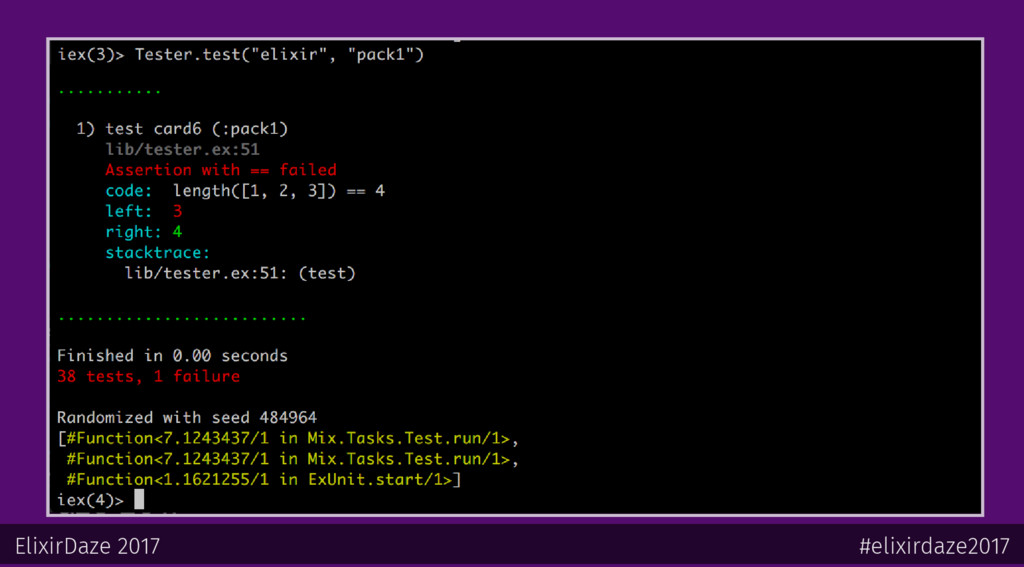
input) when input in @packs do file = "files/#{lang}_cards/#{pack}/#{pack}.csv" code_cards = PrepareTests.get_code_cards(file) TestIt.define(String.to_atom(pack), code_cards) TestIt.run() end end ElixirDaze 2017 #elixirdaze2017 -
defmodule TestIt do ... def run() do Mix.env(:test) Mix.Tasks.Test.run([]) end
end ElixirDaze 2017 #elixirdaze2017 -
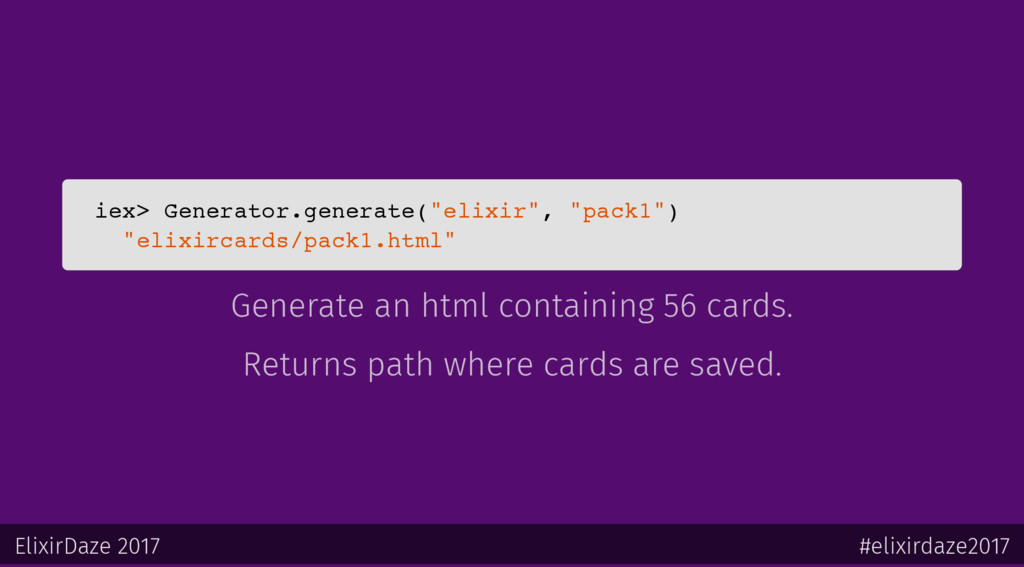
iex> Generator.generate("elixir", "pack1") "elixircards/pack1.html" Generate an html containing 56 cards.
Returns path where cards are saved. ElixirDaze 2017 #elixirdaze2017 -
Converting String of code to Formatted HTML Tried to solve
using Regular Expressions Things got difficult with recursive regex Changed tack, tried Tokeniser/Parser/Compiler This proved much easier to write AND test!! ElixirDaze 2017 #elixirdaze2017 -
defmodule Generator do ... defp process(row, face) do row #
string |> Tokenizer.tokenize # list of tokens |> Parser.parse # ast |> Compiler.compile # string html |> card(face) # card template end ElixirDaze 2017 #elixirdaze2017 -
Tokenizer # before "Given the function: ``` foo = fn(a,
b) -> a + b end ``` How would you call `this` function?" # after [ {:text, "Given the function:\n"}, {:code, "foo = fn(a, b) ->\na + b\nend"}, {:text, "\nHow would you call `this` function?"} ] ElixirDaze 2017 #elixirdaze2017 -
Parser # before [ {:text, "Given the function:\n"}, {:code, "foo
= fn(a, b) ->\na + b\nend"}, {:text, "\nHow would you call `this` function?"} ] # after {:card, [ {:text, "here is "}, {:code, "IO.puts"}, {:text, " text `inline code` more text"} ] } ElixirDaze 2017 #elixirdaze2017 -
Compiler # before {:card, [ {:text, "here is "}, {:code,
"IO.puts"}, {:text, " text `inline code` more text"} ] } # after <p>here is </p> <pre><code>IO.puts</code></pre> <p> text <code>inline code</code> more text</p> ElixirDaze 2017 #elixirdaze2017 -
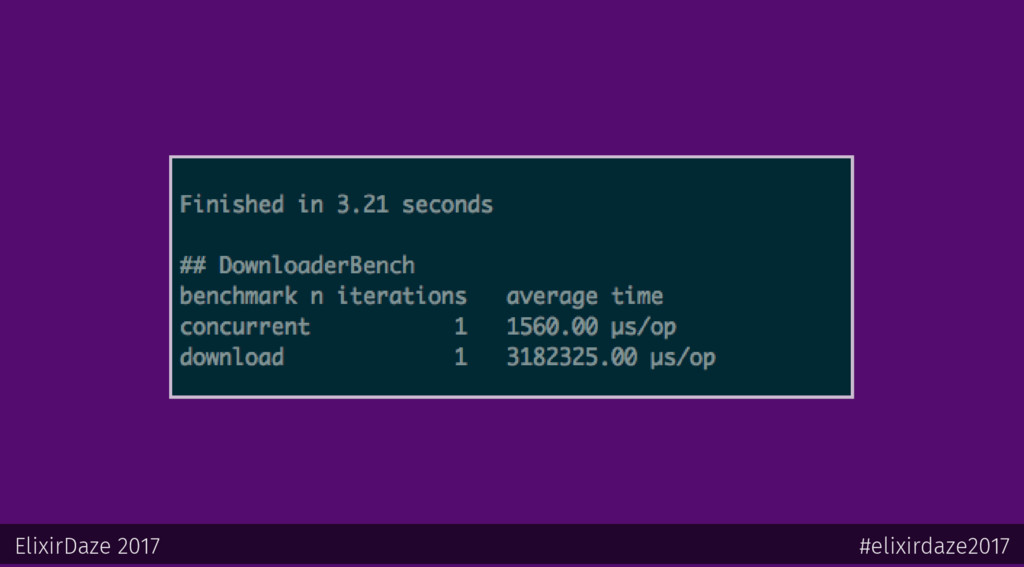
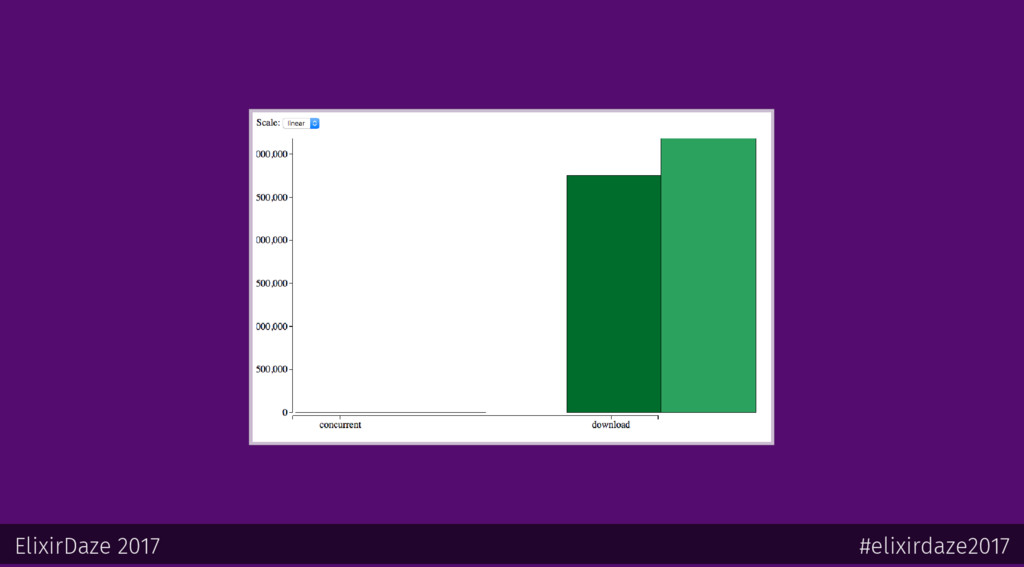
defmodule DownloaderBench do use Benchfella @lang "elixir" setup_all do HTTPotion.start
end bench "download" do Downloader.not_concurrent(@lang) end bench "concurrent" do Downloader.concurrent(@lang) end end ElixirDaze 2017 #elixirdaze2017 -
def not_concurrent(lang) do for x <- 1..20 do download_pack(lang, "pack#{x}")
end end def concurrent(lang) do for x <- 1..20 do spawn(fn -> send(self(), download_pack(lang, "pack#{x}") ) end) end end ElixirDaze 2017 #elixirdaze2017 -
What's next? Concurrent all the things! \o/ Pipeline of operations
Keeping state in supervised process Admin UI Move from spreadsheet to a DB Public UIs - multiplayer games \o/ ElixirDaze 2017 #elixirdaze2017 -
It's good to have an end to journey toward, but
it is the journey which matters at the end. Ernest Hemingway ElixirDaze 2017 #elixirdaze2017 -
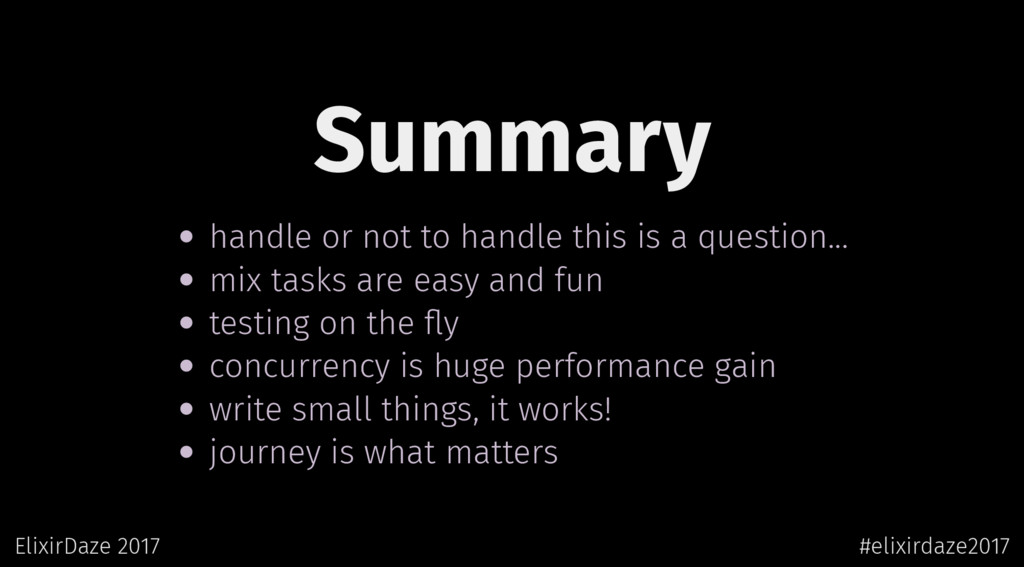
Summary handle or not to handle this is a question...
mix tasks are easy and fun testing on the fly concurrency is huge performance gain write small things, it works! journey is what matters ElixirDaze 2017 #elixirdaze2017