FPGAs and Open-Source Hardware - An Intro (Meet...

Share
Embed
FPGAs and Open-Source Hardware - An Intro (Meeting C++ 2016)
FPGAs and Open-Source Hardware - An Intro
Meeting C++ 2016
Lightning Talk
Resources:
https://github.com/MattPD/cpplinks/blob/master/comparch.fpga.md

Matt P. Dziubinski
November 19, 2016
Transcript
76 slides
-
FPGAs and Open-Source Hardware - An Intro Lightning Talk Matt
P. Dziubinski Meeting C++ 2016 [email protected] // @matt_dz Department of Mathematical Sciences, Aalborg University CREATES (Center for Research in Econometric Analysis of Time Series) -
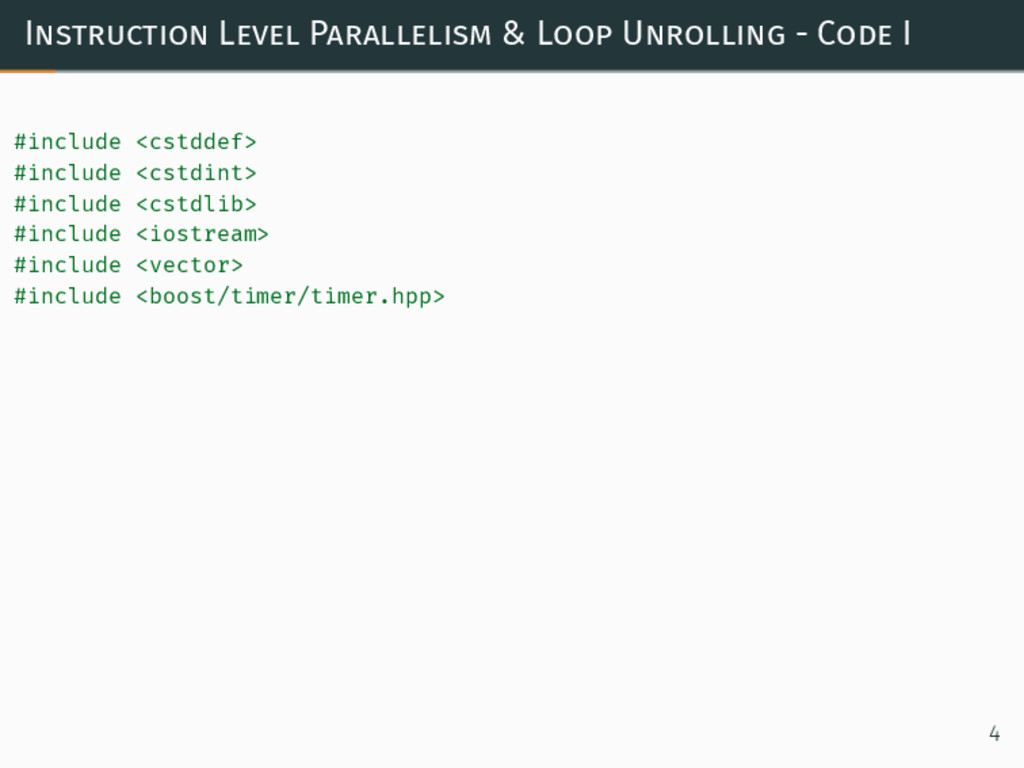
Instruction Level Parallelism & Loop Unrolling - Code I #include
<cstddef> #include <cstdint> #include <cstdlib> #include <iostream> #include <vector> #include <boost/timer/timer.hpp> 4 -
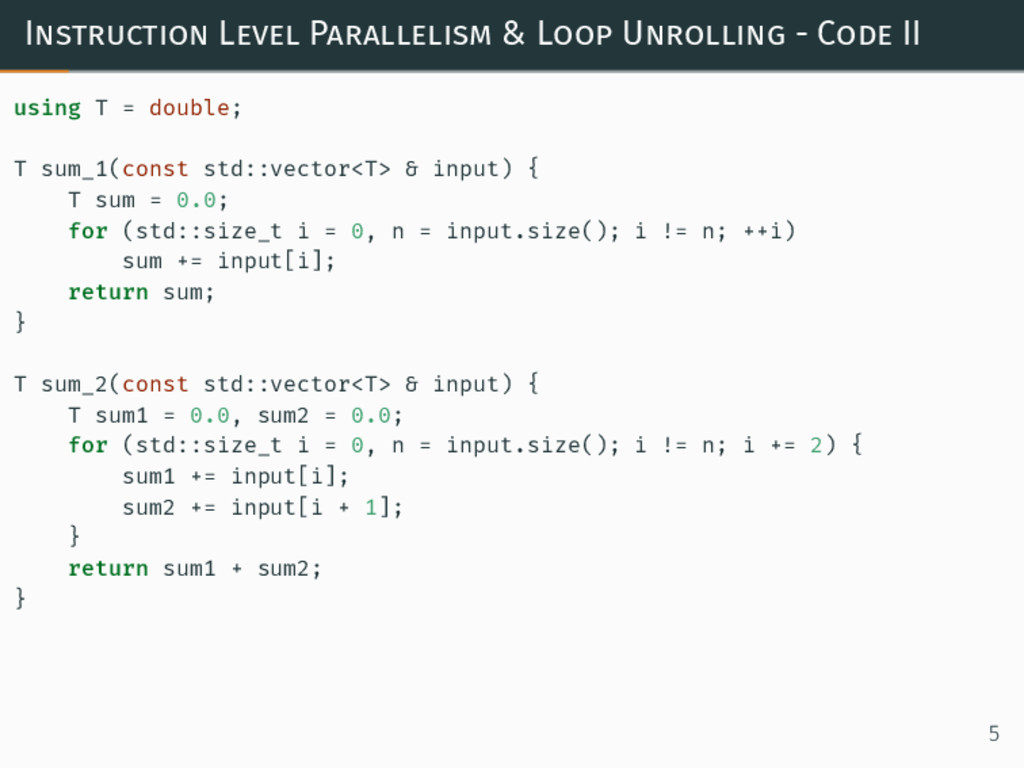
Instruction Level Parallelism & Loop Unrolling - Code II using
T = double; T sum_1(const std::vector<T> & input) { T sum = 0.0; for (std::size_t i = 0, n = input.size(); i != n; ++i) sum += input[i]; return sum; } T sum_2(const std::vector<T> & input) { T sum1 = 0.0, sum2 = 0.0; for (std::size_t i = 0, n = input.size(); i != n; i += 2) { sum1 += input[i]; sum2 += input[i + 1]; } return sum1 + sum2; } 5 -
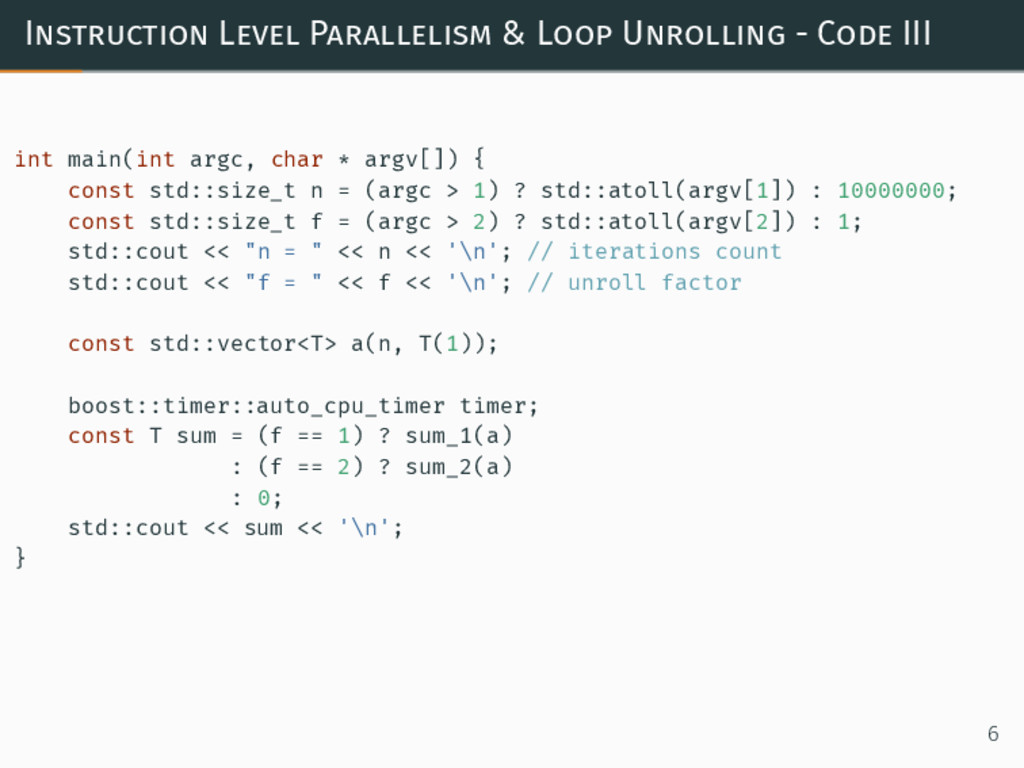
Instruction Level Parallelism & Loop Unrolling - Code III int
main(int argc, char * argv[]) { const std::size_t n = (argc > 1) ? std::atoll(argv[1]) : 10000000; const std::size_t f = (argc > 2) ? std::atoll(argv[2]) : 1; std::cout << "n = " << n << '\n'; // iterations count std::cout << "f = " << f << '\n'; // unroll factor const std::vector<T> a(n, T(1)); boost::timer::auto_cpu_timer timer; const T sum = (f == 1) ? sum_1(a) : (f == 2) ? sum_2(a) : 0; std::cout << sum << '\n'; } 6 -
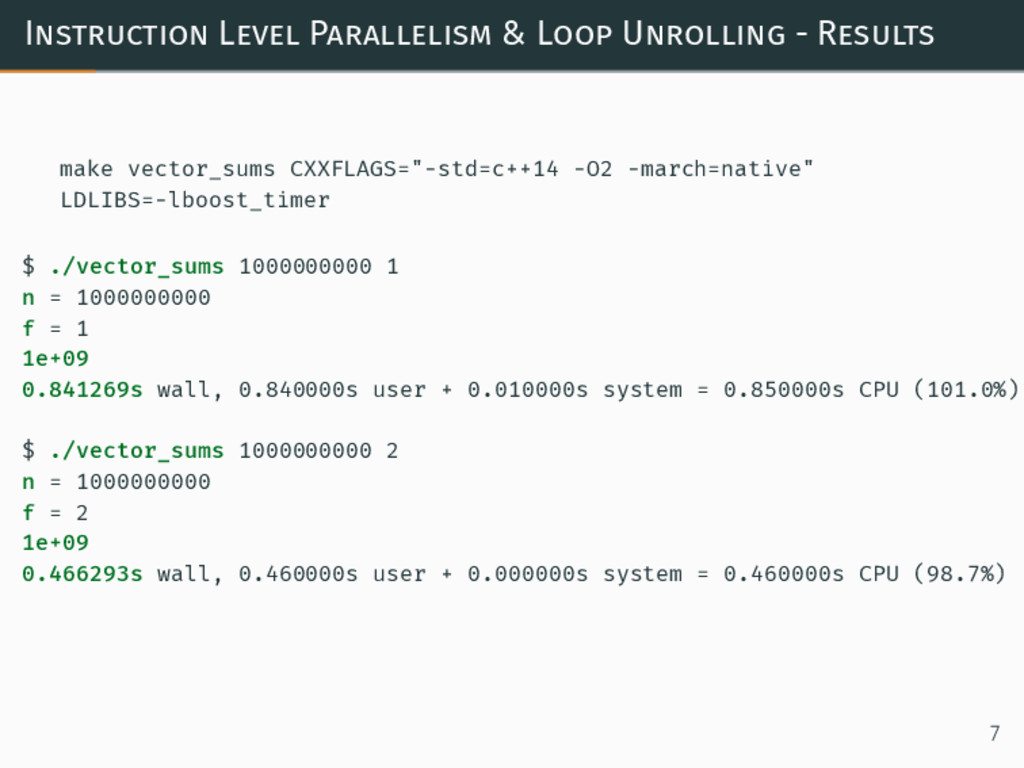
Instruction Level Parallelism & Loop Unrolling - Results make vector_sums
CXXFLAGS="-std=c++14 -O2 -march=native" LDLIBS=-lboost_timer $ ./vector_sums 1000000000 1 n = 1000000000 f = 1 1e+09 0.841269s wall, 0.840000s user + 0.010000s system = 0.850000s CPU (101.0%) $ ./vector_sums 1000000000 2 n = 1000000000 f = 2 1e+09 0.466293s wall, 0.460000s user + 0.000000s system = 0.460000s CPU (98.7%) 7 -
Microarchitecture Intel® 64 and IA-32 Architectures Optimization Reference Manual https://www-ssl.intel.com/content/www/us/en/architecture-and-
technology/64-ia-32-architectures-optimization-manual.html 8 -
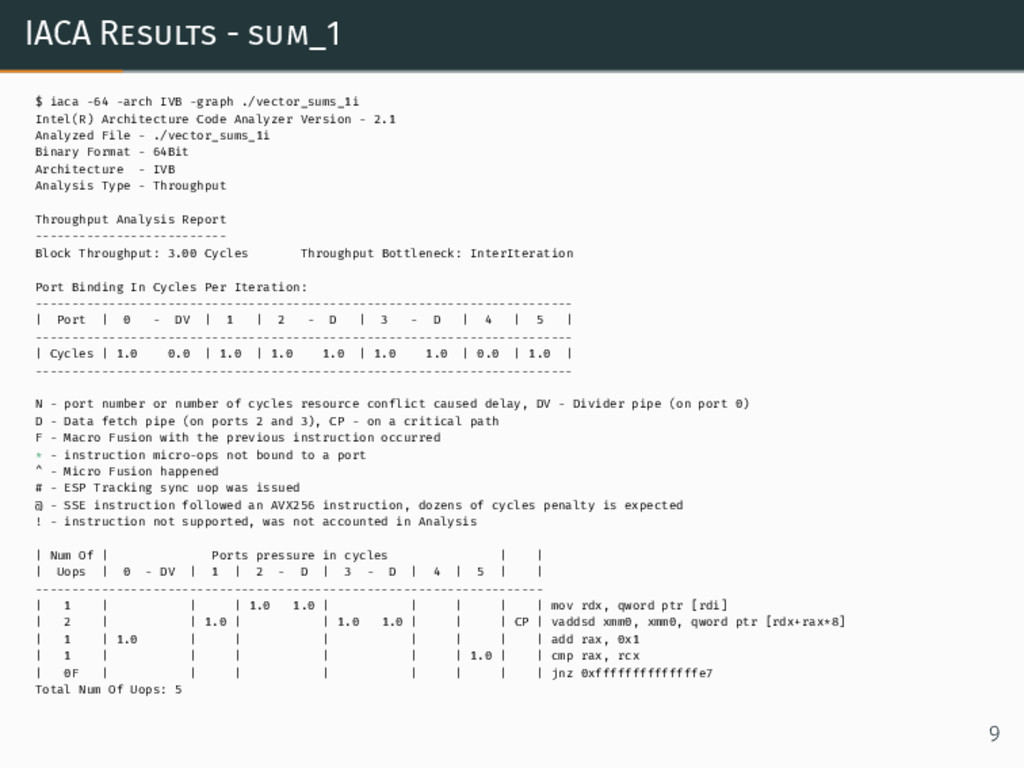
IACA Results - sum_1 $ iaca -64 -arch IVB -graph
./vector_sums_1i Intel(R) Architecture Code Analyzer Version - 2.1 Analyzed File - ./vector_sums_1i Binary Format - 64Bit Architecture - IVB Analysis Type - Throughput Throughput Analysis Report -------------------------- Block Throughput: 3.00 Cycles Throughput Bottleneck: InterIteration Port Binding In Cycles Per Iteration: ------------------------------------------------------------------------- | Port | 0 - DV | 1 | 2 - D | 3 - D | 4 | 5 | ------------------------------------------------------------------------- | Cycles | 1.0 0.0 | 1.0 | 1.0 1.0 | 1.0 1.0 | 0.0 | 1.0 | ------------------------------------------------------------------------- N - port number or number of cycles resource conflict caused delay, DV - Divider pipe (on port 0) D - Data fetch pipe (on ports 2 and 3), CP - on a critical path F - Macro Fusion with the previous instruction occurred * - instruction micro-ops not bound to a port ^ - Micro Fusion happened # - ESP Tracking sync uop was issued @ - SSE instruction followed an AVX256 instruction, dozens of cycles penalty is expected ! - instruction not supported, was not accounted in Analysis | Num Of | Ports pressure in cycles | | | Uops | 0 - DV | 1 | 2 - D | 3 - D | 4 | 5 | | --------------------------------------------------------------------- | 1 | | | 1.0 1.0 | | | | | mov rdx, qword ptr [rdi] | 2 | | 1.0 | | 1.0 1.0 | | | CP | vaddsd xmm0, xmm0, qword ptr [rdx+rax*8] | 1 | 1.0 | | | | | | | add rax, 0x1 | 1 | | | | | | 1.0 | | cmp rax, rcx | 0F | | | | | | | | jnz 0xffffffffffffffe7 Total Num Of Uops: 5 9 -
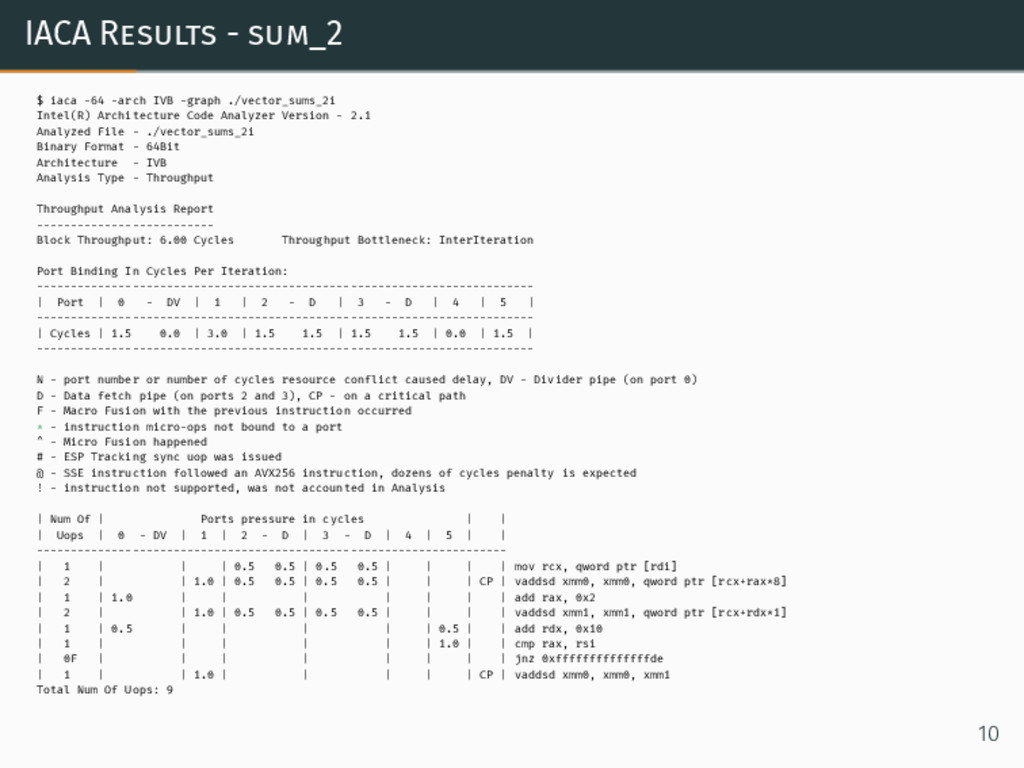
IACA Results - sum_2 $ iaca -64 -arch IVB -graph
./vector_sums_2i Intel(R) Architecture Code Analyzer Version - 2.1 Analyzed File - ./vector_sums_2i Binary Format - 64Bit Architecture - IVB Analysis Type - Throughput Throughput Analysis Report -------------------------- Block Throughput: 6.00 Cycles Throughput Bottleneck: InterIteration Port Binding In Cycles Per Iteration: ------------------------------------------------------------------------- | Port | 0 - DV | 1 | 2 - D | 3 - D | 4 | 5 | ------------------------------------------------------------------------- | Cycles | 1.5 0.0 | 3.0 | 1.5 1.5 | 1.5 1.5 | 0.0 | 1.5 | ------------------------------------------------------------------------- N - port number or number of cycles resource conflict caused delay, DV - Divider pipe (on port 0) D - Data fetch pipe (on ports 2 and 3), CP - on a critical path F - Macro Fusion with the previous instruction occurred * - instruction micro-ops not bound to a port ^ - Micro Fusion happened # - ESP Tracking sync uop was issued @ - SSE instruction followed an AVX256 instruction, dozens of cycles penalty is expected ! - instruction not supported, was not accounted in Analysis | Num Of | Ports pressure in cycles | | | Uops | 0 - DV | 1 | 2 - D | 3 - D | 4 | 5 | | --------------------------------------------------------------------- | 1 | | | 0.5 0.5 | 0.5 0.5 | | | | mov rcx, qword ptr [rdi] | 2 | | 1.0 | 0.5 0.5 | 0.5 0.5 | | | CP | vaddsd xmm0, xmm0, qword ptr [rcx+rax*8] | 1 | 1.0 | | | | | | | add rax, 0x2 | 2 | | 1.0 | 0.5 0.5 | 0.5 0.5 | | | | vaddsd xmm1, xmm1, qword ptr [rcx+rdx*1] | 1 | 0.5 | | | | | 0.5 | | add rdx, 0x10 | 1 | | | | | | 1.0 | | cmp rax, rsi | 0F | | | | | | | | jnz 0xffffffffffffffde | 1 | | 1.0 | | | | | CP | vaddsd xmm0, xmm0, xmm1 Total Num Of Uops: 9 10 -
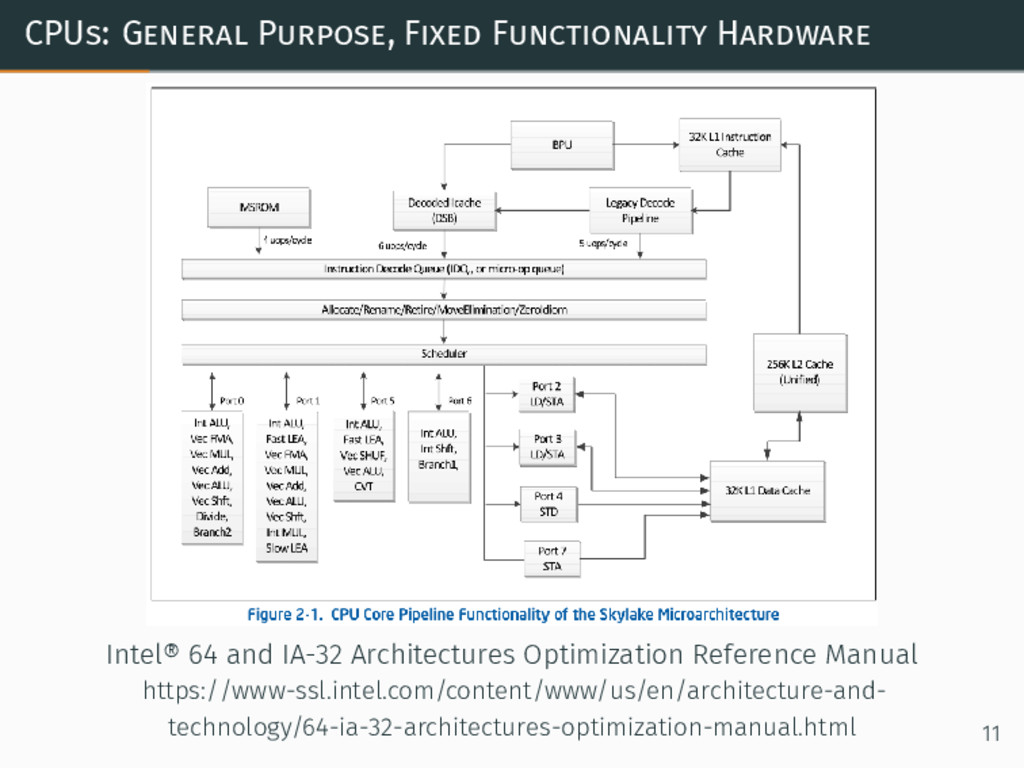
CPUs: General Purpose, Fixed Functionality Hardware Intel® 64 and IA-32
Architectures Optimization Reference Manual https://www-ssl.intel.com/content/www/us/en/architecture-and- technology/64-ia-32-architectures-optimization-manual.html 11 -
CPUs: General Purpose, Fixed Functionality Hardware General purpose flexibility –
not always needed at all costs. What if we need custom pipelines with more/custom functional units? 12 -
FPGAs: Custom Purpose, Reconfigurable Hardware We'll make our own functional
units! With look-up-tables and flip-flops! 13 -
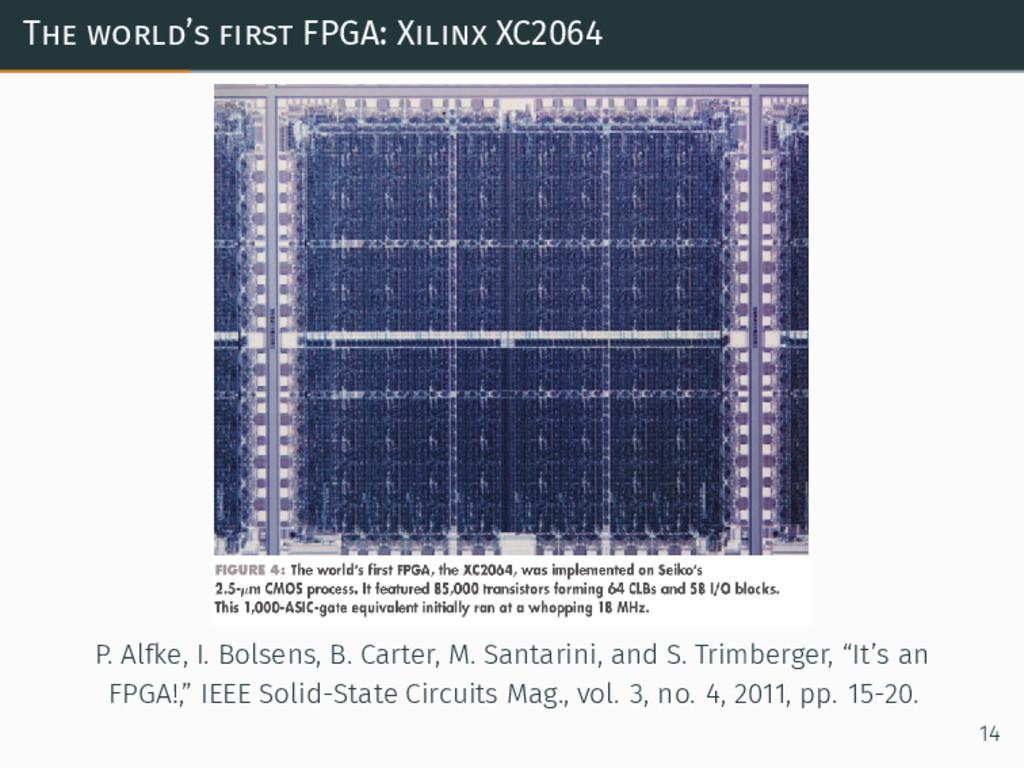
The world’s first FPGA: Xilinx XC2064 P. Alfke, I. Bolsens,
B. Carter, M. Santarini, and S. Trimberger, “It’s an FPGA!,” IEEE Solid-State Circuits Mag., vol. 3, no. 4, 2011, pp. 15-20. 14 -
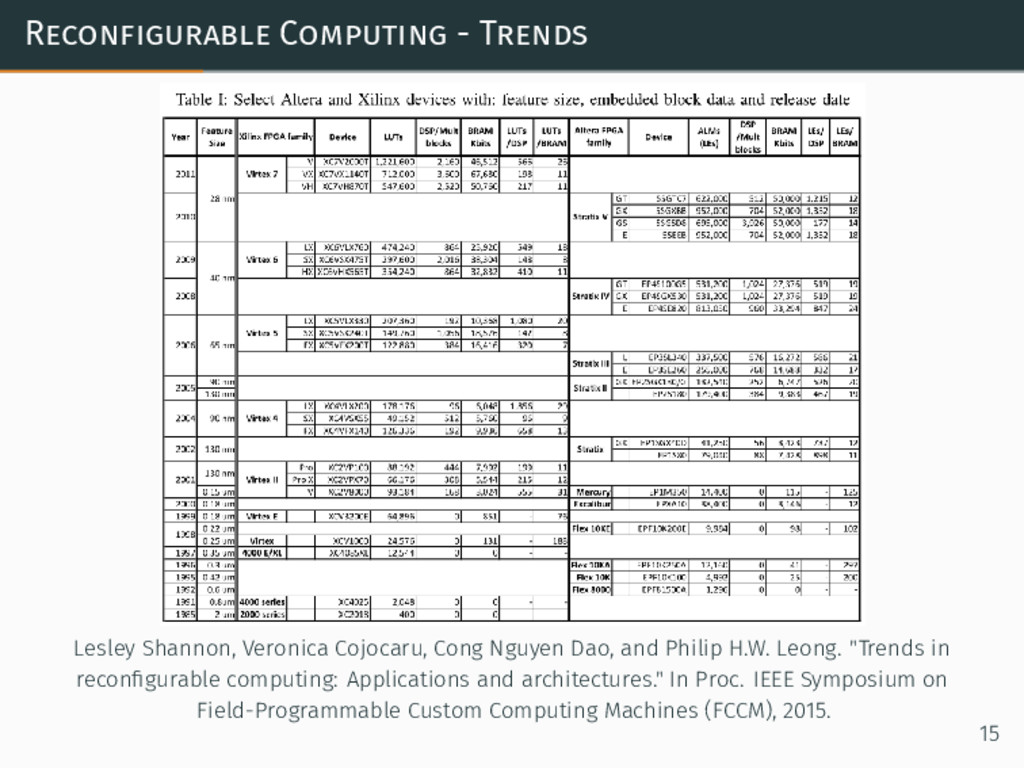
Reconfigurable Computing - Trends Lesley Shannon, Veronica Cojocaru, Cong Nguyen
Dao, and Philip H.W. Leong. "Trends in reconfigurable computing: Applications and architectures." In Proc. IEEE Symposium on Field-Programmable Custom Computing Machines (FCCM), 2015. 15 -
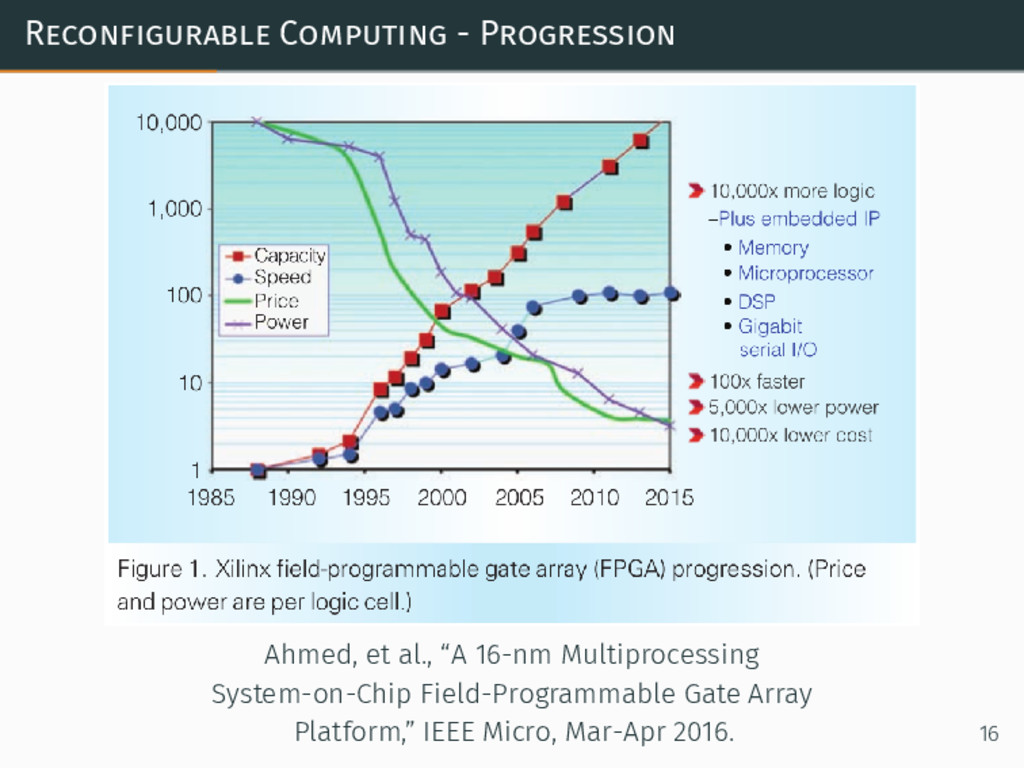
Reconfigurable Computing - Progression Ahmed, et al., “A 16-nm Multiprocessing
System-on-Chip Field-Programmable Gate Array Platform,” IEEE Micro, Mar-Apr 2016. 16 -
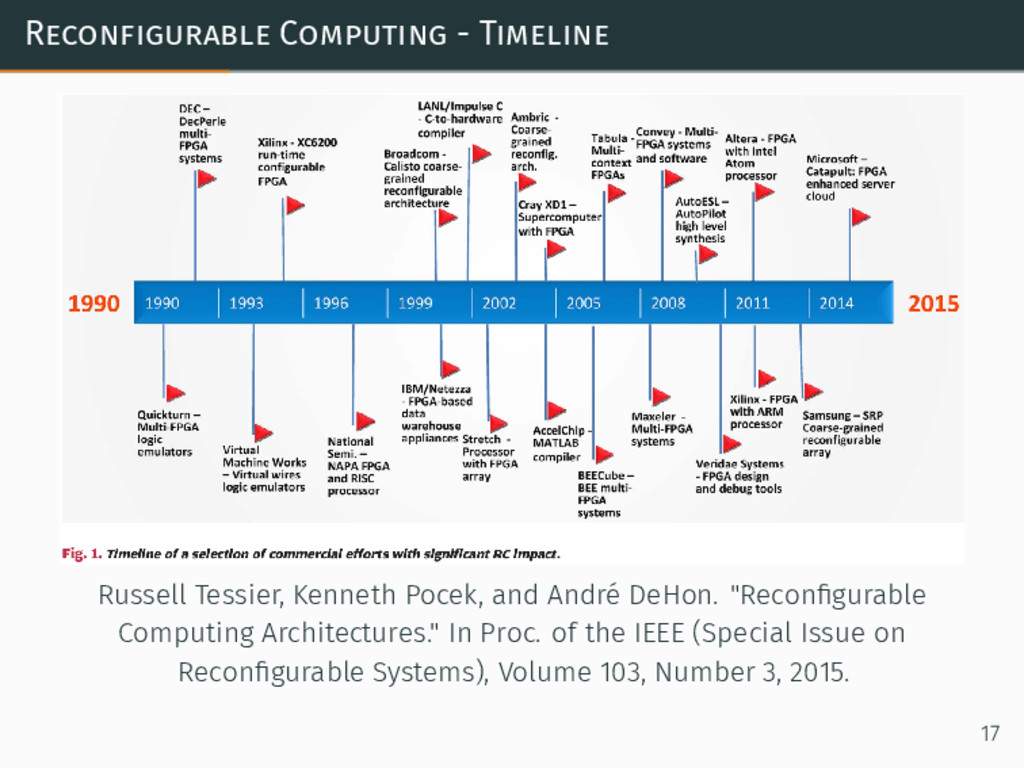
Reconfigurable Computing - Timeline Russell Tessier, Kenneth Pocek, and André
DeHon. "Reconfigurable Computing Architectures." In Proc. of the IEEE (Special Issue on Reconfigurable Systems), Volume 103, Number 3, 2015. 17 -
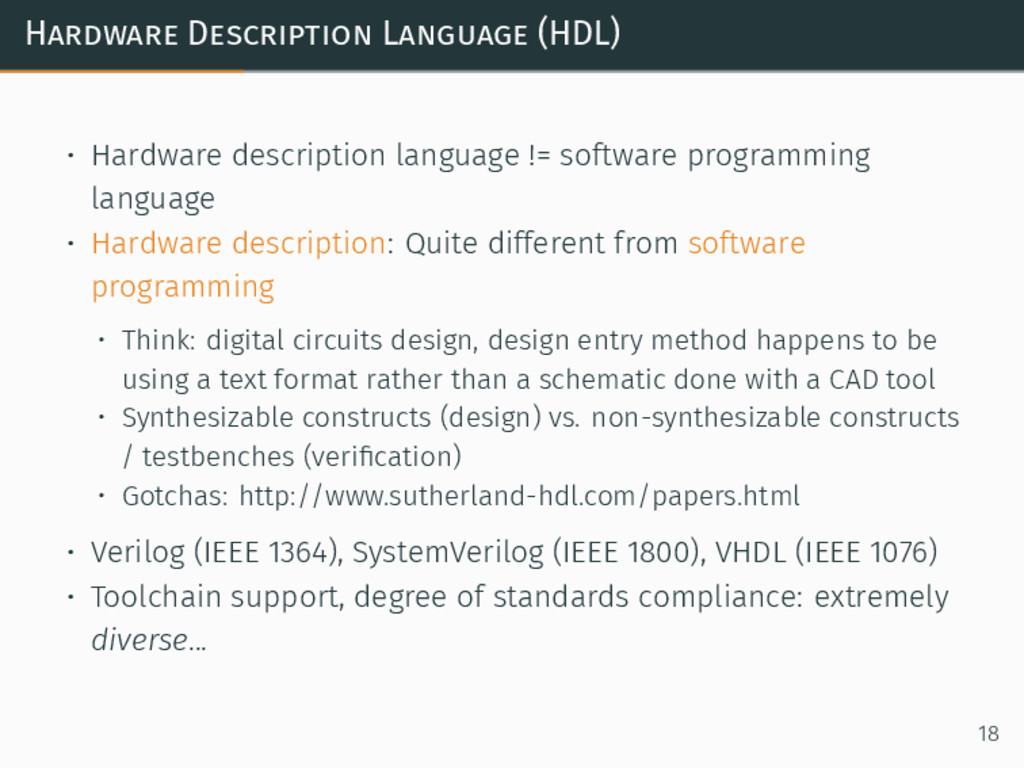
Hardware Description Language (HDL) • Hardware description language != software
programming language • Hardware description: Quite different from software programming • Think: digital circuits design, design entry method happens to be using a text format rather than a schematic done with a CAD tool • Synthesizable constructs (design) vs. non-synthesizable constructs / testbenches (verification) • Gotchas: http://www.sutherland-hdl.com/papers.html • Verilog (IEEE 1364), SystemVerilog (IEEE 1800), VHDL (IEEE 1076) • Toolchain support, degree of standards compliance: extremely diverse... 18 -
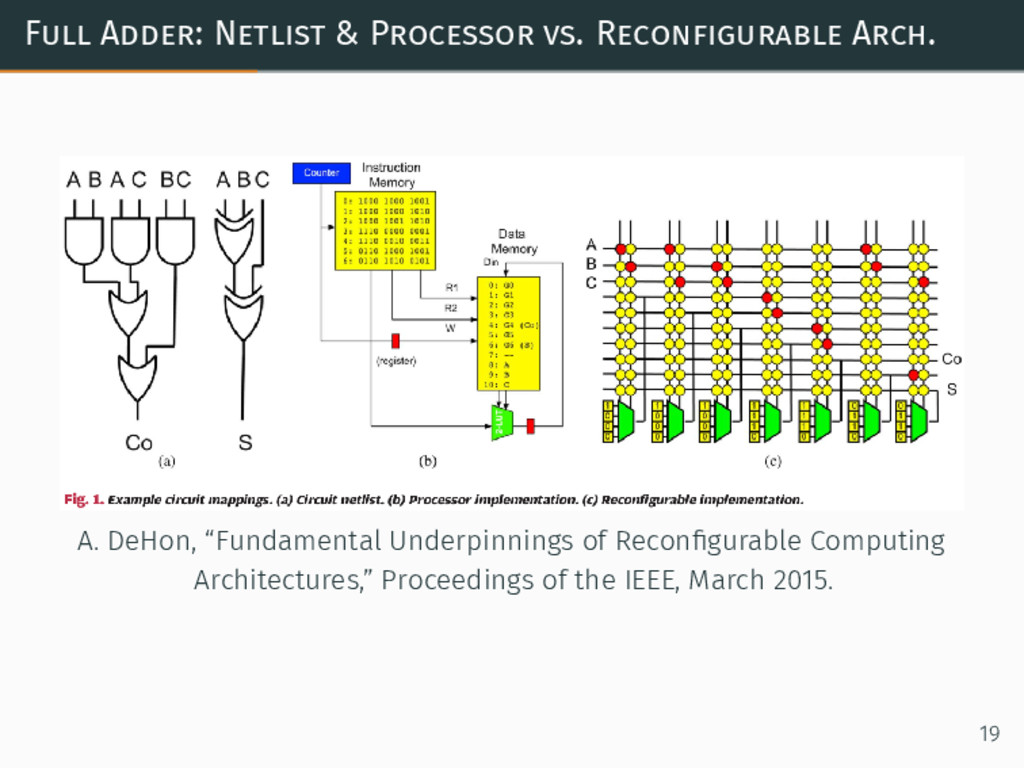
Full Adder: Netlist & Processor vs. Reconfigurable Arch. A. DeHon,
“Fundamental Underpinnings of Reconfigurable Computing Architectures,” Proceedings of the IEEE, March 2015. 19 -
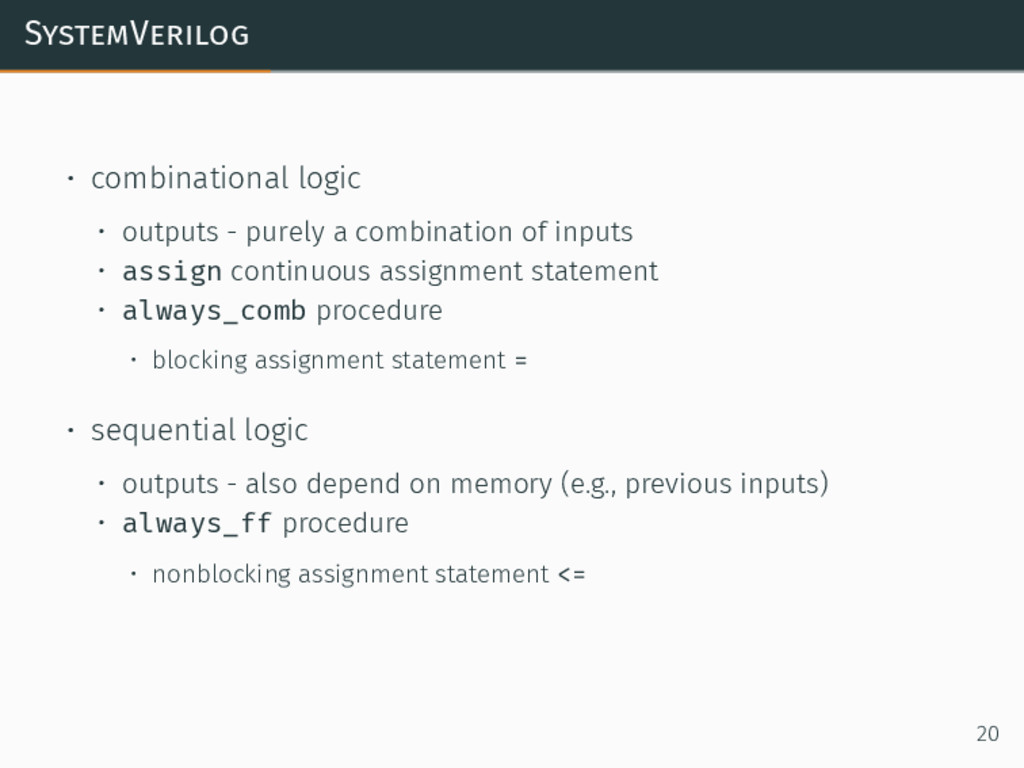
SystemVerilog • combinational logic • outputs - purely a combination
of inputs • assign continuous assignment statement • always_comb procedure • blocking assignment statement = • sequential logic • outputs - also depend on memory (e.g., previous inputs) • always_ff procedure • nonblocking assignment statement <= 20 -
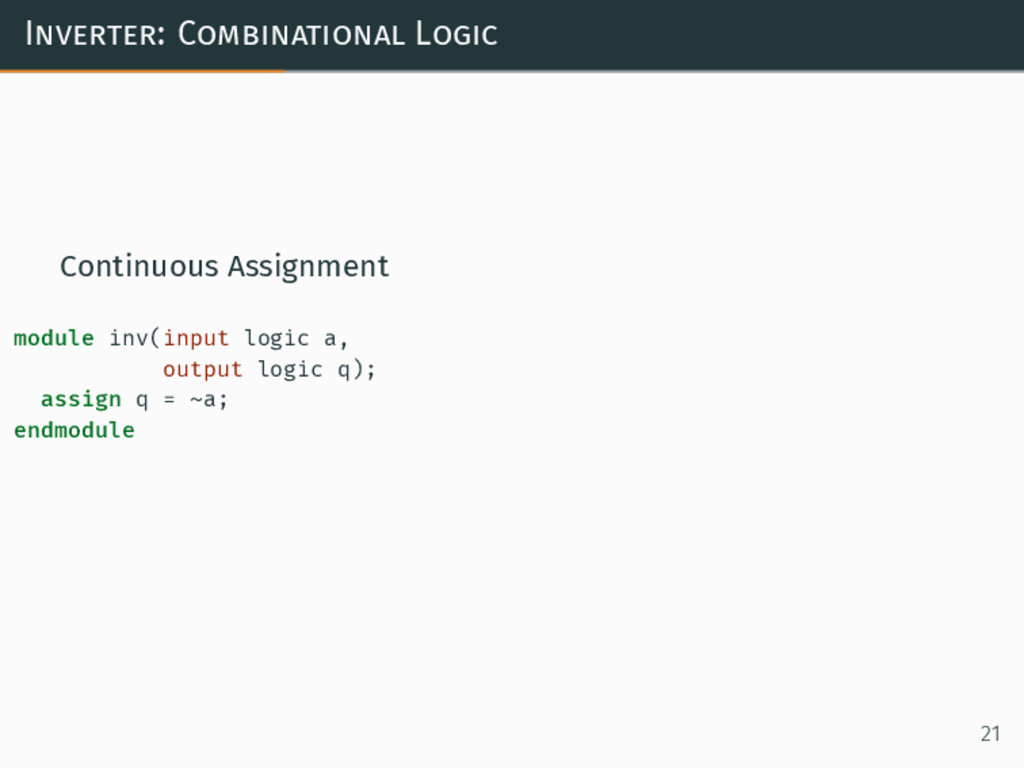
Inverter: Combinational Logic Continuous Assignment module inv(input logic a, output
logic q); assign q = ~a; endmodule 21 -
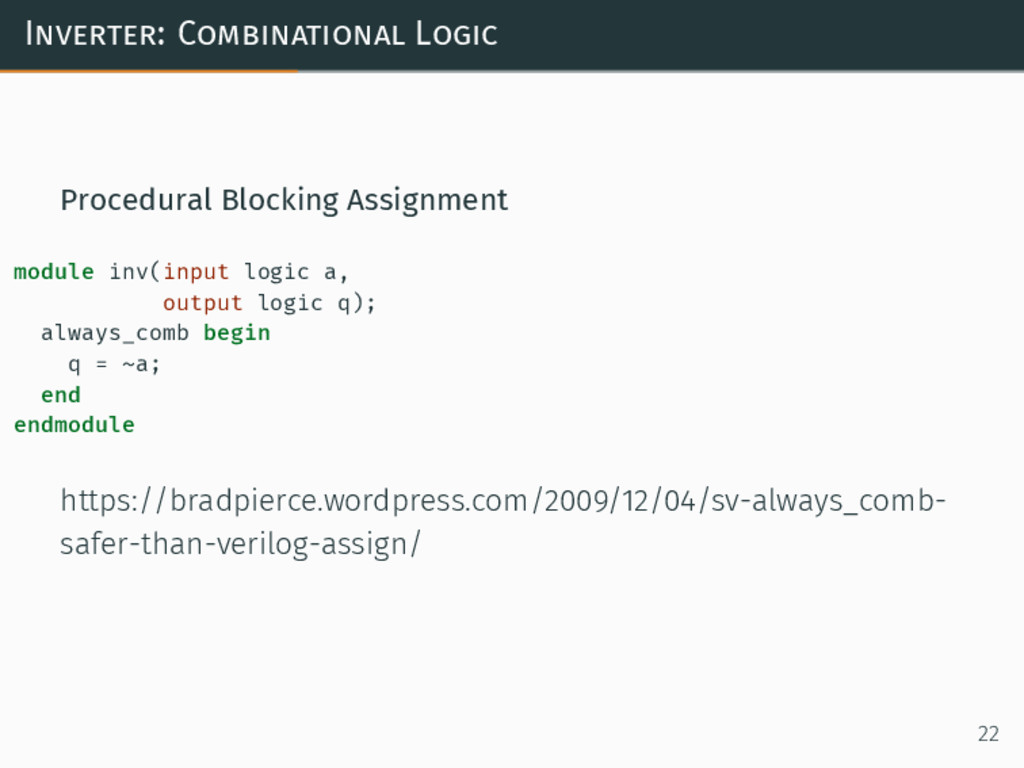
Inverter: Combinational Logic Procedural Blocking Assignment module inv(input logic a,
output logic q); always_comb begin q = ~a; end endmodule https://bradpierce.wordpress.com/2009/12/04/sv-always_comb- safer-than-verilog-assign/ 22 -
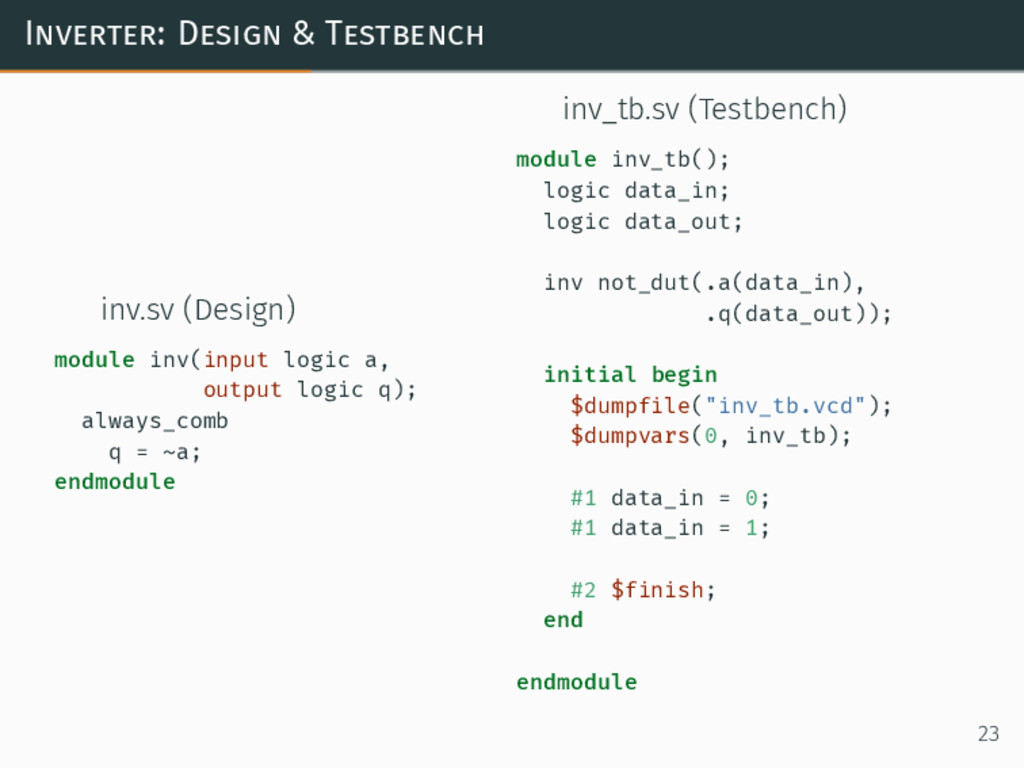
Inverter: Design & Testbench inv.sv (Design) module inv(input logic a,
output logic q); always_comb q = ~a; endmodule inv_tb.sv (Testbench) module inv_tb(); logic data_in; logic data_out; inv not_dut(.a(data_in), .q(data_out)); initial begin $dumpfile("inv_tb.vcd"); $dumpvars(0, inv_tb); #1 data_in = 0; #1 data_in = 1; #2 $finish; end endmodule 23 -
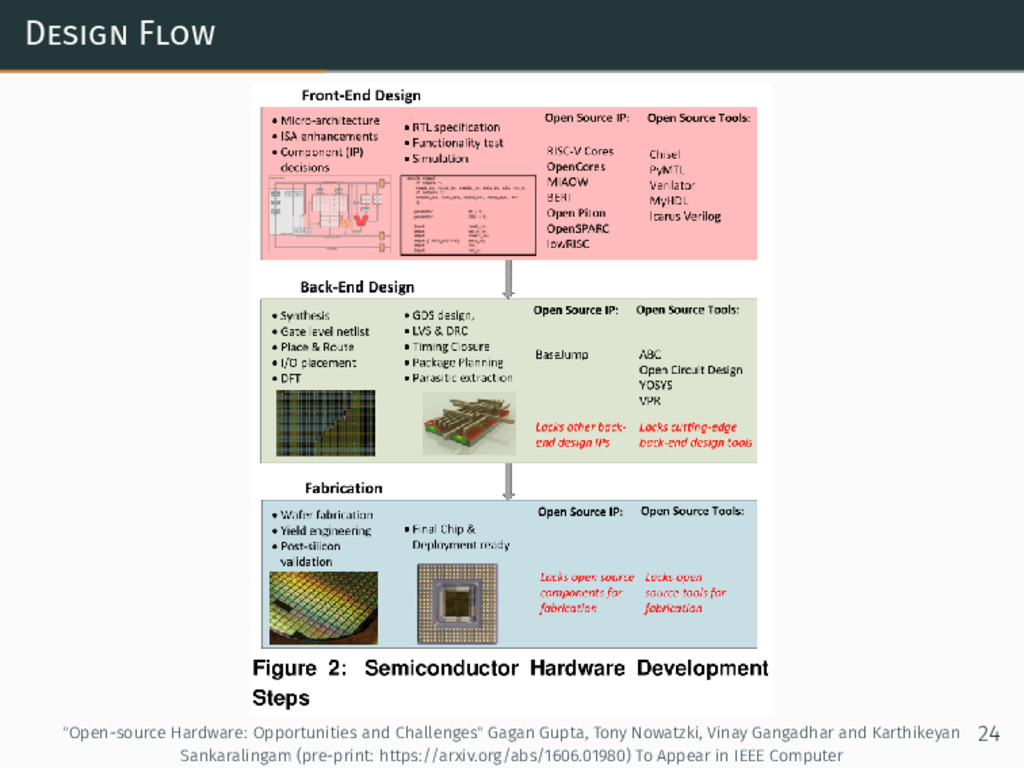
Design Flow "Open-source Hardware: Opportunities and Challenges" Gagan Gupta, Tony
Nowatzki, Vinay Gangadhar and Karthikeyan Sankaralingam (pre-print: https://arxiv.org/abs/1606.01980) To Appear in IEEE Computer 24 -
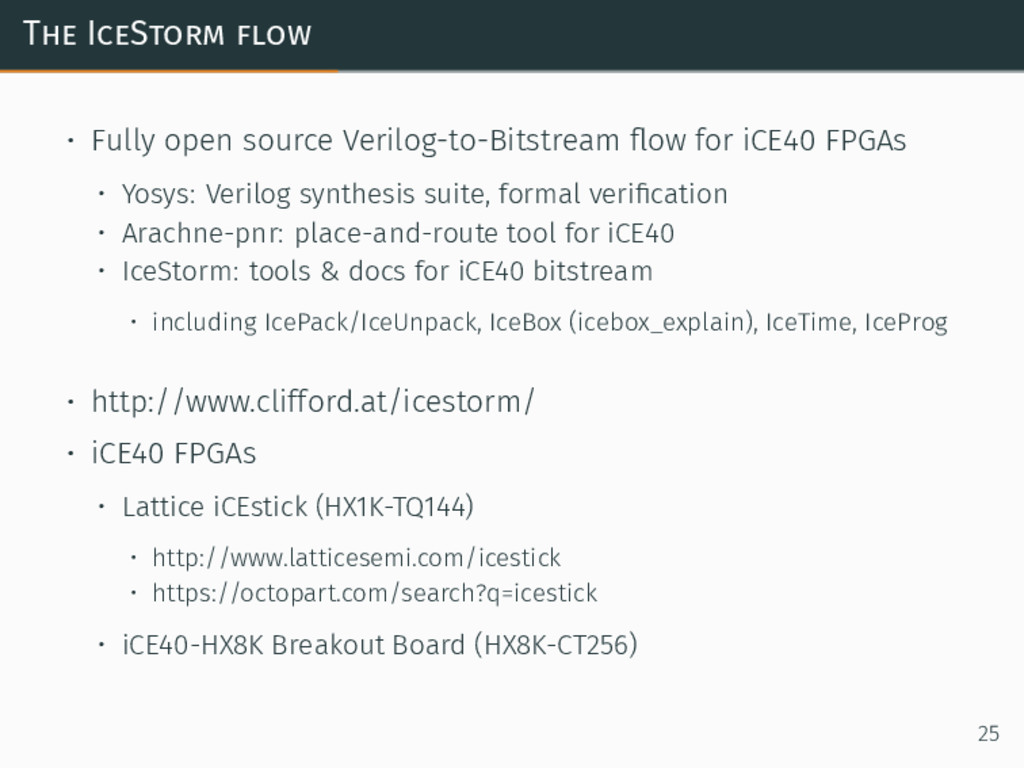
The IceStorm flow • Fully open source Verilog-to-Bitstream flow for
iCE40 FPGAs • Yosys: Verilog synthesis suite, formal verification • Arachne-pnr: place-and-route tool for iCE40 • IceStorm: tools & docs for iCE40 bitstream • including IcePack/IceUnpack, IceBox (icebox_explain), IceTime, IceProg • http://www.clifford.at/icestorm/ • iCE40 FPGAs • Lattice iCEstick (HX1K-TQ144) • http://www.latticesemi.com/icestick • https://octopart.com/search?q=icestick • iCE40-HX8K Breakout Board (HX8K-CT256) 25 -
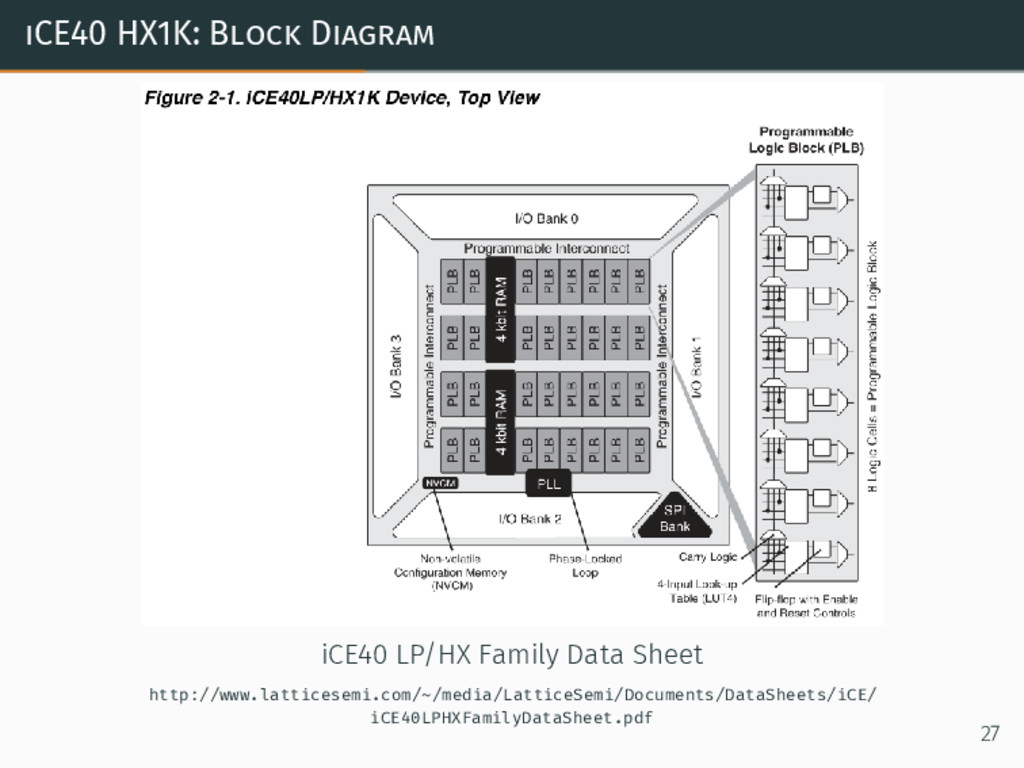
iCE40 HX1K: Block Diagram iCE40 LP/HX Family Data Sheet http://www.latticesemi.com/~/media/LatticeSemi/Documents/DataSheets/iCE/
iCE40LPHXFamilyDataSheet.pdf 27 -
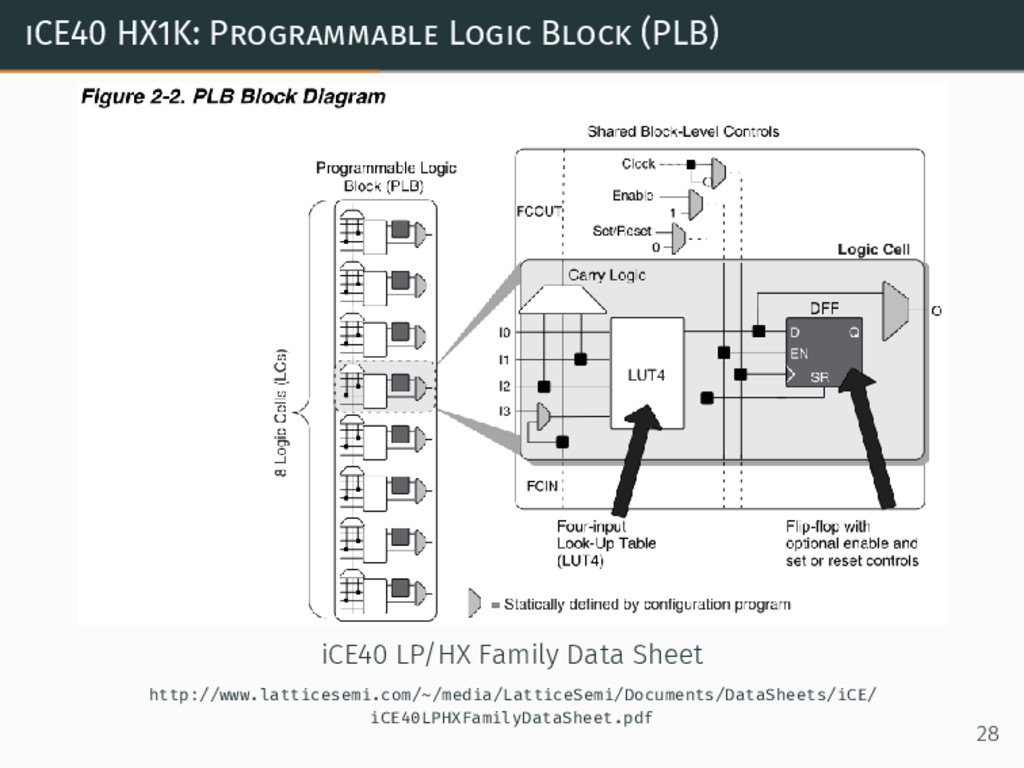
iCE40 HX1K: Programmable Logic Block (PLB) iCE40 LP/HX Family Data
Sheet http://www.latticesemi.com/~/media/LatticeSemi/Documents/DataSheets/iCE/ iCE40LPHXFamilyDataSheet.pdf 28 -
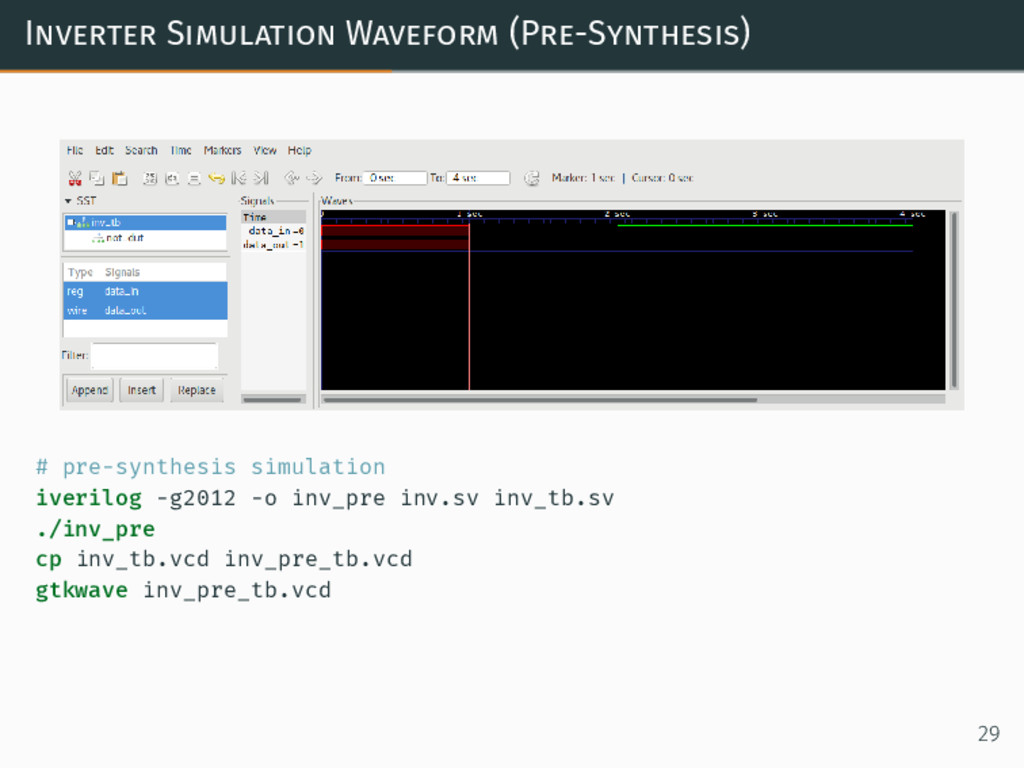
Inverter Simulation Waveform (Pre-Synthesis) # pre-synthesis simulation iverilog -g2012 -o
inv_pre inv.sv inv_tb.sv ./inv_pre cp inv_tb.vcd inv_pre_tb.vcd gtkwave inv_pre_tb.vcd 29 -
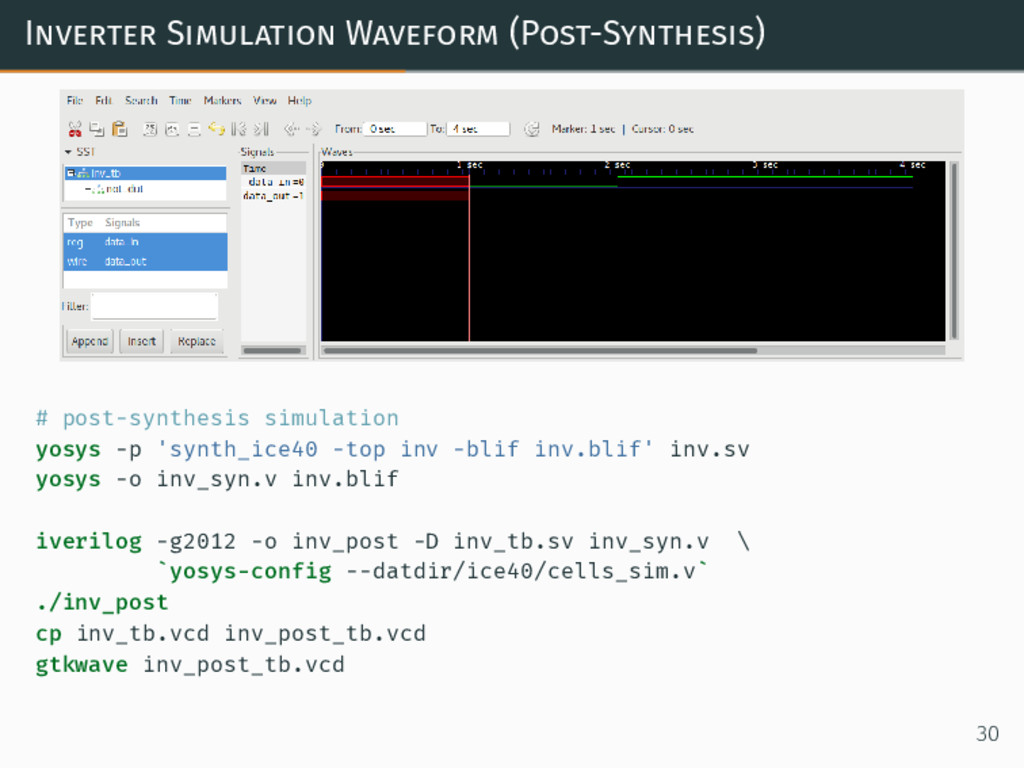
Inverter Simulation Waveform (Post-Synthesis) # post-synthesis simulation yosys -p 'synth_ice40
-top inv -blif inv.blif' inv.sv yosys -o inv_syn.v inv.blif iverilog -g2012 -o inv_post -D inv_tb.sv inv_syn.v \ `yosys-config --datdir/ice40/cells_sim.v` ./inv_post cp inv_tb.vcd inv_post_tb.vcd gtkwave inv_post_tb.vcd 30 -
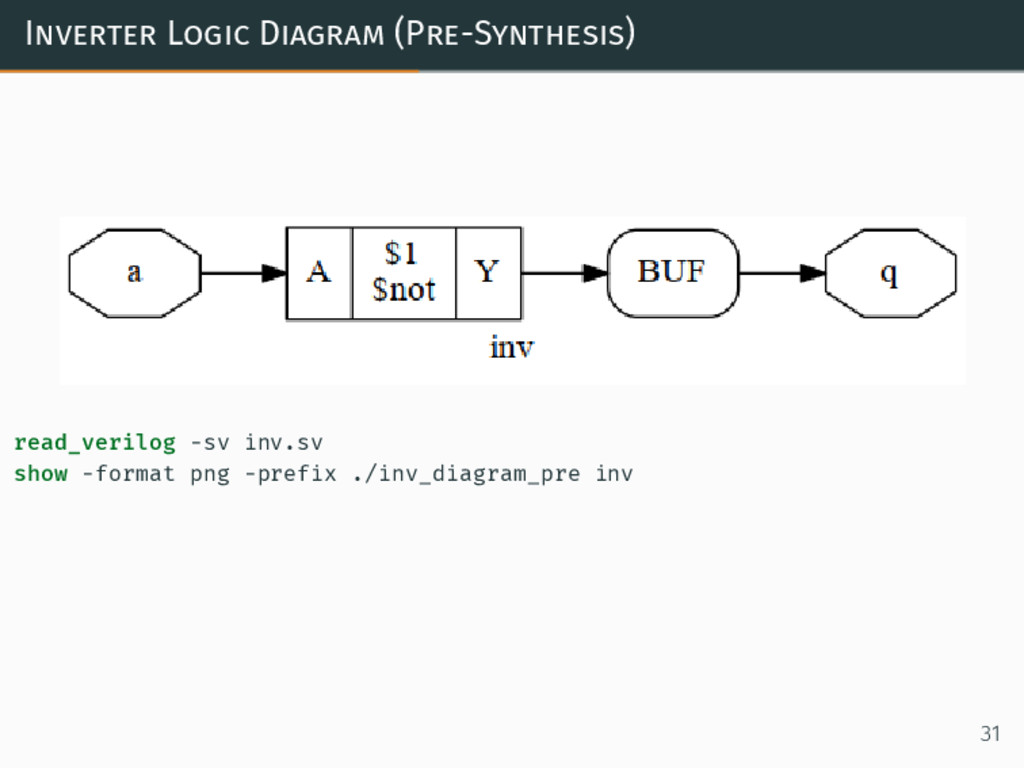
Inverter Logic Diagram (Pre-Synthesis) read_verilog -sv inv.sv show -format png
-prefix ./inv_diagram_pre inv 31 -
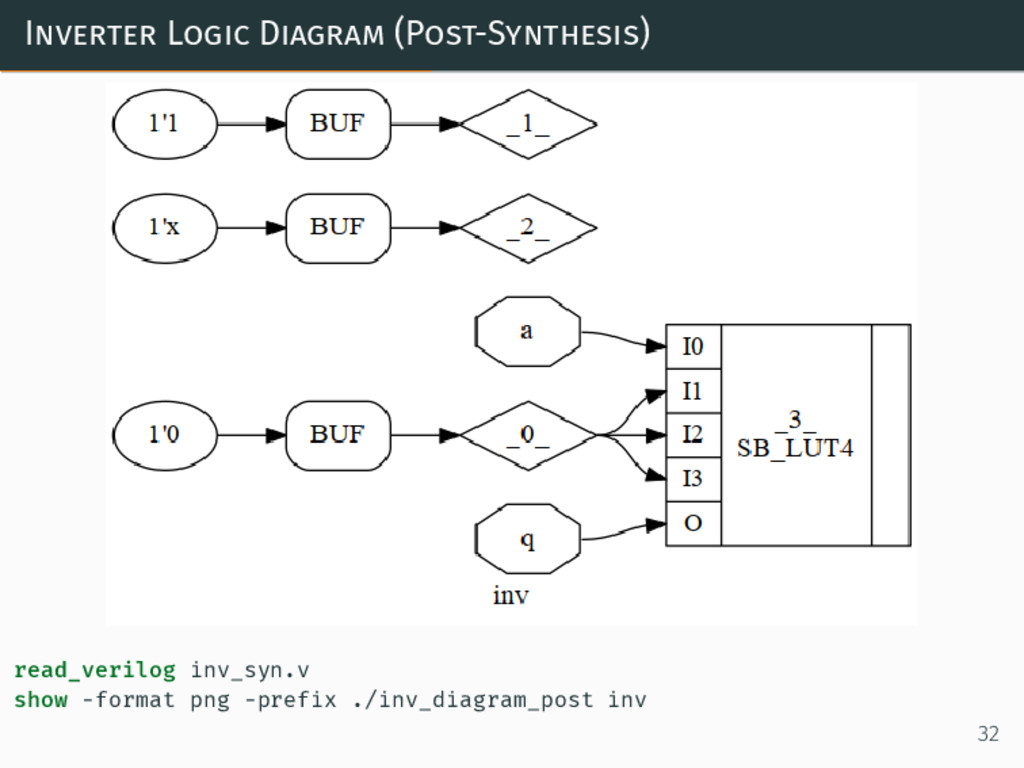
Inverter Logic Diagram (Post-Synthesis) read_verilog inv_syn.v show -format png -prefix
./inv_diagram_post inv 32 -
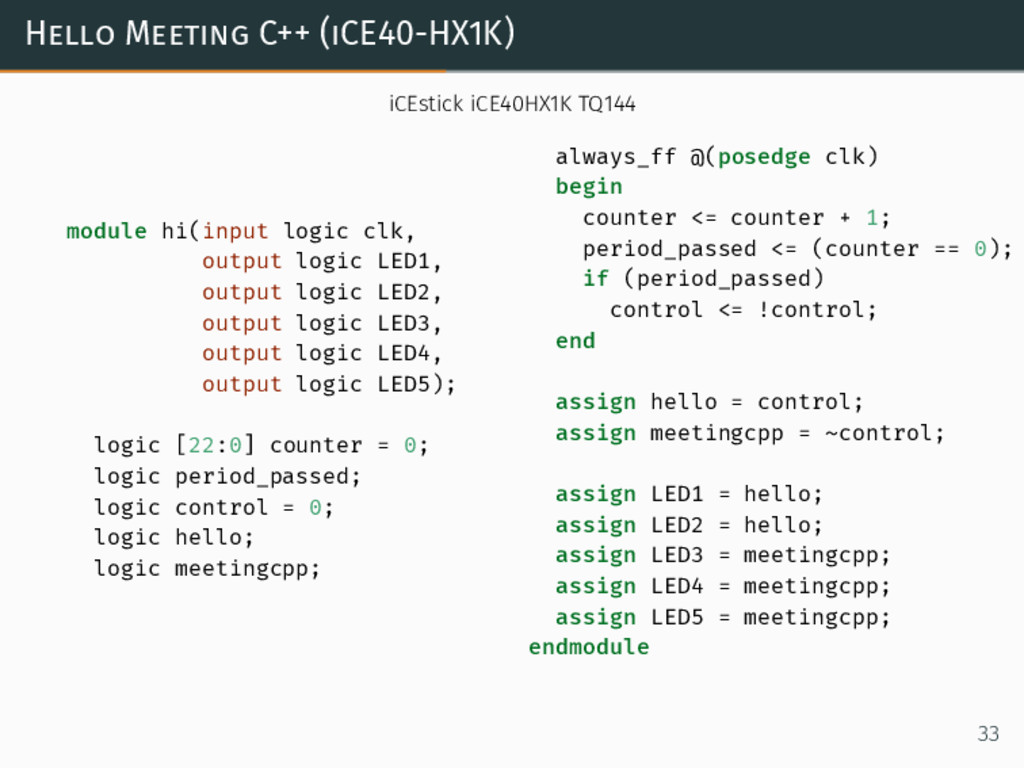
Hello Meeting C++ (iCE40-HX1K) iCEstick iCE40HX1K TQ144 module hi(input logic
clk, output logic LED1, output logic LED2, output logic LED3, output logic LED4, output logic LED5); logic [22:0] counter = 0; logic period_passed; logic control = 0; logic hello; logic meetingcpp; always_ff @(posedge clk) begin counter <= counter + 1; period_passed <= (counter == 0); if (period_passed) control <= !control; end assign hello = control; assign meetingcpp = ~control; assign LED1 = hello; assign LED2 = hello; assign LED3 = meetingcpp; assign LED4 = meetingcpp; assign LED5 = meetingcpp; endmodule 33 -
Hello Meeting C++ (iCE40-HX8K) iCE40-HX8K Breakout Board iCE40HX8K CT256 module
hi(input logic clk, output logic LED1, output logic LED2, output logic LED3, output logic LED4, output logic LED5, output logic LED6, output logic LED7, output logic LED8); logic [22:0] counter = 0; logic period_passed; logic control = 0; logic hello; logic meetingcpp; always_ff @(posedge clk) begin counter <= counter + 1; period_passed <= (counter == 0); if (period_passed) control <= !control; end assign hello = control; assign meetingcpp = ~control; assign LED1 = hello; assign LED2 = hello; assign LED3 = meetingcpp; assign LED4 = meetingcpp; assign LED5 = hello; assign LED6 = meetingcpp; assign LED7 = hello; assign LED8 = meetingcpp; endmodule 34 -
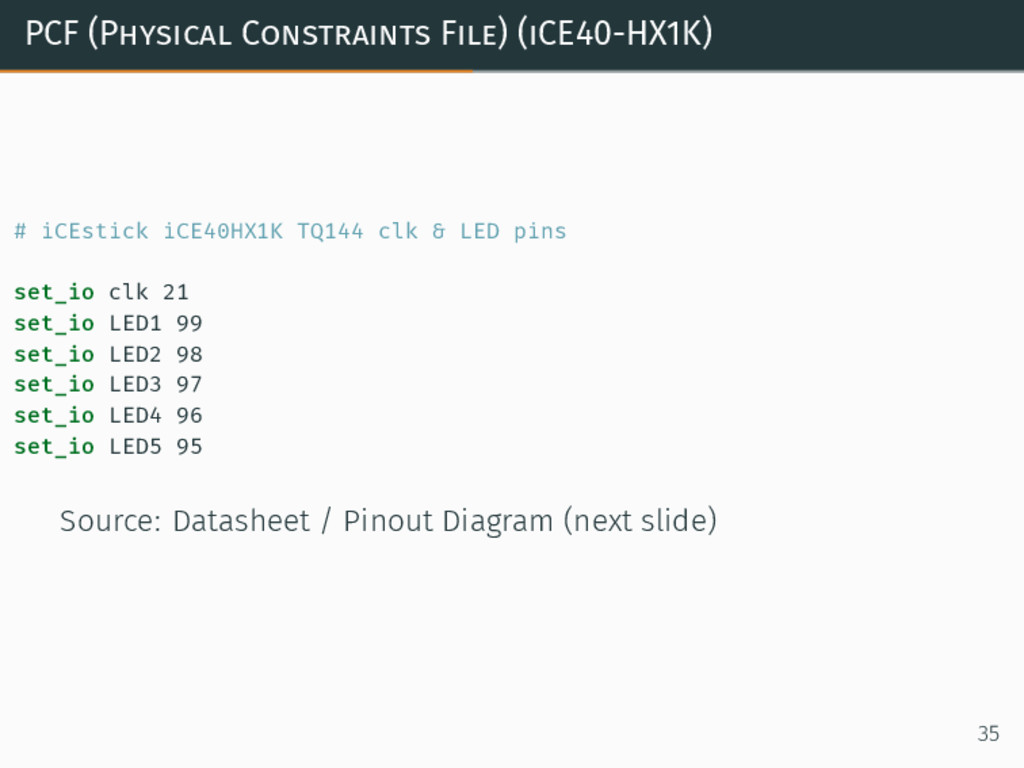
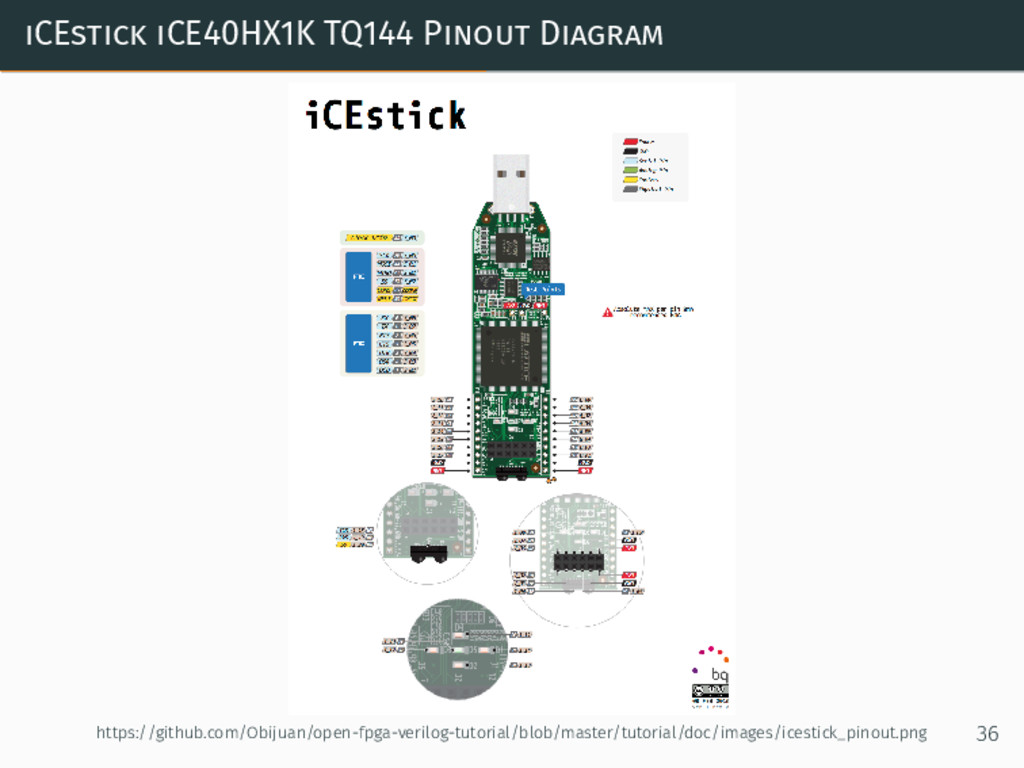
PCF (Physical Constraints File) (iCE40-HX1K) # iCEstick iCE40HX1K TQ144 clk
& LED pins set_io clk 21 set_io LED1 99 set_io LED2 98 set_io LED3 97 set_io LED4 96 set_io LED5 95 Source: Datasheet / Pinout Diagram (next slide) 35 -
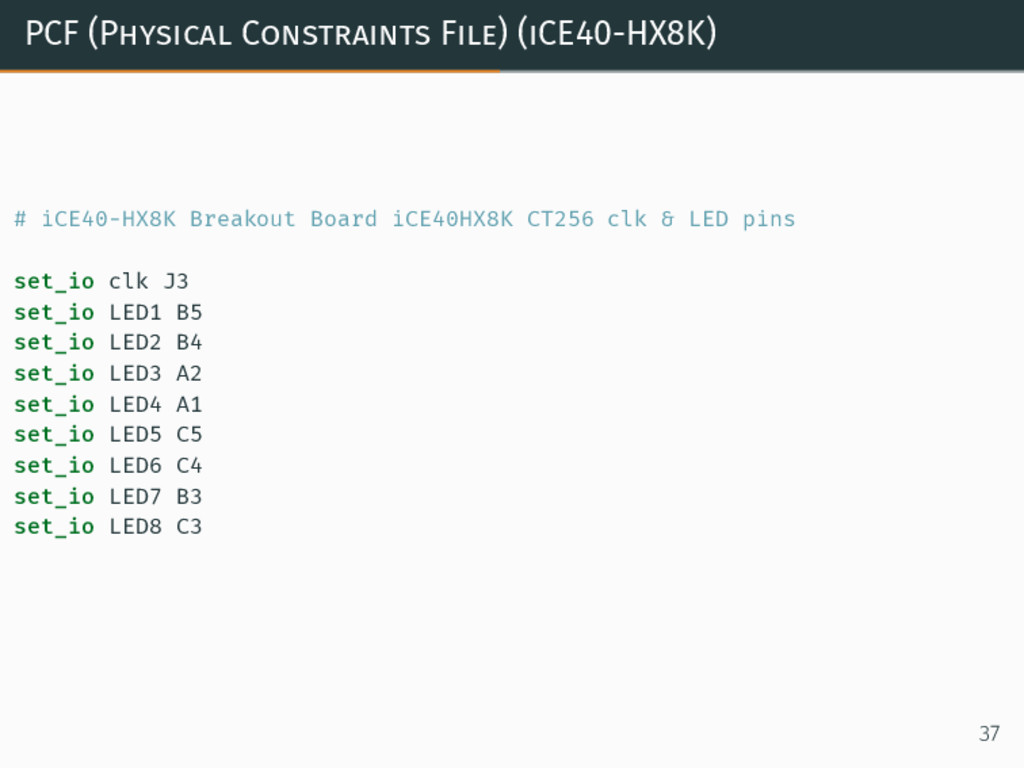
PCF (Physical Constraints File) (iCE40-HX8K) # iCE40-HX8K Breakout Board iCE40HX8K
CT256 clk & LED pins set_io clk J3 set_io LED1 B5 set_io LED2 B4 set_io LED3 A2 set_io LED4 A1 set_io LED5 C5 set_io LED6 C4 set_io LED7 B3 set_io LED8 C3 37 -
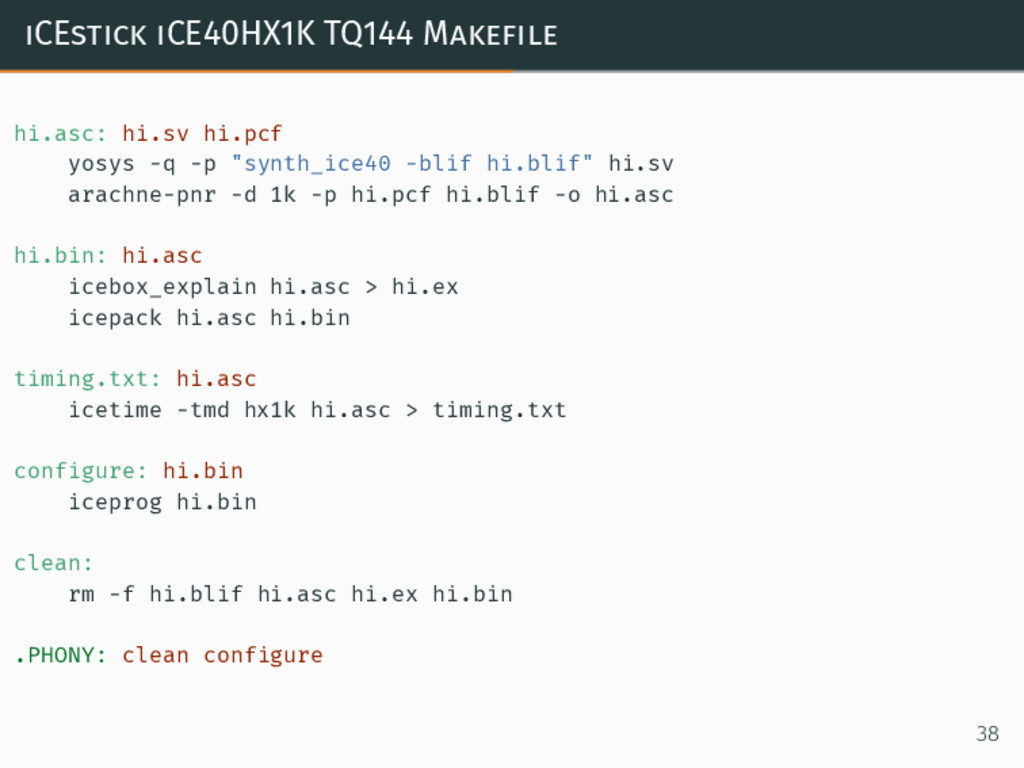
iCEstick iCE40HX1K TQ144 Makefile hi.asc: hi.sv hi.pcf yosys -q -p
"synth_ice40 -blif hi.blif" hi.sv arachne-pnr -d 1k -p hi.pcf hi.blif -o hi.asc hi.bin: hi.asc icebox_explain hi.asc > hi.ex icepack hi.asc hi.bin timing.txt: hi.asc icetime -tmd hx1k hi.asc > timing.txt configure: hi.bin iceprog hi.bin clean: rm -f hi.blif hi.asc hi.ex hi.bin .PHONY: clean configure 38 -
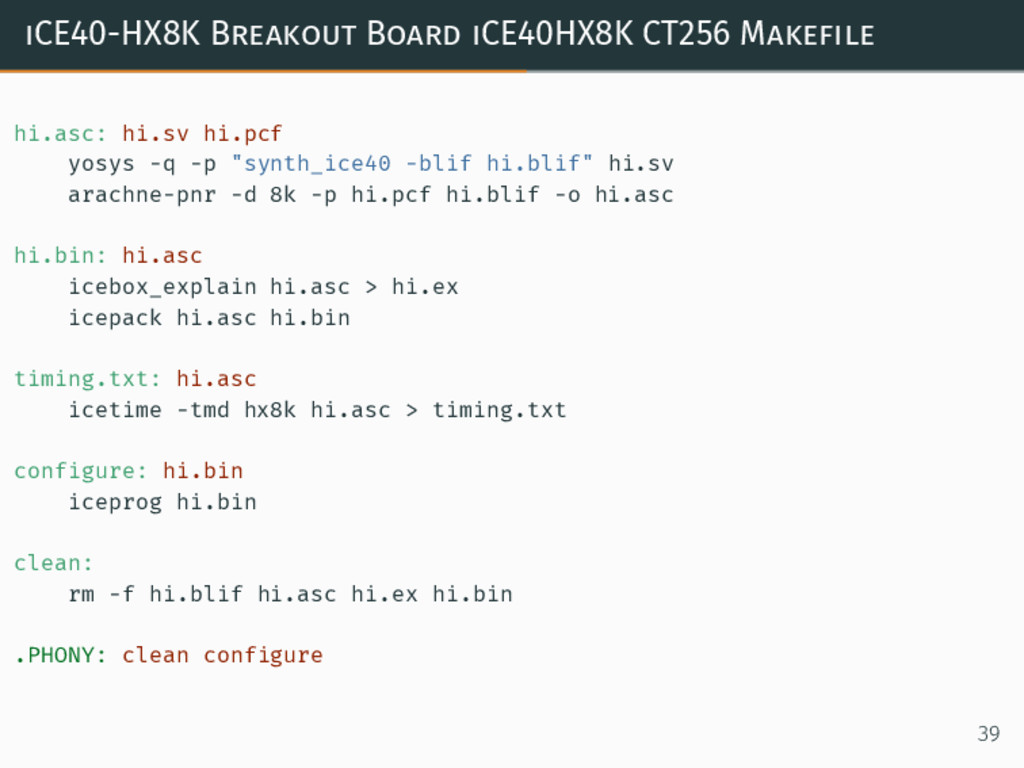
iCE40-HX8K Breakout Board iCE40HX8K CT256 Makefile hi.asc: hi.sv hi.pcf yosys
-q -p "synth_ice40 -blif hi.blif" hi.sv arachne-pnr -d 8k -p hi.pcf hi.blif -o hi.asc hi.bin: hi.asc icebox_explain hi.asc > hi.ex icepack hi.asc hi.bin timing.txt: hi.asc icetime -tmd hx8k hi.asc > timing.txt configure: hi.bin iceprog hi.bin clean: rm -f hi.blif hi.asc hi.ex hi.bin .PHONY: clean configure 39 -
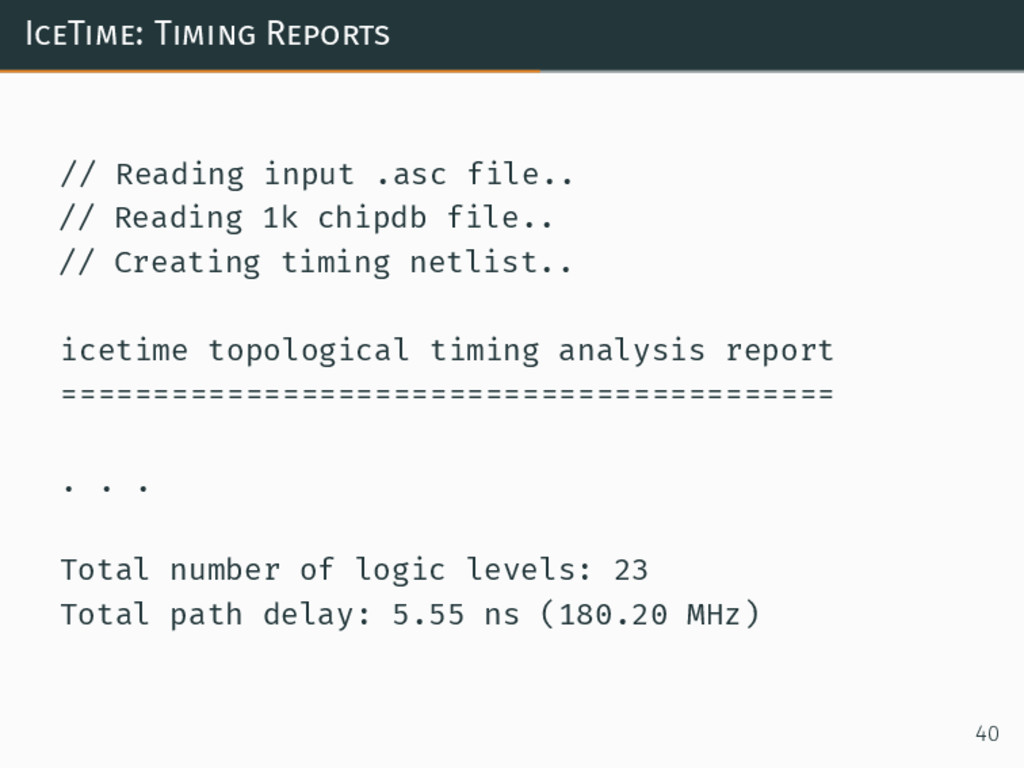
IceTime: Timing Reports // Reading input .asc file.. // Reading
1k chipdb file.. // Creating timing netlist.. icetime topological timing analysis report ========================================== . . . Total number of logic levels: 23 Total path delay: 5.55 ns (180.20 MHz) 40 -
RISC-V RISC-V: The Free and Open RISC Instruction Set Architecture
https://riscv.org/ https://riscv.org/2016/10/5th-risc-v-workshop-agenda/ 42 -
PicoRV32 - A Size-Optimized RISC-V CPU • PicoRV32 - A
Size-Optimized RISC-V CPU https://github.com/cliffordwolf/picorv32 https://github.com/cliffordwolf/picorv32/tree/master/scripts/icestorm • Running a RISC-V core on an IcoBoard http://pramode.in/2016/10/23/running-riscv-on-an-icoboard/ 43 -
RISC-V Open Source Projects • BOOM: The Berkeley Out-of-Order RISC-V
Processor • https://github.com/ucb-bar/riscv-boom https://twitter.com/boom_cpu • https://ccelio.github.io/riscv-boom-doc/ • lowRISC - creating a fully open-sourced, Linux-capable, RISC-V-based SoC: http://www.lowrisc.org/ • https://twitter.com/lowRISC • https://github.com/lowRISC/lowrisc-chip/ • mriscv: A 32-bit Microcontroller featuring a RISC-V core • https://github.com/onchipuis/mriscv https://twitter.com/onchipUIS • http://www.onchipuis.io/risc-v • PULPino - 32-bit RISC-V microcontroller core: http://www.pulp-platform.org/ • https://twitter.com/pulp_platform • https://github.com/pulp-platform/pulpino 45 -
RISC-V Startup SiFive - customized silicon based on the free
and open RISC-V instruction set architecture https://www.sifive.com/ 46 -
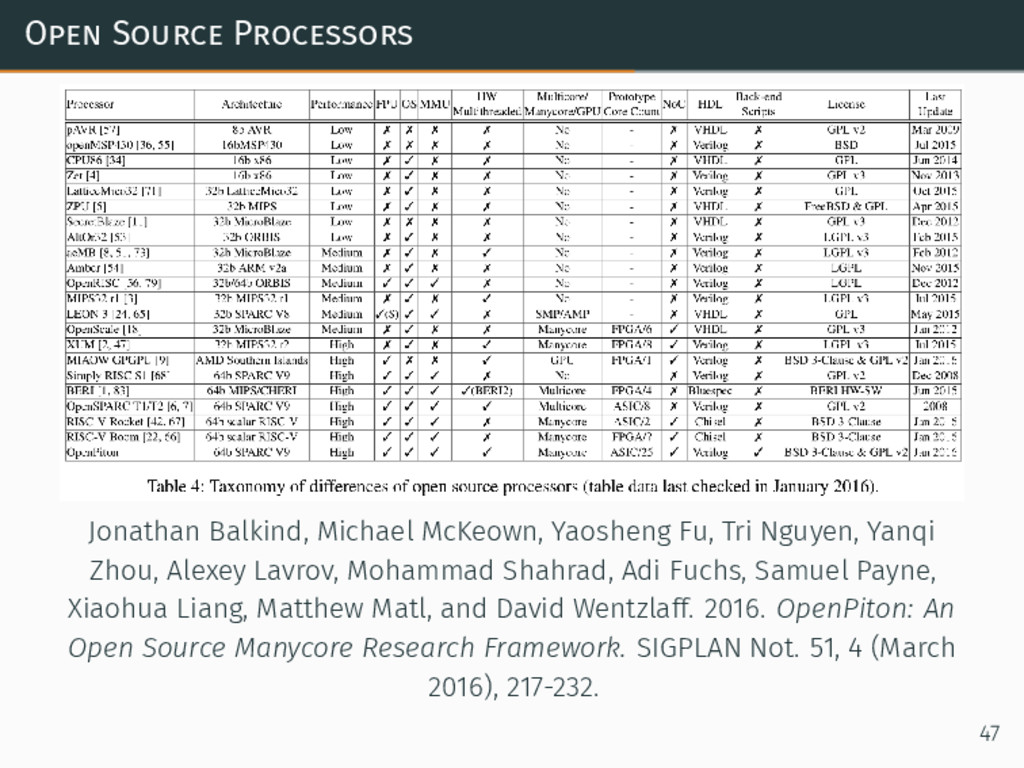
Open Source Processors Jonathan Balkind, Michael McKeown, Yaosheng Fu, Tri
Nguyen, Yanqi Zhou, Alexey Lavrov, Mohammad Shahrad, Adi Fuchs, Samuel Payne, Xiaohua Liang, Matthew Matl, and David Wentzlaff. 2016. OpenPiton: An Open Source Manycore Research Framework. SIGPLAN Not. 51, 4 (March 2016), 217-232. 47 -
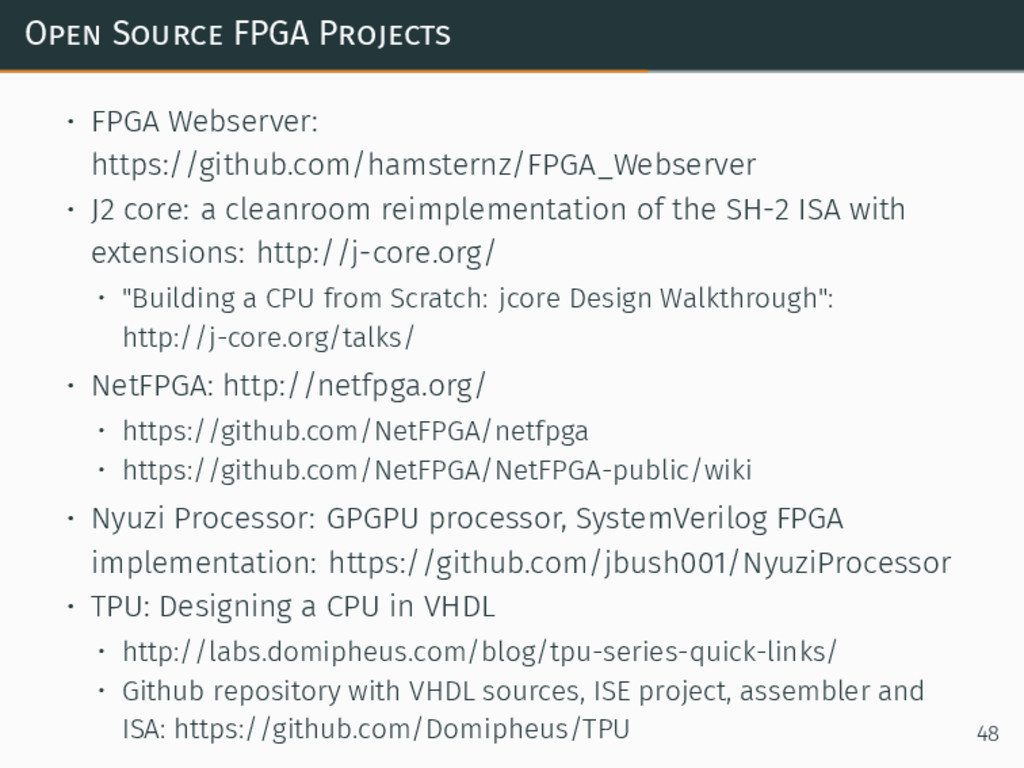
Open Source FPGA Projects • FPGA Webserver: https://github.com/hamsternz/FPGA_Webserver • J2
core: a cleanroom reimplementation of the SH-2 ISA with extensions: http://j-core.org/ • "Building a CPU from Scratch: jcore Design Walkthrough": http://j-core.org/talks/ • NetFPGA: http://netfpga.org/ • https://github.com/NetFPGA/netfpga • https://github.com/NetFPGA/NetFPGA-public/wiki • Nyuzi Processor: GPGPU processor, SystemVerilog FPGA implementation: https://github.com/jbush001/NyuziProcessor • TPU: Designing a CPU in VHDL • http://labs.domipheus.com/blog/tpu-series-quick-links/ • Github repository with VHDL sources, ISE project, assembler and ISA: https://github.com/Domipheus/TPU 48 -
FuseSoC FuseSoC - package manager and a set of build
tools for HDL (Hardware Description Language) code for FPGA/ASIC development https://github.com/olofk/fusesoc Olof Kindgren, https://twitter.com/olofkindgren 49 -
FOSSi Foundation & LibreCores FOSSi: The Free and Open Source
Silicon Foundation http://fossi-foundation.org/ https://twitter.com/FossiFoundation LibreCores: Free and Open Source Digital Hardware open source hardware community and directory https://www.librecores.org/ https://twitter.com/librecores 51 -
Resources 18-643 Reconfigurable Logic: Technology, Architecture and Applications http://users.ece.cmu.edu/~jhoe/doku/doku.php?id=18- 643_reconfigurable_logic
http://www.clifford.at/icestorm/ http://www.clifford.at/icestorm/bitdocs-1k/ http://www.edaplayground.com/ http://fpgacpu.ca/fpga/ OH! Open Hardware for Chip Designers Silicon proven Verilog library for IC and FPGA designers https://github.com/parallella/oh https://github.com/parallella/oh#design-guide https://github.com/parallella/oh#coding-guide 52 -
FPGA History P. Alfke, I. Bolsens, B. Carter, M. Santarini,
and S. Trimberger, “It’s an FPGA!,” IEEE Solid-State Circuits Mag., vol. 3, no. 4, 2011, pp. 15-20. http://ieeexplore.ieee.org/document/6069771/ Computer History Museum: Oral History of Bill Carter, designer of the first FPGA. Interviewed by Steve Trimberger on 2015-07-13 https://www.youtube.com/watch?v=1oG-3XWLgog "Xilinx and the Birth of the Fabless Semiconductor Industry" by Steve Leibson. Chapter of "Fabless: the Transformation of the Semiconductor Industry" by Daniel Nenni and Paul McLellan https://forums.xilinx.com/xlnx/attachments/xlnx/ Xcell/200/1/Fabless%20Book%20Chapter%20FINAL.pdf 53 -
Verilog • EDA Playground Verilog Tutorials - https://www.youtube.com/ playlist?list=PLScWdLzHpkAfbPhzz1NKHDv2clv1SgsMo •
HDLBits — Verilog Practice - http://verilog.stuffedcow.net/ • http://hackaday.com/2015/08/19/ learning-verilog-on-a-25-fpga-part-i/ • http://hackaday.com/2015/07/28/ open-source-fpga-toolchain-builds-cpu/ • https://github.com/Obijuan/ open-fpga-verilog-tutorial/wiki/Chapter-0% 3A-you-are-leaving-the-privative-sector • Lattice HDL Coding Guidelines - http://www.latticesemi. com/~/media/LatticeSemi/Documents/UserManuals/EI/ HDLcodingguidelines.pdf?document_id=48203 • Quick Reference for Verilog HDL - https://github.com/ parallella/oh/blob/master/docs/verilog_reference.md 54 -
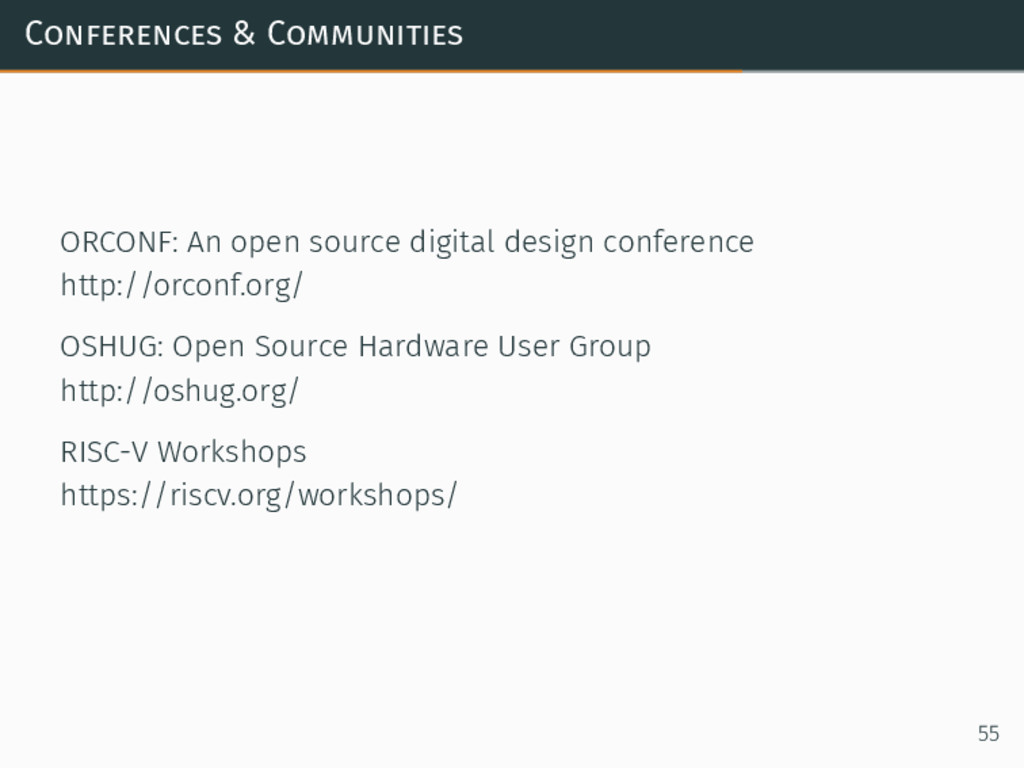
Conferences & Communities ORCONF: An open source digital design conference
http://orconf.org/ OSHUG: Open Source Hardware User Group http://oshug.org/ RISC-V Workshops https://riscv.org/workshops/ 55 -
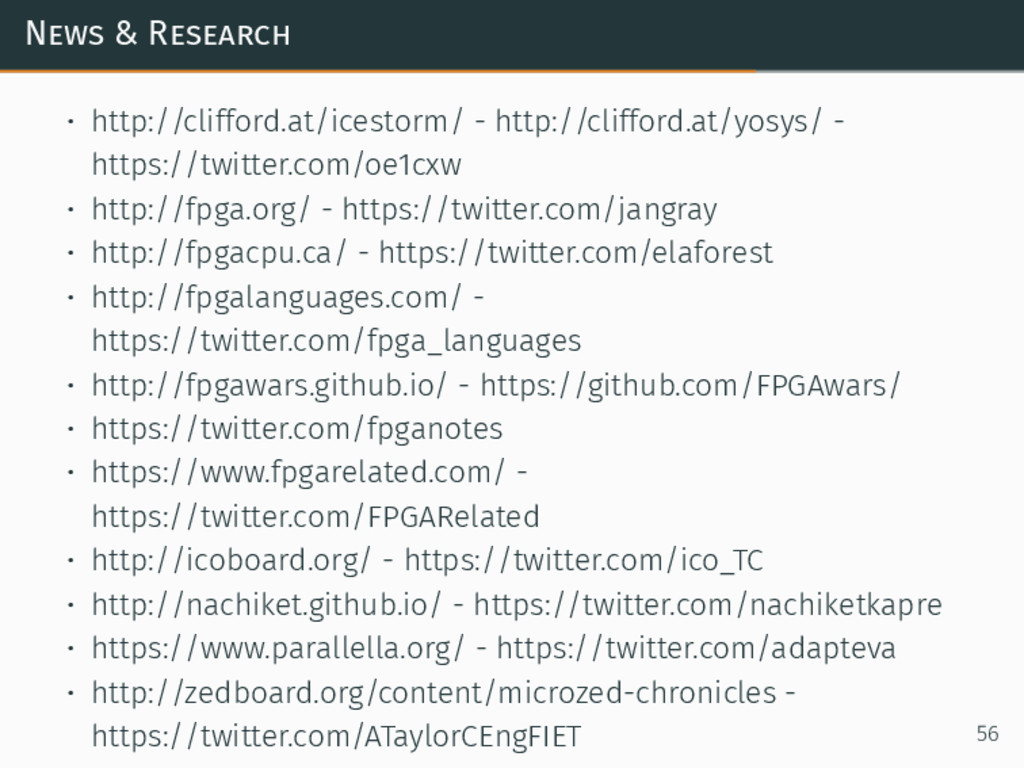
News & Research • http://clifford.at/icestorm/ - http://clifford.at/yosys/ - https://twitter.com/oe1cxw •
http://fpga.org/ - https://twitter.com/jangray • http://fpgacpu.ca/ - https://twitter.com/elaforest • http://fpgalanguages.com/ - https://twitter.com/fpga_languages • http://fpgawars.github.io/ - https://github.com/FPGAwars/ • https://twitter.com/fpganotes • https://www.fpgarelated.com/ - https://twitter.com/FPGARelated • http://icoboard.org/ - https://twitter.com/ico_TC • http://nachiket.github.io/ - https://twitter.com/nachiketkapre • https://www.parallella.org/ - https://twitter.com/adapteva • http://zedboard.org/content/microzed-chronicles - https://twitter.com/ATaylorCEngFIET 56 -
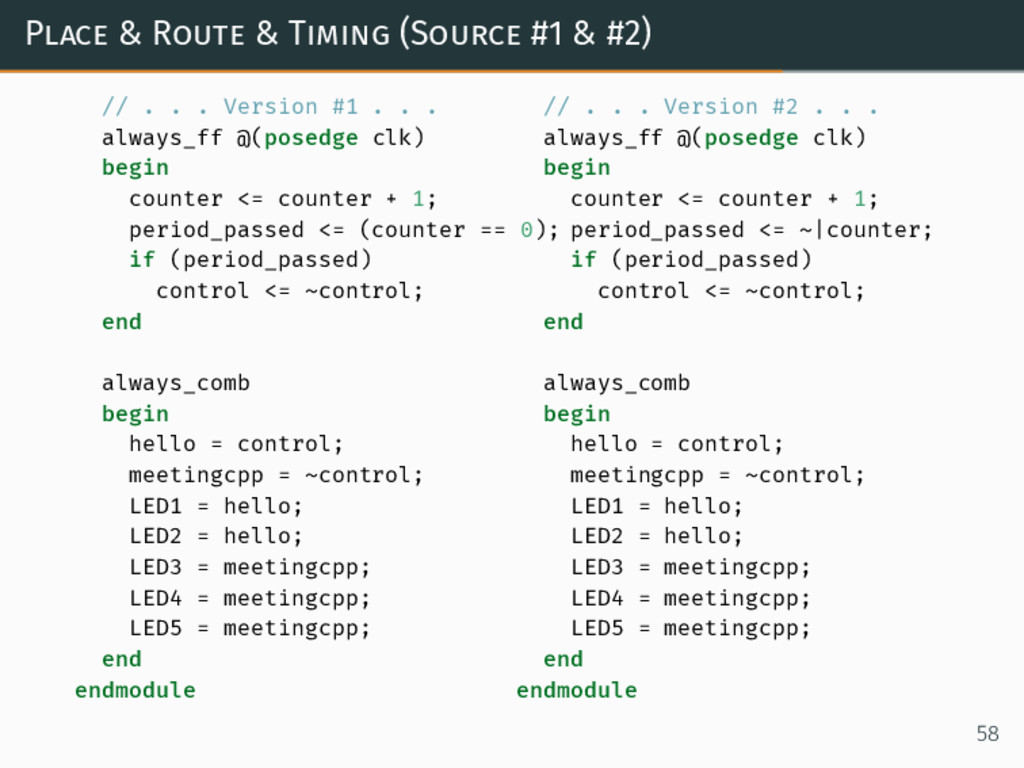
Place & Route & Timing (Source #1 & #2) //
. . . Version #1 . . . always_ff @(posedge clk) begin counter <= counter + 1; period_passed <= (counter == 0); if (period_passed) control <= ~control; end always_comb begin hello = control; meetingcpp = ~control; LED1 = hello; LED2 = hello; LED3 = meetingcpp; LED4 = meetingcpp; LED5 = meetingcpp; end endmodule // . . . Version #2 . . . always_ff @(posedge clk) begin counter <= counter + 1; period_passed <= ~|counter; if (period_passed) control <= ~control; end always_comb begin hello = control; meetingcpp = ~control; LED1 = hello; LED2 = hello; LED3 = meetingcpp; LED4 = meetingcpp; LED5 = meetingcpp; end endmodule 58 -
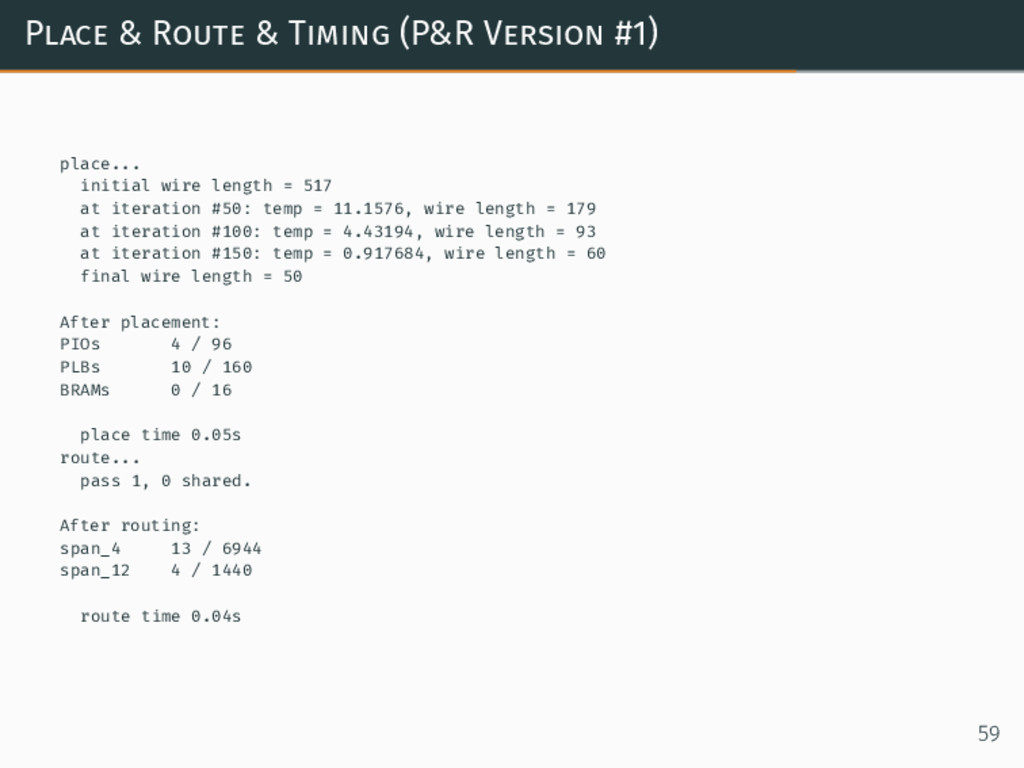
Place & Route & Timing (P&R Version #1) place... initial
wire length = 517 at iteration #50: temp = 11.1576, wire length = 179 at iteration #100: temp = 4.43194, wire length = 93 at iteration #150: temp = 0.917684, wire length = 60 final wire length = 50 After placement: PIOs 4 / 96 PLBs 10 / 160 BRAMs 0 / 16 place time 0.05s route... pass 1, 0 shared. After routing: span_4 13 / 6944 span_12 4 / 1440 route time 0.04s 59 -
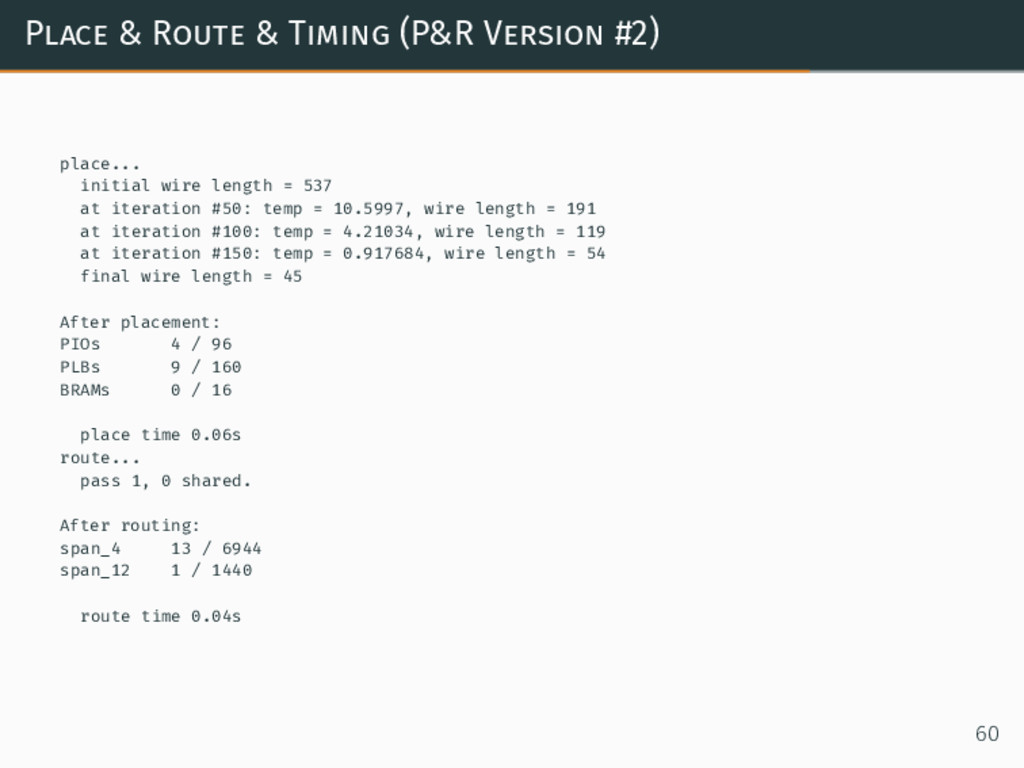
Place & Route & Timing (P&R Version #2) place... initial
wire length = 537 at iteration #50: temp = 10.5997, wire length = 191 at iteration #100: temp = 4.21034, wire length = 119 at iteration #150: temp = 0.917684, wire length = 54 final wire length = 45 After placement: PIOs 4 / 96 PLBs 9 / 160 BRAMs 0 / 16 place time 0.06s route... pass 1, 0 shared. After routing: span_4 13 / 6944 span_12 1 / 1440 route time 0.04s 60 -
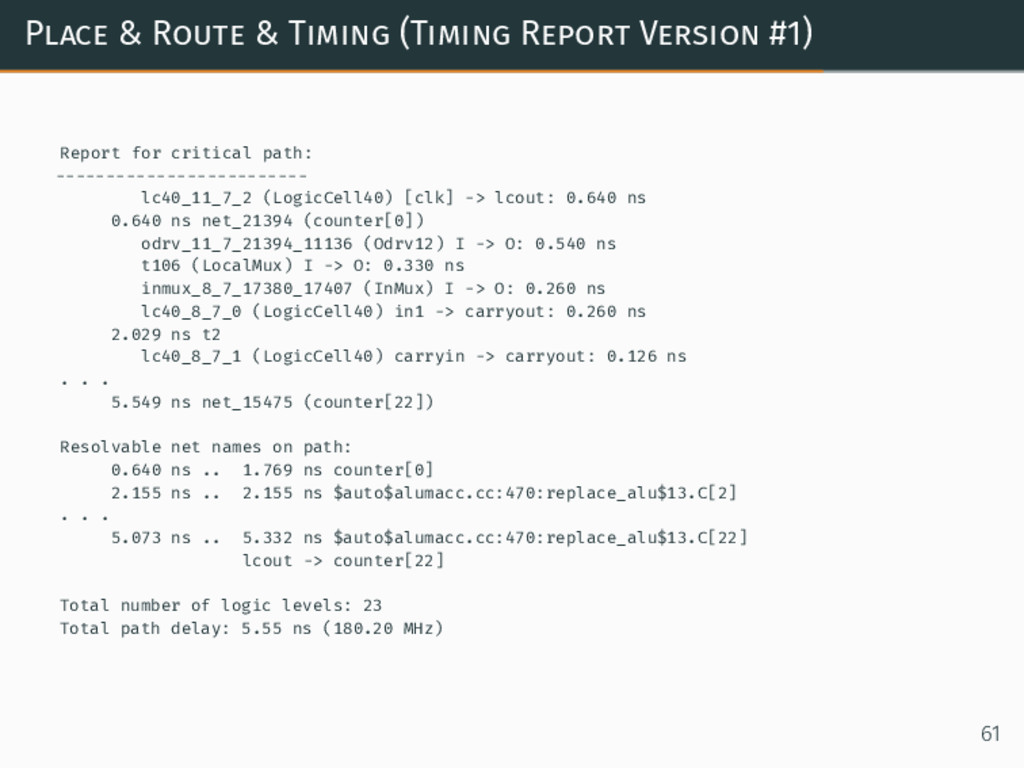
Place & Route & Timing (Timing Report Version #1) Report
for critical path: ------------------------- lc40_11_7_2 (LogicCell40) [clk] -> lcout: 0.640 ns 0.640 ns net_21394 (counter[0]) odrv_11_7_21394_11136 (Odrv12) I -> O: 0.540 ns t106 (LocalMux) I -> O: 0.330 ns inmux_8_7_17380_17407 (InMux) I -> O: 0.260 ns lc40_8_7_0 (LogicCell40) in1 -> carryout: 0.260 ns 2.029 ns t2 lc40_8_7_1 (LogicCell40) carryin -> carryout: 0.126 ns . . . 5.549 ns net_15475 (counter[22]) Resolvable net names on path: 0.640 ns .. 1.769 ns counter[0] 2.155 ns .. 2.155 ns $auto$alumacc.cc:470:replace_alu$13.C[2] . . . 5.073 ns .. 5.332 ns $auto$alumacc.cc:470:replace_alu$13.C[22] lcout -> counter[22] Total number of logic levels: 23 Total path delay: 5.55 ns (180.20 MHz) 61 -
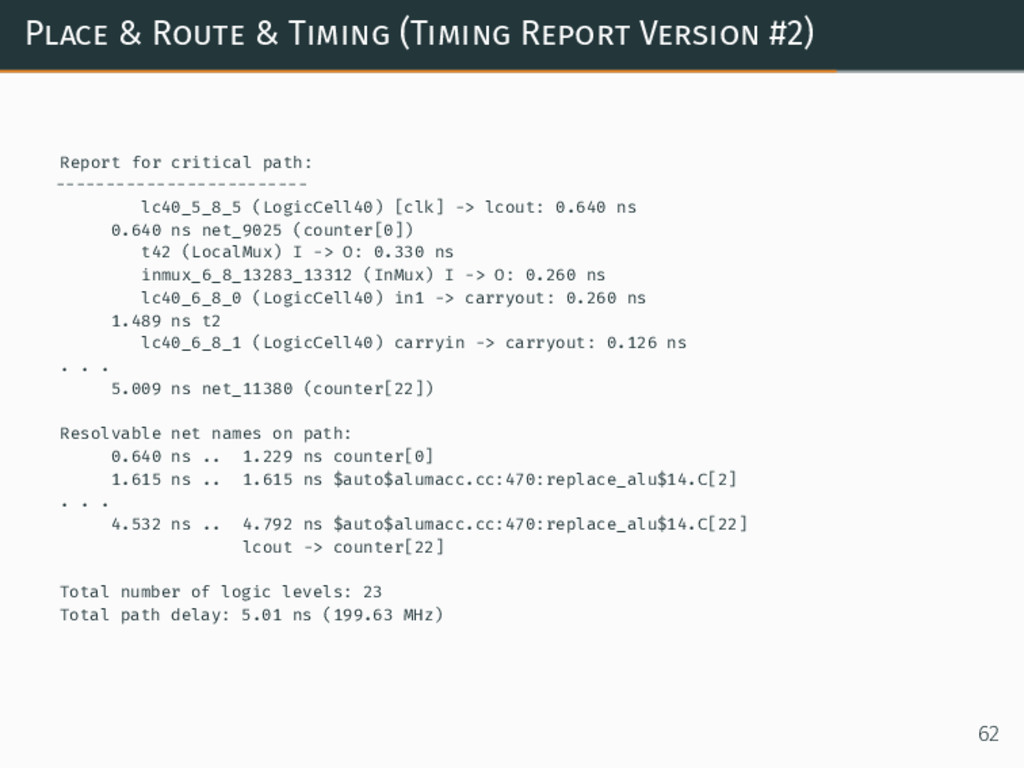
Place & Route & Timing (Timing Report Version #2) Report
for critical path: ------------------------- lc40_5_8_5 (LogicCell40) [clk] -> lcout: 0.640 ns 0.640 ns net_9025 (counter[0]) t42 (LocalMux) I -> O: 0.330 ns inmux_6_8_13283_13312 (InMux) I -> O: 0.260 ns lc40_6_8_0 (LogicCell40) in1 -> carryout: 0.260 ns 1.489 ns t2 lc40_6_8_1 (LogicCell40) carryin -> carryout: 0.126 ns . . . 5.009 ns net_11380 (counter[22]) Resolvable net names on path: 0.640 ns .. 1.229 ns counter[0] 1.615 ns .. 1.615 ns $auto$alumacc.cc:470:replace_alu$14.C[2] . . . 4.532 ns .. 4.792 ns $auto$alumacc.cc:470:replace_alu$14.C[22] lcout -> counter[22] Total number of logic levels: 23 Total path delay: 5.01 ns (199.63 MHz) 62 -
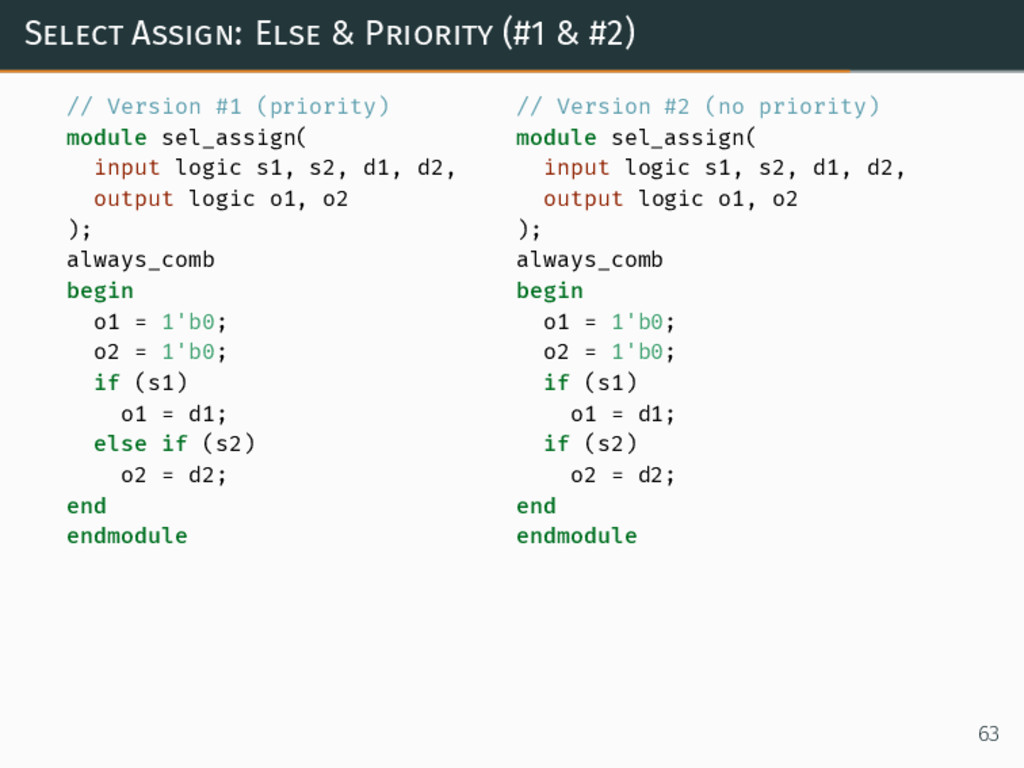
Select Assign: Else & Priority (#1 & #2) // Version
#1 (priority) module sel_assign( input logic s1, s2, d1, d2, output logic o1, o2 ); always_comb begin o1 = 1'b0; o2 = 1'b0; if (s1) o1 = d1; else if (s2) o2 = d2; end endmodule // Version #2 (no priority) module sel_assign( input logic s1, s2, d1, d2, output logic o1, o2 ); always_comb begin o1 = 1'b0; o2 = 1'b0; if (s1) o1 = d1; if (s2) o2 = d2; end endmodule 63 -
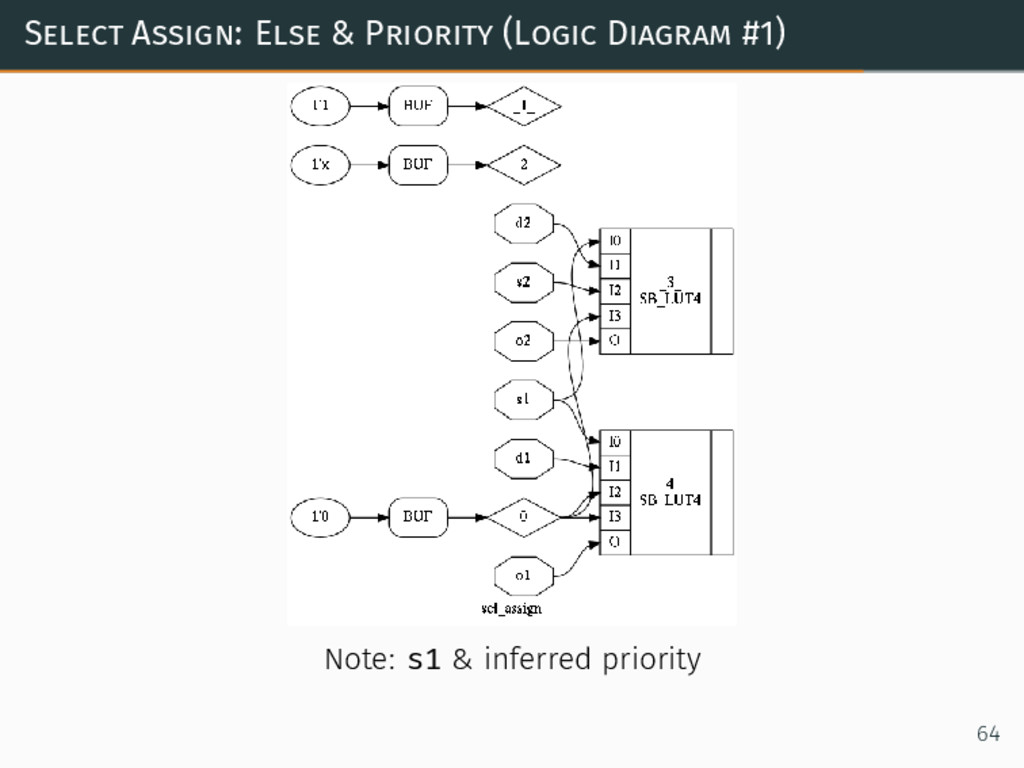
Select Assign: Else & Priority (Logic Diagram #1) Note: s1
& inferred priority 64 -
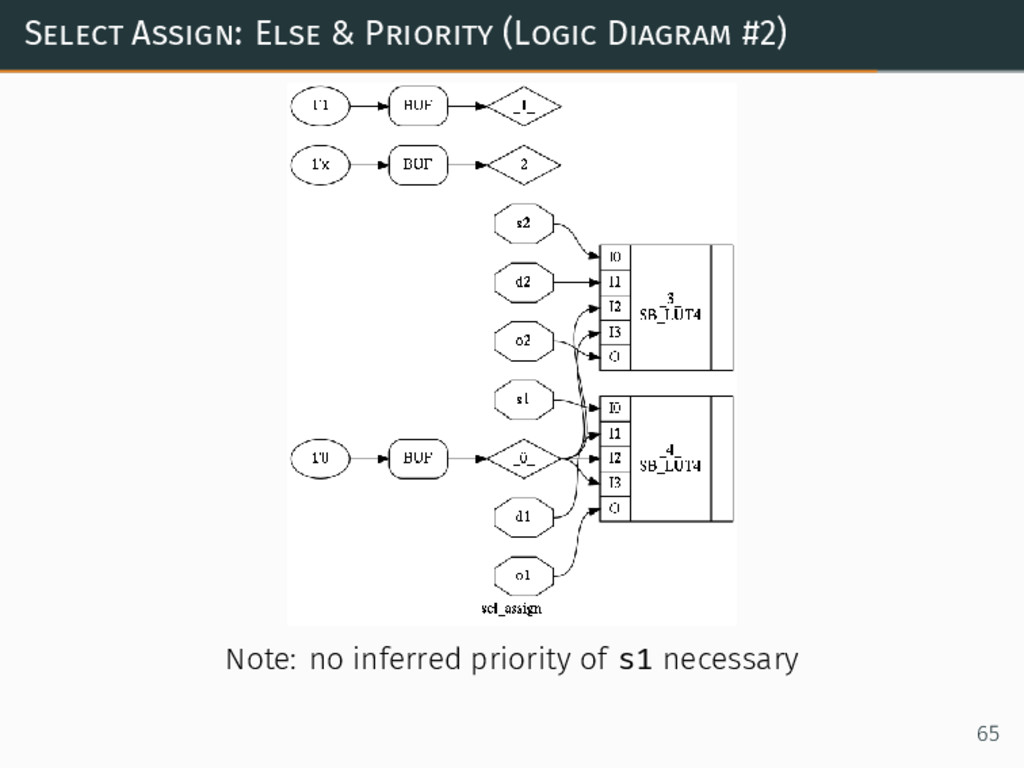
Select Assign: Else & Priority (Logic Diagram #2) Note: no
inferred priority of s1 necessary 65 -
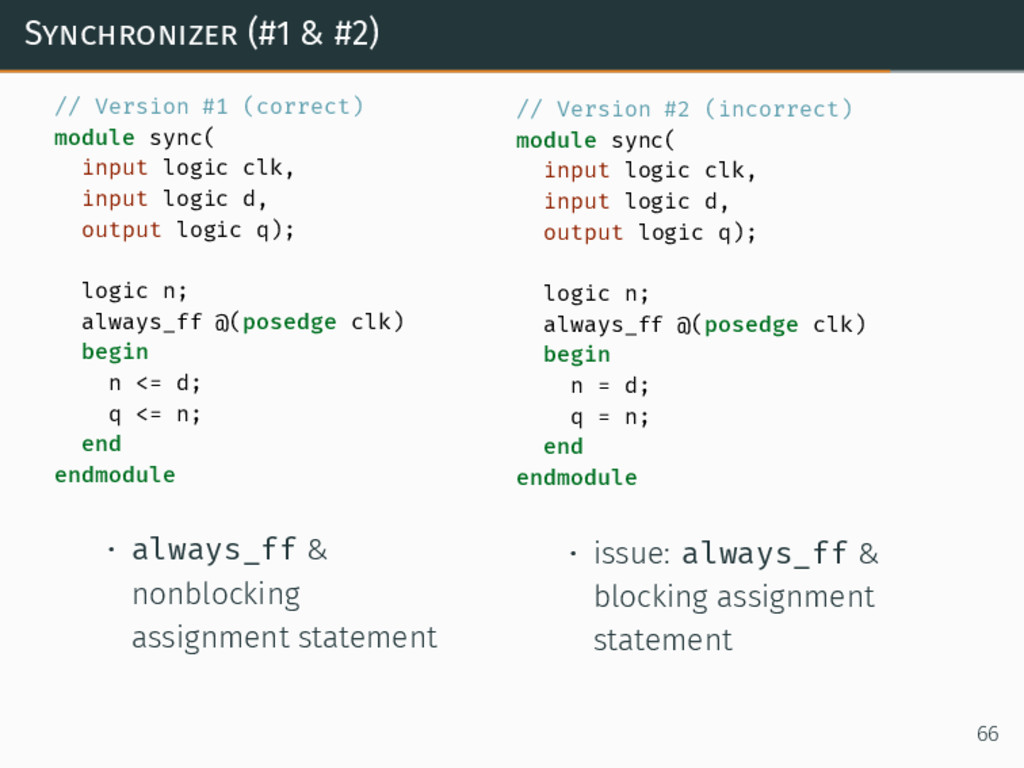
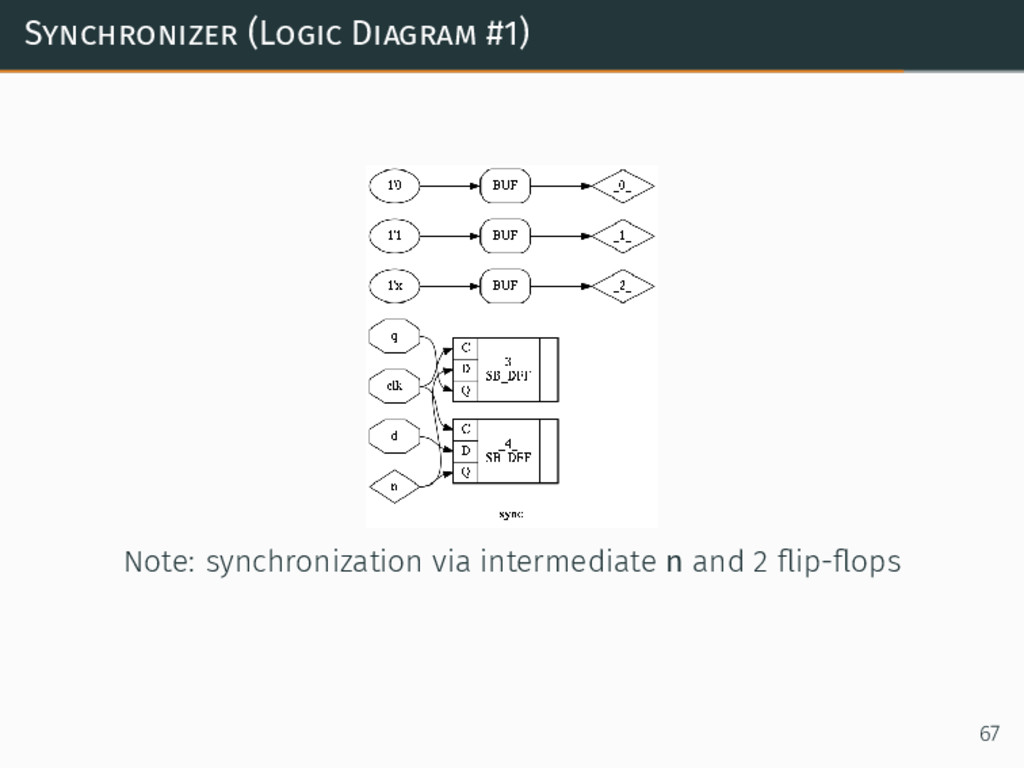
Synchronizer (#1 & #2) // Version #1 (correct) module sync(
input logic clk, input logic d, output logic q); logic n; always_ff @(posedge clk) begin n <= d; q <= n; end endmodule • always_ff & nonblocking assignment statement // Version #2 (incorrect) module sync( input logic clk, input logic d, output logic q); logic n; always_ff @(posedge clk) begin n = d; q = n; end endmodule • issue: always_ff & blocking assignment statement 66 -
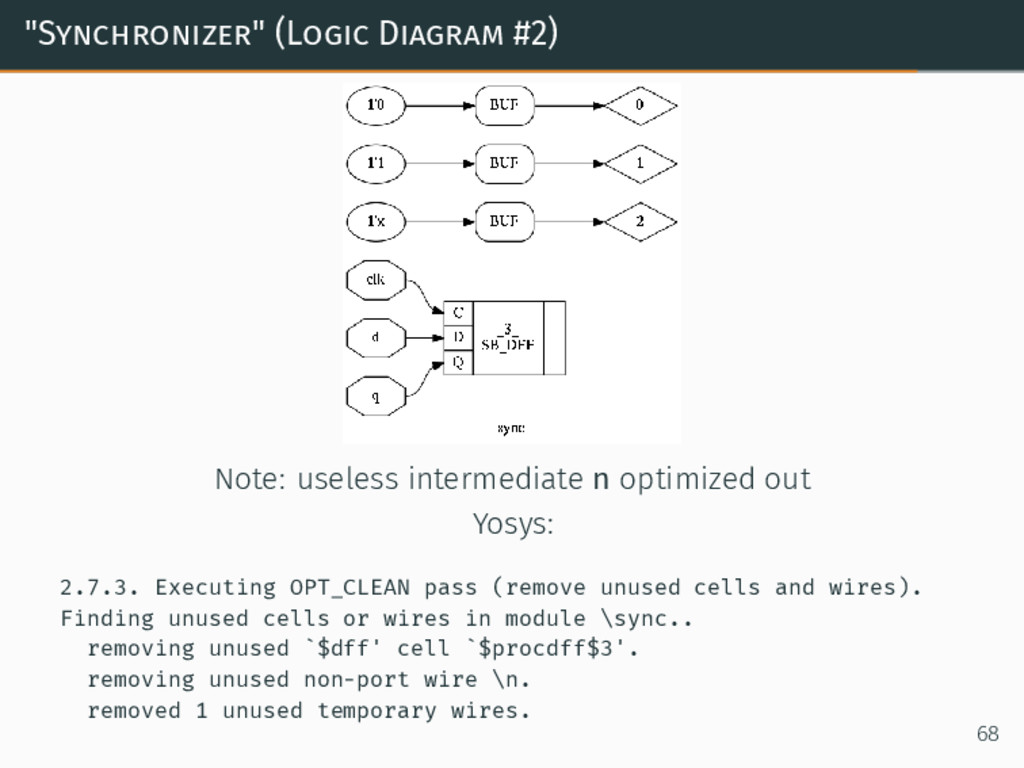
"Synchronizer" (Logic Diagram #2) Note: useless intermediate n optimized out
Yosys: 2.7.3. Executing OPT_CLEAN pass (remove unused cells and wires). Finding unused cells or wires in module \sync.. removing unused `$dff' cell `$procdff$3'. removing unused non-port wire \n. removed 1 unused temporary wires. 68 -
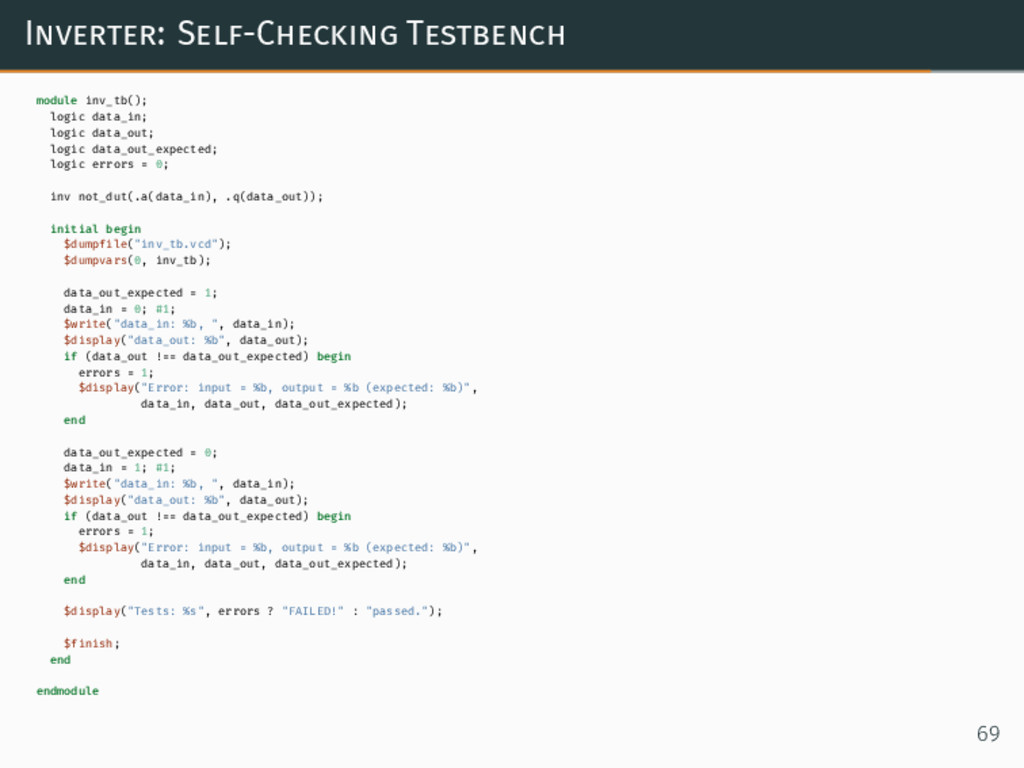
Inverter: Self-Checking Testbench module inv_tb(); logic data_in; logic data_out; logic
data_out_expected; logic errors = 0; inv not_dut(.a(data_in), .q(data_out)); initial begin $dumpfile("inv_tb.vcd"); $dumpvars(0, inv_tb); data_out_expected = 1; data_in = 0; #1; $write("data_in: %b, ", data_in); $display("data_out: %b", data_out); if (data_out !== data_out_expected) begin errors = 1; $display("Error: input = %b, output = %b (expected: %b)", data_in, data_out, data_out_expected); end data_out_expected = 0; data_in = 1; #1; $write("data_in: %b, ", data_in); $display("data_out: %b", data_out); if (data_out !== data_out_expected) begin errors = 1; $display("Error: input = %b, output = %b (expected: %b)", data_in, data_out, data_out_expected); end $display("Tests: %s", errors ? "FAILED!" : "passed."); $finish; end endmodule 69 -
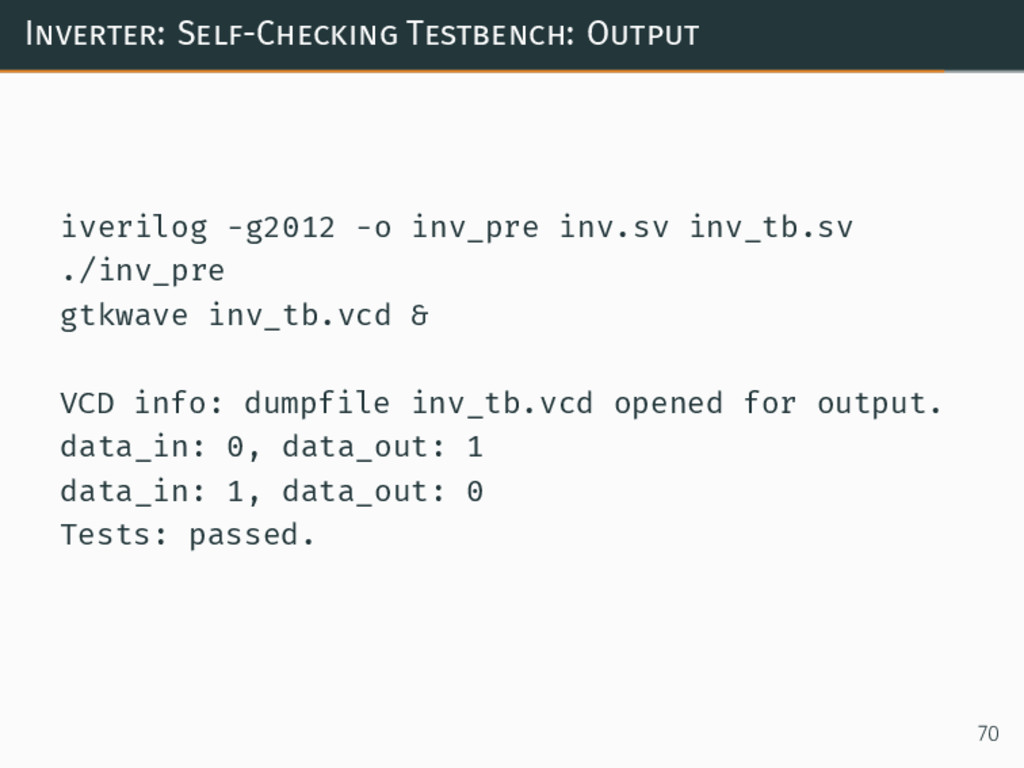
Inverter: Self-Checking Testbench: Output iverilog -g2012 -o inv_pre inv.sv inv_tb.sv
./inv_pre gtkwave inv_tb.vcd & VCD info: dumpfile inv_tb.vcd opened for output. data_in: 0, data_out: 1 data_in: 1, data_out: 0 Tests: passed. 70 -
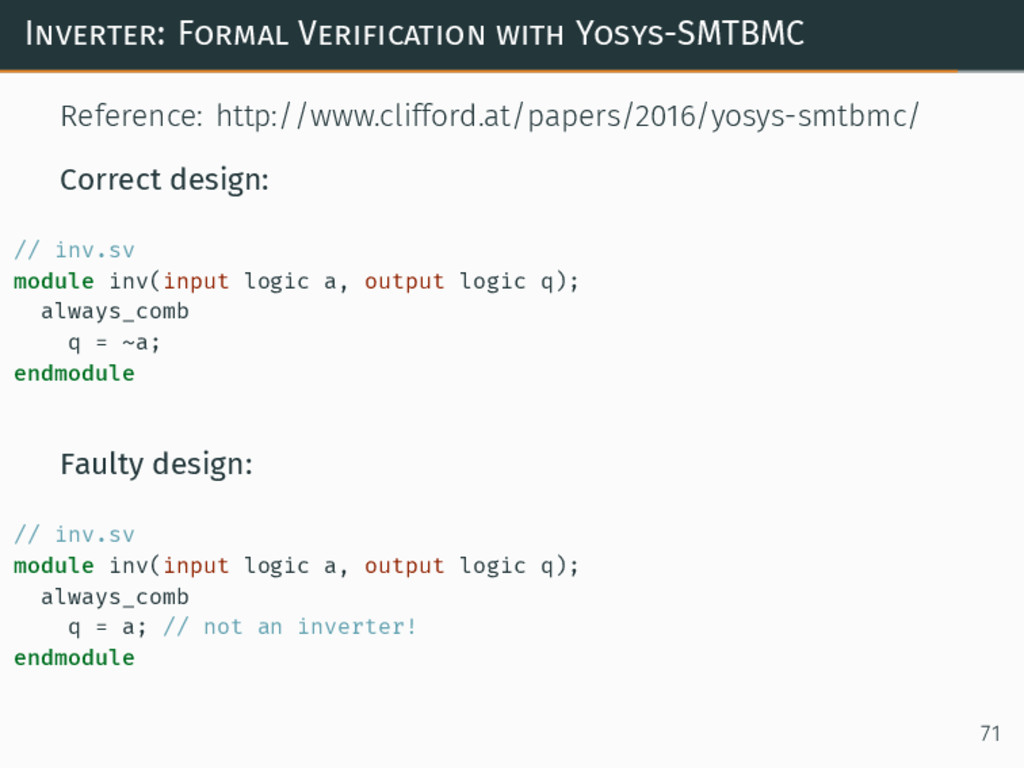
Inverter: Formal Verification with Yosys-SMTBMC Reference: http://www.clifford.at/papers/2016/yosys-smtbmc/ Correct design: //
inv.sv module inv(input logic a, output logic q); always_comb q = ~a; endmodule Faulty design: // inv.sv module inv(input logic a, output logic q); always_comb q = a; // not an inverter! endmodule 71 -
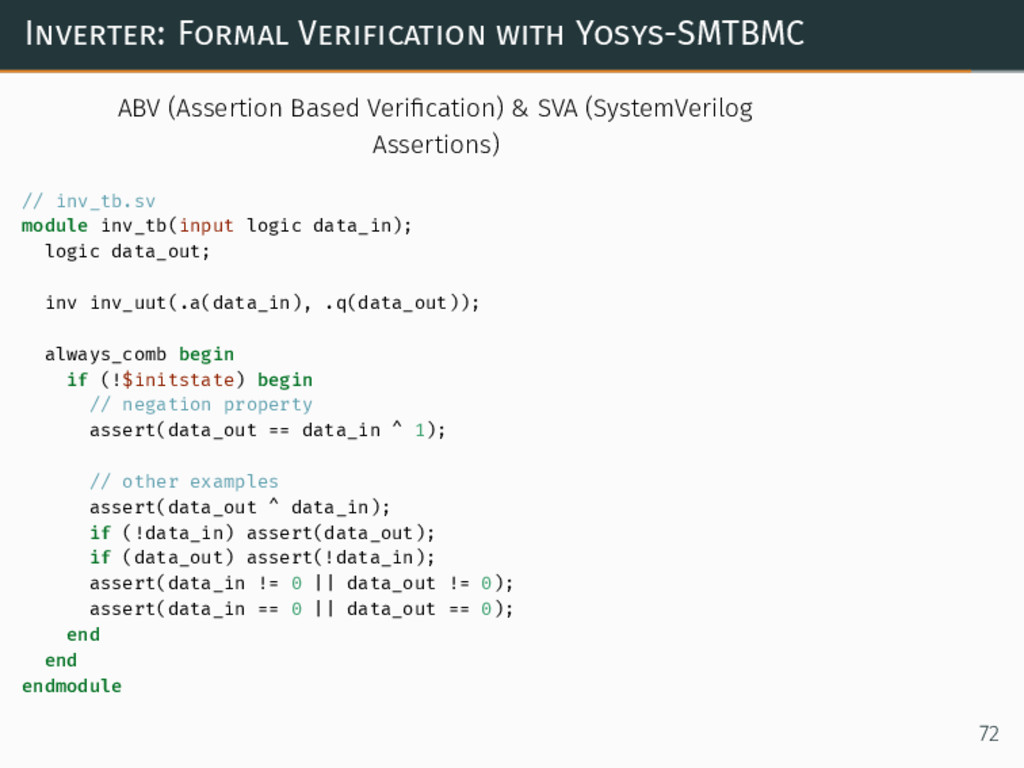
Inverter: Formal Verification with Yosys-SMTBMC ABV (Assertion Based Verification) &
SVA (SystemVerilog Assertions) // inv_tb.sv module inv_tb(input logic data_in); logic data_out; inv inv_uut(.a(data_in), .q(data_out)); always_comb begin if (!$initstate) begin // negation property assert(data_out == data_in ^ 1); // other examples assert(data_out ^ data_in); if (!data_in) assert(data_out); if (data_out) assert(!data_in); assert(data_in != 0 || data_out != 0); assert(data_in == 0 || data_out == 0); end end endmodule 72 -
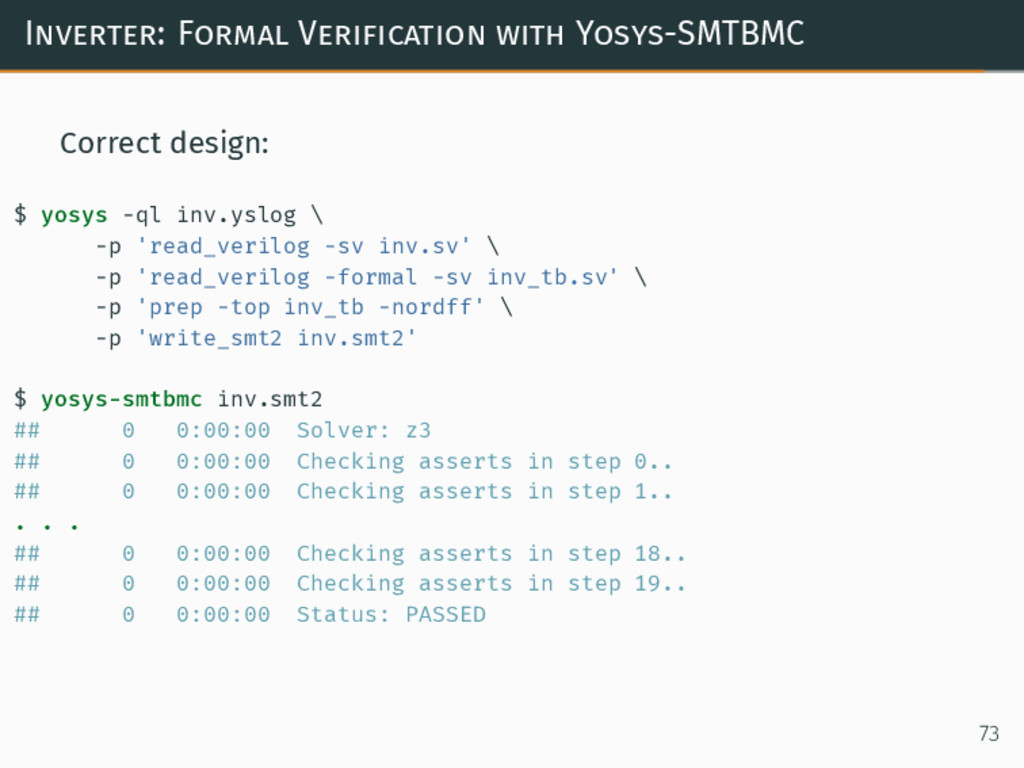
Inverter: Formal Verification with Yosys-SMTBMC Correct design: $ yosys -ql
inv.yslog \ -p 'read_verilog -sv inv.sv' \ -p 'read_verilog -formal -sv inv_tb.sv' \ -p 'prep -top inv_tb -nordff' \ -p 'write_smt2 inv.smt2' $ yosys-smtbmc inv.smt2 ## 0 0:00:00 Solver: z3 ## 0 0:00:00 Checking asserts in step 0.. ## 0 0:00:00 Checking asserts in step 1.. . . . ## 0 0:00:00 Checking asserts in step 18.. ## 0 0:00:00 Checking asserts in step 19.. ## 0 0:00:00 Status: PASSED 73 -
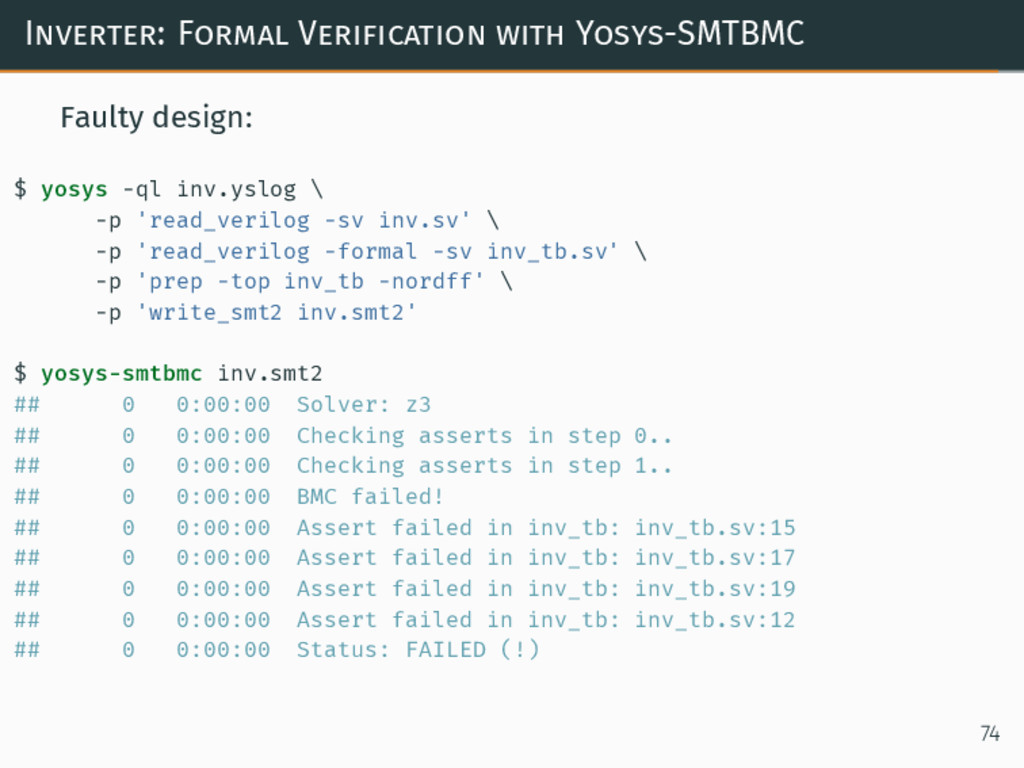
Inverter: Formal Verification with Yosys-SMTBMC Faulty design: $ yosys -ql
inv.yslog \ -p 'read_verilog -sv inv.sv' \ -p 'read_verilog -formal -sv inv_tb.sv' \ -p 'prep -top inv_tb -nordff' \ -p 'write_smt2 inv.smt2' $ yosys-smtbmc inv.smt2 ## 0 0:00:00 Solver: z3 ## 0 0:00:00 Checking asserts in step 0.. ## 0 0:00:00 Checking asserts in step 1.. ## 0 0:00:00 BMC failed! ## 0 0:00:00 Assert failed in inv_tb: inv_tb.sv:15 ## 0 0:00:00 Assert failed in inv_tb: inv_tb.sv:17 ## 0 0:00:00 Assert failed in inv_tb: inv_tb.sv:19 ## 0 0:00:00 Assert failed in inv_tb: inv_tb.sv:12 ## 0 0:00:00 Status: FAILED (!) 74
 mattpd
 ivargrimstad
 drumath2237
 kajitack
 koukimiura
 leegeunhyeok
 chigichan24
 meihei3
 tarao
 fuqda
 quramy
 l2hyunwoo
 hasutosasaki
 jonoalderson
 matthewcrist
 marktimemedia
 productmarketing
 reverentgeek
 davidcarrasco
 tonyrice
 lynnandtonic
 kristinabergwall1
 madoxten
 addyosmani
 inesmontani