Share
Embed
Fast Rails API
History of optimizing Rails API, starting from AR connections pool and ending by using Fragment caching. Also there is list of tools for profiling applications (stackprof, etc.). All techniques are quite famous.
Anton Kaliaev
March 03, 2014
Transcript
36 slides
-
# config/unicorn.rb worker_processes (ENV['UNICORN_WORKERS'] || 1).to_i # config/database.yml development: ...
pool: 5 Connection pool https://devcenter.heroku.com/articles/concurrency-and-database-connections Unicorn worker Unicorn worker DB AR connection pool 1 connection per worker for max productivity -
# config/unicorn.rb before_fork do |server, worker| if defined?(ActiveRecord::Base) ActiveRecord::Base.connection.disconnect! end
end after_fork do |server, worker| if defined?(ActiveRecord::Base) config = Rails.application.config.database_configuration[Rails.env] config['reaping_frequency'] = ENV['DB_REAP_FREQ'] || 10 # seconds config['pool'] = ENV['DB_POOL'] || 5 ActiveRecord::Base.establish_connection(config) end end Establish DB connection after fork https://devcenter.heroku.com/articles/concurrency-and-database-connections -
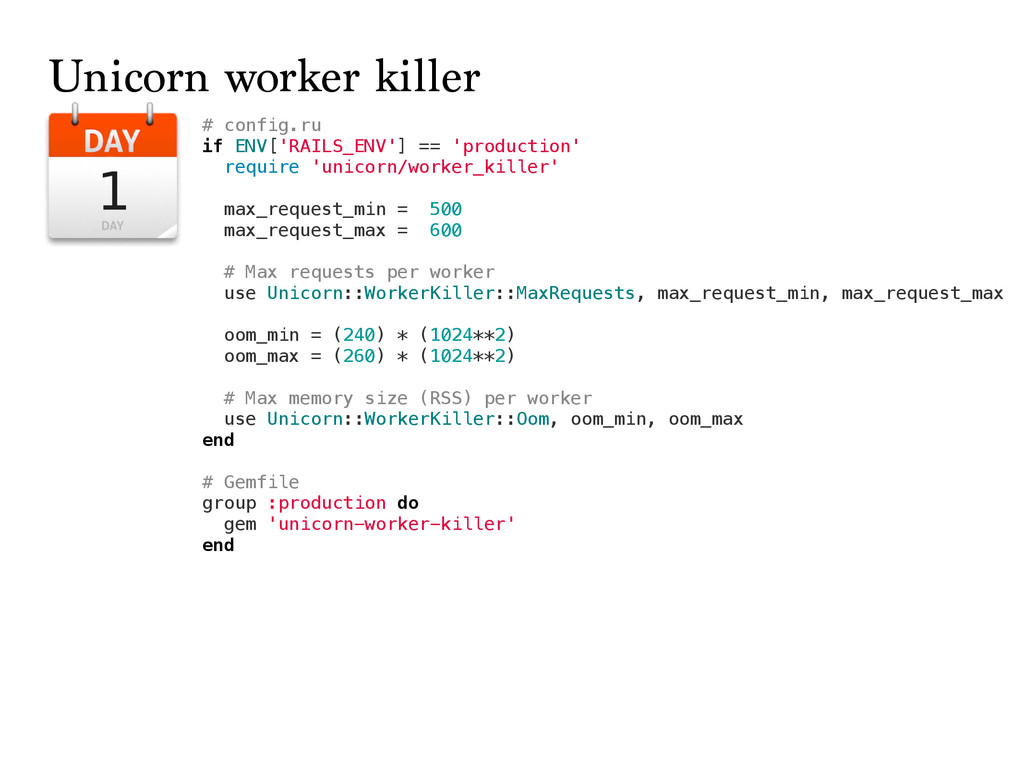
# config.ru if ENV['RAILS_ENV'] == 'production' require 'unicorn/worker_killer' max_request_min =
500 max_request_max = 600 # Max requests per worker use Unicorn::WorkerKiller::MaxRequests, max_request_min, max_request_max oom_min = (240) * (1024**2) oom_max = (260) * (1024**2) # Max memory size (RSS) per worker use Unicorn::WorkerKiller::Oom, oom_min, oom_max end # Gemfile group :production do gem 'unicorn-worker-killer' end Unicorn worker killer -
# config/application.rb require "active_record/railtie" require "action_mailer/railtie" require "action_controller/railtie" require "action_view/railtie"
require "rails/test_unit/railtie" require "sprockets/railtie" Do not load ‘rails/all’ -
# config/application.rb require "active_record/railtie" require "action_mailer/railtie" require "action_controller/railtie" require "action_view/railtie"
require "rails/test_unit/railtie" require "sprockets/railtie" Do not load ‘rails/all’ -
Connection pool Rails-api Do not load ‘rails/all’ Establish DB connection
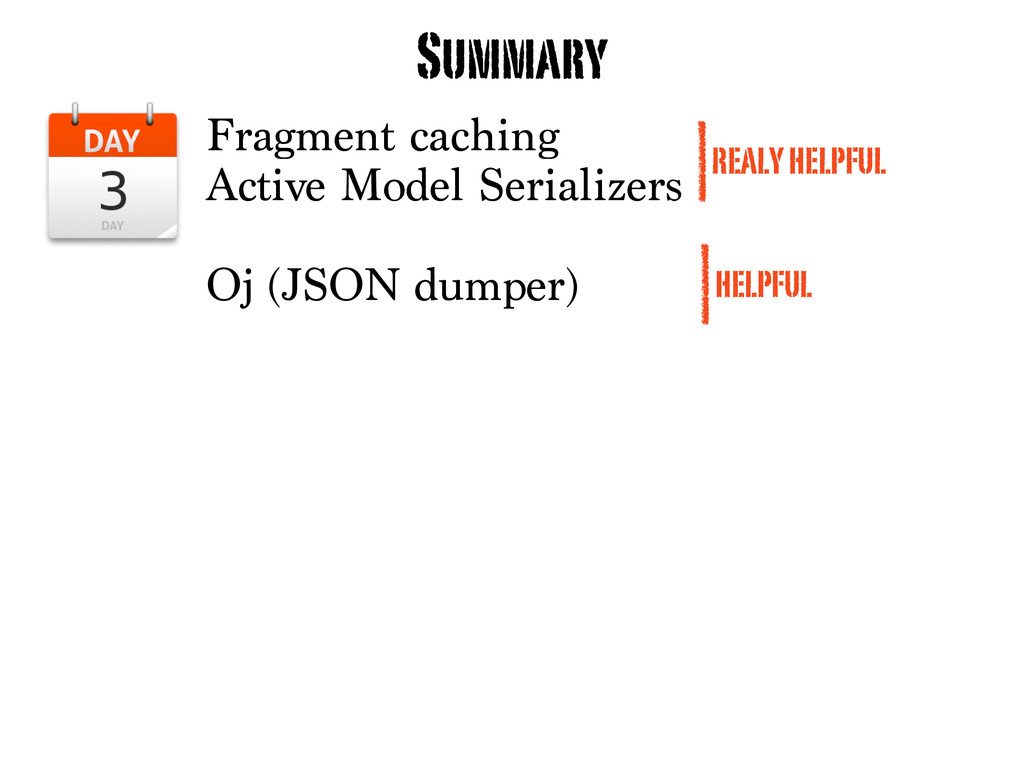
after fork/ new thread was created Unicorn worker killer Summary REALY HELPFUL HELPFUL IMPROVES STABILITY -
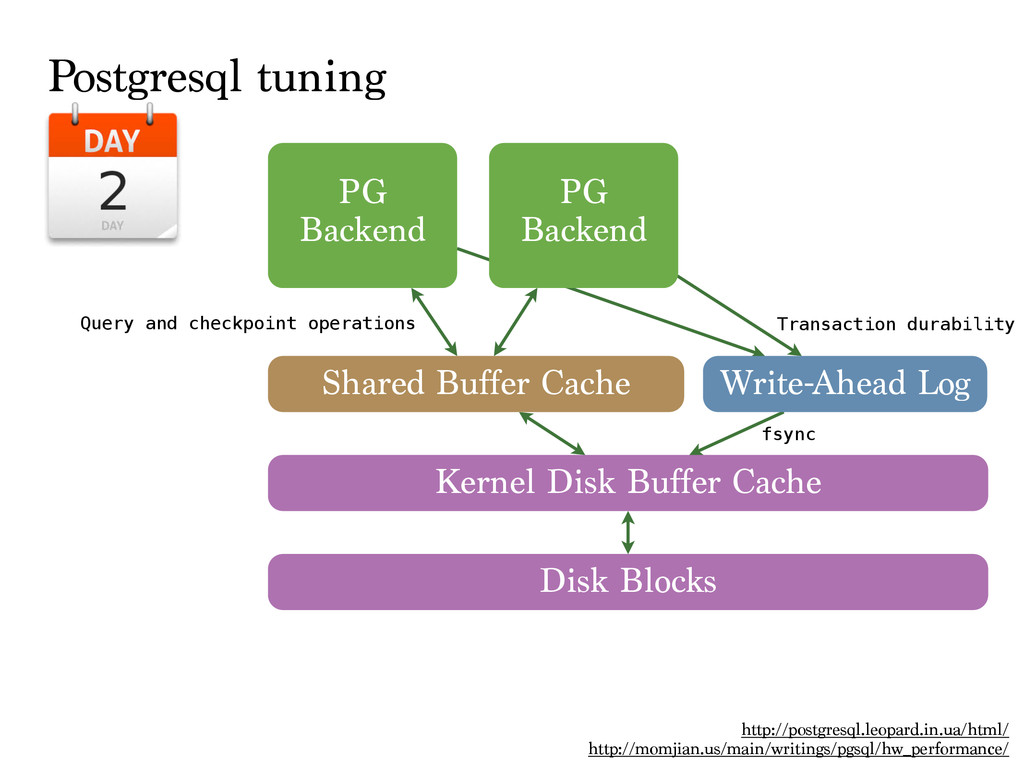
Postgresql tuning http://postgresql.leopard.in.ua/html/ http://momjian.us/main/writings/pgsql/hw_performance/ PG Backend PG Backend Shared Buffer
Cache Write-Ahead Log Query and checkpoint operations Transaction durability Kernel Disk Buffer Cache fsync Disk Blocks -
Oj (JSON dumper) # Gemfile gem 'oj' json 0.810000 0.020000
0.830000 ( 0.841307) yajl 0.760000 0.020000 0.780000 ( 0.809903) oj 0.640000 0.010000 0.650000 ( 0.666230) Good idea to use the fastest dumper -
Active Model Serializers # Gemfile gem 'active_model_serializers' # app/serializers/user_serializer.rb class
UserSerializer < ActiveModel::Serializer root false attributes :id, :guid, :current_channel_id, :current_telecast_ts, :created_at, :updated_at end # app/controllers/api/user_controller.rb def show @user = User.find params[:id] render json: @user end -
Fragment caching https://devcenter.heroku.com/articles/caching-strategies http://signalvnoise.com/posts/3113-how-key-based-cache-expiration-works # app/controllers/api/application_controller.rb class Api::ApplicationController < ActionController::API
include ActionController::Caching # app/controllers/api/users_controller.rb def show @user = User.find params[:id] json = cache ['v1', @user] do ActiveModel::Serializer.build_json(self, @user, {}).to_json end render json: json end -
Fragment caching # app/controllers/api/users_controller.rb def index json = cache ['v1',
CacheKeyRegistry.users] do @users = User.all ActiveModel::Serializer.build_json(self, @users, {}).to_json end render json: json end # lib/cache_key_registry.rb module CacheKeyRegistry class << self def users; key(User, __method__) end private def key(scope, key_prefix) count = scope.count max_updated_at = scope.maximum(:updated_at).try(:utc).try(:to_s, :number) "#{key_prefix}/all-#{count}-#{max_updated_at}" end end end “users/all-25-2014-02-23” -
Do not instantiate AR objects Try OOBGC Try different web
server (e.g. Puma) Other ideas -
Do not instantiate AR objects def self.lightning connection.select_all(select([:guid, :current_channel_id, :current_telecast_ts]).arel).each
do |attrs| attrs.each_key do |attr| attrs[attr] = type_cast_attribute(attr, attrs) end end end -
$ stackprof stackprof-cpu-6196-1393432908.dump --text ================================== Mode: cpu(1000) Samples: 545 (0.00%
miss rate) GC: 48 (8.81%) ================================== TOTAL (pct) SAMPLES (pct) FRAME 42 (7.7%) 39 (7.2%) #<Module:0x000000020550f8>.escape 33 (6.1%) 23 (4.2%) ActiveRecord::ConnectionAdapters::Column.new_time 21 (3.9%) 21 (3.9%) Set#include? 13 (2.4%) 13 (2.4%) block in ActiveSupport::Dependencies#search_for_file 13 (2.4%) 13 (2.4%) block in ActiveSupport::Dependencies#autoloadable_module? 26 (4.8%) 4 (0.7%) Channel::Telecast#cover_url Stackprof -
$ stackprof stackprof-cpu-6196-1393432908.dump --text --method 'Channel::Telecast#cover_url' Channel::Telecast#cover_url (/projects/undev/simpletv-backend/app/models/concerns/coverable.rb:12) samples: 4
self (0.7%) / 26 total (4.8%) callers: 26 ( 100.0%) Channel::TelecastSerializer#cover callees (22 total): 22 ( 100.0%) Channel::Telecast#cover code: | 12 | def cover_url(version = nil) | 13 | if cover.file.nil? && external_cover 26 (4.8%) / 4 (0.7%) | 14 | external_cover.gsub(configus.cdn_host, '/cdn') Stackprof