of money. • Organisations that have lots of COBOL are likely to have money. • We’d like some of that. • Hmm, do they know about multicore? • It’s not in the standard... • Spoiler alert: beware microprocessor-centrism! 2 Friday, 15 February 13
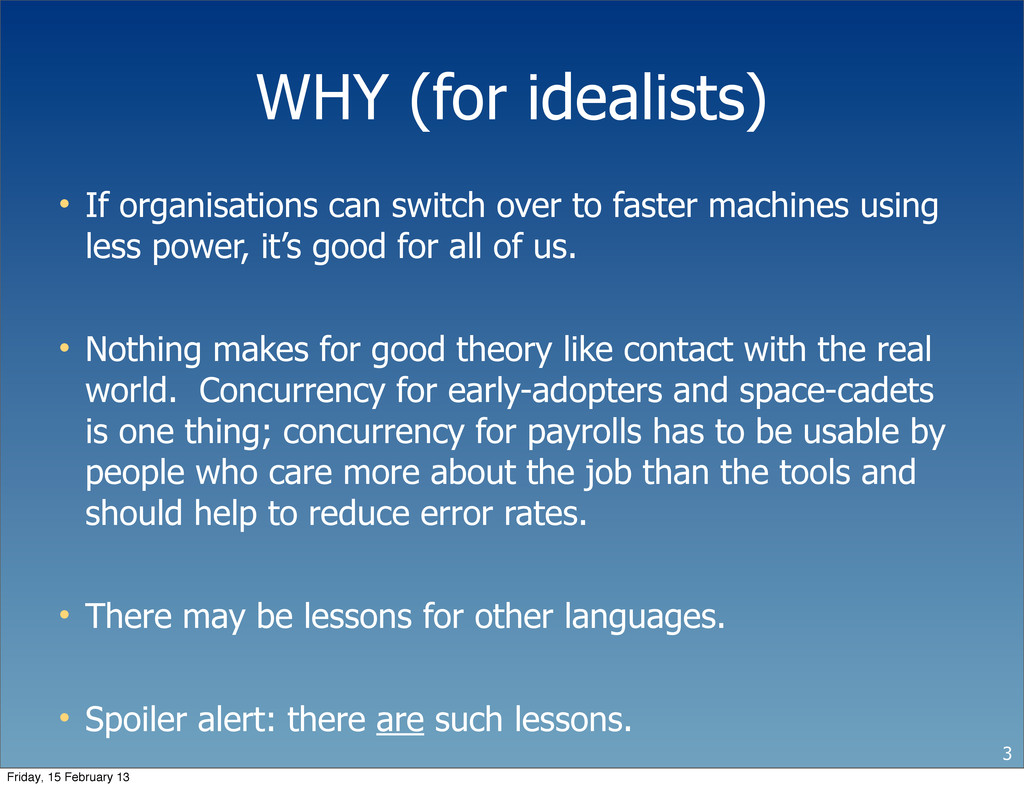
faster machines using less power, it’s good for all of us. • Nothing makes for good theory like contact with the real world. Concurrency for early-adopters and space-cadets is one thing; concurrency for payrolls has to be usable by people who care more about the job than the tools and should help to reduce error rates. • There may be lessons for other languages. • Spoiler alert: there are such lessons. 3 Friday, 15 February 13
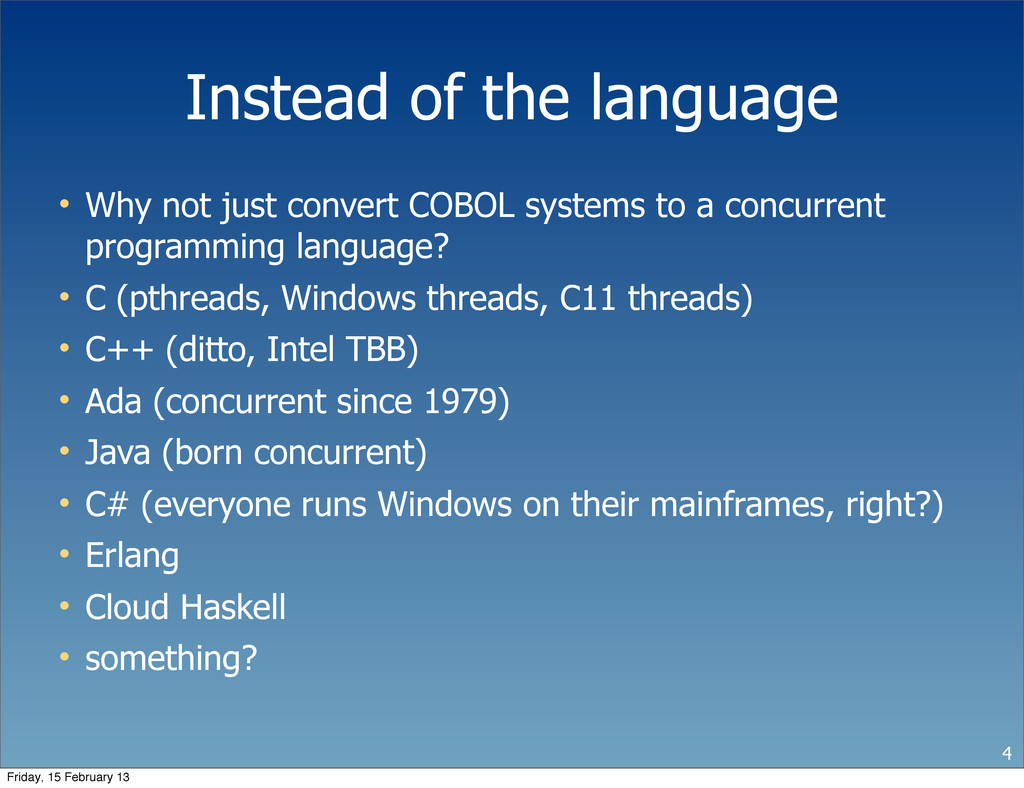
systems to a concurrent programming language? • C (pthreads, Windows threads, C11 threads) • C++ (ditto, Intel TBB) • Ada (concurrent since 1979) • Java (born concurrent) • C# (everyone runs Windows on their mainframes, right?) • Erlang • Cloud Haskell • something? 4 Friday, 15 February 13
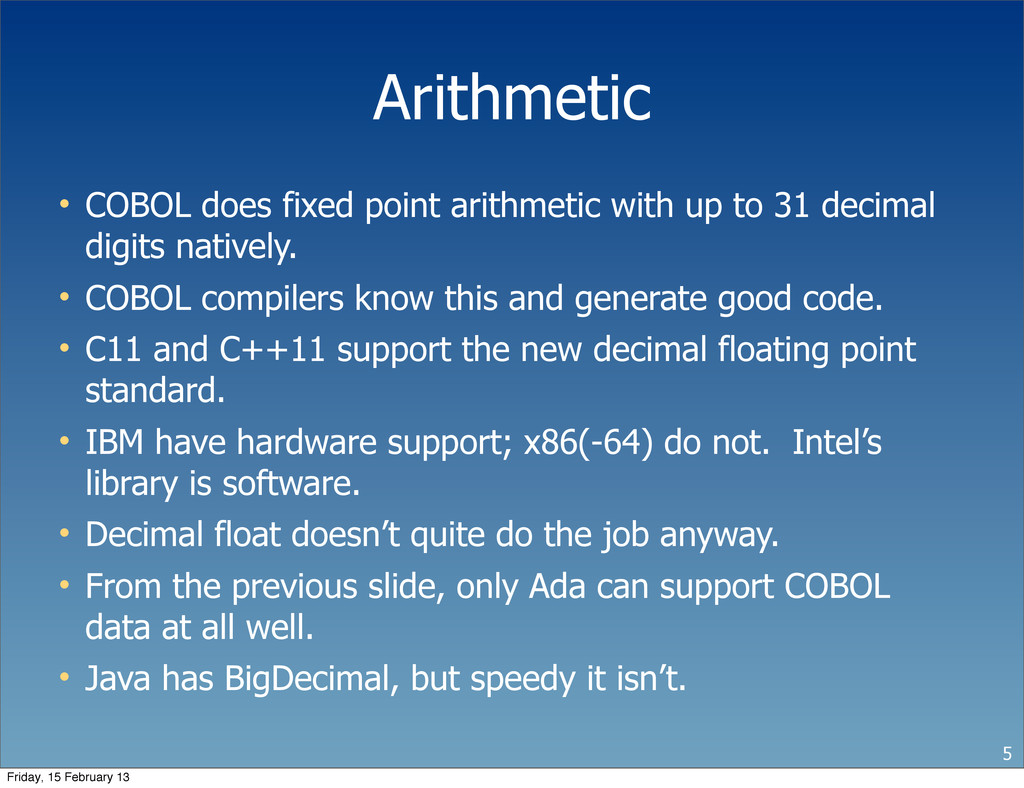
31 decimal digits natively. • COBOL compilers know this and generate good code. • C11 and C++11 support the new decimal floating point standard. • IBM have hardware support; x86(-64) do not. Intel’s library is software. • Decimal float doesn’t quite do the job anyway. • From the previous slide, only Ada can support COBOL data at all well. • Java has BigDecimal, but speedy it isn’t. 5 Friday, 15 February 13
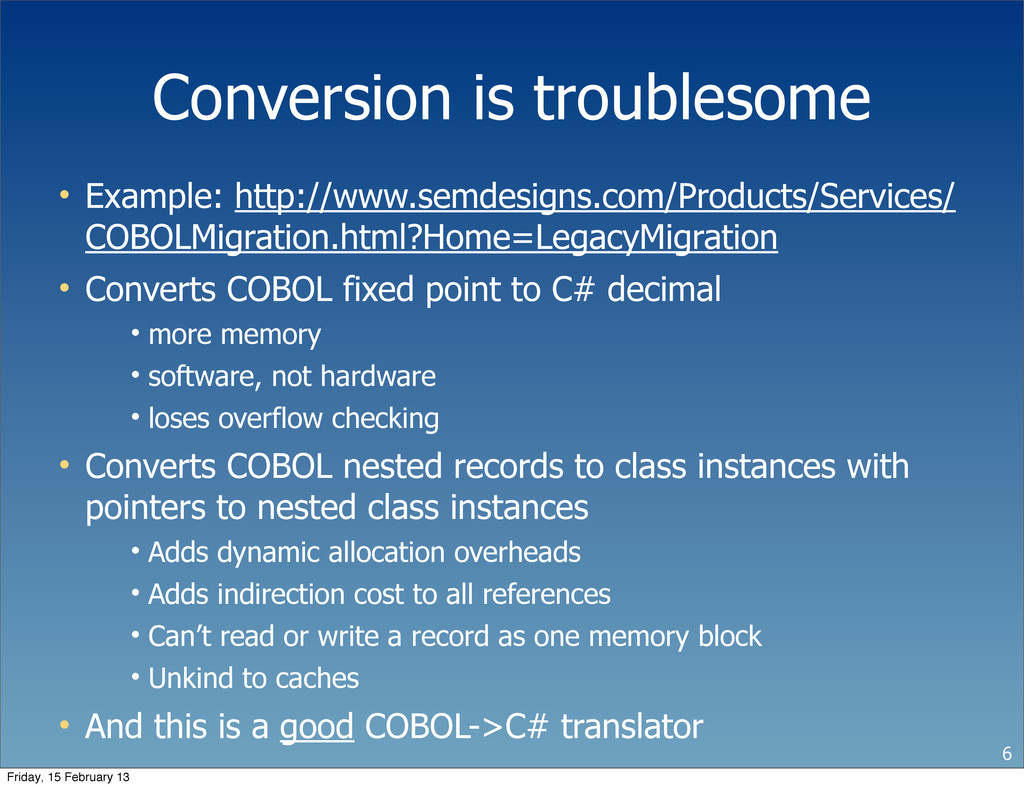
fixed point to C# decimal • more memory • software, not hardware • loses overflow checking • Converts COBOL nested records to class instances with pointers to nested class instances • Adds dynamic allocation overheads • Adds indirection cost to all references • Can’t read or write a record as one memory block • Unkind to caches • And this is a good COBOL->C# translator 6 Friday, 15 February 13
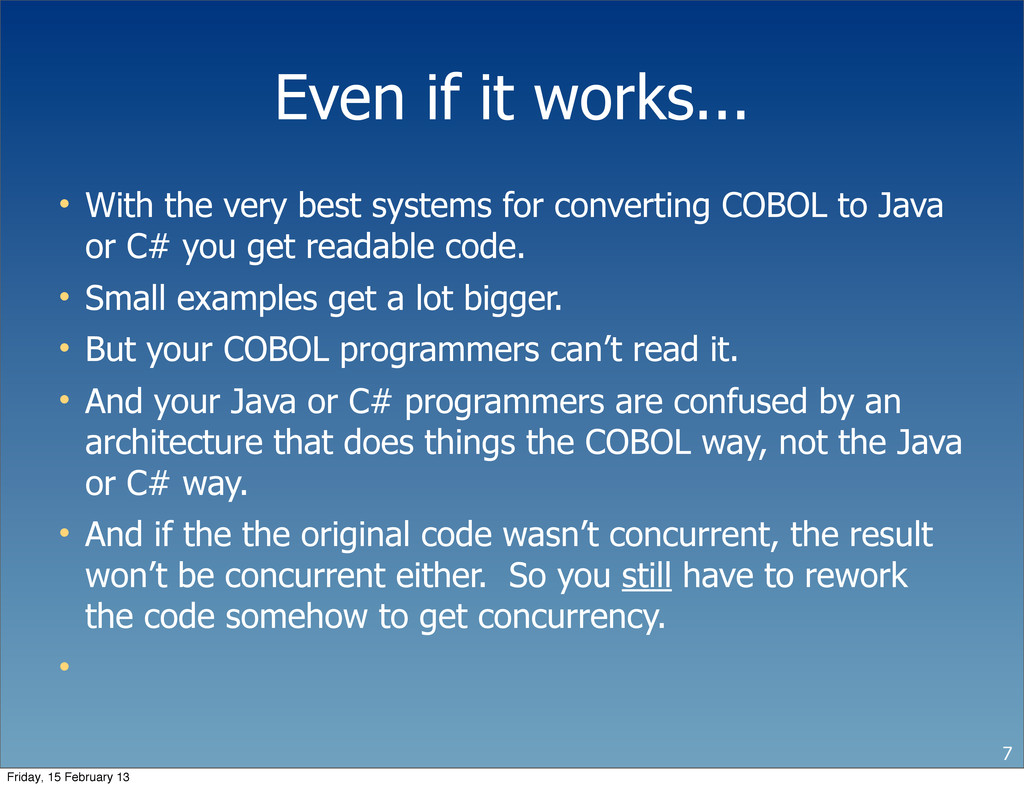
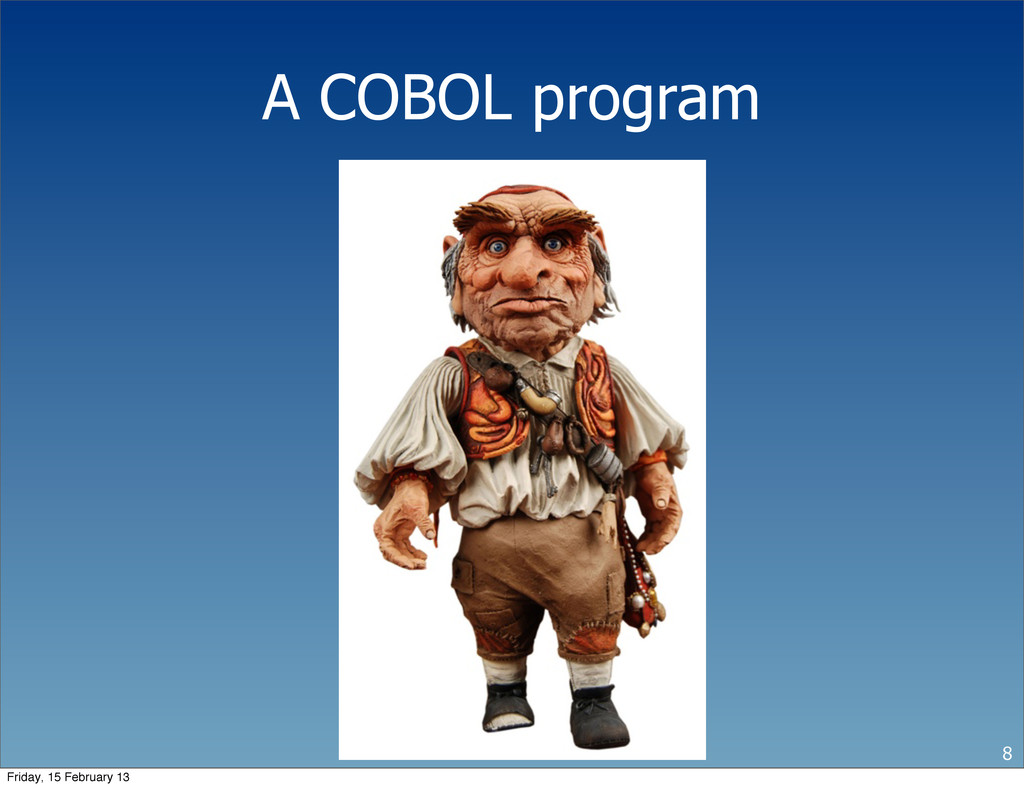
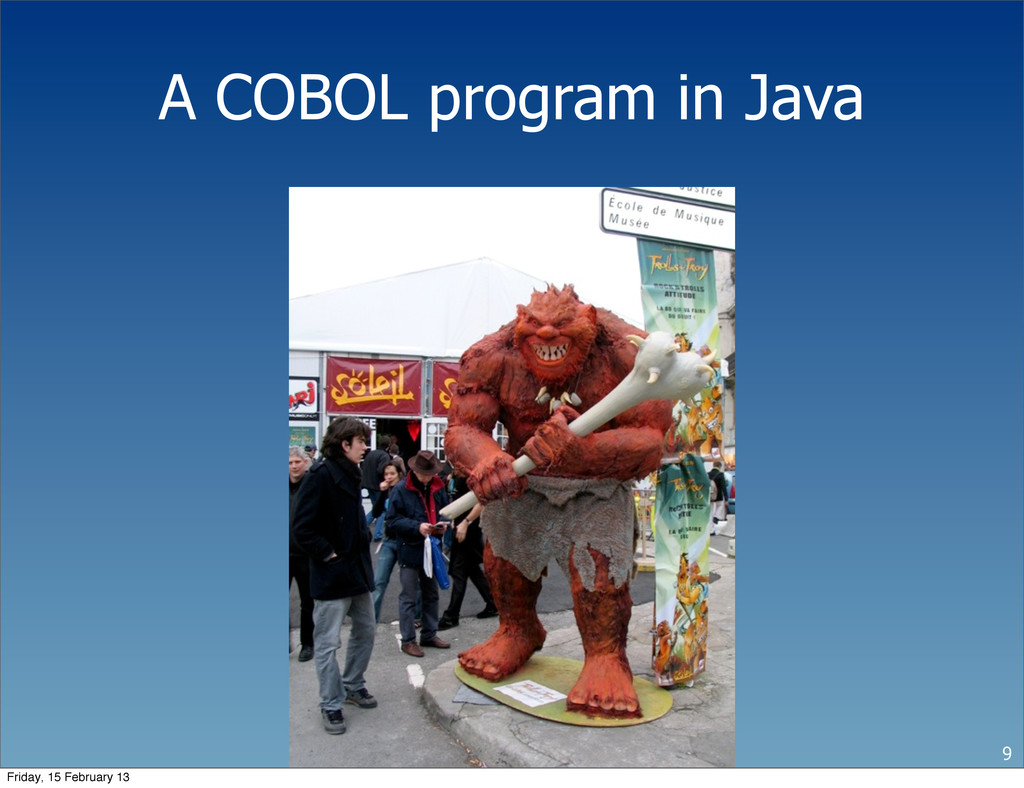
for converting COBOL to Java or C# you get readable code. • Small examples get a lot bigger. • But your COBOL programmers can’t read it. • And your Java or C# programmers are confused by an architecture that does things the COBOL way, not the Java or C# way. • And if the the original code wasn’t concurrent, the result won’t be concurrent either. So you still have to rework the code somehow to get concurrency. • 7 Friday, 15 February 13
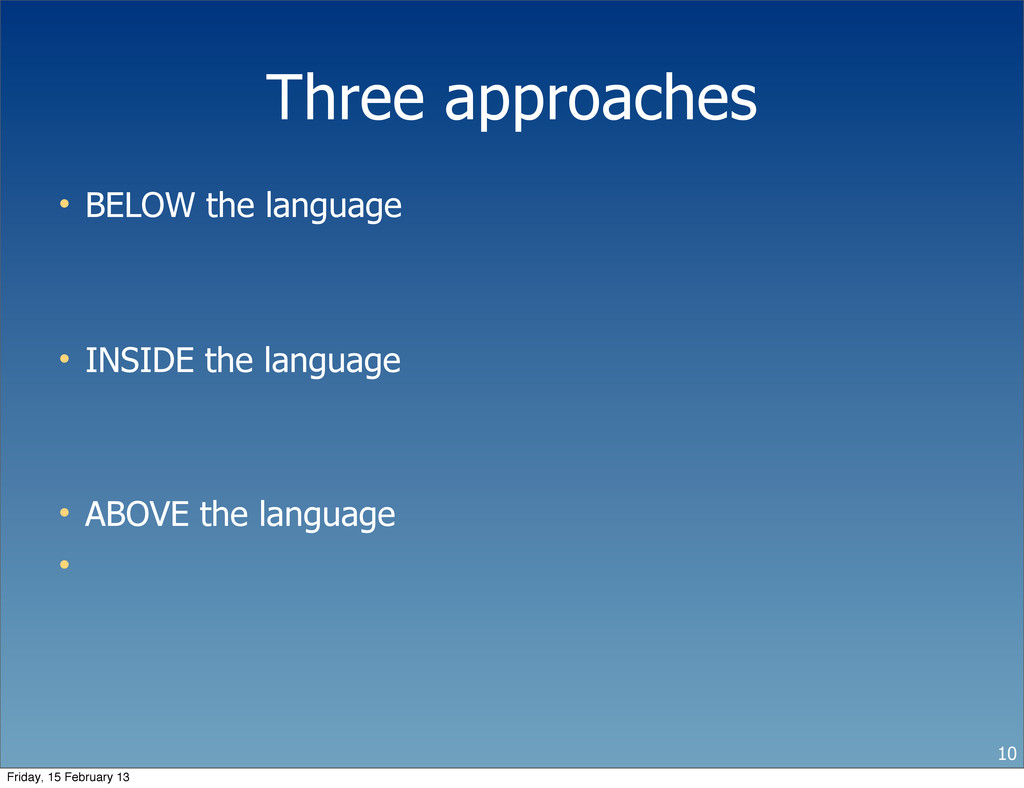
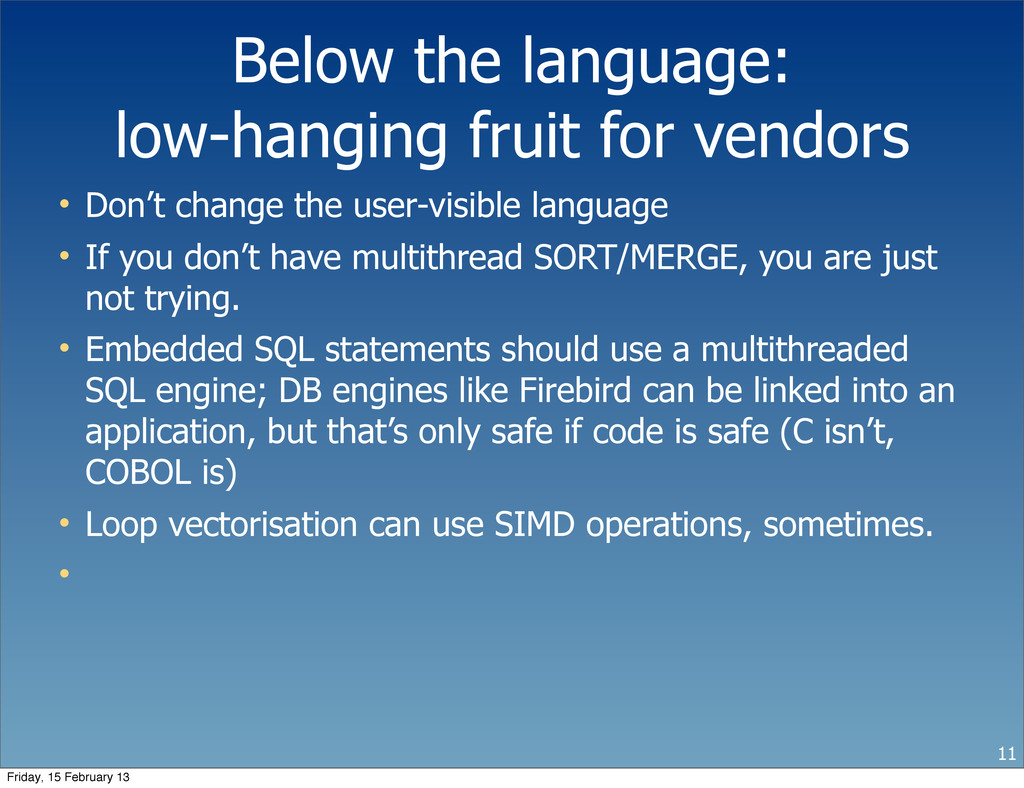
the user-visible language • If you don’t have multithread SORT/MERGE, you are just not trying. • Embedded SQL statements should use a multithreaded SQL engine; DB engines like Firebird can be linked into an application, but that’s only safe if code is safe (C isn’t, COBOL is) • Loop vectorisation can use SIMD operations, sometimes. • 11 Friday, 15 February 13
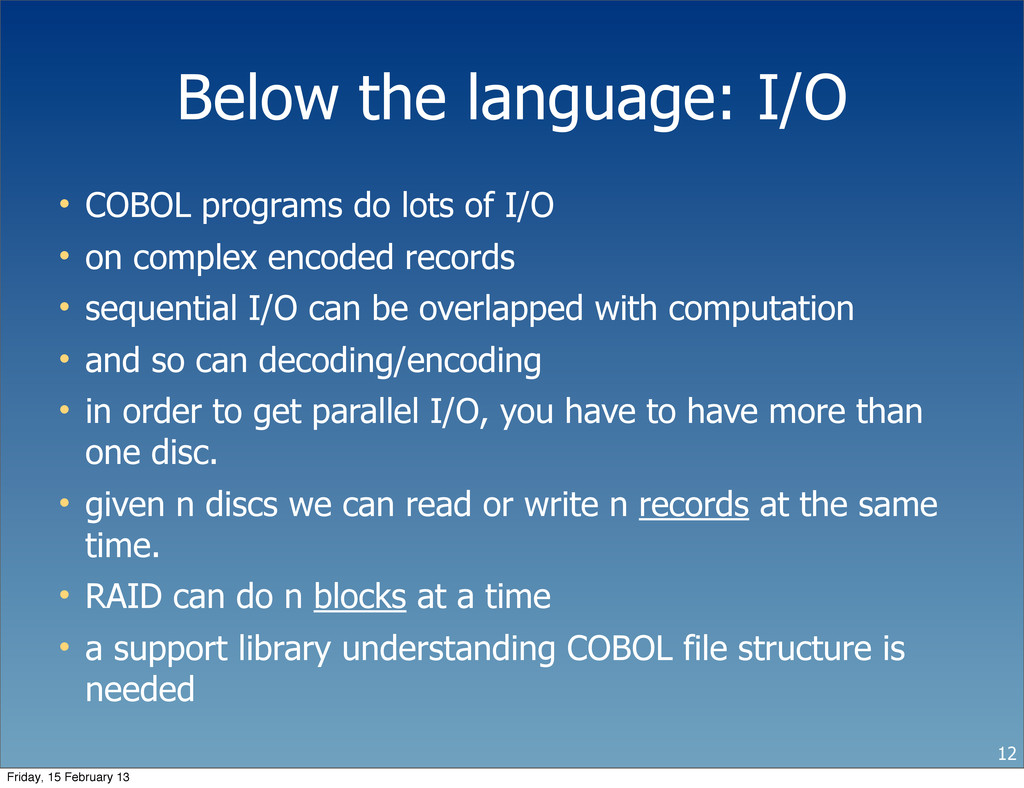
I/O • on complex encoded records • sequential I/O can be overlapped with computation • and so can decoding/encoding • in order to get parallel I/O, you have to have more than one disc. • given n discs we can read or write n records at the same time. • RAID can do n blocks at a time • a support library understanding COBOL file structure is needed 12 Friday, 15 February 13
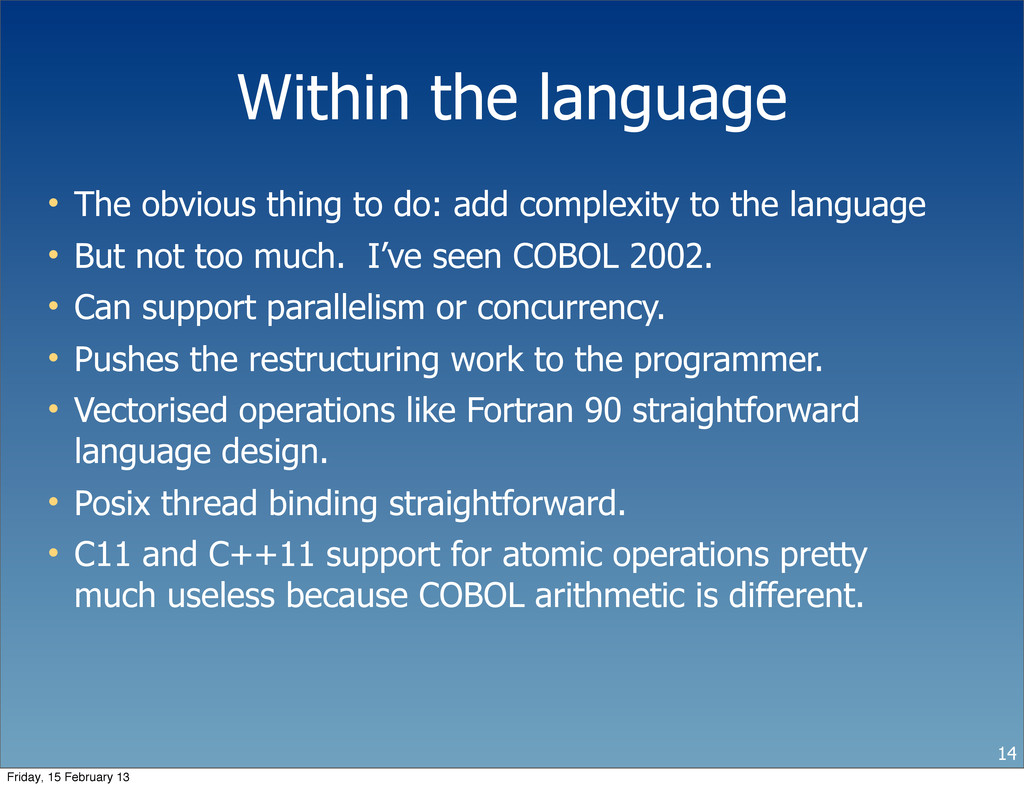
complexity to the language • But not too much. I’ve seen COBOL 2002. • Can support parallelism or concurrency. • Pushes the restructuring work to the programmer. • Vectorised operations like Fortran 90 straightforward language design. • Posix thread binding straightforward. • C11 and C++11 support for atomic operations pretty much useless because COBOL arithmetic is different. 14 Friday, 15 February 13
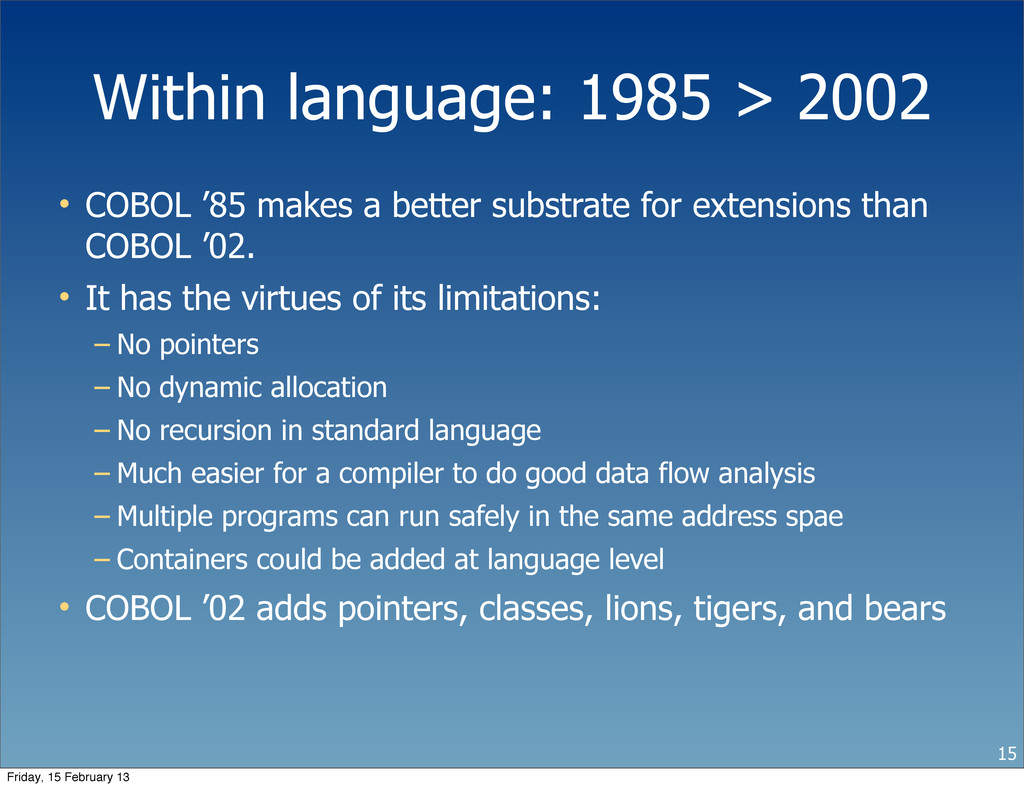
better substrate for extensions than COBOL ’02. • It has the virtues of its limitations: – No pointers – No dynamic allocation – No recursion in standard language – Much easier for a compiler to do good data flow analysis – Multiple programs can run safely in the same address spae – Containers could be added at language level • COBOL ’02 adds pointers, classes, lions, tigers, and bears 15 Friday, 15 February 13
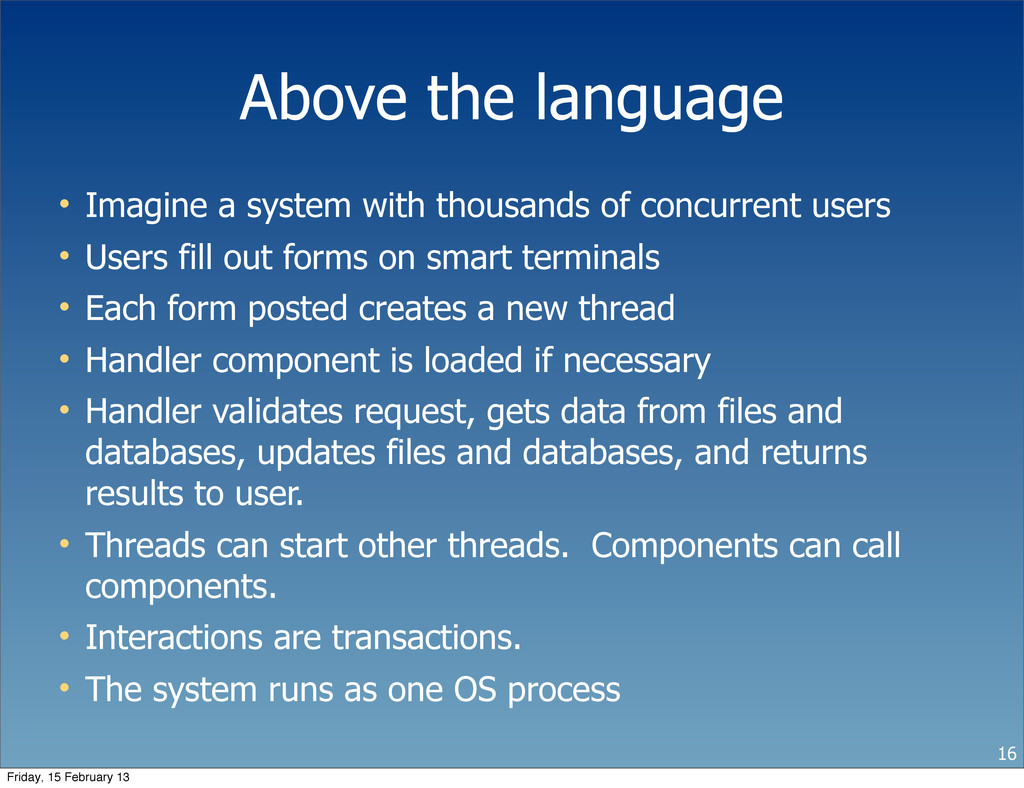
concurrent users • Users fill out forms on smart terminals • Each form posted creates a new thread • Handler component is loaded if necessary • Handler validates request, gets data from files and databases, updates files and databases, and returns results to user. • Threads can start other threads. Components can call components. • Interactions are transactions. • The system runs as one OS process 16 Friday, 15 February 13
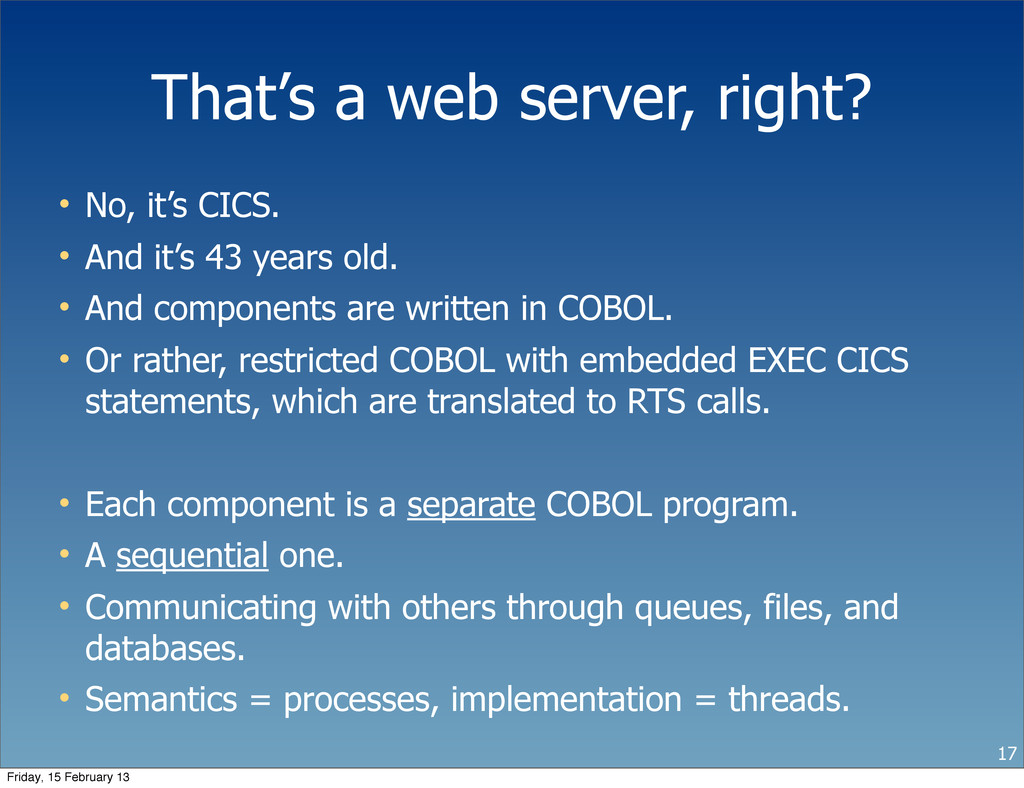
And it’s 43 years old. • And components are written in COBOL. • Or rather, restricted COBOL with embedded EXEC CICS statements, which are translated to RTS calls. • Each component is a separate COBOL program. • A sequential one. • Communicating with others through queues, files, and databases. • Semantics = processes, implementation = threads. 17 Friday, 15 February 13
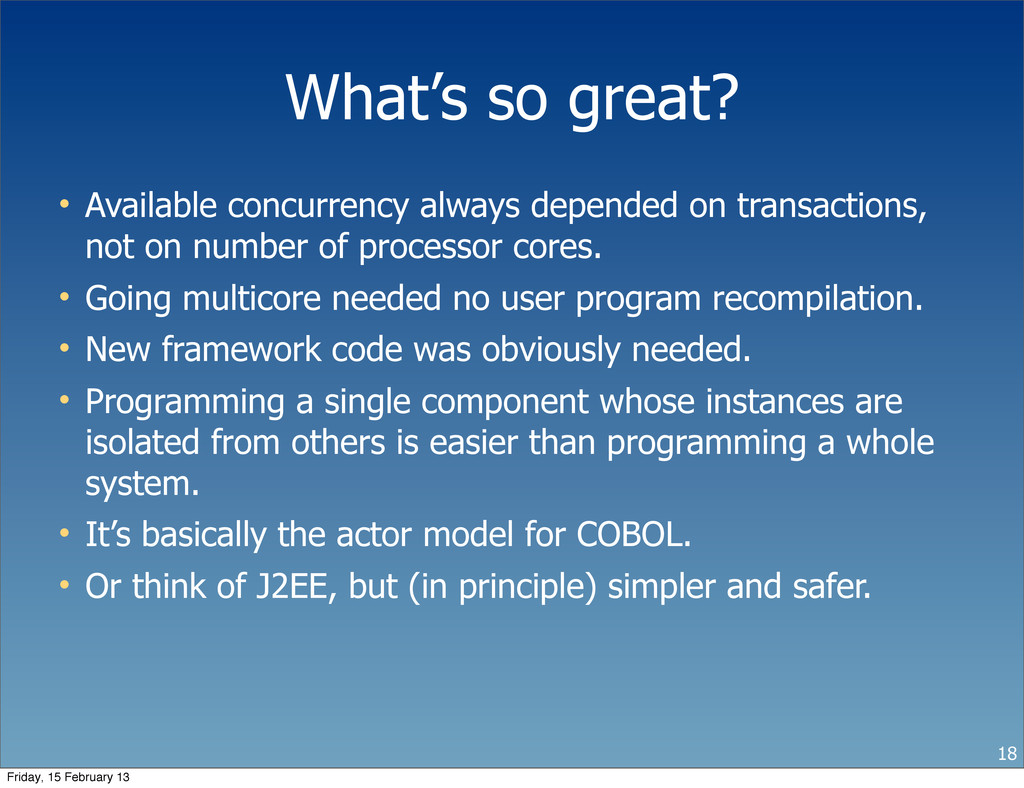
not on number of processor cores. • Going multicore needed no user program recompilation. • New framework code was obviously needed. • Programming a single component whose instances are isolated from others is easier than programming a whole system. • It’s basically the actor model for COBOL. • Or think of J2EE, but (in principle) simpler and safer. 18 Friday, 15 February 13
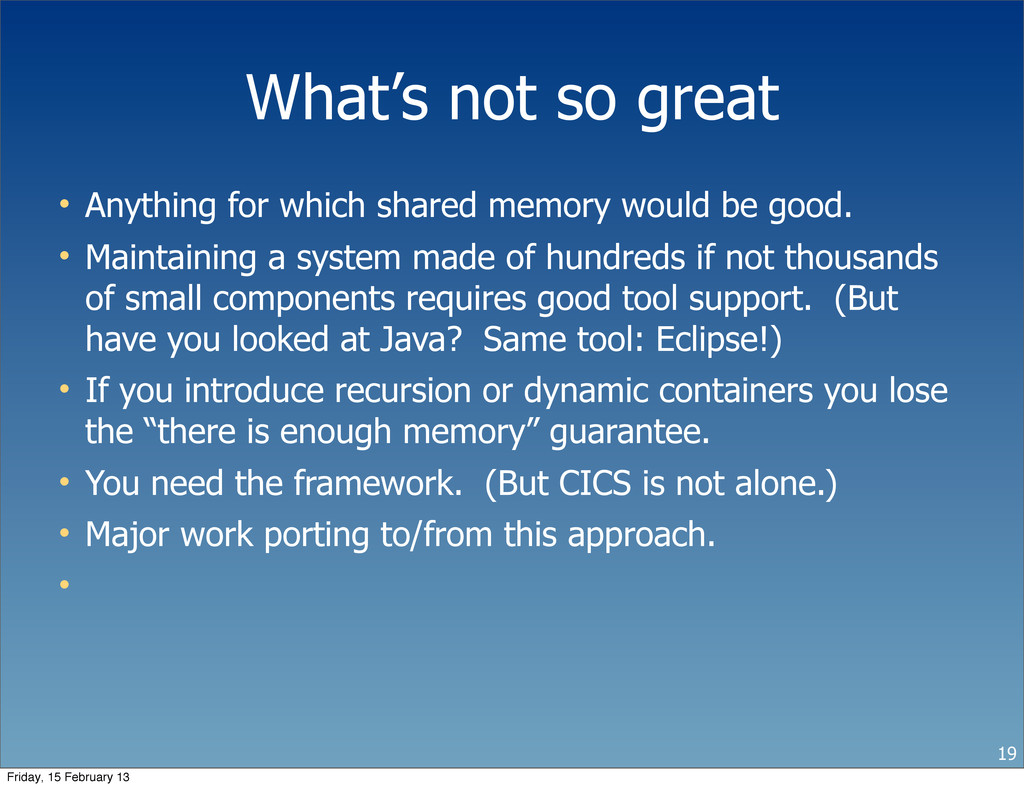
would be good. • Maintaining a system made of hundreds if not thousands of small components requires good tool support. (But have you looked at Java? Same tool: Eclipse!) • If you introduce recursion or dynamic containers you lose the “there is enough memory” guarantee. • You need the framework. (But CICS is not alone.) • Major work porting to/from this approach. • 19 Friday, 15 February 13
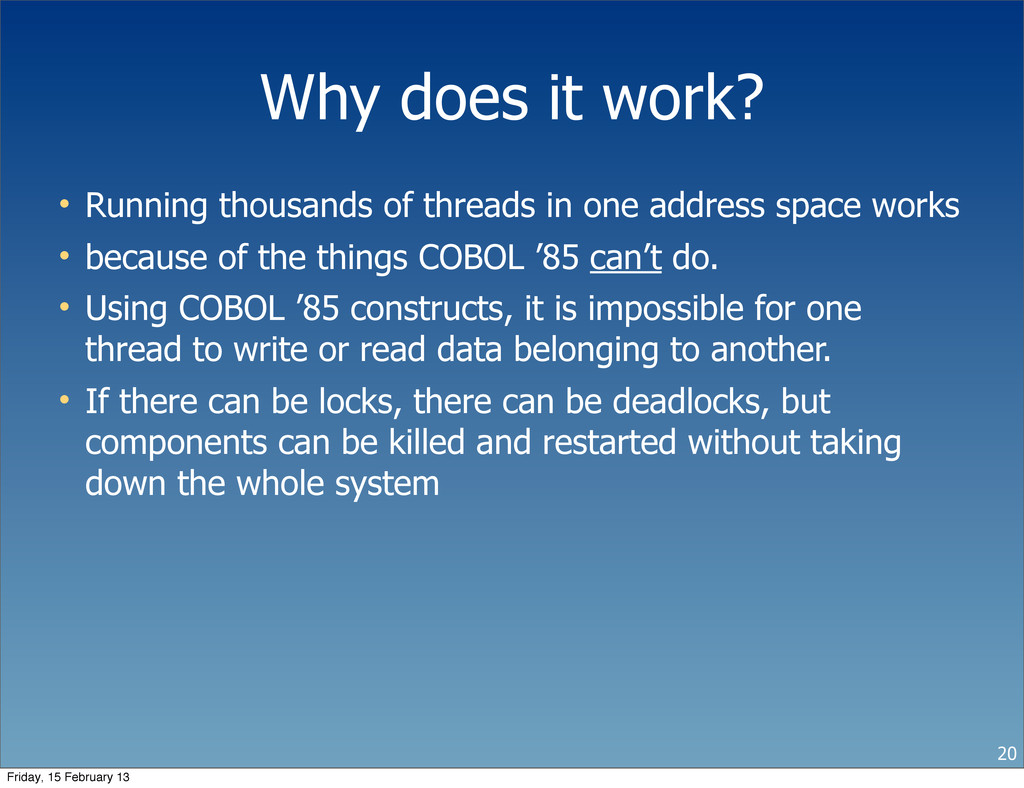
one address space works • because of the things COBOL ’85 can’t do. • Using COBOL ’85 constructs, it is impossible for one thread to write or read data belonging to another. • If there can be locks, there can be deadlocks, but components can be killed and restarted without taking down the whole system 20 Friday, 15 February 13
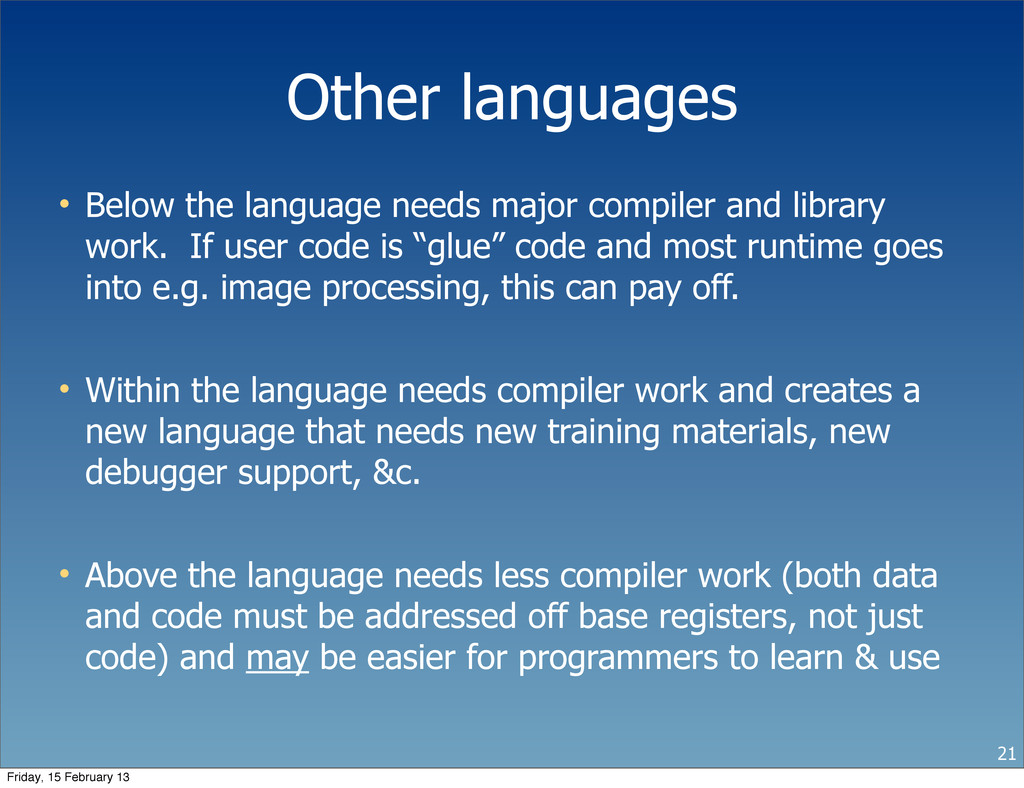
library work. If user code is “glue” code and most runtime goes into e.g. image processing, this can pay off. • Within the language needs compiler work and creates a new language that needs new training materials, new debugger support, &c. • Above the language needs less compiler work (both data and code must be addressed off base registers, not just code) and may be easier for programmers to learn & use 21 Friday, 15 February 13


 multicorenz
 aleyda
 chriscoyier
 lynnandtonic
 shlominoach
 lcolladotor
 coloredviolet
 stephenakadiri
 minecr
 maggiecrowley
 sarafernandez
 soudai
![Multicore COBOL: three approaches Richard A. O’Keefe ([email protected]) Friday, 15](https://files.speakerdeck.com/presentations/efac3a7059780130d1bf1231392d87a1/slide_0.jpg)