and mediatech environment in the US and building relationships for Nikkei, based in New York • Launched in-house development and grew team • Made an algorithm and built a platform for article recommendations • AI-Generated headlines and articles • AI-Generated videos from articles • Developing business strategies based on sophisticated data simulations and forecasts • Implementing strategies to grow subscriber LTV [email protected] Who I am 2
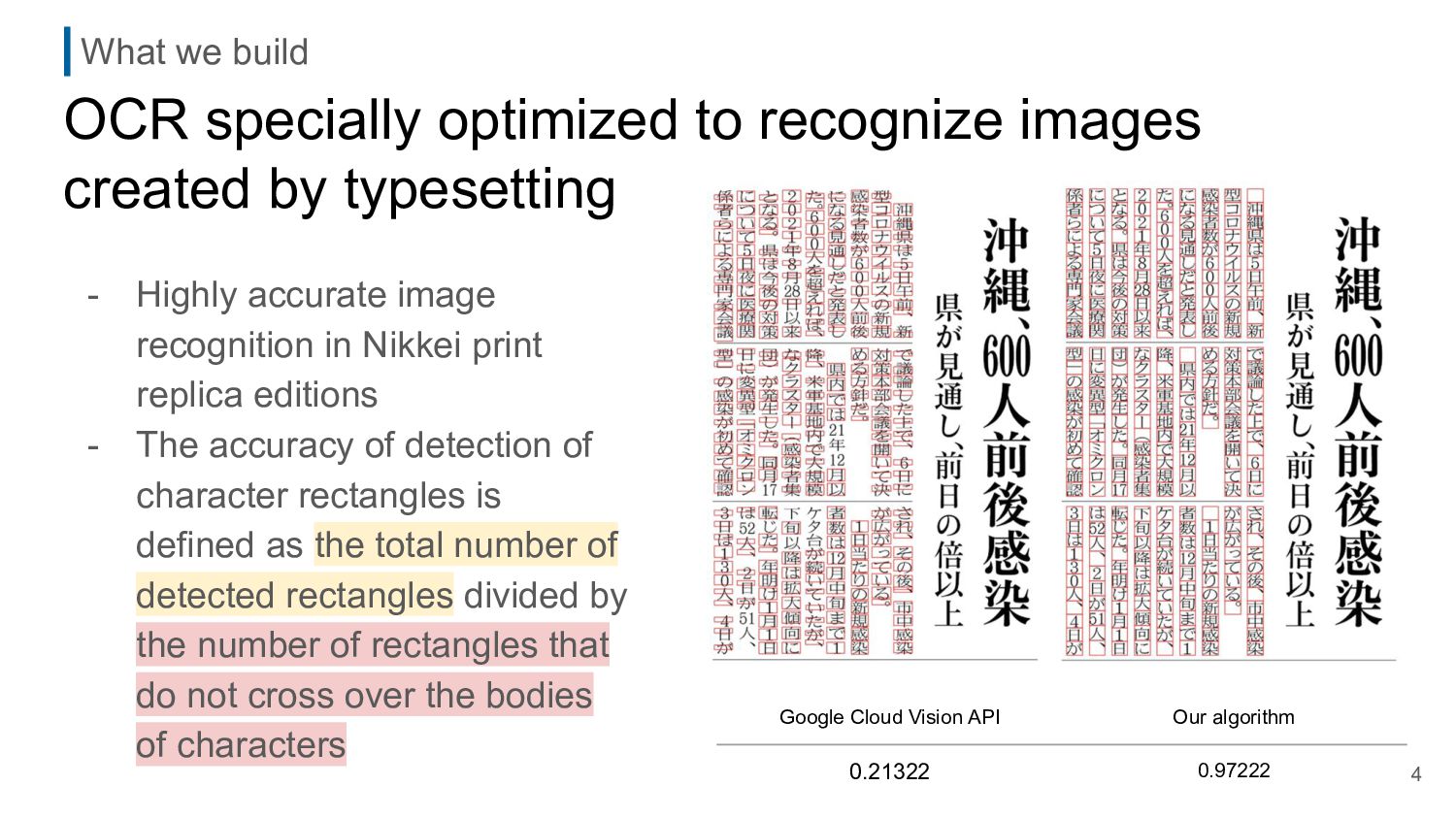
- The accuracy of detection of character rectangles is defined as the total number of detected rectangles divided by the number of rectangles that do not cross over the bodies of characters OCR specially optimized to recognize images created by typesetting What we build Google Cloud Vision API Our algorithm 0.21322 0.97222 4
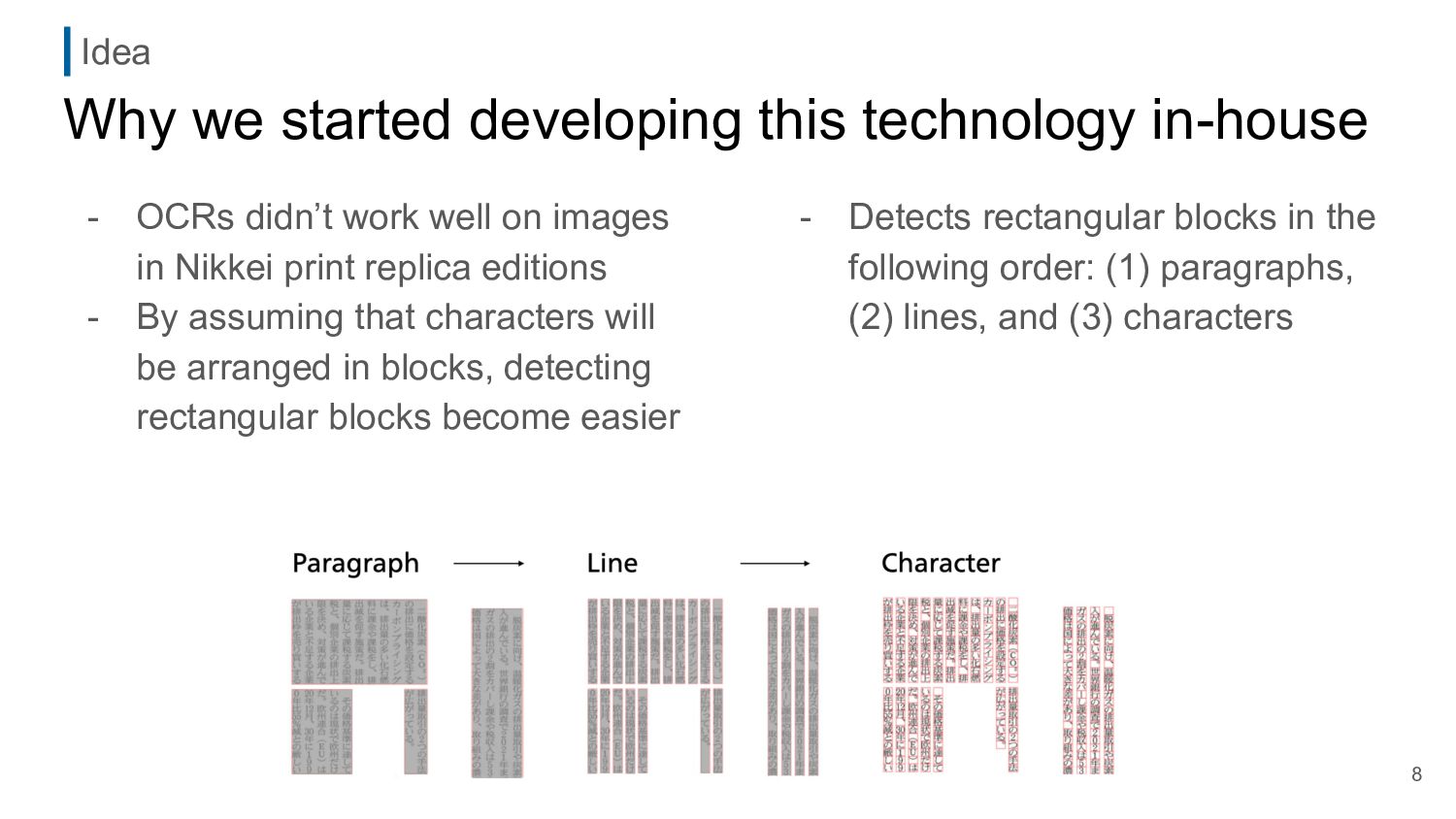
replica editions - By assuming that characters will be arranged in blocks, detecting rectangular blocks become easier Why we started developing this technology in-house Idea - Detects rectangular blocks in the following order: (1) paragraphs, (2) lines, and (3) characters 8
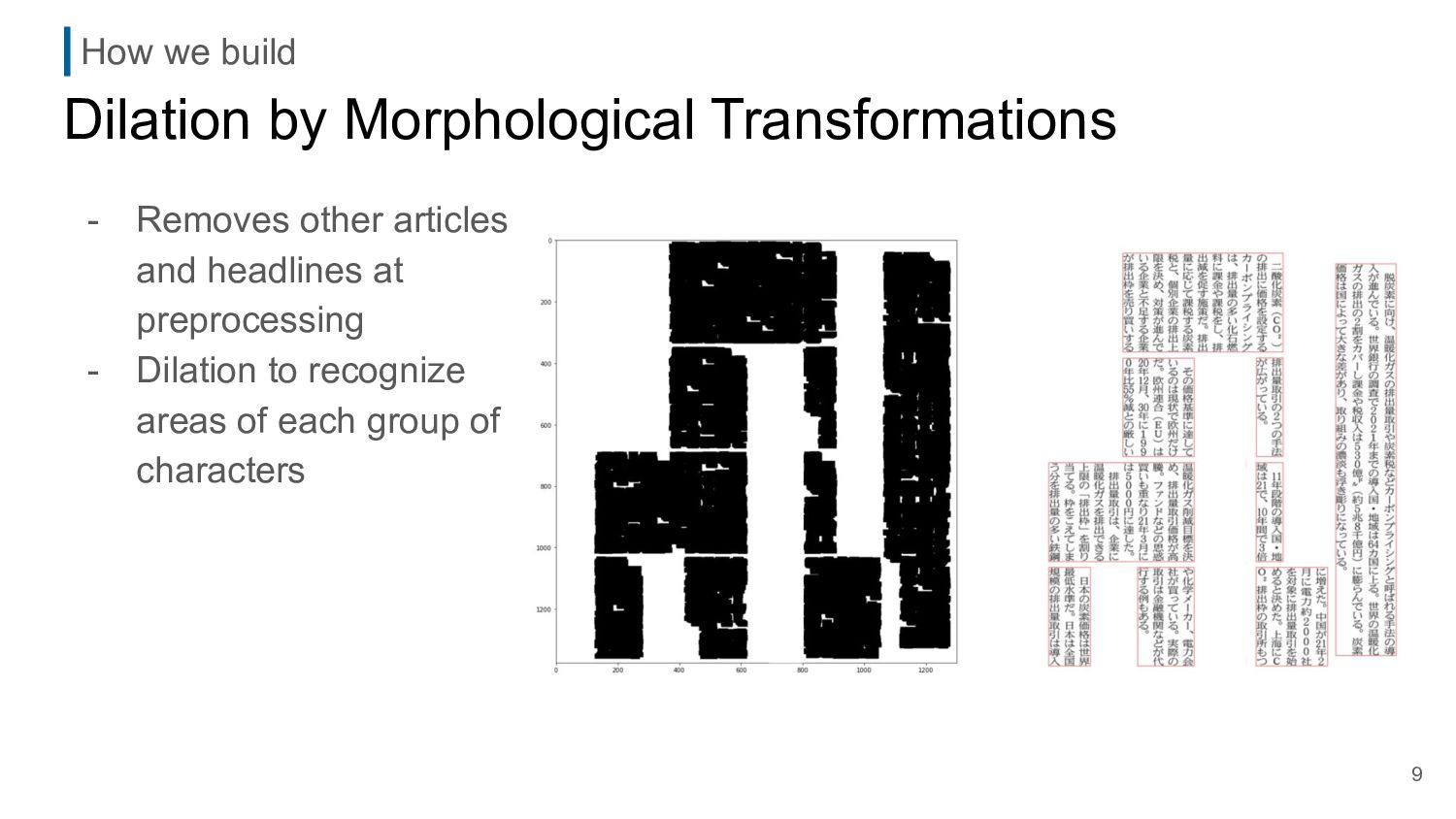
find the positions of characters - Gaps should be between characters - Minimize the loss function to draw horizontal lines How we build Figure: Y where there is no single pixel of black color can be a break between characters. 10
used to order paragraphs in Japanese print newspapers - Matching of each character in sentences to templates - total 2000 kanji characters - Low accuracy tolerance, focus on position of characters and order of paragraphs - Paragraph Order by Dynamic Programming with Levenshtein distance between predicted text and text for digital products How we build 11
1 character, and “㌽” containing 4 characters in 1 character space are translated to text for digital products - Match detected characters to text for digital products by dynamic programming How we build 12
defined as the number of rectangles that do not cross over the bodies of characters out of the total number of detected rectangles Results Google Cloud Vision API Our algorithm 0.21322 0.97222 Our algorithm Google Cloud Vision API 13
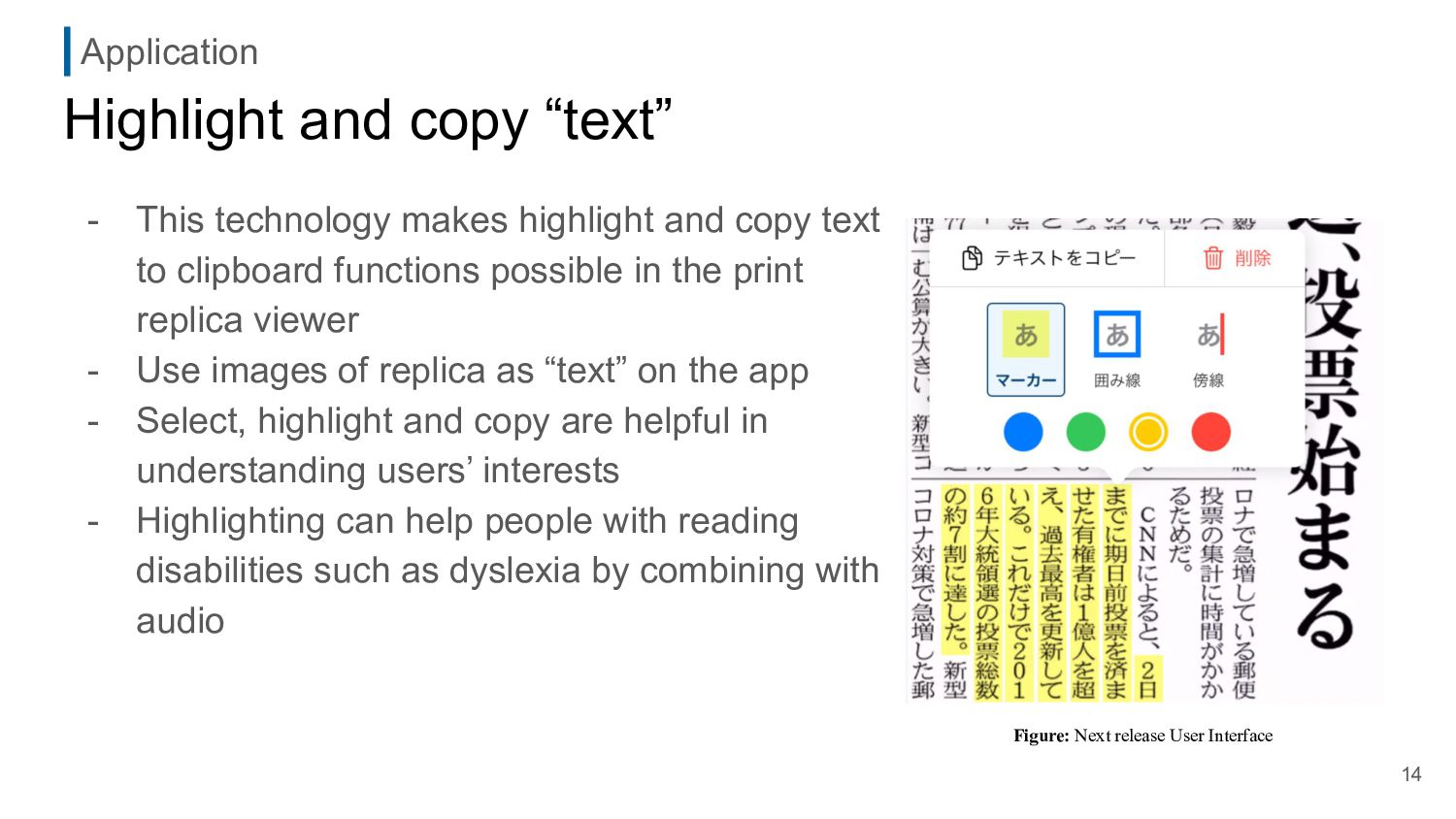
copy text to clipboard functions possible in the print replica viewer - Use images of replica as “text” on the app - Select, highlight and copy are helpful in understanding users’ interests - Highlighting can help people with reading disabilities such as dyslexia by combining with audio Application Figure: Next release User Interface 14


 nakamods320yen
 fj_yoshimura_kosuke
 silmin_
 wadayusuke
 sansantech
 shotashiratori
 sat
 oracle4engineer
 pipepasta
 nealle
 keitah
 imuta
 yuutosi
 jonoalderson
 speakerdeck
 shlominoach
 keavy
 chriscoyier
 bkeepers
 inesmontani
 rkendrick25
 aleyda
 tmiket
 varn
 codingconduct