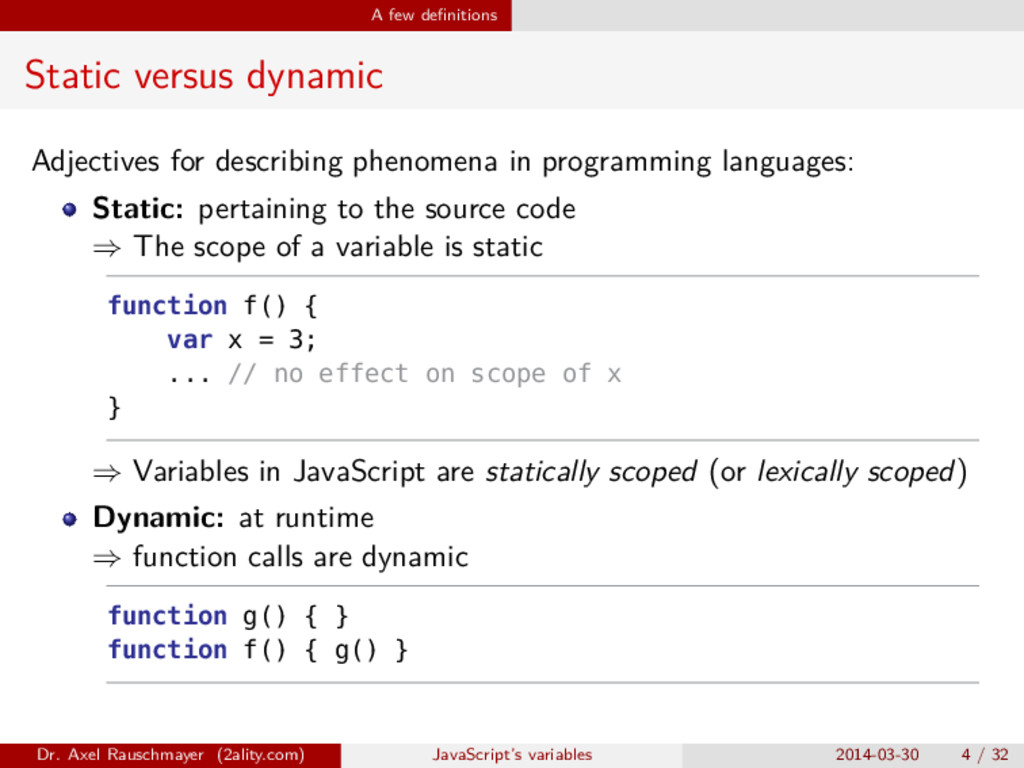
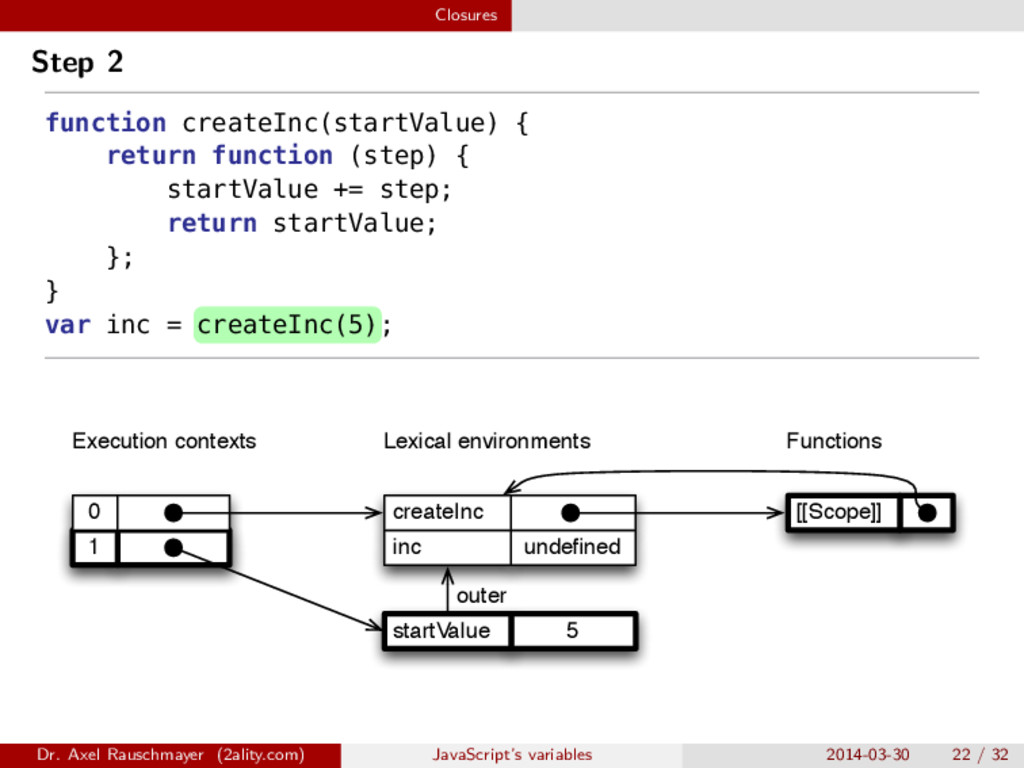
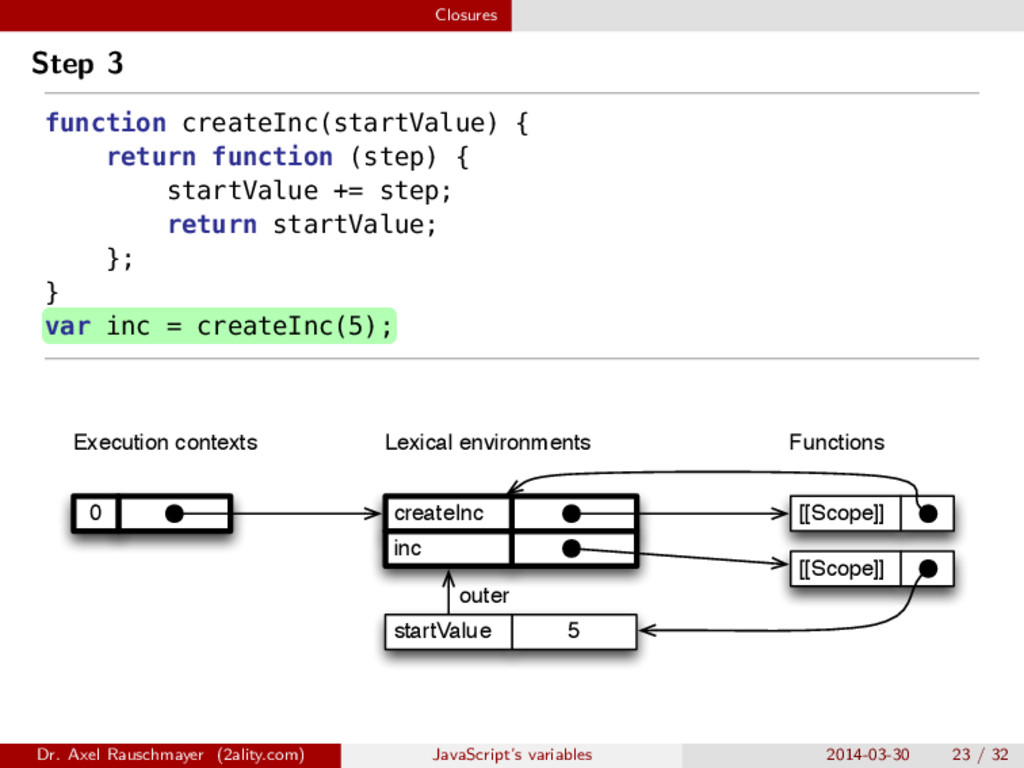
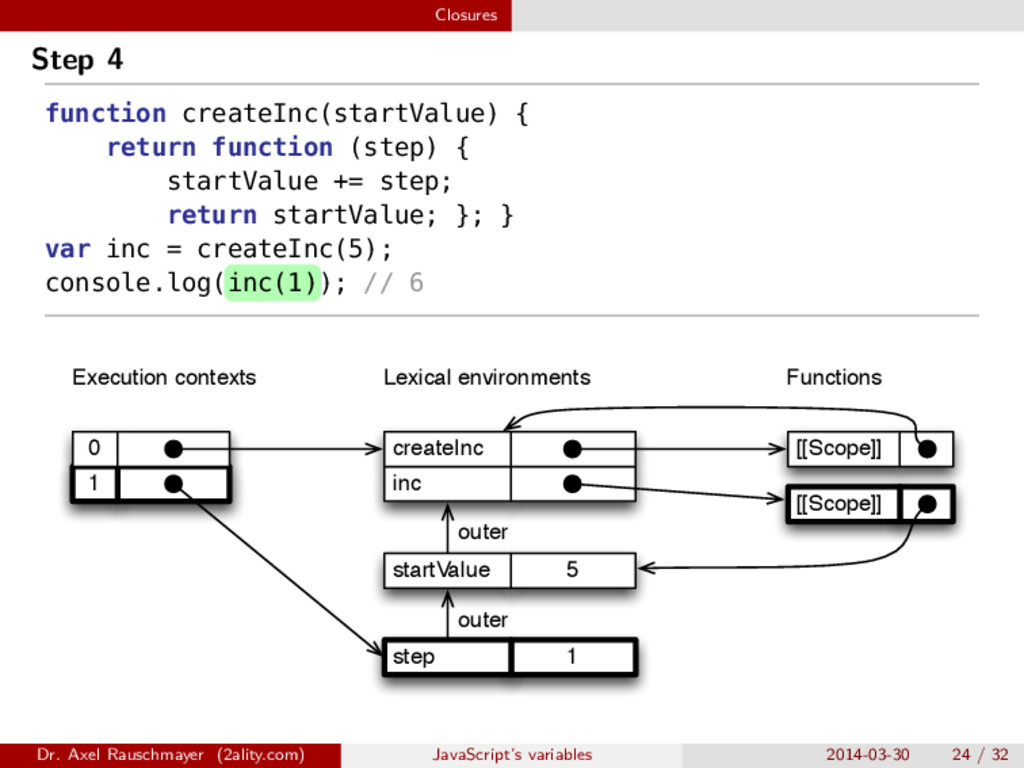
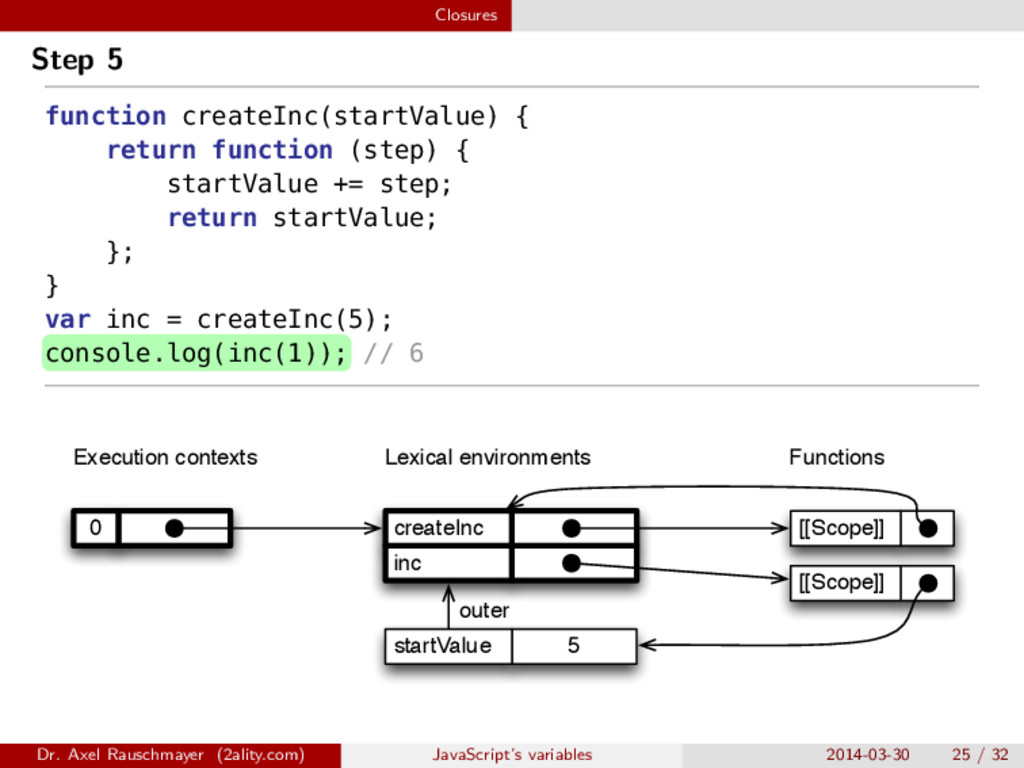
in programming languages: Static: pertaining to the source code ⇒ The scope of a variable is static function f() { var x = 3; ... // no effect on scope of x } ⇒ Variables in JavaScript are statically scoped (or lexically scoped) Dynamic: at runtime ⇒ function calls are dynamic function g() { } function f() { g() } Dr. Axel Rauschmayer (2ality.com) JavaScript’s variables 2014-03-30 4 / 32
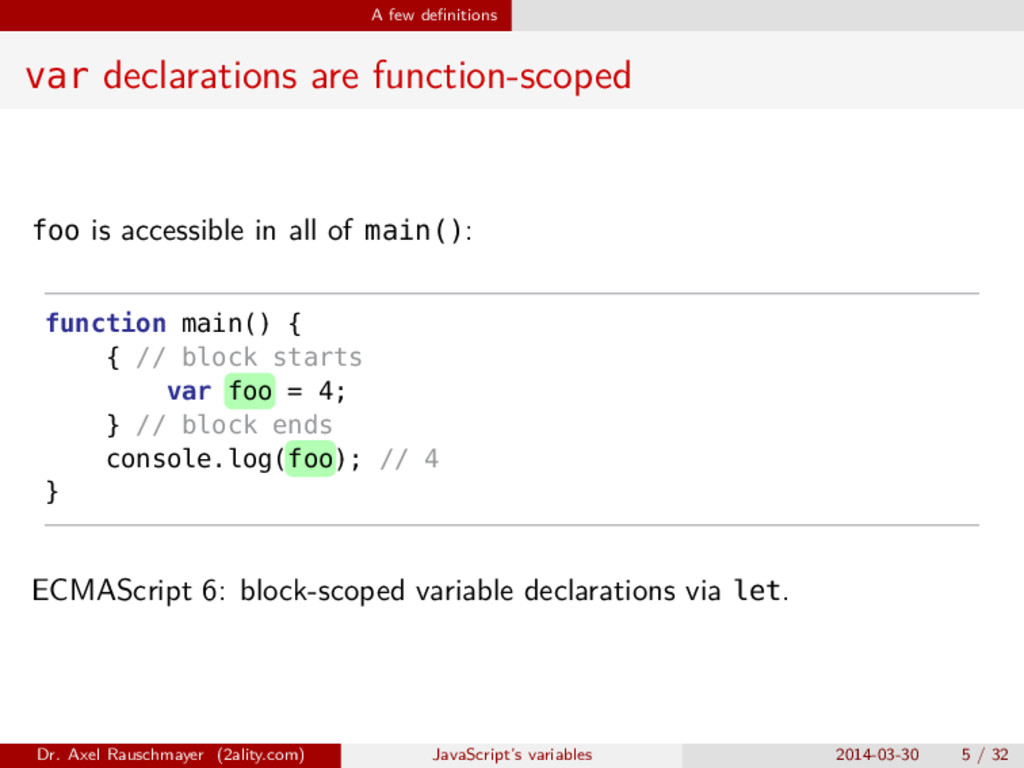
in all of main(): function main() { { // block starts var foo = 4; } // block ends console.log(foo); // 4 } ECMAScript 6: block-scoped variable declarations via let. Dr. Axel Rauschmayer (2ality.com) JavaScript’s variables 2014-03-30 5 / 32
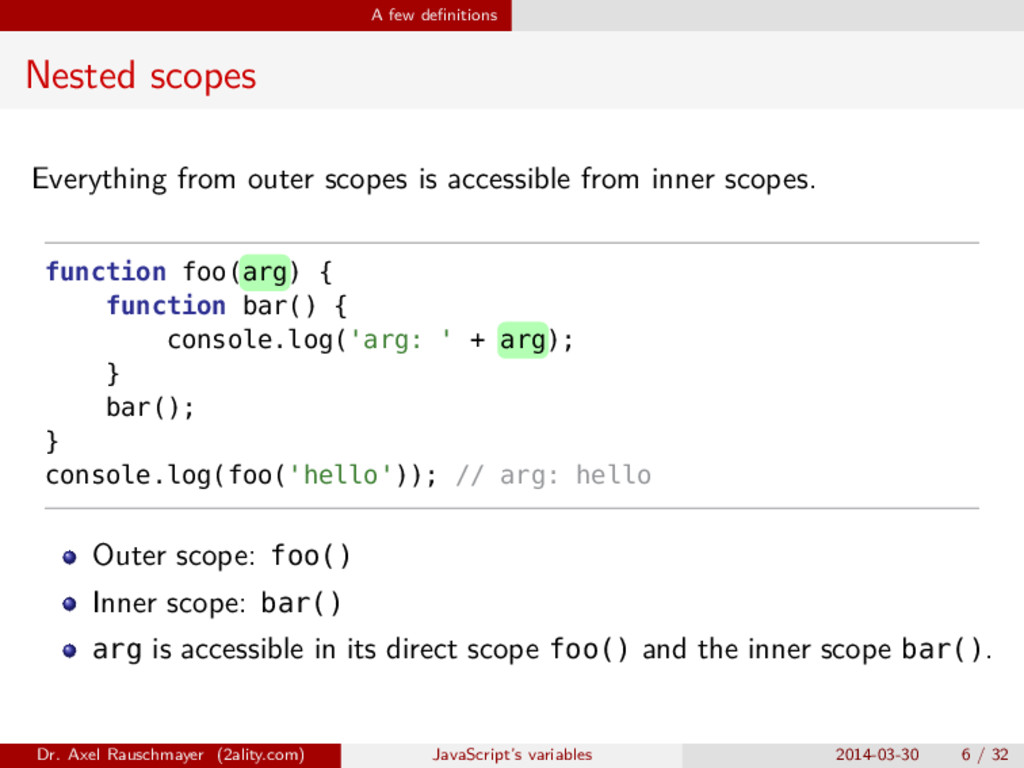
accessible from inner scopes. function foo(arg) { function bar() { console.log('arg: ' + arg); } bar(); } console.log(foo('hello')); // arg: hello Outer scope: foo() Inner scope: bar() arg is accessible in its direct scope foo() and the inner scope bar(). Dr. Axel Rauschmayer (2ality.com) JavaScript’s variables 2014-03-30 6 / 32
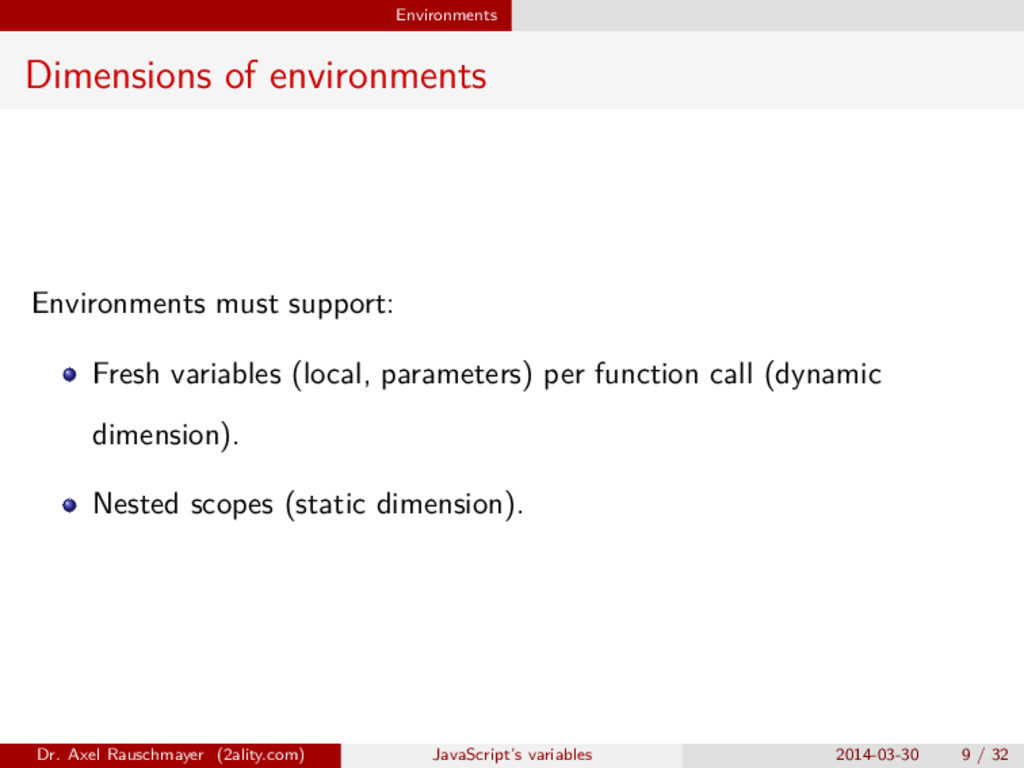
parameters) per function call (dynamic dimension). Nested scopes (static dimension). Dr. Axel Rauschmayer (2ality.com) JavaScript’s variables 2014-03-30 9 / 32
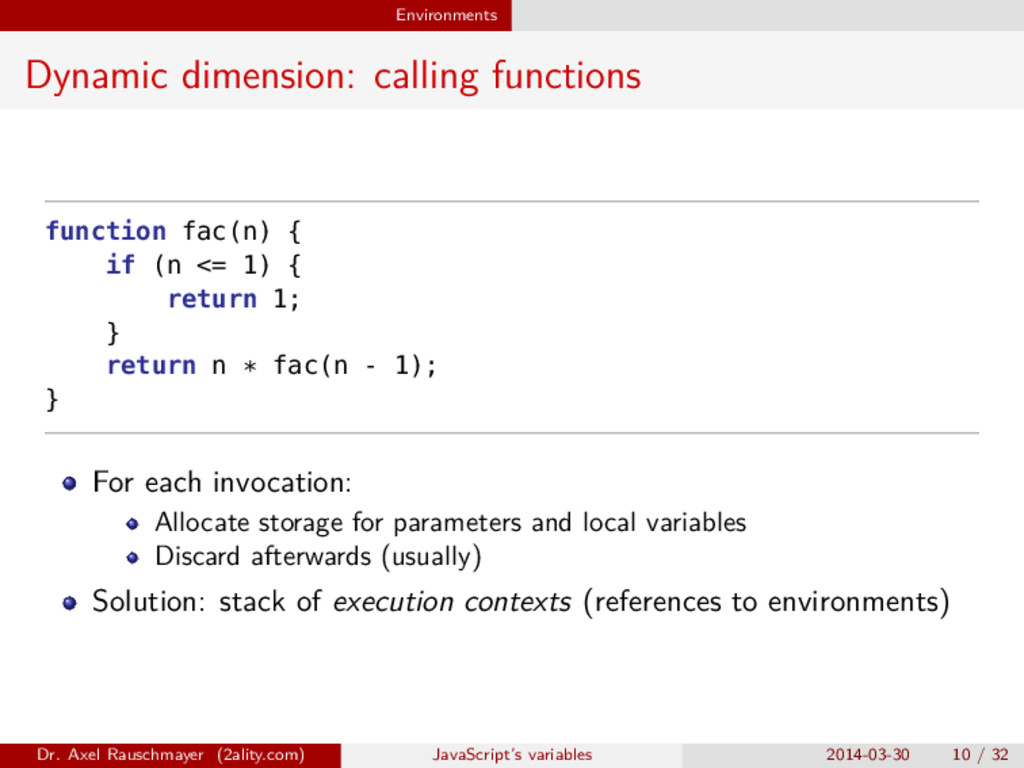
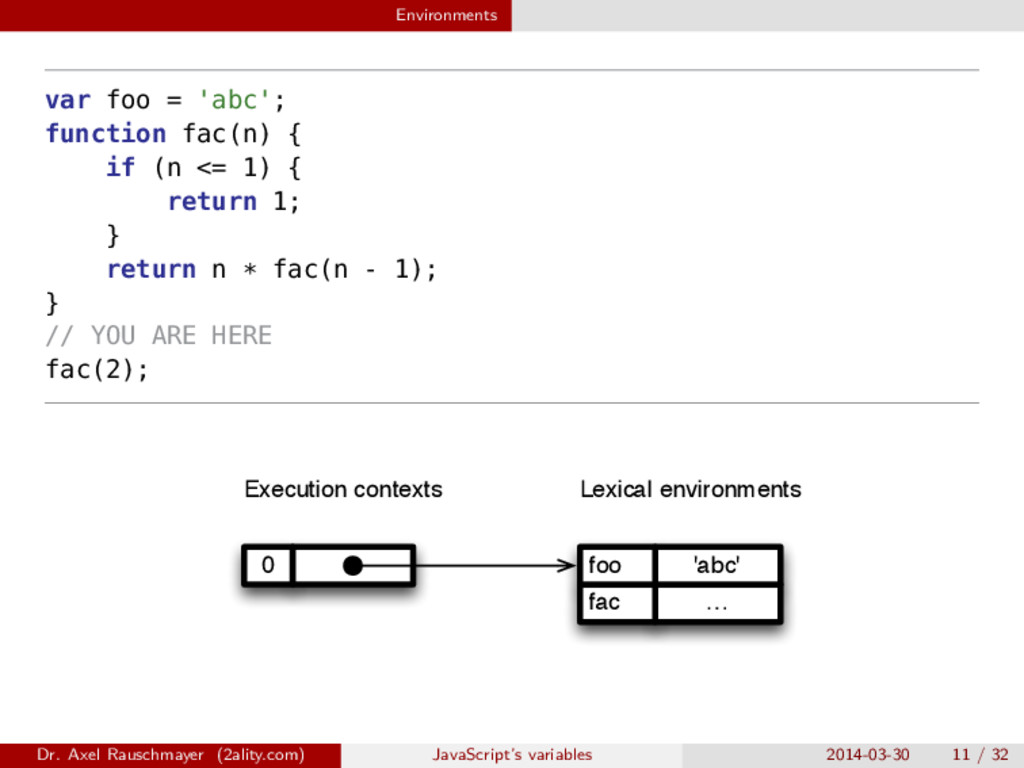
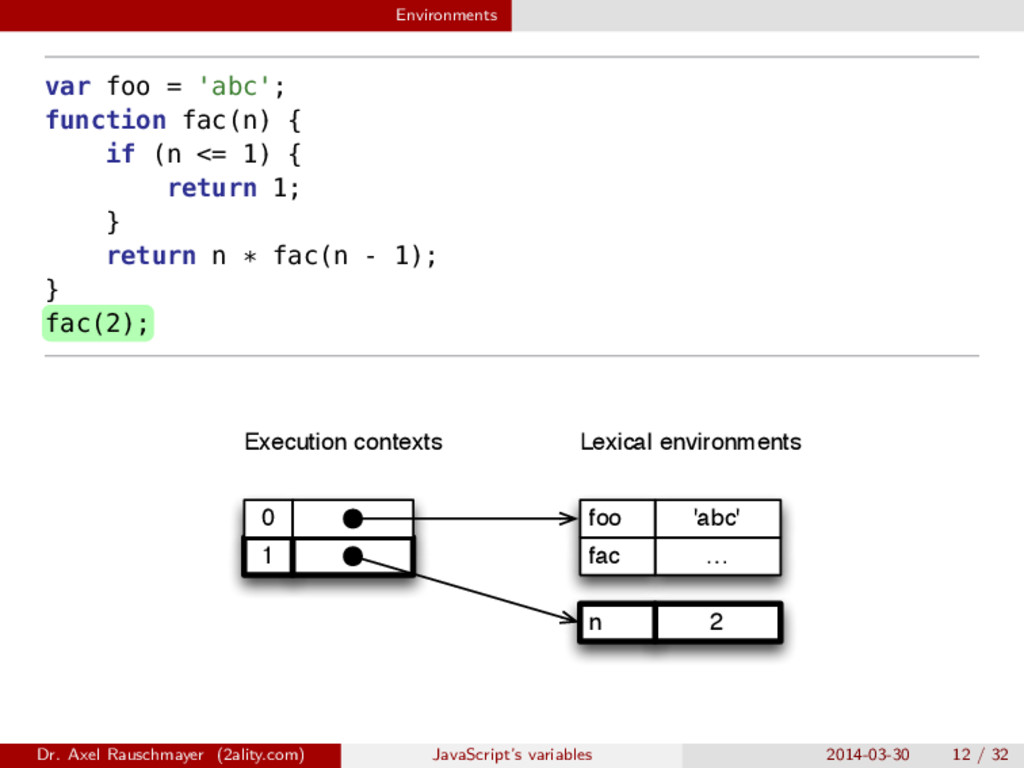
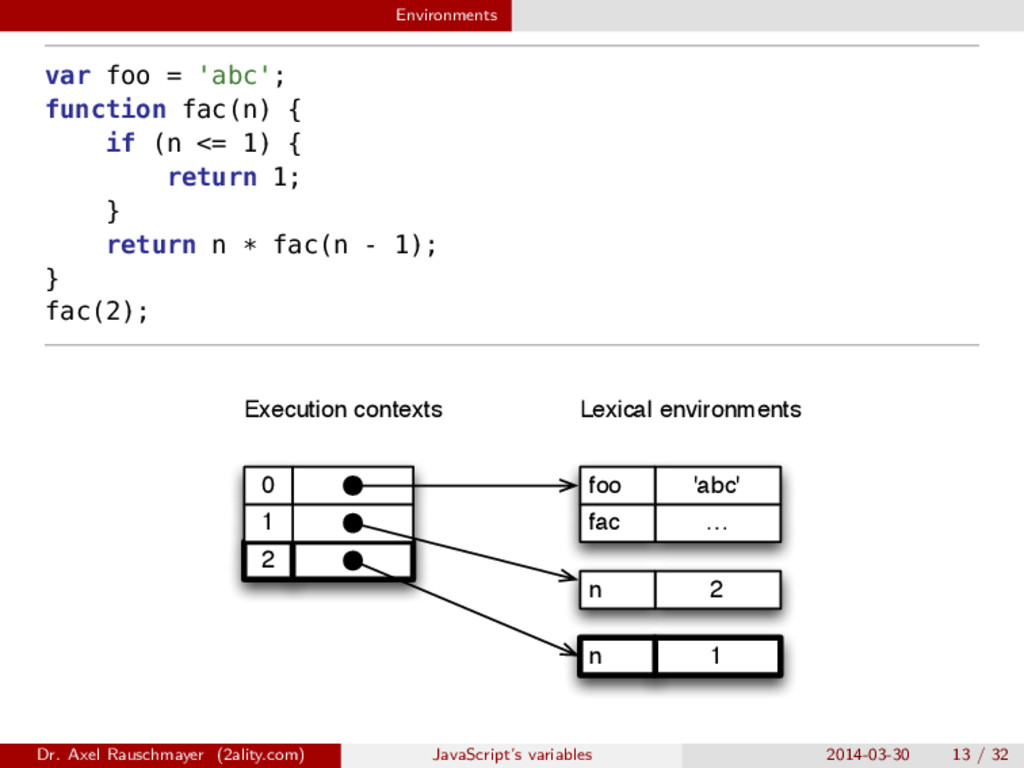
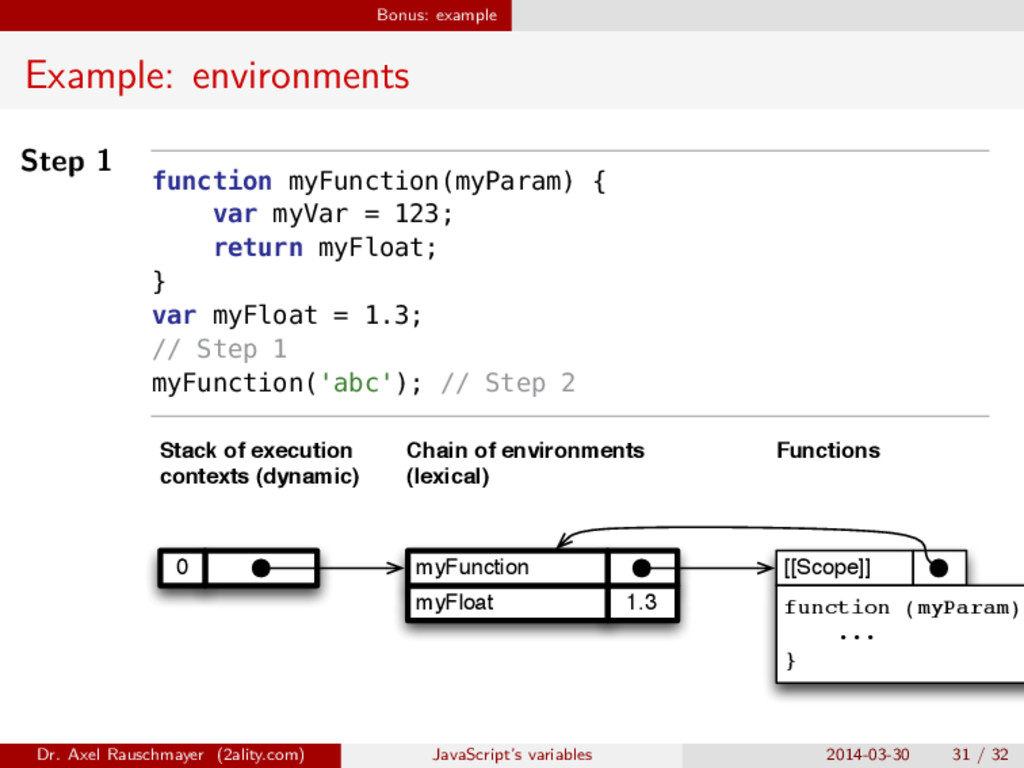
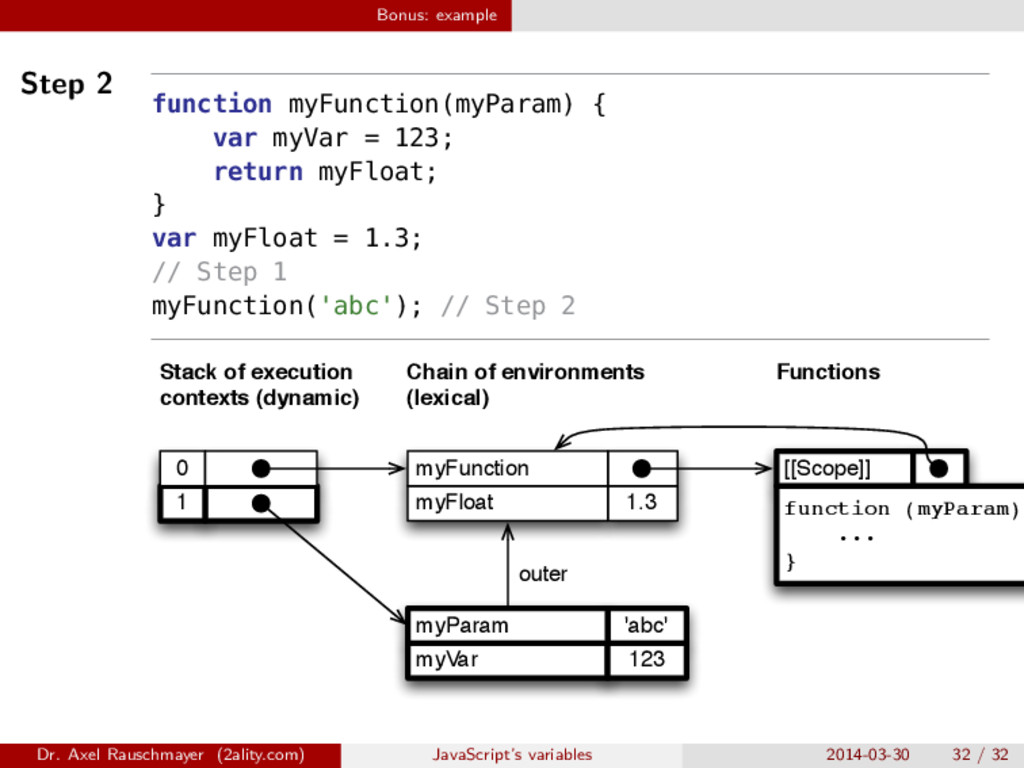
<= 1) { return 1; } return n * fac(n - 1); } For each invocation: Allocate storage for parameters and local variables Discard afterwards (usually) Solution: stack of execution contexts (references to environments) Dr. Axel Rauschmayer (2ality.com) JavaScript’s variables 2014-03-30 10 / 32
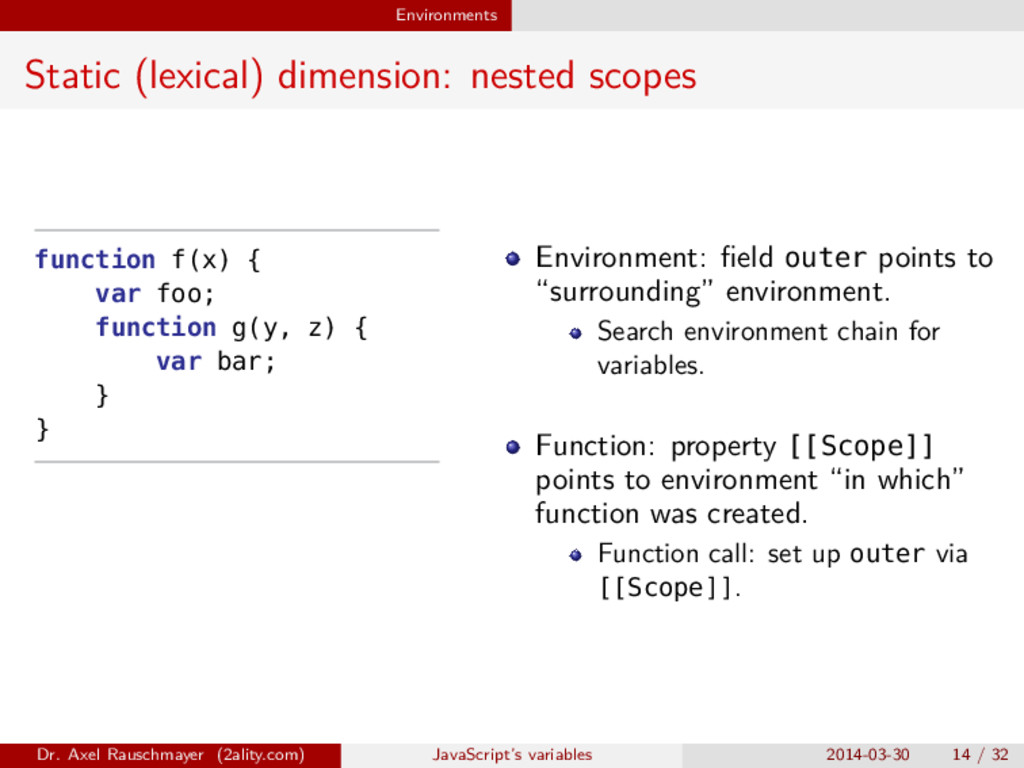
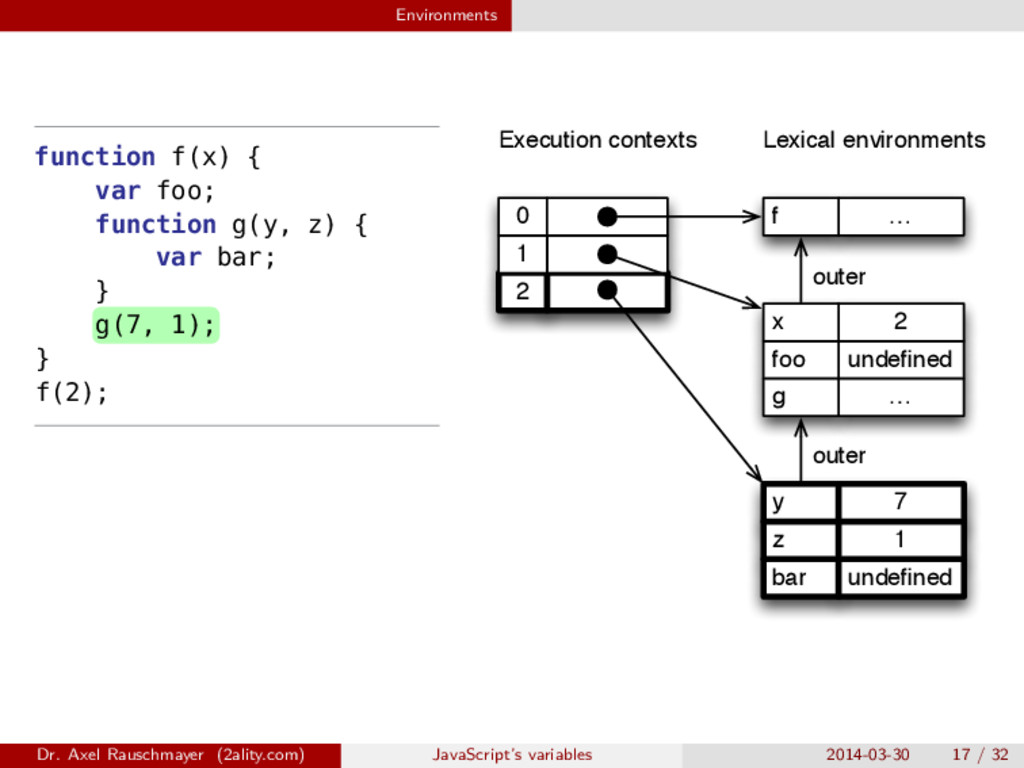
foo; function g(y, z) { var bar; } } Environment: field outer points to “surrounding” environment. Search environment chain for variables. Function: property [[Scope]] points to environment “in which” function was created. Function call: set up outer via [[Scope]]. Dr. Axel Rauschmayer (2ality.com) JavaScript’s variables 2014-03-30 14 / 32
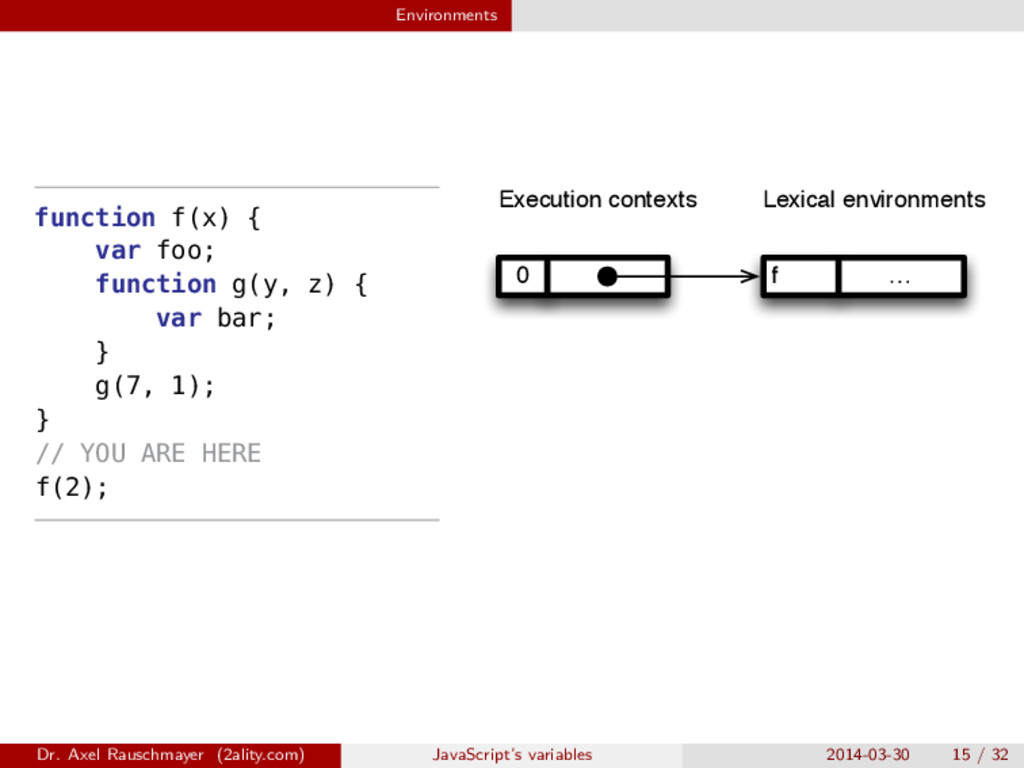
var bar; } g(7, 1); } // YOU ARE HERE f(2); 0 … f Lexical environments Execution contexts Dr. Axel Rauschmayer (2ality.com) JavaScript’s variables 2014-03-30 15 / 32
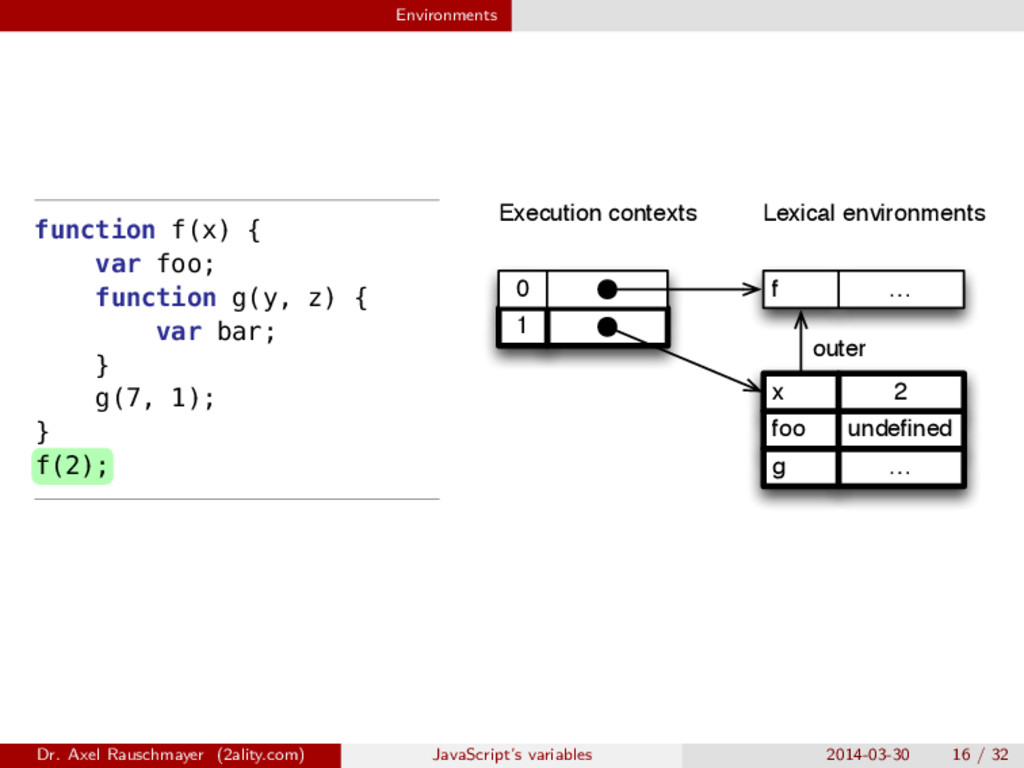
var bar; } g(7, 1); } f(2); 2 1 0 … f … g undefined foo 2 x outer Lexical environments Execution contexts undefined bar 1 z 7 y outer Dr. Axel Rauschmayer (2ality.com) JavaScript’s variables 2014-03-30 17 / 32
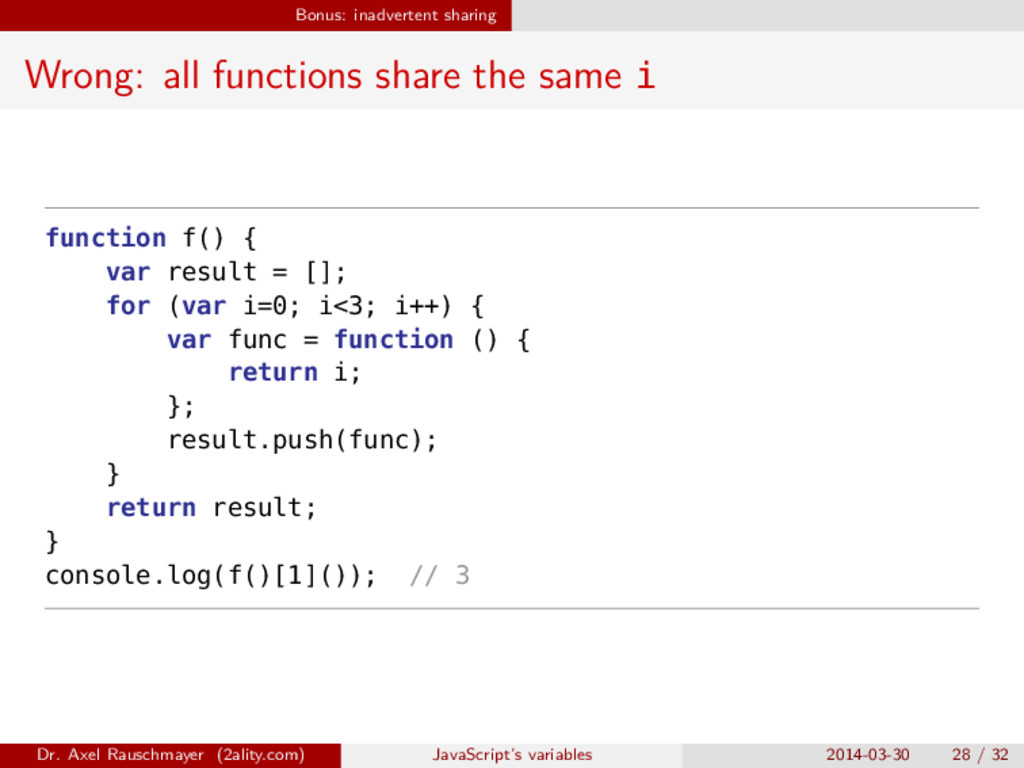
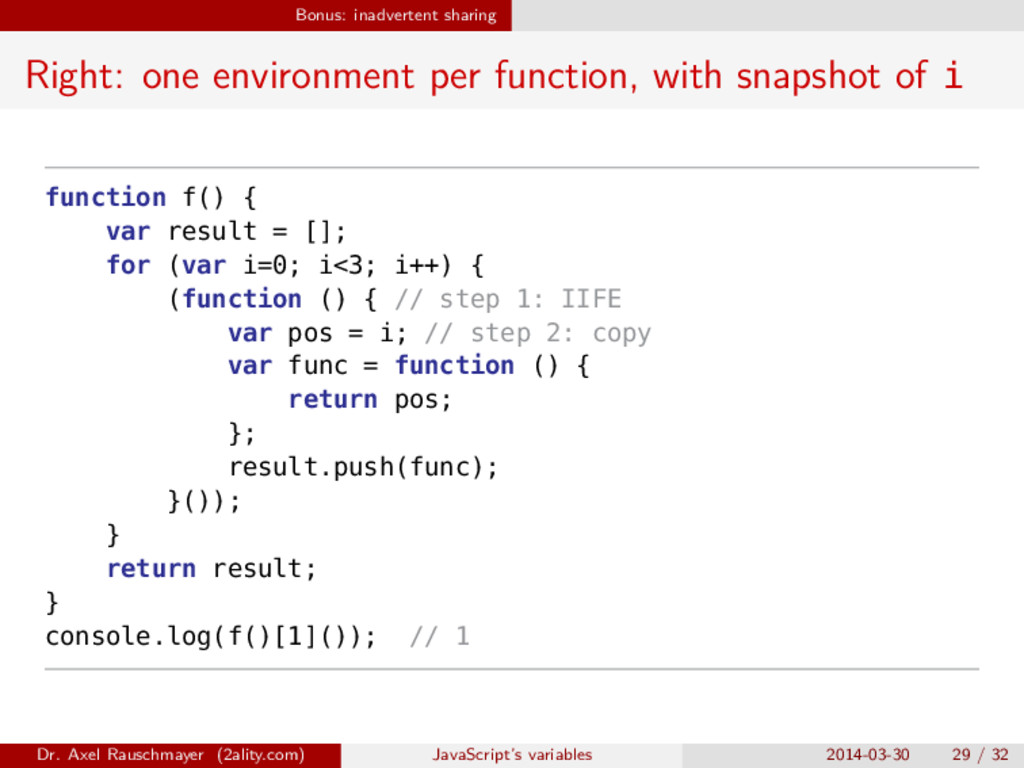
function f() { var result = []; for (var i=0; i<3; i++) { var func = function () { return i; }; result.push(func); } return result; } console.log(f()[1]()); // 3 Dr. Axel Rauschmayer (2ality.com) JavaScript’s variables 2014-03-30 28 / 32


 rauschma
 akit37
.jpg) yumnumm
yumnumm
 optim
optim
 yuta_onishi_97
 chobishiba
 minodriven
 yegor256
 rkaga
rkaga
 texmeijin
 a_matsuda
 morizo_1984
 mixplace
 moore
moore
 gurzu
gurzu
 aleyda
 jdejongh
 brad_frost
 aemeredith
 asonas
 bluesmoon
 ryanjones
 hatefulcrawdad
 kimpetersen
 rocio
rocio