$30 off During Our Annual Pro Sale. View Details »

OSXP 2025: "Hop3: From Self-Hosting Complexity ...

OSXP 2025: "Hop3: From Self-Hosting Complexity to Production-Ready Sovereignty"

Avatar for Stefane Fermigier

Stefane Fermigier

December 11, 2025
Tweet

More Decks by Stefane Fermigier

Other Decks in Technology

Transcript

  1. Hop3: From Self-Hosting Complexity to Production- Ready Sovereignty An Open-Source

    PaaS for Digital Autonomy OSXP 2025, Paris Stefane Fermigier (PhD), CEO, Abilian Slides sur: speakerdeck.com/sfermigier 1
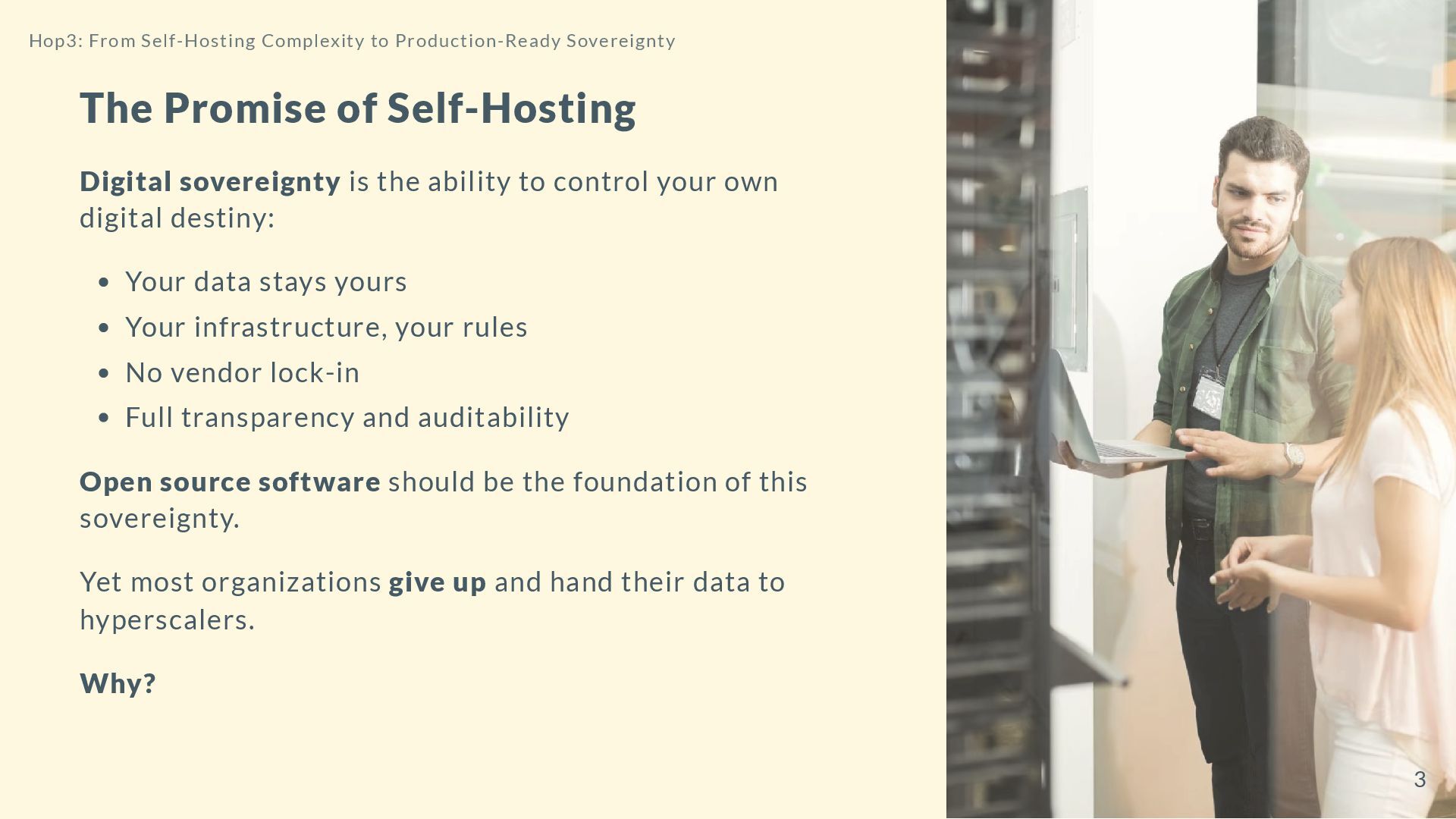
  2. The Promise of Self-Hosting Digital sovereignty is the ability to

    control your own digital destiny: Your data stays yours Your infrastructure, your rules No vendor lock-in Full transparency and auditability Open source software should be the foundation of this sovereignty. Yet most organizations give up and hand their data to hyperscalers. Why? Hop3: From Self-Hosting Complexity to Production-Ready Sovereignty 3
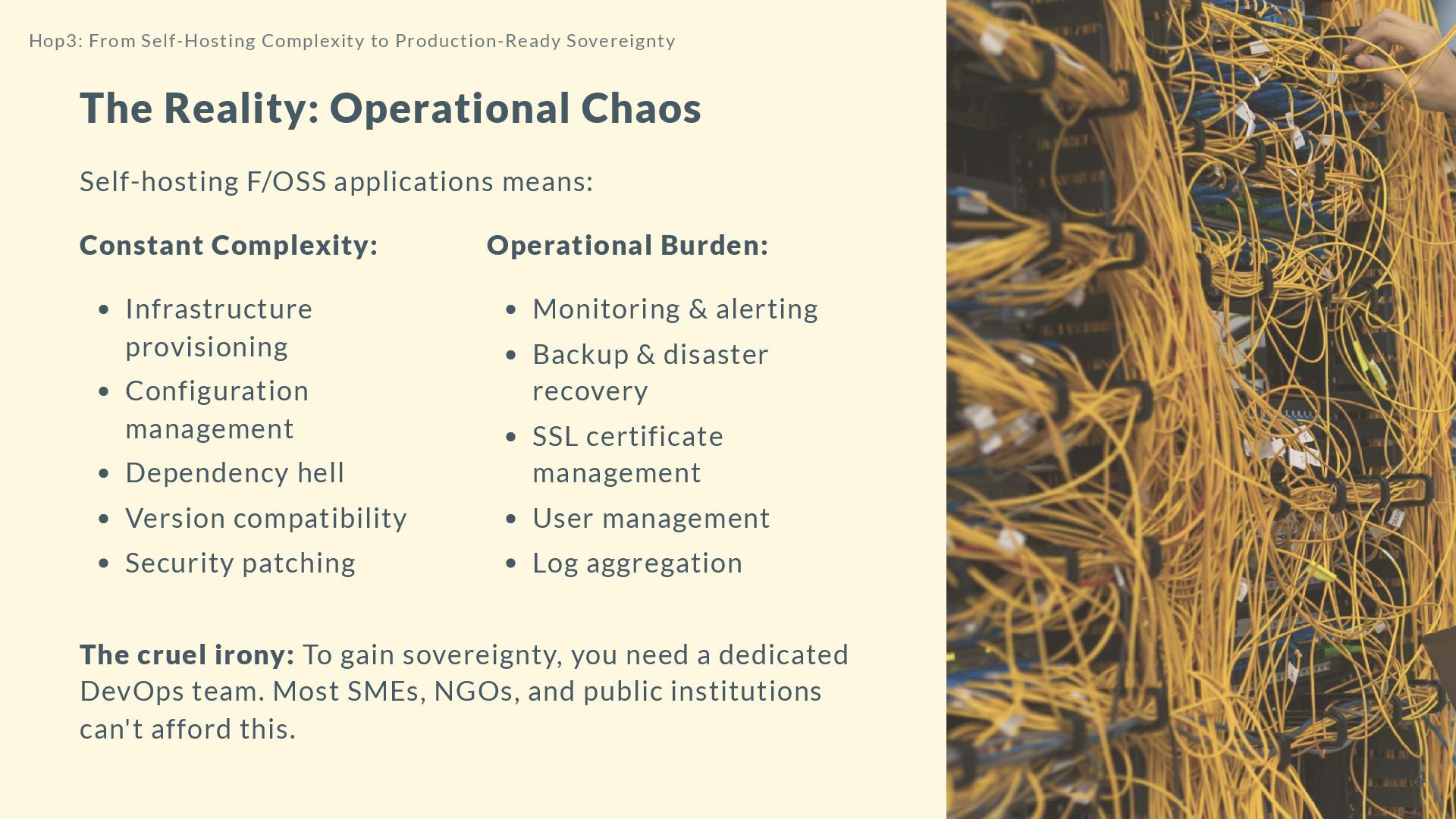
  3. The Reality: Operational Chaos Self-hosting F/OSS applications means: Constant Complexity:

    Infrastructure provisioning Configuration management Dependency hell Version compatibility Security patching Operational Burden: Monitoring & alerting Backup & disaster recovery SSL certificate management User management Log aggregation The cruel irony: To gain sovereignty, you need a dedicated DevOps team. Most SMEs, NGOs, and public institutions can't afford this. Hop3: From Self-Hosting Complexity to Production-Ready Sovereignty 4
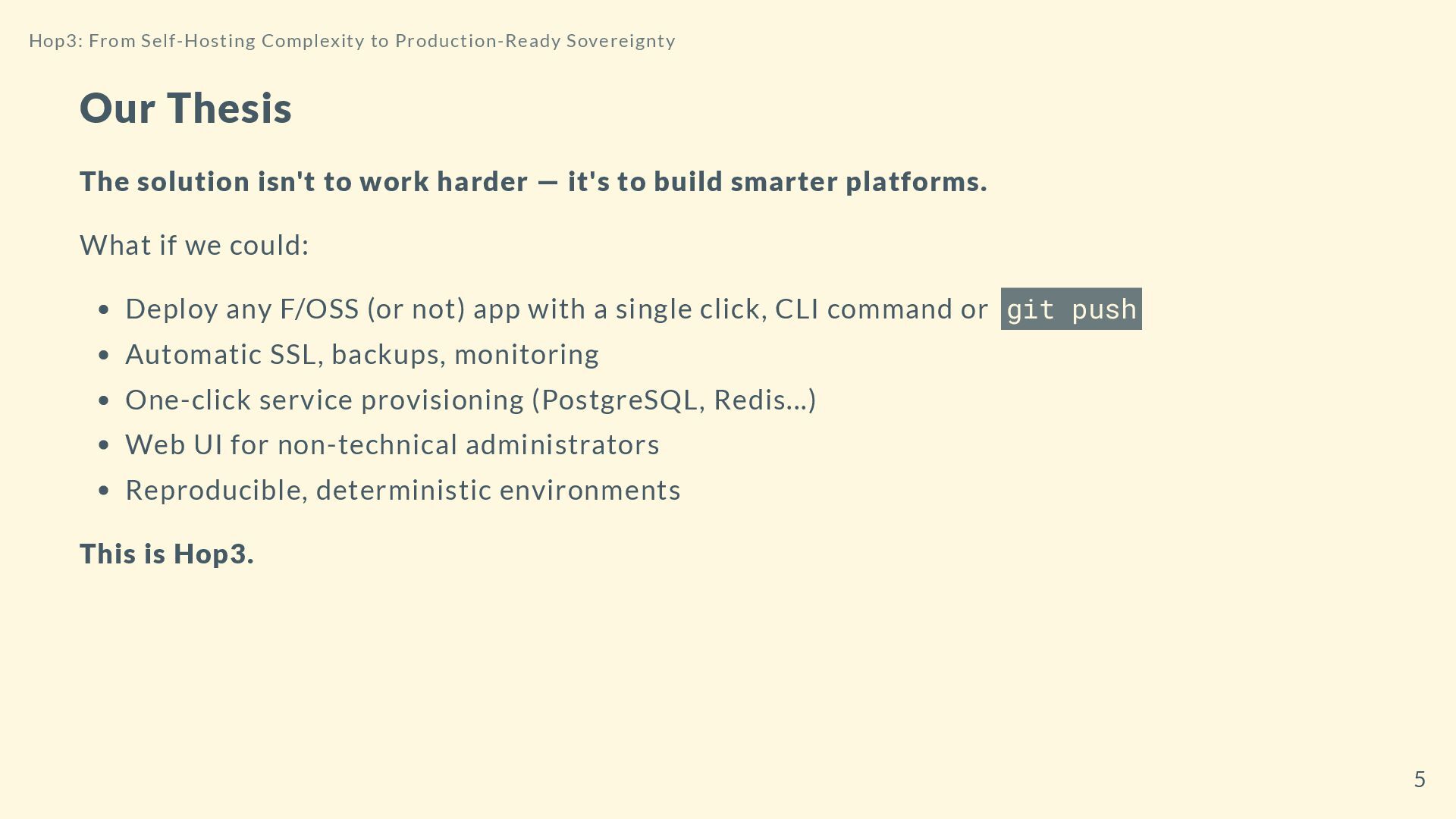
  4. Our Thesis The solution isn't to work harder — it's

    to build smarter platforms. What if we could: Deploy any F/OSS (or not) app with a single click, CLI command or git push Automatic SSL, backups, monitoring One-click service provisioning (PostgreSQL, Redis...) Web UI for non-technical administrators Reproducible, deterministic environments This is Hop3. Hop3: From Self-Hosting Complexity to Production-Ready Sovereignty 5
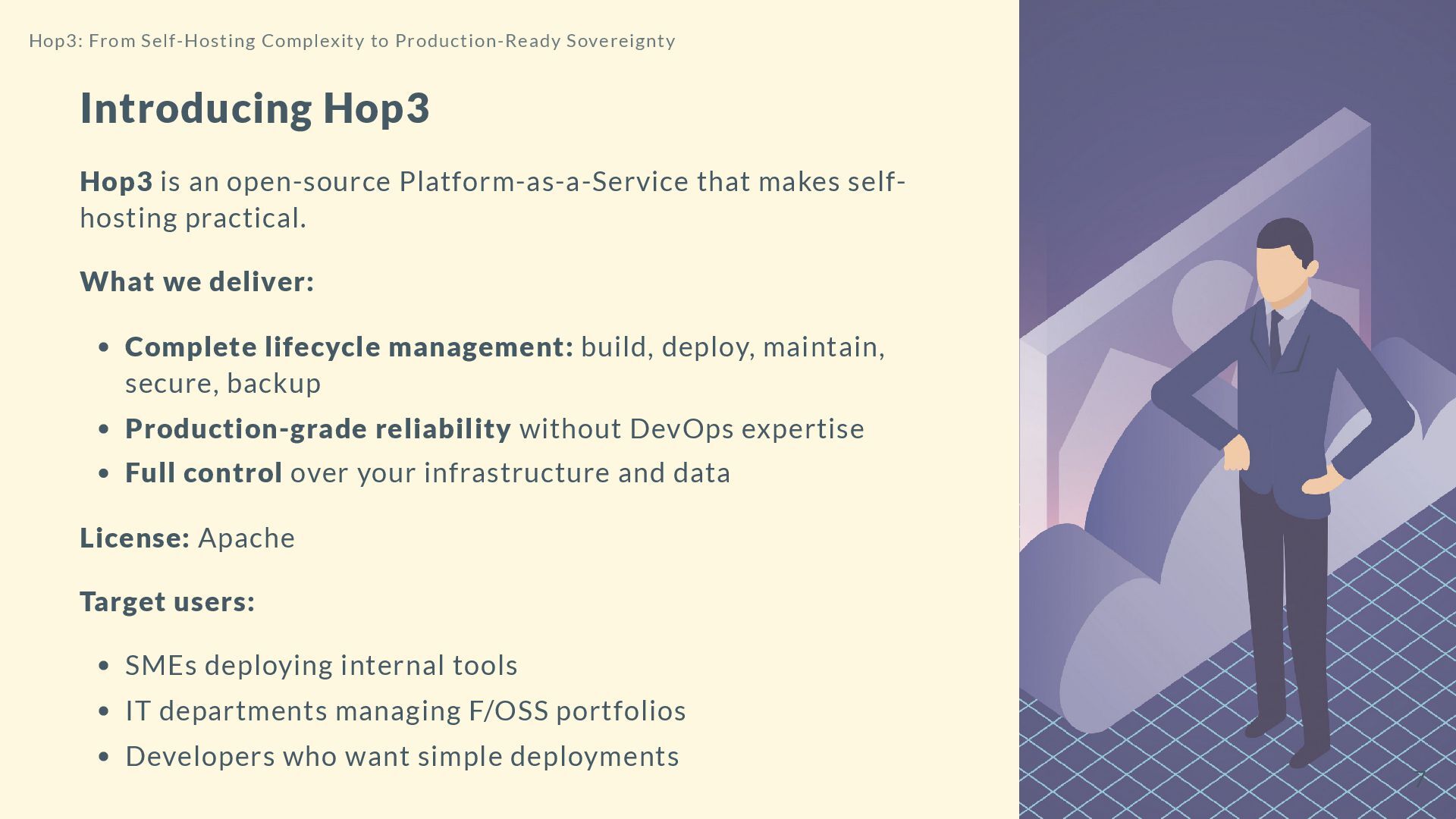
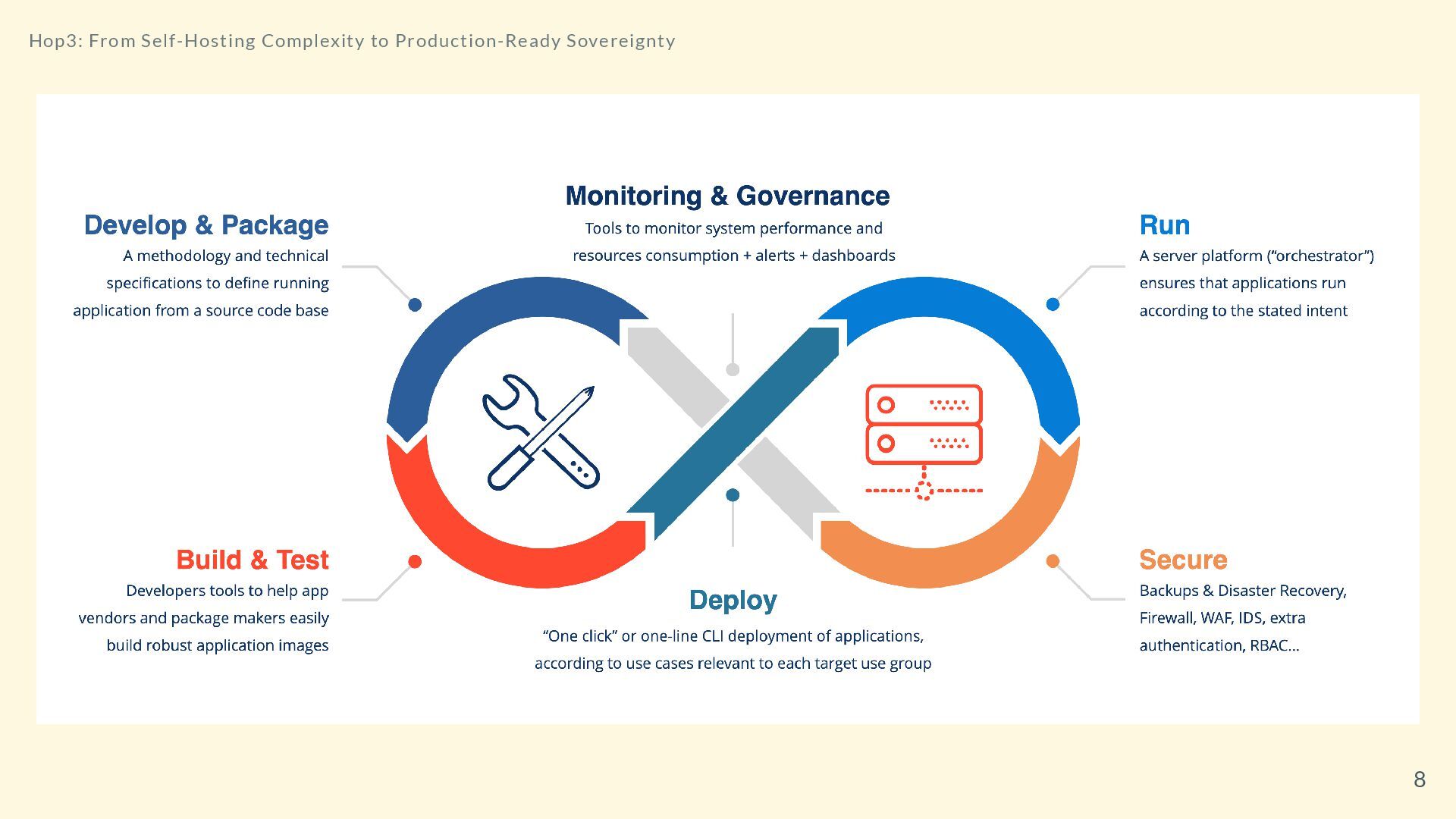
  5. Introducing Hop3 Hop3 is an open-source Platform-as-a-Service that makes self-

    hosting practical. What we deliver: Complete lifecycle management: build, deploy, maintain, secure, backup Production-grade reliability without DevOps expertise Full control over your infrastructure and data License: Apache Target users: SMEs deploying internal tools IT departments managing F/OSS portfolios Developers who want simple deployments Hop3: From Self-Hosting Complexity to Production-Ready Sovereignty 7
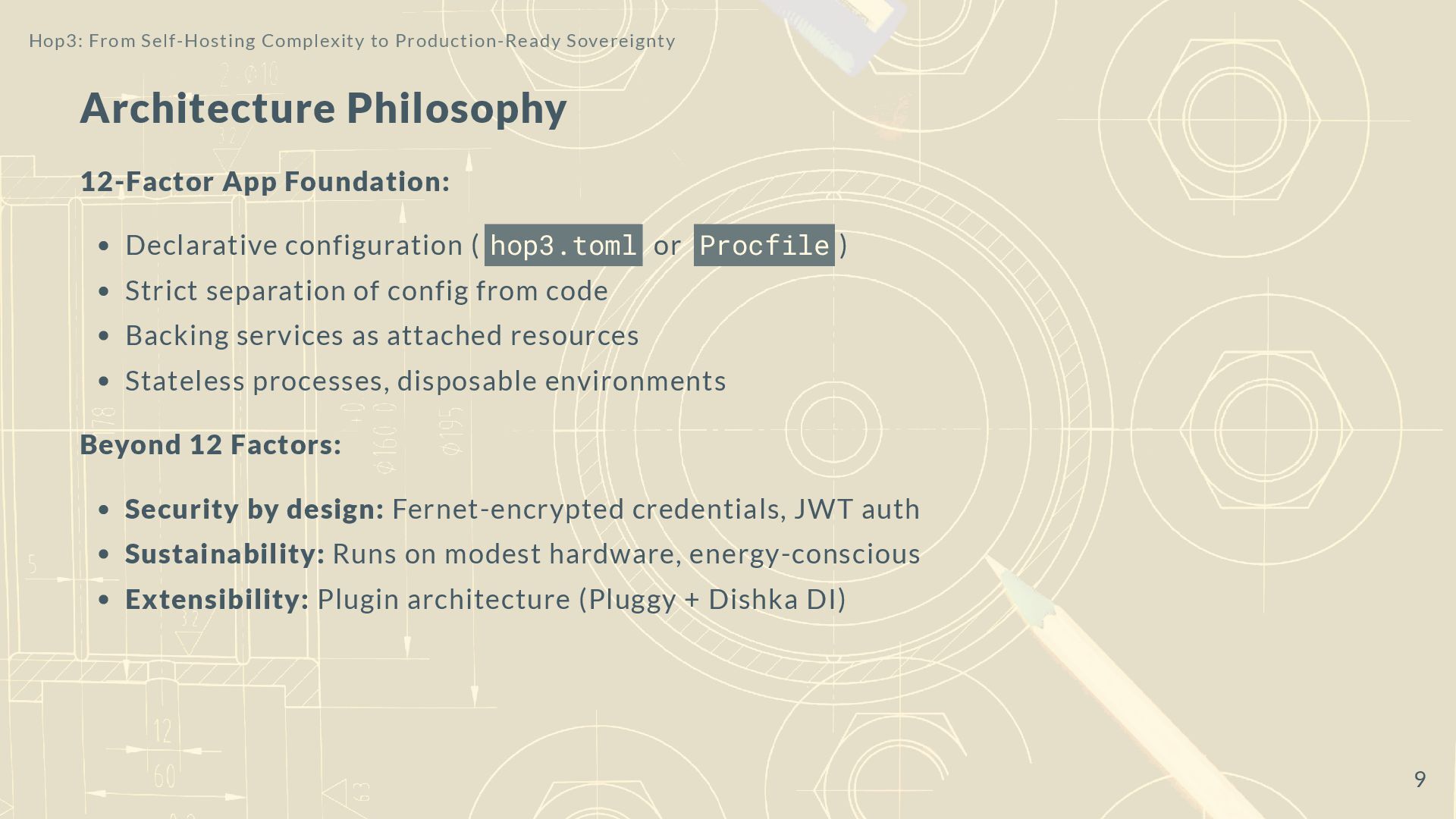
  6. Architecture Philosophy 12-Factor App Foundation: Declarative configuration ( hop3.toml or

    Procfile ) Strict separation of config from code Backing services as attached resources Stateless processes, disposable environments Beyond 12 Factors: Security by design: Fernet-encrypted credentials, JWT auth Sustainability: Runs on modest hardware, energy-conscious Extensibility: Plugin architecture (Pluggy + Dishka DI) Hop3: From Self-Hosting Complexity to Production-Ready Sovereignty 9
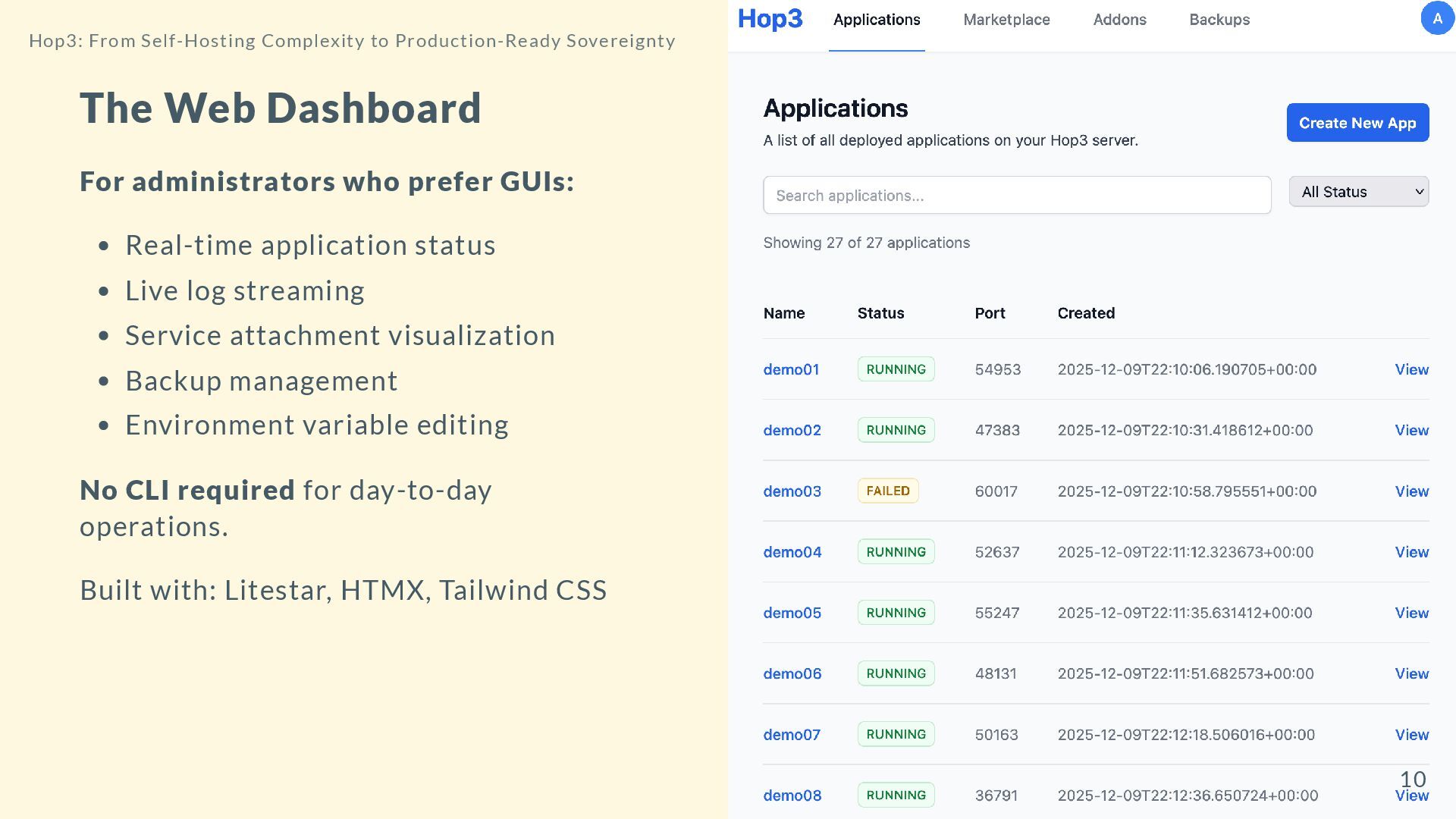
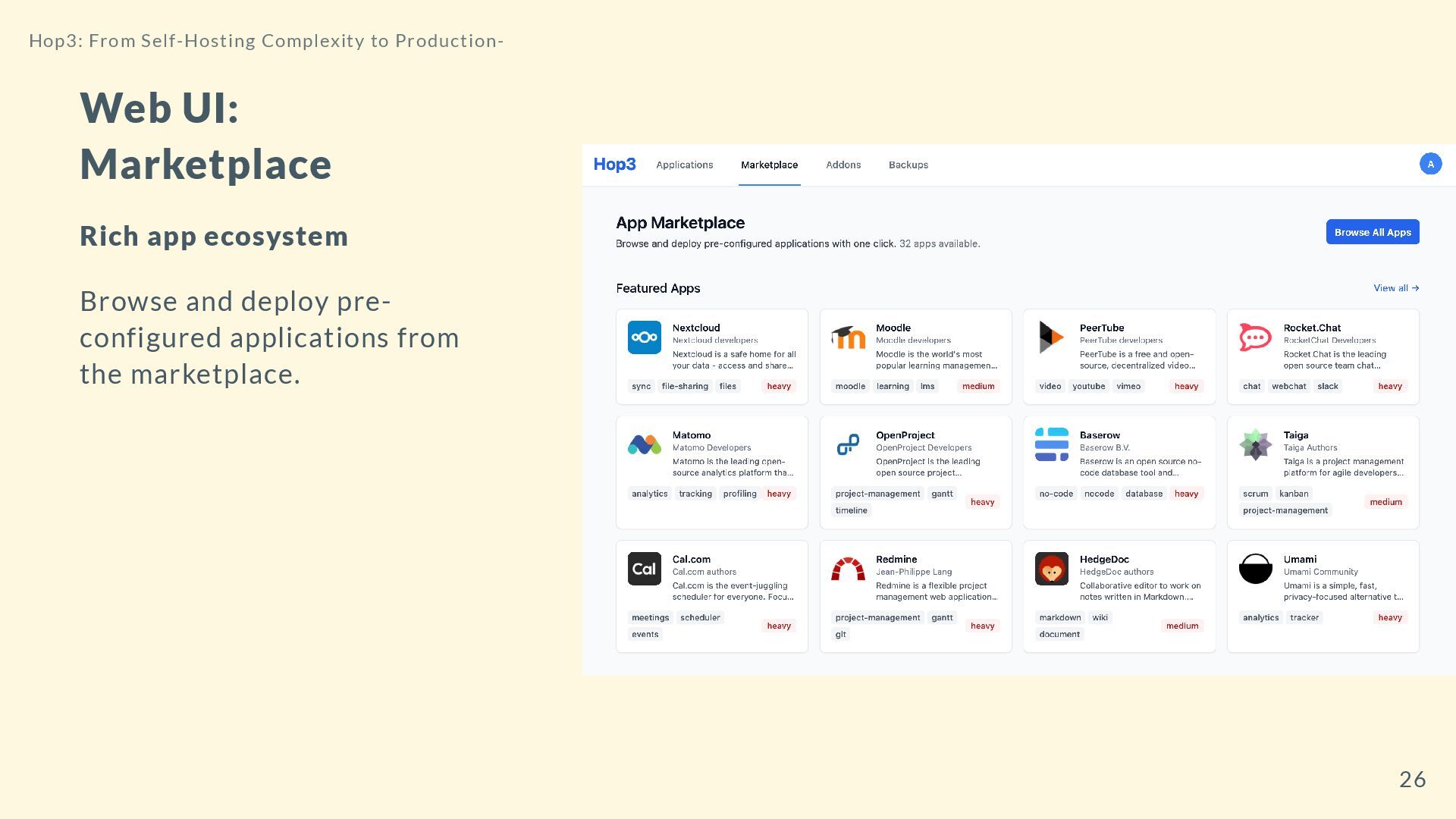
  7. The Web Dashboard For administrators who prefer GUIs: Real-time application

    status Live log streaming Service attachment visualization Backup management Environment variable editing No CLI required for day-to-day operations. Built with: Litestar, HTMX, Tailwind CSS Hop3: From Self-Hosting Complexity to Production-Ready Sovereignty 10
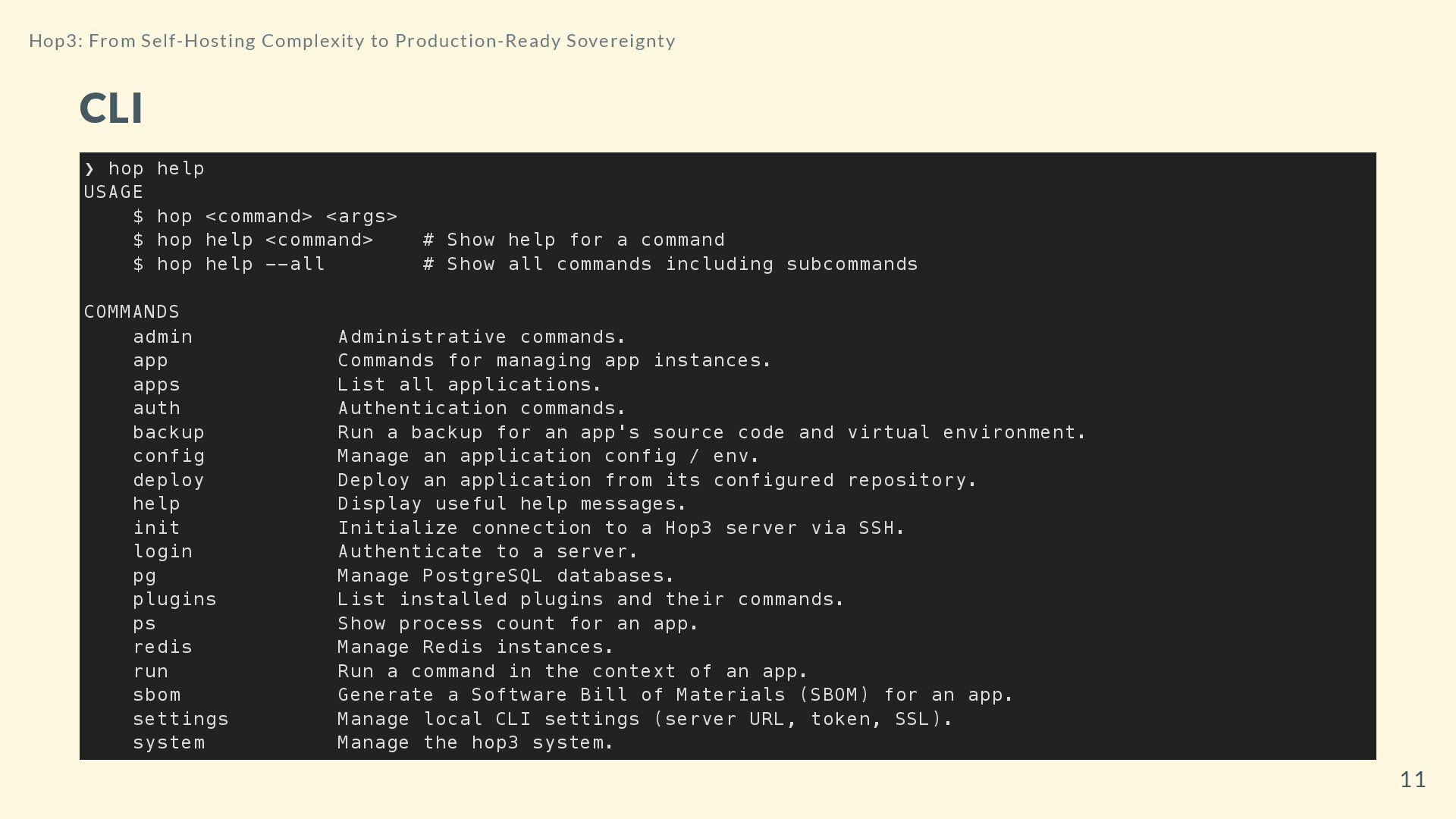
  8. CLI ❯ hop help USAGE $ hop <command> <args> $

    hop help <command> # Show help for a command $ hop help --all # Show all commands including subcommands COMMANDS admin Administrative commands. app Commands for managing app instances. apps List all applications. auth Authentication commands. backup Run a backup for an app's source code and virtual environment. config Manage an application config / env. deploy Deploy an application from its configured repository. help Display useful help messages. init Initialize connection to a Hop3 server via SSH. login Authenticate to a server. pg Manage PostgreSQL databases. plugins List installed plugins and their commands. ps Show process count for an app. redis Manage Redis instances. run Run a command in the context of an app. sbom Generate a Software Bill of Materials (SBOM) for an app. settings Manage local CLI settings (server URL, token, SSL). system Manage the hop3 system. Hop3: From Self-Hosting Complexity to Production-Ready Sovereignty 11
  9. Declarative Configuration hop3.toml - Your application's complete specification: [metadata] id

    = "my-nextcloud" version = "1.0.0" [run] start = "php-fpm" [env] NEXTCLOUD_ADMIN_USER = "admin" NEXTCLOUD_TRUSTED_DOMAINS = "cloud.example.com" [[provider]] name = "postgres" version = "15" [[provider]] name = "redis" No Kubernetes YAML. No Docker Compose complexity. Just your app's needs. Hop3: From Self-Hosting Complexity to Production-Ready Sovereignty 12
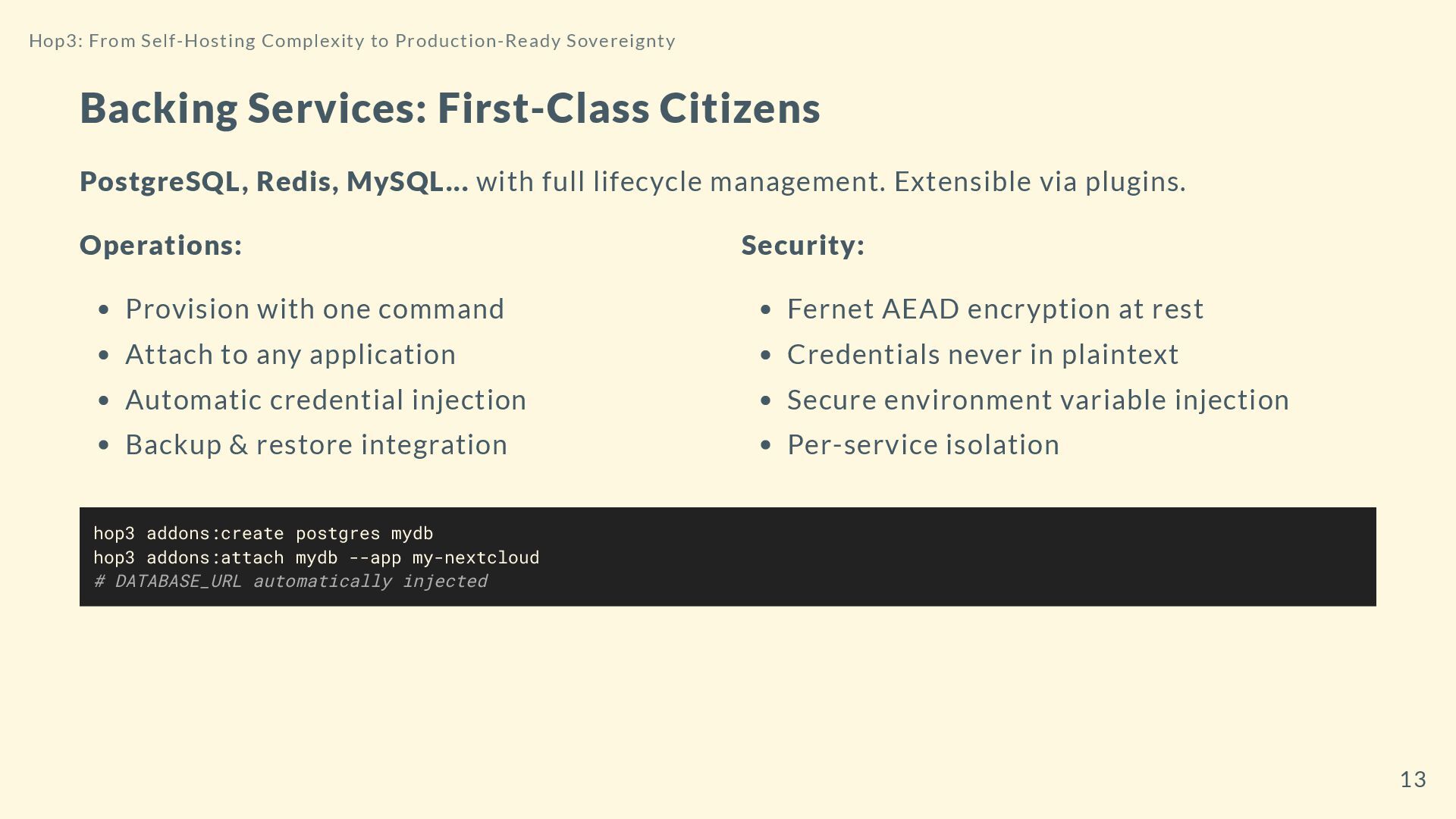
  10. Backing Services: First-Class Citizens PostgreSQL, Redis, MySQL... with full lifecycle

    management. Extensible via plugins. Operations: Provision with one command Attach to any application Automatic credential injection Backup & restore integration Security: Fernet AEAD encryption at rest Credentials never in plaintext Secure environment variable injection Per-service isolation hop3 addons:create postgres mydb hop3 addons:attach mydb --app my-nextcloud # DATABASE_URL automatically injected Hop3: From Self-Hosting Complexity to Production-Ready Sovereignty 13
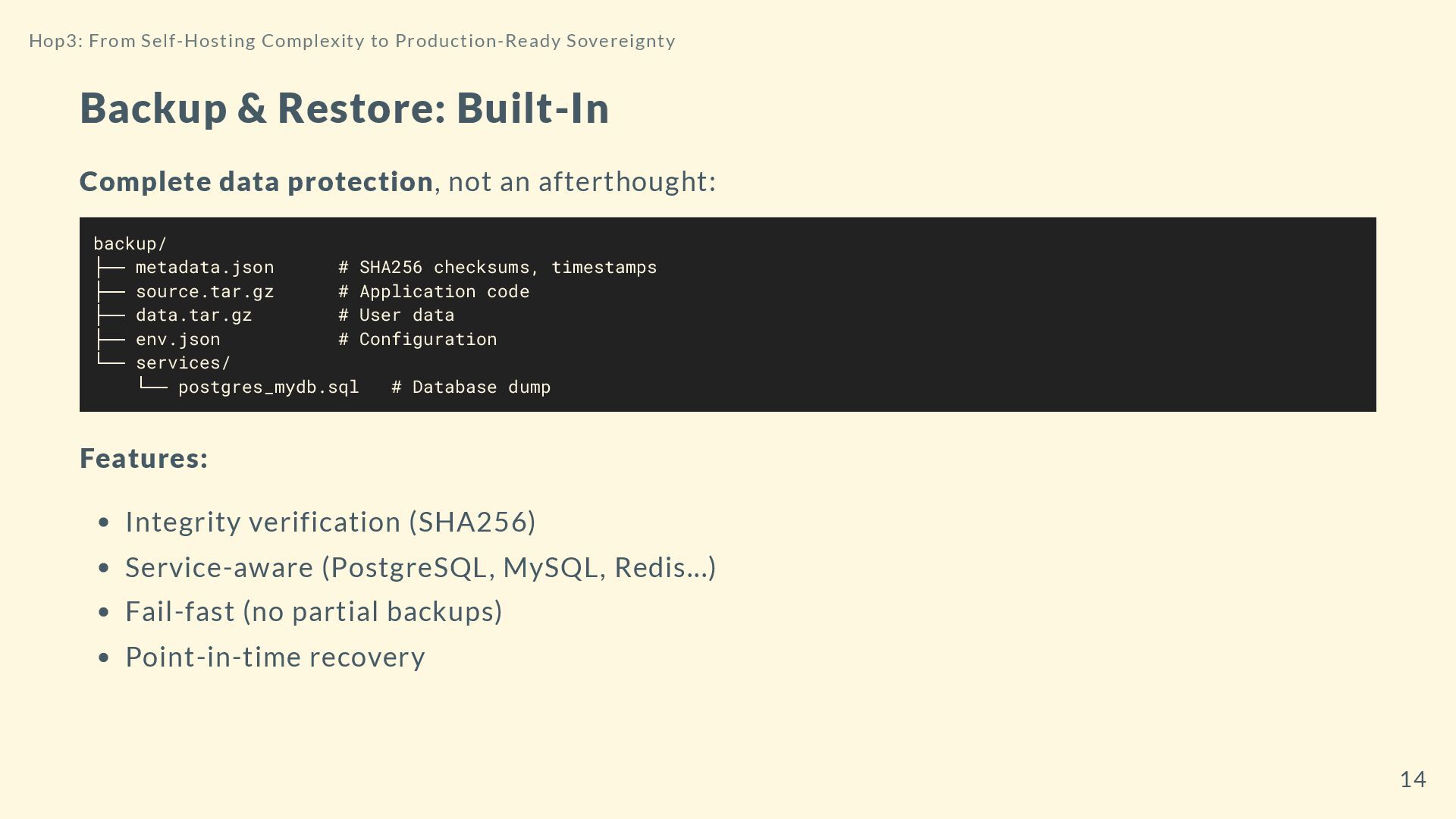
  11. Backup & Restore: Built-In Complete data protection, not an afterthought:

    backup/ ├── metadata.json # SHA256 checksums, timestamps ├── source.tar.gz # Application code ├── data.tar.gz # User data ├── env.json # Configuration └── services/ └── postgres_mydb.sql # Database dump Features: Integrity verification (SHA256) Service-aware (PostgreSQL, MySQL, Redis...) Fail-fast (no partial backups) Point-in-time recovery Hop3: From Self-Hosting Complexity to Production-Ready Sovereignty 14
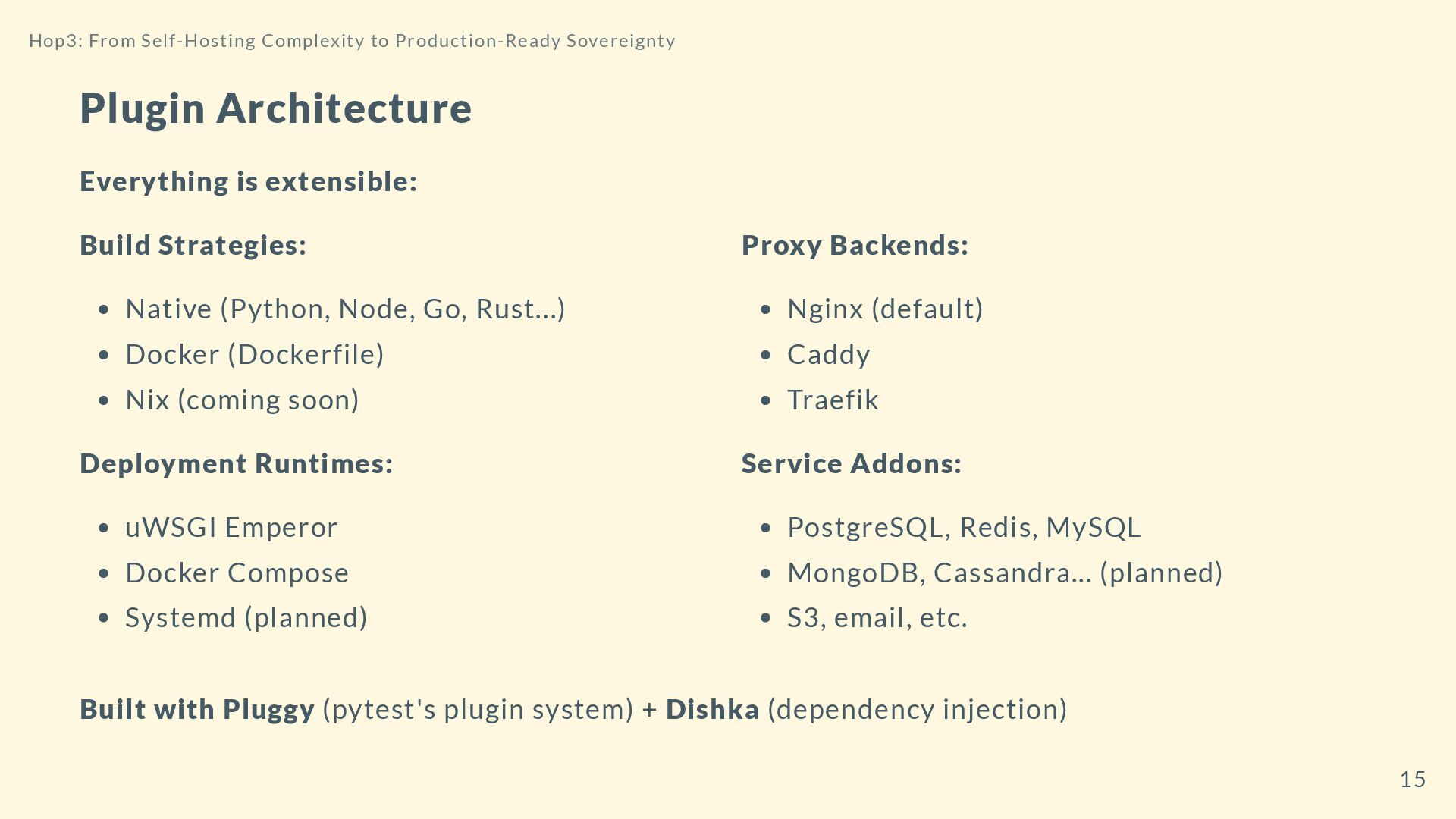
  12. Plugin Architecture Everything is extensible: Build Strategies: Native (Python, Node,

    Go, Rust...) Docker (Dockerfile) Nix (coming soon) Deployment Runtimes: uWSGI Emperor Docker Compose Systemd (planned) Proxy Backends: Nginx (default) Caddy Traefik Service Addons: PostgreSQL, Redis, MySQL MongoDB, Cassandra... (planned) S3, email, etc. Built with Pluggy (pytest's plugin system) + Dishka (dependency injection) Hop3: From Self-Hosting Complexity to Production-Ready Sovereignty 15
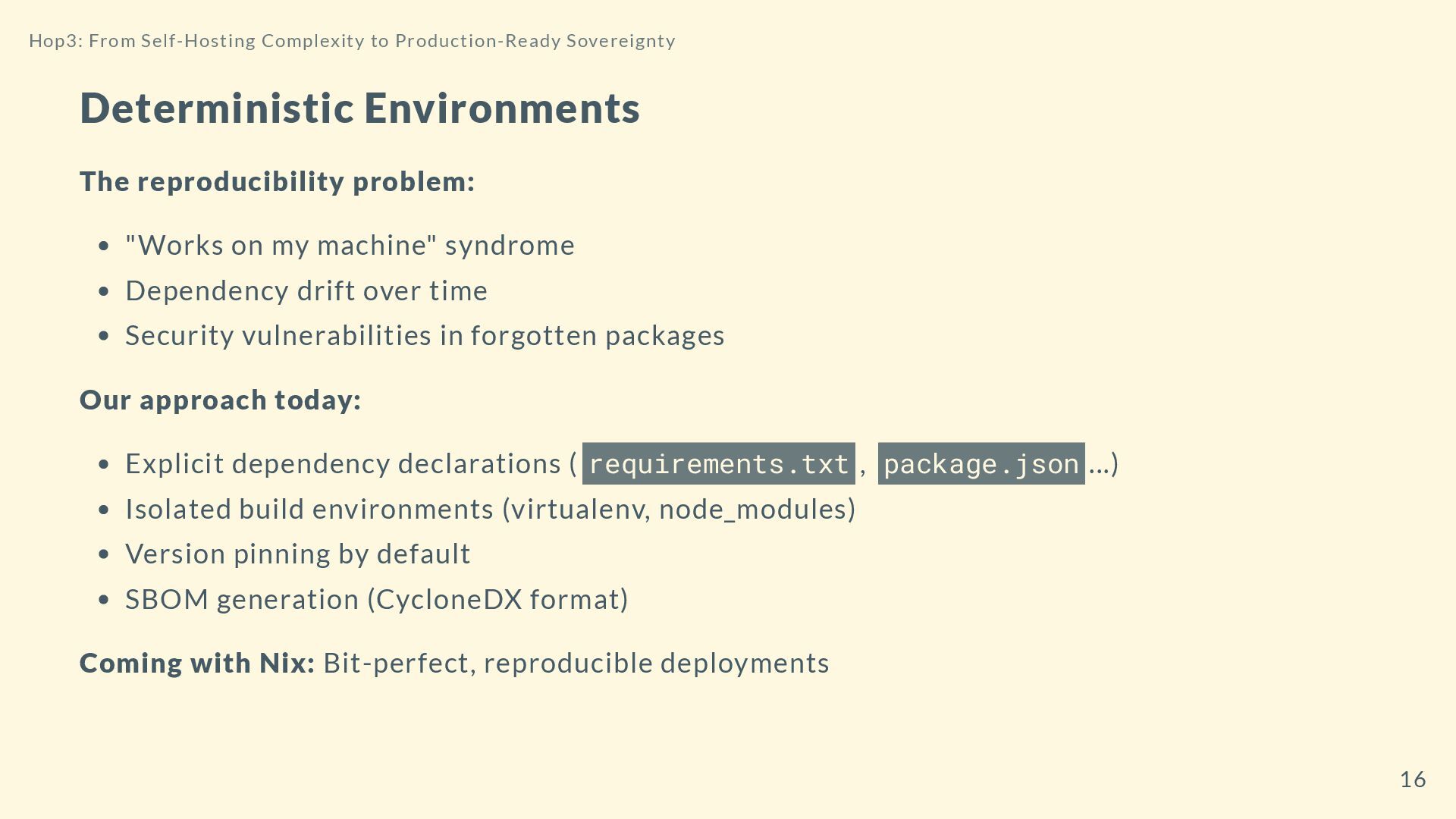
  13. Deterministic Environments The reproducibility problem: "Works on my machine" syndrome

    Dependency drift over time Security vulnerabilities in forgotten packages Our approach today: Explicit dependency declarations ( requirements.txt , package.json ...) Isolated build environments (virtualenv, node_modules) Version pinning by default SBOM generation (CycloneDX format) Coming with Nix: Bit-perfect, reproducible deployments Hop3: From Self-Hosting Complexity to Production-Ready Sovereignty 16
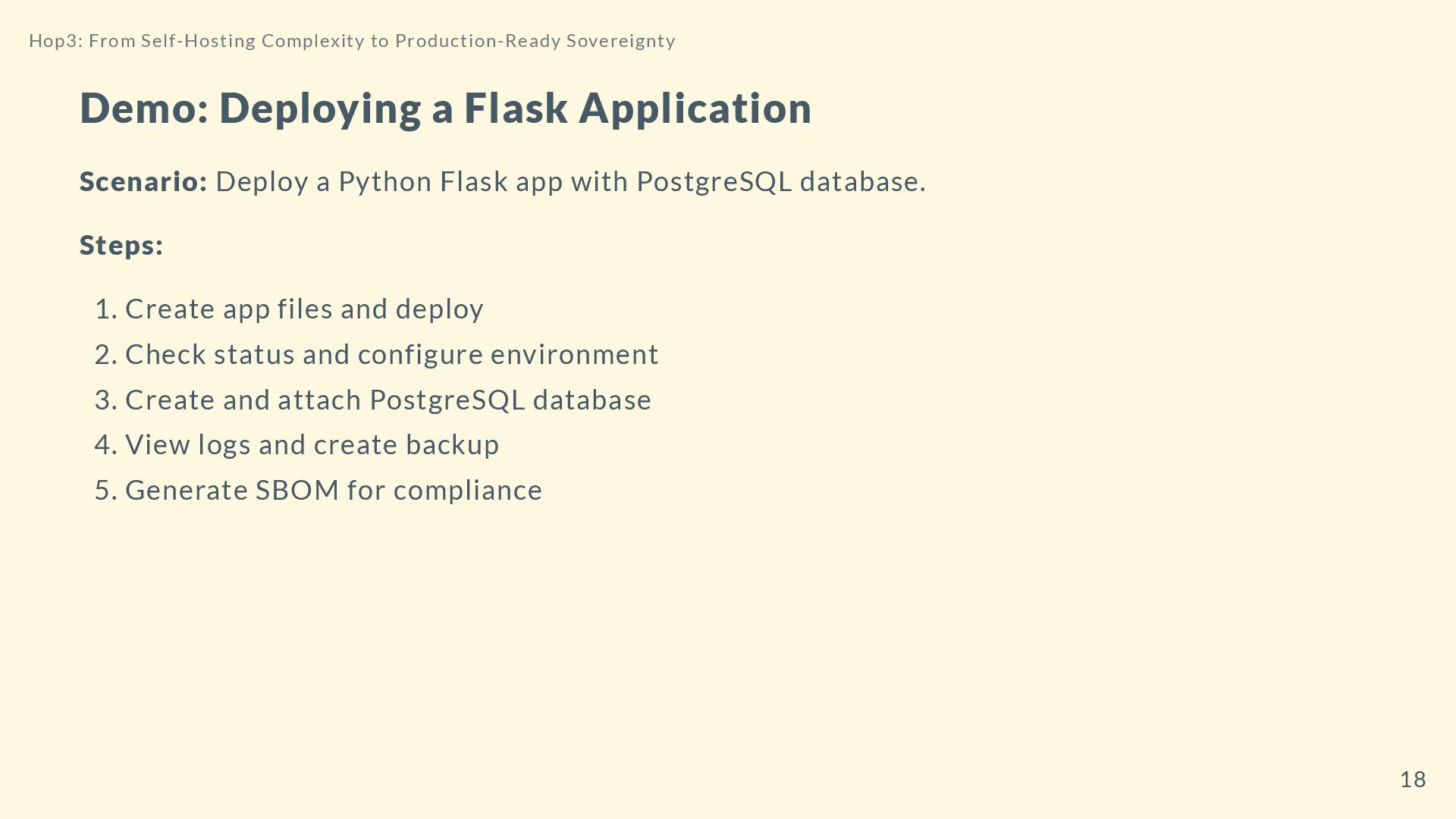
  14. Demo: Deploying a Flask Application Scenario: Deploy a Python Flask

    app with PostgreSQL database. Steps: 1. Create app files and deploy 2. Check status and configure environment 3. Create and attach PostgreSQL database 4. View logs and create backup 5. Generate SBOM for compliance Hop3: From Self-Hosting Complexity to Production-Ready Sovereignty 18
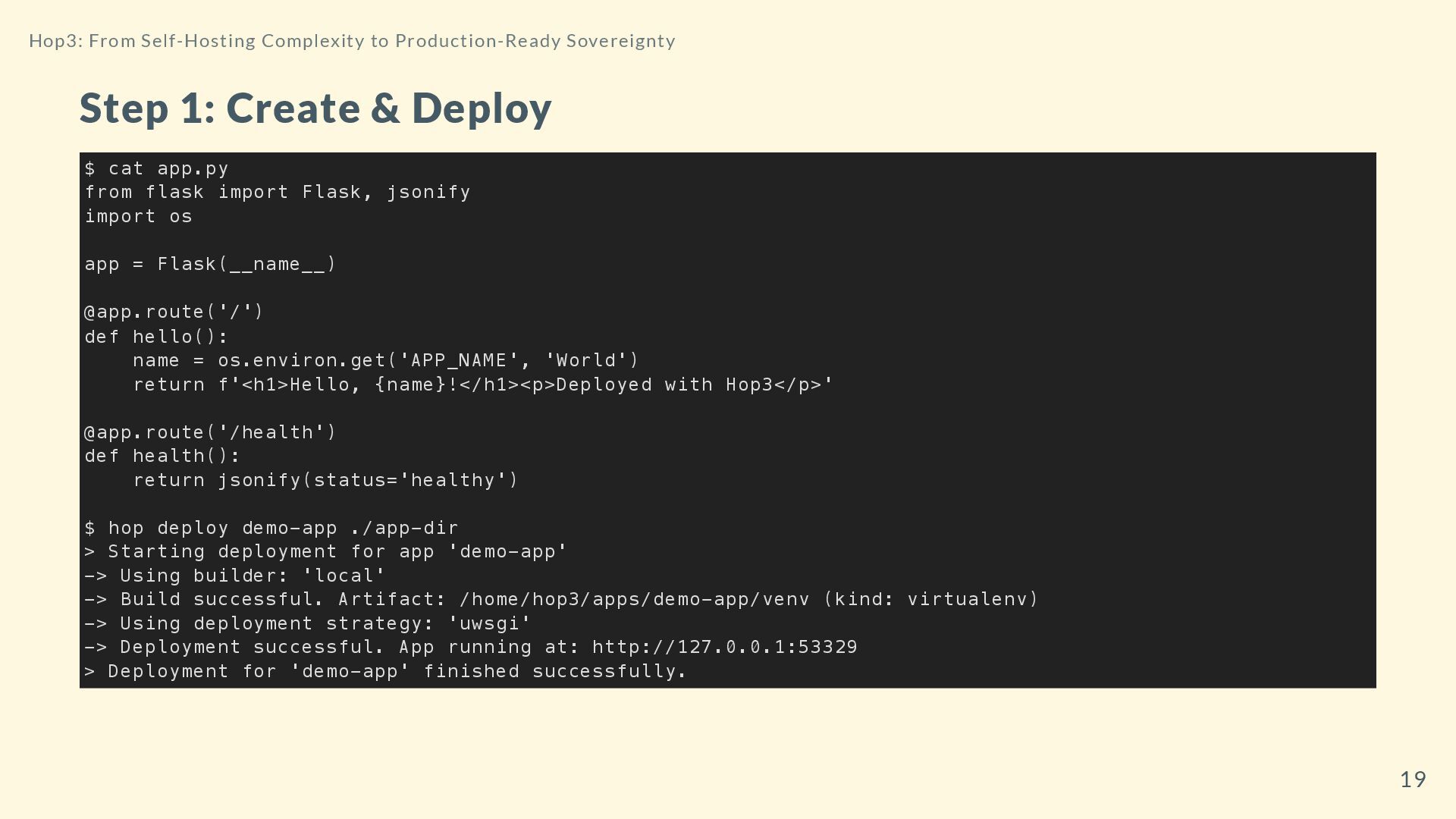
  15. Step 1: Create & Deploy $ cat app.py from flask

    import Flask, jsonify import os app = Flask(__name__) @app.route('/') def hello(): name = os.environ.get('APP_NAME', 'World') return f'<h1>Hello, {name}!</h1><p>Deployed with Hop3</p>' @app.route('/health') def health(): return jsonify(status='healthy') $ hop deploy demo-app ./app-dir > Starting deployment for app 'demo-app' -> Using builder: 'local' -> Build successful. Artifact: /home/hop3/apps/demo-app/venv (kind: virtualenv) -> Using deployment strategy: 'uwsgi' -> Deployment successful. App running at: http://127.0.0.1:53329 > Deployment for 'demo-app' finished successfully. Hop3: From Self-Hosting Complexity to Production-Ready Sovereignty 19
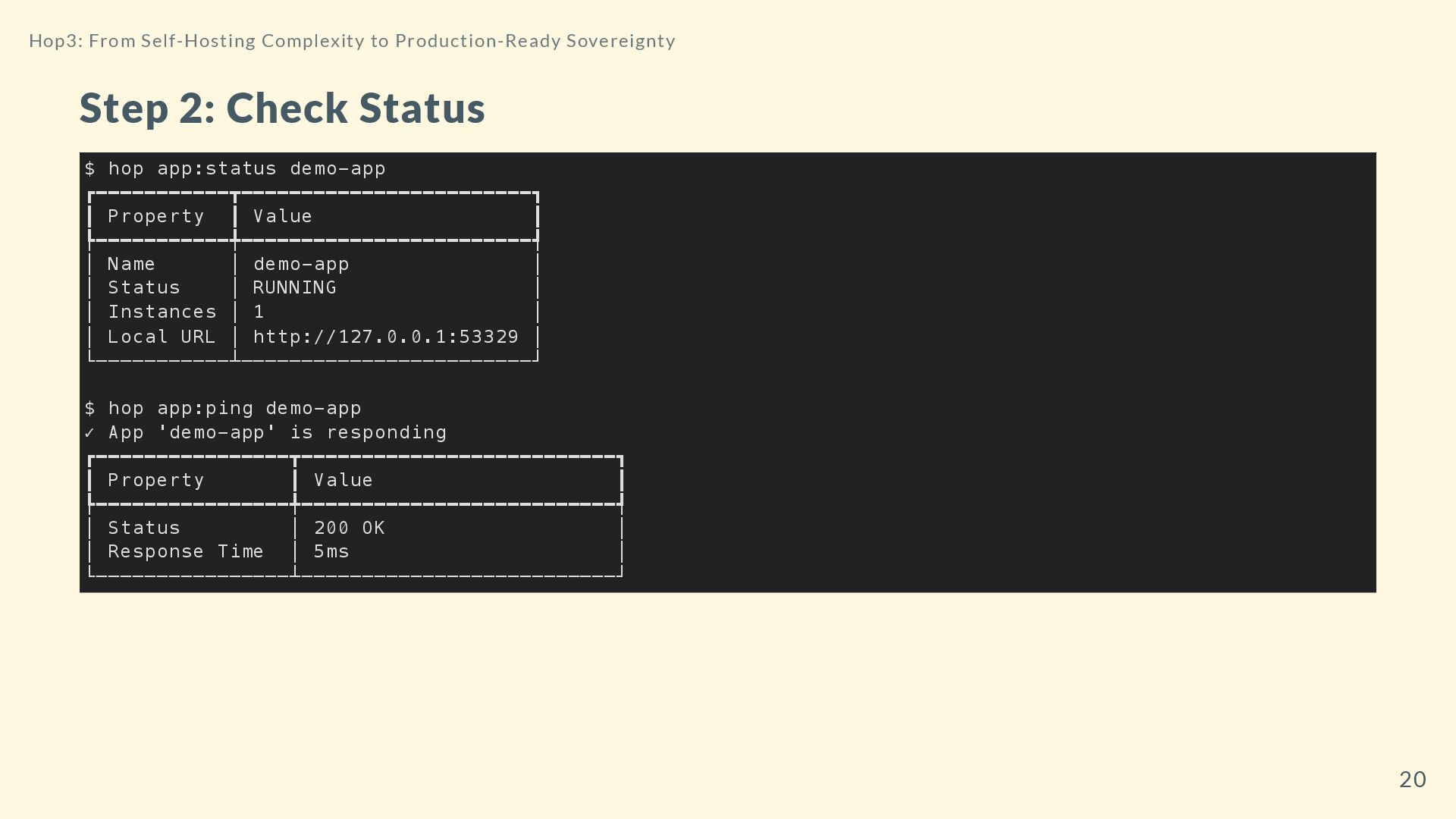
  16. Step 2: Check Status $ hop app:status demo-app ┏━━━━━━━━━━━┳━━━━━━━━━━━━━━━━━━━━━━━━┓ ┃

    Property ┃ Value ┃ ┡━━━━━━━━━━━╇━━━━━━━━━━━━━━━━━━━━━━━━┩ │ Name │ demo-app │ │ Status │ RUNNING │ │ Instances │ 1 │ │ Local URL │ http://127.0.0.1:53329 │ └───────────┴────────────────────────┘ $ hop app:ping demo-app ✓ App 'demo-app' is responding ┏━━━━━━━━━━━━━━━━┳━━━━━━━━━━━━━━━━━━━━━━━━━━┓ ┃ Property ┃ Value ┃ ┡━━━━━━━━━━━━━━━━╇━━━━━━━━━━━━━━━━━━━━━━━━━━┩ │ Status │ 200 OK │ │ Response Time │ 5ms │ └────────────────┴──────────────────────────┘ Hop3: From Self-Hosting Complexity to Production-Ready Sovereignty 20
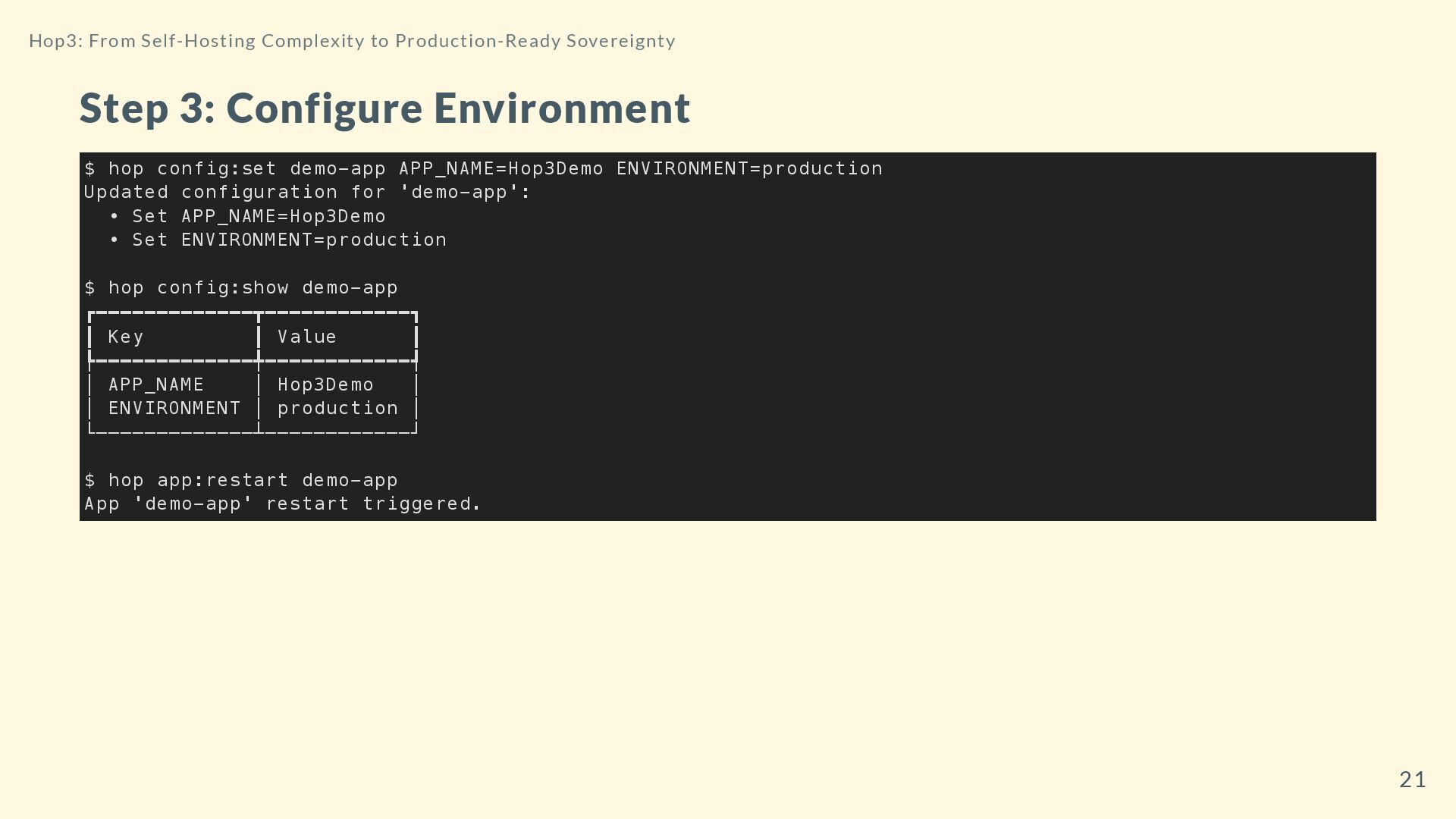
  17. Step 3: Configure Environment $ hop config:set demo-app APP_NAME=Hop3Demo ENVIRONMENT=production

    Updated configuration for 'demo-app': • Set APP_NAME=Hop3Demo • Set ENVIRONMENT=production $ hop config:show demo-app ┏━━━━━━━━━━━━━┳━━━━━━━━━━━━┓ ┃ Key ┃ Value ┃ ┡━━━━━━━━━━━━━╇━━━━━━━━━━━━┩ │ APP_NAME │ Hop3Demo │ │ ENVIRONMENT │ production │ └─────────────┴────────────┘ $ hop app:restart demo-app App 'demo-app' restart triggered. Hop3: From Self-Hosting Complexity to Production-Ready Sovereignty 21
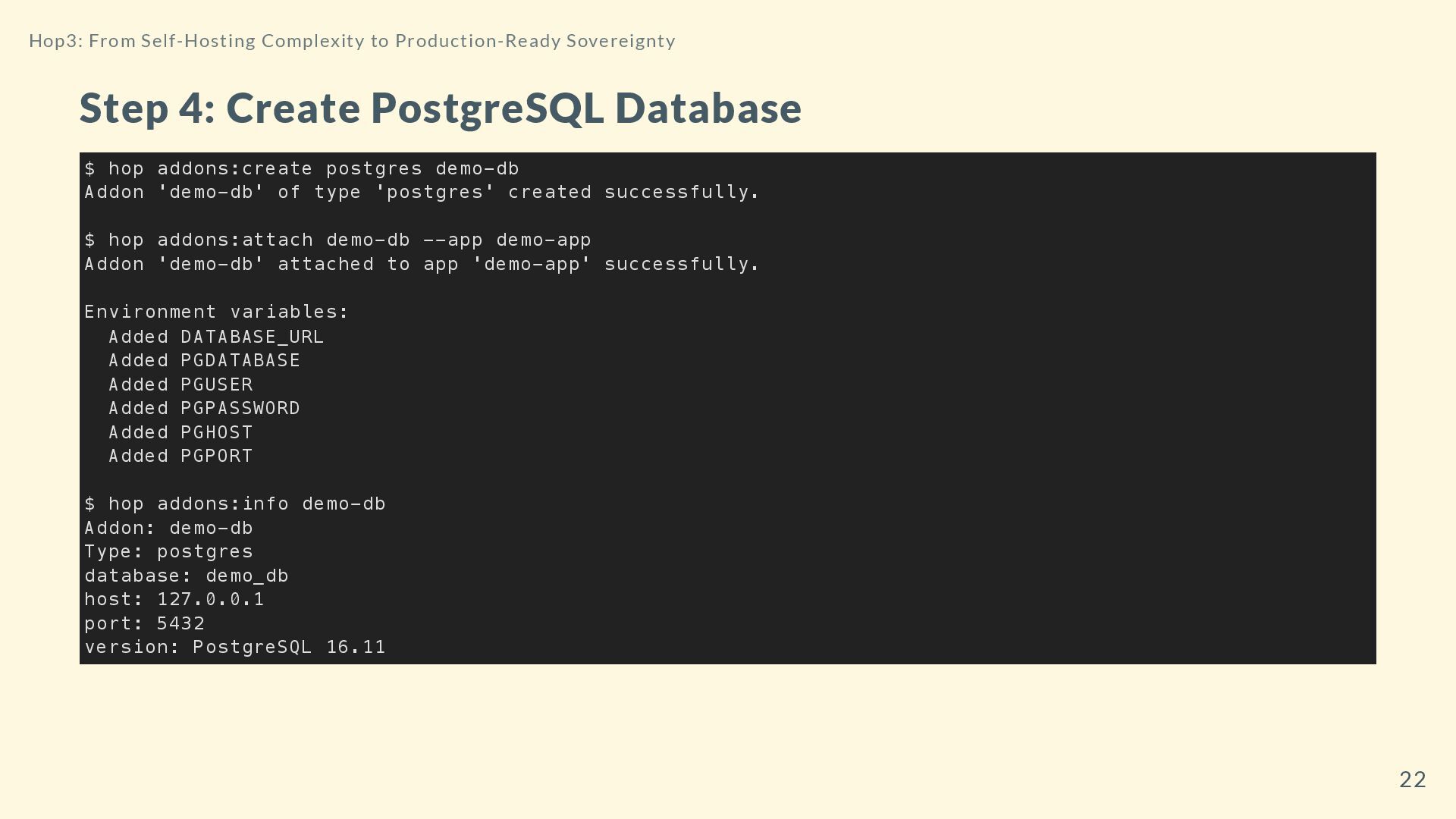
  18. Step 4: Create PostgreSQL Database $ hop addons:create postgres demo-db

    Addon 'demo-db' of type 'postgres' created successfully. $ hop addons:attach demo-db --app demo-app Addon 'demo-db' attached to app 'demo-app' successfully. Environment variables: Added DATABASE_URL Added PGDATABASE Added PGUSER Added PGPASSWORD Added PGHOST Added PGPORT $ hop addons:info demo-db Addon: demo-db Type: postgres database: demo_db host: 127.0.0.1 port: 5432 version: PostgreSQL 16.11 Hop3: From Self-Hosting Complexity to Production-Ready Sovereignty 22
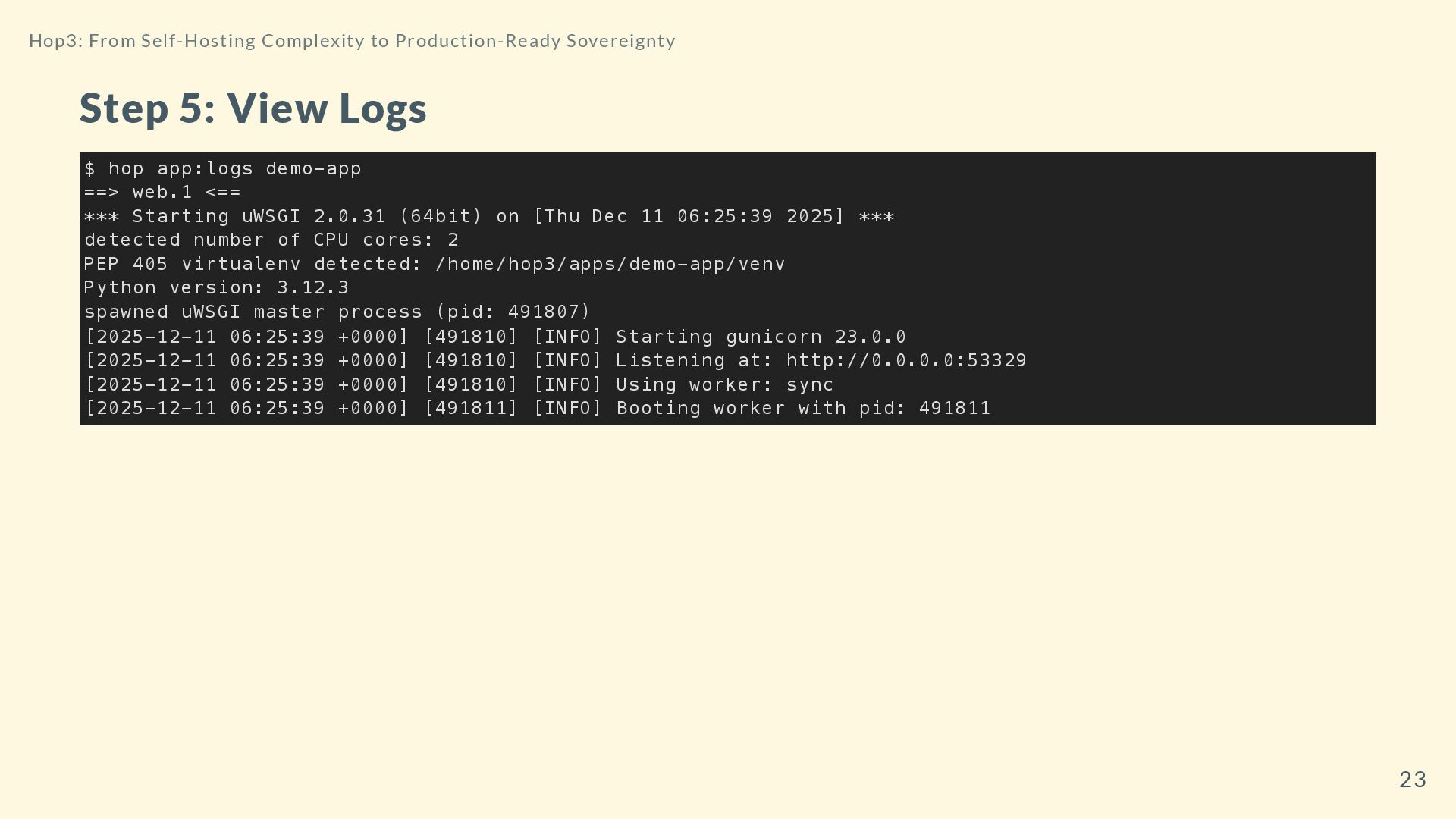
  19. Step 5: View Logs $ hop app:logs demo-app ==> web.1

    <== *** Starting uWSGI 2.0.31 (64bit) on [Thu Dec 11 06:25:39 2025] *** detected number of CPU cores: 2 PEP 405 virtualenv detected: /home/hop3/apps/demo-app/venv Python version: 3.12.3 spawned uWSGI master process (pid: 491807) [2025-12-11 06:25:39 +0000] [491810] [INFO] Starting gunicorn 23.0.0 [2025-12-11 06:25:39 +0000] [491810] [INFO] Listening at: http://0.0.0.0:53329 [2025-12-11 06:25:39 +0000] [491810] [INFO] Using worker: sync [2025-12-11 06:25:39 +0000] [491811] [INFO] Booting worker with pid: 491811 Hop3: From Self-Hosting Complexity to Production-Ready Sovereignty 23
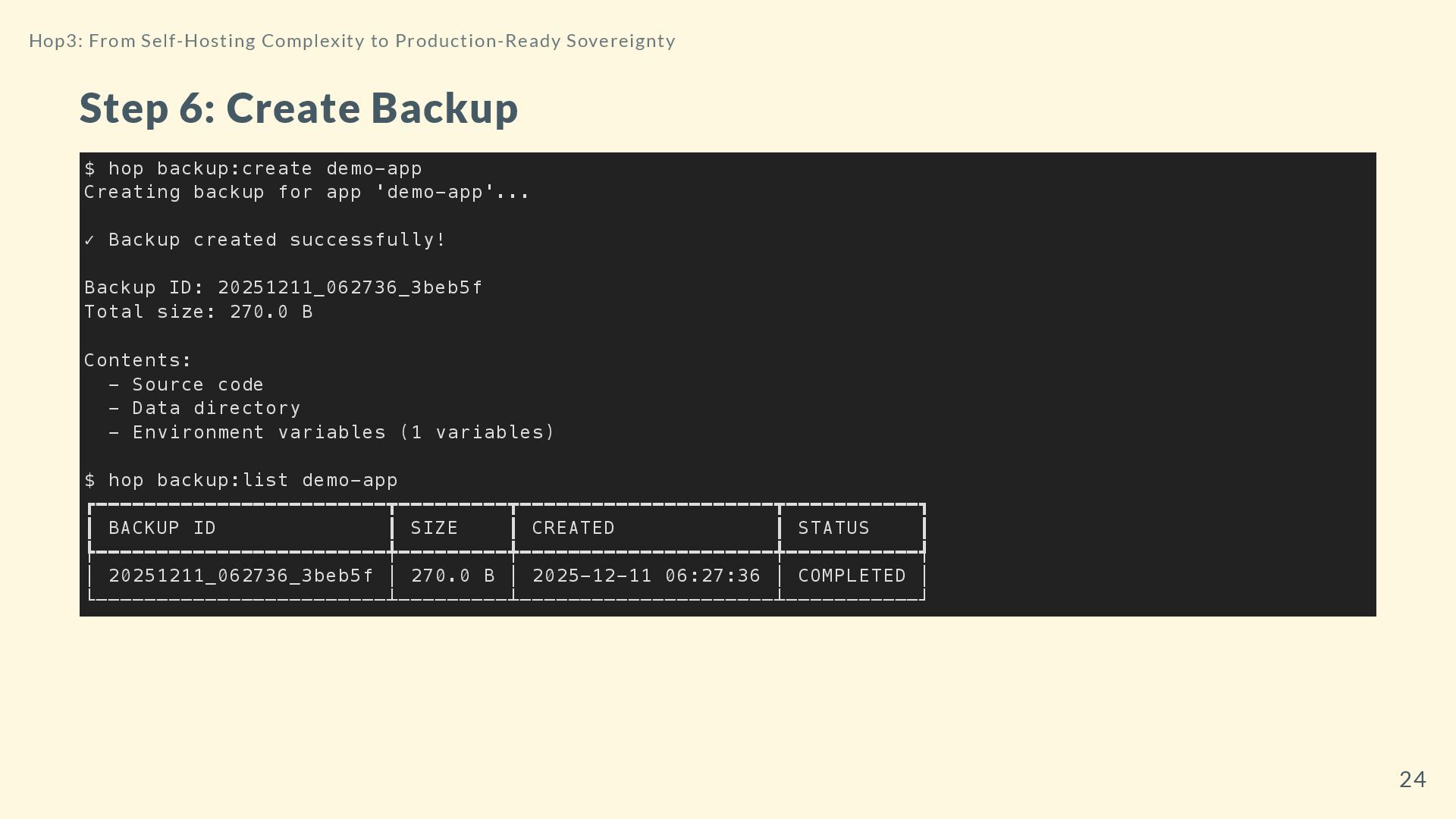
  20. Step 6: Create Backup $ hop backup:create demo-app Creating backup

    for app 'demo-app'... ✓ Backup created successfully! Backup ID: 20251211_062736_3beb5f Total size: 270.0 B Contents: - Source code - Data directory - Environment variables (1 variables) $ hop backup:list demo-app ┏━━━━━━━━━━━━━━━━━━━━━━━━┳━━━━━━━━━┳━━━━━━━━━━━━━━━━━━━━━┳━━━━━━━━━━━┓ ┃ BACKUP ID ┃ SIZE ┃ CREATED ┃ STATUS ┃ ┡━━━━━━━━━━━━━━━━━━━━━━━━╇━━━━━━━━━╇━━━━━━━━━━━━━━━━━━━━━╇━━━━━━━━━━━┩ │ 20251211_062736_3beb5f │ 270.0 B │ 2025-12-11 06:27:36 │ COMPLETED │ └────────────────────────┴─────────┴─────────────────────┴───────────┘ Hop3: From Self-Hosting Complexity to Production-Ready Sovereignty 24
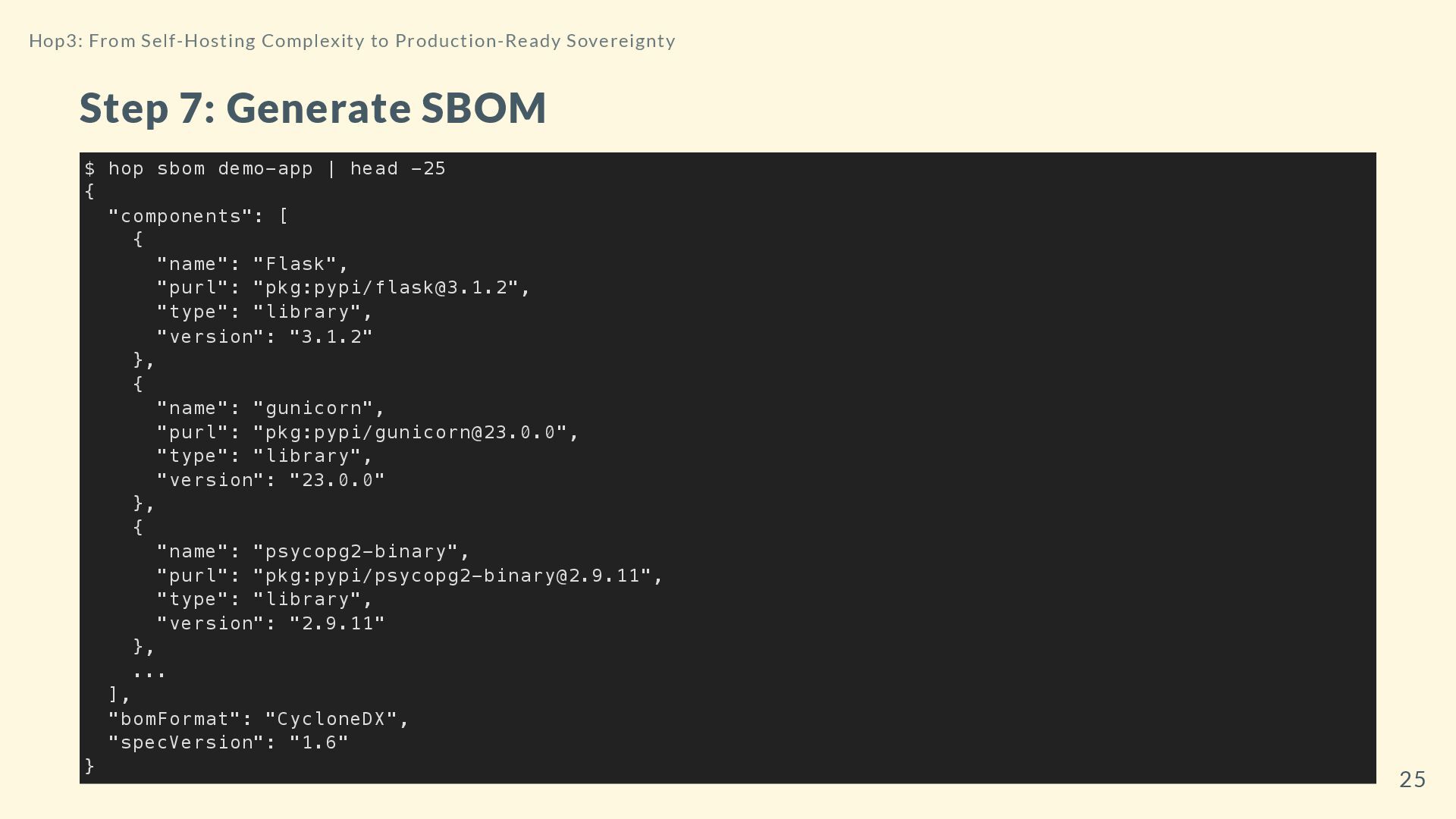
  21. Step 7: Generate SBOM $ hop sbom demo-app | head

    -25 { "components": [ { "name": "Flask", "purl": "pkg:pypi/[email protected]", "type": "library", "version": "3.1.2" }, { "name": "gunicorn", "purl": "pkg:pypi/[email protected]", "type": "library", "version": "23.0.0" }, { "name": "psycopg2-binary", "purl": "pkg:pypi/[email protected]", "type": "library", "version": "2.9.11" }, ... ], "bomFormat": "CycloneDX", "specVersion": "1.6" } Hop3: From Self-Hosting Complexity to Production-Ready Sovereignty 25
  22. Web UI: Marketplace Rich app ecosystem Browse and deploy pre-

    configured applications from the marketplace. Hop3: From Self-Hosting Complexity to Production- 26
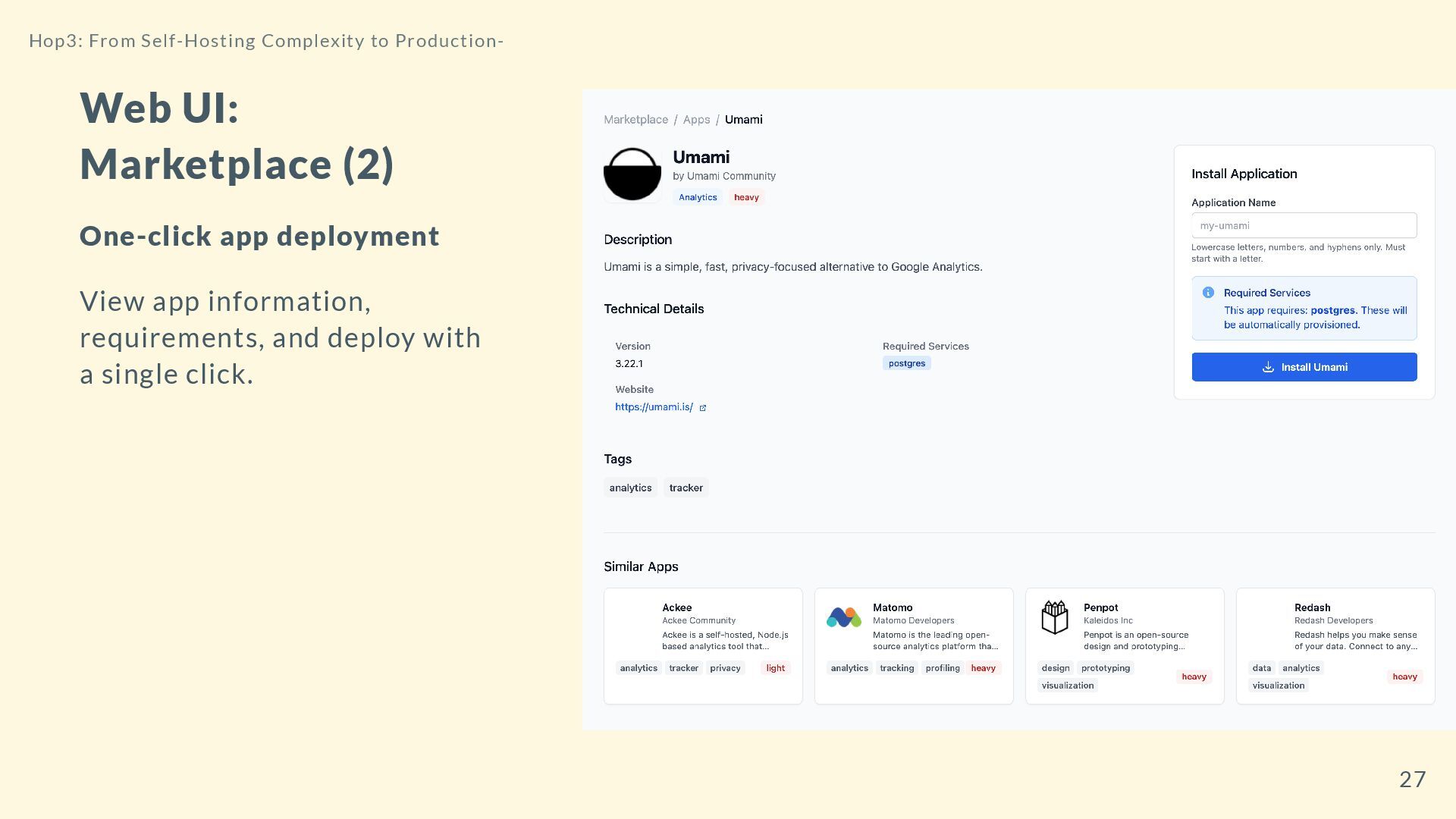
  23. Web UI: Marketplace (2) One-click app deployment View app information,

    requirements, and deploy with a single click. Hop3: From Self-Hosting Complexity to Production- 27
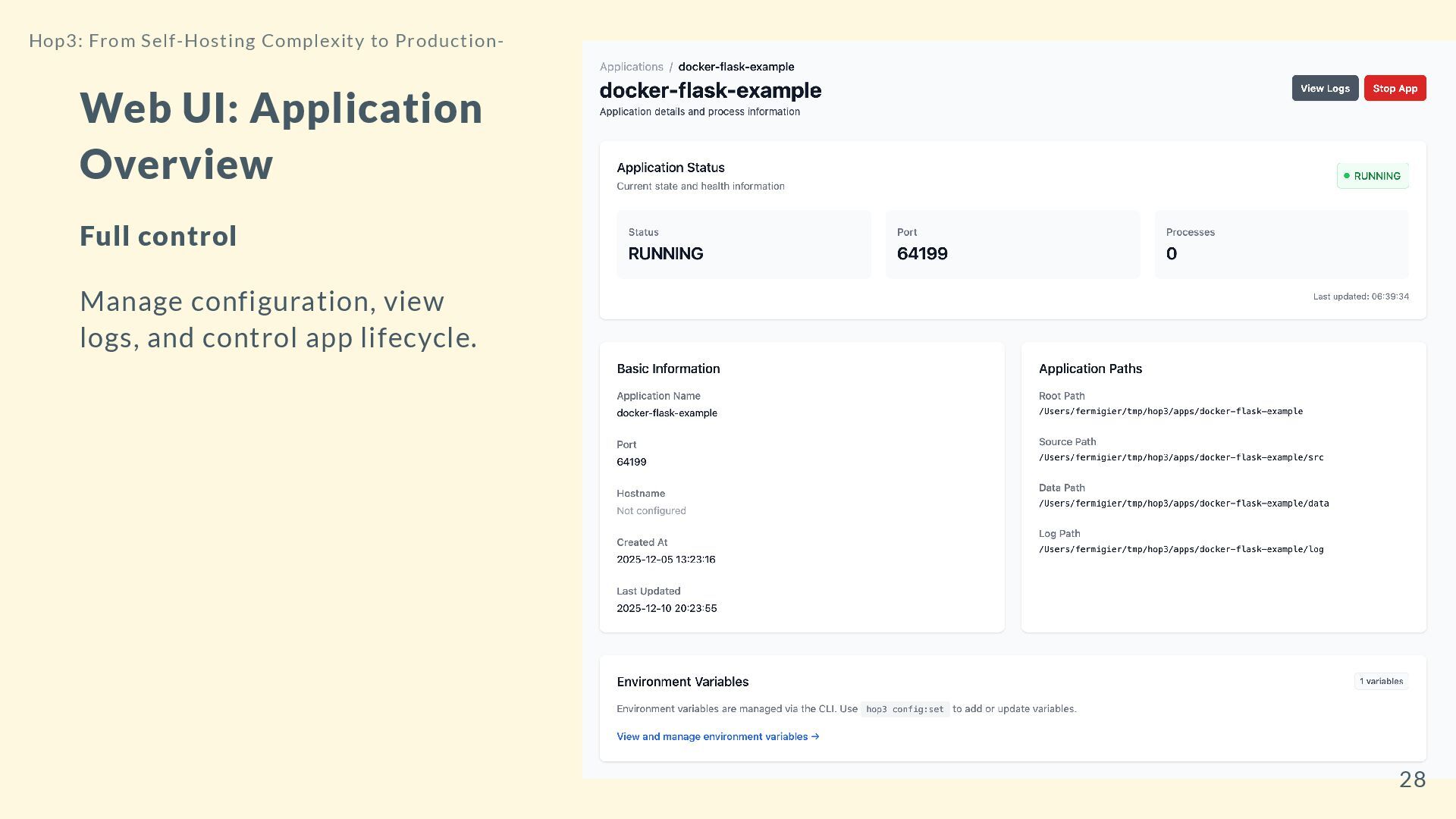
  24. Web UI: Application Overview Full control Manage configuration, view logs,

    and control app lifecycle. Hop3: From Self-Hosting Complexity to Production- 28
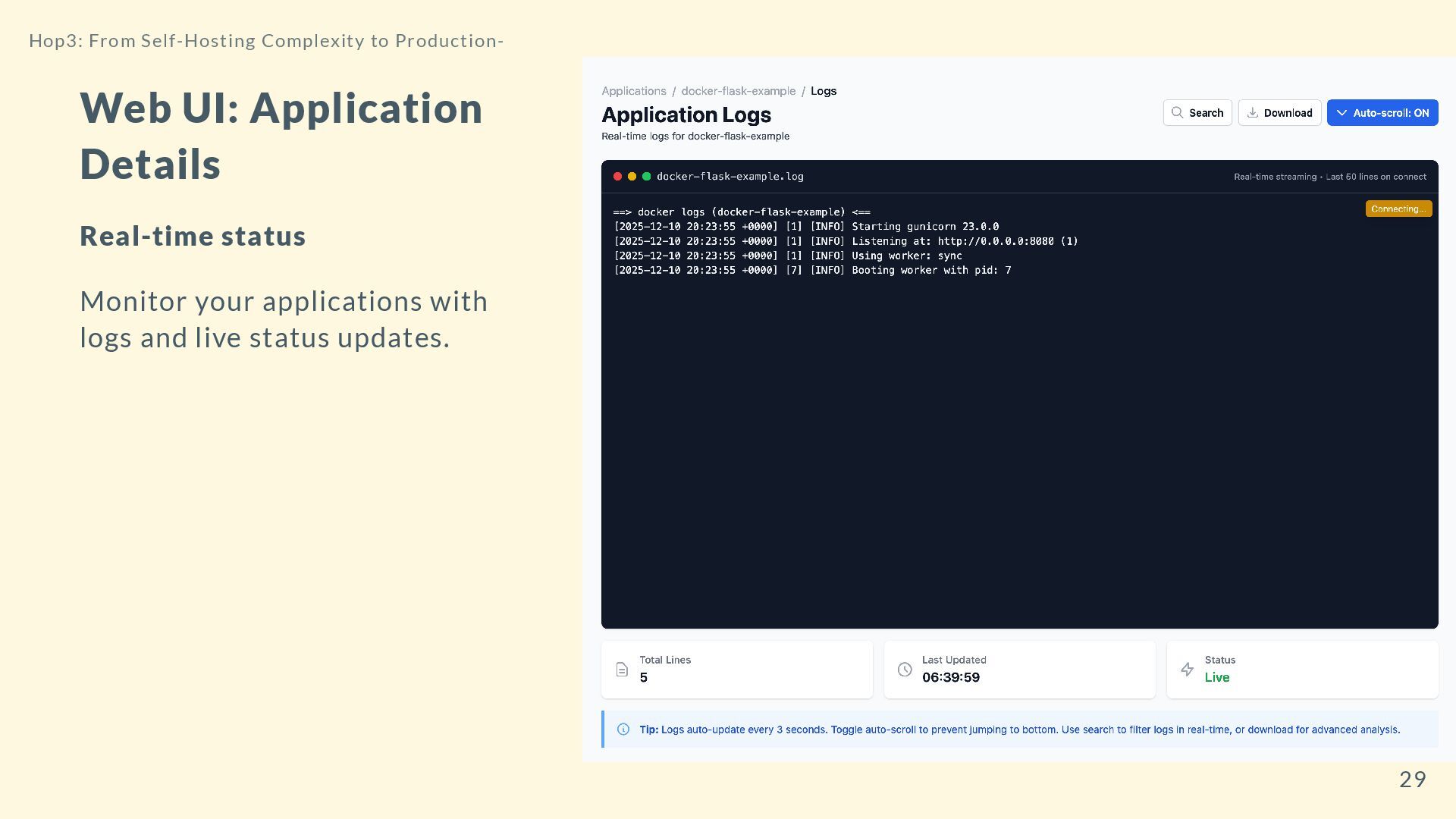
  25. Web UI: Application Details Real-time status Monitor your applications with

    logs and live status updates. Hop3: From Self-Hosting Complexity to Production- 29
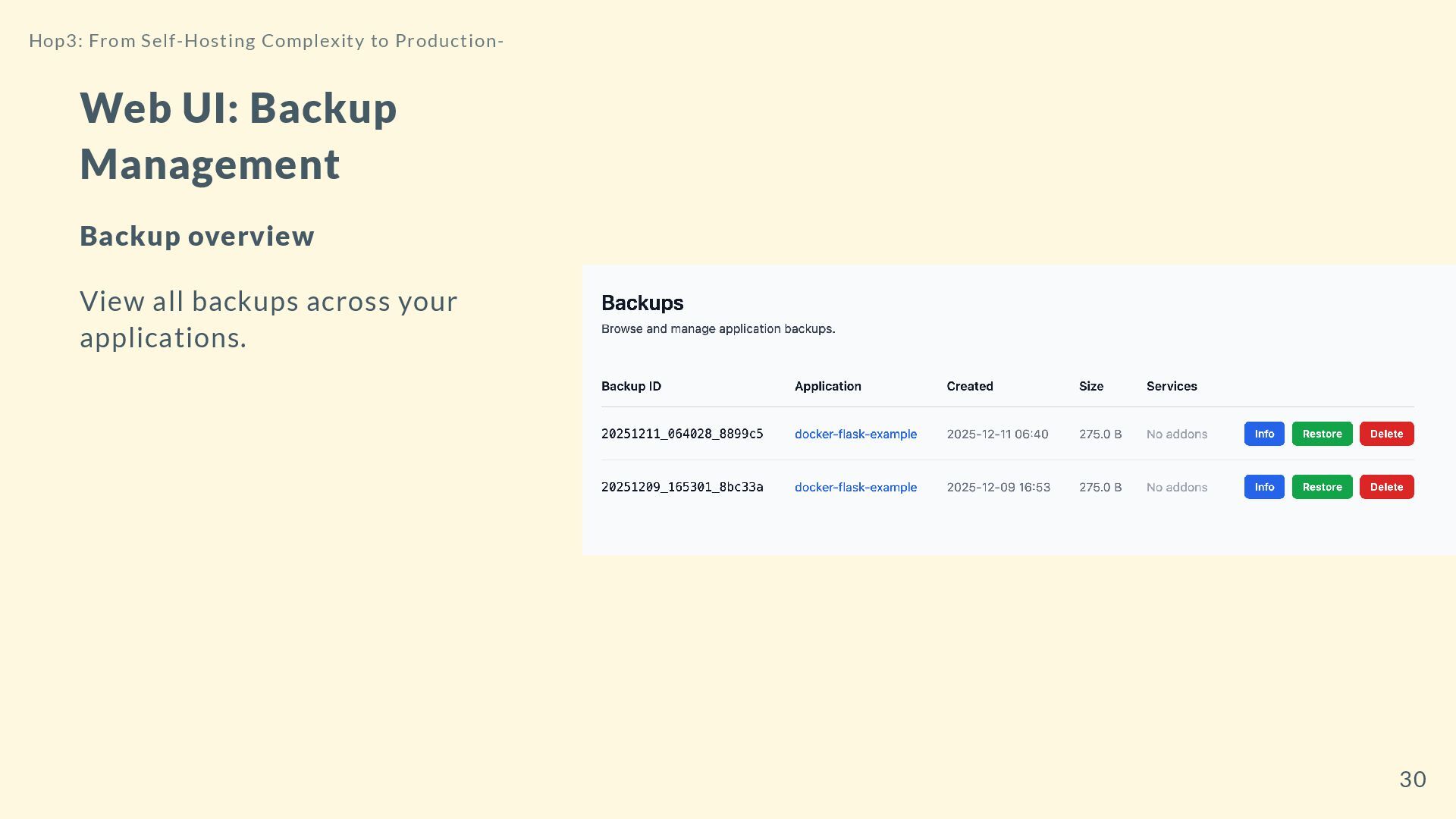
  26. Web UI: Backup Management Backup overview View all backups across

    your applications. Hop3: From Self-Hosting Complexity to Production- 30
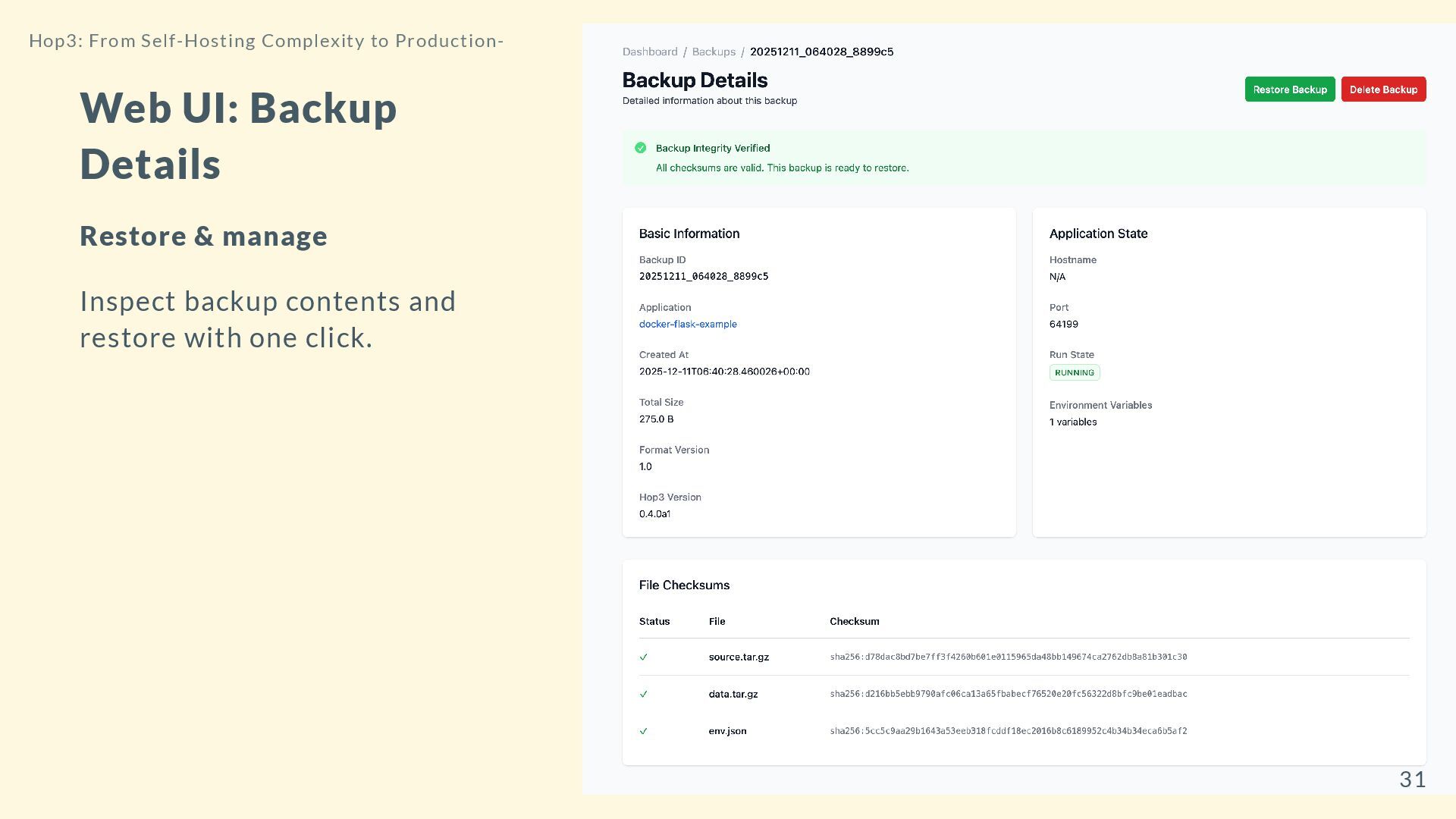
  27. Web UI: Backup Details Restore & manage Inspect backup contents

    and restore with one click. Hop3: From Self-Hosting Complexity to Production- 31
  28. Part 4 The Open Internet Stack in Action Hop3: From

    Self-Hosting Complexity to Production-Ready Sovereignty 32
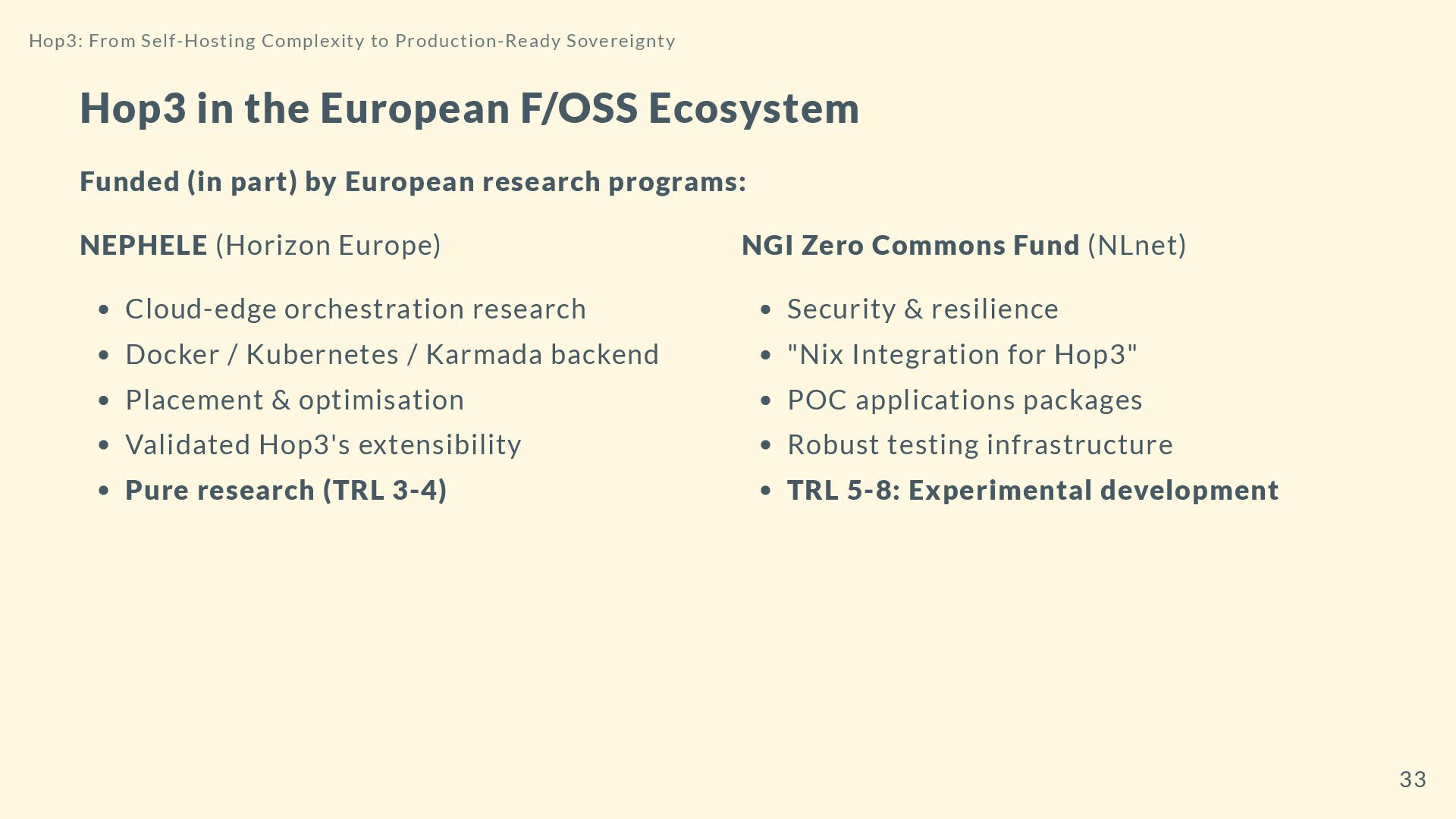
  29. Hop3 in the European F/OSS Ecosystem Funded (in part) by

    European research programs: NEPHELE (Horizon Europe) Cloud-edge orchestration research Docker / Kubernetes / Karmada backend Placement & optimisation Validated Hop3's extensibility Pure research (TRL 3-4) NGI Zero Commons Fund (NLnet) Security & resilience "Nix Integration for Hop3" POC applications packages Robust testing infrastructure TRL 5-8: Experimental development Hop3: From Self-Hosting Complexity to Production-Ready Sovereignty 33
  30. NGI0: Towards Reproducible Sovereignty The NGI Zero Commons project focuses

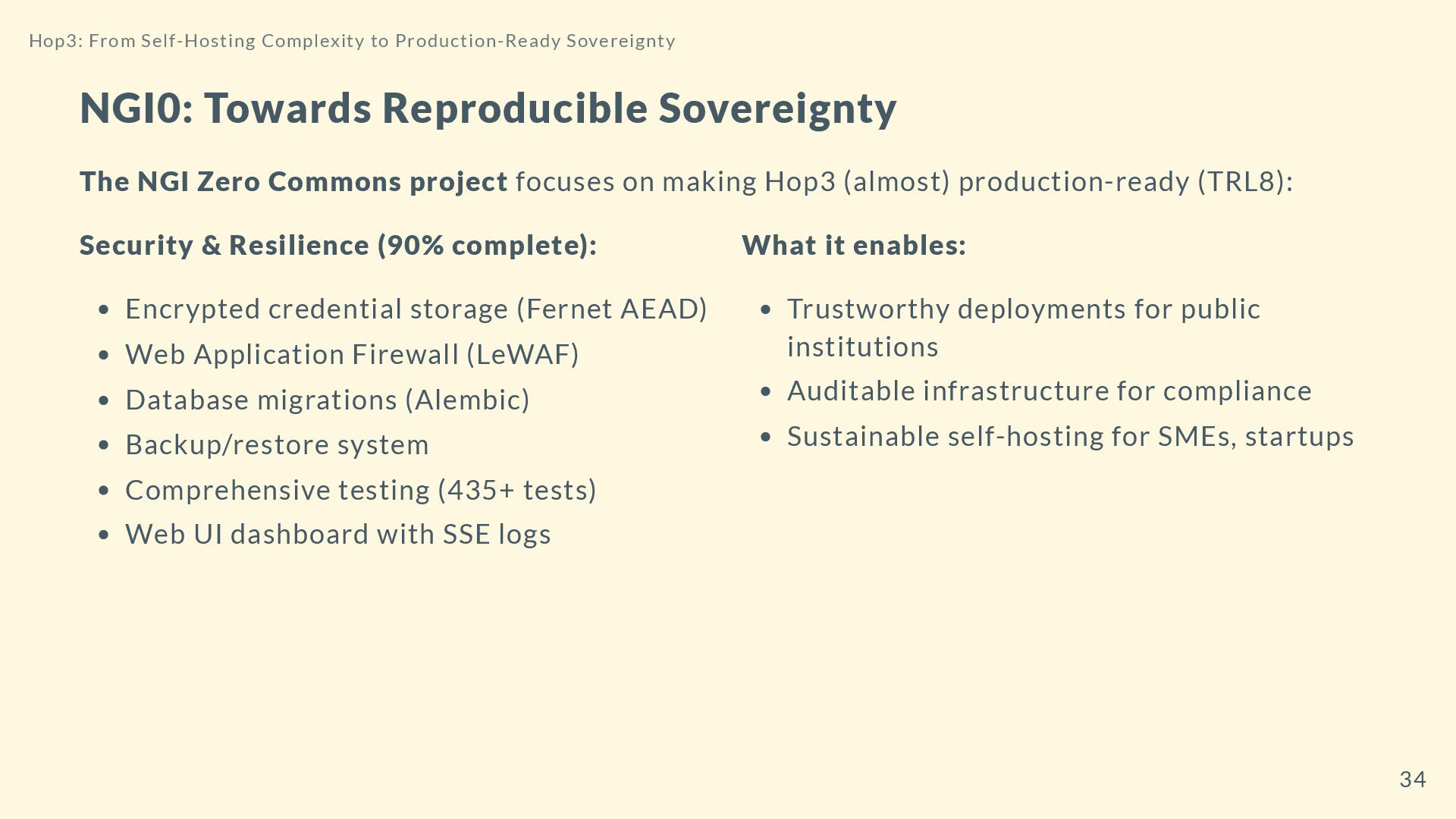
    on making Hop3 (almost) production-ready (TRL8): Security & Resilience (90% complete): Encrypted credential storage (Fernet AEAD) Web Application Firewall (LeWAF) Database migrations (Alembic) Backup/restore system Comprehensive testing (435+ tests) Web UI dashboard with SSE logs What it enables: Trustworthy deployments for public institutions Auditable infrastructure for compliance Sustainable self-hosting for SMEs, startups Hop3: From Self-Hosting Complexity to Production-Ready Sovereignty 34
  31. LeWAF: A Web Application Firewall for Hop3 LeWAF = Lightweight

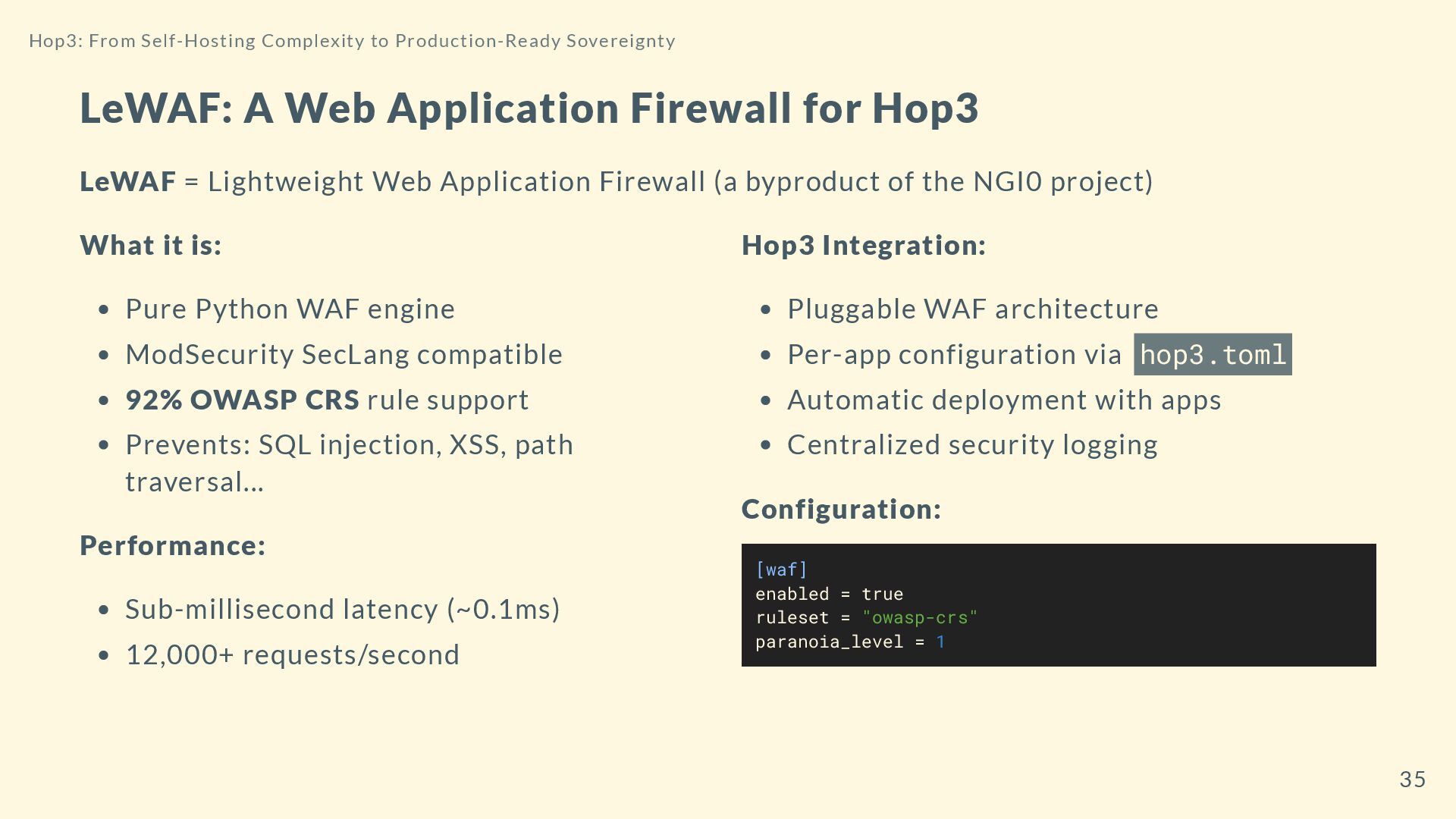
    Web Application Firewall (a byproduct of the NGI0 project) What it is: Pure Python WAF engine ModSecurity SecLang compatible 92% OWASP CRS rule support Prevents: SQL injection, XSS, path traversal... Performance: Sub-millisecond latency (~0.1ms) 12,000+ requests/second Hop3 Integration: Pluggable WAF architecture Per-app configuration via hop3.toml Automatic deployment with apps Centralized security logging Configuration: [waf] enabled = true ruleset = "owasp-crs" paranoia_level = 1 Hop3: From Self-Hosting Complexity to Production-Ready Sovereignty 35
  32. NGI0: The Nix Vision Why Nix matters for sovereignty: Reproducibility:

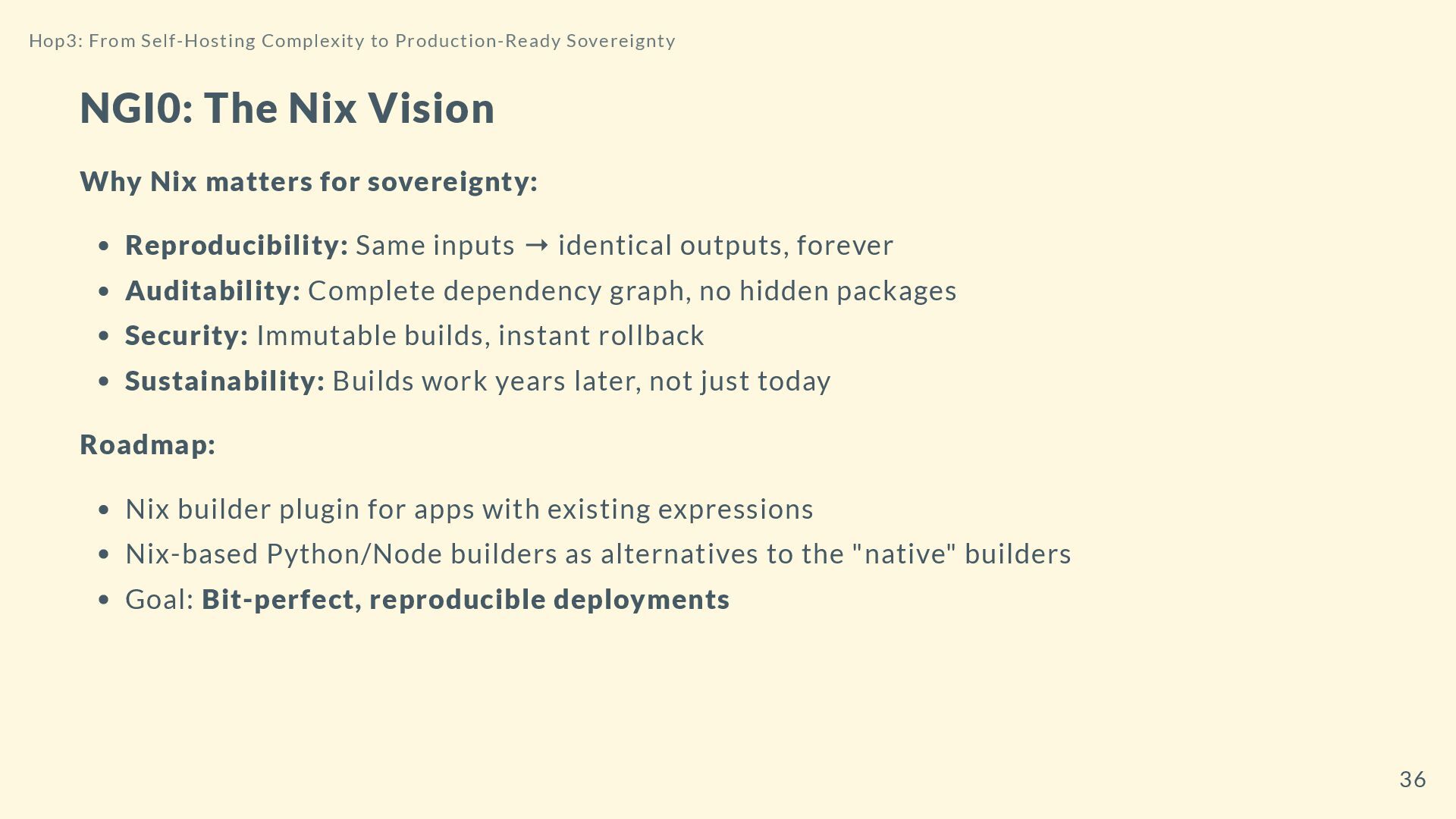
    Same inputs → identical outputs, forever Auditability: Complete dependency graph, no hidden packages Security: Immutable builds, instant rollback Sustainability: Builds work years later, not just today Roadmap: Nix builder plugin for apps with existing expressions Nix-based Python/Node builders as alternatives to the "native" builders Goal: Bit-perfect, reproducible deployments Hop3: From Self-Hosting Complexity to Production-Ready Sovereignty 36
  33. The Open Internet Stack Vision NGI has funded hundreds of

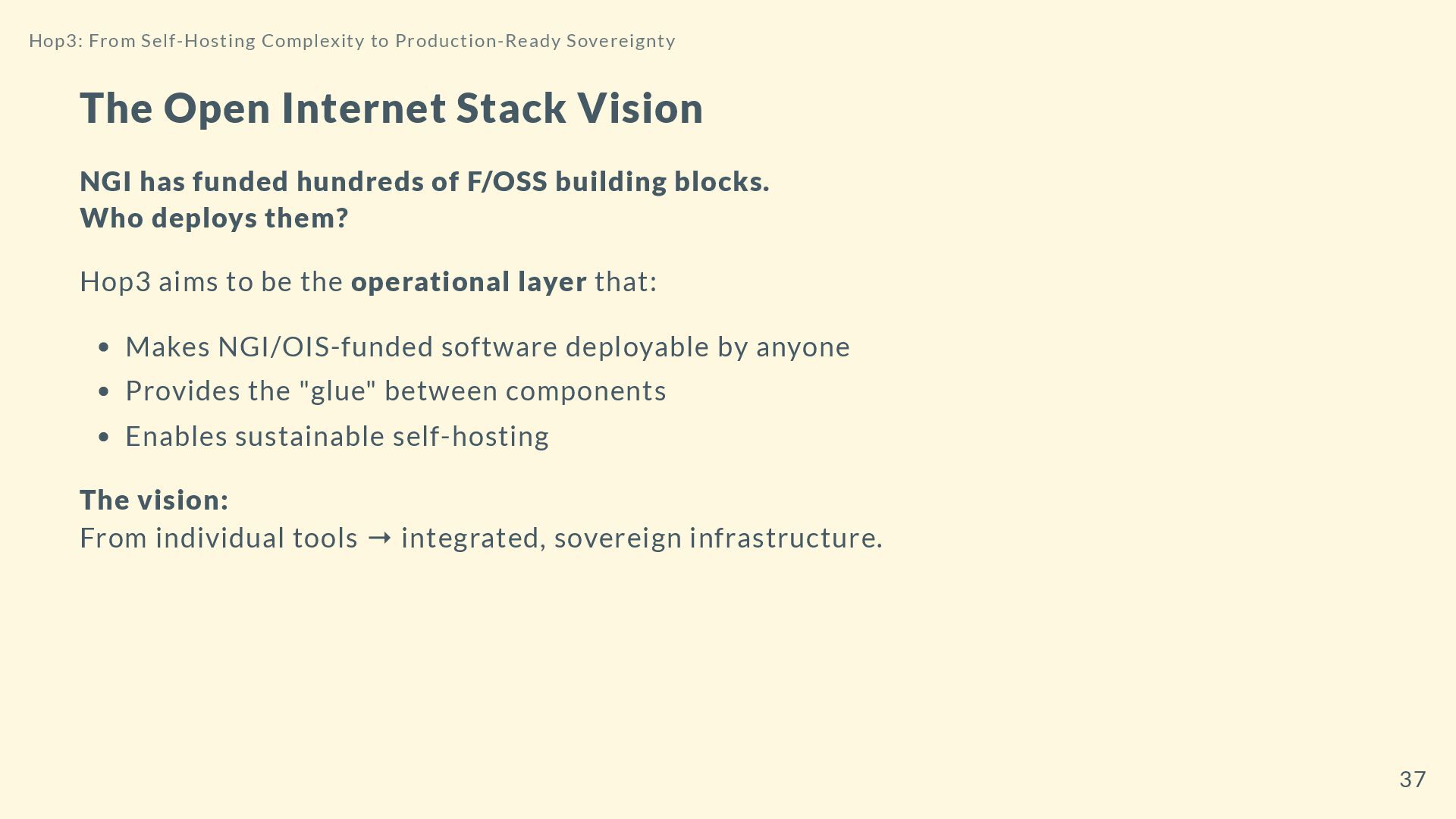
    F/OSS building blocks. Who deploys them? Hop3 aims to be the operational layer that: Makes NGI/OIS-funded software deployable by anyone Provides the "glue" between components Enables sustainable self-hosting The vision: From individual tools → integrated, sovereign infrastructure. Hop3: From Self-Hosting Complexity to Production-Ready Sovereignty 37
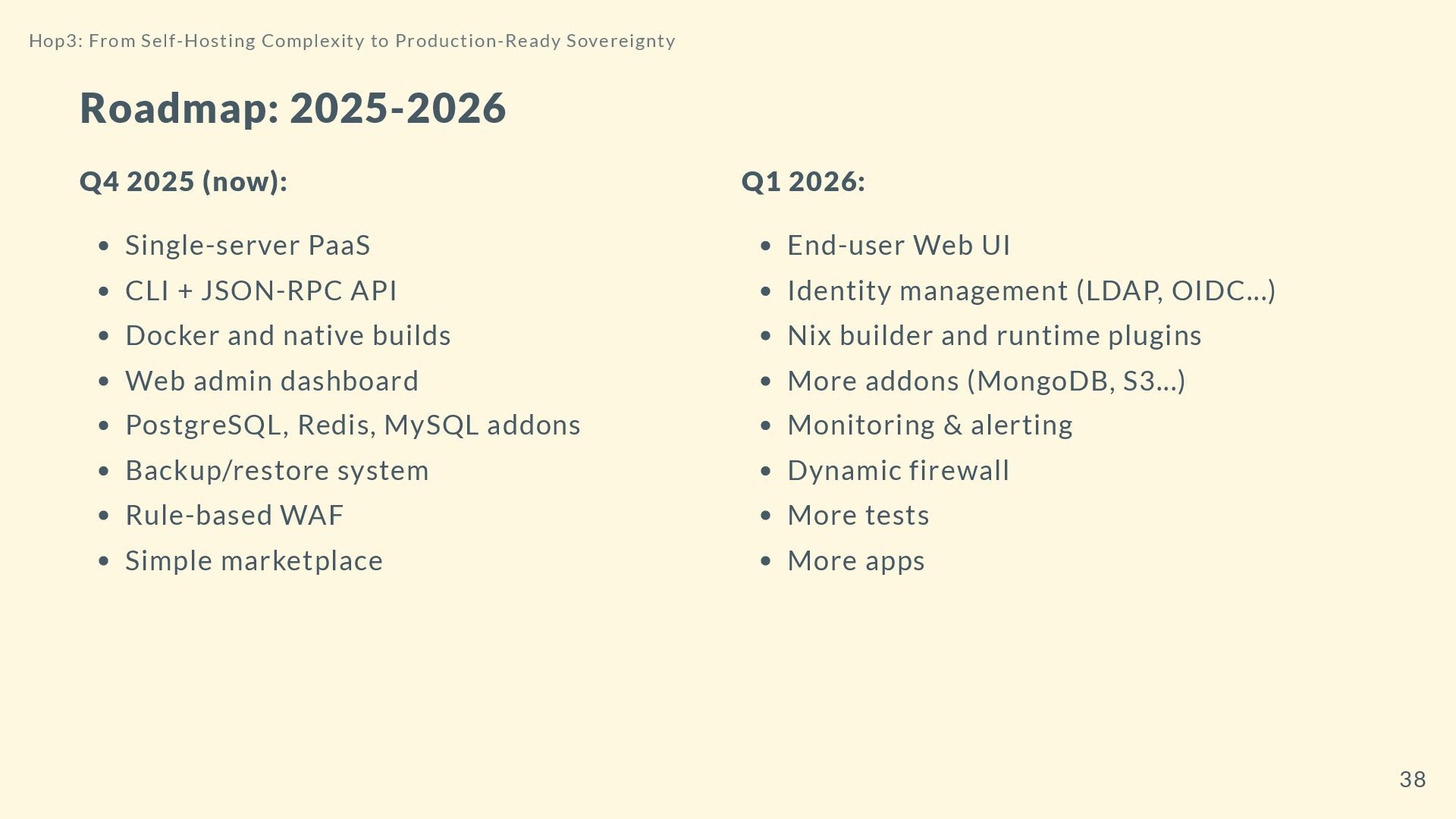
  34. Roadmap: 2025-2026 Q4 2025 (now): Single-server PaaS CLI + JSON-RPC

    API Docker and native builds Web admin dashboard PostgreSQL, Redis, MySQL addons Backup/restore system Rule-based WAF Simple marketplace Q1 2026: End-user Web UI Identity management (LDAP, OIDC...) Nix builder and runtime plugins More addons (MongoDB, S3...) Monitoring & alerting Dynamic firewall More tests More apps Hop3: From Self-Hosting Complexity to Production-Ready Sovereignty 38
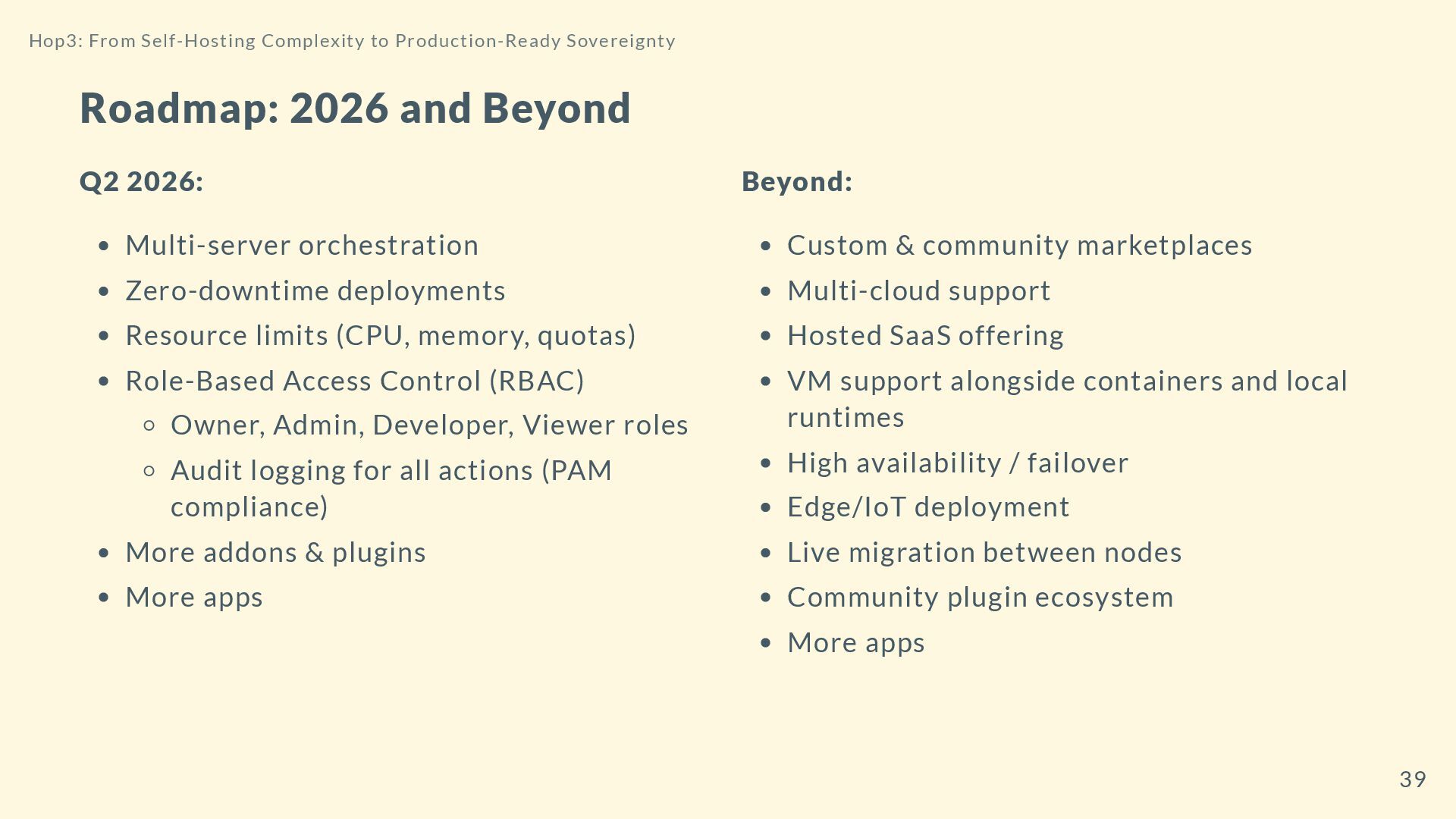
  35. Roadmap: 2026 and Beyond Q2 2026: Multi-server orchestration Zero-downtime deployments

    Resource limits (CPU, memory, quotas) Role-Based Access Control (RBAC) Owner, Admin, Developer, Viewer roles Audit logging for all actions (PAM compliance) More addons & plugins More apps Beyond: Custom & community marketplaces Multi-cloud support Hosted SaaS offering VM support alongside containers and local runtimes High availability / failover Edge/IoT deployment Live migration between nodes Community plugin ecosystem More apps Hop3: From Self-Hosting Complexity to Production-Ready Sovereignty 39
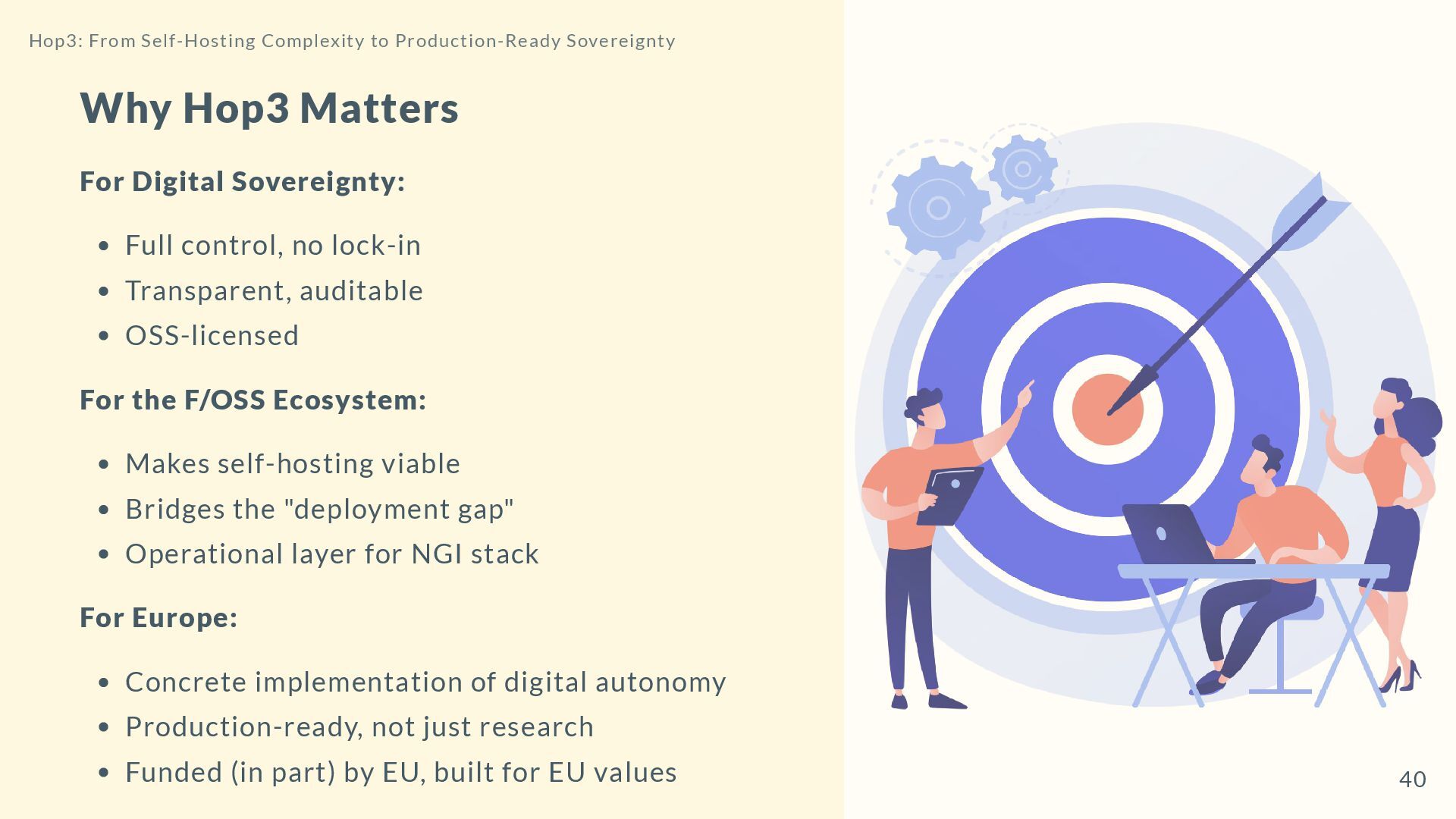
  36. Why Hop3 Matters For Digital Sovereignty: Full control, no lock-in

    Transparent, auditable OSS-licensed For the F/OSS Ecosystem: Makes self-hosting viable Bridges the "deployment gap" Operational layer for NGI stack For Europe: Concrete implementation of digital autonomy Production-ready, not just research Funded (in part) by EU, built for EU values Hop3: From Self-Hosting Complexity to Production-Ready Sovereignty 40
  37. Get Involved Try it: Documentation: hop3.cloud Source code: github.com/abilian/hop3 LeWAF:

    github.com/abilian/lewaf Contribute: Code, documentation, testing Application packaging Feedback and bug reports Supported by: Hop3: From Self-Hosting Complexity to Production-Ready Sovereignty 41
  38. Image Credits Images from Freepik: Server room, IT professional, blueprints

    Gold pot, roadmap, target People working Hackathon photo: EU OS Hackathon (illustration only) Logos used with permission from respective organizations. Hop3: From Self-Hosting Complexity to Production-Ready Sovereignty 43