Word embeddings for fun and profit with Gensim ...

Share
Embed
Word embeddings for fun and profit with Gensim - PyData London 2016

Lev Konstantinovskiy
May 08, 2016
Transcript
53 slides
-
Word Embeddings for Fun and Profit Lev Konstantinovskiy Community Manager
at Gensim @teagermylk http://rare-technologies.com/ -
About Lev Konstantinovskiy @teagermylk https://github.com/tmylk Graduate school drop-out in Algebraic
Geometry Worked in Trading IT Graduate of Galvanize Data Science Bootcamp in San Francisco Community manager for open-source projects gensim and others. NLP consultant at RaRe Technologies. -
The business problem to be solved in Part 2 You
run a movie studio. Every day you receive thousands of proposals for movies to make. Need to send them to the right department for consideration! One department per genre. Need to classify plots by genre. -
Word embeddings can be used for: - automated text tagging
(this talk) - recommendation engines - synonyms and search query expansion - machine translation - plain feature engineering -
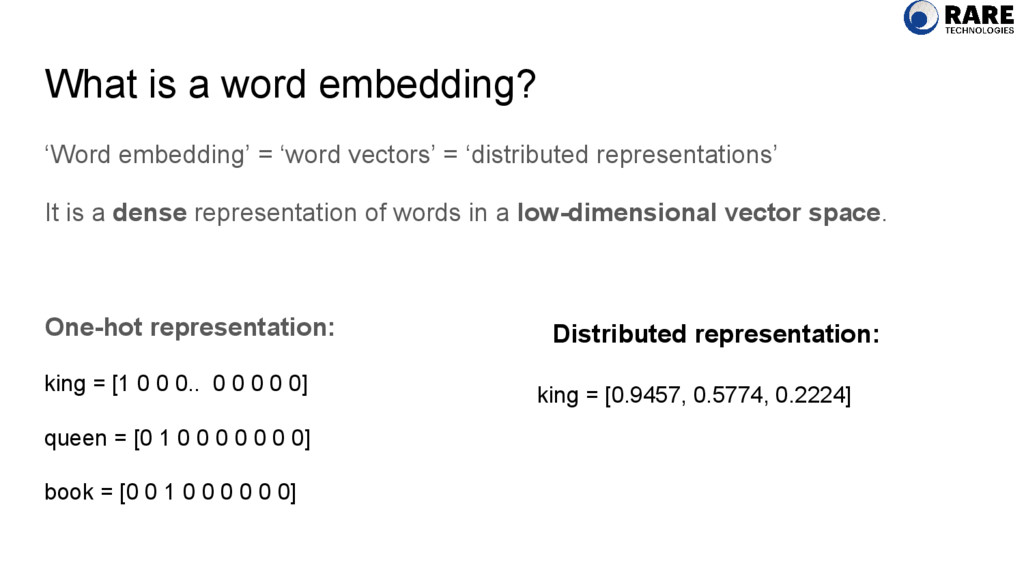
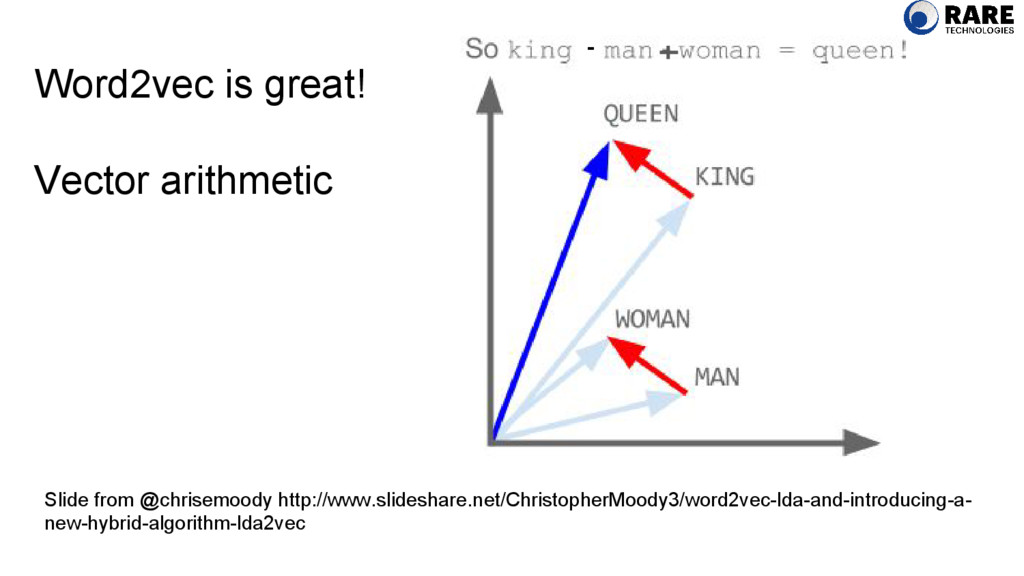
What is a word embedding? ‘Word embedding’ = ‘word vectors’
= ‘distributed representations’ It is a dense representation of words in a low-dimensional vector space. One-hot representation: king = [1 0 0 0.. 0 0 0 0 0] queen = [0 1 0 0 0 0 0 0 0] book = [0 0 1 0 0 0 0 0 0] king = [0.9457, 0.5774, 0.2224] Distributed representation: -
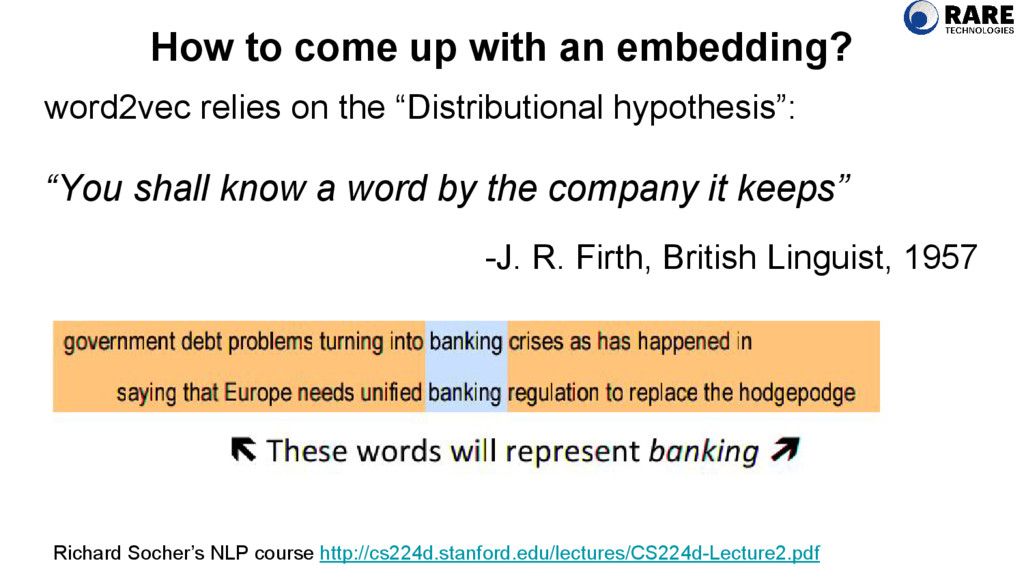
word2vec relies on the “Distributional hypothesis”: “You shall know a
word by the company it keeps” -J. R. Firth, British Linguist, 1957 Richard Socher’s NLP course http://cs224d.stanford.edu/lectures/CS224d-Lecture2.pdf How to come up with an embedding? -
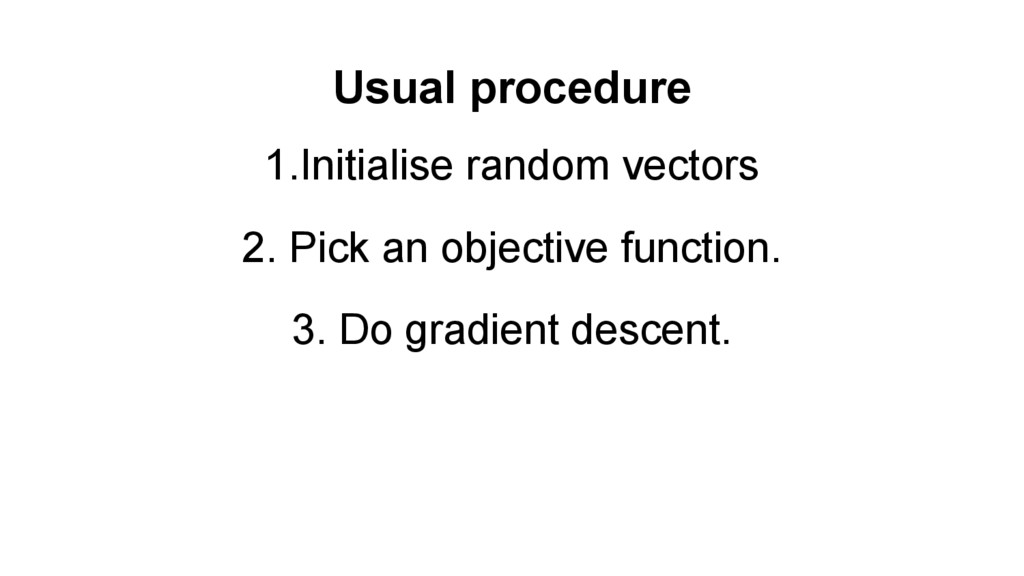
Usual procedure 1.Initialise random vectors 2. Pick an objective function.
3. Do gradient descent. -
For the theory, take Richard Sochers’s class Richard Socher’s NLP
course http://cs224d.stanford.edu/lectures/CS224d-Lecture2.pdf -
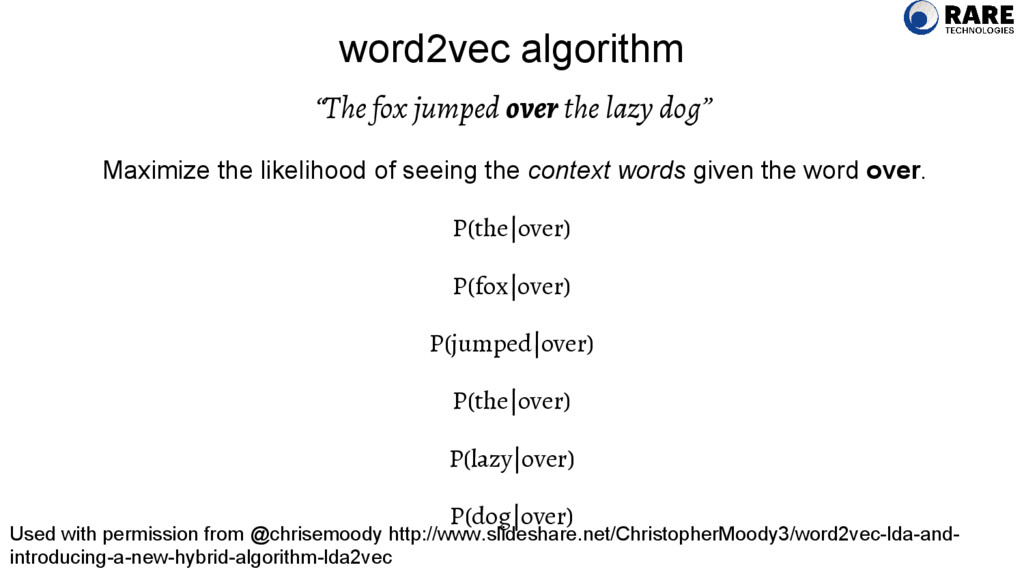
“The fox jumped over the lazy dog” Maximize the likelihood
of seeing the context words given the word over. P(the|over) P(fox|over) P(jumped|over) P(the|over) P(lazy|over) P(dog|over) word2vec algorithm Used with permission from @chrisemoody http://www.slideshare.net/ChristopherMoody3/word2vec-lda-and- introducing-a-new-hybrid-algorithm-lda2vec -
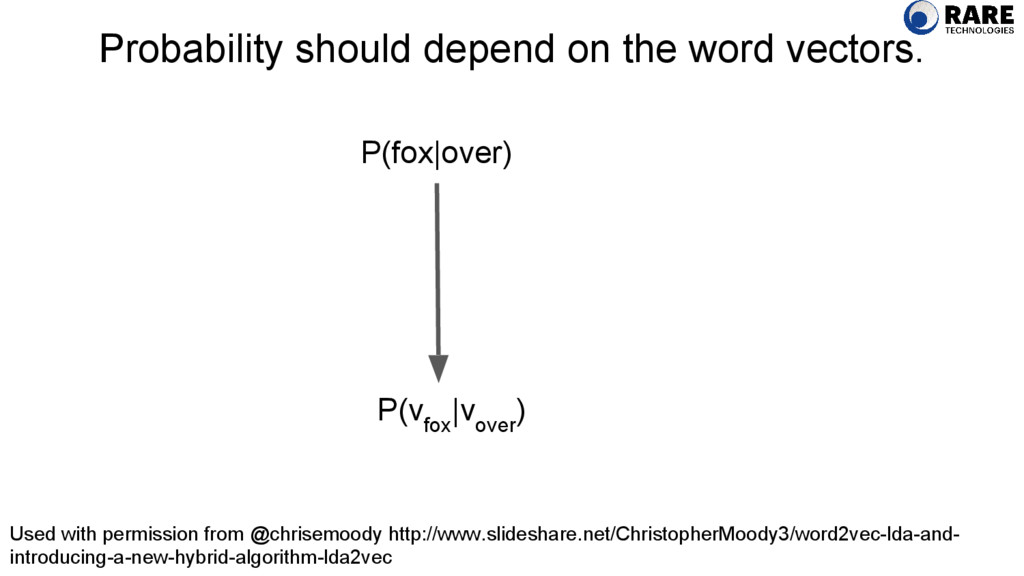
Probability should depend on the word vectors. Used with permission
from @chrisemoody http://www.slideshare.net/ChristopherMoody3/word2vec-lda-and- introducing-a-new-hybrid-algorithm-lda2vec P(fox|over) P(v fox |v over ) -
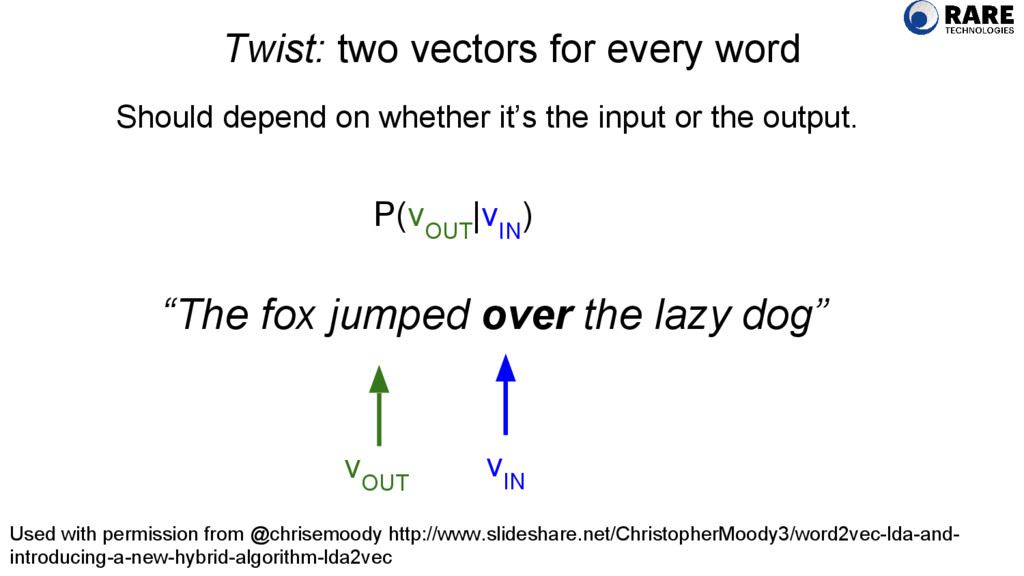
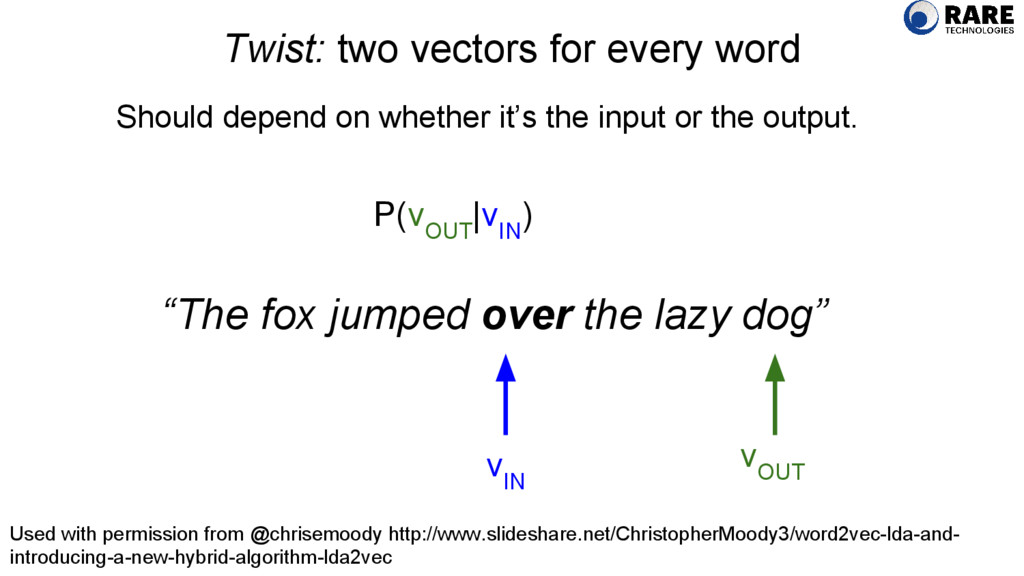
A twist: two vectors for every word Used with permission
from @chrisemoody http://www.slideshare.net/ChristopherMoody3/word2vec-lda-and- introducing-a-new-hybrid-algorithm-lda2vec Should depend on whether it’s the input or the output. P(v OUT |v IN ) “The fox jumped over the lazy dog” v IN -
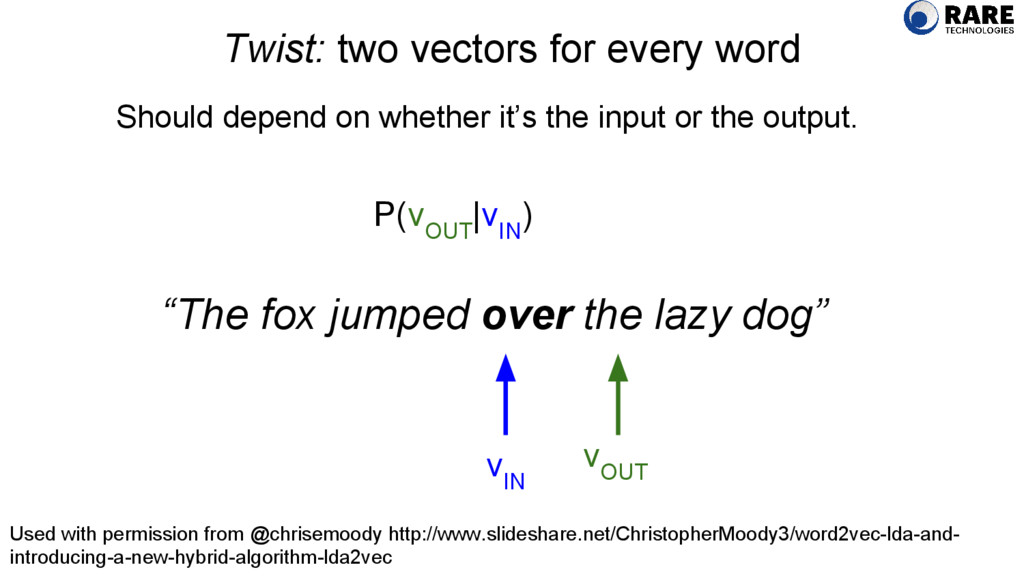
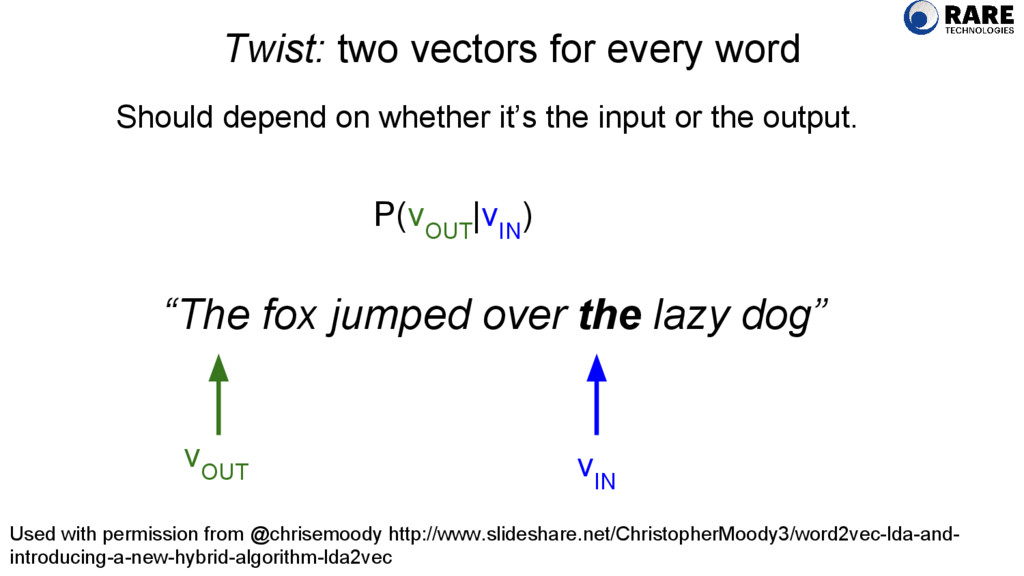
Twist: two vectors for every word Used with permission from
@chrisemoody http://www.slideshare.net/ChristopherMoody3/word2vec-lda-and- introducing-a-new-hybrid-algorithm-lda2vec Should depend on whether it’s the input or the output. P(v OUT |v IN ) “The fox jumped over the lazy dog” v IN v OUT = P(v THE |v OVER ) -
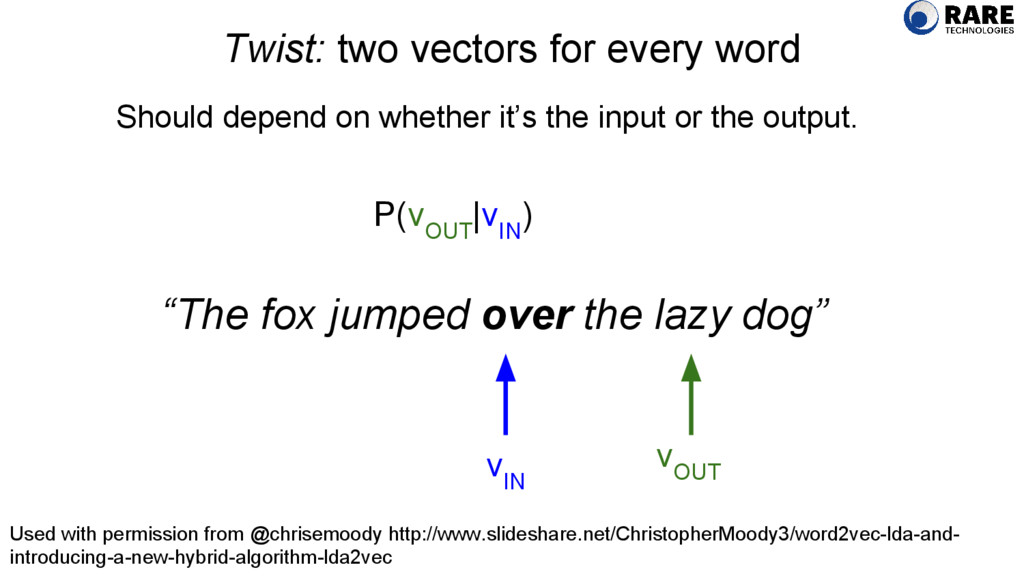
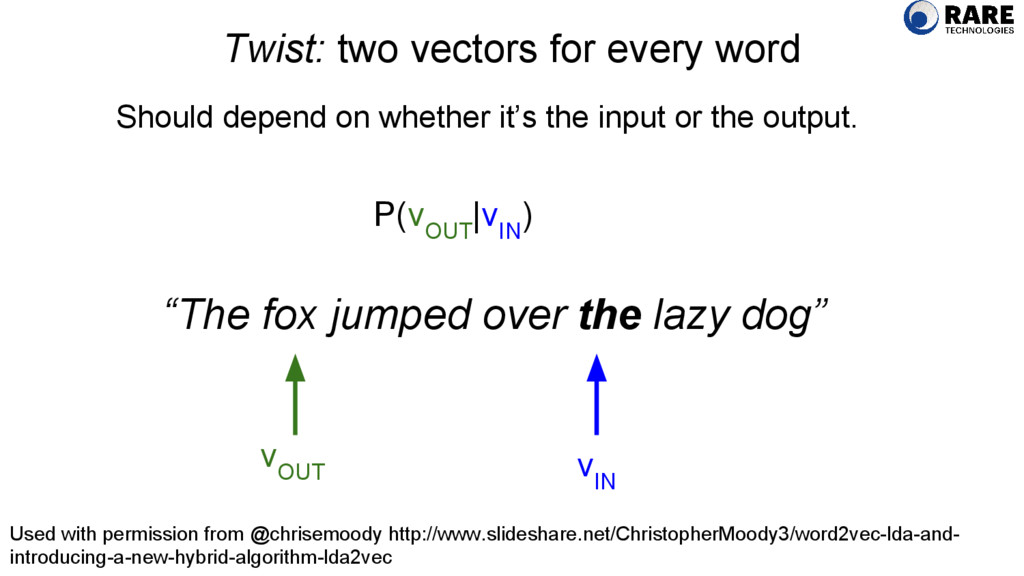
Twist: two vectors for every word Used with permission from
@chrisemoody http://www.slideshare.net/ChristopherMoody3/word2vec-lda-and- introducing-a-new-hybrid-algorithm-lda2vec Should depend on whether it’s the input or the output. P(v OUT |v IN ) “The fox jumped over the lazy dog” v IN v OUT -
Twist: two vectors for every word Used with permission from
@chrisemoody http://www.slideshare.net/ChristopherMoody3/word2vec-lda-and- introducing-a-new-hybrid-algorithm-lda2vec Should depend on whether it’s the input or the output. P(v OUT |v IN ) “The fox jumped over the lazy dog” v IN v OUT -
Twist: two vectors for every word Used with permission from
@chrisemoody http://www.slideshare.net/ChristopherMoody3/word2vec-lda-and- introducing-a-new-hybrid-algorithm-lda2vec Should depend on whether it’s the input or the output. P(v OUT |v IN ) “The fox jumped over the lazy dog” v IN v OUT -
Twist: two vectors for every word Used with permission from
@chrisemoody http://www.slideshare.net/ChristopherMoody3/word2vec-lda-and- introducing-a-new-hybrid-algorithm-lda2vec Should depend on whether it’s the input or the output. P(v OUT |v IN ) “The fox jumped over the lazy dog” v IN v OUT -
Twist: two vectors for every word Used with permission from
@chrisemoody http://www.slideshare.net/ChristopherMoody3/word2vec-lda-and- introducing-a-new-hybrid-algorithm-lda2vec Should depend on whether it’s the input or the output. P(v OUT |v IN ) “The fox jumped over the lazy dog” v IN v OUT -
Twist: two vectors for every word Used with permission from
@chrisemoody http://www.slideshare.net/ChristopherMoody3/word2vec-lda-and- introducing-a-new-hybrid-algorithm-lda2vec Should depend on whether it’s the input or the output. P(v OUT |v IN ) “The fox jumped over the lazy dog” v IN v OUT -
Twist: two vectors for every word Used with permission from
@chrisemoody http://www.slideshare.net/ChristopherMoody3/word2vec-lda-and- introducing-a-new-hybrid-algorithm-lda2vec Should depend on whether it’s the input or the output. P(v OUT |v IN ) “The fox jumped over the lazy dog” v IN v OUT -
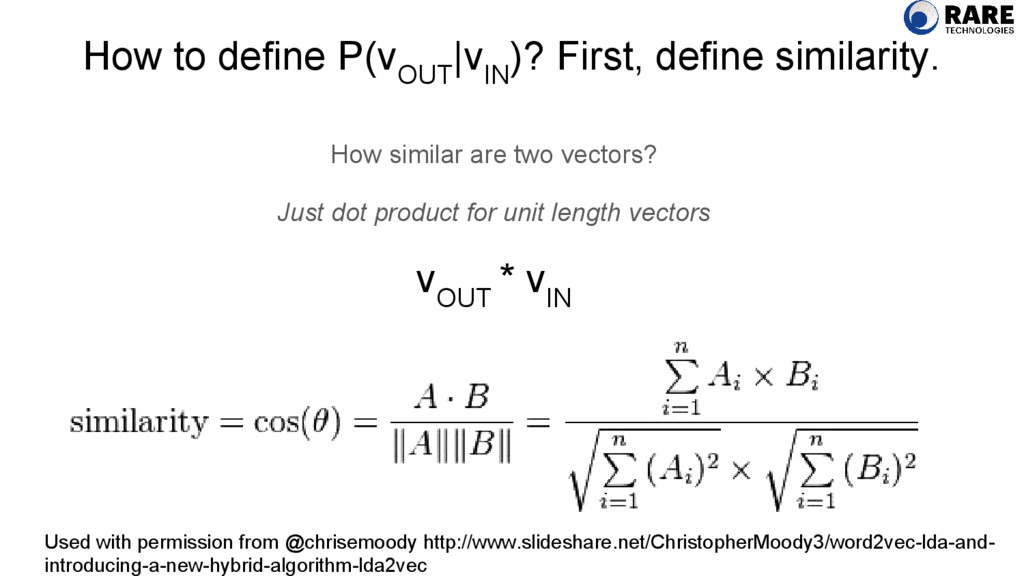
How to define P(v OUT |v IN )? First, define
similarity. How similar are two vectors? Just dot product for unit length vectors v OUT * v IN Used with permission from @chrisemoody http://www.slideshare.net/ChristopherMoody3/word2vec-lda-and- introducing-a-new-hybrid-algorithm-lda2vec -
Get a probability in [0,1] out of similarity in [-1,
1] Normalization term over all out words Used with permission from @chrisemoody http://www.slideshare.net/ChristopherMoody3/word2vec-lda-and- introducing-a-new-hybrid-algorithm-lda2vec -
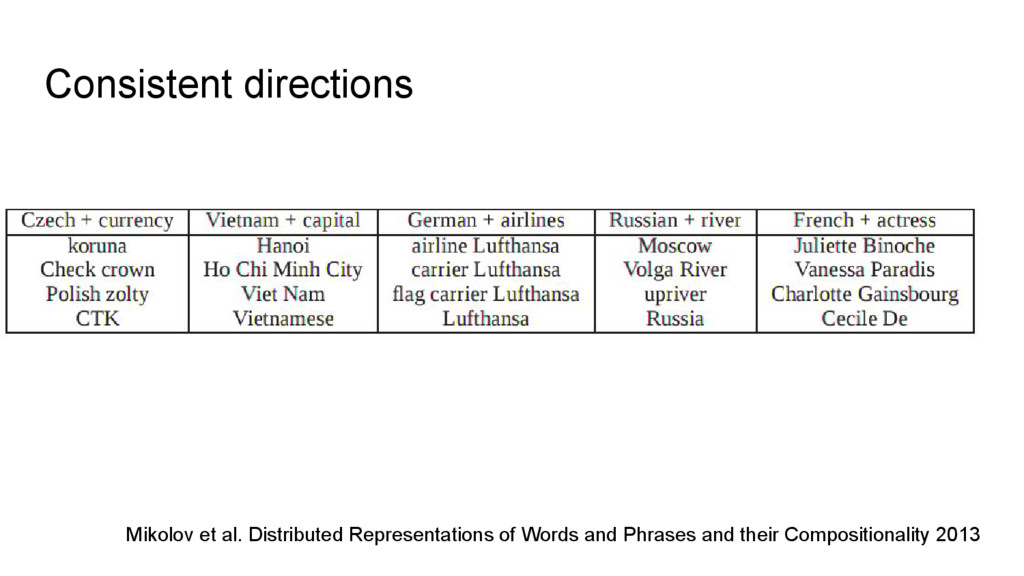
Consistent directions Mikolov et al. Distributed Representations of Words and
Phrases and their Compositionality 2013 -
Word2vec is big victory of unsupervised learning Google ran word2vec
on 100billion of unlabelled documents. Then shared their trained model. Thanks to Google for cutting our training time to zero!. :) -
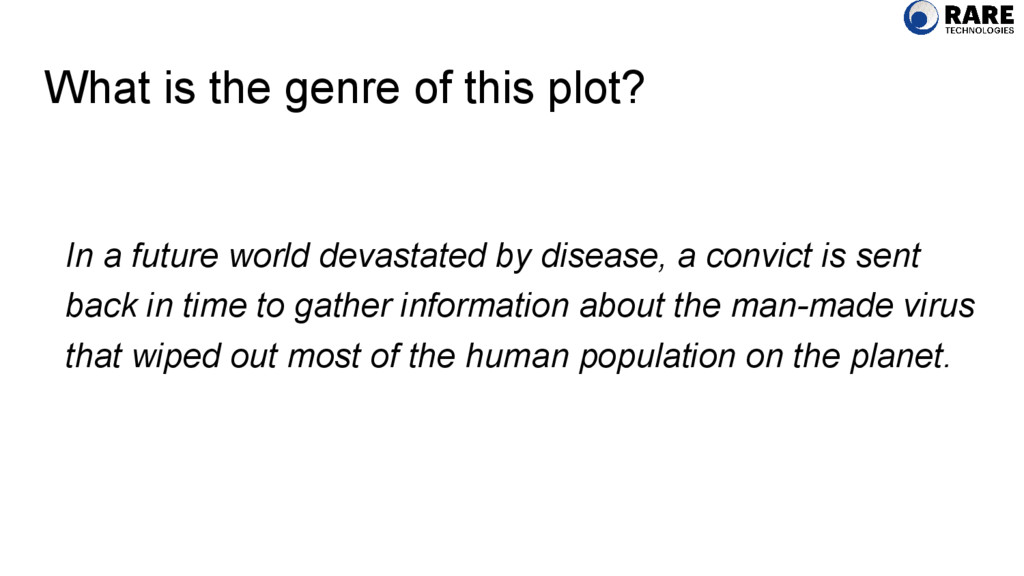
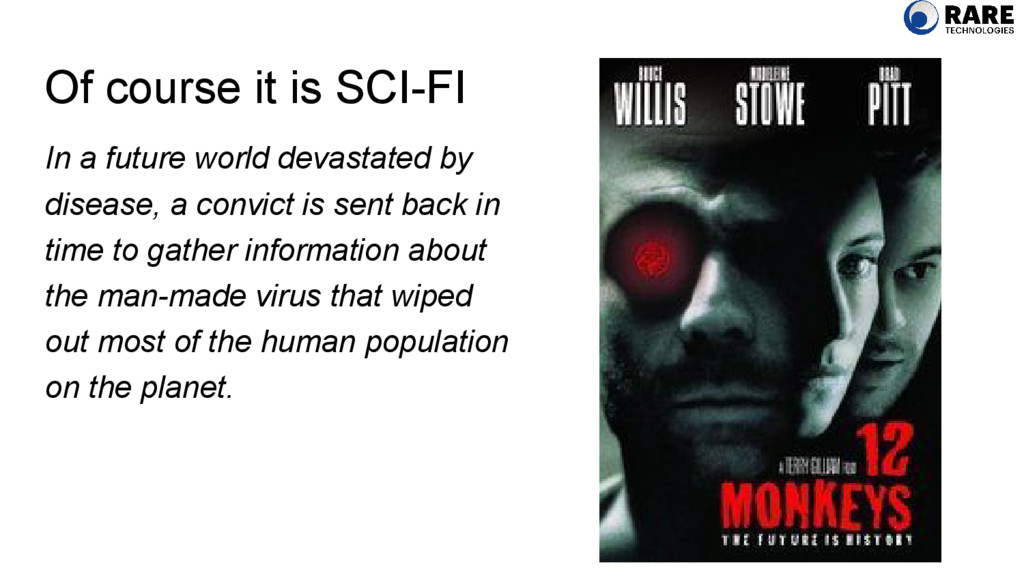
What is the genre of this plot? In a future
world devastated by disease, a convict is sent back in time to gather information about the man-made virus that wiped out most of the human population on the planet. -
Of course it is SCI-FI In a future world devastated
by disease, a convict is sent back in time to gather information about the man-made virus that wiped out most of the human population on the planet. -
What is the genre of this one? When Mr. Dashwood
dies, he must leave the bulk of his estate to the son by his first marriage, which leaves his second wife and their three daughters (Elinor, Marianne, and Margaret) in straitened circumstances. They are taken in by a kindly cousin, but their lack of fortune affects the marriageability of both practical Elinor and romantic Marianne. When Elinor forms an attachment for the wealthy Edward Ferrars, his family disapproves and separates them. And though Mrs. Jennings tries to match the worthy (and rich) Colonel Brandon to her, Marianne finds the dashing and fiery John Willoughby more to her taste. Both relationships are sorely tried. -
ROMANCE When Mr. Dashwood dies, he must leave the bulk
of his estate to the son by his first marriage, which leaves his second wife and their three daughters (Elinor, Marianne, and Margaret) in straitened circumstances. They are taken in by a kindly cousin, but their lack of fortune affects the marriageability of both practical Elinor and romantic Marianne. When Elinor forms an attachment for the wealthy Edward Ferrars, his family disapproves and separates them. And though Mrs. Jennings tries to match the worthy (and rich) Colonel Brandon to her, Marianne finds the dashing and fiery John Willoughby more to her taste. Both relationships are sorely tried. -
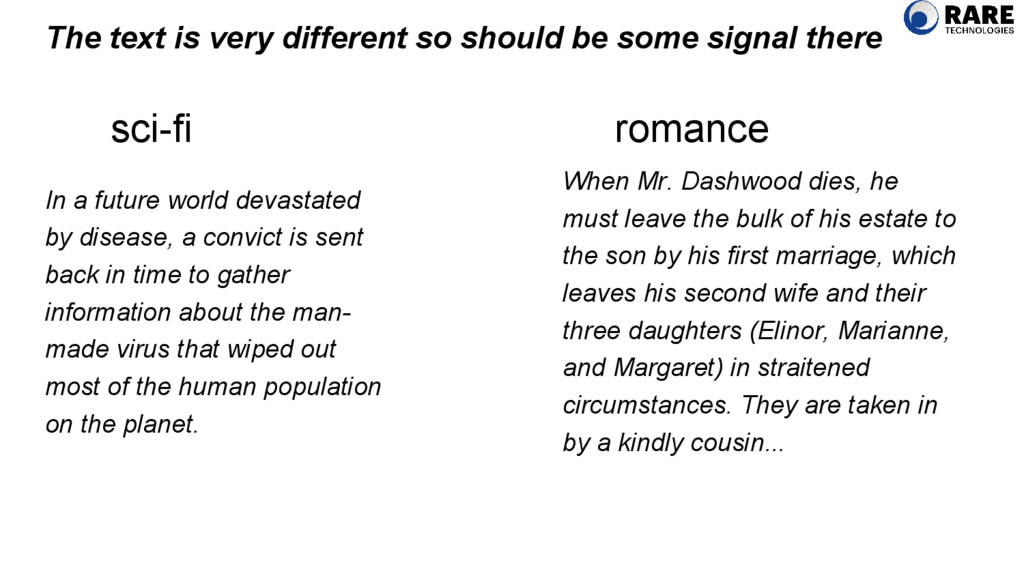
When Mr. Dashwood dies, he must leave the bulk of
his estate to the son by his first marriage, which leaves his second wife and their three daughters (Elinor, Marianne, and Margaret) in straitened circumstances. They are taken in by a kindly cousin... romance In a future world devastated by disease, a convict is sent back in time to gather information about the man- made virus that wiped out most of the human population on the planet. sci-fi The text is very different so should be some signal there -
Word2vec to... A Document Classifier We need some features to
power our favourite classifier (logistic regression/KNN) We have vectors for words but need vectors for documents. How to create a document classifier out of a set of word vectors? For KNN, how similar is one sequence of words to another sequence of words? -
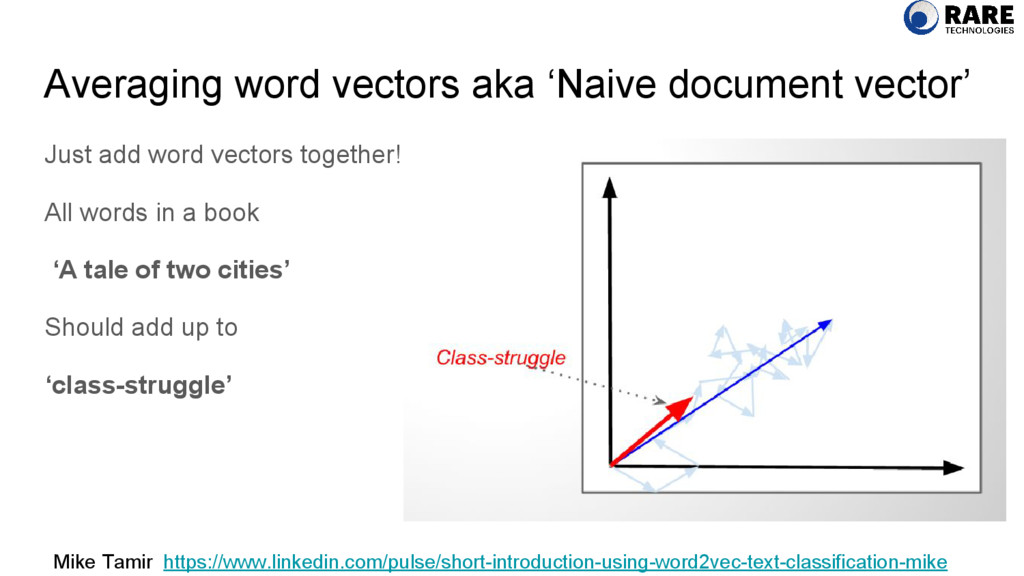
Averaging word vectors aka ‘Naive document vector’ Just add word
vectors together! All words in a book ‘A tale of two cities’ Should add up to ‘class-struggle’ Mike Tamir https://www.linkedin.com/pulse/short-introduction-using-word2vec-text-classification-mike -
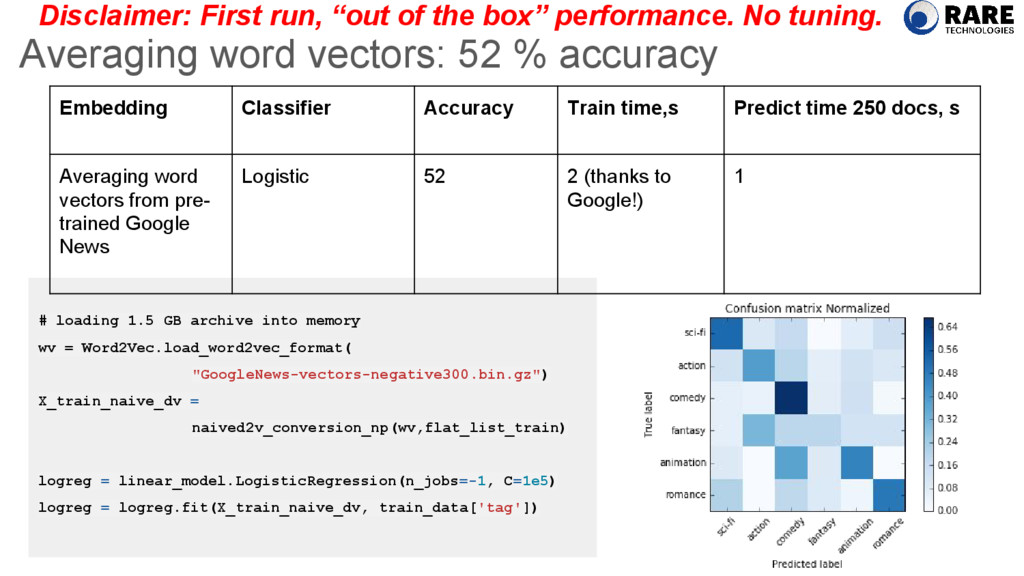
Averaging word vectors: 52 % accuracy # loading 1.5 GB
archive into memory wv = Word2Vec.load_word2vec_format( "GoogleNews-vectors-negative300.bin.gz") X_train_naive_dv = naived2v_conversion_np(wv,flat_list_train) logreg = linear_model.LogisticRegression(n_jobs=-1, C=1e5) logreg = logreg.fit(X_train_naive_dv, train_data['tag']) Embedding Classifier Accuracy Train time,s Predict time 250 docs, s Averaging word vectors from pre- trained Google News Logistic 52 2 (thanks to Google!) 1 Disclaimer: First run, “out of the box” performance. No tuning. -
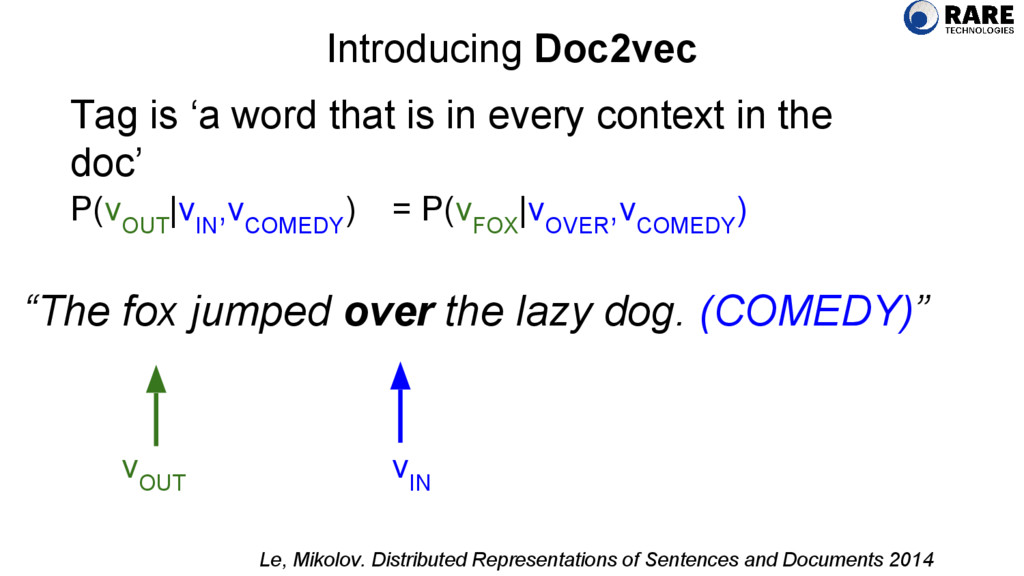
Introducing Doc2vec Le, Mikolov. Distributed Representations of Sentences and Documents
2014 Tag is ‘a word that is in every context in the doc’ P(v OUT |v IN ,v COMEDY ) “The fox jumped over the lazy dog. (COMEDY)” v IN v OUT = P(v FOX |v OVER ,v COMEDY ) -
Introducing Doc2vec Tag is ‘a word that is in every
context in the doc’ P(v OUT |v IN ,v COMEDY ) “The fox jumped over the lazy dog. (COMEDY)” v IN v OUT = P(v JUMPED |v OVER ,v COMEDY ) Used with permission from @chrisemoody http://www.slideshare.net/ChristopherMoody3/word2vec-lda-and- introducing-a-new-hybrid-algorithm-lda2vec -
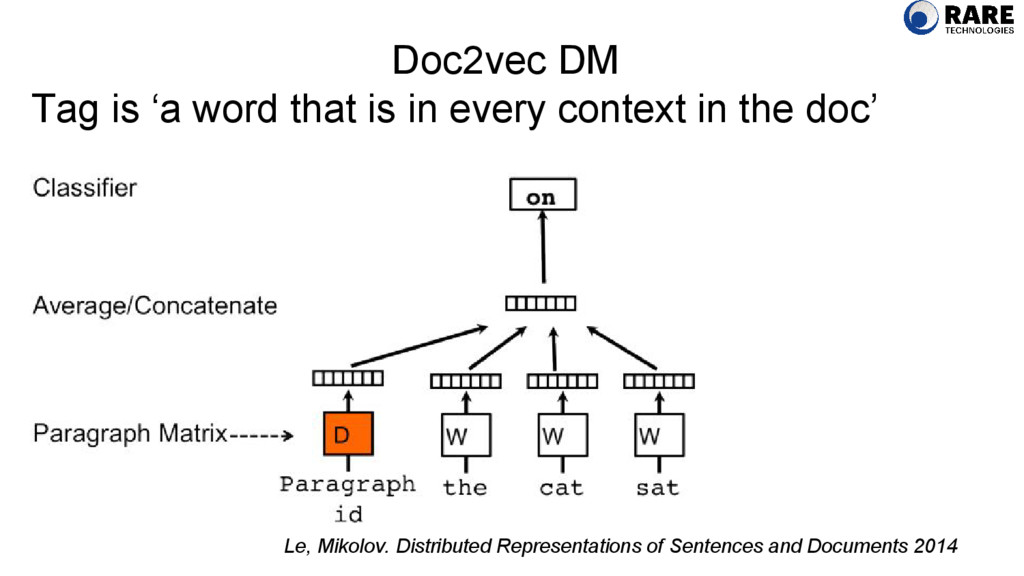
Doc2vec DM Tag is ‘a word that is in every
context in the doc’ Le, Mikolov. Distributed Representations of Sentences and Documents 2014 -
Closest words to sci-fi model.most_similar([mdm_alt.docvecs['sci-fi']]) [('samurai', 0.3334442377090454), ('havoc', 0.328862726688385), ('doom',
0.32513290643692017), ('loose', 0.3133614659309387), ('cops', 0.305380642414093), ('showing', 0.2965583801269531), ('games', 0.29606401920318604), ('dinosaur', 0.2917608618736267), ('tough', 0.2828773260116577)] -
Closest words romance model.most_similar([mdm_alt.docvecs['romance']]) [('say', 0.38082122802734375), ('skill', 0.3159002363681793), ('leads', 0.3063559830188751),
('local', 0.3018215596675873), ('millionaire', 0.2863730788230896), ('located', 0.28458985686302185), ('hood', 0.2830425798892975), ('heir', 0.2802196145057678), ('died', 0.27215155959129333), ('indians', 0.26776593923568726)] -
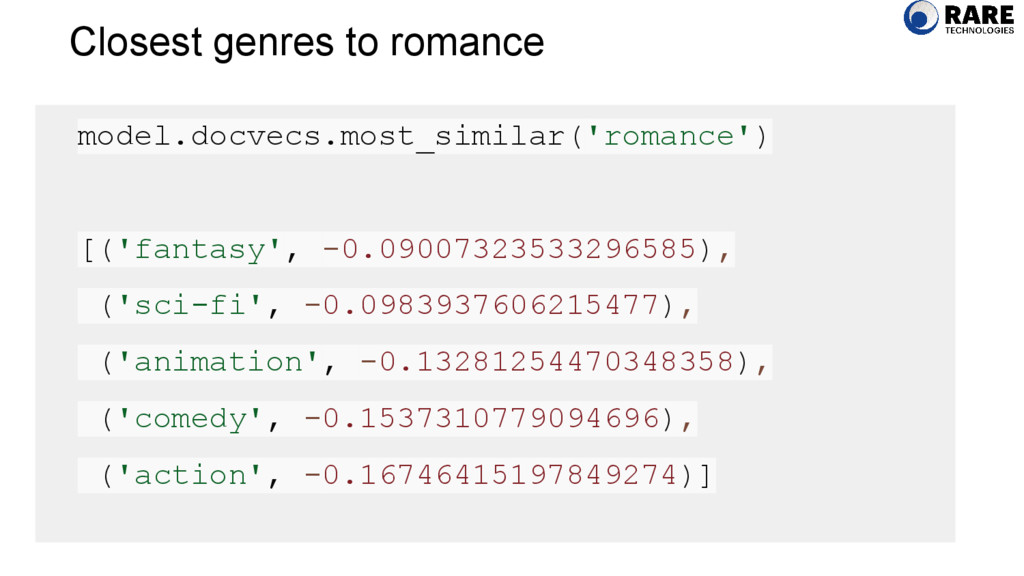
Closest genres to romance model.docvecs.most_similar('romance') [('fantasy', -0.09007323533296585), ('sci-fi', -0.0983937606215477), ('animation',
-0.13281254470348358), ('comedy', -0.1537310779094696), ('action', -0.16746415197849274)] -
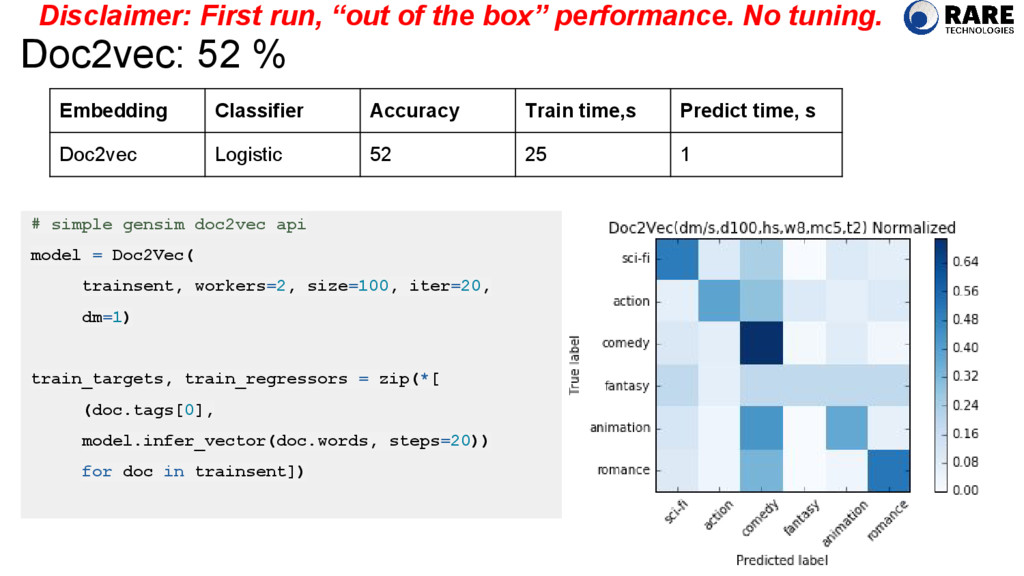
Doc2vec: 52 % # simple gensim doc2vec api model =
Doc2Vec( trainsent, workers=2, size=100, iter=20, dm=1) train_targets, train_regressors = zip(*[ (doc.tags[0], model.infer_vector(doc.words, steps=20)) for doc in trainsent]) Embedding Classifier Accuracy Train time,s Predict time, s Doc2vec Logistic 52 25 1 Disclaimer: First run, “out of the box” performance. No tuning. -
Simple baseline also known as ‘Punchline’: 47% TF-IDF just counting
words in a document, adjusting for doc length, word frequency and word-doc frequency Counting words, char n-grams are similar: 42, 44. Embedding Classifier Accuracy Train time,s Predict time, s Baseline tf-idf bag of words Logistic 47 2 1 TfidfVectorizer( min_df=2, tokenizer=nltk.word_tokenize, preprocessor=None,stop_words='english') Disclaimer: First run, “out of the box” performance. No tuning. -
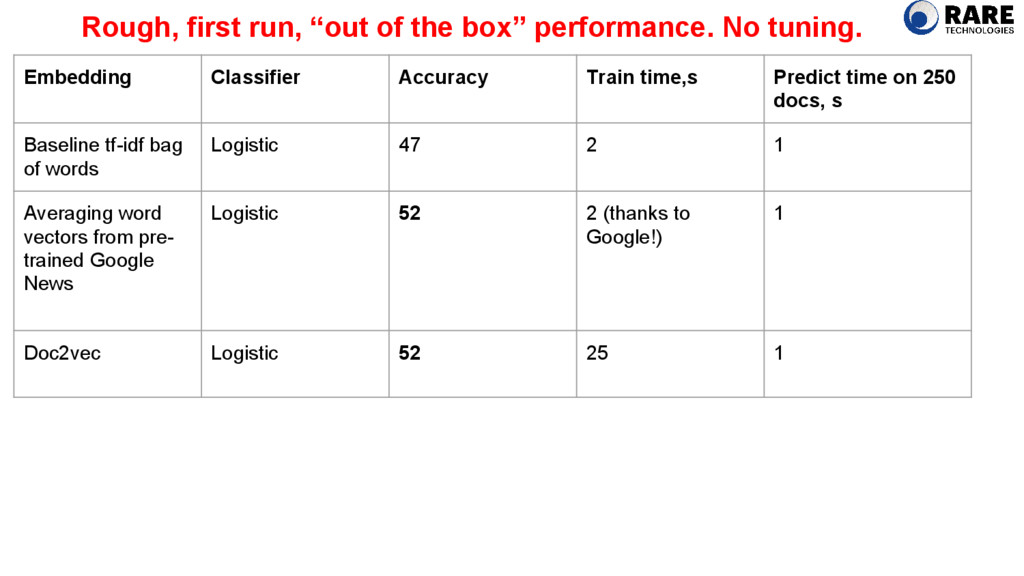
Embedding Classifier Accuracy Train time,s Predict time on 250 docs,
s Baseline tf-idf bag of words Logistic 47 2 1 Averaging word vectors from pre- trained Google News Logistic 52 2 (thanks to Google!) 1 Doc2vec Logistic 52 25 1 Rough, first run, “out of the box” performance. No tuning. -
No neural network magic out of the box:( Simple baselines
are not much worse than fancy methods. -
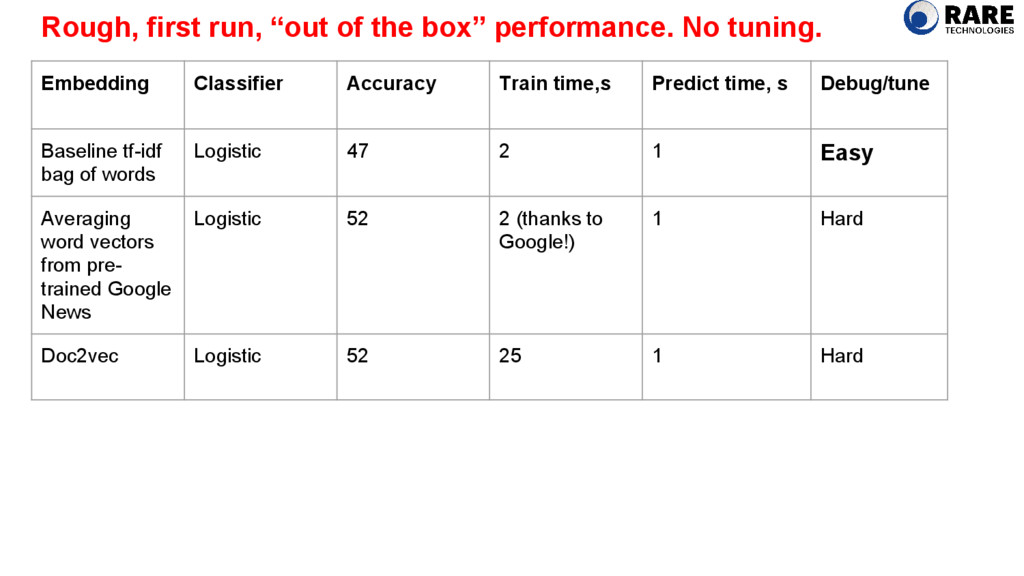
Which model is easiest to tune and debug? “What caused
this error?” “What is wrong with comedy genre?” “What can I do to fix this class of errors?” -
Embedding Classifier Accuracy Train time,s Predict time, s Debug/tune Baseline
tf-idf bag of words Logistic 47 2 1 Easy Averaging word vectors from pre- trained Google News Logistic 52 2 (thanks to Google!) 1 Hard Doc2vec Logistic 52 25 1 Hard Rough, first run, “out of the box” performance. No tuning. -
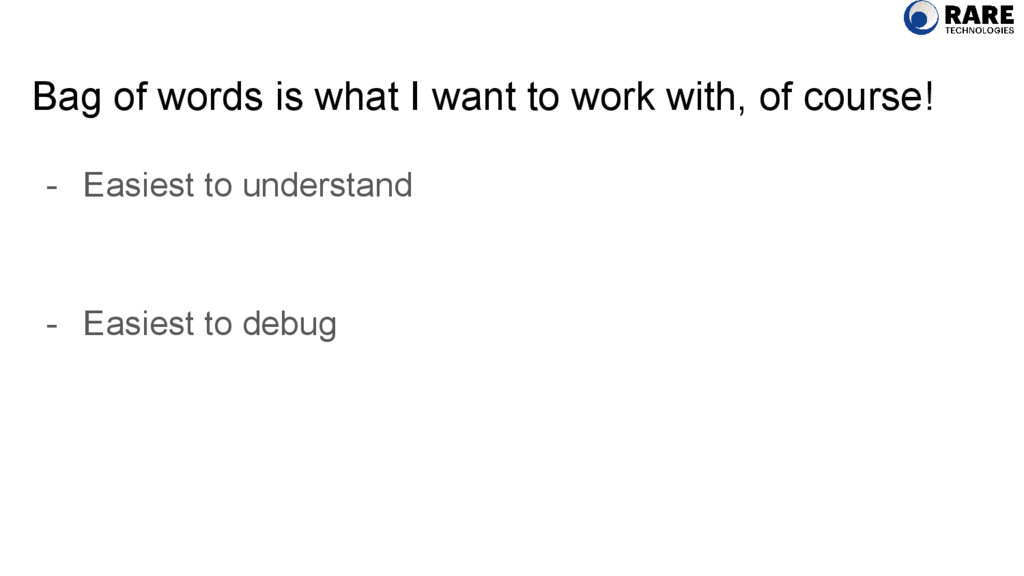
- Easiest to understand - Easiest to debug Bag of
words is what I want to work with, of course! -
There is a place for word embeddings - Small improvement
matters (maybe you want your paper accepted) - Lots of data - Extra features to existing ensembles - Need directionality (analogies) -
Thanks! Lev Konstantinovskiy github.com/tmylk @teagermylk Events coming up: - Word2vec
tutorial at PyData Berlin 20-21 May - Tutorials sprint at PyCon in Portland, Oregon 2- 6 June Come and learn about word2vec with us! - Doc classification at PyData New York, 25 May
 tmylk
 veronikapj
 leew
 usagi0920_pochi
 ivargrimstad
 syobochim
 kazuki1023
 dalinaum
 sodainc
 chigichan24
 seike460
 ypresto
 ickx
 holman
 keavy
 tessaabrams
 hatefulcrawdad
 sergeychernyshev
 carmenintech
 marktimemedia
 kastner
 katarinadahlin
 lcolladotor
 lfama