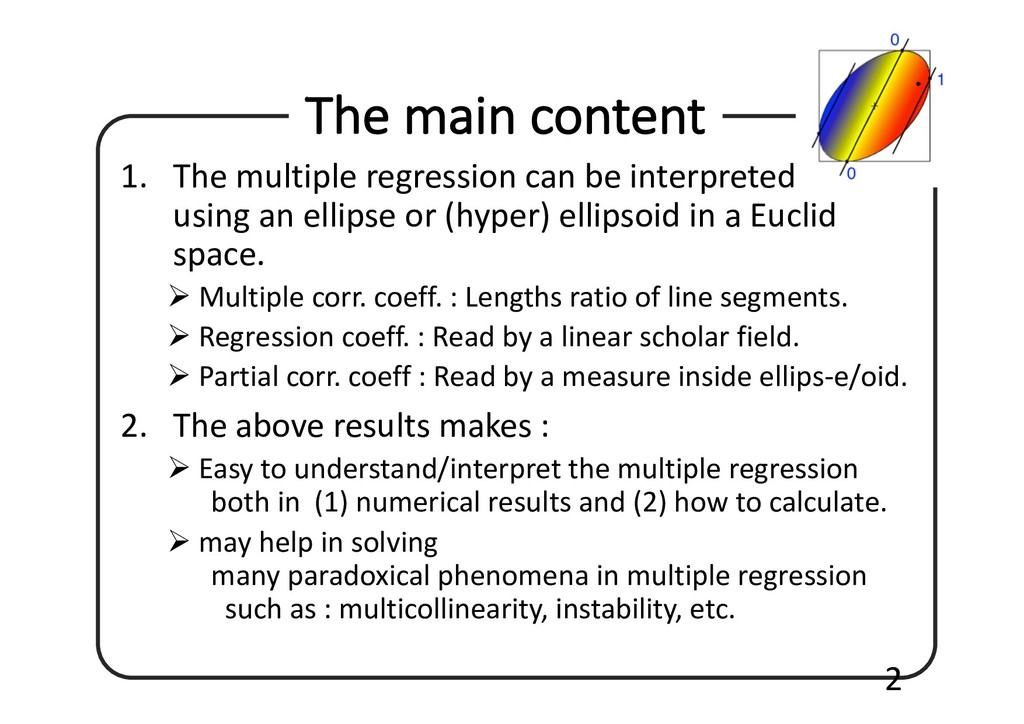
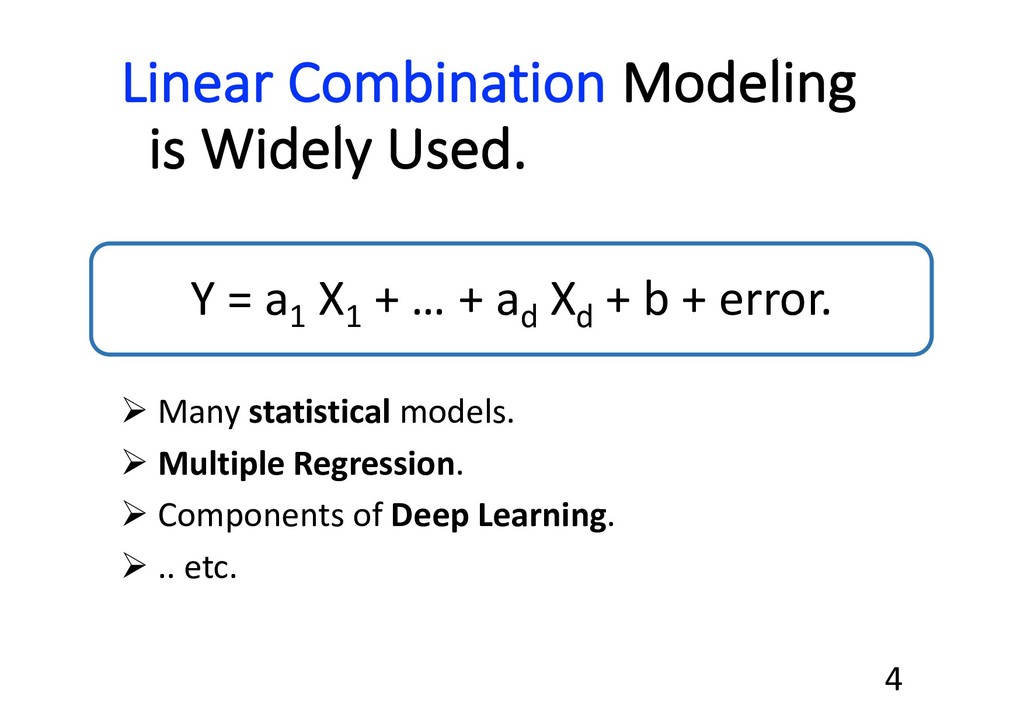
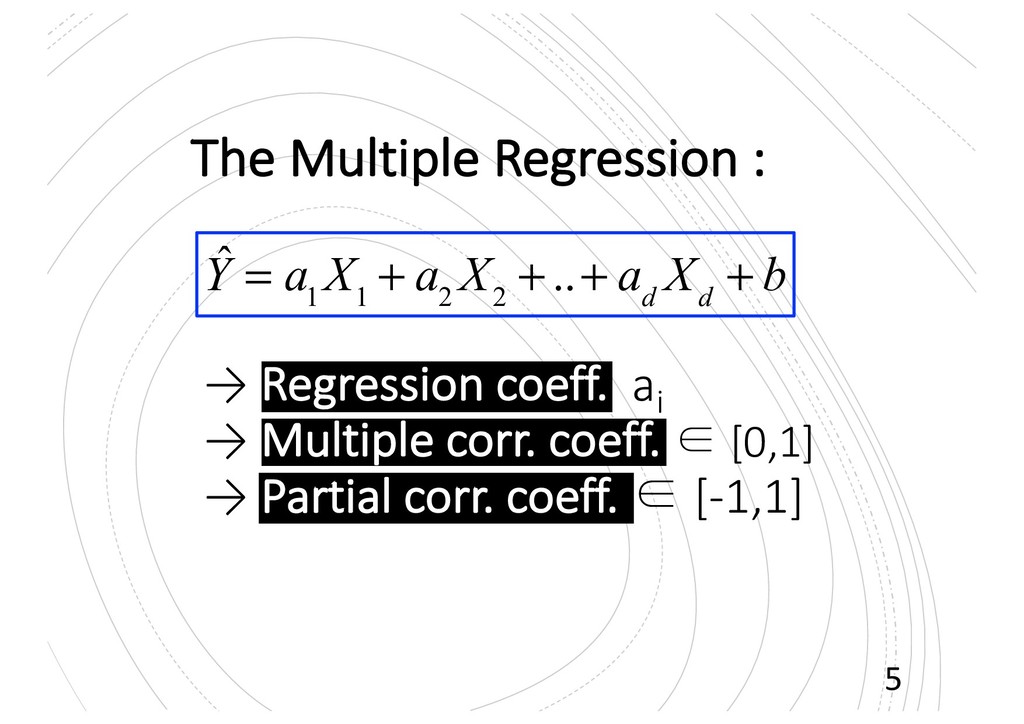
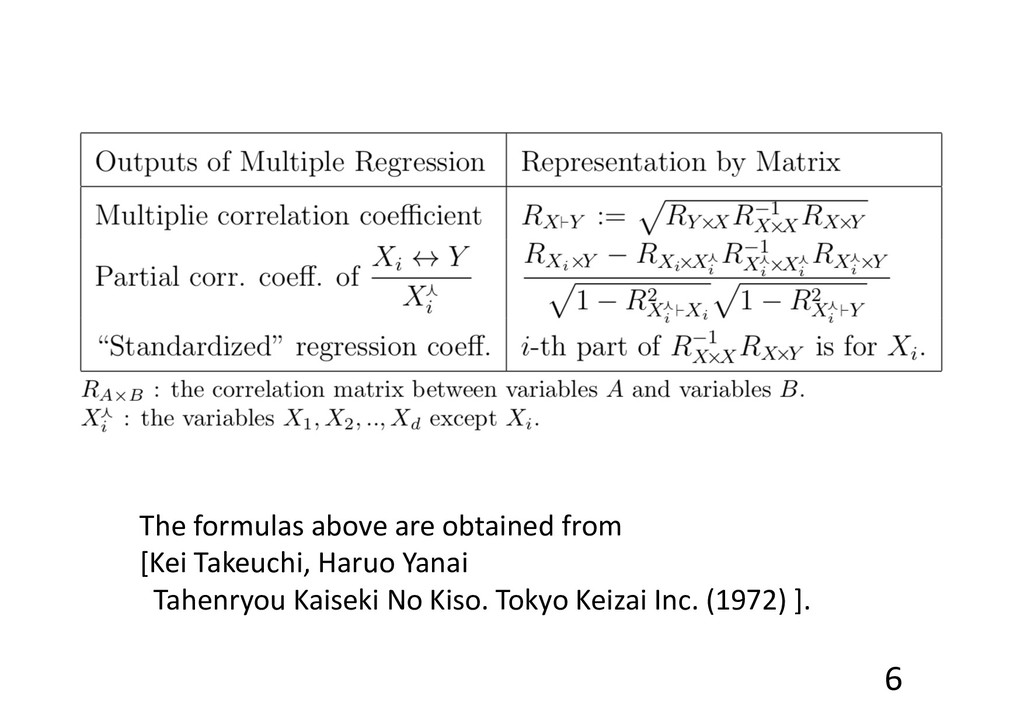
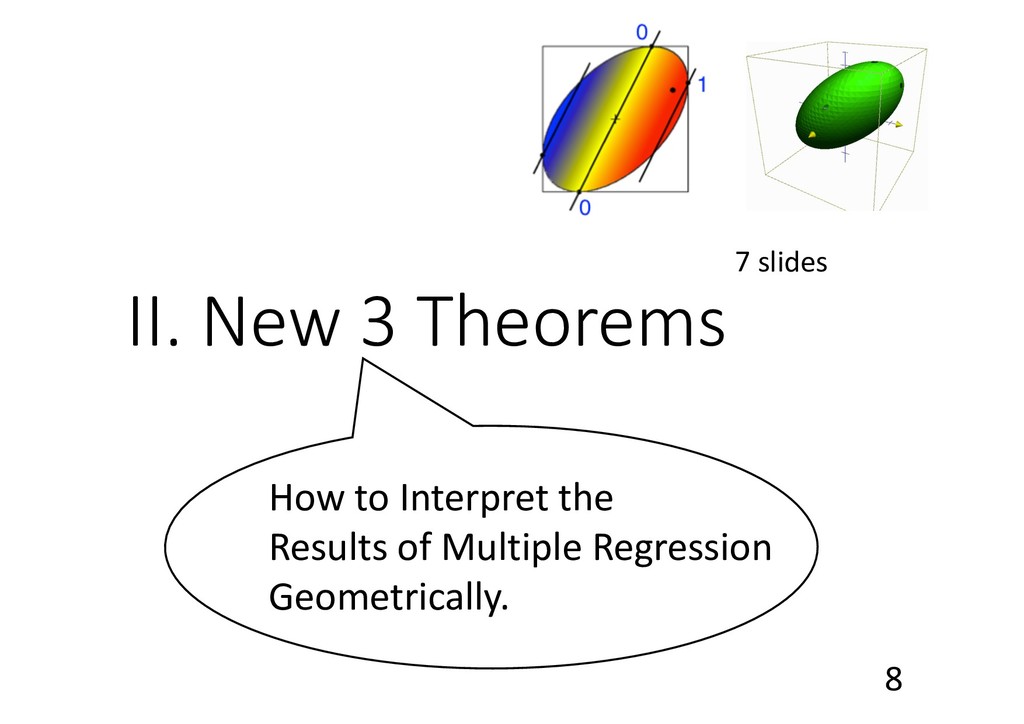
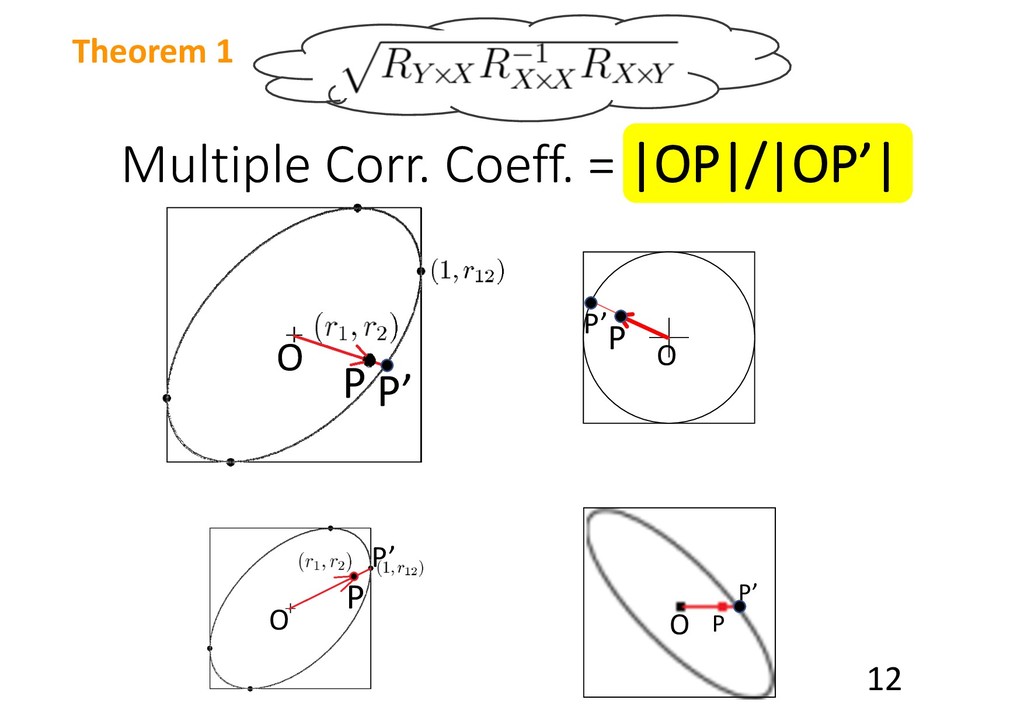
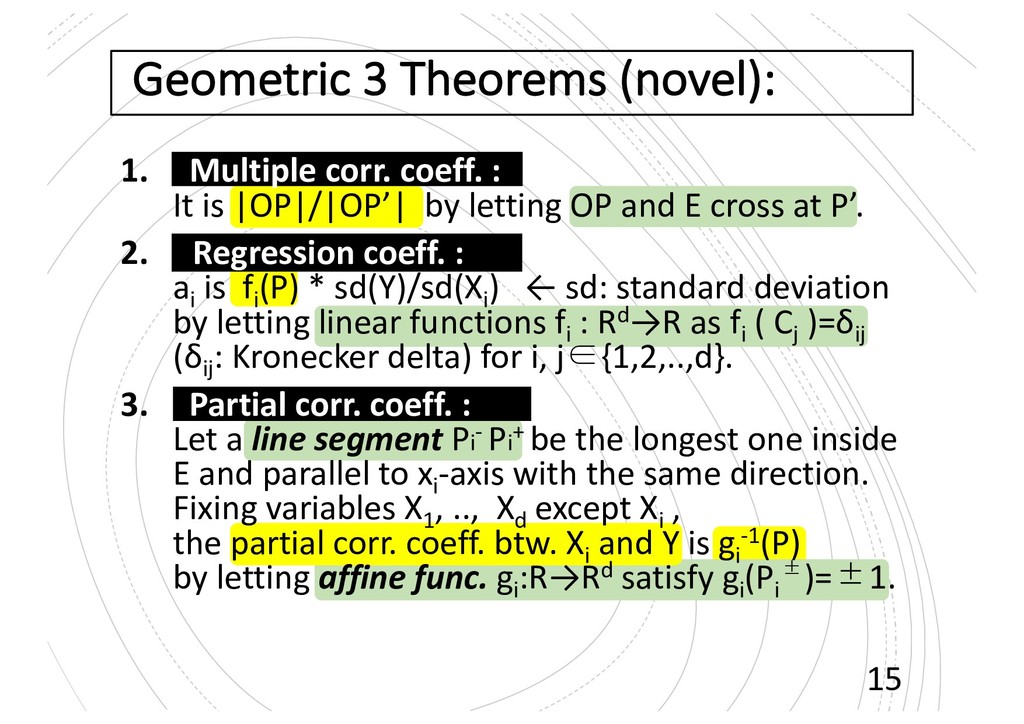
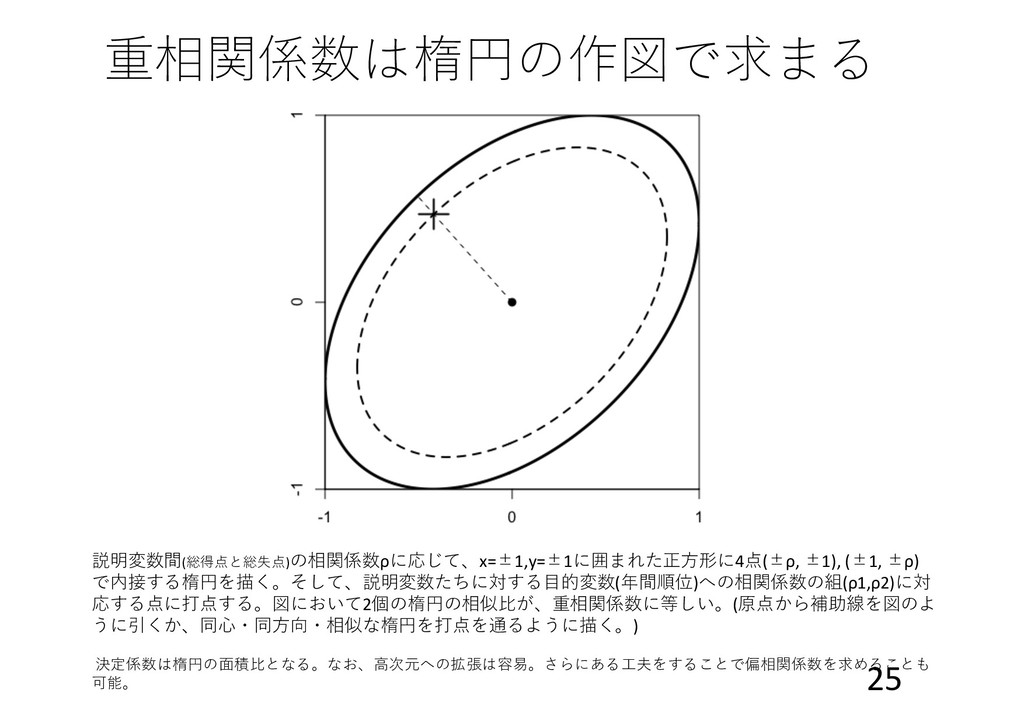
using an ellipse or (hyper) ellipsoid in a Euclid space. Ø Multiple corr. coeff. : Lengths ratio of line segments. Ø Regression coeff. : Read by a linear scholar field. Ø Partial corr. coeff : Read by a measure inside ellips-e/oid. 2. The above results makes : Ø Easy to understand/interpret the multiple regression both in (1) numerical results and (2) how to calculate. Ø may help in solving many paradoxical phenomena in multiple regression such as : multicollinearity, instability, etc. 2
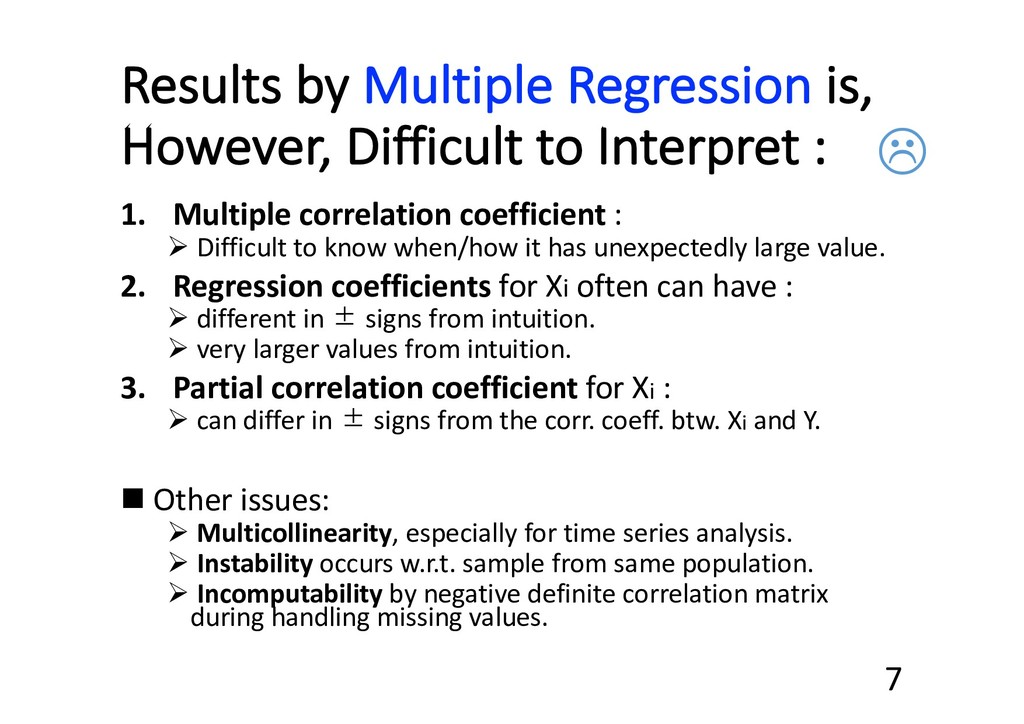
1. Multiple correlation coefficient : Ø Difficult to know when/how it has unexpectedly large value. 2. Regression coefficients for Xi often can have : Ø different in ʶ signs from intuition. Ø very larger values from intuition. 3. Partial correlation coefficient for Xi : Ø can differ in ʶ signs from the corr. coeff. btw. Xi and Y. n Other issues: Ø Multicollinearity, especially for time series analysis. Ø Instability occurs w.r.t. sample from same population. Ø Incomputability by negative definite correlation matrix during handling missing values. 7 L
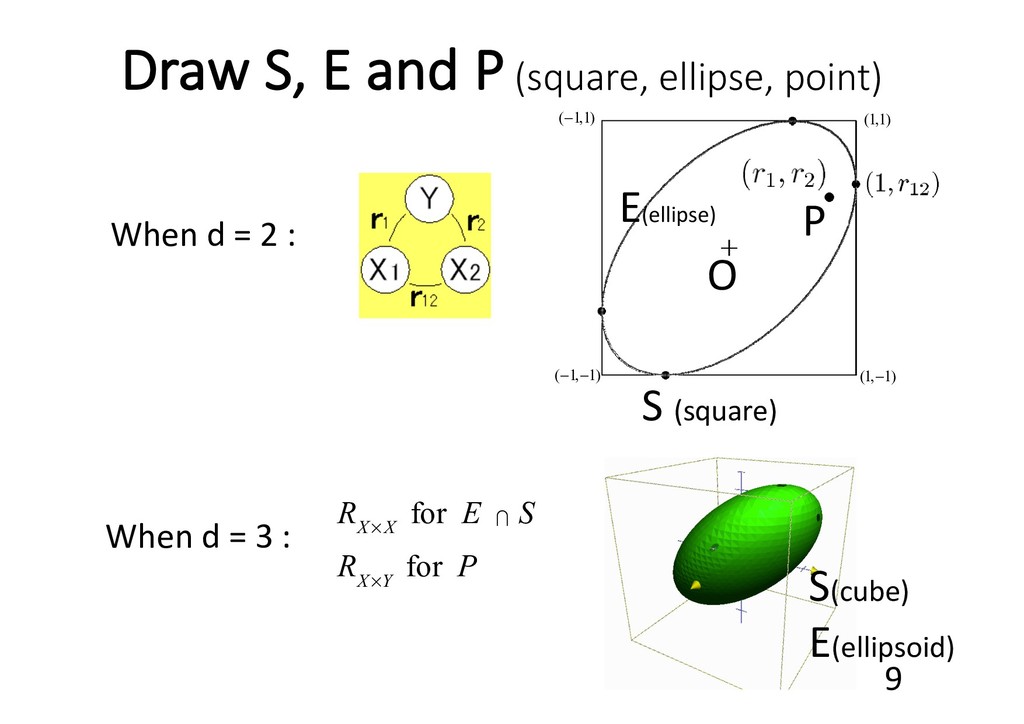
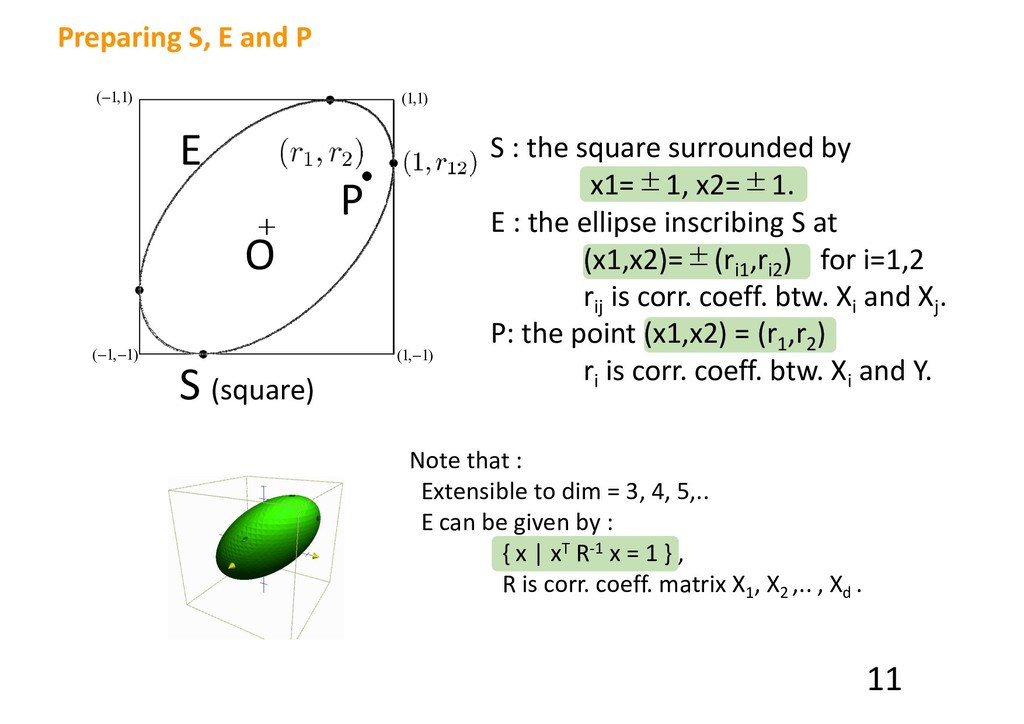
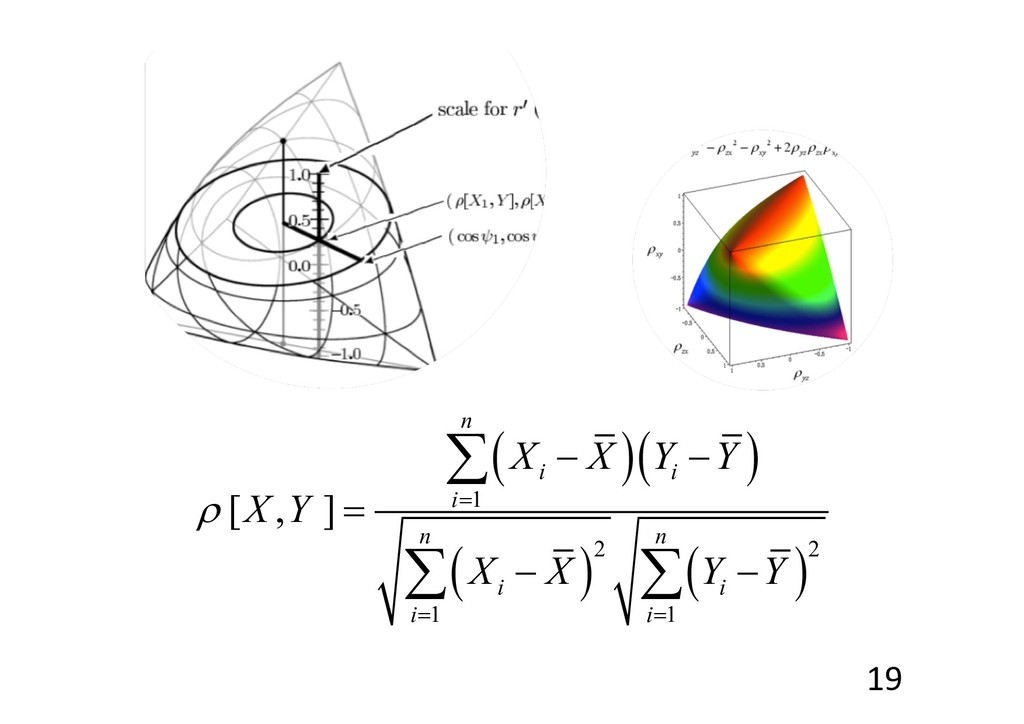
(the number of explanatory variables) and set up an d-dim Euclid space (axes by: x1,.., xd). 2. Draw S : surrounded by x1 =±1, x2 =±1 .. xd =±1. 3. Ellipse E inscribing S centering the origin O=(0,..,0) : inscribed with the points C1, C2,..,Cd obtained from the d x d correlation matrix over X1,.., Xd as split into (C1|C2|..|Cd). 4. Point P inside E : whose i-th coordinate is specified by the correlation coefficient between Xi and Y. 10
: the square surrounded by x1=±1, x2=±1. E : the ellipse inscribing S at (x1,x2)=±(ri1 ,ri2 ) for i=1,2 rij is corr. coeff. btw. Xi and Xj . P: the point (x1,x2) = (r1 ,r2 ) ri is corr. coeff. btw. Xi and Y. Note that : Extensible to dim = 3, 4, 5,.. E can be given by : { x | xT R-1 x = 1 } , R is corr. coeff. matrix X1 , X2 ,.. , Xd . 11 Preparing S, E and P
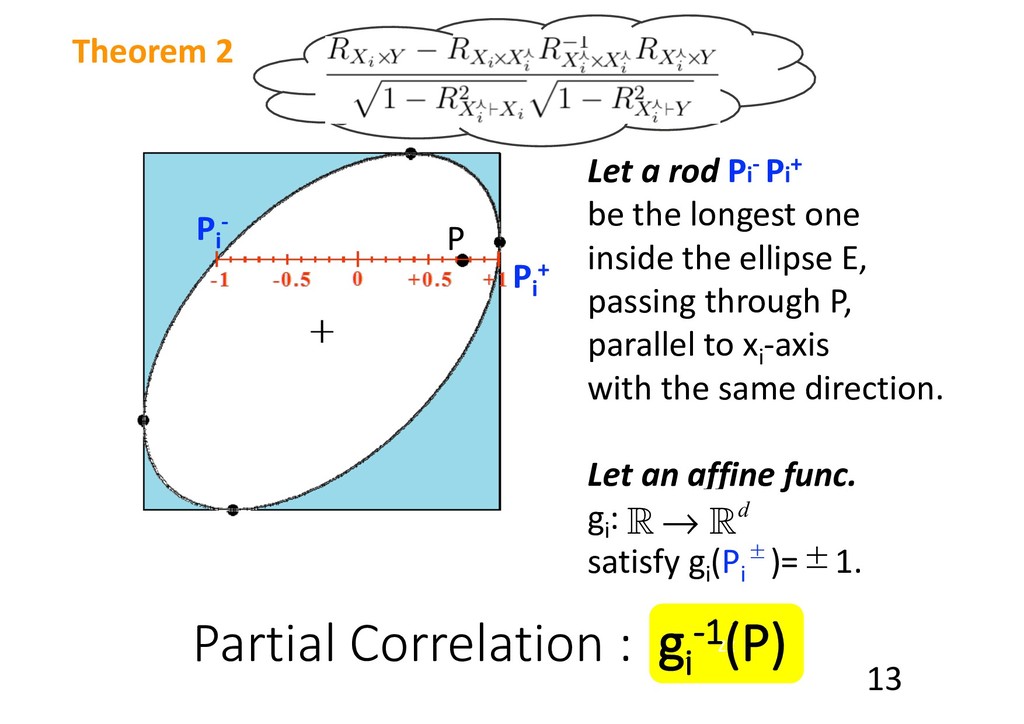
Pi+ be the longest one inside the ellipse E, passing through P, parallel to xi -axis with the same direction. Let an affine func. gi :R→Rd satisfy gi (Pi ±)=±1. Pi - Pi + P 13 Theorem 2 ! → !d
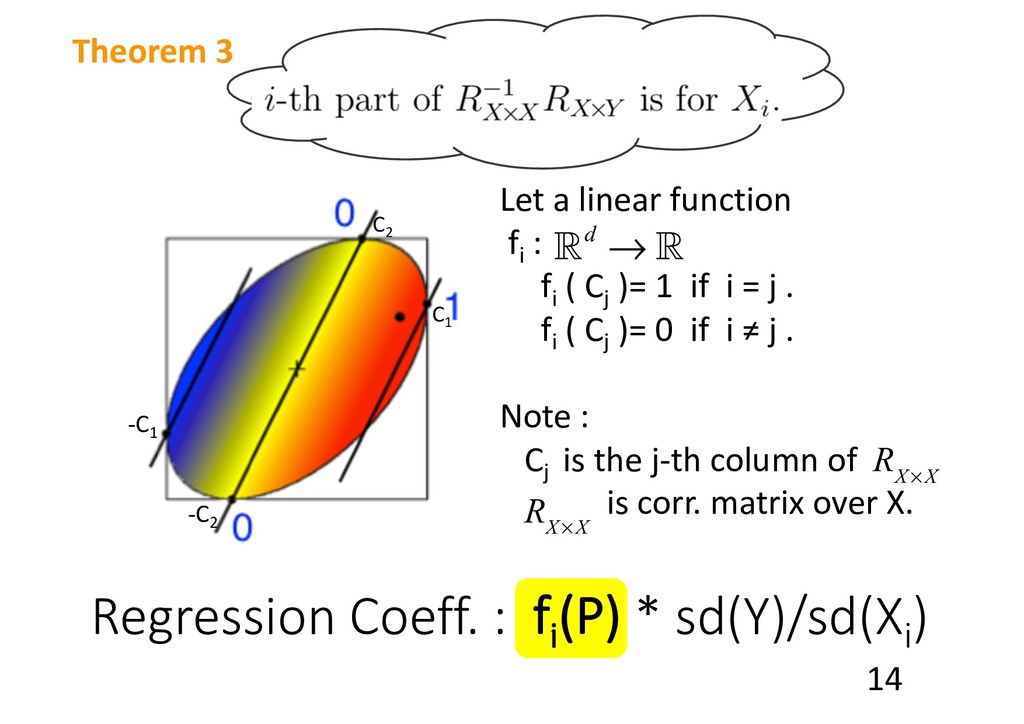
linear function fi : Rd→R fi ( Cj )= 1 if i = j . fi ( Cj )= 0 if i ≠ j . Note : Cj is the j-th column of is corr. matrix over X. C1 C2 -C2 -C1 R X ×X R X ×X 14 Theorem 3 !d → !
is |OP|/|OP’| by letting OP and E cross at P’. 2. [ Regression coeff. :] ai is fi (P) * sd(Y)/sd(Xi ) ← sd: standard deviation by letting linear functions fi : Rd→R as fi ( Cj )=δij (δij : Kronecker delta) for i, j∈{1,2,..,d}. 3. Partial corr. coeff. : Let a line segment Pi- Pi+ be the longest one inside E and parallel to xi -axis with the same direction. Fixing variables X1 , .., Xd except Xi , the partial corr. coeff. btw. Xi and Y is gi -1(P) by letting affine func. gi :R→Rd satisfy gi (Pi ±)=±1. 15
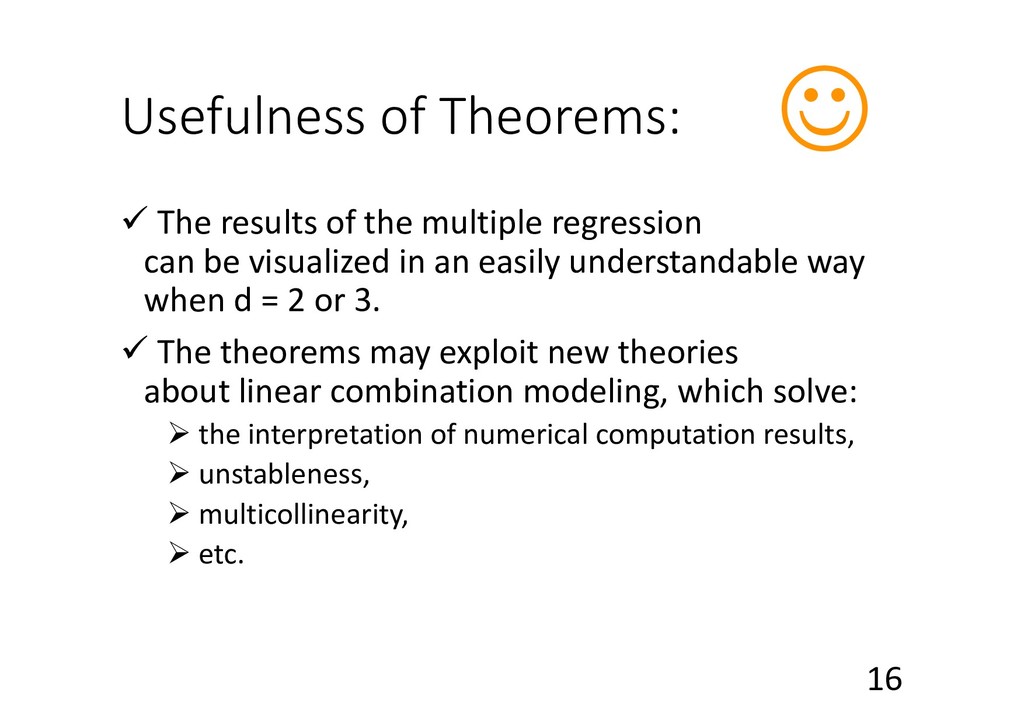
can be visualized in an easily understandable way when d = 2 or 3. ü The theorems may exploit new theories about linear combination modeling, which solve: Ø the interpretation of numerical computation results, Ø unstableness, Ø multicollinearity, Ø etc. 16 J


 tulamili
 microbaseinc
 institutdelelevage
 hirachan
 shibuiwilliam
 imai448
 ishiirikie
 satai
 yumulab
 tosseto
 enochan
 honzajavorek
 aemeredith
 axbom
 jnunemaker
 reverentgeek
 samanthasiow
 lemiorhan
 3n
 mkilby
 tmiket
 baasie
 tammyeverts