Share
Embed
Simplify Your React Component With Recompose
This slide is from the Recompose talk which I gave in a Front-end Developers Taiwan meetup.
wuct
September 21, 2017
Transcript
24 slides
-
About Recompose • Lodash for React. • Can be used
with React, Preact and all other React-like framework. • Flow typed. • 繁體中⽂文⽂文件(thanks to @neighborhood999) • I’m one of the collaborators :D -
Why We Should use Recompose? • To write more pure
functional components. • Functional programming is fun! -
Pure Functional Component • Help prevent abuse of using setSate().
• Make code more readable. • Make testing easier. -
Basic Functional Programming: Currying • From Wikipedia: Currying is the
technique of translating the evaluation of a function that takes multiple arguments (or a tuple of arguments) into evaluating a sequence of functions, each with a single argument. Currying is related to, but not the same as, partial application. const add = x !=> y !=> x + y add(4)(2) !// 6 addFour = add(4) addFour(2) !// 6 -
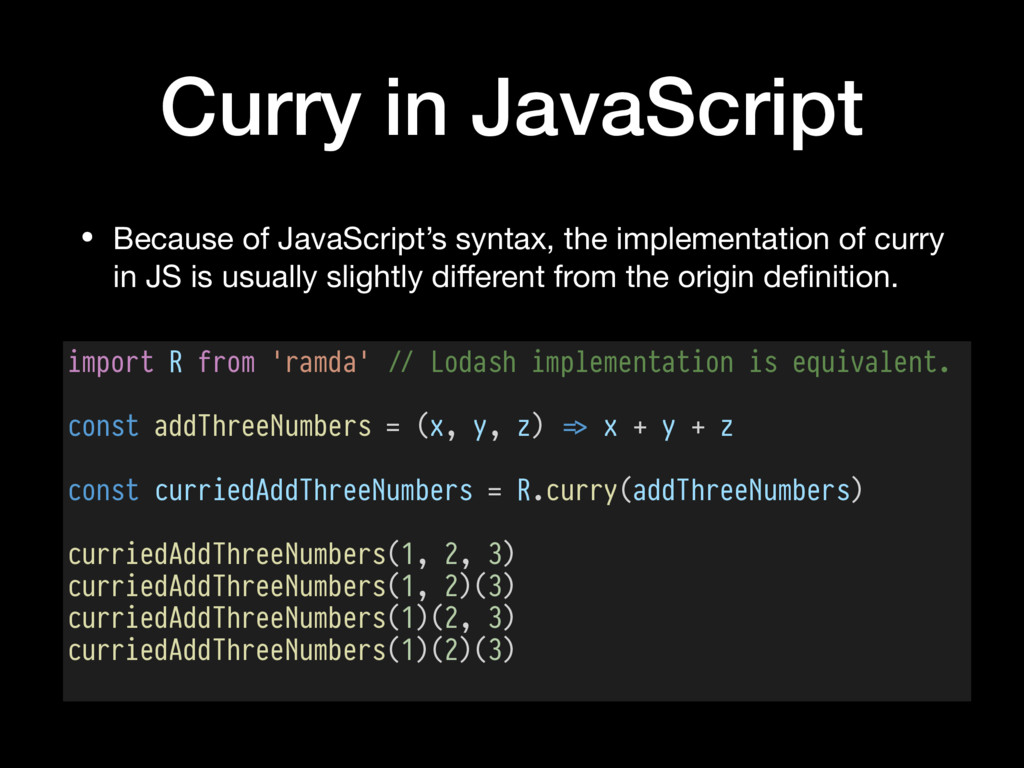
Curry in JavaScript • Because of JavaScript’s syntax, the implementation
of curry in JS is usually slightly different from the origin definition. import R from 'ramda' !// Lodash implementation is equivalent. const addThreeNumbers = (x, y, z) !=> x + y + z const curriedAddThreeNumbers = R.curry(addThreeNumbers) curriedAddThreeNumbers(1, 2, 3) curriedAddThreeNumbers(1, 2)(3) curriedAddThreeNumbers(1)(2, 3) curriedAddThreeNumbers(1)(2)(3) -
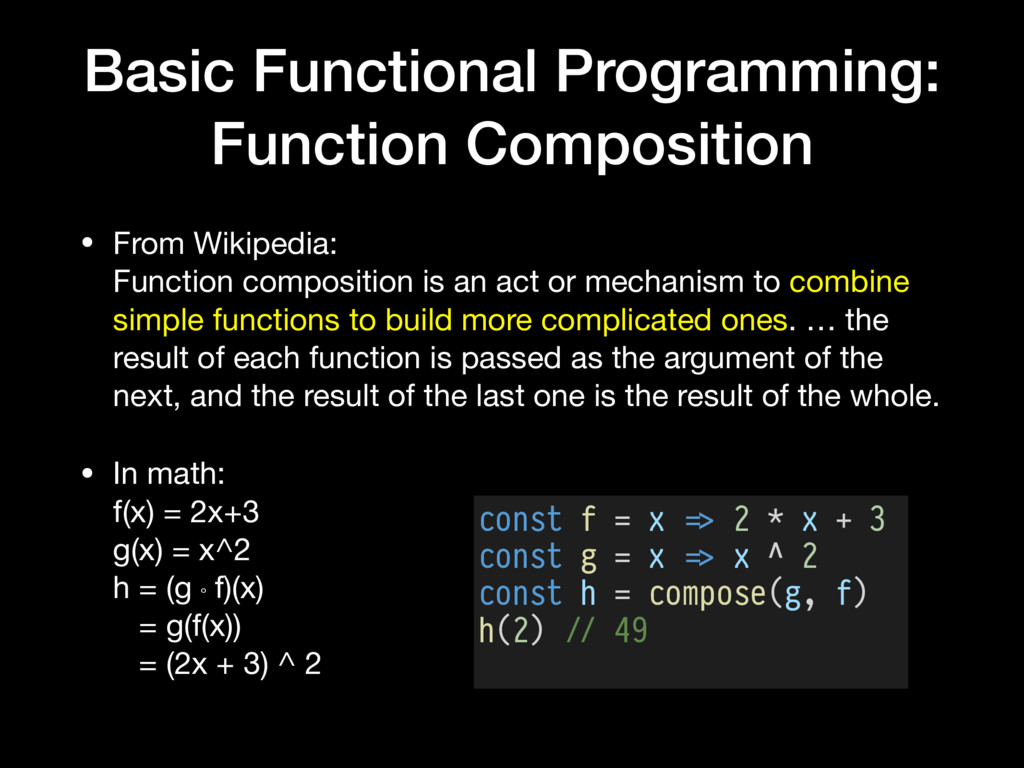
Basic Functional Programming: Function Composition • From Wikipedia: Function composition
is an act or mechanism to combine simple functions to build more complicated ones. … the result of each function is passed as the argument of the next, and the result of the last one is the result of the whole. • In math: f(x) = 2x+3 g(x) = x^2 h = (g º f)(x) = g(f(x)) = (2x + 3) ^ 2 const f = x !=> 2 * x + 3 const g = x !=> x ^ 2 const h = compose(g, f) h(2) !// 49 -
How to Implement Compose in JavaScript const compose = (!!...funcs)
!=> { if (funcs.length !!=== 0) { return arg !=> arg } if (funcs.length !!=== 1) { return funcs[0] } return funcs.reduce((a, b) !=> (!!...args) !=> a(b(!!...args))) } -
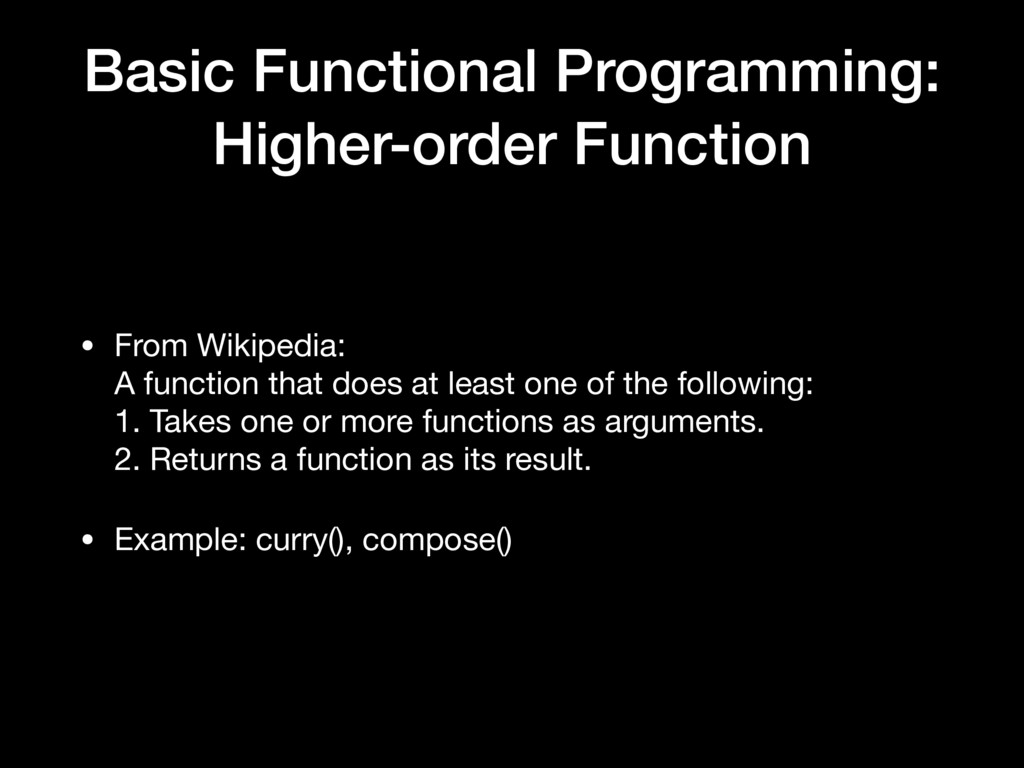
Basic Functional Programming: Higher-order Function • From Wikipedia: A function
that does at least one of the following: 1. Takes one or more functions as arguments. 2. Returns a function as its result. • Example: curry(), compose() -
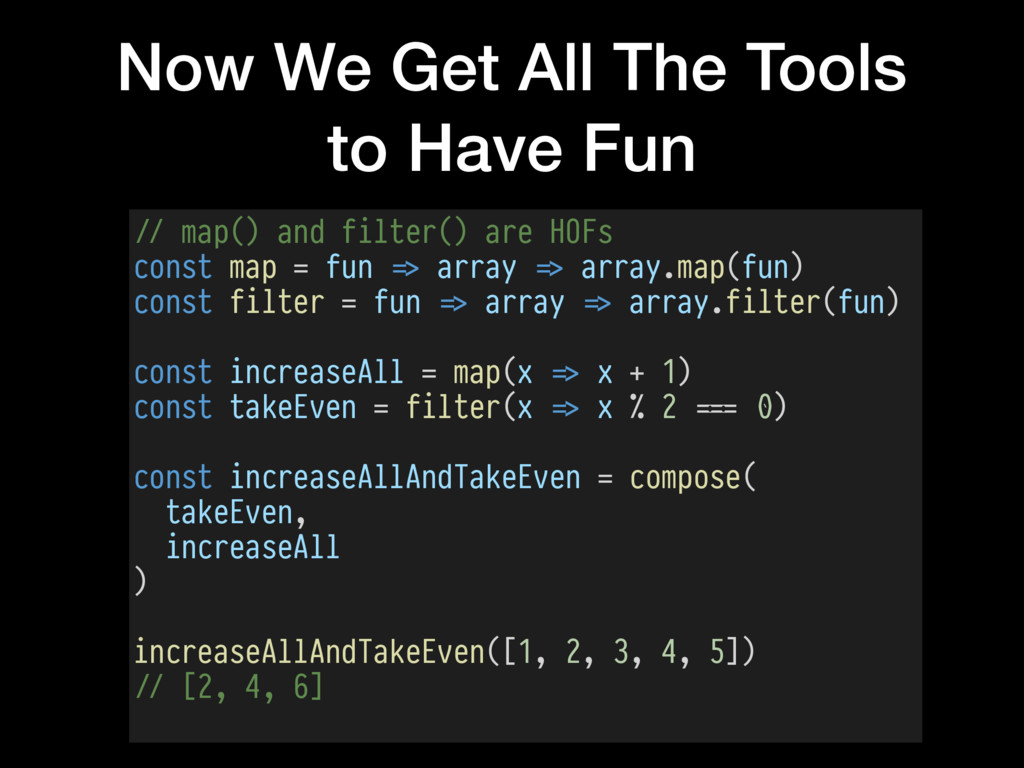
Now We Get All The Tools to Have Fun !//
map() and filter() are HOFs const map = fun !=> array !=> array.map(fun) const filter = fun !=> array !=> array.filter(fun) const increaseAll = map(x !=> x + 1) const takeEven = filter(x !=> x % 2 !!=== 0) const increaseAllAndTakeEven = compose( takeEven, increaseAll ) increaseAllAndTakeEven([1, 2, 3, 4, 5]) !// [2, 4, 6] -
Higher-order Component • A function that does at least one
of the following: 1. Takes one or more components as arguments. 2. Returns a component as its result. • Remember that, in React, functions can also be components (a.k.a. pure functional component). • Example: • react-redux’ connect() • styled-components’ withTheme() • react-router’s withRouter() • react-apollo’s graphql() • Most of functions in Recompose -
import * as Rc from 'recompose' !// enhance is a
HOC, which is a function accepting !// a component and return a new component with the !// “MyAwesomeButton" display name. const enhance = Rc.setDisplayName('MyAwesomeButton') const MyAwesomeButton = (!!...props) !=> <button {!!...props}>This is awesome!!</button> export default enhance(MyAwesomeButton) setDisplayName( displayName: string ): HigherOrderComponent -
Some Commonly Used HOCs • pure • mapProps • withState
• withHandlers • withStateHandlers -
const enhance = Rc.pure const MyComponent = () !=> <div>{!/*
!!... !*/}!</div> export default enhance(MyComponent) pure() pure: HigherOrderComponent -
const enhance = Rc.mapProps(({ firstName, secondName }) !=> ({ name:
firstName + ' ' + secondName })) const Name = ({ name }) !=> <span>{name}!</span> export default enhance(Name) mapProps( propsMapper: (ownerProps: Object) => Object, ): HigherOrderComponent -
const enhance = Rc.withState('count', 'setCount', 0) const MyComponent = ({
count, setCount }) !=> <div onClick={() !=> setCount(count + 1)}> Click {count} {count > 1 ? 'times' : 'time'}. !</div> export default enhance(MyComponent) withState( stateName: string, stateUpdaterName: string, initialState: any | (props: Object) => any ): HigherOrderComponent -
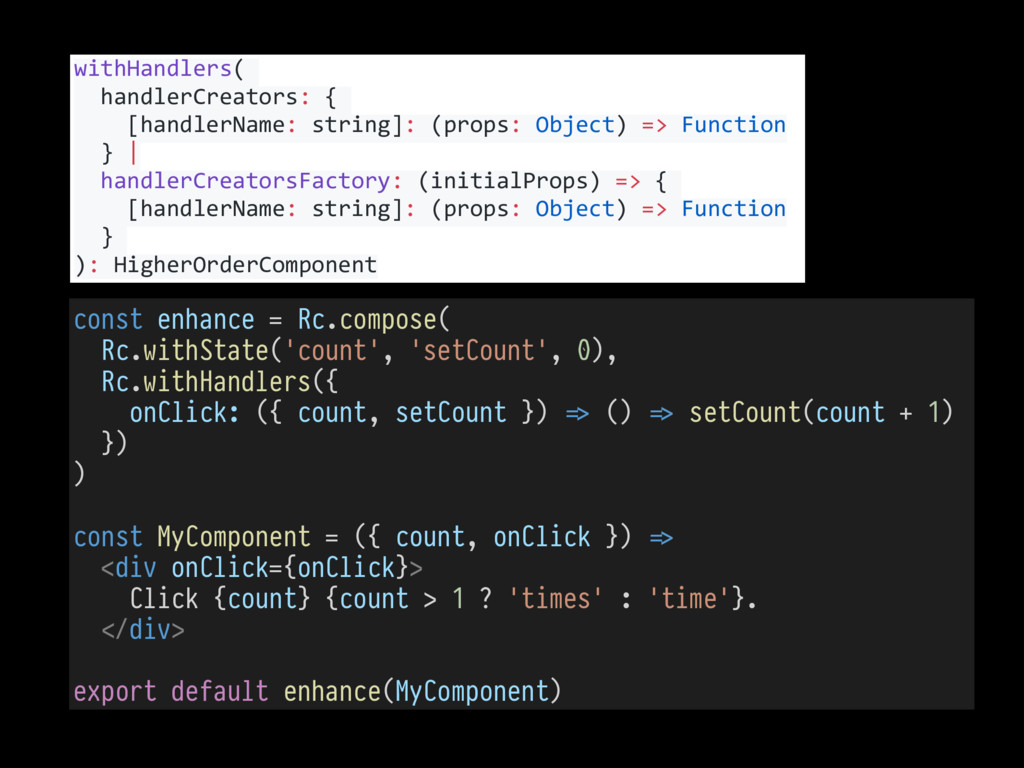
const enhance = Rc.compose( Rc.withState('count', 'setCount', 0), Rc.withHandlers({ onClick: ({
count, setCount }) !=> () !=> setCount(count + 1) }) ) const MyComponent = ({ count, onClick }) !=> <div onClick={onClick}> Click {count} {count > 1 ? 'times' : 'time'}. !</div> export default enhance(MyComponent) withHandlers( handlerCreators: { [handlerName: string]: (props: Object) => Function } | handlerCreatorsFactory: (initialProps) => { [handlerName: string]: (props: Object) => Function } ): HigherOrderComponent -
const enhance = Rc.withStateHandlers({ count: 0 }, { onClick: ({
count }) !=> () !=> ({ count: count + 1 }) }) const MyComponent = ({ count, onClick }) !=> <div onClick={onClick}> Click {count} {count > 1 ? 'times' : 'time'}. !</div> export default enhance(MyComponent) withStateHandlers( initialState: Object | (props: Object) => any, stateUpdaters: { [key: string]: (state:Object, props:Object) => (...payload: any[]) => Object } ) -
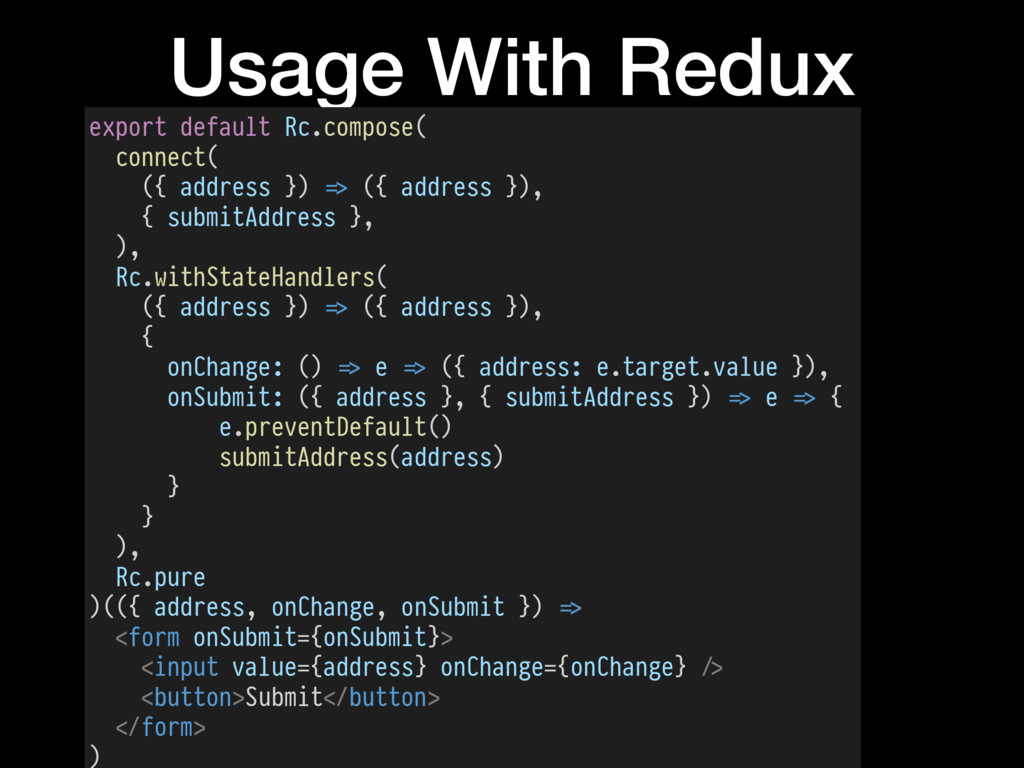
Usage With Redux export default Rc.compose( connect( ({ address })
!=> ({ address }), { submitAddress }, ), Rc.withStateHandlers( ({ address }) !=> ({ address }), { onChange: () !=> e !=> ({ address: e.target.value }), onSubmit: ({ address }, { submitAddress }) !=> e !=> { e.preventDefault() submitAddress(address) } } ), Rc.pure )(({ address, onChange, onSubmit }) !=> <form onSubmit={onSubmit}> <input value={address} onChange={onChange} !/> <button>Submit!</button> !</form> ) -
Usage With Apollo export default Rc.compose( Rc.withStateHandlers({ keyword: '' },
{ onChange: () !=> e !=> ({ keyword: e.target.value }), }), graphql(gql` query HotelSearchQuery($keyword: String!) { hotels(keyword: $keyword) { !!... } }`, { options: ({ keyword }) !=> ({ variables: { keyword }}), }), mapProps(({ data, !!...otherProps }) !=> ({ !!...otherProps, !!...data, })), Rc.pure, )(({ keyword, onChange, hotels }) !=> <div> <input value={keyword} onChange={onChange} !/> <ul>{hotels.map(!/* !!... !*/)}!</ul> !</div> ) -
Usage With React Router export default Rc.compose( withRouter, Rc.mapProps(({ match:
{ params = {} }}) !=> ({ keyword: params.keyword, })), graphql(gql` !!... `, { options: ({ keyword }) !=> ({ variables: { keyword }}), }), Rc.pure )(({ hotels }) !=> <div> <ul>{hotels.map(!/* !!... !*/)}!</ul> !</div> ) -
Usage With Observable mapPropsStream( ownerPropsToChildProps: (props$: Observable<object>) => Observable<object>, BaseComponent:
ReactElementType ): ReactComponent Rc.mapPropsStream(props$ !=> { const value$ = new BehaviorSubject('') const onClick = e !=> value$.next(e.target.value) return props$.combineLatest( value$.distinctUntilChanged(), (props, value) !=> ({ !!...props, value, onChange }) ) })(({ value, onChange }) !=> <input value={value} onChange={onChange} !/> )