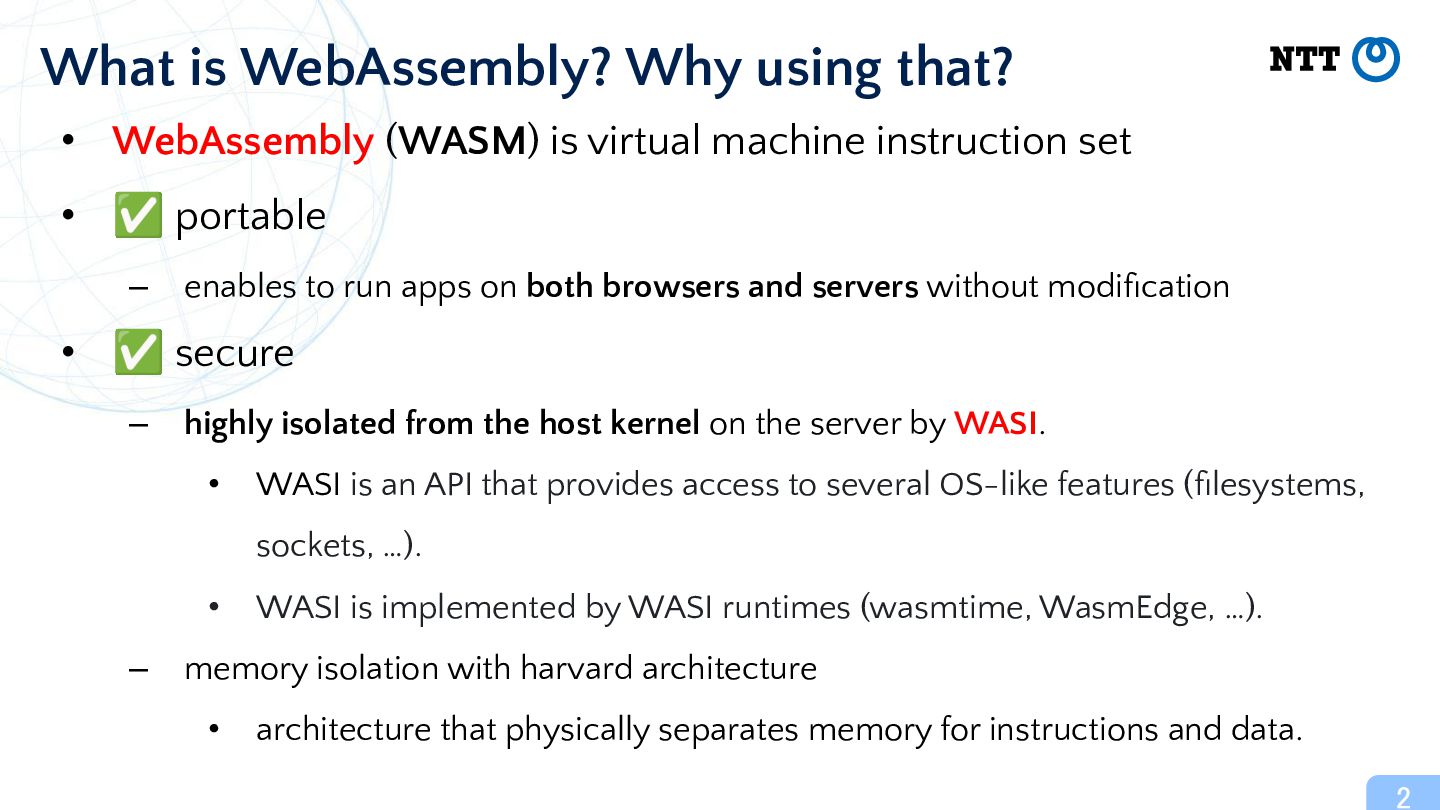
portable – enables to run apps on both browsers and servers without modification • ✅ secure – highly isolated from the host kernel on the server by WASI. • WASI is an API that provides access to several OS-like features (filesystems, sockets, …). • WASI is implemented by WASI runtimes (wasmtime, WasmEdge, …). – memory isolation with harvard architecture • architecture that physically separates memory for instructions and data. What is WebAssembly? Why using that? 2
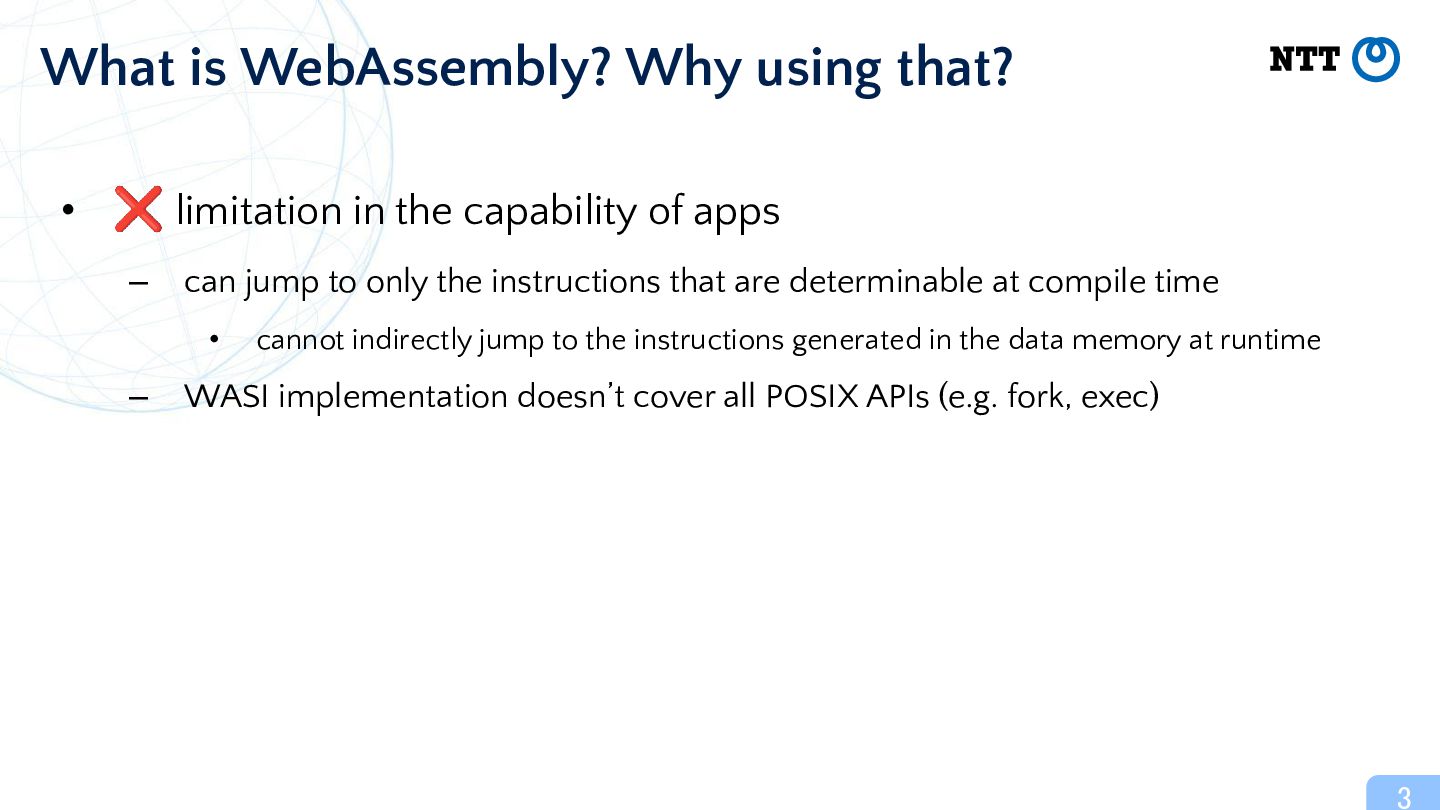
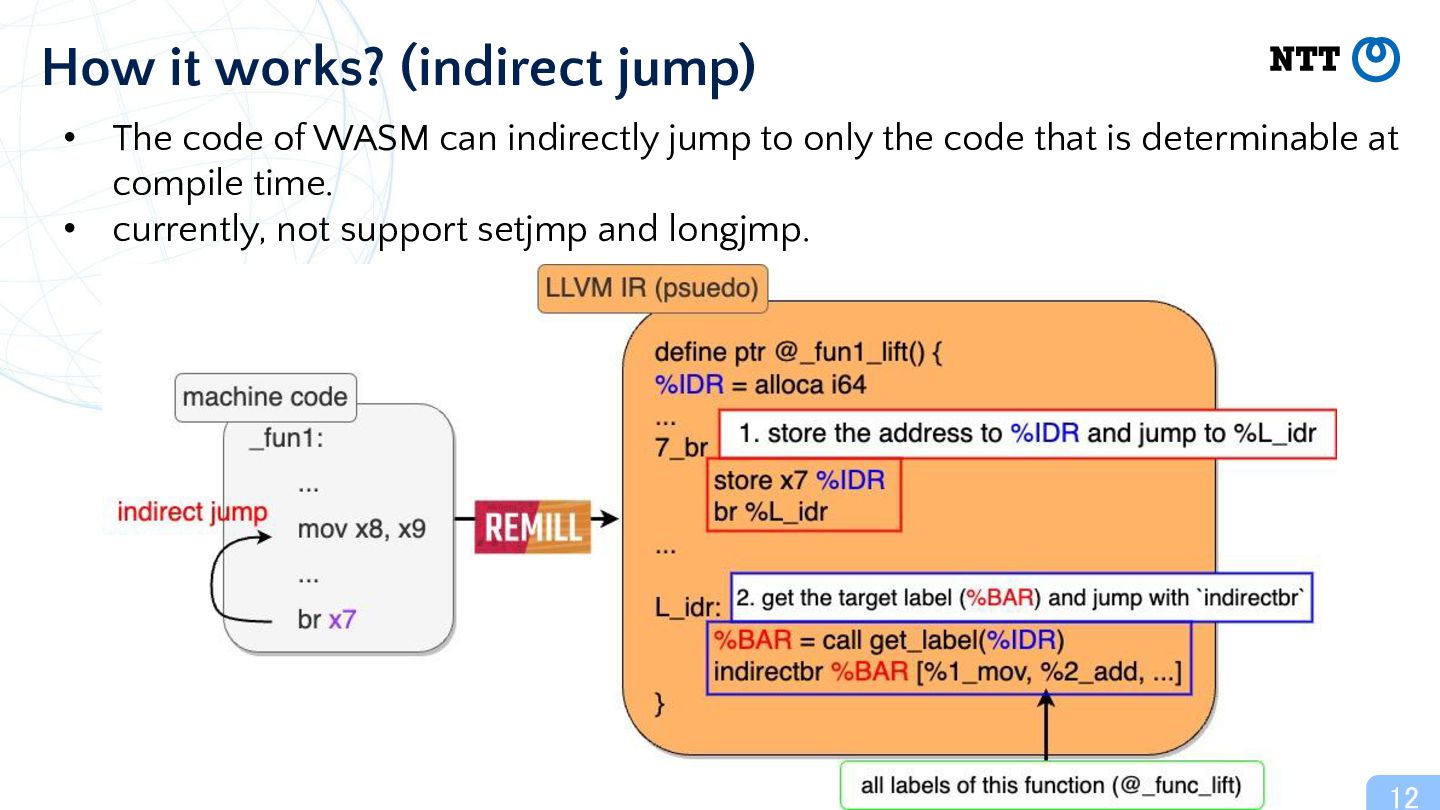
jump to only the instructions that are determinable at compile time • cannot indirectly jump to the instructions generated in the data memory at runtime – WASI implementation doesn’t cover all POSIX APIs (e.g. fork, exec) What is WebAssembly? Why using that? 3
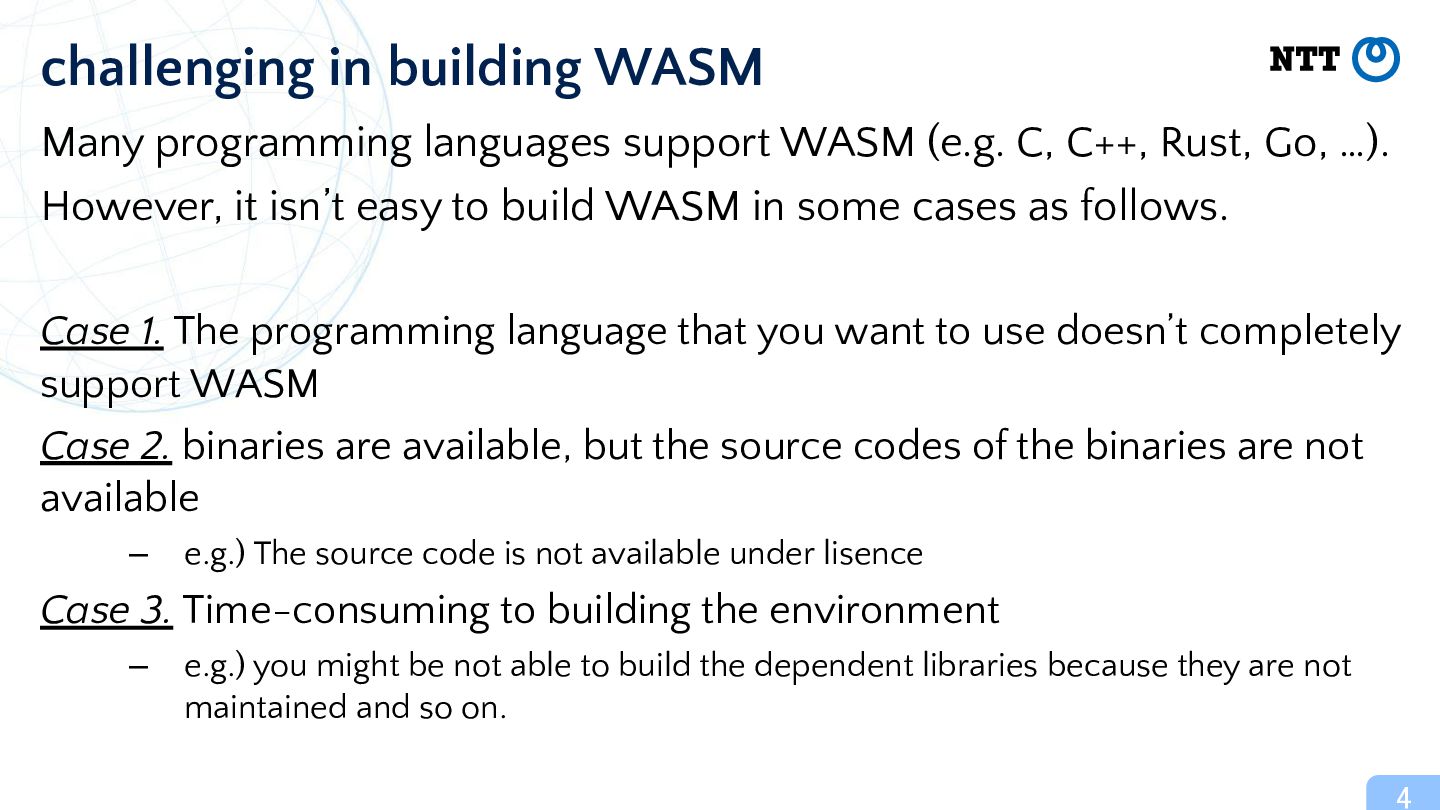
…). However, it isn’t easy to build WASM in some cases as follows. Case 1. The programming language that you want to use doesn’t completely support WASM Case 2. binaries are available, but the source codes of the binaries are not available – e.g.) The source code is not available under lisence Case 3. Time-consuming to building the environment – e.g.) you might be not able to build the dependent libraries because they are not maintained and so on. challenging in building WASM 4
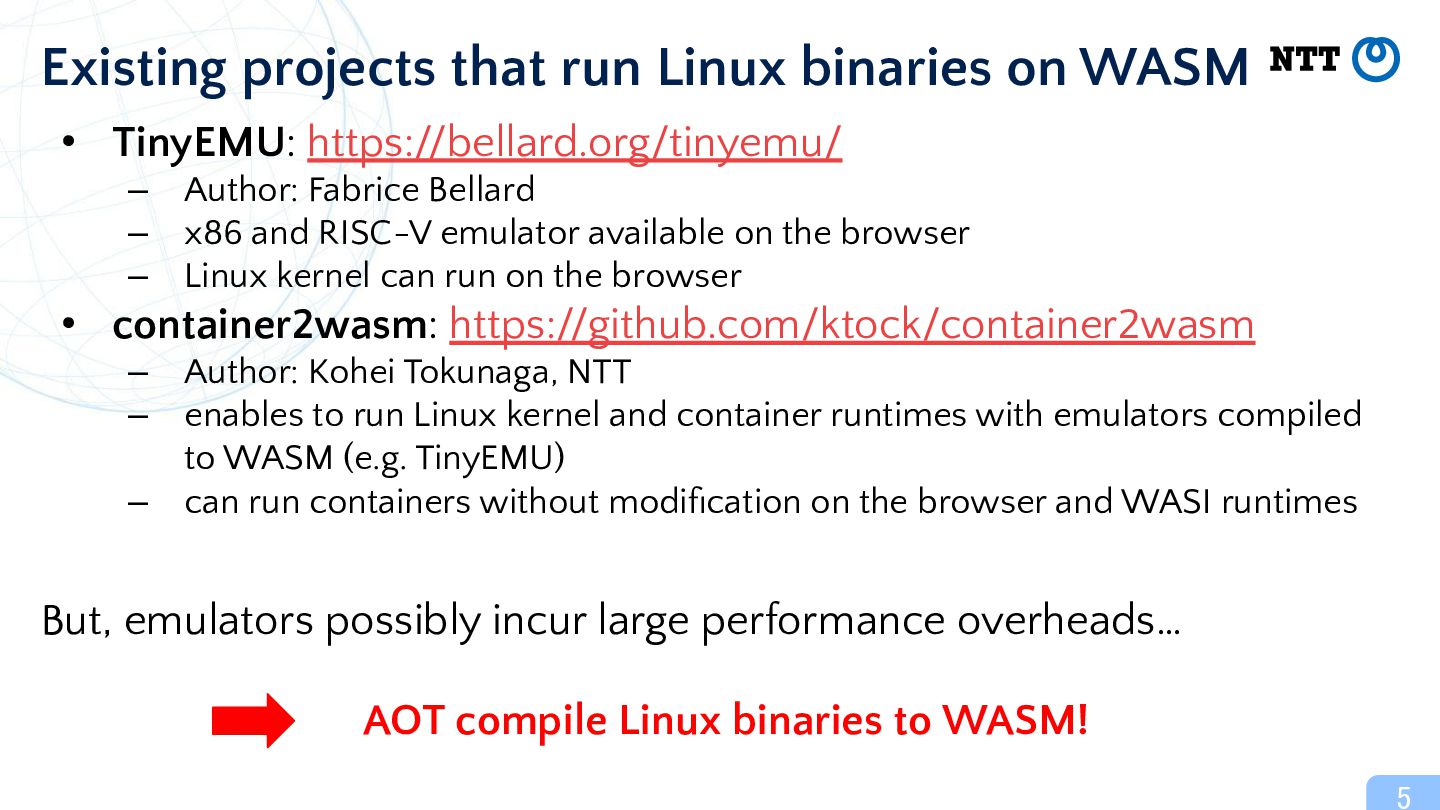
RISC-V emulator available on the browser – Linux kernel can run on the browser • container2wasm: https://github.com/ktock/container2wasm – Author: Kohei Tokunaga, NTT – enables to run Linux kernel and container runtimes with emulators compiled to WASM (e.g. TinyEMU) – can run containers without modification on the browser and WASI runtimes But, emulators possibly incur large performance overheads… Existing projects that run Linux binaries on WASM AOT compile Linux binaries to WASM! 5
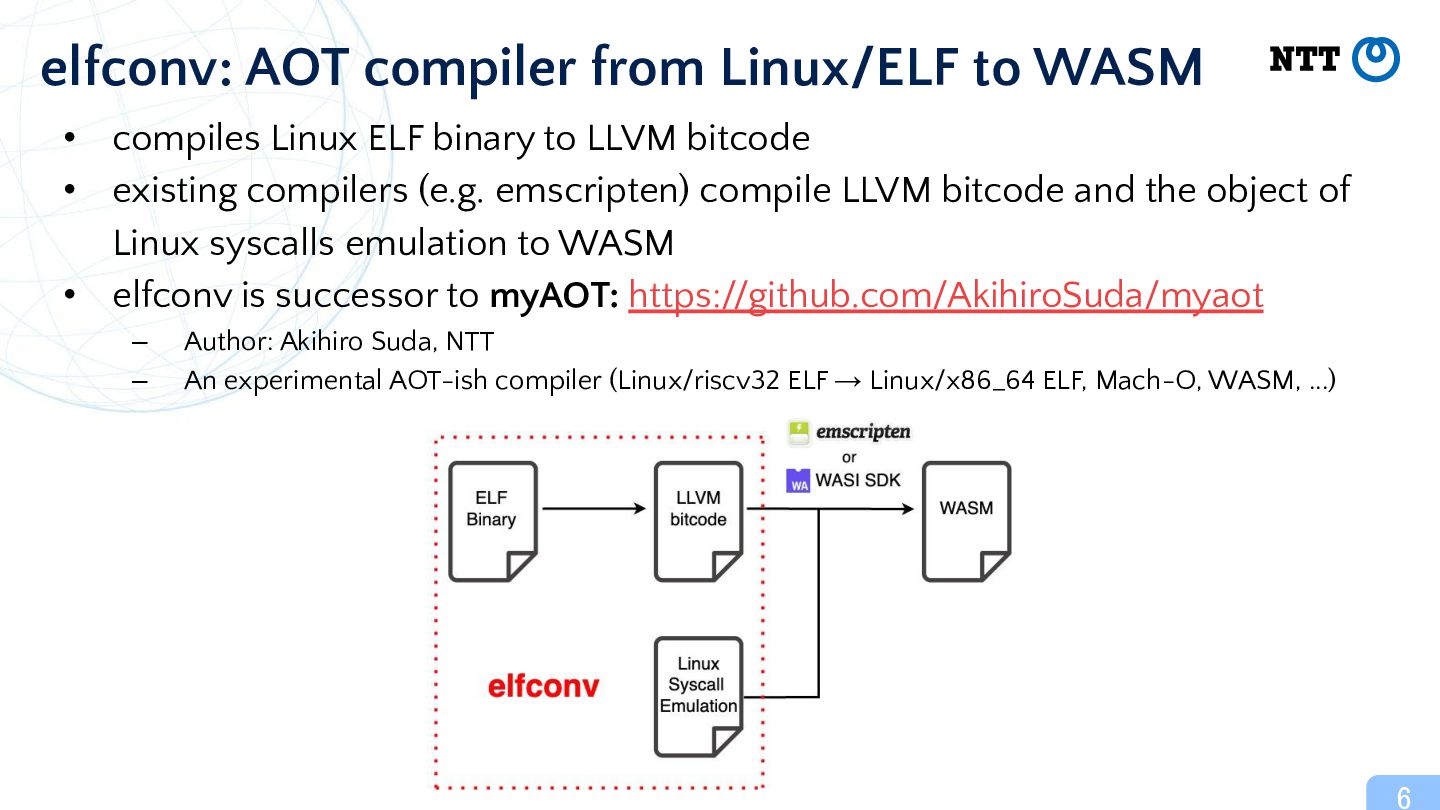
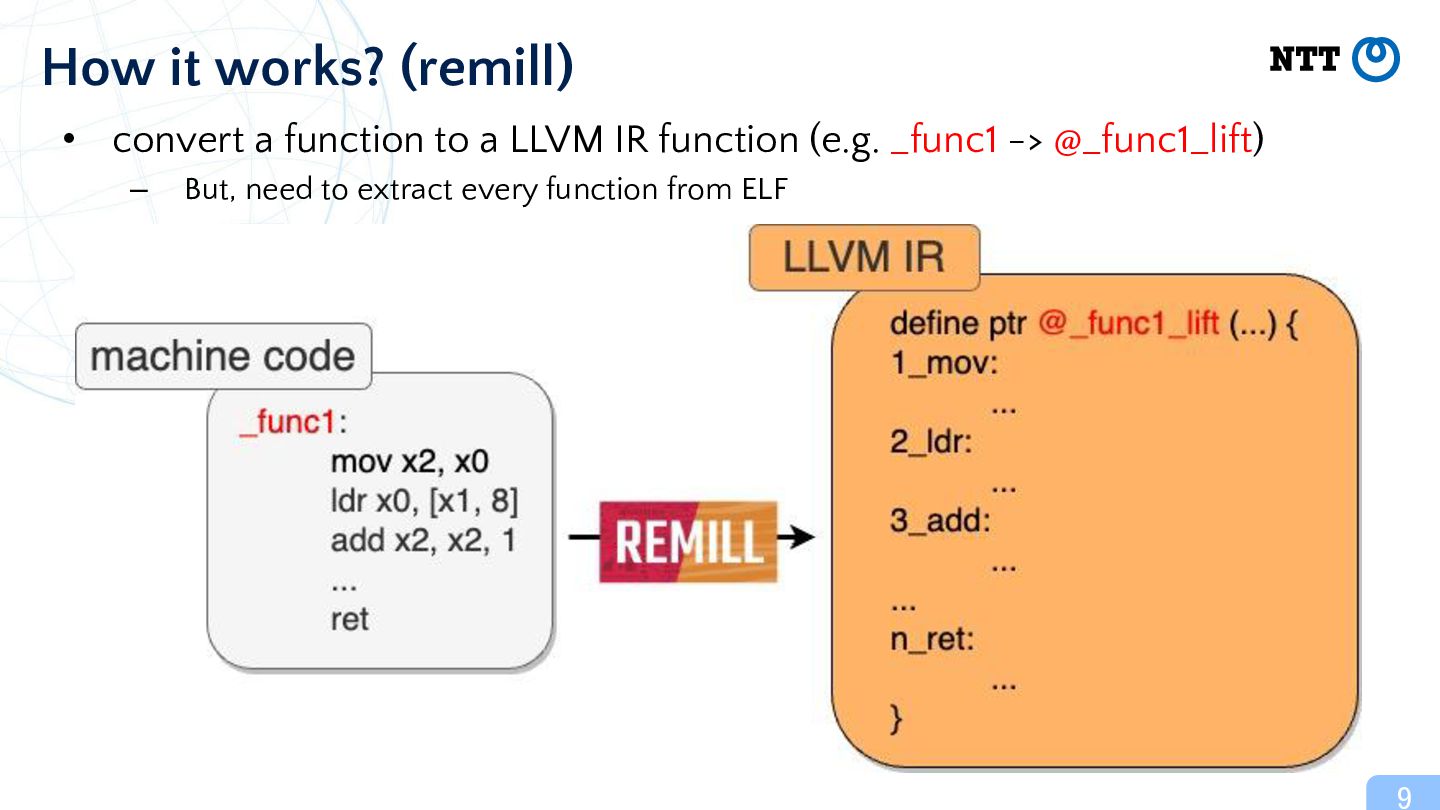
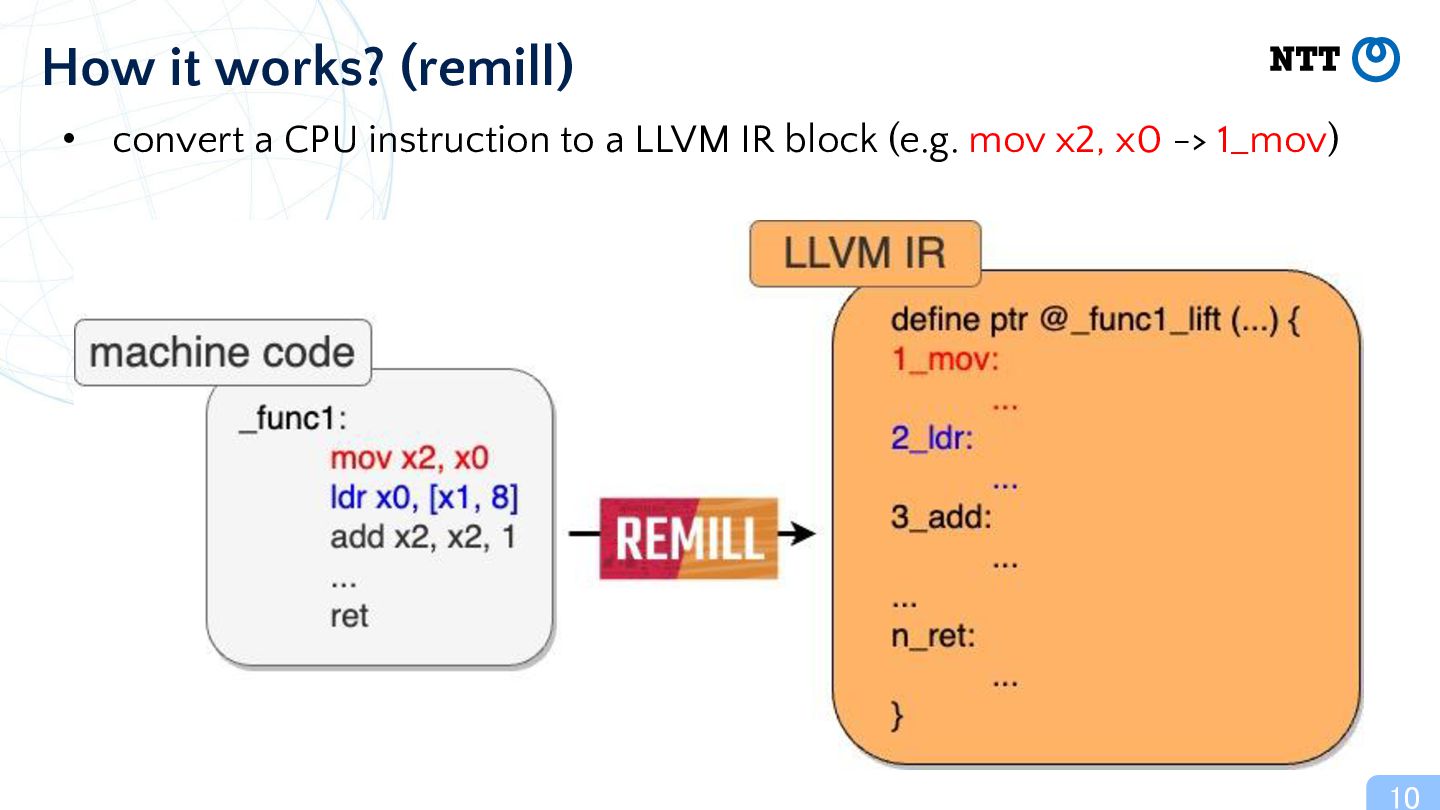
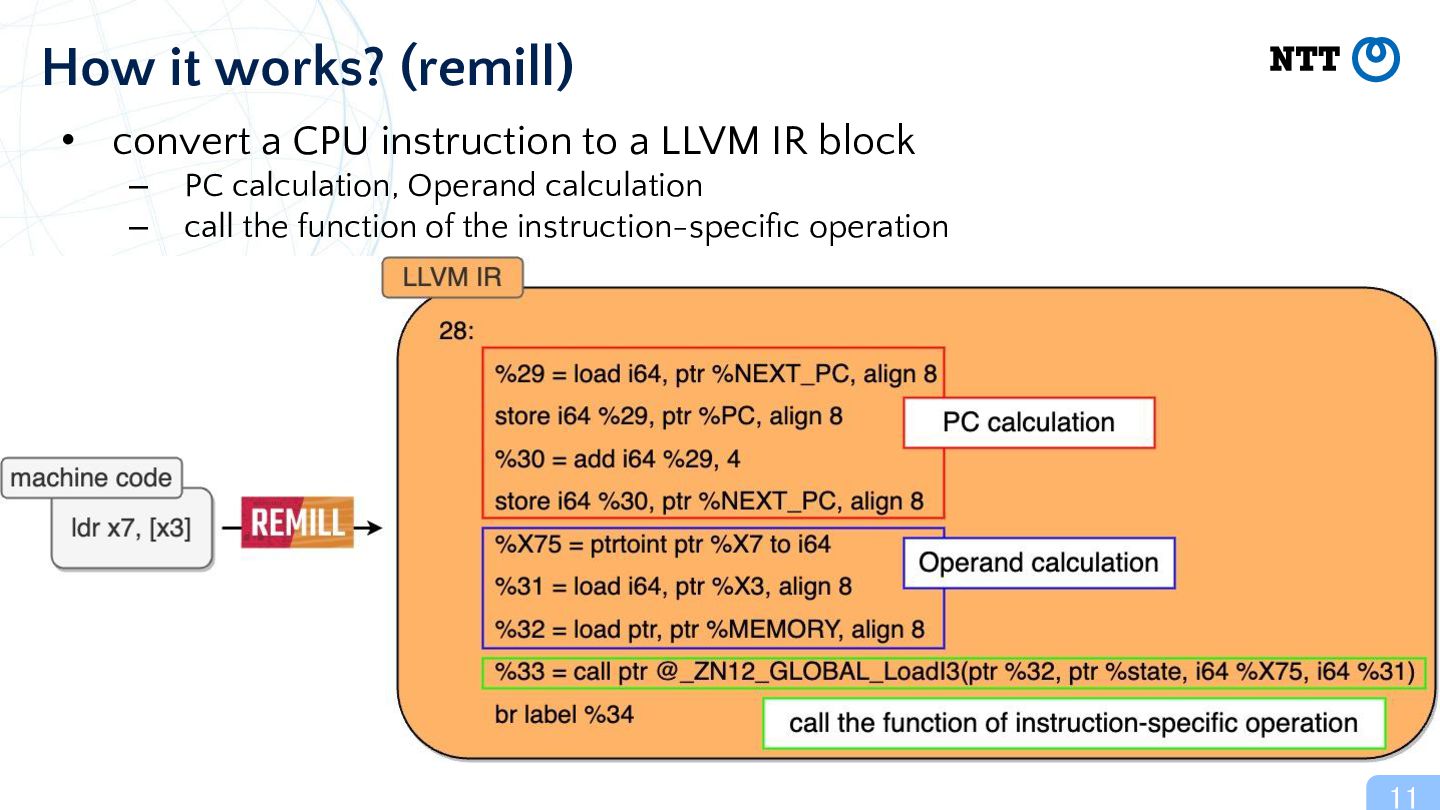
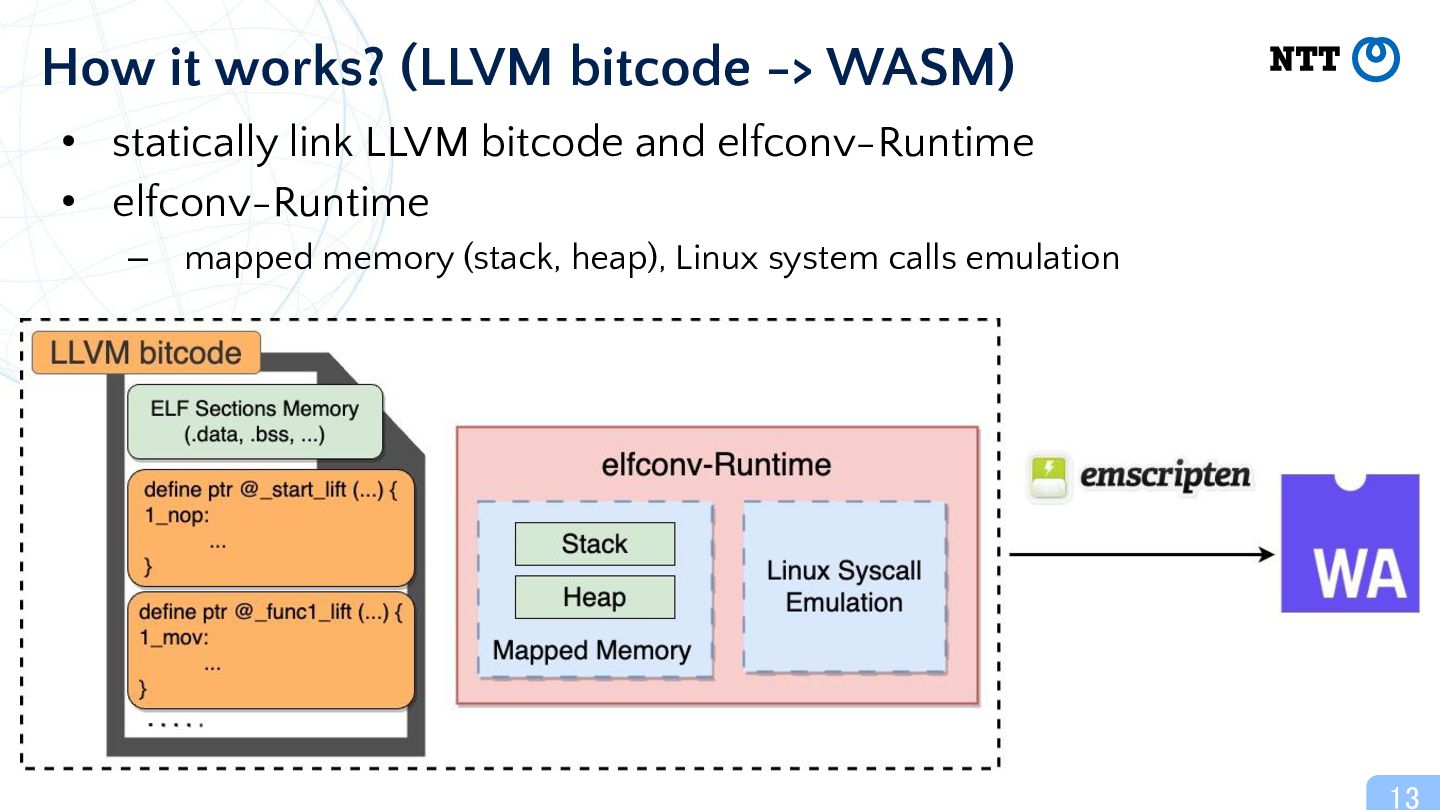
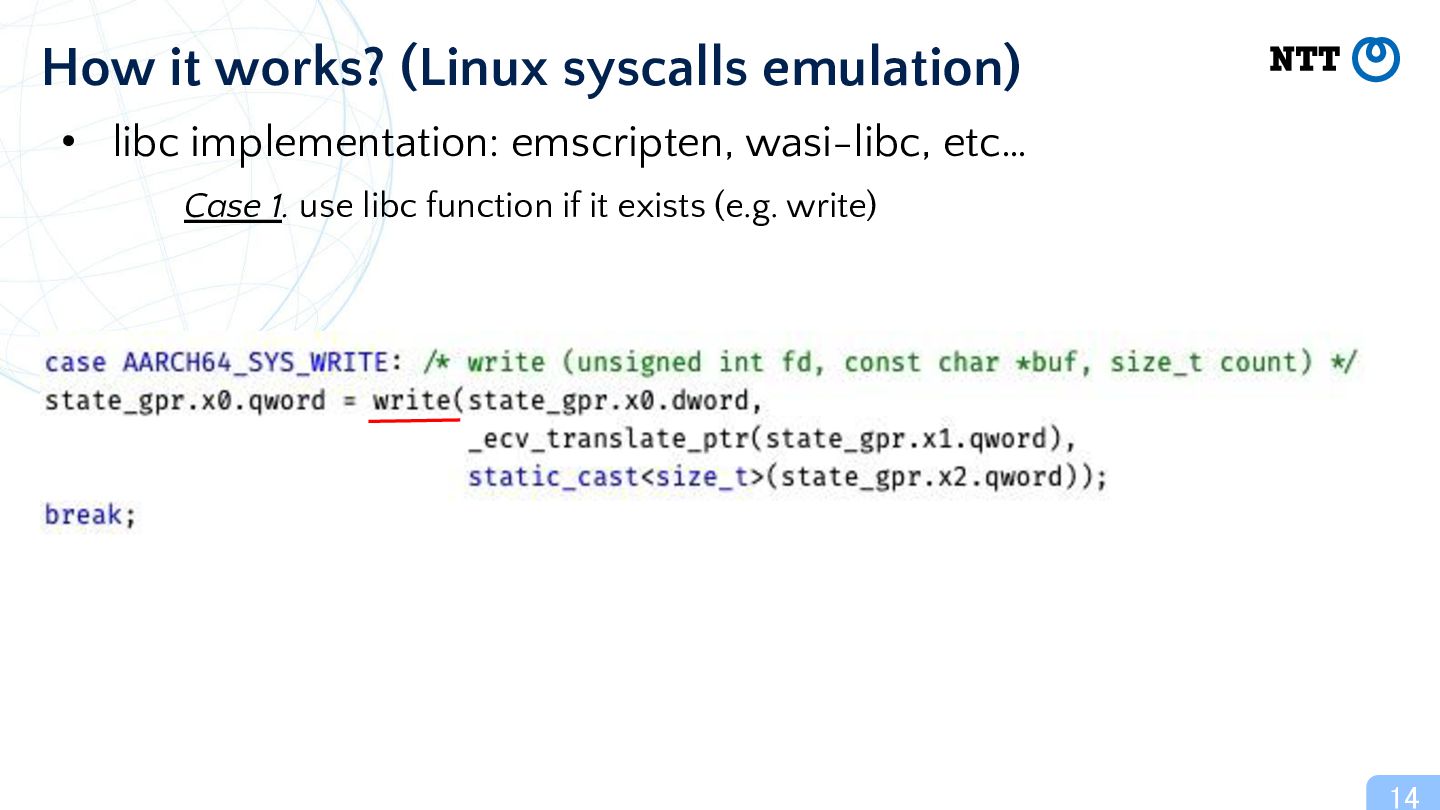
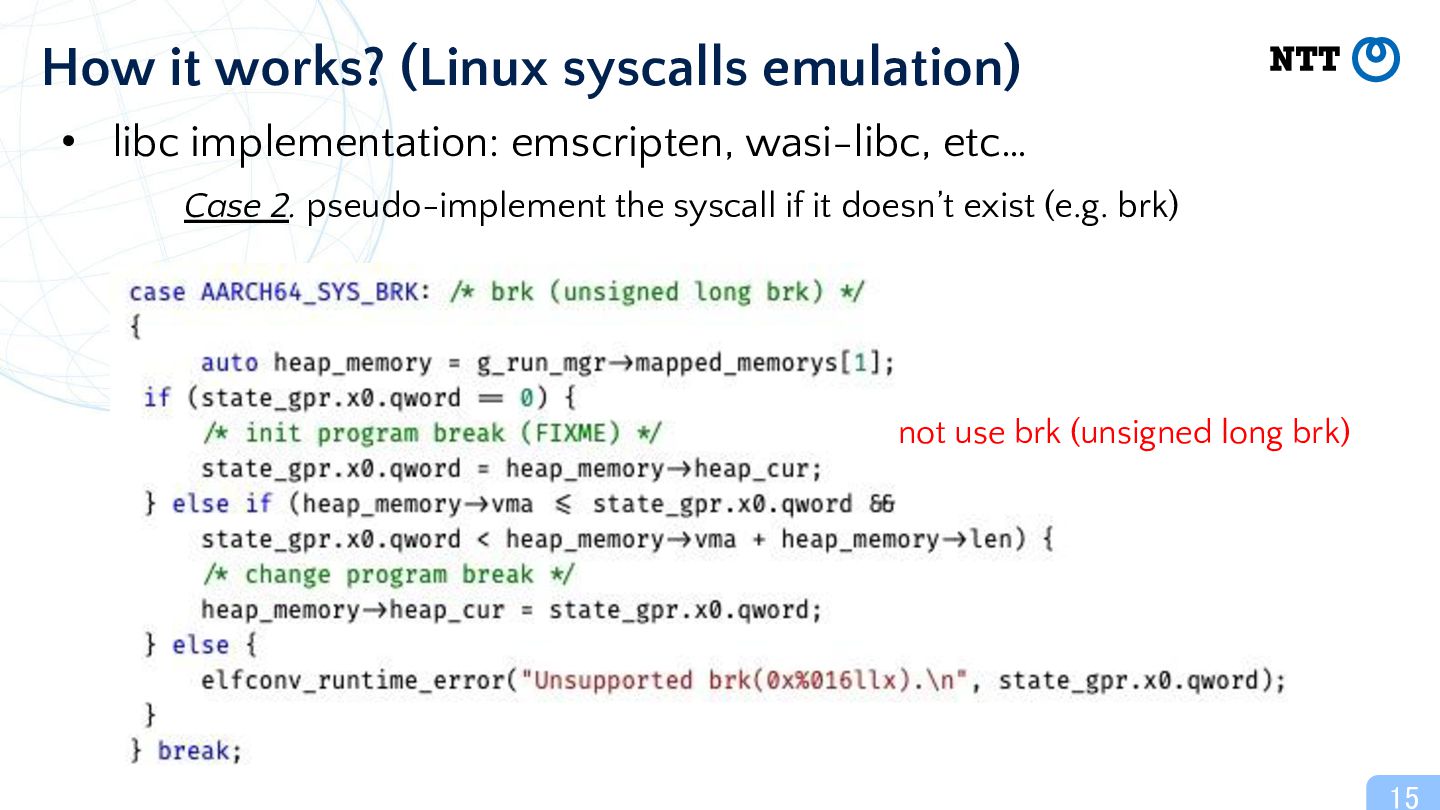
compilers (e.g. emscripten) compile LLVM bitcode and the object of Linux syscalls emulation to WASM • elfconv is successor to myAOT: https://github.com/AkihiroSuda/myaot – Author: Akihiro Suda, NTT – An experimental AOT-ish compiler (Linux/riscv32 ELF → Linux/x86_64 ELF, Mach-O, WASM, ...) elfconv: AOT compiler from Linux/ELF to WASM 6
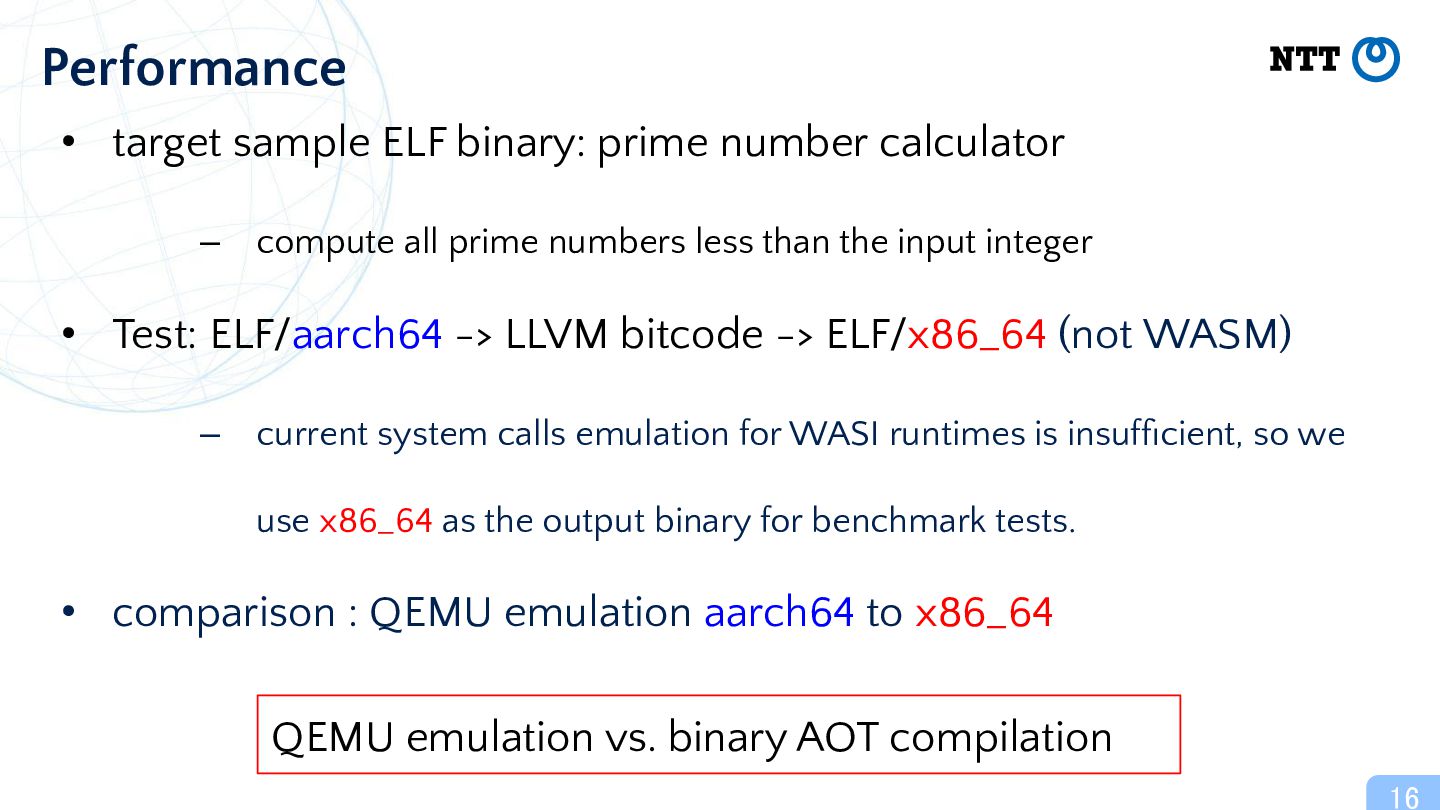
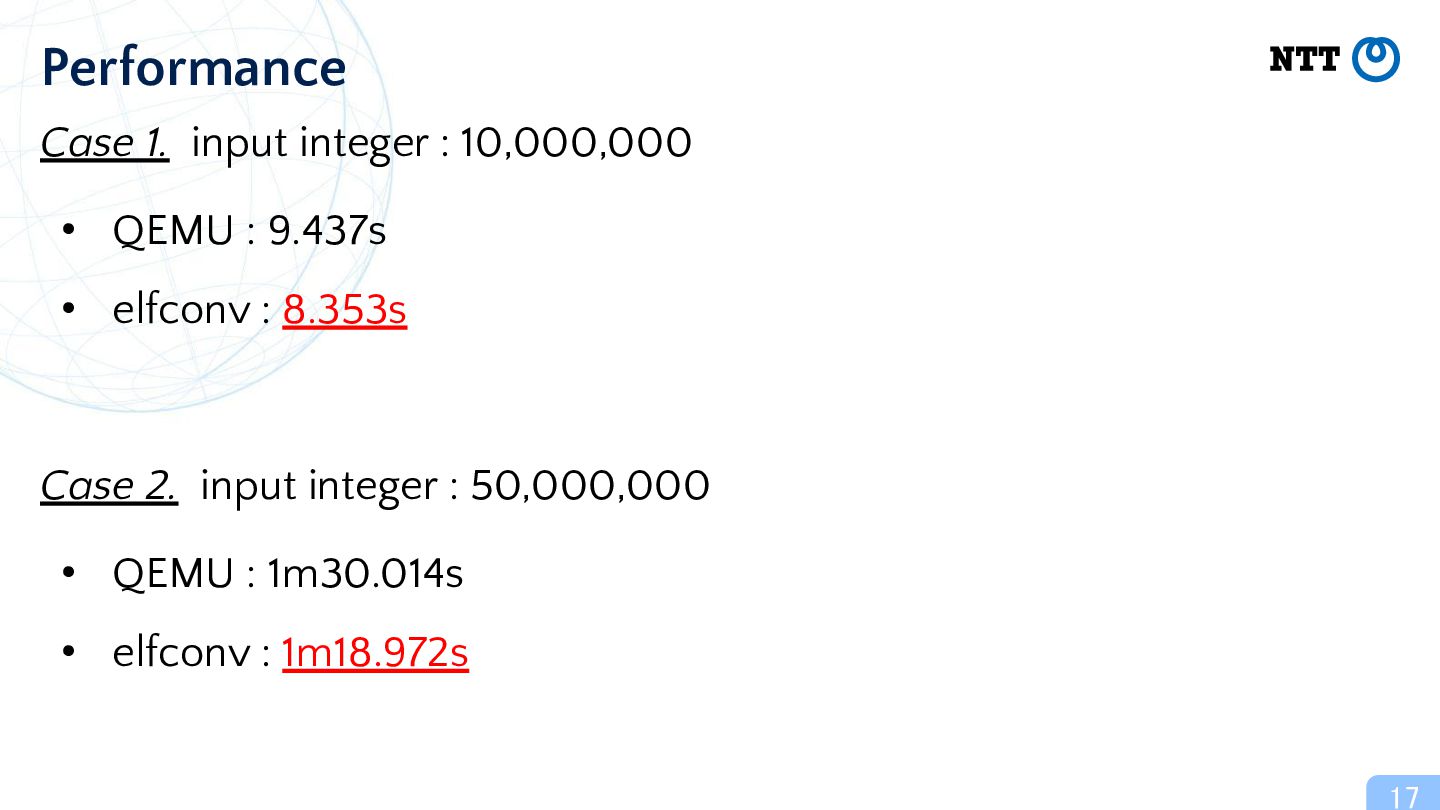
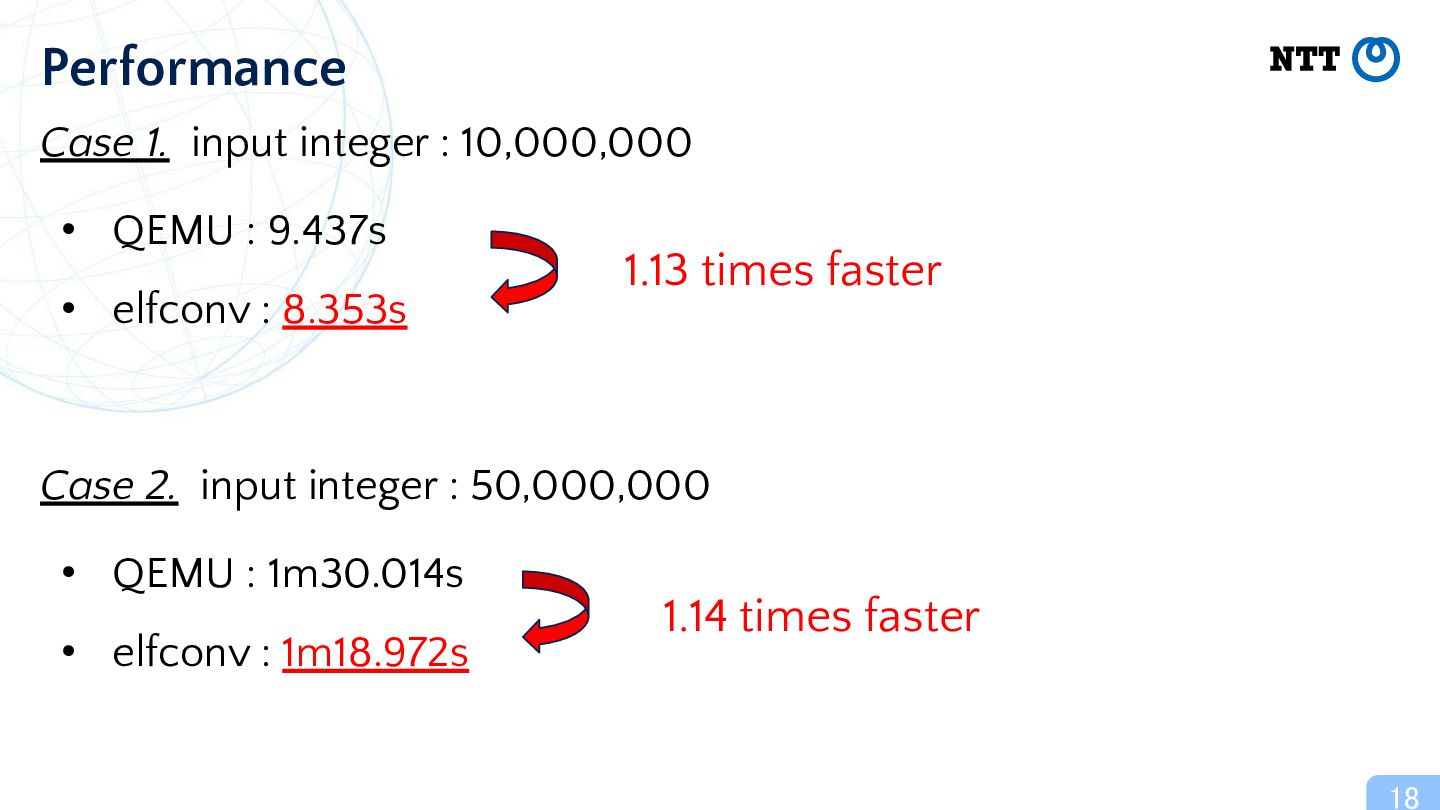
all prime numbers less than the input integer • Test: ELF/aarch64 -> LLVM bitcode -> ELF/x86_64 (not WASM) – current system calls emulation for WASI runtimes is insufficient, so we use x86_64 as the output binary for benchmark tests. • comparison : QEMU emulation aarch64 to x86_64 16 Performance QEMU emulation vs. binary AOT compilation
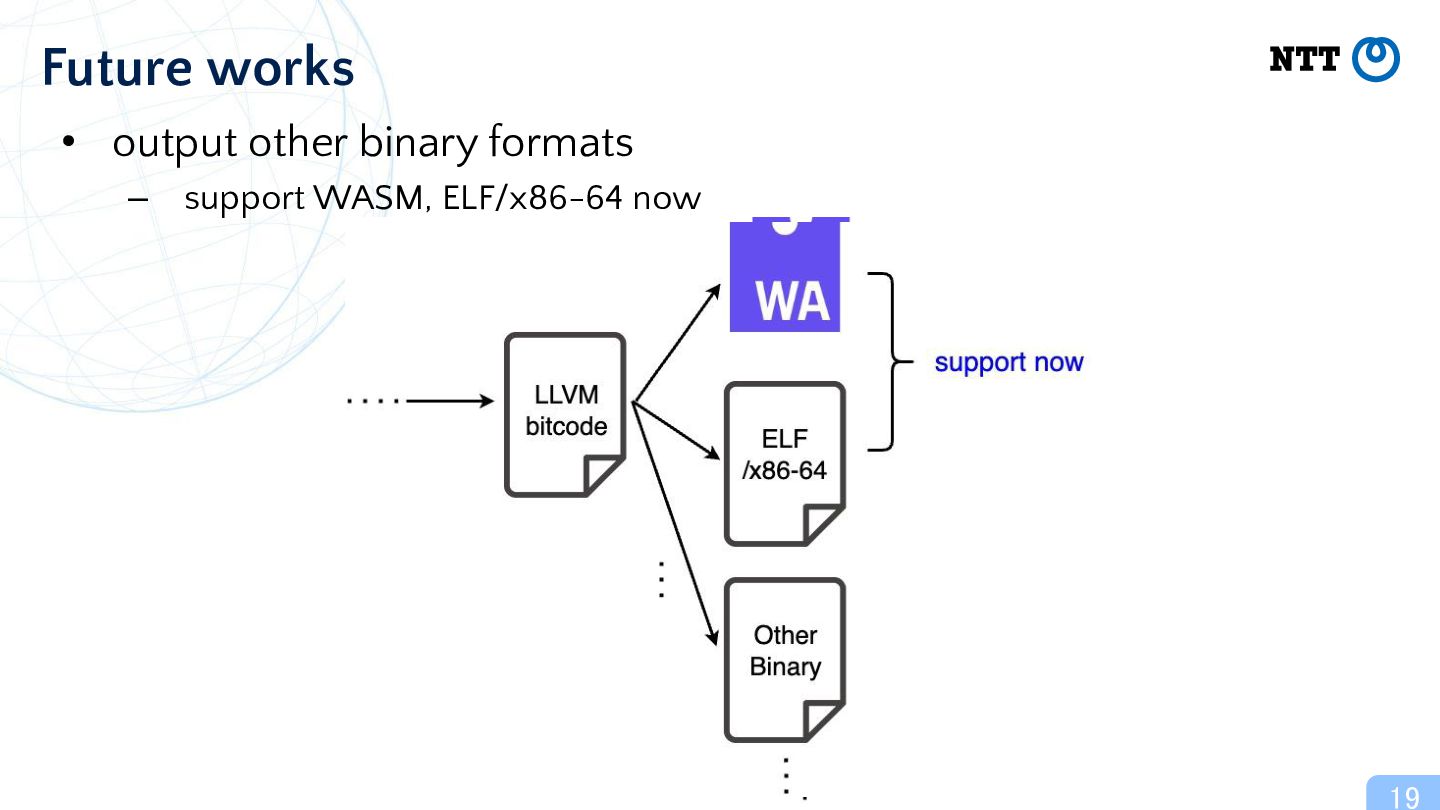
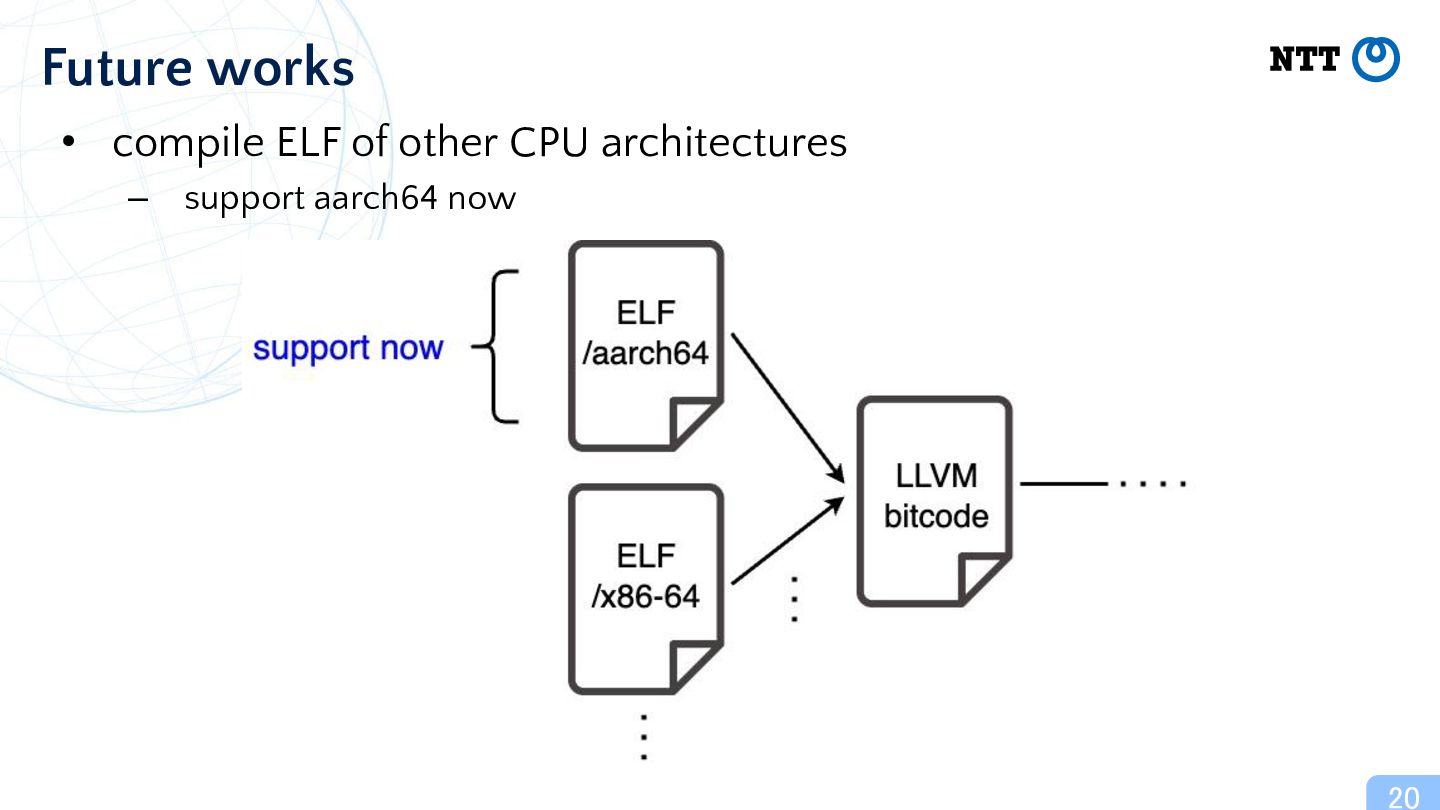
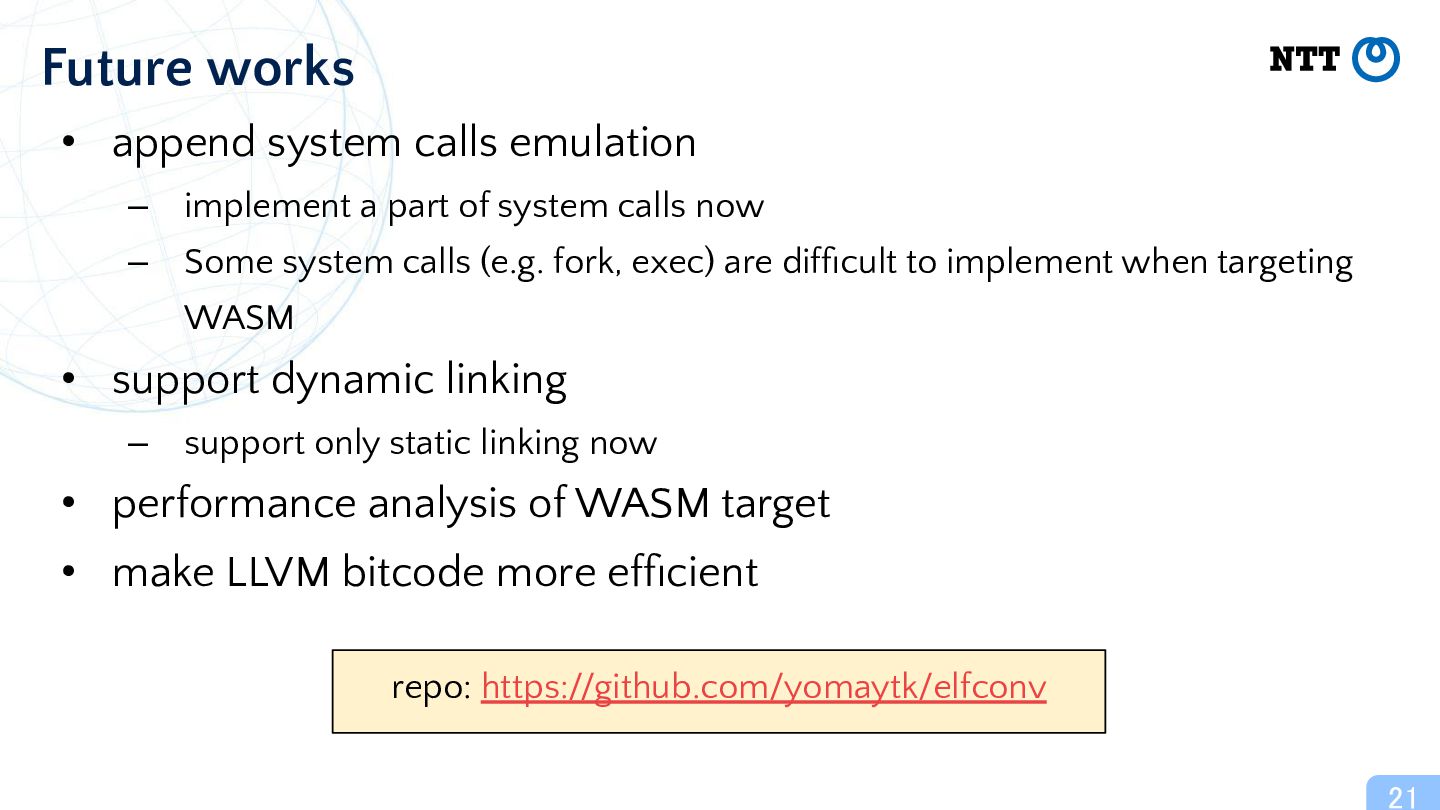
system calls now – Some system calls (e.g. fork, exec) are difficult to implement when targeting WASM • support dynamic linking – support only static linking now • performance analysis of WASM target • make LLVM bitcode more efficient Future works 21 repo: https://github.com/yomaytk/elfconv


 yomaytk
 garrettdimon
 baasie
 mza
 wjessup
 maltzj
 helenjbeal
 speakerdeck
 sarafernandez
 bryan
 aleyda
 techseoconnect
 raygrieselhuber