Share
Embed
【EMNLP 2023】Incorporating Structured Representations into Pretrained Vision & Language Models Using Scene Graphs 論文読み会発表資料
mori yuichiro
January 25, 2024
Transcript
20 slides
-
Incorporating Structured Representations into Pretrained Vision & Language Models Using
Scene Graphs Roei Herzig, Alon Mendelson, Leonid Karlinsky, Assaf Arbelle, Rogerio Feris, Trevor Darrell, Amir Globerson Tel-Aviv University, UC Berkeley, IBM Research, MIT-IBM Watson AI Lab EMNLP 2023 https://arxiv.org/abs/2305.06343 1 -
Summary • Visual Language Models (VLMs) face challenges in understanding
complex scenes, particularly in attributes and relations. • This study introduces a few number of structured scene graphs into VLMs, enhancing visual and textual comprehension. • The method improves VLM performance across multiple datasets, effectively addressing the initial scene understanding limitations. 2 -
Introduction • VLM • image-text Encoder (e.g., CLIP, BLIP, BLIP2)
• remarkable zero-shot performance thanks to the massive scale image-text pairs • Scene Graph • Node: object -> (class label, bounding box, attributes) • Edge: relation -> (obj_1, relation category, obj_2) • Dataset: Visual Genome (Krishna et.al, International journal of computer vision 2017), etc… 3 -
Introduction • Background • Large-scale pretrained VLMs still struggle with
compositional scene recognition • Especially recognizing attributes and relationships of objects, as well as the state of actions • Scene Graphs (SG) are effective for compositional recognition but have a high annotation cost • making them impractical to prepare on a large scale 4 -
Introduction • Purpose • They aim to enhance the compositional
recognition capabilities of pre-trained VLMs using a small amount of SGs • Method • They propose a fine-tuning method for pre-trained VLMs, named Scene Graphs for Vision-Language Models (SGVL), to leverage Scene Graphs for enhancing these models 5 -
Methodology • text-encoder: contrastive learning with SG-to-text • Positive/Negative Captions
from SG • Image-encoder: integrating “SG Component” 7 [CLS] [CLS] Enhancing compositionality by contrasting hard- negative captions that highlight structural aspects -
Methodology • Positive/Negative Captions from SG • Negative one Generated
by • Swapping asymmetrical relations • Binding attributes with several objects 8 ↓ GN -
Methodology • text-encoder: contrastive learning with SG-to-text • Image-encoder: integrating
“SG Component” • Adaptive SG Token • Partitioning image-encoder 9 [CLS] [CLS] Enhancing compositionality through predicting SG elements (objects, relationships) -
Methodology • Adaptive SG Token • learnable soft prompt •
This allows for effective training of the image-encoder in the task of predicting SG 10 image-encoder object relation projection object representation bounding box object name embedding relation representation bounding box relation name embedding -
Methodology • Partitioning image patch and SG token in image-encoder
• This allows better learning of the graph prediction task • Although the Q,K,V and MLP are partitioned, the attention is performed over all tokens (patch and SG) 11 -
Methodology • Objective function (for image-SG pairs) 1. Image-text contrastive
loss like CLIP 2. Matching object and relation loss following DETR (Carion et.al ECCV2020) • for allowing SG Tokens learn object/relations representation 12 Estimated probability of Teacher Label Loss Based on Bounding Box For image-text pairs, objective is just ℒ𝐶𝑜𝑛𝑡 -
Experiments • Experiment settings • Training Data: image-SG pair (10K
of Visual Genome Dataset: VG) and standard image-text pairs (less than 1% of LAION 400M) • Pretrained Model: {CLIP(ViT/B-32), BLIP(ViT/B-32)/BLIP2(ViT-g)} • {32, 8} epoch • one batch comprised of {256, 32} image-text pairs and 8 image-SG pairs • 4 {V100, A100} GPUs • Evaluation baselines • CLIP, BLIP/BLIP2, NegCLIP/LLaVA/miniGPT4 etc.. 13 -
Experiments • Evaluation benchmarks • VL-Checklist (VLC) (Zhao et.al arXiv)
• pos-neg captions per 1 image (C pos, C neg, I) • Winoground (Thrush et.al CVPR2022) • 2 image-text pairs (C 0, I 0, C 1, I 1 ) swapping words • Attribution, Relation and Order (ARO) (Yuksekgonul et.al ICLR 2023) • Select the most suitable caption for an image from 5 captions, adjusting for changes in relationship, object, and attributes • Visual Spatial Reasoning (VSR) (Liu et.al TACL 2023) • estimate whether Image-text pair has spatial relationship each other • ZS (Various Zero-Shot Task) • 21 classification tasks from ELEVATER (Li et al., NeurIPS 2022) 14 Winoground sample VSR sample -
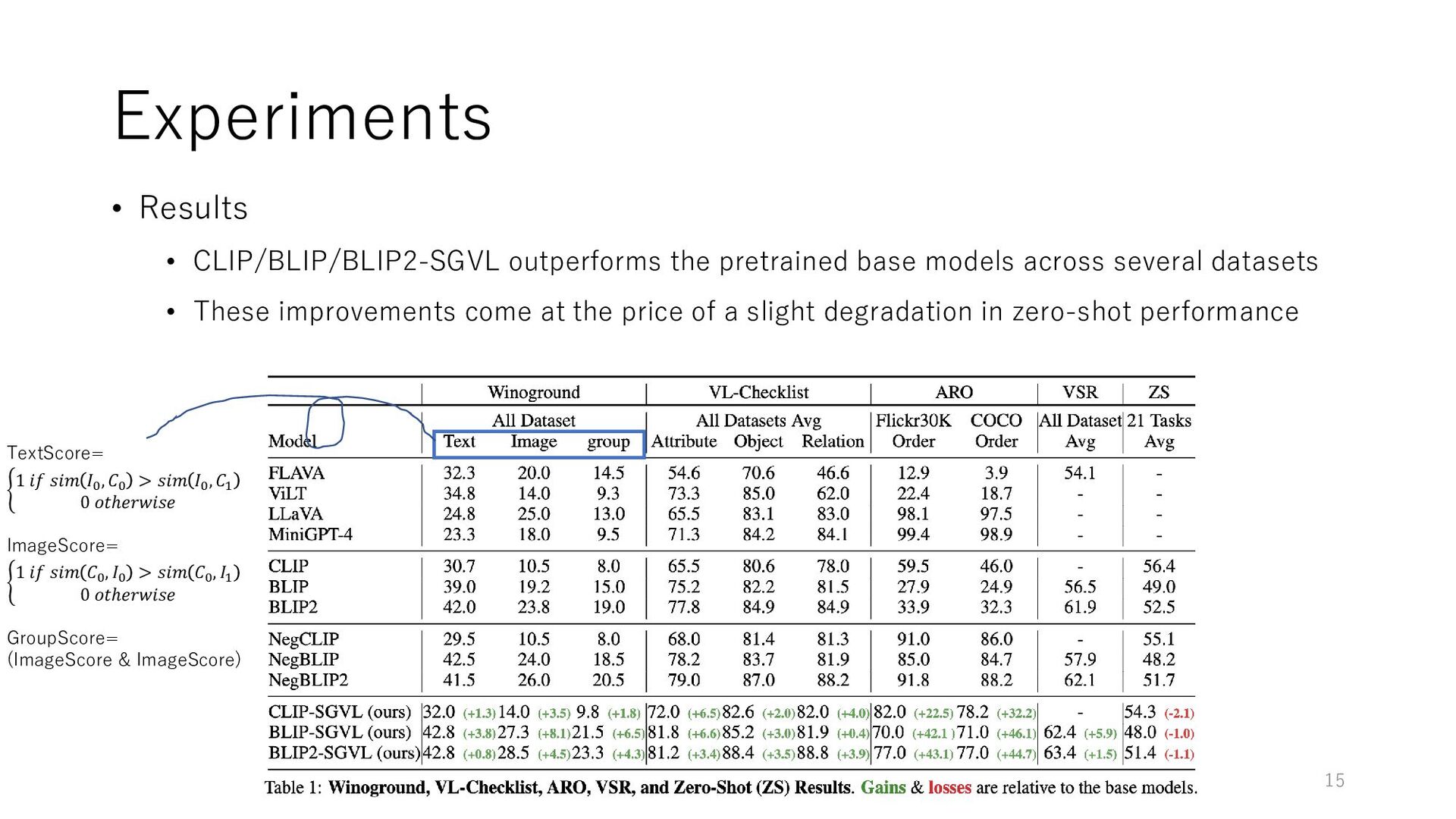
Experiments • Results • CLIP/BLIP/BLIP2-SGVL outperforms the pretrained base models
across several datasets • These improvements come at the price of a slight degradation in zero-shot performance 15 TextScore= ቊ 1 𝑖𝑓 𝑠𝑖𝑚 𝐼0 , 𝐶0 > 𝑠𝑖𝑚 𝐼0 , 𝐶1 0 𝑜𝑡ℎ𝑒𝑟𝑤𝑖𝑠𝑒 ImageScore= ቊ 1 𝑖𝑓 𝑠𝑖𝑚 𝐶0 , 𝐼0 > 𝑠𝑖𝑚 𝐶0 , 𝐼1 0 𝑜𝑡ℎ𝑒𝑟𝑤𝑖𝑠𝑒 GroupScore= (ImageScore & ImageScore) -
Experiments • Fine-grained results • SGVL show compositionality for almost
all categories in Winoground and VLC • especially for swapping image object/relation (in Winoground) 16 -
Experiments • Ablation study A) Graph based {Caption/Negative Caption}, SG
Token are effective B) Adding Adaptive SG Token and partitioning image patch and SG token are effective C) SG Annotation needs to be dense for improving compositionality of VLM 17 -
Conclusion • Visual Language Models (VLMs) face challenges in understanding
complex scenes, particularly in attributes and relations. • This study introduces a few number of structured scene graphs into VLMs, enhancing visual and textual comprehension. • The method improves VLM performance across multiple datasets, effectively addressing the initial scene understanding limitations. 19