Share
Embed
Building Scalable Web Apps - EuroPython 2011
David Cramer
September 26, 2011
Transcript
47 slides
-
Agenda • Terminology • Common bottlenecks • Building a scalable
app • Architecting your database • Building an API • Optimizing the frontend Thursday, June 16, 2011 -
“Performance measures the speed with which a single request can
be executed, while scalability measures the ability of a request to maintain its performance under increasing load.” Performance vs. Scalability (but we’re not just going to scale your code) Thursday, June 16, 2011 -
“Database sharding is a method of horizontally partitioning data by
common properties” Sharding Thursday, June 16, 2011 -
“Denormalization is the process of attempting to optimize the performance
of a database by adding redundant data or by grouping data.” Denormalization Thursday, June 16, 2011 -
Common Bottlenecks • Database (almost always) • Caching, Invalidation •
Lack of metrics, lack of tests Thursday, June 16, 2011 -
Getting Started • Pick a framework: Django, Flask, Pyramid •
Package your app; Repeatability • Solve problems • Invest in architecture Thursday, June 16, 2011 -
Django is.. • Fast (enough) • Loaded with goodies •
Maintained • Tested • Used Thursday, June 16, 2011 -
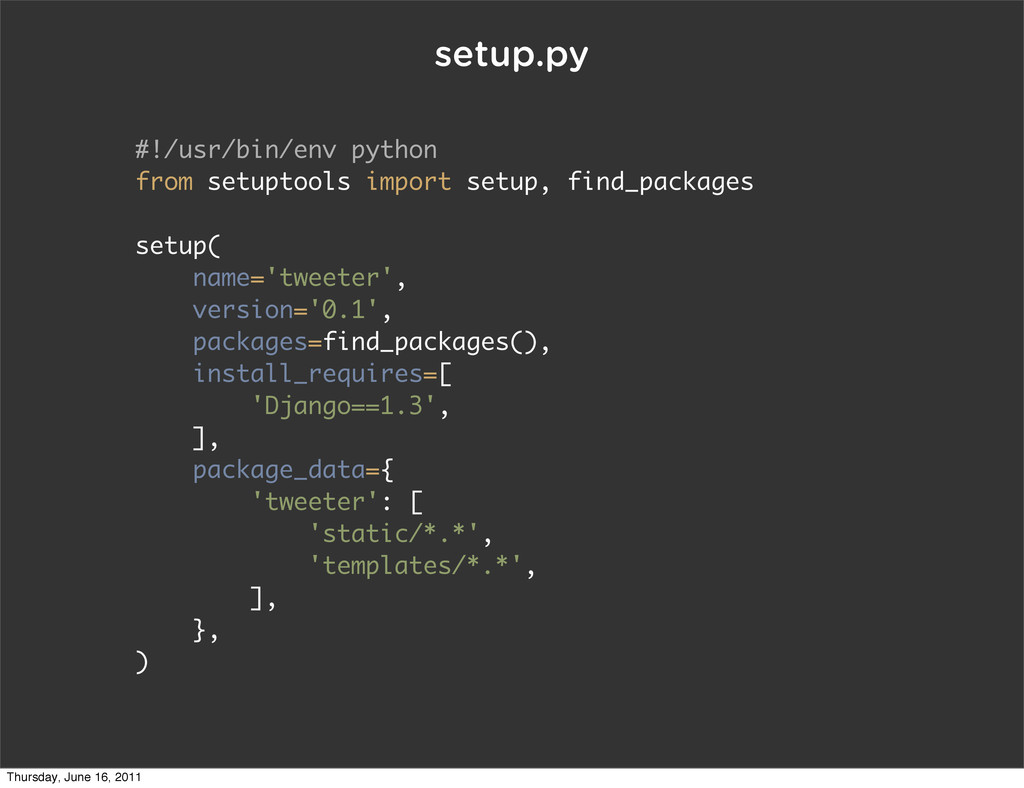
setup.py #!/usr/bin/env python from setuptools import setup, find_packages setup( name='tweeter',
version='0.1', packages=find_packages(), install_requires=[ 'Django==1.3', ], package_data={ 'tweeter': [ 'static/*.*', 'templates/*.*', ], }, ) Thursday, June 16, 2011 -
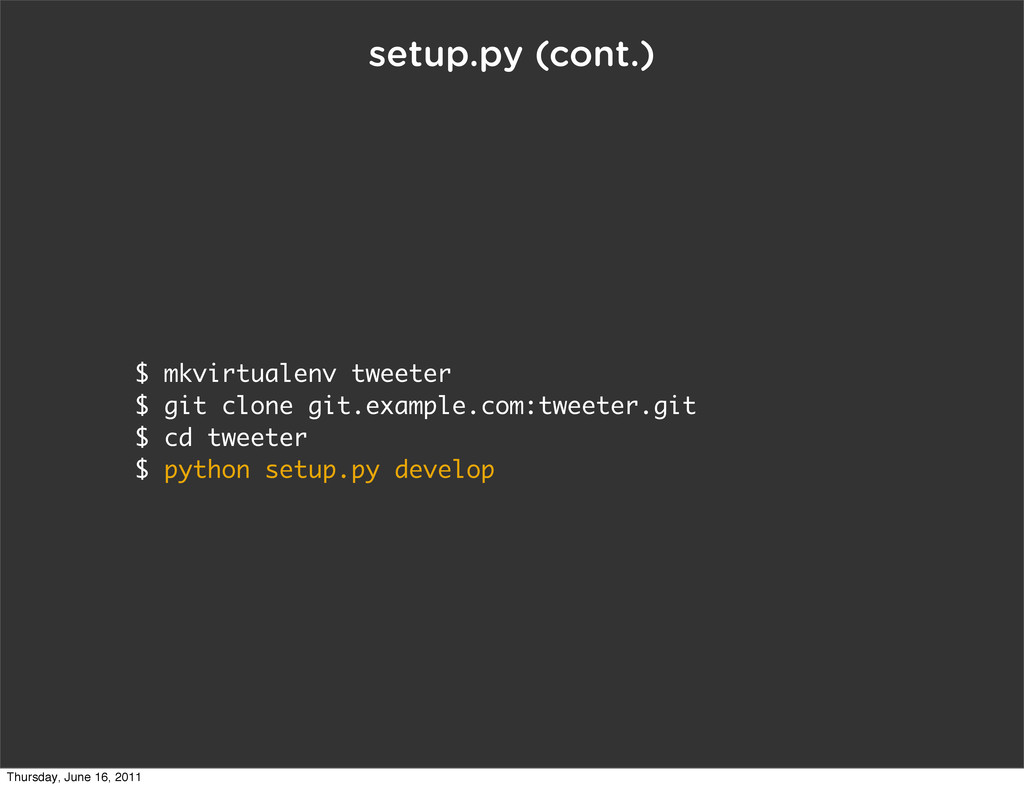
setup.py (cont.) $ mkvirtualenv tweeter $ git clone git.example.com:tweeter.git $
cd tweeter $ python setup.py develop Thursday, June 16, 2011 -
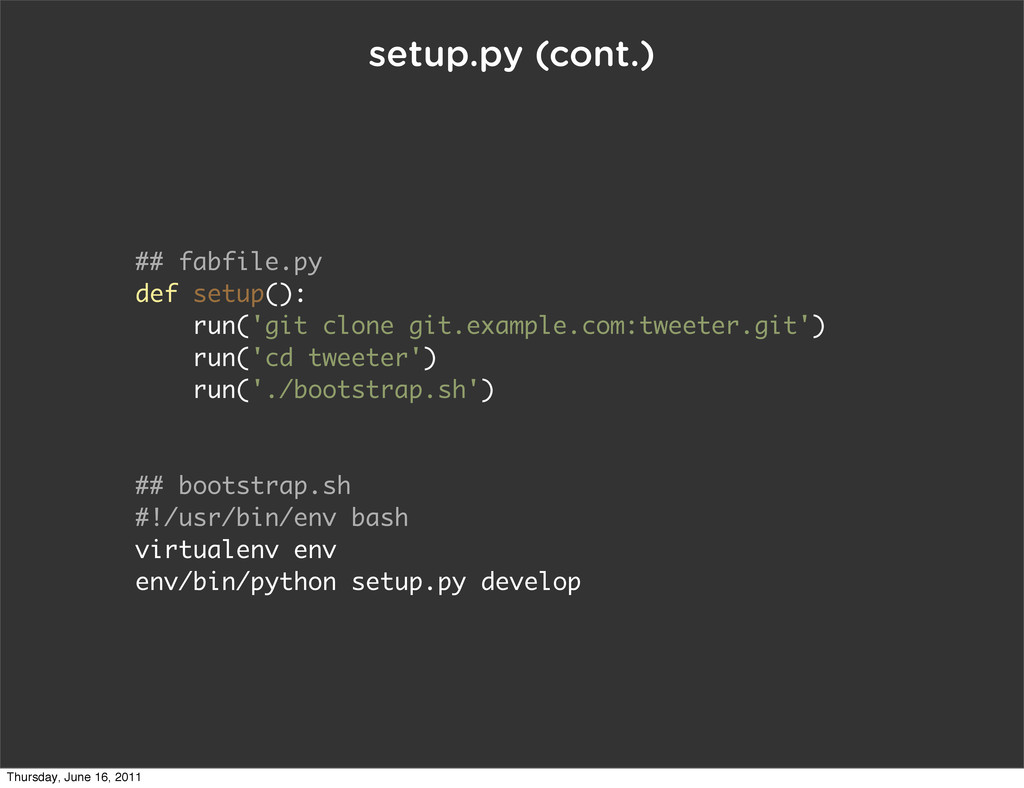
setup.py (cont.) ## fabfile.py def setup(): run('git clone git.example.com:tweeter.git') run('cd
tweeter') run('./bootstrap.sh') ## bootstrap.sh #!/usr/bin/env bash virtualenv env env/bin/python setup.py develop Thursday, June 16, 2011 -
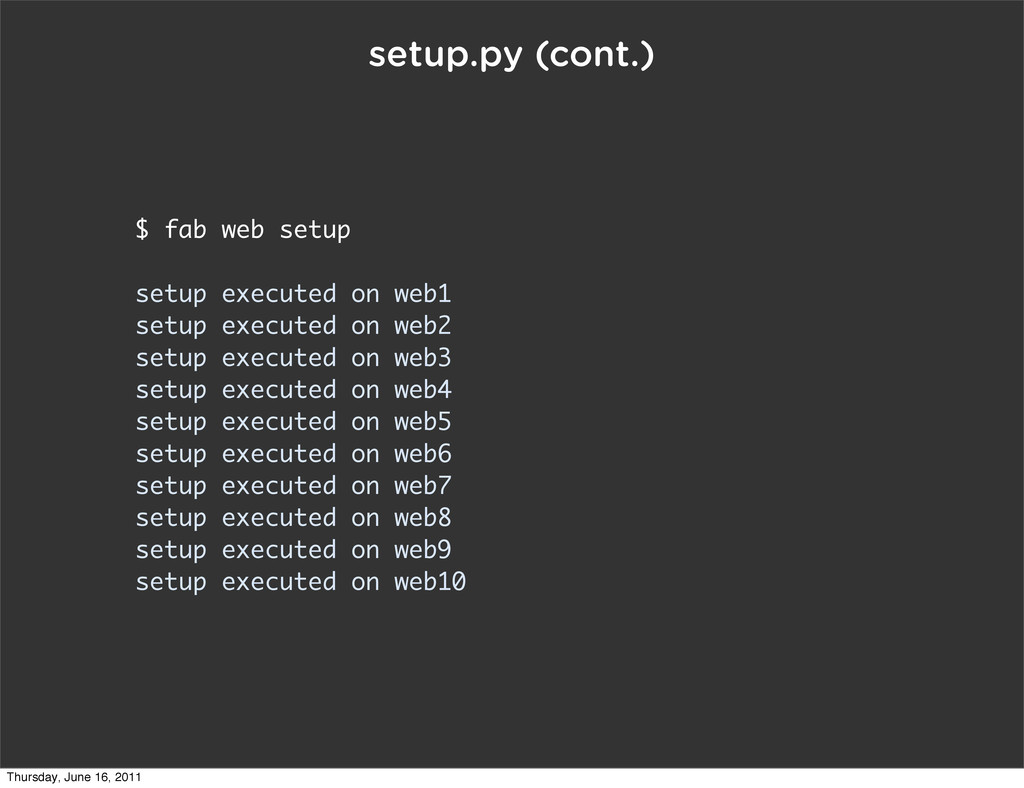
setup.py (cont.) $ fab web setup setup executed on web1
setup executed on web2 setup executed on web3 setup executed on web4 setup executed on web5 setup executed on web6 setup executed on web7 setup executed on web8 setup executed on web9 setup executed on web10 Thursday, June 16, 2011 -
Databases • Usually core • Common bottleneck • Hard to
change • Tedious to scale http://www.flickr.com/photos/adesigna/3237575990/ Thursday, June 16, 2011 -
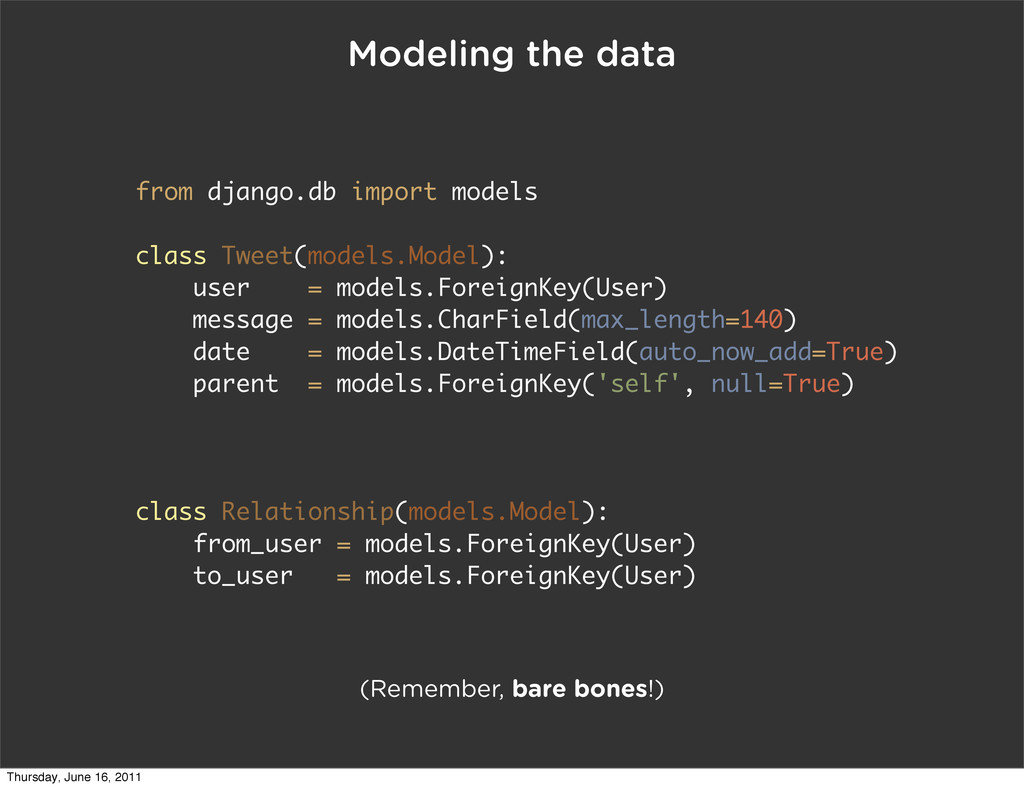
Modeling the data from django.db import models class Tweet(models.Model): user
= models.ForeignKey(User) message = models.CharField(max_length=140) date = models.DateTimeField(auto_now_add=True) parent = models.ForeignKey('self', null=True) class Relationship(models.Model): from_user = models.ForeignKey(User) to_user = models.ForeignKey(User) (Remember, bare bones!) Thursday, June 16, 2011 -
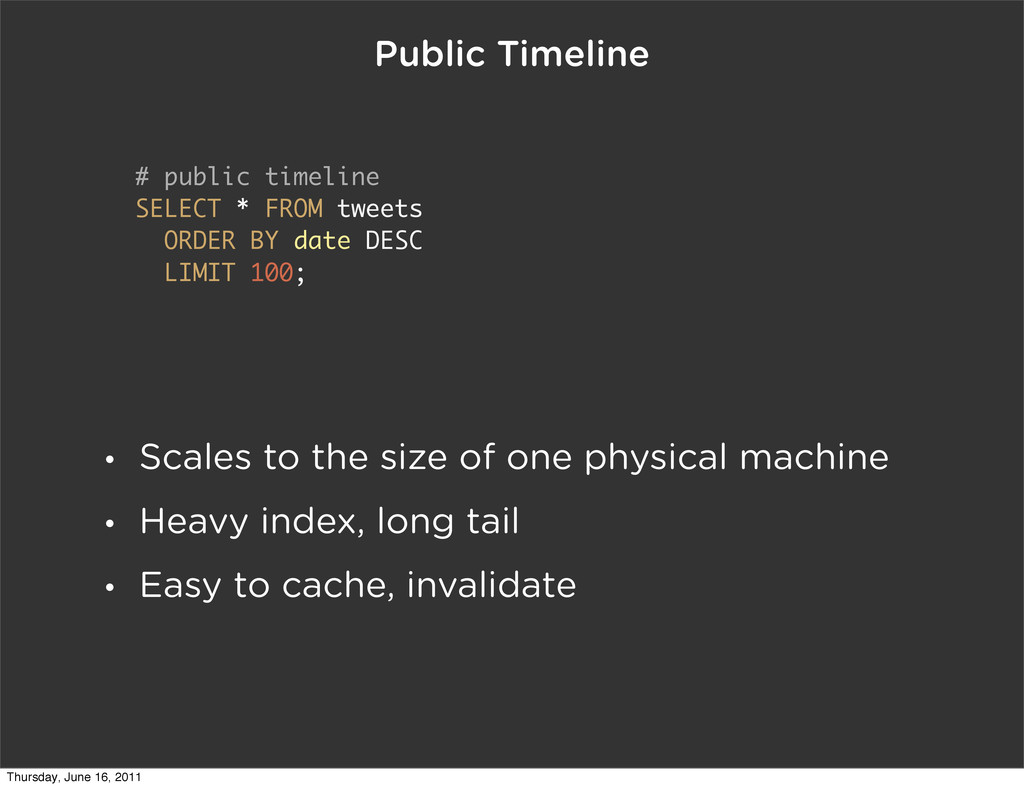
Public Timeline # public timeline SELECT * FROM tweets ORDER
BY date DESC LIMIT 100; • Scales to the size of one physical machine • Heavy index, long tail • Easy to cache, invalidate Thursday, June 16, 2011 -
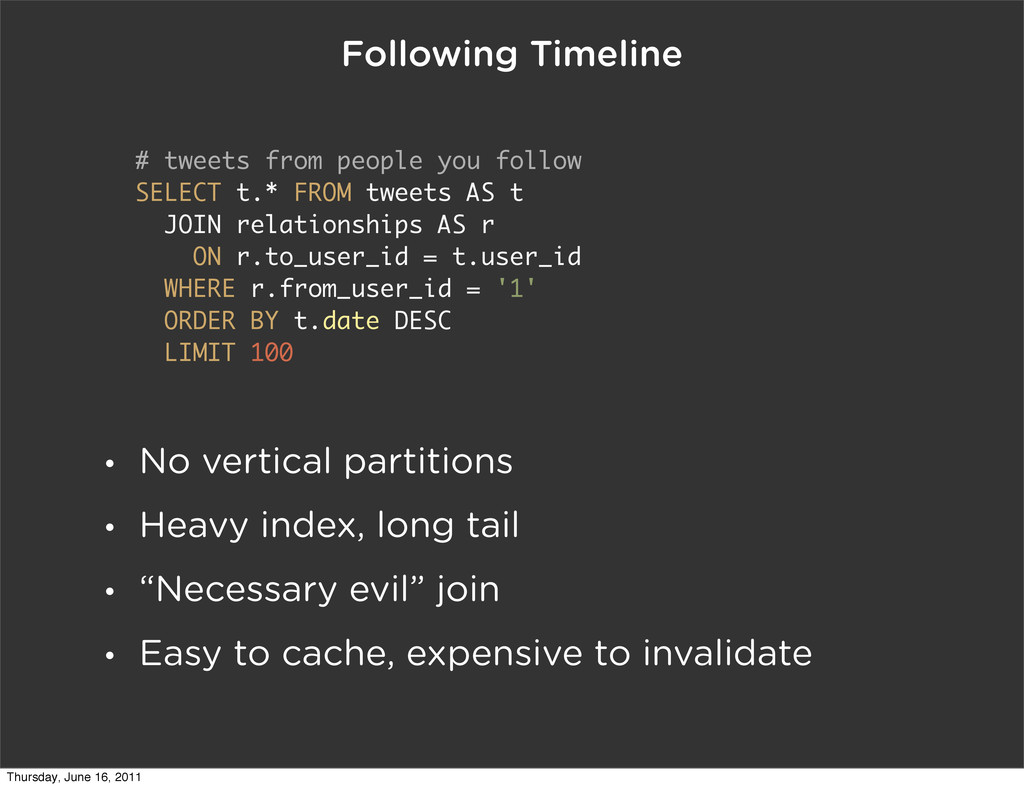
Following Timeline • No vertical partitions • Heavy index, long
tail • “Necessary evil” join • Easy to cache, expensive to invalidate # tweets from people you follow SELECT t.* FROM tweets AS t JOIN relationships AS r ON r.to_user_id = t.user_id WHERE r.from_user_id = '1' ORDER BY t.date DESC LIMIT 100 Thursday, June 16, 2011 -
Materializing Views PUBLIC_TIMELINE = [] def on_tweet_creation(tweet): global PUBLIC_TIME PUBLIC_TIMELINE.insert(0,
tweet) def get_latest_tweets(num=100): return PUBLIC_TIMELINE[:num] Disclaimer: don’t try this at home Thursday, June 16, 2011 -
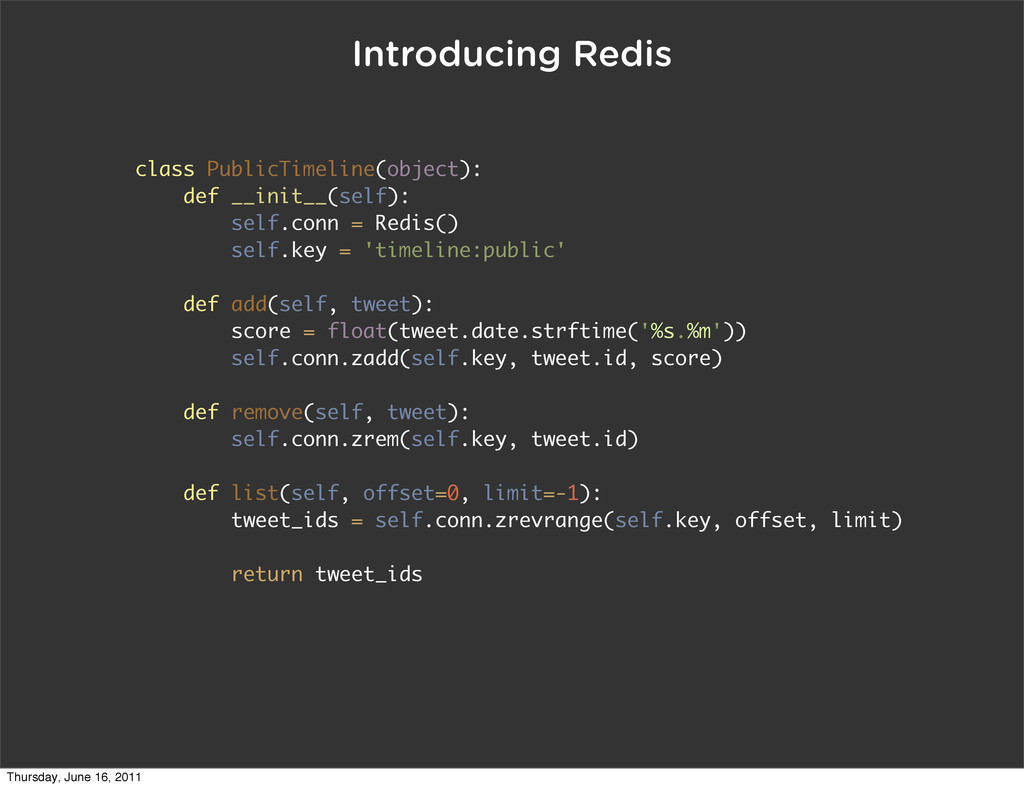
Introducing Redis class PublicTimeline(object): def __init__(self): self.conn = Redis() self.key
= 'timeline:public' def add(self, tweet): score = float(tweet.date.strftime('%s.%m')) self.conn.zadd(self.key, tweet.id, score) def remove(self, tweet): self.conn.zrem(self.key, tweet.id) def list(self, offset=0, limit=-1): tweet_ids = self.conn.zrevrange(self.key, offset, limit) return tweet_ids Thursday, June 16, 2011 -
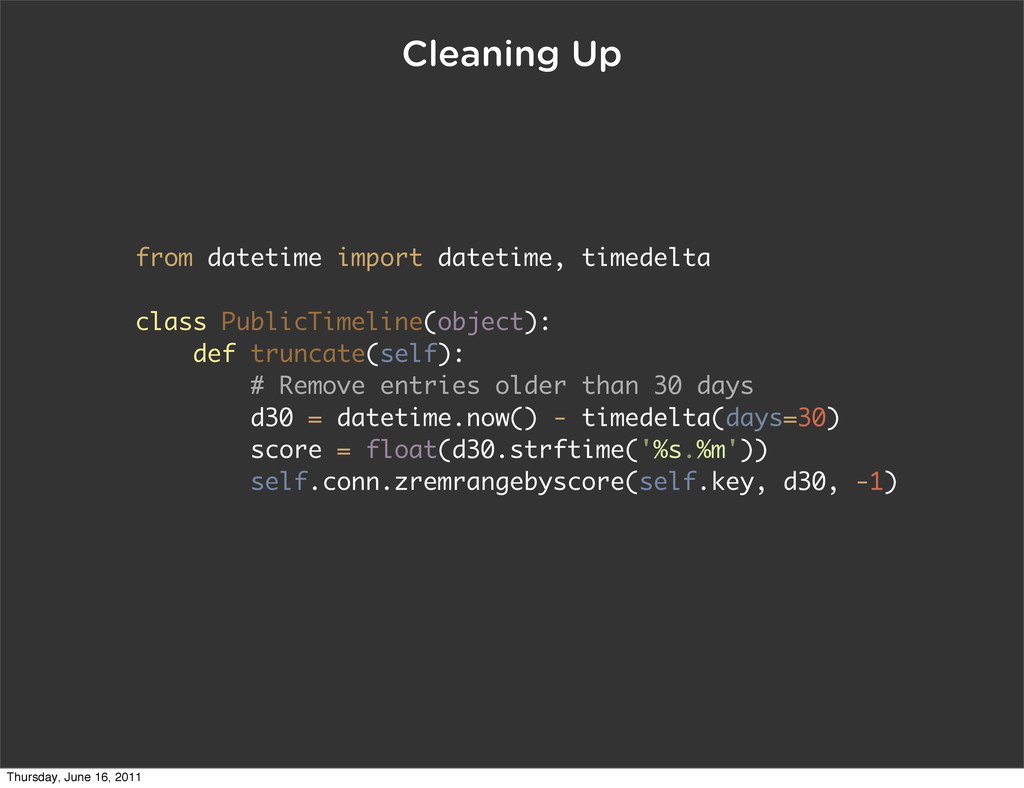
Cleaning Up from datetime import datetime, timedelta class PublicTimeline(object): def
truncate(self): # Remove entries older than 30 days d30 = datetime.now() - timedelta(days=30) score = float(d30.strftime('%s.%m')) self.conn.zremrangebyscore(self.key, d30, -1) Thursday, June 16, 2011 -
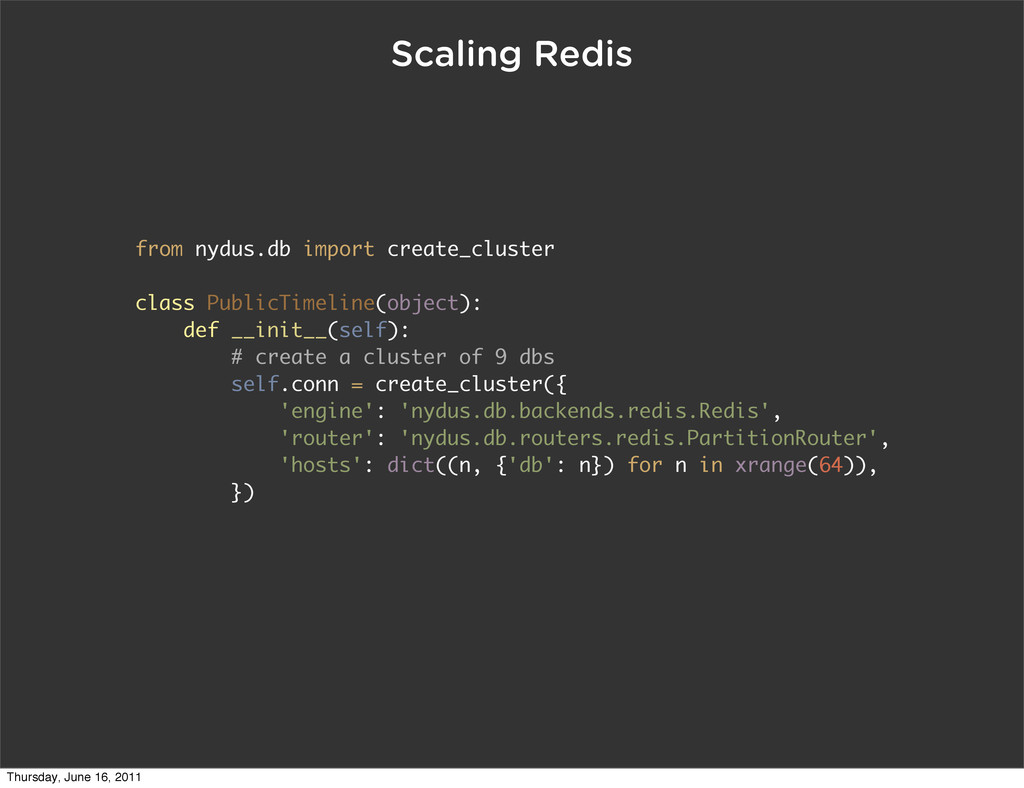
Scaling Redis from nydus.db import create_cluster class PublicTimeline(object): def __init__(self):
# create a cluster of 9 dbs self.conn = create_cluster({ 'engine': 'nydus.db.backends.redis.Redis', 'router': 'nydus.db.routers.redis.PartitionRouter', 'hosts': dict((n, {'db': n}) for n in xrange(64)), }) Thursday, June 16, 2011 -
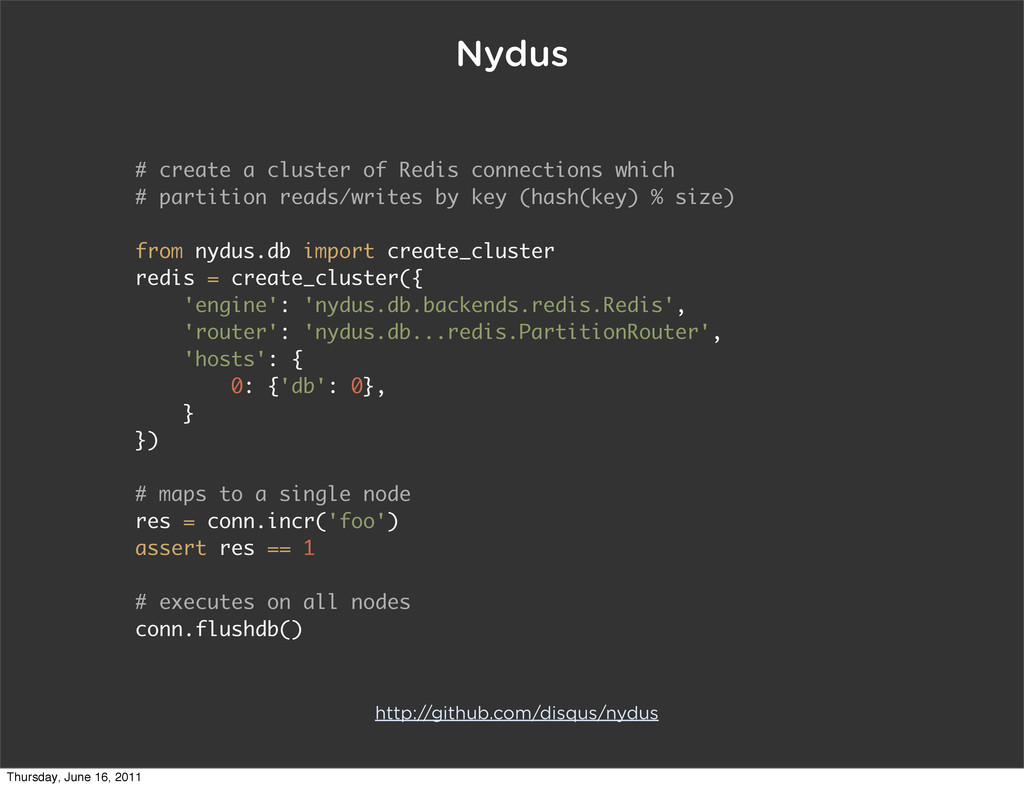
Nydus # create a cluster of Redis connections which #
partition reads/writes by key (hash(key) % size) from nydus.db import create_cluster redis = create_cluster({ 'engine': 'nydus.db.backends.redis.Redis', 'router': 'nydus.db...redis.PartitionRouter', 'hosts': { 0: {'db': 0}, } }) # maps to a single node res = conn.incr('foo') assert res == 1 # executes on all nodes conn.flushdb() http://github.com/disqus/nydus Thursday, June 16, 2011 -
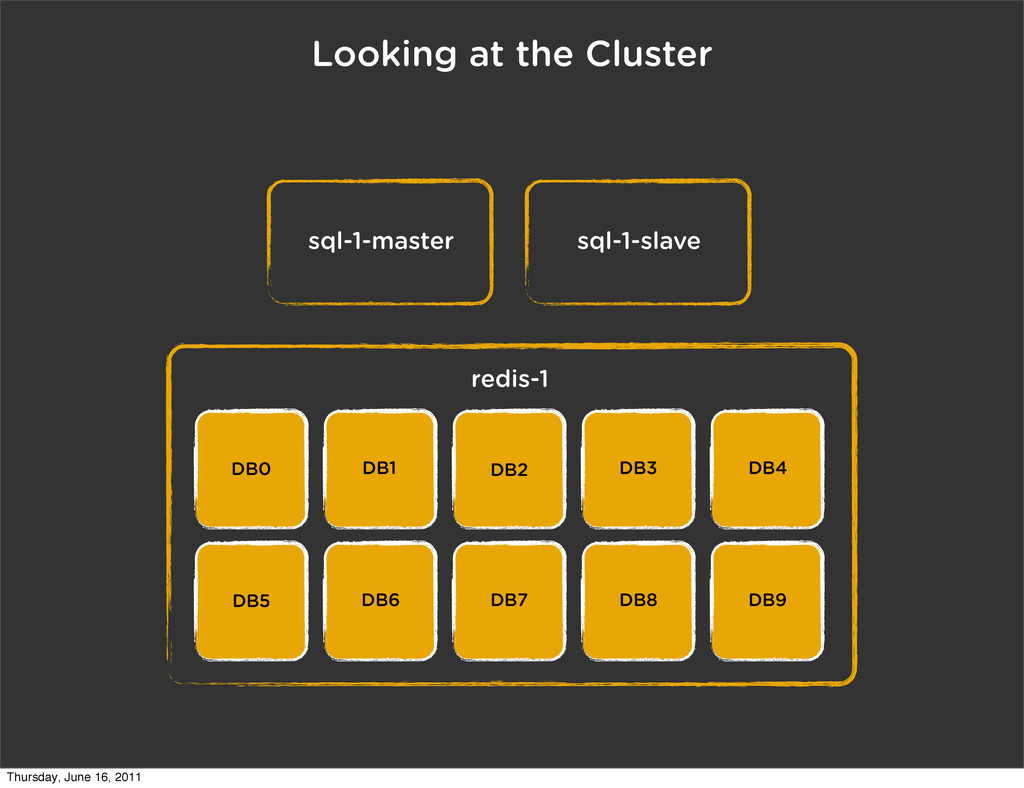
Looking at the Cluster DB5 DB6 DB7 DB8 DB9 DB0
DB1 DB2 DB3 DB4 redis-1 sql-1-master sql-1-slave Thursday, June 16, 2011 -
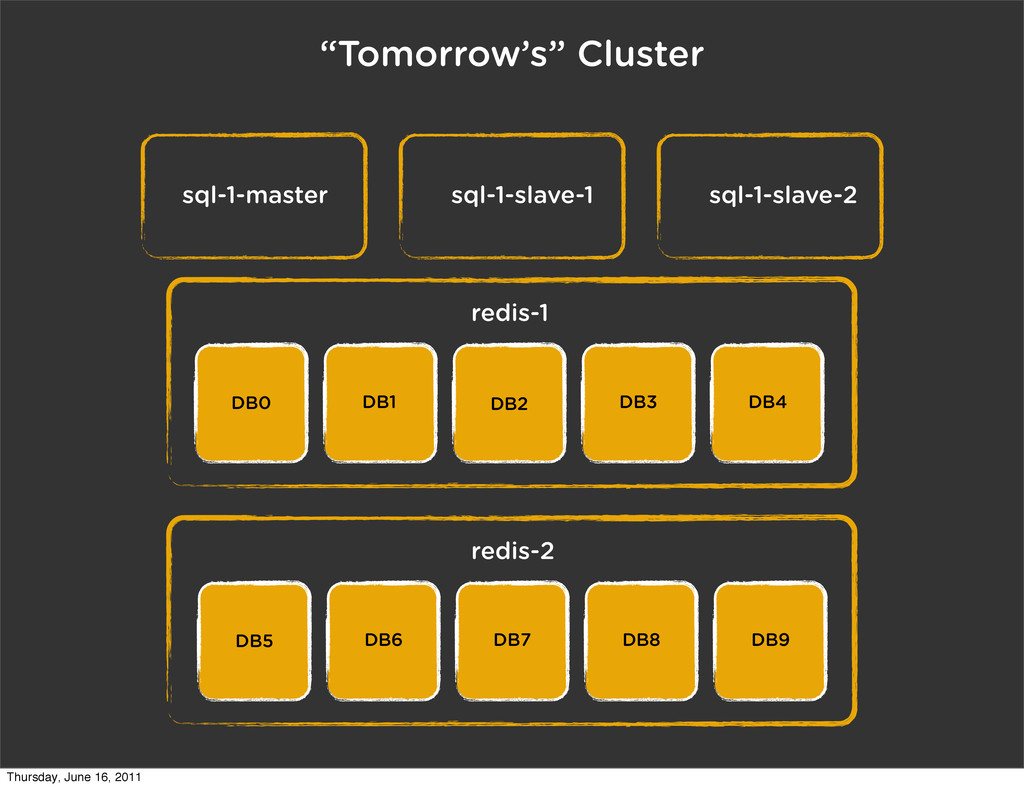
redis-2 “Tomorrow’s” Cluster DB5 DB6 DB7 DB8 DB9 DB0 DB1
DB2 DB3 DB4 redis-1 sql-1-master sql-1-slave-1 sql-1-slave-2 Thursday, June 16, 2011 -
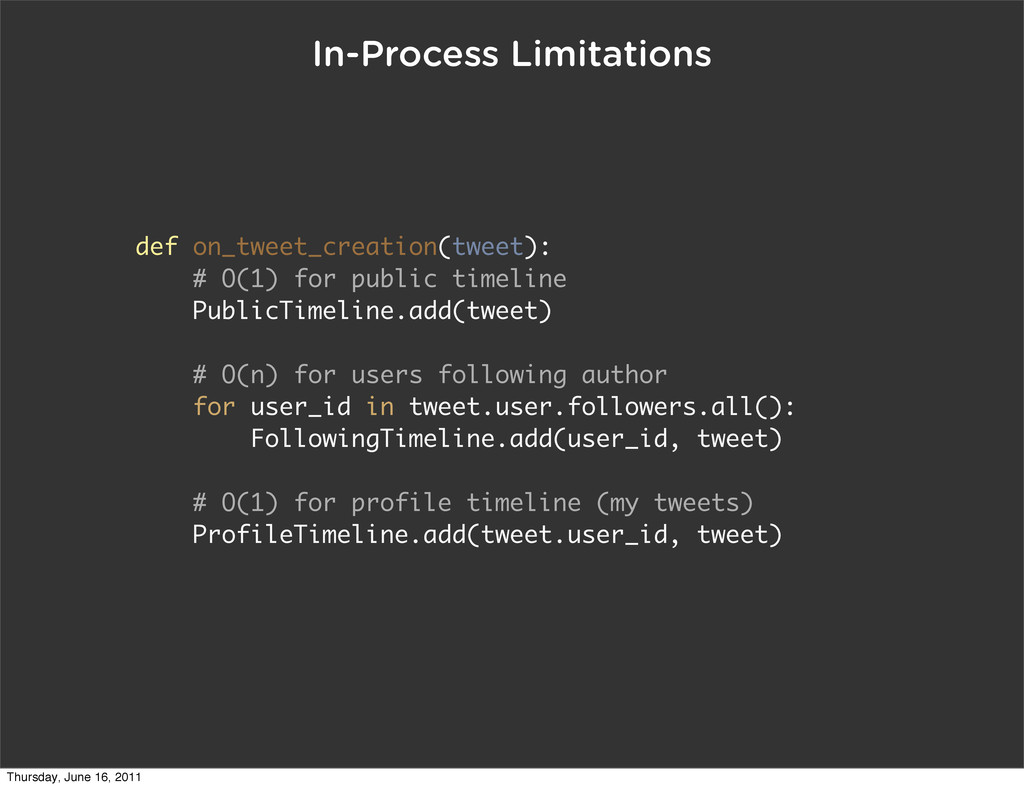
In-Process Limitations def on_tweet_creation(tweet): # O(1) for public timeline PublicTimeline.add(tweet)
# O(n) for users following author for user_id in tweet.user.followers.all(): FollowingTimeline.add(user_id, tweet) # O(1) for profile timeline (my tweets) ProfileTimeline.add(tweet.user_id, tweet) Thursday, June 16, 2011 -
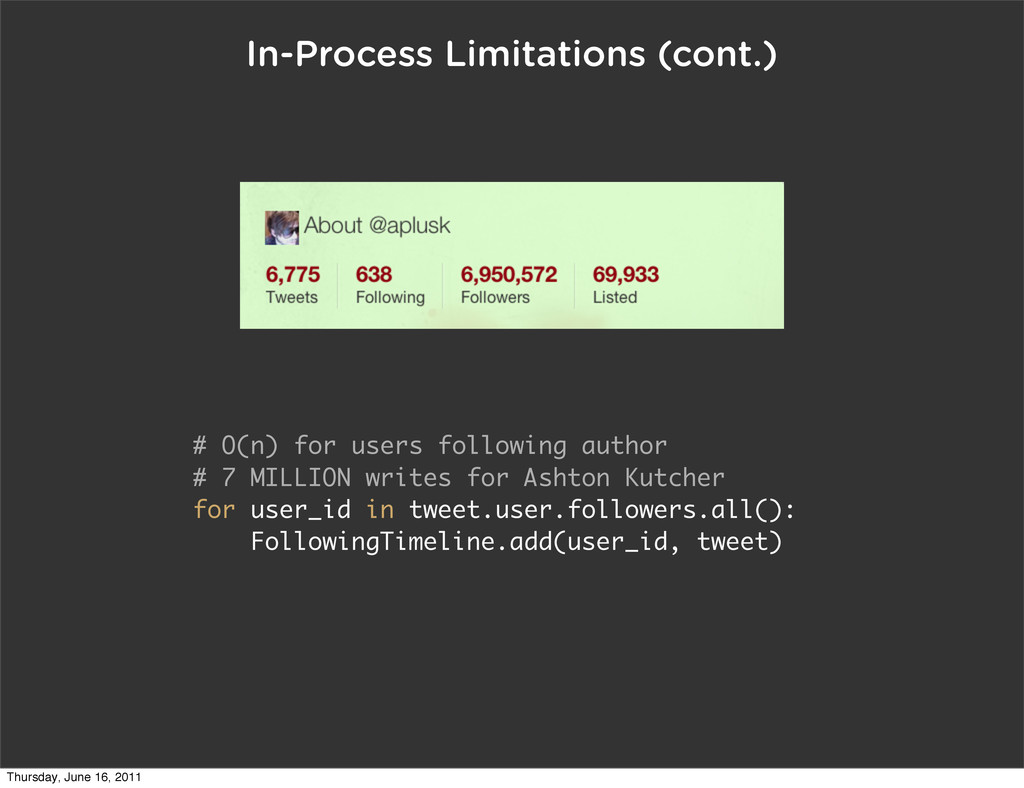
In-Process Limitations (cont.) # O(n) for users following author #
7 MILLION writes for Ashton Kutcher for user_id in tweet.user.followers.all(): FollowingTimeline.add(user_id, tweet) Thursday, June 16, 2011 -
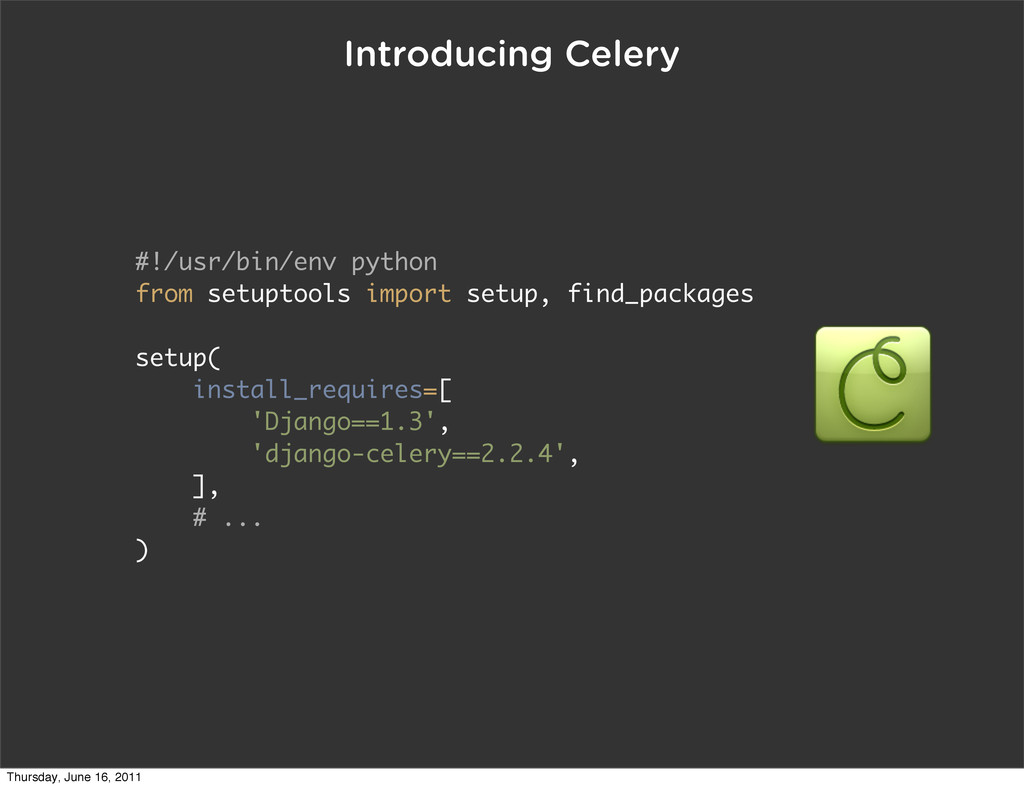
Introducing Celery #!/usr/bin/env python from setuptools import setup, find_packages setup(
install_requires=[ 'Django==1.3', 'django-celery==2.2.4', ], # ... ) Thursday, June 16, 2011 -
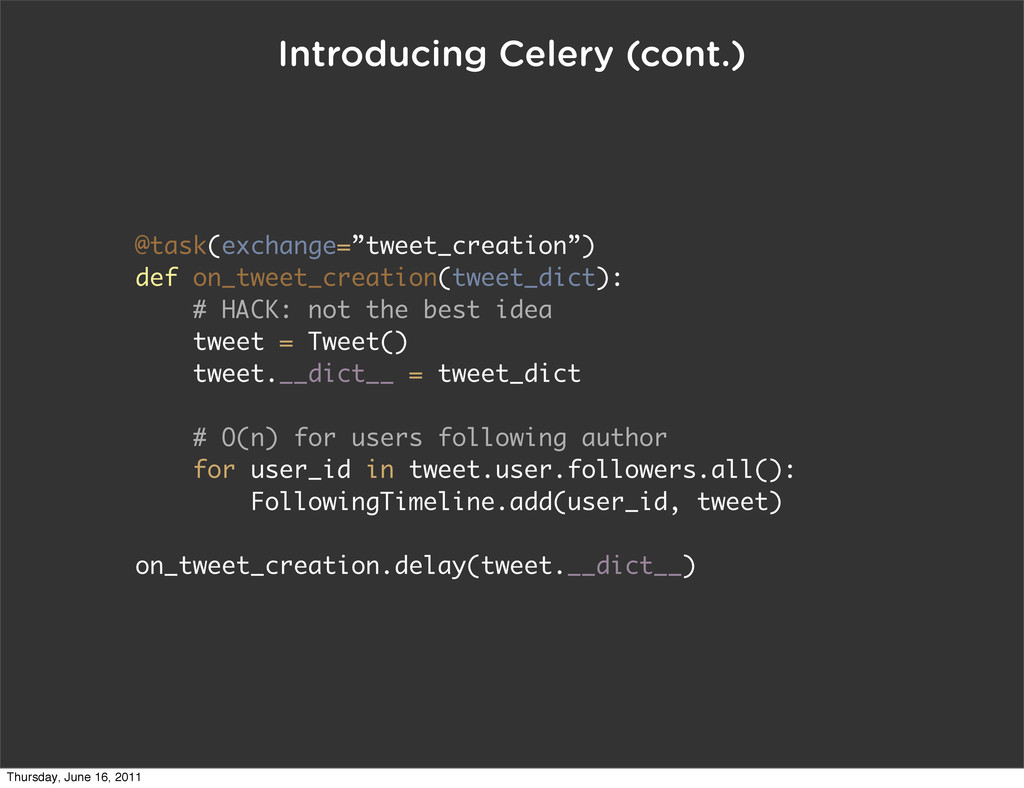
Introducing Celery (cont.) @task(exchange=”tweet_creation”) def on_tweet_creation(tweet_dict): # HACK: not the
best idea tweet = Tweet() tweet.__dict__ = tweet_dict # O(n) for users following author for user_id in tweet.user.followers.all(): FollowingTimeline.add(user_id, tweet) on_tweet_creation.delay(tweet.__dict__) Thursday, June 16, 2011 -
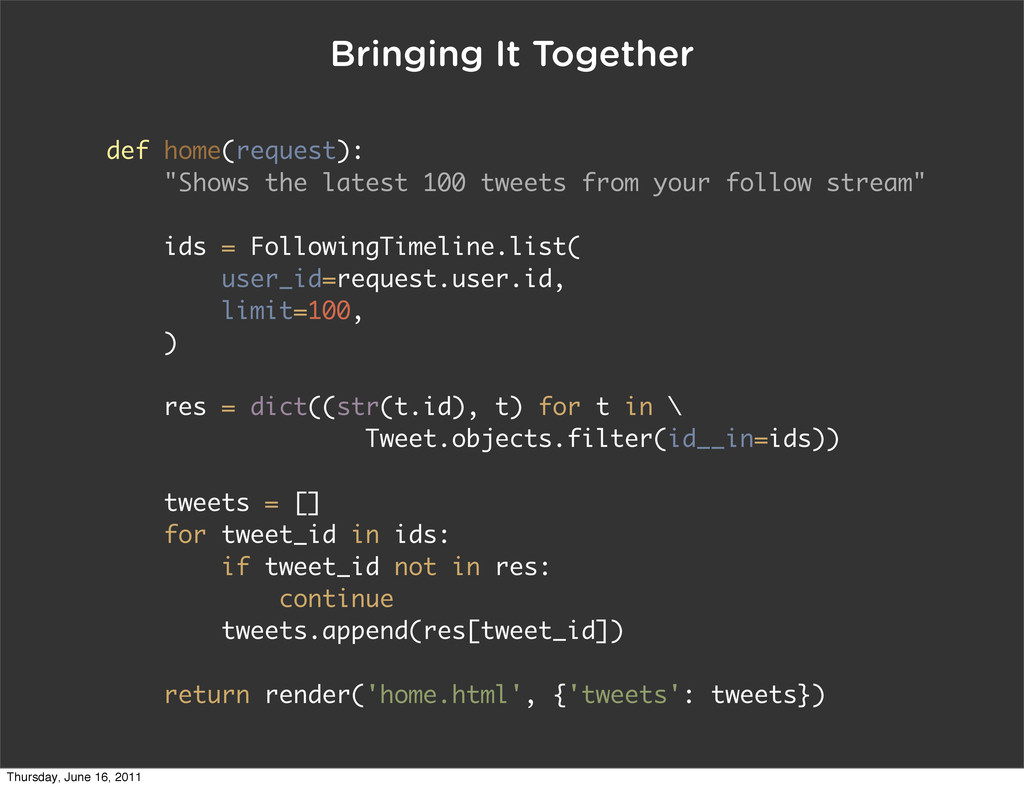
Bringing It Together def home(request): "Shows the latest 100 tweets
from your follow stream" ids = FollowingTimeline.list( user_id=request.user.id, limit=100, ) res = dict((str(t.id), t) for t in \ Tweet.objects.filter(id__in=ids)) tweets = [] for tweet_id in ids: if tweet_id not in res: continue tweets.append(res[tweet_id]) return render('home.html', {'tweets': tweets}) Thursday, June 16, 2011 -
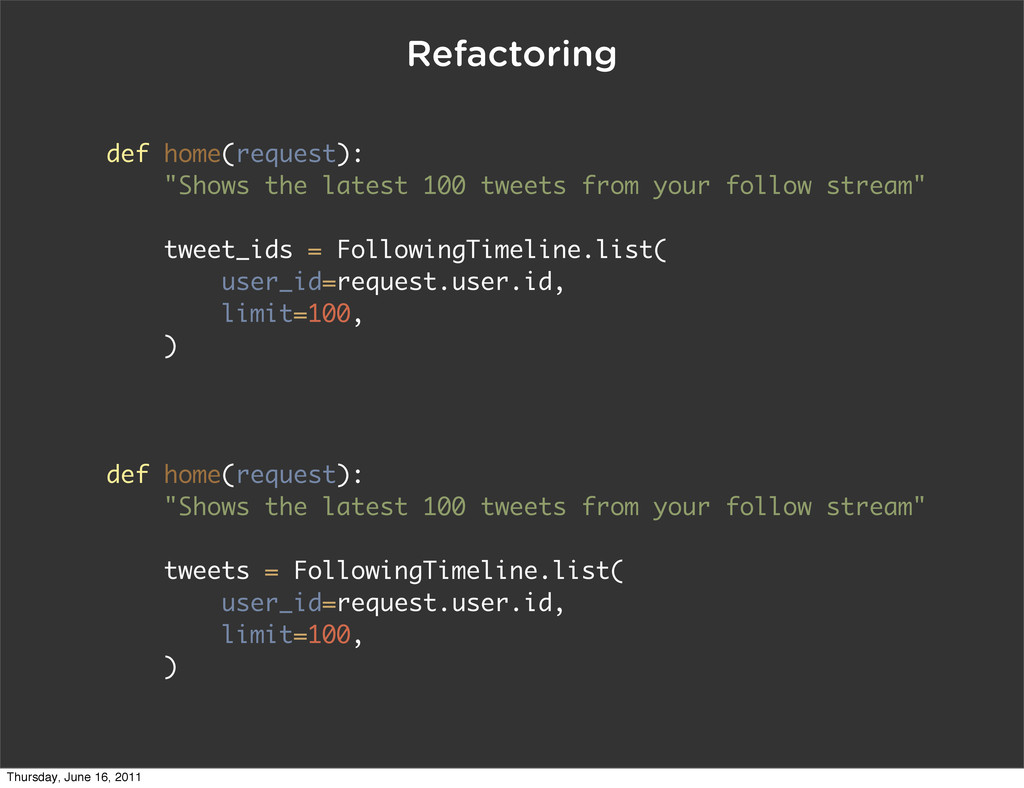
Refactoring def home(request): "Shows the latest 100 tweets from your
follow stream" tweet_ids = FollowingTimeline.list( user_id=request.user.id, limit=100, ) def home(request): "Shows the latest 100 tweets from your follow stream" tweets = FollowingTimeline.list( user_id=request.user.id, limit=100, ) Thursday, June 16, 2011 -
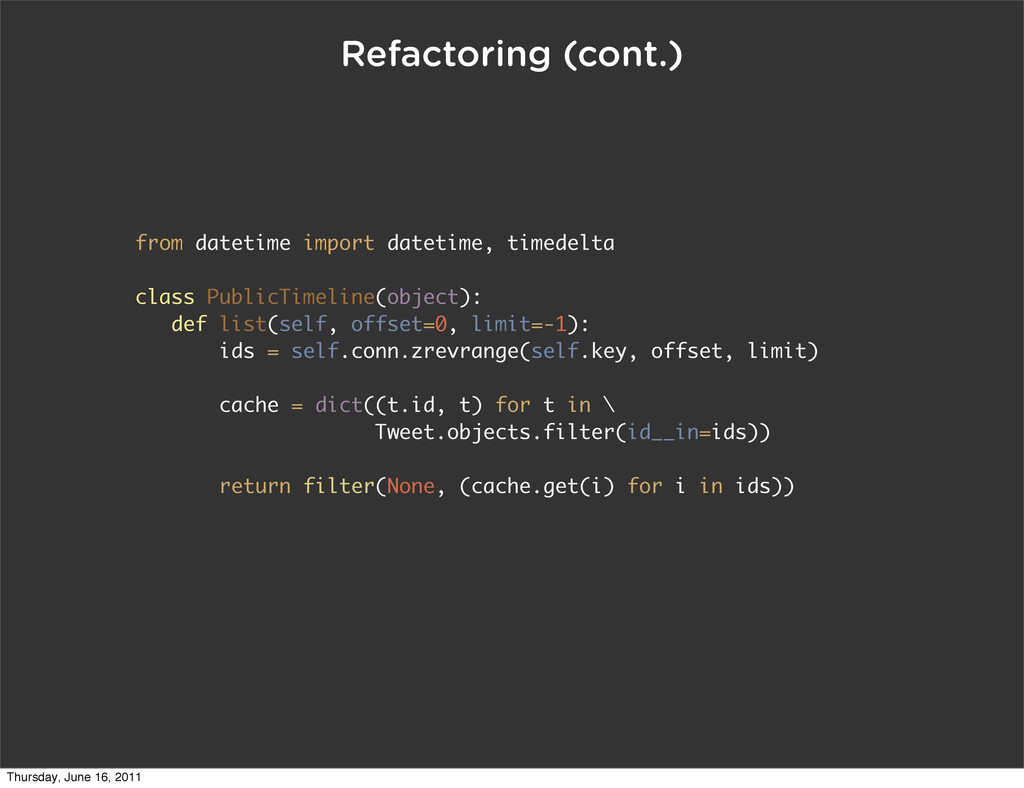
Refactoring (cont.) from datetime import datetime, timedelta class PublicTimeline(object): def
list(self, offset=0, limit=-1): ids = self.conn.zrevrange(self.key, offset, limit) cache = dict((t.id, t) for t in \ Tweet.objects.filter(id__in=ids)) return filter(None, (cache.get(i) for i in ids)) Thursday, June 16, 2011 -
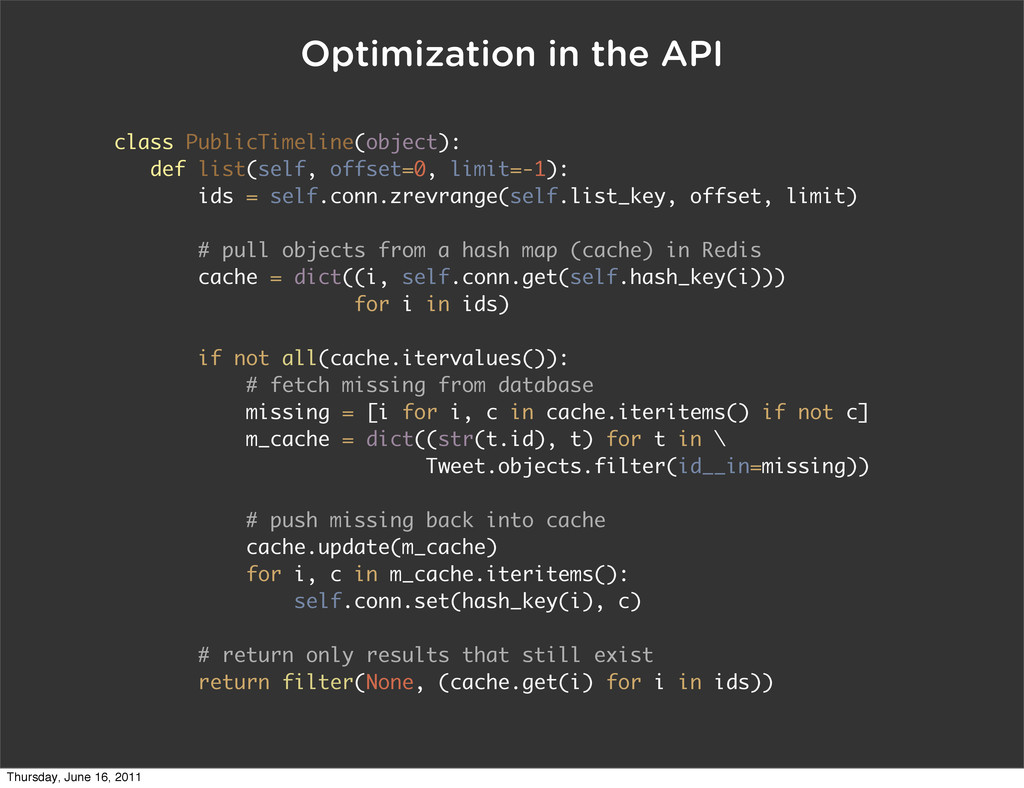
Optimization in the API class PublicTimeline(object): def list(self, offset=0, limit=-1):
ids = self.conn.zrevrange(self.list_key, offset, limit) # pull objects from a hash map (cache) in Redis cache = dict((i, self.conn.get(self.hash_key(i))) for i in ids) if not all(cache.itervalues()): # fetch missing from database missing = [i for i, c in cache.iteritems() if not c] m_cache = dict((str(t.id), t) for t in \ Tweet.objects.filter(id__in=missing)) # push missing back into cache cache.update(m_cache) for i, c in m_cache.iteritems(): self.conn.set(hash_key(i), c) # return only results that still exist return filter(None, (cache.get(i) for i in ids)) Thursday, June 16, 2011 -
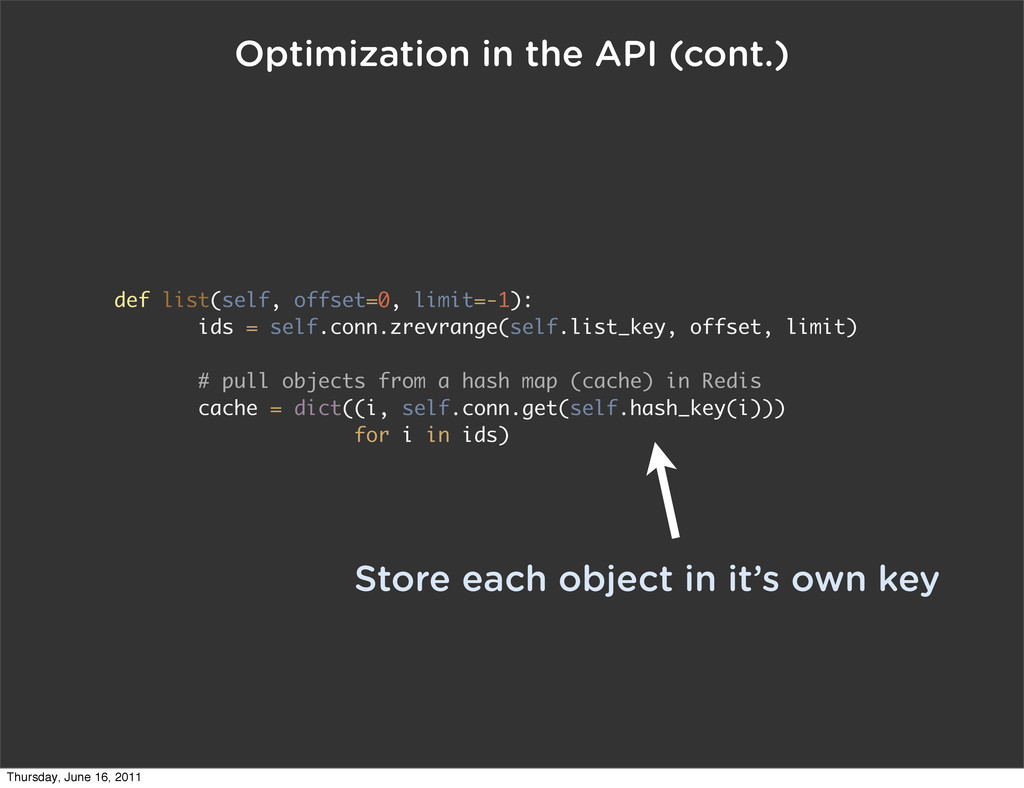
Optimization in the API (cont.) def list(self, offset=0, limit=-1): ids
= self.conn.zrevrange(self.list_key, offset, limit) # pull objects from a hash map (cache) in Redis cache = dict((i, self.conn.get(self.hash_key(i))) for i in ids) Store each object in it’s own key Thursday, June 16, 2011 -
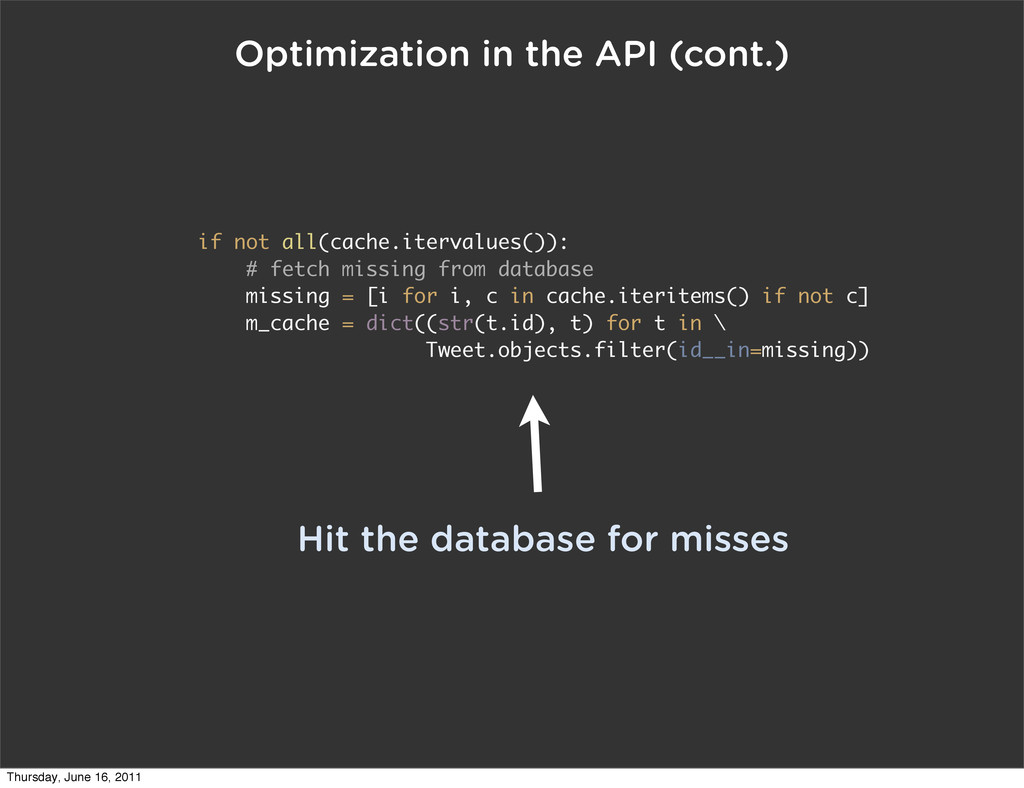
Optimization in the API (cont.) if not all(cache.itervalues()): # fetch
missing from database missing = [i for i, c in cache.iteritems() if not c] m_cache = dict((str(t.id), t) for t in \ Tweet.objects.filter(id__in=missing)) Hit the database for misses Thursday, June 16, 2011 -
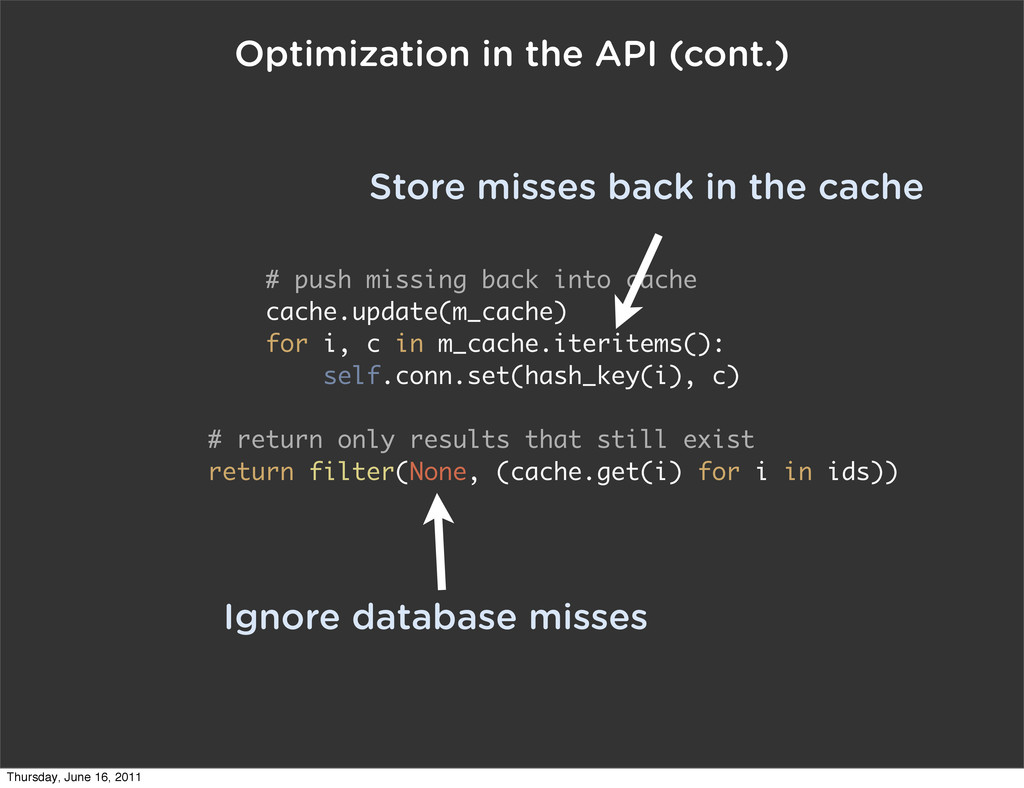
Optimization in the API (cont.) # push missing back into
cache cache.update(m_cache) for i, c in m_cache.iteritems(): self.conn.set(hash_key(i), c) # return only results that still exist return filter(None, (cache.get(i) for i in ids)) Store misses back in the cache Ignore database misses Thursday, June 16, 2011 -
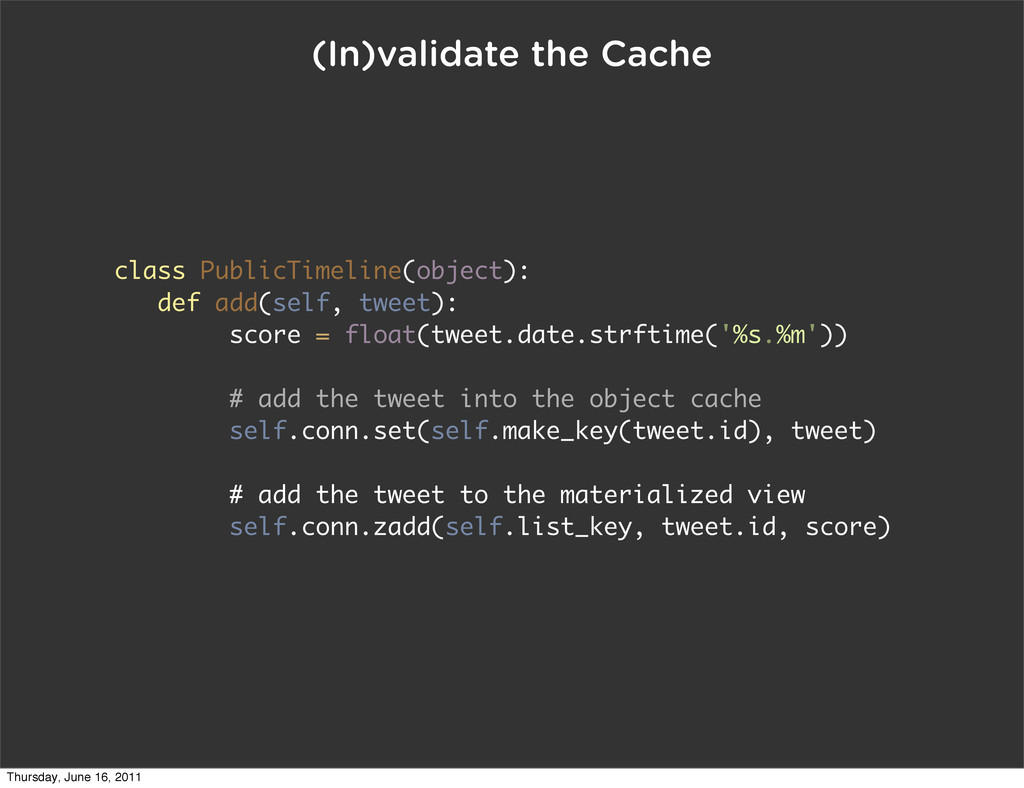
(In)validate the Cache class PublicTimeline(object): def add(self, tweet): score =
float(tweet.date.strftime('%s.%m')) # add the tweet into the object cache self.conn.set(self.make_key(tweet.id), tweet) # add the tweet to the materialized view self.conn.zadd(self.list_key, tweet.id, score) Thursday, June 16, 2011 -
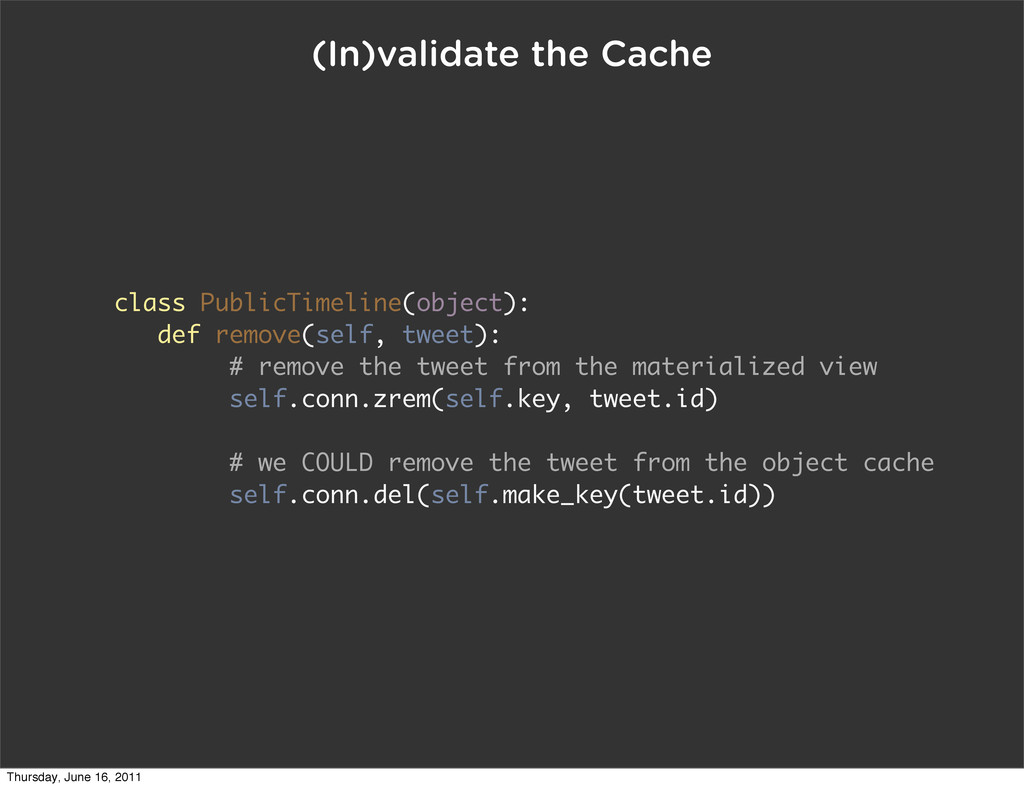
(In)validate the Cache class PublicTimeline(object): def remove(self, tweet): # remove
the tweet from the materialized view self.conn.zrem(self.key, tweet.id) # we COULD remove the tweet from the object cache self.conn.del(self.make_key(tweet.id)) Thursday, June 16, 2011 -
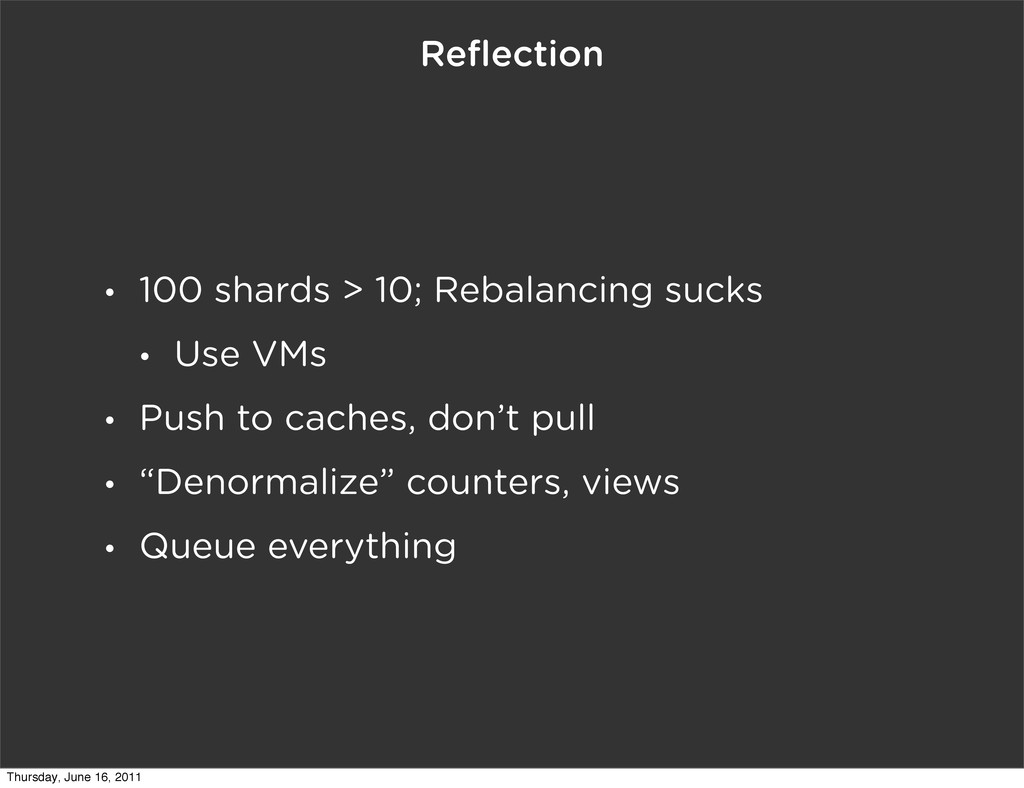
Reflection • 100 shards > 10; Rebalancing sucks • Use
VMs • Push to caches, don’t pull • “Denormalize” counters, views • Queue everything Thursday, June 16, 2011