Share
Embed
Cluster sampling
Cluster Sampling is a probability sampling method.
In simple words - Instead of selecting individual people, you select *groups (clusters)
Aiswarya M
October 25, 2026
Transcript
35 slides
-
M.Ed Seminar Cluster Sampling Methodology, statistical foundations and educational applications
Advanced Research Methodology & Educational Statistics Tom Titto Valley M.Ed · NSS Training College, Ottapalam -
What is cluster sampling? • Core Definition: A probability sampling
technique where a target population is divided into naturally occurring groups called clusters. • Primary Unit: The sampling unit is the entire cluster (group), not individual students or teachers. • Main Purpose: Solves logistical challenges when studying large, geographically dispersed educational populations. -
Definition Of Cluster Sampling Cluster sampling is a sampling method
where a large group (the population) is divided into smaller naturally existing groups called clusters. Researchers then randomly choose a few of these clusters to study. -
Basic principles of cluster sampling • Within-Cluster Variance: Ideally, each
cluster should be a mini-representation of the overall population (heterogeneous internally). • Between-Cluster Variance: Clusters should look as similar to each other as possible (homogeneous externally). • Randomization: Clusters must be selected using random sampling methods to maintain scientific validity. -
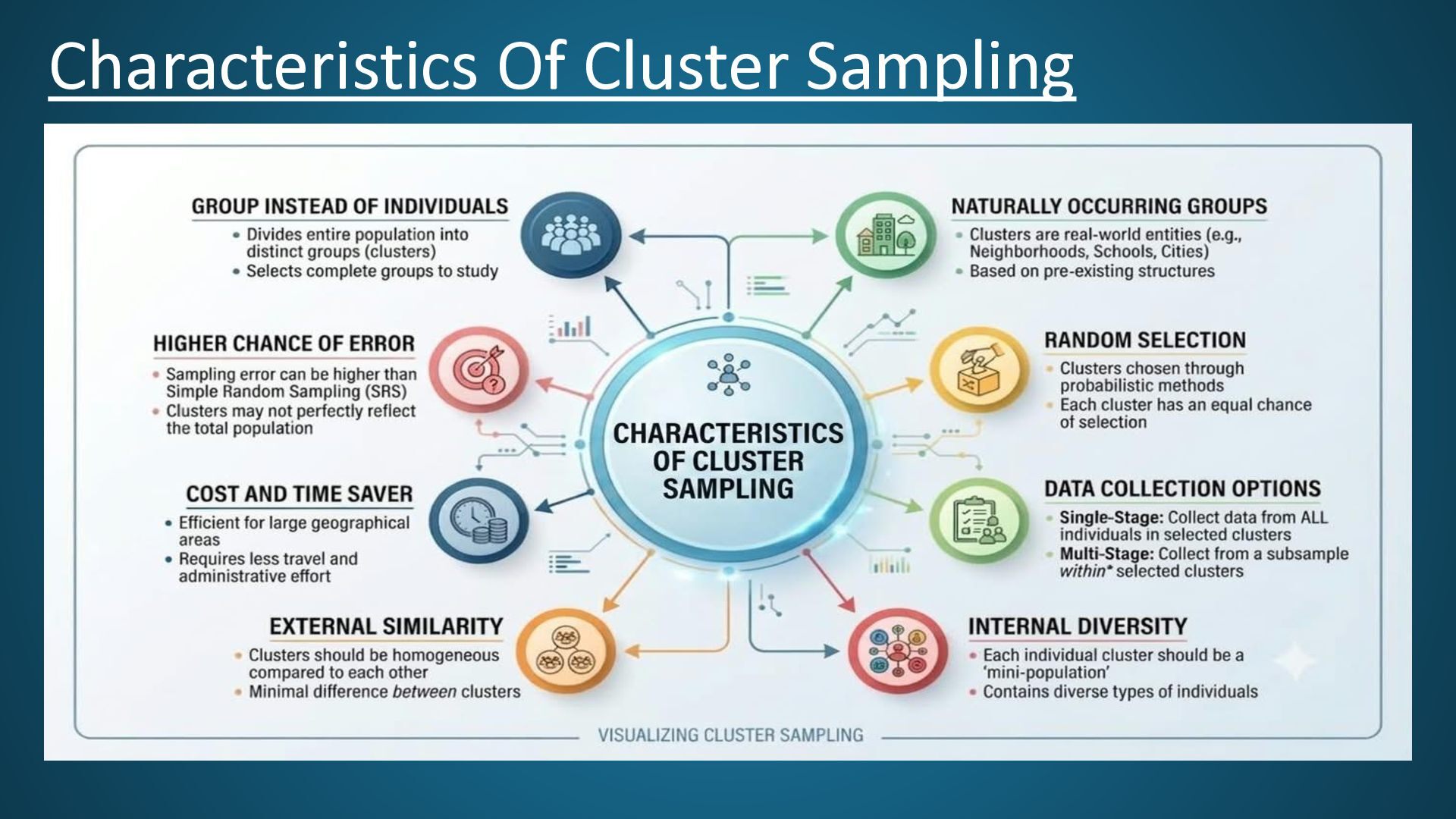
Characteristics Of Cluster Sampling 1. Groups instead of individuals: Instead
of picking single people one by one, you divide the whole population into groups (called clusters). 2. Naturally occurring groups: The clusters are usually based on natural divisions like schools, cities, neighborhoods, or companies. 3. Random selection: You use a random lottery method to pick which entire clusters to include in your study. -
Characteristics Of Cluster Sampling 4. Internal diversity: Each individual cluster
should ideally be a miniversion of the whole population, containing a wide mix of different people. 5. External similarity: All the clusters should look fairly similar to one another overall. 6. Data collection options: Once a cluster is picked, you either survey everyone inside it (single-stage) or a random subgroup inside it (two-stage). -
Characteristics Of Cluster Sampling 7. Cost and time saver: It
requires far less traveling, time, and money compared to finding individuals scattered randomly across a huge area. 8. Higher chance of error: People inside the same cluster (like the same school or neighborhood) often share similar traits, which can make your overall results slightly less accurate than pure random sampling. -
Research Objectives of Cluster Sampling 1.Reduce Data Collection Costs: Minimize
total survey expenditure by grouping interviews/assessments within localized geographical areas or existing organizations. 2.Optimize Logistics & Time Efficiency: Streamline field movement and administrative effort when studying large, widely scattered populations. 3.Study Hard-to-Reach Populations: Enable structured sampling when a complete list of every single individual in the target population is unavailable. -
Research Objectives of Cluster Sampling. 4.Evaluate Group-Level Dynamics: Analyze patterns,
behaviors, or outcomes within naturally existing units (e.g., classrooms, neighborhoods, or hospital wards). 5.Enable Multi-Stage Research Design: Structure complex multistep studies where primary sampling units (clusters) are selected before individual respondents. -
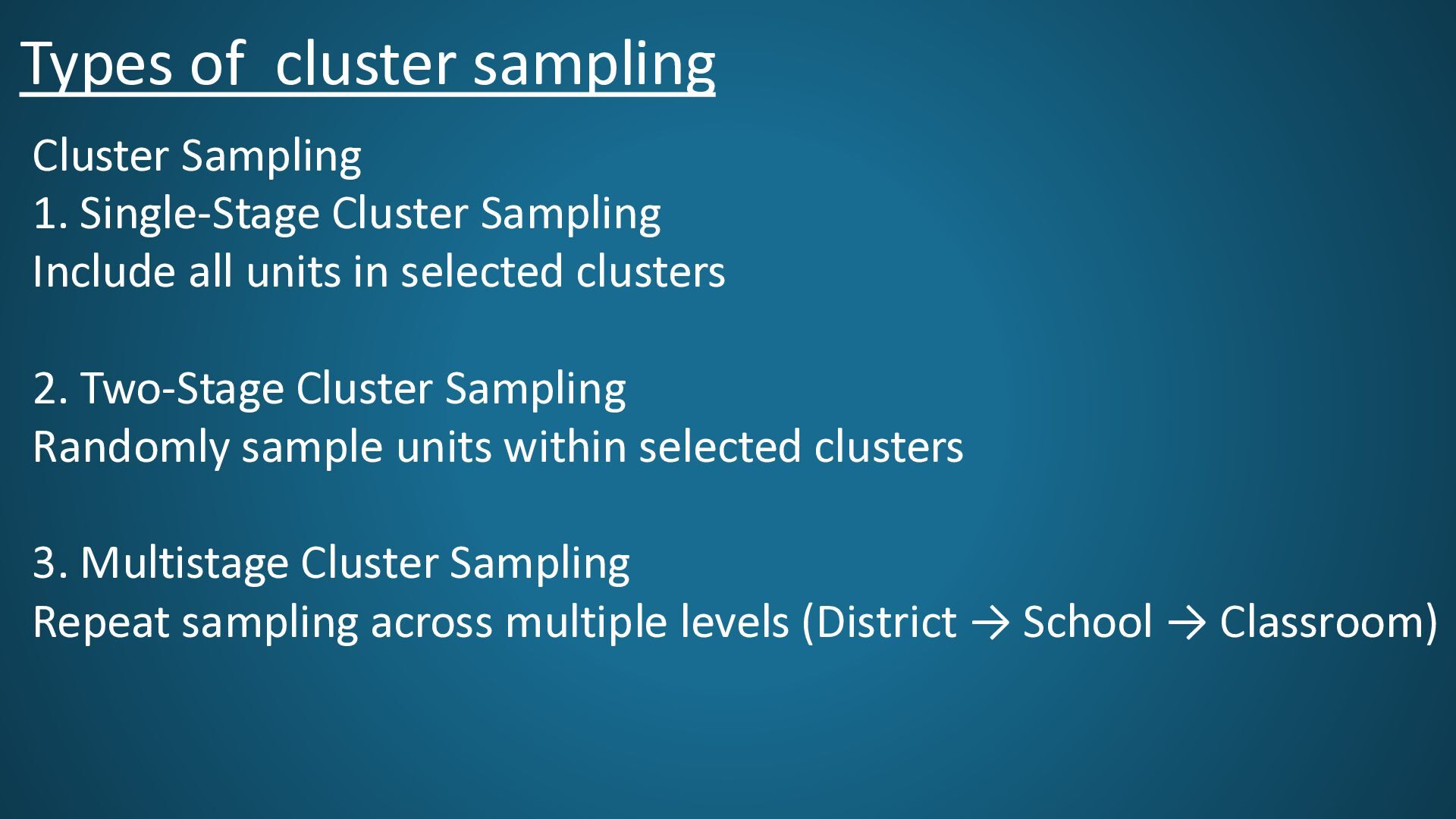
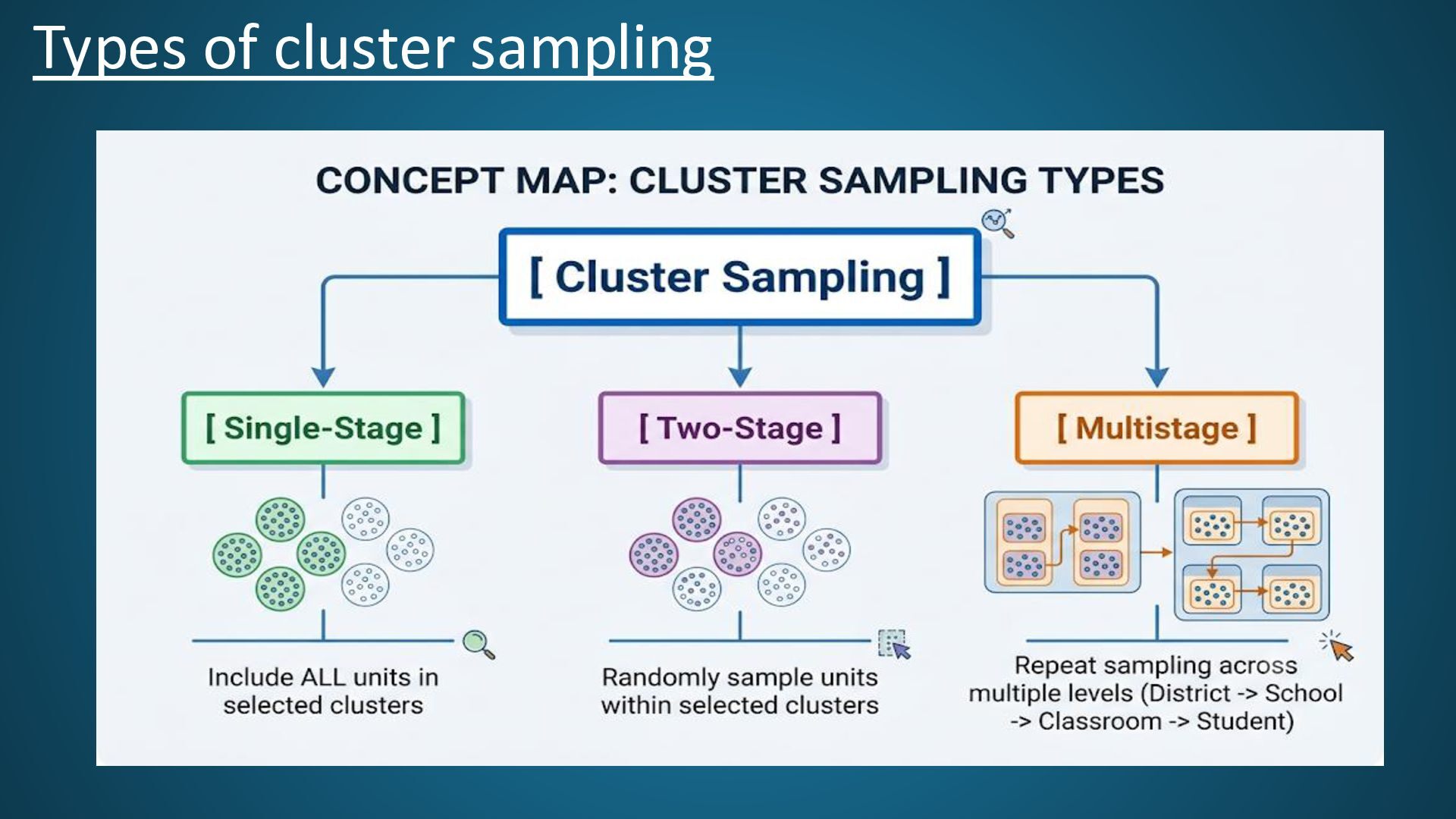
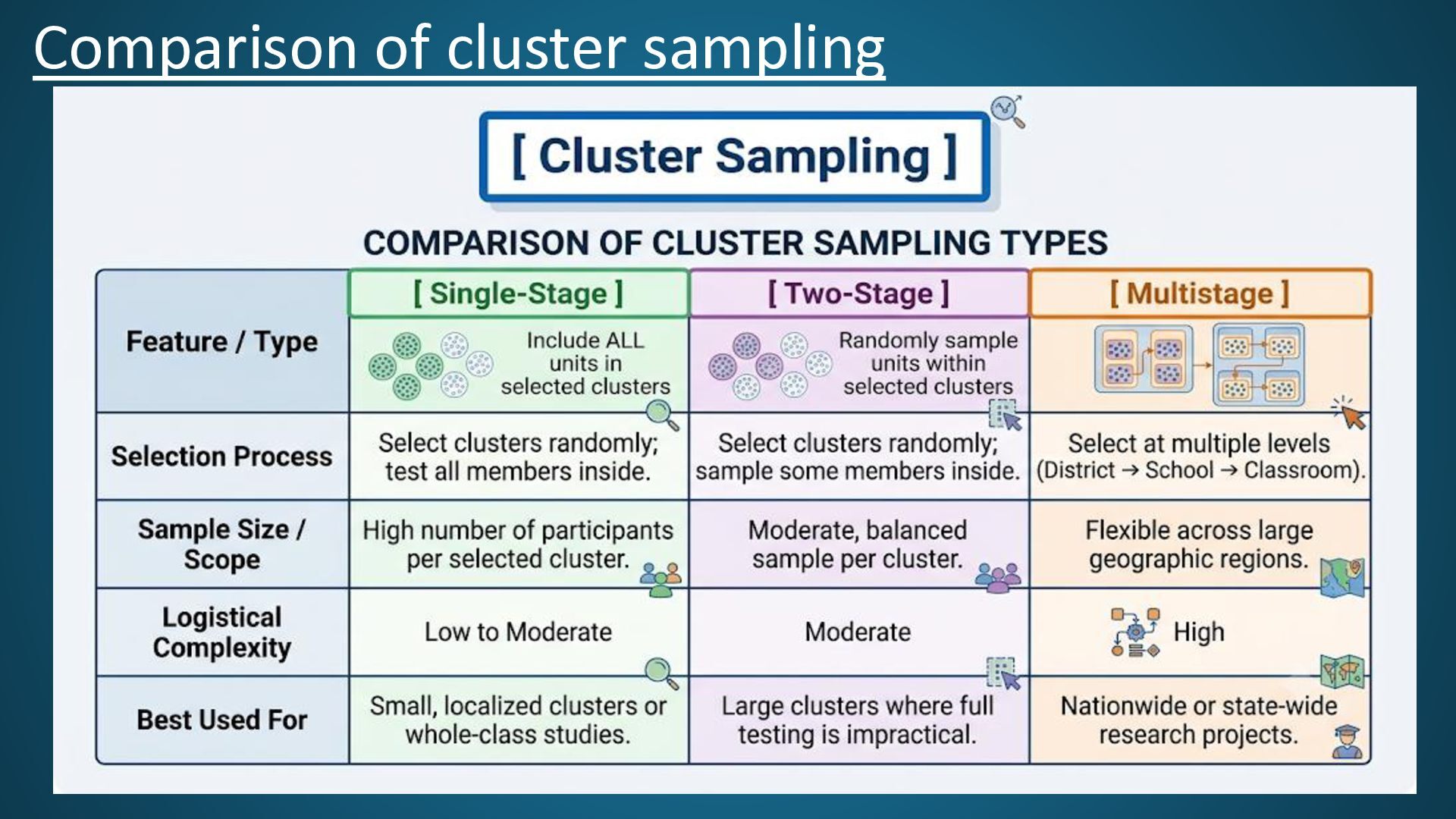
Types of cluster sampling Cluster Sampling 1. Single-Stage Cluster Sampling
Include all units in selected clusters 2. Two-Stage Cluster Sampling Randomly sample units within selected clusters 3. Multistage Cluster Sampling Repeat sampling across multiple levels (District → School → Classroom) -
Step-by-step procedure: Steps1:Define target population Example: All 5th-grade public school
students in a specific state. Steps2: Identify and list clusters Compile a comprehensive sampling frame of all available units (e.g., a list of all 200 public elementary schools in that state). -
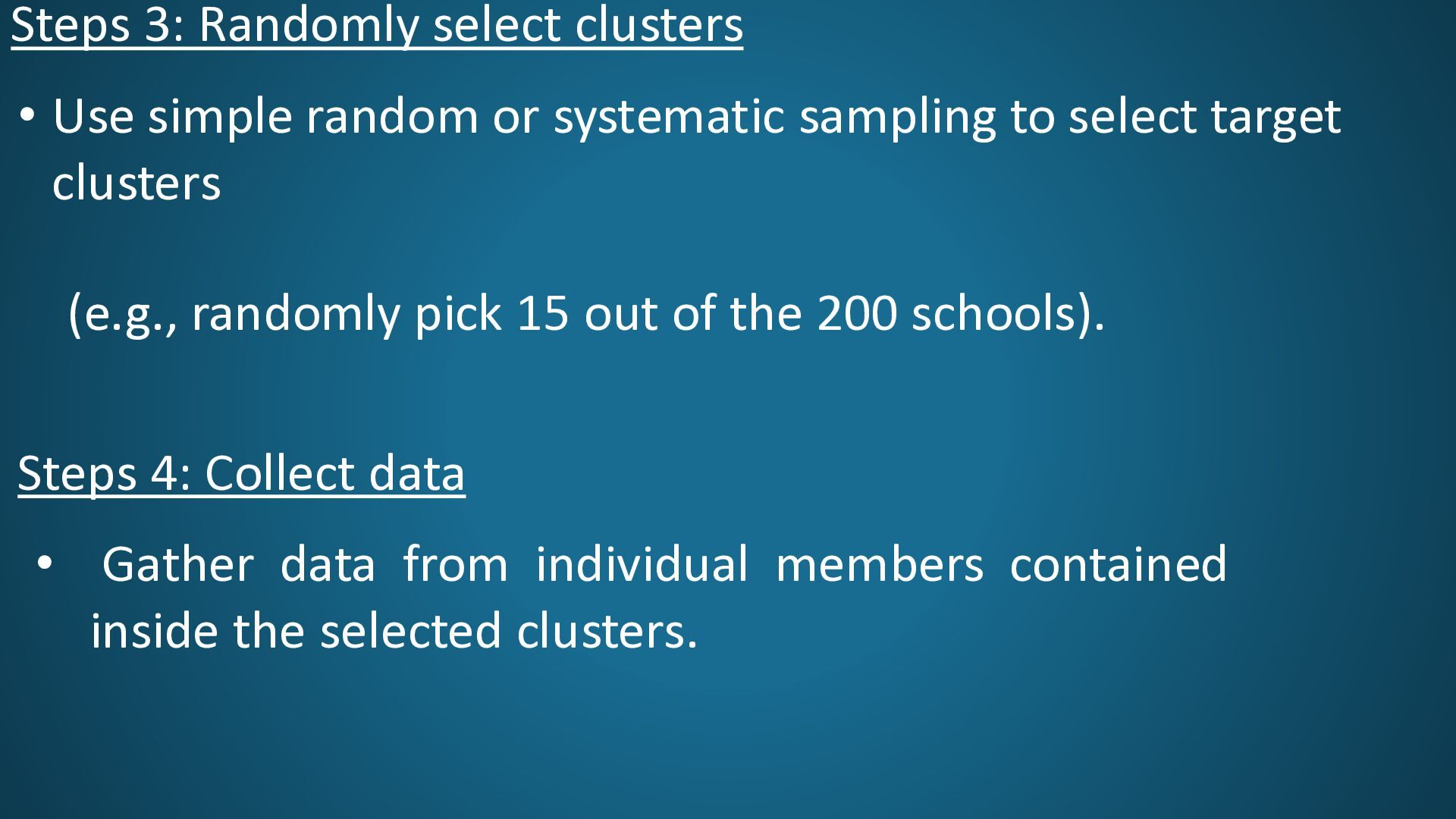
Steps 3: Randomly select clusters • Use simple random or
systematic sampling to select target clusters (e.g., randomly pick 15 out of the 200 schools). Steps 4: Collect data • Gather data from individual members contained inside the selected clusters. -
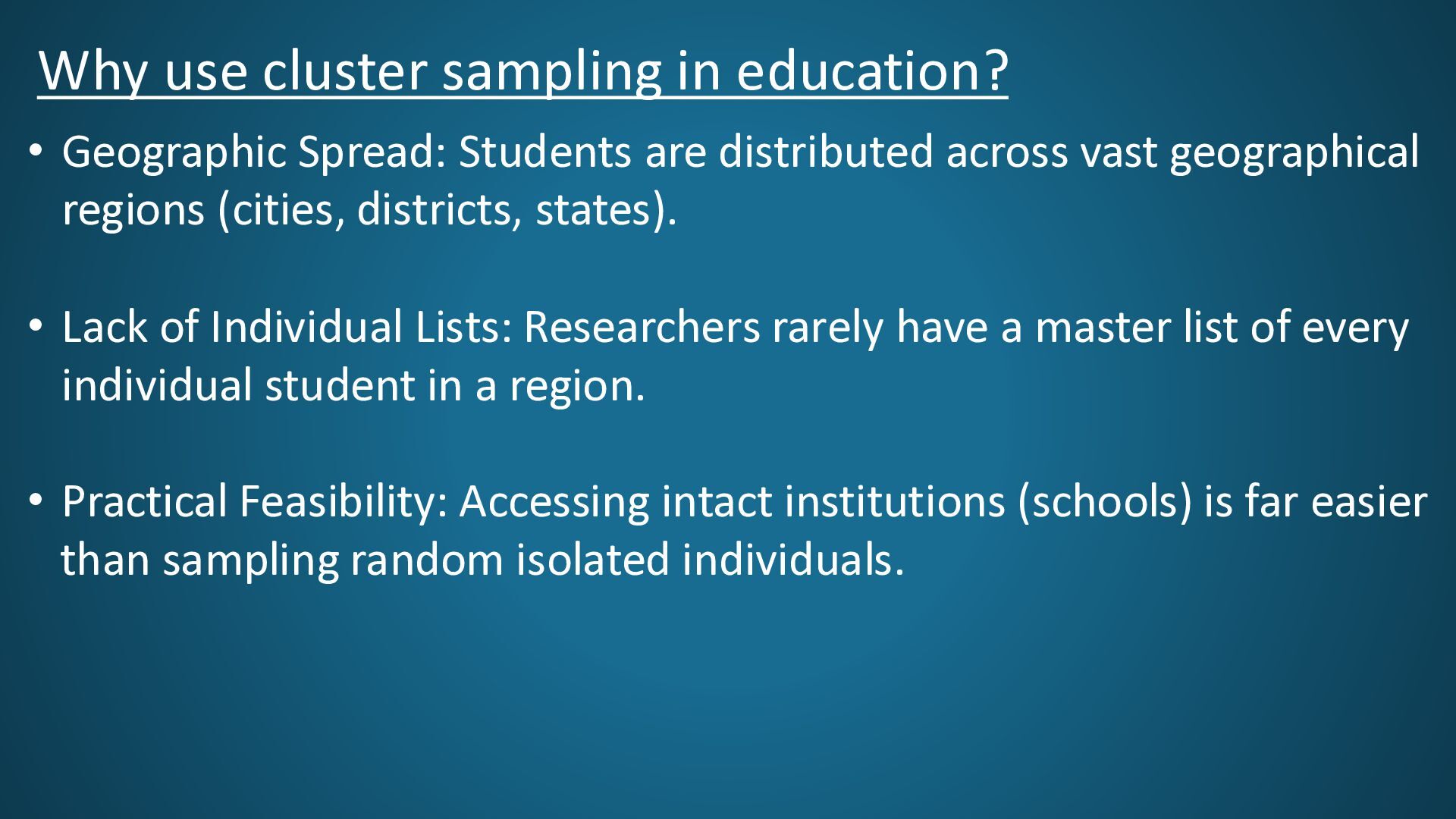
Why use cluster sampling in education? • Geographic Spread: Students
are distributed across vast geographical regions (cities, districts, states). • Lack of Individual Lists: Researchers rarely have a master list of every individual student in a region. • Practical Feasibility: Accessing intact institutions (schools) is far easier than sampling random isolated individuals. -
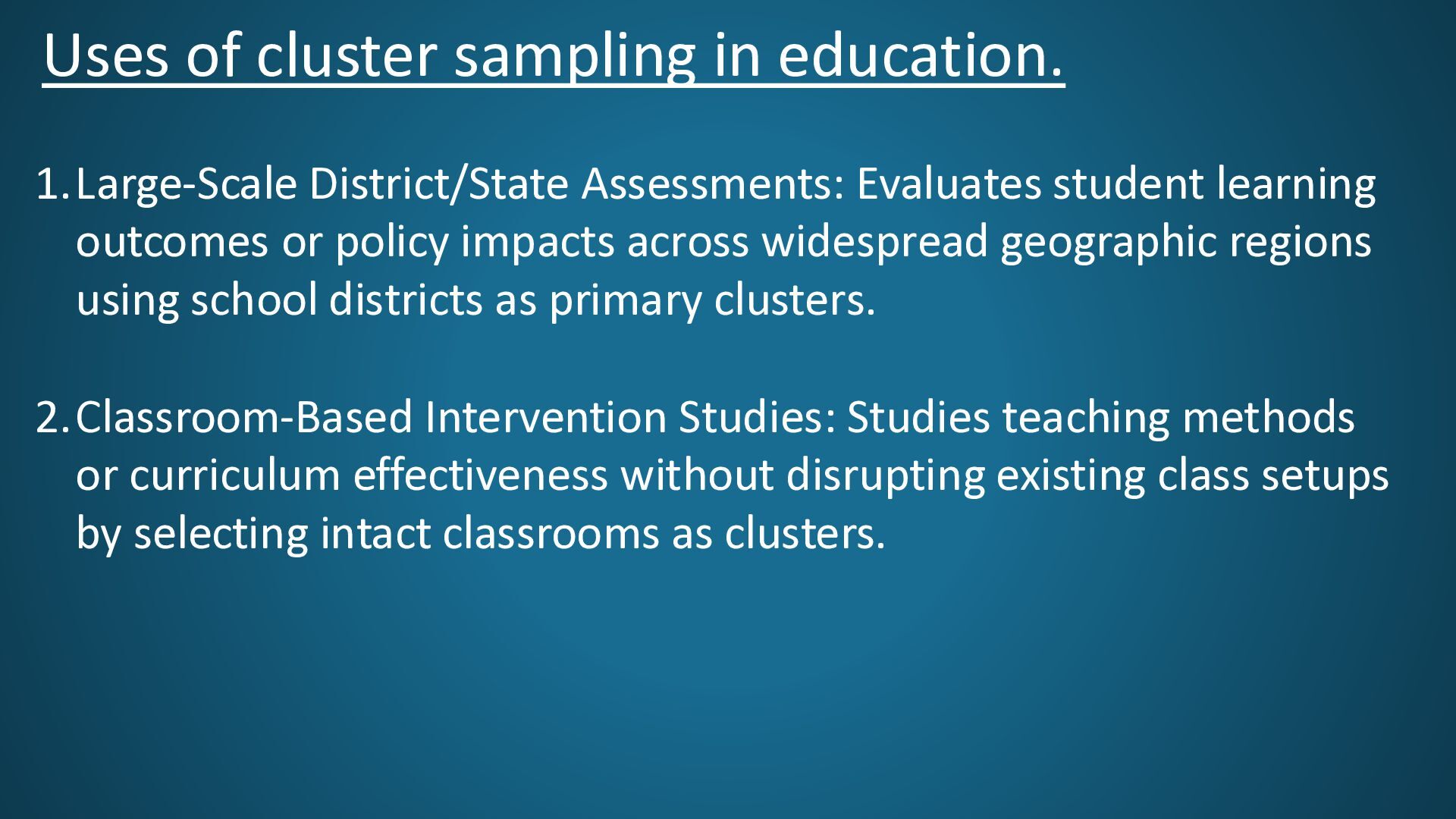
Uses of cluster sampling in education. 1.Large-Scale District/State Assessments: Evaluates
student learning outcomes or policy impacts across widespread geographic regions using school districts as primary clusters. 2.Classroom-Based Intervention Studies: Studies teaching methods or curriculum effectiveness without disrupting existing class setups by selecting intact classrooms as clusters. -
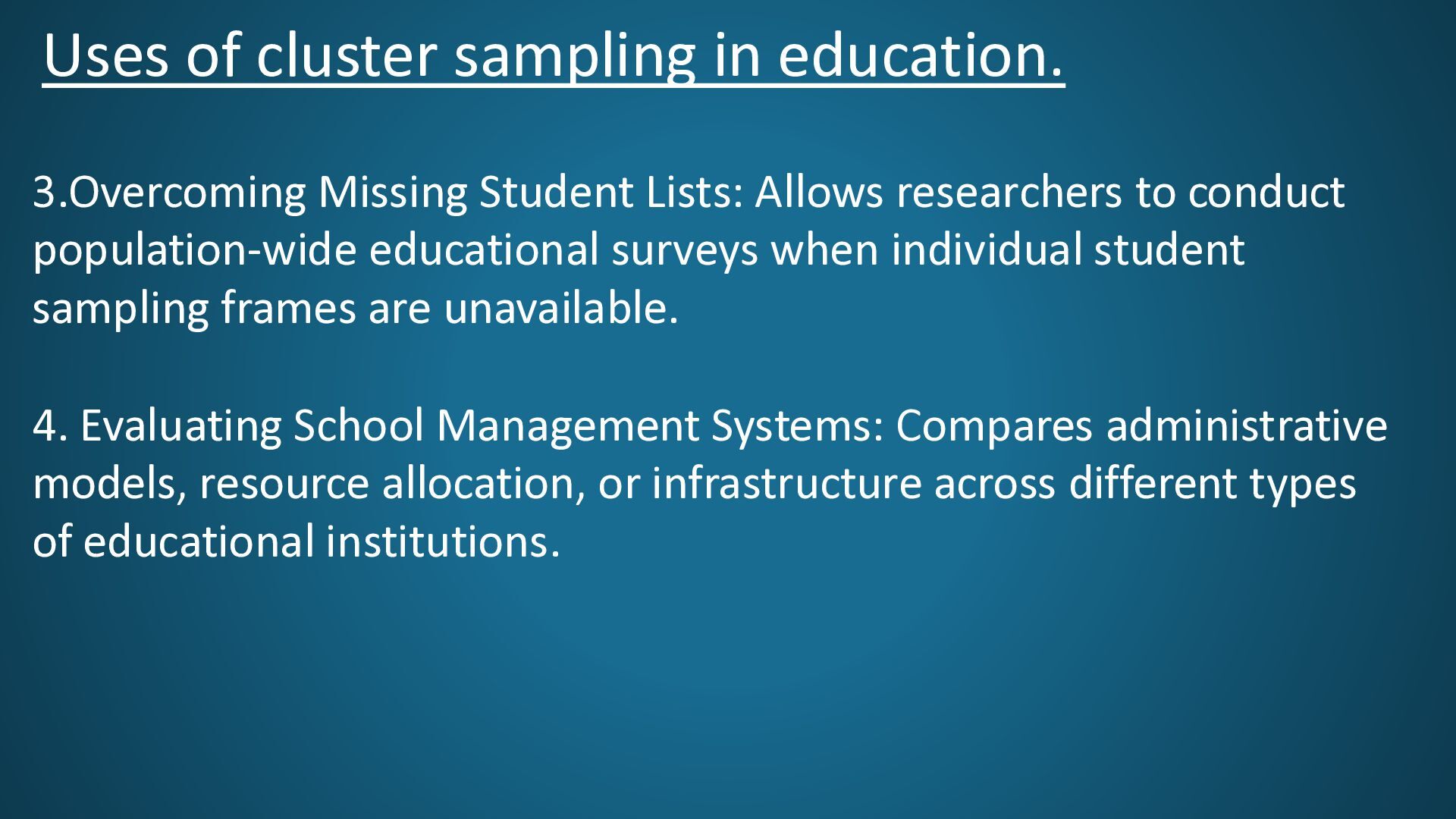
Uses of cluster sampling in education. 3.Overcoming Missing Student Lists:
Allows researchers to conduct population-wide educational surveys when individual student sampling frames are unavailable. 4. Evaluating School Management Systems: Compares administrative models, resource allocation, or infrastructure across different types of educational institutions. -
Uses of cluster sampling in education. 5.Cost-Effective Field Observations: Reduces
researcher travel and logistics budgets when conducting in-person school visits or classroom observations. -
Examples of educational clusters • School Districts: Administrative boundaries spanning
multiple communities. • Individual Schools: Public, private, or charter school buildings. • Classrooms: Specific section groupings (e.g., all 8th-grade Science classrooms). • Geographical Zones: Urban, suburban, and rural school clusters. -
Administrative uses of cluster sampling. 1.Checking how new school programs
work: School leaders use cluster sampling to test new teaching ideas in whole schools instead of picking single students. This saves a lot of time and makes organizing the test much easier for administrators. -
Administrative uses of cluster sampling. 2. Planning budgets and sharing
school supplies: It helps leaders find out what different school areas need, like books, teachers, or equipment. By visiting a few full groups instead of scattered individuals, they save money on travel and work. -
Administrative uses of cluster sampling. 3. Checking if schools follow
official rules: Inspectors use it to check safety and education standards across whole chosen districts. This lets them review how entire areas are doing without needing a huge list of every single child. -
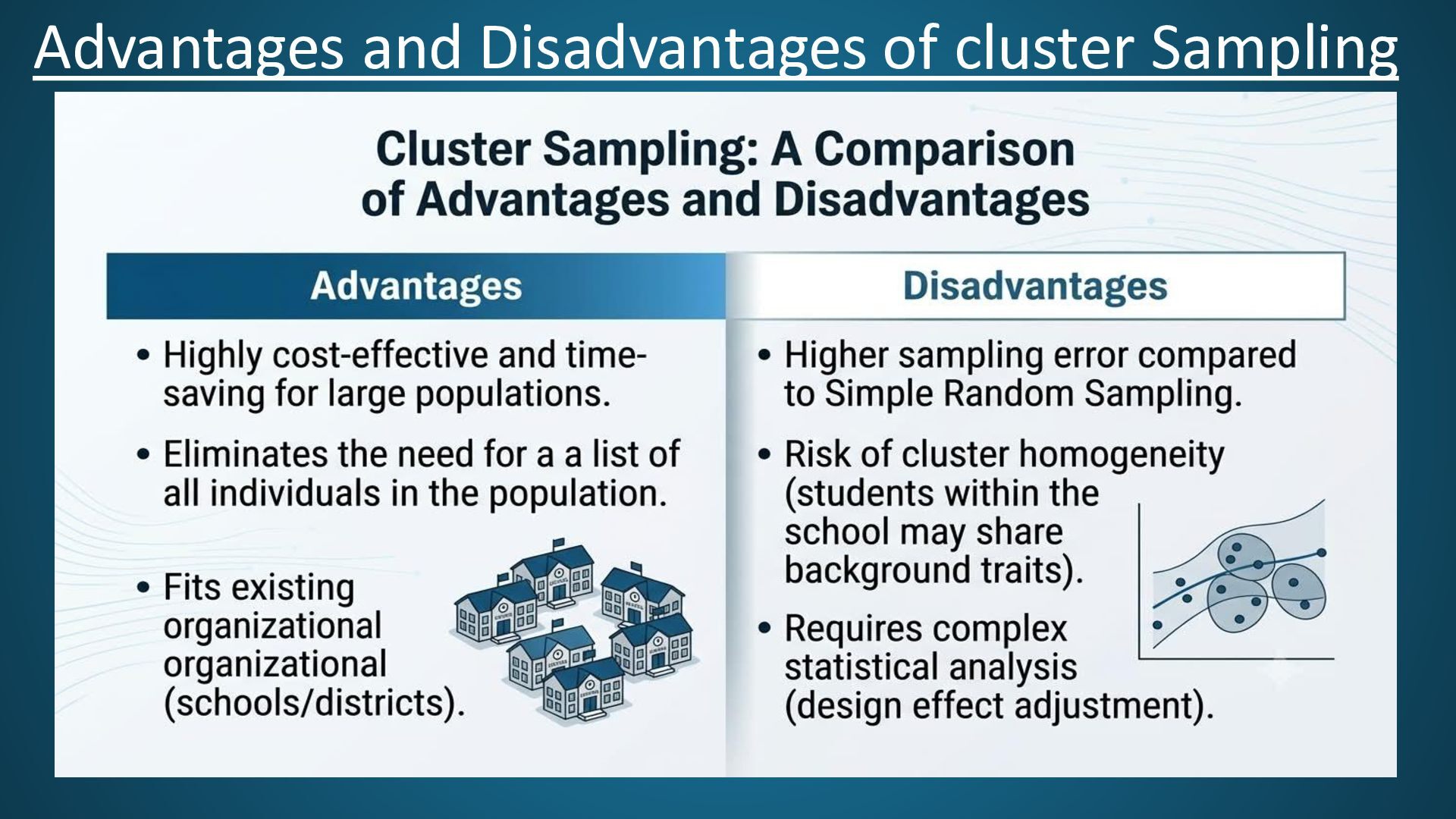
Advantages of cluster sampling Advantages: • Highly cost-effective and time-saving
for large populations. • Eliminates the need for a list of all individuals in the population. • Fits existing organizational structures (schools/districts). -
Disadvantages of cluster sampling Disadvantages: • Higher sampling error compared
to Simple Random Sampling. • Risk of cluster homogeneity (students within the same school may share similar background traits). • Requires complex statistical analysis (design effect adjustment). -
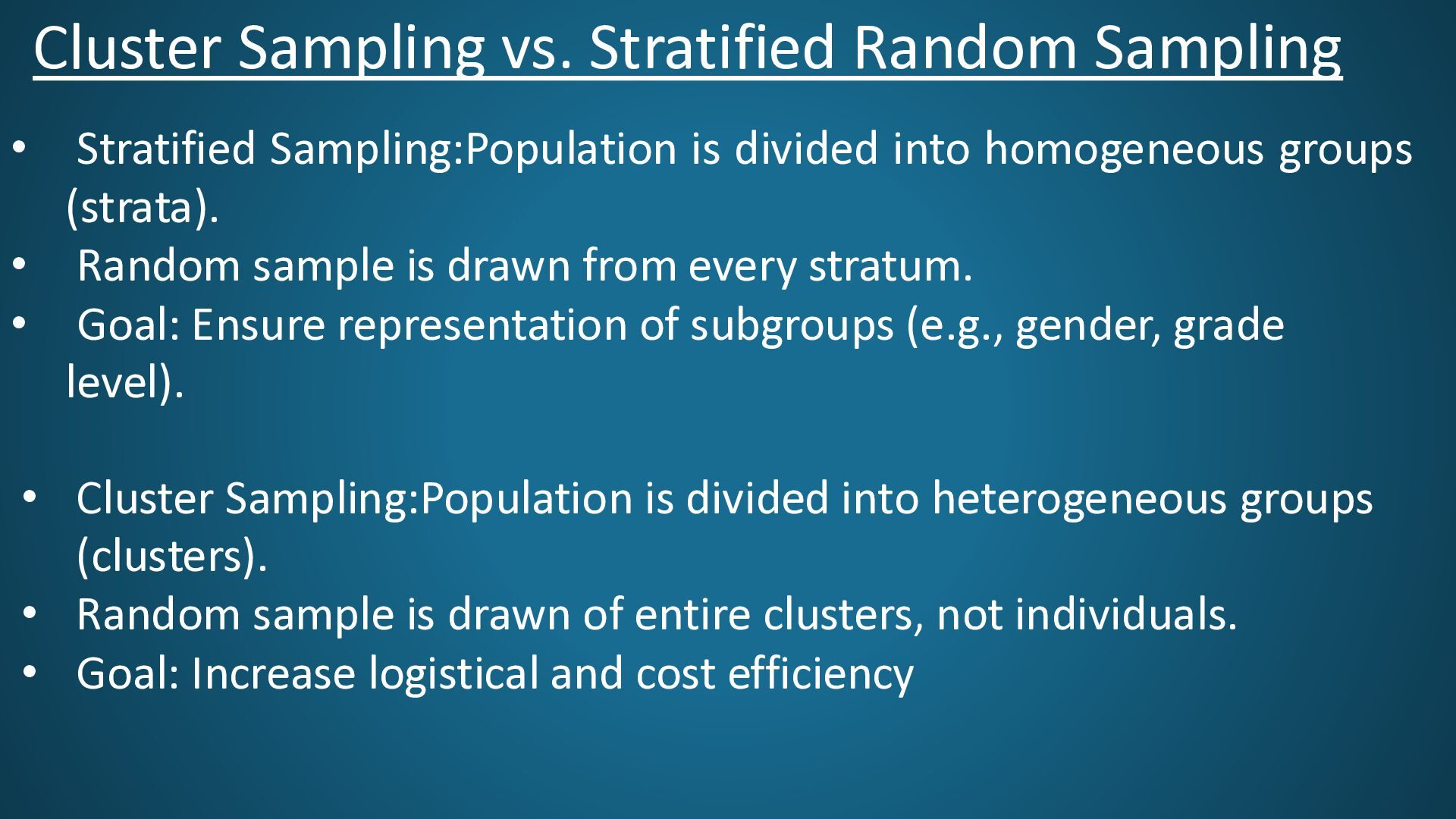
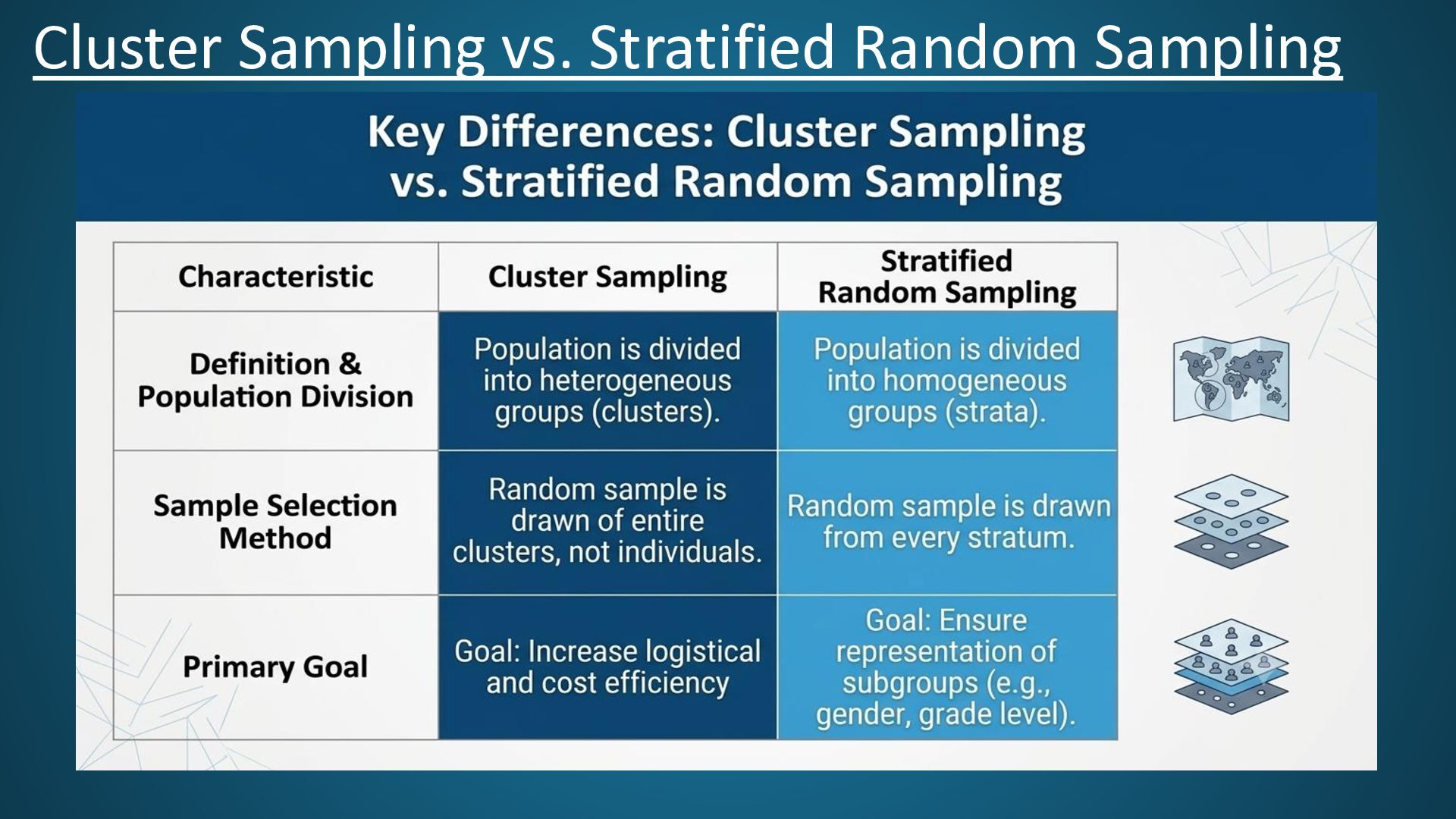
Cluster Sampling vs. Stratified Random Sampling • Stratified Sampling:Population is
divided into homogeneous groups (strata). • Random sample is drawn from every stratum. • Goal: Ensure representation of subgroups (e.g., gender, grade level). • Cluster Sampling:Population is divided into heterogeneous groups (clusters). • Random sample is drawn of entire clusters, not individuals. • Goal: Increase logistical and cost efficiency -
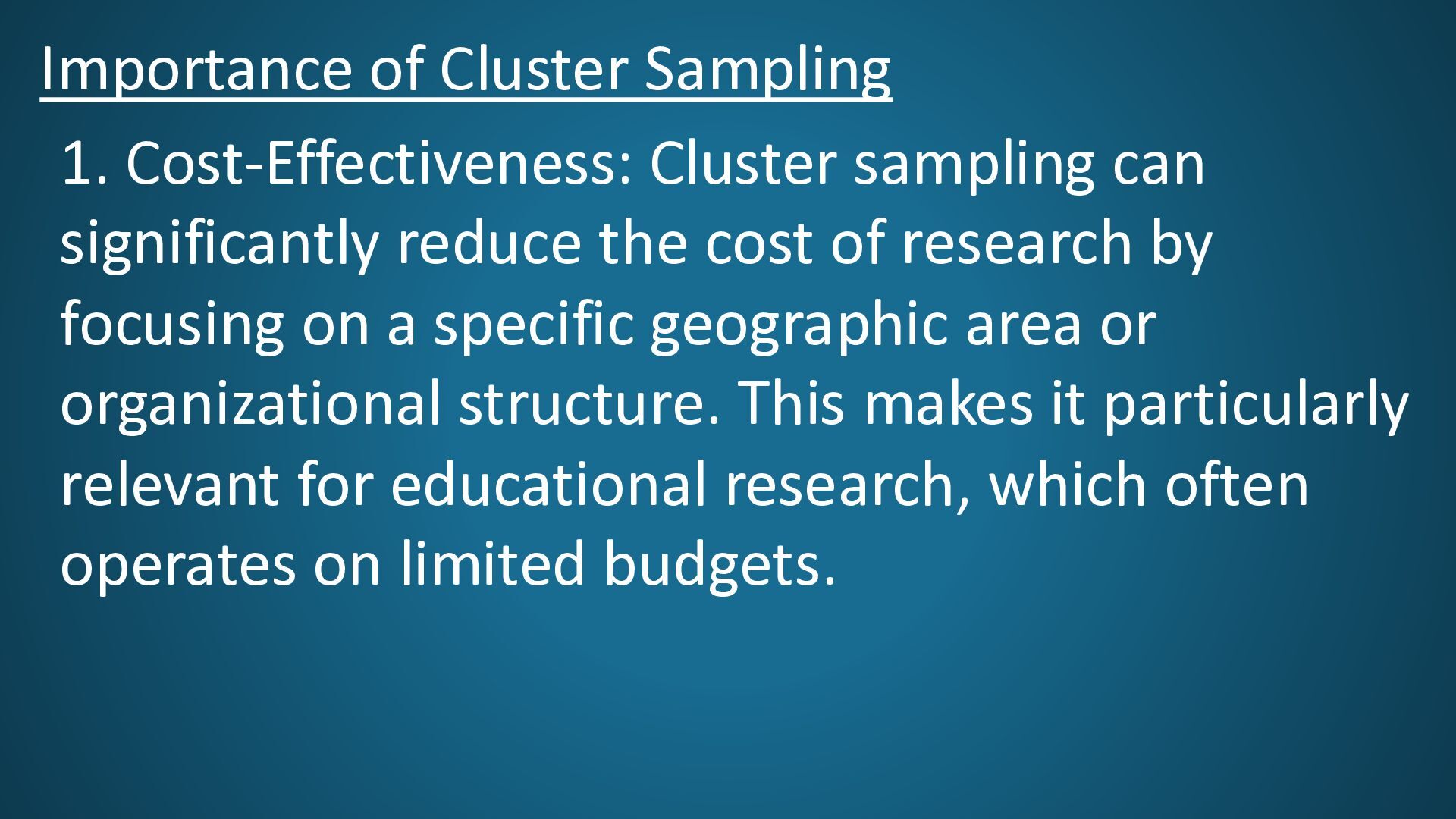
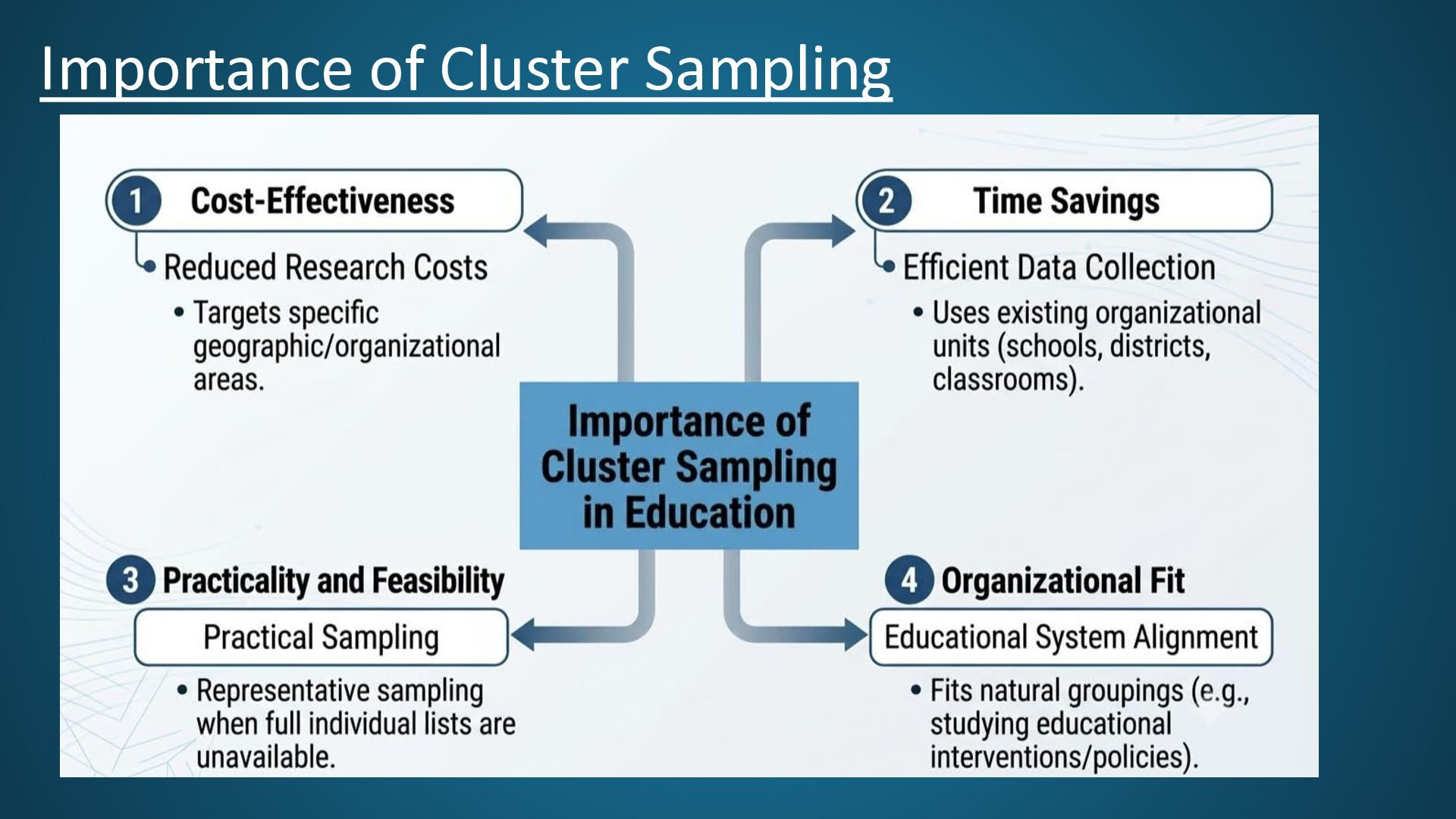
Importance of Cluster Sampling 1. Cost-Effectiveness: Cluster sampling can significantly
reduce the cost of research by focusing on a specific geographic area or organizational structure. This makes it particularly relevant for educational research, which often operates on limited budgets. -
Importance of Cluster Sampling 2. Time Savings: By targeting existing
organizational units (such as schools, districts, or classrooms), cluster sampling can save considerable time compared to other methods that require compiling exhaustive lists of individual students -
Importance of Cluster Sampling 3. Practicality and Feasibility: When it
is difficult or impossible to obtain a complete list of individual students, cluster sampling provides a practical way to collect a representative sample. -
Importance of Cluster Sampling 4. Organizational Fit: The natural groupings
within educational systems make cluster sampling an excellent fit for studying educational interventions and policies. -
conclusion • Cluster sampling lets researchers and administrators easily study
large educational systems by selecting entire groups, like schools or classrooms, instead of individual students. • This approach saves significant time and money while working naturally within existing school structures. • However, it requires careful statistical adjustments because students within the same group often share similar characteristics. -
THANK YOU PRESENTED BY: TOM TITTO VALLEY INSTITUTION: N.S.S. TRAINING
COLLEGE OTTAPALAM CLASS: 1. M.ED.