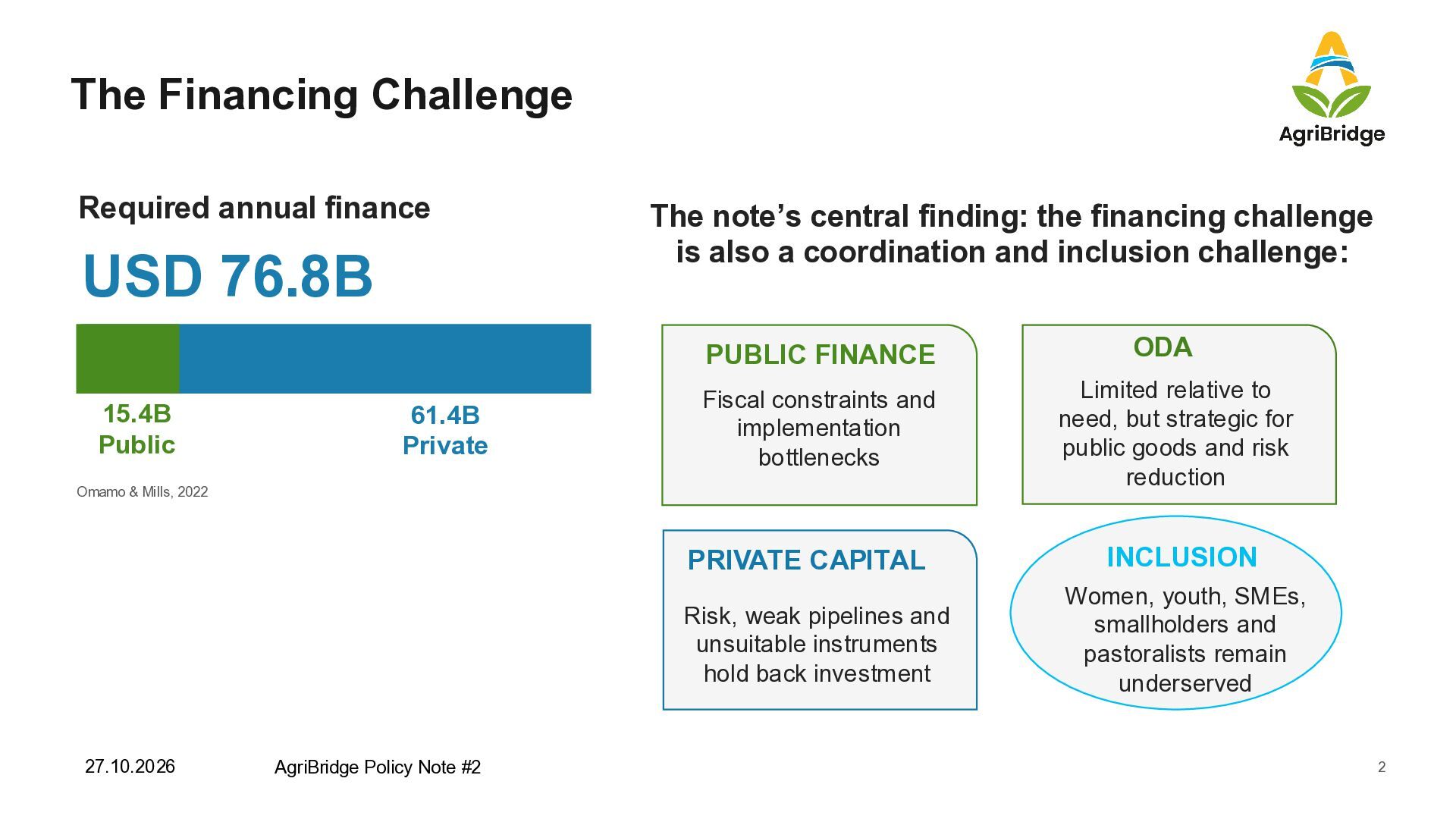
61.4B Private The note’s central finding: the financing challenge is also a coordination and inclusion challenge: PUBLIC FINANCE ODA Fiscal constraints and implementation bottlenecks Limited relative to need, but strategic for public goods and risk reduction PRIVATE CAPITAL INCLUSION Risk, weak pipelines and unsuitable instruments hold back investment Women, youth, SMEs, smallholders and pastoralists remain underserved Omamo & Mills, 2022 27.10.2026 AgriBridge Policy Note #2 2
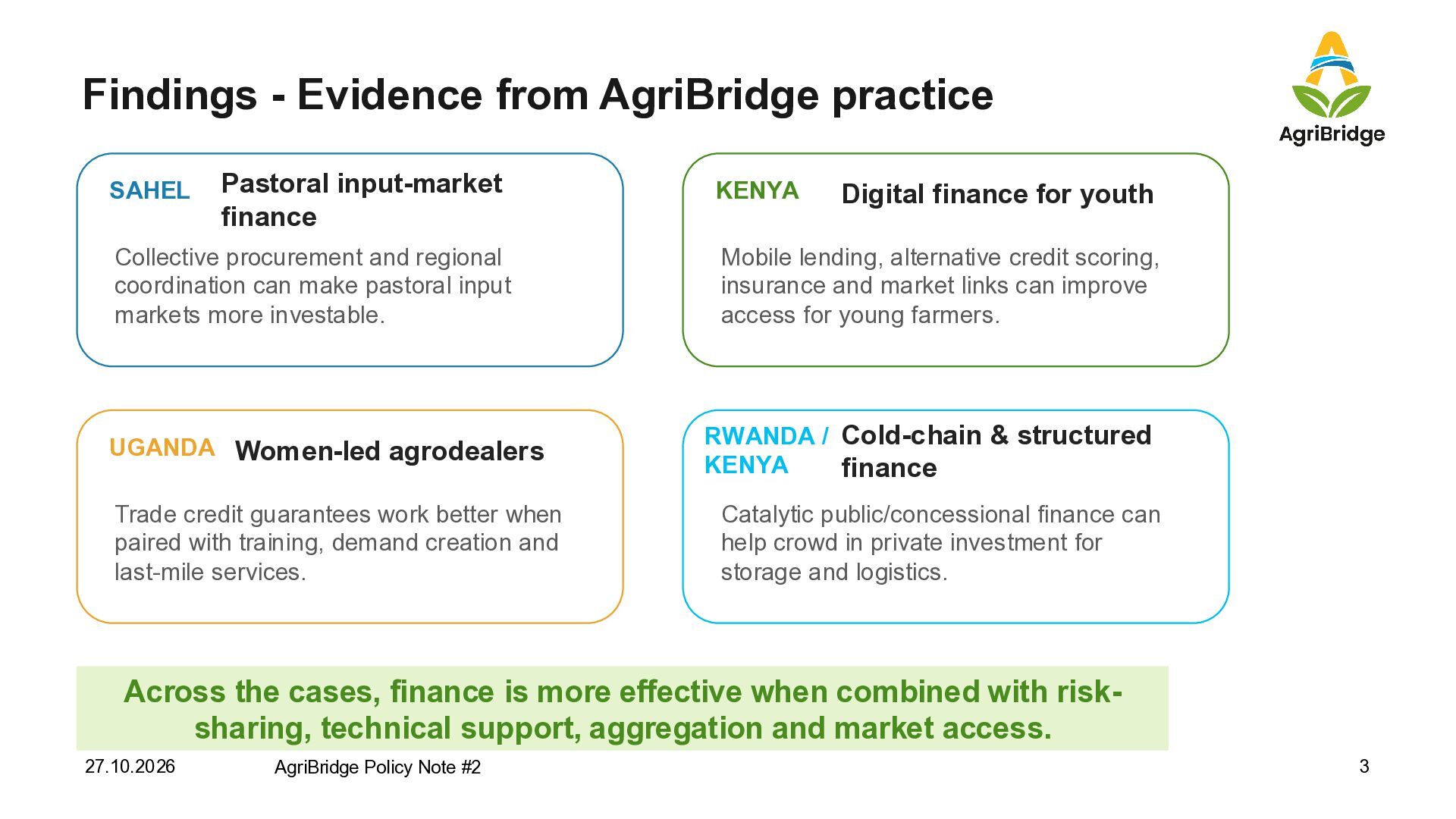
KENYA Digital finance for youth Collective procurement and regional coordination can make pastoral input markets more investable. Mobile lending, alternative credit scoring, insurance and market links can improve access for young farmers. UGANDA Women-led agrodealers RWANDA / Cold-chain & structured KENYA finance Trade credit guarantees work better when paired with training, demand creation and last-mile services. Catalytic public/concessional finance can help crowd in private investment for storage and logistics. Across the cases, finance is more effective when combined with risksharing, technical support, aggregation and market access. 27.10.2026 AgriBridge Policy Note #2 3
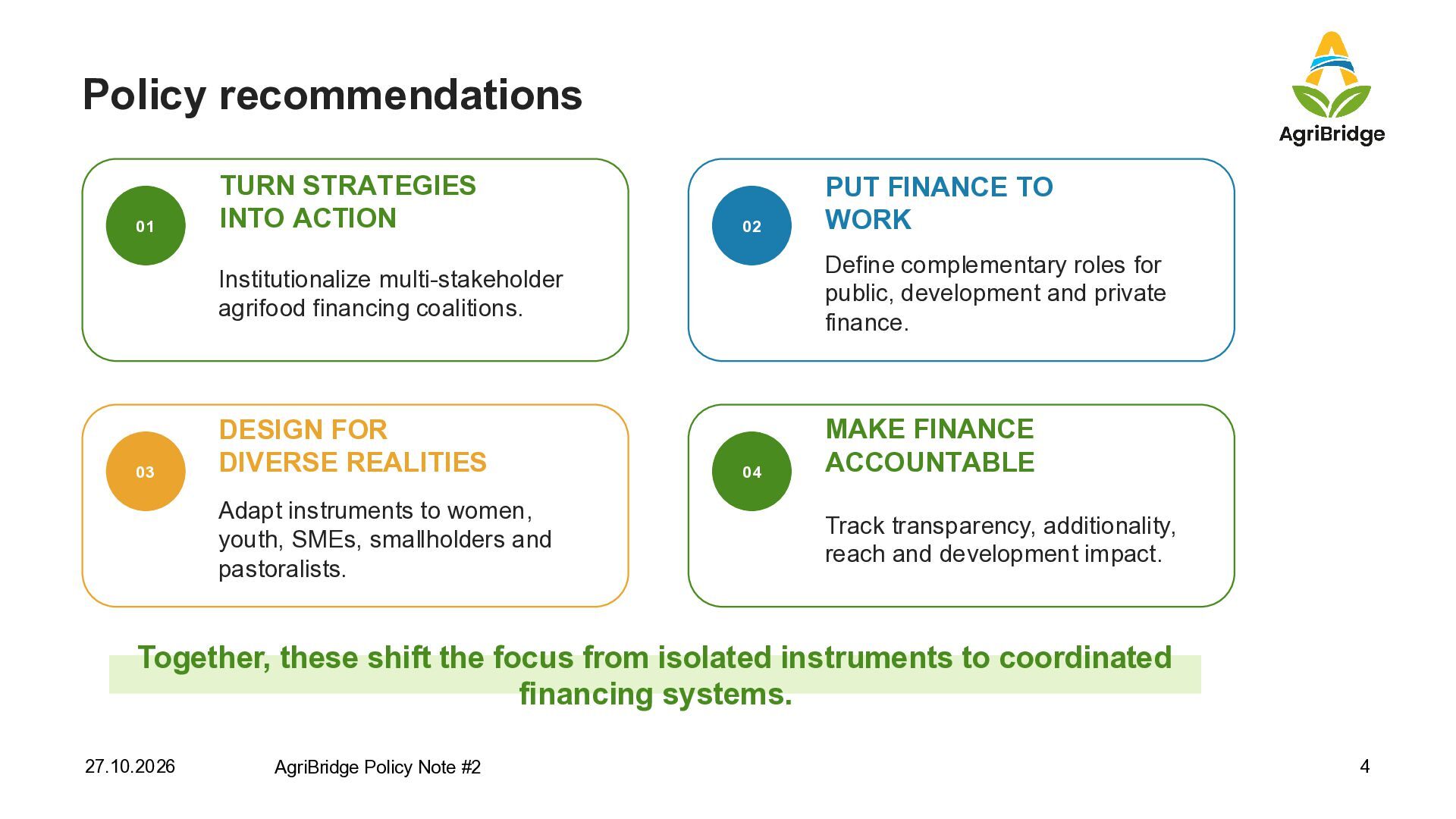
FINANCE TO WORK Institutionalize multi-stakeholder agrifood financing coalitions. Define complementary roles for public, development and private finance. DESIGN FOR DIVERSE REALITIES MAKE FINANCE ACCOUNTABLE Adapt instruments to women, youth, SMEs, smallholders and pastoralists. 04 Track transparency, additionality, reach and development impact. Together, these shift the focus from isolated instruments to coordinated financing systems. 27.10.2026 AgriBridge Policy Note #2 4
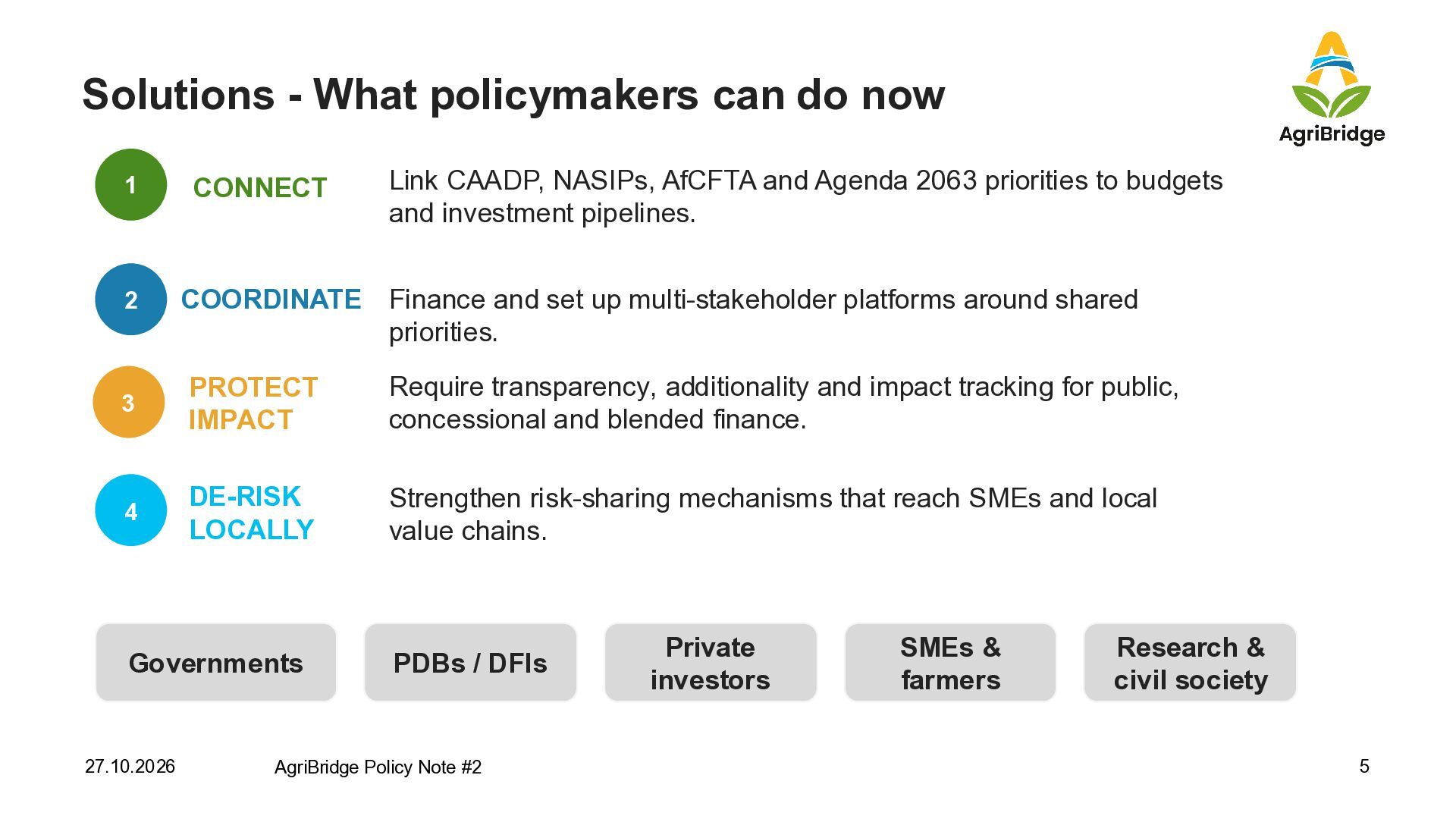
AfCFTA and Agenda 2063 priorities to budgets and investment pipelines. 1 CONNECT 2 COORDINATE Finance and set up multi-stakeholder platforms around shared priorities. 3 PROTECT IMPACT Require transparency, additionality and impact tracking for public, concessional and blended finance. 4 DE-RISK LOCALLY Strengthen risk-sharing mechanisms that reach SMEs and local value chains. Governments 27.10.2026 PDBs / DFIs AgriBridge Policy Note #2 Private investors SMEs & farmers Research & civil society 5


 akademiya2063
 sishi2026
 institutdelelevage
 youten622
 dk999
 gkazunii
 recsyslab
 reokashiwa
 datascientistsociety
 koide3
 sishi
 mikimhk
 resolutionfoundation
 sonatard
 cassininazir
 popppiees
 apolaine
 rkaga
 addyosmani
 jacobian
 sferik
 danielanewman
 greggifford
 marktimemedia