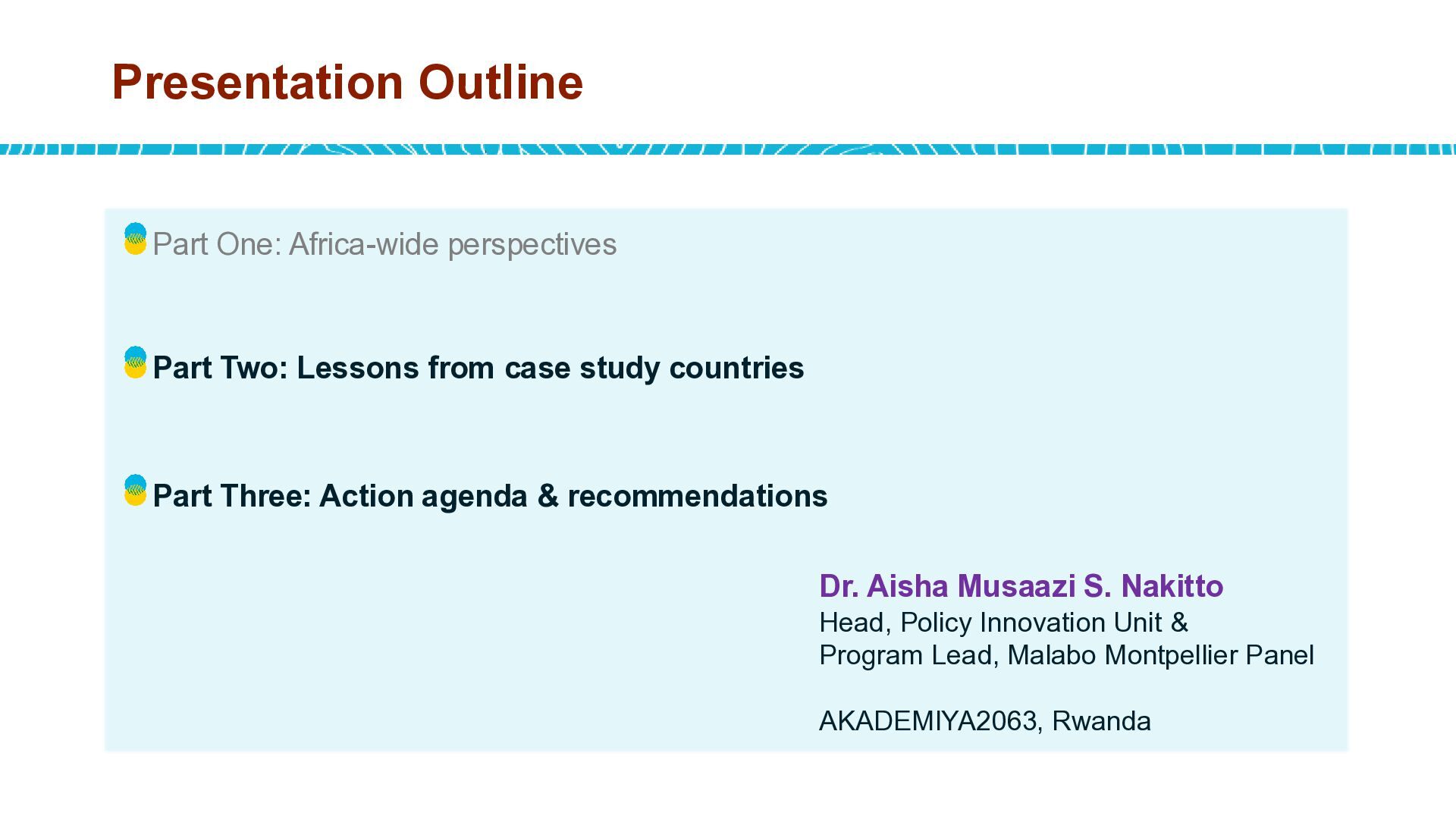
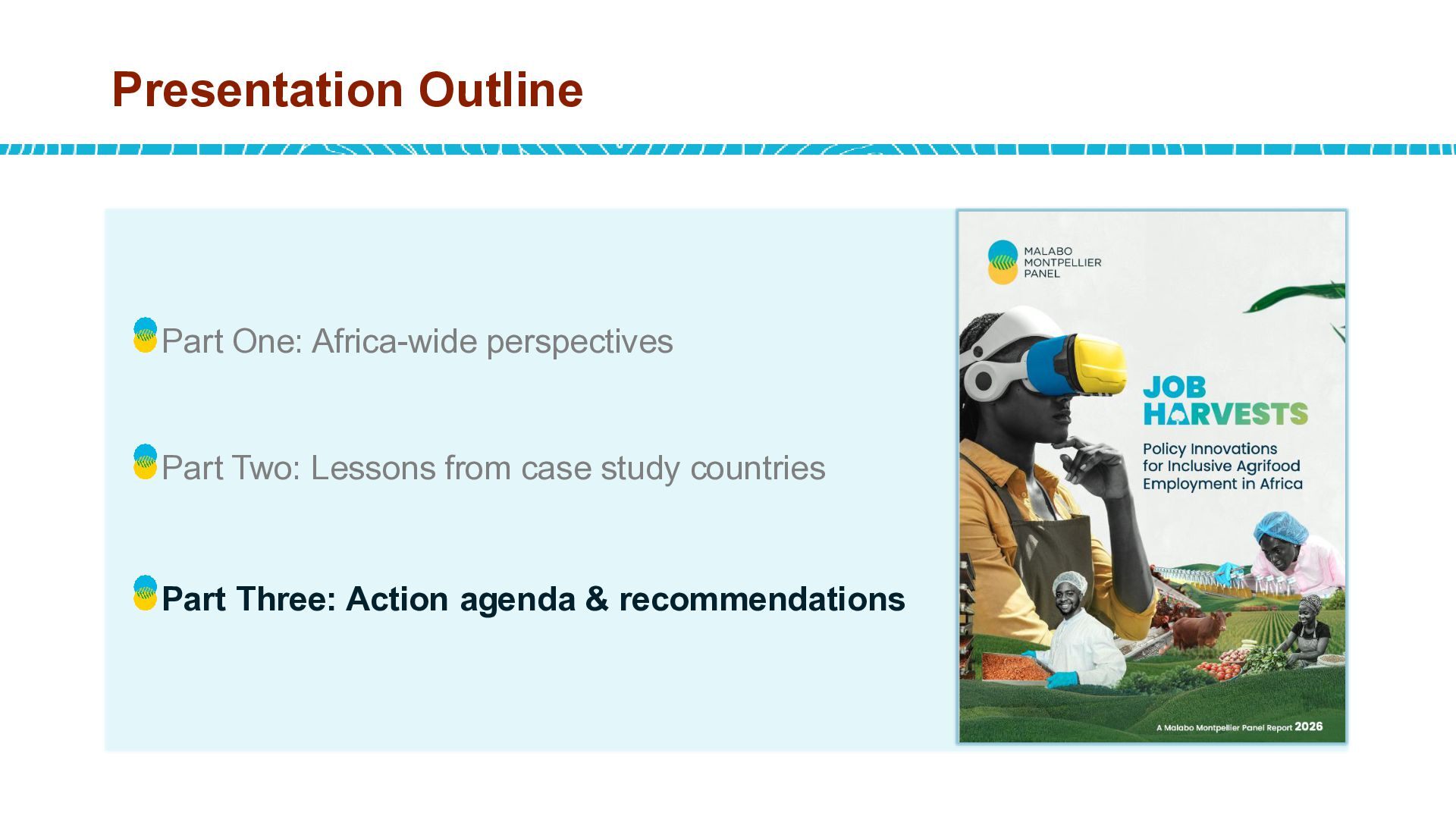
case study countries Part Three: Action agenda & recommendations Dr. Bezawit Beyene Chichaibelu Senior Researcher, Center for Development Research (ZEF), University of Bonn
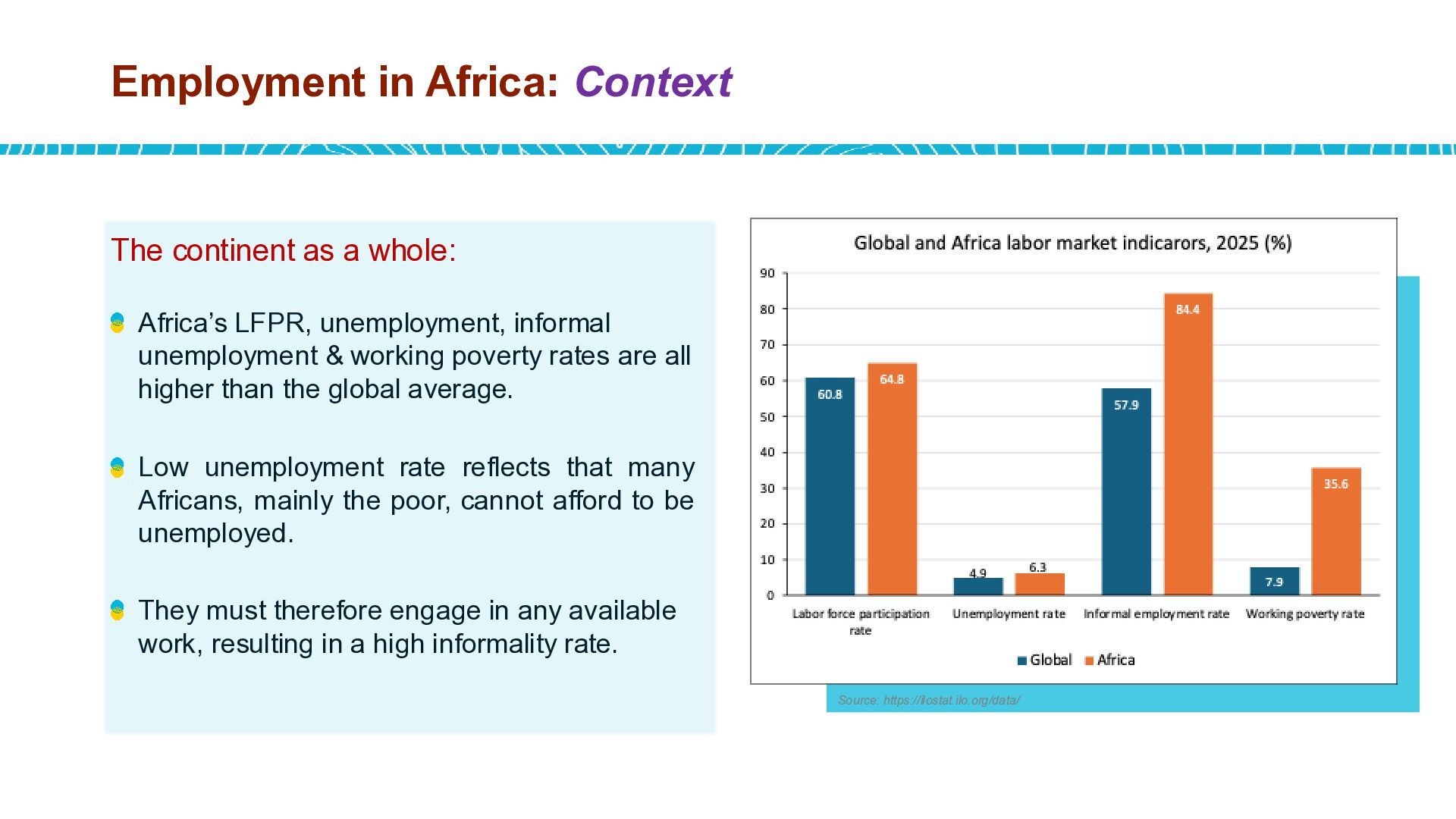
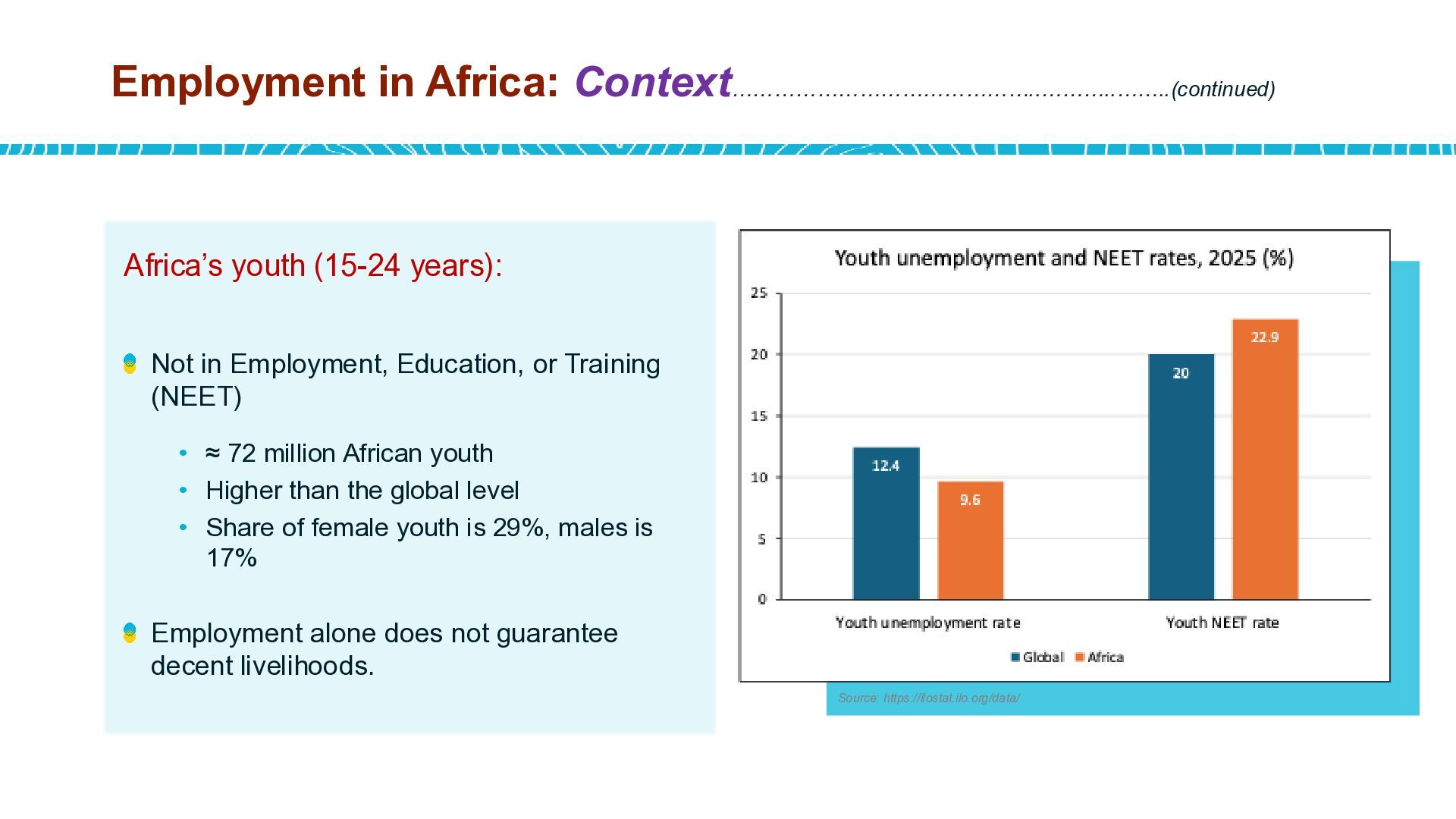
whole: Africa’s LFPR, unemployment, informal unemployment & working poverty rates are all higher than the global average. Low unemployment rate reflects that many Africans, mainly the poor, cannot afford to be unemployed. They must therefore engage in any available work, resulting in a high informality rate.
Not in Employment, Education, or Training (NEET) • ≈ 72 million African youth • Higher than the global level • Share of female youth is 29%, males is 17% Employment alone does not guarantee decent livelihoods.
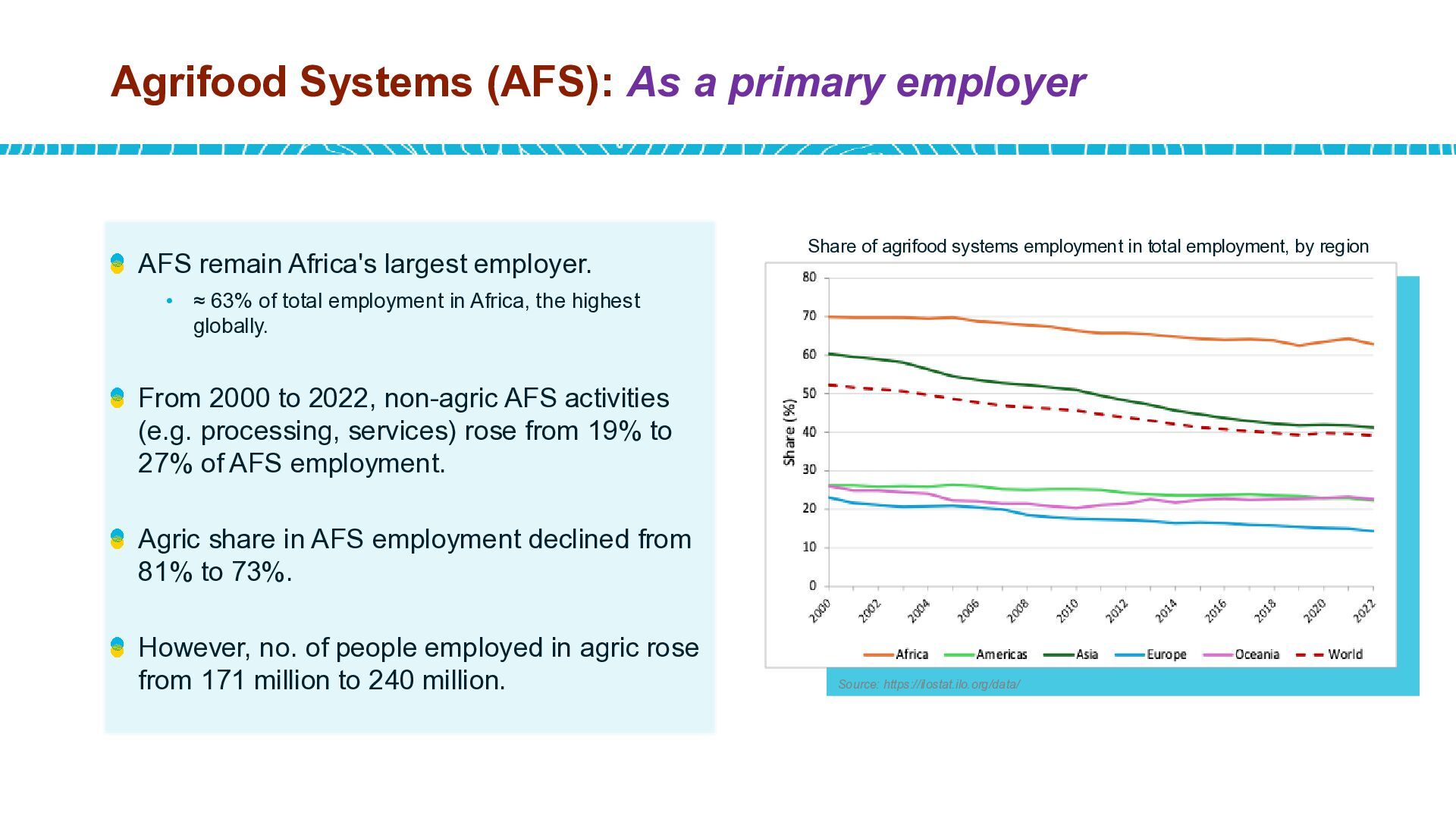
of agrifood systems employment in total employment, by region AFS remain Africa's largest employer. • ≈ 63% of total employment in Africa, the highest globally. From 2000 to 2022, non-agric AFS activities (e.g. processing, services) rose from 19% to 27% of AFS employment. Agric share in AFS employment declined from 81% to 73%. However, no. of people employed in agric rose from 171 million to 240 million.
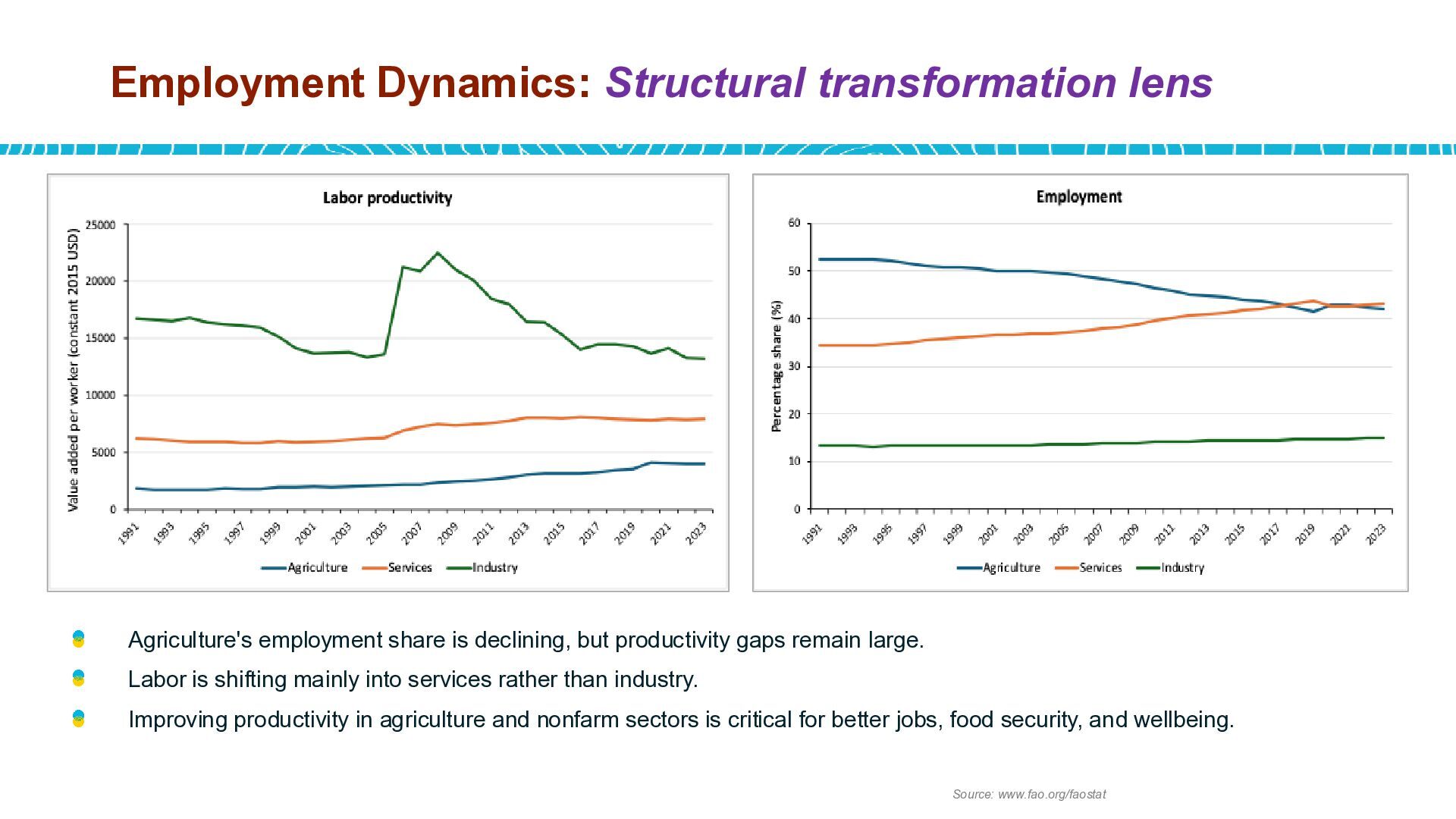
but productivity gaps remain large. Labor is shifting mainly into services rather than industry. Improving productivity in agriculture and nonfarm sectors is critical for better jobs, food security, and wellbeing. Source: www.fao.org/faostat
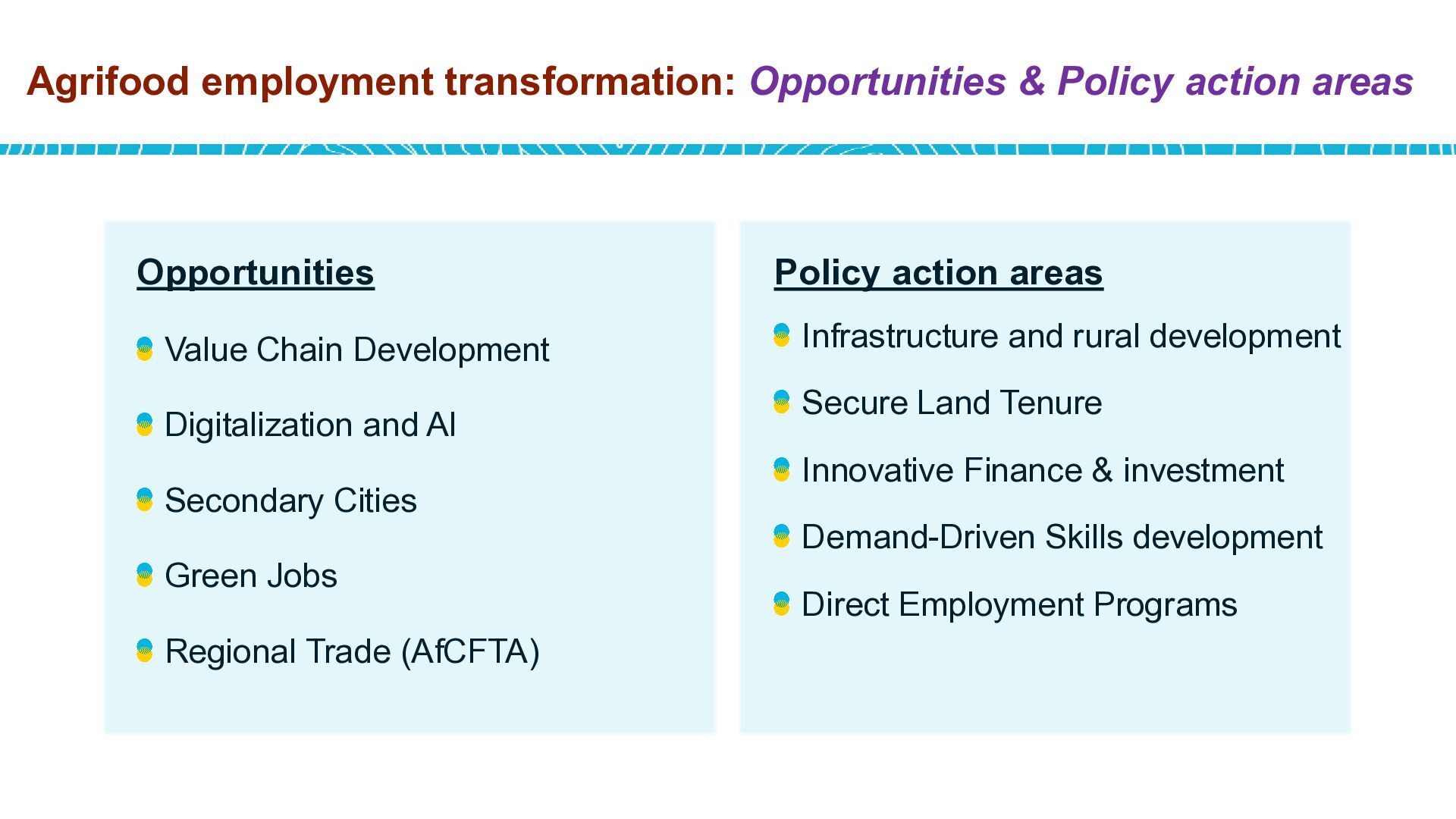
Chain Development Digitalization and AI Secondary Cities Green Jobs Regional Trade (AfCFTA) Policy action areas Infrastructure and rural development Secure Land Tenure Innovative Finance & investment Demand-Driven Skills development Direct Employment Programs
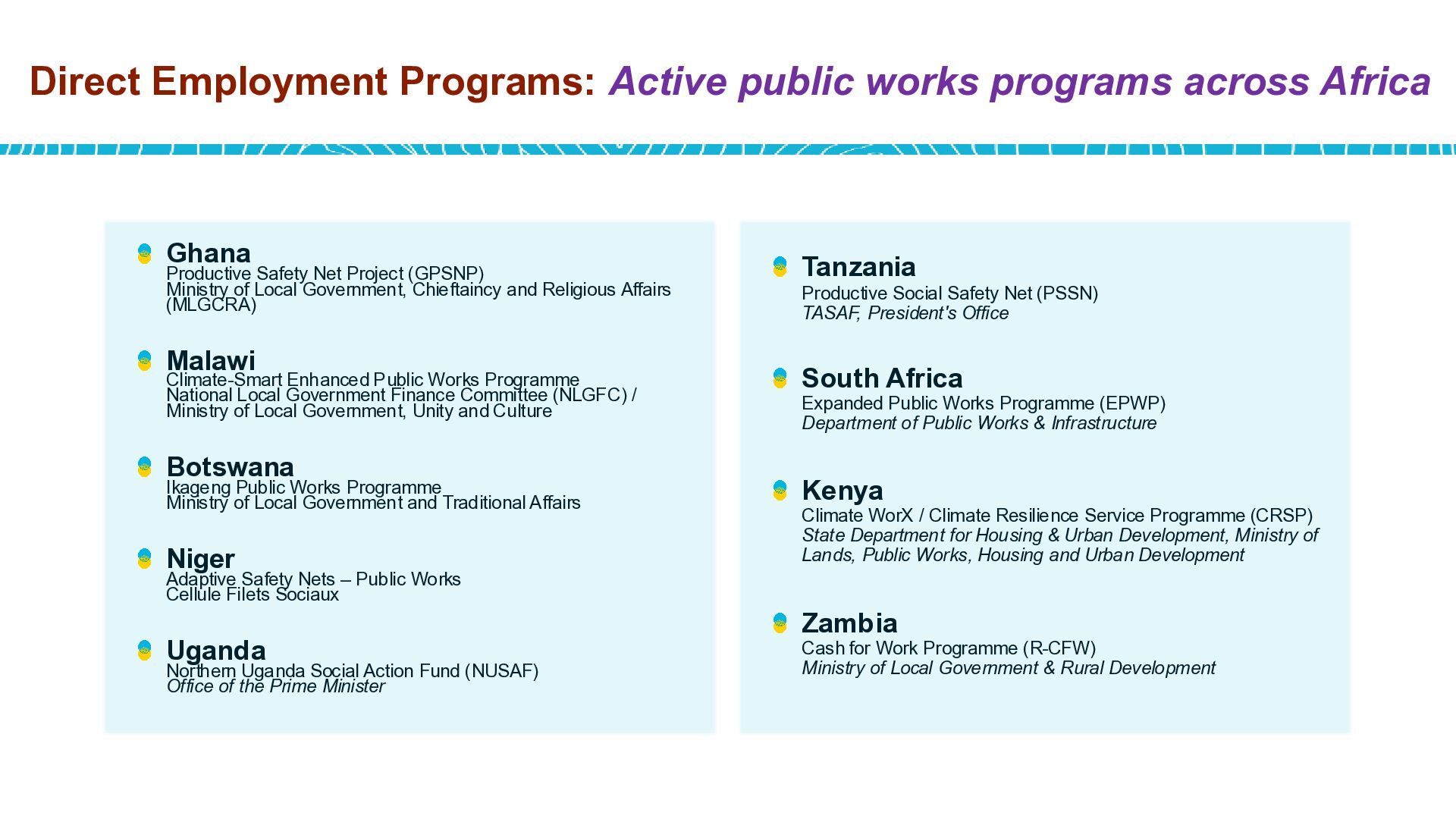
Productive Social Safety Net (PSSN) TASAF, President's Office South Africa Expanded Public Works Programme (EPWP) Department of Public Works & Infrastructure Kenya Climate WorX / Climate Resilience Service Programme (CRSP) State Department for Housing & Urban Development, Ministry of Lands, Public Works, Housing and Urban Development Zambia Cash for Work Programme (R-CFW) Ministry of Local Government & Rural Development Ghana Productive Safety Net Project (GPSNP) Ministry of Local Government, Chieftaincy and Religious Affairs (MLGCRA) Malawi Climate-Smart Enhanced Public Works Programme National Local Government Finance Committee (NLGFC) / Ministry of Local Government, Unity and Culture Botswana Ikageng Public Works Programme Ministry of Local Government and Traditional Affairs Niger Adaptive Safety Nets – Public Works Cellule Filets Sociaux Uganda Northern Uganda Social Action Fund (NUSAF) Office of the Prime Minister
case study countries Part Three: Action agenda & recommendations Dr. Aisha Musaazi S. Nakitto Head, Policy Innovation Unit & Program Lead, Malabo Montpellier Panel AKADEMIYA2063, Rwanda
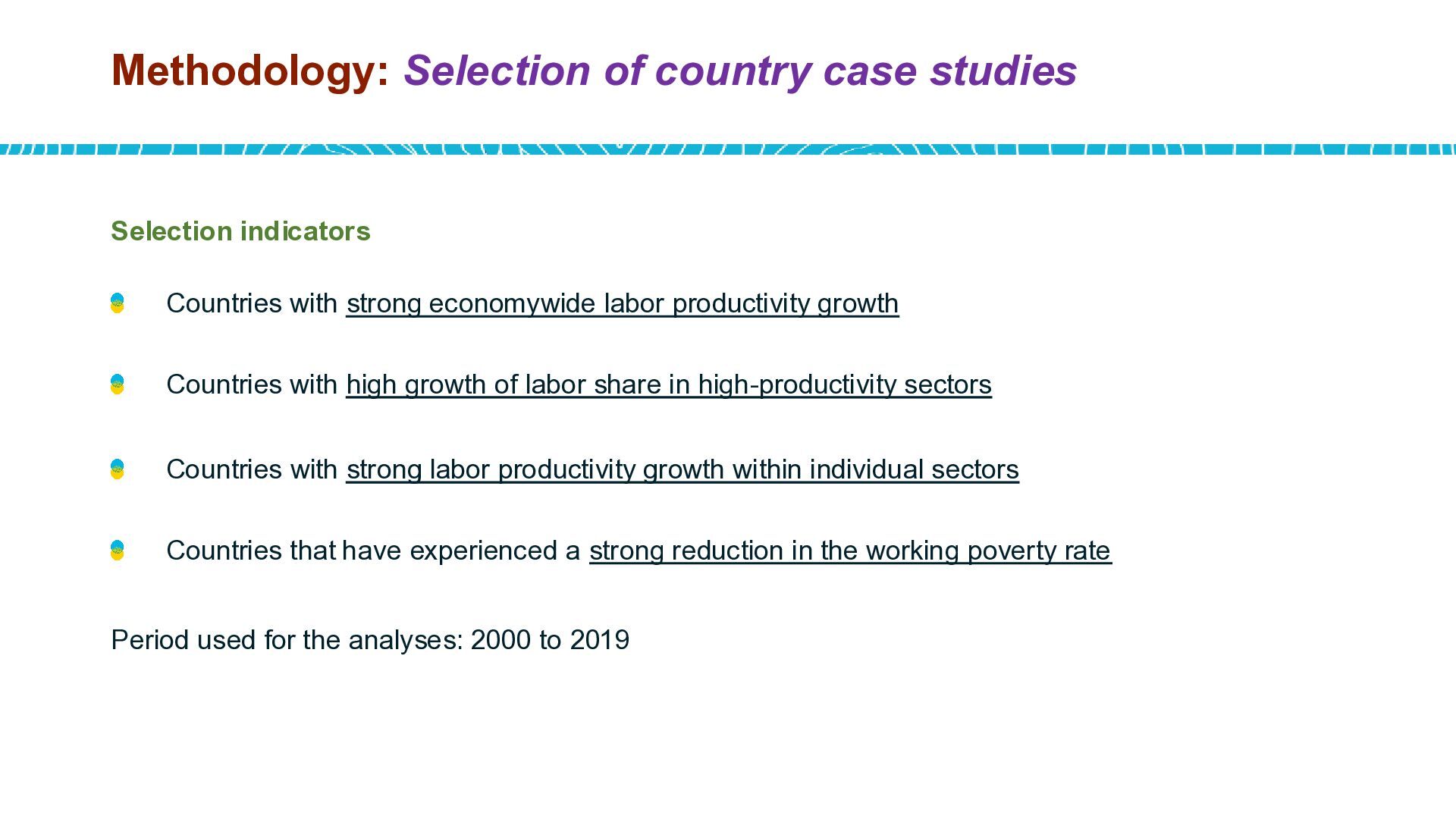
with high growth of labor share in high-productivity sectors Countries with strong labor productivity growth within individual sectors Countries that have experienced a strong reduction in the working poverty rate Period used for the analyses: 2000 to 2019 Methodology: Selection of country case studies
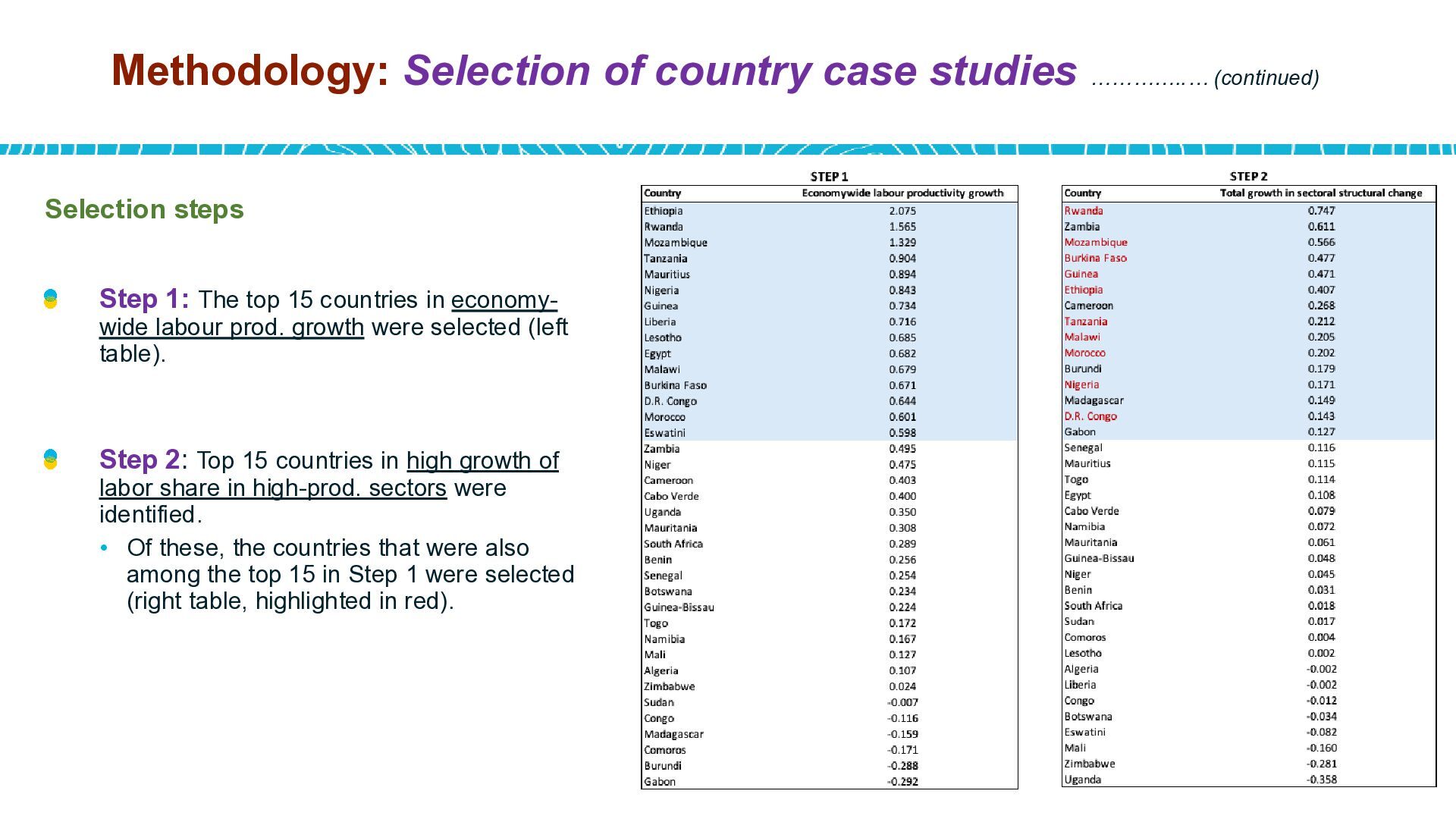
wide labour prod. growth were selected (left table). Step 2: Top 15 countries in high growth of labor share in high-prod. sectors were identified. • Of these, the countries that were also among the top 15 in Step 1 were selected (right table, highlighted in red). Methodology: Selection of country case studies …………..… (continued)
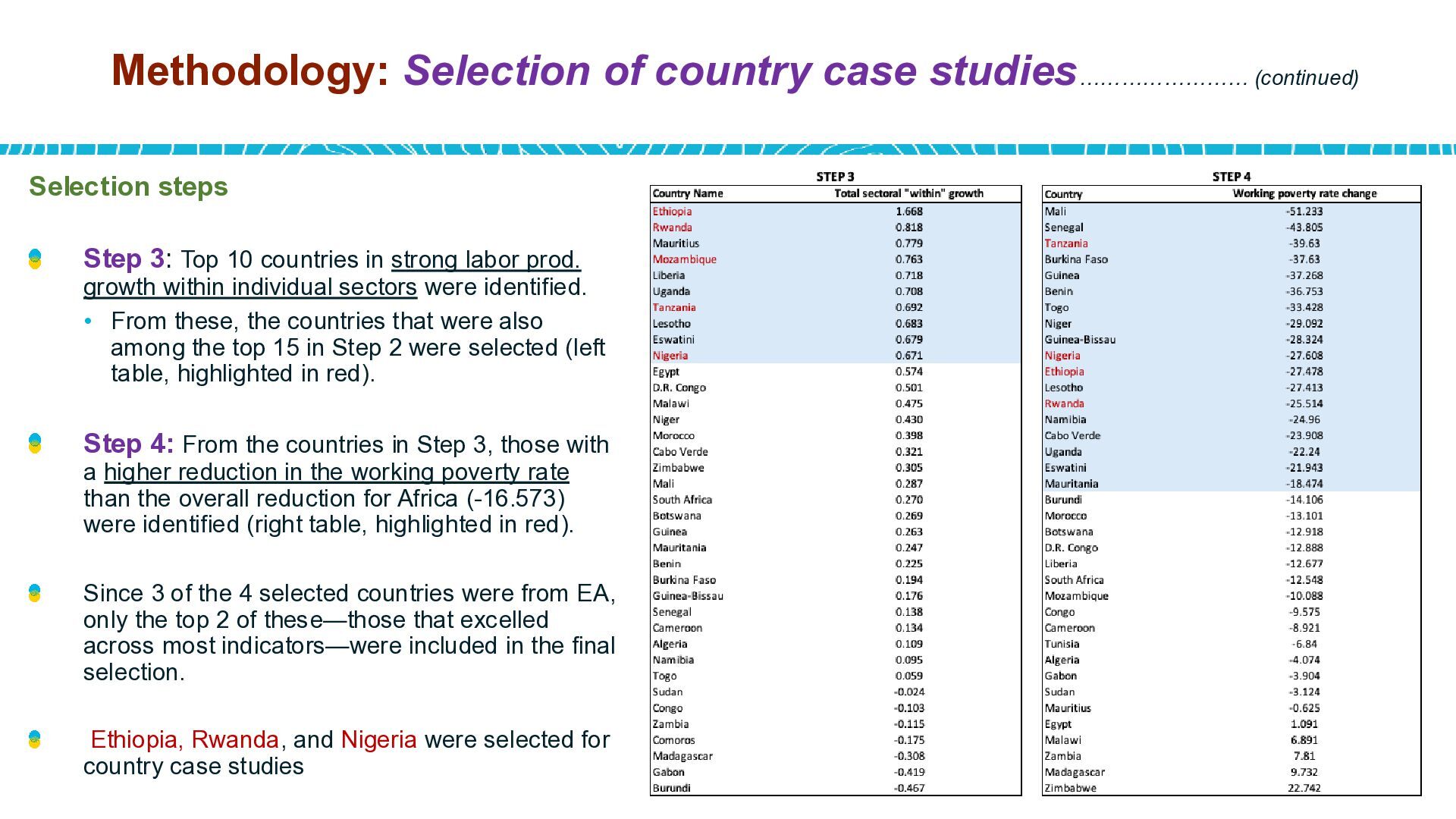
prod. growth within individual sectors were identified. • From these, the countries that were also among the top 15 in Step 2 were selected (left table, highlighted in red). Step 4: From the countries in Step 3, those with a higher reduction in the working poverty rate than the overall reduction for Africa (-16.573) were identified (right table, highlighted in red). Since 3 of the 4 selected countries were from EA, only the top 2 of these—those that excelled across most indicators—were included in the final selection. Ethiopia, Rwanda, and Nigeria were selected for country case studies Methodology: Selection of country case studies…………………… (continued)
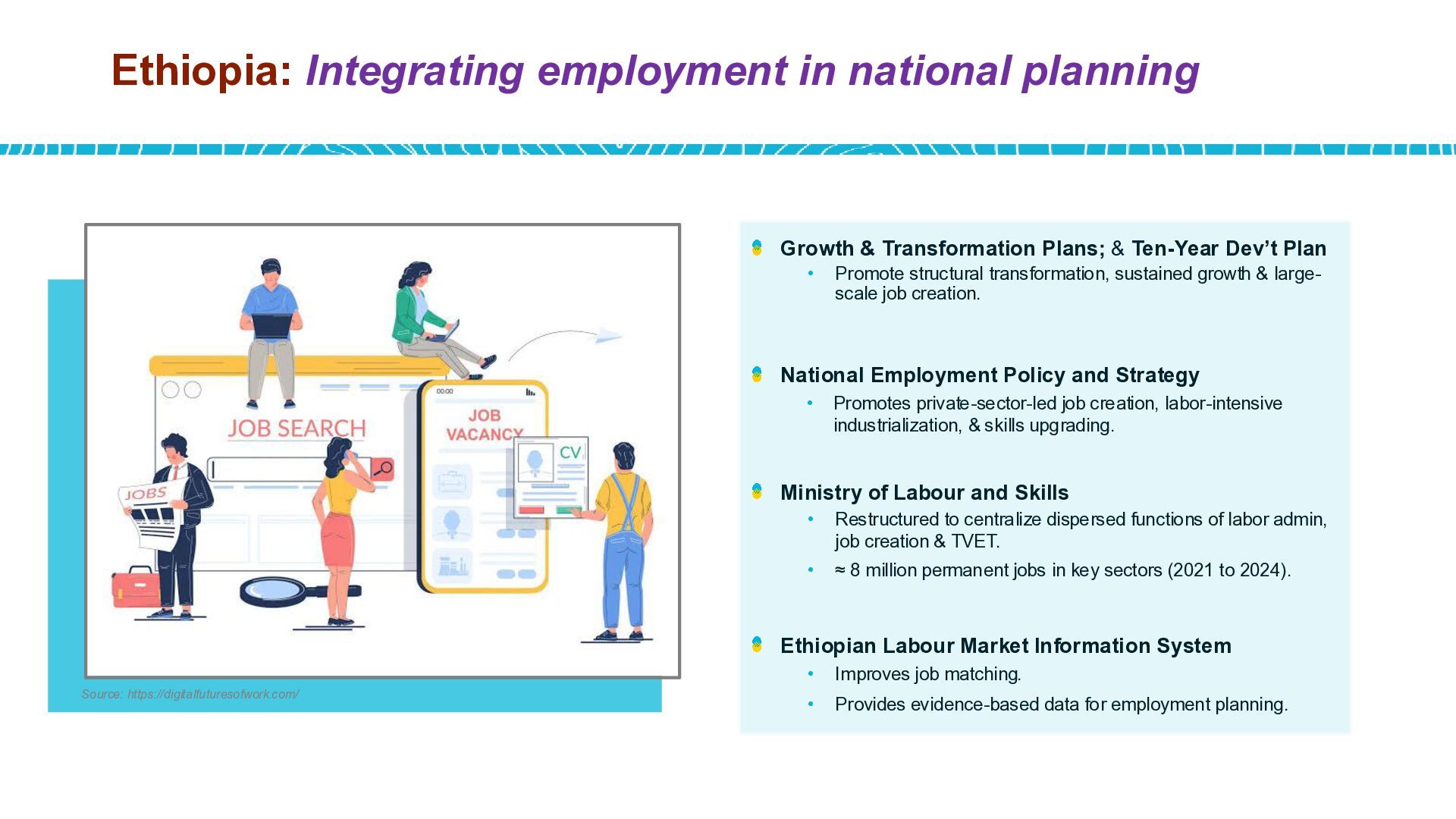
Transformation Plans; & Ten-Year Dev’t Plan • Promote structural transformation, sustained growth & large- scale job creation. National Employment Policy and Strategy • Promotes private-sector-led job creation, labor-intensive industrialization, & skills upgrading. Ministry of Labour and Skills • Restructured to centralize dispersed functions of labor admin, job creation & TVET. • ≈ 8 million permanent jobs in key sectors (2021 to 2024). Ethiopian Labour Market Information System • Improves job matching. • Provides evidence-based data for employment planning.
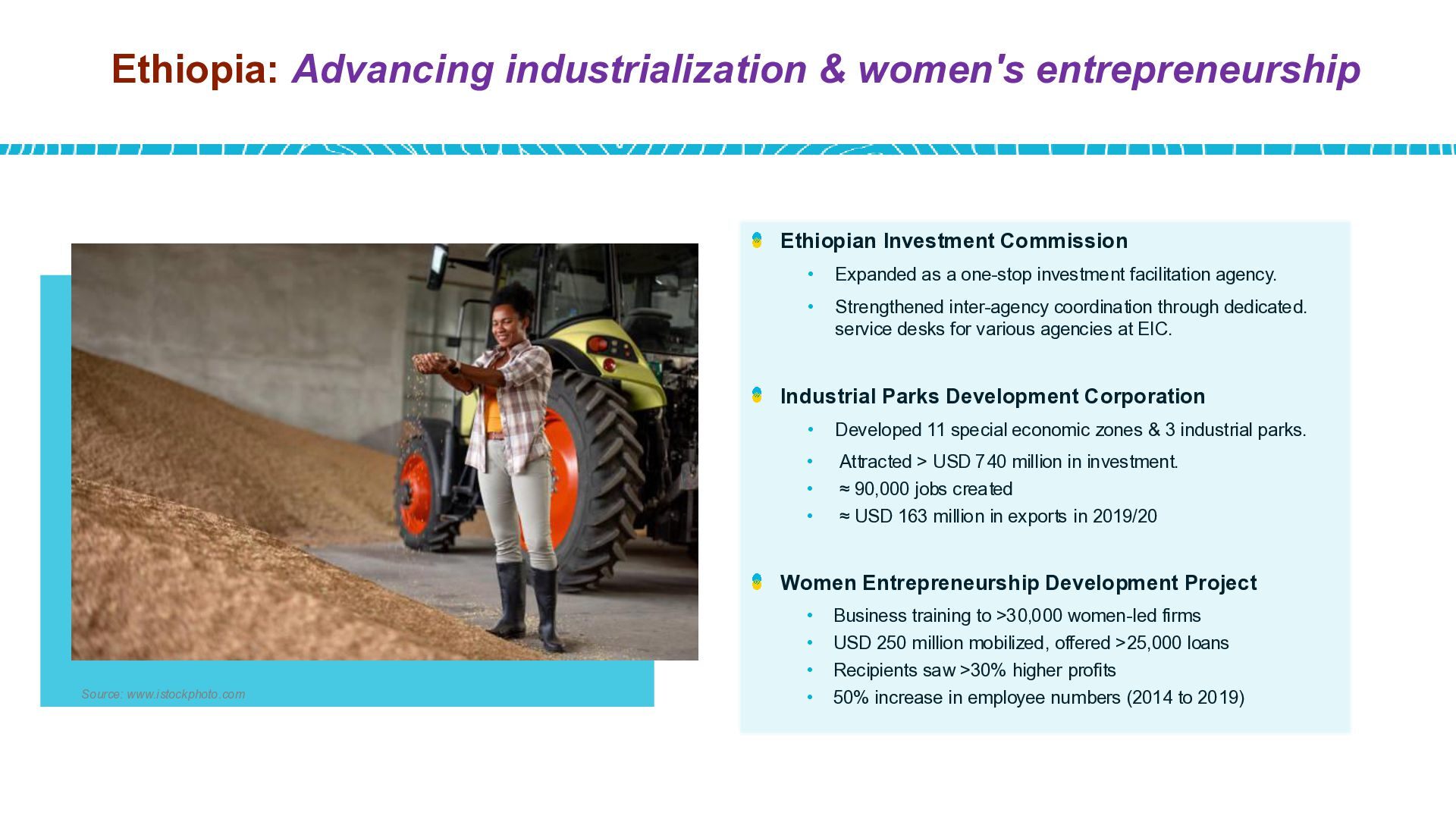
Commission • Expanded as a one-stop investment facilitation agency. • Strengthened inter-agency coordination through dedicated. service desks for various agencies at EIC. Industrial Parks Development Corporation • Developed 11 special economic zones & 3 industrial parks. • Attracted > USD 740 million in investment. • ≈ 90,000 jobs created • ≈ USD 163 million in exports in 2019/20 Women Entrepreneurship Development Project • Business training to >30,000 women-led firms • USD 250 million mobilized, offered >25,000 loans • Recipients saw >30% higher profits • 50% increase in employee numbers (2014 to 2019)
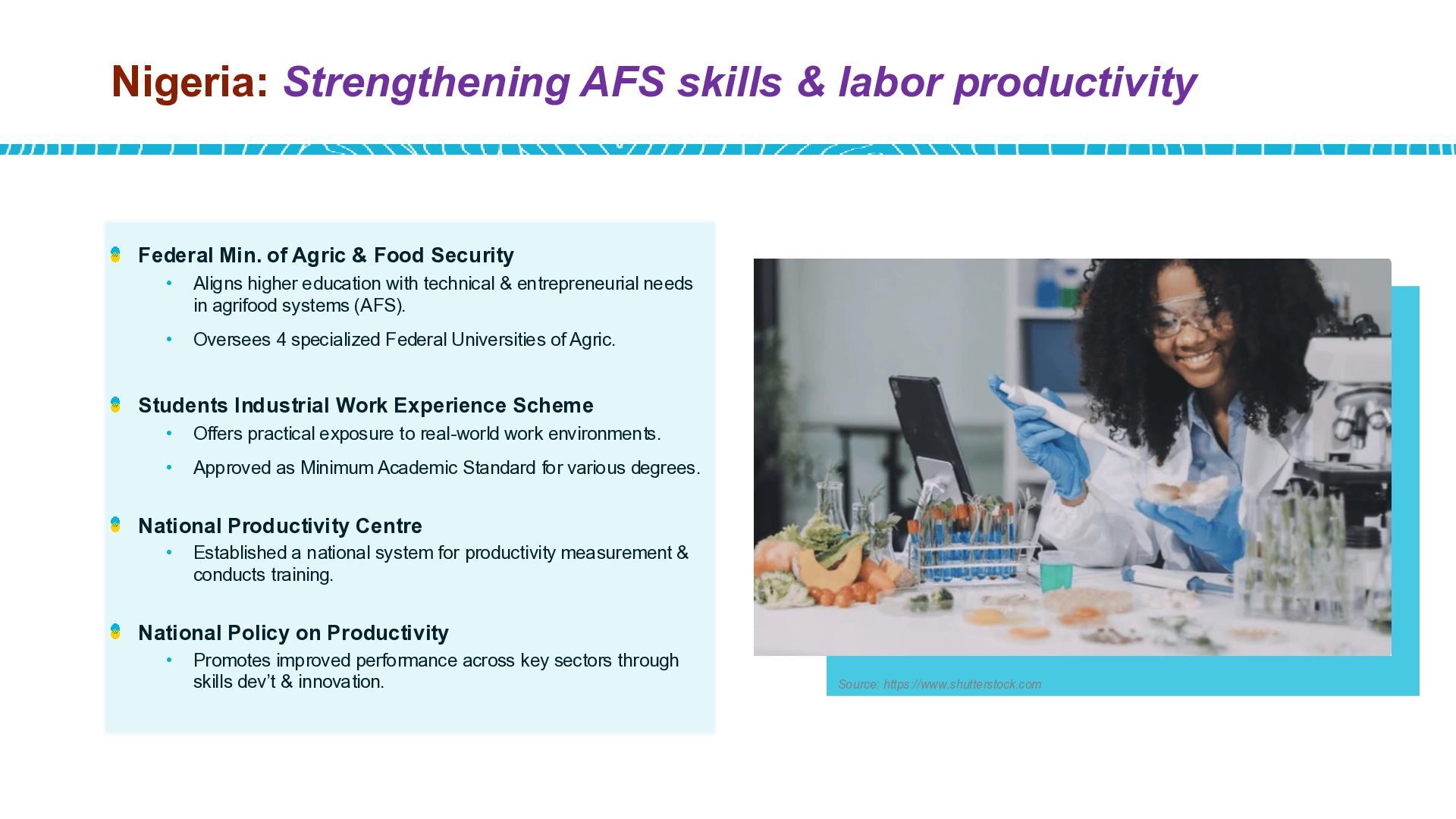
Min. of Agric & Food Security • Aligns higher education with technical & entrepreneurial needs in agrifood systems (AFS). • Oversees 4 specialized Federal Universities of Agric. Students Industrial Work Experience Scheme • Offers practical exposure to real-world work environments. • Approved as Minimum Academic Standard for various degrees. National Productivity Centre • Established a national system for productivity measurement & conducts training. National Policy on Productivity • Promotes improved performance across key sectors through skills dev’t & innovation.
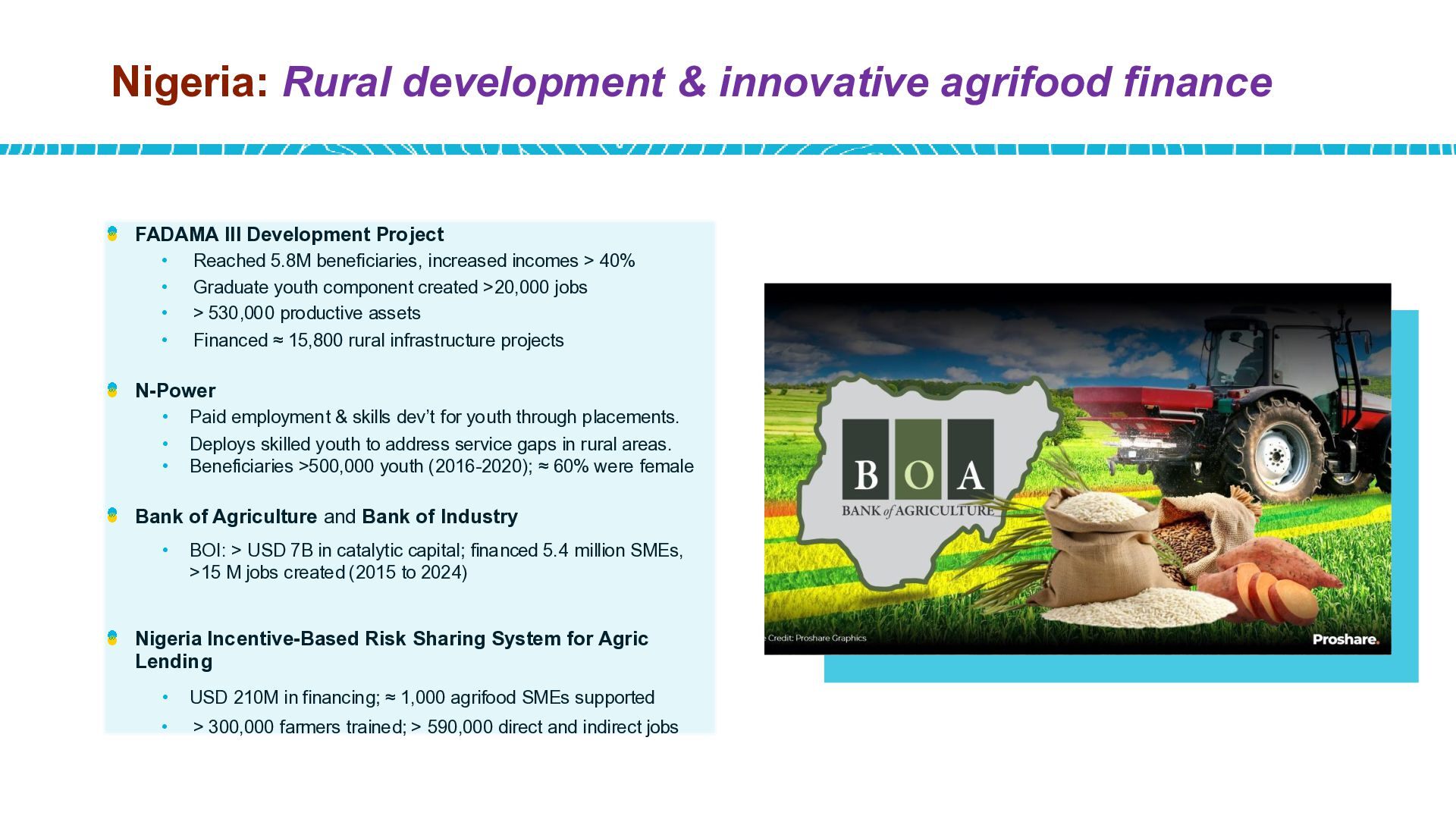
Project • Reached 5.8M beneficiaries, increased incomes > 40% • Graduate youth component created >20,000 jobs • > 530,000 productive assets • Financed ≈ 15,800 rural infrastructure projects N-Power • Paid employment & skills dev’t for youth through placements. • Deploys skilled youth to address service gaps in rural areas. • Beneficiaries >500,000 youth (2016-2020); ≈ 60% were female Bank of Agriculture and Bank of Industry • BOI: > USD 7B in catalytic capital; financed 5.4 million SMEs, >15 M jobs created (2015 to 2024) Nigeria Incentive-Based Risk Sharing System for Agric Lending • USD 210M in financing; ≈ 1,000 agrifood SMEs supported • > 300,000 farmers trained; > 590,000 direct and indirect jobs
Board • Streamlines investment facilitation. • Its “One Stop Centre" integrates business registration, licensing, and tax admin • Offers incentives to investors. Industrial Dev’t & Export Diversification Council • High-level public–private coordination for industrial dev’t. • Reports to the office of the Prime Minister & provides oversight and guidance on industrial & export dev’t. Private Sector Dev’t & Youth Employment Sector Strategic Plan working group • Brings together gov’t ministries, dev’t partners, & private sector associations.
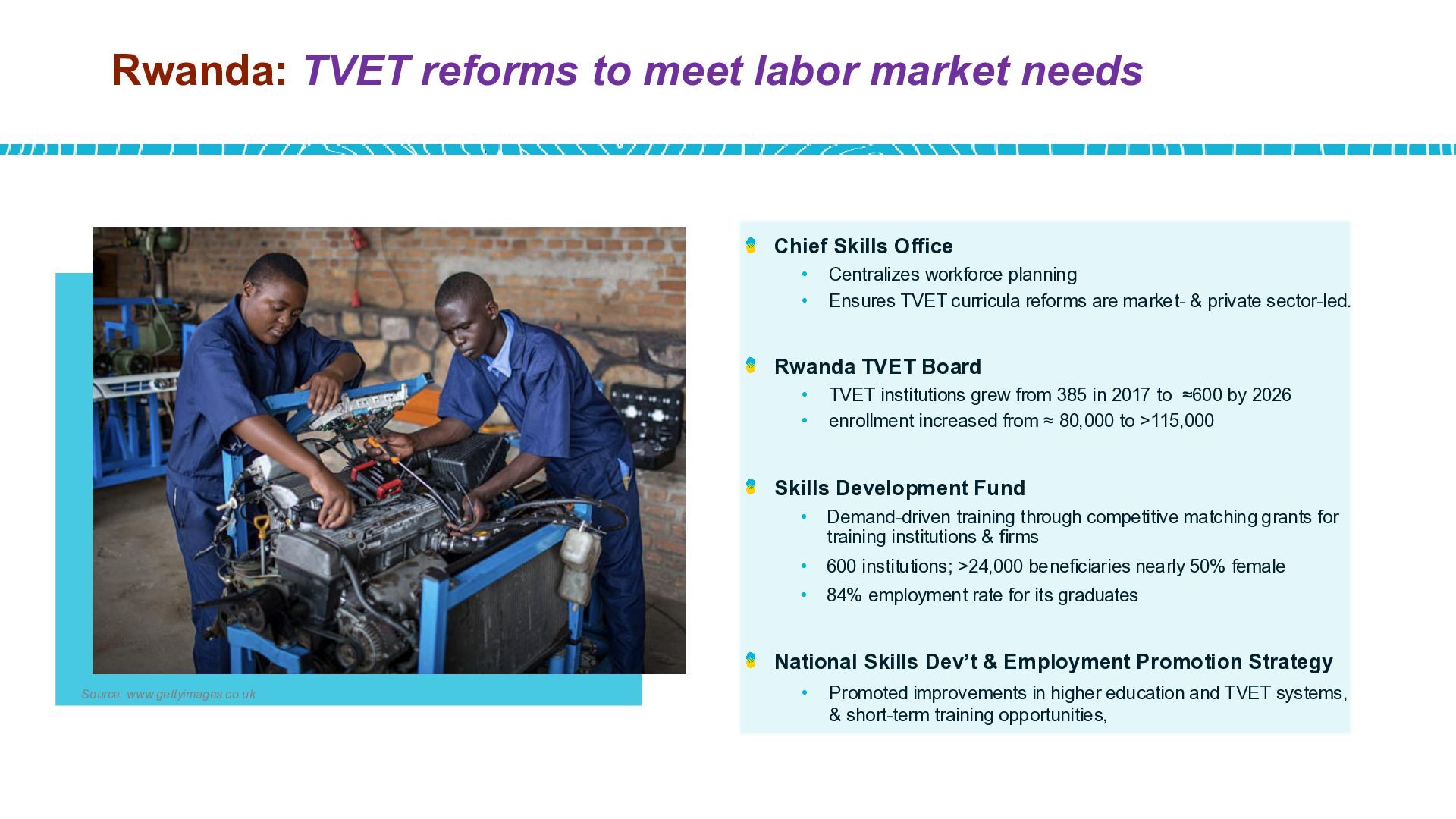
Chief Skills Office • Centralizes workforce planning • Ensures TVET curricula reforms are market- & private sector-led. Rwanda TVET Board • TVET institutions grew from 385 in 2017 to ≈600 by 2026 • enrollment increased from ≈ 80,000 to >115,000 Skills Development Fund • Demand-driven training through competitive matching grants for training institutions & firms • 600 institutions; >24,000 beneficiaries nearly 50% female • 84% employment rate for its graduates National Skills Dev’t & Employment Promotion Strategy • Promoted improvements in higher education and TVET systems, & short-term training opportunities,
core of national dev’t strategies. Equip youth & women with skills to transform agrifood systems. Address job informality & improve worker protection. Strengthen mobilization of innovative financing & private investment to stimulate decent job creation.
employment and agrifood innovation. Invest in labor-intensive rural infrastructure to create jobs and strengthen rural economies. Strengthen the harmonization of labor market statistics across countries.


 akademiya2063
 institutdelelevage
 yumulab
 kzmssk
 rikkabotan7
 shibuiwilliam
 xspa2012
 tkng
tkng
 nzw0301
 takehaya
 kentaitakura
 destraynor
 inesmontani
 oripsolob
 tamaranovitovic
 lindahogenes
 lara
lara
 soudai
 tonyrice
 bermonpainter
 deanohume
 hatefulcrawdad
 watany