Upgrade to Pro — share decks privately, control downloads, hide ads and more …

What’s moving the needle in Ecommerce SEO & AI ...

Sponsored · SiteGround - Reliable hosting with speed, security, and support you can count on.

What’s moving the needle in Ecommerce SEO & AI Search in 2026

Learn the keys of ecommerce organic search success in the AI era: from criteria, steps to tools to use, and mistakes to avoid.

Avatar for Aleyda Solis

Aleyda Solis

July 10, 2026

More Decks by Aleyda Solis

Other Decks in Marketing & SEO

Transcript

  1. What’s moving the needle in Ecommerce SEO & AI Search

    in 2026 By Aleyda Solis - SEO Consultant & Founder at Orainti & SEOFOMO
  2. By Aleyda Solis - SEO Consultant & Founder at Orainti

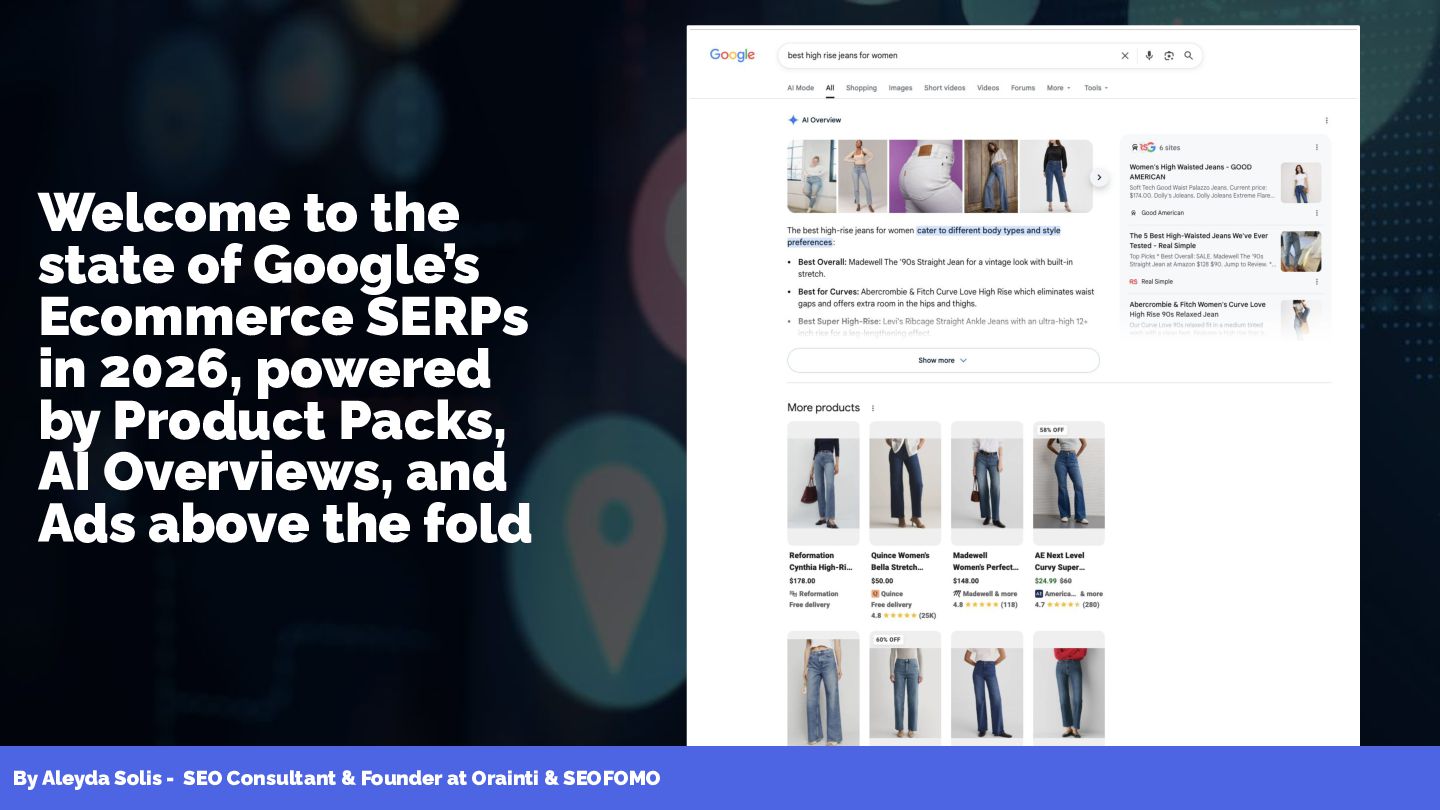
    & SEOFOMO Welcome to the state of Google’s Ecommerce SERPs in 2026, powered by Product Packs, AI Overviews, and Ads above the fold
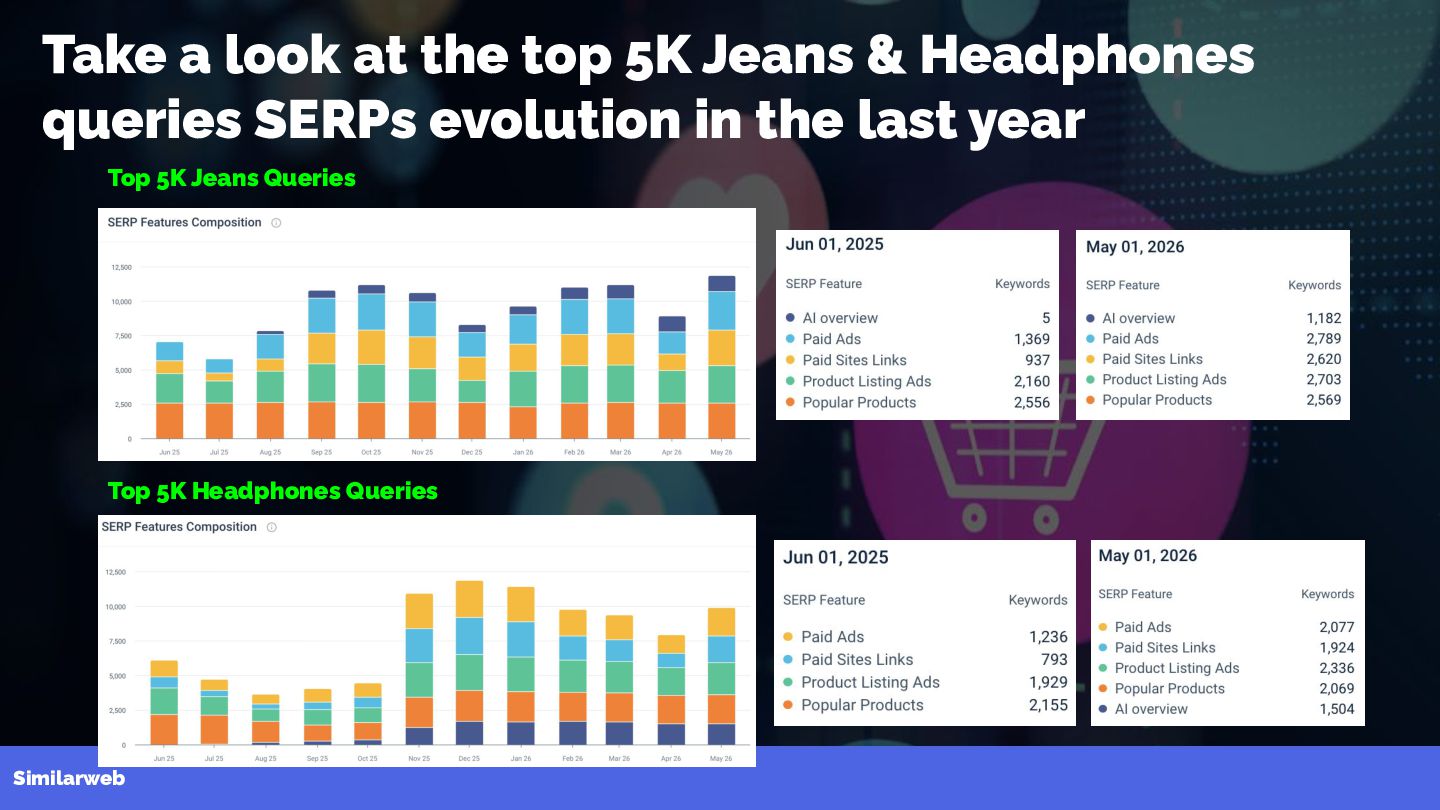
  3. Similarweb Take a look at the top 5K Jeans &

    Headphones queries SERPs evolution in the last year Top 5K Jeans Queries Top 5K Headphones Queries
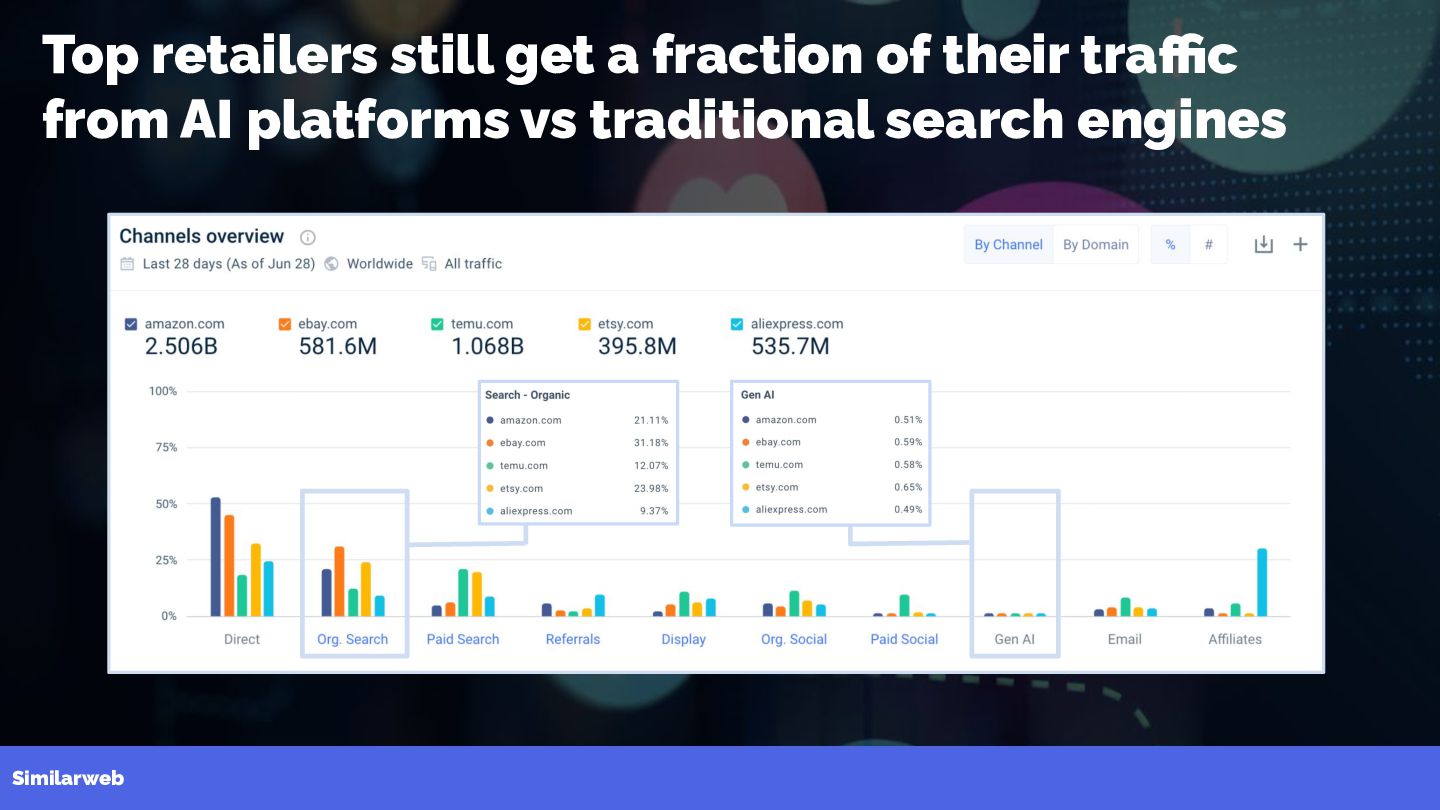
  4. Similarweb Top retailers still get a fraction of their traffic

    from AI platforms vs traditional search engines
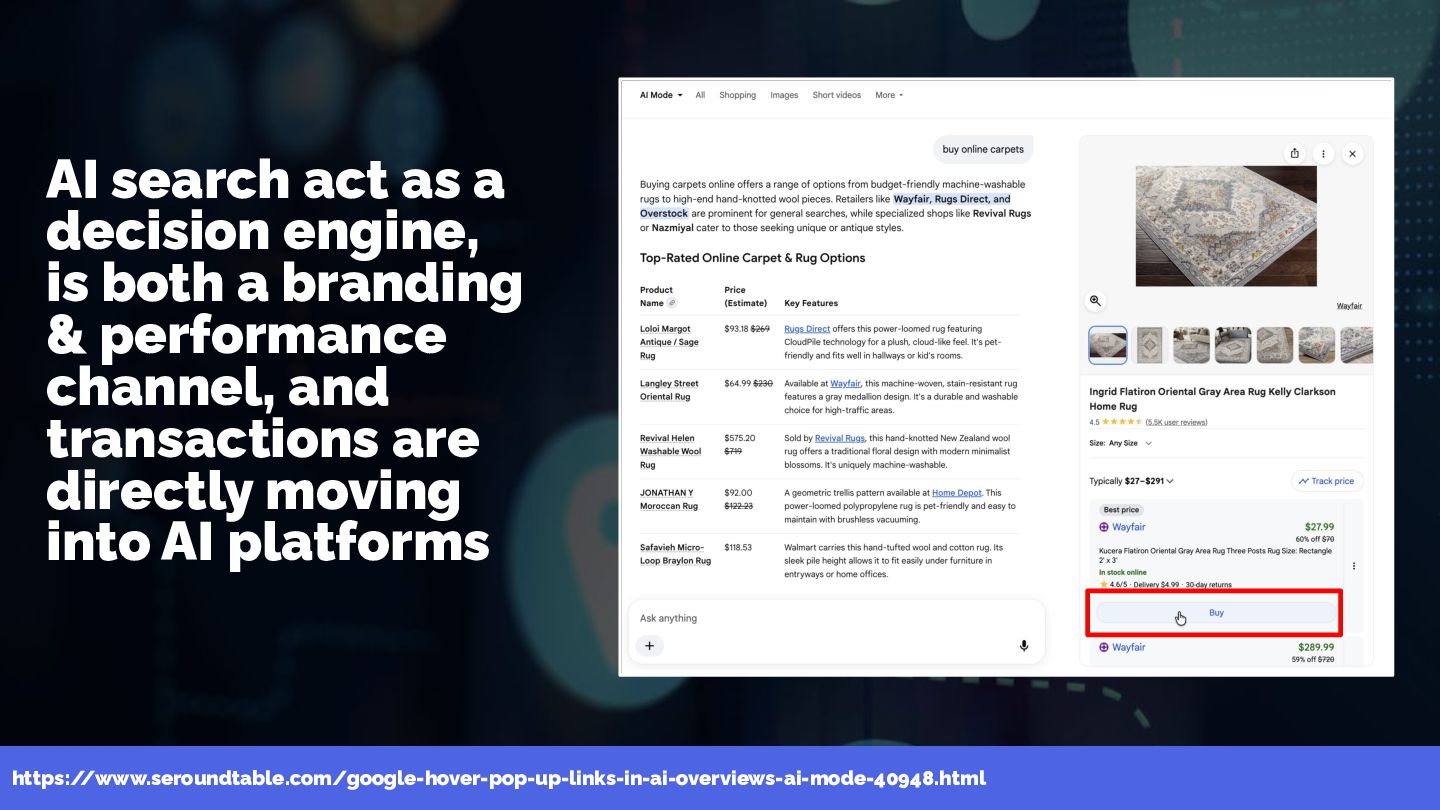
  5. https:/ /www.seroundtable.com/google-hover-pop-up-links-in-ai-overviews-ai-mode-40948.html AI search act as a decision engine, is

    both a branding & performance channel, and transactions are directly moving into AI platforms
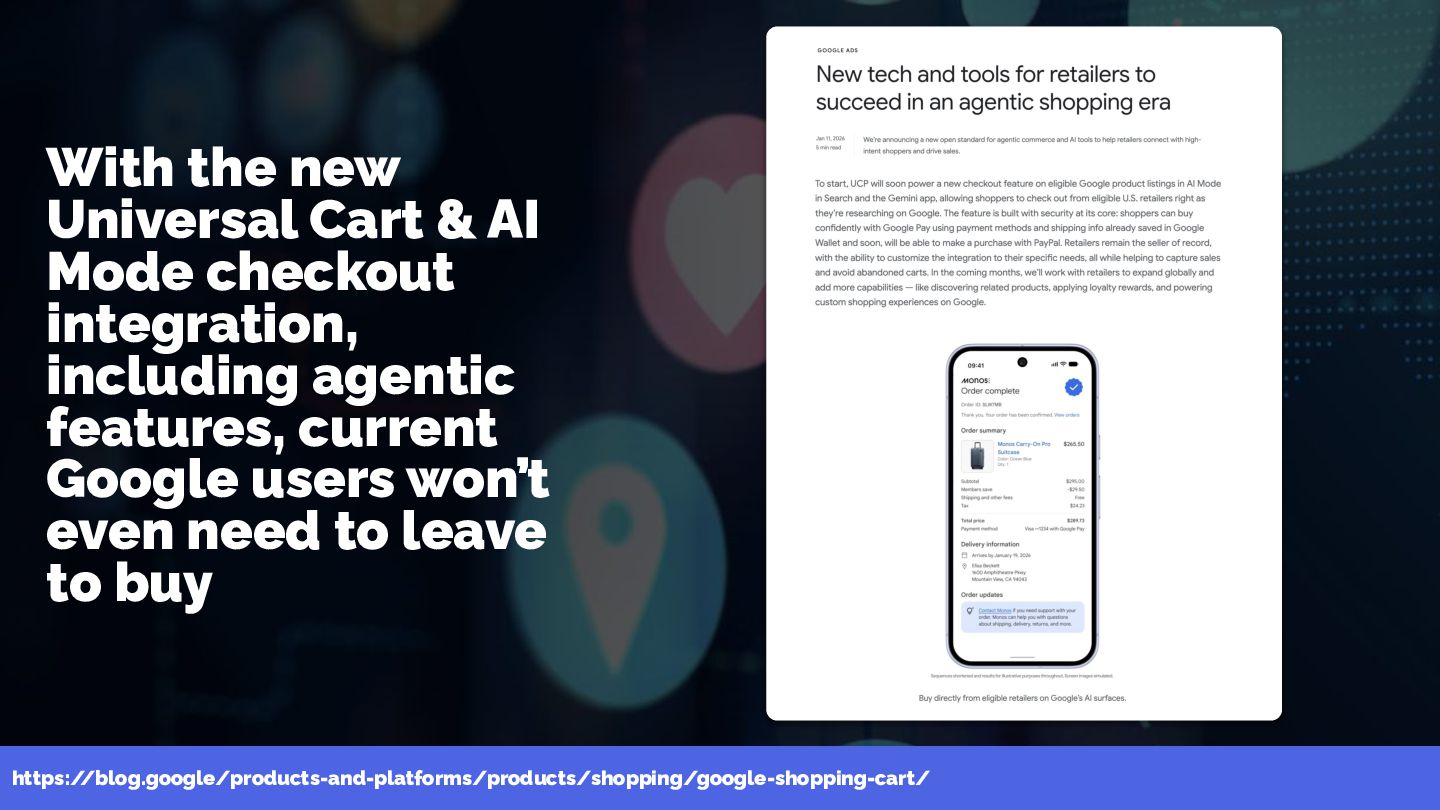
  6. https:/ /blog.google/products-and-platforms/products/shopping/google-shopping-cart/ With the new Universal Cart & AI Mode

    checkout integration, including agentic features, current Google users won’t even need to leave to buy
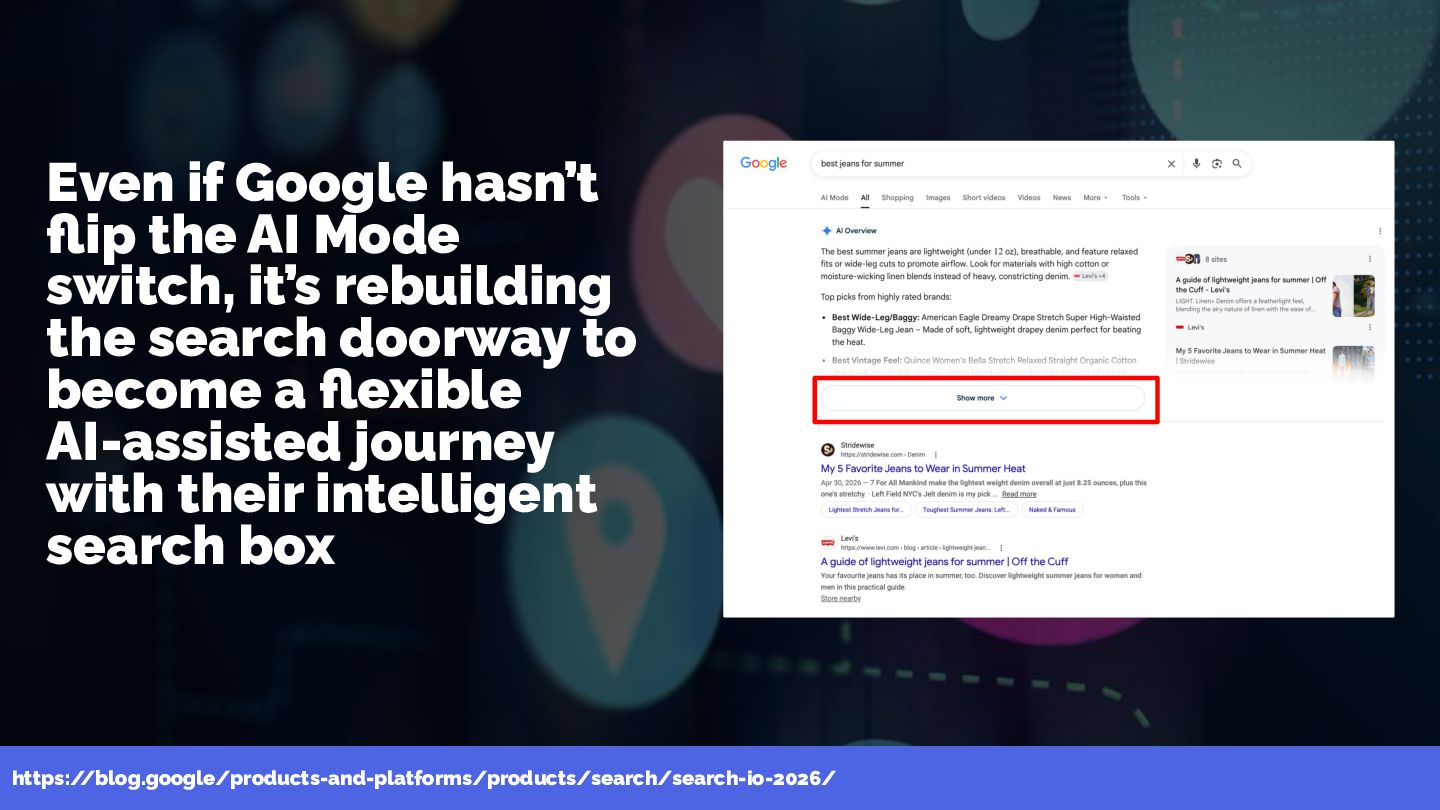
  7. https:/ /blog.google/products-and-platforms/products/search/search-io-2026/ Even if Google hasn’t flip the AI Mode

    switch, it’s rebuilding the search doorway to become a flexible AI-assisted journey with their intelligent search box
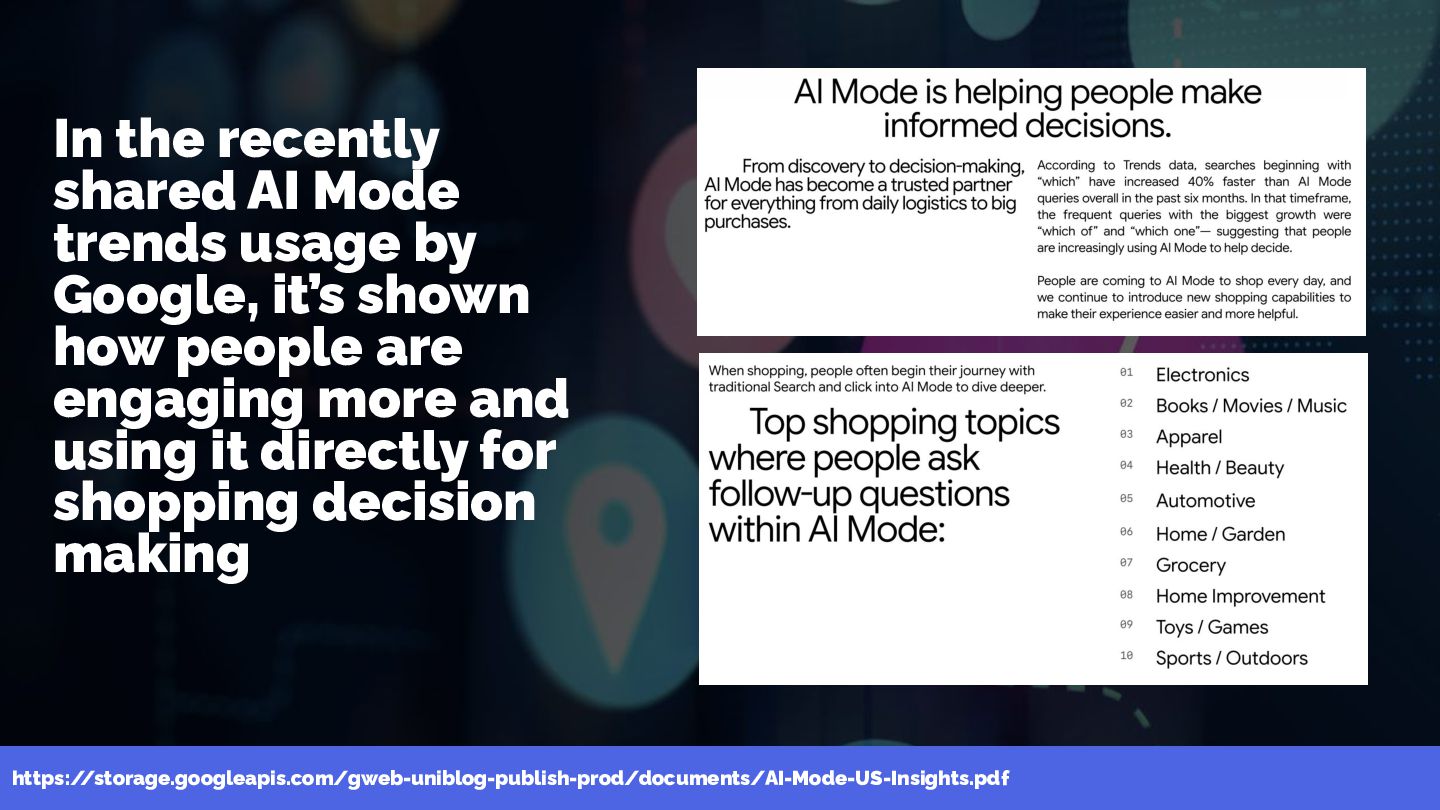
  8. https:/ /storage.googleapis.com/gweb-uniblog-publish-prod/documents/AI-Mode-US-Insights.pdf In the recently shared AI Mode trends usage

    by Google, it’s shown how people are engaging more and using it directly for shopping decision making
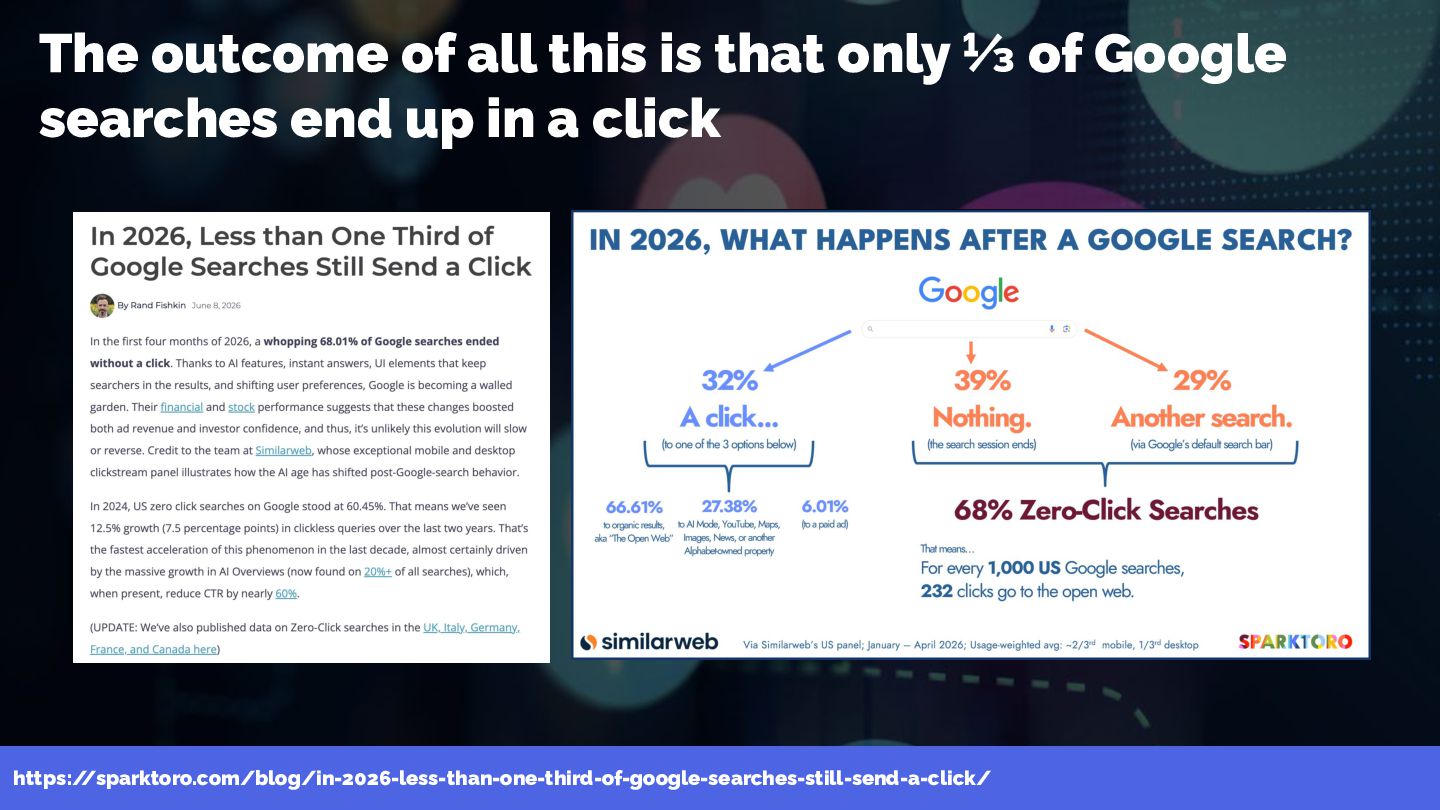
  9. So if ecom sites are getting less search traffic due

    to AI experiences & are expected to get even less: Does it mean SEO is dead? By Aleyda Solis - SEO Consultant & Founder at Orainti & SEOFOMO
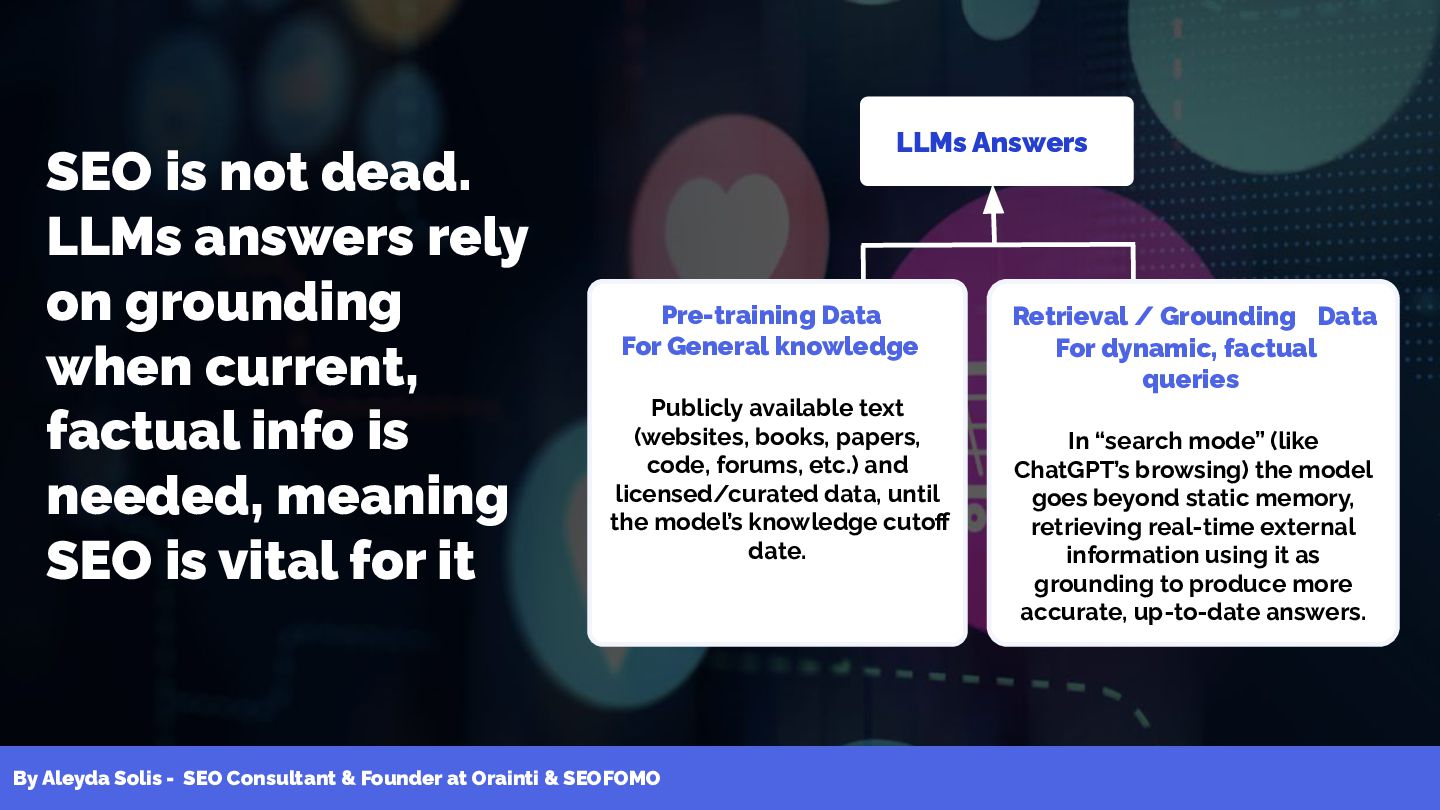
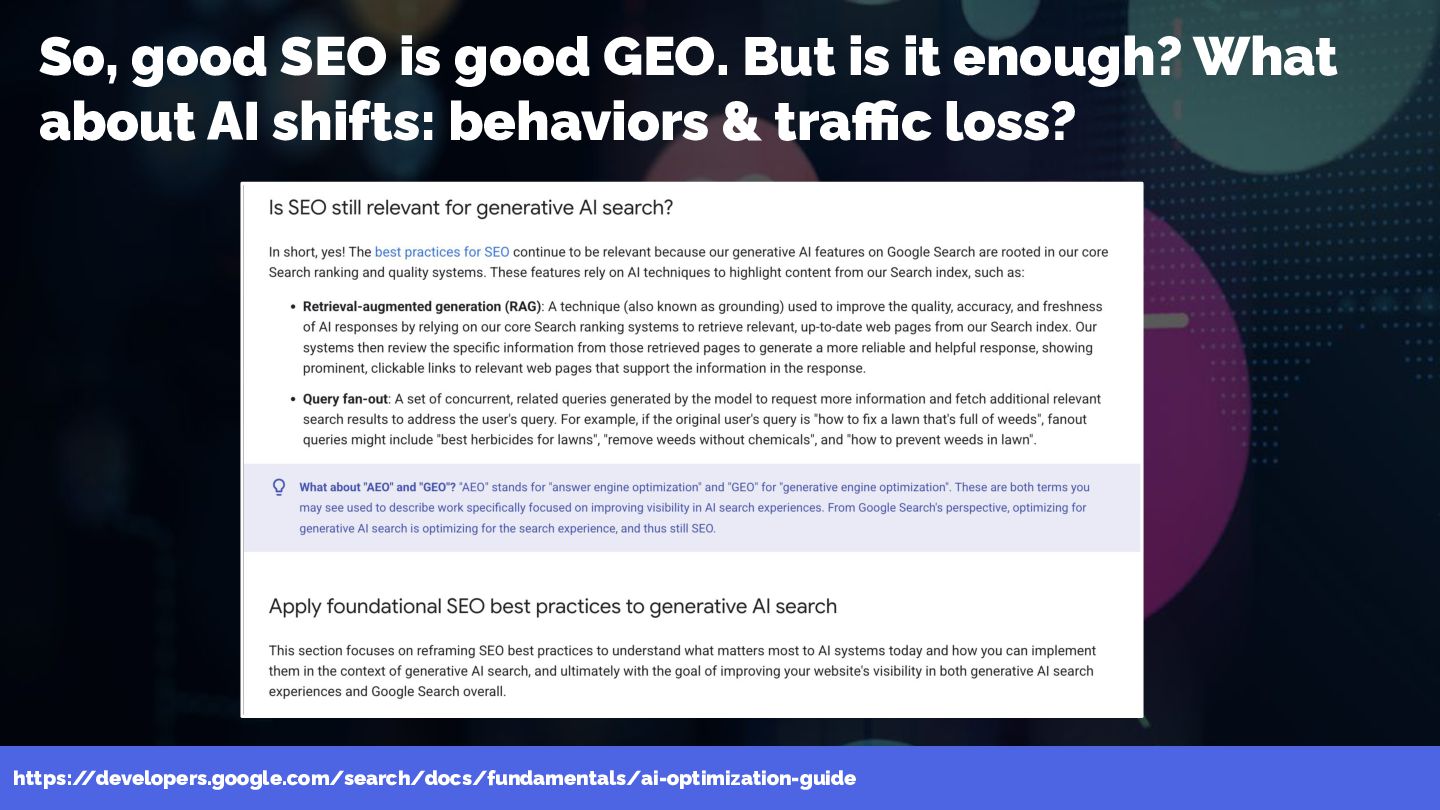
  10. SEO is not dead. LLMs answers rely on grounding when

    current, factual info is needed, meaning SEO is vital for it LLMs Answers Retrieval / Grounding Data For dynamic, factual queries In “search mode” (like ChatGPT’s browsing) the model goes beyond static memory, retrieving real-time external information using it as grounding to produce more accurate, up-to-date answers. Pre-training Data For General knowledge Publicly available text (websites, books, papers, code, forums, etc.) and licensed/curated data, until the model’s knowledge cutoff date. By Aleyda Solis - SEO Consultant & Founder at Orainti & SEOFOMO
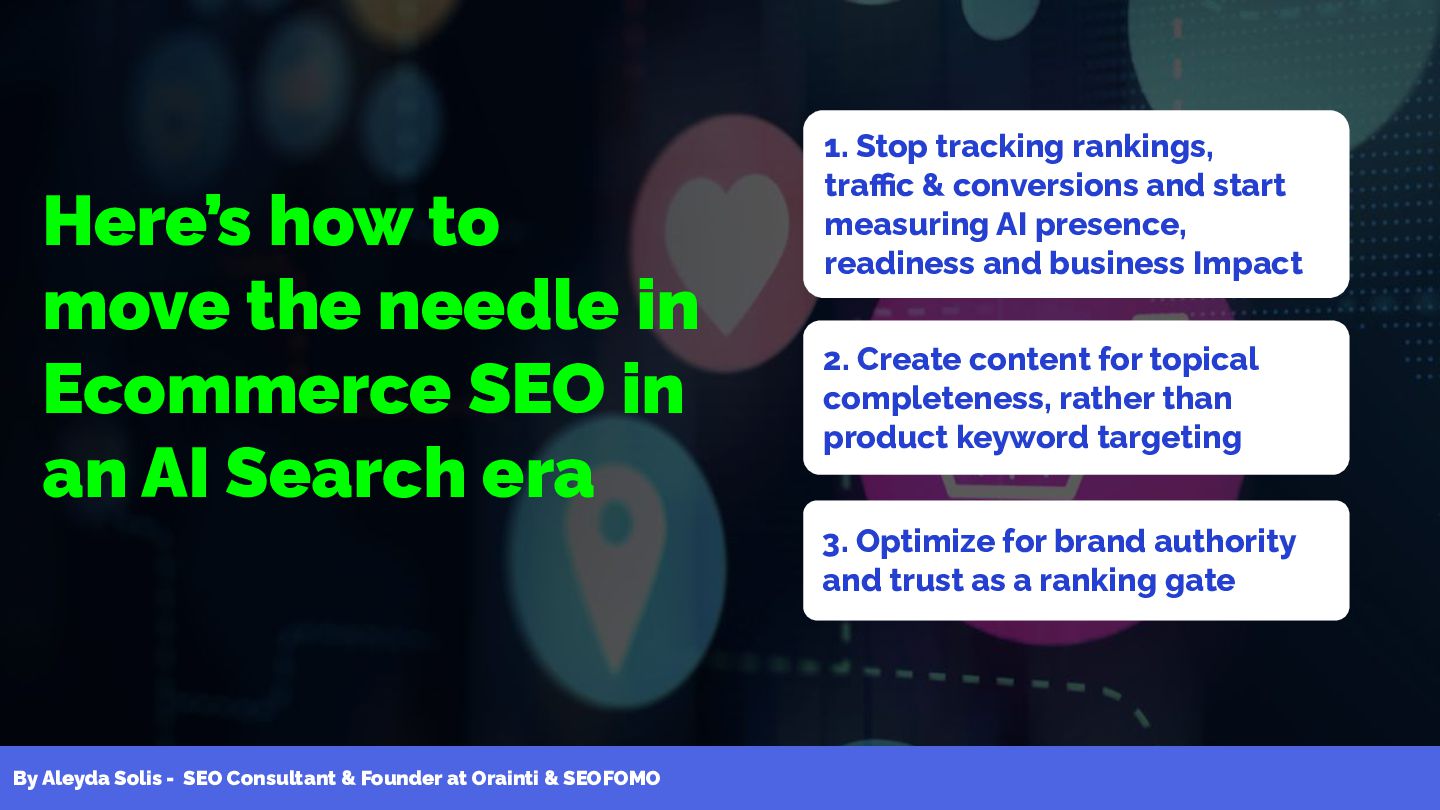
  11. Here’s how to move the needle in Ecommerce SEO in

    an AI Search era By Aleyda Solis - SEO Consultant & Founder at Orainti & SEOFOMO By Aleyda Solis - SEO Consultant & Founder at Orainti & SEOFOMO 1. Stop tracking rankings, traffic & conversions and start measuring AI presence, readiness and business Impact 2. Create content for topical completeness, rather than product keyword targeting 3. Optimize for brand authority and trust as a ranking gate
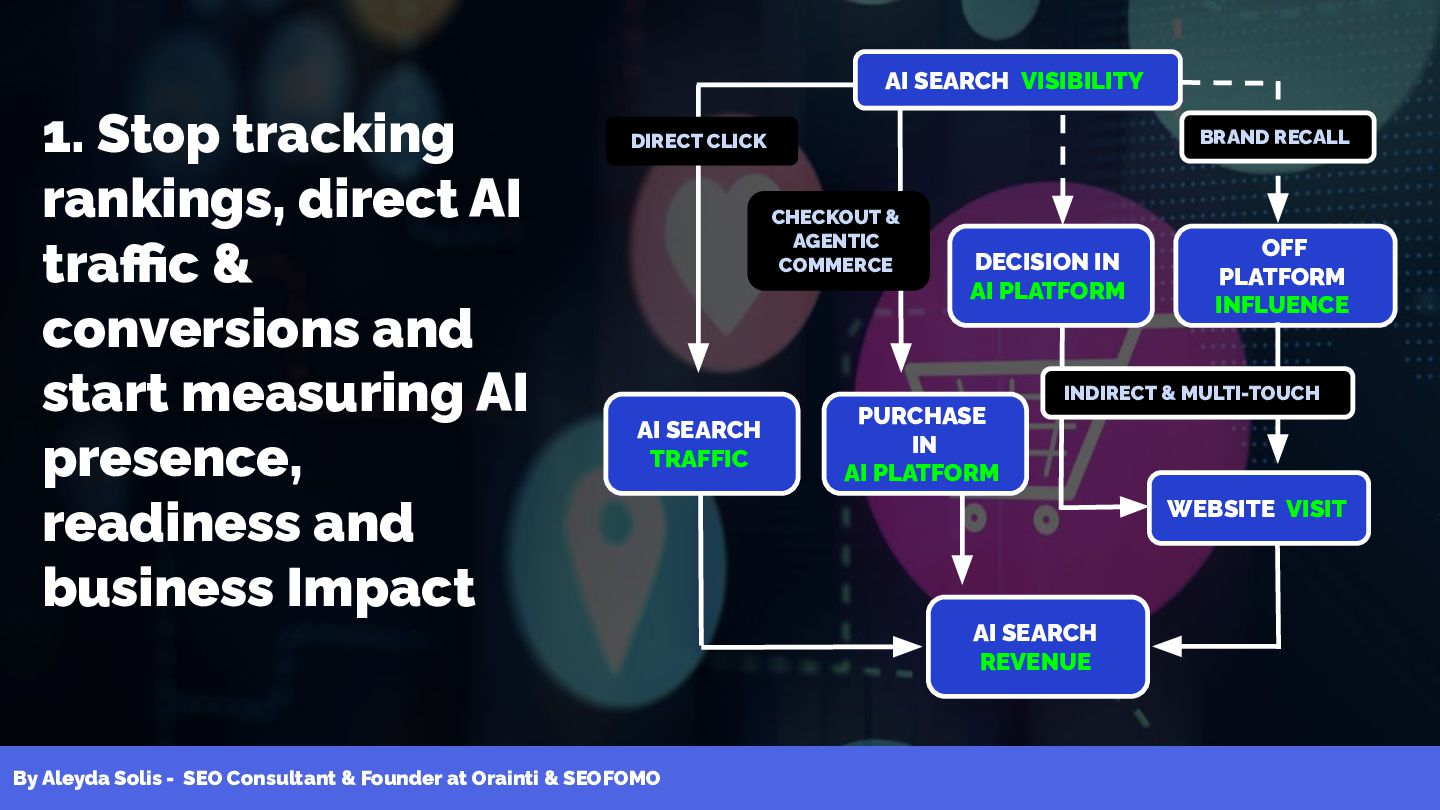
  12. By Aleyda Solis - SEO Consultant & Founder at Orainti

    & SEOFOMO BRAND RECALL AI SEARCH REVENUE AI SEARCH TRAFFIC OFF PLATFORM INFLUENCE DECISION IN AI PLATFORM WEBSITE VISIT INDIRECT & MULTI-TOUCH AI SEARCH VISIBILITY PURCHASE IN AI PLATFORM DIRECT CLICK 1. Stop tracking rankings, direct AI traffic & conversions and start measuring AI presence, readiness and business Impact CHECKOUT & AGENTIC COMMERCE
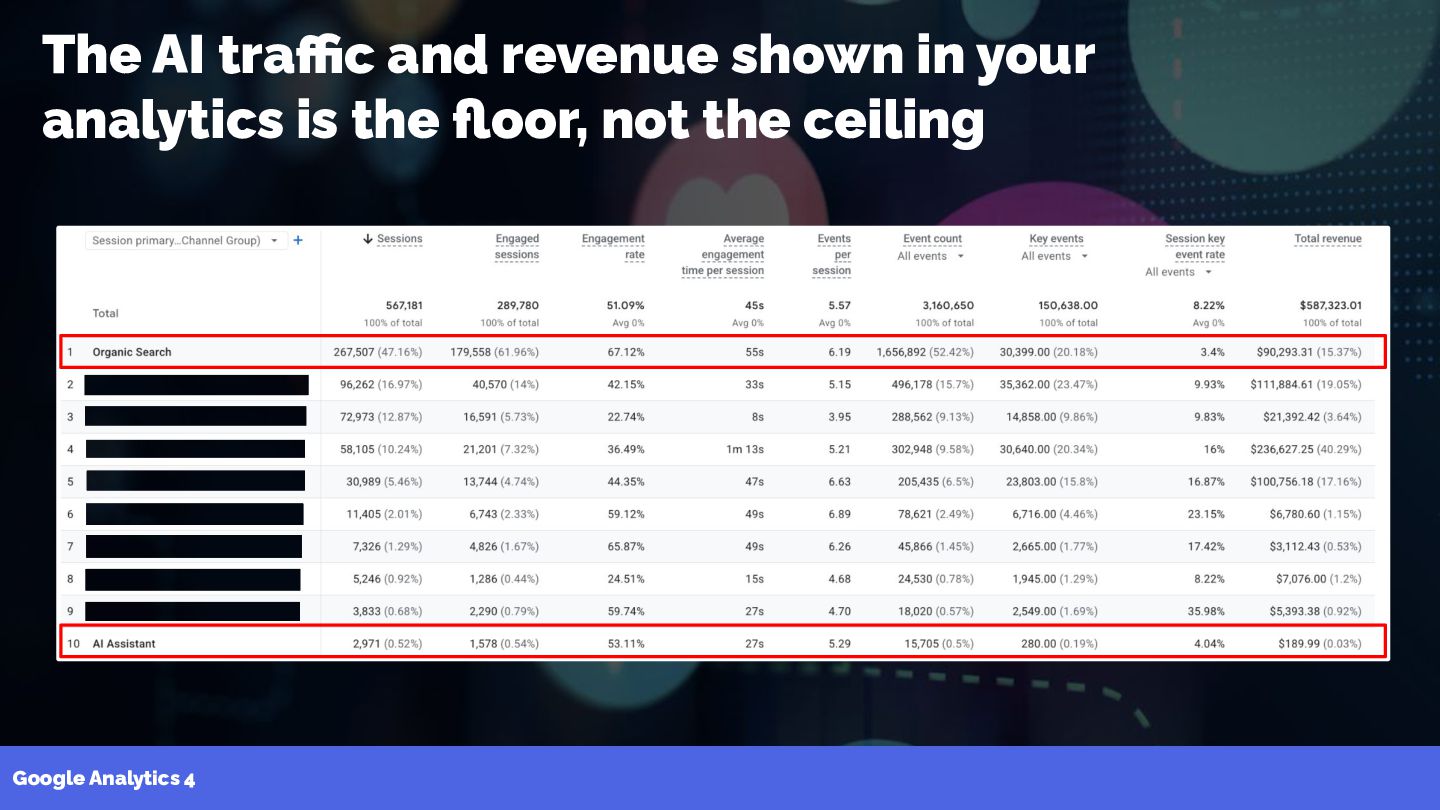
  13. Google Analytics 4 The AI traffic and revenue shown in

    your analytics is the floor, not the ceiling
  14. By Aleyda Solis - SEO Consultant & Founder at Orainti

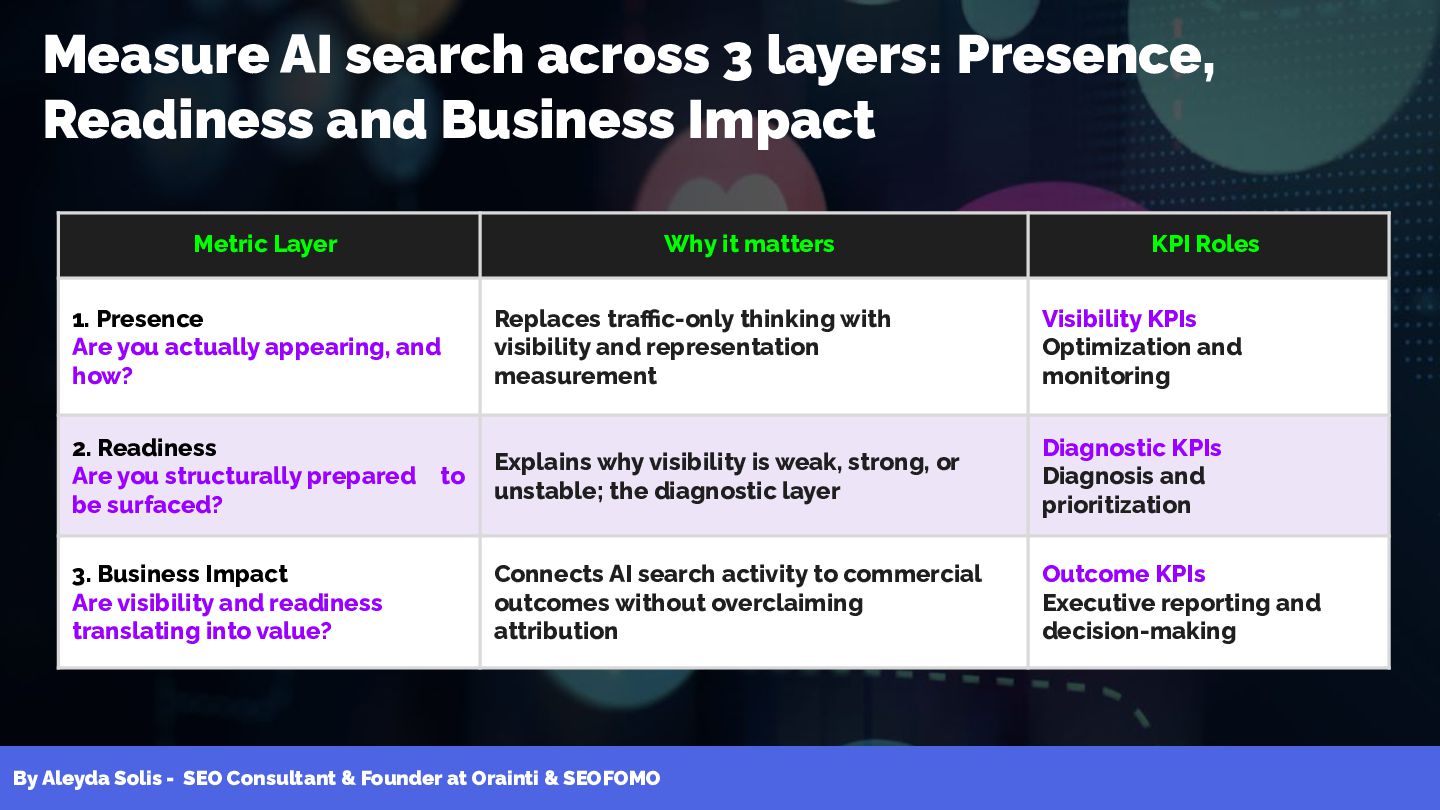
    & SEOFOMO Metric Layer Why it matters KPI Roles 1. Presence Are you actually appearing, and how? Replaces traffic-only thinking with visibility and representation measurement Visibility KPIs Optimization and monitoring 2. Readiness Are you structurally prepared to be surfaced? Explains why visibility is weak, strong, or unstable; the diagnostic layer Diagnostic KPIs Diagnosis and prioritization 3. Business Impact Are visibility and readiness translating into value? Connects AI search activity to commercial outcomes without overclaiming attribution Outcome KPIs Executive reporting and decision-making Measure AI search across 3 layers: Presence, Readiness and Business Impact
  15. By Aleyda Solis - SEO Consultant & Founder at Orainti

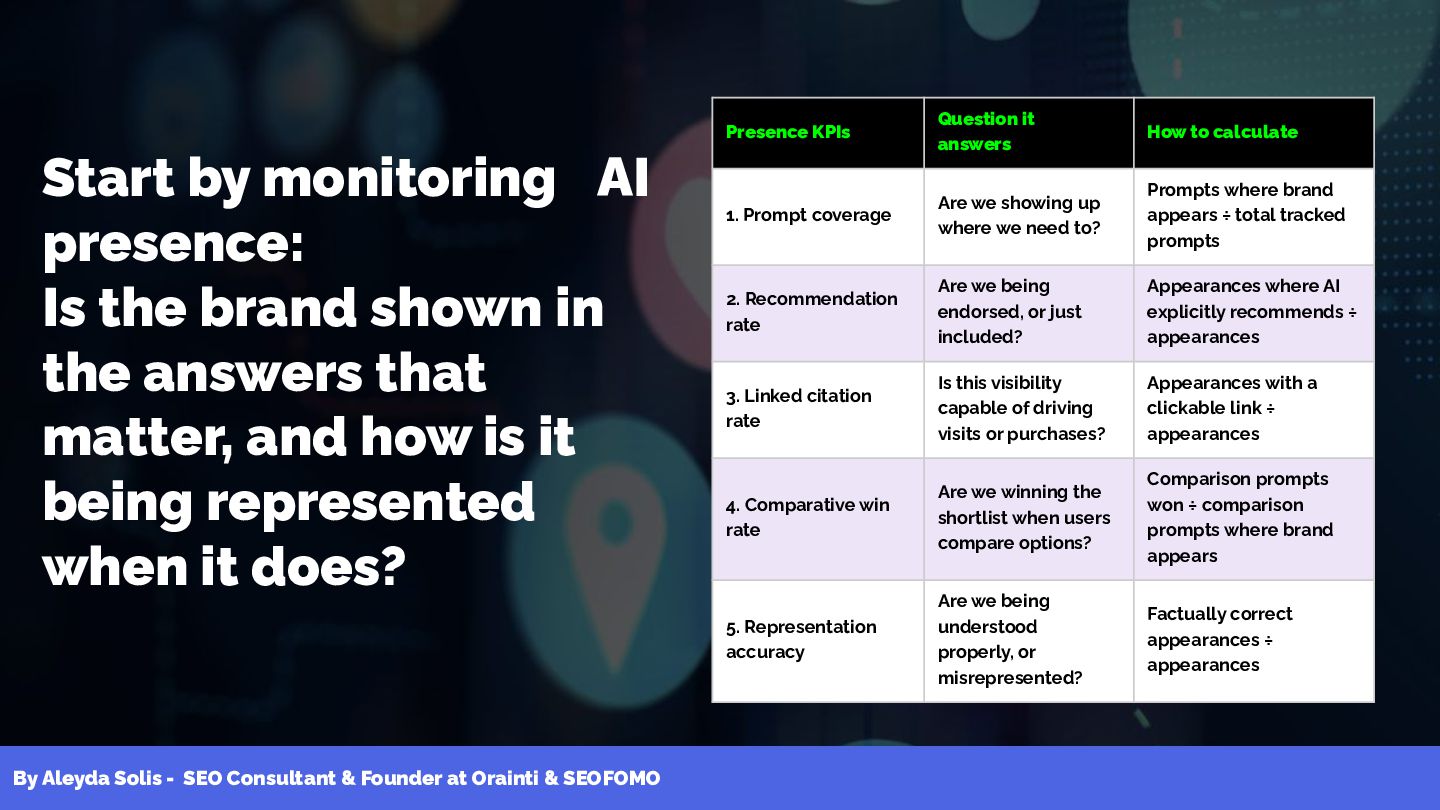
    & SEOFOMO Start by monitoring AI presence: Is the brand shown in the answers that matter, and how is it being represented when it does? Presence KPIs Question it answers How to calculate 1. Prompt coverage Are we showing up where we need to? Prompts where brand appears ÷ total tracked prompts 2. Recommendation rate Are we being endorsed, or just included? Appearances where AI explicitly recommends ÷ appearances 3. Linked citation rate Is this visibility capable of driving visits or purchases? Appearances with a clickable link ÷ appearances 4. Comparative win rate Are we winning the shortlist when users compare options? Comparison prompts won ÷ comparison prompts where brand appears 5. Representation accuracy Are we being understood properly, or misrepresented? Factually correct appearances ÷ appearances
  16. By Aleyda Solis - SEO Consultant & Founder at Orainti

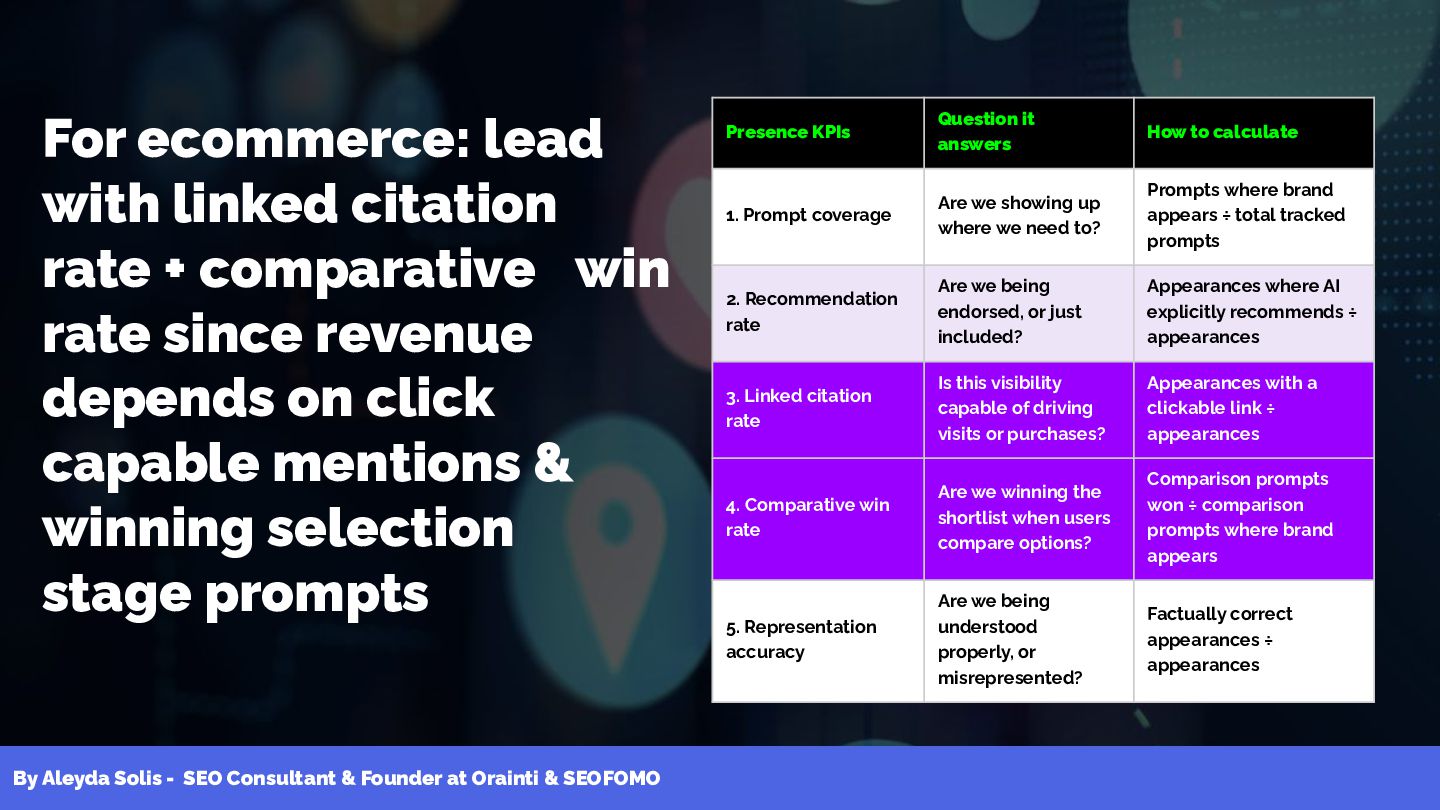
    & SEOFOMO For ecommerce: lead with linked citation rate + comparative win rate since revenue depends on click capable mentions & winning selection stage prompts Presence KPIs Question it answers How to calculate 1. Prompt coverage Are we showing up where we need to? Prompts where brand appears ÷ total tracked prompts 2. Recommendation rate Are we being endorsed, or just included? Appearances where AI explicitly recommends ÷ appearances 3. Linked citation rate Is this visibility capable of driving visits or purchases? Appearances with a clickable link ÷ appearances 4. Comparative win rate Are we winning the shortlist when users compare options? Comparison prompts won ÷ comparison prompts where brand appears 5. Representation accuracy Are we being understood properly, or misrepresented? Factually correct appearances ÷ appearances
  17. By Aleyda Solis - SEO Consultant & Founder at Orainti

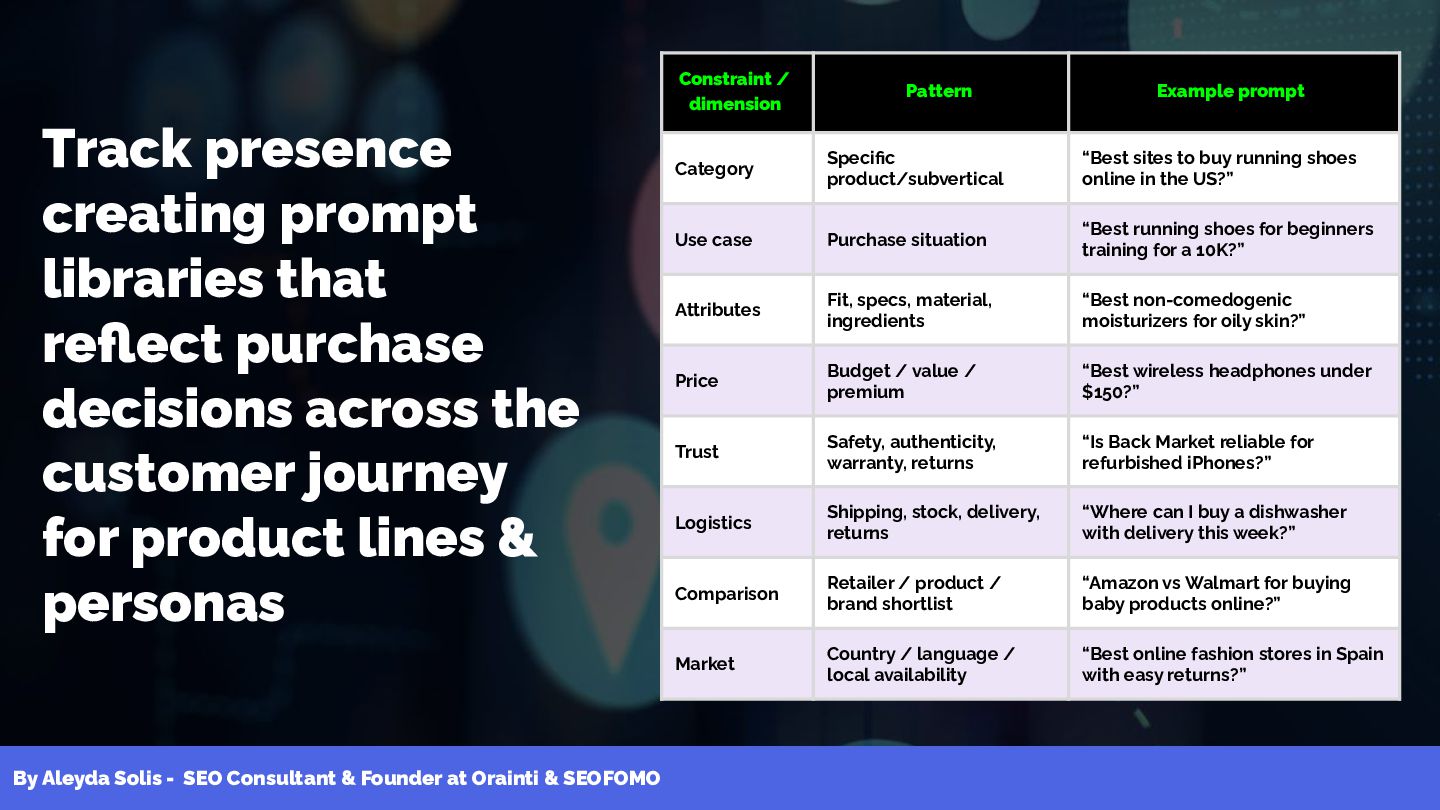
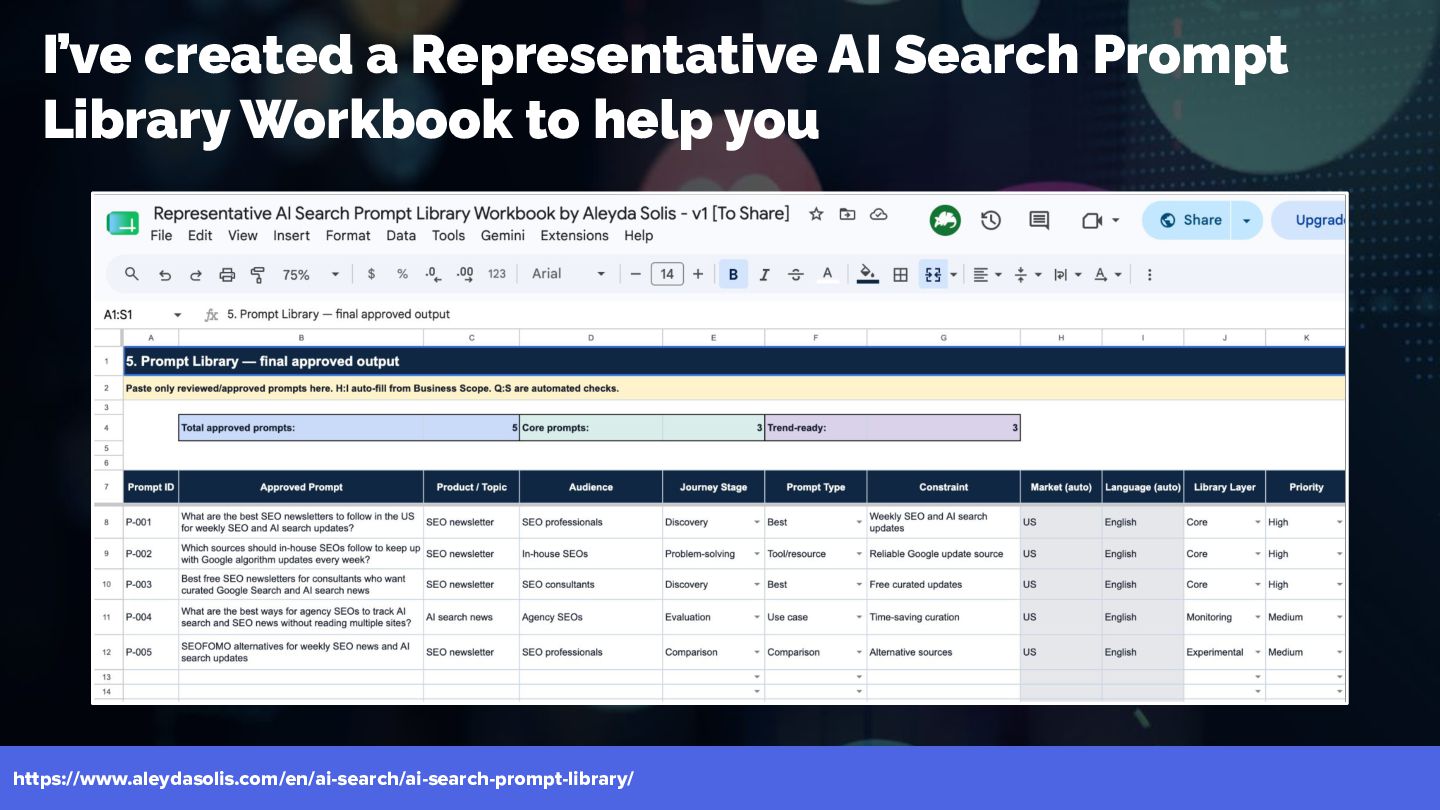
    & SEOFOMO Track presence creating prompt libraries that reflect purchase decisions across the customer journey for product lines & personas Constraint / dimension Pattern Example prompt Category Specific product/subvertical “Best sites to buy running shoes online in the US?” Use case Purchase situation “Best running shoes for beginners training for a 10K?” Attributes Fit, specs, material, ingredients “Best non-comedogenic moisturizers for oily skin?” Price Budget / value / premium “Best wireless headphones under $150?” Trust Safety, authenticity, warranty, returns “Is Back Market reliable for refurbished iPhones?” Logistics Shipping, stock, delivery, returns “Where can I buy a dishwasher with delivery this week?” Comparison Retailer / product / brand shortlist “Amazon vs Walmart for buying baby products online?” Market Country / language / local availability “Best online fashion stores in Spain with easy returns?”
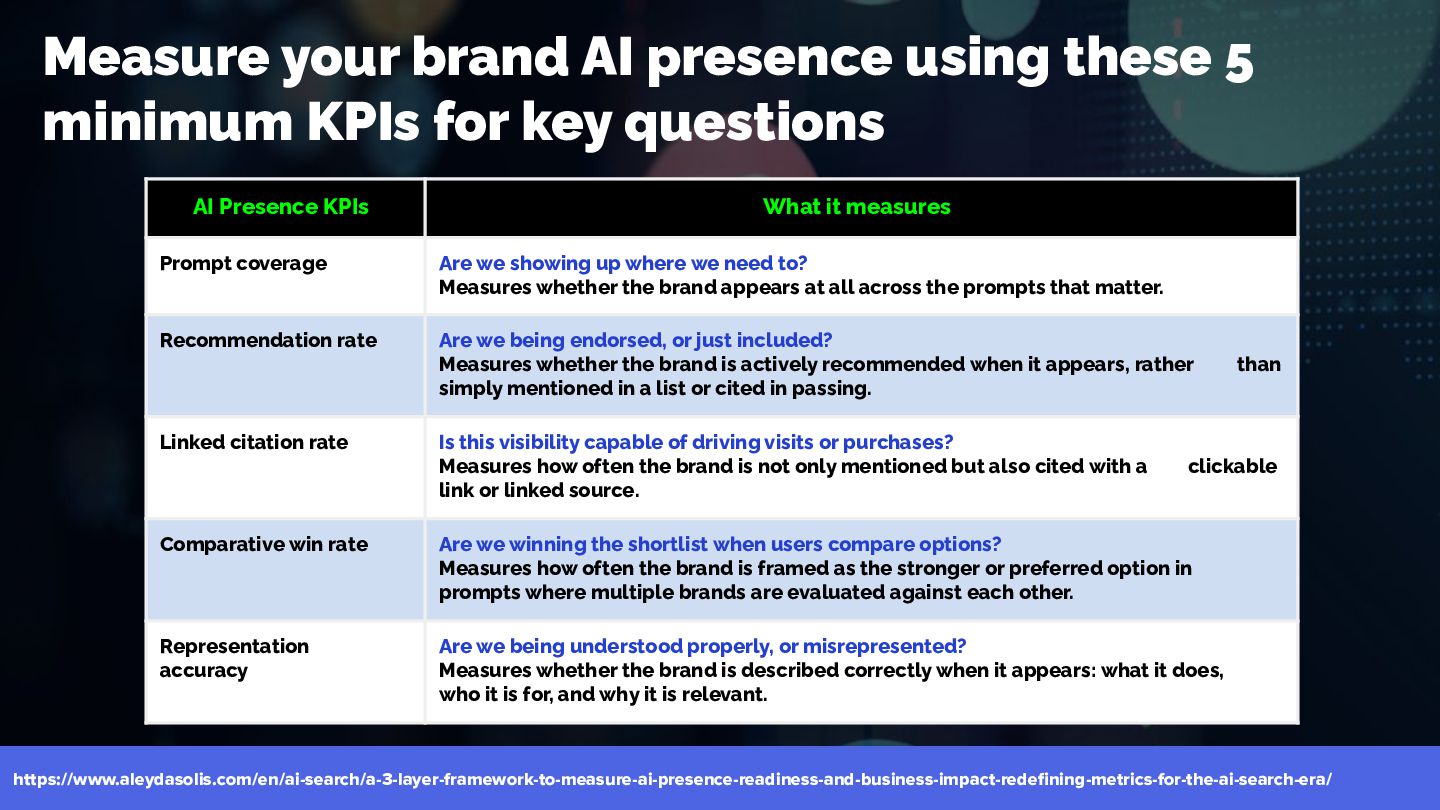
  18. Measure your brand AI presence using these 5 minimum KPIs

    for key questions AI Presence KPIs What it measures Prompt coverage Are we showing up where we need to? Measures whether the brand appears at all across the prompts that matter. Recommendation rate Are we being endorsed, or just included? Measures whether the brand is actively recommended when it appears, rather than simply mentioned in a list or cited in passing. Linked citation rate Is this visibility capable of driving visits or purchases? Measures how often the brand is not only mentioned but also cited with a clickable link or linked source. Comparative win rate Are we winning the shortlist when users compare options? Measures how often the brand is framed as the stronger or preferred option in prompts where multiple brands are evaluated against each other. Representation accuracy Are we being understood properly, or misrepresented? Measures whether the brand is described correctly when it appears: what it does, who it is for, and why it is relevant. https://www.aleydasolis.com/en/ai-search/a-3-layer-framework-to-measure-ai-presence-readiness-and-business-impact-redefining-metrics-for-the-ai-search-era/
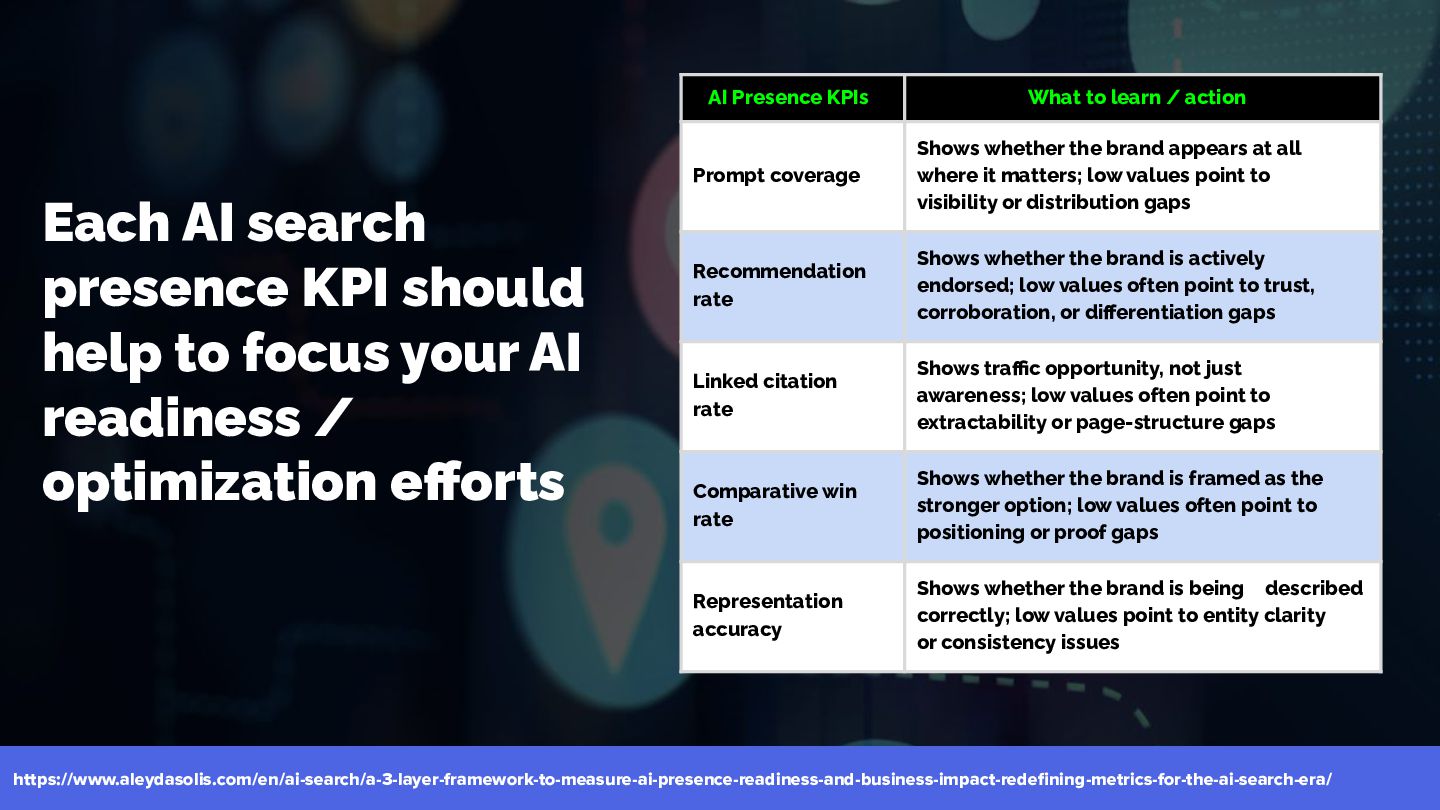
  19. AI Presence KPIs What to learn / action Prompt coverage

    Shows whether the brand appears at all where it matters; low values point to visibility or distribution gaps Recommendation rate Shows whether the brand is actively endorsed; low values often point to trust, corroboration, or differentiation gaps Linked citation rate Shows traffic opportunity, not just awareness; low values often point to extractability or page-structure gaps Comparative win rate Shows whether the brand is framed as the stronger option; low values often point to positioning or proof gaps Representation accuracy Shows whether the brand is being described correctly; low values point to entity clarity or consistency issues Each AI search presence KPI should help to focus your AI readiness / optimization efforts https://www.aleydasolis.com/en/ai-search/a-3-layer-framework-to-measure-ai-presence-readiness-and-business-impact-redefining-metrics-for-the-ai-search-era/
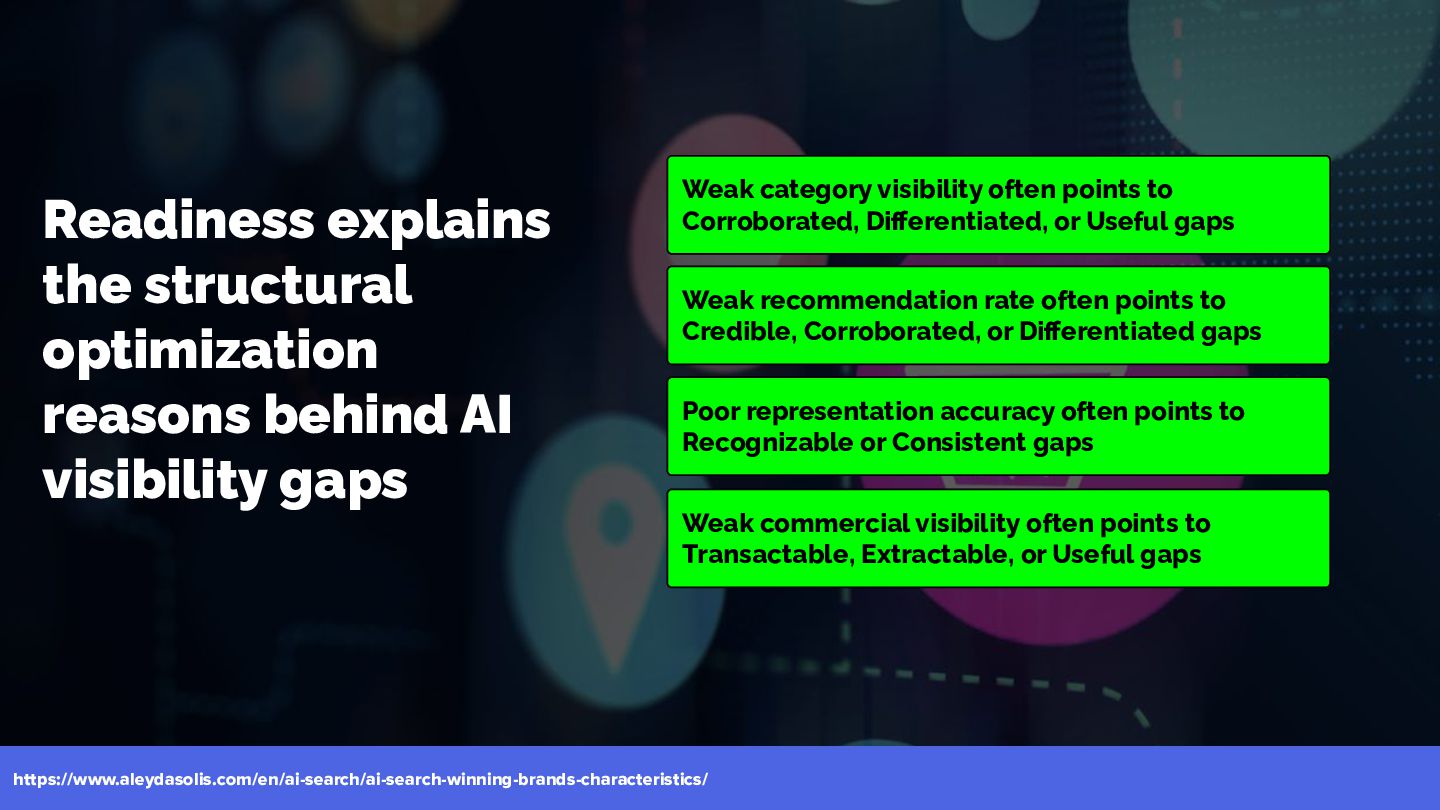
  20. Readiness explains the structural optimization reasons behind AI visibility gaps

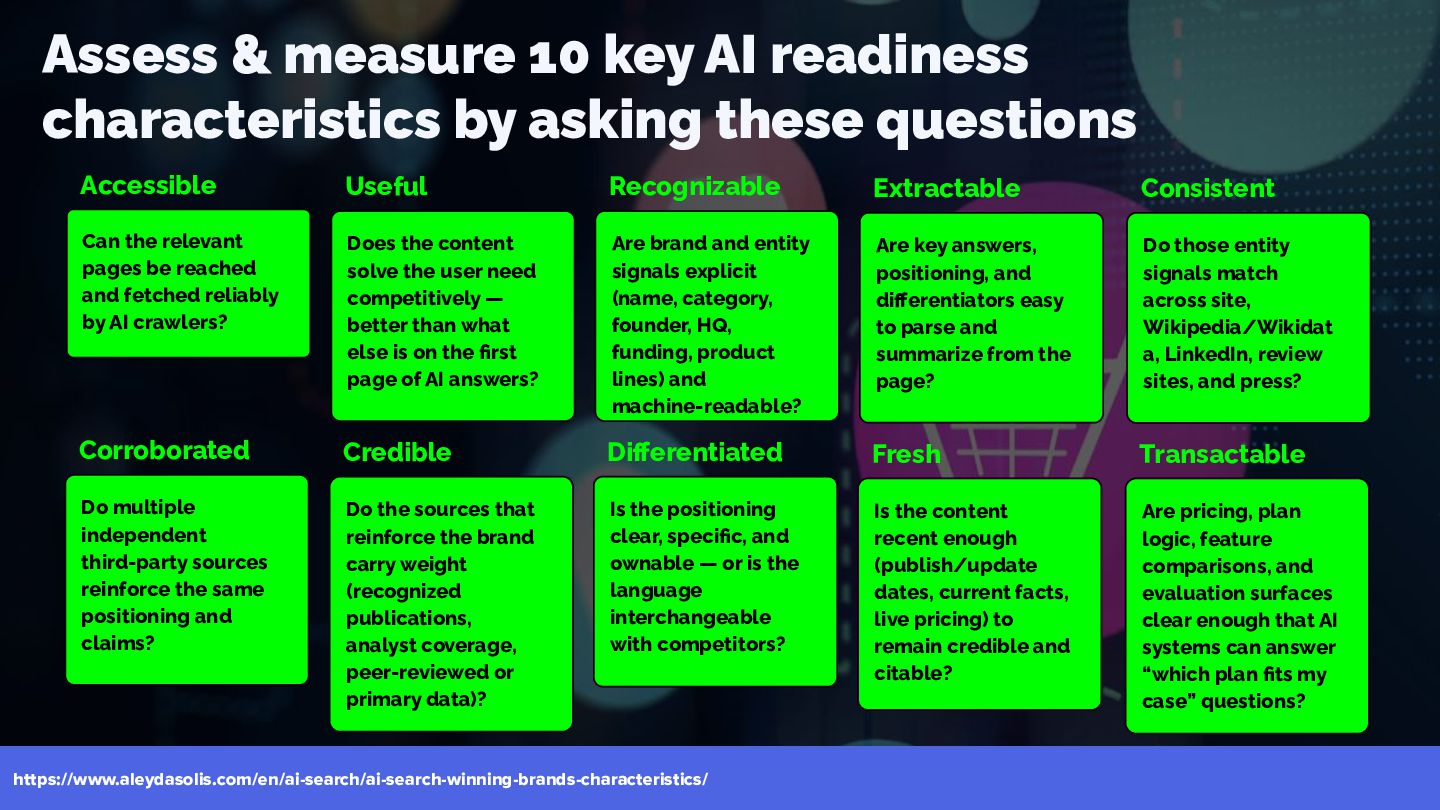
    Weak category visibility often points to Corroborated, Differentiated, or Useful gaps Weak recommendation rate often points to Credible, Corroborated, or Differentiated gaps Poor representation accuracy often points to Recognizable or Consistent gaps Weak commercial visibility often points to Transactable, Extractable, or Useful gaps https://www.aleydasolis.com/en/ai-search/ai-search-winning-brands-characteristics/
  21. Can the relevant pages be reached and fetched reliably by

    AI crawlers? Accessible Does the content solve the user need competitively — better than what else is on the first page of AI answers? Useful Are brand and entity signals explicit (name, category, founder, HQ, funding, product lines) and machine-readable? Recognizable Are key answers, positioning, and differentiators easy to parse and summarize from the page? Extractable Do those entity signals match across site, Wikipedia/Wikidat a, LinkedIn, review sites, and press? Consistent Do multiple independent third-party sources reinforce the same positioning and claims? Corroborated Do the sources that reinforce the brand carry weight (recognized publications, analyst coverage, peer-reviewed or primary data)? Credible Is the positioning clear, specific, and ownable — or is the language interchangeable with competitors? Differentiated Is the content recent enough (publish/update dates, current facts, live pricing) to remain credible and citable? Fresh Are pricing, plan logic, feature comparisons, and evaluation surfaces clear enough that AI systems can answer “which plan fits my case” questions? Transactable Assess & measure 10 key AI readiness characteristics by asking these questions https://www.aleydasolis.com/en/ai-search/ai-search-winning-brands-characteristics/
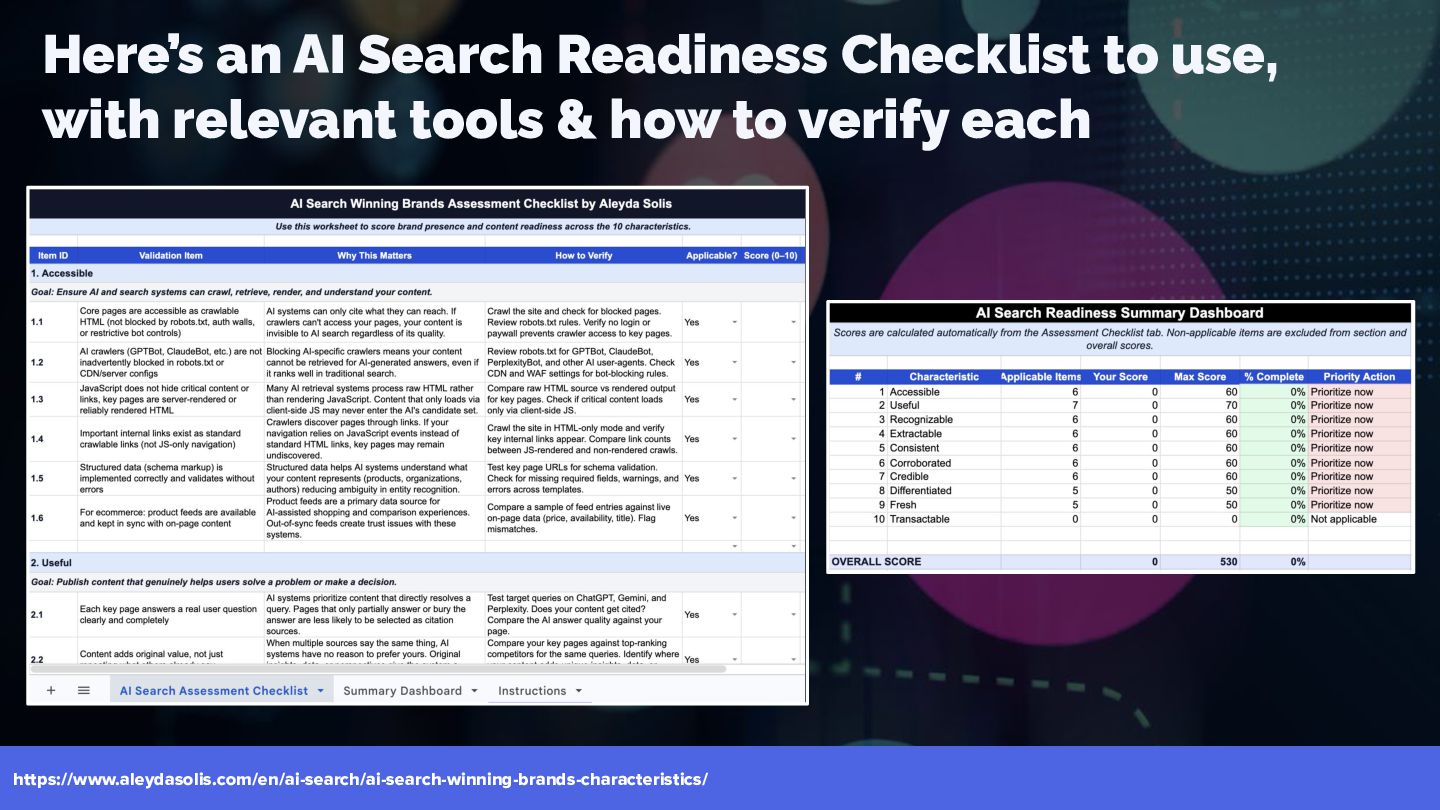
  22. Here’s an AI Search Readiness Checklist to use, with relevant

    tools & how to verify each https://www.aleydasolis.com/en/ai-search/ai-search-winning-brands-characteristics/
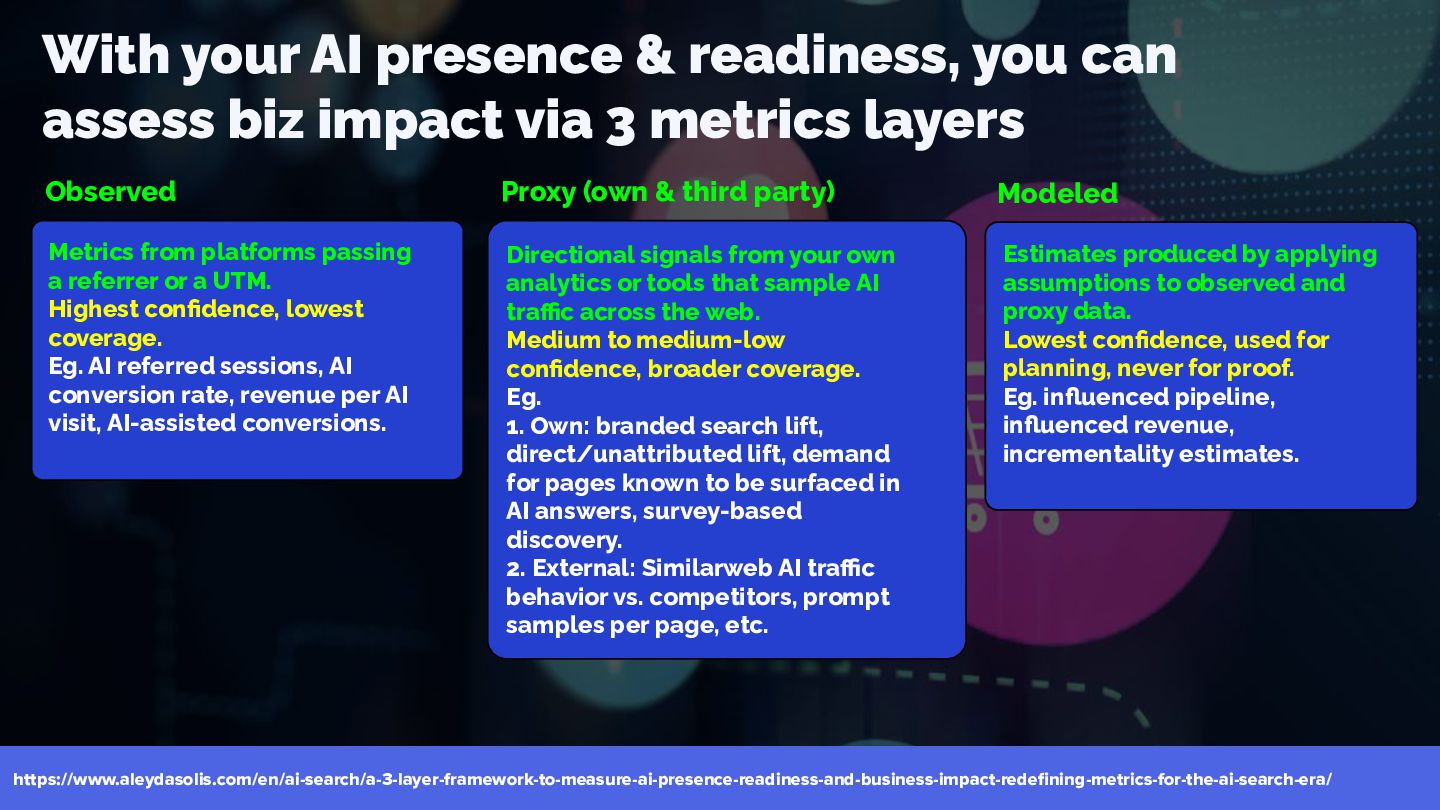
  23. With your AI presence & readiness, you can assess biz

    impact via 3 metrics layers Metrics from platforms passing a referrer or a UTM. Highest confidence, lowest coverage. Eg. AI referred sessions, AI conversion rate, revenue per AI visit, AI-assisted conversions. Directional signals from your own analytics or tools that sample AI traffic across the web. Medium to medium-low confidence, broader coverage. Eg. 1. Own: branded search lift, direct/unattributed lift, demand for pages known to be surfaced in AI answers, survey-based discovery. 2. External: Similarweb AI traffic behavior vs. competitors, prompt samples per page, etc. Estimates produced by applying assumptions to observed and proxy data. Lowest confidence, used for planning, never for proof. Eg. influenced pipeline, influenced revenue, incrementality estimates. Observed Proxy (own & third party) Modeled https://www.aleydasolis.com/en/ai-search/a-3-layer-framework-to-measure-ai-presence-readiness-and-business-impact-redefining-metrics-for-the-ai-search-era/
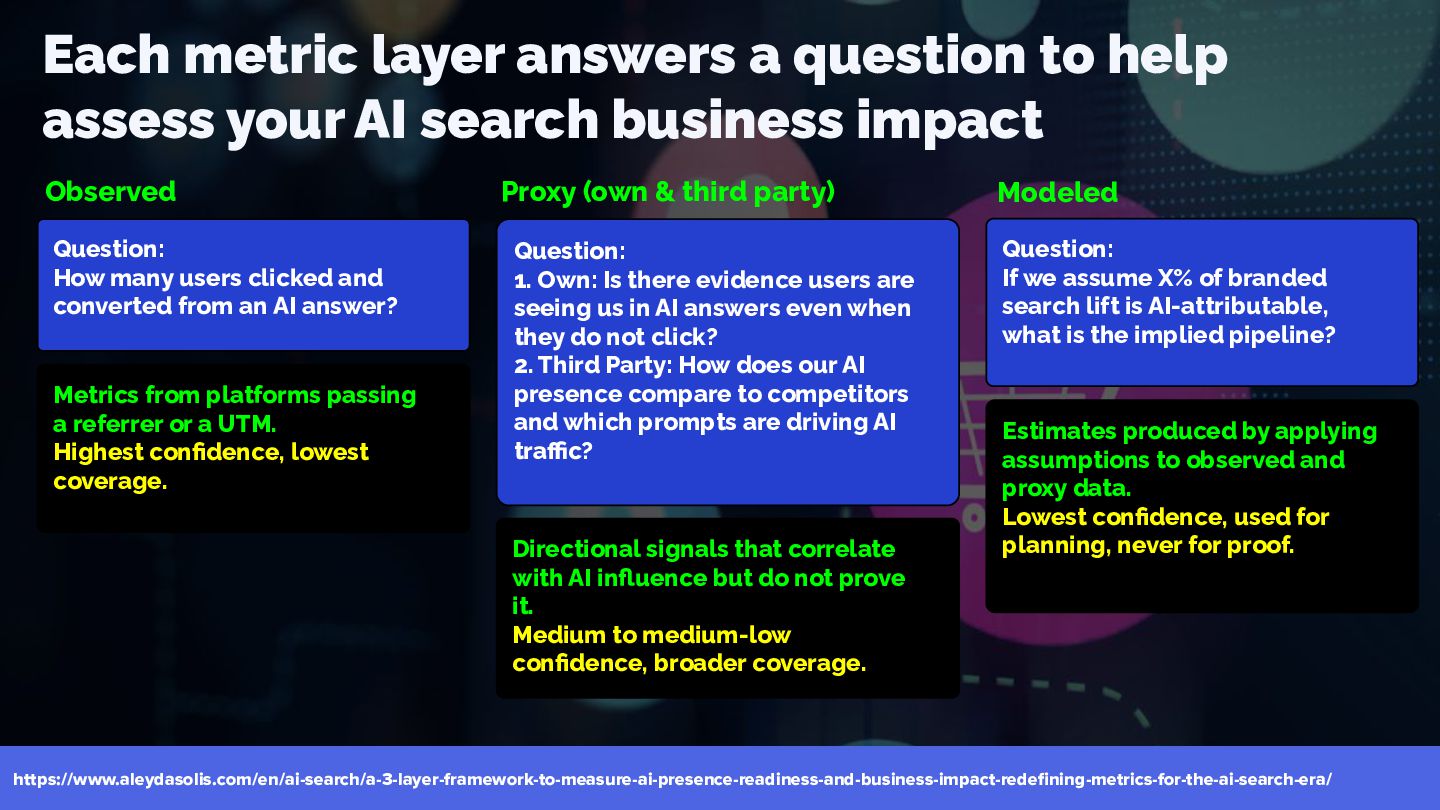
  24. Metrics from platforms passing a referrer or a UTM. Highest

    confidence, lowest coverage. Directional signals that correlate with AI influence but do not prove it. Medium to medium-low confidence, broader coverage. Estimates produced by applying assumptions to observed and proxy data. Lowest confidence, used for planning, never for proof. Observed Modeled Proxy (own & third party) Question: How many users clicked and converted from an AI answer? Question: 1. Own: Is there evidence users are seeing us in AI answers even when they do not click? 2. Third Party: How does our AI presence compare to competitors and which prompts are driving AI traffic? Question: If we assume X% of branded search lift is AI-attributable, what is the implied pipeline? Each metric layer answers a question to help assess your AI search business impact https://www.aleydasolis.com/en/ai-search/a-3-layer-framework-to-measure-ai-presence-readiness-and-business-impact-redefining-metrics-for-the-ai-search-era/
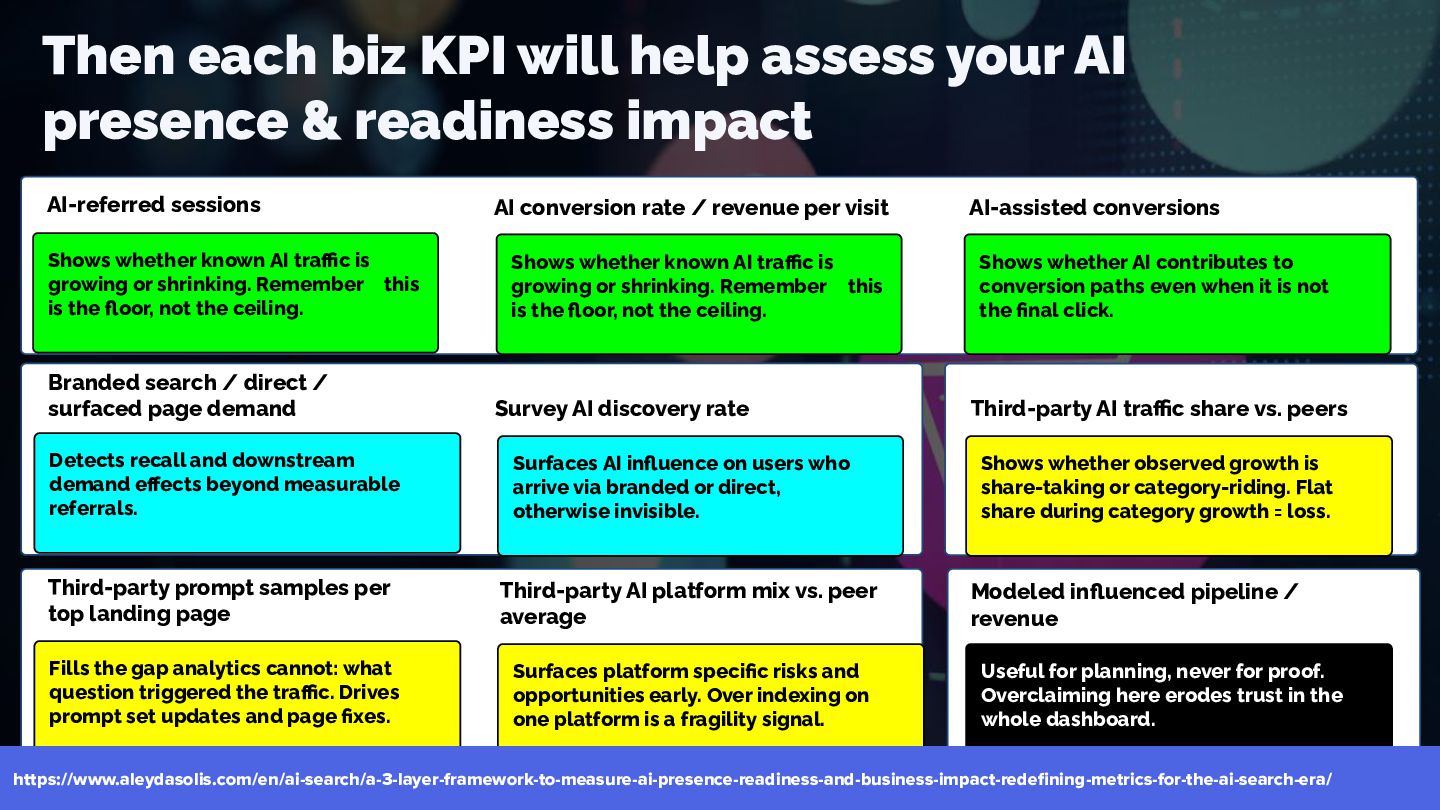
  25. Then each biz KPI will help assess your AI presence

    & readiness impact Shows whether known AI traffic is growing or shrinking. Remember this is the floor, not the ceiling. AI-referred sessions Shows whether known AI traffic is growing or shrinking. Remember this is the floor, not the ceiling. AI conversion rate / revenue per visit Shows whether AI contributes to conversion paths even when it is not the final click. AI-assisted conversions Detects recall and downstream demand effects beyond measurable referrals. Branded search / direct / surfaced page demand Surfaces AI influence on users who arrive via branded or direct, otherwise invisible. Survey AI discovery rate Shows whether observed growth is share-taking or category-riding. Flat share during category growth = loss. Third-party AI traffic share vs. peers Fills the gap analytics cannot: what question triggered the traffic. Drives prompt set updates and page fixes. Third-party prompt samples per top landing page Surfaces platform specific risks and opportunities early. Over indexing on one platform is a fragility signal. Third-party AI platform mix vs. peer average Useful for planning, never for proof. Overclaiming here erodes trust in the whole dashboard. Modeled influenced pipeline / revenue https://www.aleydasolis.com/en/ai-search/a-3-layer-framework-to-measure-ai-presence-readiness-and-business-impact-redefining-metrics-for-the-ai-search-era/
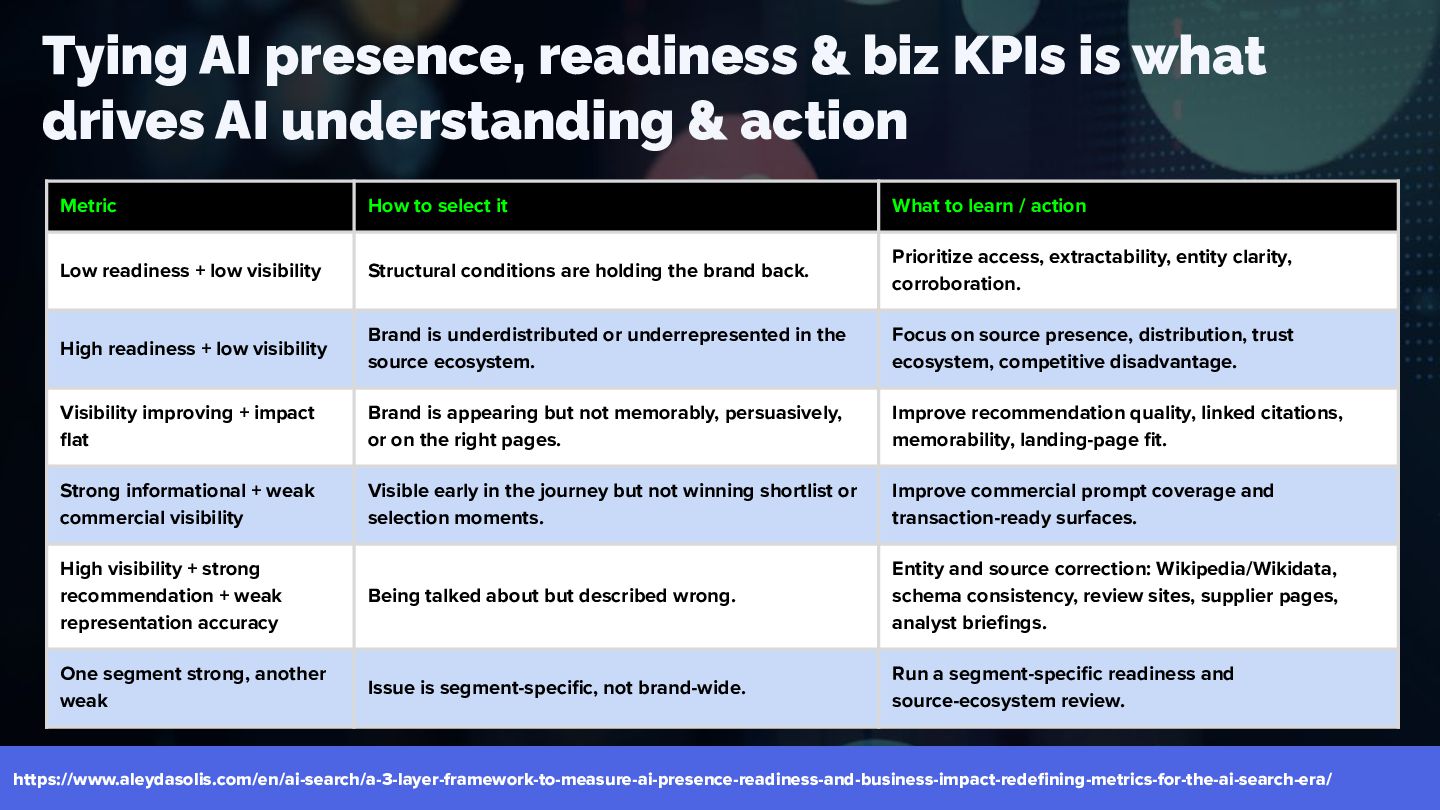
  26. Tying AI presence, readiness & biz KPIs is what drives

    AI understanding & action Metric How to select it What to learn / action Low readiness + low visibility Structural conditions are holding the brand back. Prioritize access, extractability, entity clarity, corroboration. High readiness + low visibility Brand is underdistributed or underrepresented in the source ecosystem. Focus on source presence, distribution, trust ecosystem, competitive disadvantage. Visibility improving + impact flat Brand is appearing but not memorably, persuasively, or on the right pages. Improve recommendation quality, linked citations, memorability, landing-page fit. Strong informational + weak commercial visibility Visible early in the journey but not winning shortlist or selection moments. Improve commercial prompt coverage and transaction-ready surfaces. High visibility + strong recommendation + weak representation accuracy Being talked about but described wrong. Entity and source correction: Wikipedia/Wikidata, schema consistency, review sites, supplier pages, analyst briefings. One segment strong, another weak Issue is segment-specific, not brand-wide. Run a segment-specific readiness and source-ecosystem review. https://www.aleydasolis.com/en/ai-search/a-3-layer-framework-to-measure-ai-presence-readiness-and-business-impact-redefining-metrics-for-the-ai-search-era/
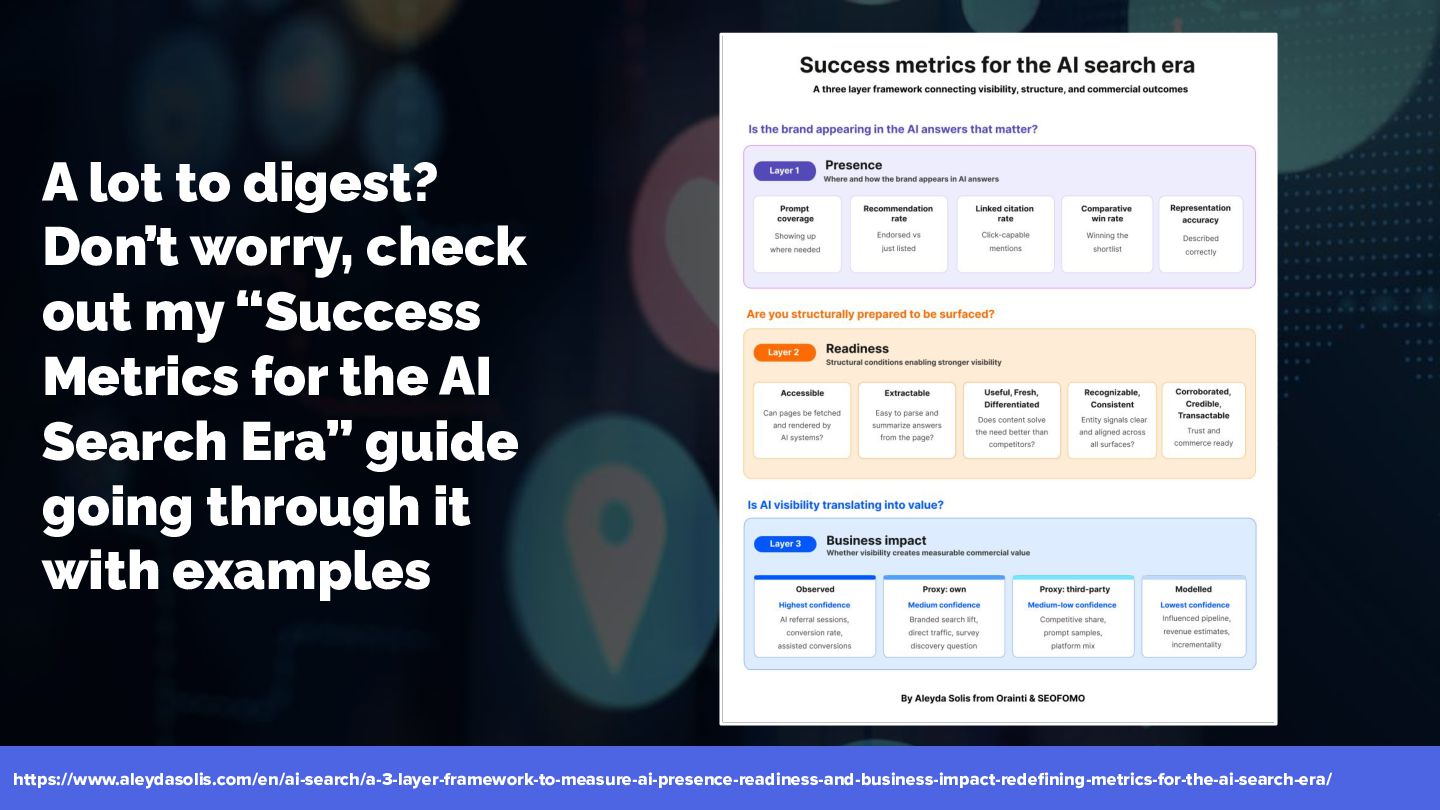
  27. A lot to digest? Don’t worry, check out my “Success

    Metrics for the AI Search Era” guide going through it with examples https://www.aleydasolis.com/en/ai-search/a-3-layer-framework-to-measure-ai-presence-readiness-and-business-impact-redefining-metrics-for-the-ai-search-era/
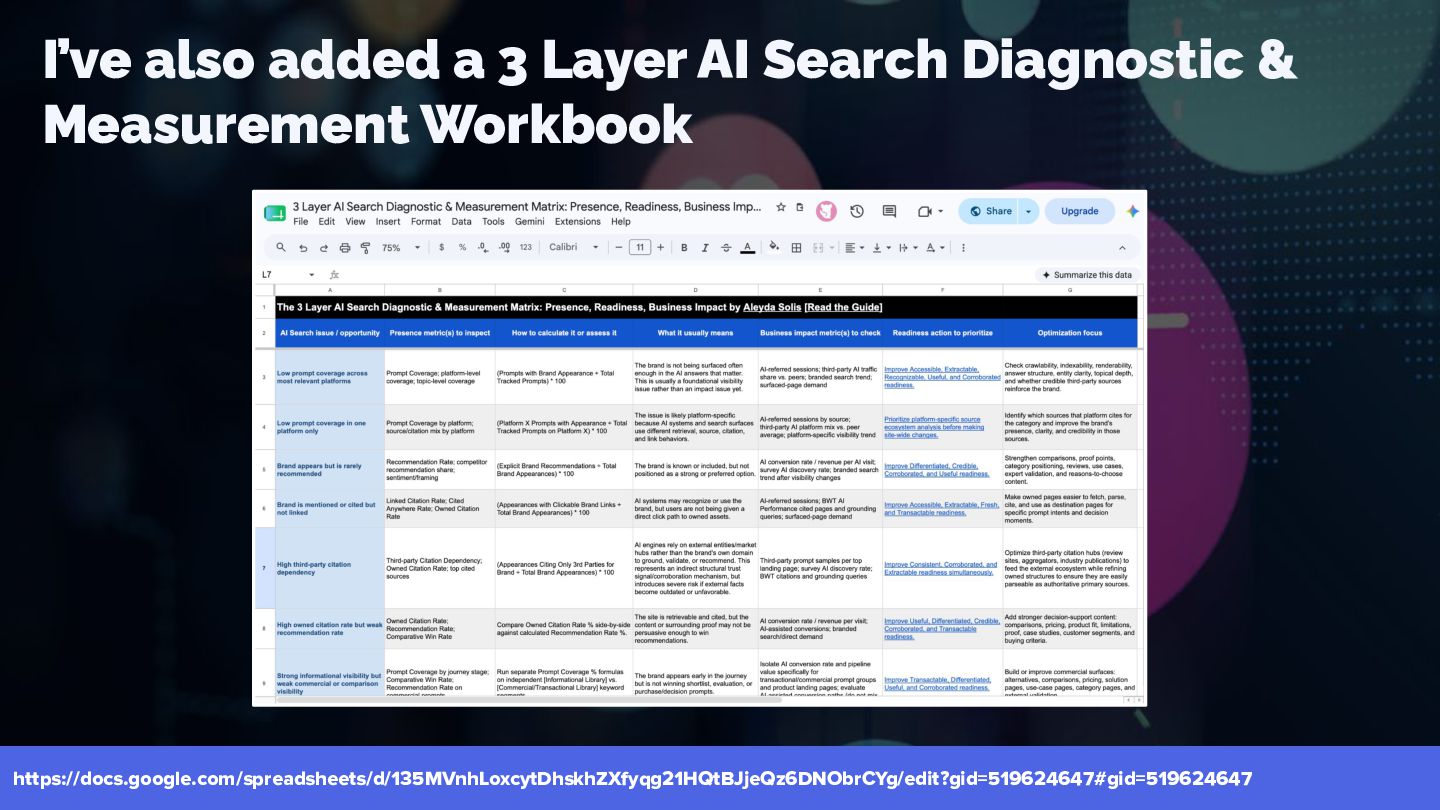
  28. I’ve also added a 3 Layer AI Search Diagnostic &

    Measurement Workbook https://docs.google.com/spreadsheets/d/135MVnhLoxcytDhskhZXfyqg21HQtBJjeQz6DNObrCYg/edit?gid=519624647#gid=519624647
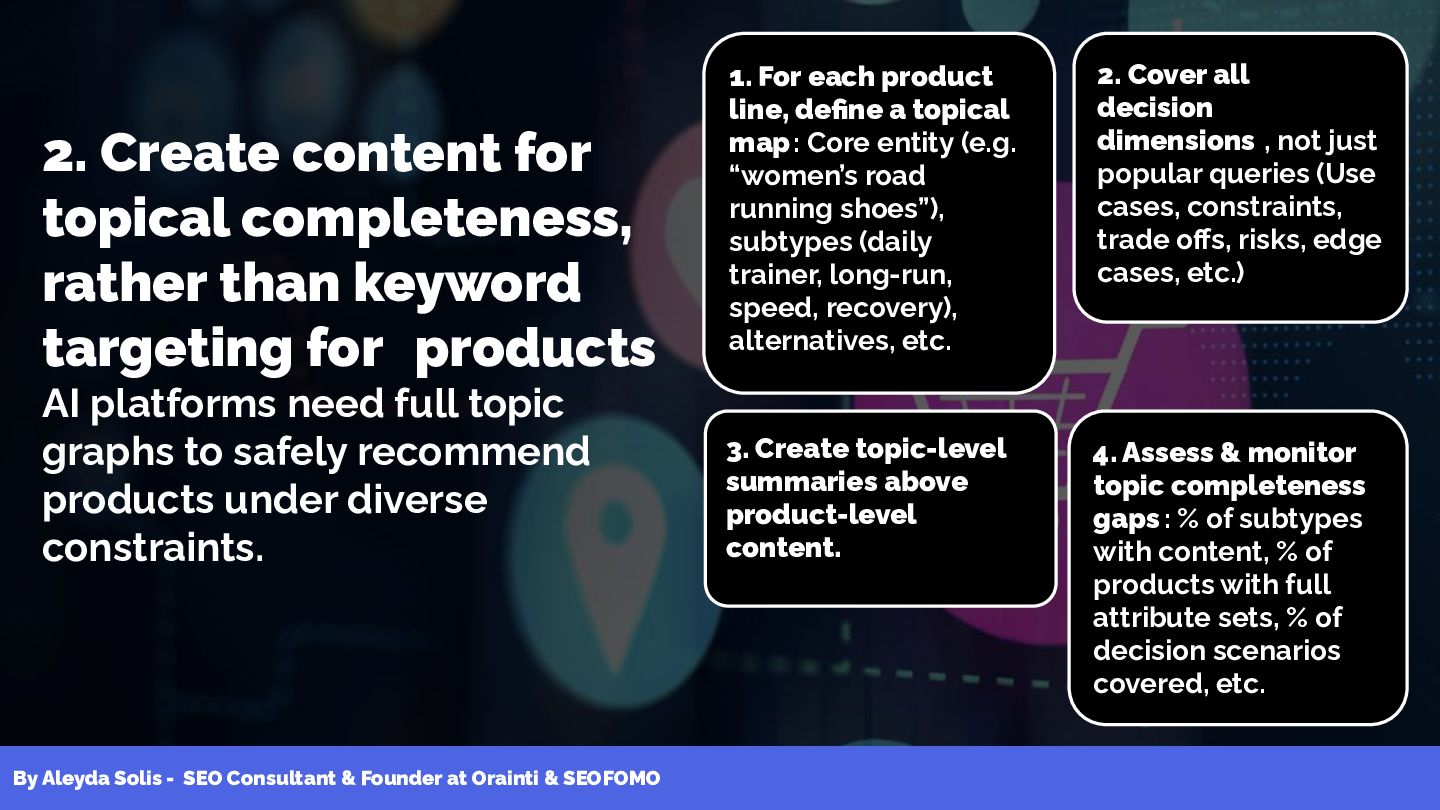
  29. 2. Create content for topical completeness, rather than keyword targeting

    for products AI platforms need full topic graphs to safely recommend products under diverse constraints. 1. For each product line, define a topical map: Core entity (e.g. “women’s road running shoes”), subtypes (daily trainer, long-run, speed, recovery), alternatives, etc. 2. Cover all decision dimensions , not just popular queries (Use cases, constraints, trade offs, risks, edge cases, etc.) 3. Create topic-level summaries above product-level content. 4. Assess & monitor topic completeness gaps: % of subtypes with content, % of products with full attribute sets, % of decision scenarios covered, etc. By Aleyda Solis - SEO Consultant & Founder at Orainti & SEOFOMO
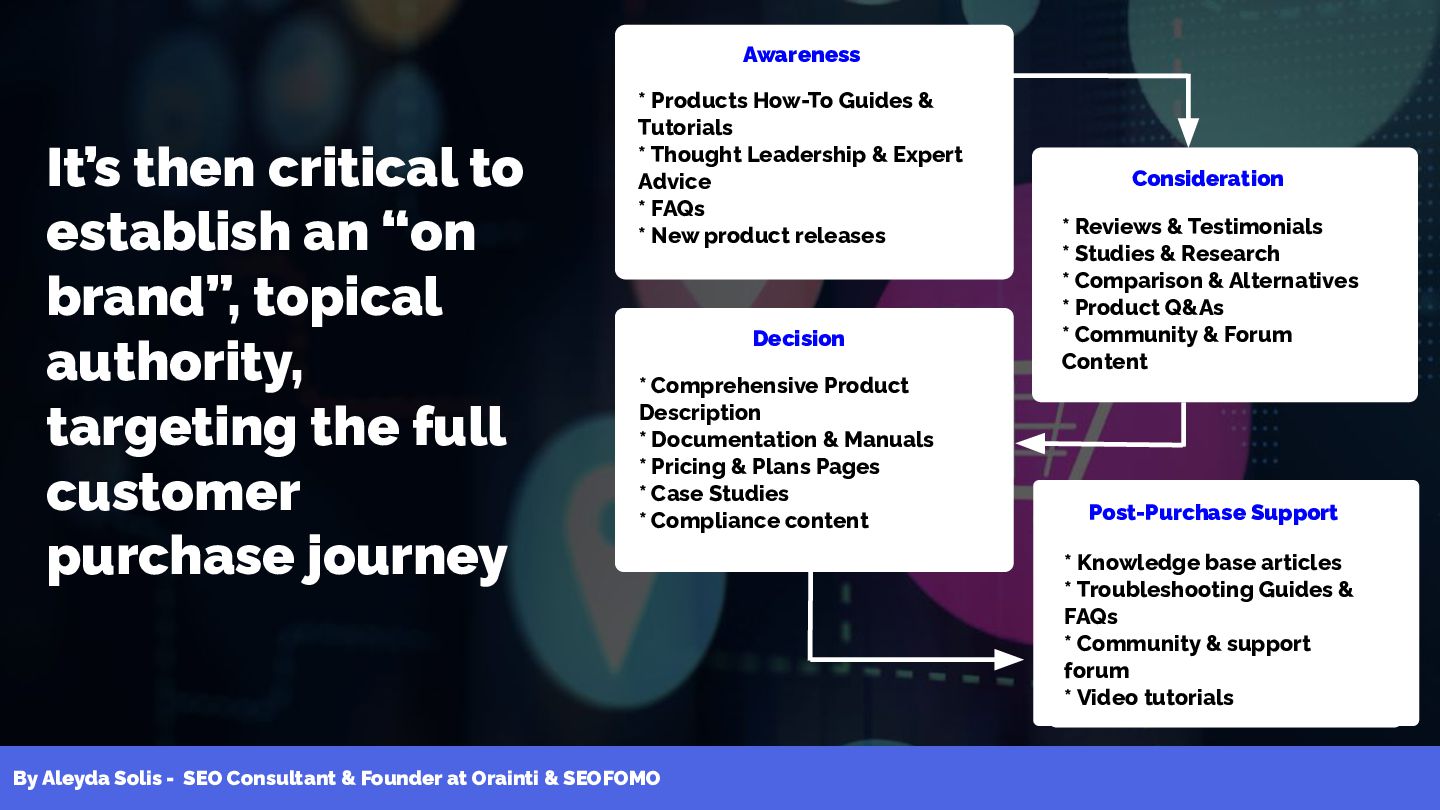
  30. It’s then critical to establish an “on brand”, topical authority,

    targeting the full customer purchase journey Consideration * Reviews & Testimonials * Studies & Research * Comparison & Alternatives * Product Q&As * Community & Forum Content Decision * Comprehensive Product Description * Documentation & Manuals * Pricing & Plans Pages * Case Studies * Compliance content * Products How-To Guides & Tutorials * Thought Leadership & Expert Advice * FAQs * New product releases Awareness * Knowledge base articles * Troubleshooting Guides & FAQs * Community & support forum * Video tutorials Post-Purchase Support By Aleyda Solis - SEO Consultant & Founder at Orainti & SEOFOMO
  31. Replace keyword maps with product constraint matrices that align with

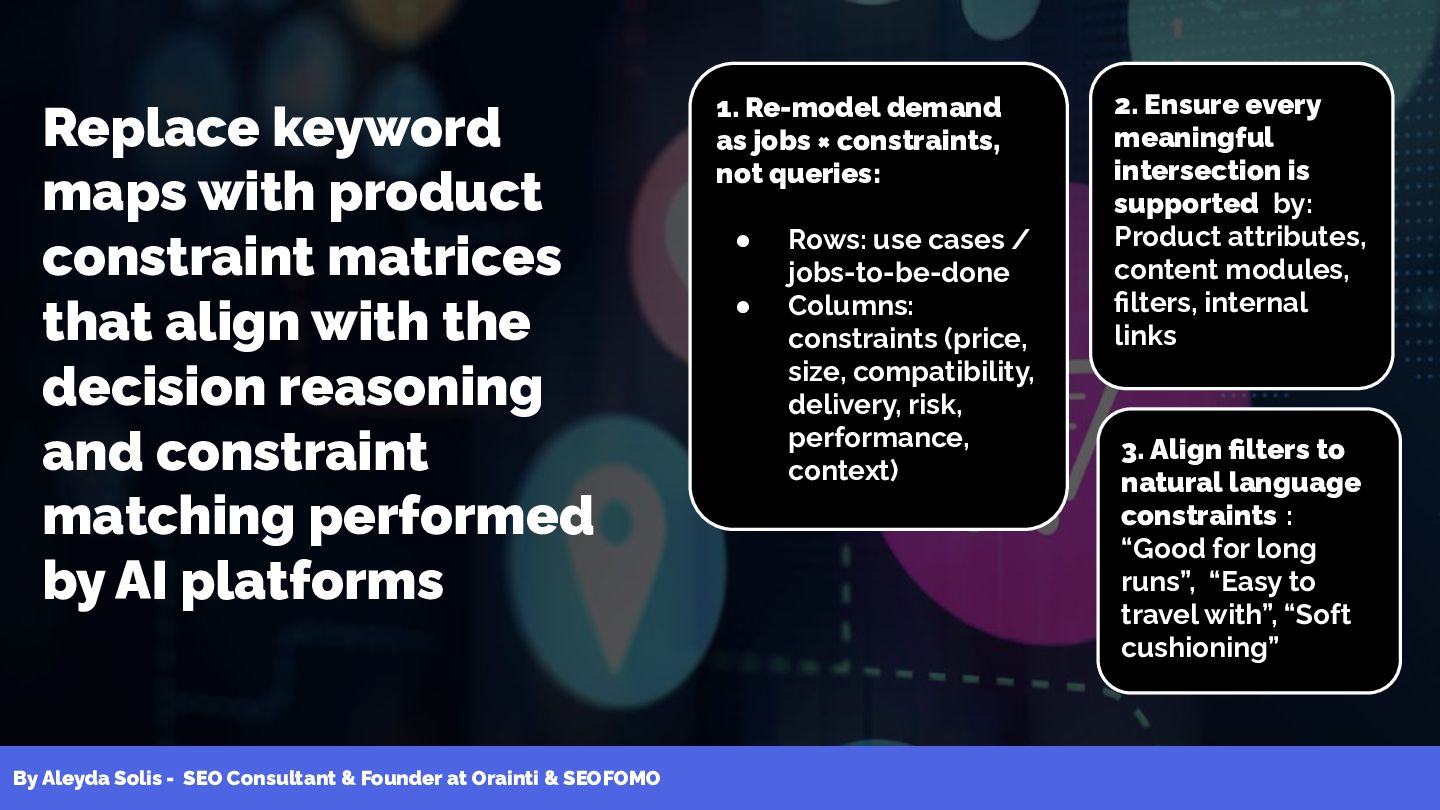
    the decision reasoning and constraint matching performed by AI platforms 1. Re-model demand as jobs × constraints, not queries: • Rows: use cases / jobs-to-be-done • Columns: constraints (price, size, compatibility, delivery, risk, performance, context) 2. Ensure every meaningful intersection is supported by: Product attributes, content modules, filters, internal links 3. Align filters to natural language constraints : “Good for long runs”, “Easy to travel with”, “Soft cushioning” By Aleyda Solis - SEO Consultant & Founder at Orainti & SEOFOMO
  32. Eg. Don’t target "best running shoes 2026", but map jobs-to-be-done

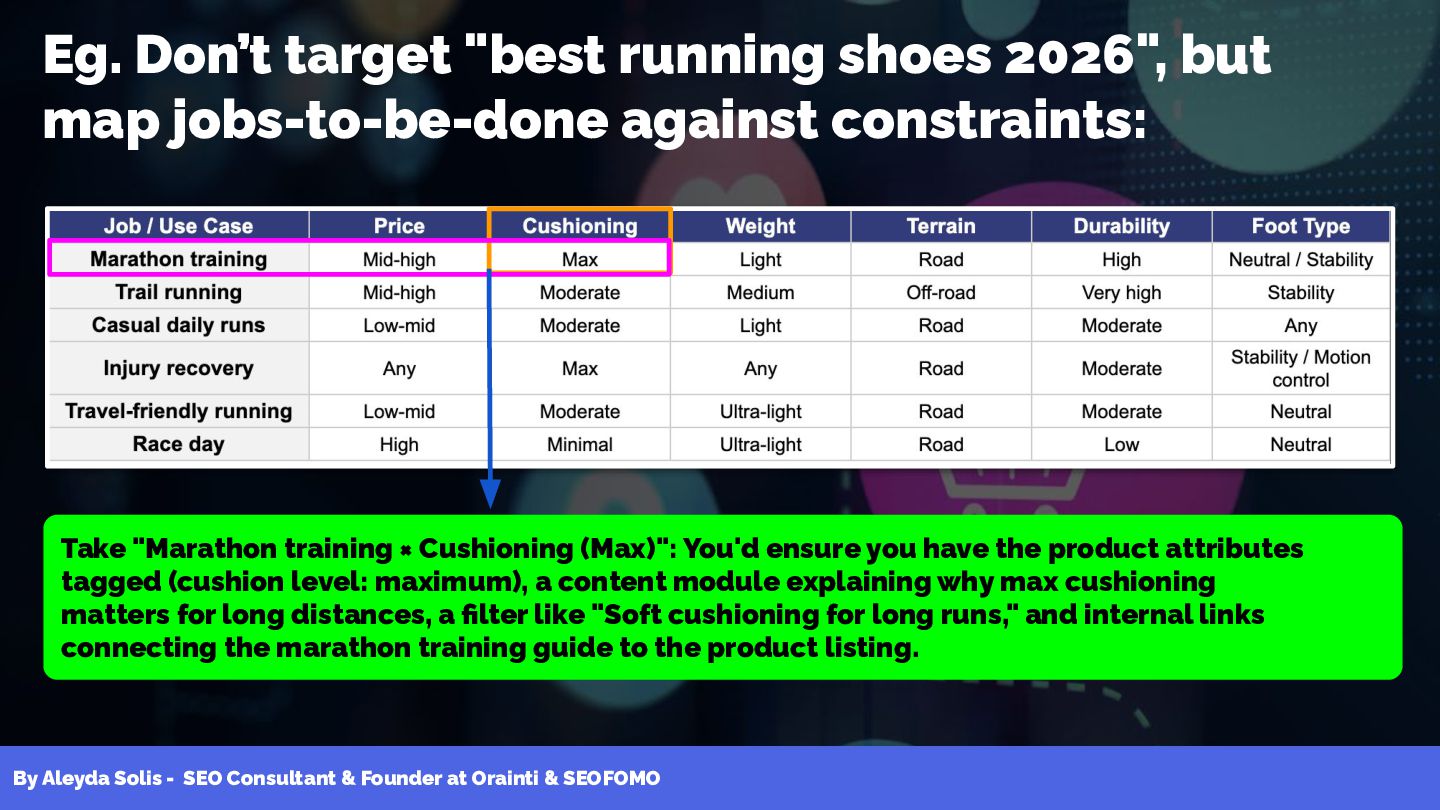
    against constraints: Take "Marathon training × Cushioning (Max)": You'd ensure you have the product attributes tagged (cushion level: maximum), a content module explaining why max cushioning matters for long distances, a filter like "Soft cushioning for long runs," and internal links connecting the marathon training guide to the product listing. By Aleyda Solis - SEO Consultant & Founder at Orainti & SEOFOMO
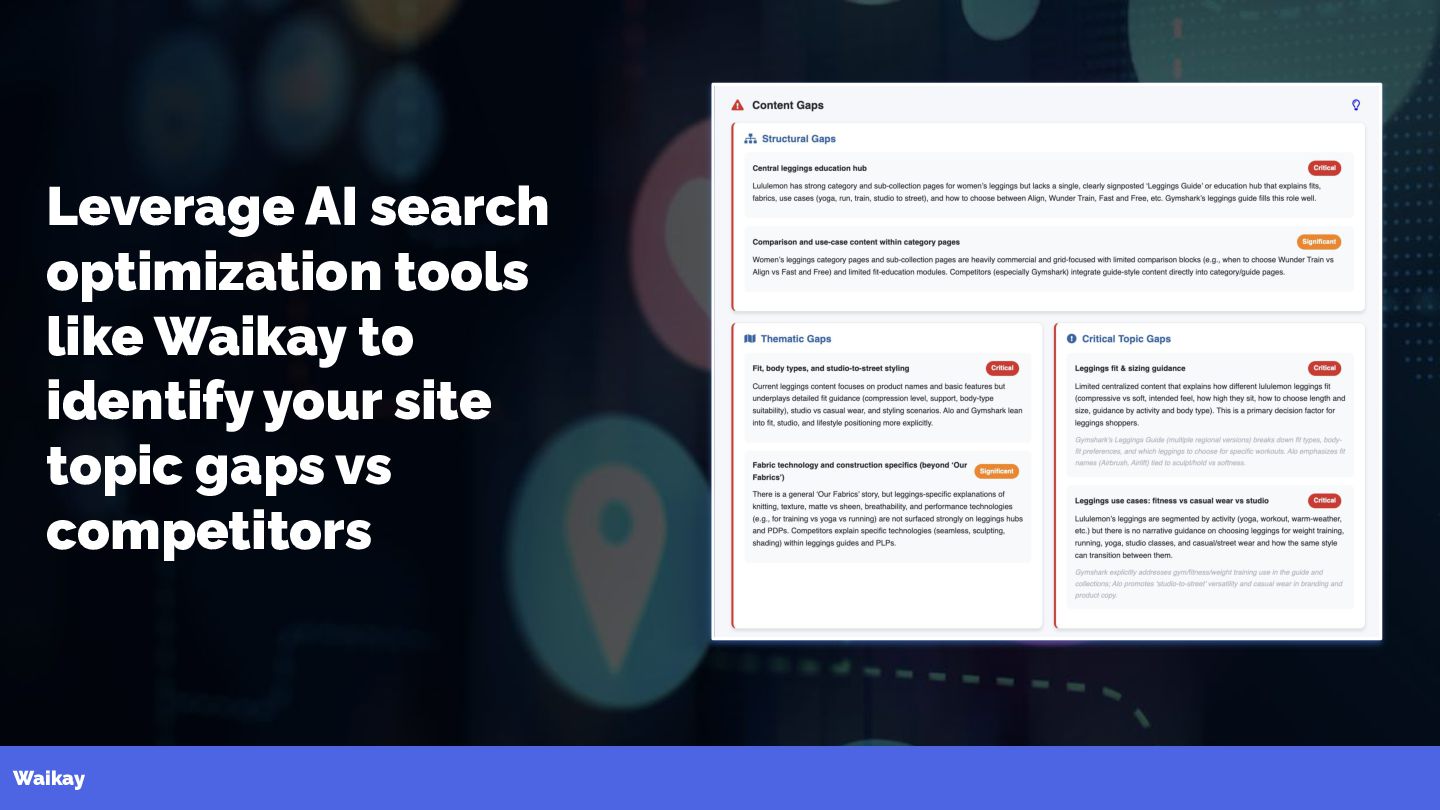
  33. Run an AI presence benchmark to identify topic gaps &

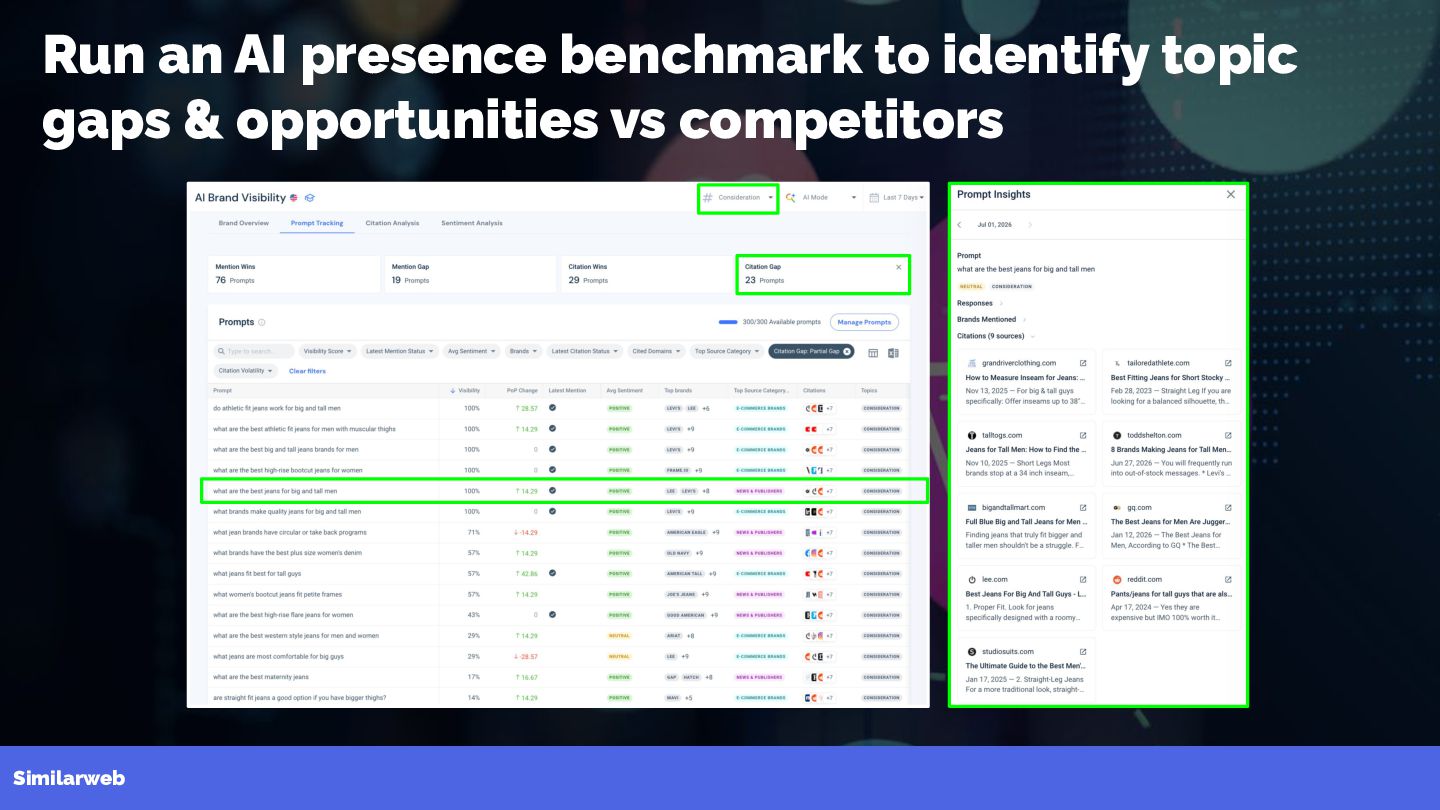
    opportunities vs competitors Similarweb
  34. Build informational content that feeds AI decisions Guides and comparisons

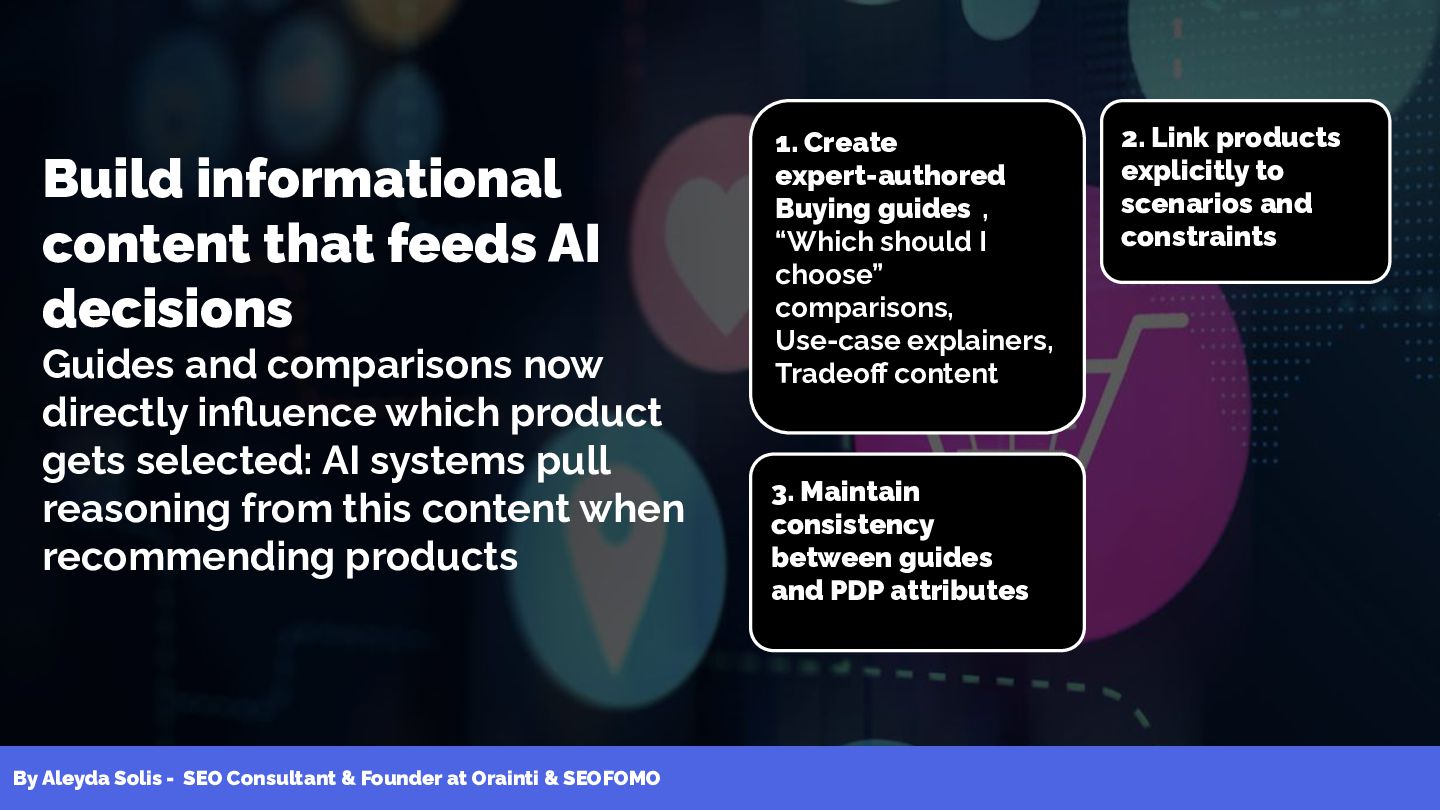
    now directly influence which product gets selected: AI systems pull reasoning from this content when recommending products 1. Create expert-authored Buying guides , “Which should I choose” comparisons, Use-case explainers, Tradeoff content 2. Link products explicitly to scenarios and constraints 3. Maintain consistency between guides and PDP attributes By Aleyda Solis - SEO Consultant & Founder at Orainti & SEOFOMO
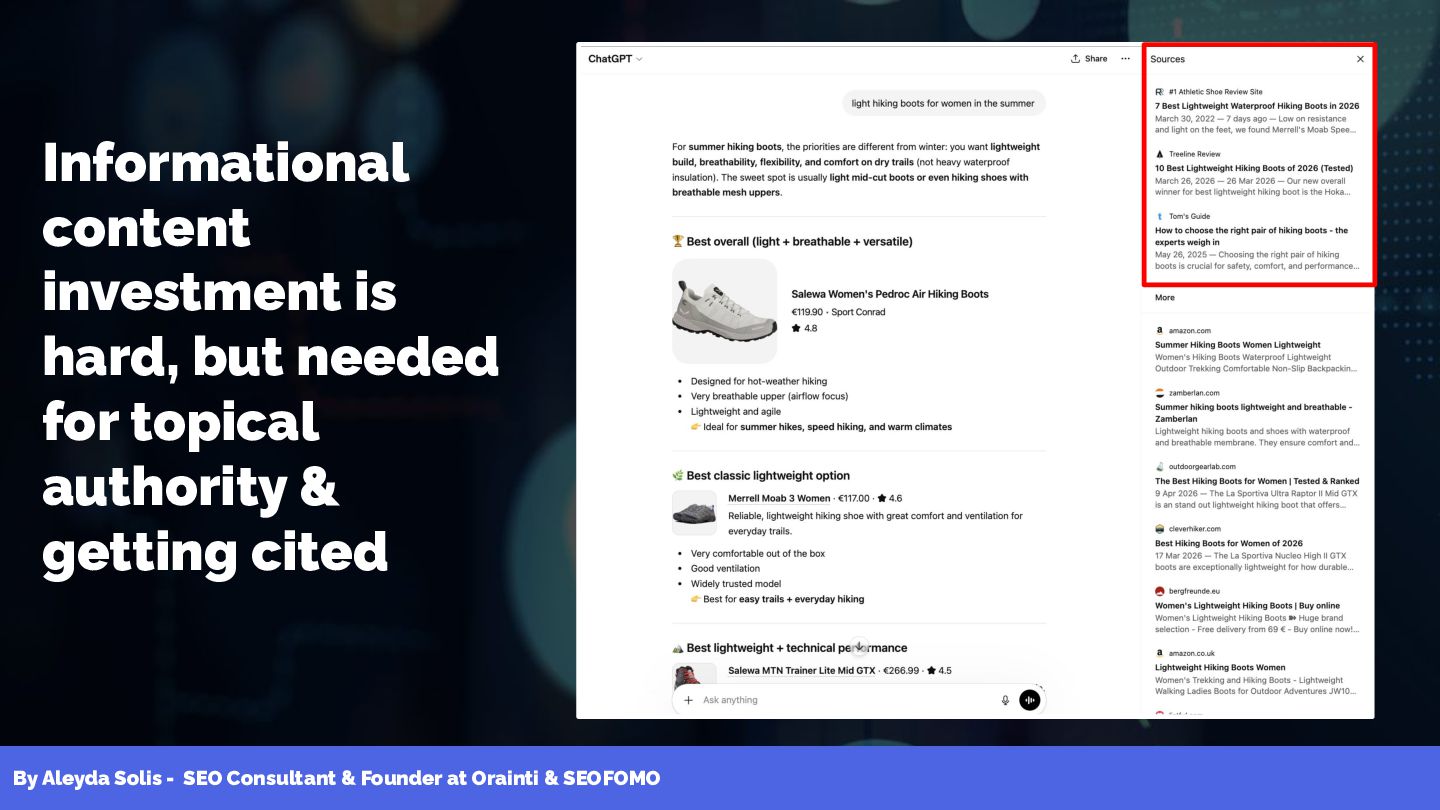
  35. Informational content investment is hard, but needed for topical authority

    & getting cited By Aleyda Solis - SEO Consultant & Founder at Orainti & SEOFOMO
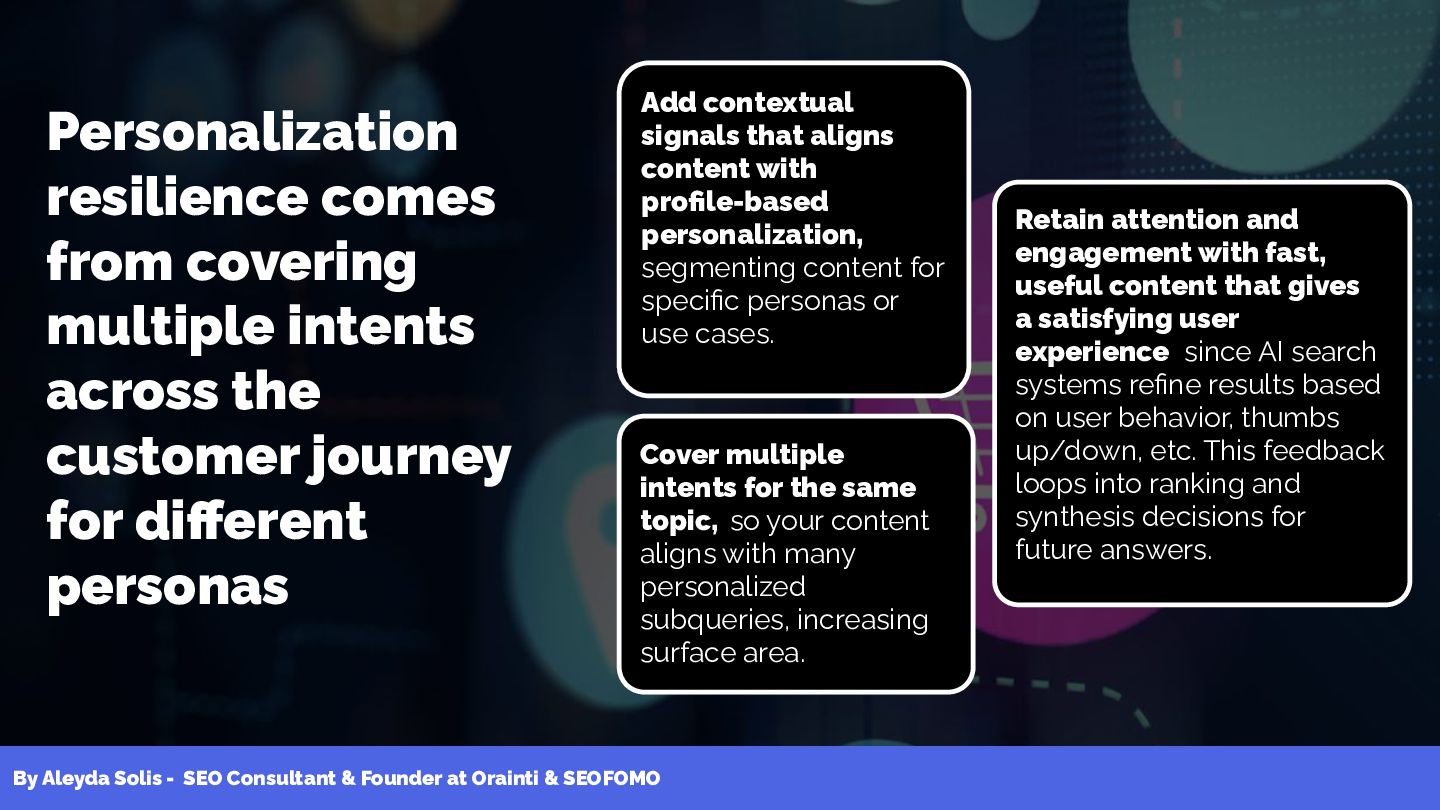
  36. Personalization resilience comes from covering multiple intents across the customer

    journey for different personas Cover multiple intents for the same topic, so your content aligns with many personalized subqueries, increasing surface area. Add contextual signals that aligns content with profile-based personalization, segmenting content for specific personas or use cases. Retain attention and engagement with fast, useful content that gives a satisfying user experience since AI search systems refine results based on user behavior, thumbs up/down, etc. This feedback loops into ranking and synthesis decisions for future answers. By Aleyda Solis - SEO Consultant & Founder at Orainti & SEOFOMO
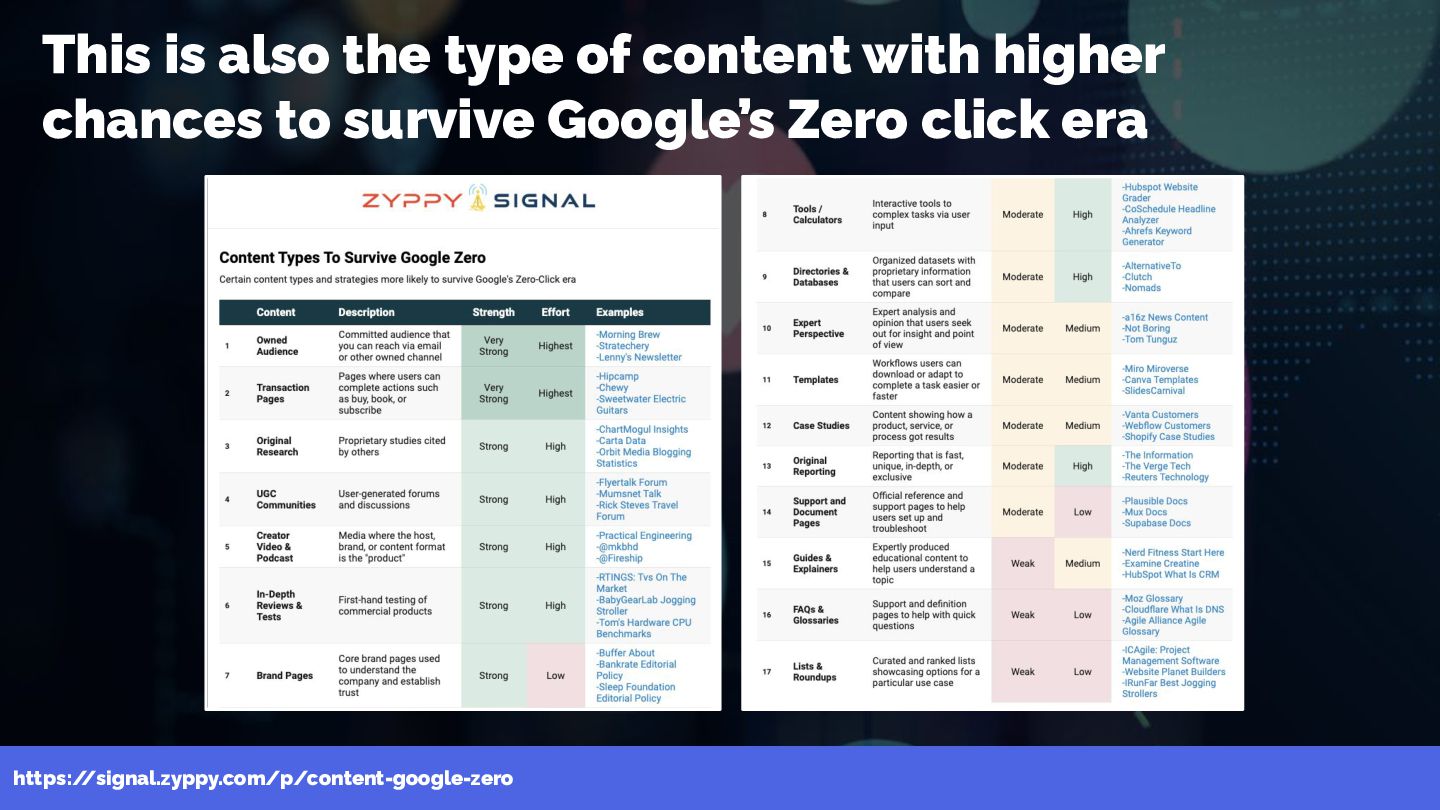
  37. This is also the type of content with higher chances

    to survive Google’s Zero click era https:/ /signal.zyppy.com/p/content-google-zero
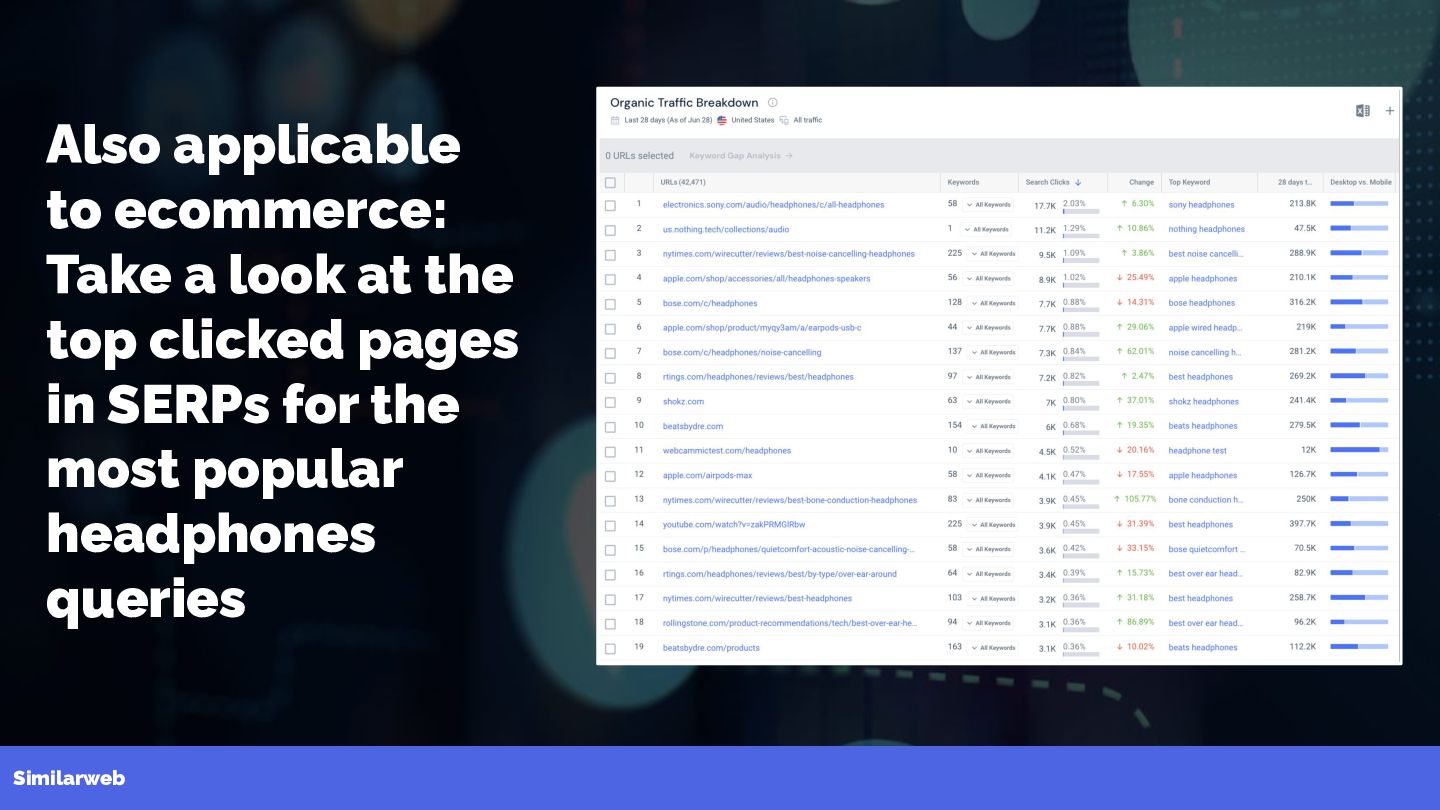
  38. Similarweb Also applicable to ecommerce: Take a look at the

    top clicked pages in SERPs for the most popular headphones queries
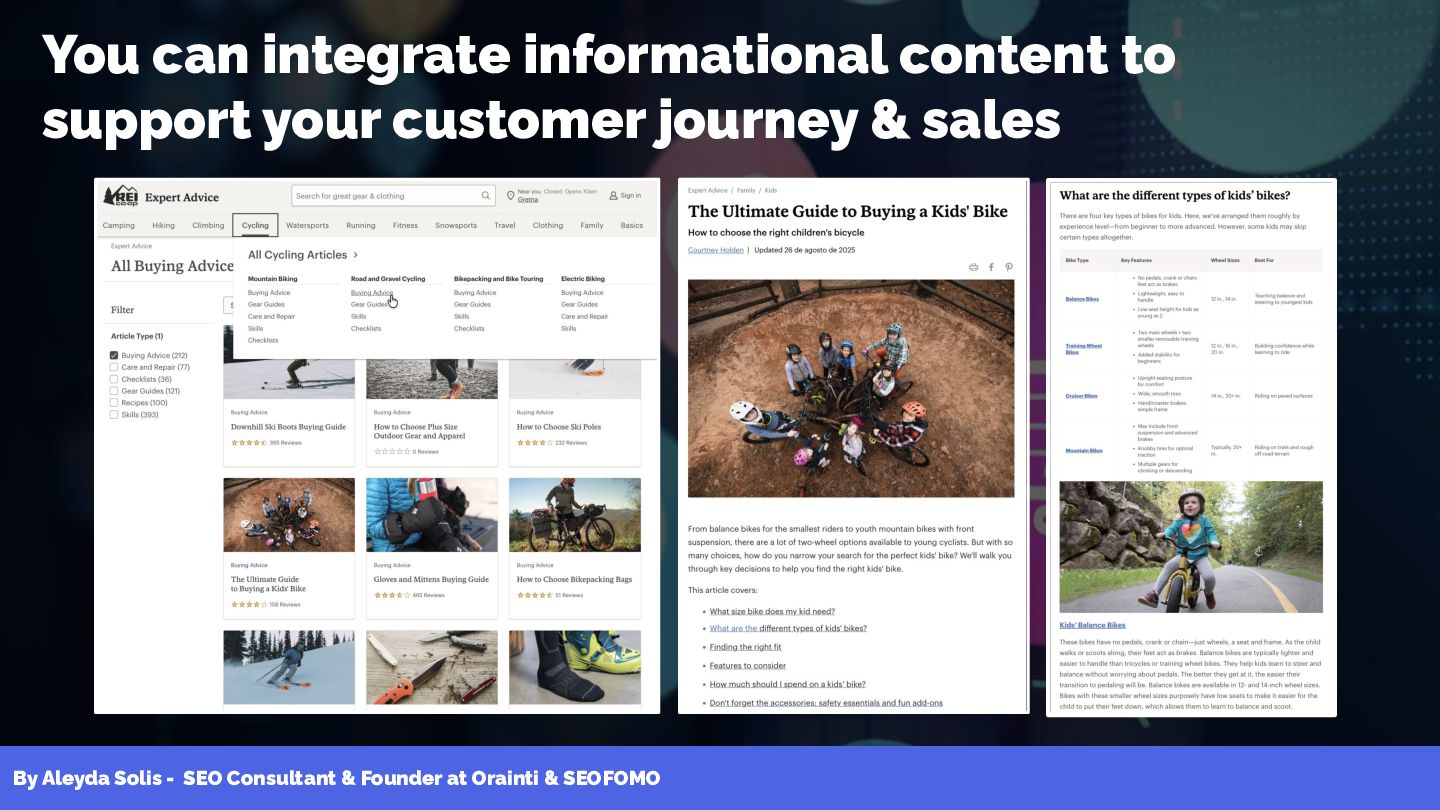
  39. You can integrate informational content to support your customer journey

    & sales By Aleyda Solis - SEO Consultant & Founder at Orainti & SEOFOMO
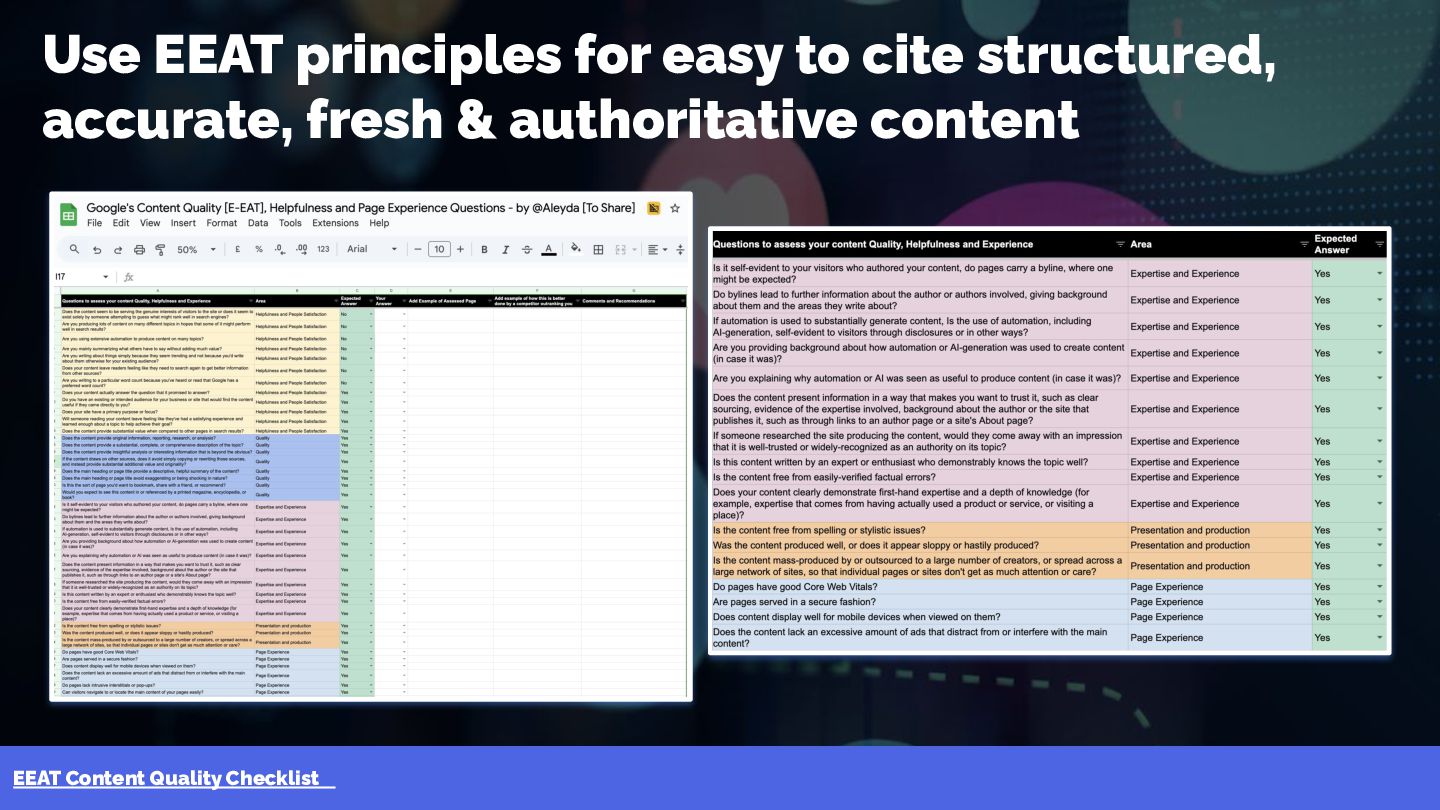
  40. Use EEAT principles for easy to cite structured, accurate, fresh

    & authoritative content EEAT Content Quality Checklist
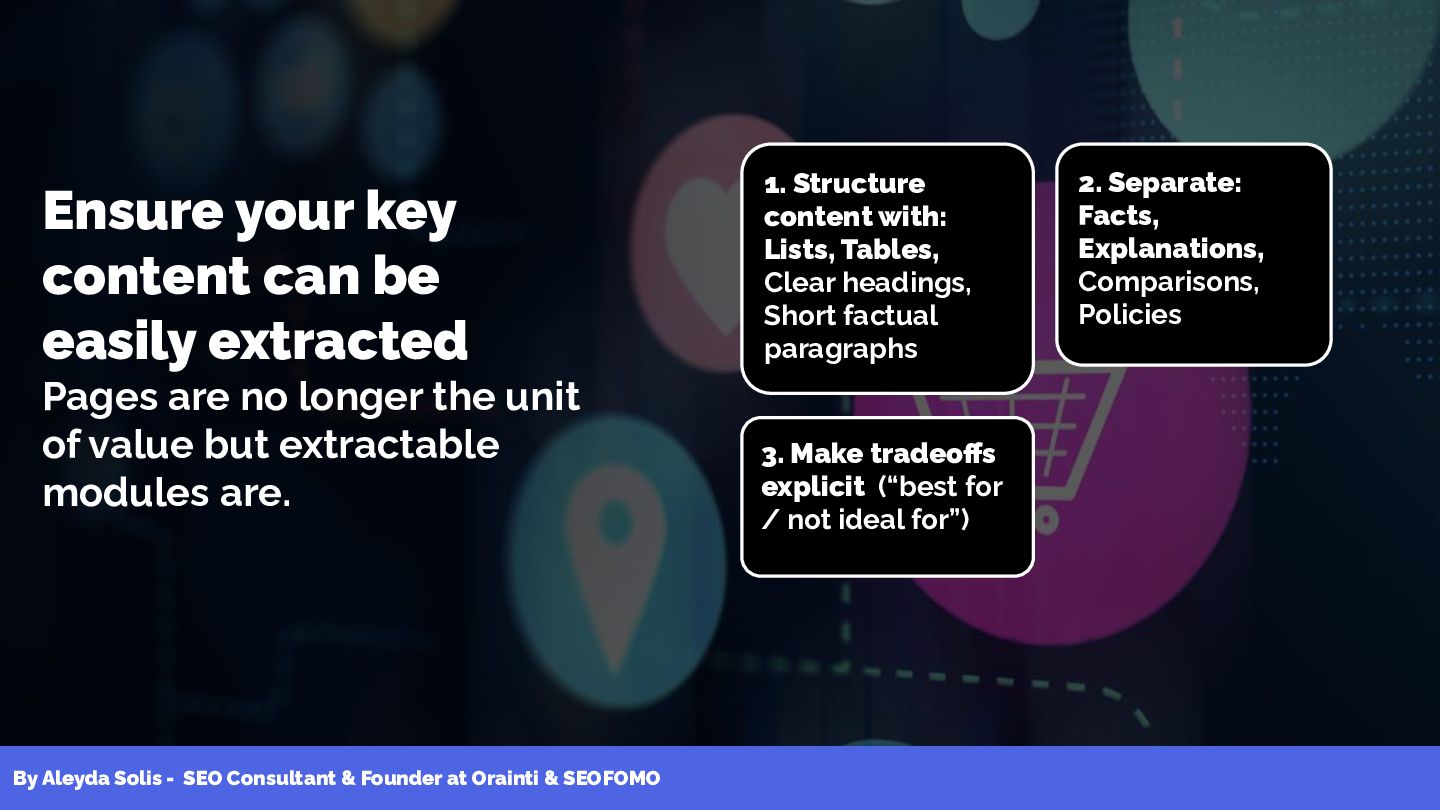
  41. Ensure your key content can be easily extracted Pages are

    no longer the unit of value but extractable modules are. 1. Structure content with: Lists, Tables, Clear headings, Short factual paragraphs 2. Separate: Facts, Explanations, Comparisons, Policies 3. Make tradeoffs explicit (“best for / not ideal for”) By Aleyda Solis - SEO Consultant & Founder at Orainti & SEOFOMO
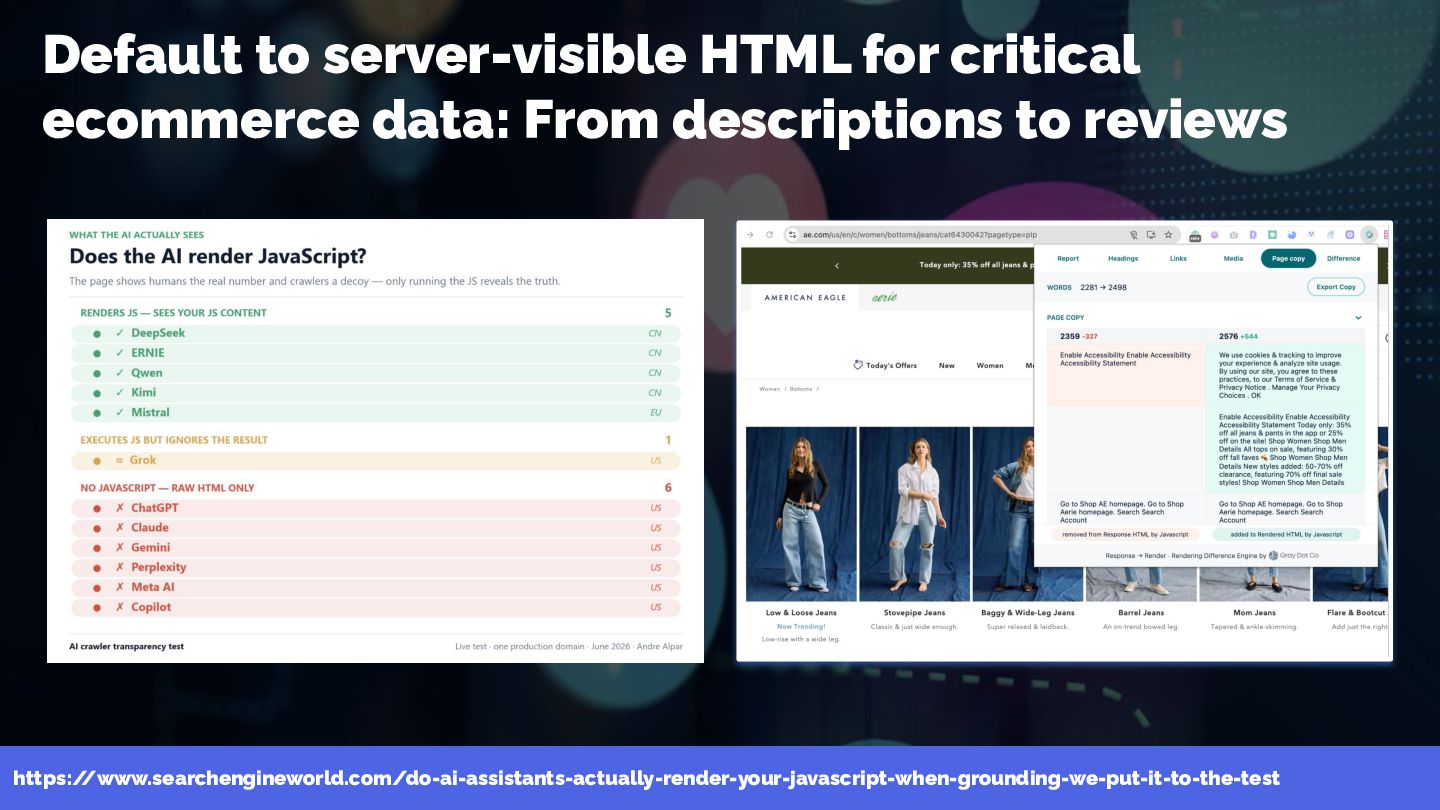
  42. Default to server-visible HTML for critical ecommerce data: From descriptions

    to reviews https:/ /www.searchengineworld.com/do-ai-assistants-actually-render-your-javascript-when-grounding-we-put-it-to-the-test
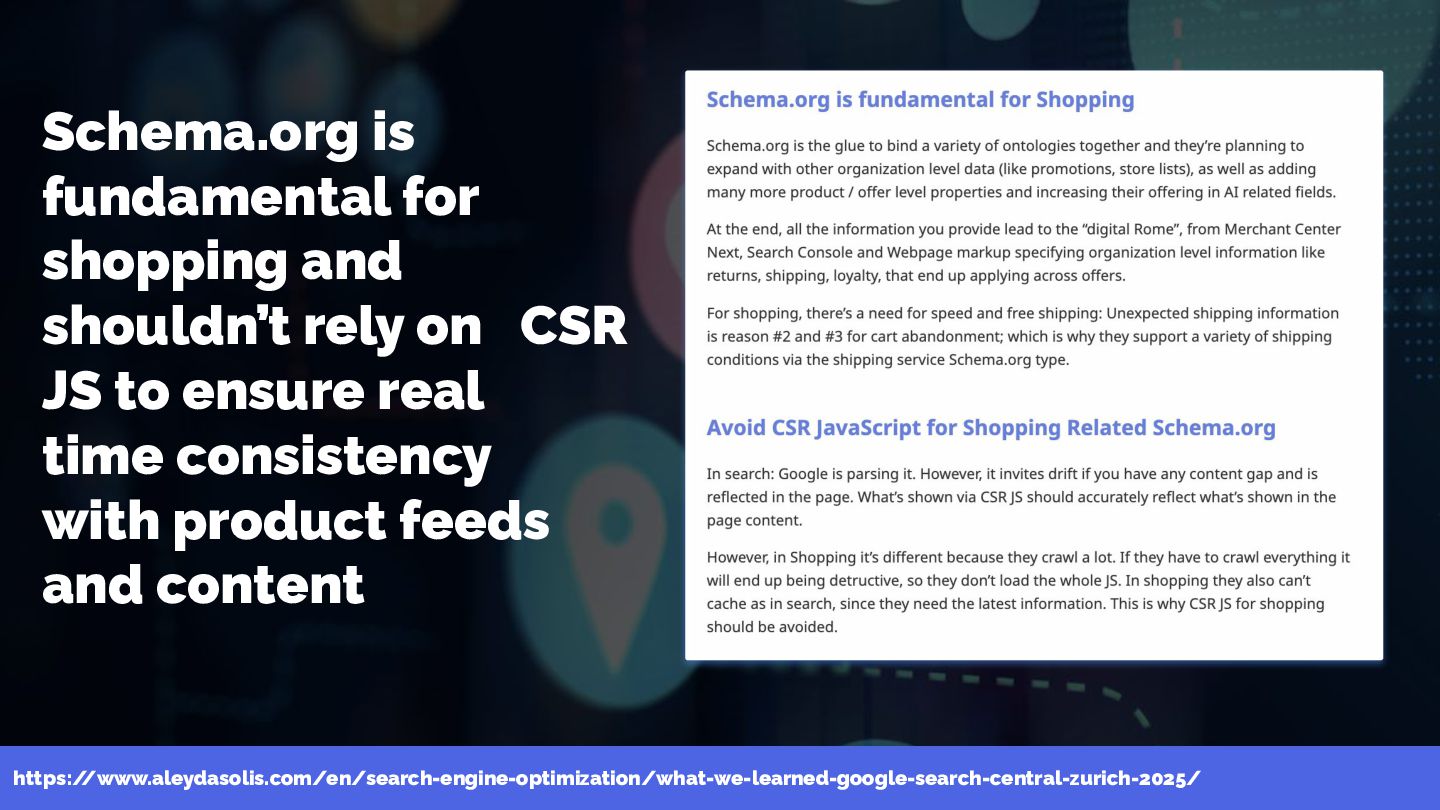
  43. Schema.org is fundamental for shopping and shouldn’t rely on CSR

    JS to ensure real time consistency with product feeds and content https:/ /www.aleydasolis.com/en/search-engine-optimization/what-we-learned-google-search-central-zurich-2025/
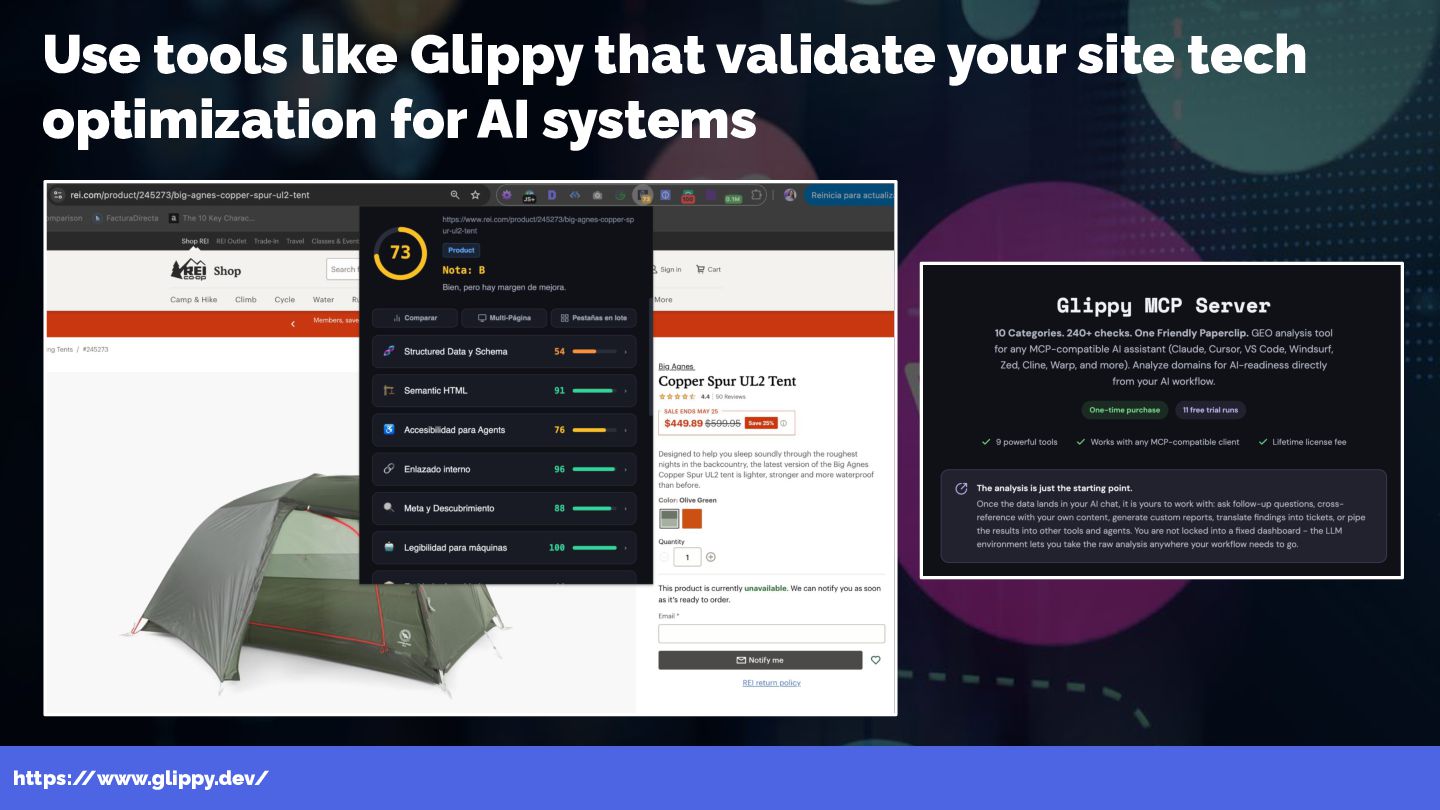
  44. Use tools like Glippy that validate your site tech optimization

    for AI systems https:/ /www.glippy.dev/
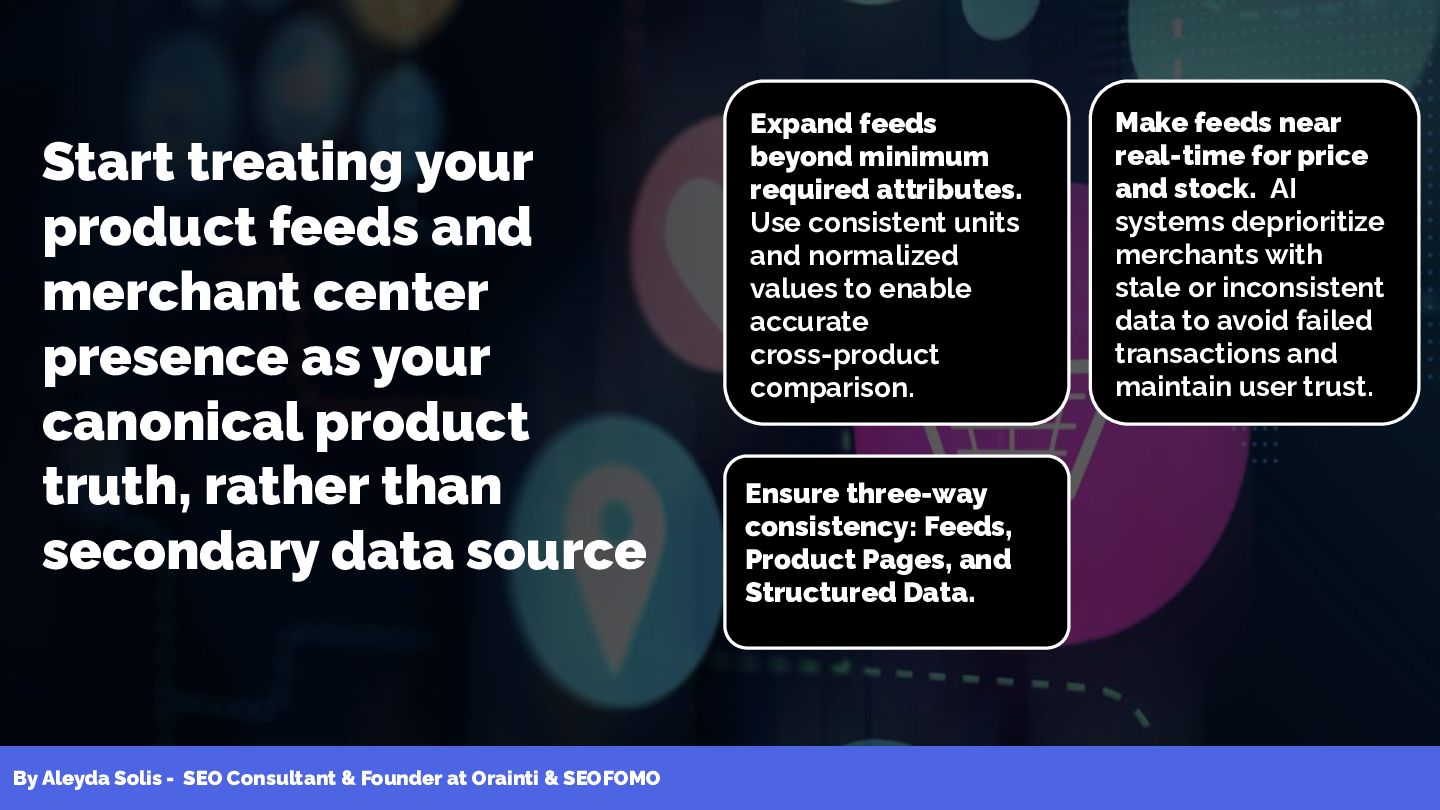
  45. Start treating your product feeds and merchant center presence as

    your canonical product truth, rather than secondary data source Make feeds near real-time for price and stock. AI systems deprioritize merchants with stale or inconsistent data to avoid failed transactions and maintain user trust. Ensure three-way consistency: Feeds, Product Pages, and Structured Data. Expand feeds beyond minimum required attributes. Use consistent units and normalized values to enable accurate cross-product comparison. By Aleyda Solis - SEO Consultant & Founder at Orainti & SEOFOMO
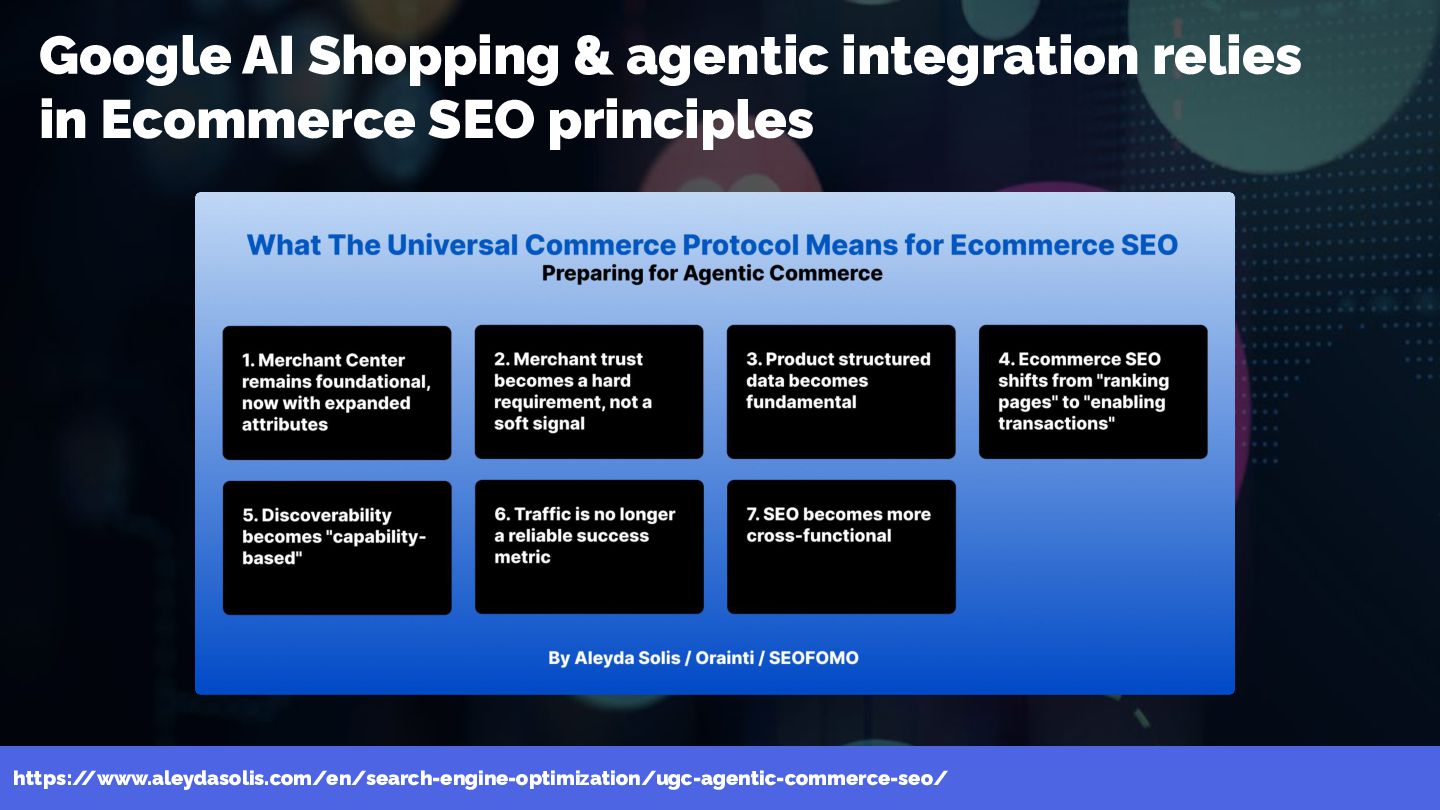
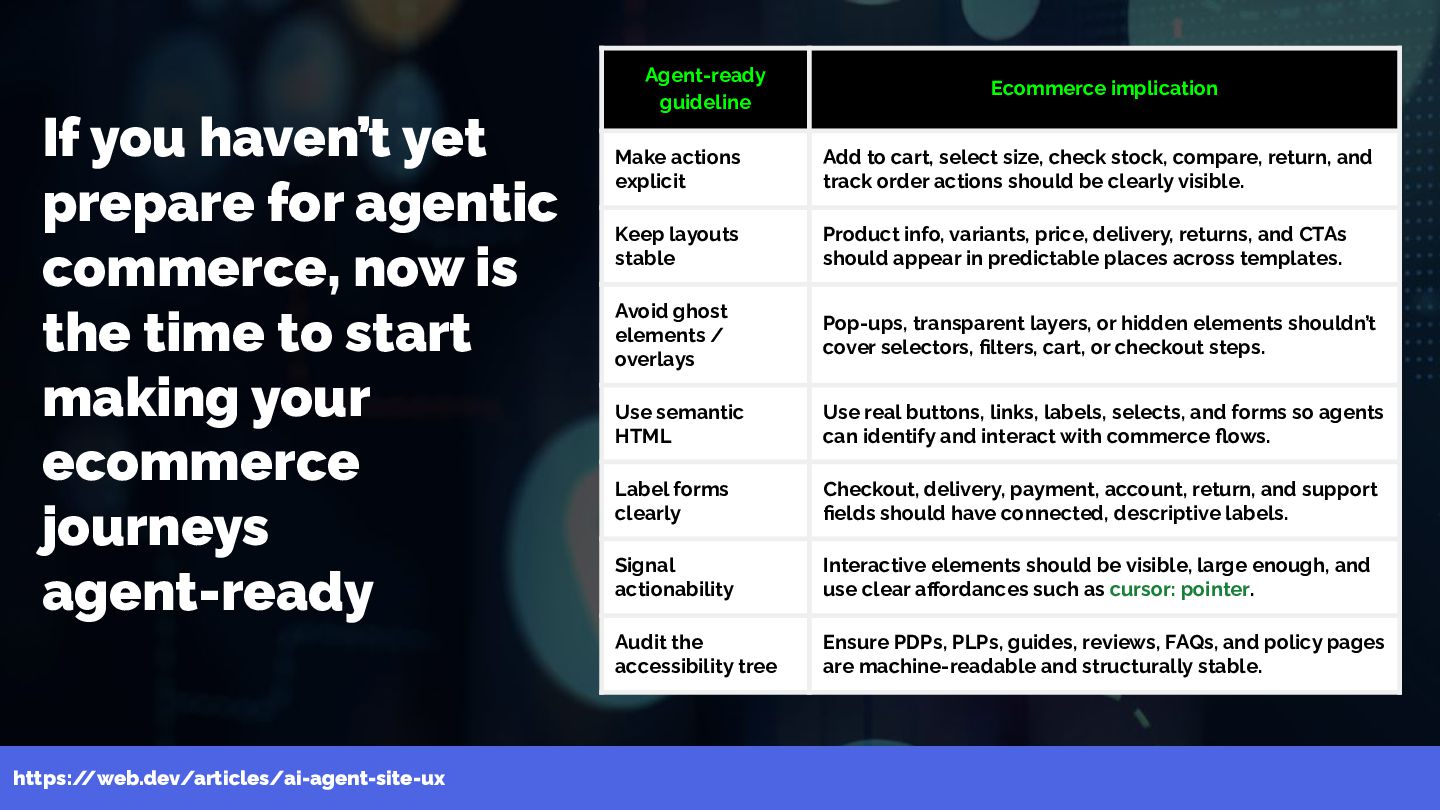
  46. If you haven’t yet prepare for agentic commerce, now is

    the time to start making your ecommerce journeys agent-ready Agent-ready guideline Ecommerce implication Make actions explicit Add to cart, select size, check stock, compare, return, and track order actions should be clearly visible. Keep layouts stable Product info, variants, price, delivery, returns, and CTAs should appear in predictable places across templates. Avoid ghost elements / overlays Pop-ups, transparent layers, or hidden elements shouldn’t cover selectors, filters, cart, or checkout steps. Use semantic HTML Use real buttons, links, labels, selects, and forms so agents can identify and interact with commerce flows. Label forms clearly Checkout, delivery, payment, account, return, and support fields should have connected, descriptive labels. Signal actionability Interactive elements should be visible, large enough, and use clear affordances such as cursor: pointer. Audit the accessibility tree Ensure PDPs, PLPs, guides, reviews, FAQs, and policy pages are machine-readable and structurally stable. https:/ /web.dev/articles/ai-agent-site-ux
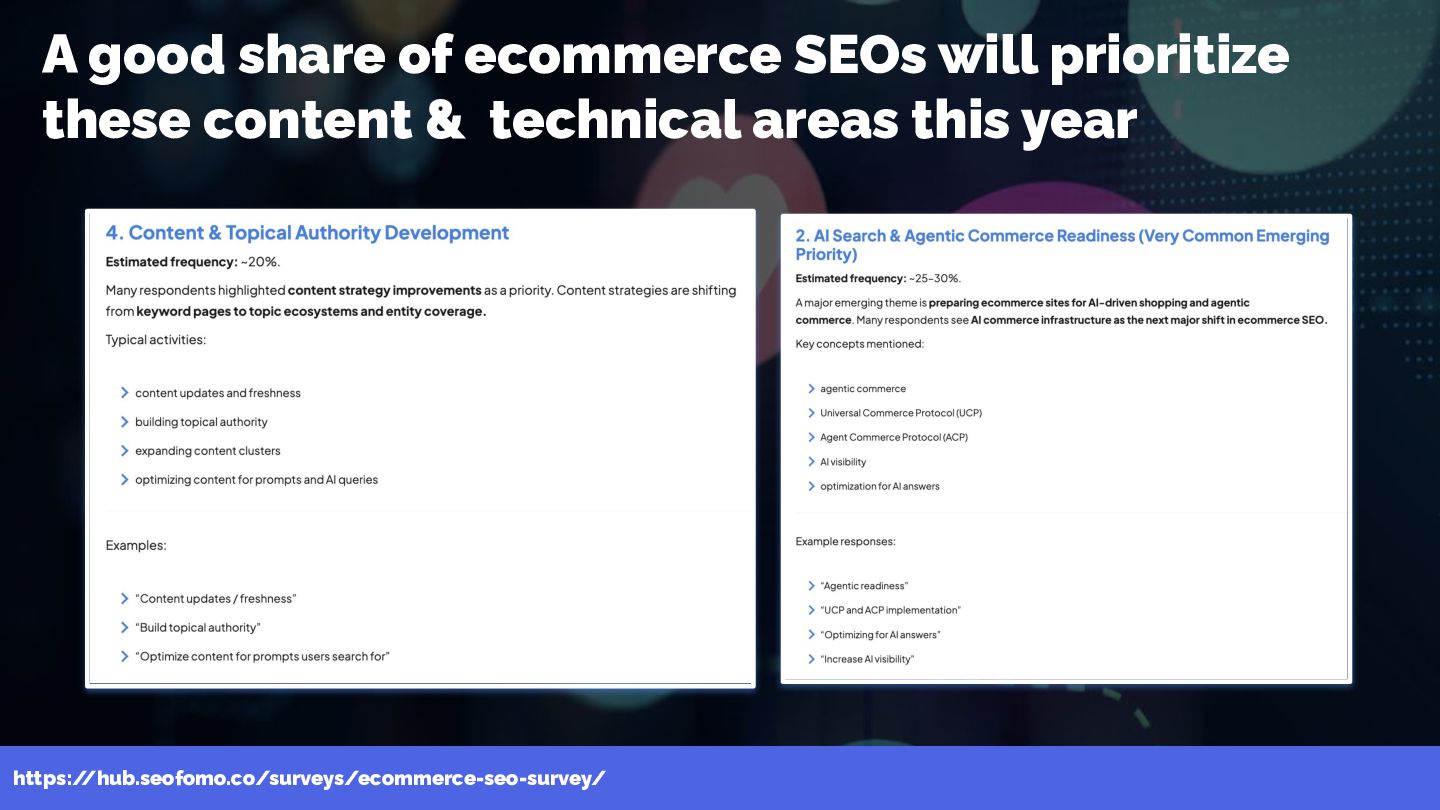
  47. A good share of ecommerce SEOs will prioritize these content

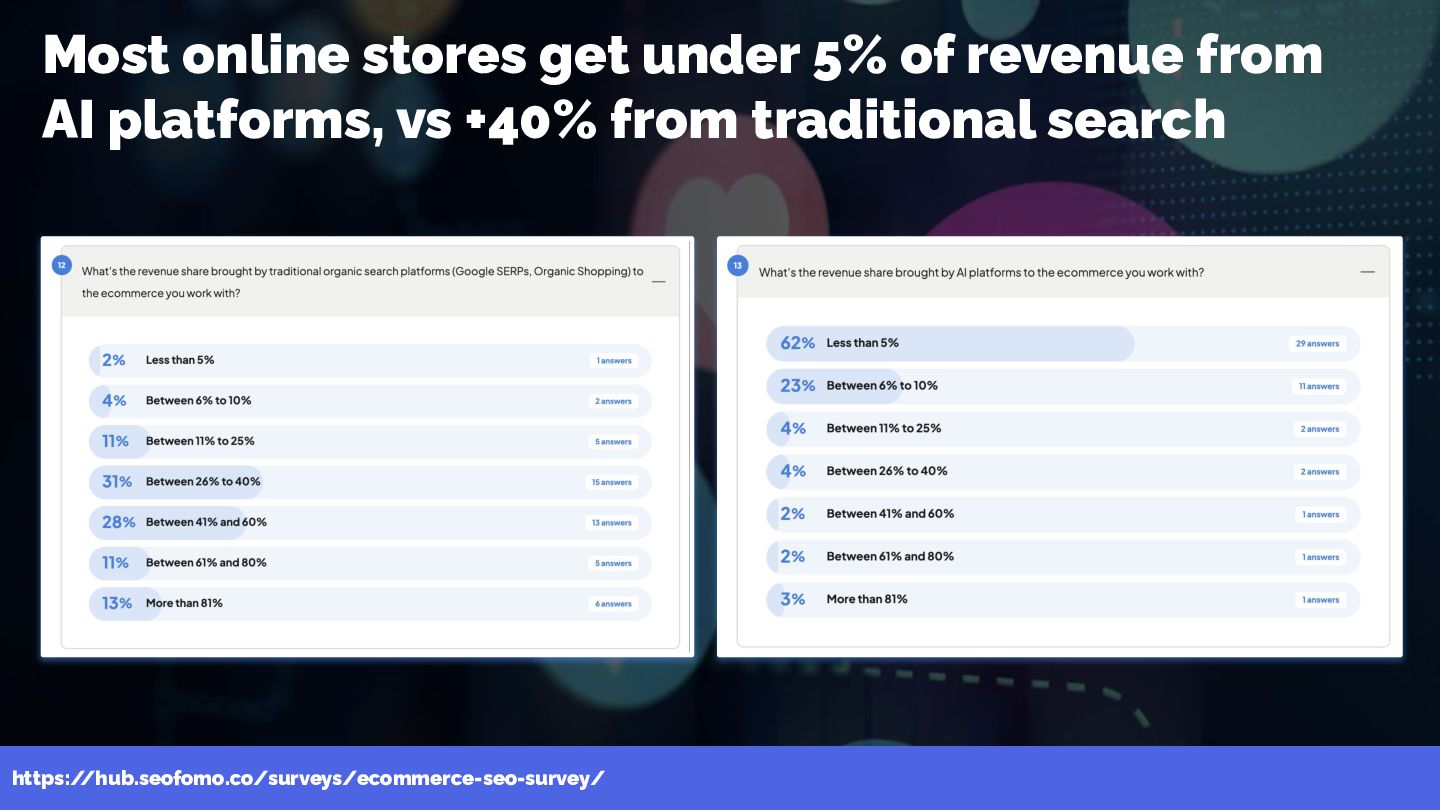
    & technical areas this year https:/ /hub.seofomo.co/surveys/ecommerce-seo-survey/
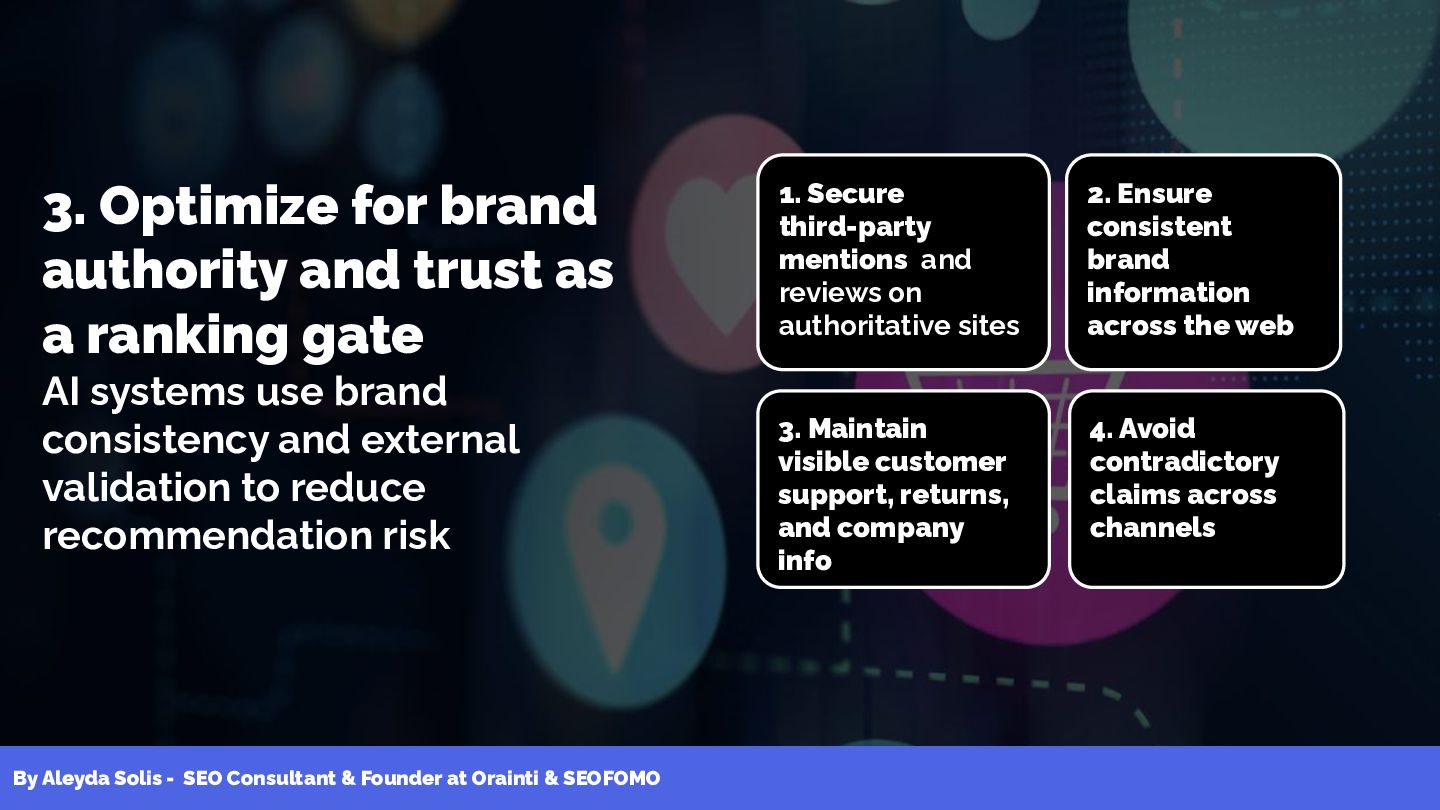
  48. 3. Optimize for brand authority and trust as a ranking

    gate AI systems use brand consistency and external validation to reduce recommendation risk 1. Secure third-party mentions and reviews on authoritative sites 2. Ensure consistent brand information across the web 3. Maintain visible customer support, returns, and company info 4. Avoid contradictory claims across channels By Aleyda Solis - SEO Consultant & Founder at Orainti & SEOFOMO
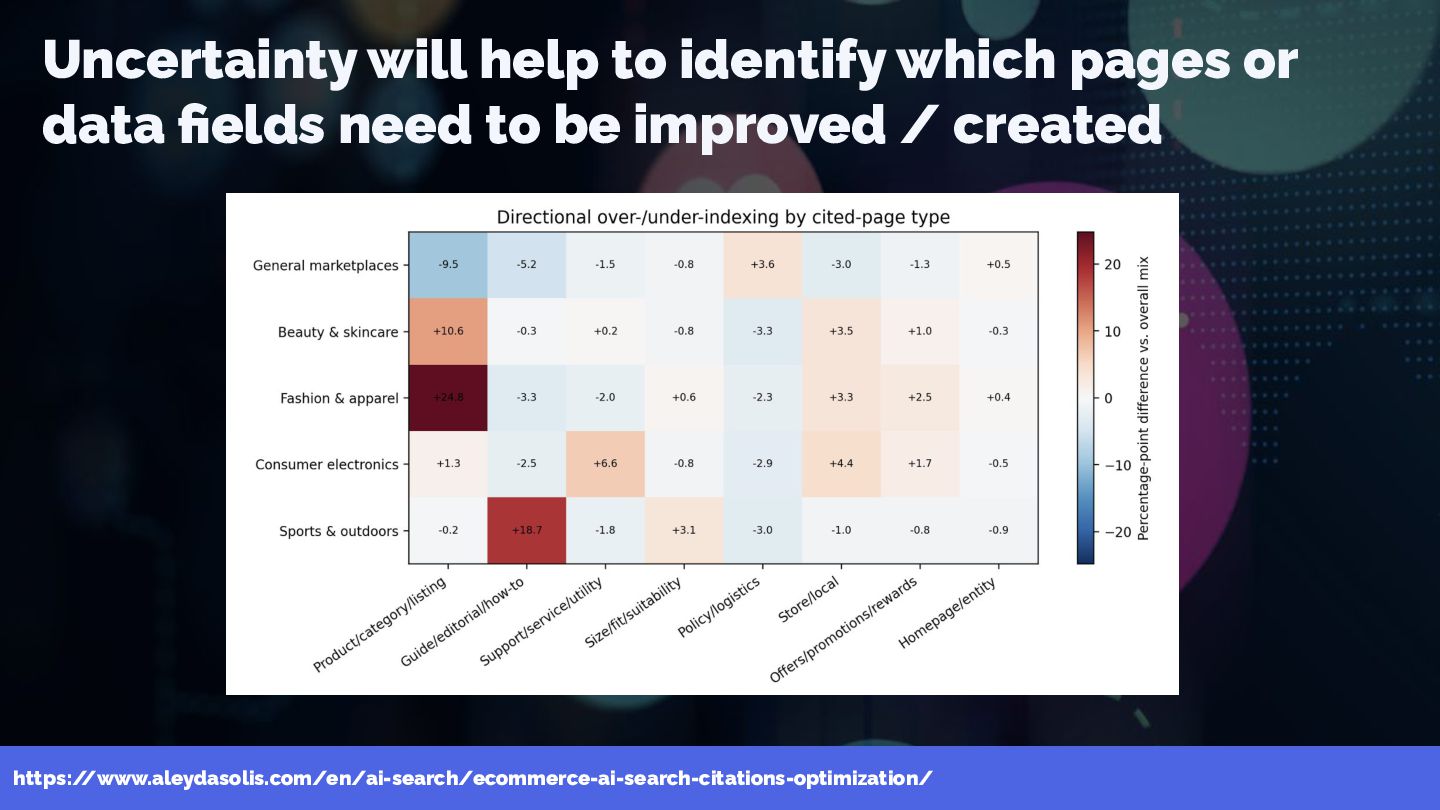
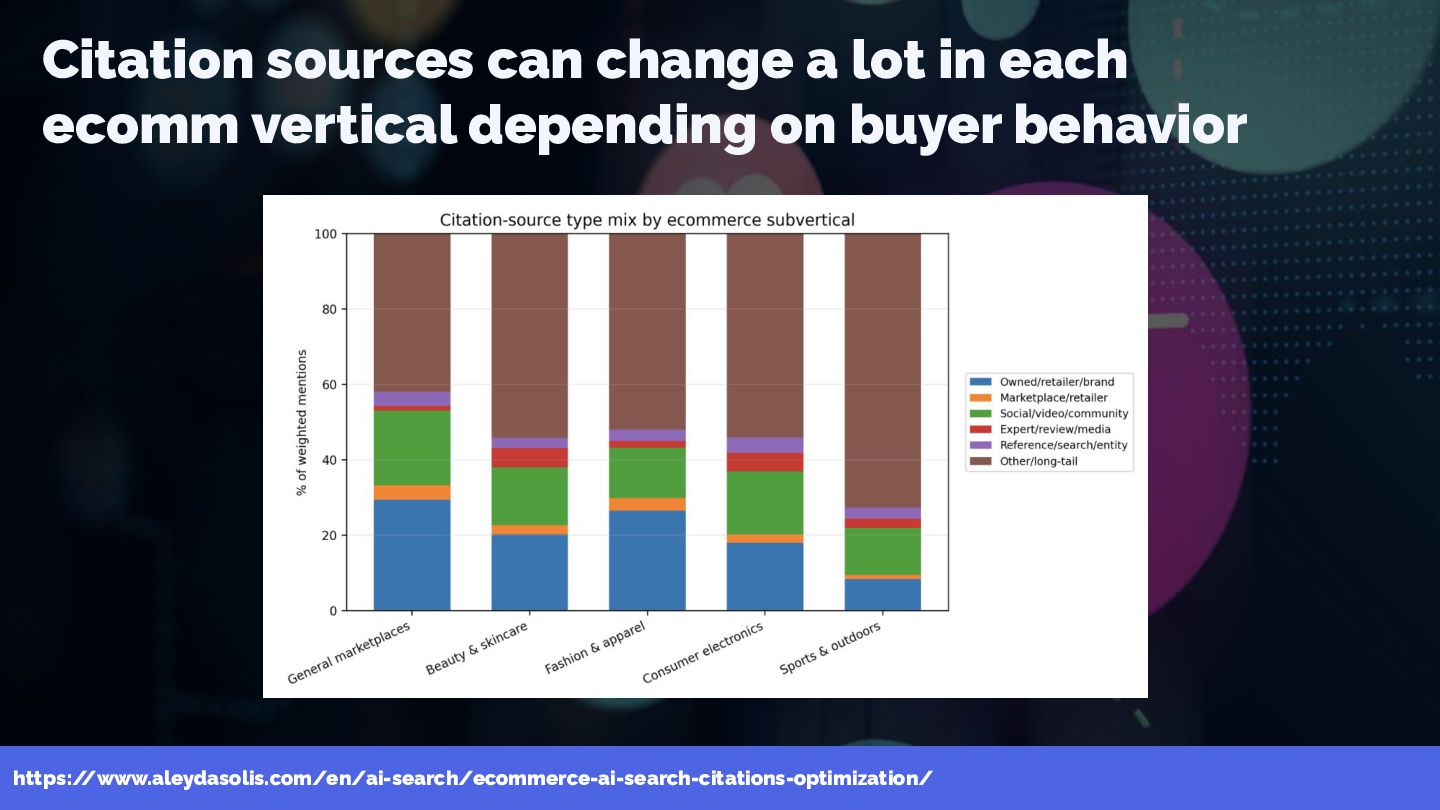
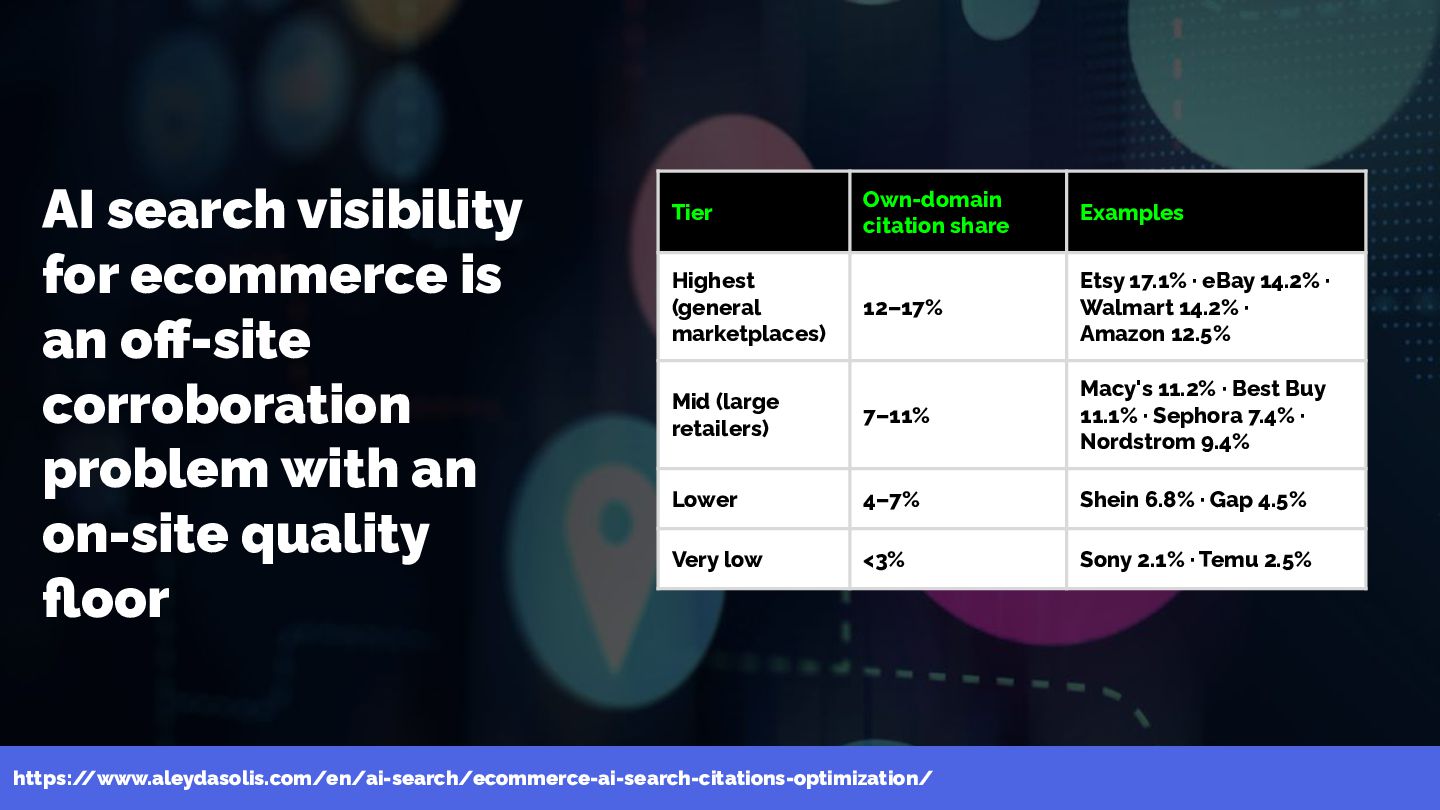
  49. AI search visibility for ecommerce is an off-site corroboration problem

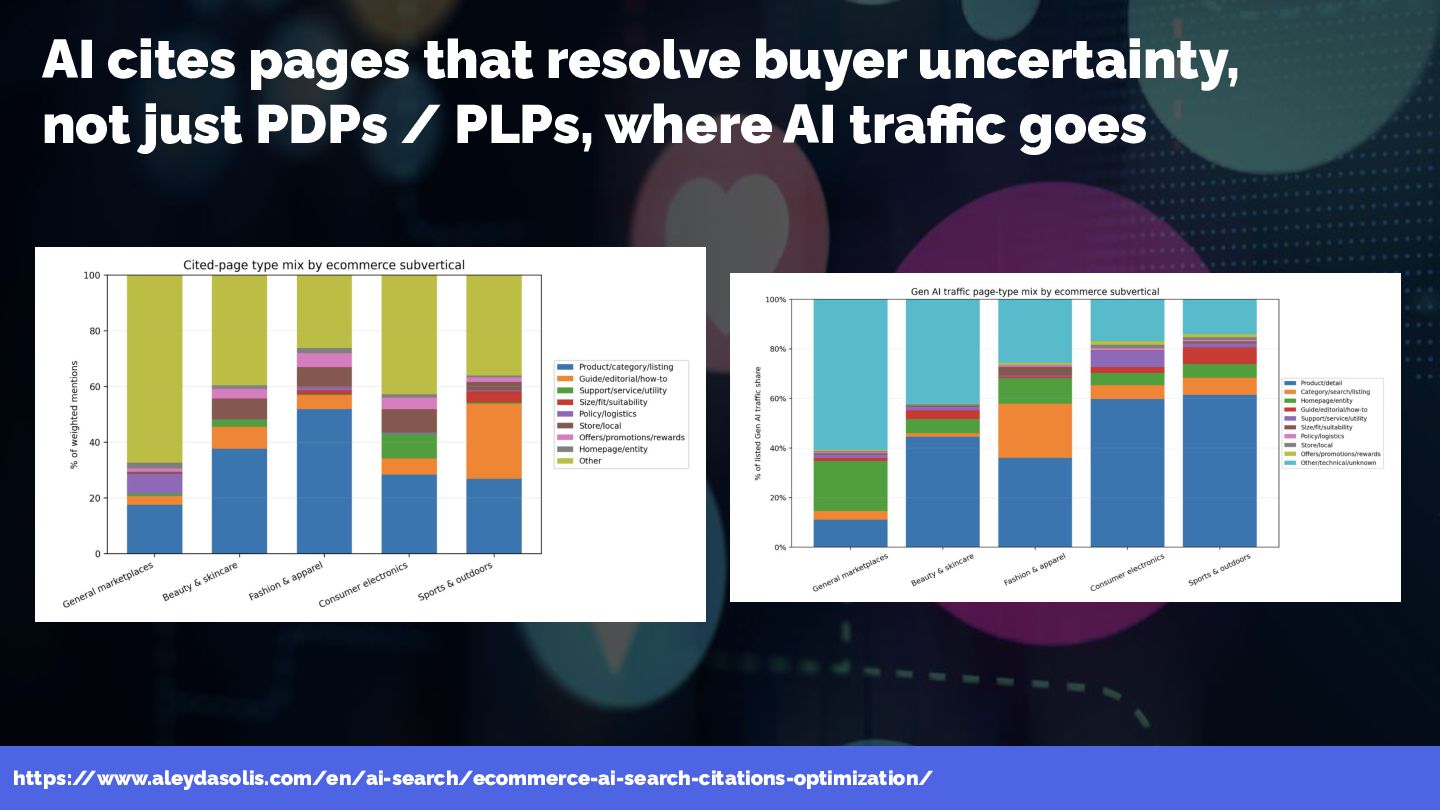
    with an on-site quality floor Tier Own-domain citation share Examples Highest (general marketplaces) 12–17% Etsy 17.1% · eBay 14.2% · Walmart 14.2% · Amazon 12.5% Mid (large retailers) 7–11% Macy's 11.2% · Best Buy 11.1% · Sephora 7.4% · Nordstrom 9.4% Lower 4–7% Shein 6.8% · Gap 4.5% Very low <3% Sony 2.1% · Temu 2.5% https:/ /www.aleydasolis.com/en/ai-search/ecommerce-ai-search-citations-optimization/
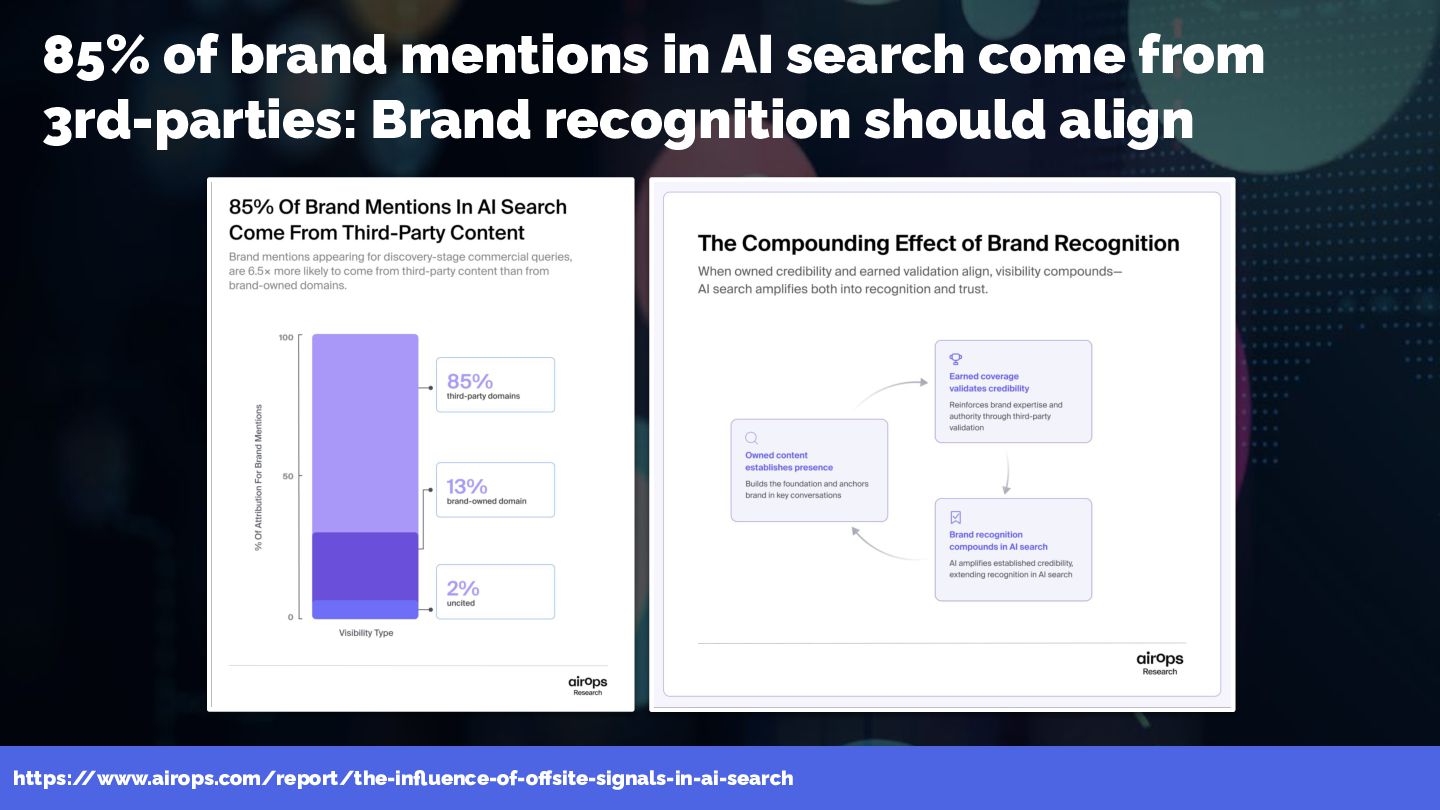
  50. 85% of brand mentions in AI search come from 3rd-parties:

    Brand recognition should align https:/ /www.airops.com/report/the-influence-of-offsite-signals-in-ai-search
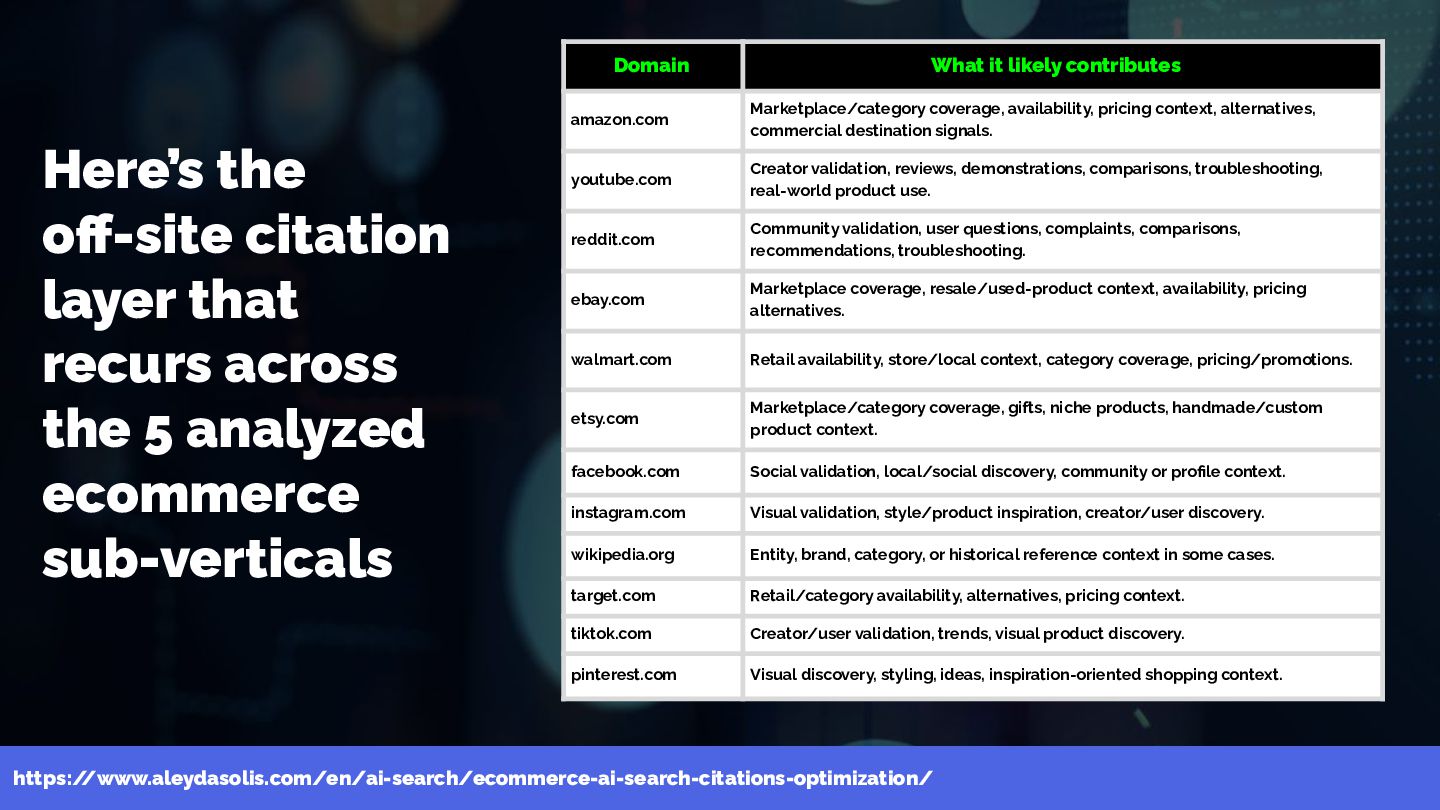
  51. Here’s the off-site citation layer that recurs across the 5

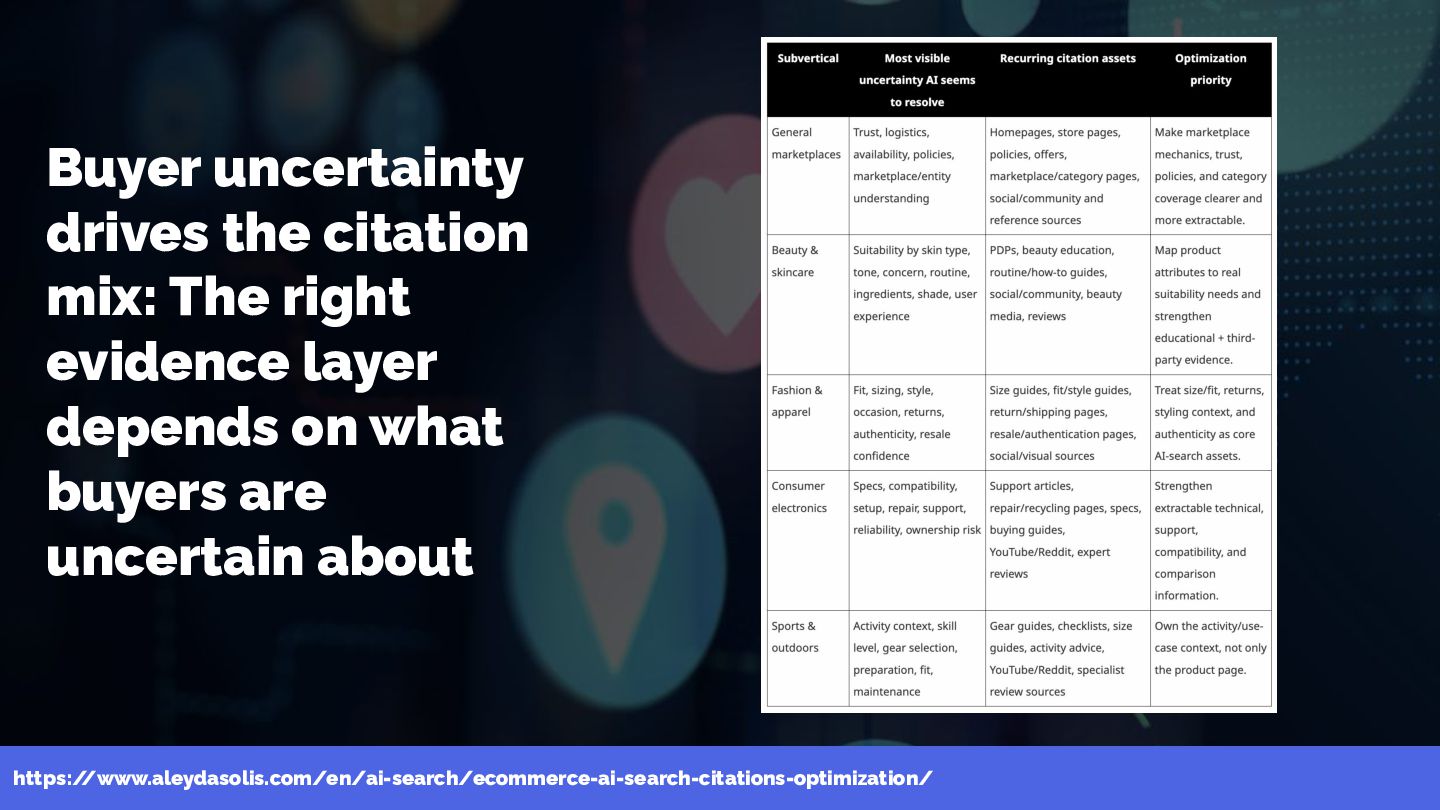
    analyzed ecommerce sub-verticals Domain What it likely contributes amazon.com Marketplace/category coverage, availability, pricing context, alternatives, commercial destination signals. youtube.com Creator validation, reviews, demonstrations, comparisons, troubleshooting, real-world product use. reddit.com Community validation, user questions, complaints, comparisons, recommendations, troubleshooting. ebay.com Marketplace coverage, resale/used-product context, availability, pricing alternatives. walmart.com Retail availability, store/local context, category coverage, pricing/promotions. etsy.com Marketplace/category coverage, gifts, niche products, handmade/custom product context. facebook.com Social validation, local/social discovery, community or profile context. instagram.com Visual validation, style/product inspiration, creator/user discovery. wikipedia.org Entity, brand, category, or historical reference context in some cases. target.com Retail/category availability, alternatives, pricing context. tiktok.com Creator/user validation, trends, visual product discovery. pinterest.com Visual discovery, styling, ideas, inspiration-oriented shopping context. https:/ /www.aleydasolis.com/en/ai-search/ecommerce-ai-search-citations-optimization/
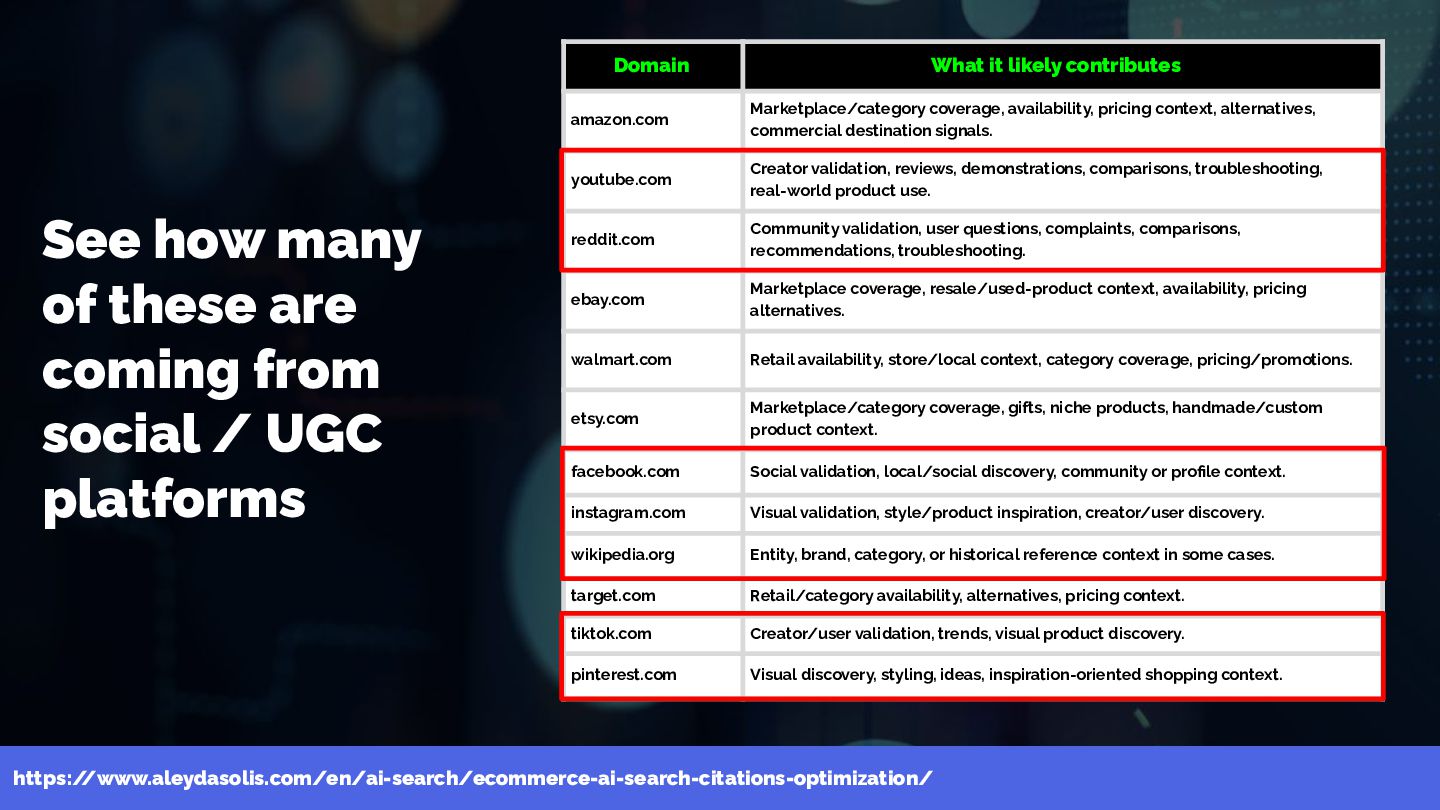
  52. See how many of these are coming from social /

    UGC platforms Domain What it likely contributes amazon.com Marketplace/category coverage, availability, pricing context, alternatives, commercial destination signals. youtube.com Creator validation, reviews, demonstrations, comparisons, troubleshooting, real-world product use. reddit.com Community validation, user questions, complaints, comparisons, recommendations, troubleshooting. ebay.com Marketplace coverage, resale/used-product context, availability, pricing alternatives. walmart.com Retail availability, store/local context, category coverage, pricing/promotions. etsy.com Marketplace/category coverage, gifts, niche products, handmade/custom product context. facebook.com Social validation, local/social discovery, community or profile context. instagram.com Visual validation, style/product inspiration, creator/user discovery. wikipedia.org Entity, brand, category, or historical reference context in some cases. target.com Retail/category availability, alternatives, pricing context. tiktok.com Creator/user validation, trends, visual product discovery. pinterest.com Visual discovery, styling, ideas, inspiration-oriented shopping context. https:/ /www.aleydasolis.com/en/ai-search/ecommerce-ai-search-citations-optimization/
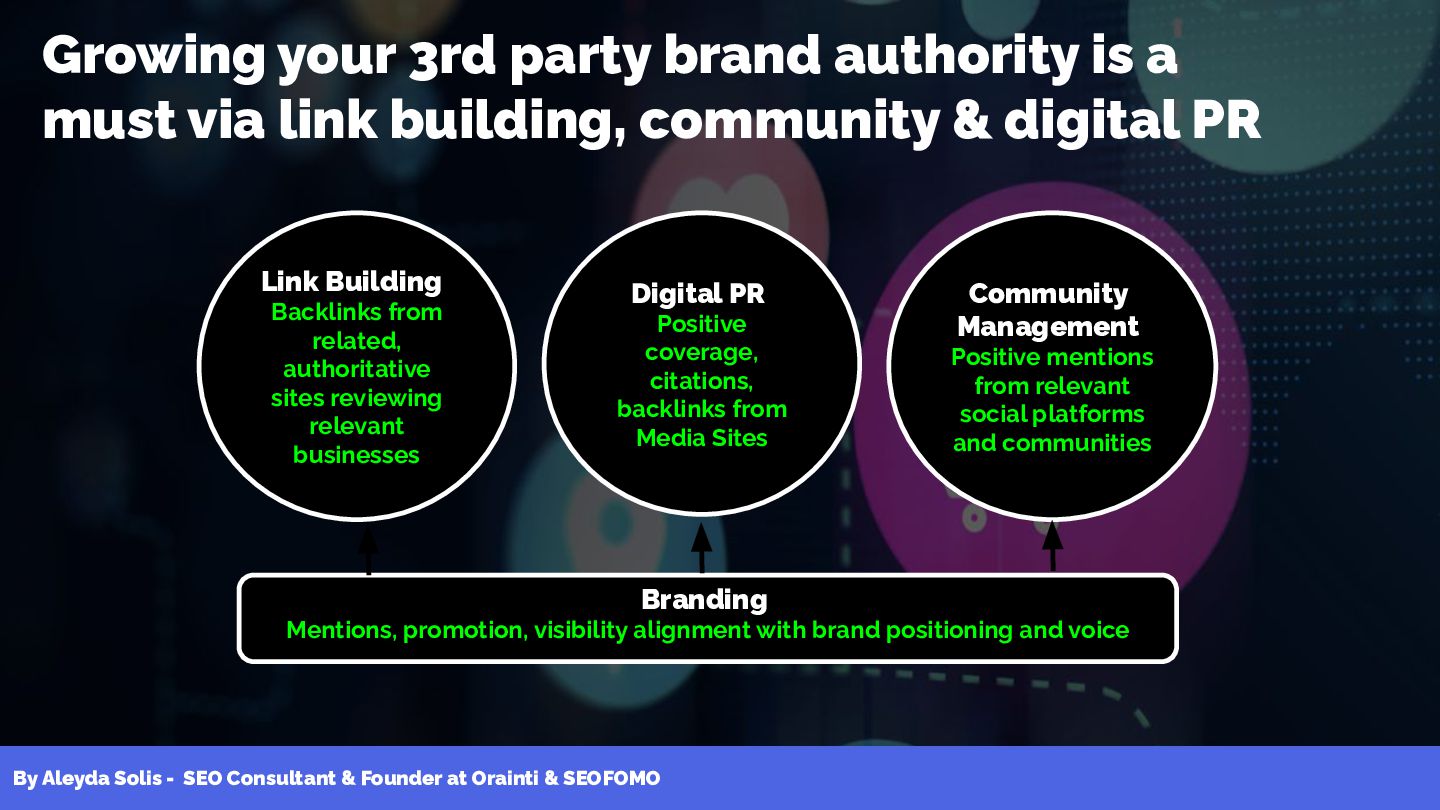
  53. Growing your 3rd party brand authority is a must via

    link building, community & digital PR Digital PR Positive coverage, citations, backlinks from Media Sites Community Management Positive mentions from relevant social platforms and communities Link Building Backlinks from related, authoritative sites reviewing relevant businesses Branding Mentions, promotion, visibility alignment with brand positioning and voice By Aleyda Solis - SEO Consultant & Founder at Orainti & SEOFOMO
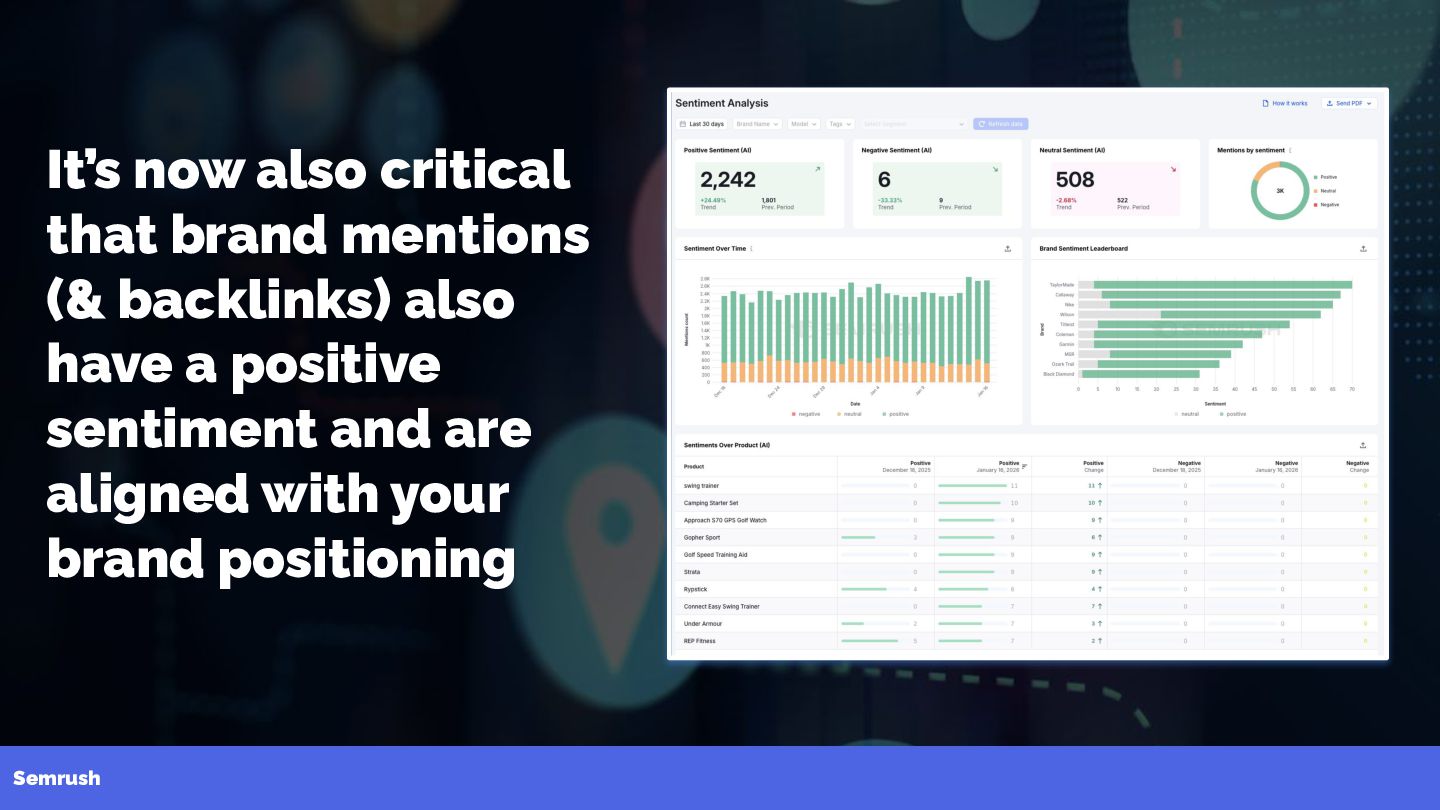
  54. It’s now also critical that brand mentions (& backlinks) also

    have a positive sentiment and are aligned with your brand positioning Semrush
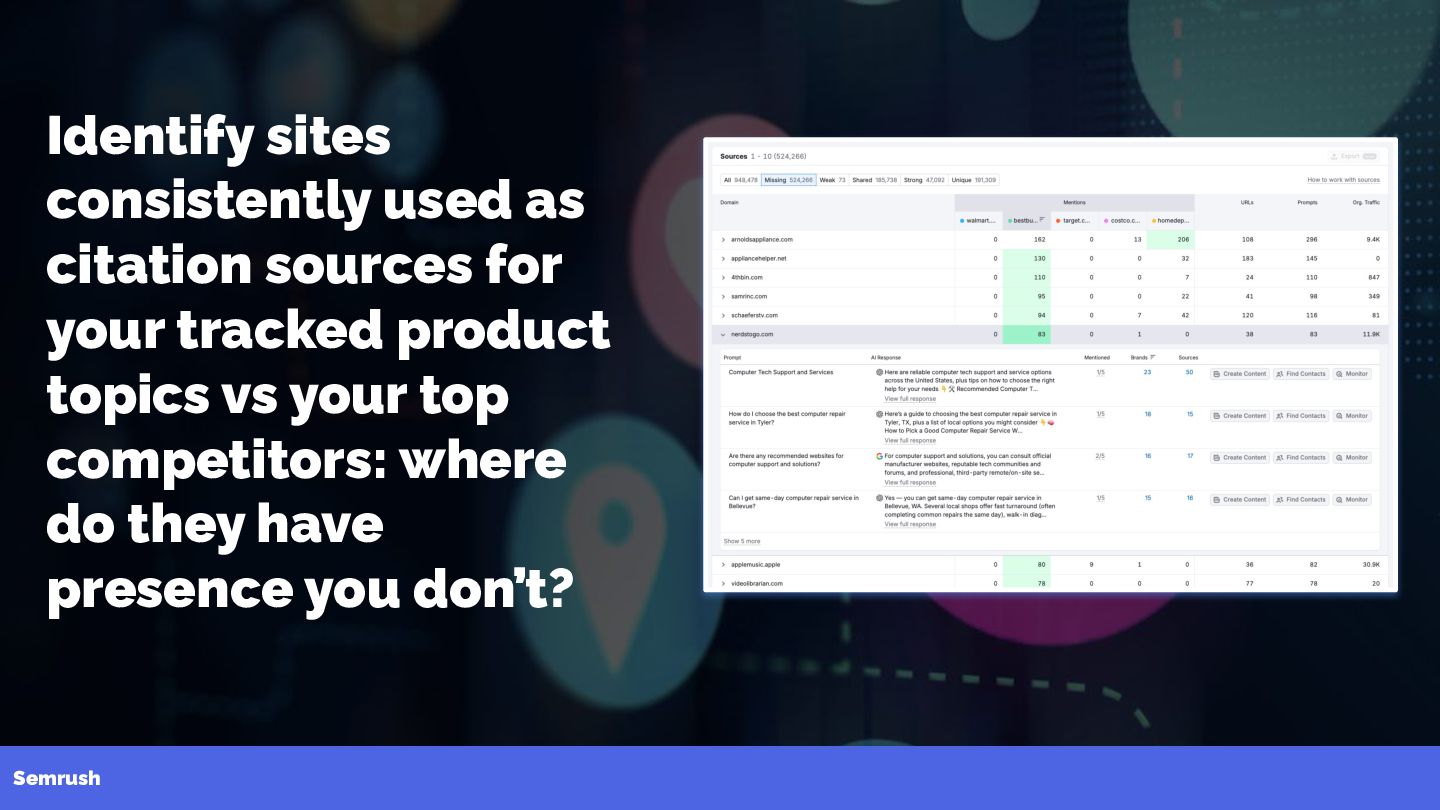
  55. Identify sites consistently used as citation sources for your tracked

    product topics vs your top competitors: where do they have presence you don’t? Semrush
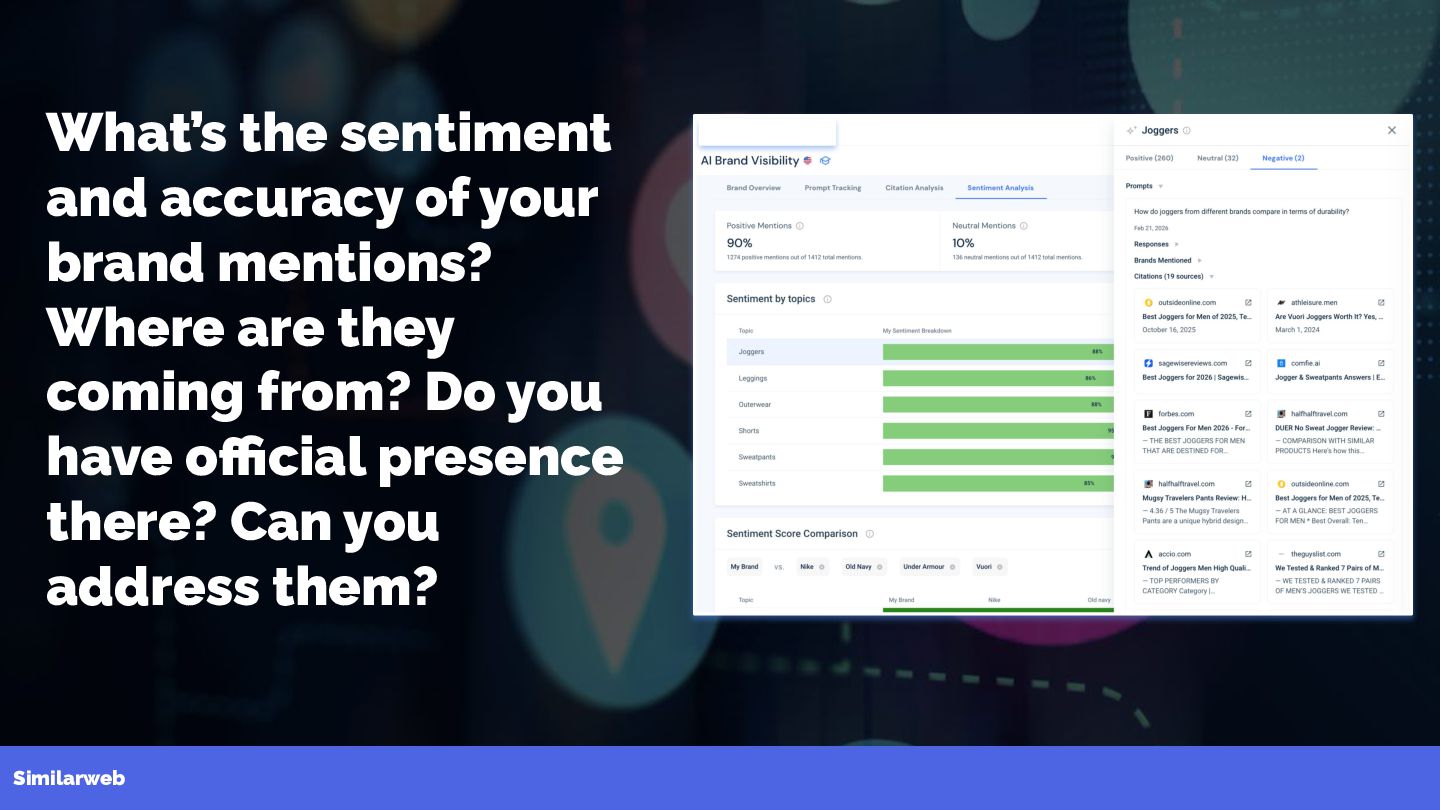
  56. What’s the sentiment and accuracy of your brand mentions? Where

    are they coming from? Do you have official presence there? Can you address them? Similarweb
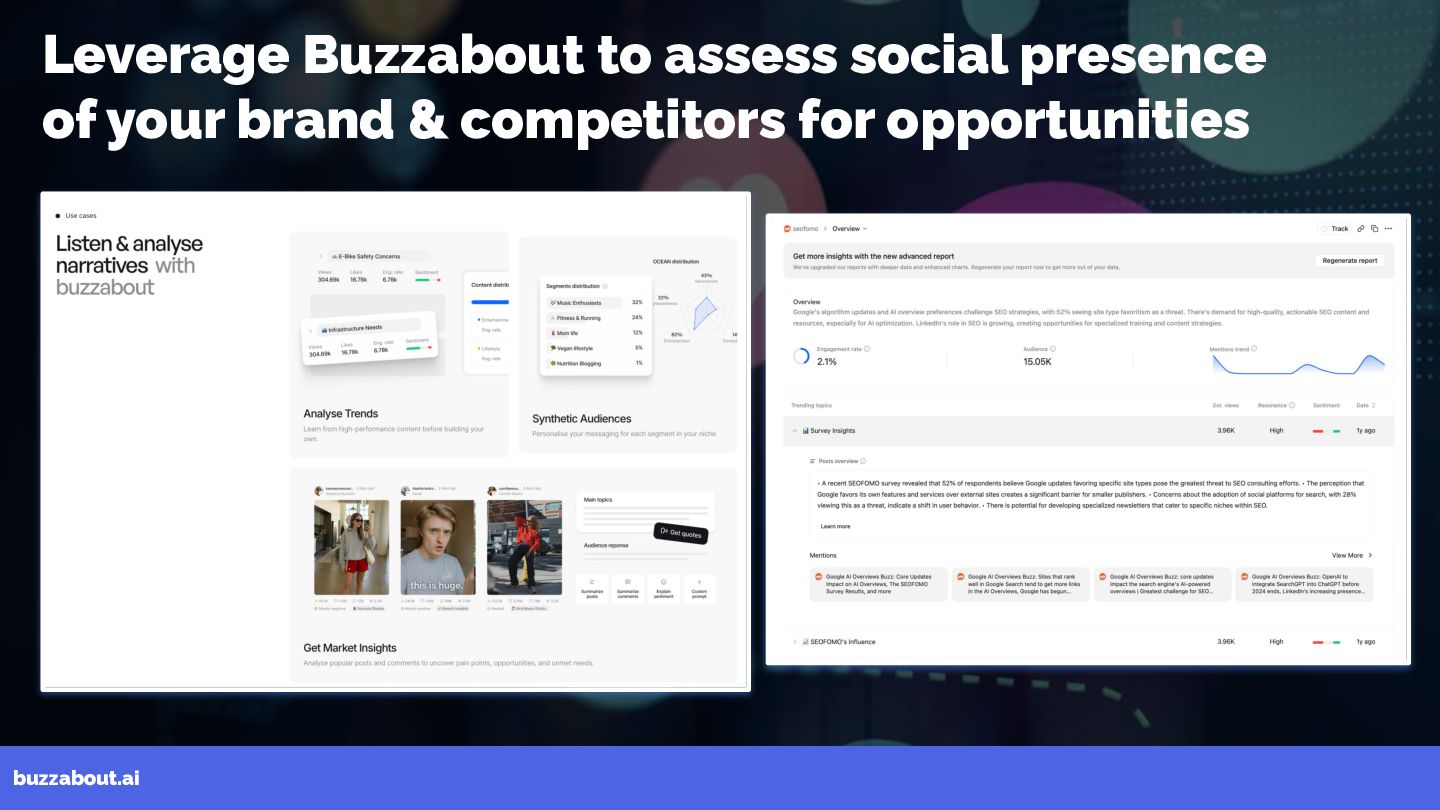
  57. Leverage Buzzabout to assess social presence of your brand &

    competitors for opportunities buzzabout.ai
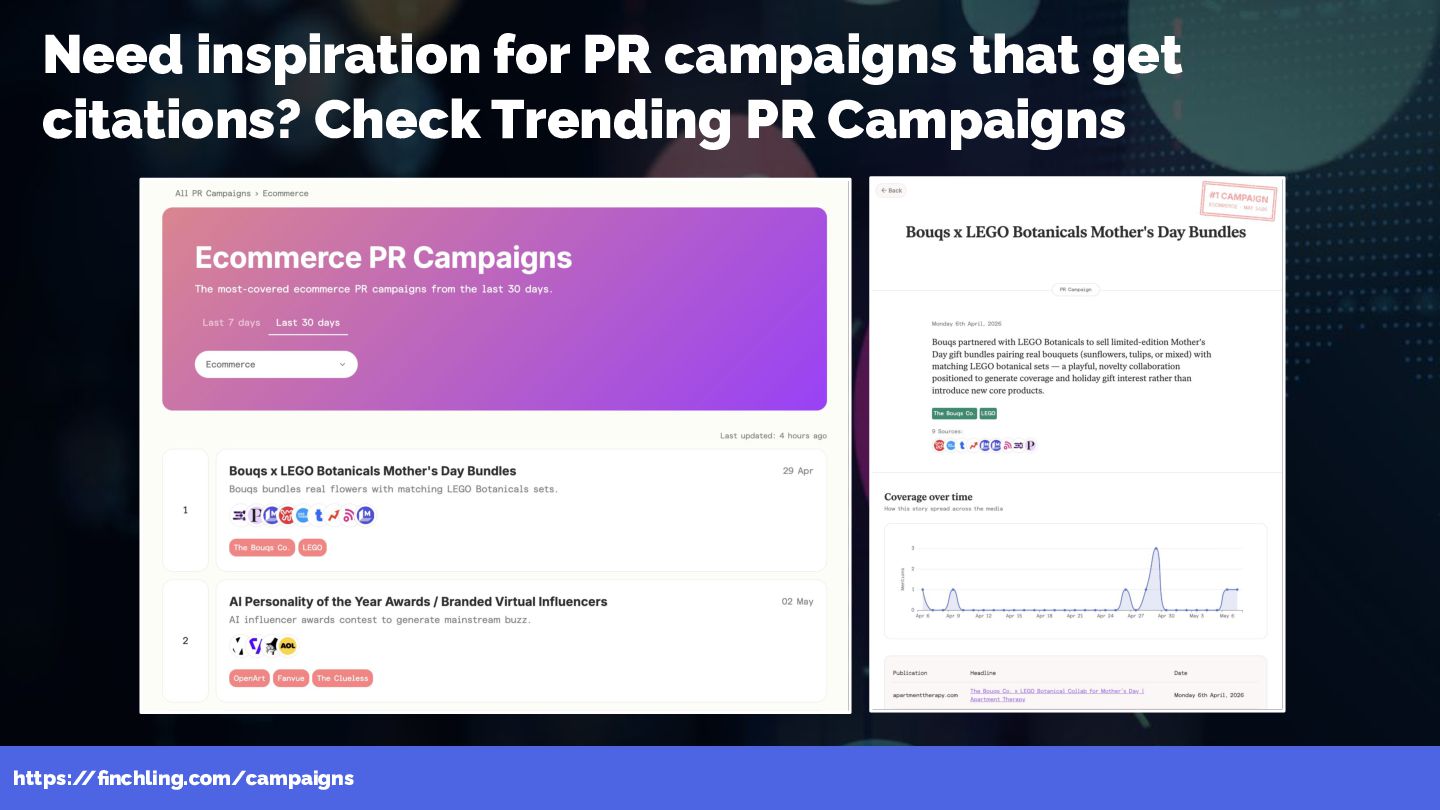
  58. Need inspiration for PR campaigns that get citations? Check Trending

    PR Campaigns https:/ /finchling.com/campaigns
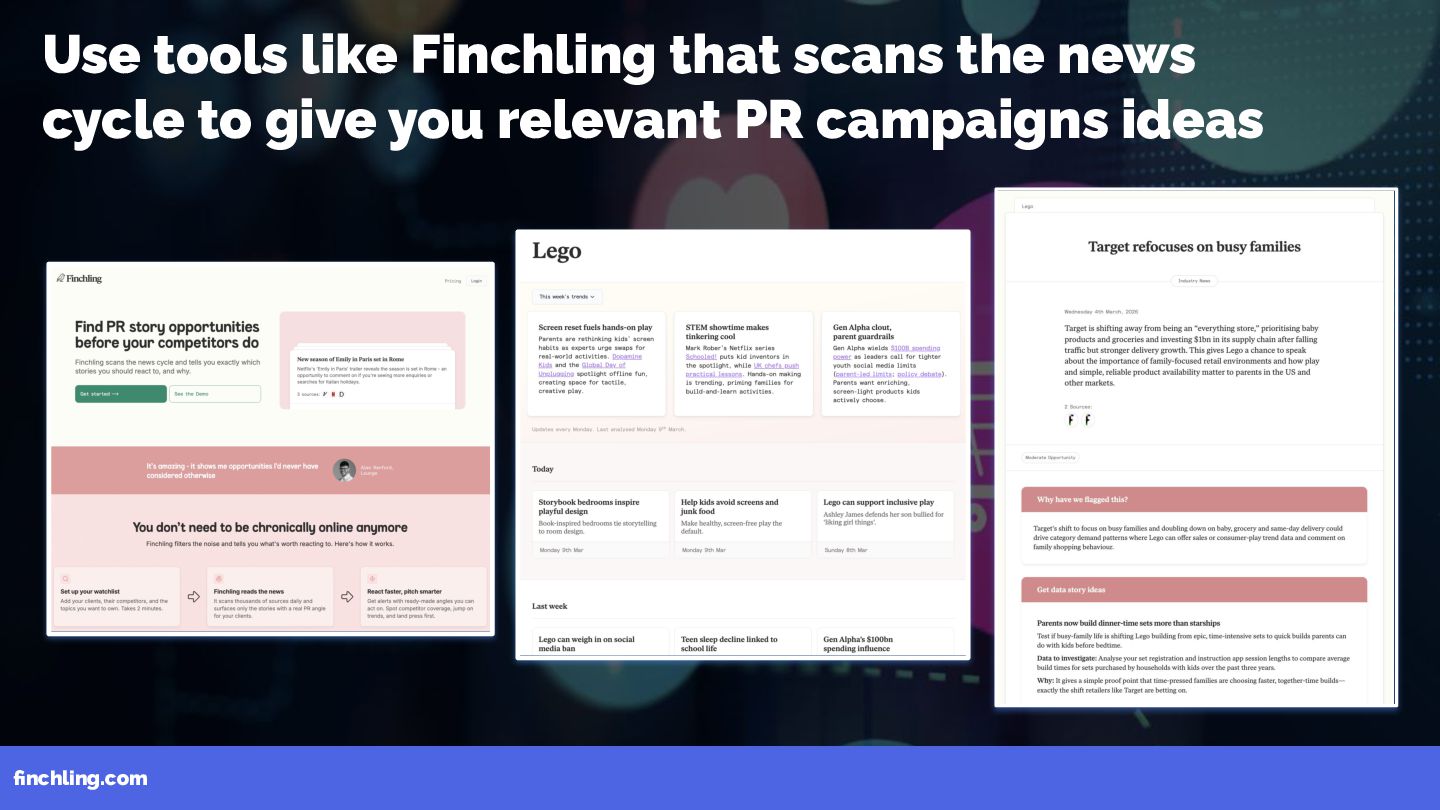
  59. Use tools like Finchling that scans the news cycle to

    give you relevant PR campaigns ideas finchling.com
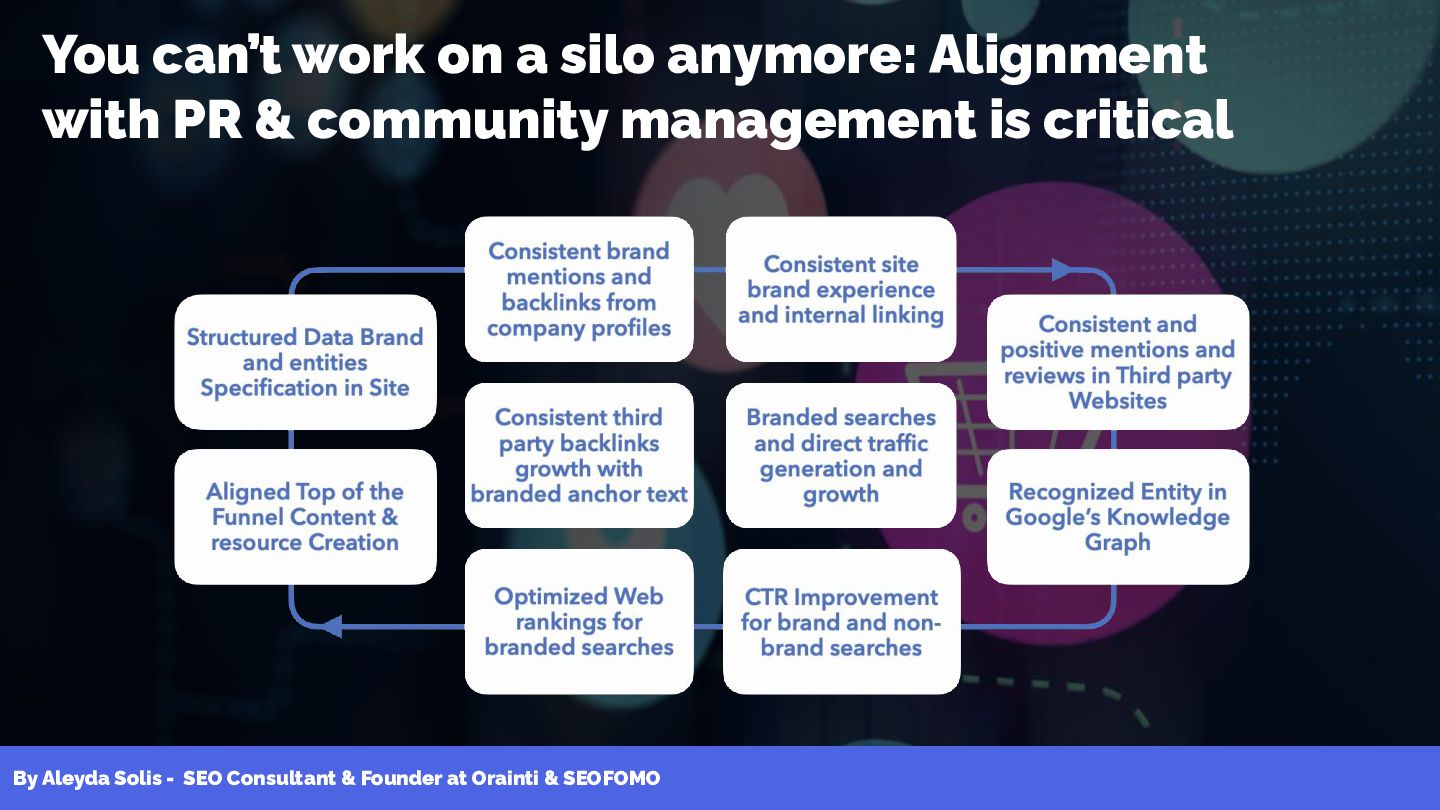
  60. You can’t work on a silo anymore: Alignment with PR

    & community management is critical By Aleyda Solis - SEO Consultant & Founder at Orainti & SEOFOMO
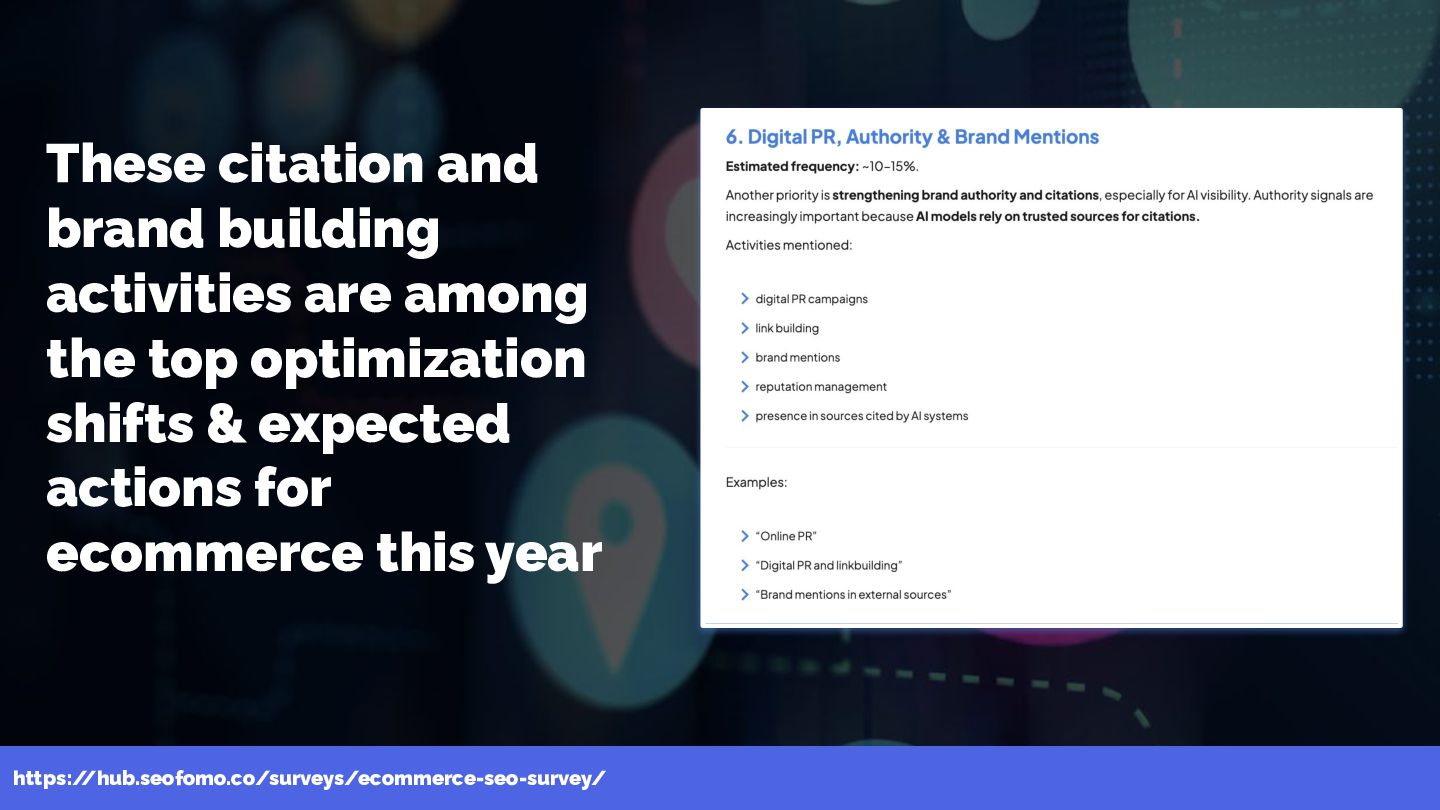
  61. These citation and brand building activities are among the top

    optimization shifts & expected actions for ecommerce this year https:/ /hub.seofomo.co/surveys/ecommerce-seo-survey/
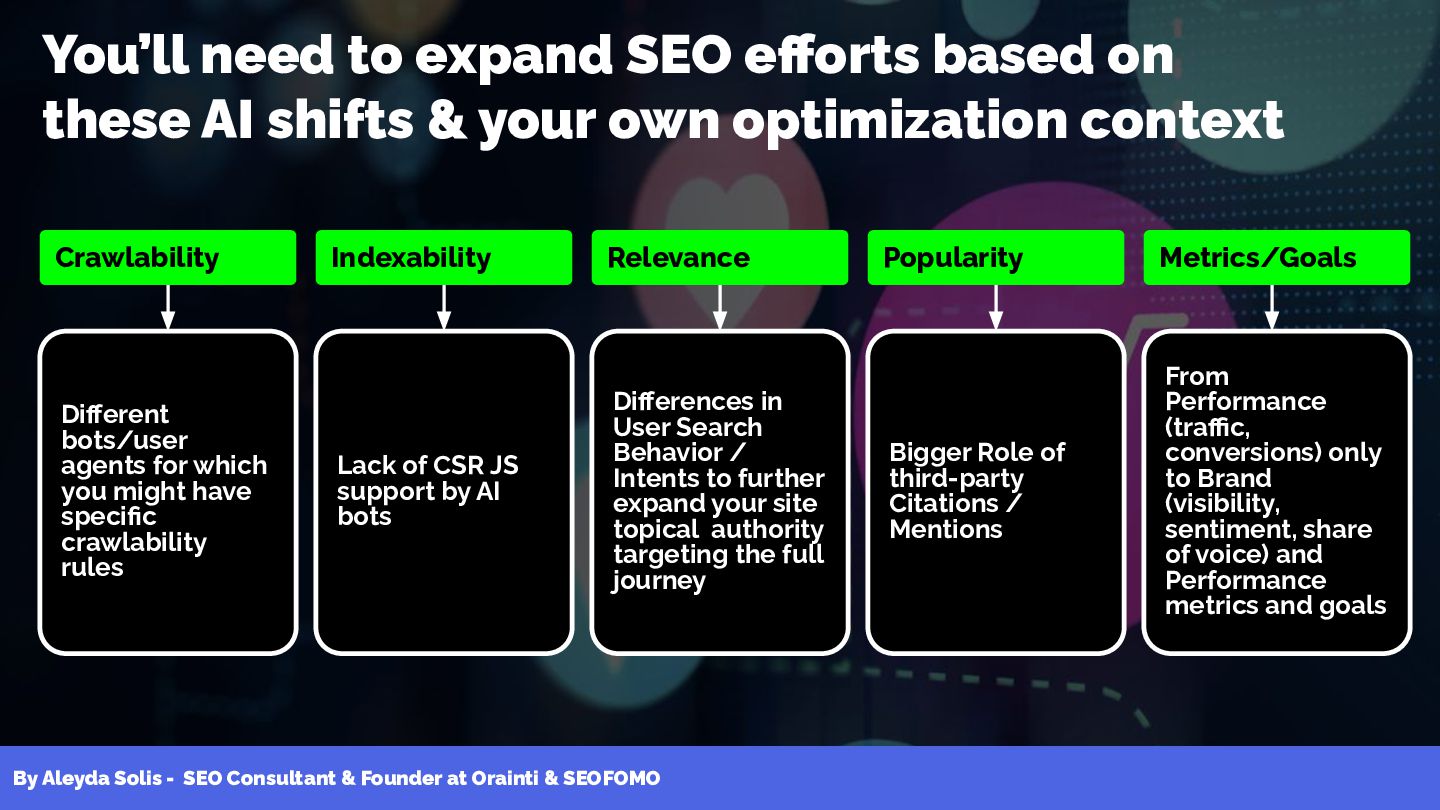
  62. You’ll need to expand SEO efforts based on these AI

    shifts & your own optimization context Differences in User Search Behavior / Intents to further expand your site topical authority targeting the full journey Bigger Role of third-party Citations / Mentions Different bots/user agents for which you might have specific crawlability rules Lack of CSR JS support by AI bots From Performance (traffic, conversions) only to Brand (visibility, sentiment, share of voice) and Performance metrics and goals Crawlability Indexability Relevance Popularity Metrics/Goals By Aleyda Solis - SEO Consultant & Founder at Orainti & SEOFOMO
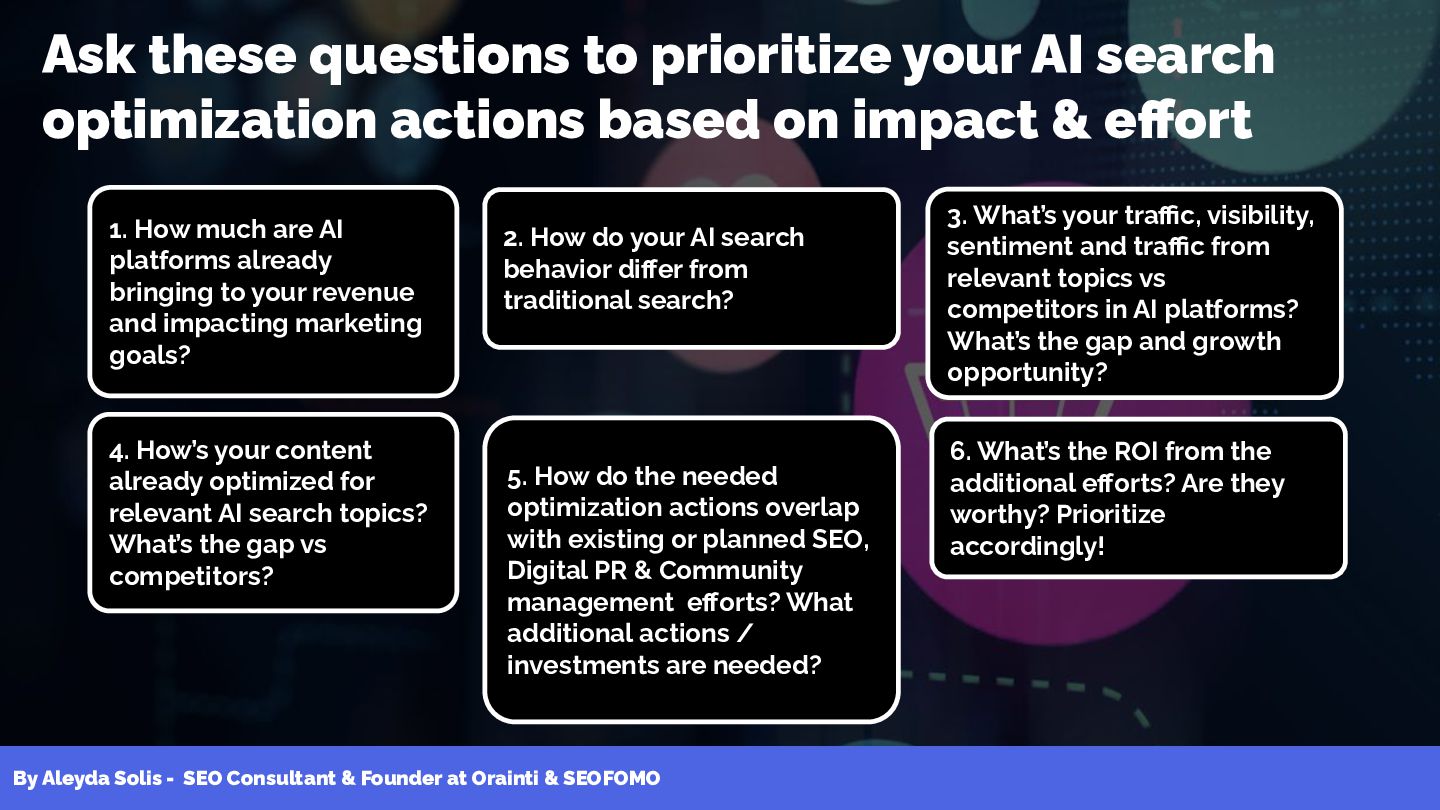
  63. 1. How much are AI platforms already bringing to your

    revenue and impacting marketing goals? 2. How do your AI search behavior differ from traditional search? 3. What’s your traffic, visibility, sentiment and traffic from relevant topics vs competitors in AI platforms? What’s the gap and growth opportunity? 4. How’s your content already optimized for relevant AI search topics? What’s the gap vs competitors? 5. How do the needed optimization actions overlap with existing or planned SEO, Digital PR & Community management efforts? What additional actions / investments are needed? 6. What’s the ROI from the additional efforts? Are they worthy? Prioritize accordingly! Ask these questions to prioritize your AI search optimization actions based on impact & effort By Aleyda Solis - SEO Consultant & Founder at Orainti & SEOFOMO
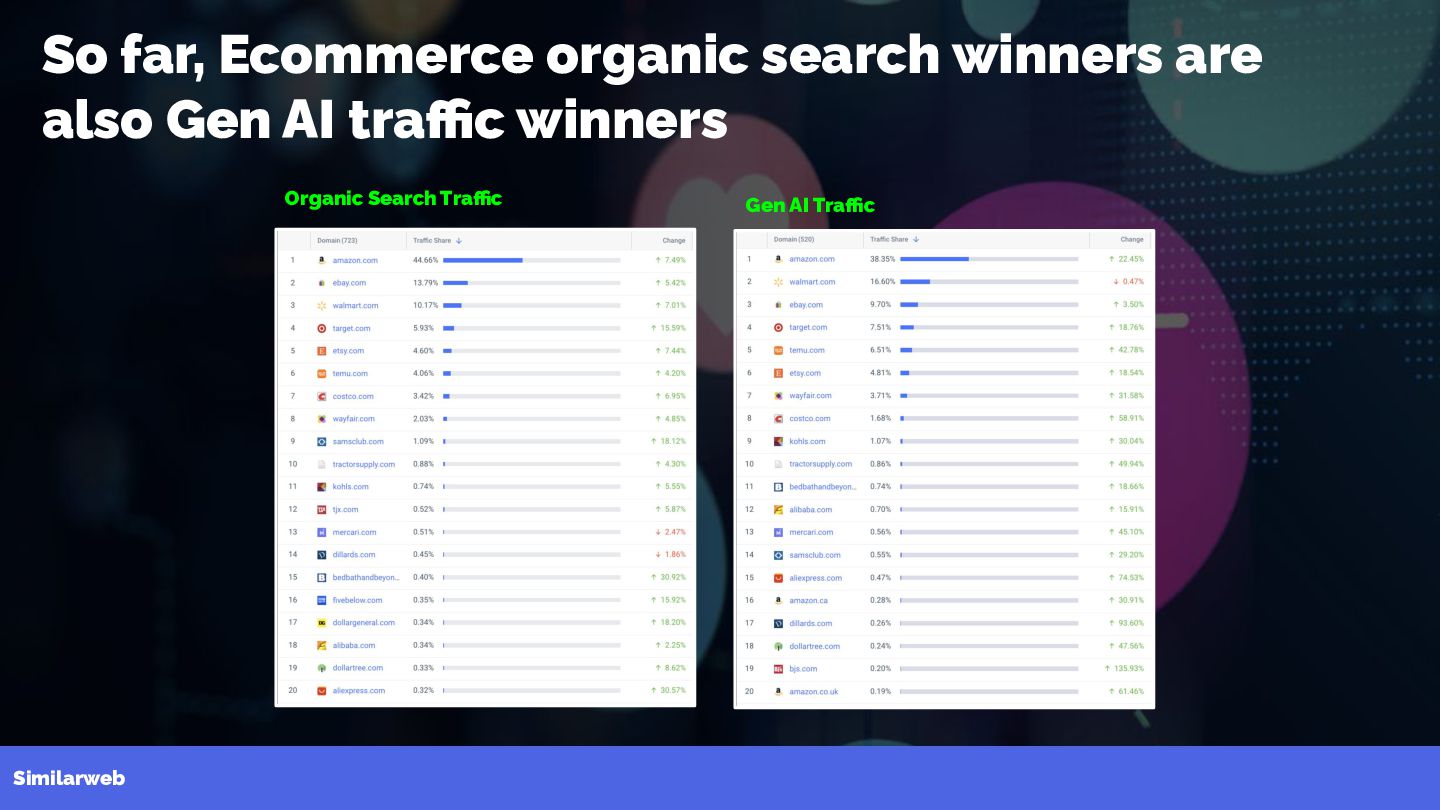
  64. Similarweb So far, Ecommerce organic search winners are also Gen

    AI traffic winners Organic Search Traffic Gen AI Traffic
  65. With AI search, Ecommerce SEO shifts from “ranking pages” to

    “enabling transactions” By Aleyda Solis - SEO Consultant & Founder at Orainti & SEOFOMO
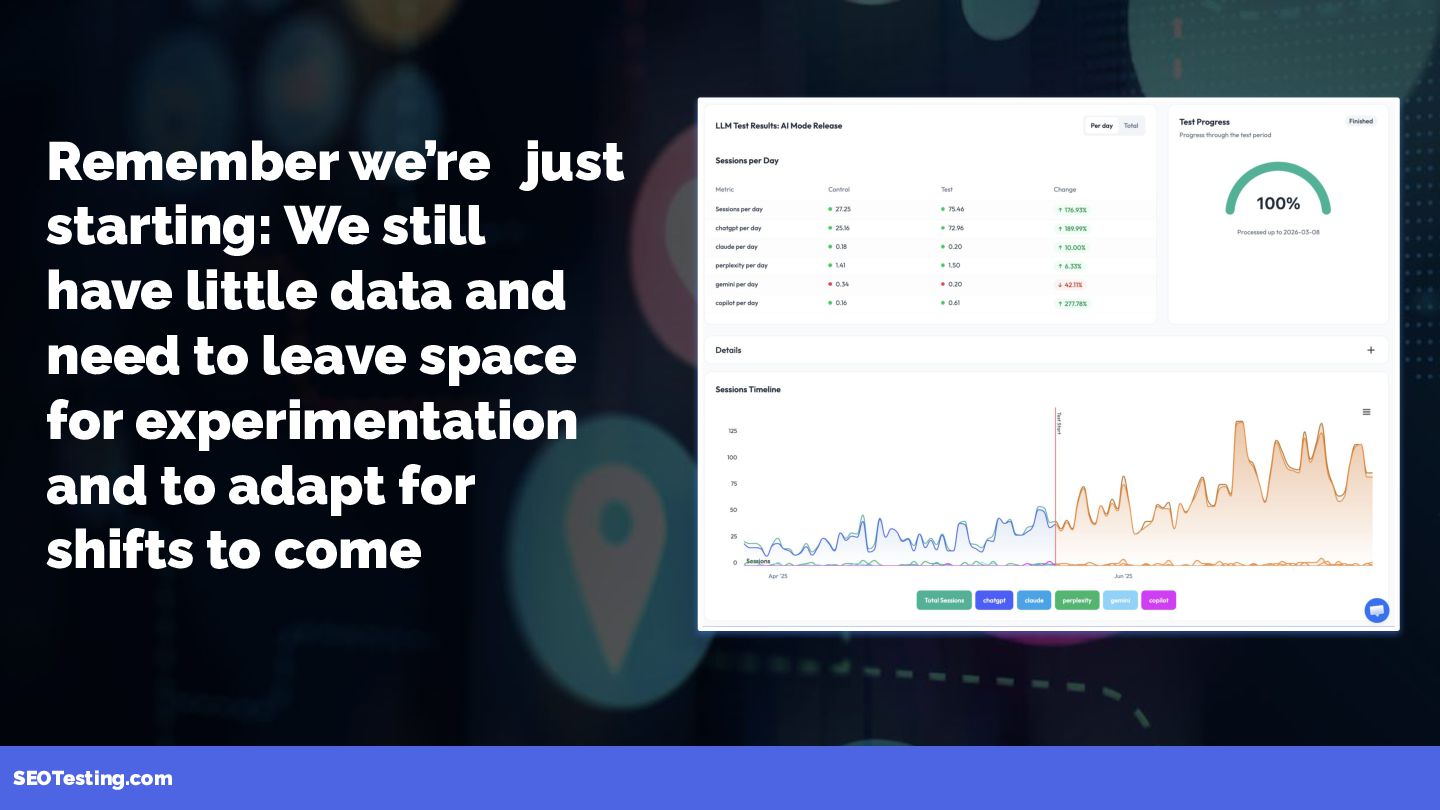
  66. Remember we’re just starting: We still have little data and

    need to leave space for experimentation and to adapt for shifts to come SEOTesting.com
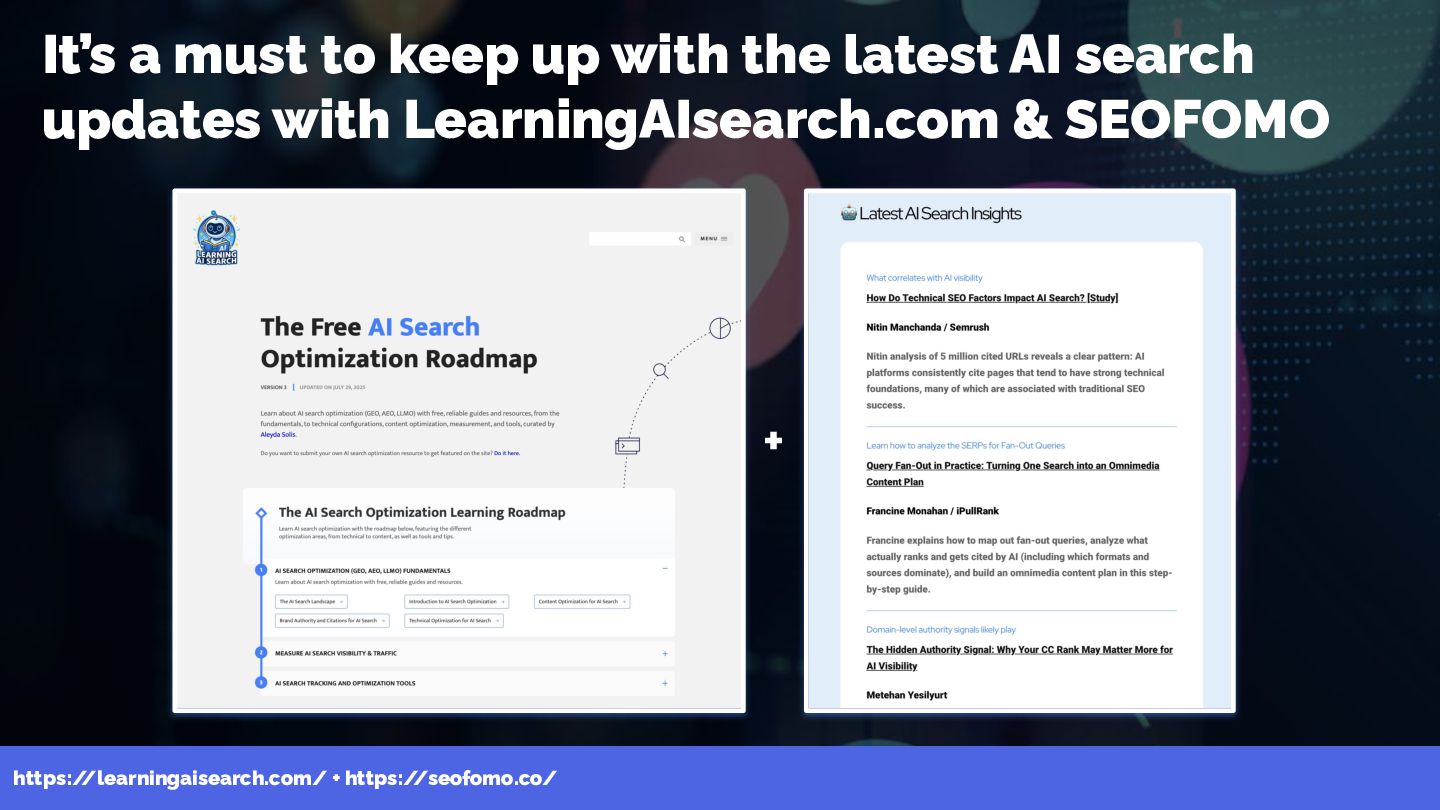
  67. It’s a must to keep up with the latest AI

    search updates with LearningAIsearch.com & SEOFOMO + https:/ /learningaisearch.com/ + https:/ /seofomo.co/
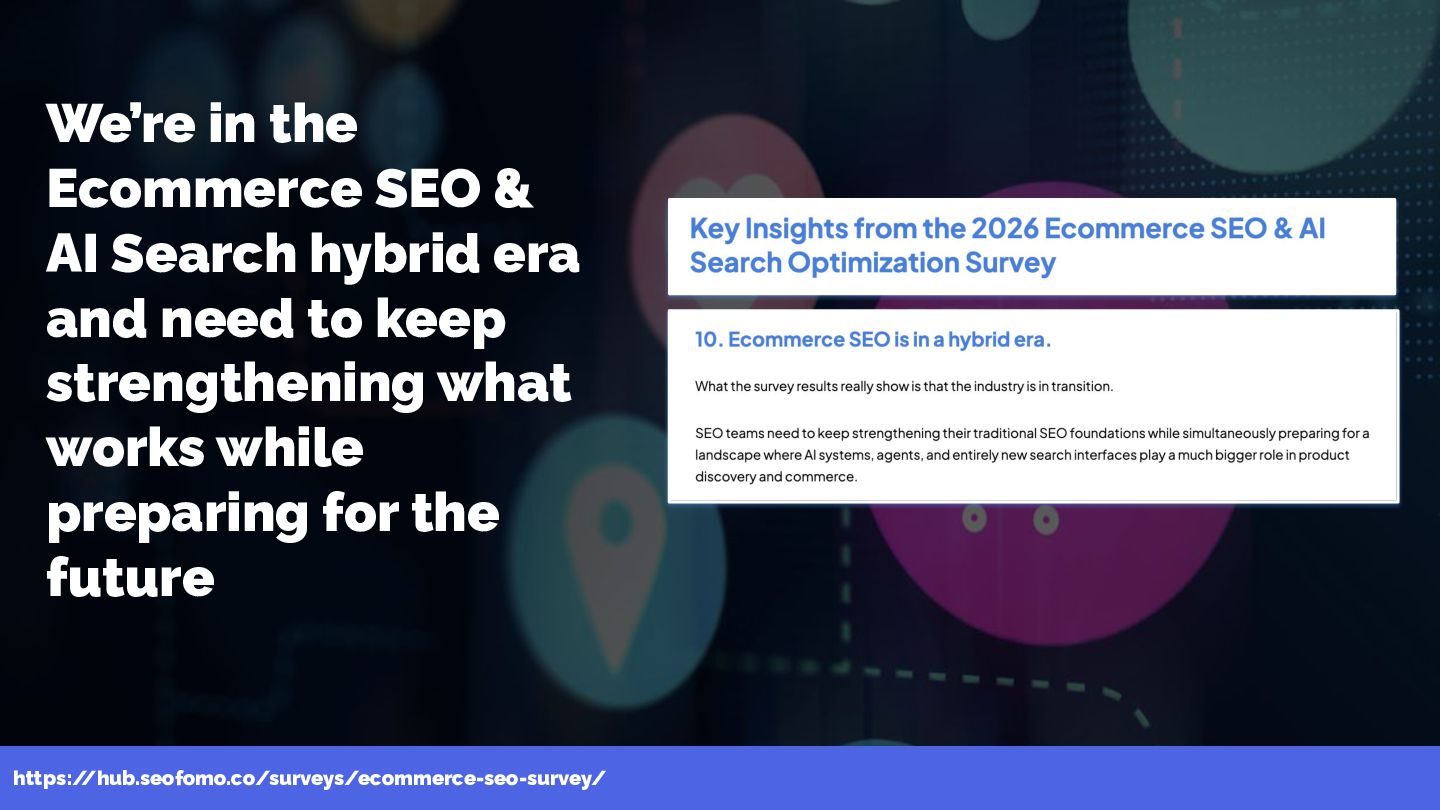
  68. We’re in the Ecommerce SEO & AI Search hybrid era

    and need to keep strengthening what works while preparing for the future https:/ /hub.seofomo.co/surveys/ecommerce-seo-survey/
  69. Long Live Ecommerce SEO … for [AI Search / AI

    Mode / ChatGPT / TikTok / YouTube / Baidu / Any Platform Used for Search] By Aleyda Solis - SEO Consultant & Founder at Orainti & SEOFOMO
  70. Thanks! Questions? SEO Consultant & Founder ❏ International SEO Consultant

    & Founder at Orainti ❏ Co-founder at Finchling ❏ Creator of the SEOFOMO & AI Marketers Newsletters ❏ Maker of LearningAIsearch.com & LearningSEO.io Speaker & Author ❏ Author of SEO, Las Claves Esenciales ❏ Spoke at +200 events in +30 countries By Aleyda Solis - SEO Consultant & Founder at Orainti & SEOFOMO