Upgrade to Pro — share decks privately, control downloads, hide ads and more …

Redefining Success Metrics for the AI Search Er...

Redefining Success Metrics for the AI Search Era - #BrightonSEO

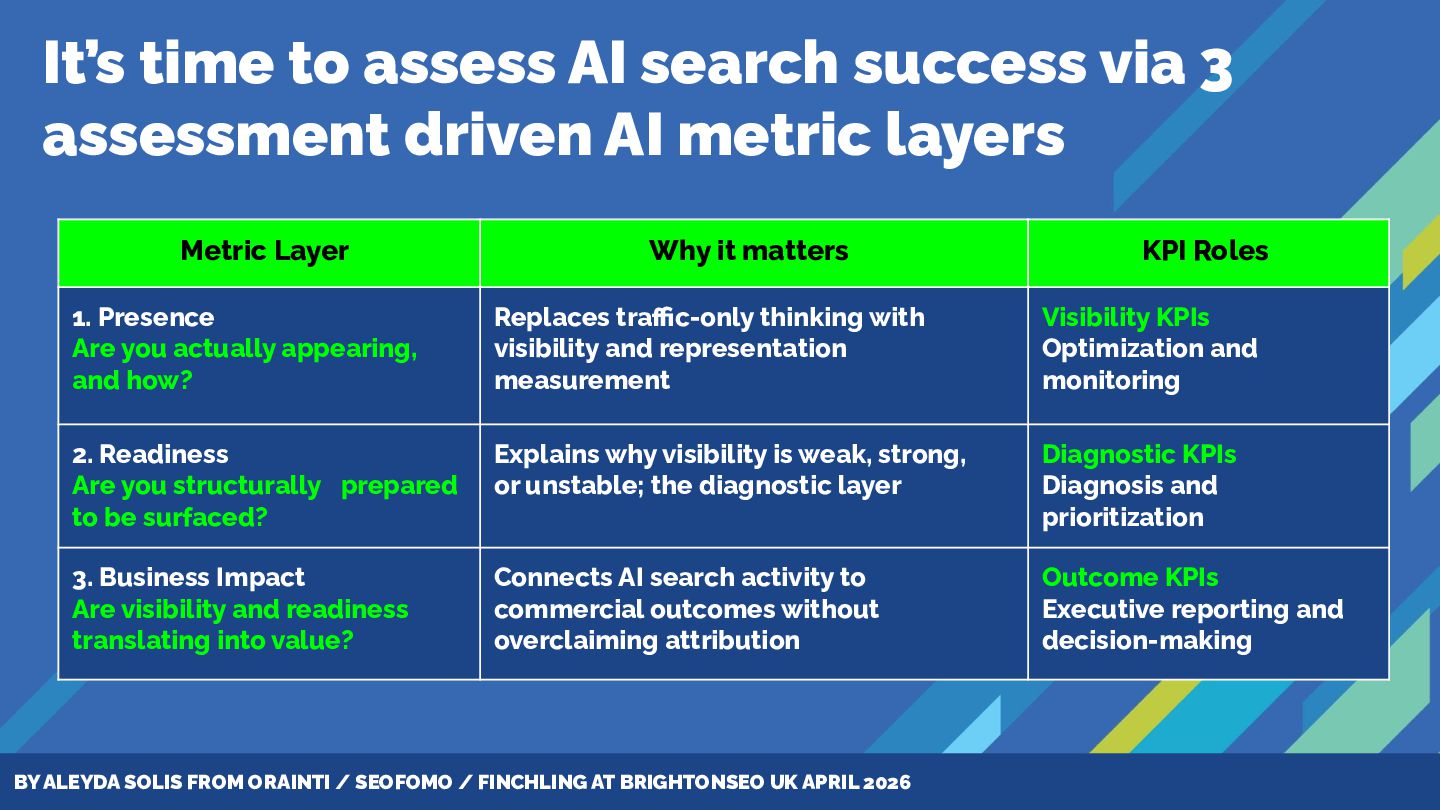
It’s time to assess AI search success via 3 assessment driven AI metric layers:

1. Presence: Are you actually appearing, and how?
2. Readiness: Are you structurally prepared to be surfaced?
3. Business Impact: Are visibility and readiness translating into value?

I go through them in this presentation.

Avatar for Aleyda Solis

Aleyda Solis

April 30, 2026

More Decks by Aleyda Solis

Other Decks in Marketing & SEO

Transcript

  1. Redefining Success Metrics for the AI Search Era Aleyda Solis

    Orainti / SEOFOMO / Finchling @aleyda | Speakerdeck.com/aleyda
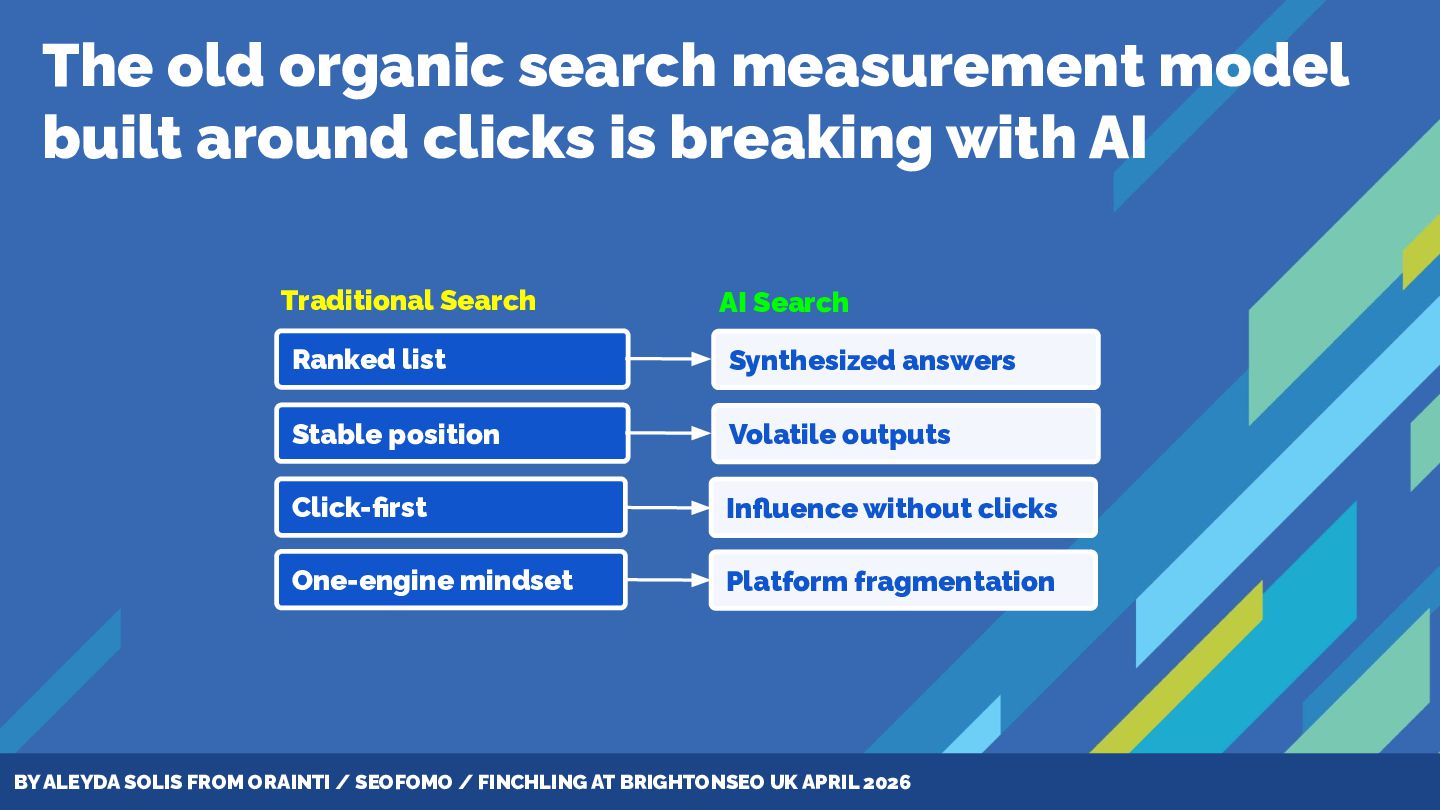
  2. BY ALEYDA SOLIS FROM ORAINTI / SEOFOMO / FINCHLING AT

    BRIGHTONSEO UK APRIL 2026 The old organic search measurement model built around clicks is breaking with AI Ranked list Traditional Search Stable position Click-first One-engine mindset Synthesized answers AI Search Volatile outputs Influence without clicks Platform fragmentation
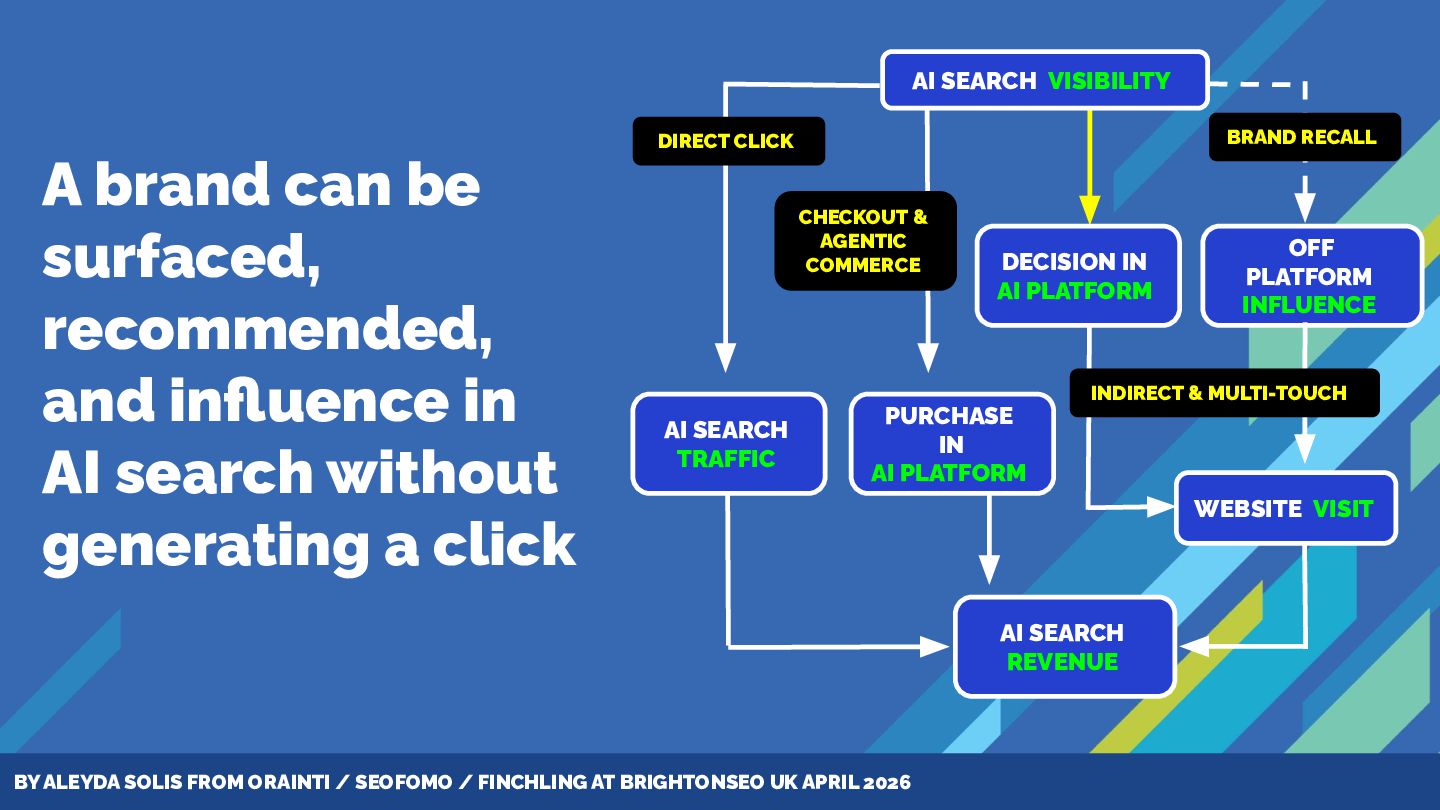
  3. A brand can be surfaced, recommended, and influence in AI

    search without generating a click BY ALEYDA SOLIS FROM ORAINTI / SEOFOMO / FINCHLING AT BRIGHTONSEO UK APRIL 2026 DIRECT CLICK BRAND RECALL AI SEARCH REVENUE AI SEARCH TRAFFIC OFF PLATFORM INFLUENCE DECISION IN AI PLATFORM WEBSITE VISIT INDIRECT & MULTI-TOUCH AI SEARCH VISIBILITY PURCHASE IN AI PLATFORM CHECKOUT & AGENTIC COMMERCE
  4. BY ALEYDA SOLIS FROM ORAINTI / SEOFOMO / FINCHLING AT

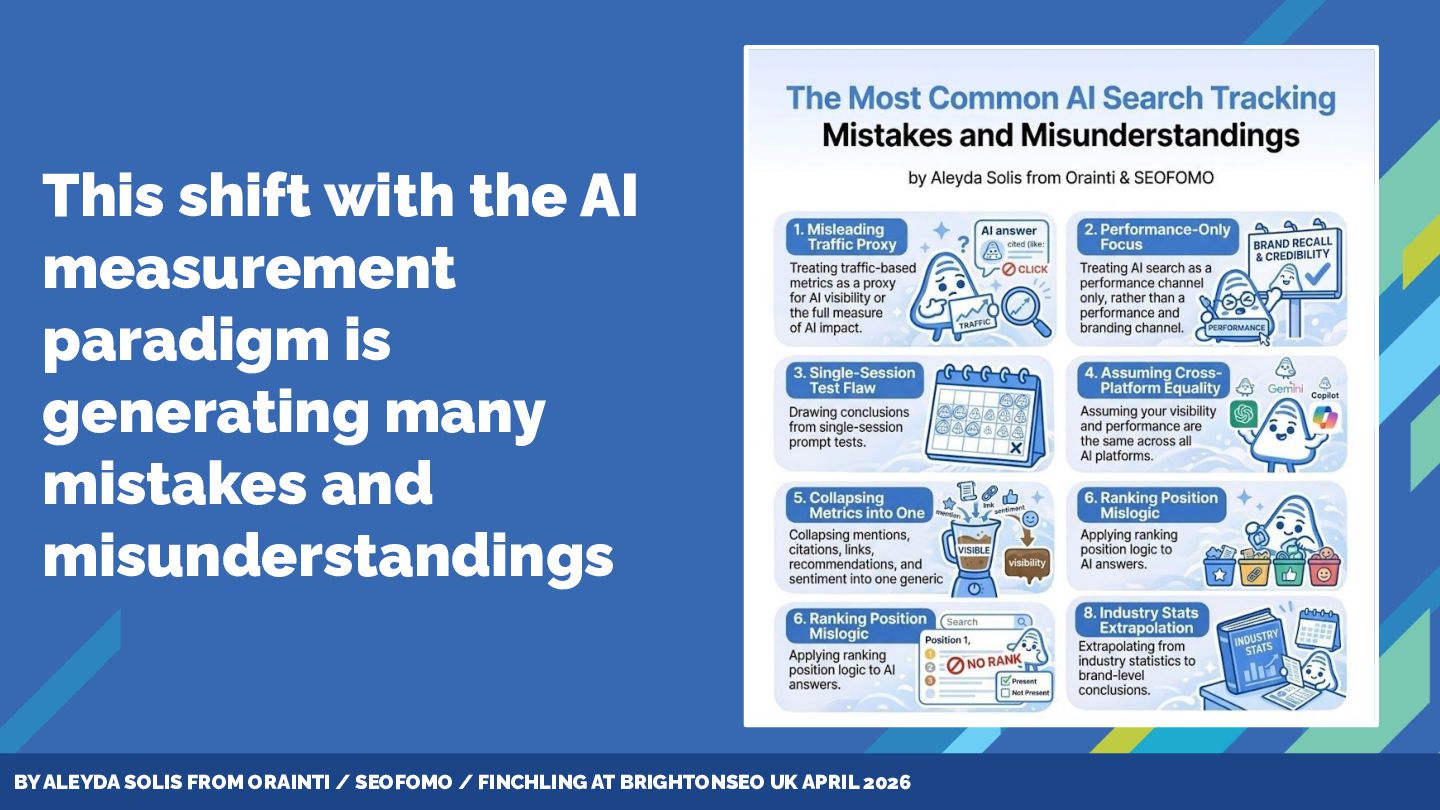
    BRIGHTONSEO UK APRIL 2026 This shift with the AI measurement paradigm is generating many mistakes and misunderstandings
  5. BY ALEYDA SOLIS FROM ORAINTI / SEOFOMO / FINCHLING AT

    BRIGHTONSEO UK APRIL 2026 Metric Layer Why it matters KPI Roles 1. Presence Are you actually appearing, and how? Replaces traffic-only thinking with visibility and representation measurement Visibility KPIs Optimization and monitoring 2. Readiness Are you structurally prepared to be surfaced? Explains why visibility is weak, strong, or unstable; the diagnostic layer Diagnostic KPIs Diagnosis and prioritization 3. Business Impact Are visibility and readiness translating into value? Connects AI search activity to commercial outcomes without overclaiming attribution Outcome KPIs Executive reporting and decision-making It’s time to assess AI search success via 3 assessment driven AI metric layers
  6. BY ALEYDA SOLIS FROM ORAINTI / SEOFOMO / FINCHLING AT

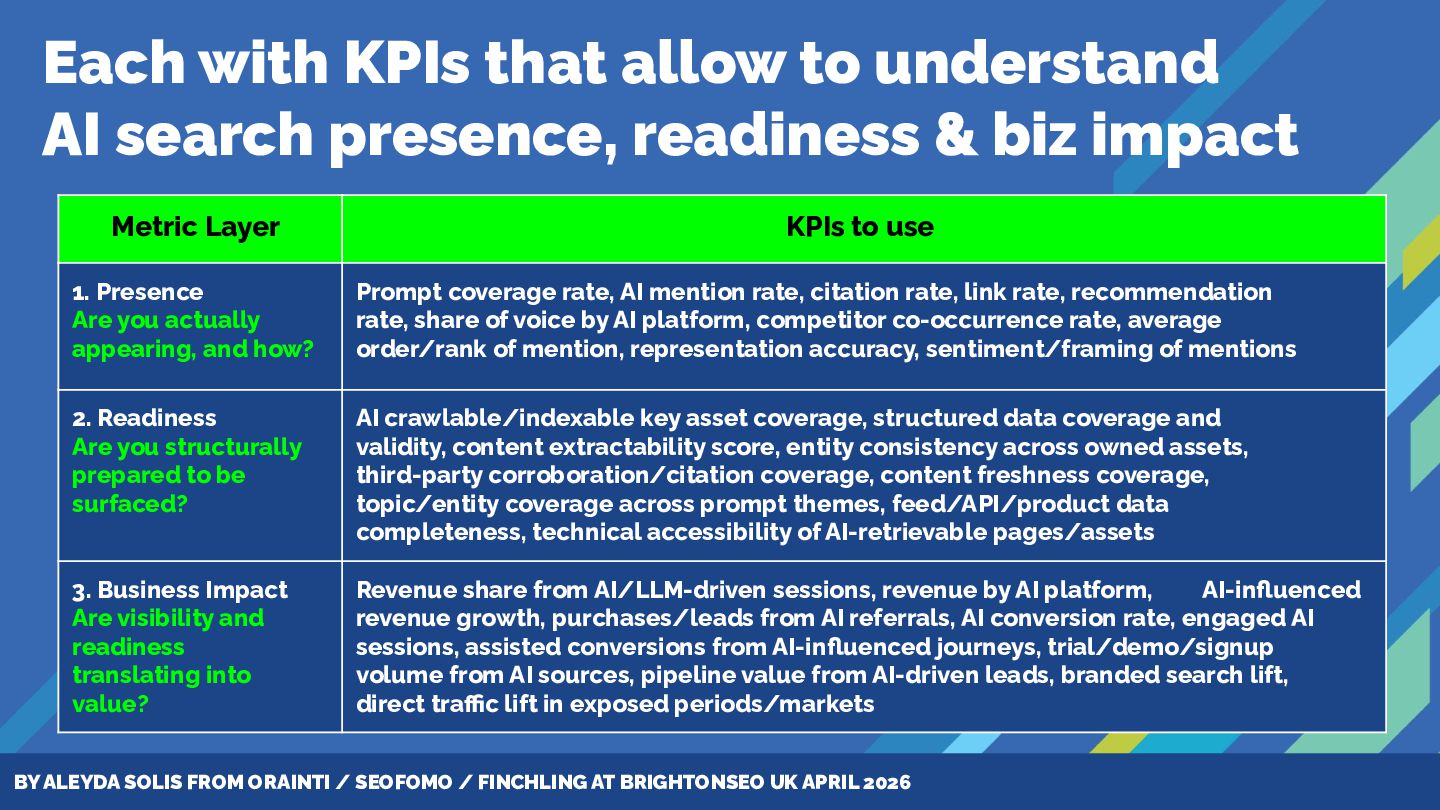
    BRIGHTONSEO UK APRIL 2026 Each with KPIs that allow to understand AI search presence, readiness & biz impact Metric Layer KPIs to use 1. Presence Are you actually appearing, and how? Prompt coverage rate, AI mention rate, citation rate, link rate, recommendation rate, share of voice by AI platform, competitor co-occurrence rate, average order/rank of mention, representation accuracy, sentiment/framing of mentions 2. Readiness Are you structurally prepared to be surfaced? AI crawlable/indexable key asset coverage, structured data coverage and validity, content extractability score, entity consistency across owned assets, third-party corroboration/citation coverage, content freshness coverage, topic/entity coverage across prompt themes, feed/API/product data completeness, technical accessibility of AI-retrievable pages/assets 3. Business Impact Are visibility and readiness translating into value? Revenue share from AI/LLM-driven sessions, revenue by AI platform, AI-influenced revenue growth, purchases/leads from AI referrals, AI conversion rate, engaged AI sessions, assisted conversions from AI-influenced journeys, trial/demo/signup volume from AI sources, pipeline value from AI-driven leads, branded search lift, direct traffic lift in exposed periods/markets
  7. BY ALEYDA SOLIS FROM ORAINTI / SEOFOMO / FINCHLING AT

    BRIGHTONSEO UK APRIL 2026 1. Presence Is the brand actually appearing in the AI answers that matter, and how is it being represented when it does?
  8. BY ALEYDA SOLIS FROM ORAINTI / SEOFOMO / FINCHLING AT

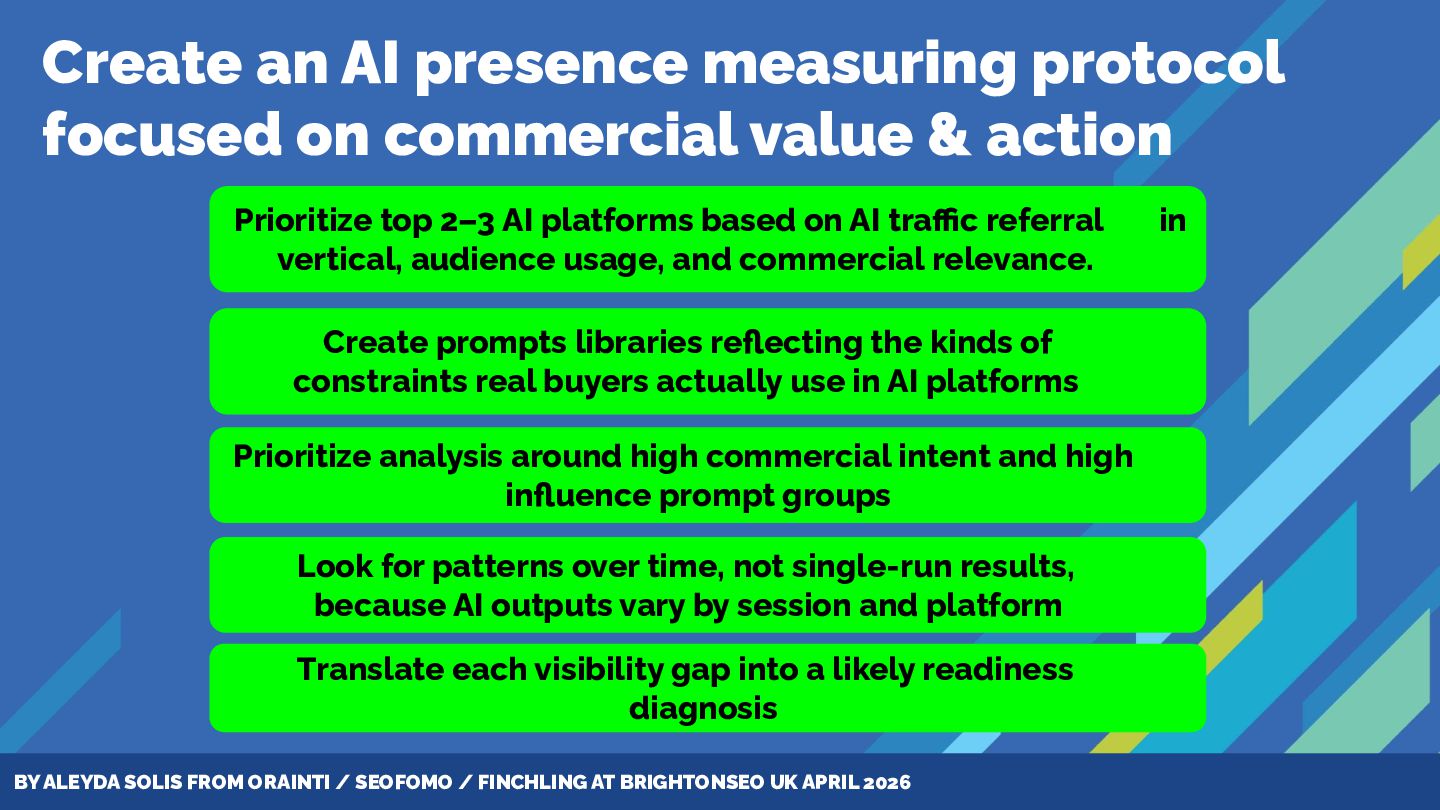
    BRIGHTONSEO UK APRIL 2026 Create an AI presence measuring protocol focused on commercial value & action Prioritize top 2–3 AI platforms based on AI traffic referral in vertical, audience usage, and commercial relevance. Create prompts libraries reflecting the kinds of constraints real buyers actually use in AI platforms Prioritize analysis around high commercial intent and high influence prompt groups Look for patterns over time, not single-run results, because AI outputs vary by session and platform Translate each visibility gap into a likely readiness diagnosis
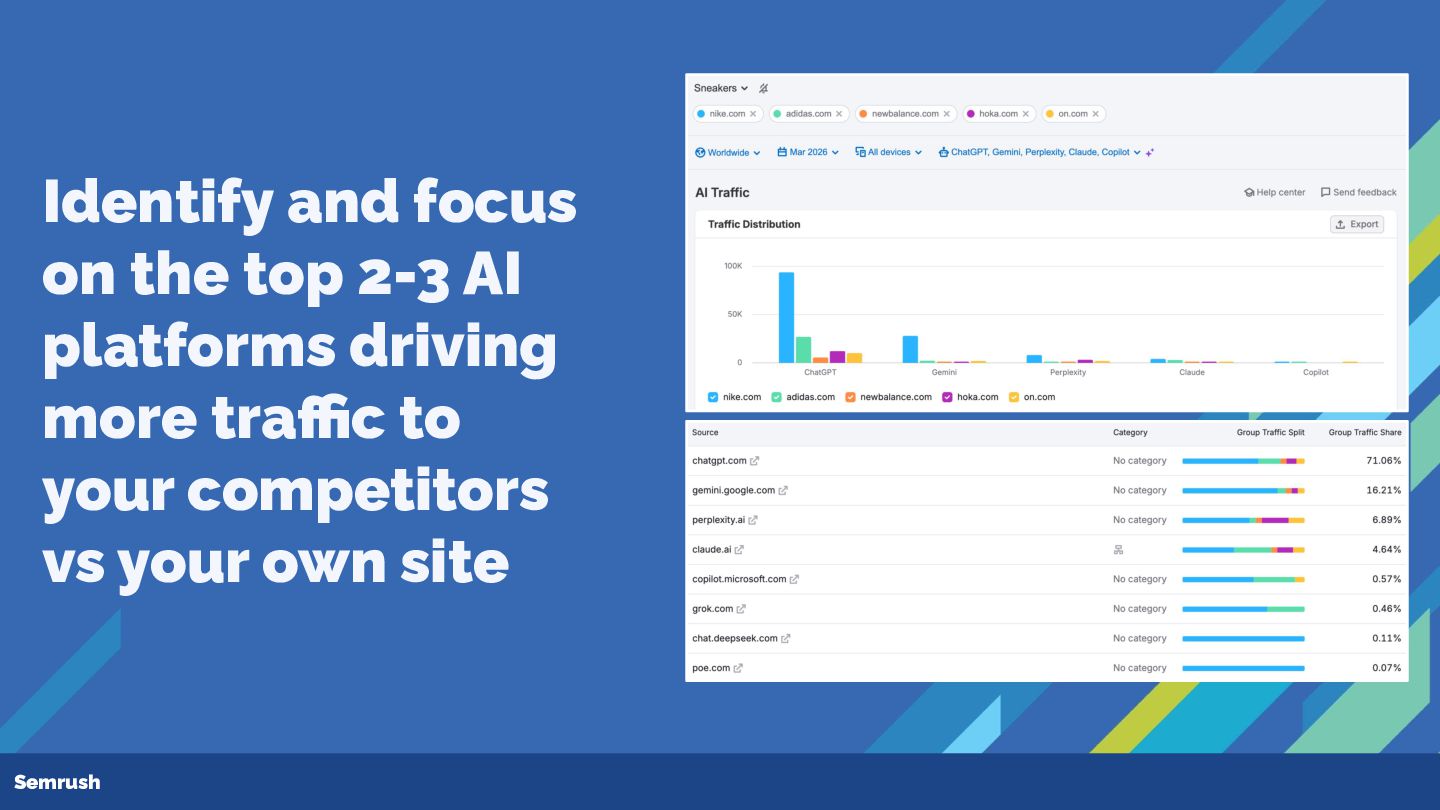
  9. Semrush Identify and focus on the top 2-3 AI platforms

    driving more traffic to your competitors vs your own site
  10. BY ALEYDA SOLIS FROM ORAINTI / SEOFOMO / FINCHLING AT

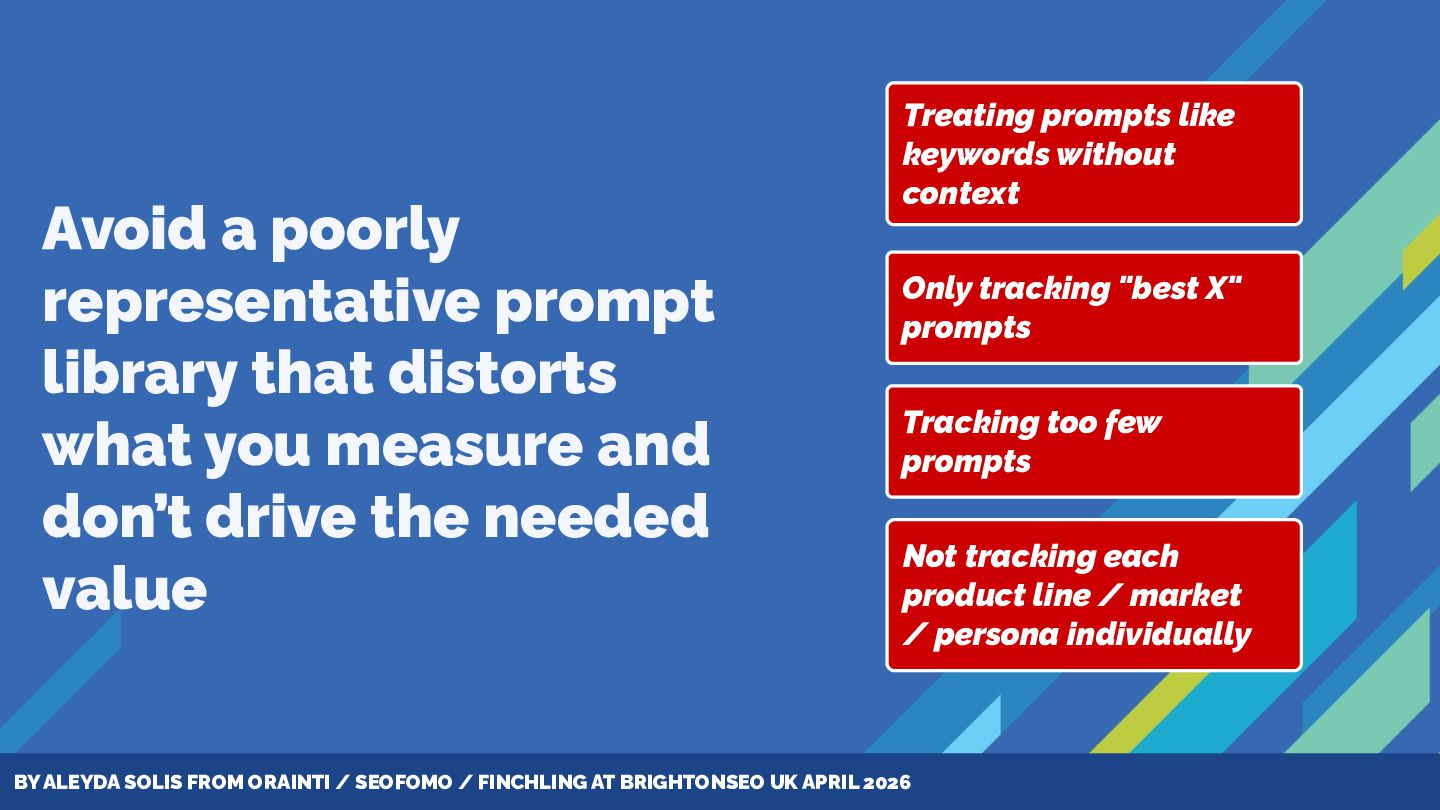
    BRIGHTONSEO UK APRIL 2026 Avoid a poorly representative prompt library that distorts what you measure and don’t drive the needed value Treating prompts like keywords without context Only tracking "best X" prompts Tracking too few prompts Not tracking each product line / market / persona individually
  11. BY ALEYDA SOLIS FROM ORAINTI / SEOFOMO / FINCHLING AT

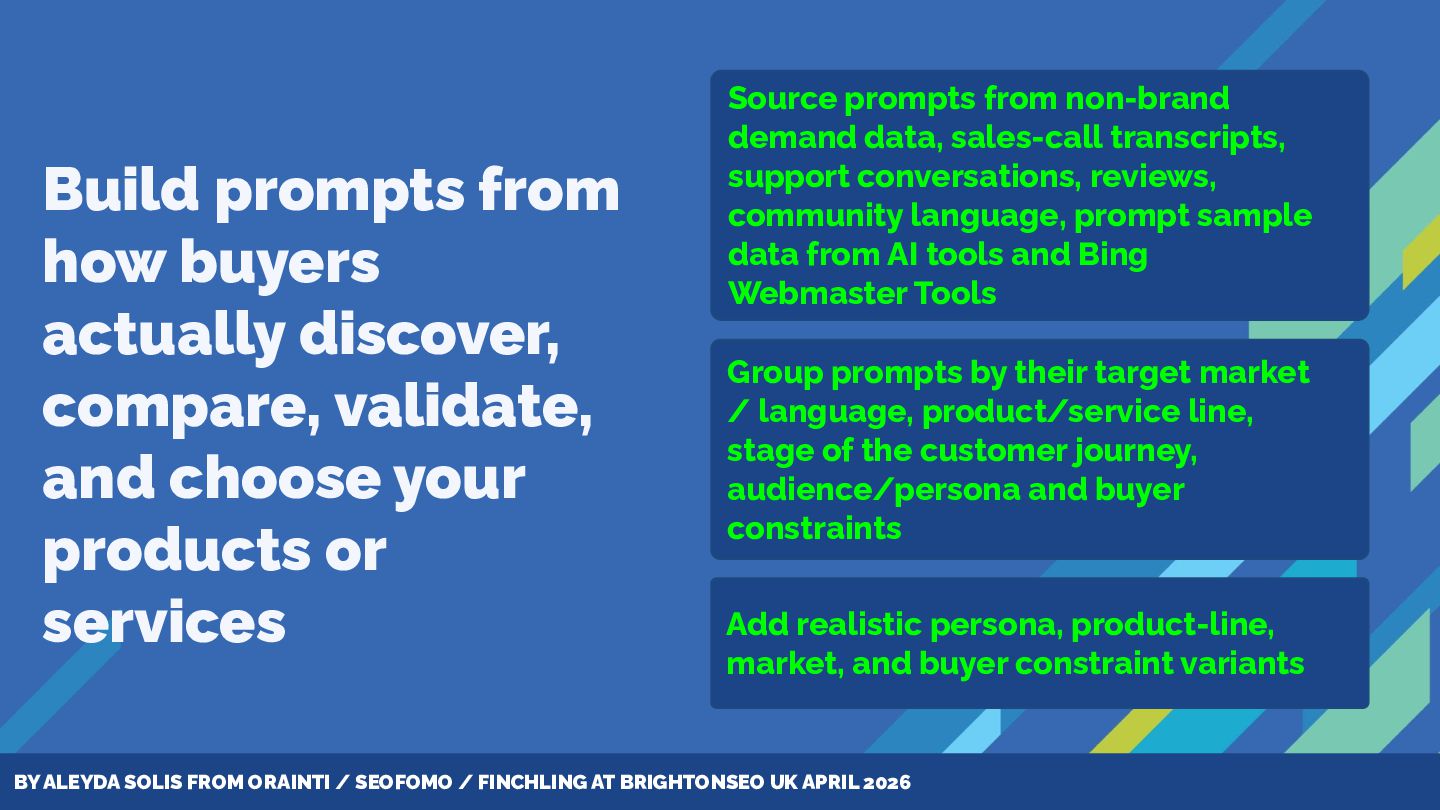
    BRIGHTONSEO UK APRIL 2026 Build prompts from how buyers actually discover, compare, validate, and choose your products or services Source prompts from non-brand demand data, sales-call transcripts, support conversations, reviews, community language, prompt sample data from AI tools and Bing Webmaster Tools Group prompts by their target market / language, product/service line, stage of the customer journey, audience/persona and buyer constraints Add realistic persona, product-line, market, and buyer constraint variants
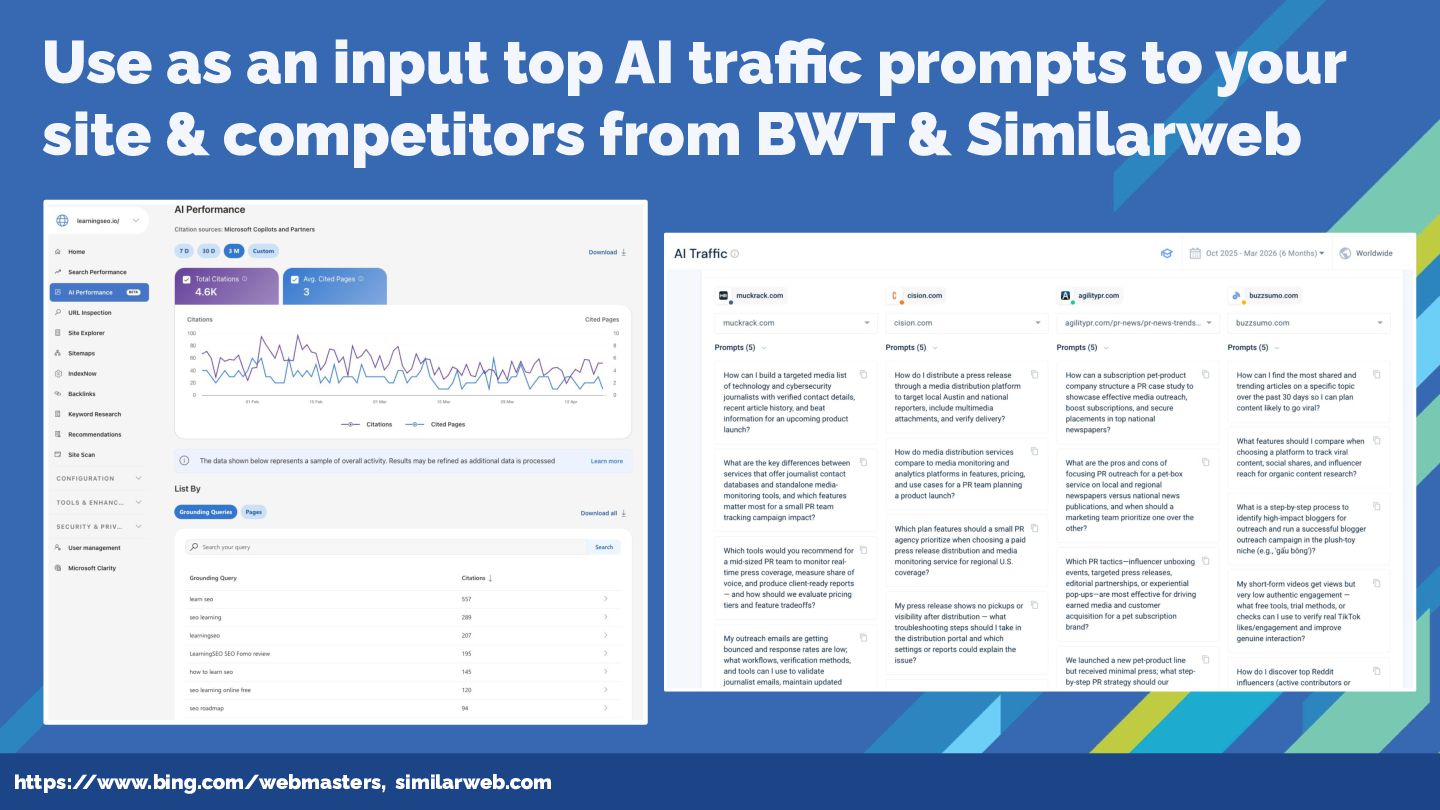
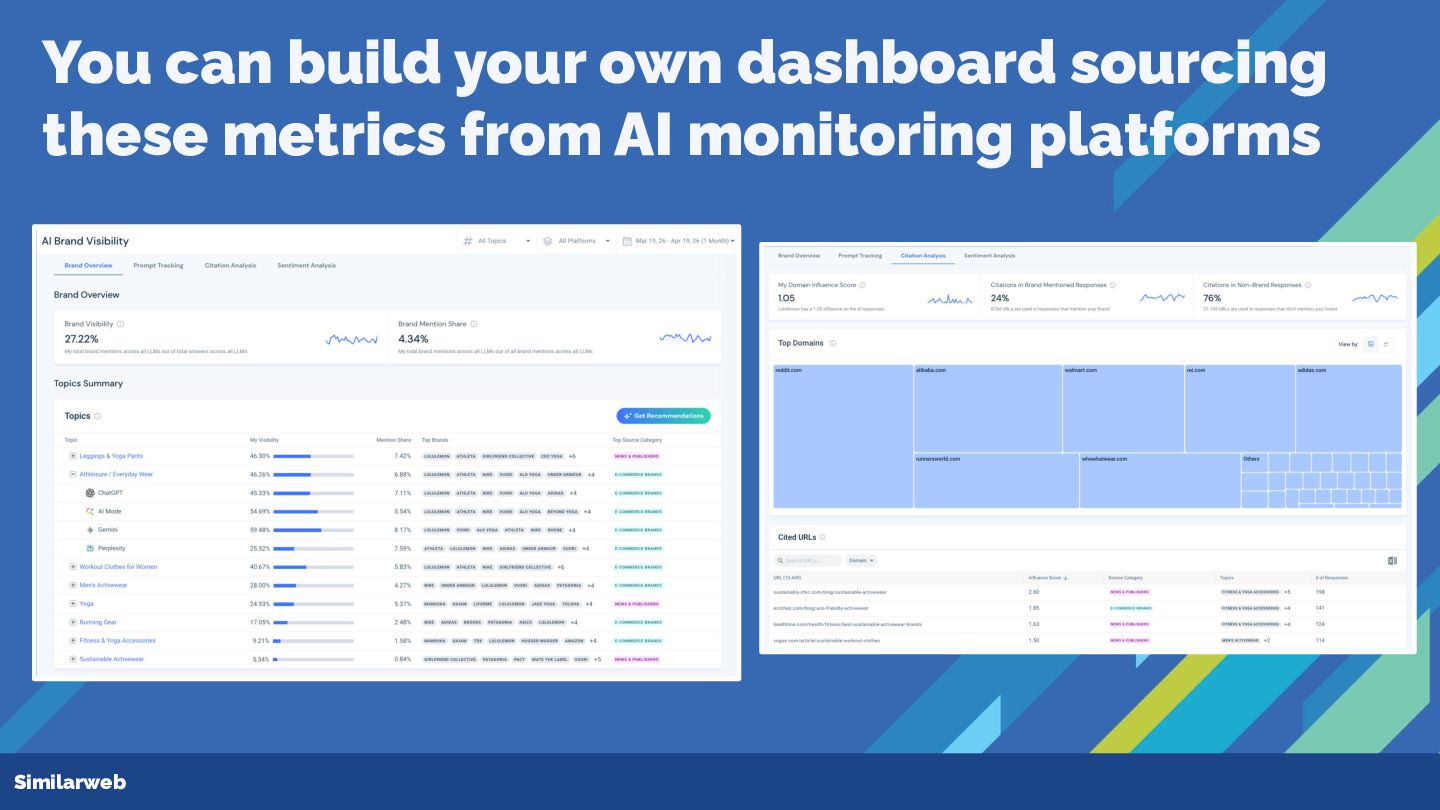
  12. https:/ /www.bing.com/webmasters, similarweb.com Use as an input top AI traffic

    prompts to your site & competitors from BWT & Similarweb
  13. BY ALEYDA SOLIS FROM ORAINTI / SEOFOMO / FINCHLING AT

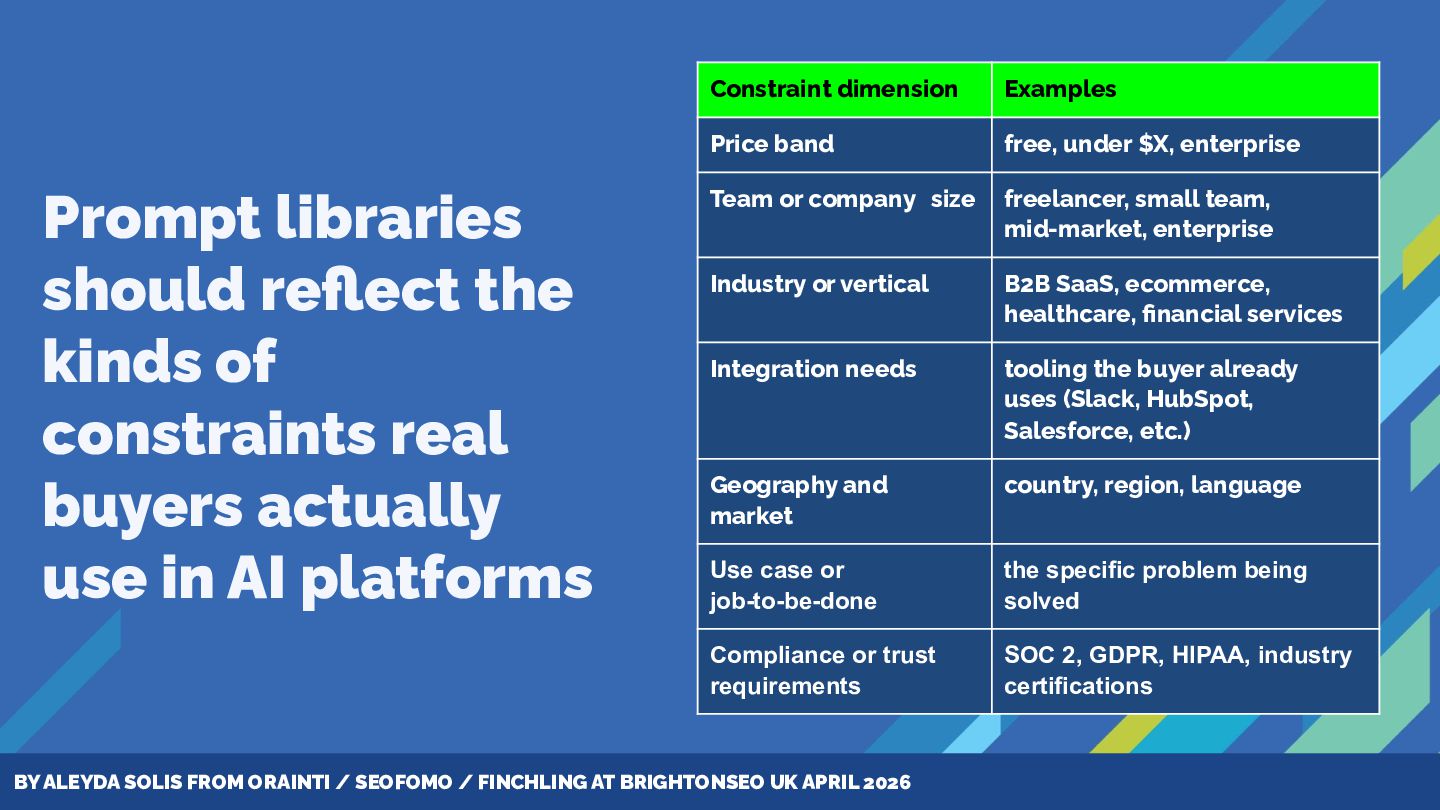
    BRIGHTONSEO UK APRIL 2026 Prompt libraries should reflect the kinds of constraints real buyers actually use in AI platforms Constraint dimension Examples Price band free, under $X, enterprise Team or company size freelancer, small team, mid-market, enterprise Industry or vertical B2B SaaS, ecommerce, healthcare, financial services Integration needs tooling the buyer already uses (Slack, HubSpot, Salesforce, etc.) Geography and market country, region, language Use case or job-to-be-done the specific problem being solved Compliance or trust requirements SOC 2, GDPR, HIPAA, industry certifications
  14. BY ALEYDA SOLIS FROM ORAINTI / SEOFOMO / FINCHLING AT

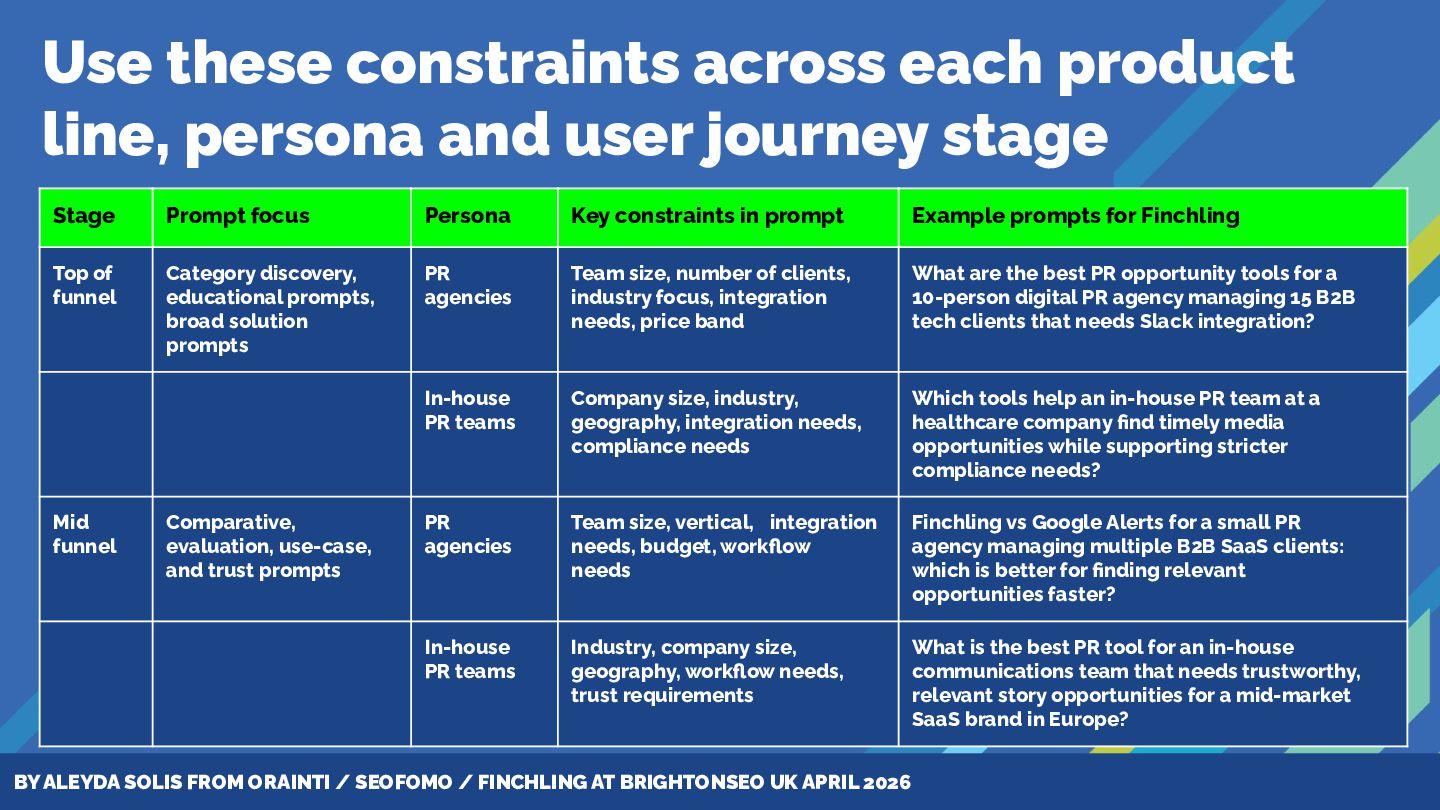
    BRIGHTONSEO UK APRIL 2026 Use these constraints across each product line, persona and user journey stage Stage Prompt focus Persona Key constraints in prompt Example prompts for Finchling Top of funnel Category discovery, educational prompts, broad solution prompts PR agencies Team size, number of clients, industry focus, integration needs, price band What are the best PR opportunity tools for a 10-person digital PR agency managing 15 B2B tech clients that needs Slack integration? In-house PR teams Company size, industry, geography, integration needs, compliance needs Which tools help an in-house PR team at a healthcare company find timely media opportunities while supporting stricter compliance needs? Mid funnel Comparative, evaluation, use-case, and trust prompts PR agencies Team size, vertical, integration needs, budget, workflow needs Finchling vs Google Alerts for a small PR agency managing multiple B2B SaaS clients: which is better for finding relevant opportunities faster? In-house PR teams Industry, company size, geography, workflow needs, trust requirements What is the best PR tool for an in-house communications team that needs trustworthy, relevant story opportunities for a mid-market SaaS brand in Europe?
  15. BY ALEYDA SOLIS FROM ORAINTI / SEOFOMO / FINCHLING AT

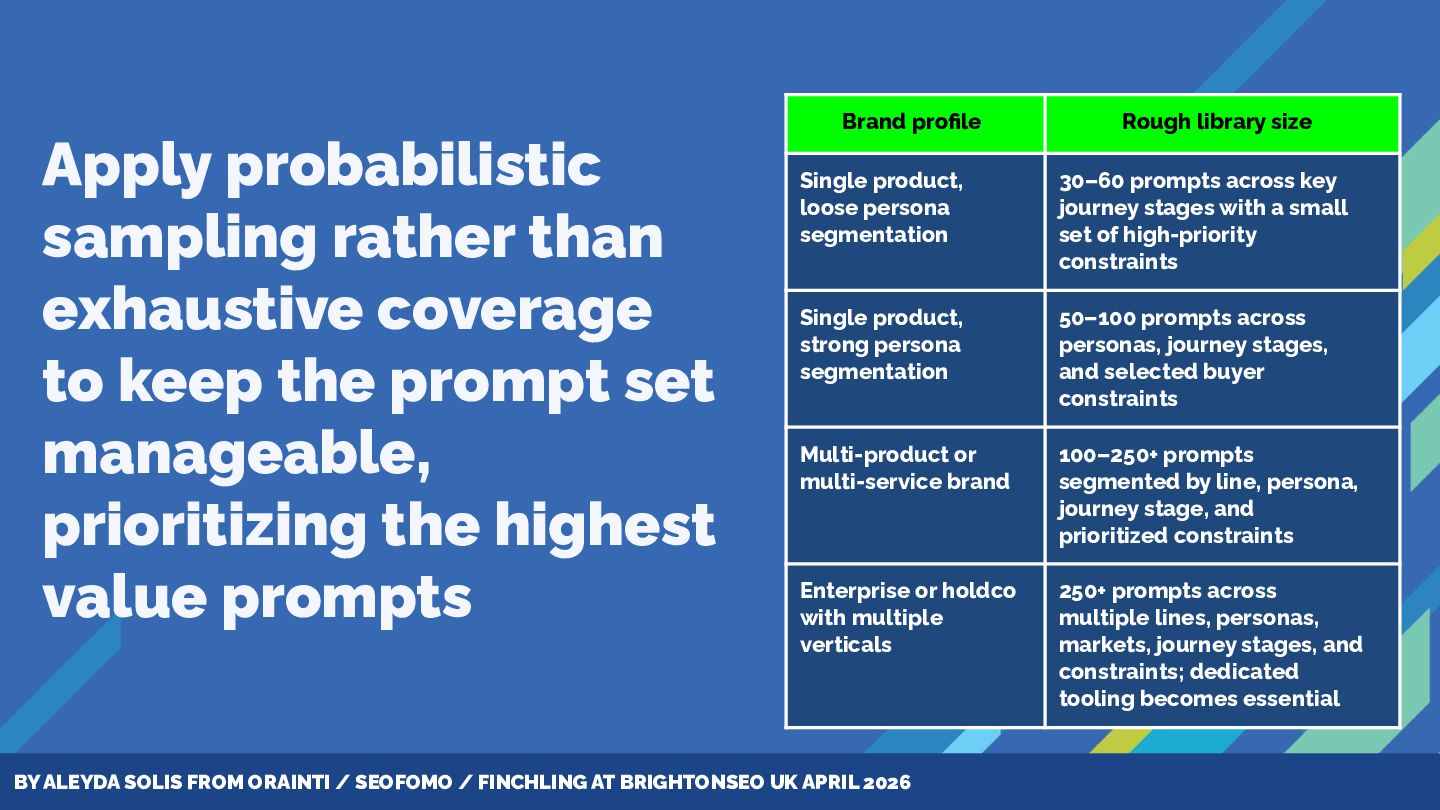
    BRIGHTONSEO UK APRIL 2026 Apply probabilistic sampling rather than exhaustive coverage to keep the prompt set manageable, prioritizing the highest value prompts Brand profile Rough library size Single product, loose persona segmentation 30–60 prompts across key journey stages with a small set of high-priority constraints Single product, strong persona segmentation 50–100 prompts across personas, journey stages, and selected buyer constraints Multi-product or multi-service brand 100–250+ prompts segmented by line, persona, journey stage, and prioritized constraints Enterprise or holdco with multiple verticals 250+ prompts across multiple lines, personas, markets, journey stages, and constraints; dedicated tooling becomes essential
  16. BY ALEYDA SOLIS FROM ORAINTI / SEOFOMO / FINCHLING AT

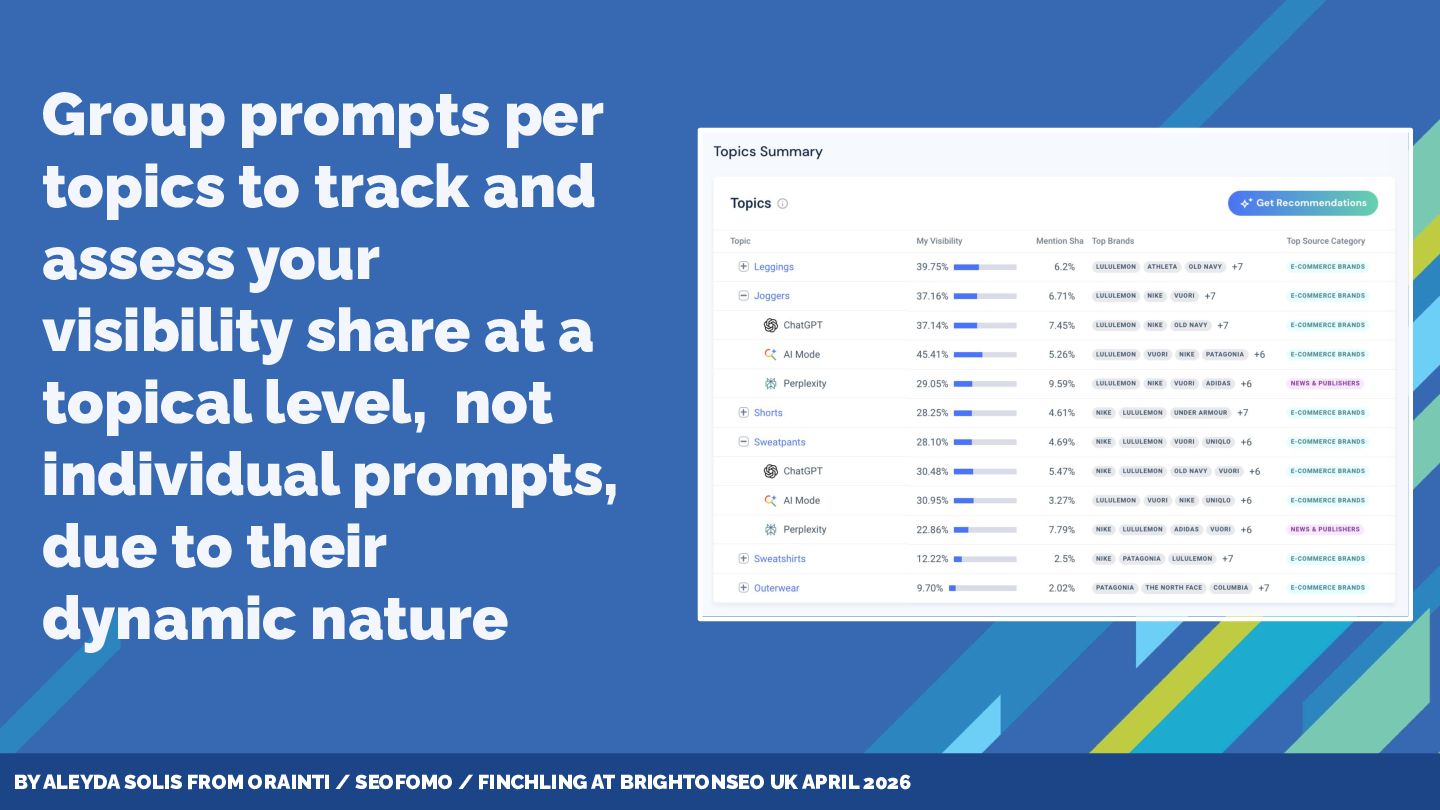
    BRIGHTONSEO UK APRIL 2026 Group prompts per topics to track and assess your visibility share at a topical level, not individual prompts, due to their dynamic nature
  17. BY ALEYDA SOLIS FROM ORAINTI / SEOFOMO / FINCHLING AT

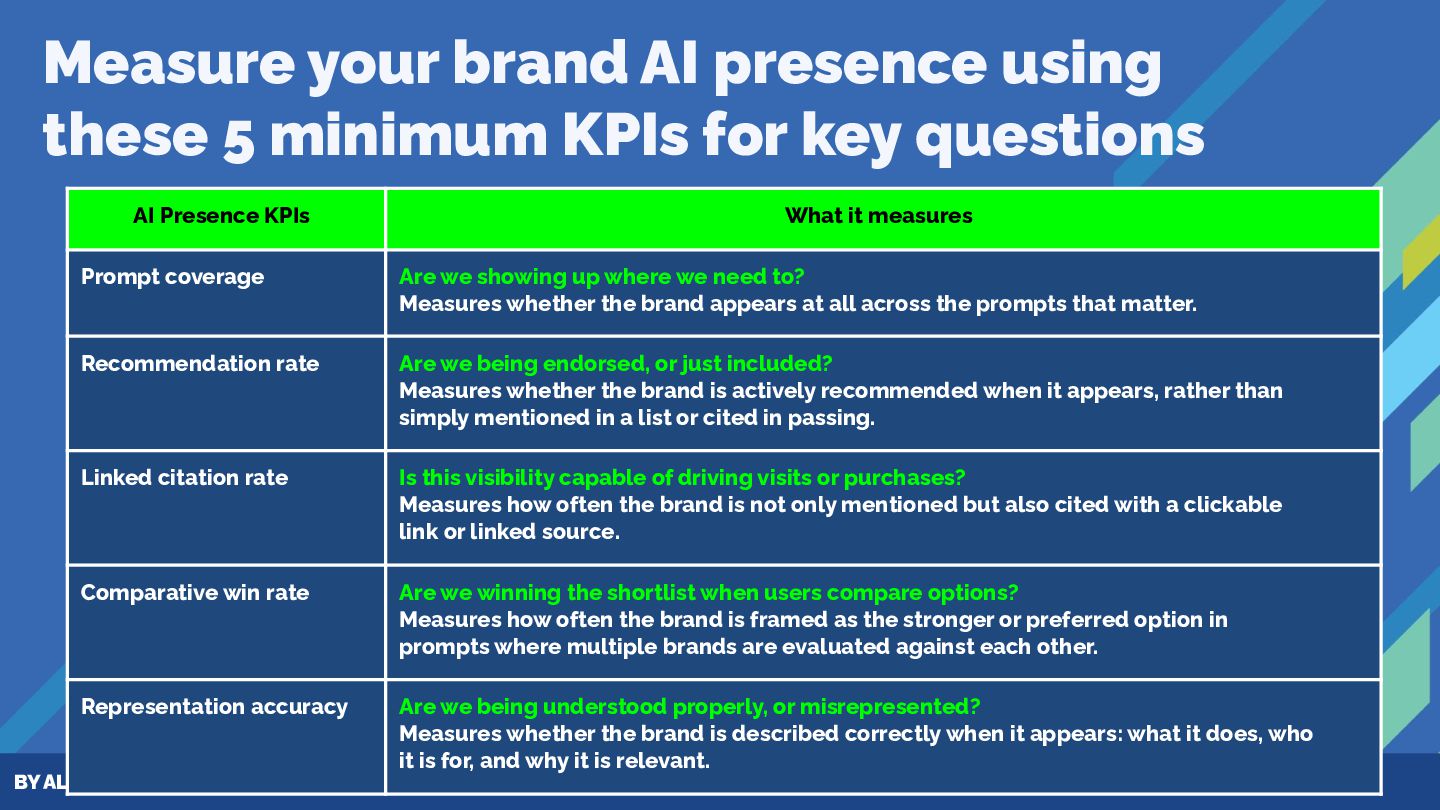
    BRIGHTONSEO UK APRIL 2026 Measure your brand AI presence using these 5 minimum KPIs for key questions AI Presence KPIs What it measures Prompt coverage Are we showing up where we need to? Measures whether the brand appears at all across the prompts that matter. Recommendation rate Are we being endorsed, or just included? Measures whether the brand is actively recommended when it appears, rather than simply mentioned in a list or cited in passing. Linked citation rate Is this visibility capable of driving visits or purchases? Measures how often the brand is not only mentioned but also cited with a clickable link or linked source. Comparative win rate Are we winning the shortlist when users compare options? Measures how often the brand is framed as the stronger or preferred option in prompts where multiple brands are evaluated against each other. Representation accuracy Are we being understood properly, or misrepresented? Measures whether the brand is described correctly when it appears: what it does, who it is for, and why it is relevant.
  18. BY ALEYDA SOLIS FROM ORAINTI / SEOFOMO / FINCHLING AT

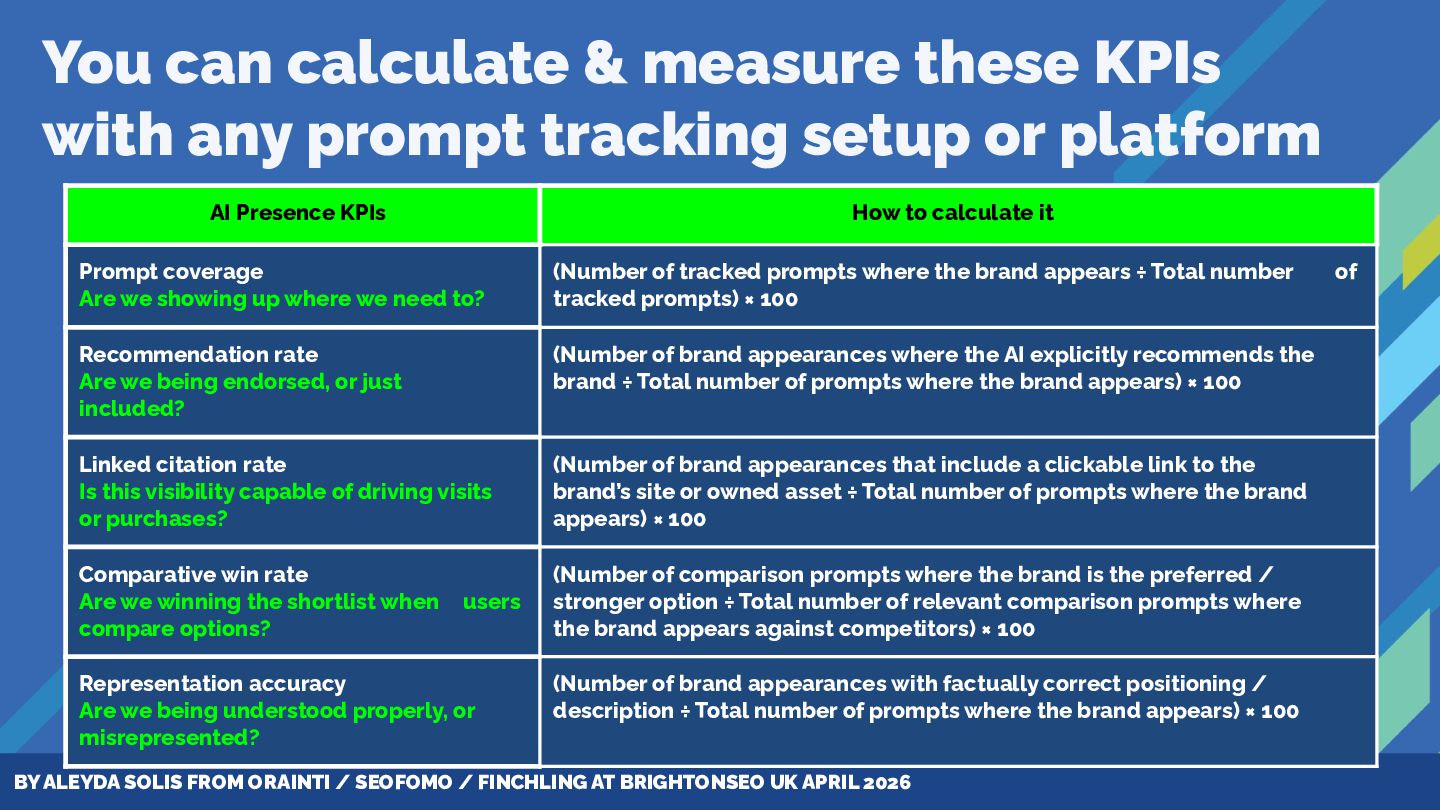
    BRIGHTONSEO UK APRIL 2026 You can calculate & measure these KPIs with any prompt tracking setup or platform AI Presence KPIs How to calculate it Prompt coverage Are we showing up where we need to? (Number of tracked prompts where the brand appears ÷ Total number of tracked prompts) × 100 Recommendation rate Are we being endorsed, or just included? (Number of brand appearances where the AI explicitly recommends the brand ÷ Total number of prompts where the brand appears) × 100 Linked citation rate Is this visibility capable of driving visits or purchases? (Number of brand appearances that include a clickable link to the brand’s site or owned asset ÷ Total number of prompts where the brand appears) × 100 Comparative win rate Are we winning the shortlist when users compare options? (Number of comparison prompts where the brand is the preferred / stronger option ÷ Total number of relevant comparison prompts where the brand appears against competitors) × 100 Representation accuracy Are we being understood properly, or misrepresented? (Number of brand appearances with factually correct positioning / description ÷ Total number of prompts where the brand appears) × 100
  19. BY ALEYDA SOLIS FROM ORAINTI / SEOFOMO / FINCHLING AT

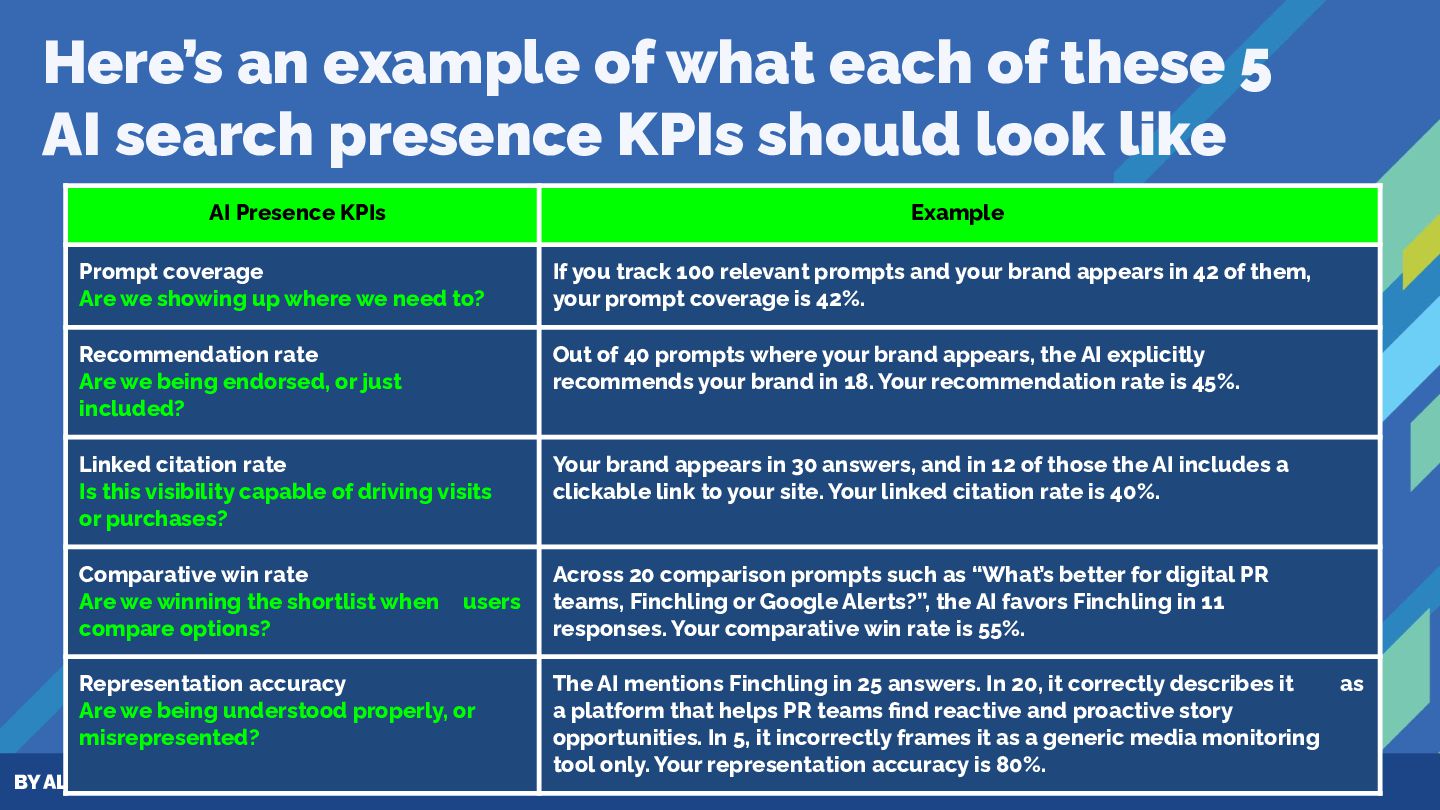
    BRIGHTONSEO UK APRIL 2026 Here’s an example of what each of these 5 AI search presence KPIs should look like AI Presence KPIs Example Prompt coverage Are we showing up where we need to? If you track 100 relevant prompts and your brand appears in 42 of them, your prompt coverage is 42%. Recommendation rate Are we being endorsed, or just included? Out of 40 prompts where your brand appears, the AI explicitly recommends your brand in 18. Your recommendation rate is 45%. Linked citation rate Is this visibility capable of driving visits or purchases? Your brand appears in 30 answers, and in 12 of those the AI includes a clickable link to your site. Your linked citation rate is 40%. Comparative win rate Are we winning the shortlist when users compare options? Across 20 comparison prompts such as “What’s better for digital PR teams, Finchling or Google Alerts?”, the AI favors Finchling in 11 responses. Your comparative win rate is 55%. Representation accuracy Are we being understood properly, or misrepresented? The AI mentions Finchling in 25 answers. In 20, it correctly describes it as a platform that helps PR teams find reactive and proactive story opportunities. In 5, it incorrectly frames it as a generic media monitoring tool only. Your representation accuracy is 80%.
  20. BY ALEYDA SOLIS FROM ORAINTI / SEOFOMO / FINCHLING AT

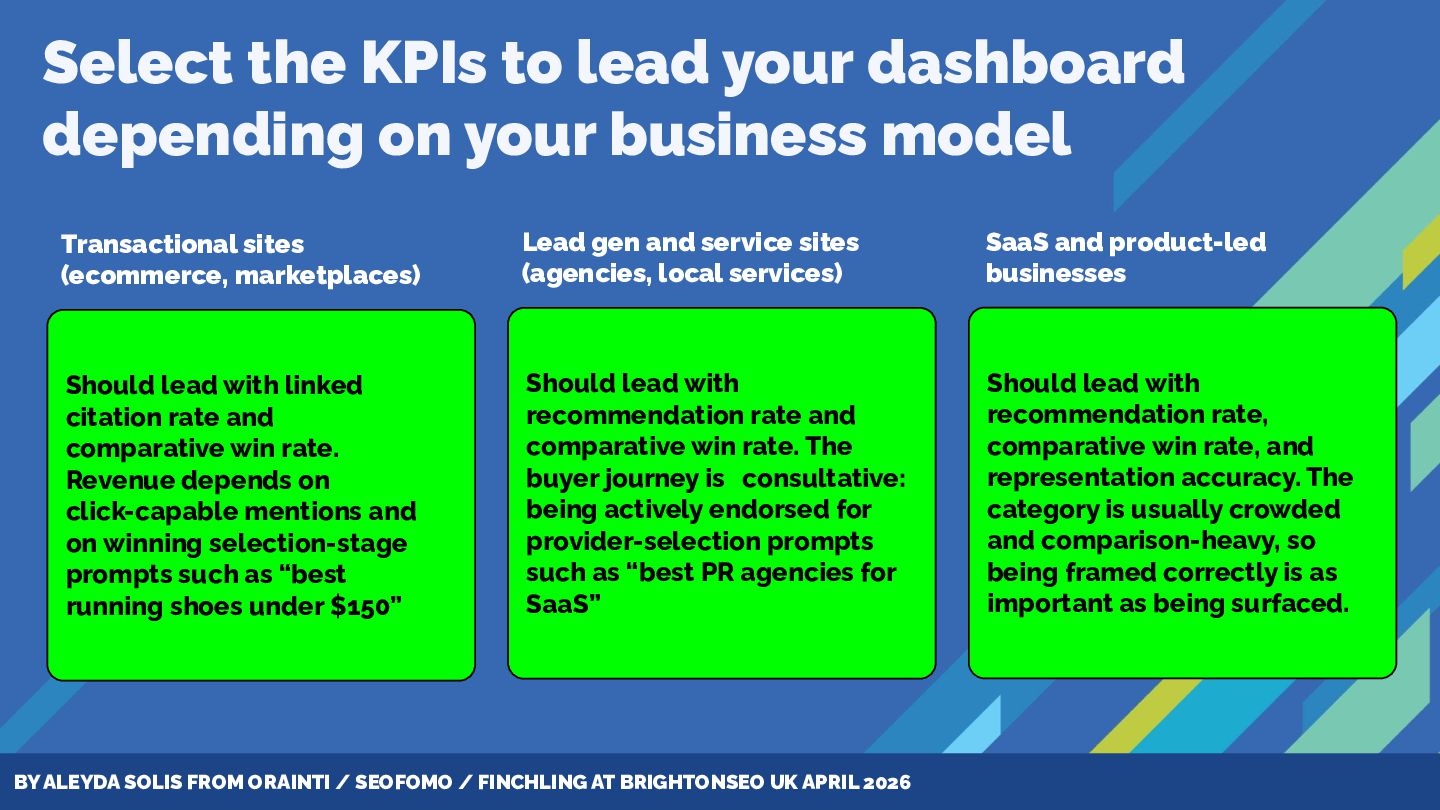
    BRIGHTONSEO UK APRIL 2026 Select the KPIs to lead your dashboard depending on your business model Should lead with linked citation rate and comparative win rate. Revenue depends on click-capable mentions and on winning selection-stage prompts such as “best running shoes under $150” Transactional sites (ecommerce, marketplaces) Should lead with recommendation rate and comparative win rate. The buyer journey is consultative: being actively endorsed for provider-selection prompts such as “best PR agencies for SaaS” Lead gen and service sites (agencies, local services) Should lead with recommendation rate, comparative win rate, and representation accuracy. The category is usually crowded and comparison-heavy, so being framed correctly is as important as being surfaced. SaaS and product-led businesses
  21. BY ALEYDA SOLIS FROM ORAINTI / SEOFOMO / FINCHLING AT

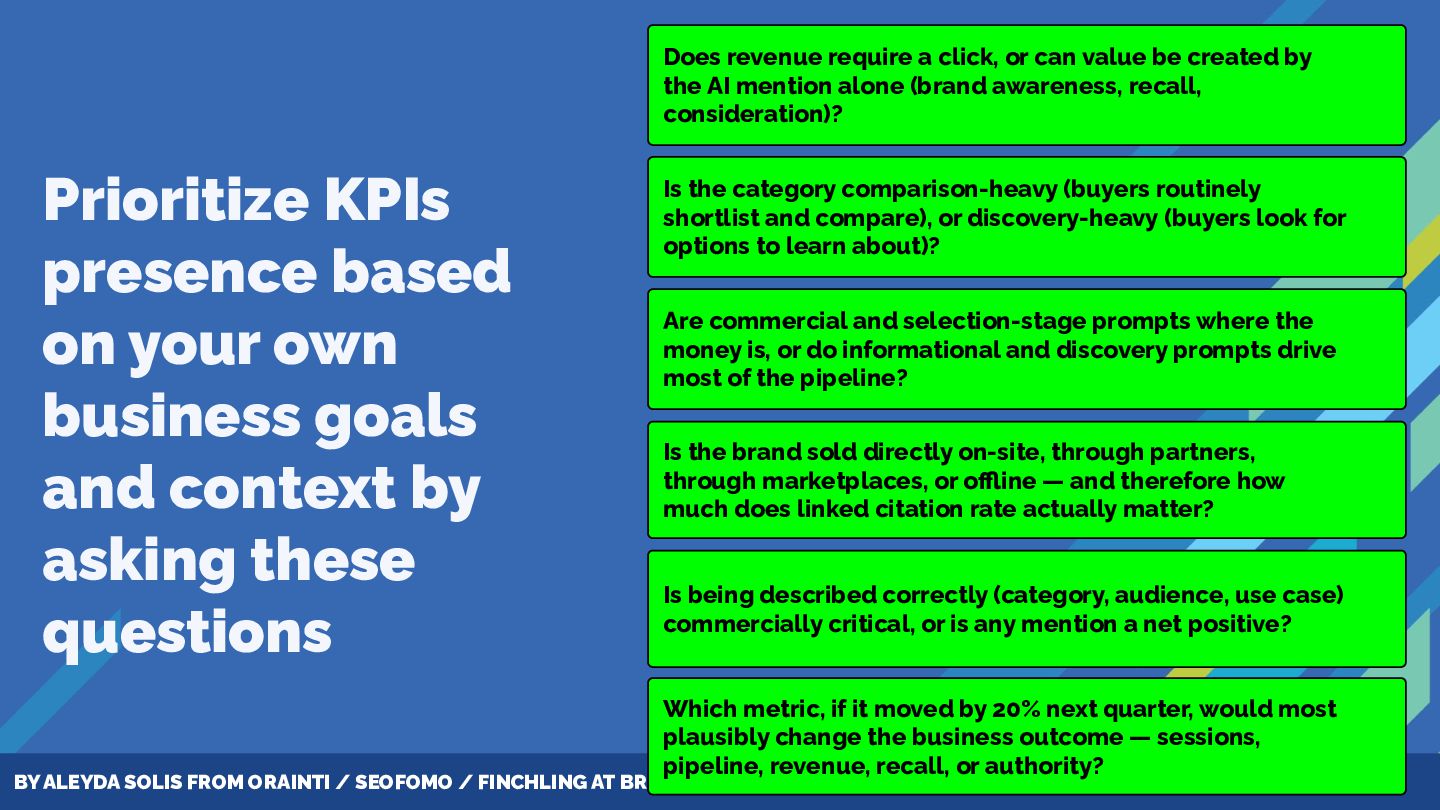
    BRIGHTONSEO UK APRIL 2026 Does revenue require a click, or can value be created by the AI mention alone (brand awareness, recall, consideration)? Is the category comparison-heavy (buyers routinely shortlist and compare), or discovery-heavy (buyers look for options to learn about)? Are commercial and selection-stage prompts where the money is, or do informational and discovery prompts drive most of the pipeline? Is the brand sold directly on-site, through partners, through marketplaces, or offline — and therefore how much does linked citation rate actually matter? Is being described correctly (category, audience, use case) commercially critical, or is any mention a net positive? Which metric, if it moved by 20% next quarter, would most plausibly change the business outcome — sessions, pipeline, revenue, recall, or authority? Prioritize KPIs presence based on your own business goals and context by asking these questions
  22. BY ALEYDA SOLIS FROM ORAINTI / SEOFOMO / FINCHLING AT

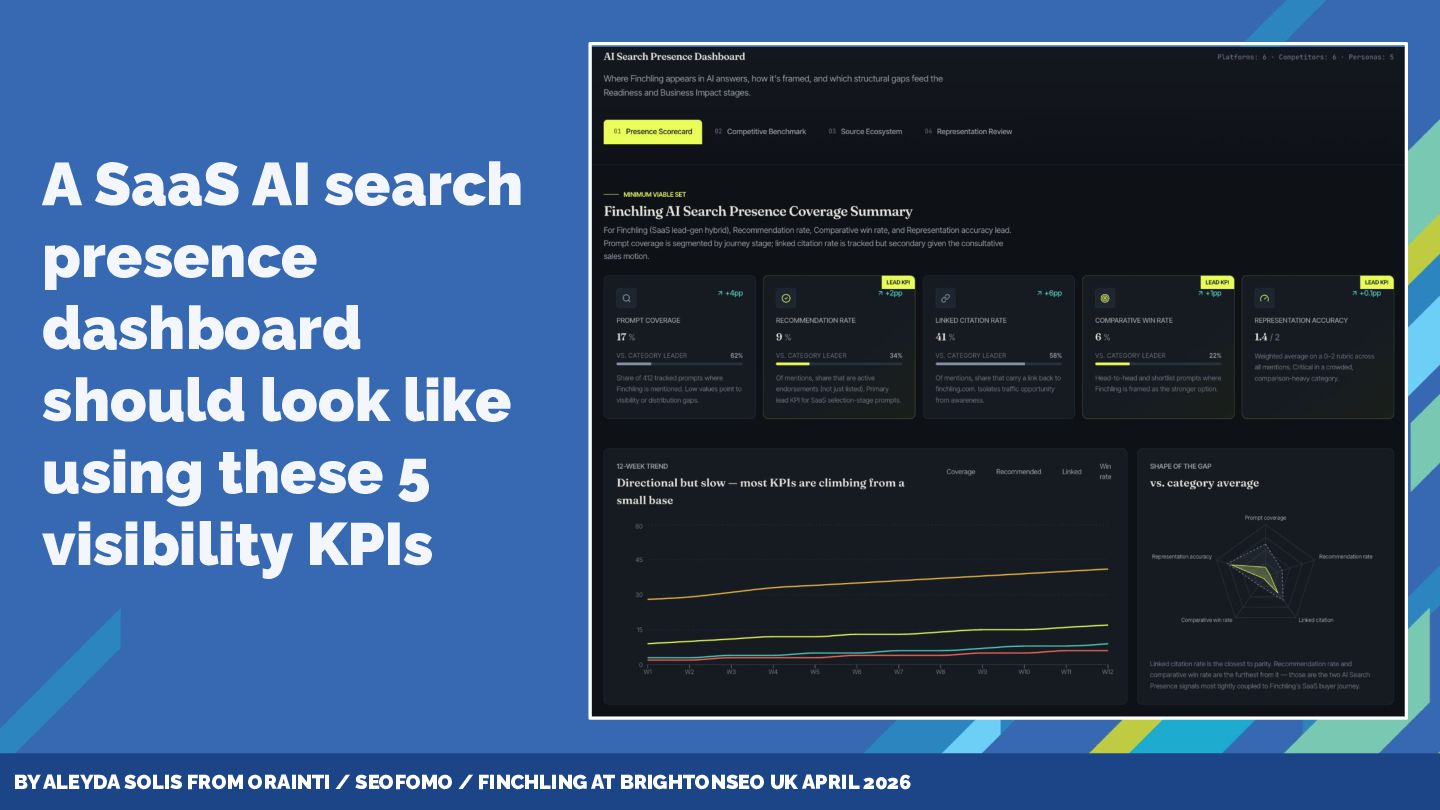
    BRIGHTONSEO UK APRIL 2026 A SaaS AI search presence dashboard should look like using these 5 visibility KPIs
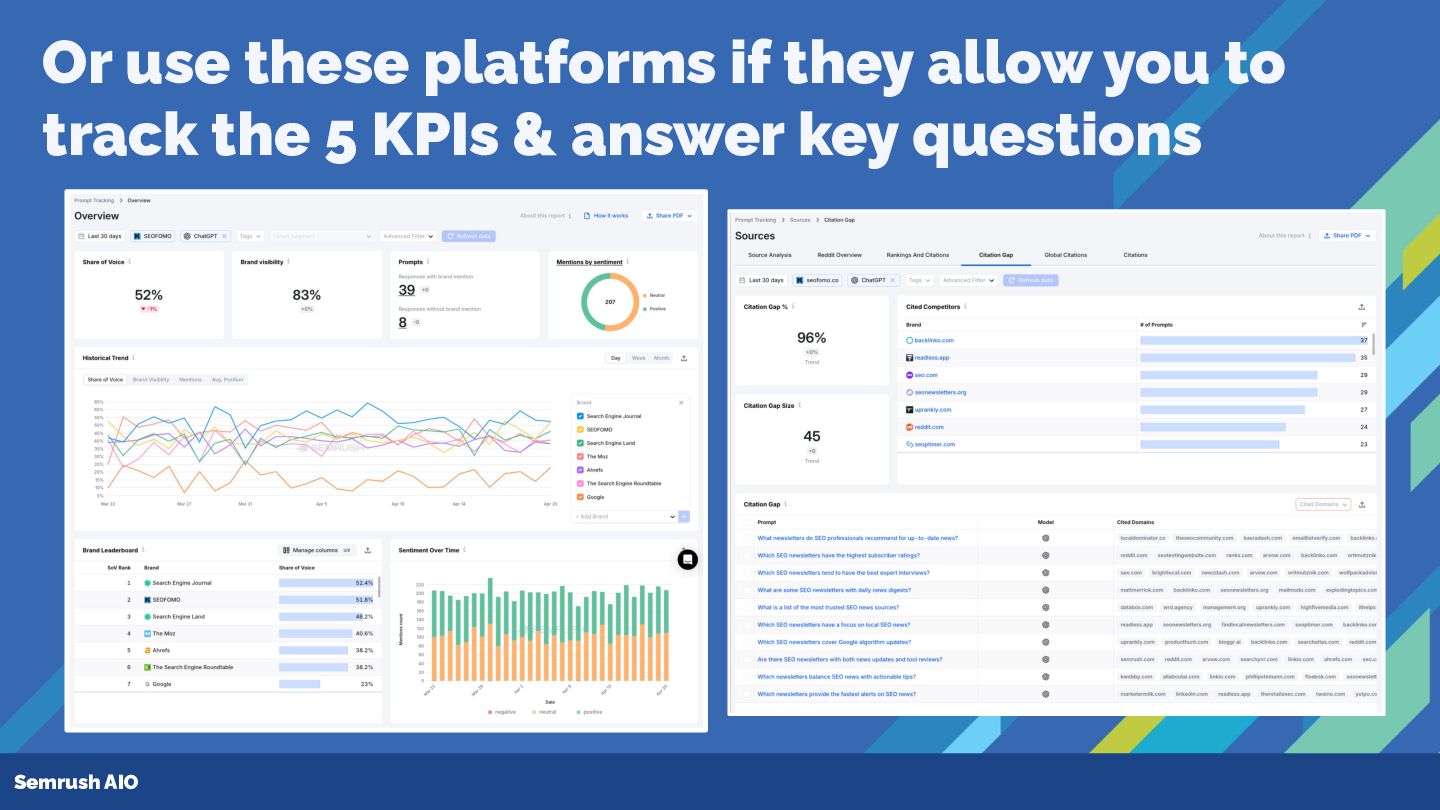
  23. Semrush AIO Or use these platforms if they allow you

    to track the 5 KPIs & answer key questions
  24. BY ALEYDA SOLIS FROM ORAINTI / SEOFOMO / FINCHLING AT

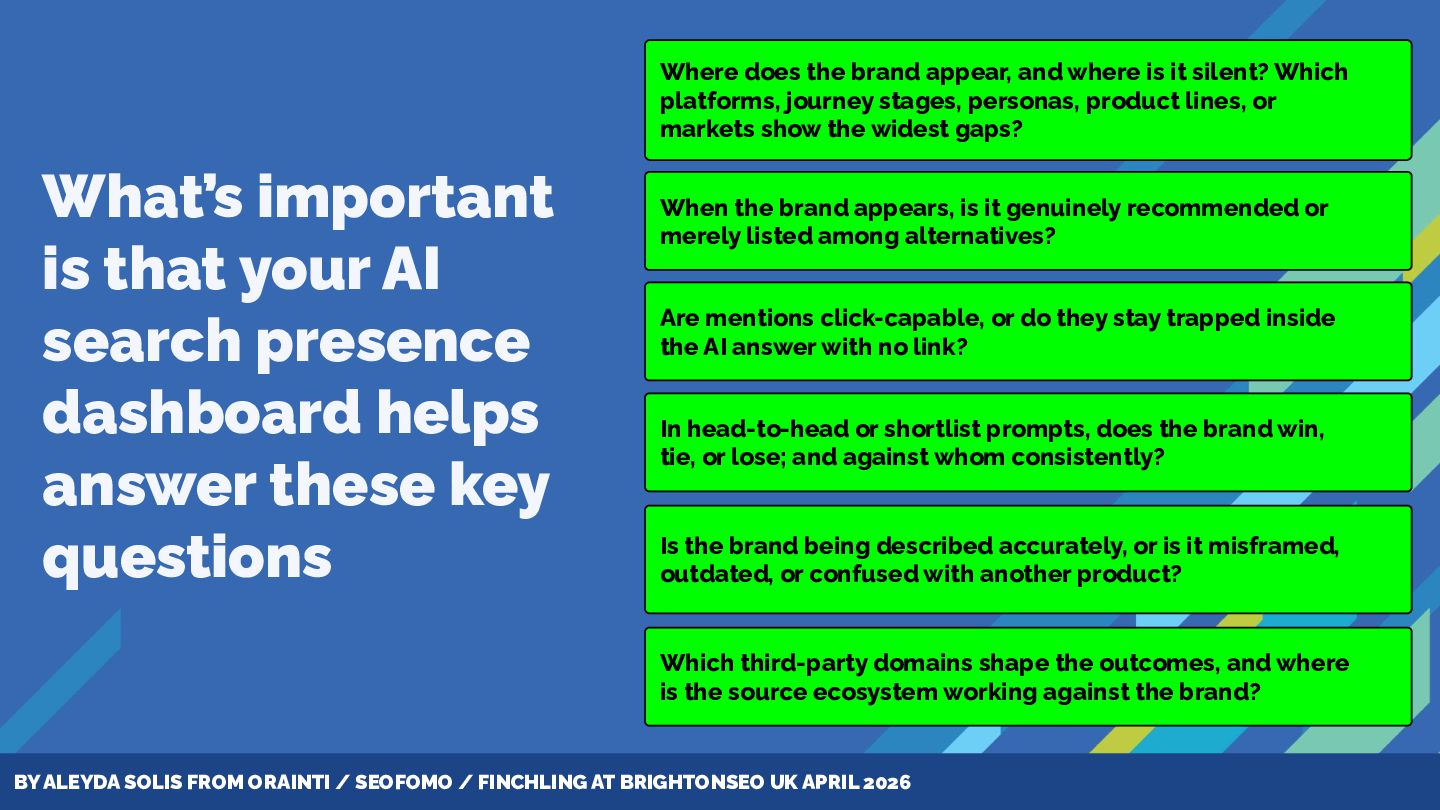
    BRIGHTONSEO UK APRIL 2026 What’s important is that your AI search presence dashboard helps answer these key questions Where does the brand appear, and where is it silent? Which platforms, journey stages, personas, product lines, or markets show the widest gaps? When the brand appears, is it genuinely recommended or merely listed among alternatives? Are mentions click-capable, or do they stay trapped inside the AI answer with no link? In head-to-head or shortlist prompts, does the brand win, tie, or lose; and against whom consistently? Is the brand being described accurately, or is it misframed, outdated, or confused with another product? Which third-party domains shape the outcomes, and where is the source ecosystem working against the brand?
  25. BY ALEYDA SOLIS FROM ORAINTI / SEOFOMO / FINCHLING AT

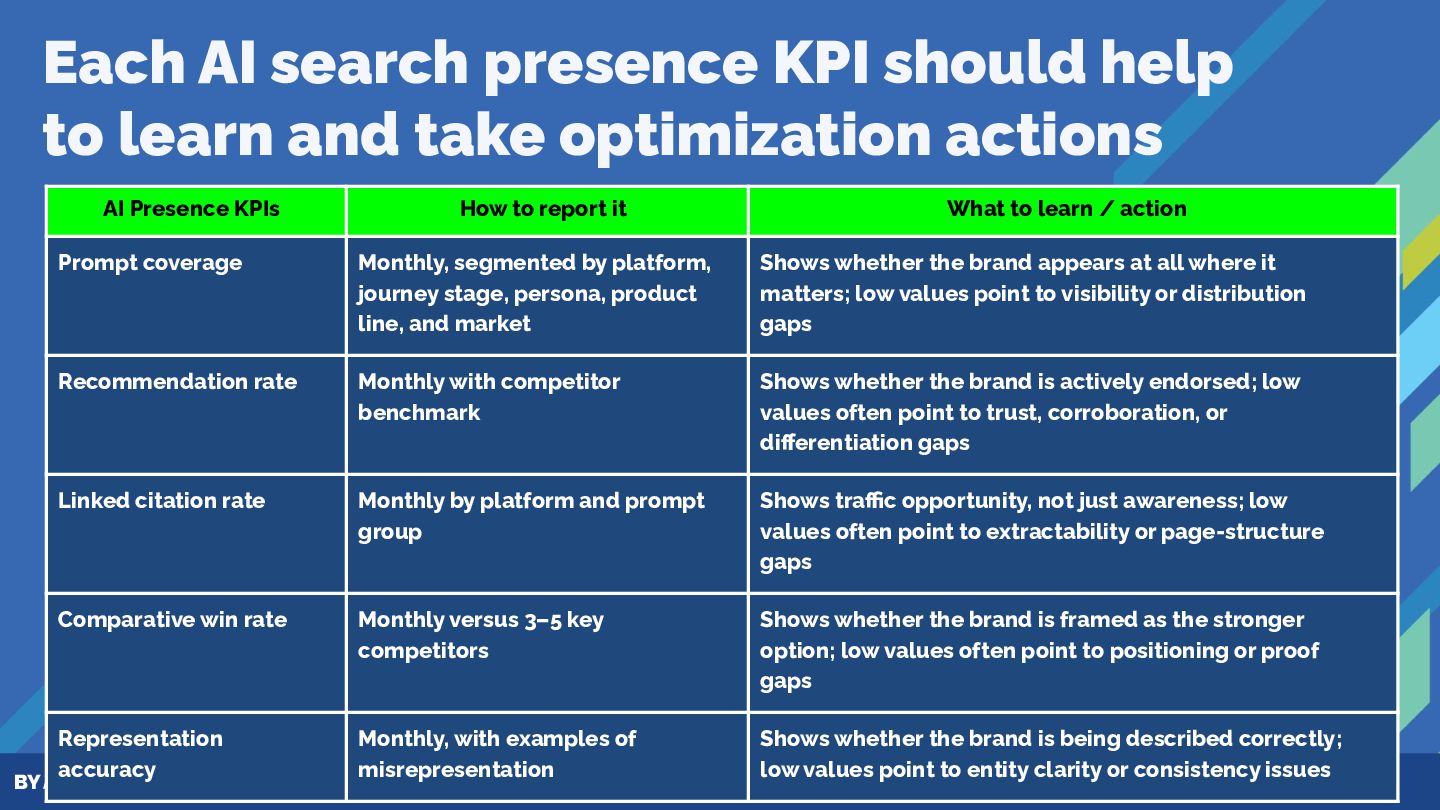
    BRIGHTONSEO UK APRIL 2026 AI Presence KPIs How to report it What to learn / action Prompt coverage Monthly, segmented by platform, journey stage, persona, product line, and market Shows whether the brand appears at all where it matters; low values point to visibility or distribution gaps Recommendation rate Monthly with competitor benchmark Shows whether the brand is actively endorsed; low values often point to trust, corroboration, or differentiation gaps Linked citation rate Monthly by platform and prompt group Shows traffic opportunity, not just awareness; low values often point to extractability or page-structure gaps Comparative win rate Monthly versus 3–5 key competitors Shows whether the brand is framed as the stronger option; low values often point to positioning or proof gaps Representation accuracy Monthly, with examples of misrepresentation Shows whether the brand is being described correctly; low values point to entity clarity or consistency issues Each AI search presence KPI should help to learn and take optimization actions
  26. 2. Readiness Are you optimized to be surfaced in AI

    Answers? BY ALEYDA SOLIS FROM ORAINTI / SEOFOMO / FINCHLING AT BRIGHTONSEO UK APRIL 2026
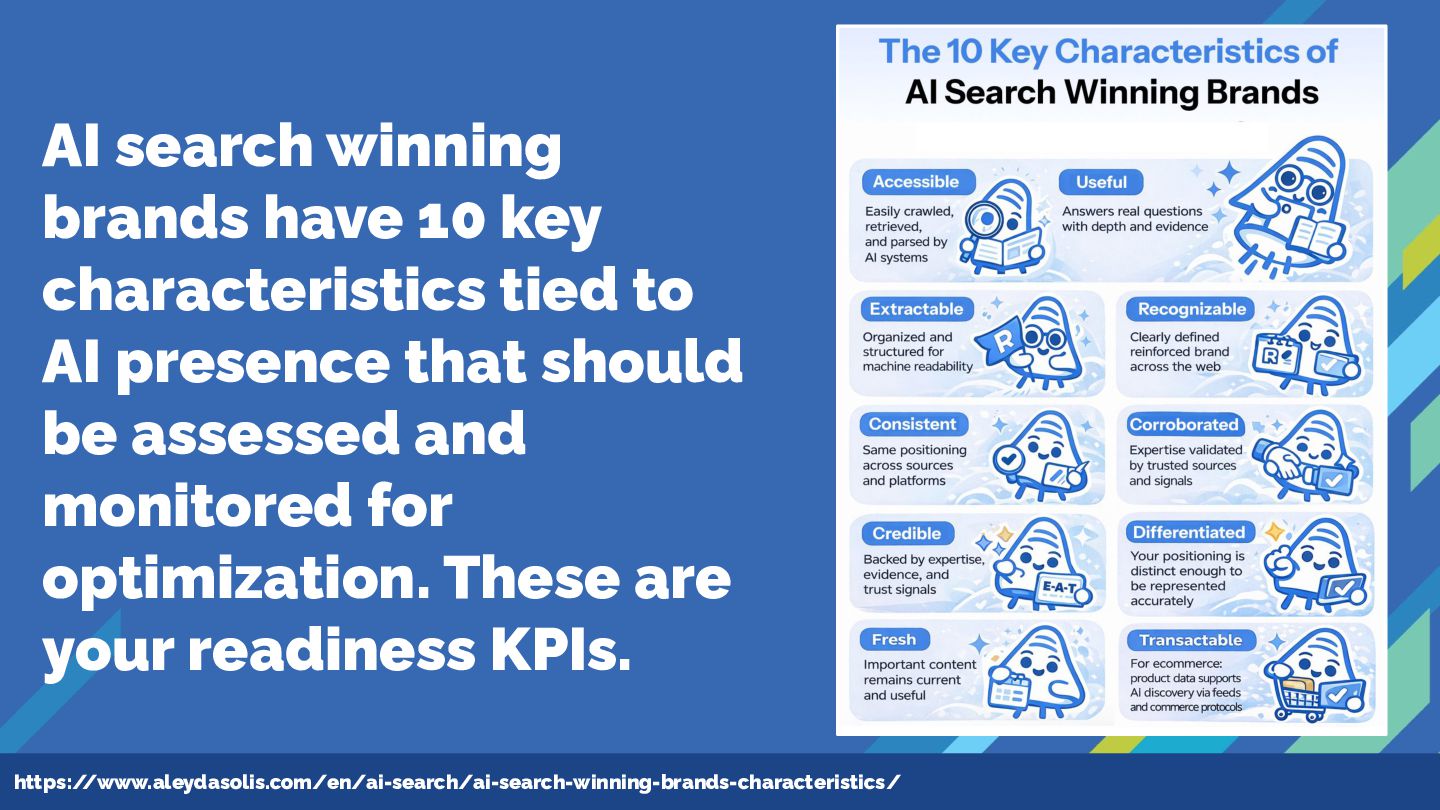
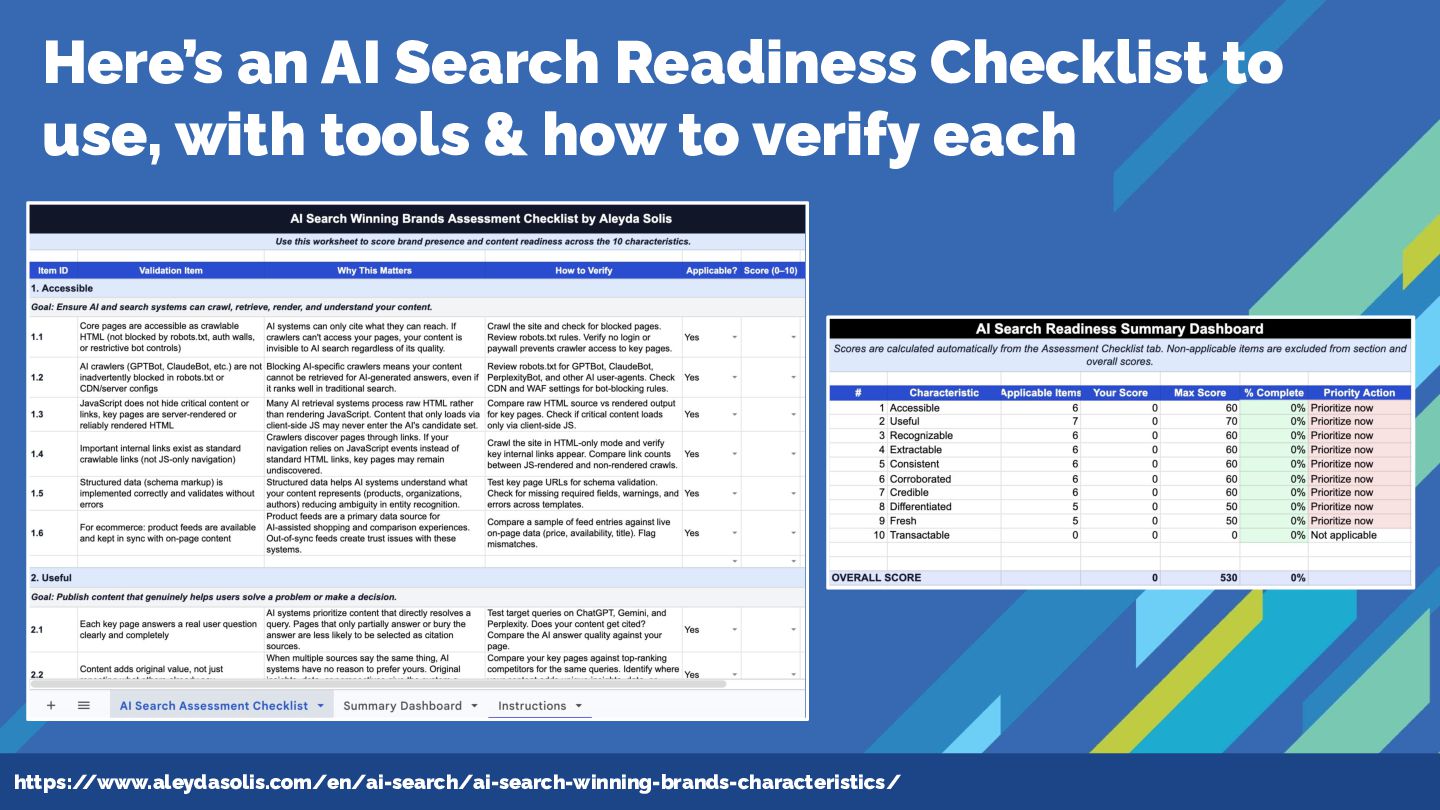
  27. https:/ /www.aleydasolis.com/en/ai-search/ai-search-winning-brands-characteristics/ AI search winning brands have 10 key characteristics

    tied to AI presence that should be assessed and monitored for optimization. These are your readiness KPIs.
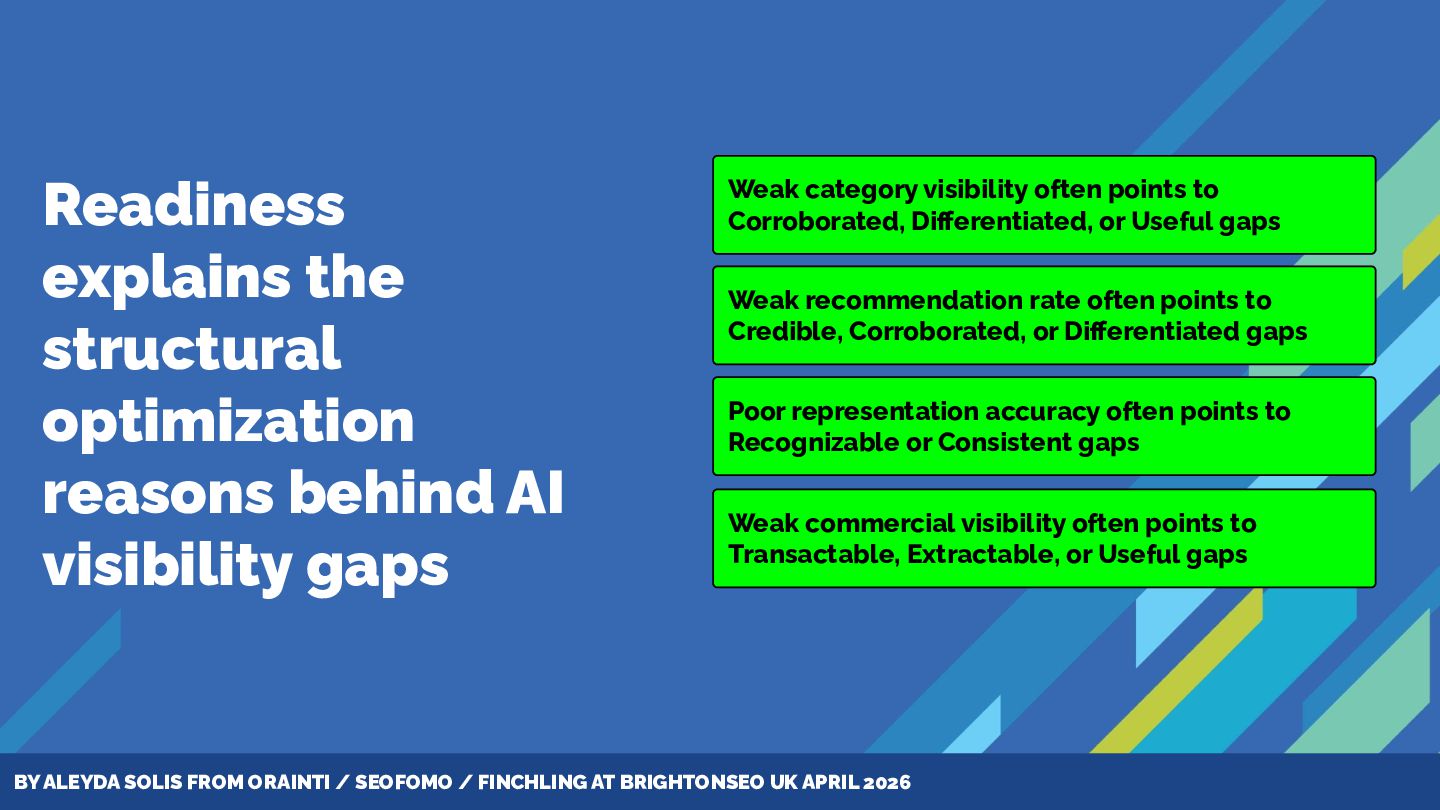
  28. Readiness explains the structural optimization reasons behind AI visibility gaps

    Weak category visibility often points to Corroborated, Differentiated, or Useful gaps Weak recommendation rate often points to Credible, Corroborated, or Differentiated gaps Poor representation accuracy often points to Recognizable or Consistent gaps Weak commercial visibility often points to Transactable, Extractable, or Useful gaps BY ALEYDA SOLIS FROM ORAINTI / SEOFOMO / FINCHLING AT BRIGHTONSEO UK APRIL 2026
  29. BY ALEYDA SOLIS FROM ORAINTI / SEOFOMO / FINCHLING AT

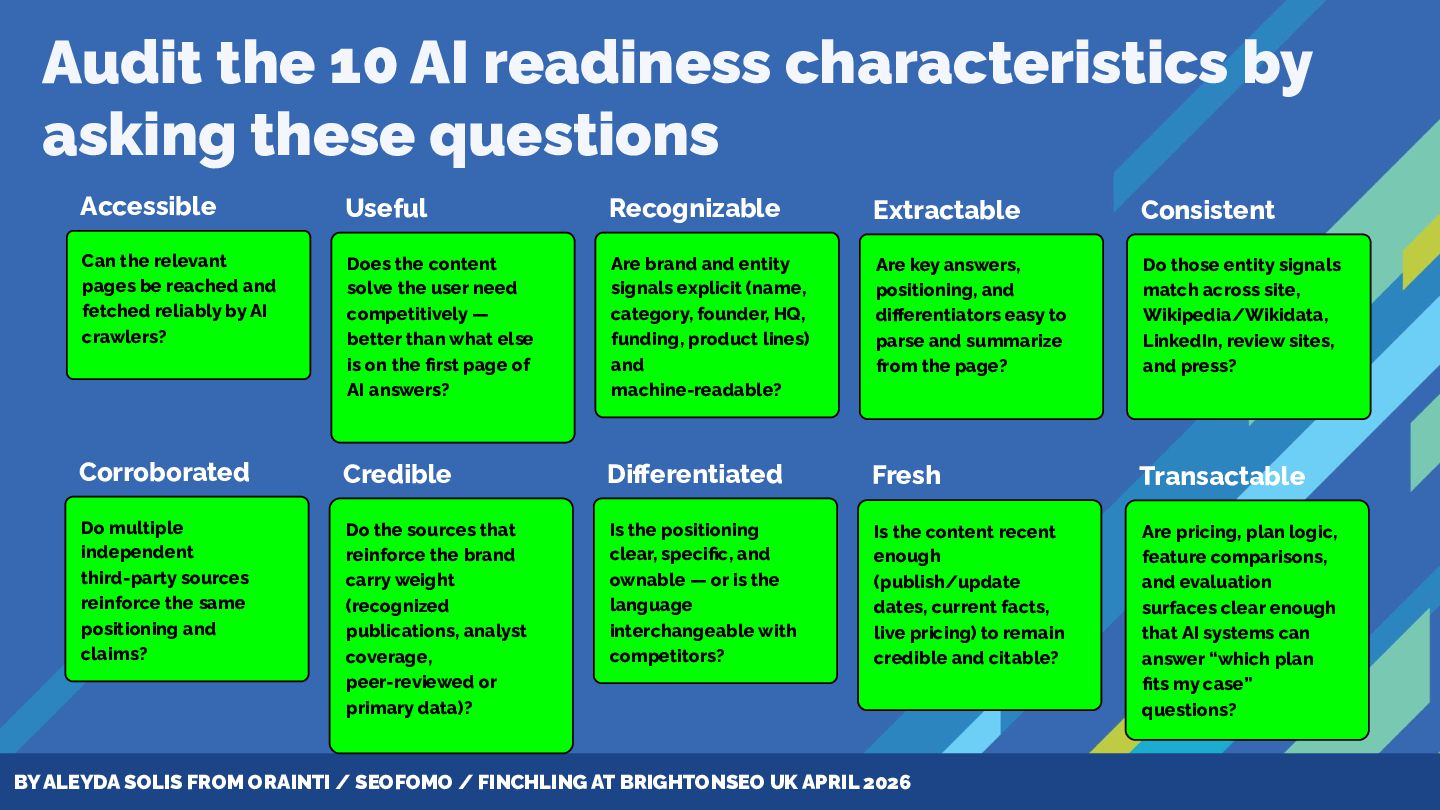
    BRIGHTONSEO UK APRIL 2026 Can the relevant pages be reached and fetched reliably by AI crawlers? Accessible Does the content solve the user need competitively — better than what else is on the first page of AI answers? Useful Are brand and entity signals explicit (name, category, founder, HQ, funding, product lines) and machine-readable? Recognizable Are key answers, positioning, and differentiators easy to parse and summarize from the page? Extractable Do those entity signals match across site, Wikipedia/Wikidata, LinkedIn, review sites, and press? Consistent Do multiple independent third-party sources reinforce the same positioning and claims? Corroborated Do the sources that reinforce the brand carry weight (recognized publications, analyst coverage, peer-reviewed or primary data)? Credible Is the positioning clear, specific, and ownable — or is the language interchangeable with competitors? Differentiated Is the content recent enough (publish/update dates, current facts, live pricing) to remain credible and citable? Fresh Are pricing, plan logic, feature comparisons, and evaluation surfaces clear enough that AI systems can answer “which plan fits my case” questions? Transactable Audit the 10 AI readiness characteristics by asking these questions
  30. BY ALEYDA SOLIS FROM ORAINTI / SEOFOMO / FINCHLING AT

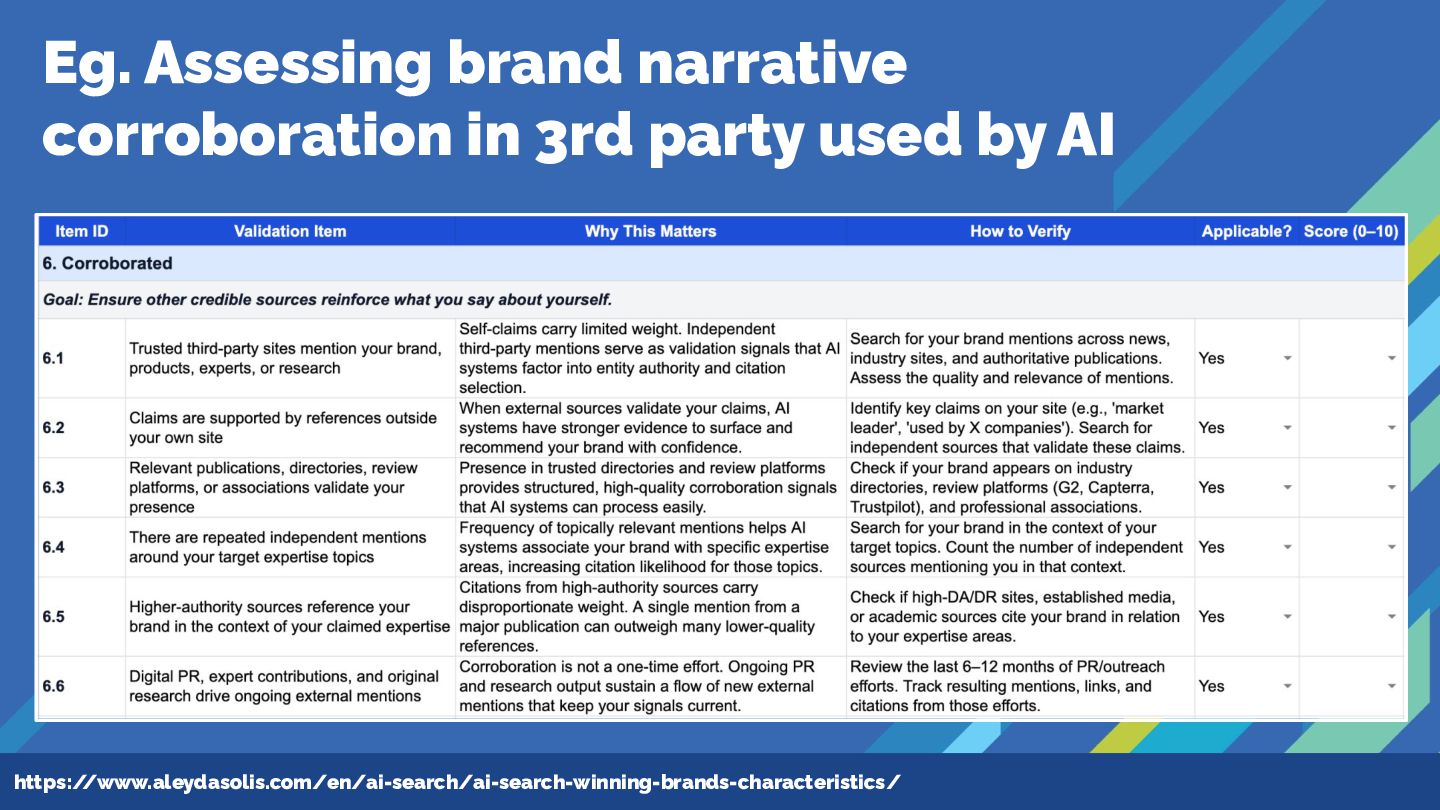
    BRIGHTONSEO UK APRIL 2026 https:/ /www.aleydasolis.com/en/ai-search/ai-search-winning-brands-characteristics/ Eg. Assessing brand narrative corroboration in 3rd party used by AI
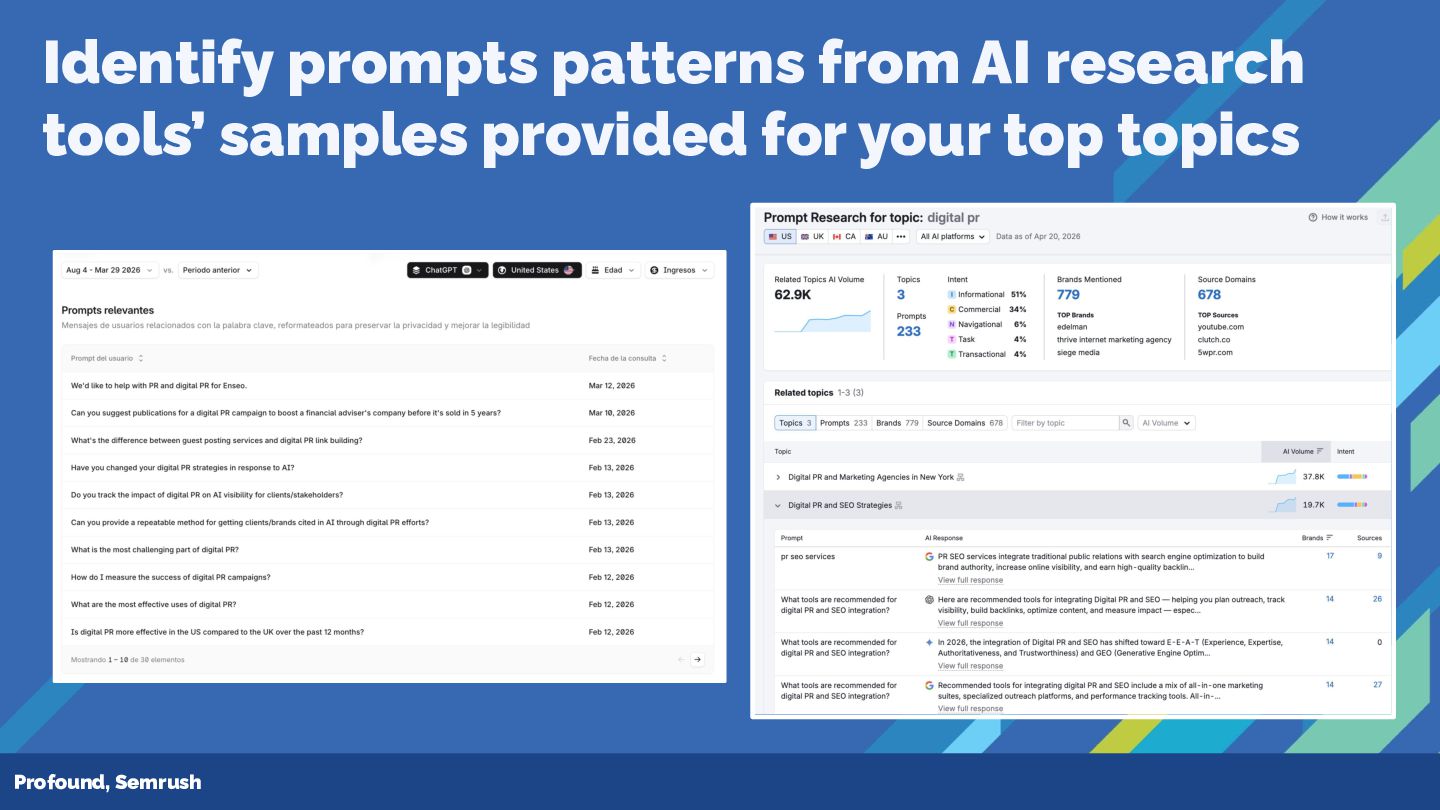
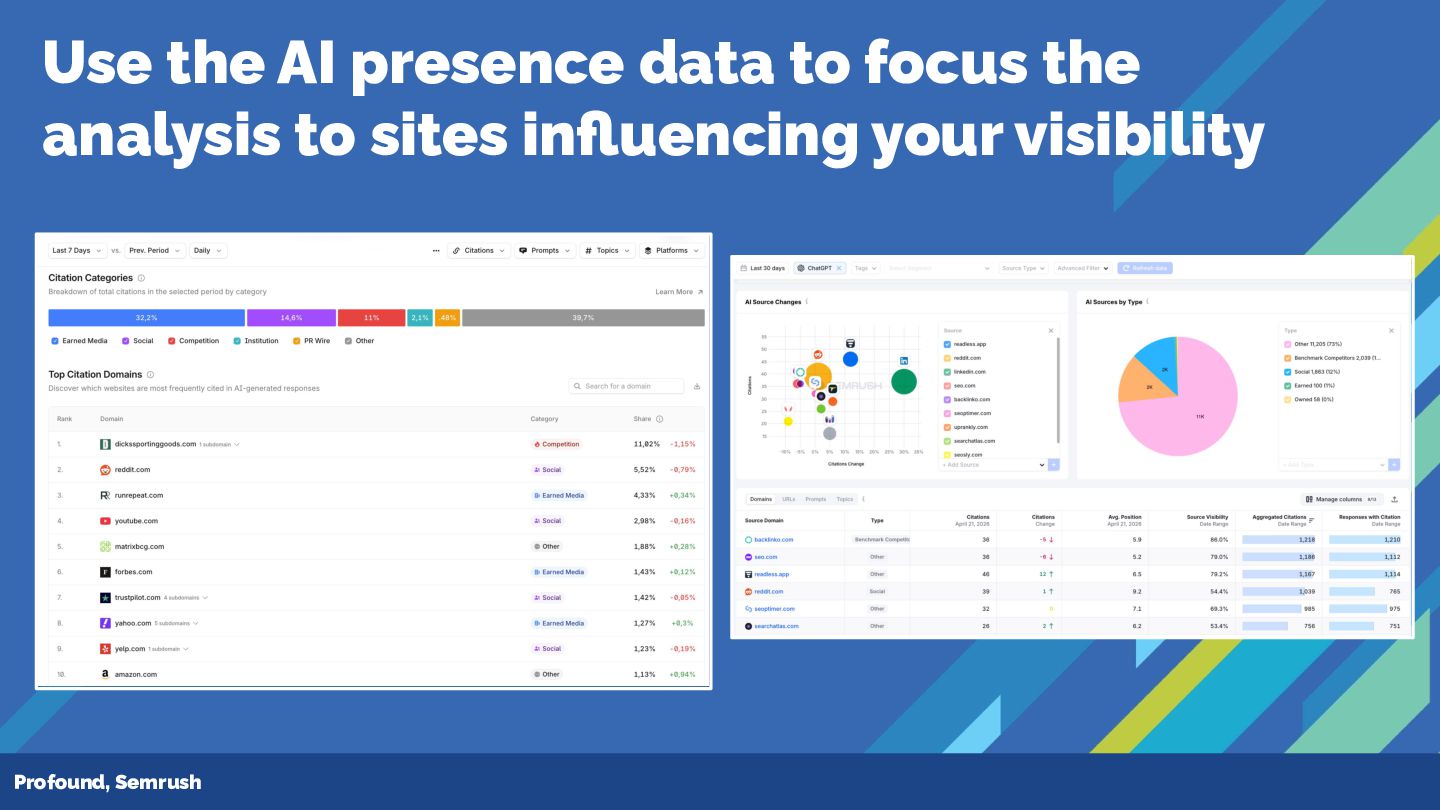
  31. Profound, Semrush Use the AI presence data to focus the

    analysis to sites influencing your visibility
  32. BY ALEYDA SOLIS FROM ORAINTI / SEOFOMO / FINCHLING AT

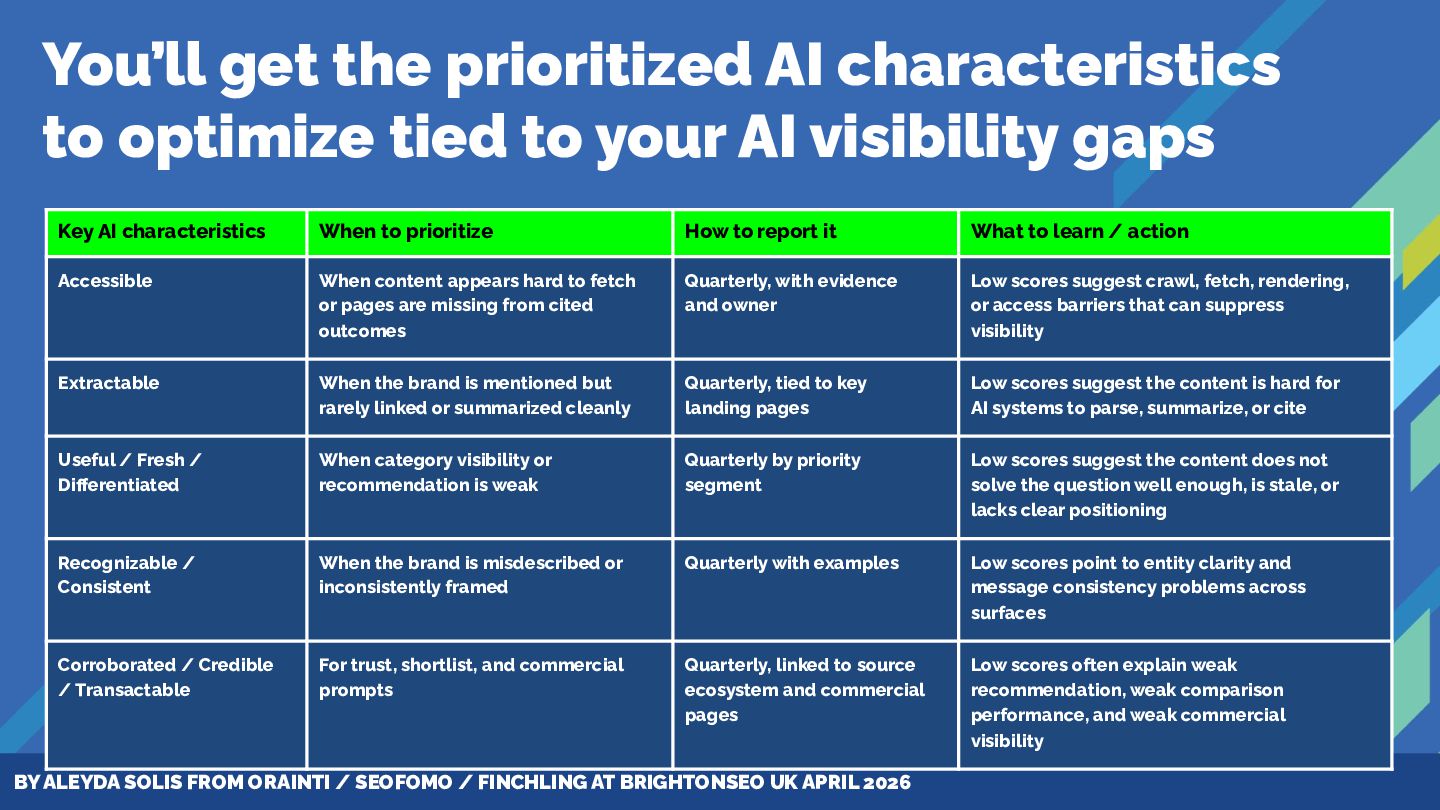
    BRIGHTONSEO UK APRIL 2026 Key AI characteristics When to prioritize How to report it What to learn / action Accessible When content appears hard to fetch or pages are missing from cited outcomes Quarterly, with evidence and owner Low scores suggest crawl, fetch, rendering, or access barriers that can suppress visibility Extractable When the brand is mentioned but rarely linked or summarized cleanly Quarterly, tied to key landing pages Low scores suggest the content is hard for AI systems to parse, summarize, or cite Useful / Fresh / Differentiated When category visibility or recommendation is weak Quarterly by priority segment Low scores suggest the content does not solve the question well enough, is stale, or lacks clear positioning Recognizable / Consistent When the brand is misdescribed or inconsistently framed Quarterly with examples Low scores point to entity clarity and message consistency problems across surfaces Corroborated / Credible / Transactable For trust, shortlist, and commercial prompts Quarterly, linked to source ecosystem and commercial pages Low scores often explain weak recommendation, weak comparison performance, and weak commercial visibility You’ll get the prioritized AI characteristics to optimize tied to your AI visibility gaps
  33. BY ALEYDA SOLIS FROM ORAINTI / SEOFOMO / FINCHLING AT

    BRIGHTONSEO UK APRIL 2026 3. Business Impact Are AI visibility and readiness efforts translating into value?
  34. BY ALEYDA SOLIS FROM ORAINTI / SEOFOMO / FINCHLING AT

    BRIGHTONSEO UK APRIL 2026 The goal of this stage is not perfect attribution, it’s an honest reporting model to support budget, planning, and prioritization decisions without overclaiming
  35. BY ALEYDA SOLIS FROM ORAINTI / SEOFOMO / FINCHLING AT

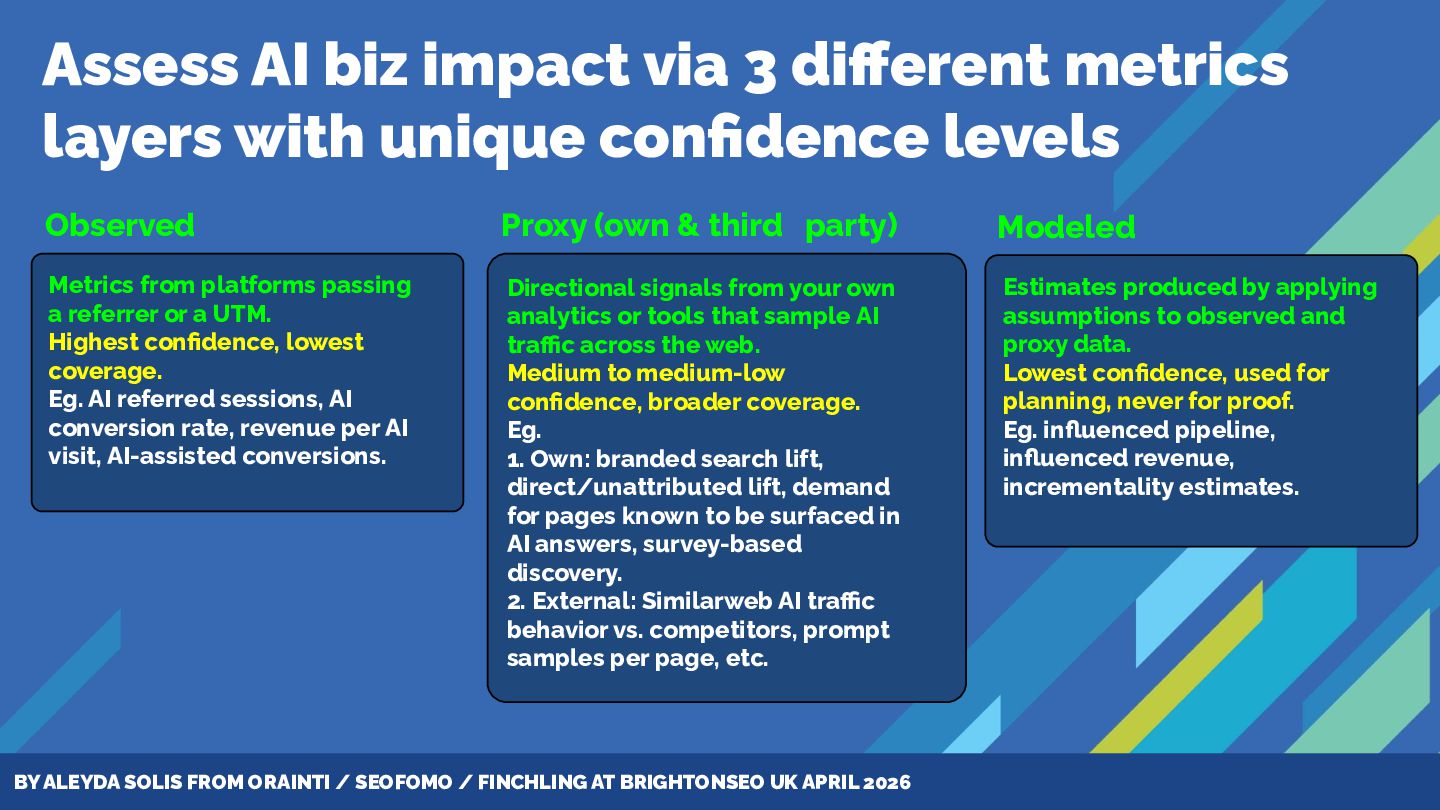
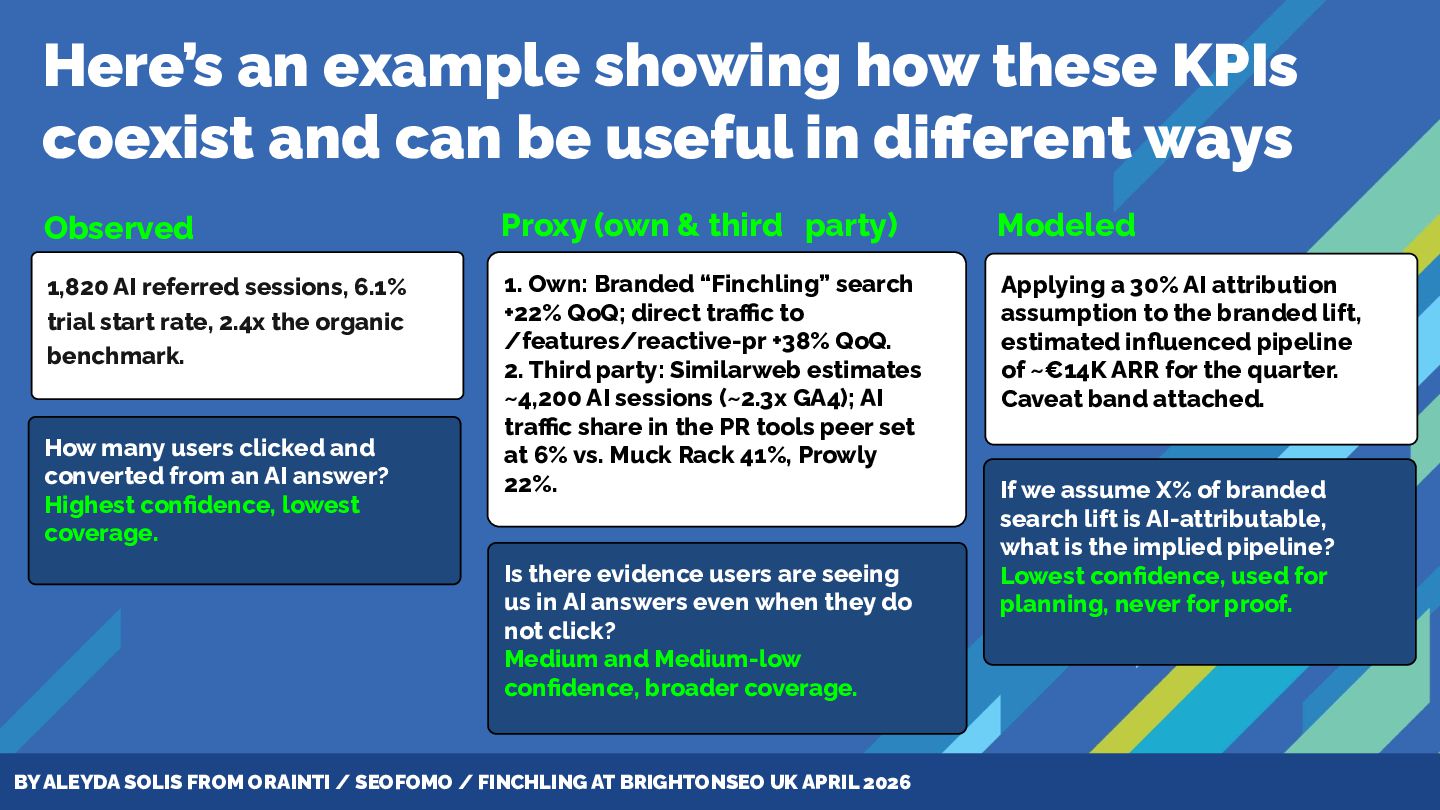
    BRIGHTONSEO UK APRIL 2026 Metrics from platforms passing a referrer or a UTM. Highest confidence, lowest coverage. Eg. AI referred sessions, AI conversion rate, revenue per AI visit, AI-assisted conversions. Directional signals from your own analytics or tools that sample AI traffic across the web. Medium to medium-low confidence, broader coverage. Eg. 1. Own: branded search lift, direct/unattributed lift, demand for pages known to be surfaced in AI answers, survey-based discovery. 2. External: Similarweb AI traffic behavior vs. competitors, prompt samples per page, etc. Estimates produced by applying assumptions to observed and proxy data. Lowest confidence, used for planning, never for proof. Eg. influenced pipeline, influenced revenue, incrementality estimates. Observed Proxy (own & third party) Modeled Assess AI biz impact via 3 different metrics layers with unique confidence levels
  36. BY ALEYDA SOLIS FROM ORAINTI / SEOFOMO / FINCHLING AT

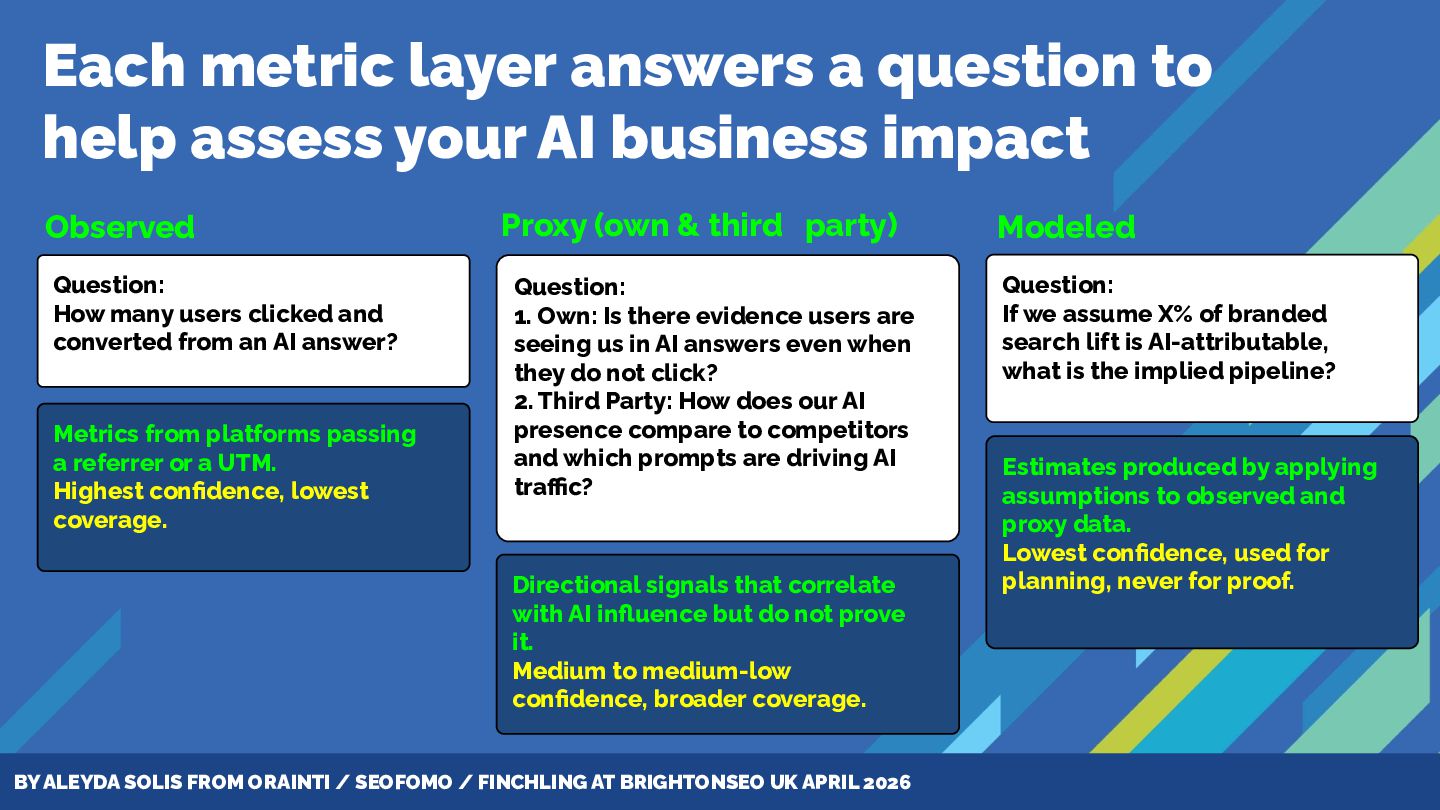
    BRIGHTONSEO UK APRIL 2026 Metrics from platforms passing a referrer or a UTM. Highest confidence, lowest coverage. Directional signals that correlate with AI influence but do not prove it. Medium to medium-low confidence, broader coverage. Estimates produced by applying assumptions to observed and proxy data. Lowest confidence, used for planning, never for proof. Observed Modeled Each metric layer answers a question to help assess your AI business impact Proxy (own & third party) Question: How many users clicked and converted from an AI answer? Question: 1. Own: Is there evidence users are seeing us in AI answers even when they do not click? 2. Third Party: How does our AI presence compare to competitors and which prompts are driving AI traffic? Question: If we assume X% of branded search lift is AI-attributable, what is the implied pipeline?
  37. BY ALEYDA SOLIS FROM ORAINTI / SEOFOMO / FINCHLING AT

    BRIGHTONSEO UK APRIL 2026 Here’s an example showing how these KPIs coexist and can be useful in different ways 1,820 AI referred sessions, 6.1% trial start rate, 2.4x the organic benchmark. 1. Own: Branded “Finchling” search +22% QoQ; direct traffic to /features/reactive-pr +38% QoQ. 2. Third party: Similarweb estimates ~4,200 AI sessions (~2.3x GA4); AI traffic share in the PR tools peer set at 6% vs. Muck Rack 41%, Prowly 22%. Applying a 30% AI attribution assumption to the branded lift, estimated influenced pipeline of ~€14K ARR for the quarter. Caveat band attached. Observed Modeled How many users clicked and converted from an AI answer? Highest confidence, lowest coverage. Is there evidence users are seeing us in AI answers even when they do not click? Medium and Medium-low confidence, broader coverage. If we assume X% of branded search lift is AI-attributable, what is the implied pipeline? Lowest confidence, used for planning, never for proof. Proxy (own & third party)
  38. BY ALEYDA SOLIS FROM ORAINTI / SEOFOMO / FINCHLING AT

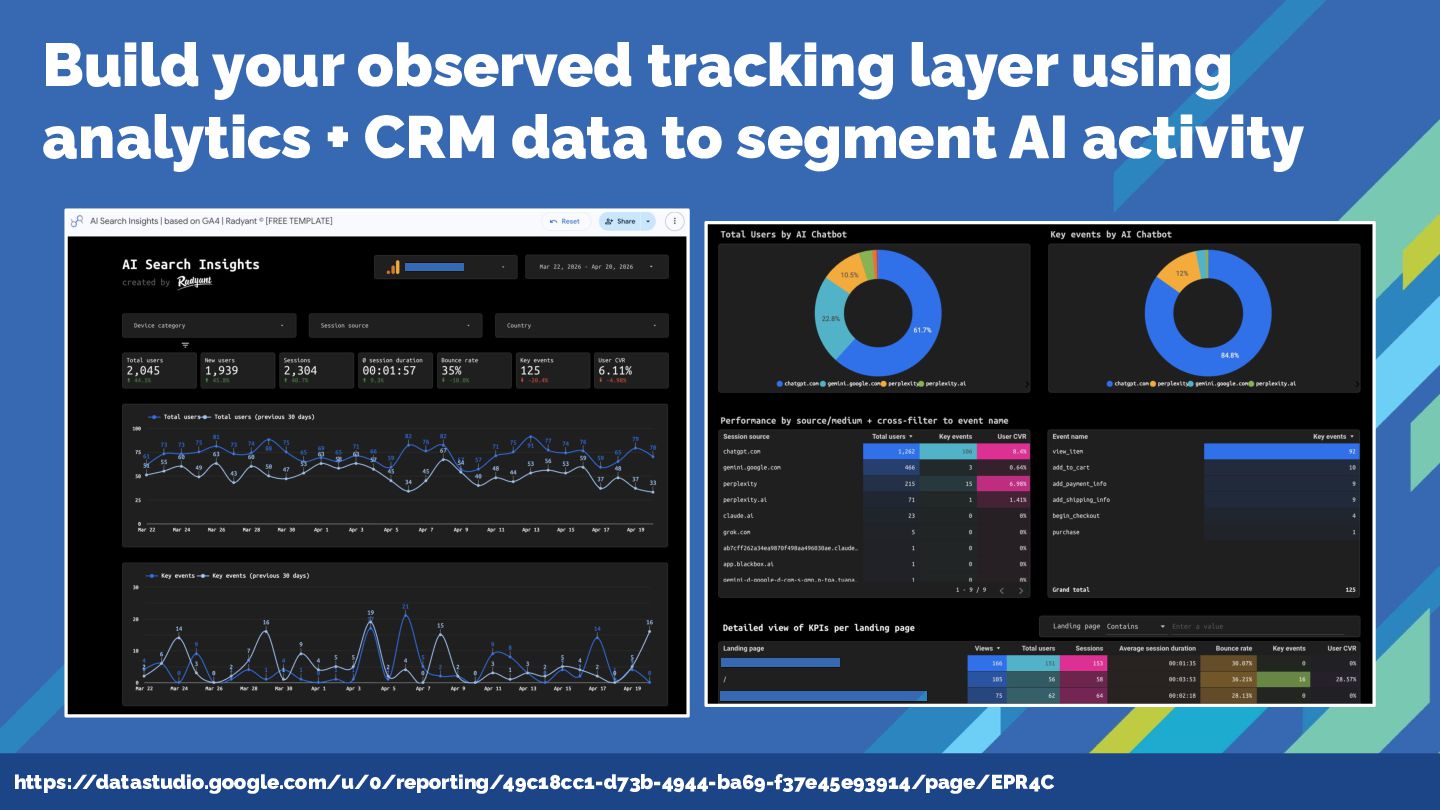
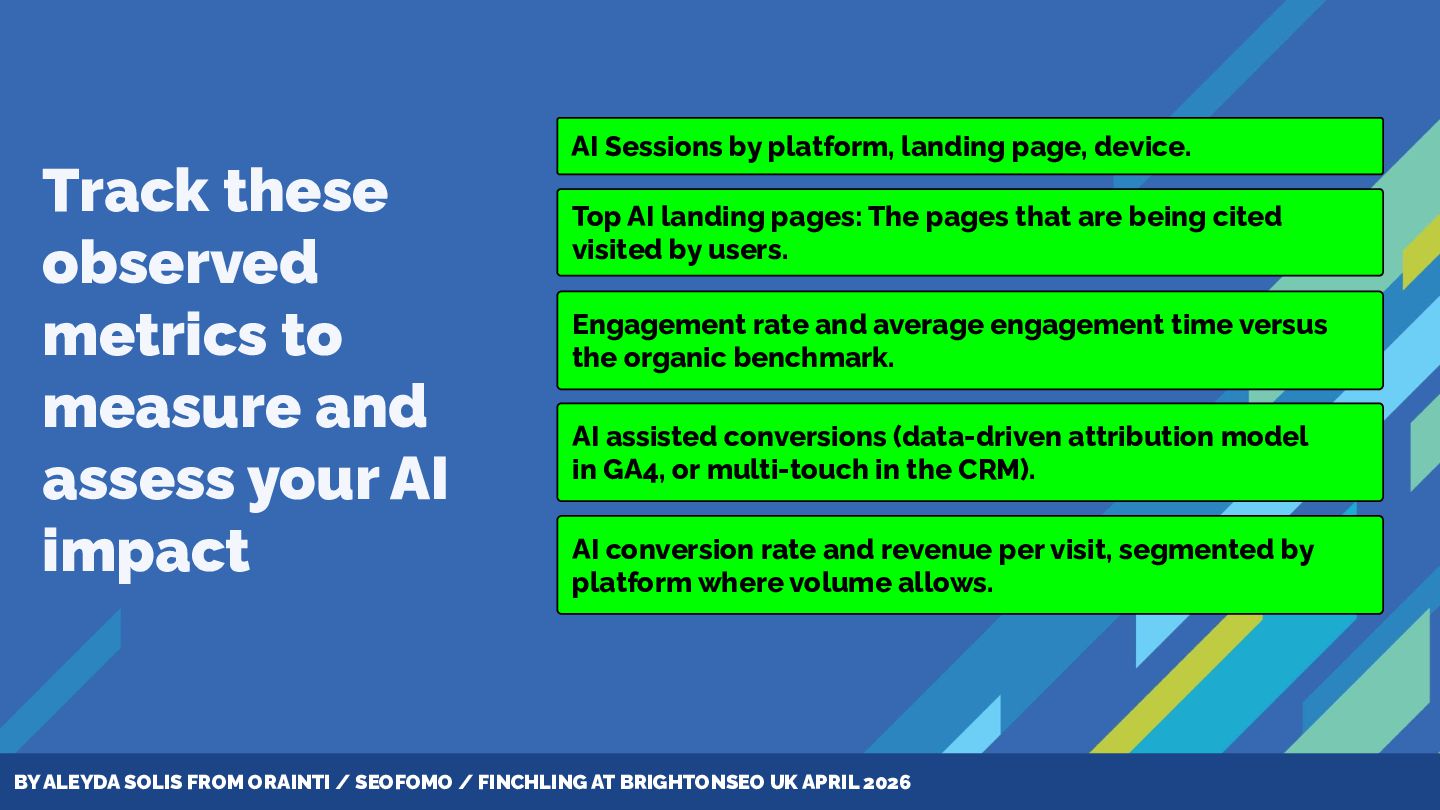
    BRIGHTONSEO UK APRIL 2026 AI Sessions by platform, landing page, device. Engagement rate and average engagement time versus the organic benchmark. AI conversion rate and revenue per visit, segmented by platform where volume allows. AI assisted conversions (data-driven attribution model in GA4, or multi-touch in the CRM). Top AI landing pages: The pages that are being cited visited by users. Track these observed metrics to measure and assess your AI impact
  39. BY ALEYDA SOLIS FROM ORAINTI / SEOFOMO / FINCHLING AT

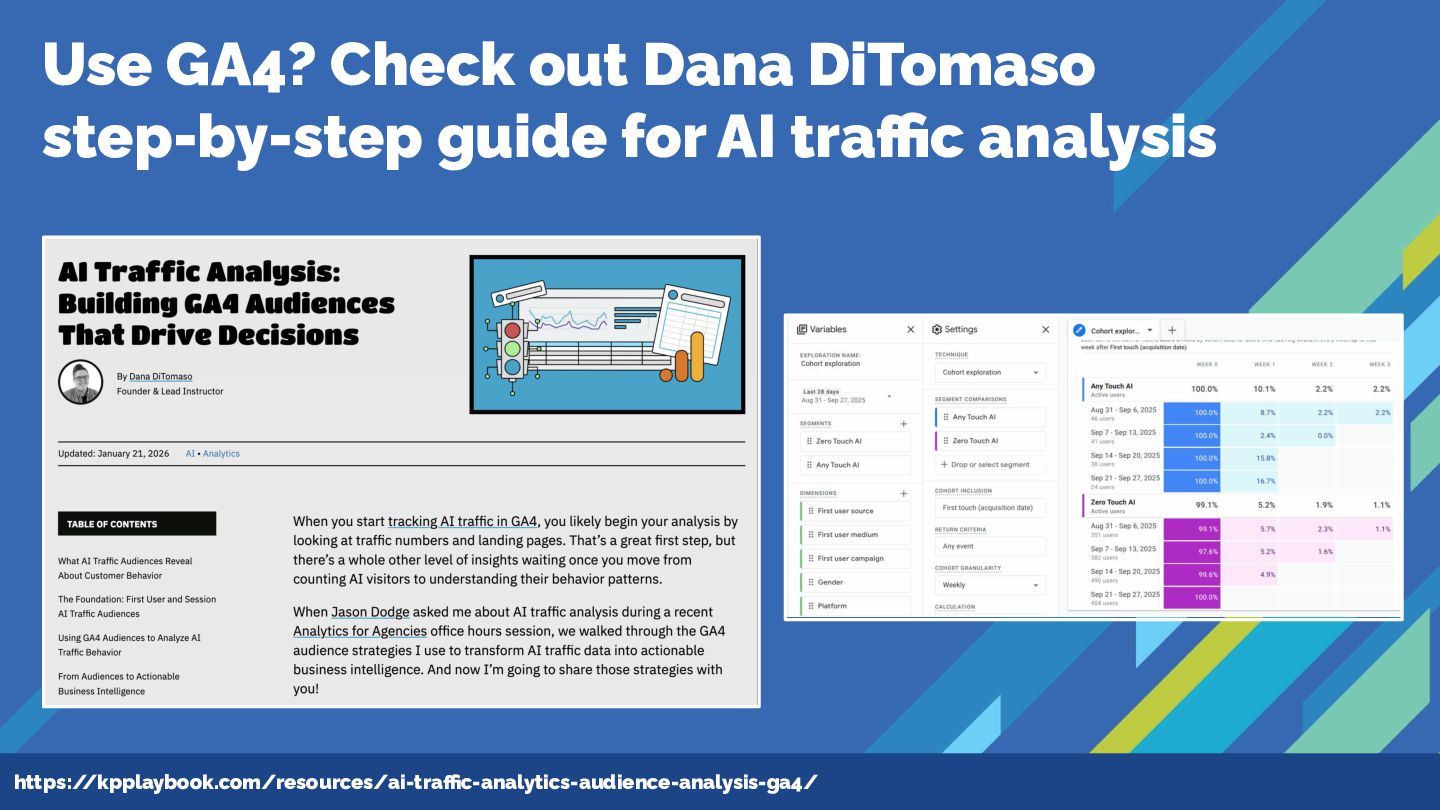
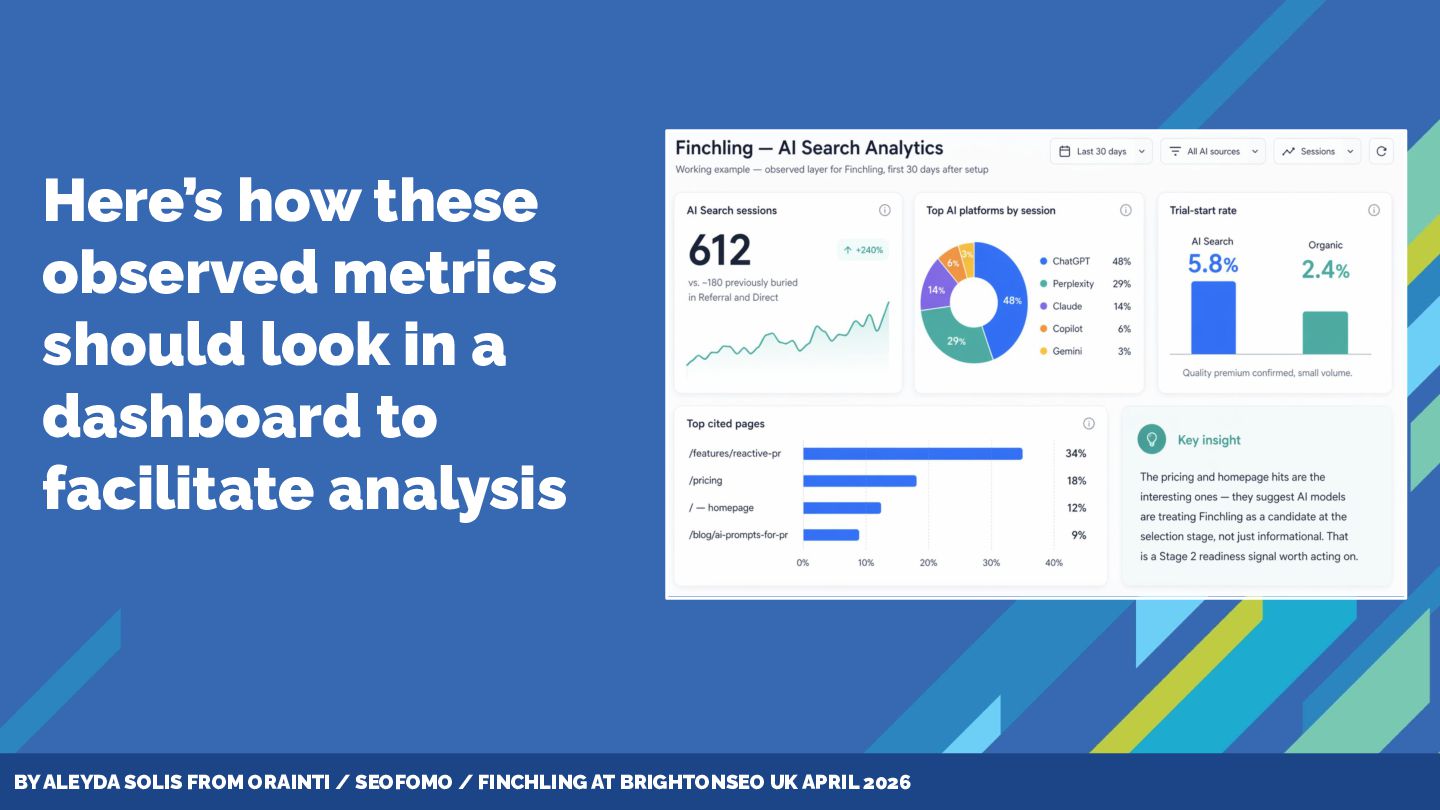
    BRIGHTONSEO UK APRIL 2026 Here’s how these observed metrics should look in a dashboard to facilitate analysis
  40. BY ALEYDA SOLIS FROM ORAINTI / SEOFOMO / FINCHLING AT

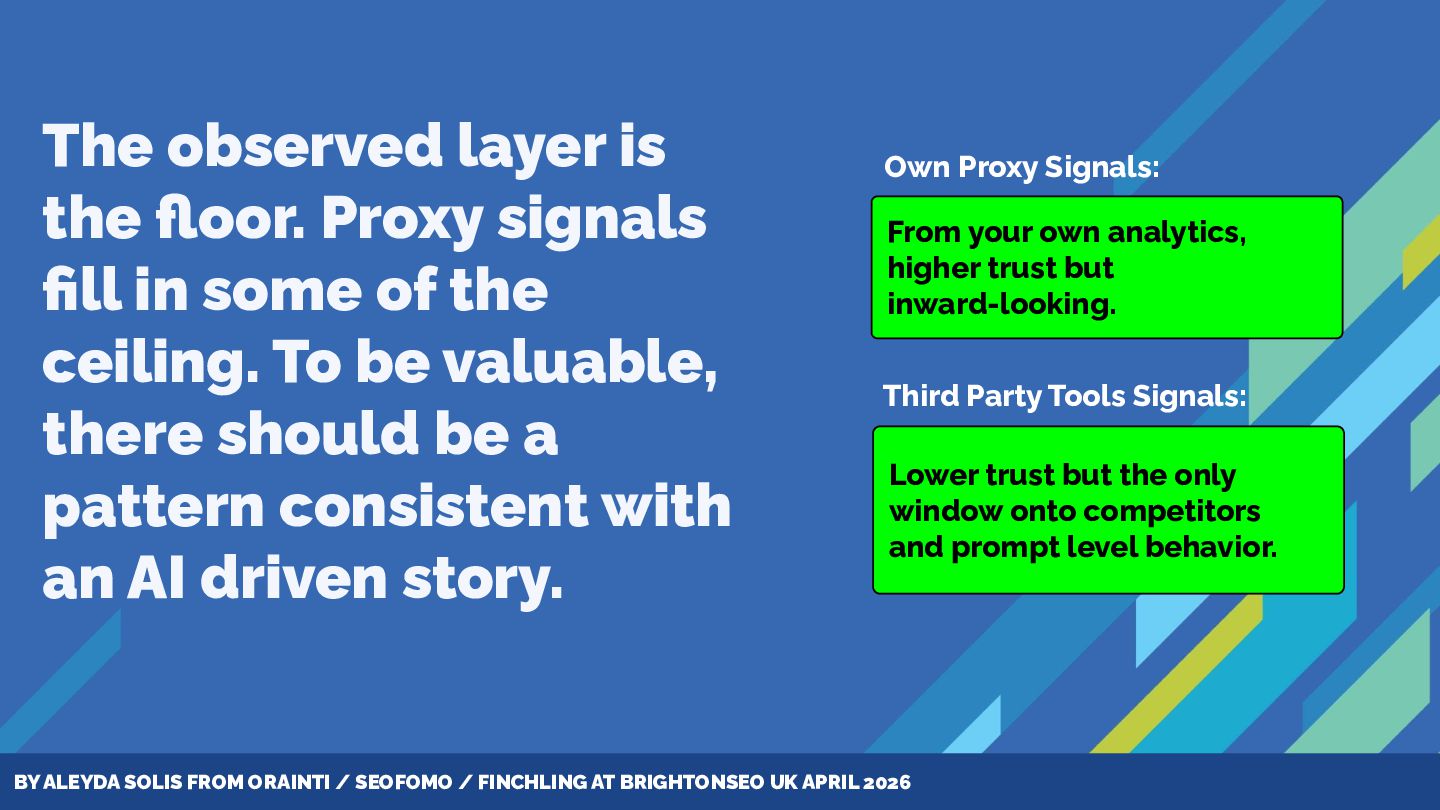
    BRIGHTONSEO UK APRIL 2026 The observed layer is the floor. Proxy signals fill in some of the ceiling. To be valuable, there should be a pattern consistent with an AI driven story. From your own analytics, higher trust but inward-looking. Lower trust but the only window onto competitors and prompt level behavior. Own Proxy Signals: Third Party Tools Signals:
  41. BY ALEYDA SOLIS FROM ORAINTI / SEOFOMO / FINCHLING AT

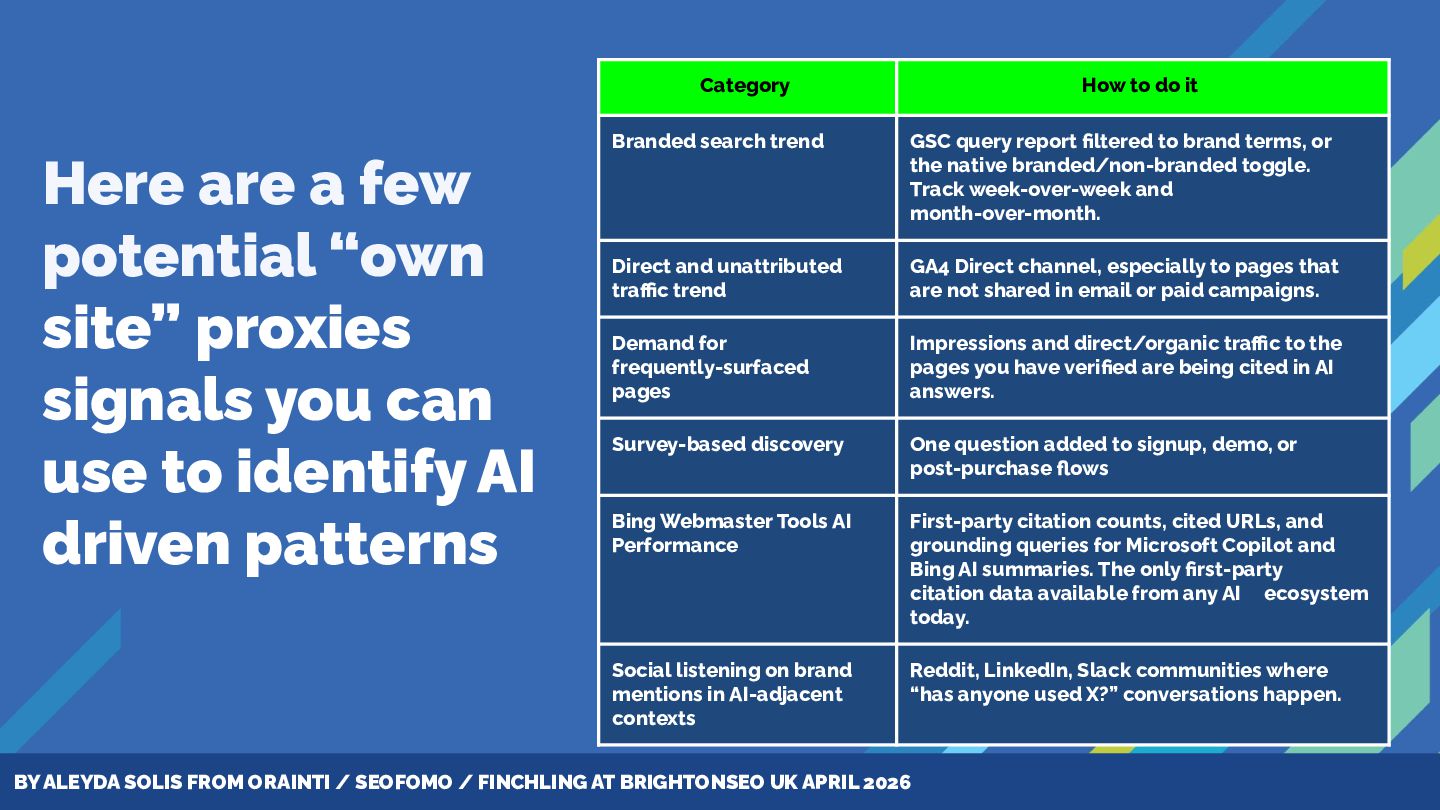
    BRIGHTONSEO UK APRIL 2026 Category How to do it Branded search trend GSC query report filtered to brand terms, or the native branded/non-branded toggle. Track week-over-week and month-over-month. Direct and unattributed traffic trend GA4 Direct channel, especially to pages that are not shared in email or paid campaigns. Demand for frequently-surfaced pages Impressions and direct/organic traffic to the pages you have verified are being cited in AI answers. Survey-based discovery One question added to signup, demo, or post-purchase flows Bing Webmaster Tools AI Performance First-party citation counts, cited URLs, and grounding queries for Microsoft Copilot and Bing AI summaries. The only first-party citation data available from any AI ecosystem today. Social listening on brand mentions in AI-adjacent contexts Reddit, LinkedIn, Slack communities where “has anyone used X?” conversations happen. Here are a few potential “own site” proxies signals you can use to identify AI driven patterns
  42. BY ALEYDA SOLIS FROM ORAINTI / SEOFOMO / FINCHLING AT

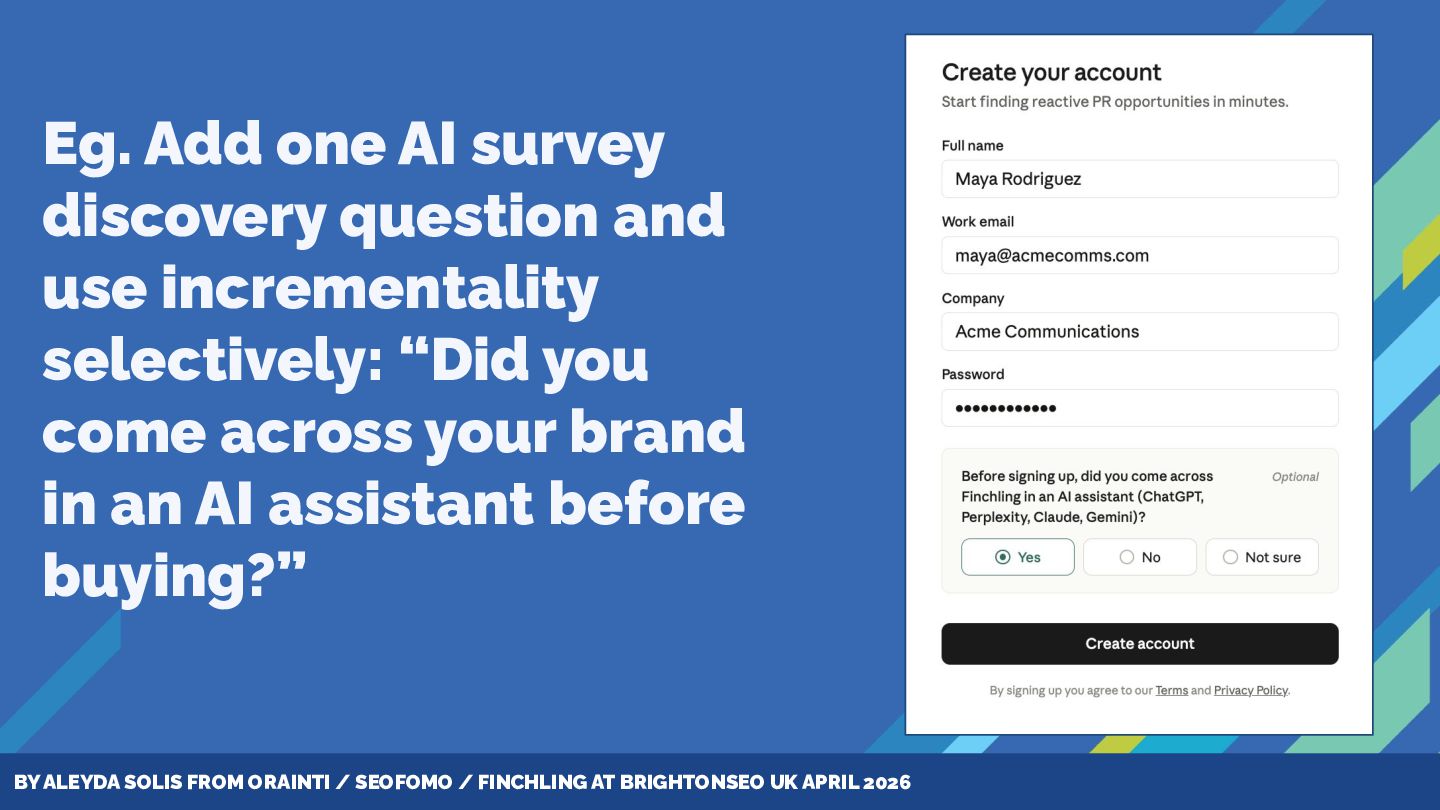
    BRIGHTONSEO UK APRIL 2026 Eg. Add one AI survey discovery question and use incrementality selectively: “Did you come across your brand in an AI assistant before buying?”
  43. BY ALEYDA SOLIS FROM ORAINTI / SEOFOMO / FINCHLING AT

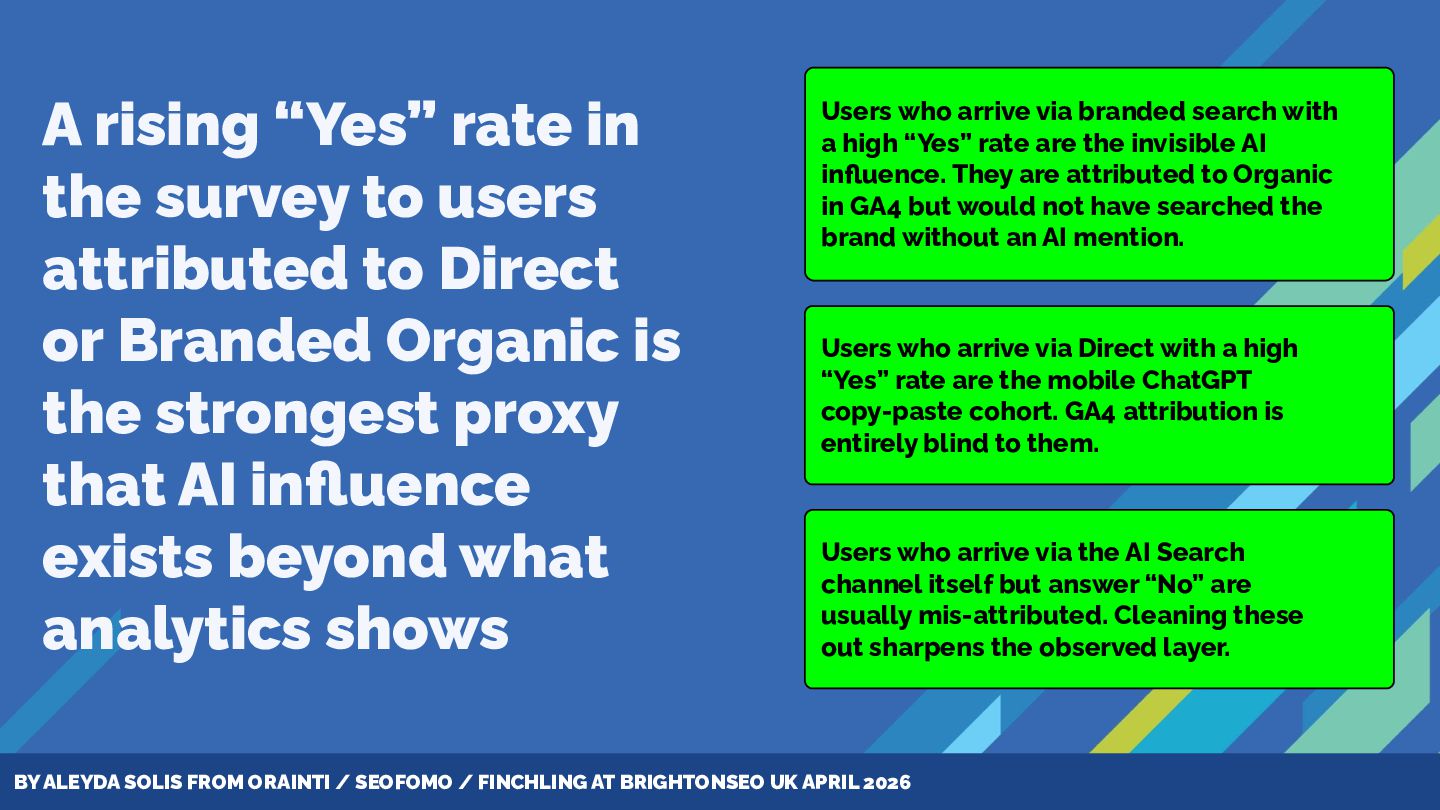
    BRIGHTONSEO UK APRIL 2026 A rising “Yes” rate in the survey to users attributed to Direct or Branded Organic is the strongest proxy that AI influence exists beyond what analytics shows Users who arrive via branded search with a high “Yes” rate are the invisible AI influence. They are attributed to Organic in GA4 but would not have searched the brand without an AI mention. Users who arrive via Direct with a high “Yes” rate are the mobile ChatGPT copy-paste cohort. GA4 attribution is entirely blind to them. Users who arrive via the AI Search channel itself but answer “No” are usually mis-attributed. Cleaning these out sharpens the observed layer.
  44. BY ALEYDA SOLIS FROM ORAINTI / SEOFOMO / FINCHLING AT

    BRIGHTONSEO UK APRIL 2026 Third party proxies like Similarweb or Semrush data can directionally fill industry, competitors & prompts level behavior for relative reads
  45. BY ALEYDA SOLIS FROM ORAINTI / SEOFOMO / FINCHLING AT

    BRIGHTONSEO UK APRIL 2026 For example, here are 3 third-party proxies reads worth running monthly 1. Prompt samples driving traffic to your top AI landing pages. Use it to: • Extend your Presence prompt set • Diagnose landing-page mismatch • Inform Readiness work 2. Competitive benchmarking of AI traffic share, top landing pages, and top prompts per page. Use it to assess: • AI traffic share trend vs competitors over time • Which pages competitors are getting AI traffic to and which are distinctively yours. • Prompt overlap per page vs competitors 3. AI platform mix over time, benchmarked. Which AI platforms refer traffic to your site and to competitors. Use it to assess: • Platform specific decay • Platform specific wins • Catch category shifts early
  46. BY ALEYDA SOLIS FROM ORAINTI / SEOFOMO / FINCHLING AT

    BRIGHTONSEO UK APRIL 2026 Build a dashboard with the different business metrics layers specifying levels of confidence, helping to assess AI search biz evolution & drive action
  47. BY ALEYDA SOLIS FROM ORAINTI / SEOFOMO / FINCHLING AT

    BRIGHTONSEO UK APRIL 2026 Shows whether known AI traffic is growing or shrinking. Remember this is the floor, not the ceiling. AI-referred sessions Shows whether known AI traffic is growing or shrinking. Remember this is the floor, not the ceiling. AI conversion rate / revenue per visit Shows whether AI contributes to conversion paths even when it is not the final click. AI-assisted conversions Detects recall and downstream demand effects beyond measurable referrals. Branded search / direct / surfaced page demand Surfaces AI influence on users who arrive via branded or direct, otherwise invisible. Survey AI discovery rate Shows whether observed growth is share-taking or category-riding. Flat share during category growth = loss. Third-party AI traffic share vs. peers Fills the gap analytics cannot: what question triggered the traffic. Drives prompt set updates and page fixes. Third-party prompt samples per top landing page Surfaces platform specific risks and opportunities early. Over indexing on one platform is a fragility signal. Third-party AI platform mix vs. peer average Useful for planning, never for proof. Overclaiming here erodes trust in the whole dashboard. Modelled influenced pipeline / revenue Each biz KPI should help understand your AI search presence & readiness impact
  48. BY ALEYDA SOLIS FROM ORAINTI / SEOFOMO / FINCHLING AT

    BRIGHTONSEO UK APRIL 2026 Metric How to select it How to report it What to learn / action Low readiness + low visibility Structural conditions are holding the brand back. Most common early-stage pattern. Prioritise access, extractability, entity clarity, corroboration. High readiness + low visibility Brand is underdistributed or underrepresented in the source ecosystem. Common for mature brands in crowded categories. Focus on source presence, distribution, trust ecosystem, competitive disadvantage. Visibility improving + impact flat Brand is appearing but not memorably, persuasively, or on the right pages. The commercially dangerous middle state. Improve recommendation quality, linked citations, memorability, landing-page fit. Strong informational + weak commercial visibility Visible early in the journey but not winning shortlist or selection moments. Classic SaaS pattern at scale. Improve commercial prompt coverage and transaction-ready surfaces. High visibility + strong recommendation + weak representation accuracy Being talked about but described wrong. Often the most commercially damaging pattern — actively costs deals. Entity and source correction: Wikipedia/Wikidata, schema consistency, review sites, supplier pages, analyst briefings. One segment strong, another weak Issue is segment-specific, not brand-wide. Easy to miss in aggregate dashboards. Run a segment-specific readiness and source-ecosystem review. Tying your AI presence, readiness & biz KPIs is what will help to drive relevant action
  49. BY ALEYDA SOLIS FROM ORAINTI / SEOFOMO / FINCHLING AT

    BRIGHTONSEO UK APRIL 2026 Eg. The AI metrics layers assessment outcome and next steps for a SaaS AI Metrics Layers Status: • Presence dashboard shows 58% prompt coverage in ChatGPT for discovery prompts but 11% recommendation rate in shortlist prompts. • Readiness assessment shows Differentiated and Credible scoring well, but Corroborated scoring low (few third-party reviews, limited presence on roundup sites). • Business Impact shows flat AI referral traffic and slightly rising branded search. The Assessment and Next Steps: • Matrix read: “high readiness + low visibility” at the commercial end of the funnel. • Diagnosis: the structural work is mostly done. The bottleneck is source-ecosystem presence at the comparison stage. AI models have nowhere to learn about Finchling in the context of selection prompts because Finchling is not in the sources they cite for those prompts. • Move: concentrated effort on getting Finchling onto software roundup pages, G2 and Capterra category pages, and reactive-PR tool comparisons. Not more content. Not more technical SEO. The lever is external corroboration.
  50. BY ALEYDA SOLIS FROM ORAINTI / SEOFOMO / FINCHLING AT

    BRIGHTONSEO UK APRIL 2026 Metric Layer Why it matters KPI Roles 1. Presence Are you actually appearing, and how? Replaces traffic-only thinking with visibility and representation measurement Visibility KPIs Optimization and monitoring 2. Readiness Are you structurally prepared to be surfaced? Explains why visibility is weak, strong, or unstable; the diagnostic layer Diagnostic KPIs Diagnosis and prioritization 3. Business Impact Are visibility and readiness translating into value? Connects AI search activity to commercial outcomes without overclaiming attribution Outcome KPIs Executive reporting and decision-making It’s time to use the 3 AI metric layer to assess, understand & drive impact
  51. BY ALEYDA SOLIS FROM ORAINTI / SEOFOMO / FINCHLING AT

    BRIGHTONSEO UK APRIL 2026 Thanks! Questions? SEO Consultant & Founder ❏ International SEO Consultant & Founder of Orainti ❏ Co-founder of Finchling ❏ Creator of the SEOFOMO, Marketing FOMO, AI Marketers and Trending Campaigns Newsletters ❏ Maker of LearningAIsearch.com & LearningSEO.io ❏ Author of SEO, Las Claves Esenciales ❏ Spoke at +200 events in +30 countries BY ALEYDA SOLIS FROM ORAINTI / SEOFOMO / FINCHLING AT BRIGHTONSEO UK APRIL 2026 Speaker and author